Method and System for Carbon Capture and Recycling
Abstract
A method for recycling CO 2 from CO 2 containing inputs to produce hydrocarbon products includes the steps of (i) capturing CO 2 from at least one CO 2 containing input, at least one of the at least one CO 2 containing input including air; (ii) producing a CO 2 feed stream from the captured CO 2 ; (iii) reacting the CO 2 feed stream with a H 2 feed stream to produce a methane containing output; and (iv) separating the methane containing output so as to at least provide methane and a first waste output, wherein the first waste output is incinerated or gasified to provide one of the at least one CO 2 containing inputs for step (i).
Claims (10)
1. A method for recycling CO 2 from CO 2 containing inputs to produce hydrocarbon products, the method including the steps of: (i) capturing CO 2 from at least one CO 2 containing input; (ii) producing a CO 2 feed stream from the captured CO 2 ; (iii) reacting the CO 2 feed stream with a H 2 feed stream to produce a methane containing output; (iv) separating the methane containing output so as to at least provide methane and a first waste output; (v) processing methane from the methane containing output to produce an acetylene containing output; and, (vi) separating the acetylene containing output so as to at least provide acetylene and a second waste output, wherein the first waste output is incinerated or gasified to provide one of the at least one CO 2 containing inputs for step (i).
Show 9 dependent claims
2. The method of claim 1 , wherein one or more of the at least one CO 2 containing input is derived from incinerator exhaust streams or industrial plumes.
3. The method of claim 1 , wherein the H 2 feed stream is provided by a water electrolysis process.
4. The method of claim 3 , wherein water produced during step (iii) is provided for the water electrolysis process.
5. The method of claim 1 , wherein, in step (i), CO 2 is captured using a calcium oxide based capture process.
6. The method of claim 1 , wherein step (v) includes heating the methane with a thermal plasma reactor.
7. The method claim 1 , further including the step of (vii) processing methane from the methane containing output to produce a hydrocarbon containing output.
8. The method of claim 7 , further including the step of (viii) separating the hydrocarbon containing output so as to at least provide one or more preselected hydrocarbon products and a third waste output.
9. The method of claim 7 , wherein step (vii) includes heating the methane, and the methane is heated by a thermal plasma reactor configured such that plasma is provided in feed with the methane.
10. The method of claim 1 , wherein the second waste output is incinerated or gasified to provide one of the at least one CO 2 containing inputs for step (i).
Full Description
Show full text →
RELATED APPLICATIONS
This application is a continuation of co-pending U.S. patent application Ser. No. 16/310,481, filed Dec. 17, 2018, which is a U.S. national stage patent application under 35 U.S.C. § 371 claiming priority to application PCT/AU2017/050613, filed Jun. 16, 2017, which claims priority to Australian patent application AU2016902386, filed Jun. 18, 2016, the entirety of both of which are incorporated herein by reference.
Field of the Invention
The present invention relates to a method and system for carbon capture and recycling, and in particular methods and systems for capturing CO 2 and producing methane, acetylene and/or other hydrocarbons.
BACKGROUND
The reference in this specification to any prior publication (or information derived from it), or to any matter which is known, is not, and should not be taken as an acknowledgment or admission or any form of suggestion that the prior publication (or information derived from it) or known matter forms part of the common general knowledge in the field of endeavour to which this specification relates.
Climate change is an important issue on the agenda of governments worldwide. It is proposed that climate change is accelerated by human production of “greenhouse gases”. Greenhouse gases are those which get trapped in the atmosphere and enhance the “greenhouse effect”. In the greenhouse effect, heat is trapped from escaping the earth due to a build-up of the greenhouse gases in the atmosphere. Therefore, in seeking to address climate change, several approaches look to reduce greenhouse gas emissions.
Carbon dioxide (CO 2 ) is one greenhouse gas where emissions are targeted. Several approaches have been developed to capture and/or reduce CO 2 emissions. One such approach is carbon capture and storage whereby CO 2 is captured (e.g., from air, flue gas, etc.) and then stored in selected geological rock formations below the Earth's surface. It will be appreciated that carbon capture and storages can be expensive, and furthermore, no usable products/outputs are produced from the captured CO 2 ; it is simply captured and stored.
The present invention seeks to provide an approach to reducing CO 2 emissions that also provides industrially applicable products.
SUMMARY OF THE INVENTION
In one broad form, the present invention provides a method for carbon capture and recycling, the method including the steps of: (i) Capturing CO 2 from at least one CO 2 containing input; (ii) producing a CO 2 feed stream from the captured CO 2 ; and (iii) reacting the CO 2 feed stream with a H 2 feed stream to produce a methane containing output.
In one form, the method further includes the step of (iv) separating the methane containing output so as to at least provide methane and a first waste output.
In one form, the first waste output is thermally treated to provide CO 2 for one of the at least CO 2 containing inputs for step (i).
In one form, one of the at least one CO 2 containing inputs includes air.
In one form, the H 2 feed stream is provided by a water electrolysis process.
In one form, water produced during step (iii) is provided for the water electrolysis process.
In one form, in step (i), CO 2 is captured using a calcium oxide based capture process.
In one form, the method further includes the step of: (v) processing methane from the methane containing output to produce acetylene containing output.
In one form, the method further includes the step of (vi) separating the acetylene containing output so as to at least provide acetylene and a second waste output.
In one form, the second waste output is thermally treated to provide CO 2 for one of the at least one CO 2 containing inputs for step (i).
In one form, step (v) includes heating the methane with a thermal plasma reactor.
In one form, the method further includes the step of (vii) processing methane from the methane containing output to produce a hydrocarbon containing output.
In one form, the method further includes the step of (viii) separating the hydrocarbon containing output so as to at least provide one or more preselected hydrocarbon products and a second waste output.
In one form, the second waste output is thermally treated to provide one of the at least one CO 2 containing inputs for step (i).
In one form, step (vii) includes heating the methane, and the methane is heated by a thermal plasma reactor configured such that plasma is provided in feed with the methane.
In a further broad form the present invention provides a system for carbon capture and recycling, the system including a CO 2 capture apparatus configured to capture CO 2 from at least one CO 2 containing input; and a first reactor configured to produce a methane containing output from a CO 2 feed stream derived from the CO 2 capture apparatus and an H 2 feed stream.
In one form, the system further includes: a first separator configured to separate the methane containing output so as to at least provide methane and a first waste output.
In one form the system further includes a thermal treatment apparatus configured to treat the first waste output so as to provide CO 2 containing input for the CO 2 capture apparatus.
In one from, the CO 2 capture apparatus is configured to capture CO 2 from an air input.
In one form, the system further includes a water electrolysis device for producing the H 2 feed stream. In one form, the water electrolysis device is configured to receive water for electrolysis produced in the first reactor.
In one form, the CO 2 capture apparatus is a Calcium Oxide based capture apparatus.
In one form, the system further includes: a second reactor configured to received methane produced in the first reactor and to produce an acetylene containing output therefrom.
In one form the system further includes: a second separator configured to separate the acetylene containing output so as to at least provide acetylene and a second waste output.
In one from, the second waste output is fed to the thermal treatment apparatus.
In one form, the second reactor is thermal plasma reactor.
In one from, the system further includes a second reactor configured to received methane produced in the first reactor and to produce a hydrocarbon containing output therefrom.
In one form, the system further includes a second separator configured to separate the hydrocarbon containing output so as to at least provide preselected hydrocarbon products and a second waste output.
In one form, the second waste output is fed to the thermal treatment apparatus.
In one form, the second reactor is a thermal plasma reactor configured provide plasma in feed with the methane.
BRIEF DESCRIPTION OF THE DRAWINGS
This invention may be better understood with reference to the illustrations of embodiments of the invention in which:
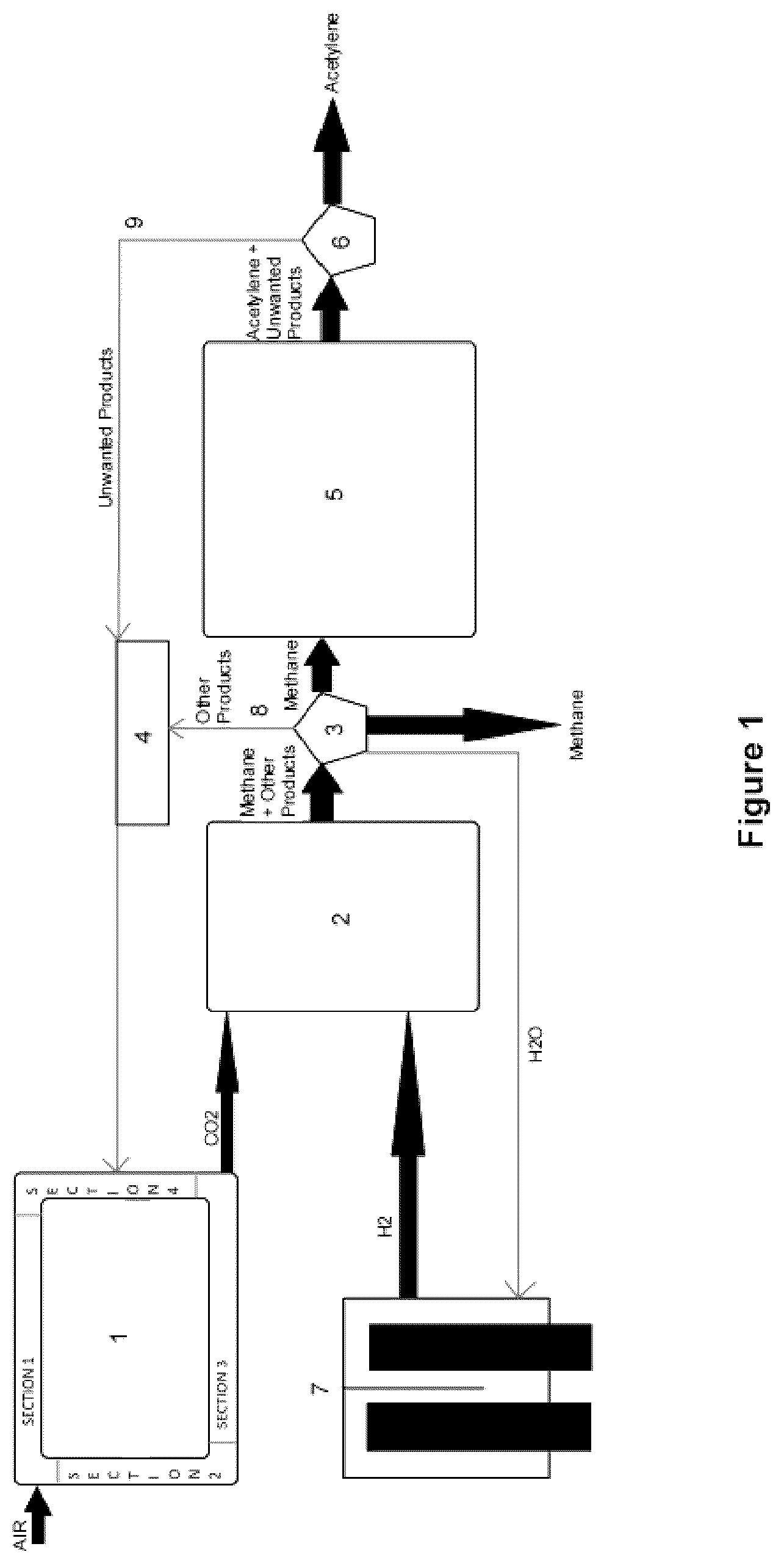
is an overview layout of one example implementation of the method/system; and
is an overview of example reactions utilized in one example implementation of the method/system.
is a flow chart overview of an example implementation of the method/system.
is an example of CO 2 capture apparatus.
DETAILED DESCRIPTION
Embodiments of the present invention provide methods and systems for carbon capture and recycling. Generally, embodiments provide a method/system for producing hydrocarbons from captured carbon, such as, for example, methane or acetylene. The presently described system captures CO 2 , reducing emissions, and produces industrially applicable output in the form of common precursor materials that may be further processed to form a wide range of materials.
In the methods and systems described, carbon dioxide (CO 2 ) is captured from at least one CO 2 containing input/source. It would be appreciated that CO 2 may be recovered/captured from a large range of sources, such as, for example, from air, incinerator exhaust streams, or industrial plumes, etc. It will also be appreciated that CO 2 may be captured using a variety of CO 2 capture devices/systems. In the presently described system/method, CO 2 is typically captured using a calcium oxide (CaO) based apparatus/system. Calcium oxide (quicklime) based carbon capture devices/systems have advantages in that the calcium oxide is reusable as a carbon capture agent and permits continuous loop processing as per the below reactions CaO+CO 2 →CaCO 3 CaCO 3 +ΔT→CaO+CO 2
As above, CaO reacts with CO 2 to form calcium carbonate, and subsequent heating of the calcium carbonate releases the CO 2 , providing the CaO for reuse (see Appendix A).
From captured CO 2 , a CO 2 feed stream is produced and fed to a methane producing reactor in combination with a hydrogen (H 2 ) feed stream. A methane containing output is produced by the methane producing reactor. Typically, the methane producing reactor is a conventional batch reactor. It will be appreciated that the H 2 feed stream may also be provided from a variety of sources. In one example form, H 2 is provided by a water electrolysis process, i.e., as per the below reaction: 2H 2 O+e − →2H 2 +O 2
The methane containing output from the methane producing reactor typically includes methane, water, and other partial products as per the reaction CO 2 +4H 2 →CH 4 +2H 2 O
The methane containing output is separated to so as to at least provide a substantially pure methane stream and a first waste output stream/recycle stream. It will also be appreciated that separation of the methane containing output may be performed by varying separation devices/methodologies.
The first waste output is then typically heated by a thermal treatment apparatus (e.g., incinerator) to provide additional CO 2 , e.g., as per the below reaction:
C x H y + ( x + y 4 ) O 2 → x CO 2 + y 2 H 2 O
The additionally produced CO 2 (e.g., by the incineration of soot, etc.) may then be re-fed into the system via carbon capture to drive more methane production. Additionally, water produced from the production of methane may be re-fed to the water electrolysis process to drive production of additional H 2 . In some examples, excess water may also be used for cooling and steam generated therefrom used to power turbines, etc. Accordingly, it will be appreciated that by-products from the reactions at each stage of the process can be re-fed into the system to increase the conversion efficiency, minimize waste, and maximize the methane produced.
Methane produced may further be fed into an acetylene producing reactor so as to produce acetylene containing output, e.g., as per the reaction CH 4 +ΔT→C 2 H 2
Typically, the reaction requires heating to high temperature (7000-8000° C.). The acetylene producing reactor is thus typically thermal plasma type reactor, and may, for example, be like or similar to the reactors as described in the publication Thermal Conversion of Methane to Acetylene Final Report, J. R. Fincke, R. P. Anderson, T. Hyde, R. Wright, R. Bewley, D. C. Haggard, W. D. Swank, published January 2000, Idaho National Engineering and Environmental Laboratory, Idaho Falls, Idaho 83415.
As with the methane containing output, the acetylene containing output may be purified/separated to provide a pure acetylene stream and a second waste output stream/recycle stream. The second waste output stream may also be fed back to the thermal treatment apparatus (e.g., incinerator), so as to provide additional CO 2 to be re-fed/re-captured by the system.
Alternatively or additionally, produced methane may be processed by a reactor to provide varied/random hydrocarbon containing output. The varied hydrocarbon containing output may then be separated by a separator preconfigured to separate out preselected hydrocarbons. The non-selected output may be provided as a waste output/recycle stream that may then be re-fed to the thermal treatment apparatus, so as to again produce additional CO 2 (e.g., by incineration, gasification). The additional CO 2 produced can be returned for recapture by the carbon capture device/apparatus. The waste output/recycle stream essentially provides a CO 2 containing input for the carbon capture device/apparatus. Again, the recycle streams from the reactor provide that the methane processing is energy efficient, with waste minimized.
The reactor in this variation is typically of thermal plasma type where plasma is provided in feed with the methane. For example, suitable reactors may be as described in the publication Thermal Conversion of Methane to Acetylene Final Report, J. R. Fincke, R. P. Anderson, T. Hyde, R. Wright, R. Bewley, D. C. Haggard, W. D. Swank, published January 2000, Idaho National Engineering and Environmental Laboratory, Idaho Falls, Idaho 83415.
One example embodiment of the system and method shall now be described with reference to .
A carbon capture apparatus 1 is provided which is configured to receive one or more CO 2 containing inputs/sources. As shown, air may be one of the CO 2 containing inputs. It will also be appreciated a range of alternate CO 2 containing inputs may be provided such as, for example, waste output streams/recycle streams.
The carbon capture apparatus 1 may take a variety of forms, however, typically, the carbon capture apparatus is a calcium oxide based apparatus. Furthermore, it will be appreciated that calcium oxide may be utilized for carbon capture in a variety of differently configured apparatuses.
The carbon capture apparatus 1 is also configured to produce a CO 2 feed gas stream for a methane producing reactor 2 .
Typically, the calcium oxide based carbon capture apparatus for use with the present system/method has two preferred configurations. In both configurations, the apparatus typically comprises four chambers with an outlet (e.g., transport tube) for transporting produced CO 2 feed to a methane producing reactor 2 .
In a first configuration, calcium oxide is mixed with air (containing CO 2 ) in the first chamber via mass transport via air with alternating fans to maximize dispersion and surfaces exposed to the air. CO 2 is captured from the air. In the second chamber, a vacuum is formed, and in the third chamber, the now calcium carbonate is baked to 700° C. while being stirred (to speed the process). Carbon dioxide is released and flows through outlet to methane producing reactor. A fourth chamber maintains the vacuum between chambers 2 , 3 , and 4 , before the calcium oxide is reused and air rated once more in chamber 1 . This is a continuous closed loop.
In a second configuration, calcium oxide is hydrated with water in the first chamber 1 , with air jets on the bottom bubbling air through the mixture while it is pushed along via a spiral configuration. Chamber 2 creates a vacuum and then raises the temperature to 400° C. removing the water, which is fed to chamber 4 . In chamber 3 , the product is heated to 700° C. while being stirred to release the carbon dioxide to the methane producing reactor. The calcium oxide is then sent to chamber 4 , where it is re-hydrated before returning chamber 1 again. Once again, this is a closed loop full of calcium oxide.
Another example configuration of a carbon capture described at .
As shown in , H 2 gas is provided to the methane producing reactor to combine with CO 2 feed for the production of methane as per the below equation: CO 2 +4H 2 →CH 4 +2H 2 O
It will be appreciated that the reactor 2 provides the appropriate conditions for the production of methane and water from CO 2 and H 2 (e.g. heating at >600° C. at 1 atmosphere of pressure). Typically, the reactor is heated to about 800° C. Typically, the methane producing reactor is a conventional batch rector. It will also be appreciated that the efficiency of this process may be improved by adjusting the reaction conditions such as, for example, by increasing the pressure of the system and the temperature.
The H 2 feed stream may come from a variety of sources. In the example of , the H 2 feed stream is provided by a water electrolysis device 7 which provides H 2 as per the following equation: 2H 2 O+e − →2H 2 +O 2
As water is produced as a by-product in the production of methane, the water can be redirected back to the water electrolysis device 7 for re-use (as shown). In other forms, the water may be used for cooling and/or quenching in subsequent process steps or at other at other parts of the system. Oxygen produced in the electrolysis may be utilized for cleaner combustion in other parts of the system or released to the environment. In some forms, the electrolysis reaction is conducted in a U-shaped reactor with a simple barrier with the possible addition of an electrolyte to speed the reaction and lower the energy costs.
A first separator 3 is provided to separate the methane, water and other partial products produced in the methane producing reactor 2 . Typically, separation is achieved via distillation; however, it will be appreciated that other methods may be used. Any non-methane and non-water products are separated out into a first waste output and fed to a thermal treatment apparatus 4 . The thermal treatment apparatus 4 is typically an incinerator, although it will be appreciated that it may take other forms, such as, for example, a gasifier. Thermal treatment, e.g., incineration, results in additional CO 2 product which can then be re-fed to the carbon capture device.
The purified methane from the first separator 3 is directed for further processing to an acetylene producing reactor 5 . The acetylene producing reactor 5 provides appropriate reaction conditions to product acetylene form the incoming methane feed stream. Typically, the acetylene is produced via heating as per to the following reaction: CH 4 +ΔT→C 2 H 2
In one form, the reactor is a thermal plasma type reactor. In one form, the reactor utilizes argon plasma to provide temperatures of about 8000° C. and rapid quenching follows to produce the acetylene. Example reactor/process are described in the publication Thermal Conversion of Methane to Acetylene Final Report, J. R. Fincke, R. P. Anderson, T. Hyde, R. Wright, R. Bewley, D. C. Haggard, W. D. Swank, published January 2000, Idaho National Engineering and Environmental Laboratory, Idaho Falls, Idaho 83415. Typical yields of acetylene are described in Appendix B. In one example, graphite tubing is utilized in the reactor surrounded by heat exchanges to recapture energy to power the argon plasma jets.
A second separator 6 is used to purify the acetylene containing output, and provide a second waste output/recycle stream 9 . Typically, separation is achieved via temperature gradient and/or distillation, although it will be appreciated a range of appropriate separation methods may be utilized. As with the first waste output stream, the second waste output stream (including soot, etc.) is fed to the thermal treatment apparatus 4 for recycling. CO 2 produced at the thermal treatment apparatus (e.g., by incineration) is then fed back into the carbon capture apparatus 1 . It will be appreciated that in some forms, heat generated from the thermal treatment apparatus 4 may be used to heat the methane and/or acetylene producing reactors. It is noted that the reaction processes in these reactors are exothermic.
Once purified, the acetylene and/or methane produced by the system/process can be readily converted via conventional processes into different polymers, benzo aromatics and other organic compounds for use in a wide variety of industrial applications.
In alternate forms, the acetylene producing reactor may be configured such that the argon plasma (or the like) may be provided in-feed with the methane. This typically results in varied hydrocarbon products being formed rather than mainly acetylene. It will be appreciated that in such examples, the second separator 6 would be configured to filter preselected hydrocarbon products. The remaining non-selected products would be re-fed to the thermal treatment apparatus (e.g., incinerator) for recycling. Again, any produced CO 2 from combustion/gasification may re-captured for further methane production.
The presently described system/method has significant advantages over conventional carbon capture and storage approaches for reducing CO 2 emissions. In particular, there are minimal waste products as the recycle feeds (i.e., waste output streams) push the conversion rate towards 100%.
In addition, once purified, acetylene has many industrial applications and can be further processed and converted, for example, into different polymers, benzo aromatics and other organic compounds. Methane may also be extracted from the system to produce compounds other than those produced by reacting acetylene.
It will be appreciated that power for the various components/reactions may be provided/supplemented by mains electricity, renewable energy sources, and waste combustion.
In particular, it will be appreciated that due to the configuration of the system, organic waste material can be directly combusted (e.g., in the thermal treatment apparatus) and filtered to provide the CO 2 for the carbon capture. Furthermore, the heat from the combustion also may be supplied to the methane and acetylene producing reactors.
Furthermore, as the methane and acetylene producing reactors are running exothermic processes, once heated, excess energy therefrom may be utilized to further provide electrical energy to the system, while energy recycling may also be used on the coolant for the argon plasma jets. Excess energy may also be harvested by steam turbines to power the argon plasma reactions.
Optional embodiments of the present invention may also be said to broadly consist in the parts, elements and features referred to or indicated herein, individually or collectively, in any or all combinations of two or more of the parts, elements or features, and wherein specific integers are mentioned herein which have known equivalents in the art to which the invention relates, such known equivalents are deemed to be incorporated herein as if individually set forth.
Although a preferred embodiment has been described in detail, it should be understood that various changes, substitutions, and alterations can be made by one of ordinary skill in the art without departing from the scope of the present invention.
It will be appreciated that various forms of the invention may be used individually or in combination.
APPENDIX A
Calcium oxide is usually made by the thermal decomposition of materials, such as limestone or seashells, that contain calcium carbonate (CaCO 3 ; mineral calcite) in a lime kiln. This is accomplished by heating the material to above 825° C. (1,517° F.), [6] a process called calcination or lime-burning, to liberate a molecule of carbon dioxide (CO 2 ), leaving quicklime. CaCO 3 (s)→CaO(s)+CO 2 ( g )
The quicklime is not stable and, when cooled, will spontaneously react with CO 2 from the air until, after enough time, it will be completely converted back to calcium carbonate unless slaked with water to set as lime plaster or lime mortar.
Hydro-
carbon
Yield Minimum
Plas- Conver- Maximum other than Normalized SER kW-
Reactor Feed- ma Quench sion Effi- Acetylene Acetylene Acetylene Soot hr/k 8 -
Reference Year Process Size stock Gas Method ciency Yield y C2H2 y HC Yield y C2H2 Yield C 2 H 2
Leumer & 1961 DC plasma 68 kW CH 4 Ar Wall heat 92.9% 801 not 862 5.7% 72.5
Stokes jet transfer analyzed
Gladisch 1962 Huels DC 8 MW natural CH 4 Water 70.5% 51.4% 45.9% 72.9% 2.7% 12.1
arc gas spray
Anderson 1962 DC plasma <10 kW CH 4 H 2 Water >90% 76% not 88% not 9.16
& Case jet spray analyzed analyzed
Holmes 1969 DuPont DC 9 MW CH 4 H 2 not not 70% not not 8.8
arc reported reported reported reported
Ibberson 1976 DC plasma <10 kW CH 4 Ar Wall heat >90% 82% not 91% not 9.0
& Sen jet transfer reported analyzed
Plotczyk 1983 DC plasma 10-40 kW CH 4 H 2 Wall heat 95% 80% not 84% not 15.5
jet transfer analyzed analyzed
Kovener 1983 RF plasma 4 kW CH 4 & He Wall heat not not reported not — not 88
natural transfer reported reported reported
gas
Plotczyk 1985 DC plasma 4-16 kW CH 4 Ar Wall heat >90% 86% not 95% not 23.9
jet transfer reported reported
Figures (4)
Citations
This patent cites (24)
- US3488401
- US3852180
- US5711770
- US5964908
- US10479739
- US2002/0055545
- US2004/0115492
- US2008/0115495
- US2009/0165376
- US2009/0289227
- US2010/0129691
- US2011/0237839
- US2012/0134906
- US2013/0154278
- US2013/0172636
- US2014/0058149
- US2014/0080927
- US2014/0299514
- US2015/0073188
- US2016/0144314
- US2016/0152528
- US2018/0086985
- US516273
- USWO-2016076041