Display Control Device and Display Method
Abstract
A captured image acquisition unit acquires a captured image showing work equipment from a camera provided at a work machine. A blade edge shadow generation unit generates a blade edge shadow obtained by projecting a blade edge of the work equipment on a projection surface toward a vertical direction. A display image generation unit generates a display image obtained by superimposing the captured image, the blade edge shadow, a left line, and a right line. The left line passes through a left end of the blade edge shadow and extends in a front-and-rear direction of the work equipment along the projection surface. The right line passes through a right end of the blade edge shadow and extends in the front-and-rear direction of the work equipment along the projection surface. A display control unit outputs a display signal for displaying the display image.
Claims (9)
1. A display control device comprising: a processor configured to: acquire a captured image from a camera provided at a work machine, the captured image showing work equipment of the work machine; generate a blade edge shadow obtained by projecting a blade edge of the work equipment on a projection surface toward a vertical direction; generate a display image obtained by superimposing (i) the captured image, (ii) the blade edge shadow, (iii) a left line that passes through a left end of the blade edge shadow and extends in a front-and-rear direction of the work equipment along the projection surface, and (iv) a right line that passes through a right end of the blade edge shadow and extends in the front-and-rear direction of the work equipment along the projection surface; and output a display signal for displaying the display image on a display device.
9. A display method comprising: acquiring a captured image from a camera provided at a work machine, the captured image showing work equipment of the work machine; generating a blade edge shadow obtained by projecting a blade edge of the work equipment on a projection surface toward a vertical direction; generating a display image obtained by superimposing (i) the captured image, (ii) the blade edge shadow, (iii) a left line that passes through a left end of the blade edge shadow and extends in a front-and-rear direction of the work equipment along the projection surface, and (iv) a right line that passes through a right end of the blade edge shadow and extends in the front-and-rear direction of the work equipment along the projection surface; and displaying the display image on a display device.
Show 7 dependent claims
2. The display control device according to claim 1 , wherein the left line and the right line extend forward and backward with respect to the blade edge shadow.
3. The display control device according to claim 1 , wherein the left line and the right line extend to a position obtained by projecting a position most separated away from a reference position of the work machine in a reachable range of the blade edge on the projection surface.
4. The display control device according to claim 1 , wherein the display image includes a maximum reach line parallel to the blade edge shadow obtained by projecting a position most separated away from a reference position of the work machine in a reachable range of the blade edge on the projection surface.
5. The display control device according to claim 1 , wherein the display image includes a distance image indicating a distance from a reference position of the work machine to each of a plurality of positions separated away from the reference position in a vicinity of the left line or the right line.
6. The display control device according to claim 5 , wherein the distance image includes a plurality of lines parallel to the blade edge shadow and separated by each unit distance from the reference position.
7. The display control device according to claim 5 , wherein the distance image includes a numerical value indicating a distance from the reference position.
8. The display control device according to claim 1 , wherein the projection surface is a plane surface passing through a ground contact surface of the work machine.
Full Description
Show full text →
CROSS-REFERENCE TO RELATED APPLICATIONS
This application is a National Stage application under 35 U.S.C. § 371 of International Application No. PCT/JP2021/031727, filed on Aug. 30, 2021, which claims priority to Japanese Patent Application No. 2020-162923, filed on Sep. 29, 2020. The contents of the prior applications are incorporated herein in their entirety.
TECHNICAL FIELD
The present disclosure relates to a display control device and a display method.
BACKGROUND ART
A technique of remotely operating a work machine is known. The remotely operated work machine is provided with a camera, and an image of a work site in operation is captured. The captured image is transmitted to a remote location and is displayed on a display device disposed in the remote location. An operator of the remote location remotely operates the work machine while viewing the captured image displayed on the display device. Since the captured image displayed on the display device is two-dimensional, it is difficult to give the operator a sense of perspective.
A technique of displaying a mesh-shaped line image on a surface of a work target shown in a captured image since the operator is given with a sense of perspective is disclosed in Patent Document 1.
CITATION LIST
Patent Document
•
• Patent Document 1 • Japanese Unexamined Patent Application, First Publication No. 2018-035645
SUMMARY OF INVENTION
Technical Problem
In a case of operating the work machine while viewing the two-dimensional captured image, it is difficult for the operator to recognize a region of a work target where work by work equipment is possible. For this reason, there is a possibility of decreasing work efficiency of the operator.
An object of the present disclosure is to provide a display control device and a display method that can prevent a decrease in work efficiency when work is performed using a work machine.
Solution to Problem
According to an aspect of the present invention, there is provided a display control device that displays an image used in order to operate a work machine including work equipment, the display control device including: a captured image acquisition unit configured to acquire a captured image showing the work equipment from a camera provided at the work machine; a blade edge shadow generation unit configured to generate a blade edge shadow obtained by projecting a blade edge of the work equipment on a projection surface toward a vertical direction; a display image generation unit configured to generate a display image obtained by superimposing the captured image, the blade edge shadow, a left line which passes through a left end of the blade edge shadow and which extends in a front-and-rear direction of the work equipment along the projection surface, and a right line which passes through a right end of the blade edge shadow and which extends in the front-and-rear direction of the work equipment along the projection surface; and a display control unit configured to output a display signal for displaying the display image.
Advantageous Effects of Invention
According to the above aspect of the present invention, a decrease in the work efficiency when work is performed using the work machine can be prevented.
BRIEF DESCRIPTION OF DRAWINGS
is a schematic view showing the configuration of a work system according to a first embodiment.
is an external view of a work machine according to the first embodiment.
is a schematic block diagram showing the configuration of a remote control device according to the first embodiment.
is a view showing an example of a display image according to the first embodiment.
is a side view showing a relationship between a blade edge shadow image and a blade edge reach gauge image according to the first embodiment.
is a flowchart showing display control processing performed by the remote control device according to the first embodiment.
is an external view of a work machine according to a second embodiment.
is a schematic block diagram showing the configuration of a remote control device according to the second embodiment.
is a view showing an example of a display image according to the second embodiment.
is a side view showing a relationship between a blade edge shadow image and a blade edge reach gauge image according to the second embodiment.
is a schematic block diagram showing the configuration of a remote control device according to a third embodiment.
is a side view showing a relationship between a blade edge shadow image and a blade edge reach gauge image according to the third embodiment.
is a view showing an example of a display image according to another embodiment.
DESCRIPTION OF EMBODIMENTS
First Embodiment
<<Work System 1 >>
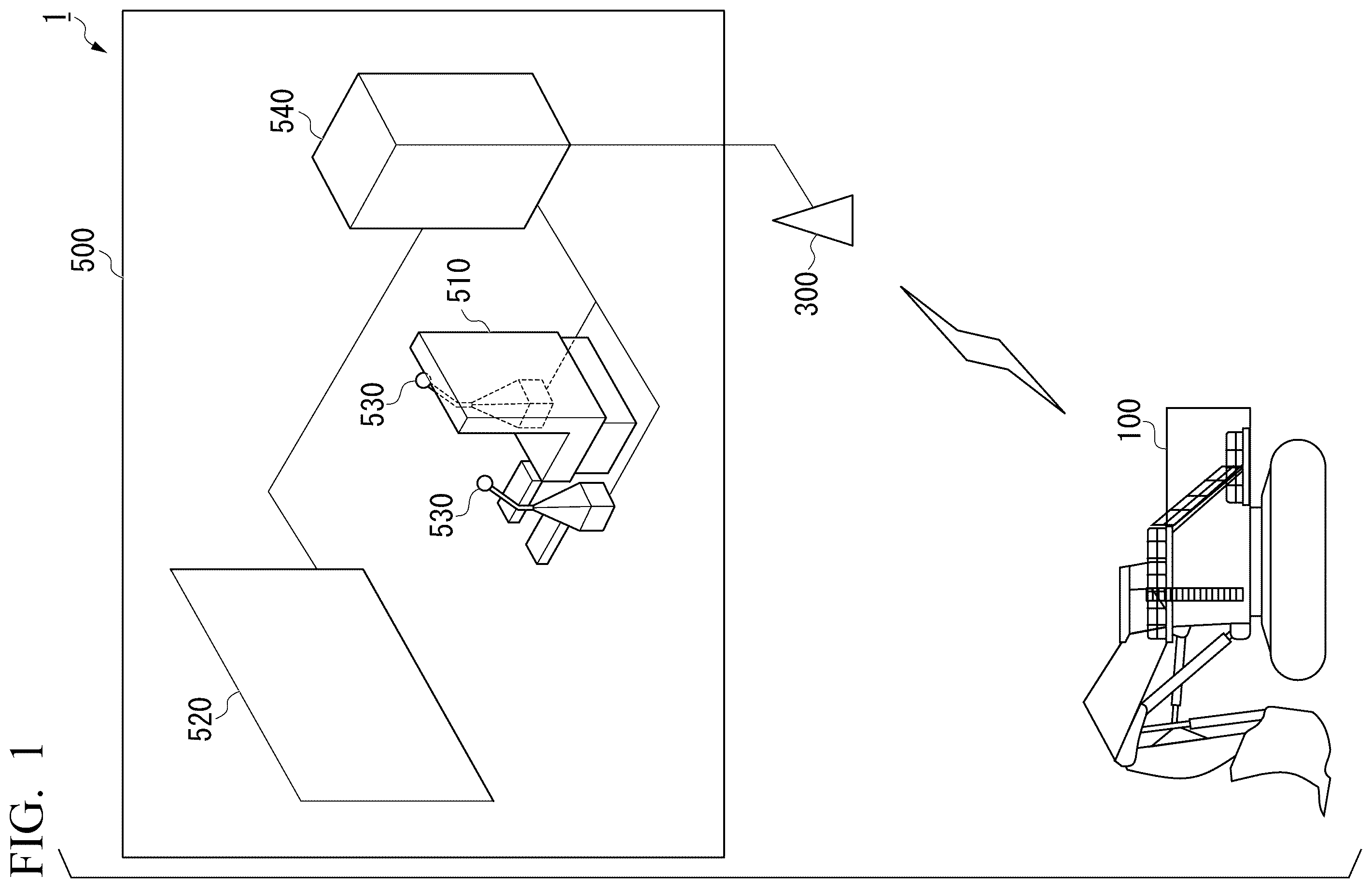
is a schematic view showing the configuration of a work system 1 according to a first embodiment.
The work system 1 includes a work machine 100 and a remote operation room 500 . The work machine 100 operates at a work site. Exemplary examples of the work site include mines and quarries. The remote operation room 500 is provided at a remote location separated away from the work site. Exemplary examples of the remote location include cities and locations in the work site. That is, an operator remotely operates the work machine 100 from a distance where the work machine 100 cannot be visually recognized.
The work machine 100 is remotely operated based on an operation signal transmitted from the remote operation room 500 . The remote operation room 500 is connected to the work machine 100 via an access point 300 provided at the work site. The operation signal indicating an operation by the operator, which is received from the remote operation room 500 , is transmitted to the work machine 100 via the access point 300 . The work machine 100 operates based on the operation signal received from the remote operation room 500 . That is, the work system 1 includes a remote operation system configured by the work machine 100 and the remote operation room 500 . In addition, the work machine 100 captures an image of a work target, and the image is displayed in the remote operation room 500 . That is, the work system 1 is an example of a display control system.
<<Work Machine 100 >>
is an external view of the work machine 100 according to the first embodiment.
The work machine 100 according to the first embodiment is a loading excavator (face excavator). The work machine 100 according to another embodiment may be another work machine such as a backhoe, a wheel loader, and a bulldozer.
The work machine 100 includes a carriage 110 , a swing body 120 that is supported by the carriage 110 , and work equipment 130 that is operated by a hydraulic pressure and is supported by the swing body 120 . The swing body 120 is supported to be swingable around a swinging central axis O. The work equipment 130 is provided at a front portion of the swing body 120 .
The work equipment 130 includes a boom 130 A, an arm 130 B, and a bucket 130 C.
A base end portion of the boom 130 A is attached to the swing body 120 via a pin.
The arm 130 B connects the boom 130 A to the bucket 130 C. A base end portion of the arm 130 B is attached to a tip portion of the boom 130 A via a pin.
The bucket 130 C includes a blade edge 130 D for excavating earth and a container for accommodating the excavated earth. A base end portion of the bucket 130 C is attached to a tip portion of the arm 130 B via a pin.
The work equipment 130 is driven by movements of a boom cylinder 131 A, an arm cylinder 131 B, and a bucket cylinder 131 C. Hereinafter, the boom cylinder 131 A, the arm cylinder 131 B, and the bucket cylinder 131 C will also be collectively referred to as a hydraulic cylinder 131 .
The boom cylinder 131 A is a hydraulic cylinder for operating the boom 130 A. A base end portion of the boom cylinder 131 A is attached to the swing body 120 . A tip portion of the boom cylinder 131 A is attached to the boom 130 A.
The arm cylinder 131 B is a hydraulic cylinder for driving the arm 130 B. A base end portion of the arm cylinder 131 B is attached to the boom 130 A. A tip portion of the arm cylinder 131 B is attached to the arm 130 B.
The bucket cylinder 131 C is a hydraulic cylinder for driving the bucket 130 C. A base end portion of the bucket cylinder 131 C is attached to the boom 130 A. A tip portion of the bucket cylinder 131 C is attached to the bucket 130 C.
A boom posture sensor 132 A, an arm posture sensor 132 B, and a bucket posture sensor 132 C that detect postures of the boom 130 A, the arm 130 B, and the bucket 130 C are attached to the work equipment 130 . Hereinafter, the boom posture sensor 132 A, the arm posture sensor 132 B, and the bucket posture sensor 132 C will also be collectively referred to as a posture sensor 132 . The posture sensor 132 according to the first embodiment is a stroke sensor attached to the hydraulic cylinder 131 . That is, the posture sensor 132 detects a stroke length of the hydraulic cylinder 131 . The term “stroke length” is a moving distance of a rod from a stroke end of the hydraulic cylinder 131 . The term “stroke end” refers to an end portion in a movable range of the rod. That is, the term “stroke end” refers to the position of the rod in a state where the hydraulic cylinder 131 has most contracted or the position of the rod in a state where the hydraulic cylinder 131 has most extended.
The boom posture sensor 132 A is provided at the boom cylinder 131 A and detects the stroke length of the boom cylinder 131 A.
The arm posture sensor 132 B is provided at the arm cylinder 131 B and detects the stroke length of the arm cylinder 131 B.
The bucket posture sensor 132 C is provided at the bucket cylinder 131 C and detects the stroke length of the bucket cylinder 131 C.
The posture sensor 132 according to another embodiment is not limited thereto. For example, in another embodiment, the posture sensor 132 may detect a relative rotation angle with potentiometers provided at the base end portions of the boom 130 A, the arm 130 B, and the bucket 130 C, may detect a rotation angle with respect to a vertical direction with an IMU, or may detect a rotation angle with respect to the vertical direction with an inclinometer.
The swing body 120 includes a cab 121 . The cab 121 is provided with a camera 122 . The camera 122 is provided in an upper front portion in the cab 121 . The camera 122 captures an image of the front of the cab 121 through a windshield in a front portion of the cab 121 . Herein, the term “front” refers to a direction in which the work equipment 130 is mounted on the swing body 120 , and the term “rear” refers to a direction opposite to the “front”. The term “side” refers to a direction (right-and-left direction) intersecting a front-and-rear direction. An exemplary example of the camera 122 includes an imaging device using a charge coupled device (CCD) sensor and a complementary metal oxide semiconductor (CMOS) sensor. In another embodiment, the camera 122 may not necessarily have to be provided in the cab 121 , and it is sufficient that the camera is provided at a position where at least a construction target and the work equipment 130 can be imaged. That is, an imaging range of the camera 122 includes at least a part of the work equipment 130 .
The work machine 100 includes the camera 122 , a position and azimuth direction calculator 123 , an inclination measurer 124 , a hydraulic device 125 , and a vehicle control device 126 .
The position and azimuth direction calculator 123 calculates a position of the swing body 120 and an azimuth direction in which the swing body 120 faces. The position and azimuth direction calculator 123 includes two receivers that receive positioning signals from an artificial satellite configuring GNSS. The two receivers are provided at positions different from each other on the swing body 120 . The position and azimuth direction calculator 123 detects a position of a representative point of the swing body 120 in a site coordinate system (the origin of a vehicle body coordinate system) based on the positioning signals received by the receivers. The position and azimuth direction calculator 123 uses each of the positioning signals received by the two receivers to calculate an azimuth direction in which the swing body 120 faces as a relationship between a provision position of one receiver and a provision position of the other receiver. In another embodiment, the position and azimuth direction calculator 123 may detect an azimuth direction in which the swing body 120 faces based on a measurement value of a rotary encoder or an IMU.
The inclination measurer 124 measures the acceleration and angular speed of the swing body 120 and detects the posture (for example, a roll angle and a pitch angle) of the swing body 120 based on the measurement result. The inclination measurer 124 is provided, for example, on a lower surface of the swing body 120 . The inclination measurer 124 can use, for example, an inertial measurement unit (IMU).
The hydraulic device 125 supplies a hydraulic oil to the hydraulic cylinder 131 . The flow rate of the hydraulic oil supplied to the hydraulic cylinder 131 is controlled based on a control command received from the vehicle control device 126 .
The vehicle control device 126 transmits, to the remote operation room 500 , an image captured by the camera 122 , the swinging speed, position, azimuth direction, and inclination angle of the swing body 120 , the posture of the work equipment 130 , and the traveling speed of the carriage 110 . In addition, the vehicle control device 126 receives an operation signal from the remote operation room 500 and drives the work equipment 130 , the swing body 120 , and the carriage 110 based on the received operation signal.
<<Remote Operation Room 500 >>
The remote operation room 500 includes a driver's seat 510 , a display device 520 , an operation device 530 , and a remote control device 540 .
The display device 520 is disposed in front of the driver's seat 510 . The display device 520 is disposed in front of the operator eyes when the operator sits on the driver's seat 510 . The display device 520 may be configured by a plurality of arranged displays or may be configured by one large display as shown in . In addition, the display device 520 may project an image on a curved surface or a spherical surface with a projector.
The operation device 530 is an operation device for the remote operation system. The operation device 530 generates, in response to an operation by the operator, an operation signal of the boom cylinder 131 A, an operation signal of the arm cylinder 131 B, an operation signal of the bucket cylinder 131 C, a right-and-left swing operation signal of the swing body 120 , and a travel operation signal of the carriage 110 for moving forward and backward and outputs the signals to the remote control device 540 . The operation device 530 is configured by, for example, a lever, a knob switch, and a pedal (not shown).
The operation device 530 is disposed in the vicinity of the driver's seat 510 . The operation device 530 is positioned within a range where the operator can operate when the operator sits on the driver's seat 510 .
The remote control device 540 generates a display image based on data received from the work machine 100 and displays the display image on the display device 520 . In addition, the remote control device 540 transmits an operation signal indicating the operation of the operation device 530 to the work machine 100 . The remote control device 540 is an example of a display control device.
is a schematic block diagram showing the configuration of the remote control device 540 according to the first embodiment.
The remote control device 540 is a computer including a processor 610 , a main memory 630 , a storage 650 , and an interface 670 . The storage 650 stores a program. The processor 610 reads the program from the storage 650 to load the program in the main memory 630 and executes processing in accordance with the program. The remote control device 540 is connected to a network via the interface 670 .
Exemplary examples of the storage 650 include a magnetic disk, an optical disk, a magneto-optical disk, and a semiconductor memory. The storage 650 may be an internal medium directly connected to a common communication line of the remote control device 540 or may be an external medium connected to the remote control device 540 via the interface 670 . The storage 650 is a non-transitory tangible storage medium.
By executing the program, the processor 610 includes a data acquisition unit 611 , a posture identification unit 612 , a blade edge shadow generation unit 613 , a display image generation unit 614 , a display control unit 615 , an operation signal input unit 616 , and an operation signal output unit 617 .
In another embodiment, in addition to the configuration or instead of the configuration, the remote control device 540 may include a custom large scale integrated circuit (LSI) such as a programmable logic device (PLD). Exemplary examples of the PLD include Programmable Array Logic (PAL), Generic Array Logic (GAL), a complex programmable logic device (CPLD), and field programmable gate array (FPGA). In this case, some or all of functions realized by the processor 610 may be realized by the integrated circuit. Such an integrated circuit is also included as an example of the processor.
The data acquisition unit 611 acquires, from the work machine 100 , data indicating an image captured by the camera 122 , the swinging speed, position, azimuth direction, and inclination angle of the swing body 120 , the posture of the work equipment 130 , and the traveling speed of the carriage 110 .
The posture identification unit 612 identifies the posture of the work machine 100 in the vehicle body coordinate system and the posture thereof in the site coordinate system based on the data acquired by the data acquisition unit 611 . The term “vehicle body coordinate system” is a local coordinate system defined by three axes, including the front-rear axis, right-left axis, and up-down axis of the swing body 120 , with an intersection of the swinging central axis O of the swing body 120 and a bottom surface of the carriage 110 as the origin. The term “site coordinate system” is a global coordinate system defined by three axes, including a latitude axis, a longitude axis, and a vertical axis, with a predetermined point (such as a reference station) on the work site as the origin. The posture identification unit 612 identifies positions in the vehicle body coordinate system and positions in the site coordinate system for a tip of the boom 130 A, a tip of the arm 130 B, and both right and left ends of the blade edge 130 D. A specific method of identifying a position of each portion by the data acquisition unit 611 will be described later.
The blade edge shadow generation unit 613 generates a blade edge shadow image showing a blade edge shadow obtained by projecting the blade edge 130 D on a projection surface toward the vertical direction based on the positions of both ends of the blade edge 130 D in the site coordinate system which are identified by the posture identification unit 612 . The projection surface according to the first embodiment is a plane surface passing through the bottom surface of the carriage 110 . Specifically, the blade edge shadow generation unit 613 generates a blade edge shadow image through the following procedures. The blade edge shadow generation unit 613 identifies the position of the blade edge shadow projected on the projection surface in the site coordinate system by rewriting values of up-down axis components of the positions of both ends of the blade edge 130 D to zero. Based on known camera parameters indicating a relationship between an image coordinate system, which is a two-dimensional orthogonal coordinate system related to an image captured by the camera 122 , and the site coordinate system, the blade edge shadow generation unit 613 converts the position of the blade edge shadow in the site coordinate system into a position in the image coordinate system. The blade edge shadow generation unit 613 generates a blade edge shadow image by drawing a line segment representing the blade edge 130 D at the converted position.
The display image generation unit 614 generates a display image by superimposing a blade edge shadow image G 1 and a blade edge reach gauge image G 2 on a captured image acquired by the data acquisition unit 611 . is a view showing an example of the display image according to the first embodiment. The blade edge reach gauge image G 2 includes a left line G 21 , a right line G 22 , a maximum reach line G 23 , scale lines G 24 , scale values G 25 , and a reference range graphic G 26 .
The left line G 21 is a line indicating the reachable range of a left end of the blade edge 130 D. As shown in , the left line G 21 passes through a left end of the blade edge shadow image G 1 .
The right line G 22 is a line indicating the reachable range of a right end of the blade edge 130 D. As shown in , the right line G 22 passes through a right end of the blade edge shadow image G 1 .
The maximum reach line G 23 is a line indicating a front edge of the reachable range of the blade edge 130 D. The maximum reach line G 23 connects a front end of the left line G 21 to a front end of the right line G 22 . The scale lines G 24 are lines representing distances from the swinging central axis O of the swing body 120 .
The scale lines G 24 are provided at regular intervals. In the example of , the scale lines G 24 are provided at intervals of two meters. Each of the scale lines G 24 is provided to connect the left line G 21 to the right line G 22 .
The maximum reach line G 23 and the scale lines G 24 are lines parallel to the blade edge shadow image G 1 .
The scale values G 25 are provided to correspond to the scale lines G 24 and represent distances indicated by the scale lines G 24 in numerical values. In the example shown in , the scale values G 25 are provided in the vicinity of right ends of the scale lines G 24 .
The reference range graphic G 26 is a graphic showing the reachable range of the blade edge 130 D on the projection surface. The reference range graphic G 26 according to the first embodiment is a quadrangle surrounded by the left line G 21 , the right line G 22 , the front edge of the reachable range on the projection surface, and a rear edge of the reachable range on the projection surface. The reachable range of the blade edge 130 D on the projection surface is the reachable range of the blade edge 130 D under a condition in which the projection surface and the blade edge 130 D come into contact with each other. The reference range graphic G 26 is highlighted and displayed with hatching or coloring.
The maximum reach line G 23 and the front ends of the left line G 21 and the right line G 22 represent the front edge of the reachable range of the blade edge 130 D when the condition in which the projection surface and the blade edge 130 D come into contact with each other is not imposed. The maximum reach line G 23 , the left line G 21 , and the right line G 22 are examples of a reachable range graphic obtained by projecting the reachable range of the blade edge when the condition is not imposed.
is a side view showing a relationship between the blade edge shadow image G 1 and the blade edge reach gauge image G 2 according to the first embodiment. The blade edge shadow image G 1 and the blade edge reach gauge image G 2 according to the first embodiment are drawn on a projection surface F 1 which is a plane surface passing through the bottom surface of the carriage 110 . For this reason, when the blade edge shadow image G 1 and the blade edge reach gauge image G 2 are superimposed on a captured image, in a portion of a ground surface F 2 higher than the projection surface F 1 , the blade edge shadow image G 1 and the blade edge reach gauge image G 2 are shown to be sunk with respect to the ground surface F 2 . In a portion of the ground surface F 2 lower than the projection surface F 1 , the blade edge shadow image G 1 and the blade edge reach gauge image G 2 are shown to be floating with respect to the ground surface F 2 .
As shown in , the front edge of the blade edge reach gauge image G 2 , that is, the maximum reach line G 23 is shown at a position where a position most separated away from the swinging central axis O in a reachable range R of the blade edge 130 D is projected on the projection surface F 1 . For this reason, the blade edge shadow image G 1 is positioned in front of the maximum reach line G 23 at all times even when the blade edge 130 D is in any posture.
As shown in , the reference range graphic G 26 indicates a range where the reachable range of the blade edge 130 D and the projection surface overlap each other.
Since the camera 122 is fixed to the swing body 120 , the reachable range of the blade edge 130 D on the projection surface in the image coordinate system does not change regardless of the swinging of the swing body 120 and the traveling of the carriage 110 . That is, the blade edge reach gauge image G 2 is constant regardless of the position and posture of the work machine 100 . Therefore, the display image generation unit 614 according to the first embodiment generates a display image by superimposing the blade edge reach gauge image G 2 prepared in advance on the captured image.
The display control unit 615 outputs a display signal for displaying the display image generated by the display image generation unit 614 to the display device 520 .
The operation signal input unit 616 receives an operation signal from the operation device 530 .
The operation signal output unit 617 transmits the operation signal received by the operation signal input unit 616 to the work machine 100 .
<<Method of Identifying Posture>>
Herein, a method of identifying a posture with the posture identification unit 612 will be described. The posture identification unit 612 identifies, through the following procedures, positions in the vehicle body coordinate system and positions in the site coordinate system for the tip of the boom 130 A (the pin of the tip portion), the tip of the arm 130 B (the pin of the tip portion), and both ends of the blade edge 130 D.
The posture identification unit 612 identifies an angle of the boom 130 A with respect to the swing body 120 , that is, an angle with respect to the front-rear axis of the vehicle body coordinate system based on the stroke length of the boom cylinder 131 A. The posture identification unit 612 identifies a boom vector extending from a base end (the pin of the base end portion) of the boom 130 A to the tip (the pin of the tip portion) of the boom 130 A in the vehicle body coordinate system based on the angle of the boom 130 A and the known length of the boom 130 A. The posture identification unit 612 identifies a position vector of the tip (the pin of the tip portion) of the boom 130 A in the vehicle body coordinate system by adding the known position vector and boom vector of the base end (the pin of the base end portion) of the boom 130 A in the vehicle body coordinate system.
The posture identification unit 612 identifies the angle of the arm 130 B with respect to the boom 130 A based on the stroke length of the arm cylinder 131 B. The posture identification unit 612 identifies the angle of the arm 130 B with respect to the front-rear axis by adding the identified angle of the arm 130 B and the angle of the boom 130 A with respect to the front-rear axis in the vehicle body coordinate system. The posture identification unit 612 identifies an arm vector extending from a base end (the pin of the base end portion) of the arm 130 B to the tip (the pin of the tip portion) of the arm 130 B in the vehicle body coordinate system based on the angle of the arm 130 B and the known length of the arm 130 B. The posture identification unit 612 identifies a position vector of the tip (the pin of the tip portion) of the arm 130 B in the vehicle body coordinate system by adding the position vector and arm vector of the tip (the pin of the tip portion) of the boom 130 A in the vehicle body coordinate system.
The posture identification unit 612 identifies the angle of the bucket 130 C with respect to the arm 130 B based on the stroke length of the bucket cylinder 131 C. The posture identification unit 612 identifies the angle of the bucket 130 C with respect to the front-rear axis by adding the identified angle of the bucket 130 C and the angle of the arm 130 B with respect to the front-rear axis in the vehicle body coordinate system. The posture identification unit 612 identifies a right bucket vector and a left bucket vector based on the angle of the bucket 130 C, the known length from the base end (the pin of the base end portion) of the bucket 130 C to the blade edge 130 D, and the known width of the blade edge 130 D. The right bucket vector is a vector extending from the base end (the pin of the base end portion) of the bucket 130 C to the right end of the blade edge 130 D in the vehicle body coordinate system. The left bucket vector is a vector extending from the base end of the bucket 130 C to the left end of the blade edge 130 D. The posture identification unit 612 identifies a position vector of the left end of the blade edge 130 D in the vehicle body coordinate system by adding the position vector and left bucket vector of the tip (the pin of the tip portion) of the arm 130 B in the vehicle body coordinate system. In addition, the posture identification unit 612 identifies a position vector of the right end of the blade edge 130 D in the vehicle body coordinate system by adding the position vector and right bucket vector of the tip (the pin of the tip portion) of the arm 130 B in the vehicle body coordinate system.
The posture identification unit 612 can identify the position of each portion in the site coordinate system by translating the position of each portion in the vehicle body coordinate system based on the position of the work machine 100 in the site coordinate system and rotating the position of each portion in the vehicle body coordinate system based on the azimuth direction (yaw angle) of the swing body 120 and the roll angle and pitch angle of the work equipment 130 .
<<Display Control Method>>
is a flowchart showing display control processing performed by the remote control device 540 according to the first embodiment. When the operator starts a remote operation of the work machine 100 with the remote operation room 500 , the remote control device 540 performs the display control processing shown in for each time period.
The data acquisition unit 611 acquires from the vehicle control device 126 of the work machine 100 , data indicating an image captured by the camera 122 , the swinging speed, position, azimuth direction, and inclination angle of the swing body 120 , the posture of the work equipment 130 , and the traveling speed of the carriage 110 (Step S 1 ). Next, the posture identification unit 612 identifies positions of both ends of the blade edge 130 D in the vehicle body coordinate system based on the data acquired in Step S 1 (Step S 2 ).
The blade edge shadow generation unit 613 identifies the position of the blade edge shadow projected on the projection surface in the vehicle body coordinate system by rewriting the values of up-down axis components of the positions of both ends of the blade edge 130 D in the vehicle body coordinate system identified in Step S 2 to zero (Step S 3 ). The blade edge shadow generation unit 613 converts the position of the blade edge shadow in vehicle body coordinate system into a position in the image coordinate system based on camera parameters (Step S 4 ). The blade edge shadow generation unit 613 generates the blade edge shadow image G 1 by drawing a line segment at the converted position (Step S 5 ).
The display image generation unit 614 generates a display image by superimposing the blade edge shadow image G 1 generated in Step S 5 and the blade edge reach gauge image G 2 prepared in advance on the captured image acquired in Step S 1 (Step S 6 ). Then, the display control unit 615 outputs a display signal for displaying the display image generated in Step S 6 to the display device 520 (Step S 7 ).
Accordingly, the display image shown in is displayed on the display device 520 .
<<Workings and Effects>>
As described above, in the first embodiment, the remote control device 540 displays, on the display device 520 , a display image obtained by superimposing a captured image showing the work equipment 130 , the blade edge shadow image G 1 obtained by projecting the blade edge 130 D on a projection surface toward the vertical direction, and the left line G 21 and the right line G 22 that pass through both ends of the blade edge shadow image G 1 and extend in the front-and-rear direction along the projection surface. Accordingly, the operator can easily recognize a range of the work target to be excavated by the work equipment 130 . That is, the operator can recognize that a portion of the work target shown in the captured image, which is sandwiched between the left line G 21 and the right line G 22 , will be excavated and can estimate the amount of soil to be excavated. Therefore, the remote control device 540 can prevent a decrease in the work efficiency when work is performed using the work machine 100 .
The display image according to the first embodiment includes the reference range graphic G 26 representing the reachable range under a condition in which the blade edge 130 D is brought into contact with the projection surface F 1 . Accordingly, the operator can recognize a range having a probability that a piston of the hydraulic cylinder 131 hits the stroke end in a case of moving the blade edge 130 D on the projection surface F 1 . Therefore, the operator can reduce the probability that the piston of the hydraulic cylinder 131 hits the stroke end by operating the operation device 530 while recognizing a positional relationship between the blade edge shadow image G 1 and the reference range graphic G 26 .
The maximum reach line G 23 is displayed at a position most separated away from the swinging central axis O of the work machine 100 in the reachable range of the blade edge 130 D in the display image according to the first embodiment. Accordingly, the operator can determine whether or not an excavation target ahead of the current position can be excavated by visually recognizing the display image. In another embodiment, the same effect can be achieved even when the left line G 21 and the right line G 22 extend to the front edge of the reachable range without the maximum reach line G 23 displayed. In addition, in another embodiment, the same effect can be achieved even when the left line G 21 and the right line G 22 extend to infinity in a case where the maximum reach line G 23 is displayed.
In addition, the left line G 21 and the right line G 22 included in the display image according to the first embodiment extend to the position most separated away from the swinging central axis O of the work machine 100 in the reachable range of the blade edge 130 D. In addition, the maximum reach line G 23 is displayed at the position most separated away from the swinging central axis O of the work machine 100 in the reachable range of the blade edge 130 D. Accordingly, the operator can determine whether or not an excavation target ahead of the current position can be excavated by visually recognizing the display image. In another embodiment, the same effect can be achieved even when the left line G 21 and the right line G 22 extend to the front edge of the reachable range without the maximum reach line G 23 displayed. In addition, in another embodiment, the same effect can be achieved even when the left line G 21 and the right line G 22 extend to infinity in a case where the maximum reach line G 23 is displayed.
In addition, the display image according to the first embodiment includes each of the scale lines G 24 indicating distances from the swinging central axis O to a plurality of positions separated away from the swinging central axis O and the scale values G 25 . Accordingly, the operator can recognize the position of the blade edge 130 D in a depth direction by visually recognizing the display image. In another embodiment, even when any one of the scale lines G 24 and the scale values G 25 is not displayed, the same effects can be achieved.
Second Embodiment
The blade edge shadow image G 1 and the blade edge reach gauge image G 2 according to the first embodiment are images projected on the projection surface F 1 which is the plane surface passing through the bottom surface of the carriage 110 . On the other hand, the blade edge shadow image G 1 and the blade edge reach gauge image G 2 according to a second embodiment are projected on the ground surface F 2 . That is, a projection surface according to the second embodiment is the ground surface F 2 .
<<Work Machine 100 >>
is an external view of the work machine 100 according to the second embodiment. The work machine 100 according to the second embodiment further includes a depth detection device 127 in addition to the configurations of the first embodiment. The depth detection device 127 is provided in the vicinity of the camera 122 and detects a depth in the same direction as an imaging direction of the camera 122 . The term “depth” is a distance from the depth detection device 127 to a target. Exemplary examples of the depth detection device 127 include a LiDAR device, a radar device, and a stereo camera. The detection range of the depth detection device 127 is substantially the same as the imaging range of the camera 122 .
<<Remote Control Device 540 >>
is a schematic block diagram showing the configuration of the remote control device 540 according to the second embodiment. The remote control device 540 according to the second embodiment further includes a topography updating unit 618 and a gauge generation unit 619 in addition to the configurations according to the first embodiment. In addition, the remote control device 540 according to the second embodiment is different from that of the first embodiment in terms of processing of the blade edge shadow generation unit 613 .
The topography updating unit 618 updates topography data indicating a three-dimensional shape of a work target in the site coordinate system based on depth data acquired from the depth detection device 127 by the data acquisition unit 611 . Specifically, the topography updating unit 618 updates the topography data through the following procedures.
The topography updating unit 618 converts the depth data to three-dimensional data related to the vehicle body coordinate system. Since the depth detection device 127 is fixed to the swing body 120 , a conversion function between the depth data and the vehicle body coordinate system can be acquired in advance. The topography updating unit 618 removes a portion where the work equipment 130 is shown from the generated three-dimensional data based on the posture of the work equipment 130 in the vehicle body coordinate system identified by the posture identification unit 612 . The topography updating unit 618 converts three-dimensional data in the vehicle body coordinate system into three-dimensional data in the site coordinate system based on the position and posture of the vehicle body acquired by the data acquisition unit 611 . The topography updating unit 618 updates topography data stored in advance in the main memory 630 using newly generated three-dimensional data. That is, a portion of the topography data stored in advance, which overlaps the newly generated three-dimensional data, is replaced with a value of the new three-dimensional data. Accordingly, the topography updating unit 618 can store the latest topography data in the main memory 630 at all times.
The gauge generation unit 619 generates the blade edge reach gauge image G 2 projected on the ground surface F 2 based on topography data. For example, the gauge generation unit 619 generates the blade edge reach gauge image G 2 through the following procedures. The gauge generation unit 619 converts a portion of the topography data, which is included in the imaging range, into the vehicle body coordinate system based on the position and posture of the vehicle body acquired by the data acquisition unit 611 . The gauge generation unit 619 projects the known reach range of the blade edge 130 D and a plurality of lines dividing the reach range at regular intervals on the ground surface F 2 using the topography data in the vehicle body coordinate system. Accordingly, the gauge generation unit 619 identifies positions of the left line G 21 , the right line G 22 , the maximum reach line G 23 , and the scale lines G 24 in the vehicle body coordinate system.
Next, the gauge generation unit 619 identifies a surface where the known reachable range R of the blade edge 130 D and the topography data in the vehicle body coordinate system overlap each other as the reference range graphic G 26 representing the reachable range under a condition in which the blade edge 130 D is brought into contact with the ground surface F 2 . Next, the gauge generation unit 619 converts the left line G 21 , the right line G 22 , the maximum reach line G 23 , the scale lines G 24 , and the reference range graphic G 26 into an image based on camera parameters of the camera 122 . The gauge generation unit 619 attaches the scale values G 25 in the vicinity of each of the scale lines G 24 of the converted image. Accordingly, the gauge generation unit 619 generates the blade edge reach gauge image G 2 projected on the ground surface F 2 .
Like the gauge generation unit 619 , the blade edge shadow generation unit 613 generates the blade edge shadow image G 1 obtained by projecting the blade edge 130 D on the ground surface F 2 based on the topography data.
The display image generation unit 614 generates a display image by superimposing the blade edge shadow image G 1 and the blade edge reach gauge image G 2 on a captured image acquired by the data acquisition unit 611 . is a view showing an example of the display image according to the second embodiment. The blade edge reach gauge image G 2 includes the left line G 21 , the right line G 22 , the maximum reach line G 23 , the scale lines G 24 , the scale values G 25 , and the reference range graphic G 26 .
is a side view showing a relationship between the blade edge shadow image G 1 and the blade edge reach gauge image G 2 according to the second embodiment. The blade edge shadow image G 1 and the blade edge reach gauge image G 2 according to the second embodiment are drawn on the ground surface F 2 detected by the depth detection device 127 . For this reason, when the blade edge shadow image G 1 and the blade edge reach gauge image G 2 are superimposed on a captured image, the blade edge shadow image G 1 and the blade edge reach gauge image G 2 are shown to be stuck on the ground surface F 2 .
Although the reference range graphic G 26 according to the second embodiment represents the reachable range under a condition in which the blade edge 130 D is brought into contact with the ground surface F 2 , the invention is not limited thereto. For example, the reference range graphic G 26 according to another embodiment may represent the reachable range under a condition in which the blade edge 130 D is brought into contact with the plane surface passing through the bottom surface of the carriage 110 , like the first embodiment. In this case, the gauge generation unit 619 generates the reference range graphic G 26 by projecting the reachable range on the ground surface F 2 under the condition in which the blade edge 130 D is brought into contact with the plane surface passing through the bottom surface of the carriage 110 .
Third Embodiment
The reference range graphics G 26 generated by the remote control device 540 according to the first and second embodiments represent the reachable range under a condition in which the blade edge 130 D is brought into contact with the projection surface (the plane surface passing through the bottom surface of the carriage 110 or the ground surface). On the other hand, the remote control device 540 according to a third embodiment represents the reachable range of the blade edge 130 D under a condition in which only the arm 130 B is driven. This is because an excavation operation of a work target is performed by a pushing operation of the arm 130 B in many cases as a mode of use of the loading excavator and a probability that a piston of the arm cylinder 131 B hits the stroke end is high compared to the boom cylinder 131 A and the bucket cylinder 131 C. The configuration of the work system 1 according to the third embodiment is basically the same as in the first embodiment.
<<Remote Control Device 540 >>
is a schematic block diagram showing the configuration of the remote control device 540 according to the third embodiment. The remote control device 540 according to the third embodiment further includes a reference range identification unit 620 in addition to the configuration according to the first embodiment. The reference range identification unit 620 calculates the reachable range of the blade edge 130 D in a case where the boom 130 A and the bucket 130 C are fixed and only the arm 130 B is driven based on the postures of the boom 130 A and the bucket 130 C identified by the posture identification unit 612 .
is a side view showing a relationship between the blade edge shadow image G 1 and the blade edge reach gauge image G 2 according to the third embodiment. Specifically, the reference range identification unit 620 identifies a rotation center P (pin center) of the arm 130 B based on the posture of the boom 130 A and identifies a length L from the rotation center to the blade edge 130 D based on the posture of the bucket 130 C. Then, the reference range identification unit 620 calculates a reachable range R1 of the blade edge 130 D in a case where only the arm 130 B is driven based on the known rotation range of the arm 130 B. The reference range identification unit 620 generates the reference range graphic G 26 by projecting the calculated reachable range R1 on the projection surface F 1 from the vertical direction. The reference range graphic G 26 generated by the reference range identification unit 620 changes each time the posture of at least one of the boom 130 A and the bucket 130 C changes.
Accordingly, the operator can remotely operate the work machine 100 such that the piston of the arm cylinder 131 B does not hit the stroke end by controlling the work equipment 130 such that the blade edge shadow image G 1 does not hit an end of the reference range graphic G 26 .
Modification Example
Although the blade edge reach gauge image G 2 according to the third embodiment has a shape projected on the projection surface F 1 , the invention is not limited thereto. For example, the blade edge reach gauge image G 2 according to another embodiment may have a shape projected on the ground surface F 2 as in the second embodiment.
Another Embodiment
Although one embodiment has been described in detail with reference to the drawings hereinbefore, a specific configuration is not limited to the description above, and various design changes are possible. That is, in another embodiment, order of processing described above may be changed as appropriate. In addition, some of the processing may be performed in parallel.
The remote control device 540 according to the embodiments described above may be configured by a computer alone, or the remote control device 540 may function as the configuration of the remote control device 540 is divided by a plurality of computers and is disposed, and the plurality of computers cooperate with each other. At this time, some of the computers configuring the remote control device 540 may be provided in the remote operation room 500 , and the other computers may be provided outside the remote operation room 500 . For example, the work machine 100 may be provided with some of the computers configuring the remote control device 540 .
is a view showing an example of a display image according to another embodiment. The operator can recognize a range excavated by the work equipment 130 with the blade edge reach gauge image G 2 according to the embodiments described above as the left line G 21 and the right line G 22 are included. On the other hand, as shown in , the blade edge reach gauge image G 2 according to another embodiment may include a center line G 27 instead of the left line G 21 and the right line G 22 in the display image. The center line G 27 passes through a center point of the blade edge 130 D and extends in the front-and-rear direction along the projection surface. Also in this case, the operator can recognize the position of the blade edge 130 D in the depth direction with at least one of an end point of the center line G 27 , the maximum reach line G 23 , the scale lines G 24 , the scale values G 25 , and the reference range graphic G 26 .
Although the reference range graphic G 26 according to the embodiments described above shows the front edge and rear edge of the reachable range of the blade edge 130 D under a predetermined condition, another embodiment is not limited thereto. For example, in a case where the work machine 100 is a loading excavator, excavation work is usually performed by a push operation of the arm 130 B since the blade edge 130 D of the bucket 130 C faces the front. For this reason, the front edge has a high probability of hitting the stroke end compared to the rear edge of the reachable range. Therefore, the reference range graphic G 26 according to another embodiment may represent only the front edge of the reachable range of the blade edge 130 D under a predetermined condition. On the other hand, in a case where the work machine 100 is a backhoe, excavation work is usually performed by a pulling operation of the arm 130 B since the blade edge 130 D of the bucket 130 C faces the rear. For this reason, the rear edge has a high probability of hitting the stroke end compared to the front edge of the reachable range. Therefore, the reference range graphic G 26 according to another embodiment may represent only the rear edge of the reachable range of the blade edge 130 D under a predetermined condition.
INDUSTRIAL APPLICABILITY
According to the above aspect, a decrease in the work efficiency when work is performed using the work machine can be prevented.
REFERENCE SIGNS LIST
•
• 1 : Work system • 100 : Work machine • 110 : Carriage • 120 : Swing body • 121 : Cab • 122 : Camera • 130 : Work equipment • 130 A: Boom • 130 B: Arm • 130 C: Bucket • 130 D: Blade edge • 500 : Remote operation room • 510 : Driver's seat • 520 : Display device • 530 : Operation device • 540 : Remote control device • 611 : Data acquisition unit • 612 : Posture identification unit • 613 : Blade edge shadow generation unit • 614 : Display image generation unit • 615 : Display control unit • 616 : Operation signal input unit • 617 : Operation signal output unit • 618 : Topography updating unit • 619 : Gauge generation unit • 620 : Reference range identification unit • G 1 : Blade edge shadow image • G 2 : Blade edge reach gauge image • G 21 : Left line • G 22 : Right line • G 23 : Maximum reach line • G 24 : Scale line • G 25 : Scale value • G 26 : Reference range graphic
Figures (13)
Citations
This patent cites (20)
- US11427988
- US11772556
- US11939747
- US2014/0099178
- US2018/0051446
- US2019/0330825
- US2021/0238828
- US2021/0250561
- US2021/0291733
- US3934241
- US2008-121280
- US2013-113044
- US2014-074318
- US2016-102312
- US2016-160741
- US2018035645
- US2020003631
- US2020003632
- US2020090985
- US2020175645