Safety Switch for Photovoltaic Systems
Abstract
Various implementations described herein are directed to a methods and apparatuses for disconnecting, by a device, elements at certain parts of an electrical system. The method may include measuring operational parameters at certain locations within the system and/or receiving messages from control devices indicating a potentially unsafe condition, disconnecting and/or short-circuiting system elements in response, and reconnection the system elements when it is safe to do so. Certain embodiments relate to methods and apparatuses for providing operational power to safety switches during different modes of system operation.
Claims (20)
1. A system comprising: a power device comprising: a first input terminal, a second input terminal, a third input terminal, and power converter circuitry connected between the first input terminal and the third input terminal; a pair of power sources connected in a serial string between the first input terminal and the third input terminal, wherein the pair of power sources comprises a first power source, which is connected to the first input terminal and the second input terminal, and a second power source, which is connected to the second input terminal and the third input terminal, and wherein the serial string comprises an open circuit voltage that is input to the power converter circuitry; a switch connected between the first input terminal and the second input terminal of the power device, wherein each power source of the pair of power sources comprises one or more solar panels; and a controller comprising a maximum power point tracking (MPPT) circuit, wherein the controller is configured to control the switch to: in response to receiving an indication of an unsafe condition, create a short-circuit across the first power source between the first input terminal and the second input terminal, wherein the short-circuit sets the open circuit voltage to a voltage across the second power source between the second input terminal and the third input terminal and reduces the open circuit voltage that is input to the power converter circuitry below a voltage threshold; and in response to receiving an indication of a safe condition, remove the short-circuit across the first power source between the first input terminal and the second input terminal to set the open circuit voltage to a voltage across the first power source and the second power source between the first input terminal and the third input terminal and increase power that is extracted from the first power source by the MPPT circuit.
11. A method comprising: controlling a power system, wherein the power system comprises: a power device comprising: a first input terminal, a second input terminal, a third input terminal, and power converter circuitry connected between the first input terminal and the third input terminal; a pair of power sources connected in a serial string between the first input terminal and the third input terminal, wherein the pair of power sources comprises a first power source, which is connected to the first input terminal and the second input terminal, and a second power source, which is connected to the second input terminal and the third input terminal, and wherein the serial string comprises an open circuit voltage that is input to the power converter circuitry; a switch connected between the first input terminal and the second input terminal of the power device, wherein each power source of the pair of power sources comprises one or more solar panels; and a controller comprising a maximum power point tracking (MPPT) circuit, wherein the controlling the power system comprises: controlling, by the controller, the switch to: in response to receiving an indication of an unsafe condition, create a short-circuit across the first power source between the first input terminal and the second input terminal, wherein the short-circuit sets the open circuit voltage to a voltage across the second power source between the second input terminal and the third input terminal and reduces the open circuit voltage that is input to the power converter circuitry below a voltage threshold; and in response to receiving an indication of a safe condition, remove the short-circuit across the first power source between the first input terminal and the second input terminal to set the open circuit voltage to a voltage across the first power source and the second power source between the first input terminal and the third input terminal and increase power that is extracted from the first power source by the MPPT circuit.
Show 18 dependent claims
2. The system of claim 1 , wherein the power device further comprises output terminals, and wherein the power device is configured to convert input power to output power.
3. The system of claim 1 , wherein the unsafe condition comprises at least one of: an overvoltage condition, a startup condition, a shutdown condition, a condition when no output power is provided at output terminals of the power device, a grid outage condition, a grid undervoltage condition, a failure of the power device, a fire, detection of an arc, detection of a short circuit, or a failure of at least one of the pair of power sources.
4. The system of claim 1 , wherein the indication of the safe condition comprises at least one of: a keep alive signal, a startup signal, or output power being provided at output terminals of the power device.
5. The system of claim 1 , further comprising at least one sensor, wherein the controller is further configured to receive, via the at least one sensor, a sensor measurement indicating at least one of: the unsafe condition or the safe condition.
6. The system of claim 5 , wherein the at least one sensor comprises at least one of: a current sensor, a voltage sensor, or a temperature sensor.
7. The system of claim 1 , further comprising a communication device, wherein the controller is further configured to receive, via the communication device, a signal indicating at least one of: the unsafe condition or the safe condition.
8. The system of claim 1 , wherein the switch comprises at least one of: a relay, a metal-oxide-semiconductor field-effect transistor (MOSFET), an insulated-gate bipolar transistor (IGBT), a bipolar junction transistor (BJT), or a junction field-effect transistor (JFET).
9. The system of claim 1 , wherein the controller comprises at least one of: an analog circuit, a microprocessor, a digital signal processor (DSP), an application-specific integrated circuit (ASIC), or a field-programmable gate array (FPGA).
10. The system of claim 1 , wherein the indication of the unsafe condition comprises an indication that the open circuit voltage is greater than the voltage threshold.
12. The method of claim 11 , further comprising converting input power to output power at output terminals of the power device.
13. The method of claim 11 , wherein the unsafe condition comprises at least one of: an overvoltage condition, a startup condition, a shutdown condition, a condition when no output power is provided at output terminals of the power device, a grid-outage condition, a grid undervoltage condition, a failure of the power device, a fire, detection of an arc, detection of a short circuit, or a failure of at least one of the pair of power sources.
14. The method of claim 11 , wherein the indication of the safe condition comprises at least one of: a keep alive signal, a startup signal, or output power being provided at output terminals of the power device.
15. The method of claim 11 , further comprising receiving, via at least one sensor, a sensor measurement indicating at least one of: the unsafe condition or the safe condition.
16. The method of claim 15 , wherein the at least one sensor comprises at least one of: a current sensor, a voltage sensor, or a temperature sensor.
17. The method of claim 11 , further comprising receiving, via a communication device, a signal indicating at least one of: the unsafe condition or the safe condition.
18. The method of claim 11 , wherein the switch comprises at least one of: a relay, a metal-oxide-semiconductor field-effect transistor (MOSFET), an insulated-gate bipolar transistor (IGBT), a bipolar junction transistor (BJT), or a junction field-effect transistor (JFET).
19. The method of claim 11 , wherein the method is performed by the controller comprising at least one of: an analog circuit, a microprocessor, a digital signal processor (DSP), an application-specific integrated circuit (ASIC), or a field-programmable gate array (FPGA).
20. The method of claim 11 , wherein the indication of the unsafe condition comprises an indication that the open circuit voltage is greater than the voltage threshold.
Full Description
Show full text →
CROSS-REFERENCE TO RELATED APPLICATIONS
The present application is a continuation of U.S. application Ser. No. 16/248,475, filed Jan. 15, 2019 entitled “Safety Switch for Photovoltaic Systems,” which is a continuation-in-part of U.S. nonprovisional application Ser. No. 15/250,068, filed Aug. 29, 2016, now U.S. Pat. No. 10,230,310, issued Mar. 12, 2019, entitled “Safety Switch for Photovoltaic Systems.” The content of these are incorporated by reference herein in their entireties for all purposes. The present application claims priority to U.S. provisional patent application Ser. No. 62/318,303, filed Apr. 5, 2016 entitled “Optimizer Garland,” hereby incorporated by reference in its entirety. Additionally, the present application claims priority to U.S. provisional patent application Ser. No. 62/341,147 filed May 25, 2016 entitled “Photovoltaic Power Device and Wiring,” hereby incorporated by reference in its entirety.
BACKGROUND
Safety regulations may require disconnecting and/or short-circuiting one or more photovoltaic (PV) generators or other components in case of an unsafe condition occurring in a photovoltaic installation. For example, safety regulations require that in case of an unsafe condition (e.g. a fire, a short-circuit, carrying out of maintenance work), the maximum voltage at any point in a photovoltaic installation may not exceed a safe voltage level. In some photovoltaic systems, it may be necessary to disconnect and/or short-circuit one or more photovoltaic generator(s) to achieve the safe voltage requirement. While photovoltaic systems may be deployed for tens of years, safety regulations may change at shorter time intervals (e.g. every several years). It would be advantageous to have a controllable safety switch which may be controlled to disconnect or short-circuit a PV generator in case of a safety hazard, and which may be controlled to reconnect the photovoltaic generator once the system is safe again. It would be desirable for controllable safety switches to be cost-effective and easily deployed.
SUMMARY
The following summary is a short summary of some of the inventive concepts for illustrative purposes only, and is not intended to limit or constrain the inventions and examples in the detailed description. One skilled in the art will recognize other novel combinations and features from the detailed description.
Embodiments herein may employ safety switches and associated apparatuses and methods for controlling currents through branches and/or voltages at nodes in photovoltaic (PV) installations.
In illustrative embodiments comprising one or more electrical systems, a group of electrical safety switches may be electrically connectable to a plurality of electrical power sources. The electrical safety switches may be controllable to maintain safe operation of the electrical systems.
In illustrative electrical systems, a safety switch may be deployed between serially-connected photovoltaic generators in a photovoltaic installation. In some embodiments, safety switches may be installed between each pair of PV generators. In some embodiments, the number and location of safety switches may be chosen with regard to current safety regulations, and in some embodiments, the number and location of safety switches may be chosen with regard to anticipated “worst-case” safety regulations. For example, in locales where adding, reconfiguring and/or removing system components is easy and inexpensive, safety switches may be deployed in a PV installation in accordance with the safety regulations at the time the installation was built. In locales where adding, reconfiguring and/or removing system components may be difficult or expensive, safety switches may be deployed in a manner that complies with a “worst-case” (i.e. most stringent) prediction of future regulations.
Illustrative safety switches according to some embodiments may be retrofit to existing photovoltaic installations and components. Illustrative safety switches according to some embodiments may be integrated in other PV system components (e.g. connectors, PV generators, power devices, combiner boxes, batteries and/or inverters), potentially reducing the cost of design and manufacturing of the safety switches, and increasing
In some embodiments, auxiliary power circuits are used to provide power to safety switches and associated controllers. In some embodiments, safety switches are located at system points which do not carry significant electrical power when the safety switches are in a particular state (e.g., when safety switches are in the ON state). Illustrative auxiliary power circuits are disclosed herein, along with associated methods for providing power to the auxiliary power circuits and safety switches regardless of the state of the safety switches.
In some embodiments, components and design of safety switches may be selected to regulate or withstand electrical parameters when illustrative safety switches are in the ON or OFF states. For example, some illustrative safety switches may comprise shunt resistors sized to regulate electrical current flowing through safety switches when the safety switches are in the OFF position.
Further embodiments include photovoltaic power devices comprising internal circuitry configured to limit a voltage between input terminals to the photovoltaic power devices in case of a potentially unsafe condition while continuously providing operational power to the photovoltaic power devices.
Further embodiments include electrical circuits for interconnecting photovoltaic generators and photovoltaic power devices configured to limit a voltage between various system nodes while continuously providing operational power to the photovoltaic power devices.
Further embodiments include a chain of preconnected photovoltaic power devices with associated safety switches, which may provide a cost-effective, easy way to wire a photovoltaic generation system along with associated safety switches.
In some embodiments, safety switches may be in communication with accompanying system devices, such as system control devices and/or end-user devices such as graphical user interfaces for monitoring applications.
Further embodiments include user interfaces for monitoring the state of and parameters measured by safety switches in illustrative power systems. A system owner or operator may be able to view a list of system safety switches, associated switch states and electrical parameter measured thereby. In some embodiments, the list may be a graphical user interface (GUI) viewable on a computing device, such as a computer monitor, tablet, smart-television, smartphone, or the like. In some embodiments, the system operator may be able to manually control safety switches (e.g. by pressing buttons).
As noted above, this Summary is merely a summary of some of the features described herein and is provided to introduce a selection of concepts in a simplified form that are further described below in the Detailed Description. The Summary is not exhaustive, is not intended to identify key features or essential features of the claimed subject matter and is not to be a limitation on the claims.
BRIEF DESCRIPTION OF THE DRAWINGS
These and other features, aspects, and advantages of the present disclosure will become better understood with regard to the following description, claims, and drawings. The present disclosure is illustrated by way of example, and not limited by, the accompanying figures.
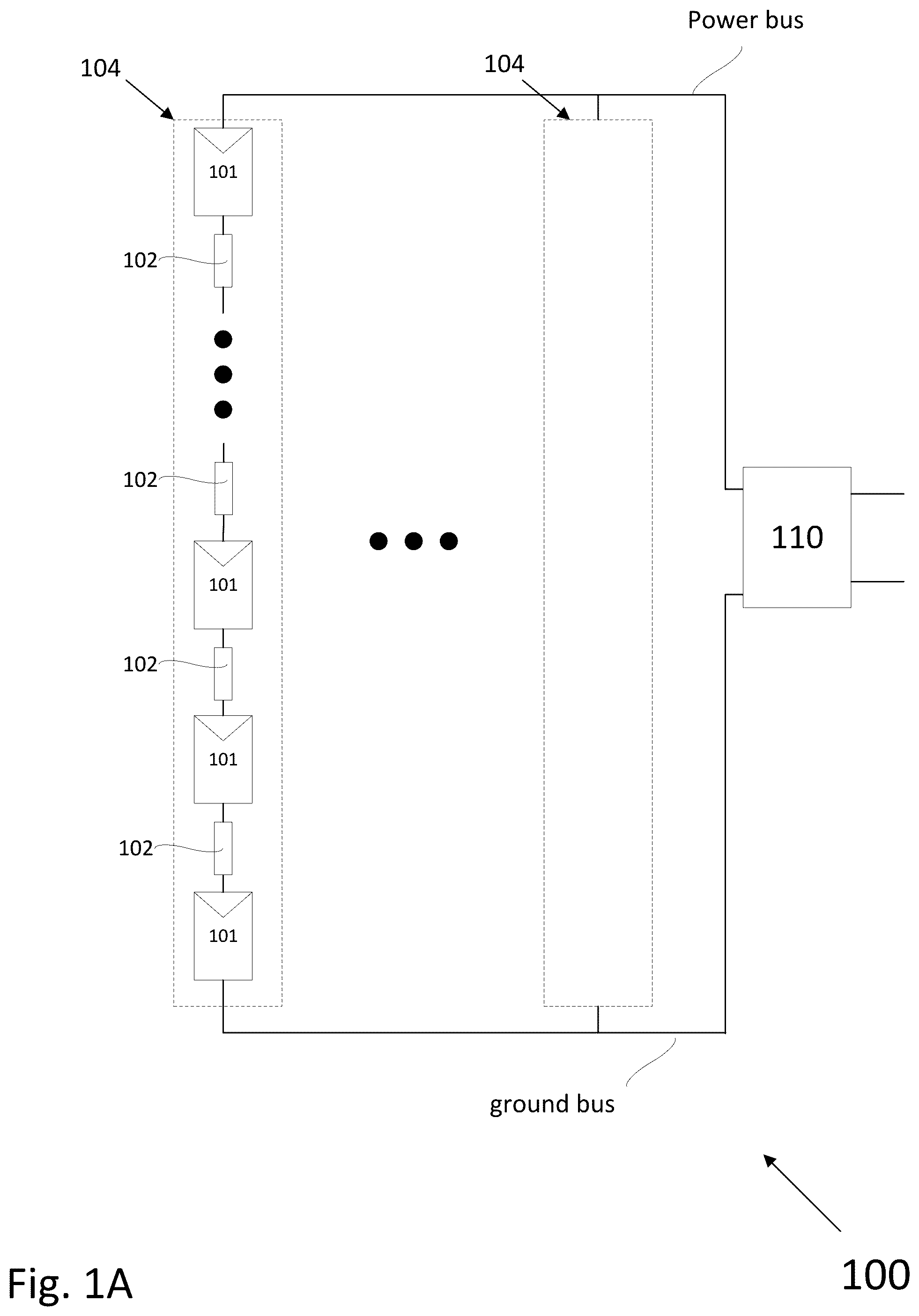
A illustrates a photovoltaic system configuration according to various aspects of the present disclosure.
B illustrates a photovoltaic system configuration according to various aspects of the present disclosure.
illustrates part of a photovoltaic system configuration according to various aspects of the present disclosure.
illustrates a safety switch according to various aspects of the present disclosure.
A- 4 B illustrate a safety switch according to various aspects of the present disclosure.
A illustrates part of a photovoltaic system configuration according to various aspects of the present disclosure.
B illustrates a photovoltaic generator according to various aspects of the present disclosure.
illustrates a method for operating a safety switch according to various aspects of the present disclosure.
A- 7 C illustrate circuits for providing operational power to a safety switch according to various aspects of the present disclosure.
D illustrates a timing diagram depicting some of the operational parameters of a safety switch according to various aspects of the present disclosure.
E illustrates a circuit for providing operational power to a safety switch according to various aspects of the present disclosure.
F illustrates a timing diagram depicting some of the operational parameters of a safety switch according to various aspects of the present disclosure.
G illustrates a circuit for providing operational power to a safety switch according to various aspects of the present disclosure.
H illustrates a circuit for providing operational power to a safety switch according to various aspects of the present disclosure.
I illustrates part of an illustrative datasheet indicating possible operating points for operating a transistor according to various aspects of the present disclosure.
illustrates a photovoltaic system configuration according to various aspects of the present disclosure.
illustrates a photovoltaic power device according to various aspects of the present disclosure.
illustrates a photovoltaic system configuration according to various aspects of the present disclosure.
A- 11 B illustrate a photovoltaic power devices according to various aspects of the present disclosure.
illustrates a photovoltaic system configuration according to various aspects of the present disclosure.
A illustrates circuitry of a safety switch according to various aspects of the present disclosure.
B illustrates circuitry of a photovoltaic power device according to various aspects of the present disclosure.
illustrates a portion of a chain of photovoltaic power devices according to various aspects of the present disclosure.
is an illustrative mockup of a user interface for an electrical system according to illustrative embodiments.
illustrates a photovoltaic power device according to various aspects of the present disclosure.
DETAILED DESCRIPTION
In the following description of various illustrative embodiments, reference is made to the accompanying drawings, which form a part hereof, and in which is shown, by way of illustration, various embodiments in which aspects of the disclosure may be practiced. It is to be understood that other embodiments may be utilized and structural and functional modifications may be made, without departing from the scope of the present disclosure.
Reference is now made to A , which shows a photovoltaic (PV) system according to illustrative embodiments. PV system 100 may comprise a plurality of PV strings 104 coupled in parallel between a ground bus and a power bus. Each of PV strings 104 may comprise a plurality of serially-connected PV generators 101 and a plurality of safety switches 102 . PV generators 101 may comprise one or more photovoltaic cells(s), module(s), panel(s) or shingle(s). In some embodiments, PV generators 101 may be replaced by direct current (DC) batteries or alternative direct current or alternating current (AC) power sources.
In the illustrative embodiment of A , a safety switch 102 is disposed between each pair of PV generators 101 . In some embodiments (e.g. the embodiment shown in ) a safety switch 102 may be disposed between groups of more than one serially-connected PV generators. Safety switch 102 may comprise a control device and a communication device, and may be operated to disconnect adjacent PV generators when receiving (e.g. via the communication device) a command to disconnect PV generators.
In some embodiments, the power and ground buses may be input to system power device 110 . In some embodiments, system power device 110 may include a DC/AC inverter and may output alternating current (AC) power to a power grid, home or other destinations. In some embodiments, system power device 110 may comprise a combiner box, transformer and/or safety disconnect circuit. For example, system power device 110 may comprise a DC combiner box for receiving DC power from a plurality of PV strings 104 and outputting the combined DC power. In some embodiments, system power device 110 may include a fuse coupled to each string 104 for overcurrent protection, and/or one or more disconnect switches for disconnecting one or more PV strings 104 .
In some embodiments, system power device 110 may include or be coupled to a control device and/or a communication device for controlling or communicating with safety switches 102 . For example, system power device 110 may comprise a control device such as a microprocessor, Digital Signal Processor (DSP) and/or a Field Programmable Gate Array (FPGA) configured to control the operation of system power device 110 . In some embodiments, system power device 110 may comprise multiple interacting control devices. System power device 110 may further comprise a communication device (e.g. a Power Line Communication circuit and/or a wireless transceiver) configured to communicate with linked communication devices included in safety switches 102 . In some embodiments, system power device 110 may comprise both a control device and a communication device, the control device configured to determine desirable modes of operation for PV power devices (e.g. power devices 103 ), and the communication device configured to transmit operational commands and receive reports from communication devices included in the PV power devices.
System power device 110 may be coupled to any number of other devices and/or systems such as PV systems 100 (e.g., various discrete and/or interconnected devices such as disconnect(s), PV cell(s)/array(s), inverter(s), micro inverter(s), PV power device(s), safety device(s), meter(s), breaker(s), AC main(s), junction box(es), camera etc.), network(s)/Intranet/Internet, computing devices, smart phone devices, tablet devices, camera, one or more servers which may include data bases and/or work stations. System power device 110 may be configured for controlling the operation of components within PV system 100 and/or for controlling the interactions with other elements coupled to PV system 100 .
In some embodiments, the power and ground buses may be further coupled to energy storage devices such as batteries, flywheels or other energy storage devices.
Safety regulations may define a maximum allowable voltage between the ground bus and any other voltage point in PV system 100 , during both regular operating conditions and during potentially unsafe conditions. Similarly, safety regulations may define a maximum allowable voltage between any two voltage points in PV system 100 . In some scenarios, an unsafe condition in PV system 100 may require disconnecting or short-circuiting one or more of the PV generators 101 in a PV string 104 .
As a numerical example, an illustrative PV string 104 may comprise 20 serially-connected PV generators 101 . Each PV generator 101 may have an open-circuit voltage of 45V. In case of an unsafe condition (e.g. a fire, detection of an arc or a dangerous short-circuit somewhere in PV system 100 ), safety regulations may require that system power device 110 cease drawing power from PV string 104 , resulting in an open-circuit voltage of 45·20=900V across PV string 104 . Safety regulations may further require that in case of an unsafe condition, the maximum voltage between any two points in PV system 100 may not exceed, for example, 80V. To comply with safety regulations, safety switches 102 may disconnect the plurality of PV generators 101 comprising PV string 104 , resulting in PV generators 101 (excluding the PV generators 101 coupled to the ground and power buses) having a “floating” voltage with regard to ground, and a voltage drop of about 45V between the two terminals of each PV generator.
In some embodiments, system power device 110 may respond to a potentially unsafe system condition by limiting the voltage across each PV string 104 . For example, system power device 110 may comprise an inverter configured to regulate a voltage of about 60V across each PV string 104 in case of a potentially unsafe condition.
Reference is now made to B , which illustrates a single PV string 104 coupled to system power device 110 . In case of a potentially unsafe system condition, safety switches 102 may disconnect (i.e. each switch may move to the OFF state), and system power device 110 may apply a voltage to PV string 104 . In the numerical example of B , each PV generator is assumed to be operating at an open-circuit voltage of 45V, and system power device 110 may apply a voltage of 60V across PV string 104 . Safety switches 102 , in accordance with embodiments disclosed herein, may be configured to provide and withstand a voltage drop of opposite polarity to the PV generators. In the numerical example of B , PV string 104 comprises twenty PV generators 101 and twenty safety switches 102 . Each PV generator has a positive voltage drop of 45V, and each safety switch 102 has a negative voltage drop of 42V, providing a string voltage of (45−42)·20=60V. It may be noted that the voltage drop between each pair of locations in the PV system does not exceed 60V.
It is to be noted that the ratio of photovoltaic generators to safety switches, and the location of safety switches, may change depending on electrical parameters of photovoltaic generators and safety regulations. For example, if low-voltage PV generators (e.g. PV generators having an open-circuit voltage of 10V) are used as PV generators 101 , and safety regulations allow a maximum point-to-point voltage of 55V in case of a potentially unsafe condition, a single safety switch 102 may be disposed per five PV generators 101 . If safety regulations are changed to allow a maximum point-to-point voltage of 45V in case of a potentially unsafe condition, additional safety switches 102 may be added.
Safety switches 102 may comprise a resistor for regulating current through safety switches 102 when the switches are in the OFF state. For example, each of safety switches 102 may comprise a shunt resistor (e.g. resistor R 31 of ) having a resistance of about 1 kΩ, to regulate the OFF-state current to be about 42V/1 kΩ=42 mA. In general, the value of a shunt resistor may vary according to expected OFF-state voltages and currents, and may be between 10Ω and 5 kΩ.
In some embodiments, the values may vary depending on the regulated voltage provided by system power device 110 and the open-circuit voltage of each PV generator 101 . For example, string 104 may comprise ten PV generators, and ten safety switches, each PV generator having an open-circuit voltage of 30V, and system power device 110 may provide a voltage of 50V across PV string 104 . In that case, each safety switch may be operated to have a negative voltage of 25V, providing the string voltage of (30−25)·10=50V.
Reference is now made to , which shows a photovoltaic string according to illustrative embodiments. PV string 204 may comprise a plurality of PV generators 101 and safety switches 102 . PV generators 101 may be similar to or the same as PV generators 101 of A , and safety switches 102 may be similar to or the same as safety switches 102 of . Safety switches 102 may be installed between each pair of PV generators 101 , such that each PV generator 101 (excluding the PV generators connected to the ground and power buses) has a first terminal connected to a different PV generator 101 and a second terminal connected to a safety switch 102 . The arrangement illustrated in may be appropriate in systems where the maximum allowed safe voltage is greater than or equal to double the open-circuit voltage of a single PV generator 101 . For example, if each PV generator 101 has an open-circuit voltage of 45V and the maximum allowed safe voltage is 100V, or each PV generator 101 has an open-circuit voltage of 30V and the maximum allowed safe voltage is 80V, the arrangement illustrated in may reduce costs by reducing the required number of safety switches while still complying with safety regulations.
Reference is now made to , which illustrates a safety switch according to illustrative embodiment. Safety switch 302 may be used as safety switch 102 in A and . Safety switch may comprise male connector 306 and female connector 307 , male connector 306 designed to fit a female connector features by a PV generator (e.g. PV generator 101 ) and female connector 307 designed to fit a male connector features by a PV generator. Conductor 308 may provide an electrical connection to male connector 306 , and conductor 309 may provide an electrical connection to female connector 307 . In some embodiments, various interconnecting connectors may be used. Safety switch 302 may include a switching element disposed between conductor 308 and conductor 309 . In the illustrative embodiment of , transistor Q 1 may be used as a switching element disposed between conductor 308 and conductor 309 . Safety switch 302 may further include controller 303 for controlling the operation of transistor Q 1 . Transistor Q 1 may be realized using various electrical devices, such as Metal-Oxide-Semiconductor Field Effect Transistor (MOSFET), Insulated Gate Bipolar Junction transistor (IGBT), Bipolar Junction Transistor (BJT), Junction gate field-effect transistor (JFET) or other appropriate devices. In some embodiments, transistor Q 1 may be realized using multiple transistors connected in parallel, to improve electrical performance (e.g. to reduce losses). In the illustrative embodiments disclosed herein, transistor Q 1 and similar switching elements will be assumed to be MOSFETs comprising a body diode. Diode D 31 may be the body diode of transistor Q 1 . In some embodiments (e.g. in case Q 1 is a MOSFET comprising a low-quality body diode) a separate diode may be coupled in parallel to diode D 31 to function as an alternative bypass diode. Diode D 31 may be oriented to prevent forward bias of diode D 31 when the transistor is in the OFF position. Resistor R 31 may be disposed across the terminals of transistor Q 1 . Resistor R 31 may be sized to regulate the OFF-state resistance across the terminals of transistor Q 1 . For example, if the anticipated OFF-state voltage drop across transistor Q 1 is 40V, and the desired OFF-state leakage current through safety switch 302 is 20 mA, R 31 may be about 40V/20 mA=2000Ω. In some embodiments, R 31 might not be featured (e.g. if there is no need or desire to regulate the OFF-state leakage current).
Safety switch 302 may comprise communication device 305 for communicating with other devices and controller 303 for controlling the operation (e.g. turning ON and OFF) of transistor Q 1 . Controller 303 may be an analog circuit, microprocessor, Digital Signal Processor (DSP), Application-Specific Integrated Circuit (ASIC) and/or a Field Programmable Gate Array (FPGA). In some embodiments, communication device 305 may receive a command from an external device to change the state of transistor Q 1 , and communication device 305 may convey the command to controller 303 . Communication device 305 may communicate with external devices using various technologies such as Power Line Communications (PLC), acoustic communications transmitted over conductors 308 and 309 , and wireless communication protocols (e.g. Wi-Fi™, ZigBee™, Bluetooth™, cellular communications, etc.).
Auxiliary power circuit 304 may be coupled to conductors 308 and/or 309 , and may provide power to controller 303 , sensor/sensor interface(s) 310 and/or communication device 305 . Auxiliary power circuit 304 may be variously realized, with illustrative embodiments disclosed herein (e.g. in A- 7 C, 7 E, 7 H ). In some embodiments, two or more of controller 303 , auxiliary power circuit 304 and communication device 305 may be integrated as a single unit. For example, in C , communication device 305 may receive a PLC signal which also provides power to controller 303 .
In some embodiments, safety switch 302 may further comprise measurement sensor(s) and/or sensor interface(s) 310 for measuring parameters such as current, voltage and/or temperature. For example, sensor/sensor interface(s) 310 may include a current sensor for measuring the current through conductor 308 or conductor 309 , and/or a voltage sensor for measuring the voltage drop across transistor Q 1 , and/or a temperature sensor for measuring the temperature at or near male connector 306 , female connector 307 and/or transistor Q 1 . In some embodiments, sensor(s)/sensor interface(s) 310 may provide measurements to controller 303 , with controller 303 configured to take action (e.g. change the state of transistor Q 1 ) according to the measurements received. For example, controller 303 may be configured to set the state of Q 1 to OFF if a high current is measured through conductor 309 , or if a high temperature is measured near male connector 306 . In some embodiments, controller 303 may provide the measurements obtained from sensor(s)/sensor interface(s) 310 to communication device 305 , with communication device 305 configured to transmit the measurements to a system controller or data-collection device (not explicitly depicted), such as system power device 110 of . In some embodiments, sensor(s)/sensor interface(s) 310 may provide measurements directly to communication device 305 , bypassing controller 303 .
It should be noted that while a preferred embodiment of the disclosure includes providing transistor Q 1 for safety features (e.g. the ability to disconnect two PV generators from each other), other embodiments included herein might not include transistor Q 1 . Sensor/sensor interface(s) 310 , auxiliary power circuit 304 and communication device 305 may be combined to provide measurement and data-reporting features even without the safety advantages (e.g. ability to disconnect a photovoltaic generator) provided by safety transistor Q 1 .
Reference is now made to A- 4 B , which illustrates the connectivity of a safety switch according to illustrative embodiments. Safety switch 402 may be similar to or the same as safety switch 302 of . Safety switch 402 may comprise male connector 406 for connecting to connector 403 , with connector 403 connected to conductor 404 which carries power generated by a first PV generator (not explicitly depicted). Similarly, safety switch 402 may comprise female connector 407 for connecting to connector 408 , with connector 408 connected to conductor 409 which carries power generated by a second PV generator (not explicitly depicted). In some conventional photovoltaic systems, the first and second photovoltaic generators may be serially connected by connecting connector 403 to connector 408 . Safety switch 402 may be designed to seamlessly connect to connector 403 on one end and to connector 408 on the other end, adding safety-disconnect, control and/or monitoring features to a photovoltaic installation, either during construction of the installation or as a retrofit feature at a later time.
A shows safety switch 402 along with connectors 408 and 403 prior to connecting, according to illustrative embodiments, while B shows connection point 400 comprising safety switch 402 connected to connectors 408 and 403 (the component boundaries indicated by dashed lines).
In some embodiments, advantages may be obtained by integrating safety switch 402 into a photovoltaic generator connector or a PV generator junction box. For example, safety switch 402 may be built into connector 403 or connector 408 of a PV generator, providing safety switching functionality in a PV generator without necessitating additional components and connections. Integrating safety switches in PV generator connectors or junction boxes may reduce costs (e.g. by not requiring a separate enclosure and connectors for the safety switch) and simplify installation (since no additional components need be connected).
Reference is now made to A , which shows part of a photovoltaic (PV) string featuring a safety switch according to illustrative embodiments. PV string 500 may be part of a string of PV generators 101 (e.g. part of a string similar to or the same as PV string 104 of A , comprising generators similar to or the same as PV generators 101 of A and ) connected to each other via connection points 400 . Connection points 400 may be similar to or the same as connection point 400 of A and B , and may include a safety switch (e.g. safety switch 402 ) coupled in between two PV generator connectors (e.g. connectors 403 and 408 ). Each PV generator 101 may comprise conductors 404 and 409 for carrying photovoltaic power from PV cells comprising the PV generator, and connectors 403 and 408 for connecting to safety switch 402 .
Reference is now made to B , which illustrates a PV generator comprising a safety switch according to illustrative embodiments. PV generator 101 may comprise junction box 511 and conductors 404 and 409 . B may illustrate the back side on a PV generator, with PV cells mounted on the front side of the PV generator (not explicitly shown). In some embodiments, PV cells may be mounted on both sides of the PV generator, or the back side of the PV generator may be constructed to allow solar irradiance to reach the PV cells from both sides of the PV generator. Junction box 511 may comprise electrical connections 512 and 513 for collecting photovoltaic power from the PV cells, and providing the photovoltaic power via conductors 409 and 404 .
In illustrative embodiments disclosed herein, safety switch 502 may be disposed between conductor 404 and electrical connection 512 . Safety switch 502 may be functionally similar or the same as safety switch 302 of , without requiring the physical enclosure and connectors 306 and 307 . Transistor Q 1 , diode D 31 , sensor(s)/sensor interfaces 510 , controller 503 , communication device 505 and/or auxiliary power circuit 504 may be integrated in junction box 511 . In some embodiments, a resistor may be coupled across the terminals of transistor Q 1 (similarly to resistor R 31 of ) for regulating the OFF-state current through safety switch 502 . In some embodiments, auxiliary power circuit 504 may be coupled between conductors 404 and 409 for receiving photovoltaic power generated by PV generator 101 , and may provide power to controller 503 , communication device 505 and/or sensor(s)/sensor interfaces 510 .
In some embodiments, junction box 511 may further include an integrated PV power device similar to or the same as PV power device 903 of . PV power device 903 may be coupled between conductors 404 and 409 and electrical connections 512 and 513 . For example, power converter 900 of may receive power from electrical connections 512 and 513 , and may output power to conductors 404 and 409 . Safety switch 502 may be disposed between PV power device 903 and electrical connection 512 , or, in some embodiments, may be integrated into PV power device 903 .
Reference is now made to , which shows a method for operating a safety switch (e.g. safety switch 102 of A , safety switch 302 of ). Method 600 may be carried out by a controller similar to or the same as controller 303 of . At step 601 , the initial condition may be that the switch is in the ON state, allowing current to flow between the two conductors coupled to the switch (e.g. conductors 404 and 409 of A ). During step 601 , an auxiliary power circuit coupled to the safety switch may provide power to the controller and/or a gate driver for maintaining the switch in the ON state (for example, some types of transistors implementing safety switches may be “normally OFF”, in which case the auxiliary power circuit may power a voltage signal applied to a transistor gate node to maintain the ON state). At step 602 , the controller may receive a command to turn the switch to the OFF state. In some embodiments, the command may be received via a communication device (e.g. communication device 305 ) in communication with a system control device. In some embodiments, at step 602 , instead of receiving a command to turn the switch to the OFF state, the controller may independently determine that an unsafe condition may be present (e.g. due to sensor reporting high current or temperature, or a sensor detecting a rapid change in current flowing through the switch, or based on comparing two electrical parameters and detecting a substantial mismatch) and determine that the switch should be turned to the OFF state. In some embodiments, a determination that the switch should be turned to the OFF state may be made in response to not receiving a signal. For example, in some illustrative systems, a system control device continuously provides a “keep alive” signal to associated safety switches and PV power devices. Not receiving a “keep alive” signal may indicate a potentially unsafe condition and may cause a determination that the switch should be turned to the OFF state.
Still referring to , at step 603 , the controller turns the switch to the OFF state. In some embodiments (e.g. if the switch is a “normally ON” transistor), turning the switch to the OFF state may include applying a voltage to a transistor terminal, and in some embodiments (e.g. if the switch is a “normally OFF” transistor), turning the switch to the OFF state may include ceasing to apply a voltage to a transistor terminal. At step 604 , the controller waits to receive a command to turn the switch back to the ON position. Generally, once an unsafe condition has been resolved, a system control device may provide a signal indicating that it is safe to reconnect PV generators and to resume providing power. In some embodiments, at step 604 the controller may independently determine that it is safe to return the switch to the ON position (e.g., due to a sensor reporting that the unsafe condition is no longer present).
At step 605 , the controller determines if a command (or, in some embodiments, a self-determination) to turn the switch to the ON state has been received. If no such command (or determination) has been received, the controller carrying out method 600 returns to step 604 . If a command (or, in some embodiments, a self-determination) to turn the switch to the ON state has been received, the controller carrying out method 600 proceeds to step 606 , turns the switch back to the ON state (e.g. by applying a voltage to a transistor node, or removing an applied voltage from a transistor node) and returns to step 601 .
An auxiliary circuit for providing continuous power supply to a safety switch according to embodiments disclosed herein may be variously implemented. Auxiliary power circuits may provide power for operating a safety switch under varying conditions and at various times. For example, auxiliary power circuits may provide operational power to a safety switch at three times: at initial startup (i.e. when the system comprising a safety switch is first deployed), at steady-state ON time (i.e. when the system is up and running, during normal operating conditions, when the switch is ON), and at steady-state OFF time (i.e. when the system is up and running, during a potentially unsafe condition, when the switch is OFF).
Reference is now made to A , which illustrates a safety switch 702 a comprising an auxiliary power circuit according to illustrative embodiments. Safety switch 702 a may comprise conductors 708 and 709 , transistor Q 1 , controller 710 and auxiliary power circuit 704 . Safety switch 702 a may further comprise a communication device similar to or the same as communication device 305 of (not explicitly depicted, to reduce visual noise). Transistor Q 1 may be similar to or the same as transistor Q 1 described with regard to , resistor R 31 may be the same as R 31 of , diode D 31 may be the same as D 31 of , controller 710 may be similar to or the same as controller 303 of , and conductors 708 and 709 may be similar to or the same as conductors 308 and 309 , respectively, of .
Auxiliary power circuit 704 may be coupled in parallel to transistor Q 1 . A first input of auxiliary power circuit 704 may be coupled to conductor 708 , and a second input of auxiliary power circuit 704 may be coupled to conductor 709 .
In some embodiments, auxiliary power circuit 704 may comprise analog circuitry configured to provide an appropriate control signal to transistor Q 1 . In some embodiments, auxiliary power circuit 704 may provide power to controller 710 , with controller 710 configured to provide a control signal to transistor Q 1 .
Reference is now made to B , which illustrates a safety switch 702 b comprising an auxiliary power circuit according to illustrative embodiments. Safety switch 702 b may comprise conductors 708 and 709 , transistor Q 1 , controller 710 and auxiliary power circuit 714 . Safety switch 702 b may further comprise a communication device similar to or the same as communication device 305 of (not explicitly depicted, to reduce visual noise). Transistor Q 1 may be similar to or the same as transistor Q 1 described with regard to , resistor R 31 may be the same as R 31 of , diode D 31 may be the same as D 31 of , controller 710 may be similar to or the same as controller 303 of , and conductors 708 and 709 may be similar to or the same as conductors 308 and 309 , respectively, of .
Auxiliary power circuit 714 may be coupled in series with transistor Q 1 . A first input of auxiliary power circuit 714 may be coupled to conductor 708 , and a second input of auxiliary power circuit 704 a may be coupled to transistor Q 1 .
Reference is now made to C , which depicts an auxiliary power circuit according to illustrative embodiments. Auxiliary power circuit 704 a may be used as auxiliary power circuit 704 of A . A first input to auxiliary power circuit 704 a may be coupled to the source terminal of a transistor (e.g. Q 1 of A ), and a second input to auxiliary power circuit 704 a may be coupled to the drain terminal of a transistor. An output of auxiliary power circuit 704 a may be coupled to the gate terminal of a transistor. Auxiliary power circuit 704 a may comprise Ultra Low Voltage Direct-Current to Direct Current (DC/DC) converter (ULVC) 720 . Controller 710 may be an analog or digital controller, and may be similar to controller 303 of . Controller 710 may be integrated with or separate from auxiliary power circuit 304 a . In some embodiments, an output of ULVC 720 may be coupled to an input of controller 710 , with controller 710 applying a voltage to the gate of a transistor. ULVC 720 may be configured to receive a very low voltage (e.g. tens or hundreds of millivolts) at its input, and output a substantially larger voltage (e.g. several volts). ULVC 720 may be variously implemented. In some embodiments, ULVC may comprise an oscillator charge pump and/or several conversion stages. Variations of illustrative circuits found in “0.18-V Input Charge Pump with Forward Body Biasing in Startup Circuit using 65 nm CMOS” (P. H. Chen et. al., ©IEEE 2010), “Low voltage integrated charge pump circuits for energy harvesting applications” (W. P. M. Randhika Pathirana, 2014) may be used as or as part of ULVC 720 .
Reference is now made to D , which shows a timing diagram for operating auxiliary power circuit 704 a of C according to an illustrative embodiment. As a numerical example, auxiliary power circuit 704 a may be coupled as described above to the terminals of a MOSFET. ULVC 720 may be coupled between the source (Vs) and drain (Vd) terminals of the MOSFET. When the MOSFET is in the OFF position, the voltage drop between terminals Vs and Vd may be substantial, e.g. close to the open-circuit voltage of a PV generator. When the MOSFET is in the OFF position, ULVC 720 may be bypassed or disabled, with the substantial voltage drop between terminals Vs and Vd processed to provide power to controller 710 . Controller 710 may hold the voltage between the MOSFET gate and source terminals to a low value, (e.g. 0V or 1V, under a minimum source-gate threshold of 2V), maintaining the MOSFET in the OFF position.
Still referring to D , controller 710 may receive a command via a communication circuit (not explicitly depicted) to turn the MOSFET to the ON state. Controller 710 may increase the gate-to-source voltage to about 5V. In illustrative PV systems, the current flowing through a PV string at certain points of operation may be about 10 A. At a gate-to-source voltage of 5V and drain-to-source current of 10 A, the drain-to-source voltage may be about 90 mV. ULVC 720 may boost the drain-to-source voltage of 90 mV to a voltage of several volts or more (e.g. 5V, 10V, 12V or 20V) for powering controller 710 . Controller 710 may continuously hold the gate-to-source voltage at about 5V until a command is received to turn the MOSFET OFF. In some embodiments, the MOSFET is turned OFF at the end of every day, i.e. when PV generators cease producing significant power due to nightfall. When it is time to turn the MOSFET OFF, controller may decrease the gate-to-source voltage back to about 0V or 1V.
Operating auxiliary power circuit 704 a according to the illustrative timing diagrams of D may provide several advantages. For example, the steady-state power consumed by safety switch 702 a using auxiliary power circuit 704 a may be low, in this illustrative example, 90 mV*10 A=900 mW when in the ON position, and 30V*10 uA=0.3 mW when in the OFF position. Furthermore, the steady-state voltage across safety switch 702 a may be substantially constant when in the ON position (e.g. 90 mV).
Reference is now made to E , which depicts an auxiliary power circuit according to illustrative embodiments. Auxiliary power circuit 704 b may be used as auxiliary power circuit 704 of A . A first input to auxiliary power circuit 704 b may be coupled to the source terminal of a transistor (e.g. Q 1 of A ), and a second input to auxiliary power circuit 704 b may be coupled to the drain terminal of a transistor. An output of auxiliary power circuit 704 b may be coupled to the gate terminal of a transistor. Auxiliary power circuit 704 b may comprise capacitor C 2 , diode D 2 , diode Z 2 , transistor Q 70 and DC-to-DC converter 721 . In some embodiments, capacitor C 2 may be replaced by a different charge device (e.g. a battery). Controller 710 may be analog or digital, and may be similar to controller 303 of . Controller 710 may be integrated with or separate from auxiliary power circuit 304 a . Diode Z 2 may be a Zener diode designed to limit and hold a reverse-bias voltage to a predetermined value. In this illustrative embodiment, diode Z 2 is assumed to have a reverse-bias voltage of 4V. A first input to auxiliary power circuit 704 b may be coupled to the source terminal of a transistor (e.g. Q 1 of A ), and a second input to auxiliary power circuit 704 b may be coupled to the drain terminal of a transistor (e.g. Q 1 ). An output of auxiliary power circuit 704 b may be coupled to the gate terminal of a transistor (e.g. Q 1 ). In some embodiments, an output of converter 721 may be coupled to an input of controller 710 , with controller 710 applying a voltage to the gate of a transistor. Converter 721 may be configured to receive a voltage of several volts (e.g. between 3V-10V) at its input, and output a voltage for powering controller 710 or controlling the gate voltage of a transistor gate terminal.
The anode of diode D 2 may be coupled to a transistor drain terminal (Vd), and the cathode of diode D 2 may be coupled to the cathode of diode Z 2 and a first terminal of capacitor C 2 . The anode of diode Z 2 may be coupled to a drain terminal of transistor Q 70 , with the source terminal of transistor Q 70 coupled to a transistor source terminal (Vs) and to a second terminal of capacitor C 2 . The gate voltage of transistor Q 70 may be controlled by controller 710 (the control line is not explicitly depicted). The inputs of converter 721 may be coupled in parallel with capacitor C 2 .
Auxiliary power circuits 704 a - b and 714 may be operated to provide a voltage drop across the terminals of safety switch 702 according to safety and effective system operation requirements. The drain-to-source voltage may be desired to be low during normal system operation, when safety switch 702 is in the “steady ON state”, i.e. when the switch provides a low-impedance path for photovoltaic power to flow through a PV string. When safety switch 702 is in a “steady OFF state”, safety switch 702 may be required to provide a drain-to-source voltage of about an open-circuit voltage of a PV generator without providing a low-impedance path for current flow.
Referring back to E , controller 710 may operate transistor Q 70 and transistor Q 1 of A to provide a voltage drop across the terminals of safety switch 702 according to safety and effective system operation requirements. In the “steady OFF state”, transistors Q 1 and Q 70 may be held in the OFF state. In the “steady ON state” transistor Q 1 may be ON, providing a low impedance path between the drain and source terminals, and transistor Q 70 may be either ON or OFF. It may be desirable during the “steady ON state” to temporarily move Q 1 to the “temporarily OFF state” for a short period of time, to allow capacitor C 2 to recharge and continue providing operational power to controller 710 . In the “temporarily OFF” state, transistor Q 1 may be OFF and transistor Q 70 may be ON. Diode Z 2 may provide a limited charging voltage (e.g. 4V) across the terminals of capacitor C 2 , with capacitor C 2 providing a current path for the current of a PV string.
Reference is now made to F , which shows a timing diagram for operating auxiliary power circuit 704 b of E according to an illustrative embodiment. As a numerical example, auxiliary power circuit 704 a may be coupled as described above to the terminals of a MOSFET. Converter 721 may be coupled between the source (Vs) and drain (Vd) terminals of the MOSFET. When the MOSFET is in the steady-OFF-state, the voltage drop between terminals Vs and Vd may be substantial, e.g. close to the open-circuit voltage of a PV generator. When the MOSFET is in the steady-OFF-state, converter 721 may be bypassed or disabled, with the substantial voltage drop between terminals Vs and Vd processed to provide power to controller 710 . In some embodiments, when the MOSFET is in the steady-OFF-state, converter 721 may process the drain-to-source voltage to provide power to controller 710 . Controller 710 may hold the voltage between the MOSFET gate terminal and source terminals to a low value, (e.g. 0V or 1V, under a minimum source-gate threshold of 2V), maintaining the MOSFET in the OFF position. When the MOSFET is in the steady-OFF-state, capacitor C 2 may be charged to about the voltage between the drain and source terminals. In some embodiments, diode Z 2 may be disconnected (e.g. by turning Q 70 to the OFF state), to increase the drain-to-source voltage when the MOSFET is in the steady-OFF-state. In some embodiments, having a large drain-to-source voltage (e.g. about the same voltage as a PV generator open-circuit voltage) when the MOSFET is in the steady-OFF-state increases system safety by decreasing the total voltage across a PV generator and an accompanying safety switch.
Still referring to F , controller 710 may receive a command via a communication circuit (not explicitly depicted) to turn the MOSFET to the ON state. Controller 710 may increase the gate-to-source voltage of Q 1 to about 6V. In illustrative PV systems, the current flowing through a PV string at certain points of operation may be about 10 A. At a gate-to-source voltage of 6V and drain-to-source current of 10 A, the drain-to-source voltage may be about 65 mV. Diode D 2 might not be forward biased (e.g., if diode has a forward voltage of 0.6V, a drain-to-source voltage of 65 mV might not forward-bias diode D 2 ), disconnecting capacitor C 2 from the drain terminal. Capacitor C 2 may slowly discharge by providing power to converter 721 . Converter 721 may include circuitry (e.g. analog comparators) to monitor the voltage across capacitor C 2 , and may respond to the voltage across capacitor C 2 falling below a first threshold. If the voltage across capacitor falls below the first threshold, controller 710 may reduce the gate-to-source voltage to about 0V or 1V, resulting in the MOSFET moving to the OFF state. Diode D 2 may then become forward-biased, and diode Z 2 may limit the drain-to-source voltage to a second threshold. Transistor Q 70 may be held in the ON state, allowing diode Z 2 to regulate the drain-to-source voltage. Capacitor C 2 may then be rapidly charged back to about the voltage level of the second threshold, with controller 710 configured to increase the gate-to-source voltage back to 6V when capacitor C 2 reaches the second threshold voltage. This iterative process may repeat itself while the MOSFET is operating in a “steady ON state” mode. In the illustrative embodiment illustrated in F , the first threshold is 2V, and the second threshold is 4V. The voltage across capacitor C 2 varies between the two levels, with the gate-to-source voltage alternating between about 0V and about 6V, and the drain-to-source voltage alternating between 4V and 65 mV.
Operating auxiliary power circuit 704 b according to the illustrative timing diagrams of F may provide several advantages. For example, a converter designed to receive an input voltage between 2-30V (e.g. converter 721 ) may be cheap, efficient and easy to implement. In some embodiments, additional zener diodes may be coupled in series with diode Z 2 , increasing the first voltages. Increasing the first threshold voltage (e.g. to 10V, 15V or 20V, respectively) may provide advantages such as decreasing the frequency of charge-discharge cycles over capacitor C 2 , and may provide a voltage to converter 721 which may be easier to process.
It is to be understood that illustrative operating points comprising MOSFET drain-to-source voltages of 65 mV and 90 mV, MOSFET gate-to-source voltages of 5V and 6V, and MOSFET drain-to-source currents of 10 A are used for illustrative purposes and are not intended to be limiting of operating points used in conjunction with illustrative embodiments disclosed herein. In some embodiments, multiple MOSFET transistors may be parallel-coupled to reduce ON-state resistance, thereby reducing the drain-to-source voltage across MOSFETs when in the ON state. For example, coupling five MOSFETs in parallel may reduce a drain-to-source ON-state voltage from 65 mV to 15 mV.
Reference is now made to G , which depicts an auxiliary power circuit according to illustrative embodiments. Auxiliary power circuit 704 c may be used as auxiliary power circuit 704 of A . Auxiliary power circuit 704 c may be similar to auxiliary power circuit 704 b , with a modification in that the anode of diode Z 2 is coupled to the drain terminal of transistor Q 1 (Vs), and that the drain terminal of transistor Q 70 is also coupled to the source terminal of transistor Q 1 (Vs). When safety switch 702 is in the “steady ON state”, transistors Q 1 and Q 70 may be ON, providing a low impedance path for PV string current. When safety switch 702 is in the “steady OFF state”, transistors Q 1 and Q 70 may be OFF, preventing a low impedance path for a PV string current, and providing a substantial voltage drop across the terminals of safety switch 702 (e.g. about the same voltage or a slightly lower voltage than a PV-generator open-circuit voltage). When safety switch 702 is in the “temporarily OFF state”, transistor Q 1 may be OFF and transistor Q 70 may be ON, diode Z 2 providing a charging voltage to capacitor C 2 and Q 70 providing a low-impedance current path for a PV string current.
Reference is now made to H , which illustrates a safety switch comprising an auxiliary power circuit according to illustrative embodiments. Safety switch 702 c may comprise conductors 708 and 709 , transistor Q 1 , controller 710 and auxiliary power circuit 715 . Auxiliary power circuit 715 may be used auxiliary power circuit 714 of B . In this illustrative embodiment, auxiliary power circuit 715 may double as a power line communication (PLC) device. Inductor L 4 , capacitor C 3 and resistor R may be coupled in parallel, with a first node of inductor L 4 coupled to conductor 708 , and a second node of inductor L 4 coupled to the source terminal of transistor Q 1 . The values of inductor L 4 and capacitor C 3 may be selected to resonate at a resonant frequency (e.g. 60 kHz).
Still referring to H , an external device (e.g. system power device 110 of ) may transmit a PLC high-frequency alternating current signal (e.g. using frequency shift keying, amplitude modulation or other modulation schemes) over conductor 708 . The PLC signal may induce a high-frequency alternating-current voltage drop across the terminals of resistor R, with diode D 7 providing a voltage to controller 710 when the voltage across resistor R is positive (i.e. the voltage at conductor 708 is higher than the voltage at the source terminal of transistor Q 1 ). In some embodiments, diode D 7 may be replaced by a “full bridge” of diodes providing a voltage to controller 710 when the voltage across R is nonzero (either positive or negative). In some embodiments, the PLC-induced voltage across resistor R may serve a dual purpose. The PLC signal may provide operational information to controller 710 by varying the voltage drop across resistor R. Additionally, in some embodiments, the PLC signal may provide operational power to controller 710 . Controller 710 may draw power from the resonant circuit comprising resistor R, capacitor C 3 and inductor L 4 , and use the drawn power to set the state of transistor Q 1 .
Implementing auxiliary power circuit 715 as illustrated in H may provide certain advantages. For example, auxiliary power circuit 715 of H may double as a communication device, reducing the total component count in safety switch 702 c . Furthermore, integrating control and power signals may reduce the complexity required to program controller 710 . For example, an ‘ON’ signal may be broadcast by a system controller at a high power, and an ‘OFF’ signal may be broadcast by a system controller at low power. Auxiliary power circuit 715 may directly apply the converted power signal to the gate of transistor Q 1 , wherein the power of the ‘ON’ signal may be sufficient to hold Q 1 in the ON state, and the power of the ‘OFF’ signal might not be sufficient to hold Q 1 in the ON state.
Elements of auxiliary power circuits 704 a , 704 b and 715 may be variously combined. For example, auxiliary power circuit 714 of B may be added to safety switch 702 a of A , auxiliary power circuit 714 functioning as a PLC circuit as well as being configured to provide power to controller 710 in case of a malfunction in auxiliary power circuit 704 . In some embodiments, auxiliary power circuit 714 may provide initial power to controller 710 at system setup, with auxiliary power circuit 704 providing power to controller 710 during “steady state” operation.
Reference is now made to I , which illustrates part of a MOSFET datasheet according to an illustrative embodiment. Plot 770 may depict relationships between drain-to-source voltage and drain-to-source current through a MOSFET. Curve 771 may depict a current-voltage relationship when the gate-to-source voltage applied to a MOSFET is 5V. Curve 771 may depict a current-voltage relationship when the gate-to-source voltage applied to a MOSFET is 6V. Operating point A may indicate that when a gate-to-source voltage applied to a MOSFET is 6V and the drain-to-source current flowing through the MOSFET is 10 A, the drain-to-source voltage across the MOSFET is about 65 mV. This may correspond to a possible operating point for a MOSFET operated according to F . Operating point B may indicate that when a gate-to-source voltage applied to a MOSFET is 5V and the drain-to-source current flowing through the MOSFET is 10 A, the drain-to-source voltage across the MOSFET is about 90 mV. This may correspond to a possible operating point for a MOSFET operated according to D . As noted above, these operating points are illustrative only, and may adapted by connected multiple MOSFETs in parallel to obtain new operating points.
Reference is now made to , which shows a photovoltaic (PV) system according to illustrative embodiments. PV system 800 may comprise a plurality of PV strings 804 coupled in parallel between a ground bus and a power bus. Each of PV strings 804 may comprise a plurality of photovoltaic generators 801 , a plurality of safety switches 802 and a plurality of PV power devices 803 . PV generators 801 may be similar to or the same as PV generators 101 of A , and safety switches 802 may be similar to or the same as safety switch 102 of A , safety switch 302 of and/or safety switches 702 a - 702 c of A- 7 C .
In some embodiments, the power and ground buses may be input to system power device 810 . In some embodiments, system power device 810 may include a DC/AC inverter and may output alternating current (AC) power to a power grid, home or other destinations. In some embodiments, system power device 810 may comprise a combiner box, transformer and/or safety disconnect circuit. For example, system power device 810 may comprise a DC combiner box for receiving DC power from a plurality of PV strings 804 and outputting the combined DC power. In some embodiments, system power device 810 may include a fuse coupled to each PV string 804 for overcurrent protection, and/or one or more disconnect switches for disconnecting one or more PV strings 804 . In some embodiments, system power device 810 may comprise a system controller (e.g. a Digital Signal Processor (DSP), Application-Specific Integrated Circuit (ASIC) and/or a Field Programmable Gate Array (FPGA)) for providing commands to and receiving data from PV power devices 803 and safety switches 802 .
Each safety switch 802 may be coupled between a first output of a first PV generator and a second output of a second output generator, and each PV power device may have two input terminals: a first input terminal coupled to the second output of the first PV generator, and a second input terminal coupled to the first output of the second PV generator. In this “two-to-one” arrangement, each pair of PV generators 801 are effectively coupled in series, with the combined voltage and power of the two PV generators provided to the input of PV power device 803 . Each safety switch 802 is disposed between the two PV generators, for disconnecting the pair of PV generators in case of a potentially unsafe condition.
Some conventional PV installations feature a similar arrangement, with each pair of PV generators 801 directly connected to each other without a safety switch disposed in between the generators. In case of an unsafe condition, a PV power device 803 may stop drawing power from the PV generators, resulting in an open-circuit voltage at the PV power device input terminals which is about double the open-circuit voltage of each PV power generator. This voltage may, in some systems, be as high as 80, 100 or even 120 volts, which may be higher than the allowed safe voltage defined by safety regulations.
By operating safety switches 802 according to apparatuses and methods disclosed herein, in case of an unsafe condition (e.g. detected by system power device 810 , a PV power device 803 and/or a safety switch 802 ), one or more safety switches 802 may move to the OFF state, reducing the voltage drop between the input terminals of each PV power device 803 to about 40-60 volts, which may be an adequately safe voltage level.
Each PV power device 803 may receive power from two photovoltaic generators 801 coupled to the inputs of PV power device 803 , and may provide the combined power of the two photovoltaic generators at the outputs of PV power device 803 . The outputs of a plurality of PV power devices 803 may be coupled in series to form a PV string 804 , with a plurality of PV strings 804 coupled in parallel to provide power to system power device 810 .
While illustrates an arrangement wherein two PV generators 801 are coupled in parallel to each PV power device 803 , various arrangements can be easily obtained. For example, each PV power device receive power from three or more serially-connected PV generators 801 , with safety switches 802 disposed between the PV generators. In some embodiments, some PV power devices 803 may receive power from a single PV generator 801 , some PV power devices may receive power from two PV generators 801 , and some PV power devices may receive power from more than two PV generators 801 . In some embodiments, PV power devices 803 may receive power from multiple parallel-connected serial strings of PV generators 801 , with safety switches 802 disposed in the serial strings. Embodiments disclosed herein include the aforementioned modifications, and other modifications which will be evident to one of ordinary skill in the art.
Reference is now made to , which illustrates circuitry which may be found in a power device such as power device 903 , according to an illustrative embodiment. PV power device 903 may be similar to or the same as PV power device 803 of . In some embodiments, PV power device 903 may include power converter 900 . Power converter 900 may comprise a direct current-direct current (DC/DC) converter such as a Buck, Boost, Buck/Boost, Buck+Boost, Cuk, Flyback and/or forward converter. In some embodiments, power converter 900 may comprise a direct current-alternating current (DC/AC) converter (also known as an inverter), such a micro-inverter. Power converter 900 may have two input terminals and two output terminals, which may be the same as the input terminals and output terminals of PV power device 903 . In some embodiments, PV power device 903 may include Maximum Power Point Tracking (MPPT) circuit 906 , configured to extract increased power from a power source the power device is coupled to. In some embodiments, power converter 900 may include MPPT functionality. In some embodiments, MPPT circuit 906 may implement impedance matching algorithms to extract increased power from a power source the power device is coupled to Power device 903 may further comprise controller 905 such as a microprocessor, Digital Signal Processor (DSP), Application-Specific Integrated Circuit (ASIC) and/or a Field Programmable Gate Array (FPGA).
Still referring to , controller 905 may control and/or communicate with other elements of power device 903 over common bus 920 . In some embodiments, power device 903 may include circuitry and/or sensors/sensor interfaces 904 configured to measure parameters directly or receive measured parameters from connected sensors and/or sensor interfaces 904 configured to measure parameters on or near the power source, such as the voltage and/or current output by the power source and/or the power output by the power source. In some embodiments the power source may be a PV generator comprising PV cells, and a sensor or sensor interface may directly measure or receive measurements of the irradiance received by the PV cells, and/or the temperature on or near the PV generator.
Still referring to , in some embodiments, power device 903 may include communication device 911 , configured to transmit and/or receive data and/or commands from other devices. Communication device 911 may communicate using Power Line Communication (PLC) technology, or wireless technologies such as ZigBee™, Wi-Fi, cellular communication or other wireless methods. In some embodiments, power device 903 may include memory device 909 , for logging measurements taken by sensor(s)/sensor interfaces 904 to store code, operational protocols or other operating information. Memory device 909 may be flash, Electrically Erasable Programmable Read-Only Memory (EEPROM), Random Access Memory (RAM), Solid State Devices (SSD) or other types of appropriate memory devices.
Still referring to , in some embodiments, PV power device 903 may include safety devices 907 (e.g. fuses, circuit breakers and Residual Current Detectors). Safety devices 907 may be passive or active. For example, safety devices 907 may comprise one or more passive fuses disposed within power device 903 and designed to melt when a certain current flows through it, disconnecting part of power device 903 to avoid damage. In some embodiments, safety devices 907 may comprise active disconnect switches, configured to receive commands from a controller (e.g. controller 905 , or an external controller) to disconnect portions of power device 903 , or configured to disconnect portions of power device 903 in response to a measurement measured by a sensor (e.g. a measurement measured or obtained by sensors/sensor interfaces 904 ). In some embodiments, power device 903 may comprise auxiliary power circuit 908 , configured to receive power from a power source coupled to power device 903 , and output power suitable for operating other circuitry components (e.g. controller 905 , communication device 911 , etc.). Communication, electrical coupling and/or data-sharing between the various components of power device 903 may be carried out over common bus 920 .
Still referring to , in some embodiments, PV power device 903 may comprise transistor Q 9 coupled between the inputs of power converter 900 . Transistor Q 9 may be controlled by controller 905 . If an unsafe condition is detected, controller 905 may set transistor Q 9 to ON, short-circuiting the input to power converter 900 . Transistor Q 9 may be controlled in conjunction with safety switch 802 of . When safety switch 802 and transistor Q 9 are OFF, each pair of PV generators 801 of are disconnected, each PV generator providing an open-circuit voltage at its output terminals. When safety switch 802 and transistor Q 9 are ON, each pair of PV generators 801 of are connected and short-circuited, the pair of PV generators providing a voltage of about zero to power converter 900 . In both scenarios, a safe voltage at all system locations may be maintained, and the two scenarios may be staggered to alternate between open-circuiting and short-circuiting PV generators. This mode of operation may allow continuous power supply to system control devices, as well as provide backup mechanisms for maintaining a safe voltage (i.e. in case a safety switch 802 malfunctions, operation of transistor Q 9 may allow continued safe operating conditions).
Reference is now made to , which shows a photovoltaic (PV) system according to illustrative embodiments. PV system 1000 may comprise a plurality of PV strings 1004 coupled in parallel between a ground bus and a power bus. Each of PV strings 1004 may comprise a plurality of photovoltaic generators 1001 and a plurality of PV power devices 1003 . PV generators 1001 may be similar to or the same as PV generators 801 of . In some embodiments, the power and ground buses may be input to system power device 1010 , which may be similar to or the same as system power device 810 of .
Each of photovoltaic power devices 1003 may comprise four input terminals: T 1 , T 2 , T 3 and T 4 . T 1 and T 2 may be coupled to and receive power from a first PV generator, and T 3 and T 4 may be coupled to and receive power from a second PV generator. In some embodiments, PV power device 1003 may be substantially the same as PV power device 803 of , with the addition of safety switch 802 integrated into PV power device 1003 and connected in between terminals T 2 and T 3 of PV power device 1003 .
Reference is now made to A , which shows a photovoltaic power device according to illustrative embodiments. PV power device 1103 a may be used as PV power device 1003 of . PV power device 1103 a may comprise a PV power device similar to or the same as PV power device 803 of or PV power device 903 of . For convenience, in the illustrative embodiments of A and B, PV power device 1103 a will be assumed to comprise PV power device 903 of .
PV power device 1103 a may comprise transistors Q 3 , Q 4 and Q 5 . Transistors Q 3 -Q 5 may be MOSFETs, JFETs, IGBTs, BJTs or other appropriate transistors. For the illustrative embodiment of A , transistors Q 3 -Q 5 will be assumed to be MOSFETs. Transistor Q 3 may be connected between input terminals T 2 and T 3 . Transistor Q 4 may be connected between input terminals T 2 and T 4 . Transistor Q 1 may be connected between input terminals T 1 and T 3 . Transistors Q 3 -Q 5 may be controlled (e.g. have gate signals provided) by one or more controllers such as controller 905 of PV power device 903 . The elements comprising PV power device 1103 a may be jointly enclosed by enclosure 1108 .
A first PV generator (not explicitly depicted) may be coupled between terminals T 1 and T 2 , and a second PV generator (not explicitly depicted) may be coupled between terminals T 3 and T 4 . Under normal operating conditions, transistor Q 3 may be ON, and transistors Q 4 and Q 5 may be OFF. Under these conditions, the two photovoltaic generators may be serially connected, with the combined serial voltage of the two PV generators provided between terminals T 1 and T 4 . When a potentially unsafe condition is detected, the controller controlling transistor Q 3 may turn Q 3 to the OFF state, reducing the voltage drop between terminals T 1 and T 4 .
Even when transistor Q 3 is OFF, power may still be provided at the input to PV power device 903 . For example, in some embodiments, controller(s) controlling transistors Q 4 and Q 5 may switch Q 4 and Q 5 to the ON state when Q 3 is OFF, resulting in terminal T 1 being short-circuited to terminal T 3 , and terminal T 2 being short-circuited to terminal T 4 . Under these conditions, the first and second photovoltaic generator may be coupled in parallel between terminal T 1 and T 4 , allowing PV power device 903 to draw power from the PV generators (e.g. for powering devices such as controller 905 , communication device 911 , auxiliary power circuit 908 and other devices depicted in ). In some embodiments, Q 4 or Q 5 might not be included in PV power device 1103 a . For example, Q 4 might not be included, in which case by turning Q 5 to the ON position when Q 3 is OFF, power is provided to PV power device 903 by a single PV generator (coupled between T 3 and T 4 ). Similarly, Q 5 might not be included, in which case by turning Q 4 to the ON position when Q 3 is OFF, power is provided to PV power device 903 by a single PV generator (coupled between T 1 and T 2 ).
Reference is now made to B , which shows a photovoltaic power device according to illustrative embodiments. PV power device 1103 b may be used as PV power device 1003 of . PV power device 1103 b may comprise a PV power device similar to or the same as PV power device 803 of or PV power device 903 of . For convenience, in the illustrative embodiments of A and B , PV power device 1103 a will be assumed to comprise PV power device 903 of .
Transistor Q 6 may be similar to or the same as transistor Q 3 of A . PV power device 1103 b may further comprise diodes D 3 and D 4 . The anode of diode D 3 may be coupled to terminal T 3 and the cathode of diode D 3 may be coupled to the positive input of PV power device 903 at node N 1 . The anode of diode D 4 may be coupled to terminal T 1 and the cathode of diode D 3 may be coupled to the positive input of PV power device 903 at node N 1 . The elements comprising PV power device 1103 b may be jointly enclosed by enclosure 1108 .
Still referring to B , a first PV generator (not explicitly depicted) may be coupled between terminals T 1 and T 2 , and a second PV generator (not explicitly depicted) may be coupled between terminals T 3 and T 4 . Under normal operating conditions, transistor Q 3 may be ON, connecting terminals T 2 and T 3 . The voltage at terminal T 1 may be higher than the voltage at terminal T 2 (e.g. if the positive output of a PV generator is coupled to terminal T 1 and the negative output of the PV generator is coupled to terminal T 2 ), so diode D 4 may be forward-biased and diode D 3 may be reverse-biased. The voltage at node N 1 may be about the voltage at terminal T 1 (assuming an insignificant voltage drop across diode D 4 ), resulting in a voltage input to PV power device 903 about equal to the voltage between terminals T 1 and T 4 .
When a potentially unsafe condition is detected, the controller controlling transistor Q 6 may turn Q 6 to the OFF state, disconnecting the coupling of terminals T 2 and T 3 . The voltage at node N 1 may be the voltage at terminal T 1 or the voltage at terminal T 3 , the greater of the two. While the voltage at node N 1 might not be predetermined, in either possible scenario, a PV generator may be coupled to the inputs of PV power device 903 , providing power to PV power device 903 (e.g. for powering devices such as controller 905 , communication device 911 , auxiliary power circuit 908 and other devices depicted in ).
Reference is now made to , which shows a photovoltaic (PV) system according to illustrative embodiments. PV system 1200 may comprise a plurality of PV strings 1204 coupled in parallel between a ground bus and a power bus. Each of PV strings 1204 may comprise a plurality of photovoltaic generators 1201 , a plurality of safety switches 1202 and a plurality of PV power devices 1203 . PV generators 1001 may be similar to or the same as PV generators 801 of . In some embodiments, the power and ground buses may be input to system power device 1210 , which may be similar to or the same as system power device 810 of .
Each PV power device 1203 may be designed to be coupled to more than one PV power generator 1201 . For example, in PV system 1200 , each PV power device 1203 (except for the PV power devices coupled to the power bus) is coupled to two PV power generators and to two safety switches 1202 , with each safety switch 1202 (except for the safety switch 1202 which is coupled to the ground bus) coupled to two PV generators 1201 and two PV power devices 1203 .
Under normal operating conditions, each PV power device 1203 may receive power from two PV generators 1201 , and may forward the power along PV string 1204 towards the power bus. Under normal operating conditions, each safety switch 1202 may provide a connection between two PV generators 1201 and may provide a connection between two PV power devices 1203 for forwarding power along PV string 1204 . For example, under normal operating conditions, safety switch 1202 a provides a connection between PV generators 1201 a and 1201 b . PV power device 1203 a may receive power generated by PV generators 1201 a and 1201 b , with safety switches 1202 b disposed between PV power devices 1203 a and 1203 b , providing PV power device 1203 a with a connection for forwarding power to PV power device 1203 b . Similarly, safety switch 1202 b provides a connection between PV generators 1201 c and 1201 d , with PV power device 1203 b receiving power from PV generators 1201 c and 1201 d.
In case of an unsafe condition, safety switch 1202 a may be operated to disconnect PV generator 1201 a from PV generator 1201 b , and to disconnect PV power device 1203 a from the ground bus. Similarly, safety switch 1202 b may be operated to disconnect PV generator 1201 c from PV generator 1201 d , and to disconnect PV power device 1203 a PV power device 1203 b . Operating safety switches 1202 in this manner may reduce the voltage in various locations in PV system 1200 to safe voltage levels.
Reference is now made to A , which shows safety switch 1205 according to an illustrative embodiment. Safety switch 1205 may comprise terminals T 1 -T 4 , transistors (e.g. MOSFETs) Q 7 and Q 8 , capacitors C 4 and C 5 , and inductors L 4 and L 5 . Inductor L 4 may be provided between terminal T 3 and terminal T 1 to reduce ripples and/or spikes in a current flowing from terminal T 1 to terminal T 3 , and inductor L 5 may be provided between terminal T 4 and midpoint node X to reduce ripples and/or spikes in a current flowing from transistor Q 7 to terminal T 4 . In some embodiments, inductors L 4 and L 5 might not be provided. In some embodiments, transistors Q 7 and Q 8 may be replaced by alternative switching elements, such as IGBTs, BJTs, JFETs or other switching elements. Capacitor C 4 may be coupled between terminals T 1 and T 2 . Transistor Q 7 may be coupled between terminal T 2 and midpoint node X, and capacitor C 5 may be coupled between terminal T 1 and midpoint node X. Transistor Q 8 may be coupled in parallel to capacitor C 5 , between terminal T 1 and midpoint node X. In some embodiments, capacitor C 5 and/or capacitor C 4 might not be provided.
During normal system operation, transistor Q 7 may be held in the ON state, and transistor Q 8 may be in the OFF state. Capacitor C 5 may then be in parallel with capacitor C 4 , and a first PV generator may be coupled between terminals T 1 and T 2 , applying a voltage to capacitors C 4 and C 5 and providing electrical power at terminals T 1 and T 2 . Terminal T 4 may be coupled to an output terminal of a second PV generator, and terminal T 3 may be coupled to an input terminal of a PV power device 1203 . The power input to safety switch 1205 at terminals T 1 and T 2 may be output at terminals T 3 and T 4 to the second PV generators and the PV power device 1203 .
Transistors Q 7 and Q 8 may be controlled by a controller (not explicitly depicted) similar to or the same as controller 710 of A . In some embodiments, the controller may be powered by capacitor C 4 (e.g. a controller input power terminal may be coupled to terminal T 2 or terminal T 1 for receiving power from capacitor C 4 ). Safety switch 1205 may further comprise a communication device (e.g. similar to or the same as communication device 305 of ) for receiving operational commands from a system control device.
When an unsafe condition is detected, the controller may switch transistor Q 7 to the OFF state and transistor Q 8 to the ON state. Capacitor C 5 may be short-circuited by transistor Q 8 , while capacitor C 4 may maintain the voltage imposed between terminals T 1 and T 2 .
Reference is now made to B , which shows some of the internal circuitry of a photovoltaic power device according to one illustrative embodiment. In some embodiments, PV power device 1203 may comprise a variation of a Buck+Boost DC/DC converter. The power device may include a circuit having two input terminals, denoted Vin and common, and two output terminals which output the same voltage Vout. The output voltage is in relation to the common terminal. The circuit may include an input capacitor Cin coupled between the common terminal and the Vin terminal, an output capacitor coupled between the common terminal and the Vout terminals. The circuit may include two central points used for reference. The circuit may include a plurality of switches (e.g. MOSFET transistors) Q 11 , Q 12 , Q 13 and Q 14 with Q 11 connected between Vin and the first central point, and Q 12 connected between the common terminal and the first central point. Q 13 may be connected between the Vout terminal and the second central point, and Q 14 may be connected between the common terminal and the second central point. The circuit may further include inductor L 6 coupled between the two central points.
The operation of the Buck+Boost DC/DC converter in PV power device 1203 may be variously configured. If an output voltage lower than he input voltage is desired, Q 13 may be statically ON, Q 14 may be statically OFF, and with Q 11 and Q 12 being Pulse-Width-Modulation (PWM)-switched in a complementary manner to one another, the circuit is temporarily equivalent to a Buck converter and the input voltage is bucked. If an output voltage higher than he input voltage is desired, Q 11 may be statically ON, Q 12 may be statically OFF, and with Q 13 and Q 14 being PWM-switched in a complementary manner to one another, the input voltage is boosted. Staggering the switching of switches Q 11 and Q 12 , the circuit may convert the input voltage Vin to output voltage Vout. If current is input to the circuit by the Vin and common terminals, and the voltage drop across capacitors Cin and Cout are about constant voltages Vin and Vout respectively, the currents input to the circuit are combined at inductor L 6 to form an inductor current which is equal to the sum of the current input at the Vin and common terminals. The inductor current may contain a ripple due to the charging and discharging of capacitors Cin and Cout, but if the voltage drop across capacitors Cin and Cout are about constant, the voltage ripples over the capacitors are small, and similarly the inductor current ripple may be small. The inductor current may be output by the pair of output terminals Vout. In some embodiments, a single output terminal may be included, and system designers may split the output terminal externally (i.e. outside of the PV power device circuit), if desired.
In illustrative embodiments, PV power device 1203 may be similar to or the same as PV power device 903 of , with power converter 900 of comprising the Buck+Boost converter of B . In some embodiments, boosting the voltage input to a PV power device 1203 might not be necessary, in which case PV power device 1203 may comprise a Buck converter similar to the Buck+Boost converter of B , with switch Q 14 removed (i.e. replaced by an open-circuit) and switch Q 13 replaced with a wire (i.e. connecting the Vout terminal to the second central point).
Referring back to , safety switch 1202 b may be coupled to photovoltaic generators 1201 c and 1201 d , and to PV power devices 1203 a and 1203 b . Terminal T 2 may be connected to the positive output of PV generator 1201 c , and terminal T 4 may be connected to the negative output of PV generator 1201 d . Terminal T 1 may be coupled to a first Vout terminal of PV power device 1203 a , and terminal T 3 may be coupled to the common terminal of PV power device 1203 b . The positive output terminal of PV generator 1201 d may be coupled to the Vin terminal of PV power device 1203 b , and the negative output terminal of PV generator 1201 c may be coupled to a second Vout terminal of PV power device 1203 a . Under normal operating conditions, PV generators 1201 c and 1201 d are serially coupled, the combined voltage of PV generators 1201 c and 1201 d input between the common and Vin terminals of PV power device 1203 b . If an unsafe condition is detected, safety switch 1202 b may disconnect the connection between terminals T 2 and T 4 (e.g. by setting transistor Q 7 of A to OFF) and couple terminals T 3 and T 4 (e.g. by setting transistor Q 8 of A to ON). As a result, PV generator 1201 d may be coupled between the common and Vin terminals of PV power device 1203 b , and PV generator 1201 c may be coupled between terminals T 1 and T 2 of safety switch 1202 b.
The system topology illustrated in may provide certain advantages. For example, during normal system operation, two PV generators 1201 provide a combined voltage and power to a PV power device 1203 , requiring a reduced number of PV power devices for processing power generated by the PV generators. Furthermore, continuous operational power (i.e. power used for powering device components such as controllers and transistors) is provided to all PV power devices 1203 and safety switches 1202 both during normal operations and during a potentially unsafe condition.
Reference is now made to , which shows part of a chain of photovoltaic devices according to an illustrative embodiment. Chain 1400 may comprise a plurality of PV power devices 1203 and a plurality of safety switches 1202 . Each safety switch 1202 may be connected, using conductors, between two PV power devices 1203 . Terminal T 1 of safety switch 1202 may be connected to a Vout terminal of a first PV power device, and terminal T 3 of safety switch 1202 may be connected to a common terminal of a second PV power device. Terminals T 2 and T 4 may be accessible via external connectors similar to or the same as connectors 406 and 407 of A . Similarly, a Vout terminal and a Vin terminal of each PV power device 1203 may be accessible via external connectors similar to or the same as connectors 406 and 407 of A . Conductors connecting a PV power device terminal (e.g. the common terminal) to a safety switch terminal (e.g. terminal T 3 ) may be sized to facilitate connecting chain 1400 to a plurality of PV generators, as depicted in . For example, in locales where PV generators are commonly 1-2 meters wide, each conductor disposed between a safety switch 1202 and a PV power device 1203 may be about 1-2 meters long. Chain 1400 may be assembled and sold as a single unit, saving cost and time when constructing a PV installation similar to or the same as PV system 1200 of .
Referring to , an illustrative application running on a smart phone, tablet, computer, workstation, mobile device (such as a cellular device) and/or a similar computing device is shown. The application may provide a list of safety switches disposed in an electrical power system (e.g. system 100 of ). The application may indicate a serial number or other identifying information of each safety switch, as well as identifying information of coupled PV generators and/or identifying information of a PV string each safety switch is coupled to. In some embodiments, the application may indicate the state of each safety switch and/or electrical parameters of one or more safety switches, for example, the voltage across or current through one or more safety switches. In some embodiments, the application may provide touch-screen buttons or similar input controllers for controlling the state of one or more switches. For example, activating a button 151 may move an associated safety switch to the OFF state, and activating a button 152 may move an associated safety switch to the ON state. Activating button 153 may move all safety switches to the OFF state, and activating button 154 may move all safety switches to the ON state. In some embodiments, activating buttons 151 - 154 may be restricted based on a user access level. For example, the application may enable buttons 151 - 154 only when running in “Installer/Administrator” mode, to restrict the actions of unsophisticated users.
Still referring to , activating button 155 may enable a user to reconfigure a threshold. For example, an electrical voltage, current or power threshold which may be indicative of an arcing condition and trigger a system response (e.g. moving one or more safety switches to the OFF state) may be reconfigured by a user using the application of . Activating button 156 may display a graphical layout of an electrical system represented by the application, including physical location details of one or more safety switches. Activating button 157 may download current or past operational system data such as the state of safety switches, and/or electrical parameter measurement measured by safety switches. Buttons 155 - 157 may similarly be restricted depending on the level of user authorization.
The application of may communicate directly with safety switches via wireless communications (e.g. cellular communication, or over the internet). In some embodiments, the application may communicate with a system power device (e.g. system power device 110 of ), with the system power device configured to relay communication between the application and the safety switches via wireless communication or wired communication (e.g. power line communication).
Reference is now made to , which illustrates another aspect of the present disclosure. A PV power device 1603 may be similar to or the same as PV power device 903 of , and correspondingly, PV power device 803 of . Components depicted and described above with reference to are correspondingly depicted in . Hence, power converter 1600 may be analogous to power converter 900 of . Likewise, sensor(s) 1604 may be analogous to sensor(s) 904 of ; controller 1605 may be analogous to controller 905 of ; and so forth for the other components of the PV power device 903 , such as Maximum Power Point Tracking (MPPT) circuit 1606 ; safety devices 1607 ; auxiliary power circuit 1608 ; memory device 1609 ; communication device 1611 ; and common bus 1620 , and so forth.
According to some aspects of the disclosure, PV power device 1603 may include power converter 1600 similar to, for example, PV power converter 900 . Power converter 1600 may comprise a direct current-direct current (DC/DC) converter such as a Buck, Boost, Buck/Boost, Buck+Boost, Cuk, Flyback and/or forward converter. According to some aspects, power converter 1600 may comprise a direct current-alternating current (DC/AC) converter (also known as an inverter), such a micro-inverter. PV power device 1603 may have three input terminals, T in1 , T in2 , and T in3 , and two output terminals (not labelled, for clarity of depiction).
Still referring to , according to some aspects of the disclosure, PV power device 1603 may comprise switch S 16 , which may be coupled between input terminals T in1 , T in2 . Photovoltaic generator 1601 a may comprise an output terminal connected to an input terminal of PV power device 1603 , for instance, to input terminal T in1 . Photovoltaic generator 1601 a may also comprise a second output terminal which may be connected to a negative output terminal of photovoltaic generator 1601 b . The output from photovoltaic generator 1601 a to the negative output terminal of photovoltaic generator 1601 b may also connect to PV power device 1603 at input terminal T in2 . The connection to both the negative output terminal of photovoltaic generator 1601 b and to an input terminal of PV power device 1603 may be via, for example, T-connector 1631 . T-connector 1631 may, over input terminal T in2 , connect to PV power device 1603 . Terminal T in2 may terminate at a switch S 16 , which is comprised in PV power device 1603 . Switch S 16 may comprise a transistor, similar to transistor Q 9 of . Alternatively, the switch S 16 may comprise a relay or a different type of switch (e.g. an IGBT, BJT and the like). Photovoltaic generator 1601 b may comprise an output terminal connected to an input terminal of PV power device 1603 via terminal T in3 .
Switch S 16 may comprise a control terminal. The control terminal of switch S 16 may be controlled by controller 1605 . Correspondingly, controller 1605 may be configured to control switch S 16 . If an unsafe condition, such as a grid-outage, overvoltage, undervoltage, a problem with the inverter (such as, but not limited to, the inverter described above with reference to power converter 900 ), or any other problem which may result in a potentially unsafe condition, or a failure in the photovoltaic generator 1601 a , is detected, controller 1605 may turn on switch S 16 , short-circuiting the input terminals of photovoltaic generator 1601 a in order to protect, reduce the risk for, and so forth, power converter 1600 and/or personnel in the physical proximity of PV power device 1603 . When switch S 16 is OFF, the two PV generators 1601 a and 1601 b may be connected in series and to the input terminals of power converter 1600 . In both scenarios, a safe voltage at locations within the system may be maintained. When switch S 16 is ON, PV generator 1601 a is short-circuited, and a reduced voltage between terminals T in3 and T in1 is obtained. Switch S 16 being OFF may be indicative of normal operating conditions, and under normal operating conditions an increased voltage between terminals T in3 and T in1 may be permissible.
In an example of an aspect of system operation, communication device 1611 may enable sensor(s) 1604 to monitor the system described herein across above the common bus 1620 for a “keep alive” signal, as described above with reference to . In the absence of said “keep alive” signal, sensor(s) 1604 signals controller 1605 that a potentially unsafe condition might be occurring. Controller 1605 then may actuate switch S 16 (which may comprise a transistor, for instance, as already noted) in order to short circuit PV generator 1601 a . Upon receipt of a wakeup or “keep alive” signal, in the event that switch S 16 is ON, the controller may eliminate the short circuit across PV generator 1601 a by turning switch S 16 OFF.
It is appreciated that in the aspect of the present disclosure described herein above, in the event that PV generator 1601 a fails, PV power device 1603 may continue working as long as switch S 16 is turned ON. In such a case, PV power device 1603 may continue to receive power from PV generator 1601 b . It is also appreciated that T-connector 1631 may provide a test point for measuring voltage across the PV generator 1601 a , thereby enabling calculation of the individual operating parameters of each of PV generator 1601 a and PV generator 1601 b . Voltmeter 1642 is depicted in in parallel to switch S 16 to indicate this aspect.
According to another aspect of the present disclosure, an additional switch (not depicted) might be positioned between terminals, T in2 and T in3 . The additional switch may also be controlled by controller 1605 . In such an aspect, when both the additional switch is OFF, and switch S 16 is OFF, the two PV generators 1601 a and 1601 b are connected in series to input terminals of power converter 1600 . When switch S 16 is ON, and the additional switch is OFF, the output terminals of photovoltaic generator 1601 a are short circuited and photovoltaic generator 1601 b provides the power to the input terminals to power converter 1600 . Correspondingly, when the additional switch is ON and switch S 16 is OFF, the output terminals of photovoltaic generator 1601 b are short circuited and photovoltaic generator 1601 a provides the power to the input terminals of power converter 1600 . The ability to short circuit either one of photovoltaic generator 1601 a or photovoltaic generator 1601 b may make the system failure proof for each of the two photovoltaic generators 1601 a and 1601 b . When both switch S 16 is ON, and the additional switch is ON, the output terminals of both PV generators 1601 a and 1601 b are short-circuited, thereby the input terminals of power converter 1600 are also short-circuited. Switch S 16 (as noted above) and the additional switch may comprise a relay, a transistor, including, but not limited to a MOSFET, an IGBT, a BJT, a JFET, and so forth, or another appropriate switching element.
In still another aspect of the present disclosure, a single photovoltaic generator (not depicted) may be utilized rather than photovoltaic generator 1601 a and photovoltaic generator 1601 b . The single photovoltaic generator may have at least three output terminals (e.g., a first series string of solar cells connected between first and second output terminals, and a second series string of solar cells connected between the second output terminal and a third output terminal). The three output terminals may, respectively, connect to the PV power device 1603 over input terminals T in1 , T in2 , and T in3 . As described above, if an unsafe condition, such as a grid-outage, overvoltage, undervoltage, a problem with the inverter (such as, but not limited to, the inverter described above with reference to power converter 900 ), or any other problem which may result in a potentially unsafe condition, or a failure in the single photovoltaic generator, is detected, controller 1605 may turn on switch S 16 , short-circuiting the two of the terminals of the single photovoltaic generator in order to protect, reduce the risk for, and so forth, power converter 1600 and/or personnel in the physical proximity of PV power device 1603 . When switch S 16 is OFF, the output terminals of the single photovoltaic generator may be connected in series to the input terminals of power converter 1600 , (i.e., “normal operation”) as described herein above.
In illustrative embodiments disclosed herein, photovoltaic generators are used as examples of power sources which may make use of the novel features disclosed. Each PV generator may comprise one or more solar cells, one or more solar cell strings, one or more solar panels, one or more solar shingles, or combinations thereof. In some embodiments, the power sources may include batteries, flywheels, wind or hydroelectric turbines, fuel cells or other energy sources in addition to or instead of photovoltaic panels. Systems, apparatuses and methods disclosed herein which use PV generators may be equally applicable to alternative systems using additional power sources, and these alternative systems are included in embodiments disclosed herein.
It is noted that various connections are set forth between elements herein. These connections are described in general and, unless specified otherwise, may be direct or indirect; this specification is not intended to be limiting in this respect. Further, elements of one embodiment may be combined with elements from other embodiments in appropriate combinations or subcombinations. For example, PV power device circuitry of one embodiments may be combined with and/or exchanged for power device circuitry of a different embodiment. For example, transistor Q 9 of PV power device 903 may be disposed between electrical connections 512 and 513 of junction box 511 and operated to short-circuit the input to PV generator 101 of A .
Figures (20)
Citations
This patent cites (2152)
- US2367925
- US2586804
- US2758219
- US2852721
- US2958171
- US3369210
- US3380035
- US3392326
- US3496029
- US3566143
- US3569784
- US3643564
- US3696286
- US3740652
- US3958136
- US3982105
- US4060757
- US4101816
- US4104687
- US4127797
- US4129788
- US4129823
- US4146785
- US4161771
- US4171861
- US4183079
- US4253764
- US4257087
- US4296461
- US4321581
- US4324225
- US4327318
- US4346341
- US4363040
- US4367557
- US4375662
- US4384321
- US4404472
- US4412142
- US4452867
- US4453207
- US4460232
- US4470213
- US4479175
- US4481654
- US4488136
- US4526553
- US4533986
- US4545997
- US4549254
- US4554502
- US4554515
- US4580090
- US4591965
- US4598330
- US4602322
- US4604567
- US4611090
- US4623753
- US4626983
- US4631565
- US4637677
- US4639844
- US4641042
- US4641079
- US4644458
- US4649334
- US4652770
- US4683529
- US4685040
- US4686617
- US4706181
- US4719553
- US4720667
- US4720668
- US4736151
- US4746879
- US4772994
- US4783728
- US4797803
- US4819121
- USRE33057
- US4864213
- US4868379
- US4873480
- US4888063
- US4888702
- US4899246
- US4899269
- US4903851
- US4906859
- US4910518
- US4951117
- US4978870
- US4987360
- US5001415
- US5027051
- US5027059
- US5041739
- US5045988
- US5081558
- US5097196
- US5138422
- US5143556
- US5144222
- US5155670
- US5191519
- US5196781
- US5210519
- US5235266
- US5237194
- US5268832
- US5280133
- US5280232
- US5287261
- US5289361
- US5289998
- US5327071
- US5329222
- US5345375
- US5379209
- US5381327
- US5391235
- US5402060
- US5404059
- US5412558
- US5413313
- US5428286
- US5446645
- US5460546
- US5472614
- US5475296
- US5477091
- US5493154
- US5497289
- US5501083
- US5504415
- US5504418
- US5504449
- US5513075
- US5517378
- US5530335
- US5539238
- US5548504
- US5563780
- US5565855
- US5566022
- US5576941
- US5580395
- US5585749
- US5604430
- US5616913
- US5625539
- US5631534
- US5636107
- US5644212
- US5644219
- US5646501
- US5648731
- US5654740
- US5659465
- US5677833
- US5684385
- US5686766
- US5696439
- US5703390
- US5708576
- US5719758
- US5722057
- US5726505
- US5726615
- US5731603
- US5734258
- US5734259
- US5734565
- US5747967
- US5751120
- US5773963
- US5777515
- US5777858
- US5780092
- US5793184
- US5798631
- US5801519
- US5804894
- US5812045
- US5814970
- US5821734
- US5822186
- US5838148
- US5847549
- US5859772
- US5869956
- US5873738
- US5886882
- US5886890
- US5892354
- US5898585
- US5903138
- US5905645
- US5917722
- US5919314
- US5923100
- US5923158
- US5929614
- US5930128
- US5930131
- US5932994
- US5933327
- US5945806
- US5946206
- US5949668
- US5955885
- US5959438
- US5961739
- US5963010
- US5963078
- US5982253
- US5986909
- US5990659
- US6002290
- US6002603
- US6008971
- US6021052
- US6031736
- US6037720
- US6038148
- US6046470
- US6046919
- US6050779
- US6058035
- US6064086
- US6078511
- US6081104
- US6082122
- US6087738
- US6091329
- US6093885
- US6094129
- US6101073
- US6105317
- US6111188
- US6111391
- US6111767
- US6127801
- US6130458
- US6150739
- US6151234
- US6163086
- US6166455
- US6166527
- US6169678
- US6175219
- US6175512
- US6191456
- US6191498
- US6215286
- US6219623
- US6222351
- US6225793
- US6255360
- US6255804
- US6256234
- US6259234
- US6262558
- US6268559
- US6274804
- US6275016
- US6281485
- US6285572
- US6291764
- US6292379
- US6297621
- US6301128
- US6304065
- US6307749
- US6311137
- US6316716
- US6320769
- US6329808
- US6331670
- US6339538
- US6344612
- US6346451
- US6348781
- US6350944
- US6351130
- US6369461
- US6369462
- US6380719
- US6396170
- US6396239
- US6400579
- US6425248
- US6429546
- US6429621
- US6433522
- US6433978
- US6441597
- US6445599
- US6448489
- US6452362
- US6452814
- US6465910
- US6465931
- US6469919
- US6472254
- US6479963
- US6483203
- US6493246
- US6501362
- US6507176
- US6509712
- US6512444
- US6515215
- US6515217
- US6519165
- US6528977
- US6531848
- US6545211
- US6548205
- US6560131
- US6587051
- US6590793
- US6590794
- US6593520
- US6593521
- US6600100
- US6603672
- US6608468
- US6611130
- US6611441
- US6628011
- US6633824
- US6636431
- US6650031
- US6650560
- US6653549
- US6655987
- US6657419
- US6664762
- US6672018
- US6678174
- US6690590
- US6693327
- US6693781
- US6708507
- US6709291
- US6724593
- US6731136
- US6738692
- US6744643
- US6750391
- US6765315
- US6768047
- US6768180
- US6788033
- US6788146
- US6795318
- US6800964
- US6801442
- US6807069
- US6809942
- US6810339
- US6812396
- US6828503
- US6828901
- US6835491
- US6837739
- US6838611
- US6838856
- US6842354
- US6844739
- US6850074
- US6856102
- US6882131
- US6888728
- US6894911
- US6897370
- US6914418
- US6919714
- US6927955
- US6933627
- US6933714
- US6936995
- US6940735
- US6949843
- US6950323
- US6963147
- US6966184
- US6970365
- US6980783
- US6984967
- US6984970
- US6985967
- US6987444
- US6996741
- US7030597
- US7031176
- US7038430
- US7039941
- US7042195
- US7045991
- US7046531
- US7053506
- US7061211
- US7061214
- US7064967
- US7068017
- US7072194
- US7078883
- US7079406
- US7087332
- US7088595
- US7089780
- US7090509
- US7091707
- US7097516
- US7099169
- US7126053
- US7126294
- US7138786
- US7142997
- US7148669
- US7150938
- US7157888
- US7158359
- US7158395
- US7161082
- US7174973
- US7176667
- US7183667
- US7193872
- US7202653
- US7208674
- US7218541
- US7248946
- US7256566
- US7259474
- US7262979
- US7276886
- US7277304
- US7281141
- US7282814
- US7282924
- US7291036
- US7298113
- USRE39976
- US7315052
- US7319313
- US7324361
- US7336004
- US7336056
- US7339287
- US7348802
- US7352154
- US7361952
- US7371963
- US7372712
- US7385380
- US7385833
- US7388348
- US7391190
- US7394237
- US7405117
- US7414870
- US7420354
- US7420815
- US7432691
- US7435134
- US7435897
- US7443052
- US7443152
- US7450401
- US7456510
- US7456523
- US7463500
- US7466566
- US7471014
- US7471524
- US7479774
- US7482238
- US7485987
- US7495419
- US7504811
- US7518346
- US7538451
- US7560915
- US7589437
- US7595616
- US7596008
- US7599200
- US7600349
- US7602080
- US7602626
- US7605498
- US7612283
- US7615981
- US7626834
- US7634667
- US7646116
- US7649434
- US7659701
- US7701083
- US7709727
- US7719140
- US7723865
- US7733069
- US7748175
- US7759575
- US7763807
- US7772716
- US7777570
- US7780472
- US7782031
- US7783389
- US7787273
- US7804282
- US7807919
- US7808125
- US7812592
- US7812701
- US7821225
- US7824189
- US7839022
- US7843085
- US7864497
- US7868599
- US7880334
- US7883808
- US7884278
- US7893346
- US7898112
- US7900361
- US7906007
- US7906870
- US7919952
- US7919953
- US7925552
- US7944191
- US7945413
- US7948221
- US7952897
- US7960650
- US7960950
- US7962249
- US7969043
- US7969133
- US7977810
- US8003885
- US8004113
- US8004116
- US8004117
- US8004237
- US8004866
- US8013472
- US8018748
- US8035249
- US8039730
- US8049363
- US8050804
- US8058747
- US8058752
- US8067855
- US8077437
- US8080986
- US8089780
- US8089785
- US8090548
- US8093756
- US8093757
- US8097818
- US8098055
- US8102074
- US8102144
- US8111052
- US8116103
- US8138631
- US8138914
- US8139335
- US8139382
- US8148849
- US8158877
- US8169252
- US8179147
- US8184460
- US8188610
- US8204709
- US8212408
- US8212409
- US8232790
- US8233301
- US8248804
- US8271599
- US8274172
- US8279644
- US8284574
- US8289183
- US8289742
- US8294451
- US8299757
- US8299773
- US8304932
- US8310101
- US8310102
- US8314375
- US8319471
- US8324921
- US8325059
- US8344548
- US8355563
- US8369113
- US8378656
- US8379418
- US8391031
- US8391032
- US8395366
- US8405248
- US8405349
- US8405367
- US8410359
- US8410889
- US8410950
- US8415552
- US8415937
- US8427009
- US8436592
- US8461809
- US8466789
- US8472220
- US8473250
- US8509032
- US8526205
- US8531055
- US8542512
- US8570017
- US8581441
- US8587151
- US8618692
- US8624443
- US8653689
- US8669675
- US8670255
- US8674548
- US8674668
- US8686333
- US8710351
- US8751053
- US8773236
- US8791598
- US8796884
- US8809699
- US8811047
- US8816535
- US8823212
- US8823218
- US8823342
- US8835748
- US8841916
- US8842397
- US8853886
- US8854193
- US8859884
- US8860241
- US8860246
- US8872439
- US8878563
- US8917156
- US8922061
- US8933321
- US8934269
- US8947194
- US8963375
- US8963378
- US8963501
- US8963518
- US8972765
- US9010645
- US9041339
- US9130401
- US9142965
- US9257848
- US9291696
- US9362743
- US9397497
- US9401664
- US9407161
- US9466737
- US9577454
- US9647442
- US9660527
- US9673630
- US9819178
- US9831916
- US9843193
- US9853490
- US9865411
- US9869701
- US9923516
- US9991717
- US9995796
- US10032939
- US10432139
- US10457159
- US10666045
- US10673253
- US10931119
- US10969412
- US11018623
- US11205946
- US11276786
- US11476799
- US11682918
- US11728724
- US2001/0000957
- US2001/0011881
- US2001/0013767
- US2001/0023703
- US2001/0032664
- US2001/0034982
- US2001/0035180
- US2001/0048605
- US2001/0050102
- US2001/0054881
- US2002/0002040
- US2002/0014262
- US2002/0017900
- US2002/0034083
- US2002/0038667
- US2002/0041505
- US2002/0044473
- US2002/0047309
- US2002/0047693
- US2002/0056089
- US2002/0059035
- US2002/0063552
- US2002/0063625
- US2002/0078991
- US2002/0080027
- US2002/0085397
- US2002/0105765
- US2002/0113689
- US2002/0118559
- US2002/0127980
- US2002/0134567
- US2002/0148497
- US2002/0149950
- US2002/0162585
- US2002/0165458
- US2002/0177401
- US2002/0179140
- US2002/0180408
- US2002/0190696
- US2003/0001709
- US2003/0002303
- US2003/0025594
- US2003/0038615
- US2003/0043597
- US2003/0047207
- US2003/0058593
- US2003/0058662
- US2003/0062078
- US2003/0066076
- US2003/0066555
- US2003/0075211
- US2003/0080741
- US2003/0085621
- US2003/0090233
- US2003/0090246
- US2003/0094931
- US2003/0098056
- US2003/0107352
- US2003/0111103
- US2003/0116154
- US2003/0121514
- US2003/0127126
- US2003/0140960
- US2003/0156439
- US2003/0164695
- US2003/0185026
- US2003/0193821
- US2003/0201674
- US2003/0206424
- US2003/0214274
- US2003/0223257
- US2004/0004402
- US2004/0027101
- US2004/0027112
- US2004/0041548
- US2004/0056642
- US2004/0056768
- US2004/0061527
- US2004/0076028
- US2004/0117676
- US2004/0118446
- US2004/0123894
- US2004/0124816
- US2004/0125618
- US2004/0140719
- US2004/0141345
- US2004/0144043
- US2004/0150410
- US2004/0164718
- US2004/0165408
- US2004/0167676
- US2004/0169499
- US2004/0170038
- US2004/0189090
- US2004/0189432
- US2004/0201279
- US2004/0201933
- US2004/0207366
- US2004/0211456
- US2004/0211458
- US2004/0211459
- US2004/0213169
- US2004/0223351
- US2004/0230343
- US2004/0233685
- US2004/0246226
- US2004/0255999
- US2004/0258141
- US2004/0262998
- US2004/0263119
- US2004/0263183
- US2004/0264225
- US2005/0002214
- US2005/0005785
- US2005/0006958
- US2005/0017697
- US2005/0017701
- US2005/0030772
- US2005/0040800
- US2005/0041442
- US2005/0057214
- US2005/0057215
- US2005/0068012
- US2005/0068820
- US2005/0077879
- US2005/0099138
- US2005/0103376
- US2005/0105224
- US2005/0105306
- US2005/0109386
- US2005/0110454
- US2005/0121067
- US2005/0122747
- US2005/0135031
- US2005/0139258
- US2005/0140335
- US2005/0162018
- US2005/0163063
- US2005/0172995
- US2005/0179420
- US2005/0191528
- US2005/0194937
- US2005/0201397
- US2005/0213272
- US2005/0218876
- US2005/0225090
- US2005/0226017
- US2005/0231183
- US2005/0242795
- US2005/0248428
- US2005/0252545
- US2005/0257827
- US2005/0269988
- US2005/0275386
- US2005/0275527
- US2005/0275979
- US2005/0281064
- US2005/0286510
- US2005/0287402
- US2006/0001406
- US2006/0017327
- US2006/0034106
- US2006/0038692
- US2006/0043792
- US2006/0043942
- US2006/0053447
- US2006/0055384
- US2006/0066349
- US2006/0068239
- US2006/0077046
- US2006/0085167
- US2006/0091958
- US2006/0103360
- US2006/0108979
- US2006/0109009
- US2006/0113843
- US2006/0113979
- US2006/0116968
- US2006/0118162
- US2006/0125449
- US2006/0132102
- US2006/0149396
- US2006/0152085
- US2006/0162772
- US2006/0163946
- US2006/0164065
- US2006/0167762
- US2006/0171182
- US2006/0174939
- US2006/0176029
- US2006/0176031
- US2006/0176036
- US2006/0176716
- US2006/0185727
- US2006/0192540
- US2006/0208660
- US2006/0222912
- US2006/0222916
- US2006/0225781
- US2006/0227577
- US2006/0227578
- US2006/0231132
- US2006/0232220
- US2006/0235717
- US2006/0237058
- US2006/0238750
- US2006/0243318
- US2006/0261751
- US2006/0266408
- US2006/0267515
- US2006/0290317
- US2007/0001653
- US2007/0013349
- US2007/0019613
- US2007/0024257
- US2007/0027644
- US2007/0029468
- US2007/0029636
- US2007/0030068
- US2007/0035975
- US2007/0040540
- US2007/0044837
- US2007/0075689
- US2007/0075711
- US2007/0081364
- US2007/0085523
- US2007/0089778
- US2007/0103108
- US2007/0103297
- US2007/0107767
- US2007/0115635
- US2007/0119718
- US2007/0121648
- US2007/0133241
- US2007/0133421
- US2007/0147075
- US2007/0158185
- US2007/0159866
- US2007/0164612
- US2007/0164750
- US2007/0165347
- US2007/0205778
- US2007/0209656
- US2007/0211888
- US2007/0217178
- US2007/0223165
- US2007/0227574
- US2007/0235071
- US2007/0236187
- US2007/0241720
- US2007/0246546
- US2007/0247135
- US2007/0247877
- US2007/0262802
- US2007/0271006
- US2007/0273240
- US2007/0273339
- US2007/0273342
- US2007/0273351
- US2007/0284451
- US2007/0290636
- US2007/0290656
- US2008/0021707
- US2008/0023061
- US2008/0024098
- US2008/0030198
- US2008/0036440
- US2008/0042709
- US2008/0055941
- US2008/0072091
- US2008/0080177
- US2008/0088184
- US2008/0088829
- US2008/0089277
- US2008/0097655
- US2008/0106250
- US2008/0111529
- US2008/0115823
- US2008/0121272
- US2008/0122449
- US2008/0122518
- US2008/0136367
- US2008/0142071
- US2008/0143188
- US2008/0143462
- US2008/0144294
- US2008/0147335
- US2008/0149167
- US2008/0150366
- US2008/0150484
- US2008/0156551
- US2008/0164766
- US2008/0179949
- US2008/0186004
- US2008/0191560
- US2008/0191675
- US2008/0192510
- US2008/0192519
- US2008/0198523
- US2008/0205096
- US2008/0218152
- US2008/0224652
- US2008/0236647
- US2008/0236648
- US2008/0238195
- US2008/0238372
- US2008/0246460
- US2008/0246463
- US2008/0252273
- US2008/0264470
- US2008/0266913
- US2008/0266919
- US2008/0283118
- US2008/0291707
- US2008/0294472
- US2008/0297963
- US2008/0298608
- US2008/0303503
- US2008/0304296
- US2008/0304298
- US2009/0010035
- US2009/0012917
- US2009/0014050
- US2009/0014057
- US2009/0014058
- US2009/0015071
- US2009/0020151
- US2009/0021877
- US2009/0029468
- US2009/0039833
- US2009/0039852
- US2009/0064252
- US2009/0066357
- US2009/0066382
- US2009/0066399
- US2009/0069950
- US2009/0073726
- US2009/0078300
- US2009/0080226
- US2009/0084570
- US2009/0097172
- US2009/0097283
- US2009/0101191
- US2009/0102440
- US2009/0114263
- US2009/0120485
- US2009/0121549
- US2009/0127448
- US2009/0133736
- US2009/0140715
- US2009/0141522
- US2009/0145480
- US2009/0146667
- US2009/0146671
- US2009/0147554
- US2009/0150005
- US2009/0160258
- US2009/0179500
- US2009/0179662
- US2009/0182532
- US2009/0183763
- US2009/0184746
- US2009/0189456
- US2009/0190275
- US2009/0195081
- US2009/0206666
- US2009/0207543
- US2009/0217965
- US2009/0224817
- US2009/0234692
- US2009/0237042
- US2009/0237043
- US2009/0238444
- US2009/0242011
- US2009/0243385
- US2009/0243547
- US2009/0273241
- US2009/0278496
- US2009/0282755
- US2009/0283129
- US2009/0283130
- US2009/0284078
- US2009/0284232
- US2009/0284240
- US2009/0284998
- US2009/0295225
- US2009/0296434
- US2009/0322494
- US2009/0325003
- US2010/0001587
- US2010/0002349
- US2010/0013452
- US2010/0020576
- US2010/0026097
- US2010/0026736
- US2010/0038907
- US2010/0043781
- US2010/0052735
- US2010/0057267
- US2010/0060000
- US2010/0071742
- US2010/0085670
- US2010/0103579
- US2010/0115093
- US2010/0124027
- US2010/0124087
- US2010/0126550
- US2010/0127570
- US2010/0127571
- US2010/0131108
- US2010/0132757
- US2010/0132758
- US2010/0132761
- US2010/0133911
- US2010/0139734
- US2010/0139743
- US2010/0141041
- US2010/0141153
- US2010/0147362
- US2010/0154858
- US2010/0176773
- US2010/0181957
- US2010/0191383
- US2010/0195357
- US2010/0195361
- US2010/0206378
- US2010/0207764
- US2010/0207770
- US2010/0208501
- US2010/0213897
- US2010/0214808
- US2010/0217551
- US2010/0229915
- US2010/0241375
- US2010/0244575
- US2010/0246223
- US2010/0264736
- US2010/0269430
- US2010/0277001
- US2010/0282290
- US2010/0286836
- US2010/0288327
- US2010/0289337
- US2010/0294528
- US2010/0294903
- US2010/0295680
- US2010/0297860
- US2010/0301677
- US2010/0301991
- US2010/0308662
- US2010/0309692
- US2010/0315043
- US2010/0321148
- US2010/0326809
- US2010/0327657
- US2010/0327659
- US2010/0332047
- US2011/0006743
- US2011/0012430
- US2011/0019444
- US2011/0025130
- US2011/0026282
- US2011/0027626
- US2011/0031816
- US2011/0031946
- US2011/0037600
- US2011/0043172
- US2011/0045802
- US2011/0049990
- US2011/0050002
- US2011/0050190
- US2011/0056533
- US2011/0061705
- US2011/0061713
- US2011/0062784
- US2011/0068633
- US2011/0079263
- US2011/0080147
- US2011/0083733
- US2011/0084553
- US2011/0088741
- US2011/0101949
- US2011/0108087
- US2011/0109158
- US2011/0114154
- US2011/0115295
- US2011/0115393
- US2011/0116294
- US2011/0121441
- US2011/0121652
- US2011/0125431
- US2011/0132424
- US2012/0199172
- US2012/0200311
- US2012/0212066
- US2012/0215367
- US2012/0217797
- US2012/0217973
- US2012/0228931
- US2012/0240490
- US2012/0242156
- US2012/0253533
- US2012/0253541
- US2012/0255591
- US2012/0268969
- US2012/0271576
- US2012/0274145
- US2012/0274264
- US2012/0280571
- US2012/0299380
- US2012/0318320
- US2013/0002335
- US2013/0026839
- US2013/0026840
- US2013/0026842
- US2013/0026843
- US2013/0038124
- US2013/0039028
- US2013/0049710
- US2013/0057223
- US2013/0062956
- US2013/0062958
- US2013/0063119
- US2013/0069438
- US2013/0082724
- US2013/0094112
- US2013/0094262
- US2013/0134790
- US2013/0175971
- US2013/0181533
- US2013/0192657
- US2013/0193765
- US2013/0194706
- US2013/0200709
- US2013/0200710
- US2013/0214607
- US2013/0222144
- US2013/0229834
- US2013/0229842
- US2013/0234518
- US2013/0235637
- US2013/0269181
- US2013/0271096
- US2013/0279210
- US2013/0285459
- US2013/0294126
- US2013/0307556
- US2013/0313909
- US2013/0320778
- US2013/0321013
- US2013/0328541
- US2013/0332093
- US2013/0335861
- US2014/0062206
- US2014/0062209
- US2014/0062396
- US2014/0077756
- US2014/0097808
- US2014/0119072
- US2014/0119076
- US2014/0167715
- US2014/0169053
- US2014/0191583
- US2014/0210485
- US2014/0233136
- US2014/0246915
- US2014/0246927
- US2014/0252859
- US2014/0265551
- US2014/0265579
- US2014/0265629
- US2014/0265638
- US2014/0268913
- US2014/0277796
- US2014/0293491
- US2014/0306543
- US2014/0327313
- US2014/0327995
- US2014/0354245
- US2015/0022006
- US2015/0028683
- US2015/0028692
- US2015/0061409
- US2015/0069844
- US2015/0100265
- US2015/0103572
- US2015/0131187
- US2015/0161872
- US2015/0171789
- US2891438
- US101030752
- US101050770
- US101107712
- US100371843
- US101128974
- US101136129
- US101180781
- US101257221
- US100426175
- US201167381
- US201203438
- US100487970
- US101488271
- US101521459
- US101523230
- US101647172
- US101672252
- US101697462
- US2011/0133552
- US2011/0133556
- US2011/0139213
- US2011/0140535
- US2011/0140536
- US2011/0141644
- US2011/0144822
- US2011/0161722
- US2011/0172842
- US2011/0173276
- US2011/0179726
- US2011/0181251
- US2011/0181340
- US2011/0183537
- US2011/0198935
- US2011/0210610
- US2011/0210611
- US2011/0210612
- US2011/0218687
- US2011/0227411
- US2011/0232714
- US2011/0240100
- US2011/0245989
- US2011/0246338
- US2011/0254372
- US2011/0260866
- US2011/0267721
- US2011/0267859
- US2011/0271611
- US2011/0273015
- US2011/0273016
- US2011/0273017
- US2011/0273024
- US2011/0273302
- US2011/0278955
- US2011/0285205
- US2011/0285375
- US2011/0290317
- US2011/0291486
- US2011/0298288
- US2011/0301772
- US2011/0304204
- US2011/0304213
- US2011/0304215
- US2011/0316346
- US2012/0007434
- US2012/0007558
- US2012/0007613
- US2012/0019966
- US2012/0026763
- US2012/0026769
- US2012/0032515
- US2012/0033392
- US2012/0033463
- US2012/0039099
- US2012/0042588
- US2012/0043818
- US2012/0043823
- US2012/0044014
- US2012/0044717
- US2012/0048325
- US2012/0049627
- US2012/0049801
- US2012/0049819
- US2012/0056483
- US2012/0056591
- US2012/0063177
- US2012/0080943
- US2012/0081009
- US2012/0081933
- US2012/0081934
- US2012/0081937
- US2012/0087159
- US2012/0091810
- US2012/0091817
- US2012/0098344
- US2012/0104861
- US2012/0104863
- US2012/0113554
- US2012/0119584
- US2012/0126624
- US2012/0127764
- US2012/0133372
- US2012/0134058
- US2012/0138123
- US2012/0139343
- US2012/0146420
- US2012/0146583
- US2012/0161526
- US2012/0161528
- US2012/0169124
- US2012/0169291
- US2012/0174961
- US2012/0175961
- US2012/0175963
- US2012/0187769
- US2012/0194003
- US2015/0183328
- US2015/0188415
- US2015/0214889
- US2015/0236589
- US2015/0263609
- US2015/0318410
- US2015/0351264
- US2015/0364918
- US2015/0372490
- US2015/0381108
- US2015/0381111
- US2016/0006392
- US2016/0036235
- US2016/0126367
- US2016/0172900
- US2016/0181802
- US2016/0190931
- US2016/0211841
- US2016/0226252
- US2016/0226257
- US2016/0241039
- US2016/0268809
- US2016/0270245
- US2016/0276820
- US2016/0293115
- US2016/0329715
- US2016/0336899
- US2016/0380436
- US2017/0104413
- US2017/0138804
- US2017/0179876
- US2017/0179886
- US2017/0184343
- US2017/0207746
- US2017/0211190
- US2017/0222542
- US2017/0271879
- US2017/0278375
- US2017/0288384
- US2017/0331325
- US2018/0034411
- US2018/0145593
- US2018/0191292
- US2018/0248513
- US2018/0287484
- US2018/0351401
- US2019/0379279
- US2019/0393834
- US2020/0176937
- US2020/0279963
- US2020/0373841
- US2021/0036557
- US2073800
- US2005262278
- US2009202125
- US2012225199
- US1183574
- US2063243
- US2301657
- US2394761
- US2658087
- US2443450
- US2572452
- US2613038
- US2704605
- US2702392
- US2071396
- US1106523
- US2284479
- US1188453
- US2305016
- US1236213
- US1244745
- US1262552
- US1064487
- US1309451
- US1362655
- US2514538
- US1122905
- US2579063
- US1474492
- US1523726
- US1551377
- US1185782
- US2672668
- US2672938
- US1588773
- US1201157
- US1614854
- US2706955
- US1245795
- US1787717
- US1794537
- US101779291
- US101847939
- US201601477
- US201623478
- US201623651
- US101902051
- US101902171
- US101904015
- US201663167
- US101939660
- US101951011
- US101951190
- US101953051
- US101953060
- US101976855
- US101976952
- US101980409
- US102084584
- US102089883
- US102117815
- US102148584
- US201926948
- US201956938
- US202034903
- US102273039
- US202103601
- US102362550
- US102386259
- US202178274
- US102474112
- US102565635
- US102771017
- US102845136
- US202871823
- US103227475
- US103280768
- US103299501
- US203367304
- US103548226
- US103580463
- US103875144
- US104143916
- US104158482
- US1838191
- US1841254
- US1841823
- US1848588
- US1892239
- US1902809
- US1929276
- US1930925
- US1933315
- US10345302
- US102004043478
- US102004053942
- US102004037446
- US69734495
- US69735169
- US102005012213
- US102005018173
- US20 2005 020161
- US102005036153
- US102005030907
- US102005032864
- US102006023563
- US102006026073
- US202007002077
- US102006060815
- US602004011201
- US102007051134
- US202008012345
- US102007037130
- US102007050031
- US202009007318
- US102008042199
- US102008057874
- US102009051186
- US102009022569
- US102010023549
- US202011109688
- US102013101314
- US102013106255
- US102013106808
- US102016117229
- US0027405
- US169673
- US0178757
- US0206253
- US0231211
- US0293219
- US0340006
- US0418612
- US419093
- US420295
- US0521467
- US0576271
- US0577334
- US604777
- US0628901
- US0642199
- US653692
- US0670915
- US677749
- US0677749
- US756178
- US0756372
- US0780750
- US0809293
- US824273
- US827254
- US0895146
- US0906660
- US0947904
- US0947905
- US964415
- US964457
- US0978884
- US1012886
- US1024575
- US1034465
- US1035640
- US1039361
- US1039620
- US1039621
- US1047179
- US1130770
- US1143594
- US1187291
- US1235339
- US1239573
- US1239576
- US1254505
- US1271742
- US1291997
- US1330009
- US1339153
- US1369983
- US1376706
- US1388774
- US1400988
- US1407534
- US1120895
- US1418482
- US1429393
- US1442473
- US1447561
- US1457857
- US1463188
- US1475882
- US1503490
- US1521345
- US1526633
- US1531542
- US1531545
- US1532727
- US1552563
- US1562281
- US1580862
- US1603212
- US1610571
- US1623495
- US1642355
- US0964457
- US1657557
- US1657797
- US1684397
- US1691246
- US1706937
- US1708070
- US1716272
- US1728413
- US1734373
- US1750193
- US1766490
- US1782146
- US1785800
- US1837985
- US1842121
- US1609250
- US1887675
- US1901419
- US1902349
- US1911101
- US1914857
- US2048679
- US2054944
- US2061088
- US2092625
- US2092631
- US2130286
- US2135296
- US2135348
- US2144133
- US2179451
- US2206159
- US2232690
- US2234237
- US2249457
- US2256819
- US2315328
- US2355268
- US2374190
- US2386122
- US2393178
- US2395648
- US2495766
- US2515424
- US2533299
- US2549635
- US2561596
- US2581941
- US2615644
- US2621045
- US2666222
- US2722979
- US2779251
- US3176933
- US2139104
- US3252909
- US3382871
- US2249147
- US2249149
- US2796216
- US2819653
- US2894401
- US310362
- US612859
- US1211885
- US1231961
- US1261838
- US1571681
- US1597508
- US2128017
- US2327208
- US2339465
- US2376801
- US2399463
- US2399465
- US2415841
- US2419968
- US2421847
- US2434490
- US2476508
- US2480015
- US2480015
- US104253585
- US104488155
- US104685785
- US104779636
- US105075046
- US105164915
- US105490298
- US105553422
- US205609261
- US106093721
- US207304483
- US1161639
- US3236071
- US3525630
- US3729000
- US4019710
- US4032569
- US4041672
- US9312710
- US4232356
- US4325436
- US4328511
- US19515786
- US2482653
- US2483317
- US2485527
- US2486408
- US2487368
- US2497275
- US2498365
- US2498790
- US2498791
- US2499991
- USS56042365
- USS60027964
- USS60148172
- US61065320
- USS62154121
- USS62154122
- USH01311874
- USH04219982
- USH04364378
- USH05003678
- USH06035555
- USH06141261
- USH07026849
- USH07058843
- USH07-222436
- USH07322529
- US8009557
- USH08033347
- USH08066050
- USH0897460
- USH08116628
- USH08181343
- USH08185235
- USH08204220
- USH08227324
- USH08316517
- USH08317664
- US097644
- USH094692
- USH09097918
- USH09148611
- USH09148613
- USH09275644
- US2676789
- USH1017445
- USH1075580
- USH10201086
- USH10201105
- USH10308523
- US11041832
- USH1146457
- US11103538
- US2892183
- US11206038
- USH11266545
- US11289891
- US11318042
- USH11332088
- US2000020150
- US2000051074
- US3015512
- US2000-112545
- US2000-116010
- US2000160789
- US2000166097
- US2000174307
- US2000232791
- US2000232793
- US2000316282
- US2000324852
- US2000339044
- US2000341974
- US2000347753
- US2000358330
- US200185716
- US2001060120
- US2001075662
- US2001086765
- US2001178145
- US2001189476
- US2001224142
- US2001238466
- US2001250964
- US2001255949
- US2001-320827
- US2002073184
- US2002231578
- US2002238246
- US2002-262461
- US2002270876
- US2002300735
- US2002339591
- US2002354677
- US2003068312
- US2003102134
- US2003124492
- US2003132959
- US2003132960
- US2003134661
- US2003134667
- US2003168487
- US2003282916
- US2003289674
- US3499941
- US2004047279
- US2004055603
- US2004-096090
- US2004111754
- US2004-147465
- US2004194500
- US2004260944
- US2004-334704
- US2004312994
- US2005-151662
- US3656531
- US2005192314
- US2005-235082
- US2005251039
- US2005-276942
- US2005283516
- US2005-312287
- US2006041440
- US2006262619
- US2006271083
- US2006278755
- US2007058845
- US2007104872
- US2007225625
- US4174227
- US2010-146047
- US2010245532
- US2011-055634
- US2011-249790
- US2012-60714
- US2012511299
- US2012178535
- US2015-233386
- US20010044490
- US20030050390
- US20040086088
- US100468127
- US200402282
- US20060060825
- US20070036528
- US100725755
- US20080092747
- US100912892
- US101073143
- US1011483
- US497326
- US200913291
- US8202134
- US1982002134
- US1984003402
- US1988004801
- US9003680
- US1992007418
- US1993013587
- US95/25374
- US95/34121
- US1996007130
- US1996013093
- US1998023021
- US1999028801
- US00/00839
- US00/21178
- US0042689
- US0075947
- US0077522
- US01/13502
- US02/17469
- US0231517
- US2002073785
- US0278164
- US2003012569
- US03/026114
- US2003036688
- US2003050938
- US2003071655
- US2003098703
- US2004001942
- US2004006342
- US2004008619
- US2004023278
- US2004053993
- US2004090993
- US2004098261
- US2004100344
- US2004100348
- US2004107543
- US2005015584
- US2005027300
- US2005036725
- US2005053189
- US2005069096
- US2005076444
- US2005076445
- US2005089030
- US2005112551
- US2005119278
- US2005119609
- US2005124498
- US2006002380
- US19502762
- US19614861
- US19609189
- US19618882
- US19701897
- US19718046
- US19732218
- US19737286
- US19838230
- US19846818
- US2006005125
- US2006007198
- US2006011071
- US2006011359
- US2006013600
- US2006033143
- US2006045016
- US2006/013600
- US2006048688
- US2006048689
- US2006/074561
- US2006071436
- US2006078685
- US2006079503
- US2006089778
- US2006110613
- US2006/125664
- US2006117551
- US2006130520
- US2006137948
- US2007006564
- US2007007360
- US2007010326
- US2007/020419
- US2007048421
- US2007072517
- US2007073951
- US2007080429
- US2007084196
- US2007090476
- US2006124130
- US2007113358
- US2007124518
- US2007129808
- US2007142693
- US2008008528
- US2008026207
- US2008/046370
- US2008077473
- US2008069926
- US2008097591
- US2008119034
- US2008121266
- US2008125915
- US2008132551
- US2008132553
- US2008142480
- US2009003680
- US2009006879
- US2009007782
- US2009011780
- US2009020917
- US2009/026602
- US2009007782
- US2009046533
- US2009051221
- US2009051222
- US2009051853
- US2009051854
- US2009051870
- US2009055474
- US2009/059877
- US2009056957
- US2009059028
- US2009064683
- US2009/072075
- US2009/073867
- US2009072076
- US2009072077
- US2009073868
- US2009073995
- US2009075985
- US2009/075985
- US2009098729
- US2009114341
- US2009118682
- US2009118683
- US2009118683
- US2009136358
- US2009140536
- US2009140539
- US2009140543
- US2009140551
- US2009118682
- US2009155392
- US2010/002960
- US2010/003941
- US2009136358
- US2009/140536
- US2009/140543
- US2009/140551
- US2010014116
- US2010020385
- US2010/042124
- US2010037393
- US2010056777
- US2010/071855
- US2010062410
- US2010062662
- US2010065043
- US2010065388
- US2010072717
- US2010078303
- US2010080672
- US2010091025
- US2010094012
- US2010118503
- US2010120315
- US2010/132369
- US2010134057
- US20100134057
- US2011005339
- US2011011711
- US2011014275
- US2011017721
- US2011019936
- US2011023732
- US2011028456
- US2011028457
- US2011044641
- US2011049985
- US2011059067
- US2011074025
- US2011076707
- US2011085259
- US2011089607
- US2011109746
- US2011119587
- US2011133843
- US2011133928
- US2011151672
- US2012024538
- US2012100263
- US2013015921
- US2013019899
- US2013064828
- US2013130563
- US2014143021
- US2017/125375
- US2018122835
- US8138754
- US1047095
- US2056126
- US2078164
- US2093655
- US3012569
- US3084041
- US19859732
- US19904561
- US19928809
- US019937410
- US19961705
- US10064039
- US10060108
- US10103431
- US10136147
- US10219956
- US10222621
- US202004001246