Method for Determining 224 Ra in Sediment by Using Pulse Ionization Chamber Emanometer
Abstract
Disclosed is a method for determining 224 Ra in a sediment by using a pulse ionization chamber emanometer, which belongs to the technical field of analysis and measurement. A pulse ionization chamber emanometer (PIC), a new emanometer, is used. Based on the half-life characteristics of different radon isotopes, one can separate the 220 Rn activity from the total counts by dual counting. The resulting 220 Rn measurement then can be used to determine the 224 Ra activity in sediment according to the principle of secular radioactive equilibrium.
Claims (9)
1. A method for determining 224 Ra in a sediment by using a pulse ionization chamber emanometer, comprising steps of: (1) placing a sediment standard sample of 224 Ra in a sample tray, connecting the sample tray with an air pump and the pulse ionization chamber emanometer, to form an enclosed test system; turning on the air pump and circulating gases in the enclosed test system for at least 5 minutes, such that a radioactive equilibrium between a 220 Rn gas released from the sediment standard sample and 224 Ra in the sediment standard sample is reached, and performing a first continuous measurement for an activity of Rn in the enclosed test system, to obtain a sum of counting rates of 222 Rn and 220 Rn, represented by C 1 , in cpm; turning off the air pump, closing inlet valve(s) and outlet valve(s) of the pulse ionization chamber emanometer, and leaving the pulse ionization chamber emanometer to stand for at least 5 minutes, such that 220 Rn in the pulse ionization chamber emanometer completely decays and disappears, and performing a second continuous measurement for an activity of Rn in the pulse ionization chamber emanometer, to obtain a counting rate of 222 Rn, represented by C 2 , in cpm; and calculating a counting rate of 224 Ra in the sediment standard sample according to equation 1; C p =C d =C 1 −C 2 equation 1, in equation 1, C p represents the counting rate of 224 Ra in the sediment standard sample, and C d represents the counting rate of 220 Rn in the sediment standard sample; (2) repeating step (1) by using different sediment standard samples with a 224 Ra activity gradient to obtain counting rates of 224 Ra in the different sediment standard samples with the 224 Ra activity gradient; and plotting a standard curve of activities of 224 Ra versus counting rates of 224 Ra, in which the counting rates of 224 Ra in the different sediment standard samples are set as ordinate, and activities of 224 Ra in the different sediment standard samples are set as abscissa; and (3) performing a measurement on a sediment sample to be tested according to step (1) to obtain a counting rate of 224 Ra in the sediment sample to be tested, and calculating an activity of 224 Ra in the sediment sample to be tested according to the standard curve of activities of 224 Ra versus counting rates of 224 Ra obtained in step (2).
Show 8 dependent claims
2. The method as claimed in claim 1 , wherein the sediment sample to be tested and the different sediment standard samples are in same type.
3. The method as claimed in claim 1 , wherein an air flow rate provided by the air pump is in a range of 0.5-3 L/min.
4. The method as claimed in claim 1 , wherein the sediment sample to be tested has a moisture content of 0-70 wt % and each of the different sediment standard samples independently has a moisture content of 0-70 wt %.
5. The method as claimed in claim 1 , wherein the first continuous measurement for an activity of Rn in the enclosed test system is performed for 0.5 to 6 hours.
6. The method as claimed in claim 1 , wherein the second continuous measurement for an activity of Rn in the pulse ionization chamber emanometer is performed for 0.5 to 4 hours.
7. The method as claimed in claim 1 , further comprising calculating a relative standard deviation of the activity of 224 Ra in the sediment sample to be tested after step (3).
8. The method as claimed in claim 7 , wherein calculating the relative standard deviation of the activity of 224 Ra in the sediment sample to be tested is performed by a process comprising: calculating a standard deviation of the sum of counting rates of 222 Rn and 220 Rn obtained from the first continuous measurement according to equation 2 and equation 3,
9. The method as claimed in claim 1 , wherein the sediment sample to be tested has a mass of 1-60 g and each of the different sediment standard samples independently has a mass of 1-60 g.
Full Description
Show full text →
CROSS REFERENCE TO RELATED APPLICATION
This patent application claims the benefit and priority of Chinese Patent Application No. 202210549978. 8, entitled “Method for determining 224 Ra in sediment by using pulse ionization chamber emanometer” filed on May 18, 2022, the disclosure of which is incorporated by reference herein in its entirety as part of the present application.
TECHNICAL FIELD
The present disclosure relates to the technical field of analysis and measurement, particularly to a method for determining 224 Ra in a sediment by using a pulse ionization chamber emanometer.
BACKGROUND ART
Radium isotopes with short half-life ( 224 Ra, T 1/2 =3.66 days) are suitable for studying oceanographic processes on short time scales (several days to several weeks). Some researchers have used 224 Ra to study 224 Ra/ 228 Th disequilibrium phenomenon in marine sediments, and then quantified the exchange flux of trace metals, nutrients and dissolved organic carbon at the sediment-water interface by the 224 Ra/ 228 Th disequilibrium method. At present, the conventionally used method for determining 224 Ra in sediments is the Radium Delayed Coincidence Counter (RaDeCC) method. The method allows for accurately and rapidly detecting the activity of 224 Ra in sediments, with a measurement accuracy of ±(5%-7%) and a repeatability of ±5%. However, since this method requires helium gas and 220/110 V line voltage, it is unsuitable for remote study sites without a power supply or access to helium.
SUMMARY
An object of the present disclosure is to provide a method for determining 224 Ra in sediment by using a pulse ionization chamber (PIC) emanometer. The method according to the present disclosure does not need to carry helium gas cylinders, has low testing cost and high testing efficiency, and is convenient for on-site measuring.
To achieve the above object, the present disclosure provides the following technical solutions:
The present disclosure provides a method for determining 224 Ra in sediment by using a pulse ionization chamber emanometer, comprising steps of
•
• (1) placing a sediment standard sample of 224 Ra in a sample tray, connecting the sample tray with an air pump and the pulse ionization chamber emanometer, to form an enclosed test system; • turning on the air pump and circulating gas in the test system for at least 5 minutes, such that a radioactive equilibrium between 220 Rn gas released from the sediment standard sample and 224 Ra in the sediment standard sample is reached, and performing a first continuous measurement for an activity of Rn in the test system, which would obtain a sum of counting rates of 222 Rn and 220 Rn, represented by C 1 in cpm; • turning off the air pump, closing inlet valve(s) and outlet valve(s) of the pulse ionization chamber emanometer, and leaving the pulse ionization chamber emanometer to stand for at least 5 minutes, such that 220 Rn in the pulse ionization chamber emanometer completely decays and disappears, and performing a second continuous measurement for an activity of Rn in the pulse ionization chamber emanometer, which would obtain a counting rate of 222 Rn, represented by C 2 in cpm; • calculating a counting rate of 224 Ra in the sediment standard sample according to equation 1; C p =C d =C 1 −C 2 equation 1, • in equation 1, C p represents the counting rate of parent isotope 224 Ra in the sediment standard sample, and Ca represents the counting rate of daughter isotope 220 Rn in the sediment standard sample; • (2) repeating step (1) by using different sediment standard samples with a 224 Ra activity gradient to obtain counting rates of 224 Ra in different sediment standard samples with a 224 Ra activity gradient; • plotting a standard curve of activities of 224 Ra versus counting rates, in which the counting rates of 224 Ra in the different sediment standard samples are set as ordinate, and 224 Ra activities in the different sediment standard samples are set as abscissa; and • (3) performing a measurement on a sediment sample according to step (1) to obtain a counting rate of 224 Ra (cpm), and calculating the 224 Ra activity of the sediment sample according to the standard curve obtained in step (2).
In some embodiments, the sediment sample and the sediment standard samples are in same type.
In some embodiments, an air flow rate provide by the air pump is 0.5-3 L/min.
In some embodiments, each of the sediment sample to be tested and the sediment standard samples independently has a moister content of 0-70 wt %.
In some embodiments, the first continuous measurement is performed for 0.5-6 hours.
In some embodiments, the second continuous measurement is performed for 0.5-4 hours.
In some embodiments, the method further comprises calculating a relative standard deviation of the activity of 224 Ra in the sediment sample to be tested after step (3).
In some embodiments, calculating a relative standard deviation of the activity of 224 Ra in the sediment sample to be tested is performed by a process comprising
•
• calculating a standard deviation of the sum of counting rates of 222 Rn and 220 Rn obtained from the first continuous measurement according to equation 2 and equation 3,
σ 1 = N 1 N 1 × C 1 ; equation 2 N 1 = C 1 × T 1 ; equation 3
•
• in equations 2 and 3, al represents the standard deviation of the sum of counting rates of 222 Rn and 220 Rn obtained from the first continuous measurement, in cpm; N 1 represents a counting value in the first continuous measurement, in counts; T 1 represents time for the first continuous measurement, in minute; • calculating a standard deviation of the counting rate of 222 Rn obtained from the second continuous measurement according to equation 4 and equation 5,
σ2 = N 2 N 2 × C 2 ; equation 4 N 2 = C 2 × T 2 ; equation 5
•
• in equations 4 and 5, σ 2 represents the standard deviation of the counting rate of 222 Rn obtained from the second continuous measurement, in cpm; N 2 represents a counting value in the second continuous measurement, in counts; T 2 represents time for the second continuous measurement, in minute; and • calculating the relative standard deviation of the activity of 224 Ra according to equation 6, represented by δ in equation 6,
δ = σ 1 2 + σ 2 2 C 1 - C 2 × 1 0 0 % . equation 6
In some embodiments, each of the sediment sample to be tested and the sediment standard samples independently has a mass of 1-60 g.
In the method according to the present disclosure, a new emanometer, i.e. a pulse ionization chamber emanometer (PIC) is used, and based on the half-life characteristics of different radon isotopes, one can separate the 220 Rn activity from the total counts by dual counting. The resulting 220 Rn measurement then can be used to determine the 224 Ra activity. The method according to the present disclosure does not need to carry helium gas cylinders, has low measurement cost and high testing efficiency, and is convenient for on-site measuring.
According to the present disclosure, the measurement principle is as follows.
The α-decay of 224 Ra produces a gaseous daughter 220 Rn. Since the half-life of 224 Ra (T 1/2 =3.66 days) is much longer than that of its daughter 220 Rn (T 1/2 =55.6 s), according to the principle of secular radioactive equilibrium, the activity of 224 Ra is the same as that of 220 Rn after five-fold time of the half-life of 220 Rn (i.e., five minutes). Therefore, the content of 224 Ra in a sediment could be indirectly determined by determining the gaseous daughter 220 Rn of 224 Ra by using a PIC emanometer.
It should be noted that the result measured by PIC is the sum of the radon isotopes in the gas. The parent nuclide of the radon isotopes is the radium isotope (Ra). There are four natural radioactive radium isotopes, namely 228 Ra (T 1/2 =5.75 years), 226 Ra (T 1/2 =1620 years), 224 Ra (T 1/2 =3.66 days) and 223 Ra (T 1/2 =11.4 days), and three types of Rn isotopes would be produced when they decay, namely 222 Rn (T 1/2 =3.83 days), 220 Rn (T 1/2 =55.6 s) and 219 Rn (T 1/2 =3.96 s). Since the object measured in the ionization chamber are positive and negative charges generated by ionizing air with alpha particles, the three nuclides 222 Rn, 220 Rn and 219Rn could not be directly distinguished by the PIC. In order to obtain the activity of 220 Rn in the gas alone, the following technical solutions are designed in the present disclosure.
First, since the content of 223 Ra in the sediment is extremely low and the half-life of 219 Rn is very short, the influence of 219 Rn on the 220 Rn measurement in the sediment could be ignored during the measurement.
Secondly, since 222 Rn (T 1/2 =3.83 days) and 220 Rn (T 1/2 =55.6 s) are largely different in half-life, and the half-life of 220 Rn is relatively shorter, the sum of counting rates of 222 Rn and 220 Rn (represented by C 1 ) could be measured first. Thereafter inlet valve(s) and outlet valve(s) of the PIC are closed (equivalent to removing the sample Rn source), and the entire PIC measurement system is left to stand for 5 minutes. After the 220 Rn in the ionization chamber completely decays, the result measured by the PIC is just the counting rate of 222 Rn (represented by C 2 ) in the system. The self decay of 222 Rn could be ignored during the whole measurement, and thus the difference between the two measurement results is the counting rate of 220 Rn (represented by C d ), and the counting rate 224 Ra in the sediment sample (represented by C p ) is equal to the counting rate of the daughter 220 Rn (represented by C d ), which could be summarized as follows: C p =C d =C 1 −C 2 .
BRIEF DESCRIPTION OF THE DRAWINGS
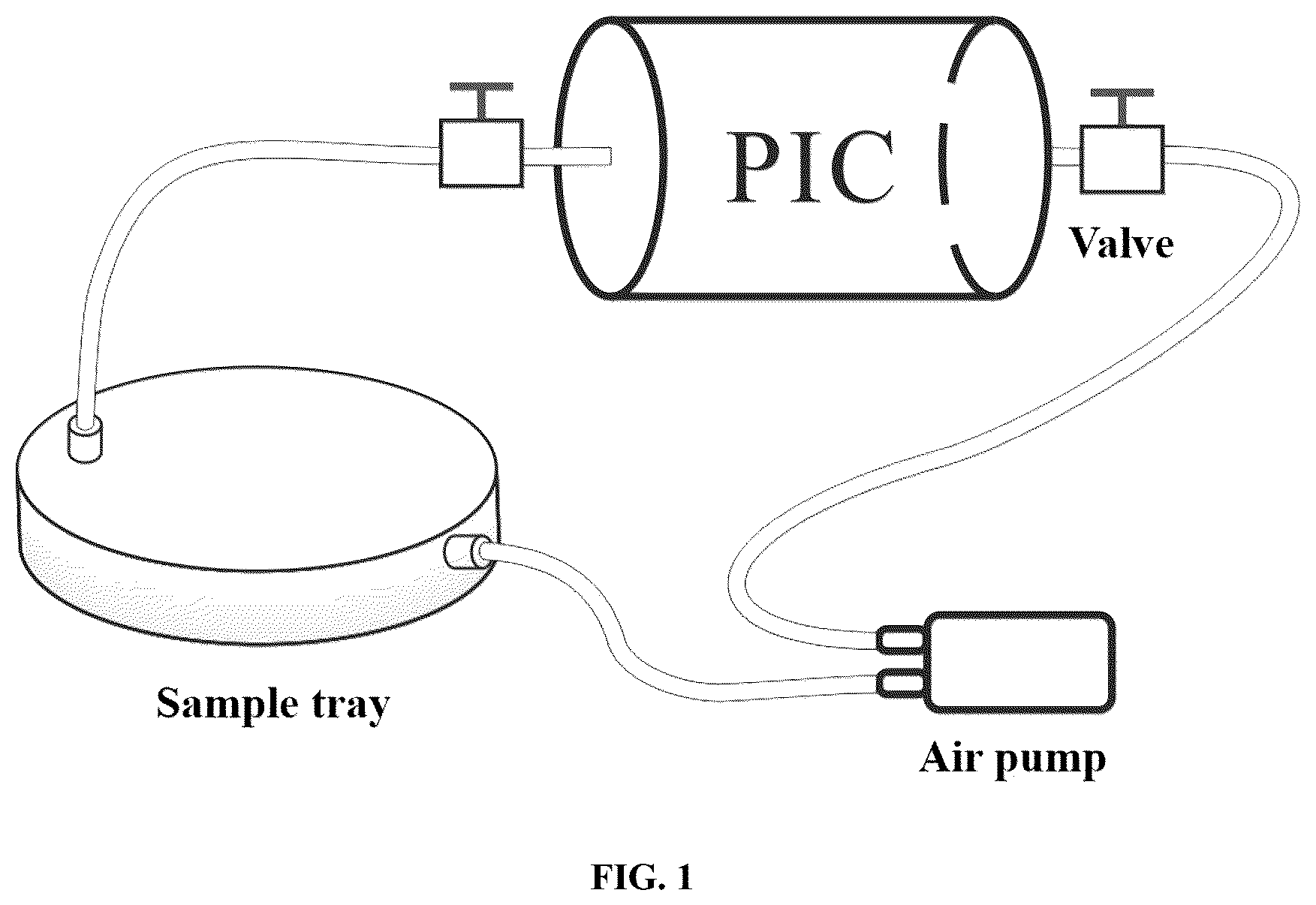
shows the schematic diagram of the device used in some embodiments of the present disclosure.
shows a schematic flow chart of the method for determining 224 Ra in a sediment according to some embodiments of the present disclosure.
DETAILED DESCRIPTION OF THE EMBODIMENTS
The present disclosure provides a method for determining 224 Ra in a sediment by using a pulse ionization chamber emanometer, comprising steps of
•
• (1) placing a sediment standard sample of 224 Ra in a sample tray, connecting the sample tray with an air pump and the pulse ionization chamber emanometer, to form an enclosed test system; • turning on the air pump and circulating gas in the test system for at least 5 minutes, such that a radioactive equilibrium between 220 Rn gas released from the sediment standard sample and 224 Ra in the sediment standard sample is reached, and performing a first continuous measurement for an activity of Rn in the test system, to obtain a sum of counting rates of 222 Rn and 220 Rn, represented by C 1 in cpm; • turning off the air pump, closing inlet valve(s) and outlet valve(s) of the pulse ionization chamber emanometer, and leaving the pulse ionization chamber emanometer to stand for at least 5 minutes, such that 220 Rn in the pulse ionization chamber emanometer completely decays and disappears, and performing a second continuous measurement for an activity of Rn in the pulse ionization chamber emanometer, to obtain a counting rate of 222 Rn, represented by C 2 in cpm; • calculating a counting rate of 224 Ra in the sediment standard sample according to equation 1; C p =C d =C 1 −C 2 equation 1, • in equation 1, C p represents the counting rate of 224 Ra in the sediment standard sample, and Ca represents the counting rate of 220 Rn in the sediment standard sample; • (2) repeating step (1) by using different sediment standard samples with a 224 Ra activity gradient to obtain counting rates of 224 Ra in different sediment standard samples with a 224 Ra activity gradient; • plotting a standard curve of activities of 224 Ra versus counting rates, in which the counting rates of 224 Ra in the different sediment standard samples are set as ordinate, and 224 Ra activities in the different sediment standard samples are set as abscissa; and • (3) performing a measurement on a sediment sample according to step (1) to obtain a counting rate of 224 Ra (cm) and calculating the 224 Ra activity of the sediment sample according to the standard curve obtained in step (2).
As shown in , in the method according to the present disclosure, the sediment standard sample of 224 Ra is first placed in the sample tray, and the sample tray is connected with the air pump and the pulse ionization chamber emanometer, to form an enclosed test system.
In the present disclosure, there is no special type limitation on the pulse ionization chamber (PIC) emanometer, and any PIC well known in the art may be used. In the present disclosure, there is no special requirements on the connection method of the sample tray, the air pump and the pulse ionization chamber emanometer, and the connection method well known in the art may be adopted, which is common knowledge in the art. In the present disclosure, there is no special requirement on the type of the sediment standard sample, for example clay and silt. In some embodiments of the present disclosure, the sediment standard sample has a moisture content of 0-70 wt %. Those skilled in the art could select an appropriate moisture content according to the particle size of the sediment standard sample. In some embodiments of the present disclosure, the sediment standard sample has a mass of 1-60 g, preferably 10-50 g, and further preferably 20-40 g.
According to the present disclosure, after the enclosed test system is formed, the air pump is turn on, and the gas in the test system is circulated for at least 5 minutes, such that a radioactive equilibrium between 220 Rn gas released from the sediment standard sample and 224 Ra in the sediment standard sample is reached, and a first continuous measurement is performed for an activity of Rn in the test system, to obtain a sum of counting rates of 222 Rn and 220 Rn, represented by C 1 , in cpm.
In some embodiments of the present disclosure, the air pump is run to provide a constant flow rate of 0.5 to 3.0 L/min, and preferably 1.0 to 2.0 L/min.
The α decay of 224 Ra produces a gaseous daughter 220 Rn. Since the half-life of 224 Ra (T 1/2 =3.66 days) is much longer than that of its daughter 220 Rn (T 1/2 =55.6 s), According to the principle of secular radioactive equilibrium, the activity of 224 Ra is the same as that of 220 Rn after five-fold time of the half-life of 220 Rn (i.e., five minutes). There are four natural radioactive radium isotopes in nature, namely 228 Ra (T 1/2 =5.75 years), 226 Ra (T 1/2 =1620 years), 224 Ra (T 1/2 =3.66 days) and 223 Ra (T 1/2 =11.4 days), and three types of Rn isotopes would be produced when they decay, namely 222 Rn (T 1/2 =3.83 days), 220 Rn (T 1/2 =55.6 s) and 219 Rn (T 1/2 =3.96 s). Since the object measured in the ionization chamber are positive and negative charges generated by ionizing air with alpha particles, the three nuclides 222 Rn, 220 Rn and 219 Rn could not be directly distinguished by the PIC. Therefore, in the first continuous measurement, the result measured by PIC is the sum of the radon isotopes in the gas ( 222 Rn, 220 Rn and 219 Rn). Since the content of 223 Ra in the sediment is extremely low and the half-life of 219 Rn is very short, the influence of 219 Rn on the 220 Rn measurement in the sediment could be ignored during the measurement. Therefore, the result obtained in the first continuous measurement is the sum of the activities (counting rates) of 222 Rn and 220 Rn.
In the present disclosure, the counting rate is expressed in unit of cpm, i.e., counts per minute, which is the number of decays of radioactive isotopes per minute observed by the instrument, which corresponding to the activity of the radioactive element at the corresponding stage of the measurement by the PIC emanometer.
In the present disclosure, there is no special requirements on the upper limit of the time for the gas circulation.
In some embodiments of the present disclosure, the first continuous measurement is performed for 0.5 to 6 hours, and preferably 2 to 4 hours. A longer time for the first continuous measurement would result in a higher counting value, thereby causing a smaller measurement error at this stage. The time for the first continuous measurement could be selected according to the measurement error requirement. The calculation of the error will be described in detail below.
According to the present disclosure, after obtaining the sum of counting rates of 222 Rn and 220 Rn (C 1 ), inlet valve(s) and outlet valve(s) of the pulse ionization chamber emanometer are closed, and the pulse ionization chamber emanometer is left to stand for at least 5 minutes such that the 220 Rn in the pulse ionization chamber emanometer completely decays and disappears, and a second continuous measurement is performed for an activity of Rn in the pulse ionization chamber emanometer, to obtain a counting rate of 222 Rn, represented by C 2 , in cpm.
In some embodiments of the present disclosure, leaving the pulse ionization chamber emanometer to stand is performed for 5 to 10 minutes.
In some embodiments of the present disclosure, the second continuous measurement is performed for 0.5 to 4 hours, and preferably 1 to 3 hours. A longer time for the second continuous measurement results in a higher counting value, thereby causing a smaller measurement error at this stage. The time for the second continuous measurement could be chosen according to the measurement error requirement. The calculation of the error will be described in detail below.
According to the present disclosure, after obtaining the sum of counting rates of 222 Rn and 220 Rn (C 1 ) and the counting rate of 222 Rn (C 2 ), the counting rate of 224 Ra in the sediment standard sample is calculated according to equation 1, C p =C d =C 1 −C 2 equation 1,
in equation 1, C p represents the counting rate of 224 Ra in the sediment standard sample, and C d represents the counting rate of 220 Rn in the sediment standard sample.
According to the present disclosure, the above steps are repeated by using different sediment standard samples with a 224 Ra activity gradient to obtain counting rates of 224 Ra in different sediment standard samples with a 224 Ra activity gradient. A standard curve of activities of 224 Ra versus counting rates is plotted, in which the counting rates (cpm) of 224 Ra in the different sediment standard samples are set as ordinate, and activities of 224 Ra in the different sediment standard samples are set as abscissa.
In the present disclosure, there is no special requirements on the progress for plotting the standard curve. According to the present disclosure, after plotting the standard curve, a linear equation of activities of 224 Ra versus counting rates and a correlation coefficient (R 2 ) are obtained, and a correlation coefficient (R 2 ) much closer to 1 indicates a higher accuracy of the measurement method according to the present disclosure. In some embodiments of the present disclosure, the linear equation is shown in equation 7: C 1 −C 2 =kA standard +b equation 7, in equation 7, (C 1 -C 2 ) equals to the counting rate of 224 Ra, A standard represents the activity of 224 Ra in the standard sample, k represents the instrument efficiency, and b represents the background value of the 224 Ra in the sediment sample.
According to the present disclosure, after obtaining the standard curve of activities of 224 Ra versus counting rates, a measurement is performed on the sediment sample to be tested according to the above-mentioned steps, to obtain the counting rate of 224 Ra in the sediment sample to be tested, and the activity of 224 Ra in the sediment sample to be tested is calculated according to the standard curve of activities of 224 Ra versus counting rates.
In some embodiments of the present disclosure, the sediment sample to be tested and the sediment standard samples are in same type. For example, if the sediment standard sample is a silty sediment, the sample to be tested is also a silty sediment.
In some embodiments, the activity of 224 Ra in the sediment sample to be tested is calculated according to the linear equation which corresponds to the standard curve, and the activity of 224 Ra calculated is the theoretically calculated activity. In the present disclosure, the activity of 224 Ra in the sediment sample to be tested (C theory ) is calculated according to equation 8, C theory =( C 1 −C 2 )/ k equation 8.
In order to ensure the accuracy of the measurement, the method according to the present disclosure further comprises calculating a relative standard deviation of the activity of 224 Ra in the sediment sample to be tested.
In some embodiments of the present disclosure, calculating the relative standard deviation of the activity of 224 Ra in the sediment sample to be tested is performed by a process comprises the following steps:
•
• calculating a standard deviation of the sum of counting rates of 222 Rn and 220 Rn obtained from the first continuous measurement according to equation 2 and equation 3,
σ 1 = N 1 N 1 × C 1 , equation 2 N 1 = C 1 × T 1 , equation 3
•
• in equations 2 and 3, σ 1 represents the standard deviation of the sum of counting rates of 222 Rn and 220 Rn obtained from the first continuous measurement, in cpm; N 1 represents a counting value in the first continuous measurement, in counts; T 1 represents time for the first continuous measurement, in minute; • calculating a standard deviation of the counting rate of 222 Rn obtained from the second continuous measurement according to equation 4 and equation 5,
σ2 = N 2 N 2 × C 2 , equation 4 N 2 = C 2 × T 2 ; equation 5
•
• in equations 4 and 5, σ 2 represents the standard deviation of the counting rate of 222 Rn obtained from the second continuous measurement, in cpm; N 2 represents a counting value in the second continuous measurement, in counts; T 2 represents time for the second continuous measurement, in minute; and • calculating the relative standard deviation of the activity of 224 Ra according to equation 6, represented by δ in equation 6,
δ = σ 1 2 + σ 2 2 C 1 - C 2 × 1 0 0 % . equation 6
•
• In the present disclosure, the relationship between the actual activity of 224 Ra in the sediment sample to be tested and the theoretical activity therefore is represented by C actual =C theory ×(1±δ).
The method for determining 224 Ra in a sediment by using a pulse ionization chamber emanometer according to the present disclosure will be described in detail below in conjunction with the examples, but they should not be construed as limiting the scope of the present disclosure.
Example 1
Six standard samples of silty sediments with a known 224 Ra activity gradient was provided. An experimental device as shown in Figure was used. The moister contents of the standard samples of sediments were adjusted to 30 wt %. An air pump was turned on, and the flow rate was adjusted to 1 L/min. The gas was circulated in the system for 5 minutes, such that a radioactive equilibrium between 220 Rn gas released from the sediment standard sample and 224 Ra in the sediment standard sample was reached, and a first continuous measurement for Rn in the test system was performed for 2 hours, obtaining the sum of the counting rates of 222 Rn and 220 Rn (i.e. C 1 ). The air pump was turned off. The inlet valve(s) and outlet valve(s) of the PIC were closed, and the PIC was left to stand for at least 5 minutes, such that the 220 Rn in the PIC completely decayed and disappeared. A second continuous measurement for the activity of Rn in the PIC was performed for 2 hours, obtaining the counting rate of the 222 Rn (C 2 ). The difference between the two measurement results (i.e. C 1 −C 2 ) was the counting rate of 220 Rn in the system, i.e. the counting rate of 224 Ra. A standard curve of activities of 224 Ra versus counting rates was plotted, in which the counting rates of 224 Ra in the different sediment standard samples are set as ordinate, and activities of 224 Ra in the different sediment standard samples are set as abscissa. The standard curve was fitted, obtaining a linear equation and R 2 value, the linear equation being shown as equation 9, C 1 −C 2 =0.2 A standard +1.6 equation 9.
20 g of silty sediment to be tested was provided and placed into a sample tray, and subjected to a measurement according to the same procedure and conditions as the sediment standard samples. The moisture content of the sediment was adjusted the same as the standard samples, i.e., 30 wt %. The air pump was turned on, and the flow rate was adjusted to 1 L/min. The gas in the system was circulated for 5 minutes. A first continuous measurement for Rn in the test system was performed for 2 hours, obtaining a total counting rate of Rn (C 1 ) of 5.0 cpm. The inlet valve(s) and outlet valve(s) of the PIC were closed. The PIC emanometer was left to stand for 5 minutes, such that the 220 Rn in the PIC completely decayed and disappeared. A second continuous measurement was performed for 2 hours for the activity of 222 Rn in the PIC, obtaining the counting rate of 222 Rn (C 2 ) of 0.8 cpm. The difference between the two measurement results was the counting rate of the 220 Rn in the system, i.e. 5.0 cpm-0.8 cpm=4.2 cpm. Since the 224 Ra in the sediment and the 220 Rn in the system were in a secular radioactive equilibrium, the counting rate of 224 Ra by the instrument was 4.2 cpm. For the silty sediment samples, the standard sample had an efficiency of 0.2 cpm/dpm with R 2 larger than 0.99. According to equation 9, the theoretical activity of 224 Ra in the sediment sample was calculated to be 1.05 dpm/g, i.e. 4.2 cpm/0.2 (cpm/dpm)/20 g=1.05 dpm/g.
Error Calculation:
The error of total radon in the first continuous measurement: 5 cpm×120 min=600 counts, the standard deviation of the counting rate (σ 1 ) was 0.2 cpm, i.e. σ 1 =
6 0 0 6 0 0 × 5 = 0 . 2 cpm ;
The error of 222 Rn in the second continuous measurement: 0.8×120 min=96 counts, the standard deviation of the counting rate (σ 2 ) was 0.08 cpm, i.e.
0 2 = 9 6 9 6 × 0 . 8 = 0.08 cpm ;
Therefore, the relative standard deviation of 224 Ra (δ) was 5%, i.e.
δ = 0.2 2 + 0.08 2 4.2 × 1 0 0 % = 5 % .
Therefore, the actual activity of 224 Ra in the sediment sample (C actual ) was 1.05±0.05 dpm/g, i.e. C actual =1.05 dpm/g×(1±0.05)=1.05±0.05 dpm/g.
The above are only the preferred embodiments of the present disclosure. It should be pointed out that for those skilled in the art, without departing from the principles of the present disclosure, several improvements and modifications could be made. And the improvements and modifications shall fall within the scope of the present disclosure.
Figures (2)
Citations
This patent cites (18)
- US1395120
- US4871914
- US4960998
- US5047634
- US5107108
- US5128540
- US5210419
- US5235190
- US6768116
- US6847033
- US8459096
- US10132936
- US10214482
- US10279309
- US11041964
- US11169281
- US11173446
- US12013500