Semiconductor Device with Contact Structures
Abstract
A semiconductor device structure is provided. The semiconductor device structure includes a first epitaxial structure and a second epitaxial structure spaced apart from the first epitaxial structure. The semiconductor device structure also includes a conductive contact electrically connected to the first epitaxial structure and a first conductive via over the conductive contact. The semiconductor device structure further includes a second conductive via directly above the second epitaxial structure. The second conductive via is longer than the first conductive via.
Claims (20)
1. A semiconductor device structure, comprising: a first source/drain structure; a second source/drain structure spaced apart from the first source/drain structure; a conductive contact electrically connected to the first source/drain structure; a first conductive via over the conductive contact; and a second conductive via directly above the second source/drain structure, wherein the second conductive via is longer than the first conductive via, wherein a first direct projection of the first source/drain structure on a top surface of the conductive contact and a second direct projection of the first conductive via on the top surface of the conductive contact do not overlap each other, wherein an interface between the first conductive via and the conductive contact is lower than a top of the second conductive via and higher than a bottom of the second conductive via.
11. A semiconductor device structure, comprising: a first source/drain structure; a second source/drain structure spaced apart from the first source/drain structure; a conductive contact electrically connected to the first source/drain structure; a first conductive via electrically connected to the conductive contact, wherein the conductive contact is wider than the first conductive via; a second conductive via directly above the second source/drain structure, wherein the second conductive via extends upwards past a bottom surface of the first conductive via, and the conductive contact is wider than the second conductive via; and a protective element over the conductive contact and surrounding the first conductive via, wherein the protective element has a first inclined sidewall, the conductive contact has a second inclined sidewall, and slopes of the first inclined sidewall and the second inclined sidewall are substantially the same.
16. A semiconductor device structure, comprising: a substrate; a first source/drain structure and a second source/drain structure over the substrate; a conductive contact electrically connected to the first source/drain structure; a first conductive via electrically connected to the conductive contact, wherein the conductive contact is wider than the first conductive via; a second conductive via electrically connected the second source/drain structure, wherein top surfaces of the first conductive via and the second conductive via are substantially level, the second conductive via is closer to the substrate than the first conductive via, and the conductive contact is wider than the second conductive via; a protective element surrounding the first conductive via, wherein the protective element has a first inclined sidewall, the conductive contact has a second inclined sidewall, and slopes of the first inclined sidewall and the second inclined sidewall are substantially the same; and a dielectric layer surrounding the protective element, the conductive contact, and the second conductive via.
Show 17 dependent claims
2. The semiconductor device structure as claimed in claim 1 , further comprising: a dielectric layer laterally surrounding the conductive contact, the first conductive via, and the second conductive via.
3. The semiconductor device structure as claimed in claim 2 , further comprising: a protective element laterally surrounding the first conductive via, wherein a portion of the dielectric layer is between the protective element and the second conductive via.
4. The semiconductor device structure as claimed in claim 3 , wherein top surfaces of the protective element and the dielectric layer are substantially level.
5. The semiconductor device structure as claimed in claim 3 , wherein a sidewall of the protective element directly meets a sidewall of the conductive contact.
6. The semiconductor device structure as claimed in claim 3 , wherein the protective element has a first inclined sidewall, the conductive contact has a second inclined sidewall, and slopes of the first inclined sidewall and the second inclined sidewall are substantially the same.
7. The semiconductor device structure as claimed in claim 1 , wherein top surfaces of the first conductive via and the second conductive via are substantially level.
8. The semiconductor device structure as claimed in claim 1 , further comprising: a first conductive line over the first conductive via; and a second conductive line over the second conductive via, wherein bottom surfaces of the first conductive line and the second conductive line are substantially level.
9. The semiconductor device structure as claimed in claim 8 , wherein the first conductive line is wider than the second conductive line.
10. The semiconductor device structure as claimed in claim 1 , wherein the conductive contact is wider than the first conductive via, and the conductive contact is wider than the second conductive via.
12. The semiconductor device structure as claimed in claim 11 , wherein the second conductive via is in direct contact with the second source/drain structure.
13. The semiconductor device structure as claimed in claim 11 , wherein an interface between the first conductive via and the conductive contact is lower than a top of the second conductive via and higher than a bottom of the second conductive via.
14. The semiconductor device structure as claimed in claim 11 , wherein the first inclined sidewall and the second inclined sidewall directly meet together.
15. The semiconductor device structure as claimed in claim 11 , wherein the second conductive via is in direct contact with the second source/drain structure.
17. The semiconductor device structure as claimed in claim 16 , wherein the second conductive via extends across a top of the conductive contact.
18. The semiconductor device structure as claimed in claim 16 , wherein the first sidewall and the second sidewall directly meet together.
19. The semiconductor device structure as claimed in claim 16 , wherein a top surface of the conductive contact is vertically between opposite ends of the second conductive via.
20. The semiconductor device structure as claimed in claim 16 , wherein a first direct projection of the second conductive via on a top surface of the substrate at least partially overlaps a second direct projection of the second source/drain structure on the top surface of the substrate.
Full Description
Show full text →
PRIORITY CLAIM AND CROSS-REFERENCE
This Application is a Continuation application of U.S. patent application Ser. No. 17/464,917, filed on Sep. 2, 2021, issued on Jul. 4, 2023, as U.S. Pat. No. 11,694,927, which is a Divisional of U.S. application Ser. No. 16/149,597, filed on Oct. 2, 2018, issued on Sep. 21, 2021, as U.S. Pat. No. 11,127,631, which claims the benefit of U.S. Provisional Application No. 62/697,582, filed on Jul. 13, 2018, the entirety of which are incorporated by reference herein.
BACKGROUND
The semiconductor integrated circuit (IC) industry has experienced rapid growth. Technological advances in IC materials and design have produced generations of ICs. Each generation has smaller and more complex circuits than the previous generation.
In the course of IC evolution, functional density (i.e., the number of interconnected devices per chip area) has generally increased while geometric size (i.e., the smallest component (or line) that can be created using a fabrication process) has decreased. This scaling-down process generally provides benefits by increasing production efficiency and lowering associated costs.
However, these advances have increased the complexity of processing and manufacturing ICs. Since feature sizes continue to decrease, fabrication processes continue to become more difficult to perform. Therefore, it is a challenge to form reliable semiconductor devices at smaller and smaller sizes.
BRIEF DESCRIPTION OF THE DRAWINGS
Aspects of the present disclosure are best understood from the following detailed description when read with the accompanying figures. It should be noted that, in accordance with the standard practice in the industry, various features are not drawn to scale. In fact, the dimensions of the various features may be arbitrarily increased or reduced for clarity of discussion.
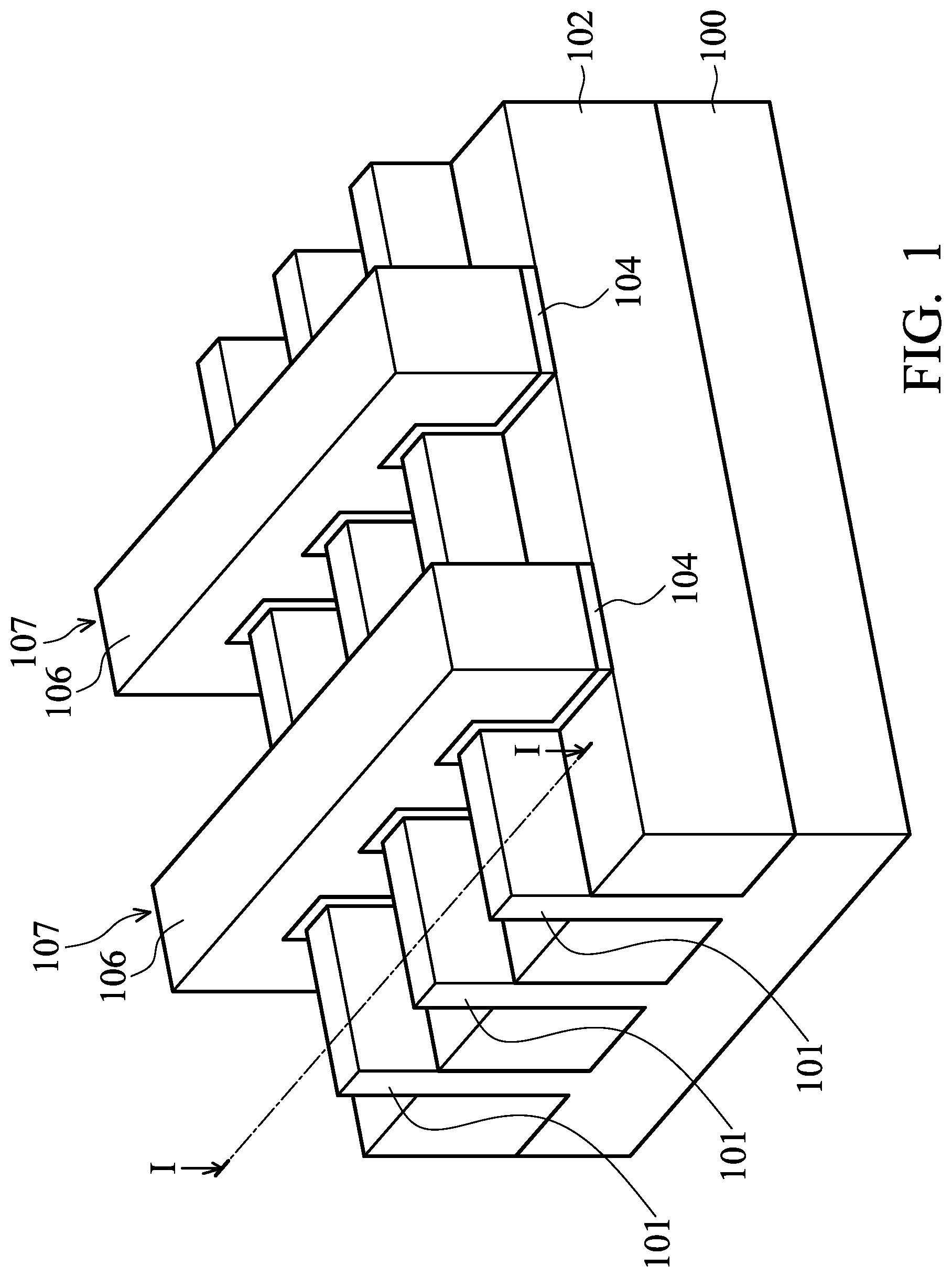
is a perspective view of a semiconductor device structure, in accordance with some embodiments.
A- 2 H are cross-sectional views of various stages of a process for forming a semiconductor device structure, in accordance with some embodiments.
is a top layout view of a semiconductor device structure, in accordance with some embodiments.
is a cross-sectional view of a semiconductor device structure, in accordance with some embodiments.
DETAILED DESCRIPTION
The following disclosure provides many different embodiments, or examples, for implementing different features of the provided subject matter. Specific examples of components and arrangements are described below to simplify the present disclosure. These are, of course, merely examples and are not intended to be limiting. For example, the formation of a first feature over or on a second feature in the description that follows may include embodiments in which the first and second features are formed in direct contact, and may also include embodiments in which additional features may be formed between the first and second features, such that the first and second features may not be in direct contact. In addition, the present disclosure may repeat reference numerals and/or letters in the various examples. This repetition is for the purpose of simplicity and clarity and does not in itself dictate a relationship between the various embodiments and/or configurations discussed.
Further, spatially relative terms, such as “beneath,” “below,” “lower,” “above,” “upper” and the like, may be used herein for ease of description to describe one element or feature's relationship to another element(s) or feature(s) as illustrated in the figures. The spatially relative terms are intended to encompass different orientations of the device in use or operation in addition to the orientation depicted in the figures. The apparatus may be otherwise oriented (rotated 90 degrees or at other orientations) and the spatially relative descriptors used herein may likewise be interpreted accordingly.
Embodiments of the disclosure may relate to FinFET structure having fins. The fins may be patterned by any suitable method. For example, the fins may be patterned using one or more photolithography processes, including double-patterning or multi-patterning processes. Generally, double-patterning or multi-patterning processes combine photolithography and self-aligned processes, allowing patterns to be created that have, for example, pitches smaller than what is otherwise obtainable using a single, direct photolithography process. For example, in some embodiments, a sacrificial layer is formed over a substrate and patterned using a photolithography process. Spacers are formed alongside the patterned sacrificial layer using a self-aligned process. The sacrificial layer is then removed, and the remaining spacers may then be used to pattern the fins. However, the fins may be formed using one or more other applicable processes.
Some embodiments of the disclosure are described. Additional operations can be provided before, during, and/or after the stages described in these embodiments. Some of the stages that are described can be replaced or eliminated for different embodiments. Additional features can be added to the semiconductor device structure. Some of the features described below can be replaced or eliminated for different embodiments. Although some embodiments are discussed with operations performed in a particular order, these operations may be performed in another logical order.
is a perspective view of a semiconductor device structure, in accordance with some embodiments. A semiconductor substrate 100 is received or provided. In some embodiments, the semiconductor substrate 100 is a bulk semiconductor substrate, such as a semiconductor wafer. For example, the semiconductor substrate 100 includes silicon or other elementary semiconductor materials such as germanium. The semiconductor substrate 100 may be un-doped or doped (such as p-type, n-type, or a combination thereof). In some embodiments, portions of the semiconductor substrate 100 are doped with dopants to form well regions. Multiple ion implantation processes may be used to form the well regions. In some embodiments, the semiconductor substrate 100 includes an epitaxially grown semiconductor layer on a dielectric layer. The epitaxially grown semiconductor layer may be made of silicon germanium, silicon, germanium, one or more other suitable materials, or a combination thereof.
In some other embodiments, the semiconductor substrate 100 includes a compound semiconductor. For example, the compound semiconductor includes one or more III-V compound semiconductors having a composition defined by the formula Al X1 Ga X2 In X3 As Y1 P Y2 N Y3 Sb Y4 , where X1, X2, X3, Y1, Y2, Y3, and Y4 represent relative proportions. Each of them is greater than or equal to zero, and added together they equal 1. The compound semiconductor may include silicon carbide, gallium arsenide, indium arsenide, indium phosphide, one or more other suitable compound semiconductors, or a combination thereof. Other suitable substrate including II-VI compound semiconductors may also be used.
In some embodiments, the semiconductor substrate 100 is an active layer of a semiconductor-on-insulator (SOI) substrate. The SOI substrate may be fabricated using a separation by implantation of oxygen (SIMOX) process, a wafer bonding process, another applicable method, or a combination thereof. In some other embodiments, the semiconductor substrate 100 includes a multi-layered structure. For example, the semiconductor substrate 100 includes a silicon-germanium layer formed on a bulk silicon layer.
Afterwards, patterned mask elements (not shown) are formed over the semiconductor substrate 100 to assist in a subsequent formation of semiconductor fins, in accordance with some embodiments. One or more etching processes may be used to partially remove the semiconductor substrate 100 . As a result, multiple recesses and semiconductor fins 101 are formed, as shown in .
Afterwards, isolation features 102 are formed over the semiconductor substrate 100 to surround lower portions of the semiconductor fins 101 , as shown in in accordance with some embodiments. In some embodiments, a dielectric material layer is deposited over the semiconductor substrate 100 to cover and surround the semiconductor fins 101 . The dielectric material layer may be made of or include silicon oxide, silicon nitride, silicon oxynitride, fluorinated silicate glass (FSG), low-K dielectric material, one or more other suitable materials, or a combination thereof. The dielectric material layer may be deposited using a chemical vapor deposition (CVD) process, an atomic layer deposition (ALD) process, a physical vapor deposition (PVD) process, a spin-on process, one or more other applicable processes, or a combination thereof.
A planarization process is then used to thin the dielectric material layer until the semiconductor fins 101 or the mask elements used for defining the semiconductor fins 101 are exposed. The planarization process may include a chemical mechanical polishing (CMP) process, a grinding process, a dry polishing process, an etching process, one or more other applicable processes, or a combination thereof.
Afterwards, the mask elements used for defining the semiconductor fins 101 are removed, and the dielectric material layer is partially removed, in accordance with some embodiments. For example, the dielectric material layer is etched back. As a result, the remaining portions of the dielectric material layer form the isolation features 102 , as shown in . The isolation features 102 surround the lower portions of the semiconductor fins 101 . Upper portions of the semiconductor fins 101 protrude from the top surfaces of the isolation features 102 .
As shown in , one or more gate stacks 107 are formed over the semiconductor substrate 100 to partially cover the semiconductor fins 101 and the isolation features 102 , as shown in in accordance with some embodiments. The gate stacks 107 extend across the semiconductor fins 101 . Each of the gate stacks 107 includes a gate electrode 106 and a gate dielectric layer 104 . In some embodiments, a gate dielectric material layer and a gate electrode material layer are deposited over the isolation features 102 and the semiconductor fins 101 . Afterwards, the gate dielectric material layer and the gate electrode material layer are patterned to form the gate stacks 107 .
In some embodiments, the gate dielectric material layer for forming the gate dielectric layer 104 is made of or includes silicon oxide, silicon nitride, silicon oxynitride, dielectric material with a high dielectric constant (high-K), one or more other suitable dielectric materials, or a combination thereof. In some embodiments, the gate dielectric material layer is a dummy gate dielectric layer that will be subsequently removed. The dummy gate dielectric material layer is, for example, a silicon oxide layer.
In some embodiments, the gate dielectric material layer is deposited using a chemical vapor deposition (CVD) process, an atomic layer deposition (ALD) process, a thermal oxidation process, a physical vapor deposition (PVD) process, one or more other applicable processes, or a combination thereof.
In some embodiments, the gate electrode material layer is made of or includes polysilicon, amorphous silicon, germanium, silicon germanium, one or more other suitable materials, or a combination thereof. In some embodiments, the gate electrode material layer is a dummy gate electrode layer that is made of or includes a semiconductor material such as polysilicon. For example, the dummy gate electrode layer is deposited using a CVD process or another applicable process.
Afterwards, epitaxial growth processes are performed to form source/drain structures, in accordance with some embodiments. A- 2 H are cross-sectional views of various stages of a process for forming a semiconductor device structure, in accordance with some embodiments. In some embodiments, A- 2 H are cross-sectional views of various subsequent stages of a process for forming a semiconductor device structure taken along line I-I in .
As shown in A , the semiconductor fins 101 are partially removed to form recessed semiconductor fins 101 , in accordance with some embodiments. In some embodiments, the recessed semiconductor fins 101 are recessed to a level below the top surfaces of the isolation features 102 . In some other embodiments, the recessed semiconductor fins 101 are recessed to a level above the top surfaces of the isolation features 102 . In some embodiments, one or more etching processes is/are used to recessing the semiconductor fins 101 .
Many variations and/or modifications can be made to embodiments of the disclosure. In some other embodiments, the semiconductor fins 101 are not recessed. In some other embodiments, the semiconductor fins 101 are merely thinned without being recessed to a level below the top surfaces of the isolation features 102 .
As shown in A , one or more semiconductor materials are epitaxially grown over the recessed semiconductor fins 101 , in accordance with some embodiments. As a result, epitaxial structures 200 A, 200 B, and 200 C are formed. The epitaxial structures 200 A, 200 B, and 200 C may function as source/drain structures. The epitaxial structures 200 A, 200 B, and 200 C may also function as stressors to improve carrier mobility.
In some embodiments, the epitaxial structures 200 A, 200 B, and 200 C are doped with the same type dopants. For example, the epitaxial structures 200 A, 200 B, and 200 C are p-type doped. Alternatively, the epitaxial structures 200 A, 200 B, and 200 C are n-type doped.
In some embodiments, two of the epitaxial structures 200 A, 200 B, and 200 C are doped with different types of dopants. For example, the epitaxial structures 200 A and 200 B are n-type doped, and the epitaxial structure 200 C is p-type doped. Alternatively, the epitaxial structures 200 A and 200 B are p-type doped, and the epitaxial structure 200 C is n-type doped. The epitaxial structures doped with different types of dopants may be formed separately in different epitaxial growth processes. Mask elements may be used to assist in the formation of the epitaxial structures doped with different types of dopants.
The p-type doped epitaxial structures may be used as p-type source/drain structures. The p-type doped epitaxial structures may include epitaxially grown silicon germanium, epitaxially grown germanium, or one or more other suitable epitaxially grown semiconductor materials. The p-type doped epitaxial structures may include p-type dopants such as boron, gallium, indium, one or more other suitable dopants, or a combination thereof.
The n-type doped epitaxial structures may be used as n-type source/drain structures. The n-type doped epitaxial structures may include epitaxially grown silicon or another suitable epitaxially grown semiconductor material. The n-type doped epitaxial structures may include n-type dopants such as phosphor, arsenic, one or more other suitable dopants, or a combination thereof.
In some embodiments, the epitaxial structures 200 A, 200 B, and 200 C are formed using a selective epitaxial growth (SEG) process, a CVD process (e.g., a vapor-phase epitaxy (VPE) process, a low-pressure chemical vapor deposition (LPCVD) process, and/or an ultra-high vacuum CVD (UHV-CVD) process), a molecular beam epitaxy process, an ALD process, one or more other applicable processes, or a combination thereof. The process of forming the epitaxial structures 200 A, 200 B, and 200 C may use gaseous and/or liquid precursors.
In some embodiments, the epitaxial structures 200 A, 200 B, and 200 C are doped in-situ during the growth of the epitaxial structures 200 A, 200 B, and 200 C. However, embodiments of the disclosure are not limited thereto. In some other embodiments, one or more doping processes are used to dope the epitaxial structures 200 A, 200 B, and 200 C after the epitaxial growth of the epitaxial structures 200 A, 200 B, and 200 C. In some embodiments, the doping is achieved using an ion implantation process, a plasma immersion ion implantation process, a gas and/or solid source diffusion process, one or more other applicable processes, or a combination thereof.
Afterwards, a dielectric layer 202 is deposited to cover the epitaxial structures 200 A, 200 B, and 200 C, as shown in A in accordance with some embodiments. In some embodiments, a dielectric material layer is deposited over the epitaxial structures 200 A, 200 B, and 200 C and the gate stacks 107 . The dielectric material layer may be made of or include silicon oxide, silicon oxynitride, borosilicate glass (BSG), phosphoric silicate glass (PSG), borophosphosilicate glass (BPSG), fluorinated silicate glass (FSG), low-k material, porous dielectric material, one or more other suitable dielectric materials, or a combination thereof.
In some embodiments, the dielectric material layer is deposited using a CVD process, an ALD process, a PVD process, a spin-on process, one or more other applicable processes, or a combination thereof. Afterwards, the dielectric material layer is partially removed using a planarization process until the gate stacks 107 are exposed. The planarization process may include a CMP process, a grinding process, a dry polishing process, an etching process, one or more other applicable processes, or a combination thereof. As a result, the remaining portion of the dielectric material layer forms the dielectric layer 202 .
A gate replacement process may then be performed to replace the gate stacks 107 with a metal gate stack. In some embodiments, the gate stacks 107 are removed to form trenches that are surrounded by the dielectric layer 202 . One or more etching processes are used to remove the gate electrode 106 and the gate dielectric layer 104 .
Afterwards, material layers for forming metal gate stacks are deposited to fill the trenches originally occupied by the gate stacks 107 . The material layers may include a high-k dielectric layer, work function layers, and metal filling layers. The material layers may further include barrier layers, buffer layers, and/or blocking layers. A planarization process may be used to remove the portions of the material layers outside of the trenches. As a result, the remaining portions of the material layers in the trenches form multiple metal gate stacks. In some embodiments, protective elements (not shown) are formed over the metal gate stacks to protect the metal gate stacks from being damaged during subsequent formation process.
Afterwards, conductive contacts 204 A and 204 B are respectively formed to provide corresponding electrical connections to the epitaxial structures 200 A and 200 C, as shown in A in accordance with some embodiments. In some embodiments, contact openings are formed in the dielectric layer 202 . The contact openings expose the epitaxial structures 200 A and 200 C. The contact openings may be formed using a photolithography process and an etching process.
Afterwards, a conductive material layer is deposited over the dielectric layer 202 to fill the contact openings, in accordance with some embodiments. The conductive material layer may be made of or include ruthenium, cobalt, tungsten, titanium, molybdenum, titanium nitride, tantalum nitride, tungsten nitride, one or more other suitable materials, or a combination thereof. The conductive material layer may be deposited using an ALD process, a CVD process, a PVD process, an electroplating process, one or more other applicable processes, or a combination thereof.
Afterwards, a planarization process is used to remove the conductive material layer outside of the contact openings, in accordance with some embodiments. As a result, the remaining portions of the conductive material layer in the contact openings form the conductive contacts 204 A and 204 B, as shown in A in accordance with some embodiments. The planarization process mentioned above may include a CMP process, a grinding process, an etching process, a dry polishing process, one or more other applicable processes, or a combination thereof.
Many variations and/or modifications can be made to embodiments of the disclosure. In some embodiments, metal-semiconductor compound layers are formed on the epitaxial structures 200 A, 200 B, and 200 C before the formation of the conductive contacts 204 A and 204 B. The metal-semiconductor compound layers may be made of or include metal silicide or other suitable materials.
In some embodiments, the conductive contacts 204 A and 204 B are selectively formed over the epitaxial structures 200 A and 200 C. In some embodiments, no conductive contact is formed directly above the epitaxial structure 200 B. The conductive contact 204 A may be used to form an electrical connection between the epitaxial structure 200 A and a conductive line that is to be formed over the conductive contact 204 A but not directly above the epitaxial structure 200 A. Similarly, the conductive contact 204 B may be used to form an electrical connection between the epitaxial structure 200 C and a conductive line that is to be formed over the conductive contact 204 B but not directly above the epitaxial structure 200 C. Because the conductive contacts are selectively formed over specific epitaxial structures but not over each of the epitaxial structures, the distribution density of the conductive contacts may be significantly reduced. The process for forming the conductive contacts becomes easier. Short circuiting between nearby conductive contacts may be prevented. The quality and reliability of the conductive contacts are improved further.
As shown in B , the conductive contacts 204 A and 204 B are partially removed to form recesses 206 , in accordance with some embodiments. The conductive contacts 204 A and 204 B may be etched back to form the recesses 206 . After the etching back process, the top surfaces of the conductive contacts 204 A and 204 B are below the top surface of the dielectric layer 202 .
As shown in C , protective elements 208 are formed in the recesses 206 , in accordance with some embodiments. The protective elements 208 are surrounded by the dielectric layer 202 . The protective elements 208 may protect the conductive contacts 204 A and 204 B thereunder from being damaged during subsequent formation processes. For example, the protective elements 208 may protect the conductive contacts 204 A and 204 B during the formation of via openings exposing the metal gate stacks.
The protective elements 208 may be made of or include silicon nitride, silicon carbide, silicon oxynitride, one or more other suitable materials, or a combination thereof. In some embodiments, a protective material layer is deposited over the dielectric layer 202 to fill the recesses 206 . Afterwards, a planarization process is used to remove the portion of the protective material layer outside of the recesses 206 . As a result, the remaining portions of the protective material layer in the recesses 206 form the protective elements 208 . The planarization process may include a CMP process, a grinding process, a dry polishing process, an etching process, one or more other applicable processes, or a combination thereof.
As shown in D , the protective elements 208 are partially removed to form openings 210 , in accordance with some embodiments. The openings 210 expose the conductive contacts 204 A and 204 B, respectively. Each of the openings 210 is not directly above the epitaxial structures 200 A and 200 B. A photolithography process and an etching process may be used to form the openings 210 .
As shown in E , an opening 212 is formed in the dielectric layer 202 to expose the epitaxial structure 200 B or a metal-semiconductor compound layer formed on the epitaxial structure 200 B, in accordance with some embodiments. The opening 212 extends deeper into the dielectric layer 202 than the openings 210 . A photolithography process and an etching process may be used to form the opening 212 . The photoresist layer formed in the photolithography process may fill the openings 210 during the etching process for forming the opening 212 . The photoresist layer may therefore protect the conductive contacts 204 A and 204 B from being damaged in the etching process.
Many variations and/or modifications can be made to embodiments of the disclosure. In some other embodiments, the opening 212 is formed before the openings 210 .
As shown in F , conductive vias 214 and a conductive via 216 are respectively formed in the openings 210 and 212 , in accordance with some embodiments. As shown in F , each of the conductive vias 214 has a length L1 (or height), and the conductive via 216 has a length L2 (or height). In some embodiments, the length L2 is greater than the length L1. The conductive via 216 is longer (or higher) than the conductive via 214 , as shown in F .
In some embodiments, a conductive material layer is deposited over the dielectric layer 202 and the protective elements 208 to fill the openings 210 and 212 . The conductive material layer may be made of or include ruthenium, cobalt, tungsten, titanium, molybdenum, titanium nitride, tantalum nitride, tungsten nitride, one or more other suitable materials, or a combination thereof. The conductive material layer may be deposited using a CVD process, an ALD process, a PVD process, an electroplating process, an electroless plating process, one or more other applicable processes, or a combination thereof.
Afterwards, a planarization process is used to remove the portion of the conductive material layer outside of the openings 210 and 212 . As a result, the remaining portions of the conductive material layer in the openings 210 form the conductive vias 214 . The remaining portion of the conductive material layer in the opening 212 form the conductive via 216 . In some embodiments, the conductive vias 214 and 216 are made of the same material. In some embodiments, the top surfaces of the conductive vias 214 and 216 are substantially coplanar. For example, the top surfaces of the conductive vias 214 and 216 and the dielectric layer 202 are substantially coplanar.
Many variations and/or modifications can be made to embodiments of the disclosure. In some other embodiments, the conductive vias 214 and 216 are made of different materials. In some embodiments, the conductive vias 214 and 216 are formed in different processes. In some embodiments, after the formation of the openings 210 , the conductive vias 214 is formed to fill the openings 212 . Afterwards, the opening 212 is formed and then filled with the conductive via 216 . In these cases, the conductive vias 214 and 216 may be made of different materials.
As shown in G , a dielectric layer 218 is deposited over the dielectric layer 202 , the protective elements 208 , and the conductive vias 214 and 216 , in accordance with some embodiments. The material and formation method of the dielectric layer 218 may be the same as or similar to those of the dielectric layer 202 .
As shown in H , conductive lines 220 A, 220 B, 220 C, and 220 D are formed in the dielectric layer 218 , in accordance with some embodiments. In some embodiments, the conductive lines 220 A and 220 D are used as power rails that are designed to carry large current. The conductive lines 220 B and 220 C are designed to transmit electrical signals and carry less current. The conductive line 220 A or 220 D has a width W 1 , and the conductive line 220 B or 220 C has a width W 2 . In some embodiments, the width W 1 is greater than the width W 2 . The conductive line 220 A or 220 D is wider than the conductive line 220 B or 220 C.
The conductive lines 220 A, 220 B, 220 C, and 220 D may be formed using a single damascene process. The conductive lines 220 A, 220 B, 220 C, and 220 D may be made of or include copper, aluminum, cobalt, titanium, gold, platinum, one or more other suitable materials, or a combination thereof.
In some embodiments, the conductive line 220 A is electrically connected to the conductive contact 204 A through one of the conductive vias 214 , as shown in H . Because the conductive line 220 A and the conductive via 214 are not directly above the epitaxial structure 200 A, the conductive contact 204 A may form an electrical connection between the conductive via 214 and the epitaxial structure 200 A. Similarly, the conductive contact 204 B may form an electrical connection between the epitaxial structure 200 C and the conductive line 220 D, which are not aligned with each other in a vertical direction.
In some embodiments, a portion of the conductive line 220 B is directly above the epitaxial structure 200 B. In some embodiments, no part of the conductive line 220 A is directly above the epitaxial structure 200 A, as shown in .
The conductive line 220 B is electrically connected to the epitaxial structure 200 B through the conductive via 216 . The conductive via 216 is aligned with the conductive line 220 B and the epitaxial structure 200 B. In some embodiments, no conductive contact is formed between the conductive via 216 and the epitaxial structure 200 B. Therefore, the conductive contact 204 A or 204 B would not be too close to another conductive contact. The quality and reliability of the conductive contacts 204 A and 204 B are greatly improved. It is not needed to form a conductive contact that is short and very close to nearby conductive contacts. Therefore, the formation process of the conductive contacts is much easier.
is a top layout view of a semiconductor device structure, in accordance with some embodiments. In some embodiments, the conductive contacts 204 are selectively formed to form an electrical connection between the active regions of the semiconductor fins 101 and the conductive lines 220 not directly above the semiconductor fins 101 . The conductive vias 214 are used to electrically couple the conductive lines 220 and the conductive contacts 204 . The conductive vias 216 are used to form a direct electrical connection between the conductive lines 220 directly above the semiconductor fins 101 . Because the conductive contacts 204 are only formed over selective epitaxial structures, the density of the conductive contacts 204 is reduced. The formation of the conductive contacts 204 becomes easier. The quality and reliability of the conductive contacts 204 are also improved.
In some embodiments, a patterned hard mask may be formed to assist in the formation of the contact openings containing the conductive contacts 204 . In some embodiments, the openings formed in the patterned hard mask are smaller or shorter than the desired contact openings. The photolithography process may be easier to perform. In some embodiments, a directional etching process is used to enlarger (or elongate) the contact opening formed in the dielectric layer. The contact openings with desired profile may still be obtained.
Embodiments of the disclosure selectively form conductive contacts between selective epitaxial structures and conductive lines that are not directly above the selective epitaxial structures. Conductive vias are used to form electrical connections between the selective conductive contacts and the conductive lines. On the other hands, the conductive contacts are prevented from being formed on other epitaxial structures with conductive lines formed directly above. Conductive vias are used to form direct electrical connections between the epitaxial structures and the conductive lines aligned with each other. Since the conductive contacts are selectively formed over specific regions, the density of the conductive contacts is significantly reduced. The formation of the conductive contacts is therefore easier. Short circuiting is prevented between the conductive contacts. The quality and reliability of the semiconductor device structure are greatly improved.
In accordance with some embodiments, a semiconductor device structure is provided. The semiconductor device structure includes a semiconductor substrate. The semiconductor device structure also includes a first source/drain structure and a second source/drain structure over the semiconductor substrate. The semiconductor device structure further includes a conductive contact disposed over the first source/drain structure and electrically connected to the first source/drain structure. In addition, the semiconductor device structure includes a first conductive line disposed over the conductive contact and electrically connected to the conductive contact through a first conductive via. The semiconductor device structure includes a dielectric layer surrounding the first conductive via and the conductive contact. The semiconductor device structure also includes a second conductive line electrically connected to the second source/drain structure through a second conductive via. The second conductive via is aligned with the second conductive line and the second source/drain structure.
In accordance with some embodiments, a semiconductor device structure is provided. The semiconductor device structure includes a first epitaxial structure and a second epitaxial structure over a semiconductor substrate. The semiconductor device structure also includes a first conductive via electrically connected to the first epitaxial structure through a conductive contact. The first conductive via is misaligned with the first epitaxial structure. The semiconductor device structure further includes a second conductive via electrically connected to the second epitaxial structure. The second conductive via is aligned with the second epitaxial structure.
In accordance with some embodiments, a method for forming a semiconductor device structure is provided. The method includes method for forming a semiconductor device structure. The method also includes forming a dielectric layer over the first epitaxial structure and the second epitaxial structure and forming a conductive contact on the first epitaxial structure. The method further includes forming a first conductive via over the conductive contact. The first conductive via is misaligned with the first epitaxial structure. In addition, the method includes forming a second conductive via directly above the second epitaxial structure. The second conductive via is longer than the first conductive via.
The foregoing outlines features of several embodiments so that those skilled in the art may better understand the aspects of the present disclosure. Those skilled in the art should appreciate that they may readily use the present disclosure as a basis for designing or modifying other processes and structures for carrying out the same purposes and/or achieving the same advantages of the embodiments introduced herein. Those skilled in the art should also realize that such equivalent constructions do not depart from the spirit and scope of the present disclosure, and that they may make various changes, substitutions, and alterations herein without departing from the spirit and scope of the present disclosure.
Figures (2)
Citations
This patent cites (25)
- US5876819
- US8772109
- US8785285
- US8816444
- US8823065
- US8860148
- US9105490
- US9236267
- US9236300
- US9466570
- US9520482
- US9576814
- US10355017
- US2008/0211106
- US2009/0014796
- US2010/0095263
- US2013/0043530
- US2016/0027703
- US2016/0190141
- US2016/0284705
- US2017/0069668
- US2017/0125289
- US2019/0013241
- US2019/0067131
- US2019/0123162