Abstract
A resonator structure includes an intake duct and a resonator that is accommodated in the intake duct. The resonator extends upward. The resonator includes a collar that protrudes toward an inner surface of the intake duct. One or both of the inner surface and the collar include a surface texture for gathering oil into a gap between the inner surface and the collar.
Claims (5)
1. A resonator structure comprising: an intake duct; and a resonator that is accommodated in the intake duct, the resonator extending upward, wherein the resonator comprises a collar that protrudes toward an inner surface of the intake duct, and one or both of the inner surface and the collar comprise a surface texture for gathering oil into a gap between the inner surface and the collar.
Show 4 dependent claims
2. The resonator structure according to claim 1 , wherein the surface texture comprises: a first area that is opposed to the collar on the inner surface; and a second area that is disposed in upper and lower areas of the first area on the inner surface, the second area being different from the first area in one or both of an angle of contact and an angle of fall with respect to an oil drop.
3. The resonator structure according to claim 2 , wherein the angle of fall of the first area with respect to the oil drop is greater than the angle of fall of the second area with respect to the oil drop.
4. The resonator structure according to claim 2 , wherein the surface texture comprises a third area that is opposed to the first area in the collar, the third area being similar to the first area in one or both of the angle of contact and the angle of fall.
5. The resonator structure according to claim 1 , wherein the surface texture comprises: a fourth area that is disposed on an upper surface of the collar, the fourth area having a first angle of contact with respect to the oil drop; and a fifth area that is disposed on the upper surface of the collar, the fifth area having a second angle of contact smaller than the first angle of contact with respect to the oil drop.
Full Description
Show full text →
CROSS-REFERENCE TO RELATED APPLICATIONS
The present application claims priority from Japanese Patent Application No. 2022-136095 filed on Aug. 29, 2022, the entire contents of which are hereby incorporated by reference.
BACKGROUND
The disclosure relates to a resonator structure.
An intake duct coupled to an engine includes a resonator for reducing noise accompanying the suction of the air. For example, Japanese Unexamined Patent Application Publication (JP-A) No. 2008-82306 discloses an intake passage and a resonator disposed in the intake passage. This resonator includes a tubular member and a collar wall protruding from the tubular member to an inner wall surface of the intake passage. A seal member is disposed between the collar wall and the inner wall surface of the intake passage. Alternatively, when the collar wall is appropriately sealed with the inner wall surface of the intake passage without the seal member, the seal member is not disposed.
SUMMARY
An aspect of the disclosure provides a resonator structure. The resonator structure includes an intake duct and a resonator that is accommodated in the intake duct. The resonator extends upward. The resonator includes a collar that protrudes toward an inner surface of the intake duct. One or both of the inner surface and the collar include a surface texture for gathering oil into a gap between the inner surface and the collar.
BRIEF DESCRIPTION OF THE DRAWINGS
The accompanying drawings are included to provide a further understanding of the disclosure and are incorporated in and constitute a part of this specification. The drawings illustrate embodiments and, together with the specification, serve to describe the principles of the disclosure.
is a perspective view illustrating a resonator structure according to an embodiment.
is an exploded perspective view illustrating the resonator structure of .
is a perspective view illustrating the resonator structure of from which an upper duct is detached.
is a cross-sectional view of the resonator structure of obtained along a central axis line.
is a cross-sectional view of a resonator structure obtained along a central axis line according to another embodiment.
is a cross-sectional view of the resonator structure of perpendicular to the central axis line.
DETAILED DESCRIPTION
A gap between the intake duct and the resonator is desired to be kept in a predetermined range from a design value for achieving intended noise reduction. However, this uses strict tolerance management and may cause a manufacturing cost increase.
It is desirable to provide a resonator structure capable of ensuring an intended noise reduction performance without strict tolerance management.
In the following, some embodiments of the disclosure are described in detail with reference to the accompanying drawings. Note that the following description is directed to illustrative examples of the disclosure and not to be construed as limiting to the disclosure. Factors including, without limitation, numerical values, shapes, materials, components, positions of the components, and how the components are coupled to each other are illustrative only and not to be construed as limiting to the disclosure. Further, elements in the following example embodiments which are not recited in a most-generic independent claim of the disclosure are optional and may be provided on an as-needed basis. The drawings are schematic and are not intended to be drawn to scale. Throughout the present specification and the drawings, elements having substantially the same function and configuration are denoted with the same numerals to avoid any redundant description.
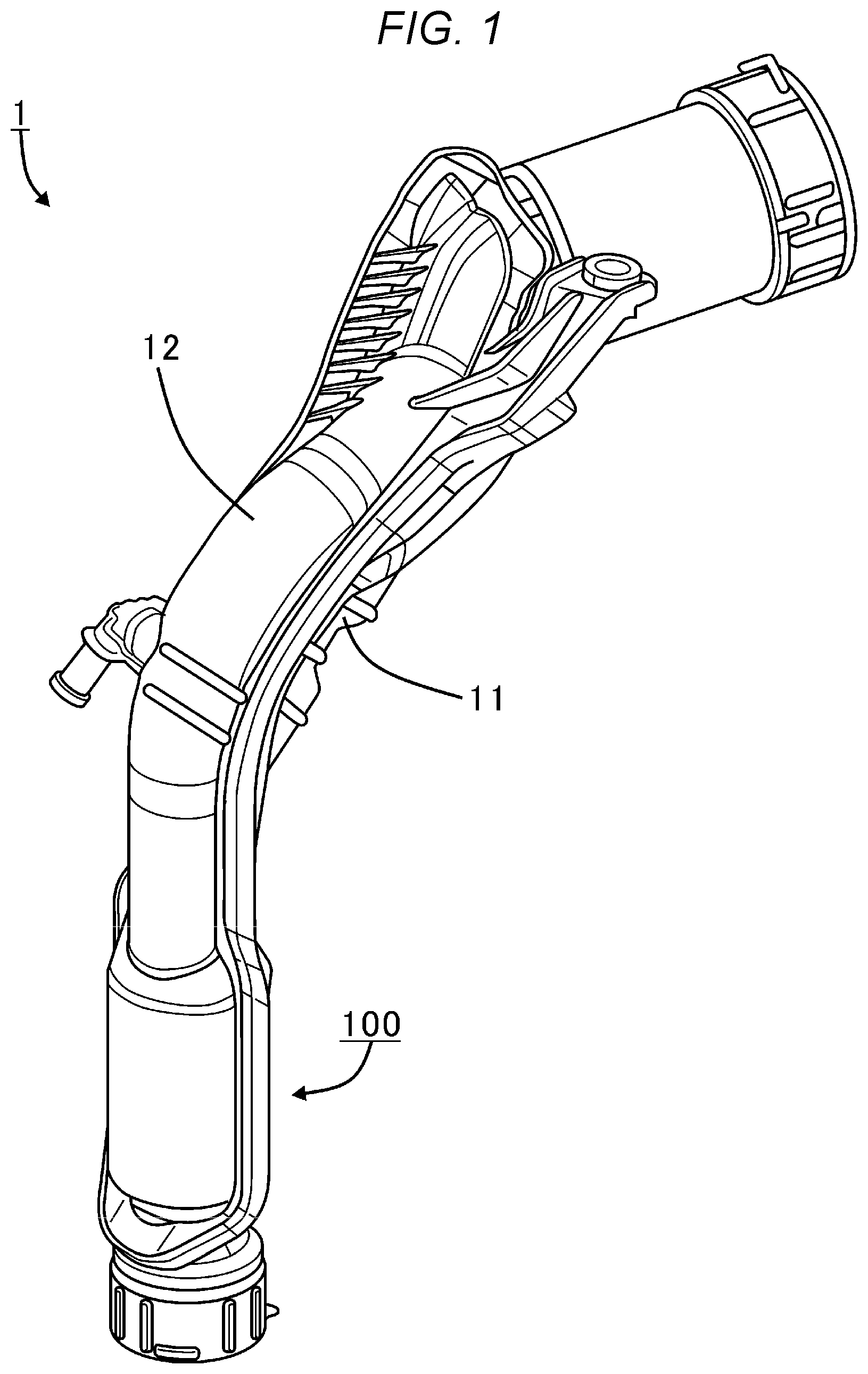
is a perspective view illustrating a resonator structure 100 according to an embodiment. is an exploded perspective view illustrating the resonator structure 100 of .
Referring to , the resonator structure 100 is applied to an intake duct 1 . The intake duct 1 is coupled to an intake port of an engine, not illustrated. In a section to which the resonator structure 100 is applied, the intake duct 1 extends upward, for example, extends in parallel to a vertical direction. The intake duct 1 is split into two parts, generally along a passage, including a lower duct 11 and an upper duct 12 . The lower duct 11 and the upper duct 12 are assembled with each other.
Referring to , the resonator structure 100 includes the intake duct 1 , which is, for example, one segment of the intake duct 1 , and a resonator 2 .
The resonator 2 is accommodated in the intake duct 1 . In one example, the resonator 2 is disposed in a space between the lower duct 11 and the upper duct 12 . The resonator 2 reduces noise produced when the air is suctioned into the intake duct 1 from outside. The resonator 2 includes a main body 21 and one or multiple collars 22 . In the embodiment, the resonator 2 includes six collars 22 .
The main body 21 is generally cylindrical. The main body 21 is disposed so that a central axis line X of the main body 21 extends upward, for example, extends in parallel to the vertical direction. In the disclosure, a radial direction and a circumferential direction about the central axis line X of the main body 21 (resonator 2 ) can be referred to simply as “radial direction” and “circumferential direction”, respectively. The main body 21 includes multiple holes 23 . The holes 23 penetrate the main body 21 in the radial direction.
The multiple collars 22 are disposed along the central axis line X. The collars 22 are generally annular. The collars 22 protrude radially outward from an outer surface of the main body 21 to an inner surface 13 of the intake duct 1 . In the embodiment, the collars 22 protrude in parallel to a horizontal direction and may have substantially flat shapes.
is a perspective view illustrating the resonator structure 100 of from which the upper duct 12 is detached. Each collar 22 includes one or multiple protrusions 22 a . The intake duct 1 includes notches 11 a at positions corresponding to the protrusions 22 a , respectively. Each protrusion 22 a is inserted into the notch 11 a . The resonator 2 is positioned in the intake duct 1 by the protrusions 22 a . The collar 22 is apart from the inner surface 13 of the intake duct 1 at positions other than those of the protrusions 22 a.
is a cross-sectional view of the resonator structure 100 of obtained along the central axis line X. For better understanding, illustrates just one side of the resonator structure 100 with respect to the central axis line X and just a range including two collars 22 . As described, each collar 22 is apart from the inner surface 13 of the intake duct 1 at the positions other than those of the protrusions 22 a (not illustrated in ). Therefore, a gap g is formed between the collar 22 and the inner surface 13 .
Oil mist containing vaporized engine oil and fuel may flow backward to the intake duct 1 from an engine. In the resonator structure 100 , one or more of the inner surface 13 of the intake duct 1 and the collar 22 include a surface texture Tx for gathering the oil mist into the gap g.
In the embodiment, the surface texture Tx includes a first area Ar 1 , a second area Ar 2 , and a third area Ar 3 . It is noted that the first area Ar 1 , the second area Ar 2 , and the third area Ar 3 are exaggerated in for better understanding and may be thinner than those illustrated in . In addition, the first area Ar 1 and the third area Ar 3 are illustrated cross-hatched in for better understanding.
The first area Ar 1 is formed at a position opposed to each collar 22 in the radial direction on the inner surface 13 . For example, the first area Ar 1 may be annular and continuous in the circumferential direction. Alternatively, the first area Ar 1 may be intermittent in the circumferential direction as long as sufficient oil can be gathered into the gaps g, as described later.
In the embodiment, a width d 1 of the first area Ar 1 is equal to a thickness d 2 of the collar 22 in an extension direction of the resonator 2 , i.e., in the direction parallel to the central axis line X. In another embodiment, the width d 1 may be smaller or larger than the thickness d 2 .
The second area Ar 2 is formed in upper and lower areas of the first areas Ar 1 on the inner surface 13 . From another perspective, the second area Ar 2 may be provided between the collars 22 in the direction parallel to the central axis line X. For example, the second area Ar 2 may be or may not be provided in the upper area of the uppermost collar 22 . Likewise, for example, the second area Ar 2 may be or may not be provided in the lower area of the lowermost collar 22 . For example, the second area Ar 2 may be cylindrical and continuous in the circumferential direction. Alternatively, the second area Ar 2 may be intermittent in the circumferential direction as long as sufficient oil can be gathered into the gaps g.
The third area Ar 3 is formed at a position opposed to the first area Ar 1 on each collar 22 in the radial direction, i.e., on an outer peripheral surface of the collar 22 . The gap g is formed between the first area Ar 1 and the third area Ar 3 . For example, the third area Ar 3 may be annular and continuous in the circumferential direction. Alternatively, the third area Ar 3 may be intermittent in the circumferential direction as long as sufficient oil can be gathered into the gap g. In the embodiment, a width d 3 of the third area Ar 3 is equal to the thickness d 2 of the collar 22 in the vertical direction. In another embodiment, the width d 3 may be smaller than the thickness d 2 .
It is noted that the surface texture Tx may not necessarily include the third area Ar 3 .
The first area Ar 1 and the second area Ar 2 are different from each other in one or more of an “angle of contact” and an “angle of fall” with respect to an oil drop.
For example, in the embodiment, the first area Ar 1 and the second area Ar 2 are different from each other in the “angle of fall” with respect to an oil drop. In one example, the angle of fall of the first area Ar 1 is greater than the angle of fall of the second area Ar 2 .
The “angle of fall”, also referred to as the “angle of slide”, is an indicator that represents liquid drop removal properties of a surface of interest. For example, the “angle of fall” can be measured by the following procedures. First, a fixed amount of an oil drop are formed on the surface of interest installed horizontally. Next, the surface of interest is tilted gradually. Subsequently, the angle between the horizontal direction and the surface of interest when an oil drop starts sliding on the surface of interest is measured. The angle of fall is measured in this way. That is, oil can be held better on the surface at a greater angle of fall.
In the embodiment, the angle of fall of the first area Ar 1 is greater than the angle of fall of the second area Ar 2 , as described above. Therefore, the first area Ar 1 is capable of holding oil better than the second area Ar 2 . In other words, the second area Ar 2 is less capable of holding oil than the first area Ar 1 . According to such configurations, oil mist adhering to the second area Ar 2 falls downward toward the first area Ar 1 below the second area Ar 2 . Since the first area Ar 1 can hold the oil well, the oil falling from the second area Ar 2 is held by the first area Ar 1 . The first area Ar 1 is opposed to each collar 22 ; therefore, the oil is gathered into the gap g between the collar 22 and the inner surface 13 . Therefore, the gap g is closed by the gathered oil. According to such configurations, the resonator structure 100 can be designed so that the intended noise reduction performance can be obtained in the state of closing the gap g, irrespective of a size of the gap g. Therefore, the intended noise reduction performance can be obtained without strictly managing a tolerance of the gap g.
Furthermore, in the embodiment, the third area Ar 3 is similar to the first area Ar 1 in the “angle of fall” with respect to an oil drop. Therefore, like the first area Ar 1 , the third area Ar 3 can hold oil well. In this way, the first area Ar 1 and the third area Ar 3 opposed to each other can hold the oil well, enabling more oil to be gathered into the gap g.
For example, the first area Ar 1 and the third area Ar 3 having a greater angle of fall with respect to an oil drop could be surfaces having irregularities of a few μm, a several μm, or a few tens of μm. Such surfaces may be formed, for example, by surface treatment such as blasting or by coating. Alternatively, for example, surface patterns of the first area Ar 1 and the third area Ar 3 may be imparted to dies used for pressing the intake duct 1 and the resonator 2 . For example, the angle of fall of the first area Ar 1 and the third area Ar 3 may be between 90 and 180 degrees.
For example, the second area Ar 2 having a smaller angle of fall with respect to an oil drop could be a surface having smaller irregularities than those of the first area Ar 1 and the third area Ar 3 . For example, the second area Ar 2 could be a surface without machining for forming the first area Ar 1 and the third area Ar 3 . For example, the second area Ar 2 could be a surface after machining or pressing. For example, the angle of fall of the second area Ar 2 may be between 0 and 90 degrees.
The resonator structure 100 described above includes the intake duct 1 and the resonator 2 that is accommodated in the intake duct 1 and that extends upward. The resonator 2 includes the collar 22 that protrudes toward the inner surface 13 of the intake duct 1 . One or more of the inner surface 13 and the collar 22 includes the surface texture Tx for gathering oil into the gap g between the inner surface 13 and the collar 22 . According to such configurations, the gap g is closed by the oil gathered by the surface texture Tx. Therefore, the resonator structure 100 can be designed so that the intended noise reduction performance can be obtained in the state of closing the gap g, irrespective of the size of the gap g. Therefore, the intended noise reduction performance can be obtained without strictly managing the tolerance of the gap g.
Furthermore, in the resonator structure 100 , the surface texture Tx includes the first area Ar 1 that is opposed to the collar 22 on the inner surface 13 , and the second area Ar 2 that is formed in the upper and lower areas of the first area Ar 1 on the inner surface 13 and that is different from the first area Ar 1 in the angle of fall with respect to the oil drop. In one example, the angle of fall of the first area Ar 1 is greater than the angle of fall of the second area Ar 2 . According to such configurations, the first area Ar 1 and the second area Ar 2 formed on the inner surface 13 of the intake duct 1 can gather the oil adhering to the inner surface 13 into the gap g.
Furthermore, in the resonator structure 100 , the width d 1 of the first area Ar 1 is equal to the thickness d 2 of the collar 22 in the extension direction of the resonator 2 . According to such configurations, the first area Ar 1 is formed throughout the gap g and the gap g can be, therefore, closed sufficiently.
Moreover, in the resonator structure 100 , the surface texture Tx includes the third area Ar 3 that is opposed to the first area Ar 1 in the collar 22 and that is similar to the first area Ar 1 in the angle of fall. According to such configurations, the third area Ar 3 opposed to the first area Ar 1 is similar to the first area Ar 1 in the angle of fall. Therefore, it is possible to gather more oil into the gap g between the first area Ar 1 and the third area Ar 3 .
Next, another embodiment will be described.
is a cross-sectional view of a resonator structure 100 A obtained along the central axis line X according to the other embodiment. For better understanding, , like , illustrates just one side of the resonator structure 100 A with respect to the central axis line X and just a range including the two collars 22 .
The resonator structure 100 A differs from the resonator structure 100 in a shape of the collar 22 and a position of the surface texture Tx. The resonator structure 100 A may be the same as the resonator structure 100 in other respects.
In the embodiment, the collars 22 are tilted downward as being closer to the inner surface 13 of the intake duct 1 . In addition, each collar 22 has multiple ribs 22 b disposed radially about the central axis line X. It is noted that illustrates just one rib 22 b per collar 22 . The rib 22 b protrudes upward from an upper surface 22 c of the collar 22 . The rib 22 b extends radially outward from a location where the collar 22 is coupled to the main body 21 . The rib 22 b is formed apart from an outer circumferential edge of the collar 22 .
is a cross-sectional view of the resonator structure 100 A of perpendicular to the central axis line X, with the collar 22 viewed from above. In the embodiment, the surface texture Tx includes a fourth area Ar 4 and a fifth area Ar 5 . The fourth area Ar 4 is illustrated cross-hatched in for better understanding.
The fourth area Ar 4 is provided between the multiple ribs 22 b on the upper surface 22 c of the collar 22 . That is, the fourth area Ar 4 includes multiple fan members. The fourth area Ar 4 is formed apart from the outer circumferential edge of the collar 22 . Referring to , the fourth area Ar 4 is also formed on side surfaces of the ribs 22 b.
Referring to , the fifth area Ar 5 is formed in areas other than the fourth area Ar 4 on the upper surface 22 c of each collar 22 . In one example, the fifth area Ar 5 is formed on an upper surface of each rib 22 b . In addition, the fifth area Ar 5 is provided in annular areas between the fourth area Ar 4 and the outer circumferential edge of the collar 22 in the radial direction.
The fourth area Ar 4 and the fifth area Ar 5 are formed to differ in the “angle of contact” with respect to an oil drop. In one example, the angle of contact (first angle of contact) of the fourth area Ar 4 is greater than the angle of contact (second angle of contact) of the fifth area Ar 5 . That is, the fourth area Ar 4 is oleophobic and the fifth area Ar 5 is oleophilic.
The “angle of contact” is an indicator representing oleophilic properties or oleophobic properties of a surface of interest. As the angle of contact is greater, the surface of interest has higher oleophobic properties and lower oleophilic properties. For example, the “angle of contact” may be measured by a method specified in standards such as JIS. For example, the “angle of contact (static angle of contact)” can be measured by the following procedures. First, a fixed amount of an oil drop are formed on the surface of interest installed horizontally. Next, the angle formed between the surface of interest and a tangent line of a lowest point on an outer surface of the oil drop with the surface of interest is measured by, for example, a measurement instrument such as a camera or a microscope. The angle of contact is measured in this way.
Referring to , the surface texture Tx also includes a sixth area Ar 6 . The sixth area Ar 6 is provided on an entire lower surface 22 d of each collar 22 . The sixth area Ar 6 has a third angle of contact smaller than the first angle of contact with respect to an oil drop. In the embodiment, the third angle of contact of the sixth area Ar 6 is identical to the second angle of contact of the fifth area Ar 5 . That is, the sixth area Ar 6 is oleophilic.
Referring to , in the resonator structure 100 A, part of the oil adhering to the fifth area Ar 5 on the upper surface of each rib 22 b runs down toward the fourth area Ar 4 between the ribs 22 b . In addition, the rest of the oil adhering to the fifth area Ar 5 on the upper surface of the rib 22 b runs down toward the annular fifth area Ar 5 by the gravity of the tilted collar 22 . The oil adhering to the fourth area Ar 4 is repelled by the oleophobic fourth area Ar 4 and runs down toward the annular fifth area Ar 5 by the gravity of the tilted collar 22 . Therefore, the oil adhering to the upper surface 22 c of the collar 22 is gathered into the annular fifth area Ar 5 on the outer circumferential edge of the collar 22 . The gap g is closed by the gathered oil. According to such configurations, the resonator structure 100 A can be designed so that the intended noise reduction performance can be obtained in the state of closing the gap g. It is noted that patterns of the fourth area Ar 4 and the fifth area Ar 5 are not limited to those illustrated in , and other patterns may be used as long as sufficient oil can be gathered into the gap g.
Furthermore, referring to , the sixth area Ar 6 on the lower surface 22 d of each collar 22 is oleophilic in the embodiment. Therefore, the oil adhering to the sixth area Ar 6 does not fall and runs down to the outer circumferential edge of the collar 22 along the sixth area Ar 6 . Therefore, more oil can be gathered into the gap g.
The oleophobic fourth area Ar 4 may be formed, for example, by surface treatment such as blasting or by coating. Alternatively, for example, a surface pattern of the fourth area Ar 4 may be imparted to a die used for pressing the resonator 2 . For example, the first angle of contact of the fourth area Ar 4 may be between 150 and 180 degrees.
The oleophilic fifth area Ar 5 and sixth area Ar 6 could be, for example, surfaces without machining for imparting oleophobic properties. For example, the fifth area Ar 5 and the sixth area Ar 6 could be surfaces after machining or pressing. For example, the second angle of contact of the fifth area Ar 5 and the third angle of contact of the sixth area Ar 6 may be between 0 and 5 degrees.
In such a resonator structure 100 A, like the resonator structure 100 , the gap g is closed by the oil gathered by the surface texture Tx. Therefore, the resonator structure 100 A can be designed so that the intended noise reduction performance can be obtained in the state of closing the gap g, irrespective of the size of the gap g. Therefore, the intended noise reduction performance can be obtained without strictly managing the tolerance of the gap g.
Furthermore, in the resonator structure 100 A, the surface texture Tx includes the fourth area Ar 4 that is formed on the upper surface 22 c of the collar 22 and that has the first angle of contact with respect to the oil drop, and the fifth area Ar 5 that is formed on the upper surface 22 c of the collar 22 and that has the second angle of contact smaller than the first angle of contact with respect to the oil drop. According to such configurations, the fourth area Ar 4 and the fifth area Ar 5 formed on the upper surface 22 c can gather the oil adhering to the upper surface 22 c of the collar 22 into the gap g.
Moreover, in the resonator structure 100 A, the surface texture Tx includes the sixth area Ar 6 that is formed on the lower surface 22 d of the collar 22 and that has the third angle of contact smaller than the first angle of contact with respect to the oil drop. According to such configurations, the sixth area Ar 6 formed on the lower surface 22 d of the collar 22 can gather the oil adhering to the lower surface 22 d into the gap g.
Furthermore, in the resonator structure 100 A, the fifth area Ar 5 includes the outer circumferential edge of the upper surface 22 c of the collar 22 . According to such configurations, the oleophilic fifth area Ar 5 is formed on the outer circumferential edge of the collar 22 closer to the gap g. Therefore, the oil can be held near the gap g.
In the resonator structure 100 A, the collar 22 is tilted downward as being closer to the inner surface 13 . Therefore, the gravity generated by tilting the collar 22 can facilitate gathering the oil into the gap g.
While the embodiments of the disclosure has been described with reference to the accompanying drawings, the disclosure is not limited to the embodiments. It is evident that a person in the art could conceive of examples of various modifications or revisions within the scope set forth in the claims. It would be understood that those modifications or revisions naturally fall in the technical range of the disclosure.
For example, referring to , in the resonator structure 100 , the first area Ar 1 and the second area Ar 2 are different from each other in the “angle of fall” with respect to an oil drop. In another embodiment, the first area Ar 1 and the second area Ar 2 may be different from each other in the angle of contact with respect to an oil drop.
For example, the angle of contact of the first area Ar 1 may be greater than the angle of contact of the second area Ar 2 . In other words, the first area Ar 1 may be oleophobic and the second area Ar 2 may be oleophilic.
In this case, oil mist adhering to the second area Ar 2 runs down toward the first area Ar 1 below the second area Ar 2 . Since the first area Ar 1 is oleophobic, the oil is accumulated in the first area Ar 1 . Since the first area Ar 1 is opposed to the collar 22 , the gap g is closed by the accumulated oil.
In this case, the third area Ar 3 may be similar to the first area Ar 1 in the “angle of contact” with respect to an oil drop. That is, the third area Ar 3 , like the first area Ar 1 , is oleophobic. According to such configurations, the first area Ar 1 and the third area Ar 3 opposed to each other can accumulate the oil, enabling more oil to be gathered into the gap g.
Furthermore, in further another embodiment, the angle of contact of the first area Ar 1 may be smaller than the angle of contact of the second area Ar 2 . In other words, the first area Ar 1 may be oleophilic and the second area Ar 2 may be oleophobic.
In this case, the oil gathered once into the first area Ar 1 is repelled by the oleophobic second area Ar 2 below the first area Ar 1 . Therefore, the oil is held in the first area Ar 1 . Since the first area Ar 1 is opposed to the collar 22 , the gap g is closed by the held oil.
In this case, the third area Ar 3 may differ from the first area Ar 1 and may be oleophobic. According to such configurations, the oil is accumulated in the oleophobic third area Ar 3 , ensuring sufficient oil to close the gap g between the inner surface 13 and the collar 22 .
Figures (6)
Citations
This patent cites (22)
- US6983820
- US7934581
- US9010485
- US9057313
- US9175648
- US9625077
- US10403256
- US10794341
- US11060489
- US11236714
- US11255303
- US2004/0194751
- US2005/0150718
- US2013/0263823
- US2021/0293210
- US2022/0049672
- US2022/0381209
- US105822469
- US107781076
- US102018122988
- US2008-82306
- USWO-2018090961