Load Control Device for a Light-emitting Diode Light Source
Abstract
A load control device may utilize a feedback signal representative of an average magnitude of the load current conducted through an electrical load to control the amount of power delivered to the electrical load. The feedback signal may be generated based on a sense signal that is electrically isolated from the line voltage input of the load control device. Depending on the operational characteristics of the electrical load, the feedback signal may be generated using different techniques. In one example technique, the sense signal may be integrated and filtered to derive the feedback signal. In another example technique, the sense signal may be used in conjunction with an input power of the load control device and an efficiency parameter of the load control device to derive the feedback signal. In yet another example technique, values derived from the foregoing two techniques may be blended together to obtain the feedback signal.
Claims (18)
1. An electric load controller, comprising: control circuitry to: receive an input indicative of a target intensity receive a load voltage feedback signal; receive a load current feedback signal; and determine whether target intensity is greater than a first intensity threshold; responsive to the determination that the target intensity exceeds a first intensity threshold: cause an operatively coupled load regulation circuit to operate in a continuous current mode in which the load current is supplied continuously to an operatively coupled LED lighting load; and determine an average load current supplied to the LED lighting load using a load voltage feedback signal; determine whether target intensity is less than a second intensity threshold; responsive to the determination that the target intensity is less than the second intensity threshold: cause the operatively coupled load regulation circuit to operate in a discontinuous current mode in which current is not continuously supplied to the operatively coupled LED lighting load; and determine the average load current supplied to the LED lighting load using a load current feedback signal; and generate at least one output to adjust at least one of: a load voltage or a load current supplied to the operatively coupled LED lighting load based on a target average load current to achieve the target intensity.
7. An electric load control method, comprising: receiving, by electric load control circuitry, an input indicative of a target intensity; receiving, by electric load control circuitry, a load voltage feedback signal from operatively coupled load sense circuitry; receiving, by electric load control circuitry, a load current feedback signal from the operatively coupled load sense circuitry; and determining, by the electric load control circuitry, whether target intensity is greater than a first intensity threshold; responsive to the determination by the electric load control circuitry that the target intensity exceeds a first intensity threshold: causing, by the electric load control circuitry, operatively coupled load regulation circuitry to operate in a continuous current mode such that a load current is supplied continuously to an operatively coupled LED lighting load; and determining, by the electric load control circuitry, an average load current supplied to the LED lighting load using the load voltage feedback signal; determining, by the electric load control circuitry, whether target intensity is less than a second intensity threshold; responsive to the determination by the electric load control circuitry that the target intensity is less than the second intensity threshold: causing, by the electric load control circuitry, the operatively coupled load regulation circuit to operate in a discontinuous current mode such that current is not continuously supplied to the operatively coupled LED lighting load; and determining, by the electric load control circuitry, the average load current supplied to the LED lighting load using a load current feedback signal; and generating, by the electric load control circuitry, at least one output to adjust at least one of: a load voltage or a load current supplied to the operatively coupled LED lighting load based on a target average load current to achieve the target intensity.
13. A non-transitory, machine-readable, storage device that includes instructions that, when executed by electric load control circuitry disposed in an electric load controller, cause the electric load control circuitry to: receive an input indicative of a target intensity; receive a load voltage feedback signal from operatively coupled load sense circuitry; receive a load current feedback signal from the operatively coupled load sense circuitry; and determine whether target intensity is greater than a first intensity threshold; responsive to the determination by the electric load control circuitry that the target intensity exceeds a first intensity threshold: cause operatively coupled load regulation circuitry to operate in a continuous current mode such that a load current is supplied continuously to an operatively coupled LED lighting load; and determine an average load current supplied to the LED lighting load using the load voltage feedback signal; determine whether target intensity is less than a second intensity threshold; responsive to the determination by the electric load control circuitry that the target intensity is less than the second intensity threshold: cause the operatively coupled load regulation circuit to operate in a discontinuous current mode such that current is not continuously supplied to the operatively coupled LED lighting load; and determine the average load current supplied to the LED lighting load using a load current feedback signal; and generate at least one output to adjust at least one of: a load voltage or a load current supplied to the operatively coupled LED lighting load based on a target average load current to achieve the target intensity.
Show 15 dependent claims
2. The electric load controller of claim 1 wherein to determine the average load current supplied to the LED lighting load using the load voltage feedback signal, the control circuitry to further: cause operatively coupled load sense circuitry to filter the received load voltage feedback signal to provide a filtered load voltage feedback signal; and determine an average load current supplied to the LED lighting load using the filtered load voltage feedback signal, input power provided to the load regulation circuitry, and an efficiency of the load regulation circuitry.
3. The electric load controller of claim 2 wherein to determine the average load current supplied to the LED lighting load using the load current feedback signal, the control circuitry to further: determine the average load current supplied to the LED lighting load by integrating and scaling the load voltage feedback signal.
4. The electric load controller of claim 1 , the control circuitry to further: determine whether target intensity falls between the first intensity threshold and the second intensity threshold; and responsive to the determination by the electric load control circuitry that the target intensity falls between the first intensity threshold and the second intensity threshold: cause the operatively coupled load regulation circuit to operate in a discontinuous current mode in which current is not continuously supplied to the operatively coupled LED lighting load; and determine a first average load current using the load voltage feedback signal; determine a second average load current using the load current feedback signal; and combine the calculated first average load current and the calculated second using a scaling factor to determine the average load current supplied to the LED lighting load.
5. The electric load controller of claim 4 , wherein to determine the average load current supplied to the LED lighting load using the load voltage feedback signal, the control circuitry to further: cause operatively coupled load sense circuitry to filter the received load voltage feedback signal to provide a filtered load voltage feedback signal; and determine an average load current supplied to the LED lighting load using the filtered load voltage feedback signal, input power provided to the load regulation circuitry, and an efficiency of the load regulation circuitry.
6. The electric load controller of claim 5 wherein to determine the average load current supplied to the LED lighting load using the load current feedback signal, the control circuitry to further: determine the average load current supplied to the LED lighting load by integrating and scaling the load voltage feedback signal.
8. The electric load control method of claim 7 wherein determining the average load current supplied to the LED lighting load using the load voltage feedback signal further comprises: causing, by the electric load control circuitry, operatively coupled load sense circuitry to filter the received load voltage feedback signal to provide a filtered load voltage feedback signal; and determining, by the electric load control circuitry, the average load current supplied to the LED lighting load using the filtered load voltage feedback signal, input power provided to the load regulation circuitry, and an efficiency of the load regulation circuitry.
9. The electric load control method of claim 8 wherein determining the average load current supplied to the LED lighting load using the load current feedback signal further comprises: determining, by the electric load control circuitry, the average load current supplied to the LED lighting load by integrating and scaling the load voltage feedback signal.
10. The electric load control method of claim 7 , further comprising: determining, by the electric load control circuitry, whether target intensity falls between the first intensity threshold and the second intensity threshold; and responsive to the determination by the electric load control circuitry that the target intensity falls between the first intensity threshold and the second intensity threshold: causing, by the electric load control circuitry, the operatively coupled load regulation circuit to operate in a discontinuous current mode in which current is not continuously supplied to the operatively coupled LED lighting load; and determining, by the electric load control circuitry, a first average load current using the load voltage feedback signal; determining, by the electric load control circuitry, a second average load current using the load current feedback signal; and combining, by the electric load control circuitry, the calculated first average load current and the calculated second using a scaling factor to determine the average load current supplied to the LED lighting load.
11. The electric load control method of claim 10 wherein determining the average load current supplied to the LED lighting load using the load voltage feedback signal, further comprises: causing, by the electric load control circuitry, operatively coupled load sense circuitry to filter the received load voltage feedback signal to provide a filtered load voltage feedback signal; and determining, by the electric load control circuitry, an average load current supplied to the LED lighting load using the filtered load voltage feedback signal, input power provided to the load regulation circuitry, and an efficiency of the load regulation circuitry.
12. The electric load control method of claim 11 wherein determining the average load current supplied to the LED lighting load using the load current feedback signal, further comprises: determining, by the electric load control circuitry, the average load current supplied to the LED lighting load by integrating and scaling the load voltage feedback signal.
14. The non-transitory, machine-readable, storage device of claim 13 wherein the instructions that cause the electric load control circuitry to determine the average load current supplied to the LED lighting load using the load voltage feedback signal further cause the control circuitry to: cause operatively coupled load sense circuitry to filter the received load voltage feedback signal to provide a filtered load voltage feedback signal; and determine the average load current supplied to the LED lighting load using the filtered load voltage feedback signal, input power provided to the load regulation circuitry, and an efficiency of the load regulation circuitry.
15. The non-transitory, machine-readable, storage device of claim 14 wherein the instructions that cause the electric load control circuitry to determine the average load current supplied to the LED lighting load using the load current feedback signal further cause the control circuitry to: determine the average load current supplied to the LED lighting load by integrating and scaling the load voltage feedback signal.
16. The non-transitory, machine-readable, storage device of claim 13 wherein the instructions, when executed by the electric load control circuitry, further cause the electric load control circuitry to further: determine whether target intensity falls between the first intensity threshold and the second intensity threshold; and responsive to the determination, by the electric load control circuitry, that the target intensity falls between the first intensity threshold and the second intensity threshold: cause the operatively coupled load regulation circuit to operate in a discontinuous current mode in which current is not continuously supplied to the operatively coupled LED lighting load; and determine a first average load current using the load voltage feedback signal; determine a second average load current using the load current feedback signal; and combine the calculated first average load current and the calculated second using a scaling factor to determine the average load current supplied to the LED lighting load.
17. The non-transitory, machine-readable, storage device of claim 16 wherein the instructions that cause the electric load control circuitry to determine the average load current supplied to the LED lighting load using the load voltage feedback signal, further cause the electric load control circuitry to: cause operatively coupled load sense circuitry to filter the received load voltage feedback signal to provide a filtered load voltage feedback signal; and determine an average load current supplied to the LED lighting load using the filtered load voltage feedback signal, input power provided to the load regulation circuitry, and an efficiency of the load regulation circuitry.
18. The non-transitory, machine-readable, storage device of claim 17 wherein the instructions that cause the electric load control circuitry to determine the average load current supplied to the LED lighting load using the load current feedback signal, further cause the electric load control circuitry to: determine the average load current supplied to the LED lighting load by integrating and scaling the load voltage feedback signal.
Full Description
Show full text →
CROSS-REFERENCE TO RELATED APPLICATION
This application is a continuation of U.S. application Ser. No. 17/734,161, filed May 2, 2022; which is a continuation of U.S. application Ser. No. 17/135,037, filed Dec. 28, 2020, now U.S. Pat. No. 11,324,092 issued May 3, 2022; which is a continuation of U.S. application Ser. No. 16/526,629, filed on Jul. 30, 2019, now U.S. Pat. No. 10,904,979 issued Jan. 26, 2021, all of which claim the benefit of Provisional U.S. Patent Application No. 62/712,109, filed Jul. 30, 2018, the disclosures of which are incorporated herein by reference in their entireties.
BACKGROUND
Light-emitting diode (LED) light sources (e.g., LED light engines) are often used in place of or as replacements for conventional incandescent, fluorescent, or halogen lamps, and the like. LED light sources may comprise a plurality of light-emitting diodes mounted on a single structure and provided in a suitable housing. LED light sources are typically more efficient and provide longer operational lives as compared to incandescent, fluorescent, and halogen lamps. In order to illuminate properly, an LED driver control device (e.g., an LED driver) may be coupled between an alternating-current (AC) source and the LED light source for regulating the power supplied to the LED light source. The LED driver may regulate either the voltage provided to the LED light source to a particular value, the current supplied to the LED light source to a specific peak current value, or may regulate both the current and voltage.
LED light sources are typically rated to be driven via one of two different control techniques: a current load control technique or a voltage load control technique. An LED light source that is rated for the current load control technique is also characterized by a rated current (e.g., approximately 350 milliamps) to which the peak magnitude of the current through the LED light source should be regulated to ensure that the LED light source is illuminated to the appropriate intensity and color. In contrast, an LED light source that is rated for the voltage load control technique is characterized by a rated voltage (e.g., approximately 15 volts) to which the voltage across the LED light source should be regulated to ensure proper operation of the LED light source. Typically, each string of LEDs in an LED light source rated for the voltage load control technique includes a current balance regulation element to ensure that each of the parallel legs has the same impedance so that the same current is drawn in each parallel string.
The light output of an LED light source can be dimmed. Different methods of dimming LEDs include a pulse-width modulation (PWM) technique and a constant current reduction (CCR) technique. Pulse-width modulation dimming can be used for LED light sources that are controlled in either a current or voltage load control mode/technique. In pulse-width modulation dimming, a pulsed signal with a varying duty cycle is supplied to the LED light source. If an LED light source is being controlled using the current load control technique, the peak current supplied to the LED light source is kept constant during an on time of the duty cycle of the pulsed signal. However, as the duty cycle of the pulsed signal varies, the average current supplied to the LED light source also varies, thereby varying the intensity of the light output of the LED light source. If the LED light source is being controlled using the voltage load control technique, the voltage supplied to the LED light source is kept constant during the on time of the duty cycle of the pulsed signal in order to achieve the desired target voltage level, and the duty cycle of the load voltage is varied in order to adjust the intensity of the light output. Constant current reduction dimming is typically only used when an LED light source is being controlled using the current load control technique. In constant current reduction dimming, current is continuously provided to the LED light source, however, the DC magnitude of the current provided to the LED light source is varied to thus adjust the intensity of the light output. Examples of LED drivers are described in greater detail in commonly-assigned U.S. Pat. No. 8,492,987, issued Jul. 23, 2010, and U.S. Patent Application Publication No. 2013/0063047, published Mar. 14, 2013, both entitled LOAD CONTROL DEVICE FOR A LIGHT-EMITTING DIODE LIGHT SOURCE, the entire disclosures of which are hereby incorporated by reference.
SUMMARY
A load control device is described herein for controlling an amount of power delivered to an electrical load. The load control device may comprise a load regulation circuit, a load sense circuit and a control circuit. The load regulation circuit may be configured to control a magnitude of a load current conducted through the electrical load to control the amount of power delivered to the electrical load across a power range. The load regulation circuit may comprise a transformer and an output inductor located on a secondary side of the transformer. The load regulation circuit may further comprise a winding magnetically coupled to and electrically isolated from the output inductor. The load regulation circuit may be configured to generate a sense signal via the winding and the sense signal may be indicative of a voltage developed across the output inductor. The load sense circuit may be configured to generate, based on the sense signal, a load current feedback signal that indicates a magnitude of the load current conducted through the electrical load. The control circuit may be configured to generate, during at least a first portion of the power range, at least one drive signal based on the load current feedback signal. The at least one drive signal may be used to control the load regulation circuit to adjust an average magnitude of the load current conducted through the electrical load. The load current feedback signal may be generated using different techniques based on the operational characteristics of the electrical load. In one example technique, the sense signal may be integrated and filtered to derive the load current feedback signal. In another example technique, the sense signal may be used in conjunction with an input power of the load control device and an efficiency parameter of the load control device to derive the load current feedback signal. In yet another example technique, values derived from the foregoing two techniques may be blended together to obtain the load current feedback signal.
BRIEF DESCRIPTION OF THE DRAWINGS
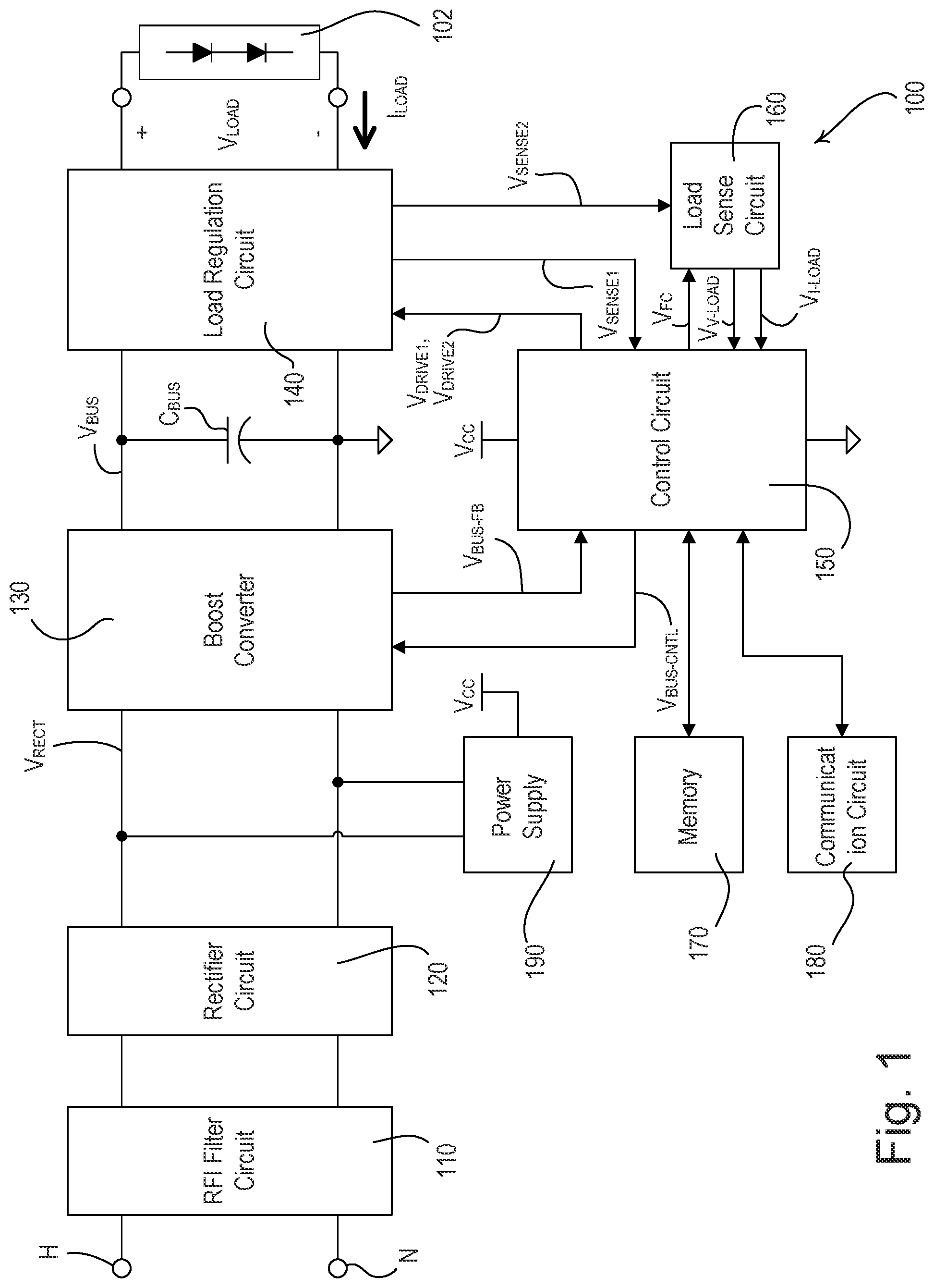
is a simplified block diagram of an example load control device, such as, a light-emitting diode (LED) driver for controlling the intensity of an LED light source.
is a simplified schematic diagram of a forward converter and a load sense circuit of an example LED driver.
is a diagram of simplified waveforms illustrating the operation of the LED driver of when the forward converter is operating in a continuous mode of operation (e.g., near a high-end intensity).
is a diagram of simplified waveforms illustrating the operation of the LED driver of when the forward converter is operating in a discontinuous mode of operation (e.g., near a low-end intensity).
are simplified example flowcharts of load current measurement procedures that each may be executed by a control circuit of a load control device for determining a magnitude of a load current conducted through an electrical load.
DETAILED DESCRIPTION
is a simplified block diagram of an example load control device, e.g., a light-emitting diode (LED) driver 100 , for controlling the amount of power delivered to an electrical load, such as, an LED light source 102 (e.g., an LED light engine), and thus the intensity of the light source. The LED light source 102 is shown as a plurality of LEDs connected in series but may comprise a single LED or a plurality of LEDs connected in parallel or a suitable combination thereof, depending on the particular lighting system. The LED light source 102 may comprise one or more organic light-emitting diodes (OLEDs). The LED driver 100 may comprise a hot terminal H and a neutral terminal that are adapted to be coupled to an alternating-current (AC) power source (not shown).
The LED driver 100 may comprise a radio-frequency interference (RFI) filter circuit 110 , a rectifier circuit 120 , a boost converter 130 , a load regulation circuit 140 , a control circuit 150 , a current sense circuit 160 , a memory 170 , a communication circuit 180 , and/or a power supply 190 . The RFI filter circuit 110 may minimize the noise provided on the AC mains. The rectifier circuit 120 may generate a rectified voltage V RECT . The boost converter 130 may receive the rectified voltage V RECT and generate a boosted direct-current (DC) bus voltage V BUS across a bus capacitor C BUS . The boost converter 130 may comprise any suitable power converter circuit for generating an appropriate bus voltage, such as, for example, a flyback converter, a single-ended primary-inductor converter (SEPIC), a Ćuk converter, or other suitable power converter circuit. The boost converter 120 may operate as a power factor correction (PFC) circuit to adjust the power factor of the LED driver 100 towards a power factor of one.
The load regulation circuit 140 may receive the bus voltage V BUS and control the amount of power delivered to the LED light source 102 across a power range. For example, the load regulation circuit may control the intensity of the LED light source 102 between a low-end (e.g., minimum) intensity L LE (e.g., approximately 0.1-5%) and a high-end (e.g., maximum) intensity L HE (e.g., approximately 100%). An example of the load regulation circuit 140 may be an isolated, half-bridge forward converter. An example of the load control device (e.g., LED driver 100 ) comprising a forward converter is described in greater detail in commonly-assigned U.S. Pat. No. 9,253,829, filed Feb. 2, 2016, entitled LOAD CONTROL DEVICE FOR A LIGHT-EMITTING DIODE LIGHT SOURCE, the entire disclosure of which is hereby incorporated by reference. The load regulation circuit 140 may also comprise, for example, a buck converter, a linear regulator, or any suitable LED drive circuit for adjusting the intensity of the LED light source 102 .
The control circuit 150 may be configured to control the operation of the boost converter 130 and/or the load regulation circuit 140 . An example of the control circuit 150 may be a controller. The control circuit 150 may comprise, for example, a digital controller or any other suitable processing device, such as, for example, a microcontroller, a programmable logic device (PLD), a microprocessor, an application specific integrated circuit (ASIC), or a field-programmable gate array (FPGA). The control circuit 150 may generate a bus voltage control signal V BUS-CNTL , which may be provided to the boost converter 130 for adjusting the magnitude of the bus voltage V BUS . The control circuit 150 may receive a bus voltage feedback signal V BUS-FB from the boost converter 130 , which may indicate the magnitude of the bus voltage V BUS .
The control circuit 150 may generate at least one drive signal such as drive signals V DR1 , V DR2 . The drive signals V DR1 , V DR2 may be provided to the load regulation circuit 140 for adjusting the magnitude of a load voltage V LOAD generated across the LED light source 102 and/or the magnitude of a load current I LOAD conducted through the LED light source 120 , for example, to control the intensity of the LED light source 120 to a target intensity L TRGT , which may range from the low-end intensity L LE to the high-end intensity L HE . The control circuit 150 may adjust an operating frequency fop and/or a duty cycle DC INV (e.g., an on time T ON ) of the drive signals V DR1 , V DR2 to adjust the magnitude of the load voltage V LOAD and/or the load current I LOAD . Near the high-end intensity L HE , the load regulation circuit 140 may operate in a continuous mode of operation (e.g., as will be described in greater detail below). Near the low-end intensity L LE , the load regulation circuit 140 may operate in a discontinuous mode of operation (e.g., as will be described in greater detail below).
The control circuit 150 may receive one or more sense signals from the load regulation circuit 140 . For example, the load regulation circuit 140 may generate first and second sense signals V SENSE1 , V SENSE2 . The control circuit 150 may receive the first sense signal V SENSE1 from the load regulation circuit 140 and may be configured to determine an input power P IN of the load regulation circuit 140 in response to the bus voltage feedback signal V BUS-FB and the first sense signal V SENSE1 . The LED driver 100 may also comprise a load sense circuit 160 that receives the second sense signal V SENSE2 and generates a load voltage feedback signal V V-LOAD and/or a load current feedback signal V I-LOAD . The load voltage feedback signal V V-LOAD may have a magnitude representative of a magnitude of the load voltage V LOAD while the load current feedback signal V I-LOAD may have a magnitude representative of an average magnitude I AVE of the load current I LOAD . The control circuit 150 may generate a filter control signal V FC for controlling the load sense circuit 160 (e.g., for controlling a portion of the load sense circuit 160 ). For example, the control circuit 150 may use the filter control signal V FC to control the generation of the load current feedback signal V I-LOAD . The control circuit 150 may be configured to receive the load voltage feedback signal V V-LOAD and/or the load current feedback signal V I-LOAD .
The control circuit 150 may control the drive signals V DR1 , V DR2 to adjust the magnitude of the load current I LOAD to a target load current I TRGT to thus control the amount of power delivered to the electrical load to a target power level (e.g., to control the intensity of the LED light source 102 to the target intensity L TRGT ) in response to the first sense signal V SENSE1 , the voltage feedback signal V V-LOAD , and/or the load current feedback signal V I-LOAD (e.g., using a control loop). The control circuit may be configured to determine the average magnitude I AVE of the load current I LOAD using different techniques, for example, based on where the target power level falls within the power range of the lighting source 120 (e.g., based on where the target intensity L TRGT falls within the intensity range of the LED light source 120 ). When the target power level is greater than a first power threshold (e.g., when the target intensity L TRGT is greater than a first threshold intensity L TH1 such as a high threshold intensity, which may be approximately 60%), the control circuit 150 may be configured to determine the average magnitude I AVE of the load current I LOAD using a first load current measurement technique. For example, when using the first load current measurement technique, the control circuit 150 may calculate the average magnitude I AVE of the load current I LOAD using the input power P IN of the load regulation circuit 140 , the magnitude of the load voltage V LOAD (e.g., as determined from the load voltage feedback signal V V-LOAD ), and an efficiency η (e.g., a predetermined efficiency parameter) of the load regulation circuit 140 . When the target power level is less than a second power threshold (e.g., when the target intensity L TRGT is less than a second threshold intensity L TH2 such as a low threshold intensity, which may be approximately 40%), the control circuit 150 may be configured to determine the average magnitude I AVE of the load current I LOAD using a second load current measurement technique. For example, when using the second load current measurement technique, the control circuit 150 may determine the average magnitude I AVE of the load current I LOAD from the load current feedback signal V I-LOAD .
When the target power level is less than or equal to the first power threshold and greater than or equal to the second power threshold (e.g., when the target intensity L TRGT is between the first threshold intensity L TH1 and the second threshold intensity L TH2 ), the control circuit 150 may be configured to use both of the first and second load current measurement techniques to determine the average magnitude I AVE of the load current I LOAD . For example, the control circuit 150 may be configured to appropriately mix the average magnitude I AVE of the load current I LOAD determined using the first measurement technique and the average magnitude I AVE of the load current I LOAD determined using the second load current measurement technique to determine the average magnitude I AVE of the load current I LOAD (e.g., as will be described in greater detail below). The load regulation circuit 140 may transition between the continuous and discontinuous modes of operation at an intensity that is greater than the first threshold intensity L TH1 to prevent the control circuit 150 from using the second load current measurement technique to determine the average magnitude I AVE of the load current I LOAD when the load regulation circuit is operating in the continuous mode.
The control circuit 150 may be coupled to the memory 170 . The memory 170 may store operational characteristics of the LED driver 100 (e.g., the target intensity L TRGT , the low-end intensity L LE , the high-end intensity L HE , etc.). The communication circuit 180 may be coupled to, for example, a wired communication link or a wireless communication link, such as a radio-frequency (RF) communication link or an infrared (IR) communication link. The control circuit 150 may be configured to update the target intensity L TRGT of the LED light source 102 and/or the operational characteristics stored in the memory 170 in response to messages (e.g., digital messages) received via the communication circuit 180 . The LED driver 100 may be configured to receive a phase-control signal from a dimmer switch for determining the target intensity L TRGT for the LED light source 102 . The power supply 190 may receive the rectified voltage V RECT and generate a direct-current (DC) supply voltage V CC for powering the circuitry of the LED driver 100 .
is a simplified schematic diagram of a forward converter 240 (e.g., the load regulation circuit 140 ) and a load sense circuit 260 (e.g., the current sense circuit 160 ) of an example LED driver 200 (e.g., the LED driver 100 shown in ). The LED driver 200 may also comprise a control circuit 250 for controlling the forward converter 240 to adjust a present intensity L PRES of an LED light source 202 in response to the load sense circuit 260 . The control circuit 250 may receive a bus voltage feedback signal V BUS-FB that may indicate a magnitude of a bus voltage V BUS received by the forward converter 240 . For example, the bus voltage feedback signal V BUS-FB may be generated by a resistive divider including resistors R 204 , R 206 .
As shown in , the forward converter 240 may comprise a half-bridge inverter circuit including two field effect transistors (FETs) Q 210 , Q 212 for generating a high-frequency inverter voltage V INV from the bus voltage V BUS . The control circuit 250 may generate at least one drive signal (e.g., drive signals V DR1 , V DR2 ) for rendering the FETs Q 210 , Q 212 conductive and non-conductive. The drive signals V DR1 , V DR2 may be coupled to gates of the respective FETs Q 210 , Q 212 via a gate drive circuit 214 (e.g., which may comprise part number L6382DTR, manufactured by ST Microelectronics). The forward converter 240 may comprise a transformer 220 and the inverter voltage V INV may be coupled to the primary winding of the transformer 220 through a DC-blocking capacitor C 216 (e.g., which may have a capacitance of approximately 0.047 μF), such that a primary voltage V PRI may be generated across the primary winding.
The forward converter 240 may comprise a current sense circuit 218 (e.g., including a sense resistor R 219 ) coupled in series with the half-bridge inverter (e.g., in series with the first FET Q 210 and the second FET Q 212 ). The current sense circuit 218 may generate a first sense signal V SENSE1 in response to a sense current I SENSE conducted through the sense resistor R 219 (e.g., conducted through the half-bridge inverter). The control circuit 250 may receive the first sense signal V SENSE1 and may be configured to determine the magnitude of the sense current I SENSE of the forward converter 240 in response to the first sense signal V SENSE1 . The control circuit 250 may use the magnitude of the sense current I SENSE to determine an input power P IN of the forward converter 240 . For example, the control circuit 250 may use the magnitude of the bus voltage V BUS (e.g., which may be determined from the bus voltage feedback signal V BUS-FB and/or stored in the memory 170 ) to calculate the input power P IN , e.g., P IN =V BUS ·I SENSE .
The secondary winding of the transformer 220 may generate a secondary voltage V SEC and may be coupled to the AC terminals of a rectifier bridge 224 (e.g., a full-wave diode rectifier bridge) for rectifying the secondary voltage generated across the secondary winding. The positive DC terminal of the rectifier bridge 224 may be coupled to the LED light source 202 through an output inductor L 226 (e.g., an energy storage inductor, which may be located on the secondary side of the transformer and may have an inductance of approximately 400 H), such that an inductor current I L226 may be conducted through the output inductor L 226 and a load voltage V LOAD may be generated across an output capacitor C 228 (e.g., which may have a capacitance of approximately 3 μF). The transformer 220 may provide electrical isolation between the line voltage input of the LED driver 200 (e.g., the hot terminal and the neutral terminal N) and the LED light source 202 .
The control circuit 250 may be configured to pulse-width modulate (PWM) the drive signals V DR1 , V DR2 to control the present intensity L PRES of the LED light source 202 towards a target intensity L TRGT , which may range from the low-end intensity L LE to the high intensity L HE . The control circuit 250 may be configured to adjust respective duty cycles DC 1 , DC 2 of the drive signals V DR1 , V DR2 to adjust the present intensity L PRES . Near the high-end intensity L HE , the load regulation circuit 240 may operate in a continuous mode of operation. The continuous mode of operation may refer to a mode in which the inductor current I L226 may be continuous (e.g., the inductor current I L226 may be continuously above zero amps). Near the low-end intensity L LE , the load regulation circuit 140 may operate in a discontinuous mode of operation. The discontinuous mode of operation may refer to a mode in which the inductor current I L226 may be discontinuous (e.g., the inductor current I L226 may reach approximately zero amps during at least a portion of an operating period of the drive signals V DR1 , V DR2 ).
The control circuit 250 may receive a load-voltage feedback signal V V-LOAD and/or a load-current feedback signal V I-LOAD from the load sense circuit 260 . The load sense circuit 260 may generate the load-voltage feedback signal V V-LOAD and/or load-current feedback signal V I-LOAD in response to a second sense signal V SENSE2 received from the load regulation circuit 240 . For example, the second sense signal V SENSE2 may be generated across a winding 230 magnetically coupled to the output inductor L 226 of the load regulation circuit 140 and may be representative of the magnitude of an inductor voltage V L226 generated across the output inductor. The winding 230 may be electrically isolated from the output inductor L 226 , and as such the load sense circuit 260 (and thus the line voltage input of the LED driver 200 ) may be electrically isolated from the load regulation circuit 240 (and thus the LED light source 202 ).
When the target intensity L TRGT of the LED light source 202 is greater than a first threshold intensity L TH1 (e.g., approximately 60% of a maximum intensity of the lighting load), the control circuit 250 may be configured to determine the average magnitude I AVE of the load current I LOAD from the load-voltage feedback signal V V-LOAD using a first load current measurement technique. The load sense circuit 260 may comprise a peak detect circuit 270 for generating the load-voltage feedback signal V V-LOAD from the second sense signal V SENSE2 . When the FETs Q 210 , Q 212 of the load regulation circuit 240 are non-conductive, the output inductor L 226 is electrically coupled in parallel with the LED light source 202 , and the magnitude of the inductor voltage V L226 may be approximately equal to the load voltage V LOAD . When the FETs Q 210 , Q 212 of the load regulation circuit 240 are non-conductive (e.g., when the magnitude of the inductor voltage V L226 may be approximately equal to the load voltage V LOAD ), a capacitor C 272 may be configured to charge through a diode D 274 and the winding 230 to the peak magnitude of the second sense signal V SENSE2 . Because of the orientation of the diode D 274 , a negative voltage V NEG (e.g., voltage having a negative polarity) may be generated at the junction of the capacitor C 272 and the diode D 274 . The negative voltage V NEG may be received by an inverting amplifier 275 (e.g., an operational amp inverter), which may generate a positive voltage V POS (e.g., a voltage having positive polarity). The positive voltage V POS may be filtered by a resistor-capacitor (RC) filter circuit comprising a resistor R 276 (e.g., having a resistance of approximately 12.1 kΩ) and a capacitor C 278 (e.g., having a capacitance of approximately 1000 pF). The load-voltage feedback signal V V-LOAD may be generated at the junction of the resistor R 276 and the capacitor C 278 and may have a magnitude (e.g., a DC magnitude) that is representative of the magnitude of the load voltage V LOAD . The control circuit 250 may calculate the average magnitude I AVE of the load current I LOAD using the input power P IN of the forward converter 240 (e.g., determined from the magnitude of the bus voltage V B US and the first sense signal V SENSE1 ), the magnitude of the load voltage V LOAD determined from the load-voltage feedback signal V V-LOAD , and an efficiency η of the forward converter 240 , e.g., I AVE =(η·P IN )/V LOAD , where η·P IN may represent the output power P OUT of the load control device.
When the target intensity L TRGT of the LED light source 202 is less than a second threshold intensity L TH2 (e.g., approximately 40% of the maximum intensity of the lighting load), the control circuit 250 may be configured to determine the average magnitude I AVE of the load current I LOAD from the load-current feedback signal V I-LOAD using a second load current measurement technique. The load sense circuit 260 may comprise an integrator circuit 280 and a filter circuit 282 (e.g., such as a boxcar filter circuit) for generating the load-current feedback signal V I-LOAD . The integrator circuit 280 may integrate the second sense signal V SENSE2 and may generate an integrated signal V INT , which may be approximately equal to or may be a scaled version of (e.g., a percentage of) the inductor current I L226 . For example, the integrator circuit 280 may comprise an operational amplifier integrator. Since the magnitude of the inductor voltage V L226 may be a function of the derivative of the inductor current I L226 , the integral of the second sense signal V SENSE2 may be approximately equal to or may be a scaled version of (e.g., a percentage of) the inductor current I L226 , where the scaling factor may be dependent upon a number of factors including the inductance of the output inductor L 226 , the number of turns of the winding 230 , and/or the values of the components of the integrator circuit 280 .
The average magnitude I AVE of the load current I LOAD may be approximately equal to the average magnitude I AVE of the inductor current I L226 . The filter circuit 282 may be configured to filter the integrated signal V INT to generate the load-current feedback signal V I-LOAD , which may have a DC magnitude that is representative of the average magnitude I AVE of the load current I LOAD . The filter circuit 282 may operate to improve the performance of the load control device in various ways. For example, when the forward converter 240 is operating in the discontinuous mode (e.g., near the low-end intensity L LE ), the load current I LOAD and/or the inductor current I L226 may reach approximately zero amps during at least a portion of the operating periods of the drive signals V DR1 , V DR2 (e.g., the inductor current I L226 and/or the load current I LOAD may comprise one or more pulses in the discontinuous mode). The pulses of the load current I LOAD (e.g., and thus pulses of the inductor current I L226 ) may be far apart and the average magnitude I AVE of the integrated signal V INT may be so small that the control circuit 250 may not able to appropriately sample and/or measure the average magnitude I AVE of the integrated signal V INT . The filter circuit 282 may be configured to filter (e.g., only filter) the integrated signal V INT during a filter window time period T FW (e.g., a time window) around the pulses of the inductor current I L226 . The filter circuit 282 may comprise a controllable switching device (e.g., a controllable switch 284 ) that may be rendered conductive and non-conductive in response to a filter control signal V FC generated by the control circuit 250 . This way, the control circuit 250 may control the controllable switch 284 to selectively couple the integrated signal V ENT to a filter (e.g., an RC filter) comprising a resistor R 286 (e.g., having a resistance of approximately 510Ω) and a capacitor C 288 (e.g., having a capacitance of approximately 0.47 μF). The load-current feedback signal V I-LOAD may be generated at the junction of the resistor R 286 and the capacitor C 288 .
Since the control circuit 250 is generating the drive signals V DR1 , V DR2 , which cause the generation of the pulses of the inductor current I L226 , the control circuit 250 may generate the filter control signal V FC to render the controllable switch 284 conductive and non-conductive in coordination with the drive signals V DR1 , V DR2 . For example, the control circuit 250 may drive the filter control signal V FC high (e.g., towards the supply voltage V CC ) to render the controllable switch 284 conductive at approximately the same time as driving either of the drive signals V DR1 , V DR2 high. The control circuit 250 may maintain the filter control signal V FC high for filter window time period T FW , which may be at least as long as the length of each pulse of the inductor current I L226 (e.g., at least as long as the length of each pulse of the load current I LOAD ). At the end of the filter window time period T FW , the control circuit 250 may drive the filter control signal V FC low (e.g., towards zero volts) to render the controllable switch 284 non-conductive. The capacitor C 288 may charge when the controllable switch 284 is conductive and may maintain the magnitude of the load-current feedback signal V I-LOAD substantially constant when the controllable switch 284 is non-conductive. As a result, the magnitude of the load-current feedback signal V I-LOAD may indicate an average magnitude I WIN of the load current I LOAD during (e.g., only during) the filter window when the filter control signal V FC is high. The control circuit 250 may be configured to calculate the average magnitude I AVE of the load current I LOAD based on the average magnitude I WIN of the load current I LOAD during the filter window and a present duty cycle DC SW of the filter control signal V FC , e.g., I AVE =DC SW ·I WIN .
The filter control signal V FC may be used to reset the integrator circuit 280 at the end of the filter window when the magnitude of the filter control signal V FC is high. For example, the filter control signal V FC may be coupled to the integrator circuit 280 via an inverter circuit 289 , which may be configured to generate an inverted signal V INV . When the filter control signal V FC is driven low (e.g., towards circuit common) at the end of the filter window, the inverted signal V INV may be driven high to reset the inverter circuit 280 .
When the target intensity L TRGT of the LED light source 2020 is less than or equal to the first threshold intensity L TH1 and greater than or equal to the second threshold intensity L TH2 , the control circuit 250 may be configured to use both of the load-voltage feedback signal V V-LOAD and the load-current feedback signal V I-LOAD to determine the average magnitude of the load current I LOAD . For example, the control circuit 150 may be configured to appropriately mix the average magnitude of the load current I LOAD determined from the load-voltage feedback signal V V-LOAD , and the average magnitude of the load current I LOAD determined from the load-current feedback signal V I-LOAD (e.g., as will be described in greater detail below) to derive an estimated average magnitude of the load current I LOAD .
is a diagram of simplified waveforms illustrating the operation of the LED driver 200 when the forward converter 240 is operating in the continuous mode of operation (e.g., near the high-end intensity L HE ). The drive signals V DR1 , V DR2 may be characterized by an operating frequency fop and an operating period Top. During each period of the drive signals V DR1 , V DR2 , the control circuit 250 may drive one of the drive signals V DR1 , V DR2 high (e.g., towards the supply voltage V CC ) for an on-time T ON (e.g., between times t 1 and t 2 in ) to render the respective FET Q 210 , Q 212 conductive for the on-time at different times (e.g., the FETs Q 210 , Q 212 are conductive at different times). The control circuit 250 may then drive signal V DR1 , V DR2 low for the remainder of the period (e.g., between times t 2 and t 3 in ). During the next period of the drive signals V DR1 , V DR2 , the control circuit 250 may drive the other one of the drive signals V DR1 , V DR2 high for the on-time T ON (e.g., between times t 3 and t 4 in ) to render the respective FET Q 210 , Q 212 conductive for the on-time.
When the high-side FET Q 210 is conductive, the bus voltage V BUS may be coupled across the series combination of the capacitor C 216 and the primary winding of the transformer 220 allowing the capacitor C 216 to charge, such that the primary voltage V PRI has a magnitude of approximately half of the magnitude of the bus voltage V BUS . Accordingly, the magnitude of the primary voltage V PRI across the primary winding of the transformer 220 may be equal to approximately half of the magnitude of the bus voltage V BUS (e.g., V BUS /2). When the low-side FET Q 212 is conductive, the capacitor C 216 may be coupled across the primary winding, such that the primary voltage V PRI may have a negative polarity with a magnitude equal to approximately half of the magnitude of the bus voltage V BUS .
When either of the high-side and low-side FETs Q 210 , Q 212 are conductive, a secondary voltage V SEC may be developed across the secondary winding of the transformer 220 . Because the secondary winding of the transformer 220 is coupled to the output inductor L 226 and the LED light source 202 through the rectifier bridge 224 , the secondary voltage V SEC may be produced across the series combination of the output inductor L 226 and the LED light source 202 when either of the FETs Q 210 , Q 212 are conductive. At this time, the magnitude of the inductor voltage V L226 may be at a peak magnitude V L-PK and the magnitude of the output inductor current I L226 conducted by the output inductor L 226 may increase with respect to time as shown in . When the FETs Q 210 , Q 212 are non-conductive, the output inductor L 226 may be coupled in parallel with the LED light source 202 and the magnitude of the inductor voltage V L226 may have a negative peak magnitude −V L-PK . In addition, the magnitude of the inductor current I L226 may decrease in magnitude with respective to time when the FETs Q 210 , Q 212 are non-conductive. Since the forward converter 240 is operating in the continuous mode, the magnitude of the inductor current I L226 does not reach zero amps (e.g., the magnitude of the inductor current I L226 is continuously above zero amps during respective operating periods of the drive control signals V DR1 , V DR2 ). In the continuous mode, the operating period Top of the drive signals V DR may be equal to a minimum operating period T MIN . The inductor current I L226 may be characterized by a peak magnitude I L-PK and an average magnitude I L-AVG . The control circuit 250 may increase and/or decrease the on-time T ON of the drive control signals V DR1 , V DR2 (e.g., and the duty cycle DC INV of the inverter voltage V INV ) to respectively increase and decrease the average magnitude I L-AVG of the output inductor current I L , and thus respectively increase and decrease the intensity of the LED light source 202 .
Near the high-end intensity L HE (e.g., when the forward converter 240 is operating in the continuous mode of operation), the control circuit 250 may determine the average magnitude of the load current I LOAD from the load-voltage feedback signal V V-LOAD using the first load current measurement technique. When the FETs Q 210 , Q 212 are rendered non-conductive (e.g., at times t 2 and t 4 in ), the capacitor C 272 of the peak detect circuit 270 may charge to the peak magnitude of the second sense signal V SENSE2 for generating the load-voltage feedback signal V V-LOAD across the capacitor C 278 . When either of the FETs Q 210 , Q 212 are conductive, the capacitor C 278 may maintain the magnitude of the load-voltage feedback signal V V-LOAD substantially constant (e.g., between times t 3 and t 4 ). The control circuit 250 may sample (e.g., periodically sample) the magnitude of the load-voltage feedback signal V V-LOAD and calculate the average magnitude of the load current I LOAD .
is a diagram of simplified waveforms illustrating the operation of the LED driver 200 when the forward converter 240 is operating in the discontinuous mode of operation (e.g., near the low-end intensity L LE ). The control circuit 250 may generate the drive signals V DR1 , V DR2 with the operating period Top (e.g., the same operating period as in ), but with a smaller length for the on-time T ON (e.g., compared to the on-time in ).
When either of the high-side and low-side FETs Q 210 , Q 212 are conductive, the magnitude of the inductor voltage V L226 may be at the peak magnitude V L-PK and the magnitude of the output inductor current I L226 conducted by the output inductor L 226 may increase with respect to time (e.g., between times t 1 and t 2 and/or between times t 4 and t 5 ). When the FETs Q 210 , Q 212 are non-conductive, the magnitude of the inductor voltage V L226 may be at the negative peak magnitude −V L-PK , and the magnitude of the inductor current I L226 may decrease in magnitude with respective to time until the magnitude of the inductor current I L226 reaches approximately zero amps (e.g., between times t 2 and t 3 and/or between times t 5 and t 6 ). Since the forward converter 240 is operating in the discontinuous mode, the magnitude of the inductor current I L226 may be at approximately zero amps for the remainder of the present operating period Top (e.g., between times t 3 and t 4 and/or between t 6 and t 7 ). At the beginning of each period, the output inductor L 226 may conduct a pulse of current (e.g., a triangular pulse), as shown in . Because the pulses of current may be spaced apart by larger amounts as the present intensity L PRES is decreased towards the low-end intensity L LE , the average magnitude I L -AVG of the inductor current I L226 may become very small (e.g., much smaller than the peak magnitude I L-PK of the inductor current I L226 ).
Near the low-end intensity L LE (e.g., when the forward converter 240 is operating in the discontinuous mode of operation), the control circuit 250 may determine the average magnitude of the load current I LOAD (e.g., from the load-current feedback signal V I-LOAD ) using the second load current measurement technique. The integrator circuit 280 of the load sense circuit 260 may integrate the second sense signal V SENSE2 to generate the integrated signal V INT , which may be equal to or may be a scaled version of the inductor current I L226 as shown in . Since the average magnitude I L-AVG of the inductor current I L226 may be very small (e.g., close to approximately zero amps) near the low-end intensity L LE , the control circuit 250 may be configured to generate the filter control signal V FC to enable the filter circuit 282 to filter (e.g., only filter) the integrated signal V INT during filter window time periods T FW around the pulses of the inductor current I L226 . The control circuit 250 may generate the filter control signal V FC in coordination with the drive signals V DR1 , V DR2 . For example, the control circuit 250 may generate the filter control signal V FC as a pulse-width modulated signal having a period equal to or similar as the operating period Top of the drive signals V DR1 , V DR2 . The control circuit 250 may drive the magnitude of the filter control signal V FC high at approximately the same time or slightly before the time at which either of the drive signals V DR1 , V DR2 is driven high (e.g., at times t 1 and t 4 in ). For example, the filter window time periods T FW of the filter control signal V FC may each be approximately equal to twice the on-time T ON of the drive signals V DR1 , V DR2 . In addition, the filter window time periods T F W of the filter control signal V FC may each be longer than twice the on-time T ON of the drive signals V DR1 , V DR2 , for example, up to approximately the minimum operating period T MIN of the drive signals. The control circuit 250 may drive the magnitude of the filter control signal V FC low at the ends of the filter window time periods T FW (e.g., at times t 3 and t 6 in ). When the filter control signal V FC is high, the filter circuit 282 may be configured to filter the integrated signal V INT to generate the load-current feedback signal V I-LOAD . When the filter control signal V FC is low (e.g., between times t 3 and t 4 ), the capacitor C 288 of the filter circuit 280 may maintain the magnitude of the load-current feedback signal V I-LOAD substantially constant (e.g., the magnitude of the load-current feedback signal V I-LOAD between times t 3 and t 4 may be substantially similar to the magnitude of the load-current feedback signal V I-LOAD between times t 1 and t 2 ). The control circuit 250 may sample (e.g., periodically sample) the magnitude of the load-current feedback signal V I-LOAD to determine the average magnitude of the load current I LOAD .
is a simplified example flowchart of a first load current measurement procedure 500 that may be executed by a control circuit of a load control device (e.g., the control circuit 150 of the LED driver 100 and/or the control circuit 250 of the LED driver 200 ) for controlling an electrical load (e.g., an LED light source, such as the LED light source 202 ). For example, the control circuit 250 may execute the first load current measurement procedure 500 to determine an average magnitude of a load current conducted through the electrical load (e.g., the load current I LOAD described herein) using a first load current measurement technique. The load control device may comprise a load regulation circuit (e.g., the load regulation circuit 140 and/or the forward converter 240 ), which may in turn comprise an output inductor. The output inductor may be magnetically coupled to a winding for generating a sense voltage that may be used to generate a load-voltage feedback signal. The load-voltage feedback signal may have a magnitude representative of the magnitude of a load voltage generated across the electrical load (e.g., the load-voltage feedback signal V V-LOAD ).
The control circuit may execute the first load current measurement procedure 500 , for example, periodically at 510 (e.g., when a target power level of the electrical load is above a high threshold). In addition, the first load current measurement procedure 500 may be executed as part of another load current measurement procedure. At 512 , the control circuit may determine the magnitude of the bus voltage V BUS . For example, the control circuit 250 may determine the magnitude of the bus voltage V BUS from the bus voltage feedback signal V BUS-FB at 512 . In addition, the control circuit 250 may recall a target bus voltage (e.g., for controlling the bus voltage control signal V BUS-CNTL ) from memory at 512 to use as the magnitude of the bus voltage V BUS . At 514 , the control circuit may determine the magnitude of the sense current I SENSE . (e.g., shown in ). For example, the control circuit 250 may determine the magnitude of the sense current I SENSE at 514 from the first sense signal V SENSE1 generated by the current sense circuit 218 when the second FET Q 212 is conductive. At 516 , the control circuit may calculate the input power P IN of the load control device using the determined magnitude of the bus voltage V BUS and the determined magnitude of the sense current I SENSE , e.g., P IN =V BUS ·I SENSE .
At 518 , the control circuit may calculate the output power P OUT of the load control device using the calculated input power P IN and an efficiency η of the power regulation circuit. For example, the efficiency η may be a predetermined value stored in memory (e.g., the memory 170 ). At 520 , the control circuit may determine the magnitude of the load voltage V LOAD , e.g., by sampling and processing (e.g., scaling) the load-voltage feedback signal V V-LOAD . At 522 , the control circuit may calculate the magnitude of the load current I LOAD using the calculated output power P OUT and the determined load voltage V LOAD , e.g., I LOAD =P OUT /V LOAD , before the first load current measurement procedure 500 exits.
is a simplified example flowchart of a second load current measurement procedure 600 that may be executed by a control circuit of a load control device (e.g., the control circuit 150 of the LED driver 100 and/or the control circuit 250 of the LED driver 200 ) for controlling an electrical load (e.g., an LED light source, such as the LED light source 202 ). For example, the control circuit 250 may execute the second load current measurement procedure 600 to determine an average magnitude of a load current of the electrical load (e.g., the load current I LOAD described herein) using a second load current measurement technique. The load control device may comprise a load regulation circuit (e.g., the load regulation circuit 140 and/or the forward converter 240 ) which may in turn comprise an output inductor. The output inductor may be magnetically coupled to a winding for generating a sense voltage that may be used to generate a load-current feedback signal. The load-current feedback signal may have a magnitude representative of the magnitude of a load current conducted through the electrical load (e.g., the load-current feedback signal V I-LOAD ).
The control circuit may execute the second load current measurement procedure 600 , for example, periodically at 610 (e.g., when a target power level of the electrical load is below a low threshold). In addition, the second load current measurement procedure 600 may be executed as part of another load current measurement procedure. At 612 , the control circuit may drive a filter control signal (e.g., the filter control signal V FC ) high to enable a filter circuit (e.g., a boxcar filter circuit) to adjust the magnitude of the load-current feedback signal. At 614 , the control circuit may wait for a time period (e.g., the filter window time period T FW as shown in ), before driving the filter control signal low to disable the filter circuit from adjusting the magnitude of the load-current feedback signal at 616 . At 618 , the control circuit may determine the average magnitude of the load current I LOAD , e.g., by sampling and processing (e.g., scaling) the magnitude of the load-current feedback signal V I-LOAD .
is a simplified flowchart of a third load current measurement procedure 700 that may be executed by a control circuit of a load control device (e.g., the control circuit 150 of the LED driver 100 and/or the control circuit 250 of the LED driver 200 ) for controlling an electrical load (e.g., an LED light source, such as the LED light source 202 ). For example, the control circuit may execute the third load current measurement procedure 600 to determine an average magnitude of a load current of the electrical load (e.g., the load current I LOAD described herein) using multiple load current measurement techniques (e.g., using the first and second load current measurement procedures 500 , 600 shown in ). The load control device may comprise a load regulation circuit (e.g., the load regulation circuit 140 and/or the forward converter 240 ).
The control circuit may execute the third load current measurement procedure 700 , for example, periodically at 710 . For example, if the present intensity L PRES of the LED light source is greater than a first threshold intensity L TH1 (e.g., approximately 60% of a maximum intensity of the LED light source) at 712 , the control circuit may determine the average magnitude of the load current I LOAD using a first load current measurement technique at 714 , for example, by executing the first load current measurement procedure 500 (e.g., as shown in ). If the present intensity L PRES of the LED light source is less than a second threshold intensity L TH2 (e.g., approximately 40% of the maximum intensity of the LED light source) at 716 , the control circuit may determine the average magnitude of the load current I LOAD using a second load current measurement technique at 718 , for example, by executing the second load current measurement procedure 600 (e.g., as shown in ).
If the present intensity L PRES of the LED light source is less than or equal to the first threshold intensity L TH1 at 712 and greater than or equal to the second threshold intensity L TH2 at 716 (e.g., if the present intensity L PRES of the LED light source is between the first threshold intensity L TH1 and the second threshold intensity L TH2 ), the control circuit may use both of the first and second load current measurement techniques and combine the values (e.g., scaled versions of the values) determined from the first and second load current measurement techniques to determine the average magnitude of the load current I LOAD . For example, the control circuit may determine a first value I LOAD1 for the average magnitude of the load current I LOAD using the first load current measurement technique at 720 , and determine a second value I LOAD2 for the average magnitude of the load current I LOAD using the second load current measurement technique at 722 . At 724 , the control circuit may determine a scaling factor α for calculating the average magnitude of the load current I LOAD . For example, the first and second values I LOAD1 , I LOAD2 may be blended (e.g., linearly blended) together between the first and second threshold intensities L TH1 , L TH2 . The scaling factor α may represent a percentage distance of the present intensity L PRES between the first and second threshold intensities L TH1 , L TH2 , e.g., α=( L PRES −L TH2 )/( L TH1 −L TH2 ). At 726 , the control circuit may calculate the average magnitude of the load current I LOAD based on two components derived using the first and second load current measurement techniques and by applying the scaling factor α to those components, e.g., I LOAD =α·I LOAD1 +(1−α)· I LOAD2 where α·I LOAD1 and (1−α)·I LOAD2 may represent respective portions of I LOAD1 , I LOAD2 used to calculate the average magnitude of the load current I LOAD . After determining the average magnitude of the load current I LOAD at 714 , 718 , or 726 , the third load current measurement procedure 700 may exit.
Although described with reference to an LED driver, one or more embodiments described herein may be used with other load control devices. For example, one or more of the embodiments described herein may be performed by a variety of load control devices that are configured to control of a variety of electrical load types, such as, for example, a LED driver for driving an LED light source (e.g., an LED light engine); a screw-in luminaire including a dimmer circuit and an incandescent or halogen lamp; a screw-in luminaire including a ballast and a compact fluorescent lamp; a screw-in luminaire including an LED driver and an LED light source; a dimming circuit for controlling the intensity of an incandescent lamp, a halogen lamp, an electronic low-voltage lighting load, a magnetic low-voltage lighting load, or another type of lighting load; an electronic switch, controllable circuit breaker, or other switching device for turning electrical loads or appliances on and off; a plug-in load control device, controllable electrical receptacle, or controllable power strip for controlling one or more plug-in electrical loads (e.g., coffee pots, space heaters, other home appliances, and the like); a motor control unit for controlling a motor load (e.g., a ceiling fan or an exhaust fan); a drive unit for controlling a motorized window treatment or a projection screen; motorized interior or exterior shutters; a thermostat for a heating and/or cooling system; a temperature control device for controlling a heating, ventilation, and air conditioning (HVAC) system; an air conditioner; a compressor; an electric baseboard heater controller; a controllable damper; a humidity control unit; a dehumidifier; a water heater; a pool pump; a refrigerator; a freezer; a television or computer monitor; a power supply; an audio system or amplifier; a generator; an electric charger, such as an electric vehicle charger; and an alternative energy controller (e.g., a solar, wind, or thermal energy controller). A single control circuit may be coupled to and/or adapted to control multiple types of electrical loads in a load control system.
Figures (7)
Citations
This patent cites (23)
- US8466628
- US8492987
- US8680787
- US9232574
- US9247608
- US9253829
- US9565731
- US9655180
- US10098196
- US10251231
- US10314129
- US2005/0269968
- US2011/0037414
- US2011/0121754
- US2013/0063047
- US2013/0241440
- US2014/0119066
- US2016/0119998
- US2018/0110102
- US2019/0267905
- US107078644
- US108702085
- US2438464