Driving Circuit, Driving Method, Driving Module and Display Device
Abstract
A driving circuit includes a driving signal generation circuit, a gating circuit, an output control circuit, an output circuit, a voltage control circuit and a second node control circuit; the driving signal generation circuit generates an Nth stage of driving signal; the output control circuit controls to connect the first control node and the second node under the control of the potential of the first node; the gating circuit writes a gating input signal into the first node under the control of a gating control signal; the voltage control circuit controls a potential of the second node according to the potential of the first node; the second node control circuit controls to connect the second node and the first voltage terminal under the control of the potential of the first node.
Claims (20)
1. A driving circuit, comprising a driving signal generation circuit, an output control circuit, a gating circuit, a voltage control circuit, a second node control circuit and an output circuit; wherein the driving signal generation circuit is electrically connected to a first control node, a second control node and an Nth stage of driving signal output terminal respectively, and is configured to generate and output an Nth stage of driving signal through the Nth stage of driving signal output terminal under the control of a potential of the first control node and a potential of the second control node; N is a positive integer; the output control circuit is electrically connected to a first node, the first control node and a second node respectively, and is configured to control to connect the first control node and the second node under the control of a potential of the first node; the gating circuit is electrically connected to the first node, a gating input terminal and a gating control terminal, and is configured to write a gating input signal provided by the gating input terminal into the first node under the control of a gating control signal provided by the gating control terminal; the voltage control circuit is electrically connected to the first node and the second node respectively, and is configured to control a potential of the second node according to the potential of the first node; the second node control circuit is electrically connected to the first node, the second node and a first voltage terminal respectively, and is configured to control to connect the second node and the first voltage terminal under the control of the potential of the first node; the output circuit is electrically connected to the second node, the second control node, the first node, the first voltage terminal, a second voltage terminal and an output driving terminal, and is configured to control to connect the output driving terminal and the first voltage terminal under the control of a potential of the second node, and control to connect control the output driving terminal and the second voltage terminal under the control of the potential of the second control node, and control to connect the output driving terminal and the second voltage terminal under the control of the potential of the first node.
Show 19 dependent claims
2. The driving circuit according to claim 1 , wherein the gating circuit is configured to control to write the gating input signal provided by the gating input terminal into the first node when a potential of an (N−1)th stage of third node is a second voltage and a potential of an Nth stage of driving signal is the second voltage.
3. The driving circuit according to claim 1 , wherein the gating circuit includes a first transistor; a gate electrode of the first transistor is electrically connected to the gating control terminal, and a first electrode of the first transistor is electrically connected to the first node, a second electrode of the first transistor is electrically connected to the gating input terminal.
4. The driving circuit according to claim 1 , wherein the gating control terminal includes a first gating control terminal and a second gating control terminal; the gating circuit includes a first transistor and a second transistor; a gate electrode of the first transistor is electrically connected to the first gating control terminal, a first electrode of the first transistor is electrically connected to the first node, and a second electrode of the first transistor is electrically connected to a first electrode of the second transistor; a gate electrode of the second transistor is electrically connected to the second gating control terminal, and a second electrode of the second transistor is electrically connected to the gating input terminal; the first gating control terminal is the Nth stage of driving signal output terminal, the second gating control terminal is the (N−1)th stage of third node, and both the first transistor and the second transistor are p-type transistors; or, the first gating control terminal is the (N−1)th stage of third node, the second gating control terminal is the Nth stage of driving signal output terminal, and the first transistor and the second transistor are p-type transistors; or, the first gating control terminal is the (N−1)th stage of driving signal output terminal, the second gating control terminal is the Nth stage of driving signal output terminal, the first transistor is an n-type transistor, and the second transistor is a p-type transistor; or, the first gating control terminal is the Nth stage of driving signal output terminal, the second gating control terminal is the (N−1)th stage of driving signal output terminal, the first transistor is a p-type transistor, and the second transistor is an n-type transistor; or, the first gating control terminal is connected to an inversion signal of the (N−1)th stage of driving signal, the second gating control terminal is the Nth stage of driving signal output terminal, the first transistor and the second transistor are both p-type transistors; or, the first gating control terminal is the Nth stage of driving signal output terminal, and the second gating control terminal is connected to the inversion signal of the (N−1)th stage of driving signal; the first transistor and the second transistor are both p-type transistors; or, the first gating control terminal is the (N−1)th stage of driving signal terminal, the second gating control terminal is connected to the inversion signal of the Nth stage of driving signal, and the first transistor and the second transistor are both N-type transistors; or, the first gating control terminal is connected to the inversion signal of the Nth stage of driving signal, the second gating control terminal is the (N−1)th stage of driving signal terminal, and the first transistor and the second transistor are both N-type transistors.
5. The driving circuit according to claim 1 , wherein the output control circuit includes a third transistor, and the voltage control circuit includes a first capacitor; a gate electrode of the third transistor is electrically connected to the first node, a first electrode of the third transistor is electrically connected to the first control node, and a second electrode of the third transistor is electrically connected to the second node; a first end of the first capacitor is electrically connected to the second node, and a second end of the first capacitor is electrically connected to the first voltage terminal.
6. The driving circuit according to claim 1 , wherein the second node control circuit includes a fourth transistor, and the output circuit includes a fifth transistor, a sixth transistor, a seventh transistor, and a second capacitor; a gate electrode of the fourth transistor is electrically connected to the first node, a first electrode of the fourth transistor is electrically connected to the first voltage terminal, and a second electrode of the fourth transistor is electrically connected to the second node; a gate electrode of the fifth transistor is electrically connected to the second node, a first electrode of the fifth transistor is electrically connected to the first voltage terminal, and a second electrode of the fifth transistor is electrically connected to the output driving terminal; a gate electrode of the sixth transistor is electrically connected to the second control node, a first electrode of the sixth transistor is electrically connected to the output driving terminal, and a second electrode of the sixth transistor is electrically connected to the second voltage terminal; a gate electrode of the seventh transistor is electrically connected to the first node, a first electrode of the seventh transistor is electrically connected to the output driving terminal, and a second electrode of the seventh transistor is electrically connected to the second voltage terminal; a first end of the second capacitor is electrically connected to the second node, and a second end of the second capacitor is electrically connected to the first voltage terminal.
7. The driving circuit according to claim 1 , further comprising an initialization circuit; wherein the initialization circuit is electrically connected to an initial control terminal, the first node and the second voltage terminal, and is configured to control to connect the first node and the second voltage terminal under the control of an initial control signal provided by the initial control terminal.
8. The driving circuit according to claim 1 , further comprising a first node control circuit; wherein the first node control circuit is electrically connected to a fourth node, the first node and the second voltage terminal, and is configured to control to connect the first node and the second voltage terminal under the control of a potential of the fourth node, wherein the initialization circuit comprises an eighth transistor; a gate electrode of the eighth transistor is electrically connected to the initial control terminal, a first electrode of the eighth transistor is electrically connected to the first node, and a second electrode of the eighth transistor is electrically connected to the second voltage terminal, wherein the first node control circuit comprises a ninth transistor; a gate electrode of the ninth transistor is electrically connected to the fourth node, a first electrode of the ninth transistor is electrically connected to the first node, and a second electrode of the ninth transistor is electrically connected to the second voltage terminal.
9. The driving circuit according to claim 1 , further comprising a voltage maintenance circuit, wherein the voltage maintenance circuit includes a first inverter, a second inverter and a maintenance control circuit; an input end of the first inverter is electrically connected to the first node, an output end of the first inverter is electrically connected to a fifth node, and an input end of the second inverter is electrically connected to the fifth node, and an output end of the second inverter is electrically connected to a sixth node; the first inverter is configured to invert the potential of the first node, and output an inverted potential of the first node through the output end of the first inverter; the second inverter is configured to invert a potential of the input end of the second inverter, and output an inverted potential through the output end of the second inverter; the maintenance control circuit is electrically connected to a maintenance control terminal, the sixth node and the first node, and is configured to control to connect or disconnect the sixth node and the first node under the control of a maintenance control signal provided by the maintenance control terminal.
10. The driving circuit according to claim 9 , wherein the maintenance control terminal includes a first maintenance control terminal and a second maintenance control terminal; the maintenance control circuit includes a tenth transistor and an eleventh transistor; a gate electrode of the tenth transistor is electrically connected to the first maintenance control terminal, a first electrode of the tenth transistor is electrically connected to the first node, and a second electrode of the tenth transistor is electrically connected to the sixth node; a gate electrode of the eleventh transistor is electrically connected to the second maintenance control terminal, a first electrode of the eleventh transistor is electrically connected to the sixth node, and a second electrode of the eleventh transistor is electrically connected to the first node; the tenth transistor is a p-type transistor, and the eleventh transistor is an u-type transistor; the first maintenance control terminal is the (N−1)th stage of driving signal terminal, and the second maintenance control terminal is the first clock signal terminal; or, the first maintenance control terminal is the second clock signal terminal, and the second maintenance control terminal is the first clock signal terminal.
11. The driving circuit according to claim 9 , wherein the first inverter includes a twelfth transistor and a thirteenth transistor, and the second inverter includes a fourteenth transistor and a fifteenth transistor; a gate electrode of the twelfth transistor is electrically connected to the first node, a first electrode of the twelfth transistor is electrically connected to the first voltage terminal, and a second electrode of the twelfth transistor is electrically connected to the fifth node; a gate electrode of the thirteenth transistor is electrically connected to the first node, a first electrode of the thirteenth transistor is electrically connected to the fifth node, and a second electrode of the thirteenth transistor is electrically connected to the second voltage terminal; the twelfth transistor is a p-type transistor, and the thirteenth transistor is an n-type transistor; a gate electrode of the fourteenth transistor is electrically connected to the fifth node, a first electrode of the fourteenth transistor is electrically connected to the first voltage terminal, and a second electrode of the fourteenth transistor is electrically connected to the sixth node; a gate electrode of the fifteenth transistor is electrically connected to the fifth node, a first electrode of the fifteenth transistor is electrically connected to the sixth node, and a second electrode of the fifteenth transistor is electrically connected to the second voltage terminal; the fourteenth transistor is a p-type transistor, and the fifteenth transistor is an n-type transistor.
12. The driving circuit according to claim 1 , wherein the driving signal generation circuit includes a first control node control circuit, a second control node control circuit, a first driving output circuit, and a second driving output circuit; the first control node control circuit is configured to control the potential of the first control node; the second control node control circuit is configured to control the potential of the second control node; the first driving output circuit is electrically connected to the first control node, the first voltage terminal and the Nth stage of driving signal output terminal respectively, and is configured to control to connect the Nth stage of driving signal output terminal and the first voltage terminal under the control of the potential of the first control node; the second driving output circuit is electrically connected to the second control node, the Nth stage of driving signal output terminal and the second voltage terminal, and is configured to control to connect the Nth stage of driving signal output terminal and the second voltage terminal under the control of the potential of the second control node.
13. The driving circuit according to claim 12 , wherein the first control node control circuit includes a seventh node control circuit, an eighth node control circuit, a third node control circuit, and a first control circuit; the seventh node control circuit is respectively electrically connected to the first clock signal terminal, the second voltage terminal, a seventh node and a ninth node, and is configured to control to connect the seventh node and the second voltage terminal under the control of the first clock signal provided by the first clock signal terminal, and control to connect the seventh node and the first clock signal terminal under the control of a potential of the ninth node; the eighth node control circuit is electrically connected to the second voltage terminal, the seventh node, and an eighth node, and is configured to control to connect the seventh node and the eighth node under the control of die second voltage signal provided by the second voltage terminal; the third node control circuit is electrically connected to the eighth node, the second clock signal terminal and the third node, and is configured to control to connect the third node and the second clock signal terminal under the control of a potential of the eighth node, and control the potential of the third node according to the potential of the eighth node; the first control circuit is electrically connected to the second clock signal terminal, the third node, the first control node, the ninth node and the first voltage terminal, and is configured to control to connect the third node and the first control node under the control of the second clock signal provided by the second clock signal terminal, control to connect the first control node and the first voltage terminal under the control of the potential of the ninth node.
14. The driving circuit according to claim 12 , wherein the second control node control circuit includes a ninth node control circuit, a tenth node control circuit, a fourth node control circuit, an eleventh node control circuit, and a second control circuit; the ninth node control circuit is electrically connected to the first clock signal terminal, the (N−1)th stage of driving signal output terminal, the ninth node, the initial control terminal and the first voltage terminal, and is configured to control to connect the ninth node and the (N−1)th stage of driving signal terminal under the control of the first clock signal provided by the first clock signal terminal, and control to connect the ninth node and the first voltage terminal under the control of the initial control signal provided by the initial control terminal; the tenth node control circuit is electrically connected to the first clock signal terminal, the (N−1)th stage of driving signal output terminal and a tenth node respectively, and is configured to control to connect the tenth node and the (N−1)th stage of driving signal output terminal under the control of the first clock signal provided by the first clock signal terminal; the fourth node control circuit is electrically connected to the first voltage terminal, the seventh node, the fourth node, an eleventh node and the second clock signal terminal, and is configured to control to connect the fourth node and the first voltage terminal under the control of a potential of the seventh node, and control to connect the fourth node and the second clock signal terminal under the control of a potential of the eleventh node; the eleventh node control circuit is electrically connected to the fourth node, the eleventh node, the second voltage terminal and the tenth node, and is configured to control the potential of the eleventh node according to the potential of the fourth node, and control to connect the eleventh node and the tenth node under the control of the second voltage signal provided by the second voltage terminal; the second control circuit is electrically connected to the eleventh node and the second control node, and is configured to control the potential of the second control node under the control of the potential of the eleventh node.
15. The driving circuit according to claim 13 , wherein the seventh node control circuit includes a sixteenth transistor and a seventeenth transistor, the eighth node control circuit includes an eighteenth transistor, and the third node control circuit includes a nineteenth transistor and a third a capacitor, the first control circuit includes a twentieth transistor and a twenty-first transistor; a gate electrode of the sixteenth transistor is electrically connected to the first clock signal terminal, a first electrode of the sixteenth transistor is electrically connected to the second voltage terminal, and a second electrode of the sixteenth transistor is electrically connected to the seventh node; a gate electrode of the seventeenth transistor is electrically connected to the ninth node, a first electrode of the seventeenth transistor is electrically connected to the seventh node, and a second electrode of the seventeenth transistor is electrically connected to the first clock signal terminal; a gate electrode of the eighteenth transistor is electrically connected to the second voltage terminal, a first electrode of the eighteenth transistor is electrically connected to the seventh node, and a second electrode of the eighteenth transistor is electrically connected to the eighth node; a gate electrode of the nineteenth transistor is electrically connected to the eighth node, a first electrode of the nineteenth transistor is electrically connected to the second clock signal terminal, and a second electrode of the nineteenth transistor is electrically connected to the third node; a first end of the third capacitor is electrically connected to the eighth node, and a second end of the third capacitor is electrically connected to the third node; a gate electrode of the twentieth transistor is electrically connected to the second clock signal terminal, a first electrode of the twentieth transistor is electrically connected to the third node, and a second electrode of the twentieth transistor is electrically connected to the first control node; a gate electrode of the twenty-first transistor is electrically connected to the ninth node, a first electrode of the twenty-first transistor is electrically connected to the first control node, and a second electrode of the twenty-first transistor is electrically connected to the first voltage terminal.
16. The driving circuit according to claim 14 , wherein the ninth node control circuit includes a twenty-second transistor and a twenty-third transistor, the tenth node control circuit includes a twenty-fourth transistor, and the fourth node control circuit includes a twenty-fifth transistor and a twenty-sixth transistor, the eleventh node control circuit includes a twenty-seventh transistor and a fourth capacitor, and the second control circuit includes a twenty-eighth transistor and a twenty-ninth transistor; a gate electrode of the twenty-second transistor is electrically connected to the first clock signal terminal, a first electrode of the twenty-second transistor is electrically connected to the (N−1)th stage of driving signal output terminal, and a second electrode of the twenty-second transistor is electrically connected to the ninth node; a gate electrode of the twenty-third transistor is electrically connected to the initial control terminal, a first electrode of the twenty-third transistor is electrically connected to the first voltage terminal, and a second electrode of the twenty-third transistor is electrically connected to the ninth node; a gate electrode of the twenty-fourth transistor is electrically connected to the first clock signal terminal, a first electrode of the twenty-fourth transistor is electrically connected to the (N−1)th stage of driving signal output terminal, and a second electrode of the twenty-fourth transistor is electrically connected to the tenth node; a gate electrode of the twenty-fifth transistor is electrically connected to the seventh node, a first electrode of the twenty-fifth transistor is electrically connected to the first voltage terminal, and a second electrode of the twenty-fifth transistor is electrically connected to the fourth node; a gate electrode of the twenty-sixth transistor is electrically connected to the eleventh node, a first electrode of the twenty-sixth transistor is electrically connected to the fourth node, and a second electrode of the twenty-sixth transistor is electrically connected to the second clock signal terminal; a gate electrode of the twenty-seventh transistor is electrically connected to the second voltage terminal, a first electrode of the twenty-seventh transistor is electrically connected to the tenth node, and a second electrode of the twenty-seventh transistor is electrically connected to the eleventh node; a first end of the fourth capacitor is electrically connected to the fourth node, and a second end of the fourth capacitor is electrically connected to the eleventh node; a gate electrode of the twenty-eighth transistor is electrically connected to the eleventh node, a first electrode of the twenty-eighth transistor is electrically connected to the second control node, and a second electrode of the twenty-eighth transistor is electrically connected to the eleventh node; a gate electrode of the twenty-ninth transistor is electrically connected to the second voltage terminal, a first electrode of the twenty-ninth transistor is electrically connected to the ninth node, a second electrode of the twenty-ninth transistor is electrically connected to the second control node.
17. The driving circuit according to claim 12 , wherein the first driving output circuit includes a thirtieth transistor and a fifth capacitor, and the second driving output circuit includes a thirty-first transistor and a sixth capacitor; a gate electrode of the thirtieth transistor is electrically connected to the first control node, a first electrode of the thirtieth transistor is electrically connected to the first voltage terminal, and a second electrode of the thirtieth transistor is connected to the Nth stage of driving signal output terminal; a first end of the fifth capacitor is electrically connected to the first control node, and a second end of the fifth capacitor is electrically connected to the first voltage end; a gate electrode of the thirty-first transistor is electrically connected to the second control node, a first electrode of the thirty-first transistor is electrically connected to the Nth stage of driving signal output terminal, and a second electrode of the thirty-first transistor is electrically connected to the second voltage terminal; a first end of the sixth capacitor is electrically connected to the Nth stage of driving signal output terminal, and a second end of the sixth capacitor is electrically connected to the second voltage terminal.
18. A driving method applied to the driving circuit according to claim 1 , comprising: generating and outputting, by the driving signal generation circuit, the Nth stage of driving signal through the Nth stage of driving signal output terminal under the control of the potential of the first control node and the potential of the second control node; wherein N is a positive integer; controlling, by the output control circuit, to connect the first control node and the second node under the control of the potential of the first node; controlling, by the gating circuit, to write the gating input signal into the first node under the control of the gating control signal; controlling, by the voltage control circuit, the potential of the second node according to the potential of the first node; controlling, by the second node control circuit, to connect the second node and the first voltage terminal under the control of the potential of the first node; controlling, by the output circuit, to connect the output driving terminal and the first voltage terminal under the control of the potential of the second node, and controlling, by the output circuit, to connect the output driving terminal and the second voltage terminal under the control of the potential of the second control node, controlling, by the output circuit, to connect the output driving terminal and the second voltage terminal under the control of the potential of the first node.
19. A driving module, comprising a plurality of stages of driving circuits according to claim 1 ; wherein an Nth stage of driving circuit is electrically connected to a driving signal output terminal of an (N−1)th stage of driving circuit; N is a positive integer.
20. A display device comprising the driving module according to claim 19 .
Full Description
Show full text →
CROSS-REFERENCE TO RELATED APPLICATION
The present disclosure is the U.S. national phase of PCT Application No. PCT/CN2022/140045 filed on Dec. 19, 2022, which are incorporated herein by reference in their entireties.
TECHNICAL FIELD
The present disclosure relates to the field of display technology, in particular to a driving circuit, a driving method, a driving module and a display device.
BACKGROUND
In the related art, when an Organic Light Emitting Diode (OLED) display screen is updated, it is necessary to initialize and write pixel voltages to all rows of pixel circuits within one frame. And in some special images, such as the AOD display images (the AOD display screen is a screen that controls the partial lighting of the screen without lighting up the entire mobile phone screen), static images or less updated images, most of the pixel circuits in the whole screen do not need to update the pixel voltage, that is, most of the pixel circuits can maintain at the original display brightness through low-leakage low temperature polycrystalline oxide (LTPO) thin film transistor (TFT), and repeated flashing of these pixel circuits causes waste of power consumption.
SUMMARY
In one aspect, the present disclosure provides in some embodiments a driving circuit, including a driving signal generation circuit, an output control circuit, a gating circuit, a voltage control circuit, a second node control circuit and an output circuit; wherein the driving signal generation circuit is electrically connected to a first control node, a second control node and an Nth stage of driving signal output terminal respectively, and is configured to generate and output an Nth stage of driving signal through the Nth stage of driving signal output terminal under the control of a potential of the first control node and a potential of the second control node; N is a positive integer; the output control circuit is electrically connected to a first node, the first control node and a second node respectively, and is configured to control to connect the first control node and the second node under the control of a potential of the first node; the gating circuit is electrically connected to the first node, a gating input terminal and a gating control terminal, and is configured to write a gating input signal provided by the gating input terminal into the first node under the control of a gating control signal provided by the gating control terminal; the voltage control circuit is electrically connected to the first node and the second node respectively, and is configured to control a potential of the second node according to the potential of the first node; the second node control circuit is electrically connected to the first node, the second node and a first voltage terminal respectively, and is configured to control to connect the second node and the first voltage terminal under the control of the potential of the first node; the output circuit is electrically connected to the second node, the second control node, the first node, the first voltage terminal, a second voltage terminal and an output driving terminal, and is configured to control to connect the output driving terminal and the first voltage terminal under the control of a potential of the second node, and control to connect control the output driving terminal and the second voltage terminal under the control of the potential of the second control node, and control to connect the output driving terminal and the second voltage terminal under the control of the potential of the first node.
Optionally, the gating circuit is configured to control to write the gating input signal provided by the gating input terminal into the first node when a potential of an (N−1)th stage of third node is a second voltage and a potential of an Nth stage of driving signal is the second voltage.
Optionally, the gating circuit includes a first transistor; a gate electrode of the first transistor is electrically connected to the gating control terminal, and a first electrode of the first transistor is electrically connected to the first node, a second electrode of the first transistor is electrically connected to the gating input terminal.
Optionally, the gating control terminal includes a first gating control terminal and a second gating control terminal; the gating circuit includes a first transistor and a second transistor; a gate electrode of the first transistor is electrically connected to the first gating control terminal, a first electrode of the first transistor is electrically connected to the first node, and a second electrode of the first transistor is electrically connected to a first electrode of the second transistor; a gate electrode of the second transistor is electrically connected to the second gating control terminal, and a second electrode of the second transistor is electrically connected to the gating input terminal; the first gating control terminal is the Nth stage of driving signal output terminal, the second gating control terminal is the (N−1)th stage of third node, and both the first transistor and the second transistor are p-type transistors; or, the first gating control terminal is the (N−1)th stage of third node, the second gating control terminal is the Nth stage of driving signal output terminal, and the first transistor and the second transistor are p-type transistors; or, the first gating control terminal is the (N−1)th stage of driving signal output terminal, the second gating control terminal is the Nth stage of driving signal output terminal, the first transistor is an n-type transistor, and the second transistor is a p-type transistor; or, the first gating control terminal is the Nth stage of driving signal output terminal, the second gating control terminal is the (N−1)th stage of driving signal output terminal, the first transistor is a p-type transistor, and the second transistor is an n-type transistor; or, the first gating control terminal is connected to an inversion signal of the (N−1)th stage of driving signal, the second gating control terminal is the Nth stage of driving signal output terminal, the first transistor and the second transistor are both p-type transistors; or, the first gating control terminal is the Nth stage of driving signal output terminal, and the second gating control terminal is connected to the inversion signal of the (N−1)th stage of driving signal; the first transistor and the second transistor are both p-type transistors; or, the first gating control terminal is the (N−1)th stage of driving signal terminal, the second gating control terminal is connected to the inversion signal of the Nth stage of driving signal, and the first transistor and the second transistor are both N-type transistors; or, the first gating control terminal is connected to the inversion signal of the Nth stage of driving signal, the second gating control terminal is the (N−1)th stage of driving signal terminal, and the first transistor and the second transistor are both N-type transistors.
Optionally, the output control circuit includes a third transistor, and the voltage control circuit includes a first capacitor; a gate electrode of the third transistor is electrically connected to the first node, a first electrode of the third transistor is electrically connected to the first control node, and a second electrode of the third transistor is electrically connected to the second node; a first end of the first capacitor is electrically connected to the second node, and a second end of the first capacitor is electrically connected to the first voltage terminal.
Optionally, the second node control circuit includes a fourth transistor, and the output circuit includes a fifth transistor, a sixth transistor, a seventh transistor, and a second capacitor; a gate electrode of the fourth transistor is electrically connected to the first node, a first electrode of the fourth transistor is electrically connected to the first voltage terminal, and a second electrode of the fourth transistor is electrically connected to the second node; a gate electrode of the fifth transistor is electrically connected to the second node, a first electrode of the fifth transistor is electrically connected to the first voltage terminal, and a second electrode of the fifth transistor is electrically connected to the output driving terminal; a gate electrode of the sixth transistor is electrically connected to the second control node, a first electrode of the sixth transistor is electrically connected to the output driving terminal, and a second electrode of the sixth transistor is electrically connected to the second voltage terminal; a gate electrode of the seventh transistor is electrically connected to the first node, a first electrode of the seventh transistor is electrically connected to the output driving terminal, and a second electrode of the seventh transistor is electrically connected to the second voltage terminal; a first end of the second capacitor is electrically connected to the second node, and a second end of the second capacitor is electrically connected to the first voltage terminal.
Optionally, the driving circuit further includes an initialization circuit; wherein the initialization circuit is electrically connected to an initial control terminal, the first node and the second voltage terminal, and is configured to control to connect the first node and the second voltage terminal under the control of an initial control signal provided by the initial control terminal.
Optionally, the driving circuit further includes a first node control circuit; wherein the first node control circuit is electrically connected to a fourth node, the first node and the second voltage terminal, and is configured to control to connect the first node and the second voltage terminal under the control of a potential of the fourth node.
Optionally, the initialization circuit comprises an eighth transistor, a gate electrode of the eighth transistor is electrically connected to the initial control terminal, a first electrode of the eighth transistor is electrically connected to the first node, and a second electrode of the eighth transistor is electrically connected to the second voltage terminal.
Optionally, the first node control circuit comprises a ninth transistor; a gate electrode of the ninth transistor is electrically connected to the fourth node, a first electrode of the ninth transistor is electrically connected to the first node, and a second electrode of the ninth transistor is electrically connected to the second voltage terminal.
Optionally, the driving circuit further includes a voltage maintenance circuit, wherein the voltage maintenance circuit includes a first inverter, a second inverter and a maintenance control circuit; an input end of the first inverter is electrically connected to the first node, an output end of the first inverter is electrically connected to a fifth node, and an input end of the second inverter is electrically connected to the fifth node, and an output end of the second inverter is electrically connected to a sixth node; the first inverter is configured to invert the potential of the first node, and output an inverted potential of the first node through the output end of the first inverter; the second inverter is configured to invert a potential of the input end of the second inverter, and output an inverted potential through the output end of the second inverter; the maintenance control circuit is electrically connected to a maintenance control terminal, the sixth node and the first node, and is configured to control to connect or disconnect the sixth node and the first node under the control of a maintenance control signal provided by the maintenance control terminal.
Optionally, the maintenance control terminal includes a first maintenance control terminal and a second maintenance control terminal; the maintenance control circuit includes a tenth transistor and an eleventh transistor; a gate electrode of the tenth transistor is electrically connected to the first maintenance control terminal, a first electrode of the tenth transistor is electrically connected to the first node, and a second electrode of the tenth transistor is electrically connected to the sixth node; a gate electrode of the eleventh transistor is electrically connected to the second maintenance control terminal, a first electrode of the eleventh transistor is electrically connected to the sixth node, and a second electrode of the eleventh transistor is electrically connected to the first node; the tenth transistor is a p-type transistor, and the eleventh transistor is an n-type transistor; the first maintenance control terminal is the (N−1)th stage of driving signal terminal, and the second maintenance control terminal is the first clock signal terminal; or, the first maintenance control terminal is the second clock signal terminal and the second maintenance control terminal is the first clock signal terminal.
Optionally, the first inverter includes a twelfth transistor and a thirteenth transistor, and the second inverter includes a fourteenth transistor and a fifteenth transistor; a gate electrode of the twelfth transistor is electrically connected to the first node, a first electrode of the twelfth transistor is electrically connected to the first voltage terminal and a second electrode of the twelfth transistor is electrically connected to the fifth node; a gate electrode of the thirteenth transistor is electrically connected to the first node, a first electrode of the thirteenth transistor is electrically connected to the fifth node, and a second electrode of the thirteenth transistor is electrically connected to the second voltage terminal; the twelfth transistor is a p-type transistor, and the thirteenth transistor is an n-type transistor; a gate electrode of the fourteenth transistor is electrically connected to the fifth node, a first electrode of the fourteenth transistor is electrically connected to the first voltage terminal, and a second electrode of the fourteenth transistor is electrically connected to the sixth node; a gate electrode of the fifteenth transistor is electrically connected to the fifth node, a first electrode of the fifteenth transistor is electrically connected to the sixth node, and a second electrode of the fifteenth transistor is electrically connected to the second voltage terminal; the fourteenth transistor is a p-type transistor, and the fifteenth transistor is an n-type transistor.
Optionally, the driving signal generation circuit includes a first control node control circuit, a second control node control circuit, a first driving output circuit, and a second driving output circuit; the first control node control circuit is configured to control the potential of the first control node; the second control node control circuit is configured to control the potential of the second control node; the first driving output circuit is electrically connected to the first control node, the first voltage terminal and the Nth stage of driving signal output terminal respectively, and is configured to control to connect the Nth stage of driving signal output terminal and the first voltage terminal under the control of the potential of the first control node; the second driving output circuit is electrically connected to the second control node, the Nth stage of driving signal output terminal and the second voltage terminal, and is configured to control to connect the Nth stage of driving signal output terminal and the second voltage terminal under the control of the potential of the second control node.
Optionally, the first control node control circuit includes a seventh node control circuit, an eighth node control circuit, a third node control circuit, and a first control circuit; the seventh node control circuit is respectively electrically connected to the first clock signal terminal, the second voltage terminal, a seventh node and a ninth node, and is configured to control to connect the seventh node and the second voltage terminal under the control of the first clock signal provided by the first clock signal terminal, and control to connect the seventh node and the first clock signal terminal under the control of a potential of the ninth node; the eighth node control circuit is electrically connected to the second voltage terminal, the seventh node, and an eighth node, and is configured to control to connect the seventh node and the eighth node under the control of the second voltage signal provided by the second voltage terminal; the third node control circuit is electrically connected to the eighth node, the second clock signal terminal and the third node, and is configured to control to connect the third node and the second clock signal terminal under the control of a potential of the eighth node, and control the potential of the third node according to the potential of the eighth node; the first control circuit is electrically connected to the second clock signal terminal, the third node, the first control node, the ninth node and the first voltage terminal, and is configured to control to connect the third node and the first control node under the control of the second clock signal provided by the second clock signal terminal, control to connect the first control node and the first voltage terminal under the control of the potential of the ninth node.
Optionally, the second control node control circuit includes a ninth node control circuit, a tenth node control circuit, a fourth node control circuit, an eleventh node control circuit, and a second control circuit; the ninth node control circuit is electrically connected to the first clock signal terminal, the (N−1)th stage of driving signal output terminal, the ninth node, the initial control terminal and the first voltage terminal, and is configured to control to connect the ninth node and the (N−1)th stage of driving signal terminal under the control of the first clock signal provided by the first clock signal terminal, and control to connect the ninth node and the first voltage terminal under the control of the initial control signal provided by the initial control terminal; the tenth node control circuit is electrically connected to the first clock signal terminal, the (N−1)th stage of driving signal output terminal and a tenth node respectively, and is configured to control to connect the tenth node and the (N−1)th stage of driving signal output terminal under the control of the first clock signal provided by the first clock signal terminal; the fourth node control circuit is electrically connected to the first voltage terminal, the seventh node, the fourth node, an eleventh node and the second clock signal terminal, and is configured to control to connect the fourth node and the first voltage terminal under the control of a potential of the seventh node, and control to connect the fourth node and the second clock signal terminal under the control of a potential of the eleventh node; the eleventh node control circuit is electrically connected to the fourth node, the eleventh node, the second voltage terminal and the tenth node, and is configured to control the potential of the eleventh node according to the potential of the fourth node, and control to connect the eleventh node and the tenth node under the control of the second voltage signal provided by the second voltage terminal; the second control circuit is electrically connected to the eleventh node and the second control node, and is configured to control the potential of the second control node under the control of the potential of the eleventh node.
Optionally, the seventh node control circuit includes a sixteenth transistor and a seventeenth transistor, the eighth node control circuit includes an eighteenth transistor, and the third node control circuit includes a nineteenth transistor and a third a capacitor, the first control circuit includes a twentieth transistor and a twenty-first transistor; a gate electrode of the sixteenth transistor is electrically connected to the first clock signal terminal, a first electrode of the sixteenth transistor is electrically connected to the second voltage terminal, and a second electrode of the sixteenth transistor is electrically connected to the seventh node; a gate electrode of the seventeenth transistor is electrically connected to the ninth node, a first electrode of the seventeenth transistor is electrically connected to the seventh node, and a second electrode of the seventeenth transistor is electrically connected to the first clock signal terminal; a gate electrode of the eighteenth transistor is electrically connected to the second voltage terminal, a first electrode of the eighteenth transistor is electrically connected to the seventh node, and a second electrode of the eighteenth transistor is electrically connected to the eighth node; a gate electrode of the nineteenth transistor is electrically connected to the eighth node, a first electrode of the nineteenth transistor is electrically connected to the second clock signal terminal, and a second electrode of the nineteenth transistor is electrically connected to the third node; a first end of the third capacitor is electrically connected to the eighth node, and a second end of the third capacitor is electrically connected to the third node; a gate electrode of the twentieth transistor is electrically connected to the second clock signal terminal, a first electrode of the twentieth transistor is electrically connected to the third node, and a second electrode of the twentieth transistor is electrically connected to the first control node; a gate electrode of the twenty-first transistor is electrically connected to the ninth node, a first electrode of the twenty-first transistor is electrically connected to the first control node, and a second electrode of the twenty-first transistor is electrically connected to the first voltage terminal.
Optionally, the ninth node control circuit includes a twenty-second transistor and a twenty-third transistor, the tenth node control circuit includes a twenty-fourth transistor, and the fourth node control circuit includes a twenty-fifth transistor and a twenty-sixth transistor, the eleventh node control circuit includes a twenty-seventh transistor and a fourth capacitor, and the second control circuit includes a twenty-eighth transistor and a twenty-ninth transistor; a gate electrode of the twenty-second transistor is electrically connected to the first clock signal terminal, a first electrode of the twenty-second transistor is electrically connected to the (N−1)th stage of driving signal output terminal, and a second electrode of the twenty-second transistor is electrically connected to the ninth node; a gate electrode of the twenty-third transistor is electrically connected to the initial control terminal, a first electrode of the twenty-third transistor is electrically connected to the first voltage terminal, and a second electrode of the twenty-third transistor is electrically connected to the ninth node; a gate electrode of the twenty-fourth transistor is electrically connected to the first clock signal terminal, a first electrode of the twenty-fourth transistor is electrically connected to the (N−1)th stage of driving signal output terminal, and a second electrode of the twenty-fourth transistor is electrically connected to the tenth node; a gate electrode of the twenty-fifth transistor is electrically connected to the seventh node, a first electrode of the twenty-fifth transistor is electrically connected to the first voltage terminal, and a second electrode of the twenty-fifth transistor is electrically connected to the fourth node; a gate electrode of the twenty-sixth transistor is electrically connected to the eleventh node, a first electrode of the twenty-sixth transistor is electrically connected to the fourth node, and a second electrode of the twenty-sixth transistor is electrically connected to the second clock signal terminal; a gate electrode of the twenty-seventh transistor is electrically connected to the second voltage terminal, a first electrode of the twenty-seventh transistor is electrically connected to the tenth node, and a second electrode of the twenty-seventh transistor is electrically connected to the eleventh node; a first end of the fourth capacitor is electrically connected to the fourth node, and a second end of the fourth capacitor is electrically connected to the eleventh node; a gate electrode of the twenty-eighth transistor is electrically connected to the eleventh node, a first electrode of the twenty-eighth transistor is electrically connected to the second control node, and a second electrode of the twenty-eighth transistor is electrically connected to the eleventh node; a gate electrode of the twenty-ninth transistor is electrically connected to the second voltage terminal, a first electrode of the twenty-ninth transistor is electrically connected to the ninth node, a second electrode of the twenty-ninth transistor is electrically connected to the second control node.
Optionally, the first driving output circuit includes a thirtieth transistor and a fifth capacitor, and the second driving output circuit includes a thirty-first transistor and a sixth capacitor; a gate electrode of the thirtieth transistor is electrically connected to the first control node, a first electrode of the thirtieth transistor is electrically connected to the first voltage terminal, and a second electrode of the thirtieth transistor is connected to the Nth stage of driving signal output terminal; a first end of the fifth capacitor is electrically connected to the first control node, and a second end of the fifth capacitor is electrically connected to the first voltage end; a gate electrode of the thirty-first transistor is electrically connected to the second control node, a first electrode of the thirty-first transistor is electrically connected to the Nth stage of driving signal output terminal, and a second electrode of the thirty-first transistor is electrically connected to the second voltage terminal; a first end of the sixth capacitor is electrically connected to the Nth stage of driving signal output terminal, and a second end of the sixth capacitor is electrically connected to the second voltage terminal.
In a second aspect, an embodiment of the present disclosure provides a driving method applied to the driving circuit, includes: generating and outputting, by the driving signal generation circuit, the Nth stage of driving signal through the Nth stage of driving signal output terminal under the control of the potential of the first control node and the potential of the second control node; wherein N is a positive integer; controlling, by the output control circuit, to connect the first control node and the second node under the control of the potential of the first node; controlling, by the gating circuit, to write the gating input signal into the first node under the control of the gating control signal; controlling, by the voltage control circuit, the potential of the second node according to the potential of the first node; controlling, by the second node control circuit, to connect the second node and the first voltage terminal under the control of the potential of the first node; controlling, by the output circuit, to connect the output driving terminal and the first voltage terminal under the control of the potential of the second node, and controlling, by the output circuit, to connect the output driving terminal and the second voltage terminal under the control of the potential of the second control node, controlling, by the output circuit, to connect the output driving terminal and the second voltage terminal under the control of the potential of the first node.
In a third aspect, an embodiment of the present disclosure provides a driving module, including a plurality of stages of driving circuits; wherein an Nth stage of driving circuit is electrically connected to a driving signal output terminal of an (N−1)th stage of driving circuit; N is a positive integer.
In a fourth aspect, an embodiment of the present disclosure provides a display device including the driving module.
BRIEF DESCRIPTION OF THE DRAWINGS
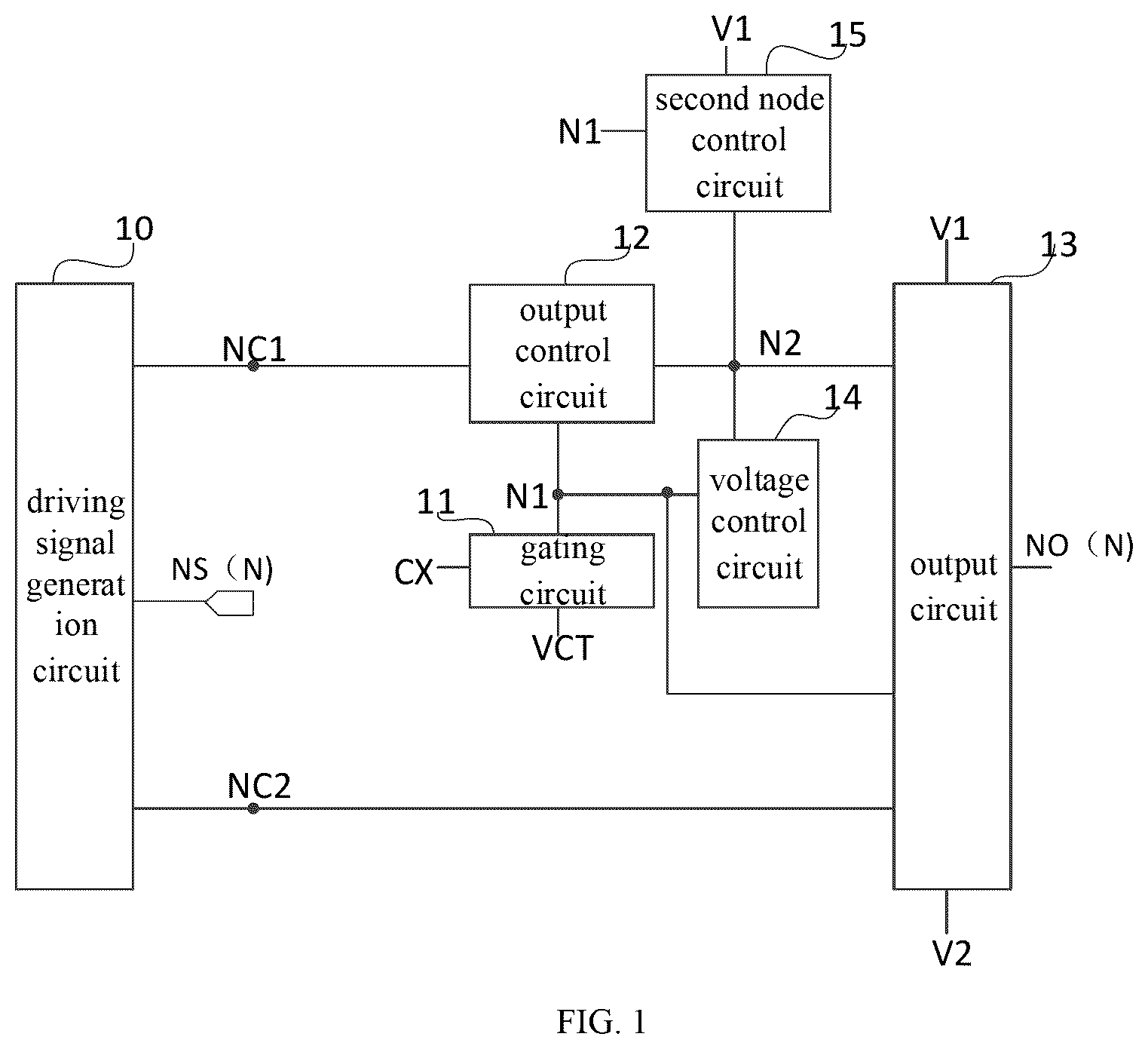
is a structural diagram of a driving circuit according to an embodiment of the present disclosure;
is a circuit diagram of a related pixel circuit;
is a working timing diagram of the related pixel circuit shown in ;
is a circuit diagram of a related pixel circuit;
is a circuit diagram of a gating circuit in a driving circuit according to an embodiment of the present disclosure;
is a circuit diagram of a gating circuit in a driving circuit according to an embodiment of the present disclosure;
is a circuit diagram of a gating circuit in a driving circuit according to an embodiment of the present disclosure;
is a circuit diagram of a gating circuit in a driving circuit according to an embodiment of the present disclosure;
is a circuit diagram of a gating circuit in a driving circuit according to an embodiment of the present disclosure;
is a circuit diagram of a gating circuit in a driving circuit according to an embodiment of the present disclosure;
is a circuit diagram of a gating circuit in a driving circuit according to an embodiment of the present disclosure;
is a circuit diagram of a gating circuit in a driving circuit according to an embodiment of the present disclosure;
is a circuit diagram of a gating circuit in a driving circuit according to an embodiment of the present disclosure;
is a circuit diagram of a gating circuit in a driving circuit according to an embodiment of the present disclosure;
is a circuit diagram of an inverter according to at least one embodiment of the present disclosure;
is a circuit diagram of an inverter according to at least one embodiment of the present disclosure;
is a structural diagram of a driving circuit according to at least one embodiment of the present disclosure;
is a structural diagram of a driving circuit according to at least one embodiment of the present disclosure;
is a structural diagram of a driving circuit according to at least one embodiment of the present disclosure;
is a structural diagram of a driving circuit according to at least one embodiment of the present disclosure;
is a structural diagram of a driving circuit according to at least one embodiment of the present disclosure;
is a structural diagram of a driving circuit according to at least one embodiment of the present disclosure;
is a circuit diagram of a driving circuit according to at least one embodiment of the present disclosure;
is a simulation timing diagram of the driving circuit shown in ;
is a simulation timing diagram of the driving circuit shown in ;
is a circuit diagram of a driving circuit according to at least one embodiment of the present disclosure;
is a simulation timing diagram of the driving circuit shown in ;
is a structural diagram of a driving module according to at least one embodiment of the present disclosure;
is a working timing diagram of the driving module shown in ;
is a structural diagram of a driving module according to at least one embodiment of the present disclosure;
is a working timing diagram of the driving module shown in ;
is a waveform diagram of the first clock signal provided by GCK and the second clock signal provided by GCB.
DETAILED DESCRIPTION
The following will clearly and completely describe the technical solutions in the embodiments of the present disclosure with reference to the accompanying drawings. Obviously, the described embodiments are only some of the embodiments of the present disclosure, not all of them. Based on the embodiments in the present disclosure, all other embodiments obtained by those ordinary skill in the art without making creative work belong to the protection scope of the present disclosure.
The transistors used in all the embodiments of the present disclosure may be thin film transistors or field effect transistors or other devices with the same characteristics. In the embodiments of the present disclosure, in order to distinguish the two electrodes of the transistor except the control electrode, one electrode is called the first electrode, and the other electrode is called the second electrode.
In actual operation, when the transistor is a thin film transistor or a field effect transistor, the control electrode may be a gate electrode, the first electrode may be a drain electrode, and the second electrode may be a source electrode; or, the control electrode may be a gate electrode, the first electrode may be a source electrode, and the second electrode may be a drain electrode.
As shown in , the driving circuit described in the embodiment of the present disclosure includes a driving signal generation circuit 10 , a gating circuit 11 , an output control circuit 12 , an output circuit 13 , a voltage control circuit 14 and a second node control circuit 15 ;
The driving signal generation circuit 10 is electrically connected to a first control node NC 1 , a second control node NC 2 and an Nth stage of driving signal output terminal NS(N) respectively, and is configured to generate and output an Nth stage of driving signal through the Nth stage of driving signal output terminal NS(N) under the control of a potential of the first control node NC 1 and a potential of the second control node NC 2 ; N is a positive integer;
The gating circuit 11 is electrically connected to the first node N 1 , a gating input terminal VCT and a gating control terminal CX, and is configured to write a gating input signal provided by the gating input terminal VCT into the first node N 1 under the control of a gating control signal provided by the gating control terminal CX;
The output control circuit 12 is electrically connected to the first node N 1 , the first control node NC 1 and the second node N 2 respectively, and is configured to control to connect the first control node NC 1 and the second node N 2 under the control of the potential of the first node N 1 ;
The voltage control circuit 14 is electrically connected to the first node N 1 and the second node N 2 respectively, and is configured to control a potential of the second node N 2 according to the potential of the first node N 1 ;
The second node control circuit 15 is electrically connected to the first node N 1 , the second node N 2 and a first voltage terminal V 1 respectively, and is configured to control to connect the second node N 2 and the first voltage terminal V 1 under the control of the potential of the first node N 1 ;
The output circuit 13 is electrically connected to the second node N 2 , the second control node NC 2 , the first node N 1 , the first voltage terminal V 1 , the second voltage terminal V 2 and the output driving terminal NO(N), and is configured to control to connect the output driving terminal NO(N) and the first voltage terminal V 1 under the control of the potential of the second node N 2 , and control to connect control the output driving terminal NO(N) and the second voltage terminal V 2 under the control of the potential of the second control node NC 2 , and control to connect the output driving terminal NO(N) and the second voltage terminal V 2 under the control of the potential of the first node N 1 .
When the driving circuit shown in of an embodiment of the present disclosure is in operation, the driving signal generation circuit 10 generates and outputs the Nth stage of driving signal through the Nth stage of driving signal output terminal NS(N) under the control of the potential of the first control node NC 1 and the potential of the second control node NC 2 ; the gating circuit 11 controls to write the gating input signal into the first node N 1 under the control of the gating control signal; the output control circuit 12 controls to connect the first control node NC 1 and the second node N 2 under the control of the potential of the first node N 1 ; the voltage control circuit 14 controls the potential of the second node N 2 according to the potential of the first node N 1 ; the second node control circuit 15 controls to connect the second node N 2 and the first voltage terminal V 1 under the control of the potential of the first node N 1 , the output circuit 13 controls to connect the output driving terminal NO(N) and the first voltage terminal V 1 under the control of the potential of the second node N 2 , control to connect the output driving terminal NO(N) and the second voltage terminal V 2 under the control of the potential of the second control node NC 2 , and control to connect the output driving terminal NO(N) and the second voltage terminal V 2 under the control of the potential of the first node N 1 .
In at least one embodiment of the present disclosure, the first voltage terminal may be a high voltage terminal, and the second voltage terminal may be a low voltage terminal, but not limited thereto.
The driving circuit shown in may be an Nth stage of driving circuit.
When the driving circuit shown in of the present disclosure is working, within one frame,
Before the supply stage of the N stage of driving signal, the gating circuit 11 writes the gating input signal provided by the gating input terminal VCT into the first node N 1 under the control of the gating control signal;
When the gating input signal is a high voltage signal, in the supply stage of the Nth stage of driving signal, the Nth stage of driving signal output terminal NS(N) outputs a high voltage signal, the potential of the first node N 1 is a high voltage, and the output control circuit 12 controls to disconnect the first control node NC 1 from the second node N 2 under the control of the potential of the first node N 1 , and the voltage control circuit 14 controls the potential of the second node N 2 to be a high voltage according the potential of the first node N 1 , and the output circuit controls the output driving terminal NO (N) to maintain to output a low voltage signal, which can control the corresponding row of pixel circuits not to update the pixel voltage;
When the gating input signal is a low voltage signal, in the supply stage of the Nth stage of driving signal, the Nth stage of driving signal output terminal NS(N) outputs a high voltage signal, and the potential of the first node N 1 is a low voltage, and the output control circuit 12 controls to connect the first control node NC 1 and the second node N 2 under the control of the potential of the first node N 1 , so that the potential of the second node N 2 is a low voltage, and the output circuit 13 controls to connect the output driving terminal NO(N) and the first voltage terminal V 1 under the control of the potential of the second node N 2 , so that NO(N) outputs a high voltage signal, which can control the corresponding row of pixel circuits to update the pixel voltage.
In the embodiment of the present disclosure, by controlling the gating input signal provided by the gating input terminal VCT, the update of the partial screen of the display screen can be realized, thereby reducing power consumption, or the partial update of the display screen can realize the ultra-low power consumption of wearable products, mobile terminals, notebook and other OLED display products.
As shown in , the pixel circuit may include a first display control transistor M 1 , a second display control transistor M 2 , a driving transistor M 3 , a fourth display control transistor M 4 , a fifth display control transistor M 5 , a sixth display control transistor M 6 , a seventh display control transistor M 7 , a storage capacitor Cst and an organic light emitting diode O 1 ;
The gate electrode of M 1 is electrically connected to the first reset terminal NR (N), the source electrode of M 1 is electrically connected to the initial voltage terminal I 1 , and the drain electrode of M 1 is electrically connected to the gate electrode of M 3 ;
The gate electrode of M 2 is electrically connected to the first scanning terminal NG (N), the source electrode of M 2 is electrically connected to the gate electrode of M 3 , and the drain electrode of M 2 is electrically connected to the drain electrode of M 3 ;
The gate electrode of M 4 is electrically connected to the second scanning terminal PG (N), the source electrode of M 4 is electrically connected to the data line D 1 , and the drain electrode of M 4 is electrically connected to the source electrode of M 3 ;
The gate electrode of M 5 is electrically connected to the light emitting control terminal E(N), the source electrode of M 5 is electrically connected to the power supply voltage terminal ELVDD, and the drain electrode of M 5 is electrically connected to the source electrode of M 3 ;
The gate electrode of M 6 is electrically connected to the light emitting control terminal E(N), the source electrode of M 6 is electrically connected to the drain electrode of M 3 , the drain electrode of M 6 is electrically connected to the anode of O 1 ; the cathode of O 1 is electrically connected to the low level terminal ELVSS;
The gate electrode of M 7 is electrically connected to the second scanning terminal PG (N), the source electrode of M 7 is electrically connected to the initial voltage terminal I 1 , and the drain electrode of M 7 is electrically connected to the anode of O 1 .
During specific implementation, the first reset terminal NR(N) may be the (N−1)th stage of first scanning terminal NG(N), but not limited thereto.
In the related pixel circuit shown in , M 1 and M 2 are n-type transistors, M 3 , M 4 , M 5 , M 6 and M 7 are all p-type transistors, M 1 and M 2 are IGZO TFTs with small leakage current, M 3 and M 4 , M 5 , M 6 and M 7 are all LTPS TFTs.
In the related pixel circuit shown in , M 1 and M 2 are IGZO TFTs. When low-frequency display is used, the IGZO TFT can ensure that Cst can maintain the gate voltage of M 3 for a long time.
In the related pixel circuit shown in , the second scanning terminal PG (N) is responsible for resetting the voltage of the anode of O 1 and writing the data voltage on the data line into the source electrode of the driving transistor, and the first scanning terminal NG (N) is responsible for realizing the reset of Cst, extracting Vth (Vth is the threshold voltage of the driving transistor) and writing the data voltage into the gate electrode of the driving transistor.
During specific implementation, the first scanning signal provided by the first scanning terminal NG(N) and the second scanning signal provided by the second scanning terminal PG(N) may be opposite in phase, but not limited thereto.
The driving circuit described in at least one embodiment of the present disclosure can provide the first scanning terminal NG(N) with the first scanning signal through the output driving terminal NO(N), but is not limited thereto.
As shown in , when the related pixel circuit shown in is in operation, the display period may include a first display control phase t 1 , a second display control phase t 2 and a third display control phase t 3 which are set successively;
In the first display control phase t 1 , E(N) outputs a high voltage signal, NR(N) provides a high voltage signal, PG(N) provides a high voltage signal, NG(N) provides a low voltage signal, M 5 and M 6 are turned off, M 1 is turned on, and the potential of the gate electrode of M 3 is pulled down to an initial voltage Vinit; the initial voltage terminal I 1 is configured to provide the initial voltage Vinit;
In the second display control phase t 2 , E(N) outputs a high voltage signal, NR(N) provides a low voltage signal, PG(N) provides a low voltage signal, NG(N) provides a high voltage signal. M 5 and M 6 are turned off, M 1 is turned off, M 2 is turned on, M 4 is turned on, M 2 and M 3 form a diode structure, and the data voltage Vdata provided by the data line D 1 charges Cst until M 3 is turned off. At this time, the gate voltage of M 3 is Vdata+Vth, and Vth is the threshold voltage of M 3 ; M 7 is turned on to reset the anode voltage of O 1 ;
In the third display control phase t 3 , E(N) outputs a low voltage signal, NR(N) provides a low voltage signal, PG(N) provides a high voltage signal, NG(N) provides a low voltage signal, M 5 and M 6 are turned on, M 3 drives O 1 to emit light; O 1 emits light according to the voltage setting of Vdata.
It can be seen from the working process of the related pixel circuit that NG (N) can control whether the data voltage Vdata (the data voltage Vdata can be the pixel voltage) is written into the gate electrode of M 3 in the second display control phase.
is a circuit diagram of a related pixel circuit.
As shown in , the related pixel circuit may include a first display control transistor M 1 , a second display control transistor M 2 , a driving transistor M 3 , a fourth display control transistor M 4 , a fifth display control transistor M 5 , a sixth display control transistor M 6 , a seventh display control transistor M 7 , a storage capacitor Cst and an organic light emitting diode O 1 ;
The gate electrode of M 1 is electrically connected to the third reset terminal RST 1 , the source electrode of M 1 is electrically connected to the initial voltage terminal I 1 , and the drain electrode of M 1 is electrically connected to the drain electrode of M 3 ;
The gate electrode of M 2 is electrically connected to the first scanning terminal NG (N), the source electrode of M 2 is electrically connected to the gate electrode of M 3 , and the drain electrode of M 2 is electrically connected to the drain electrode of M 3 ;
The gate electrode of M 4 is electrically connected to the second scanning terminal PG (N), the source electrode of M 4 is electrically connected to the data line D 1 , and the drain electrode of M 4 is electrically connected to the source electrode of M 3 ;
The gate electrode of M 5 is electrically connected to the light emitting control terminal E(N), the source electrode of M 5 is electrically connected to the power supply voltage terminal ELVDD, and the drain electrode of M 5 is electrically connected to the source electrode of M 3 ;
The gate electrode of M 6 is electrically connected to the light emitting control terminal E(N), the source electrode of M 6 is electrically connected to the drain electrode of M 3 , the drain electrode of M 6 is electrically connected to the anode of O 1 ; the cathode of O 1 is electrically connected to the low level terminal ELVSS;
The gate electrode of M 7 is electrically connected to the fourth reset terminal RST 2 , the source electrode of M 7 is electrically connected to the initial voltage terminal I 1 , and the drain electrode of M 7 is electrically connected to the anode of O 1 .
When the related pixel circuit shown in is in operation, NG(N) can control whether the data voltage Vdata on the data line D 1 is written into the gate electrode of the driving transistor M 3 .
In specific implementation, the first scanning signal provided by NG (N) can be configured to control to turn on or off the second transistor to control whether the data voltage on the data line is written into the gate electrode of the driving transistor, thereby controlling whether to update the brightness of the current row of pixel circuits; when NG (N) outputs a high voltage signal, the second transistor is turned on to update the brightness of the current row of pixel circuits; when NG (N) outputs a low voltage signal, the second transistor is always turned off, the change of the data voltage on the data line will not be written into the gate electrode of the driving transistor, and the brightness of the organic light emitting diode will not change, that is, the display brightness of the current row of pixel circuits remains unchanged in the current frame. To sum up, it can be seen that the pixel brightness can be refreshed by controlling the N-type transistor to be turned on or off. Therefore, when some pixels are not to be refreshed, it is sufficient to ensure that the N-type transistor is turned off.
In at least one embodiment of the present disclosure, the gating circuit is configured to control to write the gating input signal provided by the gating input terminal into the first node when the potential of the (N−1)th stage of third node is the second voltage and the potential of the Nth stage of driving signal is the second voltage.
Optionally, the second voltage may be a low voltage, but not limited thereto.
Optionally, the gating circuit includes a first transistor; the gate electrode of the first transistor is electrically connected to the gating control terminal, and the first electrode of the first transistor is electrically connected to the first node, the second electrode of the first transistor is electrically connected to the gating input terminal.
As shown in , the gating circuit may include a first transistor T 1 ;
The gate electrode of the first transistor T 1 is electrically connected to the gating control terminal S 0 , the drain electrode of the first transistor T 1 is electrically connected to the first node N 1 , and the source electrode of the first transistor T 1 is electrically connected to the gating input terminal VCT;
T 1 is a p-type transistor.
As shown in , the gating circuit may include a first transistor T 1 ;
The gate electrode of the first transistor T 1 is electrically connected to the gating control terminal S 0 , the source electrode of the first transistor T 1 is electrically connected to the first node N 1 , and the drain electrode of the first transistor T 1 is electrically connected to the gating input terminal VCT;
T 1 is an n-type transistor.
Optionally, the gating control terminal includes a first gating control terminal and a second gating control terminal; the gating circuit includes a first transistor and a second transistor;
A gate electrode of the first transistor is electrically connected to the first gating control terminal, a first electrode of the first transistor is electrically connected to the first node, and a second electrode of the first transistor is electrically connected to the first electrode of the second transistor;
A gate electrode of the second transistor is electrically connected to the second gating control terminal, and a second electrode of the second transistor is electrically connected to the gating input terminal;
The first gating control terminal is the Nth stage of driving signal output terminal, the second gating control terminal is the (N−1)th stage of third node, and both the first transistor and the second transistor are p-type transistors; or,
The first gating control terminal is the (N−1)th stage of third node, the second gating control terminal is the Nth stage of driving signal output terminal, and the first transistor and the second transistor are p-type transistors; or,
The first gating control terminal is the (N−1)th stage of driving signal output terminal, the second gating control terminal is the Nth stage driving signal output terminal, the first transistor is an n-type transistor, and the second transistor is a p-type transistor; or,
The first gating control terminal is the Nth stage of driving signal output terminal, the second gating control terminal is the (N−1)th stage of driving signal output terminal, the first transistor is a p-type transistor, and the second transistor is an n-type transistor; or,
The first gating control terminal is connected to an inversion signal of the (N−1)th stage of driving signal, the second gating control terminal is the Nth stage of driving signal output terminal, the first transistor and the second transistor are both p-type transistors; or,
The first gating control terminal is the Nth stage of driving signal output terminal, and the second gating control terminal is connected to the inversion signal of the (N−1)th stage of driving signal; the first transistor and the second transistor are both p-type transistors; or,
The first gating control terminal is the (N−1)th stage of driving signal terminal, the second gating control terminal is connected to the inversion signal of the Nth stage of driving signal, and the first transistor and the second transistor are both N-type transistors; or,
The first gating control terminal is connected to the inversion signal of the Nth stage of driving signal, the second gating control terminal is the (N−1)th stage of driving signal terminal, and the first transistor and the second transistor are both N-type transistors.
As shown in , the gating circuit may include a first transistor T 1 and a second transistor T 2 ;
The gate electrode of the first transistor T 1 is electrically connected to the (N−1)th stage of driving signal output terminal NS(N−1), the source electrode of the first transistor T 1 is electrically connected to the first node N 1 , and the drain electrode of the first transistor T 1 is electrically connected to the drain electrode of the second transistor T 2 ;
The gate electrode of the second transistor T 2 is electrically connected to the Nth stage of driving signal output terminal NS(N), and the source electrode of the second transistor T 2 is electrically connected to the gating input terminal VCT;
T 1 is an n-type transistor, and T 2 is a p-type transistor.
As shown in , the gating circuit may include a first transistor T 1 and a second transistor T 2 ;
The gate electrode of the first transistor T 1 is electrically connected to the Nth stage of driving signal output terminal NS(N), the drain electrode of the first transistor T 1 is electrically connected to the first node N 1 , and the source electrode of the first transistor T 1 is electrically connected to the source electrode of the second transistor T 2 ;
The gate electrode of the second transistor T 2 is electrically connected to the (N−1)th stage of driving signal output terminal NS(N−1), and the drain electrode of the second transistor T 2 is electrically connected to the gating input terminal VCT;
T 1 is a p-type transistor, and T 2 is an n-type transistor.
As shown in , the gating circuit may include a first transistor T 1 and a second transistor T 2 ;
The gate electrode of the first transistor T 1 is electrically connected to the (N−1)th stage of third node N 3 (N−1), the drain electrode of the first transistor T 1 is electrically connected to the first node N 1 , and the source electrode of the first transistor T 1 is electrically connected to the drain electrode of the second transistor T 2 ;
The gate electrode of the second transistor T 2 is electrically connected to the Nth stage of driving signal output terminal NS(N), and the source electrode of the second transistor T 2 is electrically connected to the gating input terminal VCT;
T 1 is a p-type transistor, and T 2 is a p-type transistor.
In at least one embodiment of the present disclosure, the (N−1)th stage of third node N 3 (N−1) may be a third node in the (N−1)th stage of driving circuit.
As shown in , the gating circuit may include a first transistor T 1 and a second transistor T 2 ;
The gate electrode of the first transistor T 1 is electrically connected to the Nth stage of driving signal output terminal NS(N), the drain electrode of the first transistor T 1 is electrically connected to the first node N 1 , and the source electrode of the first transistor T 1 is electrically connected to the drain electrode of the second transistor T 2 ;
The gate electrode of the second transistor T 2 is electrically connected to the (N−1)th stage of the third node N 3 (N−1), and the source electrode of the second transistor T 2 is electrically connected to the gating input terminal VCT;
T 1 is a p-type transistor, and T 2 is a p-type transistor.
As shown in , the gating circuit may include a first transistor T 1 and a second transistor T 2 ;
The gate electrode of the first transistor T 1 is electrically connected to the first inverting driving signal terminal NGI 1 , the drain electrode of the first transistor T 1 is electrically connected to the first node N 1 , and the source electrode of the first transistor T 1 is electrically connected to the drain electrode of the second transistor T 2 ; the first inverting driving signal provided by the first inverting driving signal terminal NGI 1 is inversed in phase to the (N−1)th stage of inverting driving signal provided by the (N−1)th stage of driving signal terminal NS(N−1);
The gate electrode of the second transistor T 2 is electrically connected to the Nth stage of driving signal output terminal NS(N), and the source electrode of the second transistor T 2 is electrically connected to the gating input terminal VCT;
T 1 is a p-type transistor, and T 2 is a p-type transistor.
As shown in , the gating circuit may include a first transistor T 1 and a second transistor T 2 ;
The gate electrode of the first transistor T 1 is electrically connected to the Nth stage of driving signal output terminal NS(N), the drain electrode of the first transistor T 1 is electrically connected to the first node N 1 , and the source electrode of the first transistor T 1 is electrically connected to the drain electrode of the second transistor T 2 ;
The gate electrode of the second transistor T 2 is electrically connected to the first inversed driving signal terminal NGI 1 , and the source electrode of the second transistor T 2 is electrically connected to the gating input terminal VCT; the first inversed driving signal provided by the first inversed driving signal terminal NGI 1 is inverted in phase with the (N−1)th stage of driving signal provided by the (N−1)th stage of driving signal output terminal NS(N−1);
T 1 is a p-type transistor, and T 2 is a p-type transistor.
As shown in , the gating circuit may include a first transistor T 1 and a second transistor T 2 ;
The gate electrode of the first transistor T 1 is electrically connected to the (N−1)th stage of driving signal output terminal NS(N−1), the source electrode of the first transistor T 1 is electrically connected to the first node N 1 , and the drain electrode of the first transistor T 1 is electrically connected to the first node N 1 . The drain electrode of the first transistor T 1 is electrically connected to the source electrode of the second transistor T 2 ;
The gate electrode of the second transistor T 2 is electrically connected to the second inverting driving signal terminal NGI 2 , and the drain electrode of the second transistor T 2 is electrically connected to the gating input terminal VCT; the second inversed driving signal provided by the second inverting driving signal terminal NGI 2 is inverse in phase to the Nth stage of driving signal provided by the Nth stage of driving signal output terminal NS(N);
T 1 is an n-type transistor, and T 2 is an n-type transistor.
As shown in , the gating circuit may include a first transistor T 1 and a second transistor T 2 ;
The gate electrode of the first transistor T 1 is electrically connected to the second inverting driving signal terminal NGI 2 , the source electrode of the first transistor T 1 is electrically connected to the first node N 1 , and the drain electrode of the first transistor T 1 is electrically connected to the source electrode of the second transistor T 2 ; the second inverting driving signal provided by the second inverting driving signal terminal NGI 2 is inverse in phase to the Nth stage of driving signal provided by the Nth stage of driving signal output terminal NS(N);
The gate electrode of the second transistor T 2 is electrically connected to the (N−1)th stage of driving signal output terminal NS(N−1), and the drain electrode of the second transistor T 2 is electrically connected to the gating input terminal VCT;
T 1 is an n-type transistor, and T 2 is an n-type transistor.
As shown in , the (N−1)th stage of driving signal provided by the (N−1)th stage of driving signal output terminal NS (N−1) can be inverted by the first inverter to obtain the first inverted driving signal provided by the first inversed driving signal terminal NGI 1 :
The first inverter includes a first inversion control transistor T 01 and a second inversion control transistor T 02 ;
T 01 is a p-type transistor, and T 02 is an n-type transistor.
As shown in , the Nth stage of driving signal provided by the Nth stage of driving signal output terminal NS(N) can be inverted by the second inverter to obtain the second inverted driving signal provided by the second inverted driving signal terminal NGI 2 ;
The second inverter includes a third inversion control transistor T 03 and a fourth inversion control transistor T 04 ;
T 03 is a p-type transistor, and T 04 is an n-type transistor.
Optionally, the output control circuit includes a third transistor, and the voltage control circuit includes a first capacitor;
A gate electrode of the third transistor is electrically connected to the first node, a first electrode of the third transistor is electrically connected to the first control node, and a second electrode of the third transistor is electrically connected to the second node;
A first end of the first capacitor is electrically connected to the second node, and a second end of the first capacitor is electrically connected to the first voltage terminal.
Optionally, the second node control circuit includes a fourth transistor, and the output circuit includes a fifth transistor, a sixth transistor, a seventh transistor, and a second capacitor;
A gate electrode of the fourth transistor is electrically connected to the first node, a first electrode of the fourth transistor is electrically connected to the first voltage terminal, and a second electrode of the fourth transistor is electrically connected to the second node;
A gate electrode of the fifth transistor is electrically connected to the second node, a first electrode of the fifth transistor is electrically connected to the first voltage terminal, and a second electrode of the fifth transistor is electrically connected to the output driving terminal;
A gate electrode of the sixth transistor is electrically connected to the second control node, a first electrode of the sixth transistor is electrically connected to the output driving terminal, and a second electrode of the sixth transistor is electrically connected to the second voltage terminal;
A gate electrode of the seventh transistor is electrically connected to the first node, a first electrode of the seventh transistor is electrically connected to the output driving terminal, and a second electrode of the seventh transistor is electrically connected to the second voltage terminal;
A first end of the second capacitor is electrically connected to the second node, and a second end of the second capacitor is electrically connected to the first voltage terminal.
The driving circuit described in at least one embodiment of the present disclosure further includes an initialization circuit;
The initialization circuit is electrically connected to the initial control terminal, the first node and the second voltage terminal, and is configured to control to connect the first node and the second voltage terminal under the control of the initial control signal provided by the initial control terminal.
In a specific implementation, the driving circuit may further include an initialization circuit, and the initialization circuit is configured to control to connect the first node and the second voltage terminal under the control of an initial control signal.
In at least one embodiment of the present disclosure, the driving circuit further includes a first node control circuit;
The first node control circuit is electrically connected to a fourth node, the first node and the second voltage terminal, and is configured to control to connect the first node and the second voltage terminal under the control of the potential of the fourth node.
In a specific implementation, the driving circuit may further include a first node control circuit; the first node control circuit controls to connect the first node and the second voltage terminal under the control of the potential of the fourth node.
As shown in , on the basis of the embodiment of the driving circuit shown in , the driving circuit may further include an initialization circuit 21 and a first node control circuit 22 ;
The initialization circuit 21 is electrically connected to the initial control terminal NCX, the first node N 1 and the second voltage terminal V 2 respectively, and is configured to control to connect the first node N 1 and the second voltage terminal V 2 under the control of the initial control signal provided by the initial control terminal NCX;
The first node control circuit 22 is electrically connected to the fourth node N 4 , the first node N 1 and the second voltage terminal V 2 respectively, and is configured to control to connect the first node N 1 and the second voltage terminal V 2 under the control of the potential of the fourth node N 4 .
Optionally, the initialization circuit includes an eighth transistor;
A gate electrode of the eighth transistor is electrically connected to the initial control terminal, a first electrode of the eighth transistor is electrically connected to the first node, and a second electrode of the eighth transistor is electrically connected to the second voltage terminal.
Optionally, the first node control circuit includes a ninth transistor;
A gate electrode of the ninth transistor is electrically connected to the fourth node, a first electrode of the ninth transistor is electrically connected to the first node, and a second electrode of the ninth transistor is electrically connected to the second voltage terminal.
The driving circuit according to at least one embodiment of the present disclosure further includes a voltage maintenance circuit, and the voltage maintenance circuit includes a first inverter, a second inverter and a maintenance control circuit;
An input end of the first inverter is electrically connected to the first node, an output end of the first inverter is electrically connected to the fifth node, and an input end of the second inverter is electrically connected to the fifth node, and an output end of the second inverter is electrically connected to the sixth node;
The first inverter is configured to invert the potential of the first node, and output the inverted potential of the first node through an output terminal of the first inverter;
The second inverter is configured to invert the potential of the input terminal of the second inverter, and output the inverted potential through the output terminal of the second inverter;
The maintenance control circuit is electrically connected to the maintenance control terminal, the sixth node and the first node, and is configured to control to connect or disconnect the sixth node and the first node under the control of the maintenance control signal provided by the maintenance control terminal.
In specific implementation, the driving circuit may also include a voltage maintenance circuit, the voltage maintenance circuit includes a first inverter, a second inverter and a maintenance control circuit; the first inverter controls to inverse the potential of the first node; the second inverter controls to inverse the potential of the input terminal of the second inverter; the maintenance control circuit controls to connect or disconnect the sixth node and the first node under the control of the maintenance control signal;
The maintenance control circuit may control to disconnect the sixth node from the first node so as not to affect the potential of the first node when the gating circuit controls to write the gating input signal into the first node.
When the driving circuit described in at least one embodiment of the present disclosure is working, by adding the voltage maintenance circuit, the first inverter and the second inverter included in the voltage maintenance circuit can control to connect the output terminal of the second inverter and the high voltage terminal when the potential of the first node is a high potential, so that the potential of the output terminal of the second inverter is higher than the potential of the first node, and can control the output terminal of the second inverter to be connected to the low voltage terminal when the potential of the first node is a low voltage, so that the potential of the output terminal of the second inverter is lower than the potential of the first node, and the maintenance control circuit included in the voltage maintenance circuit can control to connect the output terminal of the second inverter and the first node at the Nth stage of driving signal output phase, thereby increasing the absolute value of the potential of the first node, so that the first node can better control the transistor whose gate electrode is connected to the first node included in the output control circuit.
As shown in , on the basis of at least one embodiment of the driving circuit shown in , the driving circuit may include the voltage maintenance circuit, the voltage maintenance circuit includes the first inverter F 1 , a second inverter F 2 , and a maintenance control 11 circuit W 1 ; the maintenance control terminal includes an (N−1)th stage of driving signal output terminal NS (N−1) and a first clock signal terminal GCK;
The input terminal of the first inverter F 1 is electrically connected to the first node N 1 , the output terminal of the first inverter F 1 is electrically connected to the fifth node N 5 , and the input terminal of the second inverter F 2 terminal is electrically connected to the fifth node NS, and the output terminal of the second inverter F 2 is electrically connected to the sixth node N 6 ;
The first inverter F 1 is configured to invert the potential of the first node N 1 , and output the inverted potential of the first node N 1 through the output terminal of the first inverter F 1 ;
The second inverter F 2 is configured to invert the potential of the input terminal of the second inverter F 2 , and output the inverted potential through the output terminal of the second inverter F 2 ;
The maintenance control circuit W 1 is respectively electrically connected to the (N−1)th stage of driving signal output terminal NS(N−1), the first clock signal terminal GCK, the sixth node N 6 and the first node N 1 , is configured to control to connect or disconnect the sixth node N 6 and the first node N 1 under the control of the (N−1)th stage of driving signal provided by the (N−1)th stage of driving signal output terminal NS(N−1), and control to connect or disconnect the sixth node N 6 and the first node N 1 under the control of the first clock signal provided by the first clock signal terminal GCK.
In at least one embodiment shown in , the (N−1)th stage of driving signal output terminal may be replaced by a second clock signal terminal, but not limited thereto.
In at least one embodiment of the present disclosure, the maintenance control terminal includes a first maintenance control terminal and a second maintenance control terminal;
The maintenance control circuit includes a tenth transistor and an eleventh transistor;
A gate electrode of the tenth transistor is electrically connected to the first maintenance control terminal, a first electrode of the tenth transistor is electrically connected to the first node, and a second electrode of the tenth transistor is electrically connected to the sixth node;
A gate electrode of the eleventh transistor is electrically connected to the second maintenance control terminal, a first electrode of the eleventh transistor is electrically connected to the sixth node, and a second electrode of the eleventh transistor is electrically connected to the first node;
The tenth transistor is a p-type transistor, and the eleventh transistor is an n-type transistor;
The first maintenance control terminal is the (N−1)th stage driving signal terminal, and the second maintenance control terminal is the first clock signal terminal; or,
The first maintenance control terminal is a second clock signal terminal, and the second maintenance control terminal is a first clock signal terminal.
Optionally, the first inverter includes a twelfth transistor and a thirteenth transistor, and the second inverter includes a fourteenth transistor and a fifteenth transistor;
A gate electrode of the twelfth transistor is electrically connected to the first node, a first electrode of the twelfth transistor is electrically connected to the first voltage terminal, and a second electrode of the twelfth transistor is electrically connected to the fifth node;
A gate electrode of the thirteenth transistor is electrically connected to the first node, a first electrode of the thirteenth transistor is electrically connected to the fifth node, and a second electrode of the thirteenth transistor is electrically connected to the second voltage terminal;
The twelfth transistor is a p-type transistor, and the thirteenth transistor is an n-type transistor;
A gate electrode of the fourteenth transistor is electrically connected to the fifth node, a first electrode of the fourteenth transistor is electrically connected to the first voltage terminal, and a second electrode of the fourteenth transistor is electrically connected to the sixth node;
A gate electrode of the fifteenth transistor is electrically connected to the fifth node, a first electrode of the fifteenth transistor is electrically connected to the sixth node, and a second electrode of the fifteenth transistor is electrically connected to the second voltage terminal;
The fourteenth transistor is a p-type transistor, and the fifteenth transistor is an n-type transistor.
In at least one embodiment of the present disclosure, the driving signal generation circuit includes a first control node control circuit, a second control node control circuit, a first driving output circuit, and a second driving output circuit;
The first control node control circuit is configured to control the potential of the first control node;
The second control node control circuit is configured to control the potential of the second control node;
The first driving output circuit is electrically connected to the first control node, the first voltage terminal and the Nth stage of driving signal output terminal respectively, and is configured to control to connect the Nth stage of driving signal output terminal and the first voltage terminal under the control of the potential of the first control node;
The second driving output circuit is electrically connected to the second control node, the Nth stage of driving signal output terminal and the second voltage terminal, and is configured to control to connect the Nth stage of driving signal output terminal and the second voltage terminal under the control of the potential of the second control node.
In specific implementation, the driving signal generation circuit may include a first control node control circuit, a second control node control circuit, a first driving output circuit and a second driving output circuit; the first control node control circuit controls the potential of the first control node, the second control node control circuit controls the potential of the second control node; the first driving output circuit controls to connect the Nth stage of driving signal output terminal and the first voltage terminal under the control of the potential of the first control node; the second driving output circuit controls to connect the Nth stage of driving signal output terminal and the second voltage terminal under the control of the potential of the second control node.
As shown in , on the basis of at least one embodiment of the driving circuit shown in , the driving signal generation circuit includes a first control node control circuit 31 , a second control node control circuit 32 , a first driving output circuit 33 and a second driving output circuit 34 ;
The first control node control circuit 31 is electrically connected to the first control node NC 1 , is configured to control the potential of the first control node NC 1 ;
The second control node control circuit 32 is electrically connected to the second control node NC 2 , is configured to control the potential of the second control node NC 2 ;
The first driving output circuit 33 is electrically connected to the first control node NC 1 , the first voltage terminal V 1 , and the Nth stage of driving signal output terminal NS(N), and is configured to control to connect the Nth stage of driving signal output terminal NS(N) and the first voltage terminal V 1 under the control of the potential of the first control node NC 1 ;
The second driving output circuit 34 is electrically connected to the second control node NC 2 , the Nth stage of driving signal output terminal NS(N) and the second voltage terminal V 2 , and is configured to control to connect the Nth stage of driving signal output terminal NS(N) and the second voltage terminal V 2 under the control of the potential of the second control node NC 2 .
As shown in , on the basis of at least one embodiment of the driving circuit shown in , the driving signal generation circuit includes a first control node control circuit 31 , a second control node control circuit 32 , a first driving output circuit 33 and a second driving output circuit 34 ;
The first control node control circuit 31 is electrically connected to the first control node NC 1 , is configured to control the potential of the first control node NC 1 ;
The second control node control circuit 32 is electrically connected to the second control node NC 2 , is configured to control the potential of the second control node NC 2 ;
The first driving output circuit 33 is electrically connected to the first control node NC 1 , the first voltage terminal V 1 , and the Nth stage of driving signal output terminal NS(N), and is configured to control to connect the Nth stage of driving signal output terminal NS(N) and the first voltage terminal V 1 under the control of the potential of the first control node NC 1 ;
The second driving output circuit 34 is electrically connected to the second control node NC 2 , the Nth stage of driving signal output terminal NS(N) and the second voltage terminal V 2 , and is configured to control to connect the Nth stage of driving signal output terminal NS(N) and the second voltage terminal V 2 under the control of the potential of the second control node NC 2 .
In at least one embodiment of the present disclosure, the first control node control circuit includes a seventh node control circuit, an eighth node control circuit, a third node control circuit, and a first control circuit;
The seventh node control circuit is respectively electrically connected to the first clock signal terminal, the second voltage terminal, the seventh node and the ninth node, and is configured to control to connect the seventh node and the second voltage terminal under the control of the first clock signal provided by the first clock signal terminal, and control to connect the seventh node and the first clock signal terminal under the control of the potential of the ninth node;
The eighth node control circuit is electrically connected to the second voltage terminal, the seventh node, and the eighth node, and is configured to control to connect the seventh node and the eighth node under the control of the second voltage signal provided by the second voltage terminal;
The third node control circuit is electrically connected to the eighth node, the second clock signal terminal and the third node, and is configured to control to connect the third node and the second clock signal terminal under the control of the potential of the eighth node, and control the potential of the third node according to the potential of the eighth node;
The first control circuit is electrically connected to the second clock signal terminal, the third node, the first control node, the ninth node and the first voltage terminal, and is configured to control to connect the third node and the first control node under the control of the second clock signal provided by the second clock signal terminal, control to connect the first control node and the first voltage terminal under the control of the potential of the ninth node.
In specific implementation, the first control node control circuit may include a seventh node control circuit, an eighth node control circuit, a third node control circuit and a fast control circuit; the seventh node control circuit controls the potential of the seventh node; the eighth node control circuit controls the potential of the eighth node; the third node control circuit controls the potential of the third node; the first control circuit controls the potential of the first control node.
In at least one embodiment of the present disclosure, the second control node control circuit includes a ninth node control circuit, a tenth node control circuit, a fourth node control circuit, an eleventh node control circuit, and a second control circuit;
The ninth node control circuit is electrically connected to the first clock signal terminal, the (N−1)th stage of driving signal output terminal, the ninth node, the initial control terminal and the first voltage terminal, and is configured to control to connect the ninth node and the (N−1)th stage of driving signal terminal under the control of the first clock signal provided by the first clock signal terminal, and control to connect the ninth node and the first voltage terminal under the control of the initial control signal provided by the initial control terminal;
The tenth node control circuit is electrically connected to the first clock signal terminal, the (N−1)th stage of driving signal output terminal and the tenth node respectively, and is configured to control to connect the tenth node and the (N−1)th stage of driving signal output terminal under the control of the first clock signal provided by the first clock signal terminal;
The fourth node control circuit is electrically connected to the first voltage terminal, the seventh node, the fourth node, the eleventh node and the second clock signal terminal, and is configured to control to connect the fourth node and the first voltage terminal under the control of the potential of the seventh node, and control to connect the fourth node and the second clock signal terminal under the control of the potential of the eleventh node;
The eleventh node control circuit is electrically connected to the fourth node, the eleventh node, the second voltage terminal and the tenth node, and is configured to control the potential of the eleventh node according to the potential of the fourth node, and control to connect the eleventh node and the tenth node under the control of the second voltage signal provided by the second voltage terminal;
The second control circuit is electrically connected to the eleventh node and the second control node, and is configured to control the potential of the second control node under the control of the potential of the eleventh node.
In specific implementation, the second control node control circuit may include a ninth node control circuit, a tenth node control circuit, a fourth node control circuit, an eleventh node control circuit and a second control circuit; the ninth node control circuit controls the potential of the ninth node; the tenth node control circuit controls the potential of the tenth node; the fourth node control circuit controls the potential of the fourth node; the eleventh node control circuit controls the potential of the eleventh node; the second control circuit controls the potential of the second control node.
Optionally, the first voltage terminal may be a high voltage terminal, and the second voltage terminal may be a low voltage terminal, but not limited thereto.
As shown in , on the basis of at least one embodiment of the driving circuit shown in , the first control node control circuit includes a seventh node control circuit 41 , an eighth node control circuit 42 , a third node control circuit 43 and a first control circuit 44 ;
The seventh node control circuit 41 is electrically connected to the first clock signal terminal GCK, the second voltage terminal V 2 , the seventh node N 7 and the ninth node N 9 respectively, and is configured to control to connect the seventh node N 7 and the second voltage terminal V 2 under the control of the first clock signal provided by the first clock signal terminal GCK, and control to connect the seventh node N 7 and the first clock signal terminal GCK under the control of the potential of the ninth node N 9 ;
The eighth node control circuit 42 is electrically connected to the second voltage terminal V 2 , the seventh node N 7 and the eighth node N 8 respectively, and is configured to control to connect the seventh node N 7 and the eighth node N 8 under the control of the second voltage signal provided by the second voltage terminal V 2 ;
The third node control circuit 43 is electrically connected to the eighth node N 8 , the second clock signal terminal GCB and the third node N 3 respectively, and is configured to control to connect the third node N 3 and the second clock signal terminal GCB under the control of the potential of the eighth node N 8 , and controls the potential of the third node N 3 according to the potential of the eighth node N 8 ;
The first control circuit 44 is respectively electrically connected to the second clock signal terminal GCB, the third node N 3 , the first control node NC 1 , the ninth node N 9 and the first voltage terminal V 1 , is configured to control to connect the third node N 3 and the first control node NC 1 under the control of the second clock signal provided by the second clock signal terminal GCB, and control to connect the first control node NC 1 and the first voltage terminals V 1 under the control of the potential of the ninth node N 9 ;
The second control node control circuit includes a ninth node control circuit 51 , a tenth node control circuit 52 , a fourth node control circuit 53 , an eleventh node control circuit 54 and a second control circuit 55 ;
The ninth node control circuit 51 is electrically connected to the first clock signal terminal GCK, the (N−1)th stage of driving signal output terminal NS (N−1), the ninth node N 9 , the initial control terminal NCX and the first voltage terminal V 1 , respectively, is configured to control to connect the ninth node N 9 and the (N−1)th stage of driving signal terminal NS(N−1) under the control of the first clock signal provided by the first clock signal terminal GCK, and control to connect the ninth node N 9 and the first voltage terminal V 1 under the control of the initial control signal provided by the initial control terminal NCX;
The tenth node control circuit 52 is electrically connected to the first clock signal terminal GCK, the (N−1)th stage of driving signal output terminal NS(N−1) and the tenth node N 10 respectively, is configured to control to connect the tenth node N 10 and the (N−1)th stage of driving signal output terminal NS(N−1) under the control of the first clock signal provided by the first clock signal terminal GCK;
The fourth node control circuit 53 is electrically connected to the first voltage terminal V 1 , the seventh node N 7 , the fourth node N 4 , the eleventh node N 11 , and the second clock signal terminal GCB, and is configured to control to connect the fourth node N 4 and the first voltage terminal V 1 under the control of the potential of the seventh node N 7 , control to connect the fourth node N 4 and the second clock signal terminal GCB under the control of the potential of the eleventh node N 11 ;
The eleventh node control circuit 54 is electrically connected to the fourth node N 4 , the eleventh node N 11 , the second voltage terminal V 2 and the tenth node N 10 , and is configured to control the potential of the eleventh node N 11 according to the potential of the fourth node N 4 , control to connect the eleventh node N 11 and the tenth node N 10 under the control of the second voltage signal provided by the second voltage terminal V 2 ;
The second control circuit 55 is electrically connected to the eleventh node N 11 and the second control node NC 2 respectively, and is configured to control the potential of the second control node NC 2 under the control of the potential of the eleventh node N 11 .
As shown in , on the basis of at least one embodiment of the driving circuit shown in , the first control node control circuit includes a seventh node control circuit 41 , an eighth node control circuit 42 , a third node control circuit 43 and a first control circuit 44 ;
The seventh node control circuit 41 is electrically connected to the first clock signal terminal GCK, the second voltage terminal V 2 , the seventh node N 7 and the ninth node N 9 respectively, and is configured to control to connect the seventh node N 7 and the second voltage terminal V 2 under the control of the first clock signal provided by the first clock signal terminal GCK, and control to connect the seventh node N 7 and the first clock signal terminal GCK under the control of the potential of the ninth node N 9 ;
The eighth node control circuit 42 is electrically connected to the second voltage terminal V 2 , the seventh node N 7 and the eighth node N 8 respectively, and is configured to control to connect the seventh node N 7 and the eighth node N 8 under the control of the second voltage signal provided by the second voltage terminal V 2 ;
The third node control circuit 43 is electrically connected to the eighth node N 8 , the second clock signal terminal GCB and the third node N 3 respectively, and is configured to control to connect the third node N 3 and the second clock signal terminal GCB under the control of the potential of the eighth node N 8 , and controls the potential of the third node N 3 according to the potential of the eighth node N 8 ;
The first control circuit 44 is respectively electrically connected to the second clock signal terminal GCB, the third node N 3 , the first control node NC 1 , the ninth node N 9 and the first voltage terminal V 1 , is configured to control to connect the third node N 3 and the first control node NC 1 under the control of the second clock signal provided by the second clock signal terminal GCB, and control to connect the first control node NC 1 and the first voltage terminals V 1 under the control of the potential of the ninth node N 9 ;
The second control node control circuit includes a ninth node control circuit 51 , a tenth node control circuit 52 , a fourth node control circuit 53 , an eleventh node control circuit 54 and a second control circuit 55 ;
The ninth node control circuit 51 is electrically connected to the first clock signal terminal GCK, the (N−1)th stage of driving signal output terminal NS (N−1), the ninth node N 9 , the initial control terminal NCX and the first voltage terminal V 1 , respectively, is configured to control to connect the ninth node N 9 and the (N−1)th stage of driving signal terminal NS(N−1) under the control of the first clock signal provided by the first clock signal terminal GCK, and control to connect the ninth node N 9 and the first voltage terminal V 1 under the control of the initial control signal provided by the initial control terminal NCX;
The tenth node control circuit 52 is electrically connected to the first clock signal terminal GCK, the (N−1)th stage of driving signal output terminal NS(N−1) and the tenth node N 10 respectively, is configured to control to connect the tenth node N 10 and the (N−1)th stage of driving signal output terminal NS(N−1) under the control of the first clock signal provided by the first clock signal terminal GCK;
The fourth node control circuit 53 is electrically connected to the first voltage terminal V 1 , the seventh node N 7 , the fourth node N 4 , the eleventh node N 11 , and the second clock signal terminal GCB, and is configured to control to connect the fourth node N 4 and the first voltage terminal V 1 under the control of the potential of the seventh node N 7 , control to connect the fourth node N 4 and the second clock signal terminal GCB under the control of the potential of the eleventh node N 11 ;
The eleventh node control circuit 54 is electrically connected to the fourth node N 4 , the eleventh node N 11 , the second voltage terminal V 2 and the tenth node N 10 , and is configured to control the potential of the eleventh node N 11 according to the potential of the fourth node N 4 , controls to connect the eleventh node N 11 and the tenth node N 10 under the control of the second voltage signal provided by the second voltage terminal V 2 ;
The second control circuit 55 is electrically connected to the eleventh node N 11 and the second control node NC 2 respectively, and is configured to control the potential of the second control node NC 2 under the control of the potential of the eleventh node N 11 .
Optionally, the seventh node control circuit includes a sixteenth transistor and a seventeenth transistor, the eighth node control circuit includes an eighteenth transistor, and the third node control circuit includes a nineteenth transistor and a third a capacitor, the first control circuit includes a twentieth transistor and a twenty-first transistor;
A gate electrode of the sixteenth transistor is electrically connected to the first clock signal terminal, a first electrode of the sixteenth transistor is electrically connected to the second voltage terminal, and a second electrode of the sixteenth transistor is electrically connected to the seventh node;
A gate electrode of the seventeenth transistor is electrically connected to the ninth node, a first electrode of the seventeenth transistor is electrically connected to the seventh node, and a second electrode of the seventeenth transistor is electrically connected to the first clock signal terminal;
A gate electrode of the eighteenth transistor is electrically connected to the second voltage terminal, a first electrode of the eighteenth transistor is electrically connected to the seventh node, and a second electrode of the eighteenth transistor is electrically connected to the eighth node;
A gate electrode of the nineteenth transistor is electrically connected to the eighth node, a first electrode of the nineteenth transistor is electrically connected to the second clock signal terminal, and a second electrode of the nineteenth transistor is electrically connected to the third node;
A first end of the third capacitor is electrically connected to the eighth node, and a second end of the third capacitor is electrically connected to the third node;
A gate electrode of the twentieth transistor is electrically connected to the second clock signal terminal, a first electrode of the twentieth transistor is electrically connected to the third node, and a second electrode of the twentieth transistor is electrically connected to the first control node;
A gate electrode of the twenty-first transistor is electrically connected to the ninth node, a first electrode of the twenty-first transistor is electrically connected to the first control node, and a second electrode of the twenty-first transistor is electrically connected to the first voltage terminal.
Optionally, the ninth node control circuit includes a twenty-second transistor and a twenty-third transistor, the tenth node control circuit includes a twenty-fourth transistor, and the fourth node control circuit includes a twenty-fifth transistor and a twenty-sixth transistor, the eleventh node control circuit includes a twenty-seventh transistor and a fourth capacitor, and the second control circuit includes a twenty-eighth transistor and a twenty-ninth transistor;
A gate electrode of the twenty-second transistor is electrically connected to the first clock signal terminal, a first electrode of the twenty-second transistor is electrically connected to the (N−1)th stage of driving signal output terminal, and the second electrode of the twenty-second transistor is electrically connected to the ninth node;
A gate electrode of the twenty-third transistor is electrically connected to the initial control terminal, a first electrode of the twenty-third transistor is electrically connected to the first voltage terminal, and a second electrode of the twenty-third transistor is electrically connected to the ninth node;
A gate electrode of the twenty-fourth transistor is electrically connected to the first clock signal terminal, a first electrode of the twenty-fourth transistor is electrically connected to the (N−1)th stage of driving signal output terminal, and the second electrode of the twenty-fourth transistor is electrically connected to the tenth node;
A gate electrode of the twenty-fifth transistor is electrically connected to the seventh node, a first electrode of the twenty-fifth transistor is electrically connected to the first voltage terminal, and a second electrode of the twenty-fifth transistor is electrically connected to the fourth node;
A gate electrode of the twenty-sixth transistor is electrically connected to the eleventh node, a first electrode of the twenty-sixth transistor is electrically connected to the fourth node, and a second electrode of the twenty-sixth transistor is electrically connected to the second clock signal terminal;
A gate electrode of the twenty-seventh transistor is electrically connected to the second voltage terminal, a first electrode of the twenty-seventh transistor is electrically connected to the tenth node, and a second electrode of the twenty-seventh transistor is electrically connected to the eleventh node;
A first end of the fourth capacitor is electrically connected to the fourth node, and a second end of the fourth capacitor is electrically connected to the eleventh node;
A gate electrode of the twenty-eighth transistor is electrically connected to the eleventh node, a first electrode of the twenty-eighth transistor is electrically connected to the second control node, and a second electrode of the twenty-eighth transistor is electrically connected to the eleventh node;
A gate electrode of the twenty-ninth transistor is electrically connected to the second voltage terminal, a first electrode of the twenty-ninth transistor is electrically connected to the ninth node, a second electrode of the twenty-ninth transistor is electrically connected to the second control node.
Optionally, the first driving output circuit includes a thirtieth transistor and a fifth capacitor, and the second driving output circuit includes a thirty-first transistor and a sixth capacitor;
A gate electrode of the thirtieth transistor is electrically connected to the first control node, a first electrode of the thirtieth transistor is electrically connected to the first voltage terminal, and a second electrode of the thirtieth transistor is connected to the Nth stage of driving signal output terminal;
A first end of the fifth capacitor is electrically connected to the first control node, and a second end of the fifth capacitor is electrically connected to the first voltage end;
A gate electrode of the thirty-first transistor is electrically connected to the second control node, a first electrode of the thirty-first transistor is electrically connected to the Nth stage of driving signal output terminal, and the second electrode of the thirty-first transistor is electrically connected to the second voltage terminal;
A first end of the sixth capacitor is electrically connected to the Nth stage of driving signal output terminal, and a second end of the sixth capacitor is electrically connected to a second voltage terminal.
As shown in , on the basis of at least one embodiment of the driving circuit shown in , the gating circuit may include a first transistor T 1 and a second transistor T 2 ;
The gate electrode of the first transistor T 1 is electrically connected to the Nth stage of driving signal output terminal NS(N), the drain electrode of the first transistor T 1 is electrically connected to the first node N 1 , and the source electrode of the first transistor T 1 is electrically connected to the drain electrode of the second transistor T 2 ;
The gate electrode of the second transistor T 2 is electrically connected to the (N−1)th stage of third node N 3 (N−1), and the source electrode of the second transistor T 2 is electrically connected to the gating input terminal VCT;
The output control circuit includes a third transistor T 3 , and the voltage control circuit includes a first capacitor C 1 ;
The gate electrode of the third transistor T 3 is electrically connected to the first node N 1 , the source electrode of the third transistor T 3 is electrically connected to the first control node NC 1 , and the drain electrode of the third transistor T 3 is electrically connected to the second node N 2 ;
The first terminal of the first capacitor C 1 is electrically connected to the second node N 2 , and the second terminal of the first capacitor C 1 is electrically connected to the high voltage terminal VGH;
The second node control circuit includes a fourth transistor T 4 , and the output circuit includes a fifth transistor T 5 , a sixth transistor T 6 , a seventh transistor T 7 and a second capacitor C 2 ;
The gate electrode of the fourth transistor T 4 is electrically connected to the first node N 1 , the source electrode of the fourth transistor T 4 is electrically connected to the high voltage terminal VGH, and the drain electrode of the fourth transistor T 4 is electrically connected to the second node N 2 ;
The gate electrode of the fifth transistor T 5 is electrically connected to the second node N 2 , the source electrode of the fifth transistor T 5 is electrically connected to the high voltage terminal VGH, and the drain electrode of the fifth transistor T 5 is electrically connected to the output driving terminal NO (N);
The gate electrode of the sixth transistor T 6 is electrically connected to the second control node NC 2 , the source electrode of the sixth transistor T 6 is electrically connected to the output driving terminal NO (N), and the drain electrode of the sixth transistor T 6 is electrically connected to the low voltage terminal VGL;
The gate electrode of the seventh transistor T 7 is electrically connected to the first node N 1 , the source electrode of the seventh transistor T 7 is electrically connected to the output driving terminal NO (N), and the drain electrode of the seventh transistor T 7 is electrically connected to the low voltage terminal VGL;
The first terminal of the second capacitor C 2 is electrically connected to the second node N 2 , and the second terminal of the second capacitor C 2 is electrically connected to the high voltage terminal VGH;
The initialization circuit includes an eighth transistor T 8 ;
The gate electrode of the eighth transistor T 8 is electrically connected to the initial control terminal NCX, the source electrode of the eighth transistor T 8 is electrically connected to the first node N 1 , and the drain electrode of the eighth transistor T 8 is electrically connected to the low voltage terminal VGL;
The first node control circuit includes a ninth transistor T 9 ;
The gate electrode of the ninth transistor T 9 is electrically connected to the fourth node N 4 , the source electrode of the ninth transistor T 9 is electrically connected to the first node N 1 , and the drain electrode of the ninth transistor T 9 is electrically connected to the low voltage terminal VGL;
The seventh node control circuit includes a sixteenth transistor T 16 and a seventeenth transistor T 17 , the eighth node control circuit includes an eighteenth transistor T 18 , and the third node control circuit includes a nineteenth transistor T 19 and a third capacitor C 3 , the first control circuit includes a twentieth transistor T 20 and a twenty-first transistor T 21 ;
The gate electrode of the sixteenth transistor T 16 is electrically connected to the first clock signal terminal GCK, the source electrode of the sixteenth transistor T 16 is electrically connected to the low voltage terminal VGL, and the drain electrode of the sixteenth transistor T 16 is electrically connected to the seventh node N 7 ;
The gate electrode of the seventeenth transistor T 17 is electrically connected to the ninth node N 9 , the source electrode of the seventeenth transistor T 17 is electrically connected to the seventh node N 7 , and the drain electrode of the seventeenth transistor T 17 is electrically connected to the first clock signal terminal GCK;
The gate electrode of the eighteenth transistor T 18 is electrically connected to the low voltage terminal VGL, the source electrode of the eighteenth transistor T 18 is electrically connected to the seventh node N 7 , and the drain electrode of the eighteenth transistor T 18 is electrically connected to the eighth node N 8 ;
The gate electrode of the nineteenth transistor T 19 is electrically connected to the eighth node N 8 , the source electrode of the nineteenth transistor T 19 is electrically connected to the second clock signal terminal GCB, and the drain electrode of the nineteenth transistor T 19 is electrically connected to the third node N 3 ;
A first end of the third capacitor C 3 is electrically connected to the eighth node N 8 , and a second end of the third capacitor C 3 is electrically connected to the third node N 3 ;
The gate electrode of the twentieth transistor T 20 is electrically connected to the second clock signal terminal GCB, the source electrode of the twentieth transistor T 20 is electrically connected to the third node N 3 , and the drain electrode of the twentieth transistor T 20 is electrically connected to the first control node NC 1 ;
The gate electrode of the twenty-first transistor T 21 is electrically connected to the ninth node N 9 , the source electrode of the twenty-first transistor T 21 is electrically connected to the first control node NC 1 , and the drain electrode of the twenty-first transistor T 21 is electrically connected to the high voltage terminal VGH;
The ninth node control circuit includes a twenty-second transistor T 22 and a twenty-third transistor T 23 , the tenth node control circuit includes a twenty-fourth transistor T 24 , and the fourth node control circuit includes a twenty-fifth transistor T 25 and the twenty-sixth transistor T 26 , the eleventh node control circuit includes the twenty-seventh transistor T 27 and the fourth capacitor C 4 , and the second control circuit includes the twenty-eighth transistor T 28 and the twenty-ninth transistor T 29 ;
The gate electrode of the twenty-second transistor T 22 is electrically connected to the first clock signal terminal GCK, and the source electrode of the twenty-second transistor T 22 is electrically connected to the (N−1)th stage of driving signal output terminal NS (N−1), the drain electrode of the twenty-second transistor T 22 is electrically connected to the ninth node N 9 ;
The gate electrode of the twenty-third transistor T 23 is electrically connected to the initial control terminal NCX, the source electrode of the twenty-third transistor T 23 is electrically connected to the high voltage terminal VGH, and the drain electrode of the twenty-third transistor T 23 is electrically connected to the ninth node N 9 ;
The gate electrode of the twenty-fourth transistor T 24 is electrically connected to the first clock signal terminal GCK, and the source electrode of the twenty-fourth transistor T 24 is electrically connected to the (N−1)th stage of driving signal output terminal NS (N−1), the drain electrode of the twenty-fourth transistor T 24 is electrically connected to the tenth node N 10 ;
The gate electrode of the twenty-fifth transistor T 25 is electrically connected to the seventh node N 7 , the source electrode of the twenty-fifth transistor T 25 is electrically connected to the high voltage terminal VGH, and the drain electrode of the twenty-fifth transistor T 25 is electrically connected to the fourth node N 4 ;
The gate electrode of the twenty-sixth transistor T 26 is electrically connected to the eleventh node N 11 , the source electrode of the twenty-sixth transistor T 26 is electrically connected to the fourth node N 4 , and the drain electrode of the twenty-sixth transistor T 26 is electrically connected to the second clock signal terminal GCB;
The gate electrode of the twenty-seventh transistor T 27 is electrically connected to the low voltage terminal VGL, the source electrode of the twenty-seventh transistor T 27 is electrically connected to the tenth node N 10 , and the drain electrode of the twenty-seventh transistor T 27 is electrically connected to the eleventh node N 1 ;
The first end of the fourth capacitor C 4 is electrically connected to the fourth node N 4 , and the second end of the fourth capacitor C 4 is electrically connected to the eleventh node N 11 ;
The gate electrode of the twenty-eighth transistor T 28 is electrically connected to the eleventh node N 11 , the source electrode of the twenty-eighth transistor T 28 is electrically connected to the second control node NC 2 , and the drain electrode of the twenty-eighth transistor T 28 is electrically connected to the eleventh node N 11 ;
The gate electrode of the twenty-ninth transistor T 29 is electrically connected to the low voltage terminal VGL, the source electrode of the twenty-ninth transistor T 29 is electrically connected to the ninth node N 9 , and the drain electrode of the twenty-ninth transistor T 29 is electrically connected to the second control node NC 2 ;
The first driving output circuit includes a thirtieth transistor T 30 and a fifth capacitor C 5 , and the second driving output circuit includes a thirty-first transistor T 31 and a sixth capacitor C 6 ;
The gate electrode of the thirtieth transistor T 30 is electrically connected to the first control node NC 1 , the source electrode of the thirtieth transistor T 30 is electrically connected to the high voltage terminal VGH, and the drain electrode of the thirtieth transistor T 30 is electrically connected to the Nth stage of driving signal output terminal NS (N−1);
The first end of the fifth capacitor C 5 is electrically connected to the first control node NC 1 , and the second end of the fifth capacitor C 5 is electrically connected to the high voltage terminal VGH;
The gate electrode of the thirty-first transistor T 31 is electrically connected to the second control node NC 2 , the source electrode of the thirty-first transistor T 31 is electrically connected to the Nth stage of driving signal output terminal NS(N), and the drain electrode of the thirty-first transistor T 31 is electrically connected to the low voltage terminal VGL;
A first end of the sixth capacitor C 6 is electrically connected to the Nth stage of driving signal output terminal NS(N), and a second end of the sixth capacitor C 6 is electrically connected to the low voltage terminal VGL.
In at least one embodiment of the driving circuit shown in , T 1 and T 2 are p-type transistors, T 3 is a p-type transistor, T 4 is an n-type transistor, T 5 is a p-type transistor, T 6 is a p-type transistor, and T 7 is an n-type transistor, T 8 and T 9 are p-type transistors, and T 16 -T 31 are p-type transistors.
In at least one embodiment of the driving circuit shown in , the first voltage terminal is a high voltage terminal, and the second voltage terminal is a low voltage terminal, but not limited thereto.
In at least one embodiment of the driving circuit shown in , N 12 is the twelfth node.
In at least one embodiment of the present disclosure, the structure of the driving signal generation circuit is not limited to that shown in , the driving signal generation circuit may be 16T3C circuit, 13T3C circuit, 12T3C circuit, 10T3C circuit, but is not limited.
When at least one embodiment of the driving circuit shown in of the present disclosure is in operation,
In the first phase, when NS (N−1) outputs a low voltage signal, GCK outputs a low voltage signal, and GCB provides a high voltage signal, T 22 and T 24 are turned on, the potential of N 9 and the potential of N 11 are low voltage, and T 29 and T 27 are turned on, to ensure that the potential of NC 2 and the potential of N 11 are low voltage, T 31 is turned on, and NS (N) outputs a low voltage signal; the potential of N 11 is low voltage to ensure that T 28 is turned on, and the potential of N 9 is low voltage to turn on T 17 , T 16 and T 18 are turned on, the potential of N 7 and the potential of N 8 are pulled down, T 19 is turned on, GCB writes a high voltage signal into N 3 , and the potential of N 9 is low voltage, so as to turn on T 21 , and the potential of NC 1 is pulled up to a high voltage to ensure T 30 to be turned off;
In the second phase. NS(N−1) outputs a low voltage signal, the potential of the first clock signal output by GCK jumps from low voltage to high voltage, T 22 and T 24 are turned off, the potential of N 9 is low voltage, T 17 is turned on, and T 16 is turned off T 18 is turned off, the potential of N 7 and the potential of N 8 are high voltage. T 19 is turned off, the potential of N 3 is maintained at high voltage, GCB outputs a low voltage signal, T 20 is turned on, the potential of NC 1 is maintained at high voltage, and T 30 is turned off; at the same time the potential of N 11 is maintained at a low voltage, T 28 is turned on, GCB writes the low voltage signal into N 4 , and the potential of N 11 is pulled down to a lower voltage through C 4 (5V-10V lower than the voltage value of the low voltage signal provided by GCB), T 28 is turned on, to write the low voltage signal into NC 2 (the potential of NC 2 is 3-8V lower than the voltage value of the low voltage signal provided by GCB), and T 31 is fully turned on to ensure that NS (N) outputs a low voltage signal;
In the third phase, NS (N−1) outputs a high voltage signal, GCK outputs a low voltage signal, GCB outputs a high voltage signal, T 22 and T 24 are turned on, the potential of N 9 and the potential of N 11 are controlled to be high voltage, T 29 and T 27 are turned on, the potential of NC 2 and the potential of N 11 are high voltage, T 31 is turned off; the potential of N 11 is high voltage, T 26 is turned off the potential of N 9 is high voltage, T 17 is turned off, T 16 is turned on. T 18 is turned on, and the potential of N 7 and the potential of N 8 are pulled down, to turn on T 19 , GCB writes a high voltage signal into N 3 , T 20 is turned off, the potential of N 9 is high voltage, and T 21 is turned off, and the potential of NC 1 is maintained at high voltage to ensure that T 30 is turned off;
In the fourth phase, NS(N−1) outputs a high voltage signal, the potential of the first clock signal output by GCK jumps from low voltage to high voltage, GCB outputs a low voltage signal, to turn off T 22 and T 24 , and the potential of N 9 is high voltage, to turn off T 17 , T 16 is turned off, T 18 is turned on, to maintain the potential of N 7 and N 8 at low voltage, T 19 is turned on, T 20 is turned on, the potential of N 3 and the potential of NC 1 are low voltage, T 30 is turned on, NS (N) outputs a high voltage signal; at the same time, the potential of N 11 is a high voltage, to turn off T 26 , and the potential of N 4 remains unchanged, to ensure that the potential of N 11 is a high voltage;
In the fifth phase, the potential of the (N−1)th stage of driving signal output by NS (N−1) jumps from high voltage to low voltage, GCK outputs a high voltage signal, GCB outputs a low voltage signal. T 22 and T 24 are turned off, and the potential of N 9 and the potential of N 11 are maintained at a high voltage, and the potentials of the other nodes remain unchanged to ensure that NS (N) outputs a high voltage signal;
In the sixth phase, NS (N−1) outputs a low voltage signal, the potential of the first clock signal output by GCK jumps from high voltage to low voltage, GCB outputs a high voltage signal, T 22 and T 24 are turned on, the potential of N 9 and the potential of N 11 are low voltage, T 29 and T 27 are turned on, to ensure that the potential of NC 2 and the potential of N 11 are low voltage, to turn on T 31 , NS (N) outputs a low voltage signal; the potential of N 11 is low voltage, to ensure that T 26 is turned on, and the potential of N 9 is low voltage, to turn on T 17 , T 16 is turned on, T 18 is turned on, to pull down the potential of N 7 and the potential of N 8 , to turn on T 19 , GCB writes a high voltage signal into N 3 , the potential of N 9 is low voltage, to turn on T 21 , and pull up the potential of NC 1 to high voltage, to ensure that T 30 is turned off.
Optionally, when starting to display (that is, when the display device is powered on), in order to prevent the display screen from flickering at startup, in the startup phase before the first phase, NCX outputs a low voltage signal, T 8 is turned on, and the potential of N 1 is low voltage, T 3 is turned on; 123 is turned on, the potential of N 9 is high voltage, T 17 is turned off when GCK outputs a low voltage signal, T 16 is turned on, so that the potential of N 7 is low voltage, T 18 is turned on, the potential of N 8 is low voltage, when GCB outputs a low voltage signal. T 20 is turned on, the potential of NC 1 is low voltage, T 30 is turned on, and NS (N) outputs a high voltage signal; since T 3 is turned on, NC 1 and N 2 are connected, the potential of N 2 is low voltage, T 5 is turned on, and NO (N) outputs a high voltage signal to turn on the second display control transistor M 2 included in all pixel circuits in the effective display area, clear the residual charge in the storage capacitor Cst, and improve the poor startup screen flicker;
After that, when both NS (N) and N 3 (N−1) output low voltage signals, T 1 and T 2 are turned on to control to connect VCT and N 1 ;
When VCT provides a low voltage signal, the potential of N 1 is low voltage, and C 1 maintains the potential of N 1 ; T 3 is turned on to control to connect NC 1 and N 2 . At this time, the potential of NC 1 is high voltage, and the potential of N 2 is high voltage. T 5 is turned off, the potential of NC 2 is low voltage, T 6 is turned on, and NO (N) outputs a low voltage signal;
When VCT provides a high voltage signal, the potential of N 1 is a high voltage, T 3 is turned off, NC 1 and N 2 are disconnected, C 1 controls the potential of N 2 to be a high voltage. T 5 is turned off, the potential of NC 2 is a low voltage, T 6 is turned on, and NO (N) outputs a low voltage signal; T 4 is turned on to ensure that the potential of N 2 is a high voltage, to ensure that T 5 is turned off; T 7 is turned on to ensure that NO (N) outputs a low voltage signal;
Afterwards, in the supply phase of Nth stage of driving signal. NS (N) outputs a high voltage signal, at this time, the potential of NC 1 is low voltage, and the potential of NC 2 is high voltage;
When the potential of N 1 is low voltage, T 3 is turned on, NC 1 and N 2 are connected, the potential of N 2 is low voltage, T 5 is turned on, and NO (N) outputs a high voltage signal;
When the potential of N 1 is high voltage, T 3 is turned off, NC 1 and N 2 are disconnected, the potential of N 2 is high voltage, the potential of NC 2 is high voltage, NO (N) maintains to output the low voltage signal; T 4 is turned on to ensure the potential of N 2 is a high voltage, and T 5 is turned off; T 7 is turned on to ensure that NO (N) outputs a low voltage signal;
After the supply phase of the Nth stage of driving signal, when the potential of N 4 is low voltage, T 9 is turned on to control to connect N 1 and VGL, and the potential of N 1 is low voltage, T 3 is turned on to control to connect NC 1 and N 2 , At this time, the potential of NC 1 is a high voltage, the potential of NC 2 is a low voltage, the potential of N 2 is a high voltage, T 5 is turned off, T 6 is turned on, and NO (N) outputs a low voltage signal.
When the driving circuit shown in of the present disclosure is working, N 3 (N−1) outputs a low voltage signal and NS(N) outputs a low voltage signal, T 1 and T 2 are turned on, and the above two signals are simultaneously connected, the gating input signal state within a high and low frequency switching period can be obtained.
is a simulation timing diagram of the driving circuit shown in ;
is a simulation timing diagram of the driving circuit shown in .
The difference between at least one embodiment of the driving circuit shown in of the present disclosure and at least one embodiment of the driving circuit shown in of the present disclosure is that: T 9 is not provided.
is a simulation timing diagram of the driving circuit shown in .
The difference between at least one embodiment of the driving circuit shown in of the present disclosure and at least one embodiment of the driving circuit shown in of the present disclosure is that: a voltage maintenance circuit is added; T 1 is an n-type transistor, and the gate electrode of T 1 is connected to (N−1)th stage of driving signal output terminal NS(N−1), and the gate electrode of T 2 is electrically connected to the Nth stage of driving signal output terminal NS(N);
The voltage maintenance circuit includes a first inverter, a second inverter and a maintenance control circuit;
The maintenance control circuit includes a tenth transistor T 10 and an eleventh transistor T 11 ;
The gate electrode of the tenth transistor T 10 is electrically connected to the (N−1)th stage of driving signal output terminal NS(N−1), the source electrode of the tenth transistor T 10 is electrically connected to the first node N 1 , and the drain electrode of the tenth transistor T 10 is electrically connected to the sixth node N 6 ;
The gate electrode of the eleventh transistor T 11 is electrically connected to the first clock signal terminal GCK, the source electrode of the eleventh transistor T 11 is electrically connected to the sixth node N 6 , and the drain electrode of the eleventh transistor T 11 is electrically connected to the first node N 1 ;
The tenth transistor T 10 is a p-type transistor, and the eleventh transistor T 11 is an n-type transistor;
The first inverter includes a twelfth transistor T 12 and a thirteenth transistor T 13 , and the second inverter includes a fourteenth transistor T 14 and a fifteenth transistor T 15 ;
The gate electrode of the twelfth transistor T 12 is electrically connected to the first node N 1 , the source electrode of the twelfth transistor T 12 is electrically connected to the high voltage terminal VGH, and the drain electrode of the twelfth transistor T 12 is electrically connected to the fifth node N 5 ;
The gate electrode of the thirteenth transistor T 13 is electrically connected to the first node N 1 , the source electrode of the thirteenth transistor T 13 is electrically connected to the fifth node N 5 , and the drain electrode of the thirteenth transistor T 13 is electrically connected to the low voltage terminal VGL;
The twelfth transistor T 12 is a p-type transistor, and the thirteenth transistor T 13 is an n-type transistor;
The gate electrode of the fourteenth transistor T 14 is electrically connected to the fifth node N 5 , the source electrode of the fourteenth transistor T 14 is electrically connected to the high voltage terminal VGH, and the drain electrode of the fourteenth transistor T 14 is electrically connected to the sixth node N 6 ;
The gate electrode of the fifteenth transistor T 15 is electrically connected to the fifth node N 5 , the source electrode of the fifteenth transistor T 15 is electrically connected to the sixth node N 6 , and the drain electrode of the fifteenth transistor T 15 is electrically connected to the low voltage terminal VGL;
The fourteenth transistor T 14 is a p-type transistor, and the fifteenth transistor T 15 is an n-type transistor.
In at least one embodiment of the driving circuit shown in of the present disclosure, the first maintenance control terminal is an (N−1)th stage of driving signal terminal, and the second maintenance control terminal is a first clock signal terminal.
In at least one embodiment of the driving circuit shown in of the present disclosure, since the p-type transistor has a threshold voltage loss when delivering a low voltage, and the n-type transistor has a threshold voltage loss when delivering a high voltage, the absolute value of the potential of N 1 will be lower, the absolute value of the potential of N 1 can be controlled by the first inverter, the second inverter and the voltage maintenance circuit to increase, so that the corresponding transistor in the output circuit can be better controlled to be turned on or off, the maintenance control circuit controls to disconnect N 1 and N 6 when T 1 and T 2 are turned on, so as not to affect the writing of the potential of N 1 .
When the driving circuit shown in of the present disclosure is working, NS (N−1) provides a low voltage signal, N 1 and N 6 are connected. When GCK provides a high voltage signal, N 1 is connected to N 6 .
is a simulation timing diagram of the driving circuit shown in .
The driving method described in the embodiment of the present disclosure applies the above-mentioned driving circuit, and the driving method includes:
Generating and outputting, by the driving signal generation circuit, the Nth stage of driving signal through the Nth stage of driving signal output terminal under the control of the potential of the first control node and the potential of the second control node; N is a positive integer;
Controlling, by the output control circuit, to connect the first control node and the second node under the control of the potential of the first node;
Controlling, by the gating circuit, to write the gating input signal into the first node under the control of the gating control signal;
Controlling, by the voltage control circuit, the potential of the second node according to the potential of the first node;
Controlling, by the second node control circuit, to connect the second node and the first voltage terminal under the control of the potential of the first node;
Controlling, by the output circuit, to connect the output driving terminal and the first voltage terminal under the control of the potential of the second node, and controlling, by the output circuit, to connect the output driving terminal and the second voltage terminal under the control of the potential of the second control node, controlling, by the output circuit, to connect the output driving terminal and the second voltage terminal under the control of the potential of the first node.
The driving module described in the embodiment of the present disclosure includes a plurality of stages of the above-mentioned driving circuits;
The Nth stage of driving circuit is electrically connected to the driving signal output terminal of the (N−1)th stage of driving circuit; N is a positive integer.
As shown in , the one labeled S 1 is the first stage of driving circuit, the one labeled S 2 is the second stage of driving circuit, the one labeled S 3 is the third stage of driving circuit, and the one labeled S 4 is the forth stage of driving circuit, the one labeled S 5 is the fifth stage of driving circuit, the one labeled S 6 is the sixth stage of driving circuit, the one labeled S 7 is the seventh stage of driving circuit, the one labeled S 8 is the eighth stage of driving circuit, and the one labeled S 9 is the ninth stage of driving circuit, the one labeled S 10 is the tenth stage of driving circuit, the one labeled S 11 is the eleventh stage of driving circuit, and the one labeled S 12 is the twelfth stage of driving circuit;
The one labeled NS ( 1 ) is the driving signal output terminal of S 1 , and the one labeled NO ( 1 ) is the output driving terminal of S 1 ;
The one labeled NS ( 2 ) is the driving signal output terminal of S 2 , and the one labeled NO ( 2 ) is the output driving terminal of S 2 ; S 2 is electrically connected to NS ( 1 );
The one labeled NS ( 3 ) is the driving signal output terminal of S 3 , and the one labeled NO ( 3 ) is the output driving terminal of S 3 ; S 3 is electrically connected to NS ( 2 );
The one labeled NS ( 4 ) is the driving signal output terminal of S 4 , and the one labeled NO ( 4 ) is the output driving terminal of S 4 ; S 4 is electrically connected to NS ( 3 );
The one labeled NS ( 5 ) is the driving signal output terminal of S 5 , and the one labeled NO ( 5 ) is the output driving terminal of S 5 ; S 5 is electrically connected to NS ( 4 );
The one labeled NS ( 6 ) is the driving signal output terminal of S 6 , and the one labeled NO ( 6 ) is the output driving terminal of S 6 ; S 6 is electrically connected to NS ( 5 );
The one labeled NS ( 7 ) is the driving signal output terminal of S 7 , and the one labeled NO ( 7 ) is the output driving terminal of S 7 ; S 7 is electrically connected to NS ( 6 );
The one labeled NS ( 8 ) is the driving signal output terminal of S 8 , and the one labeled NO ( 8 ) is the output driving terminal of S 8 ; S 8 is electrically connected to NS ( 7 );
The one labeled NS ( 9 ) is the driving signal output terminal of S 9 , and the one labeled NO ( 9 ) is the output driving terminal of S 9 ; S 9 is electrically connected to NS ( 8 );
The one labeled NS ( 10 ) is the driving signal output terminal of S 10 , and the one labeled NO ( 10 ) is the output driving terminal of S 10 ; S 10 is electrically connected to NS ( 9 );
The one labeled NS ( 11 ) is the driving signal output terminal of S 11 , and the one labeled NO ( 11 ) is the output driving terminal of S 11 ; S 11 is electrically connected to NS ( 10 );
The one labeled NS ( 12 ) is the driving signal output terminal of S 12 , and the one labeled NO ( 12 ) is the output driving terminal of S 12 ; S 12 is electrically connected to NS ( 11 );
S 1 , S 2 , S 3 , S 4 , S 5 , S 6 , S 7 , S 8 , S 9 , S 10 , S 11 and S 12 are all electrically connected to the gating input terminal VCT;
S 1 , S 2 , S 3 , S 4 , S 5 , S 6 , S 7 , S 8 , S 9 , S 10 , S 11 and S 12 are all electrically connected to the first clock signal terminal GCK;
S 1 , S 2 , S 3 , S 4 , S 5 , S 6 , S 7 , S 8 , S 9 , S 10 , S 11 and S 12 are all electrically connected to the second clock signal terminal GCB.
In , the one labeled STV is the initial voltage terminal, and S 1 is electrically connected to STV.
is a working timing diagram of the driving module shown in .
When the driving module shown in is working, and when NS(N−1) outputs a high voltage signal and NS(N) outputs a low voltage signal, if VCT outputs a low voltage signal, then when NS (N) outputs a high voltage signal, NO (N) outputs a high voltage signal;
When NS(N−1) outputs a high voltage signal and NS(N) outputs a low voltage signal, if VCT outputs a high voltage signal, then when NS(N) outputs a high voltage signal, NO(N) outputs a low voltage signal.
is a waveform diagram of the first clock signal provided by GCK and the second clock signal provided by GCB.
The display device described in the embodiment of the present disclosure includes the above-mentioned driving module.
The display device provided by the embodiments of the present disclosure may be any product or component with a display function, such as a mobile phone, a tablet computer, a television, a monitor, a notebook computer, a digital photo frame, a navigator, and the like.
The above descriptions are implementations of the present disclosure. It should be pointed out that those skilled in the art can make some improvements and modifications without departing from the principle of the present disclosure. These improvements and modifications shall also fall within the scope of the present disclosure.
Figures (20)
Citations
This patent cites (63)
- US2014/0093028
- US2014/0253418
- US2015/0034950
- US2016/0148556
- US2018/0090090
- US2018/0211716
- US2018/0350315
- US2019/0057638
- US2019/0058029
- US2019/0180834
- US2019/0304375
- US2019/0340967
- US2019/0392916
- US2020/0342811
- US2021/0193040
- US2022/0284861
- US2022/0343841
- US2023/0057970
- US2023/0207031
- US2023/0252933
- US2023/0282170
- US102779478
- US104392686
- US106157923
- US106971692
- US106991973
- US107393473
- US107784977
- US108597437
- US108694894
- US109427293
- US109830256
- US110322834
- US111508433
- US111933083
- US111933084
- US112687230
- US112927644
- US112992246
- US113178161
- US113178221
- US113192551
- US113421528
- US113689824
- US113689825
- US113793570
- US113870786
- US114222615
- US114495784
- US114974067
- US111798788
- US217606538
- US115376441
- US115482780
- US116778868
- US117059033
- US2013-213912
- US2022-000833
- US20170079775
- US20180014365
- US2021/161505
- US2022/252092
- US2023/213175