Abstract
The disclosure discloses A lamp power adapter, comprising an input conductive component, a shell, a circuit board an end cover and a connecting base for connecting load; one end of the input conductive component is located in the shell, the input conductive componentis integrally fixed with the shell, the other end of the input conductive component is exposed outside the shell, an input connecting terminal, a control circuit and an output connecting terminal are arranged on the circuit board, at least a part of the circuit board is located in the shell, the input connecting terminalis electrically connected to one end of the input conductive component, the connecting base is arranged on the end cover, an output conductive component is arranged on the connecting base, when the end cover fits with the shell, the output conductive component is in plugging fit with the output connecting terminal.
Claims (7)
1. A lamp power adapter, comprising an input conductive component ( 1 ), a shell ( 2 ), a circuit board ( 3 ), an end cover ( 4 ) and a connecting base ( 5 ) for connecting load; one end of the input conductive component ( 1 ) is located in the shell ( 2 ), the input conductive component ( 1 ) is integrally fixed with the shell ( 2 ), the other end of the input conductive component ( 1 ) is exposed outside the shell ( 2 ), an input connecting terminal ( 6 ), a control circuit ( 7 ) and an output connecting terminal are arranged on the circuit board ( 3 ), at least a part of the circuit board ( 3 ) is located in the shell ( 2 ), the input connecting terminal ( 6 ) is electrically connected to one end of the input conductive component ( 1 ), the connecting base ( 5 ) is arranged on the end cover ( 4 ), an output conductive component is arranged on the connecting base ( 5 ), when the end cover ( 4 ) fits with the shell ( 2 ), the output conductive component is in plugging fit with the output connecting terminal, wherein the output connecting terminal comprises a first output connecting terminal ( 8 a ), a second output connecting terminal ( 8 b ) and a third output connecting terminal ( 8 c ), and the output conductive component comprises a first conductive component ( 9 a ) plugged with the first output connecting terminal ( 8 a ), a second conductive component ( 9 b ) plugged with the second output connecting terminal ( 8 b ) and a third conductive component ( 9 c ) plugged with the third output connecting terminal ( 8 c ), wherein: the first output connecting terminal ( 8 a ), the second output connecting terminal ( 8 b ) and the third output connecting terminal ( 8 c ) are arranged side by side; or the first output connecting terminal ( 8 a ) is misaligned with the second output connecting terminal ( 8 b ), and the second output connecting terminal ( 8 b ) is misaligned with the third output connecting terminal ( 8 c ); the first output connecting terminal ( 8 a ), the second output connecting terminal ( 8 b ) and the third output connecting terminal ( 8 c ) comprise: conductive bodies ( 8 d ) with openings, wherein abdicating openings ( 8 e ) are arranged on the conductive bodies ( 8 d ); welding pins ( 8 f ), which are fixed with the conductive bodies ( 8 d ); and two symmetrically arranged clamping sheets for clamping the output conductive components, the two clamping sheets comprise first bending parts ( 8 g ), second bending parts ( 8 h ) and clamping parts ( 8 i ), one end of each first bending part ( 8 g ) is located in each abdicating opening ( 8 e ) and fixed with each conductive body ( 8 d ); after the other end of each first bending part ( 8 g ) is fixed with one end of each second bending part ( 8 h ), an inserting import opening ( 8 j ) is formed between the two second bending parts ( 8 h ); and the other end of each second bending part ( 8 h ) is fixed with each clamping part ( 8 i ).
Show 6 dependent claims
2. The lamp power adapter according to claim 1 , wherein a bending direction of each first bending part ( 8 g ) is opposite to that of each second bending part ( 8 h ).
3. The lamp power adapter according to claim 1 , wherein two ribs ( 10 ) are respectively arranged on two opposite inner walls of the shell ( 1 ), a slot ( 11 ) is formed between the two ribs ( 10 ), and the length of each rib ( 10 ) is less than or equal to that of the circuit board ( 3 ).
4. The lamp power adapter according to claim 3 , wherein a chamfer ( 10 a ) is arranged at the end part of each rib ( 10 ) corresponding to the entrance of the slot ( 11 ).
5. The lamp power adapter according to claim 3 , wherein a supporting part ( 1 a ) for supporting the circuit board ( 3 ) is arranged on the inner wall of the shell ( 1 ).
6. The lamp power adapter according to claim 4 , wherein the chamber ( 10 a ) is a round corner or an oblique corner.
7. The lamp power adapter according to claim 1 , wherein the control circuit ( 7 ) comprises a DC power supply ( 21 ), a control unit ( 22 ) and a switch unit ( 23 ), an output end of the DC power supply ( 21 ) is electrically connected to the switch unit ( 23 ), and the control unit ( 22 ) is electrically connected to the switch unit ( 23 ); and the switch unit ( 23 ) comprises a first switch set, a second switch set and a control module (U 1 A) for controlling the first switch set and the second switch set to be turned on alternately, an output end of the control module (U 1 A) is electrically connected to the first switch set, and the output end of the control module (U 1 A) forms a second set of switch circuit after being electrically connected to the second switch set; the switch unit ( 3 ) further comprises: a first toggle switch (Q 31 ), which forms a first set of switch circuit after being electrically connected to an output end of the first switch set and the control unit ( 22 ) in respective; and a second toggle switch (Q 32 ), which forms a third set of switch circuit after being electrically connected to the output end of the first switch set and the control unit ( 22 ) in respective.
Full Description
Show full text →
CROSS-REFERENCE TO RELATED APPLICATION
This application claims priority from the Chinese patent application 2022217936729 filed Jul. 12, 2022, the content of which is incorporated herein in the entirety by reference.
TECHNICAL FIELD
The disclosure relates to the technical field of power conversion, in particular to a lamp power adapter.
BACKGROUND
An existing power adapter is usually composed of an input conductive component, a shell, a circuit board, an end cover and a connecting base for connecting load. One end of the input conductive component is located in the shell, the input conductive component is integrally fixed with the shell, and the other end of the input conductive component is exposed outside the shell and connected to a socket for high-voltage alternating current. An input connecting terminal, a control circuit and an output connecting terminal are arranged on the circuit board, at least a part of the circuit board is located in the shell, the input connecting terminal is electrically connected to one end of the input conductive component, the connecting base is arranged on the end cover, an output conductive component is arranged on the connecting base, and when the end cover fits with the shell, the output conductive component is in plugging fit with the output connecting terminal. The load is composed of a wire and a plurality of LED lamps connected to the wire, and the plurality of LED lamps arranged on the wire form a lamp luster.
Usually, two output connecting terminals are arranged for the power adapter with the above structure, and two output conductive components fitting with the output connecting terminals are provided, meaning that the output conductive components can only connect to two wires when the load is connected to the output connecting terminals. If one lamp luster is arranged on each wire, the quantity of the lamp luster connected to the existing power adapter is less, and the light effect produced by the lamp is decided by the quantity of the lamp luster; and if the quantity of the connected lamp luster is more, more light effects can be changed. Therefore, the power adapter with the above structure enables the light effect to be limited during work.
When the circuit board is inserted into the shell, due to specified space height inside the shell, usually two ribs are respectively arranged on two opposite inner walls of the shell, and a slot is formed between the two ribs. The circuit board moves along the slot, after the circuit board is installed, the ribs play a role in supporting and limiting the circuit board, and then the length of the existing ribs is equivalent to that of the circuit board, or the length of the ribs is slightly less than that of the circuit board, for example, the length of the ribs is 64 mm, and the length of the circuit board is 66 mm. The existing four ribs are set as the above length, resulting in more materials required during injection molding, and increasing shell cost.
SUMMARY
The disclosure provides a lamp power adapter, and the disclosure has the characteristics of expanding the connected lamp and reducing the cost.
A lamp power adapter, comprising an input conductive component, a shell, a circuit board an end cover and a connecting base for connecting load; one end of the input conductive component is located in the shell, the input conductive componentis integrally fixed with the shell, the other end of the input conductive component is exposed outside the shell, an input connecting terminal, a control circuit and an output connecting terminal are arranged on the circuit board, at least a part of the circuit board is located in the shell, the input connecting terminalis electrically connected to one end of the input conductive component, the connecting base is arranged on the end cover, an output conductive component is arranged on the connecting base, when the end cover fits with the shell, the output conductive component is in plugging fit with the output connecting terminal, wherein the output connecting terminal comprises a first output connecting terminal, a second output connecting terminal and a third output connecting terminal, and the output conductive component comprises a first conductive component plugged with the first output connecting terminal, a second conductive component plugged with the second output connecting terminal and a third conductive component plugged with the third output connecting terminal, wherein:
the first output connecting terminal, the second output connecting terminal and the third output connecting terminal are arranged side by side; or
the first output connecting terminal is misaligned with the second output connecting terminal, and the second output connecting terminal is misaligned with the third output connecting terminal.
In this embodiment, the lamp luster connected to the output conductive component can be expanded to three lusters by expanding the quality of the output connecting terminal and the output conductive component, so that the work time of each circuit of lamp luster may be controlled, and different work time may show different lighting effects. Moreover, the disclosure is respectively connected to the output conductive component through three wires, at least four circuits of LED lamp lusters are also connected among the three wires, apparently, the showed lighting effect is better than that in the prior art. The controller structure and the circuit structure are simpler in a case that the circuit quantity connected to the lamp is more than that in the prior art, so that the cost will not be increased.
BRIEF DESCRIPTION OF THE DRAWINGS
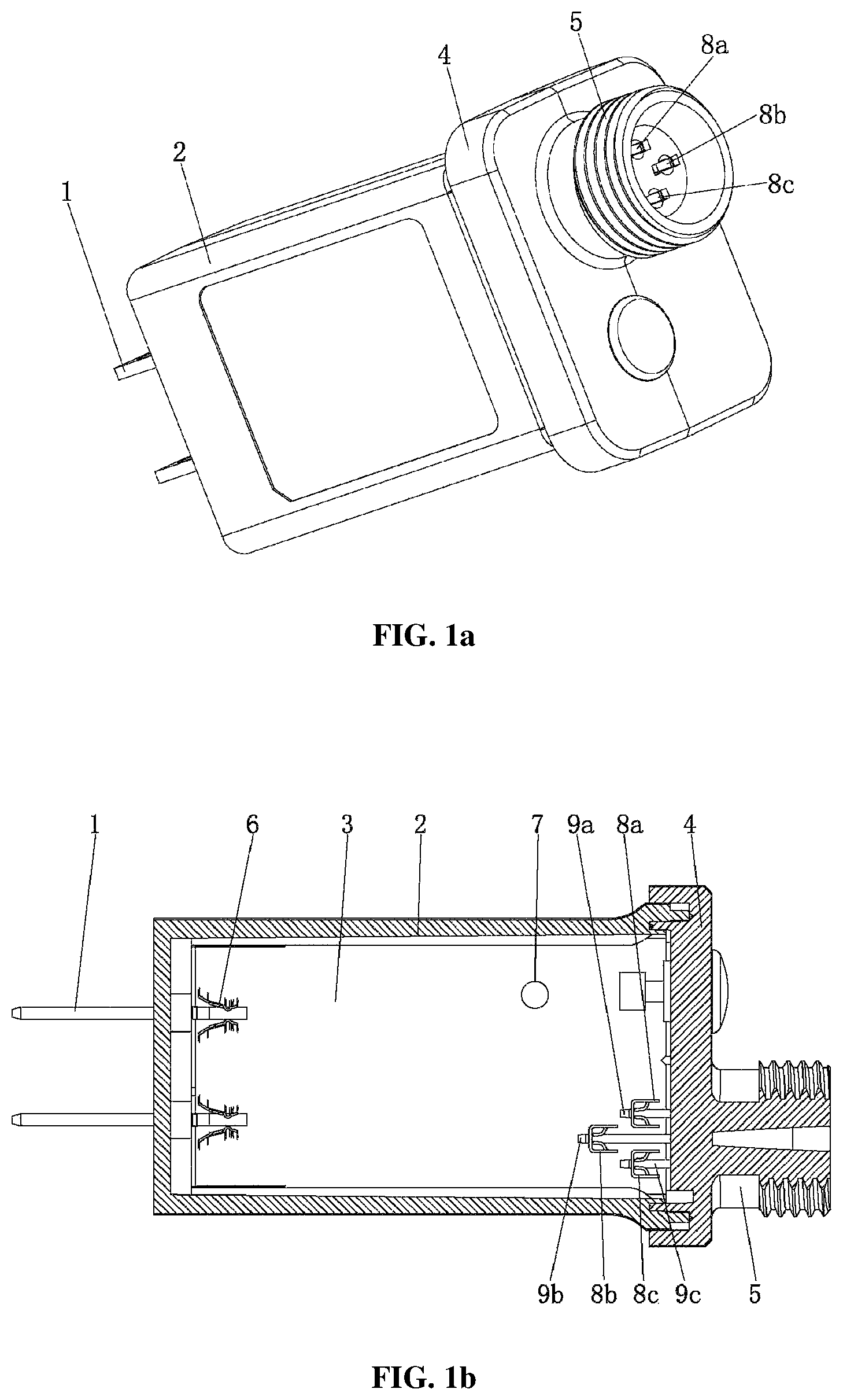
a is a solid diagram of a first lamp power adapter in the disclosure.
b is a profile of a first lamp power adapter in the disclosure.
c is a solid diagram that a circuit board fits with an end part in a first lamp power adapter.
d is a solid diagram of a first output connecting terminal.
e is a solid diagram of a first output connecting terminal in another direction.
f is a deformation structure diagram of a first lamp power adapter.
g is a deformation structure diagram of a first output connecting terminal.
h is a profile of a shell in a first lamp power adapter.
a is a schematic diagram of a second lamp power adapter in the disclosure.
b is a sectional view along an A-A line in a.
c is a solid diagram that a circuit board fits with an end part in a second lamp power adapter.
d is a profile of a shell in a second lamp power adapter.
e is a deformation schematic diagram of a rib of a shell in a second lamp power adapter.
a is a wiring diagram of a three-wire and four-circuit lamp and a lamp power adapter in the disclosure.
b is a wiring diagram of a three-wire and six-circuit lamp and a lamp power adapter in the disclosure.
is a schematic diagram of a DC power supply.
is a schematic diagram of a first control unit and a switch unit in the disclosure.
is a schematic diagram of a second control unit and a switch unit in the disclosure.
is a flow diagram of a control method for a lamp.
is a schematic diagram of a third control unit and a switch unit.
is a schematic diagram of a fourth control unit and a switch unit.
is a schematic diagram of a fifth control unit and a switch unit.
a to g are respectively orthographic views and solid diagrams of six surfaces of an appearance of a first lamp controller.
a to g are respectively orthographic views and solid diagrams of six surfaces of an appearance of a second lamp controller.
a to g are respectively orthographic views and solid diagrams of six surfaces of an appearance of a third lamp controller.
a to g are respectively orthographic views and solid diagrams of six surfaces of an appearance of a fourth lamp controller.
a to g are respectively orthographic views and solid diagrams of six surfaces of an appearance of a fifth lamp controller.
a to g are respectively orthographic views and solid diagrams of six surfaces of an appearance of a sixth lamp controller.
a to g are respectively orthographic views and solid diagrams of six surfaces of an appearance of a seventh lamp controller.
a to g are respectively orthographic views and solid diagrams of six surfaces of an appearance of an eighth lamp controller.
a to g are respectively orthographic views and solid diagrams of six surfaces of an appearance of a ninth lamp controller.
a to g are respectively orthographic views and solid diagrams of six surfaces of an appearance of a tenth lamp controller.
a to g are respectively orthographic views and solid diagrams of six surfaces of an appearance of an eleventh lamp controller.
a to g are respectively orthographic views and solid diagrams of six surfaces of an appearance of a twelfth lamp controller.
a to g are respectively orthographic views and solid diagrams of six surfaces of an appearance of a thirteenth lamp controller.
a to g are respectively orthographic views and solid diagrams of six surfaces of an appearance of a fourteenth lamp controller.
a to f are respectively orthographic views of six surfaces of an appearance of a fifteenth lamp controller.
a to f are respectively orthographic views of six surfaces of an appearance of a sixteenth lamp controller.
a to f are respectively orthographic views of six surfaces of an appearance of a seventeenth lamp controller.
a to f are respectively orthographic views of six surfaces of an appearance of an eighteenth lamp controller.
a to f are respectively orthographic views of six surfaces of an appearance of a nineteenth lamp controller.
a to f are respectively orthographic views of six surfaces of an appearance of a twentieth lamp controller.
a to f are respectively orthographic views of six surfaces of an appearance of a twenty-first lamp controller.
a to f are respectively orthographic views of six surfaces of an appearance of a twenty-second lamp controller.
a to f are respectively orthographic views of six surfaces of an appearance of a twenty-third lamp controller.
a to f are respectively orthographic views of six surfaces of an appearance of a twenty-fourth lamp controller.
a to f are respectively orthographic views of six surfaces of an appearance of a twenty-fifth lamp controller.
a to f are respectively orthographic views of six surfaces of an appearance of a twenty-sixth lamp controller.
a to f are respectively orthographic views of six surfaces of an appearance of a twenty-seventh lamp controller.
a to f are respectively orthographic views of six surfaces of an appearance of a twenty-eighth lamp controller.
a to f are respectively orthographic views of six surfaces of an appearance of a twenty-ninth lamp controller.
a to f are respectively orthographic views of six surfaces of an appearance of a thirtieth lamp controller.
a to f are respectively orthographic views of six surfaces of an appearance of a thirty-first lamp controller.
a to f are respectively orthographic views of six surfaces of an appearance of a thirty-second lamp controller.
DETAILED DESCRIPTION OF THE EMBODIMENTS
The disclosure is further described in combination with drawings and specific implementation modes below.
Embodiment 1
As shown in a to b , the lamp power adapter provided by the disclosure includes an input conductive component 1 , a shell 2 , a circuit board 3 , an end cover 4 and a connecting base 5 for connecting load, one end of the input conductive component 1 is located in the shell 2 , the input conductive component 1 is integrally fixed with the shell 2 , and the other end of the input conductive component 1 is exposed outside the shell 2 and connected to a socket for high-voltage alternating current.
As shown in a to b , an input connecting terminal 6 , a control circuit 7 and an output connecting terminal are arranged on the circuit board 3 , at least a part of the circuit board 3 is located in the shell 2 , and the input connecting terminal 6 is electrically connected to one end of the input conductive component 1 . In this embodiment, the input connecting terminal 6 is fixedly welded with the circuit board 3 , a conductive clamping part is arranged on the input connecting terminal 6 , and the input conductive component 1 is in plugging fit with the conductive clamping part on the input connecting terminal 6 . The control circuit 7 is configured to convert alternating current into direct current, to be used by a load lamp. At the same time, the control circuit 7 controls the light-emitting mode of the lamp, for example, outputs a signal with different duty cycles to control the turn-on and turn-off time of each circuit of lamp luster, thereby showing different light effects.
As shown in a to b , the connecting base 5 is arranged on the end cover 4 , the output conductive component is arranged on the connecting base 5 , and when the end cover 4 fits with the shell 2 , the output conductive component is in plugging fit with the output connecting terminal. In this embodiment, three output connecting terminals are provided, namely, the output connecting terminal includes a first output connecting terminal 8 a, a second output connecting terminal 8 b and a third output connecting terminal 8 c, and in this embodiment, three output conductive components are also provided, namely, the output conductive component includes a first conductive component 9 a plugged with the first output connecting terminal 8 a, a second conductive component 9 b plugged with the second output connecting terminal 8 b and a third conductive component 9 c plugged with the third output connecting terminal 8 c.
As shown in a to b , in this embodiment, the lamp luster connected to the output conductive component can be expanded to three lusters by expanding the quality of the output connecting terminal and the output conductive component, so that the work time of each circuit of lamp luster may be controlled, and different work time may show different lighting effects. Moreover, the disclosure is respectively connected to the output conductive component through three wires, at most six circuits of LED lamp lusters (as shown in b ) are also connected among the three wires, apparently, the showed light effect is better than that in the prior art. The controller structure and the circuit structure are simpler in a case that the circuit quantity connected to the lamp is more than that in the prior art, so that the cost will not be increased.
As shown in a to b , the expanded output connecting terminal may be arranged by any one of the following ways:
•
• (1) The first output connecting terminal 8 a, the second output connecting terminal 8 b and the third output connecting terminal 8 c are arranged side by side, and the output conductive component includes the first conductive component 9 a, the second conductive component 9 b and the third conductive component 9 c, which are arranged side by side. • (2) The first output connecting terminal 8 a is misaligned with the second output connecting terminal 8 b, the second output connecting terminal 8 b is misaligned with the third output connecting terminal 8 c, the first output connecting terminal 8 a and the third output connecting terminal 8 c are arranged side by side, the first conductive component 9 a is misaligned with the second conductive component 9 b, the second conductive component 9 b is misaligned with the third conductive component 9 c, and the first conductive component 9 a and the third conductive component 9 c are arranged side by side. • (3) The first output connecting terminal 8 a is misaligned with the second output connecting terminal 8 b, the second output connecting terminal 8 b is misaligned with the third output connecting terminal 8 c, the first output connecting terminal 8 a and the third output connecting terminal 8 c are arranged side by side, and the first conductive component 9 a, the second conductive component 9 b and the third conductive component 9 c are arranged side by side. • (4) The first output connecting terminal 8 a is misaligned with the second output connecting terminal 8 b, the second output connecting terminal 8 b is misaligned with the third output connecting terminal 8 c, the first output connecting terminal 8 a is misaligned with the third output connecting terminal 8 c, the first conductive component 9 a is misaligned with the second conductive component 9 b, the second conductive component 9 b is misaligned with the third conductive component 9 c, and the first conductive component 9 a is misaligned with the third conductive component 9 c.
As shown in a to b , in this embodiment, the first output connecting terminal 8 a , the second output connecting terminal 8 b and the third output connecting terminal 8 c include conductive bodies 8 d with openings, welding pins 8 f and two symmetrically arranged clamping sheets for clamping the output conductive components, abdicating openings 8 e are arranged on the conductive bodies 8 d, and the welding pins 8 f are fixed with the conductive bodies 8 d; the two clamping sheets include first bending parts 8 g, second bending parts 8 h and clamping parts 8 i, one end of each first bending part 8 g is located in each abdicating opening 8 e and fixed with each conductive body 8 d; after the other end of each first bending part 8 g is fixed with one end of each second bending part 8 h, an inserting import opening 8 j is formed between the two second bending parts 8 h; and the other end of each second bending part 8 h is fixed with each clamping part 8 i. A bending direction of each first bending part 8 g is opposite to that of each second bending part 8 h.
As shown in a to b , the clamping sheets with the above structures are transited to the clamping parts 8 i through the first bending parts 8 g and the second bending parts 8 h . When the output conductive component is inserted between the two clamping parts 8 i with the structures, the clamping sheets may be prevented from being broken, or the situation that the clamping sheets cannot be reset after being expanded and deformed by the output conductive component may be avoided. Therefore, the clamping sheets guarantee the quality of the output connecting terminal through the transition of the two bending parts.
As shown in a to b , in this embodiment, the first conductive component 9 a, the second conductive component 9 b and the third conductive component 9 c optimize Y-shaped structures, and one end with the opening of the first conductive component 9 a, the second conductive component 9 b and the third conductive component 9 c is configured to connect to the load lamp.
As shown in a to b , in this embodiment, two ribs 10 are respectively arranged on the two opposite inner walls of the shell 1 , a slot 11 is formed between the two ribs 10 , and the length of each rib 10 is less than or equal to that of the circuit board 3 . In this embodiment, for example, the length of each rib 10 is 60%-75% of that of the circuit board 3 , and in this embodiment, the length of each rib 10 is 70% of that of the circuit board 3 . In this embodiment, the material required for injecting the ribs 10 can be reduced by shortening the length of each rib 10 , thereby reducing the product cost.
As shown in a to b , after the length of each rib 10 is shortened, supporting points obtained by the circuit board 3 are reduced, but not affecting the stability of the circuit board 3 in the shell. In order to support the circuit board 3 well, a supporting part 1 a for supporting the circuit board 3 is arranged on the inner wall of the shell 1 , the position of the supporting part 1 a is preferentially located at a part corresponding to the end part of the circuit board 3 , and in this embodiment, one supporting part 1 a is arranged. A plurality of supporting parts 1 a may be arranged according to needs.
As shown in d , in order to insert the circuit board 3 into the slot 11 conveniently, a chamfer 10 a is arranged at the end part of each rib 10 corresponding to the entrance of the slot 11 . When the circuit board 3 is inserted into the slot 11 , the interference between the circuit board 3 and the ribs 10 may be reduced through the chamfer 10 a, thereby improving the smoothness for inserting the circuit board 3 into the slot 11 . The chamfer 10 a may be a round corner or an oblique corner.
As shown in to , in this embodiment, the control circuit 7 includes a DC power supply 21 , a control unit 22 and a switch unit 23 , an output end of the DC power supply 21 is electrically connected to the control unit 22 and the switch unit 23 in respective, the DC power supply 21 may adopt a battery or a switch power supply, and in this embodiment, the switch power supply for converting the alternating current to the direct current is preferentially adopted. In this embodiment, the switch power supply includes a rectifier filter circuit, a voltage conversion circuit, a starting circuit and a switch control circuit. Each part of the switch power supply is described in details below:
As shown in , an output end of the rectifier filter circuit is respectively connected to the voltage conversion circuit and the starting circuit, the rectifier filter circuit includes a single-phase full-wave rectifier circuit BD 1 , first inductance L 1 , a first capacitor C 1 , a second capacitor C 2 , a second parallel capacitor C 2 B, second inductance L 2 , a first anti-interference resistor ROA and a second anti-interference resistor ROB, and the single-phase full-wave rectifier circuit is composed of four diodes; an anode output end of the single-phase full-wave rectifier circuit BD 1 is respectively connected to one end of the first inductance L 1 and one end of the first capacitor C 1 , the first anti-interference resistor ROA is connected to the two ends of the first inductance L 1 in parallel, the other end of the first inductance L 1 is connected to one end of the second capacitor C 2 , the other end of the second capacitor C 2 is grounded, the second parallel capacitor C 2 B is connected to the two ends of the second capacitor C 2 in parallel, the other end of the first capacitor C 1 is connected to a cathode output end of the single-phase full-wave rectifier circuit BD 1 , the other end of the first capacitor C 1 is also connected to one end of the second inductance L 2 , the other end of the second inductance L 2 is grounded, and the second anti-interference resistor ROB is connected to the two ends of the second inductance L 2 in parallel.
As shown in , after being provided to the single-phase full-wave rectifier circuit BD 1 for rectifying through a fuse RF 1 , alternating current voltage is filtered through the first inductance L 1 , the first capacitor C 1 , the second capacitor C 2 and the second parallel capacitor C 2 B, and then electromagnetic interference is eliminated through an electromagnetic anti-interference circuit formed by the first inductance L 1 , the first anti-interference resistor ROA, the second inductance L 2 and the second anti-interference resistor ROB, thereby avoiding the influence of an electromagnetic interference signal on output DC voltage. The direct current obtained through the rectifier filter circuit is conveyed to the voltage conversion circuit, and the voltage conversion circuit is a transformer T 1 , which can transform high voltage into low voltage, to be used by the follow-up control unit 22 and the switch unit 23 . The transformer T 1 and the first inductance L 1 are provided with safety capacitors CY 1 , and one end of the safety capacitor CY 1 is connected to the ground.
As shown in , the switch power supply further includes a rectifier diode D 7 and a fifth capacitor C 5 , an anode end of the rectifier diode D 7 is connected to an output end of the voltage conversion circuit, a cathode end of the rectifier diode D 7 is connected to one end of the fifth capacitor C 5 , and the other end of the fifth capacitor C 5 is grounded. After secondary output voltage of the transformer T 1 is rectified through the rectifier diode D, direct current voltage is obtained, namely, an output end V+ of the DC power supply 21 , and the direct current voltage charges the fifth capacitor C 5 .
As shown in , the starting circuit includes a first current-limiting resistor R 9 and a second current-limiting resistor R 10 , one end of the first current-limiting resistor R 9 is connected to the other end of the first inductance L 1 while the other end of the first current-limiting resistor R 9 is connected to one end of the second current-limiting resistor R 10 , and the other end of the second current-limiting resistor R 10 is electrically connected to the switch control circuit.
As shown in , the switch control circuit is electrically connected to the rectifier filter circuit and the voltage conversion circuit in respective. The switch control circuit includes a power control chip U 1 , a second resistor R 2 , a third capacitor C 3 , a first voltage sampling resistor R 8 , a second voltage sampling resistor R 4 and a voltage sampling filter capacitor C 0 , an output end of the power control chip U 1 is connected to the transformer T 1 , and the power control chip U 1 is grounded through the second resistor R 2 . One end of the third capacitor C 3 is respectively connected to the other end of the second current-limiting resistor R 10 and the power control chip U 1 , the other end of the third capacitor C 3 is grounded, an auxiliary winding of the transformer T 1 is connected to the third capacitor C 3 through a fifth diode D 5 , one end of the first voltage sampling resistor R 8 is connected to the auxiliary winding of the transformer T 1 , and the other end of the first voltage sampling resistor R 8 is respectively connected to the second voltage sampling resistor R 4 and the power control chip U 1 .
As shown in , during the initial power-on period of the switch power supply, the current output by the rectifier filter circuit is provided to the third capacitor C 3 after being limited through the first current-limiting resistor R 9 and the second current-limiting resistor R 10 , so as to charge the third capacitor C 3 ; the voltage released by the third capacitor C 3 is provided to the power control chip U 1 , and the power control chip U 1 is powered on to work, so the switch control circuit is started to work. An electrical signal of a primary winding of the transformer T 1 is provided to the power control chip U 1 after being sampled through the first voltage sampling resistor R 8 and the second voltage sampling resistor R 4 , the power control chip U 1 compares the electrical signal with an output voltage value set inside the power control chip U 1 , and if the electrical signal is unequal to the output voltage value, the power control chip U 1 will output a control signal to adjust the output voltage. A power tube is integrated inside the power control chip U 1 , and the power control chip U 1 adjusts the output voltage by controlling the time for turning on or turning off the power tube.
As shown in , a negative peak absorption circuit is also connected between the switch control circuit and the transformer T 1 , the negative peak absorption circuit includes a fourth capacitor C 4 , a sixth resistor R 6 and a sixth diode D 6 , one end of the fourth capacitor C 4 is connected to the other end of the first inductance L 1 , the other end of the fourth capacitor C 4 is connected to a cathode end of the sixth diode D 6 , an anode end of the sixth diode D 6 is connected to an output end of the power control chip U 1 , and the sixth resistor R 6 is connected to the two ends of the fourth capacitor C 4 in parallel.
As shown in , the control unit 22 includes a microcontroller U 2 , a clock circuit and a memory chip U 3 . The microcontroller U 2 is connected to an output end V+ of the DC power supply, and the microcontroller U 2 is MCU. Since the microcontroller U 2 is a programmable controller, when a mode selector sends an operation signal to the microcontroller U 2 , the microcontroller U 2 sends a control signal enabling the lamp 23 a to work according to a programming rule.
As shown in , in this embodiment, the preferred mode is as follows: a voltage-stabilizing filter circuit is arranged between the output end V+ of the DC power supply 21 and the microcontroller U 2 , the voltage-stabilizing filter circuit includes a twelfth resistor R 12 , a voltage-stabilizing diode ZD 1 and a sixth capacitor C 6 , one end of the twelfth resistor R 12 is connected to the output end V+ of the DC power supply, the other end of the twelfth resistor R 12 is connected to a cathode end of the voltage-stabilizing diode ZD 1 , an anode end of the voltage-stabilizing diode ZD 1 is grounded, one end of the sixth capacitor C 6 is connected to the cathode end of the voltage-stabilizing diode ZD 1 , the other end of the sixth capacitor C 6 is grounded, and a pin 5 of the microcontroller U 2 is connected to one end of the sixth capacitor C 6 .
As shown in , the clock circuit includes a crystal oscillator XL 1 , a twelfth capacitor C 12 and a thirteenth capacitor C 13 , the two ends of the crystal oscillator XL 1 are respectively connected to the pin 6 and the pin 7 of the microcontroller U 2 , one end of the twelfth capacitor C 12 is connected to one end of the crystal oscillator XL 1 , the other end of the twelfth capacitor C 12 is grounded, one end of the thirteenth capacitor C 13 is connected to the other end of the crystal oscillator XL 1 , and the other end of the thirteenth capacitor C 13 is grounded.
As shown in , the pin 8 of the memory chip U 3 is connected to the output end V+ of the DC power supply, after setting the voltage-stabilizing filter circuit, preferably, the pin 8 of the memory chip U 3 is connected to one end of the sixth capacitor C 6 . The pins 1 , 2 , 3 , 4 and 7 of the memory chip U 3 are grounded, the pin 5 of the memory chip U 3 is connected to the pin 1 of the microcontroller U 2 , the pin 6 of the memory chip U 3 is connected to the pin 2 of the microcontroller U 2 , the current working mode is output to the memory chip U 3 through the microcontroller U 2 , so that the memory chip U 3 can record the working mode. After power failure, the working mode of the microcontroller U 2 before stopping work is still recorded in the memory chip U 3 ; and after the microcontroller U 2 is powered on again, the microcontroller U 2 reads the recorded working mode from the memory chip U 3 , and sends a control signal to a loading lamp 23 a in this working mode. Except that the memory chip U 3 is configured outside the microcontroller U 2 , the memory chip U 3 may also be set inside the microcontroller U 2 . Certainly, the memory chip U 3 is not necessary, namely, whether to connect U 3 may be decided according to needs.
As shown in , the switch unit 23 in this embodiment includes three sets of switch circuits, each set of switch circuit includes a load connecting part as well as a first switch tube and a second switch tube that are independently controlled by the control unit, the first switch tube and the second switch tube may be a triode or a MOS tube. The triode is taken as an example for illustration in this embodiment, wherein the first switch tube is replaced by the first triode for illustration, and the second switch tube is replaced by a second triode for illustration.
A collecting electrode of the first triode is connected to a collecting electrode of a second triode, a base electrode of the second triode is connected to the output end of the control unit 22 , an emitting electrode of the second triode is grounded, and the load connecting part is arranged at the connecting part of the collecting electrode of the first triode and the collecting electrode of the second triode.
As shown in , in this embodiment, the first triode Q 3 in the first set of switch circuit is a PNP triode or a P-channel MOS tube, the second triode Q 4 in the first set of switch circuit is a NPN triode or a N-channel MOS tube, the base electrode of the first triode Q 3 in the first set of switch circuit is connected to the pin 10 of the microcontroller U 2 , the base electrode of the first triode Q 3 in the first set of switch circuit is preferentially connected to the pin 10 of the microcontroller U 2 through the first current-limiting resistor RA 1 , the emitting electrode of the first triode Q 3 in the first set of switch circuit is connected to the output end V+ of the DC power supply, the base electrode of the second triode Q 4 in the first set of switch circuit is connected to the pin 16 of the microcontroller U 2 , the base electrode of the second triode Q 4 in the first set of switch circuit is preferentially connected to the pin 16 of the microcontroller U 2 through a second current-limiting resistor RB 1 , the emitting electrode of the second triode Q 4 in the first set of switch circuit is grounded, and the load connecting part A in the first set of switch circuit is connected to the connecting part of the collecting electrode of the first triode Q 3 in the first set of switch circuit and the collecting electrode of the second triode Q 4 in the first set of switch circuit. The first output connecting terminal 8 a is welded with the load connecting part A.
As shown in , the first triode Q 2 in the second set of switch circuit is a PNP triode or a P-channel MOS tube, the second triode Q 5 in the second set of switch circuit is a NPN triode or a N-channel MOS tube, the base electrode of the first triode Q 2 in the second set of switch circuit is connected to the pin 11 of the microcontroller U 2 , the base electrode of the first triode Q 2 in the second set of switch circuit is preferentially connected to the pin 11 of the microcontroller U 2 through the third current-limiting resistor RA 2 , the emitting electrode of the first triode Q 2 in the second set of switch circuit is connected to the output end V+ of the DC power supply, the base electrode of the second triode Q 5 in the second set of switch circuit is connected to the pin 15 of the microcontroller U 2 , the base electrode of the second triode Q 5 in the second set of switch circuit is preferentially connected to the pin 15 of the microcontroller U 2 through a fourth current-limiting resistor RB 2 , the emitting electrode of the second triode Q 5 in the second set of switch circuit is grounded, and the load connecting part B in the second set of switch circuit is connected to the connecting part of the collecting electrode of the first triode Q 2 in the second set of switch circuit and the collecting electrode of the second triode Q 5 in the second set of switch circuit. The second output connecting terminal 8 b is welded with the load connecting part B.
As shown in , the first triode Q 1 in the third set of switch circuit is a PNP triode or a P-channel MOS tube, the second triode Q 6 in the third set of switch circuit is a NPN triode or a N-channel MOS tube, the base electrode of the first triode Q 1 in the third set of switch circuit is connected to the pin 13 of the microcontroller U 2 , the base electrode of the first triode Q 1 in the third set of switch circuit is preferentially connected to the pin 13 of the microcontroller U 2 through the fifth current-limiting resistor RA 3 , the emitting electrode of the first triode Q 1 in the third set of switch circuit is connected to the output end V+ of the DC power supply, the base electrode of the second triode Q 6 in the third set of switch circuit is connected to the pin 14 of the microcontroller U 2 , the base electrode of the second triode Q 6 in the third set of switch circuit is preferentially connected to the pin 14 of the microcontroller U 2 through a sixth current-limiting resistor RB 3 , the emitting electrode of the second triode Q 6 in the third set of switch circuit is grounded, and the load connecting part C in the third set of switch circuit is connected to the connecting part of the collecting electrode of the first triode Q 1 in the third set of switch circuit and the collecting electrode of the second triode Q 6 in the third set of switch circuit. The third output connecting terminal 8 c is welded with the load connecting part C.
•
• (1) When the pins 10 and 16 of the microcontroller U 2 output high level, the first triode Q 3 in the first set of switch circuit is turned off, the second triode Q 4 in the first set of switch circuit is turned on, and the level of the connecting part of the collecting electrode of the first triode Q 3 in the first set of switch circuit and the collecting electrode of the second triode Q 4 in the first set of switch circuit is equal to the ground, namely, the low level, at this time, the level of the load connecting part A in the first set of switch circuit is the low level. • (2) When the pins 10 and 16 of the microcontroller U 2 output low level, the first triode Q 3 in the first set of switch circuit is turned on, the second triode Q 4 in the first set of switch circuit is turned off, and the level of the connecting part of the collecting electrode of the first triode Q 3 in the first set of switch circuit and the collecting electrode of the second triode Q 4 in the first set of switch circuit is from the output end V+ of the DC power supply, namely, the high level, at this time, the level of the load connecting part A in the first set of switch circuit is the high level. • (3) When the pin 10 of the microcontroller U 2 outputs high level and the pin 16 of the microcontroller U 2 outputs low level, the first triode Q 3 in the first set of switch circuit is turned off, the second triode Q 4 in the first set of switch circuit is turned off, and the connecting part of the collecting electrode of the first triode Q 3 in the first set of switch circuit and the collecting electrode of the second triode Q 4 in the first set of switch circuit has no output. • (4) When the pin 10 of the microcontroller U 2 outputs low level and the pin 16 of the microcontroller U 2 outputs high level, the first triode Q 3 in the first set of switch circuit is turned on, the second triode Q 4 in the first set of switch circuit is turned on, and the current from the output end V+ of the DC power supply flows to the ground directly, thereby causing the short circuit of the first set of switch circuit, and this situation is not allowed.
As shown in , since the load connecting parts of three sets of switch circuits may output high level or low level, and control the duty cycle output by each switch circuit, the load lamp 23 a may show different flashing modes according to a circuit structure of the load lamp 23 a.
As shown in a and , the lamp 23 a in this embodiment includes a first wire 24 , a second wire 25 , a third wire 26 , a first LED lamp 27 , a second LED lamp 28 , a third LED lamp 29 and a fourth LED lamp 30 , the first wire 24 is connected to the load connecting part A of the first set of switch circuit, the second wire 25 is connected to the load connecting part B of the second set of switch circuit, and the third wire 3 is connected to the load connecting part C of the third set of switch circuit.
As shown in a and , an anode end of the first LED lamp 27 is connected to the first wire 24 , and a cathode end of the first LED lamp 27 is connected to the second wire 25 ; a cathode end of the second LED lamp 28 is connected to the first wire 24 , and an anode end of the second LED lamp 28 is connected to the second wire 25 ; a cathode end of the third LED lamp 29 is connected to the second wire 25 , and an anode end of the third LED lamp 29 is connected to the third wire 26 ; and an anode end of the fourth LED lamp 30 is connected to the second wire 25 , and a cathode end of the fourth LED lamp 30 is connected to the third wire 26 .
As shown in a and , based on the circuit structure of the above lamp 23 a, the working is divided into the following states:
•
• (1) As shown in 3 a and , the load connecting part A of the first set of switch circuit outputs high level, the load connecting part B of the second set of switch circuit and the load connecting part C of the third set of switch circuit output low level, so that the first LED lamp 27 works, and the remaining LED lamps are extinguished. • (2) As shown in 3 a and , the load connecting part A of the first set of switch circuit outputs low level, the load connecting part B of the second set of switch circuit and the load connecting part C of the third set of switch circuit output high level, so that the second LED lamp 28 works, and the remaining LED lamps are extinguished. • (3) As shown in 3 a and , the load connecting part A of the first set of switch circuit and the load connecting part B of the second set of switch circuit output low level, the load connecting part C of the third set of switch circuit outputs high level, so that the third LED lamp 29 works, and the remaining LED lamps are extinguished. • (4) As shown in 3 a and , the load connecting part A of the first set of switch circuit and the load connecting part B of the second set of switch circuit output high level, the load connecting part C of the third set of switch circuit outputs low level, so that the fourth LED lamp 30 works, and the remaining LED lamps are extinguished.
As shown in 3 a and , the above three wires and four circuits of lamps form a three-wire and four-circuit lamp 23 a. However, the lamp 23 a in this embodiment is not limited to this. For example, as shown in , the lamp further includes a fifth LED lamp 31 and a sixth LED lamp 32 , wherein an anode end of the fifth LED lamp 31 is connected to the first wire 24 , and a cathode end of the fifth LED lamp 31 is connected to the third wire 26 ; and a cathode end of the sixth LED lamp 32 is connected to the first wire 24 , and an anode end of the sixth LED lamp 32 is connected to the third wire 26 . The fifth LED lamp 31 and the sixth LED lamp 32 are added based on the three-wire and four-circuit, so as to form a three-wire and six-circuit lamp.
As shown in 3 a and , any one of the above ways can control the duty cycle and the work time of each LED lamp, and different work time may show different lighting effects. Moreover, this implementation mode is respectively connected to the controller through three wires, at least four circuits of LED lamps are also connected among the three wires, apparently, the showed lighting effect is better than that in the prior art. The controller structure and the circuit structure are simpler in a case that the circuit quantity connecting to the lamp is more than that in the prior art, so that the cost will not be increased. In addition, the two triodes in each set of switch circuit will be controlled by the microcontroller U 2 , so as to decide whether the level output by the switch circuit is the high level or the low level. Each triode is independently controlled, so a case that the conduction of one triode is decided by another triode in the prior art is avoided, and the control efficiency of the controller is improved.
As shown in , the position of the lamp controller is hard to find in an environment with low illumination. Therefore, in this embodiment, the preferred way is to further include an indicator LED 2 , which is always on after being powered on, so as to indicate the position of the lamp controller. The indicator LED 2 is electrically connected to an output end of the DC power supply 21 , namely, the output end V+ of the DC power supply is connected to the indicator LED 2 . The indicator LED 2 will keep lighting as long as the output end V+ of the DC power supply outputs the working voltage, so as to indicate the specific position of the lamp controller. In this embodiment, a nineteenth current-limiting resistor R 19 is connected between the indicator LED 2 and the twelfth resistor R 12 , and the current of the indicator LED 2 is reached by reducing the nineteenth current-limiting resistor R 19 , thereby avoiding the damage on the indicator LED 2 .
As shown in , since a plurality of lamp flashing modes are built in the microcontroller U 2 , a switching signal for switching the flashing modes is sent to the microcontroller U 2 , and the microcontroller U 2 outputs different control signals, such as the high level or the low level for controlling each set of switch circuit to be output, or the duty cycle for controlling each set of switch circuit to output the signal, so as to form different flashing modes. Certainly, the work time of the lamp 23 a may be controlled through a selected mode, for example, working in an appointed working period, or stopping working in an appointed working period.
As shown in , based on the above description, this embodiment further includes a mode selector which inputs a light flashing mode switching signal or a light timing signal to the control unit 22 , and the mode selector is electrically connected to the control unit. The mode selector may be controlled in a wired mode or a wireless mode. When adopting the mode selector with the wired mode, the mode selector is directly welded with the control unit 22 ; when adopting the mode selector with the wireless mode, a part of this mode selector is directly welded with the control unit 22 , and the other part of this mode selector communicates with the control unit 22 in a form of wireless signal transmission.
As shown in , in this embodiment, the mode selector adopts a key switch SW or a touch switch (not shown in the figure). The key switch SW or the touch switch is electrically connected to the control unit 22 , in this embodiment, one end of the key switch SW is preferentially welded with the pin 8 of the microcontroller U 2 , and the other end of the key switch SW is grounded.
As shown in , in this embodiment, a wireless signal receiver U 4 is also adopted at the same time. One end of the wireless signal receiver U 4 is welded with the pin 5 of the microcontroller U 2 , and the other end of the wireless signal receiver U 4 is connected to the pin 9 of the microcontroller U 2 . A wireless signal transmitter paired with the wireless signal receiver U 4 is not shown in the figure, the wireless signal transmitter is usually a hand-held remote control, the wireless signal transmitter communicates with the wireless signal receiver U 4 through an infrared signal, and after receiving the signal sent by the wireless signal transmitter, the wireless signal receiver U 4 is configured to change the flashing mode or the timing signal of the lamp 23 a.
As shown in , in order to know whether the lamp 23 a is in a timing state, this embodiment further includes a timing indicator LED 1 for indicating the timing state after the control unit 22 starts the light timing according to the input of the mode selector, and the timing indicator LED 1 is electrically connected to the control unit 22 . The timing indicator LED 1 is a light-emitting diode, one end of the timing indicator LED 1 is connected to the pin 4 of the microcontroller U 2 , and the other end of the timing indicator LED 1 is grounded through an eighteenth resistor. When the timing is started, the control unit 22 outputs a signal capable of lighting the timing indicator LED 1 , and when the timing is end, the control unit 22 outputs a signal capable of extinguishing the timing indicator LED 1 .
In addition to connect to the three-wire and four-circuit lamp 23 a in a , the switch unit 23 in the embodiment 1 may also be connected to the three-wire and six-circuit lamp 23 a in b.
Embodiment 2
As shown in , in this lamp controller, the structure of the DC power supply 21 is the same as the DC power supply in the embodiment 1 , therefore the structures of the second control unit 22 and the switch unit 23 in the disclosure are not repeated herein.
The output end V+ of the DC power supply 21 is electrically connected to the switch unit 23 , and the switch unit 23 includes a first switch set, a second switch set and a control module U 1 A for controlling the first switch set and the second switch set to be turned on alternately.
An output end of the control module U 1 A is electrically connected to the first switch set, and the output end of the control module U 1 A forms a second set of switch circuit after being electrically connected to the second switch set.
The difference between this embodiment and the embodiment 1 is that the voltage-stabilizing filter circuit is arranged between the output end V+ of the DC power supply and the control module U 1 A, namely, one end of the twelfth resistor R 12 in the voltage-stabilizing filter circuit is connected to the output end V+ of the DC power supply, the other end of the twelfth resistor R 12 is connected to the cathode end of the voltage-stabilizing diode ZD 1 , the anode end of the voltage-stabilizing diode ZD 1 is grounded, one end of the sixth capacitor C 6 is connected to the cathode end of the voltage-stabilizing diode ZD 1 , the other end of the sixth capacitor C 6 is grounded, and the pin 1 of the microcontroller U 2 is connected to one end of the sixth capacitor C 6 .
In this embodiment, the second switch set includes a ninth triode Q 9 and a tenth triode Q 10 , a base electrode of the ninth triode Q 9 is connected to the output end of the control module U 1 A, the control module U 1 A is a chip, the base electrode of the ninth triode Q 9 is connected to the pin 6 of the control module U 1 A through a thirteenth resistor R 13 , the base electrode of the ninth triode Q 9 is also connected to one end of a twenty-first capacitor C 21 , the other end of the twenty-first capacitor C 21 is grounded, an emitting electrode of the ninth triode Q 9 is grounded, a collecting electrode of the ninth triode Q 9 is respectively connected to a base electrode of the tenth triode Q 10 and the output end of the DC power supply 21 , a sixteenth resistor R 16 is connected between the ninth triode Q 9 and the output end V+ of the DC power supply 21 , a sixteenth current-limiting resistor R 16 B is connected between the base electrode of the tenth triode Q 10 and the output end V+ of the DC power supply 21 , an emitting electrode of the tenth triode Q 10 is connected to the output end V+ of the DC power supply 21 , and the collecting electrode of the tenth triode Q 10 is the output end of the second set of switch circuit. Based on the above structure, a deformed or replaced solution is that the ninth triode Q 9 and the tenth triode Q 10 may be replaced by the MOS tube.
The working process of the second set of switch circuit is as follows: when the pin 6 of the control module U 1 A outputs high level, the high level is provided to the ninth triode Q 9 after being subjected to current-limiting through the thirteenth resistor R 13 , so as to trigger the ninth triode Q 9 . Since the collecting electrode of the ninth triode Q 9 is connected to the output end V+ of the DC power supply 21 through the sixteenth resistor R 16 , the ninth triode Q 9 is turned on after the base electrode of the ninth triode Q 9 is triggered. The emitting electrode of the ninth triode Q 9 is grounded, so the collecting electrode of the ninth triode Q 9 is lowered to the low level after the ninth triode Q 9 is turned on, however the base electrode of the tenth triode Q 10 is connected to the collecting electrode of the ninth triode Q 9 and the emitting electrode of the tenth triode Q 10 is connected to the output end V+ of the DC power supply 21 , so when the base electrode of the tenth triode Q 10 is the low level, the tenth triode Q 10 is turned on, and then the collecting electrode of the tenth triode Q 10 outputs high level, namely, the output end of the second set of switch circuit outputs high level.
When the pin 6 of the control module U 1 A outputs low level, the ninth triode Q 9 and the tenth triode Q 10 are in a cut-off state, namely, the output end of the second set of switch circuit outputs low level.
The first switch set includes a seventh triode Q 7 and an eighth triode Q 8 , a base electrode of the seventh triode Q 7 is connected to the output end of the control module U 1 A, the base electrode of the seventh triode Q 7 is connected to the pin 7 of the control module U 1 A through a fourteenth resistor R 14 , the base electrode of the seventh triode Q 7 is also connected to one end of the twenty-first capacitor C 21 , the other end of the twenty-first capacitor C 21 is grounded, an emitting electrode of the seventh triode Q 7 is grounded, a collecting electrode of the seventh triode Q 7 is respectively connected to a base electrode of the eighth triode Q 8 and the output end of the DC power supply 21 , a fifteenth resistor R 15 is connected between the seventh triode Q 7 and the output end V+ of the DC power supply 21 , a fifteenth current-limiting resistor R 16 B is connected between the base electrode of the eighth triode Q 8 and the output end V+ of the DC power supply 21 , an emitting electrode of the eighth triode Q 8 is connected to the output end V+ of the DC power supply 21 , and a collecting electrode of the eighth triode Q 8 is electrically connected to a first toggle switch Q 31 and a second toggle switch Q 32 in respective. Based on the above structure, a deformed or replaced solution is that the seventh triode Q 7 and the eighth triode Q 8 may be replaced by the MOS tube.
The working process of the second set of switch circuit is as follows: when the pin 7 of the control module U 1 A outputs high level, the high level is provided to the seventh triode Q 7 after being subjected to current-limiting through the fourteenth resistor R 14 , so as to trigger the seventh triode Q 7 . Since the collecting electrode of the seventh triode Q 7 is connected to the output end V+ of the DC power supply 21 through the fifteenth resistor R 15 , the seventh triode Q 7 is turned on after the base electrode of the seventh triode Q 7 is triggered. The emitting electrode of the seventh triode Q 7 is grounded, so the collecting electrode of the seventh triode Q 7 is lowered to the low level after the seventh triode Q 7 is turned on, however the base electrode of the eighth triode Q 8 is connected to the collecting electrode of the seventh triode Q 7 and the emitting electrode of the eighth triode Q 8 is connected to the output end V+ of the DC power supply 21 , so when the base electrode of the eighth triode Q 8 is the low level, the eighth triode Q 8 is turned on, and then the collecting electrode of the eighth triode Q 8 outputs high level, namely, the output end of the first set of switch circuit outputs high level.
When the pin 7 of the control module U 1 A outputs low level, the seventh triode Q 7 and the eighth triode Q 8 are in a cut-off state, namely, the output end of the first set of switch circuit outputs low level.
The pins 6 and 7 of the control module U 1 A output high level and low level alternately, so the first set of switch circuit and the second set of switch circuit output high level and low level alternately.
The lamp controller further includes a control unit 22 , and in this embodiment, the structure of the control unit 22 is the same as that of the embodiment 1, so the control unit 22 is not repeated herein.
The control unit 22 is electrically connected to the switch unit 23 , the switch unit 23 further includes a first toggle switch Q 31 and a second toggle switch Q 32 , the first toggle switch Q 31 forms the first set of switch circuit after being electrically connected to the output end of the first switch set and the control unit 22 in respective, and the second toggle switch Q 32 forms the third set of switch circuit after being electrically connected to the output end of the first switch set and the control unit 22 in respective. In this embodiment, the first toggle switch Q 31 and the second toggle switch Q 32 are thyristors, wherein the pin 11 of the microcontroller U 2 of the control unit 22 is connected to a gate electrode of the first toggle switch Q 31 through the thirteenth current-limiting resistor R 13 B, and the pin 2 of the microcontroller U 2 is connected to a gate electrode of the second toggle switch Q 32 through the fourteenth current-limiting resistor R 14 B.
The control unit 22 is configured to provide a trigger signal to the first toggle switch Q 31 and the second toggle switch Q 32 , when the output end of the first switch set outputs high level, the first toggle switch Q 31 or the second toggle switch Q 32 is controlled to be turned on through the control unit 22 , and when the output end of the first switch set outputs low level, the first toggle switch Q 31 or the second toggle switch Q 32 is turned off.
For the above structure, the output end of the first toggle switch Q 31 is the load connecting part A, the output end of the second set of switch circuit is the load connecting part B, the output end of the second toggle switch Q 32 is the load connecting part C, the load connecting parts A, B and C are respectively connected to the lamps 23 a shown in a or b , so as to control the lighting of each circuit of lamp luster. The specific conduction principle for controlling each circuit of lamp luster is the same as the embodiment 1, so it will not be repeated herein.
The switch unit 23 in the embodiment 2 can output higher voltage, for example, a circuit of namely, the output ends of the first set of switch and the second set of switch can output therefore a thirty-first current-limiting resistor R 31 is connected between the output end of the second toggle switch Q 32 and the output end of the second set of switch circuit, a thirty-second current-limiting resistor R 32 is connected between the output end of the first toggle switch Q 31 and the output end of the second set of switch circuit, the current is reduced through the current-limiting resistor, thereby avoiding damage on the lamp 23 a connected later.
This embodiment further includes a power supply circuit which supplies power to the control unit 22 , the output end of the first switch set is also connected to the power supply circuit, and the power supply circuit is electrically connected to the control unit 22 . Namely, this embodiment does not adopt the way preferentially that the DC power supply 21 supplies power to the control unit 22 , and supplies power to the control unit 22 in an indirect way. In this embodiment, when the output end of the first switch set, namely, the collecting electrode of the eighth triode Q 8 outputs high level, the power supply circuit is charged, and the power supply circuit discharges so as to supply power to the control unit 22 .
The power supply circuit includes an energy storage element C 6 B, a rectifier D 30 and a thirtieth resistor R 30 , one end of the energy storage element G 6 B is electrically connected to the output end of the first switch set, namely, one end of the energy storage element C 6 B is respectively connected to the collecting electrode of the eighth triode Q 8 and the pin 5 of the microcontroller U 2 , the other end of the energy storage element C 6 B is electrically connected to an anode end of the rectifier D 30 , a cathode end of the rectifier D 30 is connected to one end of the thirtieth resistor R 30 , the other end of the thirtieth resistor R 30 is electrically connected to the first switch set, namely, the other end of the thirtieth resistor R 30 is connected to the collecting electrode of the seventh triode Q 7 .
As for the power supply circuit, the current flowing path is as follows: the current is output from the eighth triode Q 8 , and then finally grounded through the energy storage element C 6 B, the rectifier D 30 , the thirtieth resistor R 30 , the collecting electrode of the seventh triode Q 7 and the emitting electrode of the seventh triode Q 7 in turn. During this process, the current is reduced through the current-limiting function of the thirtieth resistor R 30 .
The power supply circuit further includes a voltage-stabilizing element ZD 30 , which is connected to the energy storage element C 6 B in parallel. The voltage-stabilizing element ZD 30 enables the voltage of the power supply circuit to be a stable value.
This embodiment further includes an indicator LED 2 which is always on after being powered on, so as to indicate the position of the lamp controller, one end of the indicator LED 2 is connected to the energy storage element C 6 B, and the other end of the indicator LED 2 is grounded. Preferably, the indicator LED 2 is connected to the energy storage element C 6 B through the nineteenth resistor R 19 . Users are convenient to find the position of the lamp controller in time through the indicator LED 2 .
This embodiment further includes a mode selector which inputs a light flashing mode switching signal or a light timing signal to the control unit 22 , and the mode selector is electrically connected to the control unit. The mode selector is the same as that in the embodiment 1, so it will not be repeated herein.
This embodiment further includes a sampling circuit, which enables the control unit 22 to know whether the second set of switch circuit outputs high level or low level, one end of the sampling circuit is connected to the output end of the second set of switch circuit, and the other end of the sampling circuit is electrically connected to the control unit 22 . The sampling circuit includes a thirty-third resistor R 33 and a thirty-third capacitor C 33 , one end of the thirty-third resistor R 33 is connected to the output end of the second set of switch circuit, namely, connected to the load connecting part B, the other end of the thirty-third resistor R 33 is respectively connected to the pin 9 of the microcontroller U 2 and one end of the thirty-third capacitor C 33 , and the other end of the thirty-third capacitor C 33 is grounded. The thirty-third resistor R 33 is used for limiting current, so as to reduce the current, and the thirty-third capacitor C 33 is used for filtering.
After acquiring the voltage output by the sampling circuit, the microcontroller U 2 judges whether the output end of the second set of switch circuit outputs high level or low level in real time, so as to precisely output the trigger signal to the first toggle switch Q 31 or the second toggle switch Q 32 .
As shown in , this embodiment further provides a control method for a lamp, including the following steps:
S 1 : after being powered on, the control unit 22 outputs a control signal, and the control unit 22 receives a switching signal input by the mode selector; if a memory chip U 3 is available in the controller, the memory chip U 3 will record the control signal with a light-emitting mode output by the current control unit 22 after power failure of the last working; and after next power-on, the control unit 22 reads the control signal with the light-emitting mode output last time from the memory chip U 3 , and the control signal with the light-emitting mode is output after power-on. If the memory chip U 3 is not available in the controller, the control unit 22 will output a light-emitting mode according to program setting. The mode selector is the key switch SW or the touch switch connected to the control unit 22 , and the mode selector may also adopt the wireless signal transmitter.
S 2 : if the control unit 22 judges the switching signal input by the mode selector as the light flashing mode switching signal, the control unit 22 outputs the control signal for switching the flashing mode to the switch unit 23 , and the control signal for switching the flashing mode controls the sequence to turn on or turn off the switch unit 23 .
In S 2 , the basis that the control unit 22 judges the switching signal input by the mode selector as the light flashing mode switching signal is as follows: the mode selector is pressed once, and the pressing time is less than or equal to first time set by the control unit 22 . For example, the single pressing time does not exceed one second. The key switch SW or the touch switch is turned on or turned off by pressing, the preferred way is that the key switch SW or the touch switch is turned on, therefore the single pressing time does not exceed one second, meaning that the time for turning on the key switch SW or the touch switch does not exceed one second when pressing once.
A plurality of selection buttons are arranged on the wireless signal transmitter, the wireless signal transmitter can send out a corresponding coded signal after operating each selection button, the coded signal corresponding to each button is inconsistent, the control unit 22 compares the received coded signals with the coded signal, so as to identify the specific mode corresponding to the coded signals, for example, the flashing mode or timing mode of the lamp 23 a.
If the wireless coded signal for switching the flashing mode is output by the wireless signal transmitter, the control unit 22 outputs the control signal for changing the flashing mode of the lamp 23 a after receiving and identifying the wireless coded signal for switching the flashing mode sent by the wireless signal transmitter through the wireless signal receiver U 4 .
S 3 : if the control unit 22 judges the switching signal input by the mode selector as the light timing signal, the control unit 22 controls the operation for outputting and timing the control signal according to the input of the mode selector, and when the timing is end, the control unit 22 stops outputting the control signal; and at this time, the lamp is extinguished.
In S 3 , the basis that the control unit 22 judges the switching signal input by the mode selector as the light timing signal is as follows: the mode selector is pressed for several times in second time set by the control unit 22 ; for example, the key switch SW or the touch switch is pressed continuously twice within one second, namely, the second time is within one second. Therefore, the control unit 22 acquires two continuous signals for turning on the mode selector within one second, so as to judge that user makes the lamp enter the working mode of timing through the mode selector.
In S 3 , the basis that the control unit 22 judges the switching signal input by the mode selector as the light timing signal may also be: the time for continuously pressing the model selector is greater than or equal to third time set by the control unit 22 , for example, the time for continuously pressing the key switch SW is greater than two seconds, namely, the third time is greater than two seconds.
After entering the timing mode, if the control unit 22 further receives a light flashing mode switching signal, the flashing mode is switched according to the way in S 2 under the timing mode.
After entering the timing mode in a case that the mode selector adopts the key switch SW or the touch switch, if the control unit 22 receives the switching signal input by the mode selector again as the light timing signal, the timing is turned off.
If the timing mode is selected in a wireless manner, the control unit 22 receives the code for timing sent by the wireless signal transmitter through the wireless signal receiver U 4 , for example, the control unit 22 is used for starting timing after acquiring a second code and setting the time of the timing work, for example, the lamp 23 a is extinguished after working for six hours. Certainly, a plurality of codes for timing may be sent through the wireless signal transmitter, for example, the wireless signal transmitter may also send a third code for timing, and the third code for timing enables the lamp 23 a to be extinguished after working for eight hours. The control unit 22 starts timing after being used for the timing code, and the control unit 22 turns off timing after receiving the code signal for cancelling the timing.
When or is connected to any one of a to f , or to is any one control unit and switch unit in the a to f , the control of the controller for each lamp is applicable to the above method.
The control method of the disclosure is not limited to the above embodiments, for example:
•
• (a) In S 2 , the basis that the control unit 22 judges the switching signal input by the mode selector as the light timing signal is as follows: the mode selector is pressed for several times in the second time set by the control unit 22 ; for example, the key switch SW or the touch switch is pressed continuously twice within one second. • (b) In S 2 , the basis that the control unit 22 judges the switching signal input by the mode selector as the light flashing mode switching signal is as follows: the time for continuously pressing the model selector is greater than or equal to the third time set by the control unit 22 , for example, the time for continuously pressing the key switch SW is greater than two seconds. • (c) In S 3 , the basis that the control unit 22 judges the switching signal input by the mode selector as the light timing signal is as follows: the mode selector is pressed once, and the pressing time is less than or equal to the first time set by the control unit 22 . For example, the pressing time does not exceed one second.
The above control method is based on the fact that the controller can respectively switch the light flashing mode switching signal and the light timing signal. Some controllers only need to switch the light timing, the light flashing mode is automatically achieved by the program, so switching is not required. For example, if eight flashing modes are available, the signal is output and circulated in turn according to the eight flashing modes after power-on. For this controller, the present disclosure further configures the following control method:
After power-on, the control unit 22 outputs the control signal which enables the lamp to work, and the control signal has the eight inherent circular flashing modes illustrated above. If the control unit 22 receives the timing switching signal sent by the model selector, the control unit 22 switches the operation for outputting and timing the control signal according to the input of the mode selector, and when the timing is end, the control unit 22 stops outputting the control signal.
The mode selector is the key switch SW or the touch switch connected to the control unit 22 , the basis that the control unit 22 judges the timing switching signal sent by the mode selector is as follows: the mode selector is pressed once, and the pressing time is less than or equal to the first time set by the control unit 22 , for example, the first time is within one second; or the mode selector is pressed for several times within the second time set by the control unit 22 , for example, the key switch SW or the touch switch is continuously pressed twice within one second. Or the time for continuously pressing the model selector is greater than or equal to the third time set by the control unit 22 , and the time for continuously pressing the key switch SW is greater than two seconds.
Regardless of the working mode after power-on or the working mode entering the timing, the light brightness or the switch controller may also be switched by operating the key switch SW or the touch switch, for example, the mode selector is pressed once, and the pressing time is less than or equal to the first time set by the control unit 22 , for example, the first time is within one second; or the mode selector is pressed for several times within the second time set by the control unit 22 , for example, the key switch SW or the touch switch is continuously pressed twice within one second. Or the time for continuously pressing the model selector is greater than or equal to the third time set by the control unit 22 , and the time for continuously pressing the key switch SW is greater than two seconds. For another example, the controller is turned on or turned off when the time for continuously pressing the mode selector is greater than or equal to the third time set by the control unit 22 .
The operation for the timing mode and the operation for switching the light brightness are achieved by operating the same key switch, but the signal sending mode is different. For example, when switching the brightness by pressing the mode selector once within the first time, the mode selector is pressed for several times within the second time set by the control unit 22 , so as to enter or exit the timing mode, namely, the operations of timing, dimming and turning on/off the controller are not overlapped.
Certainly, all the above operations may also adopt two key switches SW or two touch switches, one key switch SW or touch switch is used for switching the light brightness or turning on/off the controller, and the other key switch SW or touch switch is used for entering or exiting the timing.
Figures (20)
Citations
This patent cites (4)
- US8337250
- US2008/0123376
- US2015/0311656
- US2019/0094935