Modulation of Gene Transcription Using Antisense Oligonucleotides Targeting Regulatory Rnas
Abstract
Described herein are methods of modulating gene transcription using antisense oligonucleotides (ASOs) targeting regulatory RNAs, such as promoter-associated RNAs and enhancer RNAs. These methods are useful for modulating the levels of gene products, for example, increasing expression of Carbamoyl-Phosphatase Synthetase 1 (CPS1), thereby treating diseases associated with aberrant gene expression.
Claims (15)
1. An antisense oligonucleotide (ASO) comprising a nucleotide sequence of TGCAGGCACACACATCAGGC (SEQ ID NO: 1), wherein one or more of the nucleotides of the ASO are chemically modified.
5. An antisense oligonucleotide (ASO) comprising MT=MG=M5C-MA-MG=dG=d5C=dA=d5C=dA=d5C-dA=d5C-dA=dT=M5C-MA-MG=MG=M5C-[TEG] (SEQ ID NO: 409), wherein MT, MG, MA, and M5C are 2′-O-methoxyethyl thymidine, 2′-O-methoxyethyl guanosine, 2′-O-methoxyethyl adenosine, and 2′-O-methoxyethyl 5-methyl cytidine ribonucleosides; dA, dG, dT, and d5C are 2′-deoxy adenosine, 2′-deoxy guanosine, 2′-deoxy thymidine and 2′-deoxy 5-methyl cytidine ribonucleosides, “=” is a phosphorothioate linkage, “-” is a phosphodiester linkage, and [TEG] is a ligand moiety comprising a triethyleneglycol linked to N-acetylgalactosamine (GalNAc).
7. An antisense oligonucleotide (ASO) comprising MT=MG=M5C-MA-MG-dG-d5C=dA=d5C=dA=d5C=dA=d5C=dA=dT=M5C-MA-MG-MG=M5C (SEQ ID NO: 404), wherein MT, MG, MA, and M5C are 2′-O-methoxyethyl thymidine, 2′-O-methoxyethyl guanosine, 2′-O-methoxyethyl adenosine, and 2′-O-methoxyethyl 5-methyl cytidine ribonucleosides; dA, dG, dT, and d5C are 2′-deoxy adenosine, 2′-deoxy guanosine, 2′-deoxy thymidine and 2′-deoxy 5-methyl cytidine ribonucleosides, “=” is a phosphorothioate linkage, and “-” is a phosphodiester linkage.
Show 12 dependent claims
2. The ASO of claim 1 , wherein the 3′ end of the ASO is conjugated to a ligand moiety.
3. The ASO of claim 2 , wherein the ligand moiety comprises N-acetylgalactosamine (GalNAc).
4. The ASO of claim 3 , wherein the ligand moiety comprises a three-cluster GalNAc moiety (GalNAc3).
6. The ASO of claim 5 , wherein the ligand moiety comprises a three-cluster GalNAc moiety (GalNAc3).
8. A pharmaceutical composition comprising the ASO of claim 1 .
9. A pharmaceutical composition comprising the ASO of claim 5 .
10. A pharmaceutical composition comprising the ASO of claim 7 .
11. The ASO of claim 7 , wherein the 3′ end of the ASO is conjugated to a ligand moiety.
12. The ASO of claim 11 , wherein the ligand moiety comprises N-acetylgalactosamine (GalNAc).
13. The ASO of claim 12 , wherein the ligand moiety comprises a three-cluster GalNAc moiety (GalNAc3).
14. A pharmaceutical composition comprising the ASO of claim 6 .
15. A pharmaceutical composition comprising the ASO of claim 13 .
Full Description
Show full text →
CROSS REFERENCE TO RELATED APPLICATIONS
This application is a continuation of International Application No. PCT/US2022/082295, filed Dec. 22, 2022, which claims the benefit of U.S. Provisional Application No. 63/292,920, filed Dec. 22, 2021, and U.S. Provisional Application No. 63/308,373, filed Feb. 9, 2022, each of which are hereby incorporated in their entirety by reference.
SEQUENCE LISTING
The instant application contains a Sequence Listing which has been submitted via EFS-Web and is hereby incorporated by reference in its entirety. Said XML copy, created on Dec. 21, 2022, is named CTC-028WO_140628340009.xml, and is 925,586 bytes in size.
FIELD OF THE INVENTION
The disclosure relates to methods of upregulating or downregulating gene transcription using antisense oligonucleotides (ASOs) targeting regulatory RNAs (e.g. CPS1 regulatory RNAs), such as promoter-associated RNAs and enhancer RNAs.
BACKGROUND
Transcription factors bind specific sequences in promoter and enhancer DNA elements to regulate gene transcription. It was recently reported that active promoters and enhancer elements are themselves transcribed, generating noncoding regulatory RNAs (regRNAs) such as promoter-associated RNAs (paRNAs) and enhancer RNAs (eRNAs) (see Sartorelli and Lauberth, Nat. Struct. Mol. Biol. (2020) 27, 521-28). Unlike coding RNAs, regRNAs are transcribed bi-directionally. Various models have been proposed for the functions of regRNAs, including nucleosome remodeling (see Mousavi et al., Mol. Cell (2013) 51(5):606-17), modulation of enhancer-promoter looping (see Lai et al., Nature (2013) 494(7438):497-501), and direct interaction with transcription regulators (see Sigova et al., Science (2015) 350, 978-81).
Gene expression has been generally known as an undruggable biological process. Despite on-going efforts into understanding the biology of gene transcription and regRNAs, clinically suitable methods of modulating gene expression are limited. There remains a need for new and useful methods for treating diseases associated with aberrant gene expression.
SUMMARY
In one aspect, provided herein are antisense oligonucleotides (ASO) complementary to at least 8 contiguous nucleotides of a regulatory RNA (regRNA) of Carbamoyl-Phosphate Synthetase 1 (CPS1), wherein the regRNA has a nucleotide sequence selected from the group consisting of SEQ ID NO: 49, 50, 69-79 and 89-90.
In some embodiments, the ASO is complementary to a sequence in the regRNA that is no more than 200 nucleotides from the 3′ end of the regRNA.
In some embodiments, the ASO is complementary to a sequence in the regRNA that is no more than 200 nucleotides from the 5′ end of the regRNA.
In some embodiments, the regulatory RNA has a nucleotide sequence of SEQ ID NO: 49, and the ASO comprises a nucleotide sequence of SEQ ID NO: 1.
In some embodiments, the regulatory RNA has a nucleotide sequence of SEQ ID NO: 49, and the ASO comprises a nucleotide sequence of SEQ ID NO: 2.
In some embodiments, the regulatory RNA has a nucleotide sequence of SEQ ID NO: 49, and the ASO comprises a nucleotide sequence selected from the group consisting of SEQ ID NOs: 1-3.
In some embodiments, the regulatory RNA has a nucleotide sequence of SEQ ID NO: 50, and the ASO comprises a nucleotide sequence selected from the group consisting of SEQ ID NOs: 4-15.
In some embodiments, the regulatory RNA has a nucleotide sequence of SEQ ID NO: 89, and the ASO comprises a nucleotide sequence selected from the group consisting of SEQ ID NOs: 487-574.
In some embodiments, the regulatory RNA has a nucleotide sequence of SEQ ID NO: 90, and the ASO comprises a nucleotide sequence selected from the group consisting of SEQ ID NOs: 575-662.
In some embodiments, the ASO is no more than 50, 40, 30, or 25 nucleotides in length.
In some embodiments, the ASO comprises an polynucleotide comprising one or more chemical modifications. In some embodiments, the ASO comprises an RNA polynucleotide comprising one or more chemical modifications. In some embodiments, the ASO comprises an RNA and DNA polynucleotide comprising one or more chemical modifications.
In some embodiments, at least 3, 4, or 5 nucleotides at the 5′ end and at least 3, 4, or 5 nucleotides at the 3′ end of the ASO comprise ribonucleotides with one or more chemical modifications.
In some embodiments, the one or more chemical modifications comprise a nucleotide sugar modification comprising one or more of 2′-O—C1-4alkyl such as 2′-O-methyl (2′-OMe), 2′-deoxy (2′-H), 2′-O—C1-3alkyl-O—C1-3alkyl such as 2′-methoxyethyl (“2′-MOE”), 2′-fluoro (“2′-F”), 2′-amino (“2′-NH2”), 2′-arabinosyl (“2′-arabino”) nucleotide, 2′-F-arabinosyl (“2′-F-arabino”) nucleotide, 2′-locked nucleic acid (“LNA”) nucleotide, 2′-amido bridge nucleic acid (AmNA), 2′-unlocked nucleic acid (“ULNA”) nucleotide, a sugar in L form (“L-sugar”), 4′-thioribosyl nucleotide, constrained ethyl (cET), 2′-fluoro-arabino (FANA), or thiomorpholino.
In some embodiments, the one or more chemical modifications comprise an internucleotide linkage modification comprising one or more of phosphorothioate (“PS” or (P(S))), phosphoramidate (P(NR1R2) such as dimethylaminophosphoramidate (P(N(CH3)2)), phosphonocarboxylate (P(CH2)nCOOR) such as phosphonoacetate “PACE” (P(CH2COO—)), thiophosphonocarboxylate ((S)P(CH2)nCOOR) such as thiophosphonoacetate “thioPACE” ((S)P(CH2COO—)), alkylphosphonate (P(C1-3alkyl) such as methylphosphonate —P(CH3), boranophosphonate (P(BH3)), or phosphorodithioate (P(S)2).
In some embodiments, the one or more chemical modifications comprise a nucleobase modification comprising one or more of 2-thiouracil (“2-thioU”), 2-thiocytosine (“2-thioC”), 4-thiouracil (“4-thioU”), 6-thioguanine (“6-thioG”), 2-aminoadenine (“2-aminoA”), 2-aminopurine, pseudouracil, hypoxanthine, 7-deazaguanine, 7-deaza-8-azaguanine, 7-deazaadenine, 7-deaza-8-azaadenine, 5-methylcytosine (“5-methylC”), 5-methyluracil (“5-methylU”), 5-hydroxymethylcytosine, 5-hydroxymethyluracil, 5,6-dehydrouracil, 5-propynylcytosine, 5-propynyluracil, 5-ethynylcytosine, 5-ethynyluracil, 5-allyluracil (“5-allylU”), 5-allylcytosine (“5-allylC”), 5-aminoallyluracil (“5-aminoallylU”), 5-aminoallyl-cytosine (“5-aminoallylC”), an abasic nucleotide, Z base, P base, Unstructured Nucleic Acid (“UNA”), isoguanine (“isoG”), isocytosine (“isoC”) a glycerol nucleic acid (GNA), glycerol nucleic acid (GNA), or thiophosphoramidate morpholinos (TMOs).
In some embodiments, the one or more chemical modifications comprise 2′-O-methoxyethyl, 5-methyl cytidine, locked nucleic acid (LNA), and phosphorothioate internucleotide bond.
In some embodiments, the ASO comprises 8 or more contiguous nucleotides of unmodified DNA flanked by at least 3 nucleotides of modified ribonucleotides at each of the 5′ end and the 3′ end.
In some embodiments, the ASO comprises the nucleotide sequence and/or chemical modification of any one of SEQ ID NO: 16, 22-27, 31-39, 403-412, 414-415, 417-432, 435-480, or 482-486.
In some embodiments, the ASO comprises the nucleotide sequence and/or chemical modification of SEQ ID NO: 409.
In some embodiments, the ASO further comprises at least one phosphorothioate internucleotide bond.
In some embodiments, the ASO comprises the nucleotide sequence of SEQ ID NOs: 403-406, 409-415, 417-424, 470, 473, 477, 480, or 486.
In some embodiments, the chemical modification is cET.
In some embodiments, the ASO comprises the nucleotide sequence of SEQ ID NOs: 425-432 or 435-442.
In some embodiments, the chemical modification is LNA.
In some embodiments, the ASO comprises the nucleotide sequence of SEQ ID NOs: 443-458.
In some embodiments, the chemical modification is LNA and 2′-O-methoxyethyl.
In some embodiments, the ASO comprises the nucleotide sequence of SEQ ID NOs: 400, 408, 460, 462, 464-466, 468, 469, 471, 472, 475, 476, or 479.
In some embodiments, the ASO does not comprise 8 or more contiguous nucleotides of unmodified DNA.
In some embodiments, the ASO does not comprise an unmodified ribonucleotide.
In some embodiments, the ASO does not comprise a deoxyribonucleotide.
In some embodiments, the length of the ASO is 2×n+4 nucleotides (n is an integer of 8 or greater), wherein the nucleotides at positions 2×m are ribonucleotides modified by LNA (m is an integer from 1 to n) and the remaining nucleotides are ribonucleotides modified by 2′-O-methoxyethyl.
In some embodiments, the ASO comprises the nucleotide sequence of SEQ ID NOs: 393 or 394.
In some embodiments, the length of the ASO is 3×n+2 nucleotides (n is an integer of 4 or greater), wherein the nucleotides at positions 3×m are ribonucleotides modified by LNA (m is an integer from 1 to n) and the remaining nucleotides are ribonucleotides modified by 2′-O-methoxyethyl.
In some embodiments, the ASO comprises the nucleotide sequence of SEQ ID NOs: 392 or 395.
In some embodiments, the length of the ASO is 3×n+2 nucleotides (n is an integer of 6 or greater), wherein the nucleotides at positions 3×m are ribonucleotides modified by LNA (m is an integer from 1 to n) and the five nucleotides at the 3′ and 5′ positions are ribonucleotides modified by 2′-O-methoxyethyl.
In some embodiments, the ASO comprises the nucleotide sequence of SEQ ID NO: 19 or 20.
In some embodiments, the length of the ASO is 4×n nucleotides (n is an integer of 3 or greater), wherein the nucleotides at positions 4×m are ribonucleotides modified by LNA (m is an integer from 1 to n) and the five nucleotides at the 3′ and 5′ positions are ribonucleotides modified by 2′-O-methoxyethyl.
In some embodiments, the ASO comprises the nucleotide sequence of SEQ ID NO: 21.
In some embodiments, the length of the ASO is 4×n+4 nucleotides (n is an integer of 3 or greater), wherein the nucleotides at positions 4×m are ribonucleotides modified by LNA (m is an integer from 1 to n) and the remaining nucleotides are ribonucleotides modified by 2′-O-methoxyethyl.
In some embodiments, the ASO comprises the nucleotide sequence of SEQ ID NOs: 396 or 397
In some embodiments, each ribonucleotide of the ASO is modified by 2′-O-methoxyethyl.
In some embodiments, the ASO comprises the nucleotide sequence of any one of SEQ ID NOs: 17, 28-30, and 40-48.
In some embodiments, each nucleotide of the ASO is a ribonucleotide modified by 2′-O-methoxyethyl.
In some embodiments, the ASO comprises the nucleotide sequence of any one of SEQ ID NOs: 17, 28-30, and 40-48.
In some embodiments, each cytidine in the ASO is modified by 5-methyl.
In some embodiments, the length of the ASO is 5×n+5 nucleotides (n is an integer of 3 or greater), wherein the nucleotides at positions 5×m are ribonucleotides modified by LNA (m is an integer from 1 to n) and the nucleotides at the remaining positions are ribonucleotides modified by 2′-O-methoxyethyl.
In some embodiments, the ASO comprises the nucleotide sequence of SEQ ID NOs: 398 or 399.
In some embodiments, the ASO further comprises a GalNAc moiety, optionally a GalNAc3 moiety.
In some embodiments, the ASO further comprises a biotin or cholesterol moiety.
In some embodiments, each cytidine in the ASO is modified by 5-methyl.
In some embodiments, the regRNA is an enhancer RNA (eRNA).
In another aspect, provided herein are pharmaceutical compositions comprising the ASO disclosed herein and a pharmaceutically acceptable carrier or excipient carrier.
In another aspect, provided herein are methods of increasing transcription of CPS1 in a human cell, the method comprising contacting the cell with the ASO disclosed herein or the pharmaceutical composition disclosed herein.
In some embodiments, the cell is a hepatocyte.
In some embodiments, the ASO increases the amount of the regulatory RNA in the cell as compared to a cell that has not been contacted with the ASO or the pharmaceutical composition.
In some embodiments, the ASO increases the stability of the regulatory RNA in the cell as compared to a cell that has not been contacted with the ASO or the pharmaceutical composition.
In another aspect, provided herein are methods of treating a urea cycle disorder, the method comprising administering to a subject in need thereof an effective amount of the ASO disclosed herein or the pharmaceutical composition disclosed herein.
In some embodiments, the urea cycle disorder is CPS1-deficiency.
In some embodiments, the urea cycle disorder is hyperammonemia.
In some embodiments, the ASO increases the amount of the regulatory RNA in a cell of the subject (e.g., as compared to a cell (e.g., a similar cell from the subject) that has not been contacted with the ASO or the pharmaceutical composition).
In some embodiments, the ASO increases the stability of the regulatory RNA in a cell of the subject (e.g., as compared to a cell (e.g., a similar cell from the subject) that has not been contacted with the ASO or the pharmaceutical composition).
In some embodiments, the cell is a hepatocyte.
BRIEF DESCRIPTION OF THE DRAWINGS
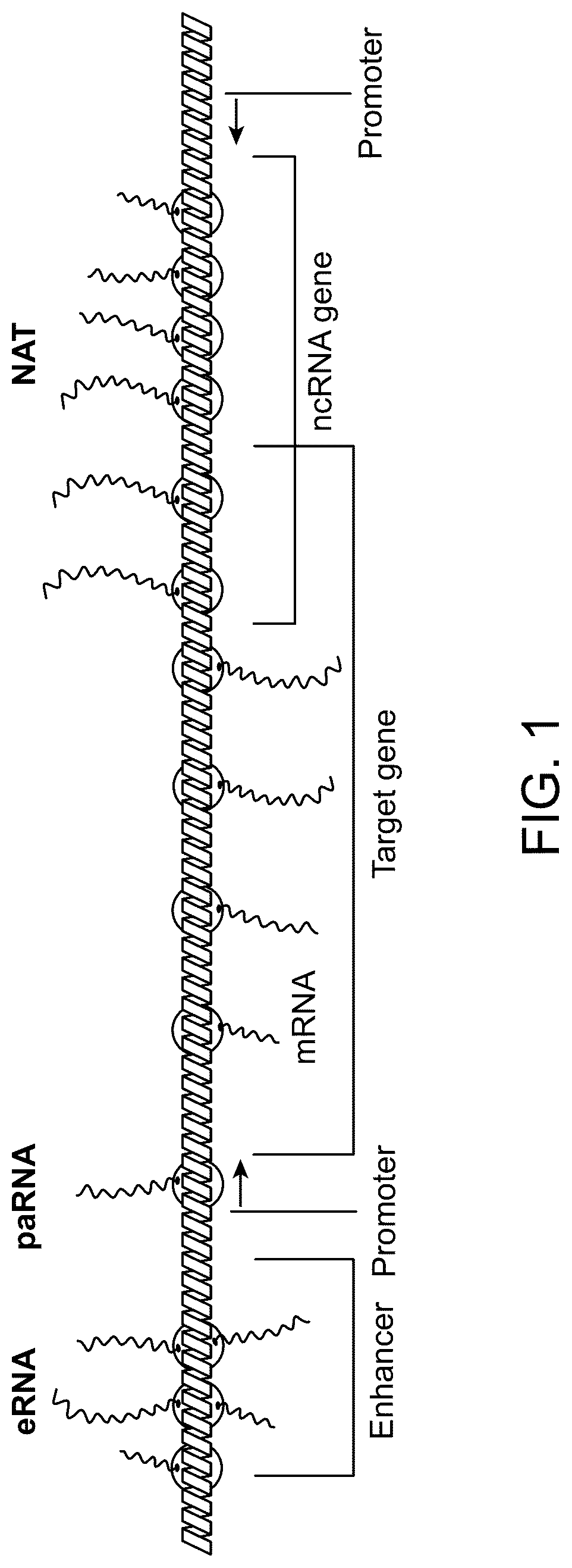
shows an illustrative schematic of eRNA, paRNA, mRNA, and natural antisense transcript (NAT) of a gene on the chromosome. The eRNA, paRNA, and NAT are all non-coding RNAs. The eRNA is transcribed bidirectionally from an enhancer of the gene. The paRNA is transcribed from the promoter of the gene, same as the mRNA, but in the antisense direction. The NAT is transcribed from a downstream promoter of its own in the antisense direction, such that the transcript overlaps at least partially with the mRNA. Generally, eRNAs and paRNAs upregulate gene expression whereas NATs downregulate gene expression.
shows analysis of mouse and human CPS1 ATAC-seq and H3K27Ac ChIP-SEQ for identification of regRNAs.
shows relative CPS1 mRNA expression in hepatocytes treated with an ASO and non-targeting control (NTC).
A shows a schematic of various human CPS1 ASOs with chemical modifications. Light gray indicates a 2′-O-(2-methoxyethyl) (2′-MOE) modification. Dark gray indicates a locked nucleic acid (LNA) modification. *C indicates a 5-methyl on the cytidine. B shows relative CPS1 mRNA expression in hepatocytes treated with the ASOs.
A shows a schematic of various human CPS1 ASOs with chemical modifications. Light gray indicates a 2′-O-(2-methoxyethyl) (2′-MOE) modification. Dark gray indicates a locked nucleic acid (LNA) modification. Line brackets indicate a phosphodiester (PO) linkage. *C indicates a 5-methyl on the cytidine. Unique sequence identifiers are assigned to nucleotide sequences having the specific chemical modifications shown in this figure. B shows a schematic of various mouse CPS1 ASOs with chemical modifications.
A shows CPS1 mRNA levels in wildtype and OTC-deficient hepatocytes treated with CPS1 ASOs. Heatmaps of CPS1 and OTC mRNA levels are shown in B and C .
A shows OTC mRNA levels in wildtype and OTC-deficient hepatocytes treated with CPS1 ASOs. Heatmaps of CPS1 and OTC mRNA levels are shown in B and C .
is a schematic depiction of the in vivo ammonia challenge for mice treated with CPS1 ASOs.
A shows relative CPS1 mRNA expression in the mouse liver. B shows plasma ammonia levels of treated mice. C shows relative mRNA expression of other urea cycle genes in the treated mice. D shows mRNA expression of genes neighboring the CPS1 locus following ASO treatment.
shows ammonia levels in OTC deficient mice treated with a CPS1 ASO.
A shows a dose dependent effect on plasma ammonia in vivo in male OTC-D mice (Otc spf/ash ) after the ASO treatment. B , there was a dose dependent effect on urea in vivo in male OTC-D mice (Otc spf/ash ) after the ASO treatment. C shows that the reduction in ammonia correlated with the total ASO administered.
A shows that CPS1 ASO treatment increased mouse OTC and CPS1 mRNA expression in the OTC deficient mice (1.26 FC of CPS1 and 1.43 FC of OTC). B shows that ASO treatment increased additional urea cycle genes, such as Nags, Ass1, Asl, and Arg1. In both figures WT C57 mice mRNA is shown on the left bar, Otc spf-ash/J treated with PBS is shown in middle bar, and Otc spf-ash/J treated with ASO is shown on the right.
shows that mouse Otc deficient livers showed hyperammonia 30 min after ammonia treatment. Treatment with mouse CPS1 ASO decreased ammonia to WT levels.
provides shows a schematic of various human CPS1 ASOs with chemical modifications. Unique sequence identifiers are assigned to nucleotide sequences having the specific chemical modifications shown in this figure.
A shows that hCPS1-ASO-1x decreased in vivo plasma ammonia in the OTC def mice with humanized liver. B shows that hCPS1-ASO-1x increased in vivo urea in the OTC def mice with humanized liver. C shows that hCPS1-ASO-1g also increased OTC protein levels after treatment with 5 mg/kg and 20 mg/kg ASO.
shows that the indicated ASOs increased CPS1 mRNA and ureagenesis in both healthy and OTC def primary human hepatocytes
shows that hCPS1-ASO-1x decreased ammonia production in NHPs by a statistically significant amount as compared to PBS only treatment by Day 27. also provides the ammonia AUC both over time and per dose in the NHP experiment.
shows that hCPS1-ASO-1x decreased ammonia in NHPs after a single dose of 5 mg/kg for up to 5 weeks
provides the NHP study ammonia AUC quantification on Days 22, 29 and 36.
shows that combination of hCPS1-ASO-1x with 13 C-sodium acetate treatment enhanced ureagenesis in NHPs at day 43 as compared to hCPS1-ASO-1x alone.
DETAILED DESCRIPTION
The present disclosure provides antisense oligonucleotides (ASOs) targeting regulatory RNAs, such as promoter-associated RNAs and enhancer RNAs, and methods using these ASOs to regulate gene expression. These methods are useful for modulating the levels of gene products, for example, modulating expression levels of disease-causing genes such as Carbamoyl-Phosphate Synthetase 1 (CPS1), thereby to treat diseases associated with aberrant gene expression such as a urea cycle disorder. Urea cycle disorders are reviewed in Haberle et al., 2012, Orphanet J. Rare Dis. 7:32, hereby incorporated by reference in its entirety. Urea cycle disorders result in the accumulation of ammonia and other precursor metabolites, causing development of hyperammonia and related symptoms, such as cerebral edema and the related signs of lethargy, anorexia, hyper- or hypoventilation, hypothermia, seizures, neurologic posturing, and coma. Milder or partial urea cycle enzyme deficiencies cause ammonia accumulation and elevations of plasma ammonia concentration. CPS1 deficiency is the most severe of the urea cycle disorders. Individuals with complete CPS1 deficiency rapidly develop hyperammonemia and are at risk for additional hyperammonemia events.
I. Definitions
To facilitate an understanding of the present application, a number of terms and phrases are defined below.
The terms “a” and “an” as used herein mean “one or more” and include the plural unless the context is inappropriate.
As used herein, the term “Carbamoyl-Phosphate Synthetase 1” or “CPS1” refers to the protein of UniProt Accession No. P31327 as set forth in the applicable database as of the priority date of the instant application and related isoforms and orthologs, the gene encoding the protein (e.g., NCBI Entrez Gene: 1373), or the mRNA encoding the protein (e.g., Accession Nos. NM_001122633.3, NM_001369256.1, NM_001369257.1, and NM_001875.5).
As used herein, the terms “regulatory RNA” and “regRNA” are used interchangeably to refer to a noncoding RNA transcribed from a regulatory element of a gene (e.g., a protein-coding gene), wherein the gene is not the noncoding RNA itself. Exemplary regulatory elements include but are not limited to promoters, enhancers, and super-enhancers. A noncoding RNA transcribed from a promoter, in the antisense direction, is also called “promoter RNA” or “paRNA.” A noncoding RNA transcribed from an enhancer or super-enhancer, in either the sense direction or the anti-sense direction, is also called “enhancer RNA” or “eRNA.” It is understood that a natural antisense transcript (NAT) complementary with at least a portion of the transcript of the gene is not a regulatory RNA as used herein.
As used herein, the term “nascent RNA” refers to an RNA that is still being transcribed or has just been transcribed by RNA polymerase and remains tethered to the DNA from which it is transcribed. An RNA that has dissociated from the DNA from which it is transcribed is also called an “untethered RNA.”
As used herein, the term “antisense oligonucleotide” or “ASO” refers to a single-stranded oligonucleotide having a nucleotide sequence that hybridizes with a target nucleic acid under suitable conditions or a conjugate comprising such single-stranded oligonucleotide.
As used herein, the stability of a regRNA is reversely correlated with the degradation rate of the regRNA. Where an ASO increases the stability of a regRNA, it reduces the degradation rate of the regRNA. Where an ASO decreases the stability of a regRNA, it increases the degradation rate of the regRNA. The degradation rate of a regRNA can be measured by blocking synthesis of new regRNA and assessing the half-life of the existing regRNA.
As used herein, the terms “subject” and “patient” refer to an organism to be treated by the methods and compositions described herein. Such organisms preferably include, but are not limited to, mammals (e.g., rodents, primates, simians, equines, bovines, porcines, canines, felines, and the like), and more preferably include humans.
As used herein, the term “effective amount” refers to the amount of a compound (e.g., a compound of the present application) sufficient to effect beneficial or desired results. An effective amount can be administered in one or more administrations, applications or dosages and is not intended to be limited to a particular formulation or administration route. As used herein, the term “treating” includes any effect, e.g., lessening, reducing, modulating, ameliorating or eliminating, that results in the improvement of the condition, disease, disorder, and the like, or ameliorating a symptom thereof.
As used herein, the term “pharmaceutical composition” refers to the combination of an active agent with a carrier, inert or active, making the composition especially suitable for diagnostic or therapeutic use in vivo or ex vivo.
As used herein, the term “pharmaceutically acceptable carrier” refers to any of the standard pharmaceutical carriers, such as a phosphate buffered saline solution, water, emulsions (e.g., such as an oil/water or water/oil emulsions), and various types of wetting agents. The compositions also can include stabilizers and preservatives. For examples of carriers, stabilizers and adjuvants, see e.g., Martin, Remington's Pharmaceutical Sciences, 15th Ed., Mack Publ. Co., Easton, PA (1975).
Throughout the description, where compositions are described as having, including, or comprising specific components, or where processes and methods are described as having, including, or comprising specific steps, it is contemplated that, additionally, there are compositions described in the present application that consist essentially of, or consist of, the recited components, and that there are processes and methods according to the present application that consist essentially of, or consist of, the recited processing steps.
As a general matter, compositions specifying a percentage are by weight unless otherwise specified. Further, if a variable is not accompanied by a definition, then the previous definition of the variable controls.
II. Antisense Oligonucleotides
The antisense oligonucleotides (ASOs) disclosed herein hybridize with a regRNA transcribed from a regulatory element of a target gene. It is understood that both eRNAs and paRNAs are regRNAs facilitating or upregulating gene expression ( ). In certain embodiments, the target regRNA is an eRNA. In certain embodiments, the target regRNA is a paRNA. eRNAs can be identified using methods known in the art, such as Assay for Transposase-Accessible Chromatin using sequencing (ATAC-seq), global run-on sequencing, precision run-on sequencing, cap analysis gene expression, and histone modification analysis (see, e.g., Sartorelli & Lauberth, Nat. Struct. Mol. Biol. (2020) 27:521-28; PCT Application Publication No. WO2013/177248). paRNAs are RNAs transcribed from promoters of target genes in the antisense direction (transcripts in the sense direction are mRNAs of the target genes). They can be identified by similar methods, taking into account their specific location and orientation. In the human CPS1 gene, multiple, distinct eRNAs have been identified to transcribe from the same enhancer region. The nucleotide sequences of exemplary regRNAs are provided in Table 1 below. Any of these regRNAs are contemplated as a target regRNA of an ASO disclosed herein.
TABLE 1
Exemplary regRNAs
regRNA Nucleotide Sequence
Human CPS1 GCCTGATGTGTGTGCCTGCATTCATGCCTGTCACTCTGCTCAGCTGCGTGCAGACAG
RR44_v1 CTTATATGAAGGAGGACTGTGTACATGTGGTCAGAGAAGAAAAAAATGCTTATTTT
SEQ ID TTAAAATGTTTTGAAAAATAATCTGTCCTAAAAGTGTAACATTTCCACTAAATTTTT
NO: 49 TCATGTCTGACTTTAACATTCCCTACCAACCAACTCTTATAGCCTCAACTCCTTTGA
TCTATCCTAATGTAAACTCCCTCACTAATGTGTAATATATTTTTTTCCAGTTTGGTTA
TAGATTTCAGTCTAGCCTGAACACTCAAGTATGAAACTAGCCACTATTTTATTTATT
GGCTGTTCCAACCTCCATTGTGGAATTATAATTGATGGATTTTCCAAGTCTCTAATT
CAGAATATTTAATCAAATTTTCCAAAATTTCTGCCTTCTCCTCCTTCATTCTGATGA
CTAAAGACATGGACCATAAAATATATATACATATATACATACATATGTATATGTAT
GTATATACACATATATATATGTATGTATATATACATACATATATATATGTATATATA
CACACACATATACATATGTATGTATATATACACACACACATATATATATGTATGTA
TATATATACACACACATATATATATGTATGTATATATATACACACACATATATATAT
GTATGTATATATATACACACACACACCGTAGTTTGCAAGTCTGCATCTGGGACCCT
TTACTGATAAAAATGAAAGCCCATTAAAACTCTCATGCCCACATTTCTCTCTAGACT
TTAGAGTAGGAGAATTCTATCCTAGAATTGTTGATTGTTGACATTTCTATGGAAAA
ACATGTTTAATTCATCATGCTTTGTAGTCAACTGCTATAAATGGTGATGAAGTCTTT
TCCTTGGTCAAGCTCTGGACTCCTCAGTACTTCCACTGTCATATTTGATTAAAACAT
AAGTGATGAAGGGAGGAAATATATTATAGTATTCATTGCATGGGTACCTTAGGGTA
ATGGGACTATGACTGATTTAAATTTATTTTGCATCCTAAAAAGTTTCCATTAGTGGG
TGCAGCACACCAGCATGGCACATGTATACATATGTAACTAACCTGCACAATGTGCA
CATGTACCCTAAAACTTAAAGTATAATAATAAAAGAAAAAAAAACTTAAAAAGAA
AAGTTTCCATAATGAGGATTGAGTTTATATCGTTTTCTTAATTAAGGAAAGACAAC
CCTCACTACACACACACACACACACACACACACACACATAAAAAGACAAGAGGTG
AGATCAAGGCGTAAACTAGTATTGGACTAAGCCAGTAAGTACTGCTTCTCAGTCCT
CAGTTCTCTAGGTTGGGAGTTTTCCTTTTGCTATTTTCATTCTCCTCCAATTCATTTT
TCAATGATCTTCAACACAAATTTCGCCTTTATTTCTTGTTCAAAATACTTCCATGAC
TATTATGAATACTATTTATGGATGAAGGCTGAACATTTTAAGGCATACTAAGTCTC
CCATGATATGGTACCTTTTCATTTTCCCATTCTATACCCTGCATCTAGGCTTTTAAA
AAATATACCACATGACTTCATGCCTCTAGGCTATTGCTCATGCCACGGCATCCCTTC
TGGGTTTTTTCCCCTCTTTATCTACTTGGTGAATTTGCATCCTTCAGTATAACACAGC
TCAACATAATTCTATGCTTAAACTTTACTGAAAATGCACAAGGAACTTGATCTTTCT
TTCTTATTTTCCCCATTTTATTTATTTTCCCATTGCATTTGGGCAACTTTCATGGCAC
CAGTTATTTTATTAATTATTTGTATAAACTAGTATGAGCCTATTTTGTTTAGCTTTCT
ATCACCAGGAGCCATGAAGCACTTTGAAATCAAATACTGTTTGTACTTGAATATAT
TAAGTAAGCGTGAGGACTTAAATTAAACTTTGTTCCTCTTTAAAAAAATCCTTACCC
CAACTCTAGCACTGA
Human CPS1 ATGAAAATGGAATATTTTGTAATCATTTAAAGTAATGTTTTAAAAGAACTTTGTAA
RR44_v2 TAACATCAAAATACATTTAACATAATATTGCCTCCAAAAAGCATTATGCAAGTCAA
SEQ ID TGGCAATTTTCAAAACTATGTTCTGAGCATTGACATAAATGCTAGAAGATAATACT
NO: 50 TTAGTGTTAACAGAGATTATGTTTGTGTGGTGGGTTATTATCTATTATTCTGTATTTC
CACATTTCTTTAAATATCAAATGAAAGTGAATACAACCTAGTACTTGACATTTTAA
CATTTTCAATACCAGATATGTCAATAAGGAATTCATAAAATAAAGTGCCCTGAGGG
ATTTCACAGGCTAAATGCTTCTATTTTTTAAAATGTATTAATAGAAAAGAAGACTA
AATCTAAAAAAAAAAATTCATTTTATCAGAGAGTGACTCATAAGTTTAGAAAACCT
TTGATGACCTGGCTCACAAAGAATGTACTTCCAAGTACACAGGGTCCCCAGCCTGA
TGTGTGTGCCTGCATTCATGCCTGTCACTCTGCTCAGCTGCGTGCAGACAGCTTA
Human CPS1 TAGATAGAAAGGAGCAGCCAGAGATGTGCCTCAGGCTGAAGCCAGTGCTGCAAAT
RR7_v1 GGGACAGCGCTCTCAAGCTACATTATATGCATTTCATTATCCAACAATTTGTTCTGG
SEQ ID GAGGACAGTTTGATTGGCCAGGCAAGAAATTCAAAATGAGAGACTTTTAAATATC
NO: 69 ACAACTCAGCTAAAAGAGCTCTTCTGTTTTCTGACCTGAGAAATTCACTTCTATCAG
TCTCAATAAAGATGCTTGTAATATTAGGTGATGCAGACTCTGAACATTTGTCCCTCT
GGACTGAGTGCACTCCCGATGATCTGAGTCTTGGGGCTATGCCTCAGGCTTCACAA
TTCCTAGTGTGAAAGCTACTTGCATATCCACCCCTCCATCCAGCTGGGTTTTGTTCT
GCTTTTCTTGTGTAACTAATGACTGTGAGTCAAAAAGATGGGAGGTCAACTACTTG
CCTTTGACCATTAAATAGGTGTTTAAACTAAGCTAACTAAGGAATAACATTGTTTTT
CCATTTCGTGATATCGTTTTCCATTTTATCCTAGATTCTTAACTAGGATGTGAAGAA
AATAATAGTAGTCAATATTATAAAGTTTAAAATAATACAAAGTAGTCGATATTATA
AACACAGACATATTTCTAGAATGGAACAATAAGATAGTAGGCTTCTATGTTTTATT
TTAAAAGGTTCCGAAATTACCCACTTACCATTTGTGTGACCTTGAACAAGTTGCTTT
AACTCCGAACCTCAGTTTCTTCATATACAAAATGGGAATACACCTACTATGGAGGT
TTGCTGATAGAATTTAAACAGAATAAGTTACGCAAAATATCTGGTGTTAGTAAAGA
ATTCTCTCAGTGACTCATAGCAAGAGTATAAATTGGTCTAGTCACTTTGTAGCATG
ATTTGTCATTATACAGTGAAATGTAAAATGTGCATACCTTACAGCAATTACATTTTT
TCAGGATGAAACTCAGAAAAATACTAAAACATGTGCACAAAATGATAGATACATA
CATAGATATATAGATATTCATTGCAGCATAAATGAACCAGTGGGAATAATATTTAA
ATGCATGAATGTTCTTTTCCCTTTTGAAATTATTTTACTGACCTTCTCCACAAACTCA
CCTATTTCTTTTGGGTGGTTTGGAATTATTACAACAGGAAGGCAAAGAGAAAGAAA
AAGTTAATATTTATCTTCTGGCAAGGCAACGGGATTTGCAGTAAGAACACAGTGCT
AACAAGTAGATTTAATCAGGGAGAGGGGAGTTCGTTAAATTCTTAAACTGCTTTAA
CTTATCATAACTCAAACTAGAGGATTCAGATTATATGAATTTTTCACATCTGGTGAA
GTGGTAGGAAGAAGAATGGAAACACAGACGTCACATCAGCGTCCTTTATTTCCACT
TCCACTTTCAACCCCTGATCCAGGACCACTCTTTAAGGCAGTAAAGGAGCAATGTA
GTAGAAATGACAGCAGCAGGCCAGCAGATACCTATTCCTGAGACAGAGCCCATGG
CATTCAGGGCCTGGAAACTGGGGACCCAAAATAACCCAAGTCTGGTTGTGACAAC
ACAGAGGTTCTGAGAGTACAGGAAGAATTAAGAAGCCTGGGGACAAGGTAGAAA
ACCACTGCAGGTAGATCATAACAGACAAGGGACAAATGACCAGACCCCCTAACGC
CCCAAAGAGCAGATGTCAACAGCACAGAGAGCAGACCAGCTCAGCTGCTCTGCAG
ATATCAAGGAGGACTCAGAGGATACATCAATCTGATTACCCTTTCCTTCTGCACCA
CTAAATCATGTAAACTAAACAACCAGATGCCCTCTTGAAGAGGAATAGGGTAAGC
AGGTCAAACTTGGAAAAGTGGAACAAATTGACCAAGCAAGGACAGGGTTACCTAA
ATGGAGTATTGGACTGCATTACTGGACTCAAGACAAAACTTACCAGATTAGACTCG
TAGATCAGATCAGTTATTTAAAAAATAAATAAAATAAGGTA
Human CPS1 GTCCATCCTGACTCCTGGCAGGGACCAGGGCCATCCAGTTATACTACGGTGTTCTTT
RR8_v1 CACCACCTCAGTGATGGCAGCTGGCTGGAGTCCAAAGCGTTTCAGTACTCCCAAGC
SEQ ID TCTGACTACTTTTTTCTCTTCTTTTCTTCATCTTGCCCTACACATTTATCCAAAGAAA
NO: 70 ATATTTAGGATGTGAAAGAAGGGGTGTAGATAAGAAATGAATCAAAGGAGAAATG
TGTGATTATAAAACAATAAAATACGTAACTGAACCTTACTGTGGCTTAACACACAG
CCAATAGTGCCAAAGATCATATAACTTCTGTCTGCTGAAGTTTTCTCTTTATTAAAT
GGCATTGACAGAGAAAAACTATAAAGAATAATTAATTGAAATAGACTGCAAATCA
CTTAGCCAACATAAAATGATGCAATATTTTATCTGATGAAGAAACCTAAAGTTAAA
TATTGGTTAGATCAATTTTATCAATTTGTCTATATCCTATCAATCCTTCAAAGCCAT
ATGAAATCATACTCTTTTAATGAACTTTATGTATGTATATCTTGTTTGTATCATACA
ATTAATATACTGTCCACGTACTCTTATTTCACACATTAATATCTTCCTGGTTGAAAT
CATTAAATAGCTCCACACTGCTTAACTACAGTGCGAAGTTAAAAATATAATATATT
CATTTTTCTAAAGCTTTAGGCTTTTGTTTGCTTCATTCACGTTGTGTGATCTAAATTA
GTATCTTCACTGTCTCTGTTTAATATCGACAAATTAGAAAGAGTAACAACCATGAC
CTCTCATAGTCCATAAGTAATAATTAATTCTTCAATTCCTTCTATAAATACTTATTA
AAGCCCTTTTACATGCCAAGCATGGTGCTAGATCCGAGAATAAAAATAAGTCTGGA
ACACAGACTTGTCCCTCAAAAGCTCCCTCTTGAGAAGCCTTTCAGTTTTATTCTTAG
AAGTGGACAAAAATGTGTATTTTCTACTCTCAAGATTGAA
Human CPS1 AAATTAAACATATTTGAGGATCACAGAGAAGCATGTGGTGCAACATGTCTTGAAGT
RR9_v1 TACCGACTTCGTGAAGTGTAAGGGGCAGTAGTTTACACTGGAATGACGTAGAGAA
SEQ ID CAGGTCACCTACGCACATTCCTACTCCACCCCCTTTTGTAGAAAATTTGTTATACTG
NO: 71 AACCTGATTTCTTCCATGGCCTCCTATTTTCAGCGGAATGTGATTCAGGAAGATACA
TTCCACCCTCCTGGAAATCGGAAATAGGACCCGTGCTTTCACAAACATTAAGTTCC
ATCTTCCCTAAAACTTTATTGCAATTCCCCAGGAATGGATCACAGAGCTATTTCTTC
CTCCAGGTTTGTAGATTTGTAAGTTGAGTCATAGGGCAGGAGTACCTTTTTTTATTT
TATATAGGCTAAAAATTTGTTGGAGAAGATTAGTGATCTGGAGAGGGGAAAAAAA
AGAAGAACAAGAAGGAGATGAAGAAGGGGAGGAAGAAGAGAAAGAAAGACAAA
AGGAAGCCAACCCTAATCCTTGAATTCTACAAACTACTAACAATTAGTCAAAAGTG
CCTACTTGGATTTCAATACCTGACATGCCTTTGAGTGTTGAAGAATTAAATGTTTTA
TTCTGGTATTGTTTTTTGATGTCATTTATTTTTAACCTATACTTGCCCCTATCAAGAT
CATTCTCAGTTGATAGTAAGAAAAATATGTAATGTTGTTGCTAATTTATCTTGCATT
AGGTAATTGATTATTTCAAAAGAGCATTCTTGAACATCTTGTAAACTAAAAAAGCA
AAGAACTCGGTATGAGGAAGTTAAAAACTCTGTCAAGATTTCAAAAATTTGTGTAT
AAAAATTAATTGCCATGTTAGAAGTCGAGGTCAAGCAGTAATGATAGAAATTTTGT
GAAATGATGATTAGACATAAAATGTAAGACAAATGAGAGAAACAAAGGTACACAA
TAGAAAAAGTATTATTAGTACTATATTAGTGACTCTGAATGGCATAA
Human CPS1 GTGCAGAAGGAAAGGGTAATCAGATTGATGTATCCTCTGAGTCCTCCTTGATATCT
RR21_v1 GCAGAGCAGCTGAGCTGGTCTGCTCTCTGTGCTGTTGACATCTGCTCTTTGGGGCGT
SEQ ID TAGGGGGTCTGGTCATTTGTCCCTTGTCTGTTATGATCTACCTGCAGTGGTTTTCTA
NO: 72 CCTTGTCCCCAGGCTTCTTAATTCTTCCTGTACTCTCAGAACCTCTGTGTTGTCACA
ACCAGACTTGGGTTATTTTGGGTCCCCAGTTTCCAGGCCCTGAATGCCATGGGCTCT
GTCTCAGGAATAGGTATCTGCTGGCCTGCTGCTGTCATTTCTACTACATTGCTCCTT
TACTGCCTTAAAGAGTGGTCCTGGATCAGGGGTTGAAAGTGGAAGTGGAAATAAA
GGACGCTGATGTGACGTCTGTGTTTCCATTCTTCTTCCTACCACTTCACCAGATGTG
AAAAATTCATATAATCTGAATCCTCTAGTTTGAGTTATGATAAGTTAAAGCAGTTT
AAGAATTTAACGAACTCCCCTCTCCCTGATTAAATCTACTTGTTAGCACTGTGTTCT
TACTGCAAATCCCGTTGCCTTGCCAGAAGATAAATATTAACTTTTTCTTTCTCTTTG
CCTTCCTGTTGTAATAATTCCAAACCACCCAAAAGAAATAGGTGAGTTTGTGGAGA
AGGTCAGTAAAATAATTTCAAAAGGGAAAAGAACATTCATGCATTTAAATATTATT
CCCACTGGTTCATTTATGCTGCAATGAATATCTATATATCTATGTATGTATCTATCA
TTTTGTGCACATGTTTTAGTATTTTTCTGAGTTTCATCCTGAAAAAATGTAATTGCT
GTAAGGTATGCACATTTTACATTTCACTGTATAATGACAAATCATGCTACAAAGTG
ACTAGACCAATTTATACTCTTGCTATGAGTCACTGAGAGAATTCTTTACTAACACCA
GATATTTTGCGTAACTTATTCTGTTTAAATTCTATCAGCAAACCTCCATAGTAGGTG
TATTCCCATTTTGTATATGAAGAAACTGAGGTTCGGAGTTAAAGCAACTTGTTCAA
GGTCACACAAATGGTAAGTGGGTAATTTCGGAACCTTTTAAAATAAAACATAGAA
GCCTACTATCTTATTGTTCCATTCTAGAAATATGTCTGTGTTTATAATATCGACTAC
TTTGTATTATTTTAAACTTTATAATATTGACTACTATTATTTTCTTCACATCCTAGTT
AAGAATCTAGGATAAAATGGAAAACGATATCACGAAATGGAAAAACAATGTTATT
CCTTAGTTAGCTTAGTTTAAACACCTATTTAATGGTCAAAGGCAAGTAGTTGACCTC
CCATCTTTTTGACTCACAGTCATTAGTTACACAAGAAAAGCAGAACAAAACCCAGC
TGGATGGAGGGGTGGATATGCAAGTAGCTTTCACACTAGGAATTGTGAAGCCTGA
GGCATAGCCCCAAGACTCAGATCATCGGGAGTGCACTCAGTCCAGAGGGACAAAT
GTTCAGAGTCTGCATCACCTAATATTACAAGCATCTTTATTGAGACTGATAGAAGT
GAATTTCTCAGGTCAGAAAACAGAAGAGCTCTTTTAGCTGAGTTGTGATATTTAAA
AGTCTCTCATTTTGAATTTCTTGCCTGGCCAATCAAACTGTCCTCCCAGAACAAATT
GTTGGATAATGAAATGCATATAATGTAGCTTGAGAGCGCTGTCCCATTTGCAGCAC
TGGCTTCAGCCTGAGGCACATCTCTGGCTGCTCCTTTCTATCTATAAGTTAAAGCAA
TGGCCTCAGCAAGCAGTACACTCTGTACAGCAGCTGCAACTCGTTATCGGCTTTGT
CCAGAATAACAAACAGAACAAACACATTTTGCAAGGGCTTTTACCCCTCTTATGTA
GAGAAGGAGGAATTAAGCAATCAGTGAAATGCTGATTGATCAGTTGTGCTGACTA
AGAGAAGTCCAAGGCCACATTAGTACTATTAAGCCCTAAAAAACAAAGCAAAAAG
AAAATGTTCTTAGAACTTTATTTAAACCAGTATTTCTGTGATGTGAAGTACATTTCC
CCCAAAGGGAAAAATGGGAAAATATTTGCATTTCACTTAGTACACTTTACTCATCC
AGACTGCTTTGTAATGTAATGATGGTTAAGTATTTTTACAAAGATAATTCATGTTTT
TTGGCAGATTTTGGTTGATCATGGAGTATCAGGGTTGTGTGAACCAAAGGTGTGAT
GCAGAGCAGCTTTAGTAAACCATCCCATTCCTATGCCACCCGTTTGATTTCAGTACC
AACTGCTGTGGCCACATCTAGACCACTCTTTACCAGAAACTGTGCCACCTTCAAAA
TTCCAGCATCCTTTTCCCCTCCTCCCTTATTTTTTGATCTCATATACTCAAGTATTCT
TAGTGTAACAATTCTTTGAGCATTCTTTCTTATCTAGCTTAAAATCTAGGGTCTACC
ATTATAATCATTCCTTTCAAGATAACCTTAACTTCCACACCCCAATTTCTAACTGGC
CTGGCAAAACTCAGACCTTTGGTGCAAAATCCTCCATCTCTATGCCTGAGCCCTTGT
GTTTGAGAATGGCTGAAGAAAACCATGTGCATGGACATTCTGATGTCACTATAAAT
TCATGGTCACGGATCTCAAATGGGAGCCCAAGACTACTGGCTTTCCTGCTGTGGTT
GTCTAATGACAGCATGATCTTACTCTTCACAGATATTAGTTTAAACTCTCCAACCTT
CAATTGAAAAGTCTACATCTTACTTTATTAGAAAGTAGAAACAATCAAGGGTTATG
CTCCCATTTTCACACTACCAAGTAAACAAACCTTCAGTAAGAGAAGATATATTTCC
TATATCTCCTCCTACCCTCCTGTTAAAAGGGTGCAAACGTCCCCCCTCCTAACAAAA
ACCAATCCTTCTTCATGCTCTTTAGATGCCGTGTTGTCTCTCTTTCTCAAAGTCTTCA
TTTTTTGGTTATACTCTTTCTCTCATGCAAATTTTTCTCTCTTTTTCAAGTAGAGCAG
GCTCAGCAGCCTACAAACGTGTCTTGGGCACCTTTCATCAAAAAATAAAAAACATA
AAAACAACAAACGAAACCCTTCTTGGCTCCACATTCTCATCCAGTTTCTATTCTTTC
ACTTAGCTGCTTTTCTTCTCATGTTTTGTCTATTTTTTAACATCCTAGTCACTCTCTG
ATCTACTTCAGTTTGACTTCTACCTCCATCACTTGAGTAAATTCAATACATGGTTTC
AAGTATATTCTAGCCCTAGCCTGATCCACAGGGAAGGTTCTGGACCACAAGCAACA
TGGCAGAGTTGTTCACTCTTGAGGTAAAGGAGTTTGGCACCTCATGCCCCTATAAT
GGATTAAAGAAACACTCCTTAATCGGGGTTAGTCCCTGGGAAAGGTTTTAGGTGTG
AGCAATTAGCAACCATCACCCACAGTGGCTGGGAGAGGGGGGCACTAGCCCAATA
AAGAGGATCTAAGTAGTGCACCCAAGCAGGTCTACCACAGTTAGCTTCCTATGTGG
GCTCACGTTGCATGCAGTGCATCTCTATACAGCAATTAATCTATTTCATAATATTAA
TAAAATAATTTCACTTTCCATGTTAAAATCCTTCAATGACTTCCTATTGCACTATAA
ATGGCAAATCAATATGTTAACATGCCCTGCCAACACCTACAGGGTCTGGGGTCTGA
TTGCCTTTCAGATCTCTC
Human CPS1 GAAAGAACACCGTAGTATAACTGGATGGCCCTGGTCCCTGCCAGGAGTCAGGATG
RR22_v1 GACTTTCAGTGTTGAAGAGCCATCTTGGCCTGTTACTAGCGCTGCCCCACACCATTG
SEQ ID TGTTTGCCTAAGAGCTGAGCCAAAGAATTTACATATGTATGAGCCAAGGTCTGAAA
NO: 73 ATAGAAGTTAAAAAAATGGTGCTAAATTGACATATTTGCTATTTTATTTTTTTGGTC
AGTTAATATGATAAACTTTTATTTAAATGTAAACATTATTTTAAAAAGCACTTTGTT
TTAAATAACTGATTTTCATTGAAATTAATTCTGGCCTCTAAGCAGAGTTAGCTACAA
AGACAATTTGTAAAAATGCAGAAAATTCAGAGTTTAACTTGGAGTTGTTTAAAGTT
TATTTTCATATTTGAGTCTGATATTTCAGTTCACTGTAATATTTCAATTTATTTAAAA
TATTATCAAGACAAATATTGGGTTACCTTCACAATATTTTTTTCATTTTTCTTACCCC
ATATATTAAAAATGAACAAAAATGAAAGAATTATATAGTCTAGTGGATGGCAATTC
TCTTGGTACAGTACTCACAGGATGTCAGAAGTGCTTTGATTTGCATGCAAATAGAA
ACTGCATTCCTAAAAGACCCTTAATTGAAGATATTAATAATTTTCATTAGGTTTTAA
GTCTTTTAACCTTATCATATGGATAGAAAAGTAAAAGATGTGTTTAATAAAATGTC
TTTTACTTATTTTTATTTGTCATTTATTTAAAGGTTTATTAGTGAATCTGTTTACCTG
GAAAATGTGCAATTCTATTTGCAAATTTGGAGCACTACATATATTTAAGAGAATCC
TTAGTTTCTGTTGGGAGTGGCAATATTTTATAACTGGGCCTTCATATTCCTATGTTA
CAGCCCTGGTCCCTGAAAGTCCTACAGCTATCTTTGTTTCAAGTGTGTATGTGTTAT
AATAAGATAAGTGTTAATTAGTTAATCAAGTACTAATTAACCTTTTTAATTTATAGA
AAAACAGACATTTATGGACAAGTAAATTTTTGGGGTCAAAGTCTTTAATAATTTGA
AGAATGCAGTTATTTTTAGCACAAATATTCTAATGTGAAAAGAATTTCTTTTTCTGA
GTTATATATTTTTATGCCATTCAGAGTCACTAATATAGTACTAATAATACTTTTTCT
ATTGTGTACCTTTGTTTCTCTCATTTGTCTTACATTTTATGTCTAATCATCATTTCAC
AAAATTTCTATCATTACTGCTTGACCTCGACTTCTAACATGGCAATTAATTTTTATA
CACAAATTTTTGAAATCTTGACAGAGTTTTTAACTTCCTCATACCGAGTTCTTTGCT
TTTTTAGTTTACAAGATGTTCAAGAATGCTCTTTTGAAATAATCAATTACCTAATGC
AAGATAAATTAGCAACAACATTACATATTTTTCTTACTATCAACTGAGAATGATCTT
GATAGGGGCAAGTATAGGTTAAAAATAAATGACATCAAAAAACAATACCAGAATA
AAACATTTAATTCTTCAACACTCAAAGGCATGTCAGGTATTGAAATCCAAGTAGGC
ACTTTTGACTAATTGTTAGTAGTTTGTAGAATTCAAGGATTAGGGTTGGCTTCCTTT
TGTCTTTCTTTCTCTTCTTCCTCCCCTTCTTCATCTCCTTCTTGTTCTTCTTTTTTTTCC
CCTCTCCAGATCACTAATCTTCTCCAACAAATTTTTAGCCTATATAAAATAAAAAA
AGGTACTCCTGCCCTATGACTCAACTTACAAATCTACAAACCTGGAGGAAGAAATA
GCTCTGTGATCCATTCCTGGGGAATTGCAATAAAGTTTTAGGGAAGATGGAACTTA
ATGTTTGTGAAAGCACGGGTCCTATTTCCGATTTCCAGGAGGGTGGAATGTATCTT
CCTGAATCACATTCCGCTG
Human CPS1 CATTCCGCTGAAAATAGGAGGCCATGGAAGAAATCAGGTTCAGTATAACAAATTTT
RR23_v1 CTACAAAAGGGGGTGGAGTAGGAATGTGCGTAGGTGACCTGTTCTCTACGTCATTC
SEQ ID CAGTGTAAACTACTGCCCCTTACACTTCACGAAGTCGGTAACTTCAAGACATGTTG
NO: 74 CACCACATGCTTCTCTGTGATCCTCAAATATGTTTAATTTAAAGAGGGTCCAGTAGT
GTCCTGGCACATGATCTGGATTGCCATAGATAACCATCTACCTCACAGCTAGGGTT
GCTCTTTAGAATCTTGCAAAATCATTTGTTTACTCTTGACAAAAGTTAAGAAAACA
AGCCCATCAGAGTTGTTTGTTCTGTCAGCATGTTAGAAGATGGTTTTGTTGCAATGA
TAATCGTTGTGCAAAGAAGACTGATGATGATTTTTTTTTACATTTTCTTAACAGTAT
TTGCTATTTAGAATGAATGTTGTCTAATTATTTAGCCATTTTATTTTGTAAAATTTAT
GTTGTAGGCATATTTAGACCAAGTTATAAGAAAATGCTTCAGCCAAAATTAAGTGT
TGAGTTTGATTTGTGTAATTGTTAGTTTCTTTACTAGTTGTTCCATCATTTACACAAT
TATTTCTATTTGAAATGCAGTAATTGTTCAGAACTTATATTTCTATACTGATGTCTA
CTAACAGCTTTAGATCAAATATTAAATAACTCAAGAATAATGAGATGATCTTGGCT
TACTTAGATATTTGGTTTTTATATCTATAGAACAAAGGAATTAGAAAATAATTTTGA
AGATTTCATCCAGCTATGTAAAACTATCTAGGGAATACATTTACTAGGTTTTCAATT
TTCTACAAAACATCTTTCAGCAGAAAGCAATCCTGTTTCCTGATATACAATGTCTGA
TACATAGAAACTACTCAGTACATAATTCCTGAATTGATTATTCTTTTGGAAATCCTA
GATTTGATTTCTGAACAATCATAAACATTTAATGGCATGAAATTACCCAGATTCCA
TGGTTCTGGAATACATAACTTCAAGCAATAAGATGCAAGATAGAAACATATAAGA
CATTCTTTGCTATTTTAGGTAAGTCCAGCTGAATCAGTTAATCAGCTAGAAACGTG
GCTCACAGATGAATTAGTTTTATTATTAGGTGGATTACTGAAAAATTAATAGCTTTA
TTTCCGTATTACCTTATCATTTATTTAATATAAAACATAATAAACCAGAGAAGTTGT
GGTTACTTTCTTCTGTCTCATTGTTCAGTTTTTACTGAAGTTATGTTTTACTGATTTT
CACGAAATGCAAATATTTCTGAGCATCAGAAATCCAGCTTTTGCTACCTCCCACTC
ATGTATTCTTCCCATCAAATTGAATCTTAACCAGGTCACTCTTTCCTGTTCATTCCAT
GCTGTTGCCCCTGTTTTCTCCAGATATAATTGACATGCTCCAAGAGGATGAACATTG
CCTAAGACTTGATTTCTGGTCTTGGCTTTGCAACTTACTAGCTGTGTGACCTTGAAC
AAGCTACTTAATTCTCTGAGACTCATCATTATTGTTTATAAAATAGGGATAGCATTA
GCTTATTTCAAGAATTGTTTTTAAAATTAGCAAGGAAGGCATACCAATGCCTAGCT
CAGGGGATCAACAAGTGGCAAGTACCTCAACTTTCAGGCAAGATCATACTTATCAT
CAGTGGAGCCAATAGAACAGATTTATTTAAATACCCTATTTTCACTTACTGGCATA
ACAGCAAGTGGTGTACATATTTATATATCTCTCTATATAGATGCAGATAATATACT
AATATATTGTGGTTATATCTTCCAATGTTTTAGTTTCTATTGAGGG
Human CPS1 TCATATAAGCTGTCTGCACGCAGCTGAGCAGAGTGACAGGCATGAATGCAGGCAC
RR43_v1 ACACATCAGGCTGGGGACCCTGTGTACTTGGAAGTACATTCTTTGTGAGCCAGGTC
SEQ ID ATCAAAGGTTTTCTAAACTTATGAGTCACTCTCTGATAAAATGAATTTTTTTTTTTA
NO: 75 GATTTAGTCTTCTTTTCTATTAATACATTTTAAAAAATAGAAGCATTTAGCCTGTGA
AATCCCTCAGGGCACTTTATTTTATGAATTCCTTATTGACATATCTGGTATTGAAAA
TGTTAAAATGTCAAGTACTAGGTTGTATTCACTTTCATTTGATATTTAAAGAAATGT
GGAAATACAGAATAATAGATAATAACCCACCACACAAACATAATCTCTGTTAACA
CTAAAGTATTATCTTCTAGCATTTATGTCAATGCTCAGAACATAGTTTTGAAAATTG
CCATTGACTTGCATAATGCTTTTTGGAGGCAATATTATGTTAAATGTATTTTGATGT
TATTACAAAGTTCTTTTAAAACATTACTTTAAATGATTACAAAATATTCCATTTTCA
TTGCTGCTACAATGCATGTCAATATTGCCATATTTGATTACTATTTACAAATTTCTC
TCCAAAGAGAGTGTACTCACCTACATACCAGTGCAATATATGGGTGTCCCTTTAAA
AATGTCCTCACCAACATTATGTATTATCTTTCATTTTATTTGCTCCGCTGTAGAAAA
TATTATTTTGCTTTCATTTCTATTTTAAATCACTGGTGAAGTTGAATACTTCACAGTA
TGTTTTTAATTGATACTATTCTTTTATCAACTACTGTTTACATTTTTGTTTCCATTAA
CTCATTTATATTAATCATTACGAAAATGTCTTTAAAGGAAACATAAAGAAACACTG
ACAGCCTGTGTCTATACTGATTTAAACAGTCCACTTCTCAAACAGTCCACTCTTCAT
TTAAACAGTCCACTGACATAAGCAAGGGAAGACCTGCTACAGATTGAAAAAAAAA
ATGAGAACAGGATGTCTTAGAGAATAAAGGTCTTAGGTTTTGGAATGAAGAGAAA
ATAAGGGTGTTAGTAATTCCTTTGAAGGTACAGAGACTTCCAACTGCCCTCTTGAA
ATGTTCCTAAGTAATGAATCAGAAACAACTCTAAGAAGTTGGTGCATCTATCAAAA
AGTCTCTAACATAGCAAGCATGCAAGAGATGCTTCTGGAAAAATGACTGAATGAA
TGGATTGCTGTGTGCTTAATTCCTGCCTGATCAGTGATGATTATTTAAGCAGGAACA
AATAAAATTACATCAGTTAAGCATGAGAGGAAATAAGGATGCTTAGGAGTCATGA
AAAAAAAAACCTGGCAATCAATAATTCTATAAAGTCTATTTTTGAAGAGATACATT
AAAGCAAGGAGTAAGGTATGACTGGAGAGCAAACAAATTCAGAGTAAAAGGAGG
TGCAATAACTCCCTGAAGAAAGTTCTACTGTTTTGTGTTTGACCAGAAATGTGTGA
AAATAGAATATAAAAGGTAGAAGTAATTGGGTTCAGTTCTATGATTTTTATTAGCC
TTAGTATCATAACAAGGAACACGGTCACAATTAAAGATATGGATGAAGAAGGCAT
CTCTGAGGGAAAGTGGTGTGGATTGTACCCATGTAAAAGGCACACATTTTCTCCTA
TCACAGAAACTAGGACAAGCTGGTAGGAGGATTCCTCAAAGTTTGGCCAGGAAGA
AGACTTAAAGTTGTTTGAAAACCTTCCCAATATGTCAAGGATTGAAAATGACAGAC
AGATATCATGTTGTTAGATGATGAGGGTTCAAACTAACCAGATATCCTTGGAAATC
CAATCAAGTAAAACCTATTCATTAAGATCCAATTGGCATTTTGAGGAATAGAAAGT
GAGGATCAAATTATGATGAATATGCTTATCAATCTAACATTTGATAACATAAAGTT
TGGAGTGATACAAAAGAAGGTGAAAAATGAAGCTG
Human CPS1 GCCTGATGTGTGTGCCTGCATTCATGCCTGTCACTCTGCTCAGCTGCGTGCAGACAG
RR21_v2 CTTATATGAAGGAGGACTGTGTACATGTGGTCAGAGAAGAAAAAAATGCTTATTTT
SEQ ID TTAAAATGTTTTGAAAAATAATCTGTCCTAAAAGTGTAACATTTCCACTAAATTTTT
NO: 76 TCATGTCTGACTTTAACATTCCCTACCAACCAACTCTTATAGCCTCAACTCCTTTGA
TCTATCCTAATGTAAACTCCCTCACTAATGTGTAATATATTTTTTTCCAGTTTGGTTA
TAGATTTCAGTCTAGCCTGAACACTCAAGTATGAAACTAGCCACTATTTTATTTATT
GGCTGTTCCAACCTCCATTGTGGAATTATAATTGATGGATTTTCCAAGTCTCTAATT
CAGAATATTTAATCAAATTTTCCAAAATTTCTGCCTTCTCCTCCTTCATTCTGATGA
CTAAAGACATGGACCATAAAATATATATACATATATACATACATATGTATATGTAT
GTATATACACATATATATATGTATGTATATATACATACATATATATATGTATATATA
CACACACATATACATATGTATGTATATATACACACACACATATATATATGTATGTA
TATATATACACACACATATATATATGTATGTATATATATACACACACATATATATAT
GTATGTATATATATACACACACACACCGTAGTTTGCAAGTCTGCATCTGGGACCCT
TTACTGATAAAAATGAAAGCCCATTAAAACTCTCATGCCCACATTTCTCTCTAGACT
TTAGAGTAGGAGAATTCTATCCTAGAATTGTTGATTGTTGACATTTCTATGGAAAA
ACATGTTTAATTCATCATGCTTTGTAGTCAACTGCTATAAATGGTGATGAAGTCTTT
TCCTTGGTCAAGCTCTGGACTCCTCAGTACTTCCACTGTCATATTTGATTAAAACAT
AAGTGATGAAGGGAGGAAATATATTATAGTATTCATTGCATGGGTACCTTAGGGTA
ATGGGACTATGACTGATTTAAATTTATTTTGCATCCTAAAAAGTTTCCATTAGTGGG
TGCAGCACACCAGCATGGCACATGTATACATATGTAACTAACCTGCACAATGTGCA
CATGTACCCTAAAACTTAAAGTATAATAATAAAAGAAAAAAAAACTTAAAAAGAA
AAGTTTCCATAATGAGGATTGAGTTTATATCGTTTTCTTAATTAAGGAAAGACAAC
CCTCACTACACACACACACACACACACACACACACACATAAAAAGACAAGAGGTG
AGATCAAGGCGTAAACTAGTATTGGACTAAGCCAGTAAGTACTGCTTCTCAGTCCT
CAGTTCTCTAGGTTGGGAGTTTTCCTTTTGCTATTTTCATTCTCCTCCAATTCATTTT
TCAATGATCTTCAACACAAATTTCGCCTTTATTTCTTGTTCAAAATACTTCCATGAC
TATTATGAATACTATTTATGGATGAAGGCTGAACATTTTAAGGCATACTAAGTCTC
CCATGATATGGTACCTTTTCATTTTCCCATTCTATACCCTGCATCTAGGCTTTTAAA
AAATATACCACATGACTTCATGCCTCTAGGCTATTGCTCATGCCACGGCATCCCTTC
TGGGTTTTTTCCCCTCTTTATCTACTTGGTGAATTTGCATCCTTCAGTATAACACAGC
TCAACATAATTCTATGCTTAAACTTTACTGAAAATGCACAAGGAACTTGATCTTTCT
TTCTTATTTTCCCCATTTTATTTATTTTCCCATTGCATTTGGGCAACTTTCATGGCAC
CAGTTATTTTATTAATTATTTGTATAAACTAGTATGAGCCTATTTTGTTTAGCTTTCT
ATCACCAGGAGCCATGAAGCACTTTGAAATCAAATACTGTTTGTACTTGAATATAT
TAAGTAAGCGTGAGGACTTAAATTAAACTTTGTTCCTCTTTAAAAAAATCCTTACCC
CAACTCTAGCACTGA
Human CPS1 TCTTCCTATGGGAAAAAATAATTTCCTCTATCAGAGGAAAAATTTATTACTATTATG
RR7_v2 ATAATACCCCTTCAGACCTTTTTCTAGTCACTTACAGGTAAAAATTGTAGTACTGGT
SEQ ID TGGTACATAGTGTATTTTATTAATGTTTTACTGCGTATATTGTTGTATAAATTGCTTT
NO: 77 CCGCACTCATTGGCATGCCTTAGAATTCTTTTTATTTAGGCTTCATGACTAATTTGT
AGTGGAACCTCAAGAAGATCACTTATGTGCTTCACTTTCCACATATGTAAAATGGG
AATAACAACAGAATCTGCCTCATAGTACTGCTGAAGGGTGACATGGGGAACACCT
GTGAGGCATTCAGAACAGAGCCTGTCATACAATAAATGCCATGTCAGTGTTTGCTC
TTATTCTCAGTATACAGAGATCTGCTTTGATCTTTTCATCTTCTGCAAAATATTCCA
CAAATTGGCATATTGTGTTTTGTAATAATCTCTATTGATTATTTTCAAGCAAGATTT
GGAATTATCCGCAGTAGTTTCAAATGTACAAAAAAGTACCTTATTTTATTTATTTTT
TAAATAACTGATCTGATCTACGAGTCTAATCTGGTAAGTTTTGTCTTGAGTCCAGTA
ATGCAGTCCAATACTCCATTTAGGTAACCCTGTCCTTGCTTGGTCAATTTGTTCCAC
TTTTCCAAGTTTGACCTGCTTACCCTATTCCTCTTCAAGAGGGCATCTGGTTGTTTA
GTTTACATGATTTAGTGGTGCAGAAGGAAAGGGTAATCAGATTGATGTATCCTCTG
AGTCCTCCTTGATATCTGCAGAGCAGCTGAGCTGGTCTGCTCTCTGTGCTGTTGACA
TCTGCTCTTTGGGGCGTTAGGGGGTCTGGTCATTTGTCCCTTGTCTGTTATGATCTA
CCTGCAGTGGTTTTCTACCTTGTCCCCAGGCTTCTTAATTCTTCCTGTACTCTCAGAA
CCTCTGTGTTGTCACAACCAGACTTGGGTTATTTTGGGTCCCCAGTTTCCAGGCCCT
GAATGCCATGGGCTCTGTCTCAGGAATAGGTATCTGCTGGCCTGCTGCTGTCATTTC
TACTACATTGCTCCTTTACTGCCTTAAAGAGTGGTCCTGGATCAGGGGTTGAAAGT
GGAAGTGGAAATAAAGGACGCTGATGTGACGTCTGTGTTTCCATTCTTCTTCCTAC
CACTTCACCAGATGTGAAAAATTCATATAATCTGAATCCTCTAGTTTGAGTTATGAT
AAGTTAAAGCAGTTTAAGAATTTAACGAACTCCCCTCTCCCTGATTAAATCTACTTG
TTAGCACTGTGTTCTTACTGCAAATCCCGTTGCCTTGCCAGAAGATAAATATTAACT
TTTTCTTTCTCTTTGCCTTCCTGTTGTAATAATTCCAAACCACCCAAAAGAAATAGG
TGAGTTTGTGGAGAAGGTCAGTAAAATAATTTCAAAAGGGAAAAGAACATTCATG
CATTTAAATATTATTCCCACTGGTTCATTTATGCTGCAATGAATATCTATATATCTA
TGTATGTATCTATCATTTTGTGCACATGTTTTAGTATTTTTCTGAGTTTCATCCTGAA
AAAATGTAATTGCTGTAAGGTATGCACATTTTACATTTCACTGTATAATGACAAAT
CATGCTACAAAGTGACTAGACCAATTTATACTCTTGCTATGAGTCACTGAGAGAAT
TCTTTACTAACACCAGATATTTTGCGTAACTTATTCTGTTTAAATTCTATCAGCAAA
CCTCCATAGTAGGTGTATTCCCATTTTGTATATGAAGAAACTGAGGTTCGGAGTTA
AAGCAACTTGTTCAAGGTCACACAAATGGTAAGTGGGTAATTTCGGAACCTTTTAA
AATAAAACATAGAAGCCTACTATCTTATTGTTCCATTCTAGAAATATGTCTGTGTTT
ATAATATCGACTACTTTGTATTATTTTAAACTTTATAATATTGACTACTATTATTTTC
TTCACATCCTAGTTAAGAATCTAGGATAAAATGGAAAACGATATCACGAAATGGA
AAAACAATGTTATTCCTTAGTTAGCTTAGTTTAAACACCTATTTAATGGTCAAAGGC
AAGTAGTTGACCTCCCATCTTTTTGACTCACAGTCATTAGTTACACAAGAAAAGCA
GAACAAAACCCAGCTGGATGGAGGGGTGGATATGCAAGTAGCTTTCACACTAGGA
ATTGTGAAGCCTGAGGCATAGCCCCAAGACTCAGATCATCGGGAGTGCACTCAGTC
CAGAGGGACAAATGTTCAGAGTCTGCATCACCTAATATTACAAGCATCTTTATTGA
GACTGATAGAAGTGAATTTCTCAGGTCAGAAAACAGAAGAGCTCTTTTAGCTGAGT
TGTGATATTTAAAAGTCTCTCATTTTGAATTTCTTGCCTGGCCAATCAAACTGTCCT
CCCAGAACAAATTGTTGGATAATGAAATGCATATAATGTAGCTTGAGAGCGCTGTC
CCATTTGCAGCACTGGCTTCAGCCTGAGGCACATCTCTGGCTGCTCCTTTCTATCTA
TAAGTTAAAGCAATGGCCTCAGCAAGCAGTACACTCTGTACAGCAGCTGCAACTCG
TTATCGGCTTTGTCCAGAATAACAAACAGAACAAACACATTTTGCAAGGGCTTTTA
CCCCTCTTATGTAGAGAAGGAGGAATTAAGCAATCAGTGAAATGCTGATTGATCAG
TTGTGCTGACTAAGAGAAGTCCAAGGCCACATTAGTACTATTAAGCCCTAAAAAAC
AAAGCAAAAAGAAAATGTTCTTAGAACTTTATTTAAACCAGTATTTCTGTGATGTG
AAGTACATTTCCCCCAAAGGGAAAAATGGGAAAATATTTGCATTTCACTTAGTACA
CTTTACTCATCCAGACTGCTTTGTAATGTAATGATGGTTAAGTATTTTTACAAAGAT
AATTCATGTTTTTTGGCAGATTTTGGTTGATCATGGAGTATCAGGGTTGTGTGAACC
AAAGGTGTGATGCAGAGCAGCTTTAGTAAACCATCCCATTCCTATGCCACCCGTTT
GATTTCAGTACCAACTGCTGTGGCCACATCTAGACCACTCTTTACCAGAAACTGTG
CCACCTTCAAAATTCCAGCATCCTTTTCCCCTCCTCCCTTATTTTTTGATCTCATATA
CTCAAGTATTCTTAGTGTAACAATTCTTTGAGCATTCTTTCTTATCTAGCTTAAAAT
CTAGGGTCTACCATTATAATCATTCCTTTCAAGATAACCTTAACTTCCACACCCCAA
TTTCTAACTGGCCTGGCAAAACTCAGACCTTTGGTGCAAAATCCTCCATCTCTATGC
CTGAGCCCTTGTGTTTGAGAATGGCTGAAGAAAACCATGTGCATGGACATTCTGAT
GTCACTATAAATTCATGGTCACGGATCTCAAATGGGAGCCCAAGACTACTGGCTTT
CCTGCTGTGGTTGTCTAATGACAGCATGATCTTACTCTTCACAGATATTAGTTTAAA
CTCTCCAACCTTCAATTGAAAAGTCTACATCTTACTTTATTAGAAAGTAGAAACAA
TCAAGGGTTATGCTCCCATTTTCACACTACCAAGTAAACAAACCTTCAGTAAGAGA
AGATATATTTCCTATATCTCCTCCTACCCTCCTGTTAAAAGGGTGCAAACGTCCCCC
CTCCTAACAAAAACCAATCCTTCTTCATGCTCTTTAGATGCCGTGTTGTCTCTCTTTC
TCAAAGTCTTCATTTTTTGGTTATACTCTTTCTCTCATGCAAATTTTTCTCTCTTTTTC
AAGTAGAGCAGGCTCAGCAGCCTACAAACGTGTCTTGGGCACCTTTCATCAAAAAA
TAAAAAACATAAAAA
Human CPS1 TGTTTGTTCTGTTTGTTATTCTGGACAAAGCCGATAACGAGTTGCAGCTGCTGTACA
RR23_v2 GAGTGTACTGCTTGCTGAGGCCATTGCTTTAACTTATAGATAGAAAGGAGCAGCCA
SEQ ID GAGATGTGCCTCAGGCTGAAGCCAGTGCTGCAAATGGGACAGCGCTCTCAAGCTA
NO: 78 CATTATATGCATTTCATTATCCAACAATTTGTTCTGGGAGGACAGTTTGATTGGCCA
GGCAAGAAATTCAAAATGAGAGACTTTTAAATATCACAACTCAGCTAAAAGAGCT
CTTCTGTTTTCTGACCTGAGAAATTCACTTCTATCAGTCTCAATAAAGATGCTTGTA
ATATTAGGTGATGCAGACTCTGAACATTTGTCCCTCTGGACTGAGTGCACTCCCGA
TGATCTGAGTCTTGGGGCTATGCCTCAGGCTTCACAATTCCTAGTGTGAAAGCTACT
TGCATATCCACCCCTCCATCCAGCTGGGTTTTGTTCTGCTTTTCTTGTGTAACTAATG
ACTGTGAGTCAAAAAGATGGGAGGTCAACTACTTGCCTTTGACCATTAAATAGGTG
TTTAAACTAAGCTAACTAAGGAATAACATTGTTTTTCCATTTCGTGATATCGTTTTC
CATTTTATCCTAGATTCTTAACTAGGATGTGAAGAAAATAATAGTAGTCAATATTA
TAAAGTTTAAAATAATACAAAGTAGTCGATATTATAAACACAGACATATTTCTAGA
ATGGAACAATAAGATAGTAGGCTTCTATGTTTTATTTTAAAAGGTTCCGAAATTAC
CCACTTACCATTTGTGTGACCTTGAACAAGTTGCTTTAACTCCGAACCTCAGTTTCT
TCATATACAAAATGGGAATACACCTACTATGGAGGTTTGCTGATAGAATTTAAACA
GAATAAGTTACGCAAAATATCTGGTGTTAGTAAAGAATTCTCTCAGTGACTCATAG
CAAGAGTATAAATTGGTCTAGTCACTTTGTAGCATGATTTGTCATTATACAGTGAA
ATGTAAAATGTGCATACCTTACAGCAATTACATTTTTTCAGGATGAAACTCAGAAA
AATACTAAAACATGTGCACAAAATGATAGATACATACATAGATATATAGATATTCA
TTGCAGCATAAATGAACCAGTGGGAATAATATTTAAATGCATGAATGTTCTTTTCC
CTTTTGAAATTATTTTACTGACCTTCTCCACAAACTCACCTATTTCTTTTGGGTGGTT
TGGAATTATTACAACAGGAAGGCAAAGAGAAAGAAAAAGTTAATATTTATCTTCT
GGCAAGGCAACGGGATTTGCAGTAAGAACACAGTGCTAACAAGTAGATTTAATCA
GGGAGAGGGGAGTTCGTTAAATTCTTAAACTGCTTTAACTTATCATAACTCAAACT
AGAGGATTCAGATTATATGAATTTTTCACATCTGGTGAAGTGGTAGGAAGAAGAAT
GGAAACACAGACGTCACATCAGCGTCCTTTATTTCCACTTCCACTTTCAACCCCTGA
TCCAGGACCACTCTTTAAGGCAGTAAAGGAGCAATGTAGTAGAAATGACAGCAGC
AGGCCAGCAGATACCTATTCCTGAGACAGAGCCCATGGCATTCAGGGCCTGGAAA
CTGGGGACCCAAAATAACCCAAGTCTGGTTGTGACAACACAGAGGTTCTGAGAGT
ACAGGAAGAATTAAGAAGCCTGGGGACAAGGTAGAAAACCACTGCAGGTAGATCA
TAACAGACAAGGGACAAATGACCAGACCCCCTAACGCCCCAAAGAGCAGATGTCA
ACAGCACAGAGAGCAGACCAGCTCAGCTGCTCTGCAGATATCAAGGAGGACTCAG
AGGATACATCAATCTGATTACCCTTTCCTTCTGCACCACTAAATCATGTAAACTAAA
CAACCAGATGCCCTCTTGAAGAGGAATAGGGTAAGCAGGTCAAACTTGGAAAAGT
GGAACAAATTGACCAAGCAAGGACAGGGTTACCTAAATGGAGTATTGGACTGCAT
TACTGGACTCAAGACAAAACTTACCAGATTAGACTCGTAGATCAGATCAGTTATTT
AAAAAATAAATAAAATAAGGTACTTTTTTGTACATTTGAAACTACTGCGGATAATT
CCAAATCTTGCTTGAAAATAATCAATAGAGATTATTACAAAACACAATATGCCAAT
TTGTGGAATATTTTGCAGAAGATGAAAAGATCAAAGCAGATCTCTGTATACTGAGA
ATAAGAGCAAACACTGACATGGCATTTATTGTATGACAGGCTCTGTTCTGAATGCC
TCACAGGTGTTCCCCATGTCACCCTTCAGCAGTACTATGAGGCAGATTCTGTTGTTA
TTCCCATTTTACATATGTGGAAAGTGAAGCACATAAGTGATCTTCTTGAGGTTCCAC
TACAAATTAGTCATGAAGCCTAAATAAAAAGAATTCTAAGGCATGCCAATGAGTG
CGGAAAGCAATTTATACAACAATATACGCAGTAAAACATTAATAAAATACACTAT
GTACCAACCAGTACTACAATTTTTACCTGTAAGTGACTAGAAAAAGGTCTGAAGGG
GTATTATCATAATAGTAATAAATTTTTCCTCTGATAGAGGAAATTATTTTTTCCCAT
AGGAAGATCTTAAACTTATTTGTAATGTTTCAATTTTTTCACATGATGAACAAAGCA
ATACACTGCTCATGTTACTGAAACTCGATAAAATATATGAAGCTAAAATTGGTCAT
CTAAAAGTATGATAATATATAATATTTATTTTCTACTTTATCTCCAATATGCTTATC
ATACAGAAATTATAACAAAATGCAAGCAAATGTTTTGGATAATTTGAAAGTTAATA
AGTTGTACACTGTAGCCCTACCATCCCCACTGATGTCAAAGGGCTGATTTTTAATTA
TGCAATAGTAATTAAATAGGGATCAATGTCATTACCTGAGAAAACAC
Human CPS1 AATTCTAAGTCAGGTGGTCCAACAAGGCCTCTCATCCTATTGGTATTACAGTATGA
RR9_v2 CCTGTCTCCTGAACTTTGAAGCCATTTCTTTCCTTCAGAGGAGATAAGAAAATGTGT
SEQ ID CTTATCTTAAGTCTGGAAGAAACACGGAGCCCAGTATCAAGGGAGTGGAGTAGTTC
NO: 79 TTTTCCCAGACGTAGCACAGGGTTTTTCAAGCCTGAAGAAAAAGATTAATCTCCTT
AAAACAAGGCTTTGTTGACTTGGGTCTGGTCATGGCAATCCTGTTTCCAGCCATCCT
GTGTATAAGCTCTAACGGTCAGAAGTTTGTTTGCTTTGATTTTGATGTGGCTCATCT
TTTCTTAGCTGCTCATATTCAAGATTTGGAAAAGAAGGAACGGTGGTGAGCTGAGC
AATTAATTGGATTCTGATAAGGAGTTCTGGAGAAATTTTATTATTCCTGAGTTTTAA
ACCCGTGTAACTTTAATATAACTTTGGTATGAGCCTTTACATTTTTTCTCTGTGTTTT
TGTAATTATATTGTGGCATTCTTATTGGGTGTGGTAGTAGCAATAAATTATAAATGT
ATGAATTTATACATTATGGATTTATAATTTCATAAGTTTTTGAGATTTTAAGACTTA
CTATTTTTTACACGATGCCTTATGTATTTATAGCATTTAATATTAATCTAAATTCATT
TTGAGATATATTTTATCATGCTTTTATCTTTTATATGTTATTAGAAAGCACTTGGTAT
TTTAAAAATATATATTAATGTGAGATTTCACAATTTATACCTTGTCTTTGTAGTCAC
ATGCGTAGAGGATATTTACAATTTTACTCAAGTTAATTTGCTCAGTGTTGATCATCA
GACCTTTTAGCCAGTATTGGCTGGGAAAAAAAGTGTAATTCTTTTTGTTCTCTTGAG
AATTTTTTGGATCTAAAGTGATTCCTAGGGTGTGGGTCAACTTCTATGATATGAAA
GATGACATGGAGGTTTTTTATTTTGTGAAGTGCATTAATAGGTGATCACATTTCATC
CTGGGAGAGCTGCTGGAGAGGAATATTGATTTAGCCTGTTATGGTTGAGTCTTTGG
GGTCTTGAGCTTCTTAGATTTTTAGTTCTTTTTGTTATTCTTTATTGTTCAATCTTGA
GAGTAGAAAATACACATTTTTGTCCACTTCTAAGAATAAAACTGAAAGGCTTCTCA
AGAGGGAGCTTTTGAGGGACAAGTCTGTGTTCCAGACTTATTTTTATTCTCGGATCT
AGCACCATGCTTGGCATGTAAAAGGGCTTTAATAAGTATTTATAGAAGGAATTGAA
GAATTAATTATTACTTATGGACTATGAGAGGTCATGGTTGTTACTCTTTCTAATTTG
TCGATATTAAACAGAGACAGTGAAGATACTAATTTAGATCACACAACGTGAATGA
AGCAAACAAAAGCCTAAAGCTTTAGAAAAATGAATATATTATATTTTTAACTTCGC
ACTGTAGTTAAGCAGTGTGGAGCTATTTAATGATTTCAACCAGGAAGATATTAATG
TGTGAAATAAGAGTACGTGGACAGTATATTAATTGTATGATACAAACAAGATATAC
ATACATAAAGTTCATTAAAAGAGTATGATTTCATATGGCTTTGAAGGATTGATAGG
ATATAGACAAATTGATAAAATTGATCTAACCAATATTTAACTTTAGGTTTCTTCATC
AGATAAAATATTGCATCATTTTATGTTGGCTAAGTGATTTGCAGTCTATTTCAATTA
ATTATTCTTTATAGTTTTTCTCTGTCAATGCCATTTAATAAAGAGAAAACTTCAGCA
GACAGAAGTTATATGATCTTTGGCACTATTGGCTGTGTGTTAAGCCACAGTAAGGT
TCAGTTACGTATTTTATTGTTTTATAATCACACATTTCTCCTTTGATTCATTTCTTAT
CTACACCCCTTCTTTCACATCCTAAATATTTTCTTTGGATAAATGTGTAGGGCAAGA
TGAAGAAAAGAAGAGAAAAAAGTAGTCAGAGCTTGGGAGTACTGAAACGCTTTGG
ACTCCAGCCAGCTGCCATCACTGAGGTGGTGAAAGAACACCGTAGTATAACTGGAT
GGCCCTGGTCCCTGCCAGGAGTCAGGATGGACTTTCAGTGTTGAAGAGCCATCTTG
GCCTGTTACTAGCGCTGCCCCACACCATTGTGTTTGCCTAAGAGCTGAGCCAAAGA
ATTTACATATGTATGAGCCAAGGTCTGAAAATAGAAGTTAAAAAAATGGTGCTAA
ATTGACATATTTGCTATTTTATTTTTTTGGTCAGTTAATATGATAAACTTTTATTTAA
ATGTAAACATTATTTTAAAAAGCACTTTGTTTTAAATAACTGATTTTCATTGAAATT
AATTCTGGCCTCTAAGCAGAGTTAGCTACAAAGACAATTTGTAAAAATGCAGAAA
ATTCAGAGTTTAACTTGGAGTTGTTTAAAGTTTATTTTCATATTTGAGTCTGATATTT
CAGTTCACTGTAATATTTCAATTTATTTAAAATATTATCAAGACAAATATTGGGTTA
CCTTCACAATATTTTTTTCATTTTTCTTACCCCATATATTAAAAATGAACAAAAATG
AAAGAATTATATAGTCTAGTGGATGGCAATTCTCTTGGTACAGTACTCACAGGATG
TCAGAAGTGCTTTGATTTGCATGCAAATAGAAACTGCATTCCTAAAAGACCCTTAA
TTGAAGATATTAATAATTTTCATTAGGTTTTAAGTCTTTTAACCTTATCATATGGAT
AGAAAAGTAAAAGATGTGTTTAATAAAATGTCTTTTACTTATTTTTATTTGTCATTT
ATTTAAAGGTTTATTAGTGAATCTGTTTACCTGGAAAATGTGCAATTCTATTTGCAA
ATTTGGAGCACTACATATATTTAAGAGAATCCTTAGTTTCTGTTGGGAGTGGCAAT
ATTTTATAACTGGGCCTTCATATTCCTATGTTACAGCCCTGGTCCCTGAAAGTCCTA
CAGCTATCTTTGTTTCAAGTGTGTATGTGTTATAATAAGATAAGTGTTAATTAGTTA
ATCAAGTACTAATTAACCTTTTTAATTTATAGAAAAACAGACATTTATGGACAAGT
AAATTTTTGGGGTCAAAGTCTTTAATAATTTGAAGAATGCAGTTATTTTTAGCACAA
ATATTCTAATGTGAAAAGAATTTCTTTTTCTGAGTTATATATTTTTATGCCATTCAG
AGTCACTAATATAGTACTAATAATACTTTTTCTATTGTGTACCTTTGTTTCTCTCATT
TGTCTTACATTTTATGTCTAATCATCATTTCACAAAATTTCTATCATTACTGCTTGAC
CTCGACTTCTAACATGGCAATTAATTTTTATACACAAATTTTTGAAATCTTGACAGA
GTTTTTAACTTCCTCATACCGAGTTCTTTGCTTTTTTAGTTTACAAGATGTTCAAGAA
TGCTCTTTTGAAATAATCAATTACCTAATGCAAGATAAATTAGCAACAACATTACA
TATTTTTCTTACTATCAACTGAGAATGATCTTGATAGGGGCAAGTATAGGTTAAAA
ATAAATGACATCAAAAAACAATACCAGAATAAAACATTTAATTCTTCAACACTCAA
AGGCATGTCAGGTATTGAAATCCAAGTAGGCACTTTTGACTAATTGTTAGTAGTTT
GTAGAATTCAAGGATTAGGGTTGGCTTCCTTTTGTCTTTCTTTCTCTTCTTCCTCCCC
TTCTTCATCTCCTTCTTGTTCTTCTTTTTTTTCCCCTCTCCAGATCACTAATCTTCTCC
AACAAATTTTTAGCCTATATAAAATAAAAAAAGGTACTCCTGCCCTATGACTCAAC
TTACAAATCTACAAACCTGGAGGAAGAAATAGCTCTGTGATCCATTCCTGGGGAAT
TGCAATAAAGTTTTAGGGAAGATGGAACTTAATGTTTGTGAAAGCACGGGTCCTAT
TTCCGATTTCCAGGAGGGTGGAATGTATCTTCCTGAATCACATTCCGCTGAAAATA
GGAGGCCATGGAAGAAATCAGGTTCAGTATAACAAATTTTCTACAAAAGGGGGTG
GAGTAGGAATGTGCGTAGGTGACCTGTTCTCTACGTCATTCCAGTGTAAACTACTG
CCCCTTACACTTCACGAAGTCGGTAACTTCAAGACATGTTGCACCACATGCTTCTCT
GTGATCCTCAAATATGTTTAATTTAAAGAGGGTCCAGTAGTGTCCTGGCACATGAT
CTGGATTGCCATAGATAACCATCTACCTCACAGCTAGGGTTGCTCTTTAGAATCTTG
CAAAATCATTTGTTTACTCTTGACAAAAGTTAAGAAAACAAGCCCATCAGAGTTGT
TTGTTCTGTCAGCATGTTAGAAGATGGTTTTGTTGCAATGATAATCGTTGTGCAAAG
AAGACTGATGATGATTTTTTTTTACATTTTCTTAACAGTATTTGCTATTTAGAATGA
ATGTTGTCTAATTATTTAGCCATTTTATTTTGTAAAATTTATGTTGTAGGCATATTTA
GACCAAGTTATAAGAAAATGCTTCAGCCAAAATTAAGTGTTGAGTTTGATTTGTGT
AATTGTTAGTTTCTTTACTAGTTGTTCCATCATTTACACAATTATTTCTATTTGAAAT
GCAGTAATTGTTCAGAACTTATATTTCTATACTGATGTCTACTAACAGCTTTAGATC
AAATATTAAATAACTCAAGAATAATGAGATGATCTTGGCTTACTTAGATATTTGGT
TTTTATATCTATAGAACAAAGGAATTAGAAAATAATTTTGAAGATTTCATCCAGCT
ATGTAAAACTATCTAGGGAATACATTTACTAGGTTTTCAATTTTCTACAAAACATCT
TTCAGCAGAAAGCAATCCTGTTTCCTGATATACAATGTCTGATACATAGAAACTAC
TCAGTACATAATTCCTGAATTGATTATTCTTTTGGAAATCCTAGATTTGATTTCTGA
ACAATCATAAACATTTAATGGCATGAAATTACCCAGATTCCATGGTTCTGGAATAC
ATAACTTCAAGCAATAAGATGCAAGATAGAAACATATAAGACATTCTTTGCTATTT
TAGGTAAGTCCAGCTGAATCAGTTAATCAGCTAGAAACGTGGCTCACAGATGAATT
AGTTTTATTATTAGGTGGATTACTGAAAAATTAATAGCTTTATTTCCGTATTACCTT
ATCATTTATTTAATATAAAACATAATAAACCAGAGAAGTIGTGGTTACTTTC
Mouse CPS1 CACTGCTGGTTCCACCTCCTTCTCTCACCATGGGGAGAAAAAGGTGACCTCTTCTG
RR52_v1 GCATTGCAAGCACAACCTGACTCACAGGGCAATGCTTTTGTATCTGAGTGTCTTTC
SEQ ID ACAATCCATTTACTATCTGTAACTAGCTGTTCTGTTACTAACCTTTAAAAACTGCTC
NO: 80 CCATGCCCTTCAATGACAATTATGTAAATATACTCTAATGACTTTTAACTATCTTTA
AAATACTGTGCCCACATCAAAAAGAATTAATTTGGATGTGTATTTCTTAGAAAATT
GAGTTTTAAAAGAGAAGGCAAAAAAAAAATCATACATAAAGGACTATTTCAAAAT
AAGTGACTAAGAACACAGGTCCCCCTTGGACTCTGTGGGACTTTAATTCACTACCA
TGAAGCTTAAGAACTTCCATTTTTCATGCCTGGCATTCCTCCAAAGTTCTGGCCAGT
AATGACTGTATGTGAGTAATGGCTTTTGCACCTTGAAATGATGGCTTATTCCTCCTG
AAAATTTGTCATTCTTAGCTATGAACTATGGAAGACCCTTGAAACAGATCTACCAC
CATGAGCTAGAACTGCTTTCCCAGGGGTCGGTCCACATAATTAGCTCATGTTGTTGT
GTGGTAATTGCTGTGTAGAGTGCTTGCTGAGTCTAGGGATCTGATTTATAATTATTG
TGGCCTCCACTATTCATTGCTCTGTTTTTGGTATTTAACAGAGACCTGCTCATCCTT
AGCTACCCACTTCTGTGAGAATAAAGTGGTCCAGGTGACACAGTTCAGAAATATGA
CAAAGCACTTAAACTGTAGATGGTACTGTTGTCCTTACAGTTTCTTCTCTTCAAGAT
GGCATGTGATGTCTTCAAGGCATTGAAACACTTAACTAAAGCTAAACCACCATTCT
CTGTATATCAAGGTACTATGTCCTTATTGATGCTTTAGAATATCCATTCTCCTTTCTG
GCTTCCATCTTATTATCAAAATGAATCCAACATGGCTTTCTTAGGCTTTGTAATAAA
TTCTCAGGGTAGCAGGCTCAAGTTGGTATCATGTCATTGATGTAAGCATAAGTGTC
TCTCTCCCTTTCCCTCCCACTCCTCCTCCCCTTCCCCATCCTCCTCTTCCTCTCCCTAC
CCTCCATGCCACCATCCTTTCCTTCCACCCTCTTTTTCTCTCCCACCAGTCTTCTTAT
GTCTCTCTCCTGTCCCTGGAATCTATAAGAACCTATAGAAATTGCCTGTTCCCACAC
ATGCCAGAATCCAAAGCCCCTGAAATCCTGACCAAGGCATTATAAGCAAAAGAAT
CTCTTTTGGTATAGCATTGGAAATGTAAATGAGCTAAATACCTAATAAAAAATGGA
AAAAAAAAAAGAGTCAAATGTCAAAAAAAAAAAAAAAGGAATCTAAGGAGCACC
Mouse CPS1 ACTTCTTTTGCTTCATAATCATGTTACAAGAGGCCCTTGACCTGAGGTACCCTCCAC
RR34_v1 TAAATACACATTTGATTTGCACAGTGGGGTCATTGGCTCTGGCAAACAGCAGTGTC
SEQ ID AACATTGCTAATCTGAAACAACAATCTCTCATGCCCCTCTCTGCCCCACCTTCAAAC
NO: 81 ACACCCACAGCAAGTTCTGACAAACACTTTATATGTGCCGAACTGAGCATTCTTTA
TCACTTGAGTAGACATGACAACCAGCTAACCTTGCAGGAACGTCCCTCTCTCCTGG
CTTCTTTCTAGTGAGAATGGAATCCAGCTCACCTTATCCTAAAATACTTGGTGTAGA
ACATGAAATTGTTTTGGAGTTTTCTTCATATATATTTAGATCTAGATAGAGCCCATG
CTTATCTTAAGTTAACGAAAGAGAAATTCAAATTAAAACAAAAAAAAAAACAAAC
AAACAAACAATTGCTCAATCCCTCACACTTGTTAGCTCTGGGCCTGGTCTTTAACCC
CGGTTTTCCATTTCTACTTTAGTTCTTTTCTCAGTCAGCAGGGTTTGCTAAGATTCAT
GCTTGCTTTACATTTTCTACAAAAGCCCAGAGACTGAAACCATGTGTTTTAAGTGGT
TTTAACTCAAAATGTTCTTTTTTGCTTGTTGAGAACTCATAACCCAACTTGATAGAA
TGTTCTTTCTAATTATAAAGTATTGTAATGAGGTCCCTGTATCCAAGAAGCACCATT
TAATGTCCGCTCTGATCTCTGAGGGTTTTATTTTTACATCAATCCAGTTCTGACCAC
CCAGACATGAAAGTGCCTTGGTCACTGAGCCAGCAGCACCCTCCAGTTGGCAAAA
GCAAGGTCATGAGAAATGGTGACAAATTTCAGAGCTTCTTACTCCTCATTTGGATT
CAAAGTCCCTAAAATGGAAATATAATTCTTTTACCACTTCTTGAACTACTCTATCAG
GCAGGGTTCAAAAAATAAAATCCACTTTGAGAGTTTCTTTAAATAGTAACACCCTT
AATAATATCAAAACATGATTTGCATAATTGCACTCTATTAACTAATATGAGTGTATT
TCTTGTGAATAGTTATGTTGAAAAGACGTTCTTGGAAGCATCAAAAATATTAACTA
AAATATTTAAAGAATGATTTAAGCTCCATCAAAATTTTAAAATGTTTACTCAAAAG
ATACTGTTAAGAAAGTGAAAAATAAGGCATAGACTTAAAAGCAAATATTCACAAA
TGATATTATTGGTAAAAAAAAAAAAAATTGTATCCAGGCCAGATCAAGAGCTTTTA
GAAGTAGATAGCAAGATGAATGAGCCAACTTAAAATAAGCAGAATAGGAGCTGGA
AAATGCTCAGTGGGAAAATGCTTGCTATGCAAACATGAGGATCAGATCTCAGATAC
CCAACACCCCTATAGCTCACAGCCAACAATTGGACTGAGCTCCAGGGGACCTGGAT
GGAGGAGATGGAGAAGGGATTGAAGGAGCTAGGGGTTTGCAGCCCCATGGAGGG
AGCAAGAAGTGTCAACAGGCCAGATACCCTAGAGCTTCCAGGGACTGGATCAACC
ACCAAAGAATACACATGGAGCAGCCCATGGCGCTGGCCACATATGTGGCAGAAGA
TGGCCTGGTTGAACATCAGTGAGAGGAGAGGCCCTTGGGCCTGAAGGTGTTCAATG
TCCCAGTGTAGGAGAATGCCAGGGAGGGAGAATGGGAGTGAGGGAGTCGGGGAG
CACCCTCATAGAGGCATGGGAGGGGGAATGGGATAGGG
Mouse CPS1 AGTTTTGGCACACCATTTTAATGAGACAGCAGATGCAAAAGTGCTTACAACAGCTG
RR35_v1 CCCTAAGTAGACATTTTATCATCCTCCCTCACAGCAGCCATTCTGTGCCTTCTTCTG
SEQ ID CATGGCTATTTAGCAATTGTAAGTCTCTAGAACCATTCAATGGTATTCTGTACAGTT
NO: 82 AATGTTTTTAATTATATTCTGCTTCAGACTTTGATTCTTTTGTAAGCTTTTTCTTTAC
ATAAAATTTACCAACTGCTTCTTTTCCTTCTTGGACTTACACATGTCTATCATAACC
ACACTGACTTTATTTGGAGACAAAGTAATAAGGTAACTAAACTTTACTTACTCATT
ATAGTGTTAAGGAATCAACCTCATGTCTCACACAGACTAGGTAACTGTTCTGTCAC
TGAGCTGATTCCTAGCCTTTCTAATGTTCTATGAGTGATTATTATAATCTACGAAAG
ACTAAGGGCACAGTAAGGAACAACACAAAATTTTCTGCCTCCACTGAACTTGTATT
GTAAATGTTATAATGAAATGTAGGGACCATGAATGAATAATGGATATGGTATCTCC
AAATCTTATGCATCGTCATTTTCTAATTCCTGTATCCTGATATTTTGTGGGAAACTT
GCTACCCTGTTTGACTGATGTCTTGGTGGGACAGTCTTTGATCTTACTCCAATCTCG
TTCTCTTTGCCAACTTGTAGACACCTGATCATGCTTGTCCAATCAGACTCTCAGGAA
AACTGAATATAATTGGACTATGTTCAACTCAAAGATGGCTCTTTGACAAAGGCCAT
TGACTCCTGCCACCTAGTCCTCAGGGACTCATTTGTCCTTATTTGTTCCAAAGGCCT
CTTTCCTTGGCTACTCCTTGTATGCAAAATCTTCACTGTTTCTTGCAAGTTATTTTAA
GTGTAATTTTGTGTTGGCTGGAATCCAGTTATTCTAATACATTAAATTTGGCAAAGG
AAAGAGCATAGCATTTCTTTATTTCTCCAAGTCAACTGTCTTATCCTTTTATCCACT
GGGCTTGTAAGAAATTAAATTGAAACTTTAGTGGGGATTCCCCTCTATGATTCCGT
GGCTGAGAACCAGTAGCCAGTTTCTGAGGTGTCCACTGTGGCCGCCTTTGTTCTAT
GCCAGGGATAAGAAGATCGTTAGAGAGACTGGTTATCAGGGAGCTAAGGTTCGCT
TCTACAGGTGCAACGTGCAAAGCCTACTGTATGTAAGTCTGTATTATGCCTGGGAG
ACTTTGTACCATCGGGCTGATTACTCTGATGCAAAGCCTCCCTCAGACAGTTAACTT
ATCTTAAAGCCTCTGTTATCGTTCATGAACAGAGGGCAAACTCATGTCCATTCTGTC
TTGTTCTCCCACCTGTCTCTTAAGTTGCTCTGGATTGCTACATTAAACTCTGAGGAA
CAATGAACCCATTCTTCCATTTAGTATGAATTTAGTAAGTGTCTGATCCATTCCAAA
TTCTCTATGAGACTCTGAAAAGACAAAGGGAAACTCCATTTAGTTATTGTTCTACA
GGAGTACATTTTGGGTTGGAGAAAGGGAAGATTAAGTAAGCTAGTGGCTAAGCAA
CAGGGCAGTGATGAACTCGACAAGAACCATGACAACATAACAATAGAAAAGATCT
GAGTCTATTTGGAGAATGTCATGTCAGACATGGACTACAAAAGGAGAGAACGGCT
GGGTTGGACCTTTGGGAGGATGTGGGAATTTGCTTACTATACAGGTGACCAGTAAT
GGCACATACCAAATCATAGAGGGAGGAGGAAAGAAAGGAAGGAAAAGAGCAGGT
TATAAAGAAGGAGGAAGAAACAACATGGGAAAAAAACAGGGTCAGAGAAGAGGC
AAGAATAAGAACAAGAGAGAAGGAAGGAGGGAGAGGAAAAGGAAAAGGAAGAA
AGAAAAGAAAAAAAAAACAGAAGAAGGCTGGGGGGGGGGGGTTATGTTGTCCT
GTAACAAGTAGCACACTATAGCTGACAGGATTAGGGTGAAGTCCACTAAGAGGCT
TGGGTGAGACAGACATAGGAAACAGGTAGACAGAAAAACCCAGAAGGAACATTG
TCATCTTGCTCTCCTGTGTGAAAACGGAAGCTTTGCCTCTGTGAATCCAAGAAAGA
GACGTACCTCTGTTCTTATCTACACAAAAGAGAAGGTGGCAGAAACCTCATCTTAC
TGTCACTGAGAGGACTAAATGGACTTTTGAATCAAAAGCACTTAGCACAGTACCTA
CCACACAGCAGAAATCAAGGGCTTTTACCTGTCCTCCTTCTTCCAAACCTCACACCC
TGAAAATCCATCACAAACCCTGTGGAACCATAAAAAGATATCCACCCCT
Mouse CPS1 CCTCTATCTCCACTCTCATTAATATGGGTGTCCTATTGCTCTTATTTTCTTATTAAAA
RR36_v1 GAAAAGGGGGACACAGACACACACATAAATATATACAAACACATGCACACACACA
SEQ ID TACATATATACACACATGTACATACACTCCAAGATGTTTTGATGAAAAAGGCAGTT
NO: 83 ATAAATTAGAATCTGGATGAGAATCAAGCCAGGCAGGTTTTATTTCTTGCTATCTG
TTGGTTTGGTTTTACTTGGGTTTGGAGACTAGGGCTGTGTTTTGAGATGGGAGACA
ATGAACAAATATCTGGATATTTACCTGGAAAGTGGAGTTGTAAATTTTTATGATAG
AAAGGGTATAACCAAGGAGTAAAGACTCAAAGAGTGGCCAAAGGGGGGATATGA
AGAAGATGGAAAGTAAGTCATTTCTGATCTGCCAGACATACTTCCACTAGTATAAC
TGGAAGGCAGAAGGACTAGACAACCTTTCCTTCCTGCAAGTTGATAAATTCAGTAG
TGTAAAGAGTAGAGCACAGCCATCTCATGACTTCCATTTTTCAGTGATGTGGGGTG
CAGTTTTTCACTGAAGGTTGCAAGGATGCAAACCCTTTAAAGGATTTGACCTGTGA
TAGGCTGCCCATGACCCAGTAGATGCCCTGTACCTATGCTCATACTGGCAGCACTA
AGTAAACTCAGTGAGTTTAAAAAACAAAACGAAATATAAAGCTTTGGGAGGGAGG
GGATGGTGGTGGGCAGGAAGGAGGAGTTGGAGAGGGGAGAATGGAAGGAGACTA
GATCAAAACATGTTATGTGCCTGAATGAATTCTCAAACAGTAACAAAAGAAAACTC
CTTAGGAGTAAACTAGATCAAAACATGTTATGTGCATTCATGAATTCCCAAACAGT
AACAAAAGAAAAGTCTCAGGAAACTAGGGCCATGTTCTCCTTACAGTAAGATCCTC
AGTAGTATCAGATTTTCACCCGCGATAGCAATGGTGAATTCATATGACATCAGAAT
GTACATGAATATGGCTTTCTCCAGCTATTTTCAAAAACAAGTGTGCAGCCTAGCAG
GTGGCATATTACTCACCGAGAGTTCAAGCATTACCTAGCAATATAGGAAGAAATGG
GGTGTGAAATATGAGACTCTAGAAAGAAATAACTACAATAGTAGACCCTAAATTCT
AAGACAAATGAAAAGATTGCTCAAAAGTGAGGAGATGTCTCAGTCAGTGGTGGCA
CATACCTTTAATCCCAGCACCCTAGAGGCAGGGGAATCTCTGAGTTCGAGGACAGA
CAAGTAAGTCTCCAGAGCAAGTTCTGGGACAGCCAAGGCTACACAGAGAATCCCT
GACACATGCATGTGCACATATGTACCTACGTGTACACACCACACACACACACACAC
ACACACACACACACACACAAAAATCACAGCTCTAAAAACTACTGAGGCAGATTCT
GAAAGATCCATACAGTAAATATATGAATTCAAAAAATAGGAAAAAAGATGAGAAA
ACTAAGACATTTGGATTTTAAAGGTGGCTCTGTTTCTGATAAAGATCATCTGGGAG
TTGGGGGGGGCATAATTAAGCTGTTACGCTGACAATCTTTTTTCATTTCACACAATT
CTACCTCTCTGTGGTCAACCAACACAGTCCAAATACTATGAATCCTGTTTATAAGG
CATAACCACCATCAATATGAGAAAATCATAATAAACAAAGCAAATTTCTTTCCTTT
CTTTAGGCAAAATTGAACATCACAGAAATATTAGTATAAATAAAGTTCTAAGAGTA
ATCTTTGTTGAGATTTTCTTTTTTCATTTTACAGGGTTAATAGCACTCATGTGGCCTT
GAACCTCTCTATGCCAGTACAATTGATCAATCAGCATTTCACCGATTGCTTCACTCC
TCCTTCTCCCCATAAGAGGAGAGAAACCCTTGCAAAACGTGTTTGTTCTGTTTGTTA
TTCTGGATAAAGCCGATAACGAGTTGCAGCTGCTGAACAGGGTGTACTGCTTGCCG
AGGCCACGGCTGTAACTTATAGATAGAACAGAGCAGCCAAAGATGTGCCTCGGGC
TGGAGCCAGCTCTGCAAATAGGCCACACTCTGGGCTATGATACATGCATTTCATTA
GCTGACAATTTACTCCTGGAGAAGCTTGATTGGCGACAGACTCAAAAAGAGAGAA
TTTGAAATATCACTCCTCAGCTCAAAGTGTTTTTCTCTGTTTCTGACCTGAAGGATT
GGCTTATGTCAGTCTCAATCAAGATGCCTTTAGTAGTACTTGAGGCTGACTTGGAA
CAATATGGGTCCCTCTGGACAGAGTGTACACCTGATGATTCGTGTCTTGGGGCAAT
GCCTGAGGCCGCACAGTCCCTAGTGCTGAAACTGAGCTCACGCCCAACTCAACTGA
GTTTTGTGCCTCTTCCCTGTGTACTTAAGGGCTGTGGGCCAAAAAGACATGCAGCC
AACAATCTGCCCTGAACCATTAAACAGCTCTCTAAACCGAGCTGATGGGGAACAG
AGTATCATTGTCCATTATTTATAATGTGATCTTCTACTTTTATCCTCAATTATTAAGA
CACAAGGAAAACAAGAACAGTCAACATTATAAGGATTGGGTCAAAATGAATACAT
GCTTTGAGCATAAACCAGAATCAAGATAACTCTTGTGCTTGCTTGAAAAAAGTTTT
CAAGCCTTCATCCTTTAGCAAGTTGCTCTGACTCCTCAGACCTCTGTTTGTTCACAG
GTAGAATGGGAATGATCCTCACAGCTGTGGAGGGTTATCCAGAGACTTCTGATAAA
GTAAGTTATATGAAATGTCTACCATTAGCAAGGAATACTCTAAAGTTGTCTAGCAG
AAATGACGAGCAGGTTCAGCCAGTCAAGGTTCCTGTCACCAAGCCTGAAGACTAA
CTTCATCCCCGGGATCCACATAATGGAAGGAGAGTGAGAACCCCACAGTTGTCCTC
TACATACACACACGCACATACACCACAAAATAAGATGTAATAAAATATGTTCTAAT
GCAATTTTTCATTATATAGTGGAATATCAATTGTGTATATCCTATAGTAATTGTACT
TTTCAATATGTAACTTAAAGAGATACAAAAATGTGTGCAAAAATTATATATGTTTT
TACAATAAGAATATATATATATACACACTGTGCCATTAATGAATCAAGCCAAATAA
CATTTTAATGTATTAGTGTTCTTTTCTGTTTTGAAAGTCATCTTACTGGCCTTGCCCG
CTTATATGTTTGAACTCCTTTTGGATTATTGTAACTGGAAAACAATGTGAGGTCTGG
GATCCAGATAAAAAGACTCCCTGAGGCAGATTACTCCACACACCTAAGTATCACAT
GGCTGAACCAGTATCCAGTACCACACTCAGTGAACAGACTGAGCAGCAAACAAGG
CGCTGAGGGCCAATACAGGGCCCCCAACAATTCATCCCTCTGCAGAAATCATGGAT
GGTCCAGAGCACACCACTGGTCCCTACCACCTTTCCCCTCTCTACCACCCAATCAAT
CACATGAGCTAAACAACTGTCTTGAATTGGAATGGCGAGCCAGTTCCCTAAATGGA
GGGCTTGGACCGCAGAGCTGCACCTAAGAAGAGAATTTAGCTCGTTAAATGAAAG
ATGTGTTTCCAGTCAATGAAATAGATCAGGTTAATTATTTAAAAATCTCCAGCTTCA
TTGCACATGTGAGTCGACTGCAGGGAATTCGAAACCTTGCTGCAAAGTAATCAATA
GAGATATTTCTAGGCAAAAAAAAAAAAAGTATGTTGGTGAGCATGGTGGCACACG
CCTTTAATCCCAGCAGTCAGGAGGCAAGTGGAGCCATGAGTGCGAGGCCAGCCTG
ATCTACAGAGTGAGTTCTGGGACAGCCAGGACTACACAGAGACACCATCTCAAAA
AATAATAATAATAACAACAATAATAATAAAAGTATTTGGACCACAGGCTGCACGT
CTCTCTCACAAGATCAGAGTGACCTGGCACAGTGTCACTGCATAACAGCTCTGGTC
TGAGGGTTTCAAAGACATTAACTGGTATCATGCATAATGCAAGATAGATGCTGTTG
TTCTTTCCATTACACATATAAGGGAACTGAAGCAGAGACTCCCTTAAGTTGTCTTCT
CAAGGTTTCCCTATTTATTTATGATGGGGCTTAAATTGAAAAAGTCCTAAGGCACA
CAGATGTGTCTTTTTTTTAAGCAATTATACAGAGCAATGCATCTCTTCAAACGTTAG
TAATGCAGACACATGCCGGCATTTCATAGTTTCATTAGCAAATGACTAGGACAAAA
TCTAAAGAAATATTGTAAAGTTCATCATGATGCTTCCCTCTGCACTTAAAAATATTA
TCACTTCATAGGGAGGTTTGTTTTTAAGTTTATCTCTGATAATTTAATTATCTCACTT
TGGAAATATGGCAATGTACTGCTCATTTGACTAAAATTGGATAAAATAAATGAAGC
TAAGAAGGATGGTATGGTAATATTAGCAATAGTTTGTACTTTATTTGAAATACGTTT
GTATTATAGAAATAAAAGTAAACATGGGGAAGTATGTTAGATGCTGTTGAAAAAC
AGTGCCACATTGTTTCCCTAACATTCCCAGTGATTGTCAAAGAGCTGCTTTCTAATT
ATAGAATAGTATTTAAATAGGGACCAATGACATTCTAAAGAACACTAATAGAAAG
TAGTTATTATTCTCCTGTATTTCTTTAATAATAATAGCTACTTTCTATTAGTGTTCTT
TAGAATAGAACCTTGGTTGAGTGGTTACTCTGGTCAGTCTACCCTTGATTTTCTGTC
TTGGATGAGTTTGCGTTGTGTGTCTACAAAAAAATCTCACAAACAGCAGCATATGA
GGAATCACATTAAAACTTCTTTGAAAAAAGAAAGTATTTATTATAAGCAACATAAT
TTCCATTGAAAAGTAAAAGAATGGAAAGTCAATTTCTAAAATTAAATACATAAGG
ATAACTCACTTCAATAAATTGAGTAAGTTTTGCAATTATAGAATTATATTTTCCTAA
ATTCTCATGAAGAAGTAAACATCTGTAATTCCAGAACTTGGGAAGCTAAACCAAGA
AAATCATGAGTTTGGAGCTAACCTGAACTTCATAGTCACCCTGACTCAAAACAAAA
GTTCTGATTCCTGATAAAGAGCAATTTGATACTCATTCTATATGGGTTCTATTATGC
AATCTTTAATATACAAAACAGAATACTTTAAAATGACATTATTATTGTGAATTGAT
GGAAAAAATAGACAAAGCTTTATTATAAAATTAAATATAAGTTTGTATGAAATTCA
TAATGTCCTTTAAAATGTGAATGACATATTAGAAAAAAAGTCACCTTATCAACTGT
GAATCTAATTTTATATATAGTTACATTATCTTTATAACTGTTTTAAGTCCTGTCAGA
AAAAAATGTATAATTAATGAAAGATGATGACTGACAGCACCATCTCTCAGATCAG
GAAAACCAGCTCAGATGAAATGAGAAAAGAATACAATGTTCACTACCAAAAAATC
TATATCAGGTAGTTTATTTATTTAGATTTTTAACATTGTTCCTGGTCTATATATCAAG
GTGATGCAGATAGATAGATAGATAGATAGATA
Mouse CPS1 TTTAAATAATTAACCTGATCTATTTCATTGACTGGAAACACATCTTTCATTTAACGA
RR37_v1 GCTAAATTCTCTTCTTAGGTGCAGCTCTGCGGTCCAAGCCCTCCATTTAGGGAACTG
SEQ ID GCTCGCCATTCCAATTCAAGACAGTTGTTTAGCTCATGTGATTGATTGGGTGGTAG
NO: 84 AGAGGGGAAAGGTGGTAGGGACCAGTGGTGTGCTCTGGACCATCCATGATTTCTGC
AGAGGGATGAATTGTTGGGGGCCCTGTATTGGCCCTCAGCGCCTTGTTTGCTGCTC
AGTCTGTTCACTGAGTGTGGTACTGGATACTGGTTCAGCCATGTGATACTTAGGTGT
GTGGAGTAATCTGCCTCAGGGAGTCTTTTTATCTGGATCCCAGACCTCACATTGTTT
TCCAGTTACAATAATCCAAAAGGAGTTCAAACATATAAGCGGGCAAGGCCAGTAA
GATGACTTTCAAAACAGAAAAGAACACTAATACATTAAAATGTTATTTGGCTTGAT
TCATTAATGGCACAGTGTGTATATATATATATTCTTATTGTAAAAACATATATAATT
TTTGCACACATTTTTGTATCTCTTTAAGTTACATATTGAAAAGTACAATTACTATAG
GATATACACAATTGATATTCCACTATATAATGAAAAATTGCATTAGAACATATTTT
ATTACATCTTATTTTGTGGTGTATGTGCGTGTGTGTATGTAGAGGACAACTGTGGGG
TTCTCACTCTCCTTCCATTATGTGGATCCCGGGGATGAAGTTAGTCTTCAGGCTTGG
TGACAGGAACCTTGACTGGCTGAACCTGCTCGTCATTTCTGCTAGACAACTTTAGA
GTATTCCTTGCTAATGGTAGACATTTCATATAACTTACTTTATCAGAAGTCTCTGGA
TAACCCTCCACAGCTGTGAGGATCATTCCCATTCTACCTGTGAACAAACAGAGGTC
TGAGGAGTCAGAGCAACTTGCTAAAGGATGAAGGCTTGAAAACTTTTTTCAAGCAA
GCACAAGAGTTATCTTGATTCTGGTTTATGCTCAAAGCATGTATTCATTTTGACCCA
ATCCTTATAATGTTGACTGTTCTTGTTTTCCTTGTGTCTTAATAATTGAGGATAAAA
GTAGAAGATCACATTATAAATAATGGACAATGATACTCTGTTCCCCATCAGCTCGG
TTTAGAGAGCTGTTTAATGGTTCAGGGCAGATTGTTGGCTGCATGTCTTTTTGGCCC
ACAGCCCTTAAGTACACAGGGAAGAGGCACAAAACTCAGTTGAGTTGGGCGTGAG
CTCAGTTTCAGCACTAGGGACTGTGCGGCCTCAGGCATTGCCCCAAGACACGAATC
ATCAGGTGTACACTCTGTCCAGAGGGACCCATATTGTTCCAAGTCAGCCTCAAGTA
CTACTAAAGGCATCTTGATTGAGACTGACATAAGCCAATCCTTCAGGTCAGAAACA
GAGAAAAACACTTTGAGCTGAGGAGTGATATTTCAAATTCTCTCTTTTTGAGTCTGT
CGCCAATCAAGCTTCTCCAGGAGTAAATTGTCAGCTAATGAAATGCATGTATCATA
GCCCAGAGTGTGGCCTATTTGCAGAGCTGGCTCCAGCCCGAGGCACATCTTTGGCT
GCTCTGTTCTATCTATAAGTTACAGCCGTGGCCTCGGCAAGCAGTACACCCTGTTCA
GCAGCTGCAACTCGTTATCGGCTTTATCCAGAATAACAAACAGAACAAACACGTTT
TGCAAGGGTTTCTCTCCTCTTATGGGGAGAAGGAGGAGTGAAGCAATCGGTGAAAT
GCTGATTGATCAATTGTACTGGCATAGAGAGGTTCAAGGCCACATGAGTGCTATTA
ACCCTGTAAAATGAAAAAAGAAAATCTCAACAAAGATTACTCTTAGAACTTTATTT
ATACTAATATTTCTGTGATGTTCAATTTTGCCTAAAGAAAGGAAAGAAATTTGCTTT
GTTTATTATGATTTTCTCATATTGATGGTGGTTATGCCTTATAAACAGGATTCATAG
TATTTGGACTGT
Mouse CPS1 AGAAAGTTCAGTGTTATTCAGCGGCAGATTTCCTCACAGGGCAAAGCATTGCATTA
RR38_v1 ATTTATGTTGGCTGAGTGAGTCACAGTCTGCTCTATTTATTTTTCCCCTGTCAACTTC
SEQ ID ATTTTGTACAGAGAAAACTTTAGTAAACACAAGGCGGATGGTTTTTGACACAGGGA
NO: 85 GTGTCAAGCCACTGTAAAGAATCAGTTATGTATTTTAGCTGTATTATTTTACAATCA
TGTGGTCCCCCTCCCCCCCCGGGATTTTTTTTTTTCTTCTTCTTTGCCCCCCACTCTA
TCATGTCCTTAGTAATTTTTTCTGGTGAAATTTGTATTGCTAGAGGAGAAAAGTATC
ATGTGGGATTGTGAGTACTAGAACAGGCTGGAGTCCAGCCAGCCGTCCTAGTGAA
GAATTCACAGAACTGGATCTTCCTCTCCCTAGTCTCTGCCAGAAATCTCTGTTCACA
GTAATGCTCAAAAGCCATTTTGGCCTATCACCGTCCCTGTCACACCTAGAATATGA
TCTCAAAATTCTACTTTCAAACTTTAAGGGCGGAAAAAGGACCATGTAAATGAAGC
AATGATGCTAAATTAATATATTTTCTACTTTTGTCTTATAGAAGCATTTACTTCAAT
GTAAATCTTATTTAAGAAAGTGCTTCCTCGTTAAAACATAGACTTTCATGGTACTTC
TCCTGATGTCGACGTGAAGTGAAGTAGCTACAAAGGCAGTTTGTATGTGCAGACAA
CTCAGAACTTAGTTTTGAGATATTAAAACTTCTTATTACCATAGTTGCATTCCTACT
CCTCAGGTCACTATAACATTTTAATTTTCTATAATCAAGACAAGTTGGACTATATCT
TCACAATAAGTACATTTATTTCTCTTACCTTGTCTACCAAAAAGAAAATTAAAATG
GAAGTTTTTTCTTTTTTCGCCATCCTAATGGACAACAAATCTTTTGTGCTGTGTTCA
AAGAACAACCAAGGTGTTTT
Mouse CPS1 GAGCAGTTTGTTCTGTTCAGCACATTATAAGAGGGGGAGGGTTTTGGCAATAATAA
RR39_v1 TCACTGTGCAAAGAAGGGCTGCTGATGAATTTGCTGTTTTCAAAAAACATTTTCGT
SEQ ID AGAAATAATTTACTAGTTAGAATGAGCACATATCTAATGATTTAGTCATCACACTC
NO: 86 TATGAAATTTACACTGTAAGCATGTTTTGGTCAAGTTTTAAGAAACTTCTTTGACCA
GGATTAGCTAAACTGACACAGTTAGCATCTTTCTAATTGTTTTAATATTCATCAAGT
TATTTTTTTAAAGGTATCAATTATGTGGAACTCAGGTCTAGATTGACCCTTTTTTCC
TTTTTAAAGAAAAGCTAAACTAAAAACTTTTACTAAAGGCTATTTAGTACTGAATA
ACTCATAAATAACGAGATGACTCTATATTTATCCAGATGCCAGATTTTTATATATAC
AAAACAAAAGAACCAGAAAACTATTTTAAAGGTTTATTTTTTAATCTATCTAAAAC
TATCTATATAATTTATACTATTTGCCTTCTAAAAATGTAGGTAAGGCACTTAGATGT
TGTGAATTTTCTTGAAATCATTTTTAGTTAAAGCCAATACTGTTTCCTGATATATAT
TGATTGATATCCTAGCATTTCTTAGTAAGCATTTCCTGAATTCTTTTAGTTACTCTAC
ATCTTATTTCCAAACAAATATAAGAATTCAGTGAGACTAAAGTACTCAGATCCTGT
GGCTTTGGAATGAAAAATTATAAACAATAAGGTATAAGATAGAAAACAGTGAGAA
CATGATTTGCTATTGTAGTTAAGTCTGGTCAAGTCTCAATCCAATTTACCTGATCTG
AATTACAAAAACAAGATAGCCAGTATAATTCCCTGCTATTTGAATATTGTTGTTATT
TTTAAATTTAAATGTAATACCAAAAGTAAAGTCAGAATTACTTTCATCCCTCATTTT
TTGACATTTACTTAAGTTGTATCATCTTAACTTTACGTGATGGCATAAACCCTTCTG
AGCTCTGAAATCTGTTCTTTGCACCTCCACTCTCGGGTGTGCTTTCTGTCTTGCTGG
ATCTTGCCCAGCCCACTCTCTCCACCTCATTCTACACCGTCACACCCGCTTTTCCAA
GTATGACCAATACACAGGAAGAGGATGGACATTGGCTAAGAGCTGAATTCTGATT
CTGGCCTCGACTCTTTCAGTGTGGTGCTAGACAAGCTAGTTACAAAGCTAAGACAC
ACTATCAGCTATACAACAGGAACAGCAATCGATAACCAGGAGTTGTTTCTAAACTT
AATGGAGAAGGCAAGCAGGTGCCTAACGATGAGAATAAATGGCAAATTACTTAAC
ATTATTCATGACTAGAACAATTAAAACAAGTTTATTTAAATATGTATTTATGCACAC
ATAGACATACCTTTTATTATAAATATGCAATGTGCTAAAATTGTAATCATACACTA
GTGTCTTAGCTTCTTATGTAAGATTTTTAAATTTATTATTGAATAATTTCCATTTTTC
ATCATTAAAGATTAAGTTTGATTAATTAACTCTACATGACATGTTTTTAAATTTTAA
TTGTCACCAAAGTAGTACTTTTTACATCTTTATTCAATATTTAACTTTACAAGTAAT
TTTCAGTTTATTTTCTTAATTTCTATTCTAGATTCTGTTATCTAAATATACTTTATGC
AAGCATAGTCAGCTATGACTAACTTAGGACCTCTTGCTATTCAATATTAGCACTAC
ATATGCCTGTCTTCCAAAAAACAATCTATCCACCACAGTTTTCTTTTTTGGCAGACA
TTTTTCCTCCATCTTTTGGACTGACTTACATCTGACCTTCCCACTTGGATTTTGCTCT
GCTCTGTTTCTGTTTAACTGTGCCTTCAATTTTTCCAAGGTCACTTGAATTCTGAATC
AACTTTCGAAGGAGTTGTCTATTTTCTTTTCATTTCACTTGCCCTCAACATACTTGGC
T
Mouse CPS1 TCCCTTTAGCAGGATATTTGATATAATAAATCTGACACCTTCTGGGCCCTCCTGTTT
RR40_v1 CCAAGGGAATTTGATCTAGGAAGATGTGTTTCAGATTCTCGGAAACTGGAATAATG
SEQ ID CTTTCACAAACTTTAAGTTTCATTATCCTAAAATGTTATCGCAGCTCGCCAGGAAAG
NO: 87 GAACGCACAATTATTTCTCCCTCCAATGTCGAAGGTTGAGAATGGCATTATTATAA
GGCATGAGTATTGTTGTTGTTGTTGCTGCTGCTGCTGCTGCTGCTGCTGCTGCTGTT
CTTGTTCTTGTTGACGTGGTTATGGTAGTGAGATGGAGTTGGTGGTGGTGTTGTTTA
TAAAGACTTTTTATTTTAGAAAATCAATGCTATGAAAGGAAAATGAGAATAAGCTA
GAAAGGAAGGACAATAAAAGGAGAAAGAAAGAGAAGGCGGCAGACTGATCTCTG
AACTCTACTAACTGCTAACAATTAGTCAAAGAACCTCCTTGGATATCAAATTTCTG
ATATAGCTTTGAGTATTGGAGAATTGGTTGGTTTCTTTTTTCTGGTATTGTTCACTTG
ATGTCATTCATCCTTAACCTGCTCTTGCCTTCACTAAGATCATTCACAGCTCAGAAG
AATTAAATATATATTCCCATCAATTGATTCTGGGTTGGAAAATAAAAAGTGTTCTT
AAAAACTTCAGGAAATTCAAAAGCAAAGCAAGGATCATTTTTTAAAAAGTTAAAG
ACTGTGAAAAGATTTCAAAATGTTGTATTTAAAAGTTACCTGACTAACTGGGCATT
TGGCGGGTGGGCCTGTAAAATCTCAACACTTGAGAGATGGGAAGGCCTGAAGTTC
AAGGCCAGTCTTTAGCTGCTACATAGTAAGTTTAAGACTAAACTGTGCTATGTTAG
ACCTTGTCTCAAAAATGAAAAGCAAATGTTATTGTGGTGAGAAGCTGAGGCTGAA
GTAGTGTTCTAGGAGTCTGACAAAAAGAATGATTACACATGTTTAAAGAGCAGGG
GAAATGACATAATCAAAGTACTGTGTTAGTATAAATCGTACATTAACGTGTTGCTT
GGAAAAGGGCTTTTCAAATGTGAATAATAATTATGTTAACAATGGTAAATGCATTC
TTTAAATTATTAAATATTCTGACTCAGTCACTTGCCCATGTCTGGTTTCTACAATTG
TCTTCTCTCTCTCTCTCTCTCTCTCTCTCTCTCTCTCTCTCTCTCTCTCTCTCTCTCTCT
CTCTCTCTCAGAGCTGAGGACTAAACCCAAGATCTTGCACTTACTAGGCAAGCGCT
CTACCACTGAGCTAAATCCCCAACCCCTTCTACTGTTGTCTAATCAATTTATTTGTG
TTTGATTGACTCAGCAACACTTATCTTATTACAATCCATCTATCTTTTAAATCAAAG
ATAAATGAAGGGCTCTTAGGGAACAGGCTTATAACATAAAAGTGCAAAGGCCCCA
GTATAAAATGTTACTACTCTCATAGGAACTGAGGACTCTCTAAGAAGTGGAACCAA
CTCATCTCTAAATCTCAAACACATACAACTGAAGATCATATAGATAGATTGGTTCA
CAGACAAACCTTTAAATAAAGGACAAAAATACTTTAAATAAAGACTTTTATTGCCT
GTGGTTGAATTAGGGAAAGACTGGAAGAAGCTGAGGAGGAGGGCGACCCTGTAGG
AGGACCAGCAGTCTCAATTAACCTGGTCCTCCGAGATCTCTCAAACACTGGACCAT
CATGCACCAACTGATATGAGGCCCCCAACACATACACAGCAGAGGACTTCAGGAT
TTGGTTTCAGCCAGAGAAGATGTACCTAACCCTCAAGAGACTGGAGGCCCCAAAG
AGTTTAGAGTTCTGGTTGGGTGTGGGGTGGGTGATAGGGACATACTCGTGGAGACA
GGGGGGCGGGGAGGAGGTATGGGATGTGGAAAATTAGGAGGGTGGACCAGGTAG
GGAATAAATCTGCAGTGTAAATTAATTAATTAATTTAAAAAAACTTTTGTTGGCAC
TTTATTTTTTTTTCTTTTCCTCTCCAGAGGCTGAGGCTGGACCACCTGACCATAACA
AAAGCTCCATGCCTTCGTCCAGACACTTTTCAGGACGGTAATTTTTATTCACACGTG
AATCAAAACACCTTGGTTGTTCTTTGAACACAGCACAAAAGATTTGTTGTCCATTA
GGATGGCGAAAAAAGAAAAAACTTCCATTTTAATTTTCTTTTTGGTAGACAAGGTA
AGAGAAATAAATGTACTTATTGTGAAGATATAGTCCAACTTGTCTTGATTATAGAA
AATTAAAATGTTATAGTGACCTGAGGAGTAGGAATGCAACTATGGTAATAAGAAG
TTTTAATATCTCAAAACTAAGTTCTGAGTTGTCTGCACATACAAACTGCCTTTGTAG
CTACTTCACTTCACGTCGACATCAGGAGAAGTACCATGAAAGTCTATGTTTTAACG
AGGAAGCACTTTCTTAAATAAGATTTACATTGAAGTAAATGCTTCTATAAGACAAA
AGTAGAAAATATATTAATTTAGCATCATTGCTTCATTTACATGGTCCTTTTTCCGCC
CTTAAAGTTTGAAAGTAGAATTTTGAGATCATATTCTAGGTGTGACAGGGACGGTG
ATAGGCCAAAATGGCTTTTGAGCATTACTGTGAACAGAGATTTCTGGCAGAGACTA
GGGAGAGGAAGATCCAGTTCTGTGAATTCTTCACTAGGACGGCTGGCTGGACTCCA
GCCTGTTCTAGTACTCACAATCCCACATGATACTTTTCTCCTCTAGCAATACAAATT
TCACCAGAAAAAATTACTAAGGACATGATAGAGTGGGGGGCAAAGAAGAAGAAA
AAAAAAAATCCCGGGGGGGGAGGGGGACCACATGATTGTAAAATAATACAGCTAA
AATACATAACTGATTCTTTACAGTGGCTTGACACTCCCTGTGTCAAAAACCATCCG
CCTTGTGTTTACTAAAGTTTTCTCTGTACAAAATGAAGTTGACAGGGGAAAAATAA
ATAGAGCAGACTGTGACTCACTCAGCCAACATAAATTAATGCAATGCTTTGCCCTG
TGAGGAAATCTGCCGCTGAATAACACTGAACTTTCTCTGTTTGCCTGTATTCGATGA
AATCTTTGAATTCCTACAGAATGCTGTTCTTTTTTTTTTTTTTTCTGACATGAGACAA
ATTCTTTATAAACATCTTGTTTGGATCAGCCACCACATTGTAACATTGTTTCTTACA
CTAAGGCTACTATTCTATAAAACTGTTACATATCTCCACTCTAACTACAGTGCAAA
GCTAAAAAAAAATTAAAAAAAATAAAAAAATAAAAAAAAGCAACACCTTCAGTTT
TCTAAGACTTTACTCTCATTGCTTCCACATTTTGGATGTATAATCCTAAATTAATCT
CTTCCTTGCCTCTTTTTAGCATCAACAAATAGGATATTTCCTAATGTAGCAAGCATT
AGTTCTATGAGCCATGAGGGGTAGTTTTTAACCCCTCCTTCATTCAATGTTAACTAA
AAGTCTTTTACATGCCAAGAGGGCTACAGTCAAGCCACTGTAAAGAATCAGTTATG
TATTTTAGCTGTATTATTTTATTTATTTTATTACTTTATTTATTATTTATTTTCAAAAG
TTCTGAAAATAAAAATGAGCTCAGAAACTCTCTCTGCAAACTCACTCTCAAAGAGC
CTTTACAGTTTATTCTTAGAAAGAGCCATGTCGTATCTAGTCTCAAGACTAAACAAT
AAAGAAAGACAAAGGGAACTGTAAACCTACAAATCTCAAGACCCCAAGACCCAAG
AACAACAGACCAAATCAATATTCCTCTCCAGCAGCCACACGACGATGAAGTGTGA
GCATGTGTCTGTACACTTCACAAAATACAAAGCCCCCTGCATCAGCTTTCATATCCC
AAAGGAGTTGACCCACACTTCTAGGAAGCCCTTCACATCCTACAACTTCTCAGAAA
ACAAGAAGAATCAGATTTTTTTGAGCAGACAATTGTGGCTGGAAGTTGAGTTATTA
TTACTGAGCAAATTGACTAAACTTTTAACATATGCAGGACTAAAAGATAAAGTATA
AAATGAAAACTCATATATATGAGTAACTTTTTAAAACAAATGTTTTCTAAAAATAT
ATGAAAGATAAGTCCAAGATCAAATGTGTTTCATGGACTTAGATTAATAGTCAATG
GTAGAAACATGAGTCAAAACATTTTTTCATAAAATAACAAATCTTAAATTAAAACC
CCAAATACTCATGAAACAACAAATCTTTAGCTCTTATCCCACCTAACAAATATACC
ACAATATAATTACTACTTGACAGAGAGAAAAGTAAAGGTTCATACCAGATTATGTT
AAAGTTATAGGGATTTGTAATCAATTTTCTCAAGATCTCCTCATCAGAATCCAATG
AGTCACTCAGCTCACCACTGTTTCTTCTTTTCCAAATCTTGACTGTGAGCAGCTAAG
AAAAGATGAGCCACATCAGAATCAAGGCAAGCAAAGTTTTGACTGTTCAAGCTTA
GACTCAGGATGGCTGGAAACAAGACTTCCATGTCCAAGCCCAAGTCAGGACAGTC
CTTTTTTAAAGCAGATTAATCTTTTTCTTCAGACTTGAAAACTCTGTGCTATGTCTA
GGAAAGTAACTACTCCGCTACCTTGATACTGAACTCTGTGTTTCTCCCAGACCTAA
GATAAGACACCTTTCTTTATCTCCTCTGGGGAAAGAAAATGGCTTCAAAGTCCAGT
CCAGGAGACAAGCCATACGGCAATGCCAATAGTATCAGAGGCCTTGTTGGATCAC
CTGACTTAGAATTACTATAGGAGGCAATGTAACAAACACTTCAATTTTTAAAAATC
CAAAATTAGCATATTTCCTTAGTAAAAATGGTCACGAATGTCTTACAGAATGTCAC
TATTAAGTGACAACTATTGGTTTGCACATTAACTAATGCTTCTGGATGATTTAACCA
ACAGAAATGTGCTACAACTTACAACTTTAATCTC
Mouse CPS1 TTGGTCATACTTGGAAAAGCGGGTGTGACGGTGTAGAATGAGGTGGAGAGAGTGG
RR41_v1 GCTGGGCAAGATCCAGCAAGACAGAAAGCACACCCGAGAGTGGAGGTGCAAAGA
SEQ ID ACAGATTTCAGAGCTCAGAAGGGTTTATGCCATCACGTAAAGTTAAGATGATACAA
NO: 88 CTTAAGTAAATGTCAAAAAATGAGGGATGAAAGTAATTCTGACTTTACTTTTGGTA
TTACATTTAAATTTAAAAATAACAACAATATTCAAATAGCAGGGAATTATACTGGC
TATCTTGTTTTTGTAATTCAGATCAGGTAAATTGGATTGAGACTTGACCAGACTTAA
CTACAATAGCAAATCATGTTCTCACTGTTTTCTATCTTATACCTTATTGTTTATAATT
TTTCATTCCAAAGCCACAGGATCTGAGTACTTTAGTCTCACTGAATTCTTATATTTG
TTTGGAAATAAGATGTAGAGTAACTAAAAGAATTCAGGAAATGCTTACTAAGAAA
TGCTAGGATATCAATCAATATATATCAGGAAACAGTATTGGCTTTAACTAAAAATG
ATTTCAAGAAAATTCACAACATCTAAGTGCCTTACCTACATTTTTAGAAGGCAAAT
AGTATAAATTATATAGATAGTTTTAGATAGATTAAAAAATAAACCTTTAAAATAGT
TTTCTGGTTCTTTTGTTTTGTATATATAAAAATCTGGCATCTGGATAAATATAGAGT
CATCTCGTTATTTATGAGTTATTCAGTACTAAATAGCCTTTAGTAAAAGTTTTTAGT
TTAGCTTTTCTTTAAAAAGGAAAAAAGGGTCAATCTAGACCTGAGTTCCACATAAT
T
Human CPS1 TTCTTATCAAATACCTTGTCATTGCAACAACTTGTAGTCCATAAAAAACATAAGGA
RR89_v1 CTCTTTGATCTAACCCTCTACTAAGTCCTTCTACTAAAATGTATAGAATGGAATTTT
SEQ ID NO: TTTTTAAATATCCAGTTTTTGCTTTAAAATGTTCAGTTTAATGGTTTAAATTTAAAA
89 CTTTAAAGATTTTTGAGAATTGTTCATGTGTGACAATCACATAATTTGTCAAGTAAA
TCAGTCATCATTTGCACTATACAGATGACAAAACTTAGGTTCAGAGAATATGTGAC
TTGTCCAAGAACAGGGCATTAGGAAATGCATAACAGGGGTTAGATTCCAGATCTTT
TTGTGCCCAATCCAGAGTATATCCCACTATTACACTGTTACAGCCTGCTGAATGTAA
TAATGAGTGCTGAACATTTTCAGTACTAATGGAAAAAGATTATGGTATCTAAAACT
TTTTAGTATTTAGTATTTTATGGTTGTTGATCATTTATACCCTTGATATCAACTTTCT
TTAAAATATAGAGCACCTTGAAATTCTTTCCTCTTTCCTGTAAGTAAAATACAACTG
TGCCGATTGGCAAAGCACTCTATAAATATTAGCCGCTGACAAATACCCAGGGAAG
GGCCACATAAAATTATAAGTGCGTCATTGCTGTCGTCAAACCCACCGTCTCTGTCA
TCAAAGAGAGAGGAAAAGCAAACCTCTAAATATGTCGAAAAAGCAACCCAATTTA
CAGGGCAATGATTATAGATGTGACTACAGGGTGTCTTTCCCAATCCATTTACCATCT
ATAACTGGACATAATGCTACTAACCTTTAAAGTGACTGTTCTCAGTGCCCTTCACTG
ACCATTATGTAACTACATCCTAATGATTTTAACTATCTTTAAAATATGATGTCCATC
TAAAAATAGTAAATTTGGATATATTTTTCTAAGACAGTTGAGTTTTTAAAGTGAAG
GCAGGAAGAAAAGTAGATAGAGGACTATTTCACAATAACTGAATAATAACACAAG
TCCCCTTGGGCTGTTCTATGGAATTTTAATTCACTATTGTGAAGTTCAAGAACTTCT
ATTTTTTGTGCTTGGCATTCCTCCAAAACTCTGGCCAGTAATGATTGAGTGTGAGTA
ATGGCTTTTACACCATGAAATGATGGCTTAGTGCTCCTACAAATTTGTCATTCTTAG
CTGTGCACTGTGACAGACCCTTGAAACAGATCTGTCACCATGAGCTAGAACTGCTT
TCACAGTAATCCATCCACATAATTAGACCATTTTGTCGTGGTTGTGATTGTGGTGGT
GGTTGTATGGAGCACTTATTGTGATCTTGGAGAATTGGATTCTAATTTCAATCATAT
CTGTGCCATTTTAAGTAAGTACTCAATTTCGCGGTTTCTGGGGTCTGATGAAGATGC
ACCTATCCTTACCTACATACCTACCTTCTCACAGAGTGAGAAGAAGATATTCCAAG
TCACCCAACTTTGAAGTATTAGATGGCACATATAATCATAGGGGATAACTTTCATT
ACTATTGATTTTCTCTGAACTGATACATGAGTACCTTGAGGTATTACTAACAATAAA
TTCTCATAGTTTACATCTAGTTACAATGTCTTTGATGTTAGTTTAGAATATTCTCCTT
TCCCATTCTTTTGCTATAATTAAGCTAAATTCAAGAAAATATATATAACTAGACATA
ATGCCACTAACCTTTAGTGACTGCTCCCAGTGCCCTTTATGGCCATTATGTAACTAC
ATCCTAATGATTTTAACTATCTTTAAAACATGATGTCCATTTA
Human CPS1 TTATGGTATTGCTGTTGAATCATTTATCTACGTAAACTATTTGCACTTCAGAAAAAG
RR90_v1 TAGAGGCCCCACATGTTTTTTTTCCATTTTCACCAAGGCCTAAGGCTATATAACATA
SEQ ID NO: CGTGCTTTCTGGCTTACCTGATGTTTCTAAGCTATTAGTTCGCCTCAGTACTCATCCT
90 CTTAAAAAATAAATCTGAACTAAGCACTGAAAAGTAGAAAGCCTAAAGCCAGAAT
TTATTTCAGGTAATTATTGTGTAGATAATATGGTAAAAAGTTAAAATCAAGTAAAT
GAAATCTTATTCTTTTATTCTTGGAATTACACTATTAAGATATGGATTTTTGAAATT
TAGAATTTCAGCACAATTTGTCTTTGAAATATTTCATGAGACTTCTCTGCAGTTACA
AGGCCTAACACTTCAAAATTCTGAAGCACTGTAACAGCAGTAATCAATTAGGCCTT
ACCACATTCTCAGTTAATAATCTTACAACATTCCAAGTTAATATTAAGTCATCGGTC
TTTGGTTAAACATAAGCCAATGTTAAGGGGACAAAATCAAAAGGTTAATTTACTTA
AGTACTTTTATGTTTGAACATTTATAAACAAAAGATTAAGATTTATGAATCATTTTT
ATTCTAATAAGGTTTCTCATTGTAAATAAAATACAGCATTTATAAAAATTTCATTAC
AAAGTATGTTCATAAAGTGTAGGTTTATTAATATGCCTTACTGAGCATCTGCTATGT
GGCAAGTTGTTCAGAATCCTGGAGGAACCTACATATCATAAGCTAATTTTTACTGT
ATGGTGGTGATAAATTAAAATGGTCTTATATTTCAGTCTGCATTATAGAAGAAACT
TAGTAAAATTCTTTCATAATGTAGCAACCCTATTGATTCATTTATGAGAACTTCAAA
TTAGTCAGTTACCTCCCTATGAAATTTAAAAGATCAATGTATAGCATTTAACAAGTT
GAAAAAAATAAAAAGCAAACAGAGTAGCCTTGAAAATATTTTTATAAGTTCAACT
CATTTAGATCACATGAAGAAAATCAAATGGAAGCTAAAGATCCCTAGGGCTAAGG
AGCCTAACACAAACTTTGACCTTGGCCCGCGCAGCTTTTTTCGGGCCTCCGTCATTG
CAAATGCCCCAGGAAATACAAATCCCATCAAGGGCAGTCAGCGTAGCATACCAAA
CTCCTCCTGAAGGCTTGAAGTGAATTCTAGCATGCCCATTGCCTAAGAGATACTGA
AAACTTTCTACAGCACCCCTCAATTTTTGGAACAGGTTGGAAATATGAAGAAAGTC
TAATACAGATGTAAAGGCAGAGGAATAGTCTCCATTTCCATAGCAATAAGACCTAA
TGTCACCTCTAGATCGTCAGAAAGTCTGGCTAGACATGAGCAAATTGGAATGAGGG
AGAGGAAAGCACAGGTCAAGATTAGTACTAGTCCCTTGGGCAGTTCTACAGCCAG
AATGCTTAGCTTCTGACCCAAAGCTGGGACTAGGGTACTGAGTGATGTGCTTAGGG
CCTAACTCTCAAAGAGATACACCATGACACTAACAGTGACAGCCTCCTTAAATTTT
GCATCTCAGGTACCTCACTCACTTAACCTAGTCTAGGACATTTAAACTATAGTTTTT
TCAAGAGTTTTATGTCAAGAAGCTCATAATGTCAAGGCGTTGTTGGTGACTAATAA
ATGAATCTATATTTTAGAAAATTGGGGATATAAAAAATGGAAAAAATTAAAATGTT
CAAAAGAAAGGCCATCTCCCAATTAGAGAAGTATTGCATGCCAAAAGTATGTAAA
GTTGTCCATCAGGCAAACTAATTCTGCAACAGCTCATTTGGGACTGAACACAATTA
ATATTTCAAAAATGTAGTTTGCCATAGATGAAATCCGTCCTAAAATGTGTCTATAT
GTAGTAAAAGTCCAATAAAATAGTTATTCTTAAAAGTGTGTGATAACCCCATCCCC
ACTCTTACATCTAACGTGTACAGAGGCTCCAATATGATAATGAGTTATATTTCCTGT
GACTATCTTTAAAGCTACTACAATGTAAGTAAATTATTCTAATTGTAGGAGTTTTTA
TAGTTGCCAATTTCTAATCAAATGACAATAGCTCCTCAAGACGGAACTAAATAGAT
ACTTCTATGTGAAAATCAGAATATAAAATCTTAAAAATGAATGCCTTTCAAAAGAA
ATAATGACTACCAGTGCTCATTCGTAGCTGAAGTATCAGAGAGGACACTTGGATTG
TTAGGTTCCTAGCTTAATTATAACACAGGTCACCATTGTTAAAAAATGAGTGGATT
AATGTTAGAAGGAGTACTTATTGAACACTTTTCTATTCATAGGGAACTTAAGCTTTA
CAATTTAATACTTTTGATTTCCAAATTCAT
The present disclosure describes ASOs that increase the amount or stability of the target regRNA, thereby to increase expression of the target gene. This is different from the ASOs previously described that were designed to inhibit eRNAs (see, e.g., PCT Application Publication No. WO2013/177248 and PCT Application Publication No. WO2017/075406). Without wishing to be bound by theory, it is hypothesized that the ASOs' ability to upregulate regRNAs is attributable to the selection of a target sequence in the regRNA and/or the chemical modifications of the ASOs.
Sequences of ASOs
As disclosed herein, ASOs that bind a sequence closer to the 5′ or 3′ end of the target CPS1 regRNA are more likely to upregulate the regRNA. Without wishing to be bound by theory, it is hypothesized that such ASO hybridizes to a terminal portion of the target CPS1 regRNA and prevents or slows 5′→3′ and/or 3′→5′ RNA degradation without blocking the functional region of the regRNA. In certain embodiments, the ASO disclosed herein is complementary to a sequence in the target regRNA that is no more than 300, 250, 200, 150, 100, 50, 40, 30, 20, or 10 nucleotides from the 5′ or 3′ end of the target regRNA. In certain embodiments, the ASO disclosed herein is complementary to a sequence in the target regRNA that is no more than 300, 250, 200, 150, 100, 50, 40, 30, 20, or 10 nucleotides from the 5′ end of the target regRNA (i.e., the 5′ most nucleotide of the regRNA sequence forming a duplex with the ASO is no more than 300, 250, 200, 150, 100, 50, 40, 30, 20, or 10 nucleotides from the 5′ end of the target regRNA). In certain embodiments, the ASO disclosed herein is complementary to a sequence in the target regRNA that is no more than 300, 250, 200, 150, 100, 50, 40, 30, 20, or 10 nucleotides from the 3′ end of the target regRNA (i.e., the 3′ most nucleotide of the regRNA sequence forming a duplex with the ASO is no more than 300, 250, 200, 150, 100, 50, 40, 30, 20, or 10 nucleotides from the 3′ end of the target regRNA).
In certain embodiments, the ASO is no more than 25, 30, 40, 50, 60, 70, 80, 90, or 100 nucleotides in length. In certain embodiments, the ASO is no more than 8, 10, 15, 20, 25, 30, 35, 40, 45, 50, 55, 60, 65, 70, 75, 80, 85, 90, 95, or 100 nucleotides in length. In certain embodiments, the ASO is at least 8, 10, 15, 20, 25, 30, 35, 40, 45, 50, 55, 60, 65, 70, 75, 80, 85, 90, 95, or 100 nucleotides in length. In certain embodiments, the ASO is at least 8, 9, 10, 11, 12, 13, 14, 15, 16, 17, 18, 19, 20, 21, 22, 23, 24, 25, 26, 27, 28, 29, or 30 nucleotides in length.
In certain embodiments, the ASO is designed to lack a stable secondary structure formed within itself or between other identical ASO molecules, thereby increasing the amount of the ASO in a single-stranded form available to hybridize with the target regRNA. Methods to predict secondary structures are known in the art (see, e.g., Seetin and Mathews, Methods Mol. Biol. (2012) 905:99-122; Zhao et al., PLoS Comput. Biol. (2021) 17(8):e1009291) and web-based programs (e.g., RNAfold) are available to public users.
For example, ASOs have been designed to target a human CPS1 eRNA. The nucleotide sequences of these ASOs are provided in Table 2 below.
TABLE 2
Exemplary ASO sequences targeting regRNAs
SEQ
Name Sequence ID NO
hCPS1-ASO-1 TGCAGGCACACACATCAGGC 1
hCPS1-ASO-2 ATGCAGGCACACACATCAGGCT 2
hCPS1-ASO-3 AATGCAGGCACACACATCAGGCTG 3
hCPS1-ASO-4 GCACACACATCAGGCTGGGG 4
hCPS1-ASO-5 AATGCAGGCACACACATCAG 5
hCPS1-ASO-6 TGAATGCAGGCACACACATC 6
hCPS1-ASO-7 GGGACCCTGTGTACTTGGAA 7
hCPS1-ASO-8 GCAGAGTGACAGGCATGAAT 8
hCPS1-ASO-9 TGCCATTGACTTGCATAATG 9
hCPS1-ASO-10 GTCAATGCTCAGAACATAGT 10
hCPS1-ASO-11 TAGATAATAACCCACCACAC 11
hCPS1-ASO-12 GTCAAGTACTAGGTTGTATT 12
hCPS1-ASO-13 TTAGCCTGTGAAATCCCTCA 13
hCPS1-ASO-14 CTTATGAGTCACTCTCTGAT 14
hCPS1-ASO-15 TCTTTGTGAGCCAGGTCATC 15
hCPS1-ASO-16 CGCAGCTGAGCAGAGTGACA 91
hCPS1-ASO-17 CAGTCCTCCTTCATATAAGC 92
hCPS1-ASO-18 TGACCACATGTACACAGTCC 93
hCPS1-ASO-19 GTTACACTTTTAGGACAGAT 94
hCPS1-ASO-20 GGTAGGGAATGTTAAAGTCA 95
hCPS1-ASO-21 TATAAGAGTTGGTTGGTAGG 96
hCPS1-ASO-22 CAAAGGAGTTGAGGCTATAA 97
hCPS1-ASO-23 GGGAGTTTACATTAGGATAG 98
hCPS1-ASO-24 GGCTAGACTGAAATCTATAA 99
hCPS1-ASO-25 GCTAGTTTCATACTTGAGTG 100
hCPS1-ASO-26 CACAATGGAGGTTGGAACAG 101
hCPS1-ASO-27 TCCATCAATTATAATTCCAC 102
hCPS1-ASO-28 ATTAGAGACTTGGAAAATCC 103
hCPS1-ASO-29 GGTCCATGTCTTTAGTCATC 104
hCPS1-ASO-30 AGACTTGCAAACTACGGTGT 105
hCPS1-ASO-31 TTTTATCAGTAAAGGGTCCC 106
hCPS1-ASO-32 AGTCTAGAGAGAAATGTGGG 107
hCPS1-ASO-33 GGATAGAATTCTCCTACTCT 108
hCPS1-ASO-34 CAACAATCAACAATTCTAGG 109
hCPS1-ASO-35 TTCCATAGAAATGTCAACAA 110
hCPS1-ASO-36 GACTACAAAGCATGATGAAT 111
hCPS1-ASO-37 CATTTATAGCAGTTGACTAC 112
hCPS1-ASO-38 GCTTGACCAAGGAAAAGACT 113
hCPS1-ASO-39 GTGGAAGTACTGAGGAGTCC 114
hCPS1-ASO-40 TAATCAAATATGACAGTGGA 115
hCPS1-ASO-41 CCTCCCTTCATCACTTATGT 116
hCPS1-ASO-42 ACTATAATATATTTCCTCCC 117
hCPS1-ASO-43 CCCTAAGGTACCCATGCAAT 118
hCPS1-ASO-44 GTCATAGTCCCATTACCCTA 119
hCPS1-ASO-45 GGAAACTTTTTAGGATGCAA 120
hCPS1-ASO-46 CCTCATTATGGAAACTTTTC 121
hCPS1-ASO-47 CGATATAAACTCAATCCTCA 122
hCPS1-ASO-48 GTAGTGAGGGTTGTCTTTCC 123
hCPS1-ASO-49 CTCTTGTCTTTTTATGTGTG 124
hCPS1-ASO-50 CGCCTTGATCTCACCTCTTG 125
hCPS1-ASO-51 GTCCAATACTAGTTTACGCC 126
hCPS1-ASO-52 AGTACTTACTGGCTTAGTCC 127
hCPS1-ASO-53 CTAGAGAACTGAGGACTGAG 128
hCPS1-ASO-54 GGAAAACTCCCAACCTAGAG 129
hCPS1-ASO-55 AAATGAATTGGAGGAGAATG 130
hCPS1-ASO-56 GGCGAAATTTGTGTTGAAGA 131
hCPS1-ASO-57 TTGAACAAGAAATAAAGGCG 132
hCPS1-ASO-58 GTATTCATAATAGTCATGGA 133
hCPS1-ASO-59 TCAGCCTTCATCCATAAATA 134
hCPS1-ASO-60 TATGCCTTAAAATGTTCAGC 135
hCPS1-ASO-61 CATGGGAGACTTAGTATGCC 136
hCPS1-ASO-62 TGAAAAGGTACCATATCATG 137
hCPS1-ASO-63 GTATAGAATGGGAAAATGAA 138
hCPS1-ASO-64 AGCCTAGATGCAGGGTATAG 139
hCPS1-ASO-65 ATGAAGTCATGTGGTATATT 140
hCPS1-ASO-66 GCCGTGGCATGAGCAATAGC 141
hCPS1-ASO-67 TGCAAATTCACCAAGTAGAT 142
hCPS1-ASO-68 TGTGTTATACTGAAGGATGC 143
hCPS1-ASO-69 GCATAGAATTATGTTGAGCT 144
hCPS1-ASO-70 AGATCAAGTTCCTTGTGCAT 145
hCPS1-ASO-71 CTGGTGCCATGAAAGTTGCC 146
hCPS1-ASO-72 GGCTCATACTAGTTTATACA 147
hCPS1-ASO-73 AAGCTAAACAAAATAGGCTC 148
hCPS1-ASO-74 CATGGCTCCTGGTGATAGAA 149
hCPS1-ASO-75 GATTTCAAAGTGCTTCATGG 150
hCPS1-ASO-76 AGTCCTCACGCTTACTTAAT 151
hCPS1-ASO-77 CAGGCACACACATCAGGCTG 152
hCPS1-ASO-78 GCAGGCACACACATCAGGCT 153
hCPS1-ASO-79 ATGCAGGCACACACATCAGG 154
hCPS1-ASO-80 GAATGCAGGCACACACATCA 155
hCPS1-ASO-81 TGCAGGCACACACATCAGGC 156
hCPS1-ASO-82 TGCAGGCACACACATCAGGCTG 157
hCPS1-ASO-83 CAGGCACACACATCAGGCTG 158
hCPS1-ASO-84 GCAGGCACACACATCAGGCT 159
hCPS1-ASO-85 ATGCAGGCACACACATCAGG 160
hCPS1-ASO-86 TGCAGGCACACACATCAGGC 161
hCPS1-ASO-87 TGCAGGCACACACATCAGG 162
hCPS1-ASO-88 TGCAGGCACACACATCAG 163
hCPS1-ASO-89 TGCAGGCACACACAT 164
hCPS1-ASO-91 TGCAGGCACACACATCAGGC 166
hCPS1-ASO-92 CAGGCATGAATGCAGGCACA 167
hCPS1-ASO-93 ACAGGCATGAATGCAGGCAC 168
hCPS1-ASO-94 GTGACAGGCATGAATGCAGG 169
hCPS1-ASO-95 AGTGACAGGCATGAATGCAG 170
hCPS1-ASO-96 GAGTGACAGGCATGAATGCA 171
hCPS1-ASO-97 AATGCAGGCACACACA 172
hCPS1-ASO-98 TGAATGCAGGCACACA 173
hCPS1-ASO-99 CATGAATGCAGGCACA 174
hCPS1-ASO-100 TGCAGGCACACACATC 175
hCPS1-ASO-101 CAGGCACACACATCAG 176
hCPS1-ASO-102 GGCACACACATCAGGC 177
hCPS1-ASO-103 CACACACATCAGGCTG 178
hCPS1-ASO-104 CACACATCAGGCTGGG 179
hCPS1-ASO-105 TGCAGGCACACACATCAGGCTTTTTT 180
TTTT
hCPS1-ASO-106 TTTTTTTTTTTGCAGGCACACACATC 181
AGGC
hCPS1-ASO-107 ACATTACTTTAAATGATTAC 182
hCPS1-ASO-108 GATGTTATTACAAAGTTCTT 183
hCPS1-ASO-109 GGAGGCAATATTATGTTAAA 184
hCPS1-ASO-110 GCATAATGCTTTTTGGAGGC 185
hCPS1-ASO-111 CTTGCATAATGCTTTTTGGA 186
hCPS1-ASO-112 ACTTGCATAATGCTTTTTGG 187
hCPS1-ASO-113 GACTTGCATAATGCTTTTTG 188
hCPS1-ASO-114 CCATTGACTTGCATAATGCT 189
hCPS1-ASO-115 GCCATTGACTTGCATAATGC 190
hCPS1-ASO-116 TCTAGCATTTATGTCAATGC 191
hCPS1-ASO-117 CTCTGTTAACACTAAAGTAT 192
hCPS1-ASO-118 TCTCTGTTAACACTAAAGTA 193
hCPS1-ASO-119 ATCTCTGTTAACACTAAAGT 194
hCPS1-ASO-120 GATAATAACCCACCACACAA 195
hCPS1-ASO-121 GAAATGTGGAAATACAGAAT 196
hCPS1-ASO-122 ATGTCAAGTACTAGGTTGTA 197
hCPS1-ASO-123 CCTTATTGACATATCTGGTA 198
hCPS1-ASO-124 TCAGGGCACTTTATTTTATG 199
hCPS1-ASO-125 GAAATCCCTCAGGGCACTTT 200
hCPS1-ASO-126 TGAAATCCCTCAGGGCACTT 201
hCPS1-ASO-127 GTGAAATCCCTCAGGGCACT 202
hCPS1-ASO-128 TGTGAAATCCCTCAGGGCAC 203
hCPS1-ASO-129 CTGTGAAATCCCTCAGGGCA 204
hCPS1-ASO-130 GCATTTAGCCTGTGAAATCC 205
hCPS1-ASO-131 TAGAAGCATTTAGCCTGTGA 206
hCPS1-ASO-132 GTCTTCTTTTCTATTAATAC 207
hCPS1-ASO-133 AGTCACTCTCTGATAAAATG 208
hCPS1-ASO-134 GTGAGCCAGGTCATCAAAGG 209
hCPS1-ASO-135 TTTGTGAGCCAGGTCATCAA 210
hCPS1-ASO-136 CATTCTTTGTGAGCCAGGTC 211
hCPS1-ASO-137 GGAAGTACATTCTTTGTGAG 212
hCPS1-ASO-138 ACTTGGAAGTACATTCTTTG 213
hCPS1-ASO-139 GTGTACTTGGAAGTACATTC 214
hCPS1-ASO-140 GACCCTGTGTACTTGGAAGT 215
hCPS1-ASO-141 TGGGGACCCTGTGTACTTGG 216
hCPS1-ASO-142 ATCAGGCTGGGGACCCTGTG 217
hCPS1-ASO-143 ACACATCAGGCTGGGGACCC 218
hCPS1-ASO-144 GGCACACACATCAGGCTGGG 219
hCPS1-ASO-145 ATGAATGCAGGCACACACAT 220
hCPS1-ASO-146 AGGCATGAATGCAGGCACAC 221
hCPS1-ASO-147 TGACAGGCATGAATGCAGGC 222
hCPS1-ASO-148 AGAGTGACAGGCATGAATGC 223
hCPS1-ASO-149 GAGCAGAGTGACAGGCATGA 224
hCPS1-ASO-150 CAGCTGAGCAGAGTGACAGG 225
hCPS1-ASO-151 TGCACGCAGCTGAGCAGAGT 226
hCPS1-ASO-152 TGTCTGCACGCAGCTGAGCA 227
hCPS1-ASO-153 AAGCTGTCTGCACGCAGCTG 228
hCPS1-ASO-154 ATATAAGCTGTCTGCACGCA 229
hCPS1-ASO-155 CCTTCATATAAGCTGTCTGC 230
hCPS1-ASO-156 GTCCTCCTTCATATAAGCTG 231
hCPS1-ASO-157 TTCTTCTCTGACCACATGTA 232
hCPS1-ASO-158 ACATTTTAAAAAATAAGCAT 233
hCPS1-ASO-159 ACACTTTTAGGACAGATTAT 234
hCPS1-ASO-160 TGTTACACTTTTAGGACAGA 235
hCPS1-ASO-161 GGAAATGTTACACTTTTAGG 236
hCPS1-ASO-162 GACATGAAAAAATTTAGTGG 237
hCPS1-ASO-163 GGTTGGTAGGGAATGTTAAA 238
hCPS1-ASO-164 TGGTTGGTAGGGAATGTTAA 239
hCPS1-ASO-165 TTGGTTGGTAGGGAATGTTA 240
hCPS1-ASO-166 GTTGGTTGGTAGGGAATGTT 241
hCPS1-ASO-167 AGTTGGTTGGTAGGGAATGT 242
hCPS1-ASO-168 GAGTTGGTTGGTAGGGAATG 243
hCPS1-ASO-169 AGAGTTGGTTGGTAGGGAAT 244
hCPS1-ASO-170 AAGAGTTGGTTGGTAGGGAA 245
hCPS1-ASO-171 TAAGAGTTGGTTGGTAGGGA 246
hCPS1-ASO-172 ATAAGAGTTGGTTGGTAGGG 247
hCPS1-ASO-173 CTATAAGAGTTGGTTGGTAG 248
hCPS1-ASO-174 GAGGGAGTTTACATTAGGAT 249
hCPS1-ASO-175 TGGAAAAAAATATATTACAC 250
hCPS1-ASO-176 GCTAGACTGAAATCTATAAC 251
hCPS1-ASO-177 GTGTTCAGGCTAGACTGAAA 252
hCPS1-ASO-178 AGTGTTCAGGCTAGACTGAA 253
hCPS1-ASO-179 GAGTGTTCAGGCTAGACTGA 254
hCPS1-ASO-180 TGAGTGTTCAGGCTAGACTG 255
hCPS1-ASO-181 TTGAGTGTTCAGGCTAGACT 256
hCPS1-ASO-182 CTTGAGTGTTCAGGCTAGAC 257
hCPS1-ASO-183 ACTTGAGTGTTCAGGCTAGA 258
hCPS1-ASO-184 TACTTGAGTGTTCAGGCTAG 259
hCPS1-ASO-185 ATACTTGAGTGTTCAGGCTA 260
hCPS1-ASO-186 CATACTTGAGTGTTCAGGCT 261
hCPS1-ASO-187 TCATACTTGAGTGTTCAGGC 262
hCPS1-ASO-188 TTCATACTTGAGTGTTCAGG 263
hCPS1-ASO-189 GTTTCATACTTGAGTGTTCA 264
hCPS1-ASO-190 GGCTAGTTTCATACTTGAGT 265
hCPS1-ASO-191 GTGGCTAGTTTCATACTTGA 266
hCPS1-ASO-192 AGTGGCTAGTTTCATACTTG 267
hCPS1-ASO-193 GGAGGTTGGAACAGCCAATA 268
hCPS1-ASO-194 CAATGGAGGTTGGAACAGCC 269
hCPS1-ASO-195 ACAATGGAGGTTGGAACAGC 270
hCPS1-ASO-196 CCACAATGGAGGTTGGAACA 271
hCPS1-ASO-197 TCCACAATGGAGGTTGGAAC 272
hCPS1-ASO-198 TTCCACAATGGAGGTTGGAA 273
hCPS1-ASO-199 ATTCCACAATGGAGGTTGGA 274
hCPS1-ASO-200 AATTCCACAATGGAGGTTGG 275
hCPS1-ASO-201 TAATTCCACAATGGAGGTTG 276
hCPS1-ASO-202 ATCCATCAATTATAATTCCA 277
hCPS1-ASO-203 AATCCATCAATTATAATTCC 278
hCPS1-ASO-204 AAATCCATCAATTATAATTC 279
hCPS1-ASO-205 AAAATCCATCAATTATAATT 280
hCPS1-ASO-206 GAAAATCCATCAATTATAAT 281
hCPS1-ASO-207 GGAAAATCCATCAATTATAA 282
hCPS1-ASO-208 TGGAAAATCCATCAATTATA 283
hCPS1-ASO-209 TTGGAAAATCCATCAATTAT 284
hCPS1-ASO-210 CTTGGAAAATCCATCAATTA 285
hCPS1-ASO-211 ACTTGGAAAATCCATCAATT 286
hCPS1-ASO-212 GACTTGGAAAATCCATCAAT 287
hCPS1-ASO-213 AGACTTGGAAAATCCATCAA 288
hCPS1-ASO-214 GAGACTTGGAAAATCCATCA 289
hCPS1-ASO-215 AGAGACTTGGAAAATCCATC 290
hCPS1-ASO-216 GAATTAGAGACTTGGAAAAT 291
hCPS1-ASO-217 TGAATTAGAGACTTGGAAAA 292
hCPS1-ASO-218 CTGAATTAGAGACTTGGAAA 293
hCPS1-ASO-219 TCTGAATTAGAGACTTGGAA 294
hCPS1-ASO-220 TTCTGAATTAGAGACTTGGA 295
hCPS1-ASO-221 ATTCTGAATTAGAGACTTGG 296
hCPS1-ASO-222 TATTCTGAATTAGAGACTTG 297
hCPS1-ASO-223 GGAGAAGGCAGAAATTTTGG 298
hCPS1-ASO-224 GTCCATGTCTTTAGTCATCA 299
hCPS1-ASO-225 ACGGTGTGTGTGTGTATATA 300
hCPS1-ASO-226 AACTACGGTGTGTGTGTGTA 301
hCPS1-ASO-227 TGCAAACTACGGTGTGTGTG 302
hCPS1-ASO-228 GACTTGCAAACTACGGTGTG 303
hCPS1-ASO-229 ATGCAGACTTGCAAACTACG 304
hCPS1-ASO-230 CCAGATGCAGACTTGCAAAC 305
hCPS1-ASO-231 GGTCCCAGATGCAGACTTGC 306
hCPS1-ASO-232 AAAGGGTCCCAGATGCAGAC 307
hCPS1-ASO-233 CAGTAAAGGGTCCCAGATGC 308
hCPS1-ASO-234 TATCAGTAAAGGGTCCCAGA 309
hCPS1-ASO-235 GGCATGAGAGTTTTAATGGG 310
hCPS1-ASO-236 GATAGAATTCTCCTACTCTA 311
hCPS1-ASO-237 CCATAGAAATGTCAACAATC 312
hCPS1-ASO-238 GCATGATGAATTAAACATGT 313
hCPS1-ASO-239 CCATTTATAGCAGTTGACTA 314
hCPS1-ASO-240 TTGACCAAGGAAAAGACTTC 315
hCPS1-ASO-241 AGCTTGACCAAGGAAAAGAC 316
hCPS1-ASO-242 AGTCCAGAGCTTGACCAAGG 317
hCPS1-ASO-243 GAGGAGTCCAGAGCTTGACC 318
hCPS1-ASO-244 AGTACTGAGGAGTCCAGAGC 319
hCPS1-ASO-245 AGTGGAAGTACTGAGGAGTC 320
hCPS1-ASO-246 TGACAGTGGAAGTACTGAGG 321
hCPS1-ASO-247 TATGACAGTGGAAGTACTGA 322
hCPS1-ASO-248 TCCTCCCTTCATCACTTATG 323
hCPS1-ASO-249 ACCCATGCAATGAATACTAT 324
hCPS1-ASO-250 TACCCATGCAATGAATACTA 325
hCPS1-ASO-251 GTACCCATGCAATGAATACT 326
hCPS1-ASO-252 GGTACCCATGCAATGAATAC 327
hCPS1-ASO-253 AGGTACCCATGCAATGAATA 328
hCPS1-ASO-254 AAGGTACCCATGCAATGAAT 329
hCPS1-ASO-255 TAAGGTACCCATGCAATGAA 330
hCPS1-ASO-256 CCTAAGGTACCCATGCAATG 331
hCPS1-ASO-257 TTTAAATCAGTCATAGTCCC 332
hCPS1-ASO-258 GCTGCACCCACTAATGGAAA 333
hCPS1-ASO-259 GTGCTGCACCCACTAATGGA 334
hCPS1-ASO-260 GGAAACTTTTCTTTTTAAGT 335
hCPS1-ASO-261 ACGATATAAACTCAATCCTC 336
hCPS1-ASO-262 TAGTGAGGGTTGTCTTTCCT 337
hCPS1-ASO-263 TGTAGTGAGGGTTGTCTTTC 338
hCPS1-ASO-264 GTGTAGTGAGGGTTGTCTTT 339
hCPS1-ASO-265 GTGTGTAGTGAGGGTTGTCT 340
hCPS1-ASO-266 TCTTGTCTTTTTATGTGTGT 341
hCPS1-ASO-267 TACTAGTTTACGCCTTGATC 342
hCPS1-ASO-268 GCAGTACTTACTGGCTTAGT 343
hCPS1-ASO-269 GAAAACTCCCAACCTAGAGA 344
hCPS1-ASO-270 TTGGAGGAGAATGAAAATAG 345
hCPS1-ASO-271 CGAAATTTGTGTTGAAGATC 346
hCPS1-ASO-272 CATAATAGTCATGGAAGTAT 347
hCPS1-ASO-273 AATGTTCAGCCTTCATCCAT 348
hCPS1-ASO-274 TCATGGGAGACTTAGTATGC 349
hCPS1-ASO-275 CTAGATGCAGGGTATAGAAT 350
hCPS1-ASO-276 CATGAAGTCATGTGGTATAT 351
hCPS1-ASO-277 CCGTGGCATGAGCAATAGCC 352
hCPS1-ASO-278 AAGTAGATAAAGAGGGGAAA 353
hCPS1-ASO-279 GGCATGAATGCAGGCA 354
hCPS1-ASO-280 CAGGCATGAATGCAGG 355
hCPS1-ASO-281 GACAGGCATGAATGCA 356
hCPS1-ASO-282 GTGACAGGCATGAATG 357
hCPS1-ASO-283 CACATCAGGCTGGGGA 358
hCPS1-ASO-284 CATCAGGCTGGGGACC 359
hCPS1-ASO-285 TCAGGCTGGGGACCCT 360
hCPS1-ASO-286 AGGCTGGGGACCCTGT 361
hCPS1-ASO-287 CATGAATGCAGGCACA 362
hCPS1-ASO-288 TGAATGCAGGCACACA 363
hCPS1-ASO-289 AATGCAGGCACACACA 364
hCPS1-ASO-290 TGCAGGCACACACATC 365
hCPS1-ASO-291 CAGGCACACACATCAG 366
hCPS1-ASO-292 GGCACACACATCAGGC 367
hCPS1-ASO-293 CACACACATCAGGCTG 368
hCPS1-ASO-294 CACACATCAGGCTGGG 369
hCPS1-ASO-295 GGCATGAATGCAGGCA 370
hCPS1-ASO-296 CAGGCATGAATGCAGG 371
hCPS1-ASO-297 GACAGGCATGAATGCA 372
hCPS1-ASO-298 GTGACAGGCATGAATG 373
hCPS1-ASO-299 CACATCAGGCTGGGGA 374
hCPS1-ASO-300 CATCAGGCTGGGGACC 375
hCPS1-ASO-301 TCAGGCTGGGGACCCT 376
hCPS1-ASO-302 AGGCTGGGGACCCTGT 377
hCPS1-ASO-303 GCATGAATGCAGGCACAC 378
hCPS1-ASO-304 GCACACACATCAGGCTGG 379
hCPS1-ASO-305 ACACACATCAGGCTGGGG 380
hCPS1-ASO-306 CACACACATCAGGCTGGG 381
hCPS1-ASO-307 GGCATGAATGCAGGCACACA 382
hCPS1-ASO-308 GGCATGAATGCAGGCACACA 383
hCPS1-ASO-309 GGCACACACATCAGGCTGGG 384
hCPS1-ASO-310 CACACACATCAGGCTGGGGA 385
hCPS1-ASO-311 GCACACACATCAGGCTGGGG 386
hCPS1-ASO-312 TGCAGGCACACACATCAGGC 387
hCPS1-ASO-313 ATCAGGCTGGGGACCCTGTG 388
hCPS1-ASO-314 GGCACACACATCAGGCTGGG 389
hCPS1-ASO-315 ATGAATGCAGGCACACACAT 390
hCPS1-ASO-316 TGCAGGCACACACATCAGGC 391
hCPS1-ASO-317 GCAATGACAAGGTATTTGAT 487
hCPS1-ASO-318 GGACTACAAGTTGTTGCAAT 488
hCPS1-ASO-319 GTTAGATCAAAGAGTCCTTA 489
hCPS1-ASO-320 TTAGTAGAGGGTTAGATCAA 490
hCPS1-ASO-321 GTAGAAGGACTTAGTAGAGG 491
hCPS1-ASO-322 GTCACACATGAACAATTCTC 492
hCPS1-ASO-323 GATGACTGATTTACTTGACA 493
hCPS1-ASO-324 TGTATAGTGCAAATGATGAC 494
hCPS1-ASO-325 TTTTGTCATCTGTATAGTGC 495
hCPS1-ASO-326 TCACATATTCTCTGAACCTA 496
hCPS1-ASO-327 TTCTTGGACAAGTCACATAT 497
hCPS1-ASO-328 TAATGCCCTGTTCTTGGACA 498
hCPS1-ASO-329 CTGTTATGCATTTCCTAATG 499
hCPS1-ASO-330 GAATCTAACCCCTGTTATGC 500
hCPS1-ASO-331 GGCACAAAAAGATCTGGAAT 501
hCPS1-ASO-332 GTAATAGTGGGATATACTCT 502
hCPS1-ASO-333 AGGCTGTAACAGTGTAATAG 503
hCPS1-ASO-334 TTATTACATTCAGCAGGCTG 504
hCPS1-ASO-335 GAAAATGTTCAGCACTCATT 505
hCPS1-ASO-336 GGTATAAATGATCAACAACC 506
hCPS1-ASO-337 GAAAGTTGATATCAAGGGTA 507
hCPS1-ASO-338 AGAATTTCAAGGTGCTCTAT 508
hCPS1-ASO-339 TTTTACTTACAGGAAAGAGG 509
hCPS1-ASO-340 CCAATCGGCACAGTTGTATT 510
hCPS1-ASO-341 TAGAGTGCTTTGCCAATCGG 511
hCPS1-ASO-342 GCGGCTAATATTTATAGAGT 512
hCPS1-ASO-343 GGTATTTGTCAGCGGCTAAT 513
hCPS1-ASO-344 TAATTTTATGTGGCCCTTCC 514
hCPS1-ASO-345 GCAATGACGCACTTATAATT 515
hCPS1-ASO-346 GTTTGACGACAGCAATGACG 516
hCPS1-ASO-347 GAGACGGTGGGTTTGACGAC 517
hCPS1-ASO-348 TTTGATGACAGAGACGGTGG 518
hCPS1-ASO-349 TTCCTCTCTCTTTGATGACA 519
hCPS1-ASO-350 AGGTTTGCTTTTCCTCTCTC 520
hCPS1-ASO-351 CGACATATTTAGAGGTTTGC 521
hCPS1-ASO-352 GGGTTGCTTTTTCGACATAT 522
hCPS1-ASO-353 CCTGTAAATTGGGTTGCTTT 523
hCPS1-ASO-354 CATCTATAATCATTGCCCTG 524
hCPS1-ASO-355 AGACACCCTGTAGTCACATC 525
hCPS1-ASO-356 TAGATGGTAAATGGATTGGG 526
hCPS1-ASO-357 TATGTCCAGTTATAGATGGT 527
hCPS1-ASO-358 AAGGTTAGTAGCATTATGTC 528
hCPS1-ASO-359 CAGTCACTTTAAAGGTTAGT 529
hCPS1-ASO-360 GTAGTTACATAATGGTCAGT 530
hCPS1-ASO-361 ATCATTAGGATGTAGTTACA 531
hCPS1-ASO-362 GCCTTCACTTTAAAAACTCA 532
hCPS1-ASO-363 ACTTTTCTTCCTGCCTTCAC 533
hCPS1-ASO-364 TAGTCCTCTATCTACTTTTC 534
hCPS1-ASO-365 GTTATTGTGAAATAGTCCTC 535
hCPS1-ASO-366 GGACTTGTGTTATTATTCAG 536
hCPS1-ASO-367 ATTCCATAGAACAGCCCAAG 537
hCPS1-ASO-368 GGAGGAATGCCAAGCACAAA 538
hCPS1-ASO-369 CCAGAGTTTTGGAGGAATGC 539
hCPS1-ASO-370 CAATCATTACTGGCCAGAGT 540
hCPS1-ASO-371 GCCATTACTCACACTCAATC 541
hCPS1-ASO-372 TCATTTCATGGTGTAAAAGC 542
hCPS1-ASO-373 CACTAAGCCATCATTTCATG 543
hCPS1-ASO-374 GACAAATTTGTAGGAGCACT 544
hCPS1-ASO-375 ACAGTGCACAGCTAAGAATG 545
hCPS1-ASO-376 AAGGGTCTGTCACAGTGCAC 546
hCPS1-ASO-377 ACAGATCTGTTTCAAGGGTC 547
hCPS1-ASO-378 CAGTTCTAGCTCATGGTGAC 548
hCPS1-ASO-379 GGATGGATTACTGTGAAAGC 549
hCPS1-ASO-380 TGGTCTAATTATGTGGATGG 550
hCPS1-ASO-381 CCACGACAAAATGGTCTAAT 551
hCPS1-ASO-382 TCCATACAACCACCACCACA 552
hCPS1-ASO-383 CAATAAGTGCTCCATACAAC 553
hCPS1-ASO-384 GAATCCAATTCTCCAAGATC 554
hCPS1-ASO-385 GGCACAGATATGATTGAAAT 555
hCPS1-ASO-386 GAGTACTTACTTAAAATGGC 556
hCPS1-ASO-387 ACCGCGAAATTGAGTACTTA 557
hCPS1-ASO-388 AGACCCCAGAAACCGCGAAA 558
hCPS1-ASO-389 GGTGCATCTTCATCAGACCC 559
hCPS1-ASO-390 GTAGGTAAGGATAGGTGCAT 560
hCPS1-ASO-391 CACTCTGTGAGAAGGTAGGT 561
hCPS1-ASO-392 GAATATCTTCTTCTCACTCT 562
hCPS1-ASO-393 GGGTGACTTGGAATATCTTC 563
hCPS1-ASO-394 TAATACTTCAAAGTTGGGTG 564
hCPS1-ASO-395 TATGTGCCATCTAATACTTC 565
hCPS1-ASO-396 CCCTATGATTATATGTGCCA 566
hCPS1-ASO-397 GTAATGAAAGTTATCCCCTA 567
hCPS1-ASO-398 GTACTCATGTATCAGTTCAG 568
hCPS1-ASO-399 TTGTTAGTAATACCTCAAGG 569
hCPS1-ASO-400 ACTAGATGTAAACTATGAGA 570
hCPS1-ASO-401 AGACATTGTAACTAGATGTA 571
hCPS1-ASO-402 TAGCAAAAGAATGGGAAAGG 572
hCPS1-ASO-403 AAGGTTAGTGGCATTATGTC 573
hCPS1-ASO-404 GGAGCAGTCACTAAAGGTTA 574
hCPS1-ASO-405 GCACGTATGTTATATAGCCT 575
hCPS1-ASO-406 GTAAGCCAGAAAGCACGTAT 576
hCPS1-ASO-407 CTTAGAAACATCAGGTAAGC 577
hCPS1-ASO-408 AGGCGAACTAATAGCTTAGA 578
hCPS1-ASO-409 GGATGAGTACTGAGGCGAAC 579
hCPS1-ASO-410 TTCAGTGCTTAGTTCAGATT 580
hCPS1-ASO-411 GGCTTTCTACTTTTCAGTGC 581
hCPS1-ASO-412 TCTGGCTTTAGGCTTTCTAC 582
hCPS1-ASO-413 GACAAATTGTGCTGAAATTC 583
hCPS1-ASO-414 CCTTGTAACTGCAGAGAAGT 584
hCPS1-ASO-415 GAAGTGTTAGGCCTTGTAAC 585
hCPS1-ASO-416 GCTGTTACAGTGCTTCAGAA 586
hCPS1-ASO-417 ATTGATTACTGCTGTTACAG 587
hCPS1-ASO-418 GTGGTAAGGCCTAATTGATT 588
hCPS1-ASO-419 AACTGAGAATGTGGTAAGGC 589
hCPS1-ASO-420 TAACCAAAGACCGATGACTT 590
hCPS1-ASO-421 GGCTTATGTTTAACCAAAGA 591
hCPS1-ASO-422 CCCCTTAACATTGGCTTATG 592
hCPS1-ASO-423 TAACCTTTTGATTTTGTCCC 593
hCPS1-ASO-424 CCTACACTTTATGAACATAC 594
hCPS1-ASO-425 GCTCAGTAAGGCATATTAAT 595
hCPS1-ASO-426 CTGAACAACTTGCCACATAG 596
hCPS1-ASO-427 CTCCAGGATTCTGAACAACT 597
hCPS1-ASO-428 TTATGATATGTAGGTTCCTC 598
hCPS1-ASO-429 ATTTATCACCACCATACAGT 599
hCPS1-ASO-430 GCAGACTGAAATATAAGACC 600
hCPS1-ASO-431 CTTCTATAATGCAGACTGAA 601
hCPS1-ASO-432 GGTTGCTACATTATGAAAGA 602
hCPS1-ASO-433 TGAATCAATAGGGTTGCTAC 603
hCPS1-ASO-434 GGTAACTGACTAATTTGAAG 604
hCPS1-ASO-435 AAATTTCATAGGGAGGTAAC 605
hCPS1-ASO-436 TTCAAGGCTACTCTGTTTGC 606
hCPS1-ASO-437 GTGATCTAAATGAGTTGAAC 607
hCPS1-ASO-438 GCTTCCATTTGATTTTCTTC 608
hCPS1-ASO-439 CCCTAGGGATCTTTAGCTTC 609
hCPS1-ASO-440 GGTCAAAGTTTGTGTTAGGC 610
hCPS1-ASO-441 GAGGCCCGAAAAAAGCTGCG 611
hCPS1-ASO-442 ATTTGCAATGACGGAGGCCC 612
hCPS1-ASO-443 CTTGATGGGATTTGTATTTC 613
hCPS1-ASO-444 TACGCTGACTGCCCTTGATG 614
hCPS1-ASO-445 GAGGAGTTTGGTATGCTACG 615
hCPS1-ASO-446 TCACTTCAAGCCTTCAGGAG 616
hCPS1-ASO-447 GGCATGCTAGAATTCACTTC 617
hCPS1-ASO-448 TCAGTATCTCTTAGGCAATG 618
hCPS1-ASO-449 GGGTGCTGTAGAAAGTTTTC 619
hCPS1-ASO-450 CATATTTCCAACCTGTTCCA 620
hCPS1-ASO-451 GCCTTTACATCTGTATTAGA 621
hCPS1-ASO-452 GACTATTCCTCTGCCTTTAC 622
hCPS1-ASO-453 TGCTATGGAAATGGAGACTA 623
hCPS1-ASO-454 TAGGTCTTATTGCTATGGAA 624
hCPS1-ASO-455 CGATCTAGAGGTGACATTAG 625
hCPS1-ASO-456 GACTTTCTGACGATCTAGAG 626
hCPS1-ASO-457 ATTTGCTCATGTCTAGCCAG 627
hCPS1-ASO-458 CCCTCATTCCAATTTGCTCA 628
hCPS1-ASO-459 GTGCTTTCCTCTCCCTCATT 629
hCPS1-ASO-460 TAATCTTGACCTGTGCTTTC 630
hCPS1-ASO-461 GGACTAGTACTAATCTTGAC 631
hCPS1-ASO-462 ACTGCCCAAGGGACTAGTAC 632
hCPS1-ASO-463 AGCATTCTGGCTGTAGAACT 633
hCPS1-ASO-464 TTGGGTCAGAAGCTAAGCAT 634
hCPS1-ASO-465 CAGTACCCTAGTCCCAGCTT 635
hCPS1-ASO-466 GCACATCACTCAGTACCCTA 636
hCPS1-ASO-467 CTTTGAGAGTTAGGCCCTAA 637
hCPS1-ASO-468 TAGTGTCATGGTGTATCTCT 638
hCPS1-ASO-469 AGGAGGCTGTCACTGTTAGT 639
hCPS1-ASO-470 GAGTGAGGTACCTGAGATGC 640
hCPS1-ASO-471 CTAGGTTAAGTGAGTGAGGT 641
hCPS1-ASO-472 GTTTAAATGTCCTAGACTAG 642
hCPS1-ASO-473 GAGCTTCTTGACATAAAACT 643
hCPS1-ASO-474 CAACGCCTTGACATTATGAG 644
hCPS1-ASO-475 TAGTCACCAACAACGCCTTG 645
hCPS1-ASO-476 AGATGGCCTTTCTTTTGAAC 646
hCPS1-ASO-477 TCTAATTGGGAGATGGCCTT 647
hCPS1-ASO-478 GCAATACTTCTCTAATTGGG 648
hCPS1-ASO-479 TACTTTTGGCATGCAATACT 649
hCPS1-ASO-480 GATGGACAACTTTACATACT 650
hCPS1-ASO-481 AATTAGTTTGCCTGATGGAC 651
hCPS1-ASO-482 GAGCTGTTGCAGAATTAGTT 652
hCPS1-ASO-483 AGTCCCAAATGAGCTGTTGC 653
hCPS1-ASO-484 TTAATTGTGTTCAGTCCCAA 654
hCPS1-ASO-485 CATCTATGGCAAACTACATT 655
hCPS1-ASO-486 GGACGGATTTCATCTATGGC 656
hCPS1-ASO-487 TATAGACACATTTTAGGACG 657
hCPS1-ASO-488 GGTTATCACACACTTTTAAG 658
hCPS1-ASO-489 GTACACGTTAGATGTAAGAG 659
hCPS1-ASO-490 TATTGGAGCCTCTGTACACG 660
hCPS1-ASO-491 CTCATTATCATATTGGAGCC 661
hCPS1-ASO-492 GTCACAGGAAATATAACTCA 662
TABLE 3
Additional Chemical Modifications of selected hCPS1-ASOs
Key: MOE (M); DNA (d); LNA (L); PS (=); PO(-); 5-MethylCytosine (5C); GalNAc (ag); Teg-GalNAc
(TEG); cET (c); AlaGal-GalNAc (AlGal); cholesterol (CholTEG)
SEQ
ID
NO Name Sequence
16 hCPS1- MT=.MG=.M5C=.MA=.MG=.dG=.dC=.dA=.dC=.dA=.dC=.dA=.dC=.dA=.dT=.M5C=.MA=.
ASO- MG=.MG=.M5C
1a
17 hCPS1- MT=.MG=.M5C=.MA=.MG=.MG=.M5C=.MA=.M5C=.MA=.M5C=.MA=.M5C=.MA=.MT=.
ASO- M5C=.MA=.MG=.MG=.M5C
1b
18 hCPS1- MT=.MG=.M5C=.MA=.MG=.dG=.dC=.dA=.M5C=.dA=.dC=.MA=.dC=.dA=.dT=.M5C=.MA
ASO- =.MG=.MG=.M5C
1c
19 ASO- MT=.MG=.M5C=.MA=.MG=.LG=.dC=.dA=.L5C=.dA=.dC=.LA=.dC=.dA=.LT=.M5C=.MA=
1d MG=.MG=.M5C
20 hCPS1- MT=.MG=.M5C=.LA=.MG=.dG=.dC=.LA=.dC=.dA=.dC=.LA=.dC=.dA=.dT=.L5C=.MA=.M
ASO- G=.MG=.M5C
1e
21 hCPS1- MT=.MG=.M5C=.MA=.LG=.dG=.dC=.dA=.L5C=.dA=.dC=.dA=.L5C=.dA=.dT=.M5C=.LA=.
ASO- MG=.MG=.M5C
1f
22 hCPS1- MT=.MG=.M5C-.MA-.MG=.dG=.dC=.dA=.dC=.dA=.dC=.dA=.dC=.dA=.dT=.M5C-.MA-
ASO- MG=.MG=.M5C
1g
23 hCPS1- MA=.MT=.MG=.M5C=.MA=.MG=.dG=.dC=.dA=.dC=.dA=.dC=.dA=.dC=.dA=.dT=.M5C=.
ASO-2 MA=.MG=.MG=.M5C=.MT
24 hCPS1- MA=.MA=.MT=.MG=.M5C=.MA=.MG=.dG=.dC=.dA=.dC=.dA=.dC=.dA=.dC=.dA=.dT=.M
ASO-3 5C=.MA=.MG=.MG=.M5C=.MT=.MG
392 hCPS1- MT=.MG=.M5C=.MA=.MG=.LG=.M5C=.MA=.L5C=.MA=.M5C=.LA=.M5C=.MA=.LT=.M
ASO- 5C=.MA=.MG=.MG=.M5C
81a
393 hCPS1- MT=.MG=.M5C=.LA=.MG=.LG=.M5C=.LA=.M5C=.LA=.M5C=.LA=.M5C=.LA=.MT=.L5C
ASO- =.MA=.LG=.MG=.M5C
81b
394 hCPS1- MT=.MG=.L5C=.MA=.LG=.MG=.L5C=.MA=.L5C=.MA=.L5C=.MA=.L5C=.MA=.LT=.M5C
ASO- =.LA=.MG=.MG=.M5C
81c
395 hCPS1- MT=.MG=.L5C=.MA=.MG=.LG=.M5C=.MA=.L5C=.MA=.M5C=.LA=.M5C=.MA=.LT=.M5
ASO- C=.MA=.LG=.MG=.M5C
81d
396 hCPS1- MT=.MG=.M5C=.MA=.LG=.MG=.M5C=.MA=.L5C=.MA=.M5C=.MA=.L5C=.MA=.MT=.M
ASO- 5C=.LA=.MG=.MG=.M5C
81e
397 hCPS1- MT=.MG=.M5C=.LA=.MG=.MG=.M5C=.LA=.M5C=.MA=.M5C=.LA=.M5C=.MA=.MT=.L
ASO- 5C=.MA=.MG=.MG=.M5C
81f
398 hCPS1- MT=.MG=.M5C=.MA=.MG=.LG=.M5C=.MA=.M5C=.MA=.L5C=.MA=.M5C=.MA=.MT=.L
ASO- 5C=.MA=.MG=.MG=.M5C
81g
399 hCPS1- MT=.MG=.M5C=.MA=.LG=.MG=.M5C=.MA=.M5C=.LA=.M5C=.MA=.M5C=.MA=.LT=.M
ASO- 5C=.MA=.MG=.MG=.M5C
81h
400 hCPS1- LT=.MG=.L5C=.MA=.LG=.dG=.dC=.dA=.dC=.dA=.dC=.dA=.dC=.dA=.dT=.L5C=.MA=.LG
ASO- =.MG=.L5C
81i
401 hCPS1- LT=.MG=.L5C=.MA=.LG=.MG=.M5C=.MA=.M5C=.MA=.M5C=.MA=.M5C=.MA=.MT=.L
ASO- 5C=.MA=.LG=.MG=.L5C
81j
402 hCPS1- MT=.MG=.M5C=.MA=.MG=.MG=.dC=.dA=.M5C=.dA=.dC=.MA=.dC=.dA=.MT=.M5C=.M
ASO- A=.MG=.MG=.M5C
81k
403 hCPS1- MT=.MG=.M5C=.MA-.MG=.dG=.d5C=.dA=.d5C=.dA=.d5C=.dA=.d5C=.dA=.dT=.M5C-
ASO- MA=.MG=.MG=.M5C
81l
404 hCPS1- MT=.MG=.M5C-.MA-.MG=.dG=.d5C=.dA=.d5C=.dA=.d5C=.dA=.d5C=.dA=.dT=.M5C-
ASO- .MA-.MG=.MG=.M5C
81m
405 hCPS1- MT=.MG-.M5C-.MA-.MG=.dG=.d5C=.dA=.d5C=.dA=.d5C=.dA=.d5C=.dA=.dT=.M5C-.MA-
ASO- .MG-.MG=.M5C
81n
406 hCPS1- MT-.MG-.M5C-.MA-.MG=.dG=.d5C=.dA=.d5C=.dA=.d5C=.dA=.d5C=.dA=.dT=.M5C-.MA-
ASO- .MG-.MG-.M5C
81o
407 hCPS1- MT=.MG=.M5C=.MA=.MG=.MG=.dC=.dA=.dC=.dA=.dC=.dA=.dC=.dA=.dT=.dC=.MA=.M
ASO- G=.MG=.M5C=.MT=.MG
82a
408 hCPS1- MT=.MG=.L5C=.MA=.LG=.dG=.dC=.dA=.dC=.dA=.dC=.dA=.dC=.dA=.dT=.L5C=.MA=.LG
ASO- =.MG=.M5C
86a
409 hCPS1- MT=.MG=.M5C-.MA-.MG=.dG=.d5C=.dA=.d5C=.dA=.d5C=.dA=.d5C=.dA=.dT=.M5C-
ASO- .MA-.MG=.MG=.M5C-.[TEG]
86b
410 hCPS1- MT=.MG=.M5C-.MA-.MG=.dG=.dC=.dA=.dC=.dA=.dC=.dA=.dC=.dA=.dT=.M5C-.MA-
ASO- .MG=.MG
87a
411 hCPS1- MT=.MG=.M5C-.MA-.MG=.dG=.dC=.dA=.dC=.dA=.dC=.dA=.dC=.dA=.dT=.M5C-.MA-.MG
ASO-
88a
412 hCPS1- MT=.MG=.M5C-.MA-.MG=.dG=.dC=.dA=.dC=.dA=.dC=.dA=.dC=.dA=.dT
ASO-
89a
414 hCPS1- MT=.MG=.M5C-.MA-.MG=.dG=.d5C=.dA=.d5C=.dA=.d5C=.dA=.d5C=.dA=.dT=.M5C-
ASO- .MA-.MG=.MG=.M5C-.[AlGal]
91a
415 hCPS1- MT=.MG=.M5C-.MA-.MG-.dG-.d5C-.dA-.d5C-.dA-.d5C-.dA-.d5C-.dA-.dT-.M5C-.MA-
ASO- MG=.MG=.M5C-.[TEG]
91b
416 hCPS1- dT=.dG=.d5C=.dA=.dG=.dG=.d5C=.dA=.d5C=.dA=.d5C=.dA=.d5C=.dA=.dT=.d5C=.dA=.dG
ASO- =.dG=.d5C-.[TEG]
91c
417 hCPS1- CholTEG-
ASO- .MT=.MG=.M5C=.MA=.MG=.dG=.d5C=.dA=.d5C=.dA=.d5C=.dA=.d5C=.dA=.dT=.M5C=.M
91d A=.MG=.MG=.M5C
418 hCPS1- CholTEG-.MT=.MG=.M5C=.MA-
ASO- .MG=.dG=.d5C=.dA=.d5C=.dA=.d5C=.dA=.d5C=.dA=.dT=.M5C-.MA=.MG=.MG=.M5C
91e
419 hCPS1- CholTEG-.MT=.MG=.M5C-.MA-
ASO- .MG=.dG=.d5C=.dA=.d5C=.dA=.d5C=.dA=.d5C=.dA=.dT=.M5C-.MA-.MG=.MG=.M5C
91f
420 hCPS1- CholTEG-.MT-.MG-.M5C-.MA-
ASO- .MG=.dG=.d5C=.dA=.d5C=.dA=.d5C=.dA=.d5C=.dA=.dT=.M5C-.MA-.MG-.MG-.M5C
91g
421 hCPS1- CholTEG=.MT=.MG=.M5C=.MA=.MG=.dG=.d5C=.dA=.d5C=.dA=.d5C=.dA=.d5C=.dA=.dT
ASO- =.M5C=.MA=.MG=.MG=.M5C
91h
422 hCPS1- CholTEG=.MT=.MG=.M5C=.MA-
ASO- .MG=.dG=.d5C=.dA=.d5C=.dA=.d5C=.dA=.d5C=.dA=.dT=.M5C-.MA=.MG=.MG=.M5C
91i
423 hCPS1- CholTEG=.MT=.MG=.M5C-.MA-
ASO- .MG=.dG=.d5C=.dA=.d5C=.dA=.d5C=.dA=.d5C=.dA=.dT=.M5C-.MA-.MG=.MG=.M5C
91j
424 hCPS1- CholTEG=.MT-.MG-.M5C-.MA-
ASO- MG=.dG=.d5C=.dA=.d5C=.dA=.d5C=.dA=.d5C=.dA=.dT=.M5C-.MA-.MG-.MG-.M5C
91k
425 hCPS1- cA=.cA=.cT=.dG=.d5C=.dA=.dG=.dG=.d5C=.dA=.d5C=.dA=.d5C=.cA=.c5C=.cA
ASO-
97a
426 hCPS1- cT=.cG=.cA=.dA=.dT=.dG=.d5C=.dA=.dG=.dG=.d5C=.dA=.d5C=.cA=.c5C=.cA
ASO-
98a
427 hCPS1- c5C=.cA=.cT=.dG=.dA=.dA=.dT=.dG=.d5C=.dA=.dG=.dG=.d5C=.cA=.c5C=.cA
ASO-
99a
428 hCPS1- cT=.cG=.c5C=.dA=.dG=.dG=.d5C=.dA=.d5C=.dA=.d5C=.dA=.d5C=.cA=.cT=.c5C
ASO-
100a
429 hCPS1- c5C=.cA=.cG=.dG=.d5C=.dA=.d5C=.dA=.d5C=.dA=.d5C=.dA=.dT=.c5C=.cA=.cG
ASO-
101a
430 hCPS1- cG=.cG=.c5C=.dA=.d5C=.dA=.d5C=.dA=.d5C=.dA=.dT=.d5C=.dA=.cG=.cG=.c5C
ASO-
102a
431 hCPS1- c5C=.cA=.c5C=.dA=.d5C=.dA=.d5C=.dA=.dT=.d5C=.dA=.dG=.dG=.c5C=.cT=.cG
ASO-
103a
432 hCPS1- c5C=.cA=.c5C=.dA=.d5C=.dA=.dT=.d5C=.dA=.dG=.dG=.d5C=.dT=.cG=.cG=.cG
ASO-
104a
433 hCPS1- MT-.MG-.M5C-.MA-.MG-.dG-.d5C-.dA-.d5C-.dA-.d5C-.dA-.d5C-.dA-.dT-.M5C-.MA-.MG-
ASO- MG-.M5C-.dT-.dT-.dT-.dT-.dT-dT-dT-dT-dT-dT-[BioTEG]
105a
434 hCPS1- [BioTEG]P.dT-.dT-.dT-.dT-.dT-.dT-.dT-dT-dT-dT-MT-MG-.M5C-.MA-MG-.dG-.d5C-
ASO- .dA-.d5C-.dA-.d5C-.dA-.d5C-.dA-.dT-.M5C-.MA-.MG-.MG-.M5C
106a
435 hCPS1- cG=.cG=.c5C=.dA=.dT=.dG=.dA=.dA=.dT=.dG=.d5C=.dA=.dG=.cG=.c5C=.cA
ASO-
279a
436 hCPS1- c5C=.cA=.cG=.dG=.d5C=.dA=.dT=.dG=.dA=.dA=.dT=.dG=.d5C=.cA=.cG=.cG
ASO-
280a
437 hCPS1- cG=.cA=.c5C=.dA=.dG=.dG=.d5C=.dA=.dT=.dG=.dA=.dA=.dT=.cG=.c5C=.cA
ASO-
281a
438 hCPS1- cG=.cT=.cG=.dA=.d5C=.dA=.dG=.dG=.d5C=.dA=.dT=.dG=.dA=.cA=.cT=.cG
ASO-
282a
439 hCPS1- c5C=.cA=.c5C=.dA=.dT=.d5C=.dA=.dG=.dG=.d5C=.dT=.dG=.dG=.cG=.cG=.cA
ASO-
283a
440 hCPS1- c5C=.cA=.cT=.d5C=.dA=.dG=.dG=.d5C=.dT=.dG=.dG=.dG=.dG=.cA=.c5C=.c5C
ASO-
284a
441 hCPS1- cT=.c5C=.cA=.dG=.dG=.d5C=.dT=.dG=.dG=.dG=.dG=.dA=.d5C=.c5C=.c5C=.cT
ASO-
285a
442 hCPS1- cA=.cG=.cG=.d5C=.dT=.dG=.dG=.dG=.dG=.dA=.d5C=.d5C=.d5C=.cT=.cG=.cT
ASO-
286a
443 hCPS1- L5C=.LA=.LT=.dG=.dA=.dA=.dT=.dG=.d5C=.dA=.dG=.dG=.d5C=.LA=.L5C=.LA
ASO-
287a
444 hCPS1- LT=.LG=.LA=.dA=.dT=.dG=.d5C=.dA=.dG=.dG=.d5C=.dA=.d5C=.LA=.L5C=.LA
ASO-
288a
445 hCPS1- LA=.LA=.LT=.dG=.d5C=.dA=.dG=.dG=.d5C=.dA=.d5C=.dA=.d5C=.LA=.L5C=.LA
ASO-
289a
446 hCPS1- LT=.LG=.L5C=.dA=.dG=.dG=.d5C=.dA=.d5C=.dA=.d5C=.dA=.d5C=.LA=.LT=.L5C
ASO-
290a
447 hCPS1- L5C=.LA=.LG=.dG=.d5C=.dA=.d5C=.dA=.d5C=.dA=.d5C=.dA=.dT=.L5C=.LA=.LG
ASO-
291a
448 hCPS1- LG=.LG=.L5C=.dA=.d5C=.dA=.d5C=.dA=.d5C=.dA=.dT=.d5C=.dA=.LG=.LG=.L5C
ASO-
292a
449 hCPS1- L5C=.LA=.L5C=.dA=.d5C=.dA=.d5C=.dA=.dT=.d5C=.dA=.dG=.dG=.L5C=.LT=.LG
ASO-
293a
450 hCPS1- L5C=.LA=.L5C=.dA=.d5C=.dA=.dT=.d5C=.dA=.dG=.dG=.d5C=.dT=.LG=.LG=.LG
ASO-
294a
451 hCPS1- LG=.LG=.L5C=.dA=.dT=.dG=.dA=.dA=.dT=.dG=.d5C=.dA=.dG=.LG=.L5C=.LA
ASO-
295a
452 hCPS1- L5C=.LA=.LG=.dG=.d5C=.dA=.dT=.dG=.dA=.dA=.dT=.dG=.d5C=.LA=.LG=.LG
ASO-
296a
453 hCPS1- LG=.LA=.L5C=.dA=.dG=.dG=.d5C=.dA=.dT=.dG=.dA=.dA=.dT=.LG=.L5C=.LA
ASO-
297a
454 hCPS1- LG=.LT=.LG=.dA=.d5C=.dA=.dG=.dG=.d5C=.dA=.dT=.dG=.dA=.LA=.LT=.LG
ASO-
298a
455 hCPS1- L5C=.LA=.L5C=.dA=.dT=.d5C=.dA=.dG=.dG=.d5C=.dT=.dG=.dG=.LG=.LG=.LA
ASO-
299a
456 hCPS1- L5C=.LA=.LT=.d5C=.dA=.dG=.dG=.d5C=.dT=.dG=.dG=.dG=.dG=.LA=.L5C=.L5C
ASO-
300a
457 hCPS1- LT=.L5C=.LA=.dG=.dG=.d5C=.dT=.dG=.dG=.dG=.dG=.dA=.d5C=.L5C=.L5C=.LT
ASO-
301a
458 hCPS1- LA=.LG=.LG=.d5C=.dT=.dG=.dG=.dG=.dG=.dA=.d5C=.d5C=.d5C=.LT=.LG=.LT
ASO-
302a
459 hCPS1- MG=.M5C=.MA=.MT=.dG=.dA=.dA=.dT=.dG=.d5C=.dA=.dG=.dG=.d5C=.MA=.M5C=.MA
ASO- =.M5C
303a
460 hCPS1- LG=.M5C=.LA=.MT=.dG=.dA=.dA=.dT=.dG=.d5C=.dA=.dG=.dG=.d5C=.MA=.L5C=.MA=.
ASO- L5C
303b
461 hCPS1- MG=.M5C=.MA=.M5C=.dA=.d5C=.dA=.d5C=.dA=.dT=.d5C=.dA=.dG=.dG=.M5C=.MT=.M
ASO- G=.MG
304a
462 hCPS1- LG=.M5C=.LA=.M5C=.dA=.d5C=.dA=.d5C=.dA=.dT=.d5C=.dA=.dG=.dG=.M5C=.LT=.MG
ASO- =.LG
304b
463 hCPS1- MA=.M5C=.MA=.M5C=.dA=.d5C=.dA=.dT=.d5C=.dA=.dG=.dG=.d5C=.dT=.MG=.MG=.MG
ASO- =.MG
305a
464 hCPS1- LA=.M5C=.LA=.M5C=.dA=.d5C=.dA=.dT=.d5C=.dA=.dG=.dG=.d5C=.dT=.MG=.LG=.MG=.
ASO- LG
305b
465 hCPS1- L5C=.MA=.M5C=.MA=.d5C=.dA=.d5C=.dA=.dT=.d5C=.dA=.dG=.dG=.d5C=.MT=.MG=.M
ASO- G=.LG
306a
466 hCPS1- L5C=.MA=.L5C=.MA=.d5C=.dA=.d5C=.dA=.dT=.d5C=.dA=.dG=.dG=.d5C=.MT=.LG=.MG
ASO- =.LG
306b
467 hCPS1- MG=.MG=.M5C=.MA=.MT=.dG=.dA=.dA=.dT=.dG=.d5C=.dA=.dG=.dG=.d5C=.MA=.M5C
ASO- =.MA=.M5C=.MA
307a
468 hCPS1- LG=.MG=.L5C=.MA=.MT=.dG=.dA=.dA=.dT=.dG=.d5C=.dA=.dG=.dG=.d5C=.MA=.M5C=.
ASO- LA=.M5C=.LA
307b
469 hCPS1- LG=.MG=.L5C=.MA=.MT=.dG=.dA=.dA=.LT=.dG=.d5C=.LA=.dG=.dG=.d5C=.MA=.M5C=
ASO- .LA=.M5C=.LA
308a
470 hCPS1- MG=.MG=.M5C=.MA-.MT-.dG=.dA=.dA=.dT=.dG=.d5C=.dA=.dG=.dG=.d5C=.MA-.M5C-
ASO- .MA=.M5C=.MA
308b
471 hCPS1- LG=.MG=.L5C=.MA=.M5C=.dA=.d5C=.dA=.d5C=.dA=.dT=.d5C=.dA=.dG=.dG=.M5C=.MT
ASO- =.LG=.MG=.LG
309a
472 hCPS1- LG=.MG=.L5C=.MA=.M5C=.dA=.d5C=.dA=.L5C=.dA=.dT=.L5C=.dA=.dG=.dG=.M5C=.M
ASO- T=.LG=.MG=.LG
309b
473 hCPS1- MG=.MG=.M5C=.MA-.M5C-.dA=.d5C=.dA=.d5C=.dA=.dT=.d5C=.dA=.dG=.dG=.M5C-
ASO- .MT-.MG=.MG=.MG
309c
474 hCPS1- M5C=.MA=.M5C=.MA=.M5C=.dA=.d5C=.dA=.dT=.d5C=.dA=.dG=.dG=.d5C=.dT=.MG=.M
ASO- G=.MG=.MG=.MA
310a
475 hCPS1- L5C=.MA=.L5C=.MA=.M5C=.dA=.d5C=.dA=.dT=.d5C=.dA=.dG=.dG=.d5C=.dT=.MG=.MG
ASO- =.LG=.MG=.LA
310b
476 hCPS1- L5C=.MA=.L5C=.MA=.M5C=.dA=.d5C=.dA=.LT=.d5C=.dA=.LG=.dG=.d5C=.dT=.MG=.M
ASO- G=.LG=.MG=.LA
310c
477 hCPS1- M5C=.MA=.M5C=.MA-.M5C-.dA=.d5C=.dA=.dT=.d5C=.dA=.dG=.dG=.d5C=.dT=.MG-
ASO- MG-.MG=.MG=.MA
310d
478 hCPS1- MG=.M5C=.MA=.M5C=.MA=.d5C=.dA=.d5C=.dA=.dT=.d5C=.dA=.dG=.dG=.d5C=.MT=.M
ASO- G=.MG=.MG=.MG
311a
479 hCPS1- LG=.M5C=.LA=.M5C=.MA=.d5C=.dA=.d5C=.dA=.dT=.d5C=.dA=.dG=.dG=.d5C=.MT=.MG
ASO- =.LG=.MG=.LG
311b
480 hCPS1- MG=.M5C=.MA=.M5C-.MA-.d5C=.dA=.d5C=.dA=.dT=.d5C=.dA=.dG=.dG=.d5C=.MT-
ASO- MG-.MG=.MG=.MG
311c
481 hCPS1- dT=.dG=.d5C=.dA=.dG=.dG=.d5C=.dA=.d5C=.dA=.d5C=.dA=.d5C=.dA=.dT=.d5C=.dA=.dG
ASO- =.dG=.d5C
312a
482 hCPS1- MA=.MT=.M5C=.MA=.MG=.dG=.d5C=.dT=.dG=.dG=.dG=.dG=.dA=.d5C=.d5C=.M5C=.MT
ASO- =.MG=.MT=.MG-.[TEG]
313a
483 hCPS1- MG=.MG=.M5C=.MA=.M5C=.dA=.d5C=.dA=.d5C=.dA=.dT=.d5C=.dA=.dG=.dG=.M5C=.M
ASO- T=.MG=.MG=.MG-.[TEG]
314a
484 hCPS1- MA=.MT=.MG=.MA=.MA=.dT=.dG=.d5C=.dA=.dG=.dG=.d5C=.dA=.d5C=.dA=.M5C=.MA
ASO- =.M5C=.MA=.MT-.[TEG]
315a
485 hCPS1- MT=.MG=.M5C=.MA=.MG=.dG=.d5C=.dA=.d5C=.dA=.d5C=.dA=.d5C=.dA=.dT=.M5C=.M
ASO- A=.MG=.MG=.M5C-.[TEG]
316a
486 hCPS1- MT=.MG=.M5C-.MA-.MG=.dG=.mC=.dA=.d5C=.dA=.d5C=.dA=.d5C=.dA=.dT=.M5C-.MA-
ASO- MG=.MG=.M5C-.[TEG]
316b
In some embodiments, hCPS1-ASO-317-492 (SEQ ID NOs: 487-662) comprise pS bonds, 5-MethylCytosines and fully MOE nucleotides.
Hybridization and ΔG
The term “hybridizing” or “hybridizes” as used herein is to be understood as two nucleic acid strands (e.g., an oligonucleotide and a target nucleic acid) forming hydrogen bonds between base pairs on opposite strands thereby forming a duplex. The affinity of the binding between two nucleic acid strands is the strength of the hybridization. It is often described in terms of the melting temperature (T m ) defined as the temperature at which half of the oligonucleotides are duplexed with the target nucleic acid. At physiological conditions T m is not strictly proportional to the affinity (Mergny and Lacroix, 2003 , Oligonucleotides 13:515-537). The standard state Gibbs free energy ΔG° is a more accurate representation of binding affinity and is related to the dissociation constant (K d ) of the reaction by ΔG°=−RTIn(K d ), where R is the gas constant and T is the absolute temperature. Therefore, a very low ΔG° of the reaction between an oligonucleotide and the target nucleic acid reflects a strong hybridization between the oligonucleotide and target nucleic acid. ΔG° is the free energy associated with a reaction where aqueous concentrations are 1M, the pH is 7, and the temperature is 37° C. The hybridization of oligonucleotides to a target nucleic acid is a spontaneous reaction and for spontaneous reactions ΔG° is less than zero. ΔG° can be measured experimentally, for example, by use of the isothermal titration calorimetry (ITC) method as described in Hansen et al., 1965 , Chem, Comm. 36-38 and Holdgate et al., 2005 , Drug Discov Today . The skilled person will know that commercial equipment is available for ΔG° measurements. ΔG° can also be estimated numerically by using the nearest neighbor model as described by SantaLucia, 1998 , Proc Natl Acad Sci USA. 95: 1460-1465 using appropriately derived thermodynamic parameters described by Sugimoto et al., 1995, Biochemistry 34:11211-11216 and McTigue et al., 2004, Biochemistry 43:5388-5405. In order to have the possibility of modulating its intended nucleic acid target by hybridization, oligonucleotides of the present disclosure hybridize to a target nucleic acid with estimated ΔG° values below −10 kcal/mol for oligonucleotides that are 10-30 nucleotides in length. In some embodiments the degree or strength of hybridization is measured by the standard state Gibbs free energy ΔG°. The oligonucleotides may hybridize to a target nucleic acid with estimated ΔG° values below the range of −10 kcal/mol, such as below −15 kcal/mol, such as below −20 kcal/mol and such as below −25 kcal/mol for oligonucleotides that are 8-30 nucleotides in length. In some embodiments the oligonucleotides hybridize to a target nucleic acid with an estimated ΔG° value of −10 to −60 kcal/mol, such as −12 to −40 kcal/mol, −15 to −30 kcal/mol, −16 to −27 kcal/mol, or −18 to −25 kcal/mol.
Duplex Region
The phrase “duplex region” refers to the region in two complementary or substantially complementary polynucleotides that form base pairs with one another, either by Watson-Crick base pairing or any other manner that allows for a stabilized duplex between polynucleotide strands that are complementary or substantially complementary. For example, a polynucleotide strand having 21 nucleotide units can base pair with another polynucleotide of 21 nucleotide units, yet only 19 bases on each strand are complementary or substantially complementary, such that the “duplex region” has 19 base pairs. The remaining bases may, for example, exist as 5′ and 3′ overhangs. Further, within the duplex region, 100% complementarity is not required; substantial complementarity is allowable within a duplex region. Substantial complementarity refers to 70% or greater complementarity. For example, a mismatch in a duplex region consisting of 19 base pairs results in 94.7% complementarity, rendering the duplex region substantially complementary. Duplex regions can be formed by two separate oligonucleotide strands, as well as by single oligonucleotide strands that can form hairpin structures comprising a duplex region.
A dsRNA includes two RNA strands that are complementary and hybridize to form a duplex structure under conditions in which the dsRNA will be used. One strand of a dsRNA (the antisense strand) includes a region of complementarity that is substantially complementary, and generally fully complementary, to a target sequence. The target sequence can be derived from the sequence of a CPS1 regRNA, such as an eRNA or paRNA. The other strand (the sense strand) includes a region that is complementary to the antisense strand, such that the two strands hybridize and form a duplex structure when combined under suitable conditions. As described elsewhere herein and as known in the art, the complementary sequences of a dsRNA can also be contained as self-complementary regions of a single nucleic acid molecule, as opposed to being on separate oligonucleotides. Generally, the duplex structure is between 15 and 50 base pairs in length, e.g., between, 15-50, 15-49, 15-48, 15-47, 15-46, 15-45, 15-44, 15-43, 15-42, 15-41, 15-40, 15-39, 15-38, 15-37, 15-36, 15-35, 15-34, 15-33, 15-32, 15-31, 15-30, 15-29, 15-28, 15-27, 15-26, 15-25, 15-24, 15-23, 15-22, 15-21, 15-20, 15-19, 15-18, 15-17, 18-50, 18-49, 18-48, 18-47, 18-46, 18-45, 18-44, 18-43, 18-42, 18-41, 18-40, 18-39, 18-38, 18-37, 18-36, 18-35, 18-34, 18-33, 18-32, 18-31, 18-30, 18-30, 18-29, 18-28, 18-27, 18-26, 18-25, 18-24, 18-23, 18-22, 18-21, 18-20, 19-50, 19-49, 19-48, 19-47, 19-46, 19-45, 19-44, 19-43, 19-42, 19-41, 19-40, 19-39, 19-38, 19-37, 19-36, 19-35, 19-34, 19-33, 19-32, 19-31, 19-30, 19-30, 19-29, 19-28, 19-27, 19-26, 19-25, 19-24, 19-23, 19-22, 19-21, 19-20, 20-50, 20-49, 20-48, 20-47, 20-46, 20-45, 20-44, 20-43, 20-42, 20-41, 20-40, 20-39, 20-38, 20-37, 20-36, 20-35, 20-34, 20-33, 20-32, 20-31, 20-30, 20-30, 20-29, 20-28, 20-27, 20-26, 20-25, 20-24, 20-23, 20-22, 20-21, 21-50, 21-49, 21-48, 21-47, 21-46, 21-45, 21-44, 21-43, 21-42, 21-41, 21-40, 21-39, 21-38, 21-37, 21-36, 21-35, 21-34, 21-33, 21-32, 21-31, 21-30, 21-29, 21-28, 21-27, 21-26, 21-25, 21-24, 21-23, 21-22, 22-50, 22-49, 22-48, 22-47, 22-46, 22-45, 22-44, 22-43, 22-42, 22-41, 22-40, 22-39, 22-38, 22-37, 22-36, 22-35, 22-34, 22-33, 22-32, 22-31, 22-30, 22-29, 22-28, 22-27, 22-26, 22-25, 22-24, 22-23, 23-50, 23-49, 23-48, 23-47, 23-46, 23-45, 23-44, 23-43, 23-42, 23-41, 23-40, 23-39, 23-38, 23-37, 23-36, 23-35, 23-34, 23-33, 23-32, 23-31, 23-30, 23-29, 23-28, 23-27, 23-26, 23-25, or 23-24 base pairs in length. Ranges and lengths intermediate to the above recited ranges and lengths are also contemplated to be part of the disclosure.
Similarly, the region of complementarity to the target sequence can be between 15 and 50 nucleotides in length, e.g., between 15-50, 15-49, 15-48, 15-47, 15-46, 15-45, 15-44, 15-43, 15-42, 15-41, 15-40, 15-39, 15-38, 15-37, 15-36, 15-35, 15-34, 15-33, 15-32, 15-31, 15-30, 15-29, 15-28, 15-27, 15-26, 15-25, 15-24, 15-23, 15-22, 15-21, 15-20, 15-19, 15-18, 15-17, 18-50, 18-49, 18-48, 18-47, 18-46, 18-45, 18-44, 18-43, 18-42, 18-41, 18-40, 18-39, 18-38, 18-37, 18-36, 18-35, 18-34, 18-33, 18-32, 18-31, 18-30, 18-30, 18-29, 18-28, 18-27, 18-26, 18-25, 18-24, 18-23, 18-22, 18-21, 18-20, 19-50, 19-49, 19-48, 19-47, 19-46, 19-45, 19-44, 19-43, 19-42, 19-41, 19-40, 19-39, 19-38, 19-37, 19-36, 19-35, 19-34, 19-33, 19-32, 19-31, 19-30, 19-30, 19-29, 19-28, 19-27, 19-26, 19-25, 19-24, 19-23, 19-22, 19-21, 19-20, 20-50, 20-49, 20-48, 20-47, 20-46, 20-45, 20-44, 20-43, 20-42, 20-41, 20-40, 20-39, 20-38, 20-37, 20-36, 20-35, 20-34, 20-33, 20-32, 20-31, 20-30, 20-30, 20-29, 20-28, 20-27, 20-26, 20-25, 20-24, 20-23, 20-22, 20-21, 21-50, 21-49, 21-48, 21-47, 21-46, 21-45, 21-44, 21-43, 21-42, 21-41, 21-40, 21-39, 21-38, 21-37, 21-36, 21-35, 21-34, 21-33, 21-32, 21-31, 21-30, 21-29, 21-28, 21-27, 21-26, 21-25, 21-24, 21-23, 21-22, 22-50, 22-49, 22-48, 22-47, 22-46, 22-45, 22-44, 22-43, 22-42, 22-41, 22-40, 22-39, 22-38, 22-37, 22-36, 22-35, 22-34, 22-33, 22-32, 22-31, 22-30, 22-29, 22-28, 22-27, 22-26, 22-25, 22-24, 22-23, 23-50, 23-49, 23-48, 23-47, 23-46, 23-45, 23-44, 23-43, 23-42, 23-41, 23-40, 23-39, 23-38, 23-37, 23-36, 23-35, 23-34, 23-33, 23-32, 23-31, 23-30, 23-29, 23-28, 23-27, 23-26, 23-25, or 23-24 nucleotides in length. Ranges and lengths intermediate to the above recited ranges and lengths are also contemplated to be part of the disclosure.
Chemical Modifications of ASOs
In certain embodiments, the ASO does not consist of only DNA. In certain embodiments, the ASO comprises at least one chemical modification relative to a natural nucleotide (e.g., ribonucleotide). Various chemical modifications can be included in the ASOs of the present disclosure. The modifications can include one or more modifications in a ribose group, one or more modifications in a phosphate group, one or more modifications in a nucleobase, one or more terminal modifications, or a combination thereof. In some embodiments, an exemplary ASO sequence targeting a regRNA as shown in Table 2 is chemically modified. For example, hCPS1-ASO-1 may be chemically modified to comprise the modifications of any one of hCPS1-ASO1-1a to hCPS1-ASO1-1g as shown in A . Such modifications can be, but are not limited to, 2′-O-(2-methoxyethyl) (2′-MOE, MOE), locked nucleic acid (LNA), 5-methyl on the cytidine, cET, phosphorothioate (PS) linkage, and/or a phosphodiester (PO) linkage, or any combination thereof. Chemical modifications of RNA are known in the art and described in, for example, PCT Application Publication No. WO2013/177248. In certain embodiments, each cytidine in the ASO is modified by 5-methyl. Exemplary ASOs comprising chemical modifications are shown in A and 14 .
Various chemical modifications for use with ASOs of the present disclosure include, but are not limited to: 3′-terminal deoxy-thymine (dT) nucleotides, 2′-O-methyl modified nucleotides, 2′-fluoro modified nucleotides, 2′-deoxy-modified nucleotides, locked nucleotides, unlocked nucleotides, conformationally restricted nucleotides, constrained ethyl nucleotides, abasic nucleotides, 2′-amino-modified nucleotides, 2′-O-allyl-modified nucleotides, 2′-C-alkyl-modified nucleotides, 2′-hydroxyl-modified nucleotides, 2′-methoxyethyl modified nucleotides, 2′-O-alkyl-modified nucleotides, morpholino nucleotides, phosphoramidates, non-natural base comprising nucleotides, tetrahydropyran modified nucleotides, 1,5-anhydrohexitol modified nucleotides, cyclohexenyl modified nucleotides, nucleotides comprising a phosphorothioate group, nucleotides comprising a methylphosphonate group, nucleotides comprising a 5′-phosphate, and nucleotides comprising a 5′-phosphate mimic.
In certain embodiments, the ASO comprises an RNA polynucleotide chemically modified to be resistant to one or more nuclear RNases (e.g., the exosome complex). In some embodiments, all nucleotide bases are modified in the ASO. In certain embodiments, the chemical modifications comprises β-D-ribonucleosides, 2′-modified nucleosides (e.g., 2′-O-(2-methoxyethyl) (2′-MOE), 2′-O—CH 3 , or 2′-fluoro-arabino (FANA)), bicyclic sugar modified nucleosides (e.g., having a constrained ethyl or locked nucleic acid (LNA)), and/or one or more modified internucleotide bonds (e.g., phosphorothioate internucleotide linkage). In certain embodiments, the chemical modification comprises 2′-MOE and a phosphorothioate internucleotide bond. In certain embodiments, at least 8, 9, 10, 11, 12, 13, 14, 15, 16, 17, 18, 19, 20, or more consecutive nucleotides of the ASO are modified by 2′-MOE. In certain embodiments, each nucleotide of the ASO is modified by 2′-MOE. In certain embodiments, at least 7, 8, 9, 10, 11, 12, 13, 14, 15, 16, 17, 18, 19, 20, or more consecutive internucleotide bonds of the ASO are phosphorothioate internucleotide bonds. In certain embodiments, each internucleotide bond of the ASO is a phosphorothioate internucleotide bond.
Internucleotide linkage modifications that can be used with the ASOs of the present disclosure include, but are not limited to, phosphorothioate “PS” (P(S)), phosphoramidate (P(NR1R2) such as dimethylaminophosphoramidate(P(N(CH3)2)), phosphonocarboxylate (P(CH2)nCOOR) such as phosphonoacetate “PACE” (P(CH2COO—)), thiophosphonocarboxylate ((S)P(CH2)nCOOR) such as thiophosphonoacetate “thioPACE” ((S)P(CH2COO—)), alkylphosphonate (P(C1-3alkyl) such as methylphosphonate —P(CH3), boranophosphonate (P(BH3)), and phosphorodithioate (P(S)2).
The chemical structures can also be described in writing. In such cases, ‘M’ indicates MOE; ‘d’ indicates DNA, ‘L’ indicates LNA, ‘=’ indicates a phosphorothioate (PS) linkage, ‘—’ indicates a phosphodiester (PO) linkage; ‘5C’ indicates 5-MethylCytosine, ‘ag’ indicates GalNAc, ‘tg’ or “TEG” indicates Teg-GalNAc, ‘ag’ or ‘AlGal’ indicates GalNAc, ‘BioTEG’ indicated biotin, ‘CholTEG’ indicates cholesterol, ‘c’ indicates cET, and ‘{circumflex over ( )}’ indicates FANA.
To avoid ambiguity, this LNA has the formula:
wherein B is the particular designated base.
Exemplary written descriptions of selected ASOs are provided in Table 3, with corresponding A and 14 providing visual representation of the modifications.
In some embodiments, the ASO comprises a sequence selected from the group consisting of SEQ ID NOs: 1-15, 91-391, or 487-662. In some embodiments, the ASO comprises a sequence and chemical modification selected from the group consisting of SEQ ID NOs: 16-48, 392-480, or 482-486. In some embodiments, the ASO comprises a sequence and/or chemical modification selected from the group consisting of SEQ ID NOs: 1-48 or 91-662.
In some embodiments, the regulatory RNA comprises a sequence selected from the group consisting of SEQ ID NOs: 80-88. In some embodiments, the ASO comprises a sequence selected from the group consisting of SEQ ID NOs: 51-68.
In some embodiments, the ASO comprises a sequence set forth in Table 2. In some embodiments, the ASO comprises a sequence and/or the chemical modification set forth in Table 3, and A, 5 A, 5 B, and 14 .
In certain embodiments, the ASO comprises one or more chemical modifications at the 5′ end, the 3′ end, or both. Without wishing to be bound by theory, chemical modifications at one or both termini of a polynucleotide (e.g., polyribonucleotide) may stabilize the polynucleotide. In certain embodiments, the ASO comprises one or more chemical modifications in at least 1, 2, 3, 4, or 5 nucleotides at the 5′ end of the ASO. In certain embodiments, the ASO comprises one or more chemical modifications in at least 1, 2, 3, 4, or 5 nucleotides at the 3′ end of the ASO. In certain embodiments, the ASO comprises one or more chemical modifications in at least 1, 2, 3, 4, or 5 nucleotides at the 5′ end of the ASO and one or more chemical modifications in at least 1, 2, 3, 4, or 5 nucleotides at the 3′ end of the ASO.
High Affinity Modified Nucleosides
A high affinity modified nucleoside is a modified nucleoside which, when incorporated into the oligonucleotide enhances the affinity of the oligonucleotide for its complementary target, for example as measured by the melting temperature (Tm). A high affinity modified nucleoside of the present disclosure preferably result in an increase in melting temperature between +0.5 to +12° C., such as between +1.5 to +10° C. or +3 to +8° C. per modified nucleoside. Numerous high affinity modified nucleosides are known in the art and include for example, many 2′ substituted nucleosides as well as locked nucleic acids (LNA) (see e.g. Freier & Altmann, Nucl. Acid Res., 1997, 25, 4429-4443 and Uhlmann, Curr. Opinion in Drug Development, 2000, 3(2), 293-213), each of which is hereby incorporated by reference.
Sugar Modifications
The ASOs described herein may comprise one or more nucleosides which have a modified sugar moiety, i.e. a modification of the sugar moiety when compared to the ribose sugar moiety found in DNA and RNA. Numerous nucleosides with modification of the ribose sugar moiety have been made, primarily with the aim of improving certain properties of oligonucleotides, such as affinity and/or nuclease resistance. Such modifications include those where the ribose ring structure is modified, e.g. by replacement with a hexose ring (HNA), or a bicyclic ring, which typically have a biradical bridge between the C2 and C4 carbons on the ribose ring (LNA), or an unlinked ribose ring which typically lacks a bond between the C2 and C3 carbons (e.g. UNA). Other sugar modified nucleosides include, for example, bicyclohexose nucleic acids (see e.g., PCT Application Publication No. WO2011/017521) or tricyclic nucleic acids (see e.g., PCT Application Publication No. WO2013/154798), both of which are hereby incorporated by reference. Modified nucleosides also include nucleosides where the sugar moiety is replaced with a non-sugar moiety, for example in the case of peptide nucleic acids (PNA), or morpholino nucleic acids.
Sugar modifications also include modifications made via altering the substituent groups on the ribose ring to groups other than hydrogen, or the 2′-OH group naturally found in DNA and RNA nucleosides. Substituents may, for example be introduced at the 2′, 3′, 4′ or 5′ positions.
In some embodiments, oligonucleotides comprise modified sugar moieties, such as any one of a 2′-O-methyl (2′OMe) moiety, a 2′-O-methoxyethyl moiety, a bicyclic sugar moiety, PNA (e.g., an oligonucleotide comprising one or more N-(2-aminoethyl)-glycine units linked by amide bonds or carbonyl methylene linkage as repeating units in place of a sugar-phosphate backbone), locked nucleoside (LNA) (e.g., an oligonucleotide comprising one or more locked ribose, and can be a mixture of 2′-deoxy nucleotides or 2′OMe nucleotides), c-ET (e.g., an oligonucleotide comprising one or more cET sugar), cMOE (e.g., an oligonucleotide comprising one or more cMOE sugar), morpholino oligomer (e.g., an oligonucleotide comprising a backbone comprising one or more phosphorodiamidate morpholiono oligomers), 2′-deoxy-2′-fluoro nucleoside (e.g., an oligonucleotide comprising one or more 2′-fluoro-β-D-arabinonucleoside), tcDNA (e.g., an oligonucleotide comprising one or more tcDNA modified sugar), constrained ethyl 2′-4′-bridged nucleic acid (cEt), S-cEt, ethylene bridged nucleic acid (ENA) (e.g., an oligonucleotide comprising one or more ENA modified sugar), hexitol nucleic acids (HNA) (e.g., an oligonucleotide comprising one or more HNA modified sugar), or tricyclic analog (tcDNA) (e.g., an oligonucleotide comprising one or more tcDNA modified sugar).
In some embodiments, oligonucleotides comprise nucleobase modifications selected from the group consisting of 2-thiouracil (“2-thioU”), 2-thiocytosine (“2-thioC”). 4-thiouracil (“4-thioU”), 6-thioguanine (“6-thioG”), 2-aminoadenine (“2-aminoA”), 2-aminopurine, pseudouracil, hypoxanthine, 7-deazaguanine, 7-deaza-8-azaguanine, 7-deazaadenine, 7-deaza-8-azaadenine, 5-methylcytosine (“5-methylC”), 5-methyluracil (“5-methylU”) 5-hydroxymethylcytosine, 5-hydroxymethyluracil, 5,6-dehydrouracil, 5-propynylcytosine, 5-propynyluracil, 5-ethynylcytosine, 5-ethynyluracil, 5-allyluracil (“5-allyl U”), 5-allylcytosine (“5-allylC”), 5-aminoallyluracil (“5-aminoallylU”), 5-aminoallyl-cytosine (“5-aminoallylC”), an abasic nucleotide, Z base, P base, Unstructured Nucleic Acid (“UNA”), isoguanine (“isoG”), and isocytosine (“isoC”), glycerol nucleic acid (GNA), thiomorpholino (C4H9NS) or thiophosphoramidate morpholinos (TMOs). Synthesis of glycerol nucleic acid (GNA) (also known as glycol nucleic acids) is described in Zhang et al, Current Protocols in Nucleic Acid Chemistry 4.40.1-4.40.18, September 2010, hereby incorporated by reference. Synthesis of thiophosphoramidate morpholino oligonucleotides is described in Langer et al, J. Am. Chem. Soc. 2020, 142, 38, 16240-16253
2′ Sugar Modified Nucleosides
A 2′ sugar modified nucleoside is a nucleoside which has a substituent other than H or —OH at the 2′ position (2′ substituted nucleoside) or comprises a 2′ linked biradical capable of forming a bridge between the 2′ carbon and a second carbon in the ribose ring, such as LNA (2′-4′ biradical bridged) nucleosides.
Without wishing to be bound by theory, the 2′ modified sugar may provide enhanced binding affinity and/or increased nuclease resistance to the oligonucleotide. Examples of 2′ substituted modified nucleosides are 2′-O-alkyl-RNA, 2′-O-methyl-RNA, 2′-alkoxy-RNA, 2′-O-methoxyethyl-RNA (MOE), 2′-amino-DNA, 2′-Fluoro-RNA, and 2′-F-ANA nucleoside. For further examples, please see e.g. Freier & Altmann; Nucl. Acid Res., 1997, 25, 4429-4443 and Uhlmann; Curr. Opinion in Drug Development, 2000, 3(2), 293-213, and Deleavey and Damha, Chemistry and Biology 2012, 19, 937, each of which are hereby incorporated by reference.
Locked Nucleic Acid Nucleosides (LNA Nucleoside)
A “LNA nucleoside” is a 2′-sugar modified nucleoside which comprises a biradical linking the C2′ and C4′ of the ribose sugar ring of said nucleoside (also referred to as a “2′-4′ bridge”), which restricts or locks the conformation of the ribose ring. In other words, a locked nucleoside is a nucleoside comprising a bicyclic sugar moiety comprising a 4′-CH 2 —O-2′ bridge. This structure effectively “locks” the ribose in the 3′-endo structural conformation. The addition of locked nucleosides to oligonucleotides has been shown to increase oligonucleotide stability in serum, and to reduce off-target effects (Grunweller, A. et al., (2003) Nucleic Acids Research 31(12):3185-3193). These nucleosides are also sometimes termed bridged nucleic acid or bicyclic nucleic acid (BNA). The locking of the conformation of the ribose is associated with an enhanced affinity of hybridization (duplex stabilization) when the LNA is incorporated into an oligonucleotide for a complementary RNA or DNA molecule. This can be routinely determined by measuring the melting temperature of the oligonucleotide/complement duplex. Exemplary LNA nucleosides include beta-D-oxy-LNA, 6′-methyl-beta-D-oxy LNA such as (S)-6′-methyl-beta-D-oxy-LNA (ScET) and ENA.
Examples of bicyclic nucleosides for use in the polynucleotides of the invention include without limitation nucleosides comprising a bridge between the 4′ and the 2′ ribosyl ring atoms. In certain embodiments, the polynucleotide agents of the invention include one or more bicyclic nucleosides comprising a 4′ to 2′ bridge. Examples of such 4′ to 2′ bridged bicyclic nucleosides, include but are not limited to 4′-(CH 2 )—O-2′ (LNA); 4′-(CH 2 ) 2 —S-2′; 4′-(CH 2 )2-O-2′ (ENA); 4′-CH(CH 3 )—O-2′ (also referred to as “constrained ethyl” or “cEt”) and 4′-CH(CH 2 OCH 3 )—O-2′ (and analogs thereof; see, e.g., U.S. Pat. No. 7,399,845); 4′-C(CH 3 )(CH 3 )—O-2′ (and analogs thereof; see e.g., U.S. Pat. No. 8,278,283); 4′-CH 2 —N(OCH 3 )-2′ (and analogs thereof; see e.g., U.S. Pat. No. 8,278,425); 4′-CH 2 —O—N(CH 3 ) 2 -2′ (see, e.g., U.S. Patent Publication No. 2004/0171570); 4′-CH 2 —N(R)—O-2′, wherein R is H, C 1 -C 12 alkyl, or a protecting group (see, e.g., U.S. Pat. No. 7,427,672); 4′-CH 2 —C(H)(CH 3 )-2′ (see, e.g., Chattopadhyaya et al., J. Org. Chem., 2009, 74, 118-134); and 4′-CH 2 —C(═CH 2 )-2′ (and analogs thereof; see, e.g., U.S. Pat. No. 8,278,426). The entire contents of each of the foregoing are hereby incorporated herein by reference.
Additional representative U.S. patents and US patent Publications that teach the preparation of locked nucleic acid nucleotides include, but are not limited to, the following: U.S. Pat. Nos. 6,268,490; 6,525,191; 6,670,461; 6,770,748; 6,794,499; 6,998,484; 7,053,207; 7,034,133; 7,084,125; 7,399,845; 7,427,672; 7,569,686; 7,741,457; 8,022,193; 8,030,467; 8,278,425; 8,278,426; 8,278,283; US 2008/0039618; and US 2009/0012281, the entire contents of each of which are hereby incorporated herein by reference.
Any of the foregoing bicyclic nucleosides can be prepared having one or more stereochemical sugar configurations including for example α-L-ribofuranose and β-D-ribofuranose (see PCT Publication No. WO 99/14226, contents of which are incorporated by reference herein).
An oligonucleotide of the invention can also be modified to include one or more constrained ethyl nucleosides. As used herein, a “constrained ethyl nucleoside” or “cEt” is a locked nucleoside comprising a bicyclic sugar moiety comprising a 4′-CH(CH 3 )—O-2′ bridge. In some embodiments, a constrained ethyl nucleoside is in the S conformation referred to herein as “S-cEt.”
An oligonucleotide of the invention may also include one or more “conformationally restricted nucleosides” (“CRN”). CRN are nucleoside analogs with a linker connecting the C2′ and C4′ carbons of ribose or the -C3 and -C5′ carbons of ribose. CRN lock the ribose ring into a stable conformation and increase the hybridization affinity to mRNA. The linker is of sufficient length to place the oxygen in an optimal position for stability and affinity resulting in less ribose ring puckering.
Representative publications that teach the preparation of certain of the above noted CRN include, but are not limited to, US Patent Publication No. 2013/0190383; and PCT Publication No. WO 2013/036868, the entire contents of each of which are hereby incorporated herein by reference.
In some embodiments, an oligonucleotide of the invention comprises one or more monomers that are UNA (unlocked nucleoside) nucleosides. UNA is unlocked acyclic nucleoside, wherein any of the bonds of the sugar has been removed, forming an unlocked “sugar” residue. In one example, UNA also encompasses monomer with bonds between C1′-C4′ have been removed (i.e., the covalent carbon-oxygen-carbon bond between the C1′ and C4′ carbons). In another example, the C2′-C3′ bond (i.e., the covalent carbon-carbon bond between the C2′ and C3′ carbons) of the sugar has been removed (see Nuc. Acids Symp. Series, 52, 133-134 (2008) and Fluiter et al., Mol. Biosyst., 2009, 10, 1039 hereby incorporated by reference).
Representative U.S. publications that teach the preparation of UNA include, but are not limited to, U.S. Pat. No. 8,314,227; and US Patent Publication Nos. 2013/0096289; 2013/0011922; and 2011/0313020, the entire contents of each of which are hereby incorporated herein by reference.
The ribose molecule may also be modified with a cyclopropane ring to produce a tricyclodeoxynucleic acid (tricyclo DNA). The ribose moiety may be substituted for another sugar such as 1,5,-anhydrohexitol, threose to produce a threose nucleoside (TNA), or arabinose to produce an arabino nucleoside. The ribose molecule can also be replaced with non-sugars such as cyclohexene to produce cyclohexene nucleoside or glycol to produce glycol nucleosides.
Potentially stabilizing modifications to the ends of nucleoside molecules can include N-(acetylaminocaproyl)-4-hydroxyprolinol (Hyp-C6-NHAc), N-(caproyl-4-hydroxyprolinol (Hyp-C6), N-(acetyl-4-hydroxyprolinol (Hyp-NHAc), thymidine-2′-O-deoxythymidine (ether), N-(aminocaproyl)-4-hydroxyprolinol (Hyp-C6-amino), 2-docosanoyl-uridine-3″-phosphate, inverted base dT(idT) and others. Disclosure of this modification can be found in PCT Publication No. WO 2011/005861.
Other alternatives chemistries of an oligonucleotide of the invention include a 5′ phosphate or 5′ phosphate mimic, e.g., a 5′-terminal phosphate or phosphate mimic of an oligonucleotide. Suitable phosphate mimics are disclosed in, for example US Patent Publication No. 2012/0157511, the entire contents of which are incorporated herein by reference.
Additional non-limiting, exemplary LNA nucleosides are disclosed in PCT Publication Nos. WO 99/014226, WO 00/66604, WO 98/039352, WO 2004/046160, WO 00/047599, WO 2007/134181, WO 2010/077578, WO 2010/036698, WO 2007/090071, WO 2009/006478, WO 2011/156202, WO 2008/154401, WO 2009/067647, WO 2008/150729, Morita et al., Bioorganic & Med. Chem. Lett. 12, 73-76, Seth et al. J. Org. Chem. 2010, Vol 75(5) pp. 1569-81, Mitsuoka et al., Nucleic Acids Research 2009, 37(4), 1225-1238, and Wan and Seth, J. Medical Chemistry 2016, 59, 9645-9667, each of which are hereby incorporated by reference.
In some embodiments, the length of the ASO is 5×n+5 nucleotides (n is an integer of 3 or greater), wherein the nucleotides at positions 5×m are ribonucleotides modified by LNA (m is an integer from 1 to n) and the nucleotides at the remaining positions are ribonucleotides modified by 2′-O-methoxyethyl.
In some embodiments, the nucleotide sugar modification is 2′-O—C1-4alkyl such as 2′-O-methyl (2′-OMe), 2′-deoxy (2′-H), 2-O—C1-3alkyl-O—C1-3alkyl such as 2′-methoxyethyl (“2′-MOE”), 2′-fluoro (“2′-F”), 2′-amino (“2-NH2”), 2′-arabinosyl (“2′-arabino”) nucleotide, 2′-F-arabinosyl (“2′-F-arabino”) nucleotide, 2′-locked nucleic acid (“LNA”) nucleotide, 2′-amido bridge nucleic acid (AmNA), 2′-unlocked nucleic acid (“ULNA”) nucleotide, a sugar in L form (“L-sugar”), or 4′-thioribosyl nucleotide.
Mixmers and Gapmers
The ASO can have a mixmer and/or gapmer structure, for example, in a pattern disclosed by the ASOs in A , B , or .
In certain embodiments, the ASO is a mixmer. As used herein, the term “mixmer” refers to an oligonucleotide comprising an alternating composition of DNA monomers and nucleoside analogue monomers across at least a portion of the oligonucleotide sequence. In certain embodiments, the ASO is a mixmer based on the gapmer structure, comprising a mixture of DNA nucleotides and 2′-MOE nucleotides in the gap, flanked by RNA sequences in the wings. Mixmers may be designed to comprise a mixture of affinity enhancing nucleotide analogues, such as in non-limiting example 2′-O-alkyl-RNA monomers, 2′-amino-DNA monomers, 2′-fluoro-DNA monomers, LNA monomers, arabino nucleic acid (ANA) monomers, 2′-fluoro-ANA monomers, HNA monomers, INA monomers, 2′-MOE-RNA (2′-O-methoxyethyl-RNA), 2′Fluoro-DNA, and LNA. In some embodiments, the mixmer is incapable of recruiting RNase H. In some embodiments, the mixmer comprises one type of affinity enhancing nucleotide analogue together with DNA and/or RNA.
Multiple different modifications can be interspaced in a mixmer. For example, the ASO can comprise LNA modification in a plurality of nucleotides and a different modification in some or all of the rest of the nucleotides. In some embodiments, any two adjacent LNA-modified nucleotides are separated by at least 1, 2, 3, 4, or 5 nucleotides. Throughout the ASO, the distance between adjacent LNA-modified nucleotides can either be constant (e.g., any two adjacent LNA-modified nucleotides are separated by 1, 2, 3, 4, or 5 nucleotides) or variable. In some embodiments, the length of the ASO is 3×n, 3×n−1, or 3×n−2 nucleotides (n is an integer of 6 or greater), wherein (a) (i) the nucleotides at positions 3×m−2 (m is an integer from 1 to n) are ribonucleotides comprising a first modification (e.g., LNA), (ii) the nucleotides at positions 3×m−1 (m is an integer from 1 to n) are ribonucleotides comprising a first modification (e.g., LNA), or (iii) the nucleotides at positions 3×m (m is an integer from 1 to n) are ribonucleotides comprising a first modification (e.g., LNA); and (b) the nucleotides at the remaining positions comprise a second, different modification (e.g., 2′-O-methoxyethyl). The ASO called hCPS1-ASO-1d herein has such a structure. In some embodiments, the length of the ASO is 2×n or 2×n−1 nucleotides (n is an integer of 9 or greater), wherein (a) (i) the nucleotides at positions 2×m−1 (m is an integer from 1 to n) are ribonucleotides comprising a first modification (e.g., LNA), or (ii) the nucleotides at positions 2×m (m is an integer from 1 to n) are ribonucleotides comprising a first modification (e.g., LNA); and (b) the nucleotides at the remaining positions comprise a second, different modification (e.g., 2′-O-methoxyethyl). The ASO called hCPS1-ASO-1e herein has such a structure. Similar modification patterns, for example, where the first modification is repeated every 4, 5, or more nucleotides, are also contemplated herein.
In some embodiments, the ASO further comprises a GalNAc or Teg-GalNAc moiety at the 5′ or 3′ end of the ASO. In some embodiments, the ASO further comprises a cholesterol or biotin moiety at the 5′ or 3′ end of the ASO.
In certain embodiments, the ASO comprises a DNA sequence (e.g., having at least 5, 6, 7, 8, 9, 10, 11, 12, 13, 14, or 15 contiguous nucleotides of unmodified DNA) flanked by RNA sequences. Such structure is known as “gapmer,” in which the internal DNA region is referred to as the “gap” and the external RNA regions is referred to as the “wings” (see, e.g., PCT Application Publication No. WO2013/177248). Gapmers were known to facilitate degradation of the target RNA by recruiting nuclear RNAses (e.g., RNase H). Surprisingly, in the present disclosure, it has been discovered that a gapmer binding a regRNA (e.g., hCPS1-ASO-1a), like regRNAs having the same sequence but having different chemical modifications (e.g., hCPS1-ASO-1g), can also increase target gene expression.
In certain embodiments, the gapmer is about 15, 16, 17, 18, 19, 20, 21, 22, 23, 24, 25, 26, 27, 28, 29, 30, or more nucleotides in length. In certain embodiments, the gap is about 5, 6, 7, 8, 9, 10, 11, 12, 13, 14, 15, or more nucleotides in length. In certain embodiments, one or both wings are about 2, 3, 4, 5, 6, 7, 8, 9, 10, or more nucleotides in length. In certain embodiments, one or both wings comprises RNA modifications, for example, β-D-ribonucleosides, 2′-modified nucleosides (e.g., 2′-O-(2-methoxyethyl) (2′-MOE), 2′-O—CH 3 , or 2′-fluoro-arabino (FANA)), and bicyclic sugar modified nucleosides (e.g., having a constrained ethyl or locked nucleic acid (LNA)). In certain embodiments, each ribonucleotide in the gapmer is modified by 2′-MOE. In certain embodiments, the gapmer comprises one or more modified internucleotide bonds, e.g., phosphorothioate (PS) internucleotide linkage. In certain embodiments, each two adjacent nucleotides in the gapmer are linked by a phosphorothioate internucleotide bond.
In certain embodiments, the ASO does not comprise 7 or more, 8 or more, 9 or more, 10 or more, 10 or more, 11 or more, 12 or more, 13 or more, 14 or more, or 15 or more contiguous nucleotides of unmodified DNA. In some embodiments, such a DNA sequence is disrupted by modified (e.g., 2′-MOE modified) ribonucleotides every 2, 3, 4, 5, or more nucleotides. In some embodiments, the ASO comprises only ribonucleotides and no deoxyribonucleotides.
The structural features of mixmer and gapmer can be combined. In certain embodiments, the ASO has a structure similar to that of a mixmer disclosed herein (e.g., one having interspaced modifications), except that the second modification in the gap is changed to a third modification (e.g., deoxyribonucleotide). In certain embodiments, the ASO has a structure similar to that of a gapmer disclosed herein, except that in the gap the nucleotides are modified in a mixmer pattern.
In certain embodiments, the ASO further comprises a ligand moiety, e.g., a ligand moiety that specifically targets a tissue or organ in a subject. For example, N-acetylgalactosamine (GalNAc) specifically targets liver. In certain embodiments, the ligand moiety comprises GalNAc. In certain embodiments, the ligand moiety comprises a three-cluster GalNAc moiety, commonly denoted GAlNAc3. Other types of GalNAc moieties are one-cluster, two cluster or four cluster GAlNAc, denoted as GAlNAc1, GAlNAc2, or GAlNAc4. In certain embodiments, the ligand moiety comprises GalNAc1, GALNAc2, GAlNAc3, or GalNAc4.
III. Pharmaceutical Compositions
In certain embodiments, the ASOs disclosed herein can be present in pharmaceutical compositions. The pharmaceutical composition can be formulated for use in a variety of drug delivery systems. One or more pharmaceutically acceptable excipients or carriers can also be included in the composition for proper formulation. Suitable formulations for use in the present disclosure are found in Remington's Pharmaceutical Sciences, Mack Publishing Company, Philadelphia, Pa., 17th ed., 1985. For a brief review of methods for drug delivery, see, e.g., Langer, Science 249:1527-1533, 1990, hereby incorporated by reference in its entirety.
Exemplary carriers and pharmaceutical formulations suitable for delivering nucleic acids are described in Durymanov and Reineke (2018) Front. Pharmacol. 9:971; Barba et al. (2019) Pharmaceutics 11(8): 360; Ni et al. (2019) Life (Basel) 9(3): 59. It is understood that the presence of a ligand moiety conjugated to the ASO may circumvent the need for a carrier for delivery to a tissue or organ targeted by the ligand moiety.
The delivery of an oligonucleotide of the disclosure to a cell e.g., a cell within a subject, such as a human subject e.g., a subject in need thereof, such as a subject having a CPS1 related disorder or other urea cycle disorders can be achieved in a number of different ways. For example, delivery may be performed by contacting a cell with an oligonucleotide of the disclosure either in vitro or in vivo. In vivo delivery may also be performed directly by administering a composition comprising an oligonucleotide to a subject. These alternatives are discussed further below.
In general, any method of delivering a nucleic acid molecule (in vitro or in vivo) can be adapted for use with an oligonucleotide of the disclosure (see e.g., Akhtar S. and Julian R L., (1992) Trends Cell. Biol. 2(5):139-144 and PCT Publication No. WO 94/02595, which are incorporated herein by reference in their entireties). For in vivo delivery, factors to consider in order to deliver an oligonucleotide molecule include, for example, biological stability of the delivered molecule, prevention of non-specific effects, and accumulation of the delivered molecule in the target tissue. The non-specific effects of an oligonucleotide can be minimized by local administration, for example, by direct injection or implantation into a tissue or topically administering the preparation. Local administration to a treatment site maximizes local concentration of the agent, limits the exposure of the agent to systemic tissues that can otherwise be harmed by the agent or that can degrade the agent, and permits a lower total dose of the oligonucleotide molecule to be administered.
For administering an oligonucleotide systemically for the treatment of a disease, the oligonucleotide can include alternative nucleobases, alternative sugar moieties, and/or alternative internucleoside linkages, or alternatively delivered using a drug delivery system; both methods act to prevent the rapid degradation of the oligonucleotide by endo- and exo-nucleases in vivo. Modification of the oligonucleotide or the pharmaceutical carrier can also permit targeting of the oligonucleotide composition to the target tissue and avoid undesirable off-target effects. Oligonucleotide molecules can be modified by chemical conjugation to lipophilic groups such as cholesterol to enhance cellular uptake and prevent degradation. In an alternative embodiment, the oligonucleotide can be delivered using drug delivery systems such as a nanoparticle, a lipid nanoparticle, a polyplex nanoparticle, a lipoplex nanoparticle, a dendrimer, a polymer, liposomes, or a cationic delivery system. Positively charged cationic delivery systems facilitate binding of an oligonucleotide molecule (negatively charged) and also enhance interactions at the negatively charged cell membrane to permit efficient uptake of an oligonucleotide by the cell. Cationic lipids, dendrimers, or polymers can either be bound to an oligonucleotide, or induced to form a vesicle or micelle that encases an oligonucleotide. The formation of vesicles or micelles further prevents degradation of the oligonucleotide when administered systemically. In general, any methods of delivery of nucleic acids known in the art may be adaptable to the delivery of the oligonucleotides of the disclosure. Methods for making and administering cationic oligonucleotide complexes are well within the abilities of one skilled in the art (see e.g., Sorensen, D R., et al. (2003) J. Mol. Biol 327:761-766; Verma, U N. et al., (2003) Clin. Cancer Res. 9:1291-1300; Arnold, A S et al., (2007) J. Hypertens. 25:197-205, which are incorporated herein by reference in their entirety). Some non-limiting examples of drug delivery systems useful for systemic delivery of oligonucleotides include DOTAP (Sorensen, D R., et al (2003), supra; Verma, U N. et al., (2003), supra), Oligofectamine™, “solid nucleic acid lipid particles” (Zimmermann, T S. et al., (2006) Nature 441:111-114), cardiolipin (Chien, P Y. et al., (2005) Cancer Gene Ther. 12:321-328; Pal, A. et al., (2005) Int J. Oncol. 26:1087-1091), polyethyleneimine (Bonnet M E. et al., (2008) Pharm. Res. August 16 Epub ahead of print; Aigner, A. (2006) J. Biomed. Biotechnol. 71659), Arg-Gly-Asp (RGD) peptides (Liu, S. (2006) Mol. Pharm. 3:472-487), and polyamidoamines (Tomalia, D A. et al., (2007) Biochem. Soc. Trans. 35:61-67; Yoo, H. et al., (1999) Pharm. Res. 16:1799-1804). In some embodiments, an oligonucleotide forms a complex with cyclodextrin for systemic administration. Methods for administration and pharmaceutical compositions of oligonucleotides and cyclodextrins can be found in U.S. Pat. No. 7,427,605, which is herein incorporated by reference in its entirety. In some embodiments the oligonucleotides of the disclosure are delivered by polyplex or lipoplex nanoparticles. Methods for administration and pharmaceutical compositions of oligonucleotides and polyplex nanoparticles and lipoplex nanoparticles can be found in U.S. Patent Publication Nos. 2017/0121454; 2016/0369269; 2016/0279256; 2016/0251478; 2016/0230189; 2015/0335764; 2015/0307554; 2015/0174549; 2014/0342003; 2014/0135376; and 2013/0317086, which are herein incorporated by reference in their entirety.
In some embodiments, the compounds described herein may be administered in combination with additional therapeutics. Examples of additional therapeutics include standard of care urea cycle disorder treatments such as low protein diet or nitrogen scavengers including, but not limited to, glycerol phenylbutyrate, sodium benzoate, phenylbutyrate, or phenylacetate.
Membranous Molecular Assembly Delivery Methods
Oligonucleotides of the disclosure can also be delivered using a variety of membranous molecular assembly delivery methods including liquid nanoparticles (LNPs), polymeric, biodegradable microparticles, or microcapsule delivery devices known in the art. For example, a colloidal dispersion system may be used for targeted delivery of an oligonucleotide agent described herein. Colloidal dispersion systems include macromolecule complexes, nanocapsules, microspheres, beads, and lipid-based systems including oil-in-water emulsions, micelles, mixed micelles, and liposomes. Liposomes are artificial membrane vesicles that are useful as delivery vehicles in vitro and in vivo. It has been shown that large unilamellar vesicles (LUVs), which range in diameter from 0.2-4.0 μm can encapsulate a substantial percentage of an aqueous buffer containing large macromolecules. Liposomes are useful for the transfer and delivery of active ingredients to the site of action. Because the liposomal membrane is structurally similar to biological membranes, when liposomes are applied to a tissue, the liposomal bilayer fuses with bilayer of the cellular membranes. As the merging of the liposome and cell progresses, the internal aqueous contents that include the oligonucleotide are delivered into the cell where the oligonucleotide can specifically bind to a target RNA. In some cases, the liposomes are also specifically targeted, e.g., to direct the oligonucleotide to particular cell types. The composition of the liposome is usually a combination of phospholipids, usually in combination with steroids, especially cholesterol. Other phospholipids or other lipids may also be used. The physical characteristics of liposomes depend on pH, ionic strength, and the presence of divalent cations.
A liposome containing an oligonucleotide can be prepared by a variety of methods. In one example, the lipid component of a liposome is dissolved in a detergent so that micelles are formed with the lipid component. For example, the lipid component can be an amphipathic cationic lipid or lipid conjugate. The detergent can have a high critical micelle concentration and may be nonionic. Exemplary detergents include cholate, CHAPS, octylglucoside, deoxycholate, and lauroyl sarcosine. The oligonucleotide preparation is then added to the micelles that include the lipid component. The cationic groups on the lipid interact with the oligonucleotide and condense around the oligonucleotide to form a liposome. After condensation, the detergent is removed, e.g., by dialysis, to yield a liposomal preparation of oligonucleotide.
If necessary, a carrier compound that assists in condensation can be added during the condensation reaction, e.g., by controlled addition. For example, the carrier compound can be a polymer other than a nucleic acid (e.g., spermine or spermidine). The pH can also be adjusted to favor condensation.
Methods for producing stable polynucleotide delivery vehicles, which incorporate a polynucleotide/cationic lipid complex as a structural component of the delivery vehicle, are further described in, e.g., WO 96/37194, the entire contents of which are incorporated herein by reference. Liposome formation can also include one or more aspects of exemplary methods described in Feigner, P. L. et al., (1987) Proc. Natl. Acad. Sci. USA 8:7413-7417; U.S. Pat. Nos. 4,897,355; 5,171,678; Bangham et al., (1965) M. Mol. Biol. 23:238; Olson et al., (1979) Biochim. Biophys. Acta 557:9; Szoka et al., (1978) Proc. Natl. Acad. Sci. 75: 4194; Mayhew et al., (1984) Biochim. Biophys. Acta 775:169; Kim et al., (1983) Biochim. Biophys. Acta 728:339; and Fukunaga et al., (1984) Endocrinol. 115:757. Commonly used techniques for preparing lipid aggregates of appropriate size for use as delivery vehicles include sonication and freeze-thaw plus extrusion (see, e.g., Mayer et al., (1986) Biochim. Biophys. Acta 858:161. Microfluidization can be used when consistently small (50 to 200 nm) and relatively uniform aggregates are desired (Mayhew et al., (1984) Biochim. Biophys. Acta 775:169). These methods are readily adapted to packaging oligonucleotide preparations into liposomes.
Liposomes fall into two broad classes. Cationic liposomes are positively charged liposomes which interact with the negatively charged nucleic acid molecules to form a stable complex. The positively charged nucleic acid/liposome complex binds to the negatively charged cell surface and is internalized in an endosome. Due to the acidic pH within the endosome, the liposomes are ruptured, releasing their contents into the cell cytoplasm (Wang et al. (1987) Biochem. Biophys. Res. Commun., 147:980-985).
Liposomes, which are pH-sensitive or negatively charged, entrap nucleic acids rather than complex with them. Since both the nucleic acid and the lipid are similarly charged, repulsion rather than complex formation occurs. Nevertheless, some nucleic acid is entrapped within the aqueous interior of these liposomes. pH sensitive liposomes have been used to deliver nucleic acids encoding the thymidine kinase gene to cell monolayers in culture. Expression of the exogenous gene was detected in the target cells (Zhou et al. (1992) Journal of Controlled Release, 19:269-274).
One major type of liposomal composition includes phospholipids other than naturally derived phosphatidylcholine. Neutral liposome compositions, for example, can be formed from dimyristoyl phosphatidylcholine (DMPC) or dipalmitoyl phosphatidylcholine (DPPC). Anionic liposome compositions generally are formed from dimyristoyl phosphatidylglycerol, while anionic fusogenic liposomes are formed primarily from dioleoyl phosphatidylethanolamine (DOPE). Another type of liposomal composition is formed from phosphatidylcholine (PC) such as, for example, soybean PC, and egg PC. Another type is formed from mixtures of phospholipid and/or phosphatidylcholine and/or cholesterol.
Examples of other methods to introduce liposomes into cells in vitro and in vivo include U.S. Pat. Nos. 5,283,185; 5,171,678; WO 94/00569; WO 93/24640; WO 91/16024; Feigner, (1994) J. Biol. Chem. 269:2550; Nabel, (1993) Proc. Natl. Acad. Sci. 90:11307; Nabel, (1992) Human Gene Ther. 3:649; Gershon, (1993) Biochem. 32:7143; and Strauss, (1992) EMBO J. 11:417.
Non-ionic liposomal systems have also been examined to determine their utility in the delivery of drugs to the skin, in particular systems comprising non-ionic surfactant and cholesterol. Non-ionic liposomal formulations comprising NOVASOME™ I (glyceryl dilaurate/cholesterol/polyoxyethylene-10-stearyl ether) and NOVASOME™ II (glyceryl distearate/cholesterol/polyoxyethylene-10-stearyl ether) were used to deliver cyclosporin-A into the dermis of mouse skin. Results indicated that such non-ionic liposomal systems were effective in facilitating the deposition of cyclosporine A into different layers of the skin (Hu et al., (1994) S.T.P.Pharma. Sci., 4(6):466).
Liposomes may also be sterically stabilized liposomes, comprising one or more specialized lipids that result in enhanced circulation lifetimes relative to liposomes lacking such specialized lipids. Examples of sterically stabilized liposomes are those in which part of the vesicle-forming lipid portion of the liposome (A) comprises one or more glycolipids, such as monosialoganglioside G M1 , or (B) is derivatized with one or more hydrophilic polymers, such as a polyethylene glycol (PEG) moiety. While not wishing to be bound by any particular theory, it is thought in the art that, at least for sterically stabilized liposomes containing gangliosides, sphingomyelin, or PEG-derivatized lipids, the enhanced circulation half-life of these sterically stabilized liposomes derives from a reduced uptake into cells of the reticuloendothelial system (RES) (Allen et al., (1987) FEBS Letters, 223:42; Wu et al., (1993) Cancer Research, 53:3765).
Various liposomes comprising one or more glycolipids are known in the art. Papahadjopoulos et al. (Ann. N.Y. Acad. Sci., (1987), 507:64) reported the ability of monosialoganglio side G M1 , galactocerebroside sulfate, and phosphatidylinositol to improve blood half-lives of liposomes. These findings were expounded upon by Gabizon et al. (Proc. Natl. Acad. Sci. U.S.A., (1988), 85:6949). U.S. Pat. No. 4,837,028 and WO 88/04924, both to Allen et al., disclose liposomes comprising (1) sphingomyelin and (2) the ganglioside G M1 or a galactocerebroside sulfate ester. U.S. Pat. No. 5,543,152 (Webb et al.) discloses liposomes comprising sphingomyelin. Liposomes comprising 1,2-sn-dimyristoylphosphatidylcholine are disclosed in WO 97/13499 (Lim et al).
In one embodiment, cationic liposomes are used. Cationic liposomes possess the advantage of being able to fuse to the cell membrane. Non-cationic liposomes, although not able to fuse as efficiently with the plasma membrane, are taken up by macrophages in vivo and can be used to deliver oligonucleotides to macrophages.
Further advantages of liposomes include: liposomes obtained from natural phospholipids are biocompatible and biodegradable; liposomes can incorporate a wide range of water and lipid soluble drugs; liposomes can protect encapsulated oligonucleotides in their internal compartments from metabolism and degradation (Rosoff, in “Pharmaceutical Dosage Forms,” Lieberman, Rieger and Banker (Eds.), 1988, volume 1, p. 245). Important considerations in the preparation of liposome formulations are the lipid surface charge, vesicle size and the aqueous volume of the liposomes.
A positively charged synthetic cationic lipid, N-[1-(2,3-dioleyloxy)propyl]-N,N,N-trimethylammonium chloride (DOTMA) can be used to form small liposomes that interact spontaneously with nucleic acid to form lipid-nucleic acid complexes which are capable of fusing with the negatively charged lipids of the cell membranes of tissue culture cells, resulting in delivery of oligonucleotide (see, e.g., Feigner, P. L. et al., (1987) Proc. Natl. Acad. Sci. USA 8:7413-7417, and U.S. Pat. No. 4,897,355 for a description of DOTMA and its use with DNA).
A DOTMA analogue, 1,2-bis(oleoyloxy)-3-(trimethylammonia)propane (DOTAP) can be used in combination with a phospholipid to form DNA-complexing vesicles. LIPOFECTIN™ Bethesda Research Laboratories, Gaithersburg, Md.) is an effective agent for the delivery of highly anionic nucleic acids into living tissue culture cells that comprise positively charged DOTMA liposomes which interact spontaneously with negatively charged polynucleotides to form complexes. When enough positively charged liposomes are used, the net charge on the resulting complexes is also positive. Positively charged complexes prepared in this way spontaneously attach to negatively charged cell surfaces, fuse with the plasma membrane, and efficiently deliver functional nucleic acids into, for example, tissue culture cells. Another commercially available cationic lipid, 1,2-bis(oleoyloxy)-3,3-(trimethylammonia)propane (“DOTAP”) (Boehringer Mannheim, Indianapolis, Ind.) differs from DOTMA in that the oleoyl moieties are linked by ester, rather than ether linkages.
Other reported cationic lipid compounds include those that have been conjugated to a variety of moieties including, for example, carboxyspermine which has been conjugated to one of two types of lipids and includes compounds such as 5-carboxyspermylglycine dioctaoleoylamide (“DOGS”) (TRANSFECTAM™, Promega, Madison, Wis.) and dipalmitoylphosphatidylethanolamine 5-carboxyspermyl-amide (“DPPES”) (see, e.g., U.S. Pat. No. 5,171,678).
Another cationic lipid conjugate includes derivatization of the lipid with cholesterol (“DC-Chol”) which has been formulated into liposomes in combination with DOPE (See, Gao, X. and Huang, L., (1991) Biochim. Biophys. Res. Commun. 179:280). Lipopolylysine, made by conjugating polylysine to DOPE, has been reported to be effective for transfection in the presence of serum (Zhou, X. et al., (1991) Biochim. Biophys. Acta 1065:8). For certain cell lines, these liposomes containing conjugated cationic lipids, are said to exhibit lower toxicity and provide more efficient transfection than the DOTMA-containing compositions. Other commercially available cationic lipid products include DMRIE and DMRIE-HP (Vical, La Jolla, Calif.) and Lipofectamine (DOSPA) (Life Technology, Inc., Gaithersburg, Md.). Other cationic lipids suitable for the delivery of oligonucleotides are described in WO 98/39359 and WO 96/37194.
Liposomal formulations are particularly suited for topical administration, liposomes present several advantages over other formulations. Such advantages include reduced side effects related to high systemic absorption of the administered drug, increased accumulation of the administered drug at the desired target, and the ability to administer oligonucleotide into the skin. In some implementations, liposomes are used for delivering oligonucleotide to epidermal cells and also to enhance the penetration of oligonucleotide into dermal tissues, e.g., into skin. For example, the liposomes can be applied topically. Topical delivery of drugs formulated as liposomes to the skin has been documented (see, e.g., Weiner et al., (1992) Journal of Drug Targeting, vol. 2, 405-410 and du Plessis et al., (1992) Antiviral Research, 18:259-265; Mannino, R. J. and Fould-Fogerite, S., (1998) Biotechniques 6:682-690; Itani, T. et al., (1987) Gene 56:267-276; Nicolau, C. et al. (1987) Meth. Enzymol. 149:157-176; Straubinger, R. M. and Papahadjopoulos, D. (1983) Meth. Enzymol. 101:512-527; Wang, C. Y. and Huang, L., (1987) Proc. Natl. Acad. Sci. USA 84:7851-7855).
Non-ionic liposomal systems have also been examined to determine their utility in the delivery of drugs to the skin, in particular systems comprising non-ionic surfactant and cholesterol. Non-ionic liposomal formulations comprising NOVASOME I (glyceryl dilaurate/cholesterol/polyoxyethylene-10-stearyl ether) and NOVASOME II (glyceryl distearate/cholesterol/polyoxyethylene-10-stearyl ether) were used to deliver a drug into the dermis of mouse skin. Such formulations with oligonucleotides are useful for treating a dermatological disorder.
The targeting of liposomes is also possible based on, for example, organ-specificity, cell-specificity, and organelle-specificity and is known in the art. In the case of a liposomal targeted delivery system, lipid groups can be incorporated into the lipid bilayer of the liposome in order to maintain the targeting ligand in stable association with the liposomal bilayer. Various linking groups can be used for joining the lipid chains to the targeting ligand. Additional methods are known in the art and are described, for example in U.S. Patent Application Publication No. 20060058255, the linking groups of which are herein incorporated by reference.
Liposomes that include oligonucleotides can be made highly deformable. Such deformability can enable the liposomes to penetrate through pore that are smaller than the average radius of the liposome. For example, transfersomes are yet another type of liposomes, and are highly deformable lipid aggregates which are attractive candidates for drug delivery vehicles. Transfersomes can be described as lipid droplets which are so highly deformable that they are easily able to penetrate through pores which are smaller than the droplet. Transfersomes can be made by adding surface edge activators, usually surfactants, to a standard liposomal composition. Transfersomes that include oligonucleotides can be delivered, for example, subcutaneously by infection in order to deliver oligonucleotides to keratinocytes in the skin. In order to cross intact mammalian skin, lipid vesicles must pass through a series of fine pores, each with a diameter less than 50 nm, under the influence of a suitable transdermal gradient. In addition, due to the lipid properties, these transfersomes can be self-optimizing (adaptive to the shape of pores, e.g., in the skin), self-repairing, and can frequently reach their targets without fragmenting, and often self-loading. Transfersomes have been used to deliver serum albumin to the skin. The transfersome-mediated delivery of serum albumin has been shown to be as effective as subcutaneous injection of a solution containing serum albumin.
Other formulations amenable to the present disclosure are described in PCT Publication Nos. WO 2009/088891, WO 2009/132131, and WO 2008/042973, which are hereby incorporated by reference in their entirety.
Surfactants find wide application in formulations such as emulsions (including microemulsions) and liposomes. The most common way of classifying and ranking the properties of the many different types of surfactants, both natural and synthetic, is by the use of the hydrophile/lipophile balance (HLB). The nature of the hydrophilic group (also known as the “head”) provides the most useful means for categorizing the different surfactants used in formulations (Rieger, in Pharmaceutical Dosage Forms, Marcel Dekker, Inc., New York, N.Y., 1988, p. 285).
If the surfactant molecule is not ionized, it is classified as a nonionic surfactant. Nonionic surfactants find wide application in pharmaceutical and cosmetic products and are usable over a wide range of pH values. In general, their HLB values range from 2 to about 18 depending on their structure. Nonionic surfactants include nonionic esters such as ethylene glycol esters, propylene glycol esters, glyceryl esters, polyglyceryl esters, sorbitan esters, sucrose esters, and ethoxylated esters. Nonionic alkanolamides and ethers such as fatty alcohol ethoxylates, propoxylated alcohols, and ethoxylated/propoxylated block polymers are also included in this class. The polyoxyethylene surfactants are the most popular members of the nonionic surfactant class.
If the surfactant molecule carries a negative charge when it is dissolved or dispersed in water, the surfactant is classified as anionic. Anionic surfactants include carboxylates such as soaps, acyl lactylates, acyl amides of amino acids, esters of sulfuric acid such as alkyl sulfates and ethoxylated alkyl sulfates, sulfonates such as alkyl benzene sulfonates, acyl isethionates, acyl taurates and sulfosuccinates, and phosphates. The most important members of the anionic surfactant class are the alkyl sulfates and the soaps.
If the surfactant molecule carries a positive charge when it is dissolved or dispersed in water, the surfactant is classified as cationic. Cationic surfactants include quaternary ammonium salts and ethoxylated amines. The quaternary ammonium salts are the most used members of this class.
If the surfactant molecule has the ability to carry either a positive or negative charge, the surfactant is classified as amphoteric. Amphoteric surfactants include acrylic acid derivatives, substituted alkylamides, N-alkylbetaines, and phosphatides.
The use of surfactants in drug products, formulations and in emulsions has been reviewed (Rieger, in Pharmaceutical Dosage Forms, Marcel Dekker, Inc., New York, N.Y., 1988, p. 285).
The oligonucleotides for use in the methods of the disclosure can also be provided as micellar formulations. Micelles are a particular type of molecular assembly in which amphipathic molecules are arranged in a spherical structure such that all the hydrophobic portions of the molecules are directed inward, leaving the hydrophilic portions in contact with the surrounding aqueous phase. The converse arrangement exists if the environment is hydrophobic.
Lipid Nanoparticle-Based Delivery Methods
Oligonucleotides of in the disclosure may be fully encapsulated in a lipid formulation, e.g., a lipid nanoparticle (LNP), or other nucleic acid-lipid particle. LNPs are useful for systemic applications, as they exhibit extended circulation lifetimes following intravenous (i.v.) injection and accumulate at distal sites (e.g., sites physically separated from the administration site). LNPs include “pSPLP,” which include an encapsulated condensing agent-nucleic acid complex as set forth in PCT Publication No. WO 00/03683. The particles of the present disclosure typically have a mean diameter of about 50 nm to about 150 nm, more typically about 60 nm to about 130 nm, more typically about 70 nm to about 110 nm, most typically about 70 nm to about 90 nm, and are substantially nontoxic. In addition, the nucleic acids when present in the nucleic acid-lipid particles of the present disclosure are resistant in aqueous solution to degradation with a nuclease. Nucleic acid-lipid particles and their method of preparation are disclosed in, e.g., U.S. Pat. Nos. 5,976,567; 5,981,501; 6,534,484; 6,586,410; 6,815,432; U.S. Publication No. 2010/0324120 and PCT Publication No. WO 96/40964.
Non-limiting examples of cationic lipids include N,N-dioleyl-N,N-dimethylammonium chloride (DODAC), N,N-distearyl-N,N-dimethylammonium bromide (DDAB), N—(I-(2,3-dioleoyloxy)propyl)-N,N,N-trimethylammonium chloride (DOTAP), N—(I-(2,3-dioleyloxy)propyl)-N,N,N-trimethylammonium chloride (DOTMA), N,N-dimethyl-2,3-dioleyloxy)propylamine (DODMA), 1,2-DiLinoleyloxy-N,N-dimethylaminopropane (DLinDMA), 1,2-Dilinolenyloxy-N,N-dimethylaminopropane (DLenDMA), 1,2-Dilinoleylcarbamoyloxy-3-dimethylaminopropane (DLin-C-DAP), 1,2-Dilinoleyoxy-3-(dimethylamino)acetoxypropane (DLin-DAC), 1,2-Dilinoleyoxy-3-morpholinopropane (DLin-MA), 1,2-Dilinoleoyl-3-dimethylaminopropane (DLinDAP), 1,2-Dilinoleylthio-3-dimethylaminopropane (DLin-S-DMA), 1-Linoleoyl-2-linoleyloxy-3-dimethylaminopropane (DLin-2-DMAP), 1,2-Dilinoleyloxy-3-trimethylaminopropane chloride salt (DLin-TMA.Cl), 1,2-Dilinoleoyl-3-trimethylaminopropane chloride salt (DLin-TAP.Cl), 1,2-Dilinoleyloxy-3-(N-methylpiperazino)propane (DLin-MPZ), or 3-(N,N-Dilinoleylamino)-1,2-propanediol (DLinAP), 3-(N,N-Dioleylamino)-1,2-propanedio (DOAP), 1,2-Dilinoleyloxo-3-(2-N,N-dimethylamino)ethoxypropane (DLin-EG-DMA), 1,2-Dilinolenyloxy-N,N-dimethylaminopropane (DLinDMA), 2,2-Dilinoleyl-4-dimethylaminomethyl-[1,3]-dioxolane (DLin-K-DMA) or analogs thereof, (3aR,5s,6aS)—N,N-dimethyl-2,2-di((9Z,12Z)-octadeca-9,12-dienyetetrahydro-3aH-cyclopenta[d][1,3]dioxol-5-amine (ALN100), (6Z,9Z,28Z,31Z)-heptatriaconta-6,9,28,31-tetraen-19-yl4-(dimethylamino)bu-tanoate (MC3), 1,1′-(2-(4-(2-((2-(bis(2-hydroxydodecyl)amino)ethyl)(2-hydroxydodecyl)ami-no)ethyl)piperazin-1-yeethylazanediyedidodecan-2-ol (Tech G1), or a mixture thereof. The cationic lipid can comprise, for example, from about 20 mol % to about 50 mol % or about 40 mol % of the total lipid present in the particle.
The ionizable/non-cationic lipid can be an anionic lipid or a neutral lipid including, but not limited to, distearoylphosphatidylcholine (DSPC), dioleoylphosphatidylcholine (DOPC), dipalmitoylphosphatidylcholine (DPPC), dioleoylphosphatidylglycerol (DOPG), dipalmitoylphosphatidylglycerol (DPPG), dioleoyl-phosphatidylethanolamine (DOPE), palmitoyloleoylphosphatidylcholine (POPC), palmitoyloleoylphosphatidylethanolamine (POPE), dioleoyl-phosphatidylethanolamine 4-(N-maleimidomethyl)-cyclohexane-1-carboxylate (DOPE-mal), dipalmitoyl phosphatidyl ethanolamine (DPPE), dimyristoylphosphoethanolamine (DMPE), distearoyl-phosphatidyl-ethanolamine (DSPE), 16-O-monomethyl PE, 16-O-dimethyl PE, 18-1-trans PE, 1-stearoyl-2-oleoyl-phosphatidyethanolamine (SOPE), cholesterol, or a mixture thereof. The non-cationic lipid can be, for example, from about 5 mol % to about 90 mol %, about 10 mol %, or about 60 mol % if cholesterol is included, of the total lipid present in the particle.
The conjugated lipid that inhibits aggregation of particles can be, for example, a polyethyleneglycol (PEG)-lipid including, without limitation, a PEG-diacylglycerol (DAG), a PEG-dialkyloxypropyl (DAA), a PEG-phospholipid, a PEG-ceramide (Cer), or a mixture thereof. The PEG-DAA conjugate can be, for example, a PEG-dilauryloxypropyl (C 12 ), a PEG-dimyristyloxypropyl (C 14 ), a PEG-dipalmityloxypropyl (C 16 ), or a PEG-distearyloxypropyl (C 18 ). The conjugated lipid that prevents aggregation of particles can be, for example, from 0 mol % to about 20 mol % or about 2 mol % of the total lipid present in the particle.
In some embodiments, the nucleic acid-lipid particle further includes cholesterol at, e.g., about 10 mol % to about 60 mol % or about 50 mol % of the total lipid present in the particle.
The ASO may also be delivered in a lipidoid. The synthesis of lipidoids has been extensively described and formulations containing these compounds are particularly suited for delivery of modified nucleic acid molecules or ASOs (see Mahon et al, Bioconjug Chem. 2010 21: 1448-1454; Schroeder et al, J Intern Med. 2010 267:9-21; Akinc et al, Nat Biotechnol. 2008 26:561-569; Love et al, Proc Natl Acad Sci USA. 2010 107: 1864-1869; Siegwart et al, Proc Natl Acad Sci USA. 2011 108: 12996-3001; all of which are incorporated herein in their entireties).
Lipid compositions for RNA delivery are disclosed in PCT Publication Nos. WO2012/170930A1, WO2013/149141A1, and WO2014/152211A1, each of which is hereby incorporated by reference.
IV. Therapeutic Applications
The present disclosure provides methods for treating diseases and disorders associated with decreased gene expression (e.g., decreased CPS1 gene expression). The method employs an ASO that hybridizes with a regulatory RNA transcribed from a regulatory element of the target gene (e.g., CPS1) or a pharmaceutical composition comprising the ASO. The oligonucleotide compositions described herein are useful in the methods of the disclosure and, while not bound by theory, are believed to exert their desirable effects through their ability to modulate the level, status, and/or activity of CPS1, e.g., by increasing the level of the CPS1 protein in a cell in a subject (e.g., a mammal, a primate, or a human).
Also provided herein are methods of treating or preventing hyperammonemia in a subject, including administering an ASO described herein to the subject. The disclosure further provides methods of treating or preventing hyperammonemia in a subject that has or is at risk of developing hyperammonemia, including administering an ASO described herein to the subject. In some embodiments, the subject having or at risk of developing hyperammonemia has one or more of the following: a urea cycle disorder, hepatic encephalopathy, acute liver failure, liver cirrhosis, non-alcoholic fatty liver disease, renal dysfunction and/or failure, propionic acidemia, methylmalonic acidemia, isovaleric acidemia, a urinary tract infection, intestinal bacterial overgrowth, a fatty acid oxidation disorder, and a systemic infection. In some embodiments, the subject has or is at risk of developing hyperammonemia associated with the intake of a drug (e.g., valproic acid, carbamazepine, fluorouracil, sulfadiazine, ribavirin, salicylates, and glycine). In some embodiments, the methods include administering an ASO described herein to the subject. In certain embodiments, treatment with an ASO described herein results in decreased ammonia levels (e.g., blood ammonia levels, plasma ammonia levels, systemic ammonia levels, or cerebrospinal fluid ammonia levels) in a subject as compared to a subject (e.g., the same subject prior to the treatment) that has not been treated with the ASO. In some embodiments, the reduction in ammonia levels (e.g., blood ammonia levels, systemic ammonia levels, or cerebrospinal fluid ammonia levels) is a reduction of at least about 5%, 10%, 15%, 20%, 25%, 30%, 40%, 50%, 60%, 70%, 80%, 90%, or 100%, relative to the ammonia levels (e.g., blood ammonia levels, systemic ammonia levels, or cerebrospinal fluid ammonia levels) in the subject (e.g., as compared to the same subject prior to administration of the ASO).
Methods of measuring ammonia levels (e.g., in a plasma sample) are known in the art and include enzymatic kinetic assays in which ammonia reacts with α-ketoglutarate and reduced nicotinamide adenine dinucleotide phosphate (NADPH) in the presence of L-glutamate dehydrogenase resulting in glutamate and NADP + . The amount of oxidized NADPH is then measured (e.g., photometrically) and is equivalent to the amount of ammonia.
An aspect of the present disclosure relates to methods of treating disorders (e.g., a urea cycle disorder) in a subject (e.g., a human subject) in need thereof. In some embodiments, provided herein are methods of treating a urea cycle disorder in a subject (e.g., a human subject) in need thereof, including administering an ASO provided herein to the subject. In some embodiments, the urea cycle disorder is carbamoyl-phosphate synthetase 1 (CPS1) deficiency, ornithine transcarbamylase (OTC) deficiency, citrullinemia type I (argininosuccinate synthetase (ASS) deficiency), argininosuccinate lyase (ASL) deficiency, N-acetyl glutamate synthetase (NAGS) deficiency, arginase deficiency (hyperargininemia, ARG1 deficiency), ornithine translocase deficiency (ORNT1 deficiency, hyperornithinemia-hyperammonemia-homocitrullinuria syndrome (HHH)), or citrin deficiency. In some embodiments, the urea cycle disorder is not N-acetyl glutamate synthetase (NAGS) deficiency. In some embodiments, administration of an ASO provided herein to a subject having a urea cycle disorder reduces the risk, frequency and/or severity of a hyperammonemic crisis in the subject (e.g., as compared to a subject that is not administered the ASO (e.g., the same subject prior to administration of the ASO)).
In some embodiments, the urea cycle disorder is Carbamoylphosphate synthetase I deficiency (CPS1 deficiency). In some embodiments, the urea cycle disorder is hyperammonemia. In some embodiments, the urea cycle disorder is Ornithine transcarbamylase deficiency (OTC deficiency). In some embodiments, the urea cycle disorder is Citrullinemia type I (ASS1 deficiency). In some embodiments, the urea cycle disorder is Argininosuccinic aciduria (ASL deficiencydeficiency). In some embodiments, the urea cycle disorder is Arginase deficiency (hyperargininemia, ARG1 deficiency). In some embodiments, the urea cycle disorder is Ornithine translocase deficiency (ORNT1 deficiency, hyperornithinemia-hyperammonemia-homocitrullinuria syndrome). In some embodiments, the urea cycle disorder is Citrin deficiency.
Another aspect of the disclosure includes methods of increasing the level of CPS1 in a cell of a subject identified as having a CPS1 related disorder (e.g., CPS1 deficiency) or other urea cycle disorder. Still another aspect includes a method of increasing expression of CPS1 in a cell in a subject. The methods may include contacting a cell with an ASO described herein, in an amount effective to increase expression of CPS1 in the cell, thereby increasing expression of CPS1 in the cell. In certain embodiments, the methods include contacting a cell with an ASO described herein, in an amount effective to increase expression of CPS1 in the cell, thereby increasing expression of OTC in the cell. In certain embodiments, the methods include contacting a cell with an ASO described herein, in an amount effective to increase expression of CPS1 in the cell, thereby increasing expression of other urea cycle genes in the cell, such as OTC, ASS1, ASL, ARG1, or ORNT1.
Based on the above methods, further aspects of the present disclosure include an ASO or oligonucleotide of the disclosure, or a composition comprising such an ASO or oligonucleotide, for use in therapy, or for use as a medicament, or for use in treating a CPS1 related disorder (e.g., CPS1 deficiency) or other urea cycle disorder in a subject in need thereof, or for use in increasing the level of CPS1 in a cell of a subject identified as having a CPS1 related disorder or other urea cycle disorder, or for use in increasing expression of CPS1 in a cell in a subject. The uses include the contacting of a cell with the ASO or oligonucleotide, in an amount effective to increase expression of CPS1 in the cell, thereby increasing expression of CPS1 in the cell. Embodiments described below in relation to the methods of the present disclosure are also applicable to these further aspects.
Contacting of a cell with an ASO or oligonucleotide may be done in vitro, ex vivo, or in vivo. Contacting a cell in vivo with the oligonucleotide includes contacting a cell or group of cells within a subject, e.g., a human subject, with the ASO or oligonucleotide. Combinations of in vitro and in vivo methods of contacting a cell are also possible. Contacting a cell may be direct or indirect, as discussed above. Furthermore, contacting a cell may be accomplished via a targeting ligand, including any ligand described herein or known in the art. In some embodiments, the targeting ligand is a carbohydrate moiety, e.g., a GalNAc3 ligand, or any other ligand that directs the oligonucleotide to a site of interest. The cell can be a liver cell (e.g., a hepatocyte).
Administration of the ASO or oligonucleotide or pharmaceutical composition disclosed herein could be intravenous, intraarterial, intraperitoneal, intramuscular, subcutaneous, intrapleural, intrathecal, intracavitary, by perfusion through a catheter or by direct intralesional injection. In certain embodiments, the ASO or oligonucleotide or pharmaceutical composition is administered systemically. In certain embodiments, the ASO or oligonucleotide or pharmaceutical composition is administered by a parenteral route. For example, in certain embodiments, the ASO or oligonucleotide or pharmaceutical composition is administered by intravenously (e.g., by intravenous infusion), for example, with a prefilled bag, a prefilled pen, or a prefilled syringe. In other embodiments, the ASO or oligonucleotide or pharmaceutical composition is administered locally to an organ or tissue in which an increase in the target gene expression is desirable (e.g., liver).
In some embodiments, the ASO or oligonucleotide is administered to a subject such that the ASO or oligonucleotide is delivered to a specific site within the subject. Such targeted delivery can be achieved by either systemic administration or local administration. The increase of expression of CPS1 may be assessed using measurements of the level or change in the level of CPS1 mRNA or CPS1 protein in a sample derived from a specific site within the subject. In some embodiments, the methods include measuring the levels of ammonia in a sample (e.g., blood, urine, plasma or cerebrospinal fluid) derived from the subject. Methods of measuring ammonia levels are well known in the art and described above. In certain embodiments, the methods include a clinically relevant increase of expression of CPS1, e.g., as demonstrated by a clinically relevant outcome after treatment of a subject with an agent to increase the expression of CPS1.
In other embodiments, the oligonucleotide is administered in an amount and for a time effective to result in reduction (e.g., by 10%, 20%, 30%, 40%, 50%, 60%, 70%, 80%, 90%, or 100%) of one or more symptoms of a CPS1 related disorder or a urea cycle disorder, such as high ammonia level in the blood.
Increase of CPS1 Expression Level
The therapeutic methods disclosed herein, using an ASO that targets CPS1, are designed to increase CPS1 expression level in a subject as compared to an untreated subject (e.g., the same subject prior to administration of the ASO or the pharmaceutical composition). Increasing expression of a CPS1 gene includes any level of increasing of a CPS1 gene, e.g., at least partial increase of the expression of a CPS1 gene. Increase may be assessed by an increase in an absolute or relative level of one or more of these variables compared with a control level. The control level may be any type of control level that is utilized in the art, e.g., a pre-dose baseline level, or a level determined from a similar subject, cell, or sample that is untreated or treated with a control (such as, e.g., buffer only control or inactive agent control). In certain embodiments, the method causes a clinically relevant increase of expression of CPS1, e.g. as demonstrated by a clinically relevant outcome after treatment of a subject with an agent to increase the expression of CPS1.
In certain embodiments, the methods disclosed herein increases CPS1 gene expression by at least about 1%, at least about 2%, at least about 5%, at least about 10%, at least about 15%, at least about 20%, at least about 25%, at least about 30%, at least about 35%, at least about 40%, at least about 45%, at least about 50%, at least about 55%, at least about 60%, at least about 65%, at least about 70%, at least about 75%, at least about 80%, at least about 85%, at least about 90%, at least about 91%, at least about 92%, at least about 93%, at least about 94%, at least about 95%, at least about 96%, at least about 97%, at least about 98%, or at least about 99%, relative to the pre-dose baseline level. In certain embodiments, the methods disclosed herein increases CPS1 gene expression by at least 2 fold, at least 3 fold, at least 4 fold, at least 5 fold, at least 6 fold, at least 7 fold, at least 8 fold, at least 9 fold, or at least 10 fold relative to the pre-dose baseline level. In certain embodiments, the subject has a deficiency in CPS1 expression, and the method disclosed herein restores the CPS1 expression level or activity to at least 20%, at least 30%, at least 40%, at least 50%, at least 60%, at least 70%, at least 80%, at least 90%, or at least 100% of the average CPS1 expression level or activity in subjects of the species of like age and gender.
The expression of a CPS1 gene may be assessed based on the level of any variable associated with CPS1 gene expression, e.g., CPS1 mRNA level or CPS1 protein level. It is understood that CPS1 is a chromosome-2 gene in certain mammals (e.g., human and mouse). In certain embodiments, the expression level or activity of CPS1 herein refers to the average expression level or activity in the liver.
In certain embodiments, surrogate markers can be used to detect an increase of CPS1 expression level. For example, effective treatment of a CPS1 related disorder, as demonstrated by acceptable diagnostic and monitoring criteria with an agent to increase CPS1 expression can be understood to demonstrate a clinically relevant increase in CPS1.
Increase of the expression of a CPS1 gene may be manifested by an increase of the amount of mRNA expressed by a first cell or group of cells (such cells may be present, for example, in a sample derived from a subject) in which a CPS1 gene is transcribed and which has or have been treated (e.g., by contacting the cell or cells with an oligonucleotide of the disclosure, or by administering an oligonucleotide of the disclosure to a subject in which the cells are or were present) such that the expression of a CPS1 gene is increased, as compared to a second cell or group of cells substantially identical to the first cell or group of cells but which has not or have not been so treated (control cell(s) not treated with an oligonucleotide or not treated with an oligonucleotide targeted to the gene of interest).
In other embodiments, increase of the expression of a CPS1 gene may be assessed in terms of an increase of a parameter that is functionally linked to CPS1 gene expression, e.g., CPS1 protein expression or CPS1 activity. CPS1 increase may be determined in any cell expressing CPS1, either endogenous or heterologous from an expression construct, and by any assay known in the art.
An increase of CPS1 expression may be manifested by an increase in the level of the CPS1 protein that is expressed by a cell or group of cells (e.g., the level of protein expressed in a sample derived from a subject), relative to a control cell or a control group of cells. An increase of CPS1 expression may also be manifested by an increase in the level of the CPS1 mRNA level in a treated cell or group of cells, relative to a control cell or a control group of cells.
A control cell or group of cells that may be used to assess the increase of the expression of a CPS1 gene includes a cell or group of cells that has not yet been contacted with an oligonucleotide of the disclosure. For example, the control cell or group of cells may be derived from an individual subject (e.g., a human or animal subject) prior to treatment of the subject with an oligonucleotide.
The level of CPS1 mRNA that is expressed by a cell or group of cells may be determined using any method known in the art for assessing mRNA expression. In one embodiment, the level of expression of CPS1 in a sample is determined by detecting a transcribed polynucleotide, or portion thereof, e.g., mRNA of the CPS1 gene. RNA may be extracted from cells using RNA extraction techniques including, for example, using acid phenol/guanidine isothiocyanate extraction (RNAzol B; Biogenesis), RNEASY™ RNA preparation kits (Qiagen) or PAXgene (PreAnalytix, Switzerland). Typical assay formats utilizing ribonucleic acid hybridization include nuclear run-on assays, RT-PCR, RNase protection assays, northern blotting, in situ hybridization, and microarray analysis. Circulating CPS1 mRNA may be detected using methods described in PCT Publication No. WO 2012/177906, the entire contents of which are hereby incorporated herein by reference. In some embodiments, the level of expression of CPS1 is determined using a nucleic acid probe. The term “probe,” as used herein, refers to any molecule that is capable of selectively binding to a specific CPS1 sequence, e.g. to an mRNA or polypeptide. Probes can be synthesized by one of skill in the art, or derived from appropriate biological preparations. Probes may be specifically designed to be labeled. Examples of molecules that can be utilized as probes include, but are not limited to, RNA, DNA, proteins, antibodies, and organic molecules.
Isolated mRNA can be used in hybridization or amplification assays that include, but are not limited to, Southern or northern analyses, polymerase chain reaction (PCR) analyses, and probe arrays. One method for the determination of mRNA levels involves contacting the isolated mRNA with a nucleic acid molecule (probe) that can hybridize to CPS1 mRNA. In one embodiment, the mRNA is immobilized on a solid surface and contacted with a probe, for example by running the isolated mRNA on an agarose gel and transferring the mRNA from the gel to a membrane, such as nitrocellulose. In an alternative embodiment, the probe(s) are immobilized on a solid surface and the mRNA is contacted with the probe(s), for example, in an AFFYMETRIX gene chip array. A skilled artisan can readily adapt known mRNA detection methods for use in determining the level of CPS1 mRNA.
An alternative method for determining the level of expression of CPS1 in a sample involves the process of nucleic acid amplification and/or reverse transcriptase (to prepare cDNA) of for example mRNA in the sample, e.g., by RT-PCR (the experimental embodiment set forth in Mullis, 1987, U.S. Pat. No. 4,683,202), ligase chain reaction (Barany (1991) Proc. Natl. Acad. Sci. USA 88:189-193), self-sustained sequence replication (Guatelli et al. (1990) Proc. Natl. Acad. Sci. USA 87:1874-1878), transcriptional amplification system (Kwoh et al. (1989) Proc. Natl. Acad. Sci. USA 86:1173-1177), Q-Beta Replicase (Lizardi et al. (1988) Bio/Technology 6:1197), rolling circle replication (Lizardi et al., U.S. Pat. No. 5,854,033) or any other nucleic acid amplification method, followed by the detection of the amplified molecules using techniques well known to those of skill in the art. These detection schemes are especially useful for the detection of nucleic acid molecules if such molecules are present in very low numbers. In particular aspects of the invention, the level of expression of CPS1 is determined by quantitative fluorogenic RT-PCR (i.e., the TAQMAN™ System) or the DUAL-GLO® Luciferase assay.
The expression levels of CPS1 mRNA may be monitored using a membrane blot (such as used in hybridization analysis such as northern, Southern, dot, and the like), or microwells, sample tubes, gels, beads or fibers (or any solid support comprising bound nucleic acids). See U.S. Pat. Nos. 5,770,722; 5,874,219; 5,744,305; 5,677,195; and 5,445,934, which are incorporated herein by reference. The determination of CPS1 expression level may also comprise using nucleic acid probes in solution.
In some embodiments, the level of mRNA expression is assessed using branched DNA (bDNA) assays or real time RT PCR or qPCR. Such methods can also be used for the detection of CPS1 nucleic acids.
The level of CPS1 protein expression may be determined using any method known in the art for the measurement of protein levels. Such methods include, for example, electrophoresis, capillary electrophoresis, high performance liquid chromatography (HPLC), thin layer chromatography (TLC), hyperdiffusion chromatography, fluid or gel precipitin reactions, absorption spectroscopy, a colorimetric assays, spectrophotometric assays, flow cytometry, immunodiffusion (single or double), immunoelectrophoresis, western blotting, radioimmunoassay (RIA), enzyme-linked immunosorbent assays (ELISAs), immunofluorescent assays, electrochemiluminescence assays, and the like. Such assays can also be used for the detection of proteins indicative of the presence or replication of CPS1 proteins.
V. Additional Embodiments
Embodiment 1 An ASO complementary to at least 8 contiguous nucleotides of a regulatory RNA (regRNA) of Carbamoyl-Phosphate Synthetase 1 (CPS1), wherein the ASO is complementary to a sequence in the regRNA that is no more than 200 nucleotides from a terminus of the regRNA.
Embodiment 2 The ASO of embodiment 1, wherein the ASO is complementary to a sequence in the regRNA that is no more than 200 nucleotides from the 3′ end of the regRNA.
Embodiment 3 The ASO of embodiment 1, wherein the ASO is complementary to a sequence in the regRNA that is no more than 200 nucleotides from the 5′ end of the regRNA.
Embodiment 4 The ASO of embodiments 1 or 2, wherein the ASO comprises a RNA polynucleotide comprising one or more chemical modifications.
Embodiment 5 The ASO of embodiment 1, wherein at least 3, 4, or 5 nucleotides at the 5′ end and at least 3, 4, or 5 nucleotides at the 3′ end of the ASO comprise ribonucleotides with one or more chemical modifications.
Embodiment 6 The ASO of embodiments 1 or 2, wherein the one or more chemical modifications comprise 2′-O-methoxyethyl, 5-methyl cytidine, locked nucleic acid (LNA), and phosphorothioate internucleotide bond.
Embodiment 7 The ASO of embodiments 1-3, wherein the ASO does not comprise 8 or more contiguous nucleotides of unmodified DNA.
Embodiment 8 An ASO complementary to at least 8 contiguous nucleotides of a regulatory RNA of a CPS1 gene, wherein the ASO does not comprise 8 or more contiguous nucleotides of unmodified DNA.
Embodiment 9 The ASO of embodiments 1-8, wherein the ASO does not comprise a deoxyribonucleotide.
Embodiment 10 The ASO of embodiments 1-9, wherein the ASO does not comprise an unmodified ribonucleotide.
Embodiment 11 The ASO of embodiments 1-10, wherein the length of the ASO is 3×n+2 nucleotides (n is an integer of 6 or greater), wherein the nucleotides at positions 3×m are ribonucleotides modified by LNA (m is an integer from 1 to n) and the nucleotides at the remaining positions are ribonucleotides modified by 2′-O-methoxyethyl.
Embodiment 12 The ASO of embodiments 1-11, wherein each nucleotide of the ASO is a ribonucleotide modified by 2′-O-methoxyethyl.
Embodiment 13 The ASO of embodiments 1-12, wherein each cytidine in the ASO is modified by 5-methyl.
Embodiment 14 The ASO of embodiments 1-13, wherein the ASO is no more than 50, 40, 30, or 25 nucleotides in length.
Embodiment 15 The ASO of embodiments 1-14, wherein the regRNA is an eRNA.
Embodiment 16 A pharmaceutical composition comprising the ASO of any one of embodiments 1-15 and a pharmaceutically acceptable carrier or excipient carrier.
Embodiment 17 A method of increasing the amount and/or stability of a regulatory RNA in a cell, the method comprising contacting the cell with the ASO of any one of embodiments 1-15 that hybridizes with the regulatory RNA.
Embodiment 18 A method of increasing transcription of a target gene in a cell, the method comprising contacting the cell with the ASO of any one of embodiments 1-15 that hybridizes with a regulatory RNA of the target gene.
Embodiment 19 The method of embodiments 17 or 18, wherein the cell is a mammalian cell.
Embodiment 20 The method of embodiment 19, wherein the cell is a human cell.
Embodiment 21 The method of embodiments 17-20, wherein the target gene is CPS1.
EXAMPLES
Example 1: Modulation of CPS1 Expression Using regRNA-Targeting ASOs
This example was designed to assess modulation of CPS1 expression in human hepatocytes using ASOs targeting eRNAs transcribed from an enhancer of human CPS1.
Regulatory RNAs (regRNAS) within enhancers of CPS1 were identified bioinformatically using ATAC-seq and H3K27Ac ChIP-SEQ data from human and mouse data. Two regRNAs were identified (RR44_v1 and RR44_v2) as conserved between human and mouse, as shown in .
330 unique antisense oligonucleotides (ASOs) targeting CPS1 were designed, 94 of which target the CPS1 regRNA described above (RR44).
Donor-derived hepatocytes were cultured in vitro. Cells were plated in growth media and treated 4-6 hours after plating with final concentrations of 1.25 μM, 2.5 μM, or 5 μM, or hCPS1-ASO-1a or control (see A for human CPS1 sequences and chemical modifications of selected ASOs). Cells were collected 48 hr post treatment and processed for RNA isolation, cDNA synthesis and QPCR analysis. A Tagman probe at 60× was used for CPS1 expression. CPS1 levels were normalized to B2M expression. shows CPS1 mRNA after treatment with hCPS1-ASO-1a, demonstrating the ASO targeting regRNA RR44 increased human CPS1 mRNA in a dose-dependent matter.
Using hCPS1-ASO-1a as a starting point, additional ASOs were designed by base-walking. These ASOs are shown in A . Using the methods described above, these additional ASOs were assessed for effect on CPS1 mRNA, and results are shown in B . Additional ASOs are shown in A .
The majority of regRNAs do not have large sequence areas that are conserved between human and mouse genomes. For in vivo proof of concept, regRNAs around the mouse CPS1 region were identified and ASOs targeting those mouse regRNA (promoter and enhancer) were designed and screened in both wildtype (B6EiC3SnF1/J, [WT]) primary mouse hepatocytes and CPS1 deficient donor (B6EiC3Sn alA-CPS1 spf-ash /J, [CPS1D]) primary mouse hepatocytes.
Primary hepatocytes were isolated from mice of mouse strains B6EiC3SnF1/J (control WT) and OTC deficient donor (B6EiC3Sn alA-OTC1 spf-ash /J, catalog: 001811) from JAX lab. The spf ash mouse has a variant c.386G>A, p.Arg129His in the OTC gene that impacts splicing, resulting in decreased OTC mRNA levels (5˜12% of wt control) in spf/ash livers. Thus, male spf ash mice have a mild biochemical phenotype with low OTC activity (5%-10% of wild-type).
Primary hepatocytes were seeded at 20,000 cells per well on day 0. Cells were treated with ASO on day 2 at concentrations of 1.25 μM, 2.5 μM, and 5 μM. Cells were incubated for 2 days and lysate was collected on Day 2 post treatment for mRNA analysis. A Taqman probe was used for determining mouse CPS1 and OTC expression. Ppia and Hprt were used as housekeeper genes for gene expression normalization. Statistics were performed using one-way ANOVA in Prism (GraphPad)
CPS1 mRNA levels in treated wildtype and OTC-deficient hepatocytes in vitro, are shown in A , heatmaps are shown in B and C . As shown, a subset of the identified ASOs upregulate CPS1 mRNA by 2-fold in treated hepatocytes. Additionally, it was observed that ASOs that upregulate CPS1 may also increases expression of OTC (OTC mRNA levels shown in A and heatmaps are shown in B and C ). Thus, ASO targeting regRNA can be used to increase CPS1 expression in diseased mice liver cells. ASO mediated CPS1 upregulation in OTC deficient mouse cells allow these to be tested in a disease model, and have an in vivo phenotypic readout.
In Vivo Modulation of CPS1
Male B6EiC3Sn a/A-Otc spf-ash /J Mice (homozygous), 4-5 mice/group, were fasted, then challenged with 0.75M NH 4 Cl injected intraperitoneally. Two hours later, a dose of 200 mg/kg/wk subcutaneous injection of GalNAc-conjugated ASO was administered. Mice were again dosed with GalNAc-conjugated ASO about 48 hours later. About 24 hours later, mice were challenged with 0.75M NH 4 Cl injected intraperitoneally, and about 24 hours subsequently were again dosed with GalNAc-conjugated ASO. After 72 hours, mice were injected with 0.75M NH 4 Cl intraperitoneally and dosed with GalNAc-conjugated ASO. 48 hours later, mice were injected with 0.75M NH 4 Cl intraperitoneally, and 2 hours later, were sacrificed. The timeline is depicted in . Serum was collected 30-60 minutes post-NH 4 Cl injection, and terminal plasma samples were analyzed by IDEXX for ammonia levels. Liver, serum, and urine were collected following sacrifice.
As shown in A , ASO treatment increased CPS1 mRNA in the mouse liver by about 1.4-fold. Additionally, plasma ammonia levels were decreased following treatment, indicated increased ureagenesis ( B ). ASOs targeting CPS1 regRNA additionally increased a number of other urea cycle genes, including ASS1, ASL, and ARG1 in OTC-deficient mice ( C ). Importantly, ASOs targeting CPS1 regRNA did not influence expression levels neighboring genes ( D ).
In an additional experiment, Male B6EiC3Sn a/A-Otc spf-ash/J Mice (homozygous), 4-5 mice/group, were fasted, then challenged with 0.75M NH 4 Cl injected intraperitoneally and subcutaneously injected with GalNAc-conjugated ASO. Terminal plasma samples collected 60 min after NH 4 Cl injection was analyzed by IDEXX for ammonia levels, with an upper detection limit of 1020 μg/dL. As shown in , CPS1 regRNA targeting mCPS1-ASO-2 decreased ammonia back to wildtype levels in the OTC deficient mice.
As shown in A and 11 B , there was a dose dependent impact on plasma ammonia ( A ) and urea ( B ) in vivo in male OTCD mice (Otc spf/ash ) after the ASO treatment. The ammonia challenge was given after overnight fasting of the mice Briefly, mice received a 0.75 M solution of ammonium chloride via IP injection. Interim plasma was collected at 30 minutes post each ammonium challenge (±5%). Ammonia levels were measured in fresh plasma samples by Beckman Coulter AU® chemistry analyzers. In addition, the reduction in ammonia correlated with the total ASO administered ( C ). Without wishing to be bound by theory this data suggests dose accumulation of the ASO and thus supports a long duration of action of the ASO. In addition, the data suggests that ASO efficacy can be achieved by splitting the dose over time, allowing for a greater safety margin during dosing. For example, at least a 1 month dosing interval may be used.
A second in vivo experiment was performed to assess the ASO duration of action. Male B6EiC3Sn a/A-Otc spf-ash/J Mice (homozygous) or wild type (C57BL/6) mice, 5 mice/group, were fasted, then challenged with 0.75M NH 4 Cl injected intraperitoneally. Two hours later, a dose of 100 mg/kg/wk subcutaneous injection of GalNAc-conjugated ASO was administered (day 1). WT and one group of OTC-deficient mice were administered PBS as control groups. Mice were again dosed with GalNAc-conjugated ASO on days 3 and 5. Ammonia was administered intraperitoneally to mice on days 8, 11, 15, 19, 22, and 26. Circulating ammonia was measured post-IP ammonia challenge. Mice were sacrificed on day 26 and livers were collected and processed for mRNA and protein expression. mRNA geomean was quantified by Gusb, Gapdh, Actb, Ppia, and Hprt genes. Statistics were done by two way ANOVA. Two way ANOVA, *: P<0.05, **: P<0.01, ***: P<0.001, ****: P<0.0001
As shown in A , Cps1 ASO treatment increased mouse Otc and Cps1 mRNA expression in the OTC deficient mice (1.26 FC of Cps1 and 1.43 FC of Otc). WT C57 mice mRNA is shown on the left bar, Otc spf-ash/J treated with PBS is shown in middle bar, and Otc spf-ash/J treated with ASO is shown on the right. In addition, ASO treatment increased additional urea cycle genes, such as Nags, Ass1, Asl, and Arg1 ( B ). WT C57 mice mRNA is shown on the left bar, Otc spf-ash/J treated with PBS is shown in middle bar, and Otc spf-ash/J treated with ASO is shown on the right.
In the PBS control group, mouse Otc deficient livers showed hyperammonia 30 min after ammonia treatment ( , see black triangle at 1.0). Ammonia levels were consistent through the study. Treatment with mouse Cps1 ASO (upside down triangles) decreased ammonia to WT levels (squares) and maintained the wild type (WT) levels throughout the study ( ). ASO was administered on days 1, 3, and 5 but the duration of action was approximately 4 weeks.
The in vivo assay was repeated with hCPS1-ASO-1x in Yecuris mice (Fah −/− ;Rag2 −/− ;Il2rg −/− (FRG) mice with OTC deficient humanized liver). Male humanized Yecuris mice were repopulated with human ornithine transcarbamylase deficient hepatocytes (OTCD) or with healthy wild-type hepatocytes (WT), 5 mice/group. After fasting overnight, 0.75M 15 NH 4 Cl was injected intraperitoneally. Two hours later, multiple doses of GalNAc-conjugated hCPS1-ASO-1x were subcutaneously injected on days 1, 8, and 15. In some groups, a single injection of 5, 20, and 50 mg/kg/week doses were performed. WT and one group of OTCD Yecuris FRG mice were administered with PBS as control groups. Ammonia challenge and ureagenesis assay in humanized Yecuris mice were performed in a fasted state, i.e. food withdrawal overnight, prior to the ammonia challenge. After fasting overnight on days 1, 8, 15, and 22 (terminal harvest) the animals were challenged with 15 NH 4 Cl by intraperitoneal injection. After 30 minutes, urines and plasmas were collected.
As shown in A and 15 B , hCPS1-ASO-1× decreased in vivo plasma ammonia and increased in vivo urea in the OTC def mice with humanized liver. hCPS1-ASO-1g also increased OTC protein levels after treatment at 5 mg/kg and 20 mg/kg ( C ).
In Vitro Modulation of Ureagenesis in Primary Human Hepatocytes
ASOs were also tested for their ability to agonize ureagenesis in human cells in vitro. Healthy donor primary human hepatocytes and OTC def primary human hepatocytes were plated and 1.25 uM of hCPS1-ASO-1a or hCPS1-ASO-1g were incubated with the cells for two days. On the second day 2 M NH 4 C1 was added to the cell mixture. Cells and cell media were collected on Day 3 for mRNA and urea quantification. As shown in , both ASOs increased CPS1 mRNA and ureagenesis in both healthy and OTC def primary human hepatocytes.
Synthesis and Characterization of Additional ASOs
Additional ASOs were synthesized and characterized. Hepatocytes were treated with 5 uM ASO as described above and CPS1 mRNA fold change was determined.
Table 4 proves the mRNA FC and standard deviation in CPS1 mRNA.
TABLE 4
Name FC SD Name FC SD Name FC SD
hCPS1- 5.5803 0.9290 hCPS1- 2.4815 0.2779 hCPS1- 1.0451 0.2891
ASO-1a ASO-85b ASO-204
hCPS1- 1.6607 0.2690 hCPS1- 2.5546 0.1486 hCPS1- 1.0432 0.1968
ASO-16 ASO-86 ASO-205
hCPS1- 1.1878 0.2382 hCPS1- 1.2337 0.1193 hCPS1- 0.9000 0.1529
ASO-17 ASO-1ab ASO-206
hCPS1- 1.3738 0.1466 hCPS1- 1.3452 0.4155 hCPS1- 1.0064 0.2810
ASO-18 ASO-1ac ASO-207
hCPS1- 1.3322 0.2929 hCPS1- 1.7071 0.3347 hCPS1- 0.8499 0.1017
ASO-19 ASO-1ad ASO-208
hCPS1- 1.4049 0.2328 hCPS1- 1.4598 0.2254 hCPS1- 0.8872 0.2187
ASO-20 ASO-1ae ASO-209
hCPS1- 3.6049 0.0613 hCPS1- 1.1069 0.2738 hCPS1- 1.0426 0.2646
ASO-21 ASO-1af ASO-210
hCPS1- 1.2367 0.1154 hCPS1- 1.2439 0.3771 hCPS1- 0.8667 0.1797
ASO-22 ASO-1ag ASO-211
hCPS1- 1.0846 0.1572 hCPS1- 1.9014 0.3037 hCPS1- 1.1604 0.2568
ASO-23 ASO-1ah ASO-212
hCPS1- 1.0683 0.1120 hCPS1- 3.0003 0.6407 hCPS1- 1.0240 0.2239
ASO-24 ASO-1ai ASO-213
hCPS1- 0.9967 0.1307 hCPS1- 1.4093 0.0630 hCPS1- 0.9408 0.2219
ASO-25 ASO-92 ASO-214
hCPS1- 1.1141 0.2129 hCPS1- 1.3278 0.1805 hCPS1- 1.2719 0.3355
ASO-26 ASO-93 ASO-215
hCPS1- 1.2348 0.2667 hCPS1- 1.1871 0.0806 hCPS1- 0.9536 0.2038
ASO-27 ASO-94 ASO-216
hCPS1- 3.7994 0.7319 hCPS1- 1.0937 0.1027 hCPS1- 0.9589 0.2111
ASO-28 ASO-95 ASO-217
hCPS1- 1.2569 0.2946 hCPS1- 1.0708 0.1544 hCPS1- 0.9624 0.1812
ASO-29 ASO-96 ASO-218
hCPS1- 0.9996 0.1342 hCPS1- 1.8697 0.2390 hCPS1- 1.0837 0.3110
ASO-30 ASO-97 ASO-219
hCPS1- 1.0879 0.2887 hCPS1- 2.2671 0.0950 hCPS1- 1.0236 0.1605
ASO-31 ASO-98 ASO-220
hCPS1- 1.0803 0.0754 hCPS1- 3.2286 0.3834 hCPS1- 1.0461 0.2903
ASO-32 ASO-99 ASO-221
hCPS1- 1.0982 0.2301 hCPS1- 1.6813 0.1274 hCPS1- 1.0435 0.2238
ASO-33 ASO-100 ASO-222
hCPS1- 0.9376 0.0691 hCPS1- 2.8205 0.0827 hCPS1- 1.1306 0.4103
ASO-34 ASO-101 ASO-223
hCPS1- 4.5563 0.0988 hCPS1- 3.1424 0.1637 hCPS1- 1.0954 0.1792
ASO-35 ASO-102 ASO-224
hCPS1- 1.1589 0.1449 hCPS1- 3.7109 0.4564 hCPS1- 0.8416 0.2138
ASO-36 ASO-103 ASO-225
hCPS1- 1.0707 0.1475 hCPS1- 5.0641 0.2305 hCPS1- 1.0220 0.2833
ASO-37 ASO-104 ASO-226
hCPS1- 1.0941 0.1276 hCPS1- 1.4662 0.1834 hCPS1- 0.8141 0.1635
ASO-38 ASO-107 ASO-227
hCPS1- 1.1150 0.1947 hCPS1- 1.3163 0.1848 hCPS1- 0.7884 0.1280
ASO-39 ASO-108 ASO-228
hCPS1- 1.1812 0.0713 hCPS1- 1.1404 0.1269 hCPS1- 0.8821 0.1602
ASO-40 ASO-109 ASO-229
hCPS1- 1.1376 0.1669 hCPS1- 1.4157 0.2399 hCPS1- 1.0366 0.2360
ASO-41 ASO-110 ASO-230
hCPS1- 3.9849 0.9906 hCPS1- 1.3974 0.0526 hCPS1- 1.0731 0.3336
ASO-42 ASO-111 ASO-231
hCPS1- 1.1340 0.1748 hCPS1- 1.3309 0.2948 hCPS1- 1.0336 0.2169
ASO-43 ASO-112 ASO-232
hCPS1- 0.9795 0.1452 hCPS1- 1.1250 0.0133 hCPS1- 1.0184 0.2427
ASO-44 ASO-113 ASO-233
hCPS1- 1.0825 0.3286 hCPS1- 1.4471 0.3902 hCPS1- 1.0379 0.2667
ASO-45 ASO-114 ASO-234
hCPS1- 1.3008 0.2339 hCPS1- 1.3250 0.2205 hCPS1- 0.7109 0.1642
ASO-46 ASO-115 ASO-235
hCPS1- 1.2834 0.2346 hCPS1- 1.4592 0.2191 hCPS1- 0.9437 0.2016
ASO-47 ASO-116 ASO-236
hCPS1- 1.0953 0.2896 hCPS1- 1.5146 0.1541 hCPS1- 1.1237 0.2948
ASO-48 ASO-117 ASO-237
hCPS1- 1.4947 0.3320 hCPS1- 1.4798 0.3053 hCPS1- 0.8325 0.1677
ASO-49 ASO-118 ASO-238
hCPS1- 1.2992 0.2852 hCPS1- 1.4687 0.3357 hCPS1- 1.2847 0.3268
ASO-50 ASO-119 ASO-239
hCPS1- 1.0101 0.2333 hCPS1- 1.4309 0.2206 hCPS1- 1.0368 0.1643
ASO-51 ASO-120 ASO-240
hCPS1- 1.2026 0.2065 hCPS1- 1.5330 0.4945 hCPS1- 1.0348 0.2319
ASO-52 ASO-121 ASO-241
hCPS1- 1.3176 0.2462 hCPS1- 2.1728 1.0205 hCPS1- 1.2009 0.3035
ASO-53 ASO-122 ASO-242
hCPS1- 1.2888 0.1512 hCPS1- 1.3792 0.2117 hCPS1- 0.8364 0.1646
ASO-54 ASO-123 ASO-243
hCPS1- 0.9070 0.0979 hCPS1- 1.6351 0.2666 hCPS1- 0.9177 0.1890
ASO-55 ASO-124 ASO-244
hCPS1- 2.2957 0.4780 hCPS1- 1.9894 0.2327 hCPS1- 0.9563 0.2149
ASO-56 ASO-125 ASO-245
hCPS1- 1.3780 0.1587 hCPS1- 1.8741 0.1928 hCPS1- 1.0945 0.1746
ASO-57 ASO-126 ASO-246
hCPS1- 1.1027 0.1230 hCPS1- 1.9805 0.5252 hCPS1- 1.1518 0.1876
ASO-58 ASO-127 ASO-247
hCPS1- 1.2449 0.2215 hCPS1- 1.7071 0.2968 hCPS1- 1.1365 0.2040
ASO-59 ASO-128 ASO-248
hCPS1- 1.4067 0.1655 hCPS1- 1.8255 0.4447 hCPS1- 0.9208 0.2208
ASO-60 ASO-129 ASO-249
hCPS1- 1.2124 0.0876 hCPS1- 1.9578 0.6166 hCPS1- 1.1458 0.2996
ASO-61 ASO-130 ASO-250
hCPS1- 0.9895 0.1303 hCPS1- 1.3484 0.2757 hCPS1- 0.8471 0.1852
ASO-62 ASO-131 ASO-251
hCPS1- 2.3654 0.4539 hCPS1- 1.4400 0.3570 hCPS1- 0.7147 0.0925
ASO-63 ASO-132 ASO-252
hCPS1- 1.1365 0.1718 hCPS1- 1.4004 0.1358 hCPS1- 0.6961 0.1808
ASO-64 ASO-133 ASO-253
hCPS1- 0.8489 0.1813 hCPS1- 1.5631 0.1290 hCPS1- 0.8060 0.1913
ASO-65 ASO-134 ASO-254
hCPS1- 1.2409 0.1946 hCPS1- 1.6723 0.4246 hCPS1- 0.8039 0.1878
ASO-66 ASO-135 ASO-255
hCPS1- 0.9222 0.1245 hCPS1- 1.6023 0.3159 hCPS1- 0.7368 0.0548
ASO-67 ASO-136 ASO-256
hCPS1- 1.3275 0.1510 hCPS1- 1.5022 0.2462 hCPS1- 0.9517 0.2562
ASO-68 ASO-137 ASO-257
hCPS1- 1.0944 0.2374 hCPS1- 1.9038 0.5748 hCPS1- 1.0658 0.3429
ASO-69 ASO-138 ASO-258
hCPS1- 1.5761 0.1388 hCPS1- 1.6131 0.1660 hCPS1- 0.8157 0.2459
ASO-70 ASO-139 ASO-259
hCPS1- 1.3363 0.1613 hCPS1- 1.6504 0.2242 hCPS1- 1.1626 0.2553
ASO-71 ASO-140 ASO-260
hCPS1- 1.0412 0.1404 hCPS1- 1.8803 0.2397 hCPS1- 0.9754 0.1961
ASO-72 ASO-141 ASO-261
hCPS1- 1.3314 0.2056 hCPS1- 3.0769 0.3542 hCPS1- 1.3364 0.3546
ASO-73 ASO-142 ASO-262
hCPS1- 1.2915 0.1170 hCPS1- 1.9543 0.5131 hCPS1- 1.0346 0.1123
ASO-74 ASO-143 ASO-263
hCPS1- 1.2395 0.0952 hCPS1- 3.5634 0.5168 hCPS1- 0.6237 0.0401
ASO-75 ASO-144 ASO-264
hCPS1- 1.0942 0.2650 hCPS1- 2.8153 0.5824 hCPS1- 0.7730 0.1091
ASO-76 ASO-145 ASO-265
hCPS1- 1.1870 0.1452 hCPS1- 1.5756 0.0004 hCPS1- 0.8882 0.1967
ASO-1b ASO-146 ASO-266
hCPS1- 1.4590 0.2142 hCPS1- 1.8075 0.1998 hCPS1- 0.7796 0.2146
ASO-1c ASO-147 ASO-267
hCPS1- 1.0277 0.1069 hCPS1- 1.6902 0.0950 hCPS1- 0.9467 0.1832
ASO-1d ASO-148 ASO-268
hCPS1- 1.0992 0.1400 hCPS1- 1.5828 0.0817 hCPS1- 0.9570 0.1712
ASO-le ASO-149 ASO-269
hCPS1- 1.6978 0.4026 hCPS1- 1.6598 0.1305 hCPS1- 0.8511 0.1498
ASO-1f ASO-150 ASO-270
hCPS1- 4.4990 0.6087 hCPS1- 1.7341 0.2274 hCPS1- 0.9859 0.1688
ASO-1g ASO-151 ASO-271
hCPS1- 4.3014 0.9287 hCPS1- 1.7582 0.2844 hCPS1- 0.7428 0.0842
ASO-2 ASO-152 ASO-272
hCPS1- 2.2218 0.1531 hCPS1- 1.8459 0.3518 hCPS1- 0.8121 0.1444
ASO-3 ASO-153 ASO-273
hCPS1- 1.0275 0.1642 hCPS1- 1.5900 0.4826 hCPS1- 0.7497 0.1493
ASO-9a ASO-154 ASO-274
hCPS1- 1.1384 0.2750 hCPS1- 1.3183 0.0726 hCPS1- 0.7799 0.1717
ASO-10a ASO-155 ASO-275
hCPS1- 1.1334 0.1617 hCPS1- 0.9952 0.1123 hCPS1- 0.8826 0.1542
ASO-11a ASO-156 ASO-276
hCPS1- 0.8162 0.0866 hCPS1- 1.2972 0.1294 hCPS1- 0.8896 0.2650
ASO-12a ASO-157 ASO-277
hCPS1- 1.5297 0.1882 hCPS1- 1.7248 0.2074 hCPS1- 0.4696 0.0748
ASO-13a ASO-158 ASO-278
hCPS1- 0.9744 0.0844 hCPS1- 1.7892 0.3807 hCPS1- 1.3629 0.1492
ASO-14a ASO-159 ASO-279
hCPS1- 0.9225 0.1756 hCPS1- 1.6078 0.2263 hCPS1- 1.9970 0.4340
ASO-15a ASO-160 ASO-280
hCPS1- 0.6872 0.0821 hCPS1- 1.0960 0.6012 hCPS1- 1.9249 0.2595
ASO-7a ASO-161 ASO-281
hCPS1- 1.5925 0.1816 hCPS1- 1.5522 0.6413 hCPS1- 1.4252 0.4261
ASO-4a ASO-162 ASO-282
hCPS1- 2.1196 0.3491 hCPS1- 1.1633 0.0408 hCPS1- 4.4672 1.1138
ASO-5a ASO-163 ASO-283
hCPS1- 1.8529 0.9210 hCPS1- 1.3349 0.1053 hCPS1- 5.0837 1.5527
ASO-6a ASO-164 ASO-284
hCPS1- 1.5270 0.8361 hCPS1- 1.6669 0.2143 hCPS1- 4.7339 0.3981
ASO-8a ASO-165 ASO-285
hCPS1- 0.8992 0.0590 hCPS1- 1.3915 0.2569 hCPS1- 1.5091 0.3739
ASO-9b ASO-166 ASO-286
hCPS1- 0.9770 0.0428 hCPS1- 1.7175 0.2493 hCPS1- 1.3469 0.3479
ASO-10b ASO-167 ASO-287
hCPS1- 1.6000 0.2631 hCPS1- 1.1979 0.1337 hCPS1- 1.6093 0.2169
ASO-11b ASO-168 ASO-288
hCPS1- 0.9917 0.1514 hCPS1- 1.3335 0.2080 hCPS1- 0.9802 0.3187
ASO-12b ASO-169 ASO-289
hCPS1- 1.1117 0.1612 hCPS1- 1.0882 0.3444 hCPS1- 1.6650 0.1183
ASO-13b ASO-170 ASO-290
hCPS1- 0.8017 0.0536 hCPS1- 1.2852 0.1472 hCPS1- 1.7705 0.4831
ASO-14b ASO-171 ASO-291
hCPS1- 0.8779 0.0632 hCPS1- 1.3309 0.1877 hCPS1- 1.8768 0.3481
ASO-15b ASO-172 ASO-292
hCPS1- 0.9488 0.0891 hCPS1- 1.3430 0.2467 hCPS1- 1.8295 0.3331
ASO-7b ASO-173 ASO-293
hCPS1- 0.9687 0.1444 hCPS1- 1.2633 0.2020 hCPS1- 4.2131 0.7748
ASO-4b ASO-174 ASO-294
hCPS1- 0.9448 0.1081 hCPS1- 1.6397 0.3383 hCPS1- 0.8242 0.1736
ASO-5b ASO-175 ASO-295
hCPS1- 0.8277 0.0428 hCPS1- 1.3926 0.5390 hCPS1- 1.7239 0.4255
ASO-6b ASO-176 ASO-296
hCPS1- 0.9161 0.1199 hCPS1- 1.4242 0.2749 hCPS1- 2.0747 0.4485
ASO-8b ASO-177 ASO-297
hCPS1- 4.1549 0.9198 hCPS1- 1.4453 0.2574 hCPS1- 1.1081 0.1802
ASO-77 ASO-178 ASO-298
hCPS1- 2.2972 0.1418 hCPS1- 1.2086 0.0863 hCPS1- 5.1515 0.9679
ASO-78 ASO-179 ASO-299
hCPS1- 2.4319 0.2248 hCPS1- 1.2183 0.1814 hCPS1- 4.8213 0.9887
ASO-79 ASO-180 ASO-300
hCPS1- 2.7917 0.6061 hCPS1- 1.3878 0.1419 hCPS1- 3.3943 0.6421
ASO-80 ASO-181 ASO-301
hCPS1- 1.1727 0.1382 hCPS1- 1.3813 0.1038 hCPS1- 1.8365 0.4610
ASO-1h ASO-182 ASO-302
hCPS1- 1.4355 0.1558 hCPS1- 1.2326 0.1733 hCPS1- 1.3137 0.2222
ASO-1i ASO-183 ASO-303a
hCPS1- 1.2027 0.0988 hCPS1- 1.3169 0.3607 hCPS1- 1.7427 0.3256
ASO-1j ASO-184 ASO-303b
hCPS1- 1.1188 0.0499 hCPS1- 1.4697 0.2622 hCPS1- 2.2107 0.3595
ASO-1k ASO-185 ASO-304a
hCPS1- 1.3171 0.1662 hCPS1- 1.2855 0.3984 hCPS1- 2.0165 0.7982
ASO-1l ASO-186 ASO-304b
hCPS1- 1.1873 0.1099 hCPS1- 1.3655 0.2214 hCPS1- 1.8751 0.3138
ASO-1m ASO-187 ASO-305a
hCPS1- 1.1683 0.1096 hCPS1- 1.3777 0.1068 hCPS1- 2.9614 0.4636
ASO-1n ASO-188 ASO-305b
hCPS1- 1.3191 0.1220 hCPS1- 1.2786 0.1922 hCPS1- 2.9192 0.8811
ASO-1o ASO-189 ASO-306a
hCPS1- 1.9562 0.0841 hCPS1- 1.0252 0.0880 hCPS1- 3.4468 1.3494
ASO-1p ASO-190 ASO-306b
hCPS1- 1.2673 0.1820 hCPS1- 1.2291 0.1588 hCPS1- 1.3314 0.3165
ASO-1q ASO-191 ASO-307a
hCPS1- 1.5857 0.1339 hCPS1- 1.4614 0.2198 hCPS1- 1.2205 0.1267
ASO-1r ASO-192 ASO-307
hCPS1- 2.5762 0.3147 hCPS1- 1.4984 0.4280 hCPS1- 1.2918 0.2042
ASO-1s ASO-193 ASO-308a
hCPS1- 2.4333 0.2508 hCPS1- 0.9625 0.3146 hCPS1- 1.1019 0.1488
ASO-1t ASO-194 ASO-308
hCPS1- 2.9405 0.2842 hCPS1- 1.4616 0.2171 hCPS1- 1.9776 0.5046
ASO-1u ASO-195 ASO-309a
hCPS1- 1.9457 0.2076 hCPS1- 1.3635 0.0990 hCPS1- 1.4482 0.2178
ASO-1v ASO-196 ASO-309b
hCPS1- 2.5019 0.3142 hCPS1- 1.5088 0.2155 hCPS1- 1.8643 0.3592
ASO-82a ASO-197 ASO-309c
hCPS1- 1.6054 0.1333 hCPS1- 1.5691 0.1943 hCPS1- 2.1756 0.8122
ASO-83a ASO-198 ASO-310a
hCPS1- 1.3049 0.1062 hCPS1- 0.8877 0.2414 hCPS1- 2.1692 0.3493
ASO-83b ASO-199 ASO-310b
hCPS1- 1.6594 0.1400 hCPS1- 0.9393 0.1766 hCPS1- 1.5170 0.2149
ASO-84a ASO-200 ASO-310c
hCPS1- 1.6155 0.2525 hCPS1- 0.8805 0.1631 hCPS1- 1.7083 0.2543
ASO-84b ASO-201 ASO-310d
hCPS1- 3.1551 0.2265 hCPS1- 0.9079 0.1671 hCPS1- 3.7975 0.7950
ASO-85a ASO-202 ASO-311a
hCPS1- 1.2847 0.4866 hCPS1- 0.8525 0.1637 hCPS1- 2.2173 0.2349
ASO-1 ASO-203 ASO-311b
hCPS1- 3.8806 0.8311
ASO-311c
hCPS1-ASO-1a and hCPS1-ASO1g were tested in hepatocytes at increasing concentrations. 0.156 to 5 uM ASO was incubated with hepatocytes as described above. As shown in Table 5, both hCPS1-ASO-1a and hCPS1-ASO1g induced a dose dependent increase in CPS1 mRNA.
TABLE 5
Name FC SD Dose (uM)
hCPS1-ASO-1a 1.6220 0.0932 0.156
hCPS1-ASO-1a 1.9973 0.2021 0.313
hCPS1-ASO-1a 2.4574 0.1968 0.625
hCPS1-ASO-1a 3.7565 0.4598 1.25
hCPS1-ASO-1a 4.9565 0.7826 2.5
hCPS1-ASO-1a 4.9868 0.4258 5
hCPS1-ASO-1g 1.5646 0.0907 0.156
hCPS1-ASO-1g 1.7147 0.1318 0.313
hCPS1-ASO-1g 1.9748 0.3676 0.625
hCPS1-ASO-1g 3.3634 0.7101 2.5
hCPS1-ASO-1g 3.7516 0.7574 5
Additional chemical modifications were made to selected ASOs. The chemical modifications are provided in . Hepatocytes were incubated with 1.25 to 5 uM of the selected ASO as described above. The highest CSP1 mRNA fold change (FC) and standard deviation (SD) is provided in Table 6.
TABLE 6
Name FC DS Dose (uM)
hCPS1-ASO-1a 5.5803 0.9290 5 uM
hCPS1-ASO-1b 1.1870 0.1452 5 uM
hCPS1-ASO-1c 1.4590 0.2142 5 uM
hCPS1-ASO-1d 1.0277 0.1069 5 uM
hCPS1-ASO-1e 1.0992 0.1400 5 uM
hCPS1-ASO-1f 1.6978 0.4026 5 uM
hCPS1-ASO-1g 4.4990 0.6087 5 uM
hCPS1-ASO-2 4.3014 0.9287 5 uM
hCPS1-ASO-3 2.2218 0.1531 5 uM
hCPS1-ASO-1h 1.1727 0.1382 1
hCPS1-ASO-1i 1.4355 0.1558 5 uM
hCPS1-ASO-1j 1.2027 0.0988 5 uM
hCPS1-ASO-1k 1.1188 0.0499 0.2
hCPS1-ASO-1l 1.3171 0.1662 5 uM
hCPS1-ASO-1m 1.1873 0.1099 5 uM
hCPS1-ASO-1n 1.1683 0.1096 1
hCPS1-ASO-1o 1.3191 0.1220 5 uM
hCPS1-ASO-1p 1.9562 0.0841 5 uM
hCPS1-ASO-1q 1.2673 0.1820 0.2
hCPS1-ASO-1r 1.5857 0.1339 5
hCPS1-ASO-1s 2.5762 0.3147 5
hCPS1-ASO-1t 2.4333 0.2508 5
hCPS1-ASO-1u 2.9405 0.2842 5
hCPS1-ASO-1v 1.9457 0.2076 5
hCPS1-ASO-82a 2.5019 0.3142 5
hCPS1-ASO-82a 2.5546 0.1486 5
hCPS1-ASO-86a 1.2337 0.1193 1.25
hCPS1-ASO-86b 1.3452 0.4155 2.5
hCPS1-ASO-87a 1.7071 0.3347 5
hCPS1-ASO-88a 1.4598 0.2254 5
hCPS1-ASO-89a 1.1069 0.2738 5
hCPS1-ASO-91a 1.9014 0.3037 5
hCPS1-ASO-91b 3.0003 0.6407 2.5
hCPS1-ASO-91c 1.8697 0.2390 2.5
hCPS1-ASO-91d 2.2671 0.0950 2.5
hCPS1-ASO-91e 3.2286 0.3834 2.5
hCPS1-ASO-91f 1.6813 0.1274 1.25
hCPS1-ASO-91g 2.8205 0.0827 2.5
hCPS1-ASO-91h 3.1424 0.1637 2.5
hCPS1-ASO-91i 3.7109 0.4564 1.25
hCPS1-ASO-91j 5.0641 0.2305 5 uM
hCPS1-ASO-279a 1.3629 0.1492 5 uM
hCPS1-ASO-280a 1.9970 0.4340 5 uM
hCPS1-ASO-281a 1.9249 0.2595 5 uM
hCPS1-ASO-282a 1.4252 0.4261 5 uM
hCPS1-ASO-283a 4.4672 1.1138 5 uM
hCPS1-ASO-284a 5.0837 1.5527 5 uM
hCPS1-ASO-285a 4.7339 0.3981 5 uM
hCPS1-ASO-286a 1.5091 0.3739 5 uM
hCPS1-ASO-287a 1.3469 0.3479 5 uM
hCPS1-ASO-288a 1.6093 0.2169 5 uM
hCPS1-ASO-289a 0.9802 0.3187 5 uM
hCPS1-ASO-290a 1.6650 0.1183 5 uM
hCPS1-ASO-291a 1.7705 0.4831 5 uM
hCPS1-ASO-292a 1.8768 0.3481 5 uM
hCPS1-ASO-293a 1.8295 0.3331 5 uM
hCPS1-ASO-294a 4.2131 0.7748 5 uM
hCPS1-ASO-295a 0.8242 0.1736 5 uM
hCPS1-ASO-296a 1.7239 0.4255 5 uM
hCPS1-ASO-297a 2.0747 0.4485 5 uM
hCPS1-ASO-298a 1.1081 0.1802 5 uM
hCPS1-ASO-299a 5.1515 0.9679 5 uM
hCPS1-ASO-300a 4.8213 0.9887 5 uM
hCPS1-ASO-301a 3.3943 0.6421 5 uM
hCPS1-ASO-302a 1.8365 0.4610 5 uM
hCPS1-ASO-303a 1.3137 0.2222 5 uM
hCPS1-ASO-303b 1.7427 0.3256 5 uM
hCPS1-ASO-304a 2.2107 0.3595 5 uM
hCPS1-ASO-304b 2.0165 0.7982 5 uM
hCPS1-ASO-305a 1.8751 0.3138 5 uM
hCPS1-ASO-305b 2.9614 0.4636 5 uM
hCPS1-ASO-306a 2.9192 0.8811 5 uM
hCPS1-ASO-306b 3.4468 1.3494 5 uM
hCPS1-ASO-307a 1.3314 0.3165 5 uM
hCPS1-ASO-307b 1.2205 0.1267 5 uM
hCPS1-ASO-308a 1.2918 0.2042 5 uM
hCPS1-ASO-308b 1.1019 0.1488 5 uM
hCPS1-ASO-309a 1.9776 0.5046 5 uM
hCPS1-ASO-309b 1.4482 0.2178 5 uM
hCPS1-ASO-309c 1.8643 0.3592 5 uM
hCPS1-ASO-310a 2.1756 0.8122 5 uM
hCPS1-ASO-310b 2.1692 0.3493 5 uM
hCPS1-ASO-310c 1.5170 0.2149 5 uM
hCPS1-ASO-310d 1.7083 0.2543 5 uM
hCPS1-ASO-311a 3.7975 0.7950 5 uM
hCPS1-ASO-311b 2.2173 0.2349 5 uM
hCPS1-ASO-311c 3.880599933 0.8311 5 uM
hCPS1-ASO-312a 1.284688861 0.4866 5 uM
In sum, 109 initial ASOs targeting CPS1 RR44 were made, of which 76 ASOs comprising 69 gapmers and 7 steric ASOs passed the first pass screen. These 76 ASOs were selected for tiling, and 9 ASOs, comprising 4 gapmers and 5 sterics were selected from this screen. A further 24 ASOs comprising 12 gapmers and 12 mixmers with additional chemistries were made via fine tuning. hCPS1-ASO-1g (SEQ ID NO: 22) was selected for further characterization. PO bonds, a GalNAc moiety and additional 5meC moieties were added for in vivo studies, resulting in hCPS1-ASO-1x (SEQ ID NO: 409).
Example 2: Synthesis and Characterization of Additional CPS1 regRNA-Targeting ASOs
Two additional regRNAs, RR89 and RR90, were identified. ASOs targeting the new regRNA were synthesized and tested at 5 uM in hepatocytes as described above. The CPS1 mRNA fold increase after treatment with these ASOs is provided in Table 7 below.
TABLE 7
RR Name FC SD RR Name FC SD
RR89 hCPS1-ASO-317 1.5775 0.8135 RR90 hCPS1-ASO-405 1.2012 0.2487
RR89 hCPS1-ASO-318 1.5826 0.7218 RR90 hCPS1-ASO-406 1.2865 0.2028
RR89 hCPS1-ASO-319 1.5962 0.4788 RR90 hCPS1-ASO-407 1.1295 0.2439
RR89 hCPS1-ASO-320 1.4931 0.7690 RR90 hCPS1-ASO-408 1.0533 0.2725
RR89 hCPS1-ASO-321 1.6746 0.6312 RR90 hCPS1-ASO-409 0.8087 0.1096
RR89 hCPS1-ASO-322 2.0095 0.7188 RR90 hCPS1-ASO-410 1.3942 0.5000
RR89 hCPS1-ASO-323 2.0440 1.0473 RR90 hCPS1-ASO-411 1.3583 0.3396
RR89 hCPS1-ASO-324 2.3892 0.8168 RR90 hCPS1-ASO-412 1.6266 0.7518
RR89 hCPS1-ASO-325 1.5915 0.7186 RR90 hCPS1-ASO-413 1.2538 0.4311
RR89 hCPS1-ASO-326 2.1136 1.1464 RR90 hCPS1-ASO-414 1.1461 0.3094
RR89 hCPS1-ASO-327 1.9483 0.9495 RR90 hCPS1-ASO-415 0.9143 0.0766
RR89 hCPS1-ASO-328 1.6812 0.5726 RR90 hCPS1-ASO-416 1.1560 0.1866
RR89 hCPS1-ASO-329 1.8316 0.9072 RR90 hCPS1-ASO-417 1.0591 0.2657
RR89 hCPS1-ASO-330 2.0059 0.8976 RR90 hCPS1-ASO-418 1.3887 0.3178
RR89 hCPS1-ASO-331 1.8741 0.7026 RR90 hCPS1-ASO-419 1.3402 0.4910
RR89 hCPS1-ASO-332 2.1500 0.7416 RR90 hCPS1-ASO-420 1.5140 0.3829
RR89 hCPS1-ASO-333 1.5499 0.5157 RR90 hCPS1-ASO-421 1.0943 0.2253
RR89 hCPS1-ASO-334 1.5552 0.4804 RR90 hCPS1-ASO-422 1.1711 0.1122
RR89 hCPS1-ASO-335 1.9576 0.5176 RR90 hCPS1-ASO-423 0.9694 0.1022
RR89 hCPS1-ASO-336 1.8716 0.6998 RR90 hCPS1-ASO-424 1.2236 0.1582
RR89 hCPS1-ASO-337 1.8125 0.8488 RR90 hCPS1-ASO-425 1.2610 0.1906
RR89 hCPS1-ASO-338 2.0401 0.7645 RR90 hCPS1-ASO-426 1.3614 0.2645
RR89 hCPS1-ASO-339 2.2799 1.3896 RR90 hCPS1-ASO-427 1.0732 0.1397
RR89 hCPS1-ASO-340 2.4647 1.1151 RR90 hCPS1-ASO-428 1.0589 0.2379
RR89 hCPS1-ASO-341 1.6513 0.6047 RR90 hCPS1-ASO-429 0.8780 0.1622
RR89 hCPS1-ASO-342 3.0261 1.3769 RR90 hCPS1-ASO-430 1.1569 0.1560
RR89 hCPS1-ASO-343 1.6381 0.7347 RR90 hCPS1-ASO-431 1.1585 0.1097
RR89 hCPS1-ASO-344 1.5409 0.4495 RR90 hCPS1-ASO-432 1.2950 0.2285
RR89 hCPS1-ASO-345 2.0952 1.0805 RR90 hCPS1-ASO-433 1.0298 0.2219
RR89 hCPS1-ASO-346 2.3178 1.3366 RR90 hCPS1-ASO-434 1.3012 0.0903
RR89 hCPS1-ASO-347 1.4951 0.6377 RR90 hCPS1-ASO-435 1.0841 0.1667
RR89 hCPS1-ASO-348 1.6709 0.5697 RR90 hCPS1-ASO-436 1.1873 0.2434
RR89 hCPS1-ASO-349 1.1956 0.5132 RR90 hCPS1-ASO-437 0.8902 0.4503
RR89 hCPS1-ASO-350 1.3203 0.7134 RR90 hCPS1-ASO-438 1.1951 0.1350
RR89 hCPS1-ASO-351 1.7942 1.1274 RR90 hCPS1-ASO-439 0.8887 0.0839
RR89 hCPS1-ASO-352 1.5520 0.9718 RR90 hCPS1-ASO-440 1.0615 0.1012
RR89 hCPS1-ASO-353 1.7568 1.2231 RR90 hCPS1-ASO-441 0.8649 0.0311
RR89 hCPS1-ASO-354 1.8507 1.1719 RR90 hCPS1-ASO-442 0.9772 0.1905
RR89 hCPS1-ASO-355 1.5305 0.8114 RR90 hCPS1-ASO-443 0.8815 0.2444
RR89 hCPS1-ASO-356 1.7731 0.9631 RR90 hCPS1-ASO-444 1.3442 0.1924
RR89 hCPS1-ASO-357 1.2436 0.7147 RR90 hCPS1-ASO-445 0.8889 0.0616
RR89 hCPS1-ASO-358 1.6246 1.3366 RR90 hCPS1-ASO-446 1.3171 0.2598
RR89 hCPS1-ASO-359 1.5335 1.0744 RR90 hCPS1-ASO-447 1.0407 0.0687
RR89 hCPS1-ASO-360 1.9214 1.5074 RR90 hCPS1-ASO-448 1.1217 0.1056
RR89 hCPS1-ASO-361 1.4754 0.9292 RR90 hCPS1-ASO-449 1.1537 0.3244
RR89 hCPS1-ASO-362 1.6906 1.0116 RR90 hCPS1-ASO-450 1.3109 0.2590
RR89 hCPS1-ASO-363 1.3134 0.7014 RR90 hCPS1-ASO-451 1.5129 0.6513
RR89 hCPS1-ASO-364 1.7029 0.7542 RR90 hCPS1-ASO-452 1.2111 0.1128
RR89 hCPS1-ASO-365 1.6591 0.7996 RR90 hCPS1-ASO-453 1.0163 0.1088
RR89 hCPS1-ASO-366 1.6470 1.0509 RR90 hCPS1-ASO-454 1.3094 0.3247
RR89 hCPS1-ASO-367 1.8307 1.2695 RR90 hCPS1-ASO-455 1.1397 0.2210
RR89 hCPS1-ASO-368 1.6084 0.9115 RR90 hCPS1-ASO-456 1.0946 0.1733
RR89 hCPS1-ASO-369 1.3892 0.8035 RR90 hCPS1-ASO-457 1.0506 0.1601
RR89 hCPS1-ASO-370 1.5032 0.7262 RR90 hCPS1-ASO-458 1.2491 0.2422
RR89 hCPS1-ASO-371 1.4850 0.5957 RR90 hCPS1-ASO-459 1.3670 0.2012
RR89 hCPS1-ASO-372 1.5812 0.5242 RR90 hCPS1-ASO-460 1.3623 0.1823
RR89 hCPS1-ASO-373 1.6841 0.7860 RR90 hCPS1-ASO-461 1.0625 0.2351
RR89 hCPS1-ASO-374 1.4621 0.9788 RR90 hCPS1-ASO-462 1.2013 0.4743
RR89 hCPS1-ASO-375 1.6176 1.1216 RR90 hCPS1-ASO-463 1.0886 0.1494
RR89 hCPS1-ASO-376 1.3686 0.7403 RR90 hCPS1-ASO-464 1.1047 0.2209
RR89 hCPS1-ASO-377 1.2268 0.8146 RR90 hCPS1-ASO-465 1.1645 0.1735
RR89 hCPS1-ASO-378 1.6610 1.1474 RR90 hCPS1-ASO-466 1.4413 0.3431
RR89 hCPS1-ASO-379 1.4860 0.8718 RR90 hCPS1-ASO-467 1.2275 0.0838
RR89 hCPS1-ASO-380 1.5339 0.5719 RR90 hCPS1-ASO-468 1.3235 0.1612
RR89 hCPS1-ASO-381 1.3295 0.5757 RR90 hCPS1-ASO-469 0.8282 0.2019
RR89 hCPS1-ASO-382 1.9644 0.7430 RR90 hCPS1-ASO-470 0.9232 0.2007
RR89 hCPS1-ASO-383 1.8440 1.1617 RR90 hCPS1-ASO-471 1.3966 0.5929
RR89 hCPS1-ASO-384 1.5065 0.9131 RR90 hCPS1-ASO-472 1.0118 0.3935
RR89 hCPS1-ASO-385 1.5340 0.7326 RR90 hCPS1-ASO-473 0.9936 0.0465
RR89 hCPS1-ASO-386 1.6840 0.7312 RR90 hCPS1-ASO-474 1.3558 0.1254
RR89 hCPS1-ASO-387 1.3766 0.5754 RR90 hCPS1-ASO-475 1.2423 0.2156
RR89 hCPS1-ASO-388 1.4547 0.5771 RR90 hCPS1-ASO-476 1.9336 1.7330
RR89 hCPS1-ASO-389 1.3246 0.8197 RR90 hCPS1-ASO-477 0.9444 0.2228
RR89 hCPS1-ASO-390 2.5864 1.2608 RR90 hCPS1-ASO-478 1.3043 0.4730
RR89 hCPS1-ASO-391 1.5723 0.9236 RR90 hCPS1-ASO-479 1.0763 0.2153
RR89 hCPS1-ASO-392 1.4165 1.0256 RR90 hCPS1-ASO-480 1.0685 0.0883
RR89 hCPS1-ASO-393 1.6100 0.9882 RR90 hCPS1-ASO-481 1.0366 0.2728
RR89 hCPS1-ASO-394 1.2672 0.8009 RR90 hCPS1-ASO-482 1.3154 0.2555
RR89 hCPS1-ASO-395 1.6338 0.5694 RR90 hCPS1-ASO-483 1.2040 0.0888
RR89 hCPS1-ASO-396 1.5087 0.7520 RR90 hCPS1-ASO-484 1.4609 0.3332
RR89 hCPS1-ASO-397 1.7948 0.8470 RR90 hCPS1-ASO-485 1.4426 0.3264
RR89 hCPS1-ASO-398 1.6142 0.8862 RR90 hCPS1-ASO-486 1.1654 0.3570
RR89 hCPS1-ASO-399 1.6498 0.8071 RR90 hCPS1-ASO-487 1.2836 0.1139
RR89 hCPS1-ASO-400 1.3005 0.7143 RR90 hCPS1-ASO-488 1.1598 0.5098
RR89 hCPS1-ASO-401 1.2663 0.6460 RR90 hCPS1-ASO-489 1.1434 0.1147
RR89 hCPS1-ASO-402 1.3756 0.5260 RR90 hCPS1-ASO-490 1.1133 0.1801
RR89 hCPS1-ASO-403 0.9677 0.3162 RR90 hCPS1-ASO-491 1.1545 0.0996
RR89 hCPS1-ASO-404 1.3644 0.4530 RR90 hCPS1-ASO-492 1.8287 0.8381
Example 3: In Vivo Characterization of Selected ASOs in Non-Human Primates
Male cynomolgus monkeys (NHP), 2-4 years old, were subcutaneously injected with either 20 mg/kg or 50 mg/kg of hCPS1-ASO-1x on Day 0, and repeated doses were given to some groups on Day 21. Three NHPs were randomly assigned as one group. PBS was administered to one group as a negative control. Ammonia challenge and ureagenesis assay in NHPs were performed in an overnight fasted state prior to the ammonia challenge. 200 mg/kg of 15 NH 4 Cl solution was subcutaneously injected into NHPs and multiple blood draws were performed over 0-120 min and immediately plasmas were obtained by centrifugation.
hCPS1-ASO-1x decreased ammonia production in NHPs by a statistically significant amount as compared to PBS only treatment by Day 27. provides the ammonia AUC both over time and per dose.
A second in vivo NHP study was performed to assess the efficacy with a lower dose of hCPS1-ASO-1x. Female cynomolgus monkeys (NHP), 2-4 years old, were subcutaneously injected with either 5 mg/kg or 15 mg/kg of hCPS1-ASO-1x on Day 1, and repeated doses were given on Day 36. Each group was consisted with three NHPs. One group was administered with PBS as a negative control. Ammonia challenge and ureagenesis assay in NHPs were performed in an overnight fasted state prior to the ammonia challenge. 200 mg/kg of 15 NH 4 Cl solution was subcutaneously injected into NHPs and several blood draws were performed over 0-120 min and immediately plasmas were obtained by centrifugation. 13 C-ureagenesis assay was performed in an overnight fated state prior to sodium acetate delivery. 55 mg/kg of 13 C-sodium acetate was provided by oral gavage and multiple blood draws were performed over 0-240 min and plasmas were immediately obtained by centrifugation. shows that hCPS1-ASO-1x decreased ammonia in NHPs after a single dose of 5 mg/kg for up to 5 weeks (shown are ammonia levels on day 22 and Day 36). In addition, urea levels increased in the ASOs treated NHPs up to 29 days post dose. provides the ammonia AUC quantification on Days 22, 29 and 36.
Combination of hCPS1-ASO-1x with 13 C-sodium acetate treatment enhanced ureagenesis in NHPs at day 43 as compared to hCPS1-ASO-1x alone ( ).
In sum, upregulation of CPS1 increased the output of the urea cycle in mouse, NHP, and human hepatocytes, both in vitro and in vivo. Increasing CPS1 mRNA in the mouse OTC def model via ASO treatment also increased the metabolism of ammonia to urea and the NHP data and humanized mouse liver data support this finding.
INCORPORATION BY REFERENCE
Unless stated to the contrary, the entire disclosure of each of the patent documents and scientific articles referred to herein is incorporated by reference for all purposes.
EQUIVALENTS
The invention may be embodied in other specific forms without departing from the spirit or essential characteristics thereof. The foregoing embodiments are therefore to be considered in all respects illustrative rather than limiting the invention described herein. Scope of the invention is thus indicated by the appended claims rather than by the foregoing description, and all changes that come within the meaning and range of equivalency of the claims are intended to be embraced therein.
Figures (20)
Citations
This patent cites (194)
- US4683202
- US4837028
- US4897355
- US5171678
- US5283185
- US5445934
- US5543152
- US5677195
- US5744305
- US5770722
- US5854033
- US5874219
- US5976567
- US5981501
- US6268490
- US6525191
- US6534484
- US6586410
- US6670461
- US6770748
- US6794499
- US6815432
- US6998484
- US7034133
- US7053207
- US7084125
- US7250496
- US7399845
- US7427605
- US7427672
- US7569686
- US7687616
- US7741457
- US7777022
- US7834170
- US7888497
- US7943754
- US8022193
- US8030467
- US8030474
- US8039608
- US8084598
- US8178503
- US8278283
- US8278425
- US8278426
- US8314227
- US8362230
- US8445666
- US8494784
- US8691829
- US9518261
- US9527847
- US10059941
- US11266655
- US2004/0171570
- US2004/0265865
- US2005/0019841
- US2006/0058255
- US2007/0280928
- US2008/0039618
- US2008/0176786
- US2009/0012281
- US2009/0111132
- US2009/0258925
- US2010/0166784
- US2010/0324120
- US2011/0313020
- US2012/0028838
- US2012/0157511
- US2013/0011922
- US2013/0096289
- US2013/0190383
- US2013/0237562
- US2013/0245099
- US2013/0317086
- US2014/0038920
- US2014/0135376
- US2014/0342003
- US2015/0133362
- US2015/0174549
- US2015/0225717
- US2015/0225719
- US2015/0232858
- US2015/0297598
- US2015/0307554
- US2015/0335764
- US2016/0230189
- US2016/0251478
- US2016/0264966
- US2016/0271116
- US2016/0279256
- US2016/0312216
- US2016/0348073
- US2016/0366813
- US2016/0369269
- US2017/0121454
- US2017/0130247
- US2017/0143682
- US2017/0175128
- US2017/0204407
- US2017/0296653
- US2017/0349903
- US2018/0201936
- US2018/0273609
- US2018/0320175
- US2019/0040395
- US2019/0046471
- US2019/0048337
- US2019/0136230
- US2019/0153477
- US2019/0270984
- US2019/0309259
- US2019/0374655
- US2020/0095579
- US2020/0316038
- US2021/0114996
- US2021/0130804
- US2021/0161997
- US2021/0180091
- US2021/0254056
- US2022/0090036
- US2022/0107328
- US2022/0168316
- US2022/0340898
- US2023/0042624
- USWO-1988/004924
- USWO-1991/016024
- USWO-1993/024640
- USWO-1994/000569
- USWO-1994/002595
- USWO-1996/037194
- USWO-1996/040964
- USWO-1997/013499
- USWO-1998/039352
- USWO-1998/039359
- USWO-1999/014226
- USWO-2000/003683
- USWO-2000/047599
- USWO-2000/066604
- USWO-2001/044465
- USWO-2004/046160
- USWO-2007/090071
- USWO-2007/134181
- USWO-2008/042973
- USWO-2008/046510
- USWO-2008/150729
- USWO-2008/154401
- USWO-2009/006478
- USWO-2009/067647
- USWO-2009/088891
- USWO-2009/132131
- USWO-2009/143371
- USWO-2010/036698
- USWO-2010/077578
- USWO-2011/005861
- USWO-2011/017521
- USWO-2011/081942
- USWO-2011/156202
- USWO-2012/170930
- USWO-2013/036868
- USWO-2013/149141
- USWO-2013/154798
- USWO-2013/173608
- USWO-2013/177248
- USWO-2014/066848
- USWO-2014/152211
- USWO-2014/161046
- USWO-2016/118697
- USWO-2016/130806
- USWO-2016/191427
- USWO-2016/207647
- USWO-2017/011710
- USWO-2017/031370
- USWO-2017/049157
- USWO-2017/049386
- USWO-2017/075406
- USWO-2017/106345
- USWO-2017/139212
- USWO-2017/158358
- USWO-2017/201342
- USWO-2018/204764
- USWO-2019/040471
- USWO-2019/071276
- USWO-2020/191153
- USWO-2020/191171
- USWO-2020/210642
- USWO-2022/115539
- USWO-2022/236147
- USWO-2022/256448
- USWO-2023/034983
- USWO-2023/089153
- USWO-2023/102188
- USWO-2023/212584