Methods of Treating Rheumatic Diseases Using Trimetazidine-based Compounds
Abstract
The invention provides compositions and methods for treating a subject having a rheumatic condition.
Claims (11)
1. A method of treating a rheumatic disease, disorder, or condition in a subject, the method comprising providing to a subject having a rheumatic disease, disorder, or condition a composition comprising a compound represented by formula (X):
6. A method of treating a rheumatic disease, disorder, or condition in a subject, the method comprising providing to a subject having a rheumatic disease, disorder, or condition a composition comprising a compound represented by formula (IX):
Show 9 dependent claims
2. The method of claim 1 , wherein the composition is administered in a single unit dose.
3. The method of claim 1 , wherein the composition is administered in a dose comprising multiple units.
4. The method of claim 1 , wherein the composition is formulated for oral administration.
5. The method of claim 1 , wherein the composition is formulated for intravenous administration.
7. The method of claim 6 , wherein the composition is administered in a single unit dose.
8. The method of claim 6 , wherein the composition is administered in a dose comprising multiple units.
9. The method of claim 6 , wherein the composition is formulated for oral administration.
10. The method of claim 6 , wherein the composition is formulated for intravenous administration.
11. The method of claim 1 , wherein the rheumatic disease, disorder or condition is rheumatoid arthritis.
Full Description
Show full text →
CROSS-REFERENCE TO RELATED APPLICATIONS
This application is a U.S. National Stage entry of International Application No. PCT/US2019/055640, with international filing date Oct. 10, 2019, which claims the benefit of, and priority to, U.S. Provisional Application No. 62/746,670, filed Oct. 17, 2018; U.S. Provisional Application No. 62/757,805, filed Nov. 9, 2018; and U.S. Provisional Application No. 62/819,819, filed Mar. 18, 2019, the contents of each of which are incorporated herein by reference.
FIELD OF THE INVENTION
The application is related to compositions and methods for treating a subject having a rheumatic condition.
BACKGROUND
Rheumatic conditions include hundreds of diseases and syndromes, such as arthritis, fibromyalgia, lupus, and gout, that affect the joints, spine, connective tissue, muscles, and tendons. Most rheumatic conditions result from the attack of the body's own tissue by cells of the immune system. Rheumatic conditions afflict over 50 million people in the United States and collectively are the leading cause of disability in the country. According to the Centers for Disease Control and Prevention, the combined direct and economic costs of arthritis in the United States in 2013 were over $300 billion, equal to about 1% of the country's gross domestic product for that year.
Many types of pharmacological treatments for rheumatic conditions exist, but each has its shortcomings. Milder treatments, such as analgesics, counterirritants, and non-steroidal anti-inflammatories (NSAIDs), relieve pain but do not affect the underlying immune response. In contrast, corticosteroids combat the immune response but can produce a number of side effects, including osteoporosis, when taken for extended periods and thus are not suitable only for long-term use. Disease-modifying antirheumatic drugs (DMARDs) include a variety of synthetic and biologic compositions that slow disease progression by blunting the immune response. However, because DMARDs work by blocking various signals in the immune system, they put patients at increased risk of infection. In addition, many DMARD biologics require lengthy injections in clinical settings, and annual supplies of biologics such as etanercept and adalimumab cost more than $50,000 per patient in some markets. Consequently, existing drugs to treat rheumatic conditions are inadequate, and diseases such as arthritis and lupus continue to disable millions of sufferers.
SUMMARY
The invention provides methods for treatment of subjects having rheumatic conditions. The methods include providing compositions containing compounds that include a molecule that shifts cellular metabolism from fatty acid oxidation to glucose oxidation, such as trimetazidine, and a molecule, such as nicotinic acid, that serves as a precursor for synthesis of nicotinamide adenine dinucleotide (NAD + ). The molecules may be covalently linked in a single compound. Such compounds can be metabolized in the body to allow the individual components to exert distinct biochemical effects to increase glucose oxidation relative to fatty acid oxidation and improve overall mitochondrial respiration. Furthermore, trimetazidine can cause Parkinsonian symptoms for a portion of the population. Without being limited by any particular theory or mechanism of action, it is also believed that delivery of trimetazidine as a component of a larger molecule may improve its efficacy and mitigate its side effects.
In an aspect, the invention provides methods of treating a rheumatic disease, disorder, or condition in a subject. The methods include providing to the subject a composition comprising a compound represented by formula (VII): A-C (VII), in which:
A includes a compound that shifts cellular metabolism from fatty acid oxidation to glucose oxidation; and
C is a NAD + precursor molecule.
The rheumatic disease, disorder, or condition may be acute kidney injury, alcoholic cardiomyopathy, angina (e.g., refractory angina and angina associated with heart failure), ankylosing spondylitis, autoimmune-related lung disease, Behcet's Disease, bursitis, cachexia, cardiac fibrosis, chemotherapy chronic fatigue syndrome, claudication (e.g., peripheral claudication), contrast nephropathy, cyanotic heart disease, dermatomyositis, dilated cardiomyopathy, disequilibrium, fibromyalgia, frailty, gout, Gulf War syndrome, heart failure, hypertrophic cardiomyopathy, induced nephropathy, infectious arthritis, inflammatory arthritis, inflammatory eye disease, inflammatory myositis, ischemic cardiomyopathy, juvenile idiopathic arthritis, left ventricular dysfunction, lupus, muscle myopathy, myofascial pain syndrome, myositis, osteoarthritis, osteonecrosis of the jaw, osteoporosis, polymyalgia rheumatica, polymyositis, psoriatic arthritis, pulmonary arterial hypertension, pulmonary fibrosis, a rare muscle disease, rheumatoid arthritis, sarcoidosis, sarcopenia, scleroderma, Sjögren's syndrome, tendinitis, tinnitus, vasculitis, or vertigo.
The composition may be administered in a single unit dose. The composition may be administered in a dose including multiple units.
The composition may be formulated for any route of administration. For example, the composition may be formulated for oral or intravenous administration.
A may be PEGylated with an ethylene glycol moiety. For example, the ethylene glycol moiety may have the formula (CH 2 CH 2 O) x , in which x=1-15.
C may be covalently linked to A. The covalent linkage may be via the ethylene glycol moiety, or it may not be via the ethylene glycol moiety.
A may be trimetazidine, etomoxir, perhexiline, a PPAR agonist, a malonyl CoA decarboxylase inhibitor, or dichloroacetate.
C may be nicotinic acid, nicotinamide, or nicotinamide riboside.
The compound may be represented by formula (X):
In another aspect, the invention provides methods of treating a rheumatic disease, disorder, or condition in a subject. The method include providing to the subject a composition comprising a compound represented by formula (VIII): A-L-C (VIII), in which:
A is a compound that shifts cellular metabolism from fatty acid oxidation to glucose oxidation;
L is a linker; and
C is a NAD + precursor molecule.
The rheumatic disease, disorder, or condition may be any of those described above.
The composition may be administered as a single unit dose or in a dose comprising multiple units, as described above.
The composition may be formulated for any route of administration, as described above.
A may include any of the elements described above.
C may include any of the elements described above.
L may have the formula (CH 2 CH 2 O) x , in which x=1-15.
The compound may be represented by formula (X), as show
The compound may be represented by formula (X):
In another aspect, the invention provides methods of treating a rheumatic disease, disorder, or condition in a subject. The methods include providing to the subject a composition comprising a compound represented by formula (VI):
in which:
at least one of positions A, B, C, D, E, and F is substituted with —(CH 2 CH 2 O) n H and n=1-15.
The rheumatic disease, disorder, or condition may be any of those described above.
The composition may be administered as a single unit dose or in a dose comprising multiple units, as described above.
The composition may be formulated for any route of administration, as described above.
The compound may have a substitution at position F. For example, the compound may be represented by formula (IX):
In another aspect, the invention includes methods of treating a rheumatic disease, disorder, or condition in a subject by providing to the subject compounds represented by formula (I): A-L-B (I), in which A is a compound that shifts cellular metabolism from fatty acid oxidation to glucose oxidation, L is a linker, and B is a compound that promotes mitochondrial respiration.
The compound that shifts cellular metabolism from fatty acid oxidation to glucose oxidation may be trimetazidine, etomoxir, perhexiline, a PPAR agonist, a malonyl CoA decarboxylase inhibitor, or dichloroacetate.
The compound that promotes mitochondrial respiration may be an intermediate of the citric acid cycle or a molecule that can be metabolized to enter the citric acid cycle. For example, the compound may be succinate, fumarate, malate, oxaloacetate, citrate, isocitrate, α-ketoglutarate, pyruvate, acetone, acetoacetic acid, β-hydroxybutyric acid, β-ketopentanoate, or 3-hydroxypentanoate.
The linker may be any suitable linker that can be cleaved in vivo. The linker may be an alkoxy group. The linker may be polyethylene glycol of any length. Preferably, the linker is represented by (CH 2 CH 2 O) x , in which x=1-15.
The compound may include a NAD precursor molecule covalently linked to another component of the compound. The NAD precursor molecule may be nicotinic acid, nicotinamide, or nicotinamide riboside. The NAD precursor molecule may be attached to the compound that shifts cellular metabolism, the compound that promotes mitochondrial respiration, or the linker. The NAD precursor molecule may be attached to another component via an additional linker. Preferably, the NAD precursor molecule is attached to the compound that promotes mitochondrial respiration via a 1,3-propanediol linkage.
The compound of formula (I) may be represented by formula (II):
in which y=1-3.
The compound of formula (I) may be represented by formula (III):
in which y=1-3.
In another aspect, the invention the invention includes methods of treating a rheumatic disease, disorder, or condition in a subject by providing to the subject a compound represented by formula (IV):
in which R 1 , R 2 , and R 3 are independently H or a (C 1 -C 4 )alkyl group; R 4 and R 5 together are ═O, —O(CH 2 ) m O—, or —(CH 2 ) m —, in which m=2-4, or R 4 is H and R 5 is OR 14 , SR 14 , or (CH 2 CH 2 O) n H, in which R 14 is H or a (C 1 -C 4 )alkyl group and n=1-15; and R 6 is a single or multi-ring structure optionally substituted at one or more ring positions by a heteroatom, in which each ring position optionally comprises one or more substituents.
One or more ring position of R 6 may include a substituent that includes a compound that promotes mitochondrial respiration, such as succinate, fumarate, malate, oxaloacetate, citrate, isocitrate, α-ketoglutarate, pyruvate, acetone, acetoacetic acid, β-hydroxybutyric acid, β-ketopentanoate, or β-hydroxypentanoate. The substituent may include a linker, such as (CH 2 CH 2 O) x , in which x=1-15. The substituent may include a NAD precursor molecule, such as nicotinic acid, nicotinamide, and nicotinamide riboside.
The substituent on a ring position of R 6 may be
in which y=1-3.
The substituent on a ring position of R 6 may be
in which y=1-3.
R 6 may be
The compound of formula (IV) may have a structure represented formula (IX) or formula (X):
In another aspect, the invention includes methods of treating a rheumatic disease, disorder, or condition in a subject by providing to the subject a compound represented by formula (V):
in which R 1 , R 2 , and R 3 are independently H or a (C 1 -C 4 )alkyl group; R 4 and R 8 together are ═O, —O(CH 2 ) m O—, or —(CH 2 ) m —, in which m=2-4, or R 4 is H and R 8 is H, OR 14 , SR 14 , or (CH 2 CH 2 O) n H, in which R 14 is H or a (C 1 -C 4 )alkyl group and n=1-15; R 9 , R 10 , R 12 , and R 13 are independently H or (CH 2 CH 2 O) z H, in which z=1-6; and R 11 comprises a compound that promotes mitochondrial respiration.
The compound that promotes mitochondrial respiration may be an intermediate of the citric acid cycle or a molecule that can be metabolized to enter the citric acid cycle. For example, the compound may be succinate, fumarate, malate, oxaloacetate, citrate, isocitrate, α-ketoglutarate, pyruvate, acetone, acetoacetic acid, β-hydroxybutyric acid, β-ketopentanoate, or β-hydroxypentanoate.
R 11 may include a linker, such as polyethylene glycol. For example, R 11 may include (CH 2 CH 2 O) x , in which x=1-15.
R 11 may be
in which y=1-3.
R 11 may include a NAD + precursor molecule. For example, R 11 may include nicotinic acid, nicotinamide, or nicotinamide riboside.
R 11 may be
in which y=1-3.
In another aspect, the invention includes methods of treating a rheumatic disease, disorder, or condition in a subject by providing to the subject a compound represented by formula (VII): A-C (VII), in which A is a compound that shifts cellular metabolism from fatty acid oxidation to glucose oxidation, and C is a NAD + precursor molecule. A and C may be covalently linked.
The compound that shifts cellular metabolism from fatty acid oxidation to glucose oxidation may be trimetazidine, etomoxir, perhexiline, a PPAR agonist, a malonyl CoA decarboxylase inhibitor, or dichloroacetate.
The compound that shifts cellular metabolism from fatty acid oxidation to glucose oxidation may be PEGylated with an ethylene glycol moiety. The compound that shifts cellular metabolism from fatty acid oxidation to glucose oxidation may have multiple ethylene glycol moieties, such as one, two three, four, five, or more ethylene glycol moieties. The ethylene glycol moiety may be represented by (CH 2 CH 2 O) x , in which x=1-15. The ethylene glycol moiety may form a covalent linkage between the compound that shifts cellular metabolism from fatty acid oxidation to glucose oxidation and the NAD precursor molecule. The ethylene glycol moiety may be separate from a covalent linkage between the compound that shifts cellular metabolism from fatty acid oxidation to glucose oxidation and the NAD precursor molecule. The compound that shifts cellular metabolism from fatty acid oxidation to glucose oxidation may be a PEGylated form of trimetazidine.
The NAD + precursor molecule may be nicotinic acid, nicotinamide, or nicotinamide riboside.
The compound of formula (VII) may include nicotinic acid that is covalently linked to a PEGylated form of trimetazidine. The nicotinic acid may be covalently linked via the PEGylated moiety, i.e., via an ethylene glycol linkage. The nicotinic acid may be covalently linked via the trimetazidine moiety.
The compound of formula (VII) may have a structure represented by formula (X), as shown above.
In another aspect, the invention includes compounds represented by formula (VIII): A-L-C (VIII), in which A is a compound that shifts cellular metabolism from fatty acid oxidation to glucose oxidation, L is a linker, and C is a NAD + precursor molecule. A may be covalently linked to L, and L may be covalently linked to C.
The compound that shifts cellular metabolism from fatty acid oxidation to glucose oxidation, the linker, and the NAD + precursor molecule may be as described above in relation to compounds of other formulas.
The compound of formula (VIII) may have a structure represented by formula (X), as shown above.
Any of the compounds described above may include one or more atoms that are enriched for an isotope. For example, the compounds may have one or more hydrogen atoms replaced with deuterium or tritium. The isotopically enriched atom or atoms may be located at any position within the compound.
In another aspect, the invention includes methods of treating a rheumatic disease, disorder, or condition in a subject by providing to the subject a composition that includes at least two of A, B, and C, in which A is a compound that shifts cellular metabolism from fatty acid oxidation to glucose oxidation as described above, B is a compound that promotes mitochondrial respiration as described above, and C is a NAD + precursor molecule as described above. The compositions may include A, B, and C. Each of components A, B, and C may be provided as a separate molecule, or two or more of the components may be covalently linked in a single molecule. For example, components A and B may be covalently linked in a single molecule, and C may be provided as a separate molecule.
The compositions may include co-crystals of two or more separate molecules that include two or more of components A, B, and C. For example, a co-crystal may include (1) a compound of formula (I), (III), (IV), or (V) and (2) nicotinic acid, nicotinamide, or nicotinamide riboside. Preferably the co-crystal includes nicotinamide.
The compounds may be provided in any suitable manner. The compounds may be provided in a single composition. Alternatively, the compounds may not be provided in a single composition. For example, one or two of the compounds may be provided in a single composition, and another compound may be provided in a separate composition. Alternatively, each compound may be provided in a separate composition. The compounds may be provided simultaneously or sequentially. The compounds may be provided at different intervals, with different frequency, or in different quantities.
BRIEF DESCRIPTION OF THE DRAWINGS
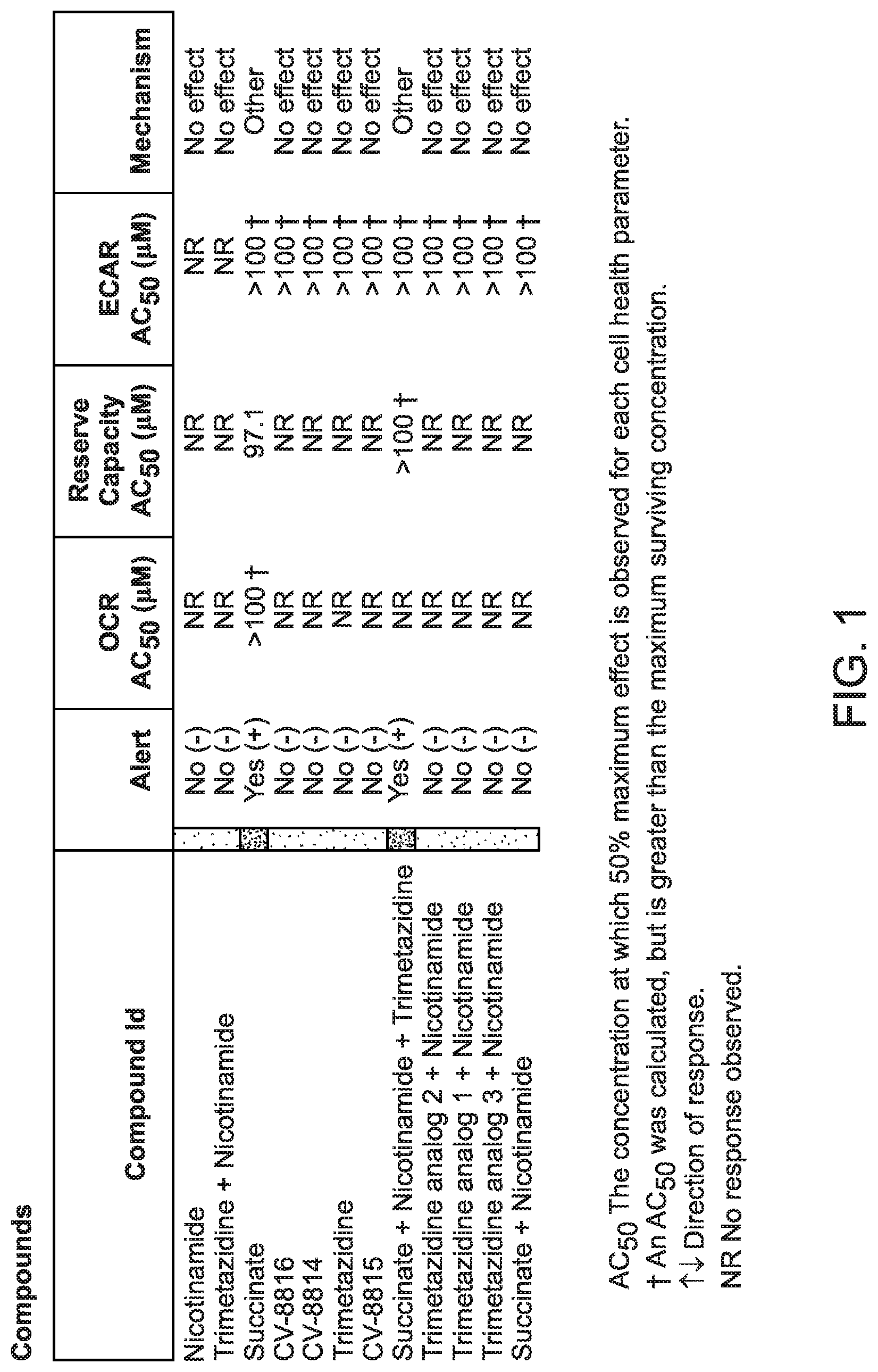
is a table summarizing the effects of various compounds on mitochondrial function.
is a table summarizing the effects of nicotinamide on various mitochondrial functional parameters.
is a series of graphs showing the effects of nicotinamide on oxygen consumption rate and reserve capacity.
is a series of graphs showing the effects of nicotinamide on extracellular acidification rate.
is a table summarizing the effects of a combination of trimetazidine and nicotinamide on various mitochondrial functional parameters.
is a series of graphs showing the effects of a combination of trimetazidine and nicotinamide on oxygen consumption rate and reserve capacity.
is a series of graphs showing the effects of a combination of trimetazidine and nicotinamide on extracellular acidification rate.
is a table summarizing the effects of succinate on various mitochondrial functional parameters.
is a series of graphs showing the effects of succinate on oxygen consumption rate and reserve capacity.
is a series of graphs showing the effects of succinate on extracellular acidification rate.
is a table summarizing the effects of compound CV-8816 on various mitochondrial functional parameters.
is a series of graphs showing the effects of compound CV-8816 on oxygen consumption rate and reserve capacity.
is a series of graphs showing the effects of compound CV-8816 on extracellular acidification rate.
is a table summarizing the effects of compound CV-8814 on various mitochondrial functional parameters.
is a series of graphs showing the effects of compound CV-8814 on oxygen consumption rate and reserve capacity.
is a series of graphs showing the effects of compound CV-8814 on extracellular acidification rate.
is a table summarizing the effects of trimetazidine on various mitochondrial functional parameters.
is a series of graphs showing the effects of trimetazidine on oxygen consumption rate and reserve capacity.
is a series of graphs showing the effects of trimetazidine on extracellular acidification rate.
is a table summarizing the effects of compound CV-8815 on various mitochondrial functional parameters.
is a series of graphs showing the effects of compound CV-8815 on oxygen consumption rate and reserve capacity.
is a series of graphs showing the effects of compound CV-8815 on extracellular acidification rate.
is a table summarizing the effects of a combination of succinate, nicotinamide, and trimetazidine on various mitochondrial functional parameters.
is a series of graphs showing the effects of a combination of succinate, nicotinamide, and trimetazidine on oxygen consumption rate and reserve capacity.
is a series of graphs showing the effects of a combination of succinate, nicotinamide, and trimetazidine on extracellular acidification rate.
is a table summarizing the effects of a combination of trimetazidine analog 2 and nicotinamide on various mitochondrial functional parameters.
is a series of graphs showing the effects of a combination of trimetazidine analog 2 and nicotinamide on oxygen consumption rate and reserve capacity.
is a series of graphs showing the effects a combination of trimetazidine analog 2 and nicotinamide on extracellular acidification rate.
is a table summarizing the effects of a combination of trimetazidine analog 1 and nicotinamide on various mitochondrial functional parameters.
is a series of graphs showing the effects of a combination of trimetazidine analog 1 and nicotinamide on oxygen consumption rate and reserve capacity.
is a series of graphs showing the effects of a combination of trimetazidine analog 1 and nicotinamide on extracellular acidification rate.
is a table summarizing the effects of a combination of trimetazidine analog 3 and nicotinamide on various mitochondrial functional parameters.
is a series of graphs showing the effects of a combination of trimetazidine analog 3 and nicotinamide on oxygen consumption rate and reserve capacity.
is a series of graphs showing the effects of a combination of trimetazidine analog 3 and nicotinamide on extracellular acidification rate.
is a table summarizing the effects of a combination of succinate and nicotinamide on various mitochondrial functional parameters.
is a series of graphs showing the effects of a combination of succinate and nicotinamide on oxygen consumption rate and reserve capacity.
is a series of graphs showing the effects of a combination of succinate and nicotinamide on extracellular acidification rate.
is a schematic of the ischemia-reperfusion (IR) method used to analyze the effects of compositions of the invention on coronary flow.
is a graph of coronary flow of after IR.
is graph of left ventricular developed pressure (LVDP) after IR.
shows images of TTC-stained heart slices after IR.
is graph of infarct size after IR.
is a schematic of the method used to analyze the effects of compositions of the invention on cardiac function.
shows hearts from mice six weeks after transverse aortic constriction.
is of graph of heart weight relative to body weight six weeks after transverse aortic constriction.
is graph of heart weight six weeks after transverse aortic constriction.
shows graphs of fractional shortening (FS) and ejection fraction (EF) at indicated time points after transverse aortic constriction.
is a graph of left ventricular end-systolic diameter at indicated time points after transverse aortic constriction.
is a graph of intraventricular septal dimension at indicated time points after transverse aortic constriction.
is a graph of left ventricular mass at indicated time points after transverse aortic constriction.
is a graph of isovolumic relaxation time at indicated time points after transverse aortic constriction.
is a graph of the ratio peak velocity flow in early diastole vs. late diastole at indicated time points after transverse aortic constriction.
is a graph of left ventricular developed pressure at six weeks after transverse aortic constriction.
is a graph of the rate of left ventricle pressure rise at six weeks after transverse aortic constriction.
is a graph showing levels of CV-8814 and trimetazidine after intravenous administration of CV-8834.
is a graph showing levels of CV-8814 and trimetazidine after oral administration of CV-8834.
is a graph showing levels of CV-8814 and trimetazidine after oral administration of CV-8834.
is a graph showing levels of CV-8814 and trimetazidine after oral administration of CV-8834.
is a graph showing levels of CV-8814 and trimetazidine after oral administration of CV-8834.
is a graph showing levels of trimetazidine after oral administration of CV-8972 or intravenous administration of trimetazidine.
is a graph showing levels of CV-8814 after oral administration of CV-8972 or intravenous administration of CV-8814.
is a graph showing levels of CV-8814 after intravenous administration of CV-8834 or oral administration of CV-8834.
is a graph showing levels of CV-8814 after intravenous administration of CV-8814 or oral administration of CV-8814.
is a graph showing the HPLC elution profile of a batch of CV-8972.
is a graph showing analysis of molecular species present in a batch of CV-8972.
is a pair of graphs showing HPLC elution profiles of molecular species present in a batch of CV-8972.
is a pair of graphs showing HPLC elution profiles of molecular species present in a batch of CV-8972.
is a graph showing X-ray powder diffraction analysis of a batch of CV-8972.
is a graph showing X-ray powder diffraction analysis of batches of CV-8972.
is a graph showing differential scanning calorimetry and thermal gravimetric analysis of a batch of CV-8972.
is a graph showing dynamic vapor sorption (DVS) of a batch of CV-8972.
is a graph showing differential scanning calorimetry and thermal gravimetric analysis of a batch of CV-8972.
is a graph showing dynamic vapor sorption (DVS) of a batch of CV-8972.
is a graph showing X-ray powder diffraction analysis of samples of CV-8972.
is a graph showing differential scanning calorimetry and thermal gravimetric analysis of a batch of CV-8972.
is a graph showing X-ray powder diffraction analysis of samples of CV-8972.
is a graph showing X-ray powder diffraction analysis of samples of CV-8972.
is a graph showing differential scanning calorimetry and thermal gravimetric analysis of samples containing form A of CV-8972.
is a graph showing differential scanning calorimetry and thermal gravimetric analysis of a sample containing form A of CV-8972.
DETAILED DESCRIPTION
The invention provides methods for treating a subject having a rheumatic condition by providing compositions that contain compounds that include a molecule that shift metabolism from fatty acid oxidation to glucose oxidation and a molecule that is a precursor for NAD synthesis. Glucose oxidation and fatty acid oxidation are energy-producing metabolic pathways that compete with each other for substrates. In glucose oxidation, glucose is broken down to pyruvate via glycolysis in the cytosol of the cell. Pyruvate then enters the mitochondria, where it is converted to acetyl coenzyme A (acetyl-CoA). In beta-oxidation of fatty acids, which occurs in the mitochondria, two-carbon units from long-chain fatty acids are sequentially converted to acetyl-CoA.
The remaining steps in energy production from oxidation of glucose or fatty acids are common to the two pathways. Acetyl-CoA is oxidized to carbon dioxide (CO 2 ) via the citric acid cycle, which results in the conversion of nicotinamide adenine dinucleotide (NAD + ) to its reduced form, NADH. NADH, in turn, drives the mitochondrial electron transport chain. The electron transport chain comprises a series of four mitochondrial membrane-bound complexes that transfer electrons via redox reactions and pump protons across the membrane to create a proton gradient. The redox reactions of the electron transport chain require molecular oxygen (O 2 ). Finally, the proton gradient enables another membrane-bound enzymatic complex to form high-energy ATP molecules, the source of energy for most cellular reactions.
In some embodiments, the compositions are compounds represented by formula (I): A-L-B (I), in which A is a compound that shifts cellular metabolism from fatty acid oxidation to glucose oxidation, L is a linker, and B is a compound that promotes mitochondrial respiration.
Component A may be any suitable compound that shifts cellular metabolism from fatty acid oxidation to glucose oxidation. Such compounds can be classified based on their mechanism of action. See Fillmore, N., et al., Mitochondrial fatty acid oxidation alterations in heart failure, ischemic heart disease and diabetic cardiomyopathy, Brit. J. Pharmacol. 171:2080-2090 (2014), incorporated herein by reference.
One class of glucose-shifting compounds includes compounds that inhibit fatty acid oxidation directly. Compounds in this class include inhibitors of malonyl CoA decarboxylase (MCD), carnitine palmitoyl transferase 1 (CPT-1), or mitochondrial fatty acid oxidation. Mitochondrial fatty acid oxidation inhibitors include trimetazidine and other compounds described in WO 2002/064576, which is incorporated herein by reference. Trimetazidine binds to distinct sites on the inner and outer mitochondrial membranes and affects both ion permeability and metabolic function of mitochondria. Morin, D., et al., Evidence for the existence of [ 3 H]-trimetazidine binding sites involved in the regulation of the mitochondrial permeability transition pore, Brit. J. Pharmacol. 123:1385-1394 (1998), incorporated herein by reference. MCD inhibitors include CBM-301106, CBM-300864, CBM-301940, 5-(1,1,1,3,3,3-hexafluoro-2-hydroxypropan-2-yl)-4,5-dihydroisoxazole-3-carboxamides, methyl 5-(N-(4-(1,1,1,3,3,3-hexafluoro-2-hydroxypropan-2-yl)phenyl)morpholine-4-carboxamido)pentanoate, and other compounds described in Chung, J. F., et al., Discovery of Potent and Orally Available Malonyl-CoA Decarboxylase Inhibitors as Cardioprotective Agents, J. Med. Chem. 49:4055-4058 (2006); Cheng J. F. et al., Synthesis and structure-activity relationship of small-molecule malonyl coenzyme A decarboxylase inhibitors, J. Med. Chem. 49:1517-1525 (2006); US Publication No. 2004/0082564; and WO 2002/058698, which are incorporated herein by reference. CPT-1 inhibitors include oxfenicine, perhexiline, etomoxir, and other compounds described in WO 2015/018660, WO 2008/109991; WO 2009/015485; US Publication No. 2011/0212072; and WO 2009/156479, which are incorporated herein by reference.
Another class of glucose-shifting compounds includes compounds that stimulate glucose oxidation directly. Examples of such compounds are described in US Publication No. 2003/0191182; WO 2006/117686; U.S. Pat. No. 8,202,901, which are incorporated herein by reference.
Another class of glucose-shifting compounds includes compounds that decrease the level of circulating fatty acids that supply the heart. Examples of such compounds include agonists of PPARα and PPARγ, including fibrate drugs, such as clofibrate, gemfibrozil, ciprofibrate, bezafibrate, and fenofibrate, and thiazolidinediones, GW-9662, and other compounds described in U.S. Pat. No. 9,096,538, which is incorporated herein by reference.
Component L may be any suitable linker. Preferably, the linker can be cleaved in vivo to release components A and B. The linker may be an alkoxy group. The linker may be polyethylene glycol of any length. The linker may be represented by (CH 2 CH 2 O) x , in which x=1-15 or (CH 2 CH 2 O) x , in which x=1-3. Other suitable linkers include 1,3-propanediol, diazo linkers, phosphoramidite linkers, disulfide linkers, cleavable peptides, iminodiacetic acid linkers, thioether linkers, and other linkers described in Leriche, G., et al., Cleavable linkers in chemical biology, Bioorg. Med. Chem. 20:571-582 (2012); WO 1995000165; and U.S. Pat. No. 8,461,117, which are incorporated herein by reference.
Component B may be any compound that promotes mitochondrial respiration. For example, component B may be an intermediate of the citric acid cycle or a molecule that can be metabolized to enter the citric acid cycle, such as succinate, fumarate, malate, oxaloacetate, citrate, isocitrate, α-ketoglutarate, pyruvate, acetone, acetoacetic acid, β-hydroxybutyric acid, β-ketopentanoate, or β-hydroxypentanoate. Intermediates of the citric acid cycle may become depleted if these molecules are used for biosynthetic purposes, resulting in inefficient generation of ATP from the citric acid cycle. However, due to the anaplerotic effect, providing one intermediate of the citric acid cycle leads to restoration of all intermediates as the cycle turns. Thus, intermediates of the citric acid cycle can promote mitochondrial respiration.
The compound may include a NAD + precursor molecule. NAD + is an important oxidizing agent that acts as a coenzyme in multiple reactions of the citric acid cycle. In these reactions, NAD + is reduced to NADH. Conversely, NADH is oxidized back to NAD + when it donates electrons to mitochondrial electron transport chain. In humans, NAD + can be synthesized de novo from tryptophan, but not in quantities sufficient to meet metabolic demands. Consequently, NAD + is also synthesized via a salvage pathway, which uses precursors that must be supplied from the diet. Among the precursors used by the salvage pathway for NAD + synthesis are nicotinic acid, nicotinamide, and nicotinamide riboside. By providing a NAD + precursor, such as nicotinic acid, nicotinamide, or nicotinamide riboside, the compound facilitates NAD + synthesis.
The inclusion of a NAD + precursor in compounds of the invention allows the compounds to stimulate energy production in cellular mitochondria in multiple ways. First, component A shifts cellular metabolism from fatty acid oxidation to glucose oxidation, which is inherently more efficient. Next, component B ensures that the intermediates of the citric acid cycle are present at adequate levels and do not become depleted or limiting. As a result, glucose-derived acetyl CoA is efficiently oxidized. Finally, the NAD + precursor provides an essential coenzyme that cycles between oxidized and reduced forms to promote respiration. In the oxidized form, NAD drives reactions of the citric acid cycle. In the reduced form, NADH promotes electron transport to create a proton gradient that enables ATP synthesis. Consequently, the chemical potential resulting from oxidation of acetyl CoA is efficiently converted to ATP that can be used for various cellular functions.
The NAD + precursor molecule may be covalently attached to the compound in any suitable manner. For example, it may linked to A, L, or B, and it may be attached directly or via another linker. Preferably, it is attached via a linker that can be cleaved in vivo. The NAD + precursor molecule may be attached via a 1,3-propanediol linkage.
The compound may be covalently attached to one or more molecules of polyethylene glycol (PEG), i.e., the compound may be PEGylated. In many instances, PEGylation of molecules reduces their immunogenicity, which prevents the molecules from being cleared from the body and allows them to remain in circulation longer. The compound may contain a PEG polymer of any size. For example, the PEG polymer may have from 1-500 (CH 2 CH 2 O) units. The PEG polymer may have any suitable geometry, such as a straight chain, branched chain, star configuration, or comb configuration. The compound may be PEGylated at any site. For example, the compound may be PEGylated on component A, component B, component L, or, if present, the NAD + precursor. The compound may be PEGylated at multiple sites. For a compound PEGylated at multiple sites, the various PEG polymers may be of the same or different size and of the same or different configuration.
The compound may be a PEGylated form of trimetazidine. For example, the compound may be represented by formula (VI):
in which one or more of the carbon atoms at positions A, B, C, D, and E and/or the nitrogen atom at position F are substituted with —(CH 2 CH 2 O) n H and n=1-15. The carbon atoms at positions A, B, C, D, and E may have two PEG substituents. In molecules that have multiple PEG chains, the different PEG chains may have the same or different length.
The compounds of formula (I) may be represented by formula (II):
in which y=1-3.
The compounds of formula (I) may be represented by formula (III):
in which y=1-3.
The invention also provides compounds represented by formula (IV):
in which R 1 , R 2 , and R 3 are independently H or a (C 1 -C 4 )alkyl group; R 4 and R 5 together are ═O, —O(CH 2 ) m O—, or —(CH 2 ) m —, in which m=2-4, or R 4 is H and R 5 is OR 14 , SR 14 , or (CH 2 CH 2 O) n H, in which R 14 is H or a (C 1 -C 4 )alkyl group and n=1-15; and R 6 is a single or multi-ring structure optionally substituted at one or more ring positions by a heteroatom, in which each ring position optionally comprises one or more substituents.
R 6 may be a single or multi-ring structure of any size. For example, the structure may contain 3-22 atoms, not including hydrogen atoms bonded to atoms in ring positions. The structure may include one or more alkyl, alkenyl, or aromatic rings. The structure may include one or more heteroatoms, i.e., atoms other than carbon. For example, the heteroatom may be oxygen, nitrogen, or sulfur, or phosphorus.
One or more ring position of R 6 may include a substituent that includes a compound that promotes mitochondrial respiration, as described above in relation to component B of formula (I). The substituent may include a linker, as described above in relation to component L of formula (I). The substituent may include a NAD precursor molecule, as described above in relation to compounds of formula (I).
The substituent on a ring position of R 6 may be
in which y=1-3.
The substituent on a ring position of R 6 may be
in which y=1-3.
R 6 may be
For some compounds of the invention that include trimetazidine prodrugs, analogs, derivatives, it is advantageous to have the trimetazidine moiety substituted with a single ethylene glycol moiety. Thus, preferred compositions of the invention include compounds of formulas (I) and (VIII) that contain linkers in which x=1, compounds of formulas (II) and (III) in which y=1, compounds of formula (V) in which z=1, compounds of formula (VI) in which n=1, and compounds of formula (VII) in which A is linked to C via a single ethylene glycol moiety. Without wishing to be bound by theory, the attachment of a single ethylene glycol moiety to the trimetazidine moiety may improve the bioavailability of trimetazidine.
The compound of formula (IV) may have structure represented by formula (IX) or formula (X):
The invention also provides compounds represented by formula (V):
in which R 1 , R 2 , and R 3 are independently H or a (C 1 -C 4 )alkyl group; R 4 and R 8 together are ═O, —O(CH 2 ) m O—, or —(CH 2 ) m —, in which m=2-4, or R 4 is H and R 8 is H, OR 14 , SR 14 , or (CH 2 CH 2 O) n H, in which R 14 is H or a (C 1 -C 4 )alkyl group and n=1-15; R 9 , R 10 , R 12 , and R 13 are independently H or (CH 2 CH 2 O) z H, in which z=1-15; and R 11 comprises a compound that promotes mitochondrial respiration, as described above in relation to component B of formula (I). R 11 may include a linker, as described above in relation to component L of formula (I).
R 11 may be
in which y=1-3.
R 11 may include a NAD precursor molecule, as described above in relation to compounds of formula (I).
R 11 may be
in which y=1-3.
In some embodiments described above, compounds of the invention include multiple active agents joined by linkers in a single molecule. It may be advantageous to deliver multiple active agents as components of a single molecule. Without wishing to be bound by a particular theory, there are several reasons why co-delivery of active agents in a single molecule may be advantageous. One possibility is that a single large molecule may have reduced side effects compared to the component agents. Free trimetazidine causes symptoms similar to those in Parkinson's disease in a fraction of patients. However, when trimetazidine is derivatized to include other components, such as succinate, the molecule is bulkier and may not be able to access sites where free trimetazidine can causes unintended effects. Trimetazidine derivatized as described above is also more hydrophilic and thus may be less likely to cross the blood-brain barrier to cause neurological effects. Another possibility is that modification of trimetazidine may alter its pharmacokinetic properties. Because the derivatized molecule is metabolized to produce the active agent, the active agent is released gradually. Consequently, levels of the active agent in the body may not reach peaks as high as when a comparable amount is administered in a single bolus. Another possibility is that less of each active agent, such as trimetazidine, is required because the compounds of the invention include multiple active agents. For example, trimetazidine shifts metabolism from fatty acid oxidation to glucose oxidation, and succinate improves mitochondrial respiration generally. Thus, a compound that provides both agents stimulates a larger increase in glucose-driven ATP production for a given amount of trimetazidine than does a compound that delivers trimetazidine alone.
The invention also provides compounds represented by formula (VII): A-C (VII), in which A is a compound that shifts cellular metabolism from fatty acid oxidation to glucose oxidation, and C is a NAD + precursor molecule. A and C may be covalently linked.
The compound that shifts cellular metabolism from fatty acid oxidation to glucose oxidation may be PEGylated with an ethylene glycol moiety. The compound that shifts cellular metabolism from fatty acid oxidation to glucose oxidation may have multiple ethylene glycol moieties, such as one, two three, four, five, or more ethylene glycol moieties. The ethylene glycol moiety may be represented by (CH 2 CH 2 O) x , in which x=1-15. The ethylene glycol moiety may form a covalent linkage between the compound that shifts cellular metabolism from fatty acid oxidation to glucose oxidation and the NAD + precursor molecule. The ethylene glycol moiety may be separate from a covalent linkage between the compound that shifts cellular metabolism from fatty acid oxidation to glucose oxidation and the NAD + precursor molecule.
The compound of formula (VII) may include nicotinic acid that is covalently linked to a PEGylated form of trimetazidine. The nicotinic acid may be covalently linked via a PEGylated moiety, i.e., via an ethylene glycol linkage. The nicotinic acid may be covalently linked via the trimetazidine moiety.
The invention also provides compounds represented by formula (VIII): A-L-C (VIII), in which A is a compound that shifts cellular metabolism from fatty acid oxidation to glucose oxidation, L is a linker, and C is a NAD + precursor molecule. A may be covalently linked to L, and L may be covalently linked to C.
The compound that shifts cellular metabolism from fatty acid oxidation to glucose oxidation, the linker, and the NAD + precursor molecule may be as described above in relation to compounds of other formulas.
The invention also provides compositions that include at least two of (1) a compound that shifts cellular metabolism from fatty acid oxidation to glucose oxidation, (2) a compound that promotes mitochondrial respiration, and (3) a NAD + precursor molecule. The aforementioned components of the composition may be provided as separate molecules.
The compositions may include each of a (1) a compound that shifts cellular metabolism from fatty acid oxidation to glucose oxidation, (2) a compound that promotes mitochondrial respiration, and (3) a NAD + precursor molecule. In such compositions, each of the three components may be provided as a separate molecule. Alternatively, in such compositions, two of the components may be covalently linked as part of single molecule, and the third component may be provided as a separate molecule. For example, the compound that shifts cellular metabolism from fatty acid oxidation to glucose oxidation may be linked to the compound that promotes mitochondrial respiration, and the NAD + precursor may be provided as a separate molecule.
The compounds of the invention may be provided as co-crystals with other compounds. Co-crystals are crystalline materials composed of two or more different molecules in the same crystal lattice. The different molecules may be neutral and interact non-ionically within the lattice. Co-crystals of the invention may include one or more compounds of the invention with one or more other molecules that stimulate mitochondrial respiration or serve as NAD + precursors. For example, a co-crystal may include any of the following combinations: (1) a compound that shifts cellular metabolism from fatty acid oxidation to glucose oxidation and (2) a NAD + precursor molecule; (1) a compound that promotes mitochondrial respiration and (2) a NAD + precursor molecule; (1) a compound that shifts cellular metabolism from fatty acid oxidation to glucose oxidation and (2) a compound that promotes mitochondrial respiration; (1) a molecule comprising a compound that shifts cellular metabolism from fatty acid oxidation to glucose oxidation covalently linked to a compound that promotes mitochondrial respiration and (2) a NAD + precursor molecule. In specific embodiments, a co-crystal may include (1) a compound of formula (I), (III), (IV), or (V) and (2) nicotinic acid, nicotinamide, or nicotinamide riboside.
The compounds may include one or more atoms that are enriched for an isotope. For example, the compounds may have one or more hydrogen atoms replaced with deuterium or tritium. Isotopic substitution or enrichment may occur at carbon, sulfur, or phosphorus, or other atoms. The compounds may be isotopically substituted or enriched for a given atom at one or more positions within the compound, or the compounds may be isotopically substituted or enriched at all instances of a given atom within the compound.
The invention provides pharmaceutical compositions containing one or more of the compounds described above. A pharmaceutical composition containing the compounds may be in a form suitable for oral use, for example, as tablets, troches, lozenges, fast-melts, aqueous or oily suspensions, dispersible powders or granules, emulsions, hard or soft capsules, syrups or elixirs. Compositions intended for oral use may be prepared according to any method known in the art for the manufacture of pharmaceutical compositions and such compositions may contain one or more agents selected from sweetening agents, flavoring agents, coloring agents and preserving agents, in order to provide pharmaceutically elegant and palatable preparations. Tablets contain the compounds in admixture with non-toxic pharmaceutically acceptable excipients which are suitable for the manufacture of tablets. These excipients may be for example, inert diluents, such as calcium carbonate, sodium carbonate, lactose, calcium phosphate or sodium phosphate; granulating and disintegrating agents, for example corn starch, or alginic acid; binding agents, for example starch, gelatin or acacia, and lubricating agents, for example magnesium stearate, stearic acid or talc. The tablets may be uncoated or they may be coated by known techniques to delay disintegration in the stomach and absorption lower down in the gastrointestinal tract and thereby provide a sustained action over a longer period. For example, a time delay material such as glyceryl monostearate or glyceryl distearate may be employed. They may also be coated by the techniques described in U.S. Pat. Nos. 4,256,108, 4,166,452 and 4,265,874, to form osmotic therapeutic tablets for control release. Preparation and administration of compounds is discussed in U.S. Pat. No. 6,214,841 and U.S. Pub. 2003/0232877, incorporated by reference herein in their entirety.
Formulations for oral use may also be presented as hard gelatin capsules in which the compounds are mixed with an inert solid diluent, for example calcium carbonate, calcium phosphate or kaolin, or as soft gelatin capsules in which the compounds are mixed with water or an oil medium, for example peanut oil, liquid paraffin or olive oil.
An alternative oral formulation, where control of gastrointestinal tract hydrolysis of the compound is sought, can be achieved using a controlled-release formulation, where a compound of the invention is encapsulated in an enteric coating.
Aqueous suspensions may contain the compounds in admixture with excipients suitable for the manufacture of aqueous suspensions. Such excipients are suspending agents, for example sodium carboxymethylcellulose, methylcellulose, hydroxypropylmethylcellulose, sodium alginate, polyvinylpyrrolidone, gum tragacanth and gum acacia; dispersing or wetting agents such as a naturally occurring phosphatide, for example lecithin, or condensation products of an alkylene oxide with fatty acids, for example, polyoxyethylene stearate, or condensation products of ethylene oxide with long chain aliphatic alcohols, for example heptadecaethyleneoxycetanol, or condensation products of ethylene oxide with partial esters derived from fatty acids and a hexitol such a polyoxyethylene with partial esters derived from fatty acids and hexitol anhydrides, for example polyoxyethylene sorbitan monooleate. The aqueous suspensions may also contain one or more preservatives, for example ethyl, or n-propyl p-hydroxybenzoate, one or more coloring agents, one or more flavoring agents, and one or more sweetening agents, such as sucrose or saccharin.
Oily suspensions may be formulated by suspending the compounds in a vegetable oil, for example, arachis oil, olive oil, sesame oil or coconut oil, or in a mineral oil such as liquid paraffin. The oily suspensions may contain a thickening agent, for example beeswax, hard paraffin or cetyl alcohol. Sweetening agents such as those set forth above, and flavoring agents may be added to provide a palatable oral preparation. These compositions may be preserved by the addition of an anti-oxidant such as ascorbic acid.
Dispersible powders and granules suitable for preparation of an aqueous suspension by the addition of water provide the compounds in admixture with a dispersing or wetting agent, suspending agent and one or more preservatives. Suitable dispersing or wetting agents and suspending agents are exemplified, for example sweetening, flavoring and coloring agents, may also be present.
The pharmaceutical compositions of the invention may also be in the form of oil-in-water emulsions. The oily phase may be a vegetable oil, for example olive oil or arachis oil, or a mineral oil, for example liquid paraffin or mixtures of these. Suitable emulsifying agents may be naturally-occurring gums, for example gum acacia or gum tragacanth, naturally occurring phosphatides, for example soya bean, lecithin, and esters or partial esters derived from fatty acids and hexitol anhydrides, for example sorbitan monooleate and condensation products of the said partial esters with ethylene oxide, for example polyoxyethylene sorbitan monooleate. The emulsions may also contain sweetening and flavoring agents.
Syrups and elixirs may be formulated with sweetening agents, such as glycerol, propylene glycol, sorbitol or sucrose. Such formulations may also contain a demulcent, a preservative, and agents for flavoring and/or coloring. The pharmaceutical compositions may be in the form of a sterile injectable aqueous or oleaginous suspension. This suspension may be formulated according to the known art using those suitable dispersing or wetting agents and suspending agents which have been mentioned above. The sterile injectable preparation may also be in a sterile injectable solution or suspension in a non-toxic parenterally acceptable diluent or solvent, for example as a solution in 1,3-butanediol. Among the acceptable vehicles and solvents that may be employed are water, Ringer's solution and isotonic sodium chloride solution. In addition, sterile, fixed oils are conventionally employed as a solvent or suspending medium. For this purpose any bland fixed oil may be employed including synthetic mono- or di-glycerides. In addition, fatty acids such as oleic acid find use in the preparation of injectables.
The compounds of the invention are useful for improving cardiac efficiency. A variety of definitions of cardiac efficiency exist in the medical literature. See, e.g., Schipke, J. D. Cardiac efficiency, Basic Res. Cardiol. 89:207-40 (1994); and Gibbs, C. L. and Barclay, C. J. Cardiac efficiency, Cardiovasc. Res. 30:627-634 (1995), incorporated herein by reference. One definition of cardiac mechanical efficiency is the ratio of external cardiac power to cardiac energy expenditure by the left ventricle. See Lopaschuk G. D., et al., Myocardial Fatty Acid Metabolism in Health and Disease, Phys. Rev. 90:207-258 (2010), incorporated herein by reference. Another definition is the ratio between stroke work and oxygen consumption, which ranges from 20-25% in the normal human heart. Visser, F., Measuring cardiac efficiency: is it useful? Hear Metab. 39:3-4 (2008), incorporated herein by reference. Another definition is the ratio of the stroke volume to mean arterial blood pressure. Any suitable definition of cardiac efficiency may be used to measure the effects of compounds of the invention
The invention also provides methods of altering cellular metabolism in a subject to increase glucose oxidation relative to fatty acid oxidation. The methods may include providing a composition of the invention, such as any the compounds described above, including the compounds represented by formulas (I), (II), (III), (IV), or (V) or formulations thereof.
The methods may include providing a compound that shifts cellular metabolism from fatty acid oxidation to glucose oxidation, as described above, and a compound that promotes mitochondrial respiration, as described above. The compounds may be provided as components of a single molecule, as separate molecules in a single composition, or as separate compositions.
The methods may also include providing a NAD + precursor molecule, as described above. In methods that involve providing a compound that shifts cellular metabolism from fatty acid oxidation to glucose oxidation, a compound that promotes mitochondrial respiration, and a NAD + precursor molecule, compounds may be provided as components of a single molecule, two different molecules, or three different molecules. The compounds may be provided in one, two, three, or any number of different compositions. The compounds may be provided together, separately, or in any combination. The compounds may be provided simultaneously or sequentially. The compounds may be provided at different intervals, with different frequency, in different quantities, or at different dosages.
The invention also provides methods of treating rheumatic diseases, disorders, and conditions by providing compositions of the invention. As used herein, a rheumatic disease, disorder, or condition is any condition that affects the joints, tendons, ligaments, bones, muscles, or connective tissue or is associated with pain in or more of such tissues. The rheumatic disease, disorder, or condition may primarily affect the joints, tendons, ligaments, bones, muscles, or connective tissue. Examples of such conditions include ankylosing spondylitis, autoimmune-related lung disease, Behcet's Disease, bursitis, chronic fatigue syndrome, dermatomyositis, fibromyalgia, gout, Gulf War syndrome, infectious arthritis, inflammatory arthritis, inflammatory eye disease, inflammatory myositis, juvenile idiopathic arthritis, lupus, myofascial pain syndrome, osteoarthritis, osteonecrosis of the jaw, osteoporosis, polymyalgia rheumatica, polymyositis, psoriatic arthritis, rheumatoid arthritis, sarcoidosis, scleroderma, Sjögren's syndrome, tendinitis, or vasculitis.
The rheumatic disease, disorder, or condition may primarily affect the cardiovascular system and have secondary effects on the joints, tendons, ligaments, bones, muscles, or connective tissue. For example and without limitation, the condition may be alcoholic cardiomyopathy, aneurysm, angina (including refractory angina and angina in the context of heart failure), atherosclerosis, cardiac fibrosis, cardiomyopathy, cerebral vascular disease, claudication (e.g., peripheral claudication) congenital heart disease, coronary artery disease, coronary heart disease, cyanotic heart disease, diabetic cardiomyopathy, dilated cardiomyopathy, heart attack, heart failure, high blood pressure (hypertension), hypertrophic cardiomyopathy, ischemic cardiomyopathy, ischemic heart disease, left ventricular dysfunction, pericardial disease, peripheral arterial disease, rheumatic heart disease, stroke, transient ischemic attacks, or valvular heart disease.
The rheumatic disease, disorder, or condition may be a rare muscle disease. For example and without limitation, the condition may be CAV3-related distal myopathy, Duchenne Muscular Dystrophy, hypertrophic cardiomyopathy, isolated hyperCKemia, limb-girdle muscular dystrophy 1C, muscle myopathy, myositis, or rippling muscle disease. The rare muscle disease may be associated with a mutation in BICD2, CAV3, or DMD.
The rheumatic disease, disorder, or condition may be a glycogen storage disease. For example and without limitation, the glycogen storage disease may be aldolase A deficiency, Andersen disease, Cori's disease, Fanconi-Bickel syndrome, Hers' disease, Lafora disease, McArdle disease, Pompe's disease, Tarui's disease, or von Gierke's disease. The glycogen storage disease may be associated with a deficiency in an enzyme or protein, such as acid alpha-glucosidase, aldolase A, β-enolase, glucose transporter, glucose-6-phosphatase, glycogen branching enzyme, glycogen debranching enzyme, glycogen synthase, glycogenin-1, liver glycogen phosphorylase, muscle glycogen phosphorylase, muscle lactate dehydrogenase, muscle phosphofructokinase, muscle phosphoglycerate mutase, phosphoglycerate mutase, or phosphorylase kinase. The glycogen storage disease may be associated with a mutation in a gene, such as AGL, ALDOA, ENO3, G6PC, GAA, GBE1, GLUT2, GYG1, GYS2, LDHA, PGAM2, PGAM2, PHKA1, PHKA2, PHKB, PHKG2, PKFM, PYGL, PYGM, or SLC37A4.
The rheumatic disease, disorder, or condition may be another condition that affects the joints, tendons, ligaments, bones, muscles, or connective tissue, such as acute kidney injury, cachexia, chemotherapy induced nephropathy, contrast nephropathy, disequilibrium, frailty, pulmonary arterial hypertension, pulmonary fibrosis, sarcopenia, tinnitus, or vertigo.
EXAMPLES
Protocol
The effects of compounds of the invention on mitochondrial function were analyzed. HepG2 cells were dosed with test compound and in real time the extracellular oxygen levels and pH were measured using the XFe96 flux analyzer (Seahorse Biosciences). XFe Technology uses solid-state sensors to simultaneously measure both oxygen consumption rate (OCR) and extracellular acidification rate (ECAR) to determine effects on oxidative phosphorylation (OXPHOS) and glycolysis simultaneously. The cells were then subjected to sequential exposure to various inhibitors of mitochondrial function to assess cellular metabolism.
Data Interpretation.
A compound was identified as positive mitochondrial-active compound when it caused a change in oxygen consumption rate (OCR) or extracellular acidification rate (ECAR) in the absence of cytotoxicity. Cytotoxicity was determined when both OXPHOS (OCR) and glycolysis (ECAR) were inhibited.
Definition of Mitochondrial Parameters.
Oxygen consumption rate (OCR) is a measurement of oxygen content in extracellular media. Changes in OCR indicate effects on mitochondrial function and can be bi-directional. A decrease is due to an inhibition of mitochondrial respiration, while an increase may indicate an uncoupler, in which respiration is not linked to energy production.
OCR = compound OCR - non mitochondrial OCR basal OCR - non mitochondrial OCR
Extracellular acidification rate (ECAR) is the measurement of extracellular proton concentration (pH). An increase in signal means an increase in rate in number of pH ions (thus decreasing pH value) and seen as an increase in glycolysis. ECAR is expressed as a fraction of basal control (rate prior to addition of compound).
ECAR = compound ECAR basal ECAR
Reserve capacity is the measured ability of cells to respond to an increase in energy demand. A reduction indicates mitochondrial dysfunction. This measurement demonstrates how close to the bioenergetic limit the cell is.
reverse capacity = FCCP OCR - non mitochondrial OCR basal OCR - non mitochondrial OCR Mitochondrial Stress Test.
A series of compounds were added sequentially to the cells to assess a bioenergetics profile, effects of test compounds on parameters such as proton leak, and reserve capacity. This can be used to assist in understanding potential mechanisms of mitochondrial toxicity. The following compounds were added in order: (1) oligomycin, (2) FCCP, and (3) rotenone and antimycin A.
Oligomycin is a known inhibitor of ATP synthase and prevents the formation of ATP. Oligomycin treatment provides a measurement of the amount of oxygen consumption related to ATP production and ATP turnover. The addition of oligomycin results in a decrease in OCR under normal conditions, and residual OCR is related to the natural proton leak.
FCCP is a protonophore and is a known uncoupler of oxygen consumption from ATP production. FCCP treatment allows the maximum achievable transfer of electrons and oxygen consumption rate and provides a measurement of reserve capacity.
Rotenone and antimycin A are known inhibitors of complex I and III of the electron transport chain, respectively. Treatment with these compounds inhibits electron transport completely, and any residual oxygen consumption is due to non-mitochondrial activity via oxygen requiring enzymes.
Definition of Mechanisms.
An electron transport chain inhibitor is an inhibitor of mitochondrial respiration that causes an increase in glycolysis as an adaptive response (e.g. decrease OCR and increase in ECAR).
The inhibition of oxygen consumption may also be due to reduced substrate availability (e.g. glucose, fatty acids, glutamine, pyruvate), for example, via transporter inhibition. Compounds that reduce the availability of substrates are substrate inhibitors. A substrate inhibitor does not result in an increase in glycolysis (e.g. OCR decrease, no response in ECAR).
Compounds that inhibit the coupling of the oxidation process from ATP production are known as uncouplers. These result in an increase in mitochondrial respiration (OCR) but inhibition of ATP production.
is a table summarizing the effects of various compounds on mitochondrial function.
is a table summarizing the effects of nicotinamide on various mitochondrial functional parameters.
is a series of graphs showing the effects of nicotinamide on oxygen consumption rate and reserve capacity.
is a series of graphs showing the effects of nicotinamide on extracellular acidification rate.
is a table summarizing the effects of a combination of trimetazidine and nicotinamide on various mitochondrial functional parameters.
is a series of graphs showing the effects of a combination of trimetazidine and nicotinamide on oxygen consumption rate and reserve capacity.
is a series of graphs showing the effects of a combination of trimetazidine and nicotinamide on extracellular acidification rate.
is a table summarizing the effects of succinate on various mitochondrial functional parameters.
is a series of graphs showing the effects of succinate on oxygen consumption rate and reserve capacity.
is a series of graphs showing the effects of succinate on extracellular acidification rate.
is a table summarizing the effects of compound CV-8816 on various mitochondrial functional parameters.
is a series of graphs showing the effects of compound CV-8816 on oxygen consumption rate and reserve capacity.
is a series of graphs showing the effects of compound CV-8816 on extracellular acidification rate.
is a table summarizing the effects of compound CV-8814 on various mitochondrial functional parameters.
is a series of graphs showing the effects of compound CV-8814 on oxygen consumption rate and reserve capacity.
is a series of graphs showing the effects of compound CV-8814 on extracellular acidification rate.
is a table summarizing the effects of trimetazidine on various mitochondrial functional parameters.
is a series of graphs showing the effects of trimetazidine on oxygen consumption rate and reserve capacity.
is a series of graphs showing the effects of trimetazidine on extracellular acidification rate.
is a table summarizing the effects of compound CV-8815 on various mitochondrial functional parameters.
is a series of graphs showing the effects of compound CV-8815 on oxygen consumption rate and reserve capacity.
is a series of graphs showing the effects of compound CV-8815 on extracellular acidification rate.
is a table summarizing the effects of a combination of succinate, nicotinamide, and trimetazidine on various mitochondrial functional parameters.
is a series of graphs showing the effects of a combination of succinate, nicotinamide, and trimetazidine on oxygen consumption rate and reserve capacity.
is a series of graphs showing the effects of a combination of succinate, nicotinamide, and trimetazidine on extracellular acidification rate.
is a table summarizing the effects of a combination of trimetazidine analog 2 and nicotinamide on various mitochondrial functional parameters.
is a series of graphs showing the effects of a combination of trimetazidine analog 2 and nicotinamide on oxygen consumption rate and reserve capacity.
is a series of graphs showing the effects a combination of trimetazidine analog 2 and nicotinamide on extracellular acidification rate.
is a table summarizing the effects of a combination of trimetazidine analog 1 and nicotinamide on various mitochondrial functional parameters.
is a series of graphs showing the effects of a combination of trimetazidine analog 1 and nicotinamide on oxygen consumption rate and reserve capacity.
is a series of graphs showing the effects of a combination of trimetazidine analog 1 and nicotinamide on extracellular acidification rate.
is a table summarizing the effects of a combination of trimetazidine analog 3 and nicotinamide on various mitochondrial functional parameters.
is a series of graphs showing the effects of a combination of trimetazidine analog 3 and nicotinamide on oxygen consumption rate and reserve capacity.
is a series of graphs showing the effects of a combination of trimetazidine analog 3 and nicotinamide on extracellular acidification rate.
is a table summarizing the effects of a combination of succinate and nicotinamide on various mitochondrial functional parameters.
is a series of graphs showing the effects of a combination of succinate and nicotinamide on oxygen consumption rate and reserve capacity.
is a series of graphs showing the effects of a combination of succinate and nicotinamide on extracellular acidification rate.
Effect of Compositions on Coronary Flow, Cardiac Function, and Infarct Size.
The effect of compositions on the coronary flow, cardiac function, and infarct size was analyzed.
is a schematic of the ischemia-reperfusion (IR) method used to analyze the effects of compositions of the invention on coronary flow, cardiac function, and infarct size. At time 0, mice were given (1) 20 μM trimetazidine (TMZ), (2) 2 μM each of trimetazidine, nicotinamide, and succinate (TNF), (3) 20 μM each of trimetazidine, nicotinamide, and succinate (TNS), or (4) the delivery vehicle (CON). At 20 minutes, ischemia was induced, and coronary flow was analyzed. At 50 minutes, reperfusion was initiated to restore blood flow. At 170 minutes, coronary flow and cardiac function was analyzed, and then the hearts were preserved, sectioned, and infarct size was measured by triphenyltetrazolium chloride (TTC) staining.
is a graph of coronary flow of after IR. Data is expressed as ratio cardiac flow at 170 minutes to cardiac flow at 20 minutes. TNS treatment preserved coronary flow after IR. Raw data is provided in Tables 1-2.
TABLE 1
CF20 (ml/min) CF170 (ml/min) CF170/CF20 (μl/ml)
CON11 2.31E+00 1.11E−01 4.81E+01
CON13 1.07E+00 4.80E−02 4.48E+01
CON14 8.28E−01 4.50E−02 5.43E+01
CON9 2.11E+00 6.96E−02 3.30E+01
CON10 1.85E+00 4.92E−02 2.66E+01
CON7 1.57E+00 5.40E−02 3.44E+01
CON8 3.22E+00 6.78E−02 2.11E+01
CON5 2.18E+00 6.60E−02 3.03E+01
CON3 2.24E+00 7.92E−02 3.53E+01
CON4 2.22E+00 7.84E−02 3.53E+01
CON2 1.68E+00 5.12E−02 3.05E+01
MEAN 1.93E+00 6.54E−02 3.58E+01
SD 6.50E−01 1.94E−02 9.72E+00
SE 1.96E−01 5.86E−03 2.93E+00
TTEST
TMZ4 2.13E+00 5.16E−02 2.42E+01
TMZ3 1.70E+00 1.00E−01 5.87E+01
TMZ1 2.18E+00 7.78E−02 3.57E+01
TMZ2 3.83E+00 1.29E−01 3.37E+01
TMZ7 1.72E+00 8.98E−02 5.21E+01
TMZ8 2.40E+00 6.56E−02 2.73E+01
TMZ5 2.14E+00 5.56E−02 2.60E+01
TMZ9 2.03E+00 1.30E−01 6.39E+01
MEAN 2.27E+00 8.74E−02 4.02E+01
SD 6.75E−01 3.06E−02 1.57E+01
SE 2.39E−01 1.08E−02 5.56E+00
TTEST
TNF1 2.24E+00 4.80E−02 2.14E+01
TNF2 2.24E+00 3.80E−02 1.69E+01
TNF3 7.32E−01 4.80E−02 6.56E+01
TNF4 8.20E−01 4.90E−02 5.98E+01
TNF5 1.09E+00 2.70E−02 2.48E+01
TNF6 9.48E−01 1.50E−01 1.58E+02
TNF7 8.08E−01 3.70E−02 4.58E+01
TNF8 1.20E+00 4.60E−02 3.83E+01
TNF9 1.45E+00 1.21E−01 8.33E+01
TNF10 1.20E+00 1.52E−02 1.27E+01
MEAN 1.27E+00 5.79E−02 5.27E+01
SD 5.56E−01 4.28E−02 4.37E+01
SE 1.76E−01 1.35E−02 1.38E+01
TTEST 2.21E−02 6.06E−01 2.26E−01
TNS1 1.52E+00 4.70E−02 3.08E+01
TNS2 9.30E−01 2.90E−02 3.12E+01
TNS3 2.24E+00 1.67E−01 7.46E+01
TNS5 5.64E−01 5.00E−02 8.87E+01
TNS6 6.28E−01 4.40E−02 7.01E+01
TNS7 1.08E+00 6.40E−02 5.95E+01
TNS8 8.72E−01 2.30E−02 2.64E+01
TNS9 1.18E+00 8.50E−02 7.23E+01
TNS10 1.70E+00 1.84E−01 1.08E+02
MEAN 1.19E+00 7.70E−02 6.24E+01
SD 5.43E−01 5.89E−02 2.82E+01
SE 1.81E−01 1.96E−02 9.42E+00
TTEST 1.35E−02 5.45E−01 8.80E−03
vs TMZ 6.82E−02
TABLE 2
CON TMZ TNF TNS
MEAN 36 40 53 62
SD 10 16 44 28
SE 3 6 14 9
is graph of left ventricular developed pressure (LVDP) after IR. Blue bars indicate LVDP at 20 minutes, and orange bars indicate LVDP at 170 minutes. TMZ, TNS, and TNF treatment prevented a decline in cardiac function after IR. Raw data is provided in Tables 3-6.
TABLE 3
pre-ischemia LVESP LVEDP HR LVDP LVDP × HR
5-18-CN CON11 6.61E+01 6.20E+00 3.28E+02 5.99E+01 1.97E+04
CON12 8.15E+01 3.73E+00 3.56E+02 7.78E+01 2.77E+04
6-10-CN CON13 8.00E+01 −3.74E+00 1.37E+02 8.37E+01 1.15E+04
CON14 7.28E+01 6.12E+00 4.54E+02 6.67E+01 3.03E+04
5-15-CN CON9 8.07E+01 5.00E+00 1.42E+02 7.57E+01 1.08E+04
CON10 4.91E+01 1.15E+00 3.21E+02 4.80E+01 1.54E+04
5-12-CN CON7 8.55E+01 6.35E+00 3.05E+02 7.91E+01 2.42E+04
CON8 5.06E+01 1.68E+00 3.04E+02 4.90E+01 1.49E+04
5-9-CN CON5 5.45E+01 5.63E+00 2.75E+02 4.89E+01 1.35E+04
CON6 6.37E+01 4.31E+00 3.08E+02 5.94E+01 1.83E+04
5-7-CN CON3 7.32E+01 2.70E+00 2.40E+02 7.05E+01 1.69E+04
CON4 4.91E+01 1.65E−01 3.14E+02 4.89E+01 1.54E+04
5-5-CN CON1 9.48E+01 7.96E+00 3.04E+02 8.68E+01 2.64E+04
CON2 4.69E+01 1.64E−01 4.02E+02 4.67E+01 1.88E+04
MEAN 6.77E+01 3.39E+00 2.99E+02 6.44E+01 1.88E+04
SD 1.58E+01 3.21E+00 8.52E+01 1.46E+01 6.12E+03
SE 4.21E+00 8.57E−01 2.28E+01 3.91E+00 1.63E+03
TTEST 2.42E−04
5-14-TMZ TMZ3 7.58E+01 6.53E+00 2.63E+02 6.93E+01 1.83E+04
TMZ4 8.44E+01 5.43E+00 2.93E+02 7.90E+01 2.31E+04
5-11-TMZ TMZ1 7.15E+01 6.76E+00 1.66E+02 6.48E+01 1.08E+04
TMZ2 5.47E+01 1.74E+00 3.35E+02 5.30E+01 1.77E+04
5-8-TMZ TMZ7 6.87E+01 3.58E+00 3.58E+02 6.51E+01 2.33E+04
TMZ8 4.27E+01 4.71E+00 3.33E+02 3.80E+01 1.26E+04
5-6-TMZ TMZ5 3.30E+01 4.77E+00 3.48E+02 2.82E+01 9.82E+03
TMZ6 3.30E+01 1.46E+00 3.21E+02 3.15E+01 1.01E+04
5-4-TMZ TMZ9 6.60E+01 7.25E+00 2.67E+02 5.87E+01 1.57E+04
TMZ10 7.38E+01 2.70E+00 3.32E+02 7.11E+01 2.36E+04
MEAN 6.03E+01 4.49E+00 3.02E+02 5.59E+01 1.68E+04
SD 1.85E+01 2.07E+00 5.75E+01 1.77E+01 5.56E+03
SE 5.84E+00 6.56E−01 1.82E+01 5.58E+00 1.76E+03
3.85E−01
5-19-TNF TNF1 5.02E+01 3.04E+00 4.09E+02 4.72E+01 1.93E+04
TNF2 4.65E+01 1.76E−01 2.76E+02 4.63E+01 1.28E+04
6-8-TNF TNF3 7.13E+01 1.53E+00 6.48E+01 6.97E+01 4.52E+03
TNF4 9.97E+01 4.15E+00 1.54E+02 9.55E+01 1.47E+04
6-12-TNF TNF5 7.14E+01 −3.42E+00 2.77E+02 7.49E+01 2.07E+04
TNF6 8.98E+01 8.85E+00 3.10E+02 8.09E+01 2.51E+04
6-14-TNF TNF7 6.58E+01 7.01E+00 3.98E+02 5.88E+01 2.34E+04
TNF8 5.99E+01 1.02E+00 2.28E+02 5.89E+01 1.34E+04
6-15-TNF TNF9 7.89E+01 2.37E−01 2.71E+02 7.87E+01 2.13E+04
TNF10 4.01E+01 1.88E+00 3.14E+02 3.82E+01 1.20E+04
MEAN 6.74E+01 2.45E+00 2.70E+02 6.49E+01 1.67E+04
SD 1.90E+01 3.54E+00 1.04E+02 1.81E+01 6.32E+03
SE 6.00E+00 1.12E+00 3.28E+01 5.73E+00 2.00E+03
1.38E−01
5-20-TNS TNS1 5.59E+01 5.23E+00 3.33E+02 5.07E+01 1.69E+04
TNS2 5.54E+01 −1.83E+00 1.24E+02 5.72E+01 7.09E+03
6-7-TNS TNS3 8.78E+01 1.53E+00 1.64E+02 8.63E+01 1.42E+04
TNS4 1.07E+02 9.86E+00 2.41E+02 9.74E+01 2.35E+04
6-9-TNS TNS5 8.97E+01 2.34E+00 8.35E+01 8.74E+01 7.29E+03
TNS6 6.17E+01 6.21E+00 1.85E+02 5.55E+01 1.03E+04
6-13-TNS TNS7 6.62E+01 4.14E+00 3.36E+02 6.21E+01 2.09E+04
TNS8 6.54E+01 1.22E+01 1.22E+02 5.32E+01 6.47E+03
6-15-TNS TNS9 6.16E+01 3.64E+00 3.45E+02 5.80E+01 2.00E+04
TNS10 5.44E+01 2.47E+00 4.12E+02 5.20E+01 2.14E+04
MEAN 7.05E+01 4.58E+00 2.35E+02 6.60E+01 1.48E+04
SD 1.80E+01 4.09E+00 1.15E+02 1.74E+01 6.61E+03
SE 5.69E+00 1.29E+00 3.63E+01 5.49E+00 2.09E+03
7.89E−02
TABLE 4
after 2 h
reperfusion LVESP LVEDP HR LVDP LVDP × HR
5-18-CN CON11 7.78E+01 3.68E+01 1.18E+02 4.10E+01 4.82E+03
CON12 7.07E+01 2.23E+01 9.23E+01 4.84E+01 4.47E+03
6-10-CN CON13 6.48E+01 5.54E+01 5.72E+02 9.39E+00 5.38E+03
CON14 9.54E+01 5.64E+01 2.08E+02 3.90E+01 8.12E+03
5-15-CN CON9 5.18E+01 2.71E+01 1.75E+02 2.47E+01 4.33E+03
CON10 1.10E+02 3.13E+01 5.76E+01 7.84E+01 4.51E+03
5-12-CN CON7 3.93E+01 1.42E+01 9.11E+01 2.51E+01 2.29E+03
CON8 5.29E+01 9.48E+00 6.07E+01 4.34E+01 2.64E+03
5-9-CN CON5 6.56E+01 4.89E+01 6.50E+01 1.67E+01 1.09E+03
CON6 7.44E+01 6.56E+01 3.78E+01 8.81E+00 3.33E+02
5-7-CN CON3 6.35E+01 9.99E+00 1.15E+02 5.35E+01 6.18E+03
CON4 8.76E+01 5.34E+01 1.06E+02 3.43E+01 3.65E+03
5-5-CN CON1 9.29E+01 4.38E+01 2.61E+02 4.91E+01 1.28E+04
CON2 5.18E+01 4.43E+00 2.57E+02 4.74E+01 1.22E+04
MEAN 7.13E+01 3.42E+01 1.58E+02 3.71E+01 5.20E+03
SD 1.98E+01 2.02E+01 1.39E+02 1.90E+01 3.68E+03
SE 5.29E+00 5.40E+00 3.72E+01 5.08E+00 9.83E+02
TTEST
5-14-TMZ TMZ3 5.07E+01 2.93E+01 1.18E+02 2.14E+01 2.52E+03
TMZ4 7.66E+01 3.31E+01 1.19E+02 4.34E+01 5.15E+03
5-11-TMZ TMZ1 9.19E+01 3.96E+01 1.01E+02 5.22E+01 5.28E+03
TMZ2 4.77E+01 1.80E+01 1.51E+02 2.97E+01 4.49E+03
5-8-TMZ TMZ7 5.18E+01 3.36E+00 6.70E+01 4.84E+01 3.24E+03
TMZ8 4.86E+01 1.87E+00 9.22E+01 4.67E+01 4.31E+03
5-6-TMZ TMZ5 6.09E+01 1.99E+01 2.22E+02 4.10E+01 9.11E+03
TMZ6 1.09E+02 3.21E+01 1.70E+02 7.65E+01 1.30E+04
5-4-TMZ TMZ9 7.38E+01 1.84E+01 1.16E+02 5.53E+01 6.44E+03
TMZ10 7.61E+01 1.77E+00 2.38E+02 7.43E+01 1.77E+04
MEAN 6.86E+01 1.97E+01 1.39E+02 4.89E+01 6.82E+03
SD 2.05E+01 1.39E+01 5.58E+01 1.73E+01 4.82E+03
SE 6.49E+00 4.39E+00 1.77E+01 5.46E+00 1.52E+03
5-19-TNF TNF1 8.37E+01 6.66E+01 1.53E+02 1.71E+01 2.62E+03
TNF2 6.19E+00 5.54E+00 2.13E+03 6.48E−01 1.38E+03
6-8-TNF TNF3 8.99E+01 1.88E+01 1.05E+01 7.11E+01 7.49E+02
TNF4 6.06E+01 1.34E+01 8.10E+01 4.72E+01 3.82E+03
6-12-TNF TNF5 1.54E+02 4.15E+01 2.20E+01 1.13E+02 2.48E+03
TNF6 1.30E+02 4.25E+01 3.33E+01 8.77E+01 2.92E+03
6-14-TNF TNF7 5.70E+01 4.00E+01 4.00E+01 1.70E+01 6.80E+02
TNF8 3.76E+01 1.87E+01 5.36E+01 1.88E+01 1.01E+03
6-15-TNF TNF9 6.23E+01 3.38E+01 1.97E+02 2.85E+01 5.59E+03
TNF10 7.85E+01 2.75E+01 7.85E+01 5.10E+01 4.00E+03
MEAN 7.60E+01 3.09E+01 2.80E+02 4.52E+01 2.53E+03
SD 4.28E+01 1.79E+01 6.54E+02 3.59E+01 1.62E+03
SE 1.35E+01 5.65E+00 2.07E+02 1.14E+01 5.12E+02
5-20-TNS TNS1 6.47E+01 1.78E+01 1.04E+02 4.69E+01 4.88E+03
TNS2 8.95E+01 3.03E+01 5.55E+01 5.92E+01 3.29E+03
6-7-TNS TNS3 7.79E+01 6.34E+01 1.28E+02 1.45E+01 1.85E+03
TNS4 7.74E+01 2.73E+01 1.02E+02 5.01E+01 5.09E+03
6-9-TNS TNS5 1.37E+02 5.63E+01 1.63E+01 8.08E+01 1.32E+03
TNS6 8.59E+01 1.23E+01 1.06E+02 7.36E+01 7.79E+03
6-13-TNS TNS7 5.76E+01 5.16E+01 1.35E+02 6.00E+00 8.07E+02
TNS8 4.96E+01 1.53E+01 1.22E+02 3.43E+01 4.20E+03
6-15-TNS TNS9 9.97E+01 3.00E+01 7.46E+01 6.98E+01 5.21E+03
TNS10 4.32E+01 −4.32E+00 7.20E+01 4.75E+01 3.42E+03
MEAN 7.83E+01 3.00E+01 9.15E+01 4.83E+01 3.79E+03
SD 2.74E+01 2.14E+01 3.69E+01 2.45E+01 2.11E+03
SE 8.67E+00 6.78E+00 1.17E+01 7.75E+00 6.69E+02
TABLE 5
after 2 h
pre-ischemia +dp/dtm −dp/dtm reperfusion +dp/dtm −dp/dtm
5-18-CN CON11 2.60E+03 −1.82E+03 CON11 1.44E+03 −8.67E+02
CON12 2.95E+03 −2.58E+03 CON12 1.63E+03 −1.07E+03
6-10-CN CON13 3.10E+03 −2.42E+03 CON13 2.25E+02 −2.22E+02
CON14 3.08E+03 −2.10E+03 CON14 3.44E+02 −2.87E+02
5-15-CN CON9 2.28E+03 −1.38E+03 CON9 9.45E+02 −5.54E+02
CON10 2.06E+03 −1.50E+03 CON10 2.29E+03 −1.75E+03
5-12-CN CON7 2.71E+03 −2.10E+03 CON7 2.51E+02 −2.55E+02
CON8 1.58E+03 −1.10E+03 CON8 3.63E+02 −3.05E+02
5-9-CN CON5 2.17E+03 −1.50E+03 CON5 2.39E+02 −2.41E+02
CON6 2.25E+03 −1.62E+03 CON6 1.47E+02 −1.49E+02
5-7-CN CON3 2.63E+03 −2.06E+03 CON3 1.63E+03 −1.06E+03
CON4 2.05E+03 −1.38E+03 CON4 1.10E+03 −7.03E+02
5-5-CN CON1 3.17E+03 −2.37E+03 CON1 1.03E+03 −1.12E+03
CON2 2.10E+03 −1.50E+03 CON2 1.75E+03 −1.27E+03
MEAN 2.48E+03 −1.82E+03 MEAN 9.56E+02 −7.04E+02
SD 4.84E+02 4.56E+02 SD 7.08E+02 4.95E+02
SE 1.29E+02 1.22E+02 SE 1.89E+02 1.32E+02
TTEST TTEST
5-14-TMZ TMZ3 2.41E+03 −1.69E+03 TMZ3 4.14E+02 −3.57E+02
TMZ4 2.77E+03 −2.26E+03 TMZ4 1.48E+03 −1.15E+03
5-11-TMZ TMZ1 1.80E+03 −1.59E+03 TMZ1 1.38E+03 −7.45E+02
TMZ2 2.15E+03 −1.80E+03 TMZ2 1.06E+03 −6.85E+02
5-8-TMZ TMZ7 3.40E+03 −2.59E+03 TMZ7 3.44E+02 −3.39E+02
TMZ8 1.75E+03 −1.20E+03 TMZ8 7.36E+02 −4.28E+02
5-6-TMZ TMZ5 1.27E+03 −8.82E+02 TMZ5 1.28E+03 −8.38E+02
TMZ6 1.24E+03 −6.59E+02 TMZ6 1.85E+03 −1.06E+03
5-4-TMZ TMZ9 1.98E+03 −1.41E+03 TMZ9 1.13E+03 −6.38E+02
TMZ10 2.02E+03 −1.56E+03 TMZ10 1.62E+03 −9.83E+02
MEAN 2.08E+03 −1.56E+03 MEAN 1.13E+03 −7.22E+02
SD 6.58E+02 5.81E+02 SD 5.01E+02 2.90E+02
SE 2.08E+02 1.84E+02 SE 1.58E+02 9.16E+01
5.16E−01 9.18E−01
5-19-TNF TNF1 2.67E+03 −1.49E+03 TNF1 3.86E+02 −3.75E+02
TNF2 2.85E+03 −1.44E+03 TNF2 1.46E+02 −1.43E+02
6-8-TNF TNF3 1.53E+03 −7.24E+02 TNF3 2.28E+02 −2.34E+02
TNF4 3.86E+03 −2.59E+03 TNF4 2.84E+02 −2.40E+02
6-12-TNF TNF5 3.29E+03 −2.34E+03 TNF5 2.92E+03 −2.08E+03
TNF6 3.03E+03 −1.90E+03 TNF6 2.48E+03 −1.84E+03
6-14-TNF TNF7 3.22E+03 −1.62E+03 TNF7 2.53E+02 −2.48E+02
TNF8 1.74E+03 −1.12E+03 TNF8 1.53E+02 −1.52E+02
6-15-TNF TNF9 2.14E+03 −2.33E+03 TNF9 1.04E+03 −6.31E+02
TNF10 1.86E+03 −9.97E+02 TNF10 2.04E+03 −1.34E+03
MEAN 2.62E+03 −1.65E+03 MEAN 9.93E+02 −7.29E+02
SD 7.71E+02 6.26E+02 SD 1.08E+03 7.43E+02
SE 2.44E+02 1.98E+02 SE 3.41E+02 2.35E+02
1.09E−03 7.48E−03
5-20-TNS TNS1 2.37E+03 −1.60E+03 TNS1 1.79E+03 −1.12E+03
TNS2 2.87E+03 −2.53E+03 TNS2 1.84E+03 −1.30E+03
6-7-TNS TNS3 4.00E+03 −2.67E+03 TNS3 2.91E+02 −3.02E+02
TNS4 3.32E+03 −2.63E+03 TNS4 1.62E+03 −1.30E+03
6-9-TNS TNS5 3.36E+03 −2.21E+03 TNS5 2.43E+02 −2.46E+02
TNS6 2.53E+03 −1.89E+03 TNS6 2.36E+03 −1.74E+03
6-13-TNS TNS7 2.92E+03 −1.75E+03 TNS7 2.49E+02 −2.47E+02
TNS8 1.12E+03 −7.42E+02 TNS8 1.29E+03 −8.50E+02
6-15-TNS TNS9 2.29E+03 −1.75E+03 TNS9 2.06E+03 −1.59E+03
TNS10 2.11E+03 −1.58E+03 TNS10 1.26E+03 −1.10E+03
MEAN 2.69E+03 −1.94E+03 MEAN 1.30E+03 −9.80E+02
SD 7.99E+02 5.95E+02 SD 7.86E+02 5.52E+02
SE 2.53E+02 1.88E+02 SE 2.49E+02 1.75E+02
9.96E−04 1.55E−03
TABLE 6
CON TMZ TNF TNS
T20 Mean 64.36 55.86 64.90 65.96
T20 SE 3.91 5.58 5.73 5.49
T170 Mean 37.09 48.91 45.16 48.27
T170 SE 5.08 5.46 11.36 7.75
shows images of TTC-stained heart slices after IR. TMZ and TNS treatment decreased infarct size after IR.
is graph of infarct size after IR. TMZ and TNS treatment decreased infarct size after IR. Raw data is provided in Tables 7-55.
TABLE 7
CN11 raw values
1 Slide11.jpg 1649
2 Slide11.jpg 10 0.06
3 Slide11.jpg 1385 8.40
4 Slide11.jpg 2808
5 Slide11.jpg 104 0.81
6 Slide11.jpg 2525 19.78
7 Slide11.jpg 3807
8 Slide11.jpg 1014 7.99
9 Slide11.jpg 2207 17.39
10 Slide11.jpg 3952
11 Slide11.jpg 15 0.08
12 Slide11.jpg 3300 17.54
13 Slide11.jpg 3376
14 Slide11.jpg 103 0.92
15 Slide11.jpg 2816 25.02
16 Slide11.jpg 1616
17 Slide11.jpg 975 6.03
18 Slide11.jpg 409 2.53
19 Slide11.jpg 2805
20 Slide11.jpg 819 6.42
21 Slide11.jpg 1496 11.73
22 Slide11.jpg 3973
23 Slide11.jpg 1047 7.91
24 Slide11.jpg 2465 18.61
25 Slide11.jpg 3971
26 Slide11.jpg 1102 5.83
27 Slide11.jpg 2430 12.85
28 Slide11.jpg 3516
29 Slide11.jpg 1919 16.37
30 Slide11.jpg 920 7.85
TABLE 8
CN11 summary
non-IS 26.21
IS 70.86
LV 97.07
IS/LV 73%
TABLE 9
CN12 raw values
1 Slide12.jpg 1562
2 Slide12.jpg 1059 8.81
3 Slide12.jpg 485 4.04
4 Slide12.jpg 2925
5 Slide12.jpg 260 1.78
6 Slide12.jpg 2159 14.76
7 Slide12.jpg 3492
8 Slide12.jpg 263 1.88
9 Slide12.jpg 2886 20.66
10 Slide12.jpg 4855
11 Slide12.jpg 1992 16.00
12 Slide12.jpg 2292 18.41
13 Slide12.jpg 2934
14 Slide12.jpg 1405 6.70
15 Slide12.jpg 914 4.36
16 Slide12.jpg 2061
17 Slide12.jpg 81 0.51
18 Slide12.jpg 1704 10.75
19 Slide12.jpg 2966
20 Slide12.jpg 105 0.71
21 Slide12.jpg 2810 18.95
22 Slide12.jpg 4099
23 Slide12.jpg 823 5.02
24 Slide12.jpg 2350 14.33
25 Slide12.jpg 3979
26 Slide12.jpg 357 3.50
27 Slide12.jpg 2787 27.32
28 Slide12.jpg 2974
29 Slide12.jpg 490 2.31
30 Slide12.jpg 2112 9.94
TABLE 10
CN12 summary
non-IS 23.61
IS 71.76
LV 95.37
IS/LV 75%
TABLE 11
TNS1 raw values
1 Slide15.jpg 1857
2 Slide15.jpg 58 0.28
3 Slide15.jpg 1672 8.10
4 Slide15.jpg 3383
5 Slide15.jpg 901 4.53
6 Slide15.jpg 1873 9.41
7 Slide15.jpg 3460
8 Slide15.jpg 1452 13.43
9 Slide15.jpg 2272 21.01
10 Slide15.jpg 3712
11 Slide15.jpg 772 8.32
12 Slide15.jpg 2422 26.10
13 Slide15.jpg 3088
14 Slide15.jpg 498 3.87
15 Slide15.jpg 1733 13.47
16 Slide15.jpg 1762
17 Slide15.jpg 65 0.33
18 Slide15.jpg 1626 8.31
19 Slide15.jpg 3532
20 Slide15.jpg 2034 9.79
21 Slide15.jpg 1206 5.80
22 Slide15.jpg 3411
23 Slide15.jpg 1752 16.44
24 Slide15.jpg 1006 9.44
25 Slide15.jpg 4241
26 Slide15.jpg 2148 20.26
27 Slide15.jpg 1101 10.38
28 Slide15.jpg 3440
29 Slide15.jpg 2307 16.10
30 Slide15.jpg 165 1.15
TABLE 12
TNS1 summary
non-IS 46.67
IS 56.59
LV 103.26
IS/LV 55%
TABLE 13
TNS2 raw values
1 Slide16.jpg 1565
2 Slide16.jpg 1058 7.44
3 Slide16.jpg 145 1.02
4 Slide16.jpg 2654
5 Slide16.jpg 431 3.90
6 Slide16.jpg 2043 18.47
7 Slide16.jpg 3247
8 Slide16.jpg 1053 8.43
9 Slide16.jpg 1584 12.68
10 Slide16.jpg 3892
11 Slide16.jpg 2391 22.73
12 Slide16.jpg 863 8.20
13 Slide16.jpg 2505
14 Slide16.jpg 1488 14.85
15 Slide16.jpg 363 3.62
16 Slide16.jpg 1526
17 Slide16.jpg 9 0.06
18 Slide16.jpg 1357 9.78
19 Slide16.jpg 2337
20 Slide16.jpg 16 0.16
21 Slide16.jpg 1899 19.50
22 Slide16.jpg 3558
23 Slide16.jpg 1453 10.62
24 Slide16.jpg 1504 10.99
25 Slide16.jpg 4041
26 Slide16.jpg 517 4.73
27 Slide16.jpg 2763 25.30
28 Slide16.jpg 2946
29 Slide16.jpg 631 5.35
30 Slide16.jpg 1326 11.25
TABLE 14
TNS2 summary
non-IS 39.14
IS 60.41
LV 99.56
IS/LV 61%
TABLE 15
TNF1 raw values
1 Slide17.jpg 1326
2 Slide17.jpg 63 0.24
3 Slide17.jpg 1183 4.46
4 Slide17.jpg 3158
5 Slide17.jpg 825 5.49
6 Slide17.jpg 2014 13.39
7 Slide17.jpg 4805
8 Slide17.jpg 1774 12.92
9 Slide17.jpg 1722 12.54
10 Slide17.jpg 4675
11 Slide17.jpg 1984 15.28
12 Slide17.jpg 2470 19.02
13 Slide17.jpg 2754
14 Slide17.jpg 269 2.05
15 Slide17.jpg 1377 10.50
16 Slide17.jpg 1373
17 Slide17.jpg 1067 3.89
18 Slide17.jpg 43 0.16
19 Slide17.jpg 3113
20 Slide17.jpg 803 5.42
21 Slide17.jpg 2008 13.55
22 Slide17.jpg 4657
23 Slide17.jpg 1189 8.94
24 Slide17.jpg 2398 18.02
25 Slide17.jpg 4607
26 Slide17.jpg 1256 9.81
27 Slide17.jpg 1978 15.46
28 Slide17.jpg 2769
29 Slide17.jpg 2115 16.04
30 Slide17.jpg 72 0.55
TABLE 16
TNF1 summary
non-IS 40.03
IS 53.82
LV 93.86
IS/LV 57%
TABLE 17
TNF2 raw values
1 Slide18.jpg 2133
2 Slide18.jpg 1861 12.21
3 Slide18.jpg 239 1.57
4 Slide18.jpg 4037
5 Slide18.jpg 753 5.60
6 Slide18.jpg 2304 17.12
7 Slide18.jpg 4663
8 Slide18.jpg 1548 10.62
9 Slide18.jpg 2917 20.02
10 Slide18.jpg 5017
11 Slide18.jpg 2648 20.06
12 Slide18.jpg 2480 18.78
13 Slide18.jpg 3629
14 Slide18.jpg 1698 13.10
15 Slide18.jpg 348 2.69
16 Slide18.jpg 2130
17 Slide18.jpg 4 0.03
18 Slide18.jpg 1988 13.07
19 Slide18.jpg 4108
20 Slide18.jpg 253 1.85
21 Slide18.jpg 3796 27.72
22 Slide18.jpg 4612
23 Slide18.jpg 815 5.65
24 Slide18.jpg 2427 16.84
25 Slide18.jpg 4880
26 Slide18.jpg 562 4.38
27 Slide18.jpg 3535 27.53
28 Slide18.jpg 3507
29 Slide18.jpg 497 3.97
30 Slide18.jpg 1837 14.67
TABLE 18
TNF2 summary
non-IS 38.73
IS 80.00
LV 118.73
IS/LV 73%
TABLE 19
TNS3 raw values
1 Slide19.jpg 1484
2 Slide19.jpg 923 4.98
3 Slide19.jpg 714 3.85
4 Slide19.jpg 3124
5 Slide19.jpg 990 6.65
6 Slide19.jpg 1845 12.40
7 Slide19.jpg 3414
8 Slide19.jpg 1282 13.89
9 Slide19.jpg 1833 19.87
10 Slide19.jpg 3380
11 Slide19.jpg 2123 16.33
12 Slide19.jpg 1042 8.02
13 Slide19.jpg 2105
14 Slide19.jpg 957 7.73
15 Slide19.jpg 308 2.49
16 Slide19.jpg 1524
17 Slide19.jpg 10 0.05
18 Slide19.jpg 1530 8.03
19 Slide19.jpg 2860
20 Slide19.jpg 13 0.10
21 Slide19.jpg 2293 16.84
22 Slide19.jpg 3358
23 Slide19.jpg 960 10.58
24 Slide19.jpg 2639 29.08
25 Slide19.jpg 2538
26 Slide19.jpg 296 3.03
27 Slide19.jpg 1797 18.41
28 Slide19.jpg 1992
29 Slide19.jpg 1105 9.43
30 Slide19.jpg 401 3.42
TABLE 20
TNS3 summary
non-IS 36.39
IS 61.20
LV 97.58
IS/LV 63%
TABLE 21
TNS4 raw values
1 Slide20.jpg 1524
2 Slide20.jpg 47 0.28
3 Slide20.jpg 1417 8.37
4 Slide20.jpg 2478
5 Slide20.jpg 582 5.17
6 Slide20.jpg 1617 14.36
7 Slide20.jpg 3284
8 Slide20.jpg 1226 11.20
9 Slide20.jpg 2072 18.93
10 Slide20.jpg 3639
11 Slide20.jpg 771 7.20
12 Slide20.jpg 2177 20.34
13 Slide20.jpg 3114
14 Slide20.jpg 491 5.36
15 Slide20.jpg 2189 23.90
16 Slide20.jpg 1648
17 Slide20.jpg 1244 6.79
18 Slide20.jpg 94 0.51
19 Slide20.jpg 2912
20 Slide20.jpg 1446 10.92
21 Slide20.jpg 1262 9.53
22 Slide20.jpg 4073
23 Slide20.jpg 2350 17.31
24 Slide20.jpg 1049 7.73
25 Slide20.jpg 3470
26 Slide20.jpg 2445 23.96
27 Slide20.jpg 1052 10.31
28 Slide20.jpg 3219
29 Slide20.jpg 2120 22.39
30 Slide20.jpg 32 0.34
TABLE 22
TNS4 summary
non-IS 55.29
IS 57.16
LV 112.45
IS/LV 51%
TABLE 23
TNF3 raw values
1 Slide21.jpg 1551
2 Slide21.jpg 3 0.02
3 Slide21.jpg 1502 10.65
4 Slide21.jpg 3054
5 Slide21.jpg 922 6.34
6 Slide21.jpg 2049 14.09
7 Slide21.jpg 3374
8 Slide21.jpg 1280 12.52
9 Slide21.jpg 1566 15.32
10 Slide21.jpg 2799
11 Slide21.jpg 1476 14.77
12 Slide21.jpg 1061 10.61
13 Slide21.jpg 2330
14 Slide21.jpg 398 3.25
15 Slide21.jpg 1012 8.25
16 Slide21.jpg 1689
17 Slide21.jpg 7 0.05
18 Slide21.jpg 1544 10.06
19 Slide21.jpg 2894
20 Slide21.jpg 361 2.62
21 Slide21.jpg 1925 13.97
22 Slide21.jpg 3254
23 Slide21.jpg 1137 11.53
24 Slide21.jpg 1267 12.85
25 Slide21.jpg 2814
26 Slide21.jpg 1272 12.66
27 Slide21.jpg 1113 11.07
28 Slide21.jpg 2821
29 Slide21.jpg 1438 9.69
30 Slide21.jpg 174 1.17
TABLE 24
TNF3 summary
non-IS 36.71
IS 54.02
LV 90.74
IS/LV 60%
TABLE 25
TNF4 raw values
1 Slide22.jpg 1354
2 Slide22.jpg 72 0.37
3 Slide22.jpg 1335 6.90
4 Slide22.jpg 2892
5 Slide22.jpg 672 3.95
6 Slide22.jpg 2093 12.30
7 Slide22.jpg 3414
8 Slide22.jpg 1342 9.83
9 Slide22.jpg 2213 16.21
10 Slide22.jpg 3698
11 Slide22.jpg 1168 10.11
12 Slide22.jpg 2317 20.05
13 Slide22.jpg 2565
14 Slide22.jpg 243 2.94
15 Slide22.jpg 1398 16.90
16 Slide22.jpg 1486
17 Slide22.jpg 638 3.01
18 Slide22.jpg 583 2.75
19 Slide22.jpg 2719
20 Slide22.jpg 26 0.16
21 Slide22.jpg 2164 13.53
22 Slide22.jpg 3514
23 Slide22.jpg 568 4.04
24 Slide22.jpg 2361 16.80
25 Slide22.jpg 3908
26 Slide22.jpg 1498 12.27
27 Slide22.jpg 1805 14.78
28 Slide22.jpg 2946
29 Slide22.jpg 16 0.17
30 Slide22.jpg 1969 20.72
TABLE 26
TNF4 summary
non-IS 23.42
IS 70.46
LV 93.88
IS/LV 75%
TABLE 27
TNS5 raw values
1 Slide23.jpg 1615
2 Slide23.jpg 8 0.04
3 Slide23.jpg 1571 8.75
4 Slide23.jpg 2789
5 Slide23.jpg 1477 11.65
6 Slide23.jpg 1042 8.22
7 Slide23.jpg 3558
8 Slide23.jpg 2026 22.21
9 Slide23.jpg 1327 14.55
10 Slide23.jpg 3822
11 Slide23.jpg 1044 8.74
12 Slide23.jpg 1590 13.31
13 Slide23.jpg 3246
14 Slide23.jpg 1224 8.67
15 Slide23.jpg 705 5.00
16 Slide23.jpg 1445
17 Slide23.jpg 1228 7.65
18 Slide23.jpg 200 1.25
19 Slide23.jpg 2732
20 Slide23.jpg 1951 15.71
21 Slide23.jpg 782 6.30
22 Slide23.jpg 3858
23 Slide23.jpg 3039 30.72
24 Slide23.jpg 400 4.04
25 Slide23.jpg 3697
26 Slide23.jpg 2609 22.58
27 Slide23.jpg 943 8.16
28 Slide23.jpg 3358
29 Slide23.jpg 1492 10.22
30 Slide23.jpg 583 3.99
TABLE 28
TNS5 summary
non-IS 69.10
IS 36.78
LV 105.88
IS/LV 35%
TABLE 29
TNS6 raw values
1 Slide24.jpg 1216
2 Slide24.jpg 258 1.49
3 Slide24.jpg 770 4.43
4 Slide24.jpg 3079
5 Slide24.jpg 1436 10.26
6 Slide24.jpg 1417 10.12
7 Slide24.jpg 3677
8 Slide24.jpg 2085 11.34
9 Slide24.jpg 1122 6.10
10 Slide24.jpg 3908
11 Slide24.jpg 2151 15.96
12 Slide24.jpg 1415 10.50
13 Slide24.jpg 2371
14 Slide24.jpg 1651 14.62
15 Slide24.jpg 495 4.38
16 Slide24.jpg 1123
17 Slide24.jpg 879 5.48
18 Slide24.jpg 262 1.63
19 Slide24.jpg 3090
20 Slide24.jpg 1775 12.64
21 Slide24.jpg 1121 7.98
22 Slide24.jpg 3470
23 Slide24.jpg 2215 12.77
24 Slide24.jpg 1219 7.03
25 Slide24.jpg 3666
26 Slide24.jpg 2524 19.97
27 Slide24.jpg 1411 11.16
28 Slide24.jpg 2470
29 Slide24.jpg 1397 11.88
30 Slide24.jpg 140 1.19
TABLE 30
TNS6 summary
non-IS 58.20
IS 32.27
LV 90.47
IS/LV 36%
TABLE 31
CN13 raw values
1 Slide25.jpg 1010
2 Slide25.jpg 4 0.04
3 Slide25.jpg 1006 8.96
4 Slide25.jpg 2216
5 Slide25.jpg 756 5.80
6 Slide25.jpg 1708 13.10
7 Slide25.jpg 3122
8 Slide25.jpg 744 5.72
9 Slide25.jpg 1674 12.87
10 Slide25.jpg 3214
11 Slide25.jpg 177 1.87
12 Slide25.jpg 1678 17.75
13 Slide25.jpg 2504
14 Slide25.jpg 371 3.41
15 Slide25.jpg 770 7.07
16 Slide25.jpg 940
17 Slide25.jpg 3 0.03
18 Slide25.jpg 902 8.64
19 Slide25.jpg 1907
20 Slide25.jpg 266 2.37
21 Slide25.jpg 1439 12.83
22 Slide25.jpg 2763
23 Slide25.jpg 1036 9.00
24 Slide25.jpg 1855 16.11
25 Slide25.jpg 2930
26 Slide25.jpg 988 11.46
27 Slide25.jpg 1618 18.78
28 Slide25.jpg 2498
29 Slide25.jpg 280 2.58
30 Slide25.jpg 1839 16.93
TABLE 32
CN13 summary
non-IS 21.14
IS 66.52
LV 87.66
IS/LV 76%
TABLE 33
CN14 raw values
1 Slide26.jpg 1387
2 Slide26.jpg 40 0.23
3 Slide26.jpg 1356 7.82
4 Slide26.jpg 2994
5 Slide26.jpg 699 4.67
6 Slide26.jpg 1620 10.82
7 Slide26.jpg 3017
8 Slide26.jpg 1087 11.89
9 Slide26.jpg 1443 15.78
10 Slide26.jpg 2871
11 Slide26.jpg 2644 29.47
12 Slide26.jpg 188 2.10
13 Slide26.jpg 2504
14 Slide26.jpg 7 0.05
15 Slide26.jpg 1996 13.55
16 Slide26.jpg 1424
17 Slide26.jpg 490 2.75
18 Slide26.jpg 931 5.23
19 Slide26.jpg 2926
20 Slide26.jpg 40 0.27
21 Slide26.jpg 2231 15.25
22 Slide26.jpg 3248
23 Slide26.jpg 782 7.95
24 Slide26.jpg 2137 21.71
25 Slide26.jpg 3401
26 Slide26.jpg 348 3.27
27 Slide26.jpg 2624 24.69
28 Slide26.jpg 2079
29 Slide26.jpg 573 4.69
30 Slide26.jpg 1042 8.52
TABLE 34
CN14 summary
non-IS 32.62
IS 62.74
LV 95.36
IS/LV 66%
TABLE 35
TNF5 raw values
1 Slide27.jpg 1504
2 Slide27.jpg 22 0.13
3 Slide27.jpg 1336 7.99
4 Slide27.jpg 2786
5 Slide27.jpg 390 3.22
6 Slide27.jpg 1956 16.15
7 Slide27.jpg 3792
8 Slide27.jpg 1444 10.66
9 Slide27.jpg 2232 16.48
10 Slide27.jpg 3470
11 Slide27.jpg 587 5.41
12 Slide27.jpg 2824 26.04
13 Slide27.jpg 3002
14 Slide27.jpg 2361 16.52
15 Slide27.jpg 1329 9.30
16 Slide27.jpg 1666
17 Slide27.jpg 274 1.48
18 Slide27.jpg 1024 5.53
19 Slide27.jpg 2735
20 Slide27.jpg 9 0.08
21 Slide27.jpg 2897 24.36
22 Slide27.jpg 3575
23 Slide27.jpg 1217 9.53
24 Slide27.jpg 2163 16.94
25 Slide27.jpg 3350
26 Slide27.jpg 997 9.52
27 Slide27.jpg 1812 17.31
28 Slide27.jpg 3022
29 Slide27.jpg 12 0.08
30 Slide27.jpg 1778 12.36
TABLE 36
TNF5 summary
non-IS 28.32
IS 76.23
LV 104.55
IS/LV 73%
TABLE 37
TNF6 raw values
1 Slide28.jpg 1114
2 Slide28.jpg 62 0.45
3 Slide28.jpg 879 6.31
4 Slide28.jpg 2858
5 Slide28.jpg 459 3.85
6 Slide28.jpg 1713 14.38
7 Slide28.jpg 3625
8 Slide28.jpg 369 3.56
9 Slide28.jpg 2924 28.23
10 Slide28.jpg 3948
11 Slide28.jpg 511 4.27
12 Slide28.jpg 2866 23.96
13 Slide28.jpg 3135
14 Slide28.jpg 386 3.08
15 Slide28.jpg 1447 11.54
16 Slide28.jpg 1126
17 Slide28.jpg 10 0.07
18 Slide28.jpg 1043 7.41
19 Slide28.jpg 3156
20 Slide28.jpg 160 1.22
21 Slide28.jpg 3062 23.29
22 Slide28.jpg 3790
23 Slide28.jpg 827 7.64
24 Slide28.jpg 2644 24.42
25 Slide28.jpg 3618
26 Slide28.jpg 1607 14.66
27 Slide28.jpg 2452 22.36
28 Slide28.jpg 3440
29 Slide28.jpg 1023 7.43
30 Slide28.jpg 1770 12.86
TABLE 38
TNF6 summary
non-IS 23.11
IS 87.38
LV 110.50
IS/LV 79%
TABLE 39
TNS7 raw values
1 Slide29.jpg 1713
2 Slide29.jpg 607 4.61
3 Slide29.jpg 782 5.93
4 Slide29.jpg 2484
5 Slide29.jpg 195 1.88
6 Slide29.jpg 1842 17.80
7 Slide29.jpg 2807
8 Slide29.jpg 1568 12.29
9 Slide29.jpg 380 2.98
10 Slide29.jpg 3271
11 Slide29.jpg 2187 20.06
12 Slide29.jpg 350 3.21
13 Slide29.jpg 2309
14 Slide29.jpg 610 5.55
15 Slide29.jpg 1008 9.17
16 Slide29.jpg 1923
17 Slide29.jpg 865 5.85
18 Slide29.jpg 631 4.27
19 Slide29.jpg 3033
20 Slide29.jpg 1501 11.88
21 Slide29.jpg 780 6.17
22 Slide29.jpg 3287
23 Slide29.jpg 2214 14.82
24 Slide29.jpg 456 3.05
25 Slide29.jpg 3395
26 Slide29.jpg 2398 21.19
27 Slide29.jpg 287 2.54
28 Slide29.jpg 2969
29 Slide29.jpg 1647 11.65
30 Slide29.jpg 67 0.47
TABLE 40
TNS7 summary
non-IS 54.88
IS 27.79
LV 82.68
IS/LV 34%
TABLE 41
TNS8 raw values
1 Slide30.jpg 1123
2 Slide30.jpg 11 0.05
3 Slide30.jpg 988 4.40
4 Slide30.jpg 2352
5 Slide30.jpg 279 2.25
6 Slide30.jpg 2001 16.16
7 Slide30.jpg 3274
8 Slide30.jpg 1085 7.29
9 Slide30.jpg 1821 12.24
10 Slide30.jpg 3333
11 Slide30.jpg 2048 17.20
12 Slide30.jpg 838 7.04
13 Slide30.jpg 2240
14 Slide30.jpg 793 7.08
15 Slide30.jpg 840 7.50
16 Slide30.jpg 914
17 Slide30.jpg 866 4.74
18 Slide30.jpg 64 0.35
19 Slide30.jpg 2811
20 Slide30.jpg 397 2.68
21 Slide30.jpg 2135 14.43
22 Slide30.jpg 3378
23 Slide30.jpg 588 3.83
24 Slide30.jpg 2250 14.65
25 Slide30.jpg 3241
26 Slide30.jpg 2671 23.08
27 Slide30.jpg 287 2.48
28 Slide30.jpg 2697
29 Slide30.jpg 1247 9.25
30 Slide30.jpg 23 0.17
TABLE 42
TNS8 summary
non-IS 38.73
IS 39.71
LV 78.44
IS/LV 51%
TABLE 43
TNF7 raw values
1 Slide31.jpg 1733
2 Slide31.jpg 15 0.06
3 Slide31.jpg 1704 6.88
4 Slide31.jpg 3401
5 Slide31.jpg 719 3.38
6 Slide31.jpg 2216 10.43
7 Slide31.jpg 3789
8 Slide31.jpg 917 7.02
9 Slide31.jpg 2163 16.56
10 Slide31.jpg 4149
11 Slide31.jpg 719 5.03
12 Slide31.jpg 3423 23.93
13 Slide31.jpg 3309
14 Slide31.jpg 1479 8.49
15 Slide31.jpg 1771 10.17
16 Slide31.jpg 1777
17 Slide31.jpg 1049 4.13
18 Slide31.jpg 678 2.67
19 Slide31.jpg 3117
20 Slide31.jpg 221 1.13
21 Slide31.jpg 2281 11.71
22 Slide31.jpg 3970
23 Slide31.jpg 2416 17.65
24 Slide31.jpg 796 5.81
25 Slide31.jpg 4354
26 Slide31.jpg 3291 21.92
27 Slide31.jpg 697 4.64
28 Slide31.jpg 3316
29 Slide31.jpg 2414 13.83
30 Slide31.jpg 62 0.36
TABLE 44
TNF7 summary
non-IS 41.32
IS 46.57
LV 87.90
IS/LV 53%
TABLE 45
TNF8 raw values
1 Slide32.jpg 1553
2 Slide32.jpg 572 2.58
3 Slide32.jpg 873 3.93
4 Slide32.jpg 3334
5 Slide32.jpg 1084 5.53
6 Slide32.jpg 1525 7.78
7 Slide32.jpg 4166
8 Slide32.jpg 2437 12.87
9 Slide32.jpg 1557 8.22
10 Slide32.jpg 4558
11 Slide32.jpg 2698 20.13
12 Slide32.jpg 1306 9.74
13 Slide32.jpg 3405
14 Slide32.jpg 2991 25.47
15 Slide32.jpg 51 0.43
16 Slide32.jpg 1543
17 Slide32.jpg 3 0.01
18 Slide32.jpg 1407 6.38
19 Slide32.jpg 3359
20 Slide32.jpg 581 2.94
21 Slide32.jpg 2011 10.18
22 Slide32.jpg 3986
23 Slide32.jpg 202 1.11
24 Slide32.jpg 3788 20.91
25 Slide32.jpg 4684
26 Slide32.jpg 425 3.08
27 Slide32.jpg 3308 24.01
28 Slide32.jpg 3498
29 Slide32.jpg 920 7.63
30 Slide32.jpg 1731 14.35
TABLE 46
TNF8 summary
non-IS 40.68
IS 52.97
LV 93.65
IS/LV 57%
TABLE 47
TNS9 raw values
1 Slide33.jpg 2637
2 Slide33.jpg 14 0.06
3 Slide33.jpg 2081 9.47
4 Slide33.jpg 4101
5 Slide33.jpg 1571 7.28
6 Slide33.jpg 1516 7.02
7 Slide33.jpg 4527
8 Slide33.jpg 2519 18.36
9 Slide33.jpg 1555 11.34
10 Slide33.jpg 3326
11 Slide33.jpg 3188 19.17
12 Slide33.jpg 27 0.16
13 Slide33.jpg 2336
14 Slide33.jpg 1885 9.68
15 Slide33.jpg 240 1.23
16 Slide33.jpg 2343
17 Slide33.jpg 2027 10.38
18 Slide33.jpg 21 0.11
19 Slide33.jpg 3393
20 Slide33.jpg 1928 10.80
21 Slide33.jpg 945 5.29
22 Slide33.jpg 4425
23 Slide33.jpg 2984 22.25
24 Slide33.jpg 637 4.75
25 Slide33.jpg 3063
26 Slide33.jpg 773 5.05
27 Slide33.jpg 1885 12.31
28 Slide33.jpg 2324
29 Slide33.jpg 1390 7.18
30 Slide33.jpg 9 0.05
TABLE 48
TNS9 summary
non-IS 55.11
IS 25.86
LV 80.97
IS/LV 32%
TABLE 49
TNS10 raw values
1 Slide34.jpg 1775
2 Slide34.jpg 1082 4.88
3 Slide34.jpg 348 1.57
4 Slide34.jpg 3607
5 Slide34.jpg 1823 11.12
6 Slide34.jpg 1483 9.05
7 Slide34.jpg 4313
8 Slide34.jpg 1087 6.80
9 Slide34.jpg 2173 13.60
10 Slide34.jpg 4275
11 Slide34.jpg 2471 15.03
12 Slide34.jpg 1734 10.55
13 Slide34.jpg 2864
14 Slide34.jpg 2424 18.62
15 Slide34.jpg 43 0.33
16 Slide34.jpg 1601
17 Slide34.jpg 1600 8.00
18 Slide34.jpg 16 0.08
19 Slide34.jpg 3486
20 Slide34.jpg 933 5.89
21 Slide34.jpg 935 5.90
22 Slide34.jpg 4312
23 Slide34.jpg 3250 20.35
24 Slide34.jpg 722 4.52
25 Slide34.jpg 4178
26 Slide34.jpg 3996 24.87
27 Slide34.jpg 231 1.44
28 Slide34.jpg 3046
29 Slide34.jpg 2854 20.61
30 Slide34.jpg 39 0.28
TABLE 50
TNS10 summary
non-IS 68.08
IS 23.66
LV 91.74
IS/LV 26%
TABLE 51
TNF9 raw values
1 Slide35.jpg 1737
2 Slide35.jpg 841 2.91
3 Slide35.jpg 788 2.72
4 Slide35.jpg 3368
5 Slide35.jpg 1416 7.99
6 Slide35.jpg 1230 6.94
7 Slide35.jpg 4474
8 Slide35.jpg 1046 8.18
9 Slide35.jpg 3356 26.25
10 Slide35.jpg 4877
11 Slide35.jpg 1303 6.68
12 Slide35.jpg 3142 16.11
13 Slide35.jpg 3803
14 Slide35.jpg 2906 16.81
15 Slide35.jpg 15 0.09
16 Slide35.jpg 1719
17 Slide35.jpg 8 0.03
18 Slide35.jpg 1545 5.39
19 Slide35.jpg 3500
20 Slide35.jpg 9 0.05
21 Slide35.jpg 3382 18.36
22 Slide35.jpg 4790
23 Slide35.jpg 9 0.07
24 Slide35.jpg 4476 32.71
25 Slide35.jpg 4213
26 Slide35.jpg 1798 10.67
27 Slide35.jpg 2840 16.85
28 Slide35.jpg 3714
29 Slide35.jpg 2917 17.28
30 Slide35.jpg 342 2.03
TABLE 52
TNF9 summary
non-IS 35.33
IS 63.72
LV 99.05
IS/LV 64%
TABLE 53
TNF10 raw values
1 Slide36.jpg 2294
2 Slide36.jpg 14 0.08
3 Slide36.jpg 2183 12.37
4 Slide36.jpg 4093
5 Slide36.jpg 189 1.34
6 Slide36.jpg 3572 25.31
7 Slide36.jpg 4330
8 Slide36.jpg 829 9.38
9 Slide36.jpg 2710 30.67
10 Slide36.jpg 2189
11 Slide36.jpg 185 1.18
12 Slide36.jpg 1581 10.11
13 Slide36.jpg 1961
14 Slide36.jpg 344 1.40
15 Slide36.jpg 1293 5.27
16 Slide36.jpg 2188
17 Slide36.jpg 1766 10.49
18 Slide36.jpg 382 2.27
19 Slide36.jpg 4243
20 Slide36.jpg 2206 15.08
21 Slide36.jpg 1246 8.52
22 Slide36.jpg 4883
23 Slide36.jpg 3763 37.76
24 Slide36.jpg 583 5.85
25 Slide36.jpg 2162
26 Slide36.jpg 2025 13.11
27 Slide36.jpg 18 0.12
28 Slide36.jpg 2558
29 Slide36.jpg 1179 3.69
30 Slide36.jpg 615 1.92
TABLE 54
TNF10 summary
non-IS 46.76
IS 51.20
LV 97.96
IS/LV 52%
TABLE 55
Composite image data
IS/LV IS/LV IS/LV IS/LV
CON7 70% TMZ3 64% TNF1 57% TNS1 55%
CON5 65% TMZ1 68% TNF2 67% TNS2 61%
CON6 75% TMZ2 60% TNF3 60% TNS3 63%
CON4 65% TMZ7 43% TNF4 75% TNS4 51%
CON3 64% TMZ8 51% TNF5 73% TNS5 35%
CON1 77% TMZ5 58% TNF6 79% TNS6 36%
CON2 55% TMZ6 49% TNF7 53% TNS7 34%
CON8 68% TMZ9 44% TNF8 57% TNS8 51%
CON9 67% TMZ10 49% TNF9 64% TNS9 31%
CON10 62% TMZ4 71% TNF10 52% TNS10 26%
CON11 73%
CON12 75%
CON13 76%
CON14 66%
Mean 68% Mean 56% Mean 64% Mean 44%
SD 6% SD 10% SD 10% SD 13%
SE 2% SE 3% SE 3% SE 4%
TTEST 8.77E−04 1.61E−01 4.79E−06
TMZ/TNS 4.00E−02
The results show that a combination of trimetazidine, nicotinamide, and succinate at 20 μM preserved coronary flow and cardiac functional recovery and decreased infarct size in isolated hearts after ischemia-reperfusion. This combination was more effective in decreasing infarct size than TMZ alone. A combination of trimetazidine, nicotinamide, and succinate at 2 μM did not appear to decrease myocardial ischemia-reperfusion injury.
This study suggested that the combination of trimetazidine, nicotinamide, and succinate at 20 μM generated better protection against ischemia-reperfusion injury in Langendorff system.
is a schematic of the method used to analyze the effects of compositions of the invention on cardiac function. Following transverse aortic constriction (TAC) or a sham procedure, mice were given one of the following via an osmotic mini-pump: CV8814 at 5.85 mg/kg/day (CV4); CV8814 at 5.85 mg/kg/day, nicotinic acid at 1.85 mg/kg/day, and succinate at 2.43 mg/kg/day (TV8); or saline (SA). Echocardiograms were measured immediately following TAC, three weeks after TAC, and 6 weeks after TAC. Mice were sacrificed at 6 weeks, and tissues were analyzed.
shows hearts from mice six weeks after a sham procedure (SHAM), TAC followed by saline administration (TAC), TAC followed by CV4 administration (CV4), or TAC followed by TV8 administration.
is of graph of heart weight relative to body weight six weeks after transverse aortic constriction. Treatments are as indicated in relation to .
is graph of heart weight six weeks after transverse aortic constriction. Treatments are as indicated in relation to .
shows graphs of fractional shortening (FS) and ejection fraction (EF) at indicated time points after transverse aortic constriction. Treatments are as indicated in relation to .
is a graph of left ventricular end-systolic diameter at indicated time points after transverse aortic constriction. Treatments are as indicated in relation to .
is a graph of intraventricular septal dimension at indicated time points after transverse aortic constriction. Treatments are as indicated in relation to .
is a graph of left ventricular mass at indicated time points after transverse aortic constriction. Treatments are as indicated in relation to .
is a graph of isovolumic relaxation time at indicated time points after transverse aortic constriction. Treatments are as indicated in relation to .
is a graph of the ratio peak velocity flow in early diastole vs. late diastole at indicated time points after transverse aortic constriction. Treatments are as indicated in relation to .
is a graph of left ventricular developed pressure at six weeks after transverse aortic constriction. Treatments are as indicated in relation to .
is a graph of the rate of left ventricle pressure rise at six weeks after transverse aortic constriction. Treatments are as indicated in relation to .
Chemical Synthesis Schemes.
Compounds of the invention include 2-(4-(2,3,4-trimethoxybenzyl)piperazin-1-yl)ethan-1-ol (referred to herein as CV8814) and 2-(4-(2,3,4-trimethoxybenzyl)piperazin-1-yl)ethyl nicotinate (referred to herein as CV-8972). These compounds may be synthesized according to the following scheme:
Stage 1:
Stage 2:
Stage 3:
The product was converted to the desired polymorph by recrystallization. The percentage of water and the ratio of methanol:methyl ethyl ketone (MEK) were varied in different batches using 2.5 g of product.
In batch MBA 25, 5% water w/r/t total volume of solvent (23 volumes) containing 30% methanol:70% MEK was used for precipitation. The yield was 67% of monohydrate of CV-8972. Water content was determined by KF to be 3.46%.
In batch MBA 26, 1.33% water w/r/t total volume of solvent (30 volumes) containing 20% methanol:80% MEK was used for precipitation. The yield was 86.5% of monohydrate of CV-8972. Water content was determined by KF to be 4.0%. The product was dried under vacuum at 40° C. for 24 hours to decrease water content to 3.75%.
In batch MBA 27, 3% water w/r/t total volume of solvent (32 volumes) containing 22% methanol:78% MEK was used for precipitation. The yield was 87.22% of monohydrate of CV-8972. Water content was determined by KF to be 3.93% after 18 hours of drying at room temperature under vacuum. The product was further dried under vacuum at 40° C. for 24 hours to decrease water content to 3.54%.
In other batches, the ratio and total volume of solvent were held constant at 20% methanol:80% MEK and 30 volumes in batches using 2.5 g of product, and only the percentage of water was varied.
In batch MBA 29, 1.0 equivalent of water was added. Material was isolated and dried under vacuum at 40° C. for 24 hours. Water content was determined by KF to be 0.89%, showing that the monohydrate form was not forming stoichiometrically.
In batch MBA 30, 3% water was added. Material was isolated and dried under vacuum at 40° C. for 24 hours. Water content was determined by KF to be 3.51%, showing that monohydrate is forming with addition of excess water.
In batch MBA 31, 5% water was added. Material was isolated and dried under vacuum at 40° C. for 24 hours. Water content was determined by KF to be 3.30%, showing that monohydrate is forming with addition of excess water.
Results are summarized in Table 56.
TABLE 56
Water KF result Amount of
percentage (Sample Water used
theoretical KF result after drying for reaction Yield Drying Drying
(for monohydrate (% of at 40° C. for (based on total Ratio of Total obtained Time temperature
Sample preparation) water) 24 hours) volume) MeOH:MEK Volume (%) (hr) (° C.)
289-MBA-25 3.32% 3.46 — 5% 30-70 23 vol 67.6 24 22
289-MBA-26 3.32% 4.00 3.75 1.33% 20-80 30 vol 86.5 19 23
289-MBA-27 3.32% 3.93 3.54 3% 22-78 32 vol 87.22 18 23
289-MBA-29 3.32% — 0.89 1.0 eq based 20-80 30 vol 84 24 40
on input
weight
289-MBA-30 3.32% — 3.51 3% 20-80 30 vol 90 24 40
289-MBA-31 3.32% — 3.30 5% 20-80 30 vol 81 24 40
Metabolism of Compounds in Dogs
The metabolism of various compounds was analyzed in dogs.
is a graph showing levels of CV-8814 (solid triangles, solid lines) and trimetazidine (open triangles, dashed lines) after intravenous administration of CV-8834 at 2.34 mg/kg. CV-8834 is a compound of formula (II) in which y=1.
is a graph showing levels of CV-8814 (solid triangles, solid lines) and trimetazidine (open triangles, dashed lines) after oral administration of CV-8834 at 77.4 mg/kg.
is a graph showing levels of CV-8814 (solid triangles, solid lines) and trimetazidine (open triangles, dashed lines) after oral administration of CV-8834 at 0.54 mg/kg.
is a graph showing levels of CV-8814 (solid triangles, solid lines) and trimetazidine (open triangles, dashed lines) after oral administration of CV-8834 at 1.08 mg/kg.
is a graph showing levels of CV-8814 (solid triangles, solid lines) and trimetazidine (open triangles, dashed lines) after oral administration of CV-8834 at 2.15 mg/kg.
Data from is summarized in Table 57.
TABLE 57
Route of Dose T max C max AUC 0-8
Compound admin. (mg/kg) Analyte (hours) (ng/mL) (ng × hr/mL) % F
CV-8834 PO 77.4 8814 0.75 12100 38050 69
CV-8834 PO 77.4 TMZ 1.67 288 1600 72
CV-8834 IV 2.34 8814 0.083 974 1668 —
CV-8834 IV 2.34 TMZ 2.67 13.4 66.7 —
CV-8834 PO 0.54 8814 0.5 74.0 175 45
CV-8834 PO 0.54 TMZ 1.17 3.63 17.6 >100
CV-8834 PO 1.08 8814 0.5 136 335 44
CV-8834 PO 1.08 TMZ 0.866 6.19 30.4 99
CV-8834 PO 2.15 8814 0.583 199 536 35
CV-8834 PO 2.15 TMZ 1.17 9.80 51.6 84
is a graph showing levels of trimetazidine after oral administration of CV-8972 at 1.5 mg/kg (triangles) or intravenous administration of trimetazidine at 2 mg/kg (squares).
is a graph showing levels of CV-8814 after oral administration of CV-8972 at 1.5 mg/kg (triangles) or intravenous administration of CV-8814 at 2.34 mg/kg (squares).
is a graph showing levels of CV-8814 after intravenous administration of CV-8834 at 4.3 mg/kg (squares) or oral administration of CV-8834 at 2.15 mg/kg (triangles).
is a graph showing levels of CV-8814 after intravenous administration of CV-8814 at 2.34 mg/kg (squares) or oral administration of CV-8814 at 2.34 mg/kg (triangles).
Data from is summarized in Table 58.
TABLE 58
Route of Dose T max C max AUC 0-24
Compound admin. (mg/kg) Vehicle Fasted Analyte (hours) (ng/mL) (ng × hr/mL) % F
CV-8972 PO 1.5 — — TMZ 2.0 17.0 117 4.3%
TMZ IV 2 0.9% NaCl 8 hrs TMZ 0.083 1002 3612 —
CV-8972 PO 1.5 — — 8814 1.125 108 534 27%
CV-8814 IV 2.34 0.9% NaCl 8 hrs 8814 0.083 1200 3059 —
CV-8834 PO 4.3 0.9% NaCl 8 hrs 8814 1.0 692 2871 69%
CV-8834 IV 4.3 0.9% NaCl 8 hrs 8814 0.083 1333 4154 —
CV-8834 PO 4.3 0.9% NaCl 8 hrs 8814 1.0 692 2871 51%
CV-8814 IV 2.34 0.9% NaCl 8 hrs 8814 0.083 1200 3059 —
CV-8814 PO 2.34 0.9% NaCl 8 hrs 8814 0.333 672 1919 63%
CV-8814 IV 2.34 0.9% NaCl 8 hrs 8814 0.083 1200 3059 —
Effect of CV-8814 on Enzyme Activity
The effect of CV-8814 on the activity of various enzymes was analyzed in in vitro assays. Enzyme activity was assayed in the presence of 10 μM CV-8814 using conditions of time, temperature, substrate, and buffer that were optimized for each enzyme based on published literature. Inhibition of 50% or greater was not observed for any of the following enzymes: ATPase, Na + /K + , pig heart; Cholinesterase, Acetyl, ACES, human; Cyclooxygenase COX-1, human; Cyclooxygenase COX-2, human; Monoamine Oxidase MAO-A, human; Monoamine Oxidase MAO-B, human; Peptidase, Angiotensin Converting Enzyme, rabbit; Peptidase, CTSG (Cathepsin G), human; Phosphodiesterase PDE3, human; Phosphodiesterase PDE4, human; Protein Serine/Threonine Kinase, PKC, Non-selective, rat; Protein Tyrosine Kinase, Insulin Receptor, human; Protein Tyrosine Kinase, LCK, human; Adenosine A1, human; Adenosine A 2A , human; Adrenergic α 1A , rat; Adrenergic α 1B , rat; Adrenergic α 1D , human; Adrenergic α 2A , human; Adrenergic α 2B , human; Adrenergic β 1 , human; Adrenergic β 2 , human; Androgen (Testosterone), human; Angiotensin AT 1 , human; Bradykinin B 2 , human; Calcium Channel L-Type, Benzothiazepine, rat; Calcium Channel L-Type, Dihydropyridine, rat; Calcium Channel L-Type, Phenylalkylamine, rat; Calcium Channel N-Type, rat; Cannabinoid CB 1 , human; Cannabinoid CB 2 , human; Chemokine CCR1, human; Chemokine CXCR2 (IL-8R B ), human; Cholecystokinin CCK 1 (CCK A ), human; Cholecystokinin CCK 2 (CCK B ), human; Dopamine D 1 , human; Dopamine D 2L , human; Dopamine D 2s , human; Endothelin ET A , human; Estrogen ERα, human; GABA A , Chloride Channel, TBOB, rat; GABA A , Flunitrazepam, Central, rat; GABA A , Ro-15-1788, Hippocampus, rat; GABA B1A , human; Glucocorticoid, human; Glutamate, AMPA, rat; Glutamate, Kainate, rat; Glutamate, Metabotropic, mGlu5, human; Glutamate, NMDA, Agonism, rat; Glutamate, NMDA, Glycine, rat; Glutamate, NMDA, Phencyclidine, rat; Glutamate, NMDA, Polyamine, rat; Glycine, Strychnine-Sensitive, rat; Histamine H 1 , human; Histamine H 2 , human; Melanocortin MC 1 , human; Melanocortin MC 4 , human; Muscarinic M 1 , human; Muscarinic M 2 , human; Muscarinic M 3 , human; Muscarinic M 4 , human; Neuropeptide Y Y 1 , human; Nicotinic Acetylcholine, human; Nicotinic Acetylcholine α1, Bungarotoxin, human; Opiate δ 1 (OP1, DOP), human; Opiate κ (OP2, KOP), human; Opiate μ (OP3, MOP), human; Platelet Activating Factor (PAF), human; Potassium Channel [KATP], hamster; Potassium Channel hERG, human; PPARγ, human; Progesterone PR-B, human; Serotonin (5-Hydroxytryptamine) 5-HT 1A , human; Serotonin (5-Hydroxytryptamine) 5-HT 1B , human; Serotonin (5-Hydroxytryptamine) 5-HT 2A , human; Serotonin (5-Hydroxytryptamine) 5-HT 2B , human; Serotonin (5-Hydroxytryptamine) 5-HT 2C , human; Serotonin (5-Hydroxytryptamine) 5-HT 3 , human; Sodium Channel, Site 2, rat; Tachykinin NK 1 , human; Transporter, Adenosine, guinea pig; Transporter, Dopamine (DAT), human; Transporter, GABA, rat; Transporter, Norepinephrine (NET), human; Transporter, Serotonin (5-Hydroxytryptamine) (SERT), human; and Vasopressin V 1A , human.
Analysis of CV-8972 Batch Properties
CV-8972 (2-(4-(2,3,4-trimethoxybenzyl)piperazin-1-yl)ethyl nicotinate, HCl salt, monohydrate) was prepared and analyzed. The batch was determined to be 99.62% pure by HPLC.
is a graph showing the HPLC elution profile of a batch of CV-8972.
is a graph showing analysis of molecular species present in a batch of CV-8972.
is a pair of graphs showing HPLC elution profiles of molecular species present in a batch of CV-8972.
is a pair of graphs showing HPLC elution profiles of molecular species present in a batch of CV-8972.
is a graph showing X-ray powder diffraction analysis of a batch of CV-8972.
is a graph showing X-ray powder diffraction analysis of batches of CV-8972. Batch 289-MBA-15-A, shown in blue, contains form B of CV-8972, batch 276-MBA-172, shown in black contains form A of CV-8972, and batch 289-MBA-16, shown in red, contains a mixture of forms A and B.
is a graph showing differential scanning calorimetry and thermal gravimetric analysis of batch 276-MBA-172 of CV-8972.
is a graph showing dynamic vapor sorption (DVS) of batch 276-MBA-172 of CV-8972.
is a graph showing differential scanning calorimetry and thermal gravimetric analysis of batch 289-MBA-15-A of CV-8972.
is a graph showing dynamic vapor sorption (DVS) of batch 289-MBA-15-A of CV-8972.
is a graph showing X-ray powder diffraction analysis of samples of CV-8972. A pre-DVS sample from batch 276-MBA-172 is shown in blue, a pre-DVS sample from batch 289-MBA-15-A is shown in red, and a post-DVS sample from batch 289-MBA-15-A is shown in black.
is a graph showing differential scanning calorimetry and thermal gravimetric analysis of batch 289-MBA-16 of CV-8972.
is a graph showing X-ray powder diffraction analysis of samples of CV-8972. Form B is shown in green, form A is shown in blue, a sample from an ethanol slurry of batch 289-MBA-15-A is shown in red, and a sample from an ethanol slurry of batch 289-MBA-16 is shown in black.
The stability of CV-8972 was analyzed.
Samples from batch 289-MBA-15-A (containing form B) were added to various solvents, incubated under various conditions, and analyzed by X-ray powder diffraction. Results are summarized in Table 59.
TABLE 59
Solvent Conditions XRPD results
EtOH Slurry, RT, 3 d Form A + Form B
MeOH/H2O (95:5) A w = 0.16 Slurry, RT, 5 d Form A
IPA/H2O (98:2) A w = 0.26 Slurry, RT, 5 d Form A
MeOH/H2O (80:20) A w = 0.48 Slurry, RT, 5 d Form A
EtOH/H2O (90:10) A w = 0.52 Slurry, RT, 5 d Form A
IPA/H2O (90:10) A w = 0.67 Slurry, RT, 5 d Form A
Acetone/H2O (90:10) A w = 0.72 Slurry, RT, 5 d Form A
ACN/H2O (90:10) A w = 0.83 Slurry, RT, 5 d Form A
EtOAc/H2O (97:3) A w = 0.94) Slurry, RT, 5 d Form A
MeOH Slurry, RT, 5 d Form A + Form B
EtOAc Slurry, RT, 5 d Form A + Form B
MEK Slurry, RT, 5 d Form A
— 100° C., Form B, shifted
20 minutes with minor Form A
EtOH CC from 60° C. Form C + minor
Form A
Samples from batch 289-MBA-16 (containing forms A and B) were added to various solvents, incubated under various conditions, and analyzed by X-ray powder diffraction. Results are summarized in Table 60.
TABLE 60
Solvent Conditions XRPD results
EtOH Slurry, RT, 3 d Form A + Form B
MeOH Vapor diffusion w/MTBE Form A
EtOAc Attempted to dissolve at ~60° C., Form A + Form B
solids remained, cooled slowly to RT,
let stir at RT from 60° C.
is a graph showing X-ray powder diffraction analysis of samples of CV-8972. A sample containing form B is shown in blue, a sample containing form A is shown in red, and a sample containing a mixture of forms A and C is shown in black.
The stability of CV-8972 was analyzed. Aqueous samples containing CV-8972 at different concentrations and pH were incubated for various periods and analyzed. Results are shown in Table 61.
TABLE 61
Decrease in purity
of CV-8972
Time Retention Time between time
Sample (hrs) pH 2.2 2.6 4.2 4.7 5.6 points
276-MBA-172 0 6.6 3.39 0.6 0.23 0.54 95.24
10 mg/mL pH 6 1 6.8 4.81 0.81 0.23 0.73 93.43 1.81
(Form A) 4 6.8 5.72 0.9 0.21 0.83 91.82 1.61
6 6.7 6.45 0.81 ND 0.93 91.8 0.02
22 6.7 7.38 1.54 0.13 1.11 89.66 2.14
276-MBA-172 0 6.1 ND ND 1.29 ND 98.01
2 mg/mL pH 6 1 6.1 1.5 ND 1.28 ND 97.22 0.79
(Form A) 4 6.1 2.03 ND 0.95 ND 97.01 0.21
6 6.1 2.47 ND 1.02 ND 96.51 0.5
22 6.1
289-MBA-15-A 0 6 3.3 0.6 0.26 0.48 95.36
10 mg/mL pH 6 1 6.1 3.76 0.65 0.25 0.53 94.81 0.55
(Form B) 4 6 3.97 0.59 0.19 0.56 94.69 0.12
6 5.9 4.3 0.54 0.17 0.6 94.39 0.3
22 5.9 4.53 0.69 0.19 0.65 93.93 0.46
289-MBA-15-A 0 6.9 1.33 ND 1.19 ND 97.48
2 mg/mL pH 6 1 6.9 3.73 ND 1.17 ND 95.1 2.38
(Form B) 4 6.8 5.25 0.67 0.84 0.79 92.45 2.65
6 6.8 6.63 0.9 0.83 0.99 90.65 1.8
22 6.7 7.72 1.13 0.86 1.14 89.15 1.5
276-MBA-172 0 7.1 5.9 0.94 0.22 0.78 92.85
10 mg/mL pH 7 1 7.2 8.12 1.45 0.21 1.17 89.05 3.8
(Form A) 4 7.1 10.14 1.48 0.13 1.46 86.8 2.25
6 7.1 11.63 1.78 0.13 1.67 84.79 2.01
22 7
276-MBA-172 0 6.7 1.42 ND 1.05 ND 97.53
2 mg/mL pH 7 1 6.8 3.31 ND 1.06 0.57 95.06 2.47
(Form A) 4 6.7 4.21 0.58 0.82 0.69 93.7 1.36
6 6.7 5.63 0.67 0.74 0.85 92.12 1.58
22 6.8 6.26 0.85 0.85 0.98 91.07 1.05
289-MBA-15-A 0 7.4 6.2 1.16 0.27 0.87 91.5
10 mg/mL pH 7 1 7.4 10.47 1.65 0.25 1.44 86.18 5.32
(Form B) 4 7.4 13.64 1.93 0.19 1.89 82.36 3.82
6 7.3 15.66 2.57 0.2 0.2 79.37 2.99
22 7.1
289-MBA-15-A 0 6.5 1.62 ND 0.9 ND 97.48
2 mg/mL pH 7 1 6.6 3.16 ND 0.89 0.49 95.46 2.02
(Form B) 4 6.5 4.27 0.53 0.66 0.62 93.92 1.54
6 6.5
22 6.5
Samples from batch S-18-0030513 (containing form A) were added to various solvents, incubated under various conditions, and analyzed by X-ray powder diffraction. Results are summarized in Table 62.
TABLE 62
Solvent Conditions XRPD results
CHCl3 Slurry, RT Form A
EtOAc Slurry, RT Form A
THF Slurry, RT Form A
— VO, RT Form A
— 80° C., 20 minutes Form A with slight peak shifting
— 100° C., 20 minutes Form B + Form A, shifted
— 97% RH Stress of Form A
Form A dried at
80° C. for 20 min
EtOH Crash cool from Form A + Form C
70° C.
MEK/H2O 99:1 Slow cool from Form A
70° C.
Samples from batch 289-MBA-16 (containing forms A and B) were added to various solvents, incubated under various conditions, and analyzed by X-ray powder diffraction. Results are summarized in Table 63.
TABLE 63
Solvent Conditions XRPD results
EtOH Slurry, RT, 3 d Form A + Form B
MeOH VD w/MTBE Form A
EtOAc SC from 60° C. Form A + Form B
THF SC from 60° C. Form B
EtOH SC from 60° C. Form A + Form C
MeOH/H2O (95:5) Slurry, overnight, 1 g scale Form A
is a graph showing differential scanning calorimetry and thermal gravimetric analysis of samples containing form A of CV-8972. A sample from an ethanol acetate-water slurry is shown with solid lines, a sample from a methanol-water slurry is shown with regularly-dashed lines, and a sample from an ethanol-water slurry is shown with dashed-dotted lines.
is a graph showing differential scanning calorimetry and thermal gravimetric analysis of a sample containing form A of CV-8972. Prior to analysis, the sample was dried at 100° C. for 20 minutes.
Samples containing form A of CV-8972 were analyzed for stability in response to humidity. Samples were incubated at 40° C., 75% relative humidity for various periods and analyzed. Results are shown in Table 64.
TABLE 64
Retention Time
Time (days) 1.9 3.9 4.5 5.4
0 ND 1.16 ND 98.84
1 ND 0.68 ND 99.32
7 0.63 0.14 0.12 99.12
Form A of CV-8972 were analyzed for stability in aqueous solution. Aqueous samples containing CV-8972 at different concentrations and pH were incubated for various periods and analyzed. Results are shown in Table 65.
TABLE 65
%
change
from t0
Concentration of Time Retention Time of RT
CV-8972 (hrs) 1.9 2.2 3.9 4.5 5.4 5.4
21 mg/mL, Initial 0 ND ND 1.12 ND 98.88 —
pH = 2.0 1 1.03 ND 0.94 ND 98.03 −0.86
2 1.9 ND 1 ND 97.11 −1.79
6 5.25 0.83 0.96 0.78 92.18 −6.78
12.5 mg/mL, Initial 0 ND ND 1.79 ND 98.21 —
pH = 2.1 1 1.38 ND 1.41 ND 97.21 −1.02
2 2.43 ND 1.67 ND 95.9 −2.35
6 6.59 1.04 1.74 1.04 89.58 −8.79
4.2 mg/mL, Initial 0 ND ND 5.35 ND 94.65 —
pH = 2.3 1 ND ND 4.02 ND 95.98 1.41
2 3.72 ND 5.09 ND 91.19 −3.66
6 9.71 ND 5.3 ND 84.99 −10.21
The amount of CV-8972 present in various dosing compositions was analyzed. Results are shown in Table 66.
TABLE 66
Target Vol. API Mass Initial Vol. 1N Total vol. pH after Vol. addl. Final
Dose soln. CV8972 pH API NaOH base soln. base soln. 1N NaOH Dose
(mg/mL) (mL) (mg) soln. (mL) (mL) addn. added (mL) (mg/mL)
10 30 779.06 2.0 2.07 30 3.6 0.7 9.92
2 30 157.38 2.4 0.19 30 2.8 0.35 2.02
10 50 777.05 2.1 2.77 10 6.2 — 10.01
2 50 142.08 2.5 0.99 10 3.0 0.3 1.82
Brain-to-Plasma Ratio of Compounds In Vivo
The brain-to-plasma ratio of trimetazidine and CV-8814 was analyzed after intravenous administration of the compounds to rats. Dosing solutions were analyzed by liquid chromatography tandem mass spectrometry (LC-MS/MS). Results are shown in Table 67.
TABLE 67
Nominal Measured
Route of Dosing Dosing
Test Adminis- Conc. Solution Conc. % of
Article tration Vehicle (mg/mL) (mg/mL) Nominal
TMZ IV Normal 1.0 1.14 114
Saline*
CV-8814 IV Normal 0.585 0.668 114
Saline*
The concentrations of compounds in the brain and plasma were analyzed 2 hours after administering compounds at 1 mg/kg to rats. Results from trimetazidine-treated rats are shown in Table 68. Results from CV-8814-treated rats are shown in Table 69.
TABLE 68
TMZ-treated rats
Rat# 11 12 13
Brain Weight (g) 1.781 1.775 1.883
Brain Homogenate Volume (mL) 8.91 8.88 9.42
Brain Homogenate Conc. (ng/mL) 7.08 7.35 7.90
Brain Tissue Conc. (ng/g) 35.4 36.8 39.5
Plasma Conc. (ng/g) 1 22.7 14.0 14.1
B:P Ratio 1.56 2.63 2.80
TABLE 69
CV-8814-treated rats
Rat# 14 15 16
Brain Weight (g) 1.857 1.902 2.026
Brain Homogenate Volume (mL) 9.29 9.51 10.1
Brain Homogenate Conc. (ng/mL) 4.01 4.21 4.74
Brain Tissue Conc. (ng/g) 20.1 21.1 24
Plasma Conc. (ng/g) 1 19.3 17.0 14.0
B:P Ratio 1.04 1.24 1.693
The average B:P ratio for trimetazidine-treated rats was 2.33±0.672. The average B:P ratio for trimetazidine-treated rats was 1.32±0.335.
INCORPORATION BY REFERENCE
References and citations to other documents, such as patents, patent applications, patent publications, journals, books, papers, web contents, have been made throughout this disclosure. All such documents are hereby incorporated herein by reference in their entirety for all purposes.
EQUIVALENTS
Various modifications of the invention and many further embodiments thereof, in addition to those shown and described herein, will become apparent to those skilled in the art from the full contents of this document, including references to the scientific and patent literature cited herein. The subject matter herein contains important information, exemplification and guidance that can be adapted to the practice of this invention in its various embodiments and equivalents thereof.
Figures (20)
Citations
This patent cites (125)
- US4100285
- US4166452
- US4256108
- US4265874
- US4574156
- US4845099
- US4876257
- US4885300
- US5077288
- US5286728
- US5340809
- US5380726
- US5384319
- US5397780
- US5399557
- US5401743
- US5428038
- US5527800
- US5591849
- US5641779
- US5770735
- US5776937
- US5849745
- US5856326
- US5962448
- US5977111
- US6087346
- US6121267
- US6200989
- US6214841
- US6271223
- US6331623
- US6528529
- US6562978
- US6693099
- US7638531
- US7666866
- US7772251
- US7968538
- US8016783
- US8202901
- US8461117
- US8569495
- US8697661
- US9096538
- US9120801
- US10167258
- US10556013
- US10918728
- US10953102
- US11730733
- US11793807
- US11844840
- US11883396
- US2002/0137798
- US2003/0191182
- US2003/0232877
- US2004/0082564
- US2005/0004121
- US2007/0004750
- US2008/0108618
- US2008/0161400
- US2009/0197891
- US2009/0258064
- US2010/0022530
- US2011/0046370
- US2011/0137362
- US2011/0212072
- US2012/0214818
- US2016/0060530
- US2016/0346397
- US2017/0008950
- US2017/0105414
- US2018/0360975
- US2019/0084917
- US2019/0216936
- US2020/0138963
- US2021/0353617
- US2170615
- US2186010
- US101747292
- US2714996
- US0144991
- US0251141
- US615855
- US661266
- US749967
- US1634598
- US1886994
- US2727916
- USS57131777
- US2000147773
- US2006113343
- US2015017236
- US1995000165
- US9626196
- US9630054
- US9630343
- US9728141
- US9746549
- US98/58638
- US9950247
- US2001005763
- US2002058698
- US2002064576
- US2003006628
- US2006027223
- US2006117686
- US2006133784
- US2007075629
- US2007096251
- US2007/116074
- US2007/116243
- US2008109991
- US2009015485
- US2009/058818
- US2009066315
- US2009156479
- US2011032099
- US2012049101
- US2015018660
- US2016005576
- US2016107603
- US2018/236745
- US2020/081361