Three-dimensional Semiconductor Memory Device with Increased Process Margin
Abstract
A three-dimensional semiconductor memory device includes a substrate including a cell array region and a connection region and an electrode structure including first and second electrodes alternatingly and vertically stacked on the substrate and having a stair-step structure on the connection region. Each of the first and second electrodes may include electrode portions provided on the cell array region to extend in a first direction and to be spaced apart from each other in a second direction perpendicular to the first direction, an electrode connecting portion provided on the connection region to extend in the second direction and to horizontally connect the electrode portions to each other, and protrusions provided on the connection region to extend from the electrode connecting portion in the first direction and to be spaced apart from each other in the second direction.
Claims (20)
1. A three-dimensional semiconductor memory device, comprising: a substrate including a cell array region and a connection region; and first and second electrode structures, each comprising first and second electrodes alternatingly and vertically stacked on the substrate, wherein, in each of the first and second electrode structures, each of the first and second electrodes comprises: a plurality of electrode portions provided on the cell array region to extend in a first direction and to be spaced apart from each other in a second direction perpendicular to the first direction; an electrode connecting portion provided on the connection region to extend in the second direction and to horizontally connect the electrode portions to each other; and protrusions provided on the connection region to extend from the electrode connecting portion in the first direction, wherein each of the first and second electrode structures has a first stair-step structure extending in the first direction and a second stair-step structure extending in the first direction on the connection region, wherein the protrusions of the first electrodes exposed by the second electrodes serve as first pad regions defining the first stair-step structure, and the protrusions of the second electrodes exposed by the first electrodes serve as second pad regions defining the second stair-step structure, wherein the second stair-step structure is adjacent to the first stair-step structure in the second direction, and wherein the first pad regions of the first electrodes are at different levels from the second pad regions of the second electrodes, and wherein the first pad regions of the first electrodes are adjacent to the second pad regions of the second electrodes in the second direction.
14. A three-dimensional semiconductor memory device, comprising: a substrate including a cell array region and a connection region; an electrode structure comprising first and second electrodes alternatingly and vertically stacked on the substrate, each of the first electrodes having a first pad region and each of the second electrodes having a second pad region, first contact plugs coupled to the first pad regions of the first electrodes, respectively; second contact plugs coupled to the second pad regions of the second electrodes, respectively; first interconnection lines coupled to the first contact plugs, respectively; and second interconnection lines coupled to the second contact plugs, respectively, wherein the electrode structure has a stair-step structure on the connection region, wherein each of the first and second electrodes comprises: electrode portions provided on the cell array region to extend in a first direction and to be spaced apart from each other in a second direction perpendicular to the first direction; an electrode connecting portion provided on the connection region to extend in the second direction and to horizontally connect the electrode portions to each other; and at least one protrusion extending from the electrode connecting portion in the first direction, the at least one protrusion of each of the first electrodes comprising an end portion serving as the first pad region, the at least one protrusion of each of the second electrodes comprising an end portion serving as the second pad region, wherein the first pad regions of the first electrodes are arranged along the first direction and the second pad regions of the second electrodes are arranged along the first direction, wherein the first pad regions of the first electrodes are adjacent to the second pad regions of the second electrodes in the second direction, wherein the first and second interconnection lines are located at the same vertical level from the substrate, and wherein the first pad regions of the first electrodes are at different levels from the second pad regions of the second electrodes.
20. A three-dimensional semiconductor memory device, comprising: a substrate including a cell array region and a connection region; and an electrode structure comprising first and second electrodes alternatingly and vertically stacked on the substrate, wherein, in the electrode structure, each of the first and second electrodes comprises: a plurality of electrode portions provided on the cell array region to extend in a first direction and to be spaced apart from each other in a second direction perpendicular to the first direction; an electrode connecting portion provided on the connection region to extend in the second direction and to horizontally connect the electrode portions to each other; and at least one protrusion provided on the connection region to extend from the electrode connecting portion in the first direction, wherein the electrode structure has a first stair-step structure extending in the first direction and a second stair-step structure extending in the first direction on the connection region, wherein the at least one protrusion of each of the first electrodes exposed by the second electrodes serve as first pad regions defining the first stair-step structure, and the at least one protrusion of each of the second electrodes exposed by the first electrodes serve as second pad regions defining the second stair-step structure, wherein the second stair-step structure is adjacent to the first stair-step structure in the second direction, and wherein the first pad regions of the first electrodes are at different levels from the second pad regions of the second electrodes, and wherein the first pad regions of the first electrodes are adjacent to the second pad regions of the second electrodes in the second direction.
Show 17 dependent claims
2. The three-dimensional semiconductor memory device of claim 1 , wherein the first and second electrode structures are spaced apart from each other in the second direction, and wherein the first and second electrodes of the first electrode structure are electrically separated from the first and second electrodes of the second electrode structure.
3. The three-dimensional semiconductor memory device of claim 1 , wherein the first electrode structure is spaced apart from the second electrode structure in the second direction, and wherein the first stair-step structure of the first electrode structure is adjacent to the first stair-step structure of the second electrode structure in the second direction.
4. The three-dimensional semiconductor memory device of claim 1 , wherein each of the first and second stair-step structures has a thickness decreasing in a stepwise manner in the first direction.
5. The three-dimensional semiconductor memory device of claim 1 , wherein the protrusions of each of the first electrodes comprises a first protrusion, which is exposed by the second electrodes positioned thereon, and a second protrusion, which is overlapped with the protrusions of the second electrodes when viewed in a plan view.
6. The three-dimensional semiconductor memory device of claim 1 , wherein the protrusions of each of the second electrodes comprises a first protrusion, which is extended from the electrode connecting portion by a first length in the first direction, and a second protrusion, which is extended from the electrode connecting portion by a second length smaller than the first length.
7. The three-dimensional semiconductor memory device of claim 6 , wherein the first protrusion of each of the second electrodes have side surfaces aligned to those of respective ones of the protrusions of each of the first electrodes positioned therebelow.
8. The three-dimensional semiconductor memory device of claim 1 , further comprising: first contact plugs coupled to the first pad regions, respectively; and second contact plugs coupled to the second pad regions, respectively.
9. The three-dimensional semiconductor memory device of claim 8 , wherein each of the electrode portions has a first width in the second direction, and wherein a distance between the first and second contact plugs adjacent to each other in the second direction is greater than the first width.
10. The three-dimensional semiconductor memory device of claim 8 , wherein the connection region comprises first and second connection regions spaced apart from each other with the cell array region interposed therebetween, wherein the first and second stair-step structures of the first and second electrode structures are provided on the first and second connection regions, respectively, wherein the first contact plugs connected to the first electrodes of the first and second electrode structures are provided on the first connection region, and wherein the second contact plugs connected to the second electrodes of the first and second electrode structures are provided on the second connection region.
11. The three-dimensional semiconductor memory device of claim 8 , wherein the connection region comprises first and second connection regions spaced apart from each other with the cell array region interposed therebetween, wherein the first and second stair-step structures of the first and second electrode structures are provided on the first and second connection regions, respectively, wherein the first and second contact plugs coupled to the first and second electrodes of the first electrode structure are provided on the first connection region, wherein the first and second contact plugs coupled to the first and second electrodes of the second electrode structure are provided on the second connection region.
12. The three-dimensional semiconductor memory device of claim 8 , further comprising, first interconnection lines coupled to the first contact plugs, respectively; and second interconnection lines coupled to the second contact plugs, respectively, wherein the first interconnection lines and the second interconnection lines are located at the same vertical level from the substrate.
13. The three-dimensional semiconductor memory device of claim 12 , wherein the first interconnection lines electrically connected to the first electrodes of the first electrode structure are electrically separated from the first and second electrodes of the second electrode structure.
15. The three-dimensional semiconductor memory device of claim 14 , wherein each of the electrode portions of the first and second electrodes has a first width in the second direction, and wherein a distance between the first and second contact plugs adjacent to each other in the second direction is greater than the first width.
16. The three-dimensional semiconductor memory device of claim 14 , wherein the electrode connecting portions of the first and second electrodes are overlapped with each other when viewed in a plan view, and wherein lengths of the at least one protrusion of the first and second electrodes in the first direction decrease with increasing vertical distance from the substrate.
17. The three-dimensional semiconductor memory device of claim 14 , wherein the at least one protrusion of each of the first electrodes extend from the electrode connecting portion by a first length.
18. The three-dimensional semiconductor memory device of claim 14 , wherein the at least one protrusion of each of the second electrodes comprises a first protrusion, which is extended from the electrode connecting portion by a first length in the first direction, and a second protrusion, which is extended from the electrode connecting portion by a second length smaller than the first length, and wherein at least a portion of the first protrusion serves as the second pad region.
19. The three-dimensional semiconductor memory device of claim 14 , wherein the connection region comprises first and second connection regions, which are spaced apart from each other with the cell array region interposed therebetween in the first direction, wherein the first pad regions of the first electrodes are provided on the first and second connection regions, wherein the second pad regions of the second electrodes are provided on the first and second connection regions, wherein the first contact plugs are provided on the first connection region, and wherein the second contact plugs are provided on the second connection region.
Full Description
Show full text →
REFERENCE TO PRIORITY APPLICATIONS
This U.S. non-provisional patent application is a continuation of U.S. patent application Ser. No. 16/837,169, now U.S. Pat. No. 11,374,019, filed Apr. 1, 2020, which is a continuation of U.S. patent application Ser. No. 16/019,119, now U.S. Pat. No. 10,644,023, filed Jun. 26, 2018, which is a continuation of U.S. patent application Ser. No. 15/403,779, now U.S. Pat. No. 10,032,791, filed Jan. 11, 2017, which claims priority under 35 U.S.C. § 119 to Korean Patent Application No. 10-2016-0006043, filed Jan. 18, 2016, in the Korean Intellectual Property Office, the entire contents of which are hereby incorporated herein by reference.
BACKGROUND OF THE INVENTION
The present disclosure relates to semiconductor memory devices and, in particular, to a highly-integrated three-dimensional semiconductor memory devices.
Higher integration of semiconductor devices is required to satisfy consumer demands for superior performance and inexpensive prices. In the case of semiconductor devices, since their integration is an important factor in determining product prices, increased integration is especially required. In the case of typical two-dimensional or planar semiconductor memory devices, since their integration is mainly determined by the area occupied by a unit memory cell, integration is greatly influenced by the level of a fine pattern forming technology. However, the extremely expensive process equipment needed to increase pattern fineness sets a practical limitation on increasing integration for two-dimensional or planar semiconductor devices. To overcome such a limitation, three-dimensional semiconductor memory devices including three-dimensionally arranged memory cells have been proposed.
SUMMARY
Some embodiments of the inventive concept provide a highly-integrated three-dimensional semiconductor memory device. For example, a vertical non-volatile memory device according to some embodiments of the invention can include a semiconductor substrate having a memory cell region and a connection region thereon. The connection region can extend immediately adjacent the memory cell region. A plurality of spaced-apart first gate electrodes are provided, which extend side-by-side and lengthwise in a first direction from the memory cell region to the connection region. A plurality of spaced-apart second gate electrodes are also provided, which extend side-by-side and lengthwise in the first direction from the memory cell region to the connection region. The plurality of spaced-apart first gate electrodes extend between the plurality of spaced-apart second gate electrodes and the semiconductor substrate. A first gate electrode connecting line is also provided, which extends lengthwise in a second direction across the connection region at a level coplanar with the plurality of spaced-apart first gate electrodes. The first gate electrode connecting line electrically shorts the plurality of spaced-apart first gate electrodes together. A second gate electrode connecting line is provided, which extends lengthwise in the second direction across the connection region at a level coplanar with the plurality of spaced-apart second gate electrodes. The second gate electrode connecting line electrically shorts the plurality of spaced-apart second gate electrodes together.
According to additional embodiments of the invention, the first and second directions are orthogonal to each other (i.e., at 90°) and the first gate electrode connecting line partitions the plurality of spaced-apart first gate electrodes into respective first active gate electrode regions, which extend across at least a portion of the memory cell region, and respective first pad regions, which are located within the connection region and at distal ends of the plurality of spaced-apart first gate electrodes. Similarly, the second gate electrode connecting line partitions the plurality of spaced-apart second gate electrodes into respective second active gate electrode regions, which extend across at least a portion of the memory cell region, and respective second pad regions, which are located within the connection region and at distal ends of the plurality of spaced-apart second gate electrodes. According to some of these embodiments of the invention, at least two of the first pad regions associated with the plurality of spaced-apart first gate electrodes have equivalent contact area dimensions, and at least two of the second pad regions associated with the plurality of spaced-apart second gate electrodes have unequal contact area dimensions.
These memory devices further include a first vertical contact plug, which electrically contacts a first of the at least two of the first pad regions, and a second vertical contact plug, which electrically contacts a first of the at least two of the second pad regions. In some of these embodiments of the invention, the first of the at least two of the second pad regions completely overlaps a second of the at least two of the first pad regions, but a second of the at least two of the second pad regions only partially overlaps the first of the at least two of the first pad regions. The second of the at least two of the second pad regions has smaller contact area dimensions relative to the first of the at least two of the second pad regions.
According to still further embodiments of the invention, a vertical non-volatile memory device is provided, which includes a semiconductor substrate having a memory cell region and a connection region thereon, with the connection region extending adjacent the memory cell region. A pair of spaced-apart first gate electrodes are provided that extend in parallel in a first direction opposite the memory cell region and the connection region, and a pair of spaced-apart second gate electrodes are provided that extend in parallel in the first direction opposite the memory cell region and the connection region. The pair of spaced-apart first gate electrodes extend between the pair of spaced-apart second gate electrodes and the substrate. A first gate electrode connecting line is provided, which extends lengthwise in a second direction across the connection region at a level coplanar with the pair of spaced-apart first gate electrodes and electrically shorts the pair of spaced-apart first gate electrodes together. A second gate electrode connecting line is provided, which extends lengthwise in the second direction across the connection region at a level coplanar with the pair of spaced-apart second gate electrodes and electrically shorts the pair of spaced-apart second gate electrodes together. A first vertical contact plug is provided, which is electrically connected to a first pad region located at a distal end of a first of the pair of spaced-apart first gate electrodes. A second vertical contact plug is provided, which is electrically connected to a second pad region located at a distal end of a second of the pair of spaced-apart second gate electrodes. The first gate electrode connecting line extends between the second gate electrode connecting line and the substrate, and a distance between the first vertical contact plug and the first gate electrode connecting line is equivalent to a distance between the second vertical contact plug and the second gate electrode connecting line.
According to still further embodiments of the invention, a three-dimensional semiconductor memory device may include a substrate including a cell array region and a connection region and an electrode structure including first and second electrodes alternatingly and vertically stacked on the substrate and having a stair-step structure on the connection region. Each of the first and second electrodes may include electrode portions provided on the cell array region to extend in a first direction and to be spaced apart from each other in a second direction perpendicular to the first direction, an electrode connecting portion provided on the connection region to extend in the second direction and to horizontally connect the electrode portions to each other, and protrusions provided on the connection region to extend from the electrode connecting portion in the first direction and to be spaced apart from each other in the second direction. Each of the first electrodes may include a first pad region exposed by the second electrode positioned thereon and provided at an end portion of one of the protrusions, and each of the second electrodes may include a second pad region exposed by the first electrode positioned thereon and provided at an end portion of one of the protrusions. The second pad regions of the second electrodes may be adjacent to the first pad regions of the first electrodes in the second direction.
According to some embodiments of the inventive concept, a three-dimensional semiconductor memory device may include a substrate including a cell array region and a connection region and first and second electrode structures, each including first and second electrodes alternatingly and vertically stacked on the substrate. Each of the first and second electrodes of the first and second electrode structures may include a plurality of electrode portions provided on the cell array region to extend in a first direction and to be spaced apart from each other in a second direction perpendicular to the first direction, an electrode connecting portion provided on the connection region to extend in the second direction and to horizontally connect the electrode portions to each other, and at least one protrusion provided on the connection region to extend from the electrode connecting portion in the first direction. In each of the first and second electrode structures, the protrusions of the first electrodes exposed by the second electrodes may serve as first pad regions defining a first stair-step structure on the connection region, and the protrusions of the second electrodes exposed by the first electrodes may serve as second pad regions defining a second stair-step structure on the connection region. The second stair-step structure may be adjacent to the first stair-step structure in the second direction.
According to some embodiments of the inventive concept, a three-dimensional semiconductor memory device may include a substrate including a cell array region and a connection region, an electrode structure including first and second electrodes alternatingly and vertically stacked on the substrate, the first and second electrodes having first and second pad regions, respectively, first contact plugs coupled to the first pad regions, respectively, second contact plugs coupled to the second pad regions, respectively, first interconnection lines coupled to the first contact plugs, respectively, and second interconnection lines coupled to the second contact plugs, respectively. The electrode structure may have a stair-step structure on the connection region. Furthermore, each of the first and second electrodes may include electrode portions provided on the cell array region to extend in a first direction and to be spaced apart from each other in a second direction perpendicular to the first direction, an electrode connecting portion provided on the connection region to extend in the second direction and to horizontally connect the electrode portions to each other, and at least one protrusion extending from the electrode connecting portion in the first direction. The protrusion of each of the first electrodes may include an end portion serving as the first pad region, the protrusion of each of the second electrodes may include an end portion serving as the second pad region, and the first and second pad regions being adjacent to each other in the second direction. The first and second interconnection lines may be located at the same vertical level from the substrate.
BRIEF DESCRIPTION OF THE DRAWINGS
Example embodiments will be more clearly understood from the following brief description taken in conjunction with the accompanying drawings. The accompanying drawings represent non-limiting, example embodiments as described herein.
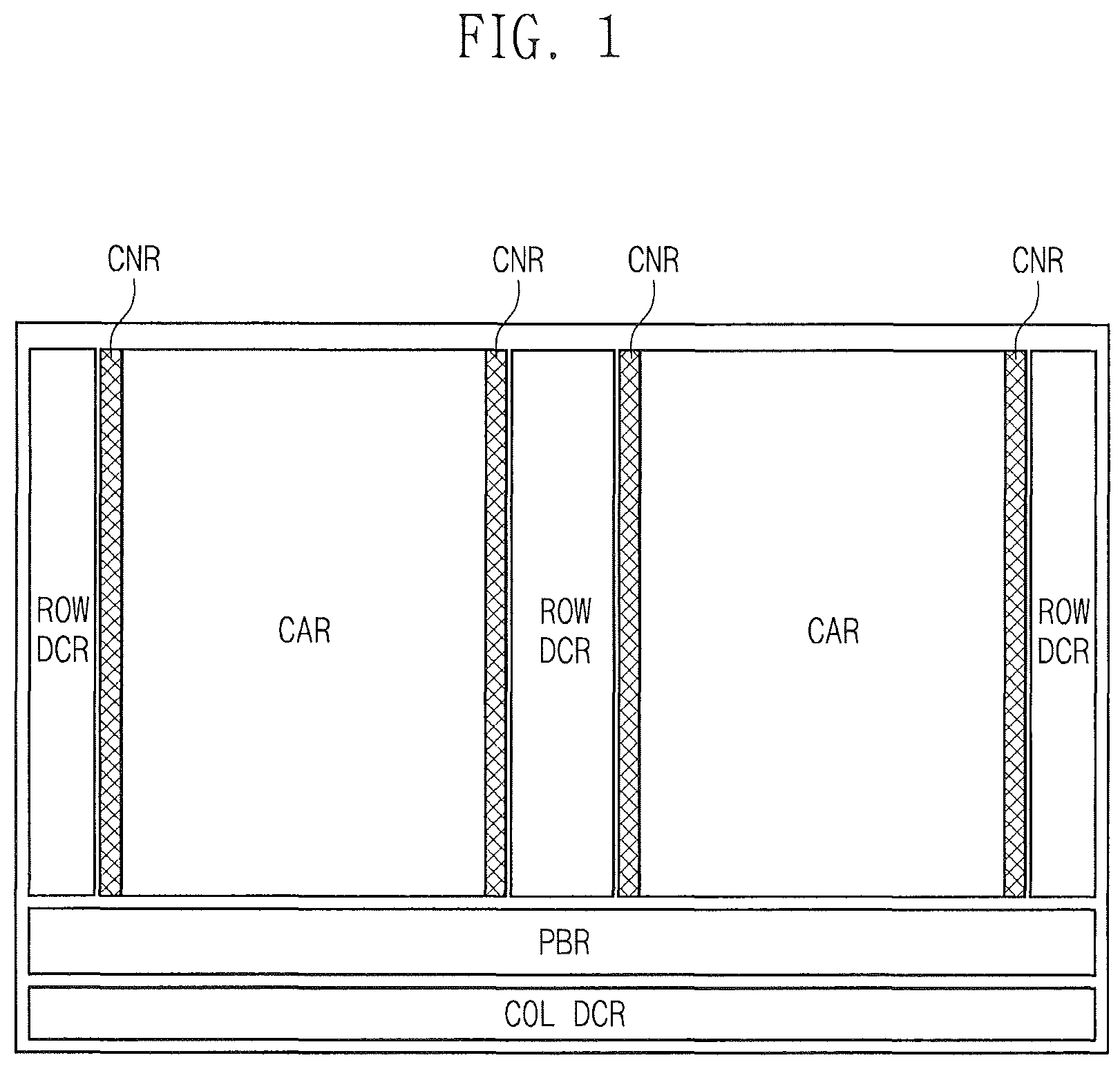
is a schematic diagram illustrating a chip layout of a three-dimensional (3D) semiconductor memory device according to some embodiments of the inventive concept.
is a schematic block diagram illustrating a cell array of a 3D semiconductor memory device according to some embodiments of the inventive concept.
are plan and perspective views illustrating a cell array block of a 3D semiconductor memory device according to some embodiments of the inventive concept.
A is a plan view illustrating one of first electrodes of an electrode structure shown in , and B is a plan view illustrating one of second electrodes of the electrode structure shown in .
, 7 , and 8 illustrate contact plugs connected to the electrode structure shown in .
illustrate interconnection lines connected to the electrode structure shown in .
A is a sectional view, which is taken along line I-I′ of to illustrate a 3D semiconductor memory device according to some embodiments of the inventive concept, and B is an enlarged sectional view of a portion ‘A’ of A .
C is a sectional view, which is taken along line I-I′ of to illustrate a 3D semiconductor memory device according to some embodiments of the inventive concept, and D is an enlarged sectional view of a portion ‘A’ of C .
E is a sectional view illustrating another example of a 3D semiconductor memory device according to some embodiments of the inventive concept.
is a plan view illustrating another example of an electrode structure of a 3D semiconductor memory device according to some embodiments of the inventive concept.
A is a plan view illustrating one of first electrodes of electrode structures shown in , and B is a plan view illustrating one of second electrodes of the electrode structures shown in .
is a plan view illustrating another example of an electrode structure of a 3D semiconductor memory device according to some embodiments of the inventive concept.
A is a plan view illustrating one of first electrodes of electrode structures shown in , and B is a plan view illustrating one of second electrodes of the electrode structures shown in .
, 17 , and 18 are plan views illustrating a 3D semiconductor memory device according to some embodiments of the inventive concept.
are plan and perspective views illustrating a cell array block of a 3D semiconductor memory device according to some embodiments of the inventive concept.
are plan and perspective views illustrating contact plugs connected to an electrode structure shown in .
is a plan view illustrating interconnection lines connected to an electrode structure shown in .
are plan views illustrating a 3D semiconductor memory device according to some embodiments of the inventive concept.
are plan and perspective views illustrating an electrode structure of a 3D semiconductor memory device according to some embodiments of the inventive concept.
are plan and perspective views illustrating contact plugs connected to an electrode structure shown in .
is a plan view illustrating interconnection lines connected to an electrode structure shown in .
are plan views illustrating a 3D semiconductor memory device according to some embodiments of the inventive concept.
to 36 are perspective views illustrating a method of forming an electrode structure of a 3D semiconductor memory device according to some embodiments of the inventive concept.
It should be noted that these figures are intended to illustrate the general characteristics of methods, structure and/or materials utilized in certain example embodiments and to supplement the written description provided below. These drawings are not, however, to scale and may not precisely reflect the precise structural or performance characteristics of any given embodiment, and should not be interpreted as defining or limiting the range of values or properties encompassed by example embodiments. For example, the relative thicknesses and positioning of molecules, layers, regions and/or structural elements may be reduced or exaggerated for clarity. The use of similar or identical reference numbers in the various drawings is intended to indicate the presence of a similar or identical element or feature.
DETAILED DESCRIPTION
Exemplary embodiments of aspects of the present inventive concepts explained and illustrated herein include their complementary counterparts. The same reference numerals or the same reference designators denote the same elements throughout the specification.
is a schematic diagram illustrating a chip layout of a three-dimensional (3D) semiconductor memory device according to some embodiments of the inventive concept. Referring to , a 3D semiconductor memory device may include a cell array region CAR and a peripheral circuit region. The peripheral circuit region may include row decoder regions ROW DCR, a page buffer region PBR, a column decoder region COL DCR, and a control circuit region (not shown). In some embodiments, a connection region CNR may be provided between the cell array region CAR and each of the row decoder regions ROW DCR.
A memory cell array may be provided in the cell array region CAR. In some embodiments, the memory cell array may include a plurality of memory cells, which are three-dimensionally arranged in the memory cell array, and a plurality of word and bit lines, which are electrically connected to the memory cells.
In each of the row decoder regions ROW DCR, a row decoder may be provided to select at least one of the word lines that are provided in the memory cell array, and in the connection region CNR, an interconnection structure may be provided to electrically connect the memory cell array to the row decoder. The row decoder may be configured to select at least one of the word lines, based on address information. The row decoder may be configured to apply different word line voltages to selected and unselected ones of the word lines, in response to control signals from a control circuit (not shown).
In the page buffer region PBR, a page buffer may be provided to read out data stored in the memory cells. Depending on an operation mode, the page buffer may be configured to temporarily store data in the memory cells or to read out data stored in the memory cells. For example, the page buffer may function as a write driver in a program operation mode or as a sense amplifier in a read operation mode.
A column decoder may be provided in the column decoder region COL DCR. The column decoder may be connected to the bit lines of the memory cell array to provide data-transmission paths between the page buffer and an external device (e.g., a memory controller).
is a schematic block diagram illustrating a cell array of a 3D semiconductor memory device according to some embodiments of the inventive concept. Referring to , the cell array region CAR may include a plurality of cell array blocks BLK 1 , BLK 2 , BLKn. Each of the cell array blocks BLK 1 , BLK 2 , BLKn may include an electrode structure including a plurality of electrodes stacked in a third direction D 3 on a plane defined by first and second directions D 1 and D 2 . The electrode structure may be coupled to a plurality of vertical structures or semiconductor pillars to constitute three-dimensionally arranged memory cells. In addition, each of the cell array blocks BLK 1 , BLK 2 , BLKn may include bit lines that are electrically connected to the memory cells.
are plan and perspective views illustrating a cell array block of a 3D semiconductor memory device according to some embodiments of the inventive concept. A is a plan view illustrating one of first electrodes of an electrode structure shown in , and B is a plan view illustrating one of second electrodes of the electrode structure shown in .
Referring to , a substrate 10 may include a cell array region CAR and a connection region CNR. For example, the substrate 10 may be formed of or include at least one of silicon (Si), germanium (Ge), silicon germanium (SiGe), gallium arsenic (GaAs), indium gallium arsenic (InGaAs), or aluminum gallium arsenic (AlGaAs). The substrate 10 may be, for example, a bulk silicon wafer, a silicon-on-insulator (SOI) wafer, a germanium wafer, a germanium-on-insulator (GOI) wafer, a silicon-germanium substrate, or a substrate with an epitaxial layer formed by a selective epitaxial growth (SEG) process. In certain embodiments, the substrate 10 may be formed of or include one or more insulating layers. For example, the substrate 10 may include a silicon oxide layer, a silicon nitride layer, or low-k dielectric.
In some embodiments, a plurality of cell array blocks BLK 1 and BLK 2 may be provided on the substrate 10 , and each of the cell array blocks BLK 1 and BLK 2 may include an electrode structure, in which a plurality of vertically stacked electrodes ELa and ELb are provided.
A plurality of electrode structures may be provided on the substrate 10 , and each of the electrode structures may include a plurality of electrodes ELa and ELb, which are stacked on a top surface of the substrate 10 or in the third direction D 3 (e.g., perpendicular to the top surface of the substrate 10 ). Each of the electrode structures may have a staircase structure on the connection region CNR. In other words, on the connection region CNR, each of the electrode structures may have a thickness decreasing in a stepwise manner in a direction away from the cell array region CAR.
The electrodes ELa and ELb may be formed of or include a conductive material; for example, the electrodes ELa and ELb may include at least one of doped semiconductor (e.g., doped silicon), metals (e.g., tungsten, copper, aluminum, etc.), conductive metal nitrides (e.g., titanium nitride, tantalum nitride, etc.), or transition metals (e.g., titanium, tantalum, etc.). Each of the electrode structures may include insulating layers (not shown) interposed between the electrodes ELa and ELb.
The cell array blocks may include first and second cell array blocks BLK 1 and BLK 2 , which are provided on the substrate 10 to be spaced apart from each other. Also, the electrode structures may include first and second electrode structures ST 1 and ST 2 . The first cell array block BLK 1 may include the first electrode structure ST 1 , and the second cell array block BLK 2 may include the second electrode structure ST 2 . The first and second electrode structures ST 1 and ST 2 may extend from the cell array region CAR to the connection region CNR in the first direction D 1 and may be spaced apart from each other in the second direction D 2 .
Each of the first and second electrode structures ST 1 and ST 2 may include first electrodes ELa and second electrodes ELb, which are alternatingly and vertically stacked on the substrate 10 . Here, each of the first electrodes ELa may include a first pad region P 1 , which is located on the connection region CNR and is exposed by the second electrode ELb thereon, and each of the second electrodes ELb may include a second pad region P 2 , which is located on the connection region CNR and is exposed by the first electrode ELa thereon. In each of the first and second electrode structures ST 1 and ST 2 , the first pad regions P 1 of the first electrodes ELa may be located at horizontally and vertically different positions. The second pad regions P 2 of the second electrodes ELb may also be located at horizontally and vertically different positions. In addition, the first pad regions P 1 of the first electrodes ELa may be adjacent to the second pad regions P 2 of the second electrodes ELb in the second direction D 2 .
In other words, each of the first and second electrode structures ST 1 and ST 2 may have a first stair-step structure, which is formed by the first pad regions P 1 of the first electrodes ELa exposed on the connection region CNR, and a second stair-step structure, which is formed by the second pad regions P 2 of the second electrodes ELb exposed on the connection region CNR. For example, in the first stair-step structure of the first electrodes ELa, the first pad regions P 1 may be arranged in the first direction D 1 when viewed in a plan view, and vertical positions thereof may be lowered in a stepwise manner in the first direction D 1 . Similarly, in the second stair-step structure of the second electrodes ELb, the second pad regions P 2 may be arranged in the first direction D 1 when viewed in a plan view, and vertical positions thereof may be lowered in a stepwise manner in the first direction D 1 . The second stair-step structure may be adjacent to the first stair-step structure in the second direction D 2 .
Furthermore, the first stair-step structure of the first electrode structure ST 1 may be provided to be adjacent to the first stair-step structure of the second electrode structure ST 2 in the second direction D 2 . For example, the first pad regions P 1 of the first electrode structure ST 1 may be adjacent to the first pad regions P 1 of the second electrode structure ST 2 in the second direction D 2 . In other words, the first and second electrode structures ST 1 and ST 2 adjacent to each other in the second direction D 2 may be disposed in a mirror symmetric manner on the connection region CNR.
Hereinafter, the first and second electrodes ELa and ELb in each of the first and second electrode structures ST 1 and ST 2 will be described in more detail with reference to A and 5 B .
Referring to A , each of the first electrodes ELa may include a plurality of electrode portions EP, an electrode connecting portion ECP, and one or more protrusions PP.
The electrode portions EP may extend in the first direction D 1 on the cell array region CAR of the substrate 10 and may be spaced apart from each other in the second direction D 2 . In other words, the electrode portions EP may be horizontally spaced apart from each other. Each of the electrode portions EP may have a first width W 1 in the second direction D 2 .
On the connection region CNR adjacent to the cell array region CAR, the electrode connecting portion ECP may extend in the second direction D 2 to horizontally connect the electrode portions EP to each other. For example, in each of the first and second electrode structures ST 1 and ST 2 , the electrode portions EP positioned at the same level from the substrate 10 may be connected to each other through the electrode connecting portion ECP, thereby being in an equipotential state.
The protrusions PP may be located on the connection region CNR and may be extended from the electrode connecting portion ECP in the first direction D 1 . In some embodiments, in each of the first electrodes ELa, the number of the protrusions PP may be the same as or smaller than that of the electrode portions EP. As an example, the protrusions PP may be continuously extended from the electrode portions EP in the first direction D 1 and may be spaced apart from each other in the second direction D 2 . Each of the protrusions PP may have a second width W 2 in the second direction D 2 , and here, the second width W 2 may be substantially equal to the first width W 1 of the electrode portions EP. In the second direction D 2 , a distance between the protrusions PP may be substantially equal to a distance between the electrode portions EP.
All of the protrusions PP of the first electrode ELa may have a first length d 1 , when measured from the electrode connecting portion ECP in the first direction D 1 . In other words, the protrusions PP of the first electrode ELa may have the same length (i.e., the first length d 1 ) in the first direction D 1 . The length d 1 of the protrusions PP of the first electrode ELa may be changed depending on a vertical position of the first electrode ELa. In addition, at least one of the protrusions PP of the first electrode ELa may include a portion serving as the first pad region P 1 .
Referring to B , similar to the first electrode ELa, each of the second electrodes ELb may include a plurality of electrode portions EP provided on the cell array region CAR, an electrode connecting portion ECP horizontally connecting the electrode portions EP to each other, and protrusions PP 1 and PP 2 protruding from the electrode connecting portion ECP. Here, the electrode portions EP may extend in the first direction D 1 and may be spaced apart from each other in the second direction D 2 .
In the second electrode ELb, the protrusions PP 1 and PP 2 may include first protrusions PP 1 , which are extended from the electrode connecting portion ECP by the first length d 1 in the first direction D 1 , and second protrusions PP 2 , which are extended from the electrode connecting portion ECP by a second length d 2 shorter than the first length d 1 . At least one of the first protrusions PP 1 of the second electrode ELb may include a portion serving as the second pad region P 2 . The first protrusions PP 1 of the second electrode ELb may have substantially the same length (i.e., the first length d 1 ) as that of the protrusions PP of the first electrode ELa located below the second electrode ELb. The lengths d 1 and d 2 of the first and second protrusions PP 1 and PP 2 of the second electrode ELb may be changed depending on a vertical position of the second electrode ELb.
Referring back to , in each of the first and second electrode structures ST 1 and ST 2 , the electrode portions EP of the second electrode ELb may be overlapped with the electrode portions EP of the first electrode ELa, when viewed in a plan view. Also, in each of the first and second electrode structures ST 1 and ST 2 , the electrode connecting portion ECP of the first electrode ELa may be overlapped with the electrode connecting portion ECP of the second electrode ELb, when viewed in a plan view.
Furthermore, in each of the first and second electrode structures ST 1 and ST 2 , the first protrusions PP 1 of the second electrode ELb may be overlapped with some of the protrusions PP of the first electrode ELa positioned therebelow, when viewed in a plan view. The second protrusions PP 2 of the second electrode ELb may be provided to expose the others of the protrusions PP of the first electrode ELa positioned therebelow, when viewed in a plan view. Also, side surfaces of the first protrusions PP 1 of the second electrode ELb may be aligned to side surfaces of the protrusions PP of the first electrode ELa positioned therebelow. Side surfaces of the second protrusions PP 2 of the second electrode ELb may be aligned to side surfaces of the protrusions PP of the first electrode ELa positioned thereon.
, 7 , and 8 illustrate contact plugs connected to the electrode structure shown in .
Referring to , first contact plugs CP 1 may be coupled to the first electrodes ELa, respectively, of the first electrode structure ST 1 on the connection region CNR, and second contact plugs CP 2 may be coupled to the second electrodes ELb, respectively, of the first electrode structure ST 1 on the connection region CNR. For example, the number of the first contact plugs CP 1 connected to the first electrode structure ST 1 may be the same as the number of the first electrodes ELa constituting the first electrode structure ST 1 . Similarly, the number of the second contact plugs CP 2 connected to the first electrode structure ST 1 may be the same as the number of the second electrodes ELb constituting the first electrode structure ST 1 .
The first contact plugs CP 1 may be provided on the first stair-step structure, and the second contact plugs CP 2 may be provided on the second stair-step structure. For example, the first contact plugs CP 1 may be respectively coupled to the first pad regions P 1 of the first electrodes ELa, and the second contact plugs CP 2 may be respectively coupled to the second pad regions P 2 of the second electrodes ELb. In other words, each of the first contact plugs CP 1 may be coupled to a corresponding one of the protrusions PP of the first electrode ELa, and each of the second contact plugs CP 2 may be coupled to a corresponding one of the first protrusions PP 1 of the second electrode ELb.
The first contact plugs CP 1 may be arranged to be spaced apart from each other in the first direction D 1 , and bottom surfaces of the first contact plugs CP 1 may be positioned at different levels from the substrate 10 . Similarly, the second contact plugs CP 2 may be arranged to be spaced apart from each other in the first direction D 1 , and bottom surfaces of the second contact plugs CP 2 may be positioned at different levels from the substrate 10 .
In some embodiments, the first contact plugs CP 1 may be spaced apart from the second contact plugs CP 2 by a first horizontal distance L 1 in the second direction D 2 . Here, the first horizontal distance L 1 may be greater than the width W 1 of the electrode portions EP of the first and second electrodes ELa and ELb. For example, the first horizontal distance L 1 may be equal to or greater than two times the width W 1 of the electrode portions EP of the first and second electrodes ELa and ELb. This may make it possible to increase a process margin in distance between the first and second contact plugs CP 1 and CP 2 coupled to the first electrode structure ST 1 .
In addition, the first contact plugs CP 1 of the first electrode structure ST 1 may be spaced apart from the first contact plugs CP 1 of the second electrode structure ST 2 by a second horizontal distance L 2 in the second direction D 2 , where the second horizontal distance L 2 may be shorter than the first horizontal distance L 1 . The second horizontal distance L 2 may be equal to or longer than the width W 1 of the electrode portions EP of the first and second electrodes ELa and ELb. As another example, the second horizontal distance L 2 may be substantially equal to the first horizontal distance L 1 , as shown in .
Thus, as described hereinabove with respect to , a vertical non-volatile memory device according to embodiments of the invention includes a semiconductor substrate 10 having a memory cell region CAR (e.g., cell array region) and a connection region CNR thereon. As illustrated, the connection region CNR can extend immediately adjacent the memory cell region CAR. A plurality of spaced-apart first gate electrodes ELa are provided, which extend side-by-side and lengthwise in a first direction D 1 from the memory cell region CAR to the connection region CNR. A plurality of spaced-apart second gate electrodes ELb are also provided, which extend side-by-side and lengthwise in the first direction D 1 from the memory cell region CAR to the connection region CNR. As shown by , the plurality of spaced-apart first gate electrodes ELa may extend between the corresponding plurality of spaced-apart second gate electrodes ELb and the semiconductor substrate 10 . As shown by A , a first gate electrode connecting line ECP (e.g., electrode connecting portion) is also provided, which extends lengthwise in a second direction D 2 across the connection region CNR at a level coplanar with the plurality of spaced-apart first gate electrodes ELa. The first gate electrode connecting line ECP electrically shorts the plurality of spaced-apart first gate electrodes ELa together. As shown by B , a second gate electrode connecting line ECP is provided, which extends lengthwise in the second direction D 2 across the connection region CNR at a level coplanar with the plurality of spaced-apart second gate electrodes ELb. The second gate electrode connecting line ECP electrically shorts the plurality of spaced-apart second gate electrodes ELb together.
According to additional embodiments of the invention, the first and second directions (D 1 and D 2 ) are orthogonal to each other (i.e., at 90°) and the first gate electrode connecting line ECP partitions the plurality of spaced-apart first gate electrodes ELa into respective first active gate electrode regions EP, which extend across at least a portion of the memory cell region CAR, and respective first pad regions PP (P 1 ), which are located within the connection region CNR and at distal ends of the plurality of spaced-apart first gate electrodes ELa, as shown by A . Similarly, the second gate electrode connecting line ECP partitions the plurality of spaced-apart second gate electrodes ELb into respective second active gate electrode regions EP, which extend across at least a portion of the memory cell region CAR, and respective second pad regions P 2 and PP 2 , which are located within the connection region CNR and at distal ends of the plurality of spaced-apart second gate electrodes ELb, as shown by B . As shown by A versus B (and , 7 ), at least two of the first pad regions P 1 associated with the plurality of spaced-apart first gate electrodes ELa have equivalent contact area dimensions, and at least two of the second pad regions PP 1 (P 2 ) v. PP 2 associated with the plurality of spaced-apart second gate electrodes ELb have unequal contact area dimensions.
As shown by , these memory devices further include a first vertical contact plug CP 1 , which electrically contacts a first of the at least two of the first pad regions P 1 , and a second vertical contact plug CP 2 , which electrically contacts a first of the at least two of the second pad regions P 2 . As shown by , 5 A- 5 B and 7 , the first of the at least two of the second pad regions P 2 completely overlaps a second of the at least two of the first pad regions P 1 , but a second of the at least two of the second pad regions PP 2 only partially overlaps the first of the at least two of the first pad regions P 1 . As shown best by B , the second of the at least two of the second pad regions PP 2 has smaller contact area dimensions relative to the first of the at least two of the second pad regions PP 1 .
illustrate interconnection lines connected to the electrode structure shown in . A is a sectional view, which is taken along line I-I′ of to illustrate a 3D semiconductor memory device according to some embodiments of the inventive concept, and B is an enlarged sectional view of a portion ‘A’ of A .
Referring to , 10 , and 11 A , first interconnection lines CL 1 may be provided on the connection region CNR and may be coupled to the first contact plugs CP 1 , respectively, of the first electrode structure ST 1 , and second interconnection lines CL 2 may be provided on the connection region CNR and may be coupled to the second contact plugs CP 2 , respectively, of the first electrode structure ST 1 . For example, the number of the first interconnection lines CL 1 connected to the first electrodes ELa of the first electrode structure ST 1 may be the same as the number of the first electrodes ELa, and the number of the second interconnection lines CL 2 connected to the second electrodes ELb of the first electrode structure ST 1 may be the same as the number of the second electrodes ELb. In some embodiments, the first and second interconnection lines CL 1 and CL 2 may be disposed at the same vertical level from the substrate 10 .
In detail, each of the first and second interconnection lines CL 1 and CL 2 may include a first portion extending in the first direction D 1 and a second portion extending in the second direction D 2 . The first portions of the first interconnection lines CL 1 may be spaced apart from each other by a uniform distance in the second direction D 2 , and the second portions of the first interconnection lines CL 1 may be in contact with the first contact plugs CP 1 , respectively. The second interconnection lines CL 2 may be provided in a similar manner to the first interconnection lines CL 1 . Meanwhile, the shape and arrangement of the first and second interconnection lines CL 1 and CL 2 are not limited to the above examples and may be variously changed. As an example, the first and second interconnection lines CL 1 and CL 2 connected to the first electrode structure ST 1 may be overlapped with the first electrode structure ST 1 , when viewed in a plan view. Also, the first and second interconnection lines CL 1 and CL 2 connected to the second electrode structure ST 2 may be overlapped with the second electrode structure ST 2 , when viewed in a plan view.
According to some embodiments of the inventive concept, since, in each of the first and second electrode structures ST 1 and ST 2 , the electrode portions EP positioned at the same level are connected to each other through the electrode connecting portion ECP, it is possible to simplify the interconnection structures (i.e., the first and second contact plugs CP 1 and CP 2 and the first and second interconnection lines CL 1 and CL 2 ) connected to each of the first and second electrode structures ST 1 and ST 2 and to increase a process margin in a process of forming the interconnection structures.
The 3D semiconductor memory device may further include vertical structures VS, a data storing layer DS, common source structures SP and CSP, and bit lines BL, which are disposed on the cell array region CAR.
For example, as shown in A and 11 B , a plurality of vertical structures VS may be provided on the cell array region CAR to penetrate the first and second electrode structures ST 1 and ST 2 . The vertical structures VS may be provided to penetrate the electrode portions EP of the first and second electrodes ELa and ELb and may be electrically connected to the substrate 10 . The vertical structures VS may be provided to form a zigzag arrangement in the first direction D 1 , when viewed in a plan view.
The vertical structures VS may include a semiconductor material or a conductive material. Bottom surfaces of the vertical structures VS may be positioned between top and bottom surfaces of the substrate 10 . Contact pads may be provided on the vertical structures VS, respectively, and the bit line contact plugs BPLG may be respectively connected to the contact pads.
As an example, each of the vertical structures VS may include a lower semiconductor pattern LSP and an upper semiconductor pattern USP. As an example, the lower and upper semiconductor patterns LSP and USP may be formed of or include at least one of doped or intrinsic semiconductor materials (e.g., of silicon (Si), germanium (Ge), or compounds thereof) and may have different crystal structures. The lower and upper semiconductor patterns LSP and USP may have one of polycrystalline, amorphous, and single-crystalline structures. The lower and upper semiconductor patterns LSP and USP may be in an undoped state or may be doped to have the same conductivity type as the substrate 10 .
The lower semiconductor pattern LSP may be provided to be in direct contact with the substrate 10 and to penetrate the lowermost one of the electrodes of the first and second electrode structures ST 1 and ST 2 . The upper semiconductor pattern USP may include a first semiconductor pattern SP 1 and a second semiconductor pattern SP 2 . The first semiconductor pattern SP 1 may be coupled to the lower semiconductor pattern LSP and may have a pipe or macaroni shape with closed bottom and open top. An inner space of the first semiconductor pattern SP 1 may be filled with an insulating gap-fill pattern VI. In addition, the first semiconductor pattern SP 1 may be in contact with an inner surface of the second semiconductor pattern SP 2 and the top surface of the lower semiconductor pattern LSP. In other words, the first semiconductor pattern SP 1 may allow the second semiconductor pattern SP 2 to be electrically connected to the lower semiconductor pattern LSP. The second semiconductor pattern SP 2 may be a pipe or macaroni structure with open top and bottom. The second semiconductor pattern SP 2 may be spaced apart from (i.e., in non-contact with) the lower semiconductor pattern LSP.
In some embodiments, the data storing layer DS may be disposed between the first and second electrode structures ST 1 and ST 2 and the vertical structures VS. The data storing layer DS may include a vertical insulating layer VP, which is provided to penetrate the electrodes EL, and a horizontal insulating layer HP, which is extended from a region between the electrodes EL and the vertical insulating layer VP to cover top and bottom surfaces of the electrodes EL.
In some embodiments, the 3D semiconductor device may be a NAND FLASH memory device. For example, the data storing layer DS interposed between the electrode structure ST and the vertical structure VS may include a tunnel insulating layer, a charge storing layer, and a blocking insulating layer. Data stored in the data storing layer DS may be changed using a Fowler-Nordheim FN tunneling effect, which may be caused by a voltage difference between the vertical structure VS and the electrodes EL of the electrode structure ST.
Common source regions CSR may be provided in the substrate 10 and between the electrode portions EP of the electrode structures on the cell array region CAR. The common source regions CSR may extend parallel to the electrode portions EP of the electrode structures or in the first direction D 1 . In some embodiments, the common source regions CSR may be formed by doping the substrate 10 with impurities of a second conductivity type. The common source regions CSR may be doped with, for example, n-type impurities (e.g., arsenic (As) or phosphorus (P)).
The common source plug CSP may be coupled to the common source region CSR, and an insulating sidewall spacer SP may be interposed between the common source plug CSP and the electrode portions EP of the first and second electrode structures ST 1 and ST 2 . The common source plug CSP may have a substantially uniform top width and may extend parallel to the electrode portions EP or in the first direction D 1 .
An insulating gapfill layer 20 may be provided on the substrate 10 to cover the electrode structures ST. The insulating gapfill layer 20 may have a substantially flat top surface and may have a thickness increasing in a direction from the cell array region CAR toward the connection region CNR. For example, the insulating gapfill layer 20 may be provided to cover the first and second pad regions P 1 and P 2 or the protrusions PP of the first and second electrode structures ST 1 and ST 2 , on the connection region CNR.
A capping insulating layer 30 may be provided on the insulating gapfill layer 20 , and the bit lines BL may be provided on the capping insulating layer 30 to extend in the second direction D 2 and to cross the electrode portions EP of the first and second electrode structures ST 1 and ST 2 . The bit lines BL may be electrically connected to the vertical structure VS through the bit line contact plug BPLG. Also, the first and second interconnection lines CL 1 and CL 2 may be provided on the capping insulating layer 30 and may be connected to the first and second contact plugs CP 1 and CP 2 .
C is a sectional view, which is taken along line I-I′ of to illustrate a 3D semiconductor memory device according to some embodiments of the inventive concept, and D is an enlarged sectional view of a portion ‘A’ of C . For concise description, an element previously described with reference to to 11 B may be identified by a similar or identical reference number without repeating an overlapping description thereof.
Referring to C and 11 D , the vertical structures VS may be provided to penetrate the first and second electrode structures ST 1 and ST 2 on the cell array region CAR. The vertical structures VS may be provided to penetrate the electrode portions EP of the first and second electrodes ELa and ELb and may be electrically connected to the substrate 10 .
In some embodiments, each of the vertical structures VS may include the first semiconductor pattern SP 1 , which is provided to penetrate the electrode structures ST and to be in contact with the substrate 10 , and the second semiconductor pattern SP 2 , which is interposed between the electrode structures ST and the first semiconductor pattern SP 1 .
In detail, the first semiconductor pattern SP 1 may be provided to have a hollow pipe structure or a macaroni structure. The first semiconductor pattern SP 1 may have a closed bottom, and an inner space of the first semiconductor pattern SP 1 may be filled with the gap-fill insulating pattern VI. Alternatively, the first semiconductor pattern SP 1 may be provided to have a circular solid pillar structure. The first semiconductor pattern SP 1 may be in contact with an inner side surface of the second semiconductor pattern SP 2 and a top surface of the substrate 10 . In other words, the first semiconductor pattern SP 1 may be provided to electrically connect the second semiconductor pattern SP 2 to the substrate 10 . In certain embodiments, the first semiconductor pattern SP 1 may have a bottom surface that is positioned at a lower level than the top surface of the substrate 10 .
The second semiconductor pattern SP 2 may be a pipe or macaroni structure with open top and bottom. The second semiconductor pattern SP 2 may have a bottom surface that is positioned at a higher level than a bottom surface of the first semiconductor pattern SP 1 and is spaced apart from the substrate 10 . Alternatively, the second semiconductor pattern SP 2 may be in direct contact with the substrate 10 .
The first and second semiconductor patterns SP 1 and SP 2 may be in an undoped state or may be doped to have the same conductivity type as the substrate 10 . The first and second semiconductor patterns SP 1 and SP 2 may be provided to have a polycrystalline or single crystalline structure.
E is a sectional view illustrating another example of a 3D semiconductor memory device according to some embodiments of the inventive concept. For concise description, an element previously described with reference to to 11 B may be identified by a similar or identical reference number without repeating an overlapping description thereof.
Referring to E , channel structures CHS may be provided on the cell array region CAR to penetrate the first and second electrode structures ST 1 and ST 2 . For example, the channel structures CHS may be provided to penetrate the electrode portions EP of the first and second electrodes ELa and ELb.
In some embodiments, each of the channel structures CHS may include first and second vertical channels VS 1 and VS 2 , which are provided to penetrate the first and second electrode structures ST 1 and ST 2 , and a horizontal channel HS, which is provided below the first and second electrode structures ST 1 and ST 2 to connect the first and second vertical channels VS 1 and VS 2 to each other. The first and second vertical channels VS 1 and VS 2 may be provided in vertical holes penetrating the first and second electrode structures ST 1 and ST 2 . The horizontal channel HS may be provided in a recess region, which is formed in an upper portion of the substrate 10 . The horizontal channel HS may be provided between the substrate 10 and the first and second electrode structures ST 1 and ST 2 to connect the first and second vertical channels VS 1 and VS 2 to each other.
As an example, the horizontal channel HS may be a hollow structure (e.g., a pipe or a macaroni), which is continuously connected to the first and second vertical channels VS 1 and VS 2 . For example, the first and second vertical channels VS 1 and VS 2 and the horizontal channel HS may be connected to form a single pipe-shaped structure. In other words, the first and second vertical channels VS 1 and VS 2 and the horizontal channel HS may be a single continuous semiconductor pattern that is substantially absent of any interface. Here, the semiconductor pattern may be formed of or include a semiconductor material and may have a single crystalline structure, an amorphous structure, or a polycrystalline structure. In addition, as described above, the data storing layer may be interposed between the channel structures CHS and the first and second electrodes ELa and ELb.
In some embodiments, the first vertical channel VS 1 of each channel structure CHS may be connected to a corresponding one of the bit lines BL, and the second vertical channel VS 2 may be connected to a common source line CSL. The channel structures CHS may be electrically separated from each other, and electric potential of each of the channel structures CHS may be controlled by voltages applied to the first and second electrode structures ST 1 and ST 2 . For example, the electric potential of each of the channel structures CHS may be controlled to selectively form a current path between the bit line BL and the common source line CSL.
is a plan view illustrating another example of an electrode structure of a 3D semiconductor memory device according to some embodiments of the inventive concept. A is a plan view illustrating one of first electrodes of electrode structures shown in , and B is a plan view illustrating one of second electrodes of the electrode structures shown in . In the description that follows, a discussion of features identical to those of to 11 B will be minimized in order to avoid redundancy.
Referring to , 13 A, and 13 B , the first and second electrode structures ST 1 and ST 2 may be provided on the substrate 10 to be spaced apart from each other in the second direction D 2 . Each of the first and second electrode structures ST 1 and ST 2 may include the first electrodes ELa and the second electrodes ELb, which are vertically and alternatingly stacked on the substrate 10 .
As described above, each of the first electrodes ELa may include the first pad region P 1 , which is located on the connection region CNR and is exposed by the second electrode ELb thereon, and each of the second electrodes ELb may include the second pad region P 2 , which is located on the connection region CNR and is exposed by the first electrode ELa thereon. Here, the first pad regions P 1 of the first electrodes ELa may be adjacent to the second pad regions P 2 of the second electrodes ELb in the second direction D 2 . Also, the first pad regions P 1 of the first electrode structure ST 1 may be adjacent to the first pad regions P 1 of the second electrode structure ST 2 in the second direction D 2 .
Referring to A , each of the first electrodes ELa of the first and second electrode structures ST 1 and ST 2 may include a plurality of the electrode portions EP, the electrode connecting portion ECP, and one or more protrusions PP. The electrode portions EP may be provided on the cell array region CAR to extend in the first direction D 1 and may be spaced apart from each other in the second direction D 2 . On the connection region CNR adjacent to the cell array region CAR, the electrode connecting portion ECP may extend in the second direction D 2 to horizontally connect the electrode portions EP to each other. The protrusions PP may be extended from the electrode connecting portion ECP in the first direction D 1 and may be spaced apart from each other in the second direction D 2 . As an example, each of the protrusions PP may have the second width W 2 in the second direction D 2 , and here, the second width W 2 may be greater than the first width W 1 of the electrode portions EP. When measured in the second direction D 2 , a distance between the protrusions PP may be substantially equal to a distance between the electrode portions EP. All of the protrusions PP of the first electrode ELa may have the first length d 1 , when measured from the electrode connecting portion ECP in the first direction D 1 . In addition, at least one of the protrusions PP of the first electrode ELa may include a portion serving as the first pad region P 1 .
Referring to B , each of the first electrodes ELa of the first and second electrode structures ST 1 and ST 2 may include a plurality of the electrode portions EP, the electrode connecting portion ECP, and one or more protrusions PP. The protrusions PP of the second electrode ELb may include the first protrusion PP 1 , which is extended from the electrode connecting portion ECP by the first length d 1 in the first direction D 1 , and the second protrusion PP 2 , which is extended from the electrode connecting portion ECP by the second length d 2 shorter than the first length d 1 in the first direction D 1 . Each of the first and second protrusions PP 1 and PP 2 may have the second width W 2 in the second direction D 2 , and the second width W 2 may be larger than the first width W 1 of the electrode portions EP. When measured in the second direction D 2 , a distance between the first and second protrusions PP 1 and PP 2 may be substantially equal to a distance between the electrode portions EP. The first protrusion PP 1 of the second electrode ELb may include a portion serving as the second pad region P 2 .
Referring back to , the first and second electrodes ELa and ELb may be alternatingly stacked on the substrate 10 , and the electrode connecting portions ECP of the first and second electrodes ELa and ELb may be overlapped with each other, when viewed in a plan view. In other words, the electrode connecting portion ECP of the second electrode ELb may be disposed on the electrode connecting portion ECP of the first electrode ELa. Furthermore, the lengths d 1 and d 2 , in the first direction D 1 , of the protrusions PP of the first and second electrodes ELa and ELb may decrease with increasing vertical distance from the substrate 10 .
is a plan view illustrating another example of an electrode structure of a 3D semiconductor memory device according to some embodiments of the inventive concept. A is a plan view illustrating one of first electrodes of electrode structures shown in , and B is a plan view illustrating one of second electrodes of the electrode structures shown in . In the description that follows, a discussion of features identical to those of to 11 B will be minimized in order to avoid redundancy.
Referring to , 15 A, and 15 B , each of the first and second electrode structures ST 1 and ST 2 may include the first and second electrodes ELa and ELb, which are vertically and alternatingly stacked on the substrate 10 . The first electrodes ELa of the first and second electrode structures ST 1 and ST 2 may include the first pad region P 1 , which is positioned on the connection region CNR and is exposed by the second electrode ELb positioned thereon, and each of the second electrodes ELb may include the second pad region P 2 , which is positioned on the connection region CNR and is exposed by the first electrode ELa positioned thereon. Here, the first pad regions P 1 of the first electrodes ELa may be adjacent to the second pad regions P 2 of the second electrodes ELb in the second direction D 2 . Also, the first pad regions P 1 of the first electrode structure ST 1 may be adjacent to the first pad regions P 1 of the second electrode structure ST 2 in the second direction D 2 .
Referring to A , each of the first electrodes ELa may include a plurality of the electrode portions EP, which are provided on the cell array region CAR to extend in the first direction D 1 , and the electrode connecting portion ECP, which extends in the second direction D 2 and horizontally connects the electrode portions EP to each other. In some embodiments, a side surface of the electrode connecting portion ECP of the first electrode ELa may be aligned to a side surface of the protrusion PP of the second electrode ELb positioned thereon. As an example, a portion of the electrode connecting portion ECP of the first electrode ELa may be exposed by the second electrode ELb positioned thereon, and the exposed portion of the electrode connecting portion ECP exposed by the second electrode ELb may serve as the first pad region P 1 .
Referring to B , each of the second electrodes ELb may include a plurality of the electrode portions EP, which are provided on the cell array region CAR to extend in the first direction D 1 , the electrode connecting portion ECP, and the protrusion PP. As an example, a width of the protrusion PP of the second electrode ELb may be equal to or greater than two times the width of the electrode portions EP. The protrusion PP of the second electrode ELb may have the second pad region P 2 , and a side surface of the protrusion PP of the second electrode ELb may be aligned to a side surface of the electrode connecting portion ECP of the first electrode ELa positioned therebelow.
Referring back to , the first and second electrodes ELa and ELb may be alternatingly stacked on the substrate 10 , and the electrode connecting portions ECP of the first and second electrodes ELa and ELb may be overlapped with each other, when viewed in a plan view. Furthermore, a length of the electrode connecting portion ECP of the first electrode ELa in the first direction D 1 may decrease with increasing vertical distance from the substrate 10 . Also, a length of the protrusion PP of the second electrode ELb in the first direction D 1 may decrease with increasing vertical distance from the substrate 10 .
, 17 , and 18 are plan views illustrating a 3D semiconductor memory device according to some embodiments of the inventive concept.
Referring to , 17 , and 18 , the substrate 10 may include a first connection region CNR 1 , a second connection region CNR 2 , and the cell array region CAR between the first and second connection regions CNR 1 and CNR 2 . In some embodiments, the first and second connection regions CNR 1 and CNR 2 may be spaced apart from each other in the first direction D 1 .
The first and second electrode structures ST 1 and ST 2 may be provided on the substrate 10 to be spaced apart from each other in the second direction D 2 . The first and second electrode structures ST 1 and ST 2 may extend from the cell array region CAR to the first and second connection regions CNR 1 and CNR 2 in the first direction D 1 . Each of the first and second electrode structures ST 1 and ST 2 may include the first and second electrodes ELa and ELb, which are alternatingly and vertically stacked on the substrate 10 . In some embodiments, lengths of the first and second electrodes ELa and ELb in the first direction D 1 may decrease with increasing vertical distance from the substrate 10 .
For example, in the first and second electrode structures ST 1 and ST 2 , each of the first electrodes ELa may include the first pad regions P 1 provided on each of the first and second connection regions CNR 1 and CNR 2 . The first pad regions P 1 of the first electrodes ELa may be exposed by the second electrodes ELb positioned thereon. Similarly, each of the second electrodes ELb may include the second pad regions P 2 provided on each of the first and second connection regions CNR 1 and CNR 2 . The second pad regions P 2 of the second electrodes ELb may be exposed by the first electrodes ELa positioned thereon.
In some embodiments, in each of the first and second electrode structures ST 1 and ST 2 , the first pad regions P 1 of the first electrodes ELa may be arranged in the first direction D 1 , and the second pad regions P 2 of the second electrodes ELb may be arranged in the first direction D 1 . The first pad regions P 1 and the second pad regions P 2 may be disposed adjacent to each other in the second direction D 2 . In other words, on each of the first and second connection regions CNR 1 and CNR 2 , each of the first and second electrode structures ST 1 and ST 2 may have the first stair-step structure, which are formed by end portions of the first electrodes ELa, and the second stair-step structure, which are formed by end portions of the second electrodes ELb. Here, the first stair-step structure and the second stair-step structure may be adjacent to each other in the second direction D 2 . Furthermore, the first stair-step structure of the first electrode structure ST 1 may be adjacent to the first stair-step structure of the second electrode structure ST 2 in the second direction D 2 , and the second stair-step structure of the first electrode structure ST 1 may be adjacent to the second stair-step structure of the second electrode structure ST 2 in the second direction D 2 .
In some embodiments, similar to that shown in A , each of the first electrodes ELa may include a plurality of the electrode portions EP, which are provided on the cell array region CAR to extend in the first direction D 1 and are spaced apart from each other in the second direction D 2 , a first electrode connecting portion ECP 1 , which is provided on the first connection region CNR 1 to horizontally connect the electrode portions EP to each other, and a second electrode connecting portion ECP 2 , which is provided on the second connection region CNR 2 to horizontally connect the electrode portions EP to each other. Each of the first electrodes ELa may include protrusions PP, which are provided on the first connection region CNR 1 and are extended from the first electrode connecting portion ECP 1 in the first direction D 1 , and protrusions PP, which are provided on the second connection region CNR 2 and are extended from the second electrode connecting portion ECP 2 in the first direction D 1 . As described with reference to A , the protrusions PP may have the same width as that of the electrode portions EP, when measured in in the second direction D 2 , and may be spaced apart from each other in the second direction D 2 . As an example, on the first and second connection regions CNR 1 and CNR 2 , at least one of the protrusions PP of each of the first electrodes ELa may serve as the first pad region P 1 .
Similar to that shown in B , each of the second electrodes ELb may include a plurality of the electrode portions EP, the first electrode connecting portion ECP 1 , which is provided on the first connection region CNR 1 to horizontally connect the electrode portions EP to each other, the second electrode connecting portion ECP 2 , which is provided on the second connection region CNR 2 to horizontally connect the electrode portions EP to each other, and protrusions PP 1 and PP 2 protruding from first and second electrode connecting portions ECP 1 and ECP 2 . As described with reference to B , the protrusions PP of the second electrode ELb may include the first protrusions PP 1 , which are extended from each of the first and second electrode connecting portions ECP 1 and ECP 2 by a first length in the first direction D 1 , and the second protrusions PP 2 , which are extended from each of the first and second electrode connecting portions ECP 1 and ECP 2 by a second length shorter than the first length. In addition, the first protrusions PP 1 of each of the second electrodes ELb may include end portions which are positioned on the first and second connection regions CNR 1 and CNR 2 to serve as the second pad regions P 2 .
In the first and second electrode structures ST 1 and ST 2 , the first contact plugs CP 1 may be coupled to the first electrodes ELa, respectively, and the second contact plugs CP 2 may be coupled to the second electrodes ELb, respectively.
As for the first electrode structure ST 1 , as shown in , the first contact plugs CP 1 may be coupled to the first pad regions P 1 of the first electrodes ELa, respectively, on the first connection region CNR 1 , and the second contact plugs CP 2 may be coupled to the second pad regions P 2 of the second electrodes ELb, respectively, on the second connection region CNR 2 . As for the second electrode structure ST 2 , the first contact plugs CP 1 may be coupled to the first pad regions P 1 of the first electrodes ELa, respectively, on the second connection region CNR 2 , and the second contact plugs CP 2 may be coupled to the second pad regions P 2 of the second electrodes ELb, respectively, on the first connection region CNR 1 .
On the first connection region CNR 1 , the first contact plugs CP 1 coupled to the first electrode structure ST 1 may be provided to be spaced apart from the second contact plugs CP 2 coupled to the second electrode structure ST 2 by the first horizontal distance L 1 in the second direction D 2 . In some embodiments, the first horizontal distance L 1 may be equal to or greater than two times the width of the electrode portions EP of the first and second electrodes ELa and ELb. Similarly, on the second connection region CNR 2 , the second contact plugs CP 2 coupled to the first electrode structure ST 1 may be provided to be spaced apart from the first contact plugs CP 1 coupled to the second electrode structure ST 2 by the first horizontal distance L 1 in the second direction D 2 .
In some embodiments, the first interconnection lines CL 1 may be coupled to the first contact plugs CP 1 of the first and second electrode structures ST 1 and ST 2 , respectively, and the second interconnection lines CL 2 may be coupled to the second contact plugs CP 2 of the first and second electrode structures ST 1 and ST 2 , respectively. As an example, the first interconnection lines CL 1 connected to the first contact plugs CP 1 of the first electrode structure ST 1 may be provided on the first connection region CNR 1 , and the second interconnection lines CL 2 connected to the second contact plugs CP 2 of the first electrode structure ST 1 may be provided on the second connection region CNR 2 . The first interconnection lines CL 1 connected to the first contact plugs CP 1 of the second electrode structure ST 2 may be provided on the second connection region CNR 2 , and the second interconnection lines CL 2 connected to the second contact plugs CP 2 of the second electrode structure ST 2 may be provided on the first connection region CNR 1 .
As described above, each of the first and second interconnection lines CL 1 and CL 2 may include a first portion, which is provided to extend in the first direction D 1 , and a second portion, which is provided to extend in the second direction D 2 and to be in contact with the first or second contact plug CP 1 or CP 2 . Furthermore, the first interconnection lines CL 1 connected to the first electrode structure ST 1 may be disposed to be overlapped with the first electrode structure ST 1 , when viewed in a plan view. Similarly, the second interconnection lines CL 2 connected to the second electrode structure ST 2 may be disposed to be overlapped with the second electrode structure ST 2 , when viewed in a plan view. In some embodiments, the maximum length of the second portion in the first and second interconnection lines CL 1 and CL 2 may be shorter than the width of the first and second electrode structures ST 1 and ST 2 in the second direction D 2 .
As shown in , the first contact plugs CP 1 coupled to the first and second electrode structures ST 1 and ST 2 may be disposed on the first connection region CNR 1 , and the second contact plugs CP 2 coupled to the first and second electrode structures ST 1 and ST 2 may be disposed on the second connection region CNR 2 .
On the first connection region CNR 1 , the first contact plugs CP 1 coupled to the first electrode structure ST 1 may be spaced apart from the first contact plugs CP 1 coupled to the second electrode structure ST 2 by the second horizontal distance L 2 in the second direction D 2 , where the second horizontal distance L 2 may be substantially equal to or greater than the width W 1 of the electrode portions of the first electrodes ELa.
The first interconnection lines CL 1 connected to the first electrode structure ST 1 and the first interconnection lines CL 1 connected to the second electrode structure ST 2 may be disposed in a mirror symmetric manner on the first connection region CNR 1 . Similarly, the second interconnection lines CL 2 connected to the first electrode structure ST 1 and the second interconnection lines CL 2 connected to the second electrode structure ST 2 may be disposed in a mirror symmetric manner on the second connection region CNR 2 .
As shown in , first to third cell array blocks BLK 1 , BLK 2 , and BLK 3 may be arranged in the second direction D 2 on the substrate 10 , the first to third cell array blocks BLK 1 , BLK 2 , and BLK 3 may include first to third electrode structures ST 1 , ST 2 , and ST 3 , respectively.
As described with reference to , each of the first to third electrode structures ST 1 , ST 2 , and ST 3 may be provided to have the first and second stair-step structures on the first and second connection regions CNR 1 and CNR 2 . The first and second electrode structures ST 1 and ST 2 may be disposed in such a way that the first stair-step structures are adjacent to each other in the second direction D 2 , and the second and third electrode structures ST 2 and ST 3 may be disposed in such a way that the second stair-step structures are adjacent to each other in the second direction D 2 .
As an example, the first and second contact plugs CP 1 and CP 2 coupled to the first and third electrode structures ST 1 and ST 3 may be disposed on the first connection region CNR 1 . The first and second contact plugs CP 1 and CP 2 coupled to the second electrode structure ST 2 may be disposed on the second connection region CNR 2 . This may make it possible to increase a distance between the first and second contact plugs CP 1 and CP 2 adjacent to each other in the second direction D 2 or to increase a process margin in a contact forming process.
The first and second interconnection lines CL 1 and CL 2 connected to the first and third electrode structures ST 1 and ST 3 may be disposed on the first connection region CNR 1 , and the first and second interconnection lines CL 1 and CL 2 connected to the second electrode structure ST 2 may be disposed on the second connection region CNR 2 .
The first and second interconnection lines CL 1 and CL 2 connected to the first electrode structure ST 1 may be partially overlapped with a portion of the second electrode structure ST 2 , when viewed in a plan view. The first and second interconnection lines CL 1 and CL 2 connected to the second electrode structure ST 2 may be overlapped with portions of the first and third electrode structures ST 1 and ST 3 adjacent to the second electrode structure ST 2 , when viewed in a plan view. Accordingly, it is possible to increase a horizontal space between the first interconnection lines CL 1 , on the first and second connection regions CNR 1 and CNR 2 . In other words, it is possible to increase a degree of freedom for the first and second interconnection lines CL 1 and CL 2 connected to the first to third electrode structures ST 1 , ST 2 , and ST 3 .
are plan and perspective views illustrating a cell array block of a 3D semiconductor memory device according to some embodiments of the inventive concept.
Referring to , the substrate 10 may include the cell array region CAR and the connection region CNR. A plurality of cell array blocks may be provided on the substrate 10 , and each of the cell array blocks may include the first and second electrode structures ST 1 and ST 2 extending from the cell array region CAR to the connection region CNR in the first direction D 1 .
Each of the first and second electrode structures ST 1 and ST 2 may include first, second, and third electrodes ELa, ELb, and ELc, which are consecutively stacked on the substrate 10 . In some embodiments, the first to third electrodes ELa, ELb, and ELc may be repeatedly and vertically stacked on the substrate 10 . Insulating layers may be interposed between the first to third electrodes ELa, ELb, and ELc.
Here, each of the first electrodes ELa may include the first pad region P 1 , which is located on the connection region CNR and is exposed by the second electrode ELb thereon, and each of the second electrodes ELb may include the second pad region P 2 , which is located on the connection region CNR and is exposed by the third electrode ELc positioned thereon. Each of the third electrodes ELc may include a third pad region P 3 , which is exposed by the first electrode ELa positioned thereon.
The first pad regions P 1 of the first electrodes ELa may be arranged in the first direction D 1 , when viewed in a plan view, and moreover, they may be positioned at different vertical levels from the substrate 10 . The second pad regions P 2 of the second electrodes ELb and the third pad regions P 3 of the third electrodes ELc may be configured to have substantially the same features as the first pad regions P 1 of the first electrodes ELa. Accordingly, on the connection region CNR, each of the first and second electrode structures ST 1 and ST 2 may have a third stair-step structure, which is formed by the third pad regions P 3 of the third electrodes ELc, in addition to the first stair-step structure, which is formed by the first pad regions P 1 of the first electrodes ELa, and the second stair-step structure, which is formed by the second pad regions P 2 of the second electrodes ELb.
The first to third pad regions P 1 , P 2 , and P 3 may be arranged in the second direction D 2 , when viewed in a plan view. In other words, the first pad regions P 1 may be adjacent to the second pad regions P 2 in the second direction D 2 , and the third pad regions P 3 may be adjacent to the second pad regions P 2 in the second direction D 2 . In addition, the first to third pad regions P 1 , P 2 , and P 3 which are adjacent to each other in the second direction D 2 may be positioned at different vertical levels from the substrate 10 . For example, vertical positions of the first to third pad regions P 1 , P 2 , and P 3 may be lowered in a stepwise manner in the second direction D 2 , and thus, each of the first and second electrode structures ST 1 and ST 2 may have a stair-step structure in the second direction D 2 .
An adjacent pair of the first and second electrode structures ST 1 and ST 2 may be disposed in such a way that the first stair-step structures or the third stair-step structures thereof are adjacent to each other in the second direction D 2 . In other words, the first and second electrode structures ST 1 and ST 2 adjacent to each other in the second direction D 2 may be disposed in a mirror symmetric manner on the connection region CNR.
In detail, as described with reference to A , each of the first electrodes ELa may include a plurality of the electrode portions EP, the electrode connecting portion ECP connecting the electrode portions EP to each other, and a plurality of the protrusions PP protruding from the electrode connecting portion ECP. Here, at least one of the protrusions PP of the first electrode ELa may include an end portion serving as the first pad region P 1 .
As described with reference to B , each of the second electrodes ELb may include a plurality of the electrode portions EP, the electrode connecting portion ECP connecting the electrode portions EP to each other, and the first and second protrusions PP 1 and PP 2 protruding from the electrode connecting portion ECP.
In each of the first and second electrode structures ST 1 and ST 2 , the first protrusions PP 1 of the second electrode ELb may be provided to cover the protrusions PP of the first electrode ELa positioned below the second electrode ELb and to have a side surface aligned to that of the protrusions PP of the first electrode ELa. Each of the second protrusions PP 2 of the second electrode ELb may be provided to expose at least one of the protrusions PP of the first electrode ELa. At least one of the first protrusions PP 1 of the second electrode ELb may include an end portion serving as the second pad region P 2 .
On the connection region CNR, each of the third electrodes ELc may be provided to expose portions of the first and second electrodes ELa and ELb positioned therebelow. For example, similar to the second electrode ELb, each of the third electrodes ELc may include a plurality of the electrode portions EP, the electrode connecting portion ECP connecting the electrode portions EP, and the first and second protrusions PP 1 and PP 2 protruding from the electrode connecting portion ECP. Here, the first protrusions PP 1 may be extended from the electrode connecting portion ECP by a first length, and the second protrusions PP 2 may be extended from the electrode connecting portion ECP by a second length shorter than the first length. The number of the first protrusions PP 1 of the third electrode ELc may be smaller than the number of the first protrusions PP 1 of the second electrode ELb.
Accordingly, in each of the first and second electrode structures ST 1 and ST 2 , each of the third electrodes ELc may expose one of the first protrusions PP 1 of the second electrode ELb positioned therebelow. The first protrusions PP 1 of the third electrode ELc may be extended onto the first protrusions PP 1 of the second electrode ELb positioned below the third electrode ELc and may have side surfaces that are aligned to side surfaces of the first protrusions PP 1 of the second electrode ELb. The second protrusions PP 2 of the third electrode ELc may be provided to expose at least one of the first protrusions PP 1 of the second electrode ELb positioned below the third electrode ELc and at least one of the protrusions PP of the first electrode ELa positioned below the third electrode ELc. At least one of the first protrusions PP 1 of the third electrode ELc may include an end portion serving as the third pad region P 3 .
As described above, the first to third electrodes ELa, ELb, and ELc may be vertically and repeatedly stacked on the substrate 10 such that the electrode connecting portions ECP and the electrode portions EP thereof are overlapped with each other, when viewed in a plan view.
are plan and perspective views illustrating contact plugs connected to an electrode structure shown in .
Referring to , in each of the first and second electrode structures ST 1 and ST 2 , the first contact plugs CP 1 may be coupled to the first pad regions P 1 of the first electrodes ELa, respectively, and the second contact plugs CP 2 may be coupled to the second pad regions P 2 of the second electrodes ELb, respectively. Also, third contact plugs CP 3 may be coupled to the third pad regions P 3 of the third electrodes ELc, respectively.
The first contact plugs CP 1 and the second contact plugs CP 2 may be disposed to be spaced apart from each other in the second direction D 2 , and the first horizontal distance L 1 between adjacent ones of the first and second contact plugs CP 1 and CP 2 may be greater than the width W 1 of the electrode portions EP of the first to third electrodes ELa, ELb, and ELc. The third contact plugs CP 3 may be disposed to be horizontally spaced apart from the second contact plugs CP 2 in the second direction D 2 , and the second horizontal distance L 2 between adjacent ones of the second and third contact plugs CP 2 and CP 3 may be greater than the width W 1 of the electrode portions EP of the first to third electrodes ELa, ELb, and ELc. As an example, the second horizontal distance L 2 may be greater than or equal to the first horizontal distance L 1 .
In some embodiments, the number of the first contact plugs CP 1 coupled to each of the first and second electrode structures ST 1 and ST 2 may be the same as the stacking number of the first electrodes ELa. The number of the second contact plugs CP 2 coupled to each of the first and second electrode structures ST 1 and ST 2 may be the same as the stacking number of the second electrodes ELb, and the number of the third contact plugs CP 3 coupled to each of the first and second electrode structures ST 1 and ST 2 may be the same as the stacking number of the third electrodes ELc. That is, in some embodiments, the stacking number of the electrodes constituting each of the first and second electrode structures ST 1 and ST 2 may be the same as the number of the contact plugs CP 1 , CP 2 , and CP 3 coupled to each electrode structure. Furthermore, the vertical lengths of the first contact plugs CP 1 may be different from each other, and the same may be true for the second and third contact plugs CP 2 and CP 3 .
is a plan view illustrating interconnection lines connected to an electrode structure shown in .
Referring to , the first interconnection lines CL 1 may be provided on the connection region CNR to be coupled to the first contact plugs CP 1 of the first electrode structure ST 1 , respectively, and the second interconnection lines CL 2 may be provided on the connection region CNR to be coupled to the second contact plugs CP 2 of the first electrode structure ST 1 , respectively. Also, third interconnection lines CL 3 may be provided on the connection region CNR to be coupled to the third contact plugs CP 3 of the first electrode structure ST 1 , respectively. The first to third interconnection lines CL 1 , CL 2 , and CL 3 may be provided at the same vertical level from the substrate 10 .
In some embodiments, the number of the first interconnection lines CL 1 connected to the first electrodes ELa of the first electrode structure ST 1 may be the same as the number of the first electrodes ELa, and the number of the second interconnection lines CL 2 connected to the second electrodes ELb of the first electrode structure ST 1 may be the same as the number of the second electrodes ELb. The number of the third interconnection lines CL 3 connected to the third electrodes ELc of the first electrode structure ST 1 may be the same as the number of the third electrodes ELc.
Each of the first to third interconnection lines CL 1 , CL 2 , and CL 3 may include a first portion extending in the first direction D 1 and a second portion extending in the second direction D 2 . On the first electrode structure ST 1 , the first portions of the first to third interconnection lines CL 1 , CL 2 , and CL 3 may be spaced apart from each other by the same distance. The second portions of the first to third interconnection lines CL 1 , CL 2 , and CL 3 may be in contact with the first to third contact plugs CP 1 , CP 2 , and CP 3 , respectively. In some embodiments, the first to third interconnection lines CL 1 , CL 2 , and CL 3 connected to the first electrode structure ST 1 may be overlapped with a portion of the first electrode structure ST 1 , when viewed in a plan view.
are plan views illustrating a 3D semiconductor memory device according to some embodiments of the inventive concept. In the description that follows, a discussion of features identical to those of to 23 will be minimized in order to avoid redundancy.
Referring to , the substrate 10 may include the first and second connection regions CNR 1 and CNR 2 , which are spaced apart from each other in the first direction D 1 , and the cell array region CAR, which are provided between the first and second connection regions CNR 1 and CNR 2 .
The first and second electrode structures ST 1 and ST 2 may be provided to be spaced apart from each other in the second direction D 2 . Each of the first and second electrode structures ST 1 and ST 2 may include the first to third electrodes ELa, ELb, and ELc, which are consecutively stacked on the substrate 10 . The first to third electrodes ELa, ELb, and ELc may be provided to extend from the cell array region CAR to the first and second connection regions CNR 1 and CNR 2 in the first direction D 1 .
On each of the first and second connection regions CNR 1 and CNR 2 , the first and second electrode structures ST 1 and ST 2 may have the first to third stair-step structures, as described with reference to . For example, on each of the first and second connection regions CNR 1 and CNR 2 , each of the first electrodes ELa may have the first pad regions P 1 exposed by the second electrode ELb positioned thereon. On each of the first and second connection regions CNR 1 and CNR 2 , each of the second electrodes ELb may have the second pad regions P 2 exposed by the third electrode ELc positioned thereon. On each of the first and second connection regions CNR 1 and CNR 2 , each of the third electrodes ELc may have the third pad regions P 3 exposed by the first electrode ELa positioned thereon.
In some embodiments, each of the first to third electrodes ELa, ELb, and ELc may include a plurality of the electrode portions EP, which are provided on the cell array region CAR to extend in the first direction D 1 , the first electrode connecting portion ECP 1 , which is provided on the first connection region CNR 1 to horizontally connect the electrode portions EP to each other, and the second electrode connecting portion ECP 2 , which is provided on the second connection region CNR 2 to horizontally connect the electrode portions EP to each other. Each of the first electrodes ELa may include the protrusions PP protruding from the first and second electrode connecting portions ECP 1 and ECP 2 , and each of the second and third electrodes ELb and ELc may include the first and second protrusions PP 1 and PP 2 protruding from the first and second electrode connecting portions ECP 1 and ECP 2 .
In an embodiment shown in , the first and third contact plugs CP 1 and CP 3 may be disposed on the second connection region CNR 2 , and the second contact plugs CP 2 may be disposed on the first connection region CNR 1 . For example, the first contact plugs CP 1 may be disposed on the second connection region CNR 2 to be coupled to the first pad regions P 1 of the first electrodes ELa, and the third contact plugs CP 3 may be disposed on the second connection region CNR 2 to be coupled to the third pad regions P 3 of the third electrodes ELc. Also, the second contact plugs CP 2 may be disposed on the first connection region CNR 1 to be coupled to the second pad regions P 2 of the second electrodes ELb. Accordingly, it is possible to increase horizontal distances between the contact plugs CP 1 , CP 2 , and CP 3 adjacent to each other in the second direction D 2 . This may make it possible to increase a process margin in a process of forming the contact plugs CP 1 , CP 2 , and CP 3 .
The first and third interconnection lines CL 1 and CL 3 may be provided on the second connection region CNR 2 to be coupled to the first and third contact plugs CP 1 and CP 3 , respectively, and the second interconnection lines CL 2 may be provided on the first connection region CNR 1 to be coupled to the second contact plugs CP 2 , respectively.
Referring to , as another example, the first to third electrode structures ST 1 , ST 2 , and ST 3 may be provided on the substrate 10 to be spaced apart from each other in the second direction D 2 . Each of the first to third electrode structures ST 1 , ST 2 , and ST 3 may include the first to third electrodes ELa, ELb, and ELc with the first to third pad regions P 1 , P 2 , and P 3 , on the first and second connection regions CNR 1 and CNR 2 , similar to that described with reference to . For example, each of the first to third electrode structures ST 1 , ST 2 , and ST 3 may be provided to have the first to third stair-step structures, on the first and second connection regions CNR 1 and CNR 2 .
In some embodiments, the first pad regions P 1 of the first electrode structure ST 1 may be adjacent to the first pad regions P 1 of the second electrode structure ST 2 in the second direction D 2 , and the third pad regions P 3 of the second electrode structure ST 2 may be adjacent to the third pad regions P 3 of the third electrode structure ST 3 in the second direction D 2 .
The first to third contact plugs CP 1 , CP 2 , and CP 3 may be coupled to the first to third electrode structures ST 1 , ST 2 , and ST 3 , respectively. In some embodiments, the first to third contact plugs CP 1 , CP 2 , and CP 3 connected to the first and third electrode structures ST 1 and ST 3 may be disposed on the first connection region CNR 1 , and the first to third contact plugs CP 1 , CP 2 , and CP 3 connected to the second electrode structure ST 2 may be disposed on the second connection region CNR 2 .
In addition, the first to third interconnection lines CL 1 , CL 2 , and CL 3 may be coupled to the first to third contact plugs CP 1 , CP 2 , and CP 3 , respectively. The first to third interconnection lines CL 1 , CL 2 , and CL 3 coupled to the first and third electrode structures ST 1 and ST 3 may be disposed on the first connection region CNR 1 , and the first to third interconnection lines CL 1 , CL 2 , and CL 3 coupled to the second electrode structure ST 2 may be disposed on the second connection region CNR 2 .
are plan and perspective views illustrating an electrode structure of a 3D semiconductor memory device according to some embodiments of the inventive concept. In the description that follows, a discussion of features identical to those of to 23 will be minimized in order to avoid redundancy.
Referring to , the first and second electrode structures ST 1 and ST 2 may be disposed on the substrate 10 , and each of the first and second electrode structures ST 1 and ST 2 may include first to fourth electrodes ELa, ELb, ELc, and ELd, which are vertically and alternatingly stacked on the substrate 10 . Furthermore, each of the first and second electrode structures ST 1 and ST 2 may include insulating layers (not shown), each of which is interposed between a corresponding pair of the first to fourth electrodes ELa, ELb, ELc, and ELd. The first to fourth electrodes ELa, ELb, ELc, and ELd may extend from the cell array region CAR to the connection region CNR in the first direction D 1 .
Each of the first electrodes ELa may include the first pad region P 1 , which is positioned on the connection region CNR and is exposed by the second electrode ELb positioned thereon, and each of the second electrodes ELb may include the second pad region P 2 , which is positioned on the connection region CNR and is exposed by the third electrode ELc positioned thereon. Each of the third electrodes ELc may include the third pad region P 3 , which is exposed by the fourth electrode ELd positioned thereon. Each of the fourth electrodes ELd may include a fourth pad region P 4 , which is exposed by the first electrode ELa positioned thereon.
The first pad regions P 1 of the first electrodes ELa may be arranged in the first direction D 1 , when viewed in a plan view, and moreover, they may be positioned at different vertical levels from the substrate 10 . The second pad regions P 2 of the second electrodes ELb, the third pad regions P 3 of the third electrodes ELc, and the fourth pad regions P 4 of the fourth electrodes ELd may be configured to have substantially the same features as the first pad regions P 1 of the first electrodes ELa. Accordingly, each of the first and second electrode structures ST 1 and ST 2 may have the first stair-step structure formed by the first pad regions P 1 , the second stair-step structure formed by the second pad regions P 2 , the third stair-step structure formed by the third pad regions P 3 , and the fourth stair-step structure formed by the fourth pad regions P 4 . In addition, in each of the first and second electrode structures ST 1 and ST 2 , the first to fourth pad regions P 1 , P 2 , P 3 , and P 4 may be arranged in the second direction D 2 . For example, vertical positions of the first to fourth pad regions P 1 , P 2 , P 3 , and P may be lowered in a stepwise manner in the second direction D 2 , and thus, each of the first and second electrode structures ST 1 and ST 2 may have a stair-step structure in the second direction D 2 . In addition, the first and second electrode structures ST 1 and ST 2 may be provided in such a way that the first to fourth pad regions P 1 , P 2 , P 3 , and P 4 of them are disposed in a mirror symmetric manner on the connection region CNR.
As described above, each of the first to fourth electrodes ELa, ELb, ELc, and ELd may include a plurality of the electrode portions EP, the electrode connecting portions ECP, and the protrusions PP. Each of the second to fourth electrodes ELb, ELc, and ELd may include at least one first protrusion PP 1 , which is extended from the electrode connecting portion ECP by a first length, and at least one second protrusion PP 2 , which is extended from the electrode connecting portion ECP a second length shorter than the first length. In each of the second to fourth electrodes ELb, ELc, and ELd, at least one of the first protrusions PP 1 may serve as the pad region.
In each electrode structure, the second electrode ELb may be provided to expose a portion of one of the protrusions PP of the first electrode ELa positioned therebelow. The third electrode ELc may be provided to expose not only one of the protrusions PP of the first electrode ELa positioned therebelow but also one the protrusions PP of the second electrode ELb positioned therebelow. The fourth electrode ELd may be provided to expose one of the protrusions PP of the first electrode ELa positioned therebelow, one of the protrusions PP of the second electrode ELb positioned therebelow, and one of the protrusions PP of the third electrode ELc positioned therebelow.
According to some embodiments of the inventive concept, in each of the second electrodes ELb, side surfaces of the first protrusions PP 1 may be aligned to side surfaces of the protrusions PP of the first electrode ELa positioned therebelow. In each of the third electrodes ELc, side surfaces of the first protrusions PP 1 may be aligned to side surfaces of the first protrusions PP 1 of the second electrode ELb positioned therebelow, and side surfaces of the second protrusions PP 2 may be aligned to side surfaces of the second protrusions PP 2 of the second electrode ELb positioned therebelow. In each of the fourth electrodes ELd, side surfaces of the first protrusions PP 1 may be aligned to side surfaces of the first protrusions PP 1 of the third electrodes ELc positioned therebelow, and side surfaces of the second protrusions PP 2 may be aligned to side surfaces of the second protrusions PP 2 of the third electrode ELc positioned therebelow.
are plan and perspective views illustrating contact plugs connected to an electrode structure shown in . In the description that follows, the electrode structure described with reference to will be minimized in order to avoid redundancy.
Referring to , the first contact plugs CP 1 may be coupled to the first pad regions P 1 of the first electrodes ELa, respectively, and the second contact plugs CP 2 may be coupled to the second pad regions P 2 of the second electrodes ELb, respectively. Similarly, the third contact plugs CP 3 may be coupled to the third pad regions P 3 of the third electrodes ELc, respectively, and fourth contact plugs CP 4 may be coupled to the fourth pad regions P 4 of the fourth electrodes ELd, respectively.
The number of the first contact plugs CP 1 may be the same as the number of the first electrodes ELa constituting the first and second electrode structures ST 1 and ST 2 , and the first contact plugs CP 1 may have different vertical lengths. The second to fourth contact plugs CP 2 , CP 3 , and CP 4 may be provided in a similar manner to the first contact plugs CP 1 .
In some embodiments, the first to fourth contact plugs CP 1 , CP 2 , CP 3 , and CP 4 may be provided to be spaced apart from each other by the same distance in the second direction D 2 . A horizontal distance, in the second direction D 2 , between the first to fourth contact plugs CP 1 , CP 2 , CP 3 , and CP 4 may be greater than a width of the electrode portions EP of each electrode.
is a plan view illustrating interconnection lines connected to an electrode structure shown in .
Referring to , in each of the first and second electrode structures ST 1 and ST 2 , the first interconnection lines CL 1 may be coupled to the first contact plugs CP 1 , respectively, and the second interconnection lines CL 2 may be coupled to the second contact plugs CP 2 , respectively. Also, in each of the first and second electrode structures ST 1 and ST 2 , the third interconnection lines CL 3 may be coupled to the third contact plugs CP 3 , respectively, and fourth interconnection lines CL 4 may be coupled to the fourth contact plugs CP 4 , respectively.
The first to fourth interconnection lines CL 1 , CL 2 , CL 3 , and CL 4 may be disposed at the same vertical level from the substrate 10 . Each of the first to fourth interconnection lines CL 1 , CL 2 , CL 3 , and CL 4 may include the first portion extending in the first direction D 1 and the second portion extending in the second direction D 2 , and the first portions of the first to fourth interconnection lines CL 1 , CL 2 , CL 3 , and CL 4 may be disposed to be spaced apart from each other by the same distance in the second direction D 2 .
are plan views illustrating a 3D semiconductor memory device according to some embodiments of the inventive concept.
Referring to , the substrate 10 may include the first and second connection regions CNR 1 and CNR 2 and the cell array region CAR therebetween. The first and second electrode structures ST 1 and ST 2 may be provided on the substrate 10 to be spaced apart from each other in the second direction D 2 .
As previously described with reference to , each of the first and second electrode structures ST 1 and ST 2 may include the first to fourth electrodes ELa, ELb, ELc, and ELd, which are consecutively and sequentially stacked on the substrate 10 . The first to fourth pad regions P 1 , P 2 , P 3 , and P 4 of the first to fourth electrodes ELa, ELb, ELc, and ELd may be disposed on the first and second connection regions CNR 1 and CNR 2 . Also, the first pad regions P 1 of the first and second electrode structures ST 1 and ST 2 may be adjacent to each other in the second direction D 2 .
According to an embodiment shown in , the first and fourth contact plugs CP 1 and CP 4 may be provided on the second connection region CNR 2 and may be coupled to the first and fourth pad regions P 1 and P 4 of the first and second electrode structures ST 1 and ST 2 . The second and third contact plugs CP 2 and CP 3 may be provided on the first connection region CNR 1 and may be coupled to the second and third pad regions P 2 and P 3 of the first and second electrode structures ST 1 and ST 2 . The first and fourth interconnection lines CL 1 and CL 4 may be coupled to the first and fourth contact plugs CP 1 and CP 4 , on the second connection region CNR 2 , and the second and third interconnection lines CL 2 and CL 3 may be coupled to the second and third contact plugs CP 2 and CP 3 on the first connection region CNR 1 . As a result of the disposition of the contact plugs and the interconnection lines, it is possible to increase a process margin in a process of forming the contact plugs and the interconnection lines.
According to an embodiment shown in , the first and third contact plugs CP 1 and CP 3 and the first and third interconnection lines CL 1 and CL 3 coupled to the first and third pad regions P 1 and P 3 of the first electrode structure ST 1 may be disposed on the first connection region CNR 1 , and the second and fourth contact plugs CP 2 and CP 4 and the second and fourth interconnection lines CL 2 and CL 4 coupled to the second and fourth pad regions P 2 and P 4 of the first electrode structure ST 1 may be disposed on the second connection region CNR 2 . The second and fourth contact plugs CP 2 and CP 4 and the second and fourth interconnection lines CL 2 and CL 4 coupled to the second and fourth pad regions P 2 and P 4 of the second electrode structure ST 2 may be disposed on the first connection region CNR 1 , the first and third contact plugs CP 1 and CP 3 and the first and third interconnection lines CL 1 and CL 3 coupled to the first and third pad regions P 1 and P 3 of the second electrode structure ST 2 may be disposed on the second connection region CNR 2 . Accordingly, the contact plugs coupled to the first and second electrode structures ST 1 and ST 2 may be spaced apart from each other by the same distance in the second direction D 2 , on the first and second connection regions CNR 1 and CNR 2 .
to 36 are perspective views illustrating a method of forming an electrode structure of a 3D semiconductor memory device according to some embodiments of the inventive concept.
Referring to , a layered structure 100 may be formed on the substrate 10 with the cell array region CAR and the connection region CNR. The layered structure 100 may include horizontal layers HLa and HLb and insulating layers ILD, which are vertically and alternatingly stacked on the substrate 10 . In some embodiments, the following patterning method may be used to form the first to fourth electrodes ELa, ELb, ELc, and ELd described with reference to to 32 . In other words, the horizontal layers HLa and HLb may be used as the first to fourth electrodes ELa, ELb, ELc, and ELd described above.
The horizontal layers HLa and HLb may be formed of a material having an etch selectivity with respect to the insulating layers ILD. For example, the insulating layers ILD may be formed of or include silicon oxide, and the horizontal layers HLa and HLb may be formed of or include at least one of silicon nitride, silicon oxynitride, poly silicon, or metals. In some embodiments, the horizontal layers HLa and HLb may be formed the same material.
A first mask pattern MP 1 may be formed on the layered structure 100 . The first mask pattern MP 1 may be formed to expose a portion of the layered structure 100 on the connection region CNR.
Thereafter, a trimming process on the first mask pattern MP 1 and an etching process on the layered structure 100 may be repeatedly performed. The etching process may be performed to etch a portion of the layered structure 100 using the first mask pattern MP 1 as an etch mask, and the trimming process may be performed to reduce a size of the first mask pattern MP 1 . In some embodiments, the etching process may be performed to etch at least two of the horizontal layers HLa and HLb exposed by the first mask pattern MP 1 . In other words, the etching depth in the etching process may be equal to or greater than two times a vertical pitch of the horizontal layers HLa and HLb. The vertical pitch of the horizontal layers HLa and HLb may mean a vertical distance between top surfaces of vertically-adjacent ones of the horizontal layers HLa and HLb. The trimming process may be performed to horizontally recess a side surface of the first mask pattern MP 1 toward the cell array region CAR by a predetermined depth or to reduce an area of the first mask pattern MP 1 . Here, the horizontal recess depth of the trimming process may correspond to the width, in the first direction D 1 , of each of the first to fourth pad regions P 1 , P 2 , P 3 , and P 4 .
In some embodiments, the trimming process on the first mask pattern MP 1 and the etching process on the layered structure 100 may be alternatingly performed to expose end portions of even-numbered ones of the horizontal layers HLb, as shown in , and hereinafter, such a structure will be referred to as a first stack 110 . In other words, the first stack 110 may have the first stair-step structure S 1 , which is formed by the exposed end portions of the even-numbered ones of the horizontal layers HLb, on the connection region CNR.
Referring to , a second mask pattern MP 2 may be formed on the first stack 110 . The second mask pattern MP 2 may be formed to define an opening exposing a portion of the first stair-step structure S 1 of the first stack 110 .
A portion of the first stack 110 may be etched using the second mask pattern MP 2 as an etch mask. In this case, the etching depth in the etching process on the first stack 110 may be smaller than that in the etching process using the first mask pattern MP 1 as the etch mask. For example, the etching depth in the etching process on the first stack 110 may be substantially equal to the vertical pitch of the horizontal layers HL. As an example, the etching process on the first stack 110 may be performed to expose portions of odd-numbered ones of the horizontal layers HLa, and as a result, the second stair-step structure S 2 may be formed on the connection region CNR. Accordingly, the first stair-step structure S 1 and the second stair-step structure S 2 may be formed on the connection region CNR, and such a structure will be referred to as a second stack 120 . Since the second stair-step structure S 2 is formed by etching a portion of the first stair-step structure S 1 , the first and second stair-step structures S 1 and S 2 may be adjacent to each other in the second direction D 2 .
After the formation of the second stack 120 , the second mask pattern MP 2 may be removed.
Referring to , third mask patterns MP 3 may be formed on the second stack 120 with the first and second stair-step structures S 1 and S 2 .
When viewed in a plan view, each of the third mask patterns MP 3 may include first line portions MP 3 a and a second line portion MP 3 b . The first line portions MP 3 a may extend in the first direction D 1 and may be spaced apart from each other in the second direction D 2 . The second line portion MP 3 b may be formed on the connection region CNR to extend in the second direction D 2 and to connect the first line portions MP 3 a to each other.
The second stack 120 may be etched using the third mask pattern MP 3 as an etch mas to form third stacks 130 separated from each other in the second direction D 2 . For example, first trenches T 1 may be formed to horizontally separate the third stacks 130 from each other, second trenches T 2 may be formed to horizontally separate the electrode portions EP on the cell array region CAR from each other, and third trenches T 3 may be formed to separate the protrusions PP on the connection region CNR from each other.
As a result, each of the third stacks 130 may have the first and second stair-step structures S 1 and S 2 . Here, each of the odd-numbered ones of the horizontal layers HLa of the third stack 130 may include the electrode portions EP, the electrode connecting portion ECP connecting the electrode portions EP, and the protrusions PP, like the first electrode ELa described with reference to A . Also, each of even-numbered ones of the horizontal layers HLb of the third stack 130 may include the electrode portions EP, the electrode connecting portion ECP connecting the electrode portions EP, and the first and second protrusions PP 1 and PP 2 , like the second electrode ELb described with reference to B .
According to some embodiments of the inventive concept, a plurality of electrodes may be vertically stacked on a substrate. Each of the electrodes may include a plurality of electrode portions and an electrode connecting portion horizontally connecting the electrode portions to each other. Accordingly, all of the electrode portions of each of the electrodes may be coupled in common to a corresponding one of contact plugs, and this may make it possible to increase a horizontal distance between two adjacent contact plugs. In other words, it is possible to increase a process margin in a process of forming interconnection structures of a three-dimensional semiconductor device.
While example embodiments of the inventive concepts have been particularly shown and described, it will be understood by one of ordinary skill in the art that variations in form and detail may be made therein without departing from the spirit and scope of the attached claims.
Figures (20)
Citations
This patent cites (32)
- US8456909
- US8564050
- US8570802
- US8786007
- US8971118
- US9041093
- US9153705
- US9165611
- US9306041
- US9711603
- US10032791
- US10204919
- US10680007
- US2009/0020744
- US2011/0147818
- US2011/0204420
- US2011/0244666
- US2011/0284943
- US2013/0009274
- US2014/0061747
- US2014/0070295
- US2014/0162420
- US2014/0197546
- US2015/0137216
- US2015/0263024
- US2016/0056165
- US2016/0155750
- US2017/0200676
- US103715176
- US107039457
- US20140093422
- US20150057254