Method and Apparatus for Aligning Sidelink DRX Configuration
Abstract
The present application relates to a method and apparatus for aligning sidelink DRX configuration. One embodiment of the subject application provides a method for sidelink communication, comprising: receiving, from a second User Equipment (UE), a second request for one or more sidelink Discontinuous Reception (DRX) configurations, wherein the second request includes assisting information; and transmitting, by the first UE, the one or more sidelink DRX configurations determined based on the assisting information to the second UE.
Claims (20)
1. A method for sidelink communication performed by a first user equipment (UE), the method comprising: receiving, from a second UE, a request for one or more sidelink Discontinuous Reception (DRX) configurations, wherein the request includes assisting information; transmitting the one or more sidelink DRX configurations determined based on the assisting information to the second UE; and monitoring for sidelink communications during each on duration associated with each destination identity (ID) of the first UE, wherein each on duration and each destination ID correspond to the one or more sidelink DRX configurations, and wherein a destination ID corresponds to a service of the first UE.
4. A first user equipment (UE) for sidelink communication, comprising: at least one memory; and at least one processor coupled with the at least one memory and configured to cause the first UE to: receive, from a second UE, a request for one or more sidelink Discontinuous Reception (DRX) configurations, wherein the request includes assisting information; transmit the one or more sidelink DRX configurations determined based on the assisting information to the UE; and monitor for sidelink communications during each on duration associated with each destination identity (ID) of the first UE, wherein each on duration and each destination ID correspond to the one or more sidelink DRX configurations, and wherein a destination ID corresponds to a service of the first UE.
18. A first base station for sidelink communication, comprising: at least one memory; and at least one processor coupled with the at least one memory and configured to cause the first base station to: receive, from a first user equipment (UE), a request for one or more sidelink DRX configurations, wherein the request includes assisting information, and wherein the one or more sidelink DRX configurations correspond to each on duration and each destination identity (ID) of the first UE, wherein a destination ID corresponds to a service of the first UE; and determine a response based on the assisting information.
Show 17 dependent claims
2. The method of claim 1 , wherein the first UE is configured with one or more initial sidelink DRX configurations, which are broadcasted in a System Information Block (SIB), transmitted with dedicate Radio Resource Control (RRC) signaling, or pre-configured.
3. The method of claim 1 , further comprising: transmitting, by the second UE, the one or more determined sidelink DRX configurations to a base station.
5. The first UE of claim 4 , wherein the first UE is configured with one or more initial sidelink DRX configurations, which are broadcasted in a System Information Block (SIB), transmitted with dedicate Radio Resource Control (RRC) signaling, or pre-configured.
6. The first UE of claim 5 , wherein each sidelink DRX configuration or each initial each sidelink DRX configuration comprises at least one of: on duration; start offset of on duration; inactive time; Hybrid Automatic Repeat Request (HARQ) Round-trip delay (RTT) time; HARQ retransmission time; next reservation time; and active time.
7. The first UE of claim 5 , wherein each sidelink DRX configuration or each initial each sidelink DRX configuration is associated with at least one of: one Sidelink Radio Bearer (SLRB) configuration and one SLRB identity (ID); one Quality of Service (QOS) flow and one QoS flow ID; one PC5 QOS Index (PQI); one logical channel configuration and one logical channel ID; one unicast link and unicast link ID; one destination ID; and one source ID.
8. The first UE of claim 5 , wherein the at least one processor is further configured to cause the first UE to: transmit the one or more initial sidelink DRX configurations to the second UE.
9. The first UE of claim 5 , wherein the at least one processor is further configured to cause the first UE to: transmit the one or more initial sidelink DRX configurations to the second UE when the first UE is out of coverage of a first base station.
10. The first UE of claim 5 , wherein the at least one processor is further configured to cause the first UE to: transmit an additional request for the one or more sidelink DRX configurations to a first base station; and determine the one or more sidelink DRX configurations based on a response from the first base station.
11. The first UE of claim 10 , wherein the at least one processor is further configured to cause the first UE to: initiate a Radio Resource Control (RRC) connection setup procedure with the first base station when the first UE is in coverage of the first base station and is in a third mode.
12. The first UE of claim 4 , wherein each sidelink DRX configuration is associated with a resource pool configuration and a resource pool identity (ID).
13. The first UE of claim 12 , wherein the first UE is free from entering into a first mode during an on duration associated with a sidelink DRX configuration when the sidelink DRX configuration is unaligned with a corresponding resource pool configuration.
14. The first UE of claim 4 , wherein the first UE receives the request during or after a unicast connection between the first UE and the second UE being established.
15. The first UE of claim 4 , wherein the assisting information comprises first type of parameters indicating requirements of the second UE.
16. The first UE of claim 4 , wherein the assisting information comprises second type of parameters indicating the DRX configuration between the second UE and a second base station.
17. The first UE of claim 16 , wherein the second type of parameters comprise at least one of a DRX configuration in a second mode, and/or or a DRX configuration in a third mode.
19. The first base station of claim 18 , wherein the assisting information comprises a first type of parameters indicating requirements of a second UE.
20. The first base station of claim 18 , wherein the assisting information comprises a second type of parameters indicating a DRX configuration between a second UE and a second base station.
Full Description
Show full text →
TECHNICAL FIELD
The subject application relates to wireless communication technology, and more particularly, related to a method and apparatus for aligning sidelink (SL) discontinuous reception (DRX) configuration.
BACKGROUND OF THE INVENTION
In 3GPP (3 rd Generation Partnership Project) Release 16, the NR (New Radio) sidelink assumes that the UEs (User Equipment) are always on during a sidelink communication. In other words, the sidelink only focuses on the UEs installed in vehicles with sufficient battery capacity. In Release 17, in order to save power for the UEs with battery constraint, the DRX configuration including parameters such as on-duration, off-duration, and wake-up time are introduced to sidelink communication.
Therefore, it is desirable to provide a solution for aligning the DRX configuration in sidelink communication among the UEs.
SUMMARY
It is desirable to provide a solution for aligning the DRX configuration in sidelink communication.
One embodiment of the subject application provides a method for sidelink communication, comprising: receiving, from a second User Equipment (UE), a second request for one or more sidelink Discontinuous Reception (DRX) configurations, wherein the second request includes assisting information; and transmitting, by the first UE, the one or more sidelink DRX configurations determined based on the assisting information to the second UE.
Another embodiment of the subject application provides a method for sidelink communication, comprising: receiving, from a first User Equipment (UE), a first request for the one or more sidelink DRX configurations, wherein the first request includes assisting information from a second UE; and determining, by a first Base Station (BS), a response based on the assisting information.
Yet another embodiment of the subject application provides an apparatus, comprising: a non-transitory computer-readable medium having stored thereon computer-executable instructions; a receiving circuitry; a transmitting circuitry; and one or more processors coupled to the non-transitory computer-readable medium, wherein the computer-executable instructions cause the one or more processors to implement the method for sidelink communication, comprising: receiving, from a second User Equipment (UE), a second request for one or more sidelink Discontinuous Reception (DRX) configurations, wherein the second request includes assisting information; and transmitting, by the first UE, the one or more sidelink DRX configurations determined based on the assisting information to the second UE.
Still another embodiment of the subject application provides an apparatus, comprising: a non-transitory computer-readable medium having stored thereon computer-executable instructions; a receiving circuitry; a transmitting circuitry; and one or more processors coupled to the non-transitory computer-readable medium, wherein the computer-executable instructions cause the one or more processors to implement the method for sidelink communication, comprising: receiving, from a first User Equipment (UE), a first request for the one or more sidelink DRX configurations, wherein the first request includes assisting information from a second UE; and determining, by a first Base Station (BS), a response based on the assisting information.
BRIEF DESCRIPTION OF THE DRAWINGS
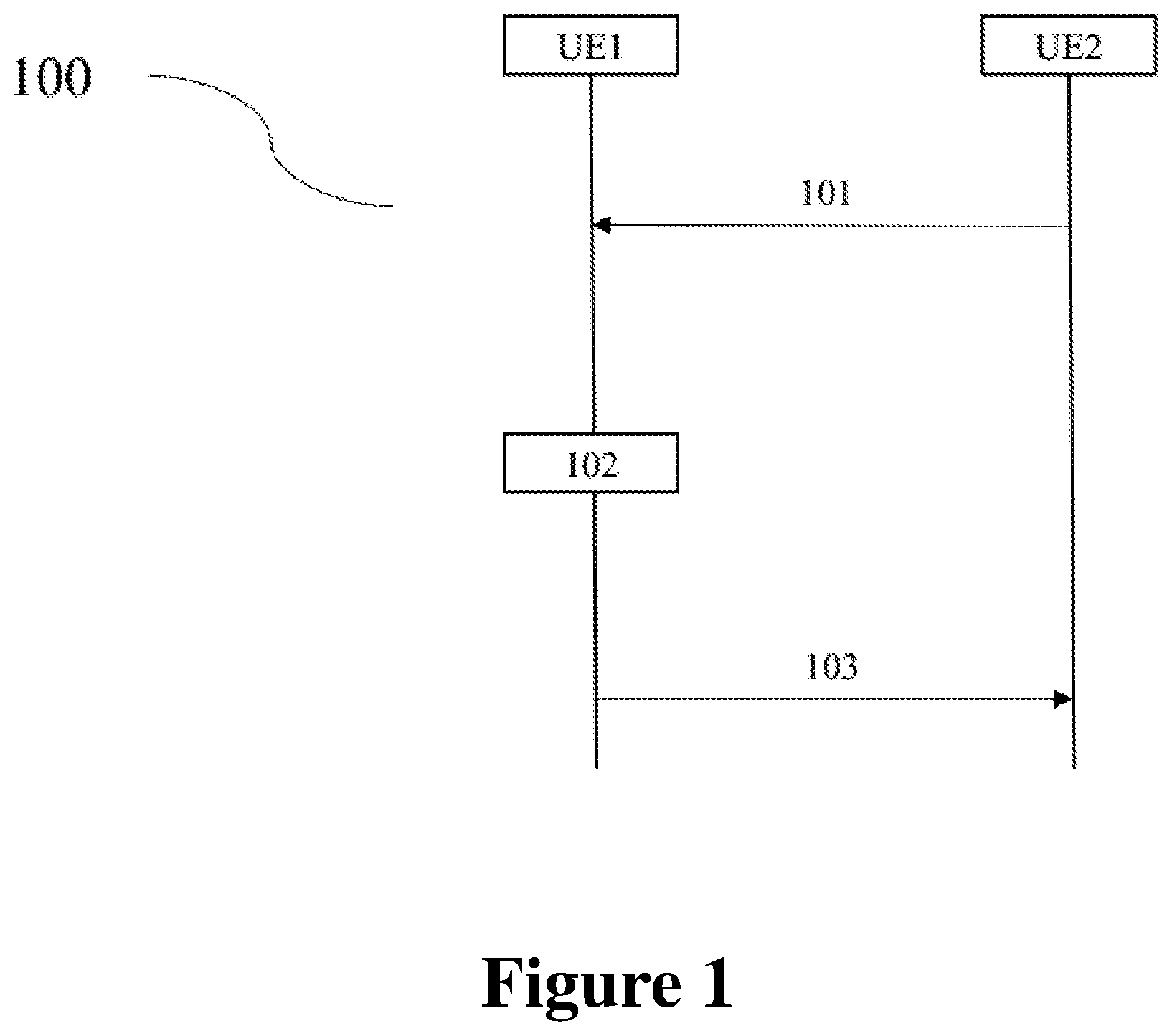
depicts a flow chart 100 illustrating a method for aligning sidelink DRX configuration according to a preferred embodiment of the subject disclosure.
A depicts a flow chart 200 A illustrating a method for aligning sidelink DRX configuration according to a preferred embodiment of the subject disclosure.
B depicts a flow chart 200 B illustrating a method for aligning sidelink DRX configuration according to a preferred embodiment of the subject disclosure.
depicts a flow chart 300 illustrating a method for aligning sidelink DRX configuration according to a preferred embodiment of the subject disclosure.
depicts a method performed by a UE according to a preferred embodiment of the subject disclosure.
depicts a method performed by a BS according to a preferred embodiment of the subject disclosure.
depicts a block diagram of a UE according to the embodiments of the subject disclosure.
depicts a block diagram of a BS according to the embodiments of the subject disclosure.
DETAILED DESCRIPTION
The detailed description of the appended drawings is intended as a description of the currently preferred embodiments of the present invention, and is not intended to represent the only form in which the present invention may be practiced. It should be understood that the same or equivalent functions may be accomplished by different embodiments that are intended to be encompassed within the spirit and scope of the present invention.
Embodiments provide a method and apparatus for aligning sidelink DRX configuration. To facilitate understanding, embodiments are provided under specific network architecture and new service scenarios, such as 3GPP 5G, 3GPP LTE Release 8 and so on. Persons skilled in the art know very well that, with the development of network architecture and new service scenarios, the embodiments in the present disclosure are also applicable to similar technical problems.
In Release 16, the Sidelink Radio Bearer (SLRB) parameters among peer UEs are aligned for unicast transmission of the NR V2X (Vehicle to Everything) communication. Specifically, for sidelink unicast, the initiating UE needs to align the following SLRB configurations with the peer UEs: 1) SLRB configurations configured by the Network or pre-configured which include the SLRB parameters only related to transmission, and 2) the SLRB parameters which are related to both transmission and reception. For sidelink unicast, a UE is not allowed to configure “SLRB parameters only related to transmission” for the peer UE in sidelink via PC5 RRC message.
As can be seen, the SLRB configurations that need to be aligned are configured by Network, for example, the Base Station (BS), or configured in advance, e.g. pre-configuration. Then the initiating UE will inform these configurations to the peer UEs.
Furthermore, power saving enables the UEs with battery constraint to perform sidelink operations in a power efficient manner. The NR sidelink communication in Release 16 is performed based on the assumption that the UE is “always-on”, e.g., only focusing on UEs installed in vehicles with sufficient battery capacity.
In Release 17, solutions for power saving are required for the vulnerable road users (VRUs) in V2X use cases and for the UEs in public safety and commercial use cases where power consumption in the UEs needs to be minimized.
Accordingly, one objective for power saving in Release 17 is for sidelink DRX, and corresponding working scope is as follows: regarding sidelink DRX for broadcast, groupcast, and unicast, 1) define on-durations and off-durations in sidelink and specify the corresponding UE procedure; 2) specify mechanism aiming to align sidelink DRX wake-up time among the UEs communicating with each other; and 3) specify mechanism aiming to align sidelink DRX wake-up time with Uu DRX wake-up time of an in-coverage UE.
The DRX configurations among the sidelink UEs need to be aligned such the data transmission would not be missed at the receiver's side, at the same time, power consumption of the receiver also needs to be minimized. In addition, the DRX configuration of a UE in a side link communication and the Uu configuration of the UE also need to be aligned.
At present, groupcast, unicast communication, and broadcast transmission are all introduced for NR V2X, and the subject disclosure focuses on the DRX alignment for unicast.
In particular, the subject disclosure aims to align the sidelink DRX configuration among the UEs communicating with each other for unicast transmission, and to align sidelink DRX configuration with Uu DRX configuration if the UEs are in coverage of the BS s.
In the subject disclosure, the sidelink DRX configuration may include the following parameters:
•
• i) On duration, the on duration indicates the duration of the UE is in the “on” state, or “wake up”, and is controlled by a timer. The parameter on duration period is derived based on the SFN (System Frame Number), DFN (Direct Frame Number), or resource pool on sidelink. • ii) Start offset of on duration, the start offset of on duration defines the start position of on duration on sidelink. • iii) Inactive time, the inactive time means the UE is active or wake up when the timer is running, and is controlled by a timer. The inactive time is started by new data transmission on sidelink. • iv) HARQ RTT (Hybrid Automatic Repeat Request Round-trip time) time: controlled by a timer, and enabled when HARQ feedback based retransmission is enabled on sidelink. • v) HARQ retransmission time: controlled by a timer, and to monitor HARQ retransmissions on sidelink. • vi) Next reservation time: controlled by a timer, and this parameter monitors the next transmission on sidelink. • vii) Active time/wake-up time: during the active time or wake-up time, the UE is actively monitor sidelink for data transmissions, and controlled by a timer.
The sidelink DRX configuration involves multiple timers, and may further include other parameters, and the subject disclosure has no intention of limiting the types of the parameters.
The sidelink DRX configuration for the sidelink UEs may be configured by the Network or pre-configured. For example, the sidelink DRX configuration could be broadcasted in system information for sidelink communication, such as: System Information Block (SIB); the sidelink DRX configuration could be transmitted in dedicate RRC signaling for a specific sidelink UE, or the sidelink DRX configuration could be pre-configured. For instance, the sidelink UE may be installed with a SIM (Subscriber Identity Module) card which includes the pre-configured sidelink DRX configuration.
The sidelink DRX configuration could be for a specific destination ID (identity), which means the sidelink DRX configuration is for a specific service. In this disclosure, several embodiments regarding associating the sidelink DRX configuration are presented as follows:
•
• i) The sidelink DRX configuration is associated with one SLRB configuration and one SLRB ID. • ii) The sidelink DRX configuration is associated with one Quality of Service (QoS) flow and one QoS flow ID; • iii) The sidelink DRX configuration is associated with one PQI (PC5 Qos Index). • iv) The sidelink DRX configuration is associated with one logical channel configuration and one logical channel ID. • v) The sidelink DRX configuration is associated with one unicast link and unicast link ID, the unicast link ID could be combination of sidelink source ID and sidelink destination ID. • vi) The sidelink DRX configuration is associated with one destination ID. • vii) The sidelink DRX configuration is associated with one source ID.
When there are multiple services are communicating on sidelink unicast link, e.g. the sidelink UE has multiple SLRBs, QoS flows, logical channels, or destination IDs, and the sidelink DRX configurations are different for different services, the UE wakes up to monitor sidelink communications during the period where at least one of DRX configuration is in active time according to sidelink DRX procedure. In other words, the UE wakes up to monitor sidelink communications if at least one timer of the on duration timer, the retransmission timer, the inactivity timer, the next reservation timer, etc. is running. If the number of services is large enough, the UE may always stay in wake-up state to monitor the sidelink communications.
Alternatively, the sidelink DRX configuration could be for a specific resource pool. For instance, if the sidelink DRX configuration is configured in pre-configuration or broadcasted in a SIB message, the sidelink DRX configuration is associated with at least one resource pool configuration and one resource pool ID. In this case, the sidelink DRX configuration depends on the resource pool configuration, e.g. on duration and start position of the on duration of the sidelink DRX is defined as the offset of start position of corresponding resource pool. For a specific resource pool, the subset of resource pool resource can be configured as active time for sidelink unicast transmission.
Furthermore, the configurations could be related to both a specific destination ID and a resource pool at the same time. That is, for a specific resource pool, multiple set of DRX parameter configurations which associated with multiple services can be configured.
If a UE is configured with a specific resource pool, and also configured with a sidelink DRX configuration, however, the above two configurations are separately configured, which means the two configurations may be aligned with each other, or not. Under the condition that the resource pool is not aligned with the DRX configuration, the UE would not enter into the active time, or would not activate any timer, either. In another word, a UE only performs the DRX operation in time domain when there is a configured resource pool, and the UE only enters on duration or active time or wakes up with the configured resource in the resource pool.
depicts a flow chart 100 illustrating a method for aligning sidelink DRX configuration according to a preferred embodiment of the subject disclosure. In , UE 1 represents the initiating UE, which initiates the sidelink communication, and UE 2 is the peer UE, which is the UE with which UE 1 intends to communicate.
In step 101 , UE 2 sends a request to UE 1 , requesting the sidelink DRX configuration. The request could be transmitted to UE 1 during or after the establishment of the unicast connection between UE 1 and UE 2 . In other words, in or after PC5-RRC signaling for radio configuration or capability message, UE 2 can inform UE 1 the sidelink DRX configuration request. The request from UE 2 includes several different types of assistance information.
In one embodiment, the request from UE 2 includes some information regarding UE 2 per se. For instance, UE 2 can use one bit to indicate UE 1 that UE 2 is a power sensitive UE; UE 2 may use one bit to indicate UE 1 that UE 2 requests for low power data transmission; or UE 2 can indicate it requests for sidelink configuration with one bit.
In another embodiment, the request from UE 2 includes some information regarding the Uu DRX configuration, which relates to the DRX configuration between UE 2 and the serving Base Station (BS) of UE 2 (hereinafter referred to as BS 2 ). Under this condition, UE 2 is within the coverage of BS 2 , and UE 1 can use the Uu DRX configuration from UE 2 to determine the sidelink DRX configuration. This Uu DRX configuration can be the DRX configuration in RRC (Radio Resource Control) CONNECTED mode, and it can also be the DRX configuration in IDLE or INACTIVE mode. The assistance information may also include the traffic pattern and UE 2 's capability information.
In still another embodiment, the request from UE 2 includes some information regarding the BS 2 (not shown in ). For example, the ID of BS 2 , or the ID of the cell where UE 2 is served.
In step 102 , UE 1 checks the existing sidelink DRX configuration, or the initial sidelink DRX configuration, which may be broadcasted in the SIB to UE 1 , or transmitted in dedicate RRC signaling for UE 1 , or preconfigured as discussed above. Taking the assisting information from UE 2 , such as the traffic pattern, the Uu DRX configuration, UE 2 's capability, UE 1 determines that the existing sidelink DRX configuration can satisfy the requirement from UE 2 , then UE 1 sends the sidelink DRX configuration to UE 2 in step 103 .
In another embodiment, if UE 1 is not in the coverage of a serving BS, then UE 1 would also check the existing sidelink DRX configuration, and transmits the existing sidelink DRX configuration to UE 2 in step 103 .
A depicts a flow chart 200 A illustrating a method for aligning sidelink DRX configuration according to a preferred embodiment of the subject disclosure. B depicts a flow chart 200 B illustrating a similar method as that in A . In A and 2 B , UE 1 represents the initiating UE, which initiates the sidelink communication, UE 2 is the peer UE, which is the UE with which UE 1 intends to communicate, BS 1 is the serving BS of UE 1 , and BS 2 is the serving BS of UE 2 . If UE 1 and UE 2 are within the same cell, then BS 1 and BS 2 are the same BS.
The step 201 in A is identical to the step 101 in , and the details are omitted here.
In step 202 , after checking the existing DRX configuration, UE 1 determines that the existing DRX configuration cannot meet the requirements of UE 2 , and UE 1 is also in the coverage of BS 1 , then UE 1 decides to request the sidelink DRX configurations from BS 1 .
In step 203 , the UE 1 sends a sidelink DRX configuration request message to BS 1 . If UE 1 is in an IDLE or INACTIVE mode, it has to trigger a RRC connection setup procedure with BS 1 before transmitting the sidelink DRX configuration request message to BS 1 . If UE 1 is in the RRC-connected mode, which means the UE 1 is already RRC connected with BS 1 , then UE 1 can sends a sidelink DRX configuration request message to BS 1 .
UE 1 can include the assisting information from UE 2 in the request message. As discussed above, for example, the assisting information from UE 2 includes the information regarding UE 2 per se, the Uu DRX configuration between UE 2 and BS 2 , the information regarding BS 2 , and/or the traffic pattern and UE capability information. This assisting information from UE 2 can help BS 1 to determine the sidelink DRX configuration to be transmitted to UE 1 . For instance, BS 1 can configure a sidelink DRX configuration so that sidelink wake up time and Uu wake up time for UE 2 can be aligned.
In step 204 , the BS 1 determines the sidelink DRX configuration and transmit the same to UE 1 . According to different assisting information included in the request, the BS 1 performs different operation to determine the sidelink DRX configurations to be transmitted to the UE 1 .
In one embodiment, the assisting information included in the request is the Uu DRX configuration of UE 2 and/or the traffic pattern on sidelink. Taking this information into consideration, the BS 1 may send different responses. For one example, the BS 1 can use one bit in the response which indicates UE 1 to reuse the Uu DRX configuration of UE 2 . For another example, the BS 1 sends a delta signalling based on the Uu DRX configuration, to modify part of Uu DRX parameters for the purpose of sidelink DRX configuration. When UE 1 receives the delta signalling, UE 1 will modify the Uu DRX configuration of UE 2 based on the delta signalling, and use the modified Uu DRX configuration as the sidelink DRX configuration, then sends the modified Uu DRX configuration to UE 2 in step 205 . For yet another example, the BS 1 may configure a new set of sidelink DRX parameters, and transmit the sidelink DRX configuration including the new set of sidelink DRX parameters to UE 1 .
In another embodiment, the assisting information included in the request from UE 2 in step 201 is the information of BS 2 , the cell ID of UE 2 , and/or the information whether Uu DRX is configured. As shown in B , after receiving such a request, in step 206 , with the information of BS 2 , the BS 1 can communicate with BS 2 directly, for example, communicate via e.g. Xn interface, and request information of Uu DRX configuration for UE 2 . Then in step 207 , BS 2 sends the Uu DRX configuration of UE 2 to BS 1 , and BS 1 configures the sidelink DRX configuration taking the Uu DRX configuration of UE 2 into consideration. In step 208 , BS 1 sends the response to UE 1 , which may indicate UE 1 to reuse the Uu DRX configuration of UE 2 , or a delta signalling, or a new sidelink DRX configuration as recited above.
Alternatively, in step 206 in B , BS 1 may indicate sidelink DRX configuration to BS 2 . Then BS 2 can update sidelink DRX configuration according to Uu DRX configuration of UE 2 , and indicate the updated sidelink DRX configuration to UE 2 .
After the above steps, the sidelink DRX configuration and the Uu DRX configuration of UE 2 are aligned.
depicts a flow chart 300 illustrating a method for aligning sidelink DRX configuration according to a preferred embodiment of the subject disclosure. The method step in takes place when UE 2 is in coverage of BS 2 , and is in RRC CONNECTED mode. In step 301 , after receiving the sidelink DRX configuration from UE 1 , or an update of the sidelink DRX configuration, UE 2 reports sidelink DRX configuration to BS 2 . UE 2 can report the sidelink DRX configuration with the sidelink DRX configuration included in the UE assistance information.
In step 302 , after receiving the sidelink DRX configuration from UE 2 , BS 2 may update or configure Uu DRX configuration for UE 2 , and transmit the same to UE 2 . If the Uu DRX configuration does not need to be updated, then BS 2 does not need to transmit the Uu DRX configuration to UE 2 . In this way, the sidelink DRX configuration and the Uu DRX configuration of UE 2 are aligned.
illustrates a method performed by a UE for wireless communication according to a preferred embodiment of the subject disclosure.
In step 401 , a UE 1 receives from a UE 2 , a second request for one or more sidelink DRX configurations, and the second request includes assisting information, in step 402 , UE 1 transmits the one or more sidelink DRX configurations determined based on the assisting information to UE 2 . This method is also shown in . UE 2 may send the second request during or after a unicast connection between UE 1 and UE 2 being established.
UE 1 is configured with a number of initial sidelink DRX configurations, which are broadcasted in a SIB, transmitted with dedicate RRC signaling, or pre-configured. For example, a sidelink DRX configuration may include at least one of the following parameters: on duration; start offset of on duration; inactive time; HARQ RTT time; HARQ retransmission time; next reservation time; and active time. Furthermore, a sidelink DRX configuration is associated with at least one of the following parameters: one SLRB configuration and one SLRB ID; one QoS flow and one QoS flow ID; one PQI; one logical channel configuration and one logical channel ID; one unicast link and unicast link ID; one destination ID; and one source ID.
In one embodiment, UE 1 may have multiple destination IDs, which means UE 1 have multiple services at the same time, and UE 1 enters into an “on” mode, or “wake up” mode, to monitor the sidelink communication during each on duration associated with each destination ID.
In another embodiment, each sidelink DRX configuration is associated with a resource pool configuration and a resource pool ID. When the sidelink DRX configuration is unaligned with the corresponding resource pool configuration, UE 2 would not enter into the “on” mode, or “wake up” mode during the on duration associated with a sidelink DRX configuration.
The assisting information from UE 2 includes several types of parameters, for example, it may be the requirements of UE 2 per se, e.g. UE 2 is power sensitive. The assisting information may be the Uu DRX configuration between the UE 2 and BS 2 , which includes the Uu DRX configuration in the RRC-CONNECTED mode, or DRX configuration in IDLE/INACTIVE mode.
In another embodiment, the UE 1 further transmits the one or more initial sidelink DRX configurations to UE 2 when UE 1 determines that the initial sidelink DRX configurations are sufficient to satisfy the requirements of UE 2 , or when UE 1 is out of coverage of a BS. When UE 1 is out of coverage of a BS, UE 1 has no choice in addition to sending the initial sidelink DRX configurations since UE 1 cannot reach a BS for additional sidelink DRX configurations.
Alternatively, when UE 1 is in coverage of BS 1 , and the initial sidelink DRX configurations do not satisfy the requirements of UE 2 , UE 1 transmits a request for one or more sidelink DRX configurations to BS 1 , and determines the one or more sidelink DRX configurations based on the response from BS 1 . Before sending the request, if UE 1 is in the IDLE mode, it has to initiate a RRC connection with the BS 1 . The response from BS 1 has different types: 1) the response indicates one or more new sidelink DRX configurations; 2) the response indicates UE 1 to use the Uu DRX configuration of UE 2 ; and 3) the response indicates UE 1 to use a portion of the Uu DRX configuration of UE 2 and update the other portion of the Uu DRX configuration of UE 2 .
In another embodiment, the assisting information from UE 2 includes the information of BS 2 , the cell ID of UE 2 , and/or the information whether Uu DRX is configured. After receiving this type of assisting information, BS 1 may communicate with BS 2 directly, and requests the Uu DRX configuration of UE 2 from BS 2 , then determines the response based on the received Uu DRX configuration. After the determination, the BS 1 transmits the response to UE 1 . The response also has different types as discussed above.
In one embodiment, after receiving the sidelink DRX configuration from UE 1 , UE 2 reports the same to BS 2 . BS 2 then updates the Uu configuration of UE 2 based on the sidelink DRX configuration.
illustrates a method performed by a BS for wireless communication according to a preferred embodiment of the subject disclosure. In step 501 , BS 1 receives a request for one or more sidelink DRX configurations from UE 1 , and the request includes the assisting information from UE 2 . In step 502 , BS 1 determines the response based on the assisting information.
The assisting information from UE 2 includes several types of parameters, for example, it may be the requirements of UE 2 per se, e.g. UE 2 is power sensitive. The assisting information may be the Uu DRX configuration between the UE 2 and BS 2 , which includes the Uu DRX configuration in the RRC-CONNECTED mode, or DRX configuration in IDLE/INACTIVE mode.
Taking the assisting information of UE 2 into consideration, BS 1 may send a response such as: 1) the response indicates one or more new sidelink DRX configurations; 2) the response indicates UE 1 to use the Uu DRX configuration of UE 2 ; and 3) the response indicates UE 1 to use a portion of the Uu DRX configuration of UE 2 and update the other portion of the Uu DRX configuration of UE 2 .
The assisting information from UE 2 may further include the information of BS 2 , the cell ID of UE 2 , and/or the information whether Uu DRX is configured. After receiving the assisting information, BS 1 communicates with BS 2 and requests the Uu DRX configuration of UE 2 from BS 2 , then determines the response based on the received Uu DRX configuration. After the determination, the BS 1 transmits the response to UE 1 .
illustrates a block diagram of a UE according to some embodiments of the subject disclosure. The UE may include a receiving circuitry, a processor, and a transmitting circuitry. In one embodiment, the UE may include a non-transitory computer-readable medium having stored thereon computer-executable instructions; a receiving circuitry; a transmitting circuitry; and a processor coupled to the non-transitory computer-readable medium, the receiving circuitry and the transmitting circuitry. The computer executable instructions can be programmed to implement a method (e.g. the method in ) with the receiving circuitry, the transmitting circuitry and the processor.
illustrates a block diagram of a BS according to some embodiments of the subject disclosure. The BS may include a receiving circuitry, a processor, and a transmitting circuitry. In one embodiment, the BS may include a non-transitory computer-readable medium having stored thereon computer-executable instructions; a receiving circuitry; a transmitting circuitry; and a processor coupled to the non-transitory computer-readable medium, the receiving circuitry and the transmitting circuitry. The computer executable instructions can be programmed to implement a method (e.g. the method in ) with the receiving circuitry, the transmitting circuitry and the processor.
The method of the present disclosure can be implemented on a programmed processor. However, the controllers, flowcharts, and modules may also be implemented on a general purpose or special purpose computer, a programmed microprocessor or microcontroller and peripheral integrated circuit elements, an integrated circuit, a hardware electronic or logic circuit such as a discrete element circuit, a programmable logic device, or the like. In general, any device that has a finite state machine capable of implementing the flowcharts shown in the figures may be used to implement the processing functions of the present disclosure.
While the present disclosure has been described with specific embodiments thereof, it is evident that many alternatives, modifications, and variations will be apparent to those skilled in the art. For example, various components of the embodiments may be interchanged, added, or substituted in the other embodiments. Also, all of the elements shown in each figure are not necessary for operation of the disclosed embodiments. For example, one skilled in the art of the disclosed embodiments would be capable of making and using the teachings of the present disclosure by simply employing the elements of the independent claims. Accordingly, the embodiments of the present disclosure as set forth herein are intended to be illustrative, not limiting. Various changes may be made without departing from the spirit and scope of the present disclosure.
In this disclosure, relational terms such as “first,” “second,” and the like may be used solely to distinguish one entity or action from another entity or action without necessarily requiring or implying any actual such relationship or order between such entities or actions. The terms “comprises,” “comprising,” or any other variation thereof, are intended to cover a non-exclusive inclusion, such that a process, method, article, or apparatus that comprises a list of elements does not include only those elements but may include other elements not expressly listed or inherent to such process, method, article, or apparatus. An element proceeded by “a,” “an,” or the like does not, without more constraints, preclude the existence of additional identical elements in the process, method, article, or apparatus that comprises the element. Also, the term “another” is defined as at least a second or more. The terms “including,” “having,” and the like, as used herein, are defined as “comprising.”
Figures (7)
Citations
This patent cites (15)
- US2016/0366645
- US2017/0019820
- US2021/0059005
- US2022/0408405
- US2023/0014303
- US107306423
- US109891947
- US105379406
- US3442276
- US3451709
- US3499975
- US4084513
- US2018016882
- US2018028416
- US2021119474