Air-pulse Generating Device with Tooth Edge Patterned Slit
Abstract
An air-pulse generating device includes a film structure including a first flap and a second flap opposite to each other. The film structure is actuated to operate at an ultrasonic frequency, and the air-pulse generating device produces a plurality of air pulses at an ultrasonic pulse rate. The first flap and the second flap are actuated to perform a differential movement to form an opening or a virtual valve. A slit is formed between the first flap and the second flap, and the opening or the virtual valve is formed because of the slit. The slit is formed as a zigzagging pattern on the film structure.
Claims (25)
1. An air-pulse generating device, comprising: a film structure, comprising a first flap and a second flap opposite to each other; wherein the film structure is actuated to operate at an ultrasonic frequency, and the air-pulse generating device produces a plurality of air pulses at an ultrasonic pulse rate; wherein the first flap and the second flap are actuated to perform a differential movement to form an opening or a virtual valve; wherein a slit is formed between the first flap and the second flap, and the opening or the virtual valve is formed because of the slit; wherein the slit is formed as a zigzagging pattern on the film structure; wherein the slit zigzags in a back-and-forth manner among a first direction and extends toward a second direction.
Show 24 dependent claims
2. The air-pulse generating device of claim 1 , wherein the slit comprises nonzero projection onto the first direction.
3. The air-pulse generating device of claim 1 , wherein the first flap comprises a plurality first protrusions and the second flap comprises a plurality second protrusions; wherein the first protrusions and the second protrusions are interleaved with each other.
4. The air-pulse generating device of claim 3 , wherein the first flap comprises a plurality first depressions and the second flap comprises a plurality second depressions; wherein the first protrusions and the first depressions are interleaved with each other.
5. The air-pulse generating device of claim 1 , wherein the first flap comprises a plurality first protrusions; wherein a protrusion among the first protrusions comprises a plateau portion.
6. The air-pulse generating device of claim 1 , wherein the first flap comprises a plurality first protrusions; wherein a protrusion among the first protrusions corresponds to a width; wherein the width is greater than a height of walls between the first flap and the second flap.
7. The air-pulse generating device of claim 1 , wherein the first flap comprises a plurality first protrusions; wherein a protrusion among the first protrusions corresponds to a width; wherein the width is greater than a displacement difference between free ends of the first flap and the second flap when the virtual valve is opened.
8. The air-pulse generating device of claim 1 , wherein the first flap comprises a plurality first protrusions; wherein a protrusion among the first protrusions corresponds to a depth; wherein the depth is greater than 15% of an anchor-to-anchor distance.
9. The air-pulse generating device of claim 1 , wherein the slit forms a tooth edge pattern.
10. The air-pulse generating device of claim 1 , wherein the slit forms a rectangular tooth edge pattern.
11. The air-pulse generating device of claim 1 , wherein the slit forms a trapezoid tooth edge pattern.
12. The air-pulse generating device of claim 1 , wherein the film structure is actuated to perform a common mode movement to form an amplitude-modulated ultrasonic air pressure variation with an ultrasonic frequency.
13. The air-pulse generating device of claim 12 , wherein the first flap and the second flap are actuated to perform the common mode movement and the differential movement simultaneously.
14. The air-pulse generating device of claim 1 , wherein the first flap and the second flap are actuated to perform the differential movement, so as to form the opening at an ultrasonic opening rate.
15. The air-pulse generating device of claim 1 , wherein the virtual valve is in a closed state when a difference of displacement of the first and second flaps is less than a thickness of the film structure; wherein the closed state of the virtual valve occurs at transitions of the differential movement of the first flap and the second flap.
16. The air-pulse generating device of claim 1 , wherein the slit zigzags on the film structure such that an area coverage ratio is no smaller than 0.25.
17. The air-pulse generating device of claim 1 , wherein the slit zigzags on the film structure such that a displacement coverage ratio is no smaller than 0.5.
18. The air-pulse generating device of claim 1 , wherein the first and second flaps form a flap pair; wherein a time of the virtual valve being closed is aligned to a time corresponding to a common mode movement of the flap pair toward a third direction; wherein a time of the virtual valve being opened is aligned to a time corresponding to the common mode movement of the flap pair toward a fourth direction opposite to the third direction.
19. The air-pulse generating device of claim 1 , comprising: a covering structure; wherein a chamber is formed between the film structure and the covering structure.
20. The air-pulse generating device of claim 19 , wherein an orifice is formed on the covering structure; wherein the plurality of air pulse propagates outward via the orifice.
21. The air-pulse generating device of claim 1 , wherein the first and second flaps form a flap pair; wherein a time of the virtual valve being closed is aligned to a time corresponding to a peak acceleration of a common mode movement of the flap pair.
22. The air-pulse generating device of claim 1 , wherein a combined common mode displacement corresponding to the virtual valve is evenly distributed within a range between a rightmost free end of the first flap and a leftmost free end of the second flap.
23. The air-pulse generating device of claim 1 , wherein an acoustic impedance corresponding to the virtual valve is evenly distributed within a range between a leftmost free end of the second flap and a rightmost free end of the first flap.
24. The air-pulse generating device of claim 1 , wherein the air-pulse generating device is applied in a sound producing application.
25. The air-pulse generating device of claim 1 , wherein the air-pulse generating device is applied in an air movement application.
Full Description
Show full text →
CROSS REFERENCE TO RELATED APPLICATIONS
This application claims the benefit of U.S. Provisional Application No. 63/540,648, filed on Sep. 26, 2023. Further, this application claims the benefit of U.S. Provisional Application No. 63/539,803, filed on Sep. 21, 2023. The contents of these applications are incorporated herein by reference.
BACKGROUND OF THE INVENTION
1. Field of the Invention
The present invention relates to an air-pulse generating device, and more particularly, to an air-pulse generating device capable of producing asymmetric air pressure pulses.
2. Description of the Prior Art
Conventionally, speaker driver and back enclosure are two major design challenges in the speaker industry. It is difficult for one single conventional speaker (such as dynamic driver) to cover an entire audio frequency band, e.g., from 20 Hz to 20 KHz. To produce high fidelity sound with high enough sound pressure level (SPL), both the radiating/moving surface and volume/size of back enclosure for the conventional speaker are required to be sufficiently large.
U.S. Pat. Nos. 9,736,595 and 10,367,430 have discussed ultrasonic pulse for sound producing application. Moreover, Applicant discloses APG (APG: air-pulse generating) device or APPS (APPS: air pressure pulse speaker) in U.S. Pat. Nos. 10,425,732, 11,172,310, 10,425,732, 11,043,197 and 11,445,279, to resolve the above bandwidth and size issues.
However, performance of APPS relies on asymmetry of the air pressure pulses produced by the APG device.
SUMMARY OF THE INVENTION
It is therefore a primary objective of the present application to provide an APG device capable of producing asymmetric air pressure pulses, to improve over disadvantages of the prior art.
An embodiment of the present disclosure provides an air-pulse generating device, comprising a film structure, comprising a first flap and a second flap opposite to each other; wherein the film structure is actuated to operate at an ultrasonic frequency, and the air-pulse generating device produces a plurality of air pulses at an ultrasonic pulse rate; wherein the first flap and the second flap are actuated to perform a differential movement to form an opening or a virtual valve; wherein a slit is formed between the first flap and the second flap, and the opening or the virtual valve is formed because of the slit; wherein the slit is formed as a zigzagging pattern on the film structure.
These and other objectives of the present invention will no doubt become obvious to those of ordinary skill in the art after reading the following detailed description of the preferred embodiment that is illustrated in the various figures and drawings.
BRIEF DESCRIPTION OF THE DRAWINGS
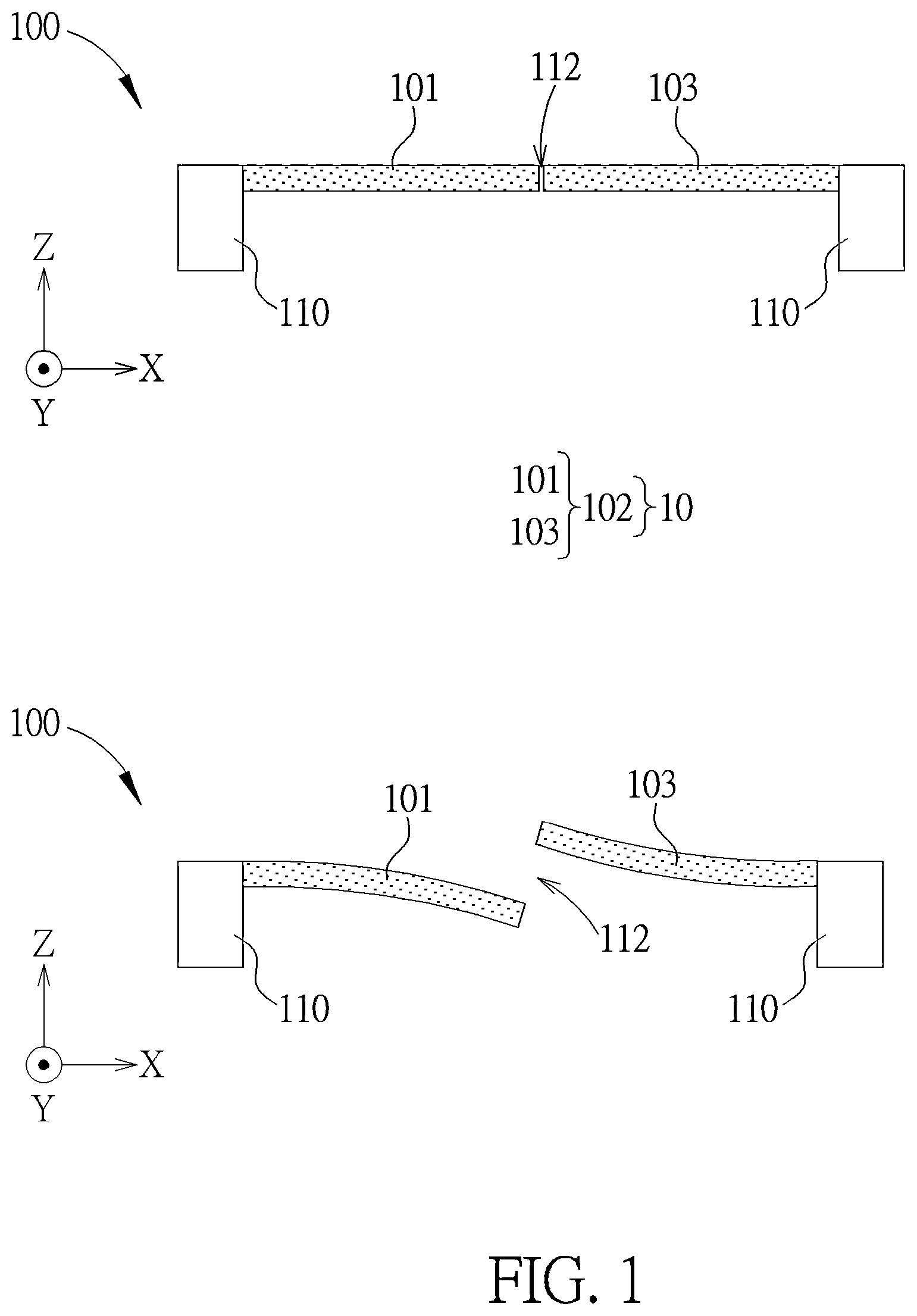
is a cross-sectional view of an air-pulse generating (APG) device.
illustrates a wiring scheme of an APG device.
illustrates a modulation signal and demodulation signals.
A illustrates a cross-sectional view of an APG device.
B illustrates a top view of the APG device of A .
C illustrates airflow directions when a virtual valve (VV) of the APG device of B is opened.
A and B illustrates cross-sectional view of an APG device according to an embodiment of the present application.
C illustrates a top view of the APG device of A and B .
D illustrates airflow directions when a virtual valve (VV) of the APG device of C is opened.
illustrates a first flap and a second flap of the APG device of C which are separated apart.
illustrates a common mode movement of the first flap and the second flap of the APG device of C .
illustrates a differential mode movement of the first flap and the second flap of the APG device of C .
A and B illustrate combined common mode displacement of common mode movement and acoustic conductance of differential mode movement for the APG devices in and .
A illustrates a combined common mode displacement versus a porosity of the APG device of C according to an embodiment of the present application.
B illustrates a virtual/effective common mode displacement versus a porosity of the APG device of C according to an embodiment of the present application.
illustrates an APG device according to an embodiment of the present application.
illustrates common mode movement and differential mode movement of the APG device within one cycle according to an embodiment of the present application.
A illustrates a combined common mode displacement and a common mode acceleration versus a porosity of the APG device according to an embodiment of the present application.
B and C illustrate a combined common mode displacement versus a porosity of the APG device according to an embodiment of the present application.
illustrates an APG device according to an embodiment of the present application.
illustrates an APG device according to an embodiment of the present application.
DETAILED DESCRIPTION
Content of U.S. Pat. No. 11,943,585 B2 and application Ser. No. 18/624,105 is incorporated herein by reference.
Air-pulse generating device in the present application generally comprises a pair of opposite flaps, fabricated by etching a membrane layer made of, e.g., SOI (SOI: silicon on insulator), POI (POLY on insulator) or other suitable material. By adding a layer of piezoelectric material, such as PZT, deposited atop the pair of flaps, the pair of opposing flaps are actuated to move up & down, to produce both a common mode motion and a differential mode motion, performing the function of modulation and demodulation, respectively.
Specifically, is cross-sectional view of an air-pulse generating (APG) device 100 . The APG device comprises a film structure (e.g., membrane or diaphragm) 10 . The film structure 10 comprises flaps 101 and 103 opposite to each other. Operation principle of the APG device 100 is similar to the one disclosed in U.S. Pat. No. 11,943,585 B2. The flaps 101 and 103 (forming as a flap pair 102 ) are actuated to perform a common mode movement to form an amplitude-modulated ultrasonic air pressure variation with an ultrasonic frequency (e.g., 192 KHz), which can be regarded as a modulation operation. Meanwhile, the flaps 101 and 103 are also actuated to perform a differential mode movement to form an opening 112 or a virtual valve (abbreviated as VV) 112 , at an ultrasonic opening rate (e.g., 192 KHz), so as to perform a demodulation operation.
In the embodiment shown in the APG device 100 , the differential movement (demodulation) and the common mode movement (modulation) are simultaneously performed by the flap pair 102 . The in situ and concurrent modulation-and-demodulation can be done by particular wiring scheme. For example, as shown in , the APG device 100 may comprise an actuator 101 A disposed on the flap 101 and an actuator 103 A disposed on the flap 103 . The actuators 101 A and 103 A comprises top electrodes and bottom electrodes. In an embodiment, the bottom electrodes of the actuators 101 A and 103 A receives a common modulation signal SM, and the top electrodes of the actuators 101 A and 103 A receives differential demodulation signals +SV and −SV, where the demodulation signals +SV and −SV have opposite polarities. Note that, the wiring scheme shown in is for illustrative purpose, which is not limited thereto. As long as one electrode of the actuator 101 A/ 103 A receives the modulation signal SM and another electrode receives the demodulation signal SV (representing either +SV or −SV), requirements of the present invention are satisfied, which is within the scope of the present application.
Waveforms of the modulation signal SM and the demodulation signal ±SV may be referred to (or similar to which is shown in ). Note that, a demodulation frequency of the demodulation signal SV is a half of a modulation frequency of the modulation signal SM. For example, when the modulation signal SM has the modulation frequency as 192 KHz, the demodulation signal SV would have the demodulation frequency as 96 KHz. Hence, the flaps 101 and 103 form the opening 112 at an opening rate of 192 KHz, and the APG device 100 produces a plurality of air pulses at an ultrasonic pulse rate f Pulse of 192 KHz.
In the present application, “the flaps 101 and 103 performing the common mode movement” means that the flaps 101 and 103 are actuated to move toward a common direction or actuated by a common driving signal, and “the flaps 101 and 103 performing the differential mode movement” means that the flaps 101 and 103 are actuated to move/bend toward different/opposite directions with respect to a common position or actuated by a differential pair of signals.
A slit 112 is formed between the flaps 101 and 103 . In the present application, “slit”, “opening” and “virtual valve” share the same notation (e.g., 112 ) as they share the same location and express similar concept in different aspect. By driving the flaps 101 and 103 via the demodulation signal ±SV, distance between free ends of the flaps 101 and 103 is enlarged and the opening 112 or the VV 112 is formed. Upper portion of illustrates a snapshot of the VV 112 is closed/sealed, and lower portion of illustrates a snapshot of the VV 112 is opened.
Pattern of the slit 112 on/over the film structure 10 is not limited. Intuitively, the slit 112 may have straight-line slit pattern. A- 4 C illustrates schematic diagrams for APG device with straight-line slit pattern. As shown in B , the slit 112 with straight-line slit pattern may be regarded as comprising zero projection onto X direction/dimension. APG device with straight-line slit pattern is successful in producing asymmetric airflow pulse. However, asymmetry of air pressure pulse produced by the APG device with straight-line slit pattern is not such obvious, or even may not be measurable. This is because of severe airflow congestion around the VV 112 and airflow detouring before reaching the VV 112 , as shown C , where C schematically illustrates airflow vectors around the VV 112 . In some figures of the present application, different types of shade are employed to illustrate flaps 101 versus 103 , which does not mean flap 101 and 103 are made of different material.
Airflow congestion (when the VV 112 is (just) “opened”) would increase a pressure difference ΔP surrounding the VV 112 , where ΔP=P A −P B and P A /P B represents air pressure right above/below the plane defined by the flap 101 / 103 . Ideally, the pressure difference ΔP should be neutralized as soon/fast as possible when VV is opened. However, neutralization of pressure difference ΔP corresponding to slit with straight-line pattern is not fast enough. It is because airflow lateral components and airflow detouring.
As shown in , the airflow vectors comprise strong lateral components (components other than Z direction, in the straight-line slit pattern shown in B , lateral components represent components parallel to X direction), which means the airflow detours. Airflow detouring not only lengthens the airflow passageway, but also slows down the reaction of pressure balance across the two sides of the flaps 101 , 103 . After reaching the vicinity of VV 112 , the air will be queued up, waiting in turn to be squeezed through the narrow opening of VV 112 . All these steps/factors lead to their respective low-pass-filter (LPF) effect. Combined those factors, a strong high order LPF is created, which filters away the higher harmonics of f Pulse . Since strong asymmetry waveform implies strong spectral components at high harmonics, such removal of harmonics of f Pulse implies loose of asymmetry.
Asymmetry of air pressure pulse is critical for the performance of the APG device, for both sound producing applications (which can be regarded as AC (AC: alternating current) airflow) and air movement applications (which can be regarded as DC (DC: direct current) airflow). It is desirable to propose a further new APG design owning asymmetry of air pressure pulse.
Several guidelines are introduced below. In order to avoid airflow congestion, the VV should be designed to span a significant amount on/over the X direction/dimension (or at least comprise nonzero projection onto X direction/dimension). In other words, the VV should span a significant percentage (or occupy a significant area) of a total area of the flaps 101 , 103 . For example, the VV 112 may span/occupy 20˜40% (or at least 15%) of a total area of the flaps 101 , 103 , but not limited thereto.
In addition, in order to minimize lateral component when the VV is “opened”, an acoustic impedance of the VV should be distributed in X direction in a mostly even manner, such that the air would flow straight through the VV (mostly through the Z direction). An amplitude of a combined common mode displacement U Z.COM (x) is suggested to be distributed in X direction in a mostly even manner. U Z.COM (x) is a combination/aggregation of common mode displacement of the flaps 101 and 103 . For example, U Z.COM (x) may be expressed as U Z.COM (x)=(w 101 (x)·ΔU z,101 (x)+w 103 (x)·ΔU z,103 (x))/(w 101 (x)+w 103 (x)), where ΔU z,101 (x)/ΔU z,103 (x) represents individual common mode displacement of the flap 101 / 103 (corresponding to X dimension variable x), w 101 (x)/w 103 (x) represents corresponding weighting factor. In an embodiment, w 101 (x)=w 103 (x)=0.5, but not limited thereto.
For avoiding airflow congestion and minimizing lateral component, one solution is to pattern/form the slit in a zigzagging pattern on the film structure. In the present application, slit with zigzagging pattern may refer that: 1) the slit is not straight-line; 2) the slit alters/changes its direction in a back-and-forth manner; or 3) the slit has nonzero projection onto X direction/dimension in a top view perspective, given the slit is patterned to zigzag in a back-and-forth manner among X direction and extends toward Y direction. A projection of the zigzagging patterned slit onto X direction/dimension may have a length/depth which is a significant percentage (e.g., more than 15%) of an anchor-to-anchor distance of the flaps 101 and 103 or the APG device.
Please refer to A- 5 D , which illustrate an APG device 200 according to an embodiment of the present invention, where C illustrates (a portion of) a zigzagging pattern of a slit 212 in a top view perspective, A and 5 B illustrate cross-sectional view along lines A-A′ and B-B′ when the flaps 101 and 103 are sustained flat (or the VV 212 is closed), D schematically illustrates airflow vectors when the VV 212 with the zigzagging pattern is opened, along a D-D′ line in C .
Width (dimension/size in Y direction) of the APG device 200 is not limited to which is shown in C . The APG device 200 may comprise wide cantilevers, meaning width of the APG device 200 may be larger than several times of length (dimension/size in X direction) of the APG device 200 . Or, in an embodiment, the flaps 101 and 103 may extend toward Y direction and have a relative extreme aspect ratio (e.g., greater than 2 or less than ½), which is not limited thereto.
The slit 212 may have a tooth edge pattern. Specifically, illustrates the flap 101 separated way apart from the flap 103 with tooth patterned edge. As shown in , the flap 101 / 103 comprises protruded parts (protrusions) 220 / 240 and depressed parts (depressions) 222 / 242 . The protrusions 220 and the depressions 240 are interleaved with each other. When the flaps 101 and 103 only separated by the slit 212 (see C and ), the depressions 242 of the flap 103 accommodate the protrusions 220 of the flap 101 , and vice versa, such that the protrusions 220 of the flap 101 and the protrusions 240 of the flap 103 are interleaved with each other. Furthermore, in C , the slit 212 has a rectangular tooth edge pattern, as an example.
From C , the slit 212 is not straight-line, alters/changes its direction in a back-and-forth manner. The slit 212 may be regarded as zigzagging in a back-and-forth manner among/over X direction between x 103L and x 101R , and extending toward Y direction. Tooth depth D T , a distance between x 103L and x 101R (shown in C ), may be a certain percentage (e.g., more than 15% or 20˜40%) of an anchor-to-anchor distance d AA between x 101L and x 103R , where the flaps 101 and 103 of the APG device 200 is supposed to be anchored on the anchor structure like the APG device 100 is, but the anchor structure is omitted in for brevity.
In addition, depressed parts 222 of the flap 101 (or protruded part 240 of the flap 103 , neglecting slit width) may have a width W T , which also denotes a length of a segment 231 . In C , W T may be considered as a width of a protrusion of the flap 103 . In order to effectively reduce acoustic resistance, in an embodiment, the width W T may be chosen such that W T ≥1.5×H slit or W T ≥1.5×U Z_open (but not limited thereto), where H slit represents a height of facing walls between the flaps 101 and 103 , typically defined by thickness of the film structure, and U Z_open represents a displacement difference between free ends of the flaps 101 and 103 on Z direction when the VV 212 is opened. As long as W T ≥H slit or W T ≥U Z_open , requirements of the present application are satisfied and would be within the scope of the present application.
Because of the line segment 231 with length W T , the protruded parts of the flap 103 would have a flat top (also denoted as 231 ) and the depressed part of the flap 101 would have a flat bottom (also denoted as 231 ). Note that, the flat top of the protruded parts of the flap 101 / 103 would be beneficial on reducing acoustic resistance (compared to the case of protrusion with sharp tip), and the flat bottom of the flap 101 / 103 would be beneficial on enhancing an effect of increasing slit length for reducing inter-tooth acoustic resistance (compared to the case of depression with recessed sharp tip). In general, compared to slit with saw-shaped/sinusoidal pattern, for the reason of reducing acoustic resistance, slit may be patterned such that protrusions of the flap 101 / 103 have plateau (e.g., 231 ).
Note that, the slit 212 in C comprises nonzero projection onto X direction/dimension, i.e., line segment 232 . In comparison, the slit 112 in B is considered to have zero projection onto X direction/dimension, geometrically or in top view perspective. Furthermore, the slit 212 shall be lengthened compared to the slit 112 .
When the flaps 101 and 103 are actuated to perform the differential movement, due to the fact that the slit 212 is lengthened and the slit 212 comprises nonzero projection onto X direction/dimension, acoustic impedance and lateral airflow component are significantly reduced. Airflow flows through region between x 103L and x 101R . Furthermore, as can be seen from D , airflow direction may be mostly perpendicular to XY plane, the plane defined by the flap 101 and 103 . As a result, the pressure difference ΔP would be neutralized (when the VV 212 is opened) much faster, compared to the case when the VV 112 is opened.
illustrate time-sequences of common mode displacements and differential mode displacements, respectively, where t CYC denotes cycle time. In an embodiment, t CYC =1/f Pulse . These two time-sequences are for illustration only, as they may not exist in isolation (e.g., in time-divisional operation) in practice and will be combined into one movement for flap 101 and another movement for flap 103 through wiring connection schemes shown in . Details may be referred to No. 11,943,585 B2 and references therein, which is incorporated herein by reference.
As depicted in , between time of (n+1/8)·t CYC ˜(n+3/8)·t CYC , the VV 212 is considered to be in “opened” state and the area outlined by segments 231 - 232 are considered as “highly porous”, “acoustically translucent” and “non-pressurizing”, which means the common mode motion of flaps 101 and 103 within this time period of (n+1/8)·t CYC ˜(n+3/8)·t CYC will result in minimal ΔP and the common mode motion of flaps 101 and 103 are effectively “made vanish”.
Conversely, between time of (n+5/8)·t CYC ˜(n+7/8)·t CYC , the VV 212 is considered to be in “closed” state and the area outlined by segments 231 - 232 are considered as “non-porous”, “acoustically opaque” and “pressurizing”, which means flaps 101 and 103 can be treated as a continuous membrane within this time period of (n+5/8)·t CYC ˜(n+7/8)·t CYC , and behave like one (complete membrane) in terms of membrane movement and membrane acceleration.
As can be seen, the VV (e.g., 112 or 212 ) is in closed state when a difference of displacement of the flap 101 and flap 103 is less than (or equal to) a thickness of the film structure, i.e., ΔU Z ≤H slit , where ΔU Z =|U Z,101 −U Z,103 |, U Z,101/103 represent vertical (Z direction/dimension) displacement of the flap 101 / 103 . Note that, in the APG device of the present application, the closed state of the VV occurs at transitions of the differential movement of the flaps 101 and 103 . In other words, the VV is closed during a period of the flap 101 moving toward a first direction (e.g., moving downward) and the flap 103 moving toward a second direction opposite to the first direction (e.g., moving upward) such that a displacement difference (ΔU Z ) between free ends of the flaps 101 and 103 is less than a thickness of the film structure H slit . In short, when the virtual valve is closed, both flaps are moving.
A and B reiterate common mode and differential mode movements, respective, of the APG device 200 . In addition, A illustrates a combined common mode displacement U Z.COM (x) with respect to x, variable in X dimension, when both flaps are actuated in common mode, and B illustrates an acoustic conductance 1/Z VV with respect to x when both flaps are actuated in differential mode, where Z VV represent an acoustic impedance of VV.
From A , it can be seen that the combined common mode displacement U Z.COM (x) corresponding to VV 212 is evenly distributed over X dimension between x 103L and x 101R , compared to which corresponding to VV 112 . From B , it can be seen that the acoustic impedance Z VV is low within the range between x 103L and x 101R , and is mostly evenly distributed over X dimension between x 103L and x 101R . It can be concluded that APG device with zigzagging slit (e.g., slit 212 ) would be successful in avoiding airflow congestion and minimizing lateral component, and thereby brings asymmetrical air pressure pulses.
In addition, the “made vanish” periods of the VV opened periods (e.g., (n+1/8)·t CYC ˜(n+3/8)·t CYC in ) should be properly synchronized and aligned to effective displacement U Z.COM (t), such as shown in A . By taking the “made vanish” periods into consideration, the physical displacement U Z.COM (t) may be converted into or considered as a sequence of virtual/effective movements UV Z.COM , as illustrated in B . For sound producing application or APPS (APPS: air pressure pulse speaker) application, such asymmetrical virtual movements UV Z.COM can be utilized to produce asymmetrical pressure pulses, e.g., via chamber compression.
For example, please refer to , where a schematic diagram of an APG device 300 is illustrated. The APG device 300 , comprising a VV 312 (which may be a zigzagging slit, e.g., VV 212 ), comprises a cap 320 , which is employed to form a compression chamber 315 . By following the timing diagram of A , a pressure pulse will be created in response to each segment of the asymmetrical “virtual/effective movement” UV Z.COM (t), such as illustrated in B , via chamber compression, which leads to pressure changes at the outlet 313 . The pressure changes would in turn lead to acoustic wave propagating outwards, at the sound speed, to the ambience and create a chain of acoustic pressure pulses.
Note that, the pressure pulses are created within the chamber 315 when the VV 312 is in the “closed” state and the magnitude of the pressure pulse is determined by the common mode displacement of the flaps 101 , 103 while the VV 312 is in its “closed” state. Conversely, the airflow flowing through the plate of the flaps 101 , 103 during time the periods when VV 312 / 212 is in the “Opened” state will generate rather small ΔP due to broadly-and-evenly distributed airflow (over the VV 312 / 212 ), minimal airflow congestion, low acoustic impedance over the VV 312 / 212 , and straight-and-short airflow pathways, and thus will only have minor impact on the net air-pressure-pulse generated by device 300 .
Refer to , where an alternative view of this common-and-differential mode interaction is illustrated, applicable to (indirect) pressure pulse generation method utilizing a compression chamber. Differential mode motion is represented by a “porosity” value illustrated in A . During time (n+1/8)·t CYC ˜(n+3/8)·t CYC (shown in ), VV 212 enters “highly porous” state, and the ΔP created due to common mode motion is largely “leaked through” via the porous surfaces, resulting in zero or near-zero ΔP during time period of (n+1/8)·t CYC ˜(n+3/8)·t CYC . Hence, ΔP due to chamber compression is to be dominated by “virtual/effective displacement” occurred during time of (n+5/8)·t CYC ˜(n+7/8)·t CYC , as illustrated in B .
Several design metrics, relative to efficacy of bypassing airflow congestion, may be defined. For slit patterning, area coverage ratio (ACR) and displacement coverage ratio (DCR) may be defined as
ACR = A ( VV ) A ( 101 + 103 ) ( eq . 1 ) DCR = ∫ x 103 L x 101 R U Z . COM dx ∫ x 101 L x 103 R U Z . COM dx . ( eq . 2 )
A (VV) in (eq. 1) refers to an area occupied by the slit (e.g., the zigzagging slit 212 ), and A ( 101 + 103 ) refers to total area of the flaps 101 and 103 . Suppose periphery of the film structure is rectangular, ACR can be further expressed as
ACR = ∫ x 103 L x 101 R 1 dx ∫ x 101 L x 103 R 1 dx = D T d AA . ( eq . 3 )
In the present application, especially (eq. 2) and (eq. 3), x 101L /x 103L refers to leftmost position on X axis of flap 101 / 103 , and x 101R /x 103R refers to rightmost position on X axis of flap 101 / 103 . In another perspective, assuming periphery of the film structure is rectangular, x 101L /x 103R refers to position on X axis where flap 101 / 103 is anchored, and x 103L /x 101R is leftmost/rightmost position on X axis of protrusion of flap 103 / 101 .
To bypass airflow congestion effectively, it is suggested that ACR≥0.25 and DCR≥0.5, but not limited thereto.
The pressure pulse generation method mentioned above is referred to indirect method, utilizing the “displacement” of U Z.COM (t) or UV Z.COM (t) to compress a small chamber (e.g., 315 ), creating pressure pulses and radiating such pressure pulses through a narrow orifice (e.g., 313 ).
Besides, the air pressure pulses may be generated by direct method. The direct method conceptually utilizes VV (e.g., 112 or 212 ) to “make vanish” a portion of the “acceleration” of flaps 101 , 103 , expressed as d 2 U Z.COM (t)/dt 2 , of each pulse cycle t CYC , so as to produce a highly asymmetrical “virtual acceleration” of flaps 101 , 103 , expressed as d′UV Z.COM (t)/dt 2 .
In the direct pulse generation method, a pressure pulse will be created in response to each segment of asymmetrical “virtual acceleration” d′UV Z.COM (t)/dt 2 . For example, as illustrated in A , a pressure pulse will be created in response to a negative half-cycle common mode displacement of U Z.COM (t), which will generate a positive half-cycle acoustic output through positive d 2 UV Z.COM (t)/dt 2 . In this case, air pressure pulses would be generated directly, compared to the indirect method where air pressure pulses are generated via chamber compression, since pressure is related to acceleration and acceleration is double derivative of displacement.
The timing alignment shown in A has a center-to-center alignment between U Z.COM (t) and Open-Close states of VV (e.g., 112 or 212 ), but not limited thereto. For example, B illustrates a scenario where the Open-Close state timing is pulled “ahead” that of U Z.COM (t) while C illustrates a scenario where the Open-Close state timing is push “behind” that of U Z.COM (t). The optimal timing alignment between U Z.COM (t) and Open-Close states of VV (e.g., 112 or 212 ) depends on the duty factor of VV or how long VV stays in its “Closed” state. All variations these operating conditions are within the scope of the present invention.
The zigzagging slit is not limited to being rectangular tooth edge patterned. The zigzagging slit may be trapezoid tooth edge patterned. For example, in and , slits 412 and 512 are trapezoid tooth edge patterned. Protrusions of flap 101 in have wider bottom (e.g., 401 ) than top (e.g., 402 ); while protrusions of flap 101 in have wider top (e.g., 502 ) than bottom (e.g., 501 ). Both cases and their variations (e.g., fillet or chamfer may be formed on the corner of the protrusions of rectangular/trapezoid patterned slit) are within the scope of the present invention.
Note that, the APG device of the present invention may be applied in sound producing application as an APPS (APPS: air pressure pulse speaker), where the generated plurality of air pulses [is] are amplitude modulated, and an envelope of the plurality of air pulses (or an input signal S IN according to which the modulation signal SM is generated, see ) is or comprises an AC (AC: alternating current) component, which may, e.g., result in AC airflow. The input signal S IN may be or comprise an audio signal. The APG/APPS of the present invention may be disposed within, or applied in, a wearable sound device, such as earbud, earphone, TWS (TWS: true wireless stereo), headphone, hearing aid, etc. The APG/APPS of the present invention may also function as loudspeaker or open field speaker, which can be disposed within in OWS (OWS: open wearable stereo), phones (as receiver or speaker), tablets, laptops, desktop (gaming/recording) monitors, televisions, or AR/VR (AR: augmented reality, VR: virtual reality) devices, but not limited thereto.
In addition, the APG device of the present invention may be applied in air movement application with functions similar to fan, blower, etc. Envelop of the generated plurality of air pulses (or the input signal S IN according to which the modulation signal SM is generated) is or comprises an DC (DC: direct current) component, which may, e.g., result in DC airflow. The input signal S IN may be or comprise a DC signal. The APG device of the present invention in air movement application may be used for heat dissipation, ventilation, cooling, drying, or air quality sensing, but not limited thereto. APG device in air movement application has been detailed in U.S. application Ser. No. 18/624,105, which are not narrated herein for brevity.
In short, the present invention utilizes the zigzagging slits or the slits with tooth edge to enhance asymmetry of air pulses, and hence improve performance of the APG devices.
Those skilled in the art will readily observe that numerous modifications and alterations of the device and method may be made while retaining the teachings of the invention. Accordingly, the above disclosure should be construed as limited only by the metes and bounds of the appended claims.
Figures (15)
Citations
This patent cites (19)
- US4364147
- US9516421
- US9736595
- US10284960
- US10771893
- US2003/0017012
- US2004/0024455
- US2012/0018244
- US2012/0053393
- US2014/0084396
- US2014/0341394
- US2017/0021391
- US2017/0041708
- US2018/0098139
- US2019/0313189
- US2020/0087138
- US2022/0224999
- US2022/0225032
- US2023/0292058