Array Substrate and Display Apparatus
Abstract
An array substrate is provided. The array substrate includes a first semiconductor material layer and a second semiconductor material layer on a side of the first semiconductor material layer away from a base substrate. The first semiconductor material layer includes at least active layers of the driving transistor and the data write transistor. The second semiconductor material layer includes at least an active layer of the compensating transistor. A first capacitance is at least partially formed between a gate connecting pad and at least one of the second semiconductor material layer or a first node connecting line. A second capacitance is formed between the first node connecting line and a respective second gate line. The first capacitance is greater than the second capacitance.
Claims (20)
1. An array substrate, comprising a plurality of first gate lines, a plurality of second gate lines, and a plurality of pixel driving circuits; wherein a respective pixel driving circuit of the plurality of pixel driving circuits comprises a driving transistor, a data write transistor, a compensating transistor, a storage capacitor, a first node connecting line connecting a gate electrode of the driving transistor with a first electrode of the compensating transistor, and a gate connecting pad; a respective first gate line of the plurality of first gate lines is configured to provide a gate scanning signal to the data write transistor; the gate connecting pad comprises at least a portion of a gate electrode of the data write transistor, is connected to the respective first gate line, and is in a layer different from the respective first gate line; a respective second gate line of the plurality of second gate lines is configured to provide a gate scanning signal to the compensating transistor; wherein the array substrate comprises a first semiconductor material layer and a second semiconductor material layer on a side of the first semiconductor material layer away from a base substrate; the first semiconductor material layer comprises at least active layers of the driving transistor and the data write transistor; the second semiconductor material layer comprises at least an active layer of the compensating transistor; a first capacitance is at least partially formed between the gate connecting pad and at least one of the second semiconductor material layer or the first node connecting line; and a second capacitance is formed between the first node connecting line and the respective second gate line; wherein the first capacitance is greater than the second capacitance; wherein the respective pixel driving circuit further comprises a light emitting control transistor and a relay electrode; an orthographic projection of the relay electrode on the base substrate at least partially overlaps with an orthographic projection of a first electrode of the light emitting control transistor on the base substrate; and/or the orthographic projection of the relay electrode on the base substrate at least partially overlaps with an orthographic projection of a second electrode of the light emitting control transistor on the base substrate.
15. An array substrate, comprising a plurality of first gate lines, a plurality of second gate lines, and a plurality of pixel driving circuits; wherein a respective pixel driving circuit of the plurality of pixel driving circuits comprises a driving transistor, a data write transistor, a compensating transistor, a storage capacitor, a first node connecting line connecting a gate electrode of the driving transistor with a first electrode of the compensating transistor, and a gate connecting pad; a respective first gate line of the plurality of first gate lines is configured to provide a gate scanning signal to the data write transistor; the gate connecting pad comprises at least a portion of a gate electrode of the data write transistor, is connected to the respective first gate line, and is in a layer different from the respective first gate line; a respective second gate line of the plurality of second gate lines is configured to provide a gate scanning signal to the compensating transistor; wherein the array substrate comprises a first semiconductor material layer and a second semiconductor material layer on a side of the first semiconductor material layer away from a base substrate; the first semiconductor material layer comprises at least active layers of the driving transistor and the data write transistor; the second semiconductor material layer comprises at least an active layer of the compensating transistor; a first capacitance is at least partially formed between the gate connecting pad and at least one of the second semiconductor material layer or the first node connecting line; and a second capacitance is formed between the first node connecting line and the respective second gate line; wherein the first capacitance is greater than the second capacitance; wherein the gate connecting pad comprises a first portion and a second portion connected to each other; an orthographic projection of the first portion on the base substrate at least partially overlaps with an orthographic projection of the respective first gate line on the base substrate, is substantially non-overlapping with an orthographic projection of the second semiconductor material layer on the base substrate, and is substantially non-overlapping with an orthographic projection of the first node connecting line on the base substrate; an orthographic projection of the second portion on the base substrate at least partially overlaps with the orthographic projection of the second semiconductor material layer on the base substrate, at least partially overlaps with the orthographic projection of the first node connecting line on the base substrate, and is substantially non-overlapping with the orthographic projection of the respective first gate line on the base substrate; and the first capacitance is at least partially formed between the second portion and at least one of the second semiconductor material layer or the first node connecting line.
20. An array substrate, comprising a plurality of first gate lines, a plurality of second gate lines, a plurality of pixel driving circuits, a plurality of second voltage supply lines, a plurality of data lines, a plurality of fourth reset signal lines, and a plurality of low voltage supply lines; wherein a respective pixel driving circuit of the plurality of pixel driving circuits comprises a driving transistor, a data write transistor, a compensating transistor, a storage capacitor, a first node connecting line connecting a gate electrode of the driving transistor with a first electrode of the compensating transistor, and a gate connecting pad; a respective first gate line of the plurality of first gate lines is configured to provide a gate scanning signal to the data write transistor; the gate connecting pad comprises at least a portion of a gate electrode of the data write transistor, is connected to the respective first gate line, and is in a layer different from the respective first gate line; a respective second gate line of the plurality of second gate lines is configured to provide a gate scanning signal to the compensating transistor; wherein the array substrate comprises a first semiconductor material layer and a second semiconductor material layer on a side of the first semiconductor material layer away from a base substrate; the first semiconductor material layer comprises at least active layers of the driving transistor and the data write transistor; the second semiconductor material layer comprises at least an active layer of the compensating transistor; a first capacitance is at least partially formed between the gate connecting pad and at least one of the second semiconductor material layer or the first node connecting line; and a second capacitance is formed between the first node connecting line and the respective second gate line; wherein the first capacitance is greater than the second capacitance; wherein the plurality of pixel driving circuits are arranged in columns, including a (3k−2)-th column, a (3k−1)-th column, and a (3k)-th column of K columns, K and k being positive integers, 1≤k≤(K/3); the (3k−2)-th column includes a (3k−2)-th pixel driving circuit, the (3k−1)-th column includes a (3k−1)-th pixel driving circuit, and the (3k)-th column includes a (3k)-th pixel driving circuit; the (3k−2)-th pixel driving circuit, the (3k−1)-th pixel driving circuit, and the (3k)-th pixel driving circuit are in a same row; the (3k−2)-th column includes a fourth reset signal line of the plurality of fourth reset signal lines; the (3k−1)-th column includes a fourth reset signal line of the plurality of fourth reset signal lines; and the (3k)-th column includes a low voltage supply line of the plurality of low voltage supply lines; the plurality of fourth reset signal lines are absent in the (3k)-th column; the plurality of low voltage supply lines are absent in the (3k−2)-th column and are absent in the (3k−1)-th column; and the plurality of second voltage supply lines are present in the (3k−2)-th column, the (3k−1)-th column, and the (3k)-th column.
Show 17 dependent claims
2. The array substrate of claim 1 , wherein the ratio of the first capacitance to the second capacitance is between 1.5 to 4.0.
3. The array substrate of claim 1 , wherein an orthographic projection of the gate connecting pad on the base substrate at least partially overlaps with an orthographic projection of at least one of the second semiconductor material layer or the first node connecting line on the base substrate.
4. The array substrate of claim 1 , wherein an orthographic projection of the second semiconductor material layer on the base substrate is substantially non-overlapping with an orthographic projection of the respective first gate line on the base substrate; and an orthographic projection of the first node connecting line on the base substrate is substantially non-overlapping with the orthographic projection of the respective first gate line on the base substrate.
5. The array substrate of claim 1 , wherein a third capacitance is at least partially formed between the relay electrode and a respective light emitting control signal line of the plurality of light emitting control signal lines; the orthographic projection of the relay electrode on the base substrate substantially covers an orthographic projection of an active layer of the light emitting control transistor on the base substrate.
6. The array substrate of claim 1 , wherein the relay electrode crosses over a respective light emitting control signal line of the plurality of light emitting control signal lines; and the orthographic projection of the relay electrode on the base substrate substantially covers an orthographic projection of a gate electrode of the light emitting control transistor on the base substrate.
7. The array substrate of claim 1 , wherein the respective pixel driving circuit further comprises an anode contact pad; the relay electrode connects the anode contact pad with a second electrode of the light emitting control transistor; the anode contact pad is connected to an anode of a light emitting element; an orthographic projection of the anode contact pad on the base substrate substantially covers an orthographic projection of an active layer of the light emitting control transistor on the base substrate; the orthographic projection of the anode contact pad on the base substrate at least partially overlaps with the orthographic projection of the first electrode of the light emitting control transistor on the base substrate; and the orthographic projection of the anode contact pad on the base substrate at least partially overlaps with an orthographic projection of the second electrode of the light emitting control transistor on the base substrate.
8. The array substrate of claim 1 , wherein the anode contact pad crosses over a respective light emitting control signal line of the plurality of light emitting control signal lines; and the orthographic projection of the anode contact pad on the base substrate substantially covers an orthographic projection of a gate electrode of the light emitting control transistor on the base substrate.
9. The array substrate of claim 1 , wherein an orthographic projection of an anode on the base substrate substantially covers an orthographic projection of an active layer of the light emitting control transistor on the base substrate; the orthographic projection of the anode on the base substrate at least partially overlaps with the orthographic projection of the first electrode of the light emitting control transistor on the base substrate; and the orthographic projection of the anode on the base substrate at least partially overlaps with an orthographic projection of the second electrode of the light emitting control transistor on the base substrate.
10. The array substrate of claim 1 , wherein an orthographic projection of an active layer of a light emitting control transistor in each pixel driving circuit on the base substrate is substantially covered by an orthographic projection of an individual anode of a plurality of anodes on the base substrate.
11. The array substrate of claim 1 , wherein the anode crosses over a respective light emitting control signal line of the plurality of light emitting control signal lines; and the orthographic projection of the anode on the base substrate substantially covers an orthographic projection of a gate electrode of the light emitting control transistor on the base substrate.
12. The array substrate of claim 1 , wherein an orthographic projection of a gate electrode of a light emitting control transistor in each pixel driving circuit on the base substrate is substantially covered by an orthographic projection of an individual anode of a plurality of anodes on the base substrate.
13. The array substrate of claim 1 , further comprising a plurality of light emitting control signal lines; wherein a respective light emitting control signal line of the plurality of light emitting control signal lines comprises a respective light emitting control signal line first branch and a respective light emitting control signal line second branch in different layers.
14. A display apparatus, comprising the array substrate of claim 1 , and one or more integrated circuits connected to the array substrate.
16. The array substrate of claim 1 , wherein the first node connecting line and the respective first gate line are in a first signal line layer on a side of the second semiconductor material layer away from the base substrate.
17. The array substrate of claim 16 , wherein the respective second gate line comprises a respective second gate line first branch in a second gate metal layer and a respective second gate line second branch in a third gate metal layer; wherein the second semiconductor material layer is on a side of the second gate metal layer away from the base substrate; the third gate metal layer is on a side of the second semiconductor material layer away from the base substrate; and the first signal line layer is on a side of the third gate metal layer away from the base substrate.
18. The array substrate of claim 16 , wherein the respective second gate line is in a same layer as the first node connecting line and the respective first gate line; wherein the respective pixel driving circuit further comprises at least one of a first gate pad comprising at least a portion of a gate electrode of the compensating transistor or a second gate pad comprising at least a portion of the gate electrode of the compensating transistor; and the respective second gate line is connected to the first gate pad through a via, and is connected to the second gate pad through a via.
19. The array substrate of claim 18 , wherein the first gate pad is in a second gate metal layer; the second gate pad is in a third gate metal layer; the second semiconductor material layer is on a side of the second gate metal layer away from the base substrate; the third gate metal layer is on a side of the second semiconductor material layer away from the base substrate; and the first signal line layer is on a side of the third gate metal layer away from the base substrate.
Full Description
Show full text →
CROSS-REFERENCE TO RELATED APPLICATION
This application is a national stage application under 35 U.S.C. § 371 of International Application No. PCT/CN2023/110469, filed Aug. 1, 2023, the contents of which are incorporated by reference in the entirety.
TECHNICAL FIELD
The present invention relates to display technology, more particularly, to an array substrate and a display apparatus.
BACKGROUND
Organic Light Emitting Diode (OLED) display is one of the hotspots in the field of flat panel display research today. OLED is driven by a driving current required to be kept constant to control illumination. The OLED display panel includes a plurality of pixel units configured with pixel-driving circuits arranged in multiple rows and columns.
SUMMARY
In one aspect, the present disclosure provides an array substrate, comprising a plurality of first gate lines, a plurality of second gate lines, and a plurality of pixel driving circuits; wherein a respective pixel driving circuit of the plurality of pixel driving circuits comprises a driving transistor, a data write transistor, a compensating transistor, a storage capacitor, a first node connecting line connecting a gate electrode of the driving transistor with a first electrode of the compensating transistor, and a gate connecting pad; a respective first gate line of the plurality of first gate lines is configured to provide a gate scanning signal to the data write transistor; the gate connecting pad comprises at least a portion of a gate electrode of the data write transistor, is connected to the respective first gate line, and is in a layer different from the respective first gate line; a respective second gate line of the plurality of second gate lines is configured to provide a gate scanning signal to the compensating transistor; wherein the array substrate comprises a first semiconductor material layer and a second semiconductor material layer on a side of the first semiconductor material layer away from a base substrate; the first semiconductor material layer comprises at least active layers of the driving transistor and the data write transistor; the second semiconductor material layer comprises at least an active layer of the compensating transistor; a first capacitance is at least partially formed between the gate connecting pad and at least one of the second semiconductor material layer or the first node connecting line; and a second capacitance is formed between the first node connecting line and the respective second gate line; wherein the first capacitance is greater than the second capacitance.
Optionally, the ratio of the first capacitance to the second capacitance is between 1.5 to 4.0.
Optionally, an orthographic projection of the gate connecting pad on the base substrate at least partially overlaps with an orthographic projection of at least one of the second semiconductor material layer or the first node connecting line on the base substrate.
Optionally, an orthographic projection of the second semiconductor material layer on the base substrate is substantially non-overlapping with an orthographic projection of the respective first gate line on the base substrate; and an orthographic projection of the first node connecting line on the base substrate is substantially non-overlapping with the orthographic projection of the respective first gate line on the base substrate.
Optionally, the gate connecting pad comprises a first portion and a second portion connected to each other; an orthographic projection of the first portion on the base substrate at least partially overlaps with an orthographic projection of the respective first gate line on the base substrate, is substantially non-overlapping with an orthographic projection of the second semiconductor material layer on the base substrate, and is substantially non-overlapping with an orthographic projection of the first node connecting line on the base substrate; an orthographic projection of the second portion on the base substrate at least partially overlaps with the orthographic projection of the second semiconductor material layer on the base substrate, at least partially overlaps with the orthographic projection of the first node connecting line on the base substrate, and is substantially non-overlapping with the orthographic projection of the respective first gate line on the base substrate; and the first capacitance is at least partially formed between the second portion and at least one of the second semiconductor material layer or the first node connecting line.
Optionally, the first node connecting line and the respective first gate line are in a first signal line layer on a side of the second semiconductor material layer away from the base substrate.
Optionally, the respective second gate line comprises a respective second gate line first branch in a second gate metal layer and a respective second gate line second branch in a third gate metal layer; wherein the second semiconductor material layer is on a side of the second gate metal layer away from the base substrate; the third gate metal layer is on a side of the second semiconductor material layer away from the base substrate; and the first signal line layer is on a side of the third gate metal layer away from the base substrate.
Optionally, the respective second gate line is in a same layer as the first node connecting line and the respective first gate line; wherein the respective pixel driving circuit further comprises at least one of a first gate pad comprising at least a portion of a gate electrode of the compensating transistor or a second gate pad comprising at least a portion of the gate electrode of the compensating transistor; and the respective second gate line is connected to the first gate pad through a via, and is connected to the second gate pad through a via.
Optionally, the first gate pad is in a second gate metal layer; the second gate pad is in a third gate metal layer; the second semiconductor material layer is on a side of the second gate metal layer away from the base substrate; the third gate metal layer is on a side of the second semiconductor material layer away from the base substrate; and the first signal line layer is on a side of the third gate metal layer away from the base substrate.
Optionally, the array substrate further comprises a plurality of light emitting control signal lines; wherein the respective pixel driving circuit further comprises a light emitting control transistor and a relay electrode; wherein a third capacitance is at least partially formed between the relay electrode and a respective light emitting control signal line of the plurality of light emitting control signal lines; an orthographic projection of the relay electrode on the base substrate substantially covers an orthographic projection of an active layer of the light emitting control transistor on the base substrate; and the orthographic projection of the relay electrode on the base substrate at least partially overlaps with an orthographic projection of a first electrode of the light emitting control transistor on the base substrate; and/or the orthographic projection of the relay electrode on the base substrate at least partially overlaps with an orthographic projection of the second electrode of the light emitting control transistor on the base substrate.
Optionally, the relay electrode crosses over the respective light emitting control signal line; and the orthographic projection of the relay electrode on the base substrate substantially covers an orthographic projection of a gate electrode of the light emitting control transistor on the base substrate.
Optionally, the respective pixel driving circuit further comprises an anode contact pad; the relay electrode connects the anode contact pad with a second electrode of the light emitting control transistor; the anode contact pad is connected to an anode of a light emitting element; an orthographic projection of the anode contact pad on the base substrate substantially covers the orthographic projection of the active layer of the light emitting control transistor on the base substrate; the orthographic projection of the anode contact pad on the base substrate at least partially overlaps with the orthographic projection of the first electrode of the light emitting control transistor on the base substrate; and the orthographic projection of the anode contact pad on the base substrate at least partially overlaps with an orthographic projection of the second electrode of the light emitting control transistor on the base substrate.
Optionally, the anode contact pad crosses over the respective light emitting control signal line; and the orthographic projection of the anode contact pad on the base substrate substantially covers an orthographic projection of a gate electrode of the light emitting control transistor on the base substrate.
Optionally, an orthographic projection of an anode on the base substrate substantially covers the orthographic projection of the active layer of the light emitting control transistor on the base substrate; the orthographic projection of the anode on the base substrate at least partially overlaps with the orthographic projection of the first electrode of the light emitting control transistor on the base substrate; and the orthographic projection of the anode on the base substrate at least partially overlaps with an orthographic projection of the second electrode of the light emitting control transistor on the base substrate.
Optionally, an orthographic projection of an active layer of a light emitting control transistor in each pixel driving circuit on the base substrate is substantially covered by an orthographic projection of an individual anode of a plurality of anodes on the base substrate.
Optionally, the anode crosses over the respective light emitting control signal line; and the orthographic projection of the anode on the base substrate substantially covers an orthographic projection of a gate electrode of the light emitting control transistor on the base substrate.
Optionally, an orthographic projection of a gate electrode of a light emitting control transistor in each pixel driving circuit on the base substrate is substantially covered by an orthographic projection of an individual anode of a plurality of anodes on the base substrate.
Optionally, the array substrate further comprises a plurality of light emitting control signal lines; wherein a respective light emitting control signal line comprises a respective light emitting control signal line first branch and a respective light emitting control signal line second branch in different layers.
Optionally, the array substrate further comprises a plurality of second voltage supply lines, a plurality of data lines, a plurality of fourth reset signal lines, and a plurality of low voltage supply lines; the plurality of pixel driving circuits are arranged in columns, including a (3k−2)-th column, a (3k−1)-th column, and a (3k)-th column of K columns, K and k being positive integers, 1≤k≤(K/3); the (3k−2)-th column includes a (3k−2)-th pixel driving circuit, the (3k−1)-th column includes a (3k−1)-th pixel driving circuit, and the (3k)-th column includes a (3k)-th pixel driving circuit; the (3k−2)-th pixel driving circuit, the (3k−1)-th pixel driving circuit, and the (3k)-th pixel driving circuit are in a same row; the (3k−2)-th column includes a fourth reset signal line of the plurality of fourth reset signal lines; the (3k−1)-th column includes a fourth reset signal line of the plurality of fourth reset signal lines; and the (3k)-th column includes a low voltage supply line of the plurality of low voltage supply lines; the plurality of fourth reset signal lines are absent in the (3k)-th column; the plurality of low voltage supply lines are absent in the (3k−2)-th column and are absent in the (3k−1)-th column; and the plurality of second voltage supply lines are present in the (3k−2)-th column, the (3k−1)-th column, and the (3k)-th column.
In another aspect, the present disclosure provides a display apparatus, comprising the array substrate described herein, and one or more integrated circuits connected to the array substrate.
BRIEF DESCRIPTION OF THE FIGURES
The following drawings are merely examples for illustrative purposes according to various disclosed embodiments and are not intended to limit the scope of the present invention.
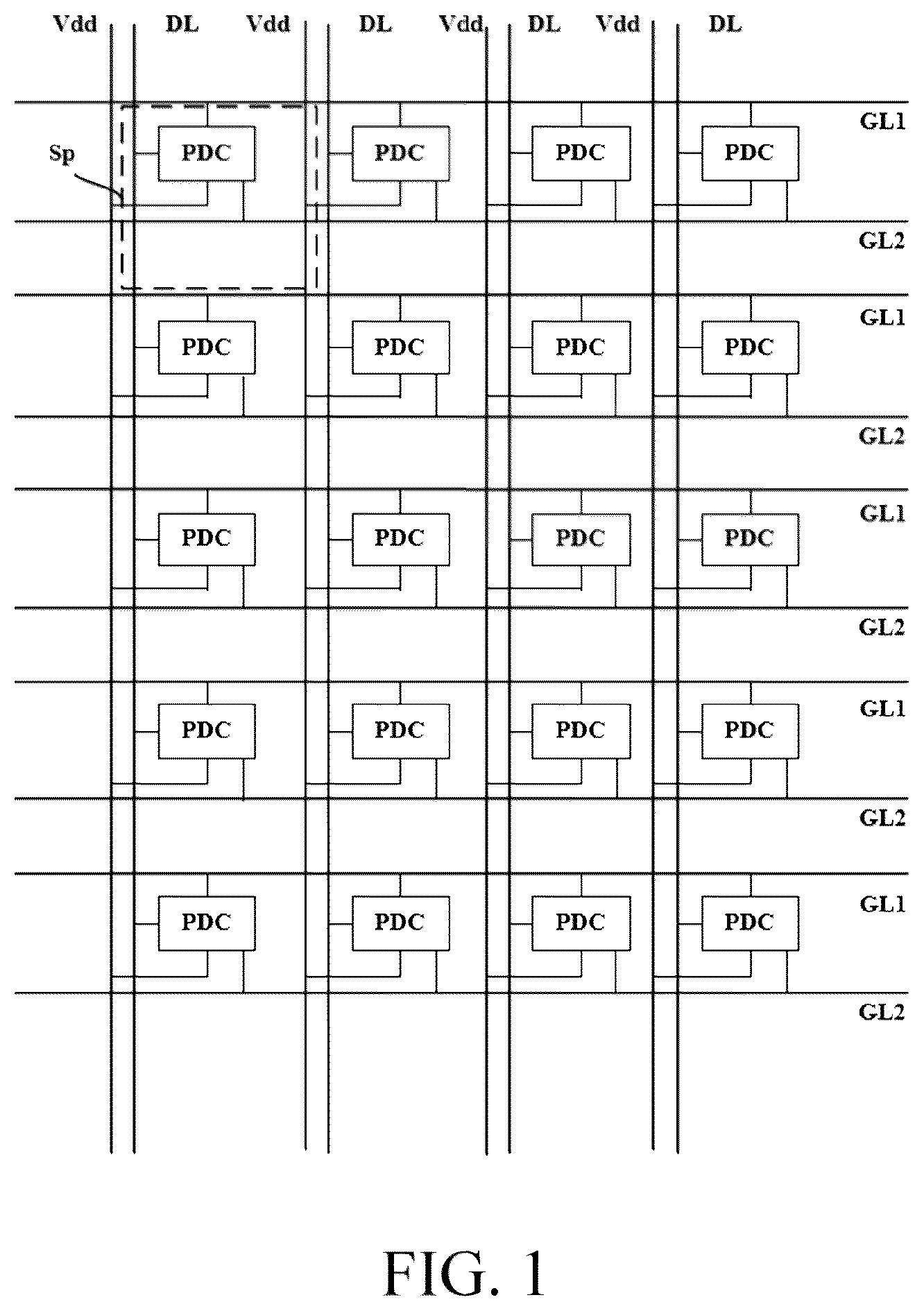
is a plan view of an array substrate in some embodiments according to the present disclosure.
A is a circuit diagram illustrating the structure of a pixel driving circuit in some embodiments according to the present disclosure.
B is a timing diagram illustrating the operation of a pixel driving circuit in some embodiments according to the present disclosure.
A is a diagram illustrating the structure of pixel driving circuits in an array substrate in some embodiments according to the present disclosure,
B is a schematic diagram illustrating an arrangement of pixel driving circuits in the array substrate depicted in A .
C is a diagram illustrating the structure of a light shielding layer in the array substrate depicted in A .
D is a diagram illustrating the structure of a first semiconductor material layer in the array substrate depicted in A .
E is a diagram illustrating the structure of a first gate metal layer in the array substrate depicted in A .
F is a diagram illustrating the structure of a second gate metal layer in the array substrate depicted in A .
G is a diagram illustrating the structure of a second semiconductor material layer in the array substrate depicted in A .
H is a diagram illustrating the structure of a third gate metal layer in the array substrate depicted in A .
I is a diagram illustrating the structure of a first signal line layer in the array substrate depicted in A .
J is a diagram illustrating the structure of a second signal line layer in the array substrate depicted in A .
K is a diagram illustrating the structure of an anode layer in the array substrate depicted in A .
L is a diagram illustrating the structure of pixel driving circuits in an array substrate depicted in A except for the anode layer.
A is a cross-sectional view along an A-A′ line in A .
B is a cross-sectional view along a B-B′ line in A .
C is a cross-sectional view along a C-C′ line in A .
D is a cross-sectional view along a D-D′ line in A .
E is a cross-sectional view along a E-E′ line in A .
illustrates an interconnected reset signal network in some embodiments according to the present disclosure.
illustrates a first capacitance and a second capacitance in a pixel driving circuit in an array substrate in some embodiments according to the present disclosure.
illustrates a first capacitance and a second capacitance in a pixel driving circuit in an array substrate in some embodiments according to the present disclosure.
illustrates the structure of a gate connecting pad in some embodiments according to the present disclosure.
A is a diagram illustrating the structure of pixel driving circuits in an array substrate in some embodiments according to the present disclosure.
B is a schematic diagram illustrating an arrangement of pixel driving circuits in the array substrate depicted in A .
C is a diagram illustrating the structure of a light shielding layer in the array substrate depicted in A .
D is a diagram illustrating the structure of a first semiconductor material layer in the array substrate depicted in A .
E is a diagram illustrating the structure of a first gate metal layer in the array substrate depicted in A .
F is a diagram illustrating the structure of a second gate metal layer in the array substrate depicted in A .
G is a diagram illustrating the structure of a second semiconductor material layer in the array substrate depicted in A .
H is a diagram illustrating the structure of a third gate metal layer in the array substrate depicted in A .
I is a diagram illustrating the structure of a first signal line layer in the array substrate depicted in A .
J is a diagram illustrating the structure of a second signal line layer in the array substrate depicted in A .
K is a diagram illustrating the structure of an anode layer in the array substrate depicted in A .
L is a diagram illustrating the structure of pixel driving circuits in an array substrate depicted in A except for the anode layer.
is a cross-sectional view along an F-F′ line in A .
illustrates a first capacitance and a second capacitance in a pixel driving circuit in an array substrate in some embodiments according to the present disclosure.
illustrates the structure of a gate connecting pad in some embodiments according to the present disclosure.
A is a diagram illustrating the structure of pixel driving circuits in an array substrate in some embodiments according to the present disclosure.
B is a schematic diagram illustrating an arrangement of pixel driving circuits in the array substrate depicted in A .
C is a diagram illustrating the structure of a light shielding layer in the array substrate depicted in A .
D is a diagram illustrating the structure of a first semiconductor material layer in the array substrate depicted in A .
E is a diagram illustrating the structure of a first gate metal layer in the array substrate depicted in A .
F is a diagram illustrating the structure of a second gate metal layer in the array substrate depicted in A .
G is a diagram illustrating the structure of a second semiconductor material layer in the array substrate depicted in A .
H is a diagram illustrating the structure of a third gate metal layer in the array substrate depicted in A .
I is a diagram illustrating the structure of a first signal line layer in the array substrate depicted in A .
J is a diagram illustrating the structure of a second signal line layer in the array substrate depicted in A .
K is a diagram illustrating the structure of an anode layer in the array substrate depicted in A .
L is a diagram illustrating the structure of pixel driving circuits in an array substrate depicted in A except for the anode layer.
A is a zoom-in view of a region having an active layer of a fourth transistor in the array substrate depicted in A .
B illustrate the structure of a first semiconductor material layer in the region depicted in A .
C illustrate the structure of a first gate metal layer in the region depicted in A .
D illustrate the structure of a first semiconductor material layer and a first signal line layer in the region depicted in A .
E illustrate the structure of a first gate metal layer and a first signal line layer in the region depicted in A .
F illustrate the structure of a first semiconductor material layer and a second signal line layer in the region depicted in A .
G illustrate the structure of a first gate metal layer and a second signal line layer in the region depicted in A .
H illustrate the structure of a first semiconductor material layer and an anode layer in the region depicted in A .
I illustrate the structure of a first gate metal layer and an anode layer in the region depicted in A .
DETAILED DESCRIPTION
The disclosure will now be described more specifically with reference to the following embodiments. It is to be noted that the following descriptions of some embodiments are presented herein for purpose of illustration and description only. It is not intended to be exhaustive or to be limited to the precise form disclosed.
The present disclosure provides, inter alia, an array substrate and a display apparatus that substantially obviate one or more of the problems due to limitations and disadvantages of the related art. In one aspect, the present disclosure provides an array substrate. In some embodiments, the array substrate includes a plurality of first gate lines, a plurality of second gate lines, and a plurality of pixel driving circuits. Optionally, a respective pixel driving circuit of the plurality of pixel driving circuits includes a driving transistor, a data write transistor, a compensating transistor, a storage capacitor, a first node connecting line connecting a gate electrode of the driving transistor with a first electrode of the compensating transistor, and a gate connecting pad. Optionally, a respective first gate line of the plurality of first gate lines configured to provide a gate scanning signal to the data write transistor. Optionally, the gate connecting pad comprises at least a portion of a gate electrode of the data write transistor, is connected to the respective first gate line, and is in a layer different from the respective first gate line. Optionally, a respective second gate line of the plurality of second gate lines configured to provide a gate scanning signal to the compensating transistor. Optionally, the array substrate comprises a first semiconductor material layer and a second semiconductor material layer on a side of the first semiconductor material layer away from a base substrate. Optionally, the first semiconductor material layer comprises at least active layers of the driving transistor and the data write transistor. Optionally, the second semiconductor material layer comprises at least an active layer of the compensating transistor. Optionally, a first capacitance is at least partially formed between the gate connecting pad and at least one of the second semiconductor material layer or the first node connecting line. Optionally, a second capacitance is formed between the first node connecting line and the respective second gate line. Optionally, a ratio of the first capacitance to the second capacitance is greater than 2.3.
Various appropriate pixel driving circuits may be used in the present array substrate. Examples of appropriate driving circuits include 3T1C, 2T1C, 4T1C, 4T2C, 5T2C, 6T1C, 7T1C, 7T2C, 8T1C, and 5T2C. In some embodiments, the respective one of the plurality of pixel driving circuits is an 8T1C driving circuit. Various appropriate light emitting elements may be used in the present array substrate. Examples of appropriate light emitting elements include organic light emitting diodes, quantum dots light emitting diodes, and micro light emitting diodes. Optionally, the light emitting element is micro light emitting diode. Optionally, the light emitting element is an organic light emitting diode including an organic light emitting layer.
is a plan view of an array substrate in some embodiments according to the present disclosure. Referring to , the array substrate includes an array of subpixels Sp. Each subpixel includes an electronic component, e.g., a light emitting element. In one example, the light emitting element is driven by a respective pixel driving circuit PDC. The array substrate includes a plurality of first gate lines (e.g., a respective first gate line GL 1 ), a plurality of second gate lines (e.g., a respective second gate line GL 2 ), a plurality of data lines (e.g., a respective data line DL), a plurality of high voltage supply lines (e.g., a respective high voltage supply line Vdd), and a plurality of low voltage supply lines (e.g., a respective low voltage supply line Vss). Light emission in a respective subpixel Sp is driven by a respective pixel driving circuit PDC. In one example, a high voltage signal (e.g., a VDD signal) is input, through the respective high voltage supply line Vdd of the plurality of high voltage supply line, to the respective pixel driving circuit PDC connected to an anode of the light emitting element; a low voltage signal (e.g., a VSS signal) is input, through a low voltage supply line, to a cathode of the light emitting element. A voltage difference between the high voltage signal (e.g., the VDD signal) and the low voltage signal (e.g., the VSS signal) is a driving voltage □V that drives light emission in the light emitting element.
A is a circuit diagram illustrating the structure of a pixel driving circuit in some embodiments according to the present disclosure. Referring to A , in some embodiments, the pixel driving circuit includes a driving transistor Td; a storage capacitor Cst having a first capacitor electrode Ce 1 and a second capacitor electrode Ce 2 ; a second reset transistor Tr 2 having a gate electrode connected to a respective second reset control signal line rst 2 of a plurality of second reset control signal lines, a first electrode connected to a respective second reset signal line Vint 2 of a plurality of second reset signal lines, and a second electrode connected to a second electrode of the driving transistor Td; a first transistor T 1 having a gate electrode connected to a respective first gate line GL 1 of a plurality of first gate lines, a first electrode connected to a respective data line DL of a plurality of data lines, and a second electrode connected to a first electrode of the driving transistor Td; a third reset transistor Tr 3 having a gate electrode connected to a respective first reset control signal line rst 1 of a plurality of first reset control signal lines, a first electrode connected to a respective third reset signal line Vint 3 of a plurality of third reset signal lines, and a second electrode connected to the first electrode of the driving transistor Td; a second transistor T 2 having a gate electrode connected to a respective second gate line GL 2 of a plurality of second gate lines, a first electrode connected to the first capacitor electrode Ce 1 of the storage capacitor Cst and the gate electrode of the driving transistor Td, and a second electrode connected to the second electrode of the driving transistor Td; a third transistor T 3 having a gate electrode connected to a respective light emitting control signal line em of a plurality of light emitting control signal lines, a first electrode connected to a respective voltage supply line Vdd of a plurality of voltage supply lines, and a second electrode connected to the first electrode of the driving transistor Td and the second electrode of the first transistor T 1 ; a fourth transistor T 4 having a gate electrode connected to the respective light emitting control signal line em of the plurality of light emitting control signal lines, a first electrode connected to second electrodes of the driving transistor Td and the second transistor T 2 , and a second electrode connected to an anode of a light emitting element LE; and a first reset transistor Tr 1 having a gate electrode connected to the respective first reset control signal line rst 1 of a plurality of first reset control signal lines, a first electrode connected to a respective first reset signal line Vint 1 of a plurality of first reset signal lines, and a second electrode connected to the second electrode of the fourth transistor T 4 and the anode of the light emitting element LE. The second capacitor electrode Ce 2 is connected to the respective voltage supply line and the first electrode of the third transistor T 3 .
In some embodiments, the pixel driving circuit includes a driving transistor Td, a data write transistor (e.g., the first transistor T 1 ), a compensating transistor (e.g., the second transistor T 2 ), two light emitting control transistors (e.g., the third transistor T 3 and the fourth transistor T 4 ), and three reset transistors (e.g., the first reset transistor Tr 1 , the second reset transistor Tr 2 , and the third reset transistor Tr 3 ).
As used herein, a first electrode or a second electrode refers to one of a first terminal and a second terminal of a transistor, the first terminal and the second terminal being connected to an active layer of the transistor. A direction of a current flowing through the transistor may be configured to be from a first electrode to a second electrode, or from a second electrode to a first electrode. Accordingly, depending on the direction of the current flowing through the transistor, in one example, the first electrode is configured to receive an input signal and the second electrode is configured to output an output signal; in another example, the second electrode is configured to receive an input signal and the first electrode is configured to output an output signal.
The pixel driving circuit further include a first node N 1 , a second node N 2 , a third node N 3 , and a fourth node N 4 . The first node N 1 is connected to the gate electrode of the driving transistor Td, the first capacitor electrode Ce 1 , and the first electrode of the second transistor T 2 . The second node N 2 is connected to the second electrode of the third transistor T 3 , the second electrode of the first transistor T 1 , the second electrode of the third reset transistor Tr 3 , and the first electrode of the driving transistor Td. The third node N 3 is connected to the second electrode of the driving transistor Td, the second electrode of the second transistor T 2 , the first electrode of the fourth transistor T 4 , and the second electrode of the second reset transistor Tr 2 . The fourth node N 4 is connected to the second electrode of the fourth transistor T 4 , the second electrode of the first reset transistor Tr 1 , and the anode of the light emitting element LB.
The array substrate in some embodiments includes a plurality of subpixels. In some embodiments, the plurality of subpixels includes a respective first subpixel, a respective second subpixel, and a respective third subpixel. Optionally, a respective pixel of the array substrate includes the respective first subpixel, the respective second subpixel, and the respective third subpixel. The plurality of subpixels in the array substrate are arranged in an array. In one example, the array of the plurality of subpixels includes a S 1 -S 2 -S 3 format repeating array, in which S 1 stands for the respective first subpixel, S 2 stands for the respective second subpixel, and S 3 stands for the respective third subpixel. In another example, the S 1 -S 2 -S 3 format is a C 1 -C 2 -C 3 format, in which C 1 stands for the respective first subpixel of a first color, C 2 stands for the respective second subpixel of a second color, and C 3 stands for the respective third subpixel of a third color. In another example, the C 1 -C 2 -C 3 format is an R-G-B format, in which the respective first subpixel is a red subpixel, the respective second subpixel is a green subpixel, and the respective third subpixel is a blue subpixel.
In another example, the array of the plurality of subpixels includes a S 1 -S 2 -S 3 -S 4 format repeating array, in which S 1 stands for the respective first subpixel, S 2 stands for the respective second subpixel, S 3 stands for the respective third subpixel, and S 4 stands for the respective fourth subpixel. In another example, the S 1 -S 2 -S 3 -S 4 format is a C 1 -C 2 -C 3 -C 4 format, in which C 1 stands for the respective first subpixel of a first color, C 2 stands for the respective second subpixel of a second color, C 3 stands for the respective third subpixel of a third color, and C 4 stands for the respective fourth subpixel of a fourth color. In another example, the S 1 -S 2 -S 3 -S 4 format is a C 1 -C 2 -C 3 -C 2 ′ format, in which C 1 stands for the respective first subpixel of a first color, C 2 stands for the respective second subpixel of a second color. C 3 stands for the respective third subpixel of a third color, and C 2 ′ stands for the respective fourth subpixel of the second color. In another example, the C 1 -C 2 -C 3 -C 2 ′ format is a R-G-B-G format, in which the respective first subpixel is a red subpixel, the respective second subpixel is a green subpixel, the respective third subpixel is a blue subpixel, and the respective fourth subpixel is a green subpixel.
In some embodiments, a minimum repeating unit of the plurality of subpixels of the array substrate includes the respective first subpixel, the respective second subpixel, and the respective third subpixel. Optionally, each of the respective first subpixel, the respective second subpixel, and the respective third subpixel, includes the first transistor T 1 , the second transistor T 2 , the third transistor T 3 , the fourth transistor T 4 , the first reset transistor Tr 1 , the second reset transistor Tr 2 , the third reset transistor Tr 3 , the driving transistor Td, and the storage capacitor Cst.
In alternative embodiments, a minimum repeating unit of the plurality of subpixels of the array substrate includes a respective first subpixel, a respective second subpixel, a respective third subpixel, and a respective fourth subpixel. Optionally, each of the respective first subpixel, the respective second subpixel, the respective third subpixel, and the respective fourth subpixel, includes the first transistor T 1 , the second transistor T 2 , the third transistor T 3 , the fourth transistor T 4 , the first reset transistor Tr 1 , the second reset transistor Tr 2 , the third reset transistor Tr 3 , the driving transistor Td, and the storage capacitor Cst.
The present disclosure may be implemented in pixel driving circuit having transistors of various types, including a pixel driving circuit having p-type transistors, a pixel driving circuit having n-type transistors, and a pixel driving circuit having one or more p-type transistors and one or more n-type transistors. Referring to A , the second transistor T 2 is an n-type transistor such as a metal oxide transistor, and other transistors are p-type transistors such as polysilicon transistors. For a p-type transistor, an effective control signal (e.g., a turn-on control signal) is a low voltage signal, and an ineffective control signal (e.g., a turn-off control signal) is a high voltage signal. For an n-type transistor, an effective control signal (e.g., a turn-on control signal) is a high voltage signal, and an ineffective control signal (e.g., a turn-off control signal) is a low voltage signal.
B is a timing diagram illustrating the operation of a pixel driving circuit in some embodiments according to the present disclosure. Referring to A and B , during one frame of image, the operation of the pixel driving circuit includes a reset sub-phase t 1 , a data write sub-phase t 2 , and a light emitting sub-phase 13 . In the initial sub-phase 10 , a turning-off reset control signal is provided through the respective second reset control signal line rst 2 to the gate electrode of the second reset transistor Tr 2 to turn off the second reset transistor Tr 2 . A turning-off reset control signal is provided through the respective first reset control signal line rst 1 to the gate electrode of the first reset transistor Tr 1 and the gate electrode of the third reset transistor Tr 3 to turn off the first reset transistor Tr 1 and the third reset transistor Tr 3 . In the initial sub-phase 10 , the respective first gate line GL 1 is provided with a turning-off signal, thus the first transistor T 1 is turned off.
In the reset sub-phase t 1 , a turning-on reset control signal is provided through the respective first reset control signal line rst 1 to the gate electrode of the first reset transistor Tr 1 to turn on the first reset transistor Tr 1 ; allowing an initialization voltage signal from the respective first reset signal line Vint 1 to pass from a first electrode of the first reset transistor Tr 1 to a second electrode of the first reset transistor Tr 1 ; and in turn to the node N 4 . The anode of the light emitting element LE is initialized. A turning-on reset control signal is provided through the respective first reset control signal line rst 1 to the gate electrode of the third reset transistor Tr 3 to turn on the third reset transistor Tr 3 ; allowing an initialization voltage signal from the respective third reset signal line Vint 3 to pass from a first electrode of the third reset transistor Tr 3 to a second electrode of the third reset transistor Tr 3 ; and in turn to the node N 2 . The node N 2 is initialized. In the reset sub-phase t 1 , the respective first gate line GL 1 is provided with a turning-off signal, thus the first transistor T 1 is turned off. The respective light emitting control signal line em is provided with a high voltage signal to turn off the third transistor T 3 and the fourth transistor T 4 .
In the data write sub-phase t 2 , a turning-on reset control signal is provided through the second reset control signal line rst 2 to the gate electrode of the second reset transistor Tr 2 to turn on the second reset transistor Tr 2 ; allowing an initialization voltage signal from the respective second reset signal line Vin t 2 to pass from a first electrode of the second reset transistor Tr 2 to a second electrode of the second reset transistor Tr 2 , and in turn to the first capacitor electrode Ce 1 and the gate electrode of the driving transistor Td. The second electrode of the driving transistor Td is initialized. The second capacitor electrode Ce 2 receives a high voltage signal from the respective voltage supply line Vdd. The first capacitor electrode Ce 1 is charged in the data write sub-phase t 2 due to an increasing voltage difference between the first capacitor electrode Ce 1 and the second capacitor electrode Ce 2 .
In the data write sub-phase t 2 , the turning-off reset control signal is again provided through the respective first reset control signal line rst 1 to the gate electrode of the first reset transistor Tr 1 and the gate electrode of the third reset transistor Tr 3 to turn off the first reset transistor Tr 1 and the third reset transistor Tr 3 . The respective first gate line GL 1 and the respective second gate line GL 2 are provided with a turning-on signal, thus the first transistor T 1 and the second transistor T 2 are turned on. A second electrode of the driving transistor Td is connected with the second electrode of the second reset transistor Tr 2 . A gate electrode of the driving transistor Td is electrically connected with the first electrode of the second transistor T 2 . Because the second transistor T 2 is turned on in the data write sub-phase 12 , the gate electrode and the second electrode of the driving transistor Td are connected and short circuited, and only the PN junction between the gate electrode and a first electrode of the driving transistor Td is effective, thus rendering the driving transistor Td in a diode connecting mode. The first transistor T 1 is turned on in the data write sub-phase 12 . The data voltage signal transmitted through the respective data line DL is received by a first electrode of the first transistor T 1 , and in turn transmitted to the first electrode of the driving transistor Td, which is connected to the second electrode of the first transistor T 1 . A node N 2 connecting to the first electrode of the driving transistor Td has a voltage level of the data voltage signal. Because only the PN junction between the gate electrode and a first electrode of the driving transistor Td is effective, the voltage level at the node N 1 in the data write sub-phase 12 increase gradually to (Vdata+Vth), wherein the Vdata is the voltage level of the data voltage signal, and the Vth is the voltage level of the threshold voltage Th of the PN junction. The storage capacitor Cst is discharged because the voltage difference between the first capacitor electrode Ce 1 and the second capacitor electrode Ce 2 is reduced to a relatively small value. The respective light emitting control signal line em is provided with a high voltage signal to turn off the third transistor T 3 and the fourth transistor T 4 .
In the light emitting sub-phase 13 , a turning-off reset control signal is provided through the respective second reset control signal line rst 2 to the gate electrode of the second reset transistor Tr 2 to turn off the second reset transistor Tr 2 . A turning-off reset control signal is provided through the respective first reset control signal line rst 1 to the gate electrode of the first reset transistor Tr 1 and the gate electrode of the third reset transistor Tr 3 to turn off the first reset transistor Tr 1 and the third reset transistor Tr 3 . The respective first gate line GL 1 and the respective second gate line GL 2 are provided with a turning-off signal, the first transistor T 1 and the second transistor T 2 are turned off. The respective light emitting control signal line em is provided with a low voltage signal to turn on the third transistor T 3 and the fourth transistor T 4 . The voltage level at the node N 1 in the light emitting sub-phase 13 is maintained at (Vdata+Vth), the driving transistor Td is turned on by the voltage level, and working in the saturation area. A path is formed through the third transistor T 3 , the driving transistor Td, the fourth transistor T 4 , to the light emitting element LE. The driving transistor Td generates a driving current for driving the light emitting element LE to emit light. A voltage level at a node N 3 connected to the second electrode of the driving transistor Td equals to a light emitting voltage of the light emitting element LE.
A is a diagram illustrating the structure of pixel driving circuits in an array substrate in some embodiments according to the present disclosure. B is a schematic diagram illustrating an arrangement of pixel driving circuits in an array substrate depicted in A . A and B depicts a portion of the array substrate having three adjacent pixel driving circuits, including PDC 1 , PDC 2 , and PDC 3 . L is a diagram illustrating the structure of pixel driving circuits in an array substrate depicted in A except for the anode layer.
C is a diagram illustrating the structure of a light shielding layer in the array substrate depicted in A . D is a diagram illustrating the structure of a first semiconductor material layer in the array substrate depicted in A . E is a diagram illustrating the structure of a first gate metal layer in the array substrate depicted in A . F is a diagram illustrating the structure of a second gate metal layer in the array substrate depicted in A . G is a diagram illustrating the structure of a second semiconductor material layer in the array substrate depicted in A . H is a diagram illustrating the structure of a third gate metal layer in the array substrate depicted in A . I is a diagram illustrating the structure of a first signal line layer in the array substrate depicted in A . J is a diagram illustrating the structure of a second signal line layer in the array substrate depicted in A . K is a diagram illustrating the structure of an anode layer in the array substrate depicted in A . A is a cross-sectional view along an A-A′ line in A . B is a cross-sectional view along a B-B′ line in A . C is a cross-sectional view along a C-C′ line in A . D is a cross-sectional view along a D-D′ line in A . E is a cross-sectional view along a E-E′ line in A .
Referring to A to L , and A to E , the array substrate in some embodiments includes a base substrate BS, a light shield layer LSL on the base substrate BS, a buffer layer BUF on a side of the light shield layer LSL away from the base substrate BS, a first semiconductor material layer SML 1 on a side of the buffer layer BUF away from the base substrate BS, a gate insulating layer G 1 on a side of the first semiconductor material layer SML 1 away from the base substrate BS, a first gate metal layer Gate 1 on a side of the gate insulating layer G 1 away from the first semiconductor material layer SML 1 , an insulating layer IN on a side of the first gate metal layer Gate 1 away from the gate insulating layer G 1 , a second gate metal layer Gate 2 on a side of the insulating layer IN away from the first gate metal layer Gate 1 , a first inter-layer dielectric layer ILD 1 on a side of the second gate metal layer Gate 2 away from the insulating layer IN, a second semiconductor material layer SML 2 on a side of the first inter-layer dielectric layer ILD 1 away from the second gate metal layer Gate 2 , a second inter-layer dielectric layer ILD 2 on a side of the second semiconductor material layer SML 2 away from the first inter-layer dielectric layer ILD 1 , a third gate metal layer Gate 3 on a side of the second inter-layer dielectric layer ILD 2 away from the second semiconductor material layer SML 2 , a passivation layer PVX on a side of the third gate metal layer Gate 3 away from the second inter-layer dielectric layer ILD 2 , a first signal line layer SD 1 on a side of the passivation layer PVX away from the third gate metal layer Gate 3 , a first planarization layer PLN 1 on a side of the first signal line layer SD 1 away from the passivation layer PVX, a second signal line layer SD 2 on a side of the first planarization layer PLN 1 away from the first signal line layer SD 1 , a second planarization layer PLN 2 on a side of the second signal line layer SD 2 away from the first planarization layer PLN 1 , and an anode layer ADL on a side of the second planarization layer PLN 2 away from the second signal line layer SD 2 .
Referring to A , A , C , A , and D , in some embodiments, the light shield layer LSL includes a light shield LS. Various appropriate materials and various appropriate fabricating methods may be used for making the light shield layer LSL. For example, a metallic material may be deposited on the substrate by a plasma-enhanced chemical vapor deposition (PECVD) process. Examples of appropriate metallic materials for making the light shield layer LSL include, but are not limited to, aluminum, chromium, tungsten, titanium, tantalum, molybdenum, copper, and alloys or laminates containing the same.
In some embodiments, an orthographic projection of the light shield LS on a base substrate BS substantially covers (e.g., covers at least 80%, covers at least 85%, covers at least 90%, covers at least 95%, covers at least 99%, or completely covers) an orthographic projection of an active layer of a driving transistor of the pixel driving circuit on the base substrate BS.
In some embodiments, the light shield LS is configured to be provided with a first reference signal. Optionally, the light shield LS is electrically connected to a voltage supply line. In one example, the light shield LS is electrically connected to a voltage supply line in a peripheral area of the array substrate.
In alternative embodiments, the light shield LS is configured to be provided with a reference signal.
In alternative embodiments, the light shield LS is configured to be provided with a reset signal.
Referring to A , A , D , A to E , the first semiconductor material layer SML 1 in some embodiments includes at least active layers of multiple transistors of the pixel driving circuit, including the first transistor T 1 , the third transistor T 3 , the fourth transistor T 4 , the first reset transistor Tr 1 , the second reset transistor Tr 2 , the third reset transistor Tr 3 , and the driving transistor Td. Optionally, the first semiconductor material layer SML 1 further includes at least respective portions of first electrodes of multiple transistors of the pixel driving circuit, including the first transistor T 1 , the third transistor T 3 , the fourth transistor T 4 , the first reset transistor Tr 1 , the second reset transistor Tr 2 , the third reset transistor Tr 3 , and the driving transistor Td. Optionally, the first semiconductor material layer SML 1 further includes at least respective portions of second electrodes of multiple transistors of the pixel driving circuit, including the first transistor T 1 , the third transistor T 3 , the fourth transistor T 4 , the first reset transistor Tr 1 , the second reset transistor Tr 2 , the third reset transistor Tr 3 , and the driving transistor Td. Optionally, the first semiconductor material layer SML 1 includes active layers, first electrodes, and second electrodes of multiple transistors of the pixel driving circuit, including the first transistor T 1 , the third transistor T 3 , the fourth transistor T 4 , the first reset transistor Tr 1 , the second reset transistor Tr 2 , the third reset transistor Tr 3 , and the driving transistor Td. Various appropriate semiconductor materials may be used for making the first semiconductor material layer SML 1 . Examples of the semiconductor materials for making the first semiconductor material layer SML 1 include silicon-based semiconductor materials such as polycrystalline silicon, single-crystal silicon, and amorphous silicon.
In D , a pixel driving circuit corresponding to PDC 1 in B is annotated with labels indicating components of each of multiple transistors (T 1 , T 3 , T 4 , Tr 1 , Tr 2 , Tr 3 , and Td) in the pixel driving circuit. For example, the first transistor T 1 includes an active layer ACT 1 , a first electrode S 1 , and a second electrode D 1 . The third transistor T 3 includes an active layer ACT 3 , a first electrode S 3 , and a second electrode D 3 . The fourth transistor T 4 includes an active layer ACT 4 , a first electrode S 4 , and a second electrode D 4 . The first reset transistor Tr 1 includes an active layer ACTr 1 , a first electrode Sr 1 , and a second electrode Dr 1 . The second reset transistor Tr 2 includes an active layer ACTr 2 , a first electrode Sr 2 , and a second electrode Dr 2 . The third reset transistor Tr 3 includes an active layer ACTr 3 , a first electrode Sr 3 , and a second electrode Dr 3 . The driving transistor Td includes an active layer ACTd, a first electrode Sd, and a second electrode Dd.
Optionally, the active layers (ACT 1 , ACT 3 , ACT 4 , ACTr 1 , ACTr 2 , ACTr 3 , and ACTd), the first electrodes (S 1 , S 3 , S 4 , Sr 1 , Sr 2 , Sr 3 , and Sd), and the second electrodes (D 1 , D 3 . D 4 . Dr 1 , Dr 2 , Dr 3 , and Dd) of the respective transistors (T 1 , T 3 , T 4 , Tr 1 , Tr 2 , Tr 3 , and Td) are in a same layer.
In some embodiments, the active layers (ACT 1 , ACT 3 , ACT 4 , ACTr 1 , and ACTd), at least portions of the first electrodes (S 1 , S 3 , S 4 , Sr 1 , and Sd), and at least portions of the second electrodes (D 1 , D 3 , D 4 , Dr 1 , and Dd) of multiple transistors (T 1 , T 3 , T 4 , Tr 1 , and Td) in the pixel driving circuit are parts of a unitary structure. Optionally, a part of the second reset transistor Tr 2 (ACTr 2 , Sr 2 , Dr 2 ) in the first semiconductor material layer is spaced apart from the unitary structure (T 1 , T 3 , T 4 , Tr 1 , and Td) in a same pixel driving circuit. Optionally, a part of the third reset transistor Tr 3 (ACTr 3 , Sr 3 . Dr 3 ) in the first semiconductor material layer is spaced apart from the unitary structure (T 1 , T 3 , 14 , Tr 1 , and Td) in a same pixel driving circuit.
Referring to A , A , E , and A to E , the first gate metal layer Gate 1 in some embodiments includes a plurality of light emitting control signal lines (e.g., a respective light emitting control signal line ent), a gate connecting pad GCP, a first gate electrode pad GEP 1 , a second gate electrode pad GEP 2 , and a first capacitor electrode Ce 1 of the storage capacitor Cst in the pixel driving circuit.
Various appropriate electrode materials and various appropriate fabricating methods may be used to make the first gate metal layer Gate 1 . For example, a conductive material may be deposited on the substrate by a plasma-enhanced chemical vapor deposition (PECVD) process and patterned. Examples of appropriate conductive materials for making the first gate metal layer Gate 1 include, but are not limited to, aluminum, copper, molybdenum, chromium, aluminum copper alloy, copper molybdenum alloy, molybdenum aluminum alloy, aluminum chromium alloy, copper chromium alloy, molybdenum chromium alloy, copper molybdenum aluminum alloy, and the like. Optionally, the plurality of light emitting control signal lines (e.g., the respective light emitting control signal line em), the gate connecting pad GCP, the first gate electrode pad GEP 1 , the second gate electrode pad GEP 2 , and the first capacitor electrode Ce 1 of the storage capacitor Cst in the pixel driving circuit are in a same layer.
As used herein, the term “same layer” refers to the relationship between the layers simultaneously formed in the same step. In one example, the plurality of light emitting control signal lines and the first capacitor electrode Ce 1 are in a same layer when they are formed as a result of one or more steps of a same patterning process performed in a same layer of material. In another example, the plurality of light emitting control signal lines and the first capacitor electrode Ce 1 can be formed in a same layer by simultaneously performing the step of forming the plurality of light emitting control signal lines, and the step of forming the first capacitor electrode Ce 1 . The term “same layer” does not always mean that the thickness of the layer or the height of the layer in a cross-sectional view is the same.
In some embodiments, the gate connecting pad GCP includes a gate electrode G 1 of the first transistor T 1 in the pixel driving circuit. The gate connecting pad GCP is connected to a respective first gate line GL 1 of a plurality of first gate lines. In one example, the respective first gate line GL 1 is connected to the gate connecting pad GCP through an eighth via v 8 . Optionally, the eighth via v 8 extends through the passivation layer PVX, the second inter-layer dielectric layer ILD 2 , the first inter-layer dielectric layer ILD 1 , and the insulating layer IN.
In some embodiments, the first gate electrode pad GEP 1 includes a gate electrode Gr 1 of the first reset transistor Tr 1 in the pixel driving circuit, and a gate electrode Gr 3 of the third reset transistor Tr 3 in an adjacent pixel driving circuit in a same row and in a next adjacent column (or a gate electrode Gr 3 of the third reset transistor Tr 3 in the pixel driving circuit, and a gate electrode Gr 1 of the first reset transistor Tr 1 in an adjacent pixel driving circuit in a same row and in a previous adjacent column. The first gate electrode pad GEP 1 is connected to the respective first reset control signal line rst 1 of the plurality of first reset control signal lines. In one example, the respective first reset control signal line rst 1 is connected to the first gate electrode pad GEP 1 through a via extending through the passivation layer PVX, the second inter-layer dielectric layer ILD 2 , the first inter-layer dielectric layer ILD 1 , and the insulating layer IN.
In some embodiments, the second gate electrode pad GEP 2 includes a gate electrode Gr 2 of the second reset transistor Tr 2 in the pixel driving circuit. The second gate electrode pad GEP 2 is connected to the respective second reset control signal line rst 2 of the plurality of second reset control signal lines. In one example, the respective second reset control signal line rst 2 is connected to the second gate electrode pad GEP 2 through a via extending through the passivation layer PVX, the second inter-layer dielectric layer ILD 2 , the first inter-layer dielectric layer ILD 1 , and the insulating layer IN.
Referring to A , A , F , and A to E , the second gate metal layer Gate 2 in some embodiments includes at least portions of a plurality of second gate lines (e.g., a respective second gate line first branch GL 2 - 1 ), a plurality of second reset signal lines (e.g., a respective second reset signal line Vint 2 ), and a second capacitor electrode Ce 2 of the storage capacitor Cst in the pixel driving circuit. Various appropriate electrode materials and various appropriate fabricating methods may be used to make the second gate metal layer Gate 2 . For example, a conductive material may be deposited on the substrate by a plasma-enhanced chemical vapor deposition (PECVD) process and patterned. Examples of appropriate conductive materials for making the second gate metal layer Gate 2 include, but are not limited to, aluminum, copper, molybdenum, chromium, aluminum copper alloy, copper molybdenum alloy, molybdenum aluminum alloy, aluminum chromium alloy, copper chromium alloy, molybdenum chromium alloy, copper molybdenum aluminum alloy, and the like. Optionally, the at least portions of the plurality of second gate lines (e.g., a respective second gate line first branch GL 2 - 1 ), the plurality of second reset signal lines (e.g., the respective second reset signal Vint 2 ), and the second capacitor electrode Ce 2 of the storage capacitor Cst in the pixel driving circuit are in a same layer.
Referring to F , a plurality of second capacitor electrodes in a plurality of pixel driving circuits are connected to each other, and are parts of a unitary structure. By having second capacitor electrodes connected to each other, a resistance of a respective first voltage supply line Vddh can be reduced because the second capacitor electrodes are electrically connected to the respective first voltage supply line Vddh. The inventors of the present disclosure discover that this structure improves display uniformity in the array substrate.
In alternative embodiments, the plurality of second capacitor electrodes in the plurality of pixel driving circuits are spaced apart from each other. By having second capacitor electrodes spaced apart from each other, parasitic capacitance between the plurality of second capacitor electrodes and the second electrode Dd of the driving transistor Td (e.g., the node N 3 ) can be reduced, preventing occurrence of short-term residual image when the array substrate is in a display mode.
Referring to A , A , G , and A to E , the second semiconductor material layer SML 2 in some embodiments includes at least an active layer ACT 2 of the second transistor T 2 in the pixel driving circuit. Optionally, the second semiconductor material layer SML 2 further includes at least a portion of a first electrode S 2 of the second transistor T 2 in the pixel driving circuit. Optionally, the second semiconductor material layer SML 2 further includes at least a portion of a second electrode D 2 of the second transistor T 2 in the pixel driving circuit. Optionally, the second semiconductor material layer SML 2 includes the active layer ACT 2 , the first electrode S 2 , and the second electrode D 2 of the second transistor T 2 . In the present array substrate, at least the active layer ACT 2 of the second transistor T 2 are in a layer different from at least the active layers of other transistors of the pixel driving circuit. Various appropriate semiconductor materials may be used for making the second semiconductor material layer SML 2 . Examples of the semiconductor materials for making the second semiconductor material layer SML 2 include metal oxide-based semiconductor material such as indium gallium zinc oxide and metal oxynitride-based semiconductor materials such as zinc oxynitride.
| In G , a pixel driving circuit corresponding to PDC 1 in B is annotated with labels indicating components of the second transistor in the pixel driving circuit. For example, the second transistor T 2 includes an active layer ACT 2 , a first electrode S 2 , and a second electrode D 2 . Optionally, the active layer ACT 2 , the first electrode S 2 , and the second electrode D 2 of the second transistor T 2 are in a same layer.
Referring to A , A , H , A to E , the third gate metal layer Gate 3 in some embodiments includes at least portions of a plurality of second gate lines (e.g., a respective second gate line second branch GL 2 - 2 ), and a plurality of third reset signal lines (e.g., a respective third reset signal line Vint 3 ). Various appropriate electrode materials and various appropriate fabricating methods may be used to make the third gate metal layer Gate 3 . For example, a conductive material may be deposited on the substrate by a plasma-enhanced chemical vapor deposition (PECVD) process and patterned. Examples of appropriate conductive materials for making the third gate metal layer Gate 3 include, but are not limited to, aluminum, copper, molybdenum, chromium, aluminum copper alloy, copper molybdenum alloy, molybdenum aluminum alloy, aluminum chromium alloy, copper chromium alloy, molybdenum chromium alloy, copper molybdenum aluminum alloy, and the like.
Referring to A , A , I , A to E , the first signal line layer SD 1 in some embodiments includes a plurality of first reset signal lines (e.g., a respective first reset signal line Vint 1 ); a plurality of first voltage supply lines (e.g., a respective first voltage supply line Vddh); a plurality of first gate lines (e.g., a respective first gate line GL 1 ); a plurality of first reset control signal lines (e.g., a respective first reset control signal line rst 1 ); a plurality of second reset control signal lines (e.g., a respective second reset control signal line rst 2 ); a data connecting pad DCP; a first node connecting line Cln 1 ; a second node connecting line Cln 2 ; a third node connecting line Cln 3 ; a relay electrode RE; a first reset signal connecting line Cli 1 ; and a second reset signal connecting line Cli 2 .
Various appropriate conductive materials and various appropriate fabricating methods may be used to make the first signal line layer SD 1 . For example, a conductive material may be deposited on the substrate by a plasma-enhanced chemical vapor deposition (PECVD) process and patterned. Examples of appropriate conductive materials for making the first signal line layer include, but are not limited to, titanium, aluminum, copper, molybdenum, chromium, aluminum copper alloy, copper molybdenum alloy, molybdenum aluminum alloy, aluminum chromium alloy, copper chromium alloy, molybdenum chromium alloy, copper molybdenum aluminum alloy, and the like. In some embodiments, the first signal line layer includes a plurality of sub-layers stacked together. In one example, the first signal line layer includes a stacked titanium/aluminum/titanium multi-layer structure. In another example, the first signal line layer includes a stacked molybdenum/aluminum/molybdenum multi-layer structure. Optionally, the plurality of first reset signal lines (e.g., the respective first reset signal line Vint 1 ); the plurality of first voltage supply lines (e.g., the respective first voltage supply line Vddh); the plurality of first gate lines (e.g., the respective first gate line GL 1 ); the plurality of first reset control signal lines (e.g., the respective first reset control signal line rst 1 ); the plurality of second reset control signal lines (e.g., the respective second reset control signal line rst 2 ); the data connecting pad DCP; the first node connecting line Cln 1 ; the second node connecting line Cln 2 ; the third node connecting line Cln 3 ; the relay electrode RE; the first reset signal connecting line Cli 1 ; and the second reset signal connecting line Cli 2 are in a same layer.
In some embodiments, the first node connecting line Cln 1 connects multiple components of the pixel driving circuit to the node N 1 . Referring to A , the first node connecting line Cln 1 is connected to the first capacitor electrode Ce 1 through a first via v 1 , and connected to the second transistor T 2 (e.g., to the first electrode $2 of the second transistor T 2 ) through a second via v 2 . Optionally, the first node connecting line Cln 1 corresponds to the node N 1 depicted in A .
Referring to A , A , E , F , and A , in some embodiments, in a hole region H, a portion of the second capacitor electrode Ce 2 is absent. Optionally, an orthographic projection of the second capacitor electrode Ce 2 on a base substrate BS substantially (e.g., at least 80%, at least 85%, at least 90%, at least 95%, at least 98%, at least 99%, or 100%) covers, with a margin, an orthographic projection of the first capacitor electrode Ce 1 on the base substrate BS except for the hole region H in which a portion of the second capacitor electrode Ce 2 is absent. Optionally, the first via v 1 extends through the passivation layer PVX, the second inter-layer dielectric layer ILD 2 , the first inter-layer dielectric layer ILD 1 , the hole region H, and the insulating layer IN.
In some embodiments, the first node connecting line Cln 1 crosses over a respective second gate line of the plurality of second gate lines. As shown in A and A , the first node connecting line Cln 1 crosses over the respective second gate line first branch GL 2 - 1 in the second gate metal layer Gate 2 , and the respective second gate line second branch GL 2 - 2 in the third gate metal layer Gate 3 .
In some embodiments, referring to B , the second node connecting line Cln 2 is connected to a second electrode D 3 of the third transistor T 3 through a third via v 3 , and connected to a second electrode Dr 3 of the third reset transistor Tr 3 through a fourth via v 4 . Optionally, the second node connecting line Cln 2 corresponds to the node N 2 depicted in A . Optionally, the second node connecting line Cln 2 crosses over the respective light emitting control signal line em of the plurality of light emitting control signal lines.
In some embodiments, referring to C , the third node connecting line Cln 3 is connected to a second electrode Dr 2 of the second reset transistor Tr 2 through a fifth via v 5 , connected to a second electrode D 2 of the second transistor T 2 through a sixth via v 6 , and connected to a second electrode Dd of the driving transistor Td and a first electrode $4 of the fourth transistor T 4 through a seventh via v 7 . Optionally, the third node connecting line Cln 3 corresponds to the node N 3 depicted in A . Optionally, the third node connecting line Cln 3 crosses over a respective second gate line of the plurality of second gate lines. As shown in A and C , the third node connecting line Cln 3 crosses over the respective second gate line first branch GL 2 - 1 in the second gate metal layer Gate 2 , and the respective second gate line second branch GL 2 - 2 in the third gate metal layer Gate 3 .
In some embodiments, an orthographic projection of the third node connecting line Cln 3 on a base substrate BS at least partially (e.g., at least 80%, at least 85%, at least 90%, at least 95%, at least 98%, or at least 99%) overlaps with an orthographic projection of the active layer ACT 2 of the second transistor T 2 on the base substrate. Optionally, the third node connecting line Cln 3 extends along a direction substantially parallel to a direction along which the active layer ACT 2 of the second transistor T 2 extends. Optionally, the orthographic projection of the third node connecting line Cln 3 on a base substrate BS at least partially overlaps with an orthographic projection of the first electrode $2 of the second transistor T 2 on the base substrate. Optionally, the orthographic projection of the third node connecting line Cln 3 on a base substrate BS at least partially overlaps with an orthographic projection of the second electrode D 2 of the second transistor T 2 on the base substrate. As used herein, the term “substantially parallel” means that an angle is in the range of 0 degree to approximately 45 degrees, e.g., 0) degree to approximately 5 degrees, 0) degree to approximately 10 degrees, 0) degree to approximately 15 degrees, 0) degree to approximately 20 degrees, 0 degree to approximately 25 degrees, 0 degree to approximately 30 degrees.
In some embodiments, referring to F , I , and J , the respective first voltage supply line Vddh connects a respective second voltage supply line Vddv of a plurality of second voltage supply lines to the second capacitor electrode Ce 2 , and connects the respective second voltage supply line Vddv of the plurality of second voltage supply lines to the first electrode S 3 of the third transistor T 3 . Optionally, the respective second voltage supply line Vddv of the plurality of second voltage supply lines is connected to the respective first voltage supply line Vddh through a via, the respective first voltage supply line Vddh of the plurality of first voltage supply lines is connected to the second capacitor electrode Ce 2 through a via, the respective first voltage supply line Vddh of the plurality of first voltage supply lines is connected to the first electrode S 3 of the third transistor T 3 through a via, thereby supplying a first reference voltage signal to the respective first voltage supply line Vddh, and in turn to the second capacitor electrode Ce 2 and to the first electrode S 3 of the third transistor T 3 .
Referring to A , I , and J , in some embodiments, the respective first voltage supply line Vddh extends along a direction substantially parallel to the first direction DR 1 , and the respective second voltage supply line Vddv extends along a direction substantially parallel to the second direction DR 2 . Optionally, the plurality of first voltage supply lines and the plurality of second voltage supply lines form an interconnected voltage supply network. The first direction DR 1 and the second direction DR 2 are different from each other.
In some embodiments, referring to A to L , the first reset signal connecting line Cli 1 connects a respective second reset signal line Vint 2 of a plurality of second reset signal lines to the first electrode Sr 2 of the second reset transistor Tr 2 . The first reset signal connecting line Cli 1 is configured to transmit a reset signal from the respective second reset signal line Vint 2 to the first electrode Sr 2 of the second reset transistor Tr 2 .
In some embodiments, referring to A to L , the second reset signal connecting line Cli 2 connects a respective third reset signal line Vint 3 of a plurality of third reset signal lines, a first electrode Sr 3 of the third reset transistor Tr 3 , and a respective fourth reset signal line Vint 4 of a plurality of fourth reset signal lines together. The second reset signal connecting line Cli 2 is connected to the first electrode Sr 3 of the third reset transistor through a via, and connected to a respective third reset signal line Vint 3 of a plurality of third reset signal lines through a via; the respective fourth reset signal line Vint 4 of the plurality of fourth reset signal lines connected to the second reset signal connecting line Cli 2 through a via, thereby transmitting a reset signal from the respective third reset signal line Vint 3 and the respective fourth reset signal line Vint 4 to the first electrode Sr 3 of the third reset transistor.
In some embodiments, referring to A to L , the respective first reset signal line Vint 1 of the plurality of first reset signal lines is connected to the first electrode Sr 1 of the first reset transistor through a via.
In some embodiments, referring to A to L , the data connecting pad DCP connect a respective data line DL of the plurality of data lines to the first electrode S 1 of the first transistor T 1 through a via. The data connecting pad DCP is configured to transmit a data signal from the respective data line DL to the first electrode S 1 of the first transistor.
Referring to A . A , J , and A to E , the second signal line layer SD 2 in some embodiments includes a plurality of second voltage supply lines (e.g, a respective second voltage supply line Vddv), an anode contact pad ACP, a plurality of data lines (e.g., a respective data line DL), a plurality of fourth reset signal lines (e.g., a respective fourth reset signal line Vint 4 ), and a plurality of low voltage supply lines (e.g., a respective low voltage supply line Vss). In some embodiments, the respective first voltage supply line Vddh and the respective second voltage supply line Vddv are configured to provide a first reference voltage signal (e.g., a high reference voltage signal). Optionally, the respective low voltage supply line Vss is configured to provide a second reference voltage signal (e.g., a low reference voltage signal). Optionally, the first reference voltage signal is a constant voltage signal, the second reference voltage signal is a constant voltage signal, the first reference voltage signal has a voltage level higher than a voltage level of the second reference voltage signal.
Various appropriate conductive materials and various appropriate fabricating methods may be used to make the second signal line layer SD 2 . For example, a conductive material may be deposited on the substrate by a plasma-enhanced chemical vapor deposition (PECVD) process and patterned. Examples of appropriate conductive materials for making the second signal line layer SD 2 include, but are not limited to, titanium, aluminum, copper, molybdenum, chromium, aluminum copper alloy, copper molybdenum alloy, molybdenum aluminum alloy, aluminum chromium alloy, copper chromium alloy, molybdenum chromium alloy, copper molybdenum aluminum alloy, and the like. In one example, the second signal line layer includes a stacked titanium/aluminum/titanium multi-layer structure. In another example, the second signal line layer includes a stacked molybdenum/aluminum/molybdenum multi-layer structure. Optionally, the plurality of second voltage supply lines (e.g., the respective second voltage supply line Vddv), the anode contact pad ACP, the plurality of data lines (e.g., the respective data line DL), the plurality of fourth reset signal lines (e.g., the respective fourth reset signal line Vint 4 ), and the plurality of low voltage supply lines (e.g., the respective low voltage supply line Vss) are in a same layer.
Referring to A , A , K , and A to E , the anode layer ADL in some embodiments includes a plurality of anodes (e.g., an anode AD denoted in K ).
| Referring to A , A , and , the array substrate in some embodiments includes a plurality of second voltage supply lines (e.g., a respective second voltage supply line Vddv), a plurality of data lines (e.g., a respective data line DL), a plurality of fourth reset signal lines (e.g., a respective fourth reset signal line Vint 4 ), and a plurality of low voltage supply lines (e.g., a respective low voltage supply line Vss). In some embodiments, the plurality of pixel driving circuits are arranged in columns, including a (3k−2)-th column C(3k−2), a (3k−1)-th column C(3k−1), and a (3k)-th column C(3k) of K columns, K and k being positive integers, 1≤k≤(K/3).
As used herein, the terms “(3k−2)-th column”. “(3k−1)-th column”, and “(3k)-th column” are used in the context of the K columns. The array substrate may or may not include additional column(s) before the first column of the K columns and/or additional columns after the last column of the K columns. In the context of the array substrate, the term “(3k−1)-th column” does not necessarily denote an odd-numbered column, and the term “(3k−2)-th column” or “(3k)-th column does not necessarily denote an even-numbered column. In one example, the (3k−2)-th column is an even-numbered column in the context of the K columns, but may be an odd-numbered column in the context of the array substrate. In another example, the (3k−2)-th column is an even-numbered column in the context of the K columns, and also an even-numbered column in the context of the array substrate. In one example, the (3k−1)-th column is an odd-numbered column in the context of the K columns, but may be an even-numbered column in the context of the array substrate. In another example, the (3k−1)-th column is an odd-numbered column in the context of the K columns, and also an odd-numbered column in the context of the array substrate. In one example, the (3k)-th column is an even-numbered column in the context of the K columns, but may be an odd-numbered column in the context of the array substrate. In another example, the (3k)-th column is an even-numbered column in the context of the K columns, and also an even-numbered column in the context of the array substrate.
In some embodiments, the (3k−2)-th column C(3k−1) includes a (3k−2)-th pixel driving circuit, the (3k−1)-th column C(3k−1) includes a (3k−1)-th pixel driving circuit, and the (3k)-th column C(3k) includes a (3k)-th pixel driving circuit. The (3k−2)-th pixel driving circuit, the (3k−1)-th pixel driving circuit, and the (3k)-th pixel driving circuit are in a same row.
In some embodiments, the (3k−2)-th column C(3k−2) includes a fourth reset signal line of the plurality of fourth reset signal lines; the (3k−1)-th column C(3k−1) includes a fourth reset signal line of the plurality of fourth reset signal lines; and the (3k)-th column C(3k) includes a low voltage supply line of the plurality of low voltage supply lines.
Optionally, the plurality of fourth reset signal lines are absent in the (3k)-th column C(3k).
Optionally, the plurality of low voltage supply lines are absent in the (3k−2)-th column C(3k−2) and are absent in the (3k−1)-th column C(3k−1).
Optionally, the plurality of second voltage supply lines are present in the (3k−2)-th column C(3k−2), the (3k−1)-th column C(3k−1), and the (3k)-th column C(3k).
In some embodiments, the plurality of third reset signal lines and the plurality of fourth reset signal lines form an interconnected reset signal network. illustrates an interconnected reset signal network in some embodiments according to the present disclosure. Referring to , the interconnected reset signal network, in some embodiments includes a plurality of third reset signal lines and a plurality of fourth reset signal lines interconnected together. The plurality of third reset signal lines extend along a direction substantially parallel to a first direction DR 1 ; the plurality of fourth reset signal lines extend along a direction substantially parallel to a second direction DR 2 . Optionally, a respective third reset signal line Vint 3 of the plurality of third reset signal lines and a respective fourth reset signal line Vint 4 of the plurality of fourth reset signal lines are interconnected to each other through a second reset signal connecting line Cli 2 . In one example, the plurality of third reset signal lines are in the third gate metal layer Gate 3 , and the plurality of fourth reset signal lines are in the second signal line layer SD 2 . Optionally, a respective third reset signal line Vint 3 is connected to one or more fourth reset signal line of the plurality of fourth reset signal line. Optionally, a respective fourth reset signal line Vint 4 is connected to one or more third reset signal line of the plurality of third reset signal line.
In some embodiments, there are two capacitances. C 1 and C 2 , in a pixel driving circuit in an array substrate in some embodiments according to the present disclosure. illustrates a first capacitance and a second capacitance in a pixel driving circuit in an array substrate in some embodiments according to the present disclosure. Referring to , A , F to I , in some embodiments, the first capacitance C 1 is formed between the second semiconductor material layer (e.g., a structure comprising the first electrode S 2 of the second transistor T 2 ) and the respective first gate line GL 1 , and/or between the first node connecting line Cln 1 and the respective first gate line GL 1 . The second capacitance C 2 is formed between the first node connecting line Cln 1 and the respective second gate line (e.g., including the respective second gate line first branch GL 2 - 1 in the second gate metal layer and the respective second gate line second branch GL 2 - 2 in the third gate metal layer).
The inventors of the present disclosure discover that a higher ratio of C 1 to C 2 is conducive to achieving an increased dark state margin. The dark state margin refers to the difference in voltage between the voltage required to turn off a subpixel completely and the voltage required to produce a small amount of light emission in the subpixel. When the dark state margin is too small, it can result in “false contouring” or “image retention”. An increased dark state margin avoids the “false contouring” or “image retention”.
As shown in , A , F to I , in some embodiments, an orthographic projection of the second semiconductor material layer on a base substrate is substantially non-overlapping (e.g., at least 80% non-overlapping, at least 90% non-overlapping, at least 95% non-overlapping, at least 99% non-overlapping, or completely non-overlapping) with an orthographic projection of the respective first gate line GL 1 on the base substrate; and an orthographic projection of the first node connecting line Cln 1 on the base substrate is substantially non-overlapping (e.g., at least 80% non-overlapping, at least 90% non-overlapping, at least 95% non-overlapping, at least 99% non-overlapping, or completely non-overlapping) with the orthographic projection of the respective first gate line GL 1 on the base substrate. The first capacitance C 1 is formed between lateral sides of the second semiconductor material layer and the respective first gate line GL 1 , and/or between lateral sides of the first node connecting line Cln 1 and the respective first gate line GL 1 . The inventors of the present disclosure discover that this leads to a relatively smaller ratio of C 1 to C 2 .
The inventors of the present disclosure discover that, by having the gate connecting pad GCP, the first capacitance C 1 can be effectively increased, achieving a higher ratio of C 1 to C 2 and an increased dark state margin.
illustrates a first capacitance and a second capacitance in a pixel driving circuit in an array substrate in some embodiments according to the present disclosure. Referring to , A , E to I , in some embodiments, an orthographic projection of the gate connecting pad GCP on a base substrate at least partially overlaps with an orthographic projection of the second semiconductor material layer (e.g., a first electrode $2 of the second transistor T 2 ) on the base substrate, and at least partially overlaps with an orthographic projection of the first node connecting line Cln 1 on the base substrate. In some embodiments, the first capacitance C 1 is at least partially formed between the gate connecting pad GCP and the second semiconductor material layer (e.g., a structure comprising the first electrode S 2 of the second transistor T 2 ), and/or between the gate connecting pad GCP and the first node connecting line Cln 1 .
illustrates the structure of a gate connecting pad in some embodiments according to the present disclosure. Referring to and , the gate connecting pad GCP in some embodiments includes a first portion P 1 and a second portion P 2 connected to each other. Optionally, the first portion P 1 and the respective first gate line GL 1 extend along a direction substantially parallel to a first direction DR 1 . Optionally, the second portion P 2 and the first node connecting line Cln 1 extend along a direction substantially parallel to a second direction DR 2 .
Optionally, an orthographic projection of the first portion P 1 on a base substrate at least partially overlaps with an orthographic projection of the respective first gate line GL 1 on the base substrate; is substantially non-overlapping (e.g., at least 80% non-overlapping, at least 90% non-overlapping, at least 95% non-overlapping, at least 99% non-overlapping, or completely non-overlapping) with an orthographic projection of the second semiconductor material layer (e.g., a first electrode S 2 of the second transistor T 2 ) on the base substrate; and is substantially non-overlapping (e.g., at least 80% non-overlapping, at least 90% non-overlapping, at least 95% non-overlapping, at least 99% non-overlapping, or completely non-overlapping) with an orthographic projection of the first node connecting line Cln 1 on the base substrate.
Optionally, an orthographic projection of the second portion P 2 on a base substrate at least partially overlaps with an orthographic projection of the second semiconductor material layer (e.g., a first electrode $2 of the second transistor T 2 ) on the base substrate; at least partially overlaps with an orthographic projection of the first node connecting line Cln 1 on the base substrate; and is substantially non-overlapping (e.g., at least 80% non-overlapping, at least 90% non-overlapping, at least 95% non-overlapping, at least 99% non-overlapping, or completely non-overlapping) with an orthographic projection of the respective first gate line GL 1 on the base substrate. Optionally, the first capacitance C 1 is at least partially formed between the second portion P 2 and the second semiconductor material layer (e.g., a structure comprising the first electrode S 2 of the second transistor T 2 ), and/or between the second portion P 2 and the first node connecting line Cln 1 .
In some embodiments, a ratio of the first capacitance to the second capacitance is greater than 1.5, e.g., greater than 1.6, greater than 1.7, greater than 1.8, greater than 1.9, greater than 2.0, greater than 2.1, greater than 2.2, greater than 2.3, greater than 2.4, greater than 2.5, greater than 2.6, greater than 2.7, greater than 2.8, greater than 2.9, greater than 3.0, greater than 3.1, greater than 3.2, greater than 3.3, greater than 3.4, greater than 3.5, greater than 3.6, greater than 3.7, greater than 3.8, greater than 3.9, or greater than 4.0. In one example, the ratio of the first capacitance to the second capacitance is greater than 2.3. In another example, the ratio of the first capacitance to the second capacitance is between 2.3 to 3.5. The inventors of the present disclosure discover that a higher ratio of C 1 to C 2 is conducive to achieving an increased dark state margin.
In the array substrate depicted in A to L , the plurality of first gate lines (configured to provide gate scanning signals to the data write transistors), the plurality of first reset control signal lines, and the plurality of second reset control signal lines are in the first signal line layer. In one example, first signal line layer includes a stacked titanium/aluminum/titanium multi-layer structure that has a lower resistance. By having the plurality of first gate lines, the plurality of first reset control signal lines, and the plurality of second reset control signal lines in the first signal line layer, loading in these signal lines can be effectively reduced. In the array substrate depicted in A to L , the plurality of light emitting control signal lines are in the first gate metal layer. In the array substrate depicted in A to L , the respective second gate line includes a respective second gate line first branch GL 2 - 1 in the second gate metal layer and a respective second gate line second branch GL 2 - 2 in the third gate metal layer. By having a double branch second gate line, the resistance of the respective second gate line can be reduced.
A is a diagram illustrating the structure of pixel driving circuits in an array substrate in some embodiments according to the present disclosure. B is a schematic diagram illustrating an arrangement of pixel driving circuits in the array substrate depicted in A . A and B depicts a portion of the array substrate having three adjacent pixel driving circuits, including PDC 1 , PDC 2 , and PDC 3 . L is a diagram illustrating the structure of pixel driving circuits in an array substrate depicted in A except for the anode layer.
C is a diagram illustrating the structure of a light shielding layer in the array substrate depicted in A . D is a diagram illustrating the structure of a first semiconductor material layer in the array substrate depicted in A . E is a diagram illustrating the structure of a first gate metal layer in the array substrate depicted in A . F is a diagram illustrating the structure of a second gate metal layer in the array substrate depicted in A . is a diagram illustrating the structure of a second semiconductor material layer in the array substrate depicted in A . H is a diagram illustrating the structure of a third gate metal layer in the array substrate depicted in A . I is a diagram illustrating the structure of a first signal line layer in the array substrate depicted in A . J is a diagram illustrating the structure of a second signal line layer in the array substrate depicted in A . K is a diagram illustrating the structure of an anode layer in the array substrate depicted in A . is a cross-sectional view along an F-F′ line in A .
Referring to A to L , and , the array substrate in some embodiments includes a base substrate BS, a light shield layer LSL on the base substrate BS, a buffer layer BUF on a side of the light shield layer LSL away from the base substrate BS, a first semiconductor material layer SML 1 on a side of the buffer layer BUF away from the base substrate BS, a gate insulating layer G 1 on a side of the first semiconductor material layer SML 1 away from the base substrate BS, a first gate metal layer Gate 1 on a side of the gate insulating layer G 1 away from the first semiconductor material layer SML 1 , an insulating layer IN on a side of the first gate metal layer Gate 1 away from the gate insulating layer G 1 , a second gate metal layer Gate 2 on a side of the insulating layer IN away from the first gate metal layer Gate 1 , a first inter-layer dielectric layer ILD 1 on a side of the second gate metal layer Gate 2 away from the insulating layer IN, a second semiconductor material layer SML 2 on a side of the first inter-layer dielectric layer ILD 1 away from the second gate metal layer Gate 2 , a second inter-layer dielectric layer ILD 2 on a side of the second semiconductor material layer SML 2 away from the first inter-layer dielectric layer ILD 1 , a third gate metal layer Gate 3 on a side of the second inter-layer dielectric layer ILD 2 away from the second semiconductor material layer SML 2 , a passivation layer PVX on a side of the third gate metal layer Gate 3 away from the second inter-layer dielectric layer ILD 2 , a first signal line layer SD 1 on a side of the passivation layer PVX away from the third gate metal layer Gate 3 , a first planarization layer PLN 1 on a side of the first signal line layer SD 1 away from the passivation layer PVX, a second signal line layer SD 2 on a side of the first planarization layer PLN 1 away from the first signal line layer SD 1 , a second planarization layer PLN 2 on a side of the second signal line layer SD 2 away from the first planarization layer PLN 1 , and an anode layer ADL on a side of the second planarization layer PLN 2 away from the second signal line layer SD 2 .
Referring to A , A to L , and , in some embodiments, the light shield layer LSL includes a light shield LS. Various appropriate materials and various appropriate fabricating methods may be used for making the light shield layer LSL. For example, a metallic material may be deposited on the substrate by a plasma-enhanced chemical vapor deposition (PECVD) process. Examples of appropriate metallic materials for making the light shield layer LSL include, but are not limited to, aluminum, chromium, tungsten, titanium, tantalum, molybdenum, copper, and alloys or laminates containing the same.
In some embodiments, an orthographic projection of the light shield LS on a base substrate BS substantially covers (e.g., covers at least 80%, covers at least 85%, covers at least 90%, covers at least 95%, covers at least 99%, or completely covers) an orthographic projection of an active layer of a driving transistor of the pixel driving circuit on the base substrate BS.
In some embodiments, the light shield LS is configured to be provided with a first reference signal. Optionally, the light shield LS is electrically connected to a voltage supply line. In one example, the light shield LS is electrically connected to a voltage supply line in a peripheral area of the array substrate.
Referring to A , A , D , , the first semiconductor material layer SML 1 in some embodiments includes at least active layers of multiple transistors of the pixel driving circuit, including the first transistor T 1 , the third transistor T 3 , the fourth transistor T 4 , the first reset transistor Tr 1 , the second reset transistor Tr 2 , the third reset transistor Tr 3 , and the driving transistor Td. Optionally, the first semiconductor material layer SML 1 further includes at least respective portions of first electrodes of multiple transistors of the pixel driving circuit, including the first transistor T 1 , the third transistor T 3 , the fourth transistor T 4 , the first reset transistor Tr 1 , the second reset transistor Tr 2 , the third reset transistor Tr 3 , and the driving transistor Td. Optionally, the first semiconductor material layer SML 1 further includes at least respective portions of second electrodes of multiple transistors of the pixel driving circuit, including the first transistor T 1 , the third transistor T 3 , the fourth transistor T 4 , the first reset transistor Tr 1 , the second reset transistor Tr 2 , the third reset transistor Tr 3 , and the driving transistor Td. Optionally, the first semiconductor material layer SML 1 includes active layers, first electrodes, and second electrodes of multiple transistors of the pixel driving circuit, including the first transistor T 1 , the third transistor T 3 , the fourth transistor T 4 , the first reset transistor Tr 1 , the second reset transistor Tr 2 , the third reset transistor Tr 3 , and the driving transistor Td. Various appropriate semiconductor materials may be used for making the first semiconductor material layer SML 1 . Examples of the semiconductor materials for making the first semiconductor material layer SML 1 include silicon-based semiconductor materials such as polycrystalline silicon, single-crystal silicon, and amorphous silicon.
In D , a pixel driving circuit corresponding to PDC 1 in B is annotated with labels indicating components of each of multiple transistors (T 1 , T 3 , T 4 , Tr 1 . Tr 2 , Tr 3 , and Td) in the pixel driving circuit. For example, the first transistor T 1 includes an active layer ACT 1 , a first electrode S 1 , and a second electrode D 1 . The third transistor T 3 includes an active layer ACT 3 , a first electrode S 3 , and a second electrode D 3 . The fourth transistor T 4 includes an active layer ACT 4 , a first electrode S 4 , and a second electrode D 4 . The first reset transistor Tr 1 includes an active layer ACTr 1 , a first electrode Sr 1 , and a second electrode Dr 1 . The second reset transistor Tr 2 includes an active layer ACTr 2 , a first electrode Sr 2 , and a second electrode Dr 2 . The third reset transistor Tr 3 includes an active layer ACTr 3 , a first electrode Sr 3 , and a second electrode Dr 3 . The driving transistor Td includes an active layer ACTd, a first electrode Sd, and a second electrode Dd.
Optionally, the active layers (ACT 1 , ACT 3 , ACT 4 , ACTr 1 , ACTr 2 , ACTr 3 , and ACTd), the first electrodes (S 1 , S 3 , S 4 , Sr 1 , Sr 2 , Sr 3 , and Sd), and the second electrodes (D 1 , D 3 , D 4 , Dr 1 , Dr 2 , Dr 3 , and Dd) of the respective transistors (T 1 , T 3 , T 4 , Tr 1 , Tr 2 , Tr 3 , and Td) are in a same layer.
In some embodiments, the active layers (ACT 1 , ACT 3 , ACT 4 , ACTr 1 , ACTr 2 , and ACTd), at least portions of the first electrodes (S 1 , S 3 , S 4 , Sr 1 , Sr 2 , and Sd), and at least portions of the second electrodes (D 1 , D 3 , D 4 , Dr 1 , Dr 2 , and Dd) of multiple transistors (T 1 , T 3 , T 4 , Tr 1 , Tr 2 , and Td) in the pixel driving circuit are parts of a unitary structure. Optionally, a part of the third reset transistor Tr 3 (ACTr 3 , Sr 3 , Dr 3 ) in the first semiconductor material layer is spaced apart from the unitary structure (T 1 , T 3 , T 4 , Tr 1 , Tr 2 , and Td) in a same pixel driving circuit.
Referring to A , A , E , and , the first gate metal layer Gate 1 in some embodiments includes a plurality of light emitting control signal lines (e.g., a respective light emitting control signal line em), a gate connecting pad GCP, a first gate electrode pad GEP 1 , a second gate electrode pad GEP 2 , and a first capacitor electrode Ce 1 of the storage capacitor Cst in the pixel driving circuit.
In some embodiments, the gate connecting pad GCP includes a gate electrode G 1 of the first transistor T 1 in the pixel driving circuit. The gate connecting pad GCP is connected to a respective first gate line GL 1 of a plurality of first gate lines. In one example, the respective first gate line OLI is connected to the gate connecting pad GCP through an eighth via v 8 . Optionally, the eighth via v 8 extends through the passivation layer PVX, the second inter-layer dielectric layer ILD 2 , the first inter-layer dielectric layer ILD 1 , and the insulating layer IN.
In some embodiments, the first gate electrode pad GEP 1 includes a gate electrode Gr 1 of the first reset transistor Tr 1 in the pixel driving circuit, and a gate electrode Gr 3 of the third reset transistor Tr 3 in an adjacent pixel driving circuit in a same row and in a next adjacent column (or a gate electrode Gr 3 of the third reset transistor Tr 3 in the pixel driving circuit, and a gate electrode Gr 1 of the first reset transistor Tr 1 in an adjacent pixel driving circuit in a same row and in a previous adjacent column. The first gate electrode pad GEP 1 is connected to the respective first reset control signal line rst 1 of the plurality of first reset control signal lines. In one example, the respective first reset control signal line rst 1 is connected to the first gate electrode pad GEP 1 through a via extending through the passivation layer PVX, the second inter-layer dielectric layer ILD 2 , the first inter-layer dielectric layer ILD 1 , and the insulating layer IN.
In some embodiments, the second gate electrode pad GEP 2 includes a gate electrode Gr 2 of the second reset transistor Tr 2 in the pixel driving circuit. The second gate electrode pad GEP 2 is connected to the respective second reset control signal line rst 2 of the plurality of second reset control signal lines. In one example, the respective second reset control signal line rst 2 is connected to the second gate electrode pad GEP 2 through a via extending through the passivation layer PVX, the second inter-layer dielectric layer ILD 2 , the first inter-layer dielectric layer ILD 1 , and the insulating layer IN.
In some embodiments, the first capacitor electrode Ce 1 includes a main body MB and an extension E extending away from the main body MB, e.g., along a direction substantially parallel to the second direction DR 2 . Optionally, an orthographic projection of the second capacitor electrode on a base substrate BS substantially (e.g., at least 80%, at least 85%, at least 90%, at least 95%, at least 98%, at least 99%, or 100%) covers, with a margin, an orthographic projection of the first capacitor electrode Ce 1 on the base substrate. In one example, the orthographic projection of the second capacitor electrode on a base substrate BS completely covers the orthographic projection of the first capacitor electrode Ce 1 on the base substrate. Optionally, an orthographic projection of the extension E on a base substrate is at least partially non-overlapping with the orthographic projection of the second capacitor electrode on the base substrate BS. Optionally, the extension E crosses over a respective second gate line GL 2 of the plurality of second gate lines. Optionally, the orthographic projection of the extension E on the base substrate at least partially overlaps with an orthographic projection of the respective second gate line GL 2 on the base substrate BS.
In the array substrate depicted in A to L , the plurality of second gate lines are disposed in the first signal line layer SD 1 . To make space for the respective second gate line, the first node connecting line Cln 1 is shortened, and the first capacitor electrode Ce 1 includes the extension E crossing over the respective second gate line GL 2 to connect with the first node connecting line Cln 1 .
Referring to A , A , F , and , the second gate metal layer Gate 2 in some embodiments includes a plurality of second reset signal lines (e.g., a respective second reset signal Vint 2 ), a first gate pad GP 1 , and a second capacitor electrode Ce 2 of the storage capacitor Cst in the pixel driving circuit. As compared to the array substrate depicted in A to L , the second gate metal layer in the array substrate depicted in A to L does not include the plurality of second gate lines or branches thereof. Instead, the second gate metal layer in the array substrate depicted in A to L includes a first gate pad GP 1 . In some embodiments, the first gate pad GP 1 includes at least a portion of a gate electrode of the second transistor T 2 , for example, a first gate electrode portion G 2 - 1 of the gate electrode of the second transistor T 2 . In one example, the second transistor T 2 is a double-gate transistor.
Referring to F , a plurality of second capacitor electrodes in a plurality of pixel driving circuits are connected to each other, and are parts of a unitary structure. By having second capacitor electrodes connected to each other, a resistance of a respective first voltage supply line Vddh can be reduced because the second capacitor electrodes are electrically connected to the respective first voltage supply line Vddh. The inventors of the present disclosure discover that this structure improves display uniformity in the array substrate.
In alternative embodiments, the plurality of second capacitor electrodes in the plurality of pixel driving circuits are spaced apart from each other. By having second capacitor electrodes spaced apart from each other, parasitic capacitance between the plurality of second capacitor electrodes and the second electrode Dd of the driving transistor Td (e.g., the node N 3 ) can be reduced, preventing occurrence of short-term residual image when the array substrate is in a display mode.
Referring to A , A , G , and , the second semiconductor material layer SML 2 in some embodiments includes at least an active layer ACT 2 of the second transistor T 2 in the pixel driving circuit. Optionally, the second semiconductor material layer SML 2 further includes at least a portion of a first electrode S 2 of the second transistor T 2 in the pixel driving circuit. Optionally, the second semiconductor material layer SML 2 further includes at least a portion of a second electrode D 2 of the second transistor T 2 in the pixel driving circuit. Optionally, the second semiconductor material layer SML 2 includes the active layer ACT 2 , the first electrode S 2 , and the second electrode D 2 of the second transistor T 2 . In the present array substrate, at least the active layer ACT 2 of the second transistor T 2 are in a layer different from at least the active layers of other transistors of the pixel driving circuit. Various appropriate semiconductor materials may be used for making the second semiconductor material layer SML 2 . Examples of the semiconductor materials for making the second semiconductor material layer SML 2 include metal oxide-based semiconductor material such as indium gallium zinc oxide and metal oxynitride-based semiconductor materials such as zinc oxynitride.
In G , a pixel driving circuit corresponding to PDC 1 in B is annotated with labels indicating components of the second transistor in the pixel driving circuit. For example, the second transistor T 2 includes an active layer ACT 2 , a first electrode S 2 , and a second electrode D 2 . Optionally, the active layer ACT 2 , the first electrode S 2 , and the second electrode D 2 of the second transistor T 2 are in a same layer.
Referring to A , A , H , and , the third gate metal layer Gate 3 in some embodiments includes a second gate pad GP 2 and a plurality of third reset signal lines (e.g., a respective third reset signal line Vint 3 ). As compared to the array substrate depicted in A to L , the third gate metal layer in the array substrate depicted in A to L does not include the plurality of second gate lines or branches thereof. Instead, the third gate metal layer in the array substrate depicted in A to L includes a second gate pad GP 2 . In some embodiments, the second gate pad GP 2 includes at least a portion of a gate electrode of the second transistor T 2 , for example, a second gate electrode portion G 2 - 2 of the gate electrode of the second transistor T 2 . In one example, the second transistor T 2 is a double-gate transistor.
Referring to A , A , I , and , the first signal line layer SD 1 in some embodiments includes a plurality of first reset signal lines (e.g., a respective first reset signal line Vint 1 ); a plurality of first voltage supply lines (e.g., a respective first voltage supply line Vddh); a plurality of first gate lines (e.g., a respective first gate line GL 1 ); a plurality of first reset control signal lines (e.g., a respective first reset control signal line rst 1 ); a plurality of second reset control signal lines (e.g., a respective second reset control signal line rst 2 ); a plurality of second gate lines (e.g., a respective second gate line GL 2 ); a data connecting pad DCP; a first node connecting line Cln 1 ; a second node connecting line Cln 2 ; a relay electrode RE; a first reset signal connecting line Cli 1 ; and a second reset signal connecting line Cli 2 .
The array substrate depicted in A to L differs from the array substrate depicted in A to L , at least in that the first signal line layer in the array substrate depicted in A to L includes the plurality of second gate lines. Referring to A to L , and , in some embodiments, the respective second gate line GL 2 is connected to the first gate pad GP 1 through a twelfth via v 12 , and is connected to the second gate pad GP 2 through a thirteenth via v 13 . In one example, the respective second gate line GL 2 is in the first signal line layer SD 1 , the first gate pad GP 1 is in the second gate metal layer Gate 2 , and the second gate pad GP 2 is in the third gate metal layer Gate 3 . In one example, the twelfth via v 11 extends through the passivation layer PVX, the second inter-layer dielectric layer ILD 2 , and the first inter-layer dielectric layer ILD 1 . In another example, the thirteenth via v 12 extends through the passivation layer PVX.
In some embodiments, the first node connecting line Cln 1 connects multiple components of the pixel driving circuit to the node N 1 . Referring to , the first node connecting line Cln 1 is connected to the first capacitor electrode Ce 1 through a first via v 1 , and connected to the second transistor T 2 (e.g., to the first electrode S 2 of the second transistor T 2 ) through a second via v 2 . Optionally, the first node connecting line Cln 1 corresponds to the node N 1 depicted in A . In one example, the first node connecting line Cln 1 is connected to the extension E of the first capacitor electrode Ce 1 through a first via v 1 . In one example, the first via v 1 extends through the passivation layer PVX, the second inter-layer dielectric layer ILD 2 , the first inter-layer dielectric layer ILD 1 , and the insulating layer IN. In another example, the second via v 2 extends through the passivation layer PVX and the second inter-layer dielectric layer ILD 2 .
In some embodiments, the second node connecting line Cln 2 is connected to a second electrode D 3 of the third transistor T 3 through a via, and connected to a second electrode Dr 3 of the third reset transistor Tr 3 through a via. Optionally, the second node connecting line Cln 2 corresponds to the node N 2 depicted in A . Optionally, the second node connecting line Cln 2 crosses over the respective light emitting control signal line em of the plurality of light emitting control signal lines.
The array substrate depicted in A to L differs from the array substrate depicted in A to L at least in that the first signal line layer in the array substrate depicted in A to L does not include a third node connecting line. Instead, the second electrode Dr 2 of the second reset transistor Tr 2 and the second electrode Dd of the driving transistor Td are parts of a unitary structure in the first semiconductor material layer. The second electrode Dr 2 of the second reset transistor Tr 2 and the second electrode Dd of the driving transistor Td are directly connected. The portion of the first semiconductor material layer connecting the second electrode Dr 2 of the second reset transistor Tr 2 and the second electrode Dd of the driving transistor Td crosses over a respective second gate line GL of the plurality of second gate lines.
In some embodiments, referring to F , I , and J , the respective first voltage supply line Vddh connects a respective second voltage supply line Vddv of a plurality of second voltage supply lines to the second capacitor electrode Ce 2 , and connects the respective second voltage supply line Vddv of the plurality of second voltage supply lines to the first electrode S 3 of the third transistor T 3 . Optionally, the respective second voltage supply line Vddv of the plurality of second voltage supply lines is connected to the respective first voltage supply line Vddh through a via, the respective first voltage supply line Vddh of the plurality of first voltage supply lines is connected to the second capacitor electrode Ce 2 through a via, the respective first voltage supply line Vddh of the plurality of first voltage supply lines is connected to the first electrode S 3 of the third transistor T 3 through a via, thereby supplying a first reference voltage signal to the respective first voltage supply line Vddh, and in turn to the second capacitor electrode Ce 2 and to the first electrode S 3 of the third transistor T 3 .
Referring to A , I , and J , in some embodiments, the respective first voltage supply line Vddh extends along a direction substantially parallel to the first direction DR 1 , and the respective second voltage supply line Vddv extends along a direction substantially parallel to the second direction DR 2 . Optionally, the plurality of first voltage supply lines and the plurality of second voltage supply lines form an interconnected voltage supply network. The first direction DR 1 and the second direction DR 2 are different from each other.
In some embodiments, referring to A to L , the first reset signal connecting line Cli 1 connects a respective second reset signal line Vint 2 of a plurality of second reset signal lines to the first electrode Sr 2 of the second reset transistor Tr 2 . The first reset signal connecting line Cli 1 is configured to transmit a reset signal from the respective second reset signal line Vint 2 to the first electrode Sr 2 of the second reset transistor Tr 2 .
In some embodiments, referring to A to L , the second reset signal connecting line Cli 2 connects a respective third reset signal line Vint 3 of a plurality of third reset signal lines, a first electrode Sr 3 of the third reset transistor Tr 3 , and a respective fourth reset signal line Vint 4 of a plurality of fourth reset signal lines together. The second reset signal connecting line Cli 2 is connected to the first electrode Sr 3 of the third reset transistor through a via, and connected to a respective third reset signal line Vint 3 of a plurality of third reset signal lines through a via; the respective fourth reset signal line Vint 4 of the plurality of fourth reset signal lines connected to the second reset signal connecting line Cli 2 through a via, thereby transmitting a reset signal from the respective third reset signal line Vint 3 and the respective fourth reset signal line Vint 4 to the first electrode Sr 3 of the third reset transistor.
In some embodiments, referring to A to L , the respective first reset signal line Vint 1 of the plurality of first reset signal lines is connected to the first electrode Sr 1 of the first reset transistor through a via.
In some embodiments, referring to A to L , the data connecting pad DCP connect a respective data line DL of the plurality of data lines to the first electrode S 1 of the first transistor T 1 through a via. The data connecting pad DCP is configured to transmit a data signal from the respective data line DL to the first electrode S 1 of the first transistor.
Referring to A , A , J , and , the second signal line layer SD 2 in some embodiments includes a plurality of second voltage supply lines (e.g., a respective second voltage supply line Vddv), an anode contact pad ACP, a plurality of data lines (e.g., a respective data line DL), a plurality of fourth reset signal lines (e.g., a respective fourth reset signal line Vint 4 ), and a plurality of low voltage supply lines (e.g., a respective low voltage supply line Vss). In some embodiments, the respective first voltage supply line Vddh and the respective second voltage supply line Vddv are configured to provide a first reference voltage signal (e.g., a high reference voltage signal). Optionally, the respective low voltage supply line Vss is configured to provide a second reference voltage signal (e.g., a low reference voltage signal). Optionally, the first reference voltage signal is a constant voltage signal, the second reference voltage signal is a constant voltage signal, the first reference voltage signal has a voltage level higher than a voltage level of the second reference voltage signal.
Referring to A , A , K , and , the anode layer ADL in some embodiments includes a plurality of anodes (e.g., an anode AD denoted in K ).
In some embodiments, there are two capacitances, C 1 and C 2 , in a pixel driving circuit in an array substrate in some embodiments according to the present disclosure. illustrates a first capacitance and a second capacitance in a pixel driving circuit in an array substrate in some embodiments according to the present disclosure. Referring to . A , E to I , in some embodiments, an orthographic projection of the gate connecting pad GCP on a base substrate at least partially overlaps with an orthographic projection of the second semiconductor material layer (e.g., a first electrode S 2 of the second transistor T 2 ) on the base substrate; and at least partially overlaps with an orthographic projection of the first node connecting line Cln 1 on the base substrate. In some embodiments, the first capacitance C 1 is at least partially formed between the gate connecting pad GCP and the second semiconductor material layer (e.g., a structure comprising the first electrode S 2 of the second transistor T 2 ), and/or between the gate connecting pad GCP and the first node connecting line Cln 1 . The second capacitance C 2 is formed between the second semiconductor material layer (e.g., a structure comprising the first electrode S 2 of the second transistor T 2 ) and the respective second gate line GL 2 in the first signal line layer, and/or between the second semiconductor material layer (e.g., a structure comprising the first electrode S 2 of the second transistor T 2 ) and the first gate pad GP 1 , and/or between the second semiconductor material layer (e.g., a structure comprising the first electrode S 2 of the second transistor T 2 ) and the second gate pad GP 2 .
As shown in , A , F to I , in some embodiments, an orthographic projection of the second semiconductor material layer on a base substrate is substantially non-overlapping (e.g., at least 80% non-overlapping, at least 90% non-overlapping, at least 95% non-overlapping, at least 99% non-overlapping, or completely non-overlapping) with an orthographic projection of the respective first gate line GL 1 on the base substrate; and an orthographic projection of the first node connecting line Cln 1 on the base substrate is substantially non-overlapping (e.g., at least 80% non-overlapping, at least 90% non-overlapping, at least 95% non-overlapping, at least 99% non-overlapping, or completely non-overlapping) with the orthographic projection of the respective first gate line GL 1 on the base substrate. The inventors of the present disclosure discover that, by having the gate connecting pad GCP, the first capacitance C 1 can be effectively increased, achieving a higher ratio of C 1 to C 2 and an increased dark state margin.
illustrates the structure of a gate connecting pad in some embodiments according to the present disclosure. Referring to and , the gate connecting pad GCP in some embodiments includes a first portion P 1 and a second portion P 2 connected to each other. Optionally, the first portion P 1 and the respective first gate line GL 1 extend along a direction substantially parallel to a first direction DR 1 . Optionally, the second portion P 2 and the first node connecting line Cln 1 extend along a direction substantially parallel to a second direction DR 2 .
Optionally, an orthographic projection of the first portion P 1 on a base substrate at least partially overlaps with an orthographic projection of the respective first gate line GL 1 on the base substrate; is substantially non-overlapping (e.g., at least 80% non-overlapping, at least 90% non-overlapping, at least 95% non-overlapping, at least 99% non-overlapping, or completely non-overlapping) with an orthographic projection of the second semiconductor material layer (e.g., a first electrode S 2 of the second transistor T 2 ) on the base substrate; and is substantially non-overlapping (e.g., at least 80% non-overlapping, at least 90% non-overlapping, at least 95% non-overlapping, at least 99% non-overlapping, or completely non-overlapping) with an orthographic projection of the first node connecting line Cln 1 on the base substrate.
Optionally, an orthographic projection of the second portion P 2 on a base substrate at least partially overlaps with an orthographic projection of the second semiconductor material layer (e.g., a first electrode S 2 of the second transistor T 2 ) on the base substrate; at least partially overlaps with an orthographic projection of the first node connecting line Cln 1 on the base substrate; and is substantially non-overlapping (e.g., at least 80% non-overlapping, at least 90% non-overlapping, at least 95% non-overlapping, at least 99% non-overlapping, or completely non-overlapping) with an orthographic projection of the respective first gate line GL 1 on the base substrate. Optionally, the first capacitance C 1 is at least partially formed between the second portion P 2 and the second semiconductor material layer (e.g., a structure comprising the first electrode S 2 of the second transistor T 2 ), and/or between the second portion P 2 and the first node connecting line Cln 1 .
In some embodiments, a ratio of the first capacitance to the second capacitance is greater than 2.0, e.g., greater than 2.1, greater than 2.2, greater than 2.3, greater than 2.4, greater than 2.5, greater than 2.6, greater than 2.7, greater than 2.8, greater than 2.9, greater than 3.0, greater than 3.1, greater than 3.2, greater than 3.3, greater than 3.4, greater than 3.5, greater than 3.6, greater than 3.7, greater than 3.8, greater than 3.9, or greater than 4.0. In one example, the ratio of the first capacitance to the second capacitance is greater than 2.3. In another example, the ratio of the first capacitance to the second capacitance is between 2.3 to 3.5. The inventors of the present disclosure discover that a higher ratio of C 1 to C 2 is conducive to achieving an increased dark state margin.
In the array substrate depicted in A to L , the plurality of first gate lines (configured to provide gate scanning signals to the data write transistors), the plurality of second gate lines (configured to provide gate scanning signals to the compensating transistor), the plurality of first reset control signal lines, and the plurality of second reset control signal lines are in the first signal line layer. In one example, first signal line layer includes a stacked titanium/aluminum/titanium multi-layer structure that has a lower resistance. By having the plurality of first gate lines, the plurality of second gate lines, the plurality of first reset control signal lines, and the plurality of second reset control signal lines in the first signal line layer, loading in these signal lines can be effectively reduced. In the array substrate depicted in A to L , the plurality of light emitting control signal lines are in the first gate metal layer.
A is a diagram illustrating the structure of pixel driving circuits in an array substrate in some embodiments according to the present disclosure. B is a schematic diagram illustrating an arrangement of pixel driving circuits in the array substrate depicted in A . C is a diagram illustrating the structure of a light shielding layer in the array substrate depicted in A . D is a diagram illustrating the structure of a first semiconductor material layer in the array substrate depicted in A . E is a diagram illustrating the structure of a first gate metal layer in the array substrate depicted in A . F is a diagram illustrating the structure of a second gate metal layer in the array substrate depicted in A . G is a diagram illustrating the structure of a second semiconductor material layer in the array substrate depicted in A . H is a diagram illustrating the structure of a third gate metal layer in the array substrate depicted in A . I is a diagram illustrating the structure of a first signal line layer in the array substrate depicted in A . J is a diagram illustrating the structure of a second signal line layer in the array substrate depicted in A . K is a diagram illustrating the structure of an anode layer in the array substrate depicted in A . L is a diagram illustrating the structure of pixel driving circuits in an array substrate depicted in A except for the anode layer.
The array substrate depicted in A to L differs from the array substrates depicted in A to L , and A to L in that the respective light emitting control signal line in the array substrate depicted in A to L includes a respective light emitting control signal line first branch em−1 and a respective light emitting control signal line second branch em−2. In one example, the respective light emitting control signal line first branch em−1 is in the first gate metal layer Gate 1 . In another example, the respective light emitting control signal line second branch em−2 is in the third gate metal layer Gate 3 . By having a double branch light emitting control signal line, the resistance of the respective light emitting control signal line can be reduced.
In alternative embodiments, the plurality of light emitting control signal lines may be disposed in the first signal line layer.
The inventors of the present disclosure discover that, brightness differences occur when a related display apparatus is switching between different frequencies, particularly in a display apparatus. This results in brightness flickering, adversely affecting display quality. The inventors of the present disclosure discover that this is at least in part due to the difference between reset voltages for the second node N 2 and the third node N 3 in the refreshing frame and the maintaining frame, respectively. The inventors of the present disclosure discover that the pixel driving circuit according to the present disclosure, by having the third reset transistor Tr 3 coupled to the second node, can maintain the reset voltages for the second node N 2 and the third node N 3 in the refreshing frame and the maintaining frame substantially the same, and can improve hysteresis.
The inventors of the present disclosure further discover that, in the related display apparatus, the driving current is relatively small in a low grayscale display frame, and the light emitting element is charged slowly, adversely affecting display quality. The inventors of the present disclosure discover that, surprisingly and unexpectedly, the intricate structure of the array substrate according to the present disclosure can effectively improve the display quality in the low grayscale display frame.
Referring to A to L , and E , in some embodiments, the relay electrode RE connects the anode contact pad ACP with a second electrode D 4 of the fourth transistor T 4 (and/or a second electrode Dr 1 of the first reset transistor Tr 1 ) together. Optionally, the anode contact pad ACP is connected to the relay electrode RE through a tenth via v 10 . Optionally, the relay electrode RE is connected to the second electrode D 4 of the fourth transistor T 4 (and/or the second electrode Dr 1 of the first reset transistor Tr 1 ) through an eleventh via v 11 . In one example, the tenth via v 10 extends through the first planarization layer PLN 1 . In another example, the eleventh via v 11 extends through the passivation layer PVX, the second inter-layer dielectric layer ILD 2 , the first inter-layer dielectric layer ILD 1 , the insulating layer IN, and the gate insulating layer G 1 .
A is a zoom-in view of a region having an active layer of a fourth transistor in the array substrate depicted in A . B illustrate the structure of a first semiconductor material layer in the region depicted in A . C illustrate the structure of a first gate metal layer in the region depicted in A . D illustrate the structure of a first semiconductor material layer and a first signal line layer in the region depicted in A . Referring to A to D , A to L , and E , in some embodiments, an orthographic projection of the relay electrode RE on a base substrate substantially covers (e.g., covers at least 80%, covers at least 85%, covers at least 90%, covers at least 95%, covers at least 99%, or completely covers) an orthographic projection of the active layer ACT 4 of the fourth transistor on the base substrate. In one example, the orthographic projection of the relay electrode RE on the base substrate completely covers the orthographic projection of the active layer ACT 4 of the fourth transistor on the base substrate.
In some embodiments, the orthographic projection of the relay electrode RE on the base substrate at least partially overlaps with an orthographic projection of the first electrode S 4 of the fourth transistor on the base substrate.
In some embodiments, the orthographic projection of the relay electrode RE on the base substrate at least partially overlaps with an orthographic projection of the second electrode D 4 of the fourth transistor on the base substrate.
E illustrate the structure of a first gate metal layer and a first signal line layer in the region depicted in A . Referring to A to E , A to L , and E , in some embodiments, the relay electrode RE crosses over the respective light emitting control signal line em. In some embodiments, an orthographic projection of the relay electrode RE on a base substrate substantially covers (e.g., covers at least 80%, covers at least 85%, covers at least 90%, covers at least 95%, covers at least 99%, or completely covers) an orthographic projection of the gate electrode G 4 of the fourth transistor on the base substrate. In one example, the orthographic projection of the relay electrode RE on the base substrate completely covers the orthographic projection of the gate electrode G 4 of the fourth transistor on the base substrate.
The inventors of the present disclosure discover that, by having the relay electrode RE crossing over the respective light emitting control signal line em and the orthographic projection of the relay electrode RE on the base substrate covers the orthographic projection of the gate electrode G 4 of the fourth transistor on the base substrate, a third capacitance C 3 (denoted in A ) can be increased. The third capacitance C 3 is at least partially formed by the relay electrode RE and the respective light emitting control signal line em. By having an increase third capacitance C 3 , a voltage level at the fourth node N 4 (comprising the relay electrode RE and the second electrode D 4 of the fourth transistor) can be effectively boosted by kickback effect due to the increased third capacitance, when the respective light emitting control signal line em is transmitting an ineffective voltage signal. The driving current through the fourth node N 4 can be increased when the kickback effect is occurring. The display quality of the display apparatus in the low grayscale display frame can be surprisingly and unexpectedly improved.
F illustrate the structure of a first semiconductor material layer and a second signal line layer in the region depicted in A . Referring to A to F , A to L , and E , in some embodiments, an orthographic projection of the anode contact pad ACP on a base substrate substantially covers (e.g., covers at least 80%, covers at least 85%, covers at least 90%, covers at least 95%, covers at least 99%, or completely covers) an orthographic projection of the active layer ACT 4 of the fourth transistor on the base substrate. In one example, the orthographic projection of the anode contact pad ACP on the base substrate completely covers the orthographic projection of the active layer ACT 4 of the fourth transistor on the base substrate.
In some embodiments, the orthographic projection of the anode contact pad ACP on the base substrate at least partially overlaps with an orthographic projection of the first electrode S 4 of the fourth transistor on the base substrate.
In some embodiments, the orthographic projection of the anode contact pad ACP on the base substrate at least partially overlaps with an orthographic projection of the second electrode D 4 of the fourth transistor on the base substrate.
G illustrate the structure of a first gate metal layer and a second signal line layer in the region depicted in A . Referring to A to G , A to L , and E , in some embodiments, the anode contact pad ACP crosses over the respective light emitting control signal line em. In some embodiments, an orthographic projection of the anode contact pad ACP on a base substrate substantially covers (e.g., covers at least 80%, covers at least 85%, covers at least 90%, covers at least 95%, covers at least 99%, or completely covers) an orthographic projection of the gate electrode G 4 of the fourth transistor on the base substrate. In one example, the orthographic projection of the anode contact pad ACP on the base substrate completely covers the orthographic projection of the gate electrode G 4 of the fourth transistor on the base substrate.
The inventors of the present disclosure discover that, by having the anode contact pad ACP crossing over the respective light emitting control signal line em and the orthographic projection of the anode contact pad ACP on the base substrate covers the orthographic projection of the gate electrode G 4 of the fourth transistor on the base substrate, a third capacitance C 3 (denoted in A ) can be increased. The third capacitance C 3 is at least partially formed by the anode contact pad ACP and the respective light emitting control signal line em. By having an increase third capacitance C 3 , a voltage level at the fourth node N 4 (comprising the anode contact pad ACP, the relay electrode RE and the second electrode D 4 of the fourth transistor) can be effectively boosted by kickback effect due to the increased third capacitance, when the respective light emitting control signal line em is transmitting an ineffective voltage signal. The driving current through the fourth node N 4 can be increased when the kickback effect is occurring. The display quality of the display apparatus in the low grayscale display frame can be surprisingly and unexpectedly improved.
H illustrate the structure of a first semiconductor material layer and an anode layer in the region depicted in A . Referring to A to H , A to L , and E , in some embodiments, an orthographic projection of an anode AD on a base substrate substantially covers (e.g., covers at least 80%, covers at least 85%, covers at least 90%, covers at least 95%, covers at least 99%, or completely covers) an orthographic projection of the active layer ACT 4 of the fourth transistor on the base substrate. In one example, the orthographic projection of the anode AD on the base substrate completely covers the orthographic projection of the active layer ACT 4 of the fourth transistor on the base substrate.
In some embodiments, the orthographic projection of the anode AD on the base substrate at least partially overlaps with an orthographic projection of the first electrode $4 of the fourth transistor on the base substrate.
In some embodiments, the orthographic projection of the anode AD on the base substrate at least partially overlaps with an orthographic projection of the second electrode D 4 of the fourth transistor on the base substrate.
In some embodiments, an orthographic projection of the active layer ACT 4 of the fourth transistor in each pixel driving circuit on the base substrate is substantially covered by an orthographic projection of an individual anode of the plurality of anodes on the base substrate.
I illustrate the structure of a first gate metal layer and an anode layer in the region depicted in A . Referring to A to I , A to L , and E , in some embodiments, the anode contact pad ACP crosses over the respective light emitting control signal line em. In some embodiments, an orthographic projection of the anode contact pad ACP on a base substrate substantially covers (e.g., covers at least 80%, covers at least 85%, covers at least 90%, covers at least 95%, covers at least 99%, or completely covers) an orthographic projection of the gate electrode G 4 of the fourth transistor on the base substrate. In one example, the orthographic projection of the anode contact pad ACP on the base substrate completely covers the orthographic projection of the gate electrode G 4 of the fourth transistor on the base substrate.
In some embodiments, an orthographic projection of the gate electrode G 4 of the fourth transistor in each pixel driving circuit on the base substrate is substantially covered by an orthographic projection of an individual anode of the plurality of anodes.
The inventors of the present disclosure discover that, by having the anode contact pad ACP crossing over the respective light emitting control signal line em and the orthographic projection of the anode AD on the base substrate covers the orthographic projection of the gate electrode G 4 of the fourth transistor on the base substrate, a third capacitance C 3 (denoted in A ) can be increased. The third capacitance C 3 is at least partially formed by the anode AD and the respective light emitting control signal line em. By having an increase third capacitance C 3 , a voltage level at the fourth node N 4 (comprising the anode contact pad ACP, the relay electrode RE and the second electrode D 4 of the fourth transistor) can be effectively boosted by kickback effect due to the increased third capacitance, when the respective light emitting control signal line em is transmitting an ineffective voltage signal. The driving current through the fourth node N 4 can be increased when the kickback effect is occurring. The display quality of the display apparatus in the low grayscale display frame can be surprisingly and unexpectedly improved.
In another aspect, the present invention provides a display apparatus, including the array substrate described herein or fabricated by a method described herein, and one or more integrated circuits connected to the array substrate. Examples of appropriate display apparatuses include, but are not limited to, an electronic paper, a mobile phone, a tablet computer, a television, a monitor, a notebook computer, a digital album, a GPS, etc. Optionally, the display apparatus is an organic light emitting diode display apparatus. Optionally, the display apparatus is a micro light emitting diode display apparatus Optionally, the display apparatus is a mini light emitting diode display apparatus.
In another aspect, the present disclosure provides a method of fabricating an array substrate. In some embodiments, the method includes forming a plurality of first gate lines, forming a plurality of second gate lines, and forming a plurality of pixel driving circuits. Optionally, forming a respective pixel driving circuit of the plurality of pixel driving circuits includes forming a driving transistor, forming a data write transistor, forming a compensating transistor, forming a storage capacitor, forming a first node connecting line connecting a gate electrode of the driving transistor with a first electrode of the compensating transistor, and forming a gate connecting pad. Optionally, a respective first gate line of the plurality of first gate lines configured to provide a gate scanning signal to the data write transistor. Optionally, the gate connecting pad includes at least a portion of a gate electrode of the data write transistor, is connected to the respective first gate line, and is in a layer different from the respective first gate line. Optionally, a respective second gate line of the plurality of second gate lines configured to provide a gate scanning signal to the compensating transistor. Optionally, the method includes forming a first semiconductor material layer and forming a second semiconductor material layer on a side of the first semiconductor material layer away from a base substrate. Optionally, forming the first semiconductor material layer includes forming at least active layers of the driving transistor and the data write transistor. Optionally, forming the second semiconductor material layer includes forming at least an active layer of the compensating transistor. Optionally, a first capacitance is at least partially formed between the gate connecting pad and at least one of the second semiconductor material layer or the first node connecting line. Optionally, a second capacitance is formed between the first node connecting line and the respective second gate line. Optionally, a ratio of the first capacitance to the second capacitance is greater than 2.3.
The foregoing description of the embodiments of the invention has been presented for purposes of illustration and description. It is not intended to be exhaustive or to limit the invention to the precise form or to exemplary embodiments disclosed. Accordingly, the foregoing description should be regarded as illustrative rather than restrictive. Obviously, many modifications and variations will be apparent to practitioners skilled in this art. The embodiments are chosen and described in order to explain the principles of the invention and its best mode practical application, thereby to enable persons skilled in the art to understand the invention for various embodiments and with various modifications as are suited to the particular use or implementation contemplated. It is intended that the scope of the invention be defined by the claims appended hereto and their equivalents in which all terms are meant in their broadest reasonable sense unless otherwise indicated. Therefore, the term “the invention”, “the present invention” or the like does not necessarily limit the claim scope to a specific embodiment, and the reference to exemplary embodiments of the invention does not imply a limitation on the invention, and no such limitation is to be inferred. The invention is limited only by the spirit and scope of the appended claims. Moreover, these claims may refer to use “first”, “second”, etc. following with noun or element. Such terms should be understood as a nomenclature and should not be construed as giving the limitation on the number of the elements modified by such nomenclature unless specific number has been given. Any advantages and benefits described may not apply to all embodiments of the invention. It should be appreciated that variations may be made in the embodiments described by persons skilled in the art without departing from the scope of the present invention as defined by the following claims. Moreover, no element and component in the present disclosure is intended to be dedicated to the public regardless of whether the element or component is explicitly recited in the following claims.
Figures (20)
Citations
This patent cites (11)
- US2015/0243722
- US2015/0379956
- US2019/0304373
- US2020/0258966
- US2021/0150984
- US104867441
- US112397565
- US113299688
- US115497964
- US115668348
- US115835701