Transmission Device and Communication System
Abstract
A transmission device of the disclosure includes a first selector configured to select one of a first signal and a second signal, and output the selected signal; a second selector configured to select one of an inversion signal of the first signal, the second signal, and an inversion signal of the second signal, and output the selected signal; a first control signal generator configured to generate a first control signal, a second control signal, and a third control signal, based on the first signal, the second signal, and a third signal; a first driver configured to set a voltage of a first output terminal, based on an output signal of the first selector and the first control signal; and a second driver configured to set a voltage of a second output terminal, based on an output signal of the second selector and the second control signal.
Claims (23)
1. A transmission device comprising: a controller configured to generate a first control signal and a second control signal that is separate and distinct from the first control signal; and a transmitter including a first output terminal and a second output terminal, the first output terminal with a first voltage based on the first control signal, and the second output terminal with a second voltage based on the second control signal, wherein, in a first operation mode, the transmitter transmits data by means of a differential signal, voltages of two output terminals constitute the differential signal, the two output terminals including the first output terminal and the second output terminal, wherein, in a second operation mode, the transmitter transmits the data by means of a three-phase signal, voltages of three output terminals constitute the three-phase signal, the three output terminals including the first output terminal and the second output terminal, and wherein the first output terminal is directly adjacent to the second output terminal, and wherein, in the first operation mode, the first control signal and the second control signal indicate a first individual selection of the voltages of the first output terminal and the second output terminal, respectively, that constitute the differential signal, and wherein, in the second operation mode, the first control signal and the second control signal indicate a second individual selection of the voltages of the first output terminal and the second output terminal, respectively, that constitute a portion of the three-phase signal.
18. A transmission device comprising: a transmitter including a first output terminal and a second output terminal; and a controller configured to set a voltage of the first output terminal and a voltage of second output terminal based on a first control signal and a second control signal that is separate and distinct from the first control signal, respectively, wherein the controller is configured to operate in a first operation mode that controls the transmitter to transmit data by means of a differential signal, voltages of two output terminals constitute the differential signal, the two output terminals including the first output terminal and the second output terminal, in a second operation mode that controls the transmitter to transmit the data by means of a three-phase signal, voltages of three output terminals constitute the three-phase signal, the three output terminals including the first output terminal and the second output terminal.
Show 21 dependent claims
2. The transmission device according to claim 1 , further comprising: a first selector configured to select one of a plurality of signals including a first signal based on the first control signal; a second selector configured to select one of the plurality of signals including an inversion signal of the first signal and a second signal based on the second control signal; and a third selector configured to select one of the plurality of signals including a third signal based on a third control signal.
3. The transmission device according to claim 2 , wherein in the first operation mode, the second selector is further configured to select the inversion signal of the first signal when the first selector selects the first signal, and in the second operation mode, the second selector is configured to select the second signal.
4. The transmission device according to claim 3 , wherein in the second operation mode, the voltages of the three output terminals are set to different voltage levels.
5. The transmission device according to claim 4 , wherein the voltages of the three output terminals are set to a high-level voltage, a low-level voltage, and a medium-level voltage that are different from each other.
6. The transmission device according to claim 2 , wherein the first selector is further configured to select one of the plurality of signals further including the second signal based on the first control signal.
7. The transmission device according to claim 1 , wherein the transmitter further includes a third output terminal, wherein the controller is further configured to generate a third control signal that is separate and distinct from the first control signal and the second control signal, wherein the transmitter transmits the data by means of the three-phase signal, the voltages of three output terminals constitute the three-phase signal, the three output terminals including the first output terminal, the second output terminal, and the third output terminal, and wherein, in the second operation mode, the first control signal, the second control signal, and the third control signal indicate the second individual selection of the voltages of the first output terminal, the second output terminal, and the third output terminal, respectively, that constitute the three-phase signal.
8. The transmission device according to claim 1 , further comprising: a first driver configured to set a voltage of the first output terminal; and a second driver configured to set a voltage of the second output terminal.
9. The transmission device according to claim 8 , wherein the controller is further configured to generate a third control signal and a fourth control signal, the first driver is configured to set the voltage based on the third control signal, and the second driver is further configured to set the voltage based on the fourth control signal.
10. The transmission device according to claim 9 , wherein the first driver includes a first driver circuit coupled to the first output terminal, and a first driver controller configured to generate a first signal that is input to the first driver circuit, and the second driver includes a second driver circuit coupled to the second output terminal, and a second driver controller configured to generate a second signal that is input to the second driver circuit.
11. The transmission device to claim 10 , further comprising: a first selector configured to select one of a plurality of signals including the first signal based on the first control signal; and a second selector configured to select one of the plurality of signals including an inversion signal of the first signal and the second signal based on the second control signal, wherein the first driver controller is configured to generate the first signal that is input to the first driver circuit based on a first selection signal output from the first selector, and the second driver controller is configured to generate to the second signal that is input to the second driver circuit based on a second selection signal output from the second selector.
12. The transmission device according to claim 11 , wherein the first driver circuit has a first N-channel MOS transistor, a second N-channel MOS transistor, a first resistor, and a second resistor.
13. The transmission device according to claim 12 , wherein a gate of the first N-channel MOS transistor corresponds to a positive input terminal of the first driver circuit, a source of the first N-channel MOS transistor is coupled to one end of the first resistor, and a gate of the second N-channel MOS transistor corresponds to a negative input terminal of the first driver circuit.
14. The transmission device according to claim 7 , wherein the second output terminal is between the first output terminal and the third output terminal.
15. The transmission device according to claim 1 , wherein the controller operates in a selected operation mode of a plurality of operation modes that includes the first operation mode and the second operation mode.
16. The transmission device according to claim 8 , wherein the first driver is adjacent to the second driver.
17. The transmission device according to claim 16 , wherein the second driver is between the first driver and a third driver.
19. The transmission device according to claim 18 , wherein the transmitter further includes a third output terminal, wherein the controller is further configured to set a third voltage of the third output terminal based on a third control signal that is distinct from the second control signal, wherein in a second operation mode that transmits the data by means of a three-phase signal, voltages of three output terminals constitute the three-phase signal, the three output terminals including the first output terminal, the second output terminal and the third output terminal.
20. The transmission device according to claim 19 , wherein the second output terminal is between the first output terminal and the third output terminal.
21. The transmission device according to claim 18 , wherein the controller operates in a selected operation mode of a plurality of operation modes that includes the first operation mode and the second operation mode.
22. The transmission device according to claim 21 , further comprising: a first driver configured to set a voltage of the first output terminal; and a second driver configured to set a voltage of the second output terminal, wherein the first driver is adjacent to the second driver.
23. The transmission device according to claim 22 , wherein the second driver is between the first driver and a third driver.
Full Description
Show full text →
CROSS REFERENCE TO RELATED APPLICATIONS
This is a continuation application is a Continuation Application of application Ser. No. 16/857,522, filed Apr. 24, 2020, which is a Continuation Application of application Ser. No. 16/209,493, filed Dec. 4, 2018, which is a Continuation Application of application Ser. No. 15/440,937, filed on Feb. 23, 2017, which is a Continuation Application of application Ser. No. 15/057,422, filed Mar. 1, 2016 and issued as U.S. Pat. No. 9,621,380 Apr. 11, 2017 and which is a continuation of International Application Number PCT/JP2015/056304, filed on Mar. 4, 2015, which contains subject matter related to Japanese Priority Patent Application No. JP 2014-062571, filed Mar. 25, 2014, the entire contents of which are incorporated herein by reference.
TECHNICAL FIELD
The disclosure relates to a transmission device that transmits a signal and a communication system including such a transmission device.
BACKGROUND ART
In association with high functionality and multi-functionality of electronic apparatuses in recent years, the electronic apparatuses include various devices such as a semiconductor chip, a sensor, and a display device. A lot of pieces of data are exchanged between these devices, and the amount of such data has been increased with high functionality and multi-functionality of the electronic apparatuses.
There are disclosed various technologies of a method of exchanging more data. For example, Patent Literatures 1 and 2 each disclose a communication system that exchanges data with use of three voltage levels.
CITATION LIST
Patent Literature
Patent Literature 1: Japanese Unexamined Patent Application Publication (Published Japanese Translation of PCT Application) No. JP2011-517159
Patent Literature 2: Japanese Unexamined Patent Application Publication (Published Japanese Translation of PCT Application) No. JP2010-520715
SUMMARY OF INVENTION
Incidentally, in many cases, electronic apparatuses include devices supplied from various venders. These devices may have different interfaces. Accordingly, it is desirable that a device exchanging data with these devices make it possible to achieve various interfaces.
It is therefore desirable to provide a transmission device and a communication system that make it possible to achieve various interfaces.
A transmission device according to an embodiment of the disclosure includes a first selector, a second selector, a first control signal generator, a first driver, and a second driver. The first selector is configured to select one of a first signal and a second signal, and output the selected one of the first signal and the second signal. The second selector is configured to select one of an inversion signal of the first signal, the second signal, and an inversion signal of the second signal, and output the selected one of the inversion signal of the first signal, the second signal, and the inversion signal of the second signal. The first control signal generator is configured to generate a first control signal, a second control signal, and a third control signal, based on the first signal, the second signal, and a third signal. The first driver is configured to set a voltage of a first output terminal, based on an output signal of the first selector and the first control signal. The second driver is configured to set a voltage of a second output terminal, based on an output signal of the second selector and the second control signal.
A transmission device according to another embodiment of the disclosure includes a controller, a first selector, a second selector, a first driver, and a second driver. The controller is configured to select one of a plurality of operation modes including a first operation mode. The first selector is configured to alternately select a first signal and a second signal in the first operation mode. The second selector is configured to alternately select an inversion signal of the first signal and an inversion signal of the second signal in the first operation mode. The first driver is configured to set a voltage of a first output terminal to one of a first voltage and a second voltage, based on an output signal of the first selector in the first operation mode. The second driver is configured to set a voltage of a second output terminal to one of the first voltage and the second voltage, based on an output signal of the second selector in the first operation mode.
A communication system according to an embodiment of the disclosure includes a transmission device and a reception device. The transmission device includes a first selector, a second selector, a first control signal generator, a first driver, and a second driver. The first selector is configured to select one of a first signal and a second signal, and output the selected one of the first signal and the second signal. The second selector is configured to select one of an inversion signal of the first signal, the second signal, and an inversion signal of the second signal, and output the selected one of the inversion signal of the first signal, the second signal, and the inversion signal of the second signal. The first control signal generator is configured to generate a first control signal, a second control signal, and a third control signal, based on the first signal, the second signal, and a third signal. The first driver is configured to set a voltage of a first output terminal, based on an output signal of the first selector and the first control signal. The second driver is configured to set a voltage of a second output terminal, based on an output signal of the second selector and the second control signal.
In the transmission device and the communication system according to the embodiments of the disclosure, the voltage of the first output terminal is set, based on the output signal of the first selector and the first control signal, and the voltage of the second output terminal is set, based on the output signal of the second selector and the second control signal. The first selector selects one of the first signal and the second signal, and outputs the selected one of the first signal and the second signal, and the second selector selects one of the inversion signal of the first signal, the second signal, and the inversion signal of the second signal and outputs the selected one of the inversion signal of the first signal, the second signal, and the inversion signal of the second signal.
In the transmission device according to another embodiment of the disclosure, in the first operation mode, the voltage of the first output terminal is set, based on the output signal of the first selector, and the voltage of the second output terminal is set, based on the output signal of the second selector. At this occasion, the first selector alternately selects the first signal and the second signal, and the second selector alternately selects the inversion signal of the first signal and the inversion signal of the second signal.
According to the transmission device and the communication system of the embodiments of the disclosure, the voltage of the first output terminal is set, based on the output signal of the first selector and the first control signal, and the voltage of the second output terminal is set, based on the output signal of the second selector and the second control signal. This makes it possible to achieve various interfaces.
According to the transmission device of another embodiment of the disclosure, the operation modes including the first operation mode are provided, and in the first operation mode, the first selector alternately selects the first signal and the second signal, and the second selector alternately selects the inversion signal of the first signal and the inversion signal of the second signal. This makes it possible to achieve various interfaces.
Note that effects described here are non-limiting. Effects achieved by the technology may be one or more of effects described in the disclosure.
BRIEF DESCRIPTION OF DRAWINGS
is a block diagram of a configuration example of a transmission device according to an embodiment of the disclosure.
is a block diagram of a configuration example of a transmitter illustrated in .
is a block diagram of a configuration example of a serializer illustrated in .
is a block diagram of a configuration example of a driver illustrated in .
is a circuit diagram of a configuration example of a driver circuit illustrated in .
is a block diagram of a configuration example of a communication system to which the transmission device illustrated in is applied.
is a circuit diagram of a configuration example of a receiver illustrated in .
is a block diagram of another configuration example of the communication system to which the transmission device illustrated in is applied.
is a circuit diagram of a configuration example of a receiver illustrated in .
is an explanatory diagram of an operation example of the receiver illustrated in .
is a block diagram of another configuration example of the communication system to which the transmission device illustrated in is applied.
is a circuit diagram of a configuration example of a receiver illustrated in .
is an explanatory diagram of a layout example of respective blocks of the transmitter illustrated in .
A is an explanatory diagram of an operation state in one operation mode of the transmitter illustrated in .
B is an explanatory diagram of another operation state in the one operation mode of the transmitter illustrated in .
is a timing waveform chart of an operation example of the transmitter illustrated in .
is an explanatory diagram of an operation example in another mode of the transmitter illustrated in .
is a table of an operation example in another operation mode of the transmitter illustrated in .
is an explanatory diagram of an operation example in another operation mode of the transmitter illustrated in .
is an explanatory diagram of a layout example of respective blocks of a transmitter according to a modification example.
is a block diagram of a configuration example of a transmitter according to another modification example.
is a block diagram of a configuration example of a transmitter according to another modification example.
is a timing waveform chart of an operation example of a transmitter according to another modification example.
is a timing waveform chart of an operation example of a transmitter according to another modification example.
is a perspective view of an appearance configuration of a smartphone to which the transmission device according to the embodiment is applied.
is a block diagram of a configuration example of an application processor to which the transmission device according to the embodiment is applied.
is a block diagram of a configuration example of an image sensor to which the transmission device according to the embodiment is applied.
is a block diagram of a configuration example of a transmitter according to another modification example.
MODE FOR CARRYING OUT THE INVENTION
Some embodiments of the disclosure are described in detail below with reference to drawings. Note that description is given in the following order.
1. Embodiment
2. Application Examples
1. EMBODIMENT
Configuration Example
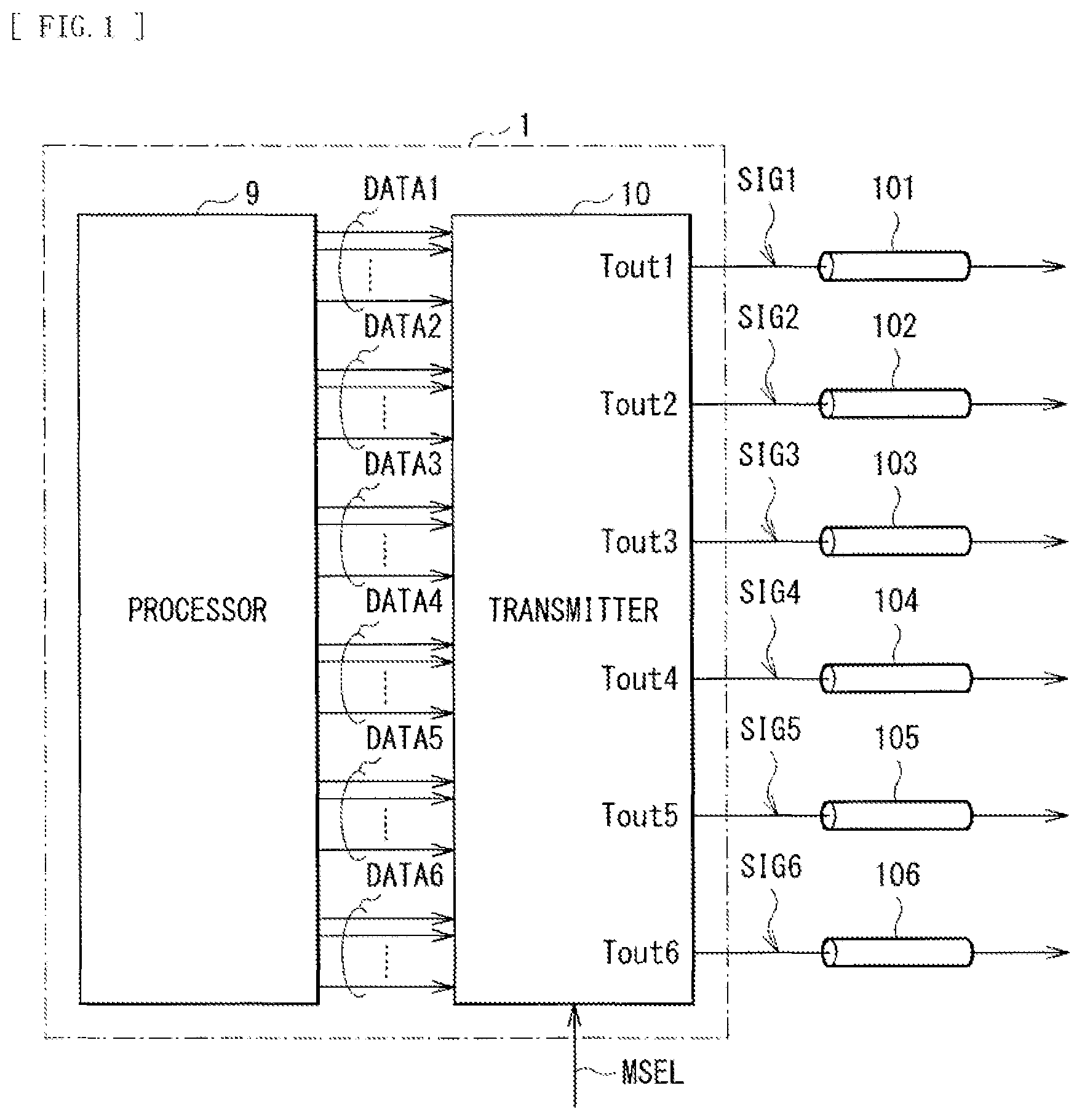
illustrates a configuration example of a transmission device according to an embodiment. A transmission device 1 is configured to make it possible to achieve a plurality of interfaces. Note that a communication system according to an embodiment of the disclosure may be embodied by this embodiment, and description thereof is therefore given together.
The transmission device 1 may include a processor 9 and a transmitter 10 . The processor 9 is adapted to generate six parallel signals DATA 1 to DATA 6 . Each of the parallel signals DATA 1 to DATA 6 is 7 bits wide in this example. The transmitter 10 is adapted to generate signals SIG 1 to SIG 6 , based on the parallel signals DATA 1 to DATA 6 and a mode selection signal MSEL, and output the signals SIG 1 to SIG 6 from output terminals Tout 1 to Tout 6 . Thus, the transmission device 1 generates the signals SIG 1 to SIG 6 , and transmits the signals SIG 1 to SIG 6 to a reception device (not illustrated) through transmission lines 101 to 106 . In this example, each of characteristic impedances of the transmission lines 101 to 106 may be 50 [Ω]. As described later, the transmission device 1 is configured to transmit data to the reception device by means of a differential signal, a three-phase signal, or a single-phase signal.
illustrates a configuration example of the transmitter 10 . The transmitter 10 may include serializers SER 1 to SER 6 , selectors 22 , 24 , 26 , and 31 to 36 , exclusive-OR circuits 41 to 46 , OR circuits 51 to 56 , drivers DRV 1 to DRV 6 , and a controller 20 . Note that a signal between these blocks may be a differential signal or a single-phase signal.
The serializers SER 1 to SER 6 are each adapted to convert a parallel signal into a series signal. More specifically, the serializer SER 1 is adapted to serialize the parallel signal DATA 1 , based on a clock signal CLK 1 and a control signal CTL 1 , to generate a signal P 11 and an inversion signal N 11 of the signal P 11 . The serializer SER 2 is adapted to serialize the parallel signal DATA 2 , based on a clock signal CLK 2 and a control signal CTL 2 , to generate a signal P 12 and an inversion signal N 12 of the signal P 12 . The serializer SER 3 is adapted to serialize the parallel signal DATA 3 , based on the clock signal CLK 1 and the control signal CTL 1 , to generate a signal P 13 and an inversion signal N 13 of the signal P 13 . The serializer SER 4 is adapted to serialize the parallel signal DATA 4 , based on the clock signal CLK 2 and the control signal CTL 2 , to generate a signal P 14 and an inversion signal N 14 of the signal P 14 . The serializer SERS is adapted to serialize the parallel signal DATA 55 , based on the clock signal CLK 1 and the control signal CTL 1 , to generate a signal P 15 and an inversion signal N 15 of the signal P 15 . The serializer SER 6 is adapted to serialize the parallel signal DATA 6 , based on the clock signal CLK 2 and the control signal CTL 2 , to generate a signal P 16 and an inversion signal N 16 of the signal P 16 .
illustrates a configuration example of the serializer SER 1 . Note that, in the following, description is given of the serializer SER 1 as an example, and the same description applies to the serializers SER 2 to SER 6 . The serializer SER 1 in this example includes a shift register, and is a so-called 7:1 serializer that serializes the parallel signal DATA 1 including seven bit signals D[ 6 ] to D[ 0 ]. The serializer SER 1 is configured to handle a differential signal, and generates the signals P 11 and N 11 as series signals.
The serializer SER 1 may include selectors 71 to 77 and flip-flops 81 to 87 . The selectors 71 to 77 are each adapted to output a signal of a first input terminal when a signal at a control terminal is “1” and output a signal of a second input terminal when the signal at the control terminal is “0”. The flip-flops 81 to 87 are D-type flip-flops, and are each adapted to sample a signal at an input terminal D at timing of a rising edge of a signal at a clock terminal and output a thus-obtained sampling result from an output terminal Q. The first input terminal, the second input terminal, and the control terminal of the selector 71 are respectively supplied with the signal D[ 6 ], “0”, and the control signal CTL 1 . The output terminal of the selector 71 is coupled to the input terminal D of the flip-flop circuit 81 . The input terminal of the flip-flop 81 is coupled to the output terminal of the selector 71 . The clock terminal of the flip-flop 81 is supplied with the clock signal CTL 1 . The output terminal Q of the flip-flop 81 is coupled to the second input terminal of the selector 72 . The first input terminal of the selector 72 is supplied with the signal D[ 5 ]. The second input terminal of the selector 72 is coupled to the output terminal Q of the flip-flop 81 . The control terminal of the selector 72 is supplied with the control signal CTL 1 . The output terminal of the selector 72 is coupled to the input terminal D of the flip-flop 82 . The input terminal D of the flip-flop 82 is coupled to the output terminal of the selector 72 . The clock terminal of the flip-flop 82 is supplied with the clock signal CLK 1 . The output terminal Q of the flip-flop 82 is coupled to the second input terminal of the selector 73 . As described, in the serializer SER 1 , the selectors and the flip-flops are alternately coupled to one another. Further, the first input terminal of the selector 77 is supplied with the signal D[ 0 ]. The second input terminal of the selector 77 is coupled to the output terminal Q of the flip-flop 86 . The control terminal of the selector 77 is supplied with the control signal CTL 1 . The output terminal of the selector 77 is coupled to the input terminal D of the flip-flop 87 . The input terminal D of the flip-flop 87 is coupled to the output terminal of the selector 77 . The clock terminal of the flip-flop 87 is supplied with the clock signal CLK 1 . The output signals P 11 and N 11 of the serializer SER 1 are generated at the output terminal Q of the flip-flop 87 .
With this configuration, in the serializer SER 1 , the control signal CTL 1 is set to “1” to cause the flip-flops 81 to 87 to respectively hold the signals D[ 6 ] to D[ 0 ]. The control signal CTL 1 is set to “0” to cause the serializer SER 1 to operate as a shift register to output the signals D[ 0 ] to D[ 6 ] in this order in synchronization with the clock signal CLK 1 . Thus, the serializer SER 1 serializes the parallel signal DATA 1 to generate the signals P 11 and N 11 .
The selector 22 is adapted to select and output one of the signals P 12 and N 12 , based on a control signal SINV. The selector 24 is adapted to select and output one of the signals P 14 and N 14 , based on the control signal SINV. The selector 26 is adapted to select and output one of the signals P 16 and N 16 , based on the control signal SINV.
The selector 31 is adapted to select one of the signals P 11 and P 12 , based on a control signal SEL 1 , and output the thus-selected signal as a signal S 31 . The selector 32 is adapted to select one of the signal N 11 and an output signal of the selector 22 and output the thus-selected signal as a signal S 32 . The selector 33 is adapted to select one of the signals P 13 and P 14 , based on a control signal SEL 3 , and output the thus-selected signal as a signal S 33 . The selector 34 is adapted to select one of the signal N 13 and an output signal of the selector 24 , based on a control signal SEL 4 , and output the thus-selected signal as a signal S 34 . The selector 35 is adapted to select one of the signals P 15 and P 16 , based on a control signal SEL 5 , and output the thus-selected signal as a signal S 35 . The selector 36 is adapted to select one of the signal N 15 and an output signal of the selector 26 , based on a control signal SEL 6 , and output the thus-selected signal as a signal S 36 .
The exclusive-OR circuit 41 is adapted to determine an exclusive OR (EX-OR) between the signal P 11 and the signal P 13 and output a thus-obtained result. The exclusive-OR circuit 42 is adapted to determine an exclusive OR between the signal P 11 and the signal P 12 and output a thus-obtained result. The exclusive-OR circuit 43 is adapted to determine an exclusive OR between the signal P 12 and the signal P 13 and output a thus-obtained result. The exclusive-OR circuit 44 is adapted to determine an exclusive OR between the signal P 14 and the signal P 16 and output a thus-obtained result. The exclusive-OR circuit 45 is adapted to determine an exclusive OR between the signal P 14 and the signal P 15 and output a thus-obtained result. The exclusive-OR circuit 46 is adapted to determine an exclusive OR between the signal P 15 and the signal P 16 and output a thus-obtained result.
The OR circuit 51 is adapted to determine an OR between an output signal of the exclusive-OR circuit 41 and a control signal SMM and output a thus-obtained result as a signal S 51 . The OR circuit 52 is adapted to determine an OR between an output signal of the exclusive-OR circuit 42 and the control signal SMM and output a thus-obtained result as a signal S 52 . The OR circuit 53 is adapted to determine an OR between an output signal of the exclusive-OR circuit 43 and the control signal SMM and output a thus-obtained result as a signal S 53 . The OR circuit 54 is adapted to determine an OR between an output signal of the exclusive-OR circuit 44 and the control signal SMM and output a thus-obtained result as a signal S 54 . The OR circuit 55 is adapted to determine an OR between an output signal of the exclusive-OR circuit 45 and the control signal SMM and output a thus-obtained result as a signal S 55 . The OR circuit 56 is adapted to determine an OR between an output signal of the exclusive-OR circuit 46 and the control signal SMM and output a thus-obtained signal as a signal S 56 .
The driver DRV 1 is configured to set a voltage of the output terminal Tout 1 to one of three voltages (a high-level voltage VH, a low-level voltage VL, and a medium-level voltage VM), based on the signal S 31 and the signal S 51 . The driver DRV 2 is configured so as to make a voltage of the output terminal Tout 2 settable to one of the three voltages, based on the signal S 32 and the signal S 52 . The driver DRV 3 is configured so as to make a voltage of the output terminal Tout 3 settable to one of the three voltages, based on the signal S 33 and the signal S 53 . The driver DRV 4 is configured so as to make a voltage of the output terminal Tout 4 settable to one of the three voltages, based on the signal S 34 and the signal S 54 . The driver DRV 5 is configured so as to make a voltage of the output terminal Tout 5 settable to one of the three voltages, based on the signal S 35 and the signal S 55 . The driver DRV 6 is configured so as to make a voltage of the output terminal Tout 6 settable to one of the three voltages, based on the signal S 36 and the signal S 56 .
illustrates a configuration example of the driver DRV 1 . Note that, in the following, description is given of the driver DRV 1 as an example, and the same description applies to the drivers DRV 2 to DRV 6 . The driver DRV 1 may include a driver controller 60 and driver circuits 61 to 65 .
The driver controller 60 is adapted to generate signals P 61 to P 75 and N 61 to N 65 , based on the signals S 31 and S 51 .
The driver circuits 61 to 65 are each adapted to set the voltage of the output terminal Tout 1 , based on signals supplied to positive input terminals and signals supplied to negative input terminals. The positive input terminal and the negative input terminal of the driver circuit 61 are respectively supplied with the signal P 61 and the signal N 61 . The output terminal of the driver circuit 61 is coupled to the output terminal Tout 1 . The positive input terminal and the negative input terminal of the driver circuit 62 are respectively supplied with the signal P 61 and the signal N 62 . The output terminal of the driver circuit 62 is coupled to the output terminal Tout 1 . The positive input terminal and the negative input terminal of the driver circuit 63 are respectively supplied with the signal P 63 and the signal N 63 . The output terminal of the driver circuit 63 is coupled to the output terminal Tout 1 . The positive input terminal and the negative input terminal of the driver circuit 64 are respectively supplied with the signal P 64 and the signal N 64 . The output terminal of the driver circuit 64 is coupled to the output terminal Tout 1 . The positive input terminal and the negative input terminal of the driver circuit 65 are respectively supplied with the signal P 65 and the signal N 65 . The output terminal of the driver circuit 65 is coupled to the output terminal Tout 1 . In other words, the output terminals of the driver circuits 61 to 65 are coupled to one another, and are coupled to the output terminal Tout 1 .
illustrates a configuration example of the driver circuit 61 . Note that, in the following, description is given of the driver circuit 61 as an example, and the same description applies to the driver circuits 62 to 65 . The driver circuit 61 may include transistors 92 and 93 and resistors 91 , 94 , and 95 . The transistors 92 and 93 in this example are N-channel MOS (Metal Oxide Semiconductor)-FETs (Field Effect Transistors). A gate of the transistor 92 corresponds to the positive input terminal of the driver circuit 61 , and is supplied with the signal P 61 . A source of the transistor 92 is coupled to one end of the resistor 91 . A drain of the transistor 92 is coupled to a drain of the transistor 93 , and is coupled to one end of the resistor 95 . A gate of the transistor 93 corresponds to the negative input terminal of the driver circuit 61 , and is supplied with the signal N 61 . A source of the transistor 93 is coupled to one end of the resistor 94 . A drain of the transistor 93 is coupled to the drain of the transistor 92 , and is coupled to the one end of the resistor 95 . The one end of the resistor 91 is coupled to the source of the transistor 92 , and the other end of the resistor 91 is supplied with a voltage V 1 . The voltage V 1 may be, for example, 400 [mV]. The one end of the resistor 94 is coupled to the source of the transistor 93 , and the other end of the resistor 94 is grounded. The one end of the resistor 95 is coupled to the drains of the transistors 92 and 93 , and the other end of the resistor 95 corresponds to the output terminal of the driver circuit 61 . In this example, the sum of a resistance value of the resistor 91 , a resistance value of on resistance of the transistor 92 , and a resistance value of the resistor 95 is about 200 [Ω]. Likewise, in this example, the sum of a resistance value of the resistor 94 , a resistance value of on resistance of the transistor 93 , and a resistance value of the resistor 95 is about 200 [Ω].
With this configuration, the driver DRV 1 sets the voltage of the output terminal Tout 1 to one of the three voltages (the high-level voltage VH, the low-level voltage VL, and the medium-level voltage VM), based on the signal S 31 and the signal S 51 . More specifically, in a case where the signal S 51 is “1”, the driver controller 60 sets the signals P 61 to P 65 and the signals N 61 to N 65 in accordance with the signal S 31 . In other words, in the case where the signal S 31 is “1”, the driver controller 60 may set, for example, four of the signals P 61 to P 65 to “1”, and may set the remaining one signal and the signals N 61 to N 65 to “0”. Accordingly, in the driver circuits 61 to 65 , four transistors 92 of which the gates are supplied with “1” is turned on to set the signal SIG 1 to the high-level voltage VH. Moreover, in a case where the signal S 31 is “0”, the driver controller 60 may set, for example, four of the signals N 61 to N 65 to “1”, and may set the remaining one signal and the signals P 61 to P 65 to “0”. Accordingly, in the driver circuits 61 to 65 , four transistors 93 of which the gates are supplied with “1” are turned on to set the signal SIG 1 to the low-level voltage VL. Meanwhile, in a case where the signal S 51 is “0”, irrespective of the signal S 31 , the driver controller 60 may set, for example, two of the signals P 61 to P 65 to “1”, and may set the remaining signals to “0”. Further, the driver controller 60 may set, for example, two of the signals N 61 to N 65 to “1”, and may set the remaining signals to “0”. Accordingly, in the driver circuits 61 to 65 , two transistors 92 of which the gates are supplied with “1” and two transistors 93 of which the gates are supplied with “1” are turned on to form a Thevenin termination, thereby setting the signal SIG 1 to the medium-level voltage VM.
In other words, the signal S 51 is a signal that controls whether the signal SIG 1 is set to the medium-level voltage VM. In the case where the signal S 51 is “0”, the driver DRV 1 sets the signal SIG to the medium-level voltage VM. Moreover, in the case where the signal S 51 is “1”, the driver DRV 1 sets the signal SIG 1 to the high-level voltage VH or the low-level voltage VL in accordance with the signal S 31 .
Moreover, in the driver DRV 1 , irrespective of the voltage level of the signal SIG 1 , four out of ten transistors including the transistors 92 and 93 are turned on. This makes it possible for the driver DRV 1 to have an output impedance of about 50 [Ω] irrespective of the voltage level of the signal SIG 1 , thereby easily achieving impedance matching.
Further, the driver controller 60 may change the number of transistors to be turned on. More specifically, for example, in order to turn on three transistors, the driver controller 60 may set, for example, three signals out of the signals P 61 to P 65 to “1” to turn on three transistors 92 , and may set, for example, three of the signals N 61 to N 65 to “1” to turn on three transistors 93 . Furthermore, for example, in order to turn on five transistors, the driver controller 60 may set all of the signals P 61 to P 65 to “1” to turn on five transistors 92 , and may set all of the signals N 61 to N 65 to “1” to turn on five transistors 93 . Accordingly, in the driver DRV 1 , it is possible to adjust a slew rate of the output signal SIG 1 .
The controller 20 is adapted to select one of three operation modes M 1 to M 3 , based on the mode selection signal MSEL, and control the transmitter 10 so that the transmitter 10 operates in the selected operation mode. Here, the operation mode M 1 is a mode of transmitting data to the reception device by means of a differential signal. The operation mode M 2 is a mode of transmitting data to the reception device by means of a three-phase signal. The operation mode M 3 is a mode of transmitting data to the reception device by means of a single-phase signal. The mode selection signal MSEL may be supplied from, for example, outside of the transmission device 1 . The controller 20 selects one of the three operation modes M 1 to M 3 , based on the mode selection signal MSEL. The controller 20 generates clock signals CLK 1 and CLK 2 and control signals CTL 1 , CTL 2 , SINV, SEL 1 to SEL 6 , and SMM in accordance with the selected operation mode, and control operation of respective blocks of the transmitter 10 with use of these control signals.
illustrates a configuration example of a communication system 4 in which the transmitter 10 operates in the operation mode M 1 . The communication system 4 may include the transmission device 1 and a reception device 110 . The reception device 110 may include receivers 111 to 113 . In this mode, the drivers DRV 1 and DRV 2 respectively transmit the signals SIG 1 and SIG 2 to the receiver 111 . The drivers DRV 3 and DRV 4 respectively transmit the signals SIG 3 and SIG 4 to the receiver 112 . The drivers DRV 5 and DRV 6 respectively transmit the signals SIG 5 and SIG 6 to the receiver 113 . At this occasion, the signals SIG 1 and SIG 2 constitute a differential signal. The signals SIG 3 and SIG 4 constitute a differential signal. The signals SIG 5 and SIG 6 constitute a differential signal. In other words, for example, one of the signals SIG 1 and SIG 2 is the high-level voltage VH, and the other one of the signals SIG 1 and SIG 2 is the low-level voltage VL. Further, the receiver 111 receives the signals SIG 1 and SIG 2 . The receiver 112 receives the signals SIG 3 and SIG 4 . The receiver 113 receives the signals SIG 5 and SIG 6 . Note that, in this example, three receivers 111 to 113 are provided for one reception device 110 , and data is transmitted to the reception device 110 ; however, the embodiment is not limited thereto. Alternatively, for example, one receiver may be provided for each of three reception devices, and data may be transmitted to these three reception devices.
illustrates a configuration example of the receiver 111 . Note that, in the following, description is given of the receiver 111 as an example, and the receivers 112 and 113 are similar to the receiver 111 . The receiver 111 may include a resistor 116 and an amplifier 117 . The resistor 116 is adapted to function as a termination resistor of the communication system 4 , and has a resistance value of about 100 [Ω] in this example. One end of the resistor 116 may be coupled to, for example, an input terminal Tin 11 , and is supplied with the signal SIG 1 . The other end of the resistor 116 may be coupled to, for example, an input terminal Tin 12 , and is supplied with the signal SIG 2 . The amplifier 117 is adapted to output “1” or “0” in response to a difference between a signal at a positive input terminal and a signal at a negative input terminal. The positive input terminal of the amplifier 117 is coupled to the one end of the resistor and the input terminal Tin 11 , and is supplied with the signal SIG 1 . The negative input terminal of the amplifier 117 is coupled to the other end of the resistor 116 and the input terminal Tin 12 , and is supplied with the signal SIG 2 .
This configuration allows the communication system 4 to transmit and receive data by means of the differential signals.
illustrates a configuration example of a communication system 5 in which the transmitter 10 operates in the operation mode M 2 . The communication system 5 may include the transmission device 1 and a reception device 120 . The reception device 120 may include receivers 121 and 122 . In this mode, the drivers DRV 1 to DRV 3 respectively transmit the signals SIG 1 to SIG 3 to the receiver 121 . The drivers DRV 4 to DRV 6 respectively transmit the signals SIG 4 to SIG 6 to the receiver 122 . At this occasion, the signals SIG 1 to SIG 3 constitute a three-phase signal, and the signals SIG 4 to SIG 6 constitute a three-phase signal. In other words, the signals SIG 1 to SIG 3 are set to voltage levels different from one another (the high-level voltage VH, the low-level voltage VL, and the medium-level voltage VM). The receiver 121 receives the signals SIG 1 to SIG 3 . The receiver 122 receives the signals SIG 4 to SIG 6 .
illustrates a configuration example of the receiver 121 . Note that, in the following, description is given of the receiver 121 as an example, and the receiver 122 is similar to the receiver 121 . The receiver 121 may include resistors 124 to 126 and amplifiers 127 to 129 . The resistors 124 to 126 are each adapted to function as a termination resistor of the communication system 5 , and have a resistance value of about 50 [Ω] in this example. One end of the resistor 124 may be coupled to, for example, an input terminal Tin 21 , and is supplied with the signal SIG 1 . One end of the resistor 125 may be coupled to, for example, an input terminal Tin 22 , and is supplied with the signal SIG 2 . One end of the resistor 126 may be coupled to, for example, an input terminal Tin 23 , and is supplied with the signal SIG 3 . The other end of the resistor 124 is coupled to the other ends of the resistor 125 and the resistor 126 . The other end of the resistor 125 is coupled to the other ends of the resistors 124 and 126 . The other end of the resistor 126 is coupled to the other ends of the resistors 124 and 126 . A positive input terminal of the amplifier 127 is coupled to a negative input terminal of the amplifier 129 , the one end of the resistor 126 , and the input terminal Tin 21 , and is supplied with the signal SIG 1 . A negative input terminal of the amplifier 127 is coupled to a positive input terminal of the amplifier 128 , the one end of the resistor 125 , and the input terminal Tin 22 , and is supplied with the signal SIG 2 . The positive input terminal of the amplifier 128 is coupled to the negative input terminal of the amplifier 127 , the one end of the resistor 125 , and the input terminal Tin 22 , and is supplied with the signal SIG 2 . The negative input terminal of the amplifier 128 is coupled to the positive input terminal of the amplifier 129 , the one end of the resistor 126 , and the input terminal Tin 23 , and is supplied with the signal SIG 3 . The positive input terminal of the amplifier 129 is coupled to the negative input terminal of the amplifier 128 , the one end of the resistor 126 , and the input terminal Tin 23 , and is supplied with the signal SIG 3 . The negative input terminal of the amplifier 129 is coupled to the positive input terminal of the amplifier 127 , the one end of the resistor 124 , and the input terminal Tin 21 , and is supplied with the signal SIG 1 .
illustrates an operation example of the receiver 121 . In this example, the signal SIG 1 , the signal SIG 2 , and the signal SIG 3 are respectively the high-level voltage VH, the low-level voltage VL, and the medium-level voltage VM. In this case, a current Iin flows through the input terminal Tin 21 , the resistor 124 , the resistor 125 , and the input terminal Tin 22 in this order. The positive input terminal and the negative input terminal of the amplifier 127 are respectively supplied with the high-level voltage VH and the low-level voltage VL, and the amplifier 127 outputs “1”. Moreover, the positive input terminal and the negative input terminal of the amplifier 128 are respectively supplied with the low-level voltage VL and the medium-level voltage VM, and the amplifier 128 outputs “0”. Further, the positive input terminal and the negative input terminal of the amplifier 129 are respectively supplied with the medium-level voltage VM and the high-level voltage VH, and the amplifier 127 outputs “0”.
This configuration allows the communication system 5 to transmit and receive data by means of the three-phase signals.
illustrates a configuration example of a communication system 6 in which the transmitter 10 operates in the operation mode M 3 . The communication system 6 may include the transmission device 1 and a reception device 130 . The reception device 130 may include receivers 131 to 136 . In this mode, the drivers DRV 1 to DRV 6 respectively transmit the signals SIG 1 to SIG 6 to the receivers 131 to 136 . At this occasion, each of the signals SIG 1 to SIG 6 is a single-phase signal. The receivers 131 to 136 are adapted to respectively receive the signals SIG 1 to SIG 6 .
illustrates a configuration example of the receiver 131 . Note that, in the following, description is given of the receiver 131 as an example, and the receivers 132 to 136 are similar to the receiver 131 . The receiver 131 may include a resistor 138 and an amplifier 139 . The resistor 138 is adapted to function as a termination resistor of the communication system 6 , and has a resistance value of about 50 [Ω] in this example. One end of the resistor 138 may be coupled to, for example, an input terminal Tin 31 , and is supplied with the signal SIG 1 . The other end of the resistor 138 is supplied with a bias voltage V 2 . A positive input terminal of the amplifier 139 is coupled to the one end of the resistor 138 and the input terminal Tin 31 , and is supplied with the signal SIG 1 . A negative input terminal of the amplifier 139 is supplied with a bias voltage V 3 .
This configuration allows the communication system 6 to transmit and receive data by means of the single-phase signals.
Next, description is given of a layout of the transmitter 10 .
illustrates a circuit layout of respective blocks in the transmitter 10 . also illustrates pads PAD 1 to PAD 6 and ESD (Electro-Static Discharge) protection circuits ESD 1 to ESD 6 . The pads PAD 1 to PAD 6 correspond to the output terminals Tout 1 to Tout 6 . The ESD protection circuits ESD 1 to ESD 6 are respectively disposed close to the pads PAD 1 to PAD 6 . Note that the selectors 22 , 24 , 26 , and 31 to 36 are not illustrated in . Solid arrows indicate a flow of a signal from the serializers SER 1 to SER 6 to the exclusive-OR circuits 41 to 46 and a flow of a signal from the OR circuits 51 to 56 to the drivers DRV 1 to DRV 6 .
In this example, the serializer SER 1 , the exclusive-OR circuit 41 , the OR circuit 51 , and the driver DRV 1 are disposed close to one another. Likewise, the serializer SER 2 , the exclusive-OR circuit 42 , the OR circuit 52 , and the driver DRV 2 are disposed close to one another. The serializer SER 3 , the exclusive-OR circuit 43 , the OR circuit 53 , and the driver DRV 3 are disposed close to one another. The serializer SER 4 , the exclusive-OR circuit 44 , the OR circuit 54 , and the driver DRV 4 are disposed close to one another. The serializer SER 5 , the exclusive-OR circuit 45 , the OR circuit 55 , and the driver DRV 5 are disposed close to one another. The serializer SER 6 , the exclusive-OR circuit 46 , the OR circuit 56 , and the driver DRV 6 are disposed close to one another. In this example, this layout allows the order of layout of the pads PAD 1 to PAD 6 to be the same as the order of layout of the serializers SER 1 to SER 6 .
Here, the selector 31 corresponds to a specific example of “first selector” in the disclosure, and the selectors 22 and 32 correspond to specific examples of “second selector” in the disclosure. The exclusive-OR circuits 41 to 43 correspond to specific examples of “first control signal generator” in the disclosure. The driver DRV 1 corresponds to a specific example of “first driver” in the disclosure, and the driver DRV 2 corresponds to a specific example of “second driver” in the disclosure. The operation mode M 1 corresponds to a specific example of “first operation mode” in the disclosure. The operation mode M 2 corresponds to a specific example of “second operation mode” in the disclosure. The operation mode M 3 corresponds to a specific example of “third operation mode” in the disclosure. The high-level voltage VH corresponds to a specific example of “first voltage” in the disclosure. The low-level voltage VL corresponds to a specific example of “second voltage” in the disclosure. The medium-level voltage VM corresponds to a specific example of “third voltage” in the disclosure.
Operation and Workings
Next, description is given of operation and workings of the transmission devices 1 according to the embodiment.
General Operation Outline
First, general operation outline of the transmission device 1 is described with reference to , and other figures. The processor 9 generates six parallel signals DATA 1 to DATA 6 . The transmitter 10 generates the signals SIG 1 to SIG 6 , based on the parallel signals DATA 1 to DATA 6 and the mode selection signal MSEL, and transmits the signals SIG 1 to SIG 6 to the reception device through the transmission lines 101 to 106 . The controller 20 of the transmitter 10 selects one of three operation modes M 1 to M 3 , based on the mode selection signal MSEL, and controls the transmitter 10 so that the transmitter 10 operates in the selected operation mode.
Operation Mode M 1
In the operation mode M 1 , the transmission device 1 transmits data to the reception device by means of the differential signals. In the following, description is given of detailed operation in the operation mode M 1 .
A and 14 B illustrate an operation example of the transmitter 10 in the operation mode M 1 . A indicates an operation state, and B indicates another operation state.
In the operation mode M 1 , the controller 20 generates the clock signals CLK 1 and CLK 2 and the control signals CTL 1 and CTL 2 . At this occasion, the clock signals CLK 1 and CLK 2 have phases different by 180° from each other. The controller 20 supplies the clock signal CLK 1 and the control signal CTL 1 to the serializers SER 1 , SER 3 , and SER 5 to control the serializers SER 1 , SER 3 , and SER 5 so that the serializers SER 1 , SER 3 , and SER 5 respectively serialize the parallel signal DATA 1 , DATA 3 , and DATA 5 . The controller 20 supplies the clock signal CLT 2 and the control signal CTL 2 to the serializers SER 2 , SER 4 , and SER 6 to control the serializers SER 2 , SER 4 , and SER 6 so that the serializers SER 2 , SER 4 , and SER 6 respectively serialize the parallel signals DATA 2 , DATA 4 , and DATA 6 .
Moreover, the controller 20 supplies the control signal SINV to the selectors 22 , 24 , and 26 to control the selectors 22 , 24 , and 26 so that the selectors 22 , 24 , and 26 respectively select and output the signal N 12 , the signal N 14 , and the signal N 16 .
Further, the controller 20 supplies the control signal SEL 1 to the selector 31 to control the selector 31 so that the selector 31 alternately selects and outputs the signal P 11 and the signal P 12 , and the controller 20 supplies the control signal SEL 2 to the selector 32 to control the selector 32 so that the selector 32 alternately selects and outputs the signal N 11 and the output signal (the signal N 12 ) of the selector 22 . At this occasion, the controller 20 controls the selectors 31 and 32 so that the selector 32 selects the signal N 11 when the selector 31 selects and outputs the signal P 11 (see A ) and the selector 32 selects the signal N 12 when the selector 31 selects and outputs the signal P 12 (see B ).
illustrates a timing waveform chart of an operation example of the selectors 31 and 32 . (A) of indicates a waveform of the signal P 11 or the signal N 11 , (B) of indicates a waveform of the signal P 12 or the signal N 12 , and (C) of indicates a waveform of the signal S 31 or the signal S 32 . In this example, the serializer SER 1 outputs data S 0 , S 2 , S 4 , . . . as the signals P 11 and N 11 in this order in synchronization with the clock signal CLK 1 . The serializer SER 2 outputs data S 1 , S 3 , S 5 , . . . as the signals P 12 and N 12 in this order in synchronization with the clock signal CLK 2 . At this occasion, since the phases of the clock signals CLK 1 and CLK 2 are different by 180° from each other, transition timing of the signals P 11 and N 11 is different from transition timing of the signals P 12 and N 12 . In a period T 1 in which data in the signals P 11 and N 11 are stable (see (A) of ), the selector 31 selects the signal P 11 and outputs the signal P 11 as the signal S 31 , and the selector 32 selects the signal N 11 and outputs the signal N 11 as the signal S 32 (see (C) of ). Moreover, in a period T 2 in which data in the signals P 12 and N 12 are stable (see (B) of ), the selector 31 selects the signal P 12 and outputs the signal P 12 as the signal S 31 , and the selector 32 selects the signal N 12 and outputs the signal N 12 as the signal S 32 (see (C) of ). Here, since the signal N 11 and the signal N 12 are respectively the inversion signal of the signal P 11 and the inversion signal of the signal P 12 , the signal S 32 is an inversion signal of the signal S 31 . As a result of such operation, data S 0 , S 1 , S 2 , . . . are disposed in this order in the signals S 31 and 32 . In other words, in the operation mode M 1 , the selectors 31 and 32 function as 2:1 serializers.
Likewise, the controller 20 supplies the control signal SEL 3 to the selector 33 to control the selector 33 so that the selector 33 alternately selects and outputs the signal P 13 and the signal P 14 , and the controller 20 supplies the control signal SEL 4 to the selector 34 to control the selector 34 so that the selector 34 alternately selects and outputs the signal N 13 and the output signal (the signal N 14 ) of the selector 24 . Moreover, the controller 20 supplies the control signal SEL 5 to the selector 35 to control the selector 35 so that the selector 35 alternately selects and outputs the signal P 15 and the signal P 16 , and the controller 20 supplies the control signal SEL 6 to the selector 36 to control the selector 36 so that the selector 36 alternately selects and outputs the signal N 15 and the output signal (the signal N 16 ) of the selector 26 .
Further, the controller 20 supplies the control signal SMM indicating “1” to the OR circuits 51 to 56 . Accordingly, the signals S 51 to S 56 are set to “1”. As a result, the drivers DRV 1 to DRV 6 respectively set the signals SIG 1 to SIG 6 to the high-level voltage VH or the low-level voltage VL in accordance with the signals S 31 to S 36 . At this occasion, since the signal S 31 and the signal S 32 are inverted from each other, the signals SIG 1 and SIG 2 constitute a differential signal. Likewise, the signals SIG 3 and SIG 4 constitute a differential signal, and the signals SIG 5 and SIG 6 constitute a differential signal.
Thus, in the operation mode M 1 , the transmission device 1 transmits data to the reception device by means of the differential signals.
Operation Mode M 2
In the operation mode M 2 , the transmission device 1 transmits data to the reception device by means of the three-phase signals. Description is given of detailed operation in the operation mode M 2 .
illustrates an operation example of the transmitter 10 in the operation mode M 2 . In the operation mode M 2 , the controller 20 generates the clock signals CLK 1 and CLK 2 and the control signals CTL 1 and CTL 2 . Here, the clock signals CLK 1 and CLK 2 have phases that are substantially equal to each other. The controller 20 supplies the clock signal CLK 1 and the control signal CTL 1 to the serializers SER 1 , SER 3 , and SERS to control the serializers SER 1 , SER 3 , and SERS so that the serializers SER 1 , SER 3 , and SERS respectively serialize the parallel signals DATA 1 , DATA 3 , and DATA 5 . The controller 20 supplies the clock signal CLK 2 and the control signal CTL 2 to the serializers SER 2 , SER 4 , and SER 6 to control the serializers SER 2 , SER 4 , and SER 6 so that the serializers SER 2 , SER 4 , and SER 6 respectively serialize the parallel signals DATA 2 , DATA 4 , and DATA 6 .
Moreover, the controller 20 supplies the control signal SINV to the selectors 22 , 24 , and 26 to control the selectors 22 , 24 , and 26 so that the selectors 22 , 24 , and 26 respectively select and output the signal P 12 , the signal P 14 , and the signal P 16 .
Moreover, the controller 20 supplies the control signal SEL 1 to the selector 31 to control the selector 31 so that the selector 31 selects the signal P 11 and outputs the signal P 11 as the signal S 31 . The controller 20 supplies the control signal SEL 2 to the selector 32 to control the selector 32 so that the selector 32 selects the output signal (the signal P 12 ) of the selector 22 and output the output signal as the signal S 32 . The controller 20 supplies the control signal SEL 3 to the selector 33 to control the selector 33 so that the selector 33 selects the signal P 13 and outputs the signal P 13 as the signal S 33 . Likewise, the controller 20 supplies the control signal SEL 4 to the selector 34 to control the selector 34 so that the selector 34 selects the output signal (the signal P 14 ) of the selector 24 and outputs the output signal as the signal S 34 . The controller 20 supplies the control signal SEL 5 to the selector 35 to control the selector 35 so that the selector 35 selects the signal P 15 and outputs the signal P 15 as the signal S 35 . The controller 20 supplies the control signal SEL 6 to the selector 36 to control the selector 36 so that the selector 36 selects the output signal (the signal P 16 ) of the selector 26 and outputs the output signal as the signal S 36 .
Further, the controller 20 supplies the control signal SMM indicating “0” to the OR circuits 51 to 56 . Accordingly, the signals S 51 to S 56 are set to the same signals as the output signals of the exclusive-OR circuits 41 to 46 . As a result, the drivers DRV 1 to DRV 3 set the signals SIG 1 to SIG 3 to three different voltages (the high-level voltage VH, the low-level voltage VL, and the medium-level voltage VM), based on the signals S 31 to S 33 and the signals S 51 to S 53 . Likewise, the drivers DRV 4 to DRV 6 set the signals SIG 4 to SIG 6 to three different voltages (the high-level voltage VH, the low-level voltage VL, and the medium-level voltage VM), based on the signals S 34 to S 36 and the signals S 54 to S 56 .
illustrates operation of the exclusive-OR circuits 41 to 43 and the drivers DRV 1 to DRV 3 . Note that the exclusive-OR circuits 44 to 46 and the drivers DRV 4 to DRV 6 operate similarly to the exclusive-OR circuits 41 to 43 and the drivers DRV 1 to DRV 3 .
For example, in a case where the signal P 11 is “1” and the signals P 12 and P 13 are both “0”, the signals S 51 and S 52 are both set to “1”, and the signal S 53 is set to “0”. Accordingly, since the signal S 31 (the signal P 11 ) is “1” and the signal S 51 is “1”, the driver DRV 1 sets the signal SIG 1 to the high-level voltage VH. Moreover, since the signal S 32 (the signal P 12 ) is “0” and the signal S 52 is “1”, the driver DRV 2 sets the signal SIG 2 to the low-level voltage VL. Further, since the signal S 53 is “0”, the driver DRV 3 sets the signal SIG 3 to the medium-level voltage VM.
For example, in a case where the signals P 11 and P 13 are both “0” and the signal P 12 is “1”, the signal S 51 is set to “0”, and the signals S 52 and S 53 are both set to “1”. Accordingly, since the signal S 51 is “0”, the driver DRV 1 sets the signal SIG 1 to the medium-level voltage VM. Moreover, since the signal S 32 (the signal P 12 ) is “1” and the signal S 52 is “1”, the driver DRV 2 sets the signal SIG 2 to the high-level voltage VH. Further, since the signal S 33 (the signal P 13 ) is “0” and the signal S 53 is “1”, the driver DRV 3 sets the signal SIG 3 to the low-level voltage VL.
For example, in a case where the signals P 11 and P 12 are both “0” and the signal P 13 is “1”, the signals S 51 and S 53 are both set to “1”, and the signal S 52 is set to “0”. Accordingly, since the signal S 31 (the signal P 11 ) is “0” and the signal S 51 is “1”, the driver DRV 1 sets the signal SIG 1 to the low-level voltage VL. Moreover, since the signal S 52 is “0”, the driver DRV 2 sets the signal SIG 2 to the medium-level voltage VM. Further, since the signal S 33 (the signal P 13 ) is “1” and the signal S 53 is “1”, the driver DRV 3 sets the signal SIG 3 to the high-level voltage VH.
Thus, in the operation mode M 2 , the transmission device 1 transmits data to the reception device by means of the three-phase signals.
Operation Mode M 3
In the operation mode M 3 , the transmission device 1 transmits data to the reception device by means of the single-phase signals. In the following, description is given of detailed operation in the operation mode M 3 .
illustrates an operation example of the transmitter 10 in the operation mode M 3 . In the operation mode M 3 , the controller 20 generates the clock signals CLK 1 and CLK 2 and the control signals CTL 1 and CTL 2 . In this example, the clock signals CLK 1 and CLK 2 have phases that are substantially equal to each other. The controller 20 supplies the clock signal CLK 1 and the control signal CTL 1 to the serializers SER 1 , SER 3 , and SER 5 to control the serializers SER 1 , SER 3 , and SERS so that the serializers SER 1 , SER 3 , and SER 5 respectively serialize the parallel signals DATA 1 , DATA 3 , and DATA 5 . The controller 20 supplies the clock signal CLK 2 and the control signal CTL 2 to the serializers SER 2 , SER 4 , and SER 6 to control the serializers SER 2 , SER 4 , and SER 6 so that the serializers SER 2 , SER 4 , and SER 6 respectively serialize the parallel signals DATA 2 , DATA 4 , and DATA 6 .
Moreover, the controller 20 supplies the control signal SINV to the selectors 22 , 24 , and 26 to control the selectors 22 , 24 , and 26 so that the selectors 22 , 24 , and 26 respectively select and output the signal P 12 , the signals P 14 , and the signal P 16 .
Further, the controller 20 supplies the control signal SEL 1 to the selector 31 to control the selector 31 so that the selector 31 selects the signal P 11 and outputs the signal P 11 as the signal S 31 . Furthermore, the controller 20 supplies the control signal SEL 2 to the selector 32 to control the selector 22 so that the selector 22 selects the output signal (the signal P 12 ) of the selector 22 and outputs the output signal as the signal S 32 . The controller 20 supplies the control signal SEL 3 to the selector 33 to control the selector 33 so that the selector 33 selects the signal P 13 and outputs the signal P 13 as the signal S 33 . The controller 20 supplies the control signal SEL 4 to the selector 34 to control the selector 34 so that the selector 34 selects the output signal (the signal P 14 ) of the selector 24 and outputs the output signal as the signal S 34 . The controller 20 supplies the control signal SEL 5 to the selector 35 to control the selector 35 so that the selector 35 selects the signal P 15 and outputs the signal P 15 as the signal S 35 . The controller 20 supplies the control signal SEL 6 to the selector 36 to control the selector 36 so that the selector 36 selects the output signal (the signal P 16 ) of the selector 26 and outputs the output signal as the signal S 36 .
Further, the controller 20 supplies the control signal SMM indicating “1” to the OR circuits 51 to 56 . Accordingly, the signals S 51 to S 56 are set to “1”. As a result, the drivers DRV 1 to DRV 6 set the signals SIG 1 to SIG 6 to the high-level voltage VH or the low-level voltage VL in accordance with the signals S 31 to S 36 .
Thus, in the operation mode M 1 , the transmission device 1 transmits data to the reception device by means of the single-phase signals.
As described, the transmission device 1 has a plurality of operation modes M 1 to M 3 to make it possible to transmit data to the reception device by means of the differential signals, the three-phase signals, and the single-phase signals, thereby achieving various interfaces.
Accordingly, it is possible to enhance, for example, the degree of freedom of system design of electronic apparatuses. More specifically, for example, in a case where the transmitter 10 is mounted in a processor, an electronic apparatus may be configured with use of a peripheral device provided for three-phase signals, or an electronic apparatus may be configured with use of a peripheral device provided for differential signals. Moreover, for example, since various interfaces are achievable by one processor, it is not necessary to provide a processor for each of the interfaces. It is therefore possible to reduce the number of kinds of processors and reduce costs. Further, the serializers SER 1 to SER 6 , the selectors 31 to 36 , the drivers DRV 1 to DRV 6 , and other components are shared by the operation modes M 1 to M 3 , which makes it possible to reduce necessary area for circuit layout, in comparison with a case where different circuits are provided for different interfaces.
EFFECTS
As described, in the embodiment, a plurality of operation modes are provided, and it is possible to transmit data to the reception device by means of the differential signals, the three-phase signals, and the single-phase signals. It is therefore possible to achieve various interfaces.
MODIFICATION EXAMPLE 1
In the foregoing embodiment, as illustrated in , the order of layout of the pads PAD 1 to PAD 6 is the same as the order of layout of the serializers SER 1 to SER 6 ; however, the order of layout of the pads PAD 1 to PAD 6 and the order of layout of the serializers SER 1 to SER 6 are not limited thereto. Alternatively, for example, as illustrated in , the order of layout of the pads PAD 1 to PAD 6 may be different from the order of layout of the serializers SER 1 to SER 6 . In this example, the serializer SER 3 , the exclusive-OR circuit 42 , the OR circuit 52 , and the driver DRV 2 are disposed close to one another. The serializers SER 2 , the exclusive-OR circuit 43 , the OR circuit 53 , and the driver DRV 3 are disposed close to one another. The serializer SER 6 , the exclusive-OR circuit 44 , the OR circuit 55 , and the driver DRV 5 are disposed close to one another. The serializer SER 5 , the exclusive-OR circuit 46 , the OR circuit 56 , and the driver DRV 6 are disposed close to one another. In other words, in the example in , the serializer SER 2 and the serializer SER 3 in the example in are replaced by each other, and the serializer SER 5 and the serializer SER 6 in the example in are replaced by each other. In this modification example, it is therefore possible to reduce variation in lengths of signal paths from the serializers SER 1 to SER 6 to the exclusive-OR circuits 41 to 46 . In other words, in the example in , a signal path from the serializer SER 3 to the exclusive-OR circuit 41 is longer than other signal paths. This may delay a signal that passes through this signal path, resulting in disturbance of waveforms of the signal SIG 1 and other signals. In contrast, in the modification example (see ), it is possible to reduce variation in the lengths of the signal paths from the serializers SER 1 to SER 6 to the exclusive-OR circuits 41 to 46 , making it possible to reduce a possibility of disturbance of waveforms of the signal SIG 1 to SIG 6 .
MODIFICATION EXAMPLE 2
In the foregoing embodiment, the controller 20 controls the operation of the serializers SER 1 to SER 6 in accordance with the operation modes M 1 to M 3 . At this occasion, for example, an operation frequency may be changed in accordance with the operation modes M 1 to M 3 . Moreover, for example, the number of flip-flops to be used out of the flip-flops 81 to 87 may be changed. For example, in order to use five flip-flops out of the flip-flops 81 to 87 in the serializer SER 1 , first, the processor 9 supplies the signals D[ 4 ] to D[ 0 ] as the parallel signal DATA 1 to the serializer SER 1 . In the serializer SER 1 , the control signal CTL 1 is set to “1” to cause the flip-flops 83 to 87 to respectively hold the signals D[ 4 ] to D[ 0 ]. Further, the control signal CTL 1 is set to “0” to cause the serializer SER 1 to output the signals D[ 0 ] to D[ 4 ] in this order in synchronization with the clock signal CLK 1 . Thus, the serializer SER 1 operates as a 5:1 serializer.
MODIFICATION EXAMPLE 3
In the foregoing embodiment, six drivers DRV 1 to DRV 6 are provided in the transmitter 10 ; however, the number of drivers is not limited thereto. Alternatively, for example, as in a transmitter 10 C illustrated in , four drivers DRV 1 to DRV 4 may be provided. The transmitter 10 C is similar to the transmitter 10 (see ) according to the foregoing embodiment with the exception that the serializers SER 5 and SER 6 , the selectors 26 , 35 , and 36 , the exclusive-OR circuits 44 to 46 , the OR circuits 55 and 56 , and the drivers DRV 5 and DRV 6 are removed therefrom. In this example, the signal S 54 to be supplied to the driver DRV 4 is set to “1”. A controller 20 C generates the clock signals CLK 1 and CLK 2 , and the control signals CTL 1 , CTL 2 , SINV, SEL 1 to SEL 4 , and SMM in accordance with the operation modes M 1 to M 3 , and controls operation of respective blocks of the transmitter 10 C with use of these control signals. Accordingly, in the transmitter 10 C in the operation mode M 1 , the signals SIG 1 and SIG 2 constitute a differential signal, and the signals SIG 3 and SIG 4 constitute a differential signal. Moreover, in the operation mode M 2 , the signals SIG 1 to SIG 3 constitute a three-phase signal. In the operation mode M 3 , each of the signals SIG 1 to SIG 4 is a single-phase signal.
Moreover, for example, as in a transmitter 10 D illustrated in , three drivers DRV 1 to DRV 3 may be provided. The transmitter 10 D is similar to the transmitter 10 (see ) according to the foregoing embodiment with the exception that the serializers SER 4 to SER 6 , the selectors 24 , 26 , and 33 to 36 , the exclusive-OR circuits 44 to 46 , the OR circuits 54 to 56 , and the drivers DRV 4 to DRV 6 are removed therefrom. In the transmitter 10 , the output signal P 13 of the serializer SER 3 is supplied to the driver DRV 3 through the selector 33 , whereas, in the transmitter 10 D, the output signal P 13 of the serializer SER 3 is directly supplied to the driver DRV 3 . The controller 20 D generates the clock signals CLK 1 and CLK 2 , and the control signals CTL 1 , CTL 2 , SINV, SEL 1 , SEL 2 , and SMM in accordance with the operation modes M 1 to M 3 , and controls operation of respective blocks of the transmitter 10 D with use of these control signals. Accordingly, in the transmitter 10 D in the operation mode M 1 , the signals SIG 1 and SIG 2 constitute a differential signal. Moreover, in the operation mode M 2 , the signals SIG 1 to SIG 3 constitute a three-phase signal. In the operation mode M 3 , each of the signals SIG 1 to SIG 3 is a single-phase signal.
MODIFICATION EXAMPLE 4
In the foregoing embodiment, the processor 9 generates six parallel signals DATA 1 to DATA 6 . At this occasion, the processor 9 may encode data by, for example, a conversion scheme such as 8 b/ 10 b to generate these parallel signals DATA 1 to DATA 6 . This makes it possible to easily perform clock recovery in the reception device. Moreover, for example, in accordance with the operation modes M 1 to M 3 , the processor 9 may be configured to determine whether data is to be encoded or to change an encoding scheme.
MODIFICATION EXAMPLE 5
In the foregoing embodiment, the signals SIG 1 to SIG 6 are generated and transmitted to the reception device. At this occasion, one or more of the signals SIG 1 to SIG 6 may have an alternating pattern of the voltage VH and the voltage VL. This allows the reception device to use the signal as the clock signal. More specifically, for example, in the operation mode M 1 , the signals SIG 5 and SIG 6 may be differential clock signals, as illustrated in . Moreover, for example, in the operation mode M 3 , the signal SIG 6 may be a clock signal, as illustrated in . Further, in , setting the signal SIG 5 as an inversion signal of the signal SIG 6 may allow each of the signals SIG 1 to SIG 4 to be a single-phase signal, while allowing each of the signals SIG 5 and SIG 6 to be a differential clock signal.
2. APPLICATION EXAMPLES
Next, description is given of application examples of the transmission devices described in the foregoing embodiment and the foregoing modification examples.
illustrates an appearance of a smartphone 300 (a multi-functional mobile phone) to which the transmission device according to the foregoing embodiment or any other embodiment is applied. Various devices are mounted in the smartphone 300 . The transmission device according to the foregoing embodiment or any other embodiment is applied to a communication system that exchanges data between these devices.
illustrates a configuration example of an application processor 310 used in the smartphone 300 . The application processor 310 may include a CPU (Central Processing Unit) 311 , a memory controller 312 , a power supply controller 313 , an external interface 314 , a GPU (Graphics Processing Unit) 315 , a media processor 316 , a display controller 317 , and a MIPI (Mobile Industry Processor Interface) interface 318 . In this example, the CPU 311 , the memory controller 312 , the power supply controller 313 , the external interface 314 , the GPU 315 , the media processor 316 , and the display controller 317 are coupled to a system bus 310 to allow for data exchange through the system bus 319 .
The CPU 311 is adapted to process various pieces of information handled in the smartphone 300 in accordance with a program. The memory controller 312 is adapted to control the memory 501 used when the CPU 311 performs information processing. The power supply controller 313 is adapted to control a power supply of the smartphone 300 .
The external interface 314 is an interface for communication with external devices. In this example, the external interface 314 is coupled to a wireless communication section 502 and an image sensor 503 . The wireless communication section 502 is adapted to carry out wireless communication with mobile phone base stations. The wireless communication section 502 may include, for example, a baseband section, an RF (Radio Frequency) front end section, and other components. The image sensor 503 is adapted to acquire an image, and may include, for example, a CMOS sensor.
The GPU 315 is adapted to perform image processing. The media processor 316 is adapted to process information such as voice, characters, and graphics. The display controller 317 is adapted to control the display 504 through the MIPI interface 318 . The MIPI interface 318 is adapted to transmit an image signal to the display 504 . As the image signal, for example, a YUV-format signal, an RGB-format signal, or any other format signal may be used. For example, the transmission device according to the foregoing embodiment or any other embodiment may be applied to the MIPI interface 318 .
illustrates a configuration example of the image sensor 410 . The image sensor 410 may include a sensor 411 , an ISP (Image Signal Processor) 412 , a JPEG (Joint Photographic Experts Group) encoder 413 , a CPU 414 , a RAM (Random Access Memory) 415 , a ROM (Read Only Memory) 416 , a power supply controller 417 , an I 2 C(Inter-Integrated Circuit) interface 418 , and an MIPI interface 419 . In this example, these blocks are coupled to a system bus 420 to allow for data exchange through the system bus 420 .
The sensor 411 is adapted to acquire an image, and may be configured of, for example, a CMOS sensor. The ISP 412 is adapted to perform predetermined processing on the image acquired by the sensor 411 . The JPEG encoder 413 is adapted to encode the image processed by the ISP 412 to generate a JPEG-format image. The CPU 414 is adapted to control respective blocks of the image sensor 410 in accordance with a program. The RAM 415 is a memory used when the CPU 414 performs information processing. The ROM 416 is adapted to store a program to be executed in the CPU 414 . The power supply controller 417 is adapted to control a power supply of the image sensor 410 . The I 2 C interface 418 is adapted to receive a control signal from the application processor 310 . Although not illustrated, the image sensor 410 is adapted to also receive a clock signal from the application processor 310 , in addition to the control signal. More specifically, the image sensor 410 is configured to be operable, based on clock signals of various frequencies. The MIPI interface 419 is adapted to transmit an image signal to the application processor 310 . As the image signal, for example, a YUV-format signal, an RGB-format signal, or any other format signal may be used. For example, the transmission device according to the foregoing embodiment or any other embodiment may be applied to the MIPI interface 419 .
Although the technology has been described above with reference to the example embodiments, the modification examples, and the application examples to electronic apparatuses, the technology is not limited thereto, and may be modified in a variety of ways.
For example, in the foregoing embodiments, the exclusive-OR circuits 41 to 46 are provided. However, the embodiment is not limited thereto. As in a transmitter 10 E illustrated in , an encoder 98 and an encoder 99 may be provided in place of the exclusive-OR circuits 41 to 46 . The encoder 98 is adapted to operate based on the signals P 11 to P 13 , and the encoder 99 is adapted to operate based on the signals P 14 to P 16 . The encoders 98 and 99 are configured to achieve the operation illustrated in . Moreover, for example, the encoder 98 may be configured to operate based on all or some of the signals P 11 to P 13 and N 11 to N 13 . Likewise, for example, the encoder 99 may be configured to operate based on all or some of the signals P 14 to P 16 and N 14 to N 16 .
Moreover, for example, in the foregoing embodiments, each of the drivers DRV 1 to DRV 6 includes five driver circuits 61 to 65 . However, the number of driver circuits is not limited thereto. Alternatively, each of the drivers DRV 1 to DRV 6 may include four or less driver circuits or six or more driver circuits.
Further, for example, in the foregoing embodiments, the driver controller 60 turns on two transistors 92 and two transistors 93 in the driver circuits 61 to 65 in the operation mode M 2 , in the case where the signal S 51 is “0”. However, the embodiments are not limited thereto. Alternatively, all of the transistors 92 and 93 may be turned off. For example, in a case where all of the transistors 92 and 93 of the driver DRV 1 are turned off, for example, output impedance of the driver DRV 1 is turned to high impedance. Accordingly, the signal SIG 1 is set to the medium-level voltage VM through the resistors 124 to 126 of the receiver 121 (see ).
Note that the effects described in the present specification are illustrative and non-limiting. Effects achieved by the technology may be effects other than those described above.
It is to be noted that the technology may include the following configurations.
(1) A transmission device including:
a first selector configured to select one of a first signal and a second signal, and output the selected one of the first signal and the second signal;
a second selector configured to select one of an inversion signal of the first signal, the second signal, and an inversion signal of the second signal, and output the selected one of the inversion signal of the first signal, the second signal, and the inversion signal of the second signal;
a first control signal generator configured to generate a first control signal, a second control signal, and a third control signal, based on the first signal, the second signal, and a third signal;
a first driver configured to set a voltage of a first output terminal, based on an output signal of the first selector and the first control signal; and
a second driver configured to set a voltage of a second output terminal, based on an output signal of the second selector and the second control signal.
(2) The transmission device according to (1), wherein
a plurality of operation modes including a first operation mode are provided, and
in the first operation mode,
the first selector alternately selects the first signal and the second signal,
the second selector selects the inversion signal of the first signal when the first selector selects the first signal, and selects the inversion signal of the second signal when the first selector selects the second signal,
the first driver selectively sets the voltage of the first output terminal to one of a first voltage and a second voltage, based on the output signal of the first selector, and
the second driver selectively sets the voltage of the second output terminal to one of the first voltage and the second voltage, based on the output signal of the second selector.
(3) The transmission device according to (2), wherein
the operation modes include a second operation mode,
in the second operation mode,
the first selector selects the first signal,
the second selector selects the second signal,
the first driver selectively sets the voltage of the first output terminal to one of the first voltage and the second voltage, based on the output signal of the first selector when the first control signal is at a first logic, and the first driver sets the voltage of the first output terminal to a third voltage when the first control signal is at a second logic, and
the second driver selectively sets the voltage of the second output terminal to one of the first voltage and the second voltage, based on the output signal of the second selector when the second control signal is at the first logic, and the second driver sets the voltage of the second output terminal to the third voltage when the second control signal is at the second logic.
(4) The transmission device according to (2) or (3), wherein
the operation modes include a third operation mode,
in the third operation mode,
the first selector selects the first signal,
the second selector selects the second signal,
the first driver selectively sets the voltage of the first output terminal to one of the first voltage and the second voltage, based on the output signal of the first selector, and
the second driver selectively sets the voltage of the second output terminal to one of the first voltage and the second voltage, based on the output signal of the second selector.
(5) The transmission device according to (3) or (4), further including:
a third selector configured to select one of the third signal and a fourth signal, and output the selected one of the third signal and the fourth signal;
a fourth selector configured to select one of an inversion signal of the third signal, the fourth signal, and an inversion signal of the fourth signal, and output the selected one of the inversion signal of the third signal, the fourth signal, and the inversion signal of the fourth signal;
a third driver configured to set a voltage of a third output terminal, based on an output signal of the third selector and the third control signal; and
a fourth driver configured to set a voltage of a fourth output terminal, based on an output signal of the fourth selector.
(6) The transmission device according to (5), wherein
in the first operation mode,
the third selector alternately selects the third signal and the fourth signal,
the fourth selector selects the inversion signal of the third signal when the third selector selects the third signal, and selects the inversion signal of the fourth signal when the third selector selects the fourth signal,
the third driver selectively sets the voltage of the third output terminal to one of the first voltage and the second voltage, based on the output signal of the third selector, and
the fourth driver selectively sets the voltage of the fourth output terminal to one of the first voltage and the second voltage, based on the output signal of the fourth selector.
(7) The transmission device according to (5) or (6), wherein
in the second operation mode,
the third selector selects the third signal, and
the third driver selectively sets the voltage of the third output terminal to one of the first voltage and the second voltage, based on the output signal of the third selector when the third control signal is at the first logic, and the third driver sets the voltage of the third output terminal to the third voltage when the third control signal is at the second logic.
(8) The transmission device according to any one of (5) to (7), further including:
a first serializer configured to generate the first signal;
a second serializer configured to generate the second signal;
a third serializer configured to generate the third signal; and
a fourth serializer configured to generate the fourth signal.
(9) The transmission device according to (8), wherein order of layout of the first output terminal, the second output terminal, the third output terminal, and the fourth output terminal is different from order of layout of the first serializer, the second serializer, the third serializer, and the fourth serializer.
(10) The transmission device according to (8) or (9), wherein each of the serializers uses a shift register, and is configured to change number of stages to be used in accordance with the operation modes.
(11) The transmission device according to any one of (1) to (4), further including:
a third selector configured to select one of the third signal and a fourth signal, and output the selected one of the third signal and the fourth signal;
a fourth selector configured to select one of an inversion signal of the third signal, the fourth signal, and an inversion signal of the fourth signal, and output the selected one of the inversion signal of the third signal, the fourth signal, and the inversion signal of the fourth signal;
a fifth selector configured to select one of a fifth signal and a sixth signal, and output the selected one of the fifth signal and the sixth signal;
a sixth selector configured to select one of an inversion signal of the fifth signal, the sixth signal, and an inversion signal of the sixth signal, and output the selected one of the inversion signal of the fifth signal, the sixth signal, and the inversion signal of the sixth signal;
a second control signal generator configured to generate a fourth control signal, a fifth control signal, and a sixth control signal, based on the fourth signal, the fifth signal, and the sixth signal;
a third driver configured to set a voltage of a third output terminal, based on an output signal of the third selector and the third control signal;
a fourth driver configured to set a voltage of a fourth output terminal, based on an output signal of the fourth selector and the fourth control signal;
a fifth driver configured to set a voltage of a fifth output terminal, based on an output signal of the fifth selector and the fifth control signal; and
a sixth driver configured to set a voltage of a sixth output terminal, based on an output signal of the sixth selector and the sixth control signal.
(12) The transmission device according to any one of (1) to (4), further including a third driver configured to set a voltage of a third output terminal, based on the third signal and the third control signal.
(13) The transmission device according to any one of (1) to (12), wherein
each of the drivers includes a plurality of driver circuits, and
each of the driver circuits includes
a first switch having one end and the other end, the one end being led to a first power supply, the other end being led to an output terminal of corresponding one of the drivers to which the corresponding driver circuit belongs, and the first power supply being configured to generate a voltage corresponding to the first voltage, and
a second switch having one end and the other ends, the one end being led to a second power supply, the other end being led to the output terminal of the corresponding one of the drivers to which the corresponding driver circuit belongs, and the second power supply being configured to generate a voltage corresponding to the second voltage.
(14) The transmission device according to (13), wherein
the first switch comprises a plurality of first switches,
the second switch comprises a plurality of second switches,
each of the drivers turns on one or more of the first switches included in the corresponding driver and turns off the second switches included in the corresponding driver to set the voltage of the output terminal of the corresponding driver to the first voltage,
each of the drivers turns on one or more of the second switches included in the corresponding driver and turns off the first switches included in the corresponding driver to set the voltage of the output terminal of the corresponding driver to the second voltage, and
each of the drivers turns on one or more of the first switches included in the corresponding driver and turns on one or more of the second switches included in corresponding driver to set the voltage of the output terminal of the corresponding driver to the third voltage.
(15) The transmission device according to (13), wherein
the first switch comprises a plurality of first switches,
the second switch comprises a plurality of second switches,
each of the drivers turns on one or more of the first switches included in the corresponding driver and turns off the second switches included in the corresponding driver to set the voltage of the output terminal of the corresponding driver to the first voltage,
each of the drivers turns on one or more of the second switches included in the corresponding driver and turns off the first switches included in the corresponding driver to set the voltage of the output terminal of the corresponding driver to the second voltage, and
each of the drivers turns off the first switches and the second switches included in the corresponding driver to set the voltage of the output terminal of the corresponding driver to the third voltage through one or more termination resistors.
(16) The transmission device according to any one of (1) to (15), further including a controller configured to select one of the operation modes to control operation of the selectors and the drivers.
(17) The transmission device according to (16), wherein the controller selects one of the operation modes, based on a signal supplied from outside.
(18) A transmission device including:
a controller configured to select one of a plurality of operation modes including a first operation mode;
a first selector configured to alternately select a first signal and a second signal in the first operation mode;
a second selector configured to alternately select an inversion signal of the first signal and an inversion signal of the second signal in the first operation mode;
a first driver configured to set a voltage of a first output terminal to one of a first voltage and a second voltage, based on an output signal of the first selector in the first operation mode; and
a second driver configured to set a voltage of a second output terminal to one of the first voltage and the second voltage, based on an output signal of the second selector in the first operation mode.
(19) The transmission device according to (18), further including a third driver configured to set a voltage of a third output terminal to one of the first voltage, the second voltage, and a third voltage, based on a third signal in a second operation mode, the second operation mode being included in the plurality of operation modes,
wherein in the second operation mode,
the first selector selects the first signal,
the second selector selects the second signal,
the first driver sets the voltage of the first output terminal to one of the first voltage, the second voltage, and the third voltage, based on the output signal of the first selector, and
the second driver sets the voltage of the second output terminal to one of the first voltage, the second voltage, and the third voltage, based on the output signal of the second selector.
(20) The transmission device according to (19), wherein
in the second operation mode,
the first driver sets the voltage of the first output terminal to the third voltage, based on two or more of the first signal, the second signal, and the third signal,
the second driver sets the voltage of the second output terminal to the third voltage, based on two or more of the first signal, the second signal, and the third signal, and
the third driver sets the voltage of the third output terminal to the third voltage, based on two or more of the first signal, the second signal, and the third signal.
(21) The transmission device according to (19), further including:
a first serializer configured to serialize a first parallel signal to generate the first signal;
a second serializer configured to serialize a second parallel signal to generate the second signal; and
a third serializer configured to serializer a third parallel signal to generate the third signal,
wherein the first parallel signal, the second parallel signal, and the third parallel signal in the first operation mode are respectively different in number of bits from the first parallel signal, the second parallel signal, and the third parallel signal in the second operation mode.
(22) A communication system provided with a transmission device and a reception device, the transmission device including:
a first selector configured to select one of a first signal and a second signal, and output the selected one of the first signal and the second signal;
a second selector configured to select one of an inversion signal of the first signal, the second signal, and an inversion signal of the second signal, and output the selected one of the inversion signal of the first signal, the second signal, and the inversion signal of the second signal;
a first control signal generator configured to generate a first control signal, a second control signal, and a third control signal, based on the first signal, the second signal, and a third signal;
a first driver configured to set a voltage of a first output terminal, based on an output signal of the first selector and the first control signal; and
a second driver configured to set a voltage of a second output terminal, based on an output signal of the second selector and the second control signal.
This application claims the benefit of Japanese Priority Patent Application JP 2014-062571 filed Mar. 25, 2014, the entire contents of which are incorporated herein by reference.
It should be understood by those skilled in the art that various modifications, combinations, sub-combinations and alterations may occur depending on design requirements and other factors insofar as they are within the scope of the appended claims or the equivalents thereof.
Figures (20)
Citations
This patent cites (30)
- US5721504
- US7016659
- US8482502
- US9621380
- US10187227
- US2005/0249295
- US2008/0273623
- US2009/0225873
- US2010/0164539
- US2012/0039404
- US2012/0307931
- US2013/0051162
- US2014/0003543
- US2014/0006649
- US2014/0230015
- US2014/0254712
- US101425986
- US101729065
- US101807910
- US102457104
- US103312312
- US2056547
- US2000353035
- US2009111794
- US2010520715
- US2011517159
- US2016510187
- US19960039604
- US20050055595
- US2015/146510