Abstract
A voltage generating device includes a low-dropout voltage regulator and a control signal generator. The low-dropout voltage regulator provides an output voltage to a power distribution network. The low-dropout voltage regulator has a feedback circuit. The feedback circuit divides the output voltage to generate a feedback voltage according to a voltage dividing ratio, and the feedback circuit sets the voltage dividing ratio according to multiple control signals. The control signal generator is coupled to the feedback circuit and the power distribution network, and generates the control signals by comparing a sensing voltage at a reference terminal of the power distribution network with multiple threshold voltages.
Claims (11)
1. A voltage generating device, comprising: a low-dropout voltage regulator that provides an output voltage to a power distribution network, wherein the low-dropout voltage regulator comprises a feedback circuit, and the feedback circuit divides the output voltage to generate a feedback voltage according to a voltage dividing ratio, wherein the feedback circuit sets the voltage dividing ratio according to a plurality of control signals; and a control signal generator that is coupled to the feedback circuit and the power distribution network, and generates the control signals by comparing a sensing voltage at a reference terminal of the power distribution network with a plurality of threshold voltages, wherein the feedback circuit comprises a first resistor and a second resistor, and the first resistor and the second resistor are sequentially connected in series between an output terminal of the voltage generating device and a reference ground terminal, the second resistor is a variable resistor, and a resistance value of the second resistor is adjusted according to the control signals, wherein the control signal generator comprises a first comparator and a second comparator, the first comparator compares the sensing voltage with a first threshold voltage to generate a first control signal, and the second comparator compares the sensing voltage with a second threshold voltage to generate a second control signal, wherein the first threshold voltage and the second threshold voltage are different.
10. A voltage generating device, comprising: a low-dropout voltage regulator that provides an output voltage to a power distribution network, wherein the low-dropout voltage regulator comprises a feedback circuit, and the feedback circuit divides the output voltage to generate a feedback voltage according to a voltage dividing ratio, wherein the feedback circuit sets the voltage dividing ratio according to a plurality of control signals; a control signal generator that is coupled to the feedback circuit and the power distribution network, and generates the control signals by comparing a sensing voltage at a reference terminal of the power distribution network with a plurality of threshold voltages, wherein the low-dropout voltage regulator further comprises: an amplifier that has a negative input terminal to receive a reference voltage and a positive input terminal to receive the feedback voltage; and a power transistor that has a first terminal to receive an input voltage, a control terminal coupled to an output terminal of the amplifier, and a second terminal coupled to the feedback circuit for generating the output voltage; and a bias current generator that is coupled to the power transistor and the control signal generator, and adjusts a current value of a bias current provided to the power transistor according to the control signals, wherein the bias current generator comprises: a plurality of switches, wherein first terminals of the switches are commonly coupled to the amplifier, and each of the switches is controlled by each of the control signals to be turned on or off; and a plurality of current sources respectively coupled to the switches in series to respectively generate a plurality of sub-bias currents according to a bias voltage.
Show 9 dependent claims
2. The voltage generating device according to claim 1 , wherein the first comparator enables the first control signal in response to the sensing voltage being less than the first threshold voltage, and the second comparator enables the second control signal in response to the sensing voltage being less than the second threshold voltage.
3. The voltage generating device according to claim 1 , wherein the reference terminal is a terminal with a heaviest load on the power distribution network.
4. The voltage generating device according to claim 1 , wherein the low-dropout voltage regulator further comprises: an amplifier that has a negative input terminal to receive a reference voltage and a positive input terminal to receive the feedback voltage; and a power transistor that has a first terminal to receive an input voltage, a control terminal coupled to an output terminal of the amplifier, and a second terminal coupled to the feedback circuit for generating the output voltage.
5. The voltage generating device according to claim 4 , further comprising: a bias current generator that is coupled to the power transistor and the control signal generator, and adjusts a current value of a bias current provided to the power transistor according to the control signals.
6. The voltage generating device according to claim 5 , wherein the bias current generator comprises: a plurality of switches, wherein first terminals of the switches are commonly coupled to the amplifier, and each of the switches is controlled by each of the control signals to be turned on or off; and a plurality of current sources respectively coupled to the switches in series to respectively generate a plurality of sub-bias currents according to a bias voltage.
7. The voltage generating device according to claim 6 , wherein each of the current sources comprises: a transistor coupled in series between each corresponding switch and a reference ground terminal, wherein the transistor generates each sub-bias current according to the bias voltage in response to the corresponding switch being turned on.
8. The voltage generating device according to claim 1 , further comprising: a threshold voltage generator configured to generate a first threshold voltage and to generate at least a second threshold voltage according to a divided voltage of the first threshold voltage.
9. The voltage generating device according to claim 8 , wherein the threshold voltage generator is a low-dropout voltage regulator.
11. The voltage generating device according to claim 10 , wherein each of the current sources comprises: a transistor coupled in series between each corresponding switch and a reference ground terminal, wherein the transistor generates each sub-bias current according to the bias voltage in response to the corresponding switch being turned on.
Full Description
Show full text →
BACKGROUND
Technical Field
The disclosure relates to a voltage generating device, and more particularly, to a voltage generating device capable of compensating for load conditions and power grids.
Description of Related Art
In the conventional technology, low-dropout voltage regulators are often used to provide the output voltage to the power distribution network, and to enable multiple circuits connected to the power distribution network to operate. However, due to the IR-drop caused by the internal resistance in the power distribution network, the voltage on the power distribution network may change greatly under different degrees of load extraction, which may cause circuits on the power distribution network to malfunction. Therefore, how to provide a suitable voltage generating device that may reliably provide a stable voltage to the power distribution network is an important issue for those skilled in the art.
SUMMARY
The voltage generating device according to the disclosure includes a low-dropout voltage regulator and a control signal generator. The low-dropout voltage regulator provides an output voltage to a power distribution network. The low-dropout voltage regulator has a feedback circuit. The feedback circuit divides the output voltage to generate a feedback voltage according to a voltage dividing ratio, and the feedback circuit sets the voltage dividing ratio according to multiple control signals. The control signal generator is coupled to the feedback circuit and the power distribution network, and generates the control signals by comparing a sensing voltage on a reference end of the power distribution network with multiple threshold voltages.
Based on the above, the voltage generating device of the disclosure may adjust the voltage dividing ratio of the feedback circuit in the low-dropout voltage regulator for generating the output voltage according to the sensing voltage at the reference terminal of the power distribution network. In this way, the output voltage of the voltage generating device may dynamically adjust the voltage value of the output voltage according to the load pumping state of the power distribution network, thereby effectively improving the stability of the output voltage and maintaining the normal operation of the system.
BRIEF DESCRIPTION OF THE DRAWINGS
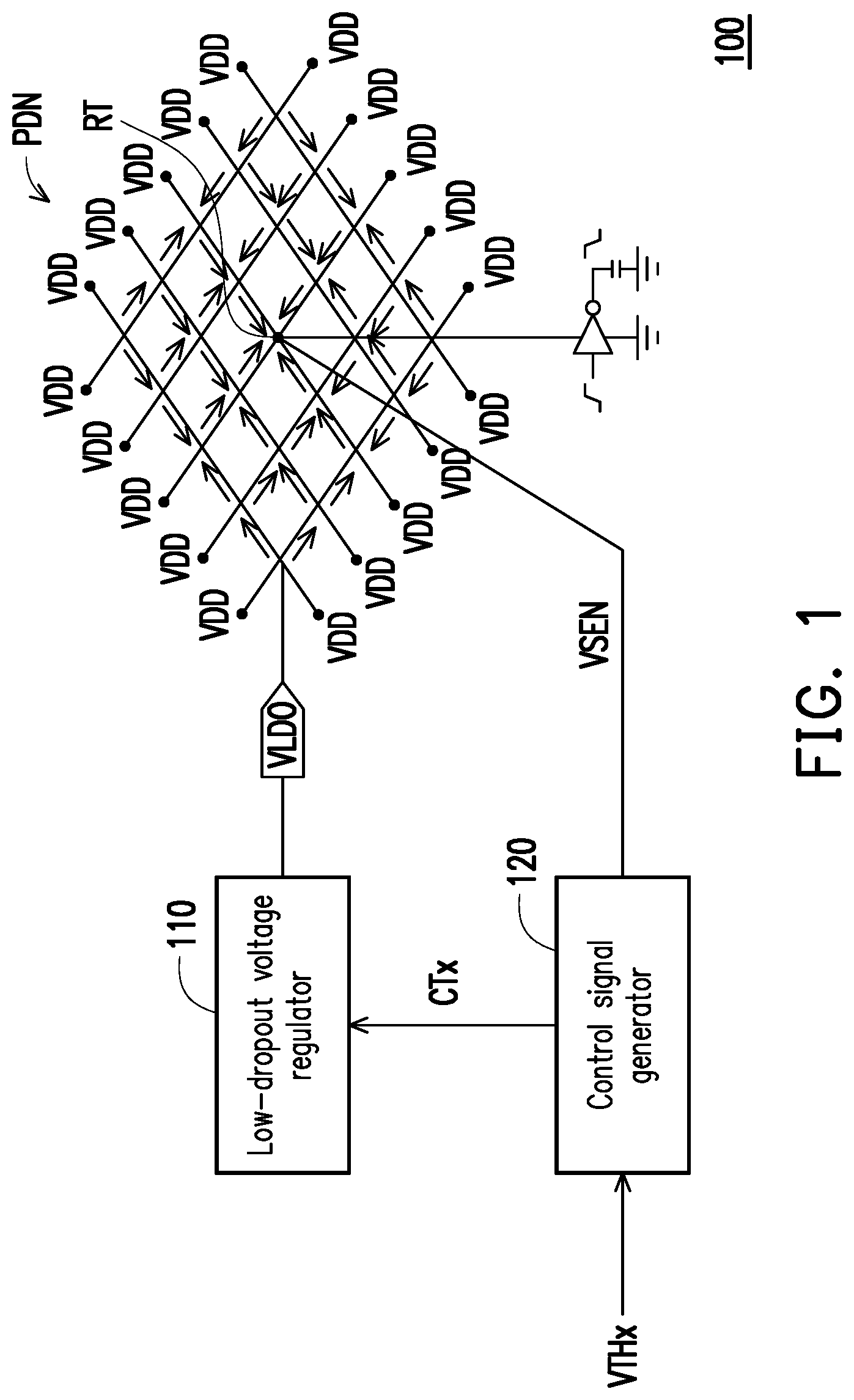
is a schematic diagram of a voltage generating device according to an embodiment of the disclosure.
and are circuit diagrams of a voltage generating device according to another embodiment of the disclosure.
is a schematic diagram of an implementation of a bias current generator according to an embodiment of the disclosure.
A and B are respectively an action waveform diagram of the voltage generating device according to an embodiment of the disclosure under different load conditions.
DESCRIPTION OF EMBODIMENTS
is a schematic diagram of a voltage generating device according to an embodiment of the disclosure. Referring to , a voltage generating device 100 is coupled to a power distribution network PDN, and is configured to provide a generated output voltage VLDO to the power distribution network PDN to provide its power supply VDD. The voltage generating device 100 includes a low-dropout voltage regulator 110 and a control signal generator 120 . The control signal generator 120 is coupled to the low-dropout voltage regulator 110 and the power distribution network PDN. The low-dropout voltage regulator 110 has a feedback circuit (not shown). The feedback circuit is configured to divide the output voltage VLDO according to a voltage dividing ratio and generate a feedback voltage, and the low-dropout voltage regulator 110 may adjust the voltage value of the generated output voltage VLDO according to a feedback voltage dividing ratio.
In this embodiment, the control signal generator 120 is coupled to a reference terminal RT of the power distribution network PDN, and receives a sensing voltage VSEN at the reference terminal RT of the power distribution network PDN. The control signal generator 120 receives multiple threshold voltages VTHx and compares the sensing voltage VSEN with the multiple threshold voltages VTHx to generate multiple control signals CTx respectively. Further, the control signal generator 120 may provide the control signal CTx to the low-dropout voltage regulator 110 . The low-dropout voltage regulator 110 may adjust the voltage dividing ratio provided by the feedback circuit according to the control signal CTx.
In detail, when the power distribution network PDN is changed from a light load to a heavy load, the sensing voltage VSEN at the reference terminal RT of the power distribution network PDN decreases correspondingly. The control signal generator 120 may generate the control signal CTx through the comparison result between the sensing voltage VSEN and the threshold voltage VTHx, and adjust the voltage dividing ratio provided by the feedback circuit through the control signal CTx to make the voltage value of the output voltage VLDO increase to respond to the load change on the power distribution network PDN. In contrast, when the power distribution network PDN is changed from a heavy load to a light load, the sensing voltage VSEN at the reference terminal RT of the power distribution network PDN increases correspondingly. The control signal generator 120 may generate the control signal CTx through the comparison result between the sensing voltage VSEN and the threshold voltage VTHx, and adjust the voltage dividing ratio provided by the feedback circuit through the control signal CTx to make the voltage value of the output voltage VLDO decrease to respond to the load change on the power distribution network PDN.
In addition, the threshold voltage VTHx in the embodiments of the disclosure may be set according to the change range of the sensing voltage VSEN that may be generated due to the load change of the power distribution network PDN. Furthermore, the reference terminal RT of the power distribution network PDN may be set at a terminal with the heaviest load on the power distribution network PDN.
is a circuit diagram of a voltage generating device according to another embodiment of the disclosure. Referring to , a voltage generating device 200 is coupled to a power distribution network PDN, and is configured to provide a generated output voltage VLDO to the power distribution network PDN. The voltage generating device 200 includes a low-dropout voltage regulator 210 and a control signal generator 220 . The low-dropout voltage regulator 210 includes an amplifier AMP 1 , a power transistor M 1 and a feedback circuit 211 . The feedback circuit 211 includes resistors R 1 and R 2 . The resistors R 1 and R 2 are sequentially coupled in series between the transistor M 1 and a reference ground terminal GND. The feedback circuit 211 is configured to divide the output voltage VLDO to generate a feedback voltage VFB.
A negative input terminal of the amplifier AMP 1 receives a reference voltage REF, and a positive input terminal of the amplifier AMP 1 receives the feedback voltage VFB. An output terminal of the amplifier AMP 1 is coupled to a control terminal of the transistor M 1 . In addition, a first terminal of the transistor M 1 receives an input voltage VIN, and a second terminal of the transistor M 1 serves as an output terminal of the voltage generating device 200 for generating the output voltage VLDO and is coupled to the feedback circuit 211 .
In addition, the resistor R 2 is a variable resistor. The resistance value of the resistor R 2 may be adjusted according to control signals CT 1 and CT 2 . The control signals CT 1 and CT 2 are generated by the control signal generator 220 . The control signal generator 220 includes comparators CMP 1 and CMP 2 . The comparator CMP 1 compares a threshold voltage VTH 1 with the sensing voltage VSEN at the reference terminal RT of the power distribution network PDN and generates the control signal CT 1 . The comparator CMP 2 compares a threshold voltage VTH 2 with the sensing voltage VSEN at the reference terminal RT of the power distribution network PDN and generates the control signal CT 2 . A case where the threshold voltage VTH 1 is greater than VTH 2 is taken as an example. When the sensing voltage VSEN is greater than the threshold voltage VTH 1 , the control signal generator 220 may generate both of the control signals CT 1 and CT 2 as disabled, so that the resistor R 2 is equal to a first resistor. When the sensing voltage VSEN is between the threshold voltages VTH 1 and VTH 2 , the control signal generator 220 may generate the control signals CT 1 and CT 2 as enabled and disabled, respectively, so that the resistor R 2 is equal to a second resistor. When the sensing voltage VSEN is less than the threshold voltage VTH 2 , the control signal generator 220 may generate both of the control signals CT 1 and CT 2 as enabled, so that the resistor R 2 is equal to a third resistor. The first resistor is greater than the second resistor, and the second resistor is greater than the third resistor.
In addition, the control signal generator 220 may include two or more comparators, and generate two or more control signals accordingly. In this way, the resistor R 2 may be adjusted in multiple stages to improve the resolution of the adjustment of the voltage dividing ratio.
From the above description, it may be seen that the output voltage VLDO generated by the voltage generating device 200 may be adaptively adjusted according to the load condition of the power distribution network PDN, so as to reduce the unsettling time of the output voltage VLDO caused by the change of the load condition and to improve the working stability of the system.
is a circuit diagram of a voltage generating device according to another embodiment of the disclosure. Referring to , a voltage generating device 300 is coupled to a power distribution network PDN, and is configured to provide a generated output voltage VLDO to the power distribution network PDN. The voltage generating device 300 includes a low-dropout voltage regulator 310 , a control signal generator 320 , a threshold voltage generator 330 and a bias current generator 340 . The implementation details of the low-dropout voltage regulator 310 and the control signal generator 320 are similar to those of the low-dropout voltage regulator 210 and the control signal generator 220 in the foregoing embodiment, and are not repeated here.
In this embodiment, the threshold voltage generator 330 includes an amplifier AMP 2 , a power transistor M 2 , and resistors R 3 and R 4 . The amplifier AMP 2 , the power transistor M 2 , and the resistors R 3 and R 4 configure another low-dropout voltage regulator. A negative input terminal of the amplifier AMP 2 receives a reference voltage VREF; a positive input terminal of the amplifier AMP 2 is coupled to a terminal where the resistors R 3 and R 4 are coupled; an output terminal of the amplifier AMP 2 is coupled to a control terminal of the power transistor M 2 . A first terminal of the power transistor M 2 receives the input voltage VIN, and a second terminal of the power transistor M 2 is coupled to a first terminal of the resistor R 3 . The resistors R 3 and R 4 are sequentially connected in series between the second terminal of the power transistor M 2 and the reference ground terminal GND. The reference voltage VREF may be equal to the reference voltage REF.
In this embodiment, a target voltage VCORE of the sensing voltage VSEN at the reference terminal RT of the power distribution network PDN is set so that on the premise that the resistor R 3 is equal to the resistor R 1 , the target voltage VCORE=VREF×(1+/R 1 /R 4 ). When there is a load current IL at the reference terminal RT of the power distribution network PDN, the relationship between the target voltage VCORE and the output voltage VLDO of the voltage generating device 300 may be expressed as VCORE=VLDO−IL×Req, where Req is equal to the equal resistance between the output terminal of the voltage generating device 300 and the reference terminal RT.
In further analysis, the target voltage VCORE may be equal to VREF×(1+R 1 /R 4 )−IL×Req, so it may be obtained that R 2 =VREF×R 1 ×R 4 /VREF×R 1 +IL×Req×R 4 . In this way, the resistor R 2 may be adjusted according to the change of the load current IL.
In addition, when the load current IL is equal to 0, the resistors R 2 and R 4 are equal.
In addition, different from the foregoing embodiments, the voltage generating device 300 of this embodiment is further provided with the bias current generator 340 . The bias current generator 340 is coupled to the amplifier AMP 1 and the control signal generator 320 . The bias current generator 340 receives the control signals CT 1 and CT 2 generated by the control signal generator 320 , and provides a bias current to the amplifier AMP 1 according to the control signals CT 1 and CT 2 . The magnitude of the bias current provided by the bias current generator 340 may be positively related to the number of the control signals CT 1 and CT 2 that are enabled.
In addition, when a large load change occurs on the power distribution network PDN, the bias current generator 340 may provide a relatively large bias current to the amplifier AMP 1 , so that the amplifier AMP 1 may improve the response speed, so that the generated output voltage VLDO tends to a settled state, which improves the stability of the system.
is a schematic diagram of an implementation of a bias current generator according to an embodiment of the disclosure. Referring to , the bias current generator 400 includes multiple switches SW 1 to SWN configured by transistors, and multiple current sources configured by transistors MB 1 to MBN. The switches SW 1 to SWN are respectively coupled in series with the transistors MB 1 to MBN. The switches SW 1 to SWN are connected in parallel with each other, and the transistors MB 1 to MBN are also connected in parallel with each other. The switches SW 1 to SWN receive the control signals CT 1 to CTN, respectively. The switches SW 1 to SWN are turned on or off according to the corresponding control signals CT 1 to CTN. Taking the control signal CT 1 as an example, when the control signal CT 1 is enabled, the corresponding switch SW 1 is turned on. On the contrary, when the control signal CT 1 is disabled, the corresponding switch SW 1 is turned off. The control signals CT 1 to CTN may be provided by the control signal generator 320 as shown in . The number of control signals CT 1 to CTN may be two or more, which is not particularly limited.
The control terminals of the transistors MB 1 to MBN receive a same bias voltage VBIAS. When the corresponding switches SW 1 to SWN are turned on, the current source formed by each transistor MB 1 to MBN may provide a bias current IB according to the bias voltage VBIAS. The larger the number of switches SW 1 to SWN that are turned on, the larger the bias current IB provided by the bias current generator 400 .
The transistors MB 1 to MBN may have the same channel aspect ratio, or may have different channel aspect ratios, which are not particularly limited. For example, the channel aspect ratio of the transistors MB 1 to MBN may be 1:2: . . . :2 N-1.
Please refer to , A and B for the following description. A and B are respectively an action waveform diagram of the voltage generating device according to an embodiment of the disclosure under different load conditions. In A , the waveform of the load current IL may be a unit step. Based on a sufficiently large current value of the load current IL, the comparators CMP 1 and CMP 2 may simultaneously generate the control signals CT 1 and CT 2 that are enabled. Correspondingly, the output voltage VLDO that may be generated by a conventional low-dropout voltage regulator without compensation may be a voltage waveform 501 . The voltage waveform 501 has a relatively long settling time, the amplitudes of the overshoot and undershoot of the voltage waveform 501 are the highest, and the final settled voltage value of the voltage waveform 501 is also lower than the target voltage.
In addition, by performing only the compensation operation of adjusting the voltage dividing ratio of the feedback circuit 311 , the output voltage VLDO that may be generated by the voltage generating device 300 may be a voltage waveform 502 . It may be clearly found that through the compensation operation of adjusting the voltage dividing ratio of the feedback circuit 311 , the final settled voltage value of the voltage waveform 502 of the output voltage VLDO may be close to the target voltage.
By performing only the compensation operation of the bias current generator 340 , the output voltage VLDO that may be generated by the voltage generating device 300 may be a voltage waveform 503 . The voltage waveform 503 may have a relatively short settling time, and the amplitudes of its overshoot and undershoot may be effectively reduced.
By performing both the compensation operation of adjusting the voltage dividing ratio of the feedback circuit 311 and the compensation operation of the bias current generator 340 , the output voltage VLDO that may be generated by the voltage generating device 300 may be a voltage waveform 504 . The voltage waveform 504 may have a relatively short settling time, and the amplitudes of its overshoot and undershoot may be effectively reduced, and the final settled voltage value of the voltage waveform 504 may be close to the target voltage.
In B , the waveform of the load current IL may be a continuous pulse wave. Correspondingly, the comparators CMP 1 and CMP 2 may simultaneously generate the control signals CT 1 and CT 2 that are alternately enabled and disabled. The output voltage VLDO that may be generated by a conventional low-dropout voltage regulator without compensation may be a voltage waveform 511 . The voltage waveform 511 has a relatively long settling time; the amplitudes of the overshoot and undershoot of the voltage waveform 511 are higher; and the final settled voltage value of the voltage waveform 511 is also lower than the target voltage. The voltage generating device 300 of the embodiment of may generate a voltage waveform that has a relatively short settling time; and the voltage waveform 512 of the embodiment has relatively low overshoot and undershoot amplitude; and the final settled voltage value is also close to the target voltage.
To sum up, the voltage generating device of the disclosure receives the sensing voltage on the power distribution network, and compares the sensing voltage with multiple threshold voltages to adjust the voltage dividing ratio of the feedback circuit of the low-dropout voltage regulator. According to the magnitude of the load, the voltage generating device may adaptively adjust the voltage value of the generated output voltage, which may effectively improve the stability of the output voltage and maintain the normal operation of the system.
Figures (6)
Citations
This patent cites (5)
- US2009/0039921
- US2014/0266118
- US2016/0087602
- US2017/0102724
- US2020/0409402