Gemstone and Method of Cutting the Same
Abstract
A gemstone includes a crown, a pavilion, and a girdle disposed between the crown and the pavilion. The girdle has an elliptical cross-section with a major axis and a minor axis. The surface of the gemstone is generally divided into a number of groups of interlocking facets disposed at a variety of angles. The groups of facets comprising the surface of the crown generally include star facets, upper intermediate crown facets, lower intermediate crown facets, main crown facets, and upper girdle facets. The upper girdle facets generally abut an upper edge of the girdle. The groups of facets comprising the surface of the pavilion include culet-adjacent facets, candle facets, main pavilion facets, and lower girdle facets. The lower girdle facets generally abut a lower edge of the girdle.
Claims (20)
1. A gemstone comprising: a girdle defining a perimeter of the gemstone, the girdle having an elliptical cross-section with a major axis and a minor axis, the major axis being larger than the minor axis; a crown forming an upper portion of the gemstone, a surface of the crown including: a table forming a generally horizontal upper surface of the crown; a plurality of star facets, each of the plurality of star facets being disposed adjacent to and abutting an edge of the table; a plurality of upper intermediate crown facets, each of the plurality of upper intermediate crown facets being disposed generally between two of the plurality of star facets, an upper vertex of each of the plurality of upper intermediate crown facets abutting a vertex of the table, the plurality of upper intermediate crown facets including major upper intermediate crown facets, minor upper intermediate crown facets, and median upper intermediate crown facets; a plurality of lower intermediate crown facets, each of the plurality of lower intermediate crown facets being disposed between two of the plurality of upper intermediate crown facets, an upper vertex of each of the plurality of lower intermediate crown facets abutting a lower vertex of one of the plurality of star facets; a plurality of main crown facets, each of the plurality of main crown facets being disposed between two of the plurality of lower intermediate crown facets, an upper vertex of each of the plurality of main crown facets abutting a lower vertex of one of the plurality of lower intermediate crown facets, the plurality of main crown facets including a plurality of central major main crown facets and a plurality of minor main crown facets, the plurality of central major main crown facets being aligned along the major axis, the plurality of minor main crown facets being aligned along the minor axis; and a plurality of upper girdle facets formed in pairs of adjacent upper girdle facets, each pair of adjacent upper girdle facets being disposed generally between two of the plurality of main crown facets, upper vertices of both upper girdle facets in each pair of upper girdle facets abutting a lower vertex of one of the plurality of lower intermediate crown facets, the plurality of upper girdle facets including a plurality of major upper girdle facets and a plurality of minor upper girdle facets, the plurality of major upper girdle facets being aligned along the major axis, the plurality of minor upper girdle facets being aligned along the minor axis; and a pavilion forming a lower portion of the gemstone, a surface of the pavilion including: a plurality of culet-adjacent facets forming a lower point of the pavilion, the plurality of culet-adjacent facets including a plurality of major culet-adjacent facets and a plurality of minor culet-adjacent facets, the plurality of major culet-adjacent facets being aligned along the major axis, the plurality of minor culet-adjacent facets being aligned along the minor axis; a plurality of candle facets, a lower portion of each of the plurality of candle facets being disposed generally between two of the plurality of culet-adjacent facets; a plurality of main pavilion facets, each of the main pavilion facets being disposed between two of the plurality of candle facets, a lower edge of each of the plurality of main pavilion facets abutting an upper edge of one of the plurality of culet-adjacent facets, the plurality of main pavilion facets including a plurality of major main pavilion facets and a plurality of minor main pavilion facets, the plurality of major main pavilion facets being aligned along the major axis, the plurality of minor main pavilion facets being aligned along the minor axis; and a plurality of lower girdle facets formed in pairs of adjacent lower girdle facets, each pair of adjacent lower girdle facets being disposed generally between two of the plurality of main pavilion facets, each pair of adjacent lower girdle facets having an upper portion of a respective one of the plurality of candle facets disposed generally therebetween, the plurality of lower girdle facets including a plurality of major lower girdle facets and a plurality of minor lower girdle facets, the plurality of major lower girdle facets being aligned along the major axis, the plurality of minor lower girdle facets being aligned along the minor axis, wherein the girdle is positioned between the crown and the pavilion, each of the plurality of upper girdle facets being disposed adjacent to and abutting an upper edge of the girdle, and each of the plurality of lower girdle facets being disposed adjacent to and abutting a lower edge of the girdle, and wherein the gemstone has a table percentage between about 20 percent and about 50 percent, and wherein the gemstone has a girdle thickness percentage between about 2 percent and about 12 percent.
Show 19 dependent claims
2. The gemstone of claim 1 , wherein each of the facets of the crown is disposed at an angle between about 10° and about 61.5° relative to the table of the crown, wherein the major upper intermediate crown facets are aligned along the major axis, and the minor upper intermediate crown facets are aligned along the minor axis.
3. The gemstone of claim 1 , wherein each of the plurality of central major main crown facets is disposed at an angle of between about 35.5° and about 45° relative to the table of the crown, and wherein each of the plurality of minor main crown facets is disposed at an angle of between about 45° and about 49.5° relative to the table of the crown.
4. The gemstone of claim 1 , wherein each of the plurality of major upper girdle facets is disposed at an angle of between about 43.5° and about 55° relative to the table of the crown, and wherein each of the plurality of minor upper girdle facets is disposed at an angle of between about 53.5° and about 61.5° relative to the table of the crown.
5. The gemstone of claim 1 , wherein each of the plurality of culet-adjacent facets is pentagon-shaped, each of the plurality of candle facets has six edges, each of the plurality of main pavilion facets is pentagon-shaped, and each of the plurality of lower girdle facet has four edges.
6. The gemstone of claim 1 , wherein each of the facets of the pavilion is disposed at an angle between about 29.5° and about 60° relative to the table of the crown.
7. The gemstone of claim 1 , wherein each of the major culet-adjacent facets is disposed at an angle of between about 29.5° and about 37.5° relative to the table of the crown, and wherein each of the minor culet-adjacent facets is disposed at an angle of between about 35° and about 40.5° relative to the table of the crown.
8. The gemstone of claim 1 , wherein each of the major main pavilion facets is disposed at an angle of between about 36.5° and about 44° relative to the table of the crown, and wherein each of the minor main pavilion facets is disposed at an angle of between about 43° and about 48° relative to the table of the crown.
9. The gemstone of claim 1 , wherein each of the major lower girdle facets is disposed at an angle of between about 41° and about 55° relative to the table of the crown, and wherein each of the minor lower girdle facets is disposed at an angle of between about 48° and about 60° relative to the table of the crown.
10. The gemstone of claim 1 , wherein the plurality of lower intermediate crown facets includes major lower intermediate crown facets and minor lower intermediate crown facets, wherein the major lower intermediate crown facets are aligned along the major axis, wherein the minor lower intermediate crown facets are aligned along the minor axis, and wherein the major lower intermediate crown facets have a different general shape than the minor lower intermediate crown facets.
11. The gemstone of claim 10 , wherein the plurality of main crown facets further includes a plurality of outer major main crown facets, wherein each of (i) the central major main crown facets, (ii) the outer major main crown facets, and (iii) the minor main crown facets, has a different general shape.
12. The gemstone of claim 11 , wherein the upper vertex of each of the central major main crown facets abuts (i) a lower vertex of an adjacent one of the major upper intermediate crown facets, and (ii) a lateral vertex of each of two adjacent ones of the major lower intermediate crown facets.
13. The gemstone of claim 12 , wherein the upper vertex of each of the outer major main crown facets abuts (i) a lower vertex of an adjacent one of the median upper intermediate crown facets, (ii) a lateral vertex of an adjacent one of the major lower intermediate crown facets, and a lateral vertex of an adjacent one of the minor lower intermediate crown facets.
14. The gemstone of claim 13 , wherein the upper vertex of each of the minor main crown facets abuts (i) a lower vertex of an adjacent one of the minor upper intermediate crown facets, and (ii) a lateral vertex of each of two adjacent ones of the minor lower intermediate crown facets.
15. The gemstone of claim 1 , wherein lateral vertices of each adjacent pair of the candle facets abut lateral vertices of (i) the central major main pavilion facets, (ii) the outer major main pavilion facets, or (iii) the minor main pavilion facets.
16. The gemstone of claim 15 , wherein two lower vertices of the central major main pavilion facets and two lower vertices of the outer major main pavilion facets each abut (i) a lateral vertex of an adjacent candle facet, and (ii) upper vertices of a corresponding major culet-adjacent facet.
17. The gemstone of claim 16 , wherein two lower vertices of the minor main pavilion facets each abut (i) a lateral vertex of an adjacent candle facet, and (ii) upper vertices of a corresponding minor culet-adjacent facet.
18. The gemstone of claim 1 , wherein the gemstone has a top depth percentage between about 15 percent and about 35 percent.
19. The gemstone of claim 1 , wherein the gemstone has a bottom depth percentage between about 40 percent and about 53 percent.
20. The gemstone of claim 1 , wherein the gemstone has a total depth percentage between about 75 percent and about 95 percent.
Full Description
Show full text →
CROSS-REFERENCE TO RELATED APPLICATIONS
The present application is a continuation of U.S. patent application Ser. No. 18/188,846, filed Mar. 23, 2023, now allowed, which is a continuation of U.S. patent application Ser. No. 17/150,558, filed Jan. 15, 2021, now issued as U.S. Pat. No. 11,633,022, which claims the benefit of and priority to U.S. Provisional Patent Application No. 62/961,577, filed Jan. 15, 2020, each of which is hereby incorporated by reference herein in its entirety.
TECHNICAL FIELD
The present disclosure relates to gemstones, more specifically, the present disclosure relates to a pattern of facets of gemstones.
BACKGROUND
Some gemstones are designed/cut to produce a desirable amount of brilliance, or “sparkle” by forming or cutting a number of individual facets on the exterior surface of the gemstone. Other gemstones are designed/cut to enhance a natural color (e.g., yellow, pink, etc.) of the gemstone. However, it can be difficult to produce a gemstone having a layout of facets at specific angles that produce both a desirable amount of brilliance and also enhance the natural color of the gemstone.
The present disclosure is directed to solving these problems and addressing other needs.
SUMMARY
According to some implementations of the present disclosure, a gemstone comprises a girdle, a crown, and a pavilion. The girdle defines a perimeter of the gemstone and has an elliptical cross-section with a major axis and a minor axis, the major axis being larger than the minor axis. The crown forms an upper portion of the gemstone. A surface of the crown includes: a table forming a generally horizontal upper surface of the crown; a plurality of star facets, each of the plurality of star facets being disposed adjacent to and abutting an edge of the table; a plurality of upper intermediate crown facets, each of the plurality of upper intermediate crown facets being disposed generally between two of the plurality of star facets, an upper vertex of each of the plurality of upper intermediate crown facets abutting a vertex of the table; a plurality of lower intermediate crown facets, each of the plurality of lower intermediate crown facets being disposed between two of the plurality of upper intermediate crown facets, an upper vertex of each of the plurality of lower intermediate crown facets abutting a lower vertex of one of the plurality of star facets; a plurality of main crown facets, each of the plurality of main crown facets being disposed between two of the plurality of lower intermediate crown facets, an upper vertex of each of the plurality of main crown facets abutting a lower vertex of one of the plurality of lower intermediate crown facets, the plurality of main crown facets including a plurality of major main crown facets and a plurality of minor main crown facets, the plurality of major main crown facets being aligned along the major axis, the plurality of minor main crown facets being aligned along the minor axis; and a plurality of upper girdle facets formed in pairs of adjacent upper girdle facets, each pair of adjacent upper girdle facets being disposed generally between two of the plurality of main crown facets, upper vertices of both upper girdle facets in each pair of upper girdle facets abutting a lower vertex of one of the plurality of lower intermediate crown facets, the plurality of upper girdle facets including a plurality of major upper girdle facets and a plurality of minor upper girdle facets, the plurality of major upper girdle facets being aligned along the major axis, the plurality of minor upper girdle facets being aligned along the minor axis. The pavilion forms a lower portion of the gemstone. A surface of the pavilion includes a plurality of culet-adjacent facets forming a lower point of the pavilion, the plurality of culet-adjacent facets including a plurality of major culet-adjacent facets and a plurality of minor culet-adjacent facets, the plurality of major culet-adjacent facets being aligned along the major axis, the plurality of minor culet-adjacent facets being aligned along the minor axis; a plurality of candle facets, a lower portion of each of the plurality of candle facets being disposed generally between two of the plurality of culet-adjacent facets; a plurality of main pavilion facets, each of the main pavilion facets being disposed between two of the plurality of candle facets, a lower edge of each of the plurality of main pavilion facets abutting an upper edge of one of the plurality of culet-adjacent facets, the plurality of main pavilion facets including a plurality of major main pavilion facets and a plurality of minor main pavilion facets, the plurality of major main pavilion facets being aligned along the major axis, the plurality of minor main pavilion facets being aligned along the minor axis; and a plurality of lower girdle facets formed in pairs of adjacent lower girdle facets, each pair of adjacent lower girdle facets being disposed generally between two of the plurality of main pavilion facets, each pair of adjacent lower girdle facets having an upper portion of a respective one of the plurality of candle facets disposed generally therebetween, the plurality of lower girdle facets including a plurality of major lower girdle facets and a plurality of minor lower girdle facets, the plurality of major lower girdle facets being aligned along the major axis, the plurality of minor lower girdle facets being aligned along the minor axis. The girdle is positioned between the crown and the pavilion. Each of the plurality of upper girdle facets is disposed adjacent to and abuts an upper edge of the girdle. Each of the plurality of lower girdle facets is disposed adjacent to and abuts a lower edge of the girdle.
According to some implementations of the present disclosure, a gemstone comprises a girdle and crown. The girdle forms a perimeter of the gemstone and has an elliptical cross-section. The crown forms an upper portion of the gemstone. The surface of the crown includes a table forming a generally horizontal upper surface of the crown; a plurality of star facets, each of the plurality of star facets being disposed adjacent to and abutting an edge of the table; a plurality of upper intermediate crown facets, each of the plurality of upper intermediate crown facets being disposed generally between two of the plurality of star facets, an upper vertex of each of the plurality of upper intermediate crown facets abutting a vertex of the table; a plurality of lower intermediate crown facets, each of the plurality of lower intermediate crown facets being disposed between two of the plurality of upper intermediate crown facets, an upper vertex of each of the plurality of lower intermediate crown facets abutting a lower vertex of one of the plurality of star facets; a plurality of main crown facets, each of the plurality of main crown facets being disposed between two of the plurality of lower intermediate crown facets, an upper vertex of each of the plurality of main crown facets abutting a lower vertex of one of the plurality of lower intermediate crown facets; and a plurality of upper girdle facets formed in pairs of adjacent upper girdle facets, each pair of adjacent upper girdle facets being disposed generally between two of the plurality of main crown facets, upper vertices of both upper girdle facets in each pair of upper girdle facets abutting a lower vertex of one of the plurality of lower intermediate crown facets.
According to some implementations of the present disclosure, a gemstone comprises a girdle and a pavilion. The girdle forms a perimeter of the gemstone and has an elliptical cross-section. The pavilion forms a lower portion of the gemstone. A surface of the pavilion includes a plurality of culet-adjacent facets forming a lower point of the pavilion; a plurality of candle facets, a lower portion of each of the plurality of candle facets being disposed generally between two of the plurality of culet-adjacent facets; a plurality of main pavilion facets, each of the plurality of main pavilion facets being disposed between two of the plurality of candle facets, a lower edge of each of the plurality of main pavilion facets abutting an upper edge of one of the plurality of culet-adjacent facets; and a plurality of lower girdle facets formed in pairs of adjacent lower girdle facets, each pair of adjacent lower girdle facets being disposed generally between two of the plurality of main pavilion facets, each pair of adjacent lower girdle facets having an upper portion of a respective one of the plurality of candle facets disposed generally therebetween.
According to some implementations of the present disclosure, a gemstone comprises a girdle, a crown, and a pavilion. The girdle forms a perimeter of the gemstone and has an elliptical cross-section. The crown forms an upper portion of the gemstone. A surface of the crown includes a table forming a generally horizontal upper surface of the crown, the table having a generally octagonal shape; a plurality of star facets disposed adjacent to the table, each of the plurality of star facets being triangle-shaped; a plurality of upper intermediate crown facets disposed adjacent to the plurality of star facets, each of the plurality of upper intermediate crown facets being kite-shaped; a plurality of lower intermediate crown facets disposed adjacent to the plurality of upper intermediate crown facets, each of the plurality of lower intermediate crown facets being kite-shaped; a plurality of main crown facets disposed adjacent to the plurality of lower intermediate crown facets, each of the plurality of main crown facets being kite-shaped; and a plurality of upper girdle facets disposed adjacent to the plurality of main crown facets, each of the plurality of upper girdle facets being triangle-shaped. The pavilion forms a lower portion of the gemstone. A surface of the pavilion includes a plurality of culet-adjacent facets forming a lower point of the pavilion, each of the plurality of culet-adjacent facets having a generally pentagonal shape; a plurality of candle facets disposed adjacent to the plurality of culet-adjacent facets, each of the plurality of candle facets having six edges; a plurality of main pavilion facets, each of the main pavilion facets being disposed between two of the plurality of candle facets and being pentagon-shaped; and a plurality of lower girdle facets formed in pairs of adjacent lower girdle facets, each pair of adjacent lower girdle facets being disposed generally between two of the plurality of main pavilion facets, each lower girdle facet having four edges. The girdle is positioned between the crown and the pavilion. Each of the plurality of upper girdle facets is disposed adjacent to and abuts an upper edge of the girdle. Each of the plurality of lower girdle facets is disposed adjacent to and abuts a lower edge of the girdle.
According to some implementations of the present disclosure, a gemstone comprises a crown, a pavilion, and a girdle. The crown forms an upper portion of the gemstone. The pavilion forms a lower portion of the gemstone. The girdle is positioned between the crown and the pavilion, and encircles the gemstone. The girdle has an elliptical cross-section with a major axis and a minor axis, the major axis being larger than the minor axis. The gemstone has a top depth percentage between about 15% and about 35%, and a bottom depth percentage between about 40% and about 53%.
According to some implementations of the present disclosure, a gemstone comprises a crown, a pavilion, and a girdle. The crown forms an upper portion of the gemstone. The pavilion forms a lower portion of the gemstone. The girdle is positioned between the crown and the pavilion, and encircles the gemstone. The girdle has an elliptical cross-section with a major axis and a minor axis, the major axis being larger than the minor axis. The gemstone has a total depth percentage between about 75% and about 95%.
According to some implementations of the present disclosure, a gemstone comprises a crown forming an upper portion of the gemstone and a pavilion forming a lower portion of the gemstone. The surface of the crown is defined by a first plurality of facets, each of the first plurality of facets being disposed at an angle between about 10° and about 61.5° relative to an upper surface of the gemstone. The surface of the pavilion is defined by a second plurality of facets, each of the second plurality of facets being disposed at an angle between about 29.5° and about 60° relative to the upper surface of the gemstone.
According to some implementations of the present disclosure, a method of forming a crown of a gemstone comprises forming a generally horizontal upper surface on an upper portion of the gemstone; forming a first temporary set of crown facets and a second temporary set of crown facets on the upper portion of the gemstone, the first temporary set of crown facets being formed at an angle of between about 35.5° and about 45° relative to the first preliminary table, the second temporary set of crown facets being formed at an angle of between about 45° and about 49° relative to the first preliminary table; forming a third temporary set of crown facets on the upper portion of the gemstone from portions of the generally horizontal upper surface, the first temporary set of crown facets, and the second temporary set of crown facets, the third temporary set of crown facets being formed at an angle of between about 29° and about 35.5° relative to the generally horizontal upper surface, a remainder of the first temporary set of crown facets forming a fourth temporary set of crown facets, a remainder of the second temporary set of crown facets forming a fifth temporary set of crown facets; forming a sixth temporary set of crown facets on the upper portion of the gemstone from portions of the generally horizontal upper surface and the third temporary set of crown facets, the sixth temporary set of crown facets being formed at an angle of between about 15.5° and about 24° relative to the generally horizontal upper surface, a remainder of the third temporary set of crown facets forming a first final set of crown facets; forming a second final set of crown facets and a third final set of crown facets on the upper portion of the gemstone, the second final set of crown facets being formed from portions of the fourth temporary set of crown facets and being formed at an angle of between about 41.5° and about 51.5° relative to the generally horizontal upper surface, the third final set of crown facets being formed from portions of the fourth temporary set of crown facets and the fifth temporary set of crown facets and being formed at an angle of between about 53.5° and about 61.5°, a remainder of the fifth temporary set of crown facets forming a fourth final set of crown facets, a remainder of the fifth temporary set of crown facets forming a fifth final set of crown facets; and forming a sixth final set of crown facets on the upper portion of the gemstone from portions of the generally horizontal surface and the sixth temporary set of crown facets, the sixth final set of crown facets being formed at an angle of between about 10° and about 18° relative to the generally horizontal upper surface, a remainder of the sixth temporary set of crown facets forming a seventh final set of crown facets, such that the upper portion of the gemstone is formed from the first, second, third, fourth, fifth, sixth, and seventh final set of crown facets.
According to some implementations of the present disclosure, a method of forming a pavilion of a gemstone having a horizontal upper surface comprises forming a first temporary set of pavilion facets and a second temporary set of pavilion facets on a lower portion of the gemstone, the first temporary set of pavilion facets being formed at an angle of between about 36.5° and about 44° relative to the horizontal upper surface, the second temporary set of pavilion facets being formed at an angle of between about 43° and about 48° relative to the horizontal upper surface; forming a third temporary set of pavilion facets and a fourth temporary set of pavilion facets on the lower portion of the gemstone, the third temporary set of pavilion facets being formed from the first temporary set of pavilion facets and at an angle of between about 35° and about 40.5° relative to the horizontal upper surface, the fourth temporary set of pavilion facets being formed from the second temporary set of pavilion facets and at an angle of between about 29.5° and about 37.5° relative to the horizontal upper surface, a remainder of the first temporary set of pavilion facets forming a fifth temporary set of pavilion facets; a remainder of the second temporary set of pavilion facets forming a sixth temporary set of pavilion facets; forming a seventh temporary set of pavilion facets on the lower portion of the gemstone from portions of third temporary set of pavilion facets, the fourth temporary set of pavilion facets, the fifth temporary set of pavilion facets, and the sixth temporary set of pavilion facets, the seventh set of temporary pavilion facets being formed at an angle of between about 34° and about 43.4° relative to the horizontal upper surface, a remainder of the third temporary set of pavilion facets forming a first final set of pavilion facets, a remainder of the fourth temporary set of pavilion facets forming an second final set of pavilion facets, a remainder of the fifth temporary set of pavilion facets forming an eighth temporary set of pavilion facets, a remainder of the sixth temporary set of pavilion facets forming a ninth temporary set of pavilion facets; and forming third final set of pavilion facets and a fourth final set of pavilion facets on the lower portion of the gemstone from the seventh temporary set of pavilion facets, the eighth temporary set of pavilion facets, and the ninth temporary set of pavilion facets, the third final set of pavilion facets being formed at an angle of between about 41° and about 55° relative to the horizontal upper surface, the fourth final set of pavilion facets being formed at an angle of between about 48° and about 60° relative to the horizontal upper surface, a remainder of the seventh temporary set of pavilion facets forming a fifth final set of pavilion facets, a remainder of the eighth temporary set of pavilion facets forming a sixth final set of pavilion facets, a remainder of the ninth temporary set of pavilion facets forming a seventh final set of pavilion facets, such that the lower portion of the gemstone is formed from the first, second, third, fourth, fifth, sixth, and seventh final set of pavilion facets.
According to some implementations of the present disclosure, a gemstone comprises a girdle, a crown, and a pavilion. The girdle defines a perimeter of the gemstone. The crown forms an upper portion of the gemstone. A surface of the crown includes a table forming a generally horizontal upper surface of the crown; a plurality of star facets, each of the plurality of star facets being disposed adjacent to and abutting an edge of the table; a plurality of upper intermediate crown facets, each of the plurality of upper intermediate crown facets being disposed generally between two of the plurality of star facets, an upper vertex of each of the plurality of upper intermediate crown facets abutting a vertex of the table; a plurality of lower intermediate crown facets, each of the plurality of lower intermediate crown facets being disposed between two of the plurality of upper intermediate crown facets, an upper vertex of each of the plurality of lower intermediate crown facets abutting a lower vertex of one of the plurality of star facets; a plurality of main crown facets, each of the plurality of main crown facets being disposed between two of the plurality of lower intermediate crown facets, an upper vertex of each of the plurality of main crown facets abutting a lower vertex of one of the plurality of lower intermediate crown facets; and a plurality of upper girdle facets formed in pairs of adjacent upper girdle facets, each pair of adjacent upper girdle facets being disposed generally between two of the plurality of main crown facets, upper vertices of both upper girdle facets in each pair of upper girdle facets abutting a lower vertex of one of the plurality of lower intermediate crown facets. The pavilion forms a lower portion of the gemstone. A surface of the pavilion includes a plurality of culet-adjacent facets forming a lower point of the pavilion; a plurality of candle facets, a lower portion of each of the plurality of candle facets being disposed generally between two of the plurality of culet-adjacent facets; a plurality of main pavilion facets, each of the main pavilion facets being disposed between two of the plurality of candle facets, a lower edge of each of the plurality of main pavilion facets abutting an upper edge of one of the plurality of culet-adjacent facets; and a plurality of lower girdle facets formed in pairs of adjacent lower girdle facets, each pair of adjacent lower girdle facets being disposed generally between two of the plurality of main pavilion facets, each pair of adjacent lower girdle facets having an upper portion of a respective one of the plurality of candle facets disposed generally therebetween. The girdle is positioned between the crown and the pavilion, each of the plurality of upper girdle facets being disposed adjacent to and abutting an upper edge of the girdle, and each of the plurality of lower girdle facets being disposed adjacent to and abutting a lower edge of the girdle.
The foregoing and additional aspects and implementations of the present disclosure will be apparent to those of ordinary skill in the art in view of the detailed description of various embodiments and/or implementations, which is made with reference to the drawings, a brief description of which is provided next.
BRIEF DESCRIPTION OF THE DRAWINGS
The foregoing and other advantages of the present disclosure will become apparent upon reading the following detailed description and upon reference to the drawings.
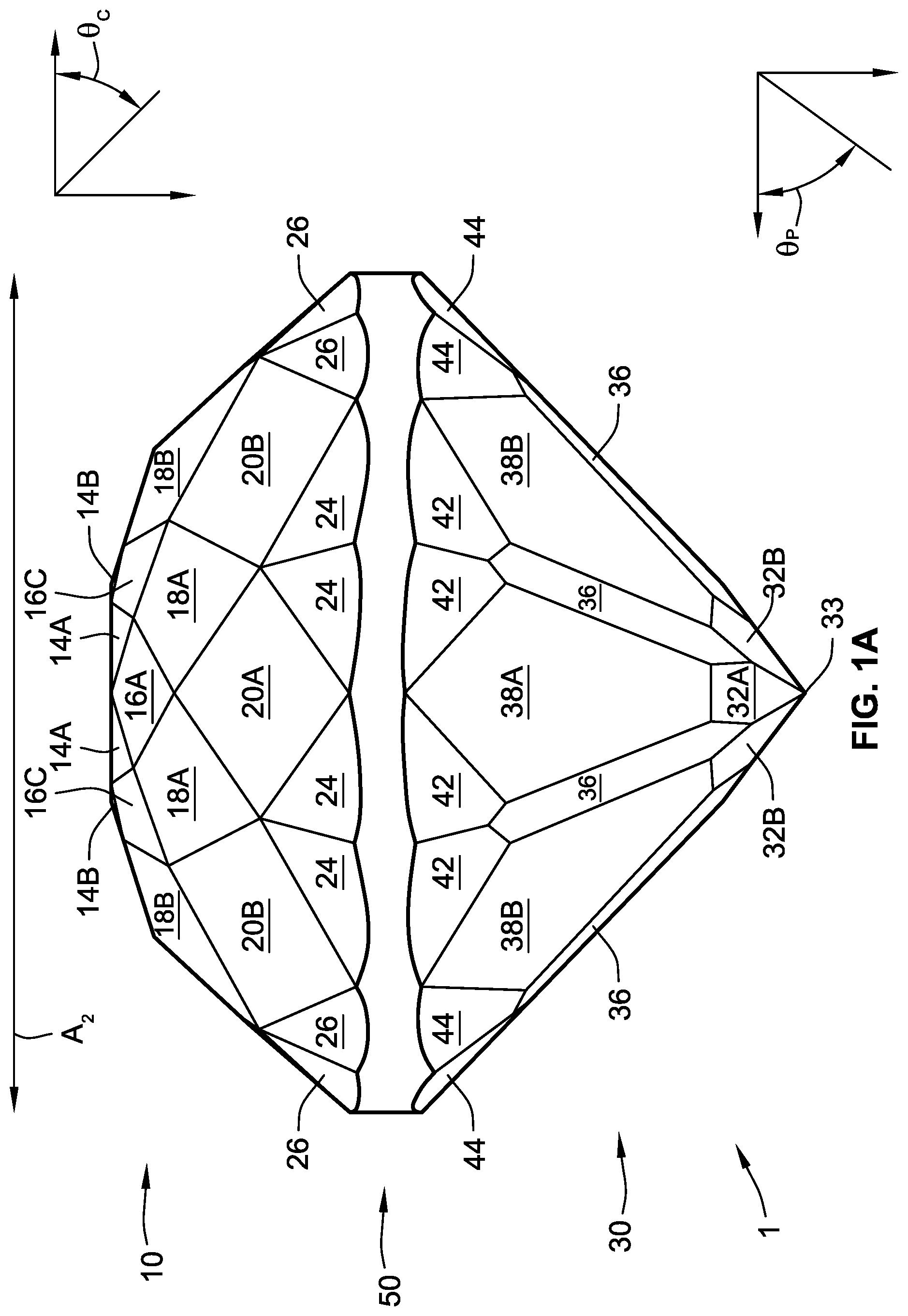
A is a first elevation view of a gemstone along a minor axis, according to some implementations of the present disclosure;
B is a second elevation view of the gemstone of A along a major axis, according to some implementation of the present disclosure;
is a top plan view of the gemstone of A and 1 B , according to some implementations of the present disclosure;
is a bottom plan view of the gemstone of A and 1 B , according to some implementations of the present disclosure;
A is a perspective view of the gemstone of A and 1 B viewed at a downward angle, according to some implementations of the present disclosure;
B is a perspective view of the gemstone of A and 1 B viewed at an upward angle, according to some implementations of the present disclosure;
A illustrates a first step of a method of forming a crown of the gemstone of A and 1 B , according to some implementations of the present disclosure;
B illustrates a second step of the method of forming the crown of the gemstone of A and 1 B , according to some implementations of the present disclosure;
C illustrates a third step of the method of forming the crown of the gemstone of A and 1 B , according to some implementations of the present disclosure;
D illustrates a fourth step of the method of forming the crown of the gemstone of A and 1 B , according to some implementations of the present disclosure;
E illustrates a fifth step of the method of forming the crown of the gemstone of A and 1 B , according to some implementations of the present disclosure;
A illustrates a first step of a method of forming a pavilion of the gemstone of A and 1 B , according to some implementations of the present disclosure;
B illustrates a second step of the method of forming the pavilion of the gemstone of A and 1 B , according to some implementations of the present disclosure;
C illustrates a third step of the method of forming the pavilion of the gemstone of A and 1 B , according to some implementations of the present disclosure; and
D illustrates a fourth step of the method of forming the pavilion of the gemstone of A and 1 B , according to some implementations of the present disclosure.
While the present disclosure is susceptible to various modifications and alternative forms, specific implementations and embodiments have been shown by way of example in the drawings and will be described in detail herein. It should be understood, however, that the present disclosure is not intended to be limited to the particular forms disclosed. Rather, the present disclosure is to cover all modifications, equivalents, and alternatives falling within the spirit and scope of the present disclosure as defined by the appended claims.
DETAILED DESCRIPTION
A and 1 B illustrate elevation views of an implementation of the gemstone 1 . The gemstone 1 is generally divided into a crown 10 formed as the upper portion of the gemstone 1 , a pavilion 30 formed as the lower portion of the gemstone 1 , and a girdle 50 , which is generally disposed between the crown 10 and the pavilion 30 . The girdle 50 generally encircles the entire circumference of the gemstone 1 . The crown 10 generally has a flat top surface (as seen in ), referred to as a table 12 . The lower portion of the gemstone 1 at the pavilion 30 can terminate in a lower point 33 as shown in A and 1 B , or can terminate in a flat facet called a culet. The gemstone 1 is generally a precious stone, such as but not limited to a diamond, ruby, emerald, sapphire, or pearl. The gemstone 1 can also be a synthetic material, such as cubic zirconium. More broadly, the gemstone 1 can include any material capable of being cut, such as, for example, precious or non-precious stones, cubic zirconia, ceramic, metal, plastic, wood, etc.
The girdle 50 is generally the widest portion of the gemstone 1 . When the gemstone 1 is viewed from above or below (e.g., the view in , respectively), the girdle 50 defines the outer perimeter of the gemstone 1 . The gemstone 1 has a generally oval or elliptical shape, and thus, the girdle 50 and the perimeter of the gemstone 1 have an elliptical cross-section with a major axis A 1 and a minor axis A 2 that are generally perpendicular to each other. The dimension of the gemstone 1 along the major axis A 1 is larger than the dimension of the gemstone 1 along the minor axis A 2 . Viewing A , the minor axis A 2 extends horizontally relative to the plane of A , while the major axis A 1 (not shown) extends into and out of the plane of A . Viewing B , the major axis A 1 extends horizontally relative to the plane of B , while the minor axis A 2 (not shown) extends into and out of the plane of B .
The dimensional characteristics of the gemstone 1 are based off of the width of the gemstone 1 . The width of the gemstone 1 can also be expressed as the diameter of the girdle 50 . The gemstone 1 has a table percentage that is a measure of a width or diameter of the table of the gemstone 1 . The table can be formed in a variety of shapes, as thus the measure of the width of the table can vary. In an implementation, the table is a circle, and thus the diameter of the circle is used to express the table percentage of the gemstone 1 . In another implementation, the table is an octagon, and either the distance between opposing edges of the octagon or between opposing vertices of the octagon is used to express the table percentage. The table percentage is generally expressed as the width of the table 12 divided by the width of the gemstone 1 . In an implementation, the table percentage is between about 26.5% and about 45%. In a further implementation, the table percentage is between about 20% and about 50%. In an additional implementation, the table percentage is between about 25% and about 45%. In yet a further implementation the table percentage is about 34.5%.
The gemstone 1 has a top depth percentage that is a measure of the height of the crown 10 of the gemstone 1 . The top depth percentage is generally expressed as the height of the crown 10 divided by the width of the gemstone 1 . In an implementation, the top depth percentage is between about 24.5% and about 28.5%. In another implementation, the top depth percentage is between about 20% and about 30%. In a further implementation, the top depth percentage is between about 15% and about 35%. In yet a further implementation the top depth percentage is about 28.3%.
The gemstone 1 has a bottom depth percentage that is a measure of the total height of the pavilion 30 of the gemstone 1 . The bottom depth percentage is generally expressed as the height of the pavilion 30 divided by the width of the gemstone 1 . In an implementation, the bottom depth percentage is between about 43% and about 49%. In another implementation, the bottom depth percentage is between about 40% and about 53%. In yet a further implementation the bottom depth percentage is about 46.9%.
The gemstone 1 has a girdle thickness percentage that is a measure of the total height of the girdle 50 of the gemstone 1 . The girdle thickness percentage is generally expressed as the height of the girdle 50 divided by the width of the gemstone 1 . In an implementation, the girdle thickness percentage is between about 4% and about 10%. In another implementation, the girdle thickness percentage is between about 6% and about 8%. In a further implementation, the girdle thickness percentage is between about 2% and about 12%. In yet a further implementation the girdle thickness percentage is about 6.9%.
The gemstone 1 has a total depth percentage that is a measure of the total height of the gemstone 1 . The total depth percentage is generally expressed as the height of the gemstone 1 divided by the width of the gemstone 1 . The total depth percentage may also be expressed as the sum of the top depth percentage, the bottom depth percentage, and the girdle thickness percentage. In an implementation, the total depth percentage is between about 82.5% and about 86.5%. In another implementation, the total depth percentage is between about 80% and about 90%. In further implementation, the total depth percentage is between about 75% and about 95%. In yet a further implementation the total depth percentage is about 82.1%.
The surface of the gemstone 1 is generally divided into a number of groups of interlocking facets disposed at a variety of angles. The facets comprising the surface of the crown 10 generally include a table 12 , star facets, upper intermediate crown facets, lower intermediate crown facets, main crown facets, and upper girdle facets. The star facets include major star facets 14 A and minor star facets 14 B. The upper intermediate crown facets include major upper intermediate crown facets 16 A, minor upper intermediate crown facets 16 B, and median upper intermediate crown facets 16 C. The lower intermediate crown facets include major lower intermediate crown facets 18 A and minor lower intermediate crown facets 18 B. The main crown facets include central major main crown facets 20 A, outer major main crown facets 20 B, and minor main crown facets 22 . The upper girdle facets include major upper girdle facets 24 and minor upper girdle facets 26 . The major and minor upper girdle facets 24 , 26 generally abut an upper edge of the girdle 50 .
The groups of facets comprising the surface of the pavilion 30 include culet-adjacent facets, candle facets, main pavilion facets, and lower girdle facets. The culet-adjacent facets include central major culet-adjacent facets 32 A, outer major culet-adjacent facets 32 B, and minor culet-adjacent facets 34 . The candle facets include candle facets 36 . The main pavilion facets include central major main pavilion facets 38 A, outer major main pavilion facets 38 B, and minor main pavilion facets 40 . The lower girdle facets include major lower girdle facets 42 and minor lower girdle facets 44 . The major and minor lower girdle facets 42 , 44 generally abut a lower edge of the girdle 50 .
In an implementation, the girdle 50 is a continuous elliptical or oval facet that encircles the entirety of the gemstone 1 . In another implementation, the girdle 50 is divided into a plurality of sub-facets. In yet another implementation, each sub-facet of the girdle 50 comprises a plurality of individual facets. The upper edge of the girdle 50 that abuts the crown 10 may be generally straight or may be curved. The lower edge of the girdle 50 that abuts the pavilion 30 may be generally straight or may be curved.
The angles that each of the facets of the crown 10 are disposed at may be measured relative to a horizontal plane defined by the table of the gemstone 1 (e.g. the top surface of the gemstone 1 ). As shown in the upper set of axes in A and 1 B , each of the facets of the crown 10 is formed at an angle θ C relative to the horizontal plane defined by the table of the gemstone 1 . As is shown in A and 1 B , the angle θ C that each of the facets of the crown 10 are disposed at is formed by rotating in a clockwise direction downward from the horizontal plane defined by the table.
Generally, every facet within a group of facets is disposed at the same angle or at an angle within the same range. For example, all of the major star facets 14 A are disposed at the same angle or at an angle within the same range as the minor star facets 14 B. Similarly, all of the major, minor, and median upper intermediate crown facets 16 A, 16 B, 16 C are disposed at the same angle or at an angle with the same range, etc. In some implementations, the range of angles for different groups of facets can overlap, such that two facets within two different groups of facets may have identical or substantially identical angles. Generally, each facets within a group of facets (e.g., all of the star facets, all of the main crown facets, etc.) has the same shape. However, as is discussed in more detail below, due to the oval or elliptical shape of the gemstone, some facets within a group of facets have different shapes.
In an implementation, the angle of the major and minor star facets 14 A, 14 B is between about 10° and about 18°. In another implementation, the angle of the major and minor star facets 14 A, 14 B is between about 5° and about 20°. In a further implementation, the angle of the major and minor star facets 14 A, 14 B is about 13°.
In an implementation, the angle of the major, minor, and median upper intermediate crown facets 16 A, 16 B, 16 C is between about 15.5° and about 24°. In another implementation, the angle of the major, minor, and median upper intermediate crown facets 16 A, 16 B, 16 C is between about 10° and about 30°. In a further implementation, the angle of the major, minor, and median upper intermediate crown facets 16 A, 16 B, 16 C is between about 18° and about 22°. In yet another implementation, the angle of the major, minor, and median upper intermediate crown facets 16 A, 16 B, 16 C is about 20°.
In an implementation, the angle of the major and minor lower intermediate crown facets 18 A, 18 B is about between about 29° and about 35.5°. In another implementation, the angle of the major and minor lower intermediate crown facets 18 A, 18 B is between about 25° and about 40°. In a further implementation, the angle of the major and minor lower intermediate crown facets 18 A, 18 B is between about 30° and about 33°. In yet another further implementation, the angle of the major and minor lower intermediate crown facets 18 A, 18 B is about 31.5°.
In an implementation, the angle of the central and outer major main crown facets 20 A, 20 B is between about 35.5° and about 45°. In another implementation, the angle of the central and outer major main crown facets 20 A, 20 B is between about 30° and about 50°. In a further implementation, the angle of the central and outer major main crown facets 20 A, 20 B is between about 39° and about 44°. In yet another implementation, the angle of the central and outer major main crown facets 20 A, 20 B is about 42°.
In an implementation, the angle of the minor main crown facets 22 is between about 45° and about 49.5°. In another implementation, the angle of the minor main crown facets 22 is between about 40° and about 55°. In a further implementation, the angle of the minor main crown facets 22 is between about 47° and about 48°. In yet another implementation, the angle of the minor main crown facets 22 is about 47.5°.
In an implementation, the angle of the major upper girdle facets 24 is between about 43.5° and about 55°. In a further implementation, the angle of the major upper girdle facets 24 is between about 40° and about 60°. In a further implementation, the angle of the major upper girdle facets is between about 47° and about 53°. In a further implementation, the angle of the major upper girdle facets 24 is about 50°.
In an implementation, the angle of the minor upper girdle facets 26 is between about 53.5° and about 61.5°. In a further implementation, the angle of the minor upper girdle facets 26 is between about 50° and about 65°. In a further implementation, the angle of the minor upper girdle facets 26 is between about 56° and about 65°. In yet another implementation, the angle of the minor upper girdle facets 26 is about 59°.
The angles that each of the facets of the pavilion 30 are disposed at may also be measured relative to the horizontal plane defined by the table of the gemstone 1 (e.g. the top surface of the gemstone 1 ). As shown in the lower set of axes in A and 1 B , each of the facets of the pavilion 30 is formed at an angle θ P relative to this horizontal plane defined by the table of the gemstone 1 . As is shown in A and 1 B , the angle θ P that each of the facets of the pavilion 30 are disposed at is formed by rotating in a counterclockwise direction upward from the horizontal plane defined by the table.
In an implementation, the angle of the major culet-adjacent facets 32 is between about 29.5° and about 37.5°. In another implementation, the angle of the major culet-adjacent facets 32 is between about 25° and about 40°. In a further implementation, the angle of the major culet-adjacent facets 32 is between about 32° and about 35°. In yet another implementation, the angle of the major culet-adjacent facets 32 is about 34°.
In an implementation, the angle of the minor culet-adjacent facets 34 is between about 35° and about 40.5°. In another implementation, the angle of the minor culet-adjacent facets 34 is between about 30° and about 45°. In a further implementation, the angle of the minor culet-adjacent facets 34 is between about 37° and about 38°. In yet another implementation, the angle of the minor culet-adjacent facets 34 is about 37.5°.
In an implementation, the angle of the candle facets 36 is between about 35° and about 45°. In another implementation, the angle of the candle facets 36 is between about 30° and about 50°. In a further implementation, the angle of the candle facets 36 is between about 35° and about 41°. In yet another implementation, the angle of the candle facets 36 is about 42°.
In an implementation, the angle of the central and outer major main pavilion facets 38 A, 38 B is between about 36.5° and about 44°. In another implementation, the angle of the central and outer major main pavilion facets 38 A, 38 B is between about 30° and about 50°. In a further implementation, the angle of the central and outer major main pavilion facets 38 A, 38 B is between about 36° and about 40°. In yet another implementation, the angle of the central and outer major main pavilion facets 38 A, 38 B is about 38.5°.
In an implementation, the angle of the minor main pavilion facets 40 is between about 43° and about 48°. In another implementation, the angle of the minor main pavilion facets 40 is between about 40° and about 50°. In a further implementation, the angle of the minor main pavilion facets 40 is between about 35° and about 55°. In yet another implementation, the angle of the minor main pavilion facets 40 is between about 44° and about 46°. In yet a further implementation, the angle of the minor main pavilion facets 40 is about 45°.
In an implementation, the angle of the major lower girdle facets 42 is between about 41° and about 55°. In another implementation, the angle of the major lower girdle facets 42 is between about 40° and about 50°. In a further implementation, the angle of the major lower girdle facets 42 is between about 35° and about 55°. In yet another implementation, the angle of the major lower girdle facets is between about 39° and about 47°. In yet a further implementation, the angle of the major lower girdle facets 42 is about 42.5°.
In an implementation, the angle of the minor lower girdle facets 44 is between about 48° and about 60°. In another implementation, the angle of the minor lower girdle facets 44 is between about 45° and about 56°. In a further implementation, the angle of the minor lower girdle facets 44 is between about 40° and about 60°. In yet another implementation, the angle of the minor lower girdle facets 44 is between about 46° and about 53°. In yet a further implementation, the angle of the minor lower girdle facets 44 is about 49.5°.
Referring now to , a top plan view of the gemstone 1 showing the crown 10 is illustrated. The major axis A 1 of the perimeter of the gemstone (which is formed by the girdle 50 ) extends horizontally relative to the plane of , while the minor axis A 2 extends vertically relative to the plane of . The major and minor axes A 1 and A 2 generally divide the facets of the crown 10 into a first quadrant 11 A, a second quadrant 11 B, a third quadrant 11 C, and fourth quadrant 11 D. The first quadrant 11 A generally corresponds to the upper-right corner region of the crown 10 relative to the plane of . The second quadrant 11 B generally corresponds to the upper-left corner region of the crown 10 relative to the plane of . The third quadrant 11 C generally corresponds to the lower-left corner region of the crown 10 relative to the plane of . The fourth quadrant 11 D generally corresponds to the lower-right corner region of the crown 10 relative to the plane of .
The terms “top,” “bottom,” “left,” “right,” “above,” below,” etc. are used herein to refer to the locations of the various facets on the crown 10 . However, those of skill in the art will understand that these are relative terms that are generally used in reference to the plane of . Thus, any of these terms used to describe an individual facet may not apply when viewing the crown 10 from a different perspective. The facets on the surface of the crown 10 share edges and vertices where the facets meet. When describing the facets on the surface of the crown 10 , the term “upper” is used to refer to edges or vertices nearer to the table 12 , while the term “lower” is used to refer to edges or vertices nearer to the girdle 50 .
The crown 10 includes a number of main crown facets, which include six major main crown facets 20 A, 20 B, and two minor main crown facets 22 . Relative to the plane of , the six major main crown facets 20 A, 20 B are generally disposed either to the left or to the right along the major axis A 1 . The major main crown facets 20 A, 20 B are divided into two groups of three major main crown facets 20 A, 20 B. A left group of three major main crown facets 20 A, 20 B is generally disposed along the left side of the major axis A 1 , which is to the left of the minor axis A 2 . A right group of three major main crown facets 20 A, 20 B is generally disposed along the right side of the major axis A 1 , which is to the right of the minor axis A 2 .
The major main crown facets 20 A, 20 B within the left group of major main crown facets 20 A, 20 B extend generally vertically relative to the plane of . In this manner, the three major main crown facets 20 A, 20 B within the left group of major main crown facets 20 A, 20 B are aligned along an axis that is parallel to and to the left of the minor axis A 2 . Similarly, the major main crown facets 20 A, 20 B within the right group of major main crown facets 20 A, 20 B also extend generally vertically relative to the plane of . In this manner, the three major main crown facets 20 A, 20 B within the right group of major main crown facets 20 A, 20 B are aligned along an axis that is parallel to and to the right of the minor axis A 2 .
Each group of three major main crown facets includes a central major main crown facet 20 A surrounded by two outer major main crown facets 20 B. The two central major main crown facets 20 A (e.g. the left and right central major main crown facets 20 A relative to the plane of ) are generally aligned along the major axis A 1 . The left central major main crown facet 20 A extends into both the second quadrant 11 B and the third quadrant 11 C. The right central major main crown facet 20 A extends into both the first quadrant 11 A and the fourth quadrant 11 D.
Relative to the plane of , the two outer major main crown facets 20 B above the central major main crown facets 20 A (e.g., the top-right and top-left major main crown facets 20 B) are aligned along a line parallel to and above the major axis A 1 . Similarly, relative to the plane of , the two outer major main crown facets 20 B below the central major main crown facets 20 A (e.g., the bottom-left and bottom-right major main crown facets 20 B) are aligned along a line parallel to and below the major axis A 1 . The top-right major main crown facet 20 B is disposed in the first quadrant 11 A. The top-left major main crown facet 20 B is disposed in the second quadrant 11 B. The bottom-left major main crown facet 20 B is disposed in the third quadrant 11 C. The bottom-right major main crown facet 20 B is disposed in the fourth quadrant 11 D. Generally, at least a portion of each of the major main crown facets 20 A, 20 B is disposed between two of the lower intermediate crown facets 18 A, 18 B.
The two minor main crown facets 22 are generally aligned along the minor axis A 2 . Relative to the plane of , one of the minor main crown facets 22 (e.g., the top minor main crown facet 22 ) is generally disposed along the top side of the minor axis A 2 , which is above the major axis A 1 . The other minor main crown facet 22 (e.g., the bottom minor main crown facet 22 ) is disposed along the bottom side of the minor axis A 2 , which is below the major axis A 1 . The top minor main crown facet 22 generally extends into both the first quadrant 11 A and the second quadrant 11 B. The bottom minor main crown facet 22 generally extends into both the third quadrant 11 C and the fourth quadrant 11 D. Generally, at least a portion of each of the minor main crown facets 22 is disposed between two of the lower intermediate crown facets 18 A, 18 B.
Each major main crown facet 20 A, 20 B is generally diamond or kite-shaped (e.g., four sides) with an upper vertex, a lower vertex, and two lateral vertices. The lower vertex of each major main crown facet 20 A, 20 B abuts the upper edge of the girdle. Similarly, each minor main crown facet 22 is generally diamond or kite-shaped (e.g., four sides) with an upper vertex, a lower vertex, and two lateral vertices. The lower vertex of each minor main crown facet 22 abuts the upper edge of the girdle. Each central major main crown facet 20 A shares first and second edges with two adjacent major upper girdle facets 24 , and third and fourth edges with two adjacent major lower intermediate crown facets 18 A. Each outer major main crown facet 20 B shares a first edge with an adjacent major upper girdle facet 24 , a second edge with an adjacent minor upper girdle facet 26 , a third edge with an adjacent major lower intermediate crown facet 18 A, and a fourth edge with an adjacent minor lower intermediate crown facet 18 B. Each minor main crown facet 22 shares first and second edges with two adjacent minor upper girdle facets 26 , and third and fourth edges with two adjacent minor lower intermediate crown facets 18 B.
The two lateral vertices of each minor main crown facet 22 abut the lateral vertex of one of the outer major main crown facets 20 B. The two lateral vertices of the central major main crown facet 20 A abut the lateral vertex of one of the outer major main crown facets 20 B, opposite the lateral vertex of that same outer major main crown facet 20 B that abuts the lateral vertex of one of the central major main crown facets 20 A. The lateral vertices of the outer major main crown facets 20 B of each group of three major main crown facets 20 A, 20 B abut one lateral vertex of one of the central major main crown facets 20 A and one lateral vertex of one of the minor main crown facets 22 .
The upper vertex of the central major main crown facets 20 A abuts a lower vertex of an adjacent major upper intermediate crown facet 16 A, and a lateral vertex of each of two adjacent major lower intermediate crown facets 18 A. The upper vertex of each outer major main crown facet 20 B abuts a lower vertex of an adjacent median upper intermediate crown facet 16 C, a lateral vertex of an adjacent major lower intermediate crown facet 18 A, and a lateral vertex of an adjacent minor lower intermediate crown facet 18 B. The upper vertex of the minor main crown facets 22 abuts a lower vertex of an adjacent minor upper intermediate crown facet 16 B, and a lateral vertex of each of two adjacent minor lower intermediate crown facets 18 B.
The upper vertex of each of the outer major main crown facets 20 B is generally shifted away from the nearest central major main crown facet 20 A, and toward the nearest minor main crown facet 22 . In this manner, the angle bisector of the upper vertex of the outer major main crown facets 20 B does not also bisect the angle formed at the lower vertex of the outer major main crown facets 20 B. In contrast, the angle bisectors of upper and lower vertices of the central major main crown facets 20 A are generally parallel. In addition, the distance between the lateral vertices of the minor main crown facets 22 is generally greater than the distance between the lateral vertices of the outer major main crown facets 20 B, which in turn is generally greater than the distance between the lateral vertices of the central major main crown facets 20 . Thus, the minor main crown facets 22 are generally wider than the outer major main crown facets 20 B, which are general wider than the center major main crown facets 20 A.
Thus, while all of the central and outer major main crown facets 20 A, 20 B generally have the same angle or an angle within the same range, the central and outer major main crown facets 20 A, 20 B can have slightly differ different shapes depending on their location along the crown 10 of the gemstone 1 . However, in some implementations, any one of the groups of main crown facets 20 A, 20 B, 22 can have the same size and shape as any of the other groups of main crown facets 20 A, 20 B, 22 .
The crown 10 includes eight major upper girdle facets 24 . Relative to the plane of , the eight major upper girdle facets 24 are disposed either to the left or to the right on the crown 10 along the major axis A 1 . The major upper girdle facets 24 are divided into two groups of four major upper girdle facets 24 , each containing two outer major upper girdle facets 24 and two inner upper major girdle facets 24 . A left group of four major upper girdle facets 24 is generally disposed along the left side of the major axis A 1 , which is to the left of the minor axis A 2 . A right group of four major upper girdle facets 24 is generally disposed along the right side of the major axis A 1 , which is to the right of the minor axis A 2 . The major upper girdle facets 24 within the left group of major upper girdle facets 24 extend generally vertically relative to the plane of . In this manner, the four major upper girdle facets 24 within the left group of major upper girdle facets 24 are aligned along an axis that is parallel to and to the left of the minor axis A 2 Similarly, the major upper girdle facets 24 within the right group of major upper girdle facets 24 also extend generally vertically relative to the plane of . In this manner, the four major upper girdle facets 24 within the right group of major upper girdle facets 24 are aligned along an axis that is parallel to and to the right of the minor axis A 2 .
The top two major upper girdle facets 24 of the right group of major upper girdle facets 24 are disposed generally in the first quadrant 11 A of the crown 10 . The top two major upper girdle facets 24 of the left group of major upper girdle facets 24 are disposed generally in the second quadrant 11 B of the crown 10 . The bottom two major upper girdle facets 24 of the left group of major upper girdle facets 24 are disposed generally in the third quadrant 11 C of the crown 10 . The bottom two major upper girdle facets 24 of the right group of major upper girdle facets 24 are disposed generally in the fourth quadrant 11 D of the crown 10 .
The major upper girdle facets 24 are disposed between the major main crown facets 20 A, 20 B and the upper edge of the girdle 50 . Each of the major upper girdle facets 24 has a generally triangular shape. A first edge of each of the major upper girdle facets 24 is shared with the girdle 50 , and can be flat or curved depending on the shape of the girdle 50 . As shown, a pair of the major upper girdle facets 24 are disposed between each of the central major main crown facets 20 A and one of the adjacent outer major main crown facets 20 B. Within each pair of major upper girdle facets 24 , a second edge of one of the major upper girdle facet 24 is shared with the outer major main crown facet 20 B, and a second edge of the other major upper girdle facet 24 is shared with the central major main crown facet 20 A. A third edge of each major upper girdle facet 24 within the pair is shared with the other major upper girdle facet 24 within the pair. Generally, each pair of major upper girdle facets 24 is disposed between two of the major main crown facets 20 A, 20 B.
The crown 10 includes eight minor upper girdle facets 26 . Relative to the plane of , the eight minor upper girdle facets 26 are disposed either toward the top of the crown 10 , or toward the bottom of the crown 10 , along the minor axis A 2 . The minor upper girdle facets 26 are divided into two groups of four minor upper girdle facets 26 , each containing two outer minor upper girdle facets 24 and two inner minor upper girdle facets 26 . A top group of four minor upper girdle facets 26 is generally disposed along the top side of the minor axis A 2 , which is above the major axis A 1 . A bottom group of four minor upper girdle facets 26 is generally disposed along the bottom side of the minor axis A 2 , which is below the major axis A 1 . The minor upper girdle facets 26 within the top group of minor upper girdle facets 26 extend generally horizontally relative to the plane of . In this manner, the four minor upper girdle facets 26 within the top group of minor upper girdle facets 26 are aligned along an axis that is parallel to and above the major axis A 1 Similarly, the minor upper girdle facets 26 within the bottom group of minor upper girdle facets 26 also extend generally horizontally relative to the plane of . In this manner, the four minor upper girdle facets 26 within the bottom group of minor upper girdle facets 26 are aligned along an axis that is parallel to and below the major axis A 1 .
The right two minor upper girdle facets 26 of the top group of minor upper girdle facets 26 are disposed generally in the first quadrant 11 A of the crown 10 . The left two minor upper girdle facets 26 of the top group of minor upper girdle facets 26 are disposed generally in the second quadrant 11 B of the crown 10 . The left two minor upper girdle facets 26 of the bottom group of minor upper girdle facets 26 are disposed generally in the third quadrant 11 C of the crown 10 . The right two minor upper girdle facets 26 of the bottom group of minor upper girdle facets 26 are disposed generally in the fourth quadrant 11 D of the crown 10 .
The minor upper girdle facets 26 are disposed between the outer major main crown facets 20 B, the minor main crown facets 22 , and the girdle 50 . Each of the minor upper girdle facets 26 has a generally triangular shape. A first edge of each of the minor upper girdle facets 26 is shared with the girdle 50 , and can be flat or curved depending on the shape of the girdle 50 . As shown, a pair of the minor upper girdle facets 26 are disposed between each of the outer major main crown facets 20 B and the adjacent minor main crown facet 22 . Within each pair of minor upper girdle facets 26 , a second edge of one of the minor upper girdle facet 26 is shared with the outer major main crown facet 20 B, and a second edge of the other minor upper girdle facet 26 is shared with the adjacent minor main crown facet 22 . A third edge of each minor upper girdle facet 26 within the pair is shared with the other minor upper girdle facet 26 within the pair. Generally, each pair of minor upper girdle facets 26 is disposed between one of the outer major main crown facets 20 B and one of the minor main crown facets 22 .
Each major and minor upper girdle facet 24 , 26 has two lower vertices and an upper vertex. Each of the two lower vertices of each the major and minor upper girdle facets 24 , 26 abuts both (i) the upper edge of the girdle and (ii) a lower vertex of an adjacent one of the major and minor upper girdle facets 24 , 26 . For the inner two major upper girdle facets 24 of both the left and right group of major upper girdle facets 24 , both of these two lower vertices abut lower vertices of adjacent major upper girdle facets 24 . For the inner two minor upper girdle facets 26 of both the top and bottom group of minor upper girdle facets 26 , both of these two lower vertices abut lower vertices of adjacent minor upper girdle facets 26 . For both (i) the outer two major upper girdle facets 24 of both the left and right group of major upper girdle facets 24 and (ii) the outer two minor upper girdle facets 26 of both the top and bottom group of minor upper girdle facets 26 , one of the lower vertices abuts a lower vertex of an adjacent major upper girdle facet 24 , while the other lower vertex abuts a lower vertex of an adjacent minor upper girdle facet 26 .
The upper vertex of each major upper girdle facet 24 within each pair of major upper girdle facets 24 abuts a vertex of (i) the other major upper girdle facet 24 within the pair, (ii) one of the central major main crown facets 20 A, (iii) one of the outer major main crown facets 20 B, and (iv) one of the major lower intermediate crown facets 18 A. The upper vertex of each minor upper girdle facet 26 within each pair of minor upper girdle facets 26 abuts a vertex of (i) the other minor upper girdle facet 26 within the pair, (ii) one of the outer major main crown facets 20 B, (iii) one of the minor main crown facets 22 , and (iv) one of the minor lower intermediate crown facets 18 B.
In the illustrated implementation, the lower edge of each major upper girdle facet 24 that abuts the upper edge of the girdle is larger than the lower edge of each minor upper girdle facet 26 that abuts the upper edge of the girdle. However, in other implementations, the lower edge of each major upper girdle facet 24 is generally the same length as the lower edge of each minor upper girdle facet 26 .
The crown 10 includes sixteen lower intermediate crown facets. Major lower intermediate crown facets 18 A are disposed between the major main crown facets 20 A, 20 B, and the table 12 . Minor lower intermediate crown facets 18 B are disposed between major crown facets 20 B and minor crown facets 22 , and the table 12 .
Relative to the plane of , the major lower intermediate crown facets 18 A are disposed either to the left or to the right on the crown 10 along the major axis A 1 . The major lower intermediate crown facets 18 A are divided into two groups of two major lower intermediate crown facets 18 A. A left group of two major lower intermediate crown facets 18 A is generally disposed along the left side of the major axis A 1 , which is to the left of the minor axis A 2 . A right group of two major lower intermediate crown facets 18 A is generally disposed along the right side of the major axis A 1 , which is to the right of the minor axis A 2 .
The major lower intermediate crown facets 18 A within the left group of major lower intermediate crown facets 18 A extend generally vertically relative to the plane of . In this manner, the two major lower intermediate crown facets 18 A within the left group of major lower intermediate crown facets 18 A are aligned along an axis that is parallel to and to the left of the minor axis A 2 . Similarly, the major lower intermediate crown facets 18 A within the right group of major lower intermediate crown facets 18 A also extend generally vertically relative to the plane of . In this manner, the two major lower intermediate crown facets 18 A within the right group of major lower intermediate crown facets 18 A are aligned along an axis that is parallel to and to the right of the minor axis A 2 . The left group of two major lower intermediate crown facets 18 A thus includes a top-left major lower intermediate crown facet 18 A and a bottom-left major lower intermediate crown facet 18 A. The right group of two major lower intermediate crown facets 18 A thus includes a top-right major lower intermediate crown facet 18 A and a bottom-right major lower intermediate crown facet 18 A.
Relative to the plane of , the minor lower intermediate crown facets 18 B are disposed either toward the top of the crown 10 or toward the bottom of the crown 10 , along the minor axis A 2 . The minor lower intermediate crown facets 18 B are divided into two groups of two minor lower intermediate crown facets 18 B. A top group of two minor lower intermediate crown facets 18 B is generally disposed along the top side of the minor axis A 2 , which is above the major axis A 1 . A bottom group of two minor lower intermediate crown facets 18 B is generally disposed along the bottom side of the minor axis A 2 , which is below the major axis A 1 .
The minor lower intermediate crown facets 18 B within the top group of minor lower intermediate crown facets 18 B extend generally horizontally relative to the plane of . In this manner, the two minor lower intermediate crown facets 18 B within the top group of minor lower intermediate crown facets 18 B are aligned along an axis that is parallel to and above the major axis A 1 Similarly, the minor lower intermediate crown facets 18 B within the bottom group of minor lower intermediate crown facets 18 B also extend generally horizontally relative to the plane of . In this manner, the two minor lower intermediate crown facets 18 B within the bottom group of minor lower intermediate crown facets 18 B are aligned along an axis that is parallel to and below the major axis A 1 . The top group of two minor lower intermediate crown facets 18 B thus includes a top-left minor lower intermediate crown facet 18 B and a top-right minor lower intermediate crown facet 18 B. The bottom group of two minor lower intermediate crown facets 18 B thus includes a bottom-left minor lower intermediate crown facet 18 B and a bottom-right major lower intermediate crown facet 18 A.
The top-right major and minor lower intermediate crown facets 18 A, 18 B are disposed generally in the first quadrant 11 A of the crown 10 . The top-left major and minor lower intermediate crown facets 18 A, 18 B are disposed generally in the second quadrant 11 B of the crown 10 . The bottom-left major and minor lower intermediate crown facets 18 A, 18 B are disposed generally in the third quadrant 11 C of the crown 10 . The bottom-right major and minor lower intermediate crown facets 18 A, 18 B are disposed generally in the fourth quadrant 11 D of the crown 10 .
Each of the major and minor lower intermediate crown facets 18 A, 18 B, are generally diamond or kite-shaped (e.g., four sides) with an upper vertex, a lower vertex, and two lateral vertices. Generally, each of the lower intermediate crown facets 18 A, 18 B is disposed between two of the upper intermediate crown facets 16 A, 16 B, 16 C. An upper portion of each major lower intermediate crown facet 18 A is positioned between one of the major upper intermediate crown facets 16 A and an adjacent one of the median upper intermediate crown facets 16 C. A lower portion of each major lower intermediate crown facet 18 A is positioned between one of the center major main crown facets 20 A and an adjacent one of the outer major main crown facets 20 B.
An upper portion of each minor lower intermediate crown facet 18 B is positioned between one of the minor upper intermediate crown facets 16 B and an adjacent one of the median upper intermediate crown facets 16 C. A lower portion of each minor lower intermediate crown facet 18 B is positioned between one of the minor main crown facets 22 and an adjacent one of the outer major main crown facets 20 B.
A lower vertex of each major lower intermediate crown facet 18 A abuts a lateral vertex of one of the central major main crown facets 20 A, a lateral vertex of one of the outer major main crown facets 20 B, and the top vertices of each of a pair of the major upper girdle facets 24 . One lateral vertex of each major lower intermediate crown facet 18 A abuts the top vertex of one of the central major main crown facets 20 A, and the lateral vertex of an adjacent major lower intermediate crown facet 18 A. The other lateral vertex of each major lower intermediate crown facet 18 A abuts the top vertex of one of the outer major main crown facets 20 B, and the lateral vertex of an adjacent minor lower intermediate crown facet 18 B. Each major lower intermediate crown facet 18 A shares a first edge with one of the central major main crown facets 20 A, a second edge with one of the outer major main crown facets 20 B, a third edge with a major upper intermediate crown facet 16 A, and a fourth edge with an adjacent median upper intermediate crown facet 16 C.
A lower vertex of each minor lower intermediate crown facet 18 B abuts a lateral vertex of one of the outer major main crown facets 20 B, a lateral vertex of one of the minor main crown facets 22 , and the top vertices of each of a pair of the minor upper girdle facets 26 . One lateral vertex of each minor lower intermediate crown facet 18 B abuts the top vertex of one of the outer major main crown facets 20 B, and the lateral vertex of an adjacent major lower intermediate crown facet 18 A. The other lateral vertex of each minor lower intermediate crown facet 18 B abuts the top vertex of one of the minor main crown facets 22 , and the lateral vertex of an adjacent minor lower intermediate crown facet 18 B. Each minor lower intermediate crown facet 18 B shares a first edge with one of the outer major main crown facets 20 B, a second edge with one of the minor main crown facets 22 , a third edge with a minor upper intermediate crown facet 16 B, and a fourth edge with an adjacent median upper intermediate crown facet 16 C.
The upper vertex of each of the major lower intermediate crown facets 18 A abuts an upper vertex of a corresponding one of the major star facets 14 A. Similarly, the upper vertex of each of the minor lower intermediate crown facets 18 B abuts an upper vertex of a corresponding one of the minor star facets 14 B. The upper vertex of each of the major lower intermediate crown facets 18 A is generally shifted away from the central major main crown facet 20 A toward the nearest outer major main crown facet 20 B.
The upper vertex of each of the minor lower intermediate crown facets 18 B is generally shifted away from the nearest outer major main crown facet 20 B toward the nearest minor main crown facet 22 . In this manner, the angle bisector of the upper vertex of each major lower intermediate crown facets 18 A does not also bisect the angle formed at the lower vertex of each lower intermediate crown facet 18 A. Similarly, the angle bisector of the upper vertex of the minor lower intermediate crown facets 18 B does not also bisect the angled formed at the lower vertex of each minor lower intermediate crown facet 18 B.
Thus, while all of the major and minor lower intermediate crown facets 18 A, 18 B generally have the same angle or an angle within the same range, the major and minor lower intermediate crown facets 18 A, 18 B can have different shapes depending on their location along the crown 10 of the gemstone 1 . However, in some implementations, the major lower intermediate crown facets 18 A can have the same size and shape as the minor lower intermediate crown facets 18 B.
The crown 10 includes eight upper intermediate crown facets 16 A, 16 B, 16 C, disposed between the major and minor lower intermediate crown facets 18 A, 18 B, and the table 12 . The upper intermediate crown facets include two major upper intermediate crown facets 16 A, two minor upper intermediate crown facets 16 B, and two median upper intermediate crown facets 16 C.
Relative to the plane of , the major upper intermediate crown facets 16 A are disposed either to the left or to the right on the crown 10 along the major axis A 1 . A left major upper intermediate crown facet 16 A is generally disposed along the left side of the major axis A 1 , which is to the left of the minor axis A 2 . A right major upper intermediate crown facet 16 A is generally disposed along the right side of the major axis A 1 , which is to the right of the minor axis A 2 . The left major upper intermediate crown facet 16 A generally extends into both the second quadrant 11 B and the third quadrant 11 C. The right major upper intermediate crown facet 16 A generally extends into both the first quadrant 11 A and the fourth quadrant 11 D.
Relative to the plane of , the minor upper intermediate crown facets 16 B are disposed either toward the top of the crown 10 or toward the bottom of the crown 10 , along the minor axis A 2 . A top minor upper intermediate crown facet 16 B is generally disposed along the top side of the minor axis A 2 , which is above the major axis A 1 . A bottom minor upper intermediate crown facet 16 B is generally disposed along the bottom side of the minor axis A 2 , which is below the major axis A 1 . The top minor upper intermediate crown facet 16 B generally extends into both the first quadrant 11 A and the second quadrant 11 B. The bottom minor upper intermediate crown facet 16 B generally extends into both the third quadrant 11 C and the fourth quadrant 11 D.
The four median upper intermediate crown facets 16 C are generally positioned diagonally relative to the major axis A 1 and the minor axis A 2 . A top-right median upper intermediate crown facet 16 C is positioned in the first quadrant 11 A, above the major axis A 1 and to the right of the minor axis A 2 . A top-left median upper intermediate crown facet 16 C is positioned in the second quadrant 11 B, above the major axis A 1 and to the left of the minor axis A 2 . A bottom-left median upper intermediate crown facet 16 C is positioned in the third quadrant 11 C, below the major axis A 1 and to the left of the minor axis A 2 . A bottom-right median upper intermediate crown facet 16 C is positioned in the fourth quadrant 11 D, below the major axis A 1 and to the right of the minor axis A 2 .
An upper portion of each major upper intermediate crown facet 16 A is positioned between two of the major star facets 14 A. A lower portion of each major upper intermediate crown facet 16 A is positioned between two of the major lower intermediate crown facets 18 A. An upper portion of each minor upper intermediate crown facet 16 B is positioned between two of the minor star facets 14 A. A lower portion of each minor upper intermediate crown facet 16 B is positioned between two of the minor lower intermediate crown facets 18 B. An upper portion of each median upper intermediate crown facet 16 C is positioned between one of the major star facets 14 A and an adjacent one of the minor star facets 14 B. A lower portion of each median upper intermediate crown facet 16 C is positioned between one of the major lower intermediate crown facets 18 A and an adjacent one of the minor lower intermediate crown facets 18 B.
All of the upper intermediate crown facets 16 A, 16 B, 16 C, are generally diamond or kite-shaped (e.g., four sides) with an upper vertex, a lower vertex, and two lateral vertices. The lower vertex of each major upper intermediate crown facet 16 A abuts the upper vertex of one of the central major main crown facets 20 A, as well as lateral vertices of a pair of adjacent major lower intermediate crown facets 18 A. The lateral vertices of each major upper intermediate crown facet 16 A abut the upper vertex of one of the major lower intermediate crown facets 18 A, as well as one of the lateral vertices of an adjacent median upper intermediate crown facet 16 C. Each major upper intermediate crown facet 16 A shares first and second edges with two adjacent major lower intermediate crown facets 18 A, and third and fourth edges with two adjacent major star facets 14 A. The upper vertex of each of the upper intermediate crown facets 16 A, 16 B, 16 C abuts a vertex of the table 12 .
The lower vertex of each minor upper intermediate crown facet 16 B abuts the upper vertex of one of the minor main crown facets 22 , as well as lateral vertices of a pair of adjacent minor lower intermediate crown facets 18 B. The lateral vertices of each minor upper intermediate crown facet 16 B abut the upper vertex of one of the minor lower intermediate crown facets 18 B, as well as one of the lateral vertices of an adjacent median upper intermediate crown facet 16 C. Each minor upper intermediate crown facet 16 B shares first and second edges with two adjacent minor lower intermediate crown facets 18 B, and third and fourth edges with two adjacent minor star facets 14 B.
The lower vertex of each median upper intermediate crown facet 16 C abuts the upper vertex of one of the outer major main crown facets 20 B, one of the lateral vertices of one of the major lower intermediate crown facets 18 A, and one of the lateral vertices of one of the minor lower intermediate crown facets 18 B. One of the lateral vertices of each median upper intermediate crown facet 16 C abuts the upper vertex of one of the major lower intermediate crown facets 18 A and one of the lateral vertices of an adjacent major upper intermediate crown facet 16 A. The other lateral vertex of each median upper intermediate crown facet 16 C abuts the upper vertex of one of the minor lower intermediate crown facets 18 B and one of the lateral vertices of an adjacent minor upper intermediate crown facet 16 B. Each median upper intermediate crown facet 16 C shares a first edge with an adjacent major lower intermediate crown facet 18 A, a second edge with an adjacent minor lower intermediate crown facet 18 B, a third edge with an adjacent major star facet 14 A, and a fourth edge with an adjacent minor star facet 14 B.
Each of the major, minor, and median upper intermediate crown facets 16 A, 16 B, 16 C are generally shaped differently due to the oval or elliptical shape of the gemstone 1 . The distance between the upper and lower vertices of the major upper intermediate crown facets 16 A is generally larger than the distance between the upper and lower vertices of the minor and median upper intermediate crown facets 16 B, 16 C. The major upper intermediate crown facets 16 A are thus generally vertically elongated (e.g., between the girdle 50 and the table 12 ). The distance between the lateral vertices of the minor upper intermediate crown facets 16 B is generally larger than the distance between the lateral vertices of the major and median upper intermediate crown facets 16 A, 16 C. The minor upper intermediate crown facets 16 B are thus laterally elongated (e.g., along the circumference of the crown 10 ).
Both the major upper intermediate crown facets 16 A and the minor upper intermediate crown facets 16 B are generally symmetrical. However, the median upper intermediate crown facets 16 C are generally asymmetrical. The upper vertex of each of the median upper intermediate crown facets 16 C is shifted slightly toward the adjacent one of the minor upper intermediate crown facets 16 B. In this manner, the angle bisector of the upper vertex of the median upper intermediate crown facets 16 C is generally not parallel to the angle bisector of the lower vertex of the median upper intermediate crown facets 16 C.
Thus, while all of the major, minor, and median upper intermediate crown facets 16 A, 16 B, 16 C generally have the same angle or an angle within the same range, the major, minor, and median upper intermediate crown facets 16 A, 16 B, 16 C can have different shapes depending on their location along the crown 10 of the gemstone 1 . However, in some implementations, any one of the groups of upper intermediate crown facets 16 A, 16 B, 16 C can have the same size and shape as any of the other groups of upper intermediate crown facets 16 A, 16 B, 16 C.
Eight star facets 14 A, 14 B are disposed between the major, minor, and median upper intermediate crown facets 16 A, 16 B, 16 C, and the table 12 . Each star facet 14 A, 14 B is disposed adjacent to and abutting an edge of the table 12 .
Relative to the plane of , the major star facets 14 A are disposed either to the left or to the right on the crown 10 along the major axis A 1 . The major star facets 14 A are divided into two groups of two major star facets 14 A. A left group of two major star facets 14 A is generally disposed along the left side of the major axis A 1 , which is to the left of the minor axis A 2 . A right group of two major star facets 14 A is generally disposed along the right side of the major axis A 1 , which is to the right of the minor axis A 2 .
The major star facets 14 A within the left group of major star facets 14 A extend generally vertically relative to the plane of . In this manner, the two major star facets 14 A within the left group of major star facets 14 A are aligned along an axis that is parallel to and to the left of the minor axis A 2 . Similarly, the major star facets 14 A within the right group of major star facets 14 A also extend generally vertically relative to the plane of . In this manner, the two major star facets 14 A within the right group of major star facets 14 A are aligned along an axis that is parallel to and to the right of the minor axis A 2 . The left group of two major star facets 14 A thus includes a top-left major star facet 14 A and a bottom-left major star facet 14 A. The right group of two major star facets 14 A thus includes a top-right major star facet 14 A and a bottom-right major star facet 14 A.
Relative to the plane of , the minor star facets 14 B are disposed either toward the top of the crown 10 or toward the bottom of the crown 10 , along the minor axis A 2 . The minor star facets 14 B are divided into two groups of two minor star facets 14 B. A top group of two minor star facets 14 B is generally disposed along the top side of the minor axis A 2 , which is above the major axis A 1 . A bottom group of two minor star facets 14 B is generally disposed along the bottom side of the minor axis A 2 , which is below the major axis A 1 .
The minor star facets 14 B within the top group of minor star facets 14 B extend generally horizontally relative to the plane of . In this manner, the two minor star facets 14 B within the top group of minor star facets 14 B are aligned along an axis that is parallel to and above the major axis A 1 . Similarly, the minor star facets 14 B within the bottom group of minor star facets 14 B also extend generally horizontally relative to the plane of . In this manner, the two minor star facets 14 B within the bottom group of minor star facets 14 B are aligned along an axis that is parallel to and below the major axis A 1 . The top group of two minor star facets 14 B thus includes a top-left minor star facet 14 B and a top-right minor star facet 14 B. The bottom group of two minor star facets 14 B thus includes a bottom-left minor star facet 14 B and a bottom-right minor star facet 14 A.
The top-right major and minor star facets 14 A, 14 B are disposed generally in the first quadrant 11 A of the crown 10 . The top-left major and minor star facets 14 A, 14 B are disposed generally in the second quadrant 11 B of the crown 10 . The bottom-left major and minor star facets 14 A, 14 B are disposed generally in the third quadrant 11 C of the crown 10 . The bottom-right major and minor star 14 A, 14 B are disposed generally in the fourth quadrant 11 D of the crown 10 .
Each major star facet 14 A is positioned between a major upper intermediate crown facet 16 A, a median upper intermediate crown facet 16 C, and the table 12 . Each minor star facet 14 B is positioned between a minor upper intermediate crown facet 16 B, a median upper intermediate crown facet 16 C, and the table 12 .
All of the major and minor star facets 14 A, 14 B are generally triangle-shaped with three vertices and three edges. A first vertex of each of the major star facets 14 A abuts the upper vertex of one of the major lower intermediate crown facets 18 A, a lateral vertex of one of the major upper intermediate crown facets 16 A, and a lateral vertex of one of the median upper intermediate crown facets 16 C. A second vertex of each of the major star facets 14 A abuts a vertex of an adjacent major star facet 14 A, the upper vertex of one of the major upper intermediate crown facets 16 A, and a vertex of the table 12 . A third vertex of each of the major star facets 14 A abuts a vertex of an adjacent minor star facet 14 B, the upper vertex of one of the median upper intermediate crown facets 16 C, and a vertex of the table 12 . A first edge of each major star facet 14 A is shared with one edge of one of the major upper intermediate crown facets 16 A. A second edge of each major star facet 14 A is shared with one edge of one of the median upper intermediate crown facets 16 C. A third edge of each major star facet 14 A is shared with the table 12 .
A first vertex of each of the minor star facets 14 B abuts the upper vertex of one of the minor lower intermediate crown facets 18 B, a lateral vertex of one of the minor upper intermediate crown facets 16 B, and a lateral vertex of one of the median upper intermediate crown facets 16 C. A second vertex of each of the minor star facets 14 B abuts a vertex of an adjacent major star facet 14 A, the upper vertex of one of the median upper intermediate crown facets 16 C, and a vertex of the table 12 . A third vertex of each of the minor star facets 14 B abuts a vertex of an adjacent minor star facet 14 B, the upper vertex of one of the minor upper intermediate crown facets 16 B, and a vertex of the table 12 . A first edge of each minor star facet 14 B is shared with one edge of one of the minor upper intermediate crown facets 16 B. A second edge of each minor star facet 14 B is shared with one edge of one of the median upper intermediate crown facets 16 C. A third edge of each minor star facet 14 B is shared with the table 12 .
The major star facets 14 A generally have a different shape as compared to the minor star facets 14 B. The distance between the edge shared with the table 12 and the first vertex (e.g., the vertex opposite the edge shared with the table 12 ) for the major star facets 14 A is generally greater than the distance between the edge shared with the table 12 and the first vertex for the minor star facets 14 B. Thus, the minor star facets 14 B can be said to be generally flattened toward the table 12 as compared to the major star facets 14 A. However, in some implementations, the major star facets 14 A have the same general size and shape as the minor star facets 14 .
The table 12 is a generally horizontal surface having a number of edges and is located at the top of the crown 10 . In the implementation illustrated in , table 12 has a generally octagonal shape. In this implementation, four edges of the table 12 are shared with the major star facets 14 A, and the other four edges of the table 12 are shared with the minor star facets 14 B. Other shapes for table 12 are contemplated in other implementations. As is shown in , the table 12 has a generally longer dimension along the major axis A 1 , and a generally shorter dimension along the minor axis A 2 .
Referring now to , a bottom plan view of the gemstone 1 showing the pavilion 30 is illustrated. The major axis A 1 of the perimeter of the gemstone (which is formed by the girdle 50 ) extends horizontally relative to the plane of , while the minor axis A 2 extends vertically relative to the plane of . The major and minor axes A 1 and A 2 generally divide the facets of the pavilion 30 into a first quadrant 31 A, a second quadrant 31 B, a third quadrant 31 C, and fourth quadrant 31 D. The first quadrant 31 A generally corresponds to the upper-right corner region of the pavilion 30 relative to the plane of . The second quadrant 31 B generally corresponds to the upper-left corner region of the pavilion 30 relative to the plane of . The third quadrant 31 C generally corresponds to the lower-left corner region of the pavilion 30 relative to the plane of . The fourth quadrant 31 D generally corresponds to the lower-right corner region of the pavilion 30 relative to the plane of .
The terms “top,” “bottom,” “left,” “right,” “above,” below,” etc. are used herein to refer to the locations of the various facets on the pavilion 30 . However, those of skill in the art will understand that these are relative terms that are generally used in reference to the plane of . Thus, any of these terms used to describe an individual facet may not apply when viewing the pavilion 30 from a different perspective. The facets on the surface of the pavilion 30 share edges and vertices where the facets meet. The facets on the surface of the pavilion 30 share edges and vertices where the facets meet. When describing the facets on the surface of the pavilion 30 , the term “lower” is used to refer to edges or vertices nearer to the lower point 33 (see A and 1 B ), while the term “upper” is used to refer to edges or vertices nearer to the girdle 50 .
The pavilion 30 includes a number of main pavilion facets, which include six major main pavilion facets 38 A, 38 B, and two minor main pavilion facets 40 . Relative to the plane of , the six major main pavilion facets 38 A, 38 B are generally disposed either to the left or to the right along the major axis A 1 . The major main pavilion facets 38 A, 38 B are divided into two groups of three major main pavilion facets 38 A, 38 B. A left group of three major main pavilion facets 38 A, 38 B is generally disposed along the left side of the major axis A 1 , which is to the left of the minor axis A 2 . A right group of three major main pavilion facets 38 A, 38 B is generally disposed along the right side of the major axis A 1 , which is to the right of the minor axis Az.
The major main pavilion facets 38 A, 38 B within the left group of major main pavilion facets 38 A, 38 B extend generally vertically relative to the plane of . In this manner, the three major main pavilion facets 38 A, 38 B within the left group of major main pavilion facets 38 A, 38 B are aligned along an axis that is parallel to and to the left of the minor axis A 2 . Similarly, the major main pavilion facets 38 A, 38 B within the right group of major main pavilion facets 38 A, 38 B also extend generally vertically relative to the plane of . In this manner, the three major main pavilion facets 38 A, 38 B within the right group of major main pavilion facets 38 A, 38 B are aligned along an axis that is parallel to and to the right of the minor axis A 2 .
Each group of three major main pavilion facets includes a central major main pavilion facet 38 A surrounded by two outer major main pavilion facets 38 B. The two central major main pavilion facets 38 A (e.g. the left and right central major main pavilion facets 38 A relative to the plane of ) are generally aligned along the major axis A 1 . The left central major main pavilion facet 38 A extends into both the second quadrant 31 B and the third quadrant 31 C. The right central major main pavilion facet 38 A extends into both the first quadrant 31 A and the fourth quadrant 31 D.
Relative to the plane of , the two outer major main pavilion facets 20 B above the central major main pavilion facets 38 A (e.g., the top-right and top-left major main pavilion facets 38 B) are aligned along a line parallel to and above the major axis A 1 . Similarly, relative to the plane of , the two outer major main crown facets 38 B below the central major main pavilion facets 38 A (e.g., the bottom-left and bottom-right major main pavilion facets 38 B) are aligned along a line parallel to and below the major axis A 1 . The top-right major main pavilion facet 38 B is disposed in the first quadrant 31 A. The top-left major main pavilion facet 38 B is disposed in the second quadrant 31 B. The bottom-left major main pavilion facet 38 B is disposed in the third quadrant 31 C. The bottom-right major main pavilion facet 38 B is disposed in the fourth quadrant 31 D. Generally, at least a first portion of each of the major main pavilion facets 38 A, 38 B is disposed between two of the candle facets 36 . At least a second portion of each of the central major main pavilion facets 38 A is disposed between two of the major upper girdle facets 42 . At least a second portion of each of the outer major main pavilion facets 38 B is disposed between one of the major upper girdle facets 42 and one of the minor upper girdle facets 42 .
The two minor main pavilion facets 40 are generally aligned along the minor axis A 2 . Relative to the plane of , one of the minor main pavilion facets 40 (e.g., the top minor main pavilion facet 40 ) is generally disposed along the top side of the minor axis A 2 , which is above the major axis A 1 . The other minor main pavilion facet 40 (e.g., the bottom minor pavilion facet 40 ) is disposed along the bottom side of the minor axis A 2 , which is below the major axis A 1 . The top minor main pavilion facet 40 generally extends into both the first quadrant 31 A and the second quadrant 31 B. The bottom minor main pavilion crown facet 40 generally extends into both the third quadrant 31 C and the fourth quadrant 31 D. Generally, at least a first portion of each of the minor main pavilion facets 40 is disposed between two of the candle facets 36 , while at least a second portion of each of the minor main pavilion facets 40 is disposed between two of the minor lower girdle facets 44 .
Each major main pavilion facet 38 A, 38 B is generally diamond or kite-shaped with a flattened lower edge. Thus, each major main pavilion facet 38 A, 38 B has a pentagon shape with five edges. The major main pavilion facets 38 A, 38 B thus have one upper vertex, two lower vertices, and two lateral vertices. The upper vertex of each major main pavilion facet 38 A, 38 B abuts the lower edge of the girdle. Similarly, each minor main pavilion facet 40 is generally diamond or kite-shaped with a flattened lower edge. Thus, each minor main pavilion facet 40 has a pentagon shape with five edges. The minor main pavilion facets 40 thus have an upper vertex, two lower vertices, and two lateral vertices. The upper vertex of each minor main pavilion facet 40 abuts the lower edge of the girdle.
Each central major main pavilion facet 38 A thus shares first and second edges with two adjacent major lower girdle facets 42 , third and fourth edges with two adjacent candle facets 36 , and a fifth edge (the lower edge) with the upper edge of a single corresponding major culet-adjacent facet 32 . Each outer major main pavilion facet 38 B shares a first edge with an adjacent major lower girdle facet 42 , a second edge with an adjacent minor lower girdle facet 44 , third and fourth edges with two adjacent candle facets 36 , and a fifth edge (the lower edge) with the upper edge of a single corresponding minor culet-adjacent facet 34 .
The two lateral vertices of each central major main pavilion facet 38 A, each outer major main pavilion facet 38 B, and each minor main pavilion facet 40 abut vertices of adjacent candle facets 36 . The two lower vertices of each of the central major main pavilion facets 38 A and all of the outer major main pavilion facets 38 B each abut a vertex of an adjacent candle facet 36 and a vertex of the single corresponding major culet-adjacent facet 32 . The two lower vertices of the minor main pavilion facets 40 each abut a vertex of an adjacent candle facet 36 and a vertex of the single corresponding minor culet-adjacent facet 34 .
The upper vertex of each of the outer major main pavilion facets 38 B is generally shifted toward the nearest central major main pavilion facet 38 A, and away from the nearest minor main pavilion facet 40 . In this manner, the angle bisector of the upper vertex of the outer major main pavilion facets 38 B is generally not perpendicular to the corresponding flattened lower edge of the same outer major main pavilion facet 38 B. In contrast, the upper vertex of the central major main pavilion facets 38 A is not shifted, and thus the angle bisectors of the upper vertex of the central major main pavilion facets 38 A are generally parallel to the corresponding flattened lower edge of the same central major main pavilion facet 38 A.
Thus, while all of the central and outer major main pavilion facets 38 A, 38 B generally have the same angle or an angle within the same range, the central and outer major main pavilion facets 38 A, 38 BB can have slightly differ different shapes depending on their location along the pavilion 30 of the gemstone 1 . However, in some implementations, any one of the groups of main pavilion facets 38 A, 38 B, 40 can have the same size and shape as any of the other groups of main pavilion facets 38 A, 38 B, 40 .
The pavilion 30 includes eight major lower girdle facets 42 . Relative to the plane of , the eight major lower girdle facets 42 are disposed either to the left or to the right on the pavilion 30 along the major axis A 1 . The major lower girdle facets 42 are divided into two groups of four major lower girdle facets 42 , each containing two outer major lower girdle facets 42 and two inner lower girdle facets 42 . A left group of four major lower girdle facets 42 is generally disposed along the left side of the major axis A 1 , which is to the left of the minor axis A 2 . A right group of four major lower girdle facets 42 is generally disposed along the right side of the major axis A 1 , which is right of the minor axis A 2 . The major lower girdle facets 42 within the left group of major lower girdle facets 42 extend generally vertically relative to the plane of . In this manner, the four major lower girdle facets 42 within the left group of major lower girdle facets 42 are aligned along an axis that is parallel to and to the left of the minor axis A 2 . Similarly, the major lower girdle facets 42 within the right group of major lower girdle facets 42 also extend generally vertically relative to the plane of . In this manner, the four major lower girdle facets 42 within the right group of major lower girdle facets 42 are aligned along an axis that is parallel to and to the right of the minor axis A 2 .
The top two major lower girdle facets 42 of the right group of major lower girdle facets 42 are disposed generally in the first quadrant 31 A of the pavilion 30 . The top two major lower girdle facets 42 of the left group of major lower girdle facets 42 are disposed generally in the second quadrant 31 B of the pavilion 30 . The bottom two major lower girdle facets 42 of the left group of major upper girdle facets 24 are disposed generally in the third quadrant 31 C of the pavilion 30 . The bottom two major lower girdle facets 42 of the right group of major lower girdle facets 42 are disposed generally in the fourth quadrant 31 D of the pavilion 30 .
The major lower girdle facets 42 are disposed between the major main pavilion facets 38 A, 38 B, the candle facets 36 , and the lower edge of the girdle 50 . Each of the major lower girdle facets 42 has four edges. A first edge of each of the major lower girdle facets 42 is shared with the girdle 50 , and can be flat or curved depending on the shape of the girdle 50 . As shown, a pair of the major lower girdle facets 42 are disposed between each of the central major main pavilion facets 38 A and one of the adjacent outer major main pavilion facets 38 B. Within each pair of major lower girdle facets 42 , a second edge of one of the major lower girdle facet 42 is shared with the outer major main pavilion facet 38 B, and a second edge of the other major lower girdle facet 42 is shared with the central major main pavilion facet 38 A. A third edge of each major lower girdle facet 42 within the pair is shared with the other major lower girdle facet 42 within the pair. A fourth edge of each major lower girdle facet 42 abuts an edge of one of the candle facets 36 . As shown, the upper portions of the major lower girdle facets 42 of each pair of major lower girdle facets 42 form a gap into which an upper portion of the candle facets 36 extends.
The pavilion 30 includes eight minor lower girdle facets 44 . Relative to the plane of , the eight minor lower girdle facets 44 are disposed either toward the top of the pavilion 30 , or toward the bottom of the pavilion 30 , along the minor axis A 2 . The minor lower girdle facets 44 are divided into two groups of four minor lower girdle facets 44 , each containing two outer minor lower girdle facets 44 and two inner minor lower girdle facets 44 . A top group of four minor lower girdle facets 44 is generally disposed along the top side of the minor axis A 2 , which is above the major axis A 1 . A bottom group of four minor lower girdle facets 44 is generally disposed along the bottom side of the minor axis A 2 , which is below the major axis A 1 . The minor lower girdle facets 44 within the top group of minor lower girdle facets 44 extend generally horizontally relative to the plane of . In this manner, the four minor lower girdle facets 44 within the top group of minor lower girdle facets 44 are aligned along an axis that is parallel to and above the major axis A 1 Similarly, the minor lower girdle facets 44 within the bottom group of minor lower girdle facets 44 also extend generally horizontally relative to the plane of . In this manner, the four minor lower girdle facets 44 within the bottom group of minor upper girdle facets 26 are aligned along an axis that is parallel to and below the major axis A 1 .
The right two minor upper girdle facets 26 of the top group of minor upper girdle facets 26 are disposed generally in the first quadrant 31 A of the pavilion 30 . The left two minor upper girdle facets 26 of the top group of minor upper girdle facets 26 are disposed generally in the second quadrant 31 B of the pavilion 30 . The left two minor upper girdle facets 26 of the bottom group of minor upper girdle facets 26 are disposed generally in the third quadrant 31 C of the pavilion 30 . The right two minor upper girdle facets 26 of the bottom group of minor upper girdle facets 26 are disposed generally in the fourth quadrant 31 D of the pavilion 30 .
The minor lower girdle facets 44 are disposed between the outer major main pavilion facets 38 B, the minor main pavilion facets 40 , the candle facets 36 , and the girdle 50 . Each of the minor lower girdle facets 44 has four edges. A first edge of each of the minor lower girdle facets 44 is shared with the girdle 50 , and can be flat or curved depending on the shape of the girdle 50 . As shown, a pair of the minor lower girdle facets 44 are disposed between one of the outer major main pavilion facets 38 B and one of the minor main pavilion facets 40 . Within each pair of minor lower girdle facets 44 , a second edge of one of the minor lower girdle facet 44 is shared with the outer major main pavilion facet 38 B, and a second edge of the other minor lower girdle facet 44 is shared with the minor main pavilion facet 40 . A third edge of each minor lower girdle facet 44 within the pair is shared with the other minor lower girdle facet 44 within the pair. A fourth edge of each minor lower girdle facet 44 abuts an edge of one of the candle facets 36 . As shown, the upper portions of the minor lower girdle facets 44 of each pair of minor lower girdle facets 44 form a gap into which an upper portion of the candle facets 36 extends.
Each major and minor lower girdle facet 42 , 44 has two lower vertices and two upper vertices. Each of the two lower vertices of each the major and minor lower girdle facets 42 , 44 abuts (i) the lower edge of the girdle and (ii) a lower vertex of an adjacent one of the major and minor lower girdle facets 42 , 44 . For the two inner major lower girdle facets 42 of both the left and right group of major lower girdle facets 42 , both of these two lower vertices abut lower vertices of adjacent major lower girdle facets 42 . For the inner two minor lower girdle facets 44 , both of these two lower vertices abut lower vertices of adjacent minor lower girdle facets 44 . For both (i) the outer two major lower girdle facets 42 of both the left and right group of major lower girdle facets 42 and (ii) the outer two minor lower girdle facets 44 of both the top and bottom group of minor lower girdle facets 44 , one of the lower vertices abuts a lower vertex of an adjacent major lower girdle facet 42 , while the other lower vertex abuts a lower vertex of an adjacent minor lower girdle facet 44 .
Both of the upper vertices of each major and minor lower girdle facet 42 , 44 abut separate lower vertices of one of the candle facets 36 . For the two inner major lower girdle facets 42 of both the left and right group of major lower girdle facets 42 , one of the upper vertices also abuts an upper vertex of an adjacent central major main pavilion facet 38 A. For the inner two minor lower girdle facets 44 , one of the upper vertices also abuts an upper vertex of an adjacent minor main pavilion facet 40 . For both (i) the outer two major lower girdle facets 42 of both the left and right group of major lower girdle facets 42 and (ii) the outer two minor lower girdle facets 44 of both the top and bottom group of minor lower girdle facets 44 , one of the upper vertices also abuts an upper vertex of an adjacent one of the outer main pavilion facets 38 B.
In the illustrated implementation, the upper edge of each major lower girdle facet 42 that abuts the lower edge of the girdle is larger than the upper edge of each minor lower girdle facet 44 that abuts the lower edge of the girdle. However, in other implementations, the upper edge of each major lower girdle facet 42 is generally the same length as the upper edge of each minor lower girdle facet 44 .
Eight culet-adjacent facets are formed at the lowermost portion of the pavilion 30 , which includes six major culet-adjacent facets 32 A, 32 B, and two minor culet-adjacent facets 34 . Each culet-adjacent facet 32 A, 32 B, 34 has a generally pentagonal shape with a lower vertex, two lateral vertices, and two upper vertices. An upper flat edge is opposite the lower vertex of each culet-adjacent facet 32 A, 32 B, 34 . In some implementations, the major and minor culet-adjacent facets 32 A, 32 B, 34 terminate in a culet, which is a horizontal surface forming the bottom of the pavilion 30 . In the implementation illustrated in , each of the major and minor culet-adjacent facets 32 A, 32 B, 34 has a bottom vertex. Together, the bottom vertices of each of the major and minor culet-adjacent facets 32 A, 32 B, 34 form the lower point 33 of the gemstone 1 (see A and 1 B ).
Relative to the plane of , the six major culet-adjacent facets 32 A, 32 B are generally disposed either to the left or to the right along the major axis A 1 . The major culet-adjacent facets 32 A, 32 B are divided into two groups of three major culet-adjacent facets 32 A, 32 B. A left group of three major culet-adjacent facets 32 A, 32 B is generally disposed along the left side of the major axis A 1 , which is to the left of the minor axis A 2 . A right group of three major culet-adjacent facets 32 A, 32 B is generally disposed along the right side of the major axis A 1 , which is to the right of the minor axis A 2 .
The major culet-adjacent facets 32 A, 32 B within the left group of major culet-adjacent facets 32 A, 32 B extend generally vertically relative to the plane of . In this manner, the three major culet-adjacent facets 32 A, 32 B within the left group of major culet-adjacent facets 32 A, 32 B are aligned along an axis that is parallel to and to the left of the minor axis A 2 . Similarly, the major culet-adjacent facets 32 A, 32 B within the right group of major culet-adjacent facets 32 A, 32 B also extend generally vertically relative to the plane of . In this manner, the three major culet-adjacent facets 32 A, 32 B within the right group of major culet-adjacent facets 32 A, 32 B are aligned along an axis that is parallel to and to the right of the minor axis A 2 .
Each group of three major culet-adjacent facets 32 A, 32 B includes a central major culet-adjacent facet 32 A surrounded by two outer major culet-adjacent facets 32 B. The two central major culet-adjacent facets 32 A (e.g. the left and right central major culet-adjacent facets 32 A relative to the plane of ) are generally aligned along the major axis A 1 . The left central major culet-adjacent facet 32 A extends into both the second quadrant 31 B and the third quadrant 31 C. The right central major culet-adjacent facet 32 A extends into both the first quadrant 31 A and the fourth quadrant 31 D.
Relative to the plane of , the two outer major culet-adjacent facets 32 B above the central major culet-adjacent facets 32 A (e.g., the top-right and top-left major culet-adjacent facets 32 B) are aligned along a line parallel to and above the major axis A 1 . Similarly, relative to the plane of , the two outer major culet-adjacent facets 32 B below the central major culet-adjacent facets 32 A (e.g., the bottom-left and bottom-right major culet-adjacent facets 32 B) are aligned along a line parallel to and below the major axis A 1 . The top-right major culet-adjacent facet 32 B is disposed in the first quadrant 31 A. The top-left major culet-adjacent facet 32 B is disposed in the second quadrant 31 B. The bottom-left major culet-adjacent facet 32 B is disposed in the third quadrant 31 C. The bottom-right major culet-adjacent facet 32 B is disposed in the fourth quadrant 31 D. Generally, at least an upper portion of each of the major main culet-adjacent facets 32 A, 32 B is disposed between two of the candle facets 36 .
The two minor culet-adjacent facets 34 are generally aligned along the minor axis A 2 . Relative to the plane of , one of the minor culet-adjacent facets 34 (e.g., the top minor culet-adjacent facet 34 ) is generally disposed along the top side of the minor axis A 2 , which is above the major axis A 1 . The other minor culet-adjacent facet 34 (e.g., the bottom minor culet-adjacent facet 34 ) is disposed along the bottom side of the minor axis A 2 , which is below the major axis A 1 . The top minor culet-adjacent facet 34 generally extends into both the first quadrant 31 A and the second quadrant 31 B. The bottom minor culet-adjacent facet 34 generally extends into both the third quadrant 31 C and the fourth quadrant 31 D. Generally, at least an upper portion of each of the minor main pavilion facets 40 is disposed between two of the candle facets 36 .
The two lateral vertices of the central major culet-adjacent facets 32 A each abut a lower vertex of an adjacent candle facet 36 and a lateral vertex of an adjacent outer major culet-adjacent facet 32 B. The two upper vertices of the central major culet-adjacent facets 32 A each abut a vertex of an adjacent candle facet 36 and a lower vertex of the adjacent major central main pavilion facet 38 A. Each central major culet-adjacent facet 32 A shares two edges with two adjacent outer major culet-adjacent facets 32 B, two edges with two adjacent candle facets 36 , and one edge with an adjacent central major main pavilion facet 38 A.
The two lateral vertices of the outer major culet-adjacent facets 32 B abut a vertex of an adjacent candle facet 36 , and either (i) a lateral vertex of the adjacent central major culet-adjacent facet 32 A or (ii) a lateral vertex of the adjacent minor culet-adjacent facet 34 . The two upper vertices of the outer major culet-adjacent facets 32 B each abut a vertex of an adjacent candle facet 36 and a lower vertex of the adjacent major outer main pavilion facet 38 B. Each outer major culet-adjacent facet 32 B shares one edge with an adjacent central major culet-adjacent facet 32 A, one edge with an adjacent minor culet-adjacent facet 34 , two edges with two adjacent candle facets 36 , and one edge with an adjacent outer major main pavilion facet 38 B.
The two lateral vertices of the minor culet-adjacent facets 34 abut a vertex of an adjacent candle facet 36 and a lateral vertex of an adjacent outer major culet-adjacent facet 32 B. The two upper vertices of the minor culet-adjacent facets 34 each abut a vertex of an adjacent candle facet 36 and a lower vertex of the adjacent minor central main pavilion facet 40 . Each minor culet-adjacent facet 34 shares two edges with two adjacent outer major culet-adjacent facets 32 B, two edges with two adjacent candle facets 36 , and one edge with an adjacent minor main pavilion facet 40 .
Due to the oval or elliptical shape of the gemstone 1 , the major and minor culet-adjacent facets 32 A, 32 B, 34 have slightly different shapes. Generally, the distance between lateral vertices of the minor culet-adjacent facets 34 is larger than the distance between lateral vertices of both the central major culet-adjacent facets 32 A and the outer major culet-adjacent facets 32 B. The distance between lateral vertices of the central major culet-adjacent facets 32 A is larger than the distance between lateral vertices of the outer major culet-adjacent facets 32 B. However, in some implementations, any one of the groups of culet-adjacent facets 32 A, 32 B, 34 can have the same size and shape as any of the other groups of culet-adjacent facets 32 A, 32 B, 34 .
Eight candle facets 36 are formed on the surface of the pavilion 30 . Each candle facet 36 is positioned between (i) two of the major and minor main pavilion facets 38 A, 38 B, 40 , (ii) two of the major and minor culet-adjacent facets 32 A, 32 B, 34 , and (iii) either a pair of major lower girdle facets 42 or a pair of minor lower girdle facets 44 . Each candle facet 36 has six edges and six vertices. Each candle facet shares two edges with two adjacent main pavilion facets (e.g., two of a central major main pavilion facet 38 A, an outer major main pavilion facet 38 B, and a minor main pavilion facet 40 ), two edges with two adjacent culet-adjacent facets (e.g., two of a central major culet-adjacent facet 32 A, an outer major culet-adjacent facet 32 B, and a minor main culet-adjacent facet 34 ), and two edges with either a pair of the major lower girdle facets 42 or a pair of the minor lower girdle facets 44 . A lower portion of each of the candle facets 36 , including a bottom point, is disposed between two adjacent culet-adjacent facets 32 A, 32 B, 34 . An upper portion of each of the candle facets 36 is slotted between either a pair of major lower girdle facets 42 , or a pair of minor lower girdle facets 44 . In the illustrated implementation, two candle facets 36 are positioned in the first quadrant 31 A, two candle facets 36 are positioned in the second quadrant 31 B, two candle facets 36 are positioned in the third quadrant 31 C, and two candle facets 36 are positioned in the fourth quadrant 31 D.
A illustrates a perspective view of gemstone 1 at a downward angle, while B illustrates a perspective view of gemstone 1 at an upward angle. These figures show the table 12 , the major star facets 14 A, the minor star facets 14 B, the major upper intermediate crown facets 16 A, the minor upper intermediate crown facets 16 B, the median upper intermediate crown facets 16 C, the major lower intermediate crown facets 18 A, the minor lower intermediate crown facets 18 B, the central major main crown facets 20 A, the outer major main crown facets 20 B, the minor main crown facets 22 , the major upper girdle facets 24 , the minor upper girdle facets 26 , the central major culet-adjacent facets 32 A, the outer major culet-adjacent facets 32 B, the minor culet-adjacent facets 34 , the candle facets 36 , the central major main pavilion facets 38 A, the outer major main pavilion facets 38 B, the minor main pavilion facets 40 , the major lower girdle facets 42 , the minor lower girdle facets 44 , and the girdle 50 .
Referring now to A- 5 E , the steps for forming the crown of the gemstone are illustrated. As used in relation to A- 5 E , the major axis A 1 and the minor axis A 2 have the same orientations relative to the gemstone as gemstone 1 in . Thus, in A- 5 E , the major axis A 1 extends horizontally relative to the plane of the figures, while the minor axis A 2 extends vertically relative to the plane of the figures. Generally, the gemstone may be formed from an uncut sample, which can have any shape. As shown in A , the first step includes forming a first preliminary table 101 A, a first set of crown facets 104 (e.g., a first temporary set of crown facets), and a second set of crown facets 106 (e.g., a second temporary set of crown facets). In an implementation, the width of the first preliminary table 101 A is formed to be the same as the table 102 of the final gemstone, and thus is between about 26.5% and about 45% of the width of the gemstone, about 20% to about 50% of the width of the gemstone, about 25% to about 45% of the width of the gemstone, or about 34.5% of the width of the gemstone.
The facets of the first set of crown facets 104 are formed at an angle of between about 35.5° and about 45°. The facets of the first set of crown facets 104 are disposed along the left and right sides of the major axis A 1 , to the left and right of the minor axis A 2 . The second set of crown facets 106 are formed at an angle of between about 45° and about 49.5°. One of the second set of crown facets 106 is disposed along the top side of the minor axis A 2 , above the major axis A 1 . The other of the second set of crown facets 106 is disposed along the bottom side of the minor axis A 2 , below the major axis A 1 . The angle of the first and second sets of crown facets 104 , 106 and the angles of subsequent crown facets formed in subsequent steps are measured relative to the horizontal plane that is defined by the first preliminary table 101 A, similar to how the angles of the facets of the completed crown were measured in A and 1 B . After this step, the crown of the gemstone includes the first preliminary table 101 A, the first set of crown facets 104 , and the second set of crown facets 106 .
The next step is shown in B . Here, a third set of crown facets 108 (e.g., a third temporary set of crown facets) is formed on the crown of the gemstone. The third set of crown facets 108 is formed by carving a pentagonal surface out of portions of the first preliminary table, the first set of crown facets 104 , and the second set of crown facets 106 . The third set of crown facets 108 can be formed at an angle of between about 29° and about 35.5°. The gemstone after this step is thus left with a second preliminary table 101 B, the third set of crown facets 108 , a fourth set of crown facets 110 , and a fifth set of crown facets 112 . The second preliminary table 101 B is formed from the remainder of the first preliminary table 101 A, and is generally horizontal. The fourth set of crown facets 110 (e.g., a fourth temporary set of crown facets) is formed from the remainder of the first set of crown facets 104 , and is formed at the same angle as the first set of crown facets 104 . The facets of the fourth set of crown facets 110 are disposed along the left and right sides of the major axis A 1 , to the left and right of the minor axis A 2 . The fifth set of crown facets 112 (e.g., a fifth temporary set of crown facets) is formed from the remainder of the second set of crown facets 106 , and is formed at the same angle as the second set of crown facets 106 . One of the fifth set of crown facets 112 is disposed along the top side of the minor axis A 2 , above the major axis A 1 . The other of the fifth set of crown facets 112 is disposed along the bottom side of the minor axis A 2 , below the major axis A 1 . After this step, the crown of the gemstone includes the second preliminary table 101 B, the third set of crown facets 108 , the fourth set of crown facets 110 , and the fifth set of crown facets 112 .
As shown in C , the next step is to carve out a pentagonal-shaped portions from the second preliminary table 101 B and the third set of crown facets 108 , to form a sixth set of crown facets 114 (e.g., a sixth temporary set of crown facets). The sixth set of crown facets 114 are formed at an angle of between about 15.5° and about 24°, and are generally disposed in a circular pattern on the crown 10 of the gemstone. The remaining portion of the second preliminary table 101 B forms a third preliminary table 101 C, which is generally horizontal. The remaining portions of the third set of crown facets 108 form a seventh set of crown facets 116 (e.g., a first final set of crown facets), which are thus disposed at the same angle as the third set of crown facets 108 . After this step, the crown of the gemstone includes the third preliminary table 101 C, the fourth set of crown facets 110 , the fifth set of crown facets 112 , the sixth set of crown facets 114 , and the seventh set of crown facets 116 . The seventh set of crown facets 116 (e.g., a first final set of crown facets) corresponds to the major and minor lower intermediate crown facets of the final gemstone.
As shown in D , the following step is to carve out an eighth set of crown facets 118 (e.g., a second final set of crown facets) from portions of the fourth set of crown facets 110 , and a ninth set of crown facets 120 (e.g., a third final set of crown facets) from portions of both the fourth set of crown facets 110 and the fifth set of crown facets 112 . The facets of the eighth set of crown facets 118 are disposed along the left and right sides of the major axis A 1 , to the left and right of the minor axis A 2 . The facets of the ninth set of crown facets 120 are disposed along the top and bottom sides of the minor axis A 2 , above and below the major axis A 1 . Both the eighth set of crown facets 118 and the ninth set of crown facets 120 are triangular-shaped and abut the upper edge of the girdle. The eighth set of crown facets 118 are formed at an angle of between about 43.5° and about 55°. The ninth set of crown facets 120 are formed at an angle of between about 53.5° and about 61.5°.
After the eighth set of crown facets 118 and the ninth set of crown facets 120 are formed, two additional sets of crown facets are left behind from the remainder of the fourth set of crown facets 110 and the fifth set of crown facets 112 . A tenth set of crown facets 122 (e.g., a fourth final set of crown facets) is formed from the remainder of the fourth set of crown facets 110 , and is thus formed at the same angle as the fourth set of crown facets 110 and the first set of crown facets 104 . An eleventh set of crown facets 124 (e.g., a fifth final set of crown facets) is formed from the remainder of the fifth set of crown facets 112 , and is thus formed at the same angle as the fifth set of crown facets 112 and the second set of crown facets 106 .
After this step, the crown of the gemstone includes the third preliminary table 101 C, the sixth set of crown facets 114 , the seventh set of crown facets 116 , the eighth set of crown facets 118 , the ninth set of crown facets 120 , the tenth set of crown facets 122 , and the eleventh set of crown facets 124 . The eighth set of crown facets 118 corresponds to the major upper girdle facets of the final gemstone. The ninth set of crown facets 120 corresponds to the minor upper girdle facets of the final gemstone. The tenth set of crown facets 122 corresponds to the central and outer major main crown facets of the final gemstone. The eleventh of crown facets 124 corresponds to the minor main crown facets of the final gemstone.
As shown in E , the final step in forming the crown of the gemstone is to carve out a twelfth set of crown facets 126 (e.g., a sixth final set of crown facets) from the sixth set of crown facets 114 and the third preliminary table 101 C. The twelfth set of crown facets 126 are generally triangular-shaped, and are formed at an angle of between about 10° and about 18°. The remaining portions of the sixth set of crown facets 114 form a thirteenth set of crown facets 128 (e.g., a seventh final set of crown facets), which are thus formed at the same angle as the sixth set of crown facets 114 . The remaining portion of the third preliminary table 101 C forms a table 102 , this is generally horizontal (e.g., disposed at an angle of about 0°).
As shown in E , the remaining set of facets on the crown (e.g., the first, second, third, fourth, fifth, sixth, and seventh final sets of crown facets) correspond to the facets on the finished crown in A, 1 B, and 2 . The seventh set of crown facets 116 corresponds to the major and minor lower intermediate crown facets. The eighth set of crown facets 118 corresponds to the major upper girdle facets. The ninth set of crown facets 120 corresponds to the minor upper girdle facets. The tenth set of crown facets 122 corresponds to the central and outer major main crown facets. The eleventh set of crown facets 124 corresponds to the minor main crown facets. The twelfth set of crown facets 126 corresponds to the major and minor star facets. The thirteenth set of crown facets 128 corresponds to the major, minor, and median upper intermediate crown facets.
Referring now to A- 6 D , the steps for forming the pavilion of the gemstone are illustrated. As used in relation to A- 6 E , the major axis A 1 and the minor axis A 2 have the same orientations relative to the gemstone as gemstone 1 in . Thus, in A- 6 D , the major axis A 1 extends horizontally relative to the plane of the figures, while the minor axis A 2 extends vertically relative to the plane of the figures. As shown in A , the first step includes carving a first set of pavilion facets 202 (e.g., a first temporary set of pavilion facets) and a second set of pavilion facets 204 (e.g., a second temporary set of pavilion facets), such that a lower point is formed. The first set of pavilion facets 202 are formed at an angle of between about 36.5° and about 44°. The facets of the first set of pavilion facets 202 are disposed along the left and right sides of the major axis A 1 , to the left and right of the minor axis A 2 . The second set of pavilion facets 204 are formed at an angle of between about 43° and about 48°. One of the second set of pavilion facets 204 is disposed along the top side of the minor axis A 2 , above the major axis A 1 . The other of the second set of pavilion facets 204 is disposed along the bottom side of the minor axis A 2 , below the major axis A 1 . The angle of the first and second sets of pavilion facets 202 , 204 and the angles of subsequent pavilion facets formed in subsequent steps are measured relative to the horizontal plane that is defined by the preliminary tables 101 A, 101 B, 101 C and the table 102 (shown in A- 5 E ), similar to how the angles of the facets of the completed pavilion were measured in A and 1 B . After this step, the pavilion of the gemstone includes the first set of pavilion facets 202 and the second set of pavilion facets 204 .
As shown in B , the next step in forming the pavilion is to carve a third set of pavilion facets 206 (e.g., a third temporary set of pavilion facets) from the first set of pavilion facets 202 , and a fourth set of pavilion facets 208 (e.g., a fourth temporary set of pavilion facets) from the second set of pavilion facets 204 . The third set of pavilion facets 206 is formed at angle of between about 29.5° and about 37.5°. The fourth set of pavilion facets 208 is formed at an angle of between about 35° and about 40.5°. The remaining portions of the first set of pavilion facets 202 form a fifth set of pavilion facets 210 (e.g., a fifth temporary set of pavilion facets), and are thus generally formed at the same angle as the first set of pavilion facets 202 . The facets of the fifth set of pavilion facets 210 are disposed along the left and right sides of the major axis A 1 , to the left and right of the minor axis A 2 . The remaining portions of the second set of pavilion facets 204 form a sixth set of pavilion facets 212 (e.g., a sixth temporary set of pavilion facets), and are thus generally formed at the same angle as the second set of pavilion facets 204 . One of the sixth set of pavilion facets 212 is disposed along the top side of the minor axis A 2 , above the major axis A 1 . The other of the sixth set of pavilion facets 212 is disposed along the bottom side of the minor axis A 2 , below the major axis A 1 . After this step, the pavilion of the gemstone includes the third set of pavilion facets 206 , the fourth set of pavilion facets 208 , the fifth set of pavilion facets 210 , and the sixth set of pavilion facets 212 .
The step is shown in C . Here, a seventh set of pavilion facets 214 (e.g., a seventh temporary set of pavilion facets) are carved into the pavilion. The seventh set of pavilion facets 214 are generally formed along (i) the shared edge between two of the third set of pavilion facets 206 and the fourth set of pavilion facets 208 (e.g., two of the third set 206 ; two of the fourth set 208 ; or one of the third set 206 and one of the fourth set 208 ), and (ii) the shared edge between two of the fifth set of pavilion facets 210 and the sixth set of pavilion facets 212 (e.g., two of the fifth set 210 ; two of the sixth set 212 ; or one of the fifth set 210 and one of the sixth set 212 ). The seventh set of pavilion facets 214 are formed at an angle of between about 35° and about 45°.
The seventh set of pavilion facets 214 are formed from portions of each of the third set of pavilion facets 206 , the fourth set of pavilion facets 208 , the fifth set of pavilion facets 210 , and the sixth set of pavilion facets 212 . The remainder of the third set of pavilion facets 206 form the eighth set of pavilion facets 216 (e.g., a first final set of pavilion facets). The facets of the eighth set of pavilion facets 216 are disposed along the left and right sides of the major axis A 1 , to the left and right of the minor axis A 2 . The eighth set of pavilion facets 216 are formed at the same angle as the third set of pavilion facets 206 .
The remainder of the fourth set of pavilion facets 208 form the ninth set of pavilion facets 218 (e.g., a second final set of pavilion facets). One of the ninth set of pavilion facets 218 is disposed along the top side of the minor axis A 2 , above the major axis A 1 . The other of the ninth set of pavilion facets 218 is disposed along the bottom side of the minor axis A 2 , below the major axis A 1 . The ninth set of pavilion facets 218 are formed at the same angle as the fourth set of pavilion facets 208 . The remainder of the fifth set of pavilion facets 210 form the tenth set of pavilion facets 220 (e.g., an eighth temporary set of pavilion facets). The facets of the tenth set of pavilion facets 220 are disposed along the left and right sides of the major axis A 1 , to the left and right of the minor axis A 2 . The tenth set of pavilion facets 220 are formed at the same angle as the fifth set of pavilion facets 210 and the first set of pavilion facets 202 . The remainder of the sixth set of pavilion facets 212 form the eleventh set of pavilion facets 222 (e.g., a ninth temporary set of pavilion facets). One of the eleventh set of pavilion facets 222 is disposed along the top side of the minor axis A 2 , above the major axis A 1 . The other of the eleventh set of pavilion facets 222 is disposed along the bottom side of the minor axis A 2 , below the major axis A 1 . The eleventh set of pavilion facets 222 are formed at the same angle as the sixth set of pavilion facets 212 and the second set of pavilion facets 204 .
After this step, the pavilion of the gemstone includes the seventh set of pavilion facets 214 , the eighth set of pavilion facets 216 , the ninth set of pavilion facets 218 , the tenth set of pavilion facets 220 , and the eleventh set of pavilion facets 222 . The seventh set of pavilion facets 214 corresponds to the candle facets of the final gemstone. The eighth set of pavilion facets 216 corresponds to the major culet-adjacent facets of the final gemstone. The ninth set of pavilion facets 218 corresponds to the minor culet-adjacent facets of the final gemstone.
As shown in D , the final step in forming the pavilion of the gemstone is to carve a twelfth set of pavilion facets 224 (e.g., a third final set of pavilion facets) from portions of the seventh set of pavilion facets 214 and the tenth set of pavilion facets 220 ; and to carve a thirteenth set of pavilion facets 226 (e.g., a fourth final set of pavilion facets) from the seventh set of pavilion facets 214 , the tenth set of pavilion facets 220 , and the eleventh set of pavilion facets 222 . The facets of the twelfth set of pavilion facets 224 are disposed along the left and right sides of the major axis A 1 , to the left and right of the minor axis A 2 . The facets of the thirteenth set of pavilion facets 226 are disposed along the left and right sides of the major axis A 1 , to the left and right of the minor axis A 2 . Both the twelfth set of pavilion facets 224 and the thirteenth set of pavilion facets 226 are generally triangular-shaped with a flattened top (e.g., have four edges), and abut the lower edge of the girdle. The twelfth set of pavilion facets 224 are formed at an angle of between about 41° and about 55°. The thirteenth set of pavilion facets 226 are formed at an angle of between about 48° and about 60°.
The remainder of the seventh set of pavilion facets 214 form a fourteenth set of pavilion facets 228 (e.g., a fifth final set of pavilion facets), which are formed at the same angle as the seventh set of pavilion facets 214 . The remainder of the tenth set of pavilion facets 220 form a fifteenth set of pavilion facets 230 (e.g., a sixth final set of pavilion facets), which are formed at the same angle as the tenth set of pavilion facets 220 and the fifth set of pavilion facets 210 . The facets of the fifteenth set of pavilion facets 230 are disposed along the left and right sides of the major axis A 1 , to the left and right of the minor axis A 2 . The remainder of the eleventh set of pavilion facets 222 form a sixteenth set of pavilion facets 232 (e.g., a seventh final set of pavilion facets), which are formed at the same angle as the eleventh set of pavilion facets 222 and the sixth set of pavilion facets 212 . One of the sixteenth set of pavilion facets 232 is disposed along the top side of the minor axis A 2 , above the major axis A 1 . The other of the sixteenth set of pavilion facets 232 is disposed along the bottom side of the minor axis A 2 , below the major axis A 1 .
As shown in D , the remaining set of facets on the pavilion (e.g., the first, second, third, fourth, fifth, sixth, and seven final sets of pavilion facets) correspond to the facets on the finished pavilion in A, 1 B, and 3 . The eighth set of pavilion facets 216 corresponds to the major culet-adjacent facets. The ninth set of pavilion facets 218 corresponds to the minor culet-adjacent facets. The twelfth set of pavilion facets 224 corresponds to the major lower girdle facets. The thirteenth set of pavilion facets 226 corresponds to the minor lower girdle facets. The fourteenth set of pavilion facets 228 corresponds to the candle facets. The fifteenth set of pavilion facets 230 corresponds to the central and outer major main pavilion facets. The sixteenth set of pavilion facets 232 corresponds to the minor main pavilion facets.
Thus, a gemstone having a crown, a girdle, and a pavilion are thus formed. The crown and the pavilion comprise a number of sets of interlocking facets that share edges and vertices on the surface of the gemstone. Each of the sets of interlocking facets is disposed at a specific angle. The shape of the facets, the organization of the facets, and the angles that the facets are formed at on the surface of the gemstone result in a gemstone having an improved brilliance. The brilliance refers to the amount of light that enters the gemstone, and is internally reflected such that it exits out of the crown of the gemstone. The facets according to aspects of the present disclosure increase the amount of light reflecting off of the internal surfaces of the facets, thus increasing the brilliance of the gemstone.
While the present disclosure has been described with reference to one or more particular implementations, those skilled in the art will recognize that many changes may be made thereto without departing from the spirit and scope of the present disclosure. Each of these implementations and obvious variations thereof is contemplated as falling within the spirit and scope of the present disclosure. It is also contemplated that additional implementations according to aspects of the present disclosure may combine any number of features from any of the implementations described herein, such as, for example, in the alternative implementations described below.
Alternative Implementations
Alternative Implementation 1. A gemstone comprising: a girdle defining a perimeter of the gemstone, the girdle having an elliptical cross-section with a major axis and a minor axis, the major axis being larger than the minor axis; a crown forming an upper portion of the gemstone, a surface of the crown including: a table forming a generally horizontal upper surface of the crown; a plurality of star facets, each of the plurality of star facets being disposed adjacent to and abutting an edge of the table; a plurality of upper intermediate crown facets, each of the plurality of upper intermediate crown facets being disposed generally between two of the plurality of star facets, an upper vertex of each of the plurality of upper intermediate crown facets abutting a vertex of the table; a plurality of lower intermediate crown facets, each of the plurality of lower intermediate crown facets being disposed between two of the plurality of upper intermediate crown facets, an upper vertex of each of the plurality of lower intermediate crown facets abutting a lower vertex of one of the plurality of star facets; a plurality of main crown facets, each of the plurality of main crown facets being disposed between two of the plurality of lower intermediate crown facets, an upper vertex of each of the plurality of main crown facets abutting a lower vertex of one of the plurality of lower intermediate crown facets, the plurality of main crown facets including a plurality of major main crown facets and a plurality of minor main crown facets, the plurality of major main crown facets being aligned along the major axis, the plurality of minor main crown facets being aligned along the minor axis; and a plurality of upper girdle facets formed in pairs of adjacent upper girdle facets, each pair of adjacent upper girdle facets being disposed generally between two of the plurality of main crown facets, upper vertices of both upper girdle facets in each pair of upper girdle facets abutting a lower vertex of one of the plurality of lower intermediate crown facets, the plurality of upper girdle facets including a plurality of major upper girdle facets and a plurality of minor upper girdle facets, the plurality of major upper girdle facets being aligned along the major axis, the plurality of minor upper girdle facets being aligned along the minor axis; and a pavilion forming a lower portion of the gemstone, a surface of the pavilion including: a plurality of culet-adjacent facets forming a lower point of the pavilion, the plurality of culet-adjacent facets including a plurality of major culet-adjacent facets and a plurality of minor culet-adjacent facets, the plurality of major culet-adjacent facets being aligned along the major axis, the plurality of minor culet-adjacent facets being aligned along the minor axis; a plurality of candle facets, a lower portion of each of the plurality of candle facets being disposed generally between two of the plurality of culet-adjacent facets; a plurality of main pavilion facets, each of the main pavilion facets being disposed between two of the plurality of candle facets, a lower edge of each of the plurality of main pavilion facets abutting an upper edge of one of the plurality of culet-adjacent facets, the plurality of main pavilion facets including a plurality of major main pavilion facets and a plurality of minor main pavilion facets, the plurality of major main pavilion facets being aligned along the major axis, the plurality of minor main pavilion facets being aligned along the minor axis; and a plurality of lower girdle facets formed in pairs of adjacent lower girdle facets, each pair of adjacent lower girdle facets being disposed generally between two of the plurality of main pavilion facets, each pair of adjacent lower girdle facets having an upper portion of a respective one of the plurality of candle facets disposed generally therebetween, the plurality of lower girdle facets including a plurality of major lower girdle facets and a plurality of minor lower girdle facets, the plurality of major lower girdle facets being aligned along the major axis, the plurality of minor lower girdle facets being aligned along the minor axis, wherein the girdle is positioned between the crown and the pavilion, each of the plurality of upper girdle facets being disposed adjacent to and abutting an upper edge of the girdle, and each of the plurality of lower girdle facets being disposed adjacent to and abutting a lower edge of the girdle.
Alternative Implementation 2. The gemstone of Alternative Implementation 1, wherein the gemstone has a table percentage between about 20% and about 50%.
Alternative Implementation 3. The gemstone of Alternative Implementation 1, wherein the gemstone has a top depth percentage between about 15% and about 35%.
Alternative Implementation 4. The gemstone of Alternative Implementation 1, wherein the gemstone has a bottom depth percentage between about 40% to about 53%.
Alternative Implementation 5. The gemstone of Alternative Implementation 1, wherein the gemstone has a total depth percentage between about 75% and about 95%.
Alternative Implementation 6. The gemstone of Alternative Implementation 1, wherein the gemstone has a girdle thickness percentage between about 2% and about 12%.
Alternative Implementation 7. The gemstone of Alternative Implementation 1, wherein a horizontal plane is defined by the table of the gemstone, and wherein each of the plurality of star facets is disposed at a first angle relative to the horizontal plane, each of the plurality of upper intermediate crown facets is disposed at a second angle relative to the horizontal plane, each of the plurality of lower intermediate crown facets is disposed at a third angle relative to the horizontal plane, each of the plurality of major main crown facets is disposed at a fourth angle relative to the horizontal plane, each of the plurality of minor main crown facets is disposed at a fifth angle relative to the horizontal plane, each of the plurality of major upper girdle facets is disposed at a sixth angle relative to the horizontal plane, and each of the plurality of minor upper girdle facets is disposed at a seventh angle relative to the horizontal plane.
Alternative Implementation 8. The gemstone of Alternative Implementation 7, wherein first angle is between about 10° and about 18°.
Alternative Implementation 9. The gemstone of Alternative Implementation 7, wherein the second angle is between about 15.5° and about 24°.
Alternative Implementation 10. The gemstone of Alternative Implementation 7, wherein the third angle is between about 29° and about 35.5°.
Alternative Implementation 11. The gemstone of Alternative Implementation 7, wherein the fourth angle is between about 35.5° and about 45°.
Alternative Implementation 12. The gemstone of Alternative Implementation 7, wherein the fifth angle is between about 45° and about 49.5°.
Alternative Implementation 13. The gemstone of Alternative Implementation 7, wherein the sixth angle is between about 43.5° and about 55°.
Alternative Implementation 14. The gemstone of Alternative Implementation 7, wherein the seventh angle is between about 53.5° and about 61.5°.
Alternative Implementation 15. The gemstone of Alternative Implementation 1, wherein a horizontal plane is defined by the table of the gemstone, and wherein each of plurality of major culet-adjacent facets is disposed at a first angle relative to the horizontal plane, each of plurality of minor culet-adjacent facets is disposed at a second angle relative to the horizontal plane, each of plurality of candle facets is disposed at a third angle relative to the horizontal plane, each of plurality of major main pavilion facets is disposed at a fourth angle relative to the horizontal plane, each of the plurality of minor main pavilion facets is disposed at a fifth angle relative to the horizontal plane, each of the plurality of major lower girdle facets is disposed at a sixth angle relative to the horizontal plane, and each of the plurality of minor lower girdle facets is disposed at a seventh angle relative to the horizontal plane.
Alternative Implementation 16. The gemstone of Alternative Implementation 15, wherein the first angle is between about 29.5° and about 37.5°.
Alternative Implementation 17. The gemstone of Alternative Implementation 15, wherein second angle is between about 35° and about 40.5°.
Alternative Implementation 18. The gemstone of Alternative Implementation 15, wherein the third angle is between about 35° and about 45°.
Alternative Implementation 19. The gemstone of Alternative Implementation 15, wherein the fourth angle is between about 36.5° and about 44°.
Alternative Implementation 20. The gemstone of Alternative Implementation 15, wherein the fifth angle is between about 43° and about 48°.
Alternative Implementation 21. The gemstone of Alternative Implementation 15, wherein the sixth angle is between about 41° and about 55°.
Alternative Implementation 22. The gemstone of Alternative Implementation 15, wherein the seventh angle is between about 48° and 60°.
Alternative Implementation 23. A gemstone comprising: a girdle defining a perimeter of the gemstone, the girdle having an elliptical cross-section; and a crown forming an upper portion of the gemstone, a surface of the crown including: a table forming a generally horizontal upper surface of the crown; a plurality of star facets, each of the plurality of star facets being disposed adjacent to and abutting an edge of the table; a plurality of upper intermediate crown facets, each of the plurality of upper intermediate crown facets being disposed generally between two of the plurality of star facets, an upper vertex of each of the plurality of upper intermediate crown facets abutting a vertex of the table; a plurality of lower intermediate crown facets, each of the plurality of lower intermediate crown facets being disposed between two of the plurality of upper intermediate crown facets, an upper vertex of each of the plurality of lower intermediate crown facets abutting a lower vertex of one of the plurality of star facets; a plurality of main crown facets, each of the plurality of main crown facets being disposed between two of the plurality of lower intermediate crown facets, an upper vertex of each of the plurality of main crown facets abutting a lower vertex of one of the plurality of lower intermediate crown facets; and a plurality of upper girdle facets formed in pairs of adjacent upper girdle facets, each pair of adjacent upper girdle facets being disposed generally between two of the plurality of main crown facets, upper vertices of both upper girdle facets in each pair of upper girdle facets abutting a lower vertex of one of the plurality of lower intermediate crown facets.
Alternative Implementation 24. A gemstone comprising: a girdle defining a perimeter of the gemstone, the girdle having an elliptical cross-section; and a pavilion forming a lower portion of the gemstone, a surface of the pavilion including: a plurality of culet-adjacent facets forming a lower point of the pavilion; a plurality of candle facets, a lower portion of each of the plurality of candle facets being disposed generally between two of the plurality of culet-adjacent facets; a plurality of main pavilion facets, each of the plurality of main pavilion facets being disposed between two of the plurality of candle facets, a lower edge of each of the plurality of main pavilion facets abutting an upper edge of one of the plurality of culet-adjacent facets; and a plurality of lower girdle facets formed in pairs of adjacent lower girdle facets, each pair of adjacent lower girdle facets being disposed generally between two of the plurality of main pavilion facets, each pair of adjacent lower girdle facets having an upper portion of a respective one of the plurality of candle facets disposed generally therebetween.
Alternative Implementation 25. A gemstone comprising: a girdle defining a perimeter of the gemstone, the girdle having an elliptical cross-section; a crown forming an upper portion of the gemstone, a surface of the crown including: a table forming a generally horizontal upper surface of the crown, the table having a generally octagonal shape; a plurality of star facets disposed adjacent to the table, each of the plurality of star facets being triangle-shaped; a plurality of upper intermediate crown facets disposed adjacent to the plurality of star facets, each of the plurality of upper intermediate crown facets being kite-shaped; a plurality of lower intermediate crown facets disposed adjacent to the plurality of upper intermediate crown facets, each of the plurality of lower intermediate crown facets being kite-shaped; a plurality of main crown facets disposed adjacent to the plurality of lower intermediate crown facets, each of the plurality of main crown facets being kite-shaped; and a plurality of upper girdle facets disposed adjacent to the plurality of main crown facets, each of the plurality of upper girdle facets being triangle-shaped; and a pavilion forming a lower portion of the gemstone, a surface of the pavilion including: a plurality of culet-adjacent facets forming a lower point of the pavilion, each of the plurality of culet-adjacent facets having a generally pentagonal shape; a plurality of candle facets disposed adjacent to the plurality of culet-adjacent facets, each of the plurality of candle facets having six edges; a plurality of main pavilion facets, each of the main pavilion facets being disposed between two of the plurality of candle facets and being pentagon-shaped; and a plurality of lower girdle facets formed in pairs of adjacent lower girdle facets, each pair of adjacent lower girdle facets being disposed generally between two of the plurality of main pavilion facets, each lower girdle facet having four edges, wherein the girdle is positioned between the crown and the pavilion, each of the plurality of upper girdle facets being disposed adjacent to and abutting an upper edge of the girdle, and each of the plurality of lower girdle facets being disposed adjacent to and abutting a lower edge of the girdle.
Alternative Implementation 26. A gemstone comprising: a crown forming an upper portion of the gemstone; a pavilion forming a lower portion of the gemstone; and a girdle positioned between the crown and the pavilion and encircling the gemstone, the girdle having an elliptical cross-section with a major axis and a minor axis, the major axis being larger than the minor axis, wherein the gemstone has a top depth percentage between about 15% and about 35%, and a bottom depth percentage between about 40% and about 53%.
Alternative Implementation 27. The gemstone of Alternative Implementation 26, wherein the gemstone has a total depth percentage between about 75% and about 95%.
Alternative Implementation 28. The gemstone of Alternative Implementation 26, wherein the gemstone has a table percentage between about 20% and about 50%.
Alternative Implementation 29. The gemstone of Alternative Implementation 26, wherein the gemstone has a girdle thickness percentage between about 2% and about 12%.
Alternative Implementation 30. A gemstone comprising: a crown forming an upper portion of the gemstone; a pavilion forming a lower portion of the gemstone; and a girdle positioned between the crown and the pavilion and encircling the gemstone, the girdle having an elliptical cross-section with a major axis and a minor axis, the major axis being larger than the minor axis, wherein the gemstone has a total depth percentage between about 75% and about 95%.
Alternative Implementation 31. A gemstone comprising: a crown forming an upper portion of the gemstone, a surface of the crown being defined by a first plurality of facets, each of the first plurality of facets being disposed at an angle between about 10° and about 61.5° relative to an upper surface of the gemstone; and a pavilion forming a lower portion of the gemstone, a surface of the pavilion being defined by a second plurality of facets, each of the second plurality of facets being disposed at an angle between about 29.5° and about 60° relative to the upper surface of the gemstone.
Alternative Implementation 32. A method of forming a crown of a gemstone, comprising: forming a generally horizontal upper surface on an upper portion of the gemstone; forming a first temporary set of crown facets and a second temporary set of crown facets on the upper portion of the gemstone, the first temporary set of crown facets being formed at an angle of between about 35.5° and about 45° relative to the first preliminary table, the second temporary set of crown facets being formed at an angle of between about 45° and about 49° relative to the first preliminary table; forming a third temporary set of crown facets on the upper portion of the gemstone from portions of the generally horizontal upper surface, the first temporary set of crown facets, and the second temporary set of crown facets, the third temporary set of crown facets being formed at an angle of between about 29° and about 35.5° relative to the generally horizontal upper surface, a remainder of the first temporary set of crown facets forming a fourth temporary set of crown facets, a remainder of the second temporary set of crown facets forming a fifth temporary set of crown facets; forming a sixth temporary set of crown facets on the upper portion of the gemstone from portions of the generally horizontal upper surface and the third temporary set of crown facets, the sixth temporary set of crown facets being formed at an angle of between about 15.5° and about 24° relative to the generally horizontal upper surface, a remainder of the third temporary set of crown facets forming a first final set of crown facets; forming a second final set of crown facets and a third final set of crown facets on the upper portion of the gemstone, the second final set of crown facets being formed from portions of the fourth temporary set of crown facets and being formed at an angle of between about 41.5° and about 51.5° relative to the generally horizontal upper surface, the third final set of crown facets being formed from portions of the fourth temporary set of crown facets and the fifth temporary set of crown facets and being formed at an angle of between about 53.5° and about 61.5°, a remainder of the fourth temporary set of crown facets forming a fourth final set of crown facets, a remainder of the fifth temporary set of crown facets forming a fifth final set of crown facets; and forming a sixth final set of crown facets on the upper portion of the gemstone from portions of the generally horizontal surface and the sixth temporary set of crown facets, the sixth final set of crown facets being formed at an angle of between about 10° and about 18° relative to the generally horizontal upper surface, a remainder of the sixth temporary set of crown facets forming a seventh final set of crown facets, such that the upper portion of the gemstone is formed from the first, second, third, fourth, fifth, sixth, and seventh final set of crown facets.
Alternative Implementation 33. A method of forming a pavilion of a gemstone having a horizontal upper surface, comprising: forming a first temporary set of pavilion facets and a second temporary set of pavilion facets on a lower portion of the gemstone, the first temporary set of pavilion facets being formed at an angle of between about 36.5° and about 44° relative to the horizontal upper surface, the second temporary set of pavilion facets being formed at an angle of between about 43° and about 48° relative to the horizontal upper surface; forming a third temporary set of pavilion facets and a fourth temporary set of pavilion facets on the lower portion of the gemstone, the third temporary set of pavilion facets being formed from the first temporary set of pavilion facets and at an angle of between about 35° and about 40.5° relative to the horizontal upper surface, the fourth temporary set of pavilion facets being formed from the second temporary set of pavilion facets and at an angle of between about 29.5° and about 37.5° relative to the horizontal upper surface, a remainder of the first temporary set of pavilion facets forming a fifth temporary set of pavilion facets; a remainder of the second temporary set of pavilion facets forming a sixth temporary set of pavilion facets; forming a seventh temporary set of pavilion facets on the lower portion of the gemstone from portions of third temporary set of pavilion facets, the fourth temporary set of pavilion facets, the fifth temporary set of pavilion facets, and the sixth temporary set of pavilion facets, the seventh set of temporary pavilion facets being formed at an angle of between about 35° and about 45° relative to the horizontal upper surface, a remainder of the third temporary set of pavilion facets forming a first final set of pavilion facets, a remainder of the fourth temporary set of pavilion facets forming an second final set of pavilion facets, a remainder of the fifth temporary set of pavilion facets forming an eighth temporary set of pavilion facets, a remainder of the sixth temporary set of pavilion facets forming a ninth temporary set of pavilion facets; and forming third final set of pavilion facets and a fourth final set of pavilion facets on the lower portion of the gemstone from the seventh temporary set of pavilion facets, the eighth temporary set of pavilion facets, and the ninth temporary set of pavilion facets, the third final set of pavilion facets being formed at an angle of between about 41° and about 55° relative to the horizontal upper surface, the fourth final set of pavilion facets being formed at an angle of between about 48° and about 60° relative to the horizontal upper surface, a remainder of the seventh temporary set of pavilion facets forming a fifth final set of pavilion facets, a remainder of the eighth temporary set of pavilion facets forming a sixth final set of pavilion facets, a remainder of the ninth temporary set of pavilion facets forming a seventh final set of pavilion facets, such that the lower portion of the gemstone is formed from the first, second, third, fourth, fifth, sixth, and seventh final set of pavilion facets.
Alternative Implementation 34. The method of Alternative Implementation 30 or Alternative Implementation 31, further comprising forming a girdle defining a perimeter of the gemstone, the girdle having an elliptical cross-section with a major axis and a minor axis, the major axis being larger than the minor axis.
Alternative Implementation 35. A gemstone comprising: a girdle defining a perimeter of the gemstone; a crown forming an upper portion of the gemstone, a surface of the crown including: a table forming a generally horizontal upper surface of the crown; a plurality of star facets, each of the plurality of star facets being disposed adjacent to and abutting an edge of the table; a plurality of upper intermediate crown facets, each of the plurality of upper intermediate crown facets being disposed generally between two of the plurality of star facets, an upper vertex of each of the plurality of upper intermediate crown facets abutting a vertex of the table; a plurality of lower intermediate crown facets, each of the plurality of lower intermediate crown facets being disposed between two of the plurality of upper intermediate crown facets, an upper vertex of each of the plurality of lower intermediate crown facets abutting a lower vertex of one of the plurality of star facets; a plurality of main crown facets, each of the plurality of main crown facets being disposed between two of the plurality of lower intermediate crown facets, an upper vertex of each of the plurality of main crown facets abutting a lower vertex of one of the plurality of lower intermediate crown facets; and a plurality of upper girdle facets formed in pairs of adjacent upper girdle facets, each pair of adjacent upper girdle facets being disposed generally between two of the plurality of main crown facets, upper vertices of both upper girdle facets in each pair of upper girdle facets abutting a lower vertex of one of the plurality of lower intermediate crown facets and a pavilion forming a lower portion of the gemstone, a surface of the pavilion including: a plurality of culet-adjacent facets forming a lower point of the pavilion; a plurality of candle facets, a lower portion of each of the plurality of candle facets being disposed generally between two of the plurality of culet-adjacent facets; a plurality of main pavilion facets, each of the main pavilion facets being disposed between two of the plurality of candle facets, a lower edge of each of the plurality of main pavilion facets abutting an upper edge of one of the plurality of culet-adjacent facets; and a plurality of lower girdle facets formed in pairs of adjacent lower girdle facets, each pair of adjacent lower girdle facets being disposed generally between two of the plurality of main pavilion facets, each pair of adjacent lower girdle facets having an upper portion of a respective one of the plurality of candle facets disposed generally therebetween; wherein the girdle is positioned between the crown and the pavilion, each of the plurality of upper girdle facets being disposed adjacent to and abutting an upper edge of the girdle, and each of the plurality of lower girdle facets being disposed adjacent to and abutting a lower edge of the girdle.
It is expressly contemplated that one or more elements or any portion(s) thereof from any of the Alternative Implementations 1-35 above can be combined with one or more elements or any portion(s) thereof from any of the other ones of the Alternative Implementations 1-35 to form one or more additional alternative implementations of the present disclosure.
Figures (11)
Citations
This patent cites (46)
- US693084
- US2348636
- US3394692
- USD286388
- USD361670
- USD414133
- USD452457
- USD457090
- USD466436
- USD474995
- USD481649
- US6761044
- USD496603
- USD511475
- USD512936
- USD514013
- USD525902
- USD530642
- USD546232
- USD546233
- USD556624
- USD569757
- USD581829
- US8156760
- USD890623
- US11559121
- US11633022
- US11633023
- USD993814
- US2003/0181147
- US2003/0192346
- US2005/0000405
- US2005/0081563
- US2007/0006616
- US2008/0271486
- US2008/0271488
- US2011/0265514
- US2012/0060557
- US2014/0026616
- US2016/0366993
- US2018/0020790
- US2019/0261747
- US2021/0212421
- US2021/0212422
- US2021/0219676
- US2022/0039525