Transversely-excited Film Bulk Acoustic Filters with Symmetric Layout
Abstract
There are disclosed acoustic resonators and radio frequency filter devices. A back surface of a single-crystal piezoelectric plate is attached to a surface of a substrate except for portions of the piezoelectric plate forming a plurality of diaphragms, each of which spans a respective cavity in the substrate. A conductor pattern is formed on the front surface, the conductor pattern including interdigital transducers (IDTs) of one or more pairs of sub-resonators, each pair consisting of two sub-resonators. The IDT of each sub-resonator includes interleaved fingers disposed on a respective diaphragm. The piezoelectric plate and the IDTs are configured such that respective radio frequency signals applied to each IDT excite respective shear primary acoustic modes in the respective diaphragms. The two sub-resonators of each pair of sub-resonators are positioned symmetrically about a central axis.
Claims (20)
1. A filter device comprising: at least one piezoelectric layer; and a conductor pattern at a surface of the at least one piezoelectric layer and having a plurality of interdigital transducers (IDTs) that have interleaved fingers for one or more pairs of sub-resonators, wherein each sub-resonator of the one or more pairs of sub-resonators comprises a plurality of pairs of interleaved fingers that are positioned on the at least one piezoelectric layer and above a respective cavity of a plurality of cavities of the filter device, wherein each sub-resonator of the one or more pairs of sub-resonators are positioned symmetrically about a central axis of the filter device, wherein the interleaved fingers of each sub-resonator of at least one pair of sub-resonators has a first plurality of fingers extending from a first busbar that is coupled to an input path of the filter device, and wherein the interleaved fingers of each sub-resonator of the at least one pair of sub-resonators has a second plurality of fingers extending from a second busbar that is coupled to an output path of the filter device.
3. A filter device comprising: at least one piezoelectric layer; and a conductor pattern on a surface of the at least one piezoelectric layer, the conductor pattern comprising a plurality of interdigital transducers (IDTs) each having interleaved fingers forming a sub-resonator of a plurality of sub-resonators of a series resonator of the filter device, wherein each sub-resonator of the plurality of sub-resonators of the series resonator comprises a plurality of pairs of interleaved fingers that are positioned above a respective cavity of a plurality of cavities of the filter device, wherein the respective sub-resonators of at least one pair of the plurality of pairs of sub-resonators are positioned symmetrically about a central axis of the filter, wherein the interleaved fingers of each sub-resonator of the plurality of sub-resonators of the series resonator has a first plurality of fingers extending from a first busbar that is coupled to an input path of the filter device, wherein the interleaved fingers of each sub-resonator of the plurality of sub-resonators of the series resonator has a second plurality of fingers extending from a second busbar that is coupled to an output path of the filter device.
12. A filter device comprising: at least one piezoelectric layer; and a plurality of interdigital transducers (IDTs) at a surface of the at least one piezoelectric layer and each having interleaved fingers for respective resonators of a plurality of pairs of sub-resonators, wherein the respective sub-resonators of at least one pair of the plurality of pairs of sub-resonators are positioned symmetrically about a central axis of the filter device, wherein each sub-resonator of the at least one pair of sub-resonators has a same electrical and physical configuration as each other, wherein the plurality of pairs of sub-resonators includes two or more series sub-resonators and two or more shunt sub-resonators, wherein the two or more series resonators are disposed in sequence along the central axis of the device, and wherein the interleaved fingers of each sub-resonator of the two or more series resonators has a first plurality of fingers extending from a first busbar that is coupled to an input of the filter device and a second plurality of fingers extending from a second busbar that is coupled to an output of the filter device.
Show 17 dependent claims
2. The filter device according to claim 1 , further comprising: a substrate having a base layer and an intermediate dielectric layer with the plurality of cavities extending in the intermediate layer.
4. The filter device according to claim 1 , wherein the central axis of the filter device extends about a central axis of the at least one piezoelectric layer.
5. The filter device according to claim 1 , wherein each sub-resonator of the at least one pair of sub-resonators has a same electrical and physical configuration as each other by having a common aperture, a common length, a common pitch and a common IDT finger width.
6. The filter device according to claim 1 , wherein each sub-resonator of the at least one pair of sub-resonators has a same electrical and physical configuration as each other by having a common pitch.
7. The filter device according to claim 1 , wherein: the conductor pattern comprises two or more pairs of sub-resonators, and the sub-resonators of each pair of the two or more pairs of sub-resonators are electrically connected in parallel with each other.
8. The filter device according to claim 1 , wherein: the at least one pair of sub-resonators comprises a first pair of sub-resonators and a second pair of sub-resonators, the respective sub-resonators of the first pair of sub-resonators are electrically connected in parallel, the respective sub-resonators of the second pair of sub-resonators are electrically connected in parallel, and the first pair of sub-resonators and the second pair of sub-resonators are electrically connected in series with each other.
9. The filter device according to claim 2 , wherein the conductor pattern is on a surface of the at least one piezoelectric layer that is opposite to the substrate.
10. The filter device according to claim 1 , wherein each sub-resonator of the at least one pair of sub-resonators extends in a lengthwise direction that is normal to a central axis of the filter device.
11. The filter device according to claim 10 , wherein the central axis of the filter device is a straight line that divides the at least one piezoelectric layer into two sections of roughly equal area and the conductor pattern has a symmetrical arrangement of the sub-resonators of the at least one pair of sub-resonators, such that there is an even distribution of the sub-resonators over the two sections of the area of the at least one piezoelectric layer.
13. The filter device according to claim 12 , wherein the two or more shunt resonators are disposed outboard of the series resonators.
14. The filter device according to claim 12 , further comprising: a substrate having a base layer and an intermediate dielectric layer with a plurality of cavities extending therein, wherein the at least one piezoelectric layer is attached to a surface of the substrate and has a plurality of portions that are each over a respective cavity of the plurality of cavities, and wherein the interleaved fingers of each respective IDT of each sub-resonator is on a respective portion of the plurality of portions of the at least one piezoelectric layer over the plurality of cavities, respectively.
15. The filter device according to claim 12 , wherein the central axis of the filter device extends about a central axis of the at least one piezoelectric layer.
16. The filter device according to claim 12 , wherein each sub-resonator of the at least one pair of sub-resonators has a same electrical and physical configuration as each other by having a common aperture, a common length, a common pitch and a common IDT finger width.
17. The filter device according to claim 12 , wherein: the at least one pair of sub-resonators comprises a first pair of sub-resonators and a second pair of sub-resonators, the respective sub-resonators of the first pair of sub-resonators are electrically connected in parallel, the respective sub-resonators of the second pair of sub-resonators are electrically connected in parallel, and the first pair of sub-resonators and the second pair of sub-resonators are electrically connected in series with each other to form the two or more series resonators.
18. The filter device according to claim 14 , wherein the plurality of IDTs are on a surface of the at least one piezoelectric layer that is opposite to the substrate.
19. The filter device according to claim 12 , wherein each sub-resonator of the at least one pair of sub-resonators extends in a lengthwise direction that is normal to a central axis of the filter.
20. The filter device according to claim 19 , wherein the central axis of the filter is a straight line that divides the at least one piezoelectric layer into two sections of roughly equal area and the respective IDTs has a symmetrical arrangement for the sub-resonators of the at least one pair of sub-resonators, such that there is an even distribution of the sub-resonators over the two sections of the area of the at least one piezoelectric layer.
Full Description
Show full text →
CROSS REFERENCE TO RELATED APPLICATIONS
This patent application is a continuation of U.S. patent application Ser. No. 17/706,154, filed Mar. 28, 2022, which is a continuation of U.S. patent application Ser. No. 17/022,048, filed Sep. 15, 2020, now issued as U.S. Pat. No. 11,349,452, which is a continuation of U.S. patent application Ser. No. 16/924,105, filed Jul. 8, 2020, now issued as U.S. Pat. No. 10,868,513, which is a continuation in part of U.S. patent application Ser. No. 16/829,617, filed Mar. 25, 2020, now issued as U.S. Pat. No. 10,868,512, which is a continuation of U.S. patent application Ser. No. 16/578,811, filed Sep. 23, 2019, now issued as U.S. Pat. No. 10,637,438, which is a continuation-in-part of application Ser. No. 16/230,443, filed Dec. 21, 2018, now issued as U.S. Pat. No. 10,491,192, which claims priority from the following provisional patent applications: application 62/685,825, filed Jun. 15, 2018, entitled SHEAR-MODE FBAR (XBAR); application 62/701,363, filed Jul. 20, 2018, entitled SHEAR-MODE FBAR (XBAR); application 62/741,702, filed Oct. 5, 2018, entitled 5 GHZ LATERALLY-EXCITED BULK WAVE RESONATOR (XBAR); application 62/748,883, filed Oct. 22, 2018, entitled SHEAR-MODE FILM BULK ACOUSTIC RESONATOR; and application 62/753,815, filed Oct. 31, 2018, entitled LITHIUM TANTALATE SHEAR-MODE FILM BULK ACOUSTIC RESONATOR. The contents of all of these applications are incorporated herein by reference.
TECHNICAL FIELD
This disclosure relates to radio frequency filters using acoustic wave resonators, and specifically to bandpass filters with high power capability for use in communications equipment.
BACKGROUND
A radio frequency (RF) filter is a two-port device configured to pass some frequencies and to stop other frequencies, where “pass” means transmit with relatively low signal loss and “stop” means block or substantially attenuate. The range of frequencies passed by a filter is referred to as the “pass-band” of the filter. The range of frequencies stopped by such a filter is referred to as the “stop-band” of the filter. A typical RF filter has at least one pass-band and at least one stop-band. Specific requirements on a pass-band or stop-band depend on the specific application. For example, a “pass-band” may be defined as a frequency range where the insertion loss of a filter is less than a defined value such as 1 dB, 2 dB, or 3 dB. A “stop-band” may be defined as a frequency range where the rejection of a filter is greater than a defined value such as 20 dB, 30 dB, 40 dB, or greater depending on application.
RF filters are used in communications systems where information is transmitted over wireless links. For example, RF filters may be found in the RF front-ends of cellular base stations, mobile telephone and computing devices, satellite transceivers and ground stations, IoT (Internet of Things) devices, laptop computers and tablets, fixed point radio links, and other communications systems. RF filters are also used in radar and electronic and information warfare systems.
RF filters typically require many design trade-offs to achieve, for each specific application, the best compromise between performance parameters such as insertion loss, rejection, isolation, power handling, linearity, size, and cost. Specific design and manufacturing methods and enhancements can benefit simultaneously one or several of these requirements.
Performance enhancements to the RF filters in a wireless system can have broad impact to system performance. Improvements in RF filters can be leveraged to provide system performance improvements such as larger cell size, longer battery life, higher data rates, greater network capacity, lower cost, enhanced security, higher reliability, etc. These improvements can be realized at many levels of the wireless system both separately and in combination, for example at the RF module, RF transceiver, mobile or fixed sub-system, or network levels.
High performance RF filters for present communication systems commonly incorporate acoustic wave resonators including surface acoustic wave (SAW) resonators, bulk acoustic wave (BAW) resonators, film bulk acoustic wave resonators (FBAR), and other types of acoustic resonators. However, these existing technologies are not well-suited for use at the higher frequencies proposed for future communications networks.
The desire for wider communication channel bandwidths will inevitably lead to the use of higher frequency communications bands. Radio access technology for mobile telephone networks has been standardized by the 3GPP (3 rd Generation Partnership Project). Radio access technology for 5 th generation mobile networks is defined in the 5G NR (new radio) standard. The 5G NR standard defines several new communications bands. Two of these new communications bands are n77, which uses the frequency range from 3300 MHz to 4200 MHz, and n79, which uses the frequency range from 4400 MHz to 5000 MHz. Both band n77 and band n79 use time-division duplexing (TDD), such that a communications device operating in band n77 and/or band n79 uses the same frequencies for both uplink and downlink transmissions. Bandpass filters for bands n77 and n79 must be capable of handling the transmit power of the communications device. The 5G NR standard also defines millimeter wave communication bands with frequencies between 24.25 GHz and 40 GHz.
BRIEF DESCRIPTION OF THE DRAWINGS
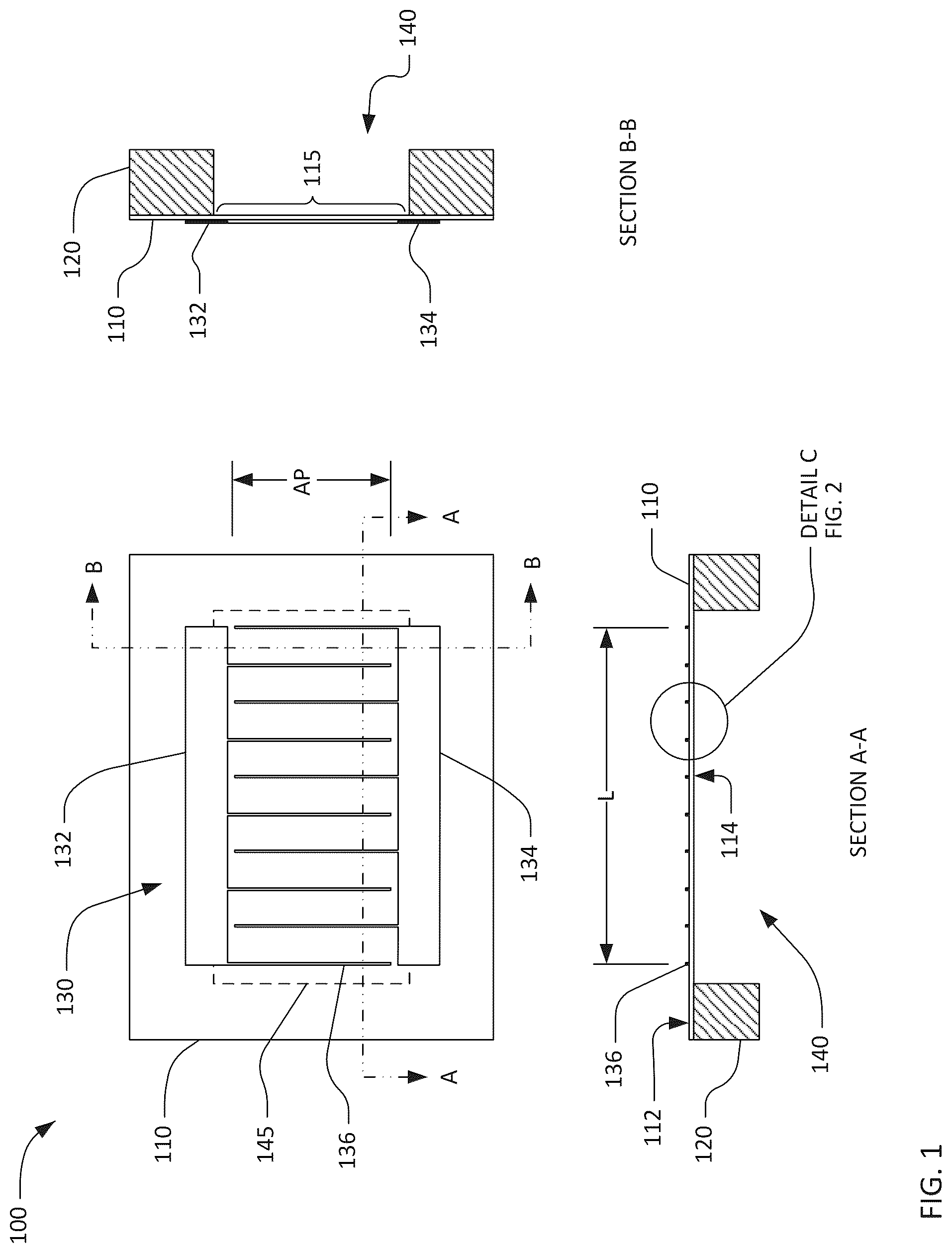
includes a schematic plan view and two schematic cross-sectional views of a transversely-excited film bulk acoustic resonator (XBAR).
is an expanded schematic cross-sectional view of a portion of the XBAR of .
A is an alternative schematic cross-sectional view of the XBAR of .
B is another alternative schematic cross-sectional view of the XBAR of .
is a graphic illustrating a primary acoustic mode in an XBAR.
is a schematic circuit diagram of a band-pass filter using acoustic resonators in a ladder circuit.
is a schematic circuit diagram of an exemplary high-power band-pass filter using XBARs.
is a layout of the filter of .
is a graph of measured S-parameters S 11 and S 21 versus frequency for the filter of and .
is a schematic circuit diagram of another exemplary high-power band-pass filter using XBARs.
is a layout of the filter of .
is an alternative layout of the filter of .
is an illustration of a series resonator and a shunt resonator sharing a common diaphragm.
Throughout this description, elements appearing in figures are assigned three-digit or four-digit reference designators, where the two least significant digits are specific to the element and the one or two most significant digit is the figure number where the element is first introduced. An element that is not described in conjunction with a figure may be presumed to have the same characteristics and function as a previously-described element having the same reference designator.
DETAILED DESCRIPTION
Description of Apparatus
shows a simplified schematic top view and orthogonal cross-sectional views of a transversely-excited film bulk acoustic resonator (XBAR) 100 . XBAR resonators such as the resonator 100 may be used in a variety of RF filters including band-reject filters, band-pass filters, duplexers, and multiplexers. XBARs are particularly suited for use in filters for communications bands with frequencies above 3 GHz.
The XBAR 100 is made up of a thin film conductor pattern formed on a surface of a piezoelectric plate 110 having parallel front and back surfaces 112 , 114 , respectively. The piezoelectric plate is a thin single-crystal layer of a piezoelectric material such as lithium niobate, lithium tantalate, lanthanum gallium silicate, gallium nitride, or aluminum nitride. The piezoelectric plate is cut such that the orientation of the X, Y, and Z crystalline axes with respect to the front and back surfaces is known and consistent. In the examples presented in this patent, the piezoelectric plates are Z-cut, which is to say the Z axis is normal to the front and back surfaces 112 , 114 . However, XBARs may be fabricated on piezoelectric plates with other crystallographic orientations.
The back surface 114 of the piezoelectric plate 110 is attached to a surface of the substrate 120 except for a portion of the piezoelectric plate 110 that forms a diaphragm 115 spanning a cavity 140 formed in the substrate. The portion of the piezoelectric plate that spans the cavity is referred to herein as the “diaphragm” 115 due to its physical resemblance to the diaphragm of a microphone. As shown in , the diaphragm 115 is contiguous with the rest of the piezoelectric plate 110 around all of a perimeter 145 of the cavity 140 . In this context, “contiguous” means “continuously connected without any intervening item”. In other configurations, the diaphragm 115 may be contiguous with the piezoelectric plate around at least 50% of the perimeter 145 of the cavity 140 .
The substrate 120 provides mechanical support to the piezoelectric plate 110 . The substrate 120 may be, for example, silicon, sapphire, quartz, or some other material or combination of materials. The back surface 114 of the piezoelectric plate 110 may be bonded to the substrate 120 using a wafer bonding process. Alternatively, the piezoelectric plate 110 may be grown on the substrate 120 or attached to the substrate in some other manner. The piezoelectric plate 110 may be attached directly to the substrate or may be attached to the substrate 120 via one or more intermediate material layers (not shown in ).
“Cavity” has its conventional meaning of “an empty space within a solid body.” The cavity 140 may be a hole completely through the substrate 120 (as shown in Section A-A and Section B-B) or a recess in the substrate 120 under the diaphragm 115 . The cavity 140 may be formed, for example, by selective etching of the substrate 120 before or after the piezoelectric plate 110 and the substrate 120 are attached.
The conductor pattern of the XBAR 100 includes an interdigital transducer (IDT) 130 . The IDT 130 includes a first plurality of parallel fingers, such as finger 136 , extending from a first busbar 132 and a second plurality of fingers extending from a second busbar 134 . The first and second pluralities of parallel fingers are interleaved. The interleaved fingers overlap for a distance AP, commonly referred to as the “aperture” of the IDT. The center-to-center distance L between the outermost fingers of the IDT 130 is the “length” of the IDT.
The first and second busbars 132 , 134 serve as the terminals of the XBAR 100 . A radio frequency or microwave signal applied between the two busbars 132 , 134 of the IDT 130 excites a primary acoustic mode within the piezoelectric plate 110 . As will be discussed in further detail, the primary acoustic mode is a bulk shear mode where acoustic energy propagates along a direction substantially orthogonal to the surface of the piezoelectric plate 110 , which is also normal, or transverse, to the direction of the electric field created by the IDT fingers. Thus, the XBAR is considered a transversely-excited film bulk wave resonator.
The IDT 130 is positioned on the piezoelectric plate 110 such that at least the fingers of the IDT 130 are disposed on the diaphragm 115 of the piezoelectric plate which spans, or is suspended over, the cavity 140 . As shown in , the cavity 140 has a rectangular shape with an extent greater than the aperture AP and length L of the IDT 130 . A cavity of an XBAR may have a different shape, such as a regular or irregular polygon. The cavity of an XBAR may have more or fewer than four sides, which may be straight or curved.
For ease of presentation in , the geometric pitch and width of the IDT fingers is greatly exaggerated with respect to the length (dimension L) and aperture (dimension AP) of the XBAR. A typical XBAR has more than ten parallel fingers in the IDT 110 . An XBAR may have hundreds, possibly thousands, of parallel fingers in the IDT 110 . Similarly, the thickness of the fingers in the cross-sectional views is greatly exaggerated.
shows a detailed schematic cross-sectional view of the XBAR 100 . The piezoelectric plate 110 is a single-crystal layer of piezoelectrical material having a thickness ts. ts may be, for example, 100 nm to 1500 nm. When used in filters for LTE™ bands from 3.4 GHZ to 6 GHz (e.g. bands 42 , 43 , 46 ), the thickness ts may be, for example, 200 nm to 1000 nm.
A front-side dielectric layer 214 may optionally be formed on the front side of the piezoelectric plate 110 . The “front side” of the XBAR is, by definition, the surface facing away from the substrate. The front-side dielectric layer 214 has a thickness tfd. The front-side dielectric layer 214 may be formed only between the IDT fingers (e.g. IDT finger 238 b ) or may be deposited as a blanket layer such that the dielectric layer is formed both between and over the IDT fingers (e.g. IDT finger 238 a ). The front-side dielectric layer 214 may be a non-piezoelectric dielectric material, such as silicon dioxide or silicon nitride. tfd may be, for example, 0 to 500 nm. tfd is typically less than the thickness ts of the piezoelectric plate. The front-side dielectric layer 214 may be formed of multiple layers of two or more materials.
The IDT fingers 238 a and 238 b may be aluminum, an aluminum alloy, copper, a copper alloy, beryllium, gold, tungsten, molybdenum or some other conductive material. The IDT fingers are considered to be “substantially aluminum” if they are formed from aluminum or an alloy comprising at least 50% aluminum. The IDT fingers are considered to be “substantially copper” if they are formed from copper or an alloy comprising at least 50% copper. Thin (relative to the total thickness of the conductors) layers of other metals, such as chromium or titanium, may be formed under and/or over and/or as layers within the fingers to improve adhesion between the fingers and the piezoelectric plate 110 and/or to passivate or encapsulate the fingers and/or to improve power handling. The busbars ( 132 , 134 in ) of the IDT may be made of the same or different materials as the fingers.
Dimension p is the center-to-center spacing or “pitch” of the IDT fingers, which may be referred to as the pitch of the IDT and/or the pitch of the XBAR. Dimension w is the width or “mark” of the IDT fingers. The geometry of the IDT of an XBAR differs substantially from the IDTs used in surface acoustic wave (SAW) resonators. In a SAW resonator, the pitch of the IDT is one-half of the acoustic wavelength at the resonance frequency. Additionally, the mark-to-pitch ratio of a SAW resonator IDT is typically close to 0.5 (i.e. the mark or finger width is about one-fourth of the acoustic wavelength at resonance). In an XBAR, the pitch p of the IDT is typically 2 to 20 times the width w of the fingers. In addition, the pitch p of the IDT is typically 2 to 20 times the thickness ts of the piezoelectric slab 212 . The width of the IDT fingers in an XBAR is not constrained to be near one-fourth of the acoustic wavelength at resonance. For example, the width of XBAR IDT fingers may be 500 nm or greater, such that the IDT can be readily fabricated using optical lithography. The thickness tm of the IDT fingers may be from 100 nm to about equal to the width w. The thickness of the busbars ( 132 , 134 in ) of the IDT may be the same as, or greater than, the thickness tm of the IDT fingers.
A and B show two alternative cross-sectional views along the section plane A-A defined in . In A , a piezoelectric plate 310 is attached to a substrate 320 . A portion of the piezoelectric plate 310 forms a diaphragm 315 spanning a cavity 340 in the substrate. The cavity 340 does not fully penetrate the substrate 320 . Fingers of an IDT are disposed on the diaphragm 315 . The cavity 340 may be formed, for example, by etching the substrate 320 before attaching the piezoelectric plate 310 . Alternatively, the cavity 340 may be formed by etching the substrate 320 with a selective etchant that reaches the substrate through one or more openings (not shown) provided in the piezoelectric plate 310 . In this case, the diaphragm 315 may contiguous with the rest of the piezoelectric plate 310 around a large portion of a perimeter of the cavity 340 . For example, the diaphragm 315 may contiguous with the rest of the piezoelectric plate 310 around at least 50% of the perimeter of the cavity 340 . An intermediate layer (not shown), such as a dielectric bonding layer, may be present between the piezoelectric plate 310 and the substrate 320 .
In B , the substrate 320 includes a base 322 and an intermediate layer 324 disposed between the piezoelectric plate 310 and the base 322 . For example, the base 322 may be silicon and the intermediate layer 324 may be silicon dioxide or silicon nitride or some other material. A portion of the piezoelectric plate 310 forms a diaphragm 315 spanning a cavity 340 in the intermediate layer 324 . Fingers of an IDT are disposed on the diaphragm 315 . The cavity 340 may be formed, for example, by etching the intermediate layer 324 before attaching the piezoelectric plate 310 . Alternatively, the cavity 340 may be formed by etching the intermediate layer 324 with a selective etchant that reaches the substrate through one or more openings provided in the piezoelectric plate 310 . In this case, the diaphragm 315 may be contiguous with the rest of the piezoelectric plate 310 around a large portion of a perimeter of the cavity 340 . For example, the diaphragm 315 may be contiguous with the rest of the piezoelectric plate 310 around at least 50% of the perimeter of the cavity 340 as shown in C . Although not shown in B , a cavity formed in the intermediate layer 324 may extend into the base 322 .
is a graphical illustration of the primary acoustic mode of interest in an XBAR. shows a small portion of an XBAR 400 including a piezoelectric plate 410 and three interleaved IDT fingers 430 which alternate in electrical polarity from finger to finger. An RF voltage is applied to the interleaved fingers 430 . This voltage creates a time-varying electric field between the fingers. The direction of the electric field is predominantly lateral, or parallel to the surface of the piezoelectric plate 410 , as indicated by the arrows labeled “electric field”. Due to the high dielectric constant of the piezoelectric plate, the RF electric energy is highly concentrated inside the plate relative to the air. The lateral electric field introduces shear deformation which couples strongly to a shear primary acoustic mode (at a resonance frequency defined by the acoustic cavity formed by the volume between the two surfaces of the piezoelectric plate) in the piezoelectric plate 410 . In this context, “shear deformation” is defined as deformation in which parallel planes in a material remain predominantly parallel and maintain constant separation while translating (within their respective planes) relative to each other. A “shear acoustic mode” is defined as an acoustic vibration mode in a medium that results in shear deformation of the medium. The shear deformations in the XBAR 400 are represented by the curves 460 , with the adjacent small arrows providing a schematic indication of the direction and relative magnitude of atomic motion at the resonance frequency. The degree of atomic motion, as well as the thickness of the piezoelectric plate 410 , have been greatly exaggerated for ease of visualization. While the atomic motions are predominantly lateral (i.e. horizontal as shown in ), the direction of acoustic energy flow of the excited primary acoustic mode is substantially orthogonal to the surface of the piezoelectric plate, as indicated by the arrow 465 .
Considering , there is essentially no RF electric field immediately under the IDT fingers 430 , and thus acoustic modes are only minimally excited in the regions 470 under the fingers. There may be evanescent acoustic motions in these regions. Since acoustic vibrations are not excited under the IDT fingers 430 , the acoustic energy coupled to the IDT fingers 430 is low (for example compared to the fingers of an IDT in a SAW resonator) for the primary acoustic mode, which minimizes viscous losses in the IDT fingers.
An acoustic resonator based on shear acoustic wave resonances can achieve better performance than current state-of-the art film-bulk-acoustic-resonators (FBAR) and solidly-mounted-resonator bulk-acoustic-wave (SMR BAW) devices where the electric field is applied in the thickness direction. In such devices, the acoustic mode is compressive with atomic motions and the direction of acoustic energy flow in the thickness direction. In addition, the piezoelectric coupling for shear wave XBAR resonances can be high (>20%) compared to other acoustic resonators. High piezoelectric coupling enables the design and implementation of microwave and millimeter-wave filters with appreciable bandwidth.
is a schematic circuit diagram of a band-pass filter 500 using five XBARs X 1 -X 5 . The filter 500 may be, for example, a band n79 band-pass filter for use in a communication device. The filter 500 has a conventional ladder filter architecture including three series resonators X 1 , X 3 , X 5 and two shunt resonators X 2 , X 4 . The three series resonators X 1 , X 3 , X 5 are connected in series between a first port and a second port. In , the first and second ports are labeled “In” and “Out”, respectively. However, the filter 500 is symmetrical and either port may serve as the input or output of the filter. The two shunt resonators X 2 , X 4 are connected from nodes between the series resonators to ground. All the shunt resonators and series resonators are XBARs.
The three series resonators X 1 , X 3 , X 5 and the two shunt resonators X 2 , X 4 of the filter 500 maybe formed on a single plate 530 of piezoelectric material bonded to a silicon substrate (not visible). Each resonator includes a respective IDT (not shown), with at least the fingers of the IDT disposed over a cavity in the substrate. In this and similar contexts, the term “respective” means “relating things each to each”, which is to say with a one-to-one correspondence. In , the cavities are illustrated schematically as the dashed rectangles (such as the rectangle 535 ). In this example, an IDT of each resonator is disposed over a respective cavity. In other filters, the IDTs of two or more resonators may be disposed over a common cavity. Resonators may also be divided into multiple sub-resonators with IDTs formed over respective cavities.
Each of the resonators X 1 to X 5 has a resonance frequency and an anti-resonance frequency. In over-simplified terms, each resonator is effectively a short circuit at its resonance frequency and effectively an open circuit at its anti-resonance frequency. Each resonator X 1 to X 5 creates a “transmission zero”, where the transmission between the in and out ports of the filter is very low. Note that the transmission at a “transmission zero” is not actually zero due to energy leakage through parasitic components and other effects. The three series resonators X 1 , X 3 , X 5 create transmission zeros at their respective anti-resonance frequencies (where each resonator is effectively an open circuit). The two shunt resonators X 2 , X 4 create transmission zeros at their respective resonance frequencies (where each resonator is effectively a short circuit). In a typical band-pass filter using acoustic resonators, the anti-resonance frequencies of the series resonators are above the passband, and the resonance frequencies of the shunt resonators are below the passband.
is a schematic diagram of an exemplary high-power XBAR band-pass filter for band n79. The circuit of the band-pass filter 600 is a five-resonator ladder filter, similar to that of . Series resonators X 1 and X 5 are each partitioned into two sub-resonators (X 1 A/B and X 5 A/B, respectively) connected in parallel. Shunt resonators X 2 and X 4 are each divided into four sub-resonators (X 2 A/B/C/D and X 4 A/B/C/D, respectively) that are connected in parallel. Dividing the resonators into two or four sub-resonators has the benefit of reducing the length and/or width of each diaphragm. Reducing the diaphragm dimensions is effective to increase the mechanical rigidity of the diaphragm. Reducing the membrane width is further beneficial for reducing parasitic resistivity in IDTs through keeping the XBAR aperture narrower. Each of the sub-resonators is formed over a respective cavity, which are indicated by dashed rectangles (such as dashed rectangle 605 ).
The sub-resonators within a resonator are typically, but not necessarily, electrically and physically the same, which is to say the sub-resonators share a common aperture, a common length, a common pitch and a common IDT finger width or mark. The resonance and anti-resonance frequencies of all sub-resonators of a resonator need not be precisely the same. The frequency offset between the resonance frequencies of the sub-resonators of a shunt resonator should be no more than a few percent of the difference between the resonance and anti-resonance frequencies of the resonator. The frequency offset between the anti-resonance frequencies of the sub-resonators of a series resonator should be no more than a few percent of the difference between the resonance and anti-resonance frequencies of the resonator.
shows an exemplary layout 700 for the band-pass filter 600 . Cross-hatched rectangles represent the resonators and sub-resonators. Shaded areas 720 represent conductors formed on the surface of a piezoelectric plate. Dashed rectangles, such as the dashed rectangle 705 , represent cavities underlying the resonators and sub-resonators. The dimensions of the various elements are not necessarily drawn to scale and the relative size and position of various elements may be distorted for ease of presentation.
In this example, the sub-resonators are arranged symmetrically in pairs about a central axis 710 . The central axis 710 is a straight line that divides the filter into two sections of roughly equal area. For example, sub-resonators X 1 A and X 1 B form a pair and are disposed in symmetric positions on either side of the central axis 710 . The two sub-resonators X 1 A and X 1 B are arranged in-line along the direction normal to the central axis and are equally spaced from the central axis. Similarly, sub-resonator pairs X 2 A/X 2 B, X 2 C/X 2 D, X 4 A/X 4 B, X 4 C/X 4 D, and X 5 A/X 5 B are disposed in symmetric positions with respect to the central axis 710 . The signal path flows generally along the central axis 710 .
The symmetrical arrangement of the sub-resonators about the central axis 710 results in an even distribution of the resonators and cavities over the area of the filter. Symmetrical arrangement of the sub-resonators about the central axis 710 also facilitates simple conductor routing between resonators, which avoids long conductors that can introduce undesired inductance and coupling between elements of the filter. For example, imagine resonator X 2 is not divided into sub-resonators, but is a dingle resonator having twice the length and width of the sub-resonators shown in . The left side (all directions refer to ) of X 2 can be directly connected to resonator X 1 and the right side of X 2 is connected to a ground conductor. The connection between X 1 and X 3 must be routed around X 2 , resulting in a much longer conductor that is parallel to ground conductors for much of its length. The longer conductor results in additional inductance in the connection between X 1 and X 3 and increased stray capacitance to ground.
Further, positioning shunt resonator segments as shown in minimizes the distance between the center of each resonator portion and the wide ground conductors at the top and bottom (as seen in ) of the device. Shortening this distance facilitates removing heat from the shunt resonator segments.
Series resonator X 3 , which is not divided into sub-resonators, is disposed along, and roughly bisected by, central axis 710 . In other filters, the input port IN and the output port OUT may also be disposed along the central axis 710 .
is a chart 800 showing measured performance of the band-pass filter 600 . The XBARs are formed on a Z-cut lithium niobate plate. The thickness ts of the lithium niobate plate is 400 nm. The substrate is silicon, the IDT conductors are aluminum, the front-side dielectric layer, where present, is SiO2. The thickness tm of the IDT fingers is 500 nm, such that tm/ts=1.25. The other physical parameters of the resonators are provided in the following table (all dimensions are in microns; p=IDT pitch, w=IDT finger width, AP=aperture, L=length, and tfd=front-side dielectric layer thickness):
Series Resonators Shunt Resonators
Parameter X1* X3 X5* X2** X4**
P 3.75 3.75 3.75 4.12 4.12
W 1.01 0.86 1.10 0.84 0.93
AP 44 37 41 58 57
L 350 420 350 350 350
Tfd 0 0 0 0.100 0.100
*Each of 2 sub-resonators
**Each of 4 sub-resonators
In , the solid line 810 is a plot of S(1,2), which is the input-output transfer function of the filter, as a function of frequency. The dashed line 820 is a plot of S(1,1), which is the reflection at the input port, as a function of frequency. The dash-dot vertical lines delimit band n79 from 4.4 to 5.0 GHz and the 5 GHz Wi-Fi band from 5.17 GHz to 5.835 GHz. Both plots 810 , 820 are based on wafer probe measurements having 50-ohm impedance.
is a schematic diagram of another exemplary high-power XBAR band-pass filter 900 . The circuit of the band-pass filter 900 is a five-resonator ladder filter, similar to that of . Series resonators X 1 and X 3 are each partitioned into four sub-resonators (X 1 A/B/C/D and X 3 A/B/C/D, respectively). In each case, the A sub-resonator is connected in parallel with the B sub-resonator and the C sub-resonator is connected in parallel with the D sub-resonator. The A-B parallel combination is connected in series with the C-D parallel combination. Series resonator X 5 is divided into two sub-resonators (X 5 A and X 5 B) which are connected in parallel. Shunt resonators X 2 and X 4 are each divided into four sub-resonators (X 2 A/B/C/D and X 4 A/B/C/D, respectively) that are connected in parallel. Dividing the resonators into two or four sub-resonators has the benefit of reducing the size (i.e. the length and area) of each diaphragm. Reducing the diaphragm size facilitates removing heat from the diaphragms and improves the mechanical strength of the diaphragms.
shows an exemplary layout 1000 for the band-pass filter 900 . Cross-hatched rectangles represent the sub-resonators. Shaded areas 1020 represent conductors formed on the surface of a piezoelectric plate. Each sub-resonator is disposed over a respective cavity. Cavities are not shown.
In this example, the series resonators (X 1 , X 3 , X 5 ) and the shunt resonators (X 2 , X 4 ) are disposed alternately along a central axis 1010 of the device 1000 . The sub-resonators are arranged symmetrically in pairs about the central axis 1010 . Specifically, all of the resonators are divided into two or four sub-resonators, with pairs of sub-resonators (i.e. X 1 A/X 1 B, X 1 C/X 1 D, etc.) positioned symmetrically about the central axis 1010 . The signal path flows generally along the central axis 1010 from an input port IN to an output port OUT, which are also disposed along the central axis 1010 . The symmetrical arrangement of the resonators shortens the path length between the IN and OUT ports and reduces undesired coupling between elements of the filter to improve stop-band rejection. Positioning the shunt sub-resonators in this manner minimizes the distance between the center of each sub-resonator and the wide ground conductors at the top and bottom (as seen in ) of the device. Shortening this distance facilitates removing heat from the shunt sub-resonators.
shows another exemplary layout 1100 for the band-pass filter 900 . Cross-hatched rectangles represent the sub-resonators. Shaded areas 1120 represent conductors formed on the surface of a piezoelectric plate. Each sub-resonator is disposed over a respective cavity. Cavities are not shown.
As in the previous example layout 1000 , the sub-resonators are arranged symmetrically in pairs about a central axis 1110 . All of the resonators are divided into two or four sub-resonators, with pairs of sub-resonators (i.e. X 1 A/X 1 B, X 1 C/X 1 D, etc.) positioned symmetrically about the central axis. The signal path flows generally along the central axis 1110 from an input port IN to an output port OUT. The series resonators X 1 , X 3 , and X 5 are positioned in sequence along the central axis. The shunt resonators X 2 and X 4 are positioned outboard of the series resonators. In this context, “outboard” is defined as “in a position farther or farthest from the longitudinal axis.” The location of the series resonators in adjacent positions along the central axis provides the shortest path length between the IN and OUT ports. Placing the shunt resonators outboard of the series resonators results in a rectangular chip with a height (i.e. the vertical direction as shown in ) substantially greater than its width. Two such rectangular chips may be combined in a single relatively square package for a duplexer.
shows a schematic diagram of a sub-circuit 1200 including a series sub-resonator XS and a shunt (parallel) sub-resonator XP. The sub-circuit 1200 may be a portion of a ladder filter circuit such as the ladder filter circuits 500 , 600 , and 900 .
also shows a layout 1250 of the filter sub-circuit 1200 . The series and shunt sub-resonators XS and XP are arranged in-line and share a common diaphragm over a common cavity 1255 . For example, XS and XP may be X 1 D and X 2 B, respectively, of the filter layout 1100 of . Having X 1 D and X 2 B (and similarly X 1 C and X 2 A) share a common diaphragm would decrease the height of the filter chip.
Closing Comments
Throughout this description, the embodiments and examples shown should be considered as exemplars, rather than limitations on the apparatus and procedures disclosed or claimed. Although many of the examples presented herein involve specific combinations of method acts or system elements, it should be understood that those acts and those elements may be combined in other ways to accomplish the same objectives. With regard to flowcharts, additional and fewer steps may be taken, and the steps as shown may be combined or further refined to achieve the methods described herein. Acts, elements and features discussed only in connection with one embodiment are not intended to be excluded from a similar role in other embodiments.
As used herein, “plurality” means two or more. As used herein, a “set” of items may include one or more of such items. As used herein, whether in the written description or the claims, the terms “comprising”, “including”, “carrying”, “having”, “containing”, “involving”, and the like are to be understood to be open-ended, i.e., to mean including but not limited to. Only the transitional phrases “consisting of” and “consisting essentially of”, respectively, are closed or semi-closed transitional phrases with respect to claims. Use of ordinal terms such as “first”, “second”, “third”, etc., in the claims to modify a claim element does not by itself connote any priority, precedence, or order of one claim element over another or the temporal order in which acts of a method are performed, but are used merely as labels to distinguish one claim element having a certain name from another element having a same name (but for use of the ordinal term) to distinguish the claim elements. As used herein, “and/or” means that the listed items are alternatives, but the alternatives also include any combination of the listed items.
Figures (12)
Citations
This patent cites (174)
- US5705399
- US5853601
- US6540827
- US6707229
- US7135940
- US7463118
- US7535152
- US7684109
- US7802466
- US7868519
- US8278802
- US8344815
- US8829766
- US8932686
- US9130145
- US9219466
- US9276557
- US9369105
- US9425765
- US9525398
- US9748923
- US9780759
- US10200013
- US10305447
- US10491192
- US10601392
- US10637438
- US10756697
- US10790802
- US10797675
- US10826462
- US10868513
- US11349452
- US11967942
- US2002/0079986
- US2002/0158714
- US2003/0199105
- US2004/0041496
- US2004/0090145
- US2004/0207033
- US2004/0207485
- US2004/0261250
- US2005/0280476
- US2006/0072875
- US2006/0125489
- US2006/0131731
- US2006/0152107
- US2006/0222568
- US2007/0001549
- US2007/0090898
- US2007/0170565
- US2007/0188047
- US2007/0194863
- US2010/0064492
- US2010/0102669
- US2010/0107388
- US2010/0123367
- US2010/0212127
- US2010/0223999
- US2010/0301703
- US2011/0109196
- US2011/0199163
- US2011/0278993
- US2013/0015353
- US2013/0021116
- US2013/0057360
- US2013/0321100
- US2014/0001919
- US2014/0009032
- US2014/0113571
- US2014/0145556
- US2014/0151151
- US2014/0152145
- US2014/0173862
- US2014/0218129
- US2014/0225684
- US2014/0312994
- US2015/0070227
- US2015/0319537
- US2015/0333730
- US2016/0028367
- US2016/0182009
- US2016/0285430
- US2017/0005638
- US2017/0063332
- US2017/0077902
- US2017/0104470
- US2017/0170808
- US2017/0179928
- US2017/0187352
- US2017/0214387
- US2017/0222618
- US2017/0222622
- US2017/0264263
- US2017/0324394
- US2017/0359050
- US2017/0370791
- US2018/0062604
- US2018/0123016
- US2018/0152169
- US2018/0191322
- US2019/0068164
- US2019/0123721
- US2019/0131953
- US2019/0148621
- US2019/0181833
- US2019/0245518
- US2019/0273480
- US2019/0273481
- US2019/0386635
- US2019/0386637
- US2019/0386638
- US2020/0007110
- US2020/0021271
- US2020/0091893
- US2020/0162052
- US2020/0220522
- US2020/0228087
- US2020/0304091
- US2020/0328728
- US2020/0336130
- US2020/0373907
- US2021/0006228
- US2021/0013859
- US2021/0013868
- US2021/0126619
- US2021/0273631
- US2021/0384885
- US2022/0103160
- US2022/0216842
- US2022/0231661
- US1926763
- US201893487
- US112352382
- US112011100580
- USH0522074
- USH10209804
- US2001244785
- US2002300003
- US2003078389
- US2004096677
- US2004129222
- US2004304622
- US2006173557
- US2007251910
- US2010103803
- US2010109949
- US2010233210
- US2013528996
- US2015054986
- US2016001923
- US2017220910
- US2018166259
- US2018207144
- US2019186655
- US2020088459
- US2020113939
- US2010047114
- US2013021948
- US2015098694
- US2015156232
- US2015182521
- US2016017104
- US2016052129
- US2016147687
- US2018003273
- US2018079522
- US2018163860
- US2019138810
- US2019241174
- US2020092414
- US2020175234
- US2021060523
- US2023002858