Semiconductor Memory Device and Method for Manufacturing the Same
Abstract
A semiconductor memory device according to an embodiment includes: a stacked body in which a plurality of conductive layers and a plurality of insulating layers are alternately stacked one by one; and a plurality of first plate-like portions that penetrate the stacked body in a stacking direction thereof and cross the stacked body in a first direction intersecting the stacking direction, the plurality of first plate-like portions being arranged along the first direction with a gap therebetween.
Claims (9)
1. A semiconductor memory device comprising: a stacked body in which a plurality of conductive layers and a plurality of insulating layers are alternately stacked one by one; a plurality of first plate-like portions that penetrate the stacked body in a stacking direction of the stacked body and cross the stacked body in a first direction intersecting the stacking direction, the plurality of first plate-like portions being arranged along the first direction with a gap therebetween; an insulating portion that is surrounded by the stacked body; a conductor portion that penetrates the insulating portion in the stacking direction; and a second plate-like portion that penetrates a boundary portion between the stacked body and the insulating portion on the side facing the plurality of first plate-like portions in the stacking direction and crosses the boundary portion in the first direction.
5. A method for manufacturing a semiconductor memory device, comprising: forming a stacked body in which a plurality of conductive layers and a plurality of insulating layers are alternately stacked one by one; forming a plurality of first plate-like portions penetrating the stacked body in a stacking direction of the stacked body and crossing the stacked body in a first direction intersecting the stacking direction so as to be arranged along the first direction with a gap therebetween; forming an insulating portion surrounded by the stacked body; forming a conductor portion penetrating the insulating portion in the stacking direction; and forming a second plate-like portion that penetrates a boundary portion between the stacked body and the insulating portion on the side facing the plurality of first plate-like portions in the stacking direction and crosses the boundary portion in the first direction.
Show 7 dependent claims
2. The semiconductor memory device according to claim 1 , wherein each of the plurality of conductive layers is connected on both sides of the plurality of first plate-like portions through the gap in a second direction intersecting the stacking direction and the first direction.
3. The semiconductor memory device according to claim 1 , further comprising: a staircase structure which extends in the first direction and in which each of the plurality of conductive layers or each of the plurality of insulating layers becomes a step surface, on both sides of at least one of the plurality of first plate-like portions, wherein the step surfaces of the staircase structure are different by one step each on both sides of the at least one first plate-like portion.
4. The semiconductor memory device according to claim 1 , further comprising: a first columnar body that penetrates the stacked body in the stacking direction of the stacked body, the first columnar body having a memory cell at a contact portion between the first columnar body and the conductive layer.
6. The method for manufacturing a semiconductor memory device according to claim 5 , wherein the formation of the stacked body includes: alternately stacking a plurality of sacrificial layers and the plurality of insulating layers one by one and replacing the plurality of sacrificial layers with the plurality of conductive layers.
7. The method for manufacturing a semiconductor memory device according to claim 6 , wherein the formation of the plurality of first plate-like portions includes: forming a plurality of slits penetrating the plurality of sacrificial layers and the plurality of insulating layers; and forming insulators in the slits to form the plurality of first plate-like portions, and the formation of the stacked body includes: replacing the plurality of sacrificial layers with the plurality of conductive layers through the plurality of slits.
8. The method for manufacturing a semiconductor memory device according to claim 6 , further comprising: forming an insulating portion surrounded by the stacked body; forming a conductor portion penetrating the insulating portion in the stacking direction; and forming a second plate-like portion that penetrates a boundary portion between the stacked body and the insulating portion on the side facing the plurality of first plate-like portions in the stacking direction and crosses the boundary portion in the first direction, wherein the formation of the insulating portion includes: inhibiting replacement of the plurality of sacrificial layers with the plurality of conductive layers in a partial region by the second plate-like portion to form the insulating portion in which the plurality of sacrificial layers and the plurality of insulating layers are alternately stacked one by one.
9. The method for manufacturing a semiconductor memory device according to claim 5 , further comprising: forming a staircase structure which extends in the first direction and in which each of the plurality of conductive layers or each of the plurality of insulating layers becomes a step surface, on both sides of at least one of the plurality of first plate-like portions, the step surfaces of the staircase structure being caused to be different by one step each on both sides of the at least one first plate-like portion.
Full Description
Show full text →
CROSS-REFERENCE TO RELATED APPLICATIONS
This application is based upon and claims the benefit of priority from Japanese Patent Application No.: 2020-153342, filed on Sep. 11, 2020; the entire contents of which are incorporated herein by reference.
FIELD
Embodiments described herein relate generally to a semiconductor memory device and a method for manufacturing the same.
BACKGROUND
For example, a semiconductor memory device with a three-dimensional structure has a stacked body in which a plurality of conductive layers and a plurality of insulating layers are alternately stacked one by one, and a memory pillar that penetrates the stacked body and is provided with a plurality of memory cells along a stacking direction of the stacked body. In the semiconductor memory device, the plurality of conductive layers function as word lines of memory cells. In addition, an end portion of the stacked body is formed in a staircase shape having each conductive layer as a step surface, and a contact is connected to the conductive layer as the step surface. The staircase shape tends to be provided not at the end portion of the stacked body but at a center portion of a memory cell region where the memory pillar is formed in order to lower the resistance of the word line and speed up the operation of the semiconductor memory device.
On the other hand, a peripheral circuit that controls each memory cell tends to be provided below the memory cell region. This is to reduce a chip area while avoiding reduction in the storage capacity. In this case, a through contact connecting the peripheral circuit and a wiring above the memory cell region is provided so as to penetrate an insulating portion provided in the memory cell region.
For this reason, in the memory cell region, the stacked body of the conductive layers and the insulating layers and the insulating portion with no conductive layer are mixed. When the insulating portion and the stacked body are mixed, the insulating portion and the stacked body may be deformed by stress due to a difference in materials.
BRIEF DESCRIPTION OF THE DRAWINGS
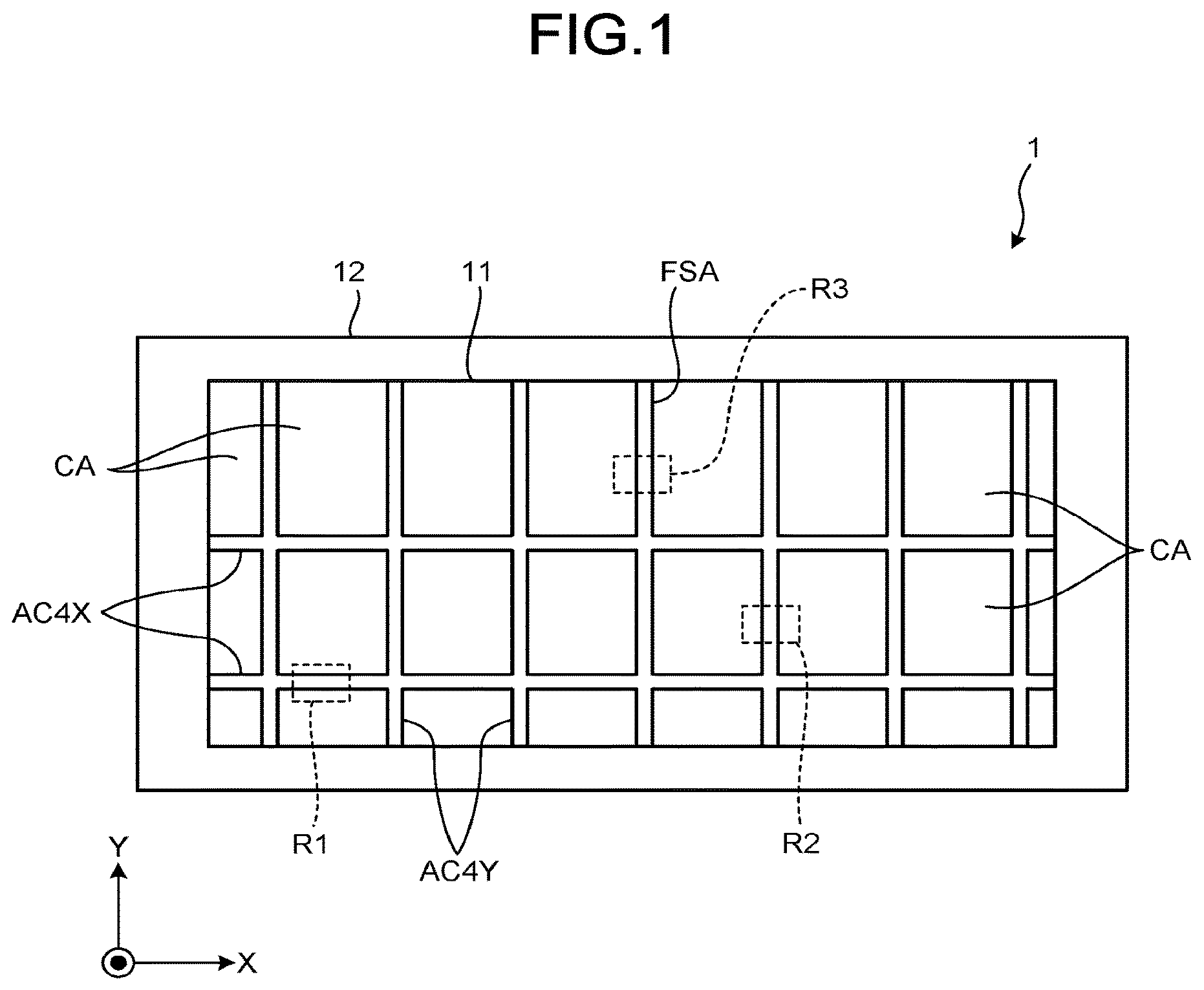
is a top view illustrating an example of a semiconductor memory device according to an embodiment;
A is a top view schematically illustrating a through contact region extending in a longitudinal direction of a memory region of the semiconductor memory device according to the embodiment;
B is a top view schematically illustrating a through contact region extending in a lateral direction of the memory region;
is a top view schematically illustrating a staircase region of the semiconductor memory device according to the embodiment;
A is a cross-sectional view taken along the line L 1 -L 1 in ;
B is a cross-sectional view taken along the line L 2 -L 2 in ;
is a cross-sectional view taken along the line L 3 -L 3 in ;
is a cross-sectional view taken along the line L 4 -L 4 in ;
A to 7 D are top views illustrating a process of replacing a silicon nitride layer with a conductive layer;
A is a top view schematically illustrating a through contact region of a semiconductor memory device according to a first modification of the present embodiment;
B is a cross-sectional view taken along the line L 5 -L 5 in A ;
C is a cross-sectional view taken along the line L 6 -L 6 in A ;
A to 9 C are diagrams illustrating a method for forming the through contact region of the semiconductor memory device according to the first modification of the present embodiment;
A to 10 C are diagrams illustrating the method for forming the through contact region of the semiconductor memory device according to the first modification of the present embodiment, following C ;
is a diagram illustrating the method for forming the through contact region of the semiconductor memory device according to the first modification of the present embodiment, following C ; and
is a top view schematically illustrating a through contact region of a semiconductor memory device according to a second modification of the present embodiment.
DETAILED DESCRIPTION
A semiconductor memory device according to an embodiment includes: a stacked body in which a plurality of conductive layers and a plurality of insulating layers are alternately stacked one by one; and a plurality of first plate-like portions that penetrate the stacked body in a stacking direction thereof and cross the stacked body in a first direction intersecting the stacking direction, the plurality of first plate-like portions being arranged along the first direction with a gap therebetween.
Hereinafter, non-limiting exemplary embodiments of the present invention will be described with reference to the accompanying drawings. In all the accompanying drawings, the same or corresponding members or parts are denoted by the same or corresponding reference numerals, and redundant description is omitted. Further, since the drawings are not intended to illustrate relative ratios between members or parts or between the thicknesses of various layers, specific thicknesses and dimensions should be determined by those skilled in the art in light of the following non-limiting embodiments.
is a top view illustrating an example of a semiconductor memory device according to an embodiment; As illustrated, a semiconductor memory device 1 has a memory region 11 and a peripheral region 12 surrounding the memory region. Further, as described later, a peripheral circuit that controls each memory cell such as a row decoder circuit and a sense amplifier is provided at least below the memory region 11 .
The memory region 11 has through contact regions AC 4 X and AC 4 Y, cell regions CA, and a staircase region FSA. The through contact region AC 4 X extends along an X-axis direction to be a longitudinal direction (first direction) of the semiconductor memory device 1 , and the through contact region AC 4 Y extends in a Y-axis direction to be a lateral direction (second direction). Further, the staircase region FSA is located substantially at the center of the memory region 11 in the X-axis direction and extends along the Y-axis direction.
The cell region CA is surrounded by the through contact regions AC 4 X and AC 4 Y and the staircase region FSA. A plurality of memory cells are three-dimensionally disposed in the cell region CA. Specifically, the cell region CA has a stacked body SK (see A and the like) in which a plurality of conductive layers and a plurality of insulating layers are alternately stacked one by one, and a plurality of memory pillars that penetrate the stacked body SK along a Z-axis direction to be a stacking direction of the stacked body SK. As will be described later, the memory pillar is provided with a plurality of memory cells along the stacking direction. Further, the conductive layer of the stacked body SK functions as a word line of the memory cell.
Next, the through contact regions AC 4 X and AC 4 Y will be described with reference to A and 2 B . A is a top view schematically illustrating the through contact region AC 4 X of the memory region 11 , and corresponds to, for example, a region R 1 in . B is a top view schematically illustrating the through contact region AC 4 Y of the memory region 11 , and corresponds to, for example, a region R 2 in .
Referring to A , the through contact region AC 4 X is partitioned from the cell regions CA by first slits (third plate-like portions) ST 1 . Further, the through contact region AC 4 X has a stacked body ON in which different insulating layers are alternately stacked one by one in the Z-axis direction in the drawing, and through contacts (conductor portions) C 4 that penetrate the stacked body ON in the Z-axis direction. The through contact C 4 is formed of a metal such as tungsten or molybdenum, for example. The through contact C 4 is provided to electrically connect a peripheral circuit provided below the cell region CA to, for example, a memory cell in the cell region CA.
Note that the first slits ST 1 extend along the X-axis direction at predetermined intervals in the Y-axis direction over the entire memory region 11 , and divide the memory cells in the cell region CA into memory blocks. Further, the first slits ST 1 are formed by etching the stacked body ON in the manufacturing process of the semiconductor memory device 1 , and are then filled with an insulating material such as silicon oxide. In the following description, both a case where the inside is a cavity and a case where the inside has an insulating material are referred to as the first slits ST 1 for convenience. Note that the first slit ST 1 may be filled with a conductive material. As a result, the first slit ST 1 can be used as a wiring. In this case, after a liner layer made of an insulating material is formed on an inner surface of the first slit ST 1 , a conductive material is further filled inside.
Next, referring to B , the through contact region AC 4 Y is partitioned by the two cell regions CA and extends along the Y-axis direction so as to cross the first slit ST 1 . The through contact region AC 4 Y also has a stacked body ON and through contacts C 4 penetrating the stacked body ON. Note that the arrangement of the through contacts C 4 in the through contact regions AC 4 X and AC 4 Y is not limited to the illustrated example, and may be appropriately determined.
Next, the staircase region FSA will be described with reference to . is a top view schematically illustrating the staircase region FSA, and corresponds to, for example, a region R 3 illustrated in . Similarly to the through contact region AC 4 Y, the staircase region FSA is partitioned by the two cell regions CA and extends in the Y-axis direction. However, unlike the through contact regions AC 4 X and AC 4 Y, the staircase region FSA has contacts CC in addition to the through contacts C 4 . Further, the staircase region FSA has a staircase portion FS having a staircase shape and an insulating portion OX having a stacked structure, the contacts CC are disposed in the staircase portion FS, and the through contacts C 4 are disposed in the insulating portion OX. The staircase portion FS and the insulating portion OX are arranged in the X-axis direction, in a region called a block sandwiched between two adjacent first slits ST 1 . Further, the staircase portion FS and the insulating portion OX are alternately disposed in the Y-axis direction.
The staircase portion FS has a staircase shape in which the conductive layer of the stacked body SK extending from the cell region CA becomes a step surface corresponding to a terrace portion. The contact CC is connected to the step surface of each step of the staircase portion FS. As described above, since the conductive layer functions as a word line of the memory cell of the cell region CA, the contact CC functions as a lead line of the word line.
Further, in the staircase region FSA, a plurality of second slits (first plate-like portions) ST 2 arranged along the X-axis direction with a gap G therebetween are provided substantially at the center of the first slit ST 1 in the Y-axis direction. Each of the second slits ST 2 is shorter than the first slit ST 1 . The second slit ST 2 is filled with an insulating material such as silicon oxide.
Hereinafter, a structure of the second slit ST 2 and its surrounding portion will be described with reference to A to 6 . A is a cross-sectional view taken along the line L 1 -L 1 in , B is a cross-sectional view taken along the line L 2 -L 2 in , is a cross-sectional view taken along the line L 3 -L 3 in , and is a cross-sectional view taken along the line L 4 -L 4 in .
Referring to A , the stacked body (second stacked body) SK is formed on a base layer SB formed of a semiconductor such as silicon or a conductor, for example. The stacked body SK has a plurality of insulating layers (second insulating layers) OL and a plurality of conductive layers WL alternately stacked one by one. The insulating layer OL is formed of an insulating material, and is formed of, for example, silicon oxide in the present embodiment. In the following description, the insulating layer OL is referred to as a silicon oxide layer OL. Further, the conductive layer WL may be formed of, for example, a metal such as tungsten or molybdenum. In A , the staircase portion FS has conductive layers WL 2 , WL 4 , WL 6 , . . . , and WL 16 as step surfaces. When an individual conductive layer is not mentioned, the conductive layers are collectively referred to as a conductive layer WL. An interlayer insulating film SO formed of an insulating material such as silicon oxide is formed above the staircase portion FS. In addition, the contacts CC penetrating the interlayer insulating film SO are connected to the conductive layers WL 2 , WL 4 , WL 6 , . . . , and WL 16 . The contact CC is connected to a plug to be described later at an upper end, and the plug is connected to an upper layer wiring. The upper layer wiring can be connected to the through contact C 4 , for example. As a result, the memory cell and the peripheral circuit are electrically connected via the conductive layer WL functioning as the word line, the contact CC, the plug, the upper layer wiring, and the through contact C 4 .
In addition, as illustrated in A , in the cell region CA adjacent to the staircase region FSA, a memory pillar PL penetrating the stacked body SK and reaching the base layer SB is provided. The same is applied to B . The memory pillar PL has a columnar shape and includes a memory film M, a channel layer CH, and a core layer C sequentially formed from the outer periphery toward the center. The memory cell MC is formed in a portion where the conductive layer WL of the stacked body SK and the memory film M are in contact with each other.
B is a cross-sectional view taken along the X-axis direction on the opposite side across the second slit ST 2 of the same staircase portion FS as the staircase portion FS illustrated in A , and the stacked body SK has a staircase shape with the conductive layer WL as a step surface. However, here, the conductive layers WL 1 , WL 3 , WL 5 , . . . , and WL 15 become step surfaces, and the contacts CC penetrating the interlayer insulating film SO are connected to the conductive layers. That is, in the semiconductor memory device 1 according to the present embodiment, the step surfaces of the staircase portion FS are different by one step each on both sides of the second slit ST 2 . In addition, the contacts CC connected to the respective conductive layers WL are arranged in the X-axis direction on both sides of the second slit ST 2 . In other words, the contacts CC are arranged in two lines with the second slit ST 2 interposed therebetween.
Referring to , a multilayer wiring portion ML is formed on a substrate 10 formed of a semiconductor such as silicon, for example. A transistor Tr separated by an element separation layer EI is formed in the substrate 10 , and a wiring L and a via V formed in a silicon oxide film SOP are provided in the multilayer wiring portion ML. The transistor Tr formed in a boundary region between the multilayer wiring portion ML and the substrate 10 , and the wiring L and the via V in the multilayer wiring portion ML constitute a peripheral circuit unit PER. In addition, the base layer SB is formed on the multilayer wiring portion ML, and the stacked body SK is formed on the base layer SB.
The first slit ST 1 and the second slit ST 2 penetrate the stacked body SK and reach the base layer SB. Both sides of the second slit ST 2 at the center in the drawing are the staircase portion FS, and in the illustrated example, the conductive layer WL 11 becomes the step surface on the left side of the second slit ST 2 , and the contact CC is connected to the conductive layer WL 11 . On the other hand, on the right side of the second slit ST 2 , the conductive layer WL 12 becomes the step surface, and the contact CC is connected to the conductive layer WL 12 .
In addition, the insulating portion OX is disposed on the opposite side of the staircase portion FS across the first slit ST 1 . The insulating portion OX is partitioned by two adjacent third slits (second plate-like portions) ST 3 , and is configured by the stacked body (first stacked body) ON. The stacked body ON is formed by two different insulating layers alternately stacked one by one. In the present embodiment, one of the two different insulating layers is formed of the silicon oxide layer OL, and the other is formed of a silicon nitride layer (first insulating layer) SN.
The through contact C 4 is provided so as to penetrate the stacked body ON constituting the insulating portion OX. The through contact C 4 is electrically connected to the wiring L of the peripheral circuit unit PER at the lower end, and is further electrically connected to the transistor Tr of the peripheral circuit unit PER through the via V and the like. Since the entire stacked body ON has an insulating property, the through contact C 4 is insulated from the conductive layer WL of the surrounding stacked body SK by the stacked body ON. In addition, the through contact C 4 is connected to an upper wiring UL via a plug C 4 P at the upper end thereof, and the upper wiring UL is electrically connected to the contact CC via the plug C 4 P. Since the contact CC is electrically connected to the memory cell through the conductive layer WL, the transistor Tr of the peripheral circuit unit PER and the memory cell are electrically connected by such a configuration.
is a cross-sectional view taken along the line L 4 -L 4 in as described above. Since the line L 4 -L 4 passes through the gap G of the second slit ST 2 , the second slit ST 2 is not illustrated in . That is, in the gap G of the second slit ST 2 , the stacked body SK continuously extends in an XY plane. Therefore, the conductive layer WL in the stacked body SK is also electrically continuous in a block which is a region between the two first slits ST 1 . Therefore, for example, the contact CC connected to the conductive layer WL 11 illustrated in is also electrically conducted to the conductive layer WL 11 on the left side of the second slit ST 2 . As described above, the conductive layer WL corresponds to the word line of the memory cell in the cell region CA. That is, the memory cell in the region between the two adjacent first slits ST 1 is controlled by the contact CC provided on either side of the second slit ST 2 .
Next, a method for forming the conductive layer WL connected on both sides of the second slit ST 2 in the gap G of the second slit ST 2 will be described with reference to A to 7 D . Note that an outline of a manufacturing process of the semiconductor memory device 1 until the conductive layer WL is formed is as follows.
First, the peripheral circuit unit PER described above is formed on a semiconductor wafer such as a silicon wafer. Next, the base layer SB is formed on the peripheral circuit unit PER, and a stacked body having a configuration similar to that of the above-described stacked body ON in which a plurality of silicon oxide layers OL and a plurality of silicon nitride layers (sacrificial layers) SN are alternately stacked one by one is formed on the base layer SB. Next, a resist mask having an opening at a position where the staircase portion FS is to be formed is provided on a top surface of the stacked body, and the stacked body has a staircase shape through processes including etching, slimming of the resist mask, and re-etching. Subsequently, an etching mask is provided so that about half of each step of the staircase shape is covered and the remaining half is exposed, and etching is performed using the etching mask, so that a provisional staircase portion having steps different by one step each is obtained. Thereafter, for example, a silicon oxide film is deposited so as to cover the provisional staircase portion and the stacked body. Next, the silicon oxide film is planarized to obtain the interlayer insulating film SO ( A and 4 B ). Subsequently, a plurality of memory pillars (first columnar bodies) PL ( ) penetrating the stacked body are formed in the cell region CA ( ). The memory pillar PL is formed, for example, by forming a memory hole that penetrates the stacked body and reaches the base layer SB, and sequentially forming a memory film, a channel layer, and a core layer on the inner surface of the memory hole.
Next, the first slit ST 1 , the second slit ST 2 , and the third slit ST 3 are formed at predetermined positions by a photolithography process and an etching process, respectively. Subsequently, for example, a silicon oxide film is formed on the inner surfaces of the first slit ST 1 to the third slit ST 3 , and then the silicon oxide film on the inner surfaces of the first slit ST 1 and the second slit ST 2 is removed by the photolithography process and the etching process. As a result, the stacked body ON and the interlayer insulating film SO are exposed on the inner surfaces of the first slit ST 1 and the second slit ST 2 . On the other hand, the silicon oxide film remains on the inner surface of the third slit ST 3 .
Next, an etching solution capable of dissolving silicon nitride is injected from the first slit ST 1 to the third slit ST 3 . Examples of the etching solution include phosphoric acid (H 3 PO 4 ).
A is a top view schematically illustrating one silicon nitride layer SN in the above-described provisional staircase portion and the second slit ST 2 . When the etching solution is injected from the second slit ST 2 , the silicon nitride layer SN exposed to the inner surface of the second slit ST 2 is exposed to the etching solution and etched as illustrated in B to generate a space SP. When the etching further progresses, the entire silicon nitride layer SN is removed, and the space SP expands. Here, since the silicon nitride layer SN existing in the gap G of the second slit ST 2 is also etched, as illustrated in C , the space SP not only expands to one side and the other side of the second slit ST 2 but also continues on both sides through the gap G. Thereafter, the space SP is filled with a metal such as tungsten or molybdenum through the second slit ST 2 , for example, by an atomic layer deposition (ALD) method, so that the conductive layer WL is formed as illustrated in D . As described above, the staircase portion FS having steps different by one step each on both sides of the second slit ST 2 , described above with reference to , is obtained.
Note that the etching solution injected into the first slit ST 1 also removes the silicon nitride layer exposed to the inner surface of the first slit ST 1 , so that the space is generated on both sides of the first slit ST 1 . The space is also filled with a metal and becomes a conductive layer continuous with the corresponding conductive layer WL in the staircase portion FS. However, unlike the second slit ST 2 , since the first slit ST 1 has no gap G, the conductive layer WL is not continuous on both sides of the first slit ST 1 . That is, one memory block is defined by the two adjacent first slits ST 1 .
The etching solution is also injected into the third slit ST 3 . However, since a film having resistance to the etching solution, such as silicon oxide, is formed on the inner surface of the third slit ST 3 as described above, the silicon nitride layer SN is not removed. Therefore, as illustrated in , the stacked body ON in which the silicon oxide layer OL and the silicon nitride layer SN are alternately stacked one by one remains between the two adjacent third slits ST 3 .
Hereinafter, effects obtained by the second slits ST 2 arranged along the X-axis direction with the gap G therebetween will be described. As described above, the conductive layer WL is continuous through the gap G on both sides of the second slit ST 2 . That is, the stacked body SK in which the silicon oxide layer OL and the conductive layer WL are alternately stacked one by one is formed in the gap G of the second slit ST 2 .
Here, for example, as illustrated in , in a portion where the second slit ST 2 is present, the second slit ST 2 is sandwiched by the stacked body SK. As described above, the second slit ST 2 is used when a metal is filled in the space SP formed by removing the silicon nitride layer SN, and remains as a cavity when the metal filling is completed. In this case, the stacked body SK may be inclined toward the cavity. In addition, even after an insulating material such as silicon oxide is filled in the second slit ST 2 , stress may act between the second slit ST 2 and the stacked body SK on both sides, and deformation may occur. Furthermore, as illustrated in , the interlayer insulating film SO is formed above the conductive layer WL as a step surface to which the contact CC is connected. The thickness of the interlayer insulating film SO is also different depending on the height of the step of the staircase portion FS, and is also different on both sides of the second slit ST 2 . Due to such a difference, stress may occur and deformation may occur.
However, in the semiconductor memory device 1 according to the present embodiment, it is possible to reduce inclination of the stacked body SK connected on both sides of the second slit ST 2 in the gap G toward the second slit ST 2 as a cavity or application of stress to the second slit ST 2 filled with an insulating material. In other words, the stacked body SK of the gap G can function as a beam supporting the stacked body SK on both sides of the second slit ST 2 .
Note that the example in which the gap G of the second slit ST 2 is located in the conductive layer WL from the uppermost step to the lowermost step of the stacked body SK has been described with reference to . In this example, since the stacked body SK occupies substantially the entire portion in the Z-axis direction which is the height direction of the gap G, the function as the beam is further exhibited. However, the stacked body is not limited to this position, and the function as the beam can be exhibited even if the stacked body is provided so as to correspond to another step.
In addition, the conductive layer WL of the stacked body SK is continuous on both sides of the second slit ST 2 through the gap G of the second slit ST 2 . For this reason, when each step of the staircase portion FS is formed so as to be different by one step each on both sides of the second slit ST 2 and then the contact CC is connected to the step surface on one side of the second slit ST 2 , the contact CC is also electrically connected to the conductive layer WL on the other side of the second slit ST 2 .
If there is no gap G and the conductive layer WL is not continuous on both sides of the second slit ST 2 , it is not possible to form a staircase portion in which steps are different by one step each on both sides. In this case, the number of steps of the staircase should be increased, and the contacts should be disposed in a line. Assuming that there are 16 conductive layers WL, the staircase portion also has 16 steps, and 16 contacts need to be arranged in a line.
On the other hand, according to the semiconductor memory device 1 according to the present embodiment, since it is possible to form the staircase portion FS having steps different by one step each on both sides of the second slit ST 2 , it is possible to arrange eight contacts CC in one line in two lines. Therefore, the staircase portion FS can be shortened, and the semiconductor memory device 1 can be downsized.
However, the number of conductive layers WL, that is, the number of stacked layers of the stacked body SK is not limited to the illustrated example, and may be arbitrarily determined. In addition, it is possible to increase the number of memory cells, that is, increase the storage capacity by stacking the stacked bodies SK illustrated in the accompanying drawings in a plurality of steps to form higher memory pillars PL. For example, 48 or 64 conductive layers can be formed.
(First Modification)
Next, a semiconductor memory device according to a first modification of the present embodiment will be described. In the first modification, a configuration capable of preventing deformation due to stress is provided in the through contact region AC 4 Y described mainly with reference to B . Other structures are similar to those of the semiconductor memory device 1 according to the embodiment. Note that the configuration described below may be applied to the through contact region AC 4 X described with reference to A .
A is a top view schematically illustrating the through contact region AC 4 Y in the semiconductor memory device according to the first modification of the present embodiment. In A , unlike B , the cell region CA is omitted. In addition, A illustrates a plurality of columnar bodies (second columnar bodies) HR. The columnar body HR penetrates the stacked body SK in the stacking direction thereof, and an inner portion thereof is filled with an insulating material such as silicon oxide. The columnar body HR is used to support the silicon oxide layer OL and maintain the space SP, when the silicon nitride layer SN of the stacked body ON is removed as described above. Therefore, a predetermined number of columnar bodies HR may be disposed in a predetermined pattern in the stacked body SK. Further, the columnar body HR is formed in the semiconductor memory device 1 according to the first embodiment as well as the present modification, but illustration is not omitted.
As illustrated in A , in the present modification, the through contact region AC 4 Y has a stacked body SK and a stacked body ON sandwiched between two short slits OST. In the stacked body ON, the through contact C 4 penetrating the stacked body ON is disposed along the stacking direction. In addition, the width of the first slit ST 1 increases at a part facing the short slit OST. In the following description, for convenience, the portion having a large width is referred to as a widening slit (widening portion) TST.
B is a cross-sectional view taken along the line L 5 -L 5 in A ; The stacked body ON is formed between the two short slits OST, that is, inside the two short slits OST, and the through contact C 4 is provided so as to penetrate the stacked body ON. The through contact C 4 is connected to the wiring L formed in the multilayer wiring portion ML in the silicon oxide film SOP at the lower end. Although not illustrated in B , the through contact C 4 is connected to the upper layer wiring UL at the upper end via the plug C 4 P as illustrated in .
The stacked body SK is formed outside the short slit OST, and the columnar body HR and the first slit ST 1 are formed so as to penetrate the stacked body SK and reach the base layer SB. As described above, the through contact C 4 is formed of a metal such as tungsten or molybdenum, and the columnar body HR and the first slit ST 1 are formed of an insulating material such as silicon oxide. In addition, the short slit OST is also formed of an insulating material such as silicon oxide. However, the short slit OST is different from the columnar body HR and the first slit ST 1 in that a liner layer is provided as described later.
C is a cross-sectional view taken along the line L 6 -L 6 in A ; Since the line L 6 -L 6 crosses the widening slit TST, a cross section of the widening slit TST is illustrated in C . As clear from the comparison with B , the widening slit TST has a width larger than that of the first slit ST 1 . The effects exhibited by the widening slit TST will be described later.
In addition, in the illustrated example, the base layer SB has a separation portion CL, and in the separation portion CL, the top surface of the silicon oxide film SOP is matched with the top surface of the base layer SB. The through contact C 4 is disposed so as to pass through the separation portion CL, so that the through contact C 4 is insulated not only from the stacked body SK but also from the base layer SB.
Next, a method for forming the through contact region AC 4 Y in the semiconductor memory device according to the first modification of the present embodiment will be described with reference to A to 11 . A to 11 are diagrams illustrating the method for forming the through contact region AC 4 Y in the semiconductor memory device according to the first modification of the present embodiment. In A to 11 , the left side is a top view and corresponds to A , and the right side is a cross-sectional view and corresponds to B . For convenience, the line L 5 -L 5 is illustrated in B to 11 , similarly to A .
Referring to A , the base layer SB is formed on the silicon oxide film SOP on which the peripheral circuit unit PER is formed, and the stacked body ON in which a plurality of silicon oxide layers OL and a plurality of silicon nitride layers SN are alternately stacked one by one is formed on the base layer SB. When the stacked body ON is formed, for example, a chemical vapor deposition (CVD) method is used.
Next, as illustrated in B , the columnar body HR and the widening slit TST are formed by a series of processes such as photolithography, etching, and thin film deposition. Specifically, an etching mask having an opening at a position where the columnar body HR and the widening slit TST are to be formed is formed, and holes for the columnar body HR and holes for the widening slit TST are formed by, for example, a reactive ion etching (RIE) method using the etching mask. These holes penetrate the stacked body ON and reach the base layer SB to be an underlayer. Thereafter, these holes are filled with an insulating material such as silicon oxide by, for example, a CVD method, and the columnar body HR and the widening slit TST are formed. Here, the widening slit TST is formed at a position facing the short slit (second plate-like portion) OST formed in a later process.
Next, as illustrated in C , the first slit ST 1 and the short slit OST are formed. Here, the first slit ST 1 is formed so as to be continuous with the widening slit TST formed in advance. Subsequently, as illustrated in A , a liner layer IL is formed on the inner surface of the first slit ST 1 and the inner surface of the short slit OST. As will be described later, the liner layer IL is formed of an insulator having resistance to an etching solution for silicon nitride, for example, silicon oxide. Thereafter, as illustrated in B , the short slit OST is covered with a resist mask RM, and etching is performed by the RIE method using the resist mask RM. As a result, the liner layer IL remains in the short slit OST covered with the resist mask RM, and the stacked body ON is exposed to the inner surface of the first slit ST 1 .
Next, when an etching solution such as phosphoric acid is injected into the first slit ST 1 , as illustrated in C , the silicon nitride layer SN exposed to the inner surface of the first slit ST 1 is etched to form the space SP. Here, the silicon oxide layer OL is supported by the columnar body HR, and the space SP is maintained. Although the etching solution is also injected into the short slit OST, the liner layer IL is formed on the inner surface of the short slit OST, so that the silicon nitride layer SN is not etched. As a result, the stacked body ON remains between the short slits OST.
Next, when the space SP is filled with a metal such as tungsten or molybdenum through the first slit ST 1 by, for example, an atomic layer deposition (ALD) method, a region outside the two short slits OST becomes the stacked body SK as illustrated in . Thereafter, the through contact C 4 that penetrates a part of the stacked body ON and the silicon oxide film SOP and reaches the wiring L is formed, and the structure described with reference to A to 8 C is obtained.
In the above-described structure, the stacked body ON and the short slit OST are surrounded by the stacked body SK. The stacked body ON is formed of the silicon oxide layer OL and the silicon nitride layer SN, while the stacked body SK around the stacked body ON is formed of the silicon oxide layer OL and the conductive layer WL. Therefore, stress can act between the stacked body ON and the stacked body SK. In particular, immediately after the stacked body SK is formed, the short slit OST is a cavity, so that there is a possibility that a force inclining the stacked body SK toward the stacked body ON acts on the stacked body SK. However, in the present modification, since the widening slit TST having a width larger than the width of the first slit ST 1 is formed on both sides of the stacked body ON, the force can be reduced. Therefore, deformation of the stacked bodies SK and ON can also be reduced. As a result, according to the first modification, it is possible to prevent deformation due to stress even in the through contact region AC 4 Y.
(Second Modification)
Next, a semiconductor memory device according to a second modification of the present embodiment will be described. is a top view schematically illustrating a through contact region AC 4 X of the semiconductor memory device according to the second modification.
In the second modification, a fourth slit (second plate-like portion) ST 4 is provided in the through contact region AC 4 X along the first slit ST 1 dividing the cell region CA and the through contact region AC 4 X. The fourth slit ST 4 has a function similar to that of the short slit OST in the first modification. That is, the stacked body ON remains in a region sandwiched between two fourth slits ST 4 , that is, inside the two fourth slits ST 4 . Further, the fourth slit ST 4 is provided with widening slits TST at predetermined intervals. Therefore, the stress that causes the stacked body SK in the cell region CA to be inclined toward the stacked body ON can be reduced by the widening slit TST. As a result, according to the second modification, it is possible to prevent deformation due to stress even in the through contact region AC 4 X.
(Other Modifications)
In the above-described embodiment, first modification, and second modification, the staircase portion FS is formed by processing the end portion of the stacked body SK extending from the cell region CA into a staircase shape so that the conductive layer WL becomes a step surface. However, the staircase portion FS may have a staircase shape having the insulating layer OL, which is, for example, a silicon oxide layer or the like in the stacked body SK, as a step surface. In this case, the contact CC can penetrate the interlayer insulating film SO and the insulating layer OL as a step surface and can be connected to the conductive layer WL.
While certain embodiments have been described, these embodiments have been presented by way of example only, and are not intended to limit the scope of the inventions. Indeed, the novel embodiments described herein may be embodied in a variety of other forms; furthermore, various omissions, substitutions and changes in the form of the embodiments described herein may be made without departing from the spirit of the inventions. The accompanying claims and their equivalents are intended to cover such forms or modifications as would fall within the scope and spirit of the inventions.
Figures (11)
Citations
This patent cites (8)
- US10290595
- US2015/0303214
- US2019/0287995
- US2019/0371811
- US2019/0393236
- US2018-160531
- US2019-161059
- US2019-212689