Pedestrian Safe Front Panel/grille Having a Two-shot Molded Decorative Part
Abstract
A method of multi-shot injection molding of a decorative part for a front-end of a vehicle includes performing a first injection molding shot of a transparent plastic material to form an A-side portion of the decorative part and performing a second injection molding shot of an opaque elastomeric material for form a B-side portion of the decorative part. A multi-shot injection molded decorative part for a front-end of a vehicle includes an A-side portion formed by performing a first injection molding shot of a transparent plastic material and a B-side portion formed by performing a second injection molding shot of an opaque elastomeric material.
Claims (16)
1. A method of multi-shot injection molding of a decorative part for a front-end of a vehicle, the method comprising: performing a first injection molding shot of a transparent plastic material to form an A-side portion of the decorative part; and performing a second injection molding shot of an opaque elastomeric material to form a B-side portion of the decorative part, a surface area defined by a length and width of the B-side portion being the same as a surface area defined by a length and a width of the A-side portion, wherein: the opaque elastomeric material forming the B-side portion does not substantially increase a total thickness of the decorative part; the transparent plastic material is polycarbonate (PC) and the opaque elastomeric material is a thermoplastic elastomer (TPE); and the thermoplastic elastomer (TPE) has a thickness of approximately 2 millimeters.
9. A multi-shot injection molded decorative part for a front-end of a vehicle, the part comprising: an A-side portion formed by performing a first injection molding shot of a transparent plastic material; and a B-side portion formed by performing a second injection molding shot of an opaque elastomeric material, a surface area defined by a length and width of the B-side portion being the same as a surface area defined by a length and a width of the A-side portion, wherein: the opaque elastomeric material forming the B-side portion does not substantially increase a total thickness of the decorative part defined by a combined thickness of the A-side portion and the B-side portion; the transparent plastic material is polycarbonate (PC) and the opaque elastomeric material is a thermoplastic elastomer (TPE); and the thermoplastic elastomer (TPE) has a thickness of approximately 2 millimeters.
Show 14 dependent claims
2. The method of claim 1 , wherein the opaque elastomeric material defines a decoration of the decorative part without substantially increasing a rigidity of the decorative part above a rigidity of the A-side portion of the decorative part.
3. The method of claim 1 , wherein the decorative part is part of a front panel or grille of the vehicle.
4. The method of claim 1 , wherein the TPE is thermoplastic polyurethane (TPU).
5. The method of claim 1 , wherein the multi-shot injection molding comprises only two shots.
6. The method of claim 1 , wherein the multi-shot injection molding comprises three or more shots.
7. The method of claim 1 , wherein the opaque elastomeric material increases at least an impact absorption of the decorative part, beyond that of the transparent plastic material alone.
8. The method of claim 1 , wherein the polycarbonate (PC) has a thickness of approximately 3 millimeters and the decorative part has a total thickness of approximately 5 millimeters.
10. The part of claim 9 , wherein the opaque elastomeric material defines a decoration of the decorative part without substantially increasing a rigidity of the decorative part above a rigidity of the A-side portion of the decorative part.
11. The part of claim 10 , wherein the decorative part is part of a front panel or grille of the vehicle.
12. The part of claim 9 , wherein the TPE is thermoplastic polyurethane (TPU).
13. The part of claim 9 , wherein the multi-shot injection molding process to form the decorative part comprises only two shots.
14. The part of claim 9 , wherein the multi-shot injection molding process to form the decorative part comprises three or more shots.
15. The part of claim 9 , wherein the opaque elastomeric material increases at least an impact absorption of the part.
16. The part of claim 9 , wherein the polycarbonate (PC) has a thickness of approximately 3 millimeters and the decorative part has a total thickness of approximately 5 millimeters.
Full Description
Show full text →
CROSS-REFERENCE TO RELATED APPLICATION(S)
The present application claims the benefit of Spanish Application Number P202130151, filed on Feb. 23, 2021. The disclosure of the above-identified application is incorporated herein by reference in its entirety.
FIELD
The present application relates to a pedestrian safe vehicle front panel/grille having a two-shot (2K) injection mold decorative part.
BACKGROUND
Currently, achieving a decorative appearance of a decorative part of a vehicle front panel or grille with a satisfactory or desired depth of image requires substantially increasing (e.g., doubling) the thickness of the grille. This increasing of the thickness also stiffens the decorative part such that pedestrians who may be involved with a collision with the grille could sustain injury as the force of the impact is borne by the pedestrian. This substantial increase in thickness increases material and part costs. Thus, while conventional vehicle front panels/grilles with decorative parts do work for their intended purpose, there remains a desire for improvement in the relevant art.
SUMMARY
According to one aspect of the present disclosure, a method of multi-shot injection molding of a decorative part for a front-end of a vehicle is presented. In one exemplary implementation, the method comprises performing a first injection molding shot of a transparent plastic material to form an A-side portion of the decorative part, and performing a second injection molding shot of an opaque elastomeric material for form a B-side portion of the decorative part.
In some implementations, the opaque elastomeric material defines a decoration of the decorative part without substantially increasing a rigidity of the decorative part above a rigidity of the A-side portion of the decorative part. In some implementations, the opaque elastomeric material does not increase the rigidity of the decorative part above a rigidity of the A-side portion of the decorative part. In some implementations, the non-substantial increase in the rigidity of the decorative part provides for a decreased chance of the vehicle causing harm to a pedestrian during a front-end collision. In some implementations, the decorative part is part of a front panel or grille of the vehicle. In some implementations, the transparent plastic material is polycarbonate (PC) and the opaque elastomeric material is a thermoplastic elastomer (TPE). In some implementations, the TPE is thermoplastic polyurethane (TPU). In some implementations, the multi-shot injection molding comprises only two shots. In some implementations, the multi-shot injection molding comprises three or more shots.
According to another aspect of the present disclosure, a multi-shot injection molded decorative part for a front-end of a vehicle is presented. In one exemplary implementation, the part comprises an A-side portion formed by performing a first injection molding shot of a transparent plastic material, and a B-side portion formed by performing a second injection molding shot of an opaque elastomeric material.
In some implementations, the opaque elastomeric material defines a decoration of the decorative part without substantially increasing a rigidity of the decorative part above a rigidity of the A-side portion of the decorative part. In some implementations, the opaque elastomeric material does not increase the rigidity of the decorative part above a rigidity of the A-side portion of the decorative part. In some implementations, the non-substantial increase in the rigidity of the decorative part provides for a decreased chance of the vehicle causing harm to a pedestrian during a front-end collision. In some implementations, the part is a part of a front panel or grille of the vehicle. In some implementations, the transparent plastic material is polycarbonate (PC) and the opaque elastomeric material is a thermoplastic elastomer (TPE). In some implementations, the TPE is thermoplastic polyurethane (TPU). In some implementations, the multi-shot injection molding process to form the decorative part comprises only two shots. In some implementations, the multi-shot injection molding process to form the decorative part comprises three or more shots.
Further areas of applicability of the teachings of the present disclosure will become apparent from the detailed description, claims and the drawings provided hereinafter, wherein like reference numerals refer to like features throughout the several views of the drawings. It should be understood that the detailed description, including disclosed embodiments and drawings referenced therein, are merely exemplary in nature intended for purposes of illustration only and are not intended to limit the scope of the present disclosure, its application or uses. Thus, variations that do not depart from the substance of the present disclosure are intended to be within the scope of the present disclosure.
BRIEF DESCRIPTION OF THE DRAWINGS
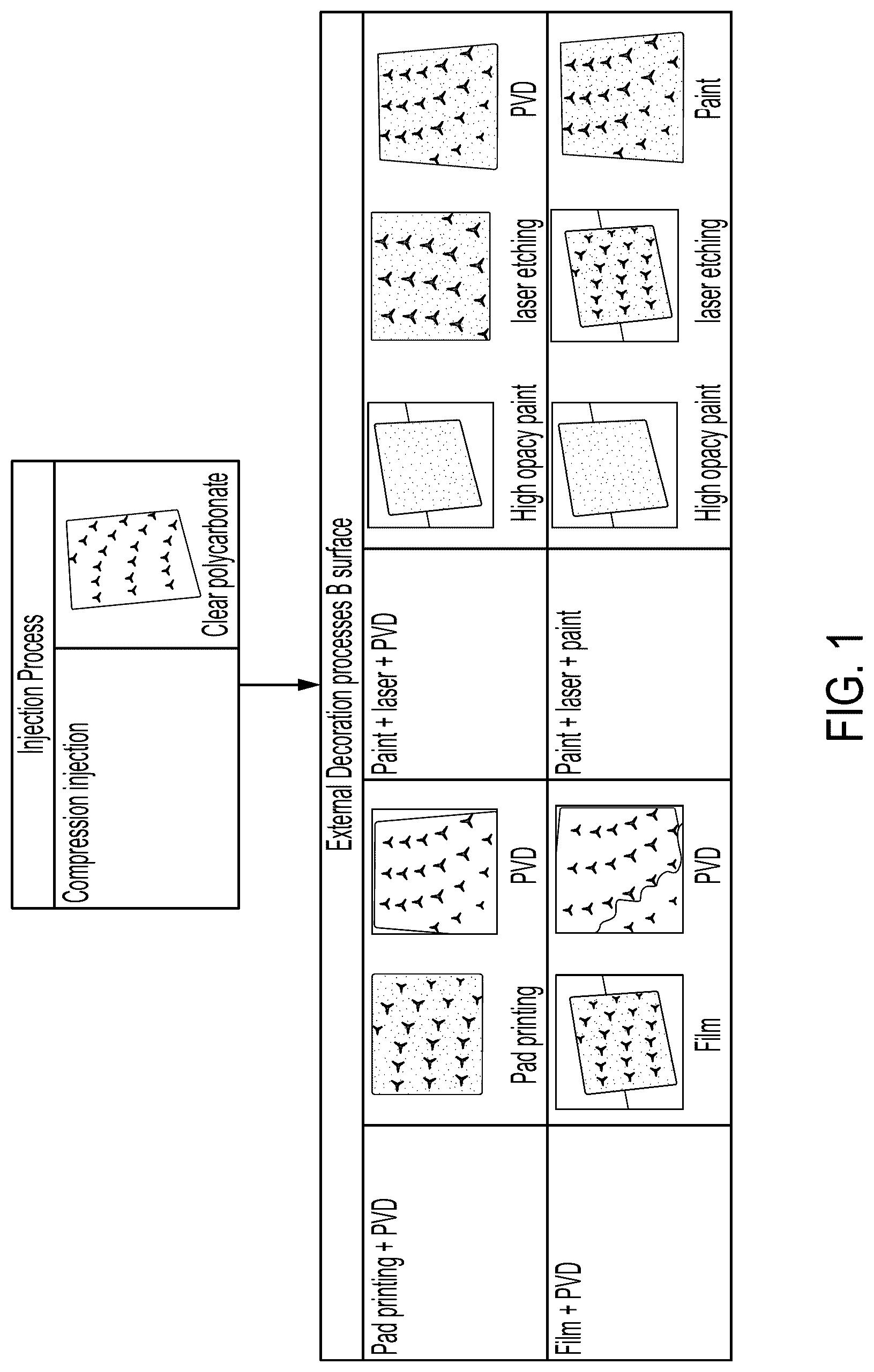
illustrates complex multi-step decorative part formation processes that are alternate solutions to some implementations of the present disclosure;
illustrates an improved decorative part formation process according to some implementations of the present disclosure;
illustrates example partial and fully formed decorative parts using the processes according to some implementations of the present disclosure; and
illustrates example partially formed decorative parts and cross-sectional views of example layer thicknesses using the processes according to some implementations of the present disclosure
DETAILED DESCRIPTION
As previously discussed, the problem with previous designs is that they require substantially increasing (e.g., doubling) the thickness of the decorative part, which stiffens the decorative part such that pedestrians who may be involved with a collision with the grille could sustain injury as the force of the impact is borne by the pedestrian. Some examples of alternate complex, multi-step decorative part formation solutions include (1) polycarbonate (PC) plus paint on B-side and laser-etching on B-side to remove paint in areas to be transparent, (2) PC plus pad printing, and (3) PC plus injection molding in-mold labeling (IML)/in-mold decorating (IMD) as illustrated in . As can be seen, these processes may include additional steps and/or more complex/costly processing via many different processing techniques/machines (e.g., molding, painting, laser etching, etc.). Decoration from the B-side that would result in substantially higher part thicknesses would also not be convenient to vehicle manufacturers (e.g., original equipment manufacturers, or OEMs) due to weight impact and pedestrian safety.
According to some implementations of the present disclosure, decoration from the B-side of a clear material is performed with a material that doesn't increase stiffness of the part (e.g., the same stiffness as a 1K or one-shot part, such as a single PC shot), and may impart greater flexibility without the risk of damage. The proposed processes/concepts of the present disclosure as shown in offer a lower cost method for achieving the same appearance as the more complex, multi-step solutions shown in and described above and be a more competitive option form of decoration because part thicknesses/weight would not be substantially increased due to the layer thicknesses and materials used. In one specific embodiment of the present disclosure, a two-shot (2K) injection molding process (i.e., a single manufacturing step or process) for a decorative part of a vehicle front panel or grille is presented. 2K injection molding is more cost competitive (part in one manufacturing step) compared to other decoration methods with several steeps and higher scrap rates. It should be noted that while 2K injection molding is specifically discussed herein, it will be appreciated that there could be three or more injection molding shots for more complex designs.
The addition of an elastomeric material (e.g., a thermoplastic elastomer, or TPE) to the back (B-side) of a primary polycarbonate (PC) sheet achieves the depth of image and decorative appearance desired by customers as shown in . In addition, the elastomeric material reduces the stiffness and rigidity of the polycarbonate sheet, allowing it to flex and absorb impact resulting from a pedestrian impact, reducing the likelihood of injuring the pedestrian. Improved testing could be performed for pedestrian impact for decorative parts placed in front of a vehicle. Taking advantage of 2K injection and combination of a PC and an elastomer, the stiffness of the part will not be increasing significantly nor will the weight as the elastomer allows to have thinner wall thickness as shown in . It will be appreciated that these are merely example thicknesses and the thicknesses could vary depending on the particular application, as could the type of elastomer material (e.g., a TPE, such as thermoplastic polyurethane or TPU). While 2K injection molding processes do exist already for many other applications, it has not been utilized for the combination of these thermoplastics (e.g., PC+TPE) to have decoration on B-side and less stiffness than being a combination of transparent and black PCs.
Although the terms first, second, third, etc. may be used herein to describe various elements, components, regions, layers and/or sections, these elements, components, regions, layers and/or sections should not be limited by these terms. These terms may be only used to distinguish one element, component, region, layer or section from another region, layer or section. Terms such as “first,” “second,” and other numerical terms when used herein do not imply a sequence or order unless clearly indicated by the context. Thus, a first element, component, region, layer or section discussed herein could be termed a second element, component, region, layer or section without departing from the teachings of the example embodiments.
It should also be understood that the mixing and matching of features, elements, methodologies and/or functions between various examples may be expressly contemplated herein so that one skilled in the art would appreciate from the present teachings that features, elements and/or functions of one example may be incorporated into another example as appropriate, unless described otherwise above.
Figures (4)
Citations
This patent cites (209)
- US3705742
- US3895835
- US3937508
- US3948497
- US3971583
- US4282816
- US4325574
- US4411462
- US4441751
- US4804169
- US4854792
- US5150935
- US5199755
- US5452931
- US5478127
- US5482336
- US5487575
- US5503444
- US5605736
- US5989479
- US6214266
- US6364397
- US6390538
- US6395219
- US6398897
- US6460926
- US6461017
- US6620371
- US6695366
- US6715790
- US6818305
- US6923286
- US6923494
- US6994384
- US7114764
- US7147808
- US7156543
- US7192080
- US7392876
- US7396147
- US7538734
- US7568746
- US7952469
- US7954871
- US8048499
- US8398132
- US8822007
- US8828518
- US9231391
- US9233656
- US9296354
- US9434326
- US9561707
- US9783152
- US9863600
- US10246044
- US2002/0041964
- US2003/0008134
- US2004/0021961
- US2004/0036302
- US2004/0094977
- US2004/0174025
- US2005/0002196
- US2005/0275246
- US2006/0008620
- US2006/0024476
- US2006/0082179
- US2006/0261665
- US2007/0085361
- US2007/0109206
- US2007/0200376
- US2007/0278803
- US2008/0122599
- US2008/0145635
- US2008/0206538
- US2008/0233367
- US2009/0256370
- US2010/0045060
- US2010/0080939
- US2010/0289197
- US2011/0030711
- US2011/0088827
- US2013/0059108
- US2014/0008096
- US2014/0054914
- US2014/0062116
- US2014/0333077
- US2015/0239286
- US2017/0232925
- US2017/0232926
- US2018/0090831
- US2019/0071130
- US2019/0111599
- US2019/0322211
- US2020/0103093
- US2022/0123458
- US2517940
- US102004035759
- US102006055996
- US102004035759
- US102006055996
- US0012697
- US0507496
- US0665935
- US0777590
- US0674052
- US0833757
- US1072380
- US1076619
- US1085992
- US1107877
- US0597624
- US0749872
- US1377777
- US1400404
- US1473189
- US1525112
- US1565350
- US1104726
- US1603774
- US1603788
- US1614590
- US1719640
- US1719691
- US1764270
- US1848581
- US1916157
- US1737692
- US1948486
- US1948487
- US2035261
- US1338483
- US2052833
- US1810892
- US1925511
- US2139013
- US2250032
- US1986890
- US2259951
- US2311689
- US1817212
- US2112025
- US1344688
- US2527202
- US2530352
- US2758282
- US2525993
- US2692024
- US2681068
- US2796325
- US3150442
- US2572936
- US3048015
- US3526067
- US2351946
- US2903340
- US2015112841
- US2016150497
- US9316902
- US9409310
- US9534445
- US9606756
- US9620842
- US9625308
- US9700180
- US9739263
- US9956990
- US9962739
- US0208015
- US2004012955
- US2004045910
- US2004080765
- US2004083020
- US2005102758
- US2006016053
- US2006035150
- US2006046771
- US2006086446
- US2007097878
- US2007139372
- US2008005625
- US2008073541
- US2009007935
- US2009101355
- US2009126670
- US2010049502
- US2011088858
- US2012004035
- US2012116805
- US2012128606
- US2012131204
- US2012143715
- US2013041254
- US2013095046
- US2013175104
- US2014158711
- US2015150657
- US2015152399
- USWO-2016008790
- US2017016763
- US2017144949
- US2017205046
- US2018072869
- US2018073087
- US2018126145
- US2018161068
- US2019053621
- US2075206
- US3095267