Claims (20)
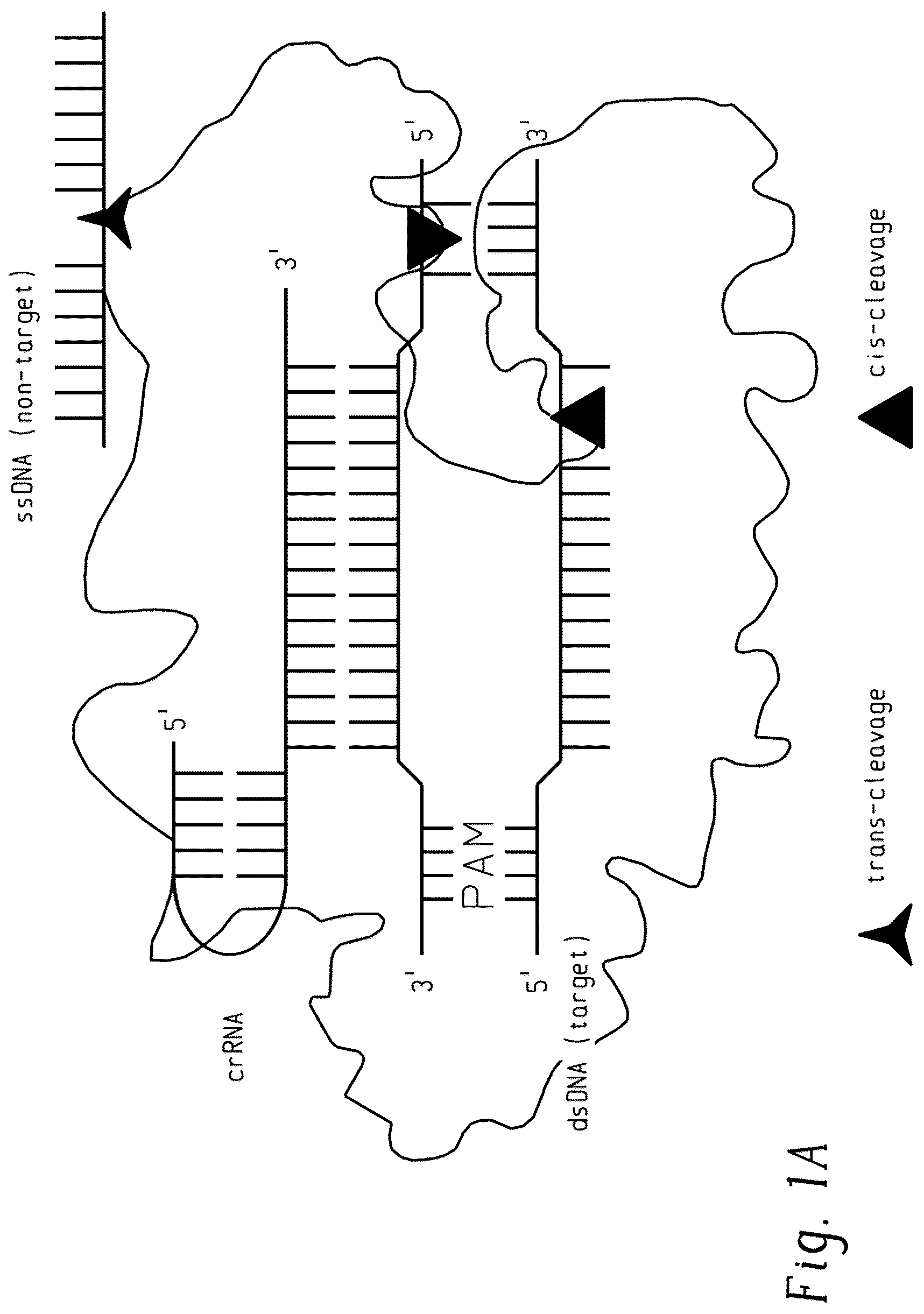
1. An immobilization-free, electrochemical method of detecting a target deoxyribonucleic nucleic acid (DNA) sequence in a sample, the method comprising: incubating the sample with a detection mixture that comprises: (i) a nucleic acid probe that has a negative charge and that includes a single-stranded DNA (ssDNA) sequence that hybridizes with a nucleic acid sequence of the target DNA sequence covalently linked to an electroactive probe, wherein the electroactive probe has a neutral or positive charge; (ii) a Class 2 cluster regularly interspaced short palindromic repeats (CRISPR)-associated (Cas) protein or enzyme that has trans-cleavage activity for ssDNA; and (iii) a guide ribonucleic acid (gRNA) that includes (A) a scaffold sequence that interacts with the Class 2 Cas protein, and (B) a nucleic acid sequence that hybridizes with a sequence of the target DNA sequence; applying an electric field comprising an alternating current (AC) electric field and a direct current (DC) offset to the detection mixture to concentrate nucleic acids in the sample and the nucleic acid probe on a positively charged working electrode, wherein the electroactive probe is released from the nucleic acid probe by the Class 2 Cas protein when the target DNA sequence is present in the detection mixture; and measuring, after applying the electric field, a current of the detection mixture as potential is applied, wherein detection of a current in the detection mixture indicates the presence of the target DNA sequence in the sample.
Show 19 dependent claims
2. The method of claim 1 , wherein: the electroactive probe has a neutral charge or a positive charge; the electroactive probe is located on the 5′ end of the ssDNA sequence of the nucleic acid probe that hybridizes with a nucleic acid sequence of the target DNA sequence, the 3′ end of the ssDNA sequence that hybridizes with a nucleic acid sequence of the target DNA sequence, or both; or a combination thereof.
3. The method of claim 1 , wherein the electroactive probe is methylene blue, the Class 2 Cas protein is CRISPR-Cas12a, or both.
4. The method of claim 1 , wherein: incubating the sample with the detection mixture includes incubating at about 35° C. to about 42° C.; incubating the sample with the detection mixture is performed for about 10 to about 90 minutes; the electric field is applied for about 10 to about 90 minutes while or prior to measuring the current of the detection mixture; or a combination thereof.
5. The method of claim 1 , wherein: the electric potential of the AC electric field is about 0.1 millivolts (mV) to about 100 mV; the electric potential of the DC offset is about 0.10% to about 90% of the electric potential of the AC electric field; or a combination thereof.
6. The method of claim 1 , wherein: the frequency (f) of the electric field is about 1 hertz (Hz) to about 100 Hz; the period of the electric field (T) is about (0.05×f) to about (2.0×f); the electric field has a pulse width that is about (0.10× T) to about (0.95× T); or a combination thereof.
7. The method of claim 1 , wherein the target DNA sequence is a positive control nucleic acid sequence, or the target DNA sequence is a nucleic acid sequence from at least one of a mutation, a genotype, a cancer, an infectious agent, a pathogen, a microorganism, a disease, disorder, or condition associated with the target DNA sequence, or a combination thereof.
8. The method of claim 1 , wherein the method detects 200 or more copies of the target DNA sequence.
9. The method of claim 1 , wherein: the nucleic acid sequence that hybridizes with a sequence of the target DNA sequence is about 10 base pairs to about 30 base pairs long; the ssDNA sequence of the nucleic acid probe that hybridizes with a nucleic acid sequence of the target DNA sequence is about 4 base pairs to about 20 base pairs long; the gRNA is about 35 to about 50 base pairs long; or a combination thereof.
10. The method of claim 1 , wherein the method is performed in a reaction chamber of an electrochemical sensor, a single solution, a homogeneous solution, or a combination thereof.
11. The method of claim 1 , further comprising amplifying the target DNA sequence in the sample incubating, wherein the sample incubated with the detection mixture is an amplification product, or a portion thereof.
12. The method of claim 11 , wherein amplifying the target DNA sequence in the sample includes performing a recombinase polymerase amplification (RPA) reaction, wherein at least one of: the nucleic acid sequence that hybridizes with a sequence of the target DNA sequence is about 15 base pairs to about 30 base pairs long; the ssDNA sequence of the nucleic acid probe that hybridizes with a nucleic acid sequence of the target DNA sequence is about 4 base pairs to about 20 base pairs long; incubating the amplification product, or a portion thereof, is performed at about 35° C. to about 40° C.; the RPA reaction is performed at about 35° C. to about 42° C.; the gRNA is about 35 to about 50 base pairs long; the RPA reaction is an isothermal amplification; the RPA reaction is about 10 minutes to about 60 minutes; or a combination thereof.
13. The method of claim 11 , wherein the method detects 100 copies or more of the target DNA sequence.
14. The method of claim 11 , wherein the method is performed in a reaction chamber of an electrochemical sensor, a single solution, a homogeneous solution, or a combination thereof.
15. The method of claim 1 , wherein the detection mixture further comprises reagents for a recombinase polymerase amplification (RPA) reaction.
16. The method of claim 15 , further comprising performing a RPA reaction to amplify the target DNA sequence.
17. The method of claim 1 , wherein the method further comprising performing a reverse transcription reaction to produce the target DNA sequence from a ribonucleic acid (RNA) sequence.
18. The method of claim 17 , wherein the RNA sequence is a positive control nucleic acid sequence, or the RNA sequence is a nucleic acid sequence from at least one of a mutation, a genotype, a cancer, a infectious agent, a pathogen, a microorganism, a disease, disorder, or condition associated with the RNA sequence, or a combination thereof.
19. A method of diagnosing an infection, disease, disorder, condition, or genotype, the method comprising performing the method of claim 1 to detect a target DNA sequence that is characteristic and/or indicative of the infection, disease, disorder, condition, or genotype.
20. The method of claim 19 , wherein the method further comprises amplifying the target DNA sequence in the sample, wherein the sample incubated with the detection mixture is an amplification product, or a portion thereof.
Full Description
No description text available for this patent.