Switch Device Capable of Providing a Discharge Path According to Signal Level of an Input Signal
Abstract
A switch device includes a driver circuit, a switch circuit and a level transition circuit. The driver circuit includes an input terminal for receiving an input signal, an output terminal for outputting an output signal, a first terminal coupled to a first reference terminal, and a second terminal coupled to a second reference terminal. The switch circuit includes a control terminal for receiving the output signal. The level transition circuit includes a first terminal for receiving the output signal, a second terminal coupled to a third reference terminal, and a third terminal for receiving the input signal. In a transition interval, the input signal is transitioned from a first input signal level to a second input signal level, the level transition circuit transitions the output signal from a first output signal level to a third output signal level between the first output signal level and a second output signal level.
Claims (19)
1. A switch device, comprising: a driver circuit comprising an input terminal configured to receive an input signal, an output terminal configured to output an output signal, a first terminal coupled to a first reference terminal, and a second terminal coupled to a second reference terminal; a switch circuit comprising a control terminal configured to receive the output signal; and a level transition circuit configured to provide a discharge path used to discharge accumulated electric charges at the control terminal of the switch circuit to a third reference terminal, and comprising: a first terminal configured to receive the output signal; a second terminal coupled to the third reference terminal; a third terminal configured to receive the input signal; a pulse generation circuit comprising an input terminal coupled to the third terminal of the level transition circuit, and an output terminal configured to output a pulse signal; a conversion circuit comprising an input terminal configured to receive the pulse signal, and a first output terminal configured to output a first operation signal according to the pulse signal; and an operation circuit comprising a first terminal coupled to the first terminal of the level transition circuit, a second terminal coupled to the second terminal of the level transition circuit, and a first operation terminal coupled to the first output terminal of the conversion circuit and configured to receive the first operation signal; wherein: in a first transition interval, the input signal is transitioned from a first input signal level to a second input signal level, the level transition circuit transitions the output signal from a first output signal level to a third output signal level, the third output signal level is between the first output signal level and a second output signal level, and the level transition circuit transitions the output signal from the first output signal level to the third output signal level in a predetermined interval; and the pulse signal is related to the predetermined interval.
Show 18 dependent claims
2. The switch device of claim 1 , wherein the third reference terminal is configured to receive a third reference signal, and the third output signal level of the output signal is determined according to a signal level of the third reference signal.
3. The switch device of claim 1 , wherein the predetermined interval is between 20 nanoseconds and 30 nanoseconds.
4. The switch device of claim 1 , further comprising a control switch, wherein: the second terminal of the driver circuit is coupled to the second reference terminal through the control switch; and in the predetermined interval, the control switch is turned off according to a control signal.
5. The switch device of claim 1 , wherein: in the first transition interval and before the predetermined interval, the driver circuit outputs the output signal with the first output signal level according to the first input signal level of the input signal; and in the first transition interval and after the output signal is transitioned from the first output signal level to the third output signal level, the driver circuit outputs the output signal with the second output signal level according to the second input signal level of the input signal.
6. The switch device of claim 1 , wherein the pulse generation circuit is configured to generate the pulse signal when the pulse generation circuit detects that the input signal is transitioned from the first input signal level to the second input signal level.
7. The switch device of claim 1 , wherein the operation circuit further comprises: a first switch comprising a first terminal coupled to the first terminal of the operation circuit, a second terminal coupled to the second terminal of the operation circuit, and a control terminal coupled to the first operation terminal of the operation circuit.
8. The switch device of claim 7 , wherein: in the predetermined interval, the first operation signal has a first operation signal level to turn on the first switch.
9. The switch device of claim 1 , wherein: the conversion circuit further comprises a second output terminal configured to output a second operation signal according to the pulse signal; and the operation circuit further comprises: a second operation terminal coupled to the second output terminal of the conversion circuit and configured to receive the second operation signal; a first switch comprising a first terminal coupled to the first terminal of the operation circuit, a second terminal, and a control terminal coupled to the first operation terminal of the operation circuit; and a second switch comprising a first terminal coupled to the second terminal of the first switch, a second terminal coupled to the second terminal of the operation circuit, and a control terminal coupled to the second operation terminal of the operation circuit.
10. The switch device of claim 9 , wherein in the predetermined interval, the first operation signal has a first operation signal level to turn on the first switch, and the second operation signal has the first operation signal level to turn on the second switch.
11. The switch device of claim 1 , wherein: the conversion circuit further comprises a second output terminal configured to output a second operation signal according to the pulse signal; and the operation circuit further comprises: a second operation terminal coupled to the second output terminal of the conversion circuit and configured to receive the second operation signal; a first switch comprising a first terminal coupled to the first terminal of the operation circuit, a second terminal, and a control terminal coupled to the first operation terminal of the operation circuit; a second switch comprising a first terminal coupled to the second terminal of the first switch, a second terminal, and a control terminal coupled to the second operation terminal of the operation circuit; and a third switch comprising a first terminal coupled to the second terminal of the second switch, a second terminal coupled to the second terminal of the operation circuit, and a control terminal coupled to the control terminal of the second switch.
12. The switch device of claim 11 , wherein in the predetermined interval, the first operation signal has a first operation signal level to turn on the first switch, and the second operation signal has the first operation signal level to turn on the second switch and the third switch.
13. The switch device of claim 1 , wherein: the level transition circuit further comprises a fourth terminal coupled to the second reference terminal; the conversion circuit further comprises a second output terminal configured to output a second operation signal according to the pulse signal, and a third output terminal configured to output a third operation signal according to the pulse signal; and the operation circuit further comprises: a third terminal coupled to the fourth terminal of the level transition circuit; a second operation terminal coupled to the second output terminal of the conversion circuit and configured to receive the second operation signal; a third operation terminal coupled to the third output terminal of the conversion circuit and configured to receive the third operation signal; a first switch comprising a first terminal coupled to the first terminal of the operation circuit, a second terminal, and a control terminal coupled to the first operation terminal of the operation circuit; a second switch comprising a first terminal coupled to the second terminal of the first switch, a second terminal, and a control terminal coupled to the second operation terminal of the operation circuit; a third switch comprising a first terminal coupled to the second terminal of the second switch, a second terminal coupled to the second terminal of the operation circuit, and a control terminal coupled to the control terminal of the second switch; and a fourth switch comprising a first terminal coupled to the second terminal of the second switch, a second terminal coupled to the third terminal of the operation circuit, and a control terminal coupled to the third operation terminal of the operation circuit.
14. The switch device of claim 13 , wherein in the predetermined interval, the first operation signal has a first operation signal level to turn on the first switch, the second operation signal has the first operation signal level to turn on the second switch and the third switch, and the third operation signal has a second operation signal level to turn off the fourth switch.
15. The switch device of claim 13 , wherein each of the first switch, the second switch, the third switch and the fourth switch comprises an N-type transistor.
16. The switch device of claim 1 , wherein the first reference terminal is configured to receive a first reference signal, and the first output signal level of the output signal is determined according to a signal level of the first reference signal.
17. The switch device of claim 1 , wherein the second reference terminal is configured to receive a second reference signal, and the second output signal level of the output signal is determined according to a signal level of the second reference signal.
18. The switch device of claim 1 , wherein in a second transition interval, the input signal is transitioned from the second input signal level to the first input signal level, the level transition circuit transitions the output signal from the second output signal level to a fourth output signal level, and the fourth output signal level is between the first output signal level and the second output signal level.
19. The switch device of claim 1 , wherein: the output signal outputted from the output terminal of the driver circuit is generated according to at least a signal provided by a charge pump.
Full Description
Show full text →
TECHNICAL FIELD
The disclosure is related to a switch device, and more particularly, a switch device capable of providing a discharge path according to the signal level of an input signal.
BACKGROUND
Regarding voltage generation, the generated voltage may be a positive voltage or a negative voltage used for controlling another circuit.
Usually, a negative voltage can be generated by a charge pump. The sourcing capability of the circuit generating a negative voltage is often weaker, so the generated negative voltage is easily affected by the discharge of accumulated positive charges. When the signal level of a terminal outputting a voltage is changed from a positive signal level to a negative signal level, accumulated positive charges may flow to the terminal to erroneously increase the generated negative voltage. Then, the generated negative voltage may be too high to erroneously operate the controlled circuit. Hence, a solution is in need for improving the quality of the provided voltage and reducing erroneous operations.
SUMMARY
An embodiment provides a switch device comprising a driver circuit, a switch circuit and a level transition circuit. The driver circuit comprises an input terminal configured to receive an input signal, an output terminal configured to output an output signal, a first terminal coupled to a first reference terminal, and a second terminal coupled to a second reference terminal. The switch circuit comprises a control terminal configured to receive the output signal. The level transition circuit comprises a first terminal configured to receive the output signal, a second terminal coupled to a third reference terminal, and a third terminal configured to receive the input signal. In a first transition interval, the input signal is transitioned from a first input signal level to a second input signal level, the level transition circuit transitions the output signal from a first output signal level to a third output signal level, and the third output signal level is between the first output signal level and a second output signal level.
BRIEF DESCRIPTION OF THE DRAWINGS
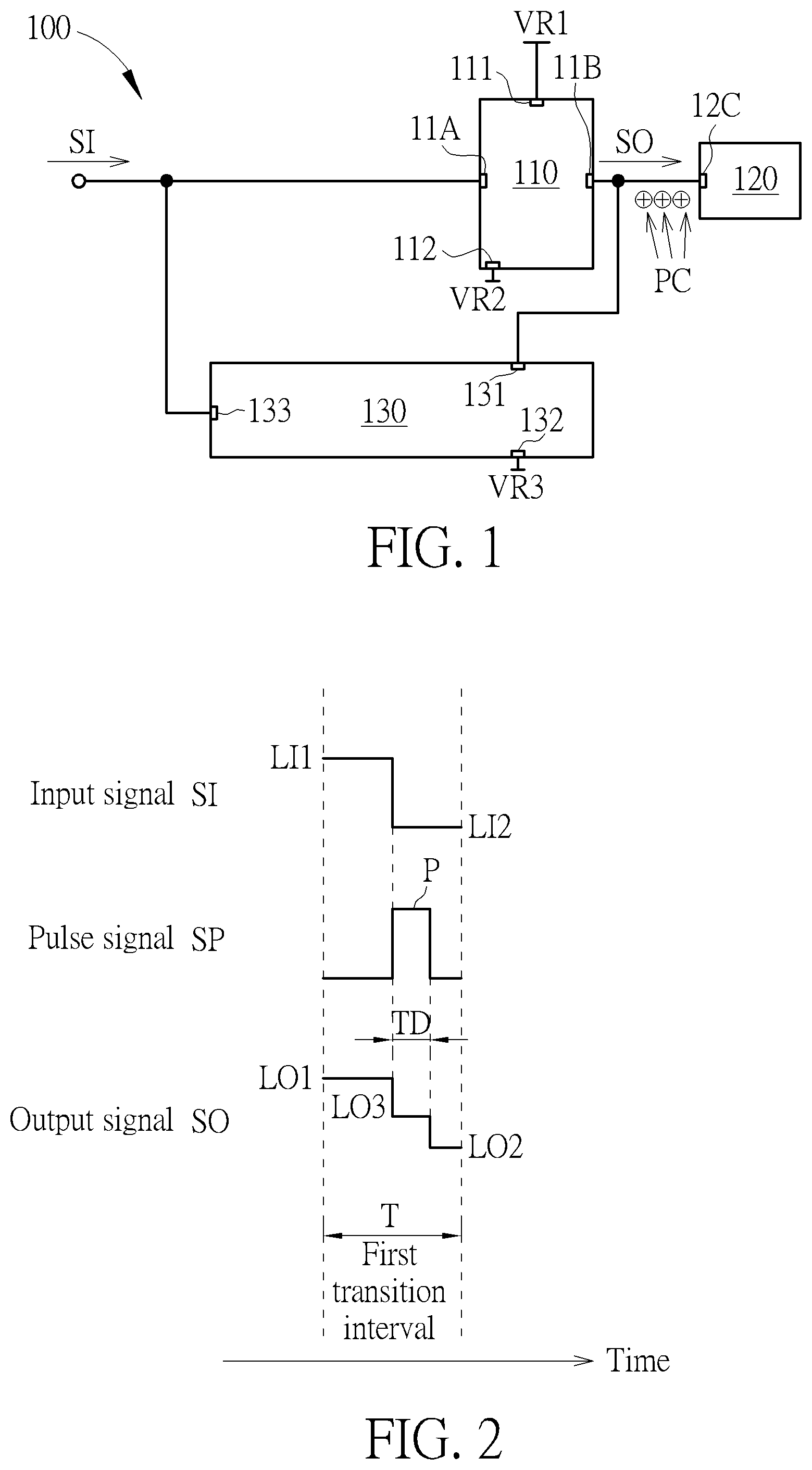
illustrates a switch device according to an embodiment.
illustrates waveforms of signals according to an embodiment.
illustrates the switch device according to an embodiment.
to illustrate the conversion circuit and the operation circuit in according to different embodiments.
illustrates the level transition circuit in and according to another embodiment.
illustrates waveforms of signals in and according to an embodiment.
illustrates the driver circuit in according to an embodiment.
DETAILED DESCRIPTION
Below, exemplary embodiments will be described in detail with reference to accompanying drawings so as to be easily realized by a person having ordinary knowledge in the art. The inventive concept may be embodied in various forms without being limited to the exemplary embodiments set forth herein. Descriptions of well-known parts are omitted for clarity, and like reference numerals refer to like elements throughout.
In order to generate stable voltages and prevent the signal level of the generated negative voltages from being too high, the switch devices described below can be used.
illustrates a switch device 100 according to an embodiment. The switch device 100 can include a driver circuit 110 , a switch circuit 120 and a level transition circuit 130 .
The driver circuit 110 can include a first terminal 111 , a second terminal 112 , an input terminal 11 A and an output terminal 11 B. The input terminal 11 A can receive an input signal SI, the output terminal 11 B can output an output signal SO, the first terminal 111 can be coupled to a first reference terminal, and the second terminal 112 can be coupled to a second reference terminal.
The switch circuit 120 can include a control terminal 12 C for receiving the output signal SO. The switch circuit 120 can include a single-pole single-throw (SPST) switch, a single-pole double-throw (SP2T) switch, or a switch of another type. The switch circuit 120 can be controlled by the output signal SO to control whether a radio-frequency signal can flow through the switch circuit 120 .
The level transition circuit 130 can include a first terminal 131 , a second terminal 132 and a third terminal 133 . The first terminal 131 can receive the output signal SO. The second terminal 132 can be coupled to a third reference terminal. The third terminal 133 can receive the input signal SI.
The first reference terminal can receive a first reference signal VR 1 . A first output signal level LO 1 of the output signal SO (as shown in ) can be determined according to a signal level of the first reference signal VR 1 .
The second reference terminal can receive a second reference signal VR 2 . A second output signal level LO 2 of the output signal SO (as shown in ) can be determined according to a signal level of the second reference signal VR 2 .
The third reference terminal can receive a third reference signal VR 3 . A third output signal level LO 3 of the output signal SO (as shown in ) can be determined according to a signal level of the third reference signal VR 3 .
The signal level of the first reference signal VR 1 can be a positive signal level. The signal level of the second reference signal VR 2 can be a negative signal level.
The signal level of the third reference signal VR 3 can be between the signal level of the first reference signal VR 1 and the signal level of the second reference signal VR 2 . For example, signal level of the third reference signal VR 3 can be a ground signal level.
illustrates waveforms of signals according to an embodiment. In , waveforms of the input signal SI, the output signal SO and a pulse signal SP are shown. The pulse signal SP will be described below.
As shown in and , in a first transition interval T, the input signal SI can be transitioned from a first input signal level LI 1 to a second input signal level LI 2 , and the level transition circuit 130 can transition the output signal SO from the first output signal level LO 1 to the third output signal level LO 3 , and then to the second output signal level LO 2 .
The third output signal level LO 3 can be between the first output signal level LO 1 and the second output signal level LO 2 , and it can expressed as LO 1 >LO 3 >LO 2 .
The first output signal level LO 1 can be a positive signal level, the second output signal level LO 2 can be a negative signal level, and the third output signal level LO 3 can be (but not limited to) a ground signal level.
In the first transition interval T, the level transition circuit 130 can transition the output signal SO from the first output signal level LO 1 to the third output signal level LO 3 in a predetermined interval TD.
The first transition interval T can be between 200 nanoseconds and 500 nanoseconds. The predetermined interval TD can be between 20 nanoseconds and 30 nanoseconds.
As shown in , positive charges PC can be accumulated at the control terminal of the switch circuit 120 . If the level transitions circuit 130 is omitted, when the output signal SO is transitioned from the first output signal level LO 1 to the second output signal level LO 2 , the positive charges PC may flow to the output terminal 11 B of the driver circuit 110 , and this may unwantedly increase the signal level of the output signal SO. When the signal level of the output signal SO is expected to be a negative signal level, the signal level may not be low enough due to the positive charges PC flowing to the driver circuit 110 , and this may cause an erroneous operation of the switch circuit 120 .
In order to solve this problem, during an interval where the output signal SO is transitioned from the first output signal level LO 1 to the second output signal level LO 2 (e.g. from a positive signal level to a negative signal level), the level transitions circuit 130 can provide a discharge path for discharging the accumulated charges PC. Hence, the signal level of the output signal SO is prevented from being increase erroneously.
illustrates the switch device 200 according to an embodiment. The switch device 200 can be one type of the switch device 100 in , but embodiments are not limited thereto.
The switch device 200 can further include a control switch 255 . The second terminal 112 of the driver circuit 110 can be coupled to the second reference terminal through the control switch 255 . In the predetermined interval TD, the control switch 255 can be turned off according to a control signal SC.
The level transition circuit 130 can include a pulse generation circuit 210 , a conversion circuit 220 and an operation circuit 230 .
The pulse generation circuit 210 can include an input terminal 21 A and an output terminal 21 B. The input terminal 21 A can be coupled to the third terminal 133 of the level transition circuit 130 . The output terminal 21 B can output a pulse signal SP.
As shown in and , the pulse signal SP can have a pulse P. The pulse P can have a higher signal level. In other words, the pulse P can be a positive pulse. However, this is an example, and embodiments are not limited thereto.
As shown in to , in the first transition interval T and before the predetermined interval TD, the driver circuit 110 can output the output signal SO with the first output signal level LO 1 according to the first input signal level LI 1 of the input signal SI. In this example, the current or voltage of the input signal SI may be insufficient for driving the switch circuit 120 , and the current or voltage of the output signal SO generated by the driver circuit 110 can be sufficient for driving the switch circuit 120 .
As shown in to , in the first transition interval T and after the output signal SO is transitioned from the first output signal level LO 1 to the third output signal level LO 3 , the driver circuit 110 can output the output signal SO with the second output signal level LO 2 according to the second input signal level LI 2 of the input signal SI.
After the predetermined interval TD, the driver circuit 110 can output the output signal SO with the second output signal level LO 2 according to the second input signal level LI 2 of the input signal SI.
As shown in , the conversion circuit 220 can include an input terminal 22 A and at least an output terminal 22 B. The input terminal 22 A can be coupled to the output terminal 21 B of the pulse generation circuit 210 to receive the pulse signal SP. The output terminal 22 B can output an operation signal to the operation circuit 230 . The conversion circuit 220 can convert the signal level of the pulse signal SP to generate at least one operation signal(s) as described below. The conversion circuit 220 can be implemented with a conventional circuit design.
The operation circuit 230 can include a first terminal 231 , a second terminal 232 and at least one operation terminal 23 A. The first terminal 231 can be coupled to the first terminal 131 of the level transition circuit 130 . The second terminal 232 can be coupled to the second terminal 132 of the level transition circuit 130 . The operation terminal 23 A can be coupled to the output terminal 22 B of the conversion circuit 220 to receive the operation signal to control whether a discharge path between the first terminal 231 and the second terminal 232 is conductive, as described below.
The pulse signal SP can be related to the predetermined interval TD. For example, as shown in and , the duration of the pulse P of the pulse signal SP can be substantially equal to the length of the predetermined interval TD. During the pulse P, the level transition circuit 130 can provide a discharge path to discharge the positive charges PC shown in and
The pulse generation circuit 210 can generate the pulse signal SP when the pulse generation circuit 210 detects that the input signal SI is transitioned from the first input signal level LI 1 to the second input signal level LI 2 .
illustrates the conversion circuit 220 and the operation circuit 230 in according to an embodiment. As shown in and , the at least one output terminal 22 B can include a first output terminal 22 B 1 , and the at least one operation terminal 23 A of the operation circuit 230 can include a first operation terminal 23 A 1 . The conversion circuit 220 can output a first operation signal SX 1 to the operation circuit 230 .
As shown in and , the operation circuit 230 can include a switch SW 1 . The switch SW 1 can include a first terminal, a second terminal and a control terminal, where the first terminal can be coupled to the first terminal 231 of the operation circuit 230 , the second terminal can be coupled to the second terminal 232 of the operation circuit 230 , and the control terminal can be coupled to the first operation terminal 23 A 1 of the operation circuit 230 .
As shown in and , in the first transition interval T, for example, in the predetermined interval TD (e.g. during the pulse P), the first operation signal SX 1 can have a first operation signal level to turn on the switch SW 1 . For example, the first operation signal level can be the signal level of the first reference signal VR 1 , such as a positive signal level.
When the switch SW 1 is turned on, the operation circuit 230 can provide a discharge path to discharge the positive charges PC in and to prevent the output signal SO from being erroneously increased. Hence, the signal level of the output signal SO is prevented from being too high.
In another scenario, when it is not in the predetermined interval TD (e.g. before or after the pulse P) and the output signal SO has been transitioned to the second output signal level LO 2 , the switch SW 1 can be turned off to cut off the discharge path.
In the example of and , the level of the first operation signal SX 1 can be shown as Table 1.
TABLE 1
Before the During the After the
Time pulse P pulse P pulse P
Signal Signal level Signal level Signal level
level of of the second of the first of the second
the first reference signal reference reference signal
operation VR2 or the signal VR1 VR2 or the
signal third reference third reference
SX1 signal VR3 signal VR3
illustrates the conversion circuit 220 and the operation circuit 230 in according to another embodiment.
As shown in and , the at least one output terminal 22 B can include a first output terminal 22 B 1 and a second output terminal 22 B 2 . The first output terminal 22 B 1 can output a first operation signal SX 1 according to the pulse signal SP. The second output terminal 22 B 2 can output a second operation signal SX 2 according to the pulse signal SP.
As shown in , the at least one operation terminal 23 A of the operation circuit 230 can include a first operation terminal 23 A 1 and a second operation terminal 23 A 2 . The first operation terminal 23 A 1 can be coupled to the first output terminal 22 B 1 of the conversion circuit 220 to receive the first operation signal SX 1 . The second operation terminal 23 A 2 can be coupled to the second output terminal 22 B 2 of the conversion circuit 220 to receive the second operation signal SX 2 .
The operation circuit 230 can include a first switch SW 51 and a second switch SW 52 . The first switch SW 51 can include a first terminal, a second terminal and a control terminal, where the first terminal can be coupled to the first terminal 231 of the operation circuit 230 , and the control terminal can be coupled to the first operation terminal 23 A 1 of the operation circuit 230 .
The second switch SW 52 can include a first terminal, a second terminal and a control terminal, where the first terminal can be coupled to the second terminal of the first switch SW 51 , the second terminal coupled to the second terminal 232 of the operation circuit 230 , and the control terminal can be coupled to the second operation terminal 23 A 2 of the operation circuit 230 .
As shown in and , in the first transition interval T (e.g. during the pulse P), the first operation signal SX 1 can have a first operation signal level to turn on the first switch SW 51 , and the second operation signal SX 2 can have the first operation signal level to turn on the second switch SW 52 . For example, the first operation signal level can be the signal level of the first reference signal VR 1 , such as a positive signal level.
When the first switch SW 51 and the second switch SW 52 are turned on, the operation circuit 230 can provide a discharge path to discharge the positive charges PC in and to prevent the output signal SO from being erroneously increased. Hence, the signal level of the output signal SO is prevented from being too high. In another scenario, when it is not in the predetermined interval TD (e.g. before or after the pulse P) and the output signal SO has been transitioned to the second output signal level LO 2 , the first switch SW 51 and the second switch SW 52 can be turned off to cut off the discharge path.
In the example of and , the levels of the first operation signal SX 1 and the second operation signal SX 2 can be shown as Table 2.
TABLE 2
Before the During the After the
Time pulse P pulse P pulse P
Signal level Signal level Signal level Signal level
of the first of the third of the first of the third
operation reference reference reference
signal SX1 signal VR3 signal VR1 signal VR3
Signal level Signal level Signal level Signal level
of the second of the second of the first of the second
operation reference reference reference
signal SX2 signal VR2 signal VR1 signal VR2
illustrates the conversion circuit 220 and the operation circuit 230 in according to another embodiment.
As shown in and , the at least one output terminal 22 B can include a first output terminal 22 B 1 and a second output terminal 22 B 2 . The first output terminal 22 B 1 can output a first operation signal SX 1 according to the pulse signal SP. The second output terminal 22 B 2 can output a second operation signal SX 2 according to the pulse signal SP.
As shown in , the at least one operation terminal 23 A of the operation circuit 230 can include a first operation terminal 23 A 1 and a second operation terminal 23 A 2 . The first operation terminal 23 A 1 can be coupled to the first output terminal 22 B 1 of the conversion circuit 220 to receive the first operation signal SX 1 . The second operation terminal 23 A 2 can be coupled to the second output terminal 22 B 2 of the conversion circuit 220 to receive the second operation signal SX 2 .
The operation circuit 230 can include a first switch SW 61 , a second switch SW 62 and a third switch SW 63 .
The first switch SW 61 can include a first terminal, a second terminal and a control terminal, where the first terminal can be coupled to the first terminal 231 of the operation circuit 230 , and the control terminal can be coupled to the first operation terminal 23 A 1 of the operation circuit 230 .
The second switch SW 62 can include a first terminal, a second terminal and a control terminal, where the first terminal can be coupled to the second terminal of the first switch SW 61 , and the control terminal can be coupled to the second operation terminal 23 A 2 of the operation circuit 230 .
The third switch SW 63 can include a first terminal, a second terminal and a control terminal, where the first terminal can be coupled to the second terminal of the second switch SW 62 , the second terminal can be coupled to the second terminal 232 of the operation circuit 230 , and the control terminal can be coupled to the control terminal of the second switch SW 62 . Compared with , the risk of the breakdown of the operation circuit 230 can be reduced by further using the third switch SW 63 .
As shown in and , in the first transition interval T, for example, in the predetermined interval TD (e.g. during the pulse P), the first operation signal SX 1 can have a first operation signal level to turn on the first switch SW 61 , and the second operation signal SX 2 can have the first operation signal level to turn on the second switch SW 62 and the third switch SW 63 . For example, the first operation signal level can be the signal level of the first reference signal VR 1 , such as a positive signal level.
When the first switch SW 61 , the second switch SW 62 and the third switch SW 63 are turned on, the operation circuit 230 can provide a discharge path to discharge the positive charges PC in and to prevent the output signal SO from being erroneously increased. Hence, the signal level of the output signal SO is prevented from being too high. In another scenario, when it is not in the predetermined interval TD (e.g. before or after the pulse P) and the output signal SO has been transitioned to the second output signal level LO 2 , the first switch SW 61 , the second switch SW 62 and the third switch SW 63 can be turned off to cut off the discharge path.
In the example of and , the levels of the first operation signal SX 1 and the second operation signal SX 2 can be shown as Table 3.
TABLE 3
Before the During the After the
Time pulse P pulse P pulse P
Signal level Signal level Signal level Signal level
of the first of the third of the first of the third
operation reference reference reference
signal SX1 signal VR3 signal VR1 signal VR3
Signal level Signal level Signal level Signal level
of the second of the second of the first of the second
operation reference reference reference
signal SX2 signal VR2 signal VR1 signal VR2
illustrates the level transition circuit 130 in and according to another embodiment. Compare with , the level transition circuit 130 in can further include a fourth terminal 134 coupled to the second reference terminal for receiving the second reference signal VR 2 .
Compared with , in , the operation circuit 230 can further include a third terminal 233 coupled to the fourth terminal 134 of the level transition circuit 130 .
As shown in , the at least one output terminal 22 B can include a first output terminal 22 B 1 , a second output terminal 22 B 2 and a third output terminal 22 B 3 . The first output terminal 22 B 1 can output a first operation signal SX 1 according to the pulse signal SP. The second output terminal 22 B 2 can output a second operation signal SX 2 according to the pulse signal SP. The third output terminal 22 B 3 can output a third operation signal SX 3 according to the pulse signal SP.
The at least one operation terminal 23 A of the operation circuit 230 can include a first operation terminal 23 A 1 , a second operation terminal 23 A 2 and a third operation terminal 23 A 3 . The first operation terminal 23 A 1 can be coupled to the first output terminal 22 B 1 of the conversion circuit 220 to receive the first operation signal SX 1 . The second operation terminal 23 A 2 can be coupled to the second output terminal 22 B 2 of the conversion circuit 220 to receive the second operation signal SX 2 . The third operation terminal 23 A 3 can be coupled to the third output terminal 22 B 3 of the conversion circuit 220 to receive the third operation signal SX 3 .
The operation circuit 230 can include a first switch SW 71 , a second switch SW 72 , a third switch SW 73 and a fourth switch SW 74 .
The first switch SW 71 can include a first terminal, a second terminal and a control terminal, where the first terminal can be coupled to the first terminal 231 of the operation circuit 230 , and the control terminal can be coupled to the first operation terminal 23 A 1 of the operation circuit 230 .
The second switch SW 72 can include a first terminal, a second terminal and a control terminal, where the first terminal can be coupled to the second terminal of the first switch SW 71 , and the control terminal can be coupled to the second operation terminal 23 A 2 of the operation circuit 230 .
The third switch SW 73 can include a first terminal, a second terminal and a control terminal, where the first terminal can be coupled to the second terminal of the second switch SW 72 , the second terminal can be coupled to the second terminal 232 of the operation circuit 230 , and the control terminal can be coupled to the control terminal of the second switch SW 72 .
The fourth switch SW 74 can include a first terminal, a second terminal and a control terminal, where the first terminal can be coupled to the second terminal of the second switch SW 72 , the second terminal can be coupled to the third terminal 233 of the operation circuit 230 , and the control terminal can be coupled to the third operation terminal 23 A 3 of the operation circuit 230 . Compared with , the risk of the breakdown of the operation circuit 230 can be reduced by further using the third switch SW 73 and the fourth switch SW 74 .
As shown in and , in the first transition interval T, for example, in the predetermined interval TD (e.g. during the pulse P), the first operation signal SX 1 can have a first operation signal level to turn on the first switch SW 71 , the second operation signal SX 2 can have the first operation signal level to turn on the second switch SW 72 and the third switch SW 73 , and the third operation signal SX 3 can have the second operation signal level to turn off the fourth switch SW 74 . For example, the second operation signal level can be the signal level of the second reference signal VR 2 , such as a negative signal level.
When the first switch SW 71 , the second switch SW 72 and the third switch SW 73 are turned on, the operation circuit 230 can provide a discharge path to discharge the positive charges PC in and to prevent the output signal SO from being erroneously increased. Hence, the signal level of the output signal SO is prevented from being too high.
In another scenario, when it is not in the predetermined interval TD (e.g. before or after the pulse P) and the output signal SO has been transitioned to the second output signal level LO 2 , the first switch SW 71 , the second switch SW 72 and the third switch SW 73 can be turned off, and the fourth switch SW 74 can be turned on, so the discharge path is cut off.
In the example of and , the levels of the first operation signal SX 1 , the second operation signal SX 2 and the third operation signal SX 3 can be shown as Table 4.
TABLE 4
Before the During the After the
Time pulse P pulse P pulse P
Signal level Signal level Signal level Signal level
of the first of the third of the first of the third
operation reference reference reference
signal SX1 signal VR3 signal VR1 signal VR3
Signal level Signal level Signal level Signal level
of the second of the second of the first of the second
operation reference reference reference
signal SX2 signal VR2 signal VR1 signal VR2
Signal level Signal level Signal level Signal level
of the third of the third of the second of the third
operation reference reference reference
signal SX3 signal VR3 signal VR2 signal VR3
For example, each of the first switch SW 71 , the second switch SW 72 , the third switch SW 73 and the fourth switch SW 74 can include an N-type transistor. Hence, when the voltage level at the control terminal of the switch is a low voltage level, the switch can be turned off. When the voltage level at the control terminal of the switch is a high voltage level, the switch can be turned on.
As shown in to , the operation signal(s) outputted by the conversion circuit 220 can have the signal level(s) of the first reference signal VR 1 , the second reference signal VR 2 and/or the third reference signal VR 3 . Hence, the conversion circuit 220 can be coupled to the first reference terminal, the second reference terminal and/or the third reference terminal to receive the first reference signal VR 1 , the second reference signal VR 2 and/or the third reference signal VR 3 . In another embodiment, the operation circuit 230 can further have terminals coupled to the conversion circuit 220 for the conversion circuit 220 to receive the reference signals through the operation circuit 230 .
For example, as shown in , the conversion circuit 220 can be coupled to the second terminal 132 and the fourth terminal 134 of the level transition circuit 130 to receive the second reference signal VR 2 and the third reference signal VR 3 . The level transition circuit 130 can further include a fifth terminal 135 coupled to the first reference terminal, and the conversion circuit 220 can be coupled to the fifth terminal 135 of the level transition circuit 130 to receive the first reference signal VR 1 . is an example, and embodiments are not limited thereto.
illustrates waveforms of signals in and according to an embodiment. As shown in , in the second transition interval T 2 , the input signal SI can be transitioned from the second input signal level LI 2 to the first input signal level LI 1 .
The second transition interval T 2 can precede the first transition interval T, or proceed the first transition interval T.
As shown in , the level transition circuit 130 in and can transition the output signal SO from the second output signal level LO 2 to a fourth output signal level LO 4 , and then transition the output signal SO from the fourth output signal level LO 4 to the first output signal level LO 1 .
The fourth output signal level LO 4 can be between the first output signal level LO 1 and the second output signal level LO 2 . The fourth output signal level LO 4 may be the same as or different from the third output signal level LO 3 described in .
illustrates the driver circuit in according to an embodiment. is an example, and embodiments are not limited thereto. As shown in , the driver circuit 110 can include a level shifter 115 , and switches SW 91 , SW 92 , SW 93 and SW 94 . The level shifter 115 can shift the signal level of the input signal SI to generate one or more control signal(s) with one signal level or different signal levels. The level shifter 115 can be implemented according to a conventional design.
The couplings among the level shifter 115 and the switches SW 91 , SW 92 , SW 93 and SW 94 can be as shown in .
For example, the switches SW 91 and SW 92 can include P-type transistors, so they can be turned on by signals with a low voltage level. The switches SW 93 and SW 94 can include N-type transistors, so they can be turned on by signals with a high voltage level.
The level shifter 115 can output control signals S 111 and S 112 to the switches SW 91 and SW 94 respectively according to the input signal SI. The control terminals of the switches SW 92 and SW 93 can be coupled to the third reference terminal to receive the third reference signal VR 3 .
In , when the input signal SI is transitioned from the first input signal level LI 1 to the second input signal level LI 2 , the level shifter 115 can transition the control signal S 111 from the signal level of the third reference signal VR 3 to the signal level of the first reference signal VR 1 , and transition the control signal S 112 from the signal level of the second reference signal VR 2 to the signal level of the third reference signal VR 3 .
If the first reference signal VR 1 , the second reference signal VR 2 and the third reference signal VR 3 have a positive signal level, a negative signal level and a ground signal level respectively, the output signal SO can be transitioned from a high signal level to a low signal level. For example, the output signal SO can be transitioned from the first output signal level LO 1 to the second output signal level LO 2 as shown in .
In summary, by using the switch devices 100 and 200 and the circuits shown in and to , a discharge path can be generated for discharging the accumulated positive charges PC when the driver circuit 110 provides the output signal SO with a negative signal level. The output signal SO can be prevented from being increased erroneously. Hence, the generated negative positive voltage will not be too high. Likewise, the discharge path can be used to discharge accumulated negative charges to avoid decreasing a generated positive voltage erroneously. Hence, the erroneous operations of the switch circuit 120 can be effectively reduced, and the long-standing problems in the field could be solved.
Those skilled in the art will readily observe that numerous modifications and alterations of the device and method may be made while retaining the teachings of the invention. Accordingly, the above disclosure should be construed as limited only by the metes and bounds of the appended claims.
Figures (6)
Citations
This patent cites (39)
- US5297104
- US5680300
- US5929665
- US5986484
- US6016281
- US6271708
- US6333665
- US6370069
- US6535020
- US7519135
- US7710187
- US8138818
- US8203377
- US8963576
- US9019001
- US9100019
- US9496864
- US9621153
- US9685945
- US10044349
- US10270437
- US10511301
- US10523194
- US10680601
- US10848145
- US11258443
- US11437911
- US2009/0066402
- US2009/0167368
- US2013/0076322
- US2022/0310148
- US104866888
- US201044782
- US1348270
- US201242231
- US201532388
- USI575872
- US202111551
- US202203590