Mosquito Monitoring and Counting System
Abstract
A mosquito monitoring and counting system, including a sensor, the sensor including a high-speed computer vision camera, a detector, an antenna, a central processing unit, a counting sensor, and a GSM or WIFI module. The high-speed computer vision camera is installed in a trap diffuser, the counting sensor detects all insects that enter an air stream, and the central processing unit, based on artificial intelligence through neural networks, is adapted to process a data array, count and classify insects into species and subspecies, transmit the processed data array via the GSM or WIFI module over the Internet to a server, and further processing the data array and submitting a result to be graphically integrated with a mapping service.
Claims (9)
1. A mosquito monitoring and counting system, comprising: a housing comprising a frame, a bottom base attached to the frame, a top cap attached to the frame, at least four panels, and at least four sides extending between said top cap and said bottom base, each of said at least four sides being attached to the frame by being set within a respective first opening of a first set of first openings defined by said frame; said top cap, bottom base, at least four panels, and at least four sides define an interior portion; each of said at least four panels of said housing disposed proximate to and beneath said top cap and above said at least four sides, each of said panels being attached to the frame by being set within a respective second opening of a second set of second openings defined by the frame, each of said panels providing a plurality of mesh openings through which insects travel into said interior portion; a high-speed computer vision camera installed in a trap diffuser within said interior portion of said housing, said trap diffuser comprising a top end and a bottom end, the top end being wider than and longitudinally opposite from the bottom end; a fan installed within said interior portion and configured to regulate an air stream through said trap diffuser; an antenna attached to said housing; a counting sensor installed within said interior portion and configured to detect insects that enter the air stream of the trap diffuser; a GSM or WIFI module installed within said interior portion; and a central processing unit installed within said interior portion, based on artificial intelligence through neural networks, is configured to: process a data array generated by the counting sensor and the high-speed computer vision camera, count and classify insects into species and subspecies based on processing the data array, transmit the processed data array comprising the count and the classification of the species and the subspecies of the insects via the GSM or WIFI module using the antenna to a server, and graphically integrate the processed data array with a mapping service, wherein the processed data array graphically integrated with the mapping service is stored in a cloud storage for access by the users of an application.
Show 8 dependent claims
2. The mosquito monitoring and counting system of claim 1 , further comprising a CO 2 supplier configured to provide CO 2 to the trap diffuser.
3. The mosquito monitoring and counting system of claim 2 wherein the CO 2 supplier is regulated.
4. The mosquito monitoring and counting system of claim 1 , wherein the trap diffuser is further configured to catch the insects that enter the air stream of the trap diffuser.
5. The mosquito monitoring and counting system of claim 1 , wherein the application stores and outputs historical data relating to the number of insects at a location where the mosquito monitoring and counting system is installed.
6. The mosquito monitoring and counting system of claim 5 , wherein the application provides the count of the species and the subspecies of the insects at the mosquito monitoring and counting system and a plurality of other installed mosquito monitoring and counting systems.
7. The mosquito monitoring and counting system of claim 1 wherein the top cap is coaxial with, and longitudinally opposite from the bottom base.
8. The mosquito monitoring and counting system of claim 7 wherein the trap diffuser comprises a conical shape.
9. The mosquito monitoring and counting system of claim 8 further comprising at least one wheel attached to and extending from the housing.
Full Description
Show full text →
CROSS-REFERENCE TO RELATED APPLICATIONS
This application claims priority under 35 U.S.C. Section 371 to the International Application No. PCT/IB2020/054690, filed May 18, 2020, and to the Ukranian Application No. UA/A201905652, filed May 24, 2019, now pending, the contents of which are hereby incorporated by reference.
TECHNICAL FIELD
The present disclosure relates generally to a system and method for remote monitoring and counting of mosquito population in different areas, and the ability to share the data with other users using a relevant application.
BACKGROUND
Traditionally, a wireless sounding system determines mosquito breeding populations and mosquito breeding behavior in a particular region using a server and intelligent simulation software that collects environmental parameters via a wireless sensor (along with other environmental and historical data). This software uses the principle of reproduction prediction to create a prognostic model of reproduction and determine population and behavior (See, for example, Patent No. WO 2016/064735 dated 28 Apr. 2016).
In another example, a system counts and/or monitors insect populations. Insects of at least one defined species are lured and temporarily kept within a certain space. With the help of sensors, sensed data is analyzed based on the distinctive characteristics (See, for example, patent No. WO 2019/020694 A1 dated 31 Jan. 2019).
The disadvantages of the existing devices are the lack of a system for controlling and monitoring mosquitoes, capability of using the application remotely and sharing the obtained information with other users.
SUMMARY
The object of the disclosed embodiments is to improve the features of the device for controlling and monitoring the insects' population in order to create an ecosystem of connected devices, that enables to monitor the mosquitoes density in different regions of the world.
The task is solved by mosquito monitoring and counting system that includes a sensor, the sensor including a high-speed computer vision camera, a detector, an antenna, a central processing unit, and a GSM or WIFI module. The high-speed computer vision camera is installed in a trap diffusor, the counting sensor detects all insects that enter an air stream, and the central processing unit, based on artificial intelligence through neural networks, is adapted to process a data array, count and classify insects into species and subspecies, transmit the processed data array via the GSM or WIFI module over the Internet to a server, and further processing the data array and submitting a result to be graphically integrated with a mapping service. The data processed data array that includes the number of mosquitoes anywhere in the world where mosquito traps are installed are stored in a cloud storage for access by users of an application.
BRIEF DESCRIPTION OF THE DRAWINGS
The subject matter disclosed herein is particularly pointed out and distinctly claimed in the claims at the conclusion of the specification. The foregoing and other objects, features, and advantages of the disclosed embodiments will be apparent from the following detailed description taken in conjunction with the accompanying drawings.
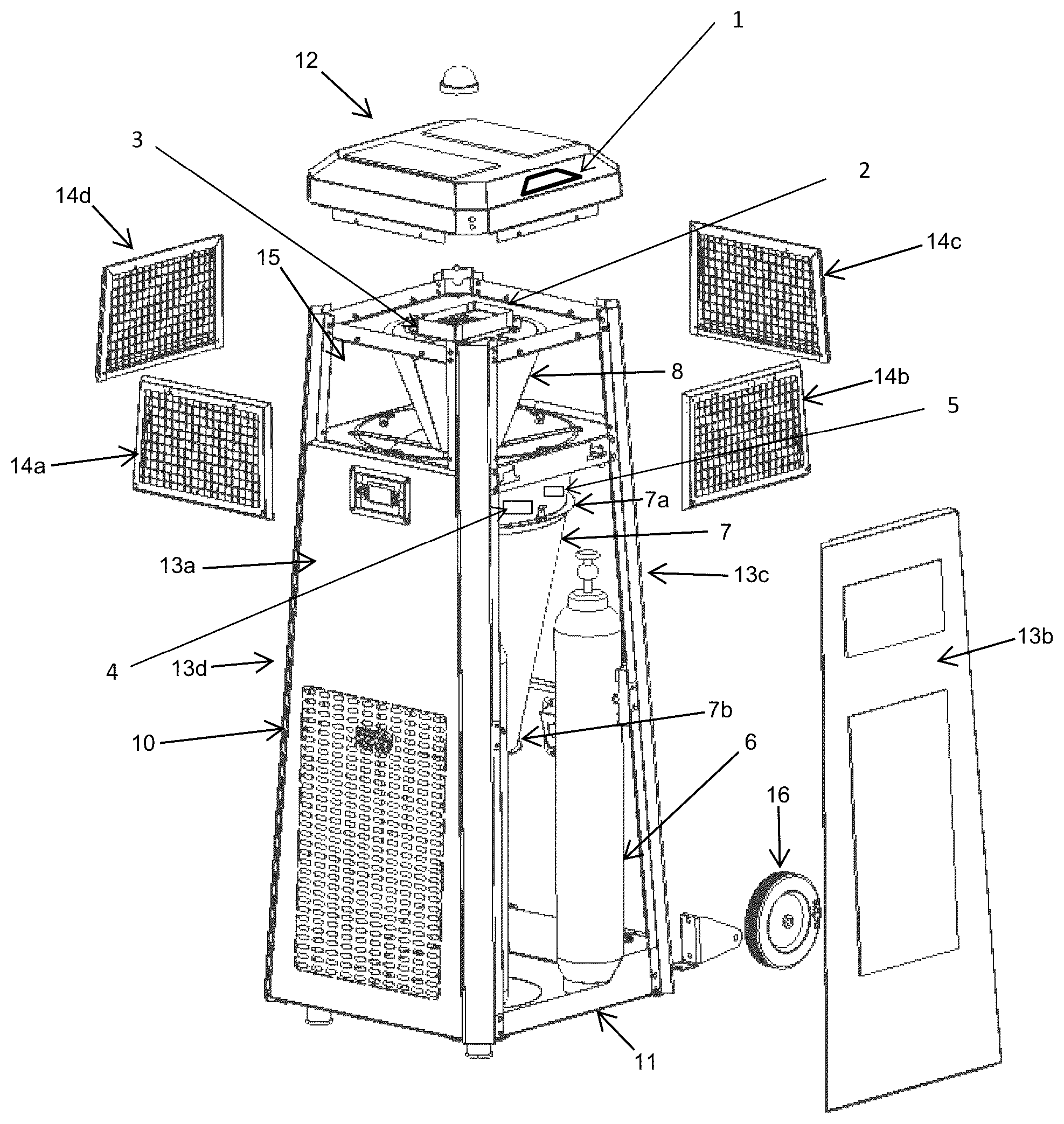
shows a perspective view of the system.
DETAILED DESCRIPTION
The disclosed embodiments remotely monitor and collect data on the number of mosquitoes anywhere in the world where mosquito control systems designed to reduce insect populations and count number of caught insects and/or of other manufacturers are installed. Mosquito monitoring and counting system enables to: share with other users information about the number of mosquitoes; decrease or increase of their population in a particular area; plan tourists' travelling to a given region; monitor in real time where and in which area it is safe to rest without threat to be infected with such diseases as malaria, Zika virus, dengue fever and other mosquito-borne diseases.
The task is solved by a mosquito monitoring and counting system that includes a sensor and a detector, differed by additionally having an antenna, a central processing unit, a counting sensor, a GSM or WIFI module and a sensor made as a high-speed computer vision camera.
The disclosed embodiments are illustrated by a mosquito monitoring and counting system corresponding to . In the embodiment, a mosquito monitoring and counting system includes an antenna 1 , a central processing unit 2 , a GSM WIFI module 3 , a high-speed computer vision camera 4 and a counting sensor 5 . The mosquito monitoring and counting system also includes a housing 10 with a bottom base 11 , top cap 12 and at least four sides 13 a , 13 b , 13 c , 13 d , collectively defining an interior portion 15 . The top cap 12 is coaxial with and longitudinally opposite from the bottom base 11 . Each of the sides 13 a - d include a panel 14 a , 14 b , 14 c , 14 d disposed proximate to and beneath the top cap 12 . Each of the panels 14 a - d include a plurality of mesh openings through which insects travel into the interior portion 15 . Furthermore, at least one wheel 16 is attached to and extending from the housing 10 . Also within the housing 10 is a trap diffuser 7 defining a top end 7 a and a bottom end 7 b , the top end 7 a being wider than and longitudinal opposite the bottom end 7 b , and forming a conical shape.
The device works as follows: the high-speed computer vision camera 4 for mosquito counting is placed in the trap's diffuser 7 . Through the counting sensor 5 that records all insects entering the air flow, and the central processing unit 2 that incorporates artificial intelligence using neural networks to process the data, the camera 4 counts and classifies insects into species and subspecies. Then, accumulated data is transmitted via GSM or Wi-Fi over the Internet to the server, where the data is processed and graphically integrated with Google Maps®, other mapping services superimposed on a Google Map, or other search and information services that become available to any registered user for further study. Users can be citizens and government agencies, institutes, schools, R&D centers, laboratories, municipalities. That is, the system enables remote access to control and collect data on the number of mosquitoes anywhere in the world where mosquito traps called SEMCS, designed to reduce insect populations and count number of caught insects and/or of other manufactures are installed.
That is, the system collects information on the number of mosquitoes caught and sends it to the cloud storage, where any user of the application through the Internet resource can see the graph of mosquitoes' activity, increase or decrease in population. In other words, the innovative system catches and counts the trapped insects, and transfers the results to the cloud server.
By connecting via Internet and downloading the application to a computer, tablet or smartphone, the user can control the mosquito trap. For example, the user may change settings, fan 8 intensity, on and off time, set the time of day and night mode, or change the interval at which the fan 8 switches on and the CO2 supply 6 .
With the enclosed embodiment, the user can monitor the pattern of activity, dynamics, the number of mosquitoes caught at different times of the day and weather conditions in different regions, using their own mosquito control devices. Also, the user can select on the map the region where these and other mosquito control devices are installed to see dynamics of population decrease or increase, depending on the time of year and weather conditions. Additionally, specialists in mosquito control and the military can collect and process data obtained from different territories for research and control. Also, with the help of a web application one may instantly get information about the activity of mosquitoes in a particular region, along with data on wind speed, ambient temperature, humidity, pressure, rainfall.
Thus, the disclosed embodiment allows for achieving control and regulation of the mosquito population to ensure safe human life.
Figures (1)
Citations
This patent cites (122)
- US138797
- US726604
- US1505651
- US1693368
- US2013969
- US2236698
- US3305965
- US3835577
- US4248005
- US5020270
- US5205064
- US5205065
- US5327675
- US5329725
- US5417009
- US5799436
- US6195932
- US6604317
- US6653971
- US6688035
- US6817139
- US6898896
- US7024815
- US7071829
- US7656300
- US7779575
- US7980200
- US8319649
- US8365995
- US8810411
- US8896451
- US9335413
- US9915732
- US10026165
- US10043263
- US10178856
- US10178857
- US10524461
- US10585192
- US11490609
- US12004500
- US2003/0061757
- US2007/0169401
- US2009/0223116
- US2010/0186284
- US2014/0226860
- US2014/0311014
- US2015/0216158
- US2015/0234049
- US2016/0245916
- US2017/0112116
- US2017/0223943
- US2017/0231210
- US2017/0258068
- US2017/0273291
- US2018/0206472
- US2018/0206473
- US2018/0279598
- US2018/0317473
- US2019/0000059
- US2019/0034736
- US2019/0110458
- US2019/0121302
- US2019/0133106
- US2019/0159440
- US2019/0302265
- US2020/0000079
- US2020/0154685
- US2020/0170234
- US2020/0178511
- US2020/0229420
- US2020/0245604
- US2020/0367483
- US2020/0396975
- US2020/0404897
- US2021/0029984
- US2021/0035473
- US2021/0045377
- US2021/0153492
- US2021/0153493
- US2021/0209352
- US2021/0219535
- US2021/0251209
- US2021/0329902
- US2021/0360204
- US2022/0101015
- US2022/0104474
- US2022/0142135
- US2022/0361471
- US2023/0064414
- US2023/0106933
- US2023/0129551
- US2023/0189780
- US2023/0210101
- US2023/0210102
- US2024/0020965
- US2024/0044757
- US2024/0090489
- US2149301
- US2570138
- US2007100353
- US2021040604
- US101476256
- US101507554
- US20160058643
- US101642711
- US101642715
- US101642712
- US20170046426
- US20170046430
- US102519804
- USWO-2016064735
- USWO-2017120189
- USWO-2018101697
- USWO-2018140679
- USWO-2019020694
- USWO-2019079248
- USWO-2019081375
- USWO-2020027761
- USWO-2021001955
- USWO-2021001957
- USWO-2021029062