Light Emitting Element and Light Emitting Device
Abstract
A light emitting element includes a support substrate, and first and second light emitting portions. Each of the first light emitting portion and the second light emitting portion includes a semiconductor layered body, an insulating film, first and second electrodes and first and second external connection portions. The first external connection portion provided in the first light emitting portion includes a first portion provided adjacent to the second external connection portion of the first light emitting portion in a first direction and provided adjacent to the first external connection portion of the second light emitting portion in a second direction, and the first portion has an inclined portion inclined with respect to one side of the semiconductor layered body on a side facing the first external connection portion provided in the second light emitting portion in the second direction.
Claims (18)
1. A light emitting element comprising: a support substrate; and a first light emitting portion and a second light emitting portion provided on the support substrate and disposed adjacent to each other, each of the first light emitting portion and the second light emitting portion including a semiconductor layered body having a rectangular planar shape and including a first semiconductor layer, a light emitting layer, and a second semiconductor layer in this order, the semiconductor layered body defining a plurality of exposed portions in which the first semiconductor layer is exposed from the second semiconductor layer and the light emitting layer, each of the exposed portions being surrounded by the second semiconductor layer in a plan view, an insulating film covering the semiconductor layered body, and defining a plurality of opening portions respectively above the exposed portions, a first electrode connected to the exposed portions at the opening portions, a portion of the first electrode being disposed on the second semiconductor layer via the insulating film, a second electrode connected to the second semiconductor layer, a first external connection portion connected to the first electrode and spaced apart from the exposed portions in the plan view, and a second external connection portion connected to the second electrode, wherein, in the plan view, in a first direction passing through the first external connection portion and the second external connection portion and parallel to one side of the semiconductor layered body, the first external connection portions and the second external connection portions are disposed adjacent to each other in each of the first light emitting portion and the second light emitting portion, in a second direction orthogonal to the first direction, the first external connection portion provided in the first light emitting portion and the first external connection portion provided in the second light emitting portion are disposed adjacent to each other, and the second external connection portion provided in the first light emitting portion and the second external connection portion provided in the second light emitting portion are disposed adjacent to each other, the first external connection portion provided in the first light emitting portion includes a first portion provided adjacent to the second external connection portion of the first light emitting portion in the first direction and provided adjacent to the first external connection portion of the second light emitting portion in the second direction, and the first portion has an inclined portion inclined with respect to the one side of the semiconductor layered body on a side facing the first external connection portion provided in the second light emitting portion in the second direction.
Show 17 dependent claims
2. The light emitting element according to claim 1 , wherein in each of the first light emitting portion and the second light emitting portion, in the plan view, the second external connection portion includes a plurality of second portions disposed in a matrix pattern, and a third portion disposed adjacent to an outer periphery of the semiconductor layered body and having an inclined portion inclined with respect to the one side of the semiconductor layered body on a side facing the outer periphery of the semiconductor layered body.
3. The light emitting element according to claim 2 , wherein in each of the first light emitting portion and the second light emitting portion, the first external connection portion further includes a plurality of fourth portions, and the fourth portions are disposed at a density of 150 units/mm 2 or more.
4. The light emitting element according to claim 3 , wherein in each of the first light emitting portion and the second light emitting portion, an interval between the second portions adjacent to each other is 16 μm or more, and an interval between the fourth portions adjacent to each other is 16 μm or more.
5. The light emitting element according to claim 4 , wherein in each of the first light emitting portion and the second light emitting portion, a planar area of each of the first portion, the second portions, the third portion, and the fourth portions is from 100 μm 2 to 100 μm 2 .
6. The light emitting element according to claim 2 , wherein in each of the first light emitting portion and the second light emitting portion, a planar area of the third portion is greater than a planar area of one of the second portions.
7. The light emitting element according to claim 3 , wherein in each of the first light emitting portion and the second light emitting portion, a planar area of the third portion is greater than a planar area of one of the second portions.
8. The light emitting element according to claim 2 , wherein in each of the first light emitting portion and the second light emitting portion, a planar area of the third portion is greater than a planar area of the first portion.
9. The light emitting element according to claim 3 , wherein in each of the first light emitting portion and the second light emitting portion, a planar area of the third portion is greater than a planar area of the first portion.
10. The light emitting element according to claim 3 , wherein in each of the first light emitting portion and the second light emitting portion, a planar area of one of the fourth portions is smaller than a planar area of the first portion.
11. The light emitting element according to claim 4 , wherein in each of the first light emitting portion and the second light emitting portion, a planar area of one of the fourth portions is smaller than a planar area of the first portion.
12. The light emitting element according to claim 1 , wherein in each of the first light emitting portion and the second light emitting portion, in the plan view, the first semiconductor layer further includes an outer peripheral exposed portion disposed at an outer periphery of the second semiconductor layer and in which the first semiconductor layer is exposed from the second semiconductor layer and the light emitting layer, the first electrode is connected to a portion of the outer peripheral exposed portion, the first external connection portion includes a fifth portion disposed adjacent to the outer peripheral exposed portion in the first direction and the second direction, and in the plan view, the fifth portion has a curved portion on a side facing the outer peripheral exposed portion.
13. The light emitting element according to claim 1 , wherein in each of the first light emitting portion and the second light emitting portion, the exposed portions are disposed in a matrix pattern.
14. The light emitting element according to claim 1 , wherein in each of the first light emitting portion and the second light emitting portion, the first external connection portion is not positioned between the exposed portions adjacent in the first direction, and The first external connection portion further includes an eighth portion having a circular planar shape.
15. A light emitting device comprising: the light emitting element according to claim 1 ; a substrate including a plurality of wires on an upper surface thereof, the light emitting element being flip-chip mounted on the plurality of wires via the first external connection portion and the second external connection portion of each of the first light emitting portion and the second light emitting portion; and a cover member containing a light reflective substance, the cover member covering the light emitting element, the first external connection portion and the second external connection portion of each of the first light emitting portion and the second light emitting portion, and the substrate.
16. The light emitting device according to claim 15 , wherein the plurality of wires includes a first wire portion connected to the first external connection portion of the first light emitting portion, a second wire portion connected to the second external connection portion of the first light emitting portion and the first external connection portion of the second light emitting portion, and a third wire portion connected to the second external connection portion of the second light emitting portion.
17. The light emitting device according to claim 16 , wherein in the first direction, a portion of the second wire portion connected to the second external connection portion of the first light emitting portion is located between parts of the first wire portion, and a portion of the third wire portion connected to the second external connection portion of the second light emitting portion is located between parts of the second wire portion.
18. The light emitting device according to claim 15 , wherein in the plan view, a distance between the first wire portion and the second wire portion and a distance between the second wire portion and the third wire portion, in the first direction and the second direction, are each from 30 μm to 70 μm.
Full Description
Show full text →
CROSS-REFERENCE TO RELATED APPLICATION
This application claims priority to Japanese Patent Application No. 2021-018625, filed on Feb. 8, 2021, and Japanese Patent Application No. 2021-197690, filed on Dec. 6, 2021, the disclosures of which are hereby incorporated by reference in their entireties.
BACKGROUND
The present disclosure relates to a light emitting element and a light emitting device.
In known art, a light emitting element has been proposed that includes a semiconductor structure including an n-type semiconductor layer and a light emitting layer and a p-type semiconductor layer that are layered so as to expose a portion of the n-type semiconductor layer, an insulating film including a plurality of opening portions provided in the semiconductor structure, an n-electrode connected through an opening portion, of the plurality of opening portions, provided in the n-type semiconductor layer exposed from the light emitting layer and the p-type semiconductor layer, a p-electrode connected through an opening portion, of the plurality of opening portions, provided in the p-type semiconductor layer, a p-side external connection portion connected to the p-electrode, and an n-side external connection portion connected to the n-electrode (Japanese Translation of PCT International Application Publication No. JP2010-525586T, for example).
SUMMARY
When bonding such a light emitting element to a substrate, in order to improve heat dissipation performance, it is preferable to increase the area over which the n-side external connection portion and the p-side external connection portion are disposed. On the other hand, when bonding the light emitting element including the n-side external connection portion and the p-side external connection portion having a large area to the substrate, there is a concern that a short-circuit may occur between the external connection portion and a wire of the substrate due to expansion of the external connection portion at the time of bonding.
The present disclosure has been made in light of such a problem, and an object of the present disclosure is to provide a light emitting element and a light emitting device that can suppress an occurrence of a short-circuit between an external connection portion and a wire of a substrate at a time of bonding.
The present disclosure includes the following aspects.
(1) A light emitting element includes a support substrate, and a first light emitting portion and a second light emitting portion provided on the support substrate and disposed adjacent to each other. Each of the first light emitting portion and the second light emitting portion includes a semiconductor layered body, an insulating film, a first electrode, a second electrode, a first external connection portion, and a second external connection portion. The semiconductor layered body has a rectangular planar shape and including a first semiconductor layer, a light emitting layer, and a second semiconductor layer in this order, the semiconductor layered body defining a plurality of exposed portions in which the first semiconductor layer is exposed from the second semiconductor layer and the light emitting layer, each of the exposed portions being surrounded by the second semiconductor layer in a plan view. The insulating film covers the semiconductor layered body, and defines a plurality of opening portions respectively above the exposed portions. The first electrode is connected to the exposed portions at the opening portions, a portion of the first electrode being disposed on the second semiconductor layer via the insulating film. The second electrode is connected to the second semiconductor layer. The first external connection portion is connected to the first electrode and spaced apart from the exposed portions in the plan view. The second external connection portion is connected to the second electrode. In the plan view, in a first direction passing through the first external connection portion and the second external connection portion and parallel to one side of the semiconductor layered body, the first external connection portions and the second external connection portions are disposed adjacent to each other in each of the first light emitting portion and the second light emitting portion, in a second direction orthogonal to the first direction, the first external connection portion provided in the first light emitting portion and the first external connection portion provided in the second light emitting portion are disposed adjacent to each other, and the second external connection portion provided in the first light emitting portion and the second external connection portion provided in the second light emitting portion are disposed adjacent to each other, the first external connection portion provided in the first light emitting portion includes a first portion provided adjacent to the second external connection portion of the first light emitting portion in the first direction and provided adjacent to the first external connection portion of the second light emitting portion in the second direction, and the first portion has an inclined portion inclined with respect to the one side of the semiconductor layered body on a side facing the first external connection portion provided in the second light emitting portion in the second direction.
(2) A light emitting device includes a substrate including a plurality of wires on an upper surface thereof, the above-described light emitting element that is flip-chip mounted on the plurality of wires via the plurality of first external connection portion and second external connection portion of each of the first light emitting portion and the second light emitting portion, and a cover member containing a light reflective substance and covering the light emitting element, the first external connection portion and the second external connection portion of each of the first light emitting portion and the second light emitting portion, and the substrate.
According to a light emitting element and a light emitting device according to certain embodiments of the present disclosure, it is possible to suppress an occurrence of a short-circuit between an external connection portion and a wire of a substrate at a time of bonding while improving the heat dissipation performance.
BRIEF DESCRIPTION OF THE DRAWINGS
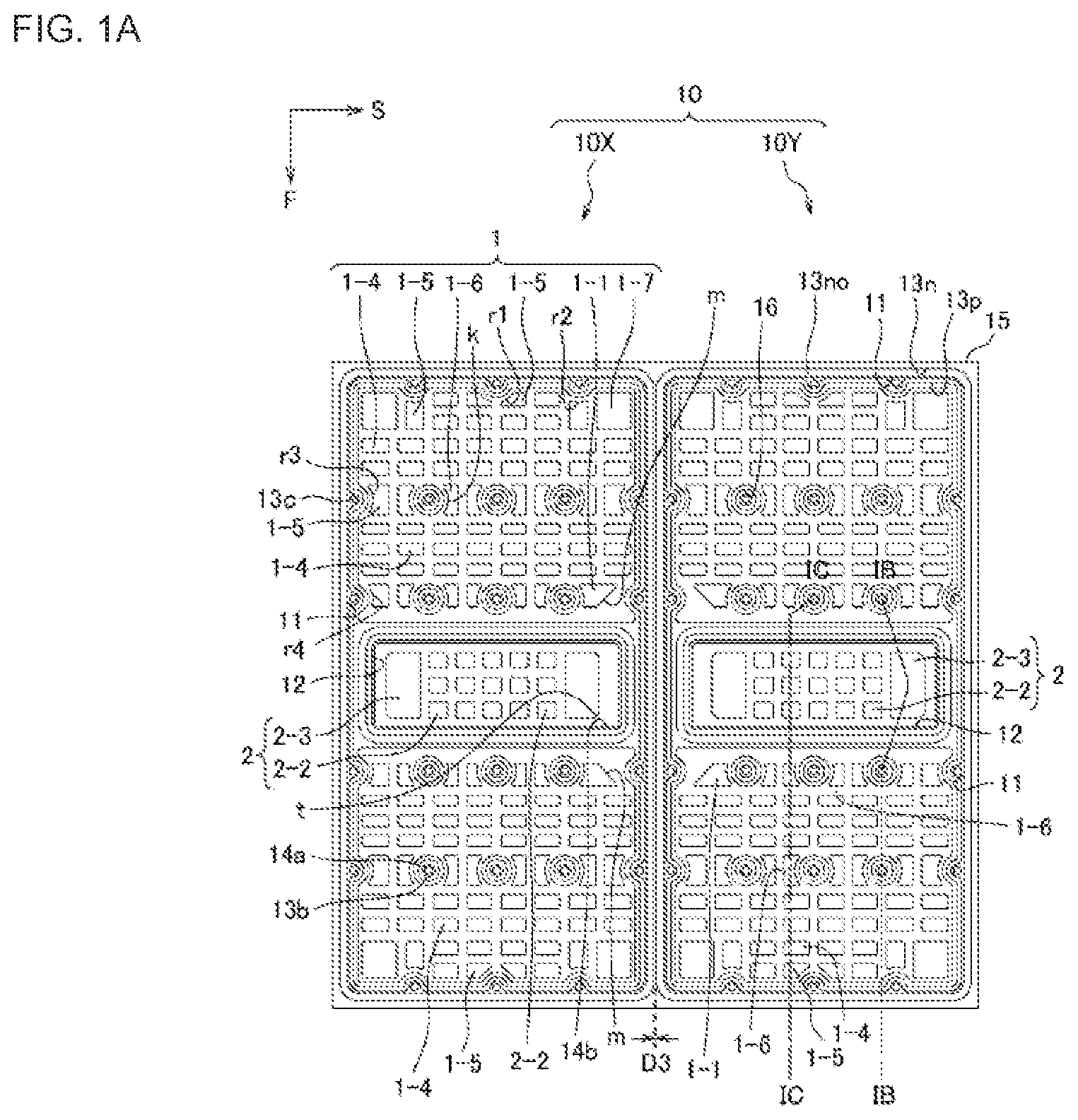
A is a plan view schematically illustrating a light emitting element according to a first embodiment of the present disclosure.
B is a cross-sectional view taken along a line IB-IB in A .
C is a cross-sectional view taken along a line IC-IC in A .
A is a perspective view schematically illustrating a light emitting device according to an embodiment of the present disclosure.
B is a cross-sectional view along a line IIB-IIB in A .
A is a plan view schematically illustrating a substrate used in the light emitting device according to an embodiment of the present disclosure.
B is an enlarged view of main portions illustrated in A .
C is a plan view schematically illustrating the substrate used in the light emitting device according to another embodiment of the present disclosure.
D is an enlarged view of main portions of the light emitting element illustrated in A when the light emitting element is placed on the substrate illustrated in A .
E is an enlarged view of main portions for describing inclined portions of a first portion and a third portion in the light emitting element illustrated in A .
is a plan view schematically illustrating a light emitting element according to a second embodiment of the present disclosure.
is a plan view schematically illustrating a light emitting element according to a third embodiment of the present disclosure.
is a plan view schematically illustrating a light emitting element according to a fourth embodiment of the present disclosure.
is a plan view schematically illustrating a light emitting element according to a fifth embodiment of the present disclosure.
is a plan view schematically illustrating a light emitting element according to a sixth embodiment of the present disclosure.
is a plan view schematically illustrating a light emitting element according to a seventh embodiment of the present disclosure.
A is a plan view schematically illustrating a light emitting device according to an embodiment of the present disclosure.
B is a plan view schematically illustrating a light emitting device according to an embodiment of the present disclosure.
DETAILED DESCRIPTION
Note that the drawings referred to in the following description are diagrams that schematically illustrate embodiments, and thus scales and intervals of members, positional relationships, and the like are exaggerated, or some of the members may not be illustrated in the drawings. Further, the scales and intervals of the members may not be the same between a plan view and a cross-sectional view thereof. Further, in the following description, members having the same designations and reference signs, in principle, represent the same members or equivalent members, and a detailed description of such members may be omitted as appropriate. In the present specification and the drawings, a first direction refers to a direction that passes through a first external connection portion and a second external connection portion and that is parallel to one side of a semiconductor layered body, and includes both a direction indicated by an arrow F and the opposite direction thereof. Similarly, a second direction refers to a direction orthogonal to the first direction, and includes both a direction indicated by an arrow S and the opposite direction thereof.
Light Emitting Element 10
As illustrated in A to 1 C , a light emitting element 10 according to an embodiment of the present disclosure includes two light emitting portions, namely, a first light emitting portion 10 X and a second light emitting portion 10 Y. The first light emitting portion 10 X and the second light emitting portion 10 Y are provided on a support substrate 15 . The first light emitting portion 10 X and the second light emitting portion 10 Y each include a semiconductor layered body 13 having a rectangular planar shape, and are disposed adjacent to each other. The semiconductor layered body 13 includes a first semiconductor layer 13 n , a light emitting layer 13 a , and a second semiconductor layer 13 p in this order from the support substrate 15 side. The first semiconductor layer 13 n includes a plurality of exposed portions 13 b that are exposed from the second semiconductor layer 13 p and the light emitting layer 13 a and are surrounded by the second semiconductor layer 13 p in a plan view.
Each of the first light emitting portion 10 X and the second light emitting portion 10 Y includes an insulating film 14 , a first electrode 11 , a second electrode 12 , a first external connection portion 1 , and a second external connection portion 2 . The insulating film 14 covers the semiconductor layered body 13 , and includes opening portions 14 a above the plurality of exposed portions 13 b . The first electrode 11 is connected to the exposed portion 13 b at the opening portions 14 a . Further, a portion of the first electrode 11 is disposed on the second semiconductor layer 13 p via the insulating film 14 . The second electrode 12 is connected to the second semiconductor layer 13 p . The first external connection portion 1 is connected to the first electrode 11 and spaced apart from the exposed portion 13 b in a plan view. The second external connection portion 2 is connected to the second electrode 12 . In a plan view, the first external connection portions 1 and the second external connection portions 2 respectively provided in the first light emitting portion 10 X and the second light emitting portion 10 Y are disposed adjacent to each other in the first direction F. Further, the first external connection portion 1 provided in the first light emitting portion 10 X and the first external connection portion 1 provided in the second light emitting portion 10 Y are disposed adjacent to each other in the second direction S. The second direction S is orthogonal to the first direction F.
The first external connection portion 1 provided in the first light emitting portion 10 X is provided adjacent to the second external connection portion 2 of the first light emitting portion 10 X in the first direction F. and includes a first portion 1 - 1 provided adjacent to the first external connection portion 1 of the second light emitting portion 10 Y in the second direction S. The first portion 1 - 1 has a shape including an inclined portion m that is inclined with respect to one side of the semiconductor layered body 13 , on a side facing the first external connection portion 1 provided in the second light emitting portion 10 Y.
By the light emitting element 10 including this type of the inclined portion m, as will be described below, when the light emitting element 10 is mounted on a substrate including a wire provided with an inclination, the first external connection portion 1 can be disposed along the wire, and thus, a short-circuit between the first external connection portion 1 and the wire can be suppressed.
Further, by disposing the first light emitting portion 10 X and the second light emitting portion 10 Y adjacent to each other on one support substrate 15 , the first light emitting portion 10 X and the second light emitting portion 10 Y can be disposed in close proximity to each other.
Support Substrate 15
The support substrate 15 is a substrate used for growing a semiconductor layer, and may be a substrate that can grow a semiconductor layer in an epitaxial manner. Examples of a material for such a substrate include insulating substrates such as sapphire (Al 2 O 3 ) and spinel (MgAl 2 O 4 ), nitride-based semiconductor substrates such as InN, AlN, GaN, InGaN, AlGaN, and InGaAlN, and the like. When the nitride-based semiconductor is used as the semiconductor layer, a sapphire substrate having the C-plane as a growth surface is preferably used. The support substrate 15 may have protrusions and recessions on the front surface thereof. Further, the support substrate 15 may have an off angle of approximately 0° to 10° with respect to a predetermined crystal surface such as the C-plane, the A-plane, or the like.
Semiconductor Layered Body 13
The semiconductor layered body 13 is constituted by the first semiconductor layer 13 n , the light emitting layer 13 a , and the second semiconductor layer 13 p being layered in this order on the support substrate 15 . A buffer layer formed of AlGaN or the like may be provided between the support substrate 15 and the semiconductor layered body 13 .
Examples of the semiconductor layered body 13 include various semiconductors, such as an III-V compound semiconductor and an II-VI compound semiconductor. Specifically, the examples include a nitride-based semiconductor material such as In X Al Y Ga 1-X-Y N (0≤X, 0≤Y, X+Y≤1), and InN, AlN, GaN, InGaN, AlGaN, InGaAlN, and the like can be used. With respect to the film thickness of each of the layers and the layer structure, a film thickness and a layer structure known in this field can be employed.
In a plan view, the semiconductor layered body 13 may further include an outer peripheral portion ( 13 no in A ) in which the first semiconductor layer 13 n is exposed from the second semiconductor layer 13 p and the light emitting layer 13 a , over the entire outer periphery or a part of the outer periphery of the second semiconductor layer 13 p.
The light emitting element 10 includes the two light emitting portions, namely, the first light emitting portion 10 X and the second light emitting portion 10 Y each including the semiconductor layered body 13 on one support substrate 15 . The light emitting portion includes the light emitting layer 13 a . The planar shape of the first light emitting portion 10 X and the second light emitting portion 10 Y may be a rectangular shape. Note that the planar shape of the first light emitting portion 10 X and the second light emitting portion 10 Y includes a rectangular shape of which a portion is missing. Of those, the planar shape of the first light emitting portion 10 X and the second light emitting portion 10 Y is more preferably a rectangular shape having long sides along the first direction F. In A , the shortest distance between the first light emitting portion 10 X and the second light emitting portion 10 Y, which is indicated by a distance D 3 , is 30 μm or less, for example. An outer peripheral portion 13 no , in which the first semiconductor layer 13 n is exposed from the second semiconductor layer 3 p and the light emitting layer 13 a , is provided between the first light emitting portion 10 X and the second light emitting portion 10 Y also.
Exposed Portion 13 b
The light emitting layer 13 a , and the second semiconductor layer 13 p provided on the upper surface of the light emitting layer 13 a are provided in predetermined regions of the upper surface of the first semiconductor layer 13 n . In other words, in some regions on the first semiconductor layer 13 n , the second semiconductor layer 13 p and the light emitting layer 13 a are not present. In this way, a region in which the first semiconductor layer 13 n is exposed from the light emitting layer 13 a and the second semiconductor layer 13 p and which is surrounded by the second semiconductor layer 13 p in a plan view is referred to as the exposed portion 13 b . In other words, the semiconductor layered body 13 has holes penetrating through the second semiconductor layer 13 p and the light emitting layer 13 a . The plurality of exposed portions 13 b are disposed in the semiconductor layered body 13 . In a plan view, the plurality of exposed portions 13 b provided in the semiconductor layered body 13 are spaced apart from each other. The side surfaces of the holes provided in the semiconductor layered body 13 include the side surfaces of the first semiconductor layer 13 n , the side surfaces of the second semiconductor layer 13 p , and the side surfaces of the light emitting layer 13 a.
The shape, size, position, and number of the exposed portions 13 b can be set appropriately in accordance with the size, shape, electrode shape, and the like of an intended light emitting element. Examples of the shape of the exposed portion 13 b in a plan view include a circular or elliptical shape, polygonal shapes such a triangular shape, a quadrangular shape, and a hexagonal shape, and of those, the circular shape is preferable. The plurality of exposed portions 13 b may each have substantially the same planar shape and approximately the same size, or all or some of the exposed portions 13 b may have planar shapes and sizes that are different from each other. By regularly aligning and disposing the plurality of exposed portions 13 b of approximately the same size, a bias in current density distribution can be suppressed. As a result, luminance unevenness can be suppressed in the light emitting element as a whole.
The size of the exposed portion 13 b can be set appropriately in accordance with the size of the semiconductor layered body 13 , a required output, a luminance, and the like of the light emitting element. In a plan view, the exposed portion 13 b preferably has a size having a diameter of 5 μm to 30 μm, for example. From another perspective, the diameter of the exposed portion 13 b is preferably from 0.5% to 3% of one side of the semiconductor layered body 13 . A distance between the exposed portions 13 b adjacent to each other may be from 1/15 to ¼ of the one side of the semiconductor layered body 13 . The distance between the adjacent exposed portions 13 b is preferably greater than the diameter of the exposed portion 13 b . The distance between the adjacent exposed portions 13 b may be the same for all of the adjacent exposed portions 13 b , or may be different for some or all of the adjacent exposed portions 13 b . From the perspective of suppressing the bias in the current density distribution, the distance between the adjacent exposed portions 13 b is preferably substantially the same for all of the adjacent exposed portions 13 b . Note that the distance between the adjacent exposed portions 13 b is a distance between the centers of the exposed portions 13 b in a plan view.
In particular, it is preferable that the exposed portion 13 b have a substantially circular shape in a plan view, the diameter thereof be from 5 μm to 30 μm, for example, and the exposed portions 13 b be disposed on the upper surface side at a constant interval, for example, at an interval of 1.5 times to 6 times the diameter of the exposed portion 13 b.
The exposed portions 13 b are preferably disposed regularly in one light emitting element, and a plurality of the exposed portions 13 b are preferably disposed in a matrix pattern, for example. As a result, the bias in the current density distribution in the light emitting element 10 can be suppressed, and thus the luminance unevenness can be suppressed. Specifically, the exposed portions 13 b are preferably disposed regularly in at least one column along the first direction F. and may be disposed in two or more columns. Further, in the second direction S also, the exposed portions 13 b are preferably disposed in at least one row, and more preferably in two or more rows. As a result of arraying the plurality of exposed portions 13 b both in the first direction F and the second direction S, the first external connection portions 1 , which will be described below, can be spaced apart from each other between the rows and columns of the exposed portions 13 b arrayed along the first direction F and the second direction S. Note that the exposed portions 13 b may be disposed on a straight line in the first direction F and the second direction S (see A and the like, for example), or may be arrayed in the second direction S in a staggered manner (see , for example).
When the exposed portions 13 b are disposed on a straight line in the first direction F and the second direction S, the number of exposed portions 13 b arrayed along the first direction F is preferably two or more, and may be three or more, five or more, or seven or more. The number of exposed portions 13 b aligned in the first direction F may be less than or greater than the number of exposed portions 13 b aligned in the second direction S. In particular, the number of exposed portions 13 b aligned in the first direction F is preferably greater than the number of exposed portions 13 b aligned in the second direction S.
In a plan view, the exposed portions 13 b arrayed along the second direction S preferably include a column adjacent to the second electrode 12 , which will be described below.
A plurality of the exposed portions 13 b are preferably disposed inside the semiconductor layered body 13 . In a plan view, the total planar area of the exposed portions 13 b disposed inside the semiconductor layered body 13 is preferably 30% or less, 25% or less, 20% or less, 18% or less, 15% or less, or 10% or less of the area of the semiconductor layered body 13 . By having such a range, the luminance unevenness caused by the bias in the current density distribution in the semiconductor layered body 13 can be suppressed while securing the area of the light emitting layer 13 a.
Further, the first semiconductor layer 13 n may further include an outer peripheral exposed portion 13 c in which the first semiconductor layer 13 n is exposed from the second semiconductor layer 13 p and the light emitting layer 13 a , at the outer periphery of the second semiconductor layer 13 p in a plan view. As described above, when the outer peripheral portion 13 no that exposes the first semiconductor layer 13 n is provided at the outer periphery of the semiconductor layered body 13 , the outer peripheral exposed portion 13 c may be disposed as part of the outer peripheral portion 13 no . Further, when the semiconductor layered body 13 constitutes the plurality of light emitting portions, the outer peripheral exposed portion 13 c may also be disposed between the light emitting portions. The exposed portions 13 b and the outer peripheral exposed portions 13 c are preferably disposed symmetrically with respect to a bisector bisecting the area of the semiconductor layered body 13 or the area of the light emitting portion in the first direction F or the second direction S.
Insulating Film 14
The insulating film 14 covers the upper and side surfaces of the semiconductor layered body 13 . Further, the insulating film 14 has the opening portions 14 a above the plurality of exposed portions 13 b . Furthermore, the insulating film 14 has opening portions 14 b above the second semiconductor layer 13 p . The insulating film 14 is provided to prevent the first electrode 11 and the second semiconductor layer 13 p , or the second electrode 12 and the first semiconductor layer 13 n from being electrically connected to each other. Since the insulating film 14 covers the upper surface of the semiconductor layered body 13 and has the opening portions 14 a above the exposed portions 13 b , the first electrode 11 can be formed over a wide range of the upper surface of the insulating film 14 covering the upper surface of the second semiconductor layer 13 p.
The insulating film 14 is preferably formed of a material and with a thickness that can ensure electrical insulation properties, using a material known in this field. Specifically, the insulating film 14 can be formed of a metal oxide, a metal nitride, or the like, and for example, can be formed of at least one type of an oxide or a nitride selected from a group consisting of Si, Ti, Zr, Nb, Ta, and Al. It is sufficient that the insulating film 14 be a film having a film thickness that can ensure the insulation properties.
First Electrode 11 and Second Electrode 12
The first electrode 11 and the second electrode 12 are disposed on the upper surface side of the semiconductor layered body 13 .
The first electrode 11 is connected to the exposed portions 13 b at the opening portions 14 a of the insulating film 14 above the exposed portions 13 b . In this case, the first electrode 11 preferably covers the plurality of exposed portions 13 b and is connected to each of the plurality of exposed portions 13 b , and the first electrode 11 more preferably covers all of the exposed portions 13 b , and is connected to all of the exposed portions 13 b . The first electrode 11 is disposed not only on the first semiconductor layer 13 n , but also above the second semiconductor layer 13 p . In other words, the first electrode 11 is disposed, via the insulating film 14 , on the side surfaces of the light emitting layer 13 a , the side surfaces of the second semiconductor layer 13 p , and the upper surface of the second semiconductor layer 13 p.
Note that when the semiconductor layered body 13 includes the outer peripheral portion 13 no , the first electrode is preferably connected to a portion of the outer peripheral portion 13 no . Further, when the first semiconductor layer 13 n includes the outer peripheral exposed portion 13 c , the first electrode 1 is preferably connected to the outer peripheral exposed portion 13 c.
The second electrode 12 is disposed on the second semiconductor layer 13 p and is connected to the second semiconductor layer 13 p at the opening portions 14 b of the insulating film 14 above the second semiconductor layer 13 p.
The first electrode 11 and the second electrode 12 are not in contact with the first semiconductor layer 13 n and the second semiconductor layer 3 p , respectively, and may be electrically connected thereto via a conductive member such as a light reflective electrode 16 to be described below.
When the planar shape of the semiconductor layered body 13 has a rectangular shape, similarly, the planar shape of the outer edge of the first electrode 11 and the second electrode 12 is also preferably rectangular or substantially rectangular. In a plan view, the first electrode 11 and the second electrode 12 provided on one semiconductor layered body 13 are preferably disposed alternately in the first direction F. For example, in a plan view, the second electrode 12 is preferably disposed between the first electrodes 11 . In particular, when the semiconductor layered body 13 has a rectangular shape having long sides along the first direction F, it is preferable that, in a plan view, the second electrode 12 has a rectangular shape having long sides along the second direction S. and that the first electrodes 11 are disposed with the second electrode 12 interposed therebetween in the first direction F. However, when the second electrode 12 is disposed between the first electrodes 11 in a plan view, the first electrodes 11 may be connected to each other at either side of the second electrode 12 . The first electrode 11 and the second electrode 12 may be formed, for example, of a single-layer or layered film of a metal such as Au, Pt, Pd, Rh, Ni, W, Mo, Cr, Ti, Al, or Cu, or an alloy thereof. Specifically, the first electrode 11 and the second electrode 12 can be formed of a layered film such as Ti/Rh/Au, Ti/Pt/Au, W/Pt/Au, Rh/Pt/Au, Ni/Pt/Au, Al—Cu alloy/Ti/Pt/Au, Al—Si—Cu alloy/Ti/Pt/Au, Al—Si—Cu alloy/Ti/Pt/Au, Ti/Rh, or the like, each of which is layered in that order from the semiconductor layered body 13 side. The film thickness of the first electrode 11 and the second electrode 12 may be any film thickness of a film used in this field. Note that “Ti/Rh/Au” layered in that order from the semiconductor layered body 13 side means that Ti, Rh, and Au are layered in that order from the semiconductor layered body 13 side.
Light Reflective Electrode 16
The light emitting element 10 preferably includes the light reflective electrode 16 interposed between the first electrode 11 and/or the second electrode 12 , and the second semiconductor layer 13 p.
As the light reflective electrode 16 , an alloy whose principal components are Ag and Al, or one of those metals can be used, and in particular, it is preferable to use silver or a silver alloy having high light reflectivity with respect to light emitted from the light emitting layer 13 a . The light reflective electrode 16 preferably has a thickness that can effectively reflect the light emitted from the light emitting layer 13 a , and may have a thickness of 100 nm to 500 nm, for example. The greater the contact area between the light reflective electrode 16 and the second semiconductor layer 13 p , the more preferable the configuration. Specifically, the total planar area of the light reflective electrode 16 may be 50% or more, 60% or more, or 70% or more of the planar area of the semiconductor layered body 13 . The light reflective electrode 16 is preferably formed of a metal material having a light reflectivity of 70% or more, and preferably of 80% or more with respect to a peak wavelength of the light from the light emitting layer 13 a , for example.
When the light reflective electrode 16 contains silver, a protective layer 17 covering the upper surface, or preferably the upper surface and the side surfaces of the light reflective electrode 16 may be provided to prevent migration of the silver. The protective layer 17 may be formed of a material similar to that of the insulating film 14 described above. Of these, SiN is preferably used as the protective film 17 . Since a film formed of SiN is a dense film and can be easily formed, it is an excellent material for suppressing the penetration of moisture. The thickness of the protective layer 17 may be from 100 nm to 1 μm for effectively preventing the migration of the silver. When the protective layer 17 is formed by an insulating member, the protective layer 17 can cause the light reflective electrode 16 and the second electrode 12 to be electrically connected to each other by having an opening above the light reflective electrode 16 . Note that when the light emitting element 10 includes the light reflective electrode 16 and the protective layer 17 on the second semiconductor layer 13 p , the insulating film 14 covering the semiconductor layered body 13 covers the light reflective electrode 16 and the protective layer 17 , and has an opening in a region directly below the second electrode 12 . As a result, the second electrode 12 and the light reflective electrode 16 are electrically connected to each other.
First External Connection Portion 1 and Second External Connection Portion 2
The first external connection portion 1 and the second external connection portion 2 are provided to be connected to wires to be described below.
The first external connection portion 1 is provided on the first electrode 11 provided on the upper surface of the insulating film 14 above the second semiconductor layer 13 p , and is connected to the first electrode 11 . The first external connection portion 1 is preferably spaced apart from the exposed portions 13 b in a plan view. Further, when the outer peripheral exposed portion 13 c is present, the first external connection portion 1 is also preferably spaced apart from the outer peripheral exposed portion 13 c.
The plurality of first external connection portions 1 are preferably disposed on the first electrode 11 . The plurality of first external connection portions 1 are preferably disposed along the first direction F and the second direction S, respectively.
In the second direction S, the first external connection portion 1 provided in the first light emitting portion 10 X is provided adjacent to the first external connection portion 1 provided in the second light emitting portion 10 Y. Further, the first external connection portion 1 provided in the first light emitting portion 10 X includes the first portion 1 - 1 that is provided adjacent to the second external connection portion 2 of the first light emitting portion 10 X in the first direction F, and provided adjacent to the first external connection portion 1 of the second light emitting portion 10 Y in the second direction S. The first portion 1 - 1 has a planar shape including the inclined portion m that is inclined with respect to the one side of the semiconductor layered body 13 , on the side facing the first external connection portion 1 provided in the second light emitting portion 10 Y. As illustrated in A , , and , only one of the first portions 1 - 1 may be disposed, as long as the first portion 1 - 1 is disposed adjacent to the first external connection portion 1 of the adjacent light emitting portion, or as illustrated in to 8 , two or more portions disposed adjacent to each other may be provided as one first portion 1 - 1 . When the first portion 1 - 1 includes the two or more portions, the inclined portions m of the respective portions are preferably disposed on a straight line. The first portion 1 - 1 near the outer periphery of the semiconductor layered body 13 is preferably smaller than the first portion 1 - 1 far from the outer periphery thereof. The inclined portion m is preferably inclined at an angle of 30° to 85° (α in E ), more preferably at an angle of 30° to 60° and even more preferably at an angle of 45° to 60° with respect to one side of the semiconductor layered body 13 . The inclined portion m is preferably inclined so as to face the second electrode 12 side. As a result of the first portion 1 - 1 including the inclined portion m, the first portion 1 - 1 can be formed so as to correspond to the shape of the wire of the substrate 23 , which will be described below, and thus, the short-circuit between the first external connection portion 1 and the wire can be suppressed. Further, as described above, when the first electrodes 11 are disposed with the second electrode 12 interposed therebetween, two or more, or four or more of the first portions 1 - 1 may be disposed with the second electrode 12 interposed therebetween. In this case, some or all of the first portions 1 - 1 may have the same size and shape, or may have different sizes and shapes. The first portion 1 - 1 may be disposed only in the first light emitting portion 10 X. The first portion 1 - 1 is preferably also disposed in the second light emitting portion 10 Y. The planar area of the first portion 1 - 1 is preferably from 100 μm 2 to 1000 μm 2 . Further, when the first portions 1 - 1 are disposed adjacent to each other, the adjacent first portions 1 - 1 are preferably disposed at an interval of 16 μm, more preferably at an interval of 16 μm to 50 μm, and even more preferably at an interval of 16 μm to 30 μm.
As long as the first portion 1 - 1 includes the inclined portion m, the shape of the first portion 1 - 1 may be one of various shapes including polygonal shapes such as a triangular shape and a quadrangular shape, a fan-shape, a semi-circular shape, a circular shape, an elliptical shape, an annular shape, and the like. Of those, the first portion 1 - 1 preferably has a quadrangular shape whose corners are partially rounded.
The first external connection portion 1 preferably further includes a plurality of fourth portions 1 - 4 . The fourth portion 1 - 4 is not positioned between adjacent ones of the exposed portions 13 b in the second direction S. In other words, the fourth portion 1 - 4 does not overlap the exposed portions 13 b when viewed along the second direction S. However, the fourth portion 1 - 4 may be positioned between the exposed portions 13 b in the first direction F. For example, one exposed portion 13 b may be interposed between two or four of the fourth portions 1 - 4 in the first direction F. The fourth portion 1 - 4 is spaced apart from the exposed portion 13 b . Note that the fourth portions 1 - 4 may include those disposed regularly or randomly. The fourth portions 1 - 4 are preferably disposed at a density of 150 units/mm 2 or more. The fourth portions 1 - 4 are more preferably disposed at a density of 150 units/mm 2 to 400 units/mm 2 , and even more preferably disposed at a density of 200 units/mm 2 to 300 units/mm 2 . The fourth portions 1 - 4 adjacent to each other are preferably disposed at an interval of 16 μm or more. The adjacent fourth portions 1 - 4 are more preferably disposed at an interval of 16 μm to 50 μm, and even more preferably at an interval of 16 μm to 30 μm. By reducing the planar area of the first external connection portions 1 in this manner, an external force applied when bonding the light emitting element 10 to the wires on the substrate can be reduced, and it is thus possible to suppress damage to the insulating film 14 and the electrodes in the vicinity of the exposed portions 13 b . As a result, a bonding performance between the light emitting element 10 and the wires on the substrate can be improved. Further, since the planar area of the plurality of portions corresponding to the first external connection portions 1 is extremely small compared to the planar area of the light emitting element 10 , the plurality of portions can be disposed in a dense manner. As a result, the total planar area of the first external connection portions 1 can be increased, and heat dissipation performance can thus be improved. Further, by causing the interval between the first external connection portions 1 to be 16 μm or more, for example, even if the planar area of the first external connection portion 1 , and the like expands when the light emitting element 10 is bonded to the wires on the substrate, it is possible to prevent the first external connection portions 1 adjacent to each other from coming into contact with each other. As will be described below, with respect to the light emitting element 10 that has been flip-chip mounted on the substrate, when an uncured resin material having light reflectivity, which finally forms the resin member 32 , is poured into a space between the light emitting element 10 and the substrate, the resin member 32 is easily disposed as far as directly below the exposed portions 13 b adjacent to each other. As a result, the light extraction efficiency of a light emitting device can be improved. The planar area of the fourth portion 1 - 4 is preferably smaller than the planar area of the first portion 1 - 1 .
It is sufficient that the fourth portions 1 - 4 be disposed regularly or randomly in a plurality of rows and columns. The number, shape, and the like of the fourth portions 1 - 4 can be set appropriately as long as the fourth portions 1 - 4 are disposed at a density of 150 units/mm 2 or more. For example, some or all of the fourth portions 1 - 4 may have the same planar shape, or may have different planar shapes.
The first external connection portion 1 can include, along the first direction F or the second direction S, a fifth portion 1 - 5 disposed adjacent to the outer peripheral exposed portion 13 c , a sixth portion 1 - 6 disposed adjacent to the exposed portion 13 b , a seventh portion 1 - 7 disposed at a corner portion of the semiconductor layered body 13 , and an eighth portion 1 - 8 disposed at a region near the corner portion of the semiconductor layered body 13 .
When the semiconductor layered body 13 includes the outer peripheral exposed portion 13 c , the fifth portion 1 - 5 is disposed adjacent to the outer peripheral exposed portion 13 c . Accordingly, when a plurality of the outer peripheral exposed portions 13 c are present, a plurality of the fifth portions 13 c are also disposed. One fifth portion 1 - 5 may be disposed adjacent to the outer peripheral exposed portion 13 c , or two or more of the fifth portions 1 - 5 may be disposed adjacent to the outer peripheral exposed portion 13 c so as to follow the shape of the outer peripheral exposed portion 13 c . At least one of the fifth portions 1 - 5 is preferably disposed with respect to all of the outer peripheral exposed portions 13 c disposed along the first direction F and the second direction S, respectively. In a plan view, the fifth portion 1 - 5 preferably has a planar shape including a curved portion on a side facing the outer peripheral exposed portion 13 c . As a result of the fifth portion 1 - 5 including a curved portion r 1 corresponding to the shape of the outer peripheral exposed portion 13 c on the side facing the outer peripheral exposed portion 13 c , the area of the first external connection portion 1 disposed in close proximity to the outer peripheral exposed portion 13 c can be made greater. When the plurality of fifth portions 1 - 5 are disposed, each of the curved portions r 1 included in the fourth portions 1 - 5 may have a different shape depending on the shape and position of the outer peripheral exposed portion 13 c.
The sixth portion 1 - 6 is disposed adjacent to the exposed portion 13 b in the second direction S. When the plurality of exposed portions 13 b are disposed, a plurality of the sixth portions 13 b are also disposed. One sixth portion 1 - 6 may be disposed adjacent to the exposed portion 13 b , or two or more of the sixth portions 1 - 6 may be disposed adjacent to the exposed portion 13 b . At least one of the sixth portions 1 - 6 is preferably disposed adjacent to all of the exposed portions 13 b in the second direction S, respectively. For example, it is more preferable that two of the sixth portions 1 - 6 be disposed such that one exposed portion 13 b is interposed therebetween in the second direction S. The sixth portion 1 - 6 is spaced apart from the exposed portion 13 b . Even when the plurality of sixth portions 1 - 6 are disposed between the exposed portions 13 b in the second direction S, the sixth portions 1 - 6 are preferably spaced apart from each other. An interval between the sixth portion 1 - 6 and the exposed portion 13 b in the second direction S may be from 12 μm to 28 μm, for example. By disposing the sixth portion 1 - 6 and the exposed portion 13 b in close proximity to each other in this manner, heat generated around the exposed portion 13 b can be efficiently released. Further, since the sixth portion 1 - 6 and the exposed portion 13 b do not overlap with each other in a plan view, damage to the semiconductor layered body 13 around the exposed portion 13 b , which may occur at the time of bonding, can be suppressed. The sixth portions 1 - 6 spaced apart from each other in the second direction S are preferably spaced apart from each other by 16 μm or more, for example, more preferably by 16 μm to 50 μm, and even more preferably by 16 μm to 30 μm. By setting such a distance, even when the first external connection portion 1 expands at the time of bonding, it is possible to prevent the adjacent first external connection portions 1 from coming into contact with each other. Then, the uncured resin material constituting the resin member 32 can be allowed to flow while suppressing generation of a void or the like between the first external connection portions 1 . As a result, peeling or the like of the light emitting element caused by thermal expansion of a gas present between the light emitting element and the substrate can be effectively prevented.
In a plan view, the sixth portion 1 - 6 preferably has a planar shape including a curved portion k on a side facing the exposed portion 13 b . As a result of the sixth portion 1 - 6 including the curved portion k corresponding to the shape of the exposed portion 13 b on the side facing the exposed portion 13 b , the area of the first external connection portion 1 disposed in close proximity to the exposed portion 13 b can be made greater. For example, when the shape of the exposed portion 13 b is circular in a plan view, the sixth portion 1 - 6 preferably has a shape including the curved portion k corresponding to the circular shape of the exposed portion 13 b . When the plurality of sixth portions 1 - 6 are disposed, each of the curved portions k included in the sixth portions 1 - 6 may have a different shape depending on the shape and position of the exposed portion 13 b.
The numbers of the fifth portion 1 - 5 and the sixth portion 1 - 6 can be set appropriately in accordance with the numbers of the outer peripheral exposed portions 13 c and the exposed portions 13 b formed in the semiconductor layered body 13 . For example, it is sufficient that the numbers of the fifth portions 1 - 5 and the sixth portions 1 - 6 be two or more with respect to one exposed portion 13 b or one outer peripheral exposed portion 13 c , and may be three, four or more, for example. However, the numbers and/or shapes of the fifth portions 1 - 5 and the sixth portions 1 - 6 may be different depending on the positions of the exposed portion 13 b and the outer peripheral exposed portion 13 c . For example, depending on the positions of the fifth portions 1 - 5 and the sixth portions 1 - 6 , such as the position facing the outer edge of the semiconductor layered body 13 , the position facing the second electrode 12 , and the position on the inner side of the semiconductor layered body 13 , the numbers, sizes, and/or shapes of the fifth portions 1 - 5 and the sixth portions 1 - 6 may be partially or entirely different, or may be the same.
The seventh portion 1 - 7 is preferably disposed around at least one of the corner portions of the semiconductor layered body 13 in a plan view. The seventh portion 1 - 7 preferably has a planar area greater than the planar area of the sixth portion 1 - 6 , the sixth portion 1 - 5 , and/or a second portion 2 - 2 . The planar area of the seventh portion 1 - 7 is preferably twice or more, or three times or more the planar area of the fifth portion 1 - 5 , the sixth portion 1 - 6 , and/or the second portion 2 - 2 , for example.
By disposing this type of the seventh portion 1 - 7 having the relatively large planar area around the corner portion of the semiconductor layered body 13 , a probe configured to check the current and voltage during and after a manufacturing process can be easily brought into contact with the seventh portion 1 - 7 .
The fourth portion 1 - 4 , the fifth portion 1 - 5 , the sixth portion 1 - 6 , and/or the seventh portion 1 - 7 that are adjacent to each other are preferably disposed at an interval of 16 μm, more preferably at an interval of 16 μm to 50 μm, and even more preferably at an interval of 16 μm to 30 μm. By having such an interval, for example, even if the planar area of the first external connection portion 1 and the like expands when the light emitting element is bonded to the wires on the substrate, it is possible to prevent the first external connection portions 1 adjacent to each other from coming into contact with each other. By having such an interval, as will be described below, the resin member 32 having light reflectivity and constituting the light emitting device is easily inserted into a space between the first external connection portions 1 .
The eighth portion 1 - 8 is disposed adjacent to the fourth portion 1 - 4 , is not positioned between the exposed portions 13 b in the first direction F, and has a planar shape that is different in shape or size from that of the first portion 1 - 1 . The size of the eighth portion 1 - 8 can be set as desired. The eighth portion 1 - 8 may be positioned between the exposed portions 13 b in the second direction S. At least one eighth portion 1 - 8 is preferably disposed in one light emitting portion and at least four eighth portions 1 - 8 are preferably disposed in one light emitting element 10 . In the present embodiment, two eighth portions 1 - 8 are disposed in one light emitting portion. In particular, in a case where the planar shape of the light emitting element 10 is quadrangular, each eighth portion 1 - 8 is preferably disposed in a region (hereinafter referred to as “region near the corner portion”) having an area that is 1/9 or less of the entire area of the light emitting element 10 and including quadrilateral corners. “Region near the corner portion” refers to one region where the entire region of the light emitting element 10 is divided into portions, for example, 9 or more portions, having the same area. The planar shape of the eighth portion 1 - 8 is preferably circular or substantially circular.
By providing the eighth portions 1 - 8 , when the light emitting element 10 is disposed on and bonded to a substrate including a wiring line, it is possible to check the bonding performance between the light emitting element 10 and the wiring line from the planar shape of each eighth portion 1 - 8 after bonding. In particular, when the planar shape of the eighth portion 1 - 8 is circular or substantially circular, the eighth portion 1 - 8 collapses in a concentric shape, and thus, the amount by which the eighth portion 1 - 8 has widened after bonding is easily determined compared to a case where the planar shape of the eighth portion 1 - 8 is quadrangular. In addition, by disposing the eighth portion 1 - 8 in the region near the corner portion, in which the first external connection portion 1 is less likely to collapse than in the central region of the light emitting element 10 , and determining bonding performance, it becomes easy to determine that the first external connection portion 1 has collapsed in the light emitting element 10 . This makes it possible to more accurately evaluate bonding performance.
Examples of the shapes of the fourth portion 1 - 4 , the fifth portion 1 - 5 , the sixth portion 1 - 6 , and the seventh portion 1 - 7 in a plan view include various shapes such as polygonal shapes including triangular and quadrangular shapes, a fan-shape, a semi-circular shape, a circular shape, an elliptical shape, an annular shape, a shape obtained by cutting out a part of the shape mentioned above, and a polygonal shape partially including a curved line.
Specifically, the fifth portion 1 - 5 may have a planar shape having the curved portion r 1 on the side facing the outer peripheral exposed portion 13 c . The sixth portion 1 - 6 may have a planar shape having the curved portion k on the side facing the exposed portion 13 b . The seventh portion 1 - 7 may have a quadrangular planar shape. When the planar shape of the outer peripheral exposed portion 3 c is a circular shape, by the fifth portion 1 - 5 including the curved portion r 1 corresponding to the shape of the outer peripheral exposed portion 13 c on the side facing the outer peripheral exposed portion 13 c , the area of the first external connection portion 1 disposed in close proximity to the outer peripheral exposed portion 13 c can be made greater. As a result, the heat dissipation performance of the light emitting element 10 can be improved. When the planar shape of the exposed portion 13 b is a circular shape, by the sixth portion 1 - 6 including the curved portion k corresponding to the shape of the exposed portion 13 b on the side facing the exposed portion 13 b , the area of the first external connection portion 1 disposed in close proximity to the exposed portion 13 b can be made greater. As a result, the heat dissipation performance of the light emitting element 10 can be improved.
The planar area of one of the portions of the first external connection portion 1 can be set appropriately in accordance with the size of the planar area of the semiconductor layered body 13 . For example, when the size of the semiconductor layered body 13 in a plan view is 0.8 mm to 1.2 mm×0.8 mm to 1.2 mm, the planar area of one of the portions of the first external connection portion 1 may be from 100 μm 2 to 10000 μm 2 , and is preferably from 500 μm 2 to 8000 μm 2 . For example, the planar area of the first portion 1 - 1 , the fourth portion 1 - 4 , the fifth portion 1 - 5 , the sixth portion 1 - 6 , or the seventh portion 1 - 7 may be from 500 μm 2 to 1000 μm 2 . Specifically, the planar area of the first portion 1 - 1 , the fourth portion 1 - 4 , the fifth portion 1 - 5 , the sixth portion 1 - 6 , or the seventh portion 1 - 7 may be 20 μm×40 μm or greater. The planar area of the seventh portion 1 - 7 may be from 3000 μm 2 to 7000 μm 2 . Specifically, the planar area of the seventh portion 1 - 7 and the fifth portion 1 - 5 may be 60 μm×60 μm or greater.
The total planar area of the first external connection portion 1 in the light emitting element 10 can be set appropriately in accordance with the size of the semiconductor layered body 13 , the number and size of the exposed portions 13 b , and the like. For example, it is sufficient that the total planar area of the first external connection portion be 40% or more of the planar area of the semiconductor layered body 13 , and it is preferably 70% or less of the planar area of the semiconductor layered body 13 . By having such a range, while ensuring the heat dissipation performance, manufacturing costs of the first external connection portion 1 can be reduced, for example, when a material forming the first external connection portion 1 is an expensive metal.
For example, the first external connection portion 1 is preferably disposed at a density of 150 units/mm 2 or more, more preferably disposed at a density of 150 units/mm 2 to 400 units/mm 2 , and even more preferably disposed at a density of 200 units/mm 2 to 300 units/mm 2 .
The second external connection portion 2 is connected to the second electrode 12 . The second external connection portion 2 is preferably disposed between the first external connection portions 1 in a plan view.
A plurality of the second external connection portions 2 are preferably disposed on the second electrode 12 . For example, the second external connection portion 2 preferably includes a plurality of the second portions 2 - 2 and a plurality of third portions 2 - 3 .
The second portions 2 - 2 are preferably disposed in a matrix pattern in a plan view.
Examples of the shape of the second portion 2 - 2 in a plan view include various shapes such as polygonal shapes including a triangular shape and a quadrangular shape, a fan-shape, a semi-circular shape, a circular shape, an elliptical shape, an annular shape, an annular fan-shape, and a shape obtained by cutting out a part of the shape mentioned above. The planar area of the second portion 2 - 2 is preferably from 100 μm 2 to 1000 μm 2 .
The third portion 2 - 3 is disposed adjacent to the outer periphery of the semiconductor layered body 13 . For example, the third portions 2 - 3 may be disposed on both sides, in the second direction S, of the plurality of second portions 2 - 2 . A plurality of the third portions 2 - 3 are preferably disposed in one second electrode 12 , and more preferably two of the third portions 2 - 3 are disposed in one second electrode 12 . Examples of the shape of the third portion 2 - 3 in a plan view include various shapes such as polygonal shapes including a triangular shape and a quadrangular shape, a fan-shape, a semi-circular shape, a circular shape, an elliptical shape, an annular shape, an annular fan-shape, and a shape obtained by cutting out a part of the shape mentioned above. The third portion 2 - 3 has a shape including an inclined portion t that is inclined with respect to one side of the semiconductor layered body 13 , on a side facing the outer periphery of the semiconductor layered body 13 , for example. It is sufficient that the inclined portion t be disposed at at least one corner portion, facing the outer periphery of the semiconductor layered body 13 , of the third portion 2 - 3 , and the inclined portions t are preferably disposed at two of the corner portions of the third portion 2 - 3 . Further, the inclined portion t may be disposed in each of the two third portions 2 - 3 disposed on both sides of the second portion 2 - 2 ( A , and the like), or may be disposed only in one of the third portions 2 - 3 ( to 8 ). The inclined portion t of the third portion 2 - 3 is preferably inclined with respect to one side of the semiconductor layered body 13 facing the inclined portion t at an angle of 30° to 85° (β in E ), more preferably at an angle of 30° to 60°, and even more preferably at an angle of 45° to 60°. The inclined portion t is preferably inclined so as to face the first electrode 11 side. As a result of the third portion 2 - 3 including the inclined portion t, the short-circuit with the wire of the substrate 23 , which will be described below, can be suppressed. Note that in the second direction S, the inclined portion t is preferably disposed on the same side as the inclined portion m.
The third portion 2 - 3 preferably has a planar area greater than the planar area of the second portion 2 - 2 . The third portion 2 - 3 has a shape that is long in the first direction F, and may have a length shorter than the length of the second electrode 12 in the first direction F. For example, the third portion 2 - 3 may have a length that is 70% to 90% of the length of the second electrode 12 in the second direction S. Each of the third portions 2 - 3 may be different in size and/or shape, or may have the same size and shape.
The planar area of the third portion 2 - 3 is preferably from 100 μm 2 to 1000 μm 2 . The planar area of the third portion 2 - 3 is preferably greater than the planar area of the seventh portion 1 - 7 of the first external connection portion 1 . Further, the planar area of the third portion 2 - 3 is preferably greater than the planar area of the first portion 1 - 1 . For example, the planar area of the third portion 2 - 3 may be from 120% to 250% of the planar area of the seventh portion 1 - 7 , and is preferably from 130% to 200% of the planar area of the seventh portion 1 - 7 . Specifically, when the planar area of the seventh portion 1 - 7 is 60 μm×60 μm or greater (60 μm×88 μm, for example), the planar area of the third portion 2 - 3 may be 65 μm×65 μm or greater (65 μm×130 μm). The planar area of the third portion 2 - 3 is preferably greater than the planar area of the second portion 2 - 2 . By disposing this type of the seventh portion 2 - 7 having the relatively large planar area at one end of the semiconductor layered body 13 , a probe configured to test the current/voltage during and after the manufacturing process can be easily brought into contact with the third portion 2 - 3 .
An interval between the second portions 2 - 2 adjacent to each other and an interval between the second portion 2 - 2 and the third portion 2 - 3 adjacent to each other are each preferably 16 μm or more. Further, the interval between the adjacent second portions 2 - 2 and the interval between the second portion 2 - 2 and the third portion 2 - 3 adjacent to each other are more preferably from 16 μm to 50 μm, and even more preferably from 16 μm to 30 μm. By having such an interval, as described above, when the light emitting element is bonded to the wire on the substrate, it is possible to prevent the second external connection portions 2 adjacent to each other from coming into contact with each other. Note that the interval between the adjacent second portions 2 - 2 and the interval between the second portion 2 - 2 and the third portion 2 - 3 may be all the same, or need not necessarily be the same.
The second portions 2 - 2 and the third portions 2 - 3 may be different in shape and/or size depending on the locations at which they are disposed on the semiconductor layered body 13 . For example, the size of the second external connection portion 2 can be set to 80% to 500%, 80% to 200%, or 80% to 150% of the first external connection portion 1 .
The first external connection portion 1 and the second external connection portion 2 can each be formed by a known method in this field. Examples of the method include a plating method, a sputtering method, a vapor deposition method, and the like.
The first external connection portion 1 and the second external connection portion 2 can be formed using a single-layer or layered structure of a metal such as Al, Ag, Cu, Au, or Ni, or of an alloy including those metals.
Note that the thicknesses of the first external connection portion 1 and the second external connection portion 2 can be set appropriately in accordance with the size of the light emitting element, and the like. For example, the thickness may be from 1 μm to 50 μm, and is preferably from 10 μm to 30 μm.
When the semiconductor layered body 13 includes one semiconductor layered body 13 on one support substrate 15 , the first external connection portions 1 and the second external connection portions 2 are preferably disposed symmetrically with respect to the bisector bisecting the area of the semiconductor layered body 13 or the area of the light emitting portion in the first direction F or the second direction S, respectively.
When the semiconductor layered body 13 includes the plurality of light emitting portions as described above, the semiconductor layered body 13 is preferably symmetrical in terms of the arrangement of the first external connection portion 1 and the second external connection portion 2 in the first light emitting portion 10 X, the arrangement of the first external connection portion 1 and the second external connection portion 2 in the second light emitting portion 10 Y, and a bisector bisecting the area of the support substrate 15 .
Light Emitting Device 33
As illustrated in A and 2 B , a light emitting device 33 according to an embodiment of the present disclosure includes the substrate 23 including a plurality of wires 24 , 25 , and 26 on the upper surface thereof, the light emitting element 10 described above (or a light emitting element to be described below), and a cover member 27 . Only one light emitting element 10 may be disposed on the substrate 23 , or two or more of the light emitting elements 10 may be disposed thereon. The light emitting element 10 is flip-chip mounted on the wires 24 , 25 , and 26 via the plurality of first external connection portions 1 and the plurality of second external connection portions 2 . A portion of the first wire 24 and a portion of the third wire 26 are exposed from the cover member 27 .
Substrate 23
The substrate 23 can be formed, for example, of an insulating member such as glass epoxy, resin, or ceramics, a metal member on a front surface of which the insulating member is formed, or the like. Of those, a ceramic having high heat resistance and weather resistance is preferably used as the material of the substrate 23 . Examples of the ceramic material include alumina, aluminum nitride, and the like. Furthermore, the ceramic material may be layered on a metal member made of, for example, aluminum.
It is sufficient that the wires 24 , 25 , and 26 can supply the current to the light emitting element 10 , and the wires 24 , 25 , and 26 are formed with a material, thickness, shape, and the like commonly used in this field. Specifically, the wires 24 , 25 , and 26 can be formed of a metal such as copper, aluminum, gold, silver, platinum, titanium, tungsten, palladium, iron, or nickel, an alloy containing those metals, or the like. In particular, the wires 24 , 25 , and 26 formed on the upper surface of the substrate 23 are preferably formed with the outermost surfaces thereof covered with a material having a high reflectivity such as silver or gold, in order to efficiently extract light from the light emitting element 10 . The wires 24 , 25 , and 26 are formed by an electrolytic plating method, an electroless plating method, a vapor deposition method, a sputtering method, or the like. For example, when the outermost surfaces of the first external connection portion 1 and the second external connection portion 2 of the light emitting element 10 are formed of gold, the outermost surfaces of the wires 24 , 25 , and 26 are also preferably formed of gold. As a result, the bonding performance between the light emitting element 10 and the wires on the substrate 23 can be improved.
When the light emitting element 10 is flip-chip mounted on the substrate 23 via the wires 24 , 25 , and 26 using a surface, of the light emitting element 10 , on which the first external connection portions 1 and the second external connection portions 2 are formed as the lower surface of the light emitting element 10 , the upper surface on the opposite side of the lower surface becomes the main light extraction surface of the light emitting element 10 . The wires 24 , 25 , and 26 may be disposed not only on the upper surface of the substrate 23 , but also inside and/or on the lower surface of the substrate 23 .
As illustrated in A and 3 B , the wires preferably include the first wire 24 (the first wire portion) connected to the first external connection portion 1 of the first light emitting portion 10 X, the second wire 25 (the second wire portion) connected to the second external connection portion 2 of the first light emitting portion 10 X and the first external connection portion 1 of the second light emitting portion 10 Y, and the third wire 26 (the third wire portion) connected to the second external connection portion 2 of the second light emitting portion 10 Y. In the light emitting element 10 , the first external connection portion 1 of the first light emitting portion 10 X is connected to the first wire 24 , and the second external connection portion 2 of the first light emitting portion 10 X is connected to the second wire 25 . Further, in the light emitting element 10 , the first external connection portion 1 of the second light emitting portion 10 Y is connected to the second wire 25 , and the second external connection portion 2 of the second light emitting portion 10 Y is connected to the third wire 26 .
In the first direction F, a portion, of the second wire 25 , to which the second external connection portion 2 of the first light emitting portion 10 X is connected is preferably positioned between the first wires 24 , and a portion, of the third wire 26 , to which the second external connection portion 2 of the second light emitting portion 10 Y is connected is preferably positioned between the second wires 25 . In a plan view, the first wire 24 includes a concave region in a portion of the first wire 24 on a side facing the second wire 25 in the second direction S. and the second wire 25 includes a concave region in a portion of the second wire 25 on a side facing the third wire 26 in the second direction S. The second wire 25 includes a convex region in a portion of the second wire 25 on a side facing the first wire 24 in the second direction S, and the third wire 26 includes a convex region in a portion of the third wire 26 on a side facing the second wire 25 in the second direction S. Then, the convex region of the second wire 25 is positioned in the concave region of the first wire 24 , and the convex region of the third wire 26 is positioned in the concave region of the second wire 25 .
For example, as illustrated in B , a concave region G of the first wire 24 includes inclined portions G 1 and G 2 at positions facing corner portions of the convex region of the second wire 25 . The concave region G of the first wire 24 includes inclined portions G 3 and G 4 at positions facing corner portions of the convex region of the third wire 26 . A convex region H of the second wire 25 includes inclined portions H 1 and H 2 having a constant distance from the inclined portions G 1 and G 2 , respectively, at positions facing the inclined portions G 1 and G 2 . The convex region of the second wire 25 includes inclined portions H 3 and H 4 having a constant distance from the inclined portions G 3 and G 4 , respectively. The concave region of the second wire 25 and the convex region of the third wire 26 also preferably have the same shapes in correlation to the relationship between the concave region of the first wire 24 and the convex region of the second wire 25 .
A distance D 1 between the first wire 24 and the second wire 25 and a distance D 2 between the second wire 25 and the third wire 26 in the second direction S may be from 30 μm to 70 μm in a plan view. The same applies to a distance between the first wire 24 and the second wire 25 and a distance between the second wire 25 and the third wire 26 in the first direction F. In other words, the distance between the first wire 24 and the second wire 25 and the distance between the second wire 25 and the third wire 26 are preferably constant over the entire length of each of the wires.
By using such wires, the two light emitting portions can be connected in series. By adopting such shapes of the wires, the distance between the first wire 24 and the second wire 25 and the distance between the second wire 25 and the third wire 26 are made closer, and thus the distance between the two light emitting portions can be narrowed.
In particular, when the light emitting element 10 is disposed on the substrate 23 illustrated in B , the second external connection portion 2 of the first light emitting portion 10 X faces the convex region of the second wire 25 , and the second external connection portion 2 of the second light emitting portion 10 Y faces the convex region of the third wire 26 . As illustrated in D , the inclined portions t of the third portions 2 - 3 of the second external connection portion 2 are disposed so as to correspond to the inclined portions H 1 and H 2 in the convex region of the second wire 25 . The inclined portions m of the first portions 1 - 1 of the first external connection portion 1 are disposed so as to correspond to the inclined portions G 3 and G 4 in the concave region G of the first wire 24 . In this way, by forming the shapes of the first portion 1 - 1 of the first external connection portion 1 and/or the third portion 2 - 3 of the second external connection portion 2 so as to correspond to the shapes of the wires 24 and 25 , it is possible to prevent a short-circuit between the two light emitting portions from occurring. D is a schematic diagram for describing relationships between the shapes of the wires and the arrangement of the first external connection portions 1 and the second external connection portions 2 , and thus all the constituent members are illustrated with solid lines.
The first external connection portion 1 and the second external connection portion 2 can be bonded to the wires 24 , 25 , and 26 using an ultrasonic bonding method, for example. When bonding the first external connection portion 1 and the second external connection portion 2 to the wires 24 , 25 , and 26 , heat and/or pressure may be applied while applying ultrasonic vibrations.
Cover Member 27
The cover member 27 covers the light emitting element 10 , the first external connection portions 1 , the second external connection portions 2 , and the substrate 23 . In other words, the cover member 27 covers the side surfaces of the light emitting element 10 , a section between the light emitting element 10 and the substrate 23 , and the side surfaces of the first external connection portions 1 and the second external connection portions 2 . The cover member 27 is preferably also disposed directly below the exposed portions 13 b on the lower surface of the light emitting element 10 . As will be described below, when the light emitting device 33 includes a light transmissive member 28 on the upper surface of the light emitting element 10 , the cover member 27 preferably also covers the side surfaces of the light transmissive member 28 .
The cover member 27 can be formed of a resin having light reflective properties, light transmissive properties, light shielding properties, and the like, or a resin or the like obtained by adding, to the above-described resin, a light reflective substance, a phosphor, a diffusing material, a coloring agent, or the like. Of those, the cover member 27 preferably has the light reflective and/or light shielding properties. Any resins, light reflective substances, and the like normally used in this field can be used to constitute the cover member 27 . Examples of the resin include a resin or a hybrid resin including at least one of a silicone resin, a modified silicone resin, an epoxy resin, a modified epoxy resin, and an acrylic resin, and the like. Examples of the light reflective substance include titanium oxide, silicon oxide, zirconium oxide, potassium titanate, alumina, aluminum nitride, boron nitride, mullite, and the like.
An amount of light reflection, an amount of light transmission, and the like can be varied by changing the content of the light reflective substance or the like contained in the material constituting the cover member 27 . The cover member 27 preferably contains 20 wt % or more of the light reflective substance, for example.
The cover member 27 can be molded by injection molding, potting molding, transfer molding, compression molding, or the like, for example.
Before disposing the cover member 27 , the resin member 32 may be disposed, for example, on the side surfaces of the light emitting element 10 , the side surfaces of the electrodes of the light emitting element 10 , the side surfaces of the first external connection portions 1 and the second external connection portions 2 , and the section between the light emitting element 10 and the substrate 23 . This resin member 32 preferably has light reflectivity. By providing this type of the resin member 32 , the light traveling from the light emitting element 10 toward the substrate 23 can be reflected toward the light emitting element 10 side, and the light extraction efficiency can be improved.
Light Transmissive Member 28
The light emitting device 33 preferably includes the light transmissive member 28 on the upper surface of the light emitting element 10 . The light transmissive member 28 is disposed covering the light extraction surface of the light emitting element 10 . The light transmissive member 28 is a member that can transmit 50% to 60% or preferably 70% or more of the light emitted from the light emitting element 10 and that can emit the light to the outside. The light transmissive member 28 can contain a phosphor that can perform wavelength conversion of at least a portion of the light emitted from the light emitting element 10 . The light transmissive member 28 may contain a light diffusing material that diffuses the light emitted from the light emitting element 10 . The light transmissive member 28 preferably has a plate-like shape, and the thickness of the light transmissive member 28 may be from 50 μm to 300 μm, for example.
The light transmissive member 28 can be formed, for example, of resin, glass, or an inorganic substance, or the like. Examples of the light transmissive member 28 containing the phosphor include a sintered body obtained by sintering a phosphor, glass or another inorganic substance containing the phosphor, and the like. The light transmissive member 28 containing the phosphor may be obtained by forming a resin layer containing a phosphor on the front surface of a molded body formed of plate-like resin, glass, or inorganic substance, or the like.
Examples of the phosphor contained in the light transmissive member 28 include an yttrium aluminum garnet based phosphor (Y 3 (Al,Ga) 5 O 12 :Ce, for example), a lutetium aluminum garnet based phosphor (Lu 3 (Al,Ga) 5 O 12 :Ce, for example), a terbium aluminum garnet based phosphor (Tb 3 (Al,Ga) 5 O 12 :Ce, for example), a β-SiALON based phosphor ((Si,Al) 3 (O,N) 4 :Eu, for example), an α based SiAlON phosphor (Ca(Si,Al) 12 (O,N) 16 :Eu, for example), an SLA based phosphor (SrLiAl3N4:Eu, for example), a nitride based phosphor such as a CASN based phosphor (CaAlSiN 3 :Eu, for example) or an SCASN based phosphor ((Sr,Ca)AlSiN 3 :Eu, for example), a fluoride phosphor such as a KSF based phosphor (K 2 SiF 6 :Mn, for example), a KSAF based phosphor (K 2 (Si,Al)F 6 :Mn, for example), or an MGF based phosphor (3.5MgO.0.5MgF 2 GeO2:Mn, for example), a phosphor having a perovskite structure (CsPb(F,Cl,Br,I) 3 , for example), a quantum dot phosphor (CdSe, InP, AgInS 2 , or AgInSe2, for example), and the like. By combining those phosphors with a light emitting element that emits blue light or a light emitting element that emits ultraviolet light, a light emitting device of a desired light emission color can be obtained. When such a phosphor is contained in the light transmissive member 28 , the content of the phosphor is preferably from 5 wt % to 50 wt %, for example.
The light transmissive member 28 is bonded so as to cover the light extraction surface of the light emitting element 10 . The light transmissive member 28 and the light emitting element 10 can be bonded together directly or via an adhesive material. For example, a light transmissive resin material, such as epoxy or silicone, can be used as the adhesive material. The light transmissive member 28 and the light emitting element 10 may be bonded together by a direct bonding method, using pressure bonding, sintering, surface activation bonding, atomic diffusion bonding, hydroxyl group bonding, or the like.
For the purposes of protecting the light transmissive member 28 , preventing the light reflection, or the like, a cover layer 29 may be disposed on the upper surface of the light transmissive member 28 . Examples of the cover layer 29 include an anti reflection (AR) layer, and the like.
The light emitting device 33 may optionally include another element such as a protective element, an electronic component, or the like. Those element and electronic component are preferably embedded in the cover member 27 . Specifically, as illustrated in C , a protective element 31 may be disposed that electrically connects the first wire 24 and the third wire 26 .
First Embodiment
As illustrated in A to 1 C , the light emitting element 10 according to a first embodiment includes the support substrate 15 , the semiconductor layered body 13 , the insulating film 14 , the first electrode 11 and the second electrode 12 , and the first external connection portion 1 and the second external connection portion 2 .
The semiconductor layered body 13 is constituted by the first semiconductor layer 13 n , the light emitting layer 13 a , and the second semiconductor layer 13 p that are layered on the support substrate 15 in this order from the support substrate 15 side. The support substrate 15 is formed of sapphire and has a protrusion and recession structure on the upper surface thereof. The shape of the support substrate 15 in a plan view is substantially a square shape, and one side thereof has a length of 1.1 mm, for example. The semiconductor layered body 13 includes the first light emitting portion 10 X and the second light emitting portion 10 Y disposed side by side in the second direction S, each having a rectangular shape that has short sides along the second direction S. The first light emitting portion 10 X and the second light emitting portion 10 Y each include the first semiconductor layer 13 n , the light emitting layer 13 a , and the second semiconductor layer 13 p.
The first semiconductor layer 13 n is exposed from the second semiconductor layer 13 p and the light emitting layer 13 a of the semiconductor layered body 13 , and includes the plurality of exposed portions 13 b surrounded by the second semiconductor layer 13 p in a plan view. The exposed portions 13 b each have a circular shape in a plan view, and are disposed in a matrix pattern. Specifically, in each of the first light emitting portion 10 X and the second light emitting portion 10 Y, four rows of the exposed portions 13 b are arrayed along the first direction F, and three columns of the exposed portions 13 b are arrayed along the second direction S. The exposed portion 13 b has a circular shape having a diameter of approximately 12 μm in a plan view. A distance between the exposed portions 13 b adjacent to each other is approximately 120 μm in the second direction S and the first direction F, respectively.
In a plan view, the semiconductor layered body 13 includes the outer peripheral portion 13 no that exposes the first semiconductor layer 13 n , at the outer periphery of the semiconductor layered body 13 , and the outer peripheral portion 13 no is also disposed between the first light emitting portion 10 X and the second light emitting portion 10 Y. At the outer periphery of the second semiconductor layer 13 p , the outer peripheral exposed portion 13 c is further provided in which the first semiconductor layer 13 n is exposed from the second semiconductor layer 13 p and the light emitting layer 13 a . The outer peripheral exposed portion 13 c is disposed as part of the outer peripheral portion 13 no . The outer peripheral exposed portions 3 c are disposed at the same positions as the exposed portions 13 b , namely, three of the outer peripheral exposed portions 13 c are disposed along the second direction S and four of the outer peripheral exposed portions 13 c are disposed along the first direction F in each of the first light emitting portion 10 X and the second light emitting portion 10 Y.
As illustrated in B and 1 C , the semiconductor layered body 13 is covered by the insulating film 14 formed of SiO 2 . The insulating film 14 has the opening portions 14 a and 14 b at least above the plurality of exposed portions 13 b and above regions of the second semiconductor layer 13 p to which the second electrode 12 is connected, respectively.
In a cross-sectional view, the light reflective electrode 16 formed of silver is disposed between the second semiconductor layer 13 p and the first electrode 11 and/or the second electrode 12 . The light reflective electrode 16 is disposed on substantially the entire upper surface of the second semiconductor layer 13 p . The light reflective electrode 16 is covered by the protective layer 17 whose upper surface and side surfaces are formed of SiN or SiO 2 .
The light emitting element 10 includes the second electrode 12 connected to the second semiconductor layer 13 p , on the upper surface side of the semiconductor layered body 13 via the light reflective electrode 16 . The second electrode 12 is disposed in a region including the center of each of the first light emitting portion 10 X and the second light emitting portion 10 Y of the light emitting element 10 in a plan view. The shape of the second electrode 12 in a plan view is a rectangular shape having long sides along the second direction S, and the second electrode 12 is formed having the size of 180 μm×460 μm.
In a plan view, the first light emitting portion 10 X and the second light emitting portion 10 Y each include the first electrodes 11 that are disposed with the second electrode 12 interposed therebetween in the first direction F. The first electrode 11 is connected to the exposed portions 13 b at the opening portions 14 a of the insulating film 14 , and further, is formed on the second semiconductor layer 13 p via the insulating film 14 .
The first external connection portion 1 is disposed on the first electrode 11 . The first external connection portion 1 is spaced apart from the exposed portion 13 b.
The plurality of first external connection portions 1 are disposed including the plurality of first portions 1 - 1 , the plurality of fourth portions 1 - 4 , the plurality of fifth portions 1 - 5 , the plurality of sixth portions 1 - 6 , and the plurality of seventh portions 1 - 7 .
In particular, two of the first portions 1 - 1 are disposed in the first light emitting portion 10 X. The first portion 1 - 1 is provided adjacent to the first external connection portion 1 of the second light emitting portion 10 Y in the second direction S. The first portion 1 - 1 includes the inclined portion m that is inclined with respect to the one side of the semiconductor layered body 13 , on the side facing the first external connection portion 1 of the second light emitting portion 10 Y. The angle of the inclined portion m (α in E ) with respect to the one side of the semiconductor layered body 13 is 45°. Further, in a plan view, the first portion 1 - 1 includes a curved portion corresponding to the shape of the exposed portion 13 b , on a side facing the exposed portion 13 b . Note that similarly, the second light emitting portion 10 Y also includes two of the first portions 1 - 1 that are provided adjacent to the first external connection portion 1 of the first light emitting portion 10 X in the second direction S.
The fourth portions 1 - 4 are arrayed along the first direction F and the second direction S, and each has a planar shape that is different in shape and size from that of the first portion 1 - 1 . For example, the fourth portion 1 - 4 has a rectangular shape that is long in the second direction S, and has the size of 20 μm×40 μm. Eight of the fourth portions 1 - 4 are disposed in the second direction S, and three rows of the fourth portions 1 - 4 are disposed between the exposed portions 13 b . Further, four, three, or two rows of the fourth portions 1 - 4 are disposed between the exposed portion 13 b and the outer periphery of the semiconductor layered body 13 in the first direction F. The fourth portion 1 - 4 disposed between the exposed portion 13 b and the outer periphery of the semiconductor layered body 13 in the first direction F has a rectangular shape that is long in the second direction S, and has the size of 30 μm×40 μm.
One or two of the fifth portions 1 - 5 are disposed adjacent to each of the outer peripheral exposed portions 13 c disposed at the outer periphery of the semiconductor layered body 13 along the first direction F and the second direction S. One fifth portion 1 - 5 is disposed adjacent to each of the outer peripheral exposed portions 13 c disposed at the outer periphery of the semiconductor layered body 13 along the first direction F. Each of the fifth portions 1 - 5 disposed adjacent to the outer peripheral exposed portions 3 c has one of mutually different curved portions r 1 , r 2 , r 3 , or r 4 , on a side facing the outer peripheral exposed portion 13 c . When two of the fifth portions 1 - 5 face one outer peripheral exposed portion 13 c disposed along the second direction S, each of the fifth portions 1 - 5 has a rectangular shape including the curved portion r 1 at a corner, of the rectangular shape, facing the outer peripheral exposed portion 13 c . When one fifth portion 1 - 5 faces one outer peripheral exposed portion 13 c disposed along the second direction S, the fifth portion 1 - 5 has a rectangular shape in which a short side thereof facing the outer peripheral exposed portion 13 c includes the curved portion r 2 . When one fifth portion 1 - 5 faces one outer peripheral exposed portion 13 c disposed along the first direction F, the fifth portion 1 - 5 has a rectangular shape in which a long side thereof facing the outer peripheral exposed portion 13 c includes the curved portion r 3 . The fifth portion 1 - 5 facing the outer peripheral exposed portion 3 c closest to the second electrode 12 has a rectangular shape in which a long side thereof facing the outer peripheral exposed portion 13 c includes the curved portion r 4 , and has a shape having a smaller planar area than that of the fifth portion 1 - 5 including the curved portion r 3 .
Two of the sixth portions 1 - 6 are disposed such that one exposed portion 13 b is interposed therebetween in the second direction S. Two of the sixth portions 1 - 6 are disposed between the exposed portions 13 b adjacent to each other while being spaced apart from each other. An interval between the sixth portion 1 - 6 and the exposed portion 13 b in the second direction S is 16 μm, for example. The sixth portions 1 - 6 spaced apart from each other are spaced apart by 16 μm, for example. The sixth portion 1 - 6 has a rectangular shape that is long in the first direction F, and includes the curved portion k on the side facing the exposed portion 13 b . The curved portion k is provided with the curved line corresponding to the planar shape of the exposed portion 13 b . The sixth portion 1 - 6 has the size of 40 μm×20 μm, for example.
In a plan view, the seventh portions 1 - 7 are disposed at four corners of the second semiconductor layer 13 p . The size of the seventh portion 1 - 7 in a plan view is 60 μm×88.5 μm, for example. Each of the fifth portion 1 - 5 , the sixth portion 1 - 6 , and the seventh portion 1 - 7 has a planar shape that is different in shape and size from those of the first portion 1 - 1 .
The plurality of second external connection portions 2 are disposed on the second electrode 12 . The second external connection portion 2 includes the plurality of second portions 2 - 2 and the plurality of third portions 2 - 3 .
The second portions 2 - 2 are disposed on the second electrode 12 in a matrix pattern, for example, in a pattern of 3×5. The second portion 2 - 2 has a substantially square planar shape. The second portion 2 - 2 has the size of 30 μm×30 μm, for example.
One third portion 2 - 3 is disposed on each side of the plurality of second portions 2 - 2 in the second direction S. The third portion 2 - 3 has a rectangular planar shape that is long in the first direction F. The third portion 2 - 3 has the size of 65 μm×133 μm, for example. The third portion 2 - 3 has a shape including the two inclined portions t, which are inclined with respect to the one side of the semiconductor layered body 13 , on the side, of each of the first light emitting portion 10 X and the second light emitting portion 10 Y, facing the outer periphery of the semiconductor layered body 13 . The angle of the inclined portion t (β in E ) with respect to the one side of the semiconductor layered body 13 is 45°. Note that the inclined portion t is disposed on the side, facing the outer periphery of the semiconductor layered body 13 , of the third portion 2 - 3 disposed on each side of the plurality of second portions 2 - 2 .
A distance between each of the portions of the first external connection portion 1 and the second external connection portion 2 , and the portion adjacent thereto is approximately 16 μm.
The first external connection portions 1 are disposed at a density of 250 units/mm 2 or more, and the second external connection portions 2 are disposed at a density of 25 units/mm 2 or more.
The thickness of the first external connection portion 1 and the second external connection portion 2 is 19 μm.
The first external connection portions 1 and the second external connection portions 2 disposed in the first light emitting portion 10 X, and the first external connection portions 1 and the second external connection portions 2 disposed in the second light emitting portion 10 Y are disposed symmetrically with respect to the bisector bisecting the area of the support substrate 15 . Further, in each of the first light emitting portion 10 X and the second light emitting portion 10 Y, the first external connection portions 1 are disposed symmetrically with respect to the bisector bisecting the area of the semiconductor layered body 13 in the first direction F.
Note that each of the first portion 1 - 1 to the seventh portion 1 - 7 may also be referred to using a designation described below. The fifth portion 1 - 1 is an inclined connection portion. The second portion 2 - 2 is an inner side connection portion.
The third portion 2 - 3 is an outer side connection portion. The fourth portion 1 - 4 is an intermediate connection portion. The fifth portion 1 - 5 is an inner corner connection portion. The sixth portion 1 - 6 is an inter-exposed portions connection portion. The seventh portion 1 - 7 is an outer corner connection portion.
As a result of the first portion 1 - 1 including the inclined portion m, in a case, which will be described below, in which the above-described light emitting element 10 is bonded to the substrate 23 including the wire provided with the inclination, the first external connection portion 1 can be disposed along the wire. As a result, a short-circuit between the first external connection portion 1 and the wire can be inhibited.
Further, by disposing the two light emitting portions so as to be adjacent to each other on one support substrate 15 , the two light emitting portions can be disposed in close proximity to each other. Furthermore, in this type of the light emitting element 10 , by disposing the plurality of first external connection portions 1 and second external connection portions 2 each having a small planar area at a high density, the external force applied to the electrodes, the insulating film, the semiconductor layered body, and the like at the time of bonding can be alleviated using the first external connection portions 1 and the like, while securing the bonding performance with the substrate 23 .
By causing the interval between the first external connection portions 1 to be 16 μm or more, when the light emitting element 10 is bonded onto the wires on the substrate 23 , even if the first external connection portion 1 expands, it is possible to prevent the first external connection portions 1 adjacent to each other from coming into contact with each other. As a result, the uncured resin material constituting the light reflective resin member 32 , which constitutes the light emitting device, can be easily poured into the spaces between the first external connection portions 1 . In this way, the light extraction efficiency of the light emitting device can be improved, and at the same time, peeling of the light emitting element 10 caused by thermal expansion of a gas can be prevented, the gas being generated as a result of a void being present between the first external connection portions 1 . Further, since the first external connection portions 1 and the second external connection portions 2 disposed in the first light emitting portion 10 X and the second light emitting portion 10 Y are disposed symmetrically or substantially symmetrically in the first direction F and the second direction S, a bias in the force applied to the first external connection portions 1 and the second external connection portions 2 can be alleviated when flip-chip mounting the light emitting element 10 onto the substrate 23 . In this way, a bonding accuracy between the light emitting element 10 and the substrate 23 can be stabilized. As a result, a light emitting device with a high heat dissipation performance and high reliability can be provided.
Second Embodiment
A light emitting element 10 A according to a second embodiment has substantially the same configuration as that of the light emitting element 10 , except that the positions of the outer peripheral exposed portions 13 c , and the shapes of the seventh portion 1 - 7 and the fifth portion 1 - 5 , of the first external connection portion 1 , facing the outer peripheral exposed portion 13 c are different from those in the light emitting element 10 , as illustrated in .
In a plan view, the outer peripheral exposed portions 13 c are disposed at each of the corner portions of the semiconductor layered body 13 of each of the first light emitting portion 10 X and the second light emitting portion 10 Y. Six of the outer peripheral exposed portions 3 c are disposed along the first direction F, and four thereof are disposed along the second direction S. 32 of the outer peripheral exposed portions 13 c in total are disposed in the semiconductor layered body 13 constituting the first light emitting portion 10 X and the second light emitting portion 10 Y.
The seventh portion 1 - 7 includes a curved portion u at a portion thereof facing the outer peripheral exposed portion 13 c disposed at the corner of the semiconductor layered body 13 , which constitutes the first light emitting portion 10 X and the second light emitting portion 10 Y.
Two of the fifth portions 1 - 5 are disposed so as to face one outer peripheral exposed portion 13 c disposed along the second direction S, and each of those rectangular fifth portions 1 - 5 includes the curved portion r 1 at the corner facing the outer peripheral exposed portions 13 c.
The light emitting element 10 A as described above can also achieve the same effects as those of the light emitting element 10 described above.
Third Embodiment
A light emitting element 10 B according to a third embodiment has substantially the same configuration as that of the light emitting element 10 , except that the positions of the outer peripheral exposed portions 13 c , the shape of the fifth portion 1 - 5 , of the first external connection portion 1 , facing the outer peripheral exposed portion 13 c , and the positions of the exposed portions 13 b are different from those in the light emitting element 10 , as illustrated in .
In each of the first light emitting portion 10 X and the second light emitting portion 10 Y, two of the outer peripheral exposed portions 13 c are disposed along the second direction S, and four thereof are disposed along the first direction F. 24 of the outer peripheral exposed portions 13 c are disposed in total.
Two of the fifth portions 1 - 5 different in size and shape are disposed so as to face the outer peripheral exposed portion 13 c disposed along the second direction S. Those fifth portions 1 - 5 have the curved portions r 1 and r 2 , respectively.
In each of the first light emitting portion 10 X and the second light emitting portion 10 Y, the exposed portions 13 b are arrayed in three columns along the first direction F, and four of the exposed portions 13 b are disposed in each of the columns. Of those, the exposed portions 13 b in the middle column arrayed along the first direction F are disposed at positions offset from the exposed portions 13 b in the columns on both sides of the middle column, by half a distance between the exposed portions 13 b in the first direction F, toward the outer periphery of the semiconductor layered body 13 in the first direction F.
Six of the sixth portions 1 - 6 are disposed around each of the exposed portions 13 b in the middle column arrayed along the first direction F. Curved portions k 1 of those six sixth portions 1 - 6 have different shapes.
The fourth portions 1 - 4 , the fifth portions 1 - 5 , the sixth portions 1 - 6 , and the seventh portions 1 - 7 are different in shape and size depending on the position thereof, and the shape of the portion adjacent thereto.
The first external connection portions 1 are disposed at a density of 250 units/mm 2 or more, and the second external connection portions 2 are disposed at a density of 25 units/mm 2 or more.
This light emitting element 10 B can also achieve the same effects as those of the light emitting elements 10 and 10 A.
Fourth Embodiment
A light emitting element 10 C according to a fourth embodiment has substantially the same configuration as that of the light emitting element 10 , except that the positions of the outer peripheral exposed portions 13 c , the shape of the fifth portion 1 - 5 , of the first external connection portion 1 , facing the outer peripheral exposed portion 13 c , the positions of the exposed portions 13 b , and the shape of the sixth portion 1 - 6 facing the exposed portion 13 b are different from those in the light emitting element 10 , as illustrated in .
In each of the first light emitting portion 10 X and the second light emitting portion 10 Y, the exposed portions 13 b are arrayed in two columns along the first direction F and in four rows along the second direction S.
In each of the first light emitting portion 10 X and the second light emitting portion 10 Y, four of the outer peripheral exposed portions 13 c are disposed along the first direction F, and two thereof are disposed along the second direction S. 24 of the outer peripheral exposed portions 13 c in total are disposed in the semiconductor layered body 13 constituting the first light emitting portion 10 X and the second light emitting portion 10 Y.
The plurality of first external connection portions 1 are disposed including the plurality of first portions 1 - 1 , the plurality of fourth portions 1 - 4 , the plurality of fifth portions 1 - 5 , the plurality of sixth portions 1 - 6 , and the plurality of seventh portions 1 - 7 .
The first portions 1 - 1 are adjacent to the first portions 1 - 1 of the first external connection portion 1 of the adjacent light emitting portion in the second direction S, and these are disposed two at a time. Those first portions 1 - 1 have shapes including inclined portions m 1 and m 2 , respectively, that are inclined with respect to one side of the semiconductor layered body 13 , on a side facing the first portions 1 - 1 in the adjacent light emitting portion. Then, the first portion 1 - 1 closer to the outer periphery of the semiconductor layered body 13 is smaller than the first portion 1 - 1 disposed on the inner side of the first portion 1 - 1 that is closer to the outer periphery of the semiconductor layered body 13 . With respect to the one side of the semiconductor layered body 13 facing the inclined portions m 1 and m 2 , the inclined portions m 1 and m 2 are both inclined at 450 (α in E ).
The fourth portion 1 - 4 has a rectangular shape having long sides along the first direction F and having short sides of various lengths in the second direction S, and has the size of 10 μm to 30 μm×40 μm. 12 of the fourth portions 1 - 4 are disposed in the second direction S, and two rows of the fourth portions 1 - 4 are disposed between the exposed portions 13 b in the first direction F. Further, three rows, two rows, or one row of the fourth portions 1 - 4 are disposed between the exposed portion 13 b and the outer periphery of the semiconductor layered body 13 in the first direction F.
The fifth portion 1 - 5 has a rectangular shape that is long in the first direction F or the second direction S. and includes the curved portion r 1 on the side facing the outer peripheral exposed portion 13 c.
The sixth portion 1 - 6 has a rectangular shape that is long in the second direction S, and includes the curved portion k on the side facing the exposed portion 13 b.
3×4 of the second portions 2 - 2 are disposed on the second electrode 12 . The second portion 2 - 2 has a substantially square planar shape. The second portion 2 - 2 has the size of 35 μm×35 μm, for example.
One third portion 2 - 3 is disposed on each side of the plurality of second portions 2 - 2 in the second direction S. The third portion 2 - 3 has a rectangular planar shape that is long in the first direction F. The third portion 2 - 3 has the size of 75 μm×140 μm, for example. The third portion 2 - 3 includes the inclined portions t at the corner portions, of the rectangular shape, located on the side on which the first light emitting portion 10 X and the second light emitting portion 10 Y face each other. With respect to the one side of the semiconductor layered body 13 facing the inclined portion t, the inclined portion t is inclined at 45° (β in E ).
The fourth portions 1 - 4 , the fifth portions 1 - 5 , and the sixth portions 2 - 6 do not necessarily have the same shape and size, depending on the position thereof and the shape of the portion adjacent thereto. The first external connection portions 1 are disposed at a density of 250 units/mm 2 or more, and the second external connection portions 2 are disposed at a density of 50 units/mm 2 or more.
This light emitting element 10 C can also achieve the same effects as those of the light emitting elements 10 , 10 A, and the like.
Fifth Embodiment
A light emitting element 10 D according to a fifth embodiment has substantially the same configuration as that of the light emitting element 10 or 10 C, except that the positions of the outer peripheral exposed portions 13 c , and the shapes of the seventh portion 1 - 7 and the fifth portion 1 - 5 , of the first external connection portion 1 , facing the outer peripheral exposed portion 13 c are different from those in the light emitting element 10 or 10 C, as illustrated in .
The outer peripheral exposed portions 13 c are disposed at each of corner portions of the semiconductor layered body 13 in a plan view. Six of the outer peripheral exposed portions 13 c are disposed along the first direction F and three thereof are disposed along the second direction S. 28 of the outer peripheral exposed portions 13 c in total are disposed in the semiconductor layered body 13 constituting the first light emitting portion 10 X and the second light emitting portion 10 Y.
The seventh portion 1 - 7 includes a curved portion u at a portion thereof facing the outer peripheral exposed portion 13 c disposed at the corner of the semiconductor layered body 13 , which constitutes the first light emitting portion 10 X and the second light emitting portion 10 Y.
Two of the fifth portions 1 - 5 are disposed so as to face one outer peripheral exposed portion 13 c disposed along the second direction S, and each of those rectangular fifth portions 1 - 5 includes the curved portion r 1 at the corner facing the outer peripheral exposed portions 13 c.
The fourth portions 1 - 4 , the fifth portions 1 - 5 , and the sixth portions 2 - 6 do not necessarily have the same shape and size, depending on the position thereof and the shape of the portion adjacent thereto. The first external connection portions 1 are disposed at a density of 250 units/mm 2 or more, and the second external connection portions 2 are disposed at a density of 50 units/mm 2 or more.
This light emitting element 10 D can also achieve the same effects as those of the light emitting elements 10 , 10 A, 10 C, and the like.
Sixth Embodiment
A light emitting element 10 E according to a sixth embodiment has substantially the same configuration as that of the light emitting element 10 D, except that the positions of the outer peripheral exposed portions 13 c , and the shape of the fifth portion 1 - 5 , of the first external connection portion 1 , facing the outer peripheral exposed portion 13 e are different from those in the light emitting element 10 D, as illustrated in .
In each of the first light emitting portion 10 X and the second light emitting portion 10 Y, two of the outer peripheral exposed portions 3 c are disposed along the second direction S. and four thereof are disposed along the first direction F. 24 of the outer peripheral exposed portions 13 c are disposed in total.
The fifth portions 1 - 5 are disposed so as to face the outer peripheral exposed portion 13 c disposed along the second direction S. The fifth portion 1 - 5 includes the curved portion r 2 corresponding to the outer peripheral exposed portion 13 c.
The numbers and shapes of the first external connection portions 1 and the second external connection portions 2 are different depending on the size of the semiconductor layered body 13 . This light emitting element 10 E can also achieve the same effects as those of the light emitting elements 10 , 10 A, 10 C, 10 E, and the like.
Seventh Embodiment
As illustrated in , in a light emitting element 10 F according to a seventh embodiment, the positions of the outer peripheral exposed portions 13 c , and the shapes of the fifth portion 1 - 5 and the seventh portion 1 - 7 of the first external connection portion 1 facing the outer peripheral exposed portion 13 c , are different. Furthermore, the light emitting element 10 F has substantially the same configuration as that of the light emitting element 10 , except that each eighth portion 1 - 8 is disposed in the region near the corner portion, that is, in a region having an area that is 1/9 or less of the entire area of the semiconductor layered body and including corners, in the light emitting element 10 F.
The positions of the outer peripheral exposed portions 13 c , and the shapes of the fifth portion 1 - 5 and the seventh portion 1 - 7 of the first external connection portion 1 facing the outer peripheral exposed portion 13 c are substantially different from those in the light emitting element 10 A.
This light emitting element 10 F can also achieve the same effects as those of the light emitting elements 10 and 10 A.
Eighth Embodiment
As illustrated in A and 2 B and A to 3 D , the light emitting device 33 according to an Eighth embodiment includes the substrate 23 including the wires 24 , 25 , and 26 on the upper surface thereof, the above-described light emitting element 10 , the cover member 27 , and the light transmissive member 28 .
The substrate 23 is formed of aluminum nitride, and includes the wires 24 , 25 , and 26 on the upper surface thereof. The outermost surfaces of the wires 24 , 25 , and 26 are formed of Au. The distances D 1 and D 2 between the wires 24 , 25 , and 26 are 50 μm, for example. On the substrate 23 , the light emitting element 10 is flip-chip mounted using the surface on which the first external connection portions 1 and the second external connection portions 2 are formed as the mounting surface.
In other words, when the light emitting element 10 is disposed, the second external connection portion 2 of the first light emitting portion 10 X faces the convex region of the second wire 25 , and the second external connection portion 2 of the second light emitting portion 10 Y faces the convex region of the third wire 26 . Then, as illustrated in D , the inclined portions t of the third portion 2 - 3 of the second external connection portion 2 are disposed so as to correspond to the inclined portions H 1 and H 2 in the convex region of the second wire 25 . Further, the inclined portions m of the first portion 1 - 1 of the first external connection portion 1 are disposed so as to correspond to the inclined portions G 3 and G 4 in the concave region G of the first wire 24 .
The light transmissive member 28 , which is formed of a ceramic containing approximately 15 wt % of the phosphor is bonded to the upper surface of the light emitting element 10 . The thickness of the light transmissive member 28 is approximately 180 μm, and in a plan view, the outer edge of the lower surface of the light transmissive member 28 is disposed so as to be substantially aligned with the outer edge of the light emitting element 10 .
For example, as illustrated in C , the protective element 31 that electrically connects the wire 24 and the wire 26 is disposed at a side of the light emitting element 10 . The protective element 31 is a Zener diode, for example.
The cover member 27 is disposed on the side surfaces of the light emitting element 10 , and between the light emitting element 10 and the substrate 23 . The cover member 27 further covers the upper surface of the substrate 23 , all of the side surfaces of the first external connection portion 1 and the second external connection portion 2 , and the protective element 31 is also embedded inside the cover member 27 . Further, the cover member 27 exposes the front surface of the cover layer 29 disposed on the upper surface of the light transmissive member 28 , and covers the side surfaces of the light transmissive member 28 and the cover layer 29 .
The cover member 27 is formed of a modified silicone resin containing approximately 30 wt % of titanium oxide, and has light reflectivity.
In the light emitting device having such a configuration, the light emitting element 10 is bonded to the substrate 23 in a state in which the high heat dissipation performance is secured, and at the same time, damage to the electrodes and the like caused by the external force applied at the time of bonding can be prevented in the vicinity of the exposed portions 13 b . Further, it is possible to prevent the short circuit between two of the light emitting portions from occurring, while reducing the distance between the two light emitting portions. Accordingly, the light emitting device that can achieve high reliability and high light extraction efficiency can be obtained.
Ninth Embodiment
A light emitting device according to a Ninth embodiment includes the light emitting element 10 , a first substrate 23 A, a second substrate 23 Aa, and a conductive member 34 . As illustrated in A , the first substrate 23 A includes a plurality of external terminals, for example, a first external terminal 41 , a second external terminal 42 , a third external terminal 43 , and a fourth external terminal 44 , on the upper surface of the first substrate 23 A. The second substrate 23 Aa is disposed on the first substrate 23 A, and includes a plurality of wiring lines, for example, a first wiring line 26 A, a second wiring line 25 A 1 , a third wiring line 24 A, and a fourth wiring line 25 A 2 , on the upper surface of the second substrate 23 Aa. The first substrate 23 A is, for example, an aluminum substrate. The second substrate 23 Aa is, for example, an aluminum nitride substrate.
On the second substrate 23 Aa, the light emitting element 10 is flip-chip mounted using the surface on which the first external connection portions 1 and the second external connection portions 2 are formed as the mounting surface.
The first wiring line 26 A is electrically connected to the first external connection portion 1 of the first light emitting portion 10 X in the light emitting element 10 . The second wiring line 25 A 1 is electrically connected to the second external connection portion 2 of the first light emitting portion 10 X. The third wiring line 24 A is electrically connected to the first external connection portion 1 of the second light emitting portion 10 Y. The fourth wiring line 25 A 2 is electrically connected to the second external connection portion 2 of the second light emitting portion 10 Y.
The first external terminal 41 , the second external terminal 42 , the third external terminal 43 , and the fourth external terminal 44 are electrically connected to the first wiring line 26 A, the second wiring line 25 A 1 , the third wiring line 24 A, and the fourth wiring line 25 A 2 , respectively, via the conductive member 34 . For example, a metal wire can be used as the conductive member 34 . Specifically, the first external terminal 41 and the first wiring line 26 A, the second external terminal 42 and the second wiring line 25 A 1 , the third external terminal 43 and the third wiring line 24 A, and the fourth external terminal 44 and the fourth wiring line 25 A 2 are electrically connected by the conductive member 34 .
The circuit connecting the first light emitting portions 10 X in series is configured by electrically connecting the first external terminal 41 , the first wiring line 26 A, the second wiring line 25 A 1 , and the second external terminal 42 . The circuit connecting the second light emitting portions 10 Y in series is configured by electrically connecting the third external terminal 43 , the third wiring line 24 A, the fourth wiring line 25 A 2 , and the fourth external terminal 44 . For example, by appropriately changing the value of the current flowing into each circuit, the first light emitting portion 10 X and the second light emitting portion 10 Y can be individually controlled. For example, when the value of the current flowing through the first light emitting portion 10 X is lower than the value of the current flowing through the second light emitting portion 10 Y, the light output on the first light emitting portion 10 X side can be relatively low in the light emitting element 10 .
Tenth Embodiment
A light emitting device according to a tenth embodiment includes the light emitting element 10 , a first substrate 23 B, a second substrate 23 Ba, and the conductive member 34 . As illustrated in B , the first substrate 23 B includes a plurality of external terminals, for example, a first external terminal 41 B and a second external terminal 42 B, on the upper surface of the first substrate 23 B. The second substrate 23 Ba is disposed on the first substrate 23 B, and includes a plurality of wiring lines, for example, a first wiring line 26 B, the second wiring line 25 A 1 , the third wiring line 24 A, the fourth wiring line 25 A 2 , and a conductive layer 26 C, on the upper surface of the second substrate 23 Ba. The conductive layer 26 C is disposed adjacent to the first wiring line 26 B and is electrically insulated from the first wiring line 26 B. A constant current diode 35 is connected in series to the first wiring line 26 B and the conductive layer 26 C.
The first external terminal 41 B is electrically connected to the conductive layer 26 C and the third wiring line 24 A by the conductive member 34 . The second external terminal 42 B is electrically connected to each of the second wiring line 25 A 1 and the fourth wiring line 25 A 2 by the conductive member 34 . A circuit in which the first light emitting portion 10 X and the second light emitting portion 10 Y in the light emitting element 10 are connected in parallel between the first external terminal 41 B and the second external terminal 42 B is configured. The constant current diode 35 is connected in series with the first light emitting portion 10 X.
The circuit connecting the first light emitting portions 10 X in series is configured by electrically connecting the first external terminal 41 B, the conductive layer 26 C, the constant current diode 35 , the first wiring line 26 B, the second wiring line 25 A 1 , and the second external terminal 42 B. The circuit connecting the second light emitting portions 10 Y in series is configured by electrically connecting the first external terminal 41 B, the third wiring line 24 A, the fourth wiring line 25 A 2 , and the second external terminal 42 B.
Apart from these configurations, the ninth embodiment has substantially the same configuration as the eighth embodiment.
By providing the constant current diode 35 in this manner, the light output of the first light emitting portion 10 X can be made relatively lower than the light output of the second light emitting portion 10 Y, by one circuit and not individually controlling the light emitting portions by using two circuits. Note that, in the ninth embodiment, an example is described in which the constant current diode 35 is disposed, but the circuit connecting the second light emitting portions 10 Y in series may be a circuit through which a constant current flows through the second light emitting portions 10 Y, and the constant current diode 35 need not be disposed.
Figures (12)
Citations
This patent cites (16)
- US20100117111
- US20150280071
- US20180182922
- US20180182929
- US20180294391
- US20190267529
- US20200212278
- US20200243740
- US20220246815
- US2010-525586
- US2018-107283
- US2018-107371
- US2018-181942
- US2019-153777
- US2020-107819
- US2020-178017