Robot System for Gripping an Item in a Storage and Picking System, and Operating Method for Same
Abstract
A robot system includes a robot having a movable robot head with at least two suction grippers spaced apart from one another and a sensor system for detecting a gripping surface pose and a gripping surface size of a gripping surface of a good. Using a controller, a gripping pose for the movable robot head, in which a maximum number of suction grippers is in contact with the gripping surface of the good, is calculated based on the determined gripping surface pose and gripping surface size. Then, the robot head is moved into the calculated gripping pose where the suction grippers are activated so as to grip the good. Moreover, a method operates the robot system.
Claims (25)
1. A method for picking goods using a robot in a storage and order-picking system, the robot having a robot head movable in relation to a robot base and comprising at least two suction grippers spaced apart from one another, the method comprising the steps: providing one or a plurality of the goods in a loading aid comprising a bottom, side walls rising up from the bottom, and a loading opening bounded by the side walls, determining by a sensor system a gripping surface pose and a gripping surface size of a gripping surface of a good to be gripped provided in the loading aid, calculating a gripping pose for the movable robot head based on the determined gripping surface pose and gripping surface size of the good to be gripped such that a maximum number of suction grippers are in contact with the gripping surface of the good, wherein a calculated gripping pose for the robot head or a calculated motion of the robot head into the gripping pose prevents a collision of the robot head with a side wall of the loading aid, and moving the robot head into the calculated gripping pose, and activating the suction grippers that will contact the gripping surface of the good so as to grip the good.
12. A robot system for picking goods from a loading aid, comprising: a robot having a robot head that is movable in relation to a robot base and is equipped with at least two suction grippers spaced apart from one another, a sensor system for detecting a gripping surface pose and a gripping surface size of a gripping surface of a good to be gripped, a controller configured to calculate a gripping pose for the movable robot head such that a maximum number of suction grippers is in contact with the gripping surface of the good to be gripped based on the detected gripping surface pose and gripping surface size of the good to be gripped, wherein a calculated gripping pose for the robot head or a calculated motion of the robot head into the gripping pose prevents a collision of the robot head with a side wall of the loading aid, and wherein the robot head is moved into the calculated gripping pose, and the suction grippers that will contact the gripping surface of the good to be gripped are activated to grip the good.
18. A storage and order-picking system for order-picking of goods comprising: a storage area for storing goods, and a working area for automatically picking or repacking goods using a robot system, the robot system comprising: a robot having a robot head that is movable in relation to a robot base and is equipped with at least two suction grippers spaced apart from one another, a sensor system for detecting a gripping surface pose and a gripping surface size of a gripping surface of a good to be gripped, a controller configured to calculate a gripping pose for the movable robot head such that a maximum number of suction grippers is in contact with the gripping surface of the good to be gripped based on the detected gripping surface pose and gripping surface size of the good to be gripped, wherein a calculated gripping pose for the robot head or a calculated motion of the robot head into the gripping pose prevents a collision of the robot head with a side wall of a loading aid, and wherein the robot head is moved into the calculated gripping pose, and the suction grippers that will contact the gripping surface of the good are activated to grip the good.
20. A method for picking goods using a robot in a storage and order-picking system, the robot having a robot head movable in relation to a robot base and comprising at least two suction grippers spaced apart from one another, the method comprising the steps: providing a plurality of the goods in a loading aid comprising a bottom, side walls rising up from the bottom, and a loading opening bounded by the side walls, determining by a sensor system a gripping surface pose and a gripping surface size of a gripping surface of a good to be gripped provided in the loading aid, calculating gripping poses for the movable robot head based on the determined gripping surface pose and gripping surface size of the good to be gripped such that the calculated gripping poses have a maximum number of suction grippers in contact with the gripping surface of the good to be gripped and prevent collisions of the robot head with at least one of a side wall of the loading aid and other goods of the plurality of the goods provided in the loading aid than the good to be gripped, wherein the calculated gripping poses are collision-free gripping poses, moving the robot head into one of the collision-free gripping poses that requires the shortest movement of the robot head or the smallest rotation angle of the robot head based on a current pose of the robot head, and activating the suction grippers that will contact the gripping surface of the good so as to grip the good.
24. A robot system for picking goods from a loading aid, comprising: a robot having a robot head that is movable in relation to a robot base and is equipped with at least two suction grippers spaced apart from one another, a sensor system for detecting a gripping surface pose and a gripping surface size of a gripping surface of a good to be gripped, a controller configured to calculate gripping poses for the movable robot head based on the detected gripping surface pose and gripping surface size of the good to be gripped, wherein the loading aid comprises a bottom, side walls rising up from the bottom, and a loading opening bounded by the side walls, wherein the calculated gripping poses for the robot head define a maximum number of suction grippers in contact with the gripping surface of the good to be gripped and prevent collisions of the robot head with at least one of a side wall of the loading aid and other goods of a plurality of the goods provided in the loading aid than the good to be gripped, so that the calculated gripping poses are collision-free gripping poses, wherein the robot head is moved into one of the collision-free gripping poses that requires the shortest movement of the robot head or the smallest rotation angle of the robot head based on a current pose of the robot head, and wherein the suction grippers that will contact the gripping surface of the good to be gripped are activated to grip the good.
25. A storage and order-picking system for order-picking of goods comprising: a storage area for storing goods, and a working area for automatically picking or repacking goods using a robot system, the robot system comprising: a robot having a robot head that is movable in relation to a robot base and is equipped with at least two suction grippers spaced apart from one another, a sensor system for detecting a gripping surface pose and a gripping surface size of a gripping surface of a good to be gripped, a controller configured to calculate gripping poses for the movable robot head based on the detected gripping surface pose and gripping surface size of the good to be gripped, wherein the loading aid comprises a bottom, side walls rising up from the bottom, and a loading opening bounded by the side walls, wherein the calculated gripping poses for the robot head define a maximum number of suction grippers in contact with the gripping surface of the good to be gripped and prevent collisions of the robot head with at least one of a side wall of the loading aid and other goods of a plurality of the goods provided in the loading aid than the good to be gripped, so that the calculated gripping poses are collision-free gripping poses, wherein the robot head is moved into one of the collision-free gripping poses that requires the shortest movement of the robot head or the smallest rotation angle of the robot head based on a current pose of the robot head, and wherein the suction grippers that will contact the gripping surface of the good to be gripped are activated to grip the good.
Show 19 dependent claims
2. The method according to claim 1 , wherein the good gripped by the robot head is transferred from the loading aid into or onto a goods carrier by the robot head according to an order.
3. The method according to claim 1 , wherein the one or the plurality of the goods are picked according to an order, and the method further comprises the steps: transporting to the robot the loading aid containing the one or the plurality of the goods to be picked, transferring by the robot head the one or the plurality of the goods into or onto a goods carrier, and transporting away from the robot by the goods carrier the one or the plurality of the goods transferred into or onto the goods carrier.
4. The method according to claim 1 , wherein a plurality of the goods are provided in the loading aid and the gripping pose for one of the plurality of the goods is calculated.
5. The method according to claim 4 , wherein the calculated gripping pose for the robot head or the calculated motion of the robot head into the gripping pose prevents contact of the robot head with other goods of the plurality of the goods provided in the loading aid than the good to be gripped.
6. The method according to claim 1 , wherein the loading aid comprises at least one of a container, a tray and a box.
7. The method according to claim 1 , wherein the step of calculating comprises calculating multiple gripping poses such that a maximum number of suction grippers are in contact with the gripping surface of the good, the calculated gripping poses are collision-free gripping poses that prevent collisions of the robot head with at least one of the side wall of the loading aid and other goods of the plurality of the goods provided in the loading aid than the good to be gripped, and the robot head is moved into one of the collision-free gripping poses.
8. The method according to claim 7 , wherein the robot head is moved into the collision-free gripping pose that requires the shortest movement of the robot head or the smallest rotation angle of the robot head based on a current pose of the robot head.
9. The method according to claim 1 , wherein, starting out from a current pose for the robot head, the calculated gripping pose for the robot head is determined such that the smallest rotational angle for the robot head is required.
10. The method according to claim 1 , wherein for calculating the gripping pose for the robot head or for calculating the motion of the robot head into the gripping pose or for calculating the gripping pose for the robot head and the motion of the robot head into the gripping pose, the gripping pose is defined so that a centroid of the area of the suction grippers corresponds with a centroid of the area of the gripping surface of the good to be gripped.
11. The method according to claim 1 , wherein for calculating the gripping pose for the robot head or for calculating the motion of the robot head into the gripping pose or for calculating the gripping pose for the robot head and the motion of the robot head into the gripping pose, the gripping pose is defined so that a centroid of the area of the suction grippers to be activated corresponds with a center of mass of the good to be gripped, and the suction grippers are projected vertically onto the gripping surface of the good to be gripped.
13. The robot system according to claim 12 , wherein the sensor system comprises at least one of a camera, a room depth sensor, a laser scanner, and an ultrasonic sensor.
14. The robot system according to claim 12 , wherein each one of the suction grippers can be controlled separately.
15. The robot system according to claim 12 , wherein a holding status of each one of the suction grippers can be determined separately.
16. The robot system according to claim 12 , wherein the robot comprises precisely three suction grippers.
17. The robot system according to claim 12 , wherein the robot is designed as a jointed-arm robot or a gantry robot.
19. The storage and order-picking system according to claim 18 , further comprising: the loading aid containing one or a plurality of the goods and a goods carrier for receiving goods of an order from the one or the plurality of the goods stored in the loading aid, a first conveying device for transporting the loading aid to the robot and away from the robot, and a second conveying device for transporting the goods carrier to the robot and away from the robot, wherein the robot is configured to grip at least one good from the loading aid and to place the at least one good in or on the goods carrier to fulfill the order.
21. The method according to claim 20 , wherein the good gripped by the robot head is transferred from the loading aid into or onto a goods carrier by the robot head according to an order.
22. The method according to claim 20 , wherein one or the plurality of the goods are picked according to an order, and the method further comprises the steps: transporting to the robot the loading aid containing the one or the plurality of the goods to be picked, transferring by the robot head the one or the plurality of the goods into or onto a goods carrier, and transporting away from the robot by the goods carrier the one or the plurality of the goods transferred into or onto the goods carrier.
23. The method according to claim 20 , wherein the gripping poses for the robot head for one of the plurality of the goods are calculated.
Full Description
Show full text →
CROSS REFERENCE TO RELATED APPLICATIONS
This application is the National Stage of PCT/AT2019/060 filed on Mar. 7, 2019, which claims priority under 35 U.S.C. § 119 of Austrian Application No. A50205/2018 filed on Mar. 9, 2018, the disclosure of which is incorporated by reference. The international application under PCT article 21 (2) was not published in English.
BACKGROUND OF THE INVENTION
1. Field of the Invention
The invention relates to a method for picking goods using a robot in a storage and order-picking system, said robot having a robot head movable in relation to a robot base and comprising at least two suction grippers spaced apart from one another wherein a gripping surface pose and a gripping surface size of a gripping surface of a good are determined by means of a sensor system. The invention further relates to a robot system for picking goods, which comprises a robot having a robot head that is movable in relation to a robot base and is equipped with at least two suction grippers spaced apart from one another, as well as a sensor system for detecting a gripping surface pose and a gripping surface size of a gripping surface of a good. Finally, the invention also relates to a storage and order-picking system for picking goods, comprising a storage area for storing goods and a working area for picking/repacking goods using a robot system of the aforementioned type.
2. Description of the Related Art
A method, a robot system and a storage and order-picking system of the mentioned type are in general known from U.S. Pat. No. 9,868,207 B2, EP 2 984 007 B1, EP 2 315 714 B1 and WO 2016/138101 A1. For example, U.S. Pat. No. 9,868,207 B2 discloses a robot for gripping goods in a storage system. In the course of this, information on gripping the mentioned goods can be determined and, in connection with a database, be used for determining a gripping strategy.
The problem of the known methods and robot systems is that secure gripping of goods cannot be ensured and thus incorrect gripping of goods and/or falling of goods from the robot head often occurs.
SUMMARY OF THE INVENTION
It is thus the object of the invention to provide an improved method for picking goods using a robot in a storage and order-picking system, an improved robot system as well as an improved storage and order-picking system for picking goods. In particular, the above-mentioned shortcomings are to be overcome and incorrect gripping and/or falling of goods from the robot head is to be avoided.
This object is achieved by a method of the initially mentioned type, in which
•
• a gripping pose for the movable robot head, in which a maximum number of suction grippers is in contact with the gripping surface of the good, is calculated based on the determined gripping surface pose and gripping surface size, and • the robot head is moved into the calculated gripping pose and the suction grippers that are or are coming into contact with the gripping surface of the good are activated so as to grip the good.
The object of the invention is further achieved by a robot system of the initially mentioned type, which comprises a controller, which is configured to
•
• calculate a gripping pose for the movable robot head, in which a maximum number of suction grippers is in contact with the gripping surface of the good, based on the determined gripping surface pose and gripping surface size, and • move the robot head into the calculated gripping pose and activate the suction grippers that are or are coming into contact with the gripping surface of the good so as to grip the good.
Finally, the object of the invention is also achieved by an (essentially automated) storage and order-picking system of the initially mentioned type, which comprises a (fully automated) robot system of the aforementioned type, which is in particular connected to the storage area in terms of conveyance.
By the suggested measures, secure gripping of goods can be ensured and incorrect gripping and/or falling of goods from the robot head can be widely avoided. The invention proves particularly advantageous if the gripping surface of a good is not large enough to be in contact with all suction grippers of the robot head. The goods can be arranged in or on the first goods carrier next to each other, on top of each other, standing upright or lying down, in particular disordered (chaotic) and/or in a random arrangement. “Random arrangement” in the present context refers to the undefined position and location of a good in or on the first goods carrier and/or the disordered, chaotic or random distribution of the goods in or on the first goods carrier.
The robot head can be mounted so as to rotatable about one or multiple axes in relation to a robot base, i.e. about a vertical axis (z axis) and/or at least one horizontal axis (x axis, y axis). Thus, not rotations of the robot head are possible not only about the vertical axis and/or the horizontal axis, but also in combination about a general axis (corresponding to a combination of a rotation of the robot head about the vertical axis and about a horizontal axis), for example when the good to be gripped is in the tilted position or lies on the goods carrier. The robot head can be mounted so as to be rotatable in the manner described above in particular about one or multiple axis in relation to a robot head base, which is mounted so as to be displaceable in the vertical axis and/or in one or multiple horizontal axes in relation to a (stationary) robot base. Thus, in this case, the robot head base is displaceable in the space, the robot head is rotatable in relation to said robot head base. This design is in particular realized by a serial-kinematic gantry robot, in which the rotational axes of the robot head—based on the serial-kinematic logic—form the movement axes of the robot furthest away from the robot base. Thus, starting out from the robot base, the rotational axes follow the translation axes. Such a robot system with a gantry robot is described in the Austrian patent application A 50886/2018, and is made a subject matter of the present disclosure. However, in general, serial-kinematic robots, which merely have rotational axes (articulated-arm robots), as well as parallel-kinematic robots (e.g. hexapods) can also be used without restrictions for the presented method. By the suggested measures, accessibility to practically all goods is possible, also if these are in random arrangement in or on the first goods carrier.
The term “robot head” generally refers to that part of the robot on which the suction grippers are arranged and/or mounted. Multiple suction grippers are combined to a group on the robot head. Accordingly, a group of multiple suction grippers also forms a “suction gripper unit”.
In the context of the invention, a “good” in particular is understood as an object that can be handled individually and/or a group of objects that can be handled individually.
A “position” generally is the combination of location and alignment in space. A “gripping surface pose” accordingly is the combination of location and alignment of the gripping surface of a good and the “gripping pose” is the combination of location and alignment of the robot head, where a maximum number of suction grippers is in contact with the gripping surface of a good.
In general, a “gripping surface” of a good, which serves for gripping said good with the robot, can have any desired shape and can for example be polygonal (especially rectangular), circular or elliptical or even be formed by a free-form surface.
In a “storage and order-picking system”, goods can for example be delivered to a goods receiving and then optionally be repacked and stored in a storage area. The goods can also be picked according to an order, meaning that they can be retrieved from the storage area, collected to an order and provided for transport at a goods issue. In contrast to a manufacturing process, the goods are not substantially changed between the goods receiving and the goods issue. However, a slight change in shape is possible, in particular in case of non-rigid bodies such as pouches or bags or other resilient packaging, for example from cardboard or plastic materials.
It is favorable if the goods can be transferred from or out of a first goods carrier into or onto a second goods carrier using the robot head according to an order. A “goods carrier” can for example be a loading aid (such as a box, a tray or a container or a pallet) or can be formed by a conveyor (such as a belt conveyor, a roller conveyor or a chain conveyor). However, a “goods carrier” can also be formed by a transport platform (for example on a storage and retrieval unit or an autonomous transport vehicle). In this context the first goods carrier serves as the “source”, the second goods carrier serves as the “target”. The second goods carrier can for example also be formed by a pivotable flap. In this case, the robot grips a good from or out of the source and places it on the flap. After this, the good can be discharged into a further container, for example by actuating, i.e. elevating, the flap.
Moreover, it is advantageous if, according to an order, the goods
•
• are transported to the robot using the first goods carrier, • are transferred from or out of the first goods carrier into or onto the second goods carrier using the robot head, and • are transported away from the robot using the second goods carrier.
In this variant, the goods are transported to the robot, for example directly on a belt conveyor, a roller conveyor or a chain conveyor, and/or with a loading aid on a belt conveyor, a roller conveyor or a chain conveyor. Thus, the robot can statically remain in one place. However, in general, it would also be conceivable that the robot is designed as a mobile robot. For example, the robot can be installed on an autonomous transport vehicle (automated guided vehicle, in short “AGV”).
Moreover, it is favorable if a plurality of goods are stored in or on the first goods carrier and the gripping pose for one of these goods is calculated. Hence, a particular good can be gripped from or out of a goods carrier in a specific manner.
Moreover, it is advantageous if a contact of the robot head with other goods than the good to be gripped is prevented in the calculation of the gripping pose for the robot head and/or in the motion of the robot head into the gripping pose. Hence, the location and position of the other goods remaining on the goods carrier essentially remains the same also when a particular good is removed. Thus, a gripping surface pose and gripping surface size for multiple goods determined once by the sensor system can be reused for the removal of another good after removal of said good. However, preferably, the gripping surface pose and gripping surface size are determined for each removal of a good from or out of the first goods carrier. Moreover, after each removal, a gripping pose for one of the goods remaining in or on the first goods carrier is again calculated if this good is again required for an order processing (this can relate to the same order or to another order).
It is further advantageous if
•
• a good is removed from a goods carrier designed as a loading aid, and • a collision of the robot head with a side wall of the loading aid is prevented in the calculation of the gripping pose for the robot head and/or in the motion of the robot head into the gripping pose.
The location and position of the other goods remaining in the loading aid when a particular good is removed are also essentially maintained by this measure. Thus, here as well, a gripping surface pose and gripping surface size for multiple goods determined once by the sensor system can be reused for the removal of another good after removal of said good, although the gripping surface pose and the gripping surface size are preferably determined for each removal of a good. Moreover, by the suggested measures, damage to the loading aid and/or the robot head is of course prevented too.
Accordingly, it is favorable if
•
• multiple gripping poses are calculated, in which a maximum number of suction grippers is in contact with the gripping surface of the mentioned good, • the calculated gripping poses are checked for collisions with other goods than the good to be gripped and/or with a side wall of the loading aid prior to the movement of the robot head, and • the robot head is moved into one of the collision-free gripping poses.
It is also particularly advantageous if for rotation into the calculated gripping pose the robot head is rotated in the direction in which, starting out from a current pose, the smallest rotational angle for the mentioned rotation is required. Hence, the robot head can be quickly rotated into a gripping pose required for gripping a good. At this point, it should be noted that the rotation mentioned above refers not only to a rotation of the robot head about the vertical axis, but also refers to rotations about a horizontal axis or about a general axis (corresponding to a combination of a rotation of the robot head about the vertical axis and about a horizontal axis), for example when the good to be gripped lies in the tilted position in or on the goods carrier.
Accordingly, it is also favorable if the robot head, when there are multiple collision-free gripping poses, is moved into that gripping pose for which based on the current pose of the robot head the shortest way and/or the smallest rotation angle is required. Hence, short cycle times are achieved.
Moreover, it is particularly advantageous if in the calculation of the gripping pose for the robot head and/or in the motion of the robot head into the gripping pose, a centroid of the area of the suction grippers to be activated corresponds with a centroid of the area of the gripping surface of the mentioned good. Hence, an even load on the suction grippers can be achieved and/or tilting of the gripped good can be avoided. This in particular holds true where the mass distribution in the gripped good is homogeneous.
Furthermore, it is particularly advantageous if in the calculation of the gripping pose and/or in the motion of the robot head into the gripping pose, a centroid of the area of the suction grippers to be activated corresponds with a center of mass of the mentioned good projected vertically onto the gripping surface. This variant is particularly advantageous where the mass distribution in the gripped good is not homogeneous and gripping the good at the centroid of the area of the gripping surface would not result in an even load on the suction grippers. Instead, the centroid of the area of the suction grippers to be activated corresponds with the center of mass of the mentioned good projected vertically onto the gripping surface, whereby, in turn, an even load on the suction grippers can be achieved, and/or tilting of the gripped good can be prevented. For realizing this method variant, knowledge of the mass distribution in the good to be gripped is required. For example, it can be determined in the beginning and be stored in a database. For example, the center of mass of a combo-pack containing pasta and a jar of tomato sauce can be empirically determined and stored in a database. By determining the gripping surface pose and accessing the database, consequently, the center of mass projected vertically onto the gripping surface can be determined. For example, an imprint on the combo-pack may also be used to determine the position of the center of mass relative to the packaging. Thus, it would also be conceivable that the database contains information about the location of the center of mass relative to a packaging, in particular relative to an imprint on said packaging.
It is favorable for the sensor system to comprise a camera and/or a room depth sensor and/or a laser scanner and/or an ultrasonic sensor. By means of these sensors, a gripping surface pose and a gripping surface size of a gripping surface of a good are determined. By means of a camera (stereo camera), a room depth sensor, a laser scanner or an ultrasonic sensor, a three-dimensional image of the good lying in or on the goods carrier can be captured. Hence, in particular an inclined position of the gripping surface can also be detected, which is caused by a tilted position of the good to be gripped in or on the goods carrier. Moreover, by the three-dimensional detection of the goods a surface structure of the gripping surface can be detected as well and the suitability for gripping by means of the suction grippers can be determined. For example, highly convex surfaces are less suitable for gripping by a suction gripper, whereas plane surfaces are particularly well-suited for said gripping. A camera is in particular also suited for capturing a surface character of the good to be gripped, for example an imprint on packaging. Hence, for example the location of a center of mass of said goods in relation to the packaging can be determined. In the case of known shapes of the gripping surface, an inclined position can also be determined via the distorted image with merely one two-dimensional image. An inclined position of the gripping surface can moreover be determined by means of a two-dimensional image which was created using multiple two-dimensional images. These two-dimensional images can, for example, come from stereometrically arranged cameras or can also be captured during a relative movement between the good and the camera. In this regard, the (individual) camera can move in relation to the non-moving good or vice versa.
At this point, it should be noted that the suggested method and/or the suggested robot can be used not only for gripping rigid goods, such as boxes, but also for gripping deformable goods, such as sacks or bags. Both rigid goods and deformable goods can be formed by an object that can be handled individually and/or be formed by a group of objects that can be handled individually. In concrete terms, a good may therefore take the form of a cardboard or plastic box, which is for example filled with multiple objects. Likewise, a good may take the form of a sack or a bag which is filled with multiple objects. The method and/or the robot system according to the invention is particularly well-suited for goods in the form of foil bags, in particular in the form of so-called “polybags” and/or “plastic bags” made from polyethylene or polypropanol. Such foil bags are predominantly used in the textile industry and are for example used for packaging T-shirts, shirts and the like. Often, such foil bags are also used in the shoe industry or in the food industry.
Moreover, it is advantageous for each suction gripper to be controllable separately. Hence, the suction gripper required for gripping a good can be controlled in a specific manner and unnecessary suction of air via the suction grippers that are not required is prevented.
It is also particularly advantageous if a holding status of each suction gripper can be determined separately. Hence, it can be found whether a holding force is established by a suction gripper brought into contact with the gripping surface of a good to be gripped.
Moreover, it is particularly advantageous if the robot comprises precisely three suction grippers, since a plane is defined by the three suction grippers and a good can thus be held particularly securely, if all three suction grippers are activated.
Moreover, it is advantageous for the robot to be designed as a jointed-arm robot or a gantry robot. These designs are proven and tested means for manipulating goods and are available on the market in a wide variety of types.
Finally, it is advantageous if the working area of the storage and order-picking system is designed for fully automated order-picking of goods, and a first conveying device for transporting goods in or on first goods carriers (storage loading aids, in particular containers) is arranged between the storage area and the robot in the working area, and/or a second conveying device for transporting goods in or on second goods carriers (order loading aids, in particular cardboard boxes) is provided between the storage area and the robot in the working area, wherein the robot is designed for removing at least one good from or out of the first goods carriers (storage loading aid, in particular container) for each order and to place the at least one good in or on the second goods carriers (order loading aid, in particular cardboard boxes) for this order. Hence, an order-picking operation can be carried out particularly efficient and fast.
BRIEF DESCRIPTION OF THE DRAWINGS
For the purpose of better understanding of the invention, it will be elucidated in more detail by means of the figures below.
These show in a respectively very simplified schematic representation:
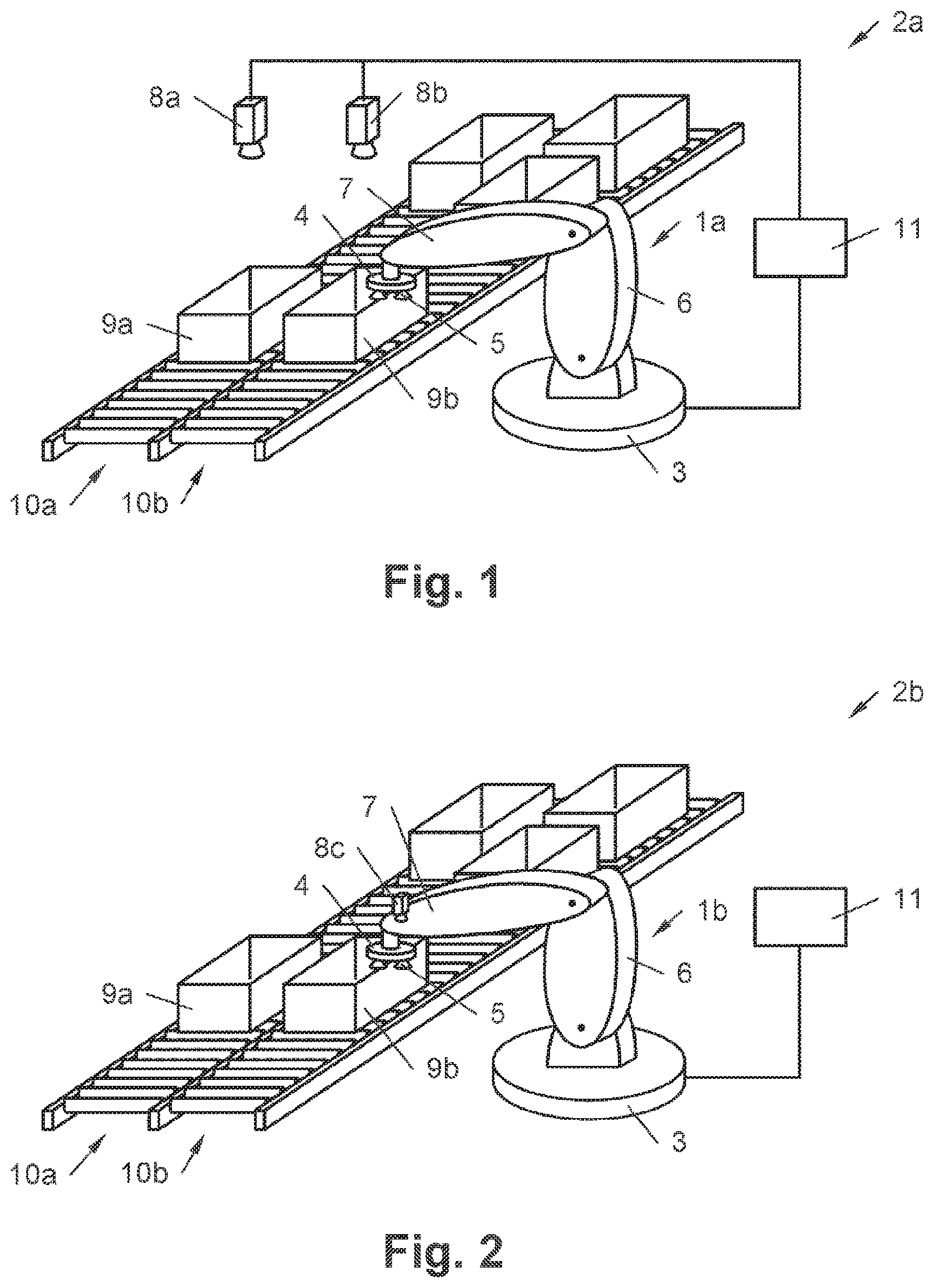
a first simplified example of a robot system having a robot and a stationarily installed camera system in an oblique view;
similar as in , but with a movable camera system having a camera mounted on a robot arm segment of the robot;
a schematically shown example of a storage and order-picking system in a top view;
an exemplary robot head having three suction grippers in a top view;
the robot head from in a bottom view;
an exemplary robot head having two suction grippers in a bottom view;
an exemplary robot head having six suction grippers in a bottom view;
a loading aid (for example a container) storing multiple different goods of a first type of goods (rigid goods, such as boxes) and gripping poses of a robot head assigned to the respective goods;
a loading aid (for example a container) storing multiple identical (of just one type) goods (the same goods of a first type of goods, such as boxes) and gripping poses of a robot head assigned to the respective goods, and
an example of a loading aid (for example a container) storing multiple different goods of a second type of goods (deformable goods, such as polybags) and gripping poses of a robot head assigned to the respective goods.
DETAILED DESCRIPTION OF THE PREFERRED EMBODIMENTS
First of all, it is to be noted that in the different embodiments described, equal parts are provided with equal reference numbers and/or equal component designations, where the disclosures contained in the entire description may be analogously transferred to equal parts with equal reference numbers and/or equal component designations. Moreover, the specifications of location, such as at the top, at the bottom, at the side, chosen in the description refer to the directly described and depicted figure and in case of a change of position, are to be analogously transferred to the new position.
shows a robot 1 a in a robot system 2 a . The robot 1 a comprises a robot head 4 which is movable in relation to a robot base 3 and which comprises three suction grippers 5 spaced apart from one another in this example. The robot head 4 is connected to the robot base 3 in an articulated manner via a robot arm comprising two arm segments 6 and 7 . Moreover, shows a sensor system 8 a , 8 b , which serves for the detection of a gripping surface pose and a gripping surface size of a gripping surface of a good and, in the present example, comprises two cameras. However, the goods are not visible in since they are stored in the goods carriers 9 a and 9 b , which are designed as containers. The container 9 a is a source container from which goods are gripped/removed by the robot head 4 , and the container 9 b is a target container, into which goods are placed/thrown by the robot head 4 . The cameras 8 a , 8 b are arranged above the containers 9 a and 9 b and are each designed as a stereo camera in this example. Accordingly, the cameras 8 a , 8 b detect a three-dimensional image of the inside of at least the containers 9 a and 9 b and the goods stored therein. In general, it is also possible that merely the camera 8 a (stereo camera) is provided above the container 9 a . Furthermore, it is conceivable that merely one common camera 8 a (stereo camera) is provided for the containers 9 a and 9 b . Although stereo cameras are used in a preferred embodiment, the cameras 8 a , 8 b can also be designed as a camera for detecting a two-dimensional image of the inside of at least the containers 9 a and 9 b and the goods stored therein.
The arrangement shown in further comprises a conveying device for transporting the containers 9 a , 9 b to the robot system 2 a and for transporting the containers 9 a , 9 b away from the robot system 2 a . In particular, the conveying device comprises a first conveying path 10 a for transporting the containers 9 a , 9 b to the robot system 2 a and a second conveying path 10 b for transporting the containers 9 a , 9 b away from the robot system 2 a . Lastly, the arrangement shown in comprises a controller 11 , which is connected to the cameras 8 a , 8 b and the robot 1 a and serves for calculating from the determined gripping surface pose and gripping surface size a gripping pose for the movable robot head 4 in which a maximum number of suction grippers 5 is in contact with the gripping surface of the mentioned good. Moreover, the controller 11 serves for moving the robot head 5 into the calculated gripping pose and for activating the suction grippers 5 that are in contact with or are coming into contact with the gripping surface of the mentioned good, so as to grip the good. The precise alignment of the robot head 5 is not shown in detail in , is, however, elucidated in more detail by means of to 10 .
shows a robot system 2 b which is very similar to the robot system 2 a shown in . In contrast, however, no cameras 8 a , 8 b are arranged above the containers 9 a and 9 b , but a single camera 8 c is arranged directly on the second arm segment 7 of the robot 1 b . This camera 8 c is also connected to a controller 11 (connection not shown). This camera 8 c can, in turn, be designed as a stereo camera, to detect a three-dimensional image of the containers 9 a and 9 b as well as the goods stored therein, for example by the camera 8 c being moved above the container 9 a or above the container 9 b by means of the robot 1 a and an image being detected there. However, it would also be conceivable that the camera 8 c is designed merely for detecting a two-dimensional image, and a three-dimensional image of the containers 9 a and 9 b as well as of the goods stored therein is generated by detecting multiple two-dimensional images during a movement of the camera 8 c and subsequent calculation of the three-dimensional image. At this point, it should also be noted that the camera 8 c can also be combined with the cameras 8 a , 8 b of the robot system 1 a of .
shows a storage and order-picking system 12 comprising a building 13 as well as a gate at a goods receiving 14 and a gate at a goods issue 15 . In the region of the goods receiving 14 , there is a first conveying path 16 and two second conveying paths 17 a and 17 b . The first conveying path 16 connects the goods receiving 14 to the robot system 2 c . The two second conveying paths 17 a and 17 b connect the robot system 2 c to a storage area 18 , which comprises multiple storage racks 19 as well as storage and retrieval units 20 a and 20 b , which move in rack aisles running between the storage racks 19 . At that end of the rack aisles, which is opposite to the second conveying paths 17 a and 17 b , there is a third conveying path 21 , which is designed annularly and leads to a further robot system 2 d in the present example. A fourth conveying path 22 , which connects the robot system 2 d to the goods issue 15 in terms of conveyance, is arranged in the operating range of the robot system 2 d as well.
shows a robot head 4 a with three suction grippers 5 a , 5 b and 5 c from the top and in a detailed view. shows the robot head 4 a with the three suction grippers 5 a , 5 b and 5 c from below.
shows a further embodiment of a robot head 4 b with two suction grippers 5 a and 5 b from below. shows a further embodiment of a robot head 4 c with six suction grippers 5 from below. Of course, an embodiment of a robot head 4 , in which three suction grippers 5 a . . . 5 c are arranged in one line, as is the case in the exemplary embodiment according to , is also conceivable.
In the examples according to to 7 , the suction grippers 5 , 5 a . . . 5 c in each case form one suction gripper unit.
to 10 now each show multiple goods 23 f . . . 23 n which are stored in goods carriers 9 a , which are designed as box-shaped containers in this example. Furthermore, the robot head 4 with the suction grippers 5 a . . . 5 c can be seen in different gripping poses.
The function of the arrangements shown in the figures is now explained in detail below:
In a first step, a gripping surface pose and a gripping surface size of a gripping surface of a good is determined using the sensor system 8 a , 8 b (here with the aid of two stereo cameras) shown in . In a specific example, the good 23 f is referred to for this purpose. The good 23 f has a gripping surface 24 f pointing upwards, which is designed to be rectangular and plane in this example. It can be gathered from the determined gripping surface size that merely one of the suction grippers 5 a . . . 5 c can be brought into contact with the gripping surface 24 f . Accordingly, the controller 11 calculates a gripping pose for the movable robot head 4 in which the suction gripper 5 a is in contact with the gripping surface 24 f . Then, the robot head 4 is moved into the calculated gripping pose shown in and the suction gripper 5 a that is in contact with or during the movement of the robot head 4 will come into contact with the gripping surface 24 f is activated, so as to grip the good 23 f.
Further goods 23 g . . . 23 l are in the container 9 a . In this respect, the goods 23 g . . . 23 k each have a gripping surface 24 g . . . 24 k which can be brought into contact with two suction grippers 5 a and 5 b in each case. The good 23 l , in turn, has a gripping surface 24 l , which can be brought into contact with all three suction grippers 5 a , 5 b and 5 c.
It can in particular be gathered from that a gripping pose for the movable robot head 4 is calculated in which a maximum number of suction grippers 5 a . . . 5 c is in contact with a gripping surface 24 f . . . 24 l of a good 23 f . . . 23 l , also if the respective gripping surface 24 f . . . 24 l is not large enough to be in contact with all three suction grippers 5 a . . . 5 c of the robot head 4 . By the suggested measures, it is ensured that the goods 23 f . . . 23 l can each be gripped securely according to the sizes of their gripping surfaces 24 f . . . 24 l and that incorrect gripping and/or falling of the respective good 23 f . . . 23 h from the robot head 4 can be avoided.
It can further be gathered from that in the calculation of the gripping pose for the robot head 4 and/or in the motion of the robot head 4 into the gripping pose, a centroid of the area of the suction grippers 5 a . . . 5 c to be activated corresponds with a centroid of the area of the respective gripping surface 24 f . . . 24 l of the respective good 23 f . . . 23 l . The centroid of the area of a suction gripper 5 a is in the center of the circular suction gripper 5 a , the centroid of the area of two suction grippers 5 a , 5 b is in the center of the connecting line of the two centers of circles of the suction grippers 5 a , 5 b and the centroid of the area of three suction grippers 5 a . . . 5 c is on the z axis shown in . By the suggested measures, an even load on the suction grippers 5 a . . . 5 c can be achieved and/or tilting of the gripped good 23 f . . . 23 l can be avoided. This in particular holds true where the mass distribution in the gripped good 23 f . . . 23 l is homogeneous.
If this condition does not apply or does not apply sufficiently, then the centroid of the area of the suction grippers 5 a . . . 5 c to be activated advantageously corresponds with a center of mass of the mentioned good 23 f . . . 23 l projected vertically upwards in the calculation of the gripping pose and/or in the motion of the robot head 4 into the gripping pose. Hence, an even load on the suction grippers 5 a . . . 5 c can be achieved even then and tilting of the good 23 f . . . 23 l can be prevented if the mass distribution within the good 23 f . . . 23 l is not homogeneous. For realizing this method variant, knowledge of the mass distribution in the good 23 f . . . 23 l to be gripped is required. For example, it can be determined empirically and be stored in a database. By determining the gripping surface pose and accessing said database, consequently, the center of mass projected vertically onto the gripping surface 24 f . . . 24 l can be determined. This embodiment variant is thus particularly well-suited for combo-packs which contain goods of differing weight. In this case, for example, an imprint on these combo-packs can be used to determine the position of the center of mass of the combo-pack relative to the outer contour of the packaging. Thus, information about the location of the center of mass relative to a packaging and/or relative to an imprint on said packaging can be stored in the mentioned database. For detecting said imprint, it is advantageous if the sensor system comprises cameras 8 a . . . 8 c for detecting a gripping surface pose and a gripping surface size, as is shown in .
It can further be seen from that a plurality of goods 23 f . . . 23 l is stored in the first goods carrier 9 a designed as a box-shaped container and a gripping pose for one of these goods 23 f . . . 23 l is calculated. This means that a specific good 23 f . . . 23 l is removed from the goods carrier 9 a in a specific manner.
In general, it is advantageous if a contact of the robot head 4 with other goods than the good 23 f . . . 23 l to be gripped is prevented in the calculation of the gripping pose for the robot head 4 and/or in the motion of the robot head 4 into the gripping pose. Likewise, it is advantageous if a collision of the robot head 4 with a side wall of the container 9 a is prevented in the calculation of the gripping pose for the robot head 4 and/or in the motion of the robot head 4 into the gripping pose. Hence, the location and position of the other goods 23 g . . . 23 l remaining in the container 9 a is essentially maintained when a particular good 23 f is removed. Thus, a gripping surface pose and gripping surface size for multiple goods 23 f . . . 23 l determined once by the cameras 8 a . . . 8 c can be reused for the removal of a further good 23 g . . . 23 l after removal of said good 23 f . However, preferably, the gripping surface pose and gripping surface size are determined prior to each removal of a good 23 g . . . 23 l . Moreover, by the suggested measures, damage to the container 9 a and/or the robot head 4 is prevented too.
In particular, multiple gripping poses in which a maximum number of suction grippers 5 a . . . 5 c is in contact with the gripping surface 24 f . . . 24 l of the mentioned good 24 f . . . 24 l are calculated. Then, prior to the motion of the robot head 4 , the calculated gripping poses are checked for collisions with other goods than the good 23 g . . . 23 l to be gripped and/or with a side wall of the container. Lastly, the robot head 4 is moved into of the collision-free gripping poses. For example, in two suction grippers 5 a and 5 b (and thus the maximum number of suction grippers 5 a . . . 5 c ) would be in contact with the gripping surface 24 g of the good 23 g also if the robot head 4 were rotated about the vertical z axis by 180°; however, this would result in a collision with a side wall of the container 9 a . Thus, the robot head 4 is advantageously not moved into this gripping pose.
In the calculation of the gripping pose for the robot head 4 and/or in the motion of the robot head 4 into the calculated gripping pose, it is also advantageous if for a rotation into the gripping pose, the robot head 4 , starting out from a current pose, is rotated into that direction in which the smallest rotational angle is required for said rotation. With reference to , starting out from the gripping pose for the good 23 f , it is advantageous to slightly turn the robot head 4 to the left (in the shown example by approx. 10°) so as to grip the good 23 g . This way, the robot head 4 can be quickly rotated into a gripping pose required for gripping a good 23 f . . . 23 l . It would be less advantageous to rotate the robot head 4 to the right starting out from the gripping pose for the good 23 f for gripping the good 23 g . The mentioned variant, in this regard, refers not only to rotations about the vertical axis (z axis) but alternatively or additionally also to rotations about a horizontal axis (x axis and/or y axis), for example where the goods 23 f . . . 23 l to be gripped are lying in the container 9 a or standing in the container 9 a in a tilted orientation.
In particular, when there are multiple collision-free gripping poses, the robot head 4 is moved into that gripping pose for which based on the current pose of the robot head 4 the shortest way and/or the smallest rotation angle is required. Hence, short cycle times are achieved.
Moreover, it is advantageous if each suction gripper 5 a . . . 5 c can be controlled separately, since thereby unnecessary suction of air via the suction grippers 5 a . . . 5 c that are not required can be prevented.
In addition to this, it is advantageous if a holding status of each suction gripper 5 a . . . 5 c can be detected separately via sensors (not depicted), since this way it can be determined whether a holding force is established by one of the suction grippers 5 a . . . 5 c brought into contact with the gripping surface 24 f . . . 24 l.
shows an example in which the container 9 a is loaded with goods 23 g . . . 23 k of just one type. Moreover, the goods 23 g . . . 23 k lie in the container 9 a such that in each case a gripping surface 24 b . . . 24 k of the same size points upwards. At this point, it should be noted that even a container 9 a loaded so as to contain articles of just one type can contain goods 23 g . . . 23 k having different gripping surfaces 24 b . . . 24 k that point upwards, for example if some of the goods 23 g . . . 23 k lie in the container 9 a and other goods 23 g . . . 23 k stand in the container 9 a . Accordingly, it can be provided for that the robot head 4 is rotated about a horizontal axis if the largest gripping surface 24 g . . . 24 k can be gripped in this orientation of the robot head 4 . It would also be conceivable that a standing good 23 g . . . 23 k is knocked over by the robot head 4 prior to being gripped, so as to allow for easier contact with the largest gripping surface 24 b . . . 24 k.
The goods 23 f . . . 23 l shown in each have a rectangular gripping surface 24 f . . . 24 l . However, this is not an obligatory condition but the gripping surfaces of the goods to be gripped can also be shaped irregularly, as is shown in for the goods 23 m and 23 n . What has been said with regard to the goods 23 f . . . 23 l can be analogously applied to the goods 23 m and 23 n . In this context, reference is made to the fact that the goods 23 a . . . 23 n are not necessarily rigid bodies but can for example also be designed as a bag or a sack. In particular, the container 9 b shown in can, in turn, be loaded with goods 23 m and 23 n of just one type.
show the process when loading goods 23 a . . . 23 n from a first goods carrier 9 a (source container) into a second goods carrier 9 b (target container) using the robot head 4 . The goods carriers 9 a and 9 b formed as box-shaped containers are transported to the robot 1 a , 1 b by means of the conveying devices 10 a and 10 b for the loading operation and transported away from the robot 1 a , 1 b after the loading operation. However, the transport of the goods 23 a . . . 23 n using loading aids 9 a and 9 b is no necessary requirement, but the goods 23 a . . . 23 n can also be transported directly on the conveying device if this for example comprises a belt conveyor, a modular belt conveyor and the like as the first conveying path 10 a and a belt conveyor, a modular belt conveyor and the like as the second conveying path 10 b . Of course, roller conveyors 10 a and 10 b can be provided as well. Likewise, other loading aids, such as trays or cardboard boxes, can be provided in place of the containers 9 a and 9 b . Such loading aids comprise a bottom, side walls rising up from the bottom and a loading opening bounded by the side walls. However, the use of pallets as a loading aid is also conceivable.
If in the region of the robot system 2 a , 2 b loading aids (containers, trays, cardboard boxes) from which or out of which goods 23 a . . . 23 n are removed by means of the suction grippers 5 , 5 a . . . 5 c are used as first goods carriers, the (source) loading aids can advantageously be loaded with goods 23 a . . . 23 n of just one type or be loaded compartmentalized with goods 23 a . . . 23 n of just one type. For example, a first loading aid contains the good “A”, a second loading contains the good “B” and so on. As opposed to this, it is also possible that a loading aid is divided into multiple receiving compartments by means of dividing walls and can accommodate different goods “A”, “B”, wherein a good “A” can be accommodated in the first receiving compartment and a good “B” can be accommodated in the second receiving compartment.
shows a fairly more complex arrangement, in specific terms a storage and order-picking system 12 . In this regard, goods 23 a . . . 23 e are delivered to the goods receiving 14 , loaded onto the first conveying path 16 , transferred from the first conveying path 16 to the second conveying paths 17 a and 17 b by the robot system 2 c and stored in the storage racks 19 by means of the storage and retrieval units 20 a and 20 b . The first conveying path 16 in this operation acts as the first goods carrier and/or the source, whereas the second conveying paths 17 a and 17 b in this operation act as the second goods carrier and/or the target.
When a picking order is to be processed, the goods 23 a . . . 23 e assigned to the order are removed from at least one storage rack 19 using at least one storage and retrieval unit 20 a and 20 b and transferred to the third conveying path 21 . Then, the goods 23 a . . . 23 e are transported to the robot system 2 d using the third conveying path 21 and transferred from the third conveying path 21 to the fourth conveying path 22 by said robot system 2 d and are lastly transported to the goods issue 15 using the fourth conveying path 22 . The third conveying path 21 in this operation acts as the first goods carrier and/or the source, whereas the fourth conveying path 22 in this operation act as the second goods carrier and/or the target.
As can be seen from , the goods 23 a , 23 b and 23 e are transported directly on the conveying paths 16 , 17 a , 17 b , 21 and 22 acting as goods carriers, whereas the goods 23 c and 23 d are transported using loading aids 9 c . . . 9 e , which accordingly also act as goods carriers. Thus, shows a mixed type of transport. It would certainly also be conceivable that the goods 23 a . . . 23 e are transported solely on the conveying paths 16 , 17 a , 17 b , 21 and 22 acting as goods carrier or solely using the loading aids 9 c . . . 9 e.
Of course, the design and arrangement of the conveying paths 16 , 17 a , 17 b , 21 and 22 in is to be considered illustrative and other formations and arrangements of the mentioned conveying paths 16 , 17 a , 17 b , 21 and 22 are also conceivable. In particular, an annular conveying path could be arranged at the goods receiving 14 , or linear conveying paths could be provided at the goods issue 15 . The conveyor connection of the robot system 2 c and 2 d to the goods receiving 14 , to the storage area 18 and to the goods issue 15 is not necessarily established via stationary conveying means, as shown in , but could also take place in whole or in part via autonomous transport vehicles (in particular autonomous floor conveyors), whose loading platforms then also serve as goods carriers.
It would further be conceivable that the goods 23 a . . . 23 e are loaded directly onto the storage and retrieval units 20 a and 20 b by the robot system 2 c or are taken over directly from the storage and retrieval units 20 a and 20 b by the robot system 2 d . In this case, the loading platforms of the storage and retrieval units 20 a and 20 b also serve as goods carriers.
At this point, it should also be noted that the robots 1 a and 1 b do not necessarily have to be designed as jointed-arm robots, but can also be designed for example as gantry robots.
It should further be noted that the sensor system can not only comprise cameras 8 a . . . 8 c , but alternatively or additionally also a room depth sensor, a laser scanner and/or an ultrasonic sensor. Using these sensors, not only a two-dimensional but also a three-dimensional image of the goods 23 a . . . 23 n lying in or on a goods carrier (for example in the containers or on the conveying paths) can be detected. Accordingly, an inclined position of a gripping surface 24 a . . . 24 n can also be detected, which is caused for example by a tilted position of the good 23 a . . . 23 n to be gripped in or on the goods carrier. Moreover, by the three-dimensional detection a surface structure of the gripping surface 24 a . . . 24 n can be detected as well and the suitability for gripping by means of the suction grippers 5 , 5 a . . . 5 c can be determined. For example, highly convex surfaces are less suitable as gripping surface 24 a . . . 24 n , whereas plane surfaces are particularly well-suited as gripping surfaces 24 a . . . 24 n . At this point, it should be noted that a surface structure and/or an inclined position of a gripping surface 24 a . . . 24 n , due to the distorted image, can also be determined using a camera for detecting a two-dimensional image if the shape of the gripping surface 24 a . . . 24 n is generally known.
It should also be noted that the goods 23 a . . . 23 n may be arranged in or on the first goods carrier 9 a , 9 c , 9 e , 10 a , 16 , 21 next to each other, on top of each other, standing upright or lying, in particular disordered (chaotic) and/or in a random arrangement.
Moreover, it is conceivable that multiple two-dimensional images are captured by a relative movement between the camera and the gripping surfaces 24 a . . . 24 n and a two-dimensional image of the mentioned gripping surfaces 24 a . . . 24 n is calculated therefrom.
Finally, it should also be noted that the scope of protection is determined by the claims. However, the description and the drawings are to be adduced for construing the claims. Individual features or feature combinations from the different exemplary embodiments shown and described may represent independent inventive solutions. The object underlying the independent inventive solutions may be gathered from the description.
In particular, it should also be noted that the devices shown may in reality comprise more or less components than those shown. In some cases, the shown devices and/or their components may not be depicted to scale and/or be enlarged and/or reduced in size.
LIST OF REFERENCE NUMBERS
•
• 1 a , 1 b robot • 2 a . . . 2 d robot system • 3 robot base • 4 , 4 a . . . 4 c robot head • 5 , 5 a . . . 5 c suction gripper • 6 first robot arm segment • 7 second robot arm segment • 8 a . . . 8 c camera (sensor system) • 9 a . . . 9 e container (goods carrier) • 10 a , 10 b conveying device (goods carrier) • 11 controller • 12 storage and order-picking system • 13 building wall • 14 goods receiving • 15 goods issue • 16 first conveying path (goods carrier) • 17 a , 17 b second conveying path (goods carrier) • 18 storage area • 19 storage rack • 20 a , 20 b storage and retrieval unit • 21 third conveying path (goods carrier) • 22 fourth conveying path (goods carrier) • 23 a . . . 23 n good(s) • 24 a . . . 24 n gripping surface
Figures (5)
Citations
This patent cites (92)
- US4242025
- US5564893
- US5605432
- US6681151
- US8788086
- US9026243
- US9205558
- US9381645
- US9452894
- US9457477
- US9665946
- US9751693
- US9827677
- US9868207
- US9926138
- US10108194
- US10549928
- US10625305
- US10773839
- US10926408
- US11514386
- US11858743
- US20050226711
- US20060182545
- US20080181753
- US20090279999
- US20100221094
- US20110170998
- US20110264259
- US20130041495
- US20140023461
- US20140205403
- US20140234066
- US20140244026
- US20150057793
- US20150314439
- US20150336741
- US20150370239
- US20160009493
- US20160016311
- US20160207195
- US20160236867
- US20160244262
- US20160297611
- US20170050315
- US20170088360
- US20170151673
- US20170322561
- US20180057263
- US20180257225
- US20190102965
- US20190185267
- US20190270197
- US20200078935
- US20200385209
- US511 867
- US201711969
- US202640363
- US205552559
- US206066477
- US44 07 324
- US10 2007 005 534
- US10 2015 007 863
- US10 2015 011 527
- US10 2016 008 078
- US0 616 874
- US1 986 165
- US2 315 714
- US2 650 237
- US2 783 799
- US2 923 971
- US3 112 295
- US2 984 007
- US3 248 915
- US3 263 292
- USS52-59475
- USH06-39387
- US2003-181786
- US56-17512
- US2018-015815
- US2006/065147
- US2009/094995
- US2012/163666
- US2013/090970
- US2015/118171
- US2016010968
- US2016/100235
- US2016/138101
- US2017/143367
- US2017/198281
- US2018/006112
- US2018132855