Microorganisms and Methods for the Production of Fatty Acids and Fatty Acid Derived Products
Abstract
This invention relates to metabolically engineered microorganism strains, such as bacterial strains, in which there is an increased utilization of malonyl-CoA for production of a fatty acid or fatty acid derived product, wherein the modified microorganism produces fatty acyl-CoA intermediates via a malonyl-CoA dependent but malonyl-ACP independent mechanism.
Claims (19)
1. A genetically modified organism comprising a heterologous nucleic acid sequence encoding a NphT7 polypeptide, a heterologous nucleic acid sequence encoding a thioesterase, and comprising a heterologous nucleic acid sequence encoding a modified NphT7 polypeptide; wherein the modified NphT7 polypeptide comprises amino acid substitutions at positions Ile147 and Phe217, and wherein said microorganism is capable of producing an acyl-CoA having a carbon chain length of C6 or greater.
Show 18 dependent claims
2. The genetically modified organism of claim 1 , wherein the modified NphT7 polypeptide comprises an amino acid substitution selected from the group consisting of F217A, F217E, F217G, F217I, F217L, F217M, F217P, F217S, F217T, F217V, and F217W and an amino acid substitution selected from the group consisting of I147A, I147C, I147D, I147E, I147F, I147G, I147H, I147K, I147L, I147M, I147N, I147P, I147Q, I147R, I147S, I147T, I147V, I147W, and I147Y.
3. The genetically modified organism of claim 1 , wherein the modified NphT7 polypeptide comprises two amino acid substitutions selected from the group consisting of I147T and F217V, I147F and F217V, I147M and F217V, I147S and F217V, I147T and F217G, I147T and F217A, I147T and F217L, I147T and F217P, I147T and F217S, I147T and F217E, I147S and F217G, I147S and F217A, I147S and F217L, I147S and F217I, I147S and F217M, I147S and F217W, I147S and F217S, I147S and F217E, I147S and F217K, I147F and F217A, I147F and F217L, I147F and F217I, I147F and F217M, I147F and F217P, I147F and F217E, I147M and F217G, I147M and F217A, I147M and F217L, I147M and F217I, I147M and F217M, I147M and F217P, I147M and F217S, I147M and F217E, and I147M and F217K.
4. The genetically modified organism of claim 1 , wherein the modified NphT7 polypeptide comprises three amino acid substitutions selected from the group consisting of Y144L, 1147T, and F217V; 1147T, F217V, and HFLQ; I147T, V157F, and F217V; and Y144L, I147T, and V157F.
5. The genetically modified organism of claim 1 , wherein the modified NphT7 polypeptide additionally comprises one or more amino acid substitutions at a position selected from the group consisting of Ser84, Val114, Gly288, Ile194, Gly318, Thr85, Gln90, Val196, Tyr144, and Phe159.
6. The genetically modified organism of claim 1 , further comprising a heterologous nucleic acid sequence encoding a termination enzyme that catalyzes the production of a fatty acid-derived product selected from the group comprising a fatty alcohol, a fatty aldehyde, a fatty alkene, a fatty amide, a fatty alkane, and a fatty diacid.
7. The genetically modified organism of claim 1 , wherein the thioesterase is an acyl-CoA esterase and the organism is capable of producing a fatty acid.
8. The genetically modified organism of claim 7 , wherein the thioesterase is selected from the group comprising tesA, ‘tesA, tesB, yciA, ybgC, ybfF, fadM, AtTE, CpTE, CperfTE, LpTE, and PA2801TE.
9. The genetically modified organism of claim 7 , wherein the thioesterase comprises an amino acid sequence of at least 70% homology to any one of SEQ ID NO 277, SEQ ID NO 278, SEQ ID NO 279, SEQ ID NO 280, SEQ ID NO 281, SEQ ID NO 282, SEQ ID NO 283, SEQ ID NO 284, SEQ ID NO 285, SEQ ID NO 286, SEQ ID NO 287, and SEQ ID NO 288.
10. The genetically modified organism of claim 1 , wherein the proteins encoded by the polynucleotides are capable of producing a six carbon fatty acid or fatty acid derived product.
11. The genetically modified organism of claim 1 , wherein the genetically modified organism comprises; a) a heterologous nucleic acid sequence encoding keto-CoA reductase fadB; b) a heterologous nucleic acid sequence encoding 3-hydroxy-acyl-CoA dehydratase fadB; c) a heterologous nucleic acid sequence encoding enoyl-CoA reductase ter; and d) the thioesterase is selected from the group consisting of AtTE, CpTE, CperfTE, PA2801TE, tesA, tesB, ybfF, ybgC, and yciA,
12. The genetically modified organism of claim 11 , wherein the thioesterase is selected from the group consisting of PA2801TE, tesB, and yciA.
13. The genetically modified organism of claim 1 , wherein the genetically modified organism comprises; a) a heterologous nucleic acid sequence encoding a keto-CoA reductase selected from the group consisting of fadB and fabG; b) a heterologous nucleic acid sequence encoding a 3-hydroxy-acyl-CoA dehydratase selected from the group consisting of fadB, ech, and ech2; c) a heterologous nucleic acid sequence encoding enoyl-CoA reductase ter; and d) the thioesterase is selected from the group consisting of AtTE, CpTE, CperfTE, fadM, PA2801TE, tesA, tesB, ybfF, ybgC, and yciA;
14. The genetically modified organism of claim 1 , wherein the genetically modified organism comprises a) a heterologous nucleic acid sequence encoding a keto-CoA reductase selected from the group consisting of fadB and fabG; b) a heterologous nucleic acid sequence encoding a 3-hydroxy-acyl-CoA dehydratase selected from the group consisting of fadB, ech and ech2; c) a heterologous nucleic acid sequence encoding enoyl-CoA reductase ter; and d) the thioesterase is selected from the group consisting of AtTE, CpTE, fadM, PA2801TE, tesA, tesB, ybfF, ybgC, and yciA,
15. The genetically modified organism of claim 1 , wherein the genetically modified organism comprises a) a heterologous nucleic acid sequence encoding a keto-CoA reductase is selected from the group consisting of fadB, fabG, and fadJ, b) a heterologous nucleic acid sequence encoding a 3-hydroxy-acyl-CoA dehydratase is selected from the group consisting of fadB, ech, and fadJ; c) a heterologous nucleic acid sequence encoding enoyl-CoA reductase ter; and d) the thioesterase is selected from the group consisting of AtTE, CpTE, CperfTE, fadM, LpTE, PA2801TE, tesA, tesB, ybfF, ybgC, and yciA,
16. The genetically modified organism of claim 1 , wherein a) the keto-CoA reductase is selected from the group consisting of fadB, and fadJ; b) the 3-hydroxy-acyl-CoA dehydratase is selected form the group consisting of fadB, and fadJ; c) the enoyl-CoA reductase is selected from the group consisting of ter, ydiO and fadE; and d) the thioesterase is selected from the group consisting of AtTE, CpTE, CperfTE, fadM, LpTE, PA2801TE, tesA, tesB, ybfF, ybgC, and yciA,
17. The genetically modified organism of claim 1 , wherein the organism is capable of using acetyl-CoA as a primer and malonyl-CoA as the extender molecule to produce a fatty acid or fatty acid derived product have a carbon chain length selected from 6, 8, 10, 12, 14, 16, 18 and 20.
18. The genetically modified organism of claim 1 , wherein the modified NphT7 comprises amino acid substitutions I147S and F217V.
19. The genetically modified organism of claim 1 , wherein the thioesterase is yciA.
Full Description
Show full text →
CROSS-REFERENCE TO RELATED APPLICATIONS
This application is a Continuation of U.S. patent application Ser. No. 15/386,506, filed Dec. 21, 2016, which is a Continuation of U.S. patent application Ser. No. 13/981,517, filed Jul. 24, 2013, which is a national phase application of International Application No. PCT/US2012/022612, filed Jan. 25, 2012, which claims the benefit of U.S. Provisional Patent Application No. 61/436,185, filed Jan. 25, 2011, each of which is incorporated by reference herein in its entirety.
STATEMENT REGARDING FEDERALLY SPONSORED RESEARCH
This invention was made with Government support under DE-AR0000088 awarded by the United States Department of Energy. The Government has certain rights in this invention.
SEQUENCE LISTING
The instant application contains a Sequence Listing which has been submitted in ASCII format via EFS-Web and is hereby incorporated by reference in its entirety. Said ASCII copy, created on Jan. 22, 2016 is named 24433-780-981-SL.txt and is 905 Kilobytes in size.
BACKGROUND
Fatty acid and fatty acid derivatives (such as fatty acid methyl esters (FAME), fatty alcohols, fatty amines, etc.) are important precursors to manufacturing many consumer products, industrial chemicals and fuels. For example, fatty acids and fatty acid derivatives are used to make detergents, cleaners, plastics, paper, paints, lubricants, waxes, coatings and surfactants. They can also be used as flavor and fragrance agents. Currently, fatty acids and fatty acid derivatives are produced from oleochemical (plant and animal fats) or petrochemical sources. In general, the fatty acids derived from oleochemical sources have aliphatic chains with an even number of carbons, whereas fatty acids derived from petrochemical sources have aliphatic chains with an odd number of carbons.
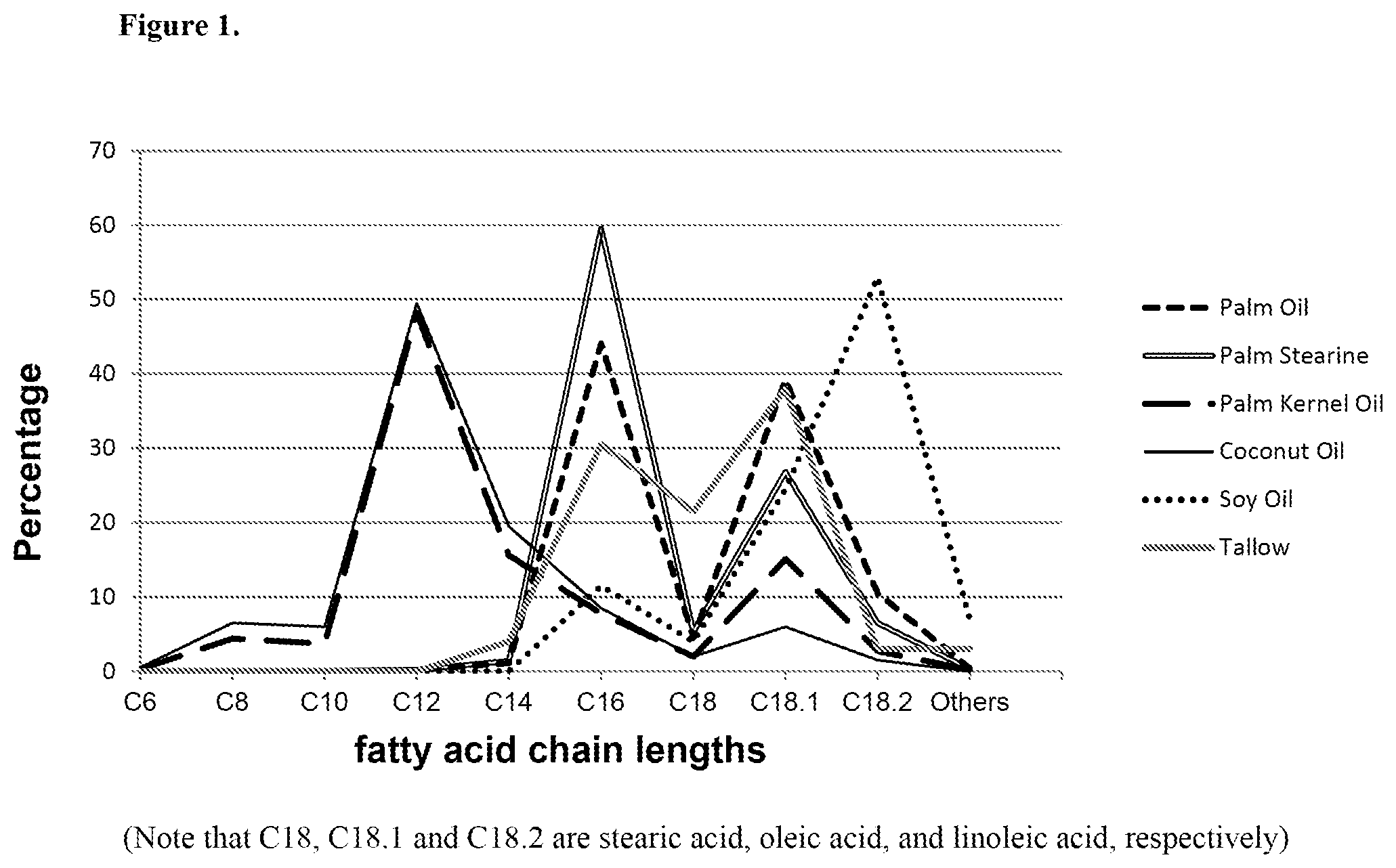
Both oleochemical and petrochemical fatty acids have significant shortcomings. Most notably, the feedstocks used to produce such fatty acids generally include a mixture of fatty acids of varying carbon chain lengths and may include a wide range of chain lengths, as well as saturated and unsaturated fatty acids. is a chart that illustrates the fatty acid carbon composition of various common oleochemical feedstocks. Many of the commercial applications for fatty acids and fatty acid derivatives, however, require a fatty acid precursor having greater specificity with respect to its aliphatic chain lengths. For example, C6-C10 fatty acids are used in the production of jet lubricants, C12-C14 fatty acids are used to make surfactants and detergents, and C16-C18 fatty acids are used for metal soap production. As a result, current fatty acid production methods require costly feedstock processing procedures, such as fractionation and distillation, in order to isolate the fatty acid components required for a given application. There are technical limits to the effectiveness of such processing procedures and their ability to isolate relatively high concentrations of fatty acids of isolated chain lengths.
Another short coming of oleochemical and petrochemical fatty acids is the wide fluctuation in the cost of the feedstocks. Oleochemical feedstock prices are extremely volatile and can significantly fluctuate from year to year and fluctuate among the various geographic regions. Since overall production costs are very sensitive to feedstock price, such volatility can significantly impact margins. Regarding petrochemical fatty acids, there is increasing acceptance that petroleum hydrocarbon supplies are decreasing, and as a result their costs are expected to continue to increase.
Finally, there is increasing concern regarding sustainability within the chemical industry, and there is a growing demand for chemicals produced from renewable resources. In fact, many chemical companies and their customers have implemented sustainability initiatives with a goal of replacing current chemicals such as petro-based chemicals with chemicals made from renewable sources. Such companies are seeking renewable chemicals that have minimal impact on product performance or characteristics, as well as minimal impact on downstream products and customers. There are even sustainability concerns within the oleochemical industry. Although many of the oleochemical fatty acids are derived from renewable resources, current industry practices do not manage the harvesting of these resources in a sustainable way. For example, there has been significant concern regarding deforestation in the production of palm oil, a primary source for oleochemical fatty acids.
In view of these shortcomings regarding petro-based and oleo-based fatty acids and fatty acid derivatives, interest has increased for developing and improving industrial microbial systems for production of chemicals and fuels using sustainable plant-based feedstocks. Such industrial microbial systems could completely or partially replace the use of petroleum hydrocarbons or oleochemicals for production of certain chemicals and products.
Numerous chemicals are produced through such microbial systems, ranging from antibiotic and anti-malarial pharmaceutical products to fine chemicals to fuels such as ethanol. However, there is still a commercial need for modified microorganisms that are adapted to produce fatty acids and fatty acid derived products, and in particular, fatty acid and fatty acid derived products that have a high concentration of a specific fatty acid chain length.
SUMMARY OF THE INVENTION
In one aspect the disclosure provides for a genetically modified organism comprising a heterologous nucleic acid sequence encoding a 3-ketoacyl-CoA synthase, a ketoacyl-CoA reductase, a hydroxyacyl-CoA dehydratase, or an enoyl-CoA reductase; and wherein said microorganism is capable of producing a fatty acid or fatty acid-derived product having a carbon chain length of C4 or greater. In some embodiments, the 3-ketoacyl-CoA synthase comprises NphT7. In some embodiments, the 3-ketoacyl-CoA synthase comprises an amino acid sequence of at least 70% homology to any one of SEQ ID NOs. 1-120. In some embodiments, the ketoacyl-CoA reductase is selected from the group consisting of a 3-ketobutyryl-CoA reductase, a 3-hydroxybutyryl-CoA dehydrogenase, a 3-ketovaleryl-CoA reductase, and 3-hydroxyvaleryl-CoA dehydrogenase. In some embodiments, the ketoacyl-CoA reductase comprises an amino acid sequence of at least 70% homology to any one of SEQ ID NO 183 and SEQ ID NO 271. In some embodiments, the hydroxyacyl-CoA dehydratase is selected from the group consisting of a 3-hydroxybutyryl-CoA dehydratase and an enoyl-CoA hydratase. In some embodiments, the hydroxyacyl-CoA dehydratase comprises an amino acid sequence of at least 70% homology to any one of SEQ ID NO 183 and SEQ ID NO 272. In some embodiments, the enoyl-CoA reductase is trans-2-enoyl-reductase. In some embodiments, the enoyl-CoA reductase comprises an amino acid sequence of at least 70% homology to SEQ ID NO 275. In some embodiments, the 3-ketoacyl-CoA synthase comprises a modified NphT7 polypeptide comprising one or more amino acid substitutions selected from the group consisting of a PDRP to HFLQ substitution for amino acids 86-89, F217A, F217E, F217G, F217I, F217L, F217M, F217P, F217S, F217T, F217V, F217W, G288S, G309S, I147A, I147C, I147D, I147E, I147F, I147G, I147H, I147K, I147L, I147M, I147N, I147P, I147Q, I147R, I147S, I147T, I147V, I147W, I147Y, V157F, V196G, and Y144L. In some embodiments, the 3-ketoacyl-CoA synthase comprises a modified NphT7 polypeptide comprising two amino acid substitutions selected from the group consisting of I147T and F217V, I147T and Y144L, I147T and V196G, I147F and F217V, I147M and F217V, I147S and F217V, I147T and HFLQ, I147T and V157F, I147T and F217G, I147T and F217A, I147T and F217L, I147T and F217I, I147T and F217M, I147T and F217P, I147T and F217S, I147T and F217E, I147S and F217G, I147S and F217A, I147S and F217L, I147S and F217I, I147S and F217M, I147S and F217W, I147S and F217S, I147S and F217E, I147S and F217K, I147F and F217A, I147F and F217L, I147F and F217I, I147F and F217M, I147F and F217P, I147F and F217E, I147M and F217G, I147M and F217A, I147M and F217L, I147M and F217I, I147M and F217M, I147M and F217P, I147M and F217S, I147M and F217E, and I147M and F217K. In some embodiments, the 3-ketoacyl-CoA synthase comprises a modified NphT7 polypeptide comprising three amino acid substitutions selected from the group consisting of Y144L, I147T, and F217V; I147T, F217V, and HFLQ; I147T, V147F, and F217V; and Y144L, I147T, and V157F. In some embodiments, the 3-ketoacyl-CoA synthase comprises a modified NphT7 polypeptide comprising one or more amino acid substitutions at a position selected from the group consisting of Ser84, Val114, Gly288, Ile194, Gly318, Thr85, Gln90, Val196, Tyr144, Phe159, Ile147, and Phe217. In some embodiments, the ketoacyl-CoA reductase is selected from the group consisting 3-ketoacyl-CoA reductase and 3-hydroxyacyl-CoA dehydrogenase. In some embodiments, the ketoacyl-CoA reductase comprises an amino acid sequence of at least 70% homology to any one of SEQ ID NO 183 and SEQ ID NO 271. In some embodiments, the hydroxyacyl-CoA dehydratase is selected from the group consisting of a 3-hydroxyacyl-CoA dehydratase and enoyl-CoA hydratase. In some embodiments, the hydroxyacyl-CoA dehydratase comprises an amino acid sequence of at least 70% homology to any one of SEQ ID NO 183, and SEQ ID NO 272. In some embodiments, the enoyl-CoA reductase is trans-2-enoyl-reductase. In some embodiments, the enoyl-CoA reductase comprises an amino acid sequence of at least 70% homology to SEQ ID NO 275. In some embodiments, the genetically modified organism further comprises a heterologous nucleic acid sequence encoding a thioesterase or a wax ester synthase. In some embodiments, the genetically modified organism further comprises a heterologous nucleic acid sequence encoding a termination enzyme that catalyzes the production of a fatty acid-derived product selected from the group comprising a fatty alcohol, a fatty aldehyde, a fatty alkene, a fatty amide, a fatty alkane, and a fatty diacid. In some embodiments, the thioesterase is an acyl-CoA esterase and the organism is capable of producing a fatty acid. In some embodiments, the thioesterase is selected from the group comprising tesA, 'tesA, tesB, yciA, ybgC, ybfF, fadM, AtTE, CpTE, CperfTE, LpTE, and PA2801TE. In some embodiments, the thioesterase comprises an amino acid sequence of at least 70% homology to any one of SEQ ID NO 277, SEQ ID NO 278, SEQ ID NO 279, SEQ ID NO 280, SEQ ID NO 281, SEQ ID NO 282, SEQ ID NO 283, SEQ ID NO 284, SEQ ID NO 285, SEQ ID NO 286, SEQ ID NO 287, and SEQ ID NO 288. In some embodiments, the wax ester synthase is selected from the group comprising Maq1, Pcry1, Rjos1, and Abork1, and wherein said organism is capable of producing a fatty ester. In some embodiments, the wax ester synthase comprises an amino acid sequence of at least 70% homology to any one of SEQ ID NO 289, SEQ ID NO 290, SEQ ID NO 291, and SEQ ID NO 292, and wherein said organism is capable of producing a fatty ester. In some embodiments, the 3-ketoacyl-CoA synthase is NphT7; the keto-CoA reductase is selected from the group consisting of hbd and fadB; the 3-hydroxy-acyl-CoA dehydratase is selected from the group consisting of crt and fadB; the enoyl-CoA reductase is ter; and the thioesterase is selected from the group consisting of CpTE, fadM, PA2801TE, tesB, ybgC, ybfF, and yciA, and wherein the proteins encoded by the polynucleotides are capable of producing a four or five carbon fatty acid or fatty acid derived product. In some embodiments, the thioesterase is selected from the group consisting of tesB and yciA. In some embodiments, one or more 3-ketoacyl-CoA synthases are selected from the group consisting of NphT7, NphT7 I147T, NphT7 F217V, and NphT7 I147T, F217V; the keto-CoA reductase is fadB; the 3-hydroxy-acyl-CoA dehydratase is fadB; the enoyl-CoA reductase is ter; and the thioesterase is selected from the group consisting of AtTE, CpTE, CperfTE, PA2801TE, tesA, tesB, ybfF, ybgC, and yciA, and wherein the proteins encoded by the polynucleotides are capable of producing a six or seven carbon fatty acid or fatty acid derived product. In some embodiments, the thioesterase is selected from the group consisting of PA2801TE, tesB, and yciA. In some embodiments, one or more 3-ketoacyl-CoA synthases are selected from the group consisting of NphT7, NphT7 I147T, NphT7 F217V, NphT7 I147T and F217V, Npth7 I147S, Npth7 I147S and F217V, and synthase III; the keto-CoA reductase is selected from the group consisting of fadB and fabG; the 3-hydroxy-acyl-CoA dehydratase is selected from the group consisting of fadB, ech and ech2; the enoyl-CoA reductase is ter; and the thioesterase is selected from the group consisting of AtTE, CpTE, CperfTE, fadM, PA2801TE, tesA, tesB, ybfF, ybgC, and yciA; and wherein the proteins encoded by the polynucleotides are capable of producing an eight or nine carbon fatty acid or fatty acid derived product. In some embodiments, the thioesterase is selected from the group consisting of PA2801TE, tesB, and yciA. In some embodiments, one or more 3-ketoacyl-CoA synthases are selected from the group consisting of NphT7, NphT7 I147T, NphT7 F217V, NphT7 I147T and F217V, Npth7 I147S, Npth7 I147S and F217V, synthase III, synthase IV, and synthase V; the keto-CoA reductase is selected from the group consisting of fadB and fabG; the 3-hydroxy-acyl-CoA dehydratase is selected from the group consisting of fadB, ech and ech2; the enoyl-CoA reductase is ter; and the thioesterase is selected from the group consisting of AtTE, CpTE, fadM, PA2801TE, tesA, tesB, ybfF, ybgC, and yciA, and wherein the proteins encoded by the polynucleotides are capable of producing a ten or eleven carbon fatty acid or fatty acid derived product. In some embodiments, the thioesterase is selected from the group consisting of tesB and yciA. In some embodiments, one or more 3-ketoacyl-CoA synthases are selected from the group consisting of NphT7, NphT7 I147T, NphT7 F217V, NphT7 I147T and F217V, Npth7 I147S, Npth7 I147S and F217V, synthase III, synthase IV, synthase V, and synthase VI; the keto-CoA reductase is selected from the group consisting of fadB, fabG, and fadJ, the 3-hydroxy-acyl-CoA dehydratase is selected from the group consisting of fadB, ech, and fadJ; the enoyl-CoA reductase is ter; and the thioesterase is selected from the group consisting of AtTE, CpTE, CperfTE, fadM, LpTE, PA2801TE, tesA, tesB, ybfF, ybgC, and yciA, and wherein the proteins encoded by the polynucleotides are capable of producing a twelve or thirteen carbon fatty acid or fatty acid derived product. In some embodiments, the thioesterase is selected from the group consisting of fadM, PA2801TE, tesA, tesB, and yciA. In some embodiments, one or more 3-ketoacyl-CoA synthases are selected from the group consisting of NphT7, NphT7 I147T, NphT7 F217V, NphT7 I147T and F217V, Npth7 I147S, Npth7 I147S and F217V, synthase III, synthase IV, synthase V, and synthase VI; the keto-CoA reductase is selected from the group consisting of fadB, and fadJ; the 3-hydroxy-acyl-CoA dehydratase is selected form the group consisting of fadB, and fadJ; the enoyl-CoA reductase is selected from the group consisting of ter, ydiO and fadE; and the thioesterase is selected from the group consisting of AtTE, CpTE, CperfTE, fadM, LpTE, PA2801TE, tesA, tesB, ybfF, ybgC, and yciA, and wherein the proteins encoded by the polynucleotides are capable of producing a fatty acid with a carbon chain length of at least fourteen carbons. In some embodiments, the thioesterase is selected from the group consisting of fadM, tesA, tesB, and yciA, and the proteins encoded by the polynucleotides are capable of producing a fourteen or fifteen carbon fatty acid or fatty acid derived product. In some embodiments, the thioesterase is selected from the group consisting of AtTE, CpTE, CperfTE, fadM, Pa2801TE, tesA, tesB, ybfF, ybgC, and yciA, and the proteins encoded by the polynucleotides are capable of producing a sixteen or seventeen carbon fatty acid or fatty acid derived product. In some embodiments, the thioesterase is selected from the group consisting of AtTE, fadM, tesA, tesB, ybfF, ybgC, and yciA, and the proteins encoded by the polynucleotides are capable of producing a sixteen or seventeen carbon fatty acid or fatty acid derived product. In some embodiments, the organism is capable of using acetyl-CoA as a primer and malonyl-CoA as the extender molecule to produce a fatty acid or fatty acid derived product have a carbon chain length selected from 4, 6, 8, 10, 12, 14, 16, 18 and 20. In some embodiments, the organism is capable of using propionyl-CoA as a primer and malonyl-CoA as the extender molecule to produce a fatty acid or fatty acid derived product have a carbon chain length selected from 5, 7, 9, 11, 13, 15, 17, 19, and 21.
In one aspect, the disclosure provides for a modified NphT7 polypeptide, comprising an amino acid sequence having at least 70% homology to SEQ ID NO:1 and one or more amino acid substitutions, deletions, or insertions, wherein the modified NphT7 polypeptide is capable of accepting an acyl-CoA substrate having a carbon chain length of C4 or greater. In some embodiments, the modified NphT7 polypeptide is capable of catalyzing a condensation reaction to condense an acyl-CoA substrate with a malonyl-CoA to produce a 3-keto-acyl-CoA having a carbon chain length of C6 or greater. In some embodiments, a modified NphT7 polypeptide comprises one or more amino acid substitutions selected from the group consisting of I147T, F217V, Y144L, V157F, G309S, G288S, a PDRP to HFLQ substitution for amino acids 86-89, I147F, I147M, I147Q, I147S, I147C, I147E, I147N, I147W, I147D, I147R, I147P, I147L, V196G, I147G, I147H, I147K, I147V, I147A, I147Y, F217G, F217A, F217L, F217I, F217M, F217T, F217P, F217S, F217E, F217L, F217W, and any combination thereof. In some embodiments, a modified NphT7 polypeptide comprises one amino acid substitution selected from the group consisting of I147V, I147F, I147M, I147Q, I147S, I147C, I147E, I147N, I147W, I147D, I147R, I147P, I147L, I147G, I147H, I147K, I147A, I147Y, and F217V. In some embodiments, a modified NphT7 polypeptide comprises two amino acid substitutions selected from the group consisting of I147T and F217V, I147T and Y144L, I147T and V196G, I147F and F217V, I147M and F217V, I147S and F217V, I147T and HFLQ, I147T and V157F, I147T and F217G, I147T and F217A, I147T and F217L, I147T and F217I, I147T and F217M, I147T and F217P, I147T and F217S, I147T and F217E, I147S and F217G, I147S and F217A, I147S and F217L, I147S and F217I, I147S and F217M, I147S and F217W, I147S and F217S, I147S and F217E, I147S and F217K, I147F and F217A, I147F and F217L, I147F and F217I, I147F and F217M, I147F and F217P, I147F and F217E, I147M and F217G, I147M and F217A, I147M and F217L, I147M and F217I, I147M and F217M, I147M and F217P, I147M and F217S, I147M and F217E, and I147M and F217K. In some embodiments, a modified NphT7 polypeptide comprises three amino acid substitutions selected from the group consisting of (Y144L, I147T, and F217V), (I147T, F217V, and HFLQ), (I147T, V147F, and F217V), and (Y144L, I147T, and V157F). In some embodiments, a modified NphT7 polypeptide comprises one or more amino acid substitutions at a position selected from the group consisting of Ser84, Val114, Gly288, Ile194, Gly318, Thr85, Gln90, Val196, Tyr144, Phe159, Ile147, Phe217, and any combination thereof. In some embodiments, a modified NphT7 polypeptide comprises an I147T amino acid substitution. In some embodiments, a modified NphT7 polypeptide comprises an F217V amino acid substitution. In some embodiments, a modified NphT7 polypeptide comprises two or more amino acid substitutions, deletions, or insertions. In some embodiments, a modified NphT7 polypeptide comprises an I147T amino acid substitution and an F217V amino acid substitution. In some embodiments, a modified polypeptide of is isolated and purified.
In one aspect the disclosure provides for an isolated and purified polynucleotide encoding a modified NphT7 polypeptide of the disclosure.
In one aspect the disclosure provides for an isolated and purified polynucleotide comprising a nucleic acid sequence having at least 70% but less than 100% or about 100% homology or complementarily to SEQ ID NO:2, wherein the polynucleotide encodes a modified NphT7 polypeptide of SEQ ID NO:1 having one or more amino acid substitutions, wherein the modified NphT7 polypeptide is capable of accepting an acyl-CoA substrate having a carbon chain length of C4 or greater. In some embodiments, an isolated and purified polynucleotide of encodes a modified NphT7 polypeptide capable of catalyzing a condensation reaction to condense an acyl-CoA substrate with a malonyl-CoA to produce a 3-ketoacyl-CoA having a carbon chain length of C6 or greater. In some embodiments, an isolated and purified polynucleotide encodes a modified NphT7 polypeptide comprising one or more amino acid substitutions selected from the group consisting of I147T, F217V, Y144L, V157F, G309S, G288S, a PDRP to HFLQ substitution for amino acids 86-89, I147F, I147M, I147Q, I147S, I147C, I147E, I147N, I147W, I147D, I147R, I147P, I147L, V196G, I147G, I147H, I147K, I147V, I147A, I147Y, F217G, F217A, F217L, F217I, F217M, F217T, F217P, F217S, F217E, F217L, F217W, and any combination thereof. In some embodiments, an isolated and purified polynucleotide encodes a modified NphT7 polypeptide comprising one amino acid substitution selected from the group consisting of I147V, I147F, I147M, I147Q, I147S, I147C, I147E, I147N, I147W, I147D, I147R, I147P, I147L, I147G, I147H, I147K, I147A, I147Y, and F217V. In some embodiments, an isolated and purified polynucleotide encodes a modified NphT7 polypeptide comprising two amino acid substitutions selected from the group consisting of I147T and F217V, I147T and Y144L, I147T and V196G, I147F and F217V, I147M and F217V, I147S and F217V, I147T and HFLQ, I147T and V157F, I147T and F217G, I147T and F217A, I147T and F217L, I147T and F217I, I147T and F217M, I147T and F217P, I147T and F217S, I147T and F217E, I147S and F217G, I147S and F217A, I147S and F217L, I147S and F217I, I147S and F217M, I147S and F217W, I147S and F217S, I147S and F217E, I147S and F217K, I147F and F217A, I147F and F217L, I147F and F217I, I147F and F217M, I147F and F217P, I147F and F217E, I147M and F217G, I147M and F217A, I147M and F217L, I147M and F217I, I147M and F217M, I147M and F217P, I147M and F217S, I147M and F217E, and I147M and F217K. In some embodiments, an isolated and purified polynucleotide encodes a modified NphT7 polypeptide comprising three amino acid substitutions selected from the group consisting of (Y144L, I147T, and F217V), (I147T, F217V, and HFLQ), (I147T, V147F, and F217V), and (Y144L, I147T, and V157F). In some embodiments, an isolated and purified polynucleotide encodes a modified NphT7 polypeptide comprising one or more amino acid substitutions at a position selected from the group consisting of Ser84, Val114, Gly288, Ile194, Gly318, Thr85, Gln90, Val196, Tyr144, Phe159, Ile147, Phe217, and any combination thereof. In some embodiments, an isolated and purified polynucleotide encodes a modified NphT7 polypeptide comprising an I147T amino acid substitution. In some embodiments, an isolated and purified polynucleotide encodes a modified NphT7 polypeptide comprising an F217V amino acid substitution. In some embodiments, an isolated and purified polynucleotide encodes a modified NphT7 polypeptide comprising two or more amino acid substitutions. In some embodiments, an isolated and purified polynucleotide encodes a modified NphT7 polypeptide, comprising an I147T amino acid substitution and an F217V amino acid substitution. In some embodiments, an isolated and purified polynucleotide is RNA. In some embodiments, an isolated and purified polynucleotide is an mRNA. In some embodiments, an isolated and purified polynucleotide is a DNA. In some embodiments, an isolated and purified polynucleotide is a cDNA. In some embodiments, vector comprises a polynucleotide of the disclosure. In some embodiments, a plasmid comprises a polynucleotide of the disclosure.
In one aspect, the disclosure provides for a method of selecting a 3-ketoacyl-CoA synthase as a candidate for condensing a malonyl-CoA with an acyl-CoA having a carbon chain length greater than C2, comprising: identifying a 3-ketoacyl-CoA synthase polypeptide comprising an amino acid sequence having at least 70% but less than 100% or about 100% homology to SEQ ID NO:1; and selecting the 3-ketoacyl-CoA synthase as a candidate for condensing an acyl-CoA having a carbon chain length greater than C2 with a malonyl-CoA, if the 3-ketoacyl-CoA synthase comprises one or more features selected from the group consisting of an (A/G)GGSR sequence motif, lack of a STPDXPQ sequence motif, and solely hydrophobic residues in the substrate binding site. In some embodiments, the method comprises selecting at least two 3-ketoacyl-CoA synthases, wherein each synthase III occupies a different branch of a phylogenetic tree.
In one aspect the disclosure provides for a library of NphT7 homologs selected by a method of the disclosure.
In one aspect the disclosure provides for an isolated NphT7 homolog, comprising an amino acid sequence having at least 70% but less than 100% homology to any one of SEQ ID NOs. 1-120.
In one aspect the disclosure provides for an isolated polynucleotide encoding a selected 3-ketoacyl-CoA synthase of the disclosure.
In one aspect the disclosure provides for a genetically modified organism expressing a selected 3-ketoacyl-CoA synthase of the disclosure.
In one aspect, the disclosure provides for a method of producing a genetically modified organism that expresses a selected 3-ketoacyl-CoA synthase of the disclosure, comprising transforming a microorganism with a polynucleotide of the disclosure.
In one aspect the disclosure provides for a genetically modified organism capable of producing a fatty acid or fatty acid-derived product having a carbon chain length of C6 or greater at a rate or titer above a control organism lacking the genetic modification, wherein the genetically modified organism does not comprise any one of SEQ ID NO:121, SEQ ID NO:122, and SEQ ID NO:123. In some embodiments, a genetically modified organism comprises a vector or plasmid of the disclosure. In some embodiments, the genetically modified organism is transformed with a vector or plasmid. In some embodiments, the genetically modified organism comprises a polynucleotide of the disclosure. In some embodiments, the genetically modified organism, expresses a modified polypeptide and/or polynucleotide of the disclosure. In some embodiments, the genetically modified organism, expresses an NphT7 homolog or a modified NphT7 polypeptide of the disclosure. In some embodiments, the genetically modified organism comprises a heterologous polypeptide capable of condensing a malonyl-CoA with an acyl-CoA having a carbon chain length greater than C2 to produce a 3-ketoacyl-CoA having a carbon chain length greater than C4. In some embodiments, the acyl-CoA is acetyl-CoA and the 3-ketoacyl-CoA is 3-ketobutyryl-CoA. In some embodiments, the acyl-CoA is acetyl-CoA and the 3-ketoacyl-CoA is 3-ketobutyryl-CoA. In some embodiments, the acyl-CoA is propionyl-CoA and the 3-ketoacyl-CoA is 3-ketovaleryl-CoA. In some embodiments, the genetically modified organism is capable of producing a free fatty acid or fatty acid-derived product with a carbon chain length C6, C8, C10, C12, C14, C16, C18, C20, or greater with >20, 30, 40, 50, 60, 70, 80, or 90% purity. In some embodiments, the genetically modified organism is capable of producing a free fatty acid or fatty acid-derived product at a rate of about 0.1 g/gDCW*hr, about 0.2 g/gDCW*hr, or greater. In some embodiments, the genetically modified organism further comprises an additional genetic modification that increases production rate of acyl-CoA. In some embodiments, the genetically modified organism, further comprises an additional genetic modification that increases production rate of malonyl-CoA. In some embodiments, the genetically modified organism, further comprise an additional genetic modification that inhibits a malonyl-ACP fatty acid synthesis pathway. In some embodiments, the genetically modified organism, further comprises an additional genetic modification reduces the conversion of malonyl-CoA to malonyl ACP. In some embodiments, the genetically modified organism, further comprises an additional genetic modification reduces the rate of condensation of malonyl-ACP with acetyl-ACP. In some embodiments, the genetically modified organism, further comprises one or more additional genetic modifications that fully or partially inhibit one or more reactions selected from the group consisting of glucose to methylglyoxal conversion, pyruvate to lactate conversion, acetyl-CoA to acetate conversion, acetyl-CoA to ethanol conversion, fatty acyl to acetyl-CoA conversion, and any combination thereof. In some embodiments, the genetically modified organism, comprises a polynucleotide encoding a 3-ketoacyl-CoA synthase that comprises an amino acid sequence of at least 70% but less than 100% or about 100% homology to any one of SEQ ID NOs. 1-120. In some embodiments, the genetically modified organism, comprises one or more heterologous polypeptides selected from the group consisting of keto-CoA reductase (KCR), 3-hydroxy-acyl-CoA dehydratase (3HDh), enoyl CoA reductase (EnCR), thioesterase enzymes, and any combination thereof. In some embodiments, the genetically modified organism, comprises one or more heterologous KCR selected from the group consisting of fadB, fabG, fadJ, ech2, PhaB, PaFabG, and any combination thereof. In some embodiments, the genetically modified organism, comprises one or more heterologous 3HDh selected from the group consisting of fadB, fadJ, ech, ech2, crt, and any combination thereof. In some embodiments, the genetically modified organism, comprises one or more heterologous EnCR selected from the group consisting of ter, ccr, fadE, ydiO and any combination thereof. In some embodiments, the genetically modified organism, comprises one or more heterologous thioesterases selected from the group consisting of yciA, PA2801TE, ATTE, YbgC, tesA, YbfF, fadM, LpTE, CpTE (or CperfTE), and any combination thereof. In some embodiments, the genetically modified organism, comprises one or more heterologous 3-ketoacyl-CoA synthases selected from the group consisting of WT NphT7, NphT7 mutated at I147T, and NphT7 mutated at I147T and F217V, and any combination thereof, and at least one of: a heterologous fadB; a heterologous ter; and/or one or more thioesterases selected from the group consisting of tesA, yciA, PA2801TE, and any combination thereof. In some embodiments, the genetically modified organism, comprises one or more heterologous 3-ketoacyl-CoA synthases selected from the group consisting of WT NphT7, NphT7 mutated at I147T, NphT7 mutated at I147T and F217V, synthase III, and any combination thereof; and at least one of: one or more heterologous KCR selected from the group consisting of fadB and fabG; one or more heterologous 3HDh selected from the group consisting of fadB, ech and ech2; a heterologous ter; and/or one or more thioesterases selected from the group consisting of tesA, yciA, PA2801TE, and any combination thereof. In some embodiments, the genetically modified organism, comprises one or more heterologous 3-ketoacyl-CoA synthases selected from the group consisting of WT NphT7, NphT7 mutated at I147T, NphT7 mutated at I147T and F217V, synthase III, synthase IV, synthase V, and any combination thereof; and at least one of: one or more heterologous KCR selected from the group consisting of fadB and fabG; one or more heterologous 3HDh selected from the group consisting of fadB, ech and ech2; a heterologous ter; and/or one or more thioesterases selected from the group consisting of tesA, ATTE, YbgC, and any combination thereof. In some embodiments, the genetically modified organism, comprises one or more heterologous 3-ketoacyl-CoA synthases selected from the group consisting of WT NphT7, NphT7 mutated at I147T, NphT7 mutated at I147T and F217V, synthase III, synthase IV, synthase V, synthase VI, and any combination thereof, and at least one of: one or more heterologous KCR selected from the group consisting of fadB, fabG, fadJ, and any combination thereof, one or more heterologous 3HDh selected from the group consisting of fadB, fadJ, ech, and any combination thereof; a heterologous ter; and/or one or more thioesterases selected from the group consisting of tesA, ybgC, ybFF, and any combination thereof. In some embodiments, the genetically modified organism, comprises one or more heterologous 3-ketoacyl-CoA synthases selected from the group consisting of WT NphT7, NphT7 mutated at I147T, NphT7 mutated at I147T and F217V, synthase III, synthase IV, synthase V, synthase VI, and any combination thereof, and at least one of: one or more heterologous KCR selected from the group consisting of fadB and fadJ; one or more heterologous 3HDh selected from the group consisting of fadB and fadJ; one or more heterologous EnCR selected from the group consisting of ter, ydiO and fadE; and/or one or more thioesterases selected from the group consisting of tesA, fadM and any combination thereof. In some embodiments, the genetically modified organism, further comprises an additional genetic modification that reduces activity of one or more endogenous polypeptides selected from the group consisting of KCR, hbd, enoyl CoA reductase, thioesterase, and any combination thereof. In some embodiments, the genetically modified organism, further comprises an additional genetic modification that reduces activity of a temperature sensitive version of one or more endogenous polypeptides. In some embodiments, the genetically modified organism, comprises one or more vectors encoding a second genetic modification of the disclosure. In some embodiments, the genetically modified organism, comprises a heterologous transporter that can transport past a cell membrane a free fatty acid having a carbon chain length of C6 or greater. In some embodiments, the genetically modified organism, comprises a heterologous transporter that is an ABC transporter. In some embodiments, the genetically modified organism, comprises a fatty acid-derived product that is a fatty alcohol, a fatty aldehyde, a fatty alkene, a fatty amide, a fatty ester, a fatty alkane, or fatty diacid. In some embodiments, one or more of thioesterases are fully or partially knocked out, the thioesterases being selected from the group consisting of tesB, YciA, AtTE, CpTE, and any combination thereof. In some embodiments, the genetically modified organism is isolated and purified.
In one aspect the disclosure provides for a genetically modified organism having a genetic modification selected from the group consisting of F-, Δ(araD-araB)567, ΔlacZ4787(::rrnB-3), LAM-, rph-1, Δ(rhaD-rhaB)568, hsdR514, ΔldhA::frt, ΔpflB::frt, ΔmgsA::frt, ΔpoxB::frt, Δpta-ack:frt, fabI(ts)-(S241F)-zeoR, Δtig:frt, ΔatoDAEB:frt, and ΔfadD::fit, and an additional genetic modification that increases synthesis of fatty acid from CoA substrates. In some embodiments, the genetically modified organism, comprises a deletion of a host gene, wherein the deletion results in increased malonyl-CoA production. In some embodiments, the genetically modified organism, comprises a deletion of one or more genes selected from the group consisting of lactate dehydrogenase, pyruvate formate lyase, methylglyoxal synthase, pyruvate oxidase, phosphotransacetylase acetate kinase, bifunctional acetyl-CoA reductase/alcohol dehydrogenase, and any combination thereof. In some embodiments, the genetically modified organism of the disclosure, further comprises an additional genetic modification that is associated with one or more enzymes selected from the group consisting of ACP, fabI, fabB, fabH, fabD, fabF, fabG, fabA, fabZ, fabR, and any combination thereof. In some embodiments, he genetically modified organism of the disclosure, further comprises an additional genetic modification that is associated with one or more enzymes selected from the group consisting of udhA, pntAB, PDH, CoAA, panD, aceA, aceB, aceK, GAPDH, pyk, pyk, gltA, CS, bicA, GOGAT, gdh, can, cynT, cynS, puuC, aldA, aldB, yieP, yibD, pstS, BAAT, rhtA, mdtM, yddG, yebS, yeeO, dedA, ycaP, ytfL, ybbP, yegH, ykgH, ytfF, eamB, ydhP, ypjD, mdlB, acrD, ydcO, emrD, citT, citS, citM, citH, and any combination thereof. In some embodiments, the genetically modified organism of the disclosure, further comprises an additional genetic modification associated with an ACCase enzyme. In some embodiments, the genetically modified organism of the disclosure, further comprises an additional genetic modification that is associated with one or more enzymes selected from the group consisting of cscA, cscB, cscK, galP, galKf, and any combination thereof. In some embodiments, the genetically modified organism, further comprises an additional genetic modification that is associated with one or more enzymes selected from the group consisting of fadE, fadD, fadA, fadB, fadI, fadJ, ydiO, paaJ, yqeF, tig, atoD, atoA, atoE, atoB, and any combination thereof. In some embodiments, the genetically modified organism, further comprises an additional genetic modification that is associated with one or more enzymes selected from the group consisting of NphT7, SaFabH, BsFabH, PaFabH, MtFabH, FabH, PaFabG, fabG, hbd, crt, ech, ech2, ter, ccr, and any combination thereof. In some embodiments, the genetically modified organism, further comprises an additional genetic modification resulting in expression of a heterologous thioesterase. In some embodiments, the genetically modified organism any claim, comprises one or more heterologous thioesterases selected from the group consisting of tesA, 'tesA, tesB, yciA, ybgC, ybfF, fadM, AtTE, CpTE (or CperfTE), LpTE, Pa2801TE, and any combination thereof. In some embodiments, the genetically modified organism, further comprises an additional genetic modification resulting in expression of a heterologous wax ester synthase. In some embodiments, the genetically modified organism, comprises one or more heterologous wax ester synthases selected from the group consisting of Maq1, Pcry1, Rjos1, Abork1, and any combination thereof. In some embodiments, the genetically modified organism, further comprises an additional genetic modification that results in expression of one or more heterologous proteins selected from the group consisting of prpE, phaA, phaB, phaC, THNS, THNS″, and any combination thereof. In some embodiments, the genetically modified organism is a microorganism. In some embodiments, the genetically modified organism is E. Coli.
In one aspect the disclosure provides for a method of producing from malonyl-CoA a free fatty acid that has a carbon chain length of C6 or greater comprising culturing a transformed microorganism with a carbon feed source, thereby producing the free fatty acid.
In one aspect the disclosure provides for a method of producing from malonyl-CoA a free fatty acid that has a carbon chain length of C6 or greater comprising: inducing expression of a polypeptide in a microorganism; and culturing a transformed microorganism with a carbon feed source, thereby producing the free fatty acid.
In one aspect the disclosure provides for a method of producing from malonyl-CoA a free fatty acid that has a carbon chain length of C6 or greater comprising: providing a genetically modified microorganism; and culturing a transformed microorganism with a carbon feed source, thereby producing the free fatty acid.
In one aspect the disclosure provides for a method of producing a free fatty acid that has a carbon chain length of C6 or greater comprising culturing a microorganism under conditions sufficient to increase acyl-CoA and malonyl-CoA production.
In one aspect the disclosure provides for a method of producing a free fatty acid that has a carbon chain length of C6 or greater, comprising culturing a microorganism under conditions sufficient to enable condensation of a malonyl-CoA and an acyl-CoA of a carbon chain length of C2 or greater, whereby the condensation results in production of a keto-acyl CoA product having a chain length of C6 or greater.
In one aspect the disclosure provides for a method of producing a free fatty acid that has a carbon chain length of C6 or greater, comprising culturing a microorganism under conditions sufficient to reduce a keto group in a keto-acyl CoA product having a carbon chain length of C6 or greater, hereby producing a hydroxyl-acyl-CoA product having a carbon chain length of C6 or greater.
In one aspect, the disclosure provides for a method of producing a free fatty acid that has a carbon chain length of C6 or greater, comprising culturing a microorganism under conditions sufficient to perform a dehydratase reaction of a hydroxyl-acyl-CoA producing having a carbon chain length of C6 or greater to produce an enoyl-acyl-CoA product having a carbon chain length of C6 or greater.
In one aspect, the disclosure provides a method of producing a free fatty acid that has a carbon chain length of C6 or greater, comprising culturing a microorganism under conditions sufficient to reduce an enoyl group of an enoyl-acyl-CoA product having a carbon chain length of C6 or greater to produce an acyl-CoA product having a carbon chain length of C6 or greater.
In one aspect the disclosure provides a method for a method of producing a free fatty acid that has a carbon chain length of C6 or greater, comprising culturing a microorganism under conditions sufficient to remove a CoA group from an acyl-CoA product having a carbon chain length of C6 or greater to produce a free fatty acid or fatty acid-derived product having a carbon chain length of C6 or greater.
In one aspect the disclosure provides for a method of producing a free fatty acid or fatty acid-derived product of chain length of C6 or greater from malonyl-CoA, comprising: culturing a genetically modified organism under conditions sufficient to increase acyl CoA and malonyl-CoA production, condensing the acyl CoA and malonyl-CoA in the genetically modified organism to produce a keto-acyl CoA product having a carbon chain length of C6 or greater; reducing a keto-group in the keto-acyl CoA product to product a hydroxyl-acyl-CoA product having a carbon chain length of C6 or greater; performing a dehydratase reaction on the hydroxyl-acyl-CoA product to produce an enoyl-acyl-CoA product having a carbon chain length of C6 or greater; and reducing an enoyl group of the enoyl-acyl-CoA product to produce an acyl-CoA product having a carbon chain length of C6 or greater; and removing a CoA group from the acyl-CoA product to produce the free fatty acid or fatty acid-derived product having a carbon chain length of C6 or greater. In some embodiments, at least 20%, 30%, 40%, 50%, 60%, 70%, 80%, or 90% of free fatty acids produced by a genetically modified organism comprise a carbon chain length of C6 or greater. In some embodiments, the method comprises culturing a genetically modified organism that comprises one or more heterologous 3-ketoacyl-CoA synthases selected from the group consisting of WT NphT7, NphT7 mutated at I147T, NphT7 mutated at I147T and F217V, and any combination thereof, and at least one of: a heterologous fadB; a heterologous ter; and/or one or more thioesterases selected from the group consisting of yciA and PA2801TE. In some embodiments, at least 20%, 30%, 40%, 50%, 60%, 70%, 80%, or 90% of free fatty acids produced by a genetically modified organism comprise a carbon chain length of C8 or greater. In some embodiments, the method further comprises culturing a genetically modified organism that comprises one or more heterologous 3-ketoacyl-CoA synthases selected from the group consisting of WT NphT7, NphT7 mutated at I147T, NphT7 mutated at I147T and F217V, synthase III, and any combination thereof, and at least one of: one or more heterologous KCR selected from the group consisting of fadB and fabG; one or more heterologous 3HDh selected from the group consisting of fadB, ech and ech2; a heterologous ter; and/or one or more thioesterases selected from the group consisting of tesA, yciA, PA2801TE, and any combination thereof. In some embodiments, at least 20%, 30%, 40%, 50%, 60%, 70%, 80%, or 90% of free fatty acids produced by a genetically modified organism comprise a carbon chain length of C10 or greater. In some embodiments, the method further comprises culturing a genetically modified organism that comprises one or more heterologous 3-ketoacyl-CoA synthases selected from the group consisting of WT NphT7, NphT7 mutated at I147T, NphT7 mutated at I147T and F217V, synthase III, synthase IV, synthase V, and any combination thereof; at least one of: one or more heterologous KCR selected from the group consisting of fadB and fabG; one or more heterologous 3HDh selected from the group consisting of fadB, ech and ech2; a heterologous ter; and/or one or more thioesterases selected from the group consisting of tesA, ATTE, YbgC, and any combination thereof. In some embodiments, at least 20%, 30%, 40%, 50%, 60%, 70%, 80%, or 90% of free fatty acids produced by a genetically modified organism comprise a carbon chain length of C12. In some embodiments, the method further comprises culturing a genetically modified organism that comprises one or more heterologous 3-ketoacyl-CoA synthases selected from the group consisting of WT NphT7, NphT7 mutated at I147T, NphT7 mutated at I147T and F217V, synthase III, synthase IV, synthase V, synthase VI, and any combination thereof, and at least one of: one or more heterologous KCR selected from the group consisting of fadB, fabG, fadJ, and any combination thereof; one or more heterologous 3HDh selected from the group consisting of fadB, fadJ, ech, and any combination thereof; a heterologous ter; and/or one or more thioesterases selected from the group consisting of tesA, ybgC, ybFF, and any combination thereof. In some embodiments, at least 50%, 60%, 70%, 80%, or 90% of free fatty acids produced by a genetically modified organism comprise a carbon chain length of C14 or C16. In some embodiments, the method further comprises culturing a genetically modified organism that comprises one or more heterologous 3-ketoacyl-CoA synthases selected from the group consisting of WT NphT7, NphT7 mutated at I147T, NphT7 mutated at I147T and F217V, synthase III, synthase IV, synthase V, synthase VI, and any combination thereof; and at least one of: one or more heterologous KCR selected from the group consisting of fadB and fadJ; one or more heterologous 3HDh selected from the group consisting of fadB and fadJ; one or more heterologous EnCR selected from the group consisting of ter, ydiO and fadE; and/or one or more thioesterases selected from the group consisting of tesA, fadM, and any combination thereof. In some embodiments, the method further comprises a cycle that comprises reactions, wherein the cycle comprises reactions employing: a NphT7, a KCR, a 3HDh, and an EnCR, wherein at least one, two, three, four, five, six, seven, eight, or nine cycles are conducted, and at least one of the NphT7, KCR, 3HDh, and/or EnCR is modified.
In one aspect the disclosure provides for a free fatty acid or fatty acid-derived product produced from a genetically modified organism.
In one aspect the disclosure provides for a free fatty acid or fatty acid-derived product produced by a method of the disclosure. In some embodiments, the fatty acid-derived product is a fatty alcohol, fatty amide, fatty ester, fatty aldehyde, fatty alkene, fatty alkane, or fatty diacid, each of which is substituted or unsubstituted.
In one aspect the disclosure provides for use of a genetically modified organism for producing a fatty acid having a carbon chain length of C6 or greater.
In one aspect the disclosure provides for a system for producing a free fatty acid or fatty acid-derived product comprising a carbon chain length of C6 or greater comprising: one or more genetically modified organisms and/or modified polypeptides; and an incubator configured for culturing the one or more genetically modified organisms. In some embodiments, the system comprises a culture medium that comprises a carbon feed source. In some embodiments, the system comprises a purification system for purifying a free fatty acid or fatty acid-derived product. In some embodiments, the system comprises at least two strains of genetically modified organisms. In some embodiments, the system comprises at least three strains of genetically modified organisms. In some embodiments, the system is capable of producing a free fatty acid or fatty acid-derived product at a titer of about 5 g/L, about 10 g/L, or greater. In some embodiments, the system is capable of producing a free fatty acid or fatty acid-derived product comprising a carbon chain of C6 or greater at a concentration of about 0.5 g/L or greater. In some embodiments, the system is capable of producing a free fatty acid or fatty acid-derived product comprising a C12 carbon chain at a concentration of about 0.7 g/L or greater. In some embodiments, the system is capable of producing a free fatty acid or fatty acid-derived product comprising a C14 carbon chain at a concentration of about 0.7 g/L or greater. In some embodiments, the system is capable of producing a free fatty acid or fatty acid-derived product comprising a C16 carbon chain at a concentration of about 0.8 g/L or greater. In some embodiments, the system is capable of yielding a free fatty acid or fatty acid-derived product at about 0.125 g/g, about 0.16 g/g, or greater. In some embodiments, the system further comprises a mixing apparatus. In some embodiments, the system further comprises a heating apparatus, wherein the incubator comprises the heating apparatus. In some embodiments, the system further comprises a reservoir. In some embodiments, the system further comprises a pump. In some embodiments, the system the reservoir is operably connected to the incubator, and wherein the pump is operably configured to pump material from the reservoir to the incubator. In some embodiments, the system further comprises a lysing apparatus. In some embodiments, the system further comprises an extracting apparatus. In some embodiments, the system further comprises a distillation apparatus.
In one aspect the disclosure provides for a genetically modified organism that is Clostridium, Zymomonas, Escherichia, Salmonella, Rhodococcus, Pseudomonas, Streptomyces, Bacillus, Lactobacillus, Enterococcus, Alcaligenes, Klebsiella, Paenibacillus, Arthrobacter, Corynebacterium, Brevibacterium, Pichia, Candida, Hansenula, Thraustochytrids, Bacteriophage , or Saccharomyces . In some embodiments, the genetically modified organism is a prokaryotic cell. In some embodiments, the genetically modified organism is a eukaryotic cell. In some embodiments, the genetically modified organism is a yeast cell. In some embodiments, the genetically modified organism is a bacteria cell. In some embodiments, the genetically modified organism is a fungi cell. In some embodiments, the genetically modified organism is a microalgae cell. In some embodiments, the genetically modified organism is an algae cell.
In one aspect the disclosure provides for a carbon source comprising a C6 carbon source. In some embodiments, the carbon source comprises a C3 carbon source. In some embodiments, the carbon source comprises one or more cellulosic sugars. In some embodiments, the carbon source comprises glucose, sucrose, fructose, dextrose, lactose, xylose, or any combination thereof. In some embodiments, the carbon source comprises less than about 50%, 40%, 30%, 20%, 10%, or 5% by mass of glycerol.
In one aspect the disclosure provides for a biomass comprising a genetically modified organism. In some embodiments, the biomass comprises a lysed genetically modified organism. In some embodiments, the biomass comprises a modified NphT7 polypeptide. In some embodiments, the biomass comprises a modified polypeptide. In some embodiments, the biomass comprises a polynucleotide. In some embodiments, the biomass comprises a free fatty acid or fatty acid-derived product. In some embodiments, the biomass is dehydrated.
In one aspect the disclosure provides for a broth comprising a genetically modified organism. In one aspect the disclosure provides for a broth comprising a lysed genetically modified organism. In one aspect the disclosure provides for a broth comprising a modified NphT7 polypeptide. In one aspect the disclosure provides for a broth comprising a modified polypeptide. In one aspect the disclosure provides for a broth comprising a polynucleotide of the disclosure. In one aspect the disclosure provides for a broth comprising a free fatty acid or fatty acid-derived product of the disclosure.
In one aspect the disclosure provides for an acyl-CoA product, comprising about 15% to 50% by mass of acyl-CoA having a carbon chain length of C4. In one aspect the disclosure provides for an acyl-CoA product, comprising about 40% to 50% by mass of acyl-CoA having a carbon chain length of C6. In one aspect the disclosure provides for an acyl-CoA product, comprising about 5% to 30% by mass of acyl-CoA having a carbon chain length of C8. In one aspect the disclosure provides for an acyl-CoA product, comprising about 1% to 20% by mass of acyl-CoA having a carbon chain length of C12. In one aspect the disclosure provides for an acyl-CoA product, wherein the mass ratio of acyl-CoA having a carbon chain length of C4, acyl-CoA having a carbon chain length of C6, acyl-CoA having a carbon chain length of C8, and acyl-CoA having a carbon chain length of C12, is about 2:4:2:1. In one aspect the disclosure provides for an acyl-CoA product, wherein the mass ratio of acyl-CoA having a carbon chain length of C4, acyl-CoA having a carbon chain length of C6, and acyl-CoA having a carbon chain length of C8, is about 7:8:1. In one aspect the disclosure provides for an acyl-CoA product, wherein the mass ratio of acyl-CoA having a carbon chain length of C4, acyl-CoA having a carbon chain length of C6, acyl-CoA having a carbon chain length of C8, and acyl-CoA having a carbon chain length of C12, is about 2:1:1:1. In one aspect the disclosure provides for an acyl-CoA product, wherein the mass ratio of acyl-CoA having a carbon chain length of C4, acyl-CoA having a carbon chain length of C6, acyl-CoA having a carbon chain length of C8, and acyl-CoA having a carbon chain length of C12, is about 8:2:3:1. In some embodiments, the acyl-CoA product is selected from the group consisting of 3-ketoacyl-CoA, 3-hydroxyacyl-CoA, and enoyl-CoA.
In one aspect the disclosure provides for a free fatty acid or fatty acid-derived product, comprising about 15% to 50 by mass of a free fatty acid or fatty acid-derivative having a carbon chain length of C4. In one aspect the disclosure provides for a free fatty acid or fatty acid-derived product, comprising about 40% to 50% by mass of a free fatty acid or fatty acid-derivative having a carbon chain length of C6. In one aspect the disclosure provides for a free fatty acid or fatty acid-derived product, comprising about 5% to 30% by mass of a free fatty acid or fatty acid-derivative having a carbon chain length of C8. In one aspect the disclosure provides for a free fatty acid or fatty acid-derived product, comprising about 1% to 20% by mass of a free fatty acid or fatty acid-derivative having a carbon chain length of C12. In one aspect the disclosure provides for a free fatty acid or fatty acid-derived product, wherein the mass ratio of a free fatty acid or fatty acid-derivative having a carbon chain length of C4, a free fatty acid or fatty acid-derivative having a carbon chain length of C6, a free fatty acid or fatty acid-derivative having a carbon chain length of C8, and acyl-CoA having a carbon chain length of C12, is about 2:4:2:1. In one aspect the disclosure provides for a free fatty acid or fatty acid-derived product, wherein the mass ratio of a free fatty acid or fatty acid-derivative having a carbon chain length of C4, a free fatty acid or fatty acid-derivative having a carbon chain length of C6, and a free fatty acid or fatty acid-derivative having a carbon chain length of C8, is about 7:8:1. In one aspect the disclosure provides for a free fatty acid or fatty acid-derived product, wherein the mass ratio of a free fatty acid or fatty acid-derivative having a carbon chain length of C4, a free fatty acid or fatty acid-derivative having a carbon chain length of C6, a free fatty acid or fatty acid-derivative having a carbon chain length of C8, and a free fatty acid or fatty acid-derivative having a carbon chain length of C12, is about 2:1:1:1. In one aspect the disclosure provides for a free fatty acid or fatty acid-derived product, wherein the mass ratio of a free fatty acid or fatty acid-derivative having a carbon chain length of C4, a free fatty acid or fatty acid-derivative having a carbon chain length of C6, a free fatty acid or fatty acid-derivative having a carbon chain length of C8, and a free fatty acid or fatty acid-derivative having a carbon chain length of C12, is about 8:2:3:1. In one aspect the disclosure provides for a free fatty acid or fatty acid-derived product, comprising about 16% or greater mass of a free fatty acid or fatty acid-derivative having a carbon chain length of C14. In one aspect the disclosure provides for a free fatty acid or fatty acid-derived product, comprising about 20% or greater mass of a free fatty acid or fatty acid-derivative having a carbon chain length of C16. In one aspect the disclosure provides for a free fatty acid or fatty acid-derived product, comprising about 36% or greater mass of a free fatty acid or fatty acid-derivative having a carbon chain length of C14 or C16. In one aspect the disclosure provides for a free fatty acid or fatty acid-derived product, comprising about 60% or greater mass of a free fatty acid or fatty acid-derivative having a carbon chain length of C14 or C16. In one aspect the disclosure provides for a free fatty acid or fatty acid-derived product, wherein the mass ratio of a free fatty acid or fatty acid-derivative having a carbon chain length of C4, a free fatty acid or free fatty acid-derivative having a carbon chain length of C6, a free fatty acid or fatty acid-derivative having a carbon chain length of C8, a free fatty acid or fatty acid-derivative having a carbon chain length of C10, a free fatty acid or fatty acid-derivative having a carbon chain length of C12, a free fatty acid having a carbon chain length of C14, a free fatty acid or fatty acid-derivative having a carbon chain length of C16, and a free fatty acid or fatty acid-derivative having a carbon chain length of C18, is about 10:20:12:7:8:16:20:7, or about 1:2:1:1:1:2:2:1. In one aspect the disclosure provides for an acyl-CoA product, free fatty acid product, or fatty acid-derived product, that is isolated and purified.
In one aspect the disclosure provides for a method of making one or more fatty acid-derived products selected from the group consisting of fatty ester, fatty amide, fatty alcohol, fatty aldehyde, fatty alkene, fatty alkane, fatty diacid, and any combination thereof, comprising: contacting a carbon source with a microorganism to form a free fatty acid having a carbon chain length of C6 or greater; and converting the free fatty acid to the fatty acid-derived product, wherein the fatty acid-derived product comprises a carbon chain length of C6 or greater. In one aspect the disclosure provides for a method of making an ester of a fatty acid, comprising esterifying a fatty acid produced by a genetically modified organism. In one aspect the disclosure provides for a method of making an amide of a fatty acid, comprising forming an amide of a fatty acid produced by a genetically modified organism of the disclosure. In one aspect the disclosure provides for a method of making a fatty alcohol, comprising forming the fatty alcohol from the fatty acid produced by a genetically modified organism of the disclosure. In one aspect the disclosure provides for a method of making an aldehyde of a fatty acid, comprising forming an aldehyde of a fatty acid produced by a genetically modified organism of the disclosure.
In one aspect the disclosure provides for a fuel comprising the acyl-CoA product, free fatty acid product, or fatty-acid derived product of the disclosure. In one aspect the disclosure provides for a lotion comprising the acyl-CoA product, free fatty acid product, or fatty-acid derived product of the disclosure. In one aspect the disclosure provides for a soap comprising the acyl-CoA product, free fatty acid product, or fatty-acid derived product of the disclosure. In one aspect the disclosure provides for a food comprising the acyl-CoA product, free fatty acid product, or fatty-acid derived product of the disclosure. In one aspect the disclosure provides for a cream comprising the acyl-CoA product, free fatty acid product, or fatty-acid derived product of the disclosure. In one aspect the disclosure provides for a shampoo comprising the acyl-CoA product, free fatty acid product, or fatty-acid derived product of the disclosure. In one aspect the disclosure provides for a conditioner comprising the acyl-CoA product, free fatty acid product, or fatty-acid derived product of the disclosure. In one aspect the disclosure provides for a cleaner comprising the acyl-CoA product, free fatty acid product, or fatty-acid derived product of the disclosure. In one aspect the disclosure provides for a detergent comprising the acyl-CoA product, free fatty acid product, or fatty-acid derived product of the disclosure. In one aspect the disclosure provides for a lubricant comprising the acyl-CoA product, free fatty acid product, or fatty-acid derived product of the disclosure. In one aspect the disclosure provides for a paint comprising the acyl-CoA product, free fatty acid product, or fatty-acid derived product of the disclosure. In one aspect the disclosure provides for a stain comprising the acyl-CoA product, free fatty acid product, or fatty-acid derived product of the disclosure. In one aspect the disclosure provides for an ink comprising the acyl-CoA product, free fatty acid product, or fatty-acid derived product of the disclosure. In one aspect the disclosure provides for a pharmaceutical formulation comprising the acyl-CoA product, free fatty acid product, or fatty-acid derived product of the disclosure. In some embodiments, the product further comprises one or more active agents. In some embodiments, the product further comprises an excipient.
In one aspect the disclosure provides for one or more isolated and purified polynucleotides comprising exogenous nucleic acid molecules encoding proteins comprising an acetoacetyl CoA synthase, a keto-CoA reductase, a 3-hydroxy-acyl-CoA dehydratase, an enoyl-CoA reductase, and a thioesterase, wherein the 3-ketoacyl-CoA synthase is selected from the group consisting of NphT7, NphT7 I147T, NphT7 F217V, NphT7 I147T and F217V, Npth7 I147S, Npth7 I147S and F217V, synthase III, synthase IV, synthase V, and synthase VI; the keto-CoA reductase is selected from the group consisting of hbd, fadB, fabG and fadJ the 3-hydroxy-acyl-CoA dehydratase is selected from the group consisting of crt, ech, fadB, and fadJ; the enoyl-CoA reductase is selected from the group consisting of ter, ydiO and fadE; and the thioesterase is selected from the group consisting of AtTE, CpTE (or CperfTE), fadM, LpTE, PA2801TE, tesA, tesB, ybfF, ybgC, and yciA. In some embodiments, the 3-ketoacyl-CoA synthase is NphT7; the keto-CoA reductase is selected from the group consisting of hbd and fadB; the 3-hydroxy-acyl-CoA dehydratase is selected from the group consisting of crt and fadB; the enoyl-CoA reductase is ter; and the thioesterase is yciA, and wherein the proteins encoded by the polynucleotides are capable of producing a four carbon fatty acid or fatty acid derived product. In some embodiments, the thioesterase is selected from the group consisting of tesB and yciA. In some embodiments, the 3-ketoacyl-CoA synthase is NphT7 and wherein the proteins encoded by the polynucleotides are capable of producing a four carbon fatty acid or fatty acid derived product. In some embodiments, the keto-CoA reductase is selected from the group consisting of hbd and fadB, and wherein the proteins encoded by the polynucleotides are capable of producing a four carbon fatty acid or fatty acid derived product. In some embodiments, the 3-hydroxy-acyl-CoA dehydratase is selected from the group consisting of crt and fadB, and wherein the proteins encoded by the polynucleotides are capable of producing a four carbon fatty acid or fatty acid derived product. In some embodiments, the enoyl-CoA reductase is ter, and wherein the proteins encoded by the polynucleotides are capable of producing a four carbon fatty acid or fatty acid derived product. In some embodiments, the thioesterase is selected from the group consisting of CpTE, fadM, PA2801TE, tesB, ybgC, ybfF, and yciA, and wherein the proteins encoded by the polynucleotides are capable of producing a four carbon fatty acid or fatty acid derived product. In some embodiments, the thioesterase is selected from the group consisting of tesB and yciA, and wherein the proteins encoded by the polynucleotides are capable of producing a four carbon fatty acid or fatty acid derived product. In some embodiments, one or more 3-ketoacyl-CoA synthases are selected from the group consisting of NphT7, NphT7 I147T, NphT7 F217V, and NphT7 I147T, F217V; the keto-CoA reductase is fadB; the 3-hydroxy-acyl-CoA dehydratase is fadB; the enoyl-CoA reductase is ter; and the thioesterase is selected from the group consisting of AtTE, CpTE (or CperfTE), PA2801TE, tesA, tesB, ybfF, ybgC, and yciA, and wherein the proteins encoded by the polynucleotides are capable of producing a six carbon fatty acid or fatty acid derived product. In some embodiments, the thioesterase is selected from the group consisting of PA2801TE, tesB, and yciA. In some embodiments, one or more 3-ketoacyl-CoA synthases are selected from the group consisting of NphT7, NphT7 I147T, NphT7 F217V, and NphT7 I147T and F217V, and wherein the proteins encoded by the polynucleotides are capable of producing a six carbon fatty acid or fatty acid derived product. In some embodiments, the keto-CoA reductase is fadB, and wherein the proteins encoded by the polynucleotides are capable of producing a six carbon fatty acid or fatty acid derived product. In some embodiments, the 3-hydroxy-acyl-CoA dehydratase is fadB, and wherein the proteins encoded by the polynucleotides are capable of producing a six carbon fatty acid or fatty acid derived product. In some embodiments, the enoyl-CoA reductase is ter, and wherein the proteins encoded by the polynucleotides are capable of producing a six carbon fatty acid or fatty acid derived product. In some embodiments, the thioesterase is selected form the group consisting of AtTE, CpTE (or CperfTE), PA2801TE, tesA, tesB, ybfF, ybgC, and yciA, and wherein the proteins encoded by the polynucleotides are capable of producing a six carbon fatty acid or fatty acid derived product. In some embodiments, the thioesterase is selected form the group consisting of PA2801TE, tesB, and yciA, and wherein the proteins encoded by the polynucleotides are capable of producing a six carbon fatty acid or fatty acid derived product. In some embodiments, one or more 3-ketoacyl-CoA synthases are selected from the group consisting of NphT7, NphT7 I147T, NphT7 F217V, NphT7 I147T and F217V, Npth7 I147S, Npth7 I147S and F217V, and synthase III; the keto-CoA reductase is selected from the group consisting of fadB and fabG; the 3-hydroxy-acyl-CoA dehydratase is selected from the group consisting of fadB, ech and ech2; the enoyl-CoA reductase is ter; and the thioesterase is selected from the group consisting of AtTE, CpTE (or CperfTE), fadM, PA2801TE, tesA, tesB, ybfF, ybgC, and yciA; and wherein the proteins encoded by the polynucleotides are capable of producing an eight carbon fatty acid or fatty acid derived product. In some embodiments, the thioesterase is selected from the group consisting of PA2801TE, tesB, and yciA. In some embodiments, one or more 3-ketoacyl-CoA synthases are selected from the group consisting of NphT7, NphT7 I147T, NphT7 F217V, NphT7 I147T and F217V, Npth7 I147S, Npth7 I147S and F217V, and synthase III, and wherein the proteins encoded by the polynucleotides are capable of producing an eight carbon fatty acid or fatty acid derived product. In some embodiments, the keto-CoA reductase is selected from the group consisting of fadB and fabG, and wherein the proteins encoded by the polynucleotides are capable of producing an eight carbon fatty acid or fatty acid derived product. In some embodiments, the 3-hydroxy-acyl-CoA dehydratase is selected form the group consisting of fadB, ech and ech2, and wherein the proteins encoded by the polynucleotides are capable of producing an eight carbon fatty acid or fatty acid derived product. In some embodiments, the enoyl-CoA reductase is ter, and wherein the proteins encoded by the polynucleotides are capable of producing an eight carbon fatty acid or fatty acid derived product. In some embodiments, the thioesterase is selected from the group consisting of AtTE, CpTE (or CperfTE), fadM, PA2801TE, tesA, tesB, ybfF, ybgC, and yciA, and wherein the proteins encoded by the polynucleotides are capable of producing an eight carbon fatty acid or fatty acid derived product. In some embodiments, the thioesterase is selected from the group consisting of PA2801TE, tesB, and yciA, and wherein the proteins encoded by the polynucleotides are capable of producing an eight carbon fatty acid or fatty acid derived product. In some embodiments, one or more 3-ketoacyl-CoA synthases are selected from the group consisting of NphT7, NphT7 I147T, NphT7 F217V, NphT7 I147T and F217V, Npth7 I147S, Npth7 I147S and F217V, synthase III, synthase IV, and synthase V; the keto-CoA reductase is selected from the group consisting of fadB and fabG; the 3-hydroxy-acyl-CoA dehydratase is selected from the group consisting of fadB, ech and ech2; the enoyl-CoA reductase is ter; and the thioesterase is selected from the group consisting of AtTE, CpTE, fadM, PA2801TE, tesA, tesB, ybfF, ybgC, and yciA, and wherein the proteins encoded by the polynucleotides are capable of producing a ten carbon fatty acid or fatty acid derived product. In some embodiments, the thioesterase is selected from the group consisting of tesB and yciA. In some embodiments, one or more 3-ketoacyl-CoA synthases are selected from the group consisting of NphT7, NphT7 I147T, NphT7 F217V, NphT7 I147T and F217V, Npth7 I147S, Npth7 I147S and F217V, synthase III, synthase IV, and synthase V, and wherein the proteins encoded by the polynucleotides are capable of producing a ten carbon fatty acid or fatty acid derived product. In some embodiments, the keto-CoA reductase is selected from the group consisting of fadB and fabG, and wherein the proteins encoded by the polynucleotides are capable of producing a ten carbon fatty acid or fatty acid derived product. In some embodiments, the 3-hydroxy-acyl-CoA dehydratase is selected from the group consisting of fadB, ech and ech2, and wherein the proteins encoded by the polynucleotides are capable of producing a ten carbon fatty acid or fatty acid derived product. In some embodiments, the enoyl-CoA reductase is ter, and wherein the proteins encoded by the polynucleotides are capable of producing a ten carbon fatty acid or fatty acid derived product. In some embodiments, the thioesterase is selected from the group consisting of AtTE, CpTE, fadM, PA2801TE, tesA, tesB, ybfF, ybgC, and yciA, and wherein the proteins encoded by the polynucleotides are capable of producing a ten carbon fatty acid or fatty acid derived product. In some embodiments, the thioesterase is selected from the group consisting of tesB and yciA, and wherein the proteins encoded by the polynucleotides are capable of producing a ten carbon fatty acid or fatty acid derived product. In some embodiments, one or more 3-ketoacyl-CoA synthases are selected from the group consisting of NphT7, NphT7 I147T, NphT7 F217V, NphT7 I147T and F217V, Npth7 I147S, Npth7 I147S and F217V, synthase III, synthase IV, synthase V, and synthase VI; the keto-CoA reductase is selected from the group consisting of fadB, fabG, and fadJ, the 3-hydroxy-acyl-CoA dehydratase is selected from the group consisting of fadB, ech, and fadJ; the enoyl-CoA reductase is ter; and the thioesterase is selected from the group consisting of AtTE, CpTE (or CperfTE), fadM, LpTE, PA2801TE, tesA, tesB, ybfF, ybgC, and yciA, and wherein the proteins encoded by the polynucleotides are capable of producing a twelve carbon fatty acid or fatty acid derived product. In some embodiments, the thioesterase is selected from the group consisting of fadM, PA2801TE, tesA, tesB, and yciA. In some embodiments, one or more 3-ketoacyl-CoA synthases are selected from the group consisting of NphT7, NphT7 I147T, NphT7 F217V, NphT7 I147T and F217V, Npth7 I147S, Npth7 I147S and F217V, synthase III, synthase IV, synthase V, and synthase VI, and wherein the proteins encoded by the polynucleotides are capable of producing a twelve carbon fatty acid or fatty acid derived product. In some embodiments, the keto-CoA reductase is selected form the group consisting of fadB, fabG, and fadJ, and wherein the proteins encoded by the polynucleotides are capable of producing a twelve carbon fatty acid or fatty acid derived product. In some embodiments, the 3-hydroxy-acyl-CoA dehydratase is selected from the group consisting of fadB, ech, and fadJ, and wherein the proteins encoded by the polynucleotides are capable of producing a twelve carbon fatty acid or fatty acid derived product. In some embodiments, the enoyl-CoA reductase is ter, and wherein the proteins encoded by the polynucleotides are capable of producing a twelve carbon fatty acid or fatty acid derived product. In some embodiments, the thioesterase is selected from the group consisting of AtTE, CpTE (or CperfTE), fadM, LpTE, PA2801TE, tesA, tesB, ybfF, ybgC, and yciA, and wherein the proteins encoded by the polynucleotides are capable of producing a twelve carbon fatty acid or fatty acid derived product. In some embodiments, the thioesterase is selected from the group consisting of fadM, PA2801TE, tesA, tesB, and yciA, and wherein the proteins encoded by the polynucleotides are capable of producing a twelve carbon fatty acid or fatty acid derived product. In some embodiments, one or more 3-ketoacyl-CoA synthases are selected from the group consisting of NphT7, NphT7 I147T, NphT7 F217V, NphT7 I147T and F217V, Npth7 I147S, Npth7 I147S and F217V, synthase III, synthase IV, synthase V, and synthase VI; the keto-CoA reductase is selected from the group consisting of fadB, and fadJ; the 3-hydroxy-acyl-CoA dehydratase is selected form the group consisting of fadB, and fadJ; the enoyl-CoA reductase is selected from the group consisting of ter, ydiO and fadE; and the thioesterase is selected from the group consisting of AtTE, CpTE (or CperfTE), fadM, LpTE, PA2801TE, tesA, tesB, ybfF, ybgC, and yciA, and wherein the proteins encoded by the polynucleotides are capable of producing a fatty acid with a carbon chain length of at least fourteen carbons. In some embodiments, the thioesterase is selected from the group consisting of fadM, tesA, tesB, and yciA, and the proteins encoded by the polynucleotides are capable of producing a fourteen carbon fatty acid or fatty acid derived product. In some embodiments, the thioesterase is selected from the group consisting of AtTE, CpTE (or CperfTE), fadM, Pa2801TE, tesA, tesB, ybfF, ybgC, and yciA, and the proteins encoded by the polynucleotides are capable of producing a sixteen carbon fatty acid or fatty acid derived product. In some embodiments, the thioesterase is selected from the group consisting of AtTE, fadM, tesA, tesB, ybfF, ybgC, and yciA, and the proteins encoded by the polynucleotides are capable of producing a sixteen carbon fatty acid or fatty acid derived product. In some embodiments, one or more 3-ketoacyl-CoA synthases are selected from the group consisting of NphT7, NphT7 I147T, NphT7 F217V, NphT7 I147T and F217V, Npth7 I147S, Npth7 I147S and F217V, synthase III, synthase IV, synthase V, and synthase VI, and wherein the proteins encoded by the polynucleotides are capable of producing a fatty acid with a carbon chain length of greater than or equal to fourteen carbons. In some embodiments, the keto-CoA reductase is selected form the group consisting of fadB, and fadJ, and wherein the proteins encoded by the polynucleotides are capable of producing a fatty acid with a carbon chain length of greater than or equal to fourteen carbons. In some embodiments, the 3-hydroxy-acyl-CoA dehydratase is selected form the group consisting of fadB, and fadJ, and wherein the proteins encoded by the polynucleotides are capable of producing a fatty acid with a carbon chain length of greater than or equal to fourteen carbons. In some embodiments, the enoyl-CoA reductase is selected form the group consisting of ter, ydiO and fadE, and wherein the proteins encoded by the polynucleotides are capable of producing a fatty acid with a carbon chain length of greater than or equal to fourteen carbons. In some embodiments, the thioesterase is selected form the group consisting of AtTE, CpTE (or CperfTE), fadM, LpTE, PA2801TE, tesA, tesB, ybfF, ybgC, and yciA, and wherein the proteins encoded by the polynucleotides are capable of producing a fatty acid with a carbon chain length of greater than or equal to fourteen carbons.
In one aspect the disclosure provides for one or more isolated and purified polynucleotides comprising exogenous nucleic acid molecules encoding proteins comprising a 3-oxoacyl-(acyl carrier protein) synthase III from a species selected from the group consisting of Alishewanella aestuarii B11 , Arcobacter butzleri ED-1 , Clostridiales bacterium 1_7_47_FAA, Gluconacetobacter oboediens 174Bp2, Gordonia aichiensis NBRC 108223, Mesorhizobium sp. STM 4661 , Pelosinus fermentans DSM 17108 , Phaeobacter gallaeciensis 2.10, Ralstonia solanacearum Po82 , Saccharomonospora azurea NA-128 , Saccharomonospora glauca K62, and Verrucosispora maris AB-18-032, wherein the proteins encoded by the polynucleotides are capable of producing a fatty acid. In some embodiments, the 3-oxoacyl-(acyl carrier protein) synthase III is from a species selected from the group consisting of Pelosinus fermentans DSM 17108 , Saccharomonospora glauca K62 , Verrucosispora maris AB-18-032, and Clostridiales bacterium 1_7_47_FAA, and wherein the proteins encoded by the polynucleotides are capable of producing an acetyl-CoA. In some embodiments, the 3-oxoacyl-(acyl carrier protein) synthase III is from a species selected from the group consisting of Saccharomonospora glauca K62 , Saccharomonospora azurea NA-128, Mesorhizobium sp. STM 4661, and Clostridiales bacterium 1_7_47_FAA, and wherein the proteins encoded by the polynucleotides are capable of producing a four carbon fatty acid or fatty acid derived product. In some embodiments, the 3-oxoacyl-(acyl carrier protein) synthase III is from a species selected from the group consisting of Gordonia aichiensis NBRC 108223 , Arcobacter butzleri ED-1 , Clostridiales bacterium 1_7_47_FAA, Saccharomonospora glauca K62, and Ralstonia solanacearum Po82, and wherein the proteins encoded by the polynucleotides are capable of producing a six carbon fatty acid or fatty acid derived product. In some embodiments, the 3-oxoacyl-(acyl carrier protein) synthase III is from a species selected from the group consisting of Gordonia aichiensis NBRC 108223, Gluconacetobacter oboediens 174Bp2 , Arcobacter butzleri ED-1, Ralstonia solanacearum Po82, and Phaeobacter gallaeciensis 2.10, and wherein the proteins encoded by the polynucleotides are capable of producing an eight carbon fatty acid or fatty acid derived product. In some embodiments, the 3-oxoacyl-(acyl carrier protein) synthase III is from Alishewanella aestuarii B11, and wherein the proteins encoded by the polynucleotides are capable of producing a ten carbon fatty acid or fatty acid derived product. In some embodiments, the proteins encoded by the polynucleotides further comprise a 3-ketoacyl-CoA synthase from Streptomyces sp. (strain CL190).
INCORPORATION BY REFERENCE
All publications, patents, and patent applications herein are incorporated by reference to the same extent as if each individual publication, patent, or patent application was specifically and individually indicated to be incorporated by reference. In the event of a conflict between a term herein and a term in an incorporated reference, the term herein controls.
BRIEF DESCRIPTION OF THE DRAWINGS
is a chart showing the carbon chain length distribution in oleochemical feedstocks used to make fatty acids and fatty acid derivatives.
is a diagram that illustrates various complete bioproduction pathways of the present invention, and provides a representative example of the conversion of various carbon sources to a C10 fatty acid or C10 fatty ester.
is a diagram showing production of even chain fatty acids using acetyl-CoA as a primer and malonyl-CoA (MCA) as the extender molecule.
is a diagram showing production of even chain fatty acid esters using acetyl-CoA as a primer and malonyl-CoA (MCA) as the extender molecule.
is a diagram showing production of odd chain fatty acids using propionyl-CoA as a primer and malonyl-CoA (MCA) as the extender molecule.
is a diagram showing production of odd chain fatty acid esters using propionyl-CoA as a primer and malonyl-CoA (MCA) as the extender molecule.
- are a series of various reaction pathways in accordance with the present invention.
is a bar chart showing the formation of acyl-CoA products produced with NphT7 variants and NphT7 mutants acting (100 μg, 30 min. assays) on Malonyl-CoA and C4-, C6-, or C10-CoA to generate the corresponding C6-, C8- and C12-hydroxyacyl-CoA in the presence of PaFabG hydroxyacyl-CoA reductase.
is a bar chart showing activity of thioesterases on acyl-CoA substrates of different carbon chain lengths.
is a bar chart showing production rates of C8-C18 free fatty acids produced in different bacteria strains.
is a bar chart showing titers of C6-C18 free fatty acids produced in different bacteria strains.
is a pie chart showing the chain length specificity distribution of free fatty acids produced in strain sample 3.
is a bar chart showing the chain length specificity preference of different 3HDh.
is a graph showing the fatty acid carbon chain length distribution produced by various microorganisms in accordance with the present invention.
includes a series of pie charts showing the fatty acid carbon chain length distribution produced by various microorganisms in accordance with the present invention.
is a bar chart showing the amounts of C4, C6, and C8 free fatty acid produced by various genetically modified microorganisms in accordance with the present invention.
is a bar chart showing the amounts of total fatty acids (C4-C18) produced by various genetically modified microorganisms in accordance with the present invention.
includes a series of pie charts showing the distribution of free fatty acids produced by various genetically modified microorganisms in accordance with the present invention.
shows a fatty acid pathway that comprises four steps which utilizes a pathway that is similar to the type II fatty acid synthesis (FAS) system utilized by bacteria. Both fatty acid syntheses are shown in . A. In step 1, 3-ketoacyl-CoA synthase catalyzes the condensation of acyl-CoA (or acetyl-CoA at initial step of chain elongation) with malonyl-CoA to yield β-ketoacyl-CoA. In the subsequent steps, β-ketoacyl-CoA undergoes reduction by β-ketoacyl-CoA reductase (step 2), dehydration by β-hydroxyacyl-CoA dehydratase (step 3), and a final reduction by enoyl-CoA reductase (step 4). Reactions are repeated and each cycle adds two carbons to the acyl-CoA chain. (B) Type II FAS System. Fatty acid synthesis is initiated by (3-ketoacyl-ACP synthase (KASIII) (step 1a) which catalyzes the condensation of acetyl-CoA with malonyl-ACP to yield β-ketoacyl-ACP. In the subsequent steps, β-ketoacyl-ACP undergoes reduction (step 2), dehydration (step 3), and reduction (step 4) similar to CoA specific pathway. Further elongation steps are initiated by KASI or KASII (step 1b) which catalyzes the condensation of acyl-ACP with malonyl-ACP. depicts the novel CoA dependent fatty acid pathway and the key enzymes associated therewith.
shows the novel CoA dependent fatty acid pathway and the key enzymes associated therewith.
DESCRIPTION OF EMBODIMENTS
The details of one or more inventive embodiments are set forth in the accompanying drawings, the claims, and the description herein. Other features, objects, and advantages of the inventive embodiments disclosed and contemplated herein can be combined with any other embodiment unless explicitly excluded.
The present invention relates generally to various production methods and/or genetically modified microorganisms that have utility for fermentative production of various chemical products, to methods of making such chemical products that utilize populations of these microorganisms in vessels, and to systems for chemical production that employ these microorganisms and methods. Among the benefits of the present invention is increased specific productivity when such microorganisms produce a chemical product during a fermentation event or cycle.
The present invention provides production techniques and/or genetically modified microorganisms to produce a chemical product of interest, such as a fatty acid or fatty acid derived product. The invention provides for one or more means for modulating conversion of malonyl-CoA to fatty acyl molecules, wherein the production pathway comprises a malonyl-CoA dependent pathway that includes an enzymatic conversion step that uses malonyl-CoA as a substrate. In accordance with certain embodiments, the malonyl-CoA dependent pathway is also a malonyl-ACP independent pathway, and is used in combination with the inhibition of a microorganism's native malonyl-ACP dependent fatty acid synthase pathway. In accordance with certain other embodiments of the present invention, fatty acid or fatty acid derived products are produced in a manner dependent on both a malonyl-CoA dependent pathway and a malonyl-ACP dependent pathway.
The genetically modified microorganisms of the invention are metabolically engineered to increase utilization of malonyl-CoA for production of a fatty acid or fatty acid derived product, through a metabolic pathway that is at least in part malonyl-CoA dependent. The fatty acid derived products may include esters, aldehydes, alcohols, alkanes, alkenes, and diacids, with various degrees of desaturation and chain branching, and further downstream products made from such chemical products. Also, genetic modifications may be made to provide one or more chemical products.
The present invention also relates to genetically engineered microorganisms having encoded therein unique enzymes and combinations of enzymes that function within the malonyl-CoA dependent pathway to produce fatty acids or fatty acid derived products of specific chain lengths. The microorganisms and methods provide a cost-competitive means of producing relatively high concentrations of fatty acids or fatty acid derived products of specific chain lengths or products having a relatively narrow carbon chain length distribution (i.e., 2, 3, 4 or less than 5 different carbon chain lengths with in the fatty acid product, e.g. C8/C10 or C8/C10/C12).
I. Definitions/Nomenclature
As used herein unless otherwise indicated, open terms such as “contain,” “containing,” “include,” “including,” and the like mean comprising.
Some embodiments herein contemplate numerical ranges. When a numerical range is provided, the range includes the range endpoints. Numerical ranges include all values and subranges therein as if explicitly written out.
As used herein, the article “a” means one or more unless explicitly stated otherwise.
As used herein, herein unless otherwise indicated, the one letter abbreviations A, R, N, C, D, Q, E, G, H, I, L, K, M, F, P, S, T, W, Y and V, represent the twenty amino acids commonly found in peptides synthesized in nature.
As used herein, unless otherwise indicated, the convention Letter1NumberLetter2, when applied to polypeptides, means that the amino acid having the one letter code Letter 1, at Number position in the polypeptide, is substituted with the amino acid having the one letter code Letter2. For example, I147T means that the amino acid I, found at position 147 in the peptide, is substituted with the amino acid T.
As used herein, unless otherwise indicated, the symbol CNumber means a carbon backbone chain length having the indicated number of carbon atoms. For example, C20 means a chemical backbone having a 20 carbon chain length. Note that the number of carbons included in the carbon backbone does not include carbon contained in functional units attached to the backbone (e.g., a functional unit in a fatty acid derived product).
As used herein, “reduced enzymatic activity,” “reducing enzymatic activity,” “decreased enzymatic activity,” “decreasing enzymatic activity,” and the like is meant to indicate that a microorganism cell's, or an isolated enzyme, exhibits a lower level of activity than that measured in a comparable cell of the same species or its native enzyme. That is, enzymatic conversion of the indicated substrate(s) to indicated product(s) under known standard conditions for that enzyme is at least 10, at least 20, at least 30, at least 40, at least 50, at least 60, at least 70, at least 80, or at least 90 percent less than the enzymatic activity for the same biochemical conversion by a native (non-modified) enzyme under a standard specified condition. These terms also can include elimination of that enzymatic activity. A decrease in enzymatic activity may be achieved in variety a ways known to those skilled in the art, including for example, a gene disruption or a gene deletion. A decrease in enzymatic activity may be temporal, be controlled through the expression of various genetic elements, or decrease in response to the cultivation conditions of the cell. A cell having reduced enzymatic activity of an enzyme can be identified using any method known in the art. For example, enzyme activity assays can be used to identify cells having reduced enzyme activity. See, for example, Enzyme Nomenclature, Academic Press, Inc., New York 2007.
As used herein, “increase enzymatic activity,” “increasing enzymatic activity,” and the like is meant to indicate that a microorganism cell's, or an isolated enzyme, exhibits a higher level of activity than that measured in a comparable cell of the same species or its native enzyme. That is, enzymatic conversion of the indicated substrate(s) to indicated product(s) under known standard conditions for that enzyme is at least 10, at least 20, at least 30, at least 40, at least 50, at least 60, at least 70, at least 80, or at least 90 percent greater than the enzymatic activity for the same biochemical conversion by a native (non-modified) enzyme under a standard specified condition. These terms also can include addition of an exogenous enzymatic activity. An increase in enzymatic activity may be temporal, be controlled through the expression of various genetic elements, or increase in response to the cultivation conditions of the cell. A cell having increased enzymatic activity of an enzyme can be identified using any method known in the art, including the enzyme activity assays noted above used to identify cells having reduced enzyme activity.
As used herein, the term “gene disruption,” or grammatical equivalents thereof (and including “to disrupt enzymatic function,” “disruption of enzymatic function,” and the like), is intended to mean a genetic modification to a microorganism that renders the encoded gene product as having a reduced polypeptide activity compared with polypeptide activity in or from a microorganism cell not so modified. The genetic modification can be, for example, deletion of the entire gene, deletion or other modification of a regulatory sequence required for transcription or translation, deletion of a portion of the gene which results in a truncated gene product (e.g., enzyme) or by any of various mutation strategies that reduces activity (including to no detectable activity level) of the encoded gene product. A disruption may broadly include a deletion of all or part of the nucleic acid sequence encoding the enzyme, and also includes, but is not limited to other types of genetic modifications, e.g., introduction of stop codons, frame shift mutations, introduction or removal of portions of the gene, and introduction of a degradation signal, those genetic modifications affecting mRNA transcription levels and/or stability, and altering the promoter or repressor upstream of the gene encoding the enzyme.
In various contexts, a gene disruption is taken to mean any genetic modification to the DNA, mRNA encoded from the DNA, and the corresponding amino acid sequence that results in reduced polypeptide activity. Many different methods can be used to make a cell having reduced polypeptide activity. For example, a cell can be engineered to have a disrupted regulatory sequence or polypeptide-encoding sequence using common mutagenesis or knock-out technology. See, e.g., Methods in Yeast Genetics (1997 edition), Adams et al., Cold Spring Harbor Press (1998). One particularly useful method of gene disruption is complete gene deletion because it reduces or eliminates the occurrence of genetic reversions in the genetically modified microorganisms of the invention. Accordingly, a disruption of a gene whose product is an enzyme thereby disrupts enzymatic function. Alternatively, antisense technology can be used to reduce the activity of a particular polypeptide. For example, a cell can be engineered to contain a cDNA that encodes an antisense molecule that prevents a polypeptide from being translated. Further, gene silencing can be used to reduce the activity of a particular polypeptide.
The term “heterologous” is intended to include the term “exogenous” as the latter term is generally used in the art. Heterologous can refer to polypeptides and/or nucleic acids which are not ordinarily produced by the host cell. Such heterologous polypeptides and/or nucleic acid thus may comprise polypeptides which either do not have substantial amino acid sequence homology with those proteins produced by the host cell or may comprise polypeptides with substantial but incomplete homology to proteins produced by the host cell or the cell line from which the host cell is derived.
The term “heterologous DNA,” “heterologous nucleic acid sequence,” and the like as used herein refers to a nucleic acid sequence wherein at least one of the following is true: (a) the sequence of nucleic acids is foreign to (i.e., not naturally found in) a given host microorganism; (b) the sequence may be naturally found in a given host microorganism, but in an unnatural amount (e.g., greater than expected) or position; or (c) the sequence of nucleic acids comprises two or more subsequences that are not found in the same relationship to each other in nature. For example, regarding instance (c), a heterologous nucleic acid sequence that is recombinantly produced will have two or more sequences from unrelated genes arranged to make a new functional nucleic acid.
The term “antisense molecule” as used herein encompasses any nucleic acid molecule or nucleic acid analog (e.g., peptide nucleic acids) that contains a sequence that corresponds to the coding strand of an endogenous polypeptide. An antisense molecule also can have flanking sequences (e.g., regulatory sequences). Thus, antisense molecules can be ribozymes or antisense oligonucleotides.
As used herein, a ribozyme can have any general structure including, without limitation, hairpin, hammerhead, or axhead structures, provided the molecule cleaves RNA.
Bio-production, as used herein, may be aerobic, microaerobic, or anaerobic.
As used herein, the language “sufficiently homologous” refers to proteins or portions thereof that have amino acid sequences that include a minimum number of identical or equivalent amino acid residues when compared to an amino acid sequence of the amino acid sequences provided in this application (including the SEQ ID Nos./sequence listings) such that the protein or portion thereof is able to achieve the respective enzymatic reaction and/or other function. To determine whether a particular protein or portion thereof is sufficiently homologous may be determined by an assay of enzymatic activity, such as those commonly known in the art.
Descriptions and methods for sequence identity and homology are intended to be exemplary and it is recognized that these concepts are well-understood in the art. Further, it is appreciated that nucleic acid sequences may be varied and still encode an enzyme or other polypeptide exhibiting a desired functionality, and such variations are within the scope of the present invention.
Further to nucleic acid sequences, “hybridization” refers to the process in which two single-stranded polynucleotides bind non-covalently to form a stable double-stranded polynucleotide. The term “hybridization” may also refer to triple-stranded hybridization. The resulting (usually) double-stranded polynucleotide is a “hybrid” or “duplex.” “Hybridization conditions” will typically include salt concentrations of less than about 1M, more usually less than about 500 mM and less than about 200 mM. Hybridization temperatures can be as low as 5° C., but are typically greater than 22° C., more typically greater than about 30° C., and often are in excess of about 37° C. Hybridizations are usually performed under stringent conditions, i.e. conditions under which a probe will hybridize to its target subsequence. Stringent conditions are sequence-dependent and are different in different circumstances. Longer fragments may require higher hybridization temperatures for specific hybridization. As other factors may affect the stringency of hybridization, including base composition and length of the complementary strands, presence of organic solvents and extent of base mismatching, the combination of parameters is more important than the absolute measure of any one alone. Generally, stringent conditions are selected to be about 5° C. lower than the T m (temperature at which half the DNA is present in a single-stranded (denatured) form) for the specific sequence at a defined ionic strength and pH. Exemplary stringent conditions include salt concentration of at least 0.01 M to no more than 1 M Na ion concentration (or other salts) at a pH 7.0 to 8.3 and a temperature of at least 25° C. For example, conditions of 5× SSPE (750 mM NaCl, 50 mM Na Phosphate, 5 mM EDTA, pH 7.4) and a temperature of 25-30° C. are suitable for allele-specific probe hybridizations. For stringent conditions, see for example, Sambrook and Russell and Anderson “Nucleic Acid Hybridization” 1 st Ed., BIOS Scientific Publishers Limited (1999), which is hereby incorporated by reference for hybridization protocols. “Hybridizing specifically to” or “specifically hybridizing to” or like expressions refer to the binding, duplexing, or hybridizing of a molecule substantially to or only to a particular nucleotide sequence or sequences under stringent conditions when that sequence is present in a complex mixture (e.g., total cellular) DNA or RNA.
The use of the phrase “segment of interest” is meant to include both a gene and any other nucleic acid sequence segment of interest. One example of a method used to obtain a segment of interest is to acquire a culture of a microorganism, where that microorganism's genome includes the gene or nucleic acid sequence segment of interest.
When the genetic modification of a gene product, i.e., an enzyme, is referred to herein, including the claims, it is understood that the genetic modification is of a nucleic acid sequence, such as or including the gene, that normally encodes the stated gene product, i.e., the enzyme.
In some embodiments a truncated respective polypeptide has at least about 90%, or at least about 91%, or at least about 92%, or at least about 93%, or at least about 94%, or at least about 95%, or at least about 96%, or at least about 97%, or at least about 98%, or at least about 99% of the full length of a polypeptide encoded by a nucleic acid sequence encoding the respective native enzyme, and more particularly at least 95% of the full length of a polypeptide encoded by a nucleic acid sequence encoding the respective native enzyme. By a polypeptide having an amino acid sequence at least, for example, 95% “identical” to a reference amino acid sequence of a polypeptide is intended that the amino acid sequence of the claimed polypeptide is identical to the reference sequence except that the claimed polypeptide sequence can include up to five amino acid alterations per each 100 amino acids of the reference amino acid of the polypeptide. In other words, to obtain a polypeptide having an amino acid sequence at least 95% identical to a reference amino acid sequence, up to 5% of the amino acid residues in the reference sequence can be deleted or substituted with another amino acid, or a number of amino acids up to 5% of the total amino acid residues in the reference sequence can be inserted into the reference sequence. These alterations of the reference sequence can occur at the amino or carboxy terminal positions of the reference amino acid sequence or anywhere between those terminal positions, interspersed either individually among residues in the reference sequence or in one or more contiguous groups within the reference sequence. In other embodiments truncation may be more substantial, as described elsewhere herein.
Species and other phylogenic identifications are according to the classification known to a person skilled in the art of microbiology.
Where methods and steps described herein indicate certain events occurring in certain order, those of ordinary skill in the art will recognize that the ordering of certain steps may be modified and that such modifications are in accordance with the variations of the invention. Additionally, certain steps may be performed concurrently in a parallel process when possible, as well as performed sequentially.
The meaning of abbreviations is as follows: “C” means Celsius or degrees Celsius, as is clear from its usage, DCW means dry cell weight, “s” means second(s), “min” means minute(s), “h,” “hr,” or “hrs” means hour(s), “psi” means pounds per square inch, “nm” means nanometers, “d” means day(s), “μL” or “uL” or “ul” means microliter(s), “mL” means milliliter(s), “L” means liter(s), “mm” means millimeter(s), “nm” means nanometers, “mM” means millimolar, “μM” or “uM” means micromolar, “M” means molar, “mmol” means millimole(s), “μmol” or “uMol” means micromole(s)”, “g” means gram(s), “μg” or “ug” means microgram(s) and “ng” means nanogram(s), “PCR” means polymerase chain reaction, “OD” means optical density, “OD 600 ” means the optical density measured at a photon wavelength of 600 nm, “kDa” means kilodaltons, “g” means the gravitation constant, “bp” means base pair(s), “kbp” means kilobase pair(s), “% w/v” means weight/volume percent, “% v/v” means volume/volume percent, “IPTG” means isopropyl-μ-D-thiogalactopyranoiside, “RBS” means ribosome binding site, “rpm” means revolutions per minute, “HPLC” means high performance liquid chromatography, “UPLC” means ultra performance liquid chromatography, and “GC” means gas chromatography.
By “means for modulating” is meant any one of the following: 1) providing in a microorganism cell at least one polynucleotide that encodes at least one polypeptide having certain enzymatic activity, wherein such enzymatic activity of the polypeptide so encoded is either: (a) exogenous, (b) native but is lower or higher than the enzymatic activity of its native form (such as by mutation and/or promoter substitution, etc.), or (c) modulated to have a reduced or increased enzymatic activity at any point during a fermentation process (such as by temperature sensitivity, inducible promoter, etc.); or 2) providing to a vessel comprising a microorganism cell or population an inhibitor that inhibits enzymatic activity or a supplement that increases enzymatic activity. These means may be provided in combination with one another.
As used herein, references to “synthase III”, “synthase IV”, “synthase V”, and “synthase VI” (except in the context of the name of a specific enzyme sequence included in a FASTA header in one of the Tables) shall refer to the third, fourth, fifth and sixth synthase, respectively, that is included in among a group of synthases. Synthase III, synthase IV, synthase V, and synthase VI may be any 3-ketoacyl-CoA synthase disclosed herein. For example, a reference herein to a genetically modified organism comprising a heterologous nucleic acid sequence encoding a 3-ketoacyl-CoA synthase selected from the group consisting of synthase III and synthase IV means either: (1) a genetically modified organism comprising a heterologous nucleic acid sequence encoding at least three 3-ketoacyl-CoA synthases wherein at least one of such 3-ketoacyl-CoA synthases is a 3-ketoacyl-CoA synthase disclosed herein; or (2) a genetically modified organism comprising a heterologous nucleic acid sequence encoding at least four 3-ketoacyl-CoA synthases wherein at least one of such 3-ketoacyl-CoA synthases is a 3-ketoacyl-CoA synthase disclosed herein.
II. The Bioproduction Pathways of the Present Invention
A. CoA Dependent Pathways
The present invention relates to a fatty acid pathway that comprises four steps which utilizes a pathway that is similar to the type II fatty acid synthesis (FAS) system utilized by bacteria. Both fatty acid syntheses are shown below in Scheme 1. As illustrated in in Scheme 1, both pathways are cyclical processes that involve: 1) condensation of acyl chain, 2) reduction of the condensation product, 3) dehydration, and 4) reduction to produce an acyl chain that is two carbon atoms longer and the process is repeated with each cycle adding two additional carbons. Given the similarities between the two processes, most enzymes utilized for the type II FAS system can also function in the propose fatty acid pathway. However, a key step involving the chain elongation of acyl moiety is quite different. In accordance with the present invention, a condensation step of the proposed fatty acid pathway employs, inter alia, a ketoacyl-CoA synthase that catalyzes the condensation of acyl-CoA with malonyl-CoA, while type II FAS system utilizes ketoacyl-ACP synthases that catalyzes the condensation of acyl-ACP with malonyl-ACP. This type of CoA dependent pathway has been previously known for elongation of longer fatty acid chain lengths (e.g., elongation to C14 to C16 or higher). In accordance with the present invention, however, applicants have discovered novel genetically modified microorganisms capable of producing fatty acids through the elongation pathway illustrated in Scheme 1A and which is capable of elongation of lower carbon chain lengths through this pathway (e.g., elongation of C4 to C6, C6 to C8, C8 to C10, C10 to C12, and C12 to C14). (Note that β-Ketoacyl and 3-ketoacyl are synonymous.)
The novel CoA dependent fatty acid pathway and the key enzymes associated therewith are illustrated in for the production of a C6 fatty acid. One skilled in the art will appreciate the cyclic nature of this pathway, wherein a malonyl-CoA is added during each cycle until the desired carbon chain length is reached. The cyclic nature of this novel pathway is further illustrated in to . illustrates the production of even chain fatty acids using acetyl-CoA as a primer and malonyl-CoA (MCA) as the extender molecule. illustrates the production of even chain fatty acid esters using acetyl-CoA as a primer and malonyl-CoA (MCA) as the extender molecule. illustrates the production of odd chain fatty acids using propionyl-CoA as a primer and malonyl-CoA (MCA) as the extender molecule. illustrates the production of odd chain fatty acid esters using propionyl-CoA as a primer and malonyl-CoA (MCA) as the extender molecule.
In accordance with the present invention, fatty acid or fatty acid derived products are produced in a manner dependent at least in part on a malonyl-CoA dependent pathway. In accordance with certain embodiments, the malonyl-CoA dependent pathway is also a malonyl-ACP independent fatty acid production pathway, and may be used in combination with the inhibition of a microorganism's malonyl-ACP dependent fatty acid synthase pathway. In accordance with certain other embodiments of the present invention, fatty acid or fatty acid derived products are produced through a microorganism pathway that is partially malonyl-CoA dependent and partially malonyl-ACP dependent. In accordance with certain other embodiments of the present invention, fatty acid or fatty acid derived products are produced through a microorganism pathway that is initiated through the reaction of malonyl-CoA and acetyl-CoA via a CoA dependent pathway.
Referring to to , examples of various malonyl-CoA dependent pathways are illustrated. The pathways illustrated are examples of the production of fatty acids or esters having carbon chain lengths of 4, 6, 8, or 10. One skilled in the art would appreciate that in view of cyclic nature of the pathways, the pathways could be extended to depict higher carbon chain lengths. In accordance with the present invention, genetically modified microorganisms are provided that include various combinations of enzymes that determine (1) the carbon chain lengths produced by the organism, and (2) the extent to which the pathway is CoA-dependent or both CoA- and ACP-dependent. In addition, if the acetyl-CoA precursor that initiates the pathways shown in to is changed to propionyl-CoA, then fatty acids and esters having a carbon chain length that is an odd number (i.e., 5, 7, 9, or 11) will be made through the pathways.
III. Genetic Modifications to Microorganisms
The present invention herein provides genetically modified microorganisms that are modified to enable and/or improve a microorganism's ability to produce fatty acids and/or fatty acid derivatives at least in part through a malonyl-CoA dependent pathway. The malonyl-CoA dependent pathway may be independent of a malonyl-ACP pathway or may be in combination with a malonyl-ACP pathway.
In general, the genetically modified organism herein can be Clostridium, Zymomonas, Escherichia, Salmonella, Rhodococcus, Pseudomonas, Streptomyces, Bacillus, Lactobacillus, Enterococcus, Alcaligenes, Klebsiella, Paenibacillus, Arthrobacter, Corynebacterium, Brevibacterium, Pichia, Candida, Hansenula, Thraustochytrids, Bacteriophage, Saccharomyces ; can be a prokaryotic cell; can be a eukaryotic cell; and/or can be a bacteria, yeast, fungi, microalgae or algae cell. Preferably the genetically modified organism is Escherichia coli.
The genetic modifications contemplated by the present invention include enhancing the organism's function in three phases of a CoA-dependent fatty acid pathway contemplated herein: (1) initiation of the fatty acid pathway; (2) chain length extension (or elongation); and (3) termination of the process once a desired chain length is achieved. These three phases are exemplified in to .
A. Genetic Modifications to Drive Phase One—Reaction Initiation
The first phase of the malonyl-CoA dependent pathway is reaction initiation. The reaction to produce even chain fatty acid products is initiated through the conversion of acetyl-CoA+malonyl-CoA to 3-ketobutyryl-CoA. This conversion requires a synthase—a ketobutyryl-CoA synthase. As illustrated in , the reaction initiation phase is completed by the conversion of ketobutyryl-CoA to butyryl-CoA by three enzymes: a ketoacyl-CoA reductase (“KCR”), a hydroxyacyl-CoA dehydratase (“3HDh”), and an enoyl-CoA reductase (“EnCr”). The reaction to produce odd chain fatty acid products is initiated through the conversion of propionyl-CoA+malonyl-CoA to 3-ketovaleryl-CoA with subsequent reduction and dehydration reactions catalyzed by KCR, 3HDh, and EnCr. Accordingly, a genetically modified microorganism of the present invention includes native or exogenous enzymes encoded therein that provide these functions.
(1) Phase One (Reaction Initiation)—Synthases
In accordance with one aspect of the present invention, NphT7, a 3-ketoacyl-CoA synthase from Streptomyces sp. Strain CL190 acts as the ketobutyryl-CoA synthase that initiates fatty acid synthesis by catalyzing the condensation of acetyl-CoA with malonyl-CoA to 3-ketobutyryl-CoA and with reduction→dehydration→reduction to butyryl-CoA (C 4 -CoA). In accordance with one aspect of the present invention, NphT7 acts as the 3-ketovaleryl-CoA synthase that initiates fatty acid synthesis by catalyzing the condensation of propionyl-CoA with malonyl-CoA to 3-ketovaleryl-CoA and with reduction→dehydration→reduction to valeryl-CoA (C 5 -CoA). The protein sequence for NphT7 (BAJ10048.1 GI:299758082) and its nucleotide sequence (AB540131.1 GI:299758081) are provided below (SEQ ID NO:1; SEQ ID NO:2).
SEQ ID NO: 1
MTDVRFRIIGTGAYVPERIVSNDEVGAPAGVDDDWITRKTGIRQRRWAAD
DQATSDLATAAGRAALKAAGITPEQLTVIAVATSTPDRPQPPTAAYVQHH
LGATGTAAFDVNAVCSGTVFALSSVAGTLVYRGGYALVIGADLYSRILNP
ADRKTVVLFGDGAGAMVLGPTSTGTGPIVRRVALHTFGGLTDLIRVPAGG
SRQPLDTDGLDAGLQYFAMDGREVRRFVTEHLPQLIKGFLHEAGVDAADI
SHFVPHQANGVMLDEVFGELHLPRATMHRTVETYGNTGAASIPITMDAAV
RAGSFRPGELVLLAGFGGGMAASFALIEW
1 cctgcaggcc gtcgagggcg cctggaagga ctacgcggag
caggacggcc ggtcgctgga
61 ggagttcgcg gcgttcgtct accaccagcc gttcacgaag
atggcctaca aggcgcaccg
121 ccacctgctg aacttcaacg gctacgacac cgacaaggac
gccatcgagg gcgccctcgg
181 ccagacgacg gcgtacaaca acgtcatcgg caacagctac
accgcgtcgg tgtacctggg
241 cctggccgcc ctgctcgacc aggcggacga cctgacgggc
cgttccatcg gcttcctgag
301 ctacggctcg ggcagcgtcg ccgagttctt ctcgggcacc
gtcgtcgccg ggtaccgcga
361 gcgtctgcgc accgaggcga accaggaggc gatcgcccgg
cgcaagagcg tcgactacgc
421 cacctaccgc gagctgcacg agtacacgct cccgtccgac
ggcggcgacc acgccacccc
481 ggtgcagacc accggcccct tccggctggc cgggatcaac
gaccacaagc gcatctacga
541 ggcgcgctag cgacacccct cggcaacggg gtgcgccact
gttcggcgca ccccgtgccg
601 ggctttcgca cagctattca cgaccatttg aggggcgggc
agccgcatga ccgacgtccg
661 attccgcatt atcggtacgg gtgcctacgt accggaacgg
atcgtctcca acgatgaagt
721 cggcgcgccg gccggggtgg acgacgactg gatcacccgc
aagaccggta tccggcagcg
781 tcgctgggcc gccgacgacc aggccacctc ggacctggcc
acggccgcgg ggcgggcagc
841 gctgaaagcg gcgggcatca cgcccgagca gctgaccgtg
atcgcggtcg ccacctccac
901 gccggaccgg ccgcagccgc ccacggcggc ctatgtccag
caccacctcg gtgcgaccgg
961 cactgcggcg ttcgacgtca acgcggtctg ctccggcacc
gtgttcgcgc tgtcctcggt
1021 ggcgggcacc ctcgtgtacc ggggcggtta cgcgctggtc
atcggcgcgg acctgtactc
1081 gcgcatcctc aacccggccg accgcaagac ggtcgtgctg
ttcggggacg gcgccggcgc
1141 aatggtcctc gggccgacct cgaccggcac gggccccatc
gtccggcgcg tcgccctgca
1201 caccttcggc ggcctcaccg acctgatccg tgtgcccgcg
ggcggcagcc gccagccgct
1261 ggacacggat ggcctcgacg cgggactgca gtacttcgcg
atggacgggc gtgaggtgcg
1321 ccgcttcgtc acggagcacc tgccgcagct gatcaagggc
ttcctgcacg aggccggggt
1381 cgacgccgcc gacatcagcc acttcgtgcc gcatcaggcc
aacggtgtca tgctcgacga
1441 ggtcttcggc gagctgcatc tgccgcgggc gaccatgcac
cggacggtcg agacctacgg
1501 caacacggga gcggcctcca tcccgatcac catggacgcg
gccgtgcgcg ccggttcctt
1561 ccggccgggc gagctggtcc tgctggccgg gttcggcggc
ggcatggccg cgagcttcgc
1621 cctgatcgag tggtagtcgc ccgtaccacc acagcggtcc
ggcgccacct gttccctgcg
1681 ccgggccgcc ctcggggcct ttaggcccca caccgcccca
gccgacggat tcagtcgcgg
1741 cagtacctca gatgtccgct gcgacggcgt cccggagagc
ccgggcgaga tcgcgggccc
1801 ccttctgctc gtccccggcc cctcccgcga gcaccacccg
cggcggacgg ccgccgtcct
1861 ccgcgatacg ccgggcgagg tcgcaggcga gcacgccgga
cccggagaag ccccccagca
1921 ccagcgaccg gccgactccg tgcgcggcca gggcaggctg
cgcgccgtcg acgtcggtga
1981 gcagcaccag gagctcctgc ggcccggcgt agaggtcggc
cagccggtcg tagcaggtcg
2041 cgggcgcgcc cggcggcggg atcagacaga tcgtgcccgc
ccgctcgtgc ctcgccgccc
2101 gcagcgtgac cagcggaatg tcccgcccag ctccgga
In some embodiments, the 3-ketobutyryl-CoA synthase of the present invention is a homolog to a synthase comprising a protein sequence of any one of SEQ ID NOs. 1-120, as shown in Table 1 below. In some embodiments, the 3-ketobutyryl-CoA synthase of the present invention is a 3-ketoacyl-CoA synthase that comprises an amino acid sequence having at least about 70%, about 75%, about 80%, about 85%, about 90%, about 92%, about 94%, about 96%, about 98%, or about 99%, but less than 100% or about 100% homology to any one of SEQ ID NOs. 1-120. In some embodiments, the method herein comprises selecting at least two of 3-ketoacyl-CoA synthases, wherein each synthase occupies a different branch of a phylogenetic tree. In one aspect, the present invention provides a library of NphT7 homologs herein selected by a method herein.
In some embodiments, the 3-ketovaleryl-CoA synthase of the present invention is a homolog to a synthase comprising a protein sequence of any one of SEQ ID NOs. 1-120, as shown in Table 1 below. In some embodiments, the 3-ketovaleryl-CoA synthase of the present invention is a 3-ketoacyl-CoA synthase that comprises an amino acid sequence having at least about 70%, about 75%, about 80%, about 85%, about 90%, about 92%, about 94%, about 96%, about 98%, or about 99%, but less than 100% or about 100% homology to any one of SEQ ID NOs. 1-120. In some embodiments, the method herein comprises selecting at least two of 3-ketoacyl-CoA synthases, wherein each synthase occupies a different branch of a phylogenetic tree. In one aspect, the present invention provides a library of NphT7 homologs herein selected by a method herein.
TABLE 1
Synthase Sequences
SEQ ID NO FASTA Header Protein sequence
SEQ ID NO: 3 >gi|18310050|ref| MKNAKMIGFGLYTPKNLVENERLQEFLETSDEWIRTRTGIERRYI
NP_561984.1|/1- SLDENTSDLAVEASKKALSQARLSAEEIDLIIVATVTPDNFTPSTA
324 3-oxoacyl- CIVQDKLGAKNAWAFDINAACTGFIYALKLGRSLIRSGEANNALI
ACP synthase IGAETLSKALNWEDRGSCVLFGDGAGATVLTSTEEDCGIKCVNV
[ Clostridium KSDGSKGDSLVIQGLPLNSPFKDGREVSENYINMNGREIFKFATK
perfringens str. VMEESIVEILEKENIKIEDIAAIIPHQANLRIIDYVVKRLGIPREKFIT
13] NLQNYGNTSGASIPIALCESIDEGNLKKGDNIIMVGFGGGLTWGA
ALIKL
SEQ ID NO: 4 >gi|21224866|ref| MHQGSRITAVGHYQPARILTNEDLAGMVDTSDEWIRSRVGIRTR
NP_630645.1|/1- RIAGPDEPVDELAGHAAAKALASAGLTPADVDLVVVATSTAIDR
316 3-oxoacyl- SPNTAARVAARLGIPGPAALDLNVVCAGFTHALATADHAVRAGS
ACP synthase ASRALVVGADKMSEVVDWTDRTTCVLVGDGAGAAVVEACAPG
[ Streptomyces EEPGIGPVLWGSVPEMGNAVRIEGTPPRFAQEGQSVYRWATTRL
coelicolor A3(2)] PAIARQACERSGLEPADLAAVVLHQANLRIVEPLAAKIGAVNAV
VARDVVESGNTSAASIPLALSKLAERGEITTGDPALLFGFGGNLS
YAGQVVRCP
SEQ ID NO: 5 >gi|23014672|ref| MIVRSQIIGCGSYLPSRLVTNAELAAKVDTTDEWIVERSGIRQRHI
ZP_00054477.1|/1- AAEGETTSDLATNAALRALEAAGIAGSAVDLVIVATATPDNTFPA
324 COG0332: TATKVQSRIGMKHGFAFDVQAVCSGFVYALSVADNFIKSGQVQT
3-oxoacyl-[acyl- ALVIGAETFSRILDWNDRTTCVLFGDGAGAVVLRANRGKGSSAD
carrier-protein] RGILSTHLHSDGSHYDLLYVDGGPSSTQTVGHVHMEGREVFRHA
synthase III VINLASVVGEALSANDLKASDIDWVVPHQANRRIIEGTAKKLGFP
[ Magnetospirillum LDKMVMTVDRHANTSAASIPLALTEAVSDGRIKPGQLVLLEAMG
magnetotacticum GGFTWGSALVRM
MS-1]
SEQ ID NO: 6 >gi|28898830|ref| MYSKILGTGSYLPSQVRTNADLEKMVDTSDEWIVARTGIKERRIA
NP_798435.1|/1- AEDETVADMAFYAAENAIDMAGIDKNDIDLIIVATTSSSHTFPSSA
316 3-oxoacyl- CQVQAKLGIKGCPAFDLAAACSGFVYALSVADQHIKSGMCKNV
ACP synthase LVIGADALSKTCDPTDRSTIILFGDGAGAVVVGASQEPGIISTHIY
[ Vibrio ADGQFGDLLSLPVPERGKDVDKWLHMAGNEVFKVAVTQLSKLV
parahaemolyticus KDTLEANDMHKSELDWLVPHQANYRIISATAKKLSMSLDQVVV
RIMD2210633] TLDRHGNTSAATVPTALDEAVRDGRIKRGQTLLLEAFGGGFTWG
SALVKF
SEQ ID NO: 7 >gi|56419339|ref| MGAGIIGVGRYVPEKVLTNFDLEKMMDTSDEWIRTRTGIEERRIA
YP_146657.1|/1- ADDIDTSDMAYFAAKRALQDAGMEAKDIDLILVATVTPDRPFPS
310 3-oxoacyl- VACMLQERLGAVNAAALDISAACAGFMYGMVTAAQFIDTGAY
ACP synthase KYILVVGADKLSKITDWTDRNTAVLFGDGAGAVVMGPVSPGRGI
[ Geobacillus LSFELGADGTGGKHLYKDEYIVMNGREVFKFAVRQMGESSVRV
kaustophilus LEKAGLTKDDVDFLIPHQANIRIVEAARQRLELPEEKISTTIRRYG
HTA426] NTSAASIPISLVEELEAGKIHDDDLIIMVGFGGGLTWGAIALRWG
R
SEQ ID NO: 8 >gi|65318552|ref| MGILGIGRYVPEKVVTNHDLEKIMDTSDEWIRTRTGIAERRIADD
ZP_00391511.1|/1- TIDTSYMAVEASKKALEDAGISGEDIDLILVATVTPDRAFPAVAC
308 COG0332: VIQEAIGAKHAAAMDLSAACAGFMYGMITAQQFIQTGTYKNVL
3-oxoacyl-[acyl- VVGSDKLSKIVDWNDRNTAVLFGDGAGAIVMGAVSEGKGVLSF
carrier-protein] ELGADGSGGKHLYQDEYVMMNGREVFKFAVRQLGDSCLRVLD
synthase III KAGLTKEDVDFLVPHQANIRIMESARERLNLPQEKMSMTIEKFG
[ Bacillus anthracis NTSASSIPIAMVEELQNGRIQDGDLIILVGFGGGLTWGAVALRWG
str. A2012] K
SEQ ID NO: 9 >gi|86159172|ref| MRSLIAGTGSYAPEKVVTNADLEKLVDTNDQWIVERTGIRERHV
YP_465957.1|/1- VADDQATSDLALEASRRALDAAGLDAKDVEMIVVGTVTPDYPF
326 3-oxoacyl- PSVGAVLQGKLGNKKAFAFDVSAACAGSLYALSVADRFVASGA
ACP synthase VKNALVVGADALTRITDWTDRNTCILFGDGAGAMVLKPTDDPQ
[ Anaeromyxobacter RGIRAVRLHADGSLVPILLQPGGGSRDPISEKVVREKSHYVKMN
dehalogenans GREVFKVAVRSLEESCREVLADEKLTPGDVTWVIAHQANKRILD
2CP-C] ATLHRLEIPESKCWMNLEKYGNTSAASVPMTLDEANRAGWLKP
GDTVLMMAIGGGMAWGASVVRW
SEQ ID NO: 10 >gi|93006238|ref| MTTCITGTGLYIPPFSISNEELVESFNQYVEKYNTKHAADIEAGTL
YP_580675.1|/1- TALQPSSAAFIEKVSGIKSRYVMEKDGILNPDIMAPVIAYRNLGEE
381 3-oxoacyl- LSIMAEMGVAALNDALADAGLEANDLDGIILACSNFQRTYPAVSI
ACP synthase EIQNAIGMVGGFAYDMNVACSAATFGLSQAHGSIASGLAKRVAV
[ Psychrobacter VNVEITSAHLNWRNRDSHFIFGDVATACIVEELDTPKGYEILNSK
cryohalolentis K5] LFTQFSTNIKNEYGFMDRSEFLAAQTEMYPDIKEPVTDKLFLQNG
RKVFREVCPKVSEVITEHLQENNIATSDVKMMWLHQANANMLD
LILRTVIGKEADKAIVPSVIAEFANTSSASPMIVFHRYKDDLASGD
LGVICSFGAGYSIGSVIVRKV
SEQ ID NO: 11 >gi|109899602|ref| MTNSVVISGSGLWNPPHSISNEELVDAYNAYAQQFNEQNADEIES
YP_662857.1|/1- GAITAKPFSSAEFIQKASGIRSRYCYMKDGVLDINRMRPIIPERGE
374 3-oxoacyl- EELSDQAEMAINAAKLALEAANKTAEDIDVVIVSCAYTQRSYPA
ACP synthase LAIEVQGALGIKGFGFDMLVACSAATFALHRAYEMISAGTAKGV
[ Pseudoalteromonas LVINPELTSPQVNYCDRDSHFIFGDVATAMVVEHADTATSEHVF
atlantica T6c] DILSTKAITQYSNNIRSNFGYVSRANDVDPYGADKLFHQEGRKVF
KEVCPMAAEHISEHLERHQLTSADVKRWWLHQANINMNTLISKR
LLGREATVEEAPIVLDRYANTASAGSIIAFNLHHKDLQAGDYGLL
CSFGAGYSIGSLLVRKR
SEQ ID NO: 12 >gi|114047960|ref| MHTKILGTGSYLPVQVRSNQDLEKMVETSDQWIVERTGISERRIA
YP_738510.1|/1- AQDETVSTMGYQAALKALEMAGIEASELDMIICGTTSAANAFPA
319 3-oxoacyl- AACEIQAMLGVHTIPAFDIAAACSGFVYALSVADQFVKNGTAKK
(acyl carrier VLVIGADVLSRLCEPEDRTTIILFGDGAGAAVIGASDEPGIISTHIY
protein) synthase ADGRQGDLLKCAFPPRQGETSEAVGFMTMKGNDVFKVAVTQLS
III [ Shewanella HVVTETLRLNNIDKSEIDWLVPHQANFRIINATAKKLDMSLDKV
sp. MR-7] VLTLAKHGNTSAASVPIALDEAVRDGRIQRGQLLLLEAFGAGFA
WGSALVRF
SEQ ID NO: 13 >gi|121533809|ref| MKANDIGVGILGLGCYVPEKVLTNHDLEKMVDTSDEWIVERTGI
ZP_01665636.1|/ RERRIADPDVATSDLATRAAERALSNAGISADELDLIIVATATPD
1-338 3-oxoacyl- MFFPSVACLVQDNLKATRAAAFDLVAGCSGFVYGLTVGAQFIKT
(acyl-carrier- GLYKKVLVIGAETLSKILDWTDRNTCVLFGDGAGAAVLSETEPG
protein) synthase YGLIGFHLGADGSGGDLLKLPAGGSRLPPSVETVTQRLHFVHMN
III [ Thermosinus GNEVFKFAVRVMGEAAVKALENAGLGHQDVDCLIPHQANIRIIQ
carboxydivorans SAAKRLKLPMDKVIVNVDKYGNTSAASIPIALEEAVRNGRVKKG
Nor1] DVVVLVGFGAGLTWASCVIKWCKEDNTIA
SEQ ID NO: 14 >gi|146293464|ref| MKQVVISGSGLFTPPYSISNEALVESFNAYVDIFNLENAGLIEQGH
YP_001183888.1|/ VAALSYSSSEFIEKASGIKHRYVMVKEGILDPEIMMPLIPERSSDE
1-373 3-oxoacyl- LSMQAEIGVEAALMALNNANLKAEQIDLVIVACAYTQRAYPAM
ACP synthase AIEIQRALGTRGYGYDMQVACSSATFAIVAAANAIATGSASRVLV
[ Shewanella INPEICSAQVNYRDRDSHFIFGDVATALVLEEQSLVEPNKGFTILS
putrefaciens CN- SRCFTDYSNNIRSNFGFLNRCDPSSAHQADKLFHQQGRKVFKELL
32] PMIYQHLDEHLAEQASTPQSFKRLWLHQANINMNQFVVRKMLG
DEVSPEQAPVVLDEYANTASAGSVIAFHKYSSDFKAGDLGLLSSF
GAGYSIGSVILQKR
SEQ ID NO: 15 >gi|160900704|ref| MRRYARITGTGSYLPPRRLTNHDLAAELAQRGIETSDEWIVERTG
YP_001566286.1|/ IHARHFAAPDVASSDLALEASKKALEAAGCQPQDIDLIIVATSTPD
1-325 3-oxoacyl- MVFPSTACILQNKLGANGCAAFDVQAVCSGFVYALTVADAMIQ
ACP synthase SGAASRALVVGSEVFSRILDFNDRTTCVLFGDGAGAVVLEASEQ
[ Delftia PGILASDLHADGKHVGILCVPGNVSGGQVLGDPLLKMDGQAVF
acidovorans SPH- KLAVGVLEKAARATLDKAGLTDADIDWLIPHQANIRIMQSTARK
1] LKLSMDKVVVTVDQHGNTSAASIPLALDHGVRNGQVKPGQTVL
LEGVGGGFTWGAVLLKM
SEQ ID NO: 16 >gi|166364688|ref| MNGFGAAVVITGCGSATPAQFLSNEELSQIVETSDEWIKSRTGIG
YP_001656961.1|/ KRHLADRSVSLSQLAAQAAIKALEMAQVSPRDIDLILLATSTPDD
1-333 3-oxoacyl- LFGSAAQVQSQIGANRAIAFDLTAACSGFLVGLVTATQFIRTGTY
ACP synthase RNVLVIGADVLSRWVDWNDRATCVLFGDGAGAVVCQANDTKD
[ Microcystis NILGFELHSDGSQNGSLNLAYEGEELPLKQGIRVQKGTYKPLRM
aeruginosa NIES- NGREVYRFAVAKVPEVIEKALYRANLTTSDIDWLVLHQANQRIM
843] DAVSERLKLPPEKVISNLSEYGNTSAASIPLALDEAVRSGKVKKG
DIIASSGFGAGLTWGGIIFRWGD
SEQ ID NO: 17 >gi|169633183|ref| MGIRITGTGLFHPTEIISNEELADSLNAYVEQYNQENAEKIAAGEL
YP_001706919.1|/ EELRGSSAEFIEKASGIKRRYVIEKSGILDPTRLRPRLSERSNDELSI
1-368 3-oxoacyl- QAEWGVIAAKQAMENAGVTAEDIDVVILACSNMQRAYPAVAIEI
ACP synthase QSALGIQGYAYDMNVACSAATFGLKQAADAIRSGARRVLLVNV
[ Acinetobacter EITSGHLDYRNRDCHFIFGDVATASIIEETTTKTGFEILDIHLFTQFS
baumannii SDF] NNIRNNFGFLNRSEDAVVDDKLFRQDGRKVFKDVCPLVAKIINA
QLEKMQLTANDIKRFWLHQANANMNELILKYVAGKDADLSRTP
IILDEFANTSSAGVIIALHRTGHEVDDGEYGVISSFGAGYSVGSIV
VQKHVA
SEQ ID NO: 18 >gi|170781992|ref| MVERFTRIWGLGAARGELDVPNDDLVGPIDSSDEWIRQRTGIITR
YP_001710324.1|/ KRAGADVDAVDLATTASLEAIAKAGIRPEQIGIVLVSTVSNTVQT
1-324 3-oxoacyl- PSMAALLADRIGANPAPAYDISAACAGYTYGIAQADSFIRSGLAE
ACP synthase YVLVVGAEKLSDIVDPTDRSISFLLGDGAGAAIVGPSDTPGISPTV
[ Clavibacter WGSDGSNWDAVGMTGTLKSMRDGSAWPTLRQDGQKVFRWAV
michiganensis WEMVKVAKEALDRAGVAPEQLAAFIPHQANMRIVDEFAKQLGL
subsp. PESVAIARDIATTGNTSAASIPLATHRLLEEDPSLSGGLALQIGFGA
sepedonicus ] GLVFGAQVVVLP
SEQ ID NO: 19 >gi|197104835|ref| MNDAVIAATGLYTPPLSLSNAELVETFNAYVERFNAANAEAIAR
YP_002130212.1|/ GEVQPLQPSSVEFIEKASGIKSRFVVDKTGLVDPEIMRPIIPERPND
1-370 3-oxoacyl- QLSILAEIAVEAAKDAIARWGKPVSEIDAVICAASNMQRAYPAM
ACP synthase AIEVQQALGIDGFAFDMNVACSSATFGIKTAADFVAGGAKAVLM
[ Phenylobacterium VNPEICSGHLNFRDRDSHFIFGDVATAVIVERADQATDGWDILGT
zucineum RLKTQFSNNIRNNFGFLNRADPEGVGKPDKLFVQEGRKVFREVV
HLK1] PMVSEMIVDHAADLGIDPTGLKRLWLHQANINMNEMIGRKVLG
RDPAPGENVIILDEYANTSSAGSIIAFHKANDDFQTGDTGLICSFG
AGYSAGTVFVRKR
SEQ ID NO: 20 >gi|219849850|ref| MYDRKVARVSRERYAAVIGWGMAVPNRVVTNDDLAQRIDTSD
YP_002464283.1|/ EWIRTRTGIRERRVAGPGESTSTFATAAGREALEMAGVSPATIDT
1-342 3-oxoacyl- VIVATCTPDRPFPATACTVQANLQIPRATAFDLAAACSGFVYGLT
(acyl-carrier- VATSLIKSGVSRRLLLIGADIFTHYINWNDRNTCVLFGDGAGAVV
protein) synthase LEATDEPLGLIASNLSADGNLEDLMAVDAGGTRMPLTAELLAEG
III [ Chloroflexus RQYVYMNGREIFKHAVREMSESALHVVQAAGLTIDDIALVIPHQ
aggregans DSM ANVRIIDAVARRLELPPERVMINLDRYGNTSAASIPIALYEAAQQE
9485] RIKAGDYVLMTAFGGGLTWGSGIVRWGRPSR
SEQ ID NO: 21 >gi|227523050|ref| MKFENFKILATASQVPTRVVDNDELSTMMDTSDDWIVQRTGIRR
ZP_03953099.1|/ RHIAVDETTSSLCTSVAKQLLEKTGLKPSEIDLIIVATMSPDYLTPS
1-327 3-oxoacyl- VSAMVQGNLGADHAVAMDIDAACSGFVYGLNMVKQLLIAETPK
(acyl carrier NAILIGGEMLSKLIDWQDRSTAVLFGDGAGGVLLKNTPKAEGAFI
protein) synthase SENLKTLGKLGRYLTAGKTGAPTPFMEKKDEFSPFFQMNGRRVY
III [ Lactobacillus RFAVNNVPESINQALAEASLTTDDIDHFVLHQANSRIVEKIAETLG
hilgardii ATCC VSMDKFPINIDEYGNTAAASEPILLDQLVTNGTIKRGDVVLLSGF
8290] GGGLTVGTMILKY
SEQ ID NO: 22 >gi|238623523|emb| MRMSDLGILGTGAYVPDRVVSNDDVGAAAGVDDAWIRRKTAIR
CAX48662.1|/1- ERRWAAPGQATSDLAAAAGRAALRSAGITADQLSVIVVATSTPD
327 putative 3- RPQPPTAAYVQHGLGAAGAAAFDVNAVCSGSVFALAVAEGLLA
oxoacyl-[acyl- GRGGHALVIGADLYSRILNPADRRTVVLFGDGAGALVLGPAAQG
carrier-protein] PRVRHLALHTFGELAGLIEVPAGGSRLPGDRAALEAGLQYFAMD
synthase GREVRRFVAEQLPRLTKQFLHEAGVVPDDIGHFVPHQANGVLLD
[ Streptomyces AVTADLGLPRAASHRTLAHYGNTGAASIPITLDTAARAGAFRPG
anulatus ] DLILLAGFGGGMSAGLALVEW
SEQ ID NO: 23 >gi|239623103|ref| MTTRIIGTGSYVPEQIVTNNDLAQIVETNDEWIRSRTGIGERRIATT
ZP_04666134.1|/ ESTSYMAANAAMRALEQSGVKPEEIDLILLGTSSPDYCFPNGACE
1-320 3-oxoacyl- VQGMIGAVNAACYDISAACTGFVYALNTAHAFISSGIYKTALVIG
[acyl-carrier- SDVLSKLIDWTDRGTCVLFGDGAGAVVVKADETGILGINMHSDG
protein]synthase TKGNVLTCGSRTNGNFLLGKKPELGYMTMDGQEVFKFAVRKVP
III [ Clostridiales ECIKQVLDDAGVAAAEVRYFVIHQANYRIIESIAKRLKVSVDCFP
bacterium VNMEHYGNTSGASVPLLLDEINRKGMLESGDKIVFSGFGAGLTW
1_7_47_FAA] GATLLEW
SEQ ID NO: 24 >gi|240850683|ref| MIRSIIRGVGSALPKRSLSNDEIAKFVETSDSWIVQRTGIRQRYIAS
YP_002972083.1|/ ENETTVSLGVEAAQAALTNAGLTIKDIDCIILATSTPNRTFPASAV
1-324 3-oxoacyl- EIQCALGMSHGFAFDIQAVCSGFIFALTTGDSYLRCGAAKRILVIG
(acyl carrier SDTFSRILDWEDRTTCVLFGDGAGAAILEAQEIEGGIAFERGILSA
protein) synthase KLRSNGAYIDKLYVDGGPSTTQTTGYLRMEGREVFKYAVGMITD
III [ Bartonella VVDDCFAAAGMDSSQLDWFVPHQANKRIIEASAKKLGISLDKVV
grahamii as4aup] ITVDQHGNTSAASVPLALTTAVCDGKIKEGDLIMLEAMGGGFTW
GAILIRW
SEQ ID NO: 25 >gi|253681256|ref| MYNVKIISTGKYIPDNVVTNDDMSKFVDTNDKWISERTGIKERRI
ZP_04862054.1|/ STGENTSHMAVKAALAALEKSSVKATDLDLIIIATCTPDSFVPSTA
1-324 3-oxoacyl- CIVQDKLGATKATCFDISAACTGFIYALGVASQFIKTGQVKNALV
[acyl-carrier- IGAETLSKILNWEDRSTCILFADGAGAAIIERSEEVGLISQYTGSDG
protein]synthase TGGKALKCEALPVRNPYCKVDDKFKDTLSMEGREVFKFAVNAM
3 [ Clostridium IESINKVLENTEYTLDDIDYIVPHQANIRIIEFVSKKLGISQDKFYV
botulinum Dstr. NLHKYGNTSGASIPIALDEMNKKGMFKKGDNIILVGFGGGLTFG
1873] AHLIQWN
SEQ ID NO: 26 >gi|254286853|ref| MYSKILGTGSYLPSQVRTNADLEKMVETSDEWIVARTGIRERRIA
ZP_04961806.1|/ ADNETVADMAFFAAQNAIDMAGIDKHDIDMIIVATTSASHTFPSA
1-312 3-oxoacyl- ACQVQGKLGIKGCPAFDLAAACSGFMYALSIADQHVKSGMCKH
(acyl-carrier- VLVIGADALSKTCDPTDRSTIILFGDGAGAVVVGASNEPGILSTHI
protein) synthase HADGEFGDLLSLEVPVRGGDSDKWLHMAGNEVFKVAVTQLSKL
III [ Vibrio VVDTLKANNMHKSELDWLVPHQANYRIISATAKKLSMSLDQVVI
cholerae AM- TLDRHGNTSAATVPTALDEAVRDGRIQRGQMLLLEAFGGGFTW
19226] GSA
SEQ ID NO: 27 >gi|254477647|ref| MTRRAVIAGIGHYLPERIVENAEFEATLDTSDEWIRSRSGIERRHF
ZP_05091033.1|/ AAEGETTSNMATKAAQNALADAGMTADDIDAIVVATSTADLTF
1-323 3-oxoacyl- PSAATMVQAQLGMTKGFAFDVQAVCAGFVYALSNANALVASG
(acyl-carrier- QADKVLVIGAETFSKIMDWTDRSTCVLFGDGAGALVLEAQEGA
protein) synthase GTSDDRGILATDLNSDGRFKDLLYVDGGVSTQNTGHLRMQGNQ
III [ Ruegeria sp. VFRHAVEKLASTAHTSLERAGLGADDVDWIVPHQANIRIIQGTA
R11] KKMGLPMDKVVVTVQDHGNTSAASIPLALSVGKARGQIKQGDLI
VTEAIGGGLAWGSVVLRW
SEQ ID NO: 28 >gi|262375396|ref| MGIRITGTGLFHPEHVITNEELVESLNAYVELFNHENADKIAAGE
ZP_06068629.1|/ VEARRGSSADFIEKASGVQRRYVVEKSGILDPKRLRPNLRERADD
1-369 3-Oxoacyl- EISLQAEWGVIAAKQAMENAGVTAEDIDIVILSCSNLQRAYPAVA
[acyl-carrier- IEIQTALGIKGYAYDMNVACSAATFGLKQAYDAIKAGARRVLLV
protein (ACP)] NVEITSAHTDFRSRDCHFIFGDVATASIIENTDSKTGFEILDSELFT
synthase III QFSNNIRNNFGFLNTSENADIDDKRFRQDGRKVFKEVCPLVAKMI
family protein TAQLEKNQIEPTGVKRFWLHQANASMNELILKLVVGKENAKPGL
[ Acinetobacter VPIILNEFANTSSAGVIIALHRTAHEVEDGEYGVLCSFGAGYSVGS
lwoffii SH145] ILVQKRVA
SEQ ID NO: 29 >gi|282854072|ref| MTAIKTRPVHGYSKFLSTGSARGSRVVTNEEMCTLIDSTPEWIEQ
ZP_06263409.1|/ RTGITERRWATSSETVASMGTTAARTALERSGLEASQIDAIIVATV
1-332 3-oxoacyl- SHHRPSPSLAAYIARELGLGDAAAFDLNGACAGFCYSTALADSM
[acyl-carrier- IRTGSANYVLVIGVEKLSEMTNLDDRSTAFLFSDGAGAAIISASDE
protein]synthase PGIGPVVWGSRSDQLKTIELEDWPTASADPNKIHPLIRMEGRAVF
3 KWAMTDVAKRAAEAVAEAGITPADLDVFIPHQANDRITDVVSR
[ Propionibacterium HLKLPESVTVCHDIADMGNTSAASVPIAIDRMLQRGQAHSGDLA
acnes J139] LIIGFGAGLVYAGQVIRLP
SEQ ID NO: 30 >gi|291439887|ref| MAKIKPSKGAPYARILGVGGYRPTRVVPNEVILETIDSSDEWIRSR
ZP_06579277.1|/ SGIETRHWASPEETVAAMSVEASGKAIADAGIDAAQIGAVVVST
1-333 3-oxoacyl- VSHFAQTPAIATEIADRLGTDRAAAFDISAGCAGFGYGLTLAKG
(acyl carrier MVVEGSAEYVLVIGVERLSDLTDLEDRATAFLFGDGAGAVVVGP
protein) synthase SQEPAIGPTVWGSEGDKSETIKQTVPWTDYRDGTVEKFPAITQEG
III [ Streptomyces QAVFRWAVFEMAKVAQQALDAAGITADDLDVFIPHQANVRIIDS
ghanaensis ATCC MVKTLKLPEHVTVARDIRTTGNTSAASIPLAMERLLATGEAKSG
14672] DTALVIGFGAGLVYAASVVTLP
SEQ ID NO: 31 >gi|294791665|ref| MTMMNKPVGIIGTGSFLPDNVVTNFDLEKMVDTNDQWIRERTGI
ZP_06756813.1|/ EERRIAPEGMNTSYMATEAAKKAMQMANVTAEEIDMIIFATLTP
1-331 3-oxoacyl- DMIIPSAACVLQANLGAKNAAAYDLQAACSGFVYGLITAASYISS
(acyl-carrier- GIYKKVLVVGAEILSRRVNWNDRGTCILFGDGAGAAVVSEVPEG
protein) synthase YGIKGIDMGADGTGGSALCIPAGGTAVVANDQRVEEGLTFIHMD
III [ Veillonella sp. GPEVYKFAVKTMGRTVLKSLERASMELNELDYFIPHQANIRIIDS
6_1_27] AAKRLHLPMEKVFVNLHKYGNTSAASVAIALDEANREGRFKRG
DNVAFAGFGAGLTWASLVLKWY
SEQ ID NO: 32 >gi|296388215|ref| MHKAVISGTGLYTPPYSISNDELVESFNTFVRQYNDQHAEAIAKG
ZP_06877690.1|/ ELEALAESSSAFIEKASGIKSRFVMNKEGILDPQRMVPYLPERSND
1-373 3-oxoacyl- EWSILCEMAVAAAREALQRAGRSAADIDGVIVACSNLQRAYPAI
(acyl carrier AVEVQAALGIQGYGYDMNVACSSATFGIQAATTAIQTGQARAIL
protein) synthase MVNPEICTGHLNFRDRDSHFIFGDACTAVIVERADLAVSKHQFDI
III [Pseudomonas VSTRLLTQFSNNIRNNFGFLNRADESGIGKRDKLFVQEGRKVFKD
aeruginosa PAb1] VCPMVAELIGEHLAANEIQVAEVKRFTVLHQANLNMNLLITRKLL
GRDAEAHEAPVILDSYANTSSAGSVIALHKHQDDLPSGAIGVLSS
FGAGYSIGSVILRKH
SEQ ID NO: 33 >gi|302539498|ref| MTAIGILGTGSYLPADTVSNRVVGERAGVTEDWILQKTGIRERRY
ZP_07291840.1|/ AAEYEATSDLAVEAARSALDAAGISAEQLSWIVVATSTPDSPQPA
1-343 3-oxoacyl- TACLVQHRIGAVNAAAFDVNSVCSGFVFGLVAAARMLPGQDGG
[acyl-carrier- VRGHALVIGADVYSRIIDREDRRTAVLFGDGAGAVVLGPVRSGY
protein]synthase GVLGSYLASRGDQAELIRVEAGGSRLPASEKTVAEGLHHFRMNG
III [ Streptomyces RGVRDFVAAELPRAVGEVLDRHGLERSEVDHFVPHQANGVMLG
sp. C ] ETVPRLGLPRARTHLTVAEHGNTSAASIPLALDEAYRSGAFRDRD
VVLLAGFGGGMSLGTVLVRWDEEAAPAPRKDSAA
SEQ ID NO: 34 >gi|307083025|ref| MTEIATTSGARSVGLLSVGAYRPERVVTNDEICQHIDSSDEWIYT
ZP_07492138.1|/ RTGIKTRRFAADDESAASMATEACRRALSNAGLSAADIDGVIVTT
1-313 3-oxoacyl- NTHFLQTPPAAPMVAASLGAKGILGFDLSAGCAGFGYALGAAAD
[acyl-carrier- MIRGGGAATMLVVGTEKLSPTIDMYDRGNCFIFADGAAAVVVG
protein]synthase ETPFQGIGPTVAGSDGEQADAIRQDIDWITFAQNPSGPRPFVRLEG
III fabH, partial PAVFRWAAFKMGDVGRRAMDAAGVRPDQIDVFVPHQANSRINE
[ Mycobacterium LLVKNLQLRPDAVVANDIEHTGNTSAASIPLAMAELLTTGAAKP
tuberculosis GDL
SUMu012]
SEQ ID NO: 35 >gi|311113478|ref| MTTLKQYENNRYSRILGYGASRGEVIVHNNDIVEAINSSDEWIKQ
YP_003984700.1|/ RTGISTRHRASENQTVNDLAIAAAHDALANSHVTGEQIDAVIISTI
1-341 3-oxoacyl- SHPYATPSLAVLVADAIGSRCPAYDISAACAGFCYGIAQADAMV
(acyl-carrier- RSGMAQNVLVIGVEKLSDFIDNTERSISFLLGDGAGAAVVSVSDE
protein) synthase PGIAPTIWGSDGSRWGTVGMTHSLLDIRNRDFVVNPVQEDEKIW
III [ Rothia PTLRQDGPSVFRWAVWEMAKVAQQALESAGITPDELGALIPHQA
dentocariosa NARIIDQMAKTLKLPENVAIARDIADAGNTSAASVPLAAHRLLQE
ATCC 17931] QPELSGKFALQIGFGAGLAYAAQVVVLP
SEQ ID NO: 36 >gi|312793335|ref| MKQNVKILSTGRFVPEKILSNYDLEKMVETSDEWITQRTGIKERR
YP_004026258.1|/ IVDGRTSTTDLAVQAARNAMQKAGISPDEIDLVIVATVTPEMFFP
1-328 3-oxoacyl- STACLVQKELKLKNAFAFDISAACSGFIYGMAVATQFIQNGFCKT
(acyl-carrier- ALVIGAEALSKITNWSDRSTCVLFGDGAGAAILTASSEEGILGFEL
protein) synthase GSDGENGLLLYCHAFGLSDLSYSQFKDMPNFRKIYMDGNEVYKF
iii AVKIMPYAVEKVLEKVGLSSSDIDVFIPHQANIRIIESAAKRLKIP
[ Caldicellulosiruptor MEKVFVNLHKYGNTSAASIPIALDEAIEEGRIKKGDRIVLVGFGG
kristjanssonii GLTWASCAVKWI
177R1B]
SEQ ID NO: 37 >gi|318080591|ref| MDNSELCATVASTPEWIETRSGIRARGFAAPDETLRFMGRAAAE
ZP_07987923.1|/ KALARAGVLPDGIDLVLVASMSRLEQTPPLAVLLAEDLGARAAA
1-307 3-oxoacyl- GLDVSGACAGFCHALALASDAVRAGSARHVLVVGTERMTDLVE
(acyl-carrier- RADRTVSVLFADGAGAAVVGPSARPGISPPARGAAGRYAGALR
protein) synthase MDRGWDAFAADPSLGRPWMRMDGRRVFRWAMDEVTPRAAEL
III [ Streptomyces LRESGIEPEALDAFVPHQANLRMIELMAERLGLPERTAVARDVV
sp. SA3_actF] RAGNTSAASVPLALEALLDSGEVGSGDRALLVGFGAGLNYAAQ
VVELP
SEQ ID NO: 38 >gi|320116117|ref| MCEKIAAGILGTGSYVPEKVLTNFDLEKMVDTSDEWITTRTGIKE
YP_004186276.1|/ RRIADPSQATSDLATEAAKKALEDAKVDPSEIDMIIVATVTPDMN
1-331 3-oxoacyl- FPSTACIVQANLGAANAAAFDISVGCSGFIYGLAIAQQFVETGMY
(acyl-carrier- NKILVIGAETLSKIINWKDRNTCVLFGDGAGAVVVGRVESGYGIL
protein) synthase SSYLGADGTGGKHLYMPAGGSRMPASEETVKKNLHTIFMEGQE
III VFKFAVKVMDSATIEALNRCGLKPEDIDMLIPHQANTRIIEAARK
[ Thermoanaerobacter RLKLSNDKVYINLDKYGNTSAASVAIALDEAYRKGLIKKGDVILT
brockii subsp. VAFGAGLTWASSVIRWSK
finnii Ako-1]
SEQ ID NO: 39 >gi|320449672|ref| MSGILALGAYAPERVMKNEEFEAYLDTSDEWIVTRTGIRERRIAA
YP_004201768.1|/ EDEYTSDLAFKAVEDLLGRHPGALEGVDGVIVATNTPDALFPDT
1-322 3-oxoacyl- AALVQARFGIQGFAYDLLAGCPGWLYALAQAHAMVEAGLARK
ACP synthase VLVVGAEALSKIVDWNDRATAVLFGDAGGAAVVGKVSKGFGFR
[ Thermus SFVLGADGTGAKELYHACVAPRLPDGTSMRNRLYMNGREVFKF
scotoductus SA- AVRVMNTATLEAIEKAGLTPEDIKVFVPHQANLRIIDAARERLGL
01] PWERVVVNVDRYGNTSTASIPLALKEAVDEGRIREGDHVLLVSF
GAGLTWAAAVITWGGA
SEQ ID NO: 40 >gi|322421910|ref| MIRAEILGTGGFVPARVVPNAHFNYLVDDADQWIHSRTGIRERRF
YP_004201133.1|/ ASAEEATSDLATNAALLALENGDVDPLEIDCIIVSTSTPDMILPAT
1-326 3-oxoacyl- ACMVQKNIGAAKAFAFDMNAVCSSFIYGMEVADNLIRSGKYRK
(acyl-carrier- VLLIGADTYSKILDFDDKGSAPLFGDGAGAVILGAGLSGKGILQS
protein) synthase VMHSDGNGWELIQVPSSGSRKPVTAESIAAKENTFKMAGKSVFT
III [ Geobacter sp. FATDVIPRIISDLAERGGIRAEDIDHIIPHQANVRIIDFISRKTGIPKE
M18] KFLLNLDRYGNTAAASVGLALDENRRNGVIKSGELVLMMGFGG
GLSWGGVLLKA
SEQ ID NO: 41 >gi|322513545|ref| MYSKILATGSYLPAQIRTNADLEKMVDTTDEWIFTRSGMKERRIA
ZP_08066645.1|/ AADETVATMGAQAAKKALEMAKIDHNEIDLIVVGTTTNSHAYPS
1-316 3-oxoacyl- AACQIQGMLEIKDAIAFDVAAACTGFVYALSVADQFVRTGKVKK
(acyl-carrier- ALVIGSDLNSRALDETDRSTVVLFGDGAGAVILEASEEQGIISTHL
protein) synthase HSSSDSEYMLALPAQKRGNEKSGFIQMQGNATFKLAVGQLSSVV
III [ Actinobacillus EETLEANNLQKSDLDWLVPHQANIRIIAATAKKLEMDMSQVVLT
ureae ATCC VEKYGNNSAATVPVALDEAVRDGRIQRGQLLLLEAFGGGWTWG
25976] SALVRF
SEQ ID NO: 42 >gi|325677042|ref| MPAPIATATPAAHAALLGLGVYRPRRVVPNSEIVDRIDSSDEWIR
ZP_08156713.1|/ TRSGITARGWAEPDETIVSMSVAAARDALAAAGLVAEQIDAVVL
1-345 3-oxoacyl- ATSSQMVLGPSAGAVVATELGMQDTAAFDISAGCAGFCYALGN
(acyl-carrier- AASLVRAGQARHVLVIGVERLSDLLDPTDRTCAFIFADGAGAVV
protein) synthase VGPSDSEGIGPVAWGSDGSQTKAIKQDKDFMQYFAEVAAAEAA
III [ Rhodococcus GGSTERPYIRMDGQAVFRWAITFLEKACRDALEKAGVTADDLD
equi ATCC AFVPHQANSRITDALIRTLGLPDSVAVARDIAESGNTSAASIPMA
33707] MEQLLRSGEARPGDTALLLGFGAGLAYAGQVVQLPAIS
SEQ ID NO: 43 >gi|325917371|ref| MSKRIYSRIAGTGSYLPEKVLTNDDMSKIVDTSDEWIFSRTGIRER
ZP_08179586.1|/ HIVADDQTTSDLAYFASLKAMEAAGVTADEIDLIVIGTTTPDLIFP
1-325 3-oxoacyl- STACLLQARLGNVGCGAMDVNAACSGFVYALSVADKFVRSGD
(acyl-carrier- AKTVLVVGAETLTRIVDWTDRTTCVLFGDGAGAVILKADEETGI
protein) synthase LSTHLHADGSKKELLWDPVGVSVGFGEGKNGGGALLMKGNDV
III [ Xanthomonas FKYAVKALDSVVDETLAANGYDKHDLDWLIPHQANLRIIEATAK
vesicatoria ATCC RLDLPMEQVVVTVDRHGNTSSASVPLALDEAVRSGRVQRGQLL
35937] LLEAFGGGFTWGSALLRY
SEQ ID NO: 44 >gi|326203621|ref| MIKSTKSVGIIGTGSFVPEKVLTNNDLEKMVDTSDEWIIKRTGISE
ZP_08193485.1|/ RRILDHDTPNYTMGIEAANRALEDAGLKAEDIDLLILSTEAPDYM
1-332 3-oxoacyl- SPSMSCIIQGAIGAVNAIAFDLNAACTGFIYSLSVARQFIANGVYR
(acyl-carrier- NALVIGCEGLSKIVDWKDRNTCILFGDASGAVVLGEVDEGYGIL
protein) synthase DSFLGSNGAEGMNITIPNLYLSEEEKAKRVNEKYNTLWMDGKEV
III [ Clostridium FKFAVKAMSSATMHVLDNLNMDIKELDFIFPHQANTRIIDGAIKK
papyrosolvens LGITDDKIHYIINKYGNISSASIPVAMDEAKRDGKLKKGDNMVLV
DSM 2782] AFGGGLTWGSMAVKWSK
SEQ ID NO: 45 >gi|332670773 ref| MTRPTLTQATGPAHSRILGIGGVRGERVVPNDDLVGPIDSSDEWI
YP_004453781.1|/ RQRTGIVTRRRAGEGTDVLDLAEGAARAAIENAGLTGADIDAVIL
1-334 3-oxoacyl- STVTYFHQTPAGAAIIADRIGATPAAAYDISAACAGYCYGIGQAD
(acyl-carrier- ALVRAGAARHVLVIGAEKMSEFVDPTDRSISFLLGDGAGAVVIGP
protein) synthase SDTPGIGPTVWGSDGAQAQAIRQTHSWLATRDEGAGWPTLRQE
III [ Cellulomonas GQSVFKWAVWQMAPVAQKALDAAGVTADQIDAFVPHQANMRI
fimi ATCC 484] IDQMIKQLKLPETVVVGRDIADTGNTSAASIPLATERLLREGQVSS
GALALQIGFGAGLVYAAQVVVLP
SEQ ID NO: 46 >gi|339488784|ref| MISGTGLYTPAQSISNEELVASFNTWSQQFNEDNAAAIERGEVEA
YP_004703312.1|/ APLSDAAFIEKASGIKSRFVMDKAGILDPQRMKPRLPERSNDEPS
1-369 3-oxoacyl- VLCEMAVAAARQALERAGRTAADVDGVIVACSNLQRPYPAIAIE
ACP synthase VQQALGIQGFAFDMNVACSSATFGIQTAANSVALGQARAVLMV
[ Pseudomonas NPEVCTGHLNFRDRDSHFIFGDAATAVLLERADKATSAHQFDIVS
putida S16] SKLWTEFSNNIRNNFGFLNRAAEEGEGAADKLFIQEGRKVFREVC
PKVAELIGEHLQENGLQPSDVKRFWLHQANLSMNHLIVKKLLGR
EVAEEDAPVILDRYANTSSAGSVIAFHLYQDDLAKGSLGVLSSFG
AGYSIGSVVLRKR
SEQ ID NO: 47 >gi|339494943|ref| MYNVVISGTGLYTPASSISNDELVESFNTYVHRFNSENAAAIEAG
YP_004715236.1|/ EVQPLAESSSAFIEKASGIKSRYVTDKAGILDPERMVPRIPERSND
1-373 3-oxoacyl- EWSILCEMSVKAAEEALARAGKTAADIDGVIVACSNLQRAYPAI
(acyl carrier AIEVQAALGIKGFGFDMNVACSSATFGIQNAVNSIKLGQARAILM
protein) synthase VNPEICTGHMNFRDRDSHFIFGDACTAVVIEREDLATSAHQWEV
III [ Pseudomonas LSTKLVTEFSNNIRNNFGFLNRTAEEYMSNPDKLFIQEGRKVFKE
stutzeri ATCC VCPMVAELIGEHLSENGIAVESVKRFWLHQANLNMNHLIVRKLL
17588 = LMG GRDATEEEAPVILDTYANTSSAGSVIAFHKHQDDLPSGSLGVLSS
11199] FGAGYSIGSVILRKR
SEQ ID NO: 48 >gi|340361349|ref| MQYAKILGTGSYLPANRVSNDDLAKKVDTSDEWITTRTGIKFRHI
ZP_08683778.1|/ ADEGEKTSDLAAEASRRALVAAGVTADEIDLIIVATATPDMQFPS
1-320 3-oxoacyl- TATIVQQKLGIANGCPAFDVQAVCAGFMYALSTANAYIKSGMA
[acyl-carrier- KKALVIGAETFSRIVDWNDRTTCVLFGDGAGAVVLGASDEAGII
protein]synthase HSKLKADGNYLDLLNVPGQIANGQVCGSPYITMDGPGVFKFAVK
III [ Neisseria MLAKIADEVISEAGYTPDQIDWLVPHQANKRIIDSTAKHLGLDME
macacae ATCC KVILTVQEHGNTSAASIPLALDVGIQNGQIKRGQNLLLEGIGGGF
33926] AWGAVLVKY
SEQ ID NO: 49 >gi|344206308|ref| MSKRIYSRIAGTGSYLPEKVLTNADLEKMVETSDEWIQSRTGIRE
YP_004791449.1|/ RHIAAEGETTSDLGYNAALRALEAAGIDASQLDMIVVGTTTPDLI
1-325 3-oxoacyl- FPSTACLIQAKLGVAGCPAFDVNAACSGFVFALGVADKFIRSGDC
ACP synthase KHVLVIGTETLTRMVDWNDRTTCVLFGDGAGAVVLKADEETGI
[ Stenotrophomonas LSTHLHADGSKKELLWNPVGVSSGFKDGANGGGTINMKGNDVF
maltophilia JV3] KYAVKALDSVVDETLAANGLDKSDLDWLIPHQANLRHEATAKR
LDMSMDQVVVTVDKHGNTSSGSVPLALDAAVRSGRVERGQLLL
LEAFGGGFTWGSALLRY
SEQ ID NO: 50 >gi|345304635|ref| MPYAAITAVGHFLPEDRLTNADLEKMVDTSDEWIRTRTGIRERRI
YP_004826537.1|/ LRDPNKATSYMATEAARECLRKRGMDPEDVELIIVATVTPDMFF
1-346 3-oxoacyl- PATACLVQANLGARNAWGFDLSAACSGFLFALSTAARFIESGKH
ACP synthase III KRVMVIGADKMSTITDYTDRKNCILFGDAAAAVLLEPDPECGVI
[ Rhodothermus DSVEHCDGNNWELLCMLGGGSLNPPTHETVDRKMHYLHQEGR
marinus AVFKLAVEGMAQVAVEIMERNNLTADDVRYLVPHQANLRIIDA
SG0.5JP17-172] TARRMGLSPDKVMVNIDRYGNTTAATIPLCLYDWERQLRRGDN
LILAAFGGGFTWGAIYLKWAYDGDKVAAAAEATAETSTENA
SEQ ID NO: 51 >gi|349685677|ref| MTAKRSLLSGFGGYLPERIVTNDELASRLDTSDEWIRGRTGIGQR
ZP_08896819.1|/ HIAGENDTAVSMAAQAARRALDYAGAAPDDVDAIIVATSTPDQ
1-323 3-oxoacyl- AFPSTAVRVQAELGMTSGFGFDLAAACSGFIYALSMADSLIRSGQ
[acyl-carrier- ARSALVIGSEVYSRILDWSDRGTCVLFGDGAGAAFLTAAGPDDG
protein]synthase DAGILSTHLHSDGQYGDLLYVDGATGQHDRPAHLRMQGRDVFR
III HAVGKLSASVDEALAANNLSHADVNWLVPHQANLRIIDGVARK
[ Gluconacetobacter LALPAERVVVTVDRHANTSAASIPLALNEAVRDGRIRKGDLVLM
oboediens EALGGGLTWGSALVRL
174Bp2]
SEQ ID NO: 52 >gi|352106212|ref| MTHVVITGTGLYTPEHAIDNAALVAAFNAWVDGENEQHAEAIER
ZP_08961263.1|/ GEREPLANSSSEFIEKASGIKSRYVLDASGILDPQRMRPKLPQRSN
1-373 3-oxoacyl- DEPSLQCEMATEAAHQALAAAQVDAADIELVIVACSNLERAYPA
(acyl carrier VAVEVQQTLGTSGYGFDMNVACSSATFALETAANAIASGSVNRA
protein) synthase LVVNPEICSAHLNFRDRDSHFIFGDACTAVVLENSAVAVADEQFE
III [ Halomonas ILGTRLVTKFSNAIRNNAGFLNRVTDSDPMALDKLFVQEGRRVF
sp. HAL1] KEVCPMVAKLITDHLASLELNGSDLKRMWLHQANRHMNDLIAR
KVLGYDPSETQAPIILDRYANTSSAGSIIAFHLHREQFNQGDIGVIC
SFGAGYSAGSVVIRRV
SEQ ID NO: 53 >gi|358061230|ref| MNVGIKGFGAYAPENIIDNAYFEQFLETSDEWISKMTGIKERHWA
ZP_09147893.1|/ DEDQDTSDLAYNASVKAIEDAGIKPEDIDMIIVATATGDMPFPSV
1-313 3-oxoacyl- ANILQERLGTGKVASMDQLAACSGFMYSMITAKQYIQSGDYHNI
(acyl carrier LVVGADKLSKITDLTDRSTAVLFGDGAGAVIIGEVSEGRGIISYEM
protein) synthase GSDGSGGKYLYLDKETGKLKMNGREVFKFAVRIMGDASTRVVE
III KANLTSDDIDLFIPHQANIRIMESARERLGISKDKMSVSVDKYGN
[ Staphylococcus TSAASIPLSINQELQNGKLKDDDTIVLVGFGGGLTWGAMTIKWG
simiae CCM K
7213]
SEQ ID NO: 54 >gi|373112342|ref| MKSVGIKGLSSYVPERIMTNFEFEKIIDTSDEWIRTRTGIEERRFAS
ZP_09526574.1|/ PEQATSDLCYEATQKLLATMKMDPQEIDFIMVCTCTPDYPVPSTA
1-328 3-oxoacyl- CVLQSKLNLLGVPAVDINAACSGFMYGLAMATSMVQTGLYKNV
[acyl-carrier- LVIGAETLSRIMDMQDRNTCVLFGDGAAAAIIGEVEEGSGILATH
protein]synthase LGAEGEDEGILQIPGGGSRYPSTLESVHTKKQFVQMKGQNVYKF
3 [ Fusobacterium AVHALPEATLAALKKAKVEASQVARFFPHQANLRIIEAAAKRMN
necrophorum VSLDKFHVNLHKVGNTSAASVGLALADALEKGMVKKGDYIALT
subsp. GFGAGLTYGSVVMKWAY
funduliforme
1_1_365]
SEQ ID NO: 55 >gi|374851360|dbj| MGTTLTGIGYYLPPKVLTNFDLEKMVDTSDDWITTRTGIKERRIA
BAL54322.1|/1- DNENVTQMAYMASLEALESANIQPEDIDLIILATLTPELKFPSTAC
307 3-oxoacyl- LLQAKLGAKRAYAFDISAACSGFIYGLELADAYIKSGKAKKILLV
[acyl-carrier- GAERLSEIVNWQDRSTCVLFGDGAGAVIISEGDGEVLSSKMLSDG
protein]synthase ELWEILYAPKCGYINMKGKELFKLAVRSMEEVCRYVLESAGISIE
III [uncultured DVSIMIPHQANIRIMEALAEKLGMPKEKVYSNIHKYGNTSAASIPI
Aquificae AMYEAYKEGKLRRGDIVMLTAMGGGLTWGAALLRF
bacterium ]
SEQ ID NO: 56 >gi|375098553|ref| MSTQDARGVAVLAGLGGWLPPRVVDNDELSRRLDTSDEWIRTR
ZP_09744816.1|/ TGIAKRHVVHTGLSTVDMAVEAGRRALESAGPYGENVDAVVLA
1-340 3-oxoacyl- TSTPDHVCPASAPQVAAELGLSGAAAFDVNAVCSGFVYALATAS
(acyl-carrier- GLISGGVAKRVLLVGADAFTTLLDPDDRTTVPIFGDGAGAVVLR
protein) synthase EGSADELGAVGPFDLHSDGELAELLIVPAGGSRRKKSENASDHFL
III KMQGPAVFRHATARMASSSRAVLEKAGWTTSDVDRFVGHQAN
[ Saccharomonospora VRILTATAKNLGLPADSLVVNIGHTGNTSAASIPLAMVDAAVDG
cyanea NA- MLQPGDRVLVTAFGAGLTWGSTVLRWPELACAPLP
134]
SEQ ID NO: 57 >gi|381164912|ref| MTRPTLTLAQGAKASRVLGVGSTQPDRVVTNDELSQHMDTSDQ
ZP_09874142.1|/ WIRDRVGIIERRFAGEDERLVDMAVTAGAKALADAGVAPSEVDT
1-326 3-oxoacyl- VIVPNCTMPAPIPNAAAQVADRIGVKAAGAFDLNAACAGFCYGL
(acyl-carrier- GVASDLVRAGSAKKVLVIGAEKLTDVVDPTDRSTAIIFADGAGA
protein) synthase ALVGPSDEPGIGPVAWGSAGDLVDVIYMRDNRYIFQEGQPVFRW
III ATTQIAPVAMRAVELAGLELSDIDVLIPHQANLRIVEAIAKRLRA
[ Saccharomonospora KGARDDMVVADDIRYSGNTSSASIPMALDHMRAAGTVKPGDVV
azurea NA- LTVGFGAGLSYAGQVLICP
128]
SEQ ID NO: 58 >gi|383771442|ref| MTQIRSVVLGCGSYLPEQVVTNAQLAARIDTSDEWIVQRTGIRER
YP_005450507.1|/ HIAAEGEFTSHLAIKAAQAALTDAGLDAQSIDLIVLATSTPDNTFP
1-326 3-oxoacyl- ATAVAVQHGLGINHGAAFDLQAVCSGFVFALATADNFLRTGAF
ACP synthase KRALVIGAETFSRILDWNDRGTCVLFGDGAGAVVLEAQEQPGNA
[ Bradyrhizobium ATDRGVVTTHLRSDGRHKAKLFVDGGPSSTQTVGHLRMEGREV
sp. S23321] FKHAVGMITDVIVDAFEATGLNADSIDWFVPHQANKRIIDASAH
KLHIAPEKVVLTVDRHGNTSAASIPLALSVARRDGRIKRGDAVL
MEAMGGGFTWGSALVRW
SEQ ID NO: 59 >gi|384154990|ref| MIYAAFRSIGAYIPPKIMSNADFEKIIDTSDEWITKRTGIKERRIAN
YP_005537805.1|/ EGEASSDLGARAGELAIERAGISKEEIDLVICATVTPDFLCMPSTA
1-333 3-oxoacyl- CLIAAKLGLPNVMAFDVSAACTGFVYALNVAKAFIESGMKKNV
ACP synthase LIVGAEKYSAILDYTDRTTCFLFGDGAGAAIISATNDKNESIIDINC
[ Arcobacter SSDGNYEDLIKTPGGGSKNPCSQEVLENKMACIKMKGNETFKLA
butzleri ED-1] VKTLTSDVKTMLEKHNLTNEDINHFIPHQANYRIIKAVGEALDLS
DEKTVVTVDKYGNTSAASIPMAMNYAFEQGKIKAGDTILFDAFG
GGLTWGSALFKFAPIKR
SEQ ID NO: 60 >gi|384450582|ref| MCVKKTRKASIWATGSYLPEKILSNSDLEQMVDTSDEWIVTRTGI
YP_005663182.1|/ KERRIAAANEYTSIMGAKAAERAIQKAGLTKDQIECIIFSTSAPDY
1-335 3-oxoacyl- IFPSSAALAQAYLGIKDIPAFDCMAACTGYLYGLSVAKAYVESG
ACP synthase MYNNVLLIAADKLSSFVNYKDRNTCVLFGDGGAACIIGESRPGA
[ Chlamydophila LEITNVNLGADGSVADLLSLPAGGSRVPASQETLEAGKHFISMEG
psittaci 6BC] KEVFKHAVRRMESAAKTCIAGAGIEESDIDWLVPHQANERIIDAI
AKRFEIDEGKVFKTLCKYGNTAASSVCIALDELLQSHTIHSGEYL
LLVAFGGGLSWGAVVLQQVES
SEQ ID NO: 61 >gi|385331603|ref| MIKAVISGTGLYTPPATISNDELVEAFNQYVELFNAENADAIASG
YP_005885554.1|/ DVTPLQPSSSSFIEKASGIKRRHVIDKDGILDPNRMKPYIPDRSNEE
1-373 3-oxoacyl- PSVQCDMAVTACREALEQAGKSAEDVDAVIVACSNLQRAYPAV
ACP synthase SIEVQEALGIDGFAYDMNVACSSATFGLQAAVNSVENGSARAVL
[ Marinobacter VVSPEICSGHLNFRDRDSHFIFGDACTAILVEREEDTREGQGFEIL
adhaerens HP15] GTSLKTKFSNNIRNNFGFLNRADESGVGKPDKLFVQQGRKVFKE
VSPLVAETIQKQLQSLSLAPDDLRRMWLHQANLNMNQLIARKVL
GRDATEEEAPVILDEYANTSSAGSIIAFHKNKDDLVSGDLGVICSF
GAGYSIGSVVVRRR
SEQ ID NO: 62 >gi|386265484|ref| MNSRILSTGSYLPSHIRTNADLEKMVDTSDEWIVTRSGIRERRIAA
YP_005828976.1|/ ADETVATMGFEAAKNAIEAAQINPQDIELIIVATTSHSHAYPSAAC
1-316 Beta- QVQGLLNIDDAISFDLAAACTGFVYALSVADQFIRAGKVKKALVI
ketoacyl-ACP GSDLNSRKLDETDRSTVVLFGDGAGAVILEASEQEGIISTHLHAS
synthase III ADKNNALVLAQPERGIEKSGYIEMQGNETFKLAVRELSNVVEET
[ Haemophilus LSANNLDKKDLDWLVPHQANLRIITATAKKLEMDMSQVVVTLD
influenzae R2846] KYANNSAATVPVALDEAIRDGRIQRGQLLLLEAFGGGWTWGSA
LVRF
SEQ ID NO: 63 >gi|386335197|ref| MHDVVISGTGLWVAPEVITNEELVASFNAYARHYNEANATAIAA
YP_006031367.1|/ GTLAAVAESSVEFIEKASGIRQRYVIDKAGVLDPARMRPRLAPRG
1-373 3-oxoacyl- DDALSLQAEIGVAAAREALAAAGRDAGDIDMLICSAANMQRPYP
ACP synthase AMGIEIQNALGADGYAFDMNVACSSATFGLEQAINAVRTGSARV
[ Ralstonia ALMVNPEITSGHLAWKDRDCHFIFGDVCTAVVVERADDARAPD
solanacearum QWQVLGTRMATRFSNSIRNNAGFLSRSEDRDPDDRDQLFRQEGR
Po82] KVFKEVCPMAAEHIAGHLQSLGHAPADVRRFWLHQANLGMNQ
LIGKRLLGRDASADEAPVILDEFANTASAGSIIAFHRHRADLQPGD
LGLICSFGAGYSIGSVAVRKR
SEQ ID NO: 64 >gi|390454110|ref| MNKLRPVGIIGTGKYVPEKILTNKDLEAIVETSDEWIVSRTGIQER
ZP_10239638.1|/ HIAAPEQATSDLAYEAAIKALKSAGMTAEDLDLIIVATVTPDMAF
1-329 3-oxoacyl- PSTACILQDKLGAKGAAAFDLSAACSGFVYGLATATSFIKTGIYN
(acyl-carrier- NALIIGADCLSRITDYTDRNTCVLFGDGAGAVVIGEVSEGRGFQS
protein) synthase FDLGAEGAGGSLLNLAAGGSRLPASADTLENKQHYIYMNGREVF
III [ Paenibacillus KFAVRVMGTATVDVLEKAGLTKDDIDLFVPHQANIRIIQSAMQR
peoriae KCTC LDLPEEKVVINVNKYANTSAASIPLALVEAAEEGRMKEGDRVLM
3763] VGFGGGLTWGASVLVW
SEQ ID NO: 65 >gi|392946737|ref| MLGLGVYRPARVVTNDEIAQRVETSDAWIQSRTGIATRRIADEEE
ZP_10312379.1|/ TTVAMGAAAAEKALAAAGLTADTIDLVIGATCTSPSQIPGAGPQI
1-307 3-oxoacyl- AHRIGADQAGAFDINGACAGFSYAVSTAADMVRAGSVRHVLVV
(acyl-carrier- ATERLSDYTDWDDRSTCILLADGAGATVIGAAETDEIGPAVWGH
protein) synthase DGSRPEAIRVPGYGDNMFRMEGQAVFRWAISLVPTVRQICERAG
III [ Frankia sp. VAPDELAGIVPHQANLRIVEALATGIGATNAAVARDVVDSGNTS
QA3] AASIPLGLARLLDAGEIRRGDPVLLFGFGAGLTYCGQVVRCP
SEQ ID NO: 66 >gi|397172008|ref| MQQVVISGSGLFTPQHIISNDELVVSFNQYVDQFNTEHAAQIAAG
ZP_10495404.1|/ ELAALEYSSSEFIEKASGIKARHVLYKDGILDPKVMHPVFRKRGE
1-372 3-oxoacyl- DELPEMVEMAVQAATQALAQANKTAADIDLIICAASNMQRPYP
(acyl carrier ALSVELQQALGAGGYAFDMNVACSSATFAISNAVNAIRGGSAKV
protein) synthase VLVVNPEFASPQVDYRSRDSHFIFGDVCTATIIEAESSCTSSQAFRI
III [ Alishewanella LGMRLKTTFSNNIRCDIGYTEHCFSEQDPKAPFFKQQGRKVFKEL
aestuarii B11] LPIVAEVILDEMAAQQVTADDLKRLWLHQANINMNIFAAKKILG
RDPLPEEAPLVLDTYANTASAGSIIAFHKYQQGLQSGDKAILCSF
GAGYSVGCLVLEKC
SEQ ID NO: 67 >gi|398305630|ref| MKAGILGVGRYIPEKVLTNHDLEKMVETSDEWIRTRTGIEERRIA
ZP_10509216.1|/ ADDVYSSHMAVAAAKKALEQAEVAAEDLDMILVATVTPDQSFP
1-312 3-oxoacyl- TVSCMIQEELGAKKACAMDISAACAGFMYGVVTGKQFIESGTYK
(acyl carrier HVLVVGVEKLSSITDWEDRNTAVLFGDGAGAAVVGPVSDDRGIL
protein) synthase SFELGADGTGGQHLYLNEKGHTIMNGREVFKFAVRQMGESCVN
III [ Bacillus VIEKAGLSKEDVDFLIPHQAMRIMEAARERLELPVEKMSKTVHK
vallismortis DV1- YGNTSAASIPISLVEELEAGKIKDGDVVVMVGFGGGLTWGAIAIR
F-3] WGR
SEQ ID NO: 68 >gi|398884037|ref| MHNVVISGTGLYTPANSISNEELVQSFNAYVAQFNADNADAIAR
ZP_10638982.1|/ GEVEALTESSAAFIEKASGIKSRFVMDKDGILDPQRMAPRLPERS
1-373 3-oxoacyl- NDEWSVLCQMAIGAAEQALQRAGKTAADIDGVIVACSNLQRAY
(acyl-carrier- PAIAIEVQEALGIQGFGFDMNVACSSATFGIQAAANSVQLGQARA
protein) synthase VLMVNPEVCTGHLNFRDRDSHFIFGDAATAVIIERADLATSKYQF
III [ Pseudomonas DVVSTKLLTKFSNNIRNNFGFLNRAAEEGIGAKDKLFVQEGRKVF
sp. GM60] KEVCPMVAELIGAHLEENQLNVGDVKRFWLHQANLSMNHLIVR
KLLGREATEAEAPVILDTYANTSSAGSVIAFHKNQDDLAAGSLA
VLSSFGAGYSIGSVILRKR
SEQ ID NO: 69 >gi|399047091|ref| MRQMDKKRSVGILATGSYTPDRVLSNFDLEKMVETTDEWIVSRT
ZP_10739223.1|/ GIRERRICSAEQASSDLAYEAAKKALERANISAEQLDMIIVATVTP
1-342 3-oxoacyl- DMMFPSTACILQEKLGAKRAAALDVSAACTGFLYGITTAAQFIA
(acyl-carrier- NGLYKYVLVVGVETLSKITNYKDRNTCVLFGDGAGAAVIGEVRE
protein) synthase GFGFQSFELGADGAGGELLCLPAGGSRIPASSESVENNLHYLSMA
III [ Brevibacillus GGEVFKFAVRVMNSATEAVLSKAGVERENIDLLVPHQANKRIID
sp. CF112] SAVQRFGLSEDKVAINLDRYGNMSSASIPVALDEAIAAGRVKEG
DNVILVGFGGGLTWGATLLKWSTTPAEGSGQ
SEQ ID NO: 70 >gi|400755130|ref| MFTPAITGTGVFTPSQTITNAELVAAFNAYADKTNAENAKAIAAG
YP_006563498.1|/ EMEPLAHSSEEFILKASGIEQRYVMDKSGVLDPEVMHPLLRQRG
1-374 3-oxoacyl- DDEPSIMAEMALDAAKKALAQAGKTAADVDTVICAASNMERAY
[acyl-carrier- PALAIEIQDLLGIKGFAFDMNVACSSATFGIQAAADMVRSGSIRS
protein]synthase ALVVNPEICSGHLEWRDRDCHFIFGDVATATLIERSEDATGAYFEI
3 [ Phaeobacter LSTRCATSFSNNIRNNNGYLRRSRPDGVEDRRDMQFMQNGRKVF
gallaeciensis 2.10] KEVLPMVSQHIAEHMEAEGVSNTDLKRLWLHQANKTMNDFIGK
KVLGRTPEAGEQPNILQDYANTSSAGSIIAFSKYSDDLSAGDLGLI
CSFGAGYSVGSVILRRVA
SEQ ID NO: 71 >gi|400756529|ref| MMRARIVGTGSAVPSKVLTNFDLEKMVDTSDEWVTTRTGIKERR
NP_952652.2|/1- IAVDGEYTSTFATLAAERALEMAGVKASDLDLLIVATITPDFPFPA
326 3-oxoacyl- TACVVQSNLKATKAAAYDISAACSGFIYALAQASNAIRSGSARK
ACP synthase ALVIGAEVLSRIIDWTDRNTCLLFGDGAGAVVLEACDDGHGVLS
[ Geobacter THLHSDGSYWELLYQPGCGNRNPAVQKTLDDRRIYLMMQGNEV
sulfurreducens FKLAVRAMEDAALEALDANGLTPADISLFIPHQANRRIIDAIGKRL
PCA] GLPGEKVYVNLDRFGNTSAASIPLALDEANRSGRIKPNDVVVFD
AFGGGLTWGSALVRW
SEQ ID NO: 72 >gi|401563713|ref| MPKISAGILGTGYYVPERVLTNFDLEKMVQTNDAWIVERTGIHE
ZP_10804658.1|/ RRIAADGEPVSVLAQRAAEMALADAGVDAADLDLIIMATLTSDR
1-334 beta- IIPSTACVLQDRLGAKHAAAFDLSAACSGFVYAASIAAQFIESGV
ketoacyl-acyl- YRHVLVIGGETLSKVVDWEDRNTCILFGDGAGAAVFGPVEDGY
carrier-protein GIRAFDLGSDGSGGDALDIPSSGSLCPVTPETIEQRLNFVHMDGK
synthase III AVFRFATKVMGRTVETSLERAGMQREDLDYLVPHQANIRIIQAA
[ Selenomonas sp. AKRLDMPMDKVIINIHRYGNMSAASIPVALAEAAHAQQFKKGD
FOBRC6] NIALAGFGAGLTWASCIMKWAKEENG
SEQ ID NO: 73 >gi|402823152|ref| MIRSVLIGTGSALPRNAVSNAELAERVDTSDEWIVERTGISNRHIA
ZP_10872590.1|/ EADETTSSLATEAGRKAIEAAGIDAESIDLIVLATATPDQTFPASA
1-323 3-oxoacyl- TIVQSRLGCRAGGIAFDVAAVCSGFLYAVGVADSMLRTGMARR
(acyl carrier ALVIGAETFSRILDWEDRTTCVLFGDGAGAVVLEAQEQVGETPR
protein) synthase GILATRLHADGAHNQLLFVDGGPSTTGTVGKLRMKGREVFRHA
III VVNLAEVLREVIEEAGLSTSDIDWLVPHQANARILDATAKKLSLP
[ Sphingomonas PEKVVMTVGQHANTSAASVPLALDVAVRDGRIKQGDLVMLEA
sp. LH128] MGGGFTWGASLIRI
SEQ ID NO: 74 >gi|407684813|ref| MSQQVVISGVGVWHPKDSITNEELVDSYNAYVDAFNEENKAQIE
YP_006799987.1|/ SGDVAAMPYSSAEFIEKASGIKSRYIYQKEGALDITRMKPKIAPR
1-374 3-oxoacyl- ADDELSHQAEIAVEAAKLALASANVTADEIDAVIVSCAYTQRAY
ACP synthase PAIAIEVQEALNIEGFGFDMLVACSAATFGMHRAYEMLSAKNAT
[ Alteromonas RVLVINPELVSPQINYADRDSHFIFGDVATATVLELAETAKSEHV
macleodii str. YDVLSTKALTKFSNNIRSNFGYMTRAEDVDPYGPDKLFHQAGRK
‘English Channel VFKEVCPLAAAHIEAHLASHDITPEGVKRWWLHQANINMNTLIC
673’] KRLLGRDADRTEAPIVLDEYANTASAGSVIAFGLNHEDLVAGDV
GVLCSFGAGYSIGSLVIRKR
SEQ ID NO: 75 >gi|410479651|ref| MTPTMLNRSIILGTGSFAPANVLTNEDISRKVETSDLWIRERTGIR
YP_006767288.1|/ ERRIASSGESTSDLALEAGRNALRNAALSPADLDGIIVATATPDLT
1-341 3-oxoacyl- FPSTACLVQARLGIPGTFAFDVNAVCSGFMYALKIADSMIRSGQC
(acyl-carrier- ETLLVIGAEVMSRFVDWSDRSTCILFGDGAGAVVLGKSGSPQTG
protein) synthase GVGTVTLHADGRYWDLIHVPGGGSRSPVETEKPPGNACTIRMKG
III SETFRMAVRSLEESVREVLKEEGIGVNELDWVVPHQAMRILEAL
[ Leptospirillum SERLGIPLGHFVVNIDRYGNTSAASIPMALDEAVQDKRIQPGHRIL
ferriphilum ML- LTAFGSGVTWGSGLVHWTQKAGGDR
04]
SEQ ID NO: 76 >gi|410617776|ref| MNSRIIGTGSYYPSEVRTNADLSLMVDTSDEWITDRTGIKERRIIG
ZP_11328741.1|/ ADETAASMGVEASKKALEAAGIDAKSLDMIVCATTSGRYALPST
1-319 3-oxoacyl- ACEIQKALDIDGIPAFDVAAACAGYCYALSVADQYIKSGMAKRIL
[acyl-carrier- VVGTDCLSRMISPEDRTMVILFGDAAGATIIEASEEPGILSTHIHAA
protein]synthase GSYGDLLAIGNPTRGDEASIHENWGSMKGNEVFRVAVTKLSEVV
3 protein 1 EETLAANNMQKSDLDWLVPHQANFRIIKATAKKLNMSLDQVVL
[ Glaciecola TLERYGNTSAATVPTALDEAIRDGRIKRGQNLLLEAFGGGFAWA
polaris LMG SALVRY
21857]
SEQ ID NO: 77 >gi|411009303|ref| MHSKILGTGSYLPHSVRTNADLEQMVETSDEWIVERTGIRERRIA
ZP_11385632.1|/ GADETVATLSHQAALRALEAAGLTAADLDMIVLATTSAENAFPA
1-319 3-oxoacyl- AACELQGLLGVQGIPAFDVAAACAGFTYALSIADQFVKSGAARH
(acyl carrier VLVVGADVLSRMCDPEDRGTIILFGDGAGAVVIGASDTPGILSTH
protein) synthase LHADGRYGELLKLPQPRRGMPGAELEAYMYMKGNDVFKVAVT
III [ Aeromonas RLSEIVTETLAAAGIEPSELDWLVPHQANFRIISATAKKLGMGLD
aquariorum KVVLTLDKHGNTSAASVPIAFDEGVRDGRIKPGQLVLLEAFGGG
AAK1] FAWGSALVRL
SEQ ID NO: 78 >gi|415794657|ref| YTKIIGTGSYLPEQVRTNADLEKMVDTSDEWIVTRTGIRERHIAA
ZP_11496472.1|/ PNETVSTMGFEAATRAIEMAGIEKDQIGLIVVATTSATHAFPSAA
1-316 3-oxoacyl- CQIQSMLGIKGCPAFDVAAACAGFTYALSVADQYVKSGAVKYA
(acyl-carrier- LVVGSDVLARTCDPTDRGTIIIFGDGAGAAVLAASEEPGIISTHLH
protein) synthase ADGSYGELLTLPNADRVNPENSIHLTMAGNEVFKVAVTELAHIV
III family protein, DETLAANNLDRSQLDWLVPHQANLRIISATAKKLGMSMDNVVV
partial TLDRHGNTSAASVPCALDEAVRDGRIKPGQLVLLEAFGGGFTWG
[ Escherichia coli SALVRF
E128010]
SEQ ID NO: 79 >gi|417318270|ref| MDTSDEWIRTRTGIEERRIARDDEYTHDLAYEAAKVAIKNAGLTP
ZP_12104859 .1|/ DDIDLFIVATVTQEATFPSVANIIQDRLGAKNAAGMDVEAACAGF
1-287 3-oxoacyl- TFGVVTAAQFIKTGAYKNIVVVGADKLSKITNWDDRTTAVLFGD
(acyl carrier GAGAVVMGPVSDDHGLLSFDLGSDGSGGKYLNLDENKKIYMNG
protein) synthase REVFRFAVRQMGEASLRVLERAGLEKEDLDLLIPHQAMRIMEAS
III [ Listeria RERLNLPEEKLMKTVHKYGNTSSSSIALALVDAVEEGRIKDNDN
monocytogenes VLLVGFGGGLTWGALIIRWGK
J1-220]
SEQ ID NO: 80 >gi|417334430|ref| MLGIKGCPAFDVAAACAGFTYALSIADQYVKSGAVKHALVVGS
ZP_12117640.1|/ DVLARTCDPGDRGTIIIFGDGAGAAVLSASEEPGIISTHLHADGRY
1-221 3-oxo acyl- GELLTLPNADRVNPDNPIYLTMAGNEVFKVAVTELAHIVDETLA
acyl-carrier- ANNLDRSELDWLVPHQANLRIISATAKKLGMSMDNVVVTLDRH
protein synthase GNTSAASVPCALDEAVRDGRIKAGQLVLLEAFGGGFTWGSALIR
KAS3 F
[ Salmonella
enterica subsp.
enterica serovar
Alachua str. R6-
377]
SEQ ID NO: 81 >gi|417747984|ref| MKQIAATSGPTNIGLLSVGSYRPQRVVTNDELCQNIDSSDEWIYS
ZP_12396438.1|/ RTGIKTRRFAARDESTASMATEAGREAIAKAGLEASDIDCVVVAT
1-335 3-oxo acyl- STHFLQTPACGPAVAAALGATGVPAFDISAGCAGFGYALGVAAD
(acyl-carrier- MVRGGTAGKVLVLGSEKLSPTVDMTDRSNCFIFADGAAGVVVG
protein) synthase ETPTQGIGPTVWGSDGTQATAIRQDIDWMDYLDRPTGPRPFLRLE
III GSAVFRWAAFEMGKVGQQAMDAAGVRPDEIDVFLPHQANSRIN
[ Mycobacterium EILAKSLELRPDAVIANDIEHTGNTSAASIPLAMAEVLATGAAKA
avium subsp. GDLALLIGYGAGLSYAAQVVRLPPG
paratuberculosis
S397]
SEQ ID NO: 82 >gi|420680190|ref| MLGIKDAASFDLAAACAGFTYALSVADQYVKSGAVKHAIVIGSD
ZP_15164698.1|/ VLSRALDPEDRGTIILFGDGAGAVVLGASEQPGIMSTHLHADGRY
1-220 3-oxo acyl- GELLALPYPDRQQDQPAYVTMAGNEVFKVAVTELAHIVDETLQ
[acyl-carrier- ANNLDRTALDWLVPHQANLRIISATAKKLGMGMDKVVITLDRH
protein]synthase GNTSAASVPSAFDEAVRDGRIQRGQLVLLEAFGGGFTWGSALVR
3 [ Yersinia pestis F
PY-47]
SEQ ID NO: 83 >gi|421612789|ref| MIETSSNVTANDLAAKSVNEESSAESTAVPTEAVSAVMPGNATT
ZP_16053888.1|/ RGRMGNLKGVRIAGTGSYVPERIVTNEDLAALGCDSDWIVRRTG
1-392 3-oxo acyl- ILQRRHAEPGQATSDLCYEAALRCLENANVSVDEIDLILVATITPD
(acyl-carrier- HPTPSTACHLQRRLGAVAPAMDIGAACAGFMYALVTGAQFVSN
protein) synthase GNARNVLVIGADLMSRTVDPEDKKTYPLFGDAAGAALLVPSTQ
III DECQSTECNGSAADSTSQTDGLLAYQLGSEGCGGEMLCIPAGGS
[ Rhodopirellula RTPITTDGEDSASRYLQMDGRGVFKWAVRVFDESAKDVLRAAN
baltica SH28] VSSDQLSLVVLHQANQRIIDSAVSDLNVPPEKVFVNLDKYGNTSG
ASIPLALDEAARAGRLKEGDLVLLCGFGAGLAWGTALLRW
SEQ ID NO: 84 >gi|421888767|ref| MPRCRFPPPLRPPTPHKGSAPGHPIPTPHMTRYARIIGTGSYLPPK
ZP_16319848.1|/ RVTNHELAAQLAEKGIETSDEWIVTRSGIRARHYAEPDVTCSDLA
1-355 3-oxo acyl- VKAAERAIEAAGIDRAEIDMILVATSTPDFVFPSAACLVQQKLGL
(acyl-carrier- SNHCAAFDLQAVCSGFVYALATADKFIRAGGCRNVLVIGAEVFS
protein) synthase RILDFNDRTTCVLFGDGAGAVVLQASDEPGILSTALHADGSHADI
III (Beta-ketoacyl- LCVPGNVAAGAIKGSAFLYMDGQAVFKLAVNVLDKVAREALGL
ACP synthase III) ANVEASQIDWLIPHQANIRIMQGTAKKLGLPNERMVVTVDEHGN
(KASIII) TSAASIPLALDAAVRDGRIRKGHHVLLEGVGGGFTWGAALLRF
[ Ralstonia
solanacearum
K60-1]
SEQ ID NO: 85 >gi|422338672|ref| MQSIGIKGIGYYVPENVFTNFDFEKIIDTSDEWIRTRTGIVERRFAS
ZP_16419632.1|/ KDQATSDLAREAALKAIENAKIKKEDVDMIILATTTPDYIAQGAA
1-328 3-oxoacyl- CIVQNKLGLTSIPCFDLNAACTGFIYGLEVAYSLVKSGLYKNVLVI
(acyl-carrier- GAETLSRIIDMQNRNTCVLFGDGAAAAIVGQVEEGYGFLGLSIGA
protein) synthase EGEDDMILKVPAGGSKKPNDEETIKNRENFVIMKGQDVFKFAVS
III TLPKVTLDALEKAKLDVNDLSMVFPHQANLRIIESAAKRMKFPL
[ Fusobacterium EKFYMNLSRYGNTSSASVGIALGEAVEKGLVKKGDNIALTGFGG
nucleatum subsp. GLTYGSAIIKWAY
polymorphum
F0401]
SEQ ID NO: 86 >gi|423074933|ref| MVSVGIVGTGSYVPDKVLTNFDLEQMVDTNDQWIVSRTGIKERH
ZP_17063653.1|/ IAEPETPVSELCYQAAVRALEDAKLPPEELDLVIVATITPDFVFPA
1-331 3-oxoacyl- TACLVAERLGAKKAAGFDLQAACTGFLYGVATAAQFIATGIYKN
(acyl carrier ALVIGGETLSKILNWEDRGTCILFGDGAGAAVLQPVEEGYGFLG
protein) synthase YDLGMDGAGGSLLTMPGGGSMHPASAETVAKKMHTIQMAGSE
III VFKFAVRIMGETALKALDKAGLGIGDVDCLIPHQANTRIVDAAV
[ Desulfitobacterium KRLGIDAKKVVVNLDRYGNMSAASIPVALDEAARSGRLNYGDI
hafniense DP7] MVMVGFGGGLTWGAAVVKWSKRGV
SEQ ID NO: 87 >gi|423197564|ref| MTSIVISGSGLYTPPFAVSNEALVAAFNQYVDLYNEENASAIDAG
ZP_17184147.1|/ QLPAKQHSSSEFIEKASGIKSRYLVSKEGVLDPDIMQPLLAERPDD
1-373 KPSIMVEMAVAAAEQALIAAGREPGEIDLVIVAASNMPRPYPALS
hypothetical IELQHYLGASGMAFDMNVACSSATFGIKTAADMLAAGSARLAL
protein VVNPEICSGHLNFRDRDSHFIFGDACTAVLLEREADCQVANPWQ
HMPREF1171_ LVASKLVTQYSNNIRNNFGFLNRLSPRTRYGDDKLFRQQGRKVF
02179 [ Aeromonas KEVLPLVCDQIAGQLDEQGWAADSLSRLWLHQANLTMNQFIAR
hydrophila SSU] KLLGHDASQQEAPVILDSYGNTSSAGSIIAFHLYNRDLPAGARGV
LCSFGAGYSIGSLLLRRL
SEQ ID NO: 88 >gi|424068956|ref| MHNVVISGTGLFTPANSISNEELVQSFNAYVAQFNSDNAAAIERG
ZP_17806404 .1|/ DVQALSESSAAFIEKASGIKSRFVMDKEGILDPQRMKPNLPERSN
1-373 3-oxoacyl- DEWSILCEMGVAAATQALQRAGKTAADIDGVIVACSNLQRAYP
ACP synthase AISIEIQQALGVAGYGFDMNVACSSATFGIQAACNSVQLGQARAL
[ Pseudomonas LVISPEICTAHLNFRDRDSHFIFGDGATAVVVERADLATSPYQFDI
syringae pv. VSTRLLTQFSNNIRNNFGFLNRTSDEGQSAPDKLFVQEGRKVFRE
avellanae str. VCPMVAELVAAHLQDNGINITDVKRFWLHQANLSMNHLIVKKL
ISPaVe013] LGRDASVEEAPVILDTYGNTSSAGSVIAFHTYQDDLPQGALAVLS
SFGAGYSIGSVILRKR
SEQ ID NO: 89 >gi|424853848|ref| MGKQIATVAGGRQSALLGLGVYRPERVVTNDEICELIDSNDEWI
ZP_18278206.1|/ QSRSGIRNRRFAAEDENVVTMSIAAGRKAIEASGIDPEQIGCVIVA
1-339 3-oxoacyl- TSTYLLLTPPAAAVVADALGTNGPGAFDLGGGCAGFCTALTVAS
[acyl-carrier- DLVRGGSVDYALVVGVEKMSITTDPTDRSTRFIFGDGAGAVVVG
protein]synthase KSDVAGIGPVEWGSDGAQADAIVQDLDWYEYITTPGATRPYIKM
[ Rhodococcus AGTAVFRWAAFEMGKVALRAVEKAGMSVDDLDAFVPHQANSR
opacus PD630] ITEVIARSMKLPENVPVSDDIAESGNTSAASVPLAMEEMLQSGAT
KPGDTALLLAFGAGLSYAAQVVTMPVLAKD
SEQ ID NO: 90 >gi|427825838|ref| MMEKAMKYAKIAGSGGYLPERVVTNDDLAAELATRQISTSDEW
ZP_18992900.1|/ IVERTGIRQRHLAERGVTTSQLATEAARRAMDDAGVQPDEIDMII
1-329 3-oxoacyl- VATSTPDYVFPSTACLVQANLGAKGGAAFDVQAVCSGFVYAMT
[acyl-carrier- TADSFIRAGRARCALVIGAEVFSRILDWNDRGTCVLFGDGAGAV
protein]synthase VLKAADEPGILAAHLHADGSQTKILCAAGNVAYGDVTGDPFLR
III [ Bordetella MDGQAVFKQAVTVLDRSARDVCAEAGVEVDDIDWLIPHQANVR
bronchiseptica ILNFLARKLRVPTERVVITVDQHANTSAASVPLALDVARRDGRV
Bbr77] KPGQLVLMQGVGGGFTWGSVLARM
SEQ ID NO: 91 >gi|441509582|ref| MSVIAANTGHQNVAMLGIGAYRPQRLVSNDEVCEVLDSSDEWIF
ZP_20991498.1|/ ERSGVRNRRWISGDESARSMAAAAAERAIENSGIAKEKIGALILA
1-356 3-oxoacyl- TNSWKTKIPHGGPIVAYDIGLNGIPAYDIAAGCGGFGYALGVAA
[acyl-carrier- DTVRAGSAEYVLVVGVETMSVVMEPTDRNTAFIFGDGAGAVVV
protein]synthase GPSEANGISPTVWGSDGENAEAIGQNYDIPEYMDRAQEYQHKDP
III [ Gordonia ETDPVGRMVVTMQGPRVFRWAAITLPKALTSVIERSGISADDIEV
aichiensis NBRC FVPHQANARINELMKKNLGFPDDMPMANDIENTGNTSAASIPLA
108223] MEEMLATGKAKGGQTALLLGFGAGLSYAGAVVTLPPAPKVSSF
DDLG
SEQ ID NO: 92 >gi|443293257|ref| MTGSRIVSMGHYQPSRVVTNDDIAKLVDTNDEWIRDRVGIVSRRI
ZP_21032351.1|/ ADGETVADMAAAAAGKALANSGLSASDIDLVVVATCSSIDRSPN
1-314 3-oxoacyl- VACRVAAKLGIAAPGAFDVNTACSGFAYALGTVDHAVRAGASR
(acyl-carrier- NALVIGAEKLSDFTDWTDRSTCIIFGDGAGAAVVTATADDEPAGI
protein) synthase GPVVWGSVPEKSDAVRIEGWRPYIQQEGQSVFRWATTAIAPLAL
III; acetylCoA QACERAGVDPSELAAFVPHQANARIIDGIAKRLNIPDAIIAKDIVE
ACP transacylase SGNTSAASVPLALSKLVERREVPSGAPVLLFGFGGGLTYAGQVV
[ Micromonospora RCP
lupini str. Lupac
08]
SEQ ID NO: 93 >gi|443491493|ref| MEHRPECCCGCALAQMPSPPEESVPLPPTVGILGTAAFVPPRVVT
YP_007369640.1|/ NNQAGASAGIDDAWIFARTGIRTRRWADPEQATSDLAVQAAEQ
1-362 3-oxoacyl- ALANTAINAGQLGAIIVSTSTPDQPQPPTAAFVQNALHANSAYAF
[acyl-carrier- DTNAVCSGFLFAINTAHALAQRDSIHVLVIGADVYSRILDPTDRK
protein]synthase TVCLFGDGAGAVVVGPTTASSRHLRIVDTELHTFTQHINLIGVPG
III, FabH_1 GGSRQPLTTATLDAGQHYFHMDGRGVRDFVTTTVPEQVRKFLA
[ Mycobacterium RHHLAVEDIDHVVMHQANGRMLDEIYSLLDLRNATCHQTIDRFG
liflandii 128FXT] NTGSASIPITLHHAYPELHGNILCIGFGGGMAAGITLLAAASGSAG
DVGAHK
SEQ ID NO: 94 >gi|444307652|ref| MSVPTLKQAPIQEHTRILGLGAYRPDVIVTNEDVCQWIDSSDEWI
ZP_21143377.1|/ RQRTGIVTRHRAKADVSVIDMAEGAAREAMEKAGIEASELGAVI
1-353 3-oxoacyl- VSTVTHPYATPSAAASLADRLGATPAPAFDISAACAGYCYGIAQ
(acyl carrier GDALVRSGTAKYVLVVGAEKLSDVIDNRERTISFLLGDGAGAVV
protein) synthase IGPSETPGIAPSVWGSDGSKWDAIGMTRSMLDVRDLGLAARQSD
III [ Arthrobacter STGDLALLEEAQELYPTLRQDGQTVFRWAVWEMAKVAQQALE
sp. SJCon] AAGVEAEDLVAFIPHQANMRIIDEMVKKLKLPETVTVARDIADA
GNTSAASIPLATHRLLQENPELSGGLALQIGFGAGLVFGAQVVVL
P
SEQ ID NO: 95 >gi|459055350|ref| MAVIADTTGIKNIGMLGIGAYRPERVVTNEEICQHIDSSDEWIYTR
ZP_23152864.1|/ TGIKTRRFARRDESVMEMAVNAGRKAIANALLHGSDIDAVILAT
1-338 3-oxoacyl- NTHLLLTPAGATKVATELGANGVPAFDVTVGCAGFGYGMALAS
[acyl-carrier- DMIRGGSATHVLVIGAEQLSVTLDMTDRTNCFIFGDGAGAVVVG
protein]synthase PTEEQELGPVVWGSDGSQFNAIRQDLDWVTFLDSDRKQRPYLRL
III [ Gordonia EGTAVFRWAAFEMGKVAHRALEAAKIGAEDLDVFVPHQANARI
paraffinivorans NELLARSLKLREDAVVANDIEYTGNTSAASIPLAMEDLLSTGKAQ
NBRC 108238] PGQTALLLGFGAGLSYASQVVKLPPVPFE
SEQ ID NO: 96 >gi|474659331|emb| MHRVIISGLGVEIPEPSITNEELVASFNAWVDTENVRRQASGEAPL
CCV14840.1|/1- AKSDSAFIVHASGVQTRHVIEREGILDPTRMAPRIPARPDDALSLQ
373 Beta- AEFGIASARKALDHAGLKPSDIDLVICSSSHQQRPYPAIAIEMQEA
ketoacyl-acyl- LGTKGAGFDMGLGCSSAAAALHMAVNLVRSGAHKRVLVTTPEII
carrier-protein TGHLNFRDRQTHFIFGDASVSMIVEGLAKGDKRPGRFEVLDTRIW
synthase I TQMSNNIRTNLGYHTRTAQDDPYMINLEGNLIKQVGNKVFKEVT
[ Mesorhizobium VAGHKFIVEFLAEHGLTPEAIRRFWLHQANARMNAMILKLSFGH
sp. STM 4661] EVGHDRAPMVLERLGNTAGAGAIIALSENHADMKPGDFGLLCAF
GAGYSIGGALLRML
SEQ ID NO: 97 >gi|478769383|gb| MPYARIIGTGSYLPEKALTNKDMEKMVDTTDQWIRERTGIERRHI
ENO13968.1|/1- AAEGETTVDLAEQASLKAIEAAGIDVQDIDLIVFATSTPDKIFPSC
322 3-oxoacyl- ACILQARLGIQGCPAFDIQAVCSGFVYALSTADKFIKTGASKKAL
ACP synthase VIGSEVFSRIVNWEDRGTCVLFGDGAGAVVLEANEETGILSTHIH
[ Marinobacter ADGQYEDLLHVPCGISDDFERVKAGQAFIEMKGNEVFKVAVNTL
nanhaiticus D15- GKIVDETLEYNQMQKSDIDWLVPHQANLRHAATAKKLNMSMD
8W] QVVVTVNEHGNTSAASIPLALDVAVRDGRIKRNEVLLLEAFGGG
FTWGSALLRY
SEQ ID NO: 98 >gi|479875377|gb| MGIRITGTGLFHPTESISNEELVESLNAYVEQFNQENAEQIAAGEI
ENU26638.1|/1- EALRGSSPEFIEKASGIQRRYVVEKSGILDPKRLRPRLQERSNDEL
368 hypothetical SLQAEWGVIAAKQAMENAGVTAEDIDVVILACSNMQRAYPAVA
protein IEIQSALGIQGYAYDMNVACSAATFGLKQAYDAVKCGARRVLLL
F992_02187 NVEITSGHLDYRTRDAHFIFGDVATASIIEETETKSGYEILDIHLFT
[ Acinetobacter sp. QFSNNIRNNFGFLNRSEDAVVDDKLFRQDGRKVFKEVCPLVAKII
NIPH 236] TAQLEKLELTPEQVKRFWLHQANANMNELILKLVVGKEADLER
APIILDEFANTSSAGVIIAMHRTGEQVNNGEYAVISSFGAGYSVGS
IIVQKHIA
SEQ ID NO: 99 >gi|345301988|ref| MLPEQSLTTPLPATTTAAPARRAAVLGVGAALPAHREPSAETERR
YP_004823890.1|/ LGLPPGWIARRTGIRERPLVGPDEATSDLAVRAGAAALAQAELSP
3-oxoacyl-ACP ERIGLLLLATSTPDHLLPPTAPVVAHRLGLKHAGAIDLAGACSGF
synthase III LYALALADGYVRLQRTCVLVIGANVLSRRTNPDDPKTSALFADG
[ Rhodothermus AGAVVLGPSEGSRGIVACWLGADGSCWDDLYIPAGGSRRPLTPE
marinus RVARGEHLMYMKDGRALFRRAATGMAEAGRRVLQQAGLDLDD
SG0.5JP17-172] VAWWIPHQANLRLIEEARRQLGMPEARTVNLVDRIGNSSAATIPL
ALALEAHRFAPGDLLLLTAVGAGLLSAAVLIQW
SEQ ID NO: 100 >gi|471324089|ref| MTAPTAVLAGLGSALPPRVVTNHDLTARMDTSDEWIRTRTGIAE
YP_007523119.1|/ RRIVDPGGATSDLAIEAGRRALDSAGGPDVGAVVVATATPDHPC
3-oxoacyl-[acyl- PATGPTVAAGLGLGTVPAFDVGAVCSGFLYALATGAGLIAASVA
carrier-protein] DSVLVVGADAFTTIVDPYDRNTAPIFADGAGAVVLRAGRADEPG
synthase 3 protein ALRRTELASDGMQADLIRVAAGGSRQRSHHSAALREDQYLTMR
3 [ Streptomyces GGEVFKNAVLRMTEASRTVLDRTGWSTAEVDLLVGHQANVRIL
davawensis JCM HAVAEQLGIGQERAYVNIGHTGNTAAASIPLALDDAHGEGRLRA
GDKVLLTAFGAGTTWGAITLTWPEGLQYRGAAGSAAA
SEQ ID NO: 101 >gi|330444499|ref| MDKIKKAAILATGSYLPEKILSNADLEKMVDTSDEWIVTRTGIKE
YP_004377485.1|/ RRIASDNEYTSDMGAKAAEKAlRASGLSKDLIDCIVFATSAPDYIF
3-oxoacyl-ACP PSSGALAQAYLGIKEVPAFDCLAACTGFLYGLSIAKAYVESGTYN
synthase III HVLLIAADKLSSFVNYQDRNTCVLFGDGGAACIVGRSRPGALEIN
[ Chlamydophila QVCLGADGALGDLLSLPAGGSRNPATEATLKEGRHYISMEGKEV
pecorum E58] FKHAVRRMEAASKASIAVAGIQEEQVGWLVPHQANERIIDAIAK
RFNISEAKVFKSLYKYGNTAASSLGIALDELLNTETVLPHEYLLLT
AFGGGLSWGSVVLEHV
SEQ ID NO: 102 >gi|459068159|ref| MNSLYSVGITGIGSYVPEKVITNYDLCEIVDTSNEWIVERTGIQER
ZP_23165498.1|/ RIVDQSLSTSDIGTIAANKALEDSNTNPKEIDLIIVATATPDMAFPS
3-oxoacyl-(acyl- TACIVQKNIQAINAAAFDISAGCSGFIYGLSIGFNFIKAGTYRKVL
carrier-protein) VIGGETLSKIVNWEDRNTCVLFGDGAGACILERCEEGFGFLTFDL
synthase III GSDGNNGHLLIQPAGGSRLPASYETVSNRLHTIKMDGREVFKFA
[ Clostridium VRIIEKSSKEVLRKANIPLEQIDLLIPHQANMRIIQSAIKKLQLEEN
ultunense Esp] KVYINLDKYGNMSSASIPVALDEAYKKEFFSKGDIVLLVAFGAGL
TWGATLLRWNK
SEQ ID NO: 103 >gi|383454618|ref| MARTHIIGTGSYAPTQVLTNQDLERLVETSDAWIRERTGIQERRQ
YP_005368607.1|/ AAPDEATSDLAVNAARNALEMAGVAPGDLDLIVVGTVTADMP
3-oxoacyl-(acyl- MPSCAALVQSKLGAKRAFAFDVSAACAGGLYALSVADQFVRSG
carrier-protein) QVKRALVVGADLLTRAVDWTDRNTCVLFGDGAGALVLGAEQD
synthase III ADEDAMAPRGILSTHLRTDGDLANLLCIPAGGSRTPVTADNVDA
[ Corallococcus NLHKLKMNGKEVFRFAVRALVESTQASLGAHGMDTTQVDHVIA
coralloides DSM HQANLRILEAVMERLEIPKEKCWLNLHKYGNTSSASLPMSLDEA
2259] QRAGRLKRGDVIAMMAIGAGMAWGSAVVRW
SEQ ID NO: 104 >gi|333371191|ref| MRIMGSVGIIGTGAYLPEKVLTNADLEKMVDTNDEWIVSRTGIRE
ZP_08463153.1|/ RRIAADDQASSDLAVEAGRRALESAGIEAKDLDLIIVATVTPDMA
3-oxoacyl-[acyl- FPATACLVQDRLGAEKAATFDLSAACTGFLYGISVASQFISNGMY
carrier-protein] RHALVIGVDCLSKITDFTDRNTCVLFGDGAGAAVLGPVEEGKGF
synthase III LSFELGGDGSGGHLLKQPAGGSRIPASGKSVEDRLHFISMNGREV
[ Desmospora sp. FKFAVRVLGSSAEEALRKAGMTKEDVDFLIPHQANTRIIDTAVQR
8437] LGLSRDKVVVNLDRYGNMSSASIPVALDEAVQRGKIKKDDTLVL
VGFGGGMTWGASVMKWTMETK
SEQ ID NO: 105 >gi|390454110|ref| MNKLRPVGIIGTGKYVPEKILTNKDLEAIVETSDEWIVSRTGIQER
ZP_10239638.1|/ HIAAPEQATSDLAYEAAIKALKSAGMTAEDLDLIIVATVTPDMAF
3-oxoacyl-(acyl- PSTACILQDKLGAKGAAAFDLSAACSGFVYGLATATSFIKTGIYN
carrier-protein) NALIIGADCLSRITDYTDRNTCVLFGDGAGAVVIGEVSEGRGFQS
synthase III FDLGAEGAGGSLLNLAAGGSRLPASADTLENKQHYIYMNGREVF
[ Paenibacillus KFAVRVMGTATVDVLEKAGLTKDDIDLFVPHQANIRIIQSAMQR
peoriae KCTC LDLPEEKVVINVNKYANTSAASIPLALVEAAEEGRMKEGDRVLM
3763] VGFGGGLTWGASVLVW
SEQ ID NO: 106 >gi|392959403|ref| MNKKCVGIIGLGSYVPQRIMTNKDLEERMDTSDQWIVERTGIHE
ZP_10324886.1|/ RRVAAENESTSDLAAKAGQKALEDAKISPAEIDLIIVATASPDMV
3-oxoacyl-(acyl- FPATACVVQENIKAVNAAAFDISAVCSGFLYAMITGSQFIKAGTY
carrier-protein) RKVLVIGAETLSRFTDWSDRNTGMLFGDGAGAAVLGETPEGYGI
synthase 3 LGVDLGADGGGAELLKIPAGGSRHPATMETILQKQHFIYMNGNE
[ Pelosinus VFKFAVKVMGETTLKALKNANLTASDITYLVPHQANIRIIQSAAK
fermentans DSM RLGIPMEKVVVNINKYGNTSAASIPIALDEAVKSGAIKSGDIVALA
17108] GFGGGLTWASSIMKWCK
SEQ ID NO: 107 >gi|116626090|ref| MPKAKISALGCYTPPRVLTNQDLEKLVDTNDQWIMERTGIRERHI
YP_828246.113- AAPEMATSDMAIEAARCALLQRGIDACEIDAIILCTVTPDHLFPST
oxoacyl-ACP ACLVQNAIGAKGAWGFDLIAACSGFLYGLTTGAHFVMAGTHKK
synthase VLVIGSDTMSRIIDYTDRATCVLFGDGAGAMLIEATDEADDGTGF
[ Candidatus IDFLGEIDGSGGEFLRMPAGGSRRPASHETVDQRMHYVHQEGSQ
Solibacter usitatus VFKYASRKMYEVCRDLLERNHFKVEDVGLMIPHQANKRIIKAAG
Ellin6076] DRLGIAPERVMINIERYGNTTAGTLPLATRDAISEGRLKKGDLVL
FAAVGAGYTVGASLWRWAF
SEQ ID NO: 108 >gi|323702691|ref| MSSNLVQAGIIGVGSYVPERILTNKDLEKMVDTSDEWITSRTGIK
ZP_08114352.1|/ ERRIADPEESTSELAVKAARRALAHAGVKPEELDLIILATCTKDM
3-oxoacyl-(acyl- PFPASACLVQDQLGAVNAGAFDIEAGCTGFVYALTVGSQFVATG
carrier-protein) SMKRVLVIGADNLSKVTNWEDRNTCVLFGDGAGAVVLGPVAPG
synthase III EGILASKLAAEGAGWKYLSMPAGGSRMPASPLTVEKKLHYIHM
[ Desulfotomaculum QGREVFRYAVKVMEEEAANIVKAAGLALSDIDLLIPHQANIRIIEH
nigrificans AAKKLKLSMDKVVVNVDRYGNTSTASIPLALDEAVKSGRVKAG
DSM 574] DNIVMVAFGAGLTSGAIVLKWSLGEGKE
SEQ ID NO: 109 >gi|384566084|ref| MSTGILGAAGYLPPRVIDNDQVGAWVDRDPDWILERTGIKERHY
ZP_10013188.1|/ AAPEVSTSDMACLAVEKLYASCPEKRASVGAVILGTSTPDHNFPS
3-oxoacyl-(cyl- TAAIVQGRMGLGRAFAFDLSAACSGYLFSFVTAHSLLSANPALEE
carrier-protein) VLVIGADTISKVLYQSDRKTVTVFGDGAAATRVGRVPDGYGLLT
synthase III HTLITDGCHADYVGQPAGGSRRPLDATTVNARERYMVMHGRKV
[ Saccharomonospora REYFEEVVPKLIHEVVEQAGVSLDDIDHFVFHQANPQMLADCIN
glauca K62] AMGIDPAKCPVPGVLSGNTGAASIPLVLSELRAERGDLVVMAAI
GSGMTAGAAVLRWY
SEQ ID NO: 110 >gi|298162138|gb| MNQGGVFPLPFKIAGLGRYVPADVVLSSDLEKKYDLPPGWCVE
ADI59524.1| KQGIRERRWVKDETASFMGAEAAKEAVRDAGLKLEDIDLIINAS
CorB GSPEQAVPDGGPLVQRELGLGRSGVPSITVNASCLSFFVALDVAA
[ Corallococcus NYLNMRRYKRILIVSSDISSVALDFRKPENFTLFGDAAAAAVVTL
coralloides ] PEPGEKSCIHASQVRTYGYGAEFSMVPGGGSRRHPNGKNTTPED
NYLHMNGAELLKIGFEYLPRFNEALWKQCPDITIKDCRYVIPHQP
SRVVLDYLSLTYPDDKLVRIIDRFANCIGASMPMALYEAVKVGG
LRRGERGVLTGTGSGVSFVGMVFTY
SEQ ID NO: 111 >gi|148359775|ref| MNFFRCEKPIYIKGPFVALPERVMSNQDVLNWMNSTQNPAVIGF
YP_001250982.1|/ STGIKNRHWVNEDQACSDLAVRAAEHLFMEKPREKHKVNQVIL
3-oxoacyl-(acyl ATISGDYPSPPSSPLVQYRLGLQNAGAFDIGAACAGFVVGLHTSA
carrier protein) ALAQTNDGSVLLIASEIRSKFLNKNNFATSVLFGDGAAACCVSQD
synthase III FabH KEEADFRFIASALFADGEVYDAVSTPAGGSRLPAAVCNDNEQFYI
[ Legionella TIKESTALFVKAVHGMADSAKDFLKELNLTISDIQWLVPHQGNK
pneumophila str. NLVLSVAKQLGFPEEKTIKTVEETGNTSGSSVGIALDRLRSDGKIK
Corby] SGEKVLLVAAGGGGIAACSLLEVI
SEQ ID NO: 112 >gi|15824218|dbj| MTNEHLARRLDTDDAWIRTRTGIRRRHAVDPGQATSDLAVEAG
BAB69376.1|3- RRALVCAATASVDAVVVATTTPDHSCPATAPAVAARLGLTGAA
oxoacyl-(acyl AFDISAVCTGFVYGLASAAGLIAAGVAERVLLIGADTYSTIVDPL
carrier protein) DRANAIIFGDGAGAVVLRAGHPDEPGAVGHFDLGSDGAHEDLIM
synthase VAAGGSRQRSRPGEPSRQDRHFGMRGKEVYRHAVTRMAESARA
[ Streptomyces TLSRAGWKTDDVDHFVPHQANLRILHSVADDLGLPRERCVTHVE
ayermitilis ] SVGNTGAASIPLALADAAAGQTLRPGDRVLLTAFGGGLTWGSCL
LTWPTLPAPAPPYDPHAQGERTTS
SEQ ID NO: 113 >gi|330468931|ref| MALSSHVEYESTTRTAVIAGLGAYVPDQVVKNEEIAARLGVTTD
YP_004406674.1|/ WIRDRTGIEQRFVLNPEGATSDLAVEAARRALDSCGNPDIDFLIL
3-oxoacyl-(acyl ATCTPDHLFPSTAPSVASRLGFKGIAAFDLNAACSGFVYALSVST
carrier protein) GMLATGAYRTGLVIGADAISSILNHDDEITGPIFGDGGGAVVVRA
synthase III GHLGETGSVSVQQLGSDGDLLDIMKTPGGGSRQRAAGVPVDIDS
[ Verrucosispora SYFTMSGRAVYKHAINRMSTVSRSVLERLGWTPDDVDWLIAHQ
maris AB-18-032] ANRRILTATAEEIGIAPERAVINVDRVANTSAASIPLAMVDAVESG
ALTAGDKVLLAAFGGGATWAAAGLTWPELTLAPTQTVR
SEQ ID NO: 114 >gi|32444698|emb| MIETSSNVTANDLAAKSVNEESSAESTAVPTEAVSAVMPGNATT
CAD74700.1|3- RGRMGNLKGVRIAGTGSYVPERIVTNEDLAALGCDSDWIVRRTG
oxoacyl-(acyl- ILQRRHAEPGQATSDLCYEAALRCLENANVSVDEIDLILVATITPD
carrier protein) HPTPSTACHLQRRLGAVAPAMDIGAACAGFMYALVTGAQFVSN
synthase GNARNVLVIGADLMSRTVDPEDKKTYPLFGDAAGAALLVPSTQ
[ Rhodopirellula DECQSTECNGSAADSTIQTDGLLAYQLGSEGCGGEMLCIPAGGSR
baltica SH 1] TPITTDGEDSASRYLQMDGRGVFKWAVRVFDESAKDVLRAANV
SSDQLSLVVLHQANQRIIDSAVSDLNVPPEKVFVNLDKYGNTSGA
SIPLALDEAARAGRLKEGDLVLLCGFGAGLAWGTALFRW
SEQ ID NO: 115 >gi|392374495|ref| MYGSRIAGTGASVPDRVLTNAELEQMVSTSDEWIVTRTGISERRI
YP_003206328.1|/ ASDDQATSDLAEGAARQALEASGVDPHDLDLILVNTVTPDMFFP
3-oxoacyl-[acyl- STACVLQERLGASRAAAFDLMAACAGFVYGLSVADAYLRAGV
carrier-protein] MRNILVIGADTLSKVVDWSDRGTCVLFGDGAGAVVVQRTTADP
synthase III (Beta- AILSTHLYSDGSKGRQLIIPGGGSRQPASQKVIDEKLVTIRMPNGN
ketoacyl-ACP EVFKTAVRSMEEAAIAALKANGAEVSDVDLFISHQANARIIYAVA
synthase III)(KAS ERLDLPRERIYMNIDRYGNTSAASIPIAMDEAVRAGRLKRGDLLL
III)[ Candidatus LTAFGGGFTWGSALIRW
Methylomirabilis
oxyfera ]]
SEQ ID NO: 116 >gi|317121784|ref| MVAAVRGVTIAGIGGCVPPAVVTNDDLAQVVETDDEWIRTRTGI
YP_004101787.1|/ RQRRVADPGTATSDLAEVAARRALEEAGVRPDQVDLIIVATVTP
3-oxoacyl-(acyl- DMPFPSTACLLQDRLGATRAAGFDLEAACSGFVYALAAGAQFIA
carrier-protein) AGLYDTVLVVGAETLSKIIDWSDRRTCVLLGDGAGAAVLRPAAP
synthase III GEGILGLYLGADGSGGDLLKQPAGGSRLPASPETVARGLHFVQM
[ Thermaerobacter NGREVFKFAVKTMGDAAQAALAQAGLTFDDVDLYVPHQANFRI
marianensis DSM IESSARRFDLPLERVVVNIDRYGNTSAASIPVALDEALSTGRIRAG
12885] QTVLLVAFGGGLTWGAAVVRWGYDRPAPRPLEMPGQEPRYGLP
EWIREQAARGRARAGEPAQGEPAAAASEATAPAALAVPRAALD
PAAVTAASPGSEGRPAWGGGGTR
SEQ ID NO: 117 >gi|383787841|ref| MKVGVLGLGSYIPEKVVTNHDLEKFLDTSDEWIRTRTGIVERRIA
YP_005472409.1|/ NENEATSDLASIAAKRALEDANLKPEDIDLIIVGTNSPDMLYPAT
3-oxoacyl-ACP ACLVQEKIGASGKCAAFDLQAGCPGFIYATVVGSQFVKSGAYKH
synthase VLVIGAEVITRMMDPTDRGTYVLFGDGAGAVVLGEVEDNRGIV
[ Caldisericum DFELYADGSIAEHLTLPAGGSRKPFSEEVLKERSYFTKMNGGEVF
exile AZM16c01] KFSVREISRISKKLLDKTGTKLEDIDWFIPHQANLRIIQAGAEKLGI
PMEKVVVTIDKFGNSSAASIPVSLDTIRKEGKLKRGDLVLMVSFG
AGMTSGAILMRW
SEQ ID NO: 118 >gi|404450648|ref| MKKTRAVITGVQGWVPEYVLTNRELETMVDTNDEWITTRTGIKE
ZP_11015628.1|/ RRILKGENQGTSVIGINAVKGLLEKTNTKAEDIDLIICATVTPDMP
3-oxoacyl-(acyl FPATANHADGVGAKNSYSYDISAACSGFLYALTIGSQFIETGMHK
carrier protein) KVIIVGADKMSSIIDYQDRATCHFGDGGGAVLLEPTQEKVGIMDS
synthase III LLHADGSGAPFLHMKAGGSRKPASLETIAAREHFAFQEGSTVFKF
[ Indibacter AVTNMAEVSARIMERNNLASEDIAWLVPHQANKRIIDATANRM
alkaliphilus LW1] GVGPDKVMLNIEKYGNTTAGTLPLCLWDYESQLKKGDNIILAAF
GGGFTWGSIYLKWGYDPK
SEQ ID NO: 119 >gi|189502112|ref| MRTAIRASITGVHGYVPEYILTNEKLEKMVDTNDEWITTRTGIKE
YP_001957829.1|/ RRILEGTNQGTSVLGIPAVRGLLEKTNTDPREIDLLICATITPDMIT
3-oxoacyl-(acyl PATANIIAHAVGATNAFSYDLQAACSGFLYALITGVQFIETGKYK
carrier protein) KVVVVGADKMSSIVNYEDRNSCILFGDGAGAVLLEPNSQGYGII
synthase III DSILKGDGNGEQYLHQKAGGSRRPPSAETIAAKEHYVYQEGRAV
[ Candidatus YRFAVEKMAEVVLEIMKKNNLHHEDIKFLVPHQANKRILDAVA
Amoebophilus QRAGIKEEQVMITIQEFGNTTGATIPLCLWRYESQLQPGDKLIITT
asiaticus 5a2] FGGGFTWGAAYLTWAYK
SEQ ID NO: 120 >gi|395801183|ref| MSAVITAIGGYVPSSILTNKKISETVDTSEEWIIKRTGIRERRIADD
ZP_10480443.1|/ DTATSDLAAAAIENLIENYNVDREEIEALLVATATPDHILAPTASI
3-oxoacyl-ACP VCDKSGLTNAFGIDMNAACSGFLYALEMGANMIESGRYKKLIIV
synthase GADKMSSIVDYEDRNTCILFGDGAGAILLEKSESDAGLMKTILKT
[ Flavobacterium DGSGVSSLAVPAGGSRNPTSMQSLLHRTHYLKQDGAFVFKRAV
sp. F52] AAMSQVSQDALAKNELEADQIDWVVPHQANLRIITAVGESLGID
FEKVKVNIDRYGNTTSATVPLCLWDFKDDFKEGQNVLITTFGAG
FSWGATCLKWGVMRERKSAETITATTKAEAVLVEH
(2) Phase One (Reaction Initiation)—Ketoacyl-CoA Reductase, 3-Hydroxyacyl-CoA Dehydratase and Enoyl-CoA Reductase
As noted above, the reaction initiation phase for even chain fatty acid products is completed by the conversion of 3-ketobutyryl-CoA to butyryl-CoA by three enzymes: a ketoacyl-CoA reductase, a hydroxyacyl-CoA dehydratase, and an enoyl-CoA reductase. For this phase, the ketoacyl-CoA reductase may be selected from the group consisting of 3-ketobutyryl-CoA reductase (e.g., fadB, a bifunctional enzyme—SEQ ID NO 183) and 3-hydroxybutyryl-CoA dehydrogenase (e.g., hbd—SEQ ID NO 271); the hydroxyacyl-CoA dehydratase may be selected from the group consisting of 3-hydroxybutyryl-CoA dehydratase (e.g., fadB, a bifunctional enzyme—SEQ ID NO 183) and enoyl-CoA hydratase (e.g., crt—SEQ ID NO 272); and the enoyl-CoA reductase may be trans-2-enoyl-reductase (e.g., ter—SEQ ID NO 275). Preferably, the bifunctional fadB is both the ketoacyl-CoA reductase and the hydroxyacyl-CoA dehydratase, or the ketoacyl-CoA reductase is hbd and the hydroxyacyl-CoA dehydratase is crt.
As noted above, the reaction initiation phase for odd chain fatty acid products is completed by the conversion of 3-ketovaleryl-CoA to valeryl-CoA by three enzymes: a ketoacyl-CoA reductase, a hydroxyacyl-CoA dehydratase, and an enoyl-CoA reductase. For this phase, the ketoacyl-CoA reductase may be selected from the group consisting of 3-ketovaleryl-CoA reductase (e.g., fadB, a bifunctional enzyme—SEQ ID NO 183) and 3-hydroxyvaleryl-CoA dehydrogenase (e.g., hbd—SEQ ID NO 271); the hydroxyacyl-CoA dehydratase may be selected from the group consisting of 3-hydroxyvaleryl-CoA dehydratase (e.g., fadB, a bifunctional enzyme—SEQ ID NO 183) and enoyl-CoA hydratase (e.g., crt—SEQ ID NO 272); and the enoyl-CoA reductase may be trans-2-enoyl-reductase (e.g., ter—SEQ ID NO 275). Preferably, the bifunctional fadB is both the ketoacyl-CoA reductase and the hydroxyacyl-CoA dehydratase, or the ketoacyl-CoA reductase is hbd and the hydroxyacyl-CoA dehydratase is crt.
(3) Phase One (Reaction Initiation)—Malonyl-ACP Pathway
In accordance with an alternative embodiment, as shown in and , the initiation phase may be achieved through a malonyl-ACP dependent pathway with at least a portion of one or more subsequent phases (i.e., elongation phase and/or termination phase) relying upon the malonyl-CoA dependent pathway. In accordance with this embodiment, the reaction to produce even chain fatty acid products is initiated through conversion of acetyl-CoA+malonyl-ACP to 3-ketobutyryl-ACP. In accordance with this embodiment, the reaction to produce even chain fatty acid products is initiated through conversion of propionyl-CoA+malonyl-ACP to 3-ketovaleryl-ACP. In accordance with this embodiment, a genetically modified microorganism is provided having encoded therein one or more enzymes described herein that catalyze reactions along the malonyl-CoA dependent pathway, and wherein native enzymes facilitate the initiation phase through the native malonyl-ACP pathway.
(4) Phase One—CoA/ACP or ACP/CoA Transition to Elongation
If a CoA-dependent elongation phase immediately follows an ACP-dependent initiation phase (see for example ), the microorganism must also encode for a transacylase, such as butyryl-ACP:CoA transacylase, which will convert butyryl-ACP to butyryl-CoA or valeryl-ACP:CoA transacylase, which will convert valeryl-ACP to valeryl-CoA. Similarly, if an ACP-dependent elongation phase immediately follows an CoA-dependent initiation phase (see for example ), the microorganism must also encode for a transacylase, such as butyryl-CoA:ACP transacylase, which will convert butyryl-CoA to butyryl-ACP or valeryl-CoA:ACP transacylase, which will convert valeryl-CoA to valeryl-ACP. Suitable butyryl-CoA:ACP transacylase include fabH, preferably from E. Coli , FASN, preferably from Homo sapiens , and FAS1, preferably from Saccharomyces cerevisiae . Additional transacylases include enzymes of the class 2.3.1.38, such as from Brassica juncea, Euglena gracilis , and ACT from Streptomyces collinus.
Alternatively, a genetically modified microorganism may be encoded for a gene that transitions a fatty acid production pathway from an ACP-dependent pathway to a CoA-dependent pathway, or conversely from a CoA-dependent pathway to an ACP-dependent pathway, by converting any ACP intermediate to its corresponding CoA intermediate, or vice versa. For example, the genetically modified microorganism may be encoded for phaG, preferably from Pseudomonas putida KT2440, which converts 3-hydroxyacyl-ACP to 3-hydroxyacyl-CoA.
B. Genetic Modifications to Drive Phase Two—Chain Length Extensions (Elongation)
The second phase of the malonyl-CoA dependent pathway involves a cyclic process wherein the length of the carbon chain is extended by two carbons with each cycle. As illustrated in , this phase requires a ketoacyl-CoA synthase, a ketoacyl-CoA reductase, a hydroxyacyl-CoA dehydratase, and an enoyl-CoA reductase. Accordingly, a genetically modified microorganism of the present invention includes native or exogenous enzymes encoded therein that provide these functions.
(1) Phase Two (Elongation)—Ketoacyl-CoA Synthase
NphT7 exhibits significant specificity for acetyl-CoA and propionyl-CoA as primers in the initiation phase, and it shows minimal activity with larger acyl-CoA chains during the elongation phase. Most 3-ketoacyl-CoA synthases that are capable of catalyzing the condensation of longer acyl-CoA chains are found in plants, mammals, yeast and other lower eukaryotes. Without a 3-ketoacyl-CoA synthase that has specificity for longer acyl-CoA, there will be no elongation of the acyl-CoA chain greater than C 4 -CoA or C 5 -CoA, and therefore 3-ketoacyl-CoA synthases that have specificity for longer acyl-CoA may be required.
In one aspect, the present invention provides a modified NphT7 polypeptide that functions as the ketoacyl-CoA synthase during the elongation phase in the malonyl-CoA dependent pathway. The modified NphT7 comprises an amino acid sequence having at least 70% but less than 100% or about 100% homology to SEQ ID NO:1 and one or more amino acid substitutions, deletions, or insertions, wherein the modified NphT7 polypeptide is capable of accepting an acyl-CoA substrate having a carbon chain length of C4 or greater, for example C5, C6, C7, C8, C9, C10, C11, C12, C13, C14, C15, C16, C17, C18, C19, C20, C21 or C22. In some embodiments, the modified NphT7 polypeptide is capable of catalyzing a condensation reaction to condense an acyl-CoA substrate with a malonyl-CoA to produce a 3-ketoacyl-CoA having a carbon chain length of C6 or greater, for example C7, C8, C9, C10, C11, C12, C13, C14, C15, C16, C17, C18, C19, C20, C21 or C22. In some embodiments, the modified NphT7 polypeptide comprises one or more amino acid substitutions selected from the group consisting of I147T, F217V, Y144L, V157F, G309S, G288S, a PDRP to HFLQ substitution for amino acids 86-89, I147F, I147M, I147Q, I147S, I147C, I147E, I147N, I147W, I147D, I147R, I147P, I147L, V196G, I147G, I147H, I147K, I147V, I147A, I147Y, F217G, F217A, F217L, F217I, F217M, F217T, F217P, F217S, F217E, F217L, F217W, and any combination thereof. In some embodiments, the modified NphT7 polypeptide comprises one amino acid substitution selected from the group consisting of I147V, I147F, I147M, I147Q, I147S, I147C, I147E, I147N, I147W, I147D, I147R, I147P, I147L, I147G, I147H, I147K, I147A, I147Y, and F217V. In some embodiments, the modified NphT7 polypeptide comprises two amino acid substitutions selected from the group consisting of I147T and F217V, I147T and Y144L, I147T and V196G, I147F and F217V, I147M and F217V, I147S and F217V, I147T and HFLQ, I147T and V157F, I147T and F217G, I147T and F217A, I147T and F217L, I147T and F217I, I147T and F217M, I147T and F217P, I147T and F217S, I147T and F217E, I147S and F217G, I147S and F217A, I147S and F217L, I147S and F217I, I147S and F217M, I147S and F217W, I147S and F217S, I147S and F217E, I147S and F217K, I147F and F217A, I147F and F217L, I147F and F217I, I147F and F217M, I147F and F217P, I147F and F217E, I147M and F217G, I147M and F217A, I147M and F217L, I147M and F217I, I147M and F217M, I147M and F217P, I147M and F217S, I147M and F217E, and I147M and F217K. In some embodiments, the modified NphT7 polypeptide of any embodiment, comprising three amino acid substitutions selected from the group consisting of (Y144L, I147T, and F217V), (I147T, F217V, and HFLQ), (I147T, V147F, and F217V), and (Y144L, I147T, and V157F). In some embodiments, the modified NphT7 polypeptide comprises one or more amino acid substitutions at a position selected from the group consisting of Ser84, Val114, Gly288, Ile194, Gly318, Thr85, Gln90, Val196, Tyr144, Phe159, Ile147, Phe217, and any combination thereof. In some embodiments, the modified NphT7 polypeptide comprises an I147T amino acid substitution. In some embodiments, the modified NphT7 polypeptide comprises an F217V amino acid substitution. In some embodiments, the modified NphT7 polypeptide comprises two or more amino acid substitutions, deletions, or insertions, such as an I147T amino acid substitution and an F217V amino acid substitution. In some embodiments, the modified polypeptide is isolated and purified.
In one aspect, the present invention provides an isolated and purified polynucleotide encoding a modified NphT7 polypeptide. In some embodiments, the isolated and purified polynucleotide comprises a nucleic acid sequence having at least 70% but less than 100% or about 100% homology or complementarily to SEQ ID NO:2, wherein the polynucleotide encodes a modified NphT7 polypeptide of SEQ ID NO:1 having one or more amino acid substitutions, deletions, or insertions, wherein the modified NphT7 polypeptide is capable of accepting an acyl-CoA substrate having a carbon chain length of C4 or greater, for example C5, C6, C7, C8, C9, C10, C11, C12, C13, C14, C15, C16, C17, C18, C19, C20, C21 or C22. In some embodiments, the isolated and purified polynucleotide encodes a modified NphT7 polypeptide capable of catalyzing a condensation reaction to condense an acyl-CoA substrate with a malonyl-CoA to produce a 3-ketoacyl-CoA having a carbon chain length of C6 or greater, for example C7, C8, C9, C10, C11, C12, C13, C14, C15, C16, C17, C18, C19, C20, C21 or C22. The isolated and purified polynucleotide of any embodiment that encodes a modified NphT7 polypeptide comprising one or more amino acid substitutions selected from the group consisting of I147T, F217V, Y144L, V157F, G309S, G288S, a PDRP to HFLQ substitution for amino acids 86-89, I147F, I147M, I147Q, I147S, I147C, I147E, I147N, I147W, I147D, I147R, I147P, I147L, V196G, I147G, I147H, I147K, I147V, I147A, I147Y, F217G, F217A, F217L, F217I, F217M, F217T, F217P, F217S, F217E, F217L, F217W, and any combination thereof. In some embodiments, the isolated and purified polynucleotide encodes a modified NphT7 polypeptide comprising one amino acid substitution selected from the group consisting of I147V, I147F, I147M, I147Q, I147S, I147C, I147E, I147N, I147W, I147D, I147R, I147P, I147L, I147G, I147H, I147K, I147A, I147Y, and F217V. In some embodiments, the isolated and purified polynucleotide encodes a modified NphT7 polypeptide comprising two amino acid substitutions selected from the group consisting of I147T and F217V, I147T and Y144L, I147T and V196G, I147F and F217V, I147M and F217V, I147S and F217V, I147T and HFLQ, I147T and V157F, I147T and F217G, I147T and F217A, I147T and F217L, I147T and F217I, I147T and F217M, I147T and F217P, I147T and F217S, I147T and F217E, I147S and F217G, I147S and F217A, I147S and F217L, I147S and F217I, I147S and F217M, I147S and F217W, I147S and F217S, I147S and F217E, I147S and F217K, I147F and F217A, I147F and F217L, I147F and F217I, I147F and F217M, I147F and F217P, I147F and F217E, I147M and F217G, I147M and F217A, I147M and F217L, I147M and F217I, I147M and F217M, I147M and F217P, I147M and F217S, I147M and F217E, and I147M and F217K. In some embodiments, the isolated and purified polynucleotide herein encodes a modified NphT7 polypeptide comprising three amino acid substitutions selected from the group consisting of (Y144L, I147T, and F217V), (I147T, F217V, and HFLQ), (I147T, V147F, and F217V), and (Y144L, I147T, and V157F). In some embodiments, the isolated and purified polynucleotide herein encodes a modified NphT7 polypeptide comprising one or more amino acid substitutions at a position selected from the group consisting of Ser84, Val114, Gly288, Ile194, Gly318, Thr85, Gln90, Val196, Tyr144, Phe159, Ile147, Phe217, and any combination thereof. In some embodiments, the isolated and purified polynucleotide herein encodes a modified NphT7 polypeptide comprising an I147T amino acid substitution. In some embodiments, the isolated and purified polynucleotide herein encodes a modified NphT7 polypeptide comprising an F217V amino acid substitution. In some aspects, the isolated and purified polynucleotide herein encodes a modified NphT7 polypeptide comprising two or more amino acid substitutions, deletions, or insertions. In some aspects, the isolated and purified polynucleotide herein encodes a modified NphT7 polypeptide, comprising an I147T amino acid substitution and an F217V amino acid substitution. In some embodiments, the isolated and purified polynucleotide herein is a RNA, mRNA, DNA, or cDNA. In some embodiments, the isolated and purified polynucleotide herein is a synthetic polynucleotide. In some embodiments, the isolated and purified polynucleotide herein is synthetic: RNA, mRNA, DNA, or cDNA.
In one aspect, the present invention provides for a ketoacyl-CoA synthase that is active during the elongation phase in the malonyl-CoA dependent pathway, wherein the ketoacyl-CoA synthase is selected from the group consisting of npht7 F217V, npht7 I147T, synthase III, synthase IV, synthase V, and synthase VI; wherein npht7 F217V and/or npht7 I147T catalyzes a reaction adding the 5 th and/or 6 th carbon in the elongation, npht7 F217V, npht7 I147T, and/or synthase III catalyzes a reaction adding the 7 th and/or 8 th carbon in the elongation, npht7 F217V, npht7 I147T, synthase III, synthase IV, and/or synthase V catalyzes a reaction adding the 9 th and/or 10 th carbon in the elongation, or wherein npht7 F217V, npht7 I147T, synthase III, synthase IV, synthase V, and/or synthase VI catalyzes a reaction adding the 9 th and/or higher number carbon in the elongation.
(2) Phase Two (Elongation)—Ketoacyl-CoA Reductase, 3-Hydroxyacyl-CoA Dehydratase and Enoyl-CoA Reductase
Referring again to , in addition to a 3-ketoacyl-CoA synthase, each cycle of the malonyl-CoA dependent elongation phase requires a 3-ketoacyl-CoA reductase (“KCR”), a hydroxyacyl-CoA dehydratase (“3HDh”), and an enoyl-CoA reductase (“EnCr”).
For the elongation phase, the ketoacyl-CoA reductase may be selected from the group consisting of 3-ketoacyl-CoA reductase (e.g., fadB, a bifunctional enzyme—SEQ ID NO 183) and 3-hydroxyacyl-CoA dehydrogenase (e.g., hbd—SEQ ID NO 271); the hydroxyacyl-CoA dehydratase may be selected from the group consisting of 3-hydroxyacyl-CoA dehydratase (e.g., fadB, a bifunctional enzyme—SEQ ID NO 183) and enoyl-CoA hydratase (e.g., crt—SEQ ID NO 272); and the enoyl-CoA reductase may be trans-2-enoyl-reductase (e.g., ter—SEQ ID NO 275). Preferably, the bifunctional fadB is both the ketoacyl-CoA reductase and the hydroxyacyl-CoA dehydratase, or the ketoacyl-CoA reductase is hbd and the hydroxyacyl-CoA dehydratase is crt.
C. Genetic Modifications to Drive Phase Three—Chain Length Termination
The elongation phase ends with a termination step once the desired chain length is achieved. In one aspect of the invention, the genetically modified microorganism encodes an enzyme capable of terminating an acyl elongation cycle substantially at a desired chain length or substantially within a relatively narrow distribution of chain lengths (i.e., a distribution of 2-4 carbons—e.g., C8-C10, C8-C12, C10-C12, C10-C14, etc.). In another aspect of the invention, the termination enzyme is a thioesterase such as an acyl-CoA esterase, and the microorganism produces a fatty acid. Suitable thioesterases include tesA—SEQ ID NO 277, 'tesA—SEQ ID NO 278, tesB—SEQ ID NO 279, yciA—SEQ ID NO 280, ybgC—SEQ ID NO 281, ybfF—SEQ ID NO 282, fadM—SEQ ID NO 283, AtTE—SEQ ID NO 284, CpTE—SEQ ID NO 285, CperfTE—SEQ ID NO 286, LpTE—SEQ ID NO 287, and PA2801TE—SEQ ID NO 288, and combinations thereof. Alternatively, the termination enzyme is a wax ester synthase and the microorganism produces a fatty ester. Suitable wax ester synthase include Maq1—SEQ ID NO 289, Pcry1—SEQ ID NO 290, Rjos1—SEQ ID NO 291, and Abork1—SEQ ID NO 292. Alternatively, it is within the skill of the art to add other known termination enzyme(s) that will enable the genetically modified microorganism to produce alternative fatty acid derivatives such as, for example, a fatty alcohol, a fatty aldehyde, a fatty alkene, a fatty amide, a fatty alkane, or a fatty diacid. By way of example, the termination enzyme may be a fatty acid or acyl-CoA reductase that catalyzes the production of a fatty alcohol or fatty aldehyde, or an aldehyde decarbonylase that catalyzes the production of fatty aldehyde, or an aldehyde decarbonylase together with an acyl-ACP reductase or an acyl-CoA reductase that catalyzes the production of an alkane.
D. Genetic Modifications Associated with Specific Chain Lengths
In accordance with one aspect of the invention, the genetically modified microorganism is engineered to produce a fatty acid or fatty acid derivative product having substantially a specific chain length or having a substantially narrow distribution of chain lengths (i.e., 2-4 carbons). Preferably, at least 50%, 60%, 70%, 80%, or 90% of the fatty acids or fatty acid derivative produced by the genetically modified microorganism of the present invention is of a desired chain length or within a desired narrow distribution of chain lengths. Applicants have determined that such specificity may be achieved through engineering a microorganism to encode for various combinations of genes that will lead to the production of fatty acids and fatty acid derivatives having specific chain lengths. Table 2 below sets forth certain unique combinations of genes that lead to the production of products having the carbon chain lengths indicated in Table 2.
TABLE 2
Chain length specificity of fatty Acid products by the enzyme combinations in the fatty acid pathways.
Product pathway synthase KCR 3HDh EnCR Thioesterase
C4 A nphT7 SEQ ID NO 1 Hbd SEQ ID NO 271 Crt SEQ ID NO 272 Ter SEQ ID NO 275 yciA SEQ ID NO 280
B npht7 SEQ ID NO 1 fadB SEQ ID NO 183 fadB SEQ ID NO 183 ter SEQ ID NO 275 yciA SEQ ID NO 280
C6 A npht7 SEQ ID NO 1 fadB SEQ ID NO 183 fadB SEQ ID NO 183 ter SEQ ID NO 275 yciA SEQ ID NO 280
npht7 I147T, F217V
B npht7 SEQ ID NO 1 fadB SEQ ID NO 183 fadB SEQ ID NO 183 ter SEQ ID NO 275 PA2801TE SEQ ID NO 288
npht7 I147T, F217V
C8 A npht7 SEQ ID NO 1 fadB SEQ ID NO 183 fadB SEQ ID NO 183 ter SEQ ID NO 275 yciA SEQ ID NO 280
B npht7 SEQ ID NO 1 fabG SEQ ID NO 270 Ech SEQ ID NO 273 ter SEQ ID NO 275 yciA SEQ ID NO 280
npht7 I147T, F217V
synthase III
C npht7 SEQ ID NO 1 fadB SEQ ID NO 183 fadB SEQ ID NO 183 ter SEQ ID NO 275 PA2801TE SEQ ID NO 288
npht7 I147T, F217V
synthase III
D npht7 SEQ ID NO 1 fabG SEQ ID NO 270 ech SEQ ID NO 273 ter SEQ ID NO 275 PA2801TE SEQ ID NO 288
npht7 I147T, F217V
synthase III
C10 A npht7 SEQ ID NO 1 fadB SEQ ID NO 183 fadB SEQ ID NO 183 ter SEQ ID NO 275 AtTE SEQ ID NO 284
npht7 I147T, F217V
synthase III, IV, V
B npht7 SEQ ID NO 1 fabG SEQ ID NO 270 ech SEQ ID NO 273 ter SEQ ID NO 275 AtTE SEQ ID NO 284
npht7 I147T, F217V
synthase III, IV, V
C npht7 SEQ ID NO 1 fadB SEQ ID NO 183 fadB SEQ ID NO 183 ter SEQ ID NO 275 ybgC SEQ ID NO 281
npht7 I147T, F217V
synthase III, IV, V
D npht7 SEQ ID NO 1 fabG SEQ ID NO 270 ech SEQ ID NO 273 ter SEQ ID NO 275 ybgC SEQ ID NO 281
npht7 I147T, F217V
synthase III, IV, V
C12 A npht7 SEQ ID NO 1 fadB SEQ ID NO 183 fadB SEQ ID NO 183 ter SEQ ID NO 275 tesA SEQ ID NO 278
npht7 I147T, F217V
synthase III, IV, V, VI
B npht7 SEQ ID NO 1 fabG SEQ ID NO 270 ech SEQ ID NO 273 ter SEQ ID NO 275 ybgC SEQ ID NO 281
npht7 I147T, F217V
synthase III, IV, V, VI
C npht7 SEQ ID NO 1 fadJ SEQ ID NO 185 fadJ SEQ ID NO 185 ter SEQ ID NO 275 ybfF SEQ ID NO 282
npht7 I147T, F217V
synthase III, IV, V, VI
C14-16 A npht7 SEQ ID NO 1 fadB SEQ ID NO 183 fadB SEQ ID NO 183 ter SEQ ID NO 275 tesA SEQ ID NO 278
npht7 I147T, F217V
synthase III, IV, V, VI
B npht7 SEQ ID NO 1 fadJ SEQ ID NO 185 fadJ SEQ ID NO 185 ter SEQ ID NO 275 fadM SEQ ID NO 283
npht7 I147T,
F217Vsynthase III,
IV, V, VI
A npht7 SEQ ID NO 1 fadB SEQ ID NO 183 fadB SEQ ID NO 183 ter SEQ ID NO 275 tesA SEQ ID NO 278
npht7 I147T, F217V fadE SEQ ID NO 180
synthase III, IV, V, VI ydiO SEQ ID NO 186
B npht7 SEQ ID NO 1 fadJ SEQ ID NO 185 fadJ SEQ ID NO 185 ter fadE fadM SEQ ID NO 283
npht7 I147T, F217V SEQ ID NO 180
synthase III, IV, V, VI ydiO SEQ ID NO 186
In accordance with one aspect of the invention, there is provided a genetically modified microorganism having encoded therein the genes included in Table 2 for a given pathway, wherein such microorganism is capable of producing a fatty acid or fatty acid derivative having a carbon chain length indicated in Table 2 for such pathway. There is also provided a genetically modified microorganism having encoded therein the genes included in Table 2 above for a combination of pathways, wherein the microorganism is capable of producing fatty acids or fatty acid derivatives within a substantially narrow distribution of chain lengths corresponding to the carbon chain lengths indicated in Table 2 for such combination of pathways. For example, there is provided a genetically modified microorganism comprising NphT7, fadB, ter, AtTE, and tesA (C10 pathway A and C12 pathway A), wherein said microorganism is capable of producing a fatty acid composition comprising C10 and C12 fatty acids.
In another aspect, applicants have discovered that chain length specificity can be controlled by utilizing certain enzymes from certain specific species of organisms. Accordingly, the present invention provides one or more isolated and purified polynucleotides comprising exogenous nucleic acid molecules encoding proteins comprising a 3-oxoacyl-(acyl carrier protein) synthase III from a species selected from the group consisting of Alishewanella aestuarii B11 (SEQ ID NO 236), Arcobacter butzleri ED-1 (SEQ ID NO 262), Clostridiales bacterium 1_7_47_FAA (SEQ ID NO 248), Gluconacetobacter oboediens 174Bp2 (SEQ ID NO 259), Gordonia aichiensis NBRC 108223 (SEQ ID NO 267), Mesorhizobium sp. STM 4661 (SEQ ID NO 246), Pelosinus fermentans DSM 17108 (SEQ ID NO 106), Phaeobacter gallaeciensis 2.10 (SEQ ID NO 70), Ralstonia solanacearum Po82 (SEQ ID NO 63), Saccharomonospora azurea NA-128 (SEQ ID NO 57), Saccharomonospora glauca K62 (SEQ ID NO 109), and Verrucosispora maris AB-18-032 (SEQ ID NO 113), wherein the proteins encoded by the polynucleotides are capable of producing a fatty acid.
In some embodiments, the 3-oxoacyl-(acyl carrier protein) synthase III is from a species selected from the group consisting of Pelosinus fermentans DSM 17108 (SEQ ID NO 106), Saccharomonospora glauca K62 (SEQ ID NO), Verrucosispora maris AB-18-032 (SEQ ID NO 113), and Clostridiales bacterium 1_7_47_FAA (SEQ ID NO 248), and wherein the proteins encoded by the polynucleotides are capable of producing an acetyl-CoA. In some embodiments, the 3-oxoacyl-(acyl carrier protein) synthase III is from a species selected from the group consisting of Saccharomonospora glauca K62 (SEQ ID NO 109), Saccharomonospora azurea NA-128 (SEQ ID NO 57), Mesorhizobium sp. STM 4661 (SEQ ID NO 246), and Clostridiales bacterium 1_7_47_FAA (SEQ ID NO 248), and wherein the proteins encoded by the polynucleotides are capable of producing a four carbon fatty acid. In some embodiments, the 3-oxoacyl-(acyl carrier protein) synthase III is from a species selected from the group consisting of Gordonia aichiensis NBRC 108223 (SEQ ID NO 267), Arcobacter butzleri ED-1 (SEQ ID NO 262), Clostridiales bacterium 1_7_47_FAA (SEQ ID NO 248), Saccharomonospora glauca K62 (SEQ ID NO 109), and Ralstonia solanacearum Po82 (SEQ ID NO 63), and wherein the proteins encoded by the polynucleotides are capable of producing a six carbon fatty acid. In some embodiments, the 3-oxoacyl-(acyl carrier protein) synthase III is from a species selected from the group consisting of Gordonia aichiensis NBRC 108223 (SEQ ID NO 267), Gluconacetobacter oboediens 174Bp2 (SEQ ID NO 259), Arcobacter butzleri ED-1 (SEQ ID NO 262), Ralstonia solanacearum Po82 (SEQ ID NO 63), and Phaeobacter gallaeciensis 2.10 (SEQ ID NO 70), and wherein the proteins encoded by the polynucleotides are capable of producing an eight carbon fatty acid. In some embodiments, the 3-oxoacyl-(acyl carrier protein) synthase III is from Alishewanella aestuarii B11 (SEQ ID NO 236), and wherein the proteins encoded by the polynucleotides are capable of producing a ten carbon fatty acid.
E. Genetic Modifications to Redirect Malonyl-CoA from Native Malonyl-ACP Dependent Fatty Acid Synthesis to Malonyl-CoA Dependent Fatty Acid Synthesis
As discussed above, certain aspects the present invention relate to microorganisms that are genetically modified to produce fatty acids and fatty acid derivatives through a malonyl-CoA dependent pathway that is also a malonyl-ACP independent pathway. This aspect of the invention may be used in combination with the inhibition of a microorganism's malonyl-ACP dependent fatty acid synthase pathway through one or more genetic modifications to reduce the activity of enzymes encoded by one or more of the microorganism's malonyl-ACP dependent fatty acid synthase system genes. The compositions may be used in the methods and systems of the present invention.
In many microorganism cells the fatty acid synthase system comprises polypeptides that have the following enzymatic activities: malonyl-CoA-acyl carrier protein (ACP) transacylase; 3-ketoacyl-ACP synthase; 3-ketoacyl-ACP reductase; 3-hydroxyacyl-ACP dehydratase; 3-hydroxyacyl-ACP dehydratase; and enoyl-ACP reductase. In various embodiments nucleic acid sequences that encode temperature-sensitive forms of these polypeptides may be introduced in place of the native enzymes, and when such genetically modified microorganisms are cultured at elevated temperatures (at which these thermolabile polypeptides become inactivated, partially or completely, due to alterations in protein structure or complete denaturation), there is observed an increase in flux through the malonyl-CoA dependent pathway and a decrease in flux through the malonyl-ACP dependent pathway.
In E. coli , these temperature-sensitive mutant genes could include fabI ts (S241F)(SEQ ID NO 141), fabB ts (A329V) or fabD ts (W257Q). In other embodiments other types of genetic modifications may be made to otherwise modulate, such as lower, enzymatic activities of one or more of these polypeptides. In various embodiments, a result of such genetic modifications is to shift malonyl-CoA utilization so that there is a reduced conversion of malonyl-CoA to fatty acids via the native pathway, overall biomass, and proportionally greater conversion of carbon source to a chemical product including a fatty acid or fatty acid derived product via a malonyl-CoA dependent, and in some cases a malonyl-ACP independent route. In various embodiments, the specific productivity for the microbially produced chemical product is unexpectedly high. Also, additional genetic modifications, such as to increase malonyl-CoA production, may be made for certain embodiments.
One enzyme, enoyl-acyl carrier protein reductase (EC No. 1.3.1.9, also referred to as enoyl-ACP reductase) is a key enzyme for fatty acid biosynthesis from malonyl-CoA. In Escherichia coli this enzyme, FabI (SEQ ID NO 132), is encoded by the gene fabI (See “Enoyl-Acyl Carrier Protein (fabI) Plays a Determinant Role in Completing Cycles of Fatty Acid Elongation in Escherichia coli ,” Richard J. Heath and Charles O. Rock, J. Biol. Chem. 270:44, pp. 26538-26543 (1995), incorporated by reference for its discussion of fabI and the fatty acid synthase system).
The present invention may utilize a microorganism that is provided with a nucleic acid sequence (polynucleotide) that encodes a polypeptide having enoyl-ACP reductase enzymatic activity that may be modulated during a fermentation event. For example, a nucleic acid sequence encoding a temperature-sensitive enoyl-ACP reductase may be provided in place of the native enoyl-ACP reductase, so that an elevated culture temperature results in reduced enzymatic activity, which then results in a shifting utilization of malonyl-CoA to production of a desired chemical product. One such sequence is a mutant temperature-sensitive fabI (fabI Ts ) of E. coli or the fabI ts (S241F) (SEQ ID NO 141). This enzyme may exhibit reduced enzymatic activity at temperatures above 30° C. but normal enzymatic activity at 30° C., so that elevating the culture temperature to, for example to 34° C., 35° C., 36° C., 37° C. or even 42° C., reduces enzymatic activity of enoyl-ACP reductase. In such case, more malonyl-CoA is converted to a fatty acid or fatty acid derived product or another chemical product through the non-native pathway under the current invention than at 30° C., where conversion of malonyl-CoA to fatty acids through its native fatty acid pathway is not impeded by a less effective enoyl-ACP reductase.
It is appreciated that nucleic acid and amino acid sequences for enoyl-ACP reductase in species other than E. coli are readily obtained by conducting homology searches in known genomics databases, such as BLASTN and BLASTP. Approaches to obtaining homologues in other species and functional equivalent sequences are described herein. Accordingly, it is appreciated that the present invention may be practiced by one skilled in the art for many microorganism species of commercial interest.
Approaches other than a temperature-sensitive enoyl-ACP reductase may be employed as known to those skilled in the art, such as, but not limited to, replacing a native enoyl-ACP or enoyl-CoA reductase with a nucleic acid sequence that includes an inducible promoter for this enzyme, so that an initial induction may be followed by no induction, thereby decreasing enoyl-ACP or enoyl-CoA reductase enzymatic activity after a selected cell density is attained. For example, a genetic modification may be made to reduce the enzymatic activity of the enoyl-ACP reductase gene (e.g., fabI in E. coli ). In such example the promoter may be induced (such as with isopropyl-μ-D-thiogalactopyranoiside (IPTG)) during a first phase of a method herein, and after the IPTG is exhausted, removed or diluted out the second step, of reducing enoyl-ACP reductase enzymatic activity, may begin. Other approaches may be applied to control enzyme expression and activity such as are described herein and/or known to those skilled in the art. For example promoters that are turned on in response to phosphate depletion may be used to controllably express desired genes. Such promoters could include the yibD (SEQ ID NO 170) or pstS (SEQ ID NO 171) gene promoters in E. coli.
Without being bound to a particular theory, it is believed that reducing the enzymatic activity of enoyl-ACP reductase (and/or of other enzymes of the fatty acid synthase system) in a microorganism leads to an accumulation and/or shunting of malonyl-CoA, a metabolic intermediate upstream of the enzyme, and such malonyl-CoA may then be converted to a chemical product for which the microorganism cell comprises a metabolic pathway that utilizes malonyl-CoA. In certain compositions, methods and systems of the present invention the reduction of enzymatic activity of enoyl-ACP reductase (or, more generally, of the fatty acid synthase system) is made to occur after a sufficient cell density of a genetically modified microorganism is attained. This bi-phasic culture approach balances a desired quantity of biocatalyst, in the cell biomass which supports a particular production rate, with yield, which may be partly attributed to having less carbon be directed to cell mass after the enoyl-ACP reductase activity (and/or activity of other enzymes of the fatty acid synthase system) is/are reduced. This results in a shifting net utilization of malonyl-CoA, thus providing for greater carbon flux to a desired chemical product.
Once the modulation is in effect to decrease the noted enzymatic activity(ies), each respective enzymatic activity so modulated may be reduced by at least 10, at least 20, at least 30, at least 40, at least 50, at least 60, at least 70, at least 80, or at least 90 percent compared with the activity of the native, non-modulated enzymatic activity (such as in a cell or isolated). Similarly, the conversion of malonyl-CoA to fatty acyl-ACP or molecules may be reduced by at least 10, at least 20, at least 30, at least 40, at least 50, at least 60, at least 70, at least 80, or at least 90 percent compared with such conversion in a non-modulated cell or other system. Likewise, the conversion of malonyl-CoA to fatty acid molecules through its native pathway may be reduced by at least 10, at least 20, at least 30, at least 40, at least 50, at least 60, at least 70, at least 80, or at least 90 percent compared with such conversion in a non-modulated cell or other system.
F. Additional Genetic Modifications
The genetic modifications described hereinabove may be combined with various additional genetic modifications to further enhance production of a desired chemical product. Such additional genetic modifications may result in a variety of beneficial attributes, such as increasing glucose uptake, decreasing consumption of key intermediates by alternative reaction pathways leading to undesirable by-products, and driving carbon flux to malonyl-CoA. Certain of these additional genetic modifications are set forth in Table 3.
TABLE 3
Genetic Modifications
E.C. Gene Name
Enzyme Function Classification in E. coli Modifications
Glucose transporter N/A GalP Increase function
(SEQ ID
NO 177)
Pyruvate dehydrogenase E1p 1.2.4.1 AceE Increase function
(SEQ ID
NO 151)
lipoate acetyltransferase/ 2.3.1.12 AceF Increase function
dihydrolipoamide (SEQ ID
acetyltransferase NO 152)
Pyruvate dehydrogenase E3 1.8.1.4 Lpd Increase function or alter such
(lipoamide dehydrogenase) (SEQ ID as by mutation to increase
NO 153) resistance to NADH
inhibition,
Lactate dehydrogenase 1.1.1.28 LdhA Decrease function, including
(SEQ ID by mutation
NO 124)
Pyruvate formate lyase (B 2.3.1.— PflB Decrease function, including
“inactive”) (SEQ ID by mutation
NO 125)
Pyruvate oxidase 1.2.2.2 PoxB Decrease function, including
(SEQ ID by mutation
NO 127)
Phosphate acetyltransferase 2.3.1.8 Pta Decrease function, including
(SEQ ID by mutation
NO 128)
acetate kinase 2.7.2.15 AckA Decrease function, including
2.7.2.1 (SEQ ID by mutation
NO 129)
methylglyoxal synthase 4.2.3.3 MgsA Decrease function, including
(SEQ ID by mutation
NO 126)
Heat stable, histidyl N/A ptsH Decrease function, including
phosphorylatable protein (of (HPr) by mutation
PTS)
Phosphoryl transfer protein (of N/A ptsI Decrease function, including
PTS) by mutation
Polypeptide chain (of PTS) N/A Crr Decrease function, including
by mutation
3-oxoacyl-ACP synthase I 2.3.1.179 FabF Decrease or increase function,
3-oxoacyl-ACP synthase II 2.3.1.41 (SEQ ID including by mutation
monomer NO 136)
3-ketoacyl-ACP synthase I, 3- 2.3.1.41 fabB Decrease or increase function,
oxoacyl-ACP-synthase I 2.3.1.— (SEQ ID including by mutation
NO 133)
Malonyl-CoA-ACP 2.3.1.39 fabD Decrease or increase function,
transacylase (SEQ ID including by mutation
NO 135)
enoyl acyl carrier protein 1.3.1.9, fabI Decrease or increase function,
reductase 1.3.1.10 (SEQ ID including by mutation
NO 132)
3-ketoacyl-acyl carrier protein 2.3.1.180 fabH Decrease or increase function,
synthase III (SEQ ID including by mutation
NO 134)
Carboxyl transferase subunit α 6.4.1.2 accA Increase function
subunit (SEQ ID
NO 147)
Biotin carboxyl carrier protein 6.4.1.2 accB Increase function
(SEQ ID
NO 148)
Biotin carboxylase subunit 6.3.4.14 accC Increase function
(SEQ ID
NO 149)
Carboxyl transferase subunit β 6.4.1.2 accD Increase function
subunit (SEQ ID
NO 150)
long chain fatty acyl 3.1.2.2, tesA Decrease or increase function
thioesterase I 3.1.1.5 (SEQ ID as well as alter by mutation to
NO 277) express in cytoplasm.
acyl-CoA synthase 2.3.1.86 fadD Decrease via deletion or
(SEQ ID mutation
NO 181)
acetate CoA-transferase 2.8.3.8 atoD Decrease via deletion or
(SEQ ID mutation
NO 190)
acetate CoA-transferase 2.8.3.8 atoA Decrease via deletion or
(SEQ ID mutation
NO 191)
Transporter atoE Decrease via deletion or
(SEQ ID mutation
NO 192)
acetyl-CoA acetyltransferase 2.3.1.9 atoB Decrease via deletion or
(SEQ ID mutation
NO 193)
pantothenate kinase 2.7.1.33 coaA Increase function
(SEQ ID
NO 173)
lactose repressor lacI Decrease via deletion or
mutation
γ-glutamyl-γ- 1.2.1.— puuC Decrease via deletion or
aminobutyraldehyde mutation
dehydrogenase
malate synthase A 2.3.3.9 AceB Decrease via deletion or
(SEQ ID mutation
NO 157)
isocitrate lyase 4.1.3.1 AceA Decrease via deletion or
(SEQ ID mutation
NO 156)
isocitrate dehydrogenase 3.1.3.—2.7.11.5. AceK Decrease via deletion or
phosphatase/isocitrate (SEQ ID mutation
dehydrogenase kinase NO 158)
pyruvate formate-lyase 1.2.1.10 adhE Decrease via deletion or
deactivase 1.1.1.1 (SEQ ID mutation
NO 130)
aldehyde dehydrogenase A, 1.2.1.21 aldA Decrease via deletion or
NAD-linked 1.2.1.22 mutation
acetaldehyde dehydrogenase 1.2.1.4 aldB Decrease via deletion or
mutation
Lambda phage DE3 lysogen λDE3 Increase function
T7 mRNA polymerase T7pol Increase function
trigger factor 5.2.1.8 Tig Decrease via deletion or
(SEQ ID mutation
NO 189)
3-ketoacyl-CoA thiolase 2.3.1.16 FadA Increase or decrease function
(SEQ ID
NO 182)
dodecenoyl-CoA δ- 5.3.3.8 fadB Increase or decrease function
isomerase, enoyl-CoA 1.1.1.35 (SEQ ID
hydratase, 3-hydroxybutyryl- 5.1.2.3 NO 183)
CoA epimerase, 3- 4.2.1.17
hydroxyacyl-CoA
dehydrogenase
Sucrose permease cscB Increase function
(SEQ ID
NO 175)
Invertase 3.2.1.26 CscA Increase function
(SEQ ID
NO 174)
fructokinase 2.7.1.4 cscK Increase function
(SEQ ID
NO
1173)
carbonic anhydrase 4.2.1.1 cynT Increase function
(SEQ ID
NO 168)
carbonic anhydrase 4.2.1.1 Can Increase function
(SEQ ID
NO 167)
pyridine nucleotide 1.6.1.2 PntAB Increase function
transhydrogenase (SEQ ID
NOS
145-146)
pyridine nucleotide 1.6.1.1 udhA Increase function
transhydrogenase (SEQ ID
NO 144)
acyl-CoA thioesterase 3.1.2.20 yciA Increase or decrease function
3.1.2.2 (SEQ ID
NO 280)
thioesterase II 3.1.2.20 tesB Increase or decrease function
3.1.2.2 (SEQ ID
NO 279)
thioesterase III 3.1.2.— fadM Increase or decrease function
(SEQ ID
NO 283)
hydroxyphenylacetyl-CoA paaI Increase or decrease function
thioesterase
esterase/thioesterase 3.1.2.28 ybgC Increase or decrease function
(SEQ ID
NO 281)
proofreading thioesterase in entH Increase or decrease function
enterobactin biosynthesis
acetoacetyl-CoA synthase 2.3.1.194 npth07 Increase function
(SEQ ID
NO 1)
3-ketoacyl-CoA synthase/ 2.3.1 Elo1 Increase function
elongase
3-ketoacyl-CoA synthase/ 2.3.1 Elo2 Increase function
elongase
3-ketoacyl-CoA synthase/ 2.3.1 Elo3 Increase function
elongase
3-Hydroxybutyryl-CoA 1.1.1.157 hbd Increase function
dehydrogenase (SEQ ID
NO 271)
3-oxoacyl-CoA reductase 1.1.1.100 fabG Increase function
(SEQ ID
NO 270)
enoyl-CoA hydratase 4.2.1.17 crt Increase function
(SEQ ID
NO 272)
enoyl-CoA hydratase 4.2.1.17 ech2 Increase function
(SEQ ID
NO 274)
Trans-2-enoyl-reductase 1.3.1.9 ter Increase function
(SEQ ID
NO 275)
In addition to the above-described genetic modifications, in various embodiments genetic modifications also are provided to increase the pool and availability of the cofactor NADPH, and/or, consequently, the NADPH/NADP + ratio. For example, in various embodiments for E. coli , this may be done by increasing activity, such as by genetic modification, of one or more of the following genes: pgi (in a mutated form), pntAB, overexpressed, gapA:gapN substitution/replacement, and disrupting or modifying a soluble transhydrogenase such as sthA, and/or genetic modifications of one or more of zwf, gnd, and edd.
Any of the genetic modifications described herein may be provided to species not having such functionality, or having a less than desired level of such functionality.
More generally, and depending on the particular metabolic pathways of a microorganism selected for genetic modification, any subgroup of genetic modifications may be made to decrease cellular production of fermentation product(s) selected from the group consisting of acetate, acetoin, acetone, acrylic, malate, fatty acid ethyl esters, glycerolipids, lipids, isoprenoids, glycerol, ethylene glycol, ethylene, propylene, butylene, isobutylene, ethyl acetate, vinyl acetate, other acetates, 1,4-butanediol, 2,3-butanediol, butanol, isobutanol, sec-butanol, butyrate, isobutyrate, 2-OH-isobutryate, 3-OH-butyrate, ethanol, isopropanol, D-lactate, L-lactate, pyruvate, itaconate, levulinate, glucarate, glutarate, caprolactam, adipic acid, propanol, isopropanol, fusel alcohols, and 1,2-propanediol, 1,3-propanediol, formate, fumaric acid, propionic acid, succinic acid, valeric acid, and maleic acid. Gene deletions may be made as disclosed generally herein, and other approaches may also be used to achieve a desired decreased cellular production of selected fermentation products.
In some embodiments, additional genetic modification is associated with a genotype or an enzyme selected from the group listed in Table 4-Table 13 below. The amino acid sequences of these enzymes are shown in Table 14.
TABLE 4
Base strain E. coli K12 BW25113
(Datsenko, K. A., and Wanner, B. L., Proc. Natl., Acad. Sci. USA 97: 6640-6645, 2000)
Genotype Function EC # Organism Gene Gene ID Comments
F- Mating negative E. coli araD b0061,
araA ECK0062
araB b0062,
ECK0063
b0063,
ECK0064
Δ(araD-araB)567 utilization of E. coli lacZ b0344, deletion of araB,
arabinose ECK0341 araA, araD
ΔlacZ4787(::rrnB-3) utilization of lactose disruption of lacZ
LAM- lambda phage E. coli pyrE b3642,
lysogen deletion ECK3632
rph-1 1-bp deletion in pyrE E. coli rhaD b3902,
rhaA ECK3895
rhaB b3903,
ECK3896
b3904,
ECK3897
Δ(rhaD-rhaB)568 utilization of E. coli araD b0061, deletion of araB,
rhamnose araA ECK0062 araA, araD
araB b0062,
ECK0063
b0063,
ECK0064
hsdR514 restriction 3.1.21.3 E. coli lacZ b0344,
endonuclease R ECK0341
TABLE 5
Host modifications for yield increase/byproduct elimination
Enzyme Function Reaction EC # Organism Gene Gene ID Comments
ldhA (SEQ lactate pyruvate + 1.1.1.28 E. coli ldhA bl380, deletion
ID NO 124) dehydrogenase NADH = lactate + NAD ECK1377,
NC_000913.2
pflB(SEQ pyruvate formate pyruvate + 2.3.1.54 E. coli pflB b0903, deletion
ID NO 125) lyase CoASH = ECK0894
acetyl-CoA + formate
mgsA(SEQ methylglyoxal dihydroxyacetone 4.2.3.3 E. coli mgsA b0963, deletion
ID NO 126) synthase phosphate = ECK0954
methylglyoxal + Pi
poxB(SEQ pyruvate oxidase pyruvate + an 1.2.2.2 E. coli poxB b9871, deletion
ID NO 127) ubiquinone = ECK0862,
CO2 + an NP_415392
ubiquinol + acetate
pta(SEQ phosphotransacetylase acetyl-CoA + 2.3.1.8 E. coli pta b2296, deletion
ID NO 128) Pi = acetyl-P + CoASH ECK2291,
ack(SEQ acetate kinase acetyl-P + ADP = 2.7.2.1 E. coli ackA b2296, deletion
ID NO 129) acetate + ATP ECK2290,
NP 416799
adhE(SEQ bifunctional acetyl-CoA acetyl-CoA + 1.1.1.1, E. coli adhE b1241, deletion
ID NO 130) reductase/alcohol NAD = 1.2.1.10 ECK1235,
dehydrogenase acetaldehyde + NADH MG4323
acetaldehyde +
NAD = ethanol + NADH
TABLE 6
Fatty acid synthesis (including temperature sensitive alleles used for increased malonyl-CoA availability)
Enzyme Function Reaction EC # Organism Gene Gene ID Comments
ACP (SEQ acyl carrier none none E. coli acpP b1094,
ID NO 131) protein ECK1080,
MG4178
fabI(SEQ enoyl-ACP a trans-enoyl- 1.3.1.9 E. coli fabI b1288, TS allele
ID NO 132) reductase acyl-ACP + ECK1283, used:
NADH = an NP_415804 S241F
acyl-ACP + NAD
fabB(SEQ 3-keto-acyl- an acyl-ACP + 2.3.1.41 E. coli fabB b2323, TS allele
ID NO 133) ACP synthase malonyl-ACP = ECK2317 used:
KASI a 3-keto- A329V
acyl-ACP +
CO2 + ACP-SH
fabH(SEQ 3-keto-acyl- acetyl-CoA + 2.3.1.180 E. coli fabH b1091,
ID NO 134) ACP synthase malonyl-ACP = ECK1077
KASIII acetoacetyl-
CoA + CO2 +
ACP-SH
fabD(SEQ malonyl- ACP-SH + 2.3.1.29 E. coli fabD b1092, TS allele
ID NO 135) CoA: ACP malonyl-CoA = 2.3.1.85, 86 ECK1078, used:
transacylase malonyl- AP_002424 W257Q
ACP +
CoASH
fabF(SEQ 3-keto-acyl- malonyl-ACP + 2.3.1.41, E. coli fabF b1095,
ID NO 136) ACP synthase acetyl-ACP = 2.3.1.179 ECK1081
KASII acetoacetyl-
ACP + ACP +
CO2
fabG(SEQ 3-keto-acyl- 3-keto-acyl- 1.1.1.100 E. coli fabG b1093,
ID NO 137) ACP reductase ACP + ECK1079
(NADPH-dep) NADPH = 3-
OH-acyl-ACP + NADP
fabA(SEQ 3-keto- 3-hydroxy- 4.2.1.60 E. coli fabA b0954,
ID NO 138) hydroxyl-acyl- acyl-ACP = ECK0945
ACP dehydrase 3-enoyl-acyl-
ACP + H2O
fabZ(SEQ 3-keto- 3-hydroxy- 4.2.1.— E. coli fabZ b0180,
ID NO 139) hydroxyl-acyl- acyl-ACP = ECK0179,
ACP dehydrase 3-enoyl-acyl- NP 414722
ACP + H2O
fabR(SEQ transcriptional none none E. coli fabR b3963,
ID NO 140) repressor NP_418398
TABLE 7
Malonyl-CoA synthesis and other genes related to optimizing flux
Enzyme Function Reaction EC # Organism Gene Gene ID Comments
udhA(SEQ NADP/NAD NAD+ + NADPH = 1.6.1.1 E. coli udhA = sthA b3962,
ID NO 144) transhydrogenase NADP+ + NADH ECK3954
(soluble)
pntAB(SEQ NADP/NAD NADP+ + NADH = 1.6.1.2 E. coli pntA, pntB b1603,
ID NOS transhydrogenase NADPH + NAD+ ECK1598
145-146) (membrane, complex) b1602,
ECK1597
PDH(SEQ Pyruvate pyruvate + NAD + 1.2.4.1 E. coli aceE b0114,
ID NO 151) dehydrogenase, CoASH = acetyl- NP_414656
subunit E1 CoA + NADH + CO2
PDH(SEQ Pyruvate pyruvate + NAD + 1.2.4.1 E. coli aceF b0115,
ID NO 152) dehydrogenase, CoASH = acetyl- 2.3.1.12 NP_414657
subunit E2 CoA + NADH + CO2
PDH(SEQ Lipoamide pyruvate + NAD + 1.2.4.1 E. coli lpd b0116, lpd* =
ID NO 153) dehydrogenase CoASH = acetyl- 2.3.1.12, ECK0115 NADH-
of Pyruvate CoA + NADH + CO2 1.8.1.4 resistant
dehydrogenase mutant
complex E354K
coaA(SEQ pantothenate pantothenate + 2.7.1.33 E. coli coaA (panK) b3974, coaA* =
ID NO 154) kinase ATP = ECK3966 feedback-
phosphopantothenate + resistant
ADP variant
R106A
panD(SEQ aspartate-1- aspartate = beta- 4.1.1.11 E. coli panD b0131,
ID NO 155) decarboxylase alanine + CO2 ECK0130
(proenzyme)
aceA(SEQ isocitrate lyase isocitrate = 4.1.3.1 H. elongata aceA b4015,
ID NO 156) glyoxylate + ECK4007
succinate
aceB(SEQ malate acetyl-CoA + 2.3.3.9 H. elongata aceB b4014,
ID NO 157) synthase glyoxylate + H2O = ECK4006
Malate + CoASH + H+
aceK(SEQ isocitrate phosphorylated 3.1.3.— H. elongata aceK b4016,
ID NO 158) dehydrogenase isocitrate ECK4008
kinase/phosphatase dehydrogenase =
isodictrate
dehydrogenase + Pi
GAPDH(SEQ glyceraldehyde glyceraldehyde-3-P + 1.2.1.12 H. elongata gapA b1779,
ID NO 159) 3-P NAD+ + ECK1777
dehydrogenase Pi = 1,3-bisPi-
glycerate +
NADH + H+
pyk(SEQ pyruvate pyruvate + ATP = 2.7.1.10 E. coli pykA b1854,
ID NO 160) kinase ADP + P-enolpyruvate ECK1855
pyk(SEQ pyruvate pyruvate + ATP = 2.4.1.40 E. coli pykF b1676,
ID NO 161) kinase ADP + P-enolpyruvate ECK1672
gltA(SEQ citrate oxaloacetate + 2.3.3.1 E. coli gltA b0720,
ID NO 162) synthase acetyl-CoA = ECK0709
citrate + CoASH
CS citrate oxaloacetate + 2.3.3.1 E. coli Arthrobacter AAC45662 SKG loop
synthase acetyl-CoA = strain DS2-3R insertion,
citrate + CoASH K313L, A10E
bicA(SEQ bicarbonate bicarbonate (out) = none E. coli Synechococcus sp. ABG46427
ID NO 163) transporter bicarbonate (in) PCC7942
GOGAT(SEQ glutamate glutamine + 2- 1.4.1.13 E. coli gltB, gltD b3212,
ID NO 164) synthase oxoglutarate + ECK3202
complex NADPH = 2 b3213,
(transaminating) glutamate + NADP ECK3203
GOGAT(SEQ glutamate glutamate + 1.4.1.4 E. coli gltB, gltD b3212,
ID NO 165) synthase NADP = 2- ECK3202
complex oxoglutarate + b3213,
(deaminating) NH3 + NADPH ECK3203
gdh(SEQ glutamate glutamate + 11.4.1.4 E. coli gdhA b1761,
ID NO 166) dehydrogenase NADP = 2- ECK1759
oxoglutarate +
NH3 + NADPH
can(SEQ carbonic CO2 + H20 = 4.2.1.1 E. coli can b0126,
ID NO 167) anhydrase bicarbonate + H+ ECK0125
cynT(SEQ carbonic CO2 + H20 = 4.2.1.1 E. coli cynT b0339,
ID NO 168) anhydrase bicarbonate + H+ ECK0336
cynS(SEQ cyanase cyanate + 4.2.1.104 E. coli cynS b0340,
ID NO 169) bicarbonate = ECK0337
carbamate + CO2
yibD(SEQ predicted none none E. coli yibD b3615, P-regulated
ID NO 170) glycosyltransferase ECK3605 gene
pstS(SEQ Phosphate Pi (out) + ATP = 3.6.3.27 Arthrobacter pstS b3729, P-regulated
ID NO 171) ABC Pi (in) + ADP (Antarctic ECK3721 gene
transporter, Pi bacterium)
binding protein strain DS2-3R
TABLE 8
Sugar transport and utilization
Enzyme Function Reaction EC # Organism Gene Gene ID Comments
cscA(SEQ sucrose sucrose = 3.2.1.48 E. coli cscA CAA57219
ID NO 174) hydrolase glucose +
fructose
cscB(SEQ sucrose sucrose (out) = none E. coli cscB CAA57217 N234D,
ID NO 175) transporter sucrose (in) I312V
cscK(SEQ fructokinase fructose + ATP = 2.7.1.3 E. coli cscK CAA57218
ID NO 175) fructose-P + ADP
galP(SEQ galactose galactose (out) = none E. coli galP b2943,
ID NO 177) transporter galactose (in) ECK2938
galK(SEQ galactokinase galactose + ATP = 2.7.1.6 E. coli galK b0757,
ID NO 178) galactose-P + ADP ECK0746
TABLE 9
Host modifications for fatty acid product
Enzyme Function Reaction EC # Organism Gene Gene ID Comments
fadE(SEQ acyl-CoA a saturated acyl- 1.3.8.— E. coli fadE b0221,
ID NO 180) dehydrogenase CoA + oxidized ECK0222
flavoprotein = a
trans-enoyl-acyl-
CoA + a reduced
flavoprotein
fadD(SEQ fatty acyl-CoA a saturated fatty 6.2.1.3 E. coli fadD b1805, deletion
ID NO 181) synthetase acid + ATP + ECK1803
CoASH = acyl-
CoA + AMP +
PPi
fadA(SEQ 3-keto-acyl-CoA acyl-CoA + 2.3.1.16 E. coli fadA b3845,
ID NO 182) thiolase acetyl-CoA = 3- ECK3847
ketoacyl-CoA +
CoASH
fadB(SEQ fatty acid 3-ketoacyl-CoA 5.1.2.3, E. coli fadB b3846,
ID NO 183) oxidation complex → 3- 1.1.1.35, ECK3838
hydroxyacyl-CoA 4.2.1.17,
→ enoyl-CoA 5.3.3.8
fadI(SEQ 3-keto-acyl-CoA acyl-CoA + 2.3.1.16 E. coli fadI b2342,
ID NO 184) thiolase acetyl-CoA = 3- ECK2336
(anaerobic) ketoacyl-CoA +
CoASH
fadJ(SEQ fatty acid 3-ketoacyl-CoA 5.1.2.3, E. coli fadJ b2341,
ID NO 185) oxidation complex → 3- 1.1.1.35, ECK2335
(anaerobic) hydroxyacyl-CoA 4.2.1.17,
→ enoyl-CoA 5.3.3.8
ydiO(SEQ predicted enoyl- enoyl-CoA + 1.3.8.— E. coli ydiO b1695,
ID NO 186) CoA reductase reduced ECK1963
flavoprotein =
acyl-CoA +
oxidized
flavoprotein
paaJ(SEQ 3-ketoacyl-CoA acyl-CoA + 2.3.1.— paaJ b1397,
ID NO 187) thiolase acetyl-CoA = 3- ECK1394
keto-acyl-CoA +
CoASH
yqeF(SEQ predicted E. coli yqeF b2844,
ID NO 188) acyltransferase ECK2842
tig(SEQ molecular none none E. coli tig b0436, deletion
ID NO 189) chaperone ECK0430
atoD(SEQ Predicted acetate- acetoacetate + 2.8.3.— E. coli atoD b2221, deletion
ID NO 190) CoA transferase, acetyl-CoA = ECK2214
alpha subunit acetoacetyl-CoA +
acetate
atoA(SEQ Predicted acetate- acetoacetate + 2.8.3.— E. coli atoA b2222, deletion
ID NO 191) CoA transferase, acetyl-CoA = ECK2215
beta subunit acetoacetyl-CoA +
acetate
atoE(SEQ Predicted fatty none E. coli atoE b2223, deletion
ID NO 192) acid transporter ECK2216
atoB(SEQ acetyl-CoA 2 acetyl-CoA = 2.3.1.9 E. coli atoB b2224, deletion
ID NO 193) acetyltransferase acetoacetyl-CoA + ECK2217
CoASH
TABLE 10
Fatty acid pathway 3-keto-acyl-CoA synthases
Enzyme Function Reaction EC # Organism Gene ID
NphT7(SEQ acetoacetyl-CoA acetyl-CoA + 2.3.1.— Streptomyces Sp AB540131
ID NO 1) synthase malonyl-CoA = CL190 NphT7
acetoacetyl-CoA +
CoASH + CO2
SaFabH(SEQ 3-ketoacyl-CoA a fatty acyl-CoA + 2.3.1.— Staphylococcus GI:75765832
ID NO 194) synthase malonyl-CoA = a 3- aureus MW2
ketoacyl-CoA + PRK09352
CoASH + CO2
BsFabH(SEQ 3-ketoacyl-CoA a fatty acyl-CoA + 2.3.1.— Bacillus subtilis YP_004207150
ID NO 195) synthase malonyl-CoA = a 3- 168 fabH1
ketoacyl-CoA +
CoASH + CO2
PaFabH(SEQ 3-ketoacyl-CoA a fatty acyl-CoA + 2.3.1.— Pseudomonas NP_251976
ID NO 196) synthase malonyl-CoA = a 3- aeruginosa PAO1
ketoacyl-CoA + PRK07515
CoASH + CO2
MtFabH(SEQ 3-ketoacyl-CoA a fatty acyl-CoA + 2.3.1.— Mycobacterium CAB08984
ID NO 197) synthase malonyl-CoA = a 3- tuberculosis H37Rv
ketoacyl-CoA + fabH
CoASH + CO2
FabH(SEQ 3-ketoacyl-CoA a fatty acyl-CoA + 2.3.1.— Rhodothermus gi|345301988
ID NO 198) synthase malonyl-CoA = a 3- marinus
ketoacyl-CoA + SG0.5JP17-172
CoASH + CO2
FabH(SEQ 3-ketoacyl-CoA a fatty acyl-CoA + 2.3.1.— Streptomyces gi|471324089
ID NO 199) synthase malonyl-CoA = a 3- davawensis
ketoacyl-CoA +
CoASH + CO2
FabH(SEQ 3-ketoacyl-CoA a fatty acyl-CoA + 2.3.1.— Chlamydophila gi|330444499
ID NO 200) synthase malonyl-CoA = a 3- pecorum E58
ketoacyl-CoA +
CoASH + CO2
FabH(SEQ 3-ketoacyl-CoA a fatty acyl-CoA + 2.3.1.— Clostridium gi|459068159
ID NO 201) synthase malonyl-CoA = a 3- ultunense Esp
ketoacyl-CoA +
CoASH + CO2
FabH(SEQ 3-ketoacyl-CoA a fatty acyl-CoA + 2.3.1.— Corallococcus gi|383454618
ID NO 202) synthase malonyl-CoA = a 3- coralloides DSM
ketoacyl-CoA + 2259
CoASH + CO2
FabH(SEQ 3-ketoacyl-CoA a fatty acyl-CoA + 2.3.1.— Desmospora sp. gi|333371191
ID NO 203) synthase malonyl-CoA = a 3- 8437
ketoacyl-CoA +
CoASH + CO2
FabH(SEQ 3-ketoacyl-CoA a fatty acyl-CoA + 2.3.1.— Paenibacillus gi|390454110
ID NO 204) synthase malonyl-CoA = a 3- peoriae KCTC 3763
ketoacyl-CoA +
CoASH + CO2
FabH(SEQ 3-ketoacyl-CoA a fatty acyl-CoA + 2.3.1.— Pelosinus gi|392959403
ID NO 205) synthase malonyl-CoA = a 3- fermentans DSM
ketoacyl-CoA + 17108
CoASH + CO2
FabH(SEQ 3-ketoacyl-CoA a fatty acyl-CoA + 2.3.1.— Candidatus gi|116626090
ID NO 206) synthase malonyl-CoA = a 3- Solibacter usitatus
ketoacyl-CoA + Ellin6076
CoASH + CO2
FabH(SEQ 3-ketoacyl-CoA a fatty acyl-CoA + 2.3.1.— Desulfotomaculum gi|323702691
ID NO 207) synthase malonyl-CoA = a 3- nigrificans DSM
ketoacyl-CoA + 574
CoASH + CO2
FabH(SEQ 3-ketoacyl-CoA a fatty acyl-CoA + 2.3.1.— Saccharomonospora gi|384566084
ID NO 208) synthase malonyl-CoA = a 3- glauca K62
ketoacyl-CoA +
CoASH + CO2
FabH(SEQ 3-ketoacyl-CoA a fatty acyl-CoA + 2.3.1.— Corallococcus gi|298162138
ID NO 209) synthase malonyl-CoA = a 3- coralloides
ketoacyl-CoA +
CoASH + CO2
FabH(SEQ 3-ketoacyl-CoA a fatty acyl-CoA + 2.3.1.— Legionella gi|148359775
ID NO 210) synthase malonyl-CoA = a 3- pneumophila str.
ketoacyl-CoA + Corby
CoASH + CO2
FabH(SEQ 3-ketoacyl-CoA a fatty acyl-CoA + 2.3.1.— Streptomyces gi|15824218
ID NO 211) synthase malonyl-CoA = a 3- avermitilis
ketoacyl-CoA +
CoASH + CO2
FabH(SEQ 3-ketoacyl-CoA a fatty acyl-CoA + 2.3.1.— Verrucosispora gi|330468931
ID NO 212) synthase malonyl-CoA = a 3- maris AB-18-032
ketoacyl-CoA +
CoASH + CO2
FabH(SEQ 3-ketoacyl-CoA a fatty acyl-CoA + 2.3.1.— Rhodopirellula gi|32444698
ID NO 213) synthase malonyl-CoA = a 3- baltica SH 1
ketoacyl-CoA +
CoASH + CO2
FabH(SEQ 3-ketoacyl-CoA a fatty acyl-CoA + 2.3.1.— Candidatus gi|392374495
ID NO 214) synthase malonyl-CoA = a 3- methylomirabilis
ketoacyl-CoA + oxyfera
CoASH + CO2
FabH(SEQ 3-ketoacyl-CoA a fatty acyl-CoA + 2.3.1.— Thermaerobacter gi|317121784
ID NO 215) synthase malonyl-CoA = a 3- marianensis
ketoacyl-CoA +
CoASH + CO2
FabH(SEQ 3-ketoacyl-CoA a fatty acyl-CoA + 2.3.1.— Caldisericum exile gi|383787841
ID NO 216) synthase malonyl-CoA = a 3- AZM16c01
ketoacyl-CoA +
CoASH + CO2
FabH(SEQ 3-ketoacyl-CoA a fatty acyl-CoA + 2.3.1.— Indibacter gi|404450648
ID NO 217) synthase malonyl-CoA = a 3- alkaliphilus LW1
ketoacyl-CoA +
CoASH + CO2
FabH(SEQ 3-ketoacyl-CoA a fatty acyl-CoA + 2.3.1.— Candidatus gi|189502112
ID NO 218) synthase malonyl-CoA = a 3- amoebophilus
ketoacyl-CoA + asiaticus 5a2
CoASH + CO2
FabH(SEQ 3-ketoacyl-CoA a fatty acyl-CoA + 2.3.1.— Flavobacterium sp. gi|395801183
ID NO 219) synthase malonyl-CoA = a 3- F52
ketoacyl-CoA +
CoASH + CO2
FabH(SEQ 3-ketoacyl-CoA a fatty acyl-CoA + 2.3.1.— Anaeromyxobacter gi|86159172
ID NO 220) synthase malonyl-CoA = a 3- dehalogenans 2CP-C
ketoacyl-CoA +
CoASH + CO2
FabH(SEQ 3-ketoacyl-CoA a fatty acyl-CoA + 2.3.1.— Microcystis gi|166364688
ID NO 221) synthase malonyl-CoA = a 3- aeruginosa NIES-
ketoacyl-CoA + 843
CoASH + CO2
FabH(SEQ 3-ketoacyl-CoA a fatty acyl-CoA + 2.3.1.— Chloroflexus gi|219849850
ID NO 222) synthase malonyl-CoA = a 3- aggregans DSM
ketoacyl-CoA + 9485
CoASH + CO2
FabH(SEQ 3-ketoacyl-CoA a fatty acyl-CoA + 2.3.1.— Lactobacillus gi|227523050
ID NO 223) synthase malonyl-CoA = a 3- hilgardii ATCC
ketoacyl-CoA + 8290
CoASH + CO2
FabH(SEQ 3-ketoacyl-CoA a fatty acyl-CoA + 2.3.1.— Bartonella grahamii gi|240850683
ID NO 224) synthase malonyl-CoA = a 3- as4aup
ketoacyl-CoA +
CoASH + CO2
FabH(SEQ 3-ketoacyl-CoA a fatty acyl-CoA + 2.3.1.— Clostridium gi|253681256
ID NO 225) synthase malonyl-CoA = a 3- botulinum D str.
ketoacyl-CoA + 1873
CoASH + CO2
FabH(SEQ 3-ketoacyl-CoA a fatty acyl-CoA + 2.3.1.— Vibrio cholerae gi|254286853
ID NO 226) synthase malonyl-CoA = a 3- AM-19226
ketoacyl-CoA +
CoASH + CO2
FabH(SEQ 3-ketoacyl-CoA a fatty acyl-CoA + 2.3.1.— Propionibacterium gi|282854072
ID NO 227) synthase malonyl-CoA = a 3- acnes J139
ketoacyl-CoA +
CoASH + CO2
FabH(SEQ 3-ketoacyl-CoA a fatty acyl-CoA + 2.3.1.— Streptomyces gi|291439887
ID NO 228) synthase malonyl-CoA = a 3- ghanaensis ATCC
ketoacyl-CoA + 14672
CoASH + CO2
FabH(SEQ 3-ketoacyl-CoA a fatty acyl-CoA + 2.3.1.— Veillonella sp. gi|294791665
ID NO 229) synthase malonyl-CoA = a 3- 6_1_27
ketoacyl-CoA +
CoASH + CO2
FabH(SEQ 3-ketoacyl-CoA a fatty acyl-CoA + 2.3.1.— Streptomyces sp. C gi|302539498
ID NO 230) synthase malonyl-CoA = a 3-
ketoacyl-CoA +
CoASH + CO2
FabH(SEQ 3-ketoacyl-CoA a fatty acyl-CoA + 2.3.1.— Streptomyces sp. gi|318080591
ID NO 231) synthase malonyl-CoA = a 3- SA3_actF
ketoacyl-CoA +
CoASH + CO2
FabH(SEQ 3-ketoacyl-CoA a fatty acyl-CoA + 2.3.1.— uncultured gi|374851360
ID NO 232) synthase malonyl-CoA = a 3- Aquificae
ketoacyl-CoA + bacterium
CoASH + CO2
FabH(SEQ 3-ketoacyl-CoA a fatty acyl-CoA + 2.3.1.— Saccharomonospora gi|381164912
ID NO 233) synthase malonyl-CoA = a 3- azurea NA-128
ketoacyl-CoA +
CoASH + CO2
FabH(SEQ 3-ketoacyl-CoA a fatty acyl-CoA + 2.3.1.— Ralstonia gi|386335197
ID NO 234) synthase malonyl-CoA = a 3- solanacearum Po82
ketoacyl-CoA +
CoASH + CO2
FabH(SEQ 3-ketoacyl-CoA a fatty acyl-CoA + 2.3.1.— Frankia sp. QA3 gi|392946737
ID NO 235) synthase malonyl-CoA = a 3-
ketoacyl-CoA +
CoASH + CO2
FabH(SEQ 3-ketoacyl-CoA a fatty acyl-CoA + 2.3.1.— Alishewanella gi|397172008
ID NO 236) synthase malonyl-CoA = a 3- aestuarii B11
ketoacyl-CoA +
CoASH + CO2
FabH(SEQ 3-ketoacyl-CoA a fatty acyl-CoA + 2.3.1.— Brevibacillus sp. gi|399047091
ID NO 237) synthase malonyl-CoA = a 3- CF112
ketoacyl-CoA +
CoASH + CO2
FabH(SEQ 3-ketoacyl-CoA a fatty acyl-CoA + 2.3.1.— Sphingomonas sp. gi|402823152
ID NO 238) synthase malonyl-CoA = a 3- LH128
ketoacyl-CoA +
CoASH + CO2
FabH(SEQ 3-ketoacyl-CoA a fatty acyl-CoA + 2.3.1.— Alteromonas gi|407684813
ID NO 239) synthase malonyl-CoA = a 3- macleodii str.
ketoacyl-CoA + ‘English Channel
CoASH + CO2 673’
FabH(SEQ 3-ketoacyl-CoA a fatty acyl-CoA + 2.3.1.— Leptospirillum gi|410479651
ID NO 240) synthase malonyl-CoA = a 3- ferriphilum ML-04
ketoacyl-CoA +
CoASH + CO2
FabH(SEQ 3-ketoacyl-CoA a fatty acyl-CoA + 2.3.1.— Glaciecola polaris gi|410617776
ID NO 241) synthase malonyl-CoA = a 3- LMG 21857
ketoacyl-CoA +
CoASH + CO2
FabH(SEQ 3-ketoacyl-CoA a fatty acyl-CoA + 2.3.1.— Listeria gi|417318270
ID NO 242) synthase malonyl-CoA = a 3- monocytogenes J1-
ketoacyl-CoA + 220
CoASH + CO2
FabH(SEQ 3-ketoacyl-CoA a fatty acyl-CoA + 2.3.1.— Mycobacterium gi|417747984
ID NO 243) synthase malonyl-CoA = a 3- avium subsp.
ketoacyl-CoA + paratuberculosis
CoASH + CO2 S397
FabH(SEQ 3-ketoacyl-CoA a fatty acyl-CoA + 2.3.1.— Fusobacterium gi|422338672
ID NO 244) synthase malonyl-CoA = a 3- nucleatum subsp.
ketoacyl-CoA + polymorphum
CoASH + CO2 F0401
FabH(SEQ 3-ketoacyl-CoA a fatty acyl-CoA + 2.3.1.— Mycobacterium gi|443491493
ID NO 245) synthase malonyl-CoA = a 3- liflandii 128FXT
ketoacyl-CoA +
CoASH + CO2
FabH(SEQ 3-ketoacyl-CoA a fatty acyl-CoA + 2.3.1.— Mesorhizobium sp. gi|474659331
ID NO 246) synthase malonyl-CoA = a 3- STM 4661
ketoacyl-CoA +
CoASH + CO2
FabH(SEQ 3-ketoacyl-CoA a fatty acyl-CoA + 2.3.1.— Streptomyces gi|21224866
ID NO 247) synthase malonyl-CoA = a 3- coelicolor A3(2)
ketoacyl-CoA +
CoASH + CO2
FabH(SEQ 3-ketoacyl-CoA a fatty acyl-CoA + 2.3.1.— Clostridiales gi|239623103
ID NO 248) synthase malonyl-CoA = a 3- bacterium
ketoacyl-CoA + 1_7_47_FAA
CoASH + CO2
FabH(SEQ 3-ketoacyl-CoA a fatty acyl-CoA + 2.3.1.— Ruegeria sp. R11 gi|254477647
ID NO 249) synthase malonyl-CoA = a 3-
ketoacyl-CoA +
CoASH + CO2
FabH(SEQ 3-ketoacyl-CoA a fatty acyl-CoA + 2.3.1.— Rothia dentocariosa gi|311113478
ID NO 250) synthase malonyl-CoA = a 3- ATCC 17931
ketoacyl-CoA +
CoASH + CO2
FabH(SEQ 3-ketoacyl-CoA a fatty acyl-CoA + 2.3.1.— Caldicellulosiruptor gi|312793335
ID NO 251) synthase malonyl-CoA = a 3- kristjanssonii
ketoacyl-CoA + 177R1B
CoASH + CO2
FabH(SEQ 3-ketoacyl-CoA a fatty acyl-CoA + 2.3.1.— Thermus gi|320449672
ID NO 252) synthase malonyl-CoA = a 3- scotoductus SA-01
ketoacyl-CoA +
CoASH + CO2
FabH(SEQ 3-ketoacyl-CoA a fatty acyl-CoA + 2.3.1.— Geobacter sp. M18 gi|322421910
ID NO 253) synthase malonyl-CoA = a 3-
ketoacyl-CoA +
CoASH + CO2
FabH(SEQ 3-ketoacyl-CoA a fatty acyl-CoA + 2.3.1.— Rhodococcus equi gi|325677042
ID NO 254) synthase malonyl-CoA = a 3- ATCC 33707
ketoacyl-CoA +
CoASH + CO2
FabH(SEQ 3-ketoacyl-CoA a fatty acyl-CoA + 2.3.1.— Clostridium gi|326203621
ID NO 255) synthase malonyl-CoA = a 3- papyrosolvens
ketoacyl-CoA + DSM 2782
CoASH + CO2
FabH(SEQ 3-ketoacyl-CoA a fatty acyl-CoA + 2.3.1.— Cellulomonas fimi gi|332670773
ID NO 256) synthase malonyl-CoA = a 3- ATCC 484
ketoacyl-CoA +
CoASH + CO2
FabH(SEQ 3-ketoacyl-CoA a fatty acyl-CoA + 2.3.1.— Neisseria macacae gi|340361349
ID NO 257) synthase malonyl-CoA = a 3- ATCC 33926
ketoacyl-CoA +
CoASH + CO2
FabH(SEQ 3-ketoacyl-CoA a fatty acyl-CoA + 2.3.1.— Rhodothermus gi|345304635
ID NO 258) synthase malonyl-CoA = a 3- marinus
ketoacyl-CoA + SG0.5JP17-172
CoASH + CO2
FabH(SEQ 3-ketoacyl-CoA a fatty acyl-CoA + 2.3.1.— Gluconacetobacter gi|349685677
ID NO 259) synthase malonyl-CoA = a 3- oboediens 174Bp2
ketoacyl-CoA +
CoASH + CO2
FabH(SEQ 3-ketoacyl-CoA a fatty acyl-CoA + 2.3.1.— Halomonas sp. gi|352106212
ID NO 260) synthase malonyl-CoA = a 3- HAL1
ketoacyl-CoA +
CoASH + CO2
FabH(SEQ 3-ketoacyl-CoA a fatty acyl-CoA + 2.3.1.— Saccharomonospora gi|375098553
ID NO 261) synthase malonyl-CoA = a 3- cyanea NA-134
ketoacyl-CoA +
CoASH + CO2
FabH(SEQ 3-ketoacyl-CoA a fatty acyl-CoA + 2.3.1.— Arcobacter butzleri gi|384154990
ID NO 262) synthase malonyl-CoA = a 3- ED-1
ketoacyl-CoA +
CoASH + CO2
FabH(SEQ 3-ketoacyl-CoA a fatty acyl-CoA + 2.3.1.— Marinobacter gi|385331603
ID NO 263) synthase malonyl-CoA = a 3- adhaerens HP15
ketoacyl-CoA +
CoASH + CO2
FabH(SEQ 3-ketoacyl-CoA a fatty acyl-CoA + 2.3.1.— Phaeobacter gi|400755130
ID NO 264) synthase malonyl-CoA = a 3- gallaeciensis 2.10
ketoacyl-CoA +
CoASH + CO2
FabH(SEQ 3-ketoacyl-CoA a fatty acyl-CoA + 2.3.1.— Aeromonas gi|423197564
ID NO 265) synthase malonyl-CoA = a 3- hydrophila SSU
ketoacyl-CoA +
CoASH + CO2
FabH(SEQ 3-ketoacyl-CoA a fatty acyl-CoA + 2.3.1.— Rhodococcus gi|424853848
ID NO 266) synthase malonyl-CoA = a 3- opacus PD630
ketoacyl-CoA +
CoASH + CO2
FabH(SEQ 3-ketoacyl-CoA a fatty acyl-CoA + 2.3.1.— Gordonia aichiensis gi|441509582
ID NO 267) synthase malonyl-CoA = a 3- NBRC 108223
ketoacyl-CoA +
CoASH + CO2
FabH(SEQ 3-ketoacyl-CoA a fatty acyl-CoA + 2.3.1.— Acinetobacter sp. gi|479875377
ID NO 268) synthase malonyl-CoA = a 3- NIPH 236
ketoacyl-CoA +
CoASH + CO2
PaFabG(SEQ 3-ketoacyl-CoA a 3-ketoacyl-CoA + 1.1.1.35 Pseudomonas NP_251657
ID NO 269) reductase NADH = a 3- aeruginosa PAO1
hydroxyacyl-CoA +
NAD+
fabG(SEQ 3-ketoacyl-CoA a 3-ketoacyl-CoA + 1.1.1.35 Pseudomonas ABR85110
ID NO 270) reductase NADH = a 3- aeruginosa PA7
hydroxyacyl-CoA +
NAD+
hbd(SEQ 3-hydroxybutyryl- acetoacetyl-CoA + 1.1.1.35 Clostridium AF494018_5
ID NO 271) CoA dehydrogenase NADH = 3- beijerinckii
hydroxybutyryl-CoA +
NAD+
crt(SEQ crotonase/enoyl- 3-hydroxybutyryl- 4.2.1.55 Clostridium AAA95967
ID NO 272) CoA hydratase CoA = crotonyl- acetobutylicum
CoA + H2O
ech(SEQ enoyl-CoA 3-hydroxybutyryl- 4.2.1.55 Pseudomonas ABA10805
ID NO 272) hydratase CoA = crotonyl- putida
CoA + H2O
ech2(SEQ bifunctional 3- a 3-ketoacyl-CoA + 1.1.1.35 Rattus norvegicus NP_077368
ID NO 274) hydroxyacyl-CoA NADH = a 3- 4.2.1.55
dehydrogenase/ hydroxyacyl-CoA +
enoyl-CoA NAD+
hydratase 3-hydroxyacyl-CoA =
enoyl-CoA + H2O
ter(SEQ crotonase/enoyl- a enoyl-CoA + 1.1.1.36 Treponema WP_002681770
ID NO 275) CoA hydratase NADH = a denticola TDE0597
fattyacyl-CoA +
NAD+
ccr(SEQ crotonase/enoyl- a enoyl-CoA + 1.1.1.36 Streptomyces GI:81309006,
ID NO 276) CoA hydratase NADH = a collinus Q53865
fattyacyl-CoA +
NAD+
TABLE 11
Thioesterases
Enzyme Function Reaction EC # Organism Gene Gene ID Comments
TesA acyl-CoA acyl-ACP + 3.1.2.14 E. coli tesA b0494,
(SEQ ID thioesterase, H2O = fatty 3.1.2.2 ECK0488
NO 277) protease, acid + ACP
phosphlipase acyl-CoA +
(periplasmic) H2O = fatty
acid + CoASH
′tesA acyl-CoA acyl-ACP + 3.1.2.14 E. coli ′tesA del2-24
(SEQ ID thioesterase H2O = fatty 3.1.2.2 (signal
NO 278) (cytoplasmic) acid + ACP sequence)
acyl-CoA +
H2O = fatty
acid + CoASH
tesB thioesterase acyl-CoA + 3.1.2.20 E. coli tesB b0452,
(SEQ ID H2O = fatty ECK0446
NO 279) acid + CoASH
yciA acyl-CoA acyl-CoA + 3.1.2.20 E. coli yciA b1253,
(SEQ ID thioesterase H2O = fatty ECK1247
NO 280) acid + CoASH
ybgC acyl-CoA acyl-CoA + 3.1.2.28 E. coli ybgC b0736,
(SEQ ID thioesterase H2O = fatty ECK0725
NO 281) acid + CoASH
ybfF predicted acyl-CoA + 3.1.2.20 E. coli ybfF b0686,
(SEQ ID thioesterase H2O = fatty ECK0674
NO 282) acid + CoASH
fadM thioesterase acyl-CoA + 3.1.2.— E. coli fadM b0443,
(SEQ ID H2O = fatty ECK0437
NO 283) acid + CoASH
AtTE thioesterase acyl-CoA + 3.1.2.20 Anaerococcus EEI82564
(SEQ ID H2O = fatty tetradius
NO 284) acid + CoASH ATCC35098
CpTE thioesterase acyl-CoA + 3.1.2.20 Cuphea AAC49179
(SEQ ID H2O = fatty palustris
NO 285) acid + CoASH
CperfTE thioesterase acyl-CoA + 3.1.2.20 Clostridium ABG82470
(SEQ ID H2O = fatty perfringens
NO 286) acid + CoASH ATCC13124
LpTE thioesterase acyl-CoA + 3.1.2.20 Lactobacillus CAD63310
(SEQ ID H2O = fatty plantarum
NO 287) acid + CoASH ACFS1 fat
PA2801TE thioesterase acyl-CoA + 3.1.2.20 Pseudomonas NP_251491
(SEQ ID H2O = fatty aeruginosa
NO 288) acid + CoASH PAO1
TABLE 12
Wax ester synthases
Enzyme Function Reaction EC # Organism Gene ID
Maq1(SEQ ID Wax ester a fatty acyl-CoA + an 2.3.1.20 Marinobacter aquaeolei YP_957462
NO 289) synthase alcohol = a fatty acyl VT8 (ATCC700491) Ma1
methyl ester + CoASH
Pcry1(SEQ ID Wax ester a fatty acyl-CoA + an 2.3.1.20 Psychrobacter cryohalolentis YP_579515
NO 290) synthase alcohol = a fatty acyl K5 Ps1
methyl ester + CoASH
Rjos1(SEQ ID Wax ester a fatty acyl-CoA + an 2.3.1.20 Rhodococcus jostii YP_701572
NO 291) synthase alcohol = a fatty acyl RHA1 Rh1
methyl ester + CoASH
Abork1(SEQ ID Wax ester a fatty acyl-CoA + an 2.3.1.20 Alcanivorax borkumensis YP_694462
NO 292) synthase alcohol = a fatty acyl strain SK2 atfA1
methyl ester + CoASH
TABLE 13
Miscellaneous
Source/Genes
E. coli
Enzyme Function Reaction EC # unless noted Gene ID Comments
prpE(SEQ propionyl-CoA propionate + CoASH + 6.2.1.17 Salmonella NP_454966
ID NO 293) synthetase ATP = propionyl-CoA + enterica
AMP + PPi subsp
typhimirium
phaA(SEQ acetyl-CoA 2 acetyl-CoA = 2.3.1.9 Cupriavides YP_353824
ID NO 294) acetyltransferase/ acetoacetyl-CoA + necator
thiolase CoASH ( Rhodobacter
sphaeroides
2.4.1)
phaB(SEQ acetoacetyl- 3-ketoacyl-CoA + 1.1.1.35 Cupriavides YP_353825
ID NO 295) CoA reductase NAD(P)H = 3- necator
hydroxyacyl-CoA + ( Rhodobacter
NAD(P)+ sphaeroides
2.4.1)
phaC(SEQ PHA synthase hydroxyacyl-CoA + 2.3.1.— Pseudomonas AAO59383
ID NO 296) [hydroxyalkanoate]n = stutzeri
[hydroxyalkanoate]n + 1 + phaC1
CoASH
phaC(SEQ PHA synthase hydroxyacyl-CoA + 2.3.1.— Pseudomonas AAA25932
ID NO 297) [hydroxyalkanoate]n = oleovorans
[hydroxyalkanoate]n + 1 +
CoASH
phaC(SEQ PHA synthase hydroxyacyl-CoA + 2.3.1.— Pseudomonas AAG08441
ID NO 298) [hydroxyalkanoate]n = aeruginosa
[hydroxyalkanoate]n + 1 + PAO1
CoASH
THNS THN synthase 5 malonyl-CoA = THN unknown Streptomycs CAC01488
(tetrahydroxynaphthalene) coelicolor
→ flaviolin bcsA
THNS″ THN synthase 5 malonyl-CoA = THN unknown Streptomycs CAC01488 C184S,
variant C184S, (tetrahydroxynaphthalene) coelicolor del351-374
del25 → flaviolin bcsA
TABLE 14
Protein Sequences of the enzymes involved in the genetic modification.
(Amino acids listed in bold and underlined represent modifications made in applicants' alleles)
SEQ ID NO Enzyme FASTA Header Protein Sequence - NCBI Database
Host modifications for yield increase / byproduct elimination
SEQ ID NO: 124 ldhA >gi|16129341|ref|NP_ MKLAVYSTKQYDKKYLQQVNESFGFELEFF
415898.11 DFLLTEKTAKTANGCEAVCIFVNDDGSRPVL
fermentative D-lactate EELKKHGVKYIALRCAGFNNVDLDAAKELG
dehydrogenase, NAD- LKVVRVPAYDPEAVAEHAIGMMMTLNRRIH
dependent RAYQRTRDANFSLEGLTGFTMYGKTAGVIG
[ Escherichia coli str. TGKIGVAMLRILKGFGMRLLAFDPYPSAAAL
K-12 substr. MG1655] ELGVEYVDLPTLFSESDVISLHCPLTPENYHL
LNEAAFEQMKNGVMIVNTSRGALIDSQAAIE
ALKNQKIGSLGMDVYENERDLFFEDKSNDVI
QDDVFRRLSACHNVLFTGHQAFLTAEALTSI
SQTTLQNLSNLEKGETCPNELV
SEQ ID NO: 125 pflB >gi|16128870|ref|NP_ MSELNEKLATAWEGFTKGDWQNEVNVRDFI
415423.1| pyruvate QKNYTPYEGDESFLAGATEATTTLWDKVME
formate lyase I GVKLENRTHAPVDFDTAVASTITSHDAGYIN
[ Escherichia coli str. KQLEKIVGLQTEAPLKRALIPFGGIKMIEGSC
K-12 substr. MG1655] KAYNRELDPMIKKIFTEYRKTHNQGVFDVY
TPDILRCRKSGVLTGLPDAYGRGRIIGDYRR
VALYGIDYLMKDKLAQFTSLQADLENGVNL
EQTIRLREEIAEQHRALGQMKEMAAKYGYD
ISGPATNAQEAIQWTYFGYLAAVKSQNGAA
MSFGRTSTFLDVYIERDLKAGKITEQEAQEM
VDHLVMKLRMVRFLRTPEYDELFSGDPIWA
TESIGGMGLDGRTLVTKNSFRFLNTLYTMGP
SPEPNMTILWSEKLPLNFKKFAAKVSIDTSSL
QYENDDLMRPDFNNDDYAIACCVSPMIVGK
QMQFFGARANLAKTMLYAINGGVDEKLKM
QVGPKSEPIKGDVLNYDEVMERMDHFMDW
LAKQYITALNIIHYMHDKYSYEASLMALHD
RDVIRTMACGIAGLSVAADSLSAIKYAKVKP
IRDEDGLAIDFEIEGEYPQFGNNDPRVDDLA
VDLVERFMKKIQKLHTYRDAIPTQSVLTITSN
VVYGKKTGNTPDGRRAGAPFGPGANPMHG
RDQKGAVASLTSVAKLPFAYAKDGISYTFSI
VPNALGKDDEVRKTNLAGLMDGYFHHEASI
EGGQHLNVNVMNREMLLDAMENPEKYPQL
TIRVSGYAVRFNSLTKEQQQDVITRTFTQSM
SEQ ID NO: 126 mgsA >gi|90111195|ref|NP_ MELTTRTLPARKHIALVAHDHCKQMLMSW
415483.21 VERHQPLLEQHVLYATGTTGNLISRATGMN
methylglyoxal VNAMLSGPMGGDQQVGALISEGKIDVLIFF
synthase [ Escherichia WDPLNAVPHDPDVKALLRLATVWNIPVATN
coli str. K-12 substr. VATADFIIQSPHFNDAVDILIPDYQRYLADRL
MG1655] K
SEQ ID NO: 127 poxB >gi|16128839|ref|NP_ MKQTVAAYIAKTLESAGVKRIWGVTGDSLN
415392.1| pyruvate GLSDSLNRMGTIEWMSTRHEEVAAFAAGAE
dehydrogenase AQLSGELAVCAGSCGPGNLHLINGLFDCHRN
(pyruvate oxidase), HVPVLAIAAHIPSSEIGSGYFQETHPQELFREC
thiamin-dependent, SHYCELVSSPEQIPQVLAIAMRKAVLNRGVS
FAD-binding VVVLPGDVALKPAPEGATMHWYHAPQPVV
[ Escherichia coli str. TPEEEELRKLAQLLRYSSNIALMCGSGCAGA
K-12 substr. MG1655] HKELVEFAGKIKAPIVHALRGKEHVEYDNPY
DVGMTGLIGFSSGFHTMMNADTLVLLGTQF
PYRAFYPTDAKIIQIDINPASIGAHSKVDMAL
VGDIKSTLRALLPLVEEKADRKFLDKALEDY
RDARKGLDDLAKPSEKAIHPQYLAQQISHFA
ADDAIFTCDVGTPTVWAARYLKMNGKRRLL
GSFNHGSMANAMPQALGAQATEPERQVVA
MCGDGGFSMLMGDFLSVVQMKLPVKIVVF
NNSVLGFVAMEMKAGGYLTDGTELHDTNF
ARIAEACGITGIRVEKASEVDEALQRAFSIDG
PVLVDVVVAKEELAIPPQIKLEQAKGFSLYM
LRAIISGRGDEVIELAKTNWLR
SEQ ID NO: 128 pta >gi|16130232|ref|NP_ MSRIIMLIPTGTSVGLTSVSLGVIRAMERKGV
416800.11 phosphate RLSVFKPIAQPRTGGDAPDQTTTIVRANSSTT
acetyltransferase TAAEPLKMSYVEGLLSSNQKDVLMEEIVAN
[ Escherichia coli str. YHANTKDAEVVLVEGLVPTRKHQFAQSLNY
K-12 substr. MG1655] EIAKTLNAEIVFVMSQGTDTPEQLKERIELTR
NSFGGAKNTNITGVIVNKLNAPVDEQGRTRP
DLSEIFDDSSKAKVNNVDPAKLQESSPLPVL
GAVPWSFDLIATRAIDMARHLNATIINEGDIN
TRRVKSVTFCARSIPHMLEHFRAGSLLVTSA
DRPDVLVAACLAAMNGVEIGALLLTGGYEM
DARISKLCERAFATGLPVFMVNTNTWQTSLS
LQSFNLEVPVDDHERIEKVQEYVANYINAD
WIESLTATSERSRRLSPPAFRYQLTELARKAG
KRIVLPEGDEPRTVKAAAICAERGIATCVLLG
NPAEINRVAASQGVELGAGIEIVDPEVVRES
YVGRLVELRKNKGMTETVAREQLEDNVVL
GTLMLEQDEVDGLVSGAVHTTANTIRPPLQL
IKTAPGSSLVSSVFFMLLPEQVYVYGDCAINP
DPTAEQLAEIAIQSADSAAAFGIEPRVAMLSY
STGTSGAGSDVEKVREATRLAQEKRPDLMID
GPLQYDAAVMADVAKSKAPNSPVAGRATV
FIFPDLNTGNTTYKAVQRSADLISIGPMLQG
MRKPVNDLSRGALVDDIVYTIALTAIQSAQQ
Q
SEQ ID NO: 129 ack >gi|16130231|ref|NP_ MSSKLVLVLNCGSSSLKFAIIDAVNGEEYLS
416799.11 acetate GLAECFHLPEARIKWKMDGNKQEAALGAG
kinase Aand AAHSEALNFIVNTILAQKPELSAQLTAIGHRI
propionate kinase 2 VHGGEKYTSSVVIDESVIQGIKDAASFAPLH
[ Escherichia coli str. NPAHLIGIEEALKSFPQLKDKNVAVFDTAFH
K-12 substr. MG1655] QTMPEESYLYALPYNLYKEHGIRRYGAHGT
SHFYVTQEAAKMLNKPVEELNIITCHLGNGG
SVSAIRNGKCVDTSMGLTPLEGLVMGTRSG
DIDPAIIFHLHDTLGMSVDAINKLLTKESGLL
GLTEVTSDCRYVEDNYATKEDAKRAMDVY
CHRLAKYIGAYTALMDGRLDAVVFTGGIGE
NAAMVRELSLGKLGVLGFENDHERNLAARF
GKSGFINKEGTRPAVVIPTNEELVIAQDASRL
TA
SEQ ID NO: 130 adhE >gi|16129202|ref|NP_ MAVTNVAELNALVERVKKAQREYASFTQE
415757.11 fused QVDKIFRAAALAAADARIPLAKMAVAESGM
acetaldehyde-CoA GIVEDKVIKNHFASEYIYNAYKDEKTCGVLS
dehydrogenase/iron- EDDTFGTITIAEPIGIICGIVPTTNPTSTAIFKSL
dependent alcohol ISLKTRNAIIFSPHPRAKDATNKAADIVLQAA
dehydrogenase/pyruva IAAGAPKDLIGWIDQPSVELSNALMHHPDIN
te-formate lyase LILATGGPGMVKAAYSSGKPAIGVGAGNTP
deactivase VVIDETADIKRAVASVLMSKTFMGVICASE
[ Escherichia coli str. QSVVVVDSVYDAVRERFATHGGYLLQGKEL
K-12 substr. MG1655] KAVQDVILKNGALNAAIVGQPAYKIAELAGF
SVPENTKILIGEVTVVDESEPFAHEKLSPTLA
MYRAKDFEDAVEKAEKLVAMGGIGHTSCL
YTDQDNQPARVSYFGQKMKTARILINTPASQ
GGIGDLYNFKLAPSLTLGCGSWGGNSISENV
GPKHLINKKTVAKRAENMLWHKLPKSIYFR
RGSLPIALDEVITDGHKRALIVTDRFLFNNGY
ADQITSVLKAAGVETEVFFEVEADPTLSIVRK
GAELANSFKPDVIIALGGGSPMDAAKIMWV
MYEHPETHFEELALRFMDIRKRIYKFPKMGV
KAKMIAVTTTSGTGSEVTPFAVVTDDATGQ
KYPLADYALTPDMAIVDANLVMDMPKSLC
AFGGLDAVTHAMEAYVSVLASEFSDGQALQ
ALKLLKEYLPASYHEGSKNPVARERVHSAA
TIAGIAFANAFLGVCHSMAHKLGSQFHIPHG
LANALLICNVIRYNANDNPTKQTAFSQYDRP
QARRRYAEIADHLGLSAPGDRTAAKIEKLLA
WLETLKAELGIPKSIREAGVQEADFLANVDK
LSEDAFDDQCTGANPRYPLISELKQILLDTYY
GRDYVEGETAAKKEAAPAKAEKKAKKSA
Fatty acid synthesis (including temperature sensitive alleles used for increased malonyl-
CoA availability)
SEQ ID NO: 131 ACP >gi|16129057|ref|NP_ MSTIEERVKKIIGEQLGVKQEEVTNNASFVE
415612.1| acyl carrier DLGADSLDTVELVMALEEEFDTEIPDEEAEKI
protein (ACP) TTVQAAIDYINGHQA
[ Escherichia coli str.
K-12 substr. MG1655]
SEQ ID NO: 132 fabI >gi|16129249|ref|NP_ MGFLSGKRILVTGVASKLSIAYGIAQAMHRE
415804.1| enoyl-[acyl- GAELAFTYQNDKLKGRVEEFAAQLGSDIVL
carrier-protein] QCDVAEDASIDTMFAELGKVWPKFDGFVHS
reductase, NADH- IGFAPGDQLDGDYVNAVTREGFKIAHDISSY
dependent SFVAMAKACRSMLNPGSALLTLSYLGAERAI
[ Escherichia coli str. PNYNVMGLAKASLEANVRYMANAMGPEGV
K-12 substr. MG1655] RVNAISAGPIRTLAASGIKDFRKMLAHCEAV
TPIRRTVTIEDVGNSAAFLCSDLSAGISGEVV
HVDGGFSIAAMNELELK
SEQ ID NO: 133 fabB >gi|16130258|ref|NP_ MKRAVITGLGIVSSIGNNQQEVLASLREGRS
416826.1| 3-oxoacyl- GITFSQELKDSGMRSHVWGNVKLDTTGLIDR
[acyl-carrier-protein] KVVRFMSDASIYAFLSMEQAIADAGLSPEAY
synthase I QNNPRVGLIAGSGGGSPRFQVFGADAMRGP
[ Escherichia coli str. RGLKAVGPYVVTKAMASGVSACLATPFKIH
K-12 substr. MG1655] GVNYSISSACATSAHCIGNAVEQIQLGKQDIV
FAGGGEELCWEMACEFDAMGALSTKYNDT
PEKASRTYDAHRDGFVIAGGGGMVVVEELE
HALARGAHIYAEIVGYGATSDGADMVAPSG
EGAVRCMKMAMHGVDTPIDYLNSHGTSTPV
GDVKELAAIREVFGDKSPAISATKAMTGHSL
GAAGVQEAIYSLLMLEHGFIAPSINIEELDEQ
AAGLNIVTETTDRELTTVMSNSFGFGGTNAT
LVMRKLKD
SEQ ID NO: 134 fabH >gi|16129054|ref|NP_ MYTKIIGTGSYLPEQVRTNADLEKMVDTSDE
415609.1| 3-oxoacyl- WIVTRTGIRERHIAAPNETVSTMGFEAATRAI
[acyl-carrier-protein] EMAGIEKDQIGLIVVATTSATHAFPSAACQIQ
synthase III SMLGIKGCPAFDVAAACAGFTYALSVADQY
[ Escherichia coli str. VKSGAVKYALVVGSDVLARTCDPTDRGTIII
K-12 substr. MG1655] FGDGAGAAVLAASEEPGIISTHLHADGSYGE
LLTLPNADRVNPENSIHLTMAGNEVFKVAVT
ELAHIVDETLAANNLDRSQLDWLVPHQANL
RIISATAKKLGMSMDNVVVTLDRHGNTSAA
SVPCALDEAVRDGRIKPGQLVLLEAFGGGFT
WGSALVRF
SEQ ID NO: 135 fabD >gi|16129055|ref|NP_ MTQFAFVFPGQGSQTVGMLADMAASYPIVE
415610.1| malonyl- ETFAEASAALGYDLWALTQQGPAEELNKTW
CoA-[acyl-carrier- QTQPALLTASVALYRVWQQQGGKAPAMMA
protein]transacylase GHSLGEYSALVCAGVIDFADAVRLVEMRGK
[ Escherichia coli str. FMQEAVPEGTGAMAAIIGLDDASIAKACEEA
K-12 substr. MG1655] AEGQVVSPVNFNSPGQVVIAGHKEAVERAG
AACKAAGAKRALPLPVSVPSHCALMKPAAD
KLAVELAKITFNAPTVPVVNNVDVKCETNG
DAIRDALVRQLYNPVQWTKSVEYMAAQGV
EHLYEVGPGKVLTGLTKRIVDTLTASALNEP
SAMAAALEL
SEQ ID NO: 136 fabF >gi|16129058|ref|NP_ MSKRRVVVTGLGMLSPVGNTVESTWKALL
415613.1| 3-oxoacyl- AGQSGISLIDHFDTSAYATKFAGLVKDFNCE
[acyl-carrier-protein] DIISRKEQRKMDAFIQYGIVAGVQAMQDSGL
synthase II EITEENATRIGAAIGSGIGGLGLIEENHTSLMN
[ Escherichia coli str. GGPRKISPFFVPSTIVNMVAGHLTIMYGLRGP
K-12 substr. MG1655] SISIATACTSGVHNIGHAARIIAYGDADVMV
AGGAEKASTPLGVGGFGAARALSTRNDNPQ
AASRPWDKERDGFVLGDGAGMLVLEEYEH
AKKRGAKIYAELVGFGMSSDAYHMTSPPEN
GAGAALAMANALRDAGIEASQIGYVNAHGT
STPAGDKAEAQAVKTIFGEAASRVLVSSTKS
MTGHLLGAAGAVESIYSILALRDQAVPPTIN
LDNPDEGCDLDFVPHEARQVSGMEYTLCNS
FGFGGTNGSLIFKKI
SEQ ID NO: 137 fabG >gi|16129056|ref|NP_ MNFEGKIALVTGASRGIGRAIAETLAARGAK
415611.1| 3-oxoacyl- VIGTATSENGAQAISDYLGANGKGLMLNVT
[acyl-carrier-protein] DPASIESVLEKIRAEFGEVDILVNNAGITRDN
reductase [ Escherichia LLMRMKDEEWNDIIETNLSSVFRLSKAVMR
coli str. K-12 substr. AMMKKRHGRIITIGSVVGTMGNGGQANYA
MG1655] AAKAGLIGFSKSLAREVASRGITVNVVAPGFI
ETDMTRALSDDQRAGILAQVPAGRLGGAQE
IANAVAFLASDEAAYITGETLHVNGGMYMV
SEQ ID NO: 138 fabA >gi|16128921|ref|NP_ MVDKRESYTKEDLLASGRGELFGAKGPQLP
415474.1| beta- APNMLMMDRVVKMTETGGNFDKGYVEAEL
hydroxydecanoyl DINPDLWFFGCHFIGDPVMPGCLGLDAMWQ
thioester dehydrase LVGFYLGWLGGEGKGRALGVGEVKFTGQV
[ Escherichia coli str. LPTAKKVTYRIHFKRIVNRRLIMGLADGEVL
K-12 substr. MG1655] VDGRLIYTASDLKVGLFQDTSAF
SEQ ID NO: 139 fabZ >gi|16128173|ref|NP_ MTTNTHTLQIEEILELLPHRFPFLLVDRVLDF
414722.1| (3R)- EEGRFLRAVKNVSVNEPFFQGHFPGKPIFPG
hydroxymyristol acyl VLILEAMAQATGILAFKSVGKLEPGELYYFA
carrier protein GIDEARFKRPVVPGDQMIMEVTFEKTRRGLT
dehydratase RFKGVALVDGKVVCEATMMCARSREA
[ Escherichia coli str.
K-12 substr. MG1655]
SEQ ID NO: 140 fabR >gi|145698338|ref|NP_ MGVRAQQKEKTRRSLVEAAFSQLSAERSFA
418398.2| DNA- SLSLREVAREAGIAPTSFYRHFRDVDELGLT
binding transcriptional MVDESGLMLRQLMRQARQRIAKGGSVIRTS
repressor [ Escherichia VSTFMEFIGNNPNAFRLLLRERSGTSAAFRA
coli str. K-12 substr. AVAREIQHFIAELADYLELENHMPRAFTEAQ
MG1655] AEAMVTIVFSAGAEALDVGVEQRRQLEERL
VLQLRMISKGAYYWYRREQEKTAIIPGNVK
DE
SEQ ID NO: 141 fabI enoyl-ACP reductase, MGFLSGKRILVTGVASKLSIAYGIAQAMHRE
NADH-dependent, GAELAFTYQNDKLKGRVEEFAAQLGSDIVL
temperature-sensitive QCDVAEDASIDTMFAELGKVWPKFDGFVHS
applicants allele IGFAPGDQLDGDYVNAVTREGFKIAHDISSY
SFVAMAKACRSMLNPGSALLTLSYLGAERAI
PNYNVMGLAKASLEANVRYMANAMGPEGV
RVNAISAGPIRTLAASGIKDFRKMLAHCEAV
TPIRRTVTIEDVGNSAAFLCSDLSAGI F GEVV
HVDGGFSIAAMNELELK
SEQ ID NO: 142 fabB 3-ketoacyl-ACP MKRAVITGLGIVSSIGNNQQEVLASLREGRS
synthase I, GITFSQELKDSGMRSHVWGNVKLDTTGLIDR
temperature sensitive KVVRFMSDASIYAFLSMEQAIADAGLSPEAY
applicants allele QNNPRVGLIAGSGGGSPRFQVFGADAMRGP
RGLKAVGPYVVTKAMASGVSACLATPFKIH
GVNYSISSACATSAHCIGNAVEQIQLGKQDIV
FAGGGEELCWEMACEFDAMGALSTKYNDT
PEKASRTYDAHRDGFVIAGGGGMVVVEELE
HALARGAHIYAEIVGYGATSDGADMVAPSG
EGAVRCMKMAMHGVDTPIDYLNSHGTSTPV
GDVKELAAIREVFGDKSPAISATK V MTGHSL
GAAGVQEAIYSLLMLEHGFIAPSINIEELDEQ
AAGLNIVTETTDRELTTVMSNSFGFGGTNAT
LVMRKLKD
SEQ ID NO: 143 fabD malonyl-CoA: ACP MTQFAFVFPGQGSQTVGMLADMAASYPIVE
transacylase, ETFAEASAALGYDLWALTQQGPAEELNKTW
temperature sensitive QTQPALLTASVALYRVWQQQGGKAPAMMA
applicants allele GHSLGEYSALVCAGVIDFADAVRLVEMRGK
FMQEAVPEGTGAMAAIIGLDDASIAKACEEA
AEGQVVSPVNFNSPGQVVIAGHKEAVERAG
AACKAAGAKRALPLPVSVPSHCALMKPAAD
KLAVELAKITFNAPTVPVVNNVDVKCETNG
DAIRDALVRQLYNPVQ Q TKSVEYMAAQGV
EHLYEVGPGKVLTGLTKRIVDTLTASALNEP
SAMAAAL
Malonyl-CoA synthesis and other genes related to optimizing flux
SEQ ID NO: 144 udhA >gi|90111670|ref|NP_ MPHSYDYDAIVIGSGPGGEGAAMGLVKQGA
418397.2| pyridine RVAVIERYQNVGGGCTHWGTIPSKALRHAV
nucleotide SRIIEFNQNPLYSDHSRLLRSSFADILNHADN
transhydrogenase, VINQQTRMRQGFYERNHCEILQGNARFVDE
soluble [ Escherichia HTLALDCPDGSVETLTAEKFVIACGSRPYHP
coli str. K-12 substr. TDVDFTHPRIYDSDSILSMHHEPRHVLIYGAG
MG1655] VIGCEYASIFRGMDVKVDLINTRDRLLAFLD
QEMSDSLSYHFWNSGVVIRHNEEYEKIEGCD
DGVIMHLKSGKKLKADCLLYANGRTGNTDS
LALQNIGLETDSRGQLKVNSMYQTAQPHVY
AVGDVIGYPSLASAAYDQGRIAAQALVKGE
ATAHLIEDIPTGIYTIPEISSVGKTEQQLTAMK
VPYEVGRAQFKHLARAQIVGMNVGTLKILF
HRETKEILGIHCFGERAAEIIHIGQAIMEQKG
GGNTIEYFVNTTFNYPTMAEAYRVAALNGL
NRLF
SEQ ID NO: 145 pntA >gi|1612956|ref|NP_ MRIGIPRERLTNETRVAATPKTVEQLLKLGFT
416120.1| pyridine VAVESGAGQLASFDDKAFVQAGAEIVEGNS
nucleotide VWQSEIILKVNAPLDDEIALLNPGTTLVSFIW
transhydrogenase, PAQNPELMQKLAERNVTVMAMDSVPRISRA
alpha subunit QSLDALSSMANIAGYRAIVEAAHEFGRFFTG
[ Escherichia coli str. QITAAGKVPPAKVMVIGAGVAGLAAIGAAN
K-12 substr. MG1655] SLGAIVRAFDTRPEVKEQVQSMGAEFLELDF
KEEAGSGDGYAKVMSDAFIKAEMELFAAQA
KEVDIIVTTALIPGKPAPKLITREMVDSMKAG
SVIVDLAAQNGGNCEYTVPGEIFTTENGVKV
IGYTDLPGRLPTQSSQLYGTNLVNLLKLLCK
EKDGNITVDFDDVVIRGVTVIRAGEITWPAPP
IQVSAQPQAAQKAAPEVKTEEKCTCSPWRK
YALMALAIILFGWMASVAPKEFLGHFTVFAL
ACVVGYYVVWNVSHALHTPLMSVTNAISGII
VVGALLQIGQGGWVSFLSFIAVLIASINIFGG
FTVTQRMLKMFRKN
SEQ ID NO: 146 pntB >gi|16129560|ref|NP_ MSGGLVTAAYIVAAILFIFSLAGLSKHETSRQ
416119.1| pyridine GNNFGIAGMAIALIATIFGPDTGNVGWILLA
nucleotide MVIGGAIGIRLAKKVEMTEMPELVAILHSFV
transhydrogenase, beta GLAAVLVGFNSYLHHDAGMAPILVNIHLTE
subunit [ Escherichia VFLGIFIGAVTFTGSVVAFGKLCGKISSKPLM
coli str. K-12 substr. LPNRHKMNLAALVVSFLLLIVFVRTDSVGLQ
MG1655] VLALLIMTAIALVFGWHLVASIGGADMPVV
VSMLNSYSGWAAAAAGFMLSNDLLIVTGAL
VGSSGAILSYIMCKAMNRSFISVIAGGFGTDG
SSTGDDQEVGEHREITAEETAELLKNSHSVII
TPGYGMAVAQAQYPVAEITEKLRARGINVR
FGIHPVAGRLPGHMNVLLAEAKVPYDIVLE
MDEINDDFADTDTVLVIGANDTVNPAAQDD
PKSPIAGMPVLEVWKAQNVIVFKRSMNTGY
AGVQNPLFFKENTHMLFGDAKASVDAILKA
L
SEQ ID NO: 147 ACCase >gi|16128178|ref|NP_ MSLNFLDFEQPIAELEAKIDSLTAVSRQDEKL
414727.1| acetyl-CoA DINIDEEVHRLREKSVELTRKIFADLGAWQIA
carboxylase, QLARHPQRPYTLDYVRLAFDEFDELAGDRA
carboxytransferase, YADDKAIVGGIARLDGRPVMIIGHQKGRETK
alpha subunit EKIRRNFGMPAPEGYRKALRLMQMAERFKM
[ Escherichia coli str. PIITFIDTPGAYPGVGAEERGQSEAIARNLRE
K-12 substr. MG1655] MSRLGVPVVCTVIGEGGSGGALAIGVGDKV
NMLQYSTYSVISPEGCASILWKSADKAPLAA
EAMGIIAPRLKELKLIDSIIPEPLGGAHRNPEA
MAASLKAQLLADLADLDVLSTEDLKNRRYQ
RLMSYGYA
SEQ ID NO: 148 ACCase >gi|16131143|ref|NP_ MDIRKIKKLIELVEESGISELEISEGEESVRISR
417721.1| acetyl CoA AAPAASFPVMQQAYAAPMMQQPAQSNAAA
carboxylase, BCCP PATVPSMEAPAAAEISGHIVRSPMVGTFYRT
subunit [ Escherichia PSPDAKAFIEVGQKVNVGDTLCIVEAMKMM
coli str. K-12 substr. NQIEADKSGTVKAILVESGQPVEFDEPLVVIE
MG1655]
SEQ ID NO: 149 ACCase >gi|16131144|ref|NP_ MLDKIVIANRGEIALRILRACKELGIKTVAVH
417722.1| acetyl-CoA SSADRDLKHVLLADETVCIGPAPSVKSYLNIP
carboxylase, biotin AIISAAEITGAVAIHPGYGFLSENANFAEQVE
carboxylase subunit RSGFIFIGPKAETIRLMGDKVSAIAAMKKAG
[ Escherichia coli str. VPCVPGSDGPLGDDMDKNRAIAKRIGYPVII
K-12 substr. MG1655] KASGGGGGRGMRVVRGDAELAQSISMTRAE
AKAAFSNDMVYMEKYLENPRHVEIQVLAD
GQGNAIYLAERDCSMQRRHQKVVEEAPAPG
ITPELRRYIGERCAKACVDIGYRGAGTFEFLF
ENGEFYFIEMNTRIQVEHPVTEMITGVDLIKE
QLRIAAGQPLSIKQEEVHVRGHAVECRINAE
DPNTFLPSPGKITRFHAPGGFGVRWESHIYA
GYTVPPYYDSMIGKLICYGENRDVAIARMK
NALQELIIDGIKTNVDLQIRIMNDENFQHGGT
NIHYLEKKLGLQEK
SEQ ID NO: 150 ACCase >gi|16130251|ref|NP_ MSWIERIKSNITPTRKASIPEGVWTKCDSCGQ
416819.1| acetyl-CoA VLYRAELERNLEVCPKCDHHMRMTARNRL
carboxylase, beta HSLLDEGSLVELGSELEPKDVLKFRDSKKYK
(carboxyltransferase) DRLASAQKETGEKDALVVMKGTLYGMPVV
subunit [ Escherichia AAAFEFAFMGGSMGSVVGARFVRAVEQALE
coli str. K-12 substr. DNCPLICFSASGGARMQEALMSLMQMAKTS
MG1655] AALAKMQERGLPYISVLTDPTMGGVSASFA
MLGDLNIAEPKALIGFAGPRVIEQTVREKLPP
GFQRSEFLIEKGAIDMIVRRPEMRLKLASILA
KLMNLPAPNPEAPREGVVVPPVPDQEPEA
SEQ ID NO: 151 PDH >gi|16128107|ref|NP_ MSERFPNDVDPIETRDWLQAIESVIREEGVER
414656.1| pyruvate AQYLIDQLLAEARKGGVNVAAGTGISNYINT
dehydrogenase, IPVEEQPEYPGNLELERRIRSAIRWNAIMTVL
decarboxylase RASKKDLELGGHMASFQSSATIYDVCFNHFF
component E1, RARNEQDGGDLVYFQGHISPGVYARAFLEG
thiamin-binding RLTQEQLDNFRQEVHGNGLSSYPHPKLMPEF
[ Escherichia coli str. WQFPTVSMGLGPIGAIYQAKFLKYLEHRGLK
K-12 substr. MG1655] DTSKQTVYAFLGDGEMDEPESKGAITIATRE
KLDNLVFVINCNLQRLDGPVTGNGKIINELE
GIFEGAGWNVIKVMWGSRWDELLRKDTSG
KLIQLMNETVDGDYQTFKSKDGAYVREHFF
GKYPETAALVADWTDEQIWALNRGGHDPK
KIYAAFKKAQETKGKATVILAHTIKGYGMG
DAAEGKNIAHQVKKMNMDGVRHIRDRFNV
PVSDADIEKLPYITFPEGSEEHTYLHAQRQKL
HGYLPSRQPNFTEKLELPSLQDFGALLEEQS
KEISTTIAFVRALNVMLKNKSIKDRLVPIIAD
EARTFGMEGLFRQIGIYSPNGQQYTPQDREQ
VAYYKEDEKGQILQEGINELGAGCSWLAAA
TSYSTNNLPMIPFYIYYSMFGFQRIGDLCWA
AGDQQARGFLIGGTSGRTTLNGEGLQHEDG
HSHIQSLTIPNCISYDPAYAYEVAVIMHDGLE
RMYGEKQENVYYYITTLNENYHMPAMPEG
AEEGIRKGIYKLETIEGSKGKVQLLGSGSILR
HVREAAEILAKDYGVGSDVYSVTSFTELARD
GQDCERWNMLHPLETPRVPYIAQVMNDAPA
VASTDYMKLFAEQVRTYVPADDYRVLGTD
GFGRSDSRENLRHHFEVDASYVVVAALGEL
AKRGEIDKKVVADAIAKFNIDADKVNPRLA
SEQ ID NO: 152 PDH >gi|16128108|ref|NP_ MAIEIKVPDIGADEVEITEILVKVGDKVEAEQ
414657.1| pyruvate SLITVEGDKASMEVPSPQAGIVKEIKVSVGD
dehydrogenase, KTQTGALIMIFDSADGAADAAPAQAEEKKE
dihydrolipoyltransacet AAPAAAPAAAAAKDVNVPDIGSDEVEVTEIL
ylase component E2 VKVGDKVEAEQSLITVEGDKASMEVPAPFA
[ Escherichia coli str. GTVKEIKVNVGDKVSTGSLIMVFEVAGEAG
K-12 substr. MG1655] AAAPAAKQEAAPAAAPAPAAGVKEVNVPDI
GGDEVEVTEVMVKVGDKVAAEQSLITVEGD
KASMEVPAPFAGVVKELKVNVGDKVKTGSL
IMIFENEGAAPAAAPAKQEAAAPAPAAKAE
APAAAPAAKAEGKSEFAENDAYVHATPLIR
RLAREFGVNLAKVKGTGRKGRILREDVQAY
VKEAIKRAEAAPAATGGGIPGMLPWPKVDF
SKFGEIEEVELGRIQKISGANLSRNWVMIPHV
THFDKTDITELEAFRKQQNEEAAKRKLDVKI
TPVVFIMKAVAAALEQMPRFNSSLSEDGQRL
TLKKYINIGVAVDTPNGLVVPVFKDVNKKGI
IELSRELMTISKKARDGKLTAGEMQGGCFTIS
SIGGLGTTHFAPIVNAPEVAILGVSKSAMEPV
WNGKEFVPRLMLPISLSFDHRVIDGADGARF
ITIINNTLSDIRRLVM
SEQ ID NO: 153 PDH >gi|16128109|ref|NP_ MSTEIKTQVVVLGAGPAGYSAAFRCADLGL
414658.1| lipoamide ETVIVERYNTLGGVCLNVGCIPSKALLHVAK
dehydrogenase, E3 VIEEAKALAEHGIVFGEPKTDIDKIRTWKEK
component is part of VINQLTGGLAGMAKGRKVKVVNGLGKFTG
three enzyme ANTLEVEGENGKTVINFDNAIIAAGSRPIQLP
complexes FIPHEDPRIWDSTDALELKEVPERLLVMGGGI
[ Escherichia coli str. IGLEMGTVYHALGSQIDVVEMFDQVIPAAD
K-12 substr. MG1655] KDIVKVFTKRISKKFNLMLETKVTAVEAKED
GIYVTMEGKKAPAEPQRYDAVLVAIGRVPN
GKNLDAGKAGVEVDDRGFIRVDKQLRTNVP
HIFAIGDIVGQPMLAHKGVHEGHVAAEVIAG
KKHYFDPKVIPSIAYTEPEVAWVGLTEKEAK
EKGISYETATFPWAASGRAIASDCADGMTKL
IFDKESHRVIGGAIVGTNGGELLGEIGLAIEM
GCDAEDIALTIHAHPTLHESVGLAAEVFEGSI
TDLPNPKAKKK
SEQ ID NO: 154 coaA >gi|16131808|ref|NP_ MSIKEQTLMTPYLQFDRNQWAALRDSVPMT
418405.1| LSEDEIARLKGINEDLSLEEVAEIYLPLSRLLN
pantothenate kinase FYISSNLRRQAVLEQFLGTNGQRIPYIISIAGS
[ Escherichia coli str. VAVGKSTTARVLQALLSRWPEHRRVELITTD
K-12 substr. MG1655] GFLHPNQVLKERGLMKKKGFPESYDMHRLV
KFVSDLKSGVPNVTAPVYSHLIYDVIPDGDK
TVVQPDILILEGLNVLQSGMDYPHDPHHVFV
SDFVDFSIYVDAPEDLLQTWYINRFLKFREG
AFTDPDSYFHNYAKLTKEEAIKTAMTLWKEI
NWLNLKQNILPTRERASLILTKSANHAVEEV
RLRK
SEQ ID NO: 155 panD >gi|16128124|ref|NP_ MIRTMLQGKLHRVKVTHADLHYEGSCAIDQ
414673.1| aspartate 1- DFLDAAGILENEAIDIWNVTNGKRFSTYAIA
decarboxylase AERGSRIISVNGAAAHCASVGDIVIIASFVTM
[ Escherichia coli str. PDEEARTWRPNVAYFEGDNEMKRTAKAIPV
K-12 substr. MG1655] QVA
SEQ ID NO: 156 aceA >gi|16131841|ref|NP_ MKTRTQQIEELQKEWTQPRWEGITRPYSAED
418439.1| isocitrate VVKLRGSVNPECTLAQLGAAKMWRLLHGE
lyase [ Escherichia coli SKKGYINSLGALTGGQALQQAKAGIEAVYLS
str. K-12 substr. GWQVAADANLAASMYPDQSLYPANSVPAV
MG1655] VERINNTFRRADQIQWSAGIEPGDPRYVDYF
LPIVADAEAGFGGVLNAFELMKAMIEAGAA
AVHFEDQLASVKKCGHMGGKVLVPTQEAIQ
KLVAARLAADVTGVPTLLVARTDADAADLI
TSDCDPYDSEFITGERTSEGFFRTHAGIEQAIS
RGLAYAPYADLVWCETSTPDLELARRFAQAI
HAKYPGKLLAYNCSPSFNWQKNLDDKTIAS
FQQQLSDMGYKFQFITLAGIHSMWFNMFDL
ANAYAQGEGMKHYVEKVQQPEFAAAKDGY
TFVSHQQEVGTGYFDKVTTIIQGGTSSVTAL
TGSTEESQF
SEQ ID NO: 157 aceB >gi|16131840|ref|NP_ MTEQATTTDELAFTRPYGEQEKQILTAEAVE
418438.1| malate FLTELVTHFTPQRNKLLAARIQQQQDIDNGT
synthase A LPDFISETASIRDADWKIRGIPADLEDRRVEIT
[ Escherichia coli str. GPVERKMVINALNANVKVFMADFEDSLAPD
K-12 substr. MG1655] WNKVIDGQINLRDAVNGTISYTNEAGKIYQL
KPNPAVLICRVRGLHLPEKHVTWRGEAIPGS
LFDFALYFFHNYQALLAKGSGPYFYLPKTQS
WQEAAWWSEVFSYAEDRFNLPRGTIKATLLI
ETLPAVFQMDEILHALRDHIVGLNCGRWDYI
FSYIKTLKNYPDRVLPDRQAVTMDKPFLNA
YSRLLIKTCHKRGAFAMGGMAAFIPSKDEEH
NNQVLNKVKADKSLEANNGHDGTWIAHPG
LADTAMAVFNDILGSRKNQLEVMREQDAPI
TADQLLAPCDGERTEEGMRANIRVAVQYIE
AWISGNGCVPIYGLMEDAATAEISRTSIWQW
IHHQKTLSNGKPVTKALFRQMLGEEMKVIAS
ELGEERFSQGRFDDAARLMEQITTSDELIDFL
TLPGYRLLA
SEQ ID NO: 158 aceK >gi|16131842|ref|NP_ MPRGLELLIAQTILQGFDAQYGRFLEVTSGA
418440.1| isocitrate QQRFEQADWHAVQQAMKNRIHLYDHHVGL
dehydrogenase VVEQLRCITNGQSTDAAFLLRVKEHYTRLLP
kinase/phosphatase DYPRFEIAESFFNSVYCRLFDHRSLTPERLFIF
[ Escherichia coli str. SSQPERRFRTIPRPLAKDFHPDHGWESLLMR
K-12 substr. MG1655] VISDLPLRLRWQNKSRDIHYIIRHLTETLGTD
NLAESHLQVANELFYRNKAAWLVGKLITPS
GTLPFLLPIHQTDDGELFIDTCLTTTAEASIVF
GFARSYFMVYAPLPAALVEWLREILPGKTTA
ELYMAIGCQKHAKTESYREYLVYLQGCNEQ
FIEAPGIRGMVMLVFTLPGFDRVFKVIKDRF
APQKEMSAAHVRACYQLVKEHDRVGRMAD
TQEFENFVLEKRHISPALMELLLQEAAEKITD
LGEQIVIRHLYIERRMVPLNIWLEQVEGQQL
RDAIEEYGNAIRQLAAANIFPGDMLFKNFGV
TRHGRVVFYDYDEICYMTEVNFRDIPPPRYP
EDELASEPWYSVSPGDVFPEEFRHWLCADPR
IGPLFEEMHADLFRADYWRALQNRIREGHV
EDVYAYRRRQRFSVRYGEMLF
SEQ ID NO: 159 GAPDH >gi|16129733|ref|NP_ MTIKVGINGFGRIGRIVFRAAQKRSDIEIVAIN
416293.1| DLLDADYMAYMLKYDSTHGRFDGTVEVKD
glyceraldehyde-3- GHLIVNGKKIRVTAERDPANLKWDEVGVDV
phosphate VAEATGLFLTDETARKHITAGAKKVVMTGP
dehydrogenase A SKDNTPMFVKGANFDKYAGQDIVSNASCTT
[ Escherichia coli str. NCLAPLAKVINDNFGIIEGLMTTVHATTATQ
K-12 substr. MG1655] KTVDGPSHKDWRGGRGASQNIIPSSTGAAK
AVGKVLPELNGKLTGMAFRVPTPNVSVVDL
TVRLEKAATYEQIKAAVKAAAEGEMKGVL
GYTEDDVVSTDFNGEVCTSVFDAKAGIALN
DNFVKLVSWYDNETGYSNKVLDLIAHISK
SEQ ID NO: 160 pyk >gi|16129807|ref|NP_ MSRRLRRTKIVTTLGPATDRDNNLEKVIAAG
416368.1| pyruvate ANVVRMNFSHGSPEDHKMRADKVREIAAKL
kinase II [ Escherichia GRHVAILGDLQGPKIRVSTFKEGKVFLNIGD
coli str. K-12 substr. KFLLDANLGKGEGDKEKVGIDYKGLPADVV
MG1655] PGDILLLDDGRVQLKVLEVQGMKVFTEVTV
GGPLSNNKGINKLGGGLSAEALTEKDKADIK
TAALIGVDYLAVSFPRCGEDLNYARRLARD
AGCDAKIVAKVERAEAVCSQDAMDDIILAS
DVVMVARGDLGVEIGDPELVGIQKALIRRAR
QLNRAVITATQMMESMITNPMPTRAEVMDV
ANAVLDGTDAVMLSAETAAGQYPSETVAA
MARVCLGAEKIPSINVSKHRLDVQFDNVEEA
IAMSAMYAANHLKGVTAIITMTESGRTALM
TSRISSGLPIFAMSRHERTLNLTALYRGVTPV
HIDSANDGVAAASEAVNLLRDKGYLMSGD
LVIVTQGDVMSTVGSTNTTRILTVE
SEQ ID NO: 161 pyk >gi|16129632|ref|NP_ MKKTKIVCTIGPKTESEEMLAKMLDAGMNV
416191.1| pyruvate MRLNFSHGDYAEHGQRIQNLRNVMSKTGKT
kinase I [ Escherichia AAILLDTKGPEIRTMKLEGGNDVSLKAGQTF
coli str. K-12 substr. TFTTDKSVIGNSEMVAVTYEGFTTDLSVGNT
MG1655] VLVDDGLIGMEVTAIEGNKVICKVLNNGDL
GENKGVNLPGVSIALPALAEKDKQDLIFGCE
QGVDFVAASFIRKRSDVIEIREHLKAHGGENI
HIISKIENQEGLNNFDEILEASDGIMVARGDL
GVEIPVEEVIFAQKMMIEKCIRARKVVITATQ
MLDSMIKNPRPTRAEAGDVANAILDGTDAV
MLSGESAKGKYPLEAVSIMATICERTDRVM
NSRLEFNNDNRKLRITEAVCRGAVETAEKLD
APLIVVATQGGKSARAVRKYFPDATILALTT
NEKTAHQLVLSKGVVPQLVKEITSTDDFYRL
GKELALQSGLAHKGDVVVMVSGALVPSGTT
NTASVHVL
SEQ ID NO: 162 gltA >gi|16128695|ref|NP_ MADTKAKLTLNGDTAVELDVLKGTLGQDVI
415248.1| citrate DIRTLGSKGVFTFDPGFTSTASCESKITFIDGD
synthase [ Escherichia EGILLHRGFPIDQLATDSNYLEVCYILLNGEK
coli str. K-12 substr. PTQEQYDEFKTTVTRHTMIHEQITRLFHAFR
MG1655] RDSHPMAVMCGITGALAAFYHDSLDVNNPR
HREIAAFRLLSKMPTMAAMCYKYSIGQPFV
YPRNDLSYAGNFLNMMFSTPCEPYEVNPILE
RAMDRILILHADHEQNASTSTVRTAGSSGAN
PFACIAAGIASLWGPAHGGANEAALKMLEEI
SSVKHIPEFVRRAKDKNDSFRLMGFGHRVY
KNYDPRATVMRETCHEVLKELGTKDDLLEV
AMELENIALNDPYFIEKKLYPNVDFYSGIILK
AMGIPSSMFTVIFAMARTVGWIAHWSEMHS
DGMKIARPRQLYTGYEKRDFKSDIKR
SEQ ID NO: 163 bicA >gi|109820126|gb| MQITNKIHFRNIRGDIFGGLTAAVIALPMALA
ABG46427.1| BicA FGVASGAGAEAGLWGAVLVGFFAALFGGTP
[ Synechococcus sp. TLISEPTGPMTVVMTAVIAHFTASAATPEEGL
PCC 70021 AIAFTVVMMAGVFQIIFGSLKLGKYVTMMP
YTVISGFMSGIGIILVILQLAPFLGQASPGGGV
IGTLQNLPTLLSNIQPGETALALGTVAIIWFM
PEKFKKVIPPQLVALVLGTVIAFIVFPPEVSD
LRRIGEIRAGFPELVRPSFSPVEFQRMILDAA
VLGMLGCIDALLTSVVADSLTRTEHNSNKEL
IGQGLGNLFSGLFGGIAGAGATMGTVVNIQS
GGRTALSGLVRAFVLLVVILGAASLTATIPLA
VLAGIAFKVGVDIIDWSFLKRAHEISPKGALI
MYGVILLTVLVDLIVAVGVGVFVANVLTIER
MSNLQSEKVQTVSDADDNIRLTTTEKRWLD
EGQGRVLLFQLSGPMIFGVAKAIAREHNAM
GDCDALVFDIGEVPHMGVTASLALENAIEEA
LDKERQVYIVGAAGQTRRRLEKLKLFKRVPP
DKCLMSREEALKNAVLGIYPHLADGVTAPSS
EMG
SEQ ID NO: 164 GOGAT >gi|308209621|ref|NP MLYDKSLERDNCGFGLIAHIEGEPSHKVVRTAIHALA
417679.2| glutamate RMQHRGAILADGKTGDGCGLLLQKPDRFFRIVAQER
synthase, large subunit GWRLAKNYAVGMLFLNKDPELAAAARRIVEEELQRE
[ Escherichia coli str. TLSIVGWRDVPTNEGVLGEIALSSLPRIEQIFVNAPAG
K-12 substr. MG1655] WRPRDMERRLFIARRRIEKRLEADKDFYVCSLSNLVNI
YKGLCMPTDLPRFYLDLADLRLESAICLFHQRFSTNTV
PRWPLAQPFRYLAHNGEINTITGNRQWARARTYKFQT
PLIPDLHDAAPFVNETGSDSSSMDNMLELLLAGGMDII
RAMRLLVPPAWQNNPDMDPELRAFFDFNSMHMEPW
DGPAGIVMSDGRFAACNLDRNGLRPARYVITKDKLIT
CASEVGIWDYQPDEVVEKGRVGPGELMVIDTRSGRIL
HSAETDDDLKSRHPYKEWMEKNVRRLVPFEDLPDEE
VGSRELDDDTLASYQKQFNYSAEELDSVIRVLGENGQ
EAVGSMGDDTPFAVLSSQPRIIYDYFRQQFAQVTNPPI
DPLREAHVMSLATSIGREMNVFCEAEGQAHRLSFKSPI
LLYSDFKQLTTMKEEHYRADTLDITFDVTKTTLEATV
KELCDKAEKMVRSGTVLLVLSDRNIAKDRLPVPAPM
AVGAIQTRLVDQSLRCDANIIVETASARDPHHFAVLL
GFGATAIYPYLAYETLGRLVDTHAIAKDYRTVMLNY
RNGINKGLYKIMSKMGISTIASYRCSKLFEAVGLHDD
VVGLCFQGAVSRIGGASFEDFQQDLLNLSKRAWLAR
KPISQGGLLKYVHGGEYHAYNPDVVRTLQQAVQSGE
YSDYQEYAKLVNERPATTLRDLLAITPGENAVNIADV
EPASELFKRFDTAAMSIGALSPEAHEALAEAMNSIGG
NSNSGEGGEDPARYGTNKVSRIKQVASGRFGVTPAYL
VNADVIQIKVAQGAKPGEGGQLPGDKVTPYIAKLRYS
VPGVTLISPPPHHDIYSIEDLAQLIFDLKQVNPKAMISV
KLVSEPGVGTIATGVAKAYADLITIAGYDGGTGASPLS
SVKYAGCPWELGLVETQQALVANGLRHKIRLQVDGG
LKTGVDIIKAAILGAESFGFGTGPMVALGCKYLRICHL
NNCATGVATQDDKLRKNHYHGLPFKVTNYFEFIARE
TRELMAQLGVTRLVDLIGRTDLLKELDGFTAKQQKL
ALSKLLETAEPHPGKALYCTENNPPFDNGLLNAQLLQ
QAKPFVDERQSKTFWFDIRNTDRSVGASLSGYIAQTH
GDQGLAADPIKAYFNGTAGQSFGVWNAGGVELYLTG
DANDYVGKGMAGGLIAIRPPVGSAFRSHEASIIGNTCL
YGATGGRLYAAGRAGERFGVRNSGAITVVEGIGDNG
CEYMTGGIVCILGKTGVNFGAGMTGGFAYVLDESGD
FRKRVNPELVEVLSVDALAIHEEHLRGLITEHVQHTGS
QRGEEILANWSTFATKFALVKPKSSDVKALLGHRSRS
AAELRVQAQ
SEQ ID NO: 165 GOGAT >gi|16131103|ref|NP_ MSQNVYQFIDLQRVDPPKKPLKIRKIEFVEIY
417680.1| glutamate EPFSEGQAKAQADRCLSCGNPYCEWKCPVH
synthase, 4Fe-45 NYIPNWLKLANEGRIFEAAELSHQTNTLPEV
protein, small subunit CGRVCPQDRLCEGSCTLNDEFGAVTIGNIER
[ Escherichia coli str. YINDKAFEMGWRPDMSGVKQTGKKVAIIGA
K-12 substr. MG1655] GPAGLACADVLTRNGVKAVVFDRHPEIGGL
LTFGIPAFKLEKEVMTRRREIFTGMGIEFKLN
TEVGRDVQLDDLLSDYDAVFLGVGTYQSMR
GGLENEDADGVYAALPFLIANTKQLMGFGE
TRDEPFVSMEGKRVVVLGGGDTAMDCVRTS
VRQGAKHVTCAYRRDEENMPGSRREVKNA
REEGVEFKFNVQPLGIEVNGNGKVSGVKMV
RTEMGEPDAKGRRRAEIVAGSEHIVPADAVI
MAFGFRPHNMEWLAKHSVELDSQGRIIAPE
GSDNAFQTSNPKIFAGGDIVRGSDLVVTAIAE
GRKAADGIMNWLEV
SEQ ID NO: 166 gdh >gi|16129715|ref|NP_ MDQTYSLESFLNHVQKRDPNQTEFAQAVRE
416275.1| glutamate VMTTLWPFLEQNPKYRQMSLLERLVEPERVI
dehydrogenase, QIRVVWVDDRNQIQVNRAWRVQFSSAIGPY
NADP-specific KGGMRFHPSVNLSILKFLGFEQTFKNALTTL
[ Escherichia coli str. PMGGGKGGSDFDPKGKSEGEVMRFCQALM
K-12 substr. MG1655] TELYRHLGADTDVPAGDIGVGGREVGFMAG
MMKKLSNNTACVFTGKGLSFGGSLIRPEATG
YGLVYFTEAMLKRHGMGFEGMRVSVSGSG
NVAQYAIEKAMEFGARVITASDSSGTVVDES
GFTKEKLARLIEIKASRDGRVADYAKEFGLV
YLEGQQPWSLPVDIALPCATQNELDVDAAH
QLIANGVKAVAEGANMPTTIEATELFQQAG
VLFAPGKAANAGGVATSGLEMAQNAARLG
WKAEKVDARLHHIMLDIHHACVEHGGEGE
QTNYVQGANIAGFVKVADAMLAQGVI
SEQ ID NO: 167 can >gi|16128119|ref|NP_ MKDIDTLISNNALWSKMLVEEDPGFFEKLAQ
414668.1| carbonic AQKPRFLWIGCSDSRVPAERLTGLEPGELFV
anhydrase HRNVANLVIHTDLNCLSVVQYAVDVLEVEH
[ Escherichia coli str. IIICGHYGCGGVQAAVENPELGLINNWLLHIR
K-12 substr. MG1655] DIWFKHSSLLGEMPQERRLDTLCELNVMEQ
VYNLGHSTIMQSAWKRGQKVTIHGWAYGIH
DGLLRDLDVTATNRETLEQRYRHGISNLKLK
HANHK
SEQ ID NO: 168 cynT >gi|16128324|ref|NP_ MKEIIDGFLKFQREAFPKREALFKQLATQQSP
414873.1| carbonic RTLFISCSDSRLVPELVTQREPGDLFVIRNAG
anhydrase NIVPSYGPEPGGVSASVEYAVAALRVSDIVIC
[ Escherichia coli str. GHSNCGAMTAIASCQCMDHMPAVSHWLRY
K-12 substr. MG1655] ADSARVVNEARPHSDLPSKAAAMVRENVIA
QLANLQTHPSVRLALEEGRIALHGWVYDIES
GSIAAFDGATRQFVPLAANPRVCAIPLRQPT
AA
SEQ ID NO: 169 cynS >gi|16128325|ref|NP_ MIQSQINRNIRLDLADAILLSKAKKDLSFAEI
414874.1| cyanate ADGTGLAEAFVTAALLGQQALPADAARLVG
aminohydrolase AKLDLDEDSILLLQMIPLRGCIDDRIPTDPTM
[ Escherichia coli str. YRFYEMLQVYGTTLKALVHEKFGDGIISAIN
K-12 substr. MG1655] FKLDVKKVADPEGGERAVITLDGKYLPTKPF
SEQ ID NO: 170 yibD >gi|16131486|ref|NP_ MMNSTNKLSVIIPLYNAGDDFRTCMESLITQ
418072.1| putative TWTALEIIIINDGSTDNSVEIAKYYAENYPHV
glycosyl transferase RLLHQANAGASVARNRGIEVATGKYVAFVD
[ Escherichia coli str. ADDEVYPTMYETLMTMALEDDLDVAQCNA
K-12 substr. MG1655] DWCFRETGETWQSIPTDRLRSTGVLTGPDW
LRMGLSSRRWTHVVWMGVYRRDVIVKNNI
KFIAGLHHQDIVWTTEFMFNALRARYTEQSL
YKYYLHNTSVSRLHRQGNKNLNYQRHYIKI
TRLLEKLNRNYADKIMIYPEFHQQITYEALR
VCHAVRKEPDILTRQRMIAEIFTSGMYKRLIT
NVRSVKVGYQALLWSFRLWQWRDKTRSHH
RITRSAFNLR
SEQ ID NO: 171 pstS >gi|16131597|ref|NP_ MCGIVGAIAQRDVAEILLEGLRRLEYRGYDS
418185.1| L- AGLAVVDAEGHMTRLRRLGKVQMLAQAAE
glutamine: D-fructose- EHPLHGGTGIAHTRWATHGEPSEVNAHPHV
6-phosphate SEHIVVVHNGIIENHEPLREELKARGYTFVSE
aminotransferase TDTEVIAHLVNWELKQGGTLREAVLRAIPQL
[ Escherichia coli str. RGAYGTVIMDSRHPDTLLAARSGSPLVIGLG
K-12 substr. MG1655] MGENFIASDQLALLPVTRRFIFLEEGDIAEITR
RSVNIFDKTGAEVKRQDIESNLQYDAGDKGI
YRHYMQKEIYEQPNAIKNTLTGRISHGQVDL
SELGPNADELLSKVEHIQILACGTSYNSGMV
SRYWFESLAGIPCDVEIASEFRYRKSAVRRNS
LMITLSQSGETADTLAGLRLSKELGYLGSLAI
CNVPGSSLVRESDLALMTNAGTEIGVASTKA
FTTQLTVLLMLVAKLSRLKGLDASIEHDIVH
GLQALPSRIEQMLSQDKRIEALAEDFSDKHH
ALFLGRGDQYPIALEGALKLKEISYIHAEAY
AAGELKHGPLALIDADMPVIVVAPNNELLEK
LKSNIEEVRARGGQLYVFADQDAGFVSSDN
MHIIEMPHVEEVIAPIFYTVPLQLLAYHVALI
KGTDVDQPRNLAKSVTVE
SEQ ID NO: 172 PDH lipoamide MSTEIKTQVVVLGAGPAGYSAAFRCADLGL
dehydrogenase, ETVIVERYNTLGGVCLNVGCIPSKALLHVAK
NADH-inhibition VIEEAKALAEHGIVFGEPKTDIDKIRTWKEK
resistant VINQLTGGLAGMAKGRKVKVVNGLGKFTG
ANTLEVEGENGKTVINFDNAIIAAGSRPIQLP
FIPHEDPRIWDSTDALELKEVPERLLVMGGGI
IGLEMGTVYHALGSQIDVVEMFDQVIPAAD
KDIVKVFTKRISKKFNLMLETKVTAVEAKED
GIYVTMEGKKAPAEPQRYDAVLVAIGRVPN
GKNLDAGKAGVEVDDRGFIRVDKQLRTNVP
HIFAIGDIVGQPMLAHKGVHEGHVAAEVIAG
KKHYFDPKVIPSIAYT E PEVAWVGLTEKEAK
EKGISYETATFPWAASGRAIASDCADGMTKL
IFDKESHRVIGGAIVGTNGGELLGEIGLAIEM
GCDAEDIALTIHAHPTLHESVGLAAEVFEGSI
TDLPNPKAKKK
SEQ ID NO: 173 coaA pantothenate kinase, MSIKEQTLMTPYLQFDRNQWAALRDSVPMT
feedback-resistant LSEDEIARLKGINEDLSLEEVAEIYLPLSRLLN
FYISSNLRRQAVLEQFLGTNGQRIPYIISIAGS
VAVGKSTTA A VLQALLSRWPEHRRVELITTD
GFLHPNQVLKERGLMKKKGFPESYDMHRLV
KFVSDLKSGVPNVTAPVYSHLIYDVIPDGDK
TVVQPDILILEGLNVLQSGMDYPHDPHHVFV
SDFVDFSIYVDAPEDLLQTWYINRFLKFREG
AFTDPDSYFHNYAKLTKEEAIKTAMTLWKEI
NWLNLKQNILPTRERASLILTKSANHAVEEV
RLRK
Sugar transport and utilization
SEQ ID NO: 174 cscA >gi|608708|emb|CAA MTQSRLHAAQNALAKLHERRGNTFYPHFHL
57219.1| sucrose APPAGWMNDPNGLIWFNDRYHAFYQHHPM
hydrolase [ Escherichia SEHWGPMHWGHATSDDMIHWQHEPIALAP
coli ] GDENDKDGCFSGSAVDDNGVLSLIYTGHVW
LDGAGNDDAIREVQCLATSRDGIHFEKQGVI
LTPPEGIMHFRDPKVWREADTWWMVVGAK
DPGNTGQILLYRGSSLREWTFDRVLAHADA
GESYMWECPDFFSLGDQHYLMFSPQGMNAE
GYSYRNRFQSGVIPGMWSPGRLFAQSGHFTE
LDNGHDFYAPQSFVAKDGRRIVIGWMDMW
ESPMPSKREGWAGCMTLARELSESNGKLLQ
RPVHEAESLRQQHQSISPRTISNKYVLQENA
QAVEIQLQWALKNSDAEHYGLQLGAGMRL
YIDNQSERLVLWRYYPHENLDGYRSIPLPQG
DMLALRIFIDTSSVEVFINDGEAVMSSRIYPQ
PEERELSLYASHGVAVLQHGALWQLG
SEQ ID NO: 175 cscB >gi|608706|emb|CAA MALNIPFRNAYYRFASSYSFLFFISWSLWWS
57217.1| sucrose LYAIWLKGHLGLTGTELGTLYSVNQFTSILF
permease [ Escherichia MMFYGIVQDKLGLKKPLIWCMSFILVLTGPF
coli ] MIYVYEPLLQSNFSVGLILGALFFGLGYLAG
CGLLDSFTEKMARNFHFEYGTARAWGSFGY
AIGAFFAGIFFSISPHINFWLVSLFGAVFMMIN
MRFKDKDHQCIAADAGGVKKEDFIAVFKDR
NFWVFVIFIVGTWSFYNIFDQQLFPVFYAGLF
ESHDVGTRLYGYLNSFQVVLEALCMAIIPFF
VNRVGPKNALLIGVVIMALRILSCALFVNPW
IISLVKLLHAIEVPLCVISVFKYSVANFDKRLS
STIFLIGFQIASSLGIVLLSTPTGILFDHAGYQT
VFFAISGIVCLMLLFGIFFLSKKREQIVMETPV
PSAI
SEQ ID NO: 176 cscK >gi|20451632|emb|CA MSAKVWVLGDAVVDLLPESDGRLLPCPGGA
A57218.2| D- PANVAVGIARLGGTSGFIGRVGDDPFGALM
fructokinase QRTLLTEGVDITYLKQDEWHRTSTVLVDLN
[ Escherichia coli ] DQGERSFTFMVRPSADLFLETTDLPCWRHGE
WLHLCSIALSAEPSRTSAFTAMTAIRHAGGF
VSFDPNIREDLWQDEHLLRLCLRQALQLAD
VVKLSEEEWRLISGKTQNDRDICALAKEYEI
AMLLVTKGAEGVVVCYRGQVHHFAGMSVN
CVDSTGAGDAFVAGLLTGLSSTGLSTDERE
MRRIIDLAQRCGALAVTAKGAMTALPCRQE
LESEK
SEQ ID NO: 177 galP >gi|16130844|ref|NP_ MPDAKKQGRSNKAMTFFVCFLAALAGLLFG
417418.1| D-galactose LDIGVIAGALPFIADEFQITSHTQEWVVSSMM
transporter FGAAVGAVGSGWLSFKLGRKKSLMIGAILF
[ Escherichia coli str. VAGSLFSAAAPNVEVLILSRVLLGLAVGVAS
K-12 substr. MG1655] YTAPLYLSEIAPEKIRGSMISMYQLMITIGILG
AYLSDTAFSYTGAWRWMLGVIIIPAILLLIGV
FFLPDSPRWFAAKRRFVDAERVLLRLRDTSA
EAKRELDEIRESLQVKQSGWALFKENSNFRR
AVFLGVLLQVMQQFTGMNVIMYYAPKIFEL
AGYTNTTEQMWGTVIVGLTNVLATFIAIGLV
DRWGRKPTLTLGFLVMAAGMGVLGTMMHI
GIHSPSAQYFAIAMLLMFIVGFAMSAGPLIW
VLCSEIQPLKGRDFGITCSTATNWIANMIVGA
TFLTMLNTLGNANTFWVYAALNVLFILLTL
WLVPETKHVSLEHIERNLMKGRKLREIGAH
D
SEQ ID NO: 178 galK >gi|16128725|ref|NP_ MSLKEKTQSLFANAFGYPATHTIQAPGRVNL
415278.1| IGEHTDYNDGFVLPCAIDYQTVISCAPRDDR
galactokinase KVRVMAADYENQLDEFSLDAPIVAHENYQ
[ Escherichia coli str. WANYVRGVVKHLQLRNNSFGGVDMVISGN
K-12 substr. MG1655] VPQGAGLSSSASLEVAVGTVLQQLYHLPLD
GAQIALNGQEAENQFVGCNCGIMDQLISALG
KKDHALLIDCRSLGTKAVSMPKGVAVVIINS
NFKRTLVGSEYNTRREQCETGARFFQQPALR
DVTIEEFNAVAHELDPIVAKRVRHILTENART
VEAASALEQGDLKRMGELMAESHASMRDD
FEITVPQIDTLVEIVKAVIGDKGGVRMTGGG
FGGCIVALIPEELVPAVQQAVAEQYEAKTGI
KETFYVCKPSQGAGQC
SEQ ID NO: 179 cscB sucrose permease MALNIPFRNAYYRFASSYSFLFFISWSLWWS
mutant with increased LYAIWLKGHLGLTGTELGTLYSVNQFTSILF
activity MMFYGIVQDKLGLKKPLIWCMSFILVLTGPF
MIYVYEPLLQSNFSVGLILGALFFGLGYLAG
CGLLDSFTEKMARNFHFEYGTARAWGSFGY
AIGAFFAGIFFSISPHINFWLVSLFGAVFMMIN
MRFKDKDHQCIAADAGGVKKEDFIAVFKDR
NFWVFVIFIVGTWSFY D IFDQQLFPVFYAGLF
ESHDVGTRLYGYLNSFQVVLEALCMAIIPFF
VNRVGPKNALLIGVVIMALRILSCALFVNPW
V ISLVKLLHAIEVPLCVISVFKYSVANFDKRL
SSTIFLIGFQIASSLGIVLLSTPTGILFDHAGYQ
TVFFAISGIVCLMLLFGIFFLSKKREQIVMETP
VPSAI
Host modifications for fatty acid production
SEQ ID NO: 180 fadE >gi|90111100|ref|NP_ MMILSILATVVLLGALFYHRVSLFISSLILLA
414756.2| acyl WTAALGVAGLWSAWVLVPLAIILVPFNFAP
coenzyme A MRKSMISAPVFRGFRKVMPPMSRTEKEAIDA
dehydrogenase GTTWWEGDLFQGKPDWKKLHNYPQPRLTA
[ Escherichia coli str. EEQAFLDGPVEEACRMANDFQITHELADLPP
K-12 substr. MG1655] ELWAYLKEHRFFAMIIKKEYGGLEFSAYAQS
RVLQKLSGVSGILAITVGVPNSLGPGELLQH
YGTDEQKDHYLPRLARGQEIPCFALTSPEAG
SDAGAIPDTGIVCMGEWQGQQVLGMRLTW
NKRYITLAPIATVLGLAFKLSDPEKLLGGAE
DLGITCALIPTTTPGVEIGRRHFPLNVPFQNGP
TRGKDVFVPIDYIIGGPKMAGQGWRMLVEC
LSVGRGITLPSNSTGGVKSVALATGAYAHIR
RQFKISIGKMEGIEEPLARIAGNAYVMDAAA
SLITYGIMLGEKPAVLSAIVKYHCTHRGQQSI
IDAMDITGGKGIMLGQSNFLARAYQGAPIAI
TVEGANILTRSMMIFGQGAIRCHPYVLEEME
AAKNNDVNAFDKLLFKHIGHVGSNKVRSFW
LGLTRGLTSSTPTGDATKRYYQHLNRLSANL
ALLSDVSMAVLGGSLKRRERISARLGDILSQ
LYLASAVLKRYDDEGRNEADLPLVHWGVQ
DALYQAEQAMDDLLQNFPNRVVAGLLNVVI
FPTGRHYLAPSDKLDHKVAKILQVPNATRSR
IGRGQYLTPSEHNPVGLLEEALVDVIAADPIH
QRICKELGKNLPFTRLDELAHNALVKGLIDK
DEAAILVKAEESRLRSINVDDFDPEELATKPV
KLPEKVRKVEAA
SEQ ID NO: 181 fadD >gi|16129759|ref|NP_ MKKVWLNRYPADVPTEINPDRYQSLVDMFE
416319.1| acyl-CoA QSVARYADQPAFVNMGEVMTFRKLEERSRA
synthetase (long- FAAYLQQGLGLKKGDRVALMMPNLLQYPV
chain-fatty-acid-CoA ALFGILRAGMIVVNVNPLYTPRELEHQLNDS
ligase)[ Escherichia GASAIVIVSNFAHTLEKVVDKTAVQHVILTR
coli str. K-12 substr. MGDQLSTAKGTVVNFVVKYIKRLVPKYHLP
MG1655] DAISFRSALHNGYRMQYVKPELVPEDLAFLQ
YTGGTTGVAKGAMLTHRNMLANLEQVNAT
YGPLLHPGKELVVTALPLYHIFALTINCLLFIE
LGGQNLLITNPRDIPGLVKELAKYPFTAITGV
NTLFNALLNNKEFQQLDFSSLHLSAGGGMP
VQQVVAERWVKLTGQYLLEGYGLTECAPL
VSVNPYDIDYHSGSIGLPVPSTEAKLVDDDD
NEVPPGQPGELCVKGPQVMLGYWQRPDAT
DEIIKNGWLHTGDIAVMDEEGFLRIVDRKKD
MILVSGFNVYPNEIEDVVMQHPGVQEVAAV
GYPSGSSGEAVKIFVVKKDPSLTEESLVTFCR
RQLTGYKVPKLVEFRDELPKSNVGKILRREL
RDEARGKVDNKA
SEQ ID NO: 182 fadA >gi|49176430|ref|YP_ MEQVVIVDAIRTPMGRSKGGAFRNVRAEDL
026272.1| 3-ketoacyl- SAHLMRSLLARNPALEAAALDDIYWGCVQQ
CoA thiolase (thiolase TLEQGFNIARNAALLAEVPHSVPAVTVNRLC
I)[ Escherichia coli str. GSSMQALHDAARMIMTGDAQACLVGGVEH
K-12 substr. MG1655] MGHVPMSHGVDFHPGLSRNVAKAAGMMG
LTAEMLARMHGISREMQDAFAARSHARAW
AATQSAAFKNEIIPTGGHDADGVLKQFNYDE
VIRPETTVEALATLRPAFDPVNGMVTAGTSS
ALSDGAAAMLVMSESRAHELGLKPRARVRS
MAVVGCDPSIMGYGPVPASKLALKKAGLSA
SDIGVFEMNEAFAAQILPCIKDLGLIEQIDEKI
NLNGGAIALGHPLGCSGARISTTLLNLMERK
DVQFGLATMCIGLGQGIATVFERV
SEQ ID NO: 183 fadB >gi|16131692|ref|NP_ MLYKGDTLYLDWLEDGIAELVFDAPGSVNK
418288.1| fused 3- LDTATVASLGEAIGVLEQQSDLKGLLLRSNK
hydroxybutyryl-CoA AAFIVGADITEFLSLFLVPEEQLSQWLHFANS
epimerase/delta(3)-cis- VFNRLEDLPVPTIAAVNGYALGGGCECVLAT
delta(2)-trans-enoyl- DYRLATPDLRIGLPETKLGIMPGFGGSVRMP
CoA isomerase/enoyl- RMLGADSALEIIAAGKDVGADQALKIGLVD
CoA hydratase/3- GVVKAEKLVEGAKAVLRQAINGDLDWKAK
hydroxyacyl-CoA RQPKLEPLKLSKIEATMSFTIAKGMVAQTAG
dehydrogenase KHYPAPITAVKTIEAAARFGREEALNLENKS
[ Escherichia coli str. FVPLAHTNEARALVGIFLNDQYVKGKAKKL
K-12 substr. MG1655] TKDVETPKQAAVLGAGIMGGGIAYQSAWK
GVPVVMKDINDKSLTLGMTEAAKLLNKQLE
RGKIDGLKLAGVISTIHPTLDYAGFDRVDIVV
EAVVENPKVKKAVLAETEQKVRQDTVLASN
TSTIPISELANALERPENFCGMHFFNPVHRMP
LVEIIRGEKSSDETIAKVVAWASKMGKTPIV
VNDCPGFFVNRVLFPYFAGFSQLLRDGADFR
KIDKVMEKQFGWPMGPAYLLDVVGIDTAH
HAQAVMAAGFPQRMQKDYRDAIDALFDAN
RFGQKNGLGFWRYKEDSKGKPKKEEDAAV
EDLLAEVSQPKRDFSEEEIIARMMIPMVNEV
VRCLEEGIIATPAEADMALVYGLGFPPFHGG
AFRWLDTLGSAKYLDMAQQYQHLGPLYEV
PEGLRNKARHNEPYYPPVEPARPVGDLKTA
SEQ ID NO: 184 fadI >gi|16130275|ref|NP_ MGQVLPLVTRQGDRIAIVSGLRTPFARQATA
416844.1| beta- FHGIPAVDLGKMVVGELLARSEIPAEVIEQL
ketoacyl-CoA thiolase, VFGQVVQMPEAPNIAREIVLGTGMNVHTDA
anaerobic, subunit YSVSRACATSFQAVANVAESLMAGTIRAGIA
[ Escherichia coli str. GGADSSSVLPIGVSKKLARVLVDVNKARTM
K-12 substr. MG1655] SQRLKLFSRLRLRDLMPVPPAVAEYSTGLRM
GDTAEQMAKTYGITREQQDALAHRSHQRAA
QAWSDGKLKEEVMTAFIPPYKQPLVEDNNIR
GNSSLADYAKLRPAFDRKHGTVTAANSTPL
TDGAAAVILMTESRAKELGLVPLGYLRSYAF
TAIDVWQDMLLGPAWSTPLALERAGLTMSD
LTLIDMHEAFAAQTLANIQLLGSERFAREAL
GRAHATGEVDDSKFNVLGGSIAYGHPFAAT
GARMITQTLHELRRRGGGFGLVTACAAGGL
GAAMVLEAE
SEQ ID NO: 185 fadJ >gi|16130274|ref|NP_ MEMTSAFTLNVRLDNIAVITIDVPGEKMNTL
416843.1| fused enoyl- KAEFASQVRAIIKQLRENKELRGVVFVSAKP
CoA hydratase and DNFIAGADINMIGNCKTAQEAEALARQGQQ
epimerase and LMAEIHALPIQVIAAIHGACLGGGLELALAC
isomerase/3 - HGRVCTDDPKTVLGLPEVQLGLLPGSGGTQ
hydroxyacyl-CoA RLPRLIGVSTALEMILTGKQLRAKQALKLGL
dehydrogenase VDDVVPHSILLEAAVELAKKERPSSRPLPVR
[ Escherichia coli str. ERILAGPLGRALLFKMVGKKTEHKTQGNYP
K-12 substr. MG1655] ATERILEVVETGLAQGTSSGYDAEARAFGEL
AMTPQSQALRSIFFASTDVKKDPGSDAPPAP
LNSVGILGGGLMGGGIAYVTACKAGIPVRIK
DINPQGINHALKYSWDQLEGKVRRRHLKAS
ERDKQLALISGTTDYRGFAHRDLIIEAVFENL
ELKQQMVAEVEQNCAAHTIFASNTSSLPIGDI
AAHATRPEQVIGLHFFSPVEKMPLVEIIPHAG
TSAQTIATTVKLAKKQGKTPIVVRDKAGFYV
NRILAPYINEAIRMLTQGERVEHIDAALVKFG
FPVGPIQLLDEVGIDTGTKIIPVLEAAYGERFS
APANVVSSILNDDRKGRKNGRGFYLYGQKG
RKSKKQVDPAIYPLIGTQGQGRISAPQVAER
CVMLMLNEAVRCVDEQVIRSVRDGDIGAVF
GIGFPPFLGGPFRYIDSLGAGEVVAIMQRLAT
QYGSRFTPCERLVEMGARGESFWKTTATDL
Q
SEQ ID NO: 186 ydiO >gi|90111318|ref|NP_ MDFSLTEEQELLLASIRELITTNFPEEYFRTCD
416210.4| putative QNGTYPREFMRALADNGISMLGVPEEFGGIP
acyl-CoA ADYVTQMLALMEVSKCGAPAFLITNGQCIH
dehydrogenase SMRRFGSAEQLRKTAESTLETGDPAYALALT
[ Escherichia coli str. EPGAGSDNNSATTTYTRKNGKVYINGQKTFI
K-12 substr. MG1655] TGAKEYPYMLVLARDPQPKDPKKAFTLWW
VDSSKPGIKINPLHKIGWHMLSTCEVYLDNV
EVEESDMVGEEGMGFLNVMYNFEMERLINA
ARSTGFAECAFEDAARYANQRIAFGKPIGHN
QMIQEKLALMAIKIDNMRNMVLKVAWQAD
QHQSLRTSAALAKLYCARTAMEVIDDAIQIM
GGLGYTDEARVSRFWRDVRCERIGGGTDEI
MIYVAGRQILKDYQNK
SEQ ID NO: 187 paaJ >gi|16129358|ref|NP_ MREAFICDGIRTPIGRYGGALSSVRADDLAAI
415915.1| 3- PLRELLVRNPRLDAECIDDVILGCANQAGED
oxoadipyl-CoA/3-oxo- NRNVARMATLLAGLPQSVSGTTINRLCGSGL
5,6-dehydros uberyl- DALGFAARAIKAGDGDLLIAGGVESMSRAPF
CoA thiolase VMGKAASAFSRQAEMFDTTIGWRFVNPLMA
[ Escherichia coli str. QQFGTDSMPETAENVAELLKISREDQDSFAL
K-12 substr. MG1655] RSQQRTAKAQSSGILAEEIVPVVLKNKKGVV
TEIQHDEHLRPETTLEQLRGLKAPPRANGVIT
AGNASGVNDGAAALIIASEQMAAAQGLTPR
ARIVAMATAGVEPRLMGLGPVPATRRVLER
AGLSIHDMDVIELNEAFAAQALGVLRELGLP
DDAPHVNPNGGAIALGHPLGMSGARLALAA
SHELHRRNGRYALCTMCIGVGQGIAMILERV
SEQ ID NO: 188 yqeF >gi|90111494|ref|NP_ MKDVVIVGALRTPIGCPRGALAGHSAVELGS
417321.2| putative LVVKALIERTGVPAYAVDEVILGQVLTAGA
acyltransferase GQNPARQSAIKGGLPNSVSAITINDVCGSGL
[ Escherichia coli str. KALHLATQAIQCGEADIVIAGGQENMSRAPH
K-12 substr. MG1655] VLTDSRTGAQLGNSQLVDSLVHDGLWDAFN
DYHIGVTAENLAREYGISRQLQDAYALSSQQ
KARAAIDAGRFKDEIVPVMTQSNGQTLVVD
TDEQPRTDASAEGLARLNPSFDSLGSVTAGN
ASSINDGAAAVMMMSEAKARALNLPVLARI
RAFASVGVDPALMGIAPVYATRRCLERVGW
QLAEVDLIEANEAFAAQALSVGKMLEWDER
RVNVNGGAIALGHPIGASGCRILVSLVHEMV
KRNARKGLATLCIGGGQGVALTIERDE
SEQ ID NO: 189 tig >gi|16128421|ref|NP_ MQVSVETTQGLGRRVTITIAADSIETAVKSEL
414970.1| peptidyl- VNVAKKVRIDGFRKGKVPMNIVAQRYGASV
prolyl cis/trans RQDVLGDLMSRNFIDAIIKEKINPAGAPTYVP
isomerase (trigger GEYKLGEDFTYSVEFEVYPEVELQGLEAIEV
factor)[ Escherichia EKPIVEVTDADVDGMLDTLRKQQATWKEK
coli str. K-12 substr. DGAVEAEDRVTIDFTGSVDGEEFEGGKASDF
MG1655] VLAMGQGRMIPGFEDGIKGHKAGEEFTIDVT
FPEEYHAENLKGKAAKFAINLKKVEERELPE
LTAEFIKRFGVEDGSVEGLRAEVRKNMEREL
KSAIRNRVKSQAIEGLVKANDIDVPAALIDSE
IDVLRRQAAQRFGGNEKQALELPRELFEEQA
KRRVVVGLLLGEVIRTNELKADEERVKGLIE
EMASAYEDPKEVIEFYSKNKELMDNMRNVA
LEEQAVEAVLAKAKVTEKETTFNELMNQQA
SEQ ID NO: 190 atoD >gi|16130158|ref|NP_ MKTKLMTLQDATGFFRDGMTIMVGGFMGI
416725.1| acetyl- GTPSRLVEALLESGVRDLTLIANDTAFVDTGI
CoA: acetoacetyl-CoA GPLIVNGRVRKVIASHIGTNPETGRRMISGEM
transferase, alpha DVVLVPQGTLIEQIRCGGAGLGGFLTPTGVG
subunit [ Escherichia TVVEEGKQTLTLDGKTWLLERPLRADLALIR
coli str. K-12 substr. AHRCDTLGNLTYQLSARNFNPLIALAADITL
MG1655] VEPDELVETGELQPDHIVTPGAVIDHIIVSQES
K
SEQ ID NO: 191 atoA >gi|16130159|ref|NP_ MDAKQRIARRVAQELRDGDIVNLGIGLPTM
416726.1| acetyl- VANYLPEGIHITLQSENGFLGLGPVTTAHPDL
CoA: acetoacetyl-CoA VNAGGQPCGVLPGAAMFDSAMSFALIRGGH
transferase, beta IDACVLGGLQVDEEANLANWVVPGKMVPG
subunit [ Escherichia MGGAMDLVTGSRKVIIAMEHCAKDGSAKIL
coli str. K-12 substr. RRCTMPLTAQHAVHMLVTELAVFRFIDGKM
MG1655] WLTEIADGCDLATVRAKTEARFEVAADLNT
QRGDL
SEQ ID NO: 192 atoE >gi|16130160|ref|NP_ MIGRISRFMTRFVSRWLPDPLIFAMLLTLLTF
416727.1| short chain VIALWLTPQTPISMVKMWGDGFWNLLAFG
fatty acid transporter MQMALIIVTGHALASSAPVKSLLRTAASAAK
[Escherichia coli str. TPVQGVMLVTFFGSVACVINWGFGLVVGA
K-12 substr. MG1655] MFAREVARRVPGSDYPLLIACAYIGFLTWGG
GFSGSMPLLAATPGNPVEHIAGLIPVGDTLFS
GFNIFITVALIVVMPFITRMMMPKPSDVVSID
PKLLMEEADFQKQLPKDAPPSERLEESRILTL
IIGALGIAYLAMYFSEHGFNITINTVNLMFMI
AGLLLHKTPMAYMRAISAAARSTAGILVQFP
FYAGIQLMMEHSGLGGLITEFFINVANKDTF
PVMTFFSSALINFAVPSGGGHWVIQGPFVIPA
AQALGADLGKSVMAIAYGEQWMNMAQPF
WALPALAIAGLGVRDIMGYCITALLFSGVIF
VIGLTLF
SEQ ID NO: 193 atoB >gi|16130161|ref|NP_ MKNCVIVSAVRTAIGSFNGSLASTSAIDLGAT
416728.1| acetyl-CoA VIKAAIERAKIDSQHVDEVIMGNVLQAGLGQ
acetyltransferase NPARQALLKSGLAETVCGFTVNKVCGSGLK
[ Escherichia coli str. SVALAAQAIQAGQAQSIVAGGMENMSLAPY
K-12 substr. MG1655] LLDAKARSGYRLGDGQVYDVILRDGLMCAT
HGYHMGITAENVAKEYGITREMQDELALHS
QRKAAAAIESGAFTAEIVPVNVVTRKKTFVF
SQDEFPKANSTAEALGALRPAPDKAGTVTA
GNASGINDGAAALVIMEESAALAAGLTPLAR
IKSYASGGVPPALMGMGPVPATQKALQLAG
LQLADIDLIEANEAFAAQFLAVGKNLGFDSE
KVNVNGGAIALGHPIGASGARILVTLLHAMQ
ARDKTLGLATLCIGGGQGIAMVIERLN
Fatty acid pathway 3-keto-acyl-CoA synthases
SEQ ID NO: 1 NphT7 >gi|299758082|dbj|BA MTDVRPRIIGTGAYVPERIVSNDEVGAPAGV
J10048.1| acetyl- DDDWITRKTGIRQRRWAADDQATSDLATAA
CoA: malonyl-CoA GRAALKAAGITPEQLTVIAVATSTPDRPQPPT
acyltransferase AAYVQHHLGATGTAAFDVNAVCSGTVFALS
[ Streptomyces sp. SVAGTLVYRGGYALVIGADLYSRILNPADRK
CL190] TVVLFGDGAGAMVLGPTSTGTGPIVRRVAL
HTFGGLTDLIRVPAGGSRQPLDTDGLDAGLQ
YFAMDGREVRRFVTEHLPQLIKGFLHEAGV
DAADISHFVPHQANGVMLDEVFGELHLPRA
TMHRTVETYGNTGAASIPITMDAAVRAGSFR
PGELVLLAGFGGGMAASFALIEW
SEQ ID NO: 194 SaFabH >gi|75765832|pdb|1Z MNVGIKGFGAYAPEKIIDNAYPEQFLDTSDE
OW|A Chain A, WISKMTGIKERHWADDDQDTSDLAYEASVK
Crystal Structure Of S . AIADAGIQPEDIDMIIVATATGDMPFPTVAN
Aureus Fabh, Beta- MLQERLGTGKVASMDQLAACSGFMYSMIT
Ketoacyl Carrier AKQYVQSGDYHNILVVGADKLSKITDLTDR
Protein Synthase Iii STAVLFGDGAGAVIIGEVSEGRGIISYEMGSD
GTGGKHLYLDKDTGKLKMNGREVFKFAVRI
MGDASTRVVEKANLTSDDIDLFIPHQANIRI
MESARERLGISKDKMSVSVNKYGNTSAASIP
LSIDQELKNGKLKDDDTIVLVGFGGGLTWG
AMTIKWGK
SEQ ID NO: 195 BsFabH >gi|321314863|ref|YP_ MKAGILGVGRYIPEKVLTNHDLEKMVETSD
004207150.1| 3- EWIRTRTGIEERRIAADDVFSSHMAVAAAKN
oxoacyl-(acyl carrier ALEQAEVAAEDLDMILVATVTPDQSFPTVSC
protein) synthase III MIQEQLGAKKACAMDISAACAGFMYGVVT
[ Bacillus subtilis GKQFIESGTYKHVLVVGVEKLSSITDWEDRN
BSn5] TAVLFGDGAGAAVVGPVSDDRGILSFELGA
DGTGGQHLYLNEKRHTIMNGREVFKFAVRQ
MGESCVNVIEKAGLSKEDVDFLIPHQANIRI
MEAARERLELPVEKMSKTVHKYGNTSAASI
PISLVEELEAGKIKDGDVVVMVGFGGGLTW
GAIAIRWGR
SEQ ID NO: 196 PaFabH >gi|15598482|ref|NP_ MESFNTFVRQYNDQHAEAIAKGELEALAESS
251976.1| 3-oxoacyl- SAFIEKASGIKSRFVMNKEGILDPQRMVPYLP
ACP synthase ERSNDEWSILCEMAVAAAREALQRAGRSAA
[ Pseudomonas DIDGVIVACSNLQRAYPAIAVEVQAALGIQG
aeruginosa PAO1] YGYDMNVACSSATFGIQAATTAIQTGQARAI
LMVNPEICTGHLNFRDRDSHFIFGDACTAVI
VERADLAVSKHQFDIVSTRLLTQFSNNIRNN
FGFLNRADESGIGKRDKLFVQEGRKVFKDV
CPMVAELIGEHLAANEIQVAEVKRFWLHQA
NLNMNLLITRKLLGRDAEAHEAPVILDSYAN
TSSAGSVIALHKHQDDLPSGAIGVLSSFGAG
YSIGSVILRKH
SEQ ID NO: 197 MtFabH >gi|2113995|emb|CAB MTEIATTSGARSVGLLSVGAYRPERVVTNDE
08984.1| 3- ICQHIDSSDEWIYTRTGIKTRRFAADDESAAS
OXOACYL-[ACYL- MATEACRRALSNAGLSAADIDGVIVTTNTHF
CARRIER-PROTEIN] LQTPPAAPMVAASLGAKGILGFDLSAGCAGF
SYNTHASE III GYALGAAADMIRGGGAATMLVVGTEKLSPT
FABH (BETA- IDMYDRGNCFIFADGAAAVVVGETPFQGIGP
KETOACYL-ACP TVAGSDGEQADAIRQDIDWITFAQNPSGPRP
SYNTHASE III) FVRLEGPAVFRWAAFKMGDVGRRAMDAAG
(KASIII) VRPDQIDVFVPHQANSRINELLVKNLQLRPD
[ Mycobacterium AVVANDIEHTGNTSAASIPLAMAELLTTGAA
tuberculosis H37Rv] KPGDLALLIGYGAGLSYAAQVVRMPKG
SEQ ID NO: 198 FabH >gi|345301988|ref|YP_ MLPEQSLTTPLPATTTAAPARRAAVLGVGA
004823890.1| 3- ALPAHREPSAETERRLGLPPGWIARRTGIRER
oxoacyl-ACP synthase PLVGPDEATSDLAVRAGAAALAQAELSPERI
III [ Rhodothermus GLLLLATSTPDHLLPPTAPVVAHRLGLKHAG
marinus SG0.5JP17- AIDLAGACSGFLYALALADGYVRLQRTCVL
172] VIGANVLSRRTNPDDPKTSALFADGAGAVV
LGPSEGSRGIVACWLGADGSCWDDLYIPAG
GSRRPLTPERVARGEHLMYMKDGRALFRRA
ATGMAEAGRRVLQQAGLDLDDVAWWIPHQ
ANLRLIEEARRQLGMPEARTVNLVDRIGNSS
AATIPLALALEAHRFAPGDLLLLTAVGAGLL
SAAVLIQW
SEQ ID NO: 199 FabH >gi|471324089|ref|YP_ MTAPTAVLAGLGSALPPRVVTNHDLTARMD
007523119.1| 3- TSDEWIRTRTGIAERRIVDPGGATSDLAIEAG
oxoacyl-[acyl-carrier- RRALDSAGGPDVGAVVVATATPDHPCPATG
protein]synthase 3 PTVAAGLGLGTVPAFDVGAVCSGFLYALAT
protein 3 GAGLIAASVADSVLVVGADAFTTIVDPYDRN
[ Streptomyces TAPIFADGAGAVVLRAGRADEPGALRRTEL
davawensis JCM ASDGMQADLIRVAAGGSRQRSHHSAALRED
4913] QYLTMRGGEVFKNAVLRMTEASRTVLDRTG
WSTAEVDLLVGHQANVRILHAVAEQLGIGQ
ERAYVNIGHTGNTAAASIPLALDDAHGEGRL
RAGDKVLLTAFGAGTTWGAITLTWPEGLQY
RGAAGSAAA
SEQ ID NO: 200 FabH >gi|330444499|ref|YP_ MDKIKKAAILATGSYLPEKILSNADLEKMVD
004377485.1| 3- TSDEWIVTRTGIKERRIASDNEYTSDMGAKA
oxoacyl-ACP synthase AEKAIRASGLSKDLIDCIVFATSAPDYIFPSSG
III [ Chlamydophila ALAQAYLGIKEVPAFDCLAACTGFLYGLSIA
pecorum E58] KAYVESGTYNHVLLIAADKLSSFVNYQDRN
TCVLFGDGGAACIVGRSRPGALEINQVCLGA
DGALGDLLSLPAGGSRNPATEATLKEGRHYI
SMEGKEVFKHAVRRMEAASKASIAVAGIQE
EQVGWLVPHQANERIIDAIAKRFNISEAKVF
KSLYKYGNTAASSLGIALDELLNTETVLPHE
YLLLTAFGGGLSWGSVVLEHV
SEQ ID NO: 201 FabH >gi|459068159|ref|ZP_ MNSLYSVGITGIGSYVPEKVITNYDLCEIVDT
23165498.1| 3- SNEWIVERTGIQERRIVDQSLSTSDIGTIAAN
oxoacyl-(acyl-carrier- KALEDSNTNPKEIDLIIVATATPDMAFPSTAC
protein) synthase III IVQKNIQAINAAAFDISAGCSGFIYGLSIGFNF
[ Clostridium ultunense IKAGTYRKVLVIGGETLSKIVNWEDRNTCVL
Esp] FGDGAGACILERCEEGFGFLTFDLGSDGNNG
HLLIQPAGGSRLPASYETVSNRLHTIKMDGR
EVFKFAVRIIEKSSKEVLRKANIPLEQIDLLIP
HQANMRIIQSAIKKLQLEENKVYINLDKYGN
MSSASIPVALDEAYKKEFFSKGDIVLLVAFG
AGLTWGATLLRWNK
SEQ ID NO: 202 FabH >gi|383454618|ref|YP_ MARTHIIGTGSYAPTQVLTNQDLERLVETSD
005368607.1| 3- AWIRERTGIQERRQAAPDEATSDLAVNAAR
oxoacyl-(acyl-carrier- NALEMAGVAPGDLDLIVVGTVTADMPMPSC
protein) synthase III AALVQSKLGAKRAFAFDVSAACAGGLYALS
[ Corallococcus VADQFVRSGQVKRALVVGADLLTRAVDWT
coralloides DSM DRNTCVLFGDGAGALVLGAEQDADEDAMA
2259] PRGILSTHLRTDGDLANLLCIPAGGSRTPVTA
DNVDANLHKLKMNGKEVFRFAVRALVEST
QASLGAHGMDTTQVDHVIAHQANLRILEAV
MERLEIPKEKCWLNLHKYGNTSSASLPMSLD
EAQRAGRLKRGDVIAMMAIGAGMAWGSAV
VRW
SEQ ID NO: 203 FabH >gi|333371191|ref|ZP_ MRIMGSVGIIGTGAYLPEKVLTNADLEKMV
08463153.113- DTNDEWIVSRTGIRERRIAADDQASSDLAVE
oxoacyl-[acyl-carrier- AGRRALESAGIEAKDLDLIIVATVTPDMAFP
protein]synthase III ATACLVQDRLGAEKAATFDLSAACTGFLYGI
[ Desmospora sp. SVASQFISNGMYRHALVIGVDCLSKITDFTD
8437] RNTCVLFGDGAGAAVLGPVEEGKGFLSFEL
GGDGSGGHLLKQPAGGSRIPASGKSVEDRLH
FISMNGREVFKFAVRVLGSSAEEALRKAGM
TKEDVDFLIPHQANTRIIDTAVQRLGLSRDK
VVVNLDRYGNMSSASIPVALDEAVQRGKIK
KDDTLVLVGFGGGMTWGASVMKWTMETK
SEQ ID NO: 204 FabH >gi|390454110|ref|ZP_ MNKLRPVGIIGTGKYVPEKILTNKDLEAIVET
10239638.1| 3- SDEWIVSRTGIQERHIAAPEQATSDLAYEAAI
oxoacyl-(acyl-carrier- KALKSAGMTAEDLDLIIVATVTPDMAFPSTA
protein) synthase III CILQDKLGAKGAAAFDLSAACSGFVYGLAT
[ Paenibacillus peoriae ATSFIKTGIYNNALIIGADCLSRITDYTDRNTC
KCTC 3763] VLFGDGAGAVVIGEVSEGRGFQSFDLGAEG
AGGSLLNLAAGGSRLPASADTLENKQHYIY
MNGREVFKFAVRVMGTATVDVLEKAGLTK
DDIDLFVPHQANIRIIQSAMQRLDLPEEKVVI
NVNKYANTSAASIPLALVEAAEEGRMKEGD
RVLMVGFGGGLTWGASVLVW
SEQ ID NO: 205 FabH >gi|392959403|ref|ZP_ MNKKCVGIIGLGSYVPQRIMTNKDLEERMD
10324886.1| 3- TSDQWIVERTGIHERRVAAENESTSDLAAKA
oxoacyl-(acyl-carrier- GQKALEDAKISPAEIDLIIVATASPDMVFPAT
protein) synthase 3 ACVVQENIKAVNAAAFDISAVCSGFLYAMIT
[ Pelosinus fermentans GSQFIKAGTYRKVLVIGAETLSRFTDWSDRN
DSM 17108] TGMLFGDGAGAAVLGETPEGYGILGVDLGA
DGGGAELLKIPAGGSRHPATMETILQKQHFI
YMNGNEVFKFAVKVMGETTLKALKNANLT
ASDITYLVPHQANIRIIQSAAKRLGIPMEKVV
VNINKYGNTSAASIPIALDEAVKSGAIKSGDI
VALAGFGGGLTWASSIMKWCK
SEQ ID NO: 206 FabH >gi|116626090|ref|YP_ MPKAKISALGCYTPPRVLTNQDLEKLVDTN
828246.1| 3-oxoacyl- DQWIMERTGIRERHIAAPEMATSDMAIEAAR
ACP synthase CALLQRGIDACEIDAIILCTVTPDHLFPSTACL
[ Candidatus Solibacter VQNAIGAKGAWGFDLIAACSGFLYGLTTGA
usitatus Ellin6076] HFVMAGTHKKVLVIGSDTMSRIIDYTDRATC
VLFGDGAGAMLIEATDEADDGTGFIDFLGEI
DGSGGEFLRMPAGGSRRPASHETVDQRMHY
VHQEGSQVFKYASRKMYEVCRDLLERNHFK
VEDVGLMIPHQANKRIIKAAGDRLGIAPERV
MINIERYGNTTAGTLPLATRDAISEGRLKKG
DLVLFAAVGAGYTVGASLWRWAF
SEQ ID NO: 207 FabH >gi|323702691|ref|ZP_ MSSNLVQAGIIGVGSYVPERILTNKDLEKMV
08114352.1| 3- DTSDEWITSRTGIKERRIADPEESTSELAVKA
oxoacyl-(acyl-carrier- ARRALAHAGVKPEELDLIILATCTKDMPFPA
protein) synthase III SACLVQDQLGAVNAGAFDIEAGCTGFVYAL
[ Desulfotomaculum TVGSQFVATGSMKRVLVIGADNLSKVTNWE
nigrificans DSM 574] DRNTCVLFGDGAGAVVLGPVAPGEGILASK
LAAEGAGWKYLSMPAGGSRMPASPLTVEK
KLHYIHMQGREVFRYAVKVMEEEAANIVKA
AGLALSDIDLLIPHQANIRIIEHAAKKLKLSM
DKVVVNVDRYGNTSTASIPLALDEAVKSGR
VKAGDNIVMVAFGAGLTSGAIVLKWSLGEG
KE
SEQ ID NO: 208 FabH >gi|384566084|ref|ZP_ MSTGILGAAGYLPPRVIDNDQVGAWVDRDP
10013188.1| 3- DWILERTGIKERHYAAPEVSTSDMACLAVEK
oxoacyl-(acyl-carrier- LYASCPEKRASVGAVILGTSTPDHNFPSTAAI
protein) synthase III VQGRMGLGRAFAFDLSAACSGYLFSFVTAH
[ Saccharomonospora SLLSANPALEEVLVIGADTISKVLYQSDRKTV
glauca K62] TVFGDGAAATRVGRVPDGYGLLTHTLITDG
CHADYVGQPAGGSRRPLDATTVNARERYM
VMHGRKVREYFEEVVPKLIHEVVEQAGVSL
DDIDHFVFHQANPQMLADCINAMGIDPAKC
PVPGVLSGNTGAASIPLVLSELRAERGDLVV
MAAIGSGMTAGAAVLRWY
SEQ ID NO: 209 FabH >gi|298162138|gb|ADI MNQGGVFPLPFKIAGLGRYVPADVVLSSDLE
59524.1| CorB KKYDLPPGWCVEKQGIRERRWVKDETASFM
[ Corallococcus GAEAAKEAVRDAGLKLEDIDLIINASGSPEQ
coralloides ] AVPDGGPLVQRELGLGRSGVPSITVNASCLS
FFVALDVAANYLNMRRYKRILIVSSDISSVA
LDFRKPENFTLFGDAAAAAVVTLPEPGEKSC
IHASQVRTYGYGAEFSMVPGGGSRRHPNGK
NTTPEDNYLHMNGAELLKIGFEYLPRFNEAL
WKQCPDITIKDCRYVIPHQPSRVVLDYLSLT
YPDDKLVRIIDRFANCIGASMPMALYEAVKV
GGLRRGERGVLTGTGSGVSFVGMVFTY
SEQ ID NO: 210 FabH >gi|148359775|ref|YP_ MNFFRCEKPIYIKGPFVALPERVMSNQDVLN
001250982.1| 3- WMNSTQNPAVIGFSTGIKNRHWVNEDQACS
oxoacyl-(acyl carrier DLAVRAAEHLFMEKPREKHKVNQVILATISG
protein) synthase III DYPSPPSSPLVQYRLGLQNAGAFDIGAACAG
FabH [ Legionella FVVGLHTSAALAQTNDGSVLLIASEIRSKFLN
pneumophila str. KNNFATSVLFGDGAAACCVSQDKEEADFRFI
Corby ] ASALFADGEVYDAVSTPAGGSRLPAAVCND
NEQFYITIKESTALFVKAVHGMADSAKDFLK
ELNLTISDIQWLVPHQGNKNLVLSVAKQLGF
PEEKTIKTVEETGNTSGSSVGIALDRLRSDGK
IKSGEKVLLVAAGGGGIAACSLLEVI
SEQ ID NO: 211 FabH >gi|15824218|dbj|BA MTNEHLARRLDTDDAWIRTRTGIRRRHAVD
B69376.1| 3-oxoacyl- PGQATSDLAVEAGRRALVCAATASVDAVVV
(acyl carrier protein) ATTTPDHSCPATAPAVAARLGLTGAAAFDIS
synthase AVCTGFVYGLASAAGLIAAGVAERVLLIGA
[ Streptomyces DTYSTIVDPLDRANAIIFGDGAGAVVLRAGH
avermitilis ] PDEPGAVGHFDLGSDGAHEDLIMVAAGGSR
QRSRPGEPSRQDRHFGMRGKEVYRHAVTRM
AESARATLSRAGWKTDDVDHFVPHQANLRI
LHSVADDLGLPRERCVTHVESVGNTGAASIP
LALADAAAGQTLRPGDRVLLTAFGGGLTWG
SCLLTWPTLPAPAPPYDPHAQGERTTS
SEQ ID NO: 212 FabH >gi|330468931|ref|YP_ MALSSHVEYESTTRTAVIAGLGAYVPDQVV
004406674.1| 3- KNEEIAARLGVTTDWIRDRTGIEQRFVLNPE
oxoacyl-(acyl carrier GATSDLAVEAARRALDSCGNPDIDFLILATC
protein) synthase III TPDHLFPSTAPSVASRLGFKGIAAFDLNAACS
[ Verrucosispora mans GFVYALSVSTGMLATGAYRTGLVIGADAISS
AB-18-032] ILNHDDEITGPIFGDGGGAVVVRAGHLGETG
SVSVQQLGSDGDLLDIMKTPGGGSRQRAAG
VPVDIDSSYFTMSGRAVYKHAINRMSTVSRS
VLERLGWTPDDVDWLIAHQANRRILTATAE
EIGIAPERAVINVDRVANTSAASIPLAMVDA
VESGALTAGDKVLLAAFGGGATWAAAGLT
WPELTLAPTQTVR
SEQ ID NO: 213 FabH >gi|32444698|emb|CA MIETSSNVTANDLAAKSVNEESSAESTAVPT
D74700.1| 3-oxoacyl- EAVSAVMPGNATTRGRMGNLKGVRIAGTGS
(acyl-carrier protein) YVPERIVTNEDLAALGCDSDWIVRRTGILQR
synthase RHAEPGQATSDLCYEAALRCLENANVSVDEI
[ Rhodopirellula DLILVATITPDHPTPSTACHLQRRLGAVAPA
baltica SH 1] MDIGAACAGFMYALVTGAQFVSNGNARNV
LVIGADLMSRTVDPEDKKTYPLFGDAAGAA
LLVPSTQDECQSTECNGSAADSTIQTDGLLA
YQLGSEGCGGEMLCIPAGGSRTPITTDGEDS
ASRYLQMDGRGVFKWAVRVFDESAKDVLR
AANVSSDQLSLVVLHQANQRIIDSAVSDLNV
PPEKVFVNLDKYGNTSGASIPLALDEAARAG
RLKEGDLVLLCGFGAGLAWGTALFRW
SEQ ID NO: 214 FabH >gi|392374495|ref|YP_ MYGSRIAGTGASVPDRVLTNAELEQMVSTS
003206328.1| 3- DEWIVTRTGISERRIASDDQATSDLAEGAAR
oxoacyl-[acyl-carrier- QALEASGVDPHDLDLILVNTVTPDMFFPSTA
protein]synthase III CVLQERLGASRAAAFDLMAACAGFVYGLSV
(Beta-ketoacyl-ACP ADAYLRAGVMRNILVIGADTLSKVVDWSDR
synthase III)(KASIII) GTCVLFGDGAGAVVVQRTTADPAILSTHLYS
[ Candidatus DGSKGRQLIIPGGGSRQPASQKVIDEKLVTIR
Methylomirabilis MPNGNEVFKTAVRSMEEAAIAALKANGAEV
oxyfera ] SDVDLFISHQANARIIYAVAERLDLPRERIYM
NIDRYGNTSAASIPIAMDEAVRAGRLKRGDL
LLLTAFGGGFTWGSALIRW
SEQ ID NO: 215 FabH >gi|317121784|ref|YP_ MVAAVRGVTIAGIGGCVPPAVVTNDDLAQV
004101787.1| 3- VETDDEWIRTRTGIRQRRVADPGTATSDLAE
oxoacyl-(acyl-carrier- VAARRALEEAGVRPDQVDLIIVATVTPDMPF
protein) synthase III PSTACLLQDRLGATRAAGFDLEAACSGFVY
[ Thermaerobacter ALAAGAQFIAAGLYDTVLVVGAETLSKIIDW
marianensis DSM SDRRTCVLLGDGAGAAVLRPAAPGEGILGL
12885] YLGADGSGGDLLKQPAGGSRLPASPETVAR
GLHFVQMNGREVFKFAVKTMGDAAQAALA
QAGLTFDDVDLYVPHQANFRIIESSARRFDLP
LERVVVNIDRYGNTSAASIPVALDEALSTGRI
RAGQTVLLVAFGGGLTWGAAVVRWGYDRP
APRPLEMPGQEPRYGLPEWIREQAARGRAR
AGEPAQGEPAAAASEATAPAALAVPRAALD
PAAVTAASPGSEGRPAWGGGGTR
SEQ ID NO: 216 FabH >gi|383787841|ref|YP_ MKVGVLGLGSYIPEKVVTNHDLEKFLDTSD
005472409.1| 3- EWIRTRTGIVERRIANENEATSDLASIAAKRA
oxoacyl-ACP synthase LEDANLKPEDIDLIIVGTNSPDMLYPATACLV
[ Caldisericum exile QEKIGASGKCAAFDLQAGCPGFIYATVVGSQ
AZM16c01] FVKSGAYKHVLVIGAEVITRMMDPTDRGTY
VLFGDGAGAVVLGEVEDNRGIVDFELYADG
SIAEHLTLPAGGSRKPFSEEVLKERSYFTKMN
GGEVFKFSVREISRISKKLLDKTGTKLEDIDW
FIPHQANLRIIQAGAEKLGIPMEKVVVTIDKF
GNSSAASIPVSLDTIRKEGKLKRGDLVLMVS
FGAGMTSGAILMRW
SEQ ID NO: 217 FabH >gi|404450648|ref|ZP_ MKKTRAVITGVQGWVPEYVLTNRELETMV
11015628.1| 3- DTNDEWITTRTGIKERRILKGENQGTSVIGIN
oxoacyl-(acyl carrier AVKGLLEKTNTKAEDIDLIICATVTPDMPFPA
protein) synthase III TANIIADGVGAKNSYSYDISAACSGFLYALTI
[ Indibacter GSQFIETGMHKKVIIVGADKMSSIIDYQDRAT
alkaliphilus LW1] CIIFGDGGGAVLLEPTQEKVGIMDSLLHADG
SGAPFLHMKAGGSRKPASLETIAAREHFAFQ
EGSTVFKFAVTNMAEVSARIMERNNLASEDI
AWLVPHQANKRIIDATANRMGVGPDKVML
NIEKYGNTTAGTLPLCLWDYESQLKKGDNII
LAAFGGGFTWGSIYLKWGYDPK
SEQ ID NO: 218 FabH >gi|189502112|ref|YP_ MRTAIRASITGVHGYVPEYILTNEKLEKMVD
001957829.1| 3- TNDEWITTRTGIKERRILEGTNQGTSVLGIPA
oxoacyl-(acyl carrier VRGLLEKTNTDPREIDLLICATITPDMITPATA
protein) synthase III NIIAHAVGATNAFSYDLQAACSGFLYALITG
[ Candidatus VQFIETGKYKKVVVVGADKMSSIVNYEDRN
Amoebophilus SCILFGDGAGAVLLEPNSQGYGIIDSILKGDG
asiaticus 5a2] NGEQYLHQKAGGSRRPPSAETIAAKEHYVY
QEGRAVYRFAVEKMAEVVLEIMKKNNLHH
EDIKFLVPHQANKRILDAVAQRAGIKEEQVM
ITIQEFGNTTGATIPLCLWRYESQLQPGDKLII
TTFGGGFTWGAAYLTWAYK
SEQ ID NO: 219 FabH >gi|395801183|ref|ZP_ MSAVITAIGGYVPSSILTNKKISETVDTSEEWI
10480443.1| 3- IKRTGIRERRIADDDTATSDLAAAAIENLIEN
oxoacyl-ACP synthase YNVDREEIEALLVATATPDHILAPTASIVCDK
[ Flavobacterium sp. SGLTNAFGIDMNAACSGFLYALEMGANMIE
F52] SGRYKKLIIVGADKMSSIVDYEDRNTCILFGD
GAGAILLEKSESDAGLMKTILKTDGSGVSSL
AVPAGGSRNPTSMQSLLHRTHYLKQDGAFV
FKRAVAAMSQVSQDALAKNELEADQIDWV
VPHQANLRIITAVGESLGIDFEKVKVNIDRYG
NTTSATVPLCLWDFKDDFKEGQNVLITTFGA
GFSWGATCLKWGVMRERKSAETITATTKAE
AVLVEH
SEQ ID NO: 220 FabH >gi|86159172|ref|YP_ MRSLIAGTGSYAPEKVVTNADLEKLVDTND
465957.1| 3-oxoacyl- QWIVERTGIRERHVVADDQATSDLALEASRR
ACP synthase ALDAAGLDAKDVEMIVVGTVTPDYPFPSVG
[ Anaeromyxobacter AVLQGKLGNKKAFAFDVSAACAGSLYALSV
dehalogenans 2CP-C] ADRFVASGAVKNALVVGADALTRITDWTDR
NTCILFGDGAGAMVLKPTDDPQRGIRAVRL
HADGSLVPILLQPGGGSRDPISEKVVREKSH
YVKMNGREVFKVAVRSLEESCREVLADEKL
TPGDVTWVIAHQANKRILDATLHRLEIPESK
CWMNLEKYGNTSAASVPMTLDEANRAGWL
KPGDTVLMMAIGGGMAWGASVVRW
SEQ ID NO: 221 FabH >gi|166364688|ref|YP_ MNGFGAAVVITGCGSATPAQFLSNEELSQIV
001656961.1| 3- ETSDEWIKSRTGIGKRHLADRSVSLSQLAAQ
oxoacyl-ACP synthase AAIKALEMAQVSPRDIDLILLATSTPDDLFGS
[ Microcystis AAQVQSQIGANRAIAFDLTAACSGFLVGLVT
aeruginosa NIES-843] ATQFIRTGTYRNVLVIGADVLSRWVDWNDR
ATCVLFGDGAGAVVCQANDTKDNILGFE,LH
SDGSQNGSLNLAYEGEELPLKQGIRVQKGTY
KPLRMNGREVYRFAVAKVPEVIEKALYRAN
LTTSDIDWLVLHQANQRIMDAVSERLKLPPE
KVISNLSEYGNTSAASIPLALDEAVRSGKVK
KGDIIASSGFGAGLTWGGIIFRWGD
SEQ ID NO: 222 FabH >gi|219849850|ref|YP_ MYDRKVARVSRERYAAVIGWGMAVPNRVV
002464283.1| 3- TNDDLAQRIDTSDEWIRTRTGIRERRVAGPG
oxoacyl-(acyl-carrier- ESTSTFATAAGREALEMAGVSPATIDTVIVA
protein) synthase III TCTPDRPFPATACTVQANLQIPRATAFDLAA
[ Chloroflexus ACSGFVYGLTVATSLIKSGVSRRLLLIGADIF
aggregans DSM 9485] THYINWNDRNTCVLFGDGAGAVVLEATDEP
LGLIASNLSADGNLEDLMAVDAGGTRMPLT
AELLAEGRQYVYMNGREIFKHAVREMSESA
LHVVQAAGLTIDDIALVIPHQANVRIIDAVAR
RLELPPERVMINLDRYGNTSAASIPIALYEAA
QQERIKAGDYVLMTAFGGGLTWGSGIVRW
GRPSR
SEQ ID NO: 223 FabH >gi|227523050|ref|ZP_ MKFENFKILATASQVPTRVVDNDELSTMMD
03953099.1| 3- TSDDWIVQRTGIRRRHIAVDETTSSLCTSYAK
oxoacyl-(acyl carrier QLLEKTGLKPSEIDLIIVATMSPDYLTPSVSA
protein) synthase III MVQGNLGADHAVAMDIDAACSGFVYGLNM
[ Lactobacillus VKQLLIAETPKNAILIGGEMLSKLIDWQDRST
hilgardii ATCC 8290] AVLFGDGAGGVLLKNTPKAEGAFISENLKTL
GKLGRYLTAGKTGAPTPFMEKKDEFSPFFQ
MNGRRVYRFAVNNVPESINQALAEASLTTD
DIDHFVLHQANSRIVEKIAETLGVSMDKFPIN
IDEYGNTAAASEPILLDQLVTNGTIKRGDVV
LLSGFGGGLTVGTMILKY
SEQ ID NO: 224 FabH >gi|240850683|ref|YP_ MIRSIIRGVGSALPKRSLSNDEIAKFVETSDS
002972083.1| 3- WIVQRTGIRQRYIASENETTVSLGVEAAQAA
oxoacyl-(acyl carrier LTNAGLTIKDIDCIILATSTPNRTFPASAVEIQ
protein) synthase III CALGMSHGFAFDIQAVCSGFIFALTTGDSYL
[ Bartonella grahamii RCGAAKRILVIGSDTFSRILDWEDRTTCVLFG
as4aup] DGAGAAILEAQEIEGGIAFERGILSAKLRSNG
AYIDKLYVDGGPSTTQTTGYLRMEGREVFK
YAVGMITDVVDDCFAAAGMDSSQLDWFVP
HQANKRIIEASAKKLGISLDKVVITVDQHGN
TSAASVPLALTTAVCDGKIKEGDLIMLEAMG
GGFTWGAILIRW
SEQ ID NO: 225 FabH >gi|253681256|ref|ZP_ MYNVKIISTGKYIPDNVVTNDDMSKFVDTN
04862054.1| 3- DKWISERTGIKERRISTGENTSHMAVKAALA
oxoacyl-[acyl-carrier- ALEKSSVKATDLDLIIIATCTPDSFVPSTACIV
protein]synthase 3 QDKLGATKATCFDISAACTGFIYALGVASQFI
[ Clostridium KTGQVKNALVIGAETLSKILNWEDRSTCILF
botulinum Dstr. 1873] ADGAGAAIIERSEEVGLISQYTGSDGTGGKA
LKCEALPVRNPYCKVDDKFKDTLSMEGREV
FKFAVNAMIESINKVLENTEYTLDDIDYIVPH
QANIRIIEFVSKKLGISQDKFYVNLHKYGNTS
GASIPIALDEMNKKGMFKKGDNIILVGFGGG
LTFGAHLIQWN
SEQ ID NO: 226 FabH >gi|254286853|ref|ZP_ MYSKILGTGSYLPSQVRTNADLEKMVETSDE
04961806.1| 3- WIVARTGIRERRIAADNETVADMAFFAAQN
oxoacyl-(acyl-carrier- AIDMAGIDKHDIDMIIVATTSASHTFPSAACQ
protein) synthase III VQGKLGIKGCPAFDLAAACSGFMYALSIAD
[ Vibrio cholerae AM- QHVKSGMCKHVLVIGADALSKTCDPTDRSTI
19226] ILFGDGAGAVVVGASNEPGILSTHIHADGEF
GDLLSLEVPVRGGDSDKWLHMAGNEVFKV
AVTQLSKLVVDTLKANNMHKSELDWLVPH
QANYRIISATAKKLSMSLDQVVITLDRHGNT
SAATVPTALDEAVRDGRIQRGQMLLLEAFG
GGFTWGSA
SEQ ID NO: 227 FabH >gi|282854072|ref|ZP_ MTAIKTRPVHGYSKFLSTGSARGSRVVTNEE
06263409.1| 3- MCTLIDSTPEWIEQRTGITERRWATSSETVAS
oxoacyl-[acyl-carrier- MGTTAARTALERSGLEASQIDAIIVATVSHH
protein]synthase 3 RPSPSLAAYIARELGLGDAAAFDLNGACAGF
[ Propionibacterium CYSTALADSMIRTGSANYVLVIGVEKLSEMT
acnes J139] NLDDRSTAFLFSDGAGAAIISASDEPGIGPVV
WGSRSDQLKTIELEDWPTASADPNKIHPLIR
MEGRAVFKWAMTDVAKRAAEAVAEAGITP
ADLDVFIPHQANDRITDVVSRHLKLPESVTV
CHDIADMGNTSAASVPIAIDRMLQRGQAHS
GDLALIIGFGAGLVYAGQVIRLP
SEQ ID NO: 228 FabH >gi|291439887|ref|ZP_ MAKIKPSKGAPYARILGVGGYRPTRVVPNEV
06579277.1| 3- ILETIDSSDEWIRSRSGIETRHWASPEETVAA
oxoacyl-(acyl carrier MSVEASGKAIADAGIDAAQIGAVVVSTVSHF
protein) synthase III AQTPAIATEIADRLGTDRAAAFDISAGCAGF
[ Streptomyces GYGLTLAKGMVVEGSAEYVLVIGVERLSDL
ghanaensis ATCC TDLEDRATAFLFGDGAGAVVVGPSQEPAIGP
14672] TVWGSEGDKSETIKQTVPWTDYRDGTVEKF
PAITQEGQAVFRWAVFEMAKVAQQALDAA
GITADDLDVFIPHQANVRIIDSMVKTLKLPEH
VTVARDIRTTGNTSAASIPLAMERLLATGEA
KSGDTALVIGFGAGLVYAASVVTLP
SEQ ID NO: 229 FabH >gi|294791665|ref|ZP_ MTMMNKPVGIIGTGSFLPDNVVTNFDLEKM
06756813.1| 3- VDTNDQWIRERTGIEERRIAPEGMNTSYMAT
oxoacyl-(acyl-carrier- EAAKKAMQMANVTAEEIDMIIFATLTPDMII
protein) synthase III PSAACVLQANLGAKNAAAYDLQAACSGFV
[ Veillonella sp. YGLITAASYISSGIYKKVLVVGAEILSRRVNW
6_1_27] NDRGTCILFGDGAGAAVVSEVPEGYGIKGID
MGADGTGGSALCIPAGGTAVVANDQRVEEG
LTFIHMDGPEVYKFAVKTMGRTVLKSLERA
SMELNELDYFIPHQANIRIIDSAAKRLHLPME
KVFVNLHKYGNTSAASVAIALDEANREGRF
KRGDNVAFAGFGAGLTWASLVLKWY
SEQ ID NO: 230 FabH >gi|302539498|ref|ZP_ MTAIGILGTGSYLPADTVSNRVVGERAGVTE
07291840.1| 3- DWILQKTGIRERRYAAEYEATSDLAVEAARS
oxoacyl-[acyl-carrier- ALDAAGISAEQLSWIVVATSTPDSPQPATAC
protein]synthase III LVQHRIGAVNAAAFDVNSVCSGFVFGLVAA
[ Streptomyces sp. C] ARMLPGQDGGVRGHALVIGADVYSRIIDRE
DRRTAVLFGDGAGAVVLGPVRSGYGVLGSY
LASRGDQAELIRVEAGGSRLPASEKTVAEGL
HHFRMNGRGVRDFVAAELPRAVGEVLDRH
GLERSEVDHFVPHQANGVMLGETVPRLGLP
RARTHLTVAEHGNTSAASIPLALDEAYRSGA
PRDRDVVLLAGFGGGMSLGTVLVRWDEEA
APAPRKDSAA
SEQ ID NO: 231 FabH >gi|318080591|ref|ZP_ MDNSELCATVASTPEWIETRSGIRARGFAAP
07987923.1| 3- DETLRFMGRAAAEKALARAGVLPDGIDLVL
oxoacyl-(acyl-carrier- VASMSRLEQTPPLAVLLAEDLGARAAAGLD
protein) synthase III VSGACAGFCHALALASDAVRAGSARHVLVV
[ Streptomyces sp. GTERMTDLVERADRTVSVLFADGAGAAVV
5A3_actF] GPSARPGISPPARGAAGRYAGALRMDRGWD
AFAADPSLGRPWMRMDGRRVFRWAMDEVT
PRAAELLRESGIEPEALDAFVPHQANLRMIEL
MAERLGLPERTAVARDVVRAGNTSAASVPL
ALEALLDSGEVGSGDRALLVGFGAGLNYAA
QVVELP
SEQ ID NO: 232 FabH >gi|374851360|dbj|BA MGTTLTGIGYYLPPKVLTNFDLEKMVDTSD
L54322.1| 3-oxoacyl- DWITTRTGIKERRIADNENVTQMAYMASLE
[acyl-carrier-protein] ALESANIQPEDIDLIILATLTPELKFPSTACLL
synthase III QAKLGAKRAYAFDISAACSGFIYGLELADAY
[uncultured Aquificae IKSGKAKKILLVGAERLSEIVNWQDRSTCVL
bacterium ] FGDGAGAVIISEGDGEVLSSKMLSDGELWEI
LYAPKCGYINMKGKELFKLAVRSMEEVCRY
VLESAGISIEDVSIMIPHQANIRIMEALAEKLG
MPKEKVYSNIHKYGNTSAASIPIAMYEAYKE
GKLRRGDIVMLTAMGGGLTWGAALLRF
SEQ ID NO: 233 FabH >gi|381164912|ref|ZP_ MTRPTLTLAQGAKASRVLGVGSTQPDRVVT
09874142.1| 3- NDELSQHMDTSDQWIRDRVGIIERRFAGEDE
oxoacyl-(acyl-carrier- RLVDMAVTAGAKALADAGVAPSEVDTVIVP
protein) synthase III NCTMPAPIPNAAAQVADRIGVKAAGAFDLN
[ Saccharomonospora AACAGFCYGLGVASDLVRAGSAKKVLVIGA
azurea NA-128] EKLTDVVDPTDRSTAIIFADGAGAALVGPSD
EPGIGPVAWGSAGDLVDVIYMRDNRYIFQE
GQPVFRWATTQIAPVAMRAVELAGLELSDID
VLIPHQANLRIVEAIAKRLRAKGARDDMVV
ADDIRYSGNTSSASIPMALDHMRAAGTVKP
GDVVLTVGFGAGLSYAGQVLICP
SEQ ID NO: 234 FabH >gi|386335197|ref|YP_ MHDVVISGTGLWVAPEVITNEELVASFNAY
006031367.1| 3- ARHYNEANATAIAAGTLAAVAESSVEFIEKA
oxoacyl-ACP synthase SGIRQRYVIDKAGVLDPARMRPRLAPRGDD
[ Ralstonia ALSLQAEIGVAAAREALAAAGRDAGDIDMLI
solanacearum P082] CSAANMQRPYPAMGIEIQNALGADGYAFDM
NVACSSATFGLEQAINAVRTGSARVALMVN
PEITSGHLAWKDRDCHFIFGDVCTAVVVERA
DDARAPDQWQVLGTRMATRFSNSIRNNAGF
LSRSEDRDPDDRDQLFRQEGRKVFKEVCPM
AAEHIAGHLQSLGHAPADVRRFWLHQANLG
MNQLIGKRLLGRDASADEAPVILDEFANTAS
AGSIIAFHRHRADLQPGDLGLICSFGAGYSIG
SVAVRKR
SEQ ID NO: 235 FabH >gi|392946737|ref|ZP_ MLGLGVYRPARVVTNDEIAQRVETSDAWIQ
10312379.1| 3- SRTGIATRRIADEEETTVAMGAAAAEKALAA
oxoacyl-(acyl-carrier- AGLTADTIDLVIGATCTSPSQIPGAGPQIAHRI
protein) synthase III GADQAGAFDINGACAGFSYAVSTAADMVR
[ Frankia sp. QA3] AGSVRHVLVVATERLSDYTDWDDRSTCILL
ADGAGATVIGAAETDEIGPAVWGHDGSRPE
AIRVPGYGDNMFRMEGQAVFRWAISLVPTV
RQICERAGVAPDELAGIVPHQANLRIVEALA
TGIGATNAAVARDVVDSGNTSAASIPLGLAR
LLDAGEIRRGDPVLLFGFGAGLTYCGQVVRC
P
SEQ ID NO: 236 FabH >gi|397172008|ref|ZP_ MQQVVISGSGLFTPQHIISNDELVVSFNQYV
10495404.1| 3- DQFNTEHAAQIAAGELAALEYSSSEFIEKASG
oxoacyl-(acyl carrier IKARHVLYKDGILDPKVMHPVFRKRGEDELP
protein) synthase III EMVEMAVQAATQALAQANKTAADIDLIICA
[ Alishewanella ASNMQRPYPALSVELQQALGAGGYAFDMN
aestuarii B11] VACSSATFAISNAVNAIRGGSAKVVLVVNPE
FASPQVDYRSRDSHFIFGDVCTATIIEAESSCT
SSQAFRILGMRLKTTFSNNIRCDIGYTEHCFS
EQDPKAPFFKQQGRKVFKELLPIVAEVILDE
MAAQQVTADDLKRLWLHQANINMNIFAAK
KILGRDPLPEEAPLVLDTYANTASAGSIIAFH
KYQQGLQSGDKAILCSFGAGYSVGCLVLEK
C
SEQ ID NO: 237 FabH >gi|399047091|ref|ZP_ MRQMDKKRSVGILATGSYTPDRVLSNFDLE
10739223.1| 3- KMVETTDEWIVSRTGIRERRICSAEQASSDL
oxoacyl-(acyl-carrier- AYEAAKKALERANISAEQLDMIIVATVTPDM
protein) synthase III MFPSTACILQEKLGAKRAAALDVSAACTGFL
[ Brevibacillus sp. YGITTAAQFIANGLYKYVLVVGVETLSKITN
CF112] YKDRNTCVLFGDGAGAAVIGEVREGFGFQS
FELGADGAGGELLCLPAGGSRIPASSESVEN
NLHYLSMAGGEVFKFAVRVMNSATEAVLSK
AGVERENIDLLVPHQANKRIIDSAVQRFGLSE
DKVAINLDRYGNMSSASIPVALDEAIAAGRV
KEGDNVILVGFGGGLTWGATLLKWSTTPAE
GSGQ
SEQ ID NO: 238 FabH >gi|402823152|ref|ZP_ MIRSVLIGTGSALPRNAVSNAELAERVDTSD
10872590.1| 3- EWIVERTGISNRHIAEADETTSSLATEAGRKA
oxoacyl-(acyl carrier IEAAGIDAESIDLIVLATATPDQTFPASATIVQ
protein) synthase III SRLGCRAGGIAFDVAAVCSGFLYAVGVADS
[ Sphingomonas sp. MLRTGMARRALVIGAETFSRILDWEDRTTC
LH128] VLFGDGAGAVVLEAQEQVGETPRGILATRL
HADGAHNQLLFVDGGPSTTGTVGKLRMKG
REVFRHAVVNLAEVLREVIEEAGLSTSDIDW
LVPHQANARILDATAKKLSLPPEKVVMTVG
QHANTSAASVPLALDVAVRDGRIKQGDLVM
LEAMGGGFTWGASLIRI
SEQ ID NO: 239 FabH >gi|407684813|ref|YP_ MSQQVVISGVGVWHPKDSITNEELVDSYNA
006799987.1| 3- YVDAFNEENKAQIESGDVAAMPYSSAEFIEK
oxoacyl-ACP synthase ASGIKSRYIYQKEGALDITRMKPKIAPRADDE
[ Alteromonas LSHQAEIAVEAAKLALASANVTADEIDAVIV
macleodii str. ‘English SCAYTQRAYPAIAIEVQEALNIEGFGFDMLV
Channel 673’] ACSAATFGMHRAYEMLSAKNATRVLVINPE
LVSPQINYADRDSHFIFGDVATATVLELAET
AKSEHVYDVLSTKALTKFSNNIRSNFGYMTR
AEDVDPYGPDKLFHQAGRKVFKEVCPLAAA
HIEAHLASHDITPEGVKRWWLHQANINMNT
LICKRLLGRDADRTEAPIVLDEYANTASAGS
VIAFGLNHEDLVAGDVGVLCSFGAGYSIGSL
VIRKR
SEQ ID NO: 240 FabH >gi|410479651|ref|YP_ MTPTMLNRSIILGTGSFAPANVLTNEDISRKV
006767288.1| 3- ETSDLWIRERTGIRERRIASSGESTSDLALEA
oxoacyl-(acyl-carrier- GRNALRNAALSPADLDGIIVATATPDLTFPST
protein) synthase III ACLVQARLGIPGTFAFDVNAVCSGFMYALKI
[ Leptospirillum ADSMIRSGQCETLLVIGAEVMSRFVDWSDRS
ferriphilum ML-04] TCILFGDGAGAVVLGKSGSPQTGGVGTVTL
HADGRYWDLIHVPGGGSRSPVETEKPPGNA
CTIRMKGSETFRMAVRSLEESVREVLKEEGI
GVNELDWVVPHQANIRILEALSERLGIPLGH
FVVNIDRYGNTSAASIPMALDEAVQDKRIQP
GHRILLTAFGSGVTWGSGLVHWTQKAGGDR
SEQ ID NO: 241 FabH >gi|410617776|ref|ZP_ MNSRIIGTGSYYPSEVRTNADLSLMVDTSDE
11328741.1| 3- WITDRTGIKERRIIGADETAASMGVEASKKA
oxoacyl-[acyl-carrier- LEAAGIDAKSLDMIVCATTSGRYALPSTACEI
protein]synthase 3 QKALDIDGIPAFDVAAACAGYCYALSVADQ
protein 1 [ Glaciecola YIKSGMAKRILVVGTDCLSRMISPEDRTMVI
polaris LMG 21857] LFGDAAGATIIEASEEPGILSTHIHAAGSYGD
LLAIGNPTRGDEASIHENWGSMKGNEVFRV
AVTKLSEVVEETLAANNMQKSDLDWLVPH
QANFRIIKATAKKLNMSLDQVVLTLERYGNT
SAATVPTALDEAIRDGRIKRGQNLLLEAFGG
GFAWASALVRY
SEQ ID NO: 242 FabH >gi|417318270|ref|ZP_ MDTSDEWIRTRTGIEERRIARDDEYTHDLAY
12104859.1| 3- EAAKVAIKNAGLTPDDIDLFIVATVTQEATFP
oxoacyl-(acyl carrier SVANIIQDRLGAKNAAGMDVEAACAGFTFG
protein) synthase III VVTAAQFIKTGAYKNIVVVGADKLSKITNW
[ Listeria DDRTTAVLFGDGAGAVVMGPVSDDHGLLSF
monocytogenes J1- DLGSDGSGGKYLNLDENKKIYMNGREVFRF
220] AVRQMGEASLRVLERAGLEKEDLDLLIPHQ
ANIRIMEASRERLNLPEEKLMKTVHKYGNTS
SSSIALALVDAVEEGRIKDNDNVLLVGFGGG
LTWGALIIRWGK
SEQ ID NO: 243 FabH >gi|417747984|ref|ZP_ MKQIAATSGPTNIGLLSVGSYRPQRVVTNDE
12396438.1| 3- LCQNIDSSDEWIYSRTGIKTRRFAARDESTAS
oxoacyl-(acyl-carrier- MATEAGREAIAKAGLEASDIDCVVVATSTHF
protein) synthase III LQTPACGPAVAAALGATGVPAFDISAGCAGF
[ Mycobacterium GYALGVAADMVRGGTAGKVLVLGSEKLSP
avium subsp. TVDMTDRSNCFIFADGAAGVVVGETPTQGIG
paratuberculosis S397] PTVWGSDGTQATAIRQDIDWMDYLDRPTGP
RPFLRLEGSAVFRWAAFEMGKVGQQAMDA
AGVRPDEIDVFLPHQANSRINEILAKSLELRP
DAVIANDIEHTGNTSAASIPLAMAEVLATGA
AKAGDLALLIGYGAGLSYAAQVVRLPPG
SEQ ID NO: 244 FabH >gi|422338672|ref|ZP_ MQSIGIKGIGYYVPENVFTNFDFEKIIDTSDE
16419632.1| 3- WIRTRTGIVERRFASKDQATSDLAREAALKA
oxoacyl-(acyl-carrier- IENAKIKKEDVDMIILATTTPDYIAQGAACIV
protein) synthase III QNKLGLTSIPCFDLNAACTGFIYGLEVAYSL
[ Fusobacterium VKSGLYKNVLVIGAETLSRIIDMQNRNTCVL
nucleatum subsp. FGDGAAAAIVGQVEEGYGFLGLSIGAEGEDD
polymorphum F0401] MILKVPAGGSKKPNDEETIKNRENFVIMKGQ
DVFKFAVSTLPKVTLDALEKAKLDVNDLSM
VFPHQANLRIIESAAKRMKFPLEKFYMNLSR
YGNTSSASVGIALGEAVEKGLVKKGDNIALT
GFGGGLTYGSAIIKWAY
SEQ ID NO: 245 FabH >gi|443491493|ref|YP_ MEHRPECCCGCALAQMPSPPEESVPLPPTVG
007369640.1| 3- ILGTAAFVPPRVVTNNQAGASAGIDDAWIFA
oxoacyl-[acyl-carrier- RTGIRTRRWADPEQATSDLAVQAAEQALAN
protein]synthase III, TAINAGQLGAIIVSTSTPDQPQPPTAAFVQNA
FabH_1 LHANSAYAFDTNAVCSGFLFAINTAHALAQ
[ Mycobacterium RDSIHVLVIGADVYSRILDPTDRKTVCLFGD
liflandii 128FXT] GAGAVVVGPTTASSRHLRIVDTELHTFTQHI
NLIGVPGGGSRQPLTTATLDAGQHYFHMDG
RGVRDFVTTTVPEQVRKFLARHHLAVEDID
HVVMHQANGRMLDEIYSLLDLRNATCHQTI
DRFGNTGSASIPITLHHAYPELHGNILCIGFG
GGMAAGITLLAAASGSAGDVGAHK
SEQ ID NO: 246 FabH >gi|474659331|emb|C MHRVIISGLGVEIPEPSITNEELVASFNAWVD
CV14840.1| Beta- TENVRRQASGEAPLAKSDSAFIVHASGVQTR
ketoacyl-acyl-carrier- HVIEREGILDPTRMAPRIPARPDDALSLQAEF
protein synthase I GIASARKALDHAGLKPSDIDLVICSSSHQQRP
[ Mesorhizobium sp. YPAIAIEMQEALGTKGAGFDMGLGCSSAAA
STM 4661] ALHMAVNLVRSGAHKRVLVTTPEIITGHLNF
RDRQTHFIFGDASVSMIVEGLAKGDKRPGRF
EVLDTRIWTQMSNNIRTNLGYHTRTAQDDP
YMINLEGNLIKQVGNKVFKEVTVAGHKFIVE
FLAEHGLTPEAIRRFWLHQANARMNAMILK
LSFGHEVGHDRAPMVLERLGNTAGAGAIIAL
SENHADMKPGDFGLLCAFGAGYSIGGALLR
ML
SEQ ID NO: 247 FabH >gi|21224866|ref|NP_ MHQGSRITAVGHYQPARILTNEDLAGMVDT
630645.1| 3-oxoacyl- SDEWIRSRVGIRTRRIAGPDEPVDELAGHAA
ACP synthase AKALASAGLTPADVDLVVVATSTAIDRSPNT
[ Streptomyces AARVAARLGIPGPAALDLNVVCAGFTHALA
coelicolor A3(2)] TADHAVRAGSASRALVVGADKMSEVVDWT
DRTTCVLVGDGAGAAVVEACAPGEEPGIGP
VLWGSVPEMGNAVRIEGTPPRFAQEGQSVY
RWATTRLPAIARQACERSGLEPADLAAVVL
HQANLRIVEPLAAKIGAVNAVVARDVVESG
NTSAASIPLALSKLAERGEITTGDPALLFGFG
GNLSYAGQVVRCP
SEQ ID NO: 248 FabH >gi|239623103|ref|ZP_ MTTRIIGTGSYVPEQIVTNNDLAQIVETNDE
04666134.1| 3- WIRSRTGIGERRIATTESTSYMAANAAMRAL
oxoacyl-[acyl-carrier- EQSGVKPEEIDLILLGTSSPDYCFPNGACEVQ
protein]synthase III GMIGAVNAACYDISAACTGFVYALNTAHAFI
[ Clostridiales SSGIYKTALVIGSDVLSKLIDWTDRGTCVLFG
bacterium DGAGAVVVKADETGILGINMHSDGTKGNVL
1_7_47_FAA] TCGSRTNGNFLLGKKPELGYMTMDGQEVFK
FAVRKVPECIKQVLDDAGVAAAEVRYFVIH
QANYRIIESIAKRLKVSVDCFPVNMEHYGNT
SGASVPLLLDEINRKGMLESGDKIVFSGFGA
GLTWGATLLEW
SEQ ID NO: 249 FabH >gi|254477647|ref|ZP_ MTRRAVIAGIGHYLPERIVENAEFEATLDTSD
05091033.1| 3- EWIRSRSGIERRHFAAEGETTSNMATKAAQN
oxoacyl-(acyl-carrier- ALADAGMTADDIDAIVVATSTADLTFPSAAT
protein) synthase III MVQAQLGMTKGFAFDVQAVCAGFVYALSN
[ Ruegeria sp. R11] ANALVASGQADKVLVIGAETFSKIMDWTDR
STCVLFGDGAGALVLEAQEGAGTSDDRGIL
ATDLNSDGRFKDLLYVDGGVSTQNTGHLRM
QGNQVI-RHAVEKLASTAHTSLERAGLGADD
VDWIVPHQANIRIIQGTAKKMGLPMDKVVV
TVQDHGNTSAASIPLALSVGKARGQIKQGDL
IVTEAIGGGLAWGSVVLRW
SEQ ID NO: 250 FabH >gi|311113478|ref|YP_ MTTLKQYENNRYSRILGYGASRGEVIVHNN
003984700.1| 3- DIVEAINSSDEWIKQRTGISTRHRASENQTVN
oxoacyl-(acyl-carrier- DLAIAAAHDALANSHVTGEQIDAVIISTISHP
protein) synthase III YATPSLAVLVADAIGSRCPAYDISAACAGFC
[ Rothia dentocariosa YGIAQADAMVRSGMAQNVLVIGVEKLSDFI
ATCC 17931] DNTERSISFLLGDGAGAAVVSVSDEPGIAPTI
WGSDGSRWGTVGMTHSLLDIRNRDFVVNPV
QEDEKIWPTLRQDGPSVFRWAVWEMAKVA
QQALESAGITPDELGALIPHQANARIIDQMA
KTLKLPENVAIARDIADAGNTSAASVPLAAH
RLLQEQPELSGKFALQIGFGAGLAYAAQVV
VLP
SEQ ID NO: 251 FabH >gi|312793335|ref|YP_ MKQNVKILSTGRFVPEKILSNYDLEKMVETS
004026258.1| 3- DEWITQRTGIKERRIVDGRTSTTDLAVQAAR
oxoacyl-(acyl-carrier- NAMQKAGISPDEIDLVIVATVTPEMFFPSTAC
protein) synthase iii LVQKELKLKNAFAFDISAACSGFIYGMAVAT
[ Caldicellulosiruptor QFIQNGFCKTALVIGAEALSKITNWSDRSTC
kristjanssonii VLFGDGAGAAILTASSEEGILGFELGSDGEN
177R1B] GLLLYCHAFGLSDLSYSQFKDMPNFRKIYM
DGNEVYKFAVKIMPYAVEKVLEKVGLSSSDI
DVFIPHQANIRIIESAAKRLKIPMEKVFVNLH
KYGNTSAASIPIALDEAIEEGRIKKGDRIVLV
GFGGGLTWASCAVKWI
SEQ ID NO: 252 FabH >gi|320449672|ref|YP_ MSGILALGAYAPERVMKNEEFEAYLDTSDE
004201768.1| 3- WIVTRTGIRERRIAAEDEYTSDLAFKAVEDL
oxoacyl-ACP synthase LGRHPGALEGVDGVIVATNTPDALFPDTAAL
[ Thermus scotoductus VQARFGIQGFAYDLLAGCPGWLYALAQAHA
SA-01] MVEAGLARKVLVVGAEALSKIVDWNDRAT
AVLFGDAGGAAVVGKVSKGFGFRSFVLGAD
GTGAKELYHACVAPRLPDGTSMRNRLYMN
GREVFKFAVRVMNTATLEAIEKAGLTPEDIK
VFVPHQANLRIIDAARERLGLPWERVVVNV
DRYGNTSTASIPLALKEAVDEGRIREGDHVL
LVSFGAGLTWAAAVITWGGA
SEQ ID NO: 253 FabH >gi|322421910|ref|YP_ MIRAEILGTGGFVPARVVPNAHFNYLVDDA
004201133.1| 3- DQWIHSRTGIRERRFASAEEATSDLATNAAL
oxoacyl-(acyl-carrier- LALENGDVDPLEIDCIIVSTSTPDMILPATAC
protein) synthase III MVQKNIGAAKAFAFDMNAVCSSFIYGMEVA
[ Geobacter sp. M18] DNLIRSGKYRKVLLIGADTYSKILDFDDKGS
APLFGDGAGAVILGAGLSGKGILQSVMHSD
GNGWELIQVPSSGSRKPVTAESIAAKENTFK
MAGKSVFTFATDVIPRIISDLAERGGIRAEDI
DHIIPHQANVRIIDFISRKTGIPKEKFLLNLDR
YGNTAAASVGLALDENRRNGVIKSGELVLM
MGFGGGLSWGGVLLKA
SEQ ID NO: 254 FabH >gi|325677042|ref|ZP_ MPAPIATATPAAHAALLGLGVYRPRRVVPNS
08156713.1| 3- EIVDRIDSSDEWIRTRSGITARGWAEPDETIV
oxoacyl-(acyl-carrier- SMSVAAARDALAAAGLVAEQIDAVVLATSS
protein) synthase III QMVLGPSAGAVVATELGMQDTAAFDISAGC
[ Rhodococcus equi AGFCYALGNAASLVRAGQARHVLVIGVERL
ATCC 33707] SDLLDPTDRTCAFIFADGAGAVVVGPSDSEG
IGPVAWGSDGSQTKAIKQDKDFMQYFAEVA
AAEAAGGSTERPYIRMDGQAVFRWAITFLE
KACRDALEKAGVTADDLDAFVPHQANSRIT
DALIRTLGLPDSVAVARDIAESGNTSAASIPM
AMEQLLRSGEARPGDTALLLGFGAGLAYAG
QVVQLPAIS
SEQ ID NO: 255 FabH >gi|326203621|ref|ZP_ MIKSTKSVGIIGTGSFVPEKVLTNNDLEKMV
08193485.1| 3- DTSDEWIIKRTGISERRILDHDTPNYTMGIEA
oxoacyl-(acyl-carrier- ANRALEDAGLKAEDIDLLILSTEAPDYMSPS
protein) synthase III MSCIIQGAIGAVNAIAFDLNAACTGFIYSLSV
[ Clostridium ARQFIANGVYRNALVIGCEGLSKIVDWKDR
papyrosolvens DSM NTCILFGDASGAVVLGEVDEGYGILDSFLGS
2782] NGAEGMNITIPNLYLSEEEKAKRVNEKYNTL
WMDGKEVFKFAVKAMSSATMHVLDNLNM
DIKELDFIFPHQANTRIIDGAIKKLGITDDKIH
YIINKYGNISSASIPVAMDEAKRDGKLKKGD
NMVLVAFGGGLTWGSMAVKWSK
SEQ ID NO: 256 FabH >gi|332670773|ref|YP_ MTRPTLTQATGPAHSRILGIGGVRGERVVPN
004453781.1| 3- DDLVGPIDSSDEWIRQRTGIVTRRRAGEGTD
oxoacyl-(acyl-carrier- VLDLAEGAARAAIENAGLTGADIDAVILSTV
protein) synthase III TYFHQTPAGAAIIADRIGATPAAAYDISAACA
[ Cellulomonas fimi GYCYGIGQADALVRAGAARHVLVIGAEKMS
ATCC 484] EFVDPTDRSISFLLGDGAGAVVIGPSDTPGIG
PTVWGSDGAQAQAIRQTHSWLATRDEGAG
WPTLRQEGQSVFKWAVWQMAPVAQKALD
AAGVTADQIDAFVPHQANMRIIDQMIKQLKL
PETVVVGRDIADTGNTSAASIPLATERLLREG
QVSSGALALQIGFGAGLVYAAQVVVLP
SEQ ID NO: 257 FabH >gi|340361349|ref|ZP_ MQYAKILGTGSYLPANRVSNDDLAKKVDTS
08683778.1| 3- DEWITTRTGIKFRHIADEGEKTSDLAAEASRR
oxoacyl-[acyl-carrier- ALVAAGVTADEIDLIIVATATPDMQFPSTATI
protein]synthase III VQQKLGIANGCPAFDVQAVCAGFMYALSTA
[ Neisseria macacae NAYIKSGMAKKALVIGAETFSRIVDWNDRTT
ATCC 33926] CVLFGDGAGAVVLGASDEAGIIHSKLKADG
NYLDLLNVPGQIANGQVCGSPYITMDGPGVF
KFAVKMLAKIADEVISEAGYTPDQIDWLVPH
QANKRIIDSTAKHLGLDMEKVILTVQEHGNT
SAASIPLALDVGIQNGQIKRGQNLLLEGIGGG
FAWGAVLVKY
SEQ ID NO: 258 FabH >gi|345304635|ref|YP_ MPYAAITAVGHFLPEDRLTNADLEKMVDTS
004826537.1| 3- DEWIRTRTGIRERRILRDPNKATSYMATEAA
oxoacyl-ACP synthase RECLRKRGMDPEDVELIIVATVTPDMFFPAT
III [ Rhodothermus ACLVQANLGARNAWGFDLSAACSGFLFALS
marinus SG0.5JP17- TAARFIESGKHKRVMVIGADKMSTITDYTDR
172] KNCILFGDAAAAVLLEPDPECGVIDSVEHCD
GNNWELLCMLGGGSLNPPTHETVDRKMHY
LHQEGRAVFKLAVEGMAQVAVEIMERNNLT
ADDVRYLVPHQANLRIIDATARRMGLSPDK
VMVNIDRYGNTTAATIPLCLYDWERQLRRG
DNLILAAFGGGFTWGAIYLKWAYDGDKVA
AAAEATAETSTENA
SEQ ID NO: 259 FabH >gi|349685677|ref|ZP_ MTAKRSLLSGFGGYLPERIVTNDELASRLDT
08896819.1|3- SDEWIRGRTGIGQRHIAGENDTAVSMAAQA
oxoacyl-[acyl-carrier- ARRALDYAGAAPDDVDAIIVATSTPDQAFPS
protein]synthase III TAVRVQAELGMTSGFGFDLAAACSGFIYALS
[ Gluconacetobacter MADSLIRSGQARSALVIGSEVYSRILDWSDR
oboediens 174Bp2] GTCVLFGDGAGAAFLTAAGPDDGDAGILST
HLHSDGQYGDLLYVDGATGQHDRPAHLRM
QGRDVFRHAVGKLSASVDEALAANNLSHAD
VNWLVPHQANLRIIDGVARKLALPAERVVV
TVDRHANTSAASIPLALNEAVRDGRIRKGDL
VLMEALGGGLTWGSALVRL
SEQ ID NO: 260 FabH >gi|352106212|ref|ZP_ MTHVVITGTGLYTPEHAIDNAALVAAFNAW
08961263.1| 3- VDGENEQHAEAIERGEREPLANSSSEFIEKAS
oxoacyl-(acyl carrier GIKSRYVLDASGILDPQRMRPKLPQRSNDEP
protein) synthase III SLQCEMATEAAHQALAAAQVDAADIELVIV
[ Halomonas sp. ACSNLERAYPAVAVEVQQTLGTSGYGFDMN
HAL1] VACSSATFALETAANAIASGSVNRALVVNPE
ICSAHLNFRDRDSHFIFGDACTAVVLENSAV
AVADEQFEILGTRLVTKFSNAIRNNAGFLNR
VTDSDPMALDKLFVQEGRRVFKEVCPMVAK
LITDHLASLELNGSDLKRMWLHQANRHMN
DLIARKVLGYDPSETQAPIILDRYANTSSAGS
IIAFHLHREQFNQGDIGVICSFGAGYSAGSVV
IRRV
SEQ ID NO: 261 FabH >gi|375098553|ref|ZP_ MSTQDARGVAVLAGLGGWLPPRVVDNDEL
09744816.1| 3- SRRLDTSDEWIRTRTGIAKRHVVHTGLSTVD
oxoacyl-(acyl-carrier- MAVEAGRRALESAGPYGENVDAVVLATSTP
protein) synthase III DHVCPASAPQVAAELGLSGAAAFDVNAVCS
[ Saccharomonospora GFVYALATASGLISGGVAKRVLLVGADAFT
cyanea NA-134] TLLDPDDRTTVPIFGDGAGAVVLREGSADEL
GAVGPFDLHSDGELAELLIVPAGGSRRKKSE
NASDHFLKMQGPAVFRHATARMASSSRAVL
EKAGWTTSDVDRFVGHQANVRILTATAKNL
GLPADSLVVNIGHTGNTSAASIPLAMVDAAV
DGMLQPGDRVLVTAFGAGLTWGSTVLRWP
ELACAPLP
SEQ ID NO: 262 FabH >gi|384154990|ref|YP_ MIYAAFRSIGAYIPPKIMSNADFEKIIDTSDE
005537805.1| 3- WITKRTGIKERRIANEGEASSDLGARAGELAI
oxoacyl-ACP synthase ERAGISKEEIDLVICATVTPDFLCMPSTACLIA
[ Arcobacter butzleri AKLGLPNVMAFDVSAACTGFVYALNVAKA
ED-1] FIESGMKKNVLIVGAEKYSAILDYTDRTTCFL
FGDGAGAAIISATNDKNESIIDINCSSDGNYE
DLIKTPGGGSKNPCSQEVLENKMACIKMKG
NETFKLAVKTLTSDVKTMLEKHNLTNEDIN
HFIPHQANYRIIKAVGEALDLSDEKTVVTVD
KYGNTSAASIPMAMNYAFEQGKIKAGDTILF
DAFGGGLTWGSALFKFAPIKR
SEQ ID NO: 263 FabH >gi|385331603|ref|YP_ MIKAVISGTGLYTPPATISNDELVEAFNQYVE
005885554.1| 3- LFNAENADAIASGDVTPLQPSSSSFIEKASGIK
oxoacyl-ACP synthase RRHVIDKDGILDPNRMKPYIPDRSNEEPSVQ
[ Marinobacter CDMAVTACREALEQAGKSAEDVDAVIVACS
adhaerens HP15] NLQRAYPAVSIEVQEALGIDGFAYDMNVAC
SSATFGLQAAVNSVENGSARAVLVVSPEICS
GHLNFRDRDSHFIFGDACTAILVEREEDTRE
GQGFEILGTSLKTKFSNNIRNNFGFLNRADES
GVGKPDKLFVQQGRKVFKEVSPLVAETIQK
QLQSLSLAPDDLRRMWLHQANLNMNQLIAR
KVLGRDATEEEAPVILDEYANTSSAGSIIAFH
KNKDDLVSGDLGVICSFGAGYSIGSVVVRRR
SEQ ID NO: 264 FabH >gi|400755130|ref|YP_ MFTPAITGTGVFTPSQTITNAELVAAFNAYA
006563498.1| 3- DKTNAENAKAIAAGEMEPLAHSSEEFILKAS
oxoacyl-[acyl-carrier- GIEQRYVMDKSGVLDPEVMHPLLRQRGDDE
protein]synthase 3 PSIMAEMALDAAKKALAQAGKTAADVDTVI
[ Phaeobacter CAASNMERAYPALAIEIQDLLGIKGFAFDMN
gallaeciensis 2.10] VACSSATFGIQAAADMVRSGSIRSALVVNPEI
CSGHLEWRDRDCHFIFGDVATATLIERSEDA
TGAYFEILSTRCATSFSNNIRNNNGYLRRSRP
DGVEDRRDMQFMQNGRKVFKEVLPMVSQH
IAEHMEAEGVSNTDLKRLWLHQANKTMND
FIGKKVLGRTPEAGEQPNILQDYANTSSAGSI
IAFSKYSDDLSAGDLGLICSFGAGYSVGSVIL
RRVA
SEQ ID NO: 265 FabH >gi|423197564|ref|ZP_ MTSIVISGSGLYTPPFAVSNEALVAAFNQYV
17184147.1| DLYNEENASAIDAGQLPAKQHSSSEFIEKAS
hypothetical protein GIKSRYLVSKEGVLDPDIMQPLLAERPDDKP
HMPREF1171_02179 SIMVEMAVAAAEQALIAAGREPGEIDLVIVA
[ Aeromonas ASNMPRPYPALSIELQHYLGASGMAFDMNV
hydrophila SSU] ACSSATFGIKTAADMLAAGSARLALVVNPEI
CSGHLNFRDRDSHFIFGDACTAVLLEREADC
QVANPWQLVASKLVTQYSNNIRNNFGFLNR
LSPRTRYGDDKLFRQQGRKVFKEVLPLVCD
QIAGQLDEQGWAADSLSRLWLHQANLTMN
QFIARKLLGHDASQQEAPVILDSYGNTSSAG
SIIAFHLYNRDLPAGARGVLCSFGAGYSIGSL
LLRRL
SEQ ID NO: 266 FabH >gi|424853848|ref|ZP_ MGKQIATVAGGRQSALLGLGVYRPERVVTN
18278206.1| 3- DEICELIDSNDEWIQSRSGIRNRRFAAEDENV
oxoacyl-[acyl-carrier- VTMSIAAGRKAIEASGIDPEQIGCVIVATSTY
protein]synthase LLLTPPAAAVVADALGTNGPGAFDLGGGCA
[ Rhodococcus opacus GFCTALTVASDLVRGGSVDYALVVGVEKMS
PD630] ITTDPTDRSTRFIFGDGAGAVVVGKSDVAGI
GPVEWGSDGAQADAIVQDLDWYEYITTPGA
TRPYIKMAGTAVFRWAAFEMGKVALRAVE
KAGMSVDDLDAFVPHQANSRITEVIARSMK
LPENVPVSDDIAESGNTSAASVPLAMEEMLQ
SGATKPGDTALLLAFGAGLSYAAQVVTMPV
LAKD
SEQ ID NO: 267 FabH >gi|441509582|ref|ZP_ MSVIAANTGHQNVAMLGIGAYRPQRLVSND
20991498.1| 3- EVCEVLDSSDEWIFERSGVRNRRWISGDESA
oxoacyl-[acyl-carrier- RSMAAAAAERAIENSGIAKEKIGALILATNS
protein]synthase III WKTKIPHGGPIVAYDIGLNGIPAYDIAAGCG
[ Gordonia aichiensis GFGYALGVAADTVRAGSAEYVLVVGVETM
NBRC 108223] SVVMEPTDRNTAFIFGDGAGAVVVGPSEAN
GISPTVWGSDGENAEAIGQNYDIPEYMDRAQ
EYQHKDPETDPVGRMVVTMQGPRVFRWAA
ITLPKALTSVIERSGISADDIEVFVPHQANARI
NELMKKNLGFPDDMPMANDIENTGNTSAAS
IPLAMEEMLATGKAKGGQTALLLGFGAGLS
YAGAVVTLPPAPKVSSFDDLG
SEQ ID NO: 268 FabH >gi|47987537|gb|EN MGIRITGTGLFHPTESISNEELVESLNAYVEQ
U26638.1| FNQENAEQIAAGEIEALRGSSPEFIEKASGIQR
hypothetical protein RYVVEKSGILDPKRLRPRLQERSNDELSLQA
F992_02187 EWGVIAAKQAMENAGVTAEDIDVVILACSN
[ Acinetobacter sp. MQRAYPAVAIEIQSALGIQGYAYDMNVACS
NIPH 236] AATFGLKQAYDAVKCGARRVLLLNVEITSG
HLDYRTRDAHFIFGDVATASIIEETETKSGYE
ILDIHLFTQFSNNIRNNFGFLNRSEDAVVDDK
LFRQDGRKVFKEVCPLVAKIITAQLEKLELTP
EQVKRFWLHQANANMNELILKLVVGKEAD
LERAPIILDEFANTSSAGVIIAMHRTGEQVNN
GEYAVISSFGAGYSVGSIIVQKHIA
SEQ ID NO: 269 PaFabG >gi|15598163|ref|NP_ MSLQGKVALVTGASRGIGQAIALELGRLGA
251657.1| 3-ketoacyl- VVIGTATSASGAEKIAETLKANGVEGAGLVL
ACP reductase DVSSDESVAATLEHIQQHLGQPLIVVNNAGI
[ Pseudomonas TRDNLLVRMKDDEWFDVVNTNLNSLYRLS
aeruginosa PAO1] KAVLRGMTKARWGRIINIGSVVGAMGNAG
QTNYAAAKAGLEGFTRALAREVGSRAITVN
AVAPGFIDTDMTRELPEAQREALLGQIPLGR
LGQAEEIAKVVGFLASDGAAYVTGATVPVN
GGMYMS
SEQ ID NO: 270 fabG >gi|150963085|gb|AB MSLQGKVALVTGASRGIGQAIALELGRLGA
R85110.1| 3-oxoacyl- VVIGTATSASGAEKIAETLKANGVEGAGLVL
(acyl-carrier-protein) DVSSDESVAATLEHIQQHLGQPLIVVNNAGI
reductase TRDNLLVRMKDDEWFDVVNTNLNSLYRLS
[ Pseudomonas KAVLRGMTKARWGRIINIGSVVGAMGNAG
aeruginosa PA7] QTNYAAAKAGLEGFTRALAREVGSRAITVN
AVAPGFIDTDMTRELPEAQREALLAQIPLGR
LGQAEEIAKVVGFLASDGAAYVTGATVPVN
GGMYMS
SEQ ID NO: 271 hbd >gi|20162442|gb|AA MKKIFVLGAGTMGAGIVQAFAQKGCEVIVR
M14586.1|AF494018_ DIKEEFVDRGIAGITKGLEKQVAKGKMSEED
5 3-hydroxybutyryl- KEAILSRISGTTDMKLAADCDLVVEAAIENM
CoA dehydrogenase KIKKEIFAELDGICKPEAILASNTSSLSITEVAS
[ Clostridium ATKRPDKVIGMHFFNPAPVMKLVEIIKGIATS
beijerinckii ] QETFDAVKELSVAIGKEPVEVAEAPGFVVNG
ILIPMINEASFILQEGIASVEDIDTAMKYGAN
HPMGPLALGDLIGLDVCLAIMDVLFTETGDN
KYRASSILRKYVRAGWLGRKSGKGFYDYSK
SEQ ID NO: 272 crt >gi: 1706153 MELNNVILEKEGKVAVVTINRPKALNALNS
P52046|CRT_CLOAB DTLKEMDYVIGEIENDSEVLAVILTGAGEK
3-hydroxybutyryl- SFVAGADISEMKEMNTIEGRKFGILGNKVFR
CoA dehydratase RLELLEKPVIAAVNGFALGGGCEIAMSCD
Clostridium IRIASSNARFGQPEVGLGITPGFGGTQRLSRL
acetobutylicum VGMGMAKQLIFTAQNIKADEALRIGLVN
KVVEPSELMNTAKEIANKIVSNAPVAVKLSK
QAINRGMQCDIDTALAFESEAFGECFSTE
DQKDAMTAFIEKRKIEGFKNR
SEQ ID NO: 273 ech >gi|74484320|gb|ABA MSDTEVPVLAEVRNRVGHLALNRPVGLNAL
10805.1| enoyl CoA TLQMIRITWRQLHAWESDPEIVAVVLRANGE
hydratase KAFCAGGDIRSLYDSYQAGDDLHHVFLEEK
[ Pseudomonas putida ] YSLDQYIHGYPKPIVALMDGFVLGGGMGLV
QGTALRVVTERVKMGMPETSIGYFPDVGGS
YFLPRLPGELGLYLGITGIQIRAADALYARLA
DWCLPSERISEFDRRLDQISWGYAPREILAGL
LSSLASNRLLGAELKSLHPAIDEHFTQPDLSA
IRASLQAERRPEYQDWAEQTVELLNNRSPLA
MSATLKLLRLGRTLSLANCFELELHLERQWF
AKGDLIEGVRALLIDKDKTPRWNPPTLEQLD
TNRVNEFFDGFQPAT
SEQ ID NO: 274 ech2 >gi|162287198|ref|NP_ MASPLRFDGRVVLVTGAGGGLGRAYALAFA
077368.21 ERGALVVVNDLGGDFKGVGKGSSAADKVV
peroxisomal EEIRRRGGKAVANYDSVEAGEKLVKTALDT
multifunctional FGRIDVVVNNAGILRDRSFSRISDEDWDIIQR
enzyme type 2 [ Rattus VHLRGSFQVTRAAWDHMKKQNYGRIIMTAS
norvegicus ] ASGIYGNFGQANYSAAKLGLLGLANTLVIEG
RKNNIHCNTIAPNAGSRMTETVMPEDLVEAL
KPEYVAPLVLWLCHESCEENGGLFEVGAGW
IGKLRWERTLGAIVRKRNQPMTPEAVRDNW
VKICDFSNASKPKSIQESTGGIIEVLHKIDSEGI
SQNHTGQVASADASGFAGVVGHKLPSFSSS
YTELQCIMYALGVGASVKNPKDLKFVYEGS
ADFSCLPTFGVIVAQKSLMSGGLAEVPGLSIN
FAKVLHGEQYLELYKPLPRSGELKCEAVIAD
ILDKGSGIVIVMDVYSYSGKELICYNQFSVFV
VGSGGFGGKRTSEKLKAAVAVPSRPPDAVL
RDTTSLNQAALYRLSGDSNPLHIDPSFASIAG
FEKPILHGLCTFGFSARHVLQQFADNDVSRF
KAIKVRFAKPVYPGQTLQTEMWKEGNRIHF
QTKVQETGDIVISNAYVDLVPTSGVSAQTPS
EGGALQSALVFGEIGRRLKDVGREVVKKVN
AVFEWHITKNGNVAAKWTIDLKNGSGEVYQ
GPAKGSADTTITISDEDFMEVVLGKLNPQNA
FFSGRLKARGNIMLSQKLQMILKDYAKL
SEQ ID NO: 275 ter >gi|488758537|ref|WP_ MIVKPMVRNNICLNAHPQGCKKGVEDQIEY
002681770.1| trans- TKKRITAEVKAGAKAPKNVLVLGCSNGYGL
2-enoyl-CoA ASRITAAFGYGAATIGVSFEKAGSETKYGTP
reductase [ Treponema GWYNNLAFDEAAKREGLYSVTIDGDAFSDEI
denticola ] KAQVIEEAKKKGIKFDLIVYSLASPVRTDPDT
GIMHKSVLKPFGKTFTGKTVDPFTGELKEISA
EPANDEEAAATVKVMGGEDWERWIKQLSK
EGLLEEGCITLAYSYIGPEATQALYRKGTIGK
AKEHLEATAHRLNKENPSIRAFVSVNKGLVT
RASAVIPVIPLYLASLFKVMKEKGNHEGCIE
QITRLYAERLYRKDGTIPVDEENRIRIDDWEL
EEDVQKAVSALMEKVTGENAESLTDLAGYR
HDFLASNGFDVEGINYEAEVERFDRI
SEQ ID NO: 276 ccr >gi|81309006|sp|Q538 MTVKDILDAIQSKDATSADFAALQLPESYRA
65.1|CCR_STRCU ITVHKDETEMFAGLETRDKDPRKSIHLDEVP
RecName: VPELGPGEALVAVMASSVNYNSVWTSIFEPV
Full = Crotonyl-CoA STFAFLERYGKLSPLTKRHDLPYHIIGSDLAG
reductase VVLRTGPGVNAWQPGDEVVAHCLSVELESP
DGHDDTMLDPEQRIWGFETNFGGLAEIALV
KTNQLMPKPKHLTWEEAAAPGLVNSTAYRQ
LVSRNGAAMKQGDNVLIWGASGGLGSYAT
QFALAGGANPICVVSSPQKAEICRSMGAEAII
DRNAEGYKFWKDEHTQDPKEWKRFGKRIRE
LTGGEDIDIVFEHPGRETFGASVYVTRKGGTI
TTCASTSGYMHEYDNRYLWMSLKRIIGSHF
ANYREAYEANRLIAKGKIHPTLSKTYSLEET
GQAAYDVHRNLHQGKVGVLCLAPEEGLGV
RDAEMRAQHIDAINRFRNV
Thioesterases
SEQ ID NO: 277 tesA >gi|16128478|ref|NP_ MMNFNNVFRWHLPFLFLVLLTFRAAAADTL
415027.1| LILGDSLSAGYRMSASAAWPALLNDKWQSK
multifunctional acyl- TSVVNASISGDTSQQGLARLPALLKQHQPRW
CoA thioesterase I and VLVELGGNDGLRGFQPQQTEQTLRQILQDV
protease I and KAANAEPLLMQIRLPANYGRRYNEAFSAIYP
lysophospholipase L1 KLAKEFDVPLLPFFMEEVYLKPQWMQDDGI
[ Escherichia coli str. HPNRDAQPFIADWMAKQLQPLVNHDS
K-12 substr. MG1655]
SEQ ID NO: 278 ′tesA acyl-CoA thioesterase AADTLLILGDSLSAGYRMSASAAWPALLND
I, cytosolic form KWQSKTSVVNASISGDTSQQGLARLPALLK
QHQPRWVLVELGGNDGLRGFQPQQTEQTLR
QILQDVKAANAEPLLMQIRLPANYGRRYNE
AFSAIYPKLAKEFDVPLLPFFMEEVYLKPQW
MQDDGIHPNRDAQPFIADWMAKQLQPLVN
HDS
SEQ ID NO: 279 tesB >gi|16128437|ref|NP_ MSQALKNLLTLLNLEKIEEGLFRGQSEDLGL
414986.1| acyl-CoA RQVFGGQVVGQALYAAKETVPEERLVHSFH
thioesterase II SYFLRPGDSKKPIIYDVETLRDGNSFSARRVA
[ Escherichia coli str. AIQNGKPIFYMTASFQAPEAGFEHQKTMPSA
K-12 substr. MG1655] PAPDGLPSETQIAQSLAHLLPPVLKDKFICDR
PLEVRPVEFHNPLKGHVAEPHRQVWIRANG
SVPDDLRVHQYLLGYASDLNFLPVALQPHGI
GFLEPGIQIATIDHSMWFHRPFNLNEWLLYS
VESTSASSARGFVRGEFYTQDGVLVASTVQE
GVMRNHN
SEQ ID NO: 280 yciA >gi|16129214|ref|NP_ MSTTHNVPQGDLVLRTLAMPADTNANGDIF
415769.1| acyl-CoA GGWLMSQMDIGGAILAKEIAHGRVVTVRVE
esterase [ Escherichia GMTFLRPVAVGDVVCCYARCVQKGTTSVSI
coli str. K-12 substr. NIEVWVKKVASEPIGQRYKATEALFKYVAV
MG1655] DPEGKPRALPVE
SEQ ID NO: 281 ybgC >gi|16128711|ref|NP_ MNTTLFRWPVRVYYEDTDAGGVVYHASYV
415264.1| acyl-CoA AFYERARTEMLRHHHFSQQALMAERVAFVV
thioesterase, involved RKMTVEYYAPARLDDMLEIQTEITSMRGTSL
in phospholipid VFTQRIVNAENTLLNEAEVLVVCVDPLKMK
metabolism PRALPKSIVAEFKQ
[ Escherichia coli str.
K-12 substr. MG1655]
SEQ ID NO: 282 ybfF >gi|16128662|ref|NP_ MKLNIRAQTAQNQHNNSPIVLVHGLFGSLD
415212.1| acyl-CoA NLGVLARDLVNDHNIIQVDMRNHGLSPRDP
esterase [ Escherichia VMNYPAMAQDLVDTLDAQQIDKATFIGHSM
coli str. K-12 substr. GGKAVMALTALASDRIDKLVAIDIAPVDYH
MG1655] VRRHDEIFAAINAVSESDAQTRQQAAAIMRQ
HLNEEGVIQFLLKSFVDGEWRFNVPVLWDQ
YPHIVGWEKIPAWDHPALFIPGGNSPYVSEQ
YRDDLLAQFPQARAHVIAGAGHWVHAEKP
DAVLRAIRRYLND
SEQ ID NO: 283 fadM >gi|16128428|ref|NP_ MQTQIKVRGYHLDVYQHVNNARYLEFLEEA
414977.1| long-chain RWDGLENSDSFQWMTAHNIAFVVVNININY
acyl-CoA thioesterase RRPAVLSDLLTITSQLQQLNGKSGILSQVITL
III [ Escherichia coli EPEGQVVADALITFVCIDLKTQKALALEGEL
str. K-12 substr. REKLEQMVK
MG1655]
SEQ ID NO: 284 AtTE >gi|227217220|gb|EEI MKFKKKFKIGRMHVDPFNYISMRYLVALMN
82564.1| Acyl-ACP EVAFDQAEILEKDIDMKNLRWIIYSWDIQIEN
thioesterase NIRLGEEIEITTIPTHMDKFYAYRDFIVESRGN
[ Anaerococcus ILARAKATFLLMDITRLRPIKIPQNLSLAYGK
tetradius ATCC ENPIFDIYDMEIRNDLAFIRDIQLRRADLDNN
35098] FHINNAVYFDLIKETVDIYDKDISYIKLIYRNE
IRDKKQIQAFARREDKSIDFALRGEDGRDYC
LGKIKTNV
SEQ ID NO: 285 CpTE >gi|1215718|gb|AAC4 MVAAAASSACFPVPSPGASPKPGKLGNWSSS
9179.1| thioesterase LSPSLKPKSIPNGGFQVKANASAHPKANGSA
[ Cuphea palustris ] VTLKSGSLNTQEDTLSSSPPPRAFFNQLPDWS
MLLTAITTVFVAPEKRWTMFDRKSKRPNML
MDSFGLERVVQDGLVFRQSFSIRSYEICADR
TASIETVMNHVQETSLNQCKSIGLLDDGFGR
SPEMCKRDLIWVVTRMKIMVNRYPTWGDTI
EVSTWLSQSGKIGMGRDWLISDCNTGEILVR
ATSVYAMMNQKTRRFSKLPHEVRQEFAPHF
LDSPPAIEDNDGKLQKFDVKTGDSIRKGLTP
GWYDLDVNQHVSNVKYIGWILESMPTEVLE
TQELCSLTLEYRRECGRDSVLESVTSMDPSK
VGDRFQYRHLLRLEDGADIMKGRTEWRPKN
AGTNGAISTGKT
SEQ ID NO: 286 CperfTE >gi|110673483|gb|AB MGKAYEKVYEVTYGETDGRKDCRITSMMN
G82470.1| acyl-ACP FFSDCCLSQEEKNSMNYADNSSETTWVFFD
thioesterase family YEIIVNRYPRYREKIKVKTYVESIRKFYSNRV
protein [ Clostridium FEAYDMDGALVARADVLAFLINKKTRRPAR
perfringens ATCC ISDEEYEIHGLSKESSKLLRKKLNFEKFDKED
13124] LEMNFHIRYLDIDLNMHVSNIKYVEWILETV
PVDIVLNYKMKKIKIKFEKEITYGHNVIIKSKI
IKGEDEVKVLHKVENEEGESITLAETYWY
SEQ ID NO: 287 LpTE >gi|28270407|emb|CA MATLGANASLYSEQHRITYYECDRTGRATL
D63310.1| oleoyl- TTLIDIAVLASEDQSDALGLTTEMVQSHGVG
[acyl-carrier protein] WVVTQYAIDITRMPRQDEVVTIAVRGSAYN
thioesterase (putative) PYFAYREFWIRDADGQQLAYITSIWVMMSQ
[ Lactobacillus TTRRIVKILPELVAPYQSEVVKRIPRLPRPISF
plantarum WCFS1] EATDTTITKPYHVRFFDIDPNRHVNNAHYFD
WLVDTLPATFLLQHDLVHVDVRYENEVKY
GQTVTAHANILPSEVADQVTTSHLIEVDDEK
CCEVTIQWRTLPEPIQ
SEQ ID NO: 288 PA2801TE >gi|15597997|ref|NP_ MADRQLLHTAHIPVRWGDMDSYGHVNNTL
251491.1| hypothetical YFQYLEEARVAWFETLGIDLEGAAEGPVVL
protein PA2801 QSLHTYLKPVVHPATVVVELYAGRLGTSSL
[ Pseudomonas VLEHRLHTLEDPQGTYGEGHCKLVWVRHAE
aeruginosa PAO1] NRSTPVPDSIRAAIA
Wax ester synthases
SEQ ID NO: 289 Maq1 >gi|120553111|ref|YP_ MTPLNPTDQLFLWLEKRQQPMHVGGLQLFS
957462.1| FPEGAPDDYVAQLADQLRQKTEVTAPFNQR
hypothetical protein LSYRLGQPVWVEDEHLDLEHHFRFEALPTPG
Maqu_0168 RIRELLSFVSAEHSHLMDRERPMWEVHLIEG
[ Marinobacter LKDRQFALYTKVHHSLVDGVSAMRMATRM
aquaeolei VT8] LSENPDEHGMPPIWDLPCLSRDRGESDGHSL
WRSVTHLLGLSGRQLGTIPTVAKELLKTINQ
ARKDPAYDSIFHAPRCMLNQKITGSRRFAAQ
SWCLKRIRAVCEAYGTTVNDVVTAMCAAA
LRTYLMNQDALPEKPLVAFVPVSLRRDDSSG
GNQVGVILASLHTDVQEAGERLLKIHHGME
EAKQRYRHMSPEEIVNYTALTLAPAAFHLLT
GLAPKWQTFNVVISNVPGPSRPLYWNGAKL
EGMYPVSIDMDRLALNMTLTSYNDQVEFGL
IGCRRTLPSLQRMLDYLEQGLAELELNAGL
SEQ ID NO: 290 Pcry1 >gi|93005078|ref|YP_ MRLLTAVDQLFLLLESRKQPMHVGGLFLFEL
579515.1| hypothetical PEDADISFVHQLVKQMQDSHVPPTFPFNQVL
protein Pcryo_0247 EHMVFWKKDKNFDVEHHLHHVALPKPARV
[ Psychrobacter RELLMYVSREHGRLLDRAMPLWECHVIEGI
cryohalolentis K5] QPESEGSPERFALYFKIHHSLVDGIAAMRLV
KKSLSQSPNEPVTLPIWSLMARHRNQIDAILP
KERSALRILKEQVSTIKPVFTELLDNFKNYND
DSYVSTFDAPRSILNRRISASRRIAAQSYDIKR
FNDIAERINISKNDVVLAVCAGAIRRYLISMD
ALPSKPLIAFVPMSLRTDDSVAGNQLSFVLA
NLGTHLDDPLSRIKLIHRSMNNGKRRFRRMN
QAQVINYSVVSYAWEGINLATGLFPKKQAF
NLIISNVPGSEKSLYWNGARLQSLYPASIVFN
GQAMNITLASYLDKIEFGITACSKALPHVQD
MLMLIEEELQLLEKVSKELEFNGITVEDKSG
YKGNGKTKKLAP
SEQ ID NO: 291 Rjos1 >gi|111018600|ref|YP_ MPVTDSIFLLGESREHPMHVGSLELFTPPEDA
701572.1| GPDYVKSMHETLLEHTDVDPAFRKKPAGPV
hypothetical protein GSLGNLWWADESDVDLEYHVRHSALPAPY
RHA1_ro01601 RVRELLTLTSRLHGTLLDRHRPLWEMYLIEG
[ Rhodococcus jostii LSDGRFAIYTKLHHSLMDGVSGLRLLMRTLS
RHA1] TDPDVRDAPPPWNLPRRASANGAAPAPDLW
SVMNGVRRTVGEVAGLAPASLRIARTAMGQ
HDMRFPYEAPRTMLNVPIGGARRFAAQSWP
LERVHAVRKVAGVSVNDVVMAMCAGALR
GYLEEQNALPDEPLIAMVPVSLRDEQQADA
GGNAVGVTLCNLATDVDDPAERLTAISASM
SQGKELFGSLTSMQALAWSAVNMSPIALTPV
PGFVRFTPPPFNVIISNVPGPRKTMYWNGSRL
DGIYPTSVVLDGQALNITLTTNGGNLDFGVI
GCRRSVPSLQRILFYLETALGELEAALL
SEQ ID NO: 292 Abork1 >gi|110835603|ref|YP_ MKALSPVDQLFLWLEKRQQPMHVGGLQLFS
694462.1| FPEGAGPKYVSELAQQMRDYCHPVAPFNQR
acyltransferase LTRRLGQYYWTRDKQFDIDHHFRHEALPKP
[ Alcanivorax GRIRELLSLVSAEHSNLLDRERPMWEAHLIE
borkumensis SK2] GIRGRQFALYYKIHHSVMDGISAMRIASKTL
STDPSEREMAPAWAFNTKKRSRSLPSNPVD
MASSMARLTASISKQAATVPGLAREVYKVT
QKAKKDENYVSIFQAPDTILNNTITGSRRFAA
QSFPLPRLKVIAKAYNCTINTVVLSMCGHAL
REYLISQHALPDEPLIAMVPMSLRQDDSTGG
NQIGMILANLGTHICDPANRLRVIHDSVEEA
KSRFSQMSPEEILNFTALTMAPTGLNLLTGL
APKWRAFNVVISNIPGPKEPLYWNGAQLQG
VYPVSIALDRIALNITLTSYVDQMEFGLIACR
RTLPSMQRLLDYLEQSIRELEIGAGIK
Miscellaneous
SEQ ID NO: 293 prpE >gi|16759349|ref|NP_ MSFSEFYQRSINEPEAFWAEQARRIDWRQPF
454966.1| propionyl- TQTLDHSRPPFARWFCGGTTNLCHNAVDRW
CoA synthetase RDKQPEALALIAVSSETDEERTFTFSQLHDEV
[ Salmonella enterica NAVAAMLLSLGVQRGDRVLVYMPMIAEAQI
subsp. enterica serovar TLLACARIGAIHSVVFGGFASHSVAARIDDA
Typhi str. CT18] RPALIVSADAGARGGKILPYKKLLDDAIAQA
QHQPKHVLLVDRGLAKMSWVDGRDLDFST
LRQQYLGASVPVAWLESNETSCILYTSGTTG
KPKGVQRDVGGYAVALATSMDTIFGGKAG
GVFFCASDIGWVVGHSYIVYAPLLAGMATIV
YEGLPTYPDCGVWWKIVEKYQVNRMFSAPT
AIRVLKKFPTAQIRNHDLSSLEALYLAGEPLD
EPTASWVTETLGVPVIDNYWQTESGWPIMA
LARALDDRPSRLGSPGVPMYGYNVQLLNEV
TGEPCGINEKGMLVIEGPLPPGCIQTIWGDDA
RFVKTYWSLFNRQVYATFDWGIRDAEGYYF
ILGRTDDVINIAGHRLGTREIEESISGYPNVAE
VAVVGIKDALKGQVAVAFVIPKQSDTLADR
EAARDEEKAIMALVDNQIGHFGRPAHVWFV
SQLPKTRSGKMLRRTIQAICEGRDPGDLTTID
DPASLQQIRQAIEE
SEQ ID NO: 294 phaA >gi|77464320|ref|YP_ MVIVSAARTAVGSFNGAFASTPAHDLGAAVI
353824.1| acetyl-CoA EAVVARAGIDKADVSETILGQVLTAGQGQN
acetyltransferase PARQAHIKAGLPQESAAWSINQVCGSGLRA
[ Rhodobacter VALAAQHVQLGDASIVVAGGQENMSLSPHV
sphaeroides 2.4.1] AHLRAGQKMGDLSFIDSMIKDGLWDAFNGY
HMGQTAENVAAKWQISRDMQDEFAVASQN
KAEAAQKAGRFADEIVPFVIKTRKGDVTVD
ADEYIRHGATLDAMAKLRPAFIKDGTVTAA
NASGINDGAAAVLVMSAEEAEKRGLSPLARI
ASYATAGLDPSIMGVGPIHASRKALEKAGW
KVGDLDLVEANEAFAAQACAVNKDMGWD
PSIVNVNGGAIAIGHPIGASGARVLNTLLFEM
QRRNAKKGLATLCIGGGMGVAMCLERP
SEQ ID NO: 295 phaB >gi|77464321|ref|YP_ MSKVALVTGGSRGIGAAISVALKNAGYTVA
353825.1| 3-oxoacyl- ANYAGNDEAARKFTEETGIKTYKWSVADYD
ACP reductase ACAAGIAQVEAELGPVAVLVNNAGITRDSM
[ Rhodobacter FHKMTRDQWKEVIDTNLSGLFNMTHPVWS
sphaeroides 2.4.1] GMRDRKFGRIINISSINGQKGQAGQANYSAA
KAGDLGFTKALAQEGARAGITVNAICPGYIA
TEMVMAVPEKVRESIIAQIPTGRLGEPEEIAR
CVVFLASDDAGFVTGSTITANGGQYFV
SEQ ID NO: 296 phaC >gi|28916412|gb|AAO MSDKNNEDLKRQASENTLGLNPVIGIRGKDL
59383.1| PHA LTSARMVLAQALKQPFHSAKHVAHFGLELK
synthase 1 NVVFGQSELKPEDGDRRFADPAWSQNPLYR
[ Pseudomonas RYLQTYLAWRKELHDWIEHSSLSEQDASRG
stutzeri ] HFVINLMTEAMAPSNSMANPAAVKRFFETG
GKSLLDGMSHLAKDMINNGGMPSQVNMAA
FEVGKNLATTEGAVVFRNDVLELIQYKPITE
SVHERPLLVVPPQINKFYVFDLSPDKSLARFL
LRSQVQTFVVSWRNPTKAQREWGLSTYIAA
LKEAIEVICAITGSKDVNMLGACSGGLTTAS
LLGHYAALGEQKVHALTLLVSVLDTQLDTQ
VALFADEKTLEAAKRRSYQAGVLEGSDMAK
VFAWMRPNDLIWNYWVNNYLLGNEPPVFDI
LYWNNDTTRLPAALHGEFIEMFQTNPLTRPG
ALEVCGTPIDLKQVTCDFFCVAGTTDHITPW
DSCYKSAHLFGGKCEFVLSNSGHIQSILNPPG
NPKARYMTNSEMPADPKAWQESSTKHADS
WWLHWQSWLAERSGKTKNAPTALGNKKFP
AGEAAPGTYVHER
SEQ ID NO: 297 phaC >gi|151442|gb|AAA25 MSNKNNDELQRQASENTLGLNPVIGIRRKDL
932.1| PHA- LSSARTVLRQAVRQPLHSAKHVAHFGLELK
polymerase 1 NVLLGKSSLAPESDDRRFNDPAWSNNPLYR
[ Pseudomonas RYLQTYLAWRKELQDWIGNSDLSPQDISRG
oleovorans ] QFVINLMTEAMAPTNTLSNPAAVKRFFETGG
KSLLDGLSNLAKDLVNNGGMPSQVNMDAF
EVGKNLGTSEGAVVYRNDVLELIQYKPITEQ
VHARPLLVVPPQINKFYVFDLSPEKSLARYC
LRSQQQTFIISWRNPTKAQREWGLSTYIDAL
KEAVDAVLAITGSKDLNMLGACSGGITCTAL
VGHYAALGENKVNALTLLVSVLDTTMDNQ
VALFVDEQTLEAAKRHSYQAGVLEGSEMAK
VFAWMRPNDLIWNYWVNNYLLGNEPPVFDI
LFWNNDTTRLPAAFHGDLIEMFKSNPLTRPD
ALEVCGTPIDLKQVKCDIYSLAGTNDHITPW
QSCYRSAHLFGGKIEFVLSNSGHIQSILNPPG
NPKARFMTGADRPGDPVAWQENATKHADS
WWLHWQSWLGERAGELEKAPTRLGNRAYA
AGEASPGTYVHER
SEQ ID NO: 298 phaC >gi|9951348|gb|AG0 MSQKNNNELPKQAAENTLNLNPVIGIRGKDL
8441.1|AE004919_2 LTSARMVLLQAVRQPLHSARHVAHFSLELK
poly(3- NVLLGQSELRPGDDDRRFSDPAWSQNPLYK
hydroxyalkanoic acid) RYMQTYLAWRKELHSWISHSDLSPQDISRG
synthase 1 QFVINLLTEAMSPTNSLSNPAAVKRFFETGG
[ Pseudomonas KSLLDGLGHLAKDLVNNGGMPSQVDMDAF
aeruginosa PAO1] EVGKNLATTEGAVVFRNDVLELIQYRPITES
VHERPLLVVPPQINKFYVFDLSPDKSLARFCL
RNGVQTFIVSWRNPTKSQREWGLTTYIEALK
EAIEVVLSITGSKDLNLLGACSGGITTATLVG
HYVASGEKKVNAFTQLVSVLDFELNTQVAL
FADEKTLEAAKRRSYQSGVLEGKDMAKVFA
WMRPNDLIWNYWVNNYLLGNQPPAFDILY
WNNDTTRLPAALHGEFVELFKSNPLNRPGA
LEVSGTPIDLKQVTCDFYCVAGLNDHITPWE
SCYKSARLLGGKCEFILSNSGHIQSILNPPGNP
KARFMTNPELPAEPKAWLEQAGKHADSWW
LHWQQWLAERSGKTRKAPASLGNKTYPAG
EAAPGTYVHER
IV. Methods and Modification Techniques Relating to Genes, Nucleotide Sequences, and Amino Acid Sequences
A. Amino Acid Sequence Variants
Some amino acids in amino acid sequences can be varied without significant effect on the structure or function of proteins. Variants included can constitute deletions, insertions, inversions, repeats, and type substitutions so long as the indicated enzyme activity is not significantly adversely affected. Guidance concerning which amino acid changes are likely to be phenotypically silent can be found, inter alia, in Bowie, J. U., et al., “Deciphering the Message in Protein Sequences: Tolerance to Amino Acid Substitutions,” Science 247:1306-1310 (1990). In various embodiments polypeptides obtained by the expression of the polynucleotide molecules of the present invention may have at least approximately 50%, 60%, 70%, 80%, 90%, 95%, 96%, 97%, 98%, 99% or 100% identity to one or more amino acid sequences encoded by the genes and/or nucleic acid sequences described herein for the fatty acid or fatty acid derived product tolerance-related and biosynthesis pathways.
It will be appreciated by those skilled in the art that amino acids homologous to those described herein are within the scope of the present invention. It will be appreciated that amino acid “homology” includes conservative substitutions, i.e. those that substitute a given amino acid in a polypeptide by another amino acid of similar characteristics. Typically seen as conservative substitutions are the following replacements: replacements of an aliphatic amino acid such as Ala, Val, Leu and Ile with another aliphatic amino acid; replacement of a Ser with a Thr or vice versa; replacement of an acidic residue such as Asp or Glu with another acidic residue; replacement of a residue bearing an amide group, such as Asn or Gln, with another residue bearing an amide group; exchange of a basic residue such as Lys or Arg with another basic residue; and replacement of an aromatic residue such as Phe or Tyr with another aromatic residue.
For all nucleic acid and amino acid sequences provided herein, it is appreciated that conservatively modified variants of these sequences are included, and are within the scope of the invention in its various embodiments. Functionally equivalent nucleic acid and amino acid sequences (functional variants), which may include conservatively modified variants as well as more extensively varied sequences, which are well within the skill of the person of ordinary skill in the art, and microorganisms comprising these, also are within the scope of various embodiments of the invention, as are methods and systems comprising such sequences and/or microorganisms. In various embodiments, nucleic acid sequences encoding sufficiently homologous proteins or portions thereof are within the scope of the invention. More generally, nucleic acids sequences that encode a particular amino acid sequence employed in the invention may vary due to the degeneracy of the genetic code, and nonetheless fall within the scope of the invention. Table 15 provides a summary of similarities among amino acids, upon which conservative and less conservative substitutions may be based, and also various codon redundancies that reflect this degeneracy.
TABLE 15
Amino Acid Conservative Substitutions
Amino Acid Relationships DNA codons
Alanine N, Ali GCT, GCC, GCA, GCG
Proline N CCT, CCC, CCA, CCG
Valine N, Ali GTT, GTC, GTA, GTG
Leucine N, Ali CTT, CTC, CTA, CTG, TTA, TTG
Isoleucine N, Ali ATT, ATC, ATA
Methionine N ATG
Phenylalanine N, Aro TTT, TTC
Tryptophan N TGG
Glycine PU GGT, GGC, GGA, GGG
Serine PU TCT, TCC, TCA, TCG, AGT, AGC
Threonine PU ACT, ACC, ACA, ACG
Asparagine PU, Ami AAT, AAC
Glutamine PU, Ami CAA, CAG
Cysteine PU TGT, TGC
Aspartic acid NEG, A GAT, GAC
Glutamic acid NEG, A GAA, GAG
Arginine POS, B CGT, CGC, CGA, CGG, AGA, AGG
Lysine POS, B AAA, AAG
Histidine POS CAT, CAC
Tyrosine Aro TAT, TAC
Stop Codons TAA, TAG, TGA
Legend: side groups and other related properties: A=acidic; B=basic; Ali=aliphatic; Ami=amine; Aro=aromatic; N=nonpolar; PU=polar uncharged; NEG=negatively charged; POS=positively charged.
Also, variants and portions of particular nucleic acid sequences, and respective encoded amino acid sequences recited herein may be exhibit a desired functionality, e.g., enzymatic activity at a selected level, when such nucleic acid sequence variant and/or portion contains a 15 nucleotide sequence identical to any 15 nucleotide sequence set forth in the nucleic acid sequences recited herein including, without limitation, the sequence starting at nucleotide number 1 and ending at nucleotide number 15, the sequence starting at nucleotide number 2 and ending at nucleotide number 16, the sequence starting at nucleotide number 3 and ending at nucleotide number 17, and so forth. It will be appreciated that the invention also provides isolated nucleic acid that contains a nucleotide sequence that is greater than 15 nucleotides (e.g., 16, 17, 18, 19, 20, 21, 22, 23, 24, 25, 26, 27, 28, 29, 30 or more nucleotides) in length and identical to any portion of the sequence set forth in nucleic acid sequences recited herein. For example, the invention provides isolated nucleic acid that contains a 25 nucleotide sequence identical to any 25 nucleotide sequence set forth in any one or more (including any grouping of) nucleic acid sequences recited herein including, without limitation, the sequence starting at nucleotide number 1 and ending at nucleotide number 25, the sequence starting at nucleotide number 2 and ending at nucleotide number 26, the sequence starting at nucleotide number 3 and ending at nucleotide number 27, and so forth. Additional examples include, without limitation, isolated nucleic acids that contain a nucleotide sequence that is 50 or more nucleotides (e.g., 100, 150, 200, 250, 300, or more nucleotides) in length and identical to any portion of any of the sequences disclosed herein. Such isolated nucleic acids can include, without limitation, those isolated nucleic acids containing a nucleic acid sequence represented in any one section of discussion and/or examples, such as regarding a fatty acid or fatty acid derived product production pathways, nucleic acid sequences encoding enzymes of the fatty acid synthase system, or a fatty acid or fatty acid derived product tolerance. For example, the invention provides an isolated nucleic acid containing a nucleic acid sequence listed herein that contains a single insertion, a single deletion, a single substitution, multiple insertions, multiple deletions, multiple substitutions, or any combination thereof (e. g., single deletion together with multiple insertions). Such isolated nucleic acid molecules can share at least 60, 65, 70, 75, 80, 85, 90, 95, 97, 98, or 99 percent sequence identity with a nucleic acid sequence listed herein (i.e., in the sequence listing).
Additional examples include, without limitation, isolated nucleic acids that contain a nucleic acid sequence that encodes an amino acid sequence that is 50 or more amino acid residues (e.g., 100, 150, 200, 250, 300, or more amino acid residues) in length and identical to any portion of an amino acid sequence listed or otherwise disclosed herein.
In addition, the invention provides isolated nucleic acid that contains a nucleic acid sequence that encodes an amino acid sequence having a variation of an amino acid sequence listed or otherwise disclosed herein. For example, the invention provides isolated nucleic acid containing a nucleic acid sequence encoding an amino acid sequence listed or otherwise disclosed herein that contains a single insertion, a single deletion, a single substitution, multiple insertions, multiple deletions, multiple substitutions, or any combination thereof (e.g., single deletion together with multiple insertions). Such isolated nucleic acid molecules can contain a nucleic acid sequence encoding an amino acid sequence that shares at least 60, 65, 70, 75, 80, 85, 90, 95, 97, 98, or 99 percent sequence identity with an amino acid sequence listed or otherwise disclosed herein.
Examples of properties that provide the bases for conservative and other amino acid substitutions are exemplified in Table 15. Accordingly, one skilled in the art may make numerous substitutions to obtain an amino acid sequence variant that exhibits a desired functionality. BLASTP, CLUSTALP, and other alignment and comparison tools may be used to assess highly conserved regions, to which fewer substitutions may be made (unless directed to alter activity to a selected level, which may require multiple substitutions). More substitutions may be made in regions recognized or believed to not be involved with an active site or other binding or structural motif. In accordance with Table 15, for example, substitutions may be made of one polar uncharged (PU) amino acid for a polar uncharged amino acid of a listed sequence, optionally considering size/molecular weight (i.e., substituting a serine for a threonine). Guidance concerning which amino acid changes are likely to be phenotypically silent can be found, inter alia, in Bowie, J. U., et Al., “Deciphering the Message in Protein Sequences: Tolerance to Amino Acid Substitutions,” Science 247:1306-1310 (1990). This reference is incorporated by reference for such teachings, which are, however, also generally known to those skilled in the art. Recognized conservative amino acid substitutions comprise (substitutable amino acids following each colon of a set): ala:ser; arg:lys; asn:gln or his; asp:glu; cys:ser; gln:asn; glu:asp; gly:pro; his:asn or gln; ile:leu or val; leu:ile or val; lys:arg or gln or glu; met:leu or ile; phe:met or leu or tyr; ser:thr; thr:ser; trp:tyr; tyr:trp or phe; val:ile or leu.
It is noted that codon preferences and codon usage tables for a particular species can be used to engineer isolated nucleic acid molecules that take advantage of the codon usage preferences of that particular species. For example, the isolated nucleic acid provided herein can be designed to have codons that are preferentially used by a particular microorganism of interest. Numerous software and sequencing services are available for such codon-optimizing of sequences.
The invention provides polypeptides that contain the entire amino acid sequence of an amino acid sequence listed or otherwise disclosed herein. In addition, the invention provides polypeptides that contain a portion of an amino acid sequence listed or otherwise disclosed herein. For example, the invention provides polypeptides that contain a 15 amino acid sequence identical to any 15 amino acid sequence of an amino acid sequence listed or otherwise disclosed herein including, without limitation, the sequence starting at amino acid residue number 1 and ending at amino acid residue number 15, the sequence starting at amino acid residue number 2 and ending at amino acid residue number 16, the sequence starting at amino acid residue number 3 and ending at amino acid residue number 17, and so forth. It will be appreciated that the invention also provides polypeptides that contain an amino acid sequence that is greater than 15 amino acid residues (e. g., 16, 17, 18, 19, 20, 21, 22, 23, 24, 25, 26, 27, 28, 29, 30 or more amino acid residues) in length and identical to any portion of an amino acid sequence listed or otherwise disclosed herein For example, the invention provides polypeptides that contain a 25 amino acid sequence identical to any 25 amino acid sequence of an amino acid sequence listed or otherwise disclosed herein including, without limitation, the sequence starting at amino acid residue number 1 and ending at amino acid residue number 25, the sequence starting at amino acid residue number 2 and ending at amino acid residue number 26, the sequence starting at amino acid residue number 3 and ending at amino acid residue number 27, and so forth. Additional examples include, without limitation, polypeptides that contain an amino acid sequence that is 50 or more amino acid residues (e.g., 100, 150, 200, 250, 300 or more amino acid residues) in length and identical to any portion of an amino acid sequence listed or otherwise disclosed herein. Further, it is appreciated that, per above, a 15 nucleotide sequence will provide a 5 amino acid sequence, so that the latter, and higher-length amino acid sequences, may be defined by the above-described nucleotide sequence lengths having identity with a sequence provided herein.
In addition, the invention provides polypeptides that an amino acid sequence having a variation of the amino acid sequence set forth in an amino acid sequence listed or otherwise disclosed herein. For example, the invention provides polypeptides containing an amino acid sequence listed or otherwise disclosed herein that contains a single insertion, a single deletion, a single substitution, multiple insertions, multiple deletions, multiple substitutions, or any combination thereof (e.g., single deletion together with multiple insertions). Such polypeptides can contain an amino acid sequence that shares at least 60, 65, 70, 75, 80, 85, 90, 95, 97, 98 or 99 percent sequence identity with an amino acid sequence listed or otherwise disclosed herein. A particular variant amino acid sequence may comprise any number of variations as well as any combination of types of variations.
As indicated herein, polypeptides having a variant amino acid sequence can retain enzymatic activity. Such polypeptides can be produced by manipulating the nucleotide sequence encoding a polypeptide using standard procedures such as site-directed mutagenesis or various PCR techniques. As noted herein, one type of modification includes the substitution of one or more amino acid residues for amino acid residues having a similar chemical and/or biochemical property. For example, a polypeptide can have an amino acid sequence set forth in an amino acid sequence listed or otherwise disclosed herein comprising one or more conservative substitutions.
More substantial changes can be obtained by selecting substitutions that are less conservative, and/or in areas of the sequence that may be more critical, for example selecting residues that differ more significantly in their effect on maintaining: (a) the structure of the polypeptide backbone in the area of the substitution, for example, as a sheet or helical conformation; (b) the charge or hydrophobicity of the polypeptide at the target site; or (c) the bulk of the side chain. The substitutions that in general are expected to produce the greatest changes in polypeptide function are those in which: (a) a hydrophilic residue, e.g., serine or threonine, is substituted for (or by) a hydrophobic residue, e.g., leucine, isoleucine, phenylalanine, valine or alanine; (b) a cysteine or proline is substituted for (or by) any other residue; (c) a residue having an electropositive side chain, e.g., lysine, arginine, or histidine, is substituted for (or by) an electronegative residue, e.g., glutamic acid or aspartic acid; or (d) a residue having a bulky side chain, e.g., phenylalanine, is substituted for (or by) one not having a side chain, e.g., glycine. The effects of these amino acid substitutions (or other deletions or additions) can be assessed for polypeptides having enzymatic activity by analyzing the ability of the polypeptide to catalyze the conversion of the same substrate as the related native polypeptide to the same product as the related native polypeptide. Accordingly, polypeptides having 5, 10, 20, 30, 40, 50 or less conservative substitutions are provided by the invention.
B. Determining Amino Acid Sequence Identity
As a practical matter, whether any particular polypeptide is at least 50%, 60%, 70%, 80%, 85%, 90%, 92%, 95%, 96%, 97%, 98% or 99% identical to any reference amino acid sequence of any polypeptide described herein (which may correspond with a particular nucleic acid sequence described herein), such particular polypeptide sequence can be determined conventionally using known computer programs such the Bestfit program (Wisconsin Sequence Analysis Package, Version 8 for Unix, Genetics Computer Group, University Research Park, 575 Science Drive, Madison, Wis. 53711). When using Bestfit or any other sequence alignment program to determine whether a particular sequence is, for instance, 95% identical to a reference sequence according to the present invention, the parameters are set such that the percentage of identity is calculated over the full length of the reference amino acid sequence and that gaps in homology of up to 5% of the total number of amino acid residues in the reference sequence are allowed.
For example, in a specific embodiment the identity between a reference sequence (query sequence, i.e., a sequence of the present invention) and a subject sequence, also referred to as a global sequence alignment, may be determined using the FASTDB computer program based on the algorithm of Brutlag et al. (Comp. App. Biosci. 6:237-245 (1990)). Preferred parameters for a particular embodiment in which identity is narrowly construed, used in a FASTDB amino acid alignment, are: Scoring Scheme=PAM (Percent Accepted Mutations) 0, k-tuple=2, Mismatch Penalty=1, Joining Penalty=20, Randomization Group Length=0, Cutoff Score=1, Window Size=sequence length, Gap Penalty=5, Gap Size Penalty=0.05, Window Size=500 or the length of the subject amino acid sequence, whichever is shorter. According to this embodiment, if the subject sequence is shorter than the query sequence due to N- or C-terminal deletions, not because of internal deletions, a manual correction is made to the results to take into consideration the fact that the FASTDB program does not account for N- and C-terminal truncations of the subject sequence when calculating global percent identity. For subject sequences truncated at the N- and C-termini, relative to the query sequence, the percent identity is corrected by calculating the number of residues of the query sequence that are lateral to the N- and C-terminal of the subject sequence, which are not matched/aligned with a corresponding subject residue, as a percent of the total bases of the query sequence. A determination of whether a residue is matched/aligned is determined by results of the FASTDB sequence alignment. This percentage is then subtracted from the percent identity, calculated by the FASTDB program using the specified parameters, to arrive at a final percent identity score. This final percent identity score is what is used for the purposes of this embodiment. Only residues to the N- and C-termini of the subject sequence, which are not matched/aligned with the query sequence, are considered for the purposes of manually adjusting the percent identity score. That is, only query residue positions outside the farthest N- and C-terminal residues of the subject sequence are considered for this manual correction. For example, a 90 amino acid residue subject sequence is aligned with a 100 residue query sequence to determine percent identity. The deletion occurs at the N-terminus of the subject sequence and therefore, the FASTDB alignment does not show a matching/alignment of the first 10 residues at the N-terminus. The 10 unpaired residues represent 10% of the sequence (number of residues at the N- and C-termini not matched/total number of residues in the query sequence) so 10% is subtracted from the percent identity score calculated by the FASTDB program. If the remaining 90 residues were perfectly matched the final percent identity would be 90%. In another example, a 90 residue subject sequence is compared with a 100 residue query sequence. This time the deletions are internal deletions so there are no residues at the N- or C-termini of the subject sequence which are not matched/aligned with the query. In this case the percent identity calculated by FASTDB is not manually corrected. Once again, only residue positions outside the N- and C-terminal ends of the subject sequence, as displayed in the FASTDB alignment, which are not matched/aligned with the query sequence are manually corrected for.
C. Techniques for Making Genetic Modifications and Nucleic Acid Constructs
Various methods and techniques may be used in accordance with the present invention to modify microorganisms. Embodiments of the present invention may result from introduction of an expression vector into a host microorganism, wherein the expression vector contains a nucleic acid sequence coding for an enzyme that is, or is not, normally found in a host microorganism.
The ability to genetically modify a host cell is essential for the production of any genetically modified (recombinant) microorganism. The mode of gene transfer technology may be by electroporation, conjugation, transduction, or natural transformation. A broad range of host conjugative plasmids and drug resistance markers are available. The cloning vectors are tailored to the host microorganisms based on the nature of antibiotic resistance markers that can function in that host. Also, as disclosed herein, a genetically modified (recombinant) microorganism may comprise modifications other than via plasmid introduction, including modifications to its genomic DNA.
More generally, nucleic acid constructs can be prepared comprising an isolated polynucleotide encoding a polypeptide having enzyme activity operably linked to one or more (several) control sequences that direct the expression of the coding sequence in a microorganism, such as E. coli , under conditions compatible with the control sequences. The isolated polynucleotide may be manipulated to provide for expression of the polypeptide. Manipulation of the polynucleotide's sequence prior to its insertion into a vector may be desirable or necessary depending on the expression vector. The techniques for modifying polynucleotide sequences utilizing recombinant DNA methods are well established in the art.
The control sequence may be an appropriate promoter sequence, a nucleotide sequence that is recognized by a host cell for expression of a polynucleotide encoding a polypeptide of the present invention. The promoter sequence contains transcriptional control sequences that mediate the expression of the polypeptide. The promoter may be any nucleotide sequence that shows transcriptional activity in the host cell of choice including mutant, truncated, and hybrid promoters, and may be obtained from genes encoding extracellular or intracellular polypeptides either homologous or heterologous to the host cell. Examples of suitable promoters for directing transcription of the nucleic acid constructs, especially in an E. coli host cell, are the lac promoter (Gronenborn, 1976, Mol. Gen. Genet. 148: 243-250), tac promoter (DeBoer et al., 1983, Proceedings of the National Academy of Sciences USA 80: 21-25), trc promoter (Brosius et al, 1985, J. Biol. Chem. 260: 3539-3541), T7 RNA polymerase promoter (Studier and Moffatt, 1986, J. Mol. Biol. 189: 113-130), phage promoter p L (Elvin et al., 1990, Gene 87: 123-126), tetA promoter (Skerra, 1994, Gene 151: 131-135), araBAD promoter (Guzman et al., 1995, J. Bacteriol. 177: 4121-4130), and rhaPBAD promoter (Haldimann et al., 1998, J. Bacteriol. 180: 1277-1286). Other promoters are described in “Useful proteins from recombinant bacteria” in Scientific American, 1980, 242: 74-94; and in Sambrook and Russell, “Molecular Cloning: A Laboratory Manual,” Third Edition 2001 (volumes 1-3), Cold Spring Harbor Laboratory Press, Cold Spring Harbor, N.Y.
The control sequence may also be a suitable transcription terminator sequence, a sequence recognized by a host cell to terminate transcription. The terminator sequence is operably linked to the 3′ terminus of the nucleotide sequence encoding the polypeptide. Any terminator that is functional in an E. coli cell may be used in the present invention. It may also be desirable to add regulatory sequences that allow regulation of the expression of the polypeptide relative to the growth of the host cell. Examples of regulatory systems are those that cause the expression of the gene to be turned on or off in response to a chemical or physical stimulus, including the presence of a regulatory compound. Regulatory systems in prokaryotic systems include the lac, tac, and trp operator systems.
For various embodiments of the invention the genetic manipulations and/or modifications may be described to include various genetic manipulations, including those directed to change regulation of, and therefore ultimate activity of, an enzyme or enzymatic activity of an enzyme identified in any of the respective pathways. Such genetic modifications, and any references herein to modulating a gene, may be directed to transcriptional, translational, and post-translational modifications that result in a change of enzyme activity and/or selectivity under selected and/or identified culture conditions and/or to provision of additional nucleic acid sequences such as to increase copy number and/or mutants of an enzyme related to fatty acid or fatty acid derived product production. Specific methodologies and approaches to achieve such genetic modification and/or modulation are well known to one skilled in the art, and include, but are not limited to: increasing expression of an endogenous genetic element; decreasing functionality of a repressor gene; introducing a heterologous genetic element; increasing copy number of a nucleic acid sequence encoding a polypeptide catalyzing an enzymatic conversion step to produce fatty acid or a fatty acid derived product; mutating a genetic element to provide a mutated protein to increase specific enzymatic activity; over-expressing; under-expressing; over-expressing a chaperone; knocking out a protease; altering or modifying feedback inhibition; providing an enzyme variant comprising one or more of an impaired binding site for a repressor and/or competitive inhibitor; knocking out a repressor gene; evolution, selection and/or other approaches to improve mRNA stability as well as use of plasmids having an effective copy number and promoters to achieve an effective level of improvement. Random mutagenesis may be practiced to provide genetic modifications that may fall into any of these or other stated approaches. The genetic modifications and/or modulation further broadly fall into additions (including insertions), deletions (such as by a mutation) and substitutions of one or more nucleic acids in a nucleic acid of interest. In various embodiments a genetic modification and/or modulation results in improved enzymatic specific activity and/or turnover number of an enzyme. Without being limited, changes may be measured by one or more of the following: K M ; K cat ; and K avidity .
In various embodiments, to function more efficiently, a microorganism may comprise one or more gene deletions. For example, in E. coli , the genes encoding the lactate dehydrogenase (ldhA), phosphate acetyltransferase (pta), pyruvate oxidase (poxB), and pyruvate-formate lyase (pflB) may be disrupted, including deleted. Such gene disruptions, including deletions, are not meant to be limiting, and may be implemented in various combinations in various embodiments. Gene deletions may be accomplished by mutational gene deletion approaches, and/or starting with a mutant strain having reduced or no expression of one or more of these enzymes, and/or other methods known to those skilled in the art. Gene deletions may be effectuated by any of a number of known specific methodologies, including but not limited to the RED/ET methods using kits and other reagents sold by Gene Bridges (Gene Bridges GmbH, Dresden, Germany, <<www.genebridges.com>>).
More particularly as to the latter method, use of Red/ET recombination, is known to those of ordinary skill in the art and described in U.S. Pat. Nos. 6,355,412 and 6,509,156, issued to Stewart et al. and incorporated by reference herein for its teachings of this method. Material and kits for such method are available from Gene Bridges (Gene Bridges GmbH, Dresden, Germany, <<www.genebridges.com>>), and the method may proceed by following the manufacturer's instructions. The method involves replacement of the target gene by a selectable marker via homologous recombination performed by the recombinase from λ-phage. The host microorganism expressing λ-red recombinase is transformed with a linear DNA product coding for a selectable marker flanked by the terminal regions (generally ˜50 bp, and alternatively up to about ˜300 bp) homologous with the target gene. The marker could then be removed by another recombination step performed by a plasmid vector carrying the FLP-recombinase, or another recombinase, such as Cre.
Targeted deletion of parts of microbial chromosomal DNA or the addition of foreign genetic material to microbial chromosomes may be practiced to alter a host cell's metabolism so as to reduce or eliminate production of undesired metabolic products. This may be used in combination with other genetic modifications such as described herein in this general example. In this detailed description, reference has been made to multiple embodiments and to the accompanying drawings in which is shown by way of illustration specific exemplary embodiments in which the invention may be practiced. These embodiments are described in sufficient detail to enable those skilled in the art to practice the invention, and it is to be understood that modifications to the various disclosed embodiments may be made by a skilled artisan.
Polypeptides and nucleic acids encoding polypeptides can be produced by standard DNA mutagenesis techniques, for example, M13 primer mutagenesis. Details of these techniques are provided in Sambrook and Russell, 2001. Nucleic acid molecules can contain changes of a coding region to fit the codon usage bias of the particular microorganism into which the molecule is to be introduced.
Alternatively, the coding region can be altered by taking advantage of the degeneracy of the genetic code to alter the coding sequence in such a way that, while the nucleic acid sequence is substantially altered, it nevertheless encodes a polypeptide having an amino acid sequence identical or substantially similar to the native amino acid sequence. For example, alanine is encoded in the open reading frame by the nucleotide codon triplet GCT. Because of the degeneracy of the genetic code, three other nucleotide codon triplets—GCA, GCC, and GCG—also code for alanine. Thus, the nucleic acid sequence of the open reading frame can be changed at this position to any of these three codons without affecting the amino acid sequence of the encoded polypeptide or the characteristics of the polypeptide. Based upon the degeneracy of the genetic code, nucleic acid variants can be derived from a nucleic acid sequence disclosed herein using standard DNA mutagenesis techniques as described herein, or by synthesis of nucleic acid sequences. Thus, for various embodiments the invention encompasses nucleic acid molecules that encode the same polypeptide but vary in nucleic acid sequence by virtue of the degeneracy of the genetic code.
The invention also provides an isolated nucleic acid that is at least about 12 bases in length (e.g., at least about 13, 14, 15, 16, 17, 18, 19, 20, 25, 30, 40, 50, 60, 100, 250, 500, 750, 1000, 1500, 2000, 3000, 4000, 5000, 6000, 7000, 8000, 9000, 10000, 11000, 12000, 13000, 14000, 15000, 16000, 17000, 18000, 19000 or 20000 bases in length) and hybridizes, under hybridization conditions, to the sense or antisense strand of a nucleic acid having a sequence listed or otherwise disclosed herein. The hybridization conditions can be moderately or highly stringent hybridization conditions.
V. Fermentation Process
In accordance with the present invention, the microorganisms described herein are used in a fermentation process to produce a desired chemical product, such as a fatty acid or fatty acid derivative, through the bioproduction pathways described herein. Without being limiting, such a process may be exemplified by providing into a vessel, such as a culture or bioreactor vessel, the following: (1) bio-production media, (2) nutrient media, such as a minimal media as known to those skilled in the art, and (3) an inoculum of a genetically modified microorganism so as to provide a population of such microorganism, such as a bacterium, and more particularly a member of the family Enterobacteriaceae, such as E. coli . In accordance with one aspect of the invention, the genetically modified microorganism comprises a metabolic pathway that converts malonyl-CoA to a selected chemical product. The inoculum is cultured in the vessel so that the cell density increases to a cell density suitable for reaching a production level of a fatty acid or fatty acid derived product that meets the desired overall productivity metrics. In various alternative embodiments, a population of these genetically modified microorganisms may be cultured to a first cell density in a first, preparatory vessel, and then transferred to the noted vessel so as to provide the selected cell density. Numerous multi-vessel culturing strategies are known to those skilled in the art.
A. Bio-Production Media (Carbon Sources)
Bio-production media, which is used in the present invention with recombinant microorganisms having a biosynthetic pathway for a fatty acid or fatty acid derived product, may contain suitable carbon sources or substrates for the intended metabolic pathways. Suitable substrates may include, but are not limited to, monosaccharides such as glucose and fructose, oligosaccharides such as lactose or sucrose, polysaccharides such as starch or cellulose or mixtures thereof and unpurified mixtures from renewable feedstocks such as cheese whey permeate, cornsteep liquor, sugar beet molasses, and barley malt. Additionally the carbon substrate may also be one-carbon substrates such as carbon dioxide, carbon monoxide, or methanol for which metabolic conversion into key biochemical intermediates has been demonstrated. In addition to one and two carbon substrates methylotrophicmicroorganisms are also known to utilize a number of other carbon containing compounds such as methylamine, glucosamine and a variety of amino acids for metabolic activity.
Although it is contemplated that all of the above mentioned carbon substrates and mixtures thereof are suitable in the present invention as a carbon source, common carbon substrates used as carbon sources are various monomeric and oligomeric sugars, such as for example glucose, fructose, and sucrose, as well as mixtures of any of these sugars. Other suitable substrates include xylose, arabinose, other cellulose-based C-5 sugars, high-fructose corn syrup, and various other sugars and sugar mixtures as are available commercially. Sucrose may be obtained from feedstocks such as sugar cane, sugar beets, cassava, bananas or other fruit, and sweet sorghum. Glucose and dextrose may be obtained through saccharification of starch based feedstocks including grains such as corn, wheat, rye, barley, and oats. Also, in some embodiments all or a portion of the carbon source may be glycerol. Alternatively, glycerol may be excluded as an added carbon source.
In one embodiment, the carbon source is selected from glucose, fructose, sucrose, dextrose, lactose, glycerol, and mixtures thereof. Variously and independently, the amount of these components in the carbon source may be greater than about 50%, greater than about 60%, greater than about 70%, greater than about 80%, greater than about 90%, or more, up to 100% or essentially 100% of the carbon source.
In addition, methylotrophicmicroorganisms are known to utilize a number of other carbon containing compounds such as methylamine, glucosamine and a variety of amino acids for metabolic activity. For example, methylotrophic yeast are known to utilize the carbon from methylamine to form trehalose or glycerol (Bellion et al., Microb. Growth C1 Compd. (Int. Symp.), 7th (1993), 415-32. Editor(s): Murrell, J. Collin; Kelly, Don P. Publisher: Intercept, Andover, UK). Similarly, various species of Candida will metabolize alanine or oleic acid (Sulter et al., Arch. Microbiol. 153:485-489 (1990)). Hence it is contemplated that the source of carbon utilized in embodiments of the present invention may encompass a wide variety of carbon-containing substrates.
In addition, fermentable sugars may be obtained from cellulosic and lignocellulosic biomass through processes of pretreatment and saccharification, as described, for example, in U.S. Patent Publication No. 2007/0031918A1, which is herein incorporated by reference. Biomass refers to any cellulosic or lignocellulosic material and includes materials comprising cellulose, and optionally further comprising hemicellulose, lignin, starch, oligosaccharides and/or monosaccharides. Biomass may also comprise additional components, such as protein and/or lipid. Biomass may be derived from a single source, or biomass can comprise a mixture derived from more than one source; for example, biomass could comprise a mixture of corn cobs and corn stover, or a mixture of grass and leaves. Biomass includes, but is not limited to, bioenergy crops, agricultural residues, municipal solid waste, industrial solid waste, sludge from paper manufacture, yard waste, wood and forestry waste. Examples of biomass include, but are not limited to, corn grain, corn cobs, crop residues such as corn husks, corn stover, grasses, wheat, wheat straw, barley, barley straw, hay, rice straw, switchgrass, waste paper, sugar cane bagasse, sorghum, soy, components obtained from milling of grains, trees, branches, roots, leaves, wood chips, sawdust, shrubs and bushes, vegetables, fruits, flowers and animal manure. Any such biomass may be used in a bio-production method or system to provide a carbon source. Various approaches to breaking down cellulosic biomass to mixtures of more available and utilizable carbon molecules, including sugars, include: heating in the presence of concentrated or dilute acid (e.g., <1% sulfuric acid); treating with ammonia; treatment with ionic salts; enzymatic degradation; and combinations of these. These methods normally follow mechanical separation and milling, and are followed by appropriate separation processes.
In various embodiments, any of a wide range of sugars, including, but not limited to sucrose, glucose, xylose, cellulose or hemicellulose, are provided to a microorganism, such as in an industrial system comprising a reactor vessel in which a defined media (such as a minimal salts media including but not limited to M9 minimal media, potassium sulfate minimal media, yeast synthetic minimal media and many others or variations of these), an inoculum of a microorganism providing one or more of the fatty acid or fatty acid derived biosynthetic pathway alternatives, and the a carbon source may be combined. The carbon source enters the cell and is catabolized by well-known and common metabolic pathways to yield common metabolic intermediates, including phosphoenolpyruvate (PEP). (See Molecular Biology of the Cell, 3rd Ed., B. Alberts et al. Garland Publishing, New York, 1994, pp. 42-45, 66-74, incorporated by reference for the teachings of basic metabolic catabolic pathways for sugars; Principles of Biochemistry, 3rd Ed., D. L. Nelson & M. M. Cox, Worth Publishers, New York, 2000, pp 527-658, incorporated by reference for the teachings of major metabolic pathways; and Biochemistry, 4th Ed., L. Stryer, W. H. Freeman and Co., New York, 1995, pp. 463-650, also incorporated by reference for the teachings of major metabolic pathways.)
Bio-based carbon can be distinguished from petroleum-based carbon according to a variety of methods, including without limitation ASTM D6866, or various other techniques. For example, carbon-14 and carbon-12 ratios differ in bio-based carbon sources versus petroleum-based sources, where higher carbon-14 ratios are found in bio-based carbon sources. In various embodiments, the carbon source is not petroleum-based, or is not predominantly petroleum based. In various embodiments, the carbon source is greater than about 50% non-petroleum based, greater than about 60% non-petroleum based, greater than about 70% non-petroleum based, greater than about 80% non-petroleum based, greater than about 90% non-petroleum based, or more. In various embodiments, the carbon source has a carbon-14 to carbon-12 ratio of about 1.0×10⁻¹⁴ or greater, for example, 2.0×10⁻¹⁴ or greater, 3.0×10⁻¹⁴ or greater, 4.0×10⁻¹⁴ or greater, 5.0×10⁻¹⁴ or greater, 6.0×10⁻¹⁴ or greater, 7.0×10⁻¹⁴ or greater, 8.0×10⁻¹⁴ or greater, 9.0×10⁻¹⁴ or greater, or 10.0×10⁻¹⁴ or greater.
The carbon source of any embodiment, comprising a C6 carbon source or C3 carbon source. The carbon source of any embodiment, comprising one or more cellulosic sugars, such as glucose, sucrose, fructose, dextrose, lactose, xylose, or any combination thereof. The carbon source of any embodiment, comprising less than about 50%, 40%, 30%, 20%, 10%, or 5% by mass of glycerol.
B. The Inoculum (Microorganisms)
The fermentation bioproduction process in accordance with the present invention may utilize an inoculum comprising any of the genetically modified microorganism described hereinabove. Features as described and claimed herein may be provided in a microorganism selected from the listing herein, or another suitable microorganism, that also comprises one or more natural, introduced, or enhanced fatty acid or fatty acid derived product bio-production pathways. Thus, in some embodiments the microorganism comprises an endogenous fatty acid or fatty acid derived product production pathway (which may, in some such embodiments, be enhanced), whereas in other embodiments the microorganism does not comprise an endogenous fatty acid or fatty acid derived product production pathway.
Varieties of these genetically modified microorganisms may comprise genetic modifications and/or other system alterations as may be described in other patent applications of one or more of the present inventor(s) and/or subject to assignment to the owner of the present patent application.
The examples describe specific modifications and evaluations to certain bacterial and yeast microorganisms. The scope of the invention is not meant to be limited to such species, but to be generally applicable to a wide range of suitable microorganisms. Generally, a microorganism used for the present invention may be selected from bacteria, cyanobacteria, filamentous fungi and yeasts.
For some embodiments, microbial hosts initially selected for bio-production of a selected chemical product should also utilize sugars including glucose at a high rate. Most microbes are capable of utilizing carbohydrates. However, certain environmental microbes cannot utilize carbohydrates to high efficiency, and therefore would not be suitable hosts for such embodiments that are intended for glucose or other carbohydrates as the principal added carbon source.
As the genomes of various species become known, the present invention easily may be applied to an ever-increasing range of suitable microorganisms. Further, given the relatively low cost of genetic sequencing, the genetic sequence of a species of interest may readily be determined to make application of aspects of the present invention more readily obtainable (based on the ease of application of genetic modifications to a microorganism having a known genomic sequence).
More particularly, based on the various criteria described herein, suitable microbial hosts for the bio-production of a chemical product generally may include, but are not limited to, any gram negative microorganisms, more particularly a member of the family Enterobacteriaceae, such as E. coli , or Oligotropha carboxidovorans , or Pseudomononas sp.; any gram positive microorganism, for example Bacillus subtilis, Lactobaccilus sp. or Lactococcus sp.; a yeast, for example Saccharomyces cerevisiae, Pichia pastoris or Pichia stipitis ; and other groups or microbial species. More particularly, suitable microbial hosts for the bio-production of a fatty acid or fatty acid derived product generally include, but are not limited to, members of the genera Clostridium, Zymomonas, Escherichia, Salmonella, Rhodococcus, Pseudomonas, Bacillus, Lactobacillus, Enterococcus, Alcaligenes, Klebsiella, Paenibacillus, Arthrobacter, Corynebacterium, Brevibacterium, Pichia, Candida, Hansenula and Saccharomyces . Hosts that may be particularly of interest include: Oligotropha carboxidovorans (such as strain 0M5), Escherichia coli, Alcaligenes eutrophus ( Cupriavidus necator ), Bacillus licheniformis, Paenibacillus macerans, Rhodococcus erythropolis, Pseudomonas putida, Lactobacillus plantarum, Enterococcus faecium, Enterococcus gallinarium, Enterococcus faecalis, Bacillus subtilis and Saccharomyces cerevisiae.
More particularly, suitable microbial hosts for the bio-production of fatty acid or fatty acid derived product generally include, but are not limited to, members of the genera Clostridium, Zymomonas, Escherichia, Salmonella, Rhodococcus, Pseudomonas, Bacillus, Lactobacillus, Enterococcus, Alcaligenes, Klebsiella, Paenibacillus, Arthrobacter, Corynebacterium, Brevibacterium, Pichia, Candida, Hansenula and Saccharomyces.
Hosts that may be particularly of interest include: Oligotropha carboxidovorans (such as strain OM5 T ), Escherichia coli, Alcaligenes eutrophus ( Cupriavidus necator ), Bacillus licheniformis, Paenibacillus macerans, Rhodococcus erythropolis, Pseudomonas putida, Lactobacillus plantarum, Enterococcus faecium, Enterococcus gallinarium, Enterococcus faecalis, Bacillus subtilis and Saccharomyces cerevisiae . Also, any of the known strains of these species may be utilized as a starting microorganism, as may any of the following species including respective strains thereof— Cupriavidus basilensis, Cupriavidus campinensis, Cupriavidus gilardi, Cupriavidus laharsis, Cupriavidus metallidurans, Cupriavidus oxalaticus, Cupriavidus pauculus, Cupriavidus pinatubonensis, Cupriavidus respiraculi , and Cupriavidus taiwanensis.
In some embodiments, the recombinant microorganism is a gram-negative bacterium. In some embodiments, the recombinant microorganism is selected from the genera Zymomonas, Escherichia, Pseudomonas, Alcaligenes , and Klebsiella . In some embodiments, the recombinant microorganism is selected from the species Escherichia coli, Cupriavidus necator, Oligotropha carboxidovorans , and Pseudomonas putida . In some embodiments, the recombinant microorganism is an E. coli strain.
In some embodiments, the recombinant microorganism is a gram-positive bacterium. In some embodiments, the recombinant microorganism is selected from the genera Clostridium, Salmonella, Rhodococcus, Bacillus, Lactobacillus, Enterococcus, Paenibacillus, Arthrobacter, Corynebacterium , and Brevibacterium . In some embodiments, the recombinant microorganism is selected from the species Bacillus licheniformis, Paenibacillus macerans, Rhodococcus erythropolis, Lactobacillus plantarum, Enterococcus faecium, Enterococcus gallinarium, Enterococcus faecalis , and Bacillus subtilis . In particular embodiments, the recombinant microorganism is a B. subtilis strain.
In some embodiments, the recombinant microorganism is yeast. In some embodiments, the recombinant microorganism is selected from the genera Pichia, Candida, Hansenula, Klebsiella, Issatchenkia , and Saccharomyces . In particular embodiments, the recombinant microorganism is Saccharomyces cerevisiae.
It is further appreciated, in view of the disclosure, that any of the above microorganisms may be used for production of chemical products other than fatty acid or fatty acid derived product.
The ability to genetically modify the host is essential for the production of any recombinant microorganism. The mode of gene transfer technology may be by electroporation, conjugation, transduction or natural transformation. A broad range of host conjugative plasmids and drug resistance markers are available. The cloning vectors are tailored to the host microorganisms based on the nature of antibiotic resistance markers that can function in that host.
C. Fermentation Nutrient Media and Culture Conditions
In addition to an appropriate carbon source, such as selected from one of the herein-disclosed types, bio-production media must contain suitable minerals, salts, cofactors, buffers and other components, known to those skilled in the art, suitable for the growth of the cultures and promotion of the enzymatic pathway necessary for chemical product bio-production under the present invention.
Another aspect of the invention regards media and culture conditions that comprise genetically modified microorganisms of the invention and optionally supplements.
Typically cells are grown at a temperature in the range of about 25° C. to about 40° C. in an appropriate medium, as well as up to 70° C. for thermophilic microorganisms. Suitable growth media in the present invention are common commercially prepared media such as Luria Bertani (LB) broth, Terrific Broth (TB), M9 minimal media, Sabouraud Dextrose (SD) broth, Yeast medium (YM) broth, (Ymin) yeast synthetic minimal media, and minimal media as described herein, such as M9 minimal media. Other defined or synthetic growth media may also be used, and the appropriate medium for growth of the particular microorganism will be known by one skilled in the art of microbiology or bio-production science. In various embodiments a minimal media may be developed and used that does not comprise, or that has a low level of addition of various components, for example less than 10, 5, 2 or 1 g/L of a complex nitrogen source including but not limited to yeast extract, peptone, tryptone, soy flour, corn steep liquor, or casein. These minimal medias may also have limited supplementation of vitamin mixtures including biotin, vitamin B12 and derivatives of vitamin B12, thiamin, pantothenate and other vitamins. Minimal media may also have limited simple inorganic nutrient sources containing less than 28, 17, or 2.5 mM phosphate, less than 25 or 4 mM sulfate, and less than 130 or 50 mM total nitrogen.
Suitable pH ranges for the bio-production are from pH 3.0 to pH 10.0, where pH 6.0 to pH 8.0 is a typical pH range for the initial condition. For example, the pH can be 2.0, 3.0, 4.0, 5.0, 6.0, 7.0, 8.0, 9.0, or 10.0 However, the actual culture conditions for a particular embodiment are not meant to be limited by these pH ranges.
Bio-productions may be performed under aerobic, microaerobic, or anaerobic conditions, with or without agitation.
In various embodiments, specific supplements to a bioreactor vessel comprising such microorganism population may also be provided to further improve the methods and systems.
D. Bio-Production Reactors and Systems
Fermentation systems utilizing methods and/or compositions according to the invention are also within the scope of the invention.
Any of the recombinant microorganisms as described and/or referred to herein may be introduced into an industrial bio-production system where the microorganisms convert a carbon source into a fatty acid or fatty acid derived product in a commercially viable operation. The bio-production system includes the introduction of such a recombinant microorganism into a bioreactor vessel, with a carbon source substrate and bio-production media suitable for growing the recombinant microorganism, and maintaining the bio-production system within a suitable temperature range (and dissolved oxygen concentration range if the reaction is aerobic or microaerobic) for a suitable time to obtain a desired conversion of a portion of the substrate molecules to a selected chemical product. Industrial bio-production systems and their operation are well-known to those skilled in the arts of chemical engineering and bioprocess engineering.
Bio-productions may be performed under aerobic, microaerobic, or anaerobic conditions, with or without agitation. The operation of cultures and populations of microorganisms to achieve aerobic, microaerobic and anaerobic conditions are known in the art, and dissolved oxygen levels of a liquid culture comprising a nutrient media and such microorganism populations may be monitored to maintain or confirm a desired aerobic, microaerobic or anaerobic condition. When syngas is used as a feedstock, aerobic, microaerobic, or anaerobic conditions may be utilized. When sugars are used, anaerobic, aerobic or microaerobic conditions can be implemented in various embodiments.
Any of the recombinant microorganisms as described and/or referred to herein may be introduced into an industrial bio-production system where the microorganisms convert a carbon source into a selected chemical product in a commercially viable operation. The bio-production system includes the introduction of such a recombinant microorganism into a bioreactor vessel, with a carbon source substrate and bio-production media suitable for growing the recombinant microorganism, and maintaining the bio-production system within a suitable temperature range (and dissolved oxygen concentration range if the reaction is aerobic or microaerobic) for a suitable time to obtain a desired conversion of a portion of the substrate molecules to the selected chemical product.
In various embodiments, syngas components or sugars are provided to a microorganism, such as in an industrial system comprising a reactor vessel in which a defined media (such as a minimal salts media including but not limited to M9 minimal media, potassium sulfate minimal media, yeast synthetic minimal media and many others or variations of these), an inoculum of a microorganism providing an embodiment of the biosynthetic pathway(s) taught herein, and the carbon source may be combined. The carbon source enters the cell and is catabolized by well-known and common metabolic pathways to yield common metabolic intermediates, including phosphoenolpyruvate (PEP) or acetyl-CoA. (See Molecular Biology of the Cell, 3 rd Ed., B. Alberts et al. Garland Publishing, New York, 1994, pp. 42-45, 66-74, incorporated by reference for the teachings of basic metabolic catabolic pathways for sugars; Principles of Biochemistry, 3 rd Ed., D. L. Nelson & M. M. Cox, Worth Publishers, New York, 2000, pp. 527-658, incorporated by reference for the teachings of major metabolic pathways; and Biochemistry, 4th Ed., L. Stryer, W. H. Freeman and Co., New York, 1995, pp. 463-650, also incorporated by reference for the teachings of major metabolic pathways.).
Further to types of industrial bio-production, various embodiments of the present invention may employ a batch type of industrial bioreactor. A classical batch bioreactor system is considered “closed” meaning that the composition of the medium is established at the beginning of a respective bio-production event and not subject to artificial alterations and additions during the time period ending substantially with the end of the bio-production event. Thus, at the beginning of the bio-production event the medium is inoculated with the desired microorganism or microorganisms, and bio-production is permitted to occur without adding anything to the system. Typically, however, a “batch” type of bio-production event is batch with respect to the addition of carbon source and attempts are often made at controlling factors such as pH and oxygen concentration. In batch systems the metabolite and biomass compositions of the system change constantly up to the time the bio-production event is stopped. Within batch cultures cells moderate through a static lag phase to a high growth log phase and finally to a stationary phase where growth rate is diminished or halted. If untreated, cells in the stationary phase will eventually die. Cells in log phase generally are responsible for the bulk of production of a desired end product or intermediate.
A variation on the standard batch system is the fed-batch system. Fed-batch bio-production processes are also suitable in the present invention and comprise a typical batch system with the exception that the nutrients, including the substrate, are added in increments as the bio-production progresses. Fed-Batch systems are useful when catabolite repression is apt to inhibit the metabolism of the cells and where it is desirable to have limited amounts of substrate in the media. Measurement of the actual nutrient concentration in Fed-Batch systems may be measured directly, such as by sample analysis at different times, or estimated on the basis of the changes of measurable factors such as pH, dissolved oxygen and the partial pressure of waste gases such as CO 2 . Batch and fed-batch approaches are common and well known in the art and examples may be found in Thomas D. Brock in Biotechnology: A Textbook of Industrial Microbiology , Second Edition (1989) Sinauer Associates, Inc., Sunderland, Mass., Deshpande, Mukund V., Appl. Biochem. Biotechnol., 36:227, (1992), and Biochemical Engineering Fundamentals, 2 nd Ed. J. E. Bailey and D. F. 011 is, McGraw Hill, New York, 1986, herein incorporated by reference for general instruction on bio-production.
Although embodiments of the present invention may be performed in batch mode, or in fed-batch mode, it is contemplated that the invention would be adaptable to continuous bio-production methods. Continuous bio-production is considered an “open” system where a defined bio-production medium is added continuously to a bioreactor and an equal amount of conditioned media is removed simultaneously for processing. Continuous bio-production generally maintains the cultures within a controlled density range where cells are primarily in log phase growth. Two types of continuous bioreactor operation include a chemostat, wherein fresh media is fed to the vessel while simultaneously removing an equal rate of the vessel contents. The limitation of this approach is that cells are lost and high cell density generally is not achievable. In fact, typically one can obtain much higher cell density with a fed-batch process. Another continuous bioreactor utilizes perfusion culture, which is similar to the chemostat approach except that the stream that is removed from the vessel is subjected to a separation technique which recycles viable cells back to the vessel. This type of continuous bioreactor operation has been shown to yield significantly higher cell densities than fed-batch and can be operated continuously. Continuous bio-production is particularly advantageous for industrial operations because it has less down time associated with draining, cleaning and preparing the equipment for the next bio-production event. Furthermore, it is typically more economical to continuously operate downstream unit operations, such as distillation, than to run them in batch mode.
Continuous bio-production allows for the modulation of one factor or any number of factors that affect cell growth or end product concentration. For example, one method will maintain a limiting nutrient such as the carbon source or nitrogen level at a fixed rate and allow all other parameters to moderate. In other systems a number of factors affecting growth can be altered continuously while the cell concentration, measured by media turbidity, is kept constant. Methods of modulating nutrients and growth factors for continuous bio-production processes as well as techniques for maximizing the rate of product formation are well known in the art of industrial microbiology and a variety of methods are detailed by Brock, supra.
It is contemplated that embodiments of the present invention may be practiced using either batch, fed-batch or continuous processes and that any known mode of bio-production would be suitable. It is contemplated that cells may be immobilized on an inert scaffold as whole cell catalysts and subjected to suitable bio-production conditions for chemical product bio-production, or be cultured in liquid media in a vessel, such as a culture vessel. Thus, embodiments used in such processes, and in bio-production systems using these processes, include a population of genetically modified microorganisms of the present invention, a culture system comprising such population in a media comprising nutrients for the population, and methods of making a selected chemical product.
Embodiments of the invention include methods of making a selected chemical product in a bio-production system, some of which methods may include obtaining a fatty acid or fatty acid derived product after such bio-production event. For example, a method of making a fatty acid or fatty acid derived product may comprise: providing to a culture vessel a media comprising suitable nutrients; providing to the culture vessel an inoculum of a genetically modified microorganism comprising genetic modifications described herein such that the microorganism produces a selected chemical product from syngas and/or a sugar molecule; and maintaining the culture vessel under suitable conditions for the genetically modified microorganism to produce a selected chemical product.
It is within the scope of the present invention to produce, and to utilize in bio-production methods and systems, including industrial bio-production systems for production of a selected chemical product, a recombinant microorganism genetically engineered to modify one or more aspects effective to increase chemical product bio-production by at least 20 percent over control microorganism lacking the one or more modifications.
In various embodiments, the invention is directed to a system for bio-production of a chemical product as described herein, said system comprising: a fermentation tank suitable for microorganism cell culture; a line for discharging contents from the fermentation tank to an extraction and/or separation vessel; and an extraction and/or separation vessel suitable for removal of the chemical product from cell culture waste. In various embodiments, the system includes one or more pre-fermentation tanks, distillation columns, centrifuge vessels, back extraction columns, mixing vessels, or combinations thereof.
The following published resources are incorporated by reference herein for their respective teachings to indicate the level of skill in these relevant arts, and as needed to support a disclosure that teaches how to make and use methods of industrial bio-production of chemical product(s) produced under the invention, from sugar sources, and also industrial systems that may be used to achieve such conversion with any of the recombinant microorganisms of the present invention (Biochemical Engineering Fundamentals, 2 nd Ed. J. E. Bailey and D. F. 011 is, McGraw Hill, New York, 1986, entire book for purposes indicated and Chapter 9, pages 533-657 in particular for biological reactor design; Unit Operations of Chemical Engineering, 5 th Ed., W. L. McCabe et al., McGraw Hill, New York 1993, entire book for purposes indicated, and particularly for process and separation technologies analyses; Equilibrium Staged Separations, P. C. Wankat, Prentice Hall, Englewood Cliffs, NJ USA, 1988, entire book for separation technologies teachings).
F. Production Metrics
In some embodiments, the genetic modification increases microbial synthesis of a selected fatty acid or fatty acid derived chemical product above a rate or titer of a control microorganism lacking said at least one genetic modification to produce a selected chemical product. In some embodiments, the genetic modification is effective to increase enzymatic conversions to a selected chemical product by at least about 5 percent, at least about 10 percent, at least about 20 percent, at least about 30 percent, or at least about 50 percent above the enzymatic conversion of a control microorganism lacking the genetic modification. In various embodiments, bio-production of a selected chemical product may reach at least 1, at least 2, at least 5, at least 10, at least 20, at least 30, at least 40, and at least 50 g/liter titer, such as by using one of the methods disclosed herein.
As may be realized by appreciation of the advances disclosed herein as they relate to commercial fermentations of selected chemical products, embodiments of the present invention may be combined with other genetic modifications and/or method or system modulations so as to obtain a microorganism (and corresponding method) effective to produce at least 10, at least 20, at least 30, at least 40, at least 45, at least 50, at least 80, at least 100, or at least 120 grams of a chemical product (such as a fatty acid or fatty acid derivative) per liter of final (e.g., spent) fermentation broth while achieving this with specific and/or volumetric productivity rates as disclosed herein. The amount of a chemical product produced in a bio-production media generally can be determined using a number of methods known in the art, for example, high performance liquid chromatography (HPLC), gas chromatography (GC), or GC/Mass Spectroscopy (MS).
Unexpected increases in specific productivity by a population of a genetically modified microorganism may be achieved in methods and systems in which that microorganism has a microbial production pathway from malonyl-CoA to a selected chemical product as well as a reduction in the enzymatic activity of a selected enzyme of the microorganism's fatty acid synthase system (more particularly, its malonyl-ACP dependent fatty acid elongation enzymes), in addition to the increase activity of a microorganisms malonyl-CoA dependent fatty acyl-CoA production pathway.
In some embodiments a microbial chemical bio-production event (i.e., a fermentation event using a cultured population of a microorganism) proceeds using a genetically modified microorganism as described herein, wherein the specific productivity is between 0.01 and 0.60 grams of selected chemical product produced per gram of microorganism cell on a dry weight basis per hour (g chemical product/g DCW-hr). In various embodiments the specific productivity is greater than 0.01, greater than 0.05, greater than 0.10, greater than 0.15, greater than 0.20, greater than 0.25, greater than 0.30, greater than 0.35, greater than 0.40, greater than 0.45, or greater than 0.50 g chemical product/g DCW-hr. Specific productivity may be assessed over a 2, 4, 6, 8, 12 or 24 hour period in a particular microbial chemical production event. More particularly, the specific productivity for a chemical product is between 0.05 and 0.10, 0.10 and 0.15, 0.15 and 0.20, 0.20 and 0.25, 0.25 and 0.30, 0.30 and 0.35, 0.35 and 0.40, 0.40 and 0.45, or 0.45 and 0.50 g chemical product/g DCW-hr., 0.50 and 0.55, or 0.55 and 0.60 g chemical product/g DCW-hr. Various embodiments comprise culture systems demonstrating such productivity.
Also, in various embodiments of the present invention the volumetric productivity achieved may be about 0.25 g fatty acid (or other chemical product) per liter per hour (g (chemical product)/L-hr), may be greater than about 0.25 g fatty acid (or other chemical product)/L-hr, may be greater than about 0.50 g fatty acid (or other chemical product)/L-hr, may be greater than about 1.0 g fatty acid (or other chemical product)/L-hr, may be greater than about 1.50 g fatty acid (or other chemical product)/L-hr, may be greater than about 2.0 g fatty acid (or other chemical product)/L-hr, may be greater than about 2.50 g fatty acid (or other chemical product)/L-hr, may be greater than about 3.0 g fatty acid (or other chemical product)/L-hr, may be greater than about 3.50 g fatty acid (or other chemical product)/L-hr, may be greater than about 4.0 g fatty acid (or other chemical product)/L-hr, may be greater than about 4.50 g fatty acid (or other chemical product)/L-hr, may be greater than about 5.0 g fatty acid (or other chemical product)/L-hr, may be greater than about 5.50 g fatty acid (or other chemical product)/L-hr, may be greater than about 6.0 g fatty acid (or other chemical product)/L-hr, may be greater than about 6.50 g fatty acid (or other chemical product)/L-hr, may be greater than about 7.0 g fatty acid (or other chemical product)/L-hr, may be greater than about 7.50 g fatty acid (or other chemical product)/L-hr, may be greater than about 8.0 g fatty acid (or other chemical product)/L-hr, may be greater than about 8.50 g fatty acid (or other chemical product)/L-hr, may be greater than about 9.0 g fatty acid (or other chemical product)/L-hr, may be greater than about 9.50 g fatty acid (or other chemical product)/L-hr, or may be greater than about 10.0 g fatty acid (or other chemical product)/L-hr.
In some embodiments, specific productivity as measured over a 24-hour fermentation (culture) period may be greater than about 0.01, 0.05, 0.10, 0.20, 0.5, 1.0, 2.0, 3.0, 4.0, 5.0, 6.0, 7.0, 8.0, 9.0, 10.0, 11.0 or 12.0 grams of chemical product per gram DCW of microorganisms (based on the final DCW at the end of the 24-hour period).
In various aspects and embodiments of the present invention, there is a resulting substantial increase in microorganism specific productivity that advances the fermentation art and commercial economic feasibility of microbial chemical production, such as of a fatty acid (but not limited thereto).
Stated in another manner, in various embodiments the specific productivity exceeds (is at least) 0.01 g chemical product/g DCW-hr, exceeds (is at least) 0.05 g chemical product/g DCW-hr, exceeds (is at least) 0.10 g chemical product/g DCW-hr, exceeds (is at least) 0.15 g chemical product/g DCW-hr, exceeds (is at least) 0.20 g chemical product/g DCW-hr, exceeds (is at least) 0.25 g chemical product/g DCW-hr, exceeds (is at least) 0.30 g chemical product/g DCW-hr, exceeds (is at least) 0.35 g chemical product/g DCW-hr, exceeds (is at least) 0.40 g chemical product/g DCW-hr, exceeds (is at least) 0.45 g chemical product/g DCW-hr, exceeds (is at least) 0.50 g chemical product/g DCW-hr, exceeds (is at least) 0.60 g chemical product/g DCW-hr. In accordance with certain embodiments of the present invention the chemical product is a fatty acid or a fatty acid derived product.
More generally, based on various combinations of the genetic modifications described herein, optionally in combination with supplementations described herein, specific productivity values for a fatty acid or fatty acid derived product, and for other chemical products described herein, may exceed 0.01 g chemical product/g DCW-hr, may exceed 0.05 g chemical product/g DCW-hr, may exceed 0.10 g chemical product/g DCW-hr, may exceed 0.15 g chemical product/g DCW-hr, may exceed 0.20 g chemical product/g DCW-hr, may exceed 0.25 g chemical product/g DCW-hr, may exceed 0.30 g chemical product/g DCW-hr, may exceed 0.35 g chemical product/g DCW-hr, may exceed 0.40 g chemical product/g DCW-hr, may exceed 0.45 g chemical product/g DCW-hr, and may exceed 0.50 g or 0.60 chemical product/g DCW-hr. Such specific productivity may be assessed over a 2, 4, 6, 8, 12 or 24 hour period in a particular microbial chemical production event.
The improvements achieved by embodiments of the present invention may be determined by percentage increase in specific productivity, or by percentage increase in volumetric productivity, compared with an appropriate control microorganism lacking the particular genetic modification combinations taught herein (with or without the supplements taught herein, added to a vessel comprising the microorganism population). For particular embodiments and groups thereof, such specific productivity and/or volumetric productivity improvements is/are at least 10, at least 20, at least 30, at least 40, at least 50, at least 100, at least 200, at least 300, at least 400, and at least 500 percent over the respective specific productivity and/or volumetric productivity of such appropriate control microorganism.
The specific methods and teachings of the specification, and/or cited references that are incorporated by reference, may be incorporated into the examples. Also, production of a chemical product may reach at least 1, at least 2, at least 5, at least 10, at least 20, at least 30, at least 40, and at least 50 g/liter titer in various embodiments.
The metrics may be applicable to any of the compositions, e.g., genetically modified microorganisms, methods, e.g., of producing chemical products, and systems, e.g., fermentation systems utilizing the genetically modified microorganisms and/or methods disclosed herein.
It is appreciated that iterative improvements using the strategies and methods provided herein, and based on the discoveries of the interrelationships of the pathways and pathway portions, may lead to even greater chemical product bio-production at the conclusion of a bio-production event.
VI. Products Produced—The Chemical Product
The novel bioproduction pathways, fermentation processes and genetically modified microorganisms described herein are engineered to produce various chemical products of interest. One chemical product may be a fatty acid of any chain length from 4 to greater than 18 carbons, for example, 5, 6, 7, 8, 9, 10, 11, 12, 13, 14, 15, 16, 17, 18, 19, 20 carbon atoms, or more carbon atoms. This group of chemical products includes: butyrate or butyric acid, valerate or valeric acid, caproate or caproic acid, enanthate or enanthic acid, caprylate or caprylic acid, pelargonate or pelargonic acid, caprate or capric acid, undecylate or undecylic acid, laurate or lauric acid, tridecylate or tridecylic acid, myristate or myristic acid, pentadecylate or pentadecylic acid, palmitate or palmitic acid, margarate or margaric acid, stearate or stearic acid, nonadecylate or nonadecylic acid, arachidate or arachidic acid. These fatty acid products may be produced from a fatty acyl-CoA intermediate via the activity of a fatty acyl-CoA thioesterase or wax ester synthase. Alternatively, these fatty acids may be produced from a fatty acyl-CoA intermediate via concerted activities of a fatty acyl-CoA phosphotransferase first producing a fatty acyl-phosphate and then the action of a fatty acid kinase operating to produce a fatty acid from the fatty acyl-phosphate.
Another chemical product may be a fatty aldehyde of any chain length from 4 to greater than 18 carbons, for example, 5, 6, 7, 8, 9, 10, 11, 12, 13, 14, 15, 16, 17, 18, 19, 20 carbon atoms, or more carbon atoms. This group of chemical products includes: Butyraldehyde, Valeraldehyde, Caproaldehyde, Enanthaldehyde, Caprylaldehyde, Pelargonaldehyde, Capraldehyde, Undecylaldehyde, Lauraldehyde, Tridecylaldehyde, Myristaldehyde, Pentadecylaldehyde, Palmitaldehyde, Margaraldehyde, Stearaldehyde, Nonadecylaldehyde, and Arachidaldehyde. These aldehyde products may be produced from a fatty acyl-CoA intermediate via the activity of a fatty acyl-CoA reductase or acyl-CoA reductase. Production strains making fatty acids may also be used to produce fatty aldehydes.
Another chemical product may be a fatty alcohol of any chain length from 4 to greater than 18 carbons, for example, 5, 6, 7, 8, 9, 10, 11, 12, 13, 14, 15, 16, 17, 18, 19, 20 carbon atoms, or more carbon atoms. This group of chemical products includes: butanol, amyl alcohol, hexanol, heptanol, octanol, nonanol, decanol, hendecanol, dodecanol, tridecanol, tetradecanol, pentadecanol, hexadecanol, heptadecanol, octadecanol, nonadecanol, and eicosanol. These fatty acid products may be produced from a fatty aldehyde via the activity of an aldehyde reductase. Production strains making fatty acids may also be used to produce fatty alcohols by expressing genes encoding enzymes that convert fatty acyl-CoA or free fatty acids to fatty alcohols. Examples of these enzymes include an alcohol-forming acyl-CoA reductase (EC 1.2.1.-), or a long-chain-fatty-acyl-CoA reductase (EC 1.2.1.50) plus an alcohol dehydrogenase (EC 1.1.1.1), or a combination of an aldehyde dehydrogenase (EC 1.2.1.-) and an alcohol dehydrogenase. A polypeptide with fatty acyl-CoA reductase activity is provided by the fabG gene of Acinetobacter SP. ADP1, accession number YP_047869. A polypeptide with fatty-acyl reductase activity is provided by the FAR-N_SDR_e gene of Bombyx mori , accession number BAC79425. A polypeptide with aldehyde dehydrogenase is provided by the ALDH gene of Geobacillus thermodenitrificans NG80-2, accession number YP_001125970. A polypeptide with alcohol dehydrogenase activity is provided by the yqhD gene of E. coli , accession number AP_003562.1. Additional sources of these activities are known to the art and can be combined to generate a production strain that produces fatty alcohols.
Another chemical product may be an alpha olefin of any chain length from 4 to greater than 18 carbons, for example, 5, 6, 7, 8, 9, 10, 11, 12, 13, 14, 15, 16, 17, 18, 19, 20 carbon atoms, or more carbon atoms.
Another chemical product may be an alkane of any chain length from 4 to greater than 18 carbons, for example, 5, 6, 7, 8, 9, 10, 11, 12, 13, 14, 15, 16, 17, 18, 19, 20 carbon atoms, or more carbon atoms.
Another chemical product may be a diacid of any chain length from 4 to greater than 18 carbons, for example, 5, 6, 7, 8, 9, 10, 11, 12, 13, 14, 15, 16, 17, 18, 19, 20 carbon atoms, or more carbon atoms. These fatty acid derived products may be produced from a fatty acid via omega or terminal oxidation by enzymes known in the art.
Any of these may be described herein as a selected chemical product, or a chemical product of interest or as a fatty acid product or as a fatty acid derivative or fatty acid product derivative. Also, any grouping, including any sub-group, of the above listing may be considered what is referred to by “selected chemical product,” “chemical product of interest,” and the like. For any of these chemical products a microorganism may inherently comprise a biosynthesis pathway to such chemical product and/or may require addition of one or more heterologous nucleic acid sequences to provide or complete such a biosynthesis pathway, in order to achieve a desired production of such chemical product.
VII. Disclosed Embodiments are Non-Limiting
While various embodiments of the present invention have been shown and described herein, it is emphasized that such embodiments are provided by way of example only. Numerous variations, changes and substitutions may be made without departing from the invention herein in its various embodiments. Specifically, and for whatever reason, for any grouping of compounds, nucleic acid sequences, polypeptides including specific proteins including functional enzymes, metabolic pathway enzymes or intermediates, elements, or other compositions, or concentrations stated or otherwise presented herein in a list, table, or other grouping (such as metabolic pathway enzymes shown in a scheme), unless clearly stated otherwise, it is intended that each such grouping provides the basis for and serves to identify various subset embodiments, the subset embodiments in their broadest scope comprising every subset of such grouping by exclusion of one or more members (or subsets) of the respective stated grouping. Moreover, when any range is described herein, unless clearly stated otherwise, that range includes all values therein and all sub-ranges therein.
Also, and more generally, in accordance with disclosures, discussions, examples and embodiments herein, there may be employed conventional molecular biology, cellular biology, microbiology, and recombinant DNA techniques within the skill of the art. Such techniques are explained fully in the literature. (See, e.g., Sambrook and Russell, “Molecular Cloning: A Laboratory Manual,” Third Edition 2001 (volumes 1-3), Cold Spring Harbor Laboratory Press, Cold Spring Harbor, N.Y.; Animal Cell Culture, R. I. Freshney, ed., 1986.) These published resources are incorporated by reference herein for their respective teachings of standard laboratory methods found therein. Such incorporation, at a minimum, is for the specific teaching and/or other purpose that may be noted when citing the reference herein. If a specific teaching and/or other purpose is not so noted, then the published resource is specifically incorporated for the teaching(s) indicated by one or more of the title, abstract, and/or summary of the reference. If no such specifically identified teaching and/or other purpose may be so relevant, then the published resource is incorporated in order to more fully describe the state of the art to which the present invention pertains, and/or to provide such teachings as are generally known to those skilled in the art, as may be applicable. However, it is specifically stated that a citation of a published resource herein shall not be construed as an admission that such is prior art to the present invention. Also, in the event that one or more of the incorporated published resources differs from or contradicts this application, including but not limited to defined terms, term usage, described techniques, or the like, this application controls. Subject matter in the Examples is incorporated into this section to the extent not already present.
EXAMPLES
Example 1—NphT7 Mutants
The enzyme NphT7 is a 3-keto-acyl-CoA synthase that is active with acetyl-CoA as the primer and malonyl-CoA as the extender donor to generate a 3-keto-C4-CoA product; the native enzyme has no detectable activity on longer chain primers. Residue modifications were made to NphT7 to alter the acyl-CoA binding pocket to accept substrates with chain lengths greater than or equal to 4 carbons. These modifications are single amino acid changes, combinations of single amino acid changes, and targeted structural loop modifications that allow the condensation reaction of acyl-CoAs with chain lengths greater than or equal to 4 carbons, such as C4-CoA and C6-CoA, with malonyl-CoA. The modifications were made based on the following criteria:
(a) Examination of the crystal structure of a related enzyme, the fabH from Mycobacterium tuberculosis (structure 1U6S in the Protein DataBase) identified the residues in Table 16 that contact the acyl chain. The corresponding residues in NphT7 were identified based on homology.
TABLE 16
Residues of mtFabH that contact the acyl chain in the substrates.
1U6S (mtFabH)
Asn B81
Thr B82
Leu B142
Thr B145
Phe B157
Ile B189
Ser B276
Val B205
Gln A86
Thr A87
Ile A196
Tyr 304
(b) Lid swap mutants. Comparison of the sequence and structural homologies between the mtFabH and NphT7 reveals a predicted L9 loop in NphT7 comprising residues 167-201. The amino acid sequence: GGLTDLIRVPAGGSRQPLDTDGLDAGLQYFAMD, makes up the L9 loops structure corresponding to the acyl-CoA lid. Saturated mutagenesis of the lid (Conversion of each amino acid in the lid to every other amino acid, and combinations of mutations within the lid) may change the lid structure to accept larger acyl-CoA chains.
Mutant nphT7 genes were constructed by oligonucleotide-directed mutagenesis and all mutants were verified to be correct by DNA sequencing. Parent and mutant nphT7 genes were cloned in pET28b vectors in frame with 6 His residues, transformed into E. coli BL21(DE3), and cultures in Terrific Broth containing 35 μg/ml kanamycin were incubated at 37° C. until the OD 600 was 0.4. Expression was induced by the addition of 0.1 mM IPTG. Cells were incubated at 18° C. and harvested after 18 hours by centrifugation at 4,000 rpm at 4° C. for 10 minutes. Pellets were stored at −80° C. prior to lysis. Lysates were prepared by resuspending cells in 50 mL Lysis Buffer (25 mM Tris, pH 8.0, 300 mM NaCl, 5 mM β-mercaptoethanol, and benzonase nuclease) and lysing with a Microfluidizer (two passes). Soluble fractions were isolated by centrifugation at 12,000 RPM at 4° C. for 30 minutes. Expression was analyzed by SDS-PAGE (coomassie staining) and anti-His western blotting (4 pg soluble/lane, maintained same volume for soluble/insoluble fraction). NphT7 enzymes were purified by Ni-NTA chromatography. Loop mutants mtloop1 and mtloop2 were additionally purified using DEAE-Sepharose chromatography.
3-ketoacyl-CoA synthase activity was monitored by measuring the release of free CoA-SH using the 5,5′-dithiobis-(2-nitrobenzoic acid) (DTNB) reagent, malonyl-CoA as the donor substrate, and various primer substrates (acetyl-CoA, C4-CoA, C6-CoA, or C10-CoA). The increase in absorbance at 412 nm at 37° C. (TNB product formation; ξ=14.14 mM −1 cm −1 in phosphate buffer at pH 8.0) was used to determine the enzymatic activity. 3-ketoacyl-CoA synthase activity was also monitored by coupling the production of 3-ketoacyl-CoA to the subsequent formation of the 3-hydroxyacyl-CoA product by purified PaFabG and NADPH. Reactions were carried out at room temperature for 30 min, stopped by the addition of acetonitrile to 20% and incubating on ice for 15 minutes, and analyzed by UPLC-MS/MS.
Specific activities of various engineered NphT7 mutants are shown in Table 17. In addition, by measuring the products of the reactions using UPLC-mass spectrometry, it was demonstrated that the variant of NphT7 with the I147T, F217V mutations produces 3-keto-C6-CoA from C4-CoA, 3-keto-C8-CoA from C6-CoA, and 3-keto-C12-CoA from C10-CoA using malonyl-CoA as the extender donor (see ; products of the NphT7 reaction were converted to the 3-OH-acyl-CoA by PaFabG to allow quantitation by UPLC-MS). As may be seen from these results, modification of selected residues of NphT7 alters the substrate preference from the almost exclusive preference for acetyl-CoA in the wildtype enzyme to variants that have significant activity on C4-CoA, for example variants I147F, F217V and I147S, F217V.
TABLE 17
Specific Activities for various NphT7 Mutants
S.A. (μmol/min./mg), purified
Acetyl-
Mutation(s) CoA C4-CoA C6-CoA C10-CoA
N/A (wild-type) gi|299758082 5.52 0.003 0 ND
F217V 0.544 0.722 0.03 0.003
I147T 2.05 0.015 0.010 ND
I147T, F217V 0.251 0.47 0.025 0.003
I147F, F217V 0.461 1.39 0.054 0.02
I147M, F217V 0.41 1.103 0.049 0.013
I147S, F217V 0.855 1.87 0.075 0.009
Y144L, I147T, F216V 0.005 0.065 0.059 0.007
“ND” = Not Determined
Example 2—Strategies for Identifying 3-Ketoacyl-CoA Synthase Candidates
NphT7 is an ideal place to begin forming a strategy for identifying other 3-ketoacyl-CoA synthase candidates because unlike type II FAS 3-ketoacyl-ACP synthases (KAS) that uses malonyl-ACP as an extender, it can perform the targeted reaction using malonyl-CoA and therefore, homologs of NphT7 would likely have maintained specificity for malonyl-CoA. In addition, KAS III from various organisms have been characterized by crystal structures and biochemical assays to define substrate binding sites and substrate specificities. Unlike NphT7, KAS III from various organisms have shown different specificity for longer or branched acyl-CoA. There is similar information available for KAS I and KAS II but unlike KAS III that utilizes acyl-CoA as a substrate for the condensation reaction, they require acyl-ACP as a substrate. Therefore, crystal structures of known KAS III along with biochemical data provide guidance in identifying conserved residues that recognize acyl-CoA and aid in identification of NphT7 homologs that utilize longer chain acyl-CoAs.
TABLE 18
Summary of substrate specificity of KAS III from different organisms
KAS III (FabH homologs) Substrate Specificity a Reference
E. coli FabH C2-C3 Choi et al., J Bact. 2000
B. subtilis FabH1 C2-C8* Choi et al., J Bact. 2000
B. subtilis FabH2 C2-C7* Choi et al., J Bact. 2000
S. aureus FabH C2-C16* Qui et al., Protein Science 2005
S. pneumoniae FabH C2-C4 Khandekar et. al., J. Bio. Chem. 2001
M. tuberculosis FabH C8-C16 Choi et al., J Bio. Chem. 2000
a Substrate specificity determined by enzyme activity
*Substrates include branched chain acyl-CoA
Okamura et al. (PNAS, 2010) defines the biochemical function of NphT7 and compares the amino acid sequence to other NphT7 homologs and E. coli KAS III, FabH (ecFabH). Mainly, the well characterized ecFabH is used to describe the similarities between all NphT7 (NphT7 and 6 NphT7 homologs) and the main differences to KAS III. The information provided by Okaramura et al. with addition of other reports describing other KAS III will be used to define rules for identifying potential 3-ketoacyl-CoA candidates.
The following five strategies for identifying 3-ketoacyl-CoA candidates were used:
1. BLASTp to identify NphT7 homologs
Rationale:
•
• a. Most likely to utilize malonyl-CoA as an extender for the condensation reaction 2. Identify homologs that contains (A/G)GGSR sequence motif Rationale: • a. The predicted L9 loops in the NphT7 homologs are inserted with additional sequence and share an (A/G)GGSR sequence motif • b. Okamura et al. suggest (A/G)GGSR motif may serve as one of recognition sites for the CoA moiety of the extender substrate malonyl-CoA • c. (A/G)GGSR motif and additional sequence are not found in KAS III homologs, thus indicating the sequence motif is specific to NphT7 homologs • d. Reference
• i. Okamura et al., PNAS 2010 3. Select for NphT7 homologs that do not contain STPDXPQ sequence motif Rationale: • a. Phe87 residue that dictates primer substrate specificity in ecFabH (KAS III) is replaced by Gln in the NphT7 homologs. • b. All NphT7 homologs share a STPDXPQ sequence motif with Gln being part of the sequence motif • c. KAS III homologs do not have conserved STPDXPQ motif • d. Reference
• i. Okamura et al., PNAS 2010 4. Identify homologs that contain only hydrophobic residues in the substrate binding site Rationale: • a. Phe87, Leu142, Phe157, Leu188, and Leu205 of ecFabH that form the hydrophobic pocket for recognition of the acetyl methyl group of acetyl-CoA are not conserved in NphT7 homologs
• i. NphT7 has 3 out 5 amino acids that are hydrophobic residues • b. Most hydrophobic residues are conserved among KAS III homologs. • c. Reference
• i. Okamura et al., PNAS 2010 • ii. Qui et al., Protein Science 2005 • iii. Scarsdale et al., JBC 2001 • iv. Qui et al., JBC 1999 5. Identify different families of NphT7 homologs Rationale: • a. Phylogenetic tree created from multiple sequence alignment (MSA) of NphT7 homologs that have met the above requirements will be used to select candidates that would represent the most diverse group of NphT7 homologs that have evolved from different ancestors.
• i. The diversity would allow for the highest possibility of finding an NphT7 homolog with different specificity due to evolving from different ancestors Result/Outcome
The following summarizes the results from the five strategies for identifying 3-ketoacyl-CoA candidates outlined above:
•
• 1. Homology search of NphT7
• a. BLAST search was performed with NphT7 as a reference sequence with maximum sequence target at 10,000 without a cutoff for e-value
• i. BLAST search resulted in 7141 homologs of NphT7 • 2. Select for NphT7 homologs with (A/G)GGSR motif
• a. 309 NphT7 homologs had (A/G)GGSR motif • 3. Elimination of homologs with STPDXPQ sequence motif
• a. 288 NphT7 homologs did not have STPDXPQ motif • 4. Selection based on conservation of hydrophobic residues in the substrate binding pocket
• a. Of the 288 homologs, 144 NphT7 homologs had hydrophobic residues at the 5 residues that are conserved between KAS III • 5. Selection based on evolutionary distance from NphT7 and known KAS III
• a. Phylogenetic tree constructed from MSA of NphT7 homologs, NphT7, ecFabH, mtFabH, bsFabH1, bsFabH2, saFabH, spFabH with (A/G)GGSR sequence motif indicate there are 6 different families of NphT7 homologs (Table 17). • b. 22 3-ketoacyl-CoA synthase candidate were chosen to cover all 6 families
• i. 10 3-ketoacyl-CoA synthase candidates • 1. With (A/G)GGSR sequence motif • 2. Without STPDXPQ sequence motif • 3. With conserved hydrophobic residues • ii. 11 3-ketoacyl-CoA synthase candidates • 1. With (A/G)GGSR sequence motif • 2. Without STPDXPQ sequence motif • iii. 1 3-ketoacyl-CoA synthase candidates • 1. With (A/G)GGSR sequence motif List of 3-Ketoacyl-CoA Synthase Candidates
lists the 3-ketoacyl-CoA synthase chosen based on the criteria described above. In addition, each synthase was aligned to NphT7, ecFabH, mtFabH, and saFabH to determine percent sequence identity, similarity and gap. Synthases 1-10 are chosen based on having all criteria met. Synthases 11-21 are chosen based on having all criteria met except for conserved hydrophobic residues. Synthase 22 is chosen based on having (A/G)GGSR sequence motif
TABLE 19
List of 3-ketoacyl-CoA synthases
NphT7 ecFabH saFabH mtFabH
% % % % % % % % % % % %
Organism Protein ID Identity positive Gap Identity positive Gap Identity positive Gap Identity positive Gap
1 Rhodothermus YP_004823890.1 39 56 1 37 54 3 35 55 5 36 50 5
marinus (SEQ ID NO 198)
SG0.5JP17-172
2 Streptomyces YP_007523119.1 38 51 0 42 55 3 38 56 5 38 52 2
davawensis JCM (SEQ ID NO 199)
4913
3 Chlamydophila YP_004377485.1 36 55 1 46 63 3 40 59 4 33 53 3
pecorum E58 (SEQ ID NO 200)
4 Clostridium ZP_23165498.1 36 54 1 43 60 2 44 64 4 34 53 7
ultunense Esp (SEQ ID NO 201)
5 Corallococcus YP_005368607.1 42 57 2 49 63 5 34 54 6 41 62 6
coralloides DSM (SEQ ID NO 202)
2259
6 Desmospora sp. ZP_08463153.1 43 60 1 50 67 2 38 57 1 52 72 4
8437 (SEQ ID NO 203)
7 Paenibacillus ZP_10239638.1 44 58 1 47 65 2 38 55 1 55 73 4
peoriae KCTC (SEQ ID NO 204)
3763
8 Pelosinus ZP_10324886.1 41 62 2 46 64 2 38 57 3 48 69 4
fermentans DSM (SEQ ID NO 205)
17108
9 Candidatus YP_828246.1 35 53 2 42 60 3 37 58 5 35 52 10
Solibacter (SEQ ID NO 206)
usitatus Ellin6076
10 Desulfotomaculum ZP_08114352.1 40 59 1 46 66 2 47 69 4 37 55 6
nigrificans (SEQ ID NO 207)
DSM 574
11 Saccharomonospora ZP_10013188.1 40 55 2 32 51 5 35 54 5 30 48 5
glauca K62 (SEQ ID NO 208)
12 Corallococcus ADI59524.1 29 47 2 33 48 7 27 47 6 25 41 8
coralloides (SEQ ID NO 209)
13 Legionella YP_001250982.1 32 45 6 32 50 5 31 53 6 27 45 3
pneumophila str. (SEQ ID NO 210)
Corby
14 Streptomyces BAB69376.1 42 54 2 40 55 3 36 54 5 38 51 2
avermitilis (SEQ ID NO 211)
15 Verrucosispora YP_004406674.1 41 52 5 36 55 3 36 56 5 36 50 11
maris AB-18-032 (SEQ ID NO 212)
16 Rhodopirellula CAD74700.1 42 57 6 42 56 8 40 60 9 32 47 9
baltica SH 1 (SEQ ID NO 213)
17 Candidatus YP_003206328.1 43 58 2 48 66 3 44 65 4 39 54 3
Methylomirabilis (SEQ ID NO 214)
oxyfera
18 Thermaerobacter YP_004101787.1 43 59 1 47 62 2 46 65 4 41 56 3
marianensis DSM (SEQ ID NO 215)
12885
19 Caldisericum exile YP_005472409.1 38 59 1 49 64 2 47 69 4 37 57 4
AZM16c01 (SEQ ID NO 216)
20 Indibacter ZP_11015628.1 30 51 2 40 59 3 39 59 6 33 50 4
alkaliphilus LW1 (SEQ ID NO 217)
21 Candidatus YP_001957829.1 34 52 3 36 57 4 37 57 5 32 50 3
Amoebophilus (SEQ ID NO 218)
asiaticus 5a2
22 Flavobacterium ZP_10480443.1 34 52 2 38 56 3 38 57 4 31 53 5
sp. F52 (SEQ ID NO 219)
Example 3—Combining NphT7 Variants and/or fabH Homologs and Thioesterases to Produce Fatty Acids with Specified Chain Lengths
While mutants of NphT7 were engineered that are capable of extending acyl-CoAs of chain length C4, C6, and C10, the specific activities of these enzymes are relatively low for the higher chain lengths. The extension by 2 carbon lengths of acyl-CoAs to form 3-keto-acyl-CoAs is a reaction also carried out by keto-acyl-CoA synthases known as KASIII enzymes, encoded by fabH gene homologs. A number of such gene homologs were synthesized using codons for optimal expression in E. coli by a commercial DNA synthesis provider (DNA2.0) and fused with 6 His residues at the N-terminus for purification of the proteins by affinity chromatography. The genes were expressed in E. coli and KAS activity was assayed using the DTNB assay for CoA-SH release from the condensation of malonyl-CoA with acyl-CoAs of varying chain lengths. Table 20 lists the enzyme homologs with sufficiently high level KAS activity to enable such enzymes to extend the acyl-CoAs of the various chain lengths noted in the table. As may be seen from the results in Table 20, FabH enzymes from different sources have different substrate chain-length preferences.
TABLE 20
High level KAS activity
Enzymes Organisms
Acetyl-CoA Streptomyces sp. (strain CL190)
Pelosinus fermentans DSM 17108
Saccharomonospora glauca K62
Verrucosispora maris AB-18-032
Clostridiales bacterium 1_7_47_FAA
C4-CoA Streptomyces sp. (strain CL190)
Saccharomonospora glauca K62
Saccharomonospora azurea NA-128
Mesorhizobium sp. STM 4661
Clostridiales bacterium 1_7_47_FAA
C6-CoA Gordonia aichiensis NBRC 108223
Arcobacter butzleri ED-1
Clostridiales bacterium 1_7_47_FAA
Saccharomonospora glauca K62
Ralstonia solanacearum Po82
C8-CoA Gordonia aichiensis NBRC 108223
Gluconacetobacter oboediens 174Bp2
Arcobacter butzleri ED-1
Ralstonia solanacearum Po82
Phaeobacter gallaeciensis 2.10
C10-CoA Alishewanella aestuarii B11
Streptomyces sp. (strain CL190)
A further approach to chain length specificity can be achieved by targeting the release of fatty acids from the acyl-CoA precursor. The genes encoding a variety of thioesterases were synthesized using codons optimized for expression in E. coli by a commercial DNA synthesis provider (DNA2.0) and the genes expressed. Purification of the enzymes was enabled by affinity chromatography based on the N-terminal 6His affinity tag. The activity of this variety of thioesterases on acyl-CoAs of different chain lengths was assessed ( ). Thus while thioesterase PA2801TE has broad specificity from C6-CoA to C16-CoA, thioesterase 'tesA has no detectable activity on acyl-CoAs shorter than C10, and is minimally active on C10-CoA.
Thus the incorporation of an NphT7 variant, a FabH with the desired specificity as shown in Table 20, and the appropriate thioesterase as shown in into a recombinant organism along with the enzymes that comprise an engineered fatty acid pathway enables the targeted production of fatty acids with specified chain lengths.
Example 4—Shake Flask Free Fatty Acid (FFA) Productions
A number of genetically modified E. coli strains were evaluated for production of free fatty acids. These strains comprise an engineered host based on strain BW25113 and with the additional genetic modifications: ΔldhA::frt, ΔpflB::frt, ΔmgsA::frt, ΔpoxB::frt, Δpta-ack::frt; a temperature-sensitive allele of fabI (fabI ts S241F); and the additional modifications: Δtig:frt, ΔatoDAEB:frt, ΔfadD:frt that minimize diversion of acyl-CoA substrates or fatty acid products. Genes encoding NphT7, one or more thioesterases, a keto-CoA reductase (KCR), a 3-hydroxy-acyl-CoA dehydratase (3HDh), and an enoyl-CoA reductase (EnCr) are also provided on plasmids. The genes present in samples 1-5 are depicted in Table 21.
TABLE 21
Genes Present in Samples 1-5
3-
ketoacyl-
Strain CoA Thio-
Sample synthase esterases KCR 3HDh EnCr
Sample 1 NphT7 none
(control) (SEQ ID
NO 1)
Sample 2 NphT7 ′tesA Hbd Crt Ter
(SEQ ID (SEQ ID (SEQ ID (SEQ ID (SEQ ID
NO 1) NO 277) NO 271) NO 272) NO 275)
Sample 3 NphT7 FadA FadB FadB Ter
(SEQ ID (SEQ ID (SEQ ID (SEQ ID (SEQ ID
NO 1) NO 182) NO 183) NO 183) NO 275)
′tesA
(SEQ ID
NO 278)
Sample 4 NphT7 ′tesA FadB FadB Ter
(SEQ ID (SEQ ID (SEQ ID (SEQ ID (SEQ ID
NO 1) NO 278) NO 183) NO 183) NO 275)
Sample 5 NphT7 ′tesA FadB FadB Ter
(SEQ ID (SEQ ID (SEQ ID (SEQ ID (SEQ ID
NO 1) NO 278) NO 183) NO 183) NO 275)
fadE
(SEQ ID
NO 180)
The rate of producing C8-C18 FFA by these samples is shown in and the titers for C6-C18 FFA production is shown in . The distribution of chain length specificity with strain sample 3 is shown in ; 36% of the product is C14-C16 FFA. These results demonstrate that increased fatty acid production is achieved in these engineered strains, with a titer of 4.07 g/L by Sample 3.
Alternative KCRs, 3HDh, and EnCr enzymes may be used to provide the requisite activities to convert the keto-acyl-CoA product of NphT7, NphT7 mutants, or fabH homologs to the fully saturated product elongated by 2 carbons, viz. the reduction of the keto-acyl-CoA to 3-hydroxyacyl-CoA by KCR, the dehydration of the 3-hydroxyacyl-CoA to the enoyl-CoA by 3HDh, and the reduction of the enoyl-CoA to acyl-CoA by EnCr. For example, alternative KCRs including FadIJ, Hbd, and FadB. FadB has sufficient activity as a KCR up to C16 (See the Table 22 below).
TABLE 22
Activity of FadB on 3-hydroxyacyl-CoAs of different chain lengths
Substrate Specific Activity (U/mg)
3-OH—C4-CoA 0.4321
3-OH—C6-CoA 0.585
3-OH—C8-CoA 0.1255
3-OH—C10-CoA 0.1777
3-OH—C12-CoA 0.1935
3-OH—C14-CoA 0.2564
3-OH—C16-CoA 0.1158
Alternative 3HDhs including the bifunctional FadB, FabG, FadJ, and Hbd were tested for activity and product specificity. The results are shown in expressed as percent of the activity achieved with the most preferred substrate.
To prevent consumption of the fatty acid product and to maintain chain length specificity, additional host genetic modifications to eliminate thioesterases may be required. These modifications include deletion or modulation of tesB (SEQ ID NO 279), yciA (SEQ ID NO 280), fadM (SEQ ID NO 283), ybgC (SEQ ID NO 281), and ybfF (SEQ ID NO 282).
Example 5. Production of 3-Keto-C 5 -CoA
It was demonstrated that odd chain length fatty acids can be produced using the genetically modified enzymes and methods of the present invention. In particular, it was demonstrated that the enzymes NphT7 and NphT7 mutants are active with propionyl-CoA as the primer and malonyl-CoA as the extender donor to generate C5 keto-acyl-CoA. The NphT7 variants and fabHs described herein would further extend the C5 keto-acyl-CoA to make longer chain odd-numbered fatty acid products.
Freshly purified His 6 -NphT7, His 6 -NphT7(I147T, F217V), His 6 -NphT7(I147S, F217V), and His 6 -Hbd were used in all the experiments in this example. NphT7 reactions (200 μL) contained 100 mM Tris-HCl (pH 8), 5 mM MgCl 2 , 1 mM malonyl-CoA, 1 mM primer CoA (C 2 -, or C 3 -CoA), and various concentrations of wild-type NphT7 or mutant enzymes. Reactions without any primer CoA but with malonyl-CoA were also run. Formation of Mg 2+ -3-keto-acyl-CoA adduct was monitored at 303 nm, at 37° C. for 15 min. NphT7-Hbd coupled reactions (200 μL) contained 100 mM Tris-HCl (pH 8), 0.75 mM NADH, 1 mM malonyl-CoA, 1 mM primer CoA (C 2 or C 3 -CoA), 10 μg of partially purified Hbd, and various concentrations of wild-type NphT7 or mutant enzymes. Reactions without any primer CoA but with malonyl-CoA were also run. Oxidation of NADH was followed at 340 nm, at 37° C. for 15 min. At the end of the 15-minute enzyme reactions, 100 μL of samples were removed from each reaction and immediately mixed with 25 μL acetonitrile to terminate enzyme reactions. The mixtures were incubated on ice for at least 15 min, followed by centrifugation at 3,220×g at 4° C. for 15 min. Supernatants were saved for UPLC-MS/MS analyses for the detection of 3-keto- and 3-OH—C 4 and C 5 -CoA. In certain runs, the Hbd enzyme was also used to determine if keto-CoA produced could be reduced to hydroxyacyl-CoA. The experimental results are shown in Table 23.
TABLE 23
Summary of Substrates and Enzymes use in Experiment
Enzyme Amount of Products Produced (ppm)
Synthase 3-keto-C4- 3-OH—C4- 3-keto-C5- 3-OH—C5-
Amount CoA CoA CoA CoA
Runs Substrate 1 Substrate 2 Synthase Hbd (mg) (851.6) (853.6) (865.6) (867.6)
1 C2-CoA M-CoA NphT7 No 0.00404 587.1 35.9 0.1 0.1
0.00202 393.3 25.8 0.1 0
0.00101 282.4 22.1 0 0.1
0.000505 123.3 17.2 0.1 0
0.000253 61.9 15.4 0.1 0
0 22.3 16.1 0 0
2 C3-CoA M-CoA NphT7 No 0.00404 20 9.4 79.8 5.2
0.00202 10.1 10.6 31.3 2.2
0.00101 6.2 9.6 13.2 1
0.000505 4.9 10.4 6.1 0.5
0.000253 3.2 10.8 3 0.2
0 3.6 11.5 1.1 0.1
3 — M-CoA NphT7 No 0.00404 7.9 7.3 0.6 0.1
0.00202 5.9 6.6 0.5 0
0.00101 4.1 5.7 0.4 0
0.000505 2.3 7.8 0.4 0
0.000253 1.5 6.3 0.3 0
0 1 10.3 0.3 0
4 C2-CoA M-CoA NphT7 Yes 0.00404 25 421.3 0.1 0.1
0.00202 17.5 220.6 0.1 0
0.00101 16.8 87.8 0.1 0
0.000505 17.6 34.7 0.1 0.1
5 C3-CoA M-CoA NphT7 Yes 0.00404 4.1 15.4 1.6 46.8
0.00202 2.3 9.1 1.4 13.1
0.00101 1.8 8.2 1.4 3.8
0.000505 1.3 6.8 1.1 1.6
6 — M-CoA NphT7 Yes 0.00404 0.9 23.9 0.1 0
0.00202 0.7 13 0.1 0
0.00101 0.7 7 0.1 0
0.000505 0.7 8.2 0.1 0
7 C2-CoA M-CoA NphT7(I147T, F217V) No 0.146 613.6 33.8 0.1 0.1
0.073 637.8 35 0.1 0.1
0.0365 695.1 38.7 0.1 0.1
0.01825 664.1 39.9 0.1 0.1
0 26.6 10.7 0.1 0
8 C3-CoA M-CoA NphT7(I147T, F217V) No 0.146 49.5 5.9 221.1 15.1
0.073 43.2 6.5 232.2 16.1
0.0365 42.5 6 250.7 17.9
0.01825 28.3 4.9 237.9 15.8
0 2.2 8.6 4.5 0.3
9 — M-CoA NphT7(I147T, F217V) No 0.146 125.9 12.6 0.3 0.1
0.073 169.1 9.7 0.3 0.1
0.0365 176.7 10.1 0.3 0.1
0.01825 88 12.1 0.3 0.1
0 3.6 8.6 0.3 0
10 C2-CoA M-CoA NphT7(I147T, F217V) Yes 0.146 99.7 568.8 0.1 0.6
0.073 55.3 605.7 0.1 0.6
0.0365 43.9 553.3 0.1 0.4
0 16 15.9 0 0.4
11 C3-CoA M-CoA NphT7(I147T, F217V) Yes 0.146 9.5 55.1 16.5 348.7
0.073 6.3 45.5 14.9 330.3
0.0365 4.7 47.1 13.8 351
0 1.2 8.5 1.1 4.3
12 — M-CoA NphT7(I147T, F217V) Yes 0.146 4.4 270.1 0.1 2.1
0.073 4.7 302.5 0.2 1.5
0.0365 1.6 148.6 0.1 1.1
0 0.8 8.6 0.1 0.7
13 C2-CoA M-CoA NphT7(I147S, F217V) No 0.01925 570.3 26.8 0.3 0.1
0.009625 487 24.9 0.2 0.1
0.004813 340.7 19.5 0.2 0.1
0.002406 232.7 15.5 0.2 0
0 20.9 10.2 0.2 0
14 C3-CoA M-CoA NphT7(I147S, F217V) No 0.01925 33.1 5.4 247.1 18.4
0.009625 14.6 6.2 173.5 11.8
0.004813 6.6 6.2 107.2 7.5
0.002406 3.9 6.6 67.1 4.7
0 1.5 7.5 2.5 0.2
15 — M-CoA NphT7(I147S, F217V) No 0.01925 121.9 8.7 0.2 0.1
0.009625 88.3 8.6 0.2 0.1
0.004813 40.2 8.1 0.2 0.1
0.002406 13.6 6.3 0.1 0.1
0 1.5 6.6 0.2 0.1
16 C2-CoA M-CoA NphT7(I147S, F217V) Yes 0.01925 23.6 427.2 0.1 0.1
0.009625 22.3 452.9 0.1 0.1
0.004813 17.4 342.2 0.1 0.1
0 18.2 14 0.1 0.1
17 C3-CoA M-CoA NphT7(I147S, F217V) Yes 0.01925 3.4 36.8 10.9 333.6
0.009625 2.5 32.6 7.1 306.4
0.004813 2.1 18.5 2 204.4
0 1 7.3 0.9 3.3
18 — M-CoA NphT7(I147S, F217V) Yes 0.01925 2.3 268 0.1 1.4
0.009625 0.7 92.8 0.1 0.8
0.004813 0.8 23.5 0.1 0.6
0 0.6 7.4 0.1 0.4
3-keto-C5-CoA was produced by NphT7 only when C3- and malonyl-CoA were present simultaneously (Table 23—Run 2). When NphT7 was coupled to Hbd, the majority of the 3-keto-C5-CoA was reduced to 3-OH-C5-CoA. These results indicated that wild-type NphT7 is capable of utilizing a C3-CoA as primer in synthesizing 3-keto-C5-CoA, and Hbd from Clostridium acetobutylicum is capable of reducing 3-keto-C5-CoA.
Reactions using either NphT7 (I147T, F217V) or NphT7 (I147S, F217V) mutants were similar to those obtained in wild-type NphT7 reactions. Both mutants could use C3-CoA as primer to produce 3-keto-C5-CoA, which was further reduced to 3-OH-C5-CoA in the presence of Hbd plus NADH (Table 23—Runs 7-18). With acetyl-CoA plus malonyl-CoA or malonyl-CoA alone, only 3-keto-C4-CoA was produced by these enzymes. Higher concentrations of products were detected in either NphT7 (I147T, F217V) or NphT7 (I147S, F217V) because more enzymes were used in these 2 reactions than the reactions with wild-type NphT7.
When 3-keto-C5-CoA concentrations were plotted against the amount of enzymes in each reaction, specific activities (average over 15 min) of NphT7, NphT7 (I147T, F217V), and NphT7 (I147S, F217V) were 0.3, 0.2, and 0.27 U/mg, respectively.
Production of odd chain fatty acids, such as fatty acids of C5, C7, C9, C11, C13, C15, and C17 in length, is made possible by the construction of recombinant strains carrying genes expressing NphT7 and/or an NphT7 mutant, a fabH with the desired chain length specificity, a KCR, a 3HDh, and an EnCr, and a terminating enzyme such as a thioesterase or an ester synthase with the desired chain length specificity, and providing a source of propionyl-CoA as the primer and malonyl-CoA as the extender.
Example 7. Production of C4 and C6 Fatty Acid
It was demonstrated that C4 and C6 fatty acids can be produced using the genetically modified enzymes and methods of the present invention. In particular, it was demonstrated that C4 and C6 fatty acids can be produced by microorganisms genetically modified to encode certain NphT7 mutant enzymes in combination with PA2801TE thioesterase. These amino acid modifications enable the condensation reaction of acyl-CoA (C4-CoA and C6-CoA) with malonyl-CoA. In particular, the genetically modified microorganism comprises one or more heterologous 3-ketoacyl-CoA synthases selected from the group comprising wild-type NphT7, a variant of NphT7 with the I147T and F217V mutations, or a variant of NphT7 with I147S and F217V mutations, and any combination thereof, and at least one of: a) a heterologous KCR, such as fadB; b) a heterologous 3HDh, such as a fadB, c) a heterologous EnCr, such as ter; and d) a thioesterase PA2801TE.
The following genetically modified E. coli strains were evaluated for production of free fatty acids:
TABLE 24
Genetic Modifications of Test Strains
Host
Strain Synthase/thiolase KCR 3HDh EnCr thioesterase Genotype* Plasmid 1 Plasmid 2
A nphT7 (SEQ ID NO 1) fadB(SEQ ID Ter (SEQ ID ′tesA (SEQ ID 1 pACYC- pET-
fadA (SEQ ID NO 182) NO 183) NO 275) NO 278) PpstsIH- PpstsIH-
nphtT7-ter fadBA-TT
TT-PpstsIH
′tesA
B nphT7(SEQ ID NO 1) fadB(SEQ ID ter (SEQ ID ′tesA (SEQ ID 2 pACYC- pET-
fadA(SEQ ID NO 182) NO 183) NO 275) NO 278) PpstsIH- PpstsIH-
nphtT7-ter fadBA-TT-
TT-PpstsIH
′tesA
C nphT7(SEQ ID NO 1) fadB(SEQ ID ter (SEQ ID NONE 2 pACYC- pET-
NO 183) NO 275) PpstsIH- PpstsIH-
nphtT7-ter empty vector
TT-PpstsIH-
fadB
D nphT7(SEQ ID NO 1) fadB(SEQ ID ter (SEQ ID PA2801TE (SEQ ID 2 pACYC- pET-
NO 183) NO 275) NO 288) PpstsIH- PpstsIH-
nphtT7-ter PA2801TE
TT-PpstsIH
fadB
E nphT7(SEQ ID NO 1) fadB(SEQ ID ter (SEQ ID PA2801TE (SEQ ID 2 pACYC- pET-
npht7(I147T, F217V) NO 183) NO 275) NO 288) PpstsIH- PpstsIH-
nphtT7-ter NphT7(I147T,
TT-PpstsIH F216V)-
fadB PA2801TE
F nphT7(SEQ ID NO 1) fadB(SEQ ID ter (SEQ ID PA28018TE (SEQ ID 2 pACYC- pET-
npht7(I147T, F217V) NO 183) NO 275) NO 288) PpstsIH- PpstsIH-
nphtT7-ter NphT7(I147T,
TT-PpstsIH F216V)-
fadB PA2801TE
*Genotype 1: F-, Δ(araD-araB)567, ΔlacZ4787(::rrnB-3), LAM-, rph-1, Δ(rhaD-rhaB)568, hsdR514, ΔldhA::frt, ΔpflB::frt, ΔmgsA::frt, ΔpoxB::frt, Δpta-ack::frt, fabI(ts)-(S241F)-zeoR, Δtig::frt, ΔatoDAEB::frt, ΔfadD::frt, ΔtesB::frt, ΔyciA::frt
*Genotype 2: F-, Δ(araD-araB)567, ΔlacZ4787(::rrnB-3), LAM-, rph-1, Δ(rhaD-rhaB)568, hsdR514, ΔldhA::frt, ΔpflB::frt, ΔmgsA::frt, ΔpoxB::frt, Δpta-ack::frt, fabI(ts)-(S241F)-zeoR, fabB(ts), ΔfabF::frt, coaA*, fabD(ts), Δtig::frt, ΔatoDAEB::frt, ΔfadD::frt, ΔyciA::frt, ΔtesB::frt, ΔfadBA::frt, ΔfadIJ::frt, ΔybgC::frt, ΔybfF::frt
A single colony was incubated at 30° C. for 20 hours in 150 ml SM11 with 35 μg/ml Kanamycin and 20 μg/ml Chloramphenicol. The cultures were transferred to 50 mL conical tubes and centrifuged at 4,000 RPM for 15 minutes. The pellets were resuspended in fresh SM11 (with phosphate) media to an optical density of 20. The resuspensions of each strain were combined, and 2.5 ml (5%) of the combined resuspensions was used to inoculate 50 ml of SM11 without phosphate media. The culture was incubated for 4 hours at 30° C., and thereafter the temperature was shifted to 37° C. After an additional 20 hours, samples were taken and analyzed for the amount of free fatty acid present. The amounts of C4, C6, and total free fatty acid measured as C4-C18 produced are shown in . In addition, samples were taken at the 18 hour time point post the temperature shift and analyzed for the free fatty acid distribution. The results of this analysis are shown in .
Example 8. Production of C 4 , C 6 and C 8 Fatty Acid
C 4 , C 6 and C 8 fatty acids were produced using the genetically modified enzymes and methods of the present invention. In particular, C 4 , C 6 and C 8 fatty acids were produced by microorganisms genetically modified to encode certain NphT7 mutant enzymes in combination with thioesterases. These amino acid modifications enable the condensation reaction of acyl-CoA (C2-CoA, C4-CoA, and C6-CoA) with malonyl-CoA. The genetically modified microorganism comprises one or more heterologous 3-ketoacyl-CoA synthases selected from the group comprising wild-type NphT7, or a variant of NphT7 with I147S and F217V mutations, and any combination thereof, and at least one of: a) a heterologous KCR, such as fadB; b) a heterologous 3HDh, such as a fadB, c) a heterologous EnCr, such as ter; and d) a thioesterase 'tesA.
The following genetically modified E. coli strains were evaluated for production of free fatty acids:
TABLE 25
Genetic Modifications of Test Strains
Strain Synthase KCR 3Hdh EnCr thioesterase Host Genotype Plasmid(s)
G nphT7(SEQ fadB(SEQ ID ter(SEQ ID ′tesA (SEQ ID F-, Δ(araD-araB)567, pACYC_PpstsIH-
ID NO 1) NO 183) NO 275) NO 278) ΔlacZ4787(::rrnB-3), npht7-
LAM-, rph-1, Δ(rhaD- ter_PpstsIH-′tesA
rhaB)568, hsdR514, pET-PpstsIH-
ΔldhA::frt, ΔpflB::frt, FadB
ΔmgsA::frt,
ΔpoxB::frt, Δpta-
ack::frt, fabI(ts)-
(S241F)-zeoR,
fabB(ts), ΔfabF::frt,
coaA*, fabD(ts),
Δtig::frt,
ΔatoDAEB::frt,
ΔfadD::frt, ΔyciA::frt,
ΔtesB::frt,
ΔfadBA::frt,
ΔfadIJ::frt
H nphT7(SEQ fadB(SEQ ID ter(SEQ ID NONE F-, Δ(araD-araB)567, pACYC_PpstsIH-
ID NO 1) NO 183) NO 275) ΔlacZ4787(::rrnB-3), nphT7-ter-TT-
nphT7(I147S- LAM-, rph-1, Δ(rhaD- PpstsIH-fadB
F217V) rhaB)568, hsdR514, pET_PpstsIH-
ΔldhA::frt, ΔpflB::frt, His-
ΔmgsA::frt, nphT7(I147S-
ΔpoxB::frt, Δpta- F217V)
ack::frt, fabI(ts)-
(S241F)-zeoR,
fabB(ts), ΔfabF::frt,
coaA*, fabD(ts),
Δtig::frt,
ΔatoDAEB::frt,
ΔfadD::frt, ΔyciA::frt,
ΔtesB::frt,
ΔfadBA::frt,
ΔfadIJ::frt, ΔybgC::frt
I nphT7(SEQ fadB(SEQ ID ter(SEQ ID NONE F-, Δ(araD-araB)567, pACYC_PpstsIH-
ID NO 1) NO 183) NO 275) ΔlacZ4787(::rrnB-3), nphT7-ter-TT-
nphT7(I147S- LAM-, rph-1, Δ(rhaD- PpstsIH-fadB
F217V) rhaB)568, hsdR514, pET_PpstsIH-
ΔldhA::frt, ΔpflB::frt, His-
ΔmgsA::frt, nphT7(I147S-
ΔpoxB::frt, Δpta- F217V)
ack::frt, fabI(ts)-
(S241F)-zeoR,
fabB(ts), ΔfabF::frt,
coaA*, fabD(ts),
Δtig::frt,
ΔatoDAEB::frt,
ΔfadD::frt, ΔyciA::frt,
ΔtesB::frt,
ΔfadBA::frt,
ΔfadIJ::frt,
ΔybgC::frt, ΔybfF::frt
J nphT7(SEQ fadB(SEQ ID ter(SEQ ID ′tesA (SEQ ID F-, Δ(araD-araB)567, pACYC_PpstsIH-
ID NO 1) NO 183) NO 275) NO 278) ΔlacZ4787(::rrnB-3), nphT7-ter-TT-
nphT7(I147S- LAM-, rph-1, Δ(rhaD- PpstsIH-fadB
F217V) rhaB)568, hsdR514, pET_PpstsIH-
ΔldhA::frt, ΔpflB::frt, His-
ΔmgsA::frt, nphT7(I147S-
ΔpoxB::frt, Δpta- F217V)
ack::frt, fabI(ts)-
(S241F)-zeoR,
fabB(ts), ΔfabF::frt,
coaA*, fabD(ts),
Δtig::frt,
ΔatoDAEB::frt,
ΔfadD::frt, ΔyciA::frt,
ΔtesB::frt,
ΔfadBA::frt,
ΔfadIJ::frt, ΔybgC::frt,
ΔaldB::PpstsIH-′tesA-
TT_loxP-BlsdR-loxP
K nphT7(SEQ fadB(SEQ ID ter ′tesA (SEQ ID F-, Δ(araD-araB)567, pACYC_PpstsIH-
ID NO 1) NO 183) NO 278) ΔlacZ4787(::rrnB-3), nphT7-ter-TT-
nphT7(I147S- LAM-, rph-1, Δ(rhaD- PpstsIH-fadB
F217V) rhaB)568, hsdR514, pET_PpstsIH-
ΔldhA::frt, ΔpflB::frt, His-
ΔmgsA::frt, nphT7(I147S-
ΔpoxB::frt, Δpta- F217V)
ack::frt, fabI(ts)-
(S241F)-zeoR,
fabB(ts), ΔfabF::frt,
coaA*, fabD(ts),
Δtig::frt,
ΔatoDAEB::frt,
ΔfadD::frt, ΔyciA::frt,
ΔtesB::frt,
ΔfadBA::frt,
ΔfadIJ::frt,
ΔybgC::frt, ΔybfF::frt,
ΔaldB::PpstsIH-
′tesA-TT_loxP-BlsdR-
loxP
coaA* denotes an allele of coaA (pantothenate kinase) which is resistant to feedback inhibition.
Production of fatty acids of chain length >C8, such as C10, C12, C14, C16, and C18 fatty acids in length with high specificity, is made possible by the construction of recombinant strains carrying genes expressing NphT7 and/or an NphT7 mutant, a fabH with the desired chain length specificity, a KCR, a 3HDh, and an EnCr, and a terminating enzyme such as a thioesterase or an ester synthase with the desired specificity, and providing a source of acetyl-CoA as the primer and malonyl-CoA as the extender.
While preferred embodiments of the present invention have been shown and described herein, it will be obvious to those skilled in the art that such embodiments are provided by way of example only. Numerous variations, changes, and substitutions will now occur to those skilled in the art without departing from the invention. It should be understood that various alternatives to the embodiments of the invention described herein may be employed in practicing the invention.
Figures (20)
Citations
This patent cites (392)
- US2408889
- US2464768
- US2469701
- US2798053
- US3687885
- US3872037
- US3875101
- US3891591
- US3904685
- US3915921
- US4029577
- US4266641
- US4268641
- US4301266
- US4431547
- US4666983
- US4685915
- US4708997
- US4734478
- US4857610
- US4952505
- US4985518
- US5009653
- US5093472
- US5135677
- US5145906
- US5180798
- US5252474
- US5274073
- US5331059
- US5342899
- US5350799
- US5426199
- US5470928
- US5487989
- US5510307
- US5510526
- US5558656
- US5616496
- US5723639
- US5817870
- US5827255
- US5876983
- US6004773
- US6013494
- US6087140
- US6117658
- US6143538
- US6284495
- US6297319
- US6306636
- US6355412
- US6472188
- US6489508
- US6509156
- US6534679
- US6586229
- US6593116
- US6623944
- US6709919
- US6723799
- US6852517
- US6960455
- US7090998
- US7118896
- US7141154
- US7153663
- US7166743
- US7186541
- US7186856
- US7223567
- US7279598
- US7285406
- US7309597
- US7326557
- US7358071
- US7393676
- US7524660
- US7538247
- US7638316
- US7678869
- US7687661
- US7803620
- US7826975
- US7833761
- US7846688
- US7943362
- US7987056
- US8048624
- US8076111
- US8097439
- US8110093
- US8110670
- US8183028
- US8268599
- US8283143
- US8313934
- US8323924
- US8372610
- US8377666
- US8467975
- US8530221
- US8535916
- US8597922
- US8652816
- US8658404
- US8753840
- US8809027
- US8835137
- US8859259
- US8883464
- US9388419
- US9428778
- US9447438
- US9587231
- US10337038
- US11408013
- US20020081684
- US20020164729
- US20030004375
- US20030087381
- US20030101486
- US20030158441
- US20030159175
- US20030191146
- US20030211131
- US20030233675
- US20030235892
- US20040009466
- US20040076982
- US20040077090
- US20040152159
- US20040152174
- US20040209337
- US20040210087
- US20040214294
- US20050003481
- US20050054060
- US20050196758
- US20050221457
- US20050221466
- US20050222458
- US20050233031
- US20050239179
- US20050272135
- US20050283029
- US20060014977
- US20060068468
- US20060084098
- US20060166342
- US20070010708
- US20070027342
- US20070031918
- US20070087403
- US20070092957
- US20070107080
- US20070141574
- US20070148749
- US20070184524
- US20070219390
- US20070245431
- US20070264688
- US20070269862
- US20070270494
- US20070281343
- US20080076167
- US20080124785
- US20080182308
- US20080193989
- US20080199926
- US20080274523
- US20090017514
- US20090023006
- US20090031453
- US20090053783
- US20090076297
- US20090082286
- US20090111151
- US20090148914
- US20090203097
- US20090234146
- US20090246141
- US20090291480
- US20090298144
- US20090305369
- US20090325248
- US20100021978
- US20100028962
- US20100037329
- US20100064381
- US20100068773
- US20100099910
- US20100113822
- US20100151536
- US20100170148
- US20100186117
- US20100210017
- US20100257777
- US20100257778
- US20100261239
- US20100274033
- US20100285549
- US20100291644
- US20110020883
- US20110038364
- US20110072714
- US20110089016
- US20110124063
- US20110125118
- US20110144377
- US20110159558
- US20110162259
- US20110171702
- US20110183382
- US20110183388
- US20110183391
- US20110190513
- US20110214979
- US20110244575
- US20110275851
- US20110281314
- US20120041232
- US20120058530
- US20120116108
- US20120129231
- US20120135481
- US20120240289
- US20120244586
- US20120244588
- US20120264902
- US20120329110
- US20130071893
- US20130078684
- US20130078686
- US20130122541
- US20130122562
- US20130183728
- US20130189787
- US20130316413
- US20130345470
- US20140051136
- US20140121118
- US20140135526
- US20140215904
- US20140242648
- US20140309451
- US20140330032
- US20150044746
- US20150056651
- US20150056669
- US20150056684
- US20150057455
- US20150064754
- US20150072384
- US20150072399
- US20150119601
- US20150299679
- US20160060663
- US20160090576
- US20160362710
- US20160257975
- US20160340700
- US2520795
- US2591599
- US2654133
- US1301304
- US101679924
- US101573451
- US103975070
- US102869768
- US102008002309
- US1124789
- US1036190
- US1305439
- US1124979
- US1731604
- US1105514
- US1778840
- US1654212
- US1706457
- US2594633
- US2133420
- US1975236
- US3103867
- US2993228
- US2473755
- US2010259388
- US2011512848
- US2007096348
- US20120108538
- US9821339
- US9855442
- US9914343
- US0039287
- US0056693
- US0061740
- US2000071738
- US0116346
- US0138284
- US0208428
- US0234784
- US0242418
- USWO-02077183
- US2003049525
- US2003102152
- US2003102201
- US2004018621
- US2004033646
- US2005003074
- US2005047498
- US2005105770
- US2005118719
- US2006034156
- US2006052871
- US2006052914
- US2006121755
- US2007012078
- US2007030830
- US2007042494
- US2007047680
- US2007093848
- US2007106903
- US2007130745
- US2007136762
- US2008021765
- US2008023039
- US2008027742
- US2008028002
- US2008072920
- US2008089102
- US2008091627
- US2008145737
- US2008149951
- US2009006430
- US2009031737
- US2009036095
- US2009062190
- US2009089457
- US2009094485
- US2009111513
- US2009111672
- US2009121066
- US2009143401
- US2009151342
- US2009156469
- US2010006076
- US2010011874
- US2010017230
- US2010031083
- US2010105095
- US2011002892
- US2011008565
- US2011038364
- US2011063304
- US2011063363
- US2011094457
- US2012017083
- US2012019175
- US2012050931
- US2012054400
- US2012129450
- US2012135760
- US2012177726
- US2013003608
- US2013019647
- US2013039563
- US20130039563
- US2013048557
- US2013126855
- US2013152051
- US2013152052
- US2013192450
- US2013192451
- US2013192453
- US2014026162
- US2014042693
- US2014145096
- US2014145297
- US2014145332
- US2014145334
- US2014145343
- US2014145344
- US2014146026
- US2014146047
- US2014198831
- US2015010103
- US2015042626
- US2002042471
- US2090312
- US3040690
- US3062173
- US3082795