Crystalline Forms of a PAR4 Inhibitor
Abstract
The present invention relates to co-crystals of the compound of formula (I), wherein the co-former molecule is succinic acid or citric acid, processes for the preparation of the co-crystal, pharmaceutical compositions thereof, and methods of using the co-crystals for treating or preventing thromboembolic disorders.
Claims (16)
1. A co-crystal of the compound of Formula (1)
Show 15 dependent claims
2. The co-crystal of claim 1 , wherein the co-former is succinic acid.
3. The co-crystal of claim 2 , wherein the co-crystal is characterized by one or more of the following: a) single crystal structure having unit cell parameters substantially equal to
4. The co-crystal of claim 3 , wherein ratio of the compound of formula (I) to succinic acid is 1: 0.5.
5. The co-crystal of claim 1 , wherein the co-former is citric acid.
6. The co-crystal of claim 5 , wherein the co-crystal is in the N-1 form and is characterized by one or more of the following: a) single crystal structure having unit cell parameters substantially equal to
7. The co-crystal of claim 6 , wherein the ratio of the compound of formula (I) to citric acid is 1:1.
8. The co-crystal of claim 6 , consisting essentially of Form N-1.
9. The co-crystal of claim 5 , wherein the co-crystal is in the N-2 form and is characterized by one or more of the following: a) single crystal structure having unit cell parameters substantially equal to
10. The co-crystal of claim 9 , wherein the ratio of the compound of formula (I) to citric acid is 1:1.
11. The co-crystal of claim 9 , consisting essentially of Form N-2.
12. The co-crystal of claim 1 , in substantially pure form.
13. A pharmaceutical composition, which comprises a pharmaceutically acceptable carrier and a co-crystal as defined in claim 1 , alone or in combination with another therapeutic agent.
14. A pharmaceutical composition, which comprises a pharmaceutically acceptable carrier and a co-crystal as defined in claim 3 , alone or in combination with another therapeutic agent.
15. A pharmaceutical composition, which comprises a pharmaceutically acceptable carrier and a co-crystal as defined in claim 6 , alone or in combination with another therapeutic agent.
16. A pharmaceutical composition, which comprises a pharmaceutically acceptable carrier and a co-crystal as defined in claim 9 , alone or in combination with another therapeutic agent.
Full Description
Show full text →
CROSS REFERENCE TO RELATED APPLICATIONS
This application is a 371 application of PCT/US2019/067717, filed Dec. 20, 2019, which is entitled to priority pursuant to 35 U.S.C. § 119(e) to U.S. provisional patent application No. 62/783,223, filed Dec. 21, 2018, which is incorporated herein in its entirety.
FIELD OF THE INVENTION
The present invention relates to co-crystals of the protease activated receptor-4 (PAR4) antagonist, 4-(4-(((6-Methoxy-2-(2-methoxyimidazo[2,1-b][1,3,4]thiadiazol-6-yl)benzofuran-4-yl)oxy)methyl)thiazol-2-yl)-N,N-dimethylbenzamide. The present invention also relates to processes of making, pharmaceutical compositions, and methods of using the co-crystals of the present invention.
BACKGROUND OF THE INVENTION
Thromboembolic diseases remain the leading cause of death in developed countries despite the availability of anticoagulants such as warfarin (COUMADIN®), heparin, low molecular weight heparins (LMWH), synthetic pentasaccharides, and antiplatelet agents such as aspirin and clopidogrel (PLAVIX®).
Current anti-platelet therapies have limitations including increased risk of bleeding as well as partial efficacy (relative cardiovascular risk reduction in the 20 to 30% range). Thus, discovering and developing safe and efficacious oral or parenteral antithrombotics for the prevention and treatment of a wide range of thromboembolic disorders remains an important goal.
Alpha-thrombin is the most potent known activator of platelet aggregation and degranulation. Activation of platelets is causally involved in atherothrombotic vascular occlusions. Thrombin activates platelets by cleaving G-protein coupled receptors termed protease activated receptors (PARs). PARs provide their own cryptic ligand present in the N-terminal extracellular domain that is unmasked by proteolytic cleavage, with subsequent intramolecular binding to the receptor to induce signaling (tethered ligand mechanism; Coughlin, S.R., Nature, 407:258-264 (2000)). Synthetic peptides that mimic the sequence of the newly formed N-terminus upon proteolytic activation can induce signaling independent of receptor cleavage. Platelets are a key player in atherothrombotic events. Human platelets express at least two thrombin receptors, commonly referred to as PAR1 and PAR4. Inhibitors of PAR1 have been investigated extensively, and several compounds, including vorapaxar and atopaxar have advanced into late stage clinical trials. Recently, in the TRACER phase III trial in ACS patients, vorapaxar did not significantly reduce cardiovascular events, but significantly increased the risk of major bleeding (Tricoci, P. et al., N. Eng. J. Med., 366(1):20-33 (2012). Thus, there remains a need to discover new antiplatelet agents with increased efficacy and reduced bleeding side effects.
The compound of formula (I), 4-(4-(((6-Methoxy-2-(2-methoxyimidazo[2,1-b][1,3,4]thiadiazol-6-yl)benzofuran-4-yl)oxy)methyl)thiazol-2-yl)-N,N-dimethylbenzamide (Compound (I)), is a PAR4 inhibitor, and its synthesis, and preparation as a free form solid material, and use are described in WO2013/163279.
SUMMARY OF THE INVENTION
The invention is directed to co-crystals comprising the compound of formula (I),
and succinic or citric acid, pharmaceutical compositions comprising the same, and treatment or prophylaxis of a thromboembolic disorder by administering an effective amount of the co-crystal to a patient or mammal in need thereof.
BRIEF DESCRIPTION OF THE DRAWINGS
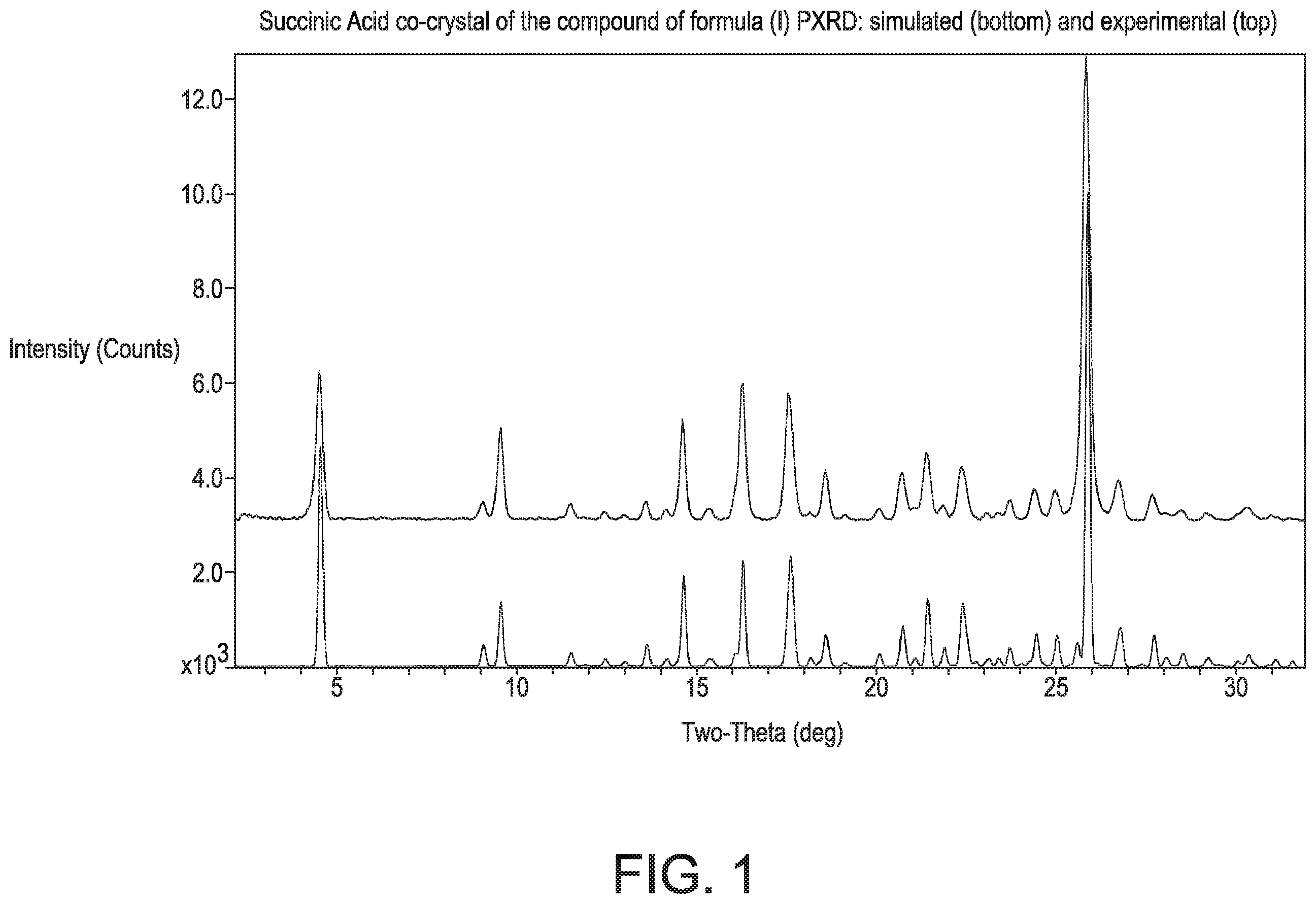
shows the simulated (bottom, calculated from atomic coordinates generated at room temperature) and experimental (top) PXRD patterns for the succinic acid co-crystal of the compound of formula (I).
shows the DSC of the succinic acid co-crystal of the compound of formula (I).
shows the TGA of the succinic acid co-crystal of the compound of formula (I).
shows the FT-Raman spectrum of the succinic acid co-crystal of the compound of formula (I).
shows the FT-IR spectrum of the succinic acid co-crystal of the compound of formula (I).
shows the simulated (bottom, calculated from atomic coordinates generated at room temperature) and experimental (top) PXRD patterns for the N-1 form of the citric acid co-crystal of the compound of formula (I).
shows the DSC of the N-1 form of the citric acid co-crystal of the compound of formula (I).
shows the TGA of the N-1 form of the citric acid co-crystal of the compound of formula (I).
shows the FT-Raman of the N-1 form of the citric acid co-crystal of the compound of formula (I).
shows the C-13 CPMAS SSNMR of the N-1 form of the citric acid co-crystal of the compound of formula (I).
shows the FT-IR of the N-1 form of the citric acid co-crystal of the compound of formula (I).
shows the simulated (bottom, calculated from atomic coordinates generated at room temperature) and experimental (top) PXRD patterns of the N-2 form of the citric acid co-crystal of the compound of formula (I).
shows the DSC of the N-2 form of the citric acid co-crystal of the compound of formula (I).
shows the TGA of the N-2 form of the citric acid co-crystal of the compound of formula (I).
shows the dissolution of the citric acid and the succinic acid co-crystals of the compound of formula (I) versus the dissolution of the free form of the compound of formula (I).
show the pharmacokinetics (PK) profile of the citric acid and the succinic acid co-crystals of the compound of formula (I) in the dog.
DETAILED DESCRIPTION
In one embodiment of the present invention is a co-crystal of the compound of formula (I) and a co-former, wherein the co-former is a citric acid or a succinic acid
In another embodiment of the present invention, the co-former is succinic acid.
In another embodiment, the co-crystal of the compound of formula (I) and succinic acid is characterized by one or more of the following:
•
• a) single crystal structure having unit cell parameters substantially equal to
Crystal system, space group Triclinic, P-1
Unit cell dimensions a = 7.5 ± 0.5Å alpha = 103 ± 1°
b = 9.6 ± 0.5 Å beta = 92 ± 1°
c = 20.1 ± 0.5 Å gamma = 98 ± 1°
Volume 1401 ± 30 Å 3
formula units per unit cell 2
Temperature room temperature
•
• wherein measurement of the single crystal structure is at room temperature; • b) an observed PXRD pattern substantially as shown in ; • c) a PXRD pattern comprising 4 or more 20 values selected from 4.5±0.2, 9.5±0.2, 14.6±0.2, 16.3±0.2, 17.6±0.2, 21.4±0.2, 22.4±0.2, and 25.9±0.2 (obtained at room temperature and (CuKα 2=1.5418 Å); • d) an infrared spectra substantially as shown in ; and/or • e) a FT-Raman spectra substantially as shown in .
In another embodiment, the co-crystal of the compound of formula (I) and succinic acid has a ratio of the compound of formula (I) to succinic acid of 1: 0.5.
In another embodiment of the present invention, the co-former is citric acid.
In another embodiment, the co-crystal of the compound of formula (I) and citric acid is in the N-1 form and is characterized by one or more of the following:
•
• a) single crystal structure having unit cell parameters substantially equal to
Crystal system, space group Triclinic, P-1
Unit cell dimensions a = 10.3 ± 0.5 Å alpha = 94 ± 1°
b = 12.3 ± 0.5 Å beta = 98 ± 1°
c = 13.9 ± 0.5 Å gamma = 98 ± 1°
Volume 1717 ± 30 Å 3
formula units per unit cell 2;
Temperature room temperature;
•
• b) a PXRD pattern substantially as shown in ; and/or • c) a powder x-ray diffraction pattern comprising four or more 20 values (CuKα 2=1.5418 Å at room temperature) selected from 6.4±0.2, 12.7±0.2. 14.4±0.2, 17.1±0.2, 23.9±0.2, 25.0±0.2, and 26.6±0.2.
In another embodiment of the invention, the co-crystal of the compound of formula (I) and citric acid has a ratio of 1:1.
In another embodiment of the invention, the co-crystal of the compound of formula (I) and citric acid consists essentially of Form N-1.
In another embodiment of the invention, the co-crystal of the compound of formula (I) and citric acid comprises Form N-1.
In another embodiment, the co-crystal of the compound of formula (I) and citric acid is in the N-2 form and is characterized by one or more of the following:
•
• a) single crystal structure having unit cell parameters substantially equal to
Crystal system, space group Triclinic, P-1
Unit cell dimensions a = 10.4 ± 0.5 Å alpha = 111 ± 1°
b = 17.8 ± 0.5 Å beta = 93 ± 1°
c = 20.5 ± 0.5 Å gamma = 102 ± 1°
Volume 3462 ± 30 Å 3;
Temperature room temperature;
formula units per unit cell 4;
•
• b) a PXRD pattern substantially as shown in ; and/or • c) a powder x-ray diffraction pattern comprising four or more 20 values (CuKα λ=1.5418 Å at room temperature) selected from 4.6±0.2, 5.5±0.2, 8.4±0.2, 11.3±0.2, 14.6±0.2, 16.4±0.2, 21.0±0.2, 24.2±0.2, and 25.2±0.2.
In another embodiment of the invention, the N-1 form of the co-crystal of the compound of formula (I) and citric acid has a ratio of 1:1.
In another embodiment of the invention, the N-2 form of the co-crystal of the compound of formula (I) and citric acid has a ratio of 1:1.
In another embodiment of the invention, the co-crystal of the compound of formula (I) and citric acid consists essentially of Form N-2.
In another embodiment of the invention, the co-crystal of the compound of formula (I) and citric acid comprises Form N-2.
In another embodiment of the invention, the present invention is directed to any one of the co-crystals in substantially pure form.
In another embodiment of the invention, the succinic acid co-crystal is characterized by a PXRD having 4 or more, 5 or more, or 6 or more, 20 values selected from 4.5±0.2, 9.5±0.2, 14.6±0.2, 16.3±0.2, 17.6±0.2, 21.4±0.2, 22.4±0.2, and 25.9±0.2 (CuKα λ=1.5418 Å at room temperature).
In another embodiment of the invention, the succinic acid co-crystal is characterized by a PXRD having at least one or more 20 values selected from 4.5±0.2, 9.5±0.2, 14.6±0.2, 16.3±0.2, 17.6±0.2, 21.4±0.2, 22.4±0.2, and 25.9±0.2 (CuKα 2=1.5418 Å at room temperature).
In another embodiment of the invention, the succinic acid co-crystal is characterized by a PXRD having 4 or more, or 5 or more, 20 values selected from 4.5±0.2, 9.5±0.2, 14.6±0.2, 16.3±0.2, 17.6±0.2, and 25.9±0.2 (CuKα λ=1.5418 Å at room temperature).
In another embodiment of the invention, the succinic acid co-crystal is characterized by a PXRD having 4 or more, or 5 or more, or 6 or more, 20 values selected from 4.5±0.2, 9.5±0.2, 14.6±0.2, 16.3±0.2, 17.6±0.2, and 25.9±0.2 (CuKα λ=1.5418 Å at room temperature).
In another embodiment of the invention, the succinic acid co-crystal has single crystal structure having unit cell parameters substantially equal to
Temperature room temperature
Crystal system, space group Triclinic, P-1
Unit cell dimensions a = 7.5 ± 0.5Å alpha = 103 ± 1°
b = 9.6 ± 0.5 Å beta = 92 ± 1°
c = 20.1 ± 0.5 Å gamma = 98 ± 1°
Volume 1401 ± 30 Å 3
formula units per unit cell 2.
In another embodiment, the succinic acid co-crystal is characterized by a FT-IR substantially in accordance with . In another embodiment, the succinic acid co-crystal is characterized by a FT-IR spectrum having peaks at 1627.9, 1704.4, and 3102.1 cm −1 (+0.4 cm −1 ).
In another embodiment, the succinic acid co-crystal is characterized by a FT-Raman substantially in accordance with . In another embodiment, the succinic acid co-crystal is characterized by a FT—Raman spectrum having peaks at 975.3, 1185.0, 1242.9, 1455.6, and 3104.4 cm −1 (+0.3 cm −1 ).
In another embodiment, the N-1 form of the citric acid co-crystal is characterized by a PXRD substantially in accordance with . In another embodiment, the N-1 form of the citric acid co-crystal is characterized by a PXRD having 4 or more, or 5 or more, or 6 or more, 20 values selected from 6.4±0.2, 12.7±0.2. 14.4±0.2, 17.1±0.2, 23.9±0.2, 25.0±0.2, and 26.6±0.2 (CuKα 2=1.5418 Å at room temperature). In another embodiment, the N-1 form of the citric acid co-crystal is characterized by a PXRD having at least one or more 20 values selected from 6.4±0.2, 12.7±0.2. 14.4±0.2, 17.1±0.2, 23.9±0.2, 25.0±0.2, and 26.6±0.2 (CuKα 2=1.5418 Å at room temperature). In another embodiment, the N-1 form of the citric acid co-crystal is characterized by a PXRD comprising 20 values selected from 6.4±0.2, 12.7±0.2. 14.4±0.2, and 26.6±0.2 (CuKα 2=1.5418 Å at room temperature).
In another embodiment, the N-1 form of the citric acid co-crystal has single crystal structure having unit cell parameters substantially equal to single crystal structure having unit cell parameters substantially equal to
Temperature room temperature
Crystal system, space group Triclinic, P-1
Unit cell dimensions a = 10.3 ± 0.5 Å alpha = 94 ± 1°
b = 12.3 ± 0.5 Å beta = 98 ± 1°
c = 13.9 ± 0.5 Å gamma = 98 ± 1°
Volume 1717 ± 30 Å 3
formula units per unit cell 2.
In another embodiment, the N-1 form of the citric acid co-crystal is characterized by a FT-IR substantially in accordance with . In another embodiment, the N-1 form of the citric acid co-crystal is characterized by a FT-IR spectrum having peaks at peaks at 1585.7, 1725.9, and 3150.5 cm −1 (+0.4 cm −1 ).
In another embodiment, the N-1 form of the citric acid co-crystal is characterized by a FT-Raman substantially in accordance with . In another embodiment, the N-1 form of the citric acid co-crystal is characterized by a FT-Raman spectrum having peaks at 755.3, 807.7, 982.1, 1191.2, 1367.8, 1450.6, and 2978.9 cm −1 (+0.3 cm −1 ).
In another embodiment, the N-2 form of the citric acid co-crystal is characterized by a PXRD substantially in accordance with . In another embodiment, the N-2 form of the citric acid co-crystal is characterized by a PXRD having 4 or more, or 5 or more, or 6 or more, 20 values selected from 4.6±0.2, 5.5±0.2, 8.4±0.2, 11.3±0.2, 14.6±0.2, 16.4±0.2, 21.0±0.2, 24.2±0.2, and 25.2±0.2 In another embodiment, the N-2 form of the citric acid co-crystal is characterized by a PXRD having at least one or more 20 values selected from 4.6±0.2, 5.5±0.2, 8.4±0.2, 11.3±0.2, 14.6±0.2, 16.4±0.2, 21.0±0.2, 24.2±0.2, and 25.2±0.2 In another embodiment, the N-1 form of the citric acid co-crystal is characterized by a PXRD comprising 20 values selected from 4 or more, or 5 or more, 20 values selected from 4.6±0.2, 14.6±0.2, 16.4±0.2, 21.010.2, and 25.2±0.2. (Cuka λ=1.5418 Å at room temperature).
In another embodiment, the N-2 form of the citric acid co-crystal has single crystal structure having unit cell parameters substantially equal to
Temperature room temperature
Crystal system, space group Triclinic, P-1
Unit cell dimensions a = 10.4 ± 0.5 Å alpha = 111± 1°
b = 17.8 ± 0.5 Å beta = 93 ± 1°
c = 20.5 ± 0.5 Å gamma = 102 ± 1°
Volume 3462 ± 30 Å 3
formula units per unit cell 4.
In another embodiment, the present invention describes a pharmaceutical composition comprising a therapeutically effective amount of at least one of the co-crystal forms of the compound of Formula (I) and a pharmaceutically acceptable carrier.
In another embodiment, the present invention describes a method for the treatment of a thromboembolic disorder which comprises administering to a host in need of such treatment a therapeutically effective amount of at least one of the co-crystal forms of the compound of Formula (1).
In some embodiments, the present invention provides a pharmaceutical composition which further includes another therapeutic agent(s). In a preferred embodiment, the present invention provides a pharmaceutical composition, wherein the additional therapeutic agent(s) are an anti-platelet agent or a combination thereof. Preferably, the anti-platelet agent(s) are P2Y12 antagonists and/or aspirin. Preferably, the P2Y12 antagonists are clopidogrel, ticagrelor, or prasugrel. In another preferred embodiment, the present invention provides a pharmaceutical composition, wherein the additional therapeutic agent(s) are an anticoagulant or a combination thereof. Preferably, the anticoagulant agent(s) are FXa inhibitors or thrombin inhibitors. Preferably, the FXa inhibitors are apixaban or rivaroxaban. Preferably, the thrombin inhibitor is dabigatran.
In some embodiments, the present invention provides a method for the treatment or prophylaxis of a thromboembolic disorder which includes the step of administering to a subject (for example, a human) in need of such treatment or prophylaxis a therapeutically effective amount of at least one of the co-crystal forms of the compound of Formula (I) disclosed herein, for example, the succinic acid co-crystal, the citric acid co-crystal, the citric acid co-crystal N-1, or the citric acid co-crystal N-2.
In some embodiments, the present invention provides methods for the treatment of a thromboembolic disorder or the primary or secondary prophylaxis of a thromboembolic disorder, which includes the steps of administering to a patient (for example, a human) in need thereof a therapeutically effective amount of one of the co-crystal forms of the compound of formula (I) disclosed herein, for example, the succinic acid co-crystal, the citric acid co-crystal, the citric acid co-crystal N-1, or the citric acid co-crystal N-2, wherein the thromboembolic disorder is selected from the group consisting of arterial cardiovascular thromboembolic disorders, venous cardiovascular thromboembolic disorders, cerebrovascular thromboembolic disorders, and thromboembolic disorders in the chambers of the heart or in the peripheral circulation.
In some embodiments, the present invention provides methods for the treatment of a thromboembolic disorder or the primary or secondary prophylaxis of a thromboembolic disorder, which includes the steps of administering to a patient (for example, a human) in need thereof a therapeutically effective amount of one of the co-crystal forms of the compound of Formula (I) disclosed herein, for example, the succinic acid co-crystal, the citric acid co-crystal, the citric acid co-crystal N-1, or the citric acid co-crystal N-2, wherein the thromboembolic disorder is selected from the group consisting of acute coronary syndrome, unstable angina, stable angina, ST-elevated myocardial infarction, non-ST-elevated myocardial infarction, atrial fibrillation, myocardial infarction, transient ischemic attack, stroke, atherosclerosis, peripheral arterial disease, venous thrombosis, deep vein thrombosis, thrombophlebitis, arterial embolism, coronary arterial thrombosis, cerebral arterial thrombosis, cerebral embolism, kidney embolism, pulmonary embolism, cancer-related thrombosis, and thrombosis resulting from medical implants, devices, and procedures in which blood is exposed to an artificial surface that promotes thrombosis.
In some embodiments, the present invention provides methods for the treatment of a thromboembolic disorder or the primary or secondary prophylaxis of a thromboembolic disorder, which includes the steps of administering to a patient (for example, a human) in need thereof a therapeutically effective amount of one of the co-crystal forms of the compound of Formula (I) disclosed herein, for example, the succinic acid co-crystal, the citric acid co-crystal, the citric acid co-crystal N-1, or the citric acid co-crystal N-2, wherein the thromboembolic disorder is selected from the group consisting of acute coronary syndrome, unstable angina, stable angina, ST-elevated myocardial infarction, and non-ST-elevated myocardial infarction.
In some embodiments, the present invention provides methods for the treatment of a thromboembolic disorder or the primary or secondary prophylaxis of a thromboembolic disorder, which includes the steps of administering to a patient (for example, a human) in need thereof a therapeutically effective amount of one of the co-crystal forms of the compound of Formula (I) disclosed herein, for example, the succinic acid co-crystal, the citric acid co-crystal, the citric acid co-crystal N-1, or the citric acid co-crystal N-2, wherein the thromboembolic disorder is selected from the group consisting of transient ischemic attack and stroke.
In some embodiments, the present invention provides methods for the treatment of a thromboembolic disorder or the primary or secondary prophylaxis of a thromboembolic disorder, which includes the steps of administering to a patient (for example, a human) in need thereof a therapeutically effective amount of one of the co-crystal forms of the compound of Formula (I) disclosed herein, for example, the succinic acid co-crystal, the citric acid co-crystal, the citric acid co-crystal N-1, or the citric acid co-crystal N-2, or solvates thereof, wherein the thromboembolic disorder is peripheral arterial disease.
In some embodiments, the present invention includes a method as described above: wherein the thromboembolic disorder is selected from unstable angina, an acute coronary syndrome, atrial fibrillation, first myocardial infarction, recurrent myocardial infarction, ischemic sudden death, transient ischemic attack, stroke, atherosclerosis, peripheral occlusive arterial disease, venous thrombosis, deep vein thrombosis, thrombophlebitis, arterial embolism, coronary arterial thrombosis, cerebral arterial thrombosis, cerebral embolism, kidney embolism, pulmonary embolism, and thrombosis resulting from medical implants, devices, or procedures in which blood is exposed to an artificial surface that promotes thrombosis.
In some embodiments, the present invention includes a method of inhibiting or preventing platelet aggregation, which includes the step of administering to a subject (such as a human) in need thereof a therapeutically effective amount of one of the co-crystal forms of the compound of Formula (I) disclosed herein, for example, the succinic acid co-crystal, the citric acid co-crystal, the citric acid co-crystal N-1, or the citric acid co-crystal N-2.
In still yet an even further embodiment, the individual co-crystal forms of Compound (I) are substantially pure.
In still yet another embodiment, the individual co-crystal forms of Compound (I) contains at least about 90 wt. %, preferably at least about 95 wt. %, and more preferably at least about 99 wt. % Compound (I), based on weight of the individual co-crystal forms of Compound (I).
In another embodiment, the Compound of formula (I) may have a mixture of the co-crystals described herein.
The present invention includes the use of the co-crystals of the compound of formula (I) for use in therapy.
The present invention is directed to the use of the co-crystals of the compound of formula (I) for the preparation of a medicament for the treatment or prophylaxis of a thromboembolic disorder.
In preparing a pharmaceutical composition, a form of the active ingredient is sought that has a balance of desired properties, such as, for example, dissolution rate, solubility, bioavailability, and/or storage stability. For example, a form of the active ingredient is sought having sufficient solubility, and bioavailability, and storage stability to prevent the sufficiently soluble and bioavailable form from converting during storage to another form having an undesirable solubility and/or bioavailability profile.
The present invention provides at least one co-crystal form of Compound (I) that surprisingly affords a balance of properties sought in a pharmaceutical composition. The present invention is also directed to other important aspects.
This invention also encompasses all combinations of alternative aspects of the invention noted herein. It is understood that any and all embodiments of the present invention may be taken in conjunction with any other embodiment to describe additional embodiments of the present invention. Furthermore, any elements of an embodiment are meant to be combined with any and all other elements from any of the embodiments to describe additional embodiments.
Definitions
The features and advantages of the invention may be more readily understood by those of ordinary skill in the art upon reading the following detailed description. It is to be appreciated that certain features of the invention that are, for clarity reasons, described above and below in the context of separate embodiments, may also be combined to form a single embodiment. Conversely, various features of the invention that are, for brevity reasons, described in the context of a single embodiment, may also be combined so as to form sub-combinations thereof.
The names used herein to characterize a specific form, e.g., “N-1” etc., are merely identifiers that are to be interpreted in accordance with the characterization information presented herein and are not to be limited so as to exclude any other substance possessing similar or identical physical and chemical characteristics.
The definitions set forth herein take precedence over definitions set forth in any patent, patent application, and/or patent application publication incorporated herein by reference.
All numbers expressing quantities of ingredients, weight percentages, temperatures, and so forth that are preceded by the word “about” are to be understood as only approximations so that slight variations above and below the stated number may be used to achieve substantially the same results as the stated number. Accordingly, unless indicated to the contrary, numerical parameters preceded by the word “about”, or “substantially in accordance” are approximations that may vary depending upon the desired properties sought to be obtained. At the very least, and not as an attempt to limit the application of the doctrine of equivalents to the scope of the claims, each numerical parameter should at least be construed in light of the number of reported significant digits and by applying ordinary rounding techniques.
All measurements are subject to experimental error and are within the spirit of the invention.
As used herein, “co-crystal” means solid state, crystalline material that is composed of two or more molecules in the same crystal lattice which are in the neutral state, interact via nonionic interactions and are solids as individual components at room temperature.
As used herein, “polymorphs” refer to crystalline forms having the same chemical structure but different spatial arrangements of the molecules and/or ions forming the crystals.
As used herein “solvate” refers to a crystalline form of a molecule, atom, and/or ions that further comprises molecules of a solvent or solvents incorporated into the crystalline lattice structure. When the solvent is water, the form is referred to as a “hydrate”. The solvent molecules in the solvate may be present in a regular arrangement and/or a non-ordered arrangement. The solvate may comprise either a stoichiometric or nonstoichiometric amount of the solvent molecules. For example, a solvate with a nonstoichiometric amount of solvent molecules may result from partial loss of solvent from the solvate. Solvates may occur as dimers or oligomers comprising more than one molecule or co-crystal of the compound of formula (I) within the crystalline lattice structure.
As used herein “amorphous” refers to a solid form of a molecule, atom, and/or ions that is not crystalline. An amorphous solid does not display a definitive X-ray diffraction pattern.
As used herein, “substantially pure,” when used in reference to a co-crystal form, means a compound having a purity greater than 90 weight %, including greater than 90, 91, 92, 93, 94, 95, 96, 97, 98, and 99 weight %, and also including equal to about 100 weight % of the co-crystal of the Compound (I), based on the weight of the compound. The remaining material comprises other form(s) of the compound, and/or reaction impurities and/or processing impurities arising from its preparation. For example, a co-crystal form of Compound (I) may be deemed substantially pure in that it has a purity greater than 90 weight %, as measured by means that are at this time known and generally accepted in the art, where the remaining less than 10 weight % of material comprises other form(s) of Compound (I) and/or reaction impurities and/or processing impurities.
When dissolved, co-crystal forms of the compound of formula (I) loses its crystalline structure, and is therefore referred to as a solution of the compound of formula (I). All forms of the present invention, however, may be used for the preparation of liquid formulations in which the drug is dissolved or suspended. In addition, the co-crystal forms of the compound of formula (I) may be incorporated into solid formulations.
As used herein, an XRPD (x-ray powder diffraction) or PXRD (powder x-ray diffraction) pattern “comprising” or having a number of peaks selected from a specified group of peaks, is intended to include PXRD patterns having additional peaks that are not included in the specified group of peaks. For example, a PXRD pattern comprising at least one or more, four or more, five or more, or six or more, 20 values selected from: A, B, C, D, E, F, G, and H, is intended to include a PXRD pattern having: (a) at least one or more, four or more, five or more, six or more, 20 values selected from: A, B, C, D, E, F, G, and H; and (b) zero or more peaks that are not one of peaks A, B, C, D, E, F, G, and H.
As used herein, the term “DSC” refers to differential scanning calorimetry. The term “TGA” refers to thermogravimetric analysis. The term “IR” refers to infrared spectroscopy. The abbreviation “FT” stands for Fourier Transform.
The term “room temperature” generally means approximately 22° C., but may vary up or down by 7ºC.
When the term “substantially in accordance” is used in relation to XRPD, or PXRD patterns, it is to be understood that measurement of the peak locations for a given crystalline form of the same compound will vary within a margin of error. It is also to be understood that the intensities of the peaks can vary between different PXRD scans of the same crystalline form of the same compound. The relative intensities of the different peaks are not meant to be limiting to a comparison of different PXRD scans.
“Therapeutically effective amount” is intended to include an amount of a compound of the present invention that is effective when administered alone or in combination to inhibit and/or antagonize PAR4 and/or to prevent or treat the disorders listed herein. When applied to a combination, the term refers to combined amounts of the active ingredients that result in the preventive or therapeutic effect, whether administered in combination, serially, or simultaneously.
The term “thrombosis”, as used herein, refers to formation or presence of a thrombus (pl. thrombi) within a blood vessel that may cause ischemia or infarction of tissues supplied by the vessel. The term “embolism”, as used herein, refers to sudden blocking of an artery by a clot or foreign material that has been brought to its site of lodgment by the blood current. The term “thromboembolism”, as used herein, refers to obstruction of a blood vessel with thrombotic material carried by the blood stream from the site of origin to plug another vessel. The term “thromboembolic disorders” entails both “thrombotic” and “embolic” disorders (defined above).
The term “thromboembolic disorders” as used herein includes arterial cardiovascular thromboembolic disorders, venous cardiovascular or cerebrovascular thromboembolic disorders, and thromboembolic disorders in the chambers of the heart or in the peripheral circulation. The term “thromboembolic disorders” as used herein also includes specific disorders selected from, but not limited to, unstable angina or other acute coronary syndromes, atrial fibrillation, first or recurrent myocardial infarction, ischemic sudden death, transient ischemic attack, stroke, atherosclerosis, peripheral occlusive arterial disease, venous thrombosis, deep vein thrombosis, thrombophlebitis, arterial embolism, coronary arterial thrombosis, cerebral arterial thrombosis, cerebral embolism, kidney embolism, pulmonary embolism, and thrombosis resulting from medical implants, devices, or procedures in which blood is exposed to an artificial surface that promotes thrombosis. The medical implants or devices include, but are not limited to: prosthetic valves, artificial valves, indwelling catheters, stents, blood oxygenators, shunts, vascular access ports, ventricular assist devices and artificial hearts or heart chambers, and vessel grafts. The procedures include, but are not limited to: cardiopulmonary bypass, percutaneous coronary intervention, and hemodialysis. In another embodiment, the term “thromboembolic disorders” includes acute coronary syndrome, stroke, deep vein thrombosis, and pulmonary embolism.
In some embodiments, a therapeutically effective amount of a PAR4 compound is preferably from about less than 100 mg/kg, 50 mg/kg, 10 mg/kg, 5 mg/kg, 1 mg/kg, or less than 1 mg/kg. In another embodiment, the therapeutically effective amount of the PAR4 compound is less than 5 mg/kg. In another embodiment, the therapeutically effective amount of the PAR4 compound is less than 1 mg/kg. In another embodiment, the dosage is 8 mg to 48 mg. Effective doses vary, as recognized by those skilled in the art, depending on route of administration and excipient usage.
The co-crystal forms are typically administered in admixture with suitable pharmaceutical diluents, excipients, or carriers (collectively referred to herein as pharmaceutical carriers) suitably selected with respect to the intended form of administration, that is, oral tablets, capsules, elixirs, syrups and the like, and consistent with conventional pharmaceutical practices.
For instance, for oral administration in the form of a tablet or capsule, the active drug component can be combined with an oral, non-toxic, pharmaceutically acceptable, inert carrier such as lactose, starch, sucrose, glucose, methyl cellulose, magnesium stearate, dicalcium phosphate, calcium sulfate, mannitol, sorbitol and the like; for oral administration in liquid form, the oral drug components can be combined with any oral, non-toxic, pharmaceutically acceptable inert carrier such as ethanol, glycerol, water, and the like. Moreover, when desired or necessary, suitable binders, lubricants, disintegrating agents, and coloring agents can also be incorporated into the mixture. Suitable binders include starch, gelatin, natural sugars such as glucose or beta-lactose, corn sweeteners, natural and synthetic gums such as acacia, tragacanth, or sodium alginate, carboxymethylcellulose, polyethylene glycol, waxes, and the like. Lubricants used in these dosage forms include sodium oleate, sodium stearate, magnesium stearate, sodium benzoate, sodium acetate, sodium chloride, and the like. Disintegrators include, without limitation, starch, methyl cellulose, agar, bentonite, xanthan gum, and the like.
The co-crystals of the present invention can also be administered in the form of liposome delivery systems, such as small unilamellar vesicles, large unilamellar vesicles, and multilamellar vesicles. Liposomes can be formed from a variety of phospholipids, such as cholesterol, stearylamine, or phosphatidylcholines.
Co-crystals of the present invention may also be coupled with soluble polymers as targetable drug carriers. Such polymers can include polyvinylpyrrolidone, pyran copolymer, polyhydroxypropylmethacrylamide-phenol, polyhydroxyethylaspartamidephenol, or polyethyleneoxide-polylysine substituted with palmitoyl residues. Furthermore, the compounds of the present invention may be coupled to a class of biodegradable polymers useful in achieving controlled release of a drug, for example, polylactic acid, polyglycolic acid, copolymers of polylactic and polyglycolic acid, polyepsilon caprolactone, polyhydroxy butyric acid, polyorthoesters, polyacetals, polydihydropyrans, polycyanoacylates, and crosslinked or amphipathic block copolymers of hydrogels.
Dosage forms (pharmaceutical compositions) suitable for administration may contain from about 1 milligram to about 100 milligrams of active ingredient per dosage unit. In these pharmaceutical compositions the active ingredient will ordinarily be present in an amount of about 0.5-95% by weight based on the total weight of the composition.
Gelatin capsules may contain the active ingredient and powdered carriers, such as lactose, starch, cellulose derivatives, magnesium stearate, stearic acid, and the like. Similar diluents can be used to make compressed tablets. Both tablets and capsules can be manufactured as sustained release products to provide for continuous release of medication over a period of hours. Compressed tablets can be sugar coated or film coated to mask any unpleasant taste and protect the tablet from the atmosphere, or enteric coated for selective disintegration in the gastrointestinal tract.
Liquid dosage forms for oral administration can contain coloring and flavoring to increase patient acceptance.
In general, water, a suitable oil, saline, aqueous dextrose (glucose), and related sugar solutions and glycols such as propylene glycol or polyethylene glycols are suitable carriers for parenteral solutions. Solutions for parenteral administration may contain a water soluble salt of the active ingredient, suitable stabilizing agents, and if necessary, buffer substances. Antioxidizing agents such as sodium bisulfite, sodium sulfite, or ascorbic acid, either alone or combined, are suitable stabilizing agents. Also used are citric acid and its salts and sodium EDTA. In addition, parenteral solutions can contain preservatives, such as benzalkonium chloride, methyl- or propyl-paraben, and chlorobutanol.
Suitable pharmaceutical carriers are described in Remington's Pharmaceutical Sciences, Mack Publishing Company, a standard reference text in this field.
Representative useful pharmaceutical dosage-forms for administration of the compounds of this invention can be illustrated as follows:
Capsules
A large number of unit capsules can be prepared by filling standard two-piece hard gelatin capsules each with 100 milligrams of powdered active ingredient, 150 milligrams of lactose, 50 milligrams of cellulose, and 6 milligrams magnesium stearate. Soft Gelatin Capsules
A mixture of active ingredient in a digestible oil such as soybean oil, cottonseed oil or olive oil may be prepared and injected by means of a positive displacement pump into gelatin to form soft gelatin capsules containing 100 milligrams of the active ingredient. The capsules should be washed and dried.
Tablets
Tablets may be prepared by conventional procedures so that the dosage unit is 100 milligrams of active ingredient, 0.2 milligrams of colloidal silicon dioxide, 5 milligrams of magnesium stearate, 275 milligrams of microcrystalline cellulose, 11 milligrams of starch and 98.8 milligrams of lactose. Appropriate coatings may be applied to increase palatability or delay absorption.
Dispersion
A spray dried dispersion can be prepared for oral administration by methods know to one skilled in the art.
Injectable
A parenteral composition suitable for administration by injection may be prepared by stirring 1.5% by weight of active ingredient in 10% by volume propylene glycol and water. The solution should be made isosmotic with sodium chloride and sterilized.
Suspension
An aqueous suspension can be prepared for oral administration so that each 5 mL contain 100 mg of finely divided active ingredient, 200 mg of sodium carboxymethyl cellulose, 5 mg of sodium benzoate, 1.0 g of sorbitol solution, U.S.P., and 0.025 mL of vanillin.
Where two or more of the foregoing second therapeutic agents are administered with the co-crystal of the compound of Formula I, generally the amount of each component in a typical daily dosage and typical dosage form may be reduced relative to the usual dosage of the agent when administered alone, in view of the additive or synergistic effect of the therapeutic agents when administered in combination.
Particularly when provided as a single dosage unit, the potential exists for a chemical interaction between the combined active ingredients. For this reason, when the co-crystalline forms of the compound (I) and a second therapeutic agent are combined in a single dosage unit they are formulated such that although the active ingredients are combined in a single dosage unit, the physical contact between the active ingredients is minimized (that is, reduced). For example, one active ingredient may be enteric coated. By enteric coating one of the active ingredients, it is possible not only to minimize the contact between the combined active ingredients, but also, it is possible to control the release of one of these components in the gastrointestinal tract such that one of these components is not released in the stomach but rather is released in the intestines. One of the active ingredients may also be coated with a material which effects a sustained-release throughout the gastrointestinal tract and also serves to minimize physical contact between the combined active ingredients. Furthermore, the sustained-released component can be additionally enteric coated such that the release of this component occurs only in the intestine. Still another approach would involve the formulation of a combination product in which the one component is coated with a sustained and/or enteric release polymer, and the other component is also coated with a polymer such as a low viscosity grade of hydroxypropyl methylcellulose (HPMC) or other appropriate materials as known in the art, in order to further separate the active components. The polymer coating serves to form an additional barrier to interaction with the other component.
These as well as other ways of minimizing contact between the components of combination products of the present invention, whether administered in a single dosage form or administered in separate forms but at the same time by the same manner, will be readily apparent to those skilled in the art, once armed with the present disclosure.
As discussed above, compounds of the present invention, including the co-crystal forms of the compound of formula I can be administered orally, intravenously, or both.
EXAMPLES
Co-crystal forms may be prepared by a variety of methods, including for example, crystallization or recrystallization from a suitable solvent, sublimation, growth from a melt, solid state transformation from another phase, crystallization from a supercritical fluid, and jet spraying. Techniques for crystallization or recrystallization of co-crystal forms from a solvent mixture include, for example, evaporation of the solvent, decreasing the temperature of the solvent mixture, crystal seeding a supersaturated solvent mixture of the molecule and/or salt, freeze drying the solvent mixture, and addition of antisolvents (countersolvents) to the solvent mixture.
For crystallization techniques that employ solvent, the choice of solvent or solvents is typically dependent upon one or more factors, such as solubility of the compound, crystallization technique, and vapor pressure of the solvent. Combinations of solvents may be employed, for example, the compound may be solubilized into a first solvent to afford a solution, followed by the addition of an antisolvent to decrease the solubility of the compound in the solution and to afford the formation of crystals. An antisolvent is a solvent in which the compound has low solubility.
In one method to prepare crystals, a compound is suspended and/or stirred in a suitable solvent to afford a slurry, which may be heated to promote dissolution. The term “slurry”, as used herein, means a saturated solution of the compound, which may also contain an additional amount of the compound to afford a heterogeneous mixture of the compound and a solvent at a given temperature.
Seed crystals may be added to any crystallization mixture to promote crystallization. Seeding may be employed to control growth of a particular polymorph or to control the particle size distribution of the crystalline product. Accordingly, calculation of the amount of seeds needed depends on the size of the seed available and the desired size of an average product particle as described, for example, in “Programmed Cooling of Batch Crystallizers,” J. W. Mullin and J. Nyvlt, Chemical Engineering Science, 1971,26, 369-377. In general, seeds of small size are needed to control effectively the growth of crystals in the batch. Seed of small size may be generated by sieving, milling, or micronizing of large crystals, or by micro-crystallization of solutions. Care should be taken that milling or micronizing of crystals does not result in any change in crystallinity form the desired crystal form (i.e., change to amorphous or to another polymorph).
A cooled crystallization mixture may be filtered under vacuum, and the isolated solids may be washed with a suitable solvent, such as cold recrystallization solvent, and dried under a nitrogen purge to afford the desired crystalline form. The isolated solids may be analyzed by a suitable spectroscopic or analytical technique, such as solid state nuclear magnetic resonance, differential scanning calorimetry, x-ray powder diffraction, or the like, to assure formation of the preferred crystalline form of the product. The resulting crystalline form is typically produced in an amount of greater than about 70 weight % isolated yield, preferably greater than 90 weight % isolated yield, based on the weight of the compound originally employed in the crystallization procedure. The product may be comilled or passed through a mesh screen to delump the product, if necessary.
The presence of more than one polymorph in a sample may be determined by techniques such as powder x-ray diffraction (PXRD) or by Raman or IR spectroscopy solid state nuclear magnetic resonance spectroscopy. For example, the presence of extra peaks in the comparison of an experimentally measured PXRD pattern with a simulated PXRD pattern may indicate more than one polymorph in the sample. The simulated PXRD may be calculated from single crystal x-ray data. see Smith, D. K., “A FORTRAN Program for Calculating X-Ray Powder Diffraction Patterns,” Lawrence Radiation Laboratory, Livermore, California, UCRL-7196 (April 1963).
The co-crystal forms of the compound of formula (I) according to the invention may be characterized using various techniques, the operation of which are well known to those of ordinary skill in the art. The forms may be characterized and distinguished using single crystal x-ray diffraction, which is based on unit cell measurements of a single crystal of form at a fixed analytical temperature. A detailed description of unit cells is provided in Stout & Jensen, X-Ray Structure Determination: A Practical Guide, Macmillan Co., New York (1968), Chapter 3, which is herein incorporated by reference. Alternatively, the unique arrangement of atoms in spatial relation within the crystalline lattice may be characterized according to the observed fractional atomic coordinates. Another means of characterizing the crystalline structure is by powder x-ray diffraction analysis in which the diffraction profile is compared to a simulated profile representing pure powder material, both run at the same analytical temperature, and measurements for the subject form characterized as a series of 20 values (usually four or more).
Other means of characterizing the form may be used, such as solid state nuclear magnetic resonance (SSNMR), differential scanning calorimetry, thermogravimetric analysis and FT-Raman and FT-IR. These techniques may also be used in combination to characterize the subject form. In addition to the techniques specifically described herein, the presence of a particular crystalline form may be determined by other suitable analytical methods.
Example 1
4-(4-(((6-Methoxy-2-(2-methoxyimidazo[2,1-b][1,3,4]thiadiazol-6-yl)benzofuran-4-yl)oxy)methyl)thiazol-2-yl)-N,N-dimethylbenzamide: succinic acid co-crystal (1:0.5)
To a 250 mL glass reactor were added the compound of formula (I) as a free form (2 g, 3.561 mmol), dichloromethane (100 mL) and methanol (20 mL). The reaction mass was heated to 39ºC, until full dissolution. Succinic acid (0.45 g, 3.8 mmol) was then added in one portion. After 3 days, 50 mL of the solution mass was distilled off, until a slurry forms. Ethyl acetate (70 mL) was added. The volatiles were removed to dryness and ethyl acetate (100 mL) was charged to the reaction mixture and the reaction mass was stirred for 12 h. The resulting slurry was then filtered off and the resulting solid was washed with ethyl acetate (10 mL). The solid was dried in a vacuum oven for 24 h (30 mmHg, 50° C.) to give the succinic acid co-crystal of the compound of formula (I). The product was obtained as a white solid (1.8 g, 41% yield), with a purity of 99.4% by HPLC. 1H NMR (400 MHZ, DMSO-d6) d 8.37 (s, 2H), 8.03 (s, 2H), 8.01 (s, 2H), 7.94 (s, 2H), 7.54 (d, J=7.8 Hz, 4H), 7.03 (s, 2H), 6.85 (dd, J=1.8, 0.8 Hz, 2H), 6.65 (d, J=1.8 Hz, 2H), 5.39 (s, 4H), 4.20 (s, 6H), 3.90-3.77 (m, 6H), 3.31 (s, 5H), 3.00 (br s, 6H), 2.94 (br s, 6H), 2.43-2.41 (m, 4H).
The succinic acid co-crystal has a stoichiometry of one molecule of the compound of formula (I) to 0.5 molecules of succinic acid, or a hemisuccinate of the compound of formula (I).
The succinic acid co-crystal of the compound of formula (I) gave the PXRD pattern shown in , the Differential Scanning calorimeter (DSC) shown in , and the thermogravimetric analysis (TGA) shown in .
The PXRD of the succinic acid co-crystal of the compound of formula (I) has selected 20 peaks at 4.5, 9.5, 14.6, 16.3, 17.6, 21.4, 22.4 and 25.9, (all peaks at degrees 2θ±0.2). The PXRD was obtained at room temperature, and the diffraction peak positions (degrees 2θ±0.2), based on a high quality pattern collected with a diffractometer (CuKα) with a spinning capillary with 20 calibrated with a NIST other suitable standard.
The succinic acid co-crystal is also characterized by a PXRD having at least one or more, or 4 or more, 20 values selected from 4.5±0.2, 9.5±0.2, 14.6±0.2, 16.3±0.2, 17.6±0.2, 21.4±0.2, 22.4±0.2, and 25.9±0.2.
The succinic acid co-crystal is also characterized by a PXRD having 4 or more 20 values selected from 4.510.2, 9.510.2, 14.610.2, 16.310.2, 17.610.2, and 25.910.2.
A single crystal X-ray of the succinic acid co-crystal of the compound of formula (I) was obtained and produced the following results:
Temperature room temperature
Wavelength 1.54178 Å
Crystal system, space group Triclinic, P-1
Unit cell dimensions a = 7.5209(7) Å alpha = 103.201(4)°
b = 9.6255(6) Å beta = 91.833(5)°
c = 20.089(1) Å gamma = 97.501(6)°
Volume 1400.8(2) Å 3
Calculated density 1.471 g/cm 3
formula units per unit cell 2
The atomic coordinates for the single crystal X-ray for the succinic acid co-crystal are shown in Table 1.
TABLE 1
Atomic Coordinates of Succinate Acid Co-crystal
Atom X Y Z
S1 1.3819 1.0196 0.3789
S2 0.7569 0.4869 0.6965
N1 1.2580 1.0724 0.5123
N2 1.4110 1.2469 0.4731
N3 1.5027 1.2961 0.4223
N4 0.7484 0.6470 0.8167
N5 0.3134 0.0672 0.9555
O1 1.2217 1.3320 0.6754
O2 0.9340 0.9577 0.7554
O3 1.0570 1.4185 0.9115
O4 1.5673 1.1838 0.3121
O5 0.4178 −0.0757 0.8652
C1 1.2781 1.2022 0.5618
C2 1.3725 1.3113 0.5387
C3 1.3401 1.1067 0.4604
C4 1.4962 1.1865 0.3716
C5 1.2023 1.2016 0.6267
C6 1.1440 1.3005 0.7326
C7 1.0753 1.1557 0.7190
C8 1.1150 1.0935 0.6504
C9 1.1432 1.3976 0.7948
C10 1.0669 1.3400 0.8459
C11 0.9935 1.1945 0.8352
C12 0.9972 1.1015 0.7722
C13 0.8653 0.8919 0.8068
C14 0.8180 0.7344 0.7755
C15 0.8322 0.6670 0.7094
C16 0.7090 0.5131 0.7815
C17 0.6313 0.3948 0.8115
C18 0.5558 0.2622 0.7706
C19 0.4807 0.1528 0.7993
C20 0.4775 0.1732 0.8699
C21 0.5576 0.3044 0.9107
C22 0.6330 0.4135 0.8823
C23 0.3986 0.0463 0.8965
C24 0.2564 0.1992 0.9920
C25 0.2529 -0.0588 0.9814
C26 1.1240 1.5674 0.9257
C27 1.6643 1.3165 0.3026
C1A 0.9198 0.2959 0.4847
C2A 0.9469 0.4532 0.5200
O1A 0.8302 0.2168 0.52.17
O2A 0.9747 0.2484 0.4300
H2 1.4037 1.4072 0.5620
H8 1.0862 0.9976 0.6269
H9 1.1903 1.4944 0.8017
H11 0.9418 1.1606 0.8709
H13A 0.7596 0.9324 0.8240
H13B 0.9547 0.9076 0.8446
H15 0.8764 0.7121 0.6758
H18 0.5560 0.2468 0.7232
H19 0.4316 0.0645 0.7711
H21 0.5601 0.3188 0.9581
H22 0.6856 0.5006 0.9107
H24A 0.3231 0.2325 1.0355
H24B 0.1305 0.1822 0.9990
H24C 0.2776 0.2708 0.9658
H25A 0.1387 −0.1048 0.9589
H25B 0.2408 −0.0299 1.0299
H25C 0.3390 −0.1251 0.9726
H26A 1.2475 1.5798 0.9149
H26B 1.1148 1.6097 0.9734
H26C 1.0548 1.6137 0.8985
H27A 1.5917 1.3924 0.3147
H27B 1.6922 1.3050 0.2556
H27C 1.7737 1.3406 0.3313
H2A1 1.0025 0.4686 0.5651
H1A1 0.8341 0.4795 0.5272
H1A 0.8025 0.1272 0.4991
The DSC of the succinic acid co-crystal showed a variable endotherm at about 182° C., which represented a melt with decomposition. The TGA of the succinic acid co-crystal showed negligible weight loss up to 150° ° C.
The FT-IR and FT-Raman are shown in respectively and showed characteristic peaks in the range from 1700 to 3500 cm −1 .
The FT-Raman spectrum for the succinic acid co-crystal has characteristic peaks at 975.3, 1185.0, 1242.9, 1455.6, and 3104.4 cm −1 (+0.3 cm −1 ).
The FT-IR spectrum for the succinic acid co-crystal has characteristic peaks at 1627.9, 1704.4, and 3102.1 cm −1 (+0.4 cm −1 ).
Example 2
4-(4-(((6-Methoxy-2-(2-methoxyimidazo[2,1-b][1,3,4]thiadiazol-6-yl)benzofuran-4-yl)oxy)methyl)thiazol-2-yl)-N,N-dimethylbenzamide: citric acid co-crystal (1:1), form N-1.
A mixture of 4-(4-(((6-Methoxy-2-(2-methoxyimidazo[2,1-b][1,3,4]thiadiazol-6-yl)benzofuran-4-yl)oxy)methyl)thiazol-2-yl)-N,N-dimethylbenzamide (6.1 g, 11 mmol, 1.0 eq) and citric acid (3.3 g, 18 mmol, 1.6 eq) in ethyl acetate (210 mL) was heated to 76° C. for 10 h and then slowly cool to room temperature and allowed to stir for 16 h. The slurry was filtered and washed with EtOAc (80 mL) followed by drying of the cake under vacuum in the oven at 55° C. for 1 days to give 8.0 g (98% yield) of the N-1 form of the citric acid co-crystal as a white solid.
Alternative Procedure
To citric acid (222.5 g, 1.16 mol, 1.3 eq) was added EtOAc (17 L) and heated to 55° C. for 2 h to give a clear solution. 4-(4-(((6-Methoxy-2-(2-methoxyimidazo[2,1-b][1,3,4]thiadiazol-6-yl)benzofuran-4-yl)oxy)methyl)thiazol-2-yl)-N,N-dimethylbenzamide (500.00 g, 0.89 mol, 1.0 eq) was added followed by EtOAc (1L). The mixture was heated to 76° C. over 1 h. 4-(4-(((6-Methoxy-2-(2-methoxyimidazo[2,1-b][1,3,4]thiadiazol-6-yl)benzofuran-4-yl)oxy)methyl)thiazol-2-yl)-N,N-dimethylbenzamide citric acid co-crystal (1.0 g, 0.2% wt) in EtOAc (15 mL) was added as seeds. The mixture was heated for an additional 30 min and then slowly cooled to room temperature for 2 h and allowed to stir for 5 h. The slurry was filtered and washed twice with EtOAc (3 L) followed by drying of the cake under vacuum in the oven at 50° C. for 3 days to give 663.7 g (99% yield) in 99.8AP purity of the N-1 form of the citric acid co-crystal as a white solid.
The N-1 form of the citric acid co-crystal of the compound of formula (I) has a stoichiometry of 1 molecule of the compound of formula (I) for every molecule of citric acid (1:1).
The N-1 Form of the citric acid co-crystal of the compound of formula (I) gave the PXRD pattern shown in , the DSC shown in , and the TGA shown in .
The form N-1 of the citric acid co-crystal of the compound of formula (I) has a PXRD with select 20 peaks at 6.4, 12.7. 14.4, 17.1, 23.9, 25.0, and 26.6, (all peaks at degrees 2θ±0.2). The PXRD was obtained at room temperature, and the diffraction peak positions (degrees 2θ±0.2), are based on a high quality pattern collected with a diffractometer (CuKα) with a spinning capillary with 20 calibrated with a NIST or other suitable standard.
The form N-1 of the citric acid co-crystal of the compound of formula (I) has a PXRD with select 20 peaks at 6.4, 12.7. 14.4, and 26.6, (all peaks at degrees 2θ±0.2). The PXRD was obtained at room temperature, and the diffraction peak positions (degrees 2θ±0.2), are based on a high quality pattern collected with a diffractometer (CuKα) with a spinning capillary with 20 calibrated with a NIST or other suitable standard.
The N-1 form of the citric acid co-crystal is also characterized by a PXRD having one or more, or 4 or more, 20 values selected from 6.4±0.2, 12.7±0.2. 14.4±0.2, 17.1±0.2, 23.9±0.2, 25.0±0.2, and 26.6±0.2.
The N-1 form of the citric acid co-crystal is also characterized by a PXRD having 4 or more 20 values selected from 6.4±0.2, 12.7±0.2. 14.4±0.2, and 26.6±0.2.
A single crystal X-ray of the N-1 form of the citric acid co-crystal of the compound of formula (I) was obtained and produced the following results:
Temperature room temperature
Wavelength 1.54178 Å
Crystal system, space group Triclinic, P-1
Unit cell dimensions a=10.293(1) Å alpha=94.005(7) °
•
• b=12.270(2) Å beta=98.188(7) ° • c=13.937(2) Å gamma=98.166(8) °
Volume 1717.1(4) Å 3
Calculated density 1.458 g/cm 3
formula units per unit cell 2
The atomic coordinates for the single crystal X-ray for the N-1 form of the citric acid co-crystal are shown in Table 3.
TABLE 3
Atom X Y Z
S1 0.4512 0.2863 0.0346
S2 −0.1441 0.8204 0.2062
O1 0.2395 0.6123 −0.2546
O2 −0.0047 0.8097 −0.0771
O3 0.0104 0.8900 −0.4059
O4 0.6135 0.1678 −0.0342
O5 −0.6703 1.0474 0.4089
N1 0.3138 0.4519 −0.0458
N2 0.4482 0.3695 −0.1267
N3 0.5346 0.2939 −0.1355
N4 −0.2186 0.9346 0.0679
N5 −0.5866 1.2223 0.3927
C1 0.3986 0.4421 −0.1876
C2 0.3948 0.3784 −0.0436
C3 0.3156 0.4921 −0.1366
C4 0.5418 0.2462 −0.0559
C5 0.2397 0.5788 −0.1613
C6 0.1695 0.6386 −0.1096
C7 0.1205 0.7163 −0.1722
C8 0.1643 0.6967 −0.2600
C9 0.1331 0.7493 −0.3426
C10 0.0506 0.8285 −0.3329
C11 0.0021 0.8511 −0.2453
C12 0.0364 0.7957 −0.1658
C13 0.7000 0.1415 −0.1012
C14 0.0519 0.8679 −0.4977
C15 −0.1056 0.8751 −0.0674
C16 −0.1332 0.8696 0.0352
C17 −0.0843 0.8031 0.0993
C18 −0.2338 0.9175 0.1577
C19 −0.3212 0.9714 0.2133
C20 −0.3341 0.9473 0.3081
C21 −0.4196 0.9953 0.3589
C22 −0.4923 1.0709 0.3180
C23 −0.4797 1.0963 0.2246
C24 −0.3949 1.0467 0.1727
C25 −0.5889 1.1146 0.3758
C26 −0.4867 1.3077 0.3657
C27 −0.6794 1.2612 0.4522
O1A 0.3438 0.5445 0.3654
O2A 0.0121 0.5695 0.3989
O3A 0.1700 0.4982 0.4882
O4A 0.1933 0.5023 0.1043
O5A 0.2960 0.3715 0.1681
O6A 0.2312 0.8560 0.3198
O7A 0.3254 0.7611 0.4332
C1A 0.2109 0.5546 0.3320
C2A 0.1252 0.5423 0.4139
C3A 0.2224 0.4387 0.1736
C4A 0.1510 0.4546 0.2594
C5A 0.2605 0.7644 0.3553
C6A 0.2014 0.6641 0.2873
H1 0.4173 0.4544 −0.2496
H6 0.1554 0.6310 −0.0458
H9 0.1647 0.7329 −0.4003
H11 −0.0537 0.9041 −0.2414
H13A 0.6484 0.1157 −0.1636
H13B 0.7482 0.0848 −0.0777
H13C 0.7614 0.2064 −0.1072
H14A 0.1468 0.8857 −0.4910
H14B 0.0116 0.9120 −0.5442
H14C 0.0252 0.7910 −0.5197
H15A −0.1850 0.8463 −0.1133
H15B −0.0760 0.9508 −0.0793
H17 −0.0259 0.7544 0.0869
H20 −0.2839 0.8978 0.3374
H21 −0.4284 0.9766 0.4215
H23 −0.5284 1.1471 0.1961
H24 −0.3877 1.0645 0.1097
H26A −0.4142 1.2742 0.3470
H26B −0.4545 1.3616 0.4203
H26C −0.5262 1.3431 0.3121
H27A −0.7613 1.2107 0.4406
H27B −0.6959 1.3331 0.4355
H27C −0.6419 1.2655 0.5198
H1A 0.3765 0.5958 0.4066
H3A 0.1166 0.4960 0.5267
H4A 0.2349 0.4901 0.0597
H6A 0.2650 0.9091 0.3587
H4A1 0.1492 0.3885 0.2939
H4A2 0.0597 0.4618 0.2352
H6A1 0.2461 0.6648 0.2306
H6A2 0.1086 0.6683 0.2655
The DSC of the N-1 form of the citric acid co-crystal showed a variable endotherm at about 185-190° C., which represented a melt with decomposition. The TGA of the N-1 form of the citric acid co-crystal showed negligible weight loss up to 150° C.
The C-13solid state NMR (C-13 SSNMR) of the citric acid co-crystal demonstrated peaks as shown in Table 4. The C-13 SSNMR is consistent with Z′=2.
TABLE 4
N-1 citric acid co-crystal
C-13 Chemical Shifts
(ppm) (ppm)
182 126.3
175.5 122.9
172.3 113
171.1 109.2
167 99
160.1 94.9
156 86.7
154.1 74.7
151.4 65.5
148.2 60.4
141.3 55.8
135.9 42.9
133.7 40.9
131.2 40
35.2
The IR and Raman spectroscopy of the N-1 form of the citric acid co-crystal demonstrated peaks as shown in . The spectra demonstrated characteristic peaks shown in the range from 1700 to 3500 cm −1 .
The FT-Raman spectrum for the N-1 citric acid co-crystal has characteristic peaks at 755.3, 807.7, 982.1, 1191.2, 1367.8, 1450.6, and 2978.9 cm −1 (+0.3 cm −1 ).
The FT-IR spectrum for the N-1 citric acid co-crystal has characteristic peaks at 1585.7, 1725.9, and 3150.5 cm −1 (+0.4 cm −1 ).
Example 3
4-(4-(((6-Methoxy-2-(2-methoxyimidazo[2,1-b][1,3,4]thiadiazol-6-yl)benzofuran-4-yl)oxy)methyl)thiazol-2-yl)-N,N-dimethylbenzamide: citric acid co-crystal (1:1), form N-2.
A mixture of 4-(4-(((6-Methoxy-2-(2-methoxyimidazo[2,1-b][1,3,4]thiadiazol-6-yl)benzofuran-4-yl)oxy)methyl)thiazol-2-yl)-N,N-dimethylbenzamide (5.00 g, 8.9 mmol, 1 eq) and citric acid (2.50 g, 13.4 mmol, 1.5 eq) in 200 mL EtOAc was heated to 74° C. for 18 h. The mixture was slowly cool to room temperature and allowed to stir for 3 h. The slurry was filtered and washed twice with EtOAc (20 mL) followed by drying of the cake under vacuum in the oven at 55° C. for 1 day to give 6.5 g (97% yield) of form N-2 of the citric acid co-crystal as a needle white solid.
The N-2 form of the citric acid co-crystal of the compound of formula (I) contains 1 molecule of the compound of formula (I) for every molecule of citric acid (1:1).
The N-2 Form of the citric acid co-crystal of the compound of formula (I) gave the PXRD pattern shown in , the DSC shown in , and the TGA shown in .
The N-2 form of the citric acid co-crystal of the compound of formula (I) has a PXRD with select 2θ peaks at 4.6, 14.6, 16.4, 21.0, and 25.2, (all peaks at degrees 2θ±0.2). The PXRD was obtained at room temperature, and the diffraction peak positions (degrees 2θ±0.2, based on a high quality pattern collected with a diffractometer (CuKα) with a spinning capillary with 2θ calibrated with a NIST suitable standard.
The N-2 form of the citric acid co-crystal of the compound of formula (I) has a PXRD with select 2θ peaks at 4.6, 5.5, 8.4, 11.3, 14.6, 16.4, 21.0, 24.2 and 25.2, (all peaks at degrees 2θ±0.2). The PXRD was obtained at room temperature, and the diffraction peak positions (degrees 2θ±0.2), based on a high quality pattern collected with a diffractometer (CuKα) with a spinning capillary with 2θ calibrated with a NIST suitable standard.
The N-2 form of the citric acid co-crystal is also characterized by a PXRD having one or more, or 4 or more, 2θ values selected from 4.6±0.2, 5.5±0.2, 8.4±0.2, 11.3±0.2, 14.6±0.2, 16.4±0.2, 21.0±0.2, 24.2±0.2, and 25.2±0.2.
The N-2 form of the citric acid co-crystal is also characterized by a PXRD having 4 or more 2θ values selected from 4.6±0.2, 14.6±0.2, 16.4±0.2, 21.0±0.2, and 25.2±0.2.
A single crystal X-ray of the N-2 form of the citric acid co-crystal of the compound of formula (I) was obtained and produced the following results:
Temperature room temperature
Wavelength 1.54178 Å
Crystal system, space group Triclinic, P-1
Unit cell dimensions a = 10.4364(4) Å alpha = 111.270(2)°
b = 17.8418(8) Å beta = 92.635(3)°
c = 20.5491(9) Å gamma = 101.641(3)°
Volume 3462.4(3) Å 3
Calculated density 1.446 g/cm 3
Molecules per unit cell 4
The atomic coordinates for the single crystal X-ray for the N-2 form of the citric acid co-crystal are shown in Table 5.
TABLE 5
Atom X Y Z
S1A 1.3310 0.7354 0.5021
S2A 0.4560 0.7843 0.6928
O1A 1.1165 1.0559 0.5766
O2A 0.7224 0.9856 0.6550
O3A 0.8398 1.2529 0.6454
O4A 1.5651 0.7506 0.4617
O5A −0.2774 0.7204 0.7003
N1A 1.3618 0.8842 0.5136
N2A 1.1688 0.8494 0.5467
N3A 1.4787 0.8671 0.4896
N4A 0.3948 0.9154 0.6924
N5A −0.2089 0.7523 0.8134
C1A 0.9221 1.0276 0.6170
C2A 0.9786 0.9572 0.6007
C3A 1.0931 0.9768 0.5770
C4A 1.0087 1.0859 0.6016
C5A 0.9913 1.1636 0.6097
C6A 0.8738 1.1794 0.6341
C7A 0.7816 1.1219 0.6492
C8A 0.8043 1.0462 0.6412
C9A 1.1929 0.9309 0.5519
C10A 1.2734 0.8247 0.5236
C11A 1.3118 0.9534 0.5317
C12A 1.4725 0.7921 0.4827
C13A 0.9356 1.3167 0.6383
C14A 1.6822 0.7953 0.4481
C15A 0.5982 0.9985 0.6749
C16A 0.5248 0.9223 0.6829
H26A −0.3902 0.7701 0.8231
H26B −0.3436 0.7299 0.8735
H26C −0.3865 0.6764 0.7931
H27A −0.0209 0.7996 0.8582
H27B −0.0998 0.7389 0.8895
H27C −0.1222 0.8286 0.9104
S1B 0.5594 0.5998 1.2742
S2B 1.1726 0.5790 0.7956
N1B 0.4242 0.4780 1.1705
N2B 0.6072 0.5252 1.1322
N3B 0.3447 0.4793 1.2218
N4B 1.0939 0.6095 0.9156
N5B 1.6697 0.9689 1.0605
O1B 0.4772 0.3577 0.9610
O2B 0.8449 0.4158 0.8440
O3B 0.5007 0.1896 0.7202
O4B 0.3617 0.5617 1.3404
O5B 1.6767 0.9384 0.9467
C1B 0.6566 0.3891 0.9088
C2B 0.5337 0.3352 0.9001
C3B 0.5687 0.4260 1.0083
C4B 0.6747 0.4474 0.9810
C5B 0.7250 0.3723 0.8487
C6B 0.6660 0.3025 0.7888
C7B 0.5460 0.2540 0.7840
C8B 0.4736 0.2684 0.8405
C9B 0.5265 0.4576 1.0792
C10B 0.5405 0.5346 1.1860
C11B 0.4143 0.4270 1.0997
C12B 0.4074 0.5408 1.2783
C13B 0.3756 0.1385 0.7133
C14B 0.2397 0.5088 1.3436
C15B 0.9062 0.4910 0.8986
C16B 1.0154 0.5341 0.8712
C17B 1.0446 0.5097 0.8050
C18B 1.1810 0.6399 0.8832
C19B 1.2840 0.7181 0.9153
C20B 1.3445 0.7419 0.9829
C21B 1.4508 0.8107 1.0105
C22B 1.4933 0.8583 0.9726
O13C 0.8728 0.7087 1.0120
O14C 1.0666 0.6951 1.0509
C1C 0.7690 0.5603 0.4498
C2C 0.9446 0.6828 0.5318
C3C 0.8120 0.6271 0.5246
C4C 0.5652 0.4460 0.3801
C5C 0.6246 0.5184 0.4470
C6C 0.8530 0.4979 0.4332
C7C 0.9685 0.7917 1.1316
C8C 0.8570 0.6898 1.1866
C9C 0.9736 0.7551 1.1883
C10C 1.1140 0.9052 1.0993
C11C 1.0928 0.8630 1.1502
C12C 0.9629 0.7271 1.0581
H1C 0.7373 0.6351 0.4107
C17A 0.5743 0.8576 0.6817
C18A 0.3450 0.8447 0.6976
C19A 0.2074 0.8178 0.7076
C20A 0.1562 0.7380 0.7022
C21A 0.0304 0.7147 0.7157
C22A −0.0485 0.7716 0.7351
C23A 0.0000 0.8505 0.7380
C24A 0.1266 0.8733 0.7242
C25A −0.1862 0.7457 0.7489
C26A −0.3437 0.7303 0.8269
C27A −0.1039 0.7825 0.8731
H2A 0.9429 0.9077 0.6056
H5A 1.0531 1.2020 0.5996
H7A 0.7037 1.1350 0.6649
H11A 1.3508 1.0045 0.5305
H13A 1.0143 1.3283 0.6699
H13B 0.9021 1.3656 0.6495
H13C 0.9558 1.2995 0.5907
H14A 1.6625 0.8097 0.4087
H14B 1.7455 0.7617 0.4375
H14C 1.7180 0.8448 0.4888
H15A 0.5496 1.0093 0.6392
H15B 0.6098 1.0457 0.7191
H17A 0.6609 0.8537 0.6757
H20A 0.2079 0.6995 0.6892
H21A −0.0027 0.6607 0.7119
H23A −0.0528 0.8885 0.7493
H24A 0.1586 0.9267 0.7260
C23B 1.4293 0.8360 0.9069
C24B 1.3255 0.7665 0.8778
C25B 1.6190 0.9253 0.9936
C26B 1.6008 0.9733 1.1221
C27B 1.8027 1.0251 1.0738
H4B 0.7471 0.4913 1.0036
H6B 0.7120 0.2888 0.7500
H8B 0.3909 0.2354 0.8380
H11B 0.3459 0.3823 1.0729
H13D 0.3750 0.1134 0.7475
H13E 0.3553 0.0961 0.6668
H13F 0.3107 0.1710 0.7209
H14D 0.1733 0.5046 1.3077
H14E 0.2115 0.5318 1.3890
H14F 0.2531 0.4548 1.3361
H15C 0.9411 0.4809 0.9385
H15D 0.8430 0.5248 0.9140
H17B 1.0003 0.4608 0.7686
H20B 1.3144 0.7121 1.0103
H21B 1.4937 0.8245 1.0554
H23B 1.4558 0.8681 0.8807
H24B 1.2837 0.7526 0.8326
H26D 1.5086 0.9682 1.1100
H26E 1.6371 1.0254 1.1600
H26F 1.6115 0.9291 1.1364
H27D 1.8461 1.0083 1.0325
H27E 1.8540 1.0224 1.1126
H27F 1.7939 1.0807 1.0850
O1C 0.7831 0.6012 0.4018
O2C 0.9404 0.7581 0.5441
O3C 1.0462 0.6593 0.5261
O4C 0.4498 0.4070 0.3877
O5C 0.6139 0.4260 0.3268
O6C 0.9247 0.4868 0.3879
O7C 0.8368 0.4575 0.4756
O8C 0.8560 0.8242 1.1341
O9C 0.8059 0.6897 1.2373
O10C 0.8179 0.6314 1.1240
O11C 1.0582 0.8819 1.0424
O12C 1.2146 0.9688 1.1232
H2C 1.0152 0.7857 0.5473
H3C1 0.7469 0.6602 0.5362
H3C2 0.8145 0.6003 0.5580
H4C 0.4185 0.3675 0.3509
H5C1 0.6173 0.4999 0.4859
H5C2 0.5726 0.5594 0.4542
H7C 0.8829 0.4237 0.4665
H8C 0.7896 0.7867 1.1250
H9C1 1.0507 0.7320 1.1849
H9C2 0.9867 0.8001 1.2339
H10C 0.7536 0.5974 1.1257
H11C 1.0887 0.9043 1.1959
H11D 1.1693 0.8413 1.1548
H12C 1.2238 0.9912 1.0946
H14G 1.0601 0.6609 1.0106
The DSC of the N-2 form of the citric acid co-crystal showed a variable endotherm at about 180ºC, which represented a variable melt with decomposition. The TGA of the succinic acid co-crystal showed negligible weight loss up to 150° C.
The analytical data for each of the co-crystals described herein were obtained using the following procedures.
Single Crystal Data
For citric acid co-crystal formsdisclosed herein, a Bruker X8 APEX II CCD diffractometer equipped with a MICROSTAR-H microfocus rotating anode X-ray generator of monochromatic Cu Kα radiation (2-1.54178 Å) was used to collect diffraction data at room temperature. For succinic acid cocrystal form, a Bruker X8 Prospector Ultra diffractometer equipped with IuS microfocus X-ray source of monochromatic Cu Kα radiation (2=1.54178 Å) and APEX II detector was used to collect diffraction data at room temperature. Indexing and processing of the measured intensity data were carried out with the APEX2 program suite (Bruker AXS, Inc., 5465 East Cheryl Parkway, Madison, WI 53711 USA). The final unit cell parameters were determined using the full data set. The structures were solved by direct methods and refined by full-matrix least-squares approach using the SHELXTL software package (G. M. Sheldrick, SHELXTL v6.14, Bruker AXS, Madison, WI USA.). Structure refinements involved minimization of the function defined by Σw(|F o |-|F c |) 2 , where w is an appropriate weighting factor based on errors in the observed intensities, F o is the structure factor based on measured reflections, and F c is the structure factor based on calculated reflections. Agreement between the refined crystal structure model and the experimental X-ray diffraction data is assessed by using the residual factors R=>|F o |-|F c ∥/Σ|F o | and wR=[Σw(\F o |-|F c ) 2 /Σw|F o |] 1/2 . Difference Fourier maps were examined at all stages of refinement. All non-hydrogen atoms were refined with anisotropic thermal displacement parameters. Hydrogen atoms were generally calculated using idealized geometry, refined isotropically, and included in structure factor calculations with fixed parameters. There were a few exceptions where hydrogen atoms were located from the difference Fourier maps and refined isotropically, such as acidic hydrogen atoms of succinic acid in co-crystal structure.
PXRD
PXRD data were obtained using a Bruker C2 GADDS (General Area Detector Diffraction System). The radiation was Cu Kα (40 KV, 40 mA). The sample-detector distance was 15 cm. Samples were placed in sealed glass capillaries with diameters of ≤ 1 mm. The capillary was rotated during data collection. Transmission data were collected for approximately 2≤2θ<32° with a sample exposure time of at least 1000 seconds. The resulting two-dimensional diffraction arcs were integrated to create a traditional 1-dimensional PXRD pattern with a step size of 0.05 degrees 2θ in the approximate range of 2 to 32 degrees 2θ.
DSC
TA INSTRUMENT® models Q2000, Q1000, or 2920 were used to generate DSC data. The measurement was made using standard TA Instruments hermetic pans. The measurement was made at a heating rate of 10° C./min, in a nitrogen environment from room temperature to 300° C., with a sample size of about 2-10 mg. The DSC plot was made with the endothermic peaks pointing down.
TGA
TA INSTRUMENT® models Q5000, Q500, or 2950 were used to generate TGA data. The measurement was made using standard TA Instruments Platinum pans. The measurement was made at a heating rate of 10° C./min, in a nitrogen environment from room temperature to 300° C., with a sample size about 10-30 mg.
Solid-State Nuclear Magnetic Resonance (SSNMR)
All solid-state C-13 NMR measurements were made with a Bruker DSX-400, 400 MHz NMR spectrometer. High resolution spectra were obtained using high-power proton decoupling and the TPPM pulse sequence and ramp amplitude cross-polarization (RAMP-CP) with magic-angle spinning (MAS) at approximately 12 kHz (A.E. Bennett et al, J. Chem. Phys., 1995, 103, 6951), (G. Metz, X. Wu and S.O. Smith, J. Magn. Reson. A,. 1994, 110, 219-227). Approximately 70 mg of sample, packed into a canister-design zirconia rotor, was used for each experiment. Chemical shifts (8) were referenced to external adamantane with the high frequency resonance being set to 38.56 ppm (W.L. Earl and D.L. VanderHart, J. Magn. Reson., 1982, 48, 35-54).
Raman Spectroscopy
Raman spectra were acquired at a resolution of 4 cm −1 with 64 scans co-added, using a IS50 FT-Raman spectrophotometer. The wavelength of the laser excitation was 1064 nm. A CaF2 beam splitter and a high sensitivity InGaS detector were used.
IR Spectroscopy
Infra-red spectra were acquired at a resolution of 4 cm −1 with 64 scans co-added, using a IS50 FT-IR Spectrophotometer, incorporating a KBr beam-splitter and DTGS detector. Sample preparation was via the attenuated total reflectance method (ATR) using a single-bounce diamond ATR sampling accessory. An ATR correction step was included to correct the path length.
DISSOLUTION DATA:
The dissolution of the N-1 form of the citric acid and the succinic acid co-crystals of the compound of formula (I) were tested against that of the free form of the compound of formula (I). The dissolution properties, rate and extent, and peak solubility were tested in FaSSIF (fasted state simulated intestinal fluid).
This experiment was performed on a pION Microdissolution Profiler™ an API sparing, low volume dissolution instrument with UV fiber optics (UVFO) probes to measure real-time dissolution profile in biorelevant media. The experimental was run under the following conditions:
•
• Apparatus: plon Microdissolution profiler • Media: FaSSIF, pH 6.5 • Volume: 15 mL at 37° C. • Stirring: 150 rpm with small stirrer bar • Dose: API powder at 0.2 mg/mL or 3 mg/vial • Study duration: 180 min
Time points: several time points to capture initial dissolution rate and through 180 min (typical time for absorption)
The results were analyzed using UVFO Analysis: Standard curve range 0-3 μg/mL; 10 mm path length probe windows; detection wavelength 315 nm; slope ˜17 μg/mL/AU; R2=0.99.
The results are shown in , and in Table 6 below.
The dissolution of both the succinic and the citric acid co-crystals in FaSSIF was better than the free form. The citric acid co-crystal has 3-4 times faster dissolution rate, AUC (extent of dissolution) and peak solubility compared to the succinic acid co-crystal.
In Vivo Performance:
To demonstrate the ability of the cocrystal to be absorbed a pharmacokinetic study was conducted in the dog model. The co-crystals were tested using the following formulations:
•
• 1. Succinic Acid co-crystal capsule (5 mg dose)—Pentagastrin pre-treated, fasted dogs • 2. Citric Acid co-crystal capsule (5 mg dose)—Pentagastrin pre-treated, fasted dogs
The Study Design is as follows:
Crossover in 4 fasted male dogs (˜10 kg); dose 5 mg/dog; flush with 50 mL water; 2-week washout between treatments; 8 blood sample points per treatments.
The results are shown in Tables 7, and .
The citric acid co-crystal and the succinic acid co-crystal exhibit measurable systemic absorption in the dog model at relevant doses. The bioavailability ranged from 32-55% relative to a well absorbed reference formulation.
PK variability (% CV) of both co-crystal capsules was high, primarily due to one dog showing very low/undetectable blood levels.
Numerous modifications and variations of the present invention are possible in light of the above teachings. It is therefore to be understood that within the scope of the appended claims, the invention may be practiced otherwise than as specifically described herein.
TABLE 6
dissolution of co-crystals of the compound of Formula (I) and the free form
Mean Data
N = 4
AUC Dissolution Rate Peak Solubility
(μg · min/mL) (μg/mL/min) (μg/mL)
Mean SD % CV Mean SD Mean
Succinic Acid 272.622 59.446 21.805 0.144 0.010 2.456
Citric Acid 988.900 153.850 15.558 0.584 0.093 6.358
Free form 0 0 0 0 0 0
* All free form values were below limit of detection, i.e. no signal.
AUC - Area under the curve (calculated by trapezoidal rule),
SD - standard deviation
CV - coefficient of variation
Citric acid co-crystal N-1 form
TABLE 7
PK Parameter Table
Dose Cmax (ng/mL) AUC 0-24h (ng · h/mL) BA (%)
(mg) Mean Std Dev Tmax (h) Mean Std Dev Mean Std Dev CV (%)
Succinic Acid Co-Crystal cap. 5 12.22 9.52 1.5 93.97 66.64 31.94 22.65 70.92
Citric Acid Co-crystal Cap 5 29.28 20.51 2.0 161.61 107.98 54.93 36.70 66.82
Cmax - maximum plasma concentration in the time-couirse profile
AUC - area under the curve from time 0-24 h
BA - bioavailability relative to a well absorbed referencxe formulation
CV - coefficient of variation
Citric acid co-crystal N-1 form
Figures (16)
Citations
This patent cites (5)
- US9688695
- US10047103
- US10428077
- US10822343
- US2013163279