Electric Device and Operating Device for Human-powered Vehicle
Abstract
An electric device for a human-powered vehicle comprises an electrical contact. The electrical contact has a first state where the electrical contact receives electricity from a power supply and a second state where the electrical contact receives information from an external device.
Claims (22)
1. An electric device for a human-powered vehicle, comprising: an electrical contact having a first state where the electrical contact receives electricity from a power supply, and a second state where the electrical contact receives information from an external device, the second state being different from the first state, wherein the electrical contact is configured to alternately connect to the power supply in the first state, and a device configured to receive the information from the external device in the second state.
21. An electric device for a human-powered vehicle, comprising: an electrical contact having a first state where the electrical contact receives electricity from a power supply, and a second state where the electrical contact receives information from an external device, wherein the electrical contact includes a first electrical contact and a second electrical contact spaced apart from the first electrical contact, the first electrical contact and the second electrical contact are in contact with the power supply in the first state, the electrical contact includes a third electrical contact spaced apart from the first electrical contact and the second electrical contact, the power supply includes a first battery and a second battery which is a separate battery from the first battery, the first electrical contact and the third electrical contact are in contact with the first battery in the first state, and the second electrical contact and the third electrical contact are in contact with the second battery in the first state.
Show 20 dependent claims
2. The electric device according to claim 1 , further comprising a base member including a power-supply accommodating part configured to at least partially accommodate the power supply in the first state, wherein the electrical contact is provided to the power-supply accommodating part.
3. The electric device according to claim 2 , wherein the power-supply accommodating part includes a power-supply accommodating space in which the power supply is at least partially provided, and the electrical contact is at least partially provided in the power-supply accommodating space.
4. The electric device according to claim 1 , wherein the electrical contact is configured to receive an input signal indicating the information in the second state, the information being superimposed on a power source voltage supplied from the external device to the electrical contact in the second state.
5. The electric device according to claim 1 , further comprising a detector electrically connected to the electrical contact, the detector being configured to detect whether the electrical contact is in the first state or the second state.
6. The electric device according to claim 1 , wherein the electrical contact includes a first electrical contact and a second electrical contact spaced apart from the first electrical contact, and the first electrical contact and the second electrical contact are in contact with the power supply in the first state.
7. The electric device according to claim 6 , wherein the electrical contact includes a third electrical contact spaced apart from the first electrical contact and the second electrical contact.
8. The electric device according to claim 7 , wherein the third electrical contact is disposed between the first electrical contact and the second electrical contact.
9. The electric device according to claim 7 , further comprising a detector electrically connected to at least one of the first electrical contact, the second electrical contact, and the third electrical contact, the detector being configured to detect whether the electrical contact is in the first state or the second state.
10. The electric device according to claim 1 , further comprising: a communicator electrically connected to the electrical contact, wherein the communicator is configured to separate an input signal indicating the information from the power source voltage supplied from the external device to the electrical contact.
11. The electric device according to claim 1 , further comprising: a communicator electrically connected to the electrical contact, wherein the communicator is configured to superimpose an output signal on the power source voltage supplied from the external device to the electrical contact.
12. The electric device according to claim 1 , wherein the electrical contact is configured not to receive the information from the external device in the first state.
13. The electric device according to claim 1 , wherein the electrical contact is configured to receive electricity and the information from the external device in the second state.
14. The electric device according to claim 1 , wherein the electrical contact has a curved surface extending along an outer periphery of the power supply.
15. The electric device according to claim 1 , wherein the electrical contact is configured to be in contact with an additional electrical contact electrically connected to the external device in the second state.
16. The electric device according to claim 1 , wherein the electrical contact defines a space, the space is configured to at least partially accommodate the power supply in the first state, and the space is configured to at least partially accommodate an additional electrical contact electrically connected to the external device in the second state.
17. An operating device for a human-powered vehicle, comprising: the electric device according to claim 1 ; and an operating member movably coupled to the base member of the electric device.
18. The electric device according to claim 1 , wherein the information includes firmware information and setting information.
19. The electric device according to claim 1 , wherein the electrical contact defines a space configured to alternately at least partially accommodate the power supply in the first state, and the device configured to receive the information from the external device in the second state.
20. The electric device according to claim 1 , wherein the electrical contact is configured to not connect to the power supply in the second state.
22. The electric device according to claim 21 , wherein the first battery includes a first coin battery, the second battery includes a second coin battery, the first electrical contact and the third electrical contact are in contact with the first coin battery in the first state, and the second electrical contact and the third electrical contact are in contact with the second coin battery in the first state.
Full Description
Show full text →
BACKGROUND
Technical Field
The present invention relates to an electric device and an operating device for a human-powered vehicle.
Background Information
A human-powered vehicle includes an electric unit powered by a power source. The electric unit receives data such as firmware updates and a change in settings from another device for maintenance. The electric unit generally has a power source holder and a data receiving port which is a separate port from the power source holder. This may complicate the structure of the electric unit. It is preferable to simplify the structure of the electric unit while receiving electricity from the power source and date from another device.
SUMMARY
In accordance with a first aspect of the present invention, an electric device for a human-powered vehicle comprises an electrical contact. The electrical contact has a first state where the electrical contact receives electricity from a power supply and a second state where the electrical contact receives information from an external device.
With the electric device according to the first aspect, it is possible to utilize the electrical contact to receive electricity from the power supply and to receive information from the external device. Thus, it is possible to simplify the structure of the electric device while receiving electricity from the power supply in the first state and the information from the external device in the second state.
In accordance with a second aspect of the present invention, the electric device according to the first aspect further comprises a base member. The base member includes a power-supply accommodating part configured to at least partially accommodate the power supply in the first state. The electrical contact is provided to the power-supply accommodating part.
With the electric device according to the second aspect, the power-supply accommodating part can maintain contact between the electrical contact and the power supply in the first state.
In accordance with a third aspect of the present invention, the electric device according to the second aspect is configured so that the power-supply accommodating part includes a power-supply accommodating space in which the power supply is at least partially provided. The electrical contact is at least partially provided in the power-supply accommodating space.
With the electric device according to the third aspect, the power-supply accommodating space can reliably maintain contact between the electrical contact and the power supply in the first state.
In accordance with a fourth aspect of the present invention, the electric device according to any one of the first to third aspects is configured so that the electrical contact is configured to receive an input signal indicating the information in the second state. The information is superimposed on a power source voltage supplied from the external device to the electrical contact in the second state.
With the electric device according to the fourth aspect, it is possible to receive the information via the electrical contact in the second state using the power source voltage supplied from the external device.
In accordance with a fifth aspect of the present invention, the electric device according to any one of the first to fourth aspects further comprises a detector electrically connected to the electrical contact. The detector is configured to detect whether the electrical contact is in the first state or the second state.
With the electric device according to the fifth aspect, it is possible to recognize the state of the electrical contact using the detector. Thus, it is possible to control the electric device in accordance with the state of the electrical contact.
In accordance with a sixth aspect of the present invention, the electric device according to any one of the first to fifth aspects is configured so that the electrical contact includes a first electrical contact and a second electrical contact spaced apart from the first electrical contact. The first electrical contact and the second electrical contact are in contact with the power supply in the first state.
With the electric device according to the sixth aspect, it is possible to utilize the first electrical contact and the second electrical contact as a positive terminal and a negative terminal in the first state. Furthermore, it is possible to utilize the first electrical contact and the second electrical contact to receive the information as signals in the second state.
In accordance with a seventh aspect of the present invention, the electric device according to the sixth aspect is configured so that the electrical contact includes a third electrical contact spaced apart from the first electrical contact and the second electrical contact.
With the electric device according to the seventh aspect, it is possible to utilize the third electrical contact to receive electricity in the first state in a case where the power supply includes a plurality of power supply components.
In accordance with an eighth aspect of the present invention, the electric device according to the seventh aspect is configured so that the third electrical contact is disposed between the first electrical contact and the second electrical contact.
With the electric device according to the eighth aspect, it is possible to utilize the third electrical contact as an intermediate terminal disposed between a positive terminal and a negative terminal. Furthermore, it is possible to utilize the third electrical contact to detect whether the electrical contact is in the first state or the second state.
In accordance with a ninth aspect of the present invention, the electric device according to the seventh or eighth aspect further comprises a detector electrically connected to at least one of the first electrical contact, the second electrical contact, and the third electrical contact. The detector is configured to detect whether the electrical contact is in the first state or the second state.
With the electric device according to the ninth aspect, it is possible to recognize the state of the electrical contact using the detector. Thus, it is possible to control the electric device in accordance with the state of the electrical contact.
In accordance with a tenth aspect of the present invention, the electric device according to any one of the seventh to ninth aspects is configured so that the power supply includes a first battery and a second battery which is a separate battery from the first battery. The first electrical contact and the third electrical contact are in contact with the first battery in the first state. The second electrical contact and the third electrical contact are in contact with the second battery in the first state.
With the electric device according to the tenth aspect, the first battery and the second battery increase the capacity of the power supply.
In accordance with an eleventh aspect of the present invention, the electric device according to the tenth aspect is configured so that the first battery includes a first coin battery. The second battery includes a second coin battery. The first electrical contact and the third electrical contact are in contact with the first coin battery in the first state. The second electrical contact and the third electrical contact are in contact with the second coin battery in the first state.
With the electric device according to the eleventh aspect, the first coin battery and the second coin battery make cost of the power supply reasonable while increasing the capacity of the power supply.
In accordance with a twelfth aspect of the present invention, the electric device according to any one of the first to eleventh aspects further comprises a communicator electrically connected to the electrical contact. The communicator is configured to separate an input signal indicating the information from the power source voltage supplied from the external device to the electrical contact.
With the electric device according to the twelfth aspect, it is possible to receive the information via the electrical contact and the communicator in the second state.
In accordance with a thirteenth aspect of the present invention, the electric device according to any one of the first to twelfth aspects further comprises a communicator electrically connected to the electrical contact. The communicator is configured to superimpose an output signal on the power source voltage supplied from the external device to the electrical contact.
With the electric device according to the thirteenth aspect, it is possible to transmit the information using the power source voltage.
In accordance with a fourteenth aspect of the present invention, the electric device according to any one of the first to thirteenth aspects is configured so that the electrical contact is configured not to receive the information from the external device in the first state.
With the electric device according to the fourteenth aspect, it is possible to reliably utilize electricity of the power supply in the first state.
In accordance with a fifteenth aspect of the present invention, the electric device according to any one of the first to fourteenth aspects is configured so that the electrical contact is configured to receive electricity and the information from the external device in the second state.
With the electric device according to the fifteenth aspect, it is possible to utilize electricity to receive the information from the external device in the second state while utilizing electricity to power the electric device.
In accordance with a sixteenth aspect of the present invention, the electric device according to any one of the first to fifteenth aspects is configured so that the electrical contact has a curved surface extending along an outer periphery of the power supply.
With the electric device according to the sixteenth aspect, it is possible to reliably maintain contact between the electrical contact and the power supply.
In accordance with a seventeenth aspect of the present invention, the electric device according to any one of the first to sixteenth aspects is configured so that the electrical contact is configured to be in contact with an additional electrical contact electrically connected to the external device in the second state.
With the electric device according to the seventeenth aspect, it is possible to reliably receive the information from the external device via the electrical contact and the additional electrical contact in the second state.
In accordance with an eighteenth aspect of the present invention, the electric device according to any one of the first to seventeenth aspects is configured so that the electrical contact defines a space. The space is configured to at least partially accommodate the power supply in the first state. The space is configured to at least partially accommodate an additional electrical contact electrically connected to the external device in the second state.
With the electric device according to the eighteenth aspect, it is possible to utilize the space to accommodate the power supply in the first state and the additional electrical contact in the second state. Thus, it is possible to simplify the structure of the electric device while the electrical contact has the first state and the second state.
In accordance with a nineteenth aspect of the present invention, an operating device for a human-powered vehicle comprises the electric device according to any one of the first to eighteenth aspects and an operating member movably coupled to the base member of the electric device.
With the electric device according to the nineteenth aspect, it is possible to apply the electric device to the operating device. Thus, in the operating device, it is possible to simplify the structure of the electric device while receiving electricity from the power supply in the first state and the information from the external device in the second state.
BRIEF DESCRIPTION OF THE DRAWINGS
A more complete appreciation of the invention and many of the attendant advantages thereof will be readily obtained as the same becomes better understood by reference to the following detailed description when considered in connection with the accompanying drawings.
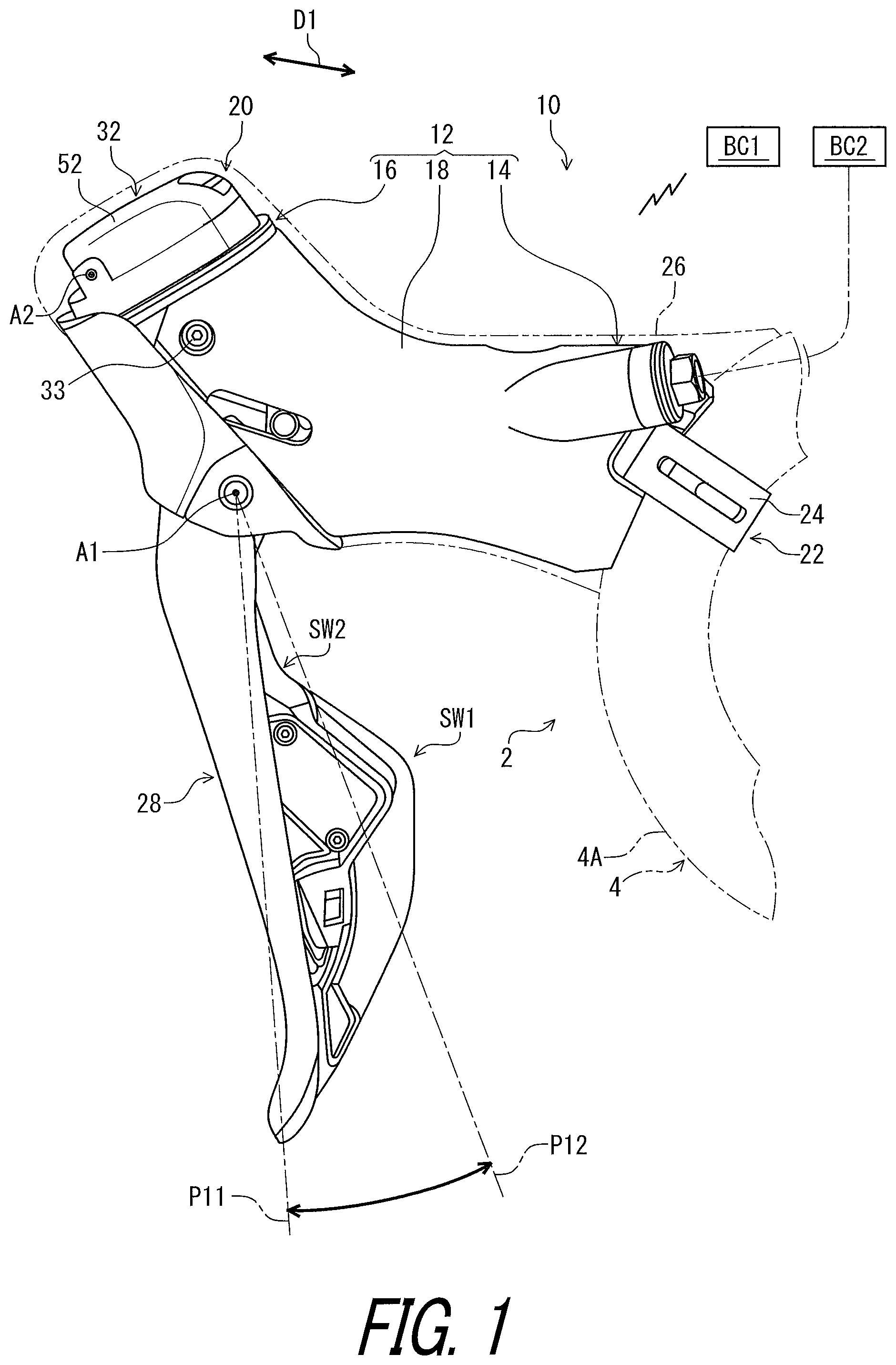
is a side elevational view of an operating device including an electric device in accordance with a first embodiment.
is a cross-sectional view of the operating device illustrated in .
is a cross-sectional view of the operating device taken along line of .
is a perspective view of a power supply illustrated in .
is another perspective view of the power supply illustrated in .
is a perspective view of an electrical contact of the electric device of the operating device illustrated in .
is a cross-sectional view of the electrical contact of the electric device take along line VII-VII of .
is a partial cross-sectional view of the operating device illustrated in (open position).
is a schematic block diagram of a human-powered vehicle including the operating device illustrated in (first state).
is a schematic block diagram of the human-powered vehicle including the operating device illustrated in (second state).
is a perspective view of a device in accordance with the first embodiment.
is a cross-sectional view of the operating device taken along line XII-XII of .
is a cross-sectional view of the operating device taken along line XIII-XIII of .
is a cross-sectional view of the operating device taken along line XIV-XIV of .
is a flowchart showing control of the electric device of the operating device illustrated in .
is a schematic block diagram of the human-powered vehicle including a device in accordance with a second embodiment (second state).
is a flowchart showing control of the device illustrated in .
is a schematic block diagram of the human-powered vehicle including the device illustrated in (second state, wireless communication).
is a schematic block diagram of the human-powered vehicle including the device illustrated in (second state, wired communication).
is a schematic block diagram of an external device and the device illustrated in (wireless communication).
is a schematic block diagram of the external device and the device illustrated in (wired communication).
is a schematic block diagram of the human-powered vehicle including the device illustrated in (second state).
is a schematic block diagram of the human-powered vehicle including a device in accordance with a modification (second state).
is a schematic block diagram of the human-powered vehicle including a device in accordance with a modification (second state).
is a schematic block diagram of the human-powered vehicle including the electric device and the device in accordance with a modification (first state).
is a schematic block diagram of the human-powered vehicle including the electric device and the device in accordance with a modification (second state).
is a schematic block diagram of the human-powered vehicle including the electric device and the device in accordance with a modification (first state).
is a schematic block diagram of the human-powered vehicle including the electric device and the device in accordance with a modification (second state).
DESCRIPTION OF THE EMBODIMENTS
The embodiment(s) will now be described with reference to the accompanying drawings, wherein like reference numerals designate corresponding or identical elements throughout the various drawings.
First Embodiment
As seen in , an operating device 10 for a human-powered vehicle 2 is configured to operate at least one component. The operating device 10 is configured to be mounted to a vehicle body 4 . The operating device 10 is configured to be mounted to a tubular part 4 A of the vehicle body 4 . Examples of the tubular part 4 A of the vehicle body 4 include a handlebar. However, the vehicle body 4 is not limited to the tubular part 4 A. The operating device 10 can be mounted to other parts of the human-powered vehicle 2 if needed and/or desired.
In the present application, a human-powered vehicle is a vehicle to travel with a motive power including at least a human power of a user who rides the human-powered vehicle (i.e., rider). The human-powered vehicle includes a various kind of bicycles such as a mountain bike, a road bike, a city bike, a cargo bike, a hand bike, and a recumbent bike. Furthermore, the human-powered vehicle includes an electric bike (E-bike). The electric bike includes an electrically assisted bicycle configured to assist propulsion of a vehicle with an electric motor. However, a total number of wheels of the human-powered vehicle is not limited to two. For example, the human-powered vehicle includes a vehicle having one wheel or three or more wheels. Especially, the human-powered vehicle does not include a vehicle that uses only an internal-combustion engine as motive power. Generally, a light road vehicle, which includes a vehicle that does not require a driver's license for a public road, is assumed as the human-powered vehicle.
The operating device 10 is configured to be electrically connected to an electric component BC 1 . In the first embodiment, the operating device 10 is configured to be connected to the electric component BC 1 via a wireless communication channel. The operating device 10 is configured to be wirelessly connected to the electric component BC 1 . However, the operating device 10 can be configured to be connected to the electric component BC 1 via a wired communication channel if needed and/or desired.
Examples of the electric component BC 1 include an additional or satellite operating device, an adjustable seatpost, a suspension, a gear changing device, a brake device, a lighting device, a display device, and a cycle computer. In the first embodiment, the electric component BC 1 includes a gear changing device such as a derailleur. However, the electric component BC 1 is not limited to the above devices.
The operating device 10 is configured to be connected to an additional component BC 2 . In the first embodiment, the operating device 10 is configured to be connected to the additional component BC 2 via a hydraulic hose. However, the operating device 10 can be configured to be connected to the additional component BC 2 via other elements such as a mechanical cable (e.g., Bowden cable).
Examples of the additional component BC 2 include an adjustable seatpost, a suspension, a gear changing device, and a brake device. In the first embodiment, the additional component BC 2 includes a hydraulic brake device. However, the additional component BC 2 is not limited to the above devices.
In the first embodiment, the operating device 10 is a right-hand side operating device configured to be operated by the rider's right hand to actuate the electric component BC 1 and the additional component BC 2 . However, the structures of the operating device 10 can be applied to a left-hand side operating device.
In the present application, the following directional terms “front,” “rear,” “forward,” “rearward,” “left,” “right,” “transverse,” “upward” and “downward” as well as any other similar directional terms refer to those directions which are determined on the basis of a user (e.g., a rider) who is in the user's standard position (e.g., on a saddle or a seat) in the human-powered vehicle 2 with facing a steering or a handlebar. Accordingly, these terms, as utilized to describe the operating device 10 or other components, should be interpreted relative to the human-powered vehicle 2 equipped with the operating device 10 as used in an upright riding position on a horizontal surface.
The operating device 10 for the human-powered vehicle 2 comprises a base structure 12 . The base structure 12 is configured to be coupled to the vehicle body 4 . In the first embodiment, the base structure 12 is configured to be mounted to a drop-down handlebar. However, structures of the operating device 10 can be applied to other operating devices mounted to other type of handlebars such as a flat handlebar, a time trial handlebar, and a bull horn handlebar.
The base structure 12 extends in a longitudinal direction D 1 . The base structure 12 includes a first end portion 14 and a second end portion 16 . The first end portion 14 is configured to be coupled to the vehicle body 4 . The second end portion 16 is opposite to the first end portion 14 in the longitudinal direction D 1 . The base structure 12 includes a grip portion 18 . The grip portion 18 is provided between the first end portion 14 and the second end portion 16 in the longitudinal direction D 1 . The second end portion 16 includes a pommel portion 20 .
The operating device 10 further comprises a mounting structure 22 configured to couple the first end portion 14 to the vehicle body 4 . The mounting structure 22 includes a band clamp 24 . However, the mounting structure 22 can include other structures which is similar to the band clamp 24 and which is used in a road shifter for mounting to the drop-down handlebar.
The operating device 10 comprises a cover 26 . The cover 26 is configured to be detachably and reattachably attached to the base structure 12 to at least partially cover the base structure 12 . The cover 26 is made of an elastic material such as rubber. A rider sometimes grips the base structure 12 (e.g., the grip portion 18 ) and leans on the base structure 12 (e.g., the grip portion 18 ) through the cover 26 during riding. The cover 26 can be omitted from the operating device 10 if needed and/or desired.
The term “detachably and reattachably” as used herein, encompasses a configuration in which an element is repeatedly detachable from and attachable to another element without substantial damage.
The operating device 10 for the human-powered vehicle 2 comprises an operating member 28 . The operating member 28 is movably coupled to the base structure 12 . The operating member 28 is pivotally coupled to the base structure 12 about a pivot axis A 1 . The operating member 28 is pivotable relative to the base structure 12 between a rest position P 11 and an operated position P 12 about the pivot axis A 1 .
In the present application, the term “rest position” as used herein refers to a position at which a movable part such as the operating member 28 remains stationary in a state where the movable part is not operated by the user. The term “operated position” as used herein refers to a position at which the movable part has been operated by the user to perform the operation of a device such as the additional component BC 2 .
The operating device 10 comprises at least one switch. The operating device 10 comprises a plurality of switches SW 1 and SW 2 . Examples of the switches SW 1 and SW 2 include a normally open switch. For example, each of the switches SW 1 and SW 2 includes a switch circuit and a button. The switches SW 1 and SW 2 are mounted to the operating member 28 to be movable relative to the base structure 12 along with the operating member 28 . However, at least one of the switches SW 1 and SW 2 can be provided in other positions such as the base structure 12 . At least one of the switches SW 1 and SW 2 can be omitted from the operating device 10 if needed and/or desired.
As seen in , the operating device 10 for the human-powered vehicle 2 comprises a hydraulic unit 30 and a reservoir 31 . The hydraulic unit 30 is configured to generate a hydraulic pressure in response to the movement of the operating member 28 . The hydraulic unit 30 includes a hydraulic chamber 30 A filled with a fluid. The reservoir 31 is connected to the hydraulic unit 30 to absorb a change in a volume of the fluid provided in the hydraulic chamber. The hydraulic unit 30 is configured to be connected to the additional component BC 2 (see e.g., ) via the hydraulic hose. The structure of the hydraulic unit 30 and the reservoir 31 have been known in the human-powered vehicle field. Thus, they will not be described in detail here for the sake of brevity. The operating device 10 can include other structures configured to operate the additional component BC 2 if needed and/or desired. For example, the operating device 10 can include an operating unit configured to wind or unwind a mechanical cable (e.g., a Bowden cable) to operate the additional component CB 2 if needed and/or desired.
As seen in , the operating device 10 for the human-powered vehicle 2 comprises an electric device 32 . The electric device 32 is coupled to the base structure 12 . The electric device 32 is coupled to the second end portion 16 of the base structure 12 . The electric device 32 is coupled to the pommel portion 20 of the base structure 12 . However, the electric device 32 can be provided to portions other than the pommel portion 20 if needed and/or desired. The electric device 32 can be coupled to portions other than the second end portion 16 if needed and/or desired. The electric device 32 can be provided to members other than the base structure 12 of the operating device 10 .
As seen in , the electric device 32 is coupled to the base structure 12 . In the first embodiment, the electric device 32 is secured to the base structure 12 with fasteners 33 such as screws. However, the electric device 32 can be secured to the base structure 12 with other structures such as an adhesive agent, insertion molding, and press-fitting if needed and/or desired.
The electric device 32 for the human-powered vehicle 2 comprises an electrical contact 34 . The electric device 32 further comprises a base member 36 . The base member 36 includes a power-supply accommodating part 38 . The electrical contact 34 is provided to the power-supply accommodating part 38 . The base member 36 is coupled to the base structure 12 . The base member 36 is secured to the base structure 12 with the fasteners 33 .
As seen in , the operating member 28 is movably coupled to the base member 36 of the electric device 32 since the base member 36 is coupled to the base structure 12 . The operating member 28 is pivotally coupled to the base member 36 about the pivot axis A 1 .
As seen in , the electrical contact 34 has a first state where the electrical contact 34 receives electricity from a power supply PS. The electrical contact 34 is configured to receive electricity from the power supply PS. The power-supply accommodating part 38 is configured to at least partially accommodate the power supply PS in the first state. The power-supply accommodating part 38 includes a power-supply accommodating space 38 A in which the power supply PS is at least partially provided. The electrical contact 34 is at least partially provided in the power-supply accommodating space 38 A.
In the first embodiment, the power-supply accommodating part 38 is configured to entirely accommodate the power supply PS in the first state. The power supply PS is entirely provided in the power-supply accommodating space 38 A in the first state. The electrical contact 34 is entirely provided in the power-supply accommodating space 38 A. However, the power-supply accommodating part 38 can be configured to partially accommodate the power supply PS in the first state if needed and/or desired. The power supply PS can be entirely provided in the power-supply accommodating space 38 A in the first state if needed and/or desired. The electrical contact 34 can be partially provided in the power-supply accommodating space 38 A if needed and/or desired.
As seen in , the electrical contact 34 includes a first electrical contact 40 and a second electrical contact 42 spaced apart from the first electrical contact 40 . In the present embodiment, the electrical contact 34 includes a third electrical contact 44 spaced apart from the first electrical contact 40 and the second electrical contact 42 . However, the third electrical contact 44 can be omitted from the electrical contact 34 if needed and/or desired.
As seen in , in the first embodiment, the third electrical contact 44 is disposed between the first electrical contact 40 and the second electrical contact 42 . However, the third electrical contact 44 can be disposed in positions other than the position provided between the first electrical contact 40 and the second electrical contact 42 if needed and/or desired.
The first electrical contact 40 and the second electrical contact 42 are in contact with the power supply PS in the first state. The first electrical contact 40 , the second electrical contact 42 , and the third electrical contact 44 are in contact with the power supply PS in the first state.
The power supply PS includes a first battery PS 1 and a second battery PS 2 which is a separate battery from the first battery PS 1 . Examples of the first battery and the second battery include a primary battery and a secondary battery. The first electrical contact 40 and the third electrical contact 44 are in contact with the first battery PS 1 in the first state. The second electrical contact 42 and the third electrical contact 44 are in contact with the second battery PS 2 in the first state. Thus, the first battery PS 1 and the second battery PS 2 are connected in series. However, the first battery PS 1 and the second battery PS 2 can be connected in parallel if needed and/or desired. The power supply PS is not limited to the first battery PS 1 and the second battery PS 2 . The power supply PS can include only one of the first battery PS 1 and the second battery PS 2 if needed and/or desired. In such modifications, the third electrical contact 44 can be omitted from the electrical contact 34 .
In the first embodiment, the first battery PS 1 includes a first coin battery. The second battery PS 2 includes a second coin battery. The first electrical contact 40 and the third electrical contact 44 are in contact with the first coin battery in the first state. The second electrical contact 42 and the third electrical contact 44 are in contact with the second coin battery in the first state. However, the first battery PS 1 can include a battery other than a coin battery if needed and/or desired. The second battery PS 2 can include a battery other than a coin battery if needed and/or desired.
As seen in , the power supply PS includes an end surface PS 31 , an additional end surface PS 32 , and an outer peripheral surface PS 33 . The end surface PS 31 has a round shape. The additional end surface PS 32 has a round shape. The end surface PS 31 faces in a thickness direction D 3 . The additional end surface PS 32 faces in the thickness direction D 3 . The additional end surface PS 32 is provided on a reverse side of the end surface PS 31 in the thickness direction D 3 .
The power supply PS includes a positive terminal TM 31 and a negative terminal TM 32 . The positive terminal TM 31 is provided on the end surface PS 31 and the outer peripheral surface PS 33 . The negative terminal TM 32 is provided on the additional end surface PS 32 . However, the shape of the power supply PS is not limited to the above shape.
The first battery PS 1 includes a first end surface PS 11 , a first additional end surface PS 12 , and a first outer peripheral surface PS 13 . The first end surface PS 11 has a round shape. The first additional end surface PS 12 has a round shape. The first end surface PS 11 faces in the thickness direction D 3 . The first additional end surface PS 12 faces in the thickness direction D 3 . The first additional end surface PS 12 is provided on a reverse side of the first end surface PS 11 in the thickness direction D 3 .
The first battery PS 1 includes a first positive terminal TM 11 and a first negative terminal TM 12 . The first positive terminal TM 11 is provided on the first end surface PS 11 and the first outer peripheral surface PS 13 . The first negative terminal TM 12 is provided on the first additional end surface PS 12 .
The second battery PS 2 includes a second end surface PS 21 , a second additional end surface PS 22 , and a second outer peripheral surface PS 23 . The second end surface PS 21 has a round shape. The second additional end surface PS 22 has a round shape. The second end surface PS 21 faces in the thickness direction D 3 . The second additional end surface PS 22 faces in the thickness direction D 3 . The second additional end surface PS 22 is provided on a reverse side of the second end surface PS 21 in the thickness direction D 3 .
The second battery PS 2 includes a second positive terminal TM 21 and a second negative terminal TM 22 . The second positive terminal TM 21 is provided on the second end surface PS 21 and the second outer peripheral surface PS 23 . The second negative terminal TM 22 is provided on the second additional end surface PS 22 .
In the present embodiment, the end surface PS 31 of the power supply PS includes the first end surface PS 11 of the first battery PS 1 . The additional end surface PS 32 of the power supply PS includes the second additional end surface PS 22 of the second battery PS 2 . The outer peripheral surface PS 33 of the power supply PS includes the first outer peripheral surface PS 13 of the first battery PS 1 and the second outer peripheral surface PS 23 of the second battery PS 2 . However, the relationships among the end surface PS 31 , the additional end surface PS 32 , the outer peripheral surface PS 33 , the first end surface PS 11 , the first additional end surface PS 12 , the first outer peripheral surface PS 13 , the second end surface PS 21 , the second additional end surface PS 22 , and the second outer peripheral surface PS 23 are not limited to the above relationships.
As seen in , the first electrical contact 40 is in contact with the positive terminal TM 31 of the power supply PS in the first state. The second electrical contact 42 is in contact with the negative terminal TM 32 of the power supply PS in the first state. Specifically, the first electrical contact 40 is in contact with the first positive terminal TM 11 of the first power supply PS 1 in the first state. The second electrical contact 42 is in contact with the second positive terminal TM 22 of the second power supply PS 2 in the second state. The third electrical contact 44 is in contact with the first negative terminal TM 12 of the first power supply PS 1 in the first state. The third electrical contact 44 is in contact with the second positive terminal TM 21 of the second power supply PS 2 in the first state. However, the positional relationship between the first power supply PS 1 , the second power supply PS 2 , the first electrical contact 40 , the second electrical contact 42 , and the third electrical contact 44 is not limited to the illustrated embodiment.
As seen in , the electrical contact 34 defines a space SP. The space SP is configured to at least partially accommodate the power supply PS in the first state. The power-supply accommodating space 38 A includes the space SP. The space SP is a part of the power-supply accommodating space 38 A. In the first embodiment, the space SP is configured to partially accommodate the power supply PS in the first state. However, the space SP can be configured to entirely accommodate the power supply PS in the first state if needed and/or desired. The space SP can be entirely of the power-supply accommodating space 38 A if needed and/or desired.
The space SP includes a first space SP 1 and a second space SP 2 . The first space SP 1 is defined by the first electrical contact 40 and the third electrical contact 44 . The second space SP 2 is defined by the second electrical contact 42 and the third electrical contact 44 .
The first battery PS 1 is at least partially provided in the first space SP 1 in the first state. The second battery PS 2 is at least partially provided in the second space SP 2 in the first state. In the first embodiment, the first battery PS 1 is partially provided in the first space SP 1 in the first state. The second battery PS 2 is partially provided in the second space SP 2 in the first state. However, the first battery PS 1 can be entirely provided in the first space SP 1 in the first state if needed and/or desired. The second battery PS 2 can be entirely provided in the second space SP 2 in the first state if needed and/or desired.
As seen in , the electrical contact 34 has a curved surface 34 S extending along an outer periphery of the power supply PS. The first electrical contact 40 has the curved surface 34 S extending along the outer periphery of the power supply PS. The curved surface 34 S extends along an outer periphery of the first battery PS 1 . The first electrical contact 40 is contactable with the outer periphery of the first battery PS 1 . The curved surface 34 S can be omitted from the first electrical contact 40 of the electrical contact 34 if needed and/or desired.
As seen in , the base member 36 includes a base part 50 and a lid 52 . The lid 52 is pivotally coupled to the base part 50 about a lid pivot axis A 2 . The lid 52 is pivotable relative to the base part 50 about the lid pivot axis A 2 between a closed position P 21 and an open position P 22 . However, the lid 52 can be coupled to the base part 50 with structures other than the pivotal structure if needed and/or desired. The lid 52 covers the power-supply accommodating space 38 A in a closed state where the lid 52 is in the closed position P 21 . The power-supply accommodating space 38 A is open to allow the power supply PS to be inserted into the power-supply accommodating space 38 A and to be removed from the power-supply accommodating space 38 A in an open state where the lid 52 is in the open position P 22 . The base member 36 includes a lid fastener 54 . The lid fastener 54 is configured to secure the lid 52 to the base part 50 . The base member 36 includes a pivot pin 114 P.
The base part 50 includes a first recess 55 in which the power supply PS is to be partially provided in the first state. The power-supply accommodating space 38 A includes at least part of the first recess 55 . The electrical contact 34 is provided in the first recess 55 .
The lid 52 includes a second recess 56 in which the power supply PS is to be partially provided in the closed state where the lid 52 is in the closed position P 21 . The power-supply accommodating space 38 A includes at least part of the second recess 56 . However, the second recess 56 can be omitted from the lid 52 if needed and/or desired.
As seen in , the switch SW 1 is configured to receive a user input U 1 . The switch SW 2 is configured to receive a user input U 2 . The switch SW 1 is configured to be activated in response to the user input U 1 . The switch SW 2 is configured to be activated in response to the user input U 2 .
The electric device 32 comprises a controller 60 . The controller 60 is electrically connected to the switches SW 1 and SW 2 . The controller 60 is configured to control another device (e.g., the electric component BC 1 ) in response to at least one of the activation of the switch SW 1 , the activation of the switch SW 2 , and other information.
The controller 60 is electrically connected to the electrical contact 34 . The controller 60 is electrically connected to the first electrical contact 40 and the second electrical contact 42 . The controller 60 is configured to be powered by the power supply PS in the first state. The controller 60 is configured to be powered by the first battery PS 1 and the second battery PS 2 in the first state. The power supply PS is configured to supply electricity to the controller 60 via the electrical contact 34 . The first battery PS 1 and the second battery PS 2 are configured to supply electricity to the controller 60 via the first electrical contact 40 , the second electrical contact 42 , and the third electrical contact 44 .
The controller 60 includes a processor 60 P, a memory 60 M, a circuit board 60 C, and a bus 60 D. The processor 60 P and the memory 60 M are electrically mounted on the circuit board 60 C. The processor 60 P and the memory 60 M are electrically connected to the circuit board 60 C via the bus 60 D. The processor 60 P is electrically connected to the memory 60 M via the circuit board 60 C and the bus 60 D.
For example, the processor 60 P includes at least one of a central processing unit (CPU), a micro processing unit (MPU), and a memory controller. The memory 60 M is electrically connected to the processor 60 P. For example, the memory 60 M includes at least one of a volatile memory and a non-volatile memory. Examples of the volatile memory include a random-access memory (RAM) and a dynamic random-access memory (DRAM). Examples of the non-volatile memory include a read only memory (ROM) and an electrically erasable programmable ROM. The memory 60 M includes storage areas each having an address in the ROM and the RAM. The processor 60 P is configured to control the memory 60 M to store data in the storage areas of the memory 60 M and reads data from the storage areas of the memory 60 M. The processor 60 P can also be referred to as a hardware processor 60 P. The memory 60 M can also be referred to as a hardware memory 60 M. The memory 60 M can also be referred to as a computer-readable storage medium 60 M.
The controller 60 is programed to execute at least one control algorithm of the electric device 32 . The memory 60 M (e.g., the ROM) stores at least one program including at least one program instructions. The at least one program is read into the processor 60 P, and thereby the at least one control algorithm of the electric device 32 is executed based on the at least one program. The controller 60 can also be referred to as a control circuit or circuitry 60 . The controller 60 can also be referred to as a hardware controller 60 .
The structure of the controller 60 is not limited to the above structure. The structure of the controller 60 is not limited to the processor 60 P, the memory 60 M, the circuit board 60 C, and the bus 60 D. The controller 60 can be realized by hardware alone or a combination of hardware and software. The processor 60 P and the memory 60 M can be integrated as a one chip such as an application specific integrated circuit (ASIC) or a field programmable gate array (FPGA).
The electric device 32 further comprises a communicator WC. The communicator WC is electrically connected to the electrical contact 34 . The communicator WC is electrically connected to the first electrical contact 40 and the second electrical contact 42 . The communicator WC is configured to be powered by the power supply PS in the first state. The communicator WC is configured to be powered by the first battery PS 1 and the second battery PS 2 in the first state. The power supply PS is configured to supply electricity to the communicator WC via the electrical contact 34 . The first battery PS 1 and the second battery PS 2 are configured to supply electricity to the communicator WC via the first electrical contact 40 , the second electrical contact 42 , and the third electrical contact 44 .
The communicator WC is configured to communicate with other components such as the electric component BC 1 The controller 60 is electrically connected to the communicator WC to control the communicator WC in response to the activation of at least one of the switches SW 1 and SW 2 . The controller 60 is configured to generate a control signal CS 1 in response to the activation of the switch SW 1 . The controller 60 is configured to generate a control signal CS 2 in response to the activation of the switch SW 2 . The controller 60 is configured to control the communicator WC to transmit the control signal CS 1 in response to the activation of the switch SW 1 . The controller 60 is configured to control the communicator WC to transmit the control signal CS 2 in response to the activation of the switch SW 2 .
The communicator WC includes a wireless communicator WC 1 . The wireless communicator WC 1 is electrically connected to the controller 60 . The wireless communicator WC 1 is electrically connected to the processor 60 P and the memory 60 M with the circuit board 60 C and the bus 60 D. The wireless communicator WC 1 includes a signal transmitting circuit or circuitry, a signal receiving circuit or circuitry, and an antenna. Thus, the wireless communicator WC 1 can also be referred to as a wireless communicator circuit or circuitry WC 1 .
The wireless communicator WC 1 is configured to superimpose signals on carrier wave using a predetermined wireless communication protocol to wirelessly transmit the signals. In the first embodiment, the wireless communicator WC 1 is configured to encrypt signals using a cryptographic key to generate encrypted wireless signals. The wireless communicator WC 1 is configured to transmit wireless signals via the antenna.
The wireless communicator WC 1 is configured to receive wireless signals via the antenna. In the first embodiment, the wireless communicator WC 1 is configured to decode the wireless signals to recognize signals transmitted from other wireless communicators. The wireless communicator WC 1 is configured to decrypt the wireless signals using the cryptographic key.
Examples of the communication protocol of the wireless communicator WC 1 include Wi-Fi (registered trademark), Zigbee (registered trademark), Bluetooth (registered trademark), ANT (registered trademark), and other wireless communication protocols.
The controller 60 is electrically connected to the wireless communicator WC 1 to control the wireless communicator WC 1 in response to the activation of at least one of the switches SW 1 and SW 2 . The controller 60 is configured to control the wireless communicator WC 1 to wirelessly transmit the control signal CS 1 in response to the activation of the switch SW 1 . The controller 60 is configured to control the wireless communicator WC 1 to wirelessly transmit the control signal CS 2 in response to the activation of the switch SW 2 .
In the first embodiment, the communicator WC is configured to communicate with an additional communicator of an additional component via a wired communication structure WS including an electric cable WS 1 using power line communication (PLC) technology. More specifically, the wired communication structure WS includes a ground line and a voltage line that are detachably connected to a serial bus that is formed by communication interfaces. In the first embodiment, the communicator WC is configured to communicate with the additional electric component through the voltage line using the PLC technology. Since the PLC technology has been known, it will not be described in detail here for the sake of brevity. The communicator WC can be configured to communicate with an additional communicator using methods other than the PLC if needed and/or desired.
The communicator WC includes a wired communicator WC 2 . The wired communicator WC 2 is configured to separate an input signal from a power source voltage supplied to the electric device 32 . The wired communicator WC 2 is configured to superimpose an output signal on the power source voltage supplied to the electric device 32 . The wired communicator WC 2 can also be referred to as a wired communicator circuit or circuitry WC 2 .
The electric device 32 comprises an informing unit 62 . The informing unit 62 is configured to inform the user of a state of the operating device 10 . Examples of the state of the operating device 10 includes a communication state of the communicator WC, a level of remaining electricity of the power supply PS, and a pairing state of the wireless communicator WC 1 . Examples of the informing unit 62 include a light emitting device such as a light-emitting diode (LED) and a loudspeaker. In the first embodiment, the informing unit 62 is provided to the base member 36 . However, the informing unit 62 can be provided other portions of the operating device 10 if needed and/or desired. The informing unit 62 can be omitted from the operating device 10 if needed and/or desired.
As seen in , the electrical contact 34 has a second state where the electrical contact 34 receives information INF from an external device ED. The electrical contact 34 is configured to receive the information INF from the external device ED in the second state. Examples of the external device ED includes a personal computer (e.g., a desktop computer or a laptop computer) a smart phone, and a tablet computer. The power supply PS is not in contact with the electrical contact 34 in the second state. In the second state, a device 64 for the human-powered vehicle 2 is in contact with the electrical contact 34 instead of the power supply PS. The device 64 is coupled to the electric device 32 in the second state. The controller 60 is configured to be electrically connected to the external device ED via the electrical contact 34 and the device 64 .
As seen in , the electrical contact 34 is configured not to receive the information INF from the external device ED in the first state since the electrical contact 34 is in contact with the power supply PS.
As seen in , the device 64 for a human-powered vehicle 2 comprises a communication electrical contact 66 . The communication electrical contact 66 is contactable with the electrical contact 34 of the electric device 32 . The electrical contact 34 has the second state where the electrical contact 34 is in contact with the communication electrical contact 66 . The communication electrical contact 66 can also be referred to as an additional electrical contact 66 . The electrical contact 34 is configured to be in contact with the additional electrical contact 66 electrically connected to the external device ED in the second state.
The communication electrical contact 66 is configured to be in contact with the electrical contact 34 to allow communication between the external device ED and the electric device 32 via the communication electrical contact 66 and the electrical contact 34 in the second state of the electrical contact 34 .
The communication electrical contact 66 includes a first communication electrical contact 68 and a second communication electrical contact 70 . The first communication electrical contact 68 is contactable with the first electrical contact 40 of the electrical contact 34 . The second communication electrical contact 70 is contactable with the second electrical contact 42 of the electrical contact 34 .
The first communication electrical contact 68 is in contact with the first electrical contact 40 of the electrical contact 34 in the second state of the electrical contact 34 . The second communication electrical contact 70 is in contact with the second electrical contact 42 of the electrical contact 34 in the second state of the electrical contact 34 . The first communication electrical contact 68 is not in contact with the second electrical contact 42 and the third electrical contact 44 of the electrical contact 34 in the second state of the electrical contact 34 . The second communication electrical contact 70 is not in contact with the first electrical contact 40 and the third electrical contact 44 of the electrical contact 34 in the second state of the electrical contact 34 . The third electrical contact 44 is not in contact with the first communication electrical contact 68 and the second communication electrical contact 70 .
As seen in , the device 64 further comprises a connection port 71 . The connection port 71 is electrically connected to the communication electrical contact 66 . The connection port 71 is configured to be connected to a connector WS 2 electrically connected to the external device ED. The connection port 71 is electrically connected to the first communication electrical contact 68 and the second communication electrical contact 70 . Examples of the connection port 71 include Universal Serial Bus (USB), USB-C (trademark), Thunderbolt (trademark), and High-Definition Multimedia Interface (HDMI) (trademark).
In the first embodiment, the wired communication structure WS is configured to electrically connect the external device ED and the device 64 . The wired communication structure WS the electric cable WS 1 . The electric cable WS 1 includes the connector WS 2 . The connector WS 2 is detachably attached to the connection port 71 of the device 64 . However, the wired communication structure WS can include at least one of at least one electric cable, at least one junction, and other connecting components.
The external device ED includes an external controller ED 4 , a user interface ED 5 , an electric power source ED 6 , an external connection port ED 7 , a display ED 8 , and an external communicator ED 9 . The external controller ED 4 is electrically connected to the user interface ED 5 , the electric power source ED 6 , the external connection port ED 7 , the display ED 8 , and the external communicator ED 9 .
The external controller ED 4 includes a processor ED 4 P, a memory ED 4 M, a circuit board ED 4 C, and a bus ED 4 D. The processor ED 4 P and the memory ED 4 M are electrically mounted on the circuit board ED 4 C. The processor ED 4 P and the memory ED 4 M are electrically connected to the circuit board ED 4 C via the bus ED 4 D. The processor ED 4 P is electrically connected to the memory ED 4 M via the circuit board ED 4 C and the bus ED 4 D.
For example, the processor ED 4 P includes at least one of a CPU, a MPU, and a memory controller. The memory ED 4 M is electrically connected to the processor ED 4 P. For example, the memory ED 4 M includes at least one of a volatile memory and a non-volatile memory. Examples of the volatile memory include a RAM and a DRAM.
Examples of the non-volatile memory include a ROM and an electrically erasable programmable ROM. The memory ED 4 M includes storage areas each having an address in the ROM and the RAM. The processor ED 4 P is configured to control the memory ED 4 M to store data in the storage areas of the memory ED 4 M and reads data from the storage areas of the memory ED 4 M. The processor ED 4 P can also be referred to as a hardware processor ED 4 P. The memory ED 4 M can also be referred to as a hardware memory ED 4 M. The memory ED 4 M can also be referred to as a computer-readable storage medium ED 4 M.
The external controller ED 4 is programed to execute at least one control algorithm of the electric device 32 . The memory ED 4 M (e.g., the ROM) stores at least one program including at least one program instructions. The at least one program is read into the processor ED 4 P, and thereby the at least one control algorithm of the electric device 32 is executed based on the at least one program. The external controller ED 4 can also be referred to as a control circuit or circuitry ED 4 . The external controller ED 4 can also be referred to as an external hardware controller ED 4 .
The structure of the external controller ED 4 is not limited to the above structure. The structure of the external controller ED 4 is not limited to the processor ED 4 P, the memory ED 4 M, the circuit board ED 4 C, and the bus ED 4 D. The external controller ED 4 can be realized by hardware alone or a combination of hardware and software. The processor ED 4 P and the memory ED 4 M can be integrated as a one chip such as an ASIC or a FPGA.
The user interface ED 5 includes at least one of a keyboard and a touch panel. The user interface ED 5 is configured to receive input from the user. The external controller ED 4 is configured to obtain the input from the user interface ED 5 .
The electric power source ED 6 includes at least one of a direct-current (DC) power source and an alternating-current (AC) power source. The electric power source ED 6 is electrically connected to the external controller ED 4 , the user interface ED 5 , the external connection port ED 7 , the display ED 8 , and the external communicator ED 9 to supply electricity to the external controller ED 4 , the user interface ED 5 , the external connection port ED 7 , the display ED 8 , and the external communicator ED 9 .
The external connection port ED 7 is configured to be detachably connected to the electric cable WS 1 . Examples of the external connection port ED 7 include USB, USB-C (trademark), Thunderbolt (trademark), and HDMI (trademark). The display ED 8 is configured to display information. The external controller ED 4 is configured to control the display ED 8 to display information.
The external communicator ED 9 is configured to communicate with another communicator such as the communicator WC of the electric device 32 . The external communicator ED 9 includes a wireless communicator ED 91 and a wired communicator ED 92 .
The wireless communicator ED 91 has substantially the same structure of the wireless communicator WC 1 of the electric device 32 . The wired communicator ED 92 has substantially the same structure of the wired communicator WC 2 of the electric device 32 .
The wireless communicator ED 91 is electrically connected to the external controller ED 4 . The wireless communicator ED 91 is electrically connected to the processor ED 9 P and the memory ED 9 M with the circuit board ED 4 C and the bus ED 9 D. The wireless communicator ED 91 includes a signal transmitting circuit or circuitry, a signal receiving circuit or circuitry, and an antenna. Thus, the wireless communicator ED 91 can also be referred to as a wireless communicator circuit or circuitry ED 91 .
The wireless communicator ED 91 is configured to superimpose signals on carrier wave using a predetermined wireless communication protocol to wirelessly transmit signals. In the first embodiment, the wireless communicator ED 91 is configured to encrypt signals using a cryptographic key to generate encrypted wireless signals. The wireless communicator ED 91 is configured to transmit wireless signals via the antenna.
The wireless communicator ED 91 is configured to receive wireless signals via the antenna. In the first embodiment, the wireless communicator ED 91 is configured to decode the wireless signals to recognize signals transmitted from other wireless communicators. The wireless communicator ED 91 is configured to decrypt the wireless signals using the cryptographic key.
Examples of the communication protocol of the wireless communicator ED 91 include Wi-Fi (registered trademark), Zigbee (registered trademark), Bluetooth (registered trademark), ANT (registered trademark), and other wireless communication protocols.
The external controller ED 4 is electrically connected to the wireless communicator ED 91 to control the wireless communicator ED 91 based on at least one of computation executed by the external controller ED 4 and the input received by the user interface ED 5 . The external controller ED 4 is configured to control the wireless communicator ED 91 to wirelessly transmit the information INF to another device.
The external communicator ED 9 is configured to communicate with an additional communicator of an additional component via the wired communication structure WS including the electric cable WS 1 using PLC technology.
The wired communicator ED 92 is configured to separate an input signal from a power source voltage supplied from the electric power source ED 6 . The wired communicator ED 92 is configured to superimpose an output signal on the power source voltage supplied from the electric power source ED 6 . The wired communicator ED 92 can also be referred to as a wired communicator circuit or circuitry ED 92 .
As seen in , the device 64 further comprises a base 72 . The communication electrical contact 66 is attached to the base 72 . The connection port 71 is provided to the base 72 . The base 72 includes a base body 74 and a protruding body 76 . The protruding body 76 protrudes from the base body 74 . The protruding body 76 includes a first protruding part 78 and a second protruding part 80 . The first protruding part 78 protrudes from the base body 74 . The second protruding part 80 protrudes from the base body 74 . The second protruding part 80 is spaced apart from the first protruding part 78 .
The first communication electrical contact 68 is spaced apart from the second communication electrical contact 70 . The first communication electrical contact 68 is spaced apart from the second communication electrical contact 70 to define a recess 81 between the first communication electrical contact 68 and the second communication electrical contact 70 . The first protruding part 78 is spaced apart from the second protruding part 80 to define the recess 81 between the first protruding part 78 and the second protruding part 80 .
As seen in , the communication electrical contact 66 is at least partially provided to the protruding body 76 . The first communication electrical contact 68 is at least partially provided to the first protruding part 78 . The second communication electrical contact 70 is at least partially provided to the second protruding part 80 . In the first embodiment, the communication electrical contact 66 is partially provided to the protruding body 76 . However, the communication electrical contact 66 can be entirely provided to the protruding body 76 if needed and/or desired. The first communication electrical contact 68 can be entirely provided to the first protruding part 78 if needed and/or desired. The second communication electrical contact 70 can be entirely provided to the second protruding part 80 if needed and/or desired.
As seen in , the base 72 is configured to be at least partially provided in the space SP defined by the electrical contact 34 of the electric device 32 in the second state of the electrical contact 34 . In the first embodiment, the base 72 is configured to be partially provided in the space SP defined by the electrical contact 34 of the electric device 32 in the second state of the electrical contact 34 . However, the base 72 can be configured to be entirely provided in the space SP in the second state of the electrical contact 34 if needed and/or desired.
The protruding body 76 is configured to be at least partially provided in the space SP defined by the electrical contact 34 of the electric device 32 in the second state of the electrical contact 34 . In the first embodiment, the protruding body 76 is configured to be partially provided in the space SP in the second state of the electrical contact 34 . The protruding body 76 is configured to be partially provided in the first space SP 1 in the second state of the electrical contact 34 . However, the protruding body 76 can be configured to be entirely provided in the space SP in the second state of the electrical contact 34 if needed and/or desired. The protruding body 76 can be configured to be entirely provided in the first space SP 1 in the second state of the electrical contact 34 if needed and/or desired.
The first protruding part 78 is at least partially provided in the space SP in the second state of the electrical contact 34 . The first protruding part 78 is at least partially provided in the first space SP 1 in the second state of the electrical contact 34 . In the first embodiment, the first protruding part 78 is partially provided in the space SP in the second state of the electrical contact 34 . The first protruding part 78 is partially provided in the first space SP 1 in the second state of the electrical contact 34 . However, the first protruding part 78 can be entirely provided in the space SP in the second state of the electrical contact 34 if needed and/or desired. The first protruding part 78 can be entirely provided in the first space SP 1 in the second state of the electrical contact 34 if needed and/or desired.
The second protruding part 80 is at least partially provided in the space SP in the second state of the electrical contact 34 . The second protruding part 80 is at least partially provided in the second space SP 2 in the second state of the electrical contact 34 . In the first embodiment, the second protruding part 80 is partially provided in the space SP in the second state of the electrical contact 34 . The second protruding part 80 is partially provided in the second space SP 2 in the second state of the electrical contact 34 . However, the second protruding part 80 can be entirely provided in the space SP in the second state of the electrical contact 34 if needed and/or desired. The second protruding part 80 can be entirely provided in the second space SP 2 in the second state of the electrical contact 34 if needed and/or desired.
The electrical contact 34 is at least partially provided in the recess 81 . The third electrical contact 44 is at least partially provided in the recess 81 . In the first embodiment, the electrical contact 34 is partially provided in the recess 81 . The third electrical contact 44 is partially provided in the recess 81 . However, the electrical contact 34 can be entirely provided in the recess 81 if needed and/or desired. The third electrical contact 44 can be entirely provided in the recess 81 if needed and/or desired.
As seen in , the protruding body 76 includes an outer peripheral surface 82 . The outer peripheral surface 82 is configured to be at least partially provided in the space SP in the second state of the electrical contact 34 . In the first embodiment, the outer peripheral surface 82 is configured to be partially provided in the space SP in the second state of the electrical contact 34 . However, the outer peripheral surface 82 can be configured to be entirely provided in the space SP in the second state of the electrical contact 34 if needed and/or desired.
As seen in , the outer peripheral surface 82 includes a first outer peripheral surface 82 A and a second outer peripheral surface 82 B. As seen in , the first protruding part 78 includes the first outer peripheral surface 82 A. As seen in , the second protruding part 80 includes the second outer peripheral surface 82 B.
As seen in , the first outer peripheral surface 82 A is configured to be at least partially provided in the space SP in the second state of the electrical contact 34 . The first outer peripheral surface 82 A is configured to be at least partially provided in the first space SP 1 in the second state of the electrical contact 34 . In the first embodiment, the first outer peripheral surface 82 A is configured to be partially provided in the space SP in the second state of the electrical contact 34 . The first outer peripheral surface 82 A is configured to be partially provided in the first space SP 1 in the second state of the electrical contact 34 . However, the first outer peripheral surface 82 A can be configured to be entirely provided in the space SP in the second state of the electrical contact 34 if needed and/or desired. The first outer peripheral surface 82 A can be configured to be entirely provided in the first space SP 1 in the second state of the electrical contact 34 if needed and/or desired.
As seen in , the second outer peripheral surface 82 B is configured to be at least partially provided in the space SP in the second state of the electrical contact 34 . The second outer peripheral surface 82 B is configured to be at least partially provided in the second space SP 2 in the second state of the electrical contact 34 . In the first embodiment, the second outer peripheral surface 82 B is configured to be partially provided in the space SP in the second state of the electrical contact 34 . The second outer peripheral surface 82 B is configured to be partially provided in the second space SP 2 in the second state of the electrical contact 34 . However, the second outer peripheral surface 82 B can be configured to be entirely provided in the space SP in the second state of the electrical contact 34 if needed and/or desired. The second outer peripheral surface 82 B can be configured to be entirely provided in the second space SP 2 in the second state of the electrical contact 34 if needed and/or desired.
As seen in to 14 , the communication electrical contact 66 is configured to be at least partially provided in the space SP defined by the electrical contact 34 of the electric device 32 in the second state of the electrical contact 34 . The space SP is configured to at least partially accommodate the additional electrical contact 66 electrically connected to the external device ED in the second state.
In the first embodiment, the communication electrical contact 66 is configured to be partially provided in the space SP defined by the electrical contact 34 of the electric device 32 . The space SP is configured to partially accommodate the additional electrical contact 66 electrically connected to the external device ED in the second state. However, the communication electrical contact 66 can be configured to be entirely provided in the space SP defined by the electrical contact 34 of the electric device 32 if needed and/or desired. The space SP can be configured to entirely accommodate the additional electrical contact 66 electrically connected to the external device ED in the second state if needed and/or desired.
As seen in , the first communication electrical contact 68 is configured to be at least partially provided in the space SP in the second state of the electrical contact. The first communication electrical contact 68 is configured to be at least partially provided in the first space SP 1 in the second state of the electrical contact 34 . In the first embodiment, the first communication electrical contact 68 is configured to be partially provided in the space SP in the second state of the electrical contact 34 . The first communication electrical contact 68 is configured to be partially provided in the first space SP 1 in the second state of the electrical contact 34 . However, the first communication electrical contact 68 can be configured to be entirely provided in the space SP in the second state of the electrical contact 34 if needed and/or desired. The first communication electrical contact 68 can be configured to be entirely provided in the first space SP 1 in the second state of the electrical contact 34 if needed and/or desired.
As seen in , the second communication electrical contact 70 is configured to be at least partially provided in the space SP in the second state of the electrical contact. The second communication electrical contact 70 is configured to be at least partially provided in the second space SP 2 in the second state of the electrical contact 34 . In the first embodiment, the second communication electrical contact 70 is configured to be partially provided in the space SP in the second state of the electrical contact 34 . The second communication electrical contact 70 is configured to be partially provided in the second space SP 2 in the second state of the electrical contact 34 . However, the second communication electrical contact 70 can be configured to be entirely provided in the space SP in the second state of the electrical contact 34 if needed and/or desired. The second communication electrical contact 70 can be configured to be entirely provided in the second space SP 2 in the second state of the electrical contact 34 if needed and/or desired.
As seen in , the electrical contact 34 is configured to receive electricity and the information INF from the external device ED in the second state. The electrical contact 34 is configured to receive electricity and the information INF from the external device ED via the communication electrical contact 66 in the second state of the electrical contact 34 . The electrical contact 34 is configured to receive an input signal indicating the information INF in the second state. The information INF is superimposed on the power source voltage supplied from the external device ED to the electrical contact 34 in the second state.
In the first embodiment, the communication electrical contact 66 is configured to receive a voltage different from the power-supply voltage of the power supply PS. The voltage is applied from the external device ED to the communication electrical contact 66 in the second state. However, the communication electrical contact 66 is configured to receive a voltage equal to the power-supply voltage of the power supply PS if needed and/or desired.
In the first embodiment, the communicator WC is configured to separate an input signal indicating the information INF from the power source voltage supplied from the external device ED to the electrical contact 34 . The communicator WC is configured to superimpose an output signal on the power source voltage supplied from the external device ED to the electrical contact 34 . The wired communicator WC 2 is configured to separate the input signal indicating the information INF from the power source voltage supplied from the external device ED to the electrical contact 34 . The wired communicator WC 2 is configured to superimpose the output signal on the power source voltage supplied from the external device ED to the electrical contact 34 . However, the communicator WC can be configured not to separate the input signal from the power source voltage supplied from the external device ED to the electrical contact 34 if needed and/or desired. The communicator WC can be configured to superimpose the output signal on the power source voltage supplied from the external device ED to the electrical contact 34 if needed and/or desired.
As seen in , the electric device 32 further comprises a detector DT. The detector DT is electrically connected to the electrical contact 34 . The detector DT is configured to detect whether the electrical contact 34 is in the first state or the second state. The detector DT is electrically connected to the controller 60 . The detector DT is electrically mounted on the circuit board 60 C. The detector DT is electrically connected to the processor 60 P and the memory 60 M via the circuit board 60 C and the bus 60 D. The controller 60 is configured to receive a detection result of the detector DT. Thus, the controller 60 is configured to recognize whether the electrical contact 34 is in the first state or the second state.
The detector DT is electrically connected to at least one of the first electrical contact 40 , the second electrical contact 42 , and the third electrical contact 44 . In the first embodiment, the detector DT is electrically connected to the third electrical contact 44 . However, the detector DT can be electrically connected to at least one of the first electrical contact 40 , the second electrical contact 42 , and the third electrical contact 44 if needed and/or desired.
The detector DT is configured to detect a voltage applied to the third electrical contact 44 . The third electrical contact 44 is configured to receive a voltage applied from one of the first battery PS 1 and the second battery PS 2 in the first state (see e.g., ). For example, each of the first battery PS 1 and the second battery PS 2 has an output voltage. The output voltage is applied between the third electrical contact 44 and one of the first electrical contact 40 and the second electrical contact 42 in the first state.
In the second state, the third electrical contact 44 is configured not to receive a voltage from the external device ED since the third electrical contact 44 is not in contact with the communication electrical contact 66 of the device 64 (see e.g., ) in the second state. Thus, the voltage applied to the third electrical contact 44 is zero in the second state.
The detector DT is configured to measure a voltage applied to the third electrical contact 44 . The detector DT is configured to detect that the electrical contact 34 is in the first state if the voltage measured by the detector DT is higher than a determination threshold. The determination threshold is lower than the output voltage applied to the third electrical contact 44 in the first state and higher than zero. The detector DT is configured to determine that the electrical contact 34 is in the second state if the voltage measured by the detector DT is lower than or equal to the determination threshold. The controller 60 is configured to recognize whether the electrical contact 34 is in the first state or the second state based on the detection result of the detector DT.
In a case where the third electrical contact 44 is omitted from the electrical contact 34 , the detector DT is electrically connected to one of the first electrical contact 40 and the second electrical contact 42 . In such modifications, one of the first battery PS 1 and the second battery PS 2 is omitted from the power supply PS. The detector DT is configured to detect a voltage applied between the first electrical contact 40 and the second electrical contact 42 . The electric power source ED 6 of the external device ED has a rated voltage which is higher than the output voltage of the power supply PS. Thus, the detector DT is configured to detect that the electrical contact 34 is in the first state if the voltage VD detected by the detector DT is lower than a determination threshold. The detector DT is configured to detect that the electrical contact 34 is in the second state if the voltage VD detected by the detector DT is higher than or equal to the determination threshold.
The detector DT is not limited to the illustrated embodiment. For example, the detector DT can be configured to detect whether the electrical contact 34 is in the first state or the second state using other methods other than a voltage.
The controller 60 is configured to use the wireless communicator WC 1 to communicate with the external device ED if the detection result of the detector DT indicates that the electrical contact 34 is in the first state. The controller 60 is configured to control the wireless communicator WC 1 to wirelessly transmit the control signal CS 1 in response to the activation of the switch SW 1 if the detection result of the detector DT indicates that the electrical contact 34 is in the first state. The controller 60 is configured to control the wireless communicator WC 1 to wirelessly transmit the control signal CS 2 in response to the activation of the switch SW 2 if the detection result of the detector DT indicates that the electrical contact 34 is in the first state.
The controller 60 is configured to use the wired communicator WC 2 to communicate with the external device ED if the detection result of the detector DT indicates that the electrical contact 34 is in the second state. The controller 60 is configured to control the wired communicator WC 2 to receive the information INF from the external device ED if the detection result of the detector DT indicates that the electrical contact 34 is in the second state. The controller 60 is configured to control the wired communicator WC 2 to transmit additional information to the external device ED if the detection result of the detector DT indicates that the electrical contact 34 is in the second state.
The information INF transmitted from the external device ED to the electric device 32 includes firmware information and setting information. The firmware information includes firmware updates of electric components installed in at least one of the electric device 32 and the operating device 10 . The setting information includes settings of at least one of the electric device 32 and the operating device 10 . The controller 60 is configured to execute firmware updates if the controller 60 receives the firmware information from the external device ED. The controller 60 is configured to change the settings based on the setting information if the controller 60 receives the setting information from the external device ED.
The control executed by the electric device 32 will be described below referring to .
The voltage VD detected by the detector DT is compared to a determination threshold VT (step S 1 ). The controller 60 is configured to store the determination threshold VT in the memory 60 M. The wireless communicator WC 1 is selected by the controller 60 if the voltage VD detected by the detector DT is higher than the determination threshold VT (steps S 1 and S 2 ). The wired communicator WC 2 is selected by the controller 60 if the voltage VD detected by the detector DT is lower than or equal to the determination threshold VT (steps S 1 and S 6 ).
It is determined by the controller 60 whether the switch SW 1 or SW 2 receives the user input U 1 or U 2 if the wireless communicator WC 1 is selected by the controller 60 (step S 3 ). For example, it is determined by the controller 60 whether the switch SW 1 or SW 2 is activated in response to the user input U 1 or U 2 if the wireless communicator WC 1 is selected by the controller 60 (step S 3 ).
The control signal CS 1 is wirelessly transmitted by the wireless communicator WC 1 in response to the user input U 1 received by the switch SW 1 (steps S 3 and S 4 ). The control signal CS 2 is wirelessly transmitted by the wireless communicator WC 1 in response to the user input U 2 received by the switch SW 2 (steps S 3 and S 5 ). The process returns to the step S 1 after the control signal CS 1 or CS 2 is transmitted.
It is determined by the controller 60 whether the information INF is transmitted from the external device ED if the wired communicator WC 2 is selected by the controller 60 in the step S 6 (steps S 7 and S 9 ). The firmware updates are executed by the controller 60 based on the firmware information if the firmware information is transmitted from the external device ED (steps S 7 and S 8 ). The settings are changed by the controller based on the setting information if the setting information is transmitted from the external device ED (steps S 9 and 10 ). The process returns to the step S 1 .
Second Embodiment
A device 264 in accordance with a second embodiment will be described below referring to to 22 . The device 264 has the same structure and/or configuration as those of the device 64 except that the device 264 is configured to wirelessly communicate with the external device ED. Thus, elements having substantially the same function as those in the first embodiment will be numbered the same here and will not be described and/or illustrated again in detail here for the sake of brevity.
As seen in , the device 264 for the human-powered vehicle 2 comprises the communication electrical contact 66 . The communication electrical contact 66 is configured to be in contact with the electrical contact 34 to allow communication between the external device ED and the electric device 32 via the communication electrical contact 66 and the electrical contact 34 in the second state of the electrical contact 34 . The device 264 has substantially the same structure as the structure of the device 64 of the first embodiment.
The device 264 further comprises a wireless communicator WC 3 . The wireless communicator WC 3 is electrically connected to the communication electrical contact 66 to wirelessly communicate with the external device ED. The wireless communicator WC 3 is configured to wirelessly communicate with the wireless communicator ED 91 of the external device ED. The wireless communicator WC 3 is configured to wirelessly receive the information INF from the wireless communicator ED 91 of the external device ED.
In the present embodiment, the device 264 further comprises a wired communicator WC 4 . The wired communicator WC 4 is electrically connected to the communication electrical contact 66 to communicate with the electric device 32 via the communication electrical contact 66 . The wireless communicator WC 3 is configured to transmit to the wired communicator WC 4 the information INF wirelessly transmitted from the external device ED. The wired communicator WC 4 is configured to transmit to the electric device 32 the information INF transmitted from the wireless communicator WC 3 via the communication electrical contact 66 and the electrical contact 34 .
The device 264 further comprises an additional power supply PS 3 . The additional power supply PS 3 is electrically connected to the communication electrical contact 66 to supply electricity to the electric device 32 via the communication electrical contact 66 and the electrical contact 34 . The additional power supply PS 3 is electrically connected to the wireless communicator WC 3 to supply electricity to the wireless communicator WC 3 . The additional power supply PS 3 is electrically connected to the wired communicator WC 4 to supply electricity to the wired communicator WC 4 .
The additional power supply PS 3 is configured to supply electricity to the electric device 32 via the communication electrical contact 66 and the electrical contact 34 in the second state of the electrical contact 34 . The additional power supply PS 3 is electrically connected to the first communication electrical contact 68 and the second communication electrical contact 70 to supply electricity to the electric device 32 via the first communication electrical contact 68 , the second communication electrical contact 70 , the first electrical contact 40 , and the second electrical contact 42 .
For example, the additional power supply PS 3 includes a battery and a battery holder. The battery holder is electrically connected to the additional controller 280 . The battery is configured to be detachably attached to the battery holder. Examples of the battery include a primary battery and a secondary battery.
The wired communicator WC 4 is configured to communicate with the wired communicator WC 2 of the electric device 32 via the communication electrical contact 66 and the electrical contact 34 using the PLC. The wired communicator WC 2 is configured to communicate with the wired communicator WC 4 using the power source voltage supplied from the additional power supply PS 3 .
The device 264 comprises an additional controller 280 . The additional controller 280 is electrically connected to the wireless communicator WC 3 , the wired communicator WC 4 , and the additional power supply PS 3 . The additional power supply PS 3 is configured to supply electricity to the wireless communicator WC 3 , the wired communicator WC 4 , and the additional controller 280 . The additional controller 280 is configured to control the wireless communicator WC 3 and the wired communicator WC 4 .
The additional controller 280 includes a processor 280 P, a memory 280 M, a circuit board 280 C, and a bus 280 D. Namely, the device 264 further comprises the memory 280 M. The processor 280 P and the memory 280 M are electrically mounted on the circuit board 280 C. The processor 280 P and the memory 280 M are electrically connected to the circuit board 280 C via the bus 280 D. The processor 280 P is electrically connected to the memory 280 M via the circuit board 280 C and the bus 280 D.
For example, the processor 280 P includes at least one of a CPU, a MPU, and a memory controller. The memory 280 M is electrically connected to the processor 280 P. For example, the memory 280 M includes at least one of a volatile memory and a non-volatile memory. Examples of the volatile memory include a RAM and a DRAM. Examples of the non-volatile memory include a ROM and an electrically erasable programmable ROM. The memory 280 M includes storage areas each having an address in the ROM and the RAM. The processor 280 P is configured to control the memory 280 M to store data in the storage areas of the memory 280 M and reads data from the storage areas of the memory 280 M. The processor 280 P can also be referred to as a hardware processor 280 P. The memory 280 M can also be referred to as a hardware memory 280 M. The memory 280 M can also be referred to as a computer-readable storage medium 280 M.
The additional controller 280 is programed to execute at least one control algorithm of the electric device 32 . The memory 280 M (e.g., the ROM) stores at least one program including at least one program instructions. The at least one program is read into the processor 280 P, and thereby the at least one control algorithm of the electric device 32 is executed based on the at least one program. The additional controller 280 can also be referred to as an additional control circuit or circuitry 280 . The additional controller 280 can also be referred to as an additional hardware controller 280 .
The structure of the additional controller 280 is not limited to the above structure. The structure of the additional controller 280 is not limited to the processor 280 P, the memory 280 M, the circuit board 280 C, and the bus 280 D. The additional controller 280 can be realized by hardware alone or a combination of hardware and software. The processor 280 P and the memory 280 M can be integrated as a one chip such as an ASIC or a FPGA.
The memory 280 M is electrically connected to the communication electrical contact 66 . The memory 280 M is configured to store the information INF received from the external device ED. The memory 280 M is configured to store the information INF wirelessly transmitted from the wireless communicator ED 91 of the external device ED to the wireless communicator WC 3 . The wired communicator WC 4 is configured to transmit the information INF stored in the memory 280 M to the electric device 32 via the communication electrical contact 66 and the electrical contact 34 . The wired communicator WC 4 is configured to transmit the information INF stored in the memory 280 M to the wired communicator WC 2 of the electric device 32 via the communication electrical contact 66 and the electrical contact 34 . The controller 60 of the electric device 32 is configured to utilize the information INF transmitted from the wired communicator WC 4 of the device 264 to the wired communicator WC 2 of the electric device 32 .
The wireless communicator WC 3 has substantially the same structure of the wireless communicator WC 1 of the electric device 32 . The wireless communicator WC 3 is electrically connected to the additional controller 280 . The wireless communicator WC 3 is electrically connected to the processor 280 P and the memory 280 M with the circuit board 280 C and the bus 280 D. The wireless communicator WC 3 includes a signal transmitting circuit or circuitry, a signal receiving circuit or circuitry, and an antenna. Thus, the wireless communicator WC 3 can also be referred to as a wireless communicator circuit or circuitry WC 3 .
The wireless communicator WC 3 is configured to superimpose signals on carrier wave using a predetermined wireless communication protocol to wirelessly transmit signals. In the first embodiment, the wireless communicator WC 3 is configured to encrypt signals using a cryptographic key to generate encrypted wireless signals. The wireless communicator WC 3 is configured to transmit wireless signals via the antenna.
The wireless communicator WC 3 is configured to receive wireless signals via the antenna. In the first embodiment, the wireless communicator WC 3 is configured to decode the wireless signals to recognize signals transmitted from other wireless communicators. The wireless communicator WC 3 is configured to decrypt the wireless signals using the cryptographic key.
Examples of the communication protocol of the wireless communicator WC 3 include Wi-Fi (registered trademark), Zigbee (registered trademark), Bluetooth (registered trademark), ANT (registered trademark), and other wireless communication protocols.
The additional controller 280 is electrically connected to the wireless communicator WC 3 to control the wireless communicator WC 3 based on the information transmitted from the external device ED. The additional controller 280 is configured to control the wireless communicator WC 3 to wirelessly receive the information INF from the external device ED.
The wired communicator WC 4 is configured to communicate with the wired communicator ED 92 of the external device ED via the wired communication structure WS using PLC technology.
The wired communicator WC 4 is configured to separate an input signal from a power source voltage supplied from the additional power supply PS 3 . The wired communicator WC 4 is configured to superimpose an output signal on the power source voltage supplied from the additional power supply PS 3 . The wired communicator WC 4 can also be referred to as a wired communicator circuit or circuitry WC 4 .
In the second embodiment, the device 264 comprises the connection port 71 . The connection port 71 is electrically connected to the wired communicator WC 4 . The wired communicator WC 4 of the device 264 is configured to communicate with the external device ED via the connection port 71 without the wireless communicator WC 3 . However, the connection port 71 can be omitted from the device 264 if needed and/or desired.
The control executed by the device 264 will be described below referring to .
It is determined by the additional controller 280 whether the device 264 is connected to the external device ED (step S 31 ). For example, it is determined by the additional controller 280 whether the device 264 is wirelessly connected to the external device ED (see e.g., ) or whether the device 264 is connected to the external device ED via the connection port 71 and the wired communication structure WS (see e.g., ). It is determined by the additional controller 280 whether the wireless communicator WC 3 of the device 264 is wirelessly connected to the wireless communicator ED 91 of the external device ED (see e.g., ) or whether the wired communicator WC 4 of the device 264 is connected to the wired communicator ED 92 of the external device ED via the connection port 71 and the wired communication structure WS (see e.g., ). More specifically, it is determined by the additional controller 280 whether pairing has been completed between the wireless communicator WC 3 of the device 264 and the wireless communicator ED 91 of the external device ED in a case where the wireless communication is used between the external device ED and the device 264 . It is determined by the additional controller 280 whether an acknowledge signal is transmitted from the wired communicator ED 92 of the external device ED to the wired communicator WC 4 of the device 264 .
The information INF is transmitted from the external device ED to the device 264 after the device 264 is connected to the external device ED. Thus, the information INF is received by the device 264 from the external device (step S 32 ). The information INF is stored in the memory 280 M by the additional controller 280 (step S 33 ).
It is determined by the additional controller 280 whether the device 264 is connected to the electric device 32 (step S 34 ). For example, it is determined by the additional controller 280 whether the device 264 is connected to the electric device 32 via the communication electrical contact 66 and the electrical contact 34 . It is determined by the additional controller 280 whether the wired communicator WC 4 of the device 264 is connected to the wired communicator WC 2 of the electric device 32 via the communication electrical contact 66 and the electrical contact 34 .
The information INF is transmitted from the device 264 to the electric device 32 after the device 264 is connected to the electric device 32 (step S 35 ). The process returns to the step S 31 . Thus, the information INF is stored in the memory 60 M by the controller 60 and is utilized for at least one of firmware updates and settings of the electric device 32 .
As seen in , the device 264 is configured to wirelessly receive the information INF from the external device ED in the state of the electrical contact 34 . The additional controller 280 is configured to receive the information INF from the wireless communicator ED 91 of the external device ED via the wireless communicator WC 3 in the state of the electrical contact 34 . The additional controller 280 is configured to transmit the information INF to the wired communicator WC 2 of the electric device 32 via the wired communicator WC 4 in the second state of the electrical contact 34 .
Furthermore, as seen in , the device 264 is configured to wirelessly receive the information INF from the external device ED in a state where the device 264 is detached from the electric device 32 . The additional controller 280 is configured to receive the information INF from the wireless communicator ED 91 of the external device ED via the wireless communicator WC 3 in the state where the device 264 is detached from the electric device 32 . The additional controller 280 is configured to store the information INF in the state where the device 264 is detached from the electric device 32 . The device 264 is detached from the external device ED after the additional controller 280 stores the information INF.
Similarly to the wireless communication between the device 264 and the external device ED, as seen in , the device 264 is configured to receive the information INF from the external device ED via the wired communication structure WS and the connection port 71 in the second state of the electrical contact 34 . The additional controller 280 is configured to receive the information INF from the wired communicator ED 92 of the external device ED via the wired communicator WC 4 in the state of the electrical contact 34 . The additional controller 280 is configured to transmit the information INF to the wired communicator WC 2 of the electric device 32 via the wired communicator WC 4 in the second state of the electrical contact 34 .
Furthermore, as seen in , the device 264 is configured to receive the information INF from the external device ED via the wired communication structure WS in the state where the device 264 is detached from the electric device 32 . The additional controller 280 is configured to receive the information INF from the wired communicator ED 92 of the external device ED via the wired communicator WC 4 in the state where the device 264 is detached from the electric device 32 . The additional controller 280 is configured to store the information INF in the state where the device 264 is detached from the electric device 32 .
As seen in , the device 264 is attached to the electric device 32 after the device 264 receives the information from the external device ED via the wireless or wired communication channel and the information INF is stored in the memory 280 M. The communication electrical contact 66 of the device 264 comes into contact with the electrical contact 34 of the electric device 32 when the device 264 is attached to the electric device 32 . The controller 60 is configured to recognize the second state of the electrical contact 34 via the communication electrical contact 66 of the device 264 and the electrical contact 34 of the electric device 32 . The additional controller 280 is configured to transmit the information INF to the controller 60 of the electric device 32 via the wired communicator WC 4 of the device 264 and the wired communicator WC 2 of the electric device 32 in the second state of the electrical contact 34 . Thus, it is possible to transmit the information INF from the external device ED to the electric device 32 using the device 264 in a case where the electric device 32 is located far away from the external device ED.
As seen in , at least one of the wireless communicator WC 3 and the wired communicator WC 4 can be omitted from the device 264 if needed and/or desired. As seen in , in a case where the wired communicator WC 4 is omitted from the device 264 , the connection port 71 can be omitted from the device 264 . However, the device 284 can include the connection port 71 in the modification depicted in .
In the second embodiment, the additional controller 280 is configured to store in the memory 280 M the information INF received from the external device ED. However, the additional controller 280 of the device 264 can be configured not to store in the memory 280 M the information INF received from the external device ED if needed and/or desired. The additional controller 280 can be omitted from the 264 as seen in .
In the first and second embodiments and the modifications thereof, the electric device 32 is used for the operating device 10 . However, the electric device 32 can be used for the electric component BC 1 or other devices if needed and/or desired. For example, the electric component BC 1 can include a gear changing device (e.g., a front derailleur, a rear derailleur) and a rider-posture changing device (e.g., an adjustable seatpost, a suspension). The electric device 32 can be used for at least one of the gear changing device and the rider-posture changing device.
As seen in , for example, a gear changing device 210 can include the electric device 32 . The gear changing device 210 includes a base structure 212 , a movable member 213 , and an actuator 215 . The base structure 12 is configured to be coupled to the vehicle body 4 . The movable member 213 is movably coupled to the base structure 212 . The actuator 215 is configured to move the movable member 213 relative to the base structure 212 to change a gear position of the gear changing device 210 . For example, the movable member 213 is contactable with a chain. The actuator 215 is configured to move the chain via the movable member 213 relative to a sprocket assembly. For example, the actuator 215 includes a motor, a motor driver, and a position sensor. The actuator 215 is electrically connected to the electric device 32 . The actuator 215 is electrically connected to the controller 60 of the electric device 32 . The controller 60 is configured to control the actuator 215 to move the movable member 213 relative to the base structure 212 in response to the control signals CS 1 and CS 2 . The actuator 215 is configured to receive electricity from the power supply PS via the electrical contact 34 in the first state. As seen in , the electric device 32 is configured to receive the information INF from the external device ED in the second state.
As seen in , for example, a rider-posture changing device 310 can include the electric device 32 . The rider-posture changing device 310 includes a base structure 312 , a movable member 313 , an actuator 315 , and a positioning structure 317 . The base structure 12 is configured to be coupled to the vehicle body 4 . The movable member 313 is movably coupled to the base structure 312 . For example, the base structure 313 has a tubular shape. The movable member 313 is movably received in the base structure 313 . The positioning structure 317 has a lock state and a movable state. In the lock state, the positioning structure 317 restricts the movable member 313 from moving relative to the base structure 312 . In the movable state, the positioning structure 317 allows the movable member 313 to move relative to the base structure 312 . Examples of the positioning structure 312 include at least one a hydraulic valve structure and a gear structure (e.g., a rod screw assembly, a rack and pinion assembly).
The actuator 315 is configured to change the state of the positioning structure 317 between the lock state and the movable state in response to at least one of the control signals CS 1 and CS 2 . For example, the actuator 315 includes a motor, a motor driver, and a position sensor. The actuator 315 is electrically connected to the electric device 32 . The actuator 315 is electrically connected to the controller 60 of the electric device 32 . The controller 60 is configured to control the actuator 315 to change the state of the positioning structure 317 between the lock state and the movable state in response to the control signals CS 1 and CS 2 . For example, the controller 60 is configured to control the actuator 315 to change the state of the positioning structure 317 from the lock state to the movable state in response to the control signal CS 1 . The controller 60 is configured to control the actuator 315 to change the state of the positioning structure 317 from the movable state to the lock state in response to the control signal CS 2 . However, the controller 60 can be configured to control the actuator 315 to change the state of the positioning structure 317 from the lock state to the movable state while the controller 60 receives one of the control signals CS 1 and CS 2 from the operating device 10 .
In a case where the rider-posture changing device 310 includes an adjustable seatpost, a saddle is coupled to the movable member 313 . The height of the saddle is adjustable in the movable state.
In a case where the rider-posture changing device 310 includes a suspension, the rider-posture changing device 310 is configured to absorb and/or damp at least one of vibration and/or shock applied to the human-powered vehicle 2 . The rest position of the movable member 313 is adjustable relative to the base structure 312 in the movable state.
The actuator 315 is configured to receive electricity from the power supply PS via the electrical contact 34 in the first state. As seen in , the electric device 32 is configured to receive the information INF from the external device ED in the second state.
In the present application, the term “comprising” and its derivatives, as used herein, are intended to be open ended terms that specify the presence of the stated features, elements, components, groups, integers, and/or steps, but do not exclude the presence of other unstated features, elements, components, groups, integers and/or steps. This concept also applies to words of similar meaning, for example, the terms “have,” “include” and their derivatives.
The terms “member,” “section,” “portion,” “part,” “element,” “body” and “structure” when used in the singular can have the dual meaning of a single part or a plurality of parts.
The ordinal numbers such as “first” and “second” recited in the present application are merely identifiers, but do not have any other meanings, for example, a particular order and the like. Moreover, for example, the term “first element” itself does not imply an existence of “second element,” and the term “second element” itself does not imply an existence of “first element.”
The term “pair of,” as used herein, can encompass the configuration in which the pair of elements have different shapes or structures from each other in addition to the configuration in which the pair of elements have the same shapes or structures as each other.
The terms “a” (or “an”), “one or more” and “at least one” can be used interchangeably herein.
The phrase “at least one of” as used in this disclosure means “one or more” of a desired choice. For one example, the phrase “at least one of” as used in this disclosure means “only one single choice” or “both of two choices” if the number of its choices is two. For other example, the phrase “at least one of” as used in this disclosure means “only one single choice” or “any combination of equal to or more than two choices” if the number of its choices is equal to or more than three. For instance, the phrase “at least one of A and B” encompasses (1) A alone, (2), B alone, and (3) both A and B. The phrase “at least one of A, B, and C” encompasses (1) A alone, (2), B alone, (3) C alone, (4) both A and B, (5) both B and C, (6) both A and C, and (7) all A, B, and C. In other words, the phrase “at least one of A and B” does not mean “at least one of A and at least one of B” in this disclosure.
Finally, terms of degree such as “substantially,” “about” and “approximately” as used herein mean a reasonable amount of deviation of the modified term such that the end result is not significantly changed. All of numerical values described in the present application can be construed as including the terms such as “substantially,” “about” and “approximately.”
Obviously, numerous modifications and variations of the present invention are possible in light of the above teachings. It is therefore to be understood that within the scope of the appended claims, the invention may be practiced otherwise than as specifically described herein.
Figures (20)
Citations
This patent cites (2)
- US20190359069
- US20210061413