Owner Identity Confirmation System, Terminal and Owner Identity Confirmation Method
Abstract
The owner sameness confirmation system determines whether or not the owners of two terminals ( 200 A, 200 B) are the same. The terminals ( 200 A, 200 B) store identity confirmation information stored in association with electronic certificates issued to the terminals by authentication station servers ( 100 A, 100 B). The terminal ( 200 A) transmits information obtained by encrypting the identity confirmation information of the owner through homomorphic encryption to the terminal ( 200 B). The terminal ( 200 B) transmits response encrypted information including information obtained by encrypting the identity confirmation information of the owner of the terminal ( 200 B), as a response to the terminal ( 200 A). The terminal ( 200 A) decrypts the response encrypted information and determines the sameness of the owners based on whether or not the decryption result matches a predetermined value.
Claims (13)
1. An owner sameness confirmation system including a plurality of terminals and a plurality of authentication station servers, wherein each of the authentication station servers includes a first storage unit configured to store an electronic certificate issued to a terminal and identity confirmation information of an owner of the terminal in association with each other, each of the terminals includes: a second storage unit configured to store identity confirmation information stored in association with an electronic certificate in an authentication station server that issued the electronic certificate to the terminal; and a confirmation request unit, including one or more processors, configured to transmit a confirmation request message including encrypted information obtained by encrypting the identity confirmation information stored in the storage unit using a public key for homomorphic encryption, and the public key to a partner terminal that is a target of owner sameness confirmation, the partner terminal includes: a third storage unit configured to store identity confirmation information stored in association with an electronic certificate in an authentication station server that issued the electronic certificate to the partner terminal; and a confirmation response unit, including one or more processors, configured to, upon receiving the confirmation request message, transmit a confirmation response message including response encrypted information, which is the result of calculating an encrypted text obtained by encrypting the identity confirmation information stored in the storage unit using the public key, and the encrypted information through computation corresponding to the homomorphic encryption, as a response to the terminal, and each of the terminals further includes: a sameness determination unit, including one or more processors, configured to decrypt the response encrypted information, and determine whether or not the identity confirmation information of the owner of the terminal and the identity confirmation information of an owner of the partner terminal match each other based on whether or not the decryption result matches a predetermined value.
2. A terminal for an owner sameness confirmation system that includes a plurality of terminals and a plurality of authentication station servers, the terminal comprising: a storage unit configured to store identity confirmation information of an owner of the terminal, the identity confirmation information being stored in association with an electronic certificate in an authentication station server that issued the electronic certificate to the terminal; a confirmation request unit, including one or more processors, configured to transmit a confirmation request message including encrypted information obtained by encrypting the identity confirmation information stored in the storage unit using a public key for homomorphic encryption, and the public key to a partner terminal that is a target of owner sameness confirmation; a confirmation response unit, including one or more processors, configured to, upon receiving the confirmation request message, transmit a confirmation response message including response encrypted information, which is the result of calculating an encrypted text obtained by encrypting the identity confirmation information stored in the storage unit using the public key, and the encrypted information through computation corresponding to the homomorphic encryption, as a response to the transmission source of the confirmation request message; and a sameness determination unit, including one or more processors, configured to decrypt the response encrypted information, and determine whether or not the identity confirmation information of the owner of the terminal and identity confirmation information of an owner of the partner terminal match each other based on whether or not the decryption result matches a predetermined value.
8. An owner sameness confirmation method to be executed by a terminal of an owner sameness confirmation system that includes a plurality of terminals and a plurality of authentication station servers, wherein the terminal includes a storage unit configured to store identity confirmation information of an owner of the terminal, the method comprising: a step of transmitting a confirmation request message including encrypted information obtained by encrypting the identity confirmation information stored in the storage unit using a public key for homomorphic encryption, and the public key to a partner terminal that is a target of owner sameness confirmation; a step of, upon receiving the confirmation request message, transmitting a confirmation response message including response encrypted information, which is the result of calculating an encrypted text obtained by encrypting the identity confirmation information stored in the storage unit using the public key and the encrypted information through computation corresponding to the homomorphic encryption, as a response to the transmission source of the confirmation request message; and a step of decrypting the response encrypted information and determining whether or not the identity confirmation information of the owner of the terminal and identity confirmation information of an owner of the partner terminal match each other based on whether or not the decryption result matches a predetermined value.
Show 10 dependent claims
3. The terminal according to claim 2 , wherein the identity confirmation information includes one or more items, the confirmation request unit is configured to calculate the encrypted information by encrypting the identity confirmation information for an item for confirming the sameness using the public key, the item being selected from among the one or more items, and transmit the item in a state of being included in the confirmation request message, the confirmation response unit is configured to generate the encrypted text obtained by encrypting the identity confirmation information for the item stored in the storage unit using the public key, calculate the response encrypted information, and transmit the calculated response encrypted information as a response, and the sameness determination unit is configured to decrypt the response encrypted information and determine whether or not the identity confirmation information for the item of the owner of the terminal and the identity confirmation information for the item of the owner of the partner terminal match each other based on whether or not the decryption result matches the predetermined value.
4. The terminal according to claim 2 , wherein E, which is the homomorphic encryption, is homomorphic encryption in which E(M 1 )×E(M 2 )=E(M 1 +M 2 ) is satisfied for unencrypted texts M 1 and M 2 , the confirmation request unit is configured to transmit E(V 1 ) as the encrypted information for identity confirmation information V 1 of the owner of the terminal, the confirmation response unit is configured to generate a random number r for identity confirmation information V 2 of the owner of the partner terminal and transmit E(V 1 )r×E(V 2 )−r as the response encrypted information as a response, and the sameness determination unit is configured to determine whether or not V 1 and V 2 match each other based on whether or not the decryption result of the response encrypted information is 0, which is the predetermined value.
5. The terminal according to claim 2 , wherein E, which is the homomorphic encryption, is homomorphic encryption in which E(M 1 )×E(M 2 )=E(M 1 ×M 2 ) is satisfied for unencrypted texts M 1 and M 2 , the confirmation request unit is configured to transmit E(V 1 ) as the encrypted information for identity confirmation information V 1 of the owner of the terminal, the confirmation response unit is configured to generate a random number r for identity confirmation information V 2 of the owner of the partner terminal and transmit E(V 1 )r×E(V 2 )−r as the response encrypted information as a response, and the sameness determination unit is configured to determine whether or not V 1 and V 2 match each other based on whether or not the decryption result of the response encrypted information is 1, which is the predetermined value.
6. The terminal according to claim 2 , wherein a value of a key owner included in the electronic certificate issued to the terminal is identification information of the terminal that is unrelated to the identity confirmation information of the owner of the terminal.
7. The terminal according to claim 2 , wherein at least one of the confirmation request message and the confirmation response message transmitted by the terminal is signed using at least one of a secret key corresponding to the electronic certificate and a secret key corresponding to a model number electronic certificate indicating a model number of the terminal.
9. The owner sameness confirmation method according to claim 8 , wherein the identity confirmation information includes one or more items, and the method further comprises: calculating the encrypted information by encrypting the identity confirmation information for an item for confirming the sameness using the public key, the item being selected from among the one or more items, and transmitting the item in a state of being included in the confirmation request message, generating the encrypted text obtained by encrypting the identity confirmation information for the item stored in the storage unit using the public key, calculating the response encrypted information, and transmitting the calculated response encrypted information as a response, and decrypting the response encrypted information and determines whether or not the identity confirmation information for the item of the owner of the terminal and the identity confirmation information for the item of the owner of the partner terminal match each other based on whether or not the decryption result matches the predetermined value.
10. The owner sameness confirmation method according to claim 8 , wherein E, which is the homomorphic encryption, is homomorphic encryption in which E(M 1 )×E(M 2 )−E(M 1 +M 2 ) is satisfied for unencrypted texts M 1 and M 2 , and the method further comprises: transmitting E(V 1 ) as the encrypted information for identity confirmation information V 1 of the owner of the terminal, generating a random number r for identity confirmation information V 2 of the owner of the partner terminal and transmitting E(V 1 )r×E(V 2 )−r as the response encrypted information as a response, and determining whether or not V 1 and V 2 match each other based on whether or not the decryption result of the response encrypted information is 0, which is the predetermined value.
11. The owner sameness confirmation method according to claim 8 , wherein E, which is the homomorphic encryption, is homomorphic encryption in which E(M 1 )×E(M 2 )=E(M 1 ×M 2 ) is satisfied for unencrypted texts M 1 and M 2 , and the method further comprises: transmitting E(V 1 ) as the encrypted information for identity confirmation information V 1 of the owner of the terminal, generating a random number r for identity confirmation information V 2 of the owner of the partner terminal and transmitting E(V 1 )r×E(V 2 )−r as the response encrypted information as a response, and determining whether or not V 1 and V 2 match each other based on whether or not the decryption result of the response encrypted information is 1, which is the predetermined value.
12. The owner sameness confirmation method according to claim 8 , wherein a value of a key owner included in the electronic certificate issued to the terminal is identification information of the terminal that is unrelated to the identity confirmation information of the owner of the terminal.
13. The owner sameness confirmation method according to claim 8 , wherein at least one of the confirmation request message and the confirmation response message transmitted by the terminal is signed using at least one of a secret key corresponding to the electronic certificate and a secret key corresponding to a model number electronic certificate indicating a model number of the terminal.
Full Description
Show full text →
CROSS-REFERENCE TO RELATED APPLICATIONS
This application is a National Stage application under 35 U.S.C. § 371 of International Application No. PCT/JP2019/030341, having an International Filing Date of Aug. 1, 2019. The disclosure of the prior application is considered part of the disclosure of this application, and is incorporated in its entirety into this application.
TECHNICAL FIELD
The present invention relates to an owner sameness confirmation system, a terminal, and an owner sameness confirmation method.
BACKGROUND ART
Various services such as product purchasing and administrative procedures have started being provided online. During service provision, user authentication including identity confirmation is essential.
User authentication using public key infrastructure is one example of user authentication. With public key infrastructure, an identity confirmation document (e.g., driver's license, etc.) of a user is checked at an authentication station (a certificate issuance server or authentication station server of an authentication station), and thereafter a public key certificate (electronic certificate) is issued to the terminal owned by the user.
The terminal generates a signature (digital signature) for data using a secret key, and transmits the generated signature to a server (the server that authenticates the user and provides the service to the terminal) together with the electronic certificate. The server confirms that the electronic certificate is authentic by confirming (successfully verifying) the signature of the authentication station given to the electronic certificate. Next, the server verifies the signature given to the data using a public key included in the electronic certificate. If verification is successful, the server can confirm that the data was transmitted from the user. Furthermore, the server can obtain information relating to the user from the information included in the electronic certificate.
When the user is in possession of multiple terminals, it is preferable that data can be shared between the terminals. For example, if one service is used from multiple terminals, it is desirable that the public key used for user authentication during service use is shared between the terminals and the user is authenticated as the same user from any terminal. There are also cases in which the user wishes to share the data needed for copyright management in order to view content on multiple terminals. When data is to be shared, it is a prerequisite that the owners of the terminals are the same, and it needs to be confirmed that the owners are the same before sharing is performed.
The technique disclosed in NPL 1 is a technique for confirming that the owners of multiple terminals are the same. In this technique, an electronic certificate (owner electronic certification) is issued to each terminal. Each of two terminals can confirm that the owner is the same by comparing the electronic certificate of the terminal and the electronic certificate of a partner (partner terminal), and it is possible to share data between terminals or between applications of the terminal (e.g., a content viewing application).
An example of a FIDO client and an authenticator in FIDO (Fast IDentity Online), which is an authentication technique used instead of a password, is another example in which it is required that the owners are the same. Since the FIDO client and the authenticator execute user authentication in a linked manner, it is a prerequisite that the owner is the same. For this reason, confirmation of the fact that the owner of the FIDO client and the owner of the authenticator are the same is required before user authentication.
CITATION LIST
Non Patent Literature
[NPL 1] Ogata, Y., others, Study Regarding Maintenance and Management of Secret key for Authentication Scheme Using Non-Symmetrical Key, Proceedings of the 2016 IEICE Society Conference, B-7-9, 2016.
SUMMARY OF THE INVENTION
Technical Problem
The method described in NPL 1, in which the sameness of the owners is confirmed by comparing electronic certificates in multiple terminals with the same owner, has two further problems from the perspective of improving useability and improving security. One problem is that the sameness of the owners cannot be confirmed if electronic certificates have been issued from different authentication stations. If the authentication stations are different, the item (type) of the identity confirmation information or the format will be different, whereby it will not be possible to compare in some cases even though the owners are the same. The other problem is that there is a risk that the identity confirmation information included in the electronic certificate will be stolen and misused. If owner sameness confirmation processing is executed with an unauthorized terminal that has been stolen or the like, there is a risk that information relating to the identity confirmation information included in the electronic certificate will leak out and be misused.
The present invention was made in view of this kind of background and aims to enable owner sameness confirmation between terminals while ensuring security.
Means for Solving the Problem
In order to solve the above-described problem, an owner sameness confirmation system is an owner sameness confirmation system constituted by including a plurality of terminals and a plurality of authentication station servers, in which each of the authentication station servers includes a storage unit configured to store an electronic certificate issued to a terminal and identity confirmation information of an owner of the terminal in association with each other, each of the terminals includes: a storage unit configured to store identity confirmation information stored in association with an electronic certificate in an authentication station server that issued the electronic certificate to the terminal; and a confirmation request unit configured to transmit a confirmation request message including encrypted information obtained by encrypting the identity confirmation information stored in the storage unit using a public key for homomorphic encryption, and the public key to a partner terminal that is a target of owner sameness confirmation, the partner terminal includes: a storage unit configured to store identity confirmation information stored in association with an electronic certificate in an authentication station server that issued the electronic certificate to the partner terminal; and a confirmation response unit configured to, upon receiving the confirmation request message, transmit a confirmation response message including response encrypted information, which is the result of calculating an encrypted text obtained by encrypting the identity confirmation information stored in the storage unit using the public key, and the encrypted information through computation corresponding to the homomorphic encryption, as a response to the terminal, and each of the terminals further includes: a sameness determination unit configured to decrypt the response encrypted information, and determine whether or not the identity confirmation information of the owner of the terminal and the identity confirmation information of an owner of the partner terminal match each other based on whether or not the decryption result matches a predetermined value.
Effects of the Invention
According to the present invention, it is possible to confirm the sameness of owners between terminals while ensuring security.
BRIEF DESCRIPTION OF DRAWINGS
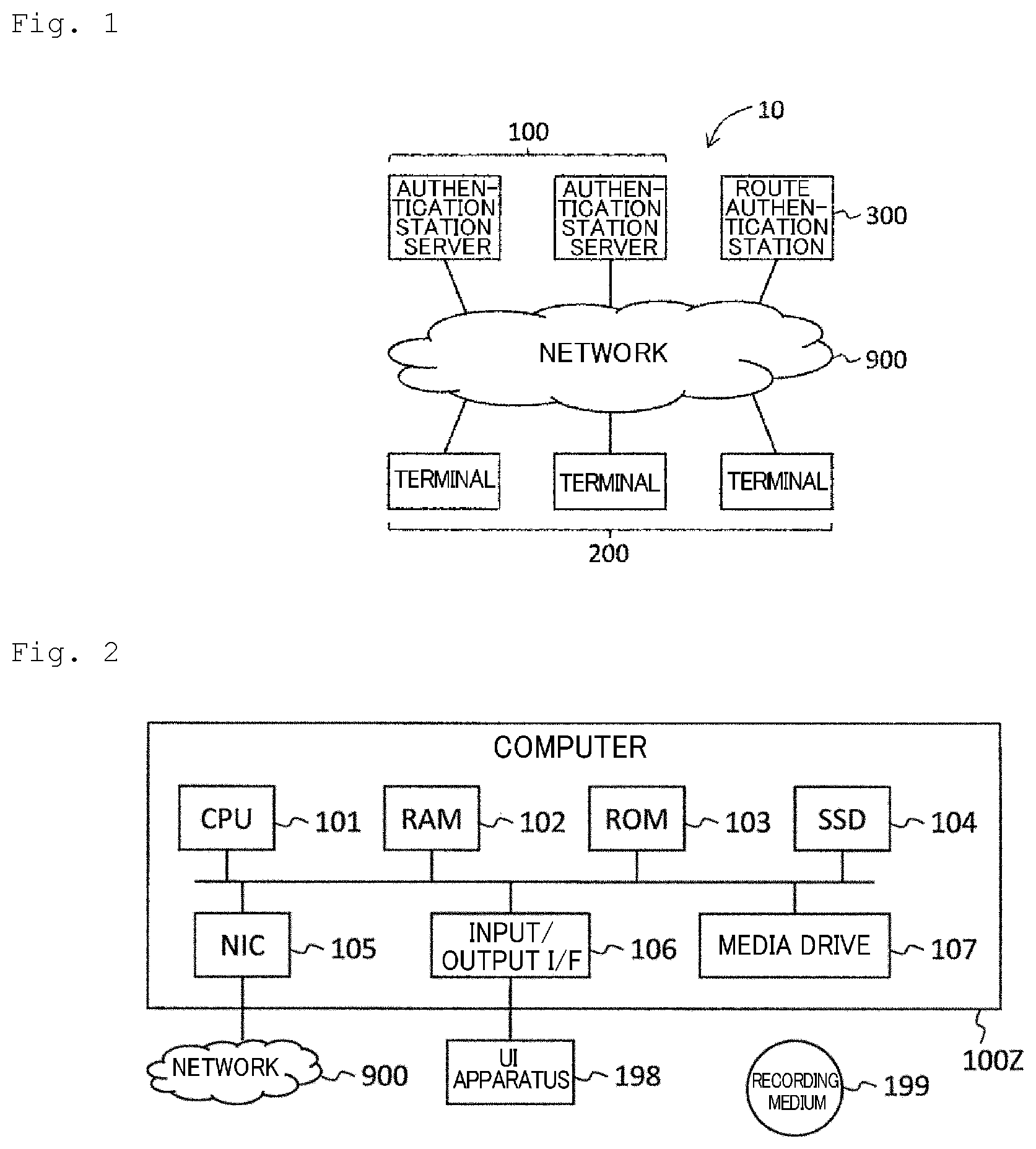
is a diagram showing an overall configuration of an owner sameness confirmation system according to the present embodiment.
is a diagram showing a hardware configuration of a computer according to the present embodiment.
is a diagram showing a functional configuration of an authentication station server according to the present embodiment.
is a diagram showing a data configuration of an electronic certificate database according to the present embodiment.
is a diagram showing a hardware configuration of the computer according to the present embodiment.
is a diagram showing a functional configuration of a terminal according to the present embodiment.
is a sequence diagram of processing for issuing an owner electronic certificate according to the present embodiment.
is a sequence diagram of processing for issuing a one-time electronic certificate according to the present embodiment.
is a sequence diagram (1) of owner sameness confirmation processing according to the present embodiment.
is a sequence diagram (2) of owner sameness confirmation processing according to the present embodiment.
DESCRIPTION OF EMBODIMENTS
Hereinafter, an owner sameness confirmation system for confirming the sameness of an owner of a terminal according to a mode for carrying out the present invention (embodiment) will be described. The owner sameness confirmation system is constituted by including a terminal and an authentication station server for issuing an electronic certificate (also written simply as “certificate”) to the terminal. The authentication station server holds identity confirmation information that was referenced in owner confirmation performed when the electronic certification was issued to the terminal. The terminal also stores the identity confirmation information of the owner of the terminal.
There are two types of electronic certification, namely an owner electronic certification and a one-time electronic certification. First, the identity confirmation information of the user of the terminal is confirmed, and the authentication station server issues an owner electronic certificate to the terminal and stores the owner electronic certificate in association with the identity confirmation information.
When the sameness between the owner of the terminal and the owner of another terminal (partner terminal) is to be confirmed, the terminal requests issuance of the one-time electronic certificate to the authentication station server that issued the owner electronic certificate (the authentication station server of the terminal). The issuance request is signed with a secret key corresponding to the owner electronic certificate. The authentication station server issues the one-time electronic certificate to the terminal and stores the one-time electronic certificate in association with the owner electronic certificate, and consequently, in association with the identity confirmation information.
In the owner sameness confirmation system, terminals determine whether or not the owners of the terminals are the same. In the determination, a terminal transmits encrypted information obtained by encrypting the identity confirmation information held by the terminal through homomorphic encryption to a partner terminal. Upon receiving the encrypted information, the partner terminal encrypts the identity confirmation information held by the partner terminal through homomorphic encryption, and transmits response encrypted information obtained by multiplying together the encrypted identity confirmation information and the received encrypted information, as a response to the terminal. The terminal decrypts the received data, and if the decrypted data matches a predetermined value, the terminal determines that the identity confirmation information held by the terminal and the identity confirmation information held by the partner terminal are the same and determines that the owners of the two terminals are the same. Since the identity confirmation information is compared while encrypted through homomorphic encryption, the identity confirmation information does not leak out between the terminal and the partner terminal.
Overall Configuration of Owner Sameness Confirmation System
is a diagram showing an overall configuration of an owner sameness confirmation system 10 according to the present embodiment. The owner sameness confirmation system 10 is constituted by including multiple authentication station servers 100 and multiple terminals 200 . The authentication station servers 100 and the terminals 200 can communicate with each other via a network 900 . A server of a route authentication station 300 that issued the electronic certificate to the authentication station server 100 may also be connected to the network 900 .
Hardware Configuration of Authentication Station Server
is a diagram showing a hardware configuration of a computer 100 Z according to the present embodiment. The computer 100 Z is constituted by including a CPU 101 , a RAM (Random Access Memory) 102 , a ROM (Read Only Memory) 103 , an SSD (Solid State Drive) 104 , an NIC (Network Interface Card) 105 , an input/output interface 106 (written as “input/output I/F (interface)” in ), and a media drive 107 .
The NIC 105 is connected to the network 900 . A display and a user interface apparatus 198 (written as “UI (User Interface) apparatus” in ) such as a keyboard and a mouse are connected to the input/output interface 106 . The media drive 107 reads a program on a recording medium 199 . The recording medium 199 is an optical recording medium such as a DVD (Digital Versatile Disc), a magneto-optical recording medium such as an MO (Magneto Optical disk), a magnetic recording medium, a semiconductor memory, or the like. The computer 100 Z functions as the authentication station server 100 that will be described hereinafter, due to the CPU 101 executing the read program (see “authentication station program 121 ” in , which will be described later).
Functional Configuration of Authentication Station Server
is a diagram showing a functional configuration of the authentication station server 100 according to the present embodiment. The authentication station server 100 is constituted by including a control unit 110 , a storage unit 120 , and an input/output unit 150 . The input/output unit 150 is constituted by including an NIC 105 , an input/output interface 106 , and a media drive 107 , and performs transmission and reception of communication data with the terminal 200 (see ) and another authentication station server 100 (see ). Also, the input/output unit 150 loads the authentication station program 121 from the recording medium 199 . The storage unit 120 stores the authentication station program 121 , an electronic certificate database 130 (see , which will be described later), and data that is needed in order to function as the authentication station server 100 , which includes the secret key and the electronic certificate of the authentication station server 100 issued by the route authentication station 300 .
Electronic Certificate Database of Authentication Station Server
is a diagram showing a data configuration of the electronic certificate database 130 according to the present embodiment. The electronic certificate database 130 is, for example, data in a table format. One row (record) of the electronic certificate database 130 indicates one electronic certificate issued by the authentication station server 100 , and is constituted by including identification information 131 , a type 132 , a key owner 133 , a related certificate 134 , an identity confirmation information 135 , and an electronic certificate 136 .
The identification information 131 is identification information of the electronic certificate (e.g., a serial number included in the electronic certificate). The type 132 is the type of the electronic certificate. The type 132 includes “owner”, which indicates an owner electronic certificate issued to the terminal 200 after the owner was confirmed, “one-time”, which indicates an electronic certificate issued temporarily to a terminal in order to confirm the sameness of the user, and the like. The key owner 133 is the issuance destination of the electronic certificate and indicates the owner (Subject field of the electronic certificate) of the key pair (secret key and public key). The related certificate 134 is the identification information 131 of a related electronic certificate. A related electronic certificate is, for example, an owner electronic certificate of the terminal that is the issuance destination of the one-time electronic certificate in the one-time electronic certificate.
The identity confirmation information 135 is identity confirmation information that was confirmed when the owner electronic certificate was issued. Information indicated in a residence certificate, a driver's license, or the like is an example of the identity confirmation information, and the identity confirmation information 135 includes data (image data, electronic data) of the identity confirmation information, an address, a name, a driver's license number, or information for accessing the identity confirmation information. The electronic certificate 136 is electronic certificate data issued by the authentication station server 100 . Note that in addition to the public key (Subject Public Key Info field of the electronic certificate), the electronic certificate includes a key owner 133 (Subject field), identification information (Issuer field) of the authentication station that performed issuance, a validity period (Validity field), a serial number (Serial Number field), and the like.
The record 138 is a record of the owner certificate whose identification information 131 is “38473857”, the key owner 133 is the name of the owner, and the address of the owner is included as the identity confirmation information 135 . The record 139 is a record of the one-time electronic certificate whose identification information 131 is “84736401”, and is related to the electronic certificate indicated in the record 138 . Specifically, the electronic certificate of the record 139 is a one-time electronic certificate that was issued to the terminal, which is the issuance destination of the electronic certificate of the record 138 . The record 139 of the one-time electronic certificate does not include the identity confirmation information in the identity confirmation information 135 , but the authentication station server 100 can acquire the identity confirmation information from the identity confirmation information 135 of the record 138 of the owner electronic certificate indicated in the related certificate 134 .
Control Unit of Authentication Station Server
Returning to , the description of the control unit 110 will continue. The control unit 110 is constituted by including an electronic certificate issuance unit 111 .
The electronic certificate issuance unit 111 issues an electronic certificate in response to a request from the terminal 200 (see ). The issued electronic certificate is stored in the electronic certificate database 130 .
Hardware Configuration of Terminal
is a diagram showing a hardware configuration of a computer 200 Z according to the present embodiment. The computer 200 Z has a similar configuration to the computer 100 Z (see ). The media drive 207 reads a program on a recording medium 299 . The computer 200 Z functions as the terminal 200 that will be described hereinafter, due to the CPU 201 executing the read program (see “terminal program 221 ” in , which will be described later).
Functional Configuration of Terminal
is a diagram showing a functional configuration of the terminal 200 according to the present embodiment. The terminal 200 is constituted by including a control unit 210 , a storage unit 220 , and an input/output unit 250 . The storage unit 220 is constituted by a RAM 202 , a ROM 203 , an SSD 204 , and the like (see ), and stores data that is needed for processing for owner sameness confirmation including an encryption key, an electronic certificate, and identity confirmation information 222 , which will be described below. In addition to the owner electronic certificate and the one-time electronic certificate, the electronic certificates include a model number electronic certificate including information on the model number (model) of the terminal 200 .
The input/output unit 250 is constituted by including an NIC 205 , an input/output interface 206 , and a media drive 207 (see ), and performs transmission and reception of communication data with another terminal 200 and the authentication station server 100 . Also, the input/output unit 250 loads the terminal program 221 from a recording medium 299 . Furthermore, the input/output unit 250 receives operations from the user of the terminal and displays information to the user.
The control unit 210 is constituted by including an electronic certificate request unit 211 , a terminal authentication unit 212 , a confirmation request unit 213 , a confirmation response unit 214 , and a sameness determination unit 215 .
The electronic certificate request unit 211 requests issuance of the electronic certificate to the authentication station server 100 .
The terminal authentication unit 212 authenticates the partner terminal 200 for which the sameness of the owner is to be confirmed, and decides on the identity confirmation information for confirming the sameness of the owners of the terminal 200 and the partner terminal 200 in order to confirm the owner sameness.
The identity confirmation information for confirming the sameness is an item (type) of the identity confirmation information for confirming that the owners are the same, such as the address, name, or driver's license number. For example, the terminal authentication unit 212 uses an item of the identity confirmation information 222 that is stored in common in both the terminal 200 and the partner terminal 200 as the item for confirming the sameness.
The confirmation request unit 213 transmits a confirmation request message (see step S 403 of , which will be described later) including information (encrypted information) obtained by encrypting the identity confirmation information of the owner stored in the terminal 200 using the public key for homomorphic encryption to the partner terminal 200 .
The confirmation response unit 214 receives the confirmation request message from the terminal 200 , and generates response encrypted information obtained by multiplying together data obtained by encrypting the identity confirmation information of the owner stored in the partner terminal 200 using a public key for homomorphic encryption, and the received encrypted information. The confirmation response unit 214 transmits a confirmation response message including the response encrypted information (see step S 407 ) as a response.
The sameness determination unit 215 receives the confirmation response message and determines whether or not the owners of the two terminals 200 are the same.
Symbols
The symbols to be used in the description will be described before starting the description of the owner sameness confirmation processing.
I d (O) is the owner electronic certificate of a terminal d. The owner electronic certificate is issued by the authentication station server 100 to the terminal 200 . The issued owner electronic certificate is stored in the electronic certificate database 130 .
I d (P) is the one-time electronic certificate of the terminal d. The one-time electronic certificate is issued by the authentication station server 100 that issued the owner electronic certificate to the terminal 200 . The issued one-time electronic certificate is stored in the electronic certificate database 130 . The one-time electronic certificate need only be valid during the sameness confirmation processing, and the validity period thereof is shorter than the validity period of the owner electronic certificate.
I d (M) is the model number electronic certificate of the terminal d. The model number electronic certificate is issued by the authentication station server 100 to the terminal 200 . The issued model number electronic certificate is stored in the electronic certificate database 130 . The authentication station server 100 that issues the model number electronic certificate is not limited to being the same as the authentication station server 100 that issues the owner electronic certificate. There may also be an authentication station server 100 that issues only the model number electronic certificate and does not issue other types of electronic certificate.
I d (C) is the electronic certificate of the authentication station server d. The electronic certificate of the authentication station server 100 is issued by the route authentication station 300 (server of the route authentication station, see ).
V+W is data obtained by combining data V and data W.
M S (M,K) is signed data obtained by signing the data M with the secret key K.
M S (M,K 1 ,K 2 ) is double-signed data obtained by signing data M with a secret key K 1 and further signing the signed data with a secret key K 2 .
Q d is an issuance request application for the one-time electronic certificate transmitted from the terminal d to the authentication station server 100 . Q d includes a public key that is generated by the terminal d and is included in the one-time electronic certificate.
S d (O) is a secret key corresponding to the owner electronic certificate I d (P) of the terminal d.
S d (P) is the secret key corresponding to the one-time electronic certificate I d (P) of the terminal d.
S d (M) is the secret key corresponding to the model number electronic certificate I d (M) of the terminal d.
S d (C) is the secret key corresponding to the electronic certificate I d (C) of the authentication station d.
E PK is an encryption formula for homomorphic encryption using a public key PK.
D SK is a decryption formula for homomorphic encryption using a secret key SK. The pair of the public key PK and the secret key SK is generated by the terminal 200 .
C d1 is the result (written also as “encrypted information”) of performing encryption using the encryption formula E PK for homomorphic encryption on the identity confirmation information calculated by the terminal d 1 . The details of the calculation method for the encryption information C d1 will be described later.
C d2 ′ is calculated by the terminal d 2 that received the encryption information C d1 . C d2 ′ is the result (written also as “response encrypted information”) of calculating the encrypted information C d1 and the result of performing encryption using the encryption formula E PK for homomorphic encryption on the identity confirmation information through computation corresponding to homomorphic encryption. Details of the method for calculating the response encrypted information C d2 ′ will be described later.
L d1,d2 is a list of items of the identity confirmation information for performing owner sameness confirmation between the terminal d 1 and the terminal d 2 .
Homomorphic Encryption
The homomorphic encryption E PK is encryption according to which E PK (M 1 +M 2 ) can be calculated based on an encrypted text E PK (M 1 ) for an unencrypted text M 1 and an encrypted text E PK (M 2 ) for an unencrypted text M 2 . Here, + is not limited to addition, and is some kind of binomial computation. For example, with RSA encryption, E PK (M 1 )×E PK (M 2 )=E PK (M 1 ×M 2 ) is satisfied. That is, the decrypted product of the encrypted texts is the product of the unencrypted texts. ElGamal encryption is another example.
Also, in Paillier encryption, E PK (M 1 )×E PK (M 2 )=E PK (M 1 +M 2 ) is satisfied. That is, the decrypted product of the encrypted texts is the sum of the unencrypted texts. Elliptic curve cryptography is another example.
Hereinafter, a method for calculating the encrypted information C d1 and the response encrypted information C d2 ′ using Paillier encryption will be described.
The secret keys for Paillier encryption are a prime number p and a prime number q with the same length.
The public key is N=p×q.
The encryption function is written as E N , and the decryption function is written as D p,q .
The encrypted text for the unencrypted text M generates a random number r and satisfies E N (M)=(1+N) M ×r N mod N 2 . Hereinafter, description of mod N 2 will be omitted.
E N (M 1 )=(1+N) M1 ×r N and E N (M 2 )=(1+N) M2 ×s N are satisfied. Here, the random number r and the random number s are random numbers that are generated when the unencrypted text M 1 and the unencrypted text M 2 are respectively encrypted. Upon doing so,
E N ( M 1 ) × E N ( M 2 ) = ( 1 + N ) M 1 × r N × ( 1 + N ) M 2 × s N = ( 1 + N ) M 1 + M 2 × ( r - × s ) N = E N ( M 1 + M 2 ) is satisfied, and therefore Paillier encryption is homomorphic encryption.
Next, a method for calculating the encrypted information C d1 and the response encrypted information C d2 ′ will be described. Hereinafter, the terminal 200 A will be described as generating the encrypted information C d1 and the terminal 200 B will be described as generating the response encrypted information C d2 ′ (see , which will be described later).
The identity confirmation information stored in the terminal 200 A for which the sameness is to be confirmed is VA, and the identity confirmation information stored in the partner terminal 200 B is VB. Note that the pieces of identity confirmation information VA and VB are pieces of identity confirmation information that correspond to items included in the item list L d1,d2 of the identity confirmation information.
Also, it is assumed that the terminal 200 A calculates encrypted information C A and the terminal 200 B that receives encrypted information C A and the public key N of the terminal 200 A calculates response encrypted information C B ′. The terminal 200 A generates a random number r, calculates the encrypted information C A =E N (VA)=(1+N) VA ×r N , which is the encrypted text of the identity confirmation information VA, and transmits the calculated encrypted information to the terminal 200 B together with the public key N.
The terminal 200 B generates a random number s and a random number t, and calculates an encrypted text E N (VB) by encrypting the identity confirmation information VB stored in the terminal 200 B. Next, the terminal 200 B calculates the response encrypted information C B ′ as described below based on the encrypted information C A (=E N (VA)) and the encrypted text E N (VB) and transmits the result to the terminal 200 A.
C B ′ = ( C A ) s × E N ( VB ) - s = ( C A ) s × ( ( 1 + N ) VB × t N ) - s C B ′ = ( ( 1 + N ) V A × r N ) s × ( 1 + N ) - sVB × t - sN = ( 1 + N ) sVA × r sN × ( 1 + N ) - sVB × t - sN = ( 1 + N ) sVA × ( 1 + N ) - sVB × r sN × t - sN = ( 1 + N ) s ( V A - VB ) × ( r s × t - s ) N is satisfied, and therefore the result of the terminal 200 A decrypting the response encrypted information C B ′ is D p,q (C B ′)=s(VA−VB). Accordingly, if the decryption result is 0, it is understood that the pieces of identity confirmation information VA and VB held by the terminal 200 A and the terminal 200 B are the same.
If the decryption result is not 0, the terminal 200 A understands that the identity confirmation information does not match. The random number s is a random number generated by the terminal 200 B, and D p,q (C B ′)=s(VA−VB) is a random number, and therefore the terminal 200 A cannot obtain the information on the identity confirmation information VB, and thus the identity confirmation information VB does not leak out. Conversely, regarding the identity confirmation information VA of the terminal 200 A, the terminal 200 B obtains only the encrypted information C A that was encrypted, and therefore the information is not obtained and the identity confirmation information VA does not leak out. That is, if the identity confirmation information does not match, neither the terminal 200 A nor the terminal 200 B leaks the identity confirmation information to its partner.
Although the foregoing is an example of sameness confirmation for identity confirmation information using Paillier encryption, it can be similarly carried out also through homomorphic encryption in which the product of the encrypted texts is the encryption of the sum of the unencrypted texts. E PK is homomorphic encryption in which E PK (M 1 )×E PK (M 2 )=E PK (M 1 +M 2 ) is satisfied.
The terminal 200 A calculates the encrypted information C A =E PK (VA) by encrypting the identity confirmation information VA, and transmits the encrypted information C A to the terminal 200 B.
The terminal 200 B generates the random number s, calculates the response encrypted information C B ′ as follows, and transmits the calculated response encrypted information C B ′ to the terminal 200 A.
C B ′ = ( CA ) s × E PK ( VB ) - s C B ′ = E PK ( V A ) s × E PK ( VB ) - s = E PK ( sVA ) × E PK ( - sVB ) = E PK ( sVA - sVB ) = E PK ( s ( V A - VB ) ) is satisfied, and therefore upon decrypting the response encrypted information C B ′, the terminal 200 A obtains D SK (C B ′)=s(VA−VB), and can determine the sameness of the identity confirmation information VA and the identity confirmation information VB based on whether or not the decryption result is 0.
This is also similarly possible with homomorphic encryption in which the product of the encrypted texts is the encryption of the product of the unencrypted texts. E PK is homomorphic encryption in which E PK (M 1 )×E PK (M 2 )=E PK (M 1 ×M 2 ) is satisfied.
The terminal 200 A calculates the encrypted information C A =E PK (VA) by encrypting the identity confirmation information VA, and transmits the encrypted information C A to the terminal 200 B.
The terminal 200 B generates the random number s, calculates the response encrypted information C B ′ as follows, and transmits the calculated response encrypted information C B ′ to the terminal 200 A.
C B ′ = ( CA ) s × E PK ( VB ) - s C B ′ = E PK ( V A ) s × E PK ( VB ) - s = E PK ( V A s ) × E PK ( VB - s ) = E PK ( V A s × VB - s ) = E PK ( ( V A / VB ) s ) is satisfied, and therefore upon decrypting the response encrypted information C B ′, the terminal 200 A obtains D SK (C B ′)=(VA/VB) s , and can determine the sameness of the identity confirmation information VA and the identity confirmation information VB based on whether or not the decryption result is 1.
As described above, the terminal 200 A encrypts the identity confirmation information VA stored in the terminal 200 A using homomorphic encryption, and transmits the encrypted identity confirmation information VA as the encrypted information C A (=E PK (VA)) to the terminal 200 B. The terminal 200 B calculates the response encrypted information C B ′ by multiplying together the result (E PK (VB)) of encrypting the identity confirmation information VB stored in the terminal 200 B and the received encrypted information C A , and transmits the calculated response encrypted information C B ′ as a response to the terminal 200 A. If the result of encrypting the response encrypted information C B ′ is a predetermined value (0 or 1 in the above-described example), the terminal 200 A determines that the pieces of identity confirmation information stored in both the terminal 200 A and the terminal 200 B are the same.
In the following description, when a signature generated using a secret key S is verified, a public key is acquired from the electronic certificate corresponding to the secret key S, and the signature is verified using the public key. If verification of the signature fails, processing for issuing an owner electronic certificate, processing for issuing a one-time electronic certificate, and processing for confirming the sameness of the owners are canceled.
Note that a signature of the authentication station server 100 is given to the electronic certificate, and the signature of the electronic certificate is verified using the public key of the authentication station server 100 . The public key of the authentication station server 100 is acquired after the signature of the electronic certificate of the authentication station server 100 issued by the route authentication station 300 (see ) is verified using the public key of the route authentication station 300 . Note that the public key of the route authentication station 300 is stored in the storage units 120 and 220 (see ). Also, a validity period is included in the electronic certificate. If no verification time is included in the validity period, the verification of the electronic certificate fails.
The electronic certificate includes identification information of the authentication station (authentication station server 100 ) that issued the electronic certificate as the issuer (Issuer field), and the authentication station of the electronic certificate from which the public key is to be acquired is understood.
Processing for Issuing Owner Electronic Certificate
is a sequence diagram showing processing for issuing an owner electronic certificate according to the present embodiment. Processing in which the authentication station server 100 A issues the owner electronic certificate to the terminal 200 A will be described with reference to .
In step S 101 , the electronic certificate request unit 211 of the terminal 200 A generates a key pair (a secret key and a public key) for public key encryption.
In step S 102 , the electronic certificate request unit 211 transmits the public key generated in step S 101 and information on the identity confirmation document to the authentication station server 100 A, and requests issuance of the owner electronic certificate. This transmitted message may also be signed with the secret key generated in step S 101 .
In step S 103 , the electronic certificate issuance unit 111 of the authentication station server 100 A confirms that the identity confirmation document received in step S 102 is authentic. Next, the electronic certificate issuance unit 111 confirms that the owner of the terminal 200 A and the person described in the identity confirmation document match each other.
In step S 104 , the electronic certificate issuance unit 111 adds a record to the electronic certificate database 130 (see ), and stores the information of the identity confirmation document and the identity information (address, name, etc.; also written as “identity confirmation information”) described in the identity confirmation document in the identity confirmation information 135 .
In step S 105 , the electronic certificate issuance unit 111 issues an owner electronic certificate I A (O) including the public key received in step S 102 . The key owner (Subject field) of the owner electronic certificate is the entirety or part of the identity confirmation information of the owner, such as the name or address, which was confirmed in step S 103 . The electronic certificate issuance unit 111 stores the serial number of the issued owner electronic certificate in the identification information 131 of the record added in step S 104 . Furthermore, the electronic certificate issuance unit 111 stores “owner” in the type 132 , the key owner in the key owner 133 , “-” in the related certificate 134 , and the data of the issued owner electronic certificate in the electronic certificate 136 .
In step S 106 , the electronic certificate issuance unit 111 transmits the issued owner electronic certificate I A (O) as a response to the request made in step S 102 to the terminal 200 A.
In step S 107 , the electronic certificate request unit 211 of the terminal 200 A verifies the signature of the authentication station server 100 A of the received owner electronic certificate I A (O) .
In step S 108 , the electronic certificate request unit 211 of the terminal 200 A stores the received owner electronic certificate I A (O) in the storage unit 220 . Also, the electronic certificate request unit 211 stores the identity confirmation information included as the value of the key owner (Subject field) of the owner electronic certificate I A (O) in the identity confirmation information 222 (see ).
The foregoing described processing in which the authentication station server 100 A issues an owner electronic certificate to the terminal 200 A. Similarly, the authentication station server 100 B issues the owner electronic certificate to the terminal 200 B. The processing in which the authentication station server 100 B issues the owner electronic certificate to the terminal 200 B is similar to that of , and therefore description thereof is omitted. In this state, the terminals 200 A and 200 B store the owner electronic certificate and the secret key corresponding thereto. Also, the authentication station servers 100 A and 100 B store the identity confirmation information in association with the owner electronic certificate. The terminals 200 A and 200 B store the identity confirmation information 222 (see ).
Processing for Issuing One-Time Electronic Certificate
is a sequence diagram showing processing for issuing a one-time electronic certificate according to the present embodiment. Processing in which the authentication station server 100 A issues the one-time electronic certificate to the terminal 200 A will be described with reference to .
In step S 201 , the electronic certificate request unit 211 of the terminal 200 A generates a key pair (a secret key and a public key) for public key encryption.
In step S 202 , the electronic certificate request unit 211 transmits a request to issue the one-time electronic certificate including the public key generated in step S 201 to the authentication station server 100 A. Specifically, the electronic certificate request unit 211 generates M S (Q A ,S A (P) ), which includes a public key and is obtained by signing an issuance request application Q A for the one-time electronic certificate with the secret key generated in step S 201 . Next, the electronic certificate request unit 211 generates M S (M S (Q A ,S A (P) ))+I A (O) +I A (M) ,S A (O) ,S A (M) ) by combining the owner electronic certificate I A (O) and model number electronic certificate I A (M) of the terminal 200 A with the signed data, and signing the result using the secret key S A (O) of the owner electronic certificate and the secret key S A (M) of the model number electronic certificate of the terminal 200 A. The electronic certificate request unit 211 transmits M S (M S (Q A ,S A (P) )+I A (O) +I A (M) ,S A (O) ,S A (M) ) to the authentication station) server 100 A as a request to issue the one-time electronic certificate.
In step S 203 , the electronic certificate issuance unit 111 of the authentication station server 100 A verifies the signatures provided using the secret keys S A (M) , S A (O) , and S A (P) of the request to issue the one-time electronic certificate received in step S 202 .
In step S 204 , the electronic certificate issuance unit 111 issues the one-time electronic certificate I A (P) including the public key included in Q A received in step S 202 . The key owner of the one-time electronic certificate is a random character string.
In step S 205 , the electronic certificate issuance unit 111 stores the one-time electronic certificate I A (P) in association with the owner electronic certificate I A (O) . Specifically, the electronic certificate issuance unit 111 adds a record to the electronic certificate database 130 (see ) and stores the serial number of the one-time electronic certificate issued in the identification information 131 . Furthermore, the electronic certificate issuance unit 111 stores “one-time” in the type 132 , the key owner in the key owner 133 , “-” in the identity confirmation information 135 , and the data of the issued one-time electronic certificate in the electronic certificate 136 . The electronic certificate issuance unit 111 stores the serial number of the owner electronic certificate I A (O) received in step S 202 in the related certificate 134 . The authentication station server 100 accesses the identity confirmation information for the owner of the terminal 200 for which the one-time electronic certificate was issued, by referencing the identity confirmation information 135 of the electronic certificate corresponding to the related certificate 134 of the one-time electronic certificate.
In step S 206 , the electronic certificate issuance unit 111 sends the issued one-time electronic certificate I A (P) as a response to the terminal 200 A. Specifically, the electronic certificate issuance unit 111 combines the electronic certificate I A (C) of the authentication station server 100 A with the one-time electronic certificate I A (P) and transmits M S (I A (P) +I A (C) ,S A (C) ) signed using the secret key S A (C) corresponding to the electronic certificate I A (C) as a response to the request made in step S 202 .
In step S 207 , the electronic certificate request unit 211 of the terminal 200 A verifies the signature provided using the secret key S A (C) of the received M S (I A (P) +I A (C) ,S A (C) ) and the signature of the one-time electronic certificate I A (P) .
In step S 208 , the electronic certificate request unit 211 of the terminal 200 A stores the one-time electronic certificate I A (P) in the storage unit 220 .
The foregoing described processing in which the authentication station server 100 A issues a one-time electronic certificate to the terminal 200 A. Similarly, the authentication station server 100 B issues the one-time electronic certificate to the terminal 200 B. The processing in which the authentication station server 100 B issues the one-time electronic certificate to the terminal 200 B is similar to that of , and therefore description thereof is omitted. In this state, the terminals 200 A and 200 B store the one-time electronic certificate and the secret key corresponding thereto. Also, the authentication station servers 100 A and 100 B store the one-time electronic certificate in association with the owner electronic certificate, and consequently, in association with the identity confirmation information.
Owner Sameness Confirmation Processing
After the terminal 200 A and the partner terminal 200 B for which the sameness of the owner is to be confirmed obtain the one-time electronic certificate, the terminal 200 A requests confirmation of the sameness of the owner to the terminal 200 B. Before the request is made, the terminals 200 A and 200 B perform mutual authentication, and thereafter determine the item of the identity confirmation information for confirming the sameness. For example, the terminals 200 A and 200 B use an item held in common in the pieces of identity confirmation information 222 (see ) stored in both terminals 200 A and 200 B as the item of the identity confirmation information for confirming the sameness.
Processing performed up to when the terminals 200 A and 200 B decide on the item of the identity confirmation information for confirming the sameness will be described with reference to , which will be described later. Next, processing in which the terminal 200 A requests confirmation of the sameness of the owner to the terminal 200 B will be described with reference to , which will be described later.
is a sequence diagram (1) for owner sameness confirmation processing according to the present embodiment.
In step S 301 , the terminal authentication unit 212 of the terminal 200 A transmits the one-time electronic certificate I A (P) to the partner terminal 200 B. The terminal 200 B verifies the signature of the received one-time electronic certificate I A (P) .
In step S 302 , the terminal authentication unit 212 of the terminal 200 B transmits the one-time electronic certificate I B (P) to the partner terminal 200 A. The terminal 200 A verifies the signature of the received one-time electronic certificate I B (P) .
In step S 303 , the terminal authentication units 212 of the terminal 200 A and 200 B authenticate each other using the secret keys S A (P) and S B (P) corresponding to the one-time electronic certificate. For example, the terminal 200 A generates the random number, transmits the random number to the terminal 200 B, and requests a signature provided using the secret key corresponding to the one-time electronic certificate I B (P) for the random number. The terminal 200 A can authenticate that the terminal 200 B has a secret key corresponding to the one-time electronic certificate I B (P) by verifying the signature generated by the terminal 200 B. Similarly, the terminal 200 B can authenticate that the terminal 200 A has the secret key corresponding to the one-time electronic certificate I A (P) .
In step S 304 , the terminal authentication unit 212 determines the item list L A,B of the identity confirmation information for confirming the sameness. Specifically, the terminal authentication unit 212 uses items held in common in the pieces of identity confirmation information stored in both of the terminals 200 A and 200 B as the item list L A,B of the identity confirmation information.
is a sequence diagram (2) of owner sameness confirmation processing according to the present embodiment.
In step S 401 , the confirmation request unit 213 of the terminal 200 A generates a key pair for homomorphic encryption.
In step S 402 , the confirmation request unit 213 calculates the encrypted information C A using homomorphic encryption. Specifically, the confirmation request unit 213 calculates the encrypted information C A by obtaining, from the identity confirmation information 222 (see ), the identity confirmation information of the owner corresponding to the item list L A,B of the identity confirmation information for confirming the sameness, which was determined in step S 304 (see ), and encrypting the acquired identity confirmation information.
In step S 403 , the confirmation request unit 213 transmits the confirmation request message to the terminal 200 B. Specifically, the confirmation request unit 213 transmits M S (L A,B +I A (P) +PK A +C A +I A (M) ,S A (P) ,S A (M) ), which is obtained by combining the item list L A,B of the identity confirmation information stored in the terminal 200 A, the one-time electronic certificate I A (P) of the terminal 200 A, the public key PK A for homomorphic encryption, the encrypted information C A , and the model number electronic certificate I A (M) and signing using the secret keys S A (P) and S A (M) , as a response to the terminal 200 B.
In step S 404 , the confirmation response unit 214 of the terminal 200 B verifies the signatures provided using the secret keys S A (M) and S A (P) of the confirmation request message.
In step S 405 , the confirmation response unit 214 confirms that the item list L A,B received in step S 403 and the item list L A,B that was determined in step S 304 (see ) and is stored in the terminal 200 B match each other. If they do not match, the confirmation response unit 214 cancels the owner sameness confirmation processing.
In step S 406 , the confirmation response unit 214 generates response encrypted information C B ′ based on the received encrypted information C A and the identity confirmation information held by the terminal 200 B. Specifically, the confirmation response unit 214 acquires the identity confirmation information of the owner corresponding to the item list L A,B of the identity confirmation information from the identity confirmation information 222 (see ). Next, the confirmation response unit 214 generates the response encrypted information C B ′ based on the encrypted information C A , the public key PK A , and the acquired identity confirmation information.
In step S 407 , the confirmation response unit 214 transmits the confirmation response message to the terminal 200 A. Specifically, the confirmation response unit 214 transmits M S (I B (P) +C B ′+I B (M) ,S B (P) ,S B (M) ), which is obtained by combining the one-time electronic certificate I B (P) , the response encrypted information C B ′, and the model number electronic certificate I B (M) of the terminal 200 B and signing using the secret keys S B (P) and S B (M) , as the confirmation response message as a response to the terminal 200 A.
In step S 408 , the sameness determination unit 215 of the terminal 200 A verifies the signatures provided using the secret keys S B (M) and S B (P) of the confirmation response message.
In step S 409 , the sameness determination unit 215 decrypts the response encrypted information C B ′ using the secret keys for homomorphic encryption.
In step S 410 , if the decryption result is 0 (step S 410 →YES), the sameness determination unit 215 advances to step S 411 , and if the decryption result is not 0 (step S 410 →NO), the sameness determination unit 215 advances to step S 412 .
In step S 411 , the sameness determination unit 215 determines that the owners are the same.
In step S 412 , the sameness determination unit 215 determines that the owners are different.
With that, the owner sameness confirmation processing in which the terminal 200 A confirms that the owner of the terminal 200 A and the owner of the partner terminal 200 B match each other in the terminal 200 B is ended. Next, the terminals 200 A and 200 B are switched, and the terminal 200 B confirms that the owner of the terminal 200 B and the owner of the partner terminal 200 A match each other. Specifically, similarly to the steps of step S 401 and onward, the terminal 200 B confirms that the owner of the terminal 200 B and the owner of the partner terminal 200 A match each other in the terminal 200 A. This processing for confirming is similar to that shown in , and therefore description thereof is omitted.
Both of the terminals 200 A and 200 B confirm that the owners are the same, whereby the owner sameness confirmation processing ends. After the end of the owner sameness confirmation processing, the terminals 200 A and 200 B performs sharing (copy) processing of a secret key to be used for authentication during, for example, service usage, data that is needed for content copyright management, and the like.
Features of Owner Sameness Certificate Processing
The one-time electronic certificate and the model number electronic certificate are examples of terminal information of the terminal that is to be transmitted to the partner terminal for which the sameness of the owner is to be confirmed. Information regarding the owner is not included in any electronic certificate. For this reason, there is no risk that personal information including the identity confirmation information of the owner will leak out to the partner terminal.
Even if the authentication station servers that issued the owner certificates are different from each other, it is possible to confirm whether or not the owners of the two terminals are the same by comparing items of the identity confirmation information that are stored in common. Also, the identity confirmation information (see the identity confirmation information 135 in and the identity confirmation information 222 in ) is authentic information acquired from the identity confirmation document (see steps S 103 , S 104 , and S 108 in ), and the owner sameness confirmation system 10 confirms the sameness of the owners based on highly-reliable identity confirmation information.
Between the terminals, the items of the pieces of identity confirmation information stored respectively in the terminals are compared while encrypted using homomorphic encryption. For this reason, it is possible to confirm whether or not the identity confirmation information matches without the identity confirmation information flowing out to the partner.
Variation: Item List of Identity Confirmation Information
The item list L A,B of the identity confirmation information is items of the identity confirmation information 222 stored in both terminals 200 A and 200 B (see the description of the terminal authentication unit 212 in and step S 304 in ). The terminal 200 may also determine the item list L A,B according to the degree of importance of the data to be shared after the sameness confirmation. For example, if a secret key for accessing a financial service is shared, the terminal 200 uses an address and a name as the item list L A,B . Also, in the case of sharing a secret key for accessing a service with a family discount between family members that live together, the terminal 200 uses only an address of the item list L A,B .
Note that if the identity confirmation information (item of the identity confirmation information) for which sameness is to be confirmed has been determined in advance, the terminal 200 may also execute the processing for owner sameness confirmation without using the item list L A,B .
Variation: Model Number Electronic Certificate
The confirmation request message (step S 403 of ) and the confirmation response message (step S 407 ) include the model number electronic certificate, and the terminal 200 can acquire the model number of the partner terminal 200 by verifying the signature of the secret key corresponding to the model number electronic certificate. Provision of the model number electronic certificate or the corresponding signature may also be omitted. A signature provided using a secret key corresponding to the one-time electronic certificate is provided in the message, and thus security is ensured.
Other Variations
Note that the present invention is not limited to the above-described embodiment and can be modified without departing from the gist of the invention.
For example, although the terminal 200 generates the key pair for homomorphic encryption each time owner sameness confirmation processing is performed (see step S 402 of ), a key pair that was generated before may also be re-used.
Also, the key owner of the one-time electronic certificate is a random character string, but need only be information that is unrelated to the identity confirmation information of the owner, and for example, may also be information generated based on the address of the terminal, a time at which there was a request to issue the electronic certificate, and the like.
Also, in step S 103 (see ), the authentication station server 100 confirms the identity confirmation document, but confirmation may also be performed manually online.
Although several embodiments of the present invention were described above, these embodiments are merely exemplary and do not limit the technical scope of the present invention. The present invention can take various other embodiments, and furthermore, various modifications such as omission and replacement can be performed without departing from the gist of the present invention. These embodiments and variations are encompassed in the scope and gist of the invention described in the present specification and the like, and are encompassed in the invention described in the patent claims and its range of equivalency.
Effects
Hereinafter, effects of the owner sameness confirmation system 10 will be described.
The owner sameness confirmation system 10 according to the present embodiment is an owner sameness confirmation system 10 constituted by including a plurality of terminals 200 and a plurality of authentication station servers 100 , in which each of the authentication station servers 100 includes a storage unit 120 configured to store an electronic certificate issued to a terminal 200 and identity confirmation information of an owner of the terminal in association with each other, each of the terminals 200 A includes: a storage unit 220 configured to store identity confirmation information stored in association with an electronic certificate in an authentication station server 100 A that issued the electronic certificate to the terminal; and a confirmation request unit 213 configured to transmit a confirmation request message including encrypted information obtained by encrypting the identity confirmation information stored in the storage unit 220 using a public key for homomorphic encryption, and the public key to a partner terminal 200 B that is a target of owner sameness confirmation, the partner terminal 200 B includes: a storage unit 220 configured to store identity confirmation information stored in association with an electronic certificate in an authentication station server 100 B that issued the electronic certificate to the partner terminal 200 B; and a confirmation response unit 214 configured to, upon receiving the confirmation request message, transmit a confirmation response message including response encrypted information, which is the result of calculating an encrypted text obtained by encrypting the identity confirmation information stored in the storage unit 220 using the public key, and the encrypted information through computation corresponding to the homomorphic encryption, as a response to the terminal 200 A, and each of the terminals 200 A further includes: a sameness determination unit 215 configured to decrypt the response encrypted information, and determine whether or not the identity confirmation information of the owner of the terminal 200 A and the identity confirmation information of an owner of the partner terminal 200 B match each other based on whether or not the decryption result matches a predetermined value.
According to this kind of owner sameness confirmation system 10 , it is possible to determine whether or not the owners are the same for multiple terminals 200 for which the authentication station servers 100 that issued the electronic certificates are different from each other. Also, the identity confirmation information is encrypted and exchanged (encrypted information and response encrypted information), and thus it is possible to confirm whether or not the identity confirmation information matches without the identity confirmation information itself flowing out to the partner terminal 200 .
Accordingly, with the owner sameness confirmation system 10 , it is possible to enable owner sameness confirmation between terminals while ensuring security.
The terminal 200 according to the present embodiment is a terminal 200 for an owner sameness confirmation system 10 constituted by including a plurality of terminals 200 and a plurality of authentication station servers 100 , the terminal 200 including: a storage unit 220 configured to store identity confirmation information of an owner of the terminal 200 , the identity confirmation information being stored in association with an electronic certificate in an authentication station server 100 that issued the electronic certificate to the terminal 200 ; a confirmation request unit 213 configured to transmit a confirmation request message including encrypted information obtained by encrypting the identity confirmation information stored in the storage unit 220 using a public key for homomorphic encryption, and the public key to a partner terminal 200 that is a target of owner sameness confirmation; a confirmation response unit 214 configured to, upon receiving the confirmation request message, transmit a confirmation response message including response encrypted information, which is the result of calculating an encrypted text obtained by encrypting the identity confirmation information stored in the storage unit 220 using the public key, and the encrypted information through computation corresponding to the homomorphic encryption, as a response to the transmission source of the confirmation request message; and a sameness determination unit 215 configured to decrypt the response encrypted information, and determine whether or not the identity confirmation information of the owner of the terminal 200 and identity confirmation information of an owner of the partner terminal 200 match each other based on whether or not the decryption result matches a predetermined value.
According to this kind of terminal 200 , it is possible to determine whether or not the owners are the same for multiple terminals 200 for which the authentication station servers 100 that issued the electronic certificates are different from each other. Also, the identity confirmation information is encrypted and exchanged (encrypted information and response encrypted information), and thus it is possible to confirm whether or not the identity confirmation information matches without the identity confirmation information itself flowing out to the partner terminal 200 .
Accordingly, with the terminal 200 , it is possible to enable owner sameness confirmation between terminals while ensuring security.
In the terminal 200 according to the present embodiment, the identity confirmation information is constituted by one or more items, the confirmation request unit 213 calculates the encrypted information by encrypting the identity confirmation information for an item for confirming the sameness using the public key, the item being selected from among the one or more items, and transmits the item in a state of being included in the confirmation request message, the confirmation response unit 214 generates the encrypted text obtained by encrypting the identity confirmation information for the item stored in the storage unit 220 using the public key, calculates the response encrypted information, and transmits the calculated response encrypted information as a response, and the sameness determination unit 215 decrypts the response encrypted information and determines whether or not the identity confirmation information for the item of the owner of the terminal 200 and the identity confirmation information for the item of the owner of the partner terminal 200 match each other based on whether or not the decryption result matches the predetermined value.
According to this kind of terminal 200 , it is possible to confirm the sameness of the owners using not all but part (an item) of the identity confirmation information. For this reason, even if the terminals 200 have different stored identity confirmation information 222 , it is possible to confirm the sameness of the owners due to part of the identity confirmation information matching.
In the terminal 200 according to the present embodiment, E, which is the homomorphic encryption, is homomorphic encryption in which E(M 1 )×E(M 2 )=E(M 1 +M 2 ) is satisfied for unencrypted texts M 1 and M 2 , the confirmation request unit 213 transmits E(V 1 ) as the encrypted information for identity confirmation information V 1 of the owner of the terminal 200 A, the confirmation response unit 214 generates a random number r for identity confirmation information V 2 of the owner of the partner terminal 200 B and transmits E(V 1 ) r ×E(V 2 ) −r as the response encrypted information as a response, and the sameness determination unit 215 determines whether or not V 1 and V 2 match each other based on whether or not the decryption result of the response encrypted information is 0, which is the predetermined value.
According to this kind of terminal 200 , the terminal 200 can confirm whether or not the pieces of identity confirmation information match each other using homomorphic encryption E, in which E(M 1 )×E(M 2 )=E(M 1 +M 2 ) is satisfied for unencrypted texts M 1 and M 2 .
Also, when the pieces of identity confirmation information V 1 and V 2 are different from each other, (V 1 −V 2 )≠0 is satisfied, and therefore r(V 1 −V 2 ), which is the result of decrypting the response encrypted information, is a random number for the terminal 200 A. For this reason, even if the terminal 200 A knows the identity confirmation information V 1 , the information of the identity confirmation information V 2 cannot be obtained, and thus the identity confirmation information V 2 of the owner of the partner terminal 200 B does not leak out. The same applies also when the terminals 200 A and 200 B are switched.
In the terminal 200 according to the present embodiment, E, which is the homomorphic encryption, is homomorphic encryption in which E(M 1 )×E(M 2 )=E(M 1 ×M 2 ) is satisfied for unencrypted texts M 1 and M 2 , the confirmation request unit 213 transmits E(V 1 ) as the encrypted information for identity confirmation information V 1 of the owner of the terminal 200 A, the confirmation response unit 214 generates a random number r for identity confirmation information V 2 of the owner of the partner terminal 200 B and transmits E(V 1 ) r ×E(V 2 ) −r as the response encrypted information as a response, and the sameness determination unit 215 determines whether or not V 1 and V 2 match each other based on whether or not the decryption result of the response encrypted information is 1, which is the predetermined value.
According to this kind of terminal 200 , the terminal 200 can confirm whether or not the pieces of identity confirmation information match each other using homomorphic encryption E, in which E(M 1 )×E(M 2 )=E(M 1 ×M 2 ) is satisfied for unencrypted texts M 1 and M 2 .
Also, when the pieces of identity confirmation information V 1 and V 2 are different from each other, (V 1 /V 2 )≠1 is satisfied, and therefore (V 1 /V 2 ) r , which is the result of decrypting the response encrypted information, is a random number for the terminal 200 A. For this reason, even if the terminal 200 A knows the identity confirmation information V 1 , the information of the identity confirmation information V 2 cannot be obtained, and thus the identity confirmation information V 2 of the owner of the partner terminal 200 B does not leak out. The same applies also when the terminals 200 A and 200 B are switched.
In the terminal 200 according to the present embodiment, a value of a key owner included in the electronic certificate issued to the terminal 200 is identification information of the terminal 200 that is unrelated to the identity confirmation information of the owner of the terminal 200 .
According to this kind of terminal 200 , it is possible to determine whether or not the owners of the two terminals 200 are the same using a one-time certificate that does not include the identity confirmation information of the owner. For this reason, the terminal 200 can confirm the sameness of the users without leaking the identity confirmation information of the owner of the terminal 200 to the partner terminal 200 .
In the terminal 200 according to the present embodiment, at least one of the confirmation request message and the confirmation response message transmitted by the terminal 200 is signed using at least one of a secret key corresponding to the electronic certificate and a secret key corresponding to a model number electronic certificate indicating a model number of the terminal 200 .
According to this kind of terminal 200 , the terminal 200 can acquire the model number (model) of the partner terminal 200 . For this reason, the terminal 200 can perform processing corresponding to the model number of the partner terminal 200 in the processing for owner sameness confirmation processing and onward.
REFERENCE SIGNS LIST
•
• 10 Owner sameness confirmation system • 100 , 100 A, 100 B Authentication station server • 111 Electronic certificate issuance unit • 130 Electronic certificate database • 200 , 200 A, 200 B Terminal • 211 Electronic certificate request unit • 212 Terminal authentication unit • 213 Confirmation request unit • 214 Confirmation response unit • 215 Sameness determination unit • 222 Identity confirmation information
Figures (9)
Citations
This patent cites (5)
- US20100246812
- US20140068736
- US20160156463
- US20170149557
- US20190182216