Low-density Ceramic Floats for Use in a Downhole Environment
Abstract
Provided is a float for use with a fluid flow control device, a fluid flow control device, a method for manufacturing a fluid flow control device, and a well system. The float, in one aspect, includes a ceramic base material having one or more cavities therein, the ceramic base material and the one or more cavities creating a net density for the float that is between a first density of a desired fluid and a second density of an undesired fluid, such that the float may control fluid flow through a flow control device when encountering the desired fluid or the undesired fluid.
Claims (26)
1. A float for use with a fluid flow control device, comprising: a ceramic base material having one or more cavities therein, the ceramic base material and the one or more cavities creating a net density for the float that is between a first density of a desired fluid and a second density of an undesired fluid, such that the float may control fluid flow through a flow control device when encountering the desired fluid or the undesired fluid; and a fluid impermeable exterior surrounding the ceramic base material having the plurality of cavities therein.
14. A fluid flow control device, comprising: an inlet port; an outlet port; a float positioned between the inlet port and the outlet port, the float movable between an open position that allows fluid flow through the outlet port and a closed position that restricts fluid flow through the outlet port, the float including: a ceramic base material having one or more cavities therein, the ceramic base material and the one or more cavities creating a net density for the float that is between a first density of a desired fluid and a second density of an undesired fluid, such that the float may control fluid flow through the flow control device when encountering the desired fluid or the undesired fluid; and a fluid impermeable exterior surrounding the ceramic base material having the plurality of cavities therein.
23. A method for manufacturing a fluid flow control device, comprising: providing a float, the float including: a ceramic base material having one or more cavities therein, the ceramic base material and the one or more cavities creating a net density for the float that is between a first density of a desired fluid and a second density of an undesired fluid, such that the float may control fluid flow through a flow control device when encountering the desired fluid or the undesired fluid; and a fluid impermeable exterior surrounding the ceramic base material having the plurality of cavities therein; and positioning the float between an inlet port and an outlet port of the flow control device, the float movable between an open position that allows fluid flow through the outlet port and a closed position that restricts fluid flow through the outlet port.
26. A well system, comprising: a wellbore formed through a subterranean formation; a tubing string positioned within the wellbore; a fluid flow control device coupled to the tubing string, the fluid flow control device including: an inlet port operable to receive fluid from the subterranean formation; an outlet port operable to pass the fluid to the tubing string; and a float positioned between the inlet port and the outlet port, the float movable between an open position that allows fluid flow through the outlet port to the tubing string and a closed position that restricts fluid flow through the outlet port to the tubing string, the float including: a ceramic base material having one or more cavities therein, the ceramic base material and the one or more cavities creating a net density for the float that is between a first density of a desired fluid and a second density of an undesired fluid, such that the float may control fluid flow through the flow control device when encountering the desired fluid or the undesired fluid; and a fluid impermeable exterior surrounding the ceramic base material having the plurality of cavities therein.
Show 22 dependent claims
2. The float as recited in claim 1 , wherein the ceramic base material and the one or more cavities create the net density for the float that is above the first density of the desired fluid and below the second density of the undesired fluid.
3. The float as recited in claim 1 , wherein the ceramic base material is a non-foam ceramic base material having the one or more cavities therein.
4. The float as recited in claim 3 , wherein the ceramic base material has four or more substantially equally spaced cavities.
5. The float as recited in claim 3 , wherein the ceramic base material has four or more gradiently spaced cavities positioned to alter a center of gravity of the float.
6. The float as recited in claim 3 , wherein the ceramic base material has four or more substantially equally sized cavities.
7. The float as recited in claim 1 , wherein the ceramic base material is a foam ceramic base material having a plurality of cavities therein.
8. The float as recited in claim 7 , wherein the foam ceramic base material having the plurality of cavities therein is a closed cell foam ceramic base material having the plurality of cavities therein.
9. The float as recited in claim 7 , wherein the foam ceramic base material having the plurality of cavities therein is an open cell foam ceramic base material having the plurality of cavities therein.
10. The float as recited in claim 7 , wherein the foam ceramic base material having the plurality of cavities therein is a mix of closed cell foam cavities and open cell foam cavities.
11. The float as recited in claim 10 , wherein the fluid impermeable exterior forms a hermetic seal around the foam ceramic base material having the plurality of cavities therein.
12. The float as recited in claim 7 , wherein the foam ceramic base material having the plurality of cavities therein is located within one or more openings in a non-ceramic base material.
13. The float as recited in claim 1 , wherein the ceramic base material having the one or more openings therein is formed using an additive manufacturing process.
15. The fluid flow control device as recited in claim 14 , wherein the ceramic base material and the one or more cavities create the net density for the float that is above the first density of the desired fluid and below the second density of the undesired fluid.
16. The fluid flow control device as recited in claim 14 , wherein the ceramic base material is a non-foam ceramic base material having the one or more cavities therein.
17. The fluid flow control device as recited in claim 14 , wherein the ceramic base material is a foam ceramic base material having a plurality of cavities therein.
18. The fluid flow control device as recited in claim 17 , wherein the foam ceramic base material having the plurality of cavities therein is a closed cell foam ceramic base material having the plurality of cavities therein.
19. The fluid flow control device as recited in claim 17 , wherein the foam ceramic base material having the plurality of cavities therein is an open cell foam ceramic base material having the plurality of cavities therein.
20. The fluid flow control device as recited in claim 17 , wherein the foam ceramic base material having the plurality of cavities therein is a mix of closed cell foam cavities and open cell foam cavities.
21. The fluid flow control device as recited in claim 17 , wherein the foam ceramic base material having the plurality of cavities therein is located within one or more openings in a non-ceramic base material.
22. The fluid flow control device as recited in claim 14 , wherein the ceramic base material having the one or more openings therein is formed using an additive manufacturing process.
24. The method as recited in claim 23 , wherein providing a float includes forming at least a portion of the float using an additive manufacturing process.
25. The method as recited in claim 24 , wherein forming at least a portion of a float using an additive manufacturing process includes tailoring the net density for the float above the first density of the desired fluid and below the second density of the undesired fluid.
Full Description
Show full text →
CROSS-REFERENCE TO RELATED APPLICATION
This application claims the benefit of U.S. Provisional Application Ser. No. 63/323,669, filed on Mar. 25, 2022, entitled “LOW-DENSITY CERAMIC FLOATS FOR USE IN A DOWNHOLE ENVIRONMENT,” commonly assigned with this application and incorporated herein by reference in its entirety.
BACKGROUND
Wellbores are sometimes drilled from the surface of a wellsite several hundred to several thousand feet downhole to reach hydrocarbon resources. During certain well operations, such as production operations, certain fluids, such as fluids of hydrocarbon resources, are extracted from the formation. For example, the fluids of hydrocarbon resources may flow into one or more sections of a conveyance such as a section of a production tubing, and through the production tubing, uphole to the surface. During production operations, other types of fluids, such as water, sometimes also flow into the section of production tubing while the fluids of hydrocarbon resources are being extracted.
BRIEF DESCRIPTION
Reference is now made to the following descriptions taken in conjunction with the accompanying drawings, in which:
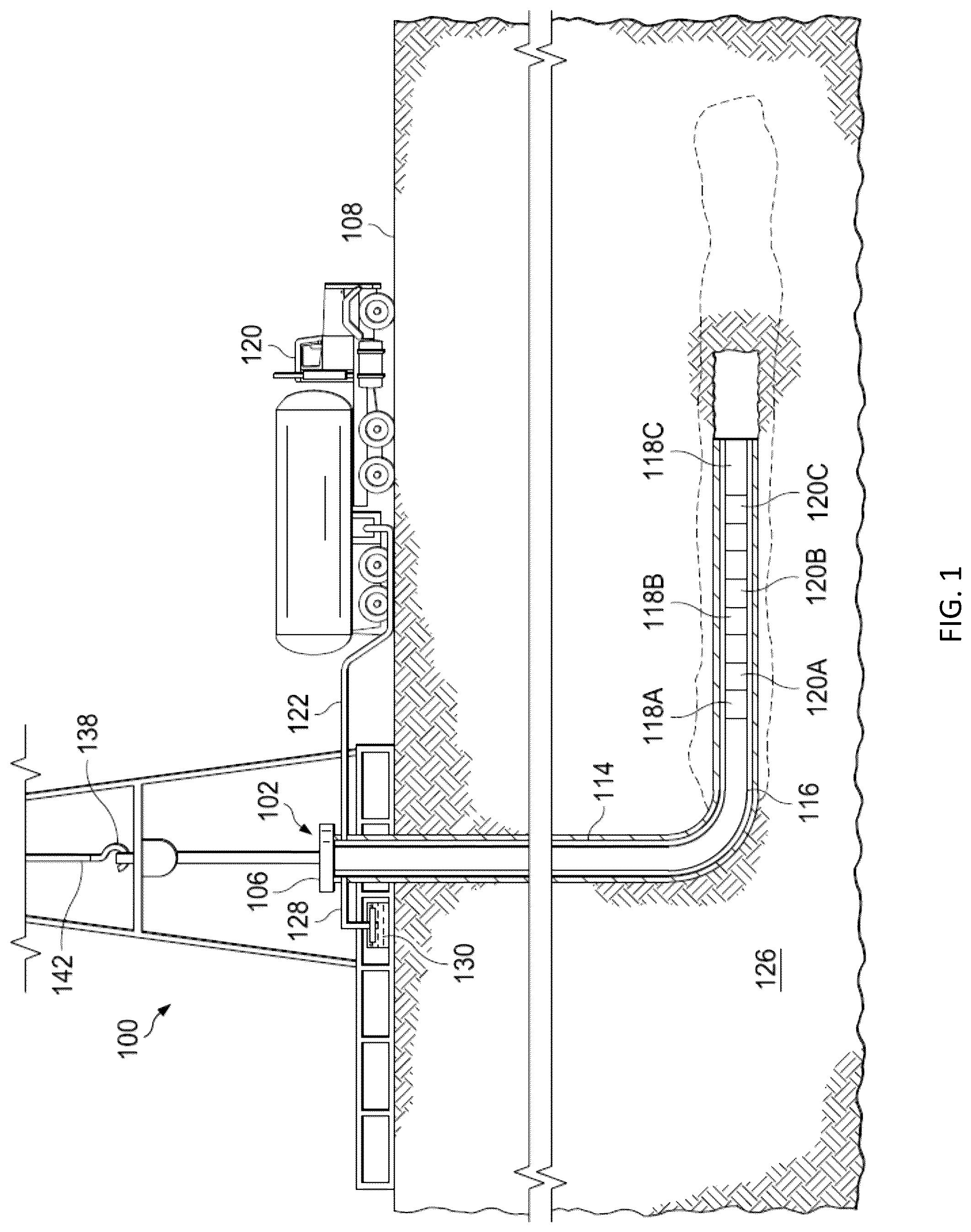
illustrates a schematic, side view of a well system in which inflow control devices are deployed in a wellbore;
illustrates a cross-sectional view of one embodiment of an inflow control device of ;
illustrates a cross-sectional view of a fluid flow control device similar in certain embodiments to fluid flow control device of ;
A through 4 N illustrate cross-sectional views of a variety of different floats (e.g., paddled shaped floats) designed, manufactured, and operated according to one or more embodiments of the disclosure, as might be used with the fluid flow control device of ;
A and 5 B illustrate cross-sectional views of an alternative embodiments of a fluid flow control device designed, manufactured, and operated according to one or more embodiments of the disclosure;
A through 6 N illustrate cross-sectional views of a variety of different floats (e.g., paddled shaped floats) designed, manufactured, and operated according to one or more embodiments of the disclosure, as might be used with the fluid flow control device of A or 5 B ;
A and 7 B illustrates cross-sectional views of an alternative embodiment of a fluid flow control device designed, manufactured, and operated according to one or more embodiments of the disclosure;
illustrates an orientation dependent inflow control apparatus designed, manufactured, and operated according to one or more embodiments of the disclosure;
illustrates a rolled-out view (360°) of a device comprising four orientation dependent inflow control apparatuses equidistantly distributed around the perimeter outside of a basepipe (not shown); and
A through 10 L illustrate cross-sectional views of a variety of different floats (e.g., spherical shaped floats) designed, manufactured, and operated according to one or more embodiments of the disclosure, as might be used with the fluid flow control device of A or 7 B .
DETAILED DESCRIPTION
In the drawings and descriptions that follow, like parts are typically marked throughout the specification and drawings with the same reference numerals, respectively. The drawn figures are not necessarily to scale. Certain features of the disclosure may be shown exaggerated in scale or in somewhat schematic form and some details of certain elements may not be shown in the interest of clarity and conciseness. The present disclosure may be implemented in embodiments of different forms.
Specific embodiments are described in detail and are shown in the drawings, with the understanding that the present disclosure is to be considered an exemplification of the principles of the disclosure, and is not intended to limit the disclosure to that illustrated and described herein. It is to be fully recognized that the different teachings of the embodiments discussed herein may be employed separately or in any suitable combination to produce desired results.
Unless otherwise specified, use of the terms “connect,” “engage,” “couple,” “attach,” or any other like term describing an interaction between elements is not meant to limit the interaction to direct interaction between the elements and may also include indirect interaction between the elements described. Unless otherwise specified, use of the terms “up,” “upper,” “upward,” “uphole,” “upstream,” or other like terms shall be construed as generally away from the bottom, terminal end of a well, regardless of the wellbore orientation; likewise, use of the terms “down,” “lower,” “downward,” “downhole,” or other like terms shall be construed as generally toward the bottom, terminal end of a well, regardless of the wellbore orientation. Use of any one or more of the foregoing terms shall not be construed as denoting positions along a perfectly vertical axis. In some instances, a part near the end of the well can be horizontal or even slightly directed upwards. Unless otherwise specified, use of the term “subterranean formation” shall be construed as encompassing both areas below exposed earth and areas below earth covered by water such as ocean or fresh water.
The present disclosure relates, for the most part, to fluid flow control devices and downhole floats. The fluid flow control device, in at least one embodiment, includes an inlet port and an outlet port. The fluid flow control device, in at least this embodiment, also includes a float that is positioned between the inlet port and the outlet port. The float is operable to move between an open position that permits fluid flow through the outlet port and a closed position that restricts fluid flow through the outlet port. As referred to herein, an open position is a position of the float where the float does not restrict fluid flow through the outlet port, whereas a closed position is a position of the float where the float restricts fluid flow through the outlet port. In some embodiments, the float shifts radially inwards toward the outlet port to move from an open position to a closed position, and shifts radially outwards away from the outlet port to move from the closed position to the open position. In some embodiments, the float shifts radially outwards toward the outlet port to move from an open position to a closed position, and shifts radially inward away from the outlet port to move from the closed position to the open position. In some other embodiments, the float is hinged such that as the body of float shifts radially outward another portion of the float shifts radially inward, whether to open or close the outlet port. As referred to herein, radially inwards means shifting radially towards the center, such as the central axis, whereas radially outwards means shifting away from the center, such as away from the central axis.
In some embodiments, the float shifts circumferentially (such as circumferentially about a flow pathway of a port) from a first position to a second position to move from an open position to a closed position, and shifts from the second position to the first position to move from the closed position to the open position. In some embodiments, the float shifts linearly from a first position to a second position to move from an open position to a closed position, and shifts linearly from the second position to the first position to move from the closed position to the open position. In yet another embodiment, the float is contained within an enclosure of fluid that it is able to freely move within, the float operable to float from a first position to a second position to move from an open position to a closed position, and sink from the second position to the first position to move from the closed position to the open position. In some embodiments, the float opens to permit certain types of fluids having densities that are less than a threshold density (such as oil and other types of hydrocarbon resources) to flow through the outlet port, and restricts other types of fluids having densities greater than or equal to the threshold density (such as water and drilling fluids) from flowing through the outlet port.
The present disclosure is based, at least in part, on the acknowledgment that there is a need for low density floats for use in downhole environments. The present disclosure has further acknowledged that such downhole environments see extreme hydrostatic pressures, high temperatures, a variety of harsh chemicals, and typically require a long service life, and that there is not a good solution for downhole components with a density lower than 1.3 specific gravity (sg). Based, at least in part on the foregoing acknowledgements, the present disclosure has recognized for the first time that a solution to the forgoing is manufacturing downhole floats including ceramics. In at least one embodiment, the downhole floats are manufactured having a ceramic base material. In at least one embodiment, the ceramic base material is a non-foam ceramic base material. In at least one other embodiment, the ceramic base material is a foam ceramic base material (e.g., closed cell foam, open cell foam, or a combination of the two). In at least one other embodiment, at least a portion of the float including the ceramic base material is formed using an additive manufacturing process. The present disclosure has recognized that that lower density may be obtained by leaving cavities (e.g., voids) in the ceramic base material, whether those cavities are voids formed in the non-foam ceramic base material, or alternatively the cavities that form at least a portion of the foam ceramic base material. These cavities can be tailored to reduce the net density of the part, while providing strength to the part to handle the extreme hydrostatic pressures, temperatures and environment.
In at least one embodiment, the floats including the ceramic base material may be used with density autonomous inflow control devices (ICDs). Often, there is a need for the float's density to be between that of oil and water (e.g., 0.75 sg and 1.0 sg, respectively) or between gas and liquids (e.g., 0.1 sg and 0.75 sg, respectively). By employing the ceramic base material having one or more cavities, these floats can obtain a net density in this range, while using a material with a native density higher than that of water, and in certain embodiments a native density of at least 1.3 sg. This also allows quick customization of the parts shape, density, and its center of gravity location.
While the above example has been discussed generally with regard to a ceramic base material, certain ceramic materials have particular value. For instance, the ceramic base material could include alumina, porcelain, cordierite, yttrium stabilized zirconium, yttrium oxide, boron carbide, silicon carbide, aluminosilicate, among others.
In certain embodiments, the float including the ceramic base material includes a fluid impermeable exterior. In yet another embodiment, the fluid impermeable exterior forms a hermetic seal around the ceramic base material.
Ultimately, the floats are designed to sink and float in a variety of downhole fluids such as: gas, oil, water/brine, and mud. The floats may be used to block or unblock flow paths in downhole flow control devices. The floats can be free floating, hinged, sliding, or any other mechanism that uses their buoyancy or a combination of buoyancy and mechanical advantage to open or close a flow path.
Turning now to the figures, illustrates a schematic side view of a well system 100 in which inflow control devices 120 A- 120 C are deployed in a wellbore 114 . As shown in , wellbore 114 extends from surface 108 of well 102 to or through formation 126 . A hook 138 , a cable 142 , traveling block (not shown), and hoist (not shown) may be provided to lower conveyance 116 into well 102 . As referred to herein, conveyance 116 is any piping, tubular, or fluid conduit including, but not limited to, drill pipe, production tubing, casing, coiled tubing, and any combination thereof. Conveyance 116 provides a conduit for fluids extracted from formation 126 to travel to surface 108 . In some embodiments, conveyance 116 additionally provides a conduit for fluids to be conveyed downhole and injected into formation 126 , such as in an injection operation. In some embodiments, conveyance 116 is coupled to a production tubing that is arranged within a horizontal section of well 102 . In the embodiment of , conveyance 116 and the production tubing are represented by the same tubing.
At wellhead 106 , an inlet conduit 122 is coupled to a fluid source 120 to provide fluids through conveyance 116 downhole. For example, drilling fluids, fracturing fluids, and injection fluids are pumped downhole during drilling operations, hydraulic fracturing operations, and injection operations, respectively. In the embodiment of , fluids are circulated into well 102 through conveyance 116 and back toward surface 108 . To that end, a diverter or an outlet conduit 128 may be connected to a container 130 at the wellhead 106 to provide a fluid return flow path from wellbore 114 . Conveyance 116 and outlet conduit 128 also form fluid passageways for fluids, such as hydrocarbon resources to flow uphole during production operations.
In the embodiment of , conveyance 116 includes production tubular sections 118 A- 118 C at different production intervals adjacent to formation 126 . In some embodiments, packers (now shown) are positioned on the left and right sides of production tubular sections 118 A- 118 C to define production intervals and provide fluid seals between the respective production tubular section 118 A, 118 B, or 118 C, and the wall of wellbore 114 . Production tubular sections 118 A- 118 C include inflow control devices 120 A- 120 C (ICDs). An inflow control device controls the volume or composition of the fluid flowing from a production interval into a production tubular section, e.g., 118 A. For example, a production interval defined by production tubular section 118 A produces more than one type of fluid component, such as a mixture of oil, water, steam, carbon dioxide, and natural gas. Inflow control device 120 A, which is fluidly coupled to production tubular section 118 A, reduces or restricts the flow of fluid into the production tubular section 118 A when the production interval is producing a higher proportion of an undesirable fluid component, such as water, which permits the other production intervals that are producing a higher proportion of a desired fluid component (e.g., oil) to contribute more to the production fluid at surface 108 of well 102 , so that the production fluid has a higher proportion of the desired fluid component. In some embodiments, inflow control devices 120 A- 120 C are an autonomous inflow control devices (AICD) that permits or restricts fluid flow into the production tubular sections 118 A- 118 C based on fluid density, without requiring signals from the well's surface by the well operator.
Although the foregoing paragraphs describe utilizing inflow control devices 120 A- 120 C during production, in some embodiments, inflow control devices 120 A- 120 C are also utilized during other types of well operations to control fluid flow through conveyance 116 . Further, although depicts each production tubular section 118 A- 118 C having an inflow control device 120 A- 120 C, in some embodiments, not every production tubular section 118 A- 118 C has an inflow control device 120 A- 120 C. In some embodiments, production tubular sections 118 A- 118 C (and inflow control devices 120 A- 120 C) are located in a substantially vertical section additionally or alternatively to the substantially horizontal section of well 102 . Further, any number of production tubular sections 118 A- 118 C with inflow control devices 120 A- 120 C, including one, are deployable in the well 102 . In some embodiments, production tubular sections 118 A- 118 C with inflow control devices 120 A- 120 C are disposed in simpler wellbores, such as wellbores having only a substantially vertical section. In some embodiments, inflow control devices 120 A- 120 C are disposed in cased wells or in open-hole environments.
In at least one embodiment, one or more of the inflow control devices 120 A- 120 C include one or more floats designed, manufactured, and operated according to the disclosure. In accordance with at least one embodiment, the one or more floats include a ceramic base material having one or more cavities therein, the ceramic base material and the one or more cavities creating a net density for the float that is between a first density of a desired fluid and a second density of an undesired fluid. Accordingly, the one or more floats may control fluid flow through a flow control device when encountering the desired fluid or the undesired fluid. The one or more floats may additionally include a fluid impermeable exterior surrounding the ceramic base material. The phrase “fluid impermeable,” as used herein, is intended to mean that the permeability of the exterior is less than 0.1 millidarcy. In at least one other embodiment, at least a portion of the float including the ceramic base material is formed using an additive manufacturing process. The phrase “additive manufacturing process,” as used herein, is intended to encompass all processes in which material is deposited, joined, or solidified under computer control to create a three-dimensional object, with material being added together (such as plastics, liquids or powder grains being fused together), typically layer by layer.
illustrates a cross-sectional view of one embodiment of an inflow control device 120 A of . In the embodiments described in , inflow control device 120 A includes an inflow tubular 200 of a well tool coupled to a fluid flow control device 202 . Although the word “tubular” is used to refer to certain components in the present disclosure, those components have any suitable shape, including a non-tubular shape. Inflow tubular 200 provides fluid to fluid flow control device 202 . In some embodiments, fluid is provided from a production interval in a well system or from another location. In the embodiment of , inflow tubular 200 terminates at an inlet port 205 that provides a fluid communication pathway into fluid flow control device 202 . In some embodiments, inlet port 205 is an opening in a housing 201 of fluid flow control device 202 .
A first fluid portion flows from inlet port 205 toward a bypass port 210 . The first fluid portion pushes against fins 212 extending outwardly from a rotatable component 208 to rotate rotatable component 208 about an axis, such as a central axis 203 . Rotation of rotatable component 208 about axis 203 generates a force on a float positioned within rotatable component 208 . After passing by rotatable component 208 , the first fluid portion exits fluid flow control device 202 via bypass port 210 . From bypass port 210 , the first fluid portion flows through a bypass tubular 230 to a tangential tubular 216 . The first fluid portion flows through tangential tubular 216 , as shown by dashed arrow 218 , into a vortex valve 220 . In the embodiment of , the first fluid portion spins around an outer perimeter of vortex valve 220 at least partially due to the angle at which the first fluid portion enters vortex valve 220 . Forces act on the first fluid portion, eventually causing the first fluid portion to flow into a central port 222 of vortex valve 220 . The first fluid portion then flows from central port 222 elsewhere, such as to a well surface as production fluid.
At the same time, a second fluid portion from inlet port 205 flows into rotatable component 208 via holes in rotatable component 208 (e.g., holes between fins 212 of rotatable component 208 ). If the density of the second fluid portion is high, the float moves to a closed position, which prevents the second fluid portion from flowing to an outlet port 207 , and instead cause the second fluid portion to flow out bypass port 210 . If the density of the second fluid portion is low (e.g., if the second fluid portion is mostly oil or gas), then the float moves to an open position that allows the second fluid portion to flow out the outlet port 207 and into a control tubular 224 . In this manner, fluid flow control device 202 autonomously directs fluids through different pathways based on the densities of the fluids. The control tubular 224 directs the second fluid portion, along with the first fluid portion, toward central port 222 of vortex valve 220 via a more direct fluid pathway, as shown by dashed arrow 226 and defined by tubular 228 . The more direct fluid pathway to central port 222 allows the second fluid portion to flow into central port 222 more directly, without first spinning around the outer perimeter of vortex valve 220 . If the bulk of the fluid enters vortex valve 220 along the pathway defined by dashed arrow 218 , then the fluid will tend to spin before exiting through central port 222 and will have a high fluid resistance. If the bulk of the fluid enters vortex valve 220 along the pathway defined by dashed arrow 226 , then the fluid will tend to exit through central port 222 without spinning and will have minimal flow resistance.
In some embodiments, the above-mentioned concepts are enhanced by the rotation of rotatable component 208 . Typically, the buoyancy force generated by the float is small because the difference in density between the lower-density fluid and the higher-density fluid is generally small, and there is only a small amount (e.g., 5 milli-Newtons) of gravitational force acting on this difference in density. This makes fluid flow control device 202 sensitive to orientation, which causes the float to get stuck in the open position or the closed position. However, rotation of rotatable component 208 creates a force (e.g., a centripetal force or a centrifugal force) on the float. The force acts as artificial gravity that is much higher than the small gravitational force naturally acting on the difference in density. This allows fluid flow control device 202 to more reliably toggle between the open and closed positions based on the density of the fluid. This also makes fluid flow control device 202 perform in a manner that is insensitive to orientation, because the force generated by rotatable component 208 is much larger than the naturally occurring gravitational force.
In some embodiments, fluid flow control device 202 directs a fluid along the more direct pathway shown by dashed arrow 226 or along the tangential pathway shown by dashed arrow 218 . In one or more of such embodiments, whether fluid flow control device 202 directs the fluid along the pathway shown by dashed arrow 226 or the dashed arrow 218 depends on the composition of the fluid. Directing the fluid in this manner causes the fluid resistance in vortex valve 220 to change based on the composition of the fluid.
In some embodiments, fluid flow control device 202 is compatible with any type of valve. For example, although includes a vortex valve 220 , in other embodiments, vortex valve 220 is replaced with other types of fluidic valves, including valves that have a moveable valve-element, such as a rate-controlled production valve. Further, in some embodiments, fluid control device 202 operates as a pressure sensing module in a valve.
is a cross-sectional view of a fluid flow control device 300 similar in certain embodiments to fluid flow control device 200 of . With reference now to , fluid flow control device 300 includes a rotatable component 308 positioned within a housing 301 of fluid flow control device 300 . Fluid flow control device 300 also includes an inlet port 305 that provides a fluid passage for fluids such as, but not limited to, hydrocarbon resources, wellbore fluids, water, and other types of fluids to flow into housing 301 . Fluid control device 300 also includes an outlet port 310 that provides a fluid flow path for fluids to flow out of fluid flow control device 300 , such as to vortex valve 220 of . Some of the fluids that flow into housing 301 also come into contact with rotatable component 308 , where force generated by fluids flowing onto rotatable component 308 rotates rotatable component 308 about axis 303 . In some embodiments, fluids flowing through inlet port 305 push against fins, including fin 312 , which are coupled to rotatable component 308 , where the force of the fluids against the fins rotates rotatable component 308 about axis 303 . Three floats 304 A- 304 C are positioned within the rotatable component 308 and are connected to the rotatable component 308 by hinges 340 A- 340 C, respectively, where each hinge 340 A, 340 B, and 340 C provides for movement of a respective float 304 A, 304 B, and 304 C relative to rotatable component 308 between the open and closed positions. In some embodiments, movements of each float 304 A, 304 B, and 304 C between the open and the closed positions are based on fluid densities of fluids in rotatable component 308 .
In some embodiments, movement of floats 304 A- 304 C back and forth between the open and closed positions is accomplished by hinging each respective float 304 A, 304 B, or 304 C on its hinge 340 A, 340 B, or 340 C. In some embodiments, each hinge 340 A, 340 B, and 340 C includes a pivot rod (not shown) mounted to rotatable component 308 and passing at least partially through float 304 A, 304 B, and 304 C, respectively. In some embodiments, in lieu of the pivot rod mounted to rotatable component 308 , each float 304 A, 304 B, and 304 C has bump extensions that fit into recesses of rotatable component 308 for use as a hinge. In some embodiments, floats 304 A- 304 C are configured to move back and forth from the open and closed positions in response to changes in the average density of fluids, including mixtures of water, hydrocarbon gas, and/or hydrocarbon liquids, introduced at inlet port 305 . For example, floats 304 A- 304 C are movable from the open position to the closed position in response to the fluid from inlet port 305 being predominantly water or mud, wherein the float component is movable from the closed position to the open position in response to the fluid from the inlet port 305 being predominantly a hydrocarbon, such as oil or gas.
In the embodiment of , rotatable component 308 includes three fluid pathways 342 A- 342 C that provide fluid communication between inlet port 305 and an outlet port 307 . Further, each fluid pathway 342 A, 342 B, and 342 C is fluidly connected to a chamber 302 A, 302 B, and 302 C, respectively. Moreover, each float 304 A, 304 B, and 304 C is disposed in a chamber 302 A, 302 B, and 302 C, respectively, such that shifting a float 304 A, 304 B, or 304 C from an open position to a closed position restricts fluid flow through a corresponding fluid pathway 342 A, 342 B, or 342 C, respectively, whereas shifting float 304 A, 304 B, or 304 C from the closed position to the open position permits fluid flow through corresponding fluid pathway 342 A, 342 B, or 342 C. In some embodiments, float 304 A, 304 B, or 304 C permits or restricts fluid flow through fluid pathway 342 A, 342 B, or 342 C, respectively, based on the density of the fluid in chamber 302 A, 302 B, or 302 C, respectively. Although illustrates three floats 304 A- 304 C positioned in three chambers 302 A- 202 C, respectively, in some embodiments, a different number of floats positioned in a different number of chambers are placed in rotatable component 308 . Further, although illustrates three fluid pathways 342 A- 342 C, in some embodiments, rotatable component 308 includes a different number of fluid pathways that fluidly connect inlet port 305 to outlet port 307 . Further, although illustrates three floats 304 A- 304 C positioned in three chambers 302 A- 202 C, respectively, in some embodiments, a different number of floats positioned in a different number of chambers are placed in rotatable component 308 . Further, although illustrates three fluid pathways 342 A- 342 C, in some embodiments, rotatable component 308 includes a different number of fluid pathways that fluidly connect inlet port 305 to outlet port 307 .
In the illustrated embodiment, the one or more of the floats 304 A- 304 C each comprise a ceramic base material having one or more cavities therein, the ceramic base material and the one or more cavities creating a net density for the float that is between a first density of a desired fluid and a second density of an undesired fluid. For example, using the ceramic base material having the one or more cavities therein, the net density of the floats 304 A- 304 C may be specifically tailored, for example to a net specific gravity value between oil and water. Moreover, the net density may be tailored, while using materials with a native density greater than both oil and water, for example using materials with a native density of at least 1.3 sg.
A through 4 N illustrate cross-sectional views of a variety of different floats (e.g., paddled shaped floats) 404 A- 404 N designed, manufactured, and operated according to one or more embodiments of the disclosure, as might be used with the fluid flow control device 300 of . For example, each of the floats 404 A- 404 N could be configured to move back and forth between the open and closed positions by rotating about a hinge point.
Each of the different floats 404 A- 404 N, or at least a portion of each of the different floats 404 A- 404 N, includes a ceramic base material having one or more cavities therein, and in certain instances has been formed using the aforementioned additive manufacturing process. Specifically, the ceramic base material having the one or more cavities therein, and in certain embodiments in addition to the additive manufacturing process, has been employed to provide a float 404 A- 404 N having a highly specific net density (e.g., combined density of all the associated parts of the float). In at least one embodiment, the float has a net density that is above a first density of a desired fluid and below a second density of an undesired fluid. In another embodiment, the float has a net density that is above a first density of an undesired fluid and below a second density of a desired fluid. In at least one other embodiment, the native density of the ceramic base material and/or the fluid impermeable exterior is greater than the first density or the second density. For example, the native density of the ceramic base material and/or the fluid impermeable exterior may be 1.3 sg or greater.
With initial reference to A , illustrated is one embodiment of a float 404 A designed, manufactured, and operated according to one or more embodiments of the disclosure. The float 404 A includes a ceramic base material 410 having one or more cavities 420 A. The ceramic base material 410 , in the illustrated embodiment of A , is a non-foam ceramic base material. For example, the ceramic base material might comprise alumina, porcelain, cordierite, yttrium stabilized zirconium, yttrium oxide, boron carbide, silicon carbide, aluminosilicate, among others. In the illustrated embodiment, the ceramic base material 410 includes a plurality of separate cavities 420 A, which in certain examples is four or more separate cavities. In the embodiment of A , the plurality of separate cavities 420 A are a plurality of spherical cavities. Furthermore, the plurality of separate cavities 420 A of the embodiment of A are substantially similarly shaped and/or similarly sized, if not entirely similar shaped or similarly sized, cavities 420 A. The plurality of separate cavities 420 A, in the illustrated embodiment, may additionally be substantially equally spaced cavities, and are optionally substantially equally distributed cavities. The term “substantially”, as used herein with regard to shape, size, spacing, and distribution, is intended to include + or − ten percent of exactly shaped, sized or spaced. In other embodiments, a multitude of sizes of cavities 420 A are used in order to allow more open space.
In at least one embodiment, the plurality of separate cavities 420 A are filled with air. In yet another embodiment, the plurality of separate cavities 420 A are filled with another fluid (e.g., gas and/or liquid) other than air. For example, the plurality of separate cavities 420 A could be filled with an inert gas, such as nitrogen, CO 2 , argon, etc., among others. In other embodiments, the plurality of separate cavities 420 A could be filled with an inert fluid, among other fluids.
Turning now to B , illustrated is an alternative embodiment of a float 404 B designed, manufactured, and operated according to another embodiment of the disclosure. The float 404 B is similar in many respects to the float 404 A of A . Accordingly, like reference numbers have been used to indicate similar, if not identical, features. The float 404 B differs, for the most part, from the float 404 A in that the float 404 B employs multiple longitudinal shaped cavities 420 B. The multiple longitudinal shaped cavities 420 B, in the embodiment of B , are substantially equally spaced, and substantially equally distributed. For example, the float 404 B has four or more substantially equally spaced cavities 420 B.
Turning now to C , illustrated is an alternative embodiment of a float 404 C designed, manufactured, and operated according to another embodiment of the disclosure. The float 404 C is similar in many respects to the float 404 B of B . Accordingly, like reference numbers have been used to indicate similar, if not identical, features. The float 404 C differs, for the most part, from the float 404 B in that the float 404 C employs multiple longitudinal shaped cavities 420 C that are equally spaced, but are concentrated together to alter the center of gravity of the float 404 C. For example, wherein a center of gravity of the float 404 B would be substantially at a midpoint of a width and height of the float 404 B, the center of gravity of the float 404 C would be to the right of the midpoint of the width of the float 404 C.
Turning now to D , illustrated is an alternative embodiment of a float 404 D designed, manufactured, and operated according to another embodiment of the disclosure. The float 404 D is similar in many respects to the float 404 C of C . Accordingly, like reference numbers have been used to indicate similar, if not identical, features. The float 404 D differs, for the most part, from the float 404 C, in that the float 404 D employs multiple longitudinal shaped cavities 420 D that are gradiently spaced. For example, the float 404 D has four or more gradiently spaced cavities 420 D. Again, the gradient spacing may be used to change the location of the center of gravity of the float 404 D. In an extension of this embodiment, the interior of the float can comprise a lattice.
Turning now to E , illustrated is an alternative embodiment of a float 404 E designed, manufactured, and operated according to another embodiment of the disclosure. The float 404 E is similar in many respects to the float 404 A of A . Accordingly, like reference numbers have been used to indicate similar, if not identical, features. The float 404 E differs, for the most part, from the float 404 A, in that the float 404 E employs a foam ceramic base material 410 E having a plurality of cavities 420 E therein. In the illustrated embodiment of E , the foam ceramic base material is a closed cell foam ceramic base material having the plurality of cavities 420 E therein. Those skilled in the art understand that the closed cell foam, and the sizing of the cells, may be used to adjust the net density of the float 404 E.
Turning now to F , illustrated is an alternative embodiment of a float 404 F designed, manufactured, and operated according to another embodiment of the disclosure. The float 404 F is similar in many respects to the float 404 E of E . Accordingly, like reference numbers have been used to indicate similar, if not identical, features. The float 404 F differs, for the most part, from the float 404 E, in that the float 404 F employs an open cell foam ceramic base material having the plurality of cavities 420 F therein. Those skilled in the art understand that the open cell foam, and the sizing of the cells, may be used to adjust the net density of the float 404 F.
Turning now to G , illustrated is an alternative embodiment of a float 404 G designed, manufactured, and operated according to another embodiment of the disclosure. The float 404 G is similar in many respects to the float 404 E of E . Accordingly, like reference numbers have been used to indicate similar, if not identical, features. The float 404 G differs, for the most part, from the float 404 E, in that the float 404 G includes a fluid impermeable exterior 430 G surrounding the foam ceramic base material 410 E having the plurality of cavities 420 E therein. In at least one embodiment, the fluid impermeable exterior 430 G forms a hermetic seal around the foam ceramic base material 410 E having the plurality of cavities 420 E therein. The term “hermetic”, as used herein, is intended to include a seal that remains airtight and/or fluid tight up to at least 70 Bar (e.g., about 1000 psi) and in some embodiments up to at least 700 Bar (e.g., about 10,000 psi) as well as at temperatures over 50° C. (e.g., about 120° F.) and in other cases to temperatures over 175° C. (e.g., over about 350° F.). Those skilled in the art understand the various different materials that the fluid impermeable exterior 430 G may comprise, whether or not it is designed to provide a hermetic seal.
Turning now to H , illustrated is an alternative embodiment of a float 404 H designed, manufactured, and operated according to another embodiment of the disclosure. The float 404 H is similar in many respects to the float 404 F of F . Accordingly, like reference numbers have been used to indicate similar, if not identical, features. The float 404 H differs, for the most part, from the float 404 F, in that the float 404 H includes a fluid impermeable exterior 430 H surrounding the foam ceramic base material 410 F having the plurality of cavities 420 F therein. In at least one embodiment, the fluid impermeable exterior 430 H forms a hermetic seal around the foam ceramic base material 410 F having the plurality of cavities 420 F therein. Those skilled in the art understand the various different materials that the fluid impermeable exterior 430 F may comprise, whether or not it is designed to provide a hermetic seal.
Turning now to I , illustrated is an alternative embodiment of a float 404 I designed, manufactured, and operated according to another embodiment of the disclosure. The float 404 I is similar in many respects to the float 404 E of E and/or float 404 F of F . Accordingly, like reference numbers have been used to indicate similar, if not identical, features. The float 404 I differs, for the most part, from the float 404 E and/or 4 F, in that the float 404 I employs is a mix of closed cell foam cavities 420 E and open cell foam cavities 420 F. In the illustrated embodiment of I , the closed cell foam cavities 420 E are formed in a first section of the float 404 I whereas the open cell foam cavities 420 F are formed in a second section of the float 404 I. For example, the closed cell foam cavities 420 E could be located on a tip of the float 404 I whereas the open cell foam cavities 420 F could be located on a base of the float 404 I.
Turning now to J , illustrated is an alternative embodiment of a float 404 J designed, manufactured, and operated according to another embodiment of the disclosure. The float 404 J is similar in many respects to the float 404 I of I . Accordingly, like reference numbers have been used to indicate similar, if not identical, features. The float 404 J differs, for the most part, from the float 404 I, in that the float 404 J has the closed cell foam cavities 420 E surround the open cell foam cavities 420 F, or vice versa. In the illustrated embodiment of J , the closed cell foam cavities 420 E surround the open cell foam cavities 420 F, and thus in certain embodiments the closed cell foam cavities 420 E provide a fluid impermeable exterior for the open cell foam cavities 420 F.
Turning now to K , illustrated is an alternative embodiment of a float 404 K designed, manufactured, and operated according to another embodiment of the disclosure. The float 404 K is similar in many respects to the float 404 E of E . Accordingly, like reference numbers have been used to indicate similar, if not identical, features. The float 404 K differs, for the most part, from the float 404 E, in that at least a portion of the float 404 K includes a non-ceramic base material 430 K. In the illustrated embodiment of K , a portion of the float 404 K nearest its point of rotation comprises the non-ceramic base material 430 K. Those skilled in the art understand the various different materials that the non-ceramic base material 430 K may comprise.
Turning now to L , illustrated is an alternative embodiment of a float 404 L designed, manufactured, and operated according to another embodiment of the disclosure. The float 404 L is similar in many respects to the float 404 F of F . Accordingly, like reference numbers have been used to indicate similar, if not identical, features. The float 404 L differs, for the most part, from the float 404 F, in that at least a portion of the float 404 L includes a non-ceramic base material 430 L. In the illustrated embodiment of L , a portion of the float 404 L nearest its point of rotation comprises the non-ceramic base material 430 L. Those skilled in the art understand the various different materials that the non-ceramic base material 430 L may comprise.
Turning now to M , illustrated is an alternative embodiment of a float 404 M designed, manufactured, and operated according to another embodiment of the disclosure. The float 404 M is similar in certain respects to the float 404 C of C . The float 404 M differs, for the most part, from the float 404 C, in that a majority of the float 404 M comprises a non-ceramic base material 430 M having one or more openings 440 M therein, and furthermore a foam ceramic base material 410 M is located within the one or more openings 440 M.
Turning now to N , illustrated is an alternative embodiment of a float 404 N designed, manufactured, and operated according to another embodiment of the disclosure. The float 404 N is similar in certain respects to the float 404 M of M . The float 404 N differs, for the most part, from the float 404 M, in that the one or more openings 440 N are gradiently spaced.
Turning to A , illustrated is a cross-sectional view of an alternative embodiment of a fluid flow control device 500 A designed, manufactured, and operated according to one or more embodiments of the disclosure. The fluid flow control device 500 A is similar in many respects to the fluid flow control device 300 of . Accordingly, like reference numbers have been used to indicate similar, if not identical, features. The fluid flow control device 500 A differs, for the most part, from the fluid flow control device 300 , in that the fluid flow control device 500 A does not employ the rotatable component 308 . Alternatively, the fluid flow control device 500 A employs a single paddle shaped float 504 A. The single paddle shaped float 504 A, in at least the illustrated embodiment, is operable to slide (e.g., linearly slide in one embodiment) between the open and closed positions, for example based upon the density of the fluid within the housing 301 . In the embodiment of A , the single paddle shaped float 504 A is configured to float upward to the closed position and sink downward to the open position, for example based upon the density of the fluid within the housing 301 .
Turning to B , illustrated is a cross-sectional view of an alternative embodiment of a fluid flow control device 500 B designed, manufactured, and operated according to one or more embodiments of the disclosure. The fluid flow control device 500 B is similar in many respects to the fluid flow control device 500 A of A . Accordingly, like reference numbers have been used to indicate similar, if not identical, features. The fluid flow control device 500 B differs, for the most part, from fluid flow control device 500 A, in that the single paddle shaped float 504 B is configured to float upward to the open position and sink downward to the closed position, for example based upon the density of the fluid within the housing 301 .
A through 6 N illustrate cross-sectional views of a variety of different floats (e.g., paddled shaped floats) 604 A- 604 N designed, manufactured, and operated according to one or more embodiments of the disclosure, as might be used with the fluid flow control device 500 A, 500 B of A and 5 B . For example, each of the floats 604 A- 604 N could be configured to slide (e.g., linearly slide) back and forth between the open and closed positions.
Each of the different floats 604 A- 604 N, or at least a portion of each of the different floats 604 A- 604 N, includes the ceramic base material having one or more cavities therein. Specifically, the ceramic base material having one or more cavities therein has been employed to provide a float 604 A- 604 N having a highly specific net density (e.g., combined density of all the associated parts of the float). In at least one embodiment, the ceramic base material having one or more cavities therein has been employed to provide a net density that is above a first density of a desired fluid and below a second density of an undesired fluid. In at least one other embodiment, the native density of the ceramic base material is greater than the first density or the second density. For example, the native density of the ceramic base material may be 1.3 sg or greater.
With initial reference to A , illustrated is one embodiment of a float 604 A designed, manufactured, and operated according to one or more embodiments of the disclosure. The float 604 A includes a ceramic base material 610 having one or more cavities 620 A. The ceramic base material 610 , in the illustrated embodiment of A , is a non-foam ceramic base material. For example, the ceramic base material might comprise alumina, porcelain, cordierite, yttrium stabilized zirconium, yttrium oxide, boron carbide, silicon carbide, aluminosilicate, among others. In the illustrated embodiment, the ceramic base material 610 includes a plurality of separate cavities 620 A, which in certain examples is four or more separate cavities. In the embodiment of A , the plurality of separate cavities 620 A are a plurality of spherical cavities. Furthermore, the plurality of separate cavities 620 A of the embodiment of A are substantially similarly shaped and/or similarly sized, if not entirely similar shaped or similarly sized, cavities 620 A. The plurality of separate cavities 620 A, in the illustrated embodiment, may additionally be substantially equally spaced cavities, and are optionally substantially equally distributed cavities. The term “substantially”, as used herein with regard to shape, size, spacing, and distribution, is intended to include + or − ten percent of exactly shaped, sized or spaced. In other embodiments, a multitude of sizes of cavities 620 A are used in order to allow more open space.
In at least one embodiment, the plurality of separate cavities 620 A are filled with air. In yet another embodiment, the plurality of separate cavities 620 A are filled with another fluid (e.g., gas and/or liquid) other than air. For example, the plurality of separate cavities 620 A could be filled with an inert gas, such as nitrogen, CO 2 , argon, etc., among others. In other embodiments, the plurality of separate cavities 620 A could be filled with an inert fluid, among other fluids.
Turning now to B , illustrated is an alternative embodiment of a float 604 B designed, manufactured, and operated according to another embodiment of the disclosure. The float 604 B is similar in many respects to the float 604 A of A . Accordingly, like reference numbers have been used to indicate similar, if not identical, features. The float 604 B differs, for the most part, from the float 604 A in that the float 604 B employs multiple longitudinal shaped cavities 620 B. The multiple longitudinal shaped cavities 620 B, in the embodiment of B , are substantially equally spaced, and substantially equally distributed. For example, the float 604 B has four or more substantially equally spaced cavities 620 B.
Turning now to C , illustrated is an alternative embodiment of a float 604 C designed, manufactured, and operated according to another embodiment of the disclosure. The float 604 C is similar in many respects to the float 604 B of B . Accordingly, like reference numbers have been used to indicate similar, if not identical, features. The float 604 C differs, for the most part, from the float 604 B in that the float 604 C employs multiple longitudinal shaped cavities 620 C that are equally spaced, but are concentrated together to alter the center of gravity of the float 604 C. For example, wherein a center of gravity of the float 604 B would be substantially at a midpoint of a width and height of the float 604 B, the center of gravity of the float 604 C would be to the right of the midpoint of the width of the float 604 C.
Turning now to D , illustrated is an alternative embodiment of a float 604 D designed, manufactured, and operated according to another embodiment of the disclosure. The float 604 D is similar in many respects to the float 604 C of C . Accordingly, like reference numbers have been used to indicate similar, if not identical, features. The float 604 D differs, for the most part, from the float 604 C, in that the float 604 D employs multiple longitudinal shaped cavities 620 D that are gradiently spaced. For example, the float 604 D has four or more gradiently spaced cavities 620 D. Again, the gradient spacing may be used to change the location of the center of gravity of the float 604 D. In an extension of this embodiment, the interior of the float can comprise a lattice.
Turning now to E , illustrated is an alternative embodiment of a float 604 E designed, manufactured, and operated according to another embodiment of the disclosure. The float 604 E is similar in many respects to the float 604 A of A . Accordingly, like reference numbers have been used to indicate similar, if not identical, features. The float 604 E differs, for the most part, from the float 604 A, in that the float 604 E employs a foam ceramic base material 610 E having a plurality of cavities 620 E therein. In the illustrated embodiment of E , the foam ceramic base material is a closed cell foam ceramic base material having the plurality of cavities 620 E therein. Those skilled in the art understand that the closed cell foam, and the sizing of the cells, may be used to adjust the net density of the float 604 E.
Turning now to F , illustrated is an alternative embodiment of a float 604 F designed, manufactured, and operated according to another embodiment of the disclosure. The float 604 F is similar in many respects to the float 604 E of E . Accordingly, like reference numbers have been used to indicate similar, if not identical, features. The float 604 F differs, for the most part, from the float 604 E, in that the float 604 F employs an open cell foam ceramic base material 610 F having the plurality of cavities 620 F therein. Those skilled in the art understand that the open cell foam base material 610 F, and the sizing of the cells, may be used to adjust the net density of the float 604 F.
Turning now to G , illustrated is an alternative embodiment of a float 604 G designed, manufactured, and operated according to another embodiment of the disclosure. The float 604 G is similar in many respects to the float 604 E of E . Accordingly, like reference numbers have been used to indicate similar, if not identical, features. The float 604 G differs, for the most part, from the float 604 E, in that the float 604 G includes a fluid impermeable exterior 630 G surrounding the foam ceramic base material 610 E having the plurality of cavities 620 E therein. In at least one embodiment, the fluid impermeable exterior 630 G forms a hermetic seal around the foam ceramic base material 610 E having the plurality of cavities 620 E therein. Those skilled in the art understand the various different materials that the fluid impermeable exterior 630 G may comprise, whether or not it is designed to provide a hermetic seal.
Turning now to H , illustrated is an alternative embodiment of a float 604 H designed, manufactured, and operated according to another embodiment of the disclosure. The float 604 H is similar in many respects to the float 604 F of F . Accordingly, like reference numbers have been used to indicate similar, if not identical, features. The float 604 H differs, for the most part, from the float 604 F, in that the float 604 H includes a fluid impermeable exterior 630 H surrounding the foam ceramic base material 610 F having the plurality of cavities 620 F therein. In at least one embodiment, the fluid impermeable exterior 630 H forms a hermetic seal around the foam ceramic base material 610 F having the plurality of cavities 620 F therein. Those skilled in the art understand the various different materials that the fluid impermeable exterior 630 F may comprise, whether or not it is designed to provide a hermetic seal.
Turning now to I , illustrated is an alternative embodiment of a float 604 I designed, manufactured, and operated according to another embodiment of the disclosure. The float 604 I is similar in many respects to the float 604 E of E and/or float 604 F of F . Accordingly, like reference numbers have been used to indicate similar, if not identical, features. The float 604 I differs, for the most part, from the float 604 E and/or 6 F, in that the float 604 I employs is a mix of closed cell foam cavities 620 E and open cell foam cavities 620 F. In the illustrated embodiment of I , the closed cell foam cavities 620 E are formed in a first section of the float 604 I whereas the open cell foam cavities 620 F are formed in a second section of the float 604 I. For example, the closed cell foam cavities 620 E could be located on a tip of the float 604 I whereas the open cell foam cavities 620 F could be located on a base of the float 604 I.
Turning now to J , illustrated is an alternative embodiment of a float 604 J designed, manufactured, and operated according to another embodiment of the disclosure. The float 604 J is similar in many respects to the float 604 I of I . Accordingly, like reference numbers have been used to indicate similar, if not identical, features. The float 604 J differs, for the most part, from the float 604 I, in that the float 604 J has the closed cell foam cavities 620 E surround the open cell foam cavities 620 F, or vice versa. In the illustrated embodiment of J , the closed cell foam cavities 620 E surround the open cell foam cavities 620 F, and thus in certain embodiments the closed cell foam cavities 620 E provide a fluid impermeable exterior for the open cell foam cavities 620 F.
Turning now to K , illustrated is an alternative embodiment of a float 604 K designed, manufactured, and operated according to another embodiment of the disclosure. The float 604 K is similar in many respects to the float 604 E of E . Accordingly, like reference numbers have been used to indicate similar, if not identical, features. The float 604 K differs, for the most part, from the float 604 E, in that at least a portion of the float 604 K includes a non-ceramic base material 630 K. In the illustrated embodiment of K , a portion of the float 604 K nearest its point of sliding comprises the non-ceramic base material 630 K. Those skilled in the art understand the various different materials that the non-ceramic base material 630 K may comprise.
Turning now to L , illustrated is an alternative embodiment of a float 604 L designed, manufactured, and operated according to another embodiment of the disclosure. The float 604 L is similar in many respects to the float 604 F of F . Accordingly, like reference numbers have been used to indicate similar, if not identical, features. The float 604 L differs, for the most part, from the float 604 F, in that at least a portion of the float 604 L includes a non-ceramic base material 630 L. In the illustrated embodiment of L , a portion of the float 604 L nearest its point of sliding comprises the non-ceramic base material 630 L. Those skilled in the art understand the various different materials that the non-ceramic base material 630 L may comprise.
Turning now to M , illustrated is an alternative embodiment of a float 604 M designed, manufactured, and operated according to another embodiment of the disclosure. The float 604 M is similar in certain respects to the float 604 C of C . The float 604 M differs, for the most part, from the float 604 C, in that a majority of the float 604 M comprises a non-ceramic base material 630 M having one or more openings 640 M therein, and furthermore a foam ceramic base material 610 M is located within the one or more openings 640 M.
Turning now to N , illustrated is an alternative embodiment of a float 604 N designed, manufactured, and operated according to another embodiment of the disclosure. The float 604 N is similar in certain respects to the float 604 M of M . The float 604 N differs, for the most part, from the float 604 M, in that the one or more openings 640 N are gradiently spaced.
Turning to A , illustrated is a cross-sectional view of an alternative embodiment of a fluid flow control device 700 A designed, manufactured, and operated according to one or more embodiments of the disclosure. The fluid flow control device 700 A is similar in many respects to the fluid flow control device 300 of . Accordingly, like reference numbers have been used to indicate similar, if not identical, features. The fluid flow control device 700 A differs, for the most part, from the fluid flow control device 300 , in that the fluid flow control device 700 A does not employ the rotatable component 308 . Alternatively, the fluid flow control device 700 A employs a single spherical shaped float 704 . The single spherical shaped float 704 , in at least the illustrated embodiment, is operable to float upward to close the fluid outlet 307 when its density is less than the fluid density of a desirable fluid, or sink downward to open the fluid outlet 307 when its density is greater than the fluid density of the desirable fluid. It should be apparent that the fluid flow control device 700 could be reversed so that the sphere 704 restricts the fluid outlet 307 when its density is greater than the fluid density of a desired fluid, such as shown in B .
illustrates an orientation dependent inflow control apparatus 800 designed, manufactured and operated according to one or more embodiments of the disclosure. In the embodiment of , multiple fluid flow control devices 700 A- 700 E are stacked to assist with certain orientation issues that may exist when the fluid flow control device 700 is positioned on a tubular downhole. The multiple fluid flow control devices 700 A- 700 E may also be used to discriminate fluid flow based upon more than just two different densities.
illustrates a rolled-out view (360°) of a device 900 comprising four orientation dependent inflow control apparatuses 800 A- 800 D equidistantly distributed around the perimeter outside of a basepipe (not shown). In the reference indications x and x′ are connected to one another, as well as the reference indications y and y′ are connected to one another. Each of the four orientation dependent inflow control apparatuses 800 A- 800 D is in fluid communication with a corresponding density control valve to form a density control valve system. The orientation of each of the four orientation dependent inflow control apparatuses 800 A- 800 D is indicated by the g-vectors ({right arrow over (g)}) where the indication + is to be understood to be in a direction into the drawing, the downward arrow is in a direction vertically down, the ● is in a direction out of the drawing and the upward arrow is in a direction vertically up.
A through 10 L illustrate cross-sectional views of a variety of different floats (e.g., spherical shaped floats) 1004 A- 1004 L designed, manufactured, and operated according to one or more embodiments of the disclosure, as might be used with the fluid flow control device 700 A of A or fluid flow control device 700 B of B . For example, each of the floats 1004 A- 1004 L could be configured to float and/or sink back and forth between the open and closed positions.
Each of the different floats 1004 A- 1004 L, or at least a portion of each of the different floats 1004 A- 1004 L, includes the ceramic base material having one or more cavities therein. Specifically, the ceramic base material having one or more cavities therein has been employed to provide a float 1004 A- 1004 L having a highly specific net density (e.g., combined density of all the associated parts of the float). In at least one embodiment, the ceramic base material having one or more cavities therein has been employed to provide a net density that is above a first density of a desired fluid and below a second density of an undesired fluid. In at least one other embodiment, the native density of the ceramic base material is greater than the first density or the second density. For example, the native density of the ceramic base material may be 1.3 sg or greater.
With initial reference to A , illustrated is one embodiment of a float 1004 A designed, manufactured, and operated according to one or more embodiments of the disclosure. The float 1004 A includes a ceramic base material 1010 having one or more cavities 1020 A. The ceramic base material 1010 , in the illustrated embodiment of A , is a non-foam ceramic base material. For example, the ceramic base material might comprise alumina, porcelain, cordierite, yttrium stabilized zirconium, yttrium oxide, boron carbide, silicon carbide, aluminosilicate, among others. In the illustrated embodiment, the ceramic base material 1010 includes a plurality of separate cavities 1020 A, which in certain examples is four or more separate cavities. In the embodiment of A , the plurality of separate cavities 1020 A are a plurality of spherical cavities. Furthermore, the plurality of separate cavities 1020 A of the embodiment of A are substantially similarly shaped and/or similarly sized, if not entirely similar shaped or similarly sized, cavities 1020 A. The plurality of separate cavities 1020 A, in the illustrated embodiment, may additionally be substantially equally spaced cavities, and are optionally substantially equally distributed cavities. In other embodiments, a multitude of sizes of cavities 1020 A are used in order to allow more open space.
In at least one embodiment, the plurality of separate cavities 1020 A are filled with air. In yet another embodiment, the plurality of separate cavities 1020 A are filled with another fluid (e.g., gas and/or liquid) other than air. For example, the plurality of separate cavities 1020 A could be filled with an inert gas, such as nitrogen, CO 2 , argon, etc., among others. In other embodiments, the plurality of separate cavities 1020 A could be filled with an inert fluid, among other fluids.
Turning now to B , illustrated is an alternative embodiment of a float 1004 B designed, manufactured, and operated according to another embodiment of the disclosure. The float 1004 B is similar in many respects to the float 1004 A of A . Accordingly, like reference numbers have been used to indicate similar, if not identical, features. The float 1004 B differs, for the most part, from the float 1004 A in that the float 1004 B employs multiple longitudinal shaped cavities 1020 B. The multiple longitudinal shaped cavities 1020 B, in the embodiment of B , are substantially equally spaced, and substantially equally distributed. For example, the float 1004 B has four or more substantially equally spaced cavities 1020 B.
Turning now to C , illustrated is an alternative embodiment of a float 1004 C designed, manufactured, and operated according to another embodiment of the disclosure. The float 1004 C is similar in many respects to the float 1004 B of B . Accordingly, like reference numbers have been used to indicate similar, if not identical, features. The float 1004 C differs, for the most part, from the float 1004 B in that the float 1004 C employs multiple longitudinal shaped cavities 1020 C that are equally spaced, but are concentrated together to alter the center of gravity of the float 1004 C. For example, wherein a center of gravity of the float 1004 B would be substantially at a midpoint of a width and height of the float 1004 B, the center of gravity of the float 1004 C would be to the bottom of the midpoint of the width of the float 1004 C.
Turning now to D , illustrated is an alternative embodiment of a float 1004 D designed, manufactured, and operated according to another embodiment of the disclosure. The float 1004 D is similar in many respects to the float 1004 C of C . Accordingly, like reference numbers have been used to indicate similar, if not identical, features. The float 1004 D differs, for the most part, from the float 1004 C, in that the float 1004 D employs multiple longitudinal shaped cavities 1020 D that are gradiently spaced. For example, the float 1004 D has four or more gradiently spaced cavities 1020 D. Again, the gradient spacing may be used to change the location of the center of gravity of the float 1004 D. In an extension of this embodiment, the interior of the float can comprise a lattice.
Turning now to E , illustrated is an alternative embodiment of a float 1004 E designed, manufactured, and operated according to another embodiment of the disclosure. The float 1004 E is similar in many respects to the float 1004 A of A . Accordingly, like reference numbers have been used to indicate similar, if not identical, features. The float 1004 E differs, for the most part, from the float 1004 A, in that the float 1004 E employs a foam ceramic base material 1010 E having a plurality of cavities 1020 E therein. In the illustrated embodiment of E , the foam ceramic base material is a closed cell foam ceramic base material having the plurality of cavities 1020 E therein. Those skilled in the art understand that the closed cell foam, and the sizing of the cells, may be used to adjust the net density of the float 1004 E.
Turning now to F , illustrated is an alternative embodiment of a float 1004 F designed, manufactured, and operated according to another embodiment of the disclosure. The float 1004 F is similar in many respects to the float 1004 E of E . Accordingly, like reference numbers have been used to indicate similar, if not identical, features. The float 1004 F differs, for the most part, from the float 1004 E, in that the float 1004 F employs an open cell foam ceramic base material 1010 F having the plurality of cavities 1020 F therein. Those skilled in the art understand that the open cell foam base material 1010 F, and the sizing of the cells, may be used to adjust the net density of the float 1004 F.
Turning now to G , illustrated is an alternative embodiment of a float 1004 G designed, manufactured, and operated according to another embodiment of the disclosure. The float 1004 G is similar in many respects to the float 1004 E of E . Accordingly, like reference numbers have been used to indicate similar, if not identical, features. The float 1004 G differs, for the most part, from the float 1004 E, in that the float 1004 G includes a fluid impermeable exterior 1030 G surrounding the foam ceramic base material 1010 E having the plurality of cavities 1020 E therein. In at least one embodiment, the fluid impermeable exterior 1030 G forms a hermetic seal around the foam ceramic base material 1010 E having the plurality of cavities 1020 E therein. Those skilled in the art understand the various different materials that the fluid impermeable exterior 1030 G may comprise, whether or not it is designed to provide a hermetic seal.
Turning now to H , illustrated is an alternative embodiment of a float 1004 H designed, manufactured, and operated according to another embodiment of the disclosure. The float 1004 H is similar in many respects to the float 1004 F of F . Accordingly, like reference numbers have been used to indicate similar, if not identical, features. The float 1004 H differs, for the most part, from the float 1004 F, in that the float 1004 H includes a fluid impermeable exterior 1030 H surrounding the foam ceramic base material 1010 F having the plurality of cavities 1020 F therein. In at least one embodiment, the fluid impermeable exterior 1030 H forms a hermetic seal around the foam ceramic base material 1010 F having the plurality of cavities 1020 F therein. Those skilled in the art understand the various different materials that the fluid impermeable exterior 1030 F may comprise, whether or not it is designed to provide a hermetic seal.
Turning now to I , illustrated is an alternative embodiment of a float 1004 I designed, manufactured, and operated according to another embodiment of the disclosure. The float 1004 I is similar in many respects to the float 1004 E of E and/or float 1004 F of F . Accordingly, like reference numbers have been used to indicate similar, if not identical, features. The float 1004 I differs, for the most part, from the float 1004 E and/or 10 F, in that the float 1004 I employs is a mix of closed cell foam cavities 1020 E and open cell foam cavities 1020 F. In the illustrated embodiment of I , the closed cell foam cavities 1020 E are formed in a first section of the float 1004 I whereas the open cell foam cavities 1020 F are formed in a second section of the float 1004 I. For example, the closed cell foam cavities 1020 E could be located on half of the float 1004 I whereas the open cell foam cavities 1020 F could be located on another half of the float 1004 I.
Turning now to J , illustrated is an alternative embodiment of a float 1004 J designed, manufactured, and operated according to another embodiment of the disclosure. The float 1004 J is similar in many respects to the float 1004 I of I . Accordingly, like reference numbers have been used to indicate similar, if not identical, features. The float 1004 J differs, for the most part, from the float 1004 I, in that the float 1004 J has the closed cell foam cavities 1020 E surround the open cell foam cavities 1020 F, or vice versa. In the illustrated embodiment of J , the closed cell foam cavities 1020 E surround the open cell foam cavities 1020 F, and thus in certain embodiments the closed cell foam cavities 1020 E provide a fluid impermeable exterior for the open cell foam cavities 1020 F.
Turning now to K , illustrated is an alternative embodiment of a float 1004 K designed, manufactured, and operated according to another embodiment of the disclosure. The float 1004 K is similar in certain respects to the float 1004 C of C . The float 1004 K differs, for the most part, from the float 1004 C, in that a majority of the float 1004 K comprises a non-ceramic base material 1030 K having one or more openings 1040 K therein, and furthermore a foam ceramic base material 1010 K is located within the one or more openings 1040 K.
Turning now to L , illustrated is an alternative embodiment of a float 1004 L designed, manufactured, and operated according to another embodiment of the disclosure. The float 1004 L is similar in certain respects to the float 1004 K of K . The float 1004 L differs, for the most part, from the float 1004 K, in that the one or more openings 1040 K are gradiently spaced.
Aspects disclosed herein include:
•
• A. A float for use with a fluid flow control device, the float including: a ceramic base material having one or more cavities therein, the ceramic base material and the one or more cavities creating a net density for the float that is between a first density of a desired fluid and a second density of an undesired fluid, such that the float may control fluid flow through a flow control device when encountering the desired fluid or the undesired fluid. • B. A fluid flow control device, the fluid flow control device including: 1) an inlet port; 2) an outlet port; 3) a float positioned between the inlet port and the outlet port, the float movable between an open position that allows fluid flow through the outlet port and a closed position that restricts fluid flow through the outlet port, the float including a ceramic base material having one or more cavities therein, the ceramic base material and the one or more cavities creating a net density for the float that is between a first density of a desired fluid and a second density of an undesired fluid, such that the float may control fluid flow through a flow control device when encountering the desired fluid or the undesired fluid. • C. A method for manufacturing a fluid flow control device, the method including: 1) providing a float, the float including a ceramic base material having one or more cavities therein, the ceramic base material and the one or more cavities creating a net density for the float that is between a first density of a desired fluid and a second density of an undesired fluid, such that the float may control fluid flow through a flow control device when encountering the desired fluid or the undesired fluid; and 2) positioning the float between an inlet port and an outlet port of the flow control device, the float movable between an open position that allows fluid flow through the outlet port and a closed position that restricts fluid flow through the outlet port. • D. A well system, the well system including: 1) a wellbore formed through a subterranean formation; 2) a tubing string positioned within the wellbore; 3) a fluid flow control device coupled to the tubing string, the fluid flow control device including: a) an inlet port operable to receive fluid from the subterranean formation; b) an outlet port operable to pass the fluid to the tubing string; and c) a float positioned between the inlet port and the outlet port, the float movable between an open position that allows fluid flow through the outlet port to the tubing string and a closed position that restricts fluid flow through the outlet port to the tubing string, the float including a ceramic base material having one or more cavities therein, the ceramic base material and the one or more cavities creating a net density for the float that is between a first density of a desired fluid and a second density of an undesired fluid, such that the float may control fluid flow through the flow control device when encountering the desired fluid or the undesired fluid.
Aspects A, B, C and D may have one or more of the following additional elements in combination: Element 1: wherein the ceramic base material and the one or more cavities create the net density for the float that is above the first density of the desired fluid and below the second density of the undesired fluid. Element 2: wherein the ceramic base material is a non-foam ceramic base material having the one or more cavities therein. Element 3: wherein the ceramic base material has four or more substantially equally spaced cavities. Element 4: wherein the ceramic base material has four or more gradiently spaced cavities positioned to alter a center of gravity of the float. Element 5: wherein the ceramic base material has four or more substantially equally sized cavities. Element 6: wherein the ceramic base material is a foam ceramic base material having a plurality of cavities therein. Element 7: wherein the foam ceramic base material having the plurality of cavities therein is a closed cell foam ceramic base material having the plurality of cavities therein. Element 8: wherein the foam ceramic base material having the plurality of cavities therein is an open cell foam ceramic base material having the plurality of cavities therein. Element 9: wherein the foam ceramic base material having the plurality of cavities therein is a mix of closed cell foam cavities and open cell foam cavities. Element 10: further including a fluid impermeable exterior surrounding the foam ceramic base material having the plurality of cavities therein. Element 11: wherein the fluid impermeable exterior forms a hermetic seal around the foam ceramic base material having the plurality of cavities therein. Element 12: wherein the foam ceramic base material having the plurality of cavities therein is located within one or more openings in a non-ceramic base material. Element 13: wherein the ceramic base material having the one or more openings therein is formed using an additive manufacturing process. Element 14: wherein providing a float includes forming at least a portion of the float using an additive manufacturing process. Element 15: wherein forming at least a portion of a float using an additive manufacturing process includes tailoring the net density for the float above the first density of the desired fluid and below the second density of the undesired fluid.
Those skilled in the art to which this application relates will appreciate that other and further additions, deletions, substitutions, and modifications may be made to the described embodiments.
Figures (20)
Citations
This patent cites (22)
- US7913765
- US10100622
- US10214991
- US10704359
- US11493145
- US11530596
- US11543049
- US20060076150
- US20160258242
- US20170096860
- US20170356273
- US20200063518
- US20200064871
- US20200217174
- US20200256154
- US20200291745
- US20200370382
- US20220403714
- US111101908
- US2012152875
- US2017004285
- US2020102263