Abstract
The present invention relates to UNC13A cryptic exon antisense oligonucleotides (ASOs), pharmaceutical compositions containing them, and methods for treating, inhibiting, suppressing, and preventing neurological diseases with them.
Claims (20)
1. A single stranded antisense oligonucleotide that suppresses the expression of a cryptic exon in UNC13A, wherein the entire nucleobase sequence of the antisense oligonucleotide is SEQ ID NO: 630, wherein at least one nucleoside of the antisense oligonucleotide comprises a modified sugar moiety.
11. A single stranded antisense oligonucleotide that suppresses the expression of a cryptic exon in UNC13A, wherein the entire nucleobase sequence of the antisense oligonucleotide is SEQ ID NO: 55, wherein at least one nucleoside of the antisense oligonucleotide comprises a modified sugar moiety.
Show 18 dependent claims
2. The antisense oligonucleotide of claim 1 , wherein at least one internucleoside linkage is a modified internucleoside linkage.
3. The antisense oligonucleotide of claim 2 , wherein at least one modified internucleoside linkage is a phosphorothioate internucleoside linkage.
4. The antisense oligonucleotide of claim 2 , wherein each modified internucleoside linkage is a phosphorothioate internucleoside linkage.
5. The antisense oligonucleotide of claim 1 , wherein at least one nucleoside comprises a modified nucleobase.
6. The antisense oligonucleotide of claim 1 , wherein the modified sugar moiety comprises a 2′-O-methoxyethyl group.
7. The antisense oligonucleotide of claim 1 , wherein each nucleoside of the antisense oligonucleotide comprises a modified sugar moiety having a 2′-O-methoxyethyl group and each internucleoside linkage is a phosphorothioate internucleoside linkage.
8. A pharmaceutical composition comprising the antisense oligonucleotide of claim 1 , and a pharmaceutically acceptable carrier, diluent and/or excipient.
9. The pharmaceutical composition of claim 8 , wherein the pharmaceutical composition is suitable for parenteral delivery.
10. The pharmaceutical composition of claim 8 , wherein the pharmaceutical composition is suitable for intracerebroventricular or intrathecal administration.
12. The antisense oligonucleotide of claim 11 , wherein at least one internucleoside linkage is a modified internucleoside linkage.
13. The antisense oligonucleotide of claim 12 , wherein at least one modified internucleoside linkage is a phosphorothioate internucleoside linkage.
14. The antisense oligonucleotide of claim 12 , wherein each modified internucleoside linkage is a phosphorothioate internucleoside linkage.
15. The antisense oligonucleotide of claim 11 , wherein at least one nucleoside comprises a modified nucleobase.
16. The antisense oligonucleotide of claim 11 , wherein the modified sugar moiety comprises a 2′-O-methoxyethyl group.
17. The antisense oligonucleotide of claim 11 , wherein each nucleoside of the antisense oligonucleotide comprises a modified sugar moiety having a 2′-O-methoxyethyl group and each internucleoside linkage is a phosphorothioate internucleoside linkage.
18. A pharmaceutical composition comprising the antisense oligonucleotide of claim 11 , and a pharmaceutically acceptable carrier, diluent and/or excipient.
19. The pharmaceutical composition of claim 18 , wherein the pharmaceutical composition is suitable for parenteral delivery.
20. The pharmaceutical composition of claim 18 , wherein the pharmaceutical composition is suitable for intracerebroventricular or intrathecal administration.
Full Description
Show full text →
CROSS-REFERENCE TO RELATED APPLICATIONS
This application claims the benefit of U.S. Provisional Application No. 63/203,409, filed Jul. 21, 2021, and U.S. Provisional Application No. 63/364,830, filed May 17, 2022, each of which is hereby incorporated in its entirety by reference.
SEQUENCE LISTING
The instant application contains a Sequence Listing which has been submitted electronically in XML file format and is hereby incorporated by reference in its entirety. Said XML copy, created on Sep. 7, 2022, is named 151421-01703_SL.xml and is 8,115,605 bytes in size.
FIELD OF THE INVENTION
The present invention relates to UNC13A cryptic exon antisense oligonucleotides (ASOs), pharmaceutical compositions containing them, and methods for treating, inhibiting, suppressing, and preventing neurological or neurodegenerative diseases with them.
BACKGROUND OF THE INVENTION
Many neurodegenerative disorders in patients are difficult to effectively treat, especially where the pathology of a neurodegenerative disorder in a particular patient is not completely understood.
UNC13A belongs to a family of genes originally discovered in C. elegans and was named based on the uncoordinated (unc) movements exhibited by animals with mutations in these genes, owing to deficits in neurotransmitter release. UNC13A encodes a large multidomain protein expressed in the nervous system, where it localizes to neuromuscular junctions and plays an essential role in the vesicle priming step, prior to synaptic vesicle fusion. Variants within the UNC13A gene increase the risk of amyotrophic lateral sclerosis (ALS) and frontotemporal dementia (FTD), two related neurodegenerative diseases defined by mislocalization of the RNA-binding protein TDP-43. Rosa Ma et al., bioRxiv, Apr. 4, 2021.
Amyotrophic lateral sclerosis (ALS) and frontotemporal dementia (FTD) are complex diseases that result from many diverse genetic etiologies. Although therapeutic strategies that target specific causal mutations (e.g. C9ORF72 antisense oligonucleotides (ASOs)) may prove effective against individual forms of ALS or FTD, these approaches cannot address the vast majority of cases that have unknown genetic etiology. Moreover, given the large number of different genes that likely contribute to ALS and FTD and the fact that each genetic form is relatively rare, this strategy may be difficult to implement for all cases. Thus, there is a pressing need for new therapeutic strategies that rescue multiple forms of ALS and FTD, particularly those with unknown genetic etiologies.
A recent analysis of 205 patients from the Mayo Clinic bank who had FTD with TDP-43 pathology, stratified the cases on the basis of UNC13A genotype, and showed a dose-dependent decrease in survival time in individuals carrying UNC13A risk alleles (Rosa Ma et al., Nature, 603:124-130, 2022). Patients with two risk alleles had a median survival time 3 years less than those with the normal transcript. Similarly, variants of UNC13A increase the risk of ALS (Brown et al., Nature, 603:131-137, 2022). TDP-43 depletion induces robust inclusion of a cryptic exon in UNC13A, resulting in nonsense-mediated decay and loss of UNC13A protein (id.).
International Publication No. WO 2022/122872 describes particular antisense oligonucleotides which are said to be capable of modulating splicing by preventing inclusion of an UNC13A cryptic exon into an UNC13A mature mRNA.
There remains a need for effective treatments for many neurodegenerative disorders, such as amyotrophic lateral sclerosis (ALS).
SUMMARY OF THE INVENTION
The present invention relates to UNC13A cryptic exon antisense oligonucleotides (ASOs or UNC13A ASOs), pharmaceutical compositions containing them, and their use in the treatment of neurodegenerative disorders. In particular, the ASOs described herein are to a cryptic exon between canonical exons 20 and 21 of UNC13A, and result in exclusion of the cryptic exon in the UNC13A transcript and increased UNC13A protein expression.
One embodiment is a single stranded ASO that suppresses the expression of UNC13A, wherein the ASO has a nucleobase sequence that comprises at least 12 or 15 consecutive nucleobases of any of the nucleobase sequences of SEQ ID NOs: 1-1282. The ASO can also be any of SEQ ID Nos: 1-1282. In a preferred embodiment, the single stranded ASO has a nucleobase sequence that comprises at least 12 or 15 consecutive nucleobases of any of the nucleobase sequences of SEQ ID NOs: 4-6, 9-11, 22-25, 53, 55, 359, or 360. In another preferred embodiment, the single stranded ASO has a nucleobase sequence comprising the consecutive nucleobases of any of the nucleobase sequences of SEQ ID NOs: 4-6, 9-11, 22-25, 53, 55, 359, or 360. In yet another preferred embodiment, the ASO is any one of SEQ ID NOs: 645-647, 650-652, 663-666, 694, 696, 1000, and 1001.
Another embodiment is an oligonucleotide consisting of 12 to 30 linked nucleosides and having a nucleobase sequence comprising at least 8, at least 9, at least 10, at least 11, at least 12, at least 13, at least 14, at least 15, at least 16, at least 17, at least 18, at least 19, or at least 20 consecutive nucleobases of any of the nucleobase sequences of SEQ ID NOs: 1-1282.
In certain embodiments, at least one internucleoside linkage in the ASO or oligonucleotide is a modified internucleoside linkage, and the modified internucleoside linkage may be a phosphorothioate internucleoside linkage or a phosphodiester internucleoside linkage. At least one of the nucleosides may also be a modified nucleobase.
In other embodiments, at least one nucleoside of the ASO may be a modified sugar moiety, where that modified sugar moiety can be a bicyclic sugar moiety, or the modified sugar moiety may comprise a 2′-O-methoxyethyl group. In certain aspects, the bicyclic sugar moiety comprises a 4′-CH(R)—O—2′ bridge where the R group is, independently, H, C 1-12 alkyl, or a protecting group.
In a preferred embodiment, the ASO is a steric blocking ASO. The steric blocking ASO binds to the target RNA and sterically denies other molecules access for base pairing to the RNA. In one embodiment, each nucleoside in the ASO has a 2′-modified sugar moiety, such as a sugar moiety with a 2′-O-methoxyethyl group, and each internucleoside linkage is a phosphorothioate linkage.
In certain other embodiments, the nucleobase sequence of the oligonucleotide is at least 80%, at least 81%, at least 82%, at least 83%, at least 84%, at least 85%, at least 86%, at least 87%, at least 88%, at least 89%, at least 90%, at least 91%, at least 92%, at least 93%, at least 94%, at least 95%, at least 96%, at least 97%, at least 98%, at least 99%, or 100% complementary to any one of SEQ ID NOs: 1-1282.
In other embodiments, the oligonucleotide consists of 12 to 30 linked nucleosides and having a nucleobase sequence comprising at least 8, at least 9, at least 10, at least 11, at least 12, at least 13, at least 14, at least 15, at least 16, at least 17, at least 18, at least 19, or at least 20 consecutive nucleobases of any of the nucleobase sequences of SEQ ID NOs: 1-1282.
In one embodiment, the ASO or oligonucleotide is 100% complementary to SEQ ID NO: 1207 (chr19:17641557-17642844).
Another embodiment is a pharmaceutical composition comprising an UNC13A ASO of the present invention and one or more pharmaceutically acceptable carriers, diluents, and/or excipients. In one embodiment, the pharmaceutical composition is suitable for parenteral administration, such as intracerebroventricular injection or intrathecal administration.
Yet another embodiment is a method of treating a subject having a neurological or neurodegenerative disease by administering to the subject a therapeutically effective amount of a UNC13A ASO or a pharmaceutical composition described herein. One embodiment is a method of treating amyotrophic lateral sclerosis (ALS) in a subject in need thereof by administering to the subject a therapeutically effective amount of a UNC13A ASO or a pharmaceutical composition described herein. Another embodiment is a method of treating frontotemporal dementia (FTD) in a subject in need thereof by administering to the subject a therapeutically effective amount of a UNC13A ASO or a pharmaceutical composition described herein.
Yet another embodiment is a method of treating a subject having an UNC13A disease or disorder by administering to the subject a therapeutically effective amount of an UNC13A ASO or a pharmaceutical composition described herein.
Yet another embodiment is a method of increasing UNC13A protein expression in a subject in need thereof by administering to the subject an effective amount of a UNC13A ASO or a pharmaceutical composition described herein.
In one embodiment of any of the methods described herein, the subject possesses a SNP variant associated with rs12973192 (C>G), rs12608932 (A>C), or both. Subjects having alleles with mutation on both SNPs may show a stronger response to treatment.
BRIEF DESCRIPTION OF THE FIGURES
A more complete appreciation of the invention and many of the attendant advantages thereof will be readily obtained as the same becomes better understood by reference to the following detailed description when considered in connection with the accompanying figures, wherein:
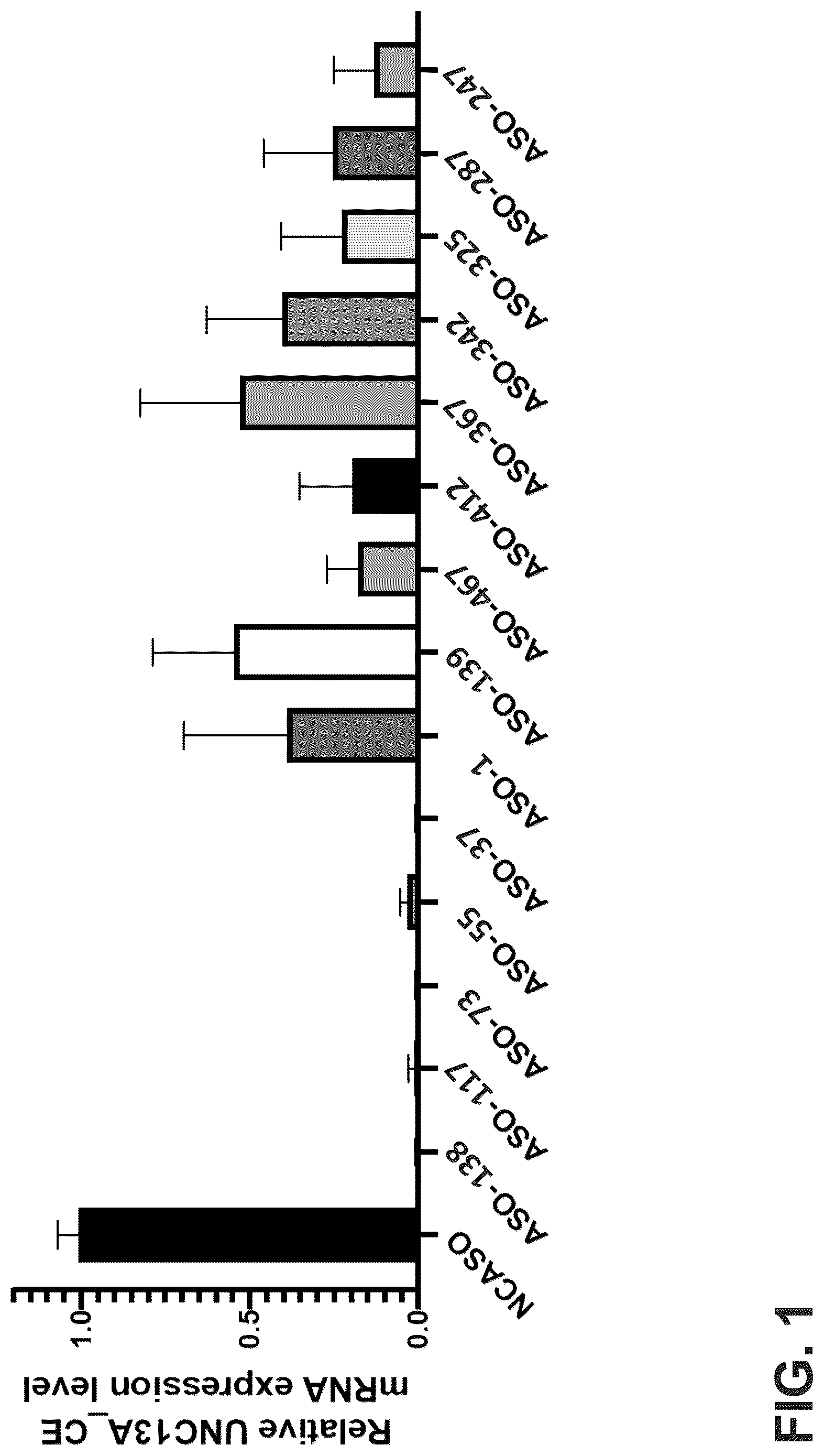
is a chart showing mRNA levels of UNC13A cryptic exon (CE) after treatment with an ASO in a healthy control line with TDP-43 siRNA. For the screen, 14-day old Ngn2-induced neurons (Ngn2-iNs) were treated with TDP-43 siRNA (siTDP-43) for 7 days. qRT-PCR were performed with n=4 biological replicates. Mean +/−s.e.m. One-way ANOVA was used for statistical analysis. p-value *<0.05, **<0.01, ***<0.001,****<0.0001. “NCASO” refers to a negative control ASO.
shows the locations of the ASOs with respect to the cryptic exon, TDP-43 binding site, and relative to the SNPs, rs12608932 and rs12973192.
A is a chart showing mRNA levels of UNC13A CE after treatment with an ASO in a sporadic ALS patient line carrying the risk haplotype on one allele (annotated as +/−). qRT-PCR were performed with n=4 biological replicates. Mean +/−s.e.m. One-way ANOVA was used for statistical analysis. p-value *<0.05, **<0.01, ***<0.001,****<0.0001.
B is a chart showing mRNA levels of UNC13A after treatment with an ASO in a sporadic ALS patient line carrying the risk haplotype on one allele (annotated as +/−). qRT-PCR were performed with n=4 biological replicates. Mean +/−s.e.m. One-way ANOVA was used for statistical analysis. p-value *<0.05, **<0.01, ***<0.001,****<0.0001.
C is a chart showing mRNA levels of UNC13A CE after treatment with an ASO in one C9ALS patient line that does not carry the UNC13A SNPs (C9ALS-SNP−/−). qRT-PCR were performed with n=4 biological replicates. Mean +/−s.e.m. One-way ANOVA was used for statistical analysis. p-value *<0.05, **<0.01, ***<0.001,****<0.0001.
D is a chart showing mRNA levels of UNC13A after treatment with an ASO in one C9ALS patient line that does not carry the UNC13A SNPs (C9ALS-SNP−/−). qRT-PCR were performed with n=4 biological replicates. Mean +/−s.e.m. One-way ANOVA was used for statistical analysis. p-value *<0.05, **<0.01, ***<0.001,****<0.0001.
E is a western blot in which the protein expression of UNC13A was reduced by TDP-43 siRNA compared to negative control siRNA, where the effect can be rescued by UNC13A ASOs.
F is a chart showing that the level of TDP-43 protein was reduced significantly by TDP-43 siRNA (siTDP-43) compared to negative control siRNA. One-way ANOVA was performed for statistical significance.
G is a chart showing that the UNC13A protein level was significantly reduced by TDP-43 KD and was rescued by ASO treatment compared to negative control siRNA. One-way ANOVA was performed for statistical significance.
A is a chart showing that the efficiency in targeting the UNC 13A cryptic exon is highly sequence-dependent and does not demonstrate a consistent pattern. Ngn2-induced cortical excitatory neurons were treated with 10 uM of ASOs for seven days before RNA collection. All ASOs are with 2MOE modified bases and phosphorothioate linkages. The fold change is relative to the TDP-43 siRNA+NCASO treatment group, which not shown in the chart.
B is another chart showing that the efficiency in targeting the UNC13A cryptic exon is highly sequence-dependent and does not demonstrate a consistent pattern, even among variations of the same ASO (ASO 55). Ngn2-induced cortical excitatory neurons were treated with 10 uM of ASOs for seven days before RNA collection. All ASOs shown have 2MOE modified bases and phosphonothioate linkages.
C is a chart showing a one-way ANOVA analysis using Dunnett's multiple comparison test to compare all test groups to the siTDP43+NCASO group. All results have p value <0.0001. The chart shows that efficiency in targeting the UNC13A cryptic exon is highly sequence-dependent and does not demonstrate a consistent pattern among ASO 55 variations.
D is a chart showing one-way ANOVA analysis using Dunnett's multiple comparison test to compare all test groups to the siTDP43+NCASO group. Only the ASO 55_12-9 group show a significant difference (p<0.0001). However, if the ASO 55_12-9 and 55_12-8 groups are removed, ASO 37, 55, 55_12-1, 55_12-2, 55_12-4, and the siNC+NCASO showed significant differences relative to the reference group.
E is a chart showing one-way ANOVA analysis using Dunnett's multiple comparison test to compare all test groups to the siTDP43+NCASO group, demonstrating that efficiency in targeting the UNC13A cryptic exon is highly sequence-dependent and does not demonstrate a consistent pattern among ASO 55 variations.
F is a chart showing that efficiency in targeting the UNC13A cryptic exon is highly sequence-dependent and does not demonstrate a consistent pattern among ASO 55 variations. As shown the table, the sequences in blue are identical in the 6 ASOs, and the sequences in red in the 3 ASOs were tested. For the 12mer version of ASO-55, the composition of the sequences is highly similar, but the ability to skip the UNC13A CE is largely different. Ngn2-induced cortical excitatory neurons were treated with 10 uM of ASOs for seven days before RNA collection. All ASOs are with 2MOE modified bases and phosphonothioate linkages. F discloses SEQ ID NOS: 604-607, 55, 637, and 639, respectively, in order of appearance.
DETAILED DESCRIPTION OF THE INVENTION
Unless otherwise defined, all technical and scientific terms used herein have the same meaning as commonly understood by one of ordinary skill in the art. In case of conflict, the present document, including definitions, will control. Preferred methods and materials are described below, although methods and materials similar or equivalent to those described herein can be used in practice or testing of the present invention. All publications, patent applications, patents and other references mentioned herein are incorporated by reference in their entirety. The materials, methods, and examples disclosed herein are illustrative only and not intended to be limiting. The terminology used herein is for the purpose of describing particular embodiments only and is not intended to be limiting.
Definitions
The terms “comprise(s),” “include(s),” “having,” “has,” “can,” “contain(s),” “may” and variants thereof, as used herein, are intended to be open-ended transitional phrases, terms, or words that do not preclude the possibility of additional acts or structures.
The singular forms “a,” “an” and “the” include plural references unless the context clearly dictates otherwise.
The present disclosure also contemplates other embodiments “comprising,” “consisting of” and “consisting essentially of,” the embodiments or elements presented herein, whether explicitly set forth or not.
As used herein, “2′-deoxynucleoside” means a nucleoside comprising a 2′-H(H) furanosyl sugar moiety, as found in naturally occurring deoxyribonucleic acids (DNA) and a nucleobase. In certain embodiments, a 2′-deoxynucleoside may comprise a modified nucleobase and a furanosyl sugar moiety or may comprise an RNA nucleobase (uracil) furanosyl sugar moiety.
As used herein, “2′-substituted nucleoside” means a nucleoside comprising a 2′-substituted sugar moiety. As used herein, “2′-substituted” in reference to a sugar moiety means a sugar moiety comprising at least one 2′-substituent group other than H or OH.
As used herein, “antisense molecule” means an oligomeric nucleic acid or oligomeric duplex capable of achieving at least one antisense activity.
The modifier “about” used in connection with a quantity is inclusive of the stated value and has the meaning dictated by the context (for example, it includes at least the degree of error associated with the measurement of the particular quantity). The modifier “about” should also be considered as disclosing the range defined by the absolute values of the two endpoints. For example, the expression “from about 2 to about 4” also discloses the range “from 2 to 4.” The term “about” may refer to plus or minus 10% of the indicated number. For example, “about 10%” may indicate a range of 9% to 11%, and “about 1” may mean from 0.9-1.1. Other meanings of “about” may be apparent from the context, such as rounding off, so, for example “about 1” may also mean from 0.5 to 1.4.
For the recitation of numeric ranges herein, each intervening number there between with the same degree of precision is explicitly contemplated. For example, for the range of 6-9, the numbers 7 and 8 are contemplated in addition to 6 and 9, and for the range 6.0-7.0, the number 6.0, 6.1, 6.2, 6.3, 6.4, 6.5, 6.6, 6.7, 6.8, 6.9, and 7.0 are explicitly contemplated.
As used herein, “bicyclic sugar” or “bicyclic sugar moiety” means a modified sugar moiety comprising two rings, wherein the second ring is formed via a bridge connecting two of the atoms in the first ring thereby forming a bicyclic structure. In certain embodiments, the first ring of the bicyclic sugar moiety is a furanosyl moiety. In certain embodiments, the bicyclic sugar moiety does not comprise a furanosyl moiety. As used herein, “bicyclic nucleoside” or “BNA” means a nucleoside comprising a bicyclic sugar moiety.
As used herein, “chirally enriched population” means a plurality of molecules of identical molecular formula, wherein the number or percentage of molecules within the population that contain a particular stereochemical configuration at a particular chiral center is greater than the number or percentage of molecules expected to contain the same particular stereochemical configuration at the same particular chiral center within the population if the particular chiral center were stereorandom. Chirally enriched populations of molecules having multiple chiral centers within each molecule may contain one or more stereorandom chiral centers. In certain embodiments, the molecules are modified oligonucleotides. In certain embodiments, the molecules are compounds comprising modified oligonucleotides.
As used herein, “complementary” in reference to an oligonucleotide means that at least 70% of the nucleobases of the oligonucleotide or one or more regions thereof and the nucleobases of another nucleic acid or one or more regions thereof are capable of hydrogen bonding with one another when the nucleobase sequence of the oligonucleotide and the other nucleic acid are aligned in opposing directions. Complementary nucleobases means nucleobases that are capable of forming hydrogen bonds with one another. Complementary nucleobase pairs include adenine (A) and thymine (T); adenine (A) and uracil (U); cytosine (C) and guanine (G); and 5-methylcytosine (mC) and guanine (G). Complementary oligonucleotides and/or nucleic acids need not have nucleobase complementarity at each nucleoside. Rather, some mismatches are tolerated. As used herein, “fully complementary” or “100% complementary” in reference to oligonucleotides means that oligonucleotides are complementary to another oligonucleotide or nucleic acid at each nucleoside of the oligonucleotide.
In certain embodiments, oligonucleotides comprise one or more type of modified sugar and/or unmodified sugar moiety arranged along the oligonucleotide or region thereof in a defined pattern or sugar motif. In certain instances, such sugar motifs include, but are not limited to, any of the sugar modifications discussed herein.
In certain embodiments, modified oligonucleotides comprise or consist of a region having a fully modified sugar motif. In such embodiments, each nucleoside of the fully modified region of the modified oligonucleotide comprises a modified sugar moiety. In certain embodiments, each nucleoside of the entire modified oligonucleotide comprises a modified sugar moiety. In certain embodiments, modified oligonucleotides comprise or consist of a region having a fully modified sugar motif, wherein each nucleoside within the fully modified region comprises the same modified sugar moiety, referred to herein as a uniformly modified sugar motif. In certain embodiments, a fully modified oligonucleotide is a uniformly modified oligonucleotide. In certain embodiments, each nucleoside of a uniformly modified oligonucleotide comprises the same 2′-modification.
“Inhibit” as used herein refers to the ability to substantially antagonize, prohibit, prevent, suppress, restrain, slow, disrupt, alter, eliminate, stop, or reverse the progression or severity of the activity of a particular agent (e.g., infectious agent) or disease.
As used herein, the term “internucleoside linkage” is the covalent linkage between adjacent nucleosides in an oligonucleotide. As used herein “modified internucleoside linkage” means any internucleoside linkage other than a phosphodiester internucleoside linkage. “Phosphorothioate linkage” is a modified internucleoside linkage in which one of the non-bridging oxygen atoms of a phosphodiester internucleoside linkage is replaced with a sulfur atom.
In certain embodiments, nucleosides of modified oligonucleotides may be linked together using any internucleoside linkage. The two main classes of internucleoside linking groups are defined by the presence or absence of a phosphorus atom. Representative phosphorus-containing internucleoside linkages include, but are not limited to, phosphates, which contain a phosphodiester bond (also referred to as unmodified or naturally occurring linkages), phosphotriesters, methylphosphonates or other alkylphosphonates, phosphoramidates, and phosphorothioates, and phosphorodithioates. Representative non-phosphorus containing internucleoside linking groups include but are not limited to methylenemethylimino (—CH 2 —N(CH 3 )—O—CH 2 —), thiodiester, thionocarbamate (—O—C(═O)(NH)—S—); siloxane (—SiH 2 —O—); and N,N′-dimethylhydrazine (—CH 2 —N(CH 3 )—N(CH 3 )—). Modified internucleoside linkages, compared to naturally occurring phosphate linkages, can be used to alter, typically increase, nuclease resistance of the oligonucleotide. Methods of preparation of phosphorous-containing and non-phosphorous-containing internucleoside linkages are well known to those skilled in the art.
Representative internucleoside linkages having a chiral center include, but are not limited to, alkylphosphonates and phosphorothioates. Modified oligonucleotides comprising internucleoside linkages having a chiral center can be prepared as populations of modified oligonucleotides comprising stereo-random internucleoside linkages, or as populations of modified oligonucleotides comprising phosphorothioate linkages in particular stereochemical configurations. In certain embodiments, populations of modified oligonucleotides comprise phosphorothioate internucleoside linkages wherein all of the phosphorothioate internucleoside linkages are stereo-random. Such modified oligonucleotides can be generated using synthetic methods that result in random selection of the stereochemical configuration of each phosphorothioate linkage. Nonetheless, as is well understood by those of skill in the art, each individual phosphorothioate of each individual oligonucleotide molecule has a defined stereoconfiguration. In certain embodiments, populations of modified oligonucleotides are enriched for modified oligonucleotides comprising one or more particular phosphorothioate internucleoside linkages in a particular, independently selected stereochemical configuration. In certain embodiments, the particular configuration of the particular phosphorothioate linkage is present in at least 65% of the molecules in the population. In certain embodiments, the particular configuration of the particular phosphorothioate linkage is present in at least 70% of the molecules in the population. In certain embodiments, the particular configuration of the particular phosphorothioate linkage is present in at least 80% of the molecules in the population. In certain embodiments, the particular configuration of the particular phosphorothioate linkage is present in at least 90% of the molecules in the population. In certain embodiments, the particular configuration of the particular phosphorothioate linkage is present in at least 99% of the molecules in the population. Such chirally enriched populations of modified oligonucleotides can be generated using synthetic methods known in the art, e.g., methods described in Oka et al., JACS 125, 8307 (2003); Wan et al., Nuc. Acid. Res. 42, 13456 (2014); Chapter 10 of Locked Nucleic Acid Aptamers in Nucleic Acid and Peptide Aptamers: Methods and Protocols v 535, 2009 by Barciszewski et al., editor Gunter Mayerand; and WO 2017/015555. In certain embodiments, a population of modified oligonucleotides is enriched for modified oligonucleotides having at least one indicated phosphorothioate in the (Sp) configuration. In another embodiment, a population of modified oligonucleotides is enriched for modified oligonucleotides having at least one indicated phosphorothioate in the (Rp) configuration.
As used herein, “MOE” means methoxyethyl. “2′-MOE” means a —OCH 2 CH 2 OCH 3 group at the 2′ position of a furanosyl ring.
A “neurological disease” is any disease that causes electrical, biochemical, or structural abnormalities in the brain, spine, or neurons. For example, a neurological disease may be a neurodegenerative disease. The neurodegenerative disease may result in motor neuron degeneration, for example. The neurological disease may be amyotrophic lateral sclerosis (ALS), Huntington's disease, Alzheimer's disease, or frontotemporal dementia, for example. Further examples of neurological diseases include, but are not limited to, Parkinson's disease, chronic traumatic encephalopathy, multiple sclerosis, peripheral myopathy, Rasmussen's encephalitis, attention deficit hyperactivity disorder, autism, central pain syndromes, anxiety, and/or depression, for example. In one embodiment, the patient suffers from a neurological disease in which TDP-43 depletion occurs.
The neurological disease may be associated with aberrant endosomal trafficking. For example, endosomal pathways and endosomes are necessary components for the recycling or breakdown of membrane-bound proteins, trafficking of Golgi-associated proteins, and the extracellular release of proteins in exosomes. These processes aid neurotransmission and drive a balance between recycling and degradation of synaptic vesicles or neurotransmitter receptors, for example.
The neurological disease may be associated with aberrant lysosome degradation. Alterations in the lysosome degradation may be present in the neurological disease, such as a neurodegenerative disease. Cathepsin imbalance during aging and age-related diseases may provoke deleterious effects on central nervous system (CNS) neurons and lysosomes may be sites for the unfolding and partial degradation of membrane proteins or their precursors that subsequently become expelled from a cell, or are released from dead cells and accumulate as pathological entities.
A health care professional may diagnose a subject as having a disease associated with motor neuron degeneration by the assessment of one or more symptoms of motor neuron degeneration. To diagnose a neurological disease, a physical exam may be followed by a thorough neurological exam. The neurological exam may assess motor and sensory skills, nerve function, hearing and speech, vision, coordination and balance, mental status, and changes in mood or behavior. Non-limiting symptoms of a disease associated with a neurological disease may be weakness in the arms, legs, feet, or ankles; slurring of speech; difficulty lifting the front part of the foot and toes; hand weakness or clumsiness; muscle paralysis; rigid muscles; involuntary jerking or writing movements (chorea); involuntary, sustained contracture of muscles (dystonia); bradykinesia; loss of automatic movements; impaired posture and balance; lack of flexibility; tingling parts in the body; electric shock sensations that occur with movement of the head; twitching in arm, shoulders, and tongue; difficulty swallowing; difficulty breathing; difficulty chewing; partial or complete loss of vision; double vision; slow or abnormal eye movements; tremor; unsteady gait; fatigue; loss of memory; dizziness; difficulty thinking or concentrating; difficulty reading or writing; misinterpretation of spatial relationships; disorientation; depression; anxiety; difficulty making decisions and judgments; loss of impulse control; difficulty in planning and performing familiar tasks; aggressiveness; irritability; social withdrawal; mood swings; dementia; change in sleeping habits; wandering; and change in appetite.
Tests may be performed to rule diseases and disorders that may have symptoms similar to those of neurological diseases, measure muscle involvement, assess neuron degeneration. Non-limiting examples of tests are electromyography (EMG); nerve conduction velocity study; laboratory tests of blood, urine, or other substances; magnetic resonance imaging (MRI); magnetic resonance spectroscopy; muscle or nerve biopsy; transcranial magnetic stimulation; genetic screening; x-rays; fluoroscopy; angiography; computed tomography (CT); positron emission tomography; cerebrospinal fluid analysis; intrathecal contrast-enhanced CT scan; electroencephalography; electronystagmography; evoked response; polysomnogram; thermography; and ultrasound. A health care professional may also assess the patient's family history of diseases associated with motor neuron degeneration and make a diagnosis in part based on a familial history of neurological diseases. A healthcare professional may diagnose a disease associated with neurological disease in a subject after the presentation of one or more symptoms.
Neurodegenerative diseases result in the progressive destruction of neurons that affects neuronal signaling. For example, a neurodegeneration may be amyotrophic lateral sclerosis, Alzheimer's disease, Huntington's disease, Friedreich's ataxia, Lewy body disease, Parkinson's disease, spinal muscle atrophy, primary lateral sclerosis, progressive muscle atrophy, progressive bulbar palsy, and pseudobulbar palsy.
Diseases associated with motor neuron degeneration may be a condition that results in the progressive destruction of motor neurons that interferes with neuronal signaling to the muscles, leading to muscle weakness and wasting. In healthy individuals, upper motor neurons transmit signals from the brain to lower motor neurons in the brain stem and spinal cord, which then transmit the signal to the muscles to result in voluntary muscle activity. The destruction of upper and lower motor neurons affects activity such as breathing, talking, swallowing, and walking, and overtime these functions can be lost. Examples of motor neuron diseases include, but are not limited to, amyotrophic lateral sclerosis, primary lateral sclerosis, progressive muscle atrophy, progressive bulbar palsy, and pseudobulbar palsy.
Neuronal hyperexcitability may occur when receptors for the excitatory neurotransmitter glutamate (glutamate receptors) such as the NMDA receptor and AMPA receptor are over-activated by excess glutamate or by other compounds or neurotransmitters acting on the glutamate receptors. Excitotoxicity may result from neuronal hyperexcitability. Excitotoxicity is the pathological process by which nerve cells are damaged or killed by excessive stimulation. The excessive stimulation allows high levels of calcium ions (Ca 2+ ) to enter the cell. Ca 2+ influx into cells activates a number of enzymes, including phospholipases, endonucleases, and proteases such as calpain. These enzymes can damage cell structures such as components of the cytoskeleton, membrane, and DNA.
Neuronal hyperexcitability may be involved in spinal cord injury, stroke, traumatic brain injury, hearing loss (through noise overexposure or ototoxicity), epilepsy, painful neuropathies, attention deficit hyperactivity disorder, autism, central pain syndromes, neurodegenerative diseases, multiple sclerosis, Alzheimer's disease, amyotrophic lateral sclerosis (ALS), Parkinson's disease, frontotemporal dementia, schizophrenia, Rasmussen's encephalitis, Huntington's disease, alcoholism or alcohol withdrawal and especially over-rapid benzodiazepine withdrawal, and also Huntington's disease. Other common conditions that cause excessive glutamate concentrations around neurons are hypoglycemia. Blood sugars are the primary glutamate removal method from inter-synaptic spaces at the NMDA and AMPA receptor site.
As used herein, “non-bicyclic modified sugar moiety” means a modified sugar moiety that comprises a modification, such as a substituent, that does not form a bridge between two atoms of the sugar to form a second ring.
As used herein, “nucleobase” means an unmodified nucleobase or a modified nucleobase. As used herein, an “unmodified nucleobase” is adenine (A), thymine (T), cytosine (C), uracil (U), or guanine (G). As used herein, a “modified nucleobase” is a group of atoms other than unmodified A, T, C, U, or G capable of pairing with at least one unmodified nucleobase or modified nucleobase. A “5-methylcytosine” or “mC” is a modified nucleobase. A universal base is a modified nucleobase that can pair with any one of the five unmodified nucleobases. As used herein, “nucleobase sequence” means the order of contiguous nucleobases in a nucleic acid or oligonucleotide independent of any sugar or internucleoside linkage modification.
In certain embodiments, modified oligonucleotides comprise one or more nucleoside comprising an unmodified nucleobase. In certain embodiments, modified oligonucleotides comprise one or more nucleoside comprising a modified nucleobase. In certain embodiments, modified oligonucleotides comprise one or more nucleoside that does not comprise a nucleobase, referred to as an abasic nucleoside.
In certain embodiments, modified nucleobases are selected from: 5-substituted pyrimidines, 6-azapyrimidines, alkyl or alkynyl substituted pyrimidines, alkyl substituted purines, and N-2, N-6 and O-6 substituted purines. In certain embodiments, modified nucleobases are selected from: 2-aminopropyladenine, 5-hydroxymethylcytosine, xanthine, hypoxanthine, 2-aminoadenine, 6-Nmethylguanine, 6-N-methyladenine, 2-propyladenine, 2-thiouracil, 2-thiothymine and 2-thiocytosine, 5-propynyl (—CC≡CH 3 ) uracil, 5-propynylcytosine, 6-azouracil, 6-azocytosine, 6-azothymine, 5-ribosyluracil (pseudouracil), 4-thiouracil, 8-halo, 8-amino, 8-thiol, 8-thioalkyl, 8-hydroxyl, 8-aza and other 8-substituted purines, 5-halo, particularly 5-bromo, 5-trifluoromethyl, 5-halouracil, and 5-halocytosine, 7-methylguanine, 7-methyladenine, 2-F-adenine, 2-aminoadenine, 7-deazaguanine, 7-deazaadenine, 3-deazaguanine, 3-deazaadenine, 6-N-benzoyladenine, 2-N-isobutyrylguanine, 4-N-benzoylcytosine, 4-N-benzoyluracil, 5-methyl 4-N-benzoylcytosine, 5-methyl 4-N-benzoyluracil, universal bases, hydrophobic bases, promiscuous bases, size-expanded bases, and fluorinated bases. Further modified nucleobases include tricyclic pyrimidines, such as 1,3-diazaphenoxazine-2-one, 1,3-diazaphenothiazine-2-one and 9-(2-aminoethoxy)-1,3-diazaphenoxazine-2-one (G-clamp). Modified nucleobases may also include those in which the purine or pyrimidine base is replaced with other heterocycles, for example 7-deaza-adenine, 7-deazaguanosine, 2-aminopyridine and 2-pyridone. Further nucleobases include those disclosed in U.S. Pat. No. 3,687,808, those disclosed in The Concise Encyclopedia Of Polymer Science And Engineering , Kroschwitz, J. I., Ed., John Wiley & Sons, 1990, 858-859; Englisch et al., Angewandte Chemie, International Edition, 1991, 30, 613; Sanghvi, Y. S., Chapter 15 Antisense Research and Applications , Crooke, S. T. and Lebleu, B., Eds., CRC Press, 1993, 273-288; and those disclosed in Chapters 6 and 15 , Antisense Drug Technology , Crooke S. T., Ed., CRC Press, 2008, 163-166 and 442-443.
As used herein, “nucleoside” means a compound comprising a nucleobase and a sugar moiety. The nucleobase and sugar moiety are each, independently, unmodified or modified. As used herein, “modified nucleoside” means a nucleoside comprising a modified nucleobase and/or a modified sugar moiety. Modified nucleosides include abasic nucleosides, which lack a nucleobase. “Linked nucleosides” are nucleosides that are connected in a continuous sequence (i.e., no additional nucleosides are presented between those that are linked).
As used herein, “oligomeric compound” means an oligonucleotide and optionally one or more additional features, such as a conjugate group or terminal group. An oligomeric compound may be paired with a second oligomeric compound that is complementary to the first oligomeric compound or may be unpaired. A “singled stranded oligomeric compound” is an unpaired oligomeric compound. The term “oligomeric duplex” means a duplex formed by two oligomeric compounds having complementary nucleobase sequences. Each oligomeric compound of an oligomeric duplex may be referred to as a “duplexed oligomeric compound.”
As used herein, “oligonucleotide” means a strand of linked nucleosides connected via internucleoside linkages, wherein each nucleoside and internucleoside linkage may be modified or unmodified. The internucleoside linkages may be any described herein. Unless otherwise indicated, oligonucleotides consist of 8-50 linked nucleosides. As used herein, “modified oligonucleotide” means an oligonucleotide, wherein at least one nucleoside or internucleoside linkage is modified. As used herein, “unmodified oligonucleotide” means an oligonucleotide that does not comprise any nucleoside modifications or internucleoside modifications.
“UNC13A,” belongs to a family of genes originally discovered in C. elegans and was named based on the uncoordinated (unc) movements exhibited by animals with mutations in these genes, owing to deficits in neurotransmitter release. UNC13A encodes a large multidomain protein expressed in the nervous system, where it localizes to neuromuscular junctions and plays an essential role in the vesicle priming step, prior to synaptic vesicle fusion. Variants within the UNC13A gene have been known to increase risk of amyotrophic lateral sclerosis (ALS) and frontotemporal dementia (FTD), two related neurodegenerative diseases defined by mislocalization of the RNA-binding protein TDP-43.
As used herein, “sugar moiety” means an unmodified sugar moiety or a modified sugar moiety. The superscript prime symbol (') is used to describe the numbering of a sugar in a nucleoside or nucleotide (the nucleobase positions are numbered without the prime). When describing the sugar only, the prime symbol is not used. As used herein, “unmodified sugar moiety” means a 2-OH(H) furanosyl moiety, as found in RNA (an “unmodified RNA sugar moiety”), or a 2-H(H) moiety, as found in DNA (an “unmodified DNA sugar moiety”). Unmodified sugar moieties have one hydrogen at each of the 1, 3, and 4 positions, an oxygen at the 3 position, and two hydrogens at the 5 position. As used herein, “modified sugar moiety” or “modified sugar” means a modified furanosyl sugar moiety or a sugar surrogate. As used herein, modified furanosyl sugar moiety means a furanosyl sugar comprising a non-hydrogen substituent in place of at least one hydrogen of an unmodified sugar moiety. In certain embodiments, a modified furanosyl sugar moiety is a 2-substituted sugar moiety. Such modified furanosyl sugar moieties include bicyclic sugars and nonbicyclic sugars.
In certain embodiments, modified sugar moieties are nonbicyclic modified sugar moieties comprising a furanosyl ring with one or more substituent groups none of which bridges two atoms of the furanosyl ring to form a bicyclic structure. Such non bridging substituents may be at any position of the furanosyl, including but not limited to substituents at the 2, 4, and/or 5 positions. In certain embodiments one or more non-bridging substituent of nonbicyclic modified sugar moieties is branched. Examples of 2-substituent groups suitable for non-bicyclic modified sugar moieties include but are not limited to: 2-F, 2-OCH 3 (“OMe” or “O-methyl”), and 2-O(CH 2 ) 2 OCH 3 (“MOE”). In certain embodiments, 2-substituent groups are selected from among: halo, allyl, amino, azido, SH, CN, OCN, CF 3 , OCF 3 , O—C 1-10 alkoxy, O—C 1-10 substituted alkoxy, O—C 1-10 alkyl, O—C 1-10 substituted alkyl, S-alkyl, N(R m )-alkyl, O-alkenyl, S-alkenyl, N(R m )-alkenyl, O-alkynyl, S-alkynyl, N(R m )-alkynyl, O-alkylenyl-O-alkyl, alkynyl, alkaryl, aralkyl, O-alkaryl, O-aralkyl, O(CH 2 ) 2 SCH 3 , O(CH 2 ) 2 ON(R m )(R n ) or OCH 2 C(═O)—N(R m )(R n ), where each R m and R n is, independently, H, an amino protecting group, or substituted or unsubstituted C 1-10 alkyl, and the 2-substituent groups can be further substituted with one or more substituent groups independently selected from among: hydroxyl, amino, alkoxy, carboxy, benzyl, phenyl, nitro (NO 2 ), thiol, thioalkoxy, thioalkyl, halogen, alkyl, aryl, alkenyl and alkynyl. Examples of 4′-substituent groups suitable for non-bicyclic modified sugar moieties include but are not limited to alkoxy (e.g., methoxy), and alkyl. Examples of 5-substituent groups suitable for non-bicyclic modified sugar moieties include but are not limited to: 5-methyl (R or S), 5-vinyl, and 5-methoxy. In certain embodiments, non-bicyclic modified sugar moieties comprise more than one non-bridging sugar substituent, for example, 2-F-5-methyl sugar moieties and the like.
In certain embodiments, a 2′-substituted non-bicyclic modified nucleoside comprises a sugar moiety comprising a nonbridging 2′-substituent group selected from: F, NH 2 , N 3 , OCF 3 , OCH 3 , O(CH 2 ) 3 NH 2 , CH 2 CH═CH 2 , OCH 2 CH═CH 2 , OCH 2 CH 2 OCH 3 , O(CH 2 ) 2 SCH 3 , O(CH 2 ) 2 ON(R m )(R n ), O(CH 2 ) 2 O(CH 2 ) 2 N(CH 3 ) 2 , and N-substituted acetamide (OCH 2 C(═O)—N(R m )(R n )), where each R m and R n is, independently, H, an amino protecting group, or substituted or unsubstituted C 1-10 alkyl.
In certain embodiments, a 2′-substituted nucleoside nonbicyclic modified nucleoside comprises a sugar moiety comprising a non-bridging 2′-substituent group selected from: F, OCF 3 , OCH 3 , OCH 2 CH 2 OCH 3 , O(CH 2 ) 2 SCH 3 , O(CH 2 ) 2 ON(CH 3 ) 2 , O(CH 2 ) 2 O(CH 2 ) 2 N(CH 3 ) 2 , and OCH 2 C(═O)—N(H)CH 3 (“NMA”).
In certain embodiments, a 2′-substituted non-bicyclic modified nucleoside comprises a sugar moiety comprising a nonbridging 2′-substituent group selected from: F, OCH 3 , and OCH 2 CH 2 OCH 3 .
Certain modified sugar moieties comprise a substituent that bridges two atoms of the furanosyl ring to form a second ring, resulting in a bicyclic sugar moiety. In certain such embodiments, the bicyclic sugar moiety comprises a bridge between the 4 and the 2 furanose ring atoms. Examples of such 4 to 2 bridging sugar substituents include but are not limited to: 4-CH 2 -2, 4-(CH 2 ) 2 -2, 4-(CH 2 ) 3 -2, 4-CH 2 —O-2 (“LNA”), 4-CH 2 —S-2, 4-(CH 2 )2-O-2 (“ENA”), 4-CH(CH 3 )—O-2 (referred to as “constrained ethyl” or “cEt”), 4-CH 2 —O—CH 2 -2, 4-CH 2 -N(R)-2, 4-CH(CH 2 OCH 3 )-O-2 (“constrained MOE” or “cMOE”) and analogs thereof, 4-C(CH 3 )(CH 3 )—O-2 and analogs thereof, 4-CH 2 —N(OCH 3 )-2 and analogs thereof, 4-CH 2 —O—N(CH 3 )-2, 4-CH 2 —C(H) (CH 3 )-2, 4-CH2-C(═CH 2 )-2 and analogs thereof, 4-C(R a R b )—N(R)—O-2, 4-C(R a R b )—O—N(R)-2, 4-CH 2 —O—N(R)-2, and 4-CH 2 —N(R)—O-2, wherein each R, R a , and R b , is, independently, H, a protecting group, or C 1-12 alkyl.
In certain embodiments, such 4 to 2 bridges independently comprise from 1 to 4 linked groups independently selected from: —[C(R a )(R b )] n —, —[C(R a )(R b )] n —O—, —C(R a )═C(R b )—, —C(R a )═N—, —C(═NR a )—, —C(═O)—, —C(═S)—, —O—, —Si(R a ) 2 —, —S(═O) x , and —N(R a )—; wherein: x is 0, 1, or 2; n is 1, 2, 3, or 4; each R a and R b is, independently, H, a protecting group, hydroxyl, C 1-12 alkyl, substituted C 1-12 alkyl, C 1-12 alkenyl, substituted C 2-12 alkenyl, C 2-12 alkynyl, substituted C 2-12 alkynyl, C 5-20 aryl, substituted C 5-20 aryl, heterocycle radical, substituted heterocycle radical, heteroaryl, substituted heteroaryl, C 5-7 alicyclic radical, substituted C5-7 alicyclic radical, halogen, OJ 1 , NJ 1 J 2 , SJ 1 , N 3 , COOJ 1 , acyl (C(═O)—H), substituted acyl, CN, sulfonyl (S(═O) 2 -J 1 ), or sulfoxyl (S(═O)-J 1 ); and each J 1 and J 2 is, independently, H, C 1-12 alkyl, substituted C 1-12 alkyl, C 2-12 alkenyl, substituted C 2-12 alkenyl, C 2-12 alkynyl, substituted C 2-12 alkynyl, C 5-20 aryl, substituted C 5-20 aryl, acyl (C(═O)—H), substituted acyl, a heterocycle radical, a substituted heterocycle radical, C 1-12 aminoalkyl, substituted C 1-12 aminoalkyl, or a protecting group.
Additional bicyclic sugar moieties are known in the art, see, for example: Freier et al., Nucleic Acids Research, 1997, 25(22), 4429-4443, Albaek et al., J. Org. Chem., 2006, 71, 7731-7740, Singh et al., Chem. Commun., 1998, 4, 455-456; Koshkin et al., Tetrahedron, 1998, 54, 3607-3630; Kumar et al., Bioorg. Med. Chem. Lett., 1998, 8, 2219-2222; Singh et al., J. Org. Chem., 1998, 63, 10035-10039; Srivastava et al., J. Am. Chem. Soc., 20017, 129, 8362-8379; Wengel et a., U.S. Pat. No. 7,053,207; Imanishi et al., U.S. Pat. No. 6,268,490; Imanishi et al. U.S. Pat. No. 6,770,748; Imanishi et al., U.S. RE44,779; Wengel et al., U.S. Pat. No. 6,794,499; Wengel et al., U.S. Pat. No. 6,670,461; Wengel et al., U.S. Pat. No. 7,034,133; Wengel et al., U.S. Pat. No. 8,080,644; Wengel et al., U.S. Pat. No. 8,034,909; Wengel et al., U.S. Pat. No. 8,153,365; Wengel et al., U.S. Pat. No. 7,572,582; and Ramasamy et al., U.S. Pat. No. 6,525,191; Torsten et al., WO 2004/106356; Wengel et al., WO 1999/014226; Seth et al., WO 2007/134181; Seth et al., U.S. Pat. No. 7,547,684; Seth et al., U.S. Pat. No. 7,666,854; Seth et al., U.S. Pat. No. 8,088,746; Seth et al., U.S. Pat. No. 7,750,131; Seth et al., U.S. Pat. No. 8,030,467; Seth et al., U.S. Pat. No. 8,268,980; Seth et al., U.S. Pat. No. 8,546,556; Seth et al., U.S. Pat. No. 8,530,640; Migawa et al., U.S. Pat. No. 9,012,421; Seth et al., U.S. Pat. No. 8,501,805; and U.S. Patent Publication Nos. Allerson et al., US2008/0039618 and Migawa et al., US2015/0191727.
“Subject” and “patient” as used herein interchangeably refers to any vertebrate, including, but not limited to, a mammal (e.g., cow, pig, camel, llama, horse, goat, rabbit, sheep, hamsters, guinea pig, cat, dog, rat, and mouse, a non-human primate (for example, a monkey, such as a cynomolgous or rhesus monkey, chimpanzee, etc.) and a human). In some embodiments, the subject may be a human or a non-human. In a preferred embodiment, the subject or patient is a human. The subject or patient may be undergoing other forms of treatment.
A “therapeutically effective amount,” or “effective dosage” or “effective amount” as used interchangeably herein unless otherwise defined, means a dosage of a drug effective for periods of time necessary, to achieve the desired therapeutic result. An effective dosage may be determined by a person skilled in the art and may vary according to factors such as the disease state, age, sex, and weight of the individual, and the ability of the drug to elicit a desired response in the individual. This term as used herein may also refer to an amount effective at bringing about a desired in vivo effect in an animal, mammal, or human. A therapeutically effective amount may be administered in one or more administrations (e.g., the agent may be given as a preventative treatment or therapeutically at any stage of disease progression, before or after symptoms, and the like), applications or dosages and is not intended to be limited to a particular formulation, combination or administration route. It is within the scope of the present disclosure that the drug may be administered at various times during the course of treatment of the subject. The times of administration and dosages used will depend on several factors, such as the goal of treatment (e.g., treating v. preventing), condition of the subject, etc. and can be readily determined by one skilled in the art.
As used herein, the term “treat” or “treating” a subject, refers to administering a composition or agent described herein to the subject, such that at least one symptom of a disease or disorder is healed, alleviated, relieved, altered, remedied, reduced, ameliorated, or improved. Treating includes administering an amount effective to alleviate, relieve, alter, remedy, reduce, ameliorate, and/or improve one or more symptoms associated with a disease or disorder. The treatment may inhibit deterioration or worsening of a symptom associated with the disease or disorder.
A hallmark pathological feature of amyotrophic lateral sclerosis (ALS) and frontotemporal dementia (FTD) is the depletion of RNA-binding protein TDP-43 from the nucleus of neurons in the brain and spinal cord to the cytoplasm where it aggregates into insoluble inclusion bodies in more than 95% of ALS cases and about 45% of FTD cases postmortem (Brown, supra). A major function of TDP-43 is as a repressor of cryptic exon (between canonical exons 20 and 21) inclusion during RNA splicing. Single nucleotide polymorphisms (SNPs) in UNC13A are among the strongest genome-wide association study (GWAS) hits associated with FTD/ALS in humans (Diekstra et al., Ann. Neurol. 76, 120-133, 2014). Evidence has shown that TDP-43 represses a cryptic exon splicing event in UNC13A. (Unlike normal conserved exons, these cryptic exons lurk in introns and are normally excluded from mature mRNAs.) Loss of TDP-43 from the nucleus in the human brain, neuronal cell lines, and iPSC-derived motor neurons resulted in the inclusion of the cryptic exon in UNC13A mRNA and reduced UNC13A protein expression. Rosa Ma et al., “TDP-43 represses cryptic exon inclusion in FTD/ALS gene UNC13A.”, https://doi.org/10.1101/2021.04.02.438213, bioRxiv (posted Apr. 4, 2021). The top variants associated with FTD/ALS risk in humans are located in the cryptic exon harboring intron itself and it is shown that they increase UNC13A cryptic exon splicing in the face of TDP-43 dysfunction. Data shows that there is a direct functional link between one of the strongest genetic risk factors for FTD/ALS (UNC13A genetic variants) and loss of TDP-43 function.
According to Rosa Ma, the most significant genetic variants associated with FTD/ALS disease risk are located within the intron harboring the cryptic exon itself. Brain samples from Frontotemporal lobar degeneration (FTLD) with TDP-43 inclusions (FTLD-TDP) patients carrying these SNPs exhibited more UNC13A cryptic exon inclusion than those from FTLD-TDP patients lacking the risk alleles. These risk alleles, according to Rosa Ma, are insufficient to cause cryptic exon inclusion because the cryptic exon is not detected in RNA sequence data from healthy control samples (GTEx) and functional studies indicate that TDP-43 dysfunction is required for UNC13A cryptic exon inclusion. Instead, the UNC13A risk alleles exert a TDP-43 loss-of-function-dependent disease modifying effect. Without being bound by any particular theory, the inventors theorize that increase of UNC13A protein expression is an effective treatment for neurodegenerative diseases, such as ALS and FTD.
The cryptic exon occurs in two forms distinguishable by their size, between exons 20 and 21 after TDP-43 knockdown. One risk SNP, rs12973192, lies 16 base pairs inside the cryptic exon, and another is located 534 base pairs downstream of the donor splice site of the cryptic exon within the same intron. The risk SNPs increase the amount of cryptic exon inclusion in cortex from ALS and FTD cases in an independent and additive fashion. A recent analysis of UNC13A CE inclusion in bulk RNA-seq data from brain and spinal cord tissues of 377 individuals including ALS, FTD and controls, showed that the UNC13A CE was detected in post-mortem tissues from ALS or FTD patients with TDP-43 pathology (Brown et al., Nature 603:131-137, 2022), and not UNC13A risk SNP carriers. Cryptic exon expression mirrored the known tissue distribution of TDP-43 aggregation and clearance: it was specific to ALS spinal cord and motor cortex as well as FTD frontal and temporal cortices, but was absent from the cerebellum in both disease and control.
The herein described methods of treatment comprises administering to a subject in need thereof a composition comprising an effective amount of one or more antisense oligonucleotides that treats neurological diseases by suppressing, preventing, or inhibiting transcription of the cryptic exon of UNC13A. The one or more antisense oligonucleotides may decrease or inhibit neurodegeneration.
Restoring UNC13A levels in ALS patients who have TDP-43 pathology may result in extending survival in patients with neurological and neurodegenerative diseases, such as ALS or FTD, for instance by several years. The presently claimed antisense oligonucleotides (ASOs) can be injected directly into the spinal cord and achieve sustained target engagement throughout the central nervous system with minimal peripheral toxicity.
The disclosure provides oligonucleotides (modified or unmodified) that can be used to modulate UNC13A expression. Table 1 provides (5′ to 3′) generic sequence of bases for the human UNC13A antisense oligonucleotides or inhibitory nucleic acids of the disclosure.
UNC13A risk haplotype associated with ALS/FTD susceptibility potentiates cryptic exon inclusion when TDP-43 is dysfunctional. SNPs associated with ALS/FTD in UNC13A include rs12608932 and rs12973192. rs12608932 (A>C) and rs12973192 (C>G), are both located in the same intron that was found to harbor the cryptic exon. shows the locations of the ASOs with respect to the cryptic exon, TDP-43 binding site, and relative to the SNPs, rs12608932 and rs12973192.
TABLE 1
SEQ ID NO. Sequence
1 GAATCTACCCACCAACTCAT
2 AATCTACCCACCAACTCATC
3 ATCTACCCACCAACTCATCC
4 TCTACCCACCAACTCATCCA
5 CTACCCACCAACTCATCCAT
6 TACCCACCAACTCATCCATC
7 ACCCACCAACTCATCCATCT
8 CCCACCAACTCATCCATCTA
9 CCACCAACTCATCCATCTAT
10 CACCAACTCATCCATCTATC
11 ACCAACTCATCCATCTATCC
12 CCAACTCATCCATCTATCCA
13 CAACTCATCCATCTATCCAT
14 AACTCATCCATCTATCCATC
15 ACTCATCCATCTATCCATCC
16 CTCATCCATCTATCCATCCA
17 TCATCCATCTATCCATCCAT
18 CATCCATCTATCCATCCATG
19 ATCCATCTATCCATCCATGT
20 TCCATCTATCCATCCATGTA
21 CCATCTATCCATCCATGTAC
22 CATCTATCCATCCATGTACT
23 ATCTATCCATCCATGTACTC
24 TCTATCCATCCATGTACTCA
25 CTATCCATCCATGTACTCAC
26 TATCCATCCATGTACTCACC
27 ATCCATCCATGTACTCACCC
28 TCCATCCATGTACTCACCCA
29 CCATCCATGTACTCACCCAT
30 CATCCATGTACTCACCCATC
31 ATCCATGTACTCACCCATCT
32 TCCATGTACTCACCCATCTC
33 CCATGTACTCACCCATCTCT
34 CATGTACTCACCCATCTCTC
35 ATGTACTCACCCATCTCTCC
36 TGTACTCACCCATCTCTCCA
37 GTACTCACCCATCTCTCCAT
38 TACTCACCCATCTCTCCATC
39 ACTCACCCATCTCTCCATCC
40 CTCACCCATCTCTCCATCCA
41 TCACCCATCTCTCCATCCAT
42 CACCCATCTCTCCATCCATC
43 ACCCATCTCTCCATCCATCC
44 CCCATCTCTCCATCCATCCT
45 CCATCTCTCCATCCATCCTT
46 CATCTCTCCATCCATCCTTT
47 ATCTCTCCATCCATCCTTTT
48 TCTCTCCATCCATCCTTTTA
49 CTCTCCATCCATCCTTTTAT
50 TCTCCATCCATCCTTTTATC
51 CTCCATCCATCCTTTTATCT
52 CCATCCATCCTTTTATCTAC
53 CTACTCATCACTCATTCATC
54 ACTCATCACTCATTCATCTG
55 CTCATCACTCATTCATCTGT
56 CATCACTCATTCATCTGTTC
57 TCATTCATTCATTCACCAGC
58 CATTCATTCATTCACCAGCA
59 GGATAAGAGTTCTTTCCAGG
60 GATAAGAGTTCTTTCCAGGA
61 TTCCAGGAAACCCAGGCAGC
62 TCCAGGAAACCCAGGCAGCT
63 AGCTGGAAGAGACATACCCA
64 GCTGGAAGAGACATACCCAG
65 CTGGAAGAGACATACCCAGA
66 TGGAAGAGACATACCCAGAC
67 GGAAGAGACATACCCAGACA
68 GAAGAGACATACCCAGACAC
69 AAGAGACATACCCAGACACA
70 AGAGACATACCCAGACACAA
71 GAGACATACCCAGACACAAA
72 AGACATACCCAGACACAAAC
73 GCCCAATCCTGAGTGGTTAG
74 CCCAATCCTGAGTGGTTAGG
75 GGCTGGAATAGAAGGAAGAA
76 GCTGGAATAGAAGGAAGAAC
77 CTGGAATAGAAGGAAGAACC
78 TGGAATAGAAGGAAGAACCT
79 GGAATAGAAGGAAGAACCTG
80 GAATAGAAGGAAGAACCTGA
81 ATAGAAGGAAGAACCTGATG
82 TAGAAGGAAGAACCTGATGA
83 AGAAGGAAGAACCTGATGAT
84 GAAGGAAGAACCTGATGATG
85 AAGGAAGAACCTGATGATGA
86 AGGAAGAACCTGATGATGAG
87 GGAAGAACCTGATGATGAGT
88 GAAGAACCTGATGATGAGTA
89 AAGAACCTGATGATGAGTAG
90 AGAACCTGATGATGAGTAGT
91 GAACCTGATGATGAGTAGTG
92 AACCTGATGATGAGTAGTGA
93 ACCTGATGATGAGTAGTGAG
94 CCTGATGATGAGTAGTGAGA
95 CTGATGATGAGTAGTGAGAG
96 TGATGATGAGTAGTGAGAGT
97 GATGATGAGTAGTGAGAGTC
98 ATGATGAGTAGTGAGAGTCA
99 TGATGAGTAGTGAGAGTCAA
100 GATGAGTAGTGAGAGTCAAC
101 ATGAGTAGTGAGAGTCAACC
102 TGAGTAGTGAGAGTCAACCT
103 GAGTAGTGAGAGTCAACCTG
104 AGTAGTGAGAGTCAACCTGG
105 GTAGTGAGAGTCAACCTGGA
106 TAGTGAGAGTCAACCTGGAG
107 AGTGAGAGTCAACCTGGAGG
108 GTGAGAGTCAACCTGGAGGC
109 TTCCCAGAGGAGGTGACCCT
110 CCAGAGGAGGTGACCCTGAA
111 CAGAGGAGGTGACCCTGAAT
112 AGAGGAGGTGACCCTGAATC
113 GAGGAGGTGACCCTGAATCT
114 AGGAGGTGACCCTGAATCTG
115 GGAGGTGACCCTGAATCTGG
116 GAGGTGACCCTGAATCTGGA
117 AGGTGACCCTGAATCTGGAC
118 GGTGACCCTGAATCTGGACT
119 GTGACCCTGAATCTGGACTT
120 TGACCCTGAATCTGGACTTT
121 GACCCTGAATCTGGACTTTG
122 ACCCTGAATCTGGACTTTGA
123 CCCTGAATCTGGACTTTGAT
124 CCTGAATCTGGACTTTGATG
125 CTGAATCTGGACTTTGATGG
126 TGAATCTGGACTTTGATGGA
127 GAATCTGGACTTTGATGGAT
128 ATCTGGACTTTGATGGATAG
129 TCTGGACTTTGATGGATAGG
130 GGAGGAGTTTTCCAGGTAAA
131 GAGGAGTTTTCCAGGTAAAG
132 AGGAGTTTTCCAGGTAAAGG
133 GCCAGGAGAGTGTGGATGGT
134 CCAGGAGAGTGTGGATGGTG
135 CAGGAGAGTGTGGATGGTGT
136 AGGAGAGTGTGGATGGTGTG
137 GGAGAGTGTGGATGGTGTGG
138 GAGAGTGTGGATGGTGTGGC
139 AATTACCCCCAAATTCACCC
140 ATTACCCCCAAATTCACCCA
141 TTACCCCCAAATTCACCCAT
142 TACCCCCAAATTCACCCATC
143 ACCCCCAAATTCACCCATCC
144 CCCCCAAATTCACCCATCCA
145 CCCCAAATTCACCCATCCAT
146 CCCAAATTCACCCATCCATA
147 CCAAATTCACCCATCCATAC
148 CAAATTCACCCATCCATACA
149 AATTCACCCATCCATACATC
150 ATTCACCCATCCATACATCT
151 TTCACCCATCCATACATCTA
152 TCACCCATCCATACATCTAT
153 CACCCATCCATACATCTATA
154 ACCCATCCATACATCTATAC
155 CCCATCCATACATCTATACT
156 CATATATCCATCCATCTGTC
157 ATATATCCATCCATCTGTCC
158 TATATCCATCCATCTGTCCA
159 ATATCCATCCATCTGTCCAT
160 TATCCATCCATCTGTCCATC
161 ATCCATCCATCTGTCCATCC
162 TCCATCCATCTGTCCATCCA
163 CCATCCATCTGTCCATCCAT
164 CATCCATCTGTCCATCCATC
165 ATCCATCTGTCCATCCATCC
166 TCCATCTGTCCATCCATCCA
167 CCATCTGTCCATCCATCCAT
168 CATCTGTCCATCCATCCATC
169 ATCTGTCCATCCATCCATCA
170 TCTGTCCATCCATCCATCAT
171 CTGTCCATCCATCCATCATC
172 TGTCCATCCATCCATCATCC
173 GTCCATCCATCCATCATCCA
174 TCCATCCATCCATCATCCAT
175 CCATCCATCCATCATCCATC
176 CATCCATCCATCATCCATCT
177 ATCCATCCATCATCCATCTA
178 TCCATCCATCATCCATCTAG
179 CCATCCATCATCCATCTAGC
180 CATCCATCATCCATCTAGCC
181 ATCCATCATCCATCTAGCCA
182 TCCATCATCCATCTAGCCAC
183 GGAGAGAAAGTGTCATGGAG
184 GAGAGAAAGTGTCATGGAGA
185 AGAGAAAGTGTCATGGAGAG
186 GAGAAAGTGTCATGGAGAGT
187 AGAAAGTGTCATGGAGAGTG
188 GAAAGTGTCATGGAGAGTGC
189 GGCAGCTTACATCATCCATC
190 GCAGCTTACATCATCCATCT
191 CAGCTTACATCATCCATCTG
192 AGCTTACATCATCCATCTGC
193 GCTTACATCATCCATCTGCC
194 CTTACATCATCCATCTGCCT
195 TTACATCATCCATCTGCCTG
196 TACATCATCCATCTGCCTGT
197 ACATCATCCATCTGCCTGTT
198 CATCATCCATCTGCCTGTTT
199 ATCATCCATCTGCCTGTTTA
200 TCATCCATCTGCCTGTTTAT
201 CATCCATCTGCCTGTTTATT
202 ATCCATCTGCCTGTTTATTC
203 TCCATCTGCCTGTTTATTCA
204 CCATCTGCCTGTTTATTCAT
205 CTACTCTTTTATCCATCCAC
206 ACTCTTTTATCCATCCACAC
207 CTCTTTTATCCATCCACACA
208 TCTTTTATCCATCCACACAC
209 CTTTTATCCATCCACACACC
210 TTTTATCCATCCACACACCC
211 TTTATCCATCCACACACCCA
212 TTATCCATCCACACACCCAC
213 TATCCATCCACACACCCACC
214 ATCCATCCACACACCCACCC
215 TCCATCCACACACCCACCCA
216 CCATCCACACACCCACCCAT
217 CATCCACACACCCACCCATC
218 ATCCACACACCCACCCATCT
219 TCCACACACCCACCCATCTA
220 CCACACACCCACCCATCTAA
221 CACACACCCACCCATCTAAC
222 ACACACCCACCCATCTAACT
223 CACACCCACCCATCTAACTA
224 ACACCCACCCATCTAACTAC
225 CACCCACCCATCTAACTACC
226 ACCCACCCATCTAACTACCC
227 CCCACCCATCTAACTACCCC
228 CCACCCATCTAACTACCCCA
229 CACCCATCTAACTACCCCAA
230 ACCCATCTAACTACCCCAAA
231 CCCATCTAACTACCCCAAAT
232 CCATCTAACTACCCCAAATT
233 AATTTCACCCATCCACTCTT
234 ATTTCACCCATCCACTCTTC
235 TTTCACCCATCCACTCTTCC
236 TTCACCCATCCACTCTTCCA
237 TCACCCATCCACTCTTCCAA
238 CACCCATCCACTCTTCCAAC
239 ACCCATCCACTCTTCCAACC
240 CCCATCCACTCTTCCAACCT
241 CCATCCACTCTTCCAACCTT
242 CATCCACTCTTCCAACCTTT
243 ATCCACTCTTCCAACCTTTC
244 TCCACTCTTCCAACCTTTCA
245 CCACTCTTCCAACCTTTCAG
246 CACTCTTCCAACCTTTCAGT
247 ACTCTTCCAACCTTTCAGTA
248 CTCTTCCAACCTTTCAGTAA
249 CCTTTCAGTAATTCAACCAC
250 CAGTAATTCAACCACACATC
251 AGTAATTCAACCACACATCC
252 GTAATTCAACCACACATCCA
253 AATTCAACCACACATCCATC
254 ATTCAACCACACATCCATCC
255 TTCAACCACACATCCATCCA
256 TCAACCACACATCCATCCAT
257 CAACCACACATCCATCCATC
258 AACCACACATCCATCCATCC
259 ACCACACATCCATCCATCCA
260 CCACACATCCATCCATCCAT
261 CACACATCCATCCATCCATC
262 ACACATCCATCCATCCATCC
263 CACATCCATCCATCCATCCA
264 ACATCCATCCATCCATCCAT
265 CATCCATCCATCCATCCATT
266 ATCCATCCATCCATCCATTC
267 TCCATCCATCCATCCATTCA
268 CCATCCATCCATCCATTCAT
269 CATCCATCCATCCATTCATC
270 ATCCATCCATCCATTCATCC
271 TCCATCCATCCATTCATCCA
272 CCATCCATCCATTCATCCAT
273 CATCCATCCATTCATCCATC
274 ATCCATCCATTCATCCATCC
275 TCCATCCATTCATCCATCCC
276 CCATCCATTCATCCATCCCA
277 CATCCATTCATCCATCCCAT
278 ATCCATTCATCCATCCCATA
279 TCCATTCATCCATCCCATAC
280 CCATTCATCCATCCCATACA
281 CATTCATCCATCCCATACAT
282 TTCATCCATCCCATACATTG
283 TCATCCATCCCATACATTGA
284 CATCCATCCCATACATTGAT
285 ATCCATCCCATACATTGATC
286 TCCATCCCATACATTGATCC
287 GCAACTTAATCCACCTACCC
288 CAACTTAATCCACCTACCCA
289 AACTTAATCCACCTACCCAA
290 ACTTAATCCACCTACCCAAT
291 CTTAATCCACCTACCCAATC
292 TTAATCCACCTACCCAATCA
293 TAATCCACCTACCCAATCAT
294 AATCCACCTACCCAATCATT
295 ATCCACCTACCCAATCATTC
296 TCCACCTACCCAATCATTCA
297 CCACCTACCCAATCATTCAT
298 CACCTACCCAATCATTCATT
299 ACCTACCCAATCATTCATTC
300 CCTACCCAATCATTCATTCT
301 CTTTCATACAACCAACCATC
302 TTTCATACAACCAACCATCC
303 TTCATACAACCAACCATCCA
304 TCATACAACCAACCATCCAT
305 CATACAACCAACCATCCATC
306 ATACAACCAACCATCCATCC
307 TACAACCAACCATCCATCCA
308 ACAACCAACCATCCATCCAC
309 CAACCAACCATCCATCCACC
310 AACCAACCATCCATCCACCC
311 ACCAACCATCCATCCACCCA
312 CCAACCATCCATCCACCCAT
313 CAACCATCCATCCACCCATC
314 AACCATCCATCCACCCATCA
315 ACCATCCATCCACCCATCAA
316 CCATCCATCCACCCATCAAT
317 CATCCATCCACCCATCAATT
318 ATCCATCCACCCATCAATTT
319 TCCATCCACCCATCAATTTA
320 CCATCCACCCATCAATTTAT
321 CATCCACCCATCAATTTATC
322 ATCCACCCATCAATTTATCC
323 TCCACCCATCAATTTATCCA
324 CCACCCATCAATTTATCCAA
325 CACCCATCAATTTATCCAAC
326 ACCCATCAATTTATCCAACC
327 CCCATCAATTTATCCAACCA
328 ATCCAACCATCCATTTTTCG
329 TCCAACCATCCATTTTTCGT
330 CCAACCATCCATTTTTCGTC
331 CAACCATCCATTTTTCGTCT
332 AACCATCCATTTTTCGTCTG
333 ACCATCCATTTTTCGTCTGT
334 CCATCCATTTTTCGTCTGTC
335 CATCCATTTTTCGTCTGTCC
336 ATCCATTTTTCGTCTGTCCA
337 TCCATTTTTCGTCTGTCCAC
338 CCATTTTTCGTCTGTCCACC
339 CATTTTTCGTCTGTCCACCA
340 ATTTTTGGTGTGTGGAGGAG
341 TTTTTCGTCTGTCCACCAGC
342 TTTTCGTCTGTCCACCAGCC
343 TTTCGTCTGTCCACCAGCCA
344 TTCGTCTGTCCACCAGCCAC
345 TCGTCTGTCCACCAGCCACT
346 GTCTGTCCACCAGCCACTCA
347 TCTGTCCACCAGCCACTCAC
348 CTGTCCACCAGCCACTCACA
349 TGTCCACCAGCCACTCACAA
350 GTCCACCAGCCACTCACAAC
351 TCCACCAGCCACTCACAACC
352 CCACCAGCCACTCACAACCA
353 CACCAGCCACTCACAACCAT
354 ACCAGCCACTCACAACCATC
355 CCAGCCACTCACAACCATCC
356 CAGCCACTCACAACCATCCA
357 AGCCACTCACAACCATCCAT
358 GCCACTCACAACCATCCATC
359 CCACTCACAACCATCCATCT
360 CACTCACAACCATCCATCTA
361 ACTCACAACCATCCATCTAA
362 CTCACAACCATCCATCTAAA
363 GCAATAGTTCAACCACACAT
364 CAATAGTTCAACCACACATC
365 AATAGTTCAACCACACATCC
366 ATAGTTCAACCACACATCCT
367 TAGTTCAACCACACATCCTT
368 AGTTCAACCACACATCCTTC
369 GTTCAACCACACATCCTTCC
370 TTCAACCACACATCCTTCCA
371 TCAACCACACATCCTTCCAT
372 CAACCACACATCCTTCCATT
373 AACCACACATCCTTCCATTC
374 ACCACACATCCTTCCATTCA
375 CCACACATCCTTCCATTCAT
376 CACACATCCTTCCATTCATC
377 ACACATCCTTCCATTCATCC
378 CACATCCTTCCATTCATCCA
379 ACATCCTTCCATTCATCCAC
380 CATCCTTCCATTCATCCACC
381 ATCCTTCCATTCATCCACCC
382 TCCTTCCATTCATCCACCCA
383 CCTTCCATTCATCCACCCAC
384 CTTCCATTCATCCACCCACC
385 TTCCATTCATCCACCCACCC
386 TCCATTCATCCACCCACCCA
387 CATTCATCCACCCACCCATT
388 ATTCATCCACCCACCCATTC
389 TTCATCCACCCACCCATTCA
390 TCATCCACCCACCCATTCAT
391 CATCCACCCACCCATTCATC
392 ATCCACCCACCCATTCATCC
393 TCCACCCACCCATTCATCCA
394 CCACCCACCCATTCATCCAT
395 CACCCACCCATTCATCCATT
396 ACCCACCCATTCATCCATTT
397 CCCACCCATTCATCCATTTG
398 CCACCCATTCATCCATTTGT
399 CACCCATTCATCCATTTGTC
400 ACCCATTCATCCATTTGTCC
401 CCATTCATCCATTTGTCCAT
402 CATTCATCCATTTGTCCATC
403 TTCATCCATTTGTCCATCTG
404 TCATCCATTTGTCCATCTGC
405 CATCCATTTGTCCATCTGCC
406 ATCCATTTGTCCATCTGCCT
407 TCCATTTGTCCATCTGCCTA
408 CCATTTGTCCATCTGCCTAT
409 CATTTGTCCATCTGCCTATA
410 ATTTGTCCATCTGCCTATAC
411 TTTGTCCATCTGCCTATACA
412 TTGTCCATCTGCCTATACAT
413 TGTCCATCTGCCTATACATC
414 GTCCATCTGCCTATACATCC
415 TCCATCTGCCTATACATCCA
416 CCATCTGCCTATACATCCAT
417 CATCTGCCTATACATCCATC
418 ATCTGCCTATACATCCATCC
419 TCTGCCTATACATCCATCCA
420 CTGCCTATACATCCATCCAT
421 TGCCTATACATCCATCCATC
422 GCCTATACATCCATCCATCC
423 CCTATACATCCATCCATCCA
424 CTATACATCCATCCATCCAT
425 TATACATCCATCCATCCATC
426 ATACATCCATCCATCCATCC
427 TACATCCATCCATCCATCCA
428 ACATCCATCCATCCATCCAT
429 CATCCATCCATCCATCCATC
430 ATCCATCCATCCATCCATCC
431 TCCATCCATCCATCCATCCA
432 CCATCCATCCATCCATCCAT
433 CATCCATCCATCCATCCATC
434 ATCCATCCATCCATCCATCT
435 TCCATCCATCCATCCATCTA
436 CCATCCATCCATCCATCTAC
437 CATCCATCCATCCATCTACC
438 ATCCATCCATCCATCTACCT
439 TCCATCCATCCATCTACCTA
440 CCATCCATCCATCTACCTAT
441 CATCCATCCATCTACCTATC
442 ATCCATCCATCTACCTATCT
443 TCCATCCATCTACCTATCTA
444 CCATCCATCTACCTATCTAC
445 CATCCATCTACCTATCTACC
446 ATCCATCTACCTATCTACCC
447 TCCATCTACCTATCTACCCA
448 CCATCTACCTATCTACCCAT
449 CATCTACCTATCTACCCATC
450 ATCTACCTATCTACCCATCT
451 TCTACCTATCTACCCATCTG
452 CTACCTATCTACCCATCTGA
453 TACCTATCTACCCATCTGAC
454 ACCTATCTACCCATCTGACT
455 CCTATCTACCCATCTGACTA
456 CTATCTACCCATCTGACTAT
457 TATCTACCCATCTGACTATC
458 ATCTACCCATCTGACTATCA
459 TCTACCCATCTGACTATCAA
460 CTACCCATCTGACTATCAAC
461 TACCCATCTGACTATCAACA
462 ACCCATCTGACTATCAACAA
463 CCCATCTGACTATCAACAAA
464 CACCTATCTACTCAATCTTC
465 ACCTATCTACTCAATCTTCC
466 CCTATCTACTCAATCTTCCT
467 CCTTCTAATAACTCAACCAC
468 AATAACTCAACCACACTTCC
469 ATAACTCAACCACACTTCCA
470 TAACTCAACCACACTTCCAT
471 AACTCAACCACACTTCCATC
472 ACTCAACCACACTTCCATCC
473 CTCAACCACACTTCCATCCA
474 TCAACCACACTTCCATCCAT
475 CAACCACACTTCCATCCATC
476 AACCACACTTCCATCCATCC
477 ACCACACTTCCATCCATCCC
478 CCACACTTCCATCCATCCCA
479 CACACTTCCATCCATCCCAT
480 ACACTTCCATCCATCCCATC
481 CACTTCCATCCATCCCATCC
482 ACTTCCATCCATCCCATCCA
483 CTTCCATCCATCCCATCCAA
484 TTCCATCCATCCCATCCAAT
485 TCCATCCATCCCATCCAATA
486 CCATCCATCCCATCCAATAC
487 CATCCATCCCATCCAATACA
488 ATCCATCCCATCCAATACAA
489 TCCATCCCATCCAATACAAC
490 CCATCCCATCCAATACAACT
491 CATCCCATCCAATACAACTT
492 ACAACTTAATCTGCTCATCC
493 CAACTTAATCTGCTCATCCA
494 ACTTAATCTGCTCATCCAAC
495 CTTAATCTGCTCATCCAACA
496 ATCTGCTCATCCAACATTTC
497 TCTGCTCATCCAACATTTCA
498 CTGCTCATCCAACATTTCAT
499 TGCTCATCCAACATTTCATC
500 GCTCATCCAACATTTCATCT
501 CCAACATTTCATCTATCCAC
502 CAACATTTCATCTATCCACC
503 AACATTTCATCTATCCACCC
504 ACATTTCATCTATCCACCCA
505 CATTTCATCTATCCACCCAG
506 ATTTCATCTATCCACCCAGT
507 TTTCATCTATCCACCCAGTC
508 TTCATCTATCCACCCAGTCA
509 TCATCTATCCACCCAGTCAA
510 CATCTATCCACCCAGTCAAT
511 ATCTATCCACCCAGTCAATC
512 TCTATCCACCCAGTCAATCA
513 CTATCCACCCAGTCAATCAT
514 TATCCACCCAGTCAATCATC
515 ATCCACCCAGTCAATCATCT
516 TCCACCCAGTCAATCATCTA
517 CCACCCAGTCAATCATCTAT
518 CACCCAGTCAATCATCTATC
519 ACCCAGTCAATCATCTATCC
520 CCCAGTCAATCATCTATCCA
521 CCAGTCAATCATCTATCCAG
522 CAGTCAATCATCTATCCAGC
523 AGTCAATCATCTATCCAGCA
524 GTCAATCATCTATCCAGCAA
525 CAATCATCTATCCAGCAATC
526 CATCTATCCAGCAATCTATC
527 ATCCAGCAATCTATCTATCC
528 TCCAGCAATCTATCTATCCA
529 CCAGCAATCTATCTATCCAC
530 CAGCAATCTATCTATCCACT
531 AGCAATCTATCTATCCACTC
532 GCAATCTATCTATCCACTCA
533 CTATCTATCCACTCATCAAG
534 ATCCACTCATCAAGTTATCC
535 TCCACTCATCAAGTTATCCA
536 CCACTCATCAAGTTATCCAT
537 CACTCATCAAGTTATCCATC
538 ACTCATCAAGTTATCCATCC
539 CTCATCAAGTTATCCATCCA
540 CATCAAGTTATCCATCCATC
541 CCATCATCTAACAATTACCC
542 CATCATCTAACAATTACCCC
543 ATCATCTAACAATTACCCCC
544 TCATCTAACAATTACCCCCA
545 CATCTAACAATTACCCCCAA
546 ACAATTACCCCCAAATTCAC
547 CAATTACCCCCAAATTCACC
548 CCATCCCATACATTGATCCG
549 CATCCCATACATTGATCCGC
550 ATCCCATACATTGATCCGCA
551 TCCCATACATTGATCCGCAA
552 CCCATACATTGATCCGCAAC
553 CCATACATTGATCCGCAACT
554 CATACATTGATCCGCAACTT
555 CATTGATCCGCAACTTAATC
556 ATTGATCCGCAACTTAATCC
557 TTGATCCGCAACTTAATCCA
558 TGATCCGCAACTTAATCCAC
559 GATCCGCAACTTAATCCACC
560 ATCCGCAACTTAATCCACCT
561 TCCGCAACTTAATCCACCTA
562 CCGCAACTTAATCCACCTAC
563 CGCAACTTAATCCACCTACC
564 CCATTCATCCACCCACCCAT
565 CCCATTCATCCATTTGTCCA
566 CCATCATCCATCTAGCCACG
567 CATCATCCATCTAGCCACGA
568 ATCATCCATCTAGCCACGAA
569 TCATCCATCTAGCCACGAAT
570 CATCCATCTAGCCACGAATC
571 ATCCATCTAGCCACGAATCT
572 TCCATCTAGCCACGAATCTA
573 CCATCTAGCCACGAATCTAC
574 CATCTAGCCACGAATCTACC
575 ATCTAGCCACGAATCTACCC
576 TCTAGCCACGAATCTACCCA
577 CTAGCCACGAATCTACCCAC
578 TAGCCACGAATCTACCCACC
579 AGCCACGAATCTACCCACCA
580 GCCACGAATCTACCCACCAA
581 CCACGAATCTACCCACCAAC
582 CACGAATCTACCCACCAACT
583 ACGAATCTACCCACCAACTC
584 CGAATCTACCCACCAACTCA
585 GACATACCCAGACACAAACG
586 ACATACCCAGACACAAACGG
587 CATACCCAGACACAAACGGC
588 GCCAGAAAGAGGAAGAGCTG
589 CCAGAAAGAGGAAGAGCTGG
590 GGCAGGCAGGAATGGTGAGT
591 GCAGGCAGGAATGGTGAGTG
592 CAGGCAGGAATGGTGAGTGG
593 AGGCAGGAATGGTGAGTGGA
594 GGCAGGAATGGTGAGTGGAA
595 GCAGGAATGGTGAGTGGAAG
596 CAGGAATGGTGAGTGGAAGT
597 AGGAATGGTGAGTGGAAGTG
598 GGAATGGTGAGTGGAAGTGG
599 GAATGGTGAGTGGAAGTGGC
600 AATGGTGAGTGGAAGTGGCA
601 ATGGTGAGTGGAAGTGGCAT
602 TGGTGAGTGGAAGTGGCATG
603 GGTGAGTGGAAGTGGCATGG
604 TCATTCATCTGT
605 CTCATTCATCTG
606 ACTCATTCATCT
607 CACTCATTCATC
608 TCACTCATTCAT
609 ATCACTCATTCA
610 CATCACTCATTC
611 TCATCACTCATT
612 CTCATCACTCAT
613 CACTCATTCATCTGT
614 TCACTCATTCATCTG
615 ATCACTCATTCATCT
616 CATCACTCATTCATC
617 TCATCACTCATTCAT
618 CTCATCACTCATTCA
619 TCACTCATTCATCTGT
620 ATCACTCATTCATCTG
621 CATCACTCATTCATCT
622 TCATCACTCATTCATC
623 CTCATCACTCATTCAT
624 ATCACTCATTCATCTGT
625 CATCACTCATTCATCTG
626 TCATCACTCATTCATCT
627 CTCATCACTCATTCATC
628 CATCACTCATTCATCTGT
629 TCATCACTCATTCATCTG
630 CTCATCACTCATTCATCT
631 TCATCACTCATTCATCTGT
632 CTCATCACTCATTCATCTG
633 CTCATCACTCATTCATCTGTT
634 ACTCATCACTCATTCATCTGT
635 CTCATCACTCATTCATCTGTTC
636 ACTCATCACTCATTCATCTGTT
637 TACTCATCACTCATTCATCTGT
638 CTCATCACTCATTCATCTGTTCA
639 ACTCATCACTCATTCATCTGTTC
640 TACTCATCACTCATTCATCTGTT
641 CTACTCATCACTCATTCATCTGT
As shown in A- 4 F , ASO 55 (SEQ ID. NO. 55) variations listed above are alternately labeled as below, to be more clearly identifiable as variations of ASO 55:
SEQ ID NO. Alternate Identifier
604 hUNC13A-ASO55_12-1
605 hUNC13A-ASO55_12-2
606 hUNC13A-ASO55_12-3
607 hUNC13A-ASO55_12-4
608 hUNC13A-ASO55_12-5
609 hUNC13A-ASO55_12-6
610 hUNC13A-ASO55_12-7
611 hUNC13A-ASO55_12-8
612 hUNC13A-ASO55_12-9
613 hUNC13A-ASO55_15-1
614 hUNC13A-ASO55_15-2
615 hUNC13A-ASO55_15-3
616 hUNC13A-ASO55_15-4
617 hUNC13A-ASO55_15-5
618 hUNC13A-ASO55_15-6
619 hUNC13A-ASO55_16-1
620 hUNC13A-ASO55_16-2
621 hUNC13A-ASO55_16-3
622 hUNC13A-ASO55_16-4
623 hUNC13A-ASO55_16-5
624 hUNC13A-ASO55_17-1
625 hUNC13A-ASO55_17-2
626 hUNC13A-ASO55_17-3
627 hUNC13A-ASO55_17-4
628 hUNC13A-ASO55_18-1
629 hUNC13A-ASO55_18-2
630 hUNC13A-ASO55_18-3
631 hUNC13A-ASO55_19-1
632 hUNC13A-ASO55_19-2
633 hUNC13A-ASO55_21-1
634 hUNC13A-ASO55_21-2
635 hUNC13A-ASO55_22-1
636 hUNC13A-ASO55_22-2
637 hUNC13A-ASO55_22-3
638 hUNC13A-ASO55_23-1
639 hUNC13A-ASO55_23-2
640 hUNC13A-ASO55_23-3
641 hUNC13A-ASO55_23-4
In one embodiment, the disclosure provides modified oligonucleotides consisting of 12-30 linked nucleosides and having a nucleobase sequence comprising at least 8, at least 9, at least 10, at least 11 at least 12, at least 13, at least 14, at least 15, at least 16, at least 17, at least 18, at least 19 or at least 20 consecutive nucleotide bases of any of the nucleobase sequences of SEQ ID NO:1-641 in Table 1. In some embodiments, the modified oligonucleotide is at least 80% to 100% (i.e., 80%, 82%, 84%, 86%, 88%, 90%, 92%, 94%, 96%, 98% or 100%; or any numerical range or value between any of the foregoing values) identical to any of the sequences comprising or consisting of SEQ ID NO:1-641. The sequences provided in Table 1 can be used to design antisense molecules for inhibition of UNC13A cryptic exon expression.
In some embodiments, the oligonucleotide is single stranded. In some embodiments the oligonucleotide comprises or is complexed with a moiety that neutralizes charge on the oligonucleotide to promote uptake and transfer across a cell membrane.
In another embodiment, each of the ASOs in Table 1 has a motif where each nucleobase has a 2′-OCH 2 CH 2 —OCH 3 group (i.e., 2′-MOE) and each internucleoside linkage is a phosphorothioate linkage. This would be the motif: 2MOE*2MOE*2MOE*2MOE*2MOE*2MOE*2MOE*2MOE*2MOE*2MOE*2MOE*2MOE* 2MOE*2MOE*2MOE*2MOE*2MOE*2MOE*2MOE*2MOE where (i) 2MOE is a nucleobase with a 2′-OCH 2 CH 2 —OCH 3 group (i.e., 2′-MOE), and (ii) the asterisk (*) refers to a phosphorothioate linkage. Table 2 below shows this motif.
Table 2: The Sequence of Bases in UNC13A Antisense Oligonucleotides (ASOs). Capital letters are 2′-methoxyethylribose nucleosides; lower case are DNA nucleosides; asterisks (*) are phosphorothioate linkages; linkages which do not have an asterisk are phosphodiester linkages)
TABLE 2
SEQ
ID
NO. Sequence
642 G*A*A*T*C*T*A*C*C*C*A*C*C*A*A*C*T*C*A*T
643 A*A*T*C*T*A*C*C*C*A*C*C*A*A*C*T*C*A*T*C
644 A*T*C*T*A*C*C*C*A*C*C*A*A*C*T*C*A*T*C*C
645 T*C*T*A*C*C*C*A*C*C*A*A*C*T*C*A*T*C*C*A
646 C*T*A*C*C*C*A*C*C*A*A*C*T*C*A*T*C*C*A*T
647 T*A*C*C*C*A*C*C*A*A*C*T*C*A*T*C*C*A*T*C
648 A*C*C*C*A*C*C*A*A*C*T*C*A*T*C*C*A*T*C*T
649 C*C*C*A*C*C*A*A*C*T*C*A*T*C*C*A*T*C*T*A
650 C*C*A*C*C*A*A*C*T*C*A*T*C*C*A*T*C*T*A*T
651 C*A*C*C*A*A*C*T*C*A*T*C*C*A*T*C*T*A*T*C
652 A*C*C*A*A*C*T*C*A*T*C*C*A*T*C*T*A*T*C*C
653 C*C*A*A*C*T*C*A*T*C*C*A*T*C*T*A*T*C*C*A
654 C*A*A*C*T*C*A*T*C*C*A*T*C*T*A*T*C*C*A*T
655 A*A*C*T*C*A*T*C*C*A*T*C*T*A*T*C*C*A*T*C
656 A*C*T*C*A*T*C*C*A*T*C*T*A*T*C*C*A*T*C*C
657 C*T*C*A*T*C*C*A*T*C*T*A*T*C*C*A*T*C*C*A
658 T*C*A*T*C*C*A*T*C*T*A*T*C*C*A*T*C*C*A*T
659 C*A*T*C*C*A*T*C*T*A*T*C*C*A*T*C*C*A*T*G
660 A*T*C*C*A*T*C*T*A*T*C*C*A*T*C*C*A*T*G*T
661 T*C*C*A*T*C*T*A*T*C*C*A*T*C*C*A*T*G*T*A
662 C*C*A*T*C*T*A*T*C*C*A*T*C*C*A*T*G*T*A*C
663 C*A*T*C*T*A*T*C*C*A*T*C*C*A*T*G*T*A*C*T
664 A*T*C*T*A*T*C*C*A*T*C*C*A*T*G*T*A*C*T*C
665 T*C*T*A*T*C*C*A*T*C*C*A*T*G*T*A*C*T*C*A
666 C*T*A*T*C*C*A*T*C*C*A*T*G*T*A*C*T*C*A*C
667 T*A*T*C*C*A*T*C*C*A*T*G*T*A*C*T*C*A*C*C
668 A*T*C*C*A*T*C*C*A*T*G*T*A*C*T*C*A*C*C*C
669 T*C*C*A*T*C*C*A*T*G*T*A*C*T*C*A*C*C*C*A
670 Q*Q*A*T*C*C*A*T*G*T*A*C*T*C*A*C*C*C*A*T
671 C*A*T*C*C*A*T*G*T*A*C*T*C*A*C*C*C*A*T*C
672 A*T*C*C*A*T*G*T*A*C*T*C*A*C*C*C*A*T*C*T
673 T*C*C*A*T*G*T*A*C*T*C*A*C*C*C*A*T*C*T*C
674 C*C*A*T*G*T*A*C*T*C*A*C*C*C*A*T*C*T*C*T
675 C*A*T*G*T*A*C*T*C*A*C*C*C*A*T*C*T*C*T*C
676 A*T*G*T*A*C*T*C*A*C*C*C*A*T*C*T*C*T*C*C
677 T*G*T*A*C*T*C*A*C*C*C*A*T*C*T*C*T*C*C*A
678 G*T*A*C*T*C*A*C*C*C*A*T*C*T*C*T*C*C*A*T
679 T*A*C*T*C*A*C*C*C*A*T*C*T*C*T*C*C*A*T*C
680 A*C*T*C*A*C*C*C*A*T*C*T*C*T*C*C*A*T*C*C
681 C*T*C*A*C*C*C*A*T*C*T*C*T*C*C*A*T*C*C*A
682 T*C*A*C*C*C*A*T*C*T*C*T*C*C*A*T*C*C*A*T
683 C*A*C*C*C*A*T*C*T*C*T*C*C*A*T*C*C*A*T*C
684 A*C*C*C*A*T*C*T*C*T*C*C*A*T*C*C*A*T*C*C
685 C*C*C*A*T*C*T*C*T*C*C*A*T*C*C*A*T*C*C*T
686 C*C*A*T*C*T*C*T*C*C*A*T*C*C*A*T*C*C*T*T
687 C*A*T*C*T*C*T*C*C*A*T*C*C*A*T*C*C*T*T*T
688 A*T*C*T*C*T*C*C*A*T*C*C*A*T*C*C*T*T*T*T
689 T*C*T*C*T*C*C*A*T*C*C*A*T*C*C*T*T*T*T*A
690 C*T*C*T*C*C*A*T*C*C*A*T*C*C*T*T*T*T*A*T
691 T*C*T*C*C*A*T*C*C*A*T*C*C*T*T*T*T*A*T*C
692 C*T*C*C*A*T*C*C*A*T*C*C*T*T*T*T*A*T*C*T
693 C*C*A*T*C*C*A*T*C*C*T*T*T*T*A*T*C*T*A*C
694 C*T*A*C*T*C*A*T*C*A*C*T*C*A*T*T*C*A*T*C
695 A*C*T*C*A*T*C*A*C*T*C*A*T*T*C*A*T*C*T*G
696 C*T*C*A*T*C*A*C*T*C*A*T*T*C*A*T*C*T*G*T
697 C*A*T*C*A*C*T*C*A*T*T*C*A*T*C*T*G*T*T*C
698 T*C*A*T*T*C*A*T*T*C*A*T*T*C*A*C*C*A*G*C
699 C*A*T*T*C*A*T*T*C*A*T*T*C*A*C*C*A*G*C*A
700 G*G*A*T*A*A*G*A*G*T*T*C*T*T*T*C*C*A*G*G
701 G*A*T*A*A*G*A*G*T*T*C*T*T*T*C*C*A*G*G*A
702 T*T*C*C*A*G*G*A*A*A*C*C*C*A*G*G*C*A*G*C
703 T*C*C*A*G*G*A*A*A*C*C*C*A*G*G*C*A*G*C*T
704 A*G*C*T*G*G*A*A*G*A*G*A*C*A*T*A*C*C*C*A
705 G*C*T*G*G*A*A*G*A*G*A*C*A*T*A*C*C*C*A*G
706 C*T*G*G*A*A*G*A*G*A*C*A*T*A*C*C*C*A*G*A
707 T*G*G*A*A*G*A*G*A*C*A*T*A*C*C*C*A*G*A*C
708 G*G*A*A*G*A*G*A*C*A*T*A*C*C*C*A*G*A*C*A
709 G*A*A*G*A*G*A*C*A*T*A*C*C*C*A*G*A*C*A*C
710 A*A*G*A*G*A*C*A*T*A*C*C*C*A*G*A*C*A*C*A
711 A*G*A*G*A*C*A*T*A*C*C*C*A*G*A*C*A*C*A*A
712 G*A*G*A*C*A*T*A*C*C*C*A*G*A*C*A*C*A*A*A
713 A*G*A*C*A*T*A*C*C*C*A*G*A*C*A*C*A*A*A*C
714 G*C*C*C*A*A*T*C*C*T*G*A*G*T*G*G*T*T*A*G
715 C*C*C*A*A*T*C*C*T*G*A*G*T*G*G*T*T*A*G*G
716 G*G*C*T*G*G*A*A*T*A*G*A*A*G*G*A*A*G*A*A
717 G*C*T*G*G*A*A*T*A*G*A*A*G*G*A*A*G*A*A*C
718 C*T*G*G*A*A*T*A*G*A*A*G*G*A*A*G*A*A*C*C
719 T*G*G*A*A*T*A*G*A*A*G*G*A*A*G*A*A*C*C*T
720 G*G*A*A*T*A*G*A*A*G*G*A*A*G*A*A*C*C*T*G
721 G*A*A*T*A*G*A*A*G*G*A*A*G*A*A*C*C*T*G*A
722 A*T*A*G*A*A*G*G*A*A*G*A*A*C*C*T*G*A*T*G
723 T*A*G*A*A*G*G*A*A*G*A*A*C*C*T*G*A*T*G*A
724 A*G*A*A*G*G*A*A*G*A*A*C*C*T*G*A*T*G*A*T
725 G*A*A*G*G*A*A*G*A*A*C*C*T*G*A*T*G*A*T*G
726 A*A*G*G*A*A*G*A*A*C*C*T*G*A*T*G*A*T*G*A
727 A*G*G*A*A*G*A*A*C*C*T*G*A*T*G*A*T*G*A*G
728 G*G*A*A*G*A*A*C*C*T*G*A*T*G*A*T*G*A*G*T
729 G*A*A*G*A*A*C*C*T*G*A*T*G*A*T*G*A*G*T*A
730 A*A*G*A*A*C*C*T*G*A*T*G*A*T*G*A*G*T*A*G
731 A*G*A*A*C*C*T*G*A*T*G*A*T*G*A*G*T*A*G*T
732 G*A*A*C*C*T*G*A*T*G*A*T*G*A*G*T*A*G*T*G
733 A*A*C*C*T*G*A*T*G*A*T*G*A*G*T*A*G*T*G*A
734 A*C*C*T*G*A*T*G*A*T*G*A*G*T*A*G*T*G*A*G
735 C*C*T*G*A*T*G*A*T*G*A*G*T*A*G*T*G*A*G*A
736 C*T*G*A*A*G*A*T*G*A*G*A*A*G*A*G*A*G*A*G
737 T*G*A*T*G*A*A*G*A*G*T*A*G*T*G*A*G*A*G*T
738 G*A*A*G*A*T*G*A*G*A*A*G*A*G*A*G*A*G*T*C
739 A*A*G*A*T*G*A*G*T*A*G*A*G*A*G*A*G*A*C*A
740 T*G*A*T*G*A*G*A*A*G*A*G*A*G*A*G*A*C*A*A
741 G*A*T*G*A*G*T*A*G*T*G*A*G*A*G*T*C*A*A*C
742 A*T*G*A*G*T*A*G*T*G*A*G*A*G*T*C*A*A*C*C
743 T*G*A*G*T*A*G*T*G*A*G*A*G*T*C*A*A*C*C*T
744 G*A*G*T*A*G*T*G*A*G*A*G*T*C*A*A*C*C*T*G
745 A*G*T*A*G*T*G*A*G*A*G*T*C*A*A*C*C*T*G*G
746 G*T*A*G*T*G*A*G*A*G*T*C*A*A*C*C*T*G*G*A
747 T*A*G*T*G*A*G*A*G*T*C*A*A*C*C*T*G*G*A*G
748 A*G*T*G*A*G*A*G*T*C*A*A*C*C*T*G*G*A*G*G
749 G*T*G*A*G*A*G*T*C*A*A*C*C*T*G*G*A*G*G*C
750 T*T*C*C*C*A*G*A*G*G*A*G*G*T*G*A*C*C*C*T
751 C*C*A*G*A*G*G*A*G*G*T*G*A*C*C*C*T*G*A*A
752 C*A*G*A*G*G*A*G*G*T*G*A*C*C*C*T*G*A*A*T
753 A*G*A*G*G*A*G*G*T*G*A*C*C*C*T*G*A*A*T*C
754 G*A*G*G*A*G*G*T*G*A*C*C*C*T*G*A*A*T*C*T
755 A*G*G*A*G*G*T*G*A*C*C*C*T*G*A*A*T*C*T*G
756 G*G*A*G*G*T*G*A*C*C*C*T*G*A*A*T*C*T*G*G
757 G*A*G*G*T*G*A*C*C*C*T*G*A*A*T*C*T*G*G*A
758 A*G*G*T*G*A*C*C*C*T*G*A*A*T*C*T*G*G*A*C
759 G*G*T*G*A*C*C*C*T*G*A*A*T*C*T*G*G*A*C*T
760 G*T*G*A*C*C*C*T*G*A*A*T*C*T*G*G*A*C*T*T
761 T*G*A*C*C*C*T*G*A*A*T*C*T*G*G*A*C*T*T*T
762 G*A*C*C*C*T*G*A*A*T*C*T*G*G*A*C*T*T*T*G
763 A*C*C*C*T*G*A*A*T*C*T*G*G*A*C*T*T*T*G*A
764 C*C*C*T*G*A*A*T*C*T*G*G*A*C*T*T*T*G*A*T
765 G*G*T*G*A*A*T*C*T*G*G*A*C*T*T*T*G*A*T*G
766 G*T*G*A*A*T*C*T*G*G*A*C*T*T*T*G*A*T*G*G
767 T*G*A*A*T*C*A*G*G*A*C*T*T*T*G*A*A*G*G*A
768 G*A*A*A*C*T*G*G*A*C*T*T*T*G*A*A*G*G*A*T
769 A*A*C*T*G*G*A*C*T*T*T*G*A*A*G*G*A*T*A*G
770 T*C*A*G*G*A*C*A*A*A*G*A*T*G*G*A*A*A*G*G
771 G*G*A*G*G*A*G*T*T*T*T*C*C*A*G*G*T*A*A*A
772 G*A*G*G*A*G*T*T*T*T*C*C*A*G*G*T*A*A*A*G
773 A*G*G*A*G*T*T*T*T*C*C*A*G*G*T*A*A*A*G*G
774 G*C*C*A*G*G*A*G*A*G*T*G*T*G*G*A*T*G*G*T
775 C*C*A*G*G*A*G*A*G*T*G*T*G*G*A*A*G*G*T*G
776 C*A*G*G*A*G*A*G*A*G*T*G*G*A*A*G*G*A*G*T
777 A*G*G*A*G*A*G*A*G*A*G*G*A*A*G*G*A*G*A*G
778 G*G*A*G*A*G*A*G*A*G*G*A*A*G*G*A*G*A*G*G
779 G*A*G*A*G*T*G*A*G*G*A*A*G*G*A*G*A*G*G*C
780 A*A*T*T*A*C*C*C*C*C*A*A*A*T*T*C*A*C*C*C
781 A*T*T*A*C*C*C*C*C*A*A*A*T*T*C*A*C*C*C*A
782 T*T*A*C*C*C*C*C*A*A*A*T*T*C*A*C*C*C*A*T
783 T*A*C*C*C*C*C*A*A*A*T*T*C*A*C*C*C*A*T*C
784 A*C*C*C*C*C*A*A*A*T*T*C*A*C*C*C*A*T*C*C
785 C*C*C*C*C*A*A*A*T*T*C*A*C*C*C*A*T*C*C*A
786 C*C*C*C*A*A*A*T*T*C*A*C*C*C*A*T*C*C*A*T
787 C*C*C*A*A*A*T*T*C*A*C*C*C*A*T*C*C*A*T*A
788 C*C*A*A*A*T*T*C*A*C*C*C*A*T*C*C*A*T*A*C
789 C*A*A*A*T*T*C*A*C*C*C*A*T*C*C*A*T*A*C*A
790 A*A*T*T*C*A*C*C*C*A*T*C*C*A*T*A*C*A*T*C
791 A*T*T*C*A*C*C*C*A*T*C*C*A*T*A*C*A*T*C*T
792 T*T*C*A*C*C*C*A*T*C*C*A*T*A*C*A*T*C*T*A
793 T*C*A*C*C*C*A*T*C*C*A*T*A*C*A*T*C*T*A*T
794 C*A*C*C*C*A*T*C*C*A*T*A*C*A*T*C*T*A*T*A
795 A*C*C*C*A*T*C*C*A*T*A*C*A*T*C*T*A*T*A*C
796 C*C*C*A*T*C*C*A*T*A*C*A*T*C*T*A*T*A*C*T
797 Q*A*T*A*T*A*T*C*C*A*T*C*C*A*T*C*T*G*T*C
798 A*T*A*T*A*T*C*C*A*T*C*C*A*T*C*T*G*T*C*C
799 T*A*T*A*T*C*C*A*T*C*C*A*T*C*T*G*T*C*C*A
800 A*T*A*T*C*C*A*T*C*C*A*T*C*T*G*T*C*C*A*T
801 T*A*T*C*C*A*T*C*C*A*T*C*T*G*T*C*C*A*T*C
802 A*T*C*C*A*T*C*C*A*T*C*T*G*T*C*C*A*T*C*C
803 T*C*C*A*T*C*C*A*T*C*T*G*T*C*C*A*T*C*C*A
804 C*C*A*T*C*C*A*T*C*T*G*T*C*C*A*T*C*C*A*T
805 C*A*T*C*C*A*T*C*T*G*T*C*C*A*T*C*C*A*T*C
806 A*T*C*C*A*T*C*T*G*T*C*C*A*T*C*C*A*T*C*C
807 T*C*C*A*T*C*T*G*T*C*C*A*T*C*C*A*T*C*C*A
808 C*C*A*T*C*T*G*T*C*C*A*T*C*C*A*T*C*C*A*T
809 C*A*T*C*T*G*T*C*C*A*T*C*C*A*T*C*C*A*T*C
810 A*T*C*T*G*T*C*C*A*T*C*C*A*T*C*C*A*T*C*A
811 T*C*T*G*T*C*C*A*T*C*C*A*T*C*C*A*T*C*A*T
812 C*T*G*T*C*C*A*T*C*C*A*T*C*C*A*T*C*A*T*C
813 T*G*T*C*C*A*T*C*C*A*T*C*C*A*T*C*A*T*C*C
814 G*T*C*C*A*T*C*C*A*T*C*C*A*T*C*A*T*C*C*A
815 T*C*C*A*T*C*C*A*T*C*C*A*T*C*A*T*C*C*A*T
816 C*C*A*T*C*C*A*T*C*C*A*T*C*A*T*C*C*A*T*C
817 C*A*T*C*C*A*T*C*C*A*T*C*A*T*C*C*A*T*C*T
818 A*T*C*C*A*T*C*C*A*T*C*A*T*C*C*A*T*C*T*A
819 T*C*C*A*T*C*C*A*T*C*A*T*C*C*A*T*C*T*A*G
820 C*C*A*T*C*C*A*T*C*A*T*C*C*A*T*C*T*A*G*C
821 C*A*T*C*C*A*T*C*A*T*C*C*A*T*C*T*A*G*C*C
822 A*T*C*C*A*T*C*A*T*C*C*A*T*C*T*A*G*C*C*A
823 T*C*C*A*T*C*A*T*C*C*A*T*C*T*A*G*C*C*A*C
824 G*G*A*G*A*G*A*A*A*G*A*G*A*C*A*A*G*G*A*G
825 G*A*C*A*G*A*A*A*G*A*G*A*C*A*A*G*G*A*G*A
826 A*G*A*G*A*A*A*G*A*G*A*C*A*A*G*G*A*G*A*G
827 G*A*G*A*A*A*G*A*G*A*C*A*A*G*G*A*G*A*G*T
828 A*G*A*A*A*G*A*G*A*C*A*A*G*G*A*G*A*G*A*G
829 G*A*A*A*G*T*G*T*C*A*T*G*G*A*G*A*G*T*G*C
830 G*G*C*A*G*C*T*T*A*C*A*T*C*A*T*C*C*A*T*C
831 G*C*A*G*C*T*T*A*C*A*T*C*A*T*C*C*A*T*C*T
832 C*A*G*C*T*T*A*C*A*T*C*A*T*C*C*A*T*C*T*G
833 A*G*C*T*T*A*C*A*T*C*A*T*C*C*A*T*C*T*G*C
834 G*C*T*T*A*C*A*T*C*A*T*C*C*A*T*C*T*G*C*C
835 C*T*T*A*C*A*T*C*A*T*C*C*A*T*C*T*G*C*C*T
836 T*T*A*C*A*T*C*A*T*C*C*A*T*C*T*G*C*C*T*G
837 T*A*C*A*T*C*A*T*C*C*A*T*C*T*G*C*C*T*G*T
838 A*C*A*T*C*A*T*C*C*A*T*C*T*G*C*C*T*G*T*T
839 C*A*T*C*A*T*C*C*A*T*C*T*G*C*C*T*G*T*T*T
840 A*T*C*A*T*C*C*A*T*C*T*G*C*C*T*G*T*T*T*A
841 T*C*A*T*C*C*A*T*C*T*G*C*C*T*G*T*T*T*A*T
842 C*A*T*C*C*A*T*C*T*G*C*C*T*G*T*T*T*A*T*T
843 A*T*C*C*A*T*C*T*G*C*C*T*G*T*T*T*A*T*T*C
844 T*C*C*A*T*C*T*G*C*C*T*G*T*T*T*A*T*T*C*A
845 C*C*A*T*C*T*G*C*C*T*G*T*T*T*A*T*T*C*A*T
846 C*T*A*C*T*C*T*T*T*T*A*T*C*C*A*T*C*C*A*C
847 A*C*T*C*T*T*T*T*A*T*C*C*A*T*C*C*A*C*A*C
848 C*T*C*T*T*T*T*A*T*C*C*A*T*C*C*A*C*A*C*A
849 T*C*T*T*T*T*A*T*C*C*A*T*C*C*A*C*A*C*A*C
850 C*T*T*T*T*A*T*C*C*A*T*C*C*A*C*A*C*A*C*C
851 T*T*T*T*A*T*C*C*A*T*C*C*A*C*A*C*A*C*C*C
852 T*T*T*A*T*C*C*A*T*C*C*A*C*A*C*A*C*C*C*A
853 T*T*A*T*C*C*A*T*C*C*A*C*A*C*A*C*C*C*A*C
854 T*A*T*C*C*A*T*C*C*A*C*A*C*A*C*C*C*A*C*C
855 +*T*C*C*A*T*C*C*A*C*A*C*A*C*C*C*A*C*C*C
856 T*C*C*A*T*C*C*A*C*A*C*A*C*C*C*A*C*C*C*A
857 C*C*A*T*C*C*A*C*A*C*A*C*C*C*A*C*C*C*A*T
858 C*A*T*C*C*A*C*A*C*A*C*C*C*A*C*C*C*A*T*C
859 A*T*C*C*A*C*A*C*A*C*C*C*A*C*C*C*A*T*C*T
860 T*C*C*A*C*A*C*A*C*C*C*A*C*C*C*A*T*C*T*A
861 C*C*A*C*A*C*A*C*C*C*A*C*C*C*A*T*C*T*A*A
862 C*A*C*A*C*A*C*C*C*A*C*C*C*A*T*C*T*A*A*C
863 A*C*A*C*A*C*C*C*A*C*C*C*A*T*C*T*A*A*C*T
864 C*A*C*A*C*C*C*A*C*C*C*A*T*C*T*A*A*C*T*A
865 A*C*A*C*C*C*A*C*C*C*A*T*C*T*A*A*C*T*A*C
866 C*A*C*C*C*A*C*C*C*A*T*C*T*A*A*C*T*A*C*C
867 A*C*C*C*A*C*C*C*A*T*C*T*A*A*C*T*A*C*C*C
868 C*C*C*A*C*C*C*A*T*C*T*A*A*C*T*A*C*C*C*C
869 C*C*A*C*C*C*A*T*C*T*A*A*C*T*A*C*C*C*C*A
870 C*A*C*C*C*A*T*C*T*A*A*C*T*A*C*C*C*C*A*A
871 A*C*C*C*A*T*C*T*A*A*C*T*A*C*C*C*C*A*A*A
872 C*C*C*A*T*C*T*A*A*C*T*A*C*C*C*C*A*A*A*T
873 C*C*A*T*C*T*A*A*C*T*A*C*C*C*C*A*A*A*T*T
874 A*A*T*T*T*C*A*C*C*C*A*T*C*C*A*C*T*C*T*T
875 A*T*T*T*C*A*C*C*C*A*T*C*C*A*C*T*C*T*T*C
876 T*T*T*C*A*C*C*C*A*T*C*C*A*C*T*C*T*T*C*C
877 T*T*C*A*C*C*C*A*T*C*C*A*C*T*C*T*T*C*C*A
878 T*C*A*C*C*C*A*T*C*C*A*C*T*C*T*T*C*C*A*A
879 C*A*C*C*C*A*T*C*C*A*C*T*C*T*T*C*C*A*A*C
880 A*C*C*C*A*T*C*C*A*C*T*C*T*T*C*C*A*A*C*C
881 C*C*C*A*T*C*C*A*C*T*C*T*T*C*C*A*A*C*C*T
882 C*C*A*T*C*C*A*C*T*C*T*T*C*C*A*A*C*C*T*T
883 C*A*T*C*C*A*C*T*C*T*T*C*C*A*A*C*C*T*T*T
884 A*T*C*C*A*C*T*C*T*T*C*C*A*A*C*C*T*T*T*C
885 T*C*C*A*C*T*C*T*T*C*C*A*A*C*C*T*T*T*C*A
886 C*C*A*C*T*C*T*T*C*C*A*A*C*C*T*T*T*C*A*G
887 C*A*C*T*C*T*T*C*C*A*A*C*C*T*T*T*C*A*G*T
888 A*C*T*C*T*T*C*C*A*A*C*C*T*T*T*C*A*G*T*A
889 C*T*C*T*T*C*C*A*A*C*C*T*T*T*C*A*G*T*A*A
890 C*C*T*T*T*C*A*G*T*A*A*T*T*C*A*A*C*C*A*C
891 C*A*G*T*A*A*T*T*C*A*A*C*C*A*C*A*C*A*T*C
892 A*G*T*A*A*T*T*C*A*A*C*C*A*C*A*C*A*T*C*C
893 G*T*A*A*T*T*C*A*A*C*C*A*C*A*C*A*T*C*C*A
894 A*A*T*T*C*A*A*C*C*A*C*A*C*A*T*C*C*A*T*C
895 A*T*T*C*A*A*C*C*A*C*A*C*A*T*C*C*A*T*C*C
896 T*T*C*A*A*C*C*A*C*A*C*A*T*C*C*A*T*C*C*A
897 T*C*A*A*C*C*A*C*A*C*A*T*C*C*A*T*C*C*A*T
898 C*A*A*C*C*A*C*A*C*A*T*C*C*A*T*C*C*A*T*C
899 A*A*C*C*A*C*A*C*A*T*C*C*A*T*C*C*A*T*C*C
900 A*C*C*A*C*A*C*A*T*C*C*A*T*C*C*A*T*C*C*A
901 C*C*A*C*A*C*A*T*C*C*A*T*C*C*A*T*C*C*A*T
902 C*A*C*A*C*A*T*C*C*A*T*C*C*A*T*C*C*A*T*C
903 A*C*A*C*A*T*C*C*A*T*C*C*A*T*C*C*A*T*C*C
904 C*A*C*A*T*C*C*A*T*C*C*A*T*C*C*A*T*C*C*A
905 A*C*A*T*C*C*A*T*C*C*A*T*C*C*A*T*C*C*A*T
906 Q*A*T*C*C*A*T*C*C*A*T*C*C*A*T*C*C*A*T*T
907 A*T*C*C*A*T*C*C*A*T*C*C*A*T*C*C*A*T*T*C
908 T*C*C*A*T*C*C*A*T*C*C*A*T*C*C*A*T*T*C*A
909 C*C*A*T*C*C*A*T*C*C*A*T*C*C*A*T*T*C*A*T
910 Q*A*T*C*C*A*T*C*C*A*T*C*C*A*T*T*C*A*T*C
911 A*T*C*C*A*T*C*C*A*T*C*C*A*T*T*C*A*T*C*C
912 T*C*C*A*T*C*C*A*T*C*C*A*T*T*C*A*T*C*C*A
913 C*C*A*T*C*C*A*T*C*C*A*T*T*C*A*T*C*C*A*T
914 C*A*T*C*C*A*T*C*C*A*T*T*C*A*T*C*C*A*T*C
915 A*T*C*C*A*T*C*C*A*T*T*C*A*T*C*C*A*T*C*C
916 T*C*C*A*T*C*C*A*T*T*C*A*T*C*C*A*T*C*C*C
917 C*C*A*T*C*C*A*T*T*C*A*T*C*C*A*T*C*C*C*A
918 C*A*T*C*C*A*T*T*C*A*T*C*C*A*T*C*C*C*A*T
919 A*T*C*C*A*T*T*C*A*T*C*C*A*T*C*C*C*A*T*A
920 T*C*C*A*T*T*C*A*T*C*C*A*T*C*C*C*A*T*A*C
921 C*C*A*T*T*C*A*T*C*C*A*T*C*C*C*A*T*A*C*A
922 C*A*T*T*C*A*T*C*C*A*T*C*C*C*A*T*A*C*A*T
923 T*T*C*A*T*C*C*A*T*C*C*C*A*T*A*C*A*T*T*G
924 T*C*A*T*C*C*A*T*C*C*C*A*T*A*C*A*T*T*G*A
925 C*A*T*C*C*A*T*C*C*C*A*T*A*C*A*T*T*G*A*T
926 +*T*C*C*A*T*C*C*C*A*T*A*C*A*T*T*G*A*T*C
927 T*C*C*A*T*C*C*C*A*T*A*C*A*T*T*G*A*T*C*C
928 G*C*A*A*C*T*T*A*A*T*C*C*A*C*C*T*A*C*C*C
929 C*A*A*C*T*T*A*A*T*C*C*A*C*C*T*A*C*C*C*A
930 A*A*C*T*T*A*A*T*C*C*A*C*C*T*A*C*C*C*A*A
931 A*C*T*T*A*A*T*C*C*A*C*C*T*A*C*C*C*A*A*T
932 C*T*T*A*A*T*C*C*A*C*C*T*A*C*C*C*A*A*T*C
933 T*T*A*A*T*C*C*A*C*C*T*A*C*C*C*A*A*T*C*A
934 T*A*A*T*C*C*A*C*C*T*A*C*C*C*A*A*T*C*A*T
935 A*A*T*C*C*A*C*C*T*A*C*C*C*A*A*T*C*A*T*T
936 A*T*C*C*A*C*C*T*A*C*C*C*A*A*T*C*A*T*T*C
937 T*C*C*A*C*C*T*A*C*C*C*A*A*T*C*A*T*T*C*A
938 C*C*A*C*C*T*A*C*C*C*A*A*T*C*A*T*T*C*A*T
939 C*A*C*C*T*A*C*C*C*A*A*T*C*A*T*T*C*A*T*T
940 A*C*C*T*A*C*C*C*A*A*T*C*A*T*T*C*A*T*T*C
941 C*C*T*A*C*C*C*A*A*T*C*A*T*T*C*A*T*T*C*T
942 C*T*T*T*C*A*T*A*C*A*A*C*C*A*A*C*C*A*T*C
943 T*T*T*C*A*T*A*C*A*A*C*C*A*A*C*C*A*T*C*C
944 T*T*C*A*T*A*C*A*A*C*C*A*A*C*C*A*T*C*C*A
945 T*C*A*T*A*C*A*A*C*C*A*A*C*C*A*T*C*C*A*T
946 C*A*T*A*C*A*A*C*C*A*A*C*C*A*T*C*C*A*T*C
947 A*T*A*C*A*A*C*C*A*A*C*C*A*T*C*C*A*T*C*C
948 T*A*C*A*A*C*C*A*A*C*C*A*T*C*C*A*T*C*C*A
949 A*C*A*A*C*C*A*A*C*C*A*T*C*C*A*T*C*C*A*C
950 C*A*A*C*C*A*A*C*C*A*T*C*C*A*T*C*C*A*C*C
951 A*A*C*C*A*A*C*C*A*T*C*C*A*T*C*C*A*C*C*C
952 A*C*C*A*A*C*C*A*T*C*C*A*T*C*C*A*C*C*C*A
953 C*C*A*A*C*C*A*T*C*C*A*T*C*C*A*C*C*C*A*T
954 C*A*A*C*C*A*T*C*C*A*T*C*C*A*C*C*C*A*T*C
955 A*A*C*C*A*T*C*C*A*T*C*C*A*C*C*C*A*T*C*A
956 A*C*C*A*T*C*C*A*T*C*C*A*C*C*C*A*T*C*A*A
957 C*C*A*T*C*C*A*T*C*C*A*C*C*C*A*T*C*A*A*T
958 Q*A*T*C*C*A*T*C*C*A*C*C*C*A*T*C*A*A*T*T
959 A*T*C*C*A*T*C*C*A*C*C*C*A*T*C*A*A*T*T*T
960 T*C*C*A*T*C*C*A*C*C*C*A*T*C*A*A*T*T*T*A
961 C*C*A*T*C*C*A*C*C*C*A*T*C*A*A*T*T*T*A*T
962 Q*A*T*C*C*A*C*C*C*A*T*C*A*A*T*T*T*A*T*C
963 A*T*C*C*A*C*C*C*A*T*C*A*A*T*T*T*A*T*C*C
964 T*C*C*A*C*C*C*A*T*C*A*A*T*T*T*A*T*C*C*A
965 C*C*A*C*C*C*A*T*C*A*A*T*T*T*A*T*C*C*A*A
966 C*A*C*C*C*A*T*C*A*A*T*T*T*A*T*C*C*A*A*C
967 A*C*C*C*A*T*C*A*A*T*T*T*A*T*C*C*A*A*C*C
968 C*C*C*A*T*C*A*A*T*T*T*A*T*C*C*A*A*C*C*A
969 +*T*C*C*A*A*C*C*A*T*C*C*A*T*T*T*T*T*C*G
970 T*C*C*A*A*C*C*A*T*C*C*A*T*T*T*T*T*C*G*T
971 C*C*A*A*C*C*A*T*C*C*A*T*T*T*T*T*C*G*T*C
972 C*A*A*C*C*A*T*C*C*A*T*T*T*T*T*C*G*T*C*T
973 A*A*C*C*A*T*C*C*A*T*T*T*T*T*C*G*T*C*T*G
974 A*C*C*A*T*C*C*A*T*T*T*T*T*C*G*T*C*T*G*T
975 C*C*A*T*C*C*A*T*T*T*T*T*C*G*T*C*T*G*T*C
976 C*A*T*C*C*A*T*T*T*T*T*C*G*T*C*T*G*A*C*C
977 A*T*C*C*A*T*T*T*T*T*C*G*T*C*T*G*T*C*C*A
978 T*C*C*A*T*T*T*T*T*C*G*T*C*T*G*T*C*C*A*C
979 C*C*A*T*T*T*T*T*C*G*T*C*T*G*T*C*C*A*C*C
980 Q*A*T*T*T*T*T*C*G*T*C*T*G*T*C*C*A*C*C*A
981 A*T*T*T*T*T*C*G*T*C*T*G*T*C*C*A*C*C*A*G
982 T*T*T*T*T*C*G*T*C*T*G*T*C*C*A*C*C*A*G*C
983 T*T*T*T*C*G*T*C*T*G*T*C*C*A*C*C*A*G*C*C
984 T*T*T*C*G*T*C*T*G*T*C*C*A*C*C*A*G*C*C*A
985 T*T*C*G*T*C*T*G*T*C*C*A*C*C*A*G*C*C*A*C
986 T*C*G*T*C*T*G*T*C*C*A*C*C*A*G*C*C*A*C*T
987 G*T*C*T*G*T*C*C*A*C*C*A*G*C*C*A*C*T*C*A
988 T*C*T*G*T*C*C*A*C*C*A*G*C*C*A*C*T*C*A*C
989 C*T*G*T*C*C*A*C*C*A*G*C*C*A*C*T*C*A*C*A
990 T*G*T*C*C*A*C*C*A*G*C*C*A*C*T*C*A*C*A*A
991 G*T*C*C*A*C*C*A*G*C*C*A*C*T*C*A*C*A*A*C
992 T*C*C*A*C*C*A*G*C*C*A*C*T*C*A*C*A*A*C*C
993 C*C*A*C*C*A*G*C*C*A*C*T*C*A*C*A*A*C*C*A
994 C*A*C*C*A*G*C*C*A*C*T*C*A*C*A*A*C*C*A*T
995 A*C*C*A*G*C*C*A*C*T*C*A*C*A*A*C*C*A*T*C
996 C*C*A*G*C*C*A*C*T*C*A*C*A*A*C*C*A*T*C*C
997 C*A*G*C*C*A*C*T*C*A*C*A*A*C*C*A*T*C*C*A
998 A*G*C*C*A*C*T*C*A*C*A*A*C*C*A*T*C*C*A*T
999 G*C*C*A*C*T*C*A*C*A*A*C*C*A*T*C*C*A*T*C
1000 C*C*A*C*T*C*A*C*A*A*C*C*A*T*C*C*A*T*C*T
1001 C*A*C*T*C*A*C*A*A*C*C*A*T*C*C*A*T*C*T*A
1002 A*C*T*C*A*C*A*A*C*C*A*T*C*C*A*T*C*T*A*A
1003 C*T*C*A*C*A*A*C*C*A*T*C*C*A*T*C*T*A*A*A
1004 G*C*A*A*T*A*G*T*T*C*A*A*C*C*A*C*A*C*A*T
1005 C*A*A*T*A*G*T*T*C*A*A*C*C*A*C*A*C*A*T*C
1006 A*A*T*A*G*T*T*C*A*A*C*C*A*C*A*C*A*T*C*C
1007 A*T*A*G*T*T*C*A*A*C*C*A*C*A*C*A*T*C*C*T
1008 T*A*G*T*T*C*A*A*C*C*A*C*A*C*A*T*C*C*T*T
1009 A*G*T*T*C*A*A*C*C*A*C*A*C*A*T*C*C*T*T*C
1010 G*T*T*C*A*A*C*C*A*C*A*C*A*T*C*C*T*T*C*C
1011 T*T*C*A*A*C*C*A*C*A*C*A*T*C*C*T*T*C*C*A
1012 T*C*A*A*C*C*A*C*A*C*A*T*C*C*T*T*C*C*A*T
1013 C*A*A*C*C*A*C*A*C*A*T*C*C*T*T*C*C*A*T*T
1014 A*A*C*C*A*C*A*C*A*T*C*C*T*T*C*C*A*T*T*C
1015 A*C*C*A*C*A*C*A*T*C*C*T*T*C*C*A*T*T*C*A
1016 C*C*A*C*A*C*A*T*C*C*T*T*C*C*A*T*T*C*A*T
1017 C*A*C*A*C*A*T*C*C*T*T*C*C*A*T*T*C*A*T*C
1018 A*C*A*C*A*T*C*C*T*T*C*C*A*T*T*C*A*T*C*C
1019 C*A*C*A*T*C*C*T*T*C*C*A*T*T*C*A*T*C*C*A
1020 A*C*A*T*C*C*T*T*C*C*A*T*T*C*A*T*C*C*A*C
1021 C*A*T*C*C*T*T*C*C*A*T*T*C*A*T*C*C*A*C*C
1022 A*T*C*C*T*T*C*C*A*T*T*C*A*T*C*C*A*C*C*C
1023 T*C*C*T*T*C*C*A*T*T*C*A*T*C*C*A*C*C*C*A
1024 Q*Q*T*T*C*C*A*T*T*C*A*T*C*C*A*C*C*C*A*C
1025 C*T*T*C*C*A*T*T*C*A*T*C*C*A*C*C*C*A*C*C
1026 T*T*C*C*A*T*T*C*A*T*C*C*A*C*C*C*A*C*C*C
1027 T*C*C*A*T*T*C*A*T*C*C*A*C*C*C*A*C*C*C*A
1028 C*A*T*T*C*A*T*C*C*A*C*C*C*A*C*C*C*A*T*T
1029 A*T*T*C*A*T*C*C*A*C*C*C*A*C*C*C*A*T*T*C
1030 T*T*C*A*T*C*C*A*C*C*C*A*C*C*C*A*T*T*C*A
1031 T*C*A*T*C*C*A*C*C*C*A*C*C*C*A*T*T*C*A*T
1032 C*A*T*C*C*A*C*C*C*A*C*C*C*A*T*T*C*A*T*C
1033 +*T*C*C*A*C*C*C*A*C*C*C*A*T*T*C*A*T*C*C
1034 T*C*C*A*C*C*C*A*C*C*C*A*T*T*C*A*T*C*C*A
1035 C*C*A*C*C*C*A*C*C*C*A*T*T*C*A*T*C*C*A*T
1036 C*A*C*C*C*A*C*C*C*A*T*T*C*A*T*C*C*A*T*T
1037 A*C*C*C*A*C*C*C*A*T*T*C*A*T*C*C*A*T*T*T
1038 C*C*C*A*C*C*C*A*T*T*C*A*T*C*C*A*T*T*T*G
1039 C*C*A*C*C*C*A*T*T*C*A*T*C*C*A*T*T*T*G*T
1040 C*A*C*C*C*A*T*T*C*A*T*C*C*A*T*T*T*G*T*C
1041 A*C*C*C*A*T*T*C*A*T*C*C*A*T*T*T*G*T*C*C
1042 C*C*A*T*T*C*A*T*C*C*A*T*T*T*G*T*C*C*A*T
1043 C*A*T*T*C*A*T*C*C*A*T*T*T*G*T*C*C*A*T*C
1044 T*T*C*A*T*C*C*A*T*T*T*G*T*C*C*A*T*C*T*G
1045 T*C*A*T*C*C*A*T*T*T*G*T*C*C*A*T*C*T*G*C
1046 C*A*T*C*C*A*T*T*T*G*T*C*C*A*T*C*A*G*C*C
1047 A*T*C*C*A*T*T*T*G*T*C*C*A*T*C*T*G*C*C*T
1048 T*C*C*A*T*T*T*G*T*C*C*A*T*C*T*G*C*C*T*A
1049 C*C*A*T*T*T*G*T*C*C*A*T*C*T*G*C*C*T*A*T
1050 C*A*T*T*T*G*T*C*C*A*T*C*T*G*C*C*T*A*T*A
1051 A*T*T*T*G*T*C*C*A*T*C*T*G*C*C*T*A*T*A*C
1052 T*T*T*G*T*C*C*A*T*C*T*G*C*C*T*A*T*A*C*A
1053 T*T*G*T*C*C*A*T*C*T*G*C*C*T*A*T*A*C*A*T
1054 T*G*T*C*C*A*T*C*T*G*C*C*T*A*T*A*C*A*T*C
1055 G*T*C*C*A*T*C*T*G*C*C*T*A*T*A*C*A*T*C*C
1056 T*C*C*A*T*C*T*G*C*C*T*A*T*A*C*A*T*C*C*A
1057 C*C*A*T*C*T*G*C*C*T*A*T*A*C*A*T*C*C*A*T
1058 C*A*T*C*T*G*C*C*T*A*T*A*C*A*T*C*C*A*T*C
1059 A*T*C*T*G*C*C*T*A*T*A*C*A*T*C*C*A*T*C*C
1060 T*C*T*G*C*C*T*A*T*A*C*A*T*C*C*A*T*C*C*A
1061 C*A*G*C*C*T*A*T*A*C*A*T*C*C*A*T*C*C*A*T
1062 T*G*C*C*T*A*T*A*C*A*T*C*C*A*T*C*C*A*T*C
1063 G*C*C*T*A*T*A*C*A*T*C*C*A*T*C*C*A*T*C*C
1064 C*C*T*A*T*A*C*A*T*C*C*A*T*C*C*A*T*C*C*A
1065 C*T*A*T*A*C*A*T*C*C*A*T*C*C*A*T*C*C*A*T
1066 T*A*T*A*C*A*T*C*C*A*T*C*C*A*T*C*C*A*T*C
1067 +*T*A*C*A*T*C*C*A*T*C*C*A*T*C*C*A*T*C*C
1068 T*A*C*A*T*C*C*A*T*C*C*A*T*C*C*A*T*C*C*A
1069 A*C*A*T*C*C*A*T*C*C*A*T*C*C*A*T*C*C*A*T
1070 C*A*T*C*C*A*T*C*C*A*T*C*C*A*T*C*C*A*T*C
1071 +*T*C*C*A*T*C*C*A*T*C*C*A*T*C*C*A*T*C*C
1072 T*C*C*A*T*C*C*A*T*C*C*A*T*C*C*A*T*C*C*A
1073 C*C*A*T*C*C*A*T*C*C*A*T*C*C*A*T*C*C*A*T
1074 C*A*T*C*C*A*T*C*C*A*T*C*C*A*T*C*C*A*T*C
1075 A*T*C*C*A*T*C*C*A*T*C*C*A*T*C*C*A*T*C*T
1076 T*C*C*A*T*C*C*A*T*C*C*A*T*C*C*A*T*C*T*A
1077 C*C*A*T*C*C*A*T*C*C*A*T*C*C*A*T*C*T*A*C
1078 C*A*T*C*C*A*T*C*C*A*T*C*C*A*T*C*T*A*C*C
1079 +*T*C*C*A*T*C*C*A*T*C*C*A*T*C*T*A*C*C*T
1080 T*C*C*A*T*C*C*A*T*C*C*A*T*C*T*A*C*C*T*A
1081 C*C*A*T*C*C*A*T*C*C*A*T*C*T*A*C*C*T*A*T
1082 C*A*T*C*C*A*T*C*C*A*T*C*T*A*C*C*T*A*T*C
1083 +*T*C*C*A*T*C*C*A*T*C*T*A*C*C*T*A*T*C*T
1084 T*C*C*A*T*C*C*A*T*C*T*A*C*C*T*A*T*C*T*A
1085 C*C*A*T*C*C*A*T*C*T*A*C*C*T*A*T*C*T*A*C
1086 C*A*T*C*C*A*T*C*T*A*C*C*T*A*T*C*T*A*C*C
1087 +*T*C*C*A*T*C*T*A*C*C*T*A*T*C*T*A*C*C*C
1088 T*C*C*A*T*C*T*A*C*C*T*A*T*C*T*A*C*C*C*A
1089 C*C*A*T*C*T*A*C*C*T*A*T*C*T*A*C*C*C*A*T
1090 C*A*T*C*T*A*C*C*T*A*T*C*T*A*C*C*C*A*T*C
1091 +*T*C*T*A*C*C*T*A*T*C*T*A*C*C*C*A*T*C*T
1092 T*C*T*A*C*C*T*A*T*C*T*A*C*C*C*A*T*C*T*G
1093 C*T*A*C*C*T*A*T*C*T*A*C*C*C*A*T*C*T*G*A
1094 T*A*C*C*T*A*T*C*T*A*C*C*C*A*T*C*T*G*A*C
1095 A*C*C*T*A*T*C*T*A*C*C*C*A*T*C*T*G*A*C*T
1096 C*C*T*A*T*C*T*A*C*C*C*A*T*C*T*G*A*C*T*A
1097 C*T*A*T*C*T*A*C*C*C*A*T*C*T*G*A*C*T*A*T
1098 T*A*T*C*T*A*C*C*C*A*T*C*T*G*A*C*T*A*T*C
1099 A*T*C*T*A*C*C*C*A*T*C*T*G*A*C*T*A*T*C*A
1100 T*C*T*A*C*C*C*A*T*C*T*G*A*C*T*A*T*C*A*A
1101 C*T*A*C*C*C*A*T*C*T*G*A*C*T*A*T*C*A*A*C
1102 T*A*C*C*C*A*T*C*T*G*A*C*T*A*T*C*A*A*C*A
1103 A*C*C*C*A*T*C*T*G*A*C*T*A*T*C*A*A*C*A*A
1104 C*C*C*A*T*C*T*G*A*C*T*A*T*C*A*A*C*A*A*A
1105 C*A*C*C*T*A*T*C*T*A*C*T*C*A*A*T*C*T*T*C
1106 A*C*C*T*A*T*C*T*A*C*T*C*A*A*T*C*T*T*C*C
1107 C*C*T*A*T*C*T*A*C*T*C*A*A*T*C*T*T*C*C*T
1108 C*C*T*T*C*T*A*A*T*A*A*C*T*C*A*A*C*C*A*C
1109 A*A*T*A*A*C*T*C*A*A*C*C*A*C*A*C*T*T*C*C
1110 A*T*A*A*C*T*C*A*A*C*C*A*C*A*C*T*T*C*C*A
1111 T*A*A*C*T*C*A*A*C*C*A*C*A*C*T*T*C*C*A*T
1112 A*A*C*T*C*A*A*C*C*A*C*A*C*T*T*C*C*A*T*C
1113 A*C*T*C*A*A*C*C*A*C*A*C*T*T*C*C*A*T*C*C
1114 C*T*C*A*A*C*C*A*C*A*C*T*T*C*C*A*T*C*C*A
1115 T*C*A*A*C*C*A*C*A*C*T*T*C*C*A*T*C*C*A*T
1116 C*A*A*C*C*A*C*A*C*T*T*C*C*A*T*C*C*A*T*C
1117 A*A*C*C*A*C*A*C*T*T*C*C*A*T*C*C*A*T*C*C
1118 A*C*C*A*C*A*C*T*T*C*C*A*T*C*C*A*T*C*C*C
1119 C*C*A*C*A*C*T*T*C*C*A*T*C*C*A*T*C*C*C*A
1120 C*A*C*A*C*T*T*C*C*A*T*C*C*A*T*C*C*C*A*T
1121 A*C*A*C*T*T*C*C*A*T*C*C*A*T*C*C*C*A*T*C
1122 C*A*C*T*T*C*C*A*T*C*C*A*T*C*C*C*A*T*C*C
1123 A*C*T*T*C*C*A*T*C*C*A*T*C*C*C*A*T*C*C*A
1124 C*T*T*C*C*A*T*C*C*A*T*C*C*C*A*T*C*C*A*A
1125 T*T*C*C*A*T*C*C*A*T*C*C*C*A*T*C*C*A*A*T
1126 T*C*C*A*T*C*C*A*T*C*C*C*A*T*C*C*A*A*T*A
1127 C*C*A*T*C*C*A*T*C*C*C*A*T*C*C*A*A*T*A*C
1128 Q*A*T*C*C*A*T*C*C*C*A*T*C*C*A*A*T*A*C*A
1129 A*T*C*C*A*T*C*C*C*A*T*C*C*A*A*T*A*C*A*A
1130 T*C*C*A*T*C*C*C*A*T*C*C*A*A*T*A*C*A*A*C
1131 C*C*A*T*C*C*C*A*T*C*C*A*A*T*A*C*A*A*C*T
1132 C*A*T*C*C*C*A*T*C*C*A*A*T*A*C*A*A*C*T*T
1133 A*C*A*A*C*T*T*A*A*T*C*T*G*C*T*C*A*T*C*C
1134 C*A*A*C*T*T*A*A*T*C*T*G*C*T*C*A*T*C*C*A
1135 A*C*T*T*A*A*T*C*T*G*C*T*C*A*T*C*C*A*A*C
1136 C*T*T*A*A*T*C*T*G*C*T*C*A*T*C*C*A*A*C*A
1137 A*T*C*T*G*C*T*C*A*T*C*C*A*A*C*A*T*T*T*C
1138 T*C*T*G*C*T*C*A*T*C*C*A*A*C*A*T*T*T*C*A
1139 C*T*G*C*T*C*A*T*C*C*A*A*C*A*T*T*T*C*A*T
1140 T*G*C*T*C*A*T*C*C*A*A*C*A*T*T*T*C*A*T*C
1141 G*C*T*C*A*T*C*C*A*A*C*A*T*T*T*C*A*T*C*T
1142 C*C*A*A*C*A*T*T*T*C*A*T*C*T*A*T*C*C*A*C
1143 C*A*A*C*A*T*T*T*C*A*T*C*T*A*T*C*C*A*C*C
1144 A*A*C*A*T*T*T*C*A*T*C*T*A*T*C*C*A*C*C*C
1145 A*C*A*T*T*T*C*A*T*C*T*A*T*C*C*A*C*C*C*A
1146 C*A*T*T*T*C*A*T*C*T*A*T*C*C*A*C*C*C*A*G
1147 A*T*T*T*C*A*T*C*T*A*T*C*C*A*C*C*C*A*G*T
1148 T*T*T*C*A*T*C*T*A*T*C*C*A*C*C*C*A*G*T*C
1149 T*T*C*A*T*C*T*A*T*C*C*A*C*C*C*A*G*T*C*A
1150 T*C*A*T*C*T*A*T*C*C*A*C*C*C*A*G*T*C*A*A
1151 C*A*T*C*T*A*T*C*C*A*C*C*C*A*G*T*C*A*A*T
1152 A*T*C*T*A*T*C*C*A*C*C*C*A*G*T*C*A*A*T*C
1153 T*C*T*A*T*C*C*A*C*C*C*A*G*T*C*A*A*T*C*A
1154 C*T*A*T*C*C*A*C*C*C*A*G*T*C*A*A*T*C*A*T
1155 T*A*T*C*C*A*C*C*C*A*G*T*C*A*A*T*C*A*T*C
1156 A*T*C*C*A*C*C*C*A*G*T*C*A*A*T*C*A*T*C*T
1157 T*C*C*A*C*C*C*A*G*T*C*A*A*T*C*A*T*C*T*A
1158 C*C*A*C*C*C*A*G*T*C*A*A*T*C*A*T*C*T*A*T
1159 C*A*C*C*C*A*G*T*C*A*A*T*C*A*T*C*T*A*T*C
1160 A*C*C*C*A*G*T*C*A*A*T*C*A*T*C*T*A*T*C*C
1161 C*C*C*A*G*T*C*A*A*T*C*A*T*C*T*A*T*C*C*A
1162 C*C*A*G*T*C*A*A*T*C*A*T*C*T*A*T*C*C*A*G
1163 C*A*G*T*C*A*A*T*C*A*T*C*T*A*T*C*C*A*G*C
1164 A*G*T*C*A*A*T*C*A*T*C*T*A*T*C*C*A*G*C*A
1165 G*T*C*A*A*T*C*A*T*C*T*A*T*C*C*A*G*C*A*A
1166 C*A*A*T*C*A*T*C*T*A*T*C*C*A*G*C*A*A*T*C
1167 C*A*T*C*T*A*T*C*C*A*G*C*A*A*T*C*T*A*T*C
1168 A*T*C*C*A*G*C*A*A*T*C*T*A*T*C*T*A*T*C*C
1169 T*C*C*A*G*C*A*A*T*C*T*A*T*C*T*A*T*C*C*A
1170 C*C*A*G*C*A*A*T*C*T*A*T*C*T*A*T*C*C*A*C
1171 C*A*G*C*A*A*T*C*T*A*T*C*T*A*T*C*C*A*C*T
1172 A*G*C*A*A*T*C*T*A*T*C*T*A*T*C*C*A*C*T*C
1173 G*C*A*A*T*C*T*A*T*C*T*A*T*C*C*A*C*T*C*A
1174 C*T*A*T*C*T*A*T*C*C*A*C*T*C*A*T*C*A*A*G
1175 A*T*C*C*A*C*T*C*A*T*C*A*A*G*T*T*A*T*C*C
1176 T*C*C*A*C*T*C*A*T*C*A*A*G*T*T*A*T*C*C*A
1177 C*C*A*C*T*C*A*T*C*A*A*G*T*T*A*T*C*C*A*T
1178 C*A*C*T*C*A*T*C*A*A*G*T*T*A*T*C*C*A*T*C
1179 A*C*T*C*A*T*C*A*A*G*T*T*A*T*C*C*A*T*C*C
1180 C*T*C*A*T*C*A*A*G*T*T*A*T*C*C*A*T*C*C*A
1181 C*A*T*C*A*A*G*T*T*A*T*C*C*A*T*C*C*A*T*C
1182 C*C*A*T*C*A*T*C*T*A*A*C*A*A*T*T*A*C*C*C
1183 C*A*T*C*A*T*C*T*A*A*C*A*A*T*T*A*C*C*C*C
1184 A*T*C*A*T*C*T*A*A*C*A*A*T*T*A*C*C*C*C*C
1185 T*C*A*T*C*T*A*A*C*A*A*T*T*A*C*C*C*C*C*A
1186 C*A*T*C*T*A*A*C*A*A*T*T*A*C*C*C*C*C*A*A
1187 A*C*A*A*T*T*A*C*C*C*C*C*A*A*A*T*T*C*A*C
1188 C*A*A*T*T*A*C*C*C*C*C*A*A*A*T*T*C*A*C*C
1189 C*C*A*T*C*C*C*A*T*A*C*A*T*T*G*A*T*C*C*G
1190 C*A*T*C*C*C*A*T*A*C*A*T*T*G*A*T*C*C*G*C
1191 A*T*C*C*C*A*T*A*C*A*T*T*G*A*T*C*C*G*C*A
1192 T*C*C*C*A*T*A*C*A*T*T*G*A*T*C*C*G*C*A*A
1193 C*C*C*A*T*A*C*A*T*T*G*A*T*C*C*G*C*A*A*C
1194 C*C*A*T*A*C*A*T*T*G*A*T*C*C*G*C*A*A*C*T
1195 C*A*T*A*C*A*T*T*G*A*T*C*C*G*C*A*A*C*T*T
1196 C*A*T*T*G*A*T*C*C*G*C*A*A*C*T*T*A*A*T*C
1197 A*T*T*G*A*T*C*C*G*C*A*A*C*T*T*A*A*T*C*C
1198 T*T*G*A*T*C*C*G*C*A*A*C*T*T*A*A*T*C*C*A
1199 T*G*A*T*C*C*G*C*A*A*C*T*T*A*A*T*C*C*A*C
1200 G*A*A*C*C*G*C*A*A*C*T*T*A*A*T*C*C*A*C*C
1201 A*T*C*C*G*C*A*A*C*T*T*A*A*T*C*C*A*C*C*T
1202 T*C*C*G*C*A*A*C*T*T*A*A*T*C*C*A*C*C*T*A
1203 C*C*G*C*A*A*C*T*T*A*A*T*C*C*A*C*C*T*A*C
1204 C*G*C*A*A*C*T*T*A*A*T*C*C*A*C*C*T*A*C*C
1205 C*C*A*T*T*C*A*T*C*C*A*C*C*C*A*C*C*C*A*T
1206 C*C*C*A*T*T*C*A*T*C*C*A*T*T*T*G*T*C*C*A
1207 C*C*A*T*C*A*T*C*C*A*T*C*T*A*G*C*C*A*C*G
1208 C*A*T*C*A*T*C*C*A*T*C*T*A*G*C*C*A*C*G*A
1209 A*T*C*A*T*C*C*A*T*C*T*A*G*C*C*A*C*G*A*A
1210 T*C*A*T*C*C*A*T*C*T*A*G*C*C*A*C*G*A*A*T
1211 C*A*T*C*C*A*T*C*T*A*G*C*C*A*C*G*A*A*T*C
1212 A*T*C*C*A*T*C*T*A*G*C*C*A*C*G*A*A*T*C*T
1213 T*C*C*A*T*C*T*A*G*C*C*A*C*G*A*A*T*C*T*A
1214 C*C*A*T*C*T*A*G*C*C*A*C*G*A*A*T*C*T*A*C
1215 C*A*T*C*T*A*G*C*C*A*C*G*A*A*T*C*T*A*C*C
1216 A*T*C*T*A*G*C*C*A*C*G*A*A*T*C*T*A*C*C*C
1217 T*C*T*A*G*C*C*A*C*G*A*A*T*C*T*A*C*C*C*A
1218 C*T*A*G*C*C*A*C*G*A*A*T*C*T*A*C*C*C*A*C
1219 T*A*G*C*C*A*C*G*A*A*T*C*T*A*C*C*C*A*C*C
1220 A*G*C*C*A*C*G*A*A*T*C*T*A*C*C*C*A*C*C*A
1221 G*C*C*A*C*G*A*A*T*C*T*A*C*C*C*A*C*C*A*A
1222 C*C*A*C*G*A*A*T*C*T*A*C*C*C*A*C*C*A*A*C
1223 C*A*C*G*A*A*T*C*T*A*C*C*C*A*C*C*A*A*C*T
1224 A*C*G*A*A*T*C*T*A*C*C*C*A*C*C*A*A*C*T*C
1225 C*G*A*A*T*C*T*A*C*C*C*A*C*C*A*A*C*T*C*A
1226 G*A*C*A*T*A*C*C*C*A*G*A*C*A*C*A*A*A*C*G
1227 A*C*A*T*A*C*C*C*A*G*A*C*A*C*A*A*A*C*G*G
1228 C*A*T*A*C*C*C*A*G*A*C*A*C*A*A*A*C*G*G*C
1229 G*C*C*A*G*A*A*A*G*A*G*G*A*A*G*A*G*C*T*G
1230 C*C*A*G*A*A*A*G*A*G*G*A*A*G*A*G*C*T*G*G
1231 G*G*C*A*G*G*C*A*G*G*A*A*T*G*G*T*G*A*G*T
1232 G*C*A*G*G*C*A*G*G*A*A*T*G*G*T*G*A*G*T*G
1233 C*A*G*G*C*A*G*G*A*A*T*G*G*T*G*A*G*T*G*G
1234 A*G*G*C*A*G*G*A*A*A*G*G*A*G*A*G*A*G*G*A
1235 G*G*C*A*G*G*A*A*A*G*G*A*G*A*G*A*C*G*A*A
1236 G*C*A*G*G*A*A*A*G*G*A*G*A*G*A*G*G*A*A*G
1237 C*A*C*G*A*A*A*G*G*T*G*A*G*A*G*G*A*A*G*T
1238 A*C*G*A*A*A*G*G*A*G*A*G*A*G*G*A*A*G*A*G
1239 C*G*A*A*T*G*G*A*G*A*G*A*G*G*A*A*G*A*G*G
1240 G*A*A*A*G*G*A*G*A*G*A*G*G*A*A*G*A*G*G*C
1241 A*A*A*G*G*A*G*A*G*A*G*G*A*A*G*A*G*G*C*A
1242 A*A*G*G*T*G*A*G*A*G*G*A*A*G*A*G*G*C*A*T
1243 T*G*G*T*G*A*G*A*G*G*A*A*G*A*G*G*C*A*T*G
1244 G*G*A*G*A*G*A*G*G*A*A*G*A*G*G*C*A*T*G*G
1245 T*C*A*T*T*C*A*T*C*T*G*T
1246 C*T*C*A*T*T*C*A*T*C*T*G
1247 A*C*T*C*A*T*T*C*A*T*C*T
1248 C*A*C*T*C*A*T*T*C*A*T*C
1249 T*C*A*C*T*C*A*T*T*C*A*T
1250 A*T*C*A*C*T*C*A*T*T*C*A
1251 C*A*T*C*A*C*T*C*A*T*T*C
1252 T*C*A*T*C*A*C*T*C*A*T*T
1253 C*T*C*A*T*C*A*C*T*C*A*T
1254 C*A*C*T*C*A*T*T*C*A*T*C*T*G*T
1255 T*C*A*C*T*C*A*T*T*C*A*T*C*T*G
1256 A*T*C*A*C*T*C*A*T*T*C*A*T*C*T
1257 C*A*T*C*A*C*T*C*A*T*T*C*A*T*C
1258 T*C*A*TC*A*C*T*C*A*T*T*C*A*T
1259 C*T*C*A*T*C*A*C*T*C*A*T*T*C*A
1260 T*C*A*C*T*C*A*T*T*C*A*T*C*T*G*T
1261 A*T*C*A*C*T*C*A*T*T*C*A*T*C*T*G
1262 C*A*T*C*A*C*T*C*A*T*T*C*A*T*C*T
1263 T*C*A*T*C*A*C*T*C*A*T*T*C*A*T*C
1264 C*T*C*A*T*C*A*C*T*C*A*T*T*C*A*T
1265 A*T*C*A*C*T*C*A*T*T*C*A*T*C*T*G*T
1266 C*A*T*C*A*C*T*C*A*T*T*C*A*T*C*T*G
1267 T*C*A*T*C*A*C*T*C*A*T*T*C*A*T*C*T
1268 C*T*C*A*T*C*A*C*T*C*A*T*T*C*A*T*C
1269 C*A*T*C*A*C*T*C*A*T*T*C*A*T*C*T*G*T
1270 T*C*A*T*C*A*C*T*C*A*T*T*C*A*T*C*T*G
1271 C*T*C*A*T*C*A*C*T*C*A*T*T*C*A*T*C*T
1272 T*C*A*T*C*A*C*T*C*A*T*T*C*A*T*C*T*G*T
1273 C*T*C*A*T*C*A*C*T*C*A*T*T*C*A*T*C*T*G
1274 C*T*C*A*T*C*A*C*T*C*A*T*T*C*A*T*C*T*G
*T*T
1275 A*C*T*C*A*T*C*A*C*T*C*A*T*T*C*A*T*C*T
*G*T
1276 C*T*C*A*T*C*A*C*T*C*A*T*T*C*A*T*C*T*G
*T*T*C
1277 A*C*T*C*A*T*C*A*C*T*C*A*T*T*C*A*T*C*T
*G*T*T
1278 T*A*C*T*C*A*T*C*A*C*T*C*A*T*T*C*A*T*C
*T*G*T
1279 C*T*C*A*T*C*A*C*T*C*A*T*T*C*A*T*C*T*G
*T*T*C*A
1280 A*C*T*C*A*T*C*A*C*T*C*A*T*T*C*A*T*C*T
*G*T*T*C
1281 T*A*C*T*C*A*T*C*A*C*T*C*A*T*T*C*A*T*C
*T*G*T*T
1282 C*T*A*C*T*C*A*T*C*A*C*T*C*A*T*T*C*A*T
*C*T*G*T
ASO 55 (SEQ ID. NO. 55) variations with a motif where each nucleobase has a 2′-OCH 2 CH 2 —OCH 3 group (i.e., 2′-MOE) and each internucleoside linkage is a phosphorothioate linkage are alternately labeled as below, to be more clearly identifiable as variations of ASO 55 with the aforementioned motif and internucleoside linkage:
SEQ ID NO. Alternate Identifier
1245 hUNC13A-ASO55_12-1
1246 hUNC13A-ASO55_12-2
1247 hUNC13A-ASO55_12-3
1248 hUNC13A-ASO55_12-4
1249 hUNC13A-ASO55_12-5
1250 hUNC13A-ASO55_12-6
1251 hUNC13A-ASO55_12-7
1252 hUNC13A-ASO55_12-8
1253 hUNC13A-ASO55_12-9
1254 hUNC13A-ASO55_15-1
1255 hUNC13A-ASO55_15-2
1256 hUNC13A-ASO55_15-3
1257 hUNC13A-ASO55_15-4
1258 hUNC13A-ASO55_15-5
1259 hUNC13A-ASO55_15-6
1260 hUNC13A-ASO55_16-1
1261 hUNC13A-ASO55_16-2
1262 hUNC13A-ASO55_16-3
1263 hUNC13A-ASO55_16-4
1264 hUNC13A-ASO55_16-5
1265 hUNC13A-ASO55_17-1
1266 hUNC13A-ASO55_17-2
1267 hUNC13A-ASO55_17-3
1268 hUNC13A-ASO55_17-4
1269 hUNC13A-ASO55_18-1
1270 hUNC13A-ASO55_18-2
1271 hUNC13A-ASO55_18-3
1272 hUNC13A-ASO55_19-1
1273 hUNC13A-ASO55_19-2
1274 hUNC13A-ASO55_21-1
1275 hUNC13A-ASO55_21-2
1276 hUNC13A-ASO55_22-1
1277 hUNC13A-ASO55_22-2
1278 hUNC13A-ASO55_22-3
1279 hUNC13A-ASO55_23-1
1280 hUNC13A-ASO55_23-2
1281 hUNC13A-ASO55_23-3
1282 hUNC13A-ASO55_23-4
The UNC13A antisense or inhibitory nucleic acids of the disclosure can inhibit the expression of the cryptic exon between canonical exons 20 and 21 of UNC13A and increase UNC13A protein expression. The UNC13A antisense or inhibitory nucleic acids can include any combination of the oligonucleotides set forth in Table 2 and sequences that are 98%-99% identical thereto.
In one embodiment, the ASO or oligonucleotide is 100% complementary to SEQ ID NO: 1283 (chr19:17641557-17642844).
SEQ ID GUGAGGGUCA UUGCUCGGCC CCUCCCAUGC
NO: 1283 CACUUCCACU CACCAUUCCU GCCUGCCCAG
CUCUUCCUCU UUCUGGCCAC ACCAUCCACA
CUCUCCUGGC CCUCUGAGAC UGCCCGCCAU
GCCAUUCCCU UUACCUGGAA AACUCCUCCC
UAUCCAUCAA AGUCCAGAUU CAGGGUCACC
UCCUCUGGGA AGCCCACCUU GGCCUCCAGG
UUGACUCUCA CUACUCAUCA UCAGGUUCUU
CCUUCUAUUC CAGCCCUAAC CACUCAGGAU
UGGGCCGUUU GUGUCUGGGU AUGUCUCUUC
CAGCUGCCUG GGUUUCCUGG AAAGAACUCU
UAUCCCCAGG AACUAGUUUG UUGAAUAAAU
GCUGGUGAAU GAAUGAAUGA UUGAACAGAU
GAAUGAGUGA UGAGUAGAUA AAAGGAUGGA
UGGAGAGAUG GGUGAGUACA UGGAUGGAUA
GAUGGAUGAG UUGGUGGGUA GAUUCGUGGC
UAGAUGGAUG AUGGAUGGAU GGACAGAUGG
AUGGAUAUAU GAUUGAACUA UUGAAAGUAU
AGAUGUAUGG AUGGGUGAAU UUGGGGGUAA
UUGUUAGAUG AUGGAUGAGU AUAGAUGAAU
GAUGGAUGGA UAACUUGAUG AGUGGAUAGA
UAGAUUGCUG GAUAGAUGAU UGACUGGGUG
GAUAGAUGAA AUGUUGGAUG AGCAGAUUAA
GUUGUAUUGG AUGGGAUGGA UGGAAGUGUG
GUUGAGUUAU UAGAAGGAAG AUUGAGUAGA
UAGGUGAAUU UGUUGAUAGU CAGAUGGGUA
GAUAGGUAGA UGGAUGGAUG GAUGGAUGGA
UGUAUAGGCA GAUGGACAAA UGGAUGAAUG
GGUGGGUGGA UGAAUGGAAG GAUGUGUGGU
UGAACUAUUG CAAGUAUUGA UAAUUGGGUU
CAUAAUUUCU GAAUAUUUAG AUGGAUGGUU
GUGAGUGGCU GGUGGACAGA CGAAAAAUGG
AUGGUUGGAU AAAUUGAUGG GUGGAUGGAU
GGUUGGUUGU AUGAAAGAAU GAAUGAUUGG
GUAGGUGGAU UAAGUUGCGG AUCAAUGUAU
GGGAUGGAUG AAUGGAUGGA UGGAUGGAUG
UGUGGUUGAA UUACUGAAAG GUUGGAAGAG
UGGAUGGGUG AAAUUUGGGG UAGUUAGAUG
GGUGGGUGUG UGGAUGGAUA AAAGAGUAGA
UGAAUGAAUU AAUGAAUAAA CAGGCAGAUG
GAUGAUGUAA GCUGCCCCAG ACCCUGGGAC
CUCUGACCCC CGGCGACCCC UUGCACUCUC
CAUGACACUU UCUCUCCCAU GGUGGCAG
Methods of treatment may include any number of modes of administering a disclosed composition. Modes of administration may include aqueous, lipid, oily or other solutions, solutions in simulated cerebrospinal fluid, emulsions such as oil-in-water emulsions, liposomes, aqueous or oily suspensions and the like. Typically, an ASO of the disclosure will be administered directly to the CNS of the subject. Accordingly, the formulation or composition will be sterile and more preferably be suitable for injection. The following formulations and methods are merely exemplary and are in no way limiting.
Formulations suitable for parenteral administration include aqueous and non-aqueous, isotonic sterile injection solutions, which may contain anti-oxidants, buffers, bacteriostats, and solutes that render the formulation isotonic with the blood of the intended recipient, and aqueous and non-aqueous sterile suspensions that may include suspending agents, solubilizers, thickening agents, stabilizers, and preservatives. The formulations may be presented in unit-dose or multi-dose sealed containers, such as ampules and vials, and may be stored as liquids or in a freeze-dried (lyophilized) condition requiring only the addition of the sterile liquid excipient, for example, water for injections, immediately prior to use. Extemporaneous injection solutions and suspensions may be prepared from sterile powders, granules, and tablets. The formulation may be provided in a pre-filled syringe.
Additional therapeutic agent(s) may be administered simultaneously or sequentially with the disclosed one or more antisense or inhibitory nucleic acids and compositions. Sequential administration includes administration before or after the disclosed one or more antisense or inhibitory nucleic acids or compositions. In some embodiments, the additional therapeutic agent or agents may be administered in the same composition as the disclosed one or more antisense or inhibitory nucleic acids. In other embodiments, there may be an interval of time between administration of the additional therapeutic agent and the disclosed one or more antisense or inhibitory nucleic acids. In some embodiments, administration of an additional therapeutic agent with a disclosed one or more antisense or inhibitory nucleic acids may allow lower doses of the other therapeutic agents and/or administration at less frequent intervals. When used in combination with one or more other active ingredients, the one or more antisense or inhibitory nucleic acids of the disclosure and the other active ingredients may be used in lower doses than when each is used singly. Accordingly, the pharmaceutical compositions of the disclosure include those that contain one or more other active ingredients, in addition to one or more antisense or inhibitory nucleic acids of the disclosure. The above combinations include combinations of one or more antisense or inhibitory nucleic acids of the disclosure not only with one other active compound, but also with two or more other active compounds. For example, the compound of the disclosure may be combined with a variety of drugs to treat neurological diseases. The antisense oligonucleotide may be covalently linked to another oligonucleotide, such as one with a target other than PIKFYVE. The antisense oligonucleotide may be covalently linked to an antibody.
The disclosed one or more antisense or inhibitory nucleic acids can be combined with the following, but are not limited, anticholinergic drugs, anticonvulsants, antidepressants, benzodiazepines, decongestants, muscle relaxants, pain medications, and/or stimulants. Additional types of therapy and treatment include, but are not limited to digital communication devices, feeding tubes, mechanical ventilation, nutritional support, deep brain stimulation, occupational therapy, physical therapy, and/or speech therapy.
The disclosed composition(s) may be incorporated into a pharmaceutical composition suitable for administration to a subject (such as a patient, which may be a human or non-human). The pharmaceutical compositions may comprise a carrier (e.g., a pharmaceutically acceptable carrier). Any suitable carrier can be used within the context of the disclosure, and such carriers are well known in the art. The choice of carrier will be determined, in part, by the particular use of the composition (e.g., administration to an animal) and the particular method used to administer the composition. Accordingly, there is a wide variety of suitable formulations of the composition of the present invention.
The pharmaceutical compositions may include a therapeutically effective amount or a prophylactically effective amount of the antisense oligonucleotide. A therapeutically effective amount of the composition may be determined by a person skilled in the art and may vary according to factors such as the disease state, age, sex, and weight of the individual, and the ability of the composition to elicit a desired response in the individual. A therapeutically effective amount is also one in which any toxic or detrimental effects of one or more antisense or inhibitory nucleic acids of the disclosure are outweighed by the therapeutically beneficial effects. A “prophylactically effective amount” refers to an amount effective, at dosages and for periods of time necessary, to achieve the desired prophylactic result. Typically, since a prophylactic dose is used in subjects prior to or at an earlier stage of disease, the prophylactically effective amount will be less than the therapeutically effective amount.
The pharmaceutical compositions may include one or more pharmaceutically acceptable carriers. The term “pharmaceutically acceptable carrier,” as used herein, means a non-toxic, inert solid, semi-solid or liquid filler, diluent, encapsulating material or formulation auxiliary of any type. Some examples of materials which can serve as pharmaceutically acceptable carriers are sugars such as, but not limited to, lactose, glucose and sucrose; starches such as, but not limited to, corn starch and potato starch; cellulose and its derivatives such as, but not limited to, sodium carboxymethyl cellulose, ethyl cellulose and cellulose acetate; powdered tragacanth; malt; gelatin; talc; excipients such as, but not limited to, cocoa butter and suppository waxes; oils such as, but not limited to, peanut oil, cottonseed oil, safflower oil, sesame oil, olive oil, corn oil and soybean oil; glycols; such as propylene glycol; esters such as, but not limited to, ethyl oleate and ethyl laurate; agar; buffering agents such as, but not limited to, magnesium hydroxide and aluminum hydroxide; alginic acid; pyrogenfree water; isotonic saline; Ringer's solution; ethyl alcohol, and phosphate buffer solutions, as well as other non-toxic compatible lubricants such as, but not limited to, sodium lauryl sulfate and magnesium stearate, as well as releasing agents, coating agents, preservatives and antioxidants may also be present in the composition, according to the judgment of the formulator.
The route by which the disclosed one or more antisense or inhibitory nucleic acids are administered, and the form of the composition will dictate the type of carrier to be used.
The pharmaceutical compositions of the disclosure can be administered in a number of ways depending upon whether local or systemic treatment is desired and upon the area to be treated. Administration can be parenteral including intravenous, intraarterial, subcutaneous, intraperitoneal or intramuscular injection or infusion; or intracranial, e.g., intrathecal, intracerebroventricular, or intraventricular, administration. In one embodiment the antisense or inhibitory nucleic acid is administered by intravenous, intraperitoneal, or as a bolus injection or administered directly into the target organ. In another embodiment, the antisense or inhibitory nucleic acid is administered intrathecally or intra-cerebroventricular as a bolus injection.
Carriers for systemic administration typically include at least one of solvents, diluents, lubricants, binders, disintegrants, colorants, flavors, sweeteners, antioxidants, preservatives, glidants, solvents, suspending agents, wetting agents, surfactants, combinations thereof, and others. All carriers are optional in the compositions.
Suitable diluents include sugars such as glucose, lactose, dextrose, and sucrose; diols such as propylene glycol; calcium carbonate; sodium carbonate; sugar alcohols, such as glycerin; mannitol; and sorbitol.
Suitable lubricants include silica, talc, stearic acid and its magnesium salts and calcium salts, calcium sulfate; and liquid lubricants such as polyethylene glycol and vegetable oils such as peanut oil, cottonseed oil, sesame oil, olive oil, corn oil and oil of theobroma. The amount of lubricant(s) in a systemic or topical composition is typically about 5 to about 10%.
Suitable binders include polyvinyl pyrrolidone; magnesium aluminum silicate; starches such as corn starch and potato starch; gelatin; tragacanth; and cellulose and its derivatives, such as sodium carboxymethylcellulose, ethyl cellulose, methylcellulose, microcrystalline cellulose, and sodium carboxymethylcellulose. The amount of binder(s) in a systemic composition is typically about 5 to about 50%.
Suitable disintegrants include agar, alginic acid and the sodium salt thereof, effervescent mixtures, croscarmelose, crospovidone, sodium carboxymethyl starch, sodium starch glycolate, clays, and ion exchange resins. The amount of disintegrant(s) in a systemic composition is typically about 0.1 to about 10%.
Suitable colorants include a colorant such as an FD&C dye. When used, the amount of colorant in a systemic or topical composition is typically about 0.005 to about 0.1%.
Suitable flavors include menthol, peppermint, and fruit flavors. The amount of flavor(s), when used, in a systemic or topical composition is typically about 0.1 to about 1.0%.
Suitable antioxidants include butylated hydroxyanisole (“BHA”), butylated hydroxytoluene (“BHT”), and vitamin E. The amount of antioxidant(s) in a systemic or topical composition is typically about 0.1 to about 5%.
Suitable preservatives include benzalkonium chloride, methyl paraben and sodium benzoate. The amount of preservative(s) in a systemic or topical composition is typically about 0.01 to about 5%.
Suitable glidants include silicon dioxide. The amount of glidant(s) in a systemic or topical composition is typically about 1 to about 5%.
Suitable solvents include water, isotonic saline, ethyl oleate, glycerine, hydroxylated castor oils, alcohols such as ethanol, and phosphate buffer solutions. The amount of solvent(s) in a systemic or topical composition is typically from about 0 to about 100%.
Suitable suspending agents include AVICEL RC-591 (from FMC Corporation of Philadelphia, PA) and sodium alginate. The amount of suspending agent(s) in a systemic or topical composition is typically about 1 to about 8%.
Suitable surfactants include lecithin, Polysorbate 80, and sodium lauryl sulfate, and the TWEENS from Atlas Powder Company of Wilmington, Delaware. Suitable surfactants include those disclosed in the C.T.F.A. Cosmetic Ingredient Handbook, 1992, pp.587-592; Remington's Pharmaceutical Sciences, 15th Ed. 1975, pp. 335-337; and McCutcheon's Volume 1, Emulsifiers & Detergents, 1994, North American Edition, pp. 236-239. The amount of surfactant(s) in the systemic or topical composition is typically about 0.1% to about 5%.
Compositions and formulations for parenteral, intrathecal, intra-cerebroventricular, or intraventricular administration can include sterile aqueous solutions which can also contain buffers, diluents and other suitable additives such as, but not limited to, penetration enhancers, carrier compounds and other pharmaceutically acceptable carriers or excipients. For example, an intrathecal cerebrospinal fluid (CSF) catheter can be used to deliver antisense formulations of the disclosure. The catheter can be inserted at the L3 or L4 vertebrae. The distal tip of the catheter extends within the intrathecal space to approximately the L1 vertebrae. Antisense oligonucleotides are dissolved in saline, are sterilized by filtration, and are administered at 0.33 ml/min in a 1.0 ml volume followed by a 0.5 ml sterile water flush. Total infusion time is 4.5 min.
Although the amounts of components in the systemic compositions may vary depending on the type of systemic composition prepared, in general, systemic compositions include 0.01% to 50% of active compound and 50% to 99.99% of one or more carriers. Compositions for parenteral administration typically include 0.1% to 10% of actives and 90% to 99.9% of a carrier including a diluent and a solvent.
The amount of the carrier employed in conjunction with a disclosed compound is sufficient to provide a practical quantity of composition for administration per unit dose of the medicament. Techniques and compositions for making dosage forms useful in the methods of this invention are described in the following references: Modern Pharmaceutics, Chapters 9 and 10, Banker & Rhodes, eds. (1979); Lieberman et al., Pharmaceutical Dosage Forms: Tablets (1981); and Ansel, Introduction to Pharmaceutical Dosage Forms, 2nd Ed., (1976).
In vivo testing of candidate antisense or inhibitory nucleic acids may be conducted by means known to one of ordinary skill in the art. For example, the candidate one or more antisense or inhibitory nucleic acids may be administered to a mammal, such as a mouse or a rabbit. The mammal may be administered, by any route deemed appropriate, a dose of a candidate antisense or inhibitory nucleic acids. Conventional methods and criteria can then be used to monitor animals for signs of reduction or improvement of motor neuron activity and/or expression or activity of UNC13A gene or protein, respectively. If needed, the results obtained in the presence of the candidate antisense or inhibitory nucleic acids can be compared with results in control animals that are not treated with the candidate antisense or inhibitory nucleic acids. Dosing studies may be performed in, or in conjunction with, the herein described methods for identifying one or more antisense or inhibitory nucleic acids capable of treating a neurological disease and/or any follow-on testing of candidate antisense or inhibitory nucleic acids in vivo. One of skill in the art of medicine may determine the appropriate dosage of one or more antisense or inhibitory nucleic acids. The dosage may be determined by monitoring the subject for signs of disease inhibition or amelioration. The dosage may be increased or decreased to obtain the desired frequency of treatment. The toxicity and efficacy of one or more antisense or inhibitory nucleic acids may be determined by standard pharmaceutical procedures in cell cultures or experimental animals, e.g. determining the lethal dose to 50% of the population (LD50) and the dose therapeutically effective in 50% of the population (ED50). The dose ratio of LD50/ED50 is the therapeutic index and, indicating the ratio between the toxic and therapeutic effects. A delivery system may be designed to help prevent toxic side effects, by delivering the one or more antisense or inhibitory nucleic acids to specific targets, e.g., delivered specifically to motor or central nervous system neurons. The optimal dose of the one or more antisense or inhibitory nucleic acids may be determined based on results of clinical electrophysiology or electromyography to analyze excitability in peripheral nerves, for example.
The dosage for use in humans may be determined by evaluating data obtained from animal studies and cell culture assays. The preferred dosage will have little or no toxicity and include the ED50. The dosage may vary depending on the dosage form and route of administration. For any antisense or inhibitory nucleic acid used in the methods described herein, the dosage may be estimated initially in cell culture. A dose may be formulated in animal models that includes the concentration of the test compound which achieves a half maximal inhibition of symptoms (LD50) as determined in cell culture. Such information obtained from cell cultures and animal models may be used to more accurately determine useful doses in humans.
The disclosure provides ASOs that suppress expression of a cryptic exon between canonical exons 20 and 21 of UNC13A in human cells. The accompanying data suggest that these ASOs may be capable of preventing neurodegeneration.
EXAMPLES
Example 1
To assess if patient neurons could recapitulate the cryptic exon inclusion phenotype, the genetic sequencing data of the approximately 80 ALS/FTD patient lines were reviewed, and an ALS patient heterozygous for the UNC13A risk allele was identified. Induced excitatory cortical neurons (iNs) were generated from the patient's iPSCs using the doxycycline-inducible Ngn2 method. Ngn2-iNs express at high levels the telencephalic markers Brn-2, Cux1 and FoxG1, which are characteristic of layer 2/3 excitatory cortical neurons. They form mature pre- and postsynaptic specializations and integrate into existing synaptic networks when transplanted into mouse brains. After generating iNs from this UNC13A risk SNP carrier, quantitative RT-PCR was performed and confirmed the presence of the cryptic exon cryptic exon. Since cryptic exon inclusion is known to only occur in nuclei depleted of TDP-43 postmortem, quantitative RT-PCR was performed on iNS derived from three patient lines in which TDP-43 expression was reduced using siRNA. It was found that the depletion of TDP-43 caused a >1,000 fold increase in cryptic exon levels and significantly reduced levels of the UNC13A regular transcript and protein ( E- 3 G ). Thus, reduced levels of TDP-43 in the context of ALS and FTD disease cause the inclusion of a cryptic exon in UNC13A mRNA that results in lowered UNC13A protein levels.
Example 2: ASO-Mediated Suppression of Cryptic Exon Inclusion Can Rescue UNC13A Levels in Patient-Derived Neurons
ASO sequences were identified based on the gene between exon 20 and 21, to tile around the cryptic exon and TDP-43 binding sites. and screened for reduction in cryptic exon inclusion and increase normal transcript expression against a control (NCASO) (data in ). Several ASO sequences were identified that potently blocked cryptic exon inclusion ( A- 3 G ), while also identifying a number of ASO sequences that did not.
A- 4 F are charts of ASOs in UNC13A exon 20-21 to block cryptic exon expression against a control (NCASO).
The foregoing description and drawings should be considered as illustrative only of the principles of the invention. The invention is not intended to be limited by the preferred embodiment and may be implemented in a variety of ways that will be clear to one of ordinary skill in the art. Numerous applications of the invention will readily occur to those skilled in the art. Therefore, it is not desired to limit the invention to the specific examples disclosed or the exact construction and operation shown and described. Rather, all suitable modifications and equivalents may be resorted to, falling within the scope of the invention. All references cited herein are incorporated by reference.
Figures (11)
Citations
This patent cites (11)
- US20040241651
- US20140142160
- US20220033818
- US2013173635
- US2013173637
- US2022018187
- US2022122872
- USWO-2022216759
- USWO-2022246251
- US2022246251
- US2023118087