Antisense Oligonucleotide for Targeting Progranulin
Abstract
The present invention relates to oligonucleotides which alter the splicing pattern of progranulin in cells, and their use in the treatment of neurological disorders.
Claims (10)
1. An antisense oligonucleotide consisting of a contiguous nucleotide sequence, which is complementary to a splice regulation site of the human progranulin pre-mRNA transcript, wherein the contiguous nucleotide is SEQ ID NO:134, and wherein the antisense oligonucleotide or contiguous nucleotide sequence thereof comprises one or more modified nucleotides or one or more modified nucleosides.
4. An antisense oligonucleotide having the structure:
5. An antisense oligonucleotide wherein the oligonucleotide is the oligonucleotide CtcAagCtcAcAtgGC (SEQ ID NO:134) wherein capital letters represent beta-D-oxy LNA nucleosides, lowercase letters represent DNA nucleosides, all LNA C are 5-methyl cytosine, and all internucleoside linkages are phosphorothioate internucleoside linkages.
Show 7 dependent claims
2. The antisense oligonucleotide according to claim 1 , wherein the contiguous nucleotide sequence is complementary to SEQ ID NO:281.
3. The antisense oligonucleotide according to claim 1 , wherein the antisense oligonucleotide is or comprises an antisense oligonucleotide mixmer or totalmer.
6. A pharmaceutical composition comprising the antisense oligonucleotide according to claim 1 and a pharmaceutically acceptable diluent, solvent, carrier, salt and/or adjuvant.
7. The antisense oligonucleotide according to claim 1 for use in the treatment of a neurological disease.
8. The antisense oligonucleotide according to claim 1 for use in the treatment of progranulin haploinsufficiency or a related disorder.
9. The pharmaceutical composition according to claim 6 for use in the treatment of a neurological disease.
10. The pharmaceutical composition according to claim 6 for use in the treatment of progranulin haploinsufficiency or a related disorder.
Full Description
Show full text →
CROSS REFERENCE TO RELATED APPLICATIONS
This application claims benefit of and priority to the European Patent Application EP 20215791.3 filed on Dec. 18, 2020, which is incorporated by reference in its entirety where permissible.
TECHNICAL FIELD OF THE INVENTION
The present invention relates to antisense oligonucleotides which alter the splicing pattern of progranulin, and their use in the treatment of neurological disorders. Such antisense oligonucleotides may up-regulate or restore expression of the Exon1-Exon2 progranulin splice variant in cells.
REFERENCE TO SEQUENCE LISTING
The instant application contains a Sequence Listing which has been submitted electronically in ASCII format and is hereby incorporated by reference in its entirety. Said ASCII copy, created on Dec. 14, 2021, is named 067211_016US1_SL.txt and is 64,354 bytes in size.
BACKGROUND OF THE INVENTION
Progranulin (PGRN) is a highly conserved secreted protein that is expressed in multiple cell types, both in the CNS and in peripheral tissues.
Deficiency of the secreted protein progranulin in the central nervous system causes the neurodegenerative disease fronto temporal dementia (FTD). Pathogenic progranulin mutations lead to a loss of about 50% in progranulin levels through haploinsufficiency and to intraneuronal aggregation of TDP-43 protein. Progranulin plays a supportive and protective role in numerous processes within the brain, including neurite outgrowth, synapse biology, response to exogenous stressors, lysosomal function, neuroinflammation, and angiogenesis in both cell autonomous and non-autonomous manners.
Both directly and via its conversion to granulins, progranulin regulates lysosomal function, cell growth, survival, repair, and inflammation. Progranulin has a major role in regulation of lysosomal function associated microglial responses in the CNS. Autosomal dominant mutations of the progranulin gene leading to protein haploinsufficiency are linked to familial frontotemporal dementia with neuropathologic frontotemporal lobar degeneration (FTLD) associated with accumulation of TAR-DNA binding protein of 43 kDA (TDP-43) inclusions (FTLD-TDP). Homozygous GRN mutations are linked to neuronal ceroid lipofuscinosis (NCL) (Townley, et al., Neurology, 2018 Jun. 12; 90(24): 1127).
Mutations in the progranulin gene have recently been identified as a cause of about 5% of all FTD, including some sporadic cases. Recent studies using mouse models have defined the expression of progranulin in the brain (Petkau et al., 2010). Progranulin is expressed late in neurodevelopment, localizing with markers of mature neurons. Progranulin is expressed in neurons in most brain regions, with highest expression in the thalamus, hippocampus, and cortex. Microglia cells also express progranulin, and the level of expression is upregulated by microglial activation. Around 70 different progranulin gene mutations have been identified in FTD and all reduce progranulin levels or result in loss of progranulin function.
There is therefore an urgent need for therapeutic agents which can increase the expression and/or activity of progranulin.
SUMMARY OF THE INVENTION
A splice variant of progranulin which retains the 5′ part of Intron 1 is expressed in the brain such as in neurons or microglia cells (Capell et al. The Journal of Biological Chemistry, 2014, 289(37), 25879-25889). This splice variant include the 5′ most 271 nucleotides of intron 1, which totals 3823 nucleotides. The 271 nucleotide fragment of intron 1 includes two AUG sites upstream of the canonical downstream AUG (open reading frame) in exon 2. Translation from these two upstream AUG sites will not encode the progranulin protein, and due to premature termination codons the transcript may undergo non-sense mediated mRNA decay (NMD).
WO2020/191212 describes specific oligonucleotides which can target the progranulin mRNA. Here the inventors have determined that reducing the splice variant which retains the 5′ part of intron 1 increases the Exon1 and Exon2 splice variant and further increases progranulin protein expression.
The present invention provides antisense oligonucleotides of progranulin. These antisense oligonucleotides are capable of altering the splicing pattern of progranulin, In particular the antisense oligonucleotides may up-regulate expression of the Exon1-Exon2 progranulin splice variant, reducing production of the progranulin Intron1-Exon2 splice variant which retains the 5′ part of intron 1, increasing the expression of the progranulin protein. These antisense oligonucleotides could be described as modulators of progranulin splicing, or as agonists of progranulin Exon1-Exon 2.
The antisense oligonucelotides of the invention may be used to restore or enhance expression of the progranulin Exon1-Exon2 splice variant in cells.
The invention provides an antisense oligonucleotide, wherein the antisense oligonucleotide is 8-40 nucleotides in length and comprises a contiguous nucleotide sequence of 8-40 nucleotides in length which is complementary, such as fully complementary, to a splice regulation site of the human progranulin pre-mRNA.
The invention provides an antisense oligonucleotide, wherein the antisense oligonucleotide is 8-40 nucleotides in length and comprises a contiguous nucleotide sequence of 8-40 nucleotides in length which is complementary, such as fully complementary, to a splice regulation site of the exon 1, intron 1 and exon 2 sequence of the human progranulin pre-mRNA. The invention provides an antisense oligonucleotide, wherein the antisense oligonucleotide is 8-40 nucleotides in length and comprises a contiguous nucleotide sequence of 8-40 nucleotides in length which is complementary, such as fully complementary, to a human progranulin pre-mRNA transcript that comprises the exon1, intron 1 and exon 2 sequence of the human progranulin pre-mRNA transcript (SEQ ID NO: 276).
The progranulin exon 1, intron 1 and exon 2 sequence is shown below as SEQ ID NO: 276. The progranulin exon1 sequence (in capital letters) corresponds to genome Ensemble (www.ensemble.org) chromosome 17 position 44,345,123; to position 44,345,334. Intron 1 corresponds to genome Ensemble chromosome 17 position 44,345,335 to 44,349,157 and Exon 2 sequence (in capital letters) corresponds to genome Ensemble chromosome 17 position 44,349,158 to position 44,349,302.
Exon 1, intron 1 and exon 2 sequence of the human progranulin pre-mRNA (SEQ ID NO: 276):
GGCGAGAGGAAGCAGGGAGGAGAGTGATTTGAGTAGAAAAGAAACACAGCATTCC
AGGCTGGCCCCACCTCTATATTGATAAGTAGCCAATGGGAGCGGGTAGCCCTGATCC
CTGGCCAATGGAAACTGAGGTAGGCGGGTCATCGCGCTGGGGTCTGTAGTCTGAGC
GCTACCCGGTTGCTGCTGCCCAAGGACCGCGGAGTCGGACGCAGgtaggagagcggccgcgc
agacctctcgcctgctcctgcccaggggcccgccagggccatgtgagcttgaggttcccctggagtctcagccggagacaacagaagaa
ccgcttactgaaactccttgggggttctgatacactagggggagttttatgggaaagaggaagcagtaattgcagtgacgccccgttagaag
gggcttctacctccccagcattcccccaaagcagggaccacaccattcttgacccagctccacccctgtcggtaggtgctggcttcttcccc
tctcctggtggtggtgggtggttcccgcggcggcctggagccggaggggcgcgcgaccctgggctgggagctccgagggcctgggaa
cgagacctgagaccttggcttctcgaaggtagtagggacttgggagtggtgactgaacctggtctggctcctccttacttcctcttgttgcggg
tgggacgagctagcttccgcctctcccagccactttttcctgctcatttgcagctaggttggctccccttttgggaatttcctctccccttggcact
cggagttggggggtgccacctagtggaagataacggagctagggtcttgaagaggctgctgtcccctctggctgttttggcggtgtagggt
ggcatgagagactgcgactcgcctcctcatccctgtttctgtatgcgagtgcttgtattcagtagaagcatacactatactccctcaatttagggt
aaacaggaggggccacatgcacaggtaattcaccagggagccgaacactcctgtgcagacagactccccttcccagcaagccatggcag
cggacagcctgctgagaacacccaggaagcaggcggtgccagctgcaggtgctttgcctgggagctgtggggctgaggagagggtcca
ctgtccaggaccagtgaacttcatccttatctgtccaggaggtggcctcttggggatgctgagttaggggaggggcacttgaggaaagcca
ggtggagcagagaggatgtgagtgactgggtgggtgagatttcctgcccctccccccgcagtggtatccacacctagactcgtggggtaa
ctgaggcacagacagagagcaacttctcaggccctcacagttggcaattctaggattaggacccaagtgcgattttcaggcagtccctgtac
cctgtttctgttgtacctgttgcaccattcccaggcactgcccatcgtgccactagtgatatgaacccaggtccaatacgctctggggccatca
aagcctgacgtcaccatgacctgatgtgtgacgtgttataggtgtcccttggtatcttcacggaactggttccaggaccccaaaatctgtgggt
gctcaagcccctgagataaaatggtgtaatatttgcatataacctatacatactttaaatcatttctagattacttatacctaatacaatggaaatga
catgtcggctgggcgtggtggctcatgcctgtaatcccaccactttgggaggccgtggcaggtggatcacctgaggtctggagtttgagac
cagcctgaccaacatggtgaaacccccatctctactaaaaatacaaaaattagccaggtgtggtagcgcacacctataatcccacctacttgg
gaggctgaggcaggagaattgcttgaacctgggaggcggagttcgcagtaagctgagatcgcgccactgtactacagcctgggtgacag
agcaggactccatctcaaaaaaaaaagagaaaaagaaaaagaaatgccatgtaaatagttgtgatcctgaattgtttagggaataataagaa
agaactatctgtagatgttcagtatagatgcacccatcgtaagcctaactacattgtataactcagcaacgatgtaacattttcaggggtttttttg
ttttgttttttgagacagaatctcagtctcactctgtcacccaggctggagtatgttggcgtgatctctgctcactgcaacctccacctcctgggct
caagcgattctcctgcctcagcctcttgagtagctgggattgcaggtgtgcgctaccacgcatggctaatttttgtatttttaatagagatggggt
tttaccacgttggtcaggctggtcttgaactcctgaccttgggatccgcccacctgggcctcccaaagtgctgggattacaggcgttagccac
cgcgcccaatatattttgatccctggttggatatggagggctgactgtacttaacatctctaagcttcagtttcctcctttaaaataaaggtgtggc
tgggtgtggtggttcaagcctgtaatcccagcacttagggaggctgaggtgggtggatcagctgaggtcaggagttcaagaccagcctgac
caatatggtgaaaccccctctctgctaaaaatacaaaaattagccaggcgtggtggcgagcgcctgtagtcccagctacttgcttgaacttgg
gaggcagaggttgcagtgagctgagatcgtgccactgaactcgagcatgggcaacagagcaagactgtctcaaaaaaaaaaaaaaaaag
ggggtgagcagacgtggtggcacgctcccacagtcccagctacttagtaggaggccaaggttggaggattgcttgatcccaggagtctga
gtccagcctgggcaacatggcaatacctcatctctaaaaataaaataaaagtaaaggtattaattactactttggatggttgttgcaaagaaata
tatataaaataatggagagtcttgtaactggctcccaagaggctcaacagacattactgtttttgcttcttcattatgagttacctctctggccacc
ccactgaactagctgggctagctgagcctgggagaagagttgtttaggaagtgagaggctgctctccacagagactcaaggctcagttcct
cctggtgactcagatgggcagcccagtgggcacacgtggtctctctccacatgtggctgagtttcacttccagaatagatggagaggcaag
ggcagggtttagcatgcttgaggaatctcagagggccctggtggtgtgggggaccctcagaacacaggtgtctcaagggctgacccagct
tctgtgtccttttctctgggtgaggaggggacattcatgggcagatggtgacctctggggaaggcagcccagactccactggccaccatattt
cctttttcacaactttctcacccctgtggtttcccatgtcatcatgtggccgcttcccgcaaggccttagcggggtgcaggtatgaacatagtgt
caggcaaggaggcatctggaggggaaccctggatttcctggggggactccctccctgcaccctagccctgtcctctcccatggctactgat
gccttcccctcaccccagaggtggcccacatctgcacagatcagacccacaaaaatcacgtcttcctgactctcataagcctgcccagtgag
gcccaggcattaggccatgtgctggggactcagacccacacatatacgcatgtcagcattcatgcttacaggtccgcacatgctggggcaa
gtgtcacacacggggcgctgtaggaagctgactctcagcccctgcagatttctgcctgcctggacagggaggtgttgagaaggctcaggc
agtcctgggccaggaccttggcctggggctagggtactgagtgaccctagaatcaagggtggcgtgggcttaagcagttgccagacgttc
cttggtactttgcagGCAGACCATGTGGACCCTGGTGAGCTGGGTGGCCTTAACAGCAGGGCT
GGTGGCTGGAACGCGGTGCCCAGATGGTCAGTTCTGCCCTGTGGCCTGCTGCCTGGA
CCCCGGAGGAGCCAGCTACAGCTGCTGCCGTCCCCTTCTG
The invention provides an antisense oligonucleotide, wherein the antisense oligonucleotide is 8-40 nucleotides in length and comprises a contiguous nucleotide sequence of at least 12 nucleotides in length which is complementary, such as fully complementary, to a splice regulation site of the human progranulin pre-mRNA.
The invention provides an antisense oligonucleotide, wherein the antisense oligonucleotide is 8-40 nucleotides in length and comprises a contiguous nucleotide sequence of 12-16 nucleotides in length which is complementary, such as fully complementary, to a splice regulation site of the human progranulin pre-mRNA.
The invention provides an antisense oligonucleotide, wherein the antisense oligonucleotide is 12-16 nucleotides in length and comprises a contiguous nucleotide sequence of 12-16 nucleotides in length which is complementary, such as fully complementary, to a splice regulation site of the human progranulin pre-mRNA.
The invention provides an antisense oligonucleotide, wherein the antisense oligonucleotide is 8-40 nucleotides in length and comprises a contiguous nucleotide sequence of 12-18 nucleotides in length which is complementary, such as fully complementary, to a splice regulation site of the human progranulin pre-mRNA.
The invention provides an antisense oligonucleotide, wherein the antisense oligonucleotide is 12-18 nucleotides in length and comprises a contiguous nucleotide sequence of 12-18 nucleotides in length which is complementary, such as fully complementary, to a splice regulation site of the human progranulin pre-mRNA.
The invention provides an antisense oligonucleotide, wherein the antisense oligonucleotide is 8-40 nucleotides in length and comprises a contiguous nucleotide sequence of 12, 13, 14, 15, 16, 17, 18, 19, 20, 21, 22, 23, 24, 25, 26, 27, 28, 29, 30, 31, 32, 33, 34, 35, 36, 37, 38, 39 or 40 nucleotides in length which is complementary, such as fully complementary, to a splice regulation site of the human progranulin pre-mRNA.
The invention provides an antisense oligonucleotide, wherein the antisense oligonucleotide is 8-40 nucleotides in length and comprises a contiguous nucleotide sequence of 8-40 nucleotides in length which is complementary, such as fully complementary, to a nucleotide sequence comprised within SEQ ID NO: 276.
The invention provides an antisense oligonucleotide, wherein the antisense oligonucleotide is 8-40 nucleotides in length and comprises a contiguous nucleotide sequence of 8-40 nucleotides in length which is complementary, such as fully complementary, to a nucleotide sequence comprised within nucleotides 441-468 of SEQ ID NO: 276.
The invention provides an antisense oligonucleotide, wherein the antisense oligonucleotide is 8-40 nucleotides in length and comprises a contiguous nucleotide sequence of 8-40 nucleotides in length which is complementary, such as fully complementary, to a nucleotide sequence comprised within nucleotides 441-462 of SEQ ID NO: 276.
The invention provides an antisense oligonucleotide, wherein the antisense oligonucleotide is 8-40 nucleotides in length and comprises a contiguous nucleotide sequence of 8-40 nucleotides in length which is complementary, such as fully complementary, to a sequence selected from the group consisting of: SEQ ID NO: 277, SEQ ID NO: 278, SEQ ID NO: 279 and SEQ ID NO: 280.
Target site for SEQ ID NO: 71
(SEQ ID NO: 277)
ATTCTTGACCCAGCTC.
Target site for SEQ ID NO: 73
(SEQ ID NO: 278)
CACACCATTCTTGACC.
Target site for SEQ ID NO: 74
(SEQ ID NO: 279)
GACCACACCATTCTTG.
Target site for SEQ ID NO: 75
(SEQ ID NO: 280)
AGGGACCACACCATTC.
The invention provides an antisense oligonucleotide, wherein the antisense oligonucleotide is 8-40 nucleotides in length and comprises a contiguous nucleotide sequence of 8-40 nucleotides in length which is complementary, such as fully complementary, to a nucleotide sequence comprised within nucleotides 268-283 of SEQ ID NO: 276.
The invention provides an antisense oligonucleotide, wherein the antisense oligonucleotide is 8-40 nucleotides in length and comprises a contiguous nucleotide sequence of 8-40 nucleotides in length which is complementary, such as fully complementary, to SEQ ID NO: 281.
Target site for SEQ ID NO: 134
(SEQ ID NO: 281)
GCCATGTGAGCTTGAG.
The invention provides an antisense oligonucleotide, wherein the antisense oligonucleotide is 8-40 nucleotides in length and comprises a contiguous nucleotide sequence of 8-40 nucleotides in length which is complementary, such as fully complementary, to a sequence selected from the group consisting of: SEQ ID NO: 291 and SEQ ID NO: 292.
The antisense oligonucleotide may be 8, 9, 10, 11, 12, 13, 14, 15, 16, 17, 18, 19, 20, 21, 22, 23, 24, 25, 26, 27, 28, 29, 30, 31, 32, 33, 34, 35, 36, 37, 38, 39 or 40 nucleotides in length. In some embodiments the antisense oligonucleotide is 8-40, 12-40, 12-20, 10-20, 14-18, 12-18 or 16-18 nucleotides in length.
The contiguous nucleotide sequence may be 8, 9, 10, 11, 12, 13, 14, 15, 16, 17, 18, 19, 20, 21, 22, 23, 24, 25, 26, 27, 28, 29, 30, 31, 32, 33, 34, 35, 36, 37, 38, 39 or 40 nucleotides in length. In some embodiments, the contiguous nucleotide sequence is of a length of at least 12 nucleotides in length, such as 12-16 or 12-18 nucleotides in length.
In some embodiments, the contiguous nucleotide sequence is the same length as the antisense oligonucleotide.
In some embodiments the antisense oligonucleotide consists of the contiguous nucleotide sequence.
In some embodiments the antisense oligonucleotide is the contiguous nucleotide sequence.
In some embodiments, the contiguous nucleotide sequence is fully complementary to a nucleotide sequence comprised within SEQ ID NO: 276.
In some embodiments, the contiguous nucleotide sequence is fully complementary to a nucleotide sequence comprised within nucleotides 441-468 of SEQ ID NO: 276.
In some embodiments, the contiguous nucleotide sequence is fully complementary to a nucleotide sequence comprised within nucleotides 441-462 of SEQ ID NO: 276.
In some embodiments, the contiguous nucleotide sequence is fully complementary to a sequence selected from the group consisting of SEQ ID NO: 277, SEQ ID NO:278, SEQ ID NO:279 and SEQ ID NO:280.
In some embodiments, the contiguous nucleotide sequence is fully complementary to SEQ ID NO:277.
In some embodiments, the contiguous nucleotide sequence is fully complementary to SEQ ID NO:278.
In some embodiments, the contiguous nucleotide sequence is fully complementary to SEQ ID NO:279.
In some embodiments, the contiguous nucleotide sequence is fully complementary to SEQ ID NO:280.
In some embodiments, the contiguous nucleotide sequence is fully complementary to a nucleotide sequence comprised within nucleotides 256-283 of SEQ ID NO: 276.
In some embodiments, the contiguous nucleotide sequence is fully complementary to SEQ ID NO:281.
In some embodiments, the contiguous nucleotide sequence is a sequence selected from the group consisting of SEQ ID NO:51, SEQ ID NO:52, SEQ ID NO:53, SEQ ID NO:54, SEQ ID NO:55, SEQ ID NO:62, SEQ ID NO:63, SEQ ID NO:67, SEQ ID NO:71, SEQ ID NO:73, SEQ ID NO:74, SEQ ID NO:75, SEQ ID NO: 100, SEQ ID NO: 134, SEQ ID NO: 135, SEQ ID NO: 196, SEQ ID NO:220, SEQ ID NO:228 and SEQ ID NO:252, or at least 8 contiguous nucleotides thereof.
In some embodiments, the contiguous nucleotide sequence is a sequence selected from the group consisting of SEQ ID NO:51, SEQ ID NO:52, SEQ ID NO:53, SEQ ID NO:54, SEQ ID NO:55, SEQ ID NO:62, SEQ ID NO:63, SEQ ID NO:67, SEQ ID NO:71, SEQ ID NO:73, SEQ ID NO:74, SEQ ID NO:75, SEQ ID NO:100, SEQ ID NO:134, SEQ ID NO:135, SEQ ID NO:196, SEQ ID NO:220, SEQ ID NO:228 and SEQ ID NO:252, or at least 9 contiguous nucleotides thereof.
In some embodiments, the contiguous nucleotide sequence is a sequence selected from the group consisting of SEQ ID NO:51, SEQ ID NO:52, SEQ ID NO:53, SEQ ID NO:54, SEQ ID NO:55, SEQ ID NO:62, SEQ ID NO:63, SEQ ID NO:67, SEQ ID NO:71, SEQ ID NO:73, SEQ ID NO:74, SEQ ID NO:75, SEQ ID NO: 100, SEQ ID NO: 134, SEQ ID NO:135, SEQ ID NO:196, SEQ ID NO:220, SEQ ID NO:228 and SEQ ID NO:252, or at least 10 contiguous nucleotides thereof.
In some embodiments, the contiguous nucleotide sequence is a sequence selected from the group consisting of SEQ ID NO:51, SEQ ID NO:52, SEQ ID NO:53, SEQ ID NO:54, SEQ ID NO:55, SEQ ID NO:62, SEQ ID NO:63, SEQ ID NO:67, SEQ ID NO:71, SEQ ID NO:73, SEQ ID NO:74, SEQ ID NO:75, SEQ ID NO: 100, SEQ ID NO:134, SEQ ID NO: 135, SEQ ID NO: 196, SEQ ID NO:220, SEQ ID NO:228 and SEQ ID NO:252, or at least 11 contiguous nucleotides thereof.
In some embodiments, the contiguous nucleotide sequence is a sequence selected from the group consisting of SEQ ID NO:51, SEQ ID NO:52, SEQ ID NO:53, SEQ ID NO:54, SEQ ID NO:55, SEQ ID NO:62, SEQ ID NO:63, SEQ ID NO:67, SEQ ID NO:71, SEQ ID NO:73, SEQ ID NO:74, SEQ ID NO:75, SEQ ID NO: 100, SEQ ID NO: 134, SEQ ID NO: 135, SEQ ID NO: 196, SEQ ID NO:220, SEQ ID NO:228 and SEQ ID NO:252, or at least 12 contiguous nucleotides thereof.
In some embodiments, the contiguous nucleotide sequence is a sequence selected from the group consisting of SEQ ID NO:51, SEQ ID NO:52, SEQ ID NO:53, SEQ ID NO:54, SEQ ID NO:55, SEQ ID NO:62, SEQ ID NO:63, SEQ ID NO:67, SEQ ID NO:71, SEQ ID NO:73, SEQ ID NO:74, SEQ ID NO:75, SEQ ID NO: 100, SEQ ID NO: 134, SEQ ID NO: 135, SEQ ID NO: 196, SEQ ID NO:220, SEQ ID NO:228 and SEQ ID NO:252, or at least 13 contiguous nucleotides thereof.
In some embodiments, the contiguous nucleotide sequence is a sequence selected from the group consisting of SEQ ID NO:51, SEQ ID NO:52, SEQ ID NO:53, SEQ ID NO:54, SEQ ID NO:55, SEQ ID NO:62, SEQ ID NO:63, SEQ ID NO:67, SEQ ID NO:71, SEQ ID NO:73, SEQ ID NO:74, SEQ ID NO:75, SEQ ID NO: 100, SEQ ID NO: 134, SEQ ID NO: 135, SEQ ID NO: 196, SEQ ID NO:220, SEQ ID NO:228 and SEQ ID NO:252, or at least 14 contiguous nucleotides thereof.
In some embodiments, the contiguous nucleotide sequence is a sequence selected from the group consisting of SEQ ID NO:51, SEQ ID NO:52, SEQ ID NO:53, SEQ ID NO:54, SEQ ID NO:55, SEQ ID NO: 62. SEQ ID NO:63, SEQ ID NO:67, SEQ ID NO:71, SEQ ID NO: 73, SEQ ID NO:74, SEQ ID NO:75, SEQ ID NO: 100, SEQ ID NO: 134, SEQ ID NO:135, SEQ ID NO: 196, SEQ ID NO:220, SEQ ID NO:228 and SEQ ID NO:252, or at least 15 contiguous nucleotides thereof.
In some embodiments the contiguous nucleotide sequence is selected from the group consisting of SEQ ID NO:51, SEQ ID NO:52, SEQ ID NO:53, SEQ ID NO:54, SEQ ID NO:55, SEQ ID NO:62, SEQ ID NO:63, SEQ ID NO: 67, SEQ ID NO:71, SEQ ID NO:73, SEQ ID NO: 74, SEQ ID NO:75, SEQ ID NO: 100, SEQ ID NO: 134, SEQ ID NO: 135, SEQ ID NO:196, SEQ ID NO:220, SEQ ID NO:228 and SEQ ID NO:252.
In some embodiments the contiguous nucleotide sequence is SEQ ID NO:71.
In some embodiments the contiguous nucleotide sequence is SEQ ID NO:73.
In some embodiments the contiguous nucleotide sequence is SEQ ID NO:74.
In some embodiments the contiguous nucleotide sequence is SEQ ID NO:75.
In some embodiments the contiguous nucleotide sequence is SEQ ID NO:134.
The invention provides an antisense oligonucleotide, wherein the antisense oligonucleotide is 8-40 nucleotides in length and comprises a contiguous nucleotide sequence of 8-40 nucleotides in length, wherein the contiguous nucleotide sequence is selected from the group consisting of: SEQ ID NO: 289 and SEQ ID NO: 290.
The invention provides for an antisense oligonucleotide which is isolated, purified or manufactured.
In some embodiments, the antisense oligonucleotide is or comprises an antisense oligonucleotide mixmer or totalmer. In some embodiments, the contiguous nucleotide sequence is a mixmer or a tolalmer.
The invention provides for a conjugate comprising the antisense oligonucleotide according to the invention, and at least one conjugate moiety covalently attached to said antisense oligonucleotide.
The invention provides an antisense oligonucleotide covalently attached to at least one conjugate moiety.
The invention provides for a pharmaceutically acceptable salt of the antisense oligonucleotide according to the invention, or the conjugate according to the invention.
The invention provides for an antisense oligonucleotide according to the invention wherein the antisense oligonucleotide is in the form of a pharmaceutically acceptable salt. In some embodiments the pharmaceutically acceptable salt may be a sodium salt, a potassium salt or an ammonium salt.
The invention provides for a pharmaceutically acceptable sodium salt of the antisense oligonucleotide according to the invention, or the conjugate according to the invention.
The invention provides for a pharmaceutically acceptable potassium salt of the antisense oligonucleotide according to the invention, or the conjugate according to the invention.
The invention provides for a pharmaceutically acceptable ammonium salt of the antisense oligonucleotide according to the invention, or the conjugate according to the invention.
The invention provides for a pharmaceutical composition comprising the antisense oligonucleotide of the invention, or the conjugate of the invention, and a pharmaceutically acceptable diluent, solvent, carrier, salt and/or adjuvant.
The invention provides for a pharmaceutical composition comprising the antisense oligonucleotide of the invention, or the conjugate of the invention, and a pharmaceutically acceptable salt. For example, the salt may comprise a metal cation, such as a sodium salt, a potassium salt or an ammonium salt.
The invention provides for a pharmaceutical composition according to the invention, wherein the pharmaceutical composition comprises the antisense oligonucleotide of the invention or the conjugate of the invention, or the pharmaceutically acceptable salt of the invention; and an aqueous diluent or solvent.
The invention provides for a solution, such as a phosphate buffered saline solution of the antisense oligonucleotide of the invention, or the conjugate of the invention, or the pharmaceutically acceptable salt of the invention. Suitably the solution, such as phosphate buffered saline solution, of the invention, is a sterile solution.
The invention provides for a method for enhancing the expression of the Exon1-Exon2 progranulin splice variant in a cell which is expressing progranulin, said method comprising administering an antisense oligonucleotide of the invention, or a conjugate of the invention, or a salt of the invention, or a pharmaceutical composition of the invention in an effective amount to said cell. In some embodiments the method is an in vitro method. In some embodiments the method is an in vivo method.
In some embodiments, the cell is either a human cell or a mammalian cell.
The invention provides for a method for treating or preventing progranulin haploinsufficiency or a related disorder, comprising administering a therapeutically or prophylactically effective amount of an antisense oligonucleotide of the invention, or a conjugate of the invention, or a salt of the invention, or a pharmaceutical composition of the invention to a subject suffering from or susceptible to progranulin haploinsufficiency or a related disorder.
The invention provides for a method for treating or preventing neurological disease, comprising administering a therapeutically or prophylactically effective amount of an antisense oligonucleotide of the invention, or a conjugate of the invention, or a salt of the invention, or a pharmaceutical composition of the invention to a subject suffering from or susceptible to neurological disease. In one embodiment the neurological disease may be a TDP-43 pathology.
The invention provides for an antisense oligonucleotide of the invention, for use as a medicament.
The invention provides for an antisense oligonucleotide of the invention, for use in therapy.
The invention provides for the antisense oligonucleotide of the invention or the conjugate of the invention, or the salt of the invention, or the pharmaceutical composition of the invention, for use as a medicament.
The invention provides the antisense oligonucleotide of the invention or the conjugate of the invention, or the salt of the invention, or the pharmaceutical composition of the invention for use in therapy.
The invention provides for the antisense oligonucleotide of the invention or the conjugate of the invention, or the salt of the invention, or the pharmaceutical composition of the invention for use in the treatment of a neurological disease. In one embodiment the neurological disease may be a TDP-43 pathology.
The invention provides for the antisense oligonucleotide of the invention or the conjugate of the invention, or the salt of the invention, or the pharmaceutical composition of the invention for use in the treatment or prevention of progranulin haploinsufficiency or a related disorder.
The invention provides for the use of the antisense oligonucleotide of the invention or the conjugate of the invention, or the salt of the invention, or the pharmaceutical composition of the invention, for the preparation of a medicament for treatment or prevention of a neurological disease. In one embodiment the neurological disease may be a TDP-43 pathology.
The invention provides for the use of the antisense oligonucleotide of the invention or the conjugate of the invention, or the salt of the invention, or the pharmaceutical composition of the invention, for the preparation of a medicament for treatment or prevention of progranulin haploinsufficiency or a related disorder.
In some embodiments the method, use, or antisense oligonucleotide for use, of the invention is for the treatment of fronto temporal dementia (FTD), neuropathologic frontotemporal lobar degeneration or neuroinflammation. In other embodiments the method, use, or antisense oligonucleotide for use, of the invention is for the treatment of amyotrophic lateral sclerosis (ALS), Alzheimer's disease, Parkinson's disease, Autism, Hippocampal sclerosis dementia, Down syndrome, Huntington's disease, polyglutamine diseases, spinocerebellar ataxia 3, myopathies or Chronic Traumatic Encephalopathy.
In one aspect the invention includes an oligonucleotide progranulin agonist having the structure corresponding to SEQ ID NO:71:
In another aspect the invention includes an oligonucleotide progranulin agonist having the structure corresponding to SEQ ID NO:73:
In another aspect the invention includes an oligonucleotide progranulin agonist having the structure corresponding to SEQ ID NO: 74:
In another aspect the invention includes an oligonucleotide progranulin agonist having the structure corresponding to SEQ ID NO:75:
In another aspect the invention includes an oligonucleotide progranulin agonist having the structure corresponding to SEQ ID NO: 134:
In another aspect the invention includes an antisense oligonucleotide wherein the oligonucleotide is the oligonucleotide compound GaGctGggTcAagAAT (SEQ ID NO: 71) wherein capital letters represent beta-D-oxy LNA nucleosides, lowercase letters represent DNA nucleosides, all LNA C are 5-methyl cytosine, and all internucleoside linkages are phosphorothioate internucleoside linkages.
In another aspect the invention includes an antisense oligonucleotide wherein the oligonucleotide is the oligonucleotide compound GgtCaaGaAtgGtgTG (SEQ ID NO: 73) wherein capital letters represent beta-D-oxy LNA nucleosides, lowercase letters represent DNA nucleosides, all LNA C are 5-methyl cytosine, and all internucleoside linkages are phosphorothioate internucleoside linkages.
In another aspect the invention includes an antisense oligonucleotide wherein the oligonucleotide is the oligonucleotide compound CaGaAtGgtGtGgTC (SEQ ID NO:74) wherein capital letters represent beta-D-oxy LNA nucleosides, lowercase letters represent DNA nucleosides, all LNA C are 5-methyl cytosine, and all internucleoside linkages are phosphorothioate internucleoside linkages.
In another aspect the invention includes an antisense oligonucleotide wherein the oligonucleotide is the oligonucleotide compound GaAtGgtGtGgTccC (SEQ ID NO:75) wherein capital letters represent beta-D-oxy LNA nucleosides, lowercase letters represent DNA nucleosides, all LNA C are 5-methyl cytosine, and all internucleoside linkages are phosphorothioate internucleoside linkages.
In another aspect the invention includes an antisense oligonucleotide wherein the oligonucleotide is the oligonucleotide compound CtcAagCtcAcAtgGC (SEQ ID NO:134) wherein capital letters represent beta-D-oxy LNA nucleosides, lowercase letters represent DNA nucleosides, all LNA C are 5-methyl cytosine, and all internucleoside linkages are phosphorothioate internucleoside linkages.
BRIEF DESCRIPTION OF THE DRAWINGS
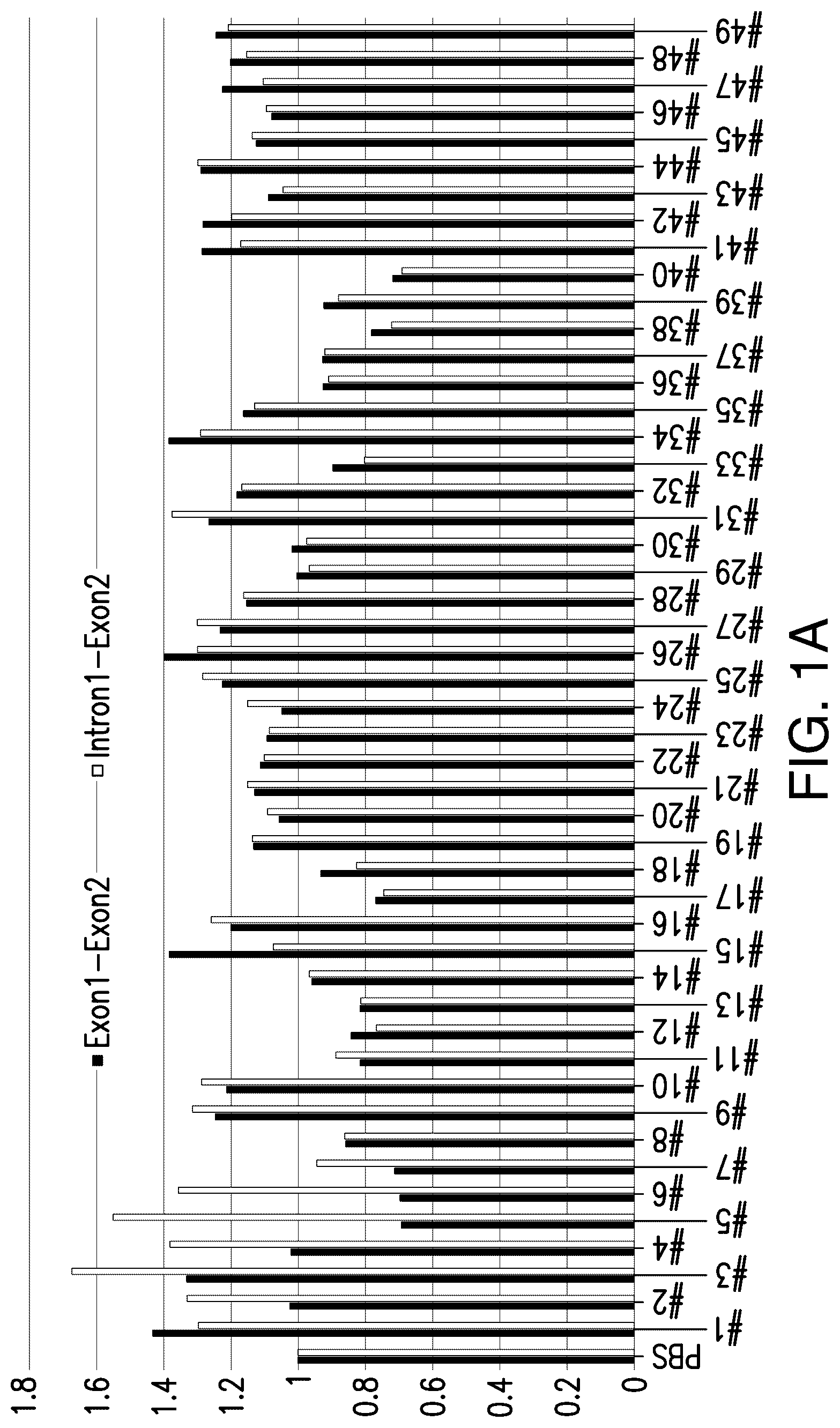
A- 1 E shows expression levels of the Exon1-Exon2 mRNA splice form of progranulin relative to HPRT1 and Intron1-Exon2 relative to HPRT1. SEQ ID NOs: 1-49 are shown in A . SEQ ID NOs: 50-109 are shown in B . SEQ ID NOs: 110-169 are shown in C . SEQ ID NOs: 170-229 are shown in D . SEQ ID Nos: 230-275 are shown in E .
shows progranulin expression levels following treatment with an oligonucleotide for 5 days.
shows progranulin expression levels following treatment with an oligonucleotide for 5 days compared to oligonucleotides S7 and S10 from WO 2020/191212.
shows an overall sequence (SEQ ID NO: 288). The first boxed sequence (SEQ ID NO: 281) is complimentary to SEQ ID NO: 134. Residues seven through twenty-two of the second box (SEQ ID NO: 278) are complementary to SEQ ID NO: 73. Residues four through nineteen of the second box (SEQ ID NO: 279) are complementary to SEQ ID NO: 74. Residues one through sixteen of the second box (SEQ ID NO: 280) are complementary to SEQ ID NO: 75.
shows progranulin expression levels following treatment with an oligonucleotide for 4 days.
shows progranulin expression levels following treatment with an oligonucleotide for 4 days compared to oligonucleotides S7, S10 and S37 from WO 2020/191212.
A- 7 D shows ddPCR data quantifying the abundance of the 5 UTR splice variants in GRN mRNA 48h after transfection in H4 cells relative to Mock transfected cells. Grey bars quantify the abundance of the splice variant with retention of intron1 (Int1-Ex2) and the black bars the splice variant with the splicing of Ex1-Ex2 (Ex1-Ex2). SEQ ID NO: 73 ( A ), SEQ ID NO: 74 ( B ) and SEQ ID NO: 75 ( C ) show dose-dependent skipping of intron1 retention (Int1-Ex2) and an increase in Ex1-Ex2 splice-variant. The S10 compound from WO 2020/191212 ( D ) shows no/limited effects on skipping of intron1 retention.
A- 8 C shows ddPCR data quantifying the abundance of the 5 UTR splice variants in GRN mRNA 48h after transfection in H4 cells relative to Mock transfected cells. Grey bars quantify the abundance of the splice variant with retention of intron1 (Int1-Ex2) and the black bars the splice variant with the splicing of Ex1-Ex2 (Ex1-Ex2). SEQ ID NO: 289 ( A ) and SEQ ID NO: 290 ( B ) show dose-dependent skipping of intron1 retention (Int1-Ex2) and an increase in Ex1-Ex2 splice-variant. The S10 compound from WO 2020/191212 showed no/limited effects on skipping of intron1 retention ( C ).
shows ddPCR data quantifying the abundance of the 5 UTR splice variants in GRN mRNA after 5 days gymnosis in Microglia cells relative to PBS transfected cells. Grey bars quantify the abundance of the splice variant with retention of intron1 (Intron 1 retention) and the black bars the splice variant with the splicing of Exon1-Exon 2 (exon1-exon2). SEQ ID NO: 290 showed dose-dependent skipping of intron1 retention and an increase in Exon1-Exon2 splice-variant. The S10 compound from WO 2020/191212 showed no/limited effects on skipping of intron1 retention. The gapmer control show the expected dose-dependent knockdown of both splice variants.
shows a Sashimi plot corresponding to the splice-switch occurring with SEQ ID NO: 290, and not occurring with compound S10 according to WO 2020/191912.
DETAILED DESCRIPTION OF THE INVENTION
I. Definitions
It should be appreciated that this disclosure is not limited to the compositions and methods described herein as well as the experimental conditions described, as such may vary. It is also to be understood that the terminology used herein is for the purpose of describing certain embodiments only, and is not intended to be limiting, since the scope of the present disclosure will be limited only by the appended claims.
Unless defined otherwise, all technical and scientific terms used herein have the same meaning as commonly understood by one of ordinary skill in the art to which this disclosure belongs. Although any compositions, methods and materials similar or equivalent to those described herein can be used in the practice or testing of the present invention. All publications mentioned are incorporated herein by reference in their entirety.
The use of the terms “a,” “an,” “the,” and similar referents in the context of describing the presently claimed invention (especially in the context of the claims) are to be construed to cover both the singular and the plural, unless otherwise indicated herein or clearly contradicted by context.
Recitation of ranges of values herein are merely intended to serve as a shorthand method of referring individually to each separate value falling within the range, unless otherwise indicated herein, and each separate value is incorporated into the specification as if it were individually recited herein.
Use of the term “about” is intended to describe values either above or below the stated value in a range of approx. +/−10%; in other embodiments the values may range in value either above or below the stated value in a range of approx. +/−5%; in other embodiments the values may range in value either above or below the stated value in a range of approx. +/−2%; in other embodiments the values may range in value either above or below the stated value in a range of approx. +/−1%. The preceding ranges are intended to be made clear by context, and no further limitation is implied. All methods described herein can be performed in any suitable order unless otherwise indicated herein or otherwise clearly contradicted by context. The use of any and all examples, or exemplary language (e.g., “such as”) provided herein, is intended merely to better illuminate the invention and does not pose a limitation on the scope of the invention unless otherwise claimed. No language in the specification should be construed as indicating any non-claimed element as essential to the practice of the invention.
As used herein, the terms “treat,” “treating,” “treatment” and “therapeutic use” refer to the elimination, reduction or amelioration of one or more symptoms of a disease or disorder. Specifically, the term “treatment” may refer to both treatment of an existing disease (e.g. a disease or disorder as herein referred to), or prevention of a disease (i.e. prophylaxis). It will therefore be recognized that treatment as referred to herein may, in some embodiments, be prophylactic. As used herein, a “therapeutically effective amount” refers to that amount of a therapeutic agent sufficient to mediate a clinically relevant elimination, reduction or amelioration of such symptoms. An effect is clinically relevant if its magnitude is sufficient to impact the health or prognosis of a recipient subject. A therapeutically effective amount may refer to the amount of therapeutic agent sufficient to delay or minimize the onset of disease. A therapeutically effective amount may also refer to the amount of the therapeutic agent that provides a therapeutic benefit in the treatment or management of a disease.
Oligonucleotide
The term “oligonucleotide” as used herein is defined as it is generally understood by the skilled person as a molecule comprising two or more covalently linked nucleosides. Such covalently bound nucleosides may also be referred to as nucleic acid molecules or oligomers.
Oligonucleotides are commonly made in the laboratory by solid-phase chemical synthesis followed by purification and isolation. When referring to a sequence of the oligonucleotide, reference is made to the sequence or order of nucleobase moieties, or modifications thereof, of the covalently linked nucleotides or nucleosides. The oligonucleotides of the invention are man-made, and are chemically synthesized, and are typically purified or isolated. The oligonucleotides of the invention may comprise one or more modified nucleosides such as 2′ sugar modified nucleosides. The oligonucleotides of the invention may comprise one or more modified internucleoside linkages, such as one or more phosphorothioate internucleoside linkages.
Antisense Oligonucleotide
The term “antisense oligonucleotide” as used herein is defined as an oligonucleotide capable of modulating expression of a target gene by hybridizing to a target nucleic acid, in particular to a contiguous sequence on a target nucleic acid. Antisense oligonucleotides are not essentially double stranded and are therefore not siRNAs or shRNAs. The antisense oligonucleotides of the present invention may be single stranded. It is understood that single stranded oligonucleotides of the present invention can form hairpins or intermolecular duplex structures (duplex between two molecules of the same oligonucleotide), as long as the degree of intra or inter self-complementarity is less than approximately 50% across of the full length of the oligonucleotide.
In certain contexts the antisense oligonucleotides of the invention may be referred to as oligonucleotides.
In some embodiments, the single stranded antisense oligonucleotides of the invention may not contain RNA nucleosides.
Advantageously, the antisense oligonucleotides of the invention comprise one or more modified nucleosides or nucleotides, such as 2′ sugar modified nucleosides. Furthermore, in some antisense oligonucleotides of the invention, it may be advantageous that the nucleosides which are not modified are DNA nucleosides.
Contiguous Nucleotide Sequence
The term “contiguous nucleotide sequence” refers to the region of the oligonucleotide which is complementary to a target nucleic acid, which may be or may comprise an oligonucleotide motif sequence. The term is used interchangeably herein with the term “contiguous nucleobase sequence”. In some embodiments all the nucleosides of the oligonucleotide constitute the contiguous nucleotide sequence. The contiguous nucleotide sequence is the sequence of nucleotides in the oligonucleotide of the invention which is complementary to, and in some instances fully complementary to, the target nucleic acid or target sequence, or target site sequence.
In some embodiments the target sequence is SEQ ID NO:276.
SEQ ID NO:276 is the sequence of exon 1, intron 1 and exon 2 of the human progranulin pre-mRNA transcript.
In some embodiments the target sequence is or comprises nucleotides 441-468 of SEQ ID NO:276.
In some embodiments the target sequence is or comprises nucleotides 441-462 of SEQ ID NO:276.
In some embodiments the target sequence is or comprises SEQ ID NO:277.
In some embodiments the target sequence is or comprises SEQ ID NO:278 In some embodiments the target sequence is or comprises SEQ ID NO:279.
In some embodiments the target sequence is or comprises SEQ ID NO:280.
In some embodiments the target sequence is or comprises nucleotides 268-283 of SEQ ID NO:276.
In some embodiments the target sequence is or comprises SEQ ID NO:281.
In some embodiments the target sequence is or comprises SEQ ID NO:291.
In some embodiments the target sequence is or comprises SEQ ID NO:292.
In some embodiments the oligonucleotide comprises the contiguous nucleotide sequence, and may optionally comprise further nucleotide(s), for example a nucleotide linker region which may be used to attach a functional group (e.g. a conjugate group) to the contiguous nucleotide sequence. The nucleotide linker region may or may not be complementary to the target nucleic acid. It is understood that the contiguous nucleotide sequence of the oligonucleotide cannot be longer than the oligonucleotide as such and that the oligonucleotide cannot be shorter than the contiguous nucleotide sequence.
Nucleotides and Nucleosides
Nucleotides and nucleosides are the building blocks of oligonucleotides and polynucleotides, and for the purposes of the present invention include both naturally occurring and non-naturally occurring nucleotides and nucleosides. In nature, nucleotides, such as DNA and RNA nucleotides comprise a ribose sugar moiety, a nucleobase moiety and one or more phosphate groups (which is absent in nucleosides). Nucleosides and nucleotides may also interchangeably be referred to as “units” or “monomers”.
Modified Nucleotide
Advantageously, the antisense oligonucleotide of the invention may comprise one or more modified nucleosides.
The term “modified nucleoside” or “nucleoside modification” as used herein refers to nucleosides modified as compared to the equivalent DNA or RNA nucleoside by the introduction of one or more modifications of the sugar moiety or the (nucleo)base moiety. Advantageously, one or more of the modified nucleosides of the antisense oligonucleotides of the invention may comprise a modified sugar moiety. The term modified nucleoside may also be used herein interchangeably with the term “nucleoside analogue” or modified “units” or modified “monomers”. Nucleosides with an unmodified DNA or RNA sugar moiety are termed DNA or RNA nucleosides herein. Nucleosides with modifications in the base region of the DNA or RNA nucleoside are still generally termed DNA or RNA if they allow Watson Crick base pairing. Exemplary modified nucleosides which may be used in the antisense oligonucleotides of the invention include LNA, 2′-O-MOE and morpholino nucleoside analogues.
Modified Internucleoside Linkage
Advantageously, the antisense oligonucleotide of the invention comprises one or more modified internucleoside linkage.
The term “modified internucleoside linkage” is defined as generally understood by the skilled person as linkages other than phosphodiester (PO) linkages, that covalently couple two nucleosides together. The antisense oligonucleotides of the invention may therefore comprise one or more modified internucleoside linkages such as one or more phosphorothioate internucleoside linkages.
In some embodiments at least 50% of the internucleoside linkages in the antisense oligonucleotide, or contiguous nucleotide sequence thereof, are phosphorothioate, such as at least 60%, such as at least 70%, such as at least 75%, such as at least 80%, such as at least 90% or more of the internucleoside linkages in the antisense oligonucleotide, or contiguous nucleotide sequence thereof, are phosphorothioate. In some embodiments all of the internucleoside linkages of the antisense oligonucleotide, or contiguous nucleotide sequence thereof, are phosphorothioate.
Advantageously, all the internucleoside linkages of the contiguous nucleotide sequence of the antisense oligonucleotide may be phosphorothioate, or all the internucleoside linkages of the antisense oligonucleotide may be phosphorothioate linkages.
Nucleobase
The term nucleobase includes the purine (e.g. adenine and guanine) and pyrimidine (e.g. uracil, thymine and cytosine) moiety present in nucleosides and nucleotides which form hydrogen bonds in nucleic acid hybridization. In the context of the present invention the term nucleobase also encompasses modified nucleobases which may differ from naturally occurring nucleobases, but which are functional during nucleic acid hybridization. In this context “nucleobase” refers to both naturally occurring nucleobases such as adenine, guanine, cytosine, thymidine, uracil, xanthine and hypoxanthine, as well as non-naturally occurring variants. Such variants are for example described in Hirao et al. (2012) Accounts of Chemical Research vol 45 page 2055 and Bergstrom (2009) Current Protocols in Nucleic Acid Chemistry Suppl. 37 1.4.1.
In some embodiments the nucleobase moiety is modified by changing the purine or pyrimidine into a modified purine or pyrimidine, such as substituted purine or substituted pyrimidine, such as a nucleobase selected from isocytosine, pseudoisocytosine, 5-methyl cytosine, 5-thiozolo-cytosine, 5-propynyl-cytosine, 5-propynyl-uracil, 5-bromouracil 5-thiazolo-uracil, 2-thio-uracil, 2′thio-thymine, inosine, diaminopurine, 6-aminopurine, 2-aminopurine, 2,6-diaminopurine and 2-chloro-6-aminopurine.
The nucleobase moieties may be indicated by the letter code for each corresponding nucleobase, e.g. A, T, G, C or U, wherein each letter may optionally include modified nucleobases of equivalent function. For example, in the exemplified oligonucleotides, the nucleobase moieties are selected from A, T, G, C, and 5-methyl cytosine. Optionally, for LNA gapmers, 5-methyl cytosine LNA nucleosides may be used.
Modified Oligonucleotide
The antisense oligonucleotide of the invention may be a modified oligonucleotide.
The term modified oligonucleotide describes an oligonucleotide comprising one or more sugar-modified nucleosides and/or modified internucleoside linkages. The term “chimeric oligonucleotide” is a term that has been used in the literature to describe oligonucleotides comprising sugar modified nucleosides and DNA nucleosides. In some embodiments, it may be advantageous for the antisense oligonucleotide of the invention to be a chimeric oligonucleotide.
Complementarity
The term “complementarity” describes the capacity for Watson-Crick base-pairing of nucleosides/nucleotides. Watson-Crick base pairs are guanine (G)-cytosine (C) and adenine (A)-thymine (T)/uracil (U).
It will be understood that oligonucleotides may comprise nucleosides with modified nucleobases, for example 5-methyl cytosine is often used in place of cytosine, and as such the term complementarity encompasses Watson Crick base-paring between non-modified and modified nucleobases (see for example Hirao et al (2012) Accounts of Chemical Research vol 45 page 2055 and Bergstrom (2009) Current Protocols in Nucleic Acid Chemistry Suppl. 37 1.4.1).
The term “% complementary” as used herein, refers to the proportion of nucleotides (in percent) of a contiguous nucleotide sequence in a nucleic acid molecule (e.g. oligonucleotide) which across the contiguous nucleotide sequence, are complementary to a reference sequence (e.g. a target sequence or sequence motif). The percentage of complementarity is thus calculated by counting the number of aligned nucleobases that are complementary (from Watson Crick base pairs) between the two sequences (when aligned with the target sequence 5′-3′ and the oligonucleotide sequence from 3′-5′), dividing that number by the total number of nucleotides in the oligonucleotide and multiplying by 100. In such a comparison a nucleobase/nucleotide which does not align (form a base pair) is termed a mismatch. Insertions and deletions are not allowed in the calculation of % complementarity of a contiguous nucleotide sequence. It will be understood that in determining complementarity, chemical modifications of the nucleobases are disregarded as long as the functional capacity of the nucleobase to form Watson Crick base pairing is retained (e.g. 5′-methyl cytosine is considered identical to a cytosine for the purpose of calculating % identity).
Within the present invention the term “complementary” requires the antisense oligonucleotide to be at least about 80% complementary, or at least about 90% complementary, to a human progranulin pre-mRNA transcript. In some embodiments the antisense oligonucleotide may be at least about 80%, at least about 81%, at least about 82%, at least about 83%, at least about 84%, at least about 85%, at least about 86%, at least about 87%, at least about 88%, at least about 89%, at least about 90%, at least about 91%, at least about 92%, at least about 93%, at least about 94%, at least about 95%, at least about 96%, at least about 97%, at least about 98% or at least about 99% complementary to a human progranulin pre-mRNA transcript. Put another way, for some embodiments, an antisense oligonucleotide of the invention may include one, two, three or more mis-matches, wherein a mis-match is a nucleotide within the antisense oligonucleotide of the invention which does not base pair with its target.
The term “fully complementary” refers to 100% complementarity.
The antisense oligonucleotides of the invention are complementary to the human progranulin pre-mRNA. The antisense oligonucleotides of the invention are advantageously complementary to the intron 1 sequence of the human progranulin pre-mRNA transcript. The sequence of exon 1, intron 1 and exon 2 of the human progranulin pre-mRNA transcript is exemplified herein as SEQ ID NO:276. SEQ ID NO:276 is provided herein as a reference sequence and it will be understood that the target progranulin nucleic acid may be an allelic variant of SEQ ID NO:276, such as an allelic variant which comprises one or more polymorphism in the human progranulin nucleic acid sequence.
Identity
The term “identity” as used herein, refers to the proportion of nucleotides (expressed in percent) of a contiguous nucleotide sequence in a nucleic acid molecule (e.g. oligonucleotide) which across the contiguous nucleotide sequence, are identical to a reference sequence (e.g. a sequence motif).
The percentage of identity is thus calculated by counting the number of aligned nucleobases that are identical (a Match) between two sequences (in the contiguous nucleotide sequence of the compound of the invention and in the reference sequence), dividing that number by the total number of nucleotides in the oligonucleotide and multiplying by 100. Therefore, Percentage of Identity=(Matches×100)/Length of aligned region (e.g. the contiguous nucleotide sequence). Insertions and deletions are not allowed in the calculation the percentage of identity of a contiguous nucleotide sequence. It will be understood that in determining identity, chemical modifications of the nucleobases are disregarded as long as the functional capacity of the nucleobase to form Watson Crick base pairing is retained (e.g. 5-methyl cytosine is considered identical to a cytosine for the purpose of calculating % identity).
Hybridization
The terms “hybridizing” or “hybridizes” as used herein are to be understood as two nucleic acid strands (e.g. an antisense oligonucleotide and a target nucleic acid) forming hydrogen bonds between base pairs on opposite strands thereby forming a duplex. The affinity of the binding between two nucleic acid strands is the strength of the hybridization. It is often described in terms of the melting temperature (Tm) defined as the temperature at which half of the oligonucleotides are duplexed with the target nucleic acid. At physiological conditions Tm is not strictly proportional to the affinity (Mergny and Lacroix, 2003 , Oligonucleotides 13:515-537). The standard state Gibbs free energy ΔG° is a more accurate representation of binding affinity and is related to the dissociation constant (K d ) of the reaction by ΔG°=-RTln(K d ), where R is the gas constant and T is the absolute temperature. Therefore, a very low ΔG° of the reaction between an oligonucleotide and the target nucleic acid reflects a strong hybridization between the oligonucleotide and target nucleic acid. ΔG° is the energy associated with a reaction where aqueous concentrations are 1M, the pH is 7, and the temperature is 37° C. The hybridization of oligonucleotides to a target nucleic acid is a spontaneous reaction and for spontaneous reactions ΔG° is less than zero. ΔG° can be measured experimentally, for example, by use of the isothermal titration calorimetry (ITC) method as described in Hansen et al., 1965 , Chem. Comm. 36-38 and Holdgate et al., 2005, Drug Discov Today. The skilled person will know that commercial equipment is available for ΔG° measurements. ΔG° can also be estimated numerically by using the nearest neighbor model as described by SantaLucia, 1998 , Proc Natl Acad Sci USA. 95: 1460-1465 using appropriately derived thermodynamic parameters described by Sugimoto et al., 1995 , Biochemistry 34:11211-11216 and McTigue et al., 2004 , Biochemistry 43:5388-5405.
In some embodiments, antisense oligonucleotides of the present invention hybridize to a target nucleic acid with estimated ΔG° values below-10 kcal for oligonucleotides that are 10-30 nucleotides in length.
In some embodiments the degree or strength of hybridization is measured by the standard state Gibbs free energy ΔG°. The oligonucleotides may hybridize to a target nucleic acid with estimated ΔG° values below the range of −10 kcal, such as below −15 kcal, such as below −20 kcal and such as below −25 kcal for oligonucleotides that are 8-30 nucleotides in length. In some embodiments the oligonucleotides hybridize to a target nucleic acid with an estimated ΔG° value of −10 to −60 kcal, such as −12 to −40, such as from −15 to −30 kcal, or −16 to −27 kcal such as −18 to −25 kcal.
High Affinity Modified Nucleosides
A high affinity modified nucleoside is a modified nucleotide which, when incorporated into the oligonucleotide enhances the affinity of the oligonucleotide for its complementary target, for example as measured by the melting temperature (Tm). A high affinity modified nucleoside of the present invention preferably results in an increase in melting temperature between +0.5 to +12° C., more preferably between +1.5 to +10° C. and most preferably between +3 to +8° C. per modified nucleoside. Numerous high affinity modified nucleosides are known in the art and include for example, many 2′ substituted nucleosides as well as locked nucleic acids (LNA) (see e.g. Freier & Altmann; Nucl. Acid Res., 1997, 25, 4429-4443 and Uhlmann; Curr. Opinion in Drug Development, 2000, 3(2), 293-213).
Sugar Modifications
The antisense oligonucleotides of the invention may comprise one or more nucleosides which have a modified sugar moiety, i.e. a modification of the sugar moiety when compared to the ribose sugar moiety found in DNA and RNA.
Numerous nucleosides with modification of the ribose sugar moiety have been made, primarily with the aim of improving certain properties of oligonucleotides, such as affinity and/or nuclease resistance.
Such modifications include those where the ribose ring structure is modified, e.g. by replacement with a hexose ring (HNA), or a bicyclic ring, which typically have a biradicle bridge between the C2 and C4 carbons on the ribose ring (LNA), or an unlinked ribose ring which typically lacks a bond between the C2 and C3 carbons (e.g. UNA). Other sugar modified nucleosides include, for example, bicyclohexose nucleic acids (WO2011/017521) or tricyclic nucleic acids (WO2013/154798). Modified nucleosides also include nucleosides where the sugar moiety is replaced with a non-sugar moiety, for example in the case of peptide nucleic acids (PNA), or morpholino nucleic acids.
Sugar modifications also include modifications made via altering the substituent groups on the ribose ring to groups other than hydrogen, or the 2′-OH group naturally found in DNA and RNA nucleosides. Substituents may, for example be introduced at the 2′, 3′, 4′ or 5′ positions.
2′ Sugar Modified Nucleosides
A 2′ sugar modified nucleoside is a nucleoside which has a substituent other than H or —OH at the 2′ position (2′ substituted nucleoside) or comprises a 2′ linked biradicle capable of forming a bridge between the 2′ carbon and a second carbon in the ribose ring, such as LNA (2′-4′ biradicle bridged) nucleosides.
Indeed, much focus has been given to developing 2′ sugar substituted nucleosides, and numerous 2′ substituted nucleosides have been found to have beneficial properties when incorporated into oligonucleotides. For example, the 2′ modified sugar may provide enhanced binding affinity and/or increased nuclease resistance to the oligonucleotide. Examples of 2′ substituted modified nucleosides are 2′-O-alkyl-RNA, 2′-O-methyl-RNA, 2′-alkoxy-RNA, 2′-O-methoxyethyl-RNA (MOE), 2′-amino-DNA, 2′-Fluoro-RNA, and 2′-F-ANA nucleoside. For further examples, please see e.g. Freier & Altmann; Nucl. Acid Res., 1997, 25, 4429-4443 and Uhlmann; Curr. Opinion in Drug Development, 2000, 3(2), 293-213, and Deleavey and Damha, Chemistry and Biology 2012, 19, 937. Below are illustrations of some 2′ substituted modified nucleosides.
In relation to the present invention 2′ substituted sugar modified nucleosides does not include 2′ bridged nucleosides like LNA.
Locked Nucleic Acid Nucleosides (LNA Nucleoside)
A “LNA nucleoside” is a 2′-modified nucleoside which comprises a biradical linking the C2′ and C4′ of the ribose sugar ring of said nucleoside (also referred to as a “2′-4′ bridge”), which restricts or locks the conformation of the ribose ring. These nucleosides are also termed bridged nucleic acid or bicyclic nucleic acid (BNA) in the literature. The locking of the conformation of the ribose is associated with an enhanced affinity of hybridization (duplex stabilization) when the LNA is incorporated into an oligonucleotide for a complementary RNA or DNA molecule. This can be routinely determined by measuring the melting temperature of the oligonucleotide/complement duplex.
Non limiting, exemplary LNA nucleosides are disclosed in WO 99/014226, WO 00/66604, WO 98/039352, WO 2004/046160, WO 00/047599, WO 2007/134181, WO 2010/077578, WO 2010/036698, WO 2007/090071, WO 2009/006478, WO 2011/156202, WO 2008/154401, WO 2009/067647, WO 2008/150729, Morita et al., Bioorganic & Med. Chem. Lett. 12, 73-76, Seth et al. J. Org. Chem. 2010, Vol 75(5) pp. 1569-81, and Mitsuoka et al., Nucleic Acids Research 2009, 37(4), 1225-1238, and Wan and Seth, J. Medical Chemistry 2016, 59, 9645-9667.
Further non limiting, exemplary LNA nucleosides are disclosed in Scheme 1.
Particular LNA nucleosides are beta-D-oxy-LNA, 6′-methyl-beta-D-oxy LNA such as (S)-6′-methyl-beta-D-oxy-LNA (ScET) and ENA.
A particularly advantageous LNA is beta-D-oxy-LNA.
Morpholino Oligonucleotides
In some embodiments, the antisense oligonucleotide of the invention comprises or consists of morpholino nucleosides (i.e. is a Morpholino oligomer and as a phosphorodiamidate Morpholino oligomer (PMO)). Splice modulating morpholino oligonucleotides have been approved for clinical use-see for example eteplirsen, a 30 nt morpholino oligonucleotide targeting a frame shift mutation in DMD, used to treat Duchenne muscular dystrophy. Morpholino oligonucleotides have nucleobases attached to six membered morpholine rings rather ribose, such as methylenemorpholine rings linked through phosphorodiamidate groups, for example as illustrated by the following illustration of 4 consecutive morpholino nucleotides:
In some embodiments, morpholino oligonucleotides of the invention may be, for example 20-40 morpholino nucleotides in length, such as morpholino 25-35 nucleotides in length.
RNase H Activity and Recruitment
The RNase H activity of an antisense oligonucleotide refers to its ability to recruit RNase H when in a duplex with a complementary RNA molecule. WO01/23613 provides in vitro methods for determining RNaseH activity, which may be used to determine the ability to recruit RNaseH. Typically an oligonucleotide is deemed capable of recruiting RNase H if it, when provided with a complementary target nucleic acid sequence, has an initial rate, as measured in pmol/l/min, of at least 5%, such as at least 10%, at least 20% or more than 20%, of the initial rate determined when using an oligonucleotide having the same base sequence as the modified oligonucleotide being tested, but containing only DNA monomers with phosphorothioate linkages between all monomers in the oligonucleotide, and using the methodology provided by Examples 91-95 of WO01/23613 (hereby incorporated by reference). For use in determining RHase H activity, recombinant RNase H1 is available from Lubio Science GmbH, Lucerne, Switzerland.
DNA oligonucleotides are known to effectively recruit RNaseH, as are gapmer oligonucleotides which comprise a region of DNA nucleosides (typically at least 5 or 6 contiguous DNA nucleosides), flanked 5′ and 3′ by regions comprising 2′ sugar modified nucleosides, typically high affinity 2′ sugar modified nucleosides, such as 2-O-MOE and/or LNA. For effective modulation of splicing, degradation of the pre-mRNA is not desirable, and as such it is preferable to avoid the RNaseH degradation of the target. Therefore, the antisense oligonucleotides of the invention are not RNaseH recruiting gapmer oligonucleotide.
RNaseH recruitment may be avoided by limiting the number of contiguous DNA nucleotides in the oligonucleotide-therefore mimxes and totalmer designs may be used. Advantageously the antisense oligonucleotides of the invention, or the contiguous nucleotide sequence thereof, do not comprise more than 3 contiguous DNA nucleosides. Further, advantageously the antisense oligonucleotides of the invention, or the contiguous nucleotide sequence thereof, do not comprise more than 4 contiguous DNA nucleosides. Further advantageously, the antisense oligonucleotides of the invention, or contiguous nucleotide sequence thereof, do not comprise more than 2 contiguous DNA nucleosides.
Mixmers and Totalmers
For splice modulation it is often advantageous to use antisense oligonucleotides which do not recruit RNAaseH. As RNaseH activity requires a contiguous sequence of DNA nucleotides, RNaseH activity of antisense oligonucleotides may be achieved by designing antisense oligonucleotides which do not comprise a region of more than 3 or more than 4 contiguous DNA nucleosides. This may be achieved by using antisense oligonucleotides or contiguous nucleoside regions thereof with a mixmer design, which comprise sugar modified nucleosides, such as 2′ sugar modified nucleosides, and short regions of DNA nucleosides, such as 1, 2 or 3 DNA nucleosides. Mixmers are exemplified herein by every second design, wherein the nucleosides alternate between 1 LNA and 1 DNA nucleoside, e.g. LDLDLDLDLDLDLDLL, with 5′ and 3′ terminal LNA nucleosides, and every third design, such as LDDLDDLDDLDDLDDL, where every third nucleoside is a LNA nucleoside.
A totalmer is an antisense oligonucleotide or a contiguous nucleotide sequence thereof which does not comprise DNA or RNA nucleosides, and may for example comprise only 2′-O-MOE nucleosides, such as a fully MOE phosphorothioate, e.g. MMMMMMMMMMMMMMMMMMMM, where M=2′-O-MOE, which are reported to be effective splice modulators for therapeutic use.
Alternatively, a mixmer may comprise a mixture of modified nucleosides, such as MLMLMLMLMLMLMLMLMLML, wherein L=LNA and M=2′-O-MOE nucleosides.
Advantageously, the internucleoside nucleosides in mixmers and totalmers may be phosphorothioate, or a majority of nucleoside linkages in mixmers may be phosphorothioate. Mixmers and totalmers may comprise other internucleoside linkages, such as phosphodiester or phosphorodithioate, by way of example.
Region D′ or D″ in an Oligonucleotide
The antisense oligonucleotide of the invention may in some embodiments comprise or consist of the contiguous nucleotide sequence of the oligonucleotide which is complementary to the target nucleic acid, such as a mixmer or toalmer region, and further 5′ and/or 3′ nucleosides. The further 5′ and/or 3′ nucleosides may or may not be complementary, such as fully complementary, to the target nucleic acid. Such further 5′ and/or 3′ nucleosides may be referred to as region D′ and D″ herein.
The addition of region D′ or D″ may be used for the purpose of joining the contiguous nucleotide sequence, such as the mixmer or totoalmer, to a conjugate moiety or another functional group. When used for joining the contiguous nucleotide sequence with a conjugate moiety it can serve as a biocleavable linker. Alternatively, it may be used to provide exonucleoase protection or for case of synthesis or manufacture.
Region D′ or D″ may independently comprise or consist of 1, 2, 3, 4 or 5 additional nucleotides, which may be complementary or non-complementary to the target nucleic acid. The nucleotide adjacent to the F or F′ region is not a sugar-modified nucleotide, such as a DNA or RNA or base modified versions of these. The D′ or D″ region may serve as a nuclease susceptible biocleavable linker (see definition of linkers). In some embodiments the additional 5′ and/or 3′ end nucleotides are linked with phosphodiester linkages, and are DNA or RNA. Nucleotide based biocleavable linkers suitable for use as region D′ or D″ are disclosed in WO2014/076195, which include by way of example a phosphodiester linked DNA dinucleotide. The use of biocleavable linkers in poly-oligonucleotide constructs is disclosed in WO2015/113922, where they are used to link multiple antisense constructs within a single oligonucleotide.
In one embodiment the antisense oligonucleotide of the invention comprises a region D′ and/or D″ in addition to the contiguous nucleotide sequence which constitutes a mixmer or a totalmer.
In some embodiments the internucleoside linkage positioned between region D′ or D″ and the mixmer or totalmer region is a phosphodiester linkage.
Conjugate
The invention encompasses an antisense oligonucleotide covalently attached to at least one conjugate moiety. In some embodiments this may be referred to as a conjugate of the invention.
The term “conjugate” as used herein refers to an antisense oligonucleotide which is covalently linked to a non-nucleotide moiety (conjugate moiety or region C or third region). The conjugate moiety may be covalently linked to the antisense oligonucleotide, optionally via a linker group, such as region D′ or D″.
Oligonucleotide conjugates and their synthesis has also been reported in comprehensive reviews by Manoharan in Antisense Drug Technology, Principles, Strategies, and Applications, S. T. Crooke, ed., Ch. 16, Marcel Dekker, Inc., 2001 and Manoharan, Antisense and Nucleic Acid Drug Development, 2002, 12, 103.
In some embodiments, the non-nucleotide moiety (conjugate moiety) is selected from the group consisting of carbohydrates (e.g. GalNAc), cell surface receptor ligands, drug substances, hormones, lipophilic substances, polymers, proteins, peptides, toxins (e.g. bacterial toxins), vitamins, viral proteins (e.g. capsids) or combinations thereof.
Linkers
A linkage or linker is a connection between two atoms that links one chemical group or segment of interest to another chemical group or segment of interest via one or more covalent bonds. Conjugate moieties can be attached to the antisense oligonucleotide directly or through a linking moiety (e.g. linker or tether). Linkers serve to covalently connect a third region, e.g. a conjugate moiety (Region C), to a first region, e.g. an oligonucleotide or contiguous nucleotide sequence complementary to the target nucleic acid (region A).
In some embodiments of the invention the conjugate or antisense oligonucleotide conjugate of the invention may optionally comprise a linker region (second region or region B and/or region Y) which is positioned between the oligonucleotide or contiguous nucleotide sequence complementary to the target nucleic acid (region A or first region) and the conjugate moiety (region C or third region).
Region B refers to biocleavable linkers comprising or consisting of a physiologically labile bond that is cleavable under conditions normally encountered or analogous to those encountered within a mammalian body. Conditions under which physiologically labile linkers undergo chemical transformation (e.g., cleavage) include chemical conditions such as pH, temperature, oxidative or reductive conditions or agents, and salt concentration found in or analogous to those encountered in mammalian cells. Mammalian intracellular conditions also include the presence of enzymatic activity normally present in a mammalian cell such as from proteolytic enzymes or hydrolytic enzymes or nucleases. In one embodiment the biocleavable linker is susceptible to S1 nuclease cleavage. In some embodiments the nuclease susceptible linker comprises between 1 and 5 nucleosides, such as DNA nucleoside(s) comprising at least two consecutive phosphodiester linkages. Phosphodiester containing biocleavable linkers are described in more detail in WO 2014/076195.
Region Y refers to linkers that are not necessarily biocleavable but primarily serve to covalently connect a conjugate moiety (region C or third region), to an oligonucleotide (region A or first region). The region Y linkers may comprise a chain structure or an oligomer of repeating units such as ethylene glycol, amino acid units or amino alkyl groups. The antisense oligonucleotide conjugates of the present invention can be constructed of the following regional elements A-C, A-B-C, A-B-Y-C, A-Y-B-C or A-Y-C. In some embodiments the linker (region Y) is an amino alkyl, such as a C2-C36 amino alkyl group, including, for example C6 to C12 amino alkyl groups. In some embodiments the linker (region Y) is a C6 amino alkyl group.
Treatment
The term ‘treatment’ as used herein refers to both treatment of an existing disease (e.g. a disease or disorder as herein referred to), or prevention of a disease, i.e. prophylaxis. It will therefore be recognized that treatment as referred to herein may, in some embodiments, be prophylactic.
TDP-43 Pathologies
A TDP-43 pathology is a disease which is associated with reduced or aberrant expression of TDP-43, often associated with an increase in cytoplasmic TDP-43, particularly hyper-phosphorylated and ubiquitinated TDP-43.
Diseases associated with TDP-43 pathology include amyotrophic lateral sclerosis (ALS), frontotemporal lobar degeneration (FTLD), Alzheimer's disease, Parkinson's disease, Autism, Hippocampal sclerosis dementia, Down syndrome, Huntington's disease, polyglutamine diseases, such as spinocerebellar ataxia 3, myopathies and Chronic Traumatic Encephalopathy.
The inventors have identified that targeting the progranulin pre-mRNA transcript with antisense oligonucleotides can increase expression of the progranulin Exon1-Exon 2 spliced mRNA, decrease expression of the progranulin Intron1-Exon2 spliced mRNA (which retains the 271 nucleotide 5′ fragment of intron 1) and/or alter the ratio of Exon1-Exon2 vs Intron1-Exon2 mRNA. This is particularly the case when antisense oligonucleotides which comprise high affinity sugar modified nucleosides, such as high affinity 2′ sugar modified nucleosides, such as LNA nucleosides or 2′-O-methoxyethyl (MOE) nucleosides are used.
Described herein are target sites present on the human progranulin pre-mRNA which can be targeted by antisense oligonucleotides. Also described are antisense oligonucleotides which are complementary, such as fully complementary, to these target sites.
Without wishing to be bound by theory, it is considered that the antisense oligonucleotides of the invention can increase expression of the progranulin Exon1-Exon2 spliced mRNA, decrease expression of the progranulin Intron1-Exon1 spliced mRNA and/or alter the ratio of Exon1-Exon2 vs Intron1-Exon2 mRNA by binding to these regions and affecting, such as increasing, production of the Exon1-Exon2 splice variant.
Oligonucleotides, such as RNaseH recruiting single stranded antisense oligonucleotides or siRNAs are used extensively in the art to inhibit target RNAs—i.e. are used as antagonists of their complementary nucleic acid target.
The antisense oligonucleotides of the present invention may be described as modulators, i.e. they alter the expression of a particular splice variant of their complementary target, progranulin pre-mRNA, and thereby increase the production of active progranulin protein.
Reduced expression of the progranulin Intron1-Exon2 splice variant is desirable because the inclusion of an intron, such as Intron 1, within a mature mRNA sequence leads to nonsense-mediated mRNA decay (NMD).
Enhanced expression of the progranulin Exon1-Exon2 over the splice variant which retains the 5′ part of intron 1 is desirable because the Exon1-Exon2 splice variant does not include the 271 nucleotide fragment of intron 1 with two AUG sites upstream of the canonical downstream AUG in Exon 2 (open reading frame). Translation from these two upstream AUG sites will not encode the progranulin protein and due to premature termination codons the transcript may undergo non-sense mediated mRNA decay (NMD). Changing the splicing to the Exon1-Exon2 splice variant will instead lead to translation of an active version of the progranulin protein. Progranulin is a neuroprotective protein, and increasing its production can be used to treat a range of neurological disorders, such as TDP-43 pathologies.
In certain embodiments the antisense oligonucleotides of the present invention may enhance the production of the Exon1-Exon2 progranulin splice variant.
In certain embodiments the antisense oligonucleotides of the present invention may enhance the production of the Exon1-Exon2 progranulin splice variant mRNA by at least about 10% relative to the production of the Exon1-Exon2 progranulin splice variant mRNA in the absence of an antisense oligonucleotide of the invention. In other embodiments the antisense oligonucleotides of the present invention may enhance the production of the Exon1-Exon2 progranulin splice variant mRNA by at least about 15%, at least about 20%, at least about 25%, at least about 30%, at least about 35%, at least about 40%, at least about 45%, at least about 50%, at least about 60%, at least about 70%, at least about 80%, at least about 90%, at least about 100%, at least about 200%, at least about 300%, at least about 400%, at least about 500% or more relative to the production of the Exon1-Exon2 progranulin splice variant mRNA in the absence of an antisense oligonucleotide of the invention.
In certain embodiments the antisense oligonucleotides of the present invention may reduce the production of the Intron1-Exon2 progranulin splice variant mRNA.
In certain embodiments the antisense oligonucleotides of the present invention may reduce the production of the Intron1-Exon2 progranulin splice variant mRNA by at least about 10% relative to the production of the Intron1-Exon2 progranulin splice variant mRNA in the absence of an antisense oligonucleotide of the invention. In other embodiments the antisense oligonucleotides of the present invention may reduce the production of the Intron1-Exon2 progranulin splice variant mRNA by at least about 15%, at least about 20%, at least about 25%, at least about 30%, at least about 35%, at least about 40%, at least about 45%, at least about 50%, at least about 60%, at least about 70%, at least about 80%, at least about 90%, at least about 100%, at least about 200%, at least about 300%, at least about 400%, at least about 500% or more relative to the production of the Intron1-Exon2 progranulin splice variant mRNA in the absence of an antisense oligonucleotide of the invention.
Enhanced expression of the progranulin Exon1-Exon2 splice variant should lead to translation of an active version of the progranulin protein. In certain embodiments the antisense oligonucleotides of the present invention may increase production of the progranulin protein by at least about 10% relative to the production of the progranulin protein in the absence of an antisense oligonucleotide of the invention. In other embodiments the antisense oligonucleotides of the present invention may increase the production of the progranulin protein by at least about 15%, at least about 20%, at least about 25%, at least about 30%, at least about 35%, at least about 40%, at least about 45%, at least about 50%, at least about 60%, at least about 70%, at least about 80%, at least about 90%, at least about 100%, at least about 200%, at least about 300%, at least about 400%, at least about 500% or more relative to the production of the progranulin protein in the absence of an antisense oligonucleotide of the invention.
In certain embodiments, the antisense oligonucleotides of the present invention may alter the ratio of Exon 1-Exon2 vs Intron-Exon2 progranulin mRNA.
In certain embodiments, the antisense oligonucleotides of the present invention may alter the ratio of Exon1-Exon2 vs Intron1-Exon2 progranulin mRNA by at least about 10% relative to the ratio of Exon1-Exon2 vs Intron1-Exon2 progranulin mRNA in the absence of an antisense oligonucleotide of the invention. In other embodiments the antisense oligonucleotides of the present invention may alter the ratio of Exon1-Exon2 vs Intron1-Exon2 progranulin mRNA by at least about 15%, at least about 20%, at least about 25%, at least about 30%, at least about 35%, at least about 40%, at least about 45%, at least about 50%, at least about 55%, at least about 60%, at least about 65%, at least about 70%, at least about 75%, at least about 80%, at least about 85%, at least about 90%, at least about 95%, at least about 100% or more, relative to the ratio of Exon1-Exon2 vs Intron1-Exon2 progranulin mRNA in the absence of an antisense oligonucleotide of the invention.
In certain embodiments, the antisense oligonucleotides of the present invention may alter the ratio of Exon1-Exon2 vs Intron1-Exon2 progranulin mRNA to at least about 1.2. In certain embodiments, the antisense oligonucleotides of the present invention may alter the ratio of Exon1-Exon2 vs Intron1-Exon2 progranulin mRNA to at least about 1.3, at least about 1.4, at least about 1.5, at least about 1.6, at least about 1.7, at least about 1.8, at least about 1.9, at least about 2.0 or more.
In some embodiments, the antisense oligonucleotides of the invention or the contiguous nucleotide sequence thereof comprises or consists of 10, 11, 12, 13, 14, 15, 16, 17, 18, 19, 20, 21, 22, 23, 24, 25, 26, 27, 28, 29, 30, 31, 32, 33, 34, 35, 36, 37, 38, 39 or 40 contiguous nucleotides in length.
In some embodiments, the entire nucleotide sequence of the antisense oligonucleotide is the contiguous nucleotide sequence.
In one embodiment the contiguous nucleotide sequence may a sequence selected from the group consisting of SEQ ID NO:71, SEQ ID NO:73, SEQ ID NO:74, SEQ ID NO:75 and SEQ ID NO:134. The invention also contemplates fragments of these contiguous nucleotide sequences, including fragments of at least 8, at least 9, at least 10, at least 11, at least 12, at least 13, at least 14, or at least 15 contiguous nucleotides thereof.
In some embodiments, the antisense oligonucleotide or contiguous nucleotide sequence comprises or consists of a sequence selected from the group consisting of SEQ ID NO:71, SEQ ID NO:73, SEQ ID NO:74, SEQ ID NO:75 and SEQ ID NO:134. It will be understood that the sequences shown in SEQ ID NO:71, SEQ ID NO:73, SEQ ID NO:74, SEQ ID NO:75 and SEQ ID NO:134 may include modified nucleobases which function as the shown nucleobase in base pairing, for example 5-methyl cytosine may be used in place of methyl cytosine. Inosine may be used as a universal base.
In some embodiments, the antisense oligonucleotide or contiguous nucleotide sequence comprises or consists of 8 to 30 or 8 to 40 nucleotides in length with at least 90% identity, preferably 100% identity, to a sequence selected from the group consisting of SEQ ID NO:71, SEQ ID NO:73, SEQ ID NO:74, SEQ ID NO:75 and SEQ ID NO:134. In some embodiments the antisense oligonucleotide may be 8, 9, 10, 11, 12, 13, 14, 15, 16, 17, 18, 19, 20, 21, 22, 23, 24, 25, 26, 27, 28, 29, 30, 31, 32, 33, 34, 35, 36, 37, 38, 39 or 40 nucleotides in length.
In some embodiments, the antisense oligonucleotide or contiguous nucleotide sequence comprises or consists of 8 to 30 or 8 to 40 nucleotides in length with at least 90% identity, preferably 100% identity, to a sequence selected from the group consisting of SEQ ID NO:289 and SEQ ID NO:290. In some embodiments the antisense oligonucleotide may be 8, 9, 10, 11, 12, 13, 14, 15, 16, 17, 18, 19, 20, 21, 22, 23, 24, 25, 26, 27, 28, 29, 30, 31, 32, 33, 34, 35, 36, 37, 38, 39 or 40 nucleotides in length.
It is understood that the contiguous nucleobase sequences (motif sequence) can be modified to, for example, increase nuclease resistance and/or binding affinity to the target nucleic acid.
The pattern in which the modified nucleosides (such as high affinity modified nucleosides) are incorporated into the oligonucleotide sequence is generally termed oligonucleotide design.
The antisense oligonucleotides of the invention are designed with modified nucleosides and DNA nucleosides. Advantageously, high affinity modified nucleosides are used.
In an embodiment, the antisense oligonucleotide comprises at least 1 modified nucleoside, such as at least 2, at least 3, at least 4, at least 5, at least 6, at least 7, at least 8, at least 9, at least 10, at least 11, at least 12, at least 13, at least 14, at least 15 or at least 16 modified nucleosides.
In an embodiment the antisense oligonucleotide comprises from 1 to 10 modified nucleosides, such as from 2 to 9 modified nucleosides, such as from 3 to 8 modified nucleosides, such as from 4 to 7 modified nucleosides, such as 6 or 7 modified nucleosides. Suitable modifications are described in the “Definitions” section under “modified nucleoside”, “high affinity modified nucleosides”, “sugar modifications”, “2′ sugar modifications” and Locked nucleic acids (LNA)”.
In an embodiment, the antisense oligonucleotide comprises one or more sugar modified nucleosides, such as 2′ sugar modified nucleosides. Preferably the antisense oligonucleotide of the invention comprises one or more 2′ sugar modified nucleoside independently selected from the group consisting of 2′-O-alkyl-RNA, 2′-O-methyl-RNA, 2′-alkoxy-RNA, 2′-O-methoxyethyl-RNA, 2′-amino-DNA, 2′-fluoro-DNA, arabino nucleic acid (ANA), 2′-fluoro-ANA and LNA nucleosides. It is advantageous if one or more of the modified nucleoside(s) is a locked nucleic acid (LNA).
In a further embodiment the antisense oligonucleotide comprises at least one modified internucleoside linkage. Suitable internucleoside modifications are described in the “Definitions” section under “Modified internucleoside linkage”. It is advantageous if at least 75%, such as all, the internucleoside linkages within the contiguous nucleotide sequence are phosphorothioate or boranophosphate internucleoside linkages. In some embodiments all the internucleotide linkages in the contiguous sequence of the oligonucleotide are phosphorothioate linkages.
In one embodiment, the invention presents an antisense oligonucleotide, wherein the antisense oligonucleotide is 8-40 nucleotides in length and comprises a contiguous nucleotide sequence of 8-40 nucleotides in length which is complementary to a splice regulation site of the human progranulin pre-mRNA transcript.
In another embodiment, the human progranulin pre-mRNA transcript comprises the exon 1, intron 1 and exon 2 sequence of the human progranulin pre-mRNA transcript (SEQ ID NO:276).
In another embodiment, the contiguous nucleotide sequence is of a length of at least 12 nucleotides in length.
In another embodiment, the contiguous nucleotide sequence is 12-16 nucleotides in length.
In another embodiment, the contiguous nucleotide sequence is 12, 13, 14, 15, 16, 17, 18, 19, 20, 21, 22, 23, 24, 25, 26, 27, 28, 29, 30, 31, 32, 33, 34, 35, 36, 37, 38, 39 or 40 nucleotides in length.
In another embodiment, the contiguous nucleotide sequence is the same length as the antisense oligonucleotide.
In another embodiment, the contiguous nucleotide sequence is fully complementary to the human progranulin pre-mRNA transcript.
In another embodiment, the contiguous nucleotide sequence is complementary to a nucleotide sequence comprised within nucleotides 441-468 of SEQ ID NO: 276.
In another embodiment, the contiguous nucleotide sequence is complementary to a nucleotide sequence comprised within nucleotides 441-462 of SEQ ID NO: 276.
In another embodiment, the contiguous nucleotide sequence is complementary to SEQ ID NO:277, SEQ ID NO:278, SEQ ID NO:279 or SEQ ID NO:280.
In another embodiment, the contiguous nucleotide sequence is fully complementary to SEQ ID NO:277, SEQ ID NO:278, SEQ ID NO:279 or SEQ ID NO:280.
In another embodiment, the contiguous nucleotide sequence is selected from SEQ ID NO:71, SEQ ID NO:73, SEQ ID NO:74 and SEQ ID NO:75, or at least 8 or at least 10 contiguous nucleotides thereof.
In another embodiment, the contiguous nucleotide sequence SEQ ID NO:71.
In another embodiment, the contiguous nucleotide sequence SEQ ID NO:73.
In another embodiment, the contiguous nucleotide sequence SEQ ID NO:74.
In another embodiment, the contiguous nucleotide sequence SEQ ID NO:75.
In another embodiment, the contiguous nucleotide sequence is complementary to a nucleotide sequence comprised within nucleotides 268-283 of SEQ ID NO: 276.
In another embodiment, the contiguous nucleotide sequence is complementary to SEQ ID NO:281.
In another embodiment, the contiguous nucleotide sequence is fully complementary to SEQ ID NO:281.
In another embodiment, the contiguous nucleotide sequence is SEQ ID NO:134, or at least 8 or at least 10 contiguous nucleotides thereof.
In another embodiment, the contiguous nucleotide sequence is selected from the group consisting of SEQ ID NO:51, SEQ ID NO:52, SEQ ID NO:53, SEQ ID NO:54, SEQ ID NO:55, SEQ ID NO:62, SEQ ID NO:63, SEQ ID NO:67, SEQ ID NO:71, SEQ ID NO:73, SEQ ID NO:74, SEQ ID NO:75, SEQ ID NO:100, SEQ ID NO:134, SEQ ID NO:135, SEQ ID NO:196, SEQ ID NO:220, SEQ ID NO:228 and SEQ ID NO:252.
In some embodiments, the antisense oligonucleotide is isolated, purified or manufactured.
In other embodiments, the antisense oligonucleotide or contiguous nucleotide sequence thereof comprises one or more modified nucleotides or one or more modified nucleosides.
In another embodiment, the antisense oligonucleotide or contiguous nucleotide sequence thereof, comprises one or more modified nucleosides, such as one or more modified nucleotides independently selected from the group consisting of 2′-O-alkyl-RNA; 2′-O-methyl RNA (2′-OMe); 2′-alkoxy-RNA; 2′-O-methoxyethyl-RNA (2′-MOE); 2′-amino-DNA; 2′-fluro-RNA; 2′-fluoro-DNA; arabino nucleic acid (ANA); 2′-fluoro-ANA; bicyclic nucleoside analog (LNA); or any combination thereof.
In some embodiments, one or more of the modified nucleosides is a sugar modified nucleoside.
In another embodiment, one or more of the modified nucleosides comprises a bicyclic sugar.
In yet another embodiment, one or more of the modified nucleosides is an affinity enhancing 2′ sugar modified nucleoside.
In another embodiment, one or more of the modified nucleosides is an LNA nucleoside, such as one or more beta-D-oxy LNA nucleosides.
In another embodiment, the antisense oligonucleotide or contiguous nucleotide sequence thereof, comprises one or more 5′-methyl-cytosine nucleobases.
In another embodiment, one or more of the internucleoside linkages within the contiguous nucleotide sequence of the antisense oligonucleotide is modified.
In another embodiment, at least about 75%, at least about 80%, at least about 85%, at least about 90%, at least about 95% or about 100% of the internucleoside linkages are modified.
In another embodiment, the one or more modified internucleoside linkages comprise a phosphorothioate linkage.
In another embodiment, the antisense oligonucleotide is a morpholino modified antisense oligonucleotide.
In another embodiment, the antisense oligonucleotide is or comprises an antisense oligonucleotide mixmer or totalmer.
In another embodiment, the antisense oligonucleotide or contiguous nucleotide sequence thereof is 10-20 nucleotides in length.
In another embodiment, the antisense oligonucleotide or contiguous nucleotide sequence thereof is 16 nucleotides in length.
In some embodiments, the invention presents an antisense oligonucleotide having the structure:
In some embodiments, the invention presents an antisense oligonucleotide having the structure:
In some embodiments, the invention presents an antisense oligonucleotide having the structure:
In another embodiment, the invention presents an antisense oligonucleotide having the structure:
In another embodiment, the invention presents an antisense oligonucleotide having the structure:
In another embodiment, the invention presents an antisense oligonucleotide wherein the oligonucleotide is the oligonucleotide compound GaGctGggTcAagAAT (SEQ ID NO: 71) wherein capital letters represent beta-D-oxy LNA nucleosides, lowercase letters represent DNA nucleosides, all LNA C are 5-methyl cytosine, and all internucleoside linkages are phosphorothioate internucleoside linkages.
In some embodiments, the invention presents an antisense oligonucleotide wherein the oligonucleotide is the oligonucleotide compound GgtCaaGaAtgGtgTG (SEQ ID NO: 73) wherein capital letters represent beta-D-oxy LNA nucleosides, lowercase letters represent DNA nucleosides, all LNA C are 5-methyl cytosine, and all internucleoside linkages are phosphorothioate internucleoside linkages.
Another embodiment presents an antisense oligonucleotide wherein the oligonucleotide is the oligonucleotide compound CaGaAtGgtGtGgTC (SEQ ID NO:74) wherein capital letters represent beta-D-oxy LNA nucleosides, lowercase letters represent DNA nucleosides, all LNA C are 5-methyl cytosine, and all internucleoside linkages are phosphorothioate internucleoside linkages.
Another embodiment presents an antisense oligonucleotide wherein the oligonucleotide is the oligonucleotide compound GaAtGgtGtGgTccC (SEQ ID NO:75) wherein capital letters represent beta-D-oxy LNA nucleosides, lowercase letters represent DNA nucleosides, all LNA C are 5-methyl cytosine, and all internucleoside linkages are phosphorothioate internucleoside linkages.
Another embodiment presents an antisense oligonucleotide wherein the oligonucleotide is the oligonucleotide compound CtcAagCtcAcAtgGC (SEQ ID NO:134) wherein capital letters represent beta-D-oxy LNA nucleosides, lowercase letters represent DNA nucleosides, all LNA C are 5-methyl cytosine, and all internucleoside linkages are phosphorothioate internucleoside linkages.
Some embodiments present an antisense oligonucleotide covalently attached to at least one conjugate moiety.
In some embodiments, the antisense oligonucleotide is in the form of a pharmaceutically acceptable salt.
In some embodiments, the salt is a sodium salt, a potassium salt or an ammonium salt.
In other embodiments, the invention presents a pharmaceutical composition comprising the antisense oligonucleotide and a pharmaceutically acceptable diluent, solvent, carrier, salt and/or adjuvant.
In other embodiments the pharmaceutical composition comprises an aqueous diluent or solvent, such as phosphate buffered saline.
In other embodiments, the invention presents an in vivo or in vitro method for enhancing the expression of the Exon1-Exon2 progranulin splice variant in a cell which is expressing progranulin, said method comprising administering an antisense oligonucleotide, or a pharmaceutical composition in an effective amount to said cell.
In some embodiments, the cell is either a human cell or a mammalian cell.
In yet another embodiment, the invention presents a method for treating or preventing neurological disease comprising administering a therapeutically or prophylactically effective amount of an antisense oligonucleotide or the pharmaceutical composition to a subject suffering from or susceptible to neurological disease.
In yet another embodiment, the invention presents a method for treating or preventing progranulin haploinsufficiency or a related disorder comprising administering a therapeutically or prophylactically effective amount of an antisense oligonucleotide or the pharmaceutical composition to a subject suffering from or susceptible to progranulin haploinsufficiency or a related disorder.
In some embodiments, the antisense oligonucleotide or the pharmaceutical composition are used as a medicament.
In another embodiment, the antisense oligonucleotide, or the pharmaceutical composition are used in the treatment of a neurological disease.
In another embodiment, the antisense oligonucleotide or pharmaceutical composition for use in the treatment of a neurological disease, wherein the neurological disease is a TDP-43 pathology.
In some embodiments, the antisense oligonucleotide or the pharmaceutical composition are used in the treatment of progranulin haploinsufficiency or a related disorder.
In yet another embodiment, the invention presents the use of the antisense oligonucleotide or the pharmaceutical composition for the preparation of a medicament for treatment or prevention of a neurological disease. In some embodiments, the neurological disease is a TDP-43 pathology.
Another embodiments presents the use of the antisense oligonucleotide or the pharmaceutical composition for the preparation of a medicament for treatment or prevention of progranulin haploinsufficiency or a related disorder.
EXAMPLES
Example 1: 275 Oligonucleotides Screened for Effects on Intron 1 Skipping
H4 neuroglioma cells were seeded 15000 pr well in 96-well plates the day before transfection in medium (DMEM Sigma: D0819, 15% FBS, 1 mM Sodium Pyruvate, 25 μg/ml Gentamicin).
Microglia cells were chosen for analysis because these cells produce high levels of progranulin. Reduction of progranulin in microglia cells alone is sufficient to recapitulate inflammation, lysosomal dysfunction, and hyperproliferation in a cell-autonomous manner. Therefore, targeting microglial dysfunction caused by progranulin insufficiency represents a potential therapeutic strategy to manage neurodegeneration in Frontotemporal dementia. To study effects on Progranulin in cellular systems, H4 cells (ATCC HTB-148) a commercial available glial cell line derived from a cancer patient have been used for identifying oligonucleotides capable of increasing progranulin production.
To further use Microglia that exhibit functional characteristics similar to human microglia, including phagocytosis and cytokine-mediated inflammatory responses, and express relevant microglial markers, hiPSC derived microglia iCell® Microglia from FujiFilm Cellular Dynamics Inc. (Cat. no R1131) have been used for investigating effects of selected oligonucleotides on progranulin production.
Transfection was performed using Lipofectamine 2000 (Invitrogen) using the following procedure.
Medium was removed from cells and 80 μL Optimem reduced serum medium (Gibco) containing 6.25 μg/mL Lipofectamine 2000 (Invitrogen) was added, 20 μL Optimem with compounds (125 nM) were added to each well (25 nM final). As control PBS was used instead of compound. After 5 hours, transfection solution was removed from wells and full growth medium was added. The day after transfection, RNA was extracted by adding 125 μL RLT buffer (Qiagen) and using RNeasy 97 kit and protocols from Qiagen. cDNA synthesis was performed using 4 μL input RNA was performed using IScript Advanced cDNA Synthesis Kit for RT-qPCR (Bio-Rad) and 2 μL was used as input for digital droplet PCR using ddPCR supermix for probes (no dUTP) (Bio-Rad) according to Manufactor's protocol. The following Primers and Probes (IDT) were used:
GRN Exon1-Exon2 (FAM):
Primer 1:
(SEQ ID NO: 282)
GCTGCTGCCCAAGGACCGCGGA
Primer 2:
(SEQ ID NO: 283)
GCCCTGCTGTTAAGGCCACCCA
Probe
(SEQ ID NO: 284)
/56-FAM/GGACGCAGG/ZEN/CAGACCATGTGGACCCTG/3IABkFQ/
GRN Intron1-Exon2 (HEX):
Primer 1:
(SEQ ID NO: 285)
CCAAAGCAGGGACCACACCATTCTT
Primer 2:
(SEQ ID NO: 286)
GCCCTGCTGTTAAGGCCACCCA
Probe
(SEQ ID NO: 287)
/5HEX/CCCAGCTCC/ZEN/ACCCCTGTCGGCAGACCATG/3IABkFQ/
•
• HPRT1: HPRT1 (FAM, PT.58v.45621572, IDT) and HPRT1 (HEX, Hs.PT.58v.45621572) IDT. • Exon1-Exon2 GRN mRNA and Intron1-Exon2 GRN mRNA concentrations were quantified relative to the housekeeping gene HPRT1 using QuantaSoft Software (Bio-Rad).
The compounds were profiled and ranked according to expression of Exon 1-Exon2 mRNA splice form relative to HPRT1 and Intron1-Exon2 relative to HPRT1 and results are shown in A- 1 E .
The following compounds relative to PBS transfected cells show an increased expression of Exon1-Exon 2 spliced mRNA, a reduced expression of Intron1-Exon 1 spliced mRNA and a more than 25% shift in ratio Exon 1-Exon2 vs Intron1-Exon2: SEQ ID NOS: 51, SEQ ID NO: 52, SEQ ID NO: 53, SEQ ID NO: 54, SEQ ID NO: 55, SEQ ID NO: 62, SEQ ID NO: 63, SEQ ID NO: 67, SEQ ID NO: 71, SEQ ID NO: 73, SEQ ID NO: 74, SEQ ID NO: 75, SEQ ID NO: 100, SEQ ID NO: 134, SEQ ID NO: 135, SEQ ID NO: 196, SEQ ID NO: 220, SEQ ID NO: 228 and SEQ ID NO: 252 as shown in A- 1 E .
TABLE 1
All the antisense oligonucleotides are designed as 16-mers DNA-LNA mixmers
with a phosphorothioate backbone, DNA-LNA mixmers with a phosphorothioate
backbone, LNA at the very 5′ and 3′ position and e.g. LNA for every 2 nd
or 3 rd nucleotide (see Compound table Table 2).
Oligo Ratio: Exon1-2/
(SEQ ID NO) Sequence Exon 1-Exon 2 Intron1-Exon2 Intron1-Exon2
SEQ ID NO: 1 TGCGTCCGACTCCGCG 1.43 1.30 1.11
2 GTCCGACTCCGCGGTC 1.02 1.33 0.77
3 CGACTCCGCGGTCCTT 1.33 1.67 0.80
4 CTCCGCGGTCCTTGGG 1.02 1.38 0.74
5 CGCGGTCCTTGGGCAG 0.69 1.55 0.45
6 GGTCCTTGGGCAGCAG 0.70 1.36 0.51
7 CCTTGGGCAGCAGCAA 0.71 0.95 0.75
8 TGGGCAGCAGCAACCG 0.86 0.86 1.00
9 GCAGCAGCAACCGGGT 1.25 1.31 0.95
10 GCAGCAACCGGGTAGC 1.21 1.29 0.94
11 GCAACCGGGTAGCGCT 0.82 0.89 0.92
12 ACCGGGTAGCGCTCAG 0.84 0.77 1.10
13 GGGTAGCGCTCAGACT 0.82 0.81 1.00
14 TAGCGCTCAGACTACA 0.96 0.97 0.99
15 CGCTCAGACTACAGAC 1.38 1.07 1.29
16 TCAGACTACAGACCCC 1.20 1.26 0.95
17 GACTACAGACCCCAGC 0.77 0.75 1.03
18 TACAGACCCCAGCGCG 0.93 0.83 1.13
19 AGTCCCTACTACCTTC 1.13 1.14 1.00
20 CCCTACTACCTTCGAG 1.06 1.09 0.97
21 TACTACCTTCGAGAAG 1.13 1.15 0.98
22 TACCTTCGAGAAGCCA 1.11 1.10 1.01
23 CTTCGAGAAGCCAAGG 1.09 1.09 1.01
24 CGAGAAGCCAAGGTCT 1.05 1.15 0.91
25 GAAGCCAAGGTCTCAG 1.23 1.28 0.95
26 GCCAAGGTCTCAGGTC 1.40 1.30 1.08
27 AAGGTCTCAGGTCTCG 1.23 1.30 0.95
28 GTCTCAGGTCTCGTTC 1.15 1.16 0.99
29 TCAGGTCTCGTTCCCA 1.00 0.97 1.04
30 GGTCTCGTTCCCAGGC 1.02 0.97 1.05
31 CTCGTTCCCAGGCCCT 1.27 1.38 0.92
32 GTTCCCAGGCCCTCGG 1.18 1.17 1.01
33 CCCAGGCCCTCGGAGC 0.90 0.80 1.12
34 AGGCCCTCGGAGCTCC 1.38 1.29 1.07
35 CCCTCGGAGCTCCCAG 1.16 1.13 1.03
36 TCGGAGCTCCCAGCCC 0.93 0.91 1.02
37 GAGCTCCCAGCCCAGG 0.93 0.92 1.01
38 CTCCCAGCCCAGGGTC 0.78 0.72 1.08
39 CCAGCCCAGGGTCGCG 0.92 0.88 1.05
40 GCCCAGGGTCGCGCGC 0.72 0.69 1.04
41 CAGGGTCGCGCGCCCC 1.29 1.17 1.10
42 GGTCGCGCGCCCCTCC 1.28 1.20 1.07
43 CGCGCGCCCCTCCGGC 1.09 1.05 1.04
44 GCGCCCCTCCGGCTCC 1.29 1.30 0.99
45 CCCCTCCGGCTCCAGG 1.12 1.14 0.99
46 CTCCGGCTCCAGGCCG 1.08 1.09 0.99
47 CGGCTCCAGGCCGCCG 1.23 1.10 1.11
48 CTCCAGGCCGCCGCGG 1.20 1.15 1.04
49 CAGGCCGCCGCGGGAA 1.24 1.21 1.03
50 GCCGCGGGAACCACCC 1.15 0.95 1.21
51 GCGGGAACCACCCACC 1.22 0.97 1.26
52 GGAACCACCCACCACC 1.14 0.88 1.29
53 ACCACCCACCACCACC 1.15 0.89 1.30
54 ACCCACCACCACCAGG 1.13 0.89 1.26
55 CACCACCACCAGGAGA 1.25 1.00 1.26
56 CACCACCAGGAGAGGG 1.20 0.99 1.21
57 CACCAGGAGAGGGGAA 1.23 1.16 1.06
58 CAGGAGAGGGGAAGAA 1.35 1.27 1.07
59 GAGAGGGGAAGAAGCC 1.17 1.17 1.00
60 AGGGGAAGAAGCCAGC 1.06 1.10 0.96
61 GGAAGAAGCCAGCACC 1.05 0.87 1.22
62 AGAAGCCAGCACCTAC 1.07 0.69 1.56
63 AGCCAGCACCTACCGA 1.08 0.75 1.44
64 CAGCACCTACCGACAG 1.16 1.06 1.09
65 CACCTACCGACAGGGG 1.14 0.98 1.16
66 CTACCGACAGGGGTGG 0.88 0.90 0.98
67 CCGACAGGGGTGGAGC 1.12 0.84 1.34
68 ACAGGGGTGGAGCTGG 1.04 0.84 1.24
69 GGGGTGGAGCTGGGTC 0.77 0.52 1.49
70 GTGGAGCTGGGTCAAG 1.34 1.04 1.30
71 GAGCTGGGTCAAGAAT 1.32 0.97 1.37
72 CTGGGTCAAGAATGGT 1.42 1.01 1.40
73 GGTCAAGAATGGTGTG 1.29 0.89 1.44
74 CAAGAATGGTGTGGTC 1.03 0.75 1.37
75 GAATGGTGTGGTCCCT 1.11 0.88 1.26
76 TGGTGTGGTCCCTGCT 1.07 0.87 1.22
77 TGTGGTCCCTGCTTTG 1.34 1.17 1.14
78 GGTCCCTGCTTTGGGG 1.29 1.08 1.19
79 CCCTGCTTTGGGGGAA 1.04 0.98 1.06
80 TGCTTTGGGGGAATGC 1.00 1.06 0.94
81 TTTGGGGGAATGCTGG 0.75 0.75 1.00
82 GGGGGAATGCTGGGGA 0.94 0.91 1.04
83 GGAATGCTGGGGAGGT 1.09 1.09 1.00
84 ATGCTGGGGAGGTAGA 1.32 1.26 1.05
85 CTGGGGAGGTAGAAAG 1.02 1.04 0.99
86 GGGAGGTAGAAAGCCC 0.99 0.94 1.06
87 AGGTAGAAAGCCCCTT 1.00 0.83 1.20
88 TAGAAAGCCCCTTCTA 1.10 1.07 1.02
89 AAAGCCCCTTCTAACG 1.07 0.99 1.08
90 GCCCCTTCTAACGGGG 1.26 1.32 0.95
91 CCTTCTAACGGGGCGT 1.13 1.12 1.01
92 TCTAACGGGGCGTCAC 1.10 1.09 1.01
93 AACGGGGCGTCACTGC 1.10 0.94 1.17
94 GGGGCGTCACTGCAAT 1.04 0.91 1.15
95 GCGTCACTGCAATTAC 1.04 0.96 1.08
96 TCACTGCAATTACTGC 1.04 0.95 1.10
97 CTGCAATTACTGCTTC 1.36 1.28 1.06
98 CAATTACTGCTTCCTC n.d. n.d. n.d.
99 TTACTGCTTCCTCTTT 1.22 1.12 1.09
100 CTGCTTCCTCTTTCCC 1.24 0.98 1.26
101 CTTCCTCTTTCCCATA 1.04 0.89 1.16
102 CCTCTTTCCCATAAAA 1.15 1.14 1.01
103 CTTTCCCATAAAACTC 1.13 1.16 0.97
104 TCCCATAAAACTCCCC 1.10 1.25 0.88
105 CATAAAACTCCCCCTA 1.14 1.25 0.90
106 AAAACTCCCCCTAGTG 1.18 1.32 0.90
107 ACTCCCCCTAGTGTAT 1.31 1.47 0.89
108 CCCCCTAGTGTATCAG 1.35 1.66 0.81
109 CCTAGTGTATCAGAAC 1.23 1.36 0.91
110 AGTGTATCAGAACCCC 0.95 1.03 0.92
111 GTATCAGAACCCCCAA 1.08 1.12 0.96
112 TCAGAACCCCCAAGGA 1.40 1.33 1.06
113 GAACCCCCAAGGAGTT 0.78 0.74 1.06
114 CCCCCAAGGAGTTTCA 0.83 0.76 1.08
115 CCAAGGAGTTTCAGTA 0.88 0.77 1.13
116 AGGAGTTTCAGTAAGC 1.31 1.03 1.28
117 AGTTTCAGTAAGCGGT 1.06 0.89 1.19
118 TTCAGTAAGCGGTTCT 1.05 0.86 1.22
119 AGTAAGCGGTTCTTCT 1.06 0.86 1.23
120 AAGCGGTTCTTCTGTT 0.69 0.63 1.10
121 CGGTTCTTCTGTTGTC 0.77 0.70 1.09
122 TTCTTCTGTTGTCTCC 0.77 0.64 1.21
123 TTCTGTTGTCTCCGGC 0.94 0.76 1.24
124 TGTTGTCTCCGGCTGA 1.03 0.82 1.25
125 TGTCTCCGGCTGAGAC 0.99 0.95 1.04
126 CTCCGGCTGAGACTCC 0.77 0.76 1.02
127 CGGCTGAGACTCCAGG 0.83 0.80 1.04
128 CTGAGACTCCAGGGGA 1.18 1.09 1.09
129 AGACTCCAGGGGAACC 1.13 1.07 1.05
130 CTCCAGGGGAACCTCA 1.15 1.00 1.15
131 CAGGGGAACCTCAAGC 1.07 1.08 0.99
132 GGGAACCTCAAGCTCA n.d. n.d. n.d.
133 AACCTCAAGCTCACAT 1.23 1.17 1.05
134 CTCAAGCTCACATGGC 1.26 0.95 1.32
135 AAGCTCACATGGCCCT 1.08 0.61 1.75
136 CTCACATGGCCCTGGC 1.23 1.08 1.13
137 ACATGGCCCTGGCGGG 1.35 1.15 1.18
138 TGGCCCTGGCGGGCCC 1.26 1.11 1.13
139 CCCTGGCGGGCCCCTG 1.28 1.20 1.07
140 TGGCGGGCCCCTGGGC 1.29 1.15 1.13
141 CGGGCCCCTGGGCAGG 1.14 1.20 0.95
142 GCCCCTGGGCAGGAGC 1.19 1.08 1.10
143 CCTGGGCAGGAGCAGG 1.17 1.04 1.12
144 GGGCAGGAGCAGGCGA 1.14 1.03 1.11
145 CAGGAGCAGGCGAGAG 1.15 0.93 1.24
146 GAGCAGGCGAGAGGTC 1.18 1.07 1.11
147 CAGGCGAGAGGTCTGC 1.30 1.12 1.16
148 GCGAGAGGTCTGCGCG 1.47 1.34 1.09
149 AGAGGTCTGCGCGGCC 1.23 1.29 0.96
150 GGTCTGCGCGGCCGCT 1.20 1.21 1.00
151 CTGCGCGGCCGCTCTC 1.52 1.56 0.98
152 CGCGGCCGCTCTCCTA 1.38 1.68 0.82
153 GGCCGCTCTCCTACCT 1.22 3.21 0.38
154 CGCTCTCCTACCTGCG 1.35 1.67 0.81
155 TCTCCTACCTGCGTCC 0.86 1.23 0.70
156 CCTACCTGCGTCCGAC 0.96 1.39 0.69
157 ACCTGCGTCCGACTCC 1.00 1.55 0.64
158 GGGGAAGAAGCCAGCA 1.20 1.06 1.13
159 GGGAAGAAGCCAGCAC 1.25 1.14 1.10
160 GAAGAAGCCAGCACCT 1.25 1.12 1.11
161 AAGAAGCCAGCACCTA 1.31 1.22 1.08
162 GAAGCCAGCACCTACC 0.86 0.79 1.10
163 AAGCCAGCACCTACCG 0.97 0.98 1.00
164 GCCAGCACCTACCGAC 0.97 0.91 1.06
165 CCAGCACCTACCGACA 0.74 0.65 1.15
166 AGCACCTACCGACAGG 1.22 1.21 1.01
167 GCACCTACCGACAGGG 0.93 0.60 1.55
168 ACCTACCGACAGGGGT 1.37 1.18 1.16
169 CCTACCGACAGGGGTG 0.91 1.00 0.92
170 TACCGACAGGGGTGGA 0.81 0.85 0.95
171 ACCGACAGGGGTGGAG 0.85 0.84 1.00
172 CGACAGGGGTGGAGCT 1.13 1.07 1.05
173 GACAGGGGTGGAGCTG 0.99 1.11 0.89
174 CAGGGGTGGAGCTGGG 0.81 0.88 0.93
175 AGGGGTGGAGCTGGGT 0.96 1.04 0.92
176 GGGTGGAGCTGGGTCA 1.00 1.05 0.95
177 GGTGGAGCTGGGTCAA 1.00 1.02 0.99
178 TGGAGCTGGGTCAAGA 0.94 1.00 0.94
179 GGAGCTGGGTCAAGAA 0.84 0.88 0.95
180 CAGAAGGGGACGGCAG 0.77 0.90 0.86
181 AAGGGGACGGCAGCAG 0.93 0.96 0.97
182 GGGACGGCAGCAGCTG 0.94 0.91 1.04
183 ACGGCAGCAGCTGTAG 0.98 0.86 1.14
184 GCAGCAGCTGTAGCTG 0.94 0.85 1.11
185 GCAGCTGTAGCTGGCT 0.98 0.89 1.10
186 GCTGTAGCTGGCTCCT 1.01 0.90 1.13
187 GTAGCTGGCTCCTCCG 1.09 0.94 1.17
188 GCTGGCTCCTCCGGGG 1.01 0.88 1.16
189 GGCTCCTCCGGGGTCC 0.98 0.95 1.03
190 TCCTCCGGGGTCCAGG n.d. n.d. n.d.
191 TCCGGGGTCCAGGCAG 0.97 1.02 0.96
192 GGGGTCCAGGCAGCAG 0.96 0.94 1.02
193 GTCCAGGCAGCAGGCC 1.02 0.98 1.04
194 CAGGCAGCAGGCCACA 1.06 1.01 1.05
195 GCAGCAGGCCACAGGG 0.92 0.86 1.08
196 GCAGGCCACAGGGCAG 1.01 0.78 1.29
197 GGCCACAGGGCAGAAC 1.06 1.06 0.99
198 CACAGGGCAGAACTGA n.d. n.d. n.d.
199 AGGGCAGAACTGACCA 1.02 1.25 0.82
200 GCAGAACTGACCATCT 0.99 1.11 0.89
201 GAACTGACCATCTGGG 1.05 1.03 1.02
202 CTGACCATCTGGGCAC 1.07 1.07 1.00
203 ACCATCTGGGCACCGC 1.08 1.11 0.98
204 ATCTGGGCACCGCGTT 1.01 0.83 1.21
205 TGGGCACCGCGTTCCA 1.11 1.15 0.97
206 GCACCGCGTTCCAGCC 1.01 0.93 1.08
207 CCGCGTTCCAGCCACC 1.02 1.32 0.77
208 CGTTCCAGCCACCAGC 1.15 1.07 1.07
209 TCCAGCCACCAGCCCT 1.06 1.00 1.06
210 AGCCACCAGCCCTGCT 1.13 1.00 1.13
211 CACCAGCCCTGCTGTT 0.98 0.90 1.08
212 CAGCCCTGCTGTTAAG 1.03 0.84 1.22
213 CCCTGCTGTTAAGGCC 0.92 1.08 0.86
214 TGCTGTTAAGGCCACC 1.02 1.02 1.00
215 TGTTAAGGCCACCCAG 1.11 1.05 1.05
216 TAAGGCCACCCAGCTC 0.92 0.89 1.03
217 GGCCACCCAGCTCACC 1.05 0.91 1.16
218 CACCCAGCTCACCAGG 1.00 0.87 1.14
219 CCAGCTCACCAGGGTC 1.05 0.89 1.18
220 GCTCACCAGGGTCCAC 1.02 0.75 1.37
221 CACCAGGGTCCACATG 0.99 0.92 1.08
222 CAGGGTCCACATGGTC 0.94 0.65 1.43
223 GGTCCACATGGTCTGC 0.96 0.88 1.09
224 CCACATGGTCTGCCTG 0.91 0.80 1.14
225 CATGGTCTGCCTGCAA 1.07 0.98 1.10
226 GGTCTGCCTGCAAAGT 1.02 0.99 1.03
227 CTGCCTGCAAAGTACC 1.06 0.89 1.18
228 CCTGCAAAGTACCAAG 1.04 0.71 1.47
229 GCAAAGTACCAAGGAA 0.99 0.89 1.10
230 AAGTACCAAGGAACGT 0.93 0.94 0.99
231 TACCAAGGAACGTCTG 1.13 1.10 1.03
232 CAAGGAACGTCTGGCA 1.03 0.94 1.10
233 GGAACGTCTGGCAACT 0.95 0.93 1.02
234 ACGTCTGGCAACTGCT 0.91 0.75 1.21
235 TCTGGCAACTGCTTAA 0.94 0.82 1.16
236 GGCAACTGCTTAAGCC 0.90 0.91 0.98
237 AACTGCTTAAGCCCAC 1.08 1.14 0.94
238 TGCTTAAGCCCACGCC 1.03 0.94 1.09
239 TTAAGCCCACGCCACC 1.02 0.83 1.23
240 AGCCCACGCCACCCTT 1.02 0.87 1.17
241 CCACGCCACCCTTGAT 0.90 0.89 1.01
242 CGCCACCCTTGATTCT 0.16 0.10 1.57
243 CACCCTTGATTCTAGG 0.94 0.90 1.05
244 CCTTGATTCTAGGGTC 0.92 0.98 0.93
245 TGATTCTAGGGTCACT 1.01 0.91 1.10
246 TTCTAGGGTCACTCAG 0.99 0.76 1.29
247 TAGGGTCACTCAGTAC 0.97 0.94 1.02
248 GGTCACTCAGTACCCT 0.89 0.94 0.95
249 CACTCAGTACCCTAGC 0.99 0.81 1.23
250 TCAGTACCCTAGCCCC 0.98 0.82 1.19
251 GTACCCTAGCCCCAGG 1.10 1.02 1.08
252 CCCTAGCCCCAGGCCA 1.01 0.77 1.32
253 TAGCCCCAGGCCAAGG 0.97 0.80 1.22
254 CCCCAGGCCAAGGTCC 0.93 0.85 1.09
255 CAGGCCAAGGTCCTGG 0.93 0.83 1.12
256 GCCAAGGTCCTGGCCC 0.92 0.82 1.12
257 AAGGTCCTGGCCCAGG 0.98 0.88 1.11
258 GTCCTGGCCCAGGACT 0.91 0.77 1.18
259 CTGGCCCAGGACTGCC 1.00 0.63 1.58
260 GCCCAGGACTGCCTGA 0.97 0.78 1.24
261 CAGGACTGCCTGAGCC 1.01 0.87 1.16
262 GACTGCCTGAGCCTTC 1.03 0.95 1.09
263 TGCCTGAGCCTTCTCA 1.22 1.20 1.02
264 CTGAGCCTTCTCAACA 0.92 0.89 1.03
265 AGCCTTCTCAACACCT 0.85 0.88 0.96
266 CTTCTCAACACCTCCC 0.95 0.95 1.00
267 CTCAACACCTCCCTGT 0.91 0.92 0.99
268 AACACCTCCCTGTCCA 0.88 0.95 0.94
269 ACCTCCCTGTCCAGGC 0.93 1.21 0.77
270 TCCCTGTCCAGGCAGG 1.08 1.16 0.93
271 CTGTCCAGGCAGGCAG 1.27 1.12 1.13
272 TCCAGGCAGGCAGAAA 1.01 1.01 1.01
273 AGGCAGGCAGAAATCT 0.97 0.85 1.15
274 CAGGCAGAAATCTGCA 0.93 1.00 0.93
275 GCAGAAATCTGCAGGG 0.78 0.84 0.93
Example 2: Oligonucleotides Tested for Effect on Progranulin Expression
H4 neuroglioma cells seeded in 96 well plates 5000 pr well, were treated with either 3 μM or 10 μM final concentration of oligo for 5 days in 200 μL medium. Progranulin expression levels were evaluated in media after dilution 1:8 by ELISA from Abcam (ab252364). SEQ ID NOs: 71, 73, 74, 75 and 134 induced progranulin secretion more than 1.5 fold compared to PBS as shown in . For comparison effects of oligonucleotides S7 and S10 from patent (WO 2020/191212A1) are shown in .
Example 3: Sequence Localization of Oligos
Sequence localization of SEQ ID NO: 73, SEQ ID NO: 74, SEQ ID NO: 75 and SEQ ID NO: 134 are shown in .
Example 4: Oligonucleotides Tested for Effect on Progranulin Expression in hiPSC Derived Microglia
hiPSC derived microglia (iCell Microglia Kit, 01279, Cat. no R1131) were seeded (n=3) in Poly-D-lysine coated 96-well plates (Greiner Catalog No. 655946) with 20000 cells pr well in 200 μL and were treated with indicated concentrations of SEQ ID NO: 73, SEQ ID NO: 74, SEQ ID NO: 75 and SEQ ID NO: 134 for 4 days. Progranulin protein expression levels were evaluated in media after dilution 1:8 using ELISA from Abcam (ab252364). SEQ ID NO: 73, SEQ ID NO: 74, SEQ ID NO: 75 and SEQ ID NO: 134 induced progranulin secretion more than 1.5 fold compared to PBS as shown in . For comparison effects of oligonucleotides S7, S10 and S37 from WO 2020/191212 are shown in .
Example 5: Oligonucleotides Tested for Effect on Progranulin Expression in H4 Neuroglioma Cells
H4 neuroglioma cells were seeded 15000 pr well in 96-well plates the day before transfection in medium (DMEM Sigma: D0819, 15% FBS, 1 mM Sodium Pyruvate, 25 μg/ml Gentamicin). Transfection was performed using Lipofectamine 2000 (Invitrogen) using the following procedure. Medium was removed from cells and 80 μL Optimem reduced serum medium (Gibco) containing 6.25 μg/mL Lipofectamine 2000 (Invitrogen) was added, 20 μL Optimem with compounds (125 nM) were added to each well (25 nM final). As control PBS was used instead of compound. After 5 hours, transfection solution was removed from wells and full growth medium was added. The day after transfection, RNA was extracted by adding 125 μL RLT buffer (Qiagen) and using RNeasy 97 kit and protocols from Qiagen. cDNA synthesis was performed using 4 μL input RNA was performed using IScript Advanced cDNA Synthesis Kit for RT-qPCR (Bio-Rad) and 2 μL was used as input for digital droplet PCR using ddPCR supermix for probes (no dUTP) (Bio-Rad) according to Manufactor's protocol.
The following Primers and Probes (IDT) were used
GRN Exon1-Exon2 (FAM):
Primer 1:
GCTGCTGCCCAAGGACCGCGGA,
Primer 2:
GCCCTGCTGTTAAGGCCACCCA
and
Probe
/56-FAM/GGACGCAGG/ZEN/CAGACCATGTGGACCCTG/3IABkFQ/
GRN Intron1-Exon2 (HEX):
Primer 1:
CCAAAGCAGGGACCACACCATTCTT,
Primer 2:
GCCCTGCTGTTAAGGCCACCCA
and
Probe
/5HEX/CCCAGCTCC/ZEN/ACCCCTGTCGGCAGACCATG/3IABkFQ/
•
• HPRT1: HPRT1 (FAM, PT.58v.45621572, IDT) and HPRT1 (HEX, Hs.PT.58v.45621572) IDT. • Exon1-Exon2 GRN mRNA and Intron1-Exon2 GRN mRNA concentrations were quantified relative to the housekeeping gene HPRT1 using QuantaSoft Software (Bio-Rad).
The results for SEQ ID NO: 73, SEQ ID NO: 74 and SEQ ID NO: 75 are show in A- 7 D . SEQ ID NO: 73, SEQ ID NO: 74 and SEQ ID NO: 75 show dose-dependent skipping of intron1 retention (Int1-Ex2) and an increase in Ex1-Ex2 splice-variant. The S10 compound from WO 2020/191212 showed no/limited effects on skipping of intron1 retention.
Example 6-Oligonucleotides Tested for Effect on Progranulin Expression in H4 Neuroglioma Cells
H4 neuroglioma cells were seeded 15000 pr well in 96-well plates the day before transfection in medium (DMEM Sigma: D0819, 15% FBS, 1 mM Sodium Pyruvate, 25 μg/ml Gentamicin). Transfection was performed using Lipofectamine 2000 (Invitrogen) using the following procedure. Medium was removed from cells and 80 μL Optimem reduced serum medium (Gibco) containing 6.25 μg/mL Lipofectamine 2000 (Invitrogen) was added, 20 μL Optimem with compounds (125 nM) were added to each well (25 nM final). As control PBS was used instead of compound. After 5 hours, transfection solution was removed from wells and full growth medium was added. The day after transfection, RNA was extracted by adding 125 μL RLT buffer (Qiagen) and using RNeasy 97 kit and protocols from Qiagen. cDNA synthesis was performed using 4 μL input RNA was performed using IScript Advanced cDNA Synthesis Kit for RT-qPCR (Bio-Rad) and 2 μL was used as input for digital droplet PCR using ddPCR supermix for probes (no dUTP) (Bio-Rad) according to Manufactor's protocol. The following Primers and Probes (IDT) were used
GRN Exon1-Exon2 (FAM):
Primer 1:
GCTGCTGCCCAAGGACCGCGGA,
Primer 2:
GCCCTGCTGTTAAGGCCACCCA
and
Probe
/56-FAM/GGACGCAGG/ZEN/CAGACCATGTGGACCCTG/3IABkFQ/
GRN Intron1-Exon2 (HEX):
Primer 1:
CCAAAGCAGGGACCACACCATTCTT,
Primer 2:
GCCCTGCTGTTAAGGCCACCCA
and
Probe
/5HEX/CCCAGCTCC/ZEN/ACCCCTGTCGGCAGACCATG/3IABkFQ/
•
• HPRT1: HPRT1 (FAM, PT.58v.45621572, IDT) and HPRT1 (HEX, Hs.PT.58v.45621572) IDT. • Exon1-Exon2 GRN mRNA and Intron1-Exon2 GRN mRNA concentrations were quantified relative to the housekeeping gene HPRT1 using QuantaSoft Software (Bio-Rad).
The results for SEQ ID NO: 289 and SEQ ID NO: 290 are show in A- 8 C . SEQ ID: 289 and 290 show dose-dependent skipping of intron1 retention (Int1-Ex2) and an increase in Ex1-Ex2 splice-variant. The S10 compound from WO 2020/191212 showed no/limited effects on skipping of intron1 retention.
Example 7-Oligonucleotides Tested for Effect on Progranulin Expression in hiPSC Derived Microglia
hiPSC derived microglia (iCell Microglia Kit, 01279, Cat. no R1131) were seeded (n=3) in Poly-D-lysine coated 96-well plates (Greiner Catalog No. 655946) with 20000 cells pr well in 200 μL and were treated with indicated concentrations of Compound S10 and SEQ ID NO: 290 for 5 days.
RNA was extracted by adding 125 μL RLT buffer (Qiagen) and using RNeasy 97 kit and protocols from Qiagen. cDNA synthesis was performed using 4 μL input RNA was performed using IScript Advanced cDNA Synthesis Kit for RT-qPCR (Bio-Rad) and 2 μL was used as input for digital droplet PCR using ddPCR supermix for probes (no dUTP) (Bio-Rad) according to Manufactor's protocol. The following Primers and Probes (IDT) were used
GRN Exon1-Exon2 (FAM):
Primer 1:
GCTGCTGCCCAAGGACCGCGGA,
Primer 2:
GCCCTGCTGTTAAGGCCACCCA
and
Probe
/56-FAM/GGACGCAGG/ZEN/CAGACCATGTGGACCCTG/3IABkFQ/
GRN Intron1-Exon2 (HEX):
Primer 1:
CCAAAGCAGGGACCACACCATTCTT,
Primer 2:
GCCCTGCTGTTAAGGCCACCCA
and
Probe
/5HEX/CCCAGCTCC/ZEN/ACCCCTGTCGGCAGACCATG/3IABkFQ/
•
• GAPDH: GAPDH (FAM, Hs.PT.39a.22214836, IDT) and GAPDH (HEX, Hs.PT.39a.22214836, IDT). • Exon1-Exon2 GRN mRNA and Intron1-Exon2 GRN mRNA concentrations were quantified relative to the housekeeping gene GAPDH using QuantaSoft Software (Bio-Rad).
The results for SEQ ID NO: 290 are show in . SEQ ID: 290 showed dose-dependent skipping of intron1 retention (Int1-Ex2) and an increase in Ex1-Ex2 splice-variant. The S10 compound from WO 2020/191212 showed no/limited effects on skipping of intron1 retention, a gapmer was included as control showing the expected dose-dependent knockdown of both splice variants.
Example 8—Splice Switch Analysis Using SEQ ID NO: 290
H4 neuroglioma cells were seeded 15000 pr well in 96-well plates the day before transfection in medium (DMEM Sigma: D0819, 15% FBS, 1 mM Sodium Pyruvate, 25 μg/ml Gentamicin). Transfection was performed using Lipofectamine 2000 (Invitrogen) using the following procedure. Medium was removed from cells and 80 μL Optimem reduced serum medium (Gibco) containing 6.25 μg/mL Lipofectamine 2000 (Invitrogen) was added, 20 μL Optimem with compounds (125 nM) were added to each well (25 nM final). As control PBS was used instead of compound. After 5 hours, transfection solution was removed from wells and full growth medium was added. Two days after transfection, RNA was extracted by adding 350 μL Magnapure lysis buffer (Roche) and using the Magnapure system and protocols (including DNase treatment) from Roche. Total RNA was eluted in 50 μL elution buffer. KAPA mRNA HyperPrep Kits (Roche) was used to generate next generation sequencing (NGS) libraries using 100 ng of total RNA as input. Sequencing was performed on the Illumina NextSeq 550 system to obtain more than 30 million paired end reads (2×151 bp) per sample. Reads were trimmed by removal of 1 nucleotide at the 3′end, and subsampled to 30 million reads per sample prior to RNA-Seq analysis using CLC Genomic Workbench (Qiagen). To generate the Sashimi plots (showing the number of reads spanning the exon junctions), the Bam files was exported from CLC Genomic Workbench (Qiagen) and imported into The Integrative Genomics Viewer (IGV) (version IGV_2.8.2) from Broad Institute. Sashimi plots showing the splice-switching to obtain the correct splicing from exon 1 to exon 2 with the SEQ ID NO: 290 and not with S10 compound from WO 2020/191212. This is shown in .
TABLE 2
Compound Table
Start End chromo- Chromo-
position position some some
in in start end
SEQ Oligo Target SEQ ID SEQ ID (hg38 (hg38
ID NO Sequence Helm sequence sequence 276 276 assembly) assembly)
1 TGCGTCC RNA1{[LR](T)[sP].[dR](G)[sP]. CGCGGAGT 196 211 44345318 44345333
GACTCCG [dR](C)[sP].[LR](G)[sP].[dR] CGGACGCA
CG (T)[sP].[dR](C)[sP].[LR]
([5meC])[sP].[dR](G)[sP].[LR]
(A)[sP].[dR](C)[sP].[dR](T)
[sP].[LR]([5meC])[sP].[dR]
([5meC])[sP].[dR](G)[sP].[LR]
([5meC])[sP].[LR](G)}$$$$V2.0
2 GTCCGAC RNA1{[LR](G)[sP].[dR](T)[sP]. GACCGCGG 193 208 44345315 44345330
TCCGCGG [LR]([5meC])[sP].[dR](C)[sP]. AGTCGGAC
TC [LR](G)[sP].[dR](A)[sP].[dR]
(C)[sP].[LR](T)[sP].[dR](C)
[sP].[dR](C)[sP].[LR](G)[sP].
[dR](C)[sP].[LR](G)[sP].[dR]
(G)[sP].[LR](T)[sP].[LR]
([5meC]}$$$$V2.0
3 CGACTCC RNA1{[LR]([5meC])[sP].[dR](G) AAGGACCG 190 205 44345312 44345327
GCGGTCC [sP].[LR](A)[sP].[dR](C)[sP]. CGGAGTCG
TT [dR](T)[sP].[LR]([5meC])[sP].
[dR]([5meC]sP].[dR](G)[sP].
[LR]([5meC])[sP].[dR](G)[sP].
[dR](G)[sP].[LR](T)[sP].[dR]
(C)[sP].[dR](C)[sP].[LR](T)
[sP].[LR](T)}$$$$V2.0
4 CTCCGCG RNA1{[LR]([5meC])[sP].[dR](T) CCCAAGGA 187 202 44345309 44345324
GTCCTTG [sP].[dR](C)[sP].[LR]([5meC]) CCGCGGAG
GG [sP].[dR](G)[sP].[dR](C)[sP].
[LR](G)[sP].[dR](G)[sP].[LR]
(T)[sP].[dR](C)[sP].[dR](C)
[sP].[LR](T)[sP].[dR](T)[sP].
[dR](G)[sP].[LR](G)[sP].[LR]
(G)}$$$$V2.0
5 CGCGGT RNA1{[LR]([5meC])[sP].[dR](G) CTGCCCAA 184 199 44345306 44345321
CCTTGG [sP].[dR](C)[sP].[LR](G)[sP]. GGACCGC
GCAG [dR](G)[sP].[dR](T)[sP].[LR]
([5meC])[sP].[dR[(C)[sP].[dR]
(T)[sP].[LR](T)[sP].[dR](G)
[sP].[dR](G)[sP].[LR](G)[sP].
[dR](C)[sP].[LR](A)[sP].[LR]
(G)}$$$$V2.0
6 GGTCCTT RNA1{[LR](G)[sP].[dR](G)[sP]. CTGCTGCC 181 196 44345303 44345318
GGGCAGC [dR](T)[sP].[LR]([5meC])[sP]. CAAGGACC
AG [dR](C)[sP].[dR](T)[sP].[LR]
(T)[sP].[dR](G)[sP].[c[R](G)
[sP].[LR](G)[sP].[dR](C)[sP].
[LR](A)[sP].[dR](G)[sP].[dR]
(C)[sP].[LR](A)[sP].[LR](G)}$
$$$V2.0
7 CCTTGGG RNA1{[LR]([5meC])[sP].[dR](C) TTGCTGCT 178 193 44345300 44345315
CAGCAGC [sP].[dR](T)[sP].[LR](T)[sP]. GCCCAAGG
AA [dR](G)[sP].[dR](G)[sP].[LR]
(G)[sP].[dR](C)[sP].[LR](A)
[sP].[dR](G)[sP].[dR](C)[sP].
[LR](A)[sP].[dR](G)[sP].[dR]
(C)[sP].[LR](A)[sP].[LR](A)}
$$$$V2.0
8 TGGGCAG RNA1{[LR](T)[sP].[dR](G)[sP]. CGGTTGCT 175 190 44345297 44345312
CAGCAAC [dR](G)[sP].[LR](G)[sP].[dR] GCTGCCCA
CG (C)[sP].[LR](A)[sP].[dR](G)
[sP].[dR](C)[sP].[LR](A)[sP].
[dR](G)[sP].[dR](C)[sP].[LR]
(A)[sP].[dR](A)[sP].[dR](C)
[sP].[LR]([5meC])[sP].[LR](G)}
$$$$V2.0
9 GCAGCAG RNA1{[LR](G)[sP].[dR](C)[sP]. ACCCGGTT 172 187 44345294 44345309
CAACCGG [LR](A)[sP].[dR](G)[sP].[dR] GCTGCTGC
GT (C)[sP].[LR](A)[sP].[dR](G)
[sP].[dR](C)[sP].[LR](A)[sP].
[dR](A)[sP].[dR](C)[sP].[LR]
([5meC])[sP].[dR](G)[sP].[dR]
(G)[sP].[LR](G)[sP].[LR](T)}$
$$$V2.0
10 GCAGCAA RNA1{[LR](G)[sP].[dR](C)[sP]. GCTACCCG 169 184 44345291 44345306
CCGGGTA [LR](A)[sP].[dR](G)[sP].[dR] GTTGCTGC
GC (C)[sP].[LR](A)[sP].[dR](A)
[sP].[dR](C)[sP].[LR]([5meC])
[sP].[dR](G)[sP].[dR](G)[sP].
[LR](G)[sP].[dR](T)[sP].[dR]
(A)[sP].[LR](G)[sP].[LR]
([5meC])}$$$$V2.0
11 GCAACCG RNA1{[LR](G)[sP].[dR](C)[sP]. AGCGCTAC 166 181 44345288 44345303
GGTAGCG [LR](A)[sP].[dR](A)[sP].[dR] CCGGTTGC
CT (C)[sP].[LR]([5meC])[sP].[dR]
(G)[sP].[dR](G)[sP].[LR](G)
[sP].[dR](T)[sP].[dR](A)[sP].
[LR](G)[sP].[dR]([5meC])[sP].
[dR](G)[sP].[LR]([5meC])[sP].
[LR](T)}$$$$V2.0
12 ACCGGGT RNA1{[LR](A)[sP].[dR](C)[sP]. CTGAGCGC 163 178 44345285 44345300
AGCGCTC [LR]([5meC])[sP].[dR](G)[sP]. TACCCGGT
AG [dR](G)[sP].[LR](G)[sP].[dR]
(T)[sP].[LR](A)[sP].[dR](G)
[sP].[dR](C)[sP].[LR](G)[sP].
[dR](C)[sP].[LR](T)[sP].[dR]
(C)[sP].[LR](A)[sP].[LR](G)}$
$$$V2.0
13 GGGTAGC RNA1{[LR](G)[sP].[dR](G)[sP]. AGTCTGAG 160 175 44345282 44345297
GCTCAGA [LR](G)[sP].[dR](T)[sP].[LR] CGCTACCC
CT (A)[sP].[dR](G)[sP].[dR](C)
[sP].[LR](G)[sP].[dR](C)[sP].
[LR](T)[sP].[dR](C)[sP].[LR]
(A)[sP].[dR](G)[sP].[dR](A)
[sP].[LR]([5meC])[sP].[LR]
(T)}$$$$V2.0
14 TAGCGCT RNA1{[LR](T)[sP].[dR](A)[sP]. TGTAGTCT 157 172 44345279 44345294
CAGACTA [dR](G)[sP].[LR]([5meC])[sP]. GAGCGCTA
CA [dR](G)[sP].[dR](C)[sP].[LR]
(T)[sP].[dR](C)[sP].[LR](A)
[sP].[dR](G)[sP].[dR](A)[sP].
[LR]([5meC])[sP].[dR](T)[sP].
[dR](A)[sP].[LR]([5meC])[sP].
[LR](A)}$$$$V2.0
15 CGCTCAG RNA1{[LR]([5meC])[sP].[dR](G) GTCTGTAG 154 169 44345276 44345291
ACTACAG [sP].[dR](C)[sP].[LR](T)[sP]. TCTGAGCG
AC [dR](C)[sP].[LR](A)[sP].[dR]
(G)[sP].[LR](A)[sP].[dR](C)
[sP].[dR](T)[sP].[LR](A)[sP].
[dR](C)[sP].[LR](A)[sP].[dR]
(G)[sP].[LR](A)[sP].[LR]
([5meC]}$$$$V2.0
16 TCAGACT RNA1{[LR](T)[sP].[dR](C)[sP]. GGGGTCTG 151 166 44345273 44345288
ACAGACC [LR](A)[sP].[dR](G)[sP].[LR] TAGTCTGA
CC (A)[sP].[dR](C)[sP].[dR](T)
[sP].[LR](A)[sP].[dR](C)[sP].
[LR](A)[sP].[dR](G)[sP].[LR]
(A)[sP].[dR](C)[sP].[dR](C)
[sP].[LR]([5meC])[sP].[LR]
([5meC]}$$$$V2.0
17 GACTACA RNA1{[LR](G)[sP].[dR](A)[sP]. GCTGGGGT 148 163 44345270 44345285
GACCCCA [dR](C)[sP].[LR](T)[sP].[dR] CTGTAGTC
GC (A)[sP].[dR](C)[sP].[LR](A)
[sP].[dR](G)[sP].[LR](A)[sP].
[dR](C)[sP].[dR](C)[sP].[LR]
([5meC])[sP].[dR](C)[sP].[dR]
(A)[sP].[LR](G)[sP].[LR]
([5meC])}$$$$V2.0
18 TACAGAC RNA1{[LR](T)[sP].[dR](A)[sP]. CGCGCTGG 145 160 44345267 44345282
CCCAGCG [dR](C)[sP].[LR](A)[sP].[dR] GGTCTGTA
CG (G)[sP].[LR](A)[sP].[dR](C)
[sP].[dR](C)[sP].[LR]([5meC]
[sP].[dR](C)[sP].[dR](A)[sP].
[LR](G)[sP].[dR]([5meC])[sP].
[dR](G)[sP].[LR]([5meC])[sP].
[LR](G)}$$$$V2.0
19 AGTTCCC RNA1{[LR](A)[sP].[dR](G)[sP]. GAAGGTAG 616 631 44345738 44345753
TACTACC [LR](T)[sP].[dR](C)[sP].[LR] TAGGGACT
TCC ([5meC])[sP].[dR](C)[sP].[dR]
(T)[sP].[LR](A)[sp].[dR](C)
[sP].[dR](T)[sP].[LR](A)[sP].
[dR](C)[sP].[LR]([5meC])[sP].
[dR](T)[sP].[LR](T)[sP].[LR]
([5meC])}$$$$V2.0
20 CCCTACT RNA1{[LR]([5meC])[sP].[dR](C) CTCGAAGG 613 628 44345735 44345750
ACCTTCG [sP].[LR]([5meC])[sP].[dR](T) TAGTAGGG
AG [sP].[LR](A)[sP].[dR](C)[sP].
[dR](T)[sP].[LR](A)[sP].[dR]
(C)[sP].[LR]([5meC])[sP].[dR]
(T)[sP].[LR](T)[sP].[dR]
([5meC][sP].[dR](G)[sP].[LR]
(A)[sP].[LR](G)}$$$$V2.0
21 TACTACC RNA1{[LR](T)[sP].[dR](A)[sP]. CTTCTCGA 610 625 44345732 44345747
TTCGAGA [LR]([5meC])[sP].[dR](T)[sP]. AGGTAGTA
AG [LR](A)[sP].[dR](C)[sP].[dR]
(C)[sP].[LR](T)[sp].[c1R](T)
[sP].[dR](C)[sP].[LR](G)[sP].
[dR](A)[sP].[dR](G)[sP].[LR]
(A)[sP].[LR](A)[sP].[LR](G)}
$$$$V2.0
22 TACCTTC RNA1{[LR](T)[sP].[dR](A)[sP]. TGGCTTCT 607 622 44345729 44345744
GAGAAGC [LR]([5meC])[sP].[dR](C)[sP]. CGAAGGTA
CA [dR](T)[sP].[LR](T)[sP].[dR]
(C)[sP].[LR](G)[sP].[dR](A)
[sP].[dR](G)[sP].[LR](A)[sP].
[dR](A)[sP].[LR](G)[sP].[dR]
(C)[sP].[LR]([5meC])[sP].[LR]
(A)}$$$$V2.0
23 CTTCGAG RNA1{[LR]([5meC])[sP].[dR](T) CCTTGGCT 604 619 44345726 44345741
AAGCCAA [sP].[LR](T)[sP].[dR](C)[sP]. TCTCGAAG
GG [LR](G)[sP].[dR](A)[sP].[dR]
(G)[sP].[LR](A)[sp].[dR](A)
[sP].[LR](G)[sP].[dR](C)[sP].
[dR](C)[sP].[LR](A)[sP].[dR]
(A)[sP].[LR](G)[sP].[LR](G)}
$$$$V2.0
24 CGAGAAG RNA1{[LR]([5meC])[sP].[dR](G) AGACCTTG 601 616 44345723 44345738
CCAAGGT [sP].[dR](A)[sP].[LR](G)[sP]. GCTTCTCG
CT [dR](A)[sP].[dR](A)[sP].[LR]
(G)[sP].[dR](C)[sP].[dR](C)
[sP].[LR](A)[sP].[dR](A)[sP].
[dR](G)[sP].[LR](G)[sP].[dR]
(T)[sP].[LR]([5meC])[sP].[LR]
(T)}$$$$V2.0
25 GAAGCCA RNA1{[LR](G)[sP].[dR](A)[sP]. CTGAGACC 598 613 44345720 44345735
AGGTCTC [dR](A)[sP].[LR](G)[sP].[dR] TTGGCTTC
AG (C)[sP].[dR](C)[sP].[LR](A)
[sP].[dR](A)[sP].[dR](G)[sP].
[LR](G)[sP].[dR](T)[sP].[dR]
(C)[sP].[LR](T)[sP].[dR](C)
[sP].[LR](A)[sP].[LR](G)}$$$
$V2.0
26 GCCAAGG RNA1{[LR](G)[sP].[dR](C)[sP]. GACCTGAG 595 610 44345717 44345732
TCTCAGG [dR](C)[sP].[LR](A)[sP].[dR] ACCTTGGC
TC (A)[sP].[dR](G)[sP].[LR](G)
[sP].[dR](T)[sP].[dR](C)[sP].
[LR](T)[sP].[dR](C)[sP].[LR]
(A)[sP].[dR](G)[sP].[dR](G)
[sP].[LR](T)[sP].[LR]
([5meC])}$$$$V2.0
27 AAGGTCT RNA1{[LR](A)[sP].[dR](A)[sP]. CGAGACCT 592 607 44345714 44345729
CAGGTCT [dR](G)[sP].[LR](G)[sP].[dR] GAGACCTT
CG (T)[sP].[dR](C)[sP].[LR](T)
[sP].[dR](C)[sP].[LR](A)[sP].
[dR](G)[sP].[dR](G)[sP].[LR]
(T)[sP].[dR](C)[sP].[dR](T)
[sP].[LR]([5meC])[sP].[LR]
(G)}$$$$V2.0
28 GTCTCAG RNA1{[LR](G)[sP].[dR](T)[sP]. GAACGAGA 589 604 44345711 44345726
GTCTCG [dR](C)[sP].[LR](T)[sP].[dR] CCTGAGAC
TTC (C)[sP].[LR](A)[sP].[dR](G)
[sP].[dR](G)[sP].[LR](T)[sP].
[dR](C)[sP].[dR](T)[sP].[LR]
([5meC])[sP].[dR](G)[sP].[dR]
(T)[sP].[LR](T)[sP].[LR]
([5meC])}$$$$V2.0
29 TCAGGTC RNA1{[LR](T)[sP].[dR](C)[sP]. TGGGAACG 586 601 44345708 44345723
TCGTTCC [LR](A)[sP].[dR](G)[sP].[dR] AGACCTGA
CA (G)[sP].[LR](T)[sP].[dR](C)
[sP].[dR](T)[sP].[LR]([5meC])
[sP].[dR](G)[sP].[dR](T)[sP].
[LR](T)[sP].[dR](C)[sP].[dR]
(C)[sP].[LR]([5meC])[sP].[LR]
(A)}$$$$V2.0
30 GGTCTCG RNA1{[LR](G)[sP].[dR](G)[sP]. GCCTGGGA 583 598 44345705 44345720
TTCCCAG [dR](T)[sP].[LR]([5meC])[sP]. ACGAGACC
GC [dR](T)[sP].[dR](C)[sP].[LR]
(G)[sP].[dR](T)[sP].[LR](T)
[sP].[dR](C)[sP].[dR](C)[sP].
[LR]([5meC])[sP].[dR](A)[sP].
[dR](G)[sP].[LR](G)[sP].[LR]
([5meC])}$$$$V2.0
31 CTCGTTC RNA1{[LR]([5meC])[sP].[dR](T) AGGGCCTG 580 595 44345702 44345717
CCAGGCC [sP].[dR](C)[sP].[LR](G)[sP]. GGAACGAG
CT [dR](T)[sP].[LR](T)[sP].[dR]
(C)[sP].[dR](C)[sP].[LR]
([5meC])[sP].[dR](A)[sP].[dR]
(G)[sP].[LR](G)[sP].[dR](C)
[sP].[dR](C)[sP].[LR]([5meC])
[sP].[LR](T)}$$$$V2.0
32 GTTCCCA RNA1{[LR](G)[sP].[dR](T)[sP]. CCGAGGGC 577 592 44345699 44345714
GGCCCTC [LR](T)[sP].[dR](C)[sP].[dR] CTGGGAAC
GG (C)[sP].[LR]([5meC])[sP].[dR]
(A)[sP].[dR](G)[sP].[LR](G)
[sP].[dR](C)[sP].[dR](C)[sP].
[LR]([5meC])[sP].[dR](T)[sP].
[dR](C)[sP].[LR](G)[sP].[LR]
(G)}$$$$V2.0
33 CCCAGGC RNA1{[LR]([5meC])[sP].[dR](C) GCTCCGAG 574 589 44345696 44345711
CCTCGGA [sP].[dR](C)[sP].[LR](A)[sP]. GGCCTGGG
GC [dR](G)[sP].[dR](G)[sP].[LR]
([5meC])[sP].[dR](C)[sP].[dR]
(C)[sP].[LR](T)[sP].[dR]
([5meC])[sP].[dR](G)[sP].[LR]
(G)[sP].[dR](A)[sP].[LR](G)
[sP].[LR]([5meC]}$$$$V2.0
34 RNA1{[LR](A)[sP].[dR](G)[sP]. GGAGCTCC 571 586 44345693 44345708
AGGCCCT [dR](G)[sP].[LR]([5meC])[sP]. GAGGGCCT
CGGAGCT [dR](C)[sP].[dR](C)[sP].[LR]
CC (T)[sP].[dR]([5meC])[sP].[dR]
(G)[sP].[LR](G)[sP].[dR](A)
[sP].[LR](G)[sP].[dR](C)[sP].
[dR](T)[sP].[LR]([5meC])[sP].
[LR]([5meC]}$$$$V2.0
35 CCCTCGG RNA1{[LR]([5meC])[sP].[dR](C) CTGGGAGC 568 583 44345690 44345705
AGCTCCC [sP].[dR](C)[sP].[LR](T)[sP]. TCCGAGGG
AG [dR]([5meC])[sP].[dR](G)[sP].
[LR](G)[sP].[dR](A)[sP].[LR]
(G)[sP].[dR](C)[sP].[dR](T)
[sP].[LR]([5meC])[sP].[dR](C)
[sP].[dR](C)[sP].[LR](A)[sP].
[LR](G)}$$$$V2.0
36 RNA1{[LR](T)[sP].[dR]([5meC]) GGGCTGGG 565 580 44345687 44345702
TCGGAGC [sP].[dR](G)[sP].[LR](G)[sP]. AGCTCCGA
TCCCAGC [dR](A)[sP].[LR](G)[sP].[dR]
CC (C)[sP].[dR](T)[sP].[LR]
([5meC])[sP].[dR](C)[sP].[dR]
(C)[sP].[LR](A)[sP].[dR](G)
[sP].[dR](C)[sP].[LR]([5meC])
[sP].[LR]([5meC]}$$$$V2.0
37 GAGCTCC RNA1{[LR](G)[sP].[dR](A)[sP]. CCTGGGCT 562 577 44345684 44345699
CAGCCCA [LR](G)[sP].[dR](C)[sP].[dR] GGGAGCTC
GG (T)[sP].[LR]([5meC])[sP].[dR]
(C)[sP].[dR](C)[sP].[LR](A)
[sP].[dR](G)[sP].[dR](C)[sP].
[LR]([5meC])[sP].[dR](C)[sP].
[dR](A)[sP].[LR](G)[sP].[LR]
(G)}$$$$V2.0
38 CTCCCAG RNA1{[LR]([5meC])[sP].[dR](T) GACCCTGG 559 574 44345681 44345696
CCCAGGG [sP].[dR](C)[sP].[LR]([5meC]) GCTGGGAG
TC [sP].[dR](C)[sP].[LR](A)[sP].
[dR](G)[sP].[dR](C)[sP].[LR]
([5meC])[sP].[dR](C)[sP].[dR]
(A)[sP].[LR](G)[sP].[dR](G)
[sP].[dR](G)[sP].[LR](T)[sP].
[LR]([5meC])}$$$$V2.0
39 CCAGCCC RNA1{[LR]([5meC][sP].[dR](C) CGCGACCC 556 571 44345678 44345693
AGGGTCG [sP].[LR](A)[sP].[dR](G)[sP]. TGGGCTGG
CG [dR](C)[sP].[LR]([5meC])[sP].
[dR](C)[sP].[dR](A)[sP].[LR]
(G)[sP].[dR](G)[sP].[dR](G)
[sP].[LR](T)[sP].[dR]([5meC])
[sP].[dR](G)[sP].[LR]([5meC])
[sP].[LR](G)}$$$$V2.0
40 GCCCAGG RNA1{[LR](G)[sP].[dR](C)[sP]. GCGCGCGA 553 568 44345675 44345690
GTCGCGC [LR]([5meC])[sP].[dR](C)[sP]. CCCTGGGC
GC [LR](A)[sP].[dR](G)[sP].[dR]
(G)[sP].[LR](G)[sp].[dR](T)
[sP].[dR](C)[sP].[LR](G)[sP].
[dR](C)[sP].[LR](G)[sP].[dR]
(C)[sP].[LR](G)[sP].[LR]
([5meC])}$$$$V2.0
41 CAGGGTC RNA1{[LR]([5meC])[sP].[dR](A) GGGGCGCG 550 565 44345672 44345687
GCGCGCC [sP].[dR](G)[sP].[LR](G)[sP]. CGACCCTG
CC [dR](G)[sP].[dR](T)[sP].[LR]
([5meC])[sP].[dm(G)[sP].[dR]
(C)[sP].[LR](G)[sP].[dR](C)
[sP].[LR](G)[sP].[dR](C)[sP].
[dR](C)[sP].[LR]([5meC])[sP].
[LR]([5meC]}$$$$V2.0
42 GGTCGCG RNA1{[LR](G)[sP].[dR](G)[sP]. GGAGGGGC 547 562 44345669 44345684
CGCCCCT [dR](T)[sP].[LR]([5meC])[sP]. GCGCGACC
CC [dR](G)[sP].[dR](C)[sP].[LR]
(G)[sP].[dR](C)[sP].[LR](G)
[sP].[dR](C)[sP].[dR](C)[sP].
[LR]([5meC])[sP].[dR](C)[sP].
[dR](T)[sP].[LR]([5meC])[sP].
[LR]([5meC]}$$$$V2.0
43 CGCGCGC RNA1{[LR]([5meC])[sP].[dR](G) GCCGGAGG 544 559 44345666 44345681
CCCTCCG [sP].[dR](C)[sP].[LR](G)[sP]. GCGCGCG
CC [dR](C)[sP].[LR](G)[sP].[dR]
(C)[sP].[dR](C)[sP].[LR]
([5meC])[sP].[dR](C)[sP].[dR]
(T)[sP].[LR]([5meC])[sP].[dR]
([5meC])[sP].[dR](G)[sP].[LR]
(G)[sP].[LR]([5meC])}$$$$V2.0
44 GCGCCCC RNA1{[LR](G)[sP].[dR](C)[sP]. GGAGCCGG 541 556 44345663 44345678
TCCGGCT [LR](G)[sP].[dR](C)[sP].[dR] AGGGGCGC
CC (C)[sP].[LR]([5meC])[sP].[dR]
(C)[sP].[dR](T)[sP].[LR]
([5meC])[sP].[dR]([5meC])[sP].
[dR](G)[sP].[LR](G)[sP].[dR]
(C)[sP].[dR](T)[sP].[LR]
([5meC])[sP].[LR]([5meC]}$$$$
V2.0
45 CCCCTCC RNA1{[LR]([5meC])[sP].[dR](C) CCTGGAGC 538 553 44345660 44345675
GGCTCCA [sP].[LR]([5meC])[sP].[dR](C) CGGAGGGG
GG [sP].[dR](T)[sP].[LR]([5meC])
[sP].[dR]([5meC])[sP].[dR](G)
[sP].[LR](G)[sP].[dR](C)[sP].
[dR](T)[sP].[LR]([5meC])[sP].
[dR](C)[sP].[dR](A)[sP].[LR]
(G)[sP].[LR](G)}$$$$V2.0
46 CTCCGGC RNA1{[LR]([5meC])[sP].[dR](T) CGGCCTGG 535 550 44345657 44345672
TCCAGGC [sP].[dR](C)[sP].[LR]([5meC]) AGCCGGAG
CG [sP].[dR](G)[sP].[dR](G)[sP].
[LR]([5meC])[sp].[dR](T)[sP].
[dR](C)[sP].[LR]([5meC])[sP].
[dR](A)[sP].[dR](G)[sP].[LR]
(G)[sP].[dR](C)[sP].[LR]
([5meC])[sP].[LR](G)}$$$$V2.0
47 CGGCTCC RNA1{[LR]([5meC])[sP].[dR](G) CGGCGGCC 532 547 44345654 44345669
AGGCCGC [sP].[dR](G)[sP].[LR]([5meC]) TGGAGCCG
CG [sP].[dR](T)[sP].[dR](C)[sP].
[LR]([5meC])[sP].[dR](A)[sP].
[dR](G)[sP].[LR](G)[sP].[dR]
(C)[sP].[dR](C)[sP].[LR](G)
[sP].[dR](C)[sP].[LR]([5meC])
[sP].[LR](G)}$$$$V2.0
48 CTCCAGG RNA1{[LR]([5meC])[sP].[dR](T) CCGCGGCG 529 544 44345651 44345666
CCGCCGC [sP].[dR](C)[sP].[LR]([5meC]) GCCTGGAG
GG [sP].[dR](A)[sP].[dR](G)[sP].
[LR](G)[sP].[dR](C)[sP].[dR]
(C)[sP].[LR](G)[sP].[dR](C)
[sP].[dR](C)[sP].[LR](G)[sP].
[dR](C)[sP].[LR](G)[sP].[LR]
(G)}$$$$V2.0
49 CAGGCCG RNA1{[LR]([5meC])[sP].[dR](A) TTCCCGCG 526 541 44345648 44345663
CCGCGGG [sP].[dR](G)[sP].[LR](G)[sP]. GCGGCCTG
AA [dR](C)[sP].[dR](C)[sP].[LR]
(G)[sP].[dR](C)[sP].[dR](C)
[sP].[LR](G)[sP].[dR](C)[sP].
[LR](G)[sP].[dR](G)[sP].[dR]
(G)[sP].[LR](A)[sP].[LR](A)}$
$$$V2.0
50 GCCGCGG RNA1{[LR](G)[sP].[dR](C)[sP]. GGGTGGTT 520 535 44345642 44345657
GAACCAC [dR](C)[sP].[LR](G)[sP].[dR] CCCGCGGC
CC (C)[sP].[LR](G)[sP].[dR](G)
[sP].[dR](G)[sP].[LR](A)[sP].
[dR](A)[sP].[dR](C)[sP].[LR]
([5meC])[sP].[dR](A)[sP].[dR]
(C)[sP].[LR]([5meC])[sP].[LR]
([5meC])}$$$$V2.0
51 GCGGGAA RNA1{[LR](G)[sP].[dR]([5meC]) GGTGGGTG 517 532 44345639 44345654
CCACCCA [sP].[dR](G)[sP].[LR](G)[sP]. GTTCCCGC
CC [dR](G)[sP].[dR](A)[sP].[LR]
(A)[sP].[dR](C)[sP].[dR](C)
[sP].[LR](A)[sP].[dR](C)[sP].
[dR](C)[sP].[LR]([5meC])[sP].
[dR](A)[sP].[LR]([5meC])[sP].
[LR]([5meC])}$$$V2.0
52 GGAACCA RNA1{[LR](G)[sP].[dR](G)[sP]. GGTGGTGG 514 529 44345636 44345651
CCCACCA [dR](A)[sP].[LR](A)[sP].[dR] GTGGTTCC
CC (C)[sP].[dR](C)[sP].[LR](A)
[sP].[dR](C)[sP].[dR](C)[sP].
[LR]([5meC])[sP].[dR](A)[sP].
[dR](C)[sP].[LR]([5meC])[sP].
[dR](A)[sP].[LR]([5meC])[sP].
[LR]([5meC])}$$$V2.0
53 ACCACCC RNA1{[LR](A)[sP].[dR](C)[sP]. GGTGGTGG 511 526 44345633 44345648
ACCACCA [dR](C)[sP].[LR](A)[sP].[dR] TGGGTGGT
CC (C)[sP].[LR]([5meC])[sP].[dR]
(C)[sP].[LR](A)[sP].[dR](C)
[sP].[dR](C)[sP].[LR](A)[sP].
[dR](C)[sP].[dR](C)[sP].[LR]
(A)[sP].[LR]([5meC])[sP].[LR]
([5meC])}$$$$V2.0
54 ACCCACC RNA1{[LR](A)[sP].[dR](C)[sP]. CCTGGTGG 508 523 44345630 44345645
ACCACCA [LR]([5meC])[sP].[dR](C)[sP]. TGGTGGGT
GG [LR](A)[sP].[dR](C)[sP].[dR]
(C)[sP].[LR](A)[sp].[dR](C)
[sP].[dR](C)[sP].[LR](A)[sP].
[dR](C)[sP].[LR]([5meC])[sP].
[dR](A)[sP].[LR](G)[sP].[LR]
(G)}$$$$V2.0
55 CACCACC RNA1{[LR]([5meC])[sP].[dR](A) TCTCCTGG 505 520 44345627 44345642
ACCAGGA [sP].[LR]([5meC])[sP].[dR](C) TGGTGGTG
GA [sP].[LR](A)[sP].[dR](C)[sP].
[dR](C)[sP].[LR](A)[sP].[dR]
(C)[sP].[dR](C)[sP].[LR](A)
[sP].[dR](G)[sP].[LR](G)[sP].
[dR](A)[sP].[LR](G)[sP].[LR]
(A)}$$$$V2.0
56 CACCACC RNA1{[LR]([5meC])[sP].[dR](A) CCCTCTCC 502 517 44345624 44345639
AGGAGAG [sP].[dR](C)[sP].[LR]([5meC]) TGGTGGTG
GG [sP].[dR](A)[sP].[dR](C)[sP].
[LR]([5meC])[sP].[dR](A)[sP].
[dR](G)[sP].[LR](G)[sP].[dR]
(A)[sP].[LR](G)[sP].[dR](A)
[sP].[dR](G)[sP].[LR](G)[sP].
[LR](G)}$$$$V2.0
57 CACCAGG RNA1{[LR]([5meC])[sP].[dR](A) TTCCCCTCT 499 514 44345621 44345636
AGAGGGG [sP].[dR](C)[sP].[LR]([5meC]) CTGGTG
AA [sP].[dR](A)[sP].[dR](G)[sP].
[LR](G)[sP].[dR](A)[sP].[LR]
(G)[sP].[dR](A)[sP].[dR](G)
[sP].[LR](G)[sP].[dR](G)[sP].
[dR](G)[sP].[LR](A)[sP].[LR]
(A)}$$$$V2.0
58 CAGGAGA RNA1{[LR]([5meC])[sP].[dR](A) TTCTTCCCC 496 511 44345618 44345633
GGGGAAG [sP].[dR](G)[sP].[LR](G)[sP]. TCTCCTG
AA [dR](A)[sP].[LR](G)[sP].[dR]
(A)[sP].[dR](G)[sP].[LR](G)
[sP].[dR](G)[sP].[dR](G)[sP].
[LR](A)[sP].[dR](A)[sP].[dR]
(G)[sP].[LR](A)[sP].[LR](A)}$
$$$V2.0
59 GAGAGGG RNA1{[LR](G)[sP].[dR](A)[sP]. GGCTTCTT 493 508 44345615 44345630
GAAGAAG [LR](G)[sP].[dR](A)[sP].[dR] CCCCTCTC
CC (G)[sP].[LR](G)[sP].[dR](G)
[sP].[dR](G)[sP].[LR](A)[sP].
[dR](A)[sP].[dR](G)[sP].[LR]
(A)[sP].[dR](A)[sP].[dR](G)
[sP].[LR]([5meC])[sP].[LR]
([5meC])}$$$$V2.0
60 AGGGGAA RNA1{[LR](A)[sP].[dR](G)[sP]. GCTGGCTT 490 505 44345612 44345627
GAAGCCA [LR](G)[sP].[dR](G)[sP].[dR] CTTCCCCT
GC (G)[sP].[LR](A)[sP].[dR](A)
[sP].[dR](G)[sP].[LR](A)[sP].
[dR](A)[sP].[dR](G)[sP].[LR]
([5meC])[sP].[dR](C)[sP].[dR]
(A)[sP].[LR](G)[sP].[LR]
([5meC])}$$$$V2.0
61 GGAAGAA RNA1{[LR](G)[sP].[dR](G)[sP]. GGTGCTGG 487 502 44345609 44345624
GCCAGCA [LR](A)[sP].[dR](A)[sP].[dR] CTTCTTCC
CC (G)[sP].[LR](A)[sP].[dR](A)
[sP].[dR](G)[sP].[LR]([5meC])
[sP].[dR](C)[sP].[dR](A)[sP].
[LR](G)[sP].[dR](C)[sP].[dR]
(A)[sP].[LR]([5meC])[sP].[LR]
([5meC])}$$$$V2.0
62 AGAAGCC RNA1{[LR](A)[sP].[dR](G)[sP]. GTAGGTGC 484 499 44345606 44345621
AGCACCT [LR](A)[sP].[dR](A)[sP].[LR] TGGCTTCT
AC (G)[sP].[dR](C)[sP].[dR](C)
[sP].[LR](A)[sP].[dR](G)[sP].
[dR](C)[sP].[LR](A)[sP].[dR]
(C)[sP].[LR]([5meC])[sP].[dR]
(T)[sP].[LR](A)[sP].[LR]
([5meC])}$$$$V2.0
63 AGCCAGC RNA1{[LR](A)[sP].[dR](G)[sP]. TCGGTAGG 481 496 44345603 44345618
ACCTACC [dR](C)[sP].[LR]([5meC])[sP]. TGCTGCT
GA [dR](A)[sP].[dR](G)[sP].[LR]
([5meC])[sP].[dR](A)[sP].[LR]
([5meC])[sP].[dR](C)[sP].[dR]
(T)[sP].[LR](A)[sP].[dR](C)
[sP].[dR](C)[sP].[LR](G)[sP].
[LR](A)}$$$$V2.0
64 CAGCACC RNA1{[LR]([5meC])[sP].[dR](A) CTGTCGGT 478 493 44345600 44345615
TACCGAC [sP].[dR](G)[sP].[LR]([5meC]) AGGTGCTG
AG [sP].[dR](A)[sP].[LR]([5meC])
[sP].[dR](C)[sP].[dR](T)[sP].
[LR](A)[sP].[dR](C)[sP].[dR]
(C)[sP].[LR](G)[sP].[dR](A)
[sP].[dR](C)[sP].[LR](A)[sP].
[LR](G)}$$$$V2.0
65 CACCTAC RNA1{[LR]([5meC])[sP].[dR](A) CCCCTGTC 475 490 44345597 44345612
CGACAGG [sP].[LR]([5meC])[sP].[dR](C) GGTAGGTG
GG [sP].[dR](T)[sP].[LR](A)[sP].
[dR](C)[sP].[dR](C)[sP].[LR]
(G)[sP].[dR](A)[sP].[dR](C)
[sP].[LR](A)[sP].[dR](G)[sP].
[dR](G)[sP].[LR](G)[sP].[LR]
(G)}$$$$V2.0
66 CTACCGA RNA1{[LR]([5meC])[sP].[dR](T) CCACCCCT 472 487 44345594 44345609
CAGGGGT [sP].[LR](A)[sP].[dR](C)[sP]. GTCGGTAG
GG [dR](C)[sP].[LR](G)[sP].[dR]
(A)[sP].[dR](C)[sP].[LR](A)
[sP].[dR](G)[sP].[dR](G)[sP].
[LR](G)[sP].[dR](G)[sP].[dR]
(T)[sP].[LR](G)[sP].[LR](G)}$
$$$V2.0
67 CCGACAG RNA1{[LR]([5meC][sP].[dR](C) GCTCCACC 469 484 44345591 44345606
GGGTGGA [sP].[LR](G)[sP].[dR](A)[sP]. CCTGTCGG
GC [dR](C)[sP].[LR](A)[sP].[dR]
(G)[sP].[dR](G)[sP].[LR](G)
[sP].[dR](G)[sP].[dR](T)[sP].
[LR](G)[sP].[dR](G)[sP].[dR]
(A)[sP].[LR](G)[sP].[LR]
([5meC])}$$$$V2.0
68 ACAGGGG RNA1{[LR](A)[sP].[dR](C)[sP]. CCAGCTCC 466 481 44345588 44345603
TGGAGCT [LR](A)[sP].[dR](G)[sP].[dR] ACCCCTGT
GG (G)[sP].[LR](G)[sP].[dR](G)
[sP].[dR](T)[sP].[LR](G)[sP].
[dR](G)[sP].[dR](A)[sP].[LR]
(G)[sP].[dR](C)[sP].[dR](T)
[sP].[LR](G)[sP].[LR](G)}$$$$
V2.0
69 GGGGTGG RNA1{[LR](G)[sP].[dR](G)[sP]. GACCCAGC 463 478 44345585 44345600
AGCTGGG [dR](G)[sP].[LR](G)[sP].[dR] TCCACCCC
TC (T)[sP].[dR](G)[sP].[LR](G)
[sP].[dR](A)[sP].[LR](G)[sP].
[dR](C)[sP].[dR](T)[sP].[LR]
(G)[sP].[dR](G)[sP].[dR](G)
[sP].[LR](T)[sP].[LR]
([5meC]}$$$$V2.0
70 GTGGAGC RNA1{[LR](G)[sP].[dR](T)[sP]. CTTGACCC 460 475 44345582 44345597
TGGGTCA [dR](G)[sP].[LR](G)[sP].[dR] AGCTCCAC
AG (A)[sP].[LR](G)[sP].[dR](C)
[sP].[dR](T)[sP].[LR](G)[sP].
[dR](G)[sP].[dR](G)[sP].[LR]
(T)[sP].[dR](C)[sP].[dR](A)
[sP].[LR](A)[sP].[LR](G)}$$$$
V2.0
71 GAGCTGG RNA1{[LR](G)[sP].[dR](A)[sP]. ATTCTTGA 457 472 44345579 44345594
GTCAAGA [LR](G)[sP].[dR](C)[sP].[dR] CCCAGCTC
AT (T)[sP].[LR](G)[sP].[dR](G)
[sP].[dR](G)[sP].[LR](T)[sP].
[dR](C)[sP].[LR](A)[sP].[dR]
(A)[sP].[dR](G)[sP].[LR](A)
[sP].[LR](A)[sP].[LR](T)}$$
$$V2.0
72 CTGGGTC RNA1{[LR]([5meC])[sP].[dR](T) ACCATTCT 454 469 44345576 44345591
AAGAATG [sP].[LR](G)[sP].[dR](G)[sP]. TGACCCAG
GT [dR](G)[sP].[LR](T)[sP].[dR]
(C)[sP].[LR](A)[sP].[dR](A)
[sP].[dR](G)[sP].[LR](A)[sP].
[LR](A)[sP].[dR](T)[sP].[dR]
(G)[sP].[LR](G)[sP].[LR](T)}$
$$$V2.0
73 GGTCAAG RNA1{[LR](G)[sP].[dR](G)[sP]. CACACCAT 451 466 44345573 44345588
AATGGTG [dR](T)[sP].[LR]([5meC])[sP]. TCTTGACC
TG [dR](A)[sP].[dR](A)[sP].[LR]
(G)[sP].[dR](A)[sP].[LR](A)
[sP].[dR](T)[sP].[dR](G)[sP].
[LR](G)[sP].[dR](T)[sP].[dR]
(G)[sP].[LR](T)[sP].[LR](G)}$
$$$V2.0
74 CAAGAAT RNA1{[LR]([5meC])[sP].[dR](A) GACCACAC 448 463 44345570 44345585
GGTGTGG [sP].[dR](A)[sP].[LR](G)[sP]. CATTCTTG
TC [dR](A)[sP].[LR](A)[sP].[dR]
(T)[sP].[LR](G)[sP].[dR](G)
[sP].[dR](T)[sP].[LR](G)[sP].
[dR](T)[sP].[LR](G)[sP].[dR]
(G)[sP].[LR](T)[sP].[LR]
([5meC])}$$$$V2.0
75 GAATGGT RNA1{[LR](G)[sP].[dR](A)[sP]. AGGGACCA 445 460 44345567 44345582
GTGGTCC [LR](A)[sP].[dR](T)[sP].[LR] CACCATTC
CT (G)[sP].[dR](G)[sP].[dR](T)
[sP].[LR](G)[sP].[dR](T)[sP].
[LR](G)[sP].[dR](G)[sP].[LR]
(T)[sP].[dR](C)[sP].[dR](C)
[sP].[LR]([5meC])[sP].[LR]
(T)}$$$$V2.0
76 TGGTGTG RNA1{[LR](T)[sP].[dR](G)[sP]. AGCAGGGA 442 457 44345564 44345579
GTCCCTG [dR](G)[sP].[LR](T)[sP].[dR] CACACCA
CT (G)[sP].[dR](T)[sP].[LR](G)
[sP].[dR](G)[sP].[LR](T)[sP].
[dR](C)[sP].[dR](C)[sP].[LR]
([5meC])[sP].[dR](T)[sP].[dR]
(G)[sP].[LR]([5meC])[sP].[LR]
(T)}$$$$V2.0
77 TGTGGTC RNA1{[LR](T)[sP].[dR](G)[sP]. CAAAGCAG 439 454 44345561 44345576
CCTGCTT [dR](T)[sP].[LR](G)[sP].[dR] GACCACA
TG (G)[sP].[LR](T)[sP].[dR](C)
[sP].[LR]([5meC])[sP].[dR](C)
[sP].[dR](T)[sP].[LR](G)[sP].
[dR](C)[sP].[LR](T)[sP].[dR]
(T)[sP].[LR](T)[sP].[LR](G)}$
$$$V2.0
78 GGTCCCT RNA1{[LR](G)[sP].[dR](G)[sP]. CCCCAAAG 436 451 44345558 44345573
GCTTTGG [LR](T)[sP].[dR](C)[sP].[LR] CAGGGACC
GG ([5meC])[sP].[dR](C)[sP].[dR]
(T)[sP].[LR](G)[sP].[dR](C)
[sP].[dR](T)[sP].[LR](T)[sP].
[dR](T)[sP].[LR](G)[sP].[dR]
(G)[sP].[LR](G)[sP].[LR](G)}$
$$$V2.0
79 CCCTGCT RNA1{[LR]([5meC][sP].[dR[(C) TTCCCCCA 433 448 44345555 44345570
TTGGGGG [sP].[dR](C)[sP].[LR](T) AAGCAGGG
AA [sP].[dR](G)[sP].[dR](C)
[sP].[LR](T)[sP].[dR](T)
[sP].[LR](T)[sP].[dR](G)
[sP].[dR](G)[sP].[LR](G)
[sP].[dR](G)[sP].[dR](G)
[sP].[LR](A)[sP].[LR](A)}$$$$
V2.0
80 TGCTTTG RNA1{[LR](T)[sP].[dR](G)[sP]. GCATTCCC 430 445 44345552 44345567
GGGGAAT [dR](C)[sP].[LR](T)[sP].[dR] CCAAAGCA
GC (T)[sP].[dR](T)[sP].[LR](G)
[sP].[dR](G)[sP].[dR](G)[sP].
[LR](G)[sP].[dR](G)[sP].[dR]
(A)[sP].[LR](A)[sP].[dR](T)
[sP].[LR](G)[sP].[LR]
([5meC])}$$$$V2.0
81 TTTGGGG RNA1{[LR](T)[sP].[dR](T)[sP]. CCAGCATT 427 442 44345549 44345564
GAATGCT [dR](T)[sP].[LR](G)[sP].[dR] CCCCCAAA
GG (G)[sP].[dR](G)[sP].[LR](G)
[sP].[dR](G)[sP].[dR](A)[sP].
[LR](A)[sP].[dR](T)[sP].[LR]
(G)[sP].[dR](C)[sP].[dR](T)
[sP].[LR](G)[sP].[LR](G)}$$$$
V2.0
82 GGGGGAA RNA1{[LR](G)[sP].[dR](G)[sP]. TCCCCAGC 424 439 44345546 44345561
TGCTGGG [dR](G)[sP].[LR](G)[sP].[dR] ATTCCCCC
GA (G)[sP].[dR](A)[sP].[LR](A)
[sP].[dR](T)[sP].[LR](G)[sP].
[dR](C)[sP].[dR](T)[sP].[LR]
(G)[sP].[dR](G)[sP].[dR](G)
[sP].[LR](G)[sP].[LR](A)}$$$$
V2.0
83 GGAATGC RNA1{[LR](G)[sP].[dR](G)[sP]. ACCTCCCC 421 436 44345543 44345558
TGGGGAG [dR](A)[sP].[LR](A)[sP].[dR] AGCATTCC
GT (T)[sP].[LR](G)[sP].[dR](C)
[sP].[dR](T)[sP].[LR](G)[sP].
[dR](G)[sP].[dR](G)[sP].[LR]
(G)[sP].[dR](A)[sP].[dR](G)
[sP].[LR](G)[sP].[LR](T)}$$$$
V2.0
84 ATGCTGG RNA1{[LR](A)[sP].[dR](T)[sP]. TCTACCTC 481 433 44345540 44345555
GGAGGTA [LR](G)[sP].[dR](C)[sP].[dR] CCCAGCAT
GA (T)[sP].[LR](G)[sP].[dR](G)
[sP].[dR](G)[sP].[LR[(G)[sP].
[dR](A)[sP].[dR](G)[sP].[LR]
(G)[sP].[dR](T)[sP].[dR](A)
[sP].[LR](G)[sP].[LR](A)}$$$$
V2.0
85 CTGGGGA RNA1{[LR]([5meC])[sP].[dR](T) CTTTCTACC 415 430 44345537 44345552
GGTAGAA [sP].[LR](G)[sP].[dR](G)[sP]. TCCCCAG
AG [dR](G)[sP].[LR](G)[sP].[dR]
(A)[sP].[dR](G)[sP].[LR](G)
[sP].[dR](T)[sP].[dR](A)[sP].
[LR](G)[sP].[dR](A)[sP].[dR]
(A)[sP].[LR](A)[sP].[LR](G)}$
$$$V2.0
86 GGGAGGT RNA1{[LR](G)[sP].[dR](G)[sP]. GGGCTTTC 412 427 44345534 44345549
AGAAAGC [LR](G)[sP].[dR](A)[sP].[dR] TACCTCCC
CC (G)[sP].[LR](G)[sP].[dR](T)
[sP].[dR](A)[sP].[LR](G)[sP].
[dR](A)[sP].[dR](A)[sP].[LR]
(A)[sP].[dR](G)[sP].[dR](C)
[sP].[LR]([5meC])[sP].[LR]
([5meC])}$$$$V2.0
87 AGGTAGA RNA1{[LR](A)[sP].[dR](G)[sP]. AAGGGGCT 409 424 44345531 44345546
AAGCCCC [dR](G)[sP].[LR](T)[sP].[dR] TTCTACCT
TT (A)[sP].[dR](G)[sP].[LR](A)
[sP].[dR](A)[sP].[LR](A)[sP].
[dR](G)[sP].[dR](C)[sP].[LR]
([5meC])[sP].[dR](C)[sP].[dR]
(C)[sP].[LR](T)[sP].[LR](T)}$
$$$V2.0
88 TAGAAAG RNA1{[LR](T)[sP].[dR](A)[sP]. TAGAAGGG 406 421 44345528 44345543
CCCCTTC [dR](G)[sP].[LR](A)[sP].[dR] GCTTTCTA
TA (A)[sP].[dR](A)[sP].[LR](G)
[sP].[dR](C)[sP].[dR](C)[sP].
[LR]([5meC])[sP].[dR](C)[sP].
[dR](T)[sP].[LR](T)[sP].[dR]
(C)[sP].[LR](T)[sP].[LR](A)}$
$$$V2.0
89 AAAGCCC RNA1{[LR](A)[sP].[dR](A)[sP]. CGTTAGAA 403 418 44345525 44345540
CTTCTAA [dR](A)[sP].[LR](G)[sP].[dR] GGGGCTTT
CG (C)[sP].[dR](C)[sP].[LR]
([5meC])[sP].[dR](C)[sP].[dR]
(T)[sP].[LR](T)[sP].[dR](C)
[sP].[dR](T)[sP].[LR](A)[sP].
[dR](A)[sP].[LR]([5meC])[sP].
[LR](G)}$$$$V2.0
90 GCCCCTT RNA1{[LR](G)[sP].[dR](C)[sP]. CCCCGTTA 400 415 44345522 44345537
CTAACGG [dR](C)[sP].[LR]([5meC])[sP]. GAAGGGGC
GG [dR](C)[sP].[dR](T)[sP].[LR]
(T)[sP].[dR](C)[sP].[dR](T)
[sP].[LR](A)[sP].[dR](A)[sP].
[LR]([5meC])[sP].[dR](G)[sP].
[dR](G)[sP].[LR](G)[sP].[LR]
(G)}$$$$V2.0
91 CCTTCTA RNA1{[LR]([5meC])[sP].[dR](C) ACGCCCCG 397 412 44345519 44345534
ACGGGGC [sP].[dR](T)[sP].[LR](T)[sP]. TTAGAAGG
GT [dR](C)[sP].[dR](T)[sP].[LR]
(A)[sP].[dR](A)[sP].[dR](C)
[sP].[LR](G)[sP].[dR](G)[sP].
[dR](G)[sP].[LR](G)[sP].[dR]
(C)[sP].[LR](G)[sP].[LR](T)}$
$$$V2.0
92 TCTAACG RNA1{[LR](T)[sP].[dR](C)[sP]. GTGACGCC 394 409 44345516 44345531
GGGCGTC [dR](T)[sP].[LR](A)[sP].[dR] CCGTTAGA
AC (A)[sP].[dR](C)[sP].[LR](G)
[sP].[dR](G)[sP].[dR](G)[sP].
[LR](G)[sP].[dR](C)[sP].[LR]
(G)[sP].[dR](T)[sP].[dR](C)
[sP].[LR](A)[sP].[LR]
([5meC])}$$$$V2.0
93 AACGGGG RNA1{[LR](A)[sP].[dR](A)[sP]. GCAGTGAC 391 406 44345513 44345528
CGTCACT [dR](C)[sP].[LR](G)[sP].[dR] GCCCCGTT
GC (G)[sP].[dR](G)[sP].[LR](G)
[sP].[dR](C)[sP].[LR](G)[sP].
[dR](T)[sP].[dR](C)[sP].[LR]
(A)[sP].[dR](C)[sP].[dR](T)
[sP].[LR](G)[sP].[LR]
([5meC])}$$$$V2.0
94 GGGGCGT RNA1{[LR](G)[sP].[dR](G)[sP]. ATTGCAGT 388 403 44345510 44345525
CACTGCA [dR](G)[sP].[LR](G)[sP].[dR] GACGCCCC
AT (C)[sP].[LR](G)[sP].[dR](T)
[sP].[dR](C)[sP].[LR](A)[sP].
[dR](C)[sP].[dR](T)[sP].[LR]
(G)[sP].[dR](C)[sP].[dR](A)
[sP].[LR](A)[sP].[LR](T)}$$$$
V2.0
95 GCGTCAC RNA1{[LR](G)[sP].[dR](C)[sP]. GTAATTGC 385 400 44345507 44345522
TGCAATT [LR](G)[sP].[dR](T)[sP].[dR] AGTGACGC
AC (C)[sP].[LR](A)[sP].[dR](C)
[sP].[dR](T)[sP].[LR](G)[sP].
[dR](C)[sP].[dR](A)[sP].[LR]
(A)[sP].[dR](T)[sP].[dR](T)
[sP].[LR](A)[sP].[LR]
([5meC])}$$$$V2.0
96 TCACTGC RNA1{[LR](T)[sP].[dR](C)[sP]. GCAGTAAT 382 397 44345504 44345519
AATTACT [LR](A)[sP].[dR](C)[sP].[dR] TGCAGTGA
GC (T)[sP].[LR](G)[sP].[dR](C)
[sP].[dR](A)[sP].[LR](A)[sP].
[dR](T)[sP].[dR](T)[sP].[LR]
(A)[sP].[dR](C)[sP].[dR](T)
[sP].[LR](G)[sP].[LR]
([5meC])}$$$$V2.0
97 CTGCAAT RNA1{[LR]([5meC])[sP].[dR](T) GAAGCAGT 379 394 44345501 44345516
TACTGCT [sP].[LR](G)[sP].[dR](C)[sP]. AATTGCAG
TC [dR](A)[sP].[LR](A)[sP].[dR]
(T)[sP].[dR](T)[sP].[LR](A)
[sP].[dR](C)[sP].[dR](T)[sP].
[LR](G)[sP].[dR](C)[sP].[dR]
(T)[sP].[LR](T)[sP].[LR]
([5meC])}$$$$V2.0
98 CAATTAC RNA1{[LR]([5meC])[sP].[dR](A) GAGGAAGC 376 391 44345498 44345513
TGCTTCC [sP].[LR](A)[sP].[dR](T)[sP]. AGTAATTG
TC [dR](T)[sP].[LR](A)[sP].[dR]
(C)[sP].[dR](T)[sP].[LR](G)
[sP].[dR](C)[sP].[dR](T)[sP].
[LR](T)[sP].[dR](C)[sP].[dR]
(C)[sP].[LR](T)[sP].[LR]
([5meC])}$$$$V2.0
99 TTACTGC RNA1{[LR](T)[sP].[dR](T)[sP]. AAAGAGGA 373 388 44345495 44345510
TTCCTCT [LR](A)[sP].[dR](C)[sP].[dR] AGCAGTAA
TT (T)[sP].[LR](G)[sP].[dR](C)
[sP].[dR](T)[sP].[LR](T)[sP].
[dR](C)[sP].[dR](C)[sP].[LR]
(T)[sP].[dR](C)[sP].[dR](T)
[sP].[LR](T)[sP].[LR](T)}$$$$
V2.0
100 CTGCTTC RNA1{[LR]([5meC])[sP].[dR](T) GGGAAAGA 370 385 44345492 44345507
CTCTTTC [sP].[LR](G)[sP].[dR](C)[sP]. GGAAGCAG
CC [dR](T)[sP].[LR](T)[sP].[dR]
(C)[sP].[dR](C)[sP].[LR](T)
[sP].[dR](C)[sP].[dR](T)[sP].
[LR](T)[sP].[dR](T)[sP].[dR]
(C)[sP].[LR]([5meC])[sP].[LR]
([5meC])}$$$$V2.0
101 CTTCCTC RNA1{[LR]([5meC])[sP].[dR](T) TATGGGAA 367 382 44345489 44345504
TTTCCCA [sP].[LR](T)[sP].[dR](C)[sP]. AGAGGAAG
TA [dR](C)[sP].[LR](T)[sP].[dR]
(C)[sP].[dR](T)[sP].[LR](T)
[sP].[dR](T)[sP].[dR](C)[sP].
[LR]([5meC])[sP].[dR](C)[sP].
[dR](A)[sP].[LR](T)[sP].[LR]
(A)}$$$$V2.0
102 CCTCTTT RNA1{[LR]([5meC])[sP].[dR](C) TTTTATGG 364 379 44345486 44345501
CCCATAA [sP].[LR](T)[sP].[dR](C)[sP]. GAAAGAGG
AA [dR](T)[sP].[LR](T)[sP].[dR]
(T)[sP].[dR](C)[sP].[LR]
([5meC])[sP].[dR](C)[sP].[LR]
(A)[sP].[dR](T)[sP].[LR](A)
[sP].[dR](A)[sP].[LR](A)[sP].
[LR](A)}$$$$V2.0
103 CTTTCCC RNA1{[LR]([5meC])[sP].[dR](T) GAGTTTTA 361 376 44345483 44345498
ATAAAAC [sP].[dR](T)[sP].[LR](T)[sP]. TGGGAAAG
TC [dR](C)[sP].[dR](C)[sP].[LR]
([5meC])[sP].[dR](A)[sP].[dR]
(T)[sP].[LR](A)[sP].[dR](A)
[sP].[LR](A)[sP].[dR](A)[sP].
[dR](C)[sP].[LR](T)[sP].[LR]
([5meC])}$$$$V2.0
104 TCCCATA RNA1{[LR](T)[sP].[dR](C)[sP]. GGGGAGTT 358 373 44345480 44345495
AAACTCC [dR](C)[sP].[LR]([5meC])[sP]. TTATGGGA
CC [dR](A)[sP].[dR](T)[sP].[LR]
(A)[sP].[dR](A)[sP].[LR](A)
[sP].[dR](A)[sP].[dR](C)[sP].
[LR](T)[sP].[dR](C)[sP].[dR]
(C)[sP].[LR]([5meC])[sP].[LR]
([5meC])}$$$$V2.0
105 CATAAAA RNA1{[LR]([5meC])[sP].[dR](A) TAGGGGGA 355 370 44345477 44345492
CTCCCCC [sP].[dR](T)[sP].[LR](A)[sP]. GTTTTATG
TA [dR](A)[sP].[LR](A)[sP].[dR]
(A)[sP].[dR](C)[sP].[LR](T)
[sP].[dR](C)[sP].[dR](C)[sP].
[LR]([5meC])[sP].[dR](C)[sP].
[dR](C)[sP].[LR](T)[sP].[LR]
(A)}$$$$V2.0
106 AAAACTC RNA1{[LR](A)[sP].[dR](A)[sP]. CACTAGGG 352 367 44345474 44345489
CCCCTAG [dR](A)[sP].[LR](A)[sP].[dR] GGAGTTTT
TG (C)[sP].[dR](T)[sP].[LR]
([5meC])[sP].[dR](C)[sP].[dR]
(C)[sP].[LR]([5meC])[sP].[dR]
(C)[sP].[dR](T)[sP].[LR](A)
[sP].[dR](G)[sP].[LR](T)[sP].
[LR](G)}$$$$V2.0
107 ACTCCCC RNA1{[LR](A)[sP].[dR](C)[sP]. ATACACTA 349 364 44345471 44345486
CTAGTGT [dR](T)[sP].[LR]([5meC])[sP]. GGGGGAGT
AT [dR](C)[sP].[dR](C)[sP].[LR]
([5meC])[sP].[dR](C)[sP].[dR]
(T)[sP].[LR](A)[sP].[dR](G)
[sP].[dR](T)[sP].[LR](G)[sP].
[dR](T)[sP].[LR](A)[sP].[LR]
(T)}$$$$V2.0
108 CCCCCTA RNA1{[LR]([5meC])[sP].[dR](C) CTGATACA 346 361 44345468 44345483
GTGTATC [sP].[dR](C)[sP].[LR]([5meC]) CTAGGGGG
AG [sP].[dR](C)[sP].[dR](T)[sP].
[LR](A)[sP].[dR](G)[sP].[dR]
(T)[sP].[LR](G)[sP].[dR](T)
[sP].[LR](A)[sP].[dR](T)[sP]
.[dR](C)[sP].[LR](A)[sP].[LR]
(G)}$$$$V2.0
109 CCTAGTG RNA1{[LR]([5meC])[sP].[dR](C) GTTCTGAT 343 358 44345465 44345480
TATCAGA [sP].[dR](T)[sP].[LR](A)[sP]. ACACTAGG
AC [dR](G)[sP].[dR](T)[sP].[LR]
(G)[sP].[dR](T)[sP].[LR](A)
[sP].[dR](T)[sP].[dR](C)[sP].
[LR](A)[sP].[dR](G)[sP].[dR]
(A)[sP].[LR](A)[sP].[LR]
([5meC])}$$$$V2.0
110 AGTGTAT RNA1{[LR](A)[sP].[dR](G)[sP]. GGGGTTCT 340 355 44345462 44345477
CAGAACC [dR](T)[sP].[LR](G)[sP].[dR] GATACACT
CC (T)[sP].[LR](A)[sP].[dR](T)
[sP].[dR](C)[sP].[LR](A)[sP].
[dR](G)[sP].[dR](A)[sP].[LR]
(A)[sP].[dR](C)[sP].[dR](C)
[sP].[LR]([5meC])[sP].[LR]
([5meC])}$$$$V2.0
111 GTATCAG RNA1{[LR](G)[sP].[dR](T)[sP]. TTGGGGGT 337 352 44345459 44345474
AACCCCC [LR](A)[sP].[dR](T)[sP].[dR] TCTGATAC
AA (C)[sP].[LR](A)[sP].[dR](G)
[sP].[dR](A)[sP].[LR](A)[sP].
[dR](C)[sP].[dR](C)[sP].[LR]
([5meC])[sP].[dR](C)[sP].[dR]
(C)[sP].[LR](A)[sP].[LR](A)}$
$$$V2.0
112 TCAGAAC RNA1{[LR](T)[sP].[dR](C)[sP]. TCCTTGGG 334 349 44345456 44345471
CCCCAAG [LR](A)[sP].[dR](G)[sP].[dR] GGTTCTGA
GA (A)[sP].[LR](A)[sP].[dR](C)
[sP].[dR](C)[sP].[LR]([5meC])
[sP].[dR](C)[sP].[dR](C)[sP].
[LR](A)[sP].[dR](A)[sP].[dR]
(G)[sP].[LR](G)[sP].[LR](A)}$
$$$V2.0
113 GAACCCC RNA1{[LR](G)[sP].[dR](A)[sP]. AACTCCTT 331 346 44345453 44345468
CAAGGAG [LR](A)[sP].[dR](C)[sP].[dR] GGGGGTTC
TT (C)[sP].[LR]([5meC])[sP].[dR]
(C)[sP].[dR](C)[sP].[LR](A)
[sP].[dR](A)[sP].[dR](G)[sP].
[LR](G)[sP].[dR](A)[sP].[dR]
(G)[sP].[LR](T)[sP].[LR](T)}$
$$$V2.0
114 CCCCCAA RNA1{[LR]([5meC][sP].[dR](C) TGAAACTC 328 343 44345450 44345465
GGAGTTT [sP].[LR]([5meC])[sP].[dR] CTTGGGGG
CA (C)[sP].[dR](C)[sP].[LR](A)
[sP].[dR](A)[sP].[dR](G)
[sP].[LR](G)[sP].[dR](A)
[sP].[dR](G)[sP].[LR](T)
[sP].[dR](T)[sP].[dR](T)
[sP].[LR]([5meC])[sP].[LR]
(A)}$$$$V2.0
115 CCAAGGA RNA1{[LR]([5meC])[sP].[dR](C) TACTGAAA 325 340 44345447 44345462
GTTTCAG [sP].[LR](A)[sP].[dR](A)[sP]. CTCCTTGG
TA [dR](G)[sP].[LR](G)[sP].[dR]
(A)[sP].[dR](G)[sP].[LR](T)
[sP].[dR](T)[sP].[dR](T)
[sP].[LR]([5meC])[sP].[dR](A)
[sP].[dR](G)[sP].[LR](T)[sP].
[LR](A)}$$$$V2.0
116 AGGAGTT RNA1{[LR](A)[sP].[dR](G)[sP]. GCTTACTG 322 337 44345444 44345459
TCAGTAA [dR](G)[sP].[LR](A)[sP].[dR] AAACTCCT
GC (G)[sP].[dR](T)[sP].[LR](T)
[sP].[dR](T)[sP].[dm(C)[sP].
[LR](A)[sP].[dR](G)[sP].[dR]
(T)[sP].[LR](A)[sP].[dR](A)
[sP].[LR](G)[sP].[LR]
([5meC])}$$$$V2.0
117 AGTTTCA RNA1{[LR](A)[sP].[dR](G)[sP]. ACCGCTTA 319 334 44345441 44345456
GTAAGCG [dR](T)[sP].[LR](T)[sP].[dR] CTGAAACT
GT (T)[sP].[dR](C)[sP].[LR](A)
[sP].[dR](G)[sP].[dR](T)[sP].
[LR](A)[sP].[dR](A)[sP].[LR]
(G)[sP].[dR]([5meC])[sP].[dR]
(G)[sP].[LR](G)[sP].[LR](T)}$
$$$V2.0
118 TTCAGTA RNA1{[LR](T)[sP].[dR](T)[sP]. AGAACCGC 316 331 44345438 44345453
AGCGGTT [dR](C)[sP].[LR](A)[sP].[dR] TTACTGAA
CT (G)[sP].[dR](T)[sP].[LR](A)
[sP].[dR](A)[sP].[dR](G)[sP].
[LR]([5meC])[sP].[dR](G)[sP].
[dR](G)[sP].[LR](T)[sP].[dR]
(T)[sP].[LR]([5meC])[sP].[LR]
(T)}$$$$V2.0
119 AGTAAGC RNA1{[LR](A)[sP].[dR](G)[sP]. AGAAGAAC 313 328 44345435 44345450
GGTTCTT [dR](T)[sP].[LR](A)[sP].[dR] CGCTTACT
CT (A)[sP].[dR](G)[sP].[LR]
([5meC])[sP].[dR](G)[sP].[dR]
(G)[sP].[LR](T)[sP].[dR](T)
[sP].[dR](C)[sP].[LR](T)[sP].
[dR](T)[sP].[LR]([5meC])[sP].
[LR](T)}$$$$V2.0
120 AAGCGGT RNA1{[LR](A)[sP].[dR](A)[sP]. AACAGAAG 310 325 44345432 44345447
TCTTCTG [dR](G)[sP].[LR]([5meC])[sP]. AACCGCTT
TT [dR](G)[sP].[dR](G)[sP].[LR]
(T)[sP].[dR](T)[sP].[dR](C)
[sP].[LR](T)[sP].[dR](T)[sP].
[LR]([5meC])[sP].[dR](T)[sP].
[dR](G)[sP].[LR](T)[sP].[LR]
(T)}$$$$V2.0
121 CGGTTCT RNA1{[LR]([5meC])[sP].[dR](G) GACAACAG 307 322 44345429 44345444
TCTGTTG [sP].[LR](G)[sP].[dR](T)[sP]. AAGAACCG
TC [LR](T)[sP].[dR](C)[sP].[dR]
(T)[sP].[LR](T)[sP].[dR](C)
[sP].[dR](T)[sP].[LR](G)[sP].
[dR](T)[sP].[LR](T)[sP].[dR]
(G)[sP].[LR](T)[sP].[LR]
([5meC]}$$$$V2.0
122 TTCTTCT RNA1{[LR](T)[sP].[LR](T)[sP]. GGAGACAA 304 319 44345426 44345441
GTTGTCT [dR](C)[sP].[dR](T)[sP].[LR] CAGAAGAA
CC (T)[sP].[dR](C)[sP].[dR](T)
[sP].[LR](G)[sP].[dR](T)[sP].
[dR](T)[sP].[LR](G)[sP].[dR]
(T)[sP].[LR]([5meC])[sP].[dR]
(T)[sP].[LR]([5meC])[sP].[LR]
([5meC])}$$$$V2.0
123 TTCTGTT RNA1{[LR](T)[sP].[LR](T)[sP]. GCCGGAGA 301 316 44345423 44345438
GTCTCCG [dR](C)[sP].[dR](T)[sP].[LR] CAACAGAA
GC (G)[sP].[dR](T)[sP].[dR](T)
[sP].[LR](G)[sP].[dR](T)[sP].
[dR](C)[sP].[LR](T)[sP].[dR]
(C)[sP].[LR]([5meC])[sP].[dR]
(G)[sP].[LR](G)[sP].[LR]
([5meC])}$$$$V2.0
124 TGTTGTC RNA1{[LR](T)[sP].[dR](G)[sP]. TCAGCCGG 298 313 44345420 44345435
TCCGGCT [LR](T)[sP].[dR](T)[sP].[dR] AGACAACA
GA (G)[sP].[LR](T)[sP].[dR](C)
[sP].[dR](T)[sP].[LR]([5meC]
[sP].[dR]([5meC][sP].[dR](G)
[sP].[LR](G)[sP].[dR](C)[sP].
[dR](T)[sP].[LR](G)[sP].[LR]
(A)}$$$$V2.0
125 TGTCTCC RNA1{[LR](T)[sP].[dR](G)[sP]. GTCTCAGC 295 310 44345417 44345432
GGCTGAG [LR](T)[sP].[dR](C)[sP].[dR] CGGAGACA
AC (T)[sP].[LR]([5meC][sP].[dR]
([5meC])[sP].[dR](G)[sP].[LR]
(G)[sP].[dR](C)[sP].[dR](T)
[sP].[LR](G)[sP].[dR](A)[sP].
[dR](G)[sP].[LR](A)[sP].[LR]
([5meC]}$$$$V2.0
126 CTCCGGC RNA1{[LR]([5meC])[sP].[dR](T) GGAGTCTC 292 307 44345414 44345429
TGAGACT [sP].[dR](C)[sP].[LR]([5meC]) AGCCGGAG
CC [sP].[dR](G)[sP].[LR](G)[sP].
[dR](C)[sP].[dR](T)[sP].[LR]
(G)[sP].[dR](A)[sP].[dR](G)
[sP].[LR](A)[sP].[dR](C)[sP].
[dR](T)[sP].[LR]([5meC])[sP].
[LR]([5meC]}$$$$V2.0
127 CGGCTGA RNA1{[LR]([5meC])[sP].[dR](G) CCTGGAGT 289 304 44345411 44345426
GACTCCA [sP].[LR](G)[sP].[dR](C)[sP]. CTCAGCCG
GG [dR](T)[sP].[LR](G)[sP].[dR]
(A)[sP].[dR](G)[sP].[LR](A)
[sP].[dR](C)[sP].[dR](T)[sP].
[LR]([5meC])[sP].[dR](C)[sP].
[dR](A)[sP].[LR](G)[sP].[LR]
(G)}$$$$V2.0
128 CTGAGAC RNA1{[LR]([5meC])[sP].[dR](T) TCCCCTGG 286 301 44345408 44345423
TCCAGGG [sP].[LR](G)[sP].[dR](A)[sP]. AGTCTCAG
GA [dR](G)[sP].[LR](A)[sP].[dR]
(C)[sP].[dR](T)[sP].[LR]
([5meC])[sP].[dR](C)[sP].[dR]
(A)[sP].[LR](G)[sP].[dR](G)
[sP].[dR](G)[sP].[LR](G)[sP].
[LR](A)}$$$$V2.0
129 AGACTCC RNA1{[LR](A)[sP].[dR](G)[sP]. GGTTCCCC 283 298 44345405 44345420
AGGGGAA [dR](A)[sP].[LR]([5meC])[sP]. TGGAGTCT
CC [dR](T)[sP].[dR](C)[sP].[LR]
([5meC])[sP].[dR](A)[sP].[dR]
(G)[sP].[LR](G)[sP].[dR](G)
[sP].[dR](G)[sP].[LR](A)[sP].
[dR](A)[sP].[LR]([5meC])[sP].
[LR]([5meC]}$$$$V2.0
130 CTCCAGG RNA1{[LR]([5meC])[sP].[dR](T) TGAGGTTC 280 295 44345402 44345417
GGAACCT [sP].[dR](C)[sP].[LR]([5meC]) CCCTGGAG
CA [sP].[dR](A)[sP].[dR](G)[sP].
[LR](G)[sP].[dR](G)[sP].[dR]
(G)[sP].[LR](A)[sP].[dR](A)
[sP].[LR]([5meC])[sP].[dR](C)
[sP].[dR](T)[sP].[LR]([5meC])
[sP].[LR](A)}$$$$V2.0
131 CAGGGGA RNA1{[LR]([5meC])[sP].[dR](A) GCTTGAGG 277 292 44345399 44345414
ACCTCAA [sP].[dR](G)[sP].[LR](G)[sP]. TTCCCCTG
GC [dR](G)[sP].[dR[(G)[sP].[LR]
(A)[sP].[dR](A)[sP].[dR](C)
[sP].[LR]([5meC])[sP].[dR](T)
[sP].[dR](C)[sP].[LR](A)[sP].
[dR](A)[sP].[LR](G)[sP].[LR]
([5meC])}$$$$V2.0
132 GGGAACC RNA1{[LR](G)[sP].[dR](G)[sP]. TGAGCTTG 274 289 44345396 44345411
TCAAGCT [dR](G)[sP].[LR](A)[sP].[dR] AGGTTCCC
CA (A)[sP].[dR](C)[sP].[LR]
([5meC])[sP].[dR](T)[sP].[dR]
(C)[sP].[LR](A)[sP].[dR](A)
[sP].[LR](G)[sP].[dR](C)[sP].
[dR](T)[sP].[LR]([5meC])[sP].
[LR](A)}$$$$V2.0
133 AACCTCA RNA1{[LR](A)[sP].[dR](A)[sP]. ATGTGAGC 271 286 44345393 44345408
AGCTCAC [dR](C)[sP].[LR]([5meC])[sP]. TTGAGGTT
AT [dR[(T)[sP].[dR[(C)[sP].[LR]
(A)[sP].[dR](A)[sP].[dR](G)
[sP].[LR]([5meC])[sP].[dR](T)
[sP].[dR[(C)[sP].[LR](A)[sP].
[dR](C)[sP].[LR](A)[sP].[LR]
(T)}$$$$V2.0
134 CTCAAGC RNA1{[LR]([5meC])[sP].[dR](T) GCCATGTG 268 283 44345390 44345405
TCACATG [sP].[dR[(C)[sP].[LR](A)[sP]. AGCTTGAG
GC [dR](A)[sP].[dR[(G)[sP].[LR]
([5meC])[sP].[dR](T)[sP].[dR
[(C)[sP].[LR](A)[sP].[dR](C)
[sP].[LR](A)[sP].[dR](T)[sP].
[dR](G)[sP].[LR](G)[sP].[LR]
([5meC])}$$$$V2.0
135 AAGCTCA RNA1{[LR](A)[sP].[dR](A)[sP]. AGGGCCAT 265 280 44345387 44345402
CATGGCC [dR](G)[sP].[LR]([5meC])[sP]. GTGAGCTT
CT [dR](T)[sP].[dR[(C)[sP].[LR]
(A)[sP].[dR](C)[sP].[LR](A)
[sP].[dR](T)[sP].[dR](G)[sP].
[LR](G)[sP].[dR](C)[sP].[dR]
(C)[sP].[LR]([5meC])[sP].[LR]
(T)}$$$$V2.0
136 CTCACAT RNA1{[LR]([5meC])[sP].[dR](T) GCCAGGGC 262 277 44345384 44345399
GGCCCTG [sP].[dR](C)[sP].[LR](A)[sP]. CATGTGAG
GC [dR](C)[sP].[LR](A)[sP].[dR]
(T)[sP].[dR](G)[sP].[LR](G)
[sP].[dR](C)[sP].[dR](C)[sP].
[LR]([5meC])[sP].[dR](T)[sP].
[dR](G)[sP].[LR](G)[sP].[LR]
([5meC])}$$$$V2.0
137 ACATGGC RNA1{[LR](A)[sP].[dR](C)[sP]. CCCGCCAG 259 274 44345381 44345396
CCTGGCG [LR](A)[sP].[dR](T)[sP].[dR] GGCCATGT
GG (G)[sP].[LR](G)[sP].[dR](C)
[sP].[dR](C)[sP].[LR]([5meC])
[sP].[dR[(T)[sP].[dR](G)[sP].
[LR](G)[sP].[dR]([5meC])[sP].
[dR[(G)[sP].[LR](G)[sP].[LR]
(G)}$$$$V2.0
138 TGGCCCT RNA1{[LR](T)[sP].[dR](G)[sP]. GGGCCCGC 256 271 44345378 44345393
GGCGGGC [dR](G)[sP].[LR]([5meC])[sP]. CAGGGCCA
CC [dR](C)[sP].[dR](C)[sP].[LR]
(T)[sP].[dR](G)[sp].[dR](G)
[sP].[LR]([5meC])[sP].[dR](G)
[sP].[dR](G)[sP].[LR](G)[sP].
[dR](C)[sP].[LR]([5meC])[sP].
[LR]([5meC]}$$$$V2.0
139 CCCTGGC RNA1{[LR]([5meC])[sP].[dR](C) CAGGGGCC 253 268 44345375 44345390
GGGCCCC [sP].[dR](C)[sP].[LR](T)[sP]. CGCCAGGG
TG [dR](G)[sP].[dR](G)[sP].[LR]
([5meC])[sP].[dm(G)[sP].[dR]
(G)[sP].[LR](G)[sP].[dR](C)
[sP].[LR]([5meC])[sP].[dR]
(C)[sP].[dR](C)[sP].[LR](T)
[sP].[LR](G)}$$$$V2.0
140 TGGCGGG RNA1{[LR](T)[sP].[dR](G)[sP]. GCCCAGGG 250 265 44345372 44345387
CCCCTGG [dR](G)[sP].[LR]([5meC])[sP]. GCCCGCCA
GC [dR](G)[sP].[dR](G)[sP].[LR]
(G)[sP].[dR](C)[sP].[dR](C)
[sP].[LR]([5meC])[sP].[dR](C)
[sP].[dR](T)[sP].[LR](G)[sP].
[dR](G)[sP].[LR](G)[sP].[LR]
([5meC]}$$$$V2.0
141 CGGGCCC RNA1{[LR]([5meC])[sP].[dR](G) CCTGCCCA 247 262 44345369 44345384
CTGGGCA [sP].[dR](G)[sP].[LR](G)[sP]. GGGGCCCG
GG [dR](C)[sP].[dR](C)[sP].[LR]
([5meC])[sP].[dm(C)[sP].[dR]
(T)[sP].[LR](G)[sP].[dR](G)
[sP].[dR](G)[sP].[LR]([5meC])
[sP].[dR](A)[sP].[LR](G)[sP].
[LR](G)}$$$$V2.0
142 GCCCCTG RNA1{[LR](G)[sP].[dR](C)[sP]. GCTCCTGC 244 259 44345366 44345381
GGCAGGA [dR](C)[sP].[LR]([5meC])[sP]. CAGGGGC
GC [dR](C)[sP].[dR](T)[sP].[LR]
(G)[sP].[dR](G)[sp].[dR](G)
[sP].[LR]([5meC])[sP].[dR](A)
[sP].[dR](G)[sP].[LR](G)[sP].
[dR](A)[sP].[LR](G)[sP].[LR]
([5meC])}$$$$V2.0
143 CCTGGGC RNA1{[LR]([5meC][sP].[dR](C) CCTGCTCC 241 256 44345363 44345378
AGGAGCA [sP].[dR](T)[sP].[LR](G)[sP]. TGCCCAGG
GG [dR](G)[sP].[dR](G)[sP].[LR]
([5meC])[sP].[dR](A)[sP].[dR]
(G)[sP].[LR](G)[sP].[dR](A)
[sP].[dR](G)[sP].[LR]([5meC])
[sP].[dR](A)[sP].[LR](G)[sP].
[LR](G)}$$$$V2.0
144 GGGCAGG RNA1{[LR](G)[sP].[dR](G)[sP]. TCGCCTGC 238 253 44345360 44345375
AGCAGGC [dR](G)[sP].[LR]([5meC])[sP]. TCCTGCCC
GA [dR](A)[sP].[dR](G)[sP].[LR]
(G)[sP].[dR](A)[sP].[dR](G)
[sP].[LR]([5meC])[sP].[dR](A)
[sP].[dR](G)[sP].[LR](G)[sP].
[dR](C)[sP].[LR](G)[sP].[LR]
(A)}$$$$V2.0
145 CAGGAGC RNA1{[LR]([5meC])[sP].[dR](A) CTCTCGCC 235 250 44345357 44345372
AGGCGAG [sP].[dR](G)[sP].[LR](G)[sP]. TGCTCCTG
AG [dR](A)[sP].[dR](G)[sP].[LR]
([5meC])[sP].[dR](A)[sP].[dR]
(G)[sP].[LR](G)[sP].[dR](C)
[sP].[LR](G)[sP].[dR](A)[sP].
[dR](G)[sP].[LR](A)[sP].[LR]
(G)}$$$$V2.0
146 GAGCAGG RNA1{[LR](G)[sP].[dR](A)[sP]. GACCTCTC 232 247 44345354 44345369
CGAGAGG [dR](G)[sP].[LR]([5meC])[sP]. GCCTGCTC
TC [dR](A)[sP].[dR](G)[sP].[LR]
(G)[sP].[dR](C)[sP].[LR](G)
[sP].[dR](A)[sP].[dR](G)[sP].
[LR](A)[sP].[dR](G)[sP].[dR]
(G)[sP].[LR](T)[sP].[LR]
([5meC])}$$$$V2.0
147 CAGGCGA RNA1{[LR]([5meC])[sP].[dR](A) GCAGACCT 229 244 44345351 44345366
GAGGTCT [sP].[dR](G)[sP].[LR](G)[sP]. CTCGCCTG
GC [dR](C)[sP].[LR](G)[sP].[dR]
(A)[sP].[dR](G)[sP].[LR](A)
[sP].[dR](G)[sP].[dR](G)[sP].
[LR](T)[sP].[dR](C)[sP].[dR]
(T)[sP].[LR](G)[sP].[LR]
([5meC])}$$$$V2.0
148 GCGAGAG RNA1{[LR](G)[sP].[dR](C)[sP]. CGCGCAGA 226 241
GTCTGCG [LR](G)[sP].[dR](A)[sP].[dR] CCTCTCGC 44345348 44345363
CG (G)[sP].[LR](A)[sP].[dR](G)
[sP].[dR](G)[sP].[LR](T)[sP].
[dR](C)[sP].[dR](T)[sP].[LR]
(G)[sP].[dR]([5meC])[sP].[dR]
(G)[sP].[LR]([5meC])[sP].[LR]
(G)}$$$$V2.0
149 AGAGGTC RNA1{[LR](A)[sP].[dR](G)[sP]. GGCCGCGC 223 238 44345345 44345360
TGCGCGG [LR](A)[sP].[dR](G)[sP].[dR] AGACCTCT
CC (G)[sP].[LR](T)[sP].[dR](C)
[sP].[dR](T)[sP].[LR](G)[sP].
[dR]([5meC])[sP].[dR](G)[sP].
[LR]([5meC])[sP].[dR](G)[sP].
[dR](G)[sP].[LR]([5meC])[sP].
[LR]([5meC]}$$$$V2.0
150 GGTCTGC RNA1{[LR](G)[sP].[dR](G)[sP]. AGCGGCCG 220 235 44345342 44345357
GCGGCCG [LR](T)[sP].[dR](C)[sP].[dR] CGCAGACC
CT (T)[sP].[LR](G)[sP].[dR](C)
[sP].[LR](G)[sP].[dR](C)[sP].
[LR](G)[sP].[dR](G)[sP].[dR]
(C)[sP].[LR]([5meC])[sP].[dR]
(G)[sP].[LR]([5meC])[sP].[LR]
(T)}$$$$V2.0
151 CTGCGCG RNA1{[LR]([5meC])[sP].[dR](T) GAGAGCGG 217 232 44345339 44345354
GCCGCTC [sP].[LR](G)[sP].[dR](C)[sP]. CCGCGCAG
TC [LR](G)[sP].[dR]([5meC])[sP].
[dR](G)[sP].[LR](G)[sP].[dR]
(C)[sP].[dR](C)[sP].[LR](G)
[sP].[dR](C)[sP].[LR](T)[sP].
[dR](C)[sP].[LR](T)[sP].[LR]
([5meC])}$$$$V2.0
152 CGCGGCC RNA1{[LR]([5meC])[sP].[dR](G) TAGGAGAG 214 229 44345336 44345351
GCTCTCC [sP].[dR](C)[sP].[LR](G)[sP]. CGGCCGCG
TA [dR](G)[sP].[dR](C)[sP].[LR]
([5meC])[sP].[dR](G)[sP].[dR]
(C)[sP].[LR](T)[sP].[dR](C)
[sP].[LR](T)[sP].[dR](C)[sP].
[dR](C)[sP].[LR](T)[sP].[LR]
(A)}$$$$V2.0
153 GGCCGCT RNA1{[LR](G)[sP].[dR](G)[sP]. AGGTAGGA 211 226 44345333 44345348
CTCCTAC [dR](C)[sP].[LR]([5meC])[sP]. GAGCGGCC
CT [dR](G)[sP].[dR](C)[sP].[LR]
(T)[sP].[dR](C)[sP].[dR](T)
[sP].[LR]([5meC])[sP].[dR](C)
[sP].[dR](T)[sP].[LR](A)[sP].
[dR](C)[sP].[LR]([5meC])[sP].
[LR](T)}$$$$V2.0
154 CGCTCTC RNA1{[LR]([5meC])[sP].[dR](G) CGCAGGTA 208 223 44345330 44345345
CTACCTG [sP].[dR](C)[sP].[LR](T)[sP]. GGAGAGCG
CG [dR](C)[sP].[dR](T)[sP].[LR]
([5meC])[sP].[dR](C)[sP].[dR]
(T)[sP].[LR](A)[sP].[dR](C)
[sP].[LR]([5meC])[sP].[dR](T)
[sP].[dR](G)[sP].[LR]([5meC])
[sP].[LR](G)}$$$$V2.0
155 TCTCCTA RNA1{[LR](T)[sP].[dR](C)[sP]. GGACGCAG 205 220 44345327 44345342
CCTGCGT [dR](T)[sP].[LR]([5meC])[sP]. GTAGGAGA
CC [dR](C)[sP].[dR](T)[sP].[LR]
(A)[sP].[dR](C)[sP].[dR](C)
[sP].[LR](T)[sP].[dR](G)[sP].
[dR](C)[sP].[LR](G)[sP].[dR]
(T)[sP].[LR]([5meC])[sP].[LR]
([5meC])}$$$$V2.0
156 CCTACCT RNA1{[LR]([5meC])[sP].[dR](C) GTCGGACG 202 217 44345324 44345339
GCGTCCG [sP].[dR](T)[sP].[LR](A)[sP]. CAGGTAGG
AC [dR](C)[sP].[dR](C)[sP].[LR]
(T)[sP].[dR](G)[sP].[dR](C)
[sP].[LR](G)[sP].[dR](T)[sP].
[dR](C)[sP].[LR]([5meC])[sP].
[dR](G)[sP].[LR](A)[sP].[LR]
([5meC])}$$$$V2.0
157 ACCTGCG RNA1{[LR](A)[sP].[dR](C)[sP]. GGAGTCGG 199 214 44345321 44345336
TCCGACT [dR](C)[sP].[LR](T)[sP].[dR] ACGCAGGT
CC (G)[sP].[dR](C)[sP].[LR](G)
[sP].[dR](T)[sP].[dR](C)[sP].
[LR]([5meC])[sP].[dR](G)[sP].
[LR](A)[sP].[dR](C)[sP].[dR]
(T)[sP].[LR]([5meC])[sP].[LR]
([5meC])}$$$$V2.0
158 GGGGAAG RNA1{[LR](G)[sP].[dR](G)[sP]. TGCTGGCT 489 504 44345611 44345626
AAGCCAG [dR](G)[sP].[LR](G)[sP].[dR] TCTTCCCC
CA (A)[sP].[dR](A)[sP].[LR](G)
[sP].[dR](A)[sP].[LR](A)[sP].
[dR](G)[sP].[dR](C)[sP].[LR]
([5meC])[sP].[dR](A)[sP].[dR]
(G)[sP].[LR]([5meC])[sP].[LR]
(A)}$$$$V2.0
159 GGGAAGA RNA1{[LR](G)[sP].[dR](G)[sP]. GTGCTGGC 488 503 44345610 44345625
AGCCAGC [dR](G)[sP].[LR](A)[sP].[dR] TTCTTCCC
AC (A)[sP].[dR](G)[sP].[LR](A)
[sP].[dR](A)[sP].[LR](G)[sP].
[dR](C)[sP].[dR](C)[sP].[LR]
(A)[sP].[dR](G)[sP].[dR](C)
[sP].[LR](A)[sP].[LR]
([5meC])}$$$$V2.0
160 GAAGAAG RNA1{[LR](G)[sP].[dR](A)[sP]. AGGTGCTG 486 501 44345608 44345623
CCAGCAC [dR](A)[sP].[LR](G)[sP].[dR] GCTTCTTC
CT (A)[sP].[dR](A)[sP].[LR](G)
[sP].[dR](C)[sP].[dR](C)[sP].
[LR](A)[sP].[dR](G)[sP].[dR]
(C)[sP].[LR](A)[sP].[dR](C)
[sP].[LR]([5meC])[sP].[LR](T)}
$$$$V2.0
161 AAGAAGC RNA1{[LR](A)[sP].[dR](A)[sP]. TAGGTGCT 485 500 44345607 44345622
CAGCACC [dR](G)[sP].[LR](A)[sP].[dR] GGCTTCTT
TA (A)[sP].[LR](G)[sP].[dR](C)
[sP].[dR](C)[sP].[LR](A)[sP].
[dR](G)[sP].[dR](C)[sP].[LR]
(A)[sP].[dR](C)[sP].[dR](C)
[sP].[LR](T)[sP].[LR](A)} $$$
$V2.0
162 GAAGCCA RNA1{[LR](G)[sP].[dR](A)[sP]. GGTAGGTG 483 498 44345605 44345620
GCACCTA [dR](A)[sP].[LR](G)[sP].[dR] CTGGCTTC
CC (C)[sP].[dR](C)[sP].[LR](A)
[sP].[dR](G)[sP].[dR](C)[sP].
[LR](A)[sP].[dR](C)[sP].[LR]
([5meC])[sP].[dR](T)[sP].[dR]
(A)[sP].[LR]([5meC])[sP].[LR]
([5meC]}$$$$V2.0
163 AAGCCAG RNA1{[LR](A)[sP].[dR](A)[sP]. CGGTAGGT 482 497 44345604 44345619
CACCTAC [LR](G)[sP].[dR](C)[sP].[dR] GCTGGCTT
CG (C)[sP].[LR](A)[sP].[dR](G)
[sP].[dR](C)[sP].[LR](A)[sP].
[dR](C)[sP].[dR](C)[sP].[LR]
(T)[sP].[dR](A)[sP].[dR](C)
[sP].[LR]([5meC])[sP].[LR]
(G)}$$$$V2.0
164 GCCAGCA RNA1{[LR](G)[sP].[dR](C)[sP]. GTCGGTAG 480 495 44345602 44345617
CCTACCG [dR](C)[sP].[LR](A)[sP].[dR] GTGCTGGC
AC (G)[sP].[dR](C)[sP].[LR](A)
[sP].[dR](C)[sP].[dR](C)[sP].
[LR](T)[sP].[dR](A)[sP].[dR]
(C)[sP].[LR]([5meC])[sP].[dR](
G)[sP].[LR](A)[sP].[LR]
([5meC])}$$$$V2.0
165 CCAGCAC RNA1{[LR]([5meC])[sP].[dR](C) TGTCGGTA 479 494 44345601 44345616
CTACCGA [sP].[LR](A)[sP].[dR](G)[sP]. GGTGCTGG
CA [dR](C)[sP].[LR](A)[sP].[dR]
(C)[sP].[LR]([5meC])[sP].[dR]
(T)[sP].[LR](A)[sP].[A
[sP].[dR](C)[sP].[LR](G)[sP].
[dR](A)[sP].[LR]([5meC])[sP].
[LR](A)}$$$$V2.0
166 AGCACCT RNA1{[LR](A)[sP].[dR](G)[sP]. CCTGTCGG 477 492 44345599 44345614
ACCGACA [dR](C)[sP].[LR](A)[sP].[dR] TAGGTGCT
GG (C)[sP].[LR]([5meC])[sP].[dR]
(T)[sP].[LR](A)[sP].[dR](C)
[sP].[dR](C)[sP].[LR](G)[sP].
[dR](A)[sP].[LR]([5meC])[sP].
[dR](A)[sP].[LR](G)[sP].[LR]
(G)}$$$$V2.0
167 GCACCTA RNA1{[LR](G)[sP].[dR](C)[sP]. CCCTGTCG 476 491 44345598 44345613
CCGACAG [dR](A)[sP].[LR]([5meC])[sP]. GTAGGTGC
GG [dR](C)[sP].[dR](T)[sP].[LR]
(A)[sP].[dR](C)[sp].[dR](C)
[sP].[LR](G)[sP].[dR](A)[sP].
[dR](C)[sP].[LR](A)[sP].[dR]
(G)[sP].[LR](G)[sP].[LR](G)}$
$$$V2.0
168 ACCTACC RNA1{[LR](A)[sP].[dR](C)[sP]. ACCCCTGT 474 489 44345596 44345611
GACAGGG [LR]([5meC])[sP].[dR](T)[sP]. CGGTAGGT
GT [LR](A)[sP].[dR](C)[sP].[dR]
(C)[sP].[LR](G)[sp].IdR](A)
[sP].[dR](C)[sP].[LR](A)[sP].
[dR](G)[sP].[LR](G)[sP].[dR]
(G)[sP].[LR](G)[sP].[LR](T)}$
$$$V2.0
169 CCTACCG RNA1{[LR]([5meC][sP].[dR[(C) CACCCCTG 473 488 44345595 44345610
ACAGGGG [sP].[dR](T)[sP].[LR](A)[sP]. TCGGTAGG
TG [dR](C)[sP].[dR](C)[sP].[LR]
(G)[sP].[dR](A)[sP].[dR](C)
[sP].[LR](A)[sP].[dR](G)[sP].
[LR](G)[sP].[dR](G)[sP].[dR]
(G)[sP].[LR](T)[sP].[LR](G)}$
$$$V2.0
170 TACCGAC RNA1{[LR](T)[sP].[dR](A)[sP]. TCCACCCC 471 486 44345593 44345608
AGGGGTG [dR](C)[sP].[LR]([5meC])[sP]. TGTCGGTA
GA [dR](G)[sP].[LR](A)[sP].[dR]
(C)[sP].[dR](A)[sP].[LR](G)
[sP].[dR](G)[sP].[dR](G)[sP].
[LR](G)[sP].[dR](T)[sP].[dR]
(G)[sP].[LR](G)[sP].[LR](A)}$
$$$V2.0
171 ACCGACA RNA1{[LR](A)[sP].[dR](C)[sP]. CTCCACCC 470 485 44345592 44345607
GGGGTGG [dR](C)[sP].[LR](G)[sP].[dR] CTGTCGGT
AG (A)[sP].[dR](C)[sP].[LR](A)
[sP].[dR](G)[sP].[dR](G)[sP].
[LR](G)[sP].[dR](G)[sP].[dR]
(T)[sP].[LR](G)[sP].[dR](G)
[sP].[LR](A)[sP].[LR](G)}$$$$
V2.0
172 CGACAGG RNA1{[LR]([5meC])[sP].[dR](G) AGCTCCAC 468 483 44345590 44345605
GGTGGAG [sP].[LR](A)[sP].[dR](C)[sP]. CCCTGTCG
CT [dR](A)[sP].[LR](G)[sP].[dR]
(G)[sP].[dR](G)[sP].[LR](G)
[sP].[dR](T)[sP].[dR](G)[sP].
[LR](G)[sP].[dR](A)[sP].[dR]
(G)[sP].[LR]([5meC])[sP].[LR]
(T)}$$$$V2.0
173 GACAGGG RNA1{[LR](G)[sP].[dR](A)[sP]. CAGCTCCA 467 482 44345589 44345604
GTGGAGC [dR](C)[sP].[LR](A)[sP].[dR] CCCCTGTC
TG (G)[sP].[dR](G)[sP].[LR](G)
[sP].[dR](G)[sP].[dR](T)[sP].
[LR](G)[sP].[dR](G)[sP].[dR]
(A)[sP].[LR](G)[sP].[dR](C)
[sP].[LR](T)[sP].[LR](G)}$$$$
V2.0
174 CAGGGGT RNA1{[LR]([5meC])[sP].[dR](A) CCCAGCTC 465 480 44345587 44345602
GGAGCTG [sP].[LR](G)[sP].[dR](G)[sP]. CACCCCTG
GG [dR](G)[sP].[LR](G)[sP].[dR]
(T)[sP].[dR](G)[sP].[LR](G)
[sP].[dR](A)[sP].[dR](G)[sP].
[LR]([5meC])[sP].[dR](T)[sP].
[dR](G)[sP].[LR](G)[sP].[LR]
(G)}$$$$V2.0
175 AGGGGTG RNA1{[LR](A)[sP].[dR](G)[sP]. ACCCAGCT 464 479 44345586 44345601
GAGCTGG [dR](G)[sP].[LR](G)[sP].[dR] CCACCCCT
GT (G)[sP].[dR](T)[sP].[LR](G)
[sP].[dR](G)[sP].[dR](A)[sP].
[LR](G)[sP].[dR](C)[sP].[dR]
(T)[sP].[LR](G)[sP].[dR](G)
[sP].[LR](G)[sP].[LR](T)}$$$$
V2.0
176 GGGTGGA RNA1{[LR](G)[sP].[dR](G)[sP]. TGACCCAG 462 477 44345584 44345599
GCTGGGT [dR](G)[sP].[LR](T)[sP].[dR] CTCCACCC
CA (G)[sP].[dR](G)[sP].[LR](A)
[sP].[dR](G)[sP].[dR](C)[sP].
[LR](T)[sP].[dR](G)[sP].[dR]
(G)[sP].[LR](G)[sP].[dR](T)
[sP].[LR]([5meC])[sP].[LR]
(A)}$$$$V2.0
177 GGTGGAG RNA1{[LR](G)[sP].[dR](G)[sP]. TTGACCCA 461 476 44345583 44345598
CTGGGTC [dR](T)[sP].[LR](G)[sP].[dR] GCTCCACC
AA (G)[sP].[dR](A)[sP].[LR](G)
[sP].[dR](C)[sP].[dR](T)[sP].
[LR](G)[sP].[dR](G)[sP].[dR]
(G)[sP].[LR](T)[sP].[dR](C)
[sP].[LR](A)[sP].[LR](A)}$$$$
V2.0
178 TGGAGCT RNA1{[LR](T)[sP].[dR](G)[sP]. TCTTGACC 459 474 44345581 44345596
GGGTCAA [dR](G)[sP].[LR](A)[sP].[dR] CAGCTCCA
GA (G)[sP].[dR](C)[sP].[LR](T)
[sP].[dR](G)[sP].[dR](G)[sP].
[LR](G)[sP].[dR](T)[sP].[dR]
(C)[sP].[LR](A)[sP].[dR](A)
[sP1.[LR](G)[sP].[LR](A)} $$$
$V2.0
179 GGAGCTG RNA1{[LR](G)[sP].[dR](G)[sP]. TTCTTGAC 458 473 44345580 44345595
GGTCAAG [dR](A)[sP].[LR](G)[sP].[dR] CCAGCTCC
AA (C)[sP].[dR](T)[sP].[LR](G)
[sP].[dR](G)[sP].[dR](G)[sP].
[LR](T)[sP].[dR](C)[sP].[LR]
(A)[sP].[dR](A)[sP].[dR](G)
[sP].[LR](A)[sP].[LR](A)} $$$
$V2.0
180 CAGAAGG RNA1{[LR]([5meC][sP].[dR](A) CTGCCGTC 4165 4180 44349287 44349302
GGACGGC [sP].[dR](G)[sP].[LR](A)[sP]. CCCTTCTG
AG [dR](A)[sP].[dR](G)[sP].[LR]
(G)[sP].[dR](G)[sP].[dR](G)
[sP].[LR](A)[sP].[dR](C)[sP].
[LR](G)[sP].[dR](G)[sP].[dR]
(C)[sP].[LR](A)[sP].[LR](G)}$
$$$V2.0
181 AAGGGGA RNA1{[LR](A)[sP].[dR](A)[sP]. CTGCTGCC 4162 4177 44349284 44349299
CGGCAGC [dR](G)[sP].[LR](G)[sP].[dR] GTCCCCTT
AG (G)[sP].[dR](G)[sP].[LR](A)
[sP].[dR](C)[sP].[LR](G)[sP].
[dR](G)[sP].[dR](C)[sP].[LR]
(A)[sP].[dR](G)[sP].[dR](C)
[sP].[LR](A)[sP].[LR](G)}$$$$
V2.0
182 GGGACGG RNA1{[LR](G)[sP].[dR](G)[sP]. CAGCTGCT 4159 4174 44349281 44349296
CAGCAGC [dR](G)[sP].[LR](A)[sP].[dR] GCCGTCCC
TG (C)[sP].[LR](G)[sP].[dR](G)
[sP].[dR](C)[sP].[LR](A)[sP].
[dR](G)[sP].[dR](C)[sP].[LR]
(A)[sP].[dR](G)[sP].[dR](C)
[sP].[LR](T)[sP].[LR](G)}$$$$
V2.0
183 ACGGCAG RNA1{[LR](A)[sP].[dR](C)[sP]. CTACAGCT 4156 4171 44349278 44349293
CAGCTGT [LR](G)[sP].[dR](G)[sP].[dR] GCTGCCGT
AG (C)[sP].[LR](A)[sP].[dR](G)
[sP].[dR](C)[sP].[LR](A)[sP].
[dR](G)[sP].[dR](C)[sP].[LR]
(T)[sP].[dR](G)[sP].[dR](T)
[sP].[LR](A)[sP].[LR](G)}$$$$
V2.0
184 GCAGCAG RNA1{[LR](G)[sP].[dR](C)[sP]. CAGCTACA 4153 4168 44349275 44349290
CTGTAGC [LR](A)[sP].[dR](G)[sP].[dR] GCTGCTGC
TG (C)[sP].[LR](A)[sP].[dR](G)
[sP].[dR](C)[sP].[LR](T)[sP].
[dR](G)[sP].[dR](T)[sP].[LR]
(A)[sP].[dR](G)[sP].[dR](C)
[sP].[LR](T)[sP].[LR](G)}$$$$
V2.0
185 GCAGCTG RNA1{[LR](G)[sP].[dR](C)[sP]. AGCCAGCT 4150 4165 44349272 44349287
TAGCTGG [dR](A)[sP].[LR](G)[sP].[dR] ACAGCTGC
CT (C)[sP].[dR](T)[sP].[LR](G)
[sP].[dR](T)[sP].[LR](A)[sP].
[dR](G)[sP].[dR](C)[sP].[LR]
(T)[sP].[dR](G)[sP].[dR](G)
[sP].[LR]([5meC])[sP].[LR]
(T)}$$$$V2.0
186 GCTGTAG RNA1{[LR](G)[sP].[dR](C)[sP]. AGGAGCCA 4147 4162 44349269 44349284
CTGGCTC [dR](T)[sP].[LR](G)[sP].[dR] GCTACAGC
CT (T)[sP].[dR](A)[sP].[LR](G)
[sP].[dR](C)[sP].[dR](T)[sP].
[LR](G)[sP].[dR](G)[sP].[dR]
(C)[sP].[LR](T)[sP].[dR](C)
[sP].[LR]([5meC])[sP].[LR]
(T)}$$$$V2.0
187 GTAGCTG RNA1{[LR](G)[sP].[dR](T)[sP]. CGGAGGAG 4144 4159 44349266 44349281
GCTCCTC [dR](A)[sP].[LR](G)[sP].[dR] CCAGCTAC
CG (C)[sP].[dR](T)[sP].[LR](G)
[sP].[dR](G)[sP].[dR](C)[sP].
[LR](T)[sP].[dR](C)[sP].[dR]
(C)[sP].[LR](T)[sP].[dR](C)
[sP].[LR]([5meC])[sP].[LR]
(G)}$$$$V2.0
188 GCTGGCT RNA1{[LR](G)[sP].[dR](C)[sP]. CCCCGGAG 4141 4156 44349263 44349278
CCTCCGG [dR](T)[sP].[LR](G)[sP].[dR] GAGCCAGC
GG (G)[sP].[dR](C)[sP].[LR](T)
[sP].[dR](C)[sP].[dR](C)[sP].
[LR](T)[sP].[dR](C)[sP].[LR]
([5meC])[sP].[dR](G)[sP].[dR]
(G)[sP].[LR](G)[sP].[LR](G)}$
$$$V2.0
189 GGCTCCT RNA1{[LR](G)[sP].[dR](G)[sP]. GGACCCCG 4138 4153 44349260 44349275
CCGGGGT [dR](C)[sP].[LR](T)[sP].[dR] GAGGAGCC
CC (C)[sP].[dR](C)[sP].[LR](T)
[sP].[dR](C)[sP].[dR](C)[sP].
[LR](G)[sP].[dR](G)[sP].[dR]
(G)[sP].[LR](G)[sP].[dR](T)
[sP].[LR]([5meC])[sP].[LR]
([5meC])}$$$$V2.0
190 TCCTCCG RNA1{[LR](T)[sP].[dR](C)[sP]. CCTGGACC 4135 4150 44349257 44349272
GGGTCCA [dR](C)[sP].[LR](T)[sP].[dR] CCGGAGGA
GG (C)[sP].[dR](C)[sP].[LR](G)
[sP].[dR](G)[sP].[dR](G)[sP].
[LR](G)[sP].[dR](T)[sP].[dR]
(C)[sP].[LR]([5meC])[sP].[dR]
(A)[sP].[LR](G)[sP].[LR](G)}$
$$$V2.0
191 TCCGGGG RNA1{[LR](T)[sP].[dR](C)[sP]. CTGCCTGG 4132 4147 44349254 44349269
TCCAGGC [dR](C)[sP].[LR](G)[sP].[dR] ACCCCGGA
AG (G)[sP].[dR](G)[sP].[LR](G)
[sP].[dR](T)[sP].[dR](C)[sP].
[LR]([5meC])[sP].[dR](A)[sP].
[dR](G)[sP].[LR](G)[sP].[dR]
(C)[sP].[LR](A)[sP].[LR](G)}$
$$$V2.0
192 GGGGTCC RNA1{[LR](G)[sP].[dR](G)[sP]. CTGCTGCC 4129 4144 44349251 44349266
AGGCAGC [dR](G)[sP].[LR](G)[sP].[dR] TGGACCCC
AG (T)[sP].[dR](C)[sP].[LR]
([5meC])[sP].[dR](A)[sP].[dR]
(G)[sP].[LR](G)[sP].[dR](C)
[sP].[LR](A)[sP].[dR](G)[sP].
[dR](C)[sP].[LR](A)[sP].[LR]
(G)}$$$$V2.0
193 GTCCAGG RNA1{[LR](G)[sP].[dR](T)[sP]. GGCCTGCT 4126 4141 44349248 44349263
CAGCAGG [dR](C)[sP].[LR]([5meC])[sP]. GCCTGGAC
CC [dR](A)[sP].[dR](G)[sP].[LR]
(G)[sP].[dR](C)[sP].[LR](A)
[sP].[dR](G)[sP].[dR](C)[sP].
[LR](A)[sP].[dR](G)[sP].[dR]
(G)[sP].[LR]([5meC])[sP].[LR]
([5meC])}$$$$V2.0
194 CAGGCAG RNA1{[LR]([5meC])[sP].[dR](A) TGTGGCCT 4123 4138 44349245 44349260
CAGGCCA [sP].[dR](G)[sP].[LR](G)[sP]. GCTGCCTG
CA [dR](C)[sP].[LR](A)[sP].[dR]
(G)[sP].[dR](C)[sP].[LR](A)
[sP].[dR](G)[sP].[dR](G)[sP].
[LR]([5meC])[sP].[dR](C)[sP].
[dR](A)[sP].[LR]([5meC])[sP].
[LR](A)}$$$$V2.0
195 GCAGCAG RNA1{[LR](G)[sP].[dR](C)[sP]. CCCTGTGG 4120 4135 44349242 44349257
GCCACAG [LR](A)[sP].[dR](G)[sP].[dR] CCTGCTGC
GG (C)[sP].[LR](A)[sP].[dR](G)
[sP].[LR](G)[sP].[dR](C)[sP].
[dR](C)[sP].[LR](A)[sP].[dR]
(C)[sP].[LR](A)[sP].[dR](G)
[sP].[LR](G)[sP].[LR](G)}$$$$
V2.0
196 GCAGGCC RNA1{[LR](G)[sP].[dR](C)[sP]. CTGCCCTG 4117 4132 44349239 44349254
ACAGGGC [LR](A)[sP].[dR](G)[sP].[LR] TGGCCTGC
AG (G)[sP].[dR](C)[sP].[dR](C)
[sP].[LR](A)[sP].[dR](C)[sP].
[LR](A)[sP].[dR](G)[sP].[dR]
(G)[sP].[LR](G)[sP].[dR](C)
[sP].[LR](A)[sP].[LR](G)}$$$$
V2.0
197 GGCCACA RNA1{[LR](G)[sP].[dR](G)[sP]. GTTCTGCC 4114 4129 44349236 44349251
GGGCAGA [dR](C)[sP].[LR]([5meC])[sP]. CTGTGGCC
AC [dR](A)[sP].[dR](C)[sP].[LR]
(A)[sP].[dR](G)[sP].[dR](G)
[sP].[LR](G)[sP].[dR](C)[sP].
[LR](A)[sP].[dR](G)[sP].[dR]
(A)[sP].[LR](A)[sP].[LR]
([5meC])}$$$$V2.0
198 CACAGGG RNA1{[LR]([5meC])[sP].[dR](A) TCAGTTCT 4111 4126 44349233 44349248
CAGAACT [sP].[dR](C)[sP].[LR](A)[sP]. GCCCTGTG
GA [dR](G)[sP].[dR](G)[sP].[LR]
(G)[sP].[dR](C)[sP].[LR](A)
[sP].[dR](G)[sP].[dR](A)[sP].
[LR](A)[sP].[dR](C)[sP].[dR]
(T)[sP].[LR](G)[sP].[LR](A)}$
$$$V2.0
199 AGGGCAG RNA1{[LR](A)[sP].[dR](G)[sP]. TGGTCAGT 4108 4123 44349230 44349245
AACTGAC [dR](G)[sP].[LR](G)[sP].[dR] TCTGCCCT
CA (C)[sP].[LR](A)[sP].[dR](G)
[sP].[dR](A)[sP].[LR](A)[sP].
[dR](C)[sP].[dR](T)[sP].[LR]
(G)[sP].[dR](A)[sP].[dR](C)
[sP1.[LR]([5meC])[sP].[LRKA)}
$$$$V2.0
200 GCAGAAC RNA1{[LR](G)[sP].[dR](C)[sP]. AGATGGTC 4105 4120 44349227 44349242
TGACCAT [LR](A)[sP].[dR](G)[sP].[dR] AGTTCTGC
CT (A)[sP].[LR](A)[sP].[dR](C)
[sP].[dR](T)[sP].[LR](G)[sP].
[dR](A)[sP].[dR](C)[sP].[LR]
([5meC])[sP].[dR](A)[sP].[dR]
(T)[sP].[LR]([5meC])[sP].[LR]
(T)}$$$$V2.0
201 GAACTGA RNA1{[LR](G)[sP].[dR](A)[sP]. CCCAGATG 4102 4117 44349224 44349239
CCATCTG [LR](A)[sP].[dR](C)[sP].[dR] GTCAGTTC
GG (T)[sP].[LR](G)[sP].[dR](A)
[sP].[dR](C)[sP].[LR]([5meC])
[sP].[dR](A)[sP].[dR](T)[sP].
[LR]([5meC])[sP].[dR](T)[sP].
[dR](G)[sP].[LR](G)[sP].[LR]
(G)}$$$$V2.0
202 CTGACCA RNA1{[LR]([5meC])[sP].[dR](T) GTGCCCAG 4099 4114 44349221 44349236
TCTGGGC [sP].[dR](G)[sP].[LR](A)[sP]. ATGGTCAG
AC [dR](C)[sP].[dR](C)[sP].[LR]
(A)[sP].[dR](T)[sP].[dR](C)
[sP].[LR](T)[sP].[dR](G)[sP].
[dR](G)[sP].[LR](G)[sP].[dR]
(C)[sP].[LR](A)[sP].[LR]
([5meC])}$$$$V2.0
203 ACCATCT RNA1{[LR](A)[sP].[dR](C)[sP]. GCGGTGCC 4096 4111 44349218 44349233
GGGCACC [dR](C)[sP].[LR](A)[sP].[dR] CAGATGGT
GC (T)[sP].[dR](C)[sP].[LR](T)
[sP].[dR](G)[sP].[dR](G)[sP].
[LR](G)[sP].[dR](C)[sP].[LR]
(A)[sP].[dR](C)[sP].[dR](C)
[sP].[LR](G)[sP].[LR]
([5meC])}$$$$V2.0
204 ATCTGGG RNA1{[LR](A)[sP].[dR](T)[sP]. AACGCGGT 4093 4108 44349215 44349230
CACCGCG [dR](C)[sP].[LR](T)[sP].[dR] GCCCAGAT
TT (G)[sP].[dR](G)[sP].[LR](G)
[sP].[dR](C)[sP].[LR](A)[sP].
[dR](C)[sP].[dR](C)[sP].[LR]
(G)[sP].[dR]([5meC])[sP].[dR]
(G)[sP].[LR](T)[sP].[LR](T)}$
$$$V2.0
205 TGGGCAC RNA1{[LR](T)[sP].[dR](G)[sP]. TGGAACGC 4090 4105 44349212 44349227
CGCGTTC [dR](G)[sP].[LR](G)[sP].[dR] GGTGCCCA
CA (C)[sP].[LR](A)[sP].[dR](C)
[sP].[dR](C)[sP].[LR](G)[sP].
[dR]([5(meC])[sP].[dR](G)
[sP].[LR](T)[sP].[dR](T)[sP].
[dR](C)[sP].[LR]([5meC])[sP].
[LR](A)}$$$$V2.0
206 GCACCGC RNA1{[LR](G)[sP].[dR](C)[sP]. GGCTGGAA 4087 4102 44349209 44349224
GTTCCAG [LR](A)[sP].[dR](C)[sP].[dR] CGCGGTGC
CC (C)[sP].[LR](G)[sP].[dR](C)
[sP].[LR](G)[sP].[dR](T)[sP].
[LR](T)[sP].[dR](C)[sP].[dR]
(C)[sP].[LR](A)[sP].[dR](G)
[sP].[LR]([5meC])[sP].[LR]
([5meC])}$$$$V2.0
207 CCGCGTT RNA1{[LR]([5meC])[sP].[dR](C) GGTGGCTG 4084 4099 44349206 44349221
CCAGCCA [sP].[LR](G)[sP].[dR](C)[sP]. GAACGCGG
CC [LR](G)[sP].[dR](T)[sP].[LR]
(T)[sP].[dR](C)[sP].[dR](C)
[sP].[LR](A)[sP].[dR](G)[sP].
[dR](C)[sP].[LR]([5meC])[sP].
[dR](A)[sP].[LR]([5meC])[sP].
[LR]([5meC]}$$$$V2.0
208 CGTTCCA RNA1{[LR]([5meC])[sP].[dR](G) GCTGGTGG 4081 4096 44349203 44349218
GCCACCA [sP].[dR](T)[sP].[LR](T)[sP]. CTGGAACG
GC [dR](C)[sP].[dR](C)[sP].[LR]
(A)[sP].[dR](G)[sP].[dR](C)
[sP].[LR]([5meC])[sP].[dR](A)
[sP].[dR](C)[sP].[LR]([5meC])
[sP].[dR](A)[sP].[LR](G)[sP].
[LR]([5meC]}$$$$V2.0
209 TCCAGCC RNA1{[LR](T)[sP].[dR](C)[sP]. AGGGCTGG 4078 4093 44349200 44349215
ACCAGCC [dR](C)[sP].[LR](A)[sP].[dR] TGGCTGGA
CT (G)[sP].[dR](C)[sP].[LR]
([5meC])[sP].[dR](A)[sp].[dR]
(C)[sP].[LR]([5meC])[sP].[dR]
(A)[sP].[LR](G)[sP].[dR](C)
[sP].[dR](C)[sP].[LR]([5meC])
[sP].[LR](T)}$$$$V2.0
210 AGCCACC RNA1{[LR](A)[sP].[dR](G)[sP]. AGCAGGGC 4075 4090 44349197 44349212
AGCCCTG [dR](C)[sP].[LR]([5meC])[sP]. TGGTGGCT
CT [dR](A)[sP].[dR](C)[sP].[LR]
([5meC])[sP].[dR](A)[sP].[LR]
(G)[sP].[dR](C)[sP].[dR](C)
[sP].[LR]([5meC])[sP].[dR](T)
[sP].[dR](G)[sP].[LR]([5meC])
[sP].[LR](T)}$$$$V2.0
211 CACCAGC RNA1{[LR]([5meC])[sP].[dR](A) AACAGCAG 4072 4087 44349194 44349209
CCTGCTG [sP].[LR]([5meC])[sP].[dR](C) GGCTGGTG
TT [sP].[LR](A)[sP].[dR](G)[sP].
[dR](C)[sP].[LR]([5meC])[sP].
[dR](C)[sP].[dR](T)[sP].[LR]
(G)[sP].[dR](C)[sP].[LR](T)
[sP].[dR](G)[sP].[LR](T)[sP].
[LR](T)}$$$$V2.0
212 CAGCCCT RNA1{[LR]([5meC])[sP].[dR](A) CTTAACAG 4069 4084 44349191 44349206
GCTGTTA [sP].[LR](G)[sP].[dR](C)[sP]. CAGGGCTG
AG [LR]([5meC])[sP].[dR](C)[sP].
[dR](T)[sP].[LR](G)[sP].[dR]
(C)[sP].[dR](T)[sP].[LR](G)
[sP].[dR](T)[sP].[dR](T)[sP]
.[LR](A)[sP].[LR](A)[sP].
[LR](G)}$$$$V2.0
213 CCCTGCT RNA1{[LR]([5meC][sP].[dR[(C) GGCCTTAA 4066 4081 44349188 44349203
GTTAAGG [sP].[LR]([5meC])[sP].[dR](T) CAGCAGGG
CC [sP].[LR](G)[sP].[dR](C)[sP].
[dR](T)[sP].[LR](G)[sP].[dR]
(T)[sP].[dR](T)[sP].[LR](A)
[sP].[LR](A)[sP].[dR](G)[sP].
[dR](G)[sP].[LR]([5meC])[sP].
[LR]([5meC])}$$$V2.0
214 TGCTGTT RNA1{[LR](T)[sP].[dR](G)[sP]. GGTGGCCT 4063 4078 44349185 44349200
AAGGCCA [LR]([5meC])[sP].[dR](T)[sP]. TAACAGCA
CC [LR](G)[sP].[dR](T)[sP].[dR]
(T)[sP].[LR](A)[sP].[dR](A)
[sP].[dR](G)[sP].[LR](G)[sP].
[dR](C)[sP].[dR](C)[sP].[LR]
(A)[sP].[LR]([5meC])[sP].[LR]
([5meC])}$$$$V2.0
215 TGTTAAG RNA1{[LR](T)[sP].[dR](G)[sP]. CTGGGTGG 4060 4075 44349182 44349197
GCCACCC [LR](T)[sP].[dR](T)[sP].[LR] CCTTAACA
AG (A)[sP].[dR](A)[sP].[dR](G)
[sP].[LR](G)[sP].[dR](C)[sP].
[dR](C)[sP].[LR](A)[sP].[dR]
(C)[sP].[LR]([5meC])[sP].[dR]
(C)[sP].[LR](A)[sP].[LR](G)}$
$$$V2.0
216 TAAGGCC RNA1{[LR](T)[sP].[dR](A)[sP]. GAGCTGGG 4057 4072 44349179 44349194
ACCCAGC [LR](A)[sP].[dR](G)[sP].[dR] TGGCCTTA
TC (G)[sP].[LR]([5meC])[sP].[dR]
(C)[sP].[dR](A)[sP].[LR]
([5meC])[sP].[dR](C)[sP].[dR]
(C)[sP].[LR](A)[sP].[dR](G)
[sP].[dR](C)[sP].[LR](T)[sP].
[LR]([5meC])}$$$$V2.0
217 GGCCACC RNA1{[LR](G)[sP].[dR](G)[sP]. GGTGAGCT 4054 4069 44349176 44349191
CAGCTCA [dR](C)[sP].[LR]([5meC])[sP]. GGGTGGCC
CC [dR](A)[sP].[dR](C)[sP].[LR]
([5meC])[sP].[dR](C)[sP].[LR]
(A)[sP].[dR](G)[sP].[dR](C)
[sP].[LR](T)[sP].[dR](C)[sP].
[dR](A)[sP].[LR]([5meC])[sP].
[LR]([5meC])}$$$$V2.0
218 CACCCAG RNA1{[LR]([5meC])[sP].[dR](A) CCTGGTGA 4051 4066 44349173 44349188
CTCACCA [sP].[dR](C)[sP].[LR]([5meC]) GCTGGGTG
GG [sP].[dR](C)[sP].[LR](A)[sP].
[dR](G)[sP].[dR](C)[sP].[LR]
(T)[sP].[dR](C)[sP].[LR](A)
[sP].[dR](C)[sP].[LR]([5meC])
[sP].[dR](A)[sP].[LR](G)[sP].
[LR](G)}$$$$V2.0
219 CCAGCTC RNA1{[LR]([5meC][sP].[dR](C) GACCCTGG 4048 4063 44349170 44349185
ACCAGGG [sP].[LR](A)[sP].[dR](G)[sP]. TGAGCTGG
TC [dR](C)[sP].[LR](T)[sP].[dR]
(C)[sP].[LR](A)[sP].[dR](C)
[sP].[dR](C)[sP].[LR](A)[sP].
[dR](G)[sP].[LR](G)[sP].[dR]
(G)[sP].[LR](T)[sP].[LR]
([5meC])}$$$$V2.0
220 GCTCACC RNA1{[LR](G)[sP].[dR](C)[sP]. GTGGACCC 4045 4060 44349167 44349182
AGGGTCC [LR](T)[sP].[dR](C)[sP].[LR] TGGTGAGC
AC (A)[sP].[dR](C)[sP].[dR](C)
[sP].[LR](A)[sP].[dR](G)[sr)].
[dR](G)[sP].[LR](G)[sP].[dR]
(T)[sP].[LR]([5meC])[sP].[dR]
(C)[sP].[LR](A)[sP].[LR]
([5meC])}$$$$V2.0
221 CACCAGG RNA1{[LR]([5meC])[sP].[dR](A) CATGTGGA 4042 4057 44349164 44349179
GTCCACA [sP].[dR](C)[sP].[LR]([5meC]) CCCTGGTG
TG [sP].[dR](A)[sP].[LR](G)[sP].
[dR](G)[sP].[dR](G)[sP].[LR]
(T)[sP].[dR](C)[sP].[dR](C)
[sP].[LR](A)[sP].[dR](C)[sP].
[dR](A)[sP].[LR](T)[sP].[LR]
(G)}$$$$V2.0
222 CAGGGTC RNA1{[LR]([5meC])[sP].[dR](A) GACCATGT 4039 4054 44349161 44349176
CACATGG [sP].[LR](G)[sP].[dR](G)[sP]. GGACCCTG
TC [dR](G)[sP].[LR](T)[sP].[dR]
(C)[sP].[dR](C)[sP].[LR](A)
[sP].[dR](C)[sP].[LR](A)[sP].
[dR](T)[sP].[LR](G)[sP].[dR]
(G)[sP].[LR](T)[sP].[LR]
([5meC])}$$$$V2.0
223 GGTCCAC RNA1{[LR](G)[sP].[dR](G)[sP]. GCAGACCA 4036 4051 44349158 44349173
ATGGTCT [LR](T)[sP].[dR](C)[sP].[dR] TGTGGACC
GC (C)[sP].[LR](A)[sP].[dR](C)
[sP].[LR](A)[sP].[dR](T)[sP].
[LR](G)[sP].[dR](G)[sP].[LR]
(T)[sP].[dR](C)[sP].[dR](T)
[sP].[LR](G)[sP].[LR]([5meC])
}$$$$V2.0
224 CCACATG RNA1{[LR]([5meC])[sP].[dR](C) CAGGCAGA 4033 4048 44349155 44349170
GTCTGCC [sP].[LR](A)[sP].[dR](C)[sP]. CCATGTGG
TG [LR](A)[sP].[dR](T)[sP].[LR]
(G)[sP].[dR](G)[sP].[LR](T)
[sP].[dR](C)[sP].[dR](T)[sP].
[LR](G)[sP].[dR](C)[sP].[dR]
(C)[sP].[LR](T)[sP].[LR](G)}$
$$$V2.0
225 CATGGTC RNA1{[LR]([5meC])[sP].[dR](A) TTGCAGGC 4030 4045 44349152 44349167
TGCCTGC [sP].[dR](T)[sP].[LR](G)[sP]. AGACCATG
AA [dR](G)[sP].[LR](T)[sP].[dR]
(C)[sP].[dR](T)[sP].[LR](G)
[sP].[dR](C)[sP].[dR](C)[sP].
[LR](T)[sP].[dR](G)[sP].[dR]
(C)[sP].[LR](A)[sP].[LR](A)}$
$$$V2.0
226 GGTCTGC RNA1{[LR](G)[sP].[dR](G)[sP]. ACTTTGCA 4027 4042 44349149 44349164
CTGCAAA [LR](T)[sP].[dR](C)[sP].[dR] GGCAGACC
GT (T)[sP].[LR](G)[sP].[dR](C)
[sP].[dR](C)[sP].[LR](T)[sP].
[dR](G)[sP].[dR](C)[sP].[LR]
(A)[sP].[dR](A)[sP].[dR](A)
[sP].[LR](G)[sP].[LR](T)}$$$$
V2.0
227 CTGCCTG RNA1{[LR]([5meC])[sP].[dR](T) GGTACTTT 4024 4039 44349146 44349161
CAAAGTA [sP].[dR](G)[sP].[LR]([5meC]) GCAGGCAG
CC [sP].[dR](C)[sP].[dR](T)[sP].
[LR](G)[sP].[dR](C)[sP].[LR]
(A)[sP].[dR](A)[sP].[dR](A)
[sP].[LR](G)[sP].[dR](T)[sP].
[](A)[sP].[LR]([5meC])[sP].
[LR]([5meC]}$$$$V2.0
228 CCTGCAA RNA1{[LR]([5meC])[sP].[dR](C) CTTGGTAC 4021 4036 44349143 44349158
AGTACCA [sP].[dR](T)[sP].[LR](G)[sP]. TTTGCAGG
AG [dR](C)[sP].[LR](A)[sP].[dR]
(A)[sP].[LR](A)[sP].[dR](G)
[sP].[dR](T)[sP].[LR](A)[sP].
[dR](C)[sP].[dR](C)[sP].[LR]
(A)[sP].[LR](A)[sP].[LR](G)}$
$$$V2.0
229 GCAAAGT RNA1{[LR](G)[sP].[dR](C)[sP]. TTCCTTGG 4018 4033 44349140 44349155
ACCAAGG [LR](A)[sP].[dR](A)[sP].[LR] TACTTTGC
AA (A)[sP].[dR](G)[sP].[dR](T)
[sP].[LR](A)[sP].[dR](C)[sP].
[dR](C)[sP].[LR](A)[sP].[LR]
(A)[sP].[dR](G)[sP].[dR](G)
[sP].[LR](A)[sP].[LR](A)}$$$$
V2.0
230 AAGTACC RNA1{[LR](A)[sP].[dR](A)[sP]. ACGTTCCT 4015 4030 44349137 44349152
AAGGAAC [LR](G)[sP].[dR](T)[sP].[LR] TGGTACTT
GT (A)[sP].[dR](C)[sP].[dR](C)
[sP].[LR](A)[sP].[dR](A)[sP].
[dR](G)[sP].[LR](G)[sP].[dR]
(A)[sP].[LR](A)[sP].[dR](C)
[sP].[LR](G)[sP].[LR](T)}$$$$
V2.0
231 TACCAAG RNA1{[LR](T)[sP].[dR](A)[sP]. CAGACGTT 4012 4027 44349134 44349149
GAACGTC [dR](C)[sP].[LR]([5meC])[sP]. CCTTGGTA
TG [dR](A)[sP].[LR](A)[sP].[dR]
(G)[sP].[dR](G)[sP].[LR](A)
[sP].[dR](A)[sP].[dR](c)[sP].
[LR](G)[sP].[dR](T)[sP].[dR]
(C)[sP].[LR](T)[sP].[LR](G)}$
$$$V2.0
232 CAAGGAA RNA1{[LR]([5meC])[sP].[dR](A) TGCCAGAC 4009 4024 44349131 44349146
CGTCTGG [sP].[LR](A)[sP].[dR](G)[sP]. GTTCCTTG
CA [dR](G)[sP].[LR](A)[sP].[dR]
(A)[sP].[dR](C)[sP].[LR](G)
[sP].[dR](T)[sP].[dR](C)[sP].
[LR](T)[sP].[dR](G)[sP].[dR]
(G)[sP].[LR]([5meC])[sP].[LR]
(A)}$$$$V2.0
233 GGAACGT RNA1{[LR](G)[sP].[dR](G)[sP]. AGTTGCCA 4006 4021 44349128 44349143
CTGGCAA [dR](A)[sP].[LR](A)[sP].[dR] GACGTTCC
CT ([5meC])[sP].[dR](G)[sP].[LR]
(T)[sP].[dR](C)[sp].[dR](T)
[sP].[LR](G)[sP].[dR](G)[sP].
[dR](C)[sP].[LR](A)[sP].[dR]
(A)[sP].[LR]([5meC])[sP].[LR]
(T)}$$$$V2.0
234 ACGTCTG RNA1{[LR](A)[sP].[dR]([5meC]) AGCAGTTG 4003 4018 44349125 44349140
GCAACTG [sP].[dR](G)[sP].[LR](T)[sP]. CCAGACGT
CT [dR](C)[sP].[dR](T)[sP].[LR]
(G)[sP].[dR](G)[sP].[dR](C)
[sP].[LR](A)[sP].[dR](A)[sP].
[LR]([5meC])[sP].[dR](T)[sP].
[dR](G)[sP].[LR]([5meC])[sP].
[LR](T)}$$$$V2.0
235 TCTGGCA RNA1{[LR](T)[sP].[dR](C)[sP]. TTAAGCAG 4000 4015 44349122 44349137
ACTGCTT [dR](T)[sP].[LR](G)[sP].[dR] TTGCCAGA
AA (G)[sP].[dR](C)[sP].[LR](A)
[sP].[LR](A)[sP].[dR](C)[sP].
[dR](T)[sP].[LR](G)[sP].[dR]
(C)[sP].[LR](T)[sP].[dR](T)
[sP].[LR](A)[sP].[LR](A)}$$$$
V2.0
236 GGCAACT RNA1{[LR](G)[sP].[dR](G)[sP]. GGCTTAAG 3997 4012 44349119 44349134
GCTTAAG [dR](C)[sP].[LR](A)[sP].[LR] CAGTTGCC
CC (A)[sP].[dR](C)[sP].[dR](T)
[sP].[LR](G)[sP].[dR](C)[sP].
[LR](T)[sP].[dR](T)[sP].[LR]
(A)[sP].[dR](A)[sP].[dR](G)
[sP].[LR]([5meC])[sP].[LR]
([5meC])}$$$$V2.0
237 AACTGCT RNA1{[LR](A)[sP].[LR](A)[sP]. GTGGGCTT 3994 4009 44349116 44349131
TAAGCCC [dR](C)[sP].[dR](T)[sP].[LR] AAGCAGTT
AC (G)[sP].[dR](C)[sP].[LR](T)
[sP].[dR](T)[sP].[LR](A)[sP].
[dR](A)[sP].[dR](G)[sP].[LR]
([5meC])[sP].[dR](C)[sP].[dR]
(C)[sP].[LR](A)[sP].[LR]
([5meC])}$$$$V2.0
238 TGCTTAA RNA1{[LR](T)[sP].[dR](G)[sP]. GGCGTGGG 3991 4006 44349113 44349128
GCCCACG [dR](C)[sP].[LR](T)[sP].[dR] CTTAAGCA
CC (T)[sP].[LR](A)[sP].[dR](A)
[sP].[dR](G)[sP].[LR]([5meC])
[sP].[dR](C)[sP].[dR](C)[sP].
[LR](A)[sP].[dR]([5meC])[sP].
[dR](G)[sP].[LR]([5meC])[sP].
[LR]([5meC]}$$$$V2.0
239 TTAAGCC RNA1{[LR](T)[sP].[dR](T)[sP]. GGTGGCGT 3988 4003 44349110 44349125
CACGCCA [LR](A)[sP].[dR](A)[sP].[dR] GGGCTTAA
CC (G)[sP].[LR]([5meC])[sP].[dR]
(C)[sP].[dR](C)[sP].[LR](A)
[sP].[dR](C)[sP].[LR](G)[sP].
[dR](C)[sP].[dR](C)[sP].[LR]
(A)[sP].[LR]([5meC])[sP].[LR]
([5meC])}$$$$V2.0
240 AGCCCAC RNA1{[LR](A)[sP].[dR](G)[sP]. AAGGGTGG 3985 4000 44349107 44349122
GCCACCC [dR](C)[sP].[LR]([5meC])[sP]. CGTGGGCT
TT [dR](C)[sP].[LR](A)[sP].[dR]
(C)[sP].[LR](G)[sP].[dR](C)
[sP].[dR](C)[sP].[LR](A)[sP].
[dR](C)[sP].[LR]([5meC])[sP].
[dR](C)[sP].[LR](T)[sP].[LR]
(T)}$$$$V2.0
241 CCACGCC RNA1{[LR]([5meC])[sP].[dR](C) ATCAAGGG 3982 3997 44349104 44349119
ACCCTTG [sP].[LR](A)[sP].[dR](C)[sP]. TGGCGTGG
AT [LR](G)[sP].[dR](C)[sP].[dR]
(C)[sP].[LR](A)[sP].[dR](C)
[sP].[LR]([5meC])[sP].[dR](C)
[sP].[LR](T)[sP].[dR](T)[sP].
[dR](G)[sP].[LR](A)[sP].[LR]
(T)}$$$$V2.0
242 CGCCACC RNA1{[LR]([5meC])[sP].[dR](G) AGAATCAA 3979 3994 44349101 44349116
CTTGATT [sP].[dR](C)[sP].[LR]([5meC]) GGGTGGCG
CT [sP].[dR](A)[sP].[dR](C)[sP].
[LR]([5meC])[sP].[dR](C)[sP].
[LR](T)[sP].[dR](T)[sP].[dR]
(G)[sP].[LR](A)[sP].[dR](T)
[sP].[dR](T)[sP].[LR]([5meC])
[sP].[LR](T)}$$$$V2.0
243 CACCCTT RNA1{[LR]([5meC])[sP].[dR](A) CCTAGAAT 3976 3991 44349098 44349113
GATTCTA [sP].[dR](C)[sP].[LR]([5meC]) CAAGGGTG
GG [sP].[dR](C)[sP].[LR](T)[sP].
[dR](T)[sP].[LR](G)[sP].[dR]
(A)[sP].[dR](T)[sP].[LR](T)
[sP].[dR](C)[sP].[LR](T)[sP].
[dR](A)[sP].[LR](G)[sP].[LR]
(G)}$$$$V2.0
244 CCTTGAT RNA1{[LR]([5meC])[sP].[dR](C) GACCCTAG 3973 3988 44349095 44349110
TCTAGGG [sP].[LR](T)[sP].[dR](T)[sP]. AATCAAGG
TC [LR](G)[sP].[dR](A)[sP].[dR]
(T)[sP].[LR](T)[sP].[dR](C)
[sP].[dR](T)[sP].[LR](A)[sP].
[dR](G)[sP].[LR](G)[sP].[dR]
(G)[sP].[LR](T)[sP].[LR]
([5meC])}$$$$V2.0
245 TGATTCT RNA1{[LR](T)[sP].[dR](G)[sP]. AGTGACCC 3970 3985 44349092 44349107
AGGGTCA [LR](A)[sP].[dR](T)[sP].[LR] TAGAATCA
CT (T)[sP].[dR](C)[sP].[dR](T)
[sP].[LR](A)[sP].[dR](G)[sP].
[dR](G)[sP].[LR](G)[sP].[dR]
(T)[sP].[dR](C)[sP].[LR](A)
[sP].[LR]([5meC])[sP].[LR](T)
}$$$$V2.0
246 TTCTAGG RNA1{[LR](T)[sP].[LR](T)[sP]. CTGAGTGA 3967 3982 44349089 44349104
GTCACTC [dR](C)[sP].[dR](T)[sP].[LR] CCCTAGAA
AG (A)[sP].[dR](G)[sP].[dR](G)
[sP].[LR](G)[sP].[dR](T)[sP].
[dR](C)[sP].[LR](A)[sP].[dR]
(C)[sP].[LR](T)[sP].[dR](C)
[sP].[LR](A)[sP].[LR](G)}$$$$
V2.0
247 TAGGGTC RNA1{[LR](T)[sP].[dR](A)[sP]. GTACTGAG 3964 3979 44349086 44349101
ACTCAGT [dR](G)[sP].[LR](G)[sP].[dR] TGACCCTA
AC (G)[sP].[dR](T)[sP].[LR]
([5meC])[sP].[dR](A)[sP].[dR]
(C)[sP].[LR](T)[sP].[dR](C)
[sP].[LR](A)[sP].[dR](G)[sP].
[dR](T)[sP].[LR](A)[sP].[LR]
([5meC])}$$$$V2.0
248 GGTCACT RNA1{[LR](G)[sP].[dR](G)[sP]. AGGGTACT 3961 3976 44349083 44349098
CAGTACC [dR](T)[sP].[LR]([5meC])[sP]. GAGTGACC
CT [dR](A)[sP].[dR](C)[sP].[LR]
(T)[sP].[dR](C)[sP].[LR](A)
[sP].[dR](G)[sP].[dR](T)[sP].
[LR](A)[sP].[dR](C)[sP].[dR]
(C)[sP].[LR]([5meC])[sP].[LR]
(T)}$$$$V2.0
249 CACTCAG RNA1{[LR]([5meC])[sP].[dR](A) GCTAGGGT 3958 3973 44349080 44349095
TACCCTA [sP].[dR](C)[sP].[LR](T)[sP]. ACTGAGTG
GC [dR](C)[sP].[LR](A)[sP].[dR]
(G)[sP].[dR](T)[sP].[LR](A)
[sP].[dR](C)[sP].[dR](C)[sP].
[LR]([5meC])[sP].[dR](T)[sP].
[dR](A)[sP].[LR](G)[sP].[LR]
([5meC])}$$$$V2.0
250 TCAGTAC RNA1{[LR](T)[sP].[dR](C)[sP]. GGGGCTAG 3955 3970 44349077 44349092
CCTAGCC [LR](A)[sP].[dR](G)[sP].[dR] GGTACTGA
CC (T)[sP].[LR](A)[sP].[dR](C)
[sP].[dR](C)[sP].[LR]([5meC])
[sP].[dR](T)[sP].[dR](A)[sP].
[LR](G)[sP].[dR](C)[sP].[dR]
(C)[sP].[LR]([5meC])[sP].[LR]
([5meC])}$$$$V2.0
251 GTACCCT RNA1{[LR](G)[sP].[dR](T)[sP]. CCTGGGGC 3952 3967 44349074 44349089
AGCCCCA [LR](A)[sP].[dR](C)[sP].[dR] TAGGGTAC
GG (C)[sP].[LR]([5meC])[sP].[dR]
(T)[sP].[dR](A)[sP].[LR](G)
[sP].[dR](C)[sP].[dR](C)[sP].
[LR]([5meC])[sP].[dR](C)[sP].
[dR](A)[sP].[LR](G)[sP].[LR]
(G)}$$$$V2.0
252 CCCTAGC RNA1{[LR]([5meC])[sP].[dR](C) TGGCCTGG 3949 3964 44349071 44349086
CCCAGGC [sP].[dR](C)[sP].[LR](T)[sP]. GGCTAGGG
CA [dR](A)[sP].[dR](G)[sP].[LR]
([5meC])[sP].[dR](C)[sP].[dR]
(C)[sP].[LR]([5meC])[sP].[dR]
(A)[sP].[dR](G)[sP].[LR](G)
[sP].[dR](C)[sP].[LR]([5meC])
[sP].[LR](A)}$$$$V2.0
253 TAGCCCC RNA1{[LR](T)[sP].[dR](A)[sP]. CCTTGGCC 3946 3961 44349068 44349083
AGGCCAA [dR](G)[sP].[LR]([5meC])[sP]. TGGGGCTA
GG [dR](C)[sP].[dR](C)[sP].[LR]
([5meC])[sP].[dR](A)[sP].[dR]
(G)[sP].[LR](G)[sP].[dR](C)
[sP].[dR](C)[sP].[LR](A)[sP].
[dR](A)[sP].[LR](G)[sP].[LR]
(G)}$$$$V2.0
254 CCCCAGG RNA1{[LR]([5meC])[sP].[dR](C) GGACCTTG 3943 3958 44349065 44349080
CCAAGGT [sP].[dR](C)[sP].[LR]([5meC]) GCCTGGGG
CC [sP].[dR](A)[sP].[dR](G)[sP].
[LR](G)[sP].[dR](C)[sP].[dR]
(C)[sP].[LR](A)[sP].[dR](A)
[sP].[dR](G)[sP].[LR](G)[sP].
[dR](T)[sP].[LR]([5meC])[sP].
[LR]([5meC]}$$$$V2.0
255 CAGGCCA RNA1{[LR]([5meC])[sP].[dR](A) CCAGGACC 3940 3955 44349062 44349077
AGGTCCT [sP].[dR](G)[sP].[LR](G)[sP]. TTGGCCTG
GG [dR](C)[sP].[dR](C)[sP].[LR]
(A)[sP].[dR](A)[sP].[dR](G)
[sP].[LR](G)[sP].[dR](T)[sP].
[LR]([5meC])[sP].[dR](C)[sP].
[dR](T)[sP].[LR](G)[sP].[LR]
(G)}$$$$V2.0
256 GCCAAGG RNA1{[LR](G)[sP].[dR](C)[sP]. GGGCCAGG 3937 3952 44349059 44349074
TCCTGGC [dR](C)[sP].[LR](A)[sP].[dR] ACCTTGGC
CC (A)[sP].[dR](G)[sP].[LR](G)
[sP].[dR](T)[sP].[LR]([5meC])
[sP].[dR](C)[sP].[dR](T)[sP].
[LR](G)[sP].[dR](G)[sP].[dR]
(C)[sP].[LR]([5meC])[sP].[LR]
([5meC])}$$$$V2.0
257 AAGGTCC RNA1{[LR](A)[sP].[dR](A)[sP]. CCTGGGCC 3934 3949 44349056 44349071
TGGCCCA [dR](G)[sP].[LR](G)[sP].[dR] AGGACCTT
GG (T)[sP].[LR]([5meC])[sP].[dR]
(C)[sP].[dR](T)[sP].[LR](G)
[sP].[dR](G)[sP].[dR](C)[sP].
[LR]([5meC])[sP].[dR](C)[sP].
[dR](A)[sP].[LR](G)[sP].[LR]
(G)}$$$$V2.0
258 GTCCTGG RNA1{[LR](G)[sP].[dR](T)[sP]. AGTCCTGG 3931 3946 44349053 44349068
CCCAGGA [dR](C)[sP].[LR]([5meC])[sP]. GCCAGGAC
CT [dR](T)[sP].[dR](G)[sP].[LR]
(G)[sP].[dR](C)[sP].[dR](C)
[sP].[LR]([5meC])[sP].[dR](A)
[sP].[dR](G)[sP].[LR](G)[sP].
[dR](A)[sP].[LR]([5meC])[sP].
[LR](T)}$$$$V2.0
259 CTGGCCC RNA1{[LR]([5meC])[sP].[dR](T) GGCAGTCC 3928 3943 44349050 44349065
AGGACTG [sP].[dR](G)[sP].[LR](G)[sP]. TGGGCCAG
CC [dR](C)[sP].[dR](C)[sP].[LR]
([5meC])[sP].[dR](A)[sP].[dR]
(G)[sP].[LR](G)[sP].[dR](A)
[sP].[LR]([5meC])[sP].[dR]
(T)[sP].[dR](G)[sP].[LR]
([5meC])[sP].[LR]([5meC])}$$$
$V2.0
260 GCCCAGG RNA1{[LR](G)[sP].[dR](C)[sP]. TCAGGCAG 3925 3940 44349047 44349062
ACTGCCT [LR]([5meC])[sP].[dR](C)[sP]. TCCTGGGC
GA [LR](A)[sP].[dR](G)[sP].[dR]
(G)[sP].[LR](A)[sp].[dR](C)
[sP].[dR](T)[sP].[LR](G)[sP].
[dR](C)[sP].[LR]([5meC])[sP].
[dR](T)[sP].[LR](G)[sP].[LR]
(A)}$$$$V2.0
261 CAGGACT RNA1{[LR]([5meC])[sP].[dR](A) GGCTCAGG 3922 3937 44349044 44349059
GCCTGAG [sP].[dR](G)[sP].[LR](G)[sP]. CAGTCCTG
CC [dR](A)[sP].[dR](C)[sP].[LR]
(T)[sP].[dR](G)[sP].[dR](C)
[sP].[LR]([5meC])[sP].[dR](T)
[sP].[LR](G)[sP].[dR](A)[sP].
[dR](G)[sP].[LR]([5meC])[sP].
[LR]([5meC]}$$$$V2.0
262 GACTGCC RNA1{[LR](G)[sP].[dR](A)[sP]. GAAGGCTC 3919 3934 44349041 44349056
TGAGCCT [dR](C)[sP].[LR](T)[sP].[dR] AGGCAGTC
TC (G)[sP].[dR](C)[sP].[LR]
([5meC])[sP].[dR](T)[sP].[LR]
(G)[sP].[dR](A)[sP].[dR](G)
[sP].[LR]([5meC])[sP].[dR](C)
[sP].[dR](T)[sP].[LR](T)[sP].
[LR]([5meC])}$$$$V2.0
263 TGCCTGA RNA1{[LR](T)[sP].[dR](G)[sP]. TGAGAAGG 3916 3931 44349038 44349053
GCCTTCT [dR](C)[sP].[LR]([5meC])[sP]. CTCAGGCA
CA [dR](T)[sP].[LR](G)[sP].[dR]
(A)[sP].[dR](G)[sP].[LR]
([5meC])[sP].[dR](C)[sP].[dR]
(T)[sP].[LR](T)[sP].[dR](C)
[sP].[dR](T)[sP].[LR]([5meC])
[sP].[LR](A)}$$$$V2.0
264 CTGAGCC RNA1{[LR]([5meC])[sP].[dR](T) TGTTGAGA 3913 3928 44349035 44349050
TTCTCAA [sP].[LR](G)[sP].[dR](A)[sP]. AGGCTCAG
CA [dR](G)[sP].[LR]([5meC])[sP].
[dR](C)[sP].[dR](T)[sP].[LR]
(T)[sP].[dR](C)[sP].[LR](T)
[sP].[dR](C)[sP].[LR](A)[sP].
[dR](A)[sP].[LR]([5meC])[sP].
[LR](A)}$$$$V2.0
265 AGCCTTC RNA1{[LR](A)[sP].[dR](G)[sP]. AGGTGTTG 3910 3925 44349032 44349047
TCAACAC [dR](C)[sP].[LR]([5meC])[sP]. AGAAGGCT
CT [dR](T)[sP].[LR](T)[sP].[dR]
(C)[sP].[LR](T)[sP].[dR](C)
[sP].[LR](A)[sP].[dR](A)[sP].
[dR](C)[sP].[LR](A)[sP].[dR]
(C)[sP].[LR]([5meC])[sP].[LR]
(T)}$$$$V2.0
266 CTTCTCA RNA1{[LR]([5meC])[sP].[dR](T) GGGAGGTG 3907 3922 44349029 44349044
ACACCTC [sP].[LR](T)[sP].[dR](C)[sP]. TTGAGAAG
CC [LR](T)[sP].[dR](C)[sP].[LR]
(A)[sP].[dR](A)[sp].RJR](C)
[sP].[LR](A)[sP].[dR](C)[sP].
[dR](C)[sP].[LR](T)[sP].[dR]
(C)[sP].[LR]([5meC])[sP].[LR]
([5meC])}$$$$V2.0
267 CTCAACA RNA1{[LR]([5meC])[sP].[dR](T) ACAGGGAG 3904 3919 44349026 44349041
CCTCCCT [sP].[dR](C)[sP].[LR](A)[sP]. GTGTTGAG
GT [dR](A)[sP].[dR](C)[sP].[LR]
(A)[sP].[dR](C)[sP].[dR](C)
[sP].[LR](T)[sP].[dR](C)[sP].
[LR]([5meC])[sP].[dR](C)[sP].
[dR](T)[sP].[LR](G)[sP].[LR]
(T)}$$$$V2.0
268 AACACCT RNA1{[LR](A)[sP].[dR](A)[sP]. TGGACAGG 3901 3916 44349023 44349038
CCCTGTC [dR](C)[sP].[LR](A)[sP].[dR] GAGGTGTT
CA (C)[sP].[dR](C)[sP].[LR](T)
[sP].[dR](C)[sP].[LR]([5meC])
[sP].[dR](C)[sP].[dR](T)[sP].
[LR](G)[sP].[dR](T)[sP].[dR]
(C)[sP].[LR]([5meC])[sP].[LR]
(A)}$$$$V2.0
269 ACCTCCC RNA1{[LR](A)[sP].[dR](C)[sP]. GCCTGGAC 3898 3913 44349020 44349035
TGTCCAG [dR](C)[sP].[LR](T)[sP].[dR] AGGGAGGT
GC (C)[sP].[LR]([5meC])[sP].[dR]
(C)[sP].[dR](T)[sP].[LR](G)
[sP].[dR](T)[sP].[dR](C)[sP].
[LR]([5meC])[sP].[dR](A)[sP].
[dR](G)[sP].[LR](G)[sP].[LR]
([5meC])}$$$$V2.0
270 TCCCTGT RNA1{[LR](T)[sP].[dR](C)[sP]. CCTGCCTG 3895 3910 44349017 44349032
CCAGGCA [LR]([5meC])[sP].[dR](C)[sP]. GACAGGGA
GG [dR](T)[sP].[LR](G)[sP].[dR]
(T)[sP].[dR](C)[sP].[LR]
([5meC])[sP].[dR](A)[sP].[dR]
(G)[sP].[LR](G)[sP].[dR](C)
[sP].[dR](A)[sP].[LR](G)[sP].
[LR](G)}$$$$V2.0
271 CTGTCCA RNA1l[LR]([5meC])[sP].[dR](T) CTGCCTGC 3892 3907 44349014 44349029
GGCAGGC [sP].[dR](G)[sP].[LR](T)[sP]. CTGGACAG
AG [dR](C)[sP].[dR](C)[sP].[LR]
(A)[sP].[dR](G)[sP].[dR](G)
[sP].[LR]([5meC])[sP].[dR](A)
[sP].[dR](G)[sP].[LR](G)[sP].
[dR](C)[sP].[LR](A)[sP].[LR]
(G)}$$$$V2.0
272 TCCAGGC RNA1{[LR](T)[sP].[dR](C)[sP]. TTTCTGCCT 3889 3904 44349011 44349026
AGGCAGA [dR](C)[sP].[LR](A)[sP].[dR] GCCTGGA
AA (G)[sP].[dR](G)[sP].[LR]
([5meC])[sP].[dR](A)[sP].[dR]
(G)[sP].[LR](G)[sP].[dR](C)
[sP].[LR](A)[sP].[dR](G)[sP].
[dR](A)[sP].[LR](A)[sP].[LR]
(A)}$$$$V2.0
273 AGGCAGG RNA1{[LR](A)[sP].[dR](G)[sP]. AGATTTCT 3886 3901 44349008 44349023
CAGAAAT [dR](G)[sP].[LR]([5meC])[sP]. GCCTGCCT
CT [dR](A)[sP].[dR](G)[sP].[LR]
(G)[sP].[dR](C)[sP].[LR](A)
[sP].[dR](G)[sP].[dR](A)[sP].
[LR](A)[sP].[dR](A)[sP].[dR]
(T)[sP].[LR]([5meC])[sP].[LR]
(T)}$$$$V2.0
274 CAGGCAG RNA1{[LR]([5meC])[sP].[dR](A) TGCAGATT 3883 3898 44349005 44349020
AAATCTG [sP].[dR](G)[sP].[LR](G)[sP]. TCTGCCTG
CA [dR](C)[sP].[LR](A)[sP].[dR]
(G)[sP].[dR](A)[sP].[LR](A)
[sP].[dR](A)[sP].[dR](T)[sP].
[LR]([5meC])[sP].[dR](T)[sP].
[dR](G)[sP].[LR]([5meC])[sP].
[LR](A)}$$$$V2.0
275 GCAGAAA RNA1{[LR](G)[sP].[dR](C)[sP]. CCCTGCAG 3880 3895 44349002 44349017
TCTGCAG [LR](A)[sP].[dR](G)[sP].[dR] ATTTCTGC
GG (A)[sP].[LR](A)[sP].[dR](A)
[sP].[LR](T)[sP].[dR](C)[sP].
[dR](T)[sP].[LR](G)[sP].[dR]
(C)[sP].[LR](A)[sP].[dR](G)
[sP].[LR](G)[sP].[LR](G)}$$$$
V2.0
289 TCAAGAA RNA1{[MOE](T)[sP].[MOE]([5me GGACCACA 447 464 44345569 44345586
TGGTGTG C])[sP].[MOE](A)[sP].[MOE](A) CCATTCTT
GTCC [sP].[MOE](G)[sP].[MOE](A) GA
[sP].[MOE](A)[sP].[MOE](T)
[sP].[MOE](G)[sP].[MOE](G)
[sP].[MOE](T)[sP].[MOE](G)
[sP].[MOE](T)[sP].[MOE](G)
[sP].[MOE](G)[sP].[MOE](T)
[sP].[MOE]([5meC])[sP].
[MOE]([5meC])}$$$$V2.0
290 GGTCAAG RNA1{[MOE](G)[sP].[MOE](G)[sP ACCACACC 449 466 44345571 44345588
AATGGTG ].[MOE](T)[sP].[MOE]([5meC]) ATTCTTGA
TGGT [sP].[MOE](A)[sP].[MOE](A) CC
[sP].[MOE](G)[sP].[MOE](A)
[sP].[MOE](A)[sP].[MOE](T)
[sP].[MOE](G)[sP].[MOE](G)
[sP].[MOE](T)[sP].[MOE](G)
[sP].[MOE](T)[sP].[MOE](G)
[sP].[MOE](G)[sP].[MOE](T)}
$$$$V2.0
Helm Annotation Key:
[LR](G) is a beta-D-oxy-LNA guanine nucleoside,
[LR](T) is a beta-D-oxy-LNA thymine nucleoside,
[LR](A) is a beta-D-oxy-LNA adenine nucleoside,
[LR]([5meC] is a beta-D-oxy-LNA 5-methyl cytosine nucleoside,
[dR](G) is a DNA guanine nucleoside,
[dR](T) is a DNA thymine nucleoside,
[dR](A) is a DNA adenine nucleoside,
[dR]([C] is a DNA cytosine nucleoside,
[mR](G) is a 2′-O-methyl RNA guanine nucleoside,
[mR](U) is a 2′-O-methyl RNA DNA uracil nucleoside,
[mR](A) is a 2′-O-methyl RNA DNA adenine nucleoside,
[mR]([C] is a 2′-O-methyl RNA DNA cytosine nucleoside,
[MOE](G) is a 2′-MOE RNA guanine nucleoside,
[MOE](T) is a 2′-MOE RNA DNA thymine nucleoside,
[MOE](A) is a 2′-MOE thyl RNA DNA adenine nucleoside,
[MOE]([C] is a 2′-MOE RNA DNA cytosine nucleoside.
Figures (19)
Citations
This patent cites (25)
- US20190070213
- US2019-500348
- US98/39352
- US99/14226
- US00/47599
- US00/66604
- US01/23613
- US2004/046160
- US2007/090071
- US2007/134181
- US2008/150729
- US2008/154401
- US2009/006478
- US2009/067647
- US2010/036698
- US2010/077578
- USWO201088668
- US2011/017521
- US2011/156202
- US2013/154798
- US2014/076195
- US2015/113922
- US2017/106370
- US2020/191212
- US2021/229036