Abstract
Described is a syringe carrier comprising a body adapted to receive a barrel of a syringe. The body includes two sections having distal ends with shoulder sections. The shoulder sections are adapted to engage a circumferential gap between the barrel of the syringe and a needle shield covering a needle of the syringe.
Claims (29)
1. An assembly comprising: a syringe comprising a distal neck portion, a needle attached to the distal neck portion, a barrel defining a cavity for a medicament, and a proximal finger flange, the barrel extending from the distal neck portion to the proximal finger flange; a needle shield removably attached to the syringe to cover the needle; a first member defining an elongate cylindrical body having a proximal portion with a first diameter and an enlarged distal portion at a distal end of the elongate cylindrical body, the enlarged distal portion having a second diameter that is larger than the first diameter of the proximal portion; a second member defining a cylindrical shape with a proximal end configured to be inserted in a proximal direction into the enlarged distal portion to couple the syringe to the first member such that distal movement of the syringe relative to the first member is limited, wherein the second member extends distally beyond a distal end of the first member when the proximal end of the second member is in the enlarged distal portion of the first member, and the second member has a third diameter that is substantially equal to the second diameter of the first member; and a retaining element providing an abutment surface for engaging the proximal finger flange of the syringe for limiting proximal movement of the syringe relative to the first member.
7. An assembly comprising: a syringe comprising a distal neck portion, a needle attached to the distal neck portion, a barrel defining a cavity for a medicament, and a proximal finger flange, the barrel extending from the distal neck portion to the proximal finger flange; a needle shield removably attached to the syringe to cover the needle; a first member having a proximal portion with a first diameter and an enlarged distal portion at a distal end of the first member, the enlarged distal portion having a second diameter that is larger than the first diameter; and a second member having a proximal end configured to be inserted in a proximal direction into the enlarged distal portion of the first member to couple the syringe to the first member, wherein the second member extends distally beyond a distal end of the first member when the syringe is coupled to the first member.
16. An assembly comprising: a syringe comprising a distal neck portion, a needle attached to the distal neck portion, a barrel defining a cavity for a medicament, and a proximal finger flange, the barrel extending from the distal neck portion to the proximal finger flange; a needle shield removably attached to the syringe to cover the needle; a first member comprising an enlarged distal portion at a distal end of the first member; and a second member having a proximal end configured to be inserted in a proximal direction into the enlarged distal portion of the first member to couple the syringe to the first member, wherein when the syringe is coupled to the first member, (i) the second member extends distally beyond a distal end of the first member, and (ii) the needle shield can be removably attached to the syringe to cover the needle.
25. A method comprising: inserting a proximal end of a second member into an enlarged distal portion of a first member in a proximal direction to deflect two resilient barbs; allowing the two resilient barbs to return to an undeflected position to couple a syringe to the first member; and limiting proximal movement of the syringe relative to the first member when the syringe is coupled to the first member.
Show 25 dependent claims
2. The assembly of claim 1 , wherein the second member has an outer diameter that is greater than an outer diameter of the needle shield.
3. The assembly of claim 2 , wherein the needle shield is a rigid needle shield.
4. The assembly of claim 1 , wherein the first member, the second member, and the syringe are sized such that there is at least one configuration in which a portion of the first member, a portion of the second member, and a portion of the syringe axially overlap each other.
5. The assembly of claim 4 , wherein the portion of the first member is the enlarged distal portion, and the portion of the second member is located at the proximal end of the second member.
6. The assembly of claim 1 , wherein the syringe contains a medicament.
8. The assembly of claim 7 , wherein the second member has a third diameter that is substantially equal to the second diameter of the first member.
9. The assembly of claim 7 , wherein the second member has an outer diameter that is greater than an outer diameter of the needle shield.
10. The assembly of claim 7 , wherein the needle shield is a rigid needle shield.
11. The assembly of claim 7 , comprising a retaining element providing an abutment surface for engaging the proximal finger flange of the syringe.
12. The assembly of claim 7 , wherein the first member, the second member, and the syringe are sized such that there is at least one configuration in which a portion of the first member, a portion of the second member, and a portion of the syringe axially overlap each other.
13. The assembly of claim 12 , wherein the portion of the first member is the enlarged distal portion.
14. The assembly of claim 12 , wherein the portion of the second member is located at the proximal end of the second member.
15. The assembly of claim 7 , wherein the syringe contains a medicament.
17. The assembly of claim 16 , wherein the second member has an outer diameter that is greater than an outer diameter of the needle shield.
18. The assembly of claim 16 , wherein the needle shield is a rigid needle shield.
19. The assembly of claim 16 , comprising a retaining element with an abutment surface for engaging the proximal finger flange of the syringe.
20. The assembly of claim 19 , wherein the abutment surface is configured to limit proximal movement of the syringe relative to the first member when the syringe is coupled to the first member.
21. The assembly of claim 16 , wherein there is a configuration in which distal movement of the syringe relative to the second member is limited.
22. The assembly of claim 16 , wherein the first member, the second member, and the syringe are sized such that there is at least one configuration in which a portion of the first member, a portion of the second member, and a portion of the syringe axially overlap each other.
23. The assembly of claim 16 , wherein the syringe contains a medicament.
24. The assembly of claim 16 , wherein the first member defines an elongate cylindrical body.
26. The method of claim 25 , comprising inserting the syringe into the second member while a removable needle shield is attached to the syringe.
27. The method of claim 26 , wherein the proximal movement of the syringe relative to the first member is limited by an abutment surface engaging a proximal finger flange of the syringe.
28. The method of claim 25 , wherein the second member extends distally beyond a distal end of the first member when the syringe is coupled to the first member.
29. The method of claim 25 , wherein a diameter of the second member is substantially equal to a diameter of the first member.
Full Description
Show full text →
CROSS REFERENCE TO RELATED APPLICATIONS
The present application is a continuation of U.S. patent application Ser. No. 17/019,879, filed Sep. 14, 2020, which is a continuation of U.S. patent application Ser. No. 16/353,282, filed Mar. 14, 2019, now U.S. Pat. No. 11,406,763, which is a continuation of U.S. patent application Ser. No. 15/976,824, filed May 10, 2018, now U.S. Pat. No. 10,646,656, which is a continuation of U.S. patent application Ser. No. 14/362,537, filed Jun. 3, 2014, now U.S. Pat. No. 10,434,258, which is a U.S. National Phase Application pursuant to 35 U.S.C. § 371 of International Application No. PCT/EP2012/074466 filed Dec. 5, 2012, which claims priority to European Patent Application No. 11192585.5 filed Dec. 8, 2011. The entire disclosure contents of these applications are herewith incorporated by reference into the present application.
TECHNICAL FIELD
The invention relates to syringe carrier.
BACKGROUND
In a conventional medicament delivery device (e.g., an autoinjector), a pre-filled syringe is housed in a carrier which is axially movable to achieve needle penetration in an injection site and, optionally, needle withdrawal. A conventional carrier provides shoulders that are adapted to engage a neck on the syringe and prevent the syringe from disengaging the carrier. Because syringes are generally supplied with rigid needle shields covering the needle and those needle shields have a diameter greater than a diameter between the shoulders, a separate assembly step is required—inserting the syringe in the carrier and then attaching the rigid needle shield to the needle. Accordingly, there is a need for a syringe carrier which does not require this separate assembly step.
SUMMARY
It is an object of the present invention to provide an improved syringe carrier.
In an exemplary embodiment, a syringe carrier according to the present invention comprises a body adapted to receive a barrel of a syringe. The body includes two sections having distal ends with shoulder sections adapted to engage a circumferential gap between the barrel of the syringe and a needle shield covering a needle of the syringe.
In an exemplary embodiment, the sections are resiliently coupled to a collar on a proximal end of the body. The shoulder sections deflect when engaged by the needle shield and return to a non-deflected position when disengaged by the needle shield to engage the circumferential gap between the barrel of the syringe and the needle shield.
In an exemplary embodiment, the sections are resiliently coupled to a collar on a distal end of the body. The sections deflect when engaged by the needle shield and return to a non-deflected position when disengaged by the needle shield to engage a finger flange of the syringe. The body includes resilient arms having additional shoulder sections adapted to engage the circumferential gap between the barrel of the syringe and a needle shield covering a needle of the syringe. The arms deflect when engaged by the needle shield and return to a non-deflected position when disengaged by the needle shield to engage the circumferential gap between the barrel of the syringe and a needle shield.
In an exemplary embodiment, the sections are coupled via at least one hinge and are movable between an open position and a closed position. A first section includes a pin adapted to engage a hole on a second section to secure the sections in the closed position.
In an exemplary embodiment, the sections are coupled via at least one clip and are movable between an open position and a closed position. The at least one clip includes a hook on a first section adapted to engage an eye on a second section to secure the sections in the closed position.
In an exemplary embodiment, the sections include doors hingedly coupled to the body and additional shoulder sections are formed on distal ends of the doors.
In an exemplary embodiment, the shoulder sections include proximally-facing contoured surfaces to accommodate a proximal portion of a neck of the syringe and distally-facing planar surfaces to abut the needle shield.
In an exemplary embodiment, the body includes one or more viewing windows.
In an exemplary embodiment, the body includes a retainer element adapted to provide an abutment surface to prevent the syringe from disengaging the syringe carrier in a proximal direction.
Further scope of applicability of the present invention will become apparent from the detailed description given hereinafter. However, it should be understood that the detailed description and specific examples, while indicating preferred embodiments of the invention, are given by way of illustration only, since various changes and modifications within the spirit and scope of the invention will become apparent to those skilled in the art from this detailed description.
BRIEF DESCRIPTION OF THE DRAWINGS
The present invention will become more fully understood from the detailed description given hereinbelow and the accompanying drawings which are given by way of illustration only, and thus, are not limitive of the present invention, and wherein:
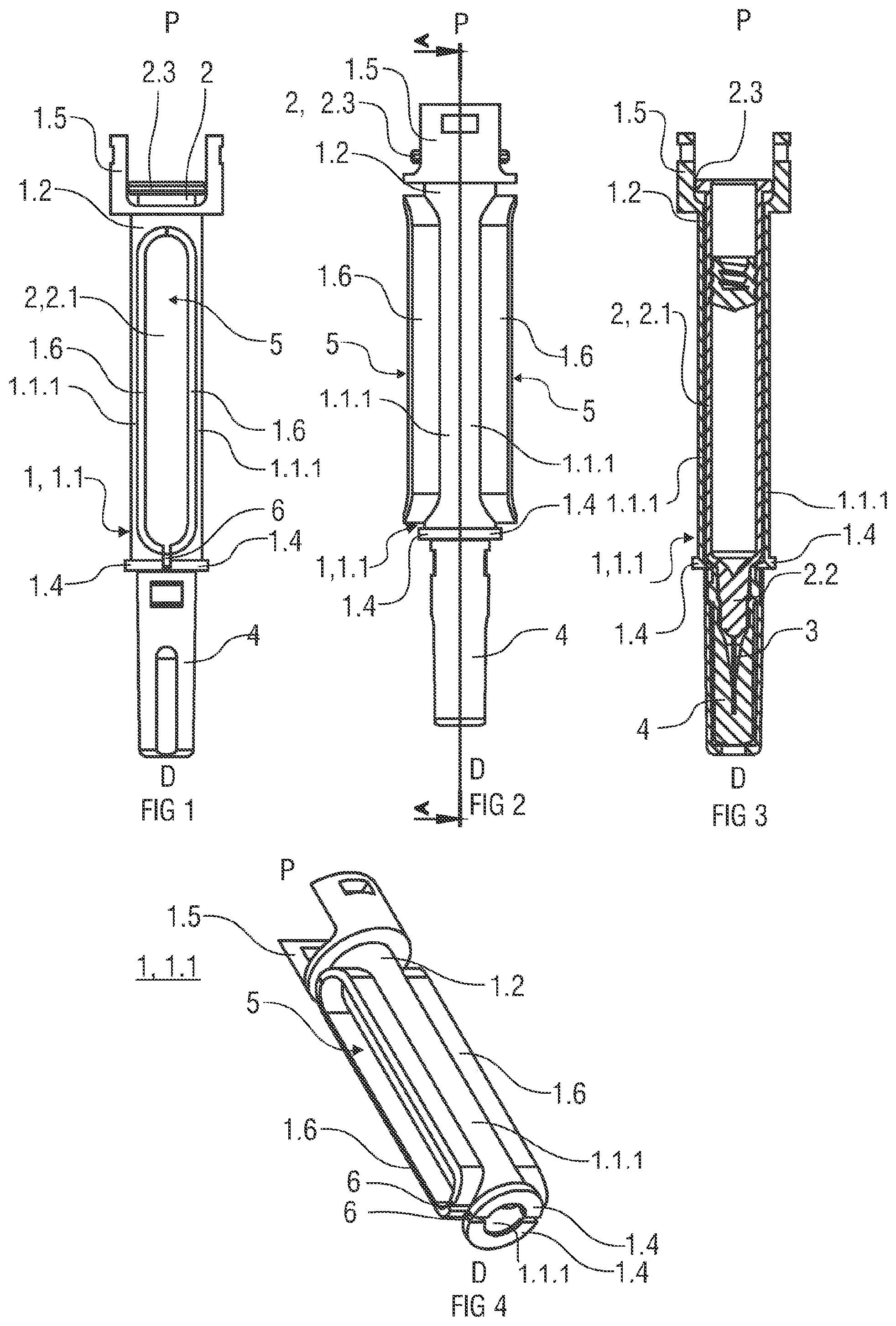
is a top view of an exemplary embodiment of a syringe carrier according to the present invention,
is a lateral view of the syringe carrier of ,
is a longitudinal section of the syringe carrier of in the section plane A-A,
is a perspective view of the syringe carrier of ,
is a top view of another exemplary embodiment of a syringe carrier according to the present invention,
is a lateral view of the syringe carrier of ,
is a longitudinal section of the syringe carrier of in the section plane A-A,
is a perspective view of the syringe carrier of ,
is a top view of yet another exemplary embodiment of a syringe carrier according to the present invention,
is a lateral view of the syringe carrier of ,
is a longitudinal section of the syringe carrier of in the section plane A-A,
is a perspective view of the syringe carrier of ,
is another perspective view of the syringe carrier of with a syringe inserted,
is a top view of yet another exemplary embodiment of a syringe carrier according to the present invention,
is a lateral view of the syringe carrier of ,
is a longitudinal section of the syringe carrier of in the section plane A-A,
is a perspective view of the syringe carrier of ,
is another perspective view of the syringe carrier of with a syringe inserted,
is a top view of yet another exemplary embodiment of a syringe carrier according to the present invention,
is a lateral view of the syringe carrier of ,
is a longitudinal section of the syringe carrier of in the section plane A-A,
is a perspective view of the syringe carrier of ,
is another perspective view of the syringe carrier of with a syringe inserted,
is a top view of yet another exemplary embodiment of a syringe carrier according to the present invention,
is a lateral view of the syringe carrier of ,
is a longitudinal section of the syringe carrier of in the section plane A-A,
is a perspective view of the syringe carrier of ,
is another perspective view of the syringe carrier of with a syringe inserted,
is a top view of yet another exemplary embodiment of a syringe carrier according to the present invention,
is a lateral view of the syringe carrier of ,
is a longitudinal section of the syringe carrier of in the section plane A-A,
is a perspective view of the syringe carrier of ,
is another perspective view of the syringe carrier of with a syringe inserted,
is a top view of yet another exemplary embodiment of a syringe carrier according to the present invention,
is a lateral view of the syringe carrier of ,
is a longitudinal section of the syringe carrier of in the section plane A-A,
is a perspective view of the syringe carrier of ,
is another perspective view of the syringe carrier of with a syringe inserted,
is a top view of yet another exemplary embodiment of a syringe carrier according to the present invention,
is a lateral view of the syringe carrier of ,
is a longitudinal section of the syringe carrier of in the section plane B-B,
is a perspective view of the syringe carrier of ,
is another perspective view of the syringe carrier of with a syringe inserted,
is a top view of yet another exemplary embodiment of a syringe carrier according to the present invention,
is a lateral view of the syringe carrier of ,
is a longitudinal section of the syringe carrier of in the section plane B-B,
is a perspective view of the syringe carrier of , and
is another perspective view of the syringe carrier of with a syringe inserted.
Corresponding parts are marked with the same reference symbols in all figures.
DETAILED DESCRIPTION
Generally, and applicable to all exemplary embodiments of the present invention, the syringe 2 comprises a barrel 2 . 1 and a neck 2 . 2 which has a smaller diameter than the barrel 2 . 1 . A needle 3 is mounted to the neck 2 . 2 and a rigid needle shield (RNS) 4 is removably arranged on the needle 3 . When coupled to the needle 3 , a portion of the RNS may cover a portion of the neck 2 . 2 , leaving a circumferential gap between the barrel 2 . 1 and the RNS 4 . The RNS 4 has a diameter substantially equal to the diameter of the barrel 2 . 1 .
show a first exemplary embodiment of a syringe carrier 1 according to the present in invention. is a top view of the syringe carrier 1 for supporting a syringe 2 . is a lateral view of the syringe carrier of . is a longitudinal section of the syringe carrier of in the section plane A-A. is a perspective view of the syringe carrier of without the syringe 2 .
As shown in , the syringe carrier 1 comprises an elongate body 1 . 1 arranged to receive the barrel 2 . 1 . In this exemplary embodiment, the body 1 . 1 has a cylindrical shape with an internal diameter corresponding to the diameter of the barrel 2 . 1 . The body 1 . 1 comprises a collar 1 . 2 at a proximal end dimensioned to allow axial insertion of the syringe 2 into the syringe carrier 1 in a distal direction D. Resilient sections 1 . 1 . 1 extend distally from the collar 1 . 2 . Distal ends of the sections 1 . 1 . 1 include shoulder sections 1 . 4 shaped as portions of a circle arranged in a transverse plane with respect to a longitudinal axis of the carrier 1 . The shoulder sections include facing surfaces 6 . When the sections 1 . 1 . 1 are in a non-deflected position, the facing surfaces 6 may abut each other, and the shoulder sections 1 . 4 form a circular shoulder (because the facing surfaces 6 abut each other) adapted to engage the circumferential gap between the barrel 2 . 1 and the RNS 4 .
The syringe 2 , with RNS 4 attached to the needle 3 , may be loaded into the syringe carrier 1 by sliding the syringe 2 in the distal direction D into the syringe carrier 2 . When the RNS 4 abuts the shoulder sections 1 . 4 , additional axial force may be applied to cause the arms 1 . 3 to deflect radially. When the RNS 4 has bypassed the shoulder sections 1 . 4 , the sections 1 . 1 . 1 may return to the non-deflected position, and the shoulder sections 1 . 4 may engage the circumferential gap between the barrel 2 . 1 and the RNS 4 and prevent the syringe 2 from moving in the distal direction D relative to the syringe carrier 1 .
In an exemplary embodiment, the proximal end 1 . 5 of the body 1 . 1 may be arranged to receive a finger flange 2 . 3 of the syringe 2 .
In an exemplary embodiment, the shoulder sections 1 . 4 may include proximally-facing contoured surfaces to accommodate a proximal portion of the neck 2 . 2 of the syringe 2 and distally-facing planar surfaces to abut the RNS 4 .
In an exemplary embodiment, viewing windows 5 may be arranged in the body 1 . 1 for allowing visual access to the barrel 2 . 1 of the syringe 2 when the syringe 2 is in the syringe carrier 2 . In an exemplary embodiment, the windows 5 are formed when cut-outs in the arms 1 . 3 are substantially contiguous when the arms 1 . 3 are in the non-deflected position (as shown in ). A projection 1 . 6 may be formed around each cut-out, and when the sections 1 . 1 . 1 are in the non-deflected position, the projections 1 . 6 may form an outline for the window 5 . In another exemplary embodiment, the windows 5 may be formed in the sections 1 . 1 . 1 .
show a second exemplary embodiment of a syringe carrier 1 according to the present invention. is a lateral view of the syringe carrier 1 of . is a longitudinal section of the syringe carrier 1 of in the section plane A-A. is a perspective view of the syringe carrier of without the syringe 2 .
As shown in , the syringe carrier 1 comprises an elongate body 1 . 1 arranged to receive the barrel 2 . 1 . In this exemplary embodiment, the body 1 . 1 is comprised of two resilient sections 1 . 1 . 1 which, when together, have a cylindrical shape with an internal diameter corresponding to the diameter of the barrel 2 . 1 . Distal ends of the sections 1 . 1 . 1 of the body 1 . 1 comprise part of a collar 1 . 2 dimensioned to allow axial insertion of the syringe 2 into the syringe carrier 1 . Resilient arms 1 . 3 are formed in the body 1 . 1 . Distal ends of the arms 1 . 3 include shoulder sections 1 . 4 shaped as portions of a circle arranged in a transverse plane with respect to a longitudinal axis of the carrier 1 . The shoulder sections include facing surfaces 6 . When the arms 1 . 3 are in a non-deflected position, the facing surfaces 6 may abut the distal ends of the sections 1 . 1 . 1 of the body 1 . 1 to form a circular shoulder adapted to engage the circumferential gap between the barrel 2 . 1 and the RNS 4 .
The syringe 2 , with RNS 4 attached to the needle 3 , may be loaded into the syringe carrier 1 by sliding the syringe 2 in the distal direction D into the syringe carrier 2 . When the RNS 4 abuts proximal ends of the sections 1 . 1 . 1 , the sections 1 . 1 . 1 may deflect radially. When the RNS 4 has bypassed the proximal ends of the section 1 . 1 . 1 , the sections 1 . 1 . 1 may return to the non-deflected position. When the RNS 4 abuts the shoulder sections 1 . 4 , the arms 1 . 3 may deflect until the RNS 4 bypasses the shoulder sections 1 . 4 . Then, the arms 1 . 3 may return to the non-deflected position, and the shoulder sections 1 . 4 and the collar 1 . 2 may engage the circumferential gap between the barrel 2 . 1 and the RNS 4 and prevent the syringe 2 from moving in the distal direction D relative to the syringe carrier 1 .
In an exemplary embodiment, the proximal end 1 . 5 of the body 1 . 1 may be arranged to receive a finger flange 2 . 3 of the syringe 2 . The proximal end 1 . 5 may also include a retainer element 1 . 7 which is adapted to provide an abutment surface to prevent the syringe 2 from disengaging the syringe carrier 1 in the proximal direction P.
In an exemplary embodiment, the shoulder sections 1 . 4 may include proximally-facing contoured surfaces to accommodate a proximal portion of the neck 2 . 2 of the syringe 2 and distally-facing planar surfaces to abut the RNS 4 .
In an exemplary embodiment, viewing windows 5 may be arranged in the body 1 . 1 for allowing visual access to the barrel 2 . 1 of the syringe 2 when the syringe 2 is in the syringe carrier 2 . In an exemplary embodiment, the windows 5 are formed when cut-outs in the sections 1 . 1 . 1 are substantially contiguous when the sections 1 . 1 . 1 are in the non-deflected position (as shown in ). A projection 1 . 6 may be formed around each cut-out, and when the sections 1 . 1 . 1 are in the non-deflected position, the projections 1 . 6 may form an outline for the window 5 .
show a third exemplary embodiment of a syringe carrier 1 according to the present invention. is a top view of a third embodiment of a syringe carrier 1 for supporting a syringe 2 . is a lateral view of the syringe carrier 1 of . is a longitudinal section of the syringe carrier 1 of in the section plane A-A. is a perspective view of the syringe carrier of without the syringe 2 . is another perspective view of the syringe carrier of .
As shown in , the syringe carrier 1 comprises an elongate body 1 . 1 arranged to receive the barrel 2 . 1 . In this exemplary embodiment, the body 1 . 1 is comprised of two sections 1 . 1 . 1 which, when together, have a cylindrical shape with an internal diameter corresponding to the diameter of the barrel 2 . 1 . The sections 1 . 1 . 1 may be coupled by a side hinge which allows the section 1 . 1 . 1 to rotate relative to each other sufficient to receive the syringe 2 . Proximal and distal ends of the sections 1 . 1 . 1 include shoulder sections 1 . 4 shaped as portions of a circle arranged in a transverse plane with respect to a longitudinal axis of the carrier 1 . The shoulder sections include facing surfaces 6 . When the sections 1 . 1 . 1 are in a closed position, the facing surfaces 6 may abut each other so that the shoulder sections 1 . 4 form circular shoulders adapted to proximally abut a finger flange 2 . 3 on the syringe 2 and to distally engage the circumferential gap between the barrel 2 . 1 and the RNS 4 . The facing surfaces 6 of one section 1 . 1 . 1 may include holes 1 . 10 and the facing surfaces 6 of the other section 1 . 1 . 1 may include pins 1 . 11 adapted to engage (e.g., frictionally, snap-fit, etc.) the holes 1 . 10 to secure the sections 1 . 1 . 1 in the closed position.
The syringe 2 , with RNS 4 attached to the needle 3 , may be loaded into the syringe carrier 1 by opening the sections 1 . 1 . 1 about the hinge and placing the syringe 2 in the syringe carrier 2 . When the sections 1 . 1 . 1 are closed, the pins 1 . 11 engage the holes 1 . 10 , and the proximal shoulder sections 1 . 4 form circular shoulders adapted to proximally abut a finger flange 2 . 3 on the syringe 2 and the distal shoulder section s 1 . 4 to distally engage the circumferential gap between the barrel 2 . 1 and the RNS 4 . Thus, the syringe 2 is prevented from moving axially relative to the syringe carrier 1 .
In an exemplary embodiment, the proximal end 1 . 5 may include a retainer element 1 . 7 which is adapted to provide an abutment surface to prevent the syringe 2 from disengaging the syringe carrier 1 in the proximal direction P.
In an exemplary embodiment, the shoulder sections 1 . 4 may include proximally-facing contoured surfaces to accommodate a proximal portion of the neck 2 . 2 of the syringe 2 and distally-facing planar surfaces to abut the RNS 4 .
In an exemplary embodiment, viewing windows 5 may be arranged in the body 1 . 1 for allowing visual access to the barrel 2 . 1 of the syringe 2 when the syringe 2 is in the syringe carrier 2 . In an exemplary embodiment, the windows 5 are formed when cut-outs in the sections 1 . 1 . 1 are substantially contiguous when the sections 1 . 1 . 1 are in the closed position. A projection 1 . 6 may be formed around each cut-out, and when the sections 1 . 1 . 1 are in the non-deflected position, the projections 1 . 6 may form an outline for the window 5 .
show a fourth exemplary embodiment of a syringe carrier 1 according to the present invention. is a top view of a fourth embodiment of a syringe carrier 1 for supporting a syringe 2 . is a lateral view of the syringe carrier 1 of . is a longitudinal section of the syringe carrier 1 of in the section plane A-A. is a perspective view of the syringe carrier of without the syringe 2 . is another perspective view of the syringe carrier of .
As shown in , the syringe carrier 1 comprises an elongate body 1 . 1 arranged to receive the barrel 2 . 1 . In this exemplary embodiment, the body 1 . 1 has a cylindrical shape with an internal diameter corresponding to the diameter of the barrel 2 . 1 . A distal end of the body 1 . 1 includes a shoulder sections 1 . 4 shaped as a portion of a circle arranged in a transverse plane with respect to a longitudinal axis of the carrier 1 , and at least one door 1 . 12 hingedly coupled to the body 1 . 1 and including a shoulder section 1 . 4 . A hinge 1 . 9 coupling the door 1 . 12 to the body 1 . 1 may be provided on an axis parallel to the longitudinal axis of the syringe carrier 1 or on an axis transverse to the longitudinal axis of the syringe carrier 1 . The shoulder section 1 . 4 includes facing surfaces 6 which abut facing surfaces 6 of the door 1 . 12 when the door 1 . 12 is in a closed position (as shown in ). When the door 1 . 12 is in the closed position, the facing surfaces 6 may abut each other so that the shoulder sections 1 . 4 on the body 1 . 1 and the door 1 . 12 to form a circular shoulder adapted to engage the circumferential gap between the barrel 2 . 1 and the RNS 4 . The facing surfaces 6 of the door 1 . 12 may include holes 1 . 10 and the facing surfaces 6 of the body 1 . 1 may include pins 1 . 11 (or vice-versa) adapted to engage (e.g., frictionally, snap-fit, etc.) the holes 1 . 10 to secure the door 1 . 12 in the closed position.
The syringe 2 , with RNS 4 attached to the needle 3 , may be loaded into the syringe carrier 1 by opening the door 1 . 12 and sliding the syringe 2 into the syringe carrier 1 . When the circumferential gap between the barrel 2 . 1 and the RNS 4 engages the shoulder section 1 . 4 on the body 1 . 1 , the door 1 . 12 may be closed to engage the gap and prevent the syringe 2 from moving axially relative to the syringe carrier 1 .
In an exemplary embodiment, the shoulder sections 1 . 4 may include proximally-facing contoured surfaces to accommodate a proximal portion of the neck 2 . 2 of the syringe 2 and distally-facing planar surfaces to abut the RNS 4 .
In an exemplary embodiment, viewing windows (not shown) may be arranged in the body 1 . 1 for allowing visual access to the barrel 2 . 1 of the syringe 2 when the syringe 2 is in the syringe carrier 2 . In an exemplary embodiment, the windows are formed as cut-outs.
show a fifth exemplary embodiment of a syringe carrier 1 according to the present invention. is a top view of a fifth embodiment of a syringe carrier 1 for supporting a syringe 2 . is a lateral view of the syringe carrier 1 of . is a longitudinal section of the syringe carrier 1 of in the section plane A-A. is a perspective view of the syringe carrier of without the syringe 2 . is another perspective view of the syringe carrier of .
As shown in , the syringe carrier 1 comprises an elongate body 1 . 1 arranged to receive the barrel 2 . 1 . In this exemplary embodiment, the body 1 . 1 is comprised of two sections 1 . 1 . 1 which, when together, have a cylindrical shape with an internal diameter corresponding to the diameter of the barrel 2 . 1 . The sections 1 . 1 . 1 may be coupled together by clips. In an exemplary embodiment, a clip may comprise a eye 1 . 14 on a first section adapted to engage a hook 1 . 13 on a second section. The eye 1 . 14 may have a cross-section substantially equal to the cross-section of the hook 1 . 13 such that the eye 1 . 14 and hook 1 . 13 engage in a snap-fit. Distal ends of the sections 1 . 1 . 1 include shoulder sections 1 . 4 shaped as portions of a circle arranged in a transverse plane with respect to a longitudinal axis of the carrier 1 . The shoulder sections include facing surfaces 6 . When the sections 1 . 1 . 1 are in a closed position, the facing surfaces 6 may abut each other so that the shoulder sections 1 . 4 form circular shoulders adapted engage the circumferential gap between the barrel 2 . 1 and the RNS 4 . Those of skill in the art will understand that the sections 1 . 1 . 1 may be hingedly connected.
The syringe 2 , with RNS 4 attached to the needle 3 , may be loaded into the syringe carrier 1 by opening the sections 1 . 1 . 1 and placing the syringe 2 in the syringe carrier 2 . When the sections 1 . 1 . 1 are closed, the eyes 1 . 14 engage the hooks 1 . 13 and the shoulder sections 1 . 4 engage the circumferential gap between the barrel 2 . 1 and the RNS 4 . Thus, the syringe 2 is prevented from moving axially relative to the syringe carrier 1 .
In an exemplary embodiment, the proximal end may include a retainer element which is adapted to provide an abutment surface to prevent the syringe 2 from disengaging the syringe carrier 1 in the proximal direction P.
In an exemplary embodiment, the shoulder sections 1 . 4 may include proximally-facing contoured surfaces to accommodate a proximal portion of the neck 2 . 2 of the syringe 2 and distally-facing planar surfaces to abut the RNS 4 .
In an exemplary embodiment, viewing windows may be arranged in the body 1 . 1 for allowing visual access to the barrel 2 . 1 of the syringe 2 when the syringe 2 is in the syringe carrier 2 .
show a sixth exemplary embodiment of a syringe carrier 1 according to the present invention. is a top view of a sixth embodiment of a syringe carrier 1 for supporting a syringe 2 . is a lateral view of the syringe carrier 1 of . is a longitudinal section of the syringe carrier 1 of in the section plane A-A. is a perspective view of the syringe carrier of without the syringe 2 . is another perspective view of the syringe carrier of .
As shown in , the syringe carrier 1 comprises an elongate body 1 . 1 arranged to receive the barrel 2 . 1 . In this exemplary embodiment, the body 1 . 1 has a partially cylindrical shape with an internal diameter corresponding to the diameter of the barrel 2 . 1 . The body 1 . 1 may include a longitudinal slot (e.g., a cut-out) which is adapted to snap over the barrel 2 . 1 of the syringe 2 . Proximal and distal ends of the body 1 . 1 include clamps 1 . 15 , 1 . 16 which are adapted to retain the syringe 2 when in the syringe carrier 1 . The distal end of the body 1 further includes shoulder sections 1 . 4 shaped as a portion of a circle arranged in a transverse plane with respect to a longitudinal axis of the carrier 1 . The shoulder sections 14 form circular shoulders adapted to engage the circumferential gap between the barrel 2 . 1 and the RNS 4 .
The syringe 2 , with RNS 4 attached to the needle 3 , may be loaded into the syringe carrier 1 by pressing the barrel 2 . 1 against the clamps 1 . 15 , 1 . 16 , causing the clamps 1 . 15 , 1 . 16 to deflect and widen the longitudinal slot in the body 1 . 1 . When the barrel 2 . 1 bypasses the clamps 1 . 15 , 1 . 16 , the clamps 1 . 15 , 1 . 16 return to their non-deflected position and retain the syringe 2 in the syringe carrier 1 . The shoulder sections 1 . 4 engage the circumferential gap between the barrel 2 . 1 and the RNS 4 . Thus, the syringe 2 is prevented from moving axially relative to the syringe carrier 1 .
In an exemplary embodiment, the proximal end may include a retainer element which is adapted to provide an abutment surface to prevent the syringe 2 from disengaging the syringe carrier 1 in the proximal direction P.
In an exemplary embodiment, the shoulder sections 1 . 4 may include proximally-facing contoured surfaces to accommodate a proximal portion of the neck 2 . 2 of the syringe 2 and distally-facing planar surfaces to abut the RNS 4 .
In an exemplary embodiment, a viewing window may be arranged in the body 1 . 1 for allowing visual access to the barrel 2 . 1 of the syringe 2 when the syringe 2 is in the syringe carrier 2 .
show a seventh exemplary embodiment of a syringe carrier 1 according to the present invention. is a top view of a seventh embodiment of a syringe carrier 1 for supporting a syringe 2 . is a lateral view of the syringe carrier 1 of . is a longitudinal section of the syringe carrier 1 of in the section plane A-A. is a perspective view of the syringe carrier of without the syringe 2 . is another perspective view of the syringe carrier of .
As shown in , the syringe carrier 1 comprises an elongate body 1 . 1 arranged to receive the barrel 2 . 1 . In this exemplary embodiment, the body 1 . 1 has a partially cylindrical shape with an internal diameter corresponding to the diameter of the barrel 2 . 1 . The body 1 . 1 includes a collar 1 . 2 at its proximal end and may include a longitudinal slot (e.g., a cut-out) formed in the body 1 . 1 distally of the collar 1 . 2 which is adapted to snap over the barrel 2 . 1 of the syringe 2 . A pair of groove hinges 1 . 17 may be formed in the body 1 . 1 adjacent a proximal end of the slot. The distal end of the body 1 includes shoulder sections 1 . 4 shaped as a portion of a circle arranged in a transverse plane with respect to a longitudinal axis of the carrier 1 . The shoulder sections 14 form circular shoulders adapted to engage the circumferential gap between the barrel 2 . 1 and the RNS 4 .
The syringe 2 , with RNS 4 attached to the needle 3 , may be loaded into the syringe carrier 1 by sliding the syringe 2 through the collar 1 . 2 in the distal direction D. When the RNS 4 abuts the shoulder sections 1 . 4 , the body 1 . 1 may radially deflect (e.g., rotate) about the groove hinges 1 . 17 . When the RNS 4 bypasses the shoulder sections 1 . 4 , the body 1 . 1 may return to its non-deflected position and retain the syringe 2 in the syringe carrier 1 . The shoulder sections 1 . 4 engage the circumferential gap between the barrel 2 . 1 and the RNS 4 . Thus, the syringe 2 is prevented from moving axially relative to the syringe carrier 1 .
In an exemplary embodiment, the proximal end may include a retainer element which is adapted to provide an abutment surface to prevent the syringe 2 from disengaging the syringe carrier 1 in the proximal direction P.
In an exemplary embodiment, the shoulder sections 1 . 4 may include proximally-facing contoured surfaces to accommodate a proximal portion of the neck 2 . 2 of the syringe 2 and distally-facing planar surfaces to abut the RNS 4 .
In an exemplary embodiment, a viewing window may be arranged in the body 1 . 1 for allowing visual access to the barrel 2 . 1 of the syringe 2 when the syringe 2 is in the syringe carrier 2 .
show an eighth exemplary embodiment of a syringe carrier 1 according to the present invention. is a top view of an eighth embodiment of a syringe carrier 1 for supporting a syringe 2 . is a lateral view of the syringe carrier 1 of . is a longitudinal section of the syringe carrier 1 of in the section plane A-A. is a perspective view of the syringe carrier of without the syringe 2 . is another perspective view of the syringe carrier of .
As shown in , the syringe carrier 1 comprises an elongate body 1 . 1 arranged to receive the barrel 2 . 1 . In this exemplary embodiment, the body 1 . 1 has a cylindrical shape with an annular groove 1 . 19 adjacent its distal end which is adapted to engage a circlip 8 . The circlip 8 may engage the circumferential gap between the barrel 1 . 2 and the RNS 4 .
The syringe 2 , with RNS 4 attached to the needle 3 and the circlip 8 attached to the syringe 2 , may be loaded into the syringe carrier 1 by sliding the syringe 2 into the syringe carrier 1 in the distal direction D. In a non-deflected position, an outer diameter of the circlip 8 may be substantially equal to a diameter of the body 1 . 1 . Thus, when the syringe 2 with the circlip 8 is inserted into the syringe carrier 1 , the circlip 8 may deflect radially until the circlip 8 reaches the annular groove 1 . 19 . The circlip 8 may then expand to the non-deflected position and retain the syringe 2 in an axial position relative to the syringe carrier 1 . That is, the circlip 8 may engage the annular groove 1 . 19 and the circumferential gap between the barrel 2 . 1 and the RNS 4 . Thus, the syringe 2 is prevented from moving axially relative to the syringe carrier 1 .
In an exemplary embodiment, the proximal end may include a retainer element which is adapted to provide an abutment surface to prevent the syringe 2 from disengaging the syringe carrier 1 in the proximal direction P.
In an exemplary embodiment, the shoulder sections 1 . 4 may include proximally-facing contoured surfaces to accommodate a proximal portion of the neck 2 . 2 of the syringe 2 and distally-facing planar surfaces to abut the RNS 4 .
In an exemplary embodiment, a viewing window may be arranged in the body 1 . 1 for allowing visual access to the barrel 2 . 1 of the syringe 2 when the syringe 2 is in the syringe carrier 2 .
show a ninth exemplary embodiment of a syringe carrier 1 according to the present invention. is a top view of a ninth embodiment of a syringe carrier 1 for supporting a syringe 2 . is a lateral view of the syringe carrier 1 of . is a longitudinal section of the syringe carrier 1 of in the section plane A-A. is a perspective view of the syringe carrier of without the syringe 2 . is another perspective view of the syringe carrier of .
As shown in , the syringe carrier 1 comprises an elongate body 1 . 1 arranged to receive the barrel 2 . 1 . In this exemplary embodiment, the body 1 . 1 has a cylindrical shape with an annular groove 1 . 19 having at least one aperture 1 . 20 adjacent its distal end which is adapted to engage a circlip 8 .
The syringe 2 , with RNS 4 attached to the needle 3 , may be loaded into the syringe carrier 1 by sliding the syringe 2 into the syringe carrier 1 in the distal direction D. When the circumferential gap between the barrel 2 . 1 and the RNS 4 is aligned with the annular groove 1 . 19 , the circlip 8 may be coupled to the body 1 . 1 and engage the apertures 1 . 20 . By extending inwardly through the apertures, the circlip 8 may be coupled to the outside of the body 1 . 1 but engage the circumferential gap between the barrel 2 . 1 and the RNS 4 . The engagement between the circlip 8 and the apertures 1 . 20 prevents the circlip 8 from translating relative to the body 1 . 1 , and the engagement between the circlip 8 and the circumferential gap prevents the syringe 2 from moving axially relative to the syringe carrier 1 .
In an exemplary embodiment, the proximal end may include a retainer element which is adapted to provide an abutment surface to prevent the syringe 2 from disengaging the syringe carrier 1 in the proximal direction P.
In an exemplary embodiment, the shoulder sections 1 . 4 may include proximally-facing contoured surfaces to accommodate a proximal portion of the neck 2 . 2 of the syringe 2 and distally-facing planar surfaces to abut the RNS 4 .
In an exemplary embodiment, a viewing window may be arranged in the body 1 . 1 for allowing visual access to the barrel 2 . 1 of the syringe 2 when the syringe 2 is in the syringe carrier 2 .
show a tenth exemplary embodiment of a syringe carrier 1 and a tool 9 for inserting a syringe 2 into the syringe carrier 1 according to the present invention.
As shown in , the syringe carrier 1 comprises an elongate body 1 . 1 arranged to receive the barrel 2 . 1 . In this exemplary embodiment, the body 1 . 1 has an enlarged portion 1 . 21 on its distal end. The body 1 . 1 has cylindrical shape with a first diameter and the enlarged portion 1 . 21 has a second diameter, larger than the first diameter. The enlarged portion 1 . 21 has one or more resilient barbs 1 . 22 extending toward a longitudinal axis of the body 1 . 1 and angled toward a proximal end of the body 1 . 1 .
The syringe 2 , with RNS 4 attached to the needle 3 , may be loaded into the syringe carrier 1 by inserting the tool 9 into the enlarged portion 1 . 21 of the syringe carrier 1 . The tool 9 may be a cylinder having an open end adapted to receive the RNS 4 . The tool 9 may have a third diameter substantially equal to the second diameter. As the tool 9 is inserted into the enlarged portion 1 . 21 , the tool 9 engages and deflects the resilient barbs 1 . 22 . When the barbs 1 . 22 are deflected, the RNS 4 can pass the barbs 1 . 22 in the distal direction D and extend from a distal opening of the body 1 . 1 . When a finger flange 2 . 3 of the syringe 2 abuts a proximal end of the body 1 . 1 , the tool 9 may be removed and the barbs 1 . 22 may engage the circumferential gap between the barrel 2 . 1 and the RNS 4 to prevent the syringe 2 from moving axially relative to the syringe carrier 1 .
In an exemplary embodiment, the proximal end may include a retainer element which is adapted to provide an abutment surface to prevent the syringe 2 from disengaging the syringe carrier 1 in the proximal direction P.
In an exemplary embodiment, the barbs 1 . 22 may include proximally-facing contoured surfaces to accommodate a proximal portion of the neck 2 . 2 of the syringe 2 and distally-facing planar surfaces to abut the RNS 4 .
In an exemplary embodiment, a viewing window may be arranged in the body 1 . 1 for allowing visual access to the barrel 2 . 1 of the syringe 2 when the syringe 2 is in the syringe carrier 2 .
It is apparent to those skilled in the art that the number of deflectable arms 1 . 3 , shoulder sections 1 . 4 , clips 8 may be varied without departing from the spirit and scope of the invention. Likewise, all the illustrated embodiments may be implemented with or without viewing windows 5 , projections 1 . 6 , restraining features retainer elements 1 . 7 and clips. Different kinds of clips may likewise be applied.
Those of skill in the art will understand that modifications (additions and/or removals) of various components of the apparatuses, methods and/or systems and embodiments described herein may be made without departing from the full scope and spirit of the present invention, which encompass such modifications and any and all equivalents thereof.
Figures (10)
Citations
This patent cites (228)
- US3026873
- US3076455
- US3144178
- US3880163
- US4563175
- US4643724
- US4655751
- US4735311
- US4838857
- US4871355
- US4909791
- US4931040
- US4946447
- US4964866
- US4973318
- US4990142
- US4997422
- US5000744
- US5078698
- US5085641
- US5163918
- US5169392
- US5282793
- US5290255
- US5320609
- US5322511
- US5344407
- US5350367
- US5356395
- US5368578
- US5383858
- US5383863
- US5439450
- US5451214
- US5480387
- US5520653
- US5599309
- US5637101
- US5709662
- US5779675
- US5865805
- US5913844
- US5925032
- US5928205
- US5928698
- US6059756
- US6090082
- US6203530
- US6210369
- US6371939
- US6454743
- US6544234
- US6613022
- US6656163
- US6726657
- US6743205
- US7118552
- US7288078
- US7717877
- US7955303
- US8647299
- US8845594
- US8876785
- US8900197
- US8992746
- US9072833
- US9216256
- US9233213
- US9242053
- US9289554
- US9408970
- US9408976
- US9713678
- US9757520
- US9867940
- US10420898
- US10441719
- US10881799
- US10918803
- US11103649
- US11400221
- US11400222
- US11400223
- US11406764
- US11511043
- US20010011163
- US20020083564
- US20030105430
- US20040039336
- US20040108339
- US20040267199
- US20050020979
- US20050027255
- US20050075608
- US20050101919
- US20050115507
- US20050165353
- US20050277896
- US20060036216
- US20060161114
- US20060167412
- US20060184133
- US20070173770
- US20070260348
- US20080147003
- US20080228143
- US20080262427
- US20090012471
- US20090105663
- US20090254027
- US20100152655
- US20100179507
- US20100185178
- US20120053528
- US20120130321
- US20120186075
- US20120203186
- US20130220869
- US20140243753
- US20140249479
- US20140323985
- US20140330213
- US20140336590
- US20140336592
- US20180064875
- US20180140781
- US20180140782
- US20190201628
- US20200405961
- US20210077743
- US20210346604
- US20220016358
- US20220054755
- US20220054756
- US20220054757
- US20220054758
- US2212489
- US1911467
- US2925504
- US101022841
- US101400393
- US101420995
- US201213944
- US103945879
- US202009009119
- US012008
- US013934
- US0518416
- US0692272
- US1702643
- US2279771
- US2438952
- US2727617
- US2777684
- US2788052
- US3153197
- US2764195
- US407109
- US829724
- US1122592
- US2388033
- US2396298
- US2397767
- US2447339
- US2434317
- US2471473
- USH08-10324
- US2002-503127
- US2005-021247
- US2005-536300
- US2006-507903
- US2006-516901
- US2008-500854
- US2009-077943
- US2009-523587
- US2009-529395
- US2014-500086
- US2014-500089
- US2068708
- US2172638
- US2311203
- US2363500
- US2012137269
- USWO 1998/035714
- USWO 1998/056442
- USWO 1999/010030
- USWO 1999/022792
- USWO 2000/024441
- USWO 2001/008727
- USWO 2001/060435
- USWO 2001/093926
- USWO 2002/047746
- USWO 2003/013632
- USWO 2003/068297
- USWO 2003/099358
- USWO 2004/007006
- USWO 2004/020026
- USWO 2004/050150
- USWO 2005/001161
- USWO 2005/070481
- USWO 2005/083614
- USWO 2005/115506
- USWO 2005/115507
- USWO 2006/047810
- USWO 2006/085176
- USWO 2006/106291
- USWO 2006/106295
- USWO 2007/056792
- USWO 2007/083115
- USWO 2007/104636
- USWO 2007/129106
- USWO 2009/019437
- USWO 2009/022132
- USWO 2010/072644
- USWO 2010/097116
- USWO 2010/115822
- USWO 2010/136076
- USWO 2010/136078
- USWO 2010/147553
- USWO 2011/000570
- USWO 2011/001161
- USWO 2011/101378
- USWO 2012/073032
- USWO 2012/089445
- USWO 2012/164403
- USWO 2013/072182
- USWO 2013/083614
- USWO 2021/008839