Radiomic Signature of an Epicardial Region
Abstract
A method for characterising an epicardial region using medical imaging data of a subject. The method comprises calculating the value of an epicardial radiomic signature of the epicardial region using the medical imaging data. Also disclosed is a method for deriving an epicardial radiomic signature indicative of cardiac health. The method comprises using a radiomic dataset to construct an epicardial radiomic signature. Also disclosed are systems for performing the aforementioned methods.
Claims (30)
1. A method for characterising an epicardial region comprising epicardial tissue, the method comprising calculating the value of an epicardial radiomic signature of the epicardial region using medical imaging data; wherein the epicardial radiomic signature is calculated on the basis of measured values of a plurality of epicardial radiomic features of the epicardial region, the measured values of the epicardial radiomic features being calculated from the medical imaging data; and wherein the epicardial radiomic signature provides a measure of the texture of the epicardial tissue.
18. A method for deriving an epicardial radiomic signature indicative of cardiac health, the method comprising using a radiomic dataset to construct an epicardial radiomic signature indicative of cardiac health, the epicardial radiomic signature being calculated on the basis of a second plurality of epicardial radiomic features; wherein the dataset comprises the values of a first plurality of epicardial radiomic features obtained from medical imaging data of an epicardial region comprising epicardial tissue for each of a plurality of individuals, the plurality of individuals comprising a first group of individuals having a cardiac condition or myocardial disease or having a history of stroke and a second group of individuals not having the cardiac condition or myocardial disease or a history of stroke; wherein the second plurality of epicardial radiomic features is selected from amongst the first plurality of epicardial radiomic features; and wherein the epicardial radiomic signature is constructed to provide a measure of the texture of the epicardial tissue.
Show 28 dependent claims
2. The method of claim 1 , wherein the epicardial radiomic signature is indicative of cardiac health.
3. The method of claim 1 or 2 , wherein the epicardial radiomic signature is predictive of the likelihood of the subject developing a cardiac condition, optionally wherein the cardiac condition is heart arrhythmia.
4. The method of claim 1 or 2 , wherein the epicardial radiomic signature is predictive of the likelihood of the subject experiencing stroke.
5. The method of claim 4 , wherein the epicardial region comprises a peri-atrial region, optionally wherein the peri atrial region comprises the intra-atrial septum epicardial region and the anterior left or right atrium epicardial region.
6. The method of claim 1 , wherein the plurality of epicardial radiomic features comprises at least two epicardial radiomic features selected from the epicardial radiomic features of groups 1 to 15, wherein the at least two epicardial radiomic features are each selected from different groups, and wherein: group 1 consists of Inverse Difference Moment HHH, Inverse Difference Normalized HHH, Contrast HHH (GLCM), Range HHH, Complexity HHH, Maximum HHH, Large Dependence High Gray Level Emphasis HHH, and Short Run Low Gray Level Emphasis HHH; group 2 consists of Minimum LHH, Long Run Low Gray Level Emphasis LHH, Short Run High Gray Level Emphasis LHH, High Gray Level Emphasis LHH, High Gray Level Run Emphasis LHH, Small Area High Gray Level Emphasis LHH, High Gray Level Zone Emphasis LHH, Autocorrelation LHH, Joint Average LHH, Sum Average LHH, Short Run Low Gray Level Emphasis LHH, Long Run High Gray Level Emphasis LHH, Range LHH, Low Gray Level Emphasis LHH, Low Gray Level Run Emphasis LHH, Large Dependence Low Gray Level Emphasis LHH, Low Gray Level Zone Emphasis LHH, Small Area Low Gray Level Emphasis LHH, Small Dependence High Gray Level Emphasis LHH, Complexity LHH, Large Dependence High Gray Level Emphasis LHH, Cluster Prominence LHH, Gray Level Variance LHH (GLSZM), and Maximum LHH; group 3 consists of Low Gray Level Zone Emphasis LLL, Short Run Low Gray Level Emphasis LLL, Low Gray Level Run Emphasis LLL, Low Gray Level Emphasis LLL, Long Run Low Gray Level Emphasis LLL, Small Area Low Gray Level Emphasis LLL, Small Dependence Low Gray Level Emphasis LLL, Large Area Low Gray Level Emphasis LLL, and Large Dependence Low Gray Level Emphasis LLL; group 4 consists of Maximum Probability LLL, Joint Energy LLL, Joint Entropy LLL, Maximum Probability, Joint Energy, Joint Entropy, Gray Level Non Uniformity Normalized, Energy LHL, Uniformity, Size Zone Non Uniformity, Sum Entropy, Gray Level Non Uniformity Normalized, Entropy, Gray Level Non Uniformity Normalized LLL, Uniformity LLL, Mean, Gray Level Non Uniformity Normalized LLL, Root Mean Squared, Interquartile Range, Sum Entropy LLL, Robust Mean Absolute Deviation, Size Zone Non Uniformity HLL, Size Zone Non Uniformity LHL, 10th Percentile, Energy HHL, Median, Dependence Non Uniformity LHL, Entropy LLL, Mean Absolute Deviation, Energy LLH, Run Entropy LLL, Interquartile Range LLL, Size Zone Non Uniformity LLH, Energy HLL, Sum of Squares, Dependence Non Uniformity HLL, Robust Mean Absolute Deviation LLL, 10th Percentile LLL, Energy LHH, Dependence Non Uniformity, and Run Entropy; group 5 consists of Busyness LHH, Strength LHH, Strength HHH, Busyness HHH, Busyness LHL, and Large Area Low Gray Level Emphasis LHH; group 6 consists of Zone Entropy LLL, Dependence Entropy LLL, Root Mean Squared LLL, Mean LLL, Run Entropy, Dependence Entropy, Median LLL, Median, Mean, 10th Percentile LLL, Uniformity, Gray Level Non Uniformity Normalized (GLDM), Root Mean Squared, 90th Percentile, Entropy, 10th Percentile, Interquartile Range LLL, Run Entropy LLL, Robust Mean Absolute Deviation LLL, Gray Level Non Uniformity Normalized LLL (GLDM), and Uniformity LLL; group 7 consists of Run Entropy LLL, Entropy LLL, Mean Absolute Deviation LLL, Mean Absolute Deviation, Robust Mean Absolute Deviation, Robust Mean Absolute Deviation LLL, Variance, Gray Level Variance (GLDM), Gray Level Variance LLL (GLDM), Variance LLL, Gray Level Variance LLL (GLSZM), Gray Level Variance (GLZM), Interquartile Range, Interquartile Range LLL, Entropy, Gray Level Variance LLL (GLDM), Root Mean Squared, Run Entropy, Gray Level Variance (GLDM), Sum Entropy, Sum of Squares, Sum Entropy LLL, Sum of Squares LLL, Cluster Tendency, Cluster Tendency LLL, Joint Entropy, Root Mean Squared LLL, Contrast (GLCM), Joint Entropy LLL, Cluster Prominence, Cluster Prominence LLL, Low Gray Level Emphasis, Short Run Low Gray Level Emphasis, Low Gray Level Run Emphasis, Long Run Low Gray Level Emphasis, Zone Entropy LLL, Low Gray Level Zone Emphasis, Uniformity LLL, Gray Level Non Uniformity Normalized LLL (GLDM), Gray Level Non Uniformity Normalized LLL (GLSZM), 10th Percentile, 10th Percentile LLL, Gray Level Non Uniformity Normalized (GLDM), Gray Level Non Uniformity Normalized (GLSZM), Mean, Uniformity, Joint Energy, Median, Joint Energy LLL, Maximum Probability, Mean LLL, and Maximum Probability LLL; group 8 consists of Maximum 3D Diameter, Maximum 2D Diameter Slice, Maximum 2D Diameter Column, and Major Axis; group 9 consists of Long Run High Gray Level Emphasis LLL, High Gray Level Emphasis LLL, High Gray Level Run Emphasis LLL, High Gray Level Zone Emphasis LLL, Short Run High Gray Level Emphasis LLL, Autocorrelation LLL, Joint Average LLL, Small Area High Gray Level Emphasis LLL, Small Dependence High Gray Level Emphasis LLL, Minimum LLL, Large Dependence Low Gray Level Emphasis LLL, Large Dependence High Gray Level Emphasis LLL, Large Area High Gray Level Emphasis LLL, Large Area Low Gray Level Emphasis LLL, Long Run Low Gray Level Emphasis LLL, Low Gray Level Emphasis LLL, Low Gray Level Run Emphasis LLL, and Short Run Low Gray Level Emphasis LLL; group 10 consists of Joint Average LLL, Autocorrelation LLL, Long Run High Gray Level Emphasis LLL, High Gray Level Emphasis LLL, High Gray Level Run Emphasis LLL, High Gray Level Zone Emphasis LLL, Short Run High Gray Level Emphasis LLL, Small Area High Gray Level Emphasis LLL, Small Dependence High Gray Level Emphasis LLL, Minimum LLL, Large Dependence Low Gray Level Emphasis LLL, Large Dependence High Gray Level Emphasis LLL, Large Area High Gray Level Emphasis LLL, Large Area Low Gray Level Emphasis LLL, Long Run Low Gray Level Emphasis LLL, Low Gray Level Emphasis LLL, Low Gray Level Run Emphasis LLL, Short Run Low Gray Level Emphasis LLL, and Low Gray Level Zone Emphasis LLL; group 11 consists of Difference Entropy LLL, Difference Average LLL, Contrast LLL (NGTDM), Difference Entropy, Inverse Difference LLL, Contrast (GLCM), Difference Variance, Inverse Difference Moment LLL, Difference Average, Inverse Variance LLL, Inverse Variance, Difference Variance LLL, Inverse Difference, Inverse Difference Moment, Inverse Difference Moment Normalized, Inverse Difference Normalized, Contrast (GNGTDM), Joint Entropy, Sum Entropy LHL, Joint Energy LHL, Run Entropy LHL, Size Zone Non Uniformity Normalized LLL, Small Area Emphasis LLL, Short Run Emphasis, Size Zone Non Uniformity Normalized, Small Area Emphasis, Gray Level Non Uniformity Normalized LHL (GLSZM), Joint Entropy LHL, Short Run Emphasis LLL, Small Dependence Emphasis LLL, Dependence Non Uniformity Normalized LLL, Gray Level Non Uniformity Normalized LHL (GLDM), Small Dependence Emphasis, Entropy LHL, Long Run Emphasis LLL, Mean Absolute Deviation LHL, Robust Mean Absolute Deviation LHL, Uniformity LHL, Interquartile Range LHL, Joint Energy, Run Length Non Uniformity Normalized LLL, Run Percentage LLL, Zone Percentage LLL, Long Run Emphasis, Sum of Squares LHL, Complexity LLL, Run Length Non Uniformity Normalized, Run Percentage, Zone Percentage, Cluster Tendency LHL, Run Variance LLL, Large Dependence Emphasis LLL, Dependence Non Uniformity Normalized, Run Variance, Gray Level Variance LHL (GLDM), Large Area Emphasis LLL, Variance LHL, Gray Level Variance LHL (GLSZM), Large Dependence Emphasis, Large Area Emphasis, Maximum Probability LHL, Root Mean Squared LHL, Difference Entropy LHL, Gray Level Variance LHL (GLRLM), Zone Variance LLL, Dependence Variance LLL, Inverse Difference LHL, Inverse Difference Moment LHL, Zone Variance, Large Area High Gray Level Emphasis, 90th Percentile LHL, Sum Entropy LLH, Difference Average LHL, Sum of Squares, Dependence Entropy LHH, Contrast LHL (GLCM), Joint Energy HLL, Difference Entropy HLL, Difference Variance LHL, Dependence Variance, Maximum Probability HLL, Complexity, Joint Entropy HLL, Joint Energy LLL, Sum Entropy LHH, Inverse Variance LHL, 90th Percentile LLH, Inverse Difference HLL, Inverse Difference Moment HLL, Difference Variance HLL, Cluster Tendency LHH, Difference Average HLL, Cluster Tendency LLH, Contrast HLL (GLCM), Run Entropy LHH, Inverse Variance HLL, Joint Energy LLH, Joint Energy HHL, Joint Entropy LLL, Run Entropy LLH, Joint Entropy LLH, Large Dependence High Gray Level Emphasis, Maximum Probability HHL, Joint Entropy HHL, Sum Entropy HHL, Gray Level Non Uniformity Normalized HLL (GLDM), Robust Mean Absolute Deviation LLH, Uniformity HLL, Cluster Prominence LHL, Complexity LHL, Entropy LLH, Gray Level Non Uniformity Normalized LLH (GLDM), Mean Absolute Deviation LLH, Run Entropy HHL, Uniformity LLH, Gray Level Non Uniformity Normalized LLH (GLSZM), Interquartile Range HLL, Interquartile Range LLH, Maximum Probability LLH, Robust Mean Absolute Deviation HLL, Gray Level Non Uniformity Normalized HHL (GLDM), Long Run Emphasis LHL, Robust Mean Absolute Deviation HHL, Run Variance LHL, Uniformity HHL, Interquartile Range HHL, Joint Entropy LHH, Sum of Squares LLH, 10th Percentile HHL, 90th Percentile HHL, Entropy HHL, Cluster Tendency HHL, Gray Level Non Uniformity Normalized HLL (GLSZM), Mean Absolute Deviation HHL, 10th Percentile LHL, Difference Entropy HHL, Sum of Squares HHL, Contrast LLL (GLCM), Gray Level Variance HHL (GLDM), Variance HHL, Entropy HLL, Gray Level Non Uniformity Normalized HHL (GLSZM), Gray Level Variance HHL (GLSZM), Inverse Difference HHL, Joint Energy LHH, Root Mean Squared HHL, Short Run Emphasis LHL, Sum of Squares LHH, 10th Percentile LHH, Inverse Difference Moment HHL, Mean Absolute Deviation LHH, Run Percentage LHL, Zone Percentage LHL, Dependence Non Uniformity Normalized LHL, Entropy LHH, Gray Level Non Uniformity Normalized LHH (GLSZM), Large Dependence Emphasis LHL, Interquartile Range LHH, Maximum Probability LHH, Small Dependence Emphasis LHL, Uniformity LHH, Large Area Emphasis LHL, Robust Mean Absolute Deviation LHH, Root Mean Squared LLH, Difference Average HHL, Small Dependence Low Gray Level Emphasis, Entropy LLL, Gray Level Variance (GLDM), Run Length Non Uniformity Normalized LHL, Variance, Zone Variance LHL, Cluster Prominence HHL, Dependence Variance LHL, Gray Level Variance LHH (GLDM), Root Mean Squared LHH, Gray Level Variance (GLSZM), Variance LHH, Contrast HHL (GLCM), Dependence Entropy HHL, Size Zone Non Uniformity Normalized LHL, Small Area Emphasis LHL, Sum Entropy HHH, Difference Variance HHL, Gray Level Variance HHL (GLRLM), Dependence Entropy LHL, Gray Level Variance LLH (GLSZM), Run Entropy HLL, Variance LLH, 90th Percentile LHH, Mean Absolute Deviation HLL, Gray Level Variance LLH (GLDM), Cluster Tendency HHH, Difference Entropy LLH, Inverse Difference Moment LLH, Gray Level Non Uniformity Normalized LHH (GLDM), Inverse Difference LLH, Mean Absolute Deviation, and 90th Percentile HLL; group 12 consists of Sum Entropy HHH, Cluster Tendency HHH, Cluster Prominence HHH, Joint Entropy HHH, Joint Energy HHH, Difference Entropy HHH, Difference Variance HHH, Sum of Squares HHH, Gray Level Non Uniformity Normalized HHH (GLSZM), Uniformity HHH, Entropy HHH, Gray Level Variance HHH (GLDM), Gray Level Variance HHH (GLSZM), Root Mean Squared HHH, Variance HHH, Mean Absolute Deviation HHH, 10th Percentile HHH, Robust Mean Absolute Deviation HHH, 90th Percentile HHH, Interquartile Range HHH, Gray Level Non Uniformity Normalized HHH (GLDM), Gray Level Variance HHH (GLRLM), Sum Entropy LHH, Joint Entropy HHL, Difference Entropy HHL, Cluster Tendency LHH, Joint Energy HHL, Long Run Emphasis HHL, Maximum Probability HHL, Short Run Emphasis HHL, Large Area Low Gray Level Emphasis HHL, Sum Entropy HHL, Size Zone Non Uniformity Normalized HHL, Sum of Squares HHL, Difference Variance HHL, Joint Entropy LHH, Run Length Non Uniformity Normalized HHL, Cluster Tendency HHL, Contrast HHL (GLCM), Difference Average HHL, Inverse Difference HHL, Large Dependence Emphasis HHL, Run Percentage HHL, Run Variance HHL, Small Area Emphasis HHL, Inverse Difference Moment HHL, Small Dependence Emphasis HHL, Sum of Squares LHH, Gray Level Variance LHH (GLDM), Root Mean Squared HHL, Variance HHL, Difference Variance LHH, Entropy HHL, Gray Level Variance HHL (GLDM), Gray Level Variance HHL (GLSZM), Gray Level Variance LHH (GLSZM), Mean Absolute Deviation HHL, Root Mean Squared LHH, Variance LHH, Joint Energy HLH, 90th Percentile HHL, Joint Energy LHH, Dependence Non Uniformity Normalized HHL, Entropy LHH, Gray Level Non Uniformity Normalized HHL (GLSZM), Joint Entropy HLH, Uniformity HHL, Cluster Prominence HHL, Cluster Prominence LHH, Mean Absolute Deviation LHH, 10th Percentile HHL, Maximum Probability HLH, Robust Mean Absolute Deviation HHL, Difference Entropy LHH, Gray Level Non Uniformity Normalized LHH (GLSZM), Maximum Probability LHH, Zone Percentage HHL, Uniformity LHH, Interquartile Range HHL, 90th Percentile LHH, Dependence Variance HHL, Robust Mean Absolute Deviation LHH, Interquartile Range LHH, Run Entropy LHH, Small Dependence High Gray Level Emphasis HHL, Sum Entropy HLH, Contrast LHH (GLCM), 10th Percentile LHH, Gray Level Variance HHL (GLRLM), Cluster Tendency HLH, Run Entropy HHH, Small Area Emphasis HLH, Difference Entropy HLL, Gray Level Non Uniformity Normalized HHL (GLDM), Large Dependence Low Gray Level Emphasis HHL, Size Zone Non Uniformity Normalized HLH, Inverse Difference HLH, Long Run Emphasis HLH, Sum of Squares HLH, Run Entropy HHL, Small Area Emphasis HLL, Inverse Difference Moment HLH, Size Zone Non Uniformity Normalized HLL, Short Run Emphasis HLH, Small Dependence Emphasis HLL, Difference Variance HLL, Large Dependence Emphasis HLL, Difference Average LHH, Difference Variance HLH, Gray Level Variance HLH (GLDM), Root Mean Squared HLH, Run Percentage HLL, Short Run Emphasis HLL, Variance HLH, Gray Level Variance HLH (GLSZM), Long Run Emphasis HLL, Run Length Non Uniformity Normalized HLL, Zone Percentage HLL, 10th Percentile HLH, Cluster Prominence HLH, Dependence Non Uniformity Normalized HLL, Entropy HLH, Gray Level Non Uniformity Normalized LHH (GLDM), Small Dependence Emphasis HLH, Difference Average HLH, Mean Absolute Deviation HLH, Run Variance HLH, Run Variance HLL, Robust Mean Absolute Deviation HLH, Gray Level Non Uniformity Normalized HLH (GLSZM), Uniformity HLH, Interquartile Range HLH, Joint Entropy HLL, Inverse Difference Moment LHH, Joint Energy HLL, Large Area Emphasis HLL, Small Dependence Emphasis, Complexity HHL, Dependence Variance HLL, Large Area Emphasis HHL, 90th Percentile HLH, Inverse Difference LHH, Run Percentage HLH, Run Variance, Zone Percentage, Contrast HLH (GLCM), Long Run Emphasis, Large Area Emphasis, Run Length Non Uniformity Normalized HLH, Size Zone Non Uniformity Normalized, Small Area Emphasis, Large Dependence Emphasis HLH, Dependence Non Uniformity Normalized, Large Dependence Emphasis, Run Percentage, Short Run Emphasis, Zone Percentage HLH, Zone Variance HLL, Contrast HLL (GLCM), Large Area Low Gray Level Emphasis HLH, Zone Variance, Difference Average HLL, Gray Level Variance LHH (GLRLM), Inverse Difference HLL, Dependence Entropy HHH, Difference Entropy, Inverse Difference Moment HLL, Joint Energy LHL, Joint Energy LLH, Run Length Non Uniformity Normalized, Zone Variance HHL, Difference Entropy LHL, Small Area High Gray Level Emphasis HHL, Maximum Probability HLL, Gray Level Variance HLH (GLRLM), Inverse Variance, Dependence Entropy LHH, Gray Level Non Uniformity Normalized HLH_GLSDM, Inverse Difference LHL, Inverse Difference Moment LHL, Small Dependence High Gray Level Emphasis HLH, Dependence Non Uniformity Normalized HLH, Joint Entropy LHL, Long Run Emphasis LHL, Run Variance LHL, Inverse Difference Moment LLH, Joint Entropy LLH, Large Dependence Emphasis LHL, Dependence Variance, Dependence Variance LHL, Inverse Difference LLH, Maximum Probability LHL, Difference Average, Run Entropy HLH, Dependence Non Uniformity Normalized LHL, Difference Entropy LLH, Large Area Emphasis LHL, Maximum Probability LLH, Contrast (GLCM), Run Percentage LHL, Short Run Emphasis LHL, Short Run High Gray Level Emphasis HHL, Sum Entropy LLH, Long Run Low Gray Level Emphasis HHL, Short Run Emphasis LHH, Small Dependence Emphasis LHH, Zone Percentage LHL, Zone Variance LHL, Inverse Difference, Inverse Difference Moment, Small Dependence Emphasis LHL, Zone Percentage LHH, Inverse Variance HLL, Large Dependence Low Gray Level Emphasis HLH, Difference Average LHL, Small Area High Gray Level Emphasis HHH, Run Variance LLH, Difference Variance LHL, Large Area Low Gray Level Emphasis HLL, Run Length Non Uniformity Normalized LHL, Contrast LHL (GLCM), Dependence Variance HLH, Inverse Difference Normalized, Maximum LLL, Run Length Non Uniformity Normalized LHH, Inverse Difference Moment Normalized, Long Run Emphasis LLH, Size Zone Non Uniformity HHH, Size Zone Non Uniformity Normalized LHL, Small Area Emphasis LHL, Interquartile Range LHL, Gray Level Non Uniformity Normalized LHL (GLSZM), Run Percentage LHH, Small Area High Gray Level Emphasis HLH, Uniformity LHL, Difference Average LLH, Difference Variance, Large Area High Gray Level Emphasis, Long Run Emphasis LHH, Small Dependence High Gray Level Emphasis HHH, High Gray Level Run Emphasis HHL, Range HHL, Robust Mean Absolute Deviation LHL, High Gray Level Emphasis HHL, Inverse Variance LHL, Inverse Variance LLH, Uniformity HLL, Gray Level Non Uniformity Normalized HLL_GLSDM, Large Dependence Emphasis LLH, Entropy LHL, Sum of Squares LLH, Interquartile Range HLL, Interquartile Range LLH, Robust Mean Absolute Deviation HLL, Sum Entropy LHL, 90th Percentile LLH, Complexity, Dependence Non Uniformity Normalized LLH, Gray Level Non Uniformity Normalized LHL (GLDM), Robust Mean Absolute Deviation LLH, Run Percentage LLH, Small Dependence Emphasis LLH, Entropy HLL, High Gray Level Zone Emphasis HHL, Short Run Emphasis LLH, Uniformity LLH, Zone Percentage LLH, Dependence Variance LLH, Gray Level Non Uniformity Normalized LLH (GLSZM), Mean Absolute Deviation LHL, Sum of Squares LHL, Contrast LLH (GLCM), Large Area Low Gray Level Emphasis LHH, Entropy LLH, Cluster Tendency LLH, Mean Absolute Deviation LLH, Size Zone Non Uniformity Normalized LLH, Small Area Emphasis LLH, Complexity HLH, High Gray Level Run Emphasis HHH, Large Area Emphasis LLH, Large Dependence Emphasis LHH, Difference Variance LLH, Informational Measure of Correlation 1, Large Area Low Gray Level Emphasis LHL, Run Length Non Uniformity Normalized LLH, Run Variance LHH, Complexity HLL, Large Dependence Emphasis LLL, Dependence Non Uniformity Normalized LLL, Short Run High Gray Level Emphasis HLH, Run Entropy LHL, Small Dependence Emphasis LLL, Dependence Variance LLL, Gray Level Non Uniformity Normalized HLL (GLDM), Gray Level Non Uniformity Normalized LLH (GLDM), Gray Level Variance LHL (GLDM), High Gray Level Zone Emphasis HHH, Large Area Emphasis HLH, Large Area Emphasis LLL, Long Run Emphasis LLL, Mean Absolute Deviation HLL, Run Percentage LLL, Short Run Emphasis LLL, Zone Percentage LLL, Zone Variance LLH, Run Length Non Uniformity Normalized LLL, Variance LHL, Complexity LHL, Gray Level Variance LHL (GLSZM), Long Run Low Gray Level Emphasis HLH, Run Variance LLL, Zone Variance LLL, Range HHH, Small Area Emphasis LLL, Sum of Squares HLL, Variance HLL, Gray Level Variance HLL (GLSZM), Gray Level Variance HLL (GLDM), Inverse Difference Moment LLL, Size Zone Non Uniformity Normalized HHH, Size Zone Non Uniformity Normalized LLL, Small Dependence High Gray Level Emphasis LHH, Inverse Difference LLL, Minimum HHH, Minimum HHL, Run Entropy LLH, Small Area Emphasis HHH, 10th Percentile HLL, Inverse Variance LLL, High Gray Level Emphasis HHH, Root Mean Squared LLH, Small Dependence High Gray Level Emphasis HLL, Gray Level Variance LHL (GLRLM), Gray Level Variance LLH (GLDM), Autocorrelation HHL, Variance LLH, 10th Percentile LHL, Maximum HHL, Short Run High Gray Level Emphasis HHH, Gray Level Variance LLH (GLSZM), Sum Entropy HLL, Difference Entropy LLL, Cluster Tendency LHL, Zone Variance HLH, Difference Average LLL, Large Dependence Low Gray Level Emphasis LHL, Root Mean Squared HLL, Complexity LHH, High Gray Level Emphasis HLH, Large Dependence Low Gray Level Emphasis HLL, High Gray Level Run Emphasis HLH, Root Mean Squared LHL, Small Dependence High Gray Level Emphasis LHL, Dependence Entropy HHL, Run Entropy HLL, Large Dependence Low Gray Level Emphasis LHH, Size Zone Non Uniformity HHL, Cluster Tendency HLL, and Maximum Probability HHH; group 13 consists of Difference Entropy LHH, Contrast LHH (GLCM), Difference Average LHH, Joint Entropy LHH, Difference Variance LHH, Sum of Squares LHH, Entropy LHH, Mean Absolute Deviation LHH, Gray Level Variance LHH (GLDM), Robust Mean Absolute Deviation LHH, Root Mean Squared LHH, Sum Entropy LHH, Variance LHH, Gray Level Variance LHH (GLSZM), Interquartile Range LHH, Cluster Tendency LHH, 90th Percentile LHH, Run Entropy LHH, Short Run Emphasis LHH, Run Length Non Uniformity Normalized LHH, Cluster Prominence LHH, Small Dependence Emphasis LHH, Run Percentage LHH, Interquartile Range HHH, Robust Mean Absolute Deviation HHH, 90th Percentile HHH, Mean Absolute Deviation HHH, Gray Level Variance LHH (GLRLM), Root Mean Squared HHH, Variance HHH, Zone Percentage LHH, Joint Entropy HHH, Dependence Entropy LHH, Difference Entropy HHH, Sum of Squares HHH, Entropy HHH, Difference Variance HHH, Gray Level Variance HHH (GLSZM), Gray Level Variance HHH (GLDM), Difference Entropy LLH, Difference Entropy LHL, Sum Entropy HHH, Gray Level Variance HHH (GLRLM), Cluster Prominence HHH, Difference Average LLH, Run Percentage LHL, Difference Average LHL, Short Run Emphasis LHL, Dependence Non Uniformity Normalized LHL, Small Dependence Emphasis LHL, Zone Percentage LHL, Joint Entropy LLH, Size Zone Non Uniformity Normalized LHH, Size Zone Non Uniformity Normalized LHL, Small Area Emphasis LHL, Contrast LHL (GLCM), Run Length Non Uniformity Normalized LHL, Contrast LLH (GLCM), Difference Variance LHL, Run Percentage LLH, Short Run Emphasis LLH, Small Area Emphasis LHH, Joint Entropy LHL, Dependence Non Uniformity Normalized LLH, Small Area Emphasis LLH, Small Dependence Emphasis LLH, Size Zone Non Uniformity Normalized LLH, Difference Variance LLH, Zone Percentage LLH, Small Dependence High Gray Level Emphasis LHH, Interquartile Range LLH, Robust Mean Absolute Deviation LLH, Run Length Non Uniformity Normalized LLH, Complexity LHH, Small Dependence Emphasis, Run Percentage, Sum of Squares LLH, Zone Percentage, Entropy LLH, Mean Absolute Deviation LLH, Short Run Emphasis, Dependence Non Uniformity Normalized, Sum Entropy LLH, Run Length Non Uniformity Normalized, Size Zone Non Uniformity Normalized, Small Area Emphasis, Interquartile Range LHL, Robust Mean Absolute Deviation LHL, Difference Entropy, Short Run Emphasis HHL, Small Area Emphasis HHL, Size Zone Non Uniformity Normalized HHL, Entropy LHL, Size Zone Non Uniformity HHH, Difference Average, Run Entropy LLH, Run Length Non Uniformity Normalized HHL, Run Percentage HHL, Cluster Tendency HHH, 90th Percentile LLH, Gray Level Variance LLH (GLDM), Small Area Emphasis HHH, Variance LLH, Mean Absolute Deviation LHL, Small Dependence Emphasis HHL, Contrast (GLCM), Small Area Emphasis HLH, Cluster Tendency LLH, Gray Level Variance LLH (GLSZM), Sum of Squares LHL, Dependence Non Uniformity Normalized HHL, Root Mean Squared LLH, Size Zone Non Uniformity Normalized HHH, Size Zone Non Uniformity Normalized HLH, Complexity LHL, Difference Entropy HHL, Informational Measure of Correlation 1, Total Energy LHH, Run Entropy LHL, Zone Percentage HHL, Difference Average HHL, Sum Entropy LHL, Gray Level Variance LHL (GLDM), Variance LHL, Gray Level Variance LHL (GLSZM), Contrast HHL (GLCM), Difference Variance, Difference Variance HHL, Short Run Emphasis HLH, Joint Entropy HHL, Small Area High Gray Level Emphasis HHH, Small Dependence High Gray Level Emphasis LHL, Difference Entropy HLH, Small Dependence Emphasis HLH, Gray Level Variance LLH (GLRLM), Dependence Non Uniformity Normalized LLL, Gray Level Variance LHL (GLRLM), Interquartile Range HHL, Run Percentage LLL, Zone Percentage LLL, Robust Mean Absolute Deviation HHL, Short Run Emphasis LLL, Size Zone Non Uniformity LHH, Small Dependence Emphasis LLL, Run Length Non Uniformity Normalized LLL, Complexity, Run Percentage HLH, Contrast HHH (GLCM), Maximum LHH, Mean Absolute Deviation HHL, Entropy HHL, Size Zone Non Uniformity Normalized LLL, Small Area Emphasis LLL, Difference Average HLH, Sum of Squares HHL, 90th Percentile HHL, Root Mean Squared HHL, Run Length Non Uniformity Normalized HLH, Variance HHL, Gray Level Variance HHL (GLSZM), Gray Level Variance HHL (GLDM), Root Mean Squared LHL, Joint Entropy HLH, Run Entropy HHH, Zone Percentage HLH, Total Energy HHH, Cluster Tendency LHL, Sum Entropy HHL, Energy LHH, Contrast HLH (GLCM), Difference Variance HLH, Dependence Non Uniformity Normalized LHH, Small Dependence High Gray Level Emphasis HHL, Cluster Tendency HHL, Short Run High Gray Level Emphasis LHH, Dependence Non Uniformity Normalized HLH, Robust Mean Absolute Deviation HLH, Small Area High Gray Level Emphasis LHL, Interquartile Range HLH, Range LHH, and Small Dependence High Gray Level Emphasis HHH; group 14 consists of Sum of Squares LHH, Cluster Tendency LHH, Entropy LHH, Gray Level Variance LHH (GLDM), Joint Entropy LHH, Gray Level Variance LHH (GLSZM), Mean Absolute Deviation LHH, Root Mean Squared LHH, Variance LHH, Contrast LHH (GLCM), Difference Entropy LHH, Difference Variance LHH, Sum Entropy LHH, Difference Average LHH, Robust Mean Absolute Deviation LHH, Interquartile Range LHH, 90th Percentile LHH, Run Entropy LHH, Cluster Prominence LHH, Short Run Emphasis LHH, Small Dependence Emphasis LHH, Run Length Non Uniformity Normalized LHH, Run Percentage LHH, Gray Level Variance LHH (GLRLM), Interquartile Range HHH, Robust Mean Absolute Deviation HHH, 90th Percentile HHH, Dependence Entropy LHH, Mean Absolute Deviation HHH, Zone Percentage LHH, Root Mean Squared HHH, Variance HHH, Joint Entropy HHH, Entropy HHH, Difference Entropy HHH, Sum of Squares HHH, Gray Level Variance HHH (GLSZM), Gray Level Variance HHH (GLDM), Difference Variance HHH, Run Percentage LHL, Difference Entropy LHL, Dependence Non Uniformity Normalized LHL, Short Run Emphasis LHL, Small Dependence Emphasis LHL, Zone Percentage LHL, Difference Entropy LLH, Size Zone Non Uniformity Normalized LHL, Small Area Emphasis LHL, Difference Average LHL, Run Length Non Uniformity Normalized LHL, Difference Average LLH, Sum Entropy HHH, Contrast LHL (GLCM), Cluster Prominence HHH, Difference Variance LHL, Run Percentage LLH, Small Area Emphasis LLH, Small Dependence Emphasis, Short Run Emphasis LLH, Size Zone Non Uniformity Normalized LLH, Small Dependence Emphasis LLH, Zone Percentage, Contrast LLH (GLCM), Dependence Non Uniformity Normalized LLH, Joint Entropy LLH, Run Percentage, Zone Percentage LLH, Short Run Emphasis, Dependence Non Uniformity Normalized, Gray Level Variance HHH (GLRLM), Joint Entropy LHL, Mean Absolute Deviation LLH, Robust Mean Absolute Deviation LLH, Size Zone Non Uniformity Normalized, Small Area Emphasis, Interquartile Range LLH, Entropy LLH, Run Length Non Uniformity Normalized LLH, Run Length Non Uniformity Normalized, Sum of Squares LLH, Difference Variance LLH, Small Dependence High Gray Level Emphasis LHH, Interquartile Range LHL, Robust Mean Absolute Deviation LHL, Complexity LHH, Difference Entropy, Entropy LHL, Gray Level Variance LLH (GLDM), Sum Entropy LLH, Variance LLH, Difference Average, Short Run Emphasis HHL, Run Entropy LLH, Small Area Emphasis HHL, Gray Level Variance LLH (GLSZM), Size Zone Non Uniformity Normalized HHL, Root Mean Squared LLH, 90th Percentile LLH, Contrast (GLCM), Mean Absolute Deviation LHL, Run Percentage HHL, Cluster Tendency LLH, Run Length Non Uniformity Normalized HHL, Small Dependence Emphasis HHL, Size Zone Non Uniformity Normalized LHH, Sum of Squares LHL, Small Area Emphasis HLH, Dependence Non Uniformity Normalized HHL, Cluster Tendency HHH, Run Entropy LHL, Size Zone Non Uniformity Normalized HLH, Zone Percentage HHL, Complexity LHL, Gray Level Variance LHL (GLSZM), Variance LHL, Gray Level Variance LHL (GLDM), Small Area Emphasis LHH, Sum Entropy LHL, Difference Entropy HHL, Difference Variance, Dependence Non Uniformity Normalized LLL, Difference Average HHL, Gray Level Variance LLH (GLRLM), Zone Percentage LLL, Run Percentage LLL, Size Zone Non Uniformity HHH, Small Dependence Emphasis LLL, Short Run Emphasis LLL, Run Length Non Uniformity Normalized LLL, Informational Measure of Correlation 1, Size Zone Non Uniformity Normalized LLL, Small Area Emphasis LLL, Complexity, Contrast HHL (GLCM), Small Dependence High Gray Level Emphasis LHL, Short Run Emphasis HLH, Small Dependence Emphasis HLH, Gray Level Variance LHL (GLRLM), Joint Entropy HHL, Difference Variance HHL, Interquartile Range HHL, Robust Mean Absolute Deviation HHL, Small Area Emphasis HHH, Mean Absolute Deviation HHL, Root Mean Squared LHL, Run Percentage HLH, Size Zone Non Uniformity Normalized HHH, Entropy HHL, 90th Percentile HHL, Root Mean Squared HHL, Total Energy LHH, Variance HHL, Difference Entropy HLH, Gray Level Variance HHL (GLSZM), Sum of Squares HHL, Gray Level Variance HHL (GLDM), Run Length Non Uniformity Normalized HLH, Zone Percentage HLH, Cluster Tendency LHL, Difference Average HLH, Small Area High Gray Level Emphasis HHH, Maximum LHH, Difference Average LLL, Sum Entropy HHL, Small Dependence High Gray Level Emphasis HHL, Cluster Tendency HHL, Dependence Non Uniformity Normalized HLH, Difference Entropy LLL, Joint Entropy HLH, Short Run High Gray Level Emphasis LHH, Contrast HLH (GLCM), Run Entropy HHH, Size Zone Non Uniformity LHH, Small Area High Gray Level Emphasis LHL, Robust Mean Absolute Deviation HLH, Interquartile Range HLH, Difference Variance HLH, Range LHH, Mean Absolute Deviation HLH, Run Entropy HHL, Cluster Prominence HHL, Gray Level Variance HLH (GLDM), Entropy HLH, Root Mean Squared HLH, Small Dependence High Gray Level Emphasis HHH, Variance HLH, Gray Level Variance HHL (GLRLM), Gray Level Variance HLH (GLSZM), Energy LHH, Small Area High Gray Level Emphasis LHH, Complexity HHL, Contrast HHH (GLCM), 90th Percentile HLH, Sum of Squares HLH, Run Percentage HLL, Size Zone Non Uniformity HHL, Complexity LLH, Dependence Non Uniformity Normalized HLL, Small Dependence Emphasis HLL, 90th Percentile LHL, Dependence Non Uniformity Normalized LHH, and Zone Percentage HLL; and group 15 consists of Gray Level Variance LHH (GLDM), Root Mean Squared LHH, Variance LHH, Entropy LHH, Mean Absolute Deviation LHH, Sum of Squares LHH, Gray Level Non Uniformity Normalized LHH (GLDM), Cluster Tendency LHH, Uniformity LHH, Contrast LHH (GLCM), Difference Variance LHH, Run Entropy LHH, 90th Percentile LHH, Joint Entropy LHH, Robust Mean Absolute Deviation LHH, 10th Percentile LHH, Interquartile Range LHH, Sum Entropy LHH, Difference Average LHH, Joint Energy LHH, Inverse Difference Moment LHH, Inverse Difference LHH, Maximum Probability LHH, Cluster Prominence LHH, Gray Level Non Uniformity Normalized LHH (GLSZM), Gray Level Variance LHH (GLSZM), Short Run Emphasis LHH, Dependence Entropy LHH, Small Dependence Emphasis LHH, Run Length Non Uniformity Normalized LHH, Long Run Emphasis LHH, Interquartile Range HHH, Mean Absolute Deviation HHH, 90th Percentile HHH, Robust Mean Absolute Deviation HHH, Root Mean Squared HHH, Run Percentage LHH, Variance HHH, 10th Percentile HHH, Zone Percentage LHH, Gray Level Non Uniformity Normalized HHH (GLDM), Uniformity HHH, Entropy HHH, Run Variance LHH, Large Dependence Emphasis LHH, Gray Level Variance HHH (GLSZM), Gray Level Variance HHH (GLDM), Joint Entropy HHH, Sum of Squares HHH, Difference Entropy HHH, Difference Variance HHH, Joint Energy HHH, Large Area Low Gray Level Emphasis LHH, Run Variance LHL, Long Run Emphasis LHL, Inverse Difference Moment LHL, Inverse Difference LHL, Inverse Difference Moment LLH, Inverse Difference LLH, Large Dependence Emphasis LHL, Run Percentage LHL, Small Dependence Emphasis LHL, Zone Percentage LHL, Dependence Non Uniformity Normalized LHL, Short Run Emphasis LHL, Size Zone Non Uniformity Normalized LHL, Small Area Emphasis LHL, Difference Entropy LHL, Cluster Prominence HHH, Gray Level Non Uniformity Normalized HHH (GLSZM), Difference Average LHL, Run Variance LLH, Difference Entropy LLH, Large Area Emphasis LHL, Long Run Emphasis LLH, Small Dependence High Gray Level Emphasis LHH, Sum Entropy HHH, Dependence Variance LHL, Inverse Variance LLH, Inverse Variance LHL, Gray Level Variance HHH (GLRLM), Run Length Non Uniformity Normalized LHL, Contrast LHL (GLCM), Difference Average LLH, Zone Variance LHL, Complexity LHH, Run Variance, Size Zone Non Uniformity Normalized LLH, Small Area Emphasis LLH, Difference Variance LHL, Contrast LLH (GLCM), Long Run Emphasis, Small Dependence Emphasis LLH, Mean Absolute Deviation LLH, Run Percentage LLH, Small Dependence Emphasis, Joint Energy LLH, Short Run Emphasis LLH, Zone Percentage, Dependence Non Uniformity Normalized LLH, Zone Percentage LLH, Entropy LLH, Joint Energy LHL, Large Dependence Emphasis LLH, Robust Mean Absolute Deviation LLH, Interquartile Range LLH, Uniformity LLH, Gray Level Non Uniformity Normalized LLH (GLDM), Run Percentage, Small Area Emphasis, Difference Variance LLH, Joint Entropy LLH, Large Area Emphasis, Size Zone Non Uniformity Normalized, Sum of Squares LLH, Short Run Emphasis, Gray Level Non Uniformity Normalized LLH (GLSZM), Dependence Non Uniformity Normalized, Joint Entropy LHL, Large Dependence Emphasis, Run Length Non Uniformity Normalized LLH, Large Area Low Gray Level Emphasis LHL, Large Dependence Low Gray Level Emphasis LHH, Maximum Probability LHL, Uniformity LHL, Gray Level Non Uniformity Normalized LHL (GLDM), Gray Level Variance LLH (GLDM), Run Length Non Uniformity Normalized, Variance LLH, Zone Variance, Interquartile Range LHL, Long Run Emphasis HHL, Robust Mean Absolute Deviation LHL, Gray Level Variance LLH (GLSZM), Large Area Emphasis LLH, Small Area Emphasis HHL, Dependence Variance LLH, Maximum Probability LLH, Run Entropy LLH, Size Zone Non Uniformity Normalized HHL, Entropy LHL, Root Mean Squared LLH, Size Zone Non Uniformity Normalized LHH, Run Variance HHL, Difference Average, Gray Level Non Uniformity Normalized LHL (GLSZM), Inverse Difference Moment, Inverse Variance, Short Run Emphasis HHL, Inverse Difference, Difference Entropy, Mean Absolute Deviation LHL, 90th Percentile LLH, Cluster Tendency LLH, Contrast (GLCM), Small Area Emphasis HLH, Sum Entropy LLH, Complexity LHL, Small Dependence Emphasis HHL, Zone Variance LLH, Inverse Difference Normalized, Large Dependence Emphasis HHL, Run Percentage HHL, Size Zone Non Uniformity Normalized HLH, Large Area Emphasis LHH, Run Length Non Uniformity Normalized HHL, 10th Percentile LHL, Sum of Squares LHL, Dependence Variance, Inverse Difference Moment Normalized, Small Area Emphasis LHH, Cluster Tendency HHH, Gray Level Variance LHL (GLDM), Run Entropy LHL, Variance LHL, Gray Level Variance LHL (GLSZM), Zone Percentage HHL, Gray Level Variance LLH (GLRLM), Dependence Non Uniformity Normalized HHL, Large Dependence Low Gray Level Emphasis LHL, Inverse Difference HHL, Inverse Difference Moment HHL, Large Area High Gray Level Emphasis, Small Dependence High Gray Level Emphasis LHL, Large Area Low Gray Level Emphasis HHL, Size Zone Non Uniformity HHH, Dependence Variance HHL, Zone Variance LHH, Difference Entropy HHL, Gray Level Variance LHL (GLDM), Difference Average HHL, Long Run Emphasis HLH, Difference Variance, 10th Percentile LLH, Long Run Emphasis LLL, Sum Entropy LHL, Complexity, Maximum Probability HHL, Run Variance LLL, Dependence Non Uniformity Normalized LLL, Zone Percentage LLL, Inverse Difference HLH, Run Percentage LLL, Small Dependence Emphasis HLH, Small Dependence Emphasis LLL, Large Dependence Emphasis LLL, Short Run Emphasis HLH, Short Run Emphasis LLL, Small Area Emphasis HHH, Contrast HHL (GLCM), Large Area Emphasis LLL, Joint Energy HHL, Maximum LHH, Run Length Non Uniformity Normalized LLL, Run Variance HLH, Size Zone Non Uniformity Normalized HHH, 10th Percentile HHL, Inverse Difference Moment HLH, Size Zone Non Uniformity Normalized LLL, Small Area Emphasis LLL, Small Area High Gray Level Emphasis HHH, Interquartile Range HHL, Difference Variance HHL, Robust Mean Absolute Deviation HHL, Root Mean Squared LHL, Short Run High Gray Level Emphasis LHH, Inverse Difference Moment LLL, Large Area Emphasis HHL, Dependence Variance LLL, Joint Entropy HHL, Uniformity HHL, Gray Level Non Uniformity Normalized HHL (GLDM), Zone Variance LLL, Inverse Difference LLL, Mean Absolute Deviation HHL, Entropy HHL, Informational Measure of Correlation 1, Total Energy LHH, Inverse Variance LLL, Range LHH, Root Mean Squared HHL, Run Percentage HLH, Variance HHL, 90th Percentile HHL, Gray Level Variance HHL (GLDM), Difference Average HLH, Gray Level Variance HHL (GLSZM), Difference Entropy HLH, Large Dependence Emphasis HLH, Zone Percentage HLH, Run Length Non Uniformity Normalized HLH, Zone Variance HHL, Run Entropy HHH, Small Area High Gray Level Emphasis LHL, Sum of Squares HHL, Cluster Tendency LHL, Long Run Low Gray Level Emphasis LHH, Maximum Probability HLH, Small Area High Gray Level Emphasis LHH, Small Dependence High Gray Level Emphasis HHL, Joint Energy HLH, Contrast HLH (GLCM), Difference Average LLL, Small Dependence High Gray Level Emphasis HHH, Large Dependence Low Gray Level Emphasis HHL, Sum Entropy HHL, 10th Percentile HLH, Cluster Tendency HHL, Dependence Non Uniformity Normalized HLH, Gray Level Non Uniformity Normalized HHL (GLSZM), High Gray Level Emphasis LHH, High Gray Level Run Emphasis LHH, Joint Entropy HLH, Robust Mean Absolute Deviation HLH, Interquartile Range HLH, Size Zone Non Uniformity LHH, Difference Entropy LLL, Difference Variance HLH, Run Entropy HHL, Contrast HHH (GLCM), Gray Level Variance HHL (GLRLM), Gray Level Variance HLH (GLSZM), Mean Absolute Deviation HLH, Root Mean Squared HLH, Uniformity HLH, Variance HLH, Entropy HLH, Gray Level Non Uniformity Normalized HLH (GLDM), Gray Level Variance HLH (GLDM), Complexity HHL, Large Area Low Gray Level Emphasis HLH, Large Dependence High Gray Level Emphasis, Cluster Prominence HHL, Complexity LLH, 90th Percentile HLH, Energy LHH, Short Run High Gray Level Emphasis LHL, Sum of Squares HLH, Dependence Variance HLH, Short Run High Gray Level Emphasis HHH, High Gray Level Emphasis LHL, High Gray Level Run Emphasis LHL, Correlation, Run Variance HLL, High Gray Level Zone Emphasis LHH, Long Run Emphasis HLL, and Small Dependence High Gray Level Emphasis HLH.
7. The method of claim 6 , wherein the at least two epicardial radiomic features comprise at least two of Inverse Difference Moment HHH, Minimum LHH, Low Gray Level Zone Emphasis LLL, Maximum Probability LLL, Busyness LHH, Zone Entropy LLL, Run Entropy LLL Maximum 3D Diameter, Long Run High Gray Level Emphasis LLL, Joint Average LLL, Difference Entropy LLL, Sum Entropy HHH, Difference Entropy LHH, Sum Squares LHH, and Gray Level Variance LHH (GLDM).
8. The method of claim 6 , wherein the at least two epicardial radiomic features are selected from the epicardial radiomic features of clusters A to D, wherein the at least two epicardial radiomic features are each selected from different clusters, and wherein: cluster A consists of the epicardial radiomic features of groups 1 to 5; cluster B consists of the epicardial radiomic features of groups 6 and 7; cluster C consists of the epicardial radiomic features of group 8; and cluster D consists of the epicardial radiomic features of groups 9 to 15.
9. The method of claim 1 , wherein the plurality of epicardial radiomic features comprises at least two epicardial radiomic features selected from the epicardial radiomic features of clusters A to D, wherein the at least two epicardial radiomic features are each selected from different clusters, and wherein: cluster A consists of Inverse Difference Moment HHH, Minimum LHH, Zone Variance LLL, Low Gray Level Zone Emphasis LLL, Maximum Probability LLL, Elongation, Cluster Shade LLL, Busyness LHH, Gray Level Non Uniformity LLL, and Skewness HHH; cluster B consists of Zone Entropy LLL, Cluster Prominence LLL, Gray Level Variance LLL (GLDM), and Run Entropy LLL; cluster C consists of Least Axis, Maximum 2D Diameter Row, Major Axis, Maximum 2D Diameter Column, Maximum 2D Diameter Slice, and Maximum 3D Diameter; and cluster D consists of Autocorrelation LLH, Long Run High Gray Level Emphasis LLL, Joint Average LLL, Autocorrelation LLL, Difference Entropy LLL, Difference Entropy LLH, Sum of Squares HLH, Sum of Squares HHH, Sum Entropy HHH, Gray Level Variance LLH (GLDM), Difference Entropy LHH, Sum Squares LHH, and Gray Level Variance LHH (GLDM).
10. The method of claim 9 , wherein: cluster A consists of Inverse Difference Moment HHH, Minimum LHH, Low Gray Level Zone Emphasis LLL, Maximum Probability LLL, and Busyness LHH; cluster B consists of Zone Entropy LLL, and Run Entropy LLL; cluster C consists of Maximum 3D Diameter; and cluster D consists of Long Run High Gray Level Emphasis LLL, Joint Average LLL, Difference Entropy LLL, Sum Entropy HHH, Difference Entropy LHH, Sum Squares LHH, and Gray Level Variance LHH (GLDM).
11. The method of claim 1 , further comprising identifying the epicardial region using an automated segmentation algorithm, optionally wherein the segmentation algorithm has been trained using machine learning to segment the medical imaging data.
12. The method of claim 1 wherein the epicardial region consists of voxels of the medical imaging data having an attenuation value falling within a given range of attenuation values, optionally wherein the range of attenuation values corresponds to adipose and/or connective tissue.
13. The method of claim 12 , wherein the given range comprises attenuation values from about −190 to about −30 Hounsfield Units or from about −190 to about +150 Hounsfield Units.
14. The method of claim 1 , further comprising predicting the risk of the subject developing a cardiac condition or experiencing stroke based on at least the calculated value of the epicardial radiomic signature, optionally wherein the cardiac condition is heart arrhythmia.
15. The method of claim 1 , further comprising identifying, based on the calculated value of the epicardial radiomic signature, whether an individual is at risk of stroke.
16. The method of claim 15 , further comprising administering or prescribing a preventative treatment to the individual to reduce the risk of stroke if the individual is identified as being at risk of stroke.
17. The method of claim 1 , further comprising determining whether the subject has myocardial disease based on at least the calculated value of the epicardial radiomic signature, optionally wherein the myocardial disease is fibrosis, inflammation or oxidative stress.
19. The method according to claim 18 , wherein the method further comprises identifying significant epicardial radiomic features from amongst the first plurality of epicardial radiomic features that are each significantly associated with the cardiac condition or myocardial disease or history of stroke, the second plurality of epicardial radiomic features comprising at least two epicardial radiomic features that are, or are collinear with, different significant epicardial radiomic features.
20. The method according to claim 19 , wherein the method further comprises using a feature selection machine learning algorithm to identify a subset of the significant epicardial radiomic features, wherein the at least two epicardial radiomic features are, or are collinear with, different significant epicardial radiomic features belonging to the subset, optionally wherein the at least two epicardial radiomic features comprises all of the significant epicardial radiomic features belonging to the subset, or collinear equivalents thereof.
21. The method according to claim 19 , further comprising identifying groups of epicardial radiomic features, each of the groups comprising one of the significant epicardial radiomic features and collinear equivalents thereof that are collinear with the significant epicardial radiomic feature, the at least two epicardial radiomic features being selected from different groups.
22. The method of claim 19 , wherein the method comprises identifying a plurality of clusters of the significant epicardial radiomic features by performing a cluster analysis, and wherein the at least two epicardial radiomic features are each selected from, or are selected to be collinear with significant epicardial radiomic features from, different clusters, optionally wherein the cluster analysis identifies the clusters based on the strength of the correlations between the significant epicardial radiomic features.
23. The method of claim 18 , wherein the epicardial radiomic signature is constructed to be correlated with the cardiac condition or myocardial disease or history of stroke, optionally wherein the epicardial radiomic signature is constructed to be significantly associated with the cardiac condition or myocardial disease or history of stroke.
24. The method of claim 18 , wherein the step of constructing the epicardial radiomic signature is performed using a machine learning algorithm.
25. The method of claim 18 , wherein the cardiac condition is associated with myocardial health or disease, optionally wherein the cardiac condition is heart arrhythmia.
26. The method of claim 18 , further comprising configuring a system for calculating the value of the epicardial radiomic signature for a patient.
27. The method of claim 18 , further comprising characterising an epicardial region of a patient by calculating the value of the epicardial radiomic signature for an epicardial region of the patient.
28. The method of claim 18 , wherein the epicardial region comprises epicardial adipose tissue and/or connective tissue.
29. The method of claim 18 , wherein the epicardial radiomic signature comprises a decision tree, optionally wherein the epicardial radiomic signature comprises a regression tree.
30. A system configured to perform the method of claim 18 .
Full Description
Show full text →
CROSS-REFERENCE TO RELATED APPLICATIONS
This application is the National Stage of International Application No. PCT/GB2019/053058, filed Oct. 29, 2019, which claims priority to GR 20180100490, filed Oct. 29, 2018 and GB 1820044.4, filed Dec. 10, 2018, which are entirely incorporated herein by reference.
FIELD OF THE INVENTION
The invention relates to methods of characterising an epicardial region, in particular using a radiomic signature, and systems for the same. The invention also relates to methods of deriving such signatures, and systems for the same.
BACKGROUND
Heart (i.e. cardiac) conditions, including ischaemic heart disease, heart failure, cardiomyopathy, and arrhythmias such as atrial fibrillation (AF), poses a global burden on healthcare systems and patients' quality of life, as does ischaemic stroke. Although the study of heart function is feasible by imaging (e.g. by echocardiography or cardiac magnetic resonance), currently there are no means to study myocardial tissue phenotype and disease (e.g. atrial redox state, fibrosis or pro-fibrotic signalling), which is often the underlying cause of such conditions.
Epicardial adiposity is an independent risk factor for development of heart conditions and stroke. For example, in clinical studies employing imaging, expansion of epicardial adipose tissue volume has been found to be independently associated with atrial fibrillation risk (Antonopoulos, A. S. & Antoniades, C. The role of epicardial adipose tissue in cardiac biology: classic concepts and emerging roles. J Physiol , doi:10.1113/JP273049 (2017)). Vice versa, atrial disease results in the fatty infiltration of atrial myocardium via enhanced natriuretic peptide signaling-induced adipogenesis (Suffee, N. et al. Atrial natriuretic peptide regulates adipose tissue accumulation in adult atria. Proc Natl Acad Sci USA 114, E771-E780, doi:10.1073/pnas.1610968114 (2017)).
Computerised tomography is now increasingly used for the imaging of human adipose tissue (e.g. to quantify fat volumes), and volumetric assessment of epicardial adiposity has been successfully used for cardiac risk assessment in clinical studies (Antonopoulos, A. S. et al. Mutual Regulation of Epicardial Adipose Tissue and Myocardial Redox State by PPAR-gamma/Adiponectin Signalling. Circ Res 118, 842-855, doi:10.1161/CIRCRESAHA.115.307856 (2016)). In particular, CT imaging has been employed as a non-invasive means to study body adiposity by identifying voxels of fat based on their CT attenuation or radiodensity (e.g. −190 to −30 Hounsfield Units), and fat volume measurements are established prognostic biomarkers of cardiovascular disease risk (Rosito, G. A. et al. Pericardial fat, visceral abdominal fat, cardiovascular disease risk factors, and vascular calcification in a community-based sample: the Framingham Heart Study. Circulation 117, 605-613, doi:10.1161/CIRCULATIONAHA.107.743062 (2008)).
Although, this volumetric approach can be used to reliably describe and quantify epicardial adiposity, it is only indirectly and poorly linked to features of adipose tissue biology and underlying myocardial biology and disease. Other methods that rely on direct assessment of heart (e.g. atrial) function or volumes e.g. by echocardiography or cardiac magnetic resonance cannot provide reliable information on heart tissue phenotype and disease. Therefore, there is an unmet need for non-invasive methods for assessing cardiac health, in particular myocardial health, and for detecting or diagnosing myocardial disease, such as myocardial oxidative stress, inflammation and/or fibrosis. There is also a need for non-invasive methods for assessing the risk of developing cardiac conditions, in particular the risk of developing heart arrhythmia, such as AF. There is also a need for non-invasive methods for assessing the risk of ischaemic stroke.
SUMMARY OF THE INVENTION
According to a first aspect of the invention, there is provided a method for characterising an epicardial region (for example its phenotype, e.g. composition and/or texture) using medical imaging data of a subject. The method may be used for indirectly characterising cardiac tissue, for example the myocardium. In particular, the method may be used for characterising or assessing myocardial health, in particular of the myocardium adjacent to the epicardial region. For example, the method may be used for detecting or identifying myocardial disease such as fibrosis, inflammation, and/or oxidative stress, in particular fibrosis. The method may comprise calculating the value of an epicardial radiomic signature of the epicardial region using the medical imaging data. The epicardial radiomic signature may be calculated using or on the basis of measured values of a plurality of epicardial radiomic features of the epicardial region. The measured values of the epicardial radiomic features may be calculated from or using the medical imaging data.
The epicardial radiomic signature may provide a measure of the texture of the epicardial region. At least one of the epicardial radiomic features may provide a measure of the texture of the epicardial region, for example at least one of the epicardial radiomic features may be a texture statistic.
The epicardial radiomic signature (i.e. its value) may be indicative of cardiac health, in particular myocardial health. For example, the epicardial radiomic signature may be indicative of, or associated with (e.g. statistically significantly associated with), myocardial disease. The epicardial radiomic signature may be indicative of myocardial inflammation. The epicardial radiomic signature may be indicative of myocardial redox state or oxidative stress. The epicardial radiomic signature may be indicative of myocardial fibrosis.
The epicardial radiomic signature (i.e. its value) may be predictive of the likelihood of the subject developing a cardiac or heart condition. The heart condition may be associated with myocardial disease, in particular with myocardial fibrosis. The heart condition may be heart arrhythmia (for example atrial fibrillation), ischaemic heart disease, heart failure, and/or cardiomyopathy.
The epicardial radiomic signature may be predictive of the likelihood of the subject experiencing or suffering stroke, specifically ischemic stroke. The epicardial radiomic signature may be associated with or indicative of risk of stroke, for example increased or high risk of stroke compared to the general population.
The epicardial region may comprise or consist of a peri-atrial region, for example a peri-left atrial region. The peri-left atrial region may comprise or consist of epicardial regions adjacent to the intra-atrial septum and/or the anterior left atrium wall (i.e. the region immediately anterior to the left atrium. These regions comprise or consist of epicardial adipose tissue and epicardial connective tissues.
At least one of the epicardial radiomic features may be calculated from a wavelet transformation of the attenuation values.
The plurality of epicardial radiomic features may comprise at least two epicardial radiomic features selected from the epicardial radiomic features of groups 1 to 15, as identified in Table 3. The at least two epicardial radiomic features may each be selected from different groups. Groups 1 to 15 may be limited to those epicardial radiomic features that are correlated with the significant epicardial radiomic feature to a degree of |rho|≥0.800. Groups 1 to 15 may be limited to those epicardial radiomic features that are correlated with the significant epicardial radiomic feature to a degree of |rho|≥0.850. Groups 1 to 15 may be limited to those epicardial radiomic features that are correlated with the significant epicardial radiomic feature to a degree of |rho|≥0.900. Groups 1 to 15 may be limited to those epicardial radiomic features that are correlated with the significant epicardial radiomic feature to a degree of |rho|≥0.950.
The plurality of epicardial radiomic features may comprise at least two epicardial radiomic features selected from the epicardial radiomic features of groups 1 to 16, as identified in Table 3b. The at least two epicardial radiomic features may each be selected from different groups. Groups 1 to 16 may be limited to those epicardial radiomic features that are correlated with the significant epicardial radiomic feature to a degree of |rho|≥0.800. Groups 1 to 16 may be limited to those epicardial radiomic features that are correlated with the significant epicardial radiomic feature to a degree of |rho|≥0.850. Groups 1 to 16 may be limited to those epicardial radiomic features that are correlated with the significant epicardial radiomic feature to a degree of |rho|≥0.900. Groups 1 to 16 may be limited to those epicardial radiomic features that are correlated with the significant epicardial radiomic feature to a degree of |rho|≥0.950.
The at least two epicardial radiomic features may comprise at least two of Inverse Difference Moment HHH, Minimum LHH, Low Gray Level Zone Emphasis LLL, Maximum Probability LLL, Busyness LHH, Zone Entropy LLL, Run Entropy LLL Maximum 3D Diameter, Long Run High Gray Level Emphasis LLL, Joint Average LLL, Difference Entropy LLL, Sum Entropy HHH, Difference Entropy LHH, Sum Squares LHH, and Gray Level Variance LHH (GLDM).
The at least two epicardial radiomic features may consist of 15 epicardial radiomic features and may consist of Inverse Difference Moment HHH, Minimum LHH, Low Gray Level Zone Emphasis LLL, Maximum Probability LLL, Busyness LHH, Zone Entropy LLL, Run Entropy LLL Maximum 3D Diameter, Long Run High Gray Level Emphasis LLL, Joint Average LLL, Difference Entropy LLL, Sum Entropy HHH, Difference Entropy LHH, Sum Squares LHH, and Gray Level Variance LHH (GLDM).
The at least two epicardial radiomic features may comprise at least two of 10 th Percentile, ID HHL, Variance, Gray Level Non Uniformity Normalized (GLRLM), Dependence Variance HLL, Size Zone Non-Uniformity LHL, Skewness, Root Mean Squared, Gray Level Non Uniformity LLH, Large Area Emphasis LLH, IDMN HHH, Zone Percentage HHL, Kurtosis, Size Zone Non Uniformity Normalized HHH, Difference Entropy LLL, and Autocorrelation HHL.
The at least two epicardial radiomic features may consist of 16 epicardial radiomic features and may consist of 10 th Percentile, ID HHL, Variance, Gray Level Non Uniformity Normalized (GLRLM), Dependence Variance HLL, Size Zone Non-Uniformity LHL, Skewness, Root Mean Squared, Gray Level Non Uniformity LLH, Large Area Emphasis LLH, IDMN HHH, Zone Percentage HHL, Kurtosis, Size Zone Non Uniformity Normalized HHH, Difference Entropy LLL, and Autocorrelation HHL.
The plurality of epicardial radiomic features may comprise at least two epicardial radiomic features selected from the epicardial radiomic features of clusters A to D, as identified in Table 1, Table 2 or Table 3. The at least two epicardial radiomic features may each be selected from different clusters.
The plurality of epicardial radiomic features may comprise at least two epicardial radiomic features selected from the epicardial radiomic features of clusters A to D, as identified in Table 1b, Table 2b or Table 3b. The at least two epicardial radiomic features may each be selected from different clusters.
The plurality of epicardial radiomic features may comprise at least two epicardial radiomic features selected from the epicardial radiomic features of clusters A to D, wherein: cluster A consists of Inverse Difference Moment HHH, Minimum LHH, Zone Variance LLL, Low Gray Level Zone Emphasis LLL, Maximum Probability LLL, Elongation, Cluster Shade LLL, Busyness LHH, Gray Level Non Uniformity LLL, and Skewness HHH; cluster B consists of Zone Entropy LLL, Cluster Prominence LLL, Gray Level Variance LLL (GLDM), and Run Entropy LLL; cluster C consists of Least Axis, Maximum 2D Diameter Row, Major Axis, Maximum 2D Diameter Column, Maximum 2D Diameter Slice, and Maximum 3D Diameter; and cluster D consists of Autocorrelation LLH, Long Run High Gray Level Emphasis LLL, Joint Average LLL, Autocorrelation LLL, Difference Entropy LLL, Difference Entropy LLH, Sum of Squares HLH, Sum of Squares HHH, Sum Entropy HHH, Gray Level Variance LLH (GLDM), Difference Entropy LHH, Sum Squares LHH, and Gray Level Variance LHH (GLDM). The at least two epicardial radiomic features may each be selected from different clusters.
The plurality of epicardial radiomic features may comprise at least two epicardial radiomic features selected from the epicardial radiomic features of clusters A to D, wherein: cluster A consists of Inverse Difference Moment HHH, Minimum LHH, Low Gray Level Zone Emphasis LLL, Maximum Probability LLL, and Busyness LHH; cluster B consists of Zone Entropy LLL, and Run Entropy LLL; cluster C consists of Maximum 3D Diameter; and cluster D consists of Long Run High Gray Level Emphasis LLL, Joint Average LLL, Difference Entropy LLL, Sum Entropy HHH, Difference Entropy LHH, Sum Squares LHH, and Gray Level Variance LHH (GLDM). The at least two epicardial radiomic features may each be selected from different clusters.
The at least two epicardial radiomic features may comprise at least three epicardial radiomic features. The at least two epicardial radiomic features may comprise at least four epicardial radiomic features. The at least two epicardial radiomic features may comprise at least 15 radiomic epicardial features. The at least two epicardial radiomic features may comprise at least 16 epicardial radiomic features
The medical imaging data may comprise attenuation values for each of a plurality of voxels corresponding to at least the epicardial region.
The method may further comprise identifying the epicardial region using the medical imaging data. The epicardial region is identified using manual contouring. The epicardial region may include only voxels of the medical imaging data having an attenuation value falling within a given range of attenuation values. The given range may be from about −190 to about −30 Hounsfield Units.
The method may further comprise identifying the epicardial region using an automated segmentation algorithm. The segmentation algorithm may have been trained using machine learning, in particular deep learning, to segment the medical imaging data.
The epicardial region may comprise or consists of voxels of the medical imaging data having an attenuation value falling within a given range of attenuation values. The given range of attenuation values may correspond to adipose and/or connective tissue.
The given range may comprise or encompass attenuation values above and below −30 Hounsfield Units. The given range may be from about −190 to about −30 Hounsfield Units or from about −190 to about +150 Hounsfield Units. Alternatively, the given range may comprise or include these ranges.
The method may further comprise segmenting the epicardial region. The values of the plurality of epicardial radiomic features may be calculated from the segmented epicardial region.
The value of each of the plurality of epicardial radiomic features may be calculated from raw attenuation values, binned attenuation values, or a wavelet transformation of the attenuation values.
The method may further comprise predicting the risk of the subject developing a cardiac condition based on at least the calculated value of the epicardial radiomic signature. The cardiac condition may be heart arrhythmia, for example atrial fibrillation. For example, the method may further comprise predicting the risk of the subject developing post-operative heart arrhythmia.
The method may further comprise predicting or categorising the risk of the subject experiencing or suffering ischaemic stroke based on at least the calculated value of the epicardial radiomic signature.
The method may further comprise identifying, based on the calculated value of the epicardial radiomic signature, whether an individual is at risk of stroke, for example at a high or increased risk of stroke, for example relative to the general population.
The method may further comprise administering or prescribing a preventative treatment, such as a medication, to the individual to reduce the risk of stroke if the individual is identified as being at risk of stroke.
The method may further comprise evaluating the cardiac health or myocardial health of the subject based on at least the calculated value of the epicardial radiomic signature.
The method may further comprise determining whether the subject has a myocardial disease based on at least the calculated value of the epicardial radiomic signature. The myocardial disease may be fibrosis. The myocardial disease may be inflammation. The myocardial disease may be oxidative stress.
The epicardial radiomic signature may be calculated using, or on the basis of (i.e. may consist or comprise of), a decision tree, in particular a regression tree.
The epicardial radiomic signature may comprise a weighted sum of the plurality of epicardial radiomic features. The epicardial radiomic signature may be linearly related to the weighted sum of the plurality of epicardial radiomic features.
According to a second aspect of the invention, there is provided a method for deriving an epicardial radiomic signature. The radiomic signature may be indicative of cardiac health or disease, in particular myocardial health or disease. The radiomic signature may be indicative of or predictive of risk of stroke. For example, the radiomic signature may be suitable for identifying individuals at risk of stroke. The epicardial radiomic signature may be suitable for indirectly characterising cardiac tissue, for example the myocardium. In particular, the signature may be suitable for characterising or assessing, or may be indicative of, myocardial health or disease, in particular of the myocardium adjacent to an epicardial region. For example, the signature may be indicative of, or may be suitable for detecting or identifying, myocardial disease such as fibrosis, inflammation, and/or oxidative stress, in particular fibrosis. The method may comprise using a radiomic dataset to construct an epicardial radiomic signature indicative of cardiac health or disease. The epicardial radiomic signature may be calculated on the basis of a second plurality of epicardial radiomic features of an epicardial region. The dataset may comprise the values of a first plurality of epicardial radiomic features of an epicardial region obtained from medical imaging data of the epicardial region for each of a plurality of individuals. The plurality of individuals may comprise a first group of individuals having, or identified as having, (at the time the medical imaging data were collected) or having previously had a heart condition or myocardial disease or a history of stroke and a second group of individuals not having, or identified as not having, (at the time the medical imaging data were collected) the heart condition or myocardial disease or history of stroke, and optionally having no history of the heart condition. The second plurality of epicardial radiomic features is selected from amongst the first plurality of epicardial radiomic features, for example based on an analysis of, or using, the dataset. In particular, the second plurality of epicardial radiomic features may be selected from amongst the first plurality of epicardial radiomic features to provide an epicardial radiomic signature that is indicative of cardiac health and/or disease and/or that is predictive of the risk of developing the heart condition or experiencing stroke, as determined from the dataset, for example using a machine learning algorithm.
The method may further comprise using the dataset to identify significant epicardial radiomic features from amongst the first plurality of epicardial radiomic features that are each identified as being significantly associated with the cardiac condition or myocardial disease or history of stroke, as determined from the dataset. The second plurality of epicardial radiomic features may comprise at least two epicardial radiomic features that may be selected to be, or to be collinear with (in particular identified as being collinear with), different significant epicardial radiomic features. Each of the at least two epicardial radiomic features of the second plurality of epicardial radiomic features may be selected to be significantly associated with the cardiac condition or myocardial disease or history of stroke, as determined from the dataset.
The method may further comprise using a feature selection algorithm (e.g. a machine learning feature selection algorithm) to identify a subset of the epicardial radiomic features (optionally a subset of the significant epicardial radiomic features) that the radiomic signature should be calculated on the basis of (i.e. optimal features). In other words, the subset of radiomic features are predicted to maximise the accuracy (e.g. optimise or maximise the association of the radiomic signature with the cardiac condition or myocardial disease or history of stroke) of the epicardial radiomic signature, e.g. when the epicardial radiomic signature is calculated on the basis of (only) the subset of epicardial radiomic features (and is optimised). The subset of epicardial radiomic features may maximise the association of a preliminary epicardial radiomic signature with the cardiac condition or myocardial disease or history of stroke (when the preliminary epicardial radiomic signature is calculated on the basis of the subset of the significant epicardial radiomic features), as determined from the dataset. The at least two epicardial radiomic features may be selected to be, or may be selected to be collinear with, different epicardial radiomic features belonging to the subset. The at least two epicardial radiomic features may comprise all of the epicardial radiomic features belonging to the subset, or collinear equivalents thereof that are collinear with the epicardial radiomic features, as determined from the dataset. In other words, the at least two epicardial radiomic features may comprise each of, or epicardial radiomic features that are collinear with each of, the epicardial radiomic features belonging to the subset.
The method may further comprise identifying groups of epicardial radiomic features, each of the groups comprising one of the significant epicardial radiomic features and collinear equivalents thereof that are collinear with the significant epicardial radiomic feature, as determined from the dataset. The at least two epicardial radiomic features may be selected from different groups.
The method may further comprise identifying a plurality of clusters of the significant epicardial radiomic features by performing a cluster analysis (e.g. using a clustering algorithm, in particular a machine learning clustering algorithm), for example a correlation cluster analysis. The at least two epicardial radiomic features may each be selected from, or be selected to be collinear with significant epicardial radiomic features from, different clusters. The cluster analysis may identify the clusters based on the strength of the correlations between the significant epicardial radiomic features. The intra-cluster correlations may be stronger than the inter-cluster correlations. For example, the epicardial radiomic features within each cluster may be correlated with each other to a greater degree than they are correlated with epicardial radiomic features in other clusters.
The cluster analysis may be a hierarchical cluster analysis, a k-means cluster analysis, a distribution-based cluster analysis, or a density-based cluster analysis. In particular, the cluster analysis may be a hierarchical cluster analysis. The cluster analysis, for example the cluster algorithm, may identify the clusters based on a distance between the epicardial radiomic features, for example the squared Euclidean distance between the epicardial radiomic features, for example in a correlation plot. The cluster algorithm may identify the clusters based on the distance between the features in correlation space, where the distance between each pair of features corresponds to the degree to which those features are correlated, i.e. the closer the two features are in correlation space the more correlated they are with one another.
Two epicardial radiomic features may be identified as collinear if they are correlated to an extent at least equal to a correlation threshold. The correlations between the epicardial radiomic features may be calculated using Spearman's rho coefficient. Alternatively, collinearity between epicardial radiomic features may be calculated using other measures of pairwise correlation, such as Pearson's correlation coefficient (Pearson's r). The correlation threshold may be at least about |rho|=0.75.
An epicardial radiomic feature may be identified as being significantly associated with the cardiac condition or myocardial disease or history of stroke if it is associated with the cardiac condition or myocardial disease or history of stroke above a significance threshold. The significance threshold may be at least about α=0.05, for example about α=0.05. A statistical correction to correct for multiple comparisons, such as a Benjamini-Hochberg correction, may be applied to the significance threshold. The association of the epicardial radiomic features with the cardiac condition or myocardial disease or history of stroke may be calculated based on a receiver operating characteristic (ROC) curve analysis, in particular using an area under the curve (AUC) measurement (i.e. the C-statistic), as will be readily understood by those skilled in the art.
The epicardial radiomic signature may be constructed to be correlated with the cardiac condition or myocardial disease or history of stroke using, or as determined from, the dataset. The epicardial radiomic signature may be constructed to be significantly associated with the cardiac condition or myocardial disease or history of stroke using, or as determined from, the dataset. The epicardial radiomic signature may be identified as being significantly associated with the cardiac condition or myocardial disease or history of stroke if it is associated with the cardiac condition or myocardial disease or history of stroke above a significance threshold, as determined from the dataset. The significance threshold may be at least about α=0.05, for example about α=0.05. The association of the epicardial radiomic signature with the cardiac condition or myocardial disease or history of stroke may be calculated based on a receiver operating characteristic (ROC) curve analysis, in particular using an area under the curve (AUC) measurement (i.e. the C-statistic), as will be readily understood by those skilled in the art.
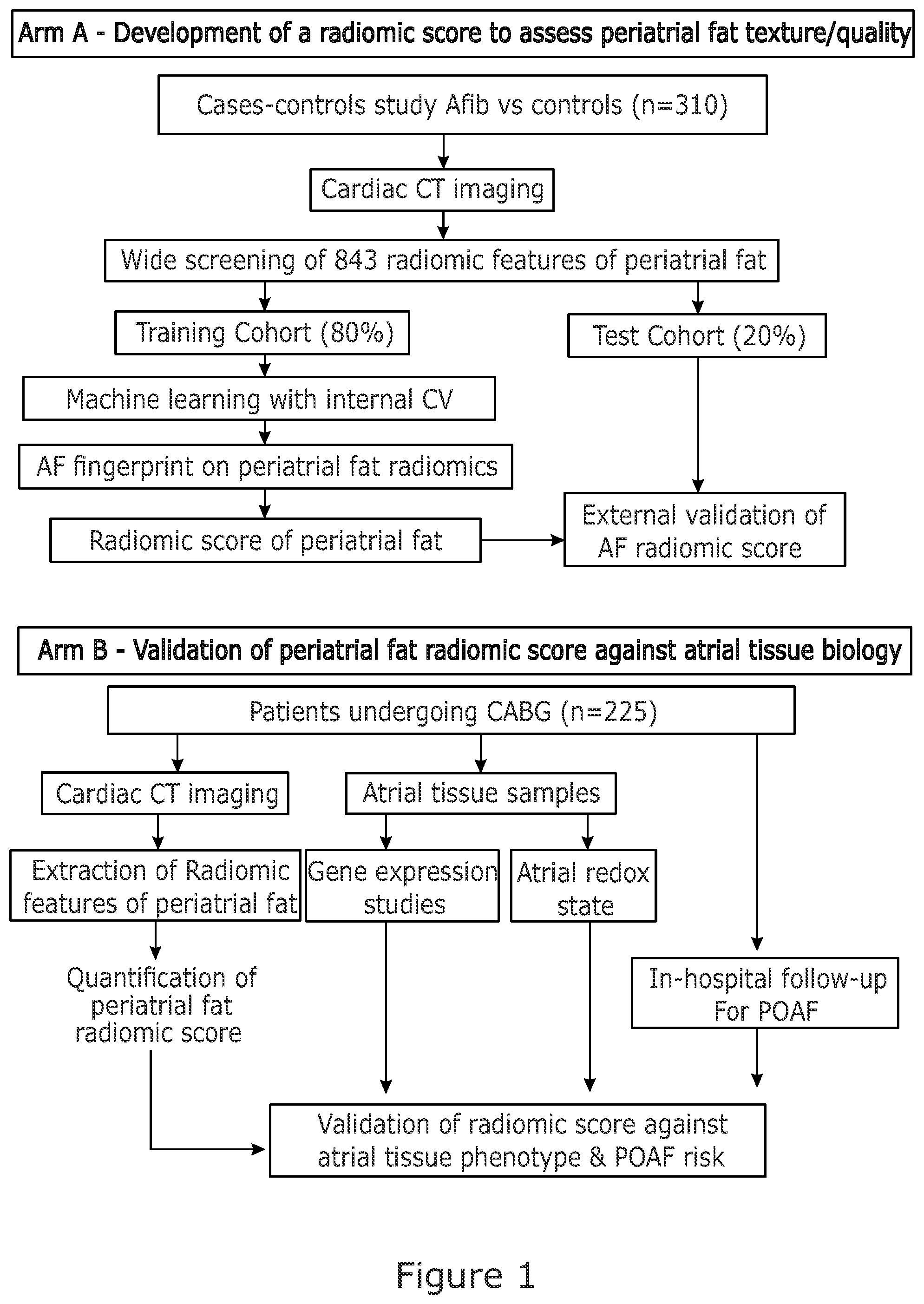
The dataset may be divided into a training cohort dataset and a test cohort dataset. The step of constructing the epicardial radiomic signature may comprise deriving the signature using the training cohort dataset and validating the signature using the test cohort dataset.
The step of constructing the epicardial radiomic signature may comprise refining the epicardial radiomic signature to increase the association of the epicardial radiomic signature with the cardiac condition or myocardial disease or history of stroke.
The step of constructing the epicardial radiomic signature may be performed using multi-fold cross-validation. The step of constructing the epicardial radiomic signature may be performed using recursive feature elimination, for example with a random forest algorithm.
The step of constructing the epicardial radiomic signature may be performed using a machine learning algorithm. For example, the step of constructing the epicardial radiomic signature may comprise identifying a subset of the significant epicardial radiomic features that are to be included in the signature, for example using a feature selection machine learning algorithm. The feature selection may be performed using recursive feature elimination, for example using a random forest algorithm. The step of constructing the epicardial radiomic signature may then comprise refining or optimising the epicardial radiomic signature based on the subset of epicardial radiomic features identified in the feature selection step, for example using a machine learning algorithm. For example, a second machine learning algorithm (e.g. a radiomic signature optimisation algorithm) may be used to refine or optimise the epicardial radiomic signature calculated using the subset of epicardial radiomic features, for example using multi-fold cross-validation. In other words, the second machine learning algorithm refines or optimises an epicardial radiomic signature calculated on the basis of the subset of significant epicardial radiomic features. The second machine learning algorithm may be a decision tree learning algorithm.
The epicardial radiomic signature may be calculated using a decision tree. The epicardial radiomic signature may be calculated using a regression tree.
The epicardial radiomic signature may be constructed to provide a measure of the texture of the epicardial region.
At least one of the second plurality of epicardial radiomic features, for example at least one of the at least two epicardial radiomic features, may provide a measure of the texture of the epicardial region. For example, each of the second plurality of epicardial radiomic features may provide a measure of the texture of the epicardial region (i.e. each of the at epicardial radiomic features may be texture statistics).
The cardiac condition may be associated with (e.g. at least partly caused by or correlated with) cardiac health or disease, in particular myocardial health or disease.
For example, the cardiac condition may be associated with myocardial redox state or oxidative stress. For example, the cardiac condition may be associated with myocardial inflammation. In particular, the cardiac condition may be associated with myocardial fibrosis. The epicardial radiomic signature may therefore be constructed to be associated with or indicative of cardiac health or disease, for example myocardial fibrosis.
The myocardial disease may be inflammation, oxidative stress, or fibrosis, in particular fibrosis.
The cardiac condition may be heart arrhythmia. The heart arrhythmia may be atrial fibrillation.
The method may further comprise calculating the value of the derived epicardial radiomic signature for an epicardial region of a patient or subject. For example, the method may further comprise characterising an epicardial region of a patient or subject by calculating the value of the derived epicardial radiomic signature. The value of the derived radiomic signature may be calculated based on or using medical imaging data of at least the epicardial region of the patient or subject. The value of the derived radiomic signature may be calculated using or based at least on the values of the second plurality radiomic features of the epicardial region of the patient or subject.
The method may therefore be for deriving an spicardial radiomic signature and characterising an epicardial region using the derived radiomic signature.
The method may further comprise configuring a system for calculating the value of the derived epicardial radiomic signature for a patient or subject. For example, the method may further comprise configuring a system for characterising an epicardial region of the a patient or subject by calculating the value of the derived epicardial radiomic signature for the patient or subject. The system may be configured to calculate the value of the derived epicardial radiomic signature using or based on medical imaging data of at least an epicardial region of the patient or subject. The system may be configured to calculate the value of the derived epicardial radiomic signature using or based at least on the values of the second plurality of epicardial radiomic features of the epicardial region of the patient or subject.
The method may therefore be for deriving an epicardial radiomic signature and configuring a system for characterising an epicardial region of a patient using the derived epicardial radiomic signature.
The method may further comprise loading computer-readable instructions onto a computer-readable memory. The instructions, when executed by a computer, cause the computer to calculate the value of the derived epicardial radiomic signature for a patient or subject. For example, the instructions may cause the computer to characterise an epicardial region of the a patient or subject by calculating the value of the derived epicardial radiomic signature for the patient or subject. The instructions may cause the computer to calculate the value of the derived epicardial radiomic signature using or based on medical imaging data of at least an epicardial region of the patient or subject. For example, the instructions may cause the computer to calculate the value of the derived epicardial radiomic signature using or based at least on the values of the second plurality of epicardial radiomic features of the epicardial region of the patient or subject. The instructions may be a computer program.
The system may be configured to receive the medical imaging data or values of the second plurality of radiomic features as an input. The system may be configured to output (e.g. display) the calculated value of the radiomic signature or a value based on the calculated value of the radiomic signature. The system may be configured to output an indication of the myocardial health of the patient. The system may be configured to output an indication of whether the patient has a myocardial disease. The system may be configured to output an indication of the risk of the patient developing a cardiac condition. The system may be configured to output an indication of the risk of the patient experiencing stroke. The system may be a computer system.
The method may comprise providing instructions for configuring a system for calculating the value of the derived radiomic signature for a patient or subject.
The medical imaging data may be radiographic data. The medical imaging data may be computed tomography data.
The epicardial region may comprise epicardial adipose tissue.
The epicardial radiomic signature of the invention may also be calculated on the basis of further epicardial radiomic features of the epicardial region in addition to the at least two epicardial radiomic features referred to above. For example, the epicardial radiomic signature may comprise other epicardial radiomic features in addition to the at least two epicardial radiomic features. Thus, it may be said that the epicardial radiomic signature is calculated on the basis of a plurality of epicardial radiomic features, and the plurality of epicardial radiomic features may comprise the at least two epicardial radiomic features.
The methods of the invention may also comprise the step of calculating the epicardial radiomic features from the medical imaging data.
According to a third aspect of the invention, there is provided a system configured to perform any of the methods described above. The system may be a computer system. The system may comprise a processor configured to perform the steps of the method. The system may comprise a memory loaded with executable instructions for performing the steps of the method.
According to a fourth aspect of the invention, there is provided use of an epicardial radiomic signature for any of the above-described purposes, for example to characterise an epicardial region, to assess cardiac health, to detect myocardial disease, to predict the risk of developing a cardiac condition, or to predict or categories the risk of experiencing stroke. The epicardial radiomic signature may be calculated on the basis of measured values of a plurality of epicardial radiomic features of the epicardial region.
The epicardial region may be or may comprise epicardial tissue, for example epicardial adipose tissue, in particular periatrial epicardial adipose tissue. The epicardial region may also comprise water, and/or other soft tissue structures within the epicardial region. For example, the epicardial region may comprise connective tissue.
BRIEF DESCRIPTION OF THE FIGURES
The invention will now be described with reference to the appended figures, in which:
illustrates, using flow charts, the methods used to derive and validate an epicardial radiomic signature. Afib/AF: atrial fibrillation; CV: cross validation; CABG: coronary artery bypass grafting; POAF: postoperative atrial fibrillation.
illustrates various aspects of the principal component analysis of periatrial adipose tissue radiomic features. ( a ) shows a scree plot of the percentage of variation explained by the 86 first principal components, accounting for 99.5% of variation in Study Arm A (843 radiomic features from 310 patients). ( b ) shows a component plot of the three major principal components. ( c ) shows principal components of periatrial adipose tissue radiomics identified as independent predictors of atrial fibrillation in logistic regression with backward elimination. ( d ) shows a correlation plot for the inter-correlations between the 843 quantified radiomic features of periatrial adipose tissue in the same patients. ( e ) shows a Manhattan plot for the classification value of periatrial adipose tissue radiomic features for atrial fibrillation in the nested case-control cohort of Arm A.
illustrates the unsupervised hierarchical clustering of selected radiomic features and a radiomics correlation heat map. ( a ) illustrates the unsupervised hierarchical clustering of the patients (individuals) of Arm A using the 33 filtered radiomic features that are significantly associated with atrial fibrillation. Distinct radiomic features are represented on x-axis, and the individual patients (observations) on y-axis. A row dendrogram identifies the two distinct clusters of patients. ( b ) shows a correlation heat map plotting the strength of inter-correlation between the 33 selected radiomic features and illustrates the clustering of the selected radiomic features by use of the squared euclidean distance between the selected radiomic features. The P-values are calculated from chi-square.
illustrates various aspects of the machine learning approach used for identification of the radiomic fingerprint of atrial fibrillation, and therefore myocardial phenotype, on periatrial adipose tissue. ( a ) illustrates the recursive feature elimination for selection of the optimum number and top features to be included in the machine learning algorithms. ( b ) illustrates model training by 5-fold cross-validation repeated 3 times. ( c ) illustrates the performance of various machine learning algorithms for developing a radiomic signature for atrial fibrillation classification in the training dataset. ( d ) and ( e ) illustrate the application of the developed signature (by using 15 epicardial radiomic features of periatrial fat) for atrial fibrillation classification and relevant confusion matrix in (d) the training dataset and (e) validation (test) dataset. ROC: receiver operating characteristic; Sens: sensitivity; Spec: specificity.
illustrates the validation of the developed epicardial radiomic signature (score) against atrial biology and risk for atrial fibrillation development. ( a ) illustrates how the developed epicardial radiomic signature from Arm A was applied to the Arm B cohort to characterize periatrial adipose tissue and explore associations with atrial gene expression profiles and atrial redox state. A score (calculated value of the signature) of less than 6 was associated with a low risk of developing post-operative atrial fibrillation and a score of 6 or more was associated with a high risk of developing post-operative atrial fibrillation. ( b ) shows that a high periatrial epicardial radiomic score was associated with the gene expression profile of atrial myocardium in Arm B patients. ( c ) shows that a periatrial epicardial radiomic score of 6 or higher (right, darker shading) was associated with significantly increased atrial expression of collagen (COL1A1) than a score of less than 6 (left, lighter shading) and ( d ) shows that a periatrial epicardial radiomic score of 6 or higher (right, darker shading) was associated with significantly increased superoxide (O2-) generation than a score of less than 6 (left, lighter shading). ( e ) shows that in the same patients there was a significant association between periatrial adipose tissue epicardial radiomic score (right, darker shading=6 or higher; left, lighter shading=below 6) and the incidence of postoperative atrial fibrillation (POAF). ( f ) shows a density plot for the correlation between the periatrial epicardial radiomic score and post-operative atrial fibrillation (POAF) probability. ( g ) shows relevant Kaplan-Meier curves for the incidence of POAF by periatrial epicardial radiomic score subgroups.
illustrates the development of the Atriomic Stroke Algorithm. ( a ) shows a coronary computed tomography angiography image captured at the level just inferior to the aortic valve. This slice demonstrates manual segmentation of the left atrium (LA) and three segmentations of peri-left atrium (LA) tissue (masking of all voxels with attenuation −190 HU to +150 HU) and anatomical annotations (letters A-D). These three peri-LA tissue depots (A, B, C) are the segmented volumes from which radiomic features are subsequently extracted. The LA segment (D) is utilised for deep-learning automation of the segmentation process. A: intra atrial septum ROI; B: anterior LA wall ROI; C: Left atrial appendage ROI; D: LA ROI; E (encircling outline): pericardium. ROI: Region of Interest. ( b ) illustrates screen captures of two patients demonstrating the cardiac anatomy as visible on a CTA scan (top row), then (second row) ground truth as fed into the deep-learning model, which is a manual segmentation of the LA, left atrial appendage region, anterior LA wall region and the intra-atrial septum region, each differently shaded. The predicted images (bottom row) represent the learnt segmentation as an output of the deep-learning model. To compute this model, a 3D convolutional neural network with 11-layers of depth and double-pathway to incorporate multiple scaling was employed to voxel-wise segment the regions of interest in the scan. CTA: Computed tomography angiography. ( c ) shows a plot representing the excellent concordance between manual left atrium segmentation (ground truth) and the automatically segmented left atrium (deep-learning). Number of segmentations performed is 286. CCC: concordance correlation coefficient. ( d ) illustrates the utilisation of machine learning for identification of the radiomic fingerprint (signature) of stroke on peri-LA tissues—recursive feature elimination for selection of the best number and top features to be included in the machine learning algorithms revealed that out of the 843 radiomic features, a set of 16 features maximized Atriomic algorithm accuracy for predicting stroke. At right, machine learning schematic demonstrating model training by 5 fold cross-validation (CV) repeated 3 times. ( e ) demonstrates the incremental prognostic value of the Atriomic Algorithm beyond CHA 2 DS 2 -VASc risk prediction for stroke. Presented are the ROC curves and AUC of two nested models for discrimination of stroke in the CRISP-CT cohort. Line A represents the Atriomic Algorithm, the radiomic signature to predict stroke within the CRISP-CT cohort. Line B represents the CHA 2 DS 2 -VASc score for the prediction for the stroke risk. The Atriomic algorithm curve is the best performing model from 12 experimental models and incorporated the radiomic signature from two merged peri-left atrium segmentations. The final segment utilised in this model includes the adipose tissue and connective tissues of the intra-atrial septum and the anterior wall of the left atrium. The attenuation mask applied was −190 to +150. AUC=area under the curve. ( f ) illustrates the relationship between the Atriomic Stroke Algorithm and atrial biology in 86 patients undergoing cardiac surgery recruited in the OX-HVF cohort. High risk Atriomic Stroke profile was associated with a pathological gene expression profile within atrial myocardium tissue samples, shown here for fibrosis related collagen (COL1A1) and pro-inflammatory gene tumor necrosis factor alpha (TNFa). Box-plots demonstrate that individuals identified as high risk for stroke based on the Atriomic Stroke Algorithm in CRISP-CT, had higher expression of inflammatory and pro-fibrotic genes in atrial appendage tissue collected during surgery.
DETAILED DESCRIPTION
The inventors have discovered that an epicardial radiomic signature (otherwise known as a “score” or “index”) calculated on the basis of two or more (i.e. a plurality of) different radiomic features of the ECR (i.e. epicardial radiomic features) can be used to indirectly evaluate or assess cardiac (in particular myocardial) health and to detect myocardial disease or predict or categories the risk of stroke, specifically ischaemic stroke. For example, the radiomic signature of the invention is indicative of or associated with, and may therefore be used to indirectly and non-invasively assess, evaluate, or characterise cardiac (e.g. myocardial) health or disease, for example myocardial fibrosis, myocardial redox state (in particular oxidative stress), myocardial inflammation, and myocardial gene expression patterns. The radiomic signature of the invention may be indicative of or associated with, and may therefore be used to indirectly and non-invasively assess the risk of, future incidence of stroke. In general, as used herein, “associated” may be taken to mean “statistically associated”, for example “statistically significantly associated”. The signature of the invention may therefore be used to predict the risk of developing, or to determine whether a patient has, a heart condition such as heart arrhythmia (for example atrial fibrillation), ischaemic heart disease, heart failure, and/or cardiomyopathy, which are commonly associated with myocardial disease, in particular myocardial fibrosis. The signature of the invention may be used to predict the risk of a patient experiencing or suffering a stroke, or to identify those at risk of stroke, for example at a high risk of suffering a stroke. In particular, the signature may be used to determine whether a patient has a myocardial disease, or a heart condition associated with myocardial disease. The signature may therefore be used in risk stratification for development of heart disease.
The radiomic signature of the invention is therefore preferably calculated on the basis of two or more radiomic features of an ECR and provides a tool for non-invasively characterising or phenotyping the ECR, and therefore also for indirectly phenotyping or evaluating the health of cardiac tissue such as myocardium, for example atrial myocardium.
If an individual, e.g. a patient, is identified as being at high risk of suffering a stroke based on the calculated value of the radiomic signature, treatment (e.g. medication) may be administered to the patient to reduce their risk of stroke. For example, the treatment may comprise prescribing medication to reduce the risk of stroke, such as anticoagulation or antithrombotic medication.
The invention exploits the fact that the cardiac tissue and the adjacent ECR, in particular tissues within the ECR such as adipose tissue, interact in a bidirectional manner. For example cardiac dysfunction may result in the fatty infiltration of myocardium via enhanced natriuretic peptide signaling-induced adipogenesis. Vice versa, myocardial disease or dysfunction may induce changes in the surrounding epicardial adipose tissue. In particular, the invention exploits the effect that this interaction has on the texture (e.g. the spatial non-uniformity or variability) of the ECR tissues, and the radiomic signature of the invention may therefore be constructed to provide a measure of the texture of the ECR or epicardial tissue.
The epicardial radiomic signature of the invention may be used on its own to characterise the ECR or to provide diagnostic or prognostic information, or it may be combined with existing models, such as those including demographics and conventional risk factors.
The epicardial region (ECR) refers to a region or volume adjacent to (and outside of) the heart, for example adjacent to the myocardium. The ECR may be a region or volume of epicardial tissue (ECT) or may comprise or consist of ECT. Epicardial tissue is tissue located adjacent to the heart (i.e. the myocardium) and is located within (i.e. enclosed by) the pericardium. Tissue is a complex biological structure, and may comprise cells (e.g. adipocytes, neurons, etc.) and extracellular structures and materials (such as water) which may occupy the intercellular spaces. In particular, the ECR may be a region of epicardial adipose tissue (EAT) or may comprise or consist of EAT. The ECR may therefore alternatively be referred to as a region or volume of EAT. The epicardial region may be a periatrial region (i.e. adjacent to an atrium of the heart). In particular, the epicardial region may be a region of periatrial adipose tissue, or may comprise or consist of periatrial adipose tissue, such as periatrial epicardial adipose tissue. In the case of embodiments relating to stroke, the ECR preferably comprises or consists of one or more peri-atrial regions, preferably one or more peri-left atrial regions. In particular, the ECR preferably comprises or consists of the epicardial regions adjacent to the intra-atrial septum (i.e. the intra-atrial septum epicardial region) and/or the region immediately anterior to the left or right atrium (i.e. the anterior left atrium epicardial region). Where epicardial regions are referred to herein with reference to an anatomical region of the heart itself (e.g. intra-atrial septum), it should be understood that this refers to the epicardial region adjacent to said anatomical region of the heart, for example the epicardial region in which epicardial adipose is found. Also, where the left atrium is referred to, it should be understood that this could equally refer to the right atrium. This is because radiomic features characterising these regions have been found to maximise the association of the signature with stroke risk. Moreover, the ECR may comprise, in addition to adipose tissue, connective tissue, particularly in the embodiments relating to stroke. Where used herein, the term epicardial region may be used interchangeably with region of interest, wherein the region of interest comprises or consists of an epicardial region.
The invention exploits a radiomic approach. Radiomics is a field of imaging in which a large amount of quantitative information is extracted from imaging data using data-characterization algorithms. The resulting features, referred to as radiomic features, range from simple volumetric, shape-related or first order statistics (such as mean or median attenuation), to second and higher order statistics that describe the texture of a segmented volume or region and the spatial relationship of voxels with similar or different attenuation values. Such features can identify imaging patterns of significant clinical value that cannot be recognized by the naked eye and have the potential to maximize the diagnostic yield of non-invasive ECR phenotyping.
The signature of the invention is derived and calculated on the basis of radiomic features, for example those extracted from medical imaging data. In particular, the medical imaging data from which the radiomic features are extracted may correspond to at least an epicardial region (ECR), for example periatrial epicardial adipose tissue, and optionally also to the heart and/or other tissue adjacent or surrounding the ECR. As used herein, the terms “epicardial radiomic signature” or “ECR radiomic signature” refer to a radiomic signature calculated on the basis of at least two epicardial radiomic features, where epicardial radiomic features are radiomic features that are calculated from medical imaging data of at least an epicardial region. The medical imaging data typically comprise radiodensity (or attenuation) values, usually expressed in Hounsfield Units (HU), for a plurality of voxels of the relevant region, in this case the ECR, and optionally also the adjacent tissues.
The medical imaging data are preferably computed tomography (CT) data, but other forms of medical imaging data (e.g. radiography data) that provide attenuation (or radiodensity) data for voxels of the imaged region may be used instead, such as three-dimensional computed laminography data. Typically, the medical imaging data used in the invention are three-dimensional imaging data. Throughout the following, where CT or another medical imaging technique is referred to, it should be understood that other suitable medical imaging techniques could alternatively be used.
The ECR may include only voxels having a radiodensity (or attenuation) falling within a given or predetermined range and/or located within a delineated region. For example, the ECR may be identified by a person such as an operator, for example by manual contouring or delineation. The operator may identify the ECR through an inspection of the imaging data, for example the CT image. The ECR may therefore include only voxels located within the delineated region. Alternatively, the ECR may be include only voxels located within a given or predetermined distance from the outer surface of the heart, for example the outer surface of the heart muscle (myocardium).
The given distance may be a set or fixed value, such as about 5 mm. The ECR may be located between the left and right pulmonary veins. Alternatively or in addition to identifying the spatial extent of the ECR, the ECR may be identified by applying a radiodensity (or attenuation) mask to the data and identifying the PCT as including only those voxels having a radiodensity falling within a given or predetermined range. For example, the ECR may include only those voxels having a radiodensity in the Hounsfield Unit range of about −190 HU to about +30 HU. In particular, the ECR may be defined as including only voxels having a radiodensity in the Hounsfield Unit range of about −190 HU to about −30 HU. This range of attenuation values generally corresponds to the radiodensity of adipose tissue. However, other ranges could be used or included, for example about −30 to about +30 Hounsfield Units, which generally corresponds to the radiodensity of water. In particular, where the signature is predictive of stroke, the range may be broader and may encompass other epicardial tissues in addition to adipose, such as epicardial connective tissue. Thus, the range may include voxels having a radiodensity above −30 HU. In other words, the ECR may comprise voxels having a radiodensity above (and below) −30 HU. For example, the range may be from about −190 HU to about +150 HU. For example, the range may encompass at least the range of about −190 HU to about +150 HU.
Preferably, the ECR is identified using an automated algorithm. The algorithm may have been trained using machine learning, in particular deep learning, to identify the ECR. For example, the algorithm may have been trained using medical imaging data in which the ECR has been manually identified and segmented. Using an automated segmentation algorithm has the advantage that the entire process may be automated and performed by a computer. The automated ECR region identification or segmentation algorithm may identify sub-regions of the ECR and may combine said sub-regions to identify the ECR of interest. For example, the ECR may identify the inra-atrial septum (epicardial) region and the anterior left (or right) atrial (epicardial) region and may merge these two regions to identify the ECR, or region of interest.
The ECR may be segmented prior to calculating the radiomic features and the radiomic features calculated from the segmented data. The segmented volume or region corresponds to the ECR, and segmentation may remove data corresponding to voxels that are outside of the ECR. Segmentation may therefore be achieved by identifying the ECR, as described above, and then removing any voxels from the data that are identified as not being part of the ECR, for example those voxels corresponding to surrounding or adjacent tissue voxels. The segmented ECR may then be extracted and used to calculate the radiomic features. For example, the segmentation may be performed by an automated algorithm, as described above.
Calculation of the radiomic features from the medical imaging data may be performed using a computer program, or software. Various commercially available software packages exist for this purpose, such as 3D Slicer (available at http://www.slicer.org; see Fedorov, A. et al. 3D Slicer as an image computing platform for the Quantitative Imaging Network. Magn Reson Imaging 30, 1323-1341, doi:10.1016/j.mri.2012.05.001 (2012)). The radiomic features may be shape-related statistics, first-order statistics, or texture statistics (e.g. second and higher order statistics). Shape-related and first-order radiomic features may be calculated using the raw radiodensity (HU) values of the ECR voxels. For calculation of texture features (e.g. Gray Level Co-occurrence Matrix [GLCM], Gray Level Dependence Matrix [GLDM], Gray Level Run-Length Matrix [GLRLM], Gray Level Size Zone Matrix [GLSZM], and Neighbouring Gray Tone Difference Matrix [NGTDM], see Tables R1-R7), ECR voxel radiodensity or attenuation values are preferably discretized into a plurality of bins, preferably into 16 bins, preferably of equal width (e.g. width of ten HU), to reduce noise while allowing a sufficient resolution to detect biologically significant spatial changes in ECR attenuation. Discretization into 16 bins is recommended as the optimal approach to increase the signal-to-noise ratio of images for radiomic analysis. However, discretization into more or fewer than 16 bins is also possible. To enforce symmetrical, rotationally-invariant results, some or all of the radiomic features, in particular the texture statistics (GLCM etc), may be calculated in all (orthogonal) directions and then averaged (e.g. using the mean or other average of the individually calculated values of the feature in each of the directions).
Some or all of the radiomic features, in particular those relating to first order and texture-based statistics, may also be calculated for three-dimensional wavelet transformations of the original image data resulting in a number of additional sets of radiomic features, for example as described by Guo et al. (Guo X, Liu X, Wang H, et al. Enhanced CT images by the wavelet transform improving diagnostic accuracy of chest nodules. J Digit Imaging 2011; 24(1): 44-9). Wavelet transformation decomposes the data into high and low frequency components. At high frequency (shorter time intervals), the resulting wavelets can capture discontinuities, ruptures and singularities in the original data. At low frequency (longer time intervals), the wavelets characterize the coarse structure of the data to identify the long-term trends. Thus, the wavelet analysis allows extraction of hidden and significant temporal features of the original data, while improving the signal-to-noise ratio of imaging studies. The data may be decomposed by a discrete wavelet transform into a plurality (e.g. eight) wavelet decompositions by passing the data through a multi-level (e.g. three level) filter bank. At each level, the data are decomposed into high- and low-frequency components by high- and low-pass filters, respectively. Thus, if a three level filter bank is used, eight wavelet decompositions result, corresponding to HHH, HHL, HLH, HLL, LHH, LHL, LLH and LLL, where H refers to “high-pass”, and L refers to “low-pass”. Of course, more or fewer than eight levels could alternatively be used to decompose the data. Such decompositions may be performed using widely available software, such as the such as the Slicer Radiomics software package which incorporates the Pyradiomics library. Optionally, the radiomic features may all be calculated on the basis of the original (raw) data, i.e. with no wavelet transformation applied. Thus, where lists, groups or clusters of radiomic features are disclosed herein, it should be understood that these could be reduced to exclude those radiomic features that are calculated on the basis of wavelet transformations. Where a radiomic feature is calculated on the basis of a wavelet decomposition or transformation of the data this is denoted by a suffix indicating which wavelet decomposition the radiomic feature has been calculated on the basis of (e.g. HHH for high-pass, high-pass, high-pass). So, for example, “Skewness LLL” denotes the radiomic feature “Skewness” as calculated on the basis of the LLL wavelet decomposition. Where no suffix is present, the radiomic feature is calculated on the basis of the original (or raw) data.
Deriving a Radiomic Signature
The invention provides a method for deriving a radiomic signature for characterising an ECR (for example a region of periatrial epicardial adipose tissue), for example for predicting the risk or identifying those at risk of stroke, for predicting the risk of developing a heart condition such as heart arrhythmia or for diagnosing or detecting myocardial disease. The radiomic signature is indicative of the underlying myocardial health of the myocardium adjacent to the ECR, and in particular of myocardial disease such as fibrosis or oxidative stress, which are known to cause a variety of heart conditions, such as arrhythmia. The presence of a cardiac condition known to be associated with myocardial disease, such as fibrosis and/or oxidative stress, may therefore be used as a surrogate marker of myocardial health or disease and used to derive the radiomic signature of the invention. The radiomic signature may therefore be derived using medical imaging data for a plurality of individuals or patients (a cohort of individuals), the plurality of individuals comprising a first group of individuals having, or with a history of, a cardiac (i.e. heart) condition known to be associated with myocardial disease, for example atrial fibrillation, and a second group of individuals without the heart condition, for example in sinus rhythm, and preferably with no history of the cardiac condition. Similarly, a known history of stroke may be used instead of the presence of a cardiac condition, particularly where the aim is to derive a signature that is associated with or predictive of the risk of stroke. Alternatively, the presence of a myocardial disease such as fibrosis may be used directly to construct the signature of the invention. Therefore, the patients may instead be divided into two groups either having or not having myocardial disease. However, it is generally not possible to detect myocardial disease non-invasively, whereas cardiac conditions such as arrhythmias can be detected or diagnosed by non-invasive means (e.g. ECG). It is therefore preferred to use a cardiac condition associated with myocardial disease rather than the myocardial disease itself to construct the signature.
As used herein, the term cardiac (or heart) condition is used to mean an abnormal functioning of the heart, for example an arrhythmia or heart failure. A heart condition is therefore generally observable using non-invasive means because it is observable through the dysfunction of the heart. Myocardial disease or health, on the other hand, refers to the underlying biology or phenotype of the myocardium itself, for example the composition or structure of the myocardium, and invasive means such as biopsies are usually required to determine whether they are present.
Fibrosis may be defined as the excess deposition of extracellular matrix in the myocardium (cardiac muscle) resulting from the activation and/or proliferation of cardiac fibroblasts. Myocardial redox state refers to the balance of pro-oxidant and anti-oxidant molecules in a tissue, and depends on the generation of reactive oxygen species and their elimination from antioxidant defence systems. Myocardial inflammation is the inflammation of the myocardium and may be defined as the expression of pro-inflammatory mediators.
The method typically involves performing a case-control study of (human) patients with versus without the cardiac condition or myocardial disease. The individuals having (or with a history of) the cardiac condition or myocardial disease are the cases (first group) and the individuals without the cardiac condition or myocardial disease are the controls (second group). Alternatively, the first group (cases) may consist of individuals with a history of stroke and the second group (controls) may consist of individuals having no history of stroke. Therefore, wherever a cardiac condition or myocardial disease is mentioned below, it should be understood that this could instead be a history of stroke. Similarly, where where prediction of developing a cardiac condition, myocardial disease (or similar) is mentioned, it should be understood that this could instead be the prediction of suffering or experiencing a stroke, specifically subsequent to the recording of the imaging data. Thus, instead of the signature being indicative of or predictive of developing a cardiac condition, it could instead be indicative of or predictive of suffering a stroke. Case-control matching, for example 1:1 matching, is preferably performed to match cases with controls, for example using an automated algorithm. The case-control matching may be performed so that each case in the first group is matched with a corresponding control in the second group. The cases and controls may be matched for clinical demographics (such as age, sex, obesity status, cardiovascular risk factors), cohort and/or technical parameters related to imaging data acquisition (e.g. tube voltage and CT scanner used).
A stepwise approach may then be followed to develop a radiomic signature. First, a plurality of radiomic features are calculated from the medical imaging data for each of the plurality of individuals, for example as described above. The radiomic features may comprise a selection or all of the radiomic features as defined in Tables R1-R7, and each of the radiomic features may be calculated based on the raw image data and/or on one or more wavelet transformations of the image data (or wavelet decompositions), as described above. Preferably, each of the radiomic features is calculated for the raw image data and for the aforementioned eight three-dimensional wavelet decompositions of the image data. Thus, a radiomic dataset comprising the measured or calculated values of a plurality of radiomic features for each of the individuals is obtained.
In the case of developing signatures associated with or predictive of stroke, the method may comprise identifying and optionally segmenting a plurality of epicardial regions. In other words, the ECR may comprise or consist of a plurality of sub-regions, and the method may comprise segmenting the ECR itself and one or more sub-regions of the ECR and extracting radiomic features for the ECR and the one or more sub-regions. The plurality of radiomic features may therefore comprise of radiomic features of the ECR and of the one or more sub-regions of the ECR.
For example, the method may comprise segmenting an ECR comprising one or more (e.g. all) of the following sub-regions: 1) the intra-atrial septum (epicardial) region, 2) the anterior left (or right) atrial (epicardial) region (the region adjacent the anterior surface of the left atrium), and 3) the left (or right) atrial appendage (epicardial) region. The sub-regions may also comprise regions that result from merging the original sub-regions. For example, the sub-regions may also comprise merged sub-regions comprising or consisting of adjacent sub-regions, specifically sub-regions 1+2 and/or 2+3. The method may then comprise calculating the features of the ECR and each of the ECR sub-regions. Preferably, the ECR comprises or consists of sub-regions 1+2+3, and the sub-regions are sub-regions 1, 2, 3, 1+2 and 2+3.
The radiomic features may also be calculated for both a narrower HU range corresponding to adipose tissue (e.g. about −190 HU to about −30 HU) and a broader HU range corresponding to other epicardial tissues in addition to adipose (e.g. about −190 HU to about +150 HU). This is useful because it increases the physiological information encapsulated in the radiomic features and therefore improves the pool of information from which the signature may be constructed. For example, different tissue types may provide different markers of cardiac health. This is particularly the case for the prediction of stroke.
Radiomic features that are found to be not significantly associated (e.g. correlated) with the cardiac condition or myocardial disease above a significance threshold based on an analysis of the data may then be removed from the plurality of radiomic features. The association of each radiomic feature with the cardiac condition or myocardial disease may be calculated on the basis of a receiver operating characteristic curve (ROC) analysis, in particular an area under the curve (AUC) calculation, based on the data for the plurality of individuals. The significance threshold is preferably about α=0.05 or lower, for example a may be in the range of from 0.001 to 0.05. The significance threshold is preferably about α=0.05. However, the significance threshold may be about α=0.04. Alternatively, the significance threshold may be about α=0.03. Alternatively, the significance threshold may be about α=0.02. Alternatively, the significance threshold may be about α=0.01. Alternatively, the significance threshold may be about α=0.005. Alternatively, the significance threshold may be about α=0.002. The end result should be that any radiomic features that are not significantly associated with the presence of the cardiac condition or myocardial disease (as determined or calculated from the data, for example based on an analysis of the data) are removed from the plurality of radiomic features. In other words, the method comprises selecting those features that are significantly associated or correlated with the cardiac condition or myocardial disease. This has the advantage that the number of radiomic features to be further processed to construct the signature is much reduced, thus reducing the complexity of the subsequent signature construction and reducing the computational burden of doing so. The reason for selecting the significant radiomic features is that these are, to a first approximation, most likely to combine to provide a radiomic signature that is associated with cardiac health because they have already been shown to be independently associated with cardial health.
When determining whether a feature is statistically significantly associated with the cardiac condition or myocardial disease, a statistical adjustment may be applied to correct for multiple comparisons and to decrease the false discovery rate (FDR). For example, the Benjamini-Hochberg correction may be applied, for example using a false discovery rate of about 0.10. Alternatively, a Bonferroni correction may be applied to the significance threshold. The Bonferroni correction may be applied based on the number of principal components which account for a given amount of variability in the study sample based on a principal component analysis. For example, the given amount may be about 99.5%. In other words the m value used to correct the a value (by dividing a by m, i.e. a/m) is the number of principal components that account for the given amount of variability. For this reason, a principal component analysis of the radiomic features may be performed on the data for the plurality of individuals.
The remaining, or “significant”, radiomic features (i.e. those that are found to be statistically significantly associated with the cardiac condition or myocardial disease) may then grouped or “clustered” into a plurality of clusters of similar, or correlated, features. The degree of correlation between features is a measure of the extent to which two radiomic features tend to vary with one another between different individuals. The pairwise correlations may be calculated using Spearman's rho coefficient or other measures of correlation, such as Pearson's correlation coefficient. The clustering may be performed, for example, using a hierarchical clustering method (such as a hierarchical clustering algorithm) to sort the significant radiomic features into the plurality of clusters. The hierarchical clustering may be performed unsupervised, i.e. independently of the strength of the correlations of the radiomic features with the cardiac condition or myocardial disease. In other words, the clustering may be performed on the strength of the correlations of the features with one another so that radiomic features are clustered together with those that they are most correlated with. Specifically, the intra-cluster correlations may be stronger than the inter-cluster correlations, i.e. the correlations between features within a cluster are stronger than those between features in different clusters. The final identification of the clusters may be performed by inspection of the correlation data by a person, e.g. an operator. For example, the operator may inspect a dendrogram representative of the hierarchical clustering of the radiomic features and/or a two-dimensional correlation plot (or heatmap) which plots the correlations of each of the radiomic features with each other radiomic features (and itself) and may identify the clusters based on this inspection of the radiomic feature inter-correlation data. In the correlation heatmap the radiomic features may be arranged along the x- and y-axes of the correlation plot in the order determined from the hierarchical clustering (i.e. with the features being located adjacent to the features with which they are most closely associated or correlated). This visual inspection may be used together with the hierarchical clustering to identify the appropriate clusters of radiomic features. Alternatively, the clusters may be identified through the hierarchical clustering or visual inspection alone.
The radiomic signature may be constructed based on at least two (or all) of the significant plurality of features (i.e. the features found to be significantly associated with the cardiac condition or myocardial disease), the at least two radiomic features being different to one another. Preferably, the radiomic signature is constructed based on at least two of the significant plurality of features, wherein the at least two radiomic features are selected from different clusters. For example, the radiomic signature may be constructed based on at least one radiomic feature selected from each cluster. Other radiomic features may also be included in the initial signature to be optimised, for example two or more radiomic features from any or all of the clusters may be included in the initial signature. However, in order to provide a signature more strongly associated with the cardiac condition or myocardial disease, and therefore of enhanced diagnostic and prognostic usefulness, it is preferable to include at least two radiomic features, each from a different cluster. This is because features from different clusters provide complementary phenotypic information relating to the ECR. In particular, radiomic features from different clusters are likely to be sensitive to different phenotypic characteristics of the ECR because they have been found not to vary in a similar manner to one another, which demonstrates that they are sensitive to different phenotypic characteristics of the ECR. The radiomic signature should therefore preferably be calculated on the basis of (the measured values of) at least two radiomic features, each selected from a different cluster. For example, the radiomic signature may comprise at least three radiomic features, each selected from a different cluster. Alternatively, the initial radiomic signature may comprise at least four radiomic features, each selected from a different cluster. Alternatively, the initial radiomic signature may comprise at least five radiomic features, each selected from a different cluster. Alternatively, the initial radiomic signature may comprise at least six radiomic features, each selected from a different cluster. Preferably, the initial radiomic signature may comprise one radiomic feature from each cluster.
The construction of the radiomic signature may involve refining or optimising the radiomic signature, in particular using data for a subset of the cohort known as the “training” cohort. This involves refining or optimising the signature to improve the correlation or association of the signature with the heart condition based on the data.
The signature may comprise (i.e. the value of the signature may be calculated using) a decision tree, with the input variables being or comprising the radiomic features of the signature. The target variable or outcome may be calculated by the decision tree based on the input variables. In particular, because the radiomic features are continuous variables, the decision tree may be a regression tree. The decision tree algorithm uses branched options at each tree node, and this process repeated at multiple levels results in the final branch or tree leaves. Each observation (i.e. set of radiomic feature values input into the decision tree) is thus assigned to a final leaf and this gives a relevant classification probability for the presence of the disease or condition (similar logistic regression probability). Formulating the radiomic signature as a decision tree was found to give the best sensitivity for the assessment of cardiac health. In particular, a decision tree was found to provide the best accuracy for discriminating patients with, versus those without the cardiac condition or myocardial disease.
Alternatively, the signature may comprise a weighted sum of the values of each of the radiomic features included in the signature, and the weighing of each of the radiomic features may be progressively optimised or refined. The coefficients by which each of the radiomic features is multiplied are generally referred to as beta (β) coefficients, and it is these beta coefficients that may be optimised or refined.
The signature may be constructed or derived using one or more machine learning algorithms. For example, the contributions of the radiomic features to the signature may be refined using a machine learning algorithm to increase or maximise the association of the signature with the cardiac condition or myocardial disease. For example, a plurality (preferably all) of the significant radiomic features (i.e. those that are significantly associated with the cardiac condition or myocardial disease) may be input into a first machine learning algorithm. The first machine learning algorithm may be used to identify the optimum number of and identity of the significant radiomic features that are to be included in the signature, in particular to maximize its accuracy for discriminating for the cardiac condition or myocardial disease. In other words, the construction of the radiomic signature may comprise a feature selection step in which the radiomic features to be included in the signature are selected. In the feature selection step a feature selection algorithm (e.g. a machine learning algorithm) may select a subset of the radiomic features to be included in the final signature, in particular that are predicted to maximise the association of the final signature with the cardiac condition or myocardial disease. This has the advantage of reducing the complexity optimising the final signature because it reduces the number of radiomic features that need to be considered. The first machine learning algorithm that performs this feature selection step may use recursive feature elimination, for example with a random forest algorithm. However, other algorithms could alternatively be used. The first machine learning algorithm may be constrained to require the resulting signature to comprise at least two radiomic features selected from different clusters. For example, the machine learning algorithm may be constrained to require the resulting signature to comprise at least one radiomic feature selected from each of the clusters.
Once the number and identity of the radiomic features to be included in the signature are identified, a second machine learning algorithm may be used to optimise the contributions of each of the features identified by the first machine learning algorithm to the signature. In other words, the construction of the radiomic signature may comprise the step of refining or optimising the radiomic signature to increase of maximise its association with the cardiac condition or myocardial disease using a second machine learning algorithm. The second machine learning algorithm may be a decision tree learning algorithm (for example if the radiomic signature comprises or is a decision tree), and is preferably a gradient boosting algorithm, in particular an extreme gradient boosting algorithm. Gradient boosting algorithms are well-known decision tree learning algorithms for classification/regression. The initial cohort (or plurality of individuals) may be split, for example using a random seed, into a training and a test cohort. The training cohort may consist of about 80% of the individuals from the initial cohort and the test cohort may consist of about 20% of the individuals from the initial cohort. The signature may be derived or refined using the data for the training cohort and validated using data for the test cohort. For example, the signature may be constructed using internal cross-validation. The internal cross validation may be multi-fold, for example 5-fold.
Alternatively, the signature may be constructed from the significant radiomic features using a single machine learning algorithm, rather than in the two-step process described above. For example, a single machine learning algorithm, such as a decision tree learning algorithm with inherent feature selection, could be used to identify the features to be included in the final signature and to refine or optimise the signature. For example, the number of radiomic features to be included in the final signature may be preselected or predetermined and input as a parameter into the machine learning algorithm, or may be left open and selected by the machine learning algorithm itself, which also refines and optimises the radiomic signature. In other words, the machine learning algorithm may include a feature selection function.
Although the method described above results in the radiomic signature being constructed from only radiomic features that are found to be significantly associated with the cardiac condition or myocardial disease (i.e. the “significant” features), it is not necessary for the radiomic signature to include only significant radiomic features. Therefore, the construction of the radiomic signature discussed above need not be performed using only significant radiomic features and may be performed without first selecting only the significant radiomic features so that non-significant features are also included in the construction of the signature. Alternatively, any or all of the significant radiomic features from which the signature is constructed may be substituted with a radiomic feature that is highly correlated, or collinear, with that significant feature, i.e. a collinear equivalent. A signature in which one or more of the significant features is replaced a feature that is collinear with that feature will generally perform similarly to a signature calculated on the basis of only the significant features because, by definition, collinear features behave very similarly to one another. In fact, it is possible that replacing one or more (or even all) of the significant features with alternative features that are collinear with the replaced significant features could result in a signature having an enhanced prognostic value, and this has in fact been found to be the case in some instances. This is because although the original features are generally the most independently associated with the clinical endpoint, they are not necessarily the best-performing features when combined into a signature.
Thus, the method of deriving the signature may comprise replacing one or all of the significant radiomic features with radiomic features that are found to be collinear with the replaced significant features. In particular, once the significant features that maximise the signature's association with the cardiac condition or myocardial disease have been identified, any or all of those significant features may be replaced by a feature that is collinear with the replaced significant feature. The radiomic signature may therefore include (i.e. be calculated on the basis of) at least two of the significant radiomic features or their collinear equivalents. For example, the radiomic signature may comprise one or more significant radiomic feature and one or more collinear equivalents of other significant radiomic features. Preferably, the at least two significant radiomic features are selected from different clusters (or the substitute features correspond to significant radiomic features belonging to different clusters). Preferably, the radiomic signature comprises at least two of the significant radiomic features (or their collinear equivalents) that are found to maximise the signature's accuracy for predicting the cardiac condition or myocardial disease.
The method of deriving the signature may therefore comprise evaluating pairwise correlations between the radiomic features and identifying groups of radiomic features that are correlated or collinear with the significant radiomic features. The correlations between the radiomic features are calculated using the measured values of the radiomic features for the plurality of individuals. Collinear radiomic features may be identified as those that are correlated with each other across the individuals to a degree at least equal to a given correlation threshold. The correlation threshold preferably applies to both positive and negative correlations, for example the correlation threshold may be expressed as a modulus. The pairwise correlations may be calculated using Spearman's rho coefficient and the correlation threshold may be at least about |rho|=0.75, for example about |rho|=0.75, so that all pairs of radiomic features that are correlated with each other at the level of |rho|≥0.75 are considered to be collinear with each other. Alternatively, the correlation threshold may be at least about |rho|=0.9, for example about |rho|=0.9 Alternatively, the correlation threshold may be at least about |rho|=0.9, for example about |rho|=0.9. As will be readily understood in the field, the correlation or collinearity is a measure of how closely two radiomic features vary together from one individual to the next and may be calculated on the basis of the measured radiomic feature values for the plurality of individuals.
The radiomic signature may then be constructed from at least two radiomic features selected from different groups of collinear features. In other words, the signature may be constructed from at least two different significant radiomic features or substitute radiomic features that are collinear with the two different significant radiomic features.
As mentioned above, the signature may include a weighted sum of the calculated values of a plurality of radiomic features. The signature may also include other terms, such as the addition or subtraction of a constant, or multiplication by a factor. However, typically, if the signature includes a weighted sum it will be linearly related to the weighted sum of radiomic feature values in some way.
The radiomic signature may take the form of, or include the term (for example, the signature may be calculated on the basis of a function including the term): A±Σb i rf i
where A is a constant (which can be zero or non-zero), b i is the weighting coefficient (or beta patameter) for the radiomic feature i, and rf i is the measured value of the radiomic feature i.
However, preferably the value of the radiomic signature is calculated using a decision tree. In this case, the decision tree may output a predicted probability (P) of the presence of the cardiac condition or myocardial disease based on the measured values of the radiomic features that are input into the decision tree. The final value of the signature may therefore be related to P in some way. In other words, the radiomic signature may simply be P, or it may be calculated using the value P. For example, the signature may also include other terms, such as the addition or subtraction of a constant, or multiplication by a factor or constant. However, typically the signature will be linearly related to the output of the decision tree. For example, the radiomic signature may be calculated as A×P, where A is a constant. A may, for example, be 10.
In general, in the above-described methods, bivariate associations between radiomic features may be assessed by the non-parametric Spearman's rho (ρ) coefficient.
The Radiomic Signature
The ECR radiomic signature of the invention is calculated on the basis of measured values of radiomic features obtained from medical imaging data. In particular, the ECR radiomic signature is preferably calculated on the basis of at least two radiomic features.
To improve the prognostic and diagnostic value of the signature, the signature is preferably calculated on the basis of at least two different radiomic features selected from different clusters of similar or correlated radiomic features, as described above. This reduces redundancy and improves the diversity of information included in the calculation of the signature because the features from different clusters relate to different textural aspects of the ECR.
Four clusters (A-D) have been identified using a hierarchical clustering algorithm (see the Examples). The members of the four clusters are identified in Table 1 (and b ). The radiomic signature may comprise at least two of the radiomic features from Table 1. Advantageously, the radiomic signature may be calculated on the basis of radiomic features selected from at least two of the clusters A-D identified in Table 1, the at least two radiomic features being selected from different clusters. Preferably, the radiomic signature may be calculated on the basis of at least one radiomic feature selected from each of the clusters A-D identified in Table 1.
TABLE 1
Radiomic feature clusters
Radiomic feature Cluster
Inverse Difference Moment HHH A
Minimum LHH A
Zone Variance LLL A
Low Gray Level Zone Emphasis LLL A
Maximum Probability LLL A
Elongation A
Cluster Shade LLL A
Busyness LHH A
Gray Level Non Uniformity LLL A
Skewness HHH A
Zone Entropy LLL B
Cluster Prominence LLL B
Gray Level Variance LLL (GLDM) B
Run Entropy LLL B
Least Axis C
Maximum 2D Diameter Row C
Major Axis C
Maximum 2D Diameter Column C
Maximum 2D Diameter Slice C
Maximum 3D Diameter C
Autocorrelation LLH D
Long Run High Gray Level Emphasis LLL D
Joint Average LLL D
Autocorrelation LLL D
Difference Entropy LLL D
Difference Entropy LLH D
Sum of Squares HLH D
Sum of Squares HHH D
Sum Entropy HHH D
Gray Level Variance LLH (GLDM) D
Difference Entropy LHH D
Sum Squares LHH D
Gray Level Variance LHH (GLDM) D
15 radiomic features were found to maximise the radiomic signature's association with a cardiac condition, and these are shown in Table 2. The radiomic signature may advantageously be calculated on the basis of at least two of the radiomic features from Table 2. Preferably, the radiomic signature is calculated on the basis of at least two radiomic features, each of the at least two radiomic features being selected from different clusters A-D. Further preferably, the radiomic signature may be calculated on the basis of at least one radiomic feature selected from each of the clusters A-D identified in Table 2. To maximise the radiomic signature's association with the cardiac condition the radiomic signature may be calculated on the basis of all of the 15 radiomic features listed in Table 2.
TABLE 2
Further optimised radiomic feature clusters
Radiomic feature Cluster
Inverse Difference Moment HHH A
Minimum LHH A
Low Gray Level Zone Emphasis LLL A
Maximum Probability LLL A
Busyness LHH A
Zone Entropy LLL B
Run Entropy LLL B
Maximum 3D Diameter C
Long Run High Gray Level Emphasis LLL D
Joint Average LLL D
Difference Entropy LLL D
Sum Entropy HHH D
Difference Entropy LHH D
Sum Squares LHH D
Gray Level Variance LHH (GLDM) D
As previously mentioned, the significant radiomic features of Tables 1 and 2 may be substituted with other radiomic features that are correlated, or collinear, with the replaced significant radiomic feature (i.e. collinear equivalents) to obtain a signature of similar diagnostic and prognostic usefulness. The radiomic signature may therefore be calculated on the basis of (i.e. comprise) at least two of the radiomic features selected from Table 3. Each of the groups identified in Table 3 includes one of the 15 significant radiomic features that have been found to maximise the association of the signature with the cardiac condition along with those radiomic features that have been calculated to be collinear with that significant feature to a degree of at least |rho|=0.75, where rho is Spearman's rho. Thus, the radiomic signature may be constructed as set out above, but with one or more of the significant radiomic features of Table 2 being replaced with a radiomic feature that is collinear with that feature, as set out in Table 3. For example, the radiomic signature may be calculated on the basis of at least two radiomic features, each of the at least two radiomic features being selected from different groups of Table 3. In particular, the radiomic signature may be calculated on the basis of at least two radiomic features that are selected from groups corresponding to significant features belonging to different clusters A-D. Further preferably, the radiomic signature may be calculated on the basis of at least one radiomic feature selected from each of the clusters A-D identified in Table 2 or collinear equivalents thereof. In other words, the radiomic signature may be calculated on the basis of at least one radiomic feature selected from each of the clusters A-D identified in Table 3 below.
TABLE 3
Groups of radiomic features collinear with significant features
| rho | with
significant
Radiomic features feature
Group 1 (cluster A)
Inverse Difference Moment HHH 1.000
Inverse Difference Normalized HHH 0.988
Contrast HHH (GLCM) 0.976
Range HHH 0.79
Complexity HHH 0.79
Maximum HHH 0.756
Large Dependence High Gray Level Emphasis HHH 0.752
Short Run Low Gray Level Emphasis HHH 0.744
Group 2 (cluster A)
Minimum LHH 1.000
Long Run Low Gray Level Emphasis LHH 0.96
Short Run High Gray Level Emphasis LHH 0.965
High Gray Level Emphasis LHH 0.961
High Gray Level Run Emphasis LHH 0.961
Small Area High Gray Level Emphasis LHH 0.96
High Gray Level Zone Emphasis LHH 0.958
Autocorrelation LHH 0.954
Joint Average LHH 0.952
Sum Average LHH 0.952
Short Run Low Gray Level Emphasis LHH 0.944
Long Run High Gray Level Emphasis LHH 0.944
Range LHH 0.944
Low Gray Level Emphasis LHH 0.943
Low Gray Level Run Emphasis LHH 0.943
Large Dependence Low Gray Level Emphasis LHH 0.941
Low Gray Level Zone Emphasis LHH 0.94
Small Area Low Gray Level Emphasis LHH 0.932
Small Dependence High Gray Level Emphasis LHH 0.931
Complexity LHH 0.905
Large Dependence High Gray Level Emphasis LHH 0.795
Cluster Prominence LHH 0.792
Gray Level Variance LHH (GLSZM) 0.768
Maximum LHH 0.757
Group 3 (cluster A)
Low Gray Level Zone Emphasis LLL 1.000
Short Run Low Gray Level Emphasis LLL 0.992
Low Gray Level Run Emphasis LLL 0.991
Low Gray Level Emphasis LLL 0.99
Long Run Low Gray Level Emphasis LLL 0.989
Small Area Low Gray Level Emphasis LLL 0.978
Small Dependence Low Gray Level Emphasis LLL 0.971
Large Area Low Gray Level Emphasis LLL 0.875
Large Dependence Low Gray Level Emphasis LLL 0.85
Group 4 (cluster A)
Maximum Probability LLL 1.000
Joint Energy LLL 0.938
Joint Entropy LLL 0.932
Maximum Probability 0.904
Joint Energy 0.873
Joint Entropy 0.857
Gray Level Non Uniformity Normalized 0.818
Energy LHL 0.817
Uniformity 0.816
Size Zone Non Uniformity 0.816
Sum Entropy 0.814
Gray Level Non Uniformity Normalized 0.81
Entropy 0.81
Gray Level Non Uniformity Normalized LLL 0.806
Uniformity LLL 0.805
Mean 0.803
Gray Level Non Uniformity Normalized LLL 0.802
Root Mean Squared 0.802
Interquartile Range 0.798
Sum Entropy LLL 0.797
Robust Mean Absolute Deviation 0.795
Size Zone Non Uniformity HLL 0.794
Size Zone Non Uniformity LHL 0.793
10th Percentile 0.792
Energy HHL 0.776
Median 0.775
Dependence Non Uniformity LHL 0.774
Entropy LLL 0.773
Mean Absolute Deviation 0.773
Energy LLH 0.765
Run Entropy LLL 0.763
Interquartile Range LLL 0.76
Size Zone Non Uniformity LLH 0.758
Energy HLL 0.755
Sum of Squares 0.754
Dependence Non Uniformity HLL 0.753
Robust Mean Absolute Deviation LLL 0.752
10th Percentile LLL 0.751
Energy LHH 0.751
Dependence Non Uniformity 0.75
Run Entropy 0.75
Group 5 (cluster A)
Busyness LHH 1.000
Strength LHH 0.988
Strength HHH 0.777
Busyness HHH 0.776
Busyness LHL 0.767
Large Area Low Gray Level Emphasis LHH 0.757
Group 6 (cluster B)
Zone Entropy LLL 1.000
Dependence Entropy LLL 0.986
Root Mean Squared LLL 0.876
Mean LLL 0.869
Run Entropy 0.864
Dependence Entropy 0.864
Median LLL 0.86
Median 0.838
Mean 0.826
10th Percentile LLL 0.825
Uniformity 0.824
Gray Level Non Uniformity Normalized (GLDM) 0.812
Root Mean Squared 0.811
90th Percentile 0.809
Entropy 0.795
10th Percentile 0.766
Interquartile Range LLL 0.762
Run Entropy LLL 0.76
Robust Mean Absolute Deviation LLL 0.753
Gray Level Non Uniformity Normalized LLL (GLDM) 0.751
Uniformity LLL 0.75
Group 7 (cluster B)
Run Entropy LLL 1.000
Entropy LLL 0.996
Mean Absolute Deviation LLL 0.98
Mean Absolute Deviation 0.975
Robust Mean Absolute Deviation 0.969
Robust Mean Absolute Deviation LLL 0.969
Variance 0.966
Gray Level Variance (GLDM) 0.966
Gray Level Variance LLL (GLDM) 0.965
Variance LLL 0.965
Gray Level Variance LLL (GLSZM) 0.965
Gray Level Variance (GLZM) 0.964
Interquartile Range 0.963
Interquartile Range LLL 0.962
Entropy 0.961
Gray Level Variance LLL (GLDM) 0.959
Root Mean Squared 0.952
Run Entropy 0.941
Gray Level Variance (GLDM) 0.939
Sum Entropy 0.938
Sum of Squares 0.935
Sum Entropy LLL 0.933
Sum of Squares LLL 0.929
Cluster Tendency 0.918
Cluster Tendency LLL 0.913
Joint Entropy 0.892
Root Mean Squared LLL 0.889
Contrast (GLCM) 0.873
Joint Entropy LLL 0.839
Cluster Prominence 0.823
Cluster Prominence LLL 0.819
Low Gray Level Emphasis 0.793
Short Run Low Gray Level Emphasis 0.791
Low Gray Level Run Emphasis 0.791
Long Run Low Gray Level Emphasis 0.777
Zone Entropy LLL 0.76
Low Gray Level Zone Emphasis 0.756
Uniformity LLL 0.989
Gray Level Non Uniformity Normalized LLL (GLDM) 0.989
Gray Level Non Uniformity Normalized LLL (GLSZM) 0.988
10th Percentile 0.973
10th Percentile LLL 0.942
Gray Level Non Uniformity Normalized (GLDM) 0.937
Gray Level Non Uniformity Normalized (GLSZM) 0.935
Mean 0.929
Uniformity 0.923
Joint Energy 0.89
Median 0.844
Joint Energy LLL 0.843
Maximum Probability 0.812
Mean LLL 0.805
Maximum Probability LLL 0.763
Group 8 (cluster C)
Maximum 3D Diameter 1.000
Maximum 2D Diameter Slice 0.946
Maximum 2D Diameter Column 0.889
Major Axis 0.801
Group 9 (cluster D)
Long Run High Gray Level Emphasis LLL 1.000
High Gray Level Emphasis LLL 0.996
High Gray Level Run Emphasis LLL 0.996
High Gray Level Zone Emphasis LLL 0.996
Short Run High Gray Level Emphasis LLL 0.995
Autocorrelation LLL 0.993
Joint Average LLL 0.989
Small Area High Gray Level Emphasis LLL 0.969
Small Dependence High Gray Level Emphasis LLL 0.921
Minimum LLL 0.866
Large Dependence Low Gray Level Emphasis LLL 0.824
Large Dependence High Gray Level Emphasis LLL 0.813
Large Area High Gray Level Emphasis LLL 0.808
Large Area Low Gray Level Emphasis LLL 0.787
Long Run Low Gray Level Emphasis LLL 0.775
Low Gray Level Emphasis LLL 0.765
Low Gray Level Run Emphasis LLL 0.763
Short Run Low Gray Level Emphasis LLL 0.76
Group 10 (cluster D)
Joint Average LLL 1.000
Autocorrelation LLL 0.998
Long Run High Gray Level Emphasis LLL 0.989
High Gray Level Emphasis LLL 0.985
High Gray Level Run Emphasis LLL 0.985
High Gray Level Zone Emphasis LLL 0.984
Short Run High Gray Level Emphasis LLL 0.983
Small Area High Gray Level Emphasis LLL 0.954
Small Dependence High Gray Level Emphasis LLL 0.904
Minimum LLL 0.842
Large Dependence Low Gray Level Emphasis LLL 0.834
Large Dependence High Gray Level Emphasis LLL 0.822
Large Area High Gray Level Emphasis LLL 0.816
Large Area Low Gray Level Emphasis LLL 0.797
Long Run Low Gray Level Emphasis LLL 0.796
Low Gray Level Emphasis LLL 0.787
Low Gray Level Run Emphasis LLL 0.784
Short Run Low Gray Level Emphasis LLL 0.782
Low Gray Level Zone Emphasis LLL 0.75
Group 11 (cluster D)
Difference Entropy LLL 1.000
Difference Average LLL 0.995
Contrast LLL (NGTDM) 0.986
Difference Entropy 0.977
Inverse Difference LLL 0.974
Contrast (GLCM) 0.972
Difference Variance 0.97
Inverse Difference Moment LLL 0.965
Difference Average 0.964
Inverse Variance LLL 0.962
Inverse Variance 0.956
Difference Variance LLL 0.946
Inverse Difference 0.944
Inverse Difference Moment 0.943
Inverse Difference Moment Normalized 0.932
Inverse Difference Normalized 0.925
Contrast (GNGTDM) 0.915
Joint Entropy 0.896
Sum Entropy LHL 0.884
Joint Energy LHL 0.87
Run Entropy LHL 0.869
Size Zone Non Uniformity Normalized LLL 0.869
Small Area Emphasis LLL 0.869
Short Run Emphasis 0.868
Size Zone Non Uniformity Normalized 0.868
Small Area Emphasis 0.868
Gray Level Non Uniformity Normalized LHL (GLSZM) 0.867
Joint Entropy LHL 0.867
Short Run Emphasis LLL 0.867
Small Dependence Emphasis LLL 0.867
Dependence Non Uniformity Normalized LLL 0.866
Gray Level Non Uniformity Normalized LHL (GLDM) 0.866
Small Dependence Emphasis 0.866
Entropy LHL 0.865
Long Run Emphasis LLL 0.865
Mean Absolute Deviation LHL 0.865
Robust Mean Absolute Deviation LHL 0.865
Uniformity LHL 0.865
Interquartile Range LHL 0.864
Joint Energy 0.864
Run Length Non Uniformity Normalized LLL 0.864
Run Percentage LLL 0.864
Zone Percentage LLL 0.863
Long Run Emphasis 0.862
Sum of Squares LHL 0.862
Complexity LLL 0.86
Run Length Non Uniformity Normalized 0.86
Run Percentage 0.86
Zone Percentage 0.86
Cluster Tendency LHL 0.858
Run Variance LLL 0.858
Large Dependence Emphasis LLL 0.857
Dependence Non Uniformity Normalized 0.856
Run Variance 0.854
Gray Level Variance LHL (GLDM) 0.853
Large Area Emphasis LLL 0.853
Variance LHL 0.853
Gray Level Variance LHL (GLSZM) 0.852
Large Dependence Emphasis 0.852
Large Area Emphasis 0.848
Maximum Probability LHL 0.848
Root Mean Squared LHL 0.845
Difference Entropy LHL 0.842
Gray Level Variance LHL (GLRLM) 0.839
Zone Variance LLL 0.838
Dependence Variance LLL 0.837
Inverse Difference LHL 0.837
Inverse Difference Moment LHL 0.836
Zone Variance 0.836
Large Area High Gray Level Emphasis 0.833
90th Percentile LHL 0.832
Sum Entropy LLH 0.829
Difference Average LHL 0.828
Sum of Squares 0.827
Dependence Entropy LHH 0.825
Contrast LHL (GLCM) 0.824
Joint Energy HLL 0.824
Difference Entropy HLL 0.823
Difference Variance LHL 0.823
Dependence Variance 0.819
Maximum Probability HLL 0.819
Complexity 0.817
Joint Entropy HLL 0.815
Joint Energy LLL 0.811
Sum Entropy LHH 0.811
Inverse Variance LHL 0.809
90th Percentile LLH 0.808
Inverse Difference HLL 0.806
Inverse Difference Moment HLL 0.806
Difference Variance HLL 0.805
Cluster Tendency LHH 0.804
Difference Average HLL 0.8
Cluster Tendency LLH 0.799
Contrast HLL (GLCM) 0.798
Run Entropy LHH 0.797
Inverse Variance HLL 0.796
Joint Energy LLH 0.794
Joint Energy HHL 0.793
Joint Entropy LLL 0.793
Run Entropy LLH 0.793
Joint Entropy LLH 0.791
Large Dependence High Gray Level Emphasis 0.791
Maximum Probability HHL 0.791
Joint Entropy HHL 0.789
Sum Entropy HHL 0.789
Gray Level Non Uniformity Normalized HLL (GLDM) 0.788
Robust Mean Absolute Deviation LLH 0.788
Uniformity HLL 0.788
Cluster Prominence LHL 0.787
Complexity LHL 0.786
Entropy LLH 0.786
Gray Level Non Uniformity Normalized LLH (GLDM) 0.786
Mean Absolute Deviation LLH 0.785
Run Entropy HHL 0.785
Uniformity LLH 0.785
Gray Level Non Uniformity Normalized LLH (GLSZM) 0.784
Interquartile Range HLL 0.784
Interquartile Range LLH 0.784
Maximum Probability LLH 0.784
Robust Mean Absolute Deviation HLL 0.784
Gray Level Non Uniformity Normalized HHL (GLDM) 0.783
Long Run Emphasis LHL 0.783
Robust Mean Absolute Deviation HHL 0.783
Run Variance LHL 0.783
Uniformity HHL 0.783
Interquartile Range HHL 0.781
Joint Entropy LHH 0.781
Sum of Squares LLH 0.781
10th Percentile HHL 0.78
90th Percentile HHL 0.78
Entropy HHL 0.78
Cluster Tendency HHL 0.779
Gray Level Non Uniformity Normalized HLL (GLSZM) 0.779
Mean Absolute Deviation HHL 0.779
10th Percentile LHL 0.777
Difference Entropy HHL 0.777
Sum of Squares HHL 0.777
Contrast LLL (GLCM) 0.776
Gray Level Variance HHL (GLDM) 0.776
Variance HHL 0.776
Entropy HLL 0.775
Gray Level Non Uniformity Normalized HHL (GLSZM) 0.775
Gray Level Variance HHL (GLSZM) 0.775
Inverse Difference HHL 0.775
Joint Energy LHH 0.775
Root Mean Squared HHL 0.775
Short Run Emphasis LHL 0.775
Sum of Squares LHH 0.775
10th Percentile LHH 0.774
Inverse Difference Moment HHL 0.774
Mean Absolute Deviation LHH 0.774
Run Percentage LHL 0.774
Zone Percentage LHL 0.774
Dependence Non Uniformity Normalized LHL 0.773
Entropy LHH 0.773
Gray Level Non Uniformity Normalized LHH (GLSZM) 0.773
Large Dependence Emphasis LHL 0.772
Interquartile Range LHH 0.771
Maximum Probability LHH 0.771
Small Dependence Emphasis LHL 0.771
Uniformity LHH 0.771
Large Area Emphasis LHL 0.77
Robust Mean Absolute Deviation LHH 0.77
Root Mean Squared LLH 0.77
Difference Average HHL 0.769
Small Dependence Low Gray Level Emphasis 0.769
Entropy LLL 0.767
Gray Level Variance (GLDM) 0.767
Run Length Non Uniformity Normalized LHL 0.767
Variance 0.767
Zone Variance LHL 0.767
Cluster Prominence HHL 0.766
Dependence Variance LHL 0.766
Gray Level Variance LHH (GLDM) 0.766
Root Mean Squared LHH 0.766
Gray Level Variance (GLSZM) 0.765
Variance LHH 0.765
Contrast HHL (GLCM) 0.764
Dependence Entropy HHL 0.764
Size Zone Non Uniformity Normalized LHL 0.764
Small Area Emphasis LHL 0.764
Sum Entropy HHH 0.764
Difference Variance HHL 0.762
Gray Level Variance HHL (GLRLM) 0.762
Dependence Entropy LHL 0.761
Gray Level Variance LLH (GLSZM) 0.761
Run Entropy HLL 0.761
Variance LLH 0.761
90th Percentile LHH 0.76
Mean Absolute Deviation HLL 0.76
Gray Level Variance LLH (GLDM) 0.759
Cluster Tendency HHH 0.758
Difference Entropy LLH 0.757
Inverse Difference Moment LLH 0.756
Gray Level Non Uniformity Normalized LHH (GLDM) 0.755
Inverse Difference LLH 0.755
Mean Absolute Deviation 0.755
90th Percentile HLL 0.754
Group 12 (cluster D)
Sum Entropy HHH 1.000
Cluster Tendency HHH 0.984
Cluster Prominence HHH 0.972
Joint Entropy HHH 0.971
Joint Energy HHH 0.967
Difference Entropy HHH 0.961
Difference Variance HHH 0.959
Sum of Squares HHH 0.956
Gray Level Non Uniformity Normalized HHH (GLSZM) 0.946
Uniformity HHH 0.946
Entropy HHH 0.945
Gray Level Variance HHH (GLDM) 0.943
Gray Level Variance HHH (GLSZM) 0.943
Root Mean Squared HHH 0.937
Variance HHH 0.937
Mean Absolute Deviation HHH 0.932
10th Percentile HHH 0.927
Robust Mean Absolute Deviation HHH 0.924
90th Percentile HHH 0.923
Interquartile Range HHH 0.923
Gray Level Non Uniformity Normalized HHH (GLDM) 0.908
Gray Level Variance HHH (GLRLM) 0.905
Sum Entropy LHH 0.887
Joint Entropy HHL 0.886
Difference Entropy HHL 0.885
Cluster Tendency LHH 0.883
Joint Energy HHL 0.883
Long Run Emphasis HHL 0.882
Maximum Probability HHL 0.882
Short Run Emphasis HHL 0.882
Large Area Low Gray Level Emphasis HHL 0.881
Sum Entropy HHL 0.88
Size Zone Non Uniformity Normalized HHL 0.877
Sum of Squares HHL 0.877
Difference Variance HHL 0.876
Joint Entropy LHH 0.876
Run Length Non Uniformity Normalized HHL 0.876
Cluster Tendency HHL 0.875
Contrast HHL (GLCM) 0.875
Difference Average HHL 0.875
Inverse Difference HHL 0.875
Large Dependence Emphasis HHL 0.875
Run Percentage HHL 0.875
Run Variance HHL 0.875
Small Area Emphasis HHL 0.875
Inverse Difference Moment HHL 0.874
Small Dependence Emphasis HHL 0.873
Sum of Squares LHH 0.873
Gray Level Variance LHH (GLDM) 0.872
Root Mean Squared HHL 0.872
Variance HHL 0.872
Difference Variance LHH 0.871
Entropy HHL 0.871
Gray Level Variance HHL (GLDM) 0.871
Gray Level Variance HHL (GLSZM) 0.871
Gray Level Variance LHH (GLSZM) 0.871
Mean Absolute Deviation HHL 0.871
Root Mean Squared LHH 0.871
Variance LHH 0.871
Joint Energy HLH 0.87
90th Percentile HHL 0.869
Joint Energy LHH 0.869
Dependence Non Uniformity Normalized HHL 0.868
Entropy LHH 0.868
Gray Level Non Uniformity Normalized HHL (GLSZM) 0.868
Joint Entropy HLH 0.868
Uniformity HHL 0.868
Cluster Prominence HHL 0.867
Cluster Prominence LHH 0.867
Mean Absolute Deviation LHH 0.867
10th Percentile HHL 0.866
Maximum Probability HLH 0.866
Robust Mean Absolute Deviation HHL 0.866
Difference Entropy LHH 0.865
Gray Level Non Uniformity Normalized LHH (GLSZM) 0.865
Maximum Probability LHH 0.865
Zone Percentage HHL 0.865
Uniformity LHH 0.864
Interquartile Range HHL 0.863
90th Percentile LHH 0.862
Dependence Variance HHL 0.861
Robust Mean Absolute Deviation LHH 0.861
Interquartile Range LHH 0.859
Run Entropy LHH 0.859
Small Dependence High Gray Level Emphasis HHL 0.859
Sum Entropy HLH 0.858
Contrast LHH (GLCM) 0.856
10th Percentile LHH 0.855
Gray Level Variance HHL (GLRLM) 0.855
Cluster Tendency HLH 0.854
Run Entropy HHH 0.854
Small Area Emphasis HLH 0.854
Difference Entropy HLL 0.853
Gray Level Non Uniformity Normalized HHL (GLDM) 0.852
Large Dependence Low Gray Level Emphasis HHL 0.852
Size Zone Non Uniformity Normalized HLH 0.852
Inverse Difference HLH 0.851
Long Run Emphasis HLH 0.851
Sum of Squares HLH 0.851
Run Entropy HHL 0.849
Small Area Emphasis HLL 0.849
Inverse Difference Moment HLH 0.848
Size Zone Non Uniformity Normalized HLL 0.848
Short Run Emphasis HLH 0.847
Small Dependence Emphasis HLL 0.847
Difference Variance HLL 0.846
Large Dependence Emphasis HLL 0.846
Difference Average LHH 0.845
Difference Variance HLH 0.845
Gray Level Variance HLH (GLDM) 0.845
Root Mean Squared HLH 0.845
Run Percentage HLL 0.845
Short Run Emphasis HLL 0.845
Variance HLH 0.845
Gray Level Variance HLH (GLSZM) 0.844
Long Run Emphasis HLL 0.844
Run Length Non Uniformity Normalized HLL 0.844
Zone Percentage HLL 0.844
10th Percentile HLH 0.843
Cluster Prominence HLH 0.843
Dependence Non Uniformity Normalized HLL 0.843
Entropy HLH 0.843
Gray Level Non Uniformity Normalized LHH (GLDM) 0.843
Small Dependence Emphasis HLH 0.843
Difference Average HLH 0.842
Mean Absolute Deviation HLH 0.842
Run Variance HLH 0.842
Run Variance HLL 0.842
Robust Mean Absolute Deviation HLH 0.841
Gray Level Non Uniformity Normalized HLH (GLSZM) 0.84
Uniformity HLH 0.84
Interquartile Range HLH 0.839
Joint Entropy HLL 0.839
Inverse Difference Moment LHH 0.838
Joint Energy HLL 0.838
Large Area Emphasis HLL 0.838
Small Dependence Emphasis 0.838
Complexity HHL 0.837
Dependence Variance HLL 0.837
Large Area Emphasis HHL 0.837
90th Percentile HLH 0.836
Inverse Difference LHH 0.836
Run Percentage HLH 0.836
Run Variance 0.836
Zone Percentage 0.836
Contrast HLH (GLCM) 0.835
Long Run Emphasis 0.835
Large Area Emphasis 0.833
Run Length Non Uniformity Normalized HLH 0.833
Size Zone Non Uniformity Normalized 0.833
Small Area Emphasis 0.833
Large Dependence Emphasis HLH 0.832
Dependence Non Uniformity Normalized 0.831
Large Dependence Emphasis 0.831
Run Percentage 0.831
Short Run Emphasis 0.831
Zone Percentage HLH 0.831
Zone Variance HLL 0.831
Contrast HLL (GLCM) 0.83
Large Area Low Gray Level Emphasis HLH 0.828
Zone Variance 0.828
Difference Average HLL 0.827
Gray Level Variance LHH (GLRLM) 0.827
Inverse Difference HLL 0.827
Dependence Entropy HHH 0.826
Difference Entropy 0.826
Inverse Difference Moment HLL 0.826
Joint Energy LHL 0.826
Joint Energy LLH 0.826
Run Length Non Uniformity Normalized 0.826
Zone Variance HHL 0.826
Difference Entropy LHL 0.825
Small Area High Gray Level Emphasis HHL 0.825
Maximum Probability HLL 0.824
Gray Level Variance HLH (GLRLM) 0.823
Inverse Variance 0.823
Dependence Entropy LHH 0.821
Gray Level Non Uniformity Normalized HLH_GLSDM 0.821
Inverse Difference LHL 0.821
Inverse Difference Moment LHL 0.821
Small Dependence High Gray Level Emphasis HLH 0.821
Dependence Non Uniformity Normalized HLH 0.82
Joint Entropy LHL 0.82
Long Run Emphasis LHL 0.819
Run Variance LHL 0.819
Inverse Difference Moment LLH 0.818
Joint Entropy LLH 0.818
Large Dependence Emphasis LHL 0.818
Dependence Variance 0.817
Dependence Variance LHL 0.817
Inverse Difference LLH 0.817
Maximum Probability LHL 0.817
Difference Average 0.816
Run Entropy HLH 0.816
Dependence Non Uniformity Normalized LHL 0.814
Difference Entropy LLH 0.814
Large Area Emphasis LHL 0.814
Maximum Probability LLH 0.814
Contrast (GLCM) 0.813
Run Percentage LHL 0.813
Short Run Emphasis LHL 0.813
Short Run High Gray Level Emphasis HHL 0.813
Sum Entropy LLH 0.813
Long Run Low Gray Level Emphasis HHL 0.812
Short Run Emphasis LHH 0.812
Small Dependence Emphasis LHH 0.812
Zone Percentage LHL 0.812
Zone Variance LHL 0.812
Inverse Difference 0.811
Inverse Difference Moment 0.811
Small Dependence Emphasis LHL 0.811
Zone Percentage LHH 0.811
Inverse Variance HLL 0.81
Large Dependence Low Gray Level Emphasis HLH 0.81
Difference Average LHL 0.809
Small Area High Gray Level Emphasis HHH 0.809
Run Variance LLH 0.808
Difference Variance LHL 0.807
Large Area Low Gray Level Emphasis HLL 0.807
Run Length Non Uniformity Normalized LHL 0.807
Contrast LHL (GLCM) 0.805
Dependence Variance HLH 0.805
Inverse Difference Normalized 0.805
Maximum LLL 0.805
Run Length Non Uniformity Normalized LHH 0.805
Inverse Difference Moment Normalized 0.804
Long Run Emphasis LLH 0.804
Size Zone Non Uniformity HHH 0.802
Size Zone Non Uniformity Normalized LHL 0.802
Small Area Emphasis LHL 0.802
Interquartile Range LHL 0.801
Gray Level Non Uniformity Normalized LHL (GLSZM) 0.8
Run Percentage LHH 0.8
Small Area High Gray Level Emphasis HLH 0.8
Uniformity LHL 0.8
Difference Average LLH 0.799
Difference Variance 0.799
Large Area High Gray Level Emphasis 0.799
Long Run Emphasis LHH 0.799
Small Dependence High Gray Level Emphasis HHH 0.799
High Gray Level Run Emphasis HHL 0.798
Range HHL 0.798
Robust Mean Absolute Deviation LHL 0.798
High Gray Level Emphasis HHL 0.797
Inverse Variance LHL 0.797
Inverse Variance LLH 0.797
Uniformity HLL 0.797
Gray Level Non Uniformity Normalized HLL_GLSDM 0.796
Large Dependence Emphasis LLH 0.796
Entropy LHL 0.795
Sum of Squares LLH 0.795
Interquartile Range HLL 0.794
Interquartile Range LLH 0.794
Robust Mean Absolute Deviation HLL 0.794
Sum Entropy LHL 0.794
90th Percentile LLH 0.793
Complexity 0.792
Dependence Non Uniformity Normalized LLH 0.792
Gray Level Non Uniformity Normalized LHL (GLDM) 0.792
Robust Mean Absolute Deviation LLH 0.792
Run Percentage LLH 0.792
Small Dependence Emphasis LLH 0.792
Entropy HLL 0.791
High Gray Level Zone Emphasis HHL 0.791
Short Run Emphasis LLH 0.791
Uniformity LLH 0.791
Zone Percentage LLH 0.791
Dependence Variance LLH 0.79
Gray Level Non Uniformity Normalized LLH (GLSZM) 0.79
Mean Absolute Deviation LHL 0.79
Sum of Squares LHL 0.79
Contrast LLH (GLCM) 0.789
Large Area Low Gray Level Emphasis LHH 0.789
Entropy LLH 0.788
Cluster Tendency LLH 0.787
Mean Absolute Deviation LLH 0.787
Size Zone Non Uniformity Normalized LLH 0.787
Small Area Emphasis LLH 0.787
Complexity HLH 0.786
High Gray Level Run Emphasis HHH 0.786
Large Area Emphasis LLH 0.786
Large Dependence Emphasis LHH 0.786
Difference Variance LLH 0.785
Informational Measure of Correlation 1 0.785
Large Area Low Gray Level Emphasis LHL 0.784
Run Length Non Uniformity Normalized LLH 0.784
Run Variance LHH 0.784
Complexity HLL 0.783
Large Dependence Emphasis LLL 0.783
Dependence Non Uniformity Normalized LLL 0.782
Short Run High Gray Level Emphasis HLH 0.782
Run Entropy LHL 0.781
Small Dependence Emphasis LLL 0.781
Dependence Variance LLL 0.78
Gray Level Non Uniformity Normalized HLL (GLDM) 0.78
Gray Level Non Uniformity Normalized LLH (GLDM) 0.78
Gray Level Variance LHL (GLDM) 0.78
High Gray Level Zone Emphasis HHH 0.78
Large Area Emphasis HLH 0.78
Large Area Emphasis LLL 0.78
Long Run Emphasis LLL 0.78
Mean Absolute Deviation HLL 0.78
Run Percentage LLL 0.78
Short Run Emphasis LLL 0.78
Zone Percentage LLL 0.78
Zone Variance LLH 0.78
Run Length Non Uniformity Normalized LLL 0.779
Variance LHL 0.779
Complexity LHL 0.778
Gray Level Variance LHL (GLSZM) 0.778
Long Run Low Gray Level Emphasis HLH 0.778
Run Variance LLL 0.778
Zone Variance LLL 0.777
Range HHH 0.776
Small Area Emphasis LLL 0.776
Sum of Squares HLL 0.776
Variance HLL 0.776
Gray Level Variance HLL (GLSZM) 0.775
Gray Level Variance HLL (GLDM) 0.775
Inverse Difference Moment LLL 0.775
Size Zone Non Uniformity Normalized HHH 0.775
Size Zone Non Uniformity Normalized LLL 0.775
Small Dependence High Gray Level Emphasis LHH 0.775
Inverse Difference LLL 0.774
Minimum HHH 0.773
Minimum HHL 0.773
Run Entropy LLH 0.773
Small Area Emphasis HHH 0.773
10th Percentile HLL 0.771
Inverse Variance LLL 0.771
High Gray Level Emphasis HHH 0.769
Root Mean Squared LLH 0.769
Small Dependence High Gray Level Emphasis HLL 0.769
Gray Level Variance LHL (GLRLM) 0.768
Gray Level Variance LLH (GLDM) 0.768
Autocorrelation HHL 0.767
Variance LLH 0.767
10th Percentile LHL 0.766
Maximum HHL 0.766
Short Run High Gray Level Emphasis HHH 0.766
Gray Level Variance LLH (GLSZM) 0.765
Sum Entropy HLL 0.765
Difference Entropy LLL 0.764
Cluster Tendency LHL 0.763
Zone Variance HLH 0.763
Difference Average LLL 0.762
Large Dependence Low Gray Level Emphasis LHL 0.762
Root Mean Squared HLL 0.762
Complexity LHH 0.761
High Gray Level Emphasis HLH 0.761
Large Dependence Low Gray Level Emphasis HLL 0.761
High Gray Level Run Emphasis HLH 0.76
Root Mean Squared LHL 0.76
Small Dependence High Gray Level Emphasis LHL 0.76
Dependence Entropy HHL 0.756
Run Entropy HLL 0.756
Large Dependence Low Gray Level Emphasis LHH 0.755
Size Zone Non Uniformity HHL 0.755
Cluster Tendency HLL 0.753
Maximum Probability HHH 0.753
Group 13 (cluster D)
Difference Entropy LHH 1.000
Contrast LHH (GLCM) 0.997
Difference Average LHH 0.996
Joint Entropy LHH 0.996
Difference Variance LHH 0.993
Sum of Squares LHH 0.993
Entropy LHH 0.988
Mean Absolute Deviation LHH 0.987
Gray Level Variance LHH (GLDM) 0.985
Robust Mean Absolute Deviation LHH 0.985
Root Mean Squared LHH 0.985
Sum Entropy LHH 0.985
Variance LHH 0.985
Gray Level Variance LHH (GLSZM) 0.984
Interquartile Range LHH 0.983
Cluster Tendency LHH 0.982
90th Percentile LHH 0.981
Run Entropy LHH 0.972
Short Run Emphasis LHH 0.944
Run Length Non Uniformity Normalized LHH 0.936
Cluster Prominence LHH 0.934
Small Dependence Emphasis LHH 0.933
Run Percentage LHH 0.932
Interquartile Range HHH 0.93
Robust Mean Absolute Deviation HHH 0.929
90th Percentile HHH 0.928
Mean Absolute Deviation HHH 0.927
Gray Level Variance LHH (GLRLM) 0.926
Root Mean Squared HHH 0.921
Variance HHH 0.921
Zone Percentage LHH 0.913
Joint Entropy HHH 0.91
Dependence Entropy LHH 0.906
Difference Entropy HHH 0.906
Sum of Squares HHH 0.902
Entropy HHH 0.9
Difference Variance HHH 0.896
Gray Level Variance HHH (GLSZM) 0.893
Gray Level Variance HHH (GLDM) 0.893
Difference Entropy LLH 0.871
Difference Entropy LHL 0.868
Sum Entropy HHH 0.865
Gray Level Variance HHH (GLRLM) 0.864
Cluster Prominence HHH 0.861
Difference Average LLH 0.86
Run Percentage LHL 0.859
Difference Average LHL 0.857
Short Run Emphasis LHL 0.857
Dependence Non Uniformity Normalized LHL 0.856
Small Dependence Emphasis LHL 0.856
Zone Percentage LHL 0.855
Joint Entropy LLH 0.854
Size Zone Non Uniformity Normalized LHH 0.854
Size Zone Non Uniformity Normalized LHL 0.853
Small Area Emphasis LHL 0.853
Contrast LHL (GLCM) 0.851
Run Length Non Uniformity Normalized LHL 0.85
Contrast LLH (GLCM) 0.849
Difference Variance LHL 0.848
Run Percentage LLH 0.845
Short Run Emphasis LLH 0.843
Small Area Emphasis LHH 0.843
Joint Entropy LHL 0.842
Dependence Non Uniformity Normalized LLH 0.841
Small Area Emphasis LLH 0.841
Small Dependence Emphasis LLH 0.841
Size Zone Non Uniformity Normalized LLH 0.84
Difference Variance LLH 0.839
Zone Percentage LLH 0.838
Small Dependence High Gray Level Emphasis LHH 0.837
Interquartile Range LLH 0.836
Robust Mean Absolute Deviation LLH 0.835
Run Length Non Uniformity Normalized LLH 0.835
Complexity LHH 0.833
Small Dependence Emphasis 0.833
Run Percentage 0.832
Sum of Squares LLH 0.832
Zone Percentage 0.832
Entropy LLH 0.831
Mean Absolute Deviation LLH 0.831
Short Run Emphasis 0.83
Dependence Non Uniformity Normalized 0.828
Sum Entropy LLH 0.826
Run Length Non Uniformity Normalized 0.825
Size Zone Non Uniformity Normalized 0.825
Small Area Emphasis 0.825
Interquartile Range LHL 0.822
Robust Mean Absolute Deviation LHL 0.821
Difference Entropy 0.82
Short Run Emphasis HHL 0.819
Small Area Emphasis HHL 0.818
Size Zone Non Uniformity Normalized HHL 0.817
Entropy LHL 0.816
Size Zone Non Uniformity HHH 0.815
Difference Average 0.814
Run Entropy LLH 0.813
Run Length Non Uniformity Normalized HHL 0.813
Run Percentage HHL 0.813
Cluster Tendency HHH 0.811
90th Percentile LLH 0.81
Gray Level Variance LLH (GLDM) 0.81
Small Area Emphasis HHH 0.81
Variance LLH 0.81
Mean Absolute Deviation LHL 0.809
Small Dependence Emphasis HHL 0.809
Contrast (GLCM) 0.808
Small Area Emphasis HLH 0.808
Cluster Tendency LLH 0.807
Gray Level Variance LLH (GLSZM) 0.807
Sum of Squares LHL 0.807
Dependence Non Uniformity Normalized HHL 0.805
Root Mean Squared LLH 0.805
Size Zone Non Uniformity Normalized HHH 0.805
Size Zone Non Uniformity Normalized HLH 0.805
Complexity LHL 0.802
Difference Entropy HHL 0.801
Informational Measure of Correlation 1 0.801
Total Energy LHH 0.801
Run Entropy LHL 0.8
Zone Percentage HHL 0.799
Difference Average HHL 0.798
Sum Entropy LHL 0.796
Gray Level Variance LHL (GLDM) 0.795
Variance LHL 0.795
Gray Level Variance LHL (GLSZM) 0.794
Contrast HHL (GLCM) 0.791
Difference Variance 0.789
Difference Variance HHL 0.787
Short Run Emphasis HLH 0.787
Joint Entropy HHL 0.786
Small Area High Gray Level Emphasis HHH 0.785
Small Dependence High Gray Level Emphasis LHL 0.785
Difference Entropy HLH 0.784
Small Dependence Emphasis HLH 0.784
Gray Level Variance LLH (GLRLM) 0.783
Dependence Non Uniformity Normalized LLL 0.78
Gray Level Variance LHL (GLRLM) 0.78
Interquartile Range HHL 0.779
Run Percentage LLL 0.779
Zone Percentage LLL 0.779
Robust Mean Absolute Deviation HHL 0.778
Short Run Emphasis LLL 0.778
Size Zone Non Uniformity LHH 0.778
Small Dependence Emphasis LLL 0.778
Run Length Non Uniformity Normalized LLL 0.777
Complexity 0.775
Run Percentage HLH 0.775
Contrast HHH (GLCM) 0.774
Maximum LHH 0.774
Mean Absolute Deviation HHL 0.774
Entropy HHL 0.773
Size Zone Non Uniformity Normalized LLL 0.773
Small Area Emphasis LLL 0.773
Difference Average HLH 0.772
Sum of Squares HHL 0.772
90th Percentile HHL 0.771
Root Mean Squared HHL 0.771
Run Length Non Uniformity Normalized HLH 0.771
Variance HHL 0.771
Gray Level Variance HHL (GLSZM) 0.77
Gray Level Variance HHL (GLDM) 0.769
Root Mean Squared LHL 0.767
Joint Entropy HLH 0.766
Run Entropy HHH 0.765
Zone Percentage HLH 0.765
Total Energy HHH 0.763
Cluster Tendency LHL 0.762
Sum Entropy HHL 0.762
Energy LHH 0.761
Contrast HLH (GLCM) 0.759
Difference Variance HLH 0.759
Dependence Non Uniformity Normalized LHH 0.758
Small Dependence High Gray Level Emphasis HHL 0.758
Cluster Tendency HHL 0.757
Short Run High Gray Level Emphasis LHH 0.757
Dependence Non Uniformity Normalized HLH 0.756
Robust Mean Absolute Deviation HLH 0.752
Small Area High Gray Level Emphasis LHL 0.752
Interquartile Range HLH 0.751
Range LHH 0.751
Small Dependence High Gray Level Emphasis HHH 0.75
Group 14 (cluster D)
Sum of Squares LHH 1.000
Cluster Tendency LHH 0.996
Entropy LHH 0.996
Gray Level Variance LHH (GLDM) 0.996
Joint Entropy LHH 0.996
Gray Level Variance LHH (GLSZM) 0.995
Mean Absolute Deviation LHH 0.995
Root Mean Squared LHH 0.995
Variance LHH 0.995
Contrast LHH (GLCM) 0.994
Difference Entropy LHH 0.993
Difference Variance LHH 0.992
Sum Entropy LHH 0.992
Difference Average LHH 0.99
Robust Mean Absolute Deviation LHH 0.99
Interquartile Range LHH 0.989
90th Percentile LHH 0.988
Run Entropy LHH 0.982
Cluster Prominence LHH 0.956
Short Run Emphasis LHH 0.947
Small Dependence Emphasis LHH 0.939
Run Length Non Uniformity Normalized LHH 0.938
Run Percentage LHH 0.935
Gray Level Variance LHH (GLRLM) 0.929
Interquartile Range HHH 0.929
Robust Mean Absolute Deviation HHH 0.928
90th Percentile HHH 0.927
Dependence Entropy LHH 0.927
Mean Absolute Deviation HHH 0.927
Zone Percentage LHH 0.926
Root Mean Squared HHH 0.923
Variance HHH 0.923
Joint Entropy HHH 0.908
Entropy HHH 0.904
Difference Entropy HHH 0.903
Sum of Squares HHH 0.902
Gray Level Variance HHH (GLSZM) 0.899
Gray Level Variance HHH (GLDM) 0.899
Difference Variance HHH 0.895
Run Percentage LHL 0.885
Difference Entropy LHL 0.884
Dependence Non Uniformity Normalized LHL 0.883
Short Run Emphasis LHL 0.883
Small Dependence Emphasis LHL 0.883
Zone Percentage LHL 0.883
Difference Entropy LLH 0.88
Size Zone Non Uniformity Normalized LHL 0.88
Small Area Emphasis LHL 0.88
Difference Average LHL 0.879
Run Length Non Uniformity Normalized LHL 0.876
Difference Average LLH 0.874
Sum Entropy HHH 0.873
Contrast LHL (GLCM) 0.872
Cluster Prominence HHH 0.869
Difference Variance LHL 0.867
Run Percentage LLH 0.866
Small Area Emphasis LLH 0.866
Small Dependence Emphasis 0.866
Short Run Emphasis LLH 0.865
Size Zone Non Uniformity Normalized LLH 0.865
Small Dependence Emphasis LLH 0.865
Zone Percentage 0.865
Contrast LLH (GLCM) 0.864
Dependence Non Uniformity Normalized LLH 0.864
Joint Entropy LLH 0.863
Run Percentage 0.862
Zone Percentage LLH 0.862
Short Run Emphasis 0.861
Dependence Non Uniformity Normalized 0.859
Gray Level Variance HHH (GLRLM) 0.859
Joint Entropy LHL 0.859
Mean Absolute Deviation LLH 0.859
Robust Mean Absolute Deviation LLH 0.859
Size Zone Non Uniformity Normalized 0.859
Small Area Emphasis 0.859
Interquartile Range LLH 0.858
Entropy LLH 0.857
Run Length Non Uniformity Normalized LLH 0.856
Run Length Non Uniformity Normalized 0.855
Sum of Squares LLH 0.855
Difference Variance LLH 0.854
Small Dependence High Gray Level Emphasis LHH 0.853
Interquartile Range LHL 0.848
Robust Mean Absolute Deviation LHL 0.847
Complexity LHH 0.843
Difference Entropy 0.843
Entropy LHL 0.842
Gray Level Variance LLH (GLDM) 0.842
Sum Entropy LLH 0.842
Variance LLH 0.842
Difference Average 0.841
Short Run Emphasis HHL 0.841
Run Entropy LLH 0.84
Small Area Emphasis HHL 0.84
Gray Level Variance LLH (GLSZM) 0.839
Size Zone Non Uniformity Normalized HHL 0.839
Root Mean Squared LLH 0.838
90th Percentile LLH 0.836
Contrast (GLCM) 0.836
Mean Absolute Deviation LHL 0.835
Run Percentage HHL 0.835
Cluster Tendency LLH 0.834
Run Length Non Uniformity Normalized HHL 0.833
Small Dependence Emphasis HHL 0.833
Size Zone Non Uniformity Normalized LHH 0.832
Sum of Squares LHL 0.831
Small Area Emphasis HLH 0.828
Dependence Non Uniformity Normalized HHL 0.827
Cluster Tendency HHH 0.826
Run Entropy LHL 0.825
Size Zone Non Uniformity Normalized HLH 0.825
Zone Percentage HHL 0.825
Complexity LHL 0.823
Gray Level Variance LHL (GLSZM) 0.822
Variance LHL 0.822
Gray Level Variance LHL (GLDM) 0.82
Small Area Emphasis LHH 0.819
Sum Entropy LHL 0.817
Difference Entropy HHL 0.816
Difference Variance 0.816
Dependence Non Uniformity Normalized LLL 0.815
Difference Average HHL 0.815
Gray Level Variance LLH (GLRLM) 0.815
Zone Percentage LLL 0.815
Run Percentage LLL 0.814
Size Zone Non Uniformity HHH 0.814
Small Dependence Emphasis LLL 0.814
Short Run Emphasis LLL 0.813
Run Length Non Uniformity Normalized LLL 0.811
Informational Measure of Correlation 1 0.808
Size Zone Non Uniformity Normalized LLL 0.808
Small Area Emphasis LLL 0.808
Complexity 0.807
Contrast HHL (GLCM) 0.807
Small Dependence High Gray Level Emphasis LHL 0.807
Short Run Emphasis HLH 0.806
Small Dependence Emphasis HLH 0.806
Gray Level Variance LHL (GLRLM) 0.805
Joint Entropy HHL 0.802
Difference Variance HHL 0.801
Interquartile Range HHL 0.801
Robust Mean Absolute Deviation HHL 0.8
Small Area Emphasis HHH 0.798
Mean Absolute Deviation HHL 0.795
Root Mean Squared LHL 0.795
Run Percentage HLH 0.795
Size Zone Non Uniformity Normalized HHH 0.795
Entropy HHL 0.794
90th Percentile HHL 0.792
Root Mean Squared HHL 0.792
Total Energy LHH 0.792
Variance HHL 0.792
Difference Entropy HLH 0.791
Gray Level Variance HHL (GLSZM) 0.791
Sum of Squares HHL 0.79
Gray Level Variance HHL (GLDM) 0.789
Run Length Non Uniformity Normalized HLH 0.788
Zone Percentage HLH 0.788
Cluster Tendency LHL 0.787
Difference Average HLH 0.787
Small Area High Gray Level Emphasis HHH 0.787
Maximum LHH 0.784
Difference Average LLL 0.781
Sum Entropy HHL 0.779
Small Dependence High Gray Level Emphasis HHL 0.777
Cluster Tendency HHL 0.776
Dependence Non Uniformity Normalized HLH 0.775
Difference Entropy LLL 0.775
Joint Entropy HLH 0.774
Short Run High Gray Level Emphasis LHH 0.774
Contrast HLH (GLCM) 0.773
Run Entropy HHH 0.772
Size Zone Non Uniformity LHH 0.772
Small Area High Gray Level Emphasis LHL 0.772
Robust Mean Absolute Deviation HLH 0.769
Interquartile Range HLH 0.768
Difference Variance HLH 0.767
Range LHH 0.767
Mean Absolute Deviation HLH 0.765
Run Entropy HHL 0.765
Cluster Prominence HHL 0.764
Gray Level Variance HLH (GLDM) 0.764
Entropy HLH 0.763
Root Mean Squared HLH 0.763
Small Dependence High Gray Level Emphasis HHH 0.763
Variance HLH 0.763
Gray Level Variance HHL (GLRLM) 0.762
Gray Level Variance HLH (GLSZM) 0.761
Energy LHH 0.76
Small Area High Gray Level Emphasis LHH 0.759
Complexity HHL 0.758
Contrast HHH (GLCM) 0.758
90th Percentile HLH 0.757
Sum of Squares HLH 0.756
Run Percentage HLL 0.752
Size Zone Non Uniformity HHL 0.752
Complexity LLH 0.751
Dependence Non Uniformity Normalized HLL 0.751
Small Dependence Emphasis HLL 0.751
90th Percentile LHL 0.75
Dependence Non Uniformity Normalized LHH 0.75
Zone Percentage HLL 0.75
Group 15 (cluster D)
Gray Level Variance LHH (GLDM) 1.000
Root Mean Squared LHH 0.999
Variance LHH 0.999
Entropy LHH 0.997
Mean Absolute Deviation LHH 0.995
Sum of Squares LHH 0.995
Gray Level Non Uniformity Normalized LHH (GLDM) 0.993
Cluster Tendency LHH 0.992
Uniformity LHH 0.992
Contrast LHH (GLCM) 0.988
Difference Variance LHH 0.988
Run Entropy LHH 0.988
90th Percentile LHH 0.987
Joint Entropy LHH 0.987
Robust Mean Absolute Deviation LHH 0.986
10th Percentile LHH 0.985
Interquartile Range LHH 0.985
Sum Entropy LHH 0.984
Difference Average LHH 0.981
Joint Energy LHH 0.981
Inverse Difference Moment LHH 0.977
Inverse Difference LHH 0.975
Maximum Probability LHH 0.975
Cluster Prominence LHH 0.966
Gray Level Non Uniformity Normalized LHH (GLSZM) 0.964
Gray Level Variance LHH (GLSZM) 0.943
Short Run Emphasis LHH 0.939
Dependence Entropy LHH 0.937
Small Dependence Emphasis LHH 0.936
Run Length Non Uniformity Normalized LHH 0.929
Long Run Emphasis LHH 0.928
Interquartile Range HHH 0.927
Mean Absolute Deviation HHH 0.927
90th Percentile HHH 0.926
Robust Mean Absolute Deviation HHH 0.926
Root Mean Squared HHH 0.926
Run Percentage LHH 0.926
Variance HHH 0.926
10th Percentile HHH 0.925
Zone Percentage LHH 0.922
Gray Level Non Uniformity Normalized HHH (GLDM) 0.913
Uniformity HHH 0.913
Entropy HHH 0.912
Run Variance LHH 0.912
Large Dependence Emphasis LHH 0.91
Gray Level Variance HHH (GLSZM) 0.908
Gray Level Variance HHH (GLDM) 0.908
Joint Entropy HHH 0.907
Sum of Squares HHH 0.904
Difference Entropy HHH 0.903
Difference Variance HHH 0.897
Joint Energy HHH 0.897
Large Area Low Gray Level Emphasis LHH 0.895
Run Variance LHL 0.894
Long Run Emphasis LHL 0.891
Inverse Difference Moment LHL 0.885
Inverse Difference LHL 0.883
Inverse Difference Moment LLH 0.881
Inverse Difference LLH 0.88
Large Dependence Emphasis LHL 0.879
Run Percentage LHL 0.879
Small Dependence Emphasis LHL 0.879
Zone Percentage LHL 0.879
Dependence Non Uniformity Normalized LHL 0.878
Short Run Emphasis LHL 0.878
Size Zone Non Uniformity Normalized LHL 0.877
Small Area Emphasis LHL 0.877
Difference Entropy LHL 0.876
Cluster Prominence HHH 0.874
Gray Level Non Uniformity Normalized HHH (GLSZM) 0.874
Difference Average LHL 0.873
Run Variance LLH 0.873
Difference Entropy LLH 0.872
Large Area Emphasis LHL 0.872
Long Run Emphasis LLH 0.872
Small Dependence High Gray Level Emphasis LHH 0.872
Sum Entropy HHH 0.872
Dependence Variance LHL 0.871
Inverse Variance LLH 0.871
Inverse Variance LHL 0.87
Gray Level Variance HHH (GLRLM) 0.869
Run Length Non Uniformity Normalized LHL 0.869
Contrast LHL (GLCM) 0.867
Difference Average LLH 0.867
Zone Variance LHL 0.867
Complexity LHH 0.864
Run Variance 0.864
Size Zone Non Uniformity Normalized LLH 0.863
Small Area Emphasis LLH 0.863
Difference Variance LHL 0.862
Contrast LLH (GLCM) 0.861
Long Run Emphasis 0.861
Small Dependence Emphasis LLH 0.86
Mean Absolute Deviation LLH 0.859
Run Percentage LLH 0.859
Small Dependence Emphasis 0.859
Joint Energy LLH 0.858
Short Run Emphasis LLH 0.858
Zone Percentage 0.858
Dependence Non Uniformity Normalized LLH 0.857
Zone Percentage LLH 0.857
Entropy LLH 0.856
Joint Energy LHL 0.856
Large Dependence Emphasis LLH 0.856
Robust Mean Absolute Deviation LLH 0.856
Interquartile Range LLH 0.855
Uniformity LLH 0.855
Gray Level Non Uniformity Normalized LLH (GLDM) 0.854
Run Percentage 0.854
Small Area Emphasis 0.854
Difference Variance LLH 0.853
Joint Entropy LLH 0.853
Large Area Emphasis 0.853
Size Zone Non Uniformity Normalized 0.853
Sum of Squares LLH 0.853
Short Run Emphasis 0.852
Gray Level Non Uniformity Normalized LLH (GLSZM) 0.851
Dependence Non Uniformity Normalized 0.85
Joint Entropy LHL 0.849
Large Dependence Emphasis 0.849
Run Length Non Uniformity Normalized LLH 0.849
Large Area Low Gray Level Emphasis LHL 0.848
Large Dependence Low Gray Level Emphasis LHH 0.847
Maximum Probability LHL 0.847
Uniformity LHL 0.847
Gray Level Non Uniformity Normalized LHL (GLDM) 0.846
Gray Level Variance LLH (GLDM) 0.846
Run Length Non Uniformity Normalized 0.846
Variance LLH 0.845
Zone Variance 0.845
Interquartile Range LHL 0.844
Long Run Emphasis HHL 0.844
Robust Mean Absolute Deviation LHL 0.844
Gray Level Variance LLH (GLSZM) 0.843
Large Area Emphasis LLH 0.843
Small Area Emphasis HHL 0.843
Dependence Variance LLH 0.842
Maximum Probability LLH 0.842
Run Entropy LLH 0.842
Size Zone Non Uniformity Normalized HHL 0.842
Entropy LHL 0.841
Root Mean Squared LLH 0.841
Size Zone Non Uniformity Normalized LHH 0.84
Run Variance HHL 0.839
Difference Average 0.838
Gray Level Non Uniformity Normalized LHL (GLSZM) 0.838
Inverse Difference Moment 0.838
Inverse Variance 0.838
Short Run Emphasis HHL 0.838
Inverse Difference 0.837
Difference Entropy 0.835
Mean Absolute Deviation LHL 0.835
90th Percentile LLH 0.833
Cluster Tendency LLH 0.833
Contrast (GLCM) 0.833
Small Area Emphasis HLH 0.833
Sum Entropy LLH 0.833
Complexity LHL 0.832
Small Dependence Emphasis HHL 0.832
Zone Variance LLH 0.832
Inverse Difference Normalized 0.831
Large Dependence Emphasis HHL 0.831
Run Percentage HHL 0.831
Size Zone Non Uniformity Normalized HLH 0.83
Large Area Emphasis LHH 0.829
Run Length Non Uniformity Normalized HHL 0.829
10th Percentile LHL 0.828
Sum of Squares LHL 0.828
Dependence Variance 0.827
Inverse Difference Moment Normalized 0.827
Small Area Emphasis LHH 0.827
Cluster Tendency HHH 0.826
Gray Level Variance LHL (GLDM) 0.826
Run Entropy LHL 0.826
Variance LHL 0.825
Gray Level Variance LHL (GLSZM) 0.824
Zone Percentage HHL 0.823
Gray Level Variance LLH (GLRLM) 0.822
Dependence Non Uniformity Normalized HHL 0.821
Large Dependence Low Gray Level Emphasis LHL 0.821
Inverse Difference HHL 0.819
Inverse Difference Moment HHL 0.818
Large Area High Gray Level Emphasis 0.818
Small Dependence High Gray Level Emphasis LHL 0.818
Large Area Low Gray Level Emphasis HHL 0.816
Size Zone Non Uniformity HHH 0.815
Dependence Variance HHL 0.814
Zone Variance LHH 0.814
Difference Entropy HHL 0.812
Gray Level Variance LHL (GLDM) 0.812
Difference Average HHL 0.811
Long Run Emphasis HLH 0.811
Difference Variance 0.81
10th Percentile LLH 0.808
Long Run Emphasis LLL 0.808
Sum Entropy LHL 0.808
Complexity 0.807
Maximum Probability HHL 0.807
Run Variance LLL 0.807
Dependence Non Uniformity Normalized LLL 0.806
Zone Percentage LLL 0.806
Inverse Difference HLH 0.805
Run Percentage LLL 0.805
Small Dependence Emphasis HLH 0.805
Small Dependence Emphasis LLL 0.805
Large Dependence Emphasis LLL 0.804
Short Run Emphasis HLH 0.804
Short Run Emphasis LLL 0.804
Small Area Emphasis HHH 0.804
Contrast HHL (GLCM) 0.803
Large Area Emphasis LLL 0.803
Joint Energy HHL 0.802
Maximum LHH 0.802
Run Length Non Uniformity Normalized LLL 0.802
Run Variance HLH 0.802
Size Zone Non Uniformity Normalized HHH 0.802
10th Percentile HHL 0.801
Inverse Difference Moment HLH 0.801
Size Zone Non Uniformity Normalized LLL 0.801
Small Area Emphasis LLL 0.801
Small Area High Gray Level Emphasis HHH 0.801
Interquartile Range HHL 0.799
Difference Variance HHL 0.798
Robust Mean Absolute Deviation HHL 0.798
Root Mean Squared LHL 0.798
Short Run High Gray Level Emphasis LHH 0.798
Inverse Difference Moment LLL 0.797
Large Area Emphasis HHL 0.797
Dependence Variance LLL 0.796
Joint Entropy HHL 0.796
Uniformity HHL 0.796
Gray Level Non Uniformity Normalized HHL (GLDM) 0.795
Zone Variance LLL 0.795
Inverse Difference LLL 0.794
Mean Absolute Deviation HHL 0.794
Entropy HHL 0.793
Informational Measure of Correlation 1 0.793
Total Energy LHH 0.793
Inverse Variance LLL 0.792
Range LHH 0.792
Root Mean Squared HHL 0.792
Run Percentage HLH 0.792
Variance HHL 0.792
90th Percentile HHL 0.79
Gray Level Variance HHL (GLDM) 0.79
Difference Average HLH 0.789
Gray Level Variance HHL (GLSZM) 0.789
Difference Entropy HLH 0.787
Large Dependence Emphasis HLH 0.787
Zone Percentage HLH 0.787
Run Length Non Uniformity Normalized HLH 0.786
Zone Variance HHL 0.786
Run Entropy HHH 0.785
Small Area High Gray Level Emphasis LHL 0.785
Sum of Squares HHL 0.785
Cluster Tendency LHL 0.784
Long Run Low Gray Level Emphasis LHH 0.783
Maximum Probability HLH 0.783
Small Area High Gray Level Emphasis LHH 0.783
Small Dependence High Gray Level Emphasis HHL 0.781
Joint Energy HLH 0.776
Contrast HLH (GLCM) 0.775
Difference Average LLL 0.775
Small Dependence High Gray Level Emphasis HHH 0.774
Large Dependence Low Gray Level Emphasis HHL 0.773
Sum Entropy HHL 0.771
10th Percentile HLH 0.77
Cluster Tendency HHL 0.77
Dependence Non Uniformity Normalized HLH 0.769
Gray Level Non Uniformity Normalized HHL (GLSZM) 0.769
High Gray Level Emphasis LHH 0.768
High Gray Level Run Emphasis LHH 0.768
Joint Entropy HLH 0.768
Robust Mean Absolute Deviation HLH 0.768
Interquartile Range HLH 0.767
Size Zone Non Uniformity LHH 0.767
Difference Entropy LLL 0.766
Difference Variance HLH 0.766
Run Entropy HHL 0.766
Contrast HHH (GLCM) 0.765
Gray Level Variance HHL (GLRLM) 0.765
Gray Level Variance HLH (GLSZM) 0.765
Mean Absolute Deviation HLH 0.765
Root Mean Squared HLH 0.765
Uniformity HLH 0.765
Variance HLH 0.765
Entropy HLH 0.764
Gray Level Non Uniformity Normalized HLH (GLDM) 0.764
Gray Level Variance HLH (GLDM) 0.763
Complexity HHL 0.762
Large Area Low Gray Level Emphasis HLH 0.762
Large Dependence High Gray Level Emphasis 0.762
Cluster Prominence HHL 0.759
Complexity LLH 0.759
90th Percentile HLH 0.758
Energy LHH 0.758
Short Run High Gray Level Emphasis LHL 0.756
Sum of Squares HLH 0.755
Dependence Variance HLH 0.753
Short Run High Gray Level Emphasis HHH 0.753
High Gray Level Emphasis LHL 0.752
High Gray Level Run Emphasis LHL 0.752
Correlation 0.751
Run Variance HLL 0.751
High Gray Level Zone Emphasis LHH 0.75
Long Run Emphasis HLL 0.75
Small Dependence High Gray Level Emphasis HLH 0.75
The groups identified in Table 3 may be reduced to include only those radiomic features that are correlated with the original significant feature of that group (i.e. one of the 15 significant features identified by the feature selection algorithm) to a degree of at least |rho|=0.800 (this includes the significant feature itself which is, by definition, correlated with itself to a degree of rho=1). For example, the groups may be reduced to those features that are correlated with the significant feature of that group to a degree of at least |rho|=0.850. For example, the groups may be reduced to those features that are correlated with the significant feature of that group to a degree of at least |rho|=0.900. For example, the groups may be reduced to those features that are correlated with the significant feature of that group to a degree of at least |rho|=0.950.
In addition to the radiomic signature being calculated on the basis of the at least two radiomic features from different clusters or groups, it may also be calculated on the basis of additional radiomic features. For example, the radiomic signature may include more than one radiomic feature from any given cluster or group, or may include radiomic features not included in any of the clusters or groups. Thus, it may be said that the radiomic signature is calculated on the basis of a plurality of radiomic features, and the plurality of radiomic features may comprise the at least two radiomic features referred to above.
Stroke
To maximise the association with stroke, again the radiomic signature is calculated on the basis of measured values of radiomic features obtained from medical imaging data. In particular the radiomic signature is preferably calculated on the basis of at least two radiomic features.
To improve the prognostic and diagnostic value of the signature, the signature is preferably calculated on the basis of at least two different radiomic features selected from different clusters of similar or correlated radiomic features, as already described. This reduces redundancy and improves the diversity of information included in the calculation of the signature because the features from different clusters relate to different textural aspects of the epicardial tissues.
Four clusters (A-D) have been identified using a hierarchical clustering algorithm. The members of the four clusters are identified in Table 1b. The radiomic signature may comprise at least two of the radiomic features from Table 1b. Advantageously, the radiomic signature may be calculated on the basis of radiomic features selected from at least two of the clusters A-D identified in Table 1b, the at least two radiomic features being selected from different clusters. Preferably, the radiomic signature may be calculated on the basis of at least one radiomic feature selected from each of the clusters A-D identified in Table 1b.
TABLE 1b
Radiomic feature clusters
Radiomic feature Cluster
10 th Percentile A
ID HHL A
Variance A
Gray Level Non Uniformity Normalized (GLRLM) A
Dependence Variance HLL A
Elongation A
Dependence Variance LLL A
Large Dependence Emphasis LLL A
Run Variance HLH A
Dependence Variance HLH A
Size Zone Non Uniformity LHL B
Skewness B
Root Mean Squared B
Gray Level Non Uniformity LLH B
Large Area Emphasis LLH B
Large Area Emphasis LHL B
Size Zone Non Uniformity LLH B
Skewness LLH B
Small Area High Gray level Emphasis LHH B
Difference Entropy HHL B
IDMN HHH C
Zone Percentage HHL C
Kurtosis C
Kurtosis HHL C
Zone Entropy HHH C
Size Zone Non Uniformity HHL C
Size Zone Non Uniformity Normalized HHH D
Difference Entropy LLL D
Autocorrelation HHL D
Difference Variance LLL D
Correlation HHL D
Size Zone Non Uniformity Normalized HHL D
16 radiomic features were found to maximise the radiomic signature's association with ischaemic stroke and these are shown in Table 2b. The radiomic signature may advantageously be calculated on the basis of at least two of the radiomic features from Table 2b. Preferably, the radiomic signature is calculated on the basis of at least two radiomic features, each of the at least two radiomic features being selected from different clusters A-D. Further preferably, the radiomic signature may be calculated on the basis of at least one radiomic feature selected from each of the clusters A-D identified in Table 2b. To maximise the radiomic signature's association with stroke the radiomic signature may be calculated on the basis of all of the 16 radiomic features listed in Table 2b.
TABLE 2b
Further optimised radiomic feature clusters
Radiomic feature Cluster
10 th Percentile A
ID HHL A
Variance A
Gray Level Non Uniformity Normalized (GLRLM) A
Dependence Variance HLL A
Size Zone Non-Uniformity LHL B
Skewness B
Root Mean Squared B
Gray Level Non Uniformity LLH B
Large Area Emphasis LLH B
IDMN HHH C
Zone Percentage HHL C
Kurtosis C
Size Zone Non Uniformity Normalized HHH D
Difference Entropy LLL D
Autocorrelation HHL D
As previously mentioned, the significant radiomic features of Tables 1b and 2 b may be substituted with other radiomic features that are correlated, or collinear, with the replaced significant radiomic feature (i.e. collinear equivalents) to obtain a signature of similar diagnostic and prognostic usefulness. The radiomic signature may therefore be calculated on the basis of (i.e. comprise) at least two of the radiomic features selected from Table 3b. Each of the groups identified in Table 3b includes one of the 16 significant radiomic features that have been found to maximise the association of the signature with stroke along with those radiomic features that have been calculated to be collinear with that significant feature to a degree of at least |rho|=0.75, where rho is Spearman's rho. Thus, the radiomic signature may be constructed as set out above, but with one or more of the significant radiomic features of Table 2b being replaced with a radiomic feature that is collinear with that feature, as set out in Table 3b. For example, the radiomic signature may be calculated on the basis of at least two radiomic features, each of the at least two radiomic features being selected from different groups of Table 3b. In particular, the radiomic signature may be calculated on the basis of at least two radiomic features that are selected from groups corresponding to significant features belonging to different clusters A-D. Further preferably, the radiomic signature may be calculated on the basis of at least one radiomic feature selected from each of the clusters A-D identified in Table 1b or collinear equivalents thereof. In other words, the radiomic signature may be calculated on the basis of at least one radiomic feature selected from each of the clusters A-D identified in Table 3b below.
TABLE 3b
Groups of radiomic features collinear with significant features
|rho| with
significant
Radiomic features feature
Group 1 (cluster A)
10 th Percentile 1.000
Range 0.962
Range HLL 0.912
Variance HLL 0.855
Range LHL 0.784
Skewness HLH 0.763
10 th Percentile LHH 0.759
Group 2 (cluster A)
ID HHL 1.000
Inverse Variance HHL 0.990
Sum Entropy HHL 0.988
MCC HHL 0.987
Sum Squares HHL 0.974
Cluster Prominence HHL 0.973
IMC2 HHL 0.960
IMC1 HHL 0.959
Difference Average HHL 0.958
Run variance HHL 0.936
ID LLL 0.924
Low Gray Level Emphasis LLL 0.911
Joint Average LLL 0.904
Sum Average LLL 0.897
Joint Entropy LLL 0.888
Cluster Shade LLL 0.887
Maximum Probability LLL 0.872
IDMN LLL 0.866
Joint Energy LLL 0.865
Contrast LLL 0.847
Joint Energy HHH 0.837
Contrast HHH 0.829
Difference Entropy HHH 0.815
Inverse Variance HHH 0.813
Difference Variance HHH 0.804
IDN HHH 0.801
IDM HHH 0.798
Correlation HHH 0.794
Autocorrelation HHH 0.789
Sum Entropy HHH 0.788
Group 3 (cluster A)
Variance 1.000
Run Variance (GLRLM) 0.977
Gray Level Variance (GLSZM) 0.976
Zone Variance (GLSZM) 0.965
Gray Level Non Uniformity (GLRLM) 0.929
Long Run Emphasis (GLRLM) 0.900
Short Run High Gray Level Emphasis (GLRLM) 0.899
Run Length Non Uniformity (GLRLM) 0.885
Gray Level Non Uniformity Normalized (GLSZM) 0.885
Size Zone Non Uniformity Normalized (GLSZM) 0.864
Size Zone Non Uniformity (GLSZM) 0.825
Gray Level Non Uniformity (GLSZM) 0.812
Large Area Emphasis (GLSZM) 0.811
Small Area High Gray Level Emphasis (GLSZM) 0.805
Zone Percentage (GLSZM) 0.782
Large Area Low Gray Level Emphasis (GLSZM) 0.777
Large Area High Gray Level Emphasis (GLSZM) 0.776
High Gray Level Zone Emphasis (GLSZM) 0.764
Small Area Emphasis (GLSZM) 0.762
Low Gray Level Zone Emphasis (GLSZM) 0.753
Zone Entropy (GLSZM) 0.753
Group 4 (cluster A)
Gray Level Non Uniformity Normalized (GLRLM) 1.000
Gray Level Non Uniformity Normalized HLL (GLRLM) 0.947
Short Run Low Gray Level Emphasis HLL (GLRLM) 0.882
Gray Level Variance HLL (GLRLM) 0.877
Low Gray Level Run Emphasis HLL (GLRLM) 0.864
Gray Level Non Uniformity Normalized LHL (GLRLM) 0.830
Run Variance LHL (GLRLM) 0.821
Gray Level Non Uniformity LHL (GLRLM) 0.793
Long Run Emphasis LHL (GLRLM) 0.765
Short Run High Gray Level Emphasis LHL (GLRLM) 0.751
Group 5 (cluster A)
Dependence Variance HLL 1.000
Large Dependence High Gray Level Emphasis HLL 0.840
Small Dependence Low Gray Level Emphasis HLL 0.839
Low Gray Level Emphasis HLL 0.828
Joint Average HLL 0.796
Sum Average HLL 0.779
Joint Entropy HLL 0.772
Group 6 (cluster B)
Size Zone Non-Uniformity LHL 1.000
Short Run Low Gray Level Emphasis LHL 0.986
Gray Level Variance LHL 0.983
Low Gray Level Run Emphasis LHL 0.971
Gray Level Non Uniformity Normalized LHL 0.968
Run Variance LHL 0.954
Gray Level Non Uniformity LHL 0.944
Long Run Emphasis LHL 0.933
Short Run High Gray Level Emphasis LHL 0.925
Run Length Non Uniformity LHL 0.924
Short Run Emphasis LHL 0.916
Long Run High Gray Level Emphasis LHL 0.915
Run Percentage LHL 0.909
Long Run Low Gray Level Emphasis LHL 0.895
Run Entropy LHL 0.894
High Gray Level Run Emphasis LHL 0.889
Run Length Non Uniformity Normalized LHL 0.883
Gray Level Variance LHL 0.872
Zone Variance LHL 0.864
Gray Level Non Uniformity Normalized LHL 0.853
Size Zone Non Uniformity Normalized LHL 0.845
Small Area High Gray Level Emphasis LHL 0.838
Zone Percentage LHL 0.818
Large Area Low Gray Level Emphasis LHL 0.811
Large Area High Gray Level Emphasis LHL 0.791
High Gray Level Zone Emphasis LHL 0.785
Small Area Emphasis LHL 0.784
Low Gray Level Zone Emphasis LHL 0.778
Zone Entropy LHL 0.777
Small Area Low Gray Level Emphasis LHL 0.774
Group 7 (cluster B)
Skewness 1.000
Uniformity 0.954
Skewness HLL 0.874
Busyness HLL 0.870
Complexity HLH 0.794
Group 8 (cluster B)
Root Mean Squared 1.000
Maximum 0.966
Root Mean Squared HLL 0.876
Sum Average LHH 0.865
Joint Entropy LHH 0.789
Cluster Shade LHH 0.771
Group 9 (cluster B)
Gray Level Non Uniformity LLH 1.000
Small Dependence Emphasis LLH 0.947
Small Dependence High Gray Level Emphasis LLH 0.941
Dependence Non Uniformity Normalized LLH 0.939
Large Dependence Emphasis LLH 0.927
Large Dependence Low Gray Level Emphasis LLH 0.880
Dependence Variance LLH 0.853
Large Dependence High Gray Level Emphasis LLH 0.842
Joint Energy LLH 0.825
Contrast LLH 0.814
Difference Entropy LLH 0.812
Inverse Variance LLH 0.774
Difference Variance LLH 0.764
Group 10 (cluster B)
Large Area Emphasis LLH 1.000
High Gray Level Emphasis LLH 0.990
Large Dependence Emphasis 0.983
Contrast LHH 0.981
LargeArea High Gray Level Emphasis 0.981
Low Gray Level Run Emphasis 0.976
Dependence Variance LHL 0.976
Variance LLL 0.972
Range HHH 0.964
Run Variance HHL 0.947
Maximum Probability HHL 0.945
90th Percentile LLH 0.936
Entropy HLH 0.926
Dependence Variance LHH 0.923
Low Gray Level Emphasis LLH 0.919
Gray Level Variance LLH 0.910
Low Gray Level Emphasis 0.900
Long Run Low Gray Level Emphasis LLH 0.895
Maximum LLH 0.895
Uniformity 0.888
10th Percentile LHH 0.880
Short Run Emphasis LHH 0.876
Complexity LHH 0.876
Coarseness HHL 0.874
Coarseness HLH 0.872
Gray Level Non Uniformity LHL 0.865
Gray Level Non Uniformity Normalized LLL (GLSZM) 0.858
Sum Entropy HHL 0.856
Low Gray Level Run Emphasis HLL 0.855
Large Area Low Gray Level Emphasis 0.853
Run Length Non Uniformity HLL 0.848
Entropy 0.845
Dependence Non Uniformity HLL 0.845
Large Area Emphasis LLL 0.843
Zone Percentage LLL 0.839
Robust Mean Absolute Deviation HLH 0.832
Auto correlation HLL 0.830
Dependence Entropy LLL 0.827
SumSquares LLH 0.826
Zone Entropy HLH 0.825
Cluster Tendency 0.808
10th Percentile HLH 0.805
Inverse Variance LLL 0.804
Interquartile Range HLL 0.803
Root Mean Squared HHL 0.800
Joint Average LLH 0.800
Run Percentage HHH 0.799
Cluster Prominence LLL 0.796
Small Dependence Emphasis HHH 0.795
Gray Level Non Uniformity Normalized HLL (GLRLM) 0.786
Large Area High Gray Level Emphasis HHL 0.786
Coarseness LHL 0.785
Gray Level Variance (LLL) 0.779
Short Run Low Gray Level Emphasis (HLH) 0.772
Difference Entropy (HLL) 0.763
Group 11 (cluster C)
IDMN HHH 1.000
Contrast LLL 0.989
Total Energy HLH 0.988
IDM LLL 0.987
Zone Percentage 0.982
Small Area Emphasis LLH 0.973
Strength 0.969
Cluster Prominence LHH 0.963
Sum Entropy 0.963
Gray Level Non Uniformity Normalized LHH 0.961
Gray Level Non Uniformity Normalized HHL 0.953
Short Run High Gray Level Emphasis LHL 0.946
Maximum 2 D Diameter Slice 0.933
Auto correlation LHH 0.930
IMC1 LHL 0.930
Uniformity 0.928
Long Run Low Gray Level Emphasis LHH 0.928
Difference Variance LHH 0.922
Interquartile Range HLH 0.914
High Gray Level Zone Emphasis HHL 0.907
Size Zone Non Uniformity HLL 0.900
Difference Average 0.900
ID LHL 0.898
Range LLH 0.897
High Gray Level Emphasis HHH 0.897
Mean HLH 0.892
Small Area Low Gray Level Emphasis LLL 0.888
Dependence Non Uniformity Normalized HHL 0.885
Run Variance HLL 0.885
Joint Average 0.883
Entropy HLH 0.882
Maximum Probability LHH 0.882
IMC2 LLH 0.878
Sum Average LHH 0.877
Run Length Non Uniformity Normalized LHH 0.872
Gray Level Non Uniformity 0.871
Minimum LLH 0.871
Gray Level Variance LHL 0.867
Contrast HHH 0.864
Gray Level Non Uniformity Normalized HHH 0.864
Robust Mean Absolute Deviation HLH 0.856
Long Run Emphasis LHL 0.852
Run Length Non Uniformity Normalized 0.850
Dependence Non Uniformity LHL 0.844
IDMN 0.843
Small Dependence High Gray Level Emphasis LHH 0.832
IDM 0.831
Low Gray Level Zone Emphasis HHH 0.828
Complexity HHL 0.819
Small Area Low Gray Level Emphasis HHL 0.815
Long Run Emphasis HHH 0.813
Low Gray Level Emphasis 0.811
Dependence Non Uniformity Normalized HLL 0.809
Maximum Probability LLL 0.808
Gray Level Variance HLL 0.807
Large Dependence High Gray Level Emphasis 0.802
High Gray Level Run Emphasis LHL 0.801
Cluster Shade LHL 0.793
Sum Squares HHL 0.792
Large Area High Gray Level Emphasis LLL 0.791
Energy HHL 0.790
IDMN LLH 0.782
IDN HHL 0.779
Large Dependence Emphasis 0.778
Maximum Probability LLH 0.774
Large Dependence Emphasis LLH 0.773
Inverse Variance HLH 0.769
Gray Level Variance LHL 0.769
Complexity LLL 0.768
Low Gray Level Emphasis LLH 0.759
Strength LLH 0.757
Maximum HHL 0.757
Small Area High Gray Level Emphasis LLH 0.750
Group 12 (cluster C)
Zone Percentage HHL 1.000
Small Dependence Emphasis HHL 0.990
Small Area High Gray Level Emphasis LLH 0.990
Contrast HLL 0.989
Autocorrelation HHH 0.985
Gray Level Non Uniformity HLH 0.985
Long Run High Gray Level Emphasis LHL 0.985
Complexity HHL 0.984
Contrast HLL 0.984
Total Energy LLL 0.983
Sum Squares LHL 0.983
Zone Variance LLH 0.982
Cluster Shade HHL 0.981
Total Energy LHH 0.980
Long Run High Gray Level Emphasis LLL 0.979
Size Zone Non Uniformity Normalized LLL 0.978
Joint Entropy LLL 0.978
Zone Entropy LHL 0.974
High Gray Level Zone Emphasis HLH 0.973
Joint Entropy LHH 0.973
Long Run Low Gray Level Emphasis LLL 0.970
Cluster Tendency LLL 0.969
Difference Average LHL 0.967
ID HLH 0.966
Short Run Low Gray Level Emphasis LLL 0.964
Large Area Low Gray Level Emphasis LLL 0.962
Dependence Non Uniformity LHH 0.959
Gray Level Non Uniformity Normalized LHH 0.958
Dependence Variance LLH 0.957
Coarseness LLH 0.956
Gray Level Non Uniformity LHH 0.956
Gray Level Variance 0.955
Small Area High Gray Level Emphasis HHH 0.955
Joint Entropy 0.953
Mean Absolute Deviation HHH 0.953
Small Dependence Emphasis 0.952
Mean HHL 0.946
Variance HLH 0.946
Long Run Emphasis HLL 0.946
Root Mean Squared HHH 0.946
Mean Absolute Deviation 0.945
Median HLL 0.943
Gray Level Variance LLL 0.942
Autocorrelation LLH 0.941
Total Energy HLH 0.941
IDM 0.941
Zone Entropy HHL 0.940
Voxel Volume 0.940
IMC1 0.940
90th Percentile LLH 0.939
Mean LHH 0.939
Run Length Non Uniformity Normalized LHL 0.939
IDM LHH 0.938
Small Dependence High Gray Level Emphasis HLH 0.937
MCC LLL 0.937
Large Area Emphasis HHL 0.935
Run Percentage LLL 0.933
Interquartile Range LLH 0.933
Small Area Low Gray Level Emphasis HHH 0.932
Correlation LLH 0.931
Long Run Low Gray Level Emphasis LHL 0.931
Joint Energy HHH 0.930
Complexity HLL 0.930
Large Area Low Gray Level Emphasis LLH 0.926
Large Dependence High Gray Level Emphasis LHL 0.925
Busyness HHL 0.925
10th Percentile LLL 0.924
Short Run High Gray Level Emphasis LLH 0.923
Low Gray Level Run Emphasis HHL 0.921
Complexity LLL 0.919
Low Gray Level Run Emphasis LHH 0.919
Gray Level Variance LHH 0.918
Difference Variance HLL 0.918
Maximum Probability 0.913
Dependence Non Uniformity Normalized HHH 0.912
Correlation HHH 0.912
Dependence Non Uniformity Normalized HLL 0.912
High Gray Level Zone Emphasis HLL 0.910
Gray Level Non Uniformity LLH 0.908
Minimum LHL 0.908
Contrast HHL 0.908
Uniformity LHL 0.908
Low Gray Level Zone Emphasis LLH 0.906
Short Run Low Gray Level Emphasis HLH 0.905
Run Length Non Uniformity LLH 0.903
Large Area Low Gray Level Emphasis 0.903
Sum Average LLL 0.900
Entropy HLL 0.900
Energy 0.897
IDM HLH 0.895
ID LHH 0.893
Autocorrelation LHH 0.889
Skewness HLL 0.888
Minimum 0.888
Variance HHH 0.886
IDM LLH 0.886
Dependence Variance 0.885
High Gray Level Run Emphasis LLL 0.883
Large Area Emphasis HHH 0.883
Uniformity LHH 0.883
Dependence Non Uniformity HHL 0.881
Large Area Emphasis 0.881
Large Dependence High Gray Level Emphasis HLH 0.881
IMC2 0.880
IDMN LHH 0.879
Zone Variance LLL 0.877
Run Entropy HLH 0.876
Maximum Probability HHH 0.872
Busyness HLH 0.872
Contrast HHL 0.872
IMC1 HHH 0.871
Inverse Variance HLH 0.870
High Gray Level Zone Emphasis 0.868
Gray Level Variance HLH 0.868
Dependence Entropy 0.867
High Gray Level Zone Emphasis LHL 0.865
High Gray Level Zone Emphasis HHH 0.862
Large Dependence Emphasis LHL 0.860
Mean Absolute Deviation LLH 0.860
Short Run High Gray Level Emphasis HLL 0.858
Cluster Prominence LHH 0.857
Gray Level Non Uniformity LLL 0.852
Long Run Low Gray Level Emphasis LLH 0.851
ID HHH 0.850
Large Dependence High Gray Level Emphasis HLL 0.849
Joint Entropy LLH 0.849
Robust Mean Absolute Deviation 0.846
Large Dependence Low Gray Level Emphasis HLL 0.846
Run Length Non Uniformity LHL 0.846
High Gray Level Emphasis LHH 0.845
Entropy HHL 0.843
Long Run Emphasis HHH 0.842
Large Dependence Low Gray Level Emphasis HLH 0.839
Run Length Non Uniformity Normalized HLL 0.836
Small Dependence High Gray Level Emphasis HLL 0.836
Run Length Non Uniformity Normalized 0.835
Cluster Tendency 0.832
Short Run Emphasis LHH 0.832
Strength LLH 0.831
Low Gray Level Run Emphasis LLH 0.830
Cluster Tendency LHL 0.830
Maximum Probability HLH 0.830
Energy LHH 0.828
Robust Mean Absolute Deviation HHL 0.827
Correlation HLH 0.827
High Gray Level Zone Emphasis LLL 0.826
Run Percentage LLH 0.825
Small Dependence Emphasis LLH 0.823
Difference Entropy LLH 0.823
Entropy LLL 0.823
Contrast HHH 0.822
Skewness HHL 0.822
Strength LHL 0.817
Inverse Variance LHH 0.817
Coarseness LHL 0.816
Dependence Non Uniformity HHH 0.812
Correlation LHH 0.811
Sum Average HHH 0.810
Small Dependence Emphasis HLL 0.810
Low Gray Level Zone Emphasis LHH 0.810
High Gray Level Zone Emphasis LLH 0.808
Gray Level Non Uniformity LLL 0.808
Gray Level Variance LHL 0.806
Joint Average LHH 0.803
High Gray Level Run Emphasis LHL 0.803
Gray Level Non Uniformity Normalized LLL 0.803
Small Dependence Emphasis LHL 0.802
Entropy LHH 0.798
Short Run Emphasis HLH 0.796
Large Area High Gray Level Emphasis LLL 0.796
Dependence Non Uniformity HLH 0.793
Interquartile Range LLL 0.793
Gray Level Non Uniformity Normalized LLH 0.790
Joint Entropy LHL 0.789
Strength LHH 0.789
IDN LLH 0.788
Uniformity LLL 0.788
Small Area Low Gray Level Emphasis LHL 0.785
Run Variance LHH 0.783
Coarseness LLL 0.783
Coarseness HHH 0.781
Small Area Low Gray Level Emphasis LHH 0.781
Cluster Shade HLL 0.779
Small Dependence Emphasis LHH 0.776
Maximum HLL 0.775
IDN HHL 0.774
Sum Average LHL 0.772
Median LHH 0.770
Small Area Emphasis HHH 0.770
Energy HHL 0.768
Gray Level Variance LLH 0.768
Large Dependence High Gray Level Emphasis HHL 0.767
Joint Entropy HLL 0.765
Range LHH 0.762
Minor Axis Length 0.761
Gray Level Non Uniformity Normalized LHH 0.760
Kurtosis HHH 0.760
Gray Level Non Uniformity LHH 0.758
Run Length Non Uniformity Normalized HLH 0.756
Gray Level Non Uniformity Normalized HHL 0.754
Gray Level Non Uniformity Normalized LLH 0.753
Contrast HHH 0.753
Difference Average HHH 0.752
Contrast HLH 0.751
Interquartile Range HHL 0.750
Mean Absolute Deviation LHL 0.750
Group 13 (cluster C)
Kurtosis 1.000
Small Dependence Low Gray Level Emphasis LHL 0.989
Run Percentage LHL 0.989
Contrast HHH 0.989
Busyness LLH 0.988
Variance HLL 0.988
IDMN LLH 0.987
Small Area High Gray Level Emphasis HHH 0.986
Short Run High Gray Level Emphasis LLH 0.986
Kurtosis LLH 0.985
Difference Variance HLL 0.984
Dependence Non Uniformity Normalized HHL 0.983
Difference Average LHH 0.983
Sum Entropy LHL 0.982
Coarseness 0.982
Joint Average HHL 0.981
Cluster Prominence HHH 0.979
Small Dependence Low Gray Level Emphasis LLH 0.979
Long Run High Gray Level Emphasis LHH 0.978
Small Dependence Emphasis HLL 0.973
Gray Level Non Uniformity Normalized LLH 0.973
Interquartile Range HHL 0.973
Long Run High Gray Level Emphasis HLL 0.969
Contrast 0.968
IMC2 0.967
Gray Level Non Uniformity Normalized HHL 0.964
High Gray Level Zone Emphasis LHH 0.963
Low Gray Level Run Emphasis LLL 0.958
Long Run High Gray Level Emphasis HHH 0.958
Uniformity HLH 0.956
Small Dependence High Gray Level Emphasis HLH 0.956
Joint Energy HHH 0.956
Large Dependence High Gray Level Emphasis LHL 0.955
Low Gray Level Run Emphasis HHL 0.952
Kurtosis LHH 0.948
Kurtosis HLL 0.945
IDM HLH 0.945
Robust Mean Absolute Deviation LLL 0.944
IDM LLH 0.944
Maximum3 D Diameter 0.943
Maximum 0.943
Cluster Tendency LLH 0.939
Robust Mean Absolute Deviation LLH 0.937
Dependence Non Uniformity LHH 0.937
Energy HLL 0.936
Gray Level Non Uniformity Normalized LHL 0.934
Gray Level Non Uniformity Normalized HLL 0.934
Skewness HLH 0.934
Busyness LHH 0.933
Cluster Tendency HHL 0.932
Short Run High Gray Level Emphasis HLL 0.931
Low Gray Level Emphasis HHL 0.931
Root Mean Squared HHL 0.931
Run Length Non Uniformity Normalized HHH 0.930
Inverse Variance HLH 0.930
Large Dependence Low Gray Level Emphasis LLL 0.929
Run Length Non Uniformity Normalized HLH 0.928
Mean LLL 0.928
Small Dependence Emphasis LHL 0.924
Correlation HLL 0.921
Gray Level Variance HLH 0.920
Autocorrelation HLH 0.920
Short Run Emphasis HHL 0.920
Short Run High Gray Level Emphasis HLH 0.917
Complexity LHH 0.915
Zone Variance HHH 0.914
10th Percentile LLH 0.911
Small Dependence High Gray Level Emphasis HLL 0.909
Skewness HLL 0.908
Joint Average LHL 0.908
Short Run Low Gray Level Emphasis 0.908
Low Gray Level Zone Emphasis HHH 0.903
Run Entropy 0.902
Uniformity LLH 0.899
IDM LHH 0.899
Small Dependence Low Gray Level Emphasis HLH 0.898
Short Run Low Gray Level Emphasis HHH 0.897
10th Percentile LHL 0.895
Gray Level Variance HLL 0.891
Coarseness LHH 0.890
Difference Variance 0.890
Interquartile Range HLH 0.887
Gray Level Non Uniformity HLL 0.886
Range LHH 0.882
Gray Level Non Uniformity Normalized HLL 0.881
Dependence Non Uniformity LHL 0.879
Gray Level Variance LHL 0.877
Strength LLH 0.876
Mean Absolute Deviation LHH 0.874
Sum Entropy LLL 0.870
Maximum LLH 0.867
Zone Variance HLH 0.865
Interquartile Range HHH 0.864
Dependence Non Uniformity LLL 0.861
Run Percentage HLH 0.861
Minimum HLL 0.859
IMC1 LLL 0.858
Zone Entropy 0.857
Busyness HHL 0.856
Large Area High Gray Level Emphasis HHL 0.854
Short Run Emphasis LLH 0.854
High Gray Level Zone Emphasis HHL 0.852
Large Dependence Low Gray Level Emphasis LHL 0.850
Low Gray Level Zone Emphasis LLH 0.850
Sum Entropy LLH 0.847
Dependence Non Uniformity HLL 0.844
Gray Level Non Uniformity HHL 0.841
Robust Mean Absolute Deviation LHL 0.833
Contrast HLH 0.832
Inverse Variance HHL 0.831
Mean Absolute Deviation LLL 0.828
Difference Variance HHH 0.824
Dependence Non Uniformity Normalized HHH 0.824
Gray Level Variance LLL 0.824
Inverse Variance HLL 0.821
Dependence Entropy 0.821
Joint Energy HLH 0.821
Joint Entropy LHL 0.818
Long Run Low Gray Level Emphasis LLH 0.818
Range 0.817
Short Run Low Gray Level Emphasis LHL 0.811
Long Run Low Gray Level Emphasis HHL 0.811
Short Run High Gray Level Emphasis 0.806
Median HLL 0.798
Dependence Non Uniformity Normalized HLH 0.797
Coarseness LLL 0.797
Zone Variance LLH 0.797
Sum Squares HHH 0.796
Large Area Emphasis HHH 0.792
ID HLL 0.791
ID LHL 0.791
Size Zone Non Uniformity Normalized 0.790
Run Entropy LLL 0.789
Sum Entropy HLH 0.788
Imc1 HLL 0.786
Maximum LLL 0.783
Small Area High Gray Level Emphasis LHL 0.783
Variance HHH 0.779
Coarseness HHH 0.777
Difference Entropy LLH 0.776
Dependence Variance 0.774
High Gray Level Run Emphasis LLH 0.772
Difference Average HHH 0.770
Energy HHH 0.769
Small Area High Gray Level Emphasis 0.769
10th Percentile HLL 0.768
Energy LLH 0.766
Least Axis Length 0.765
Short Run Emphasis HLL 0.765
Size Zone Non Uniformity Normalized LHH 0.761
Range LLH 0.760
Short Run High Gray Level Emphasis LHL 0.759
Difference Average HLH 0.759
Large Area Emphasis LLL 0.757
Maximum Probability HLL 0.756
Gray Level Variance LLL 0.753
Short Run Low Gray Level Emphasis HLL 0.752
Group 14 (cluster D)
Size Zone Non Uniformity Normalized HHH 1.000
Low Gray Level Emphasis HHH 0.990
Sum Entropy HHH 0.987
Large Area Low Gray Level Emphasis HHH 0.986
Gray Level Non Uniformity LLH 0.985
Low Gray Level Emphasis HHL 0.985
Maximum LLH 0.984
Dependence Non Uniformity Normalized LHL 0.981
Gray Level Non Uniformity HHH 0.980
IMC2 HLH 0.978
IMC2 HLL 0.975
Sum Entropy LLL 0.975
Small Dependence Emphasis HHH 0.974
Short Run Emphasis LLH 0.973
Small Dependence Emphasis HLL 0.973
Small Area Low Gray Level Emphasis LHH 0.972
Sum Entropy LHL 0.972
90th Percentile LHH 0.971
Short Run High Gray Level Emphasis HLH 0.970
Large Area High Gray Level Emphasis 0.969
IDN LHH 0.969
Maximum Probability HHL 0.967
Mean Absolute Deviation HHH 0.966
Strength LHH 0.965
Joint Energy HLH 0.964
Gray Level Non Uniformity Normalized HHL 0.960
Large Area Emphasis HLL 0.960
IDM LHH 0.957
Large Dependence Low Gray Level Emphasis LLH 0.954
Joint Average LLL 0.950
Mean LHL 0.949
Gray Level Non Uniformity HLL 0.947
Median LHH 0.947
Large Area Emphasis LHH 0.943
Short Run Low Gray Level Emphasis LLL 0.940
Contrast LLH 0.939
Joint Entropy HHH 0.939
Dependence Non Uniformity Normalized HLL 0.938
IMC1 HHL 0.937
Low Gray Level Emphasis LHL 0.937
Kurtosis LHH 0.935
Interquartile Range LHL 0.934
Variance HHH 0.931
Gray Level Non Uniformity Normalized HLH 0.930
Short Run High Gray Level Emphasis HLL 0.929
IDM 0.929
Complexity HHL 0.927
Skewness HLH 0.926
Gray Level Non Uniformity Normalized HHH 0.925
Large Area Low Gray Level Emphasis LLL 0.924
Low Gray Level Run Emphasis HHH 0.919
IDM LLL 0.918
Gray Level Non Uniformity Normalized LHL 0.918
Short Run High Gray Level Emphasis 0.916
Minimum LLL 0.910
Contrast LHL 0.910
90th Percentile LLL 0.910
Run Entropy LHH 0.909
Large Area Emphasis HHH 0.905
Small Dependence High Gray Level Emphasis HLL 0.902
Gray Level Variance HLL 0.901
Difference Average LLL 0.900
Small Area Low Gray Level Emphasis LLL 0.899
Dependence Non Uniformity HLL 0.898
Joint Energy HLL 0.894
Kurtosis LLL 0.891
Large Dependence High Gray Level Emphasis HHL 0.885
Contrast 0.884
Zone Entropy LHL 0.877
IMC2 LLH 0.876
Long Run High Gray Level Emphasis HHH 0.874
Run Length Non Uniformity Normalized LHL 0.874
Median LLL 0.873
Maximum Probability LLH 0.871
Run Variance LLH 0.870
Short Run Low Gray Level Emphasis HHH 0.866
Difference Entropy HLH 0.865
IDMN LHH 0.863
90th Percentile HLL 0.863
Dependence Non Uniformity Normalized HLH 0.860
High Gray Level Zone Emphasis HHH 0.858
Long Run High Gray Level Emphasis HLH 0.857
Size Zone Non Uniformity Normalized LLH 0.855
Large Area High Gray Level Emphasis LLL 0.854
Gray Level Non Uniformity Normalized HLH 0.851
Gray Level Non Uniformity LLL 0.851
Dependence Entropy HHL 0.851
IDN HHH 0.848
Median LHL 0.847
10th Percentile LHH 0.844
Total Energy LLL 0.844
Sum Average HLL 0.844
Gray Level Variance HHH 0.842
Maximum HHH 0.842
Gray Level Non Uniformity LHH 0.841
Strength LLH 0.840
IDN HHL 0.837
Busyness LHL 0.834
Dependence Non Uniformity Normalized HHL 0.833
Low Gray Level Emphasis LLH 0.830
Small Dependence High Gray Level Emphasis LHL 0.829
Root Mean Squared LHL 0.829
Sum Average HLH 0.827
Mean HHL 0.825
Short Run Emphasis LLL 0.825
Gray Level Variance HHL 0.824
10th Percentile HHH 0.822
Median HLH 0.821
Interquartile Range LLL 0.821
Large Dependence Low Gray Level Emphasis 0.820
Small Area Low Gray Level Emphasis HLL 0.818
Entropy HLH 0.818
Zone Percentage 0.816
Large Dependence Emphasis HHH 0.814
Energy LHH 0.814
Autocorrelation HHH 0.814
IMC1 HLL 0.812
10th Percentile LLL 0.810
Sum Average LLH 0.809
Long Run Emphasis 0.807
Gray Level Non Uniformity HHH 0.806
Gray Level Variance LHH 0.806
Maximum2 D Diameter Slice 0.805
Maximum HLH 0.804
Dependence Entropy LLL 0.801
Long Run Emphasis LLL 0.799
Contrast LHH 0.799
Zone Percentage LHL 0.798
Coarseness LHL 0.794
Gray Level Non Uniformity Normalized LLH 0.792
Zone Variance LLL 0.791
Run Length Non Uniformity Normalized LHH 0.787
Large Area Low Gray Level Emphasis LHH 0.786
Large Area Low Gray Level Emphasis HLH 0.785
Dependence Non Uniformity HLH 0.784
Cluster Tendency HHH 0.783
Gray Level Non Uniformity 0.783
Cluster Shade LLH 0.781
Range LHL 0.779
ID HLL 0.778
Large Dependence High Gray Level Emphasis LLH 0.776
Long Run High Gray Level Emphasis LHH 0.776
Skewness LLL 0.773
Zone Entropy HLH 0.771
Busyness HLH 0.770
IMC1 HHH 0.770
Strength HLH 0.768
Sum Squares HHH 0.767
Small Area Emphasis HHH 0.766
Median 0.765
Run Length Non Uniformity HHL 0.765
High Gray Level Zone Emphasis LHH 0.764
Small Area High Gray Level Emphasis LLH 0.759
10th Percentile HHL 0.755
IDMN LHL 0.753
Run Variance LHH 0.752
Autocorrelation HLH 0.752
High Gray Level Zone Emphasis HHL 0.751
Group 15 (cluster D)
Difference Entropy LLL 1.000
Zone Variance LLL 0.990
10th Percentile LLL 0.988
Contrast HLL 0.986
Interquartile Range HLL 0.985
Dependence Variance LLH 0.984
Difference Entropy HLH 0.983
Mean Absolute Deviation LHH 0.983
Sum Entropy LLH 0.983
Small Dependence Low Gray Level Emphasis LLH 0.979
Range LLL 0.979
Low Gray Level Emphasis HLL 0.979
Large Area High Gray Level Emphasis HHH 0.979
Short Run Emphasis LHH 0.979
High Gray Level Emphasis HLH 0.978
High Gray Level Emphasis HLL 0.977
Short Run Low Gray Level Emphasis LLH 0.976
Run Percentage LHL 0.975
Cluster Prominence LHH 0.975
High Gray Level Zone Emphasis LLH 0.975
Cluster Prominence HLL 0.974
ID LHL 0.974
Sum Entropy HLL 0.974
Cluster Prominence HHH 0.973
Gray Level Non Uniformity Normalized LLH 0.973
Dependence Non Uniformity 0.970
IMC2 LHH 0.969
Dependence Entropy HHL 0.969
Joint Energy 0.969
Difference Variance HLL 0.968
Kurtosis LLL 0.966
Large Dependence Emphasis LHL 0.965
Zone Entropy HLH 0.964
Low Gray Level Run Emphasis HHL 0.964
Surface Area 0.962
Robust Mean Absolute Deviation HLL 0.961
IDM LLL 0.961
Entropy LLL 0.959
90th Percentile LLL 0.958
Size Zone Non Uniformity Normalized HLL 0.958
Low Gray Level Run Emphasis LHH 0.957
Run Length Non Uniformity LLL 0.957
ID HLH 0.955
Gray Level Variance LLH 0.954
Energy 0.953
Coarseness HHL 0.953
Skewness HHL 0.952
Run Variance HHH 0.952
Joint Average HHH 0.951
Complexity 0.949
Range LHL 0.949
Gray Level Non Uniformity Normalized HHH 0.949
High Gray Level Zone Emphasis HLH 0.949
Gray Level Non Uniformity LHL 0.948
Contrast HHH 0.948
Cluster Tendency HLL 0.948
Sum Squares HHL 0.947
Gray Level Non Uniformity LLH 0.941
Contrast LLH 0.939
Gray Level Variance 0.938
Gray Level Non Uniformity Normalized HLH 0.937
Large Area High Gray Level Emphasis HLL 0.937
Run Length Non Uniformity Normalized LLH 0.935
Low Gray Level Run Emphasis HLH 0.935
Small Area Emphasis LHL 0.934
10th Percentile HHH 0.932
Kurtosis HLL 0.931
Difference Variance HHL 0.930
Large Dependence Emphasis 0.929
Long Run Emphasis LHL 0.928
Gray Level Non Uniformity Normalized LLL 0.928
Maximum HHH 0.928
Small Dependence High Gray Level Emphasis HLL 0.927
Difference Average LHL 0.927
Robust Mean Absolute Deviation HLH 0.926
Sum Average HLH 0.924
Gray Level Variance LLL 0.924
Zone Variance 0.923
Entropy LLH 0.922
Large Dependence Low Gray Level Emphasis LLL 0.922
IDMN LHL 0.921
Short Run Low Gray Level Emphasis LLL 0.920
IDMN HHL 0.920
Inverse Variance LHH 0.920
Cluster Prominence HLH 0.919
Zone Percentage HLH 0.919
Zone Variance HHL 0.918
Range HHL 0.917
Entropy HHH 0.917
IMC1 HHL 0.917
Cluster Shade 0.916
Short Run Emphasis 0.916
Range LHH 0.916
Interquartile Range HHL 0.915
Large Dependence Low Gray Level Emphasis HLL 0.915
IDM HLH 0.915
Gray Level Variance LHL 0.913
Small Dependence High Gray Level Emphasis 0.912
IMC2 HLH 0.911
Zone Percentage LHL 0.910
Root Mean Squared HLL 0.910
Minimum 0.906
Cluster Prominence LHL 0.906
Joint Energy LLH 0.899
Small Area High Gray Level Emphasis HLL 0.898
Energy LLL 0.898
IDMN LHH 0.897
Long Run High Gray Level Emphasis HHH 0.897
High Gray Level Run Emphasis LLL 0.897
Small Area Low Gray Level Emphasis LHL 0.897
Large Dependence Low Gray Level Emphasis 0.897
Strength LHL 0.896
MCC LLH 0.895
Dependence Non Uniformity Normalized LHL 0.893
90th Percentile 0.891
Complexity LHL 0.891
Gray Level Non Uniformity HLH 0.891
IMC1 LHH 0.889
Minimum HLH 0.888
Mean Absolute Deviation HHL 0.885
Small Area High Gray Level Emphasis HLH 0.885
Small Area Emphasis LLL 0.884
Contrast 0.882
Mean HHL 0.882
IMC2 LHL 0.882
Cluster Prominence LLH 0.881
High Gray Level Run Emphasis HLH 0.881
Minimum LHL 0.881
Correlation LHH 0.881
Correlation LLL 0.880
Kurtosis LLH 0.880
10th Percentile LLH 0.879
Low Gray Level Zone Emphasis LLH 0.879
Sum Squares HLL 0.879
Zone Variance LHL 0.878
High Gray Level Run Emphasis LHH 0.878
IDM LHH 0.877
Mean Absolute Deviation HHH 0.877
Gray Level Variance HLH 0.877
Total Energy HHL 0.874
Long Run Low Gray Level Emphasis LLL 0.874
MCC LHH 0.873
Sum Average HLL 0.873
Short Run Emphasis HHL 0.873
Run Length Non Uniformity 0.871
Low Gray Level Zone Emphasis HHL 0.871
Gray Level Non Uniformity HHH 0.871
Busyness LLL 0.871
Minor Axis Length 0.870
Gray Level Non Uniformity LHH 0.870
Joint Average HLH 0.870
Zone Variance HLL 0.869
IMC1 HHH 0.868
Interquartile Range LHH 0.868
Autocorrelation 0.867
Small Area Emphasis LLH 0.867
Gray Level Non Uniformity HHL 0.867
Gray Level Variance HHL 0.867
Cluster Prominence 0.867
Run Length Non Uniformity Normalized HHH 0.864
Run Entropy HHL 0.863
Difference Average LLL 0.863
Autocorrelation LHL 0.861
Correlation HHH 0.861
Run Length Non Uniformity HHH 0.859
Large Area Emphasis HLL 0.859
Uniformity LLH 0.859
Voxel Volume 0.858
Short Run High Gray Level Emphasis HHL 0.855
Variance HHL 0.854
Short Run High Gray Level Emphasis LLL 0.853
Difference Entropy HLL 0.852
Strength 0.851
Root Mean Squared LLL 0.851
Small Area Emphasis 0.850
Difference Average HHL 0.849
Low Gray Level Zone Emphasis LHL 0.848
Mean 0.847
Busyness HLL 0.847
High Gray Level Run Emphasis HHL 0.846
Autocorrelation HHH 0.844
Variance HHH 0.843
Busyness LHL 0.843
Gray Level Non Uniformity LLL 0.842
High Gray Level Zone Emphasis 0.842
IDMN LLL 0.841
Mean Absolute Deviation 0.840
Low Gray Level Emphasis LHL 0.840
Size Zone Non Uniformity Normalized 0.838
Joint Entropy LHH 0.838
Complexity LLH 0.837
Low Gray Level Run Emphasis HLL 0.837
Low Gray Level Zone Emphasis HHH 0.836
High Gray Level Zone Emphasis HHH 0.835
Robust Mean Absolute Deviation LLH 0.834
Short Run Low Gray Level Emphasis HLH 0.830
90th Percentile LHL 0.830
Mean Absolute Deviation HLL 0.828
Gray Level Non Uniformity Normalized HLH 0.827
Gray Level Variance HHL 0.826
Dependence Non Uniformity Normalized LHH 0.826
Small Dependence Low Gray Level Emphasis 0.826
Minimum LLL 0.825
Small Dependence Low Gray Level Emphasis LHH 0.825
Large Dependence High Gray Level Emphasis HLH 0.825
Small Dependence Low Gray Level Emphasis HHL 0.824
Total Energy 0.823
Maximum Probability LLL 0.823
Small Dependence Low Gray Level Emphasis HLL 0.823
Minimum HHH 0.822
Difference Variance HHH 0.821
Size Zone Non Uniformity HLH 0.820
Autocorrelation HLH 0.820
Energy HLH 0.819
Large Dependence High Gray Level Emphasis LLL 0.818
Dependence Non Uniformity LHL 0.818
Strength LLH 0.817
High Gray Level Emphasis LHH 0.817
Dependence Entropy HLH 0.816
Contrast HHH 0.815
Large Area High Gray Level Emphasis LLH 0.815
Gray Level Variance LLL 0.815
Interquartile Range HLH 0.815
Robust Mean Absolute Deviation LHL 0.813
ID LHH 0.813
Maximum2 D Diameter Row 0.811
10th Percentile HLL 0.811
Difference Variance LHL 0.809
IDM HHH 0.808
IDN LLL 0.806
Short Run Emphasis HHH 0.806
Low Gray Level Emphasis LHH 0.802
Joint Average 0.802
Dependence Variance LHH 0.801
Coarseness LLL 0.800
Low Gray Level Zone Emphasis LHH 0.800
Large Dependence Low Gray Level Emphasis LHH 0.799
Small Dependence Low Gray Level Emphasis LLL 0.798
Uniformity HHL 0.797
ID 0.796
Small Dependence Emphasis HLH 0.795
Gray Level Non Uniformity HLH 0.795
Root Mean Squared LHL 0.795
Inverse Variance 0.793
Difference Average HHH 0.793
Gray Level Non Uniformity 0.793
Autocorrelation LHH 0.792
Gray Level Non Uniformity HHL 0.789
Small Area Low Gray Level Emphasis LLL 0.789
Total Energy HHH 0.788
Mean LHL 0.788
Maximum LLL 0.787
Small Area High Gray Level Emphasis HHL 0.787
Size Zone Non Uniformity Normalized LLH 0.786
IDM HHL 0.783
Gray Level Variance HLH 0.783
Large Dependence Low Gray Level Emphasis LLH 0.780
Correlation HLL 0.779
Uniformity 0.779
Kurtosis HHH 0.778
Variance LHH 0.777
Sum Squares LHH 0.776
Run Entropy 0.774
Large Area Emphasis HLH 0.774
Gray Level Non Uniformity Normalized HHL 0.774
Total Energy LHL 0.773
Median LLL 0.773
Root Mean Squared LHH 0.771
Minimum LHH 0.771
Sum Entropy HHH 0.770
Sum Average LHL 0.769
Large Dependence Low Gray Level Emphasis HLH 0.768
Zone Entropy 0.767
Gray Level Variance LHH 0.766
MCC HLL 0.766
Difference Average LLH 0.765
Small Area High Gray Level Emphasis 0.764
High Gray Level Zone Emphasis HHL 0.763
Dependence Entropy LLH 0.762
Complexity HLH 0.761
Large Area High Gray Level Emphasis HLH 0.761
IDM LLH 0.760
Large Area High Gray Level Emphasis LHH 0.760
IMC2 HLL 0.759
Correlation 0.758
Cluster Prominence HHL 0.758
Small Dependence Emphasis HLL 0.756
Root Mean Squared HLH 0.756
Dependence Non Uniformity Normalized LLL 0.755
Contrast LHH 0.754
Joint Entropy HHL 0.754
Gray Level Non Uniformity Normalized LLH 0.753
Run Variance LLL 0.753
Large Area Low Gray Level Emphasis HLH 0.752
Low Gray Level Emphasis LLL 0.752
Small Area Emphasis LHH 0.750
Group 16 (cluster D)
Autocorrelation HHL 1.000
Zone Entropy HHL 0.990
Low Gray Level Zone Emphasis HHL 0.988
10th Percentile HHH 0.985
Small Area Low Gray Level Emphasis LHL 0.982
Run Percentage LHL 0.982
Gray Level Variance LLL 0.981
Run Variance LLL 0.980
Gray Level Non Uniformity Normalized HHL 0.977
Large Dependence Emphasis 0.974
Gray Level Variance HHL 0.973
Minimum LHL 0.971
Sum Squares HLL 0.971
Difference Entropy HLL 0.971
Sum Average LHL 0.968
High Gray Level Run Emphasis LLL 0.968
Large Dependence Low Gray Level Emphasis LLL 0.968
Small Dependence Low Gray Level Emphasis 0.965
Contrast LHH 0.963
Dependence Non Uniformity Normalized LHL 0.962
Joint Average 0.961
Energy 0.960
Difference Average LLL 0.958
Mean Absolute Deviation LHH 0.956
Small Area Emphasis LHL 0.955
Coarseness LLL 0.951
Busyness HLL 0.950
Small Area Emphasis LLL 0.948
Kurtosis HHH 0.948
Cluster Prominence LHH 0.945
Small Dependence High Gray Level Emphasis 0.944
Long Run Emphasis LHL 0.943
High Gray Level Zone Emphasis HHL 0.943
Robust Mean Absolute Deviation HLL 0.943
Run Length Non Uniformity LLL 0.941
IDMN LHH 0.941
Low Gray Level Zone Emphasis LLH 0.937
Range HHL 0.936
Low Gray Level Run Emphasis HLH 0.929
Run Variance HHH 0.927
Complexity HLH 0.927
High Gray Level Zone Emphasis LLH 0.926
Uniformity LLH 0.925
Mean Absolute Deviation HLL 0.922
Difference Average LHL 0.922
Cluster Prominence HLH 0.921
High Gray Level Zone Emphasis HLH 0.919
Size Zone Non Uniformity HLH 0.918
High Gray Level Zone Emphasis HHH 0.916
Skewness HHL 0.915
Zone Percentage HLH 0.911
Joint Energy LLH 0.910
Autocorrelation HHH 0.910
Large Area Low Gray Level Emphasis HLH 0.908
Gray Level Variance LLL 0.908
Large Area Emphasis HLL 0.907
Short Run Emphasis 0.907
Low Gray Level Run Emphasis LHH 0.906
Short Run Emphasis LHH 0.906
Low Gray Level Run Emphasis HLL 0.905
Total Energy 0.905
Short Run High Gray Level Emphasis HHL 0.903
Joint Average HLH 0.901
Dependence Variance LLH 0.900
Dependence Variance LHH 0.899
Short Run Low Gray Level Emphasis HLH 0.896
Total Energy HHL 0.895
Complexity 0.895
Dependence Entropy LLH 0.895
Low Gray Level Emphasis LLL 0.895
Gray Level Variance 0.895
Voxel Volume 0.894
Robust Mean Absolute Deviation LLH 0.894
Zone Variance HLH 0.894
Gray Level Non Uniformity Normalized LLH 0.894
Sum Squares LHH 0.893
Cluster Prominence HHL 0.891
Interquartile Range HLH 0.888
Low Gray Level Zone Emphasis LHH 0.887
Sum Squares HHL 0.886
Variance LHH 0.886
MCC LHH 0.885
Run Length Non Uniformity HHH 0.884
Short Run Emphasis HHH 0.882
Autocorrelation 0.882
Run Length Non Uniformity Normalized LLH 0.882
Large Dependence High Gray Level Emphasis LLL 0.880
Small Area High Gray Level Emphasis HHL 0.878
Correlation 0.878
Robust Mean Absolute Deviation HLH 0.876
Gray Level Non Uniformity Normalized HHH 0.875
Strength LLH 0.872
Correlation HLL 0.871
Coarseness HHL 0.867
Dependence Entropy HLH 0.866
Joint Entropy LHH 0.866
10th Percentile HLL 0.866
Large Area High Gray Level Emphasis HLH 0.865
Large Dependence Low Gray Level Emphasis HLH 0.864
Gray Level Non Uniformity HLH 0.862
Size Zone Non Uniformity Normalized 0.861
High Gray Level Run Emphasis HLH 0.861
Cluster Prominence HHH 0.859
Large Dependence Low Gray Level Emphasis LLH 0.858
Small Dependence Low Gray Level Emphasis HLL 0.858
10th Percentile LLH 0.858
Gray Level Variance LHL 0.858
IDM HLH 0.856
IMC1 HHH 0.852
Large Area High Gray Level Emphasis LHH 0.852
Mean Absolute Deviation 0.849
Short Run Low Gray Level Emphasis LLL 0.845
Small Dependence Low Gray Level Emphasis LHH 0.842
Total Energy HHH 0.841
Small Dependence Low Gray Level Emphasis LLH 0.841
Kurtosis LLL 0.837
IDMN LLL 0.836
Large Dependence Emphasis LHL 0.836
MCC 0.836
Gray Level Variance LHH 0.835
Small Area High Gray Level Emphasis 0.835
IDM LHH 0.835
Gray Level Variance LLH 0.832
Zone Variance HLL 0.832
Small Dependence Emphasis HLL 0.831
Gray Level Variance HLH 0.825
Cluster Prominence 0.825
Dependence Non Uniformity 0.820
Joint Average HHH 0.819
Range LHH 0.819
Gray Level Non Uniformity LLL 0.816
Small Dependence Low Gray Level Emphasis LLL 0.814
High Gray Level Zone Emphasis 0.812
Maximum Probability LLL 0.811
Dependence Non Uniformity Normalized LHH 0.810
Minimum HHH 0.808
Gray Level Non Uniformity Normalized HLH 0.806
Long Run Low Gray Level Emphasis LLL 0.806
Short Run Low Gray Level Emphasis LLH 0.803
Large Area High Gray Level Emphasis LLH 0.802
Root Mean Squared LHH 0.801
Contrast HHH 0.801
Large Area High Gray Level Emphasis HLL 0.800
IDM LLL 0.799
Gray Level Non Uniformity LHH 0.799
Mean 0.799
Gray Level Non Uniformity HLH 0.799
IMC2 LHL 0.798
90th Percentile 0.797
Interquartile Range HHL 0.796
MCC LLH 0.796
IMC1 LHH 0.796
Variance HHL 0.795
Median LLL 0.793
Mean Absolute Deviation HHH 0.793
Gray Level Non Uniformity LHL 0.792
Run Length Non Uniformity Normalized HHH 0.790
Low Gray Level Run Emphasis HHL 0.790
Complexity LHL 0.787
Cluster Shade 0.785
Long Run High Gray Level Emphasis HHH 0.785
Gray Level Non Uniformity Normalized HLH 0.783
Minimum 0.783
Low Gray Level Emphasis HLL 0.780
Size Zone Non Uniformity Normalized LLH 0.778
Kurtosis HLL 0.777
Mean LHL 0.774
Zone Variance LHL 0.773
Total Energy LHL 0.771
Joint Entropy HHL 0.769
Dependence Non Uniformity Normalized LLL 0.767
Difference Entropy HLH 0.766
Gray Level Non Uniformity HHH 0.765
Low Gray Level Zone Emphasis LHL 0.764
Contrast LLH 0.762
Minimum LHH 0.762
Energy HLH 0.760
Entropy LLL 0.760
ID 0.759
Small Dependence Emphasis HLH 0.759
Minimum LLL 0.757
Short Run Emphasis HHL 0.756
Variance HHH 0.755
Gray Level Non Uniformity LLH 0.755
Large Dependence Low Gray Level Emphasis 0.754
Maximum HHH 0.751
The groups identified in Table 3b may be reduced to include only those radiomic features that are correlated with the original significant feature of that group (i.e. one of the 16 significant features identified by the feature selection algorithm) to a degree of at least |rho|=0.800 (this includes the significant feature itself which is, by definition, correlated with itself to a degree of rho=1). For example, the groups may be reduced to those features that are correlated with the significant feature of that group to a degree of at least |rho|=0.850. For example, the groups may be reduced to those features that are correlated with the significant feature of that group to a degree of at least |rho|=0.900. For example, the groups may be reduced to those features that are correlated with the significant feature of that group to a degree of at least |rho|=0.950.
In addition to the radiomic signature being calculated on the basis of the at least two radiomic features from different clusters or groups, it may also be calculated on the basis of additional radiomic features. For example, the radiomic signature may include more than one radiomic feature from any given cluster or group, or may include radiomic features not included in any of the clusters or groups. Thus, it may be said that the radiomic signature is calculated on the basis of a plurality of radiomic features, and the plurality of radiomic features may comprise the at least two radiomic features.
For radiomic features that are associated with or predictive of stroke, the signature preferably comprises (i.e. is calculated on the basis of) two or more radiomic features of an ECR comprising or consisting of a peri-atrial region, specifically a peri-left atrial region, because these regions have been found to be most strongly associated with stroke. Specifically, the ECR preferably comprises or consists of the intra-atrial septum epicardial region and the anterior left (or right) atrial epicardial region. Radiomic features of these epicardial sub-regions have been found to be most strongly predictive of stroke and therefore provide a more reliable and useful signature for predicting stroke.
The epicardial radiomic signature may be calculated on the basis of measured values of a plurality of epicardial radiomic features of the epicardial region. The epicardial radiomic features may each be for the epicardial region as a whole, or may be calculated for sub-regions of the epicardial region, for example the intra-atrial septum region and/or the anterior left atrial region. All of the epicardial radiomic features may be calculated for the same region or sub-region, but this is not essential and different radiomic features may be calculated for different sub-regions.
Also, for stroke prediction, the radiomic features are preferably calculated for voxels within the broader attenuation (HU) range corresponding to adipose and other epicardial tissues (e.g. an attenuation range including voxels having a HU attenuation above −30 HU, e.g. about −190 to about +150). In other words, the epicardial region is preferably calculated for an epicardial region comprising or consisting of voxels within this broader HU range. This is because tissues other than adipose have been found to be predictive of stroke, so it improves the predictive power of the signature when the broader HU range is used corresponding to other epicardial tissues in addition to adipose.
Each of the radiomic signatures of the invention provides a straightforward means for characterising the peri-atrial tissue using medical imaging data. Because each of the radiomic signatures of the invention is based on a relatively small number of the total overall number of possible radiomic features that can be measured, the signature is simple to calculate and understand, and its physiological significance can be better appreciated by the clinician.
Each of the radiomic signatures of the invention provides a straightforward means for characterising an ECR using medical imaging data. Because each of the radiomic signatures of the invention is based on a relatively small number of the total overall number of possible radiomic features that can be measured, the signature is simple to calculate and understand, and its physiological significance can be better appreciated by the clinician.
System
The methods of the invention may be performed on a system, such as a computer system. The invention therefore also provides a system that is configured or arranged to perform one or more of the methods of the invention. For example, the system may comprise a computer processor configured to perform one or more of the methods, or steps of the methods, of the invention. The system may also comprise a computer-readable memory loaded with executable instructions for performing the steps of any of the methods of the invention.
In particular, the methods of deriving the radiomic signature may be performed on such a system and such systems are therefore provided in accordance with the invention. For example, the system may be configured to receive, and optionally store, a dataset comprising the values of a plurality of radiomic features of an ECR obtained from medical imaging data for each of a plurality of individuals. The system may be configured to use such a dataset to construct (e.g. derive and validate) a radiomic signature according to the methods of the invention.
Alternatively, the system may be configured to perform the method of characterising an ECR or assessing cardiac health. In particular, the invention provides a system for characterising an ECR or assessing cardiac health using medical imaging data of a subject. The system may be configured to calculate the value of a radiomic signature of an ECR using the medical imaging data. The radiomic signature may be calculated on the basis of measured values of at least two radiomic features of the ECR, and the measured values of the at least two radiomic features may be calculated from the medical imaging data.
The system may also be configured to calculate the radiomic features from medical imaging data, as described in more detail above. The system may therefore be configured to receive, and optionally store, medical imaging data, and to process the imaging data to calculate the radiomic features.
Definition of Radiomic Features
The definitions of the radiomic features referred to herein are generally well understood within the field of radiomics by reference to their name only. However, for ease or reference definitions of the features used herein are provided in Tables R1 to R7 below. The radiomic features in Tables R1 to R7 are defined in accordance with the radiomic features used by the Pyradiomics package (http://pyradiomics.readthedocs.io/en/latest/features.html, see van Griethuysen, J. J. M., Fedorov, A., Parmar, C., Hosny, A., Aucoin, N., Narayan, V., Beets-Tan, R. G. H., Fillon-Robin, J. C., Pieper, S., Aerts, H. J. W. L. (2017). Computational Radiomics System to Decode the Radiographic Phenotype. Cancer Research, 77(21), e104-e107. https://doi.org/10.1158/0008-5472.CAN-17-0339). Most features defined in Tables R1 to R7 are in compliance with feature definitions as described by the Imaging Biomarker Standardization Initiative (IBSI), which are available in Zwanenburg et al. (2016) (Zwanenburg, A., Leger, S., Vallibres, M., and Löck, S. (2016). Image biomarker standardisation initiative—feature definitions. In eprint arXiv:1612.07003 [cs.CV]). Where a definition provided below does not comply exactly from the IBSI definition, it should be understood that either definition could be used in accordance with the invention. Ultimately, the precise mathematical definition of the radiomic features is not crucial because slight modifications do not affect the general properties of the image that are measured by each of the features. Thus, slight modifications to the features (for example, the addition or subtraction of constants or scaling) and alternative definitions of the features are intended to be encompassed by the present invention.
a. First Order Statistics
These statistics describe the central tendency, variability, uniformity, asymmetry, skewness and magnitude of the attenuation values in a given region of interest (ROI), disregarding the spatial relationship of the individual voxels. As such, they describe quantitative and qualitative features of the whole ROI (ECR). A total of 19 features were calculated for each one of the eight wavelet transformations and the original CT image, as follows:
Let:
•
• X be the attenuation or radiodensity values (e.g. in HU) of a set of N p voxels included in the region of interest (ROI) • P(i) be the first order histogram with N g discrete intensity levels, where N g is the number of non-zero bins, equally spaced from 0 with a width. • p(i) be the normalized first order histogram and equal to
P ( i ) N p
•
• c is a value that shifts the intensities to prevent negative values in X. This ensures that voxels with the lowest gray values contribute the least to Energy, instead of voxels with gray level intensity closest to 0. Since the HU range of adipose tissue (AT) within the ECR (−190 to −30 HU) does not include zero, c was set at c=0. Therefore, higher energy corresponds to less radiodense AT, and therefore a higher lipophilic content. However, other values of c could be used. • ϵ is an arbitrarily small positive number (≈2.2×10 −16 )
TABLE R1
First-order radiomic features for ECR characterization
Radiomic feature Interpretation
Energy = ∑ i = 1 N p ( X ( i ) + c ) 2 Energy is a measure of the magnitude of voxel values in an image. A larger value implies a greater sum of the squares of
these values.
Total Energy = V voxel ∑ i = 1 N p ( X ( i ) + c ) 2 Total Energy is the value of Energy feature scaled by the volume of the voxel in cubic mm.
Entropy = - ∑ i = 1 N g p ( i ) log 2 ( p ( i ) + ϵ ) Entropy specifies the uncertainty/randomness in the image values. It measures the average amount of
information required to encode the image
values
Minimum = min(X) The minimum gray level intensity within
the ROI.
The 10th percentile of X The 10th percentile of X
The 90th percentile of X The 90th percentile of X
Maximum = max(X) The maximum gray level intensity within
the ROI.
Mean = 1 N p ∑ i = 1 N p X ( i ) The average (mean) gray level intensity within the ROI.
Median The median gray level intensity within the
ROI.
Interquartile range = P 75 − P 25 Here P 25 and P 75 are the 25 th and 75 th
percentile of the image array, respectively.
Range = max(X) − min(X) The range of gray values in the ROI.
MAD = 1 N p ∑ i = 1 N p ❘ "\[LeftBracketingBar]" X ( i ) - X _ ❘ "\[RightBracketingBar]" Mean Absolute Deviation (MAD) is the mean distance of all intensity values from the Mean Value of the image array.
rMAD = 1 N 10 - 90 ∑ i = 1 N 10 - 90 ❘ "\[LeftBracketingBar]" X 10 - 90 ( i ) - X _ 10 - 90 ❘ "\[RightBracketingBar]" Robust Mean Absolute Deviation (rMAD) is the mean distance of all intensity values from the Mean Value
calculated on the subset of image array
with gray levels in between, or equal to the
10 th and 90 th percentile.
RMS 1 N p ∑ i = 1 N p ( X ( i ) + c ) 2 Root Mean Squared (RMS) is the square- root of the mean of all the squared intensity values. It is another measure of the magnitude of the image values. This
feature is volume-confounded, a larger
value of c increases the effect of volume-
confounding.
Skewness = μ 3 σ 3 = 1 N p ∑ i = 1 N p ( X ( i ) - X _ ) 3 ( 1 N p ∑ i = 1 N p ( X ( i ) - X _ ) 2 ) 3 Skewness measures the asymmetry of the distribution of values about the Mean value. Depending on where the tail is elongated and the mass of the distribution is concentrated, this value can be positive
or negative. (Where u3 is the 3rd central
moment).
Kurtosis = μ 4 σ 4 = 1 N p ∑ i = 1 N p ( X ( i ) - X _ ) 4 ( 1 N p ∑ i = 1 N p ( X ( i ) - X _ ) 2 ) 2 Kurtosis is a measure of the ‘peakedness’ of the distribution of values in the image ROI. A higher kurtosis implies that the mass of the distribution is concentrated towards the tail(s) rather than towards the
mean. A lower kurtosis implies the reverse:
that the mass of the distribution is
concentrated towards a spike near the Mean
value. (Where u4 is the 4th central
moment).
Variance = 1 N p ∑ i = 1 N p ( X ( i ) - X _ ) 2 Variance is the mean of the squared distances of each intensity value from the Mean value. This is a measure of the
spread of the distribution about the mean.
Uniformity = ∑ i = 1 N g p ( i ) 2 Uniformity is a measure of the sum of the squares of each intensity value. This is a measure of the heterogeneity of the image
array, where a greater uniformity implies a
greater heterogeneity or a greater range of
discrete intensity values.
b. Shape-Related Statistics
Shape-related statistics describe the size and shape of a given ROI, without taking into account the attenuation values of its voxels. Since they are independent of the gray level intensities, shape-related statistics were consistent across all wavelet transformation and the original CT image, and therefore were only calculated once. These were defined as follows:
Let:
•
• V be the volume of the ROI in mm 3 • A be the surface area of the ROI in mm 2
TABLE R2
Shape-related radiomic features for ECR characterization
Radiomic feature Interpretation
Volume = ∑ i = 1 N V i The volume of the ROI V is approximated by multiplying the number of voxels in the ROI by the volume of a single voxel V i .
Surface Area = ∑ i = 1 N 1 2 ❘ "\[LeftBracketingBar]" a i b i × a i c i ❘ "\[RightBracketingBar]" Surface Area is an approximation of the surface of the ROI in mm 2 , calculated using a marching cubes algorithm, where N is the
number of triangles forming the surface mesh
of the volume (ROI), a i b i and a i c i are the edges
of the i th triangle formed by points a i , b i and c i .
Surface to volume ratio = A V Here, a lower value indicates a more compact (sphere-like) shape. This feature is not
dimensionless, and is therefore (partly)
dependent on the volume of the ROI.
Sphericity = 36 π V 2 3 A Sphericity is a measure of the roundness of the shape of the tumor region relative to a sphere.
It is a dimensionless measure, independent of
scale and orientation. The value range is
0 < sphericity ≤ 1, where a value of 1 indicates a
perfect sphere (a sphere has the smallest
possible surface area for a given volume,
compared to other solids).
Volume Number Total number of discrete volumes in the ROI.
Voxel Number Total number of discrete voxels in the ROI.
Maximum 3D diameter Maximum 3D diameter is defined as the largest
pairwise Euclidean distance between surface
voxels in the ROI (Feret Diameter).
Maximum 2D diameter (Slice) Maximum 2D diameter (Slice) is defined as the
largest pairwise Euclidean distance between
ROI surface voxels in the row-column
(generally the axial) plane.
Maximum 2D diameter (Column) Maximum 2D diameter (Column) is defined as
the largest pairwise Euclidean distance between
ROI surface voxels in the row-slice (usually the
coronal) plane.
Maximum 2D diameter (Row) Maximum 2D diameter (Row) is defined as the
largest pairwise Euclidean distance between
tumor surface voxels in the column-slice
(usually the sagittal) plane.
Major axis = λ major 4 λ major is the length of the largest principal
component axis
Minor axis = λ minor 4 λ minor is the length of the second largest
principal component axis
Least axis = λ least 4 λ least is the length of the smallest principal
component axis
Elongation = λ minor λ major Here, λ major and λ minor are the lengths of the largest and second largest principal component axes. The values range between 1 (circle-like
(non-elongated)) and 0 (single point or 1
dimensional line).
Flatness = λ least λ major Here, λ major and λ minor are the lengths of the largest and smallest principal component axes. The values range between 1 (non-flat, sphere-
like) and 0 (a flat object).
c. Gray Level Co-Occurrence Matrix (GLCM)
In simple words, a GLCM describes the number of times a voxel of a given attenuation value i is located next to a voxel of j. A GLCM of size N g ×N g describes the second-order joint probability function of an image region constrained by the mask and is defined as P(i,j|δ,θ). The (i,j) th element of this matrix represents the number of times the combination of levels i and j occur in two pixels in the image, that are separated by a distance of δ pixels along angle θ. The distance δ from the center voxel is defined as the distance according to the infinity norm. For δ=1, this results in 2 neighbors for each of 13 angles in 3D (26-connectivity) and for δ=2 a 98-connectivity (49 unique angles). In order to get rotationally invariant results, statistics are calculated in all directions and then averaged, to ensure a symmetrical GLCM.
Let:
•
• ϵ be an arbitrarily small positive number (≈2.2×10 −16 ) • P(i,j) be the co-occurrence matrix for an arbitrary δ and θ • p(i,j) be the normalized co-occurence matrix and equal
P ( i , j ) ∑ P ( i , j )
•
• Ng be the number of discrete intensity levels in the image
p x ( i ) = ∑ j = 1 N g P ( i , j )
•
• be the marginal row probabilities
p y ( j ) = ∑ i = 1 N g P ( i , j )
•
• be the marginal column probabilities • μ x be the mean gray level intensity of p x and defined as
μ x = ∑ i = 1 N g p x ( i ) i
•
• μ y be the mean gray level intensity of p y and defined as
μ y = ∑ j = 1 N g p y ( j ) j
•
• σ x be the standard deviation of p x • σ y be the standard deviation of p y
P x + y ( k ) ∑ i = 1 N g ∑ j = 1 N g p ( i , j ) , where i + j = k , and k = 2 , 3 , … , 2 N g P x - y ( k ) ∑ i = 1 N g ∑ j = 1 N g p ( i , j ) , where ❘ "\[LeftBracketingBar]" i - j ❘ "\[RightBracketingBar]" = k , and k = 0 , 1 , … , N g - 1 HX = - ∑ i = 1 N g p x ( i ) log 2 ( p x ( i ) + ϵ ) be the entropy of p x HY = - ∑ j = 1 N g p y ( j ) log 2 ( p y ( j ) + ϵ ) be the entropy of p y HXY 1 = - ∑ i = 1 N g ∑ j = 1 N g p ( i , j ) log 2 ( p x ( i ) p y ( j ) + ϵ ) HXY 2 = - ∑ i = 1 N g ∑ j = 1 N g p x ( i ) p y ( j ) log 2 ( p x ( i ) p y ( j ) + ϵ )
For distance weighting, GLCM matrices are weighted by weighting factor W and then summed and normalised. Weighting factor W is calculated for the distance between neighbouring voxels by
W = e - d 2 , where d is the distance for the associated angle.
TABLE R3
Gray Level Co-occurrence Matrix (GLCM) statistics for ECR
characterization
Radiomic feature Interpretation
Autocorrelation = ∑ i = 1 N g ∑ j = 1 N g p ( i , j ) ij Autocorrelation is a measure of the magnitude of the
fineness and coarseness
of texture.
Joint average = μ x = ∑ i = 1 N g ∑ j = 1 N g p ( i , j ) i Returns the mean gray level intensity of the i distribution.
Cluster prominence = ∑ i = 1 N g ∑ j = 1 N g ( i + j - μ x - μ y ) 4 p ( i , j ) Cluster Prominence is a measure of the skewness and
asymmetry of the
GLCM. A higher value
implies more asymmetry
around the mean while a
lower value indicates a
peak near the mean
value and less variation
around the mean.
Cluster tendency = ∑ i = 1 N g ∑ j = 1 N g ( i + j - μ x - μ y ) 2 p ( i , j ) Cluster Tendency is a measure of groupings of voxels with similar
gray-level values.
Cluster shade = ∑ i = 1 N g ∑ j = 1 N g ( i + j - μ x - μ y ) 3 p ( i , j ) Cluster Shade is a measure of the skewness and uniformity of the
GLCM. A higher cluster
shade implies greater
asymmetry about the
mean.
Contrast = ∑ i = 1 N g ∑ j = 1 N g ( i - j ) 2 p ( i , j ) Contrast is a measure of the local intensity variation, favoring
values away from the
diagonal (i = j). A larger
value correlates with a
greater disparity in
intensity values among
neighboring voxels.
Correlation = ∑ i = 1 N g ∑ j = 1 N g p ( i , j ) ij - μ x μ y σ x ( i ) σ y ( j ) Correlation is a value between 0 (uncorrelated) and 1
(perfectly correlated)
showing the linear
dependency of gray
level values to their
respective voxels in the
GLCM
Difference average = ∑ k = 0 N g - 1 kp x - y ( k ) Difference Average measures the relationship between
occurrences of pairs
with similar intensity
values and occurrences
of pairs with differing
intensity values.
Difference entropy = ∑ k = 0 N g - 1 p x - y ( k ) log 2 ( p x - y ( k ) + ϵ ) Difference Entropy is a measure of the randomness/variability
in neighborhood
intensity value
differences.
Difference variance = ∑ k = 0 N g - 1 ( k - DA ) 2 p x - y ( k ) Difference Variance is a measure of heterogeneity that
places higher weights
on differing intensity
level pairs that deviate
more from the mean.
Joint energy = ∑ i = 1 N g ∑ j = 1 N g ( p ( i , j ) ) 2 Joint energy is a measure of homogeneous patterns
in the image. A greater
joint energy implies
that there are more
instances of intensity
value pairs in the image
that neighbor each other
at higher frequencies.
(also known as Angular
Second Moment).
Joint entropy = - ∑ i = 1 N g ∑ j = 1 N g p ( i , j ) log 2 ( p ( i , j ) + ϵ ) Joint entropy is a measure of the randomness/variability
in neighborhood
intensity values.
IMC 1 = HXY - HXY 1 max { HX , HY } Informational measure of correlation 1
IMC 2 = 1 - e - 2 ( HXYZ - HXY ) Informational measure
of correlation 2
IDM = ∑ i = 1 N g ∑ j = 1 N g p ( i , j ) 1 + ❘ "\[LeftBracketingBar]" i - j ❘ "\[RightBracketingBar]" 2 IDM (inverse difference moment a.k.a Homogeneity 2) is
a measure of the local
homogeneity of an
image. IDM weights are
the inverse of the
Contrast weights
(decreasing
exponentially from the
diagonal i = j in the
GLCM).
IDMN = ∑ i = 1 N g ∑ j = 1 N g p ( i , j ) 1 + ( ❘ "\[LeftBracketingBar]" i - j ❘ "\[RightBracketingBar]" 2 N g 2 ) IDMN (inverse difference moment normalized) is a measure of the local homogeneity of an
image. IDMN weights
are the inverse of the
Contrast weights
(decreasing
exponentially from the
diagonal i = j in the
GLCM). Unlike
Homogeneity 2, IDMN
normalizes the square of
the difference between
neighboring intensity
values by dividing over
the square of the total
number of discrete
intensity values.
ID = ∑ i = 1 N g ∑ j = 1 N g p ( i , j ) 1 + ❘ "\[LeftBracketingBar]" i - j ❘ "\[RightBracketingBar]" ID (inverse difference a.k.a. Homogeneity 1) is another measure of the
local homogeneity of an
image. With more
uniform gray levels, the
denominator will remain
low, resulting in a
higher overall value.
IDN = ∑ i = 1 N g ∑ j = 1 N g p ( i , j ) 1 + ( ❘ "\[LeftBracketingBar]" i - j ❘ "\[RightBracketingBar]" N g ) IDN (inverse difference normalized) is another measure of the local homogeneity
of an image. Unlike
Homogeneity 1, IDN
normalizes the
difference between the
neighboring intensity
values by dividing over
the total number of
discrete intensity
values.
Inverse variance = ∑ i = 1 N g ∑ j = 1 N g p ( i , j ) ❘ "\[LeftBracketingBar]" i - j ❘ "\[RightBracketingBar]" 2 , i ≠ j
Maximum probability = max (p(i, j) Maximum Probability
is occurrences of the
most predominant pair
of neighboring intensity
values (also known as
Joint maximum).
Sum average = ∑ k = 2 2 N g p x + y ( k ) k Sum Average measures the relationship between occurrences of pairs
with lower intensity
values and occurrences
of pairs with higher
intensity values.
Sum entropy = ∑ k = 2 2 N g p x + y ( k ) log 2 ( p x + y ( k ) + ϵ ) Sum Entropy is a sum of neighborhood intensity value
differences.
Sum squares = ∑ i = 1 N g ∑ j = 1 N g ( i - μ x ) 2 p ( i , j ) Sum of Squares or Variance is a measure in the distribution of
neighboring intensity
level pairs about the
mean intensity level in
the GLCM. (Defined by
IBSI as Joint Variance).
d. Gray Level Size Zone Matrix (GLSZM)
A Gray Level Size Zone (GLSZM) describes gray level zones in a ROI, which are defined as the number of connected voxels that share the same gray level intensity. A voxel is considered connected if the distance is 1 according to the infinity norm (26-connected region in a 3D, 8-connected region in 2D). In a gray level size zone matrix P(i,j) the (i,j) th element equals the number of zones with gray level i and size j appear in image. Contrary to GLCM and GLRLM, the GLSZM is rotation independent, with only one matrix calculated for all directions in the ROI.
Let:
•
• N g be the number of discreet intensity values in the image • N s be the number of discreet zone sizes in the image • N p be the number of voxels in the image • N z be the number of zones in the ROI, which is equal to
∑ i = 1 N g ∑ j = 1 N s P ( i , j )
•
• and • 1≤N z ≤N p • P(i,j) be the size zone matrix • p(i,j) be the normalized size zone matrix, defined as
p ( i , j ) = P ( i , j ) N z
•
• ϵ is an arbitrarily small positive number (≈2.2×10 −16 )
TABLE R4
Gray Level Size Zone Matrix (GLSZM) statistics for ECR
characterization
Radiomic feature Interpretation
SAE = ∑ i = 1 N g ∑ j = 1 N z P ( i , j ) j 2 N z SAE (small area emphasis) is a measure of the distribution of small size zones, with a greater value indicative of smaller size zones and more fine textures.
LAE = ∑ i = 1 N g ∑ j = 1 N z P ( i , j ) j 2 N g LAE (large area emphasis) is a measure of the distribution of large area size zones, with a greater value indicative of
larger size zones and more coarse
textures.
GLN = ∑ i = 1 N g ( ∑ j = 1 N s P ( i , j ) ) 2 N z GLN (gray level non-uniformity) measures the variability of gray-level intensity values in the image, with a
lower value indicating more homogeneity
in intensity values.
GLNN = ∑ i = 1 N g ( ∑ j = 1 N s P ( i , j ) ) 2 N z 2 GLNN (gray level non-uniformity normalized) measures the variability of gray-level intensity values in the image,
with a lower value indicating a greater
similarity in intensity values. This is the
normalized version of the GLN formula.
SZN = ∑ j = 1 N s ( ∑ i = 1 N g P ( i , j ) ) 2 N z SZN (size zone non-uniformity) measures the variability of size zone volumes in the image, with a lower value
indicating more homogeneity in size
zone volumes.
SZNN = ∑ j = 1 N s ( ∑ i = 1 N g P ( i , j ) ) 2 N z 2 SZNN (size zone non-uniformity normalized) measures the variability of size zone volumes throughout the image,
with a lower value indicating more
homogeneity among zone size volumes in
the image. This is the normalized version
of the SZN formula.
Zone Percentage = N z N p ZP (Zone Percentage) measures the coarseness of the texture by taking the
ratio of number of zones and number of
voxels in the ROI. Values are in range
1/Np ≤ ZP ≤ 1, with higher values
indicating a larger portion of the ROI
consists of small zones (indicates a more
fine texture).
GLV = ∑ i = 1 N g ∑ j = 1 N s p ( i , j ) ( i - μ ) 2 , where μ = ∑ i = 1 N g ∑ j = 1 N s p ( i , j ) i Gray level variance (GLV) measures the variance in gray level intensities for
the zones.
ZV = ∑ i = 1 N g ∑ j = 1 N s p ( i , j ) ( j - μ ) 2 , where μ = ∑ i = 1 N g ∑ j = 1 N s p ( i , j ) j Zone Variance (ZV) measures the variance in zone size volumes for the
zones.
ZE = - ∑ i = 1 N g ∑ j = 1 N s p ( i , j ) log 2 ( p ( i , j ) + ϵ ) Zone Entropy (ZE) measures the uncertainty/randomness in the distribution of zone sizes and gray levels.
A higher value indicates more
heterogeneneity in the texture patterns.
LGLZE = ∑ i = 1 N g ∑ j = 1 N s P ( i , j ) i 2 N z LGLZE (low gray level zone emphasis) measures the distribution of lower gray- level size zones, with a higher value
indicating a greater proportion of lower
gray-level values and size zones in the
image.
HGLZE = ∑ i = 1 N g ∑ j = 1 N s P ( i , j ) i 2 N z HGLZE (high gray level zone emphasis) measures the distribution of the higher gray-level values, with a
higher value indicating a greater
proportion of higher gray-level values
and size zones in the image.
SALGLE = ∑ i = 1 N g ∑ j = 1 N s P ( i , j ) i 2 j 2 N z SALGLE (small area low gray level emphasis) measures the proportion in the image of the joint distribution of smaller size zones with lower gray-level values.
SAHGLE = ∑ i = 1 N g ∑ j = 1 N s P ( i , j ) i 2 j 2 N z SAHGLE (small area high gray level emphasis) measures the proportion in the image of the joint distribution of smaller size zones with higher gray-level values.
LALGLE = ∑ i = 1 N g ∑ j = 1 N s P ( i , j ) j 2 i 2 N z LALGLE (low area low gray level emphasis) measures the proportion in the image of the joint distribution of larger size zones with lower gray-level values.
LAHGLE = ∑ i = 1 N g ∑ j = 1 N s P ( i , j ) i 2 j 2 N z LAHGLE (low area high gray level emphasis) measures the proportion in the image of the joint distribution of larger size zones with higher gray-level values.
e. Gray Level Run Length Matrix (GLRLM)
A Gray Level Run Length Matrix (GLRLM) describes gray level runs, which are defined as the length in number of pixels, of consecutive pixels that have the same gray level value. In a gray level run length matrix P(i,j|θ), the (i,j) th element describes the number of runs with gray level i and length j occur in the image (ROI) along angle θ.
Let:
•
• N g be the number of discreet intensity values in the image • N r be the number of discreet run lengths in the image • N p be the number of voxels in the image • N z (θ) be the number of runs in the image along angle θ, which is equal to
∑ i = 1 N g ∑ j = 1 N r P ( i , j ❘ θ ) and 1 ≤ N z ( θ ) ≤ N p
•
• P(i,j|θ) be the run length matrix for an arbitrary direction θ • p(i,j|θ) be the normalized run length matrix, defined as
p ( i , j ❘ θ ) P ( i , j ❘ θ ) N z ( θ )
•
• ϵ is an arbitrarily small positive number (≈2.2×10 −16 )
By default, the value of a feature is calculated on the GLRLM for each angle separately, after which the mean of these values is returned. If distance weighting is enabled, GLRLMs are weighted by the distance between neighbouring voxels and then summed and normalised. Features are then calculated on the resultant matrix. The distance between neighbouring voxels is calculated for each angle using the norm specified in ‘weightingNorm’
TABLE R5
Gray Level Run Length Matrix (GLRLM) statistics for ECR
characterization
Radiomic feature Interpretation
SRE = ∑ i = 1 N g ∑ j = 1 N r P ( i , j ❘ "\[LeftBracketingBar]" θ ) j 2 N z ( θ ) SRE (Short Run Emphasis) is a measure of the distribution of short run lengths, with a greater
value indicative of shorter
run lengths and more fine
textural textures
LRE = ∑ i = 1 N g ∑ j = 1 N r P ( i , j ❘ "\[LeftBracketingBar]" θ ) j 2 N z ( θ ) LRE (Long Run Emphasis) is a measure of the distribution of long run
lengths, with greater
value indicative of longer
run lengths and more
coarse structural textures.
GLN = ∑ i = 1 N g ( ∑ j = 1 N r P ( i , j ❘ "\[LeftBracketingBar]" θ ) ) 2 N z ( θ ) GLN (Gray Level Non- uniformity) measures the similarity of gray-level
intensity values in the
image, where a lower GLN
value correlates with a
greater similarity in
intensity values.
GLNN = ∑ i = 1 N g ( ∑ j = 1 N r P ( i , j ❘ "\[LeftBracketingBar]" θ ) ) 2 N z ( θ ) 2 GLNN (Gray Level Non- uniformity Normalized) measures the similarity of
gray-level intensity values
in the image, where a lower
GLNN value correlates
with a greater similarity in
intensity values. This is the
normalized version of the
GLN formula.
RLN = ∑ j = 1 N r ( ∑ i = 1 N g P ( i , j ❘ "\[LeftBracketingBar]" θ ) ) 2 N z ( θ ) RLN (Run Length Non- uniformity) measures the similarity of run lengths
throughout the image, with
a lower value indicating
more homogeneity among
run lengths in the image.
RLNN = ∑ j = 1 N r ( ∑ i = 1 N g P ( i , j ❘ "\[LeftBracketingBar]" θ ) ) 2 N z ( θ ) 2 RLNN (Run Length Non- uniformity) measures the similarity of run lengths
throughout the image, with
a lower value indicating
more homogeneity among
run lengths in the image.
This is the normalized
version of the RLN
formula.
RP = N z ( θ ) N p RP (Run Percentage) measures the coarseness of
the texture by taking the
ratio of number of runs and
number of voxels in the
ROI. Values are in range
1/N p ≤ RP ≤ 1, with higher
values indicating a larger
portion of the ROI consists
of short runs (indicates a
more fine texture)
GLV = ∑ i = 1 N g ∑ j = 1 N r p ( i , j ❘ "\[LeftBracketingBar]" θ ) ( i - μ ) 2 , where μ = ∑ i = 1 N g ∑ j = 1 N r p ( i , j ❘ "\[LeftBracketingBar]" θ ) i GLV (Gray Level Variance) measures the
variance in gray level
intensity for the runs.
RV = ∑ i = 1 N g ∑ j = 1 N r p ( i , j ❘ "\[LeftBracketingBar]" θ ) ( j - μ ) 2 , where μ = ∑ i = 1 N g ∑ j = 1 N r p ( i , j ❘ "\[LeftBracketingBar]" θ ) j RV (Run Variance) is a measure of the variance in
runs for the run lengths.
RE = - ∑ i = 1 N g ∑ j = 1 N r p ( i , j ❘ "\[LeftBracketingBar]" θ ) log 2 ( p ( i , j ❘ "\[LeftBracketingBar]" θ ) + ϵ ) RE (Run Entropy) measures the uncertainty/randomness in
the distribution of run
lengths and gray levels. A
higher value indicates more
heterogeneity in the texture
patterns.
LGLRE = ∑ i = 1 N g ∑ j = 1 N r P ( i , j ❘ "\[LeftBracketingBar]" θ ) i 2 N z ( θ ) LGLRE (low gray level run emphasis) measures the distribution of low
gray-level values, with a
higher value indicating a
greater concentration of
low gray-level values in the
image.
HGLRE = ∑ i = 1 N g ∑ j = 1 N r P ( i , j ❘ "\[LeftBracketingBar]" θ ) i 2 N z ( θ ) HGLRE (high gray level run emphasis) measures the distribution of the
higher gray-level values,
with a higher value
indicating a greater
concentration of high gray-
level values in the image.
SRLGLE = ∑ i = 1 N g ∑ j = 1 N r P ( i , j ❘ "\[LeftBracketingBar]" θ ) i 2 j 2 N z ( θ ) SRLGLE (short run low gray level emphasis) measures the joint distribution of shorter run
lengths with lower gray-
level values
SRHGLE = ∑ i = 1 N g ∑ j = 1 N r P ( i , j ❘ "\[LeftBracketingBar]" θ ) i 2 j 2 N z ( θ ) SRHGLE (short run high gray level emphasis) measures the joint distribution of shorter run
lengths with higher gray-
level values
LRLGLRE = ∑ i = 1 N g ∑ j = 1 N r P ( i , j ❘ "\[LeftBracketingBar]" θ ) j 2 i 2 N z ( θ ) LRLGLRE (long run low gray level emphasis) measures the joint distribution of long run
lengths with lower gray-
level values.
LRHGLRE = ∑ i = 1 N g ∑ j = 1 N r P ( i , j ❘ "\[LeftBracketingBar]" θ ) i 2 j 2 N z ( θ ) LRHGLRE (long run high gray level run emphasis) measures the joint
distribution of long run
lengths with higher gray-
level values.
f. Neigbouring Gray Tone Difference Matrix (NGTDM) Features
A Neighbouring Gray Tone Difference Matrix quantifies the difference between a gray value and the average gray value of its neighbours within distance δ. The sum of absolute differences for gray level i is stored in the matrix. Let X gl be a set of segmented voxels and x gl (j x ,j y ,j z )∈X gl be the gray level of a voxel at position (j x ,j y ,j z ), then the average gray level of the neighbourhood is:
A _ i = A _ ( j x , j y , j z ) = 1 W ∑ k x = - δ δ ∑ k y = - δ δ ∑ k z = - δ δ x gl ( j x + k x , j y + k y , j z + k z ) , where ( k x , k y , k z ) ≠ ( 0 , 0 , 0 ) and x gl ( j x + k x , j y + k y , j z + k z ) ∈ X gl
Here, W is the number of voxels in the neighbourhood that are also in X gl .
Let:
•
• n i be the number of voxels in X gl with gray level i Nv,p be the total number of voxels in X gl and equal to Σn i (i.e. the number of voxels with a valid region; at least 1 neighbor). N v,p ≤N p , where N p is the total number of voxels in the ROI. • p i be the gray level probability and equal to n i /N v
s i = { ∑ n i ❘ "\[LeftBracketingBar]" i - A _ i ❘ "\[RightBracketingBar]" for n i ≠ 0 0 for n i = 0 be the sum of absolute differences for gray level i
•
• N g be the number of discreet gray levels • N g,p be the number of gray levels where p i ≠0
TABLE R6
Neigbouring Gray Tone Difference Matrix (NGTDM) for ECR
characterization
Radiomic feature Interpretation
Coarseness = 1 ∑ i = 1 N g p i s i Coarseness is a measure of average
difference
between the
center voxel
and its
neighbourhood
and is an
indication of
the spatial rate
of change. A
higher value
indicates a
lower spatial
change rate
and a locally
more uniform
texture.
Contrast = ( 1 N g , p ( N g , p - 1 ) ∑ i = 1 N g ∑ j = 1 N g p i p j ( i - j ) 2 ) ( 1 N v , p ∑ i = 1 N g s i ) , where p i ≠ 0 , p j ≠ 0 Contrast is a measure of the spatial intensity change, but is
also dependent
on the overall
gray level
dynamic range.
Contrast is
high when both
the dynamic
range and the
spatial change
rate are high,
i.e. an image
with a large
range of gray
levels, with
large changes
between voxels
and their
neighbourhood.
Busyness = ∑ i = 1 N g p i s i ∑ i = 1 N g ∑ j = 1 N g ❘ "\[LeftBracketingBar]" ip i - jp i ❘ "\[RightBracketingBar]" , where p i ≠ 0 , p j ≠ 0 A measure of the change from a pixel to its neighbour.
A high value
for busyness
indicates a
‘busy' image,
with rapid
changes of
intensity
between pixels
and its
neighbourhood.
Complexity = 1 N v , p ∑ i = 1 N g ∑ j = 1 N g ❘ "\[LeftBracketingBar]" i - j ❘ "\[RightBracketingBar]" p i s i + p j s j p i + p j , where p i ≠ 0 , p j ≠ 0 An image is considered complex when
there are many
primitive
components in
the image, i.e.
the image is
non-uniform
and there are
many rapid
changes in
gray level
intensity.
Strength = ∑ i = 1 N g ∑ j = 1 N g ( p i + p j ) ( i - j ) 2 ∑ i = 1 N g s i , where p i ≠ 0 , p j ≠ 0 Strength is a measure of the primitives in an image. Its value is high
when the
primitives are
easily defined
and visible, i.e.
an image with
slow change in
intensity but
more large
coarse
differences in
gray level
intensities.
g. Gray Level Dependence Matrix (GLDM)
A Gray Level Dependence Matrix (GLDM) quantifies gray level dependencies in an image. A gray level dependency is defined as the number of connected voxels within distance δ that are dependent on the center voxel. A neighbouring voxel with gray level j is considered dependent on center voxel with gray level i if |i-j|≤α. In a gray level dependence matrix P(i,j) the (i,j) th element describes the number of times a voxel with gray level i with j dependent voxels in its neighbourhood appears in image.
•
• N g be the number of discreet intensity values in the image • N d be the number of discreet dependency sizes in the image • N z be the number of dependency zones in the image, which is equal to
∑ i = 1 N g ∑ j = 1 N d P ( i , j )
•
• P(i,j) be the dependence matrix • p(i,j) be the normalized dependence matrix, defined as
p ( i , j ) P ( i , j ) N z
TABLE R7
Gray Level Dependence Matrix (GLDM) statistics for ECR
characterization
Radiomic feature Interpretation
S D E = ∑ i = 1 N g ∑ j = 1 N d P ( i , j ) i 2 N z SDE (Small Dependence Emphasis): A measure of the distribution of small dependencies, with a greater value
indicative of smaller dependence and
less homogeneous textures.
LDE = ∑ i = 1 N g ∑ j = 1 N d P ( i , j ) j 2 N z LDE (Large Dependence Emphasis): A measure of the distribution of large dependencies, with a greater value
indicative of larger dependence and
more homogeneous textures
GLN = ∑ i = 1 N g ( ∑ j = 1 N d P ( i , j ) ) 2 ∑ i = 1 N g ∑ j = 1 N d P ( i , j ) GLN (Gray Level Non-Uniformity): Measures the similarity of gray-level intensity values in the image, where a lower GLN value correlates with a
greater similarity in intensity values.
DN = ∑ j = 1 N d ( ∑ i = 1 N g P ( i , j ) ) 2 N z DN (Dependence Non-Uniformity): Measures the similarity of dependence throughout the image, with a lower
value indicating more homogeneity
among dependencies in the image.
DNN = ∑ j = 1 N d ( ∑ i = 1 N g P ( i , j ) ) 2 N z 2 DNN (Dependence Non-Uniformity Normalized): Measures the similarity of dependence throughout the image,
with a lower value indicating more
homogeneity among dependencies in the
image. This is the normalized version of
the DLN formula.
GLV = ∑ i = 1 N g ∑ j = 1 N d p ( i , j ) ( i - μ ) 2 , where μ = ∑ i = 1 N g ∑ j = 1 N d ip ( i , j ) GLV (Gray Level Variance): Measures the variance in grey level in the image.
DV = ∑ i = 1 N g ∑ j = 1 N d p ( i , j ) ( j - μ ) 2 , where μ = ∑ i = 1 N g ∑ j = 1 N d jp ( i , j ) DV (Dependence Variance): Measures the variance in dependence size in the image.
DE = - ∑ i = 1 N g ∑ j = 1 N d p ( i , j ) log 2 ( p ( i , j ) + ϵ ) DE (Dependence Entropy): Measures the entropy in dependence size in the image.
LGLE = ∑ i = 1 N g ∑ j = 1 N d P ( i , j ) i 2 N z LGLE (Low Gray Level Emphasis): Measures the distribution of low gray- level values, with a higher value
indicating a greater concentration of
low gray-level values in the image
HGLE = ∑ i = 1 N g ∑ j = 1 N d P ( i , j ) i 2 N z HGLE (High Gray Level Emphasis): Measures the distribution of the higher gray-level values, with a higher value
indicating a greater concentration of
high gray-level values in the image.
SDLGLE = ∑ i = 1 N g ∑ j = 1 N d P ( i , j ) i 2 j 2 N z SDLGLE (Small Dependence Low Gray Level Emphasis): Measures the joint distribution of small dependence with lower gray-level values.
SDHGLE = ∑ i = 1 N g ∑ j = 1 N d P ( i , j ) i 2 j 2 N z SDHGLE (Small Dependence High Gray Level Emphasis): Measures the joint distribution of small dependence with higher gray-level values.
LDLGLE = ∑ i = 1 N g ∑ j = 1 N d P ( i , j ) j 2 i 2 N z LDLGLE (Large Dependence Low Gray Level Emphasis): Measures the joint distribution of large dependence with lower gray-level values.
LDHGLE = ∑ i = 1 N g ∑ j = 1 N d P ( i , j ) i 2 j 2 N z LDHGLE (Large Dependence High Gray Level Emphasis): Measures the joint distribution of large dependence
with higher gray-level values.
EXAMPLES
Example 1
Methods
Study Design
Arm A was a nested cases-controls study from a cohort (cohort A) of 2,246 patients undergoing diagnostic coronary CT angiography (Cleveland Clinic, US). Patients with AF (n=155) were 1:1 matched to control subjects (n=155) without known AF history. The two groups were matched for age, sex, cardiovascular risk factors and scan acquisition details. This arm was used to identify radiomic features of an epicardial region, in particular periatrial fat or adipose tissue, that are independently associated with AF in order to develop a relevant radiomic score of periatrial fat associated with cardiac, and in particular atrial health.
Arm B comprised of an independent cohort (cohort B) of 225 patients undergoing coronary artery bypass grafting surgery (CABG). Patients underwent coronary CT angiography scans and atrial tissue samples were collected peri-operatively for myocardial phenotyping as described below. Patients were followed-up in-hospital for the development of AF. This cohort was used a) for the external validation of the developed epicardial radiomic score from Arm A against atrial biology and b) to explore its predictive value for postoperative heart arrhythmia development, in particular AF development.
Computerised Tomography Studies
Participants in Study Arms A and B underwent coronary CT angiography imaging using a standardized clinical protocol. Heart rate was optimised using intravenous injection of beta-blockers and sublingual glyceryl-trinitrate (800 ug) was also administered to achieve maximum coronary vasodilatation. An iodine-based contrast was administered intravenously to achieve vessel opacification and diagnosis of obstructive coronary artery disease. A prospectively ECG-triggered axial acquisition CT scan was obtained with the carina and the diaphragm used as cranial and caudal landmarks respectively. For the analysis of adipose tissue radiomic features raw DICOM (Digital Imaging and Communications in Medicine) images were transferred to a dedicated workstation and further post-processed by using 3D Slicer (see below).
Radiomic Feature Extraction of Periatrial Adipose Tissue
Calculation of radiomic features in periatrial adipose tissue was performed in CT scans using the 3D Slicer software (v.4.9.0-2017-12-18 r26813, available at http://www.slicer.org; see Fedorov, A. et al. 3D Slicer as an image computing platform for the Quantitative Imaging Network. Magn Reson Imaging 30, 1323-1341, doi:10.1016/j.mri.2012.05.001 (2012)). Segmentation of adipose tissue was performed by manual contouring of periatrial epicardial adipose tissue located in-between the level of the pulmonary veins and by using a −190 to −30 Hounsfield Units (HU) mask for fat identification. The segmented adipose tissue was subsequently used to calculate and extract a series of radiomic features, using the SlicerRadiomics extension of 3D Slicer, which incorporates the Pyradiomics library of radiomic features into 3D Slicer (see van Griethuysen, J. J. M. et al. Computational Radiomics System to Decode the Radiographic Phenotype. Cancer Res 77, e104-e107, doi:10.1158/0008-5472.CAN-17-0339 (2017)). Shape-related and first-order radiomic features were calculated using the raw HU values of the segmented adipose tissue. For calculation of texture features (GLCM, GLDM, GLRLM, GLSZM, and NGTDM), adipose tissue voxels were discretized into 16 bins of equal width (width of 10 HU), to reduce noise while allowing a sufficient resolution to detect biologically significant spatial changes in adipose tissue attenuation. First order and texture-based statistics were also calculated for three-dimensional wavelet transformations of the original image resulting in eight additional sets of radiomic features, as described above.
Harvesting of Human Myocardium Samples
During CABG, myocardial tissue samples were collected from the site of right atrial appendage (as previously described in Antonopoulos, A. S. et al. Mutual Regulation of Epicardial Adipose Tissue and Myocardial Redox State by PPAR-gamma/Adiponectin Signalling. Circ Res 118, 842-855, doi:10.1161/CIRCRESAHA.115.307856 (2016)) and transferred to the lab into oxygenated (95% O 2 /5% CO 2 ) ice-cold buffer for further studies.
Myocardial Superoxide Measurements
Myocardial O 2 − production was measured in samples of right atrium appendages using lucigenin (5 μmol/L)-enhanced chemiluminescence, as described in Antoniades, C. et al. Myocardial redox state predicts in-hospital clinical outcome after cardiac surgery effects of short-term pre-operative statin treatment. J Am Coll Cardiol 59, 60-70, doi:10.1016/j.jacc.2011.08.062 (2012). Myocardial tissue was homogenised in ice-cold Krebs HEPES Buffer pH 7.35 in the presence of protease inhibitor (Roche Applied Science, Indianapolis, IN) using a pre-cooled Polytron homogeniser.
Gene Expression Studies in Human Atrial Myocardium
Samples of atrial myocardial tissue were snap frozen in QIAzol (Qiagen) and stored at −80° C. RNA was extracted using the RNeasy Micro or Mini kit (Qiagen) and ribonucleic acid was converted into complementary DNA (Quantitect Rev. Transcription kit—Qiagen).The cDNA was then subjected to qPCR using TaqMan probes (Applied Biosystems) for TNFA (Assay ID Hs01113624_g1), IL6 (Assay ID Hs00985639_m1), IFNG (Assay ID Hs00989291_m1), COLIA1 (Assay ID Hs00164004_m1), NPPA (Assay ID Hs00383230_g1), BNP (Assay ID Hs00173590_m1 and PGK1 was used as house-keeping gene (Assay ID Hs00943178_g1). The reactions were performed in triplicate in 384-well plates, using 5 ng of cDNA per reaction, on an ABI 7900HT Fast Real-Time PCR System (Applied Biosystems). The efficiency of the reaction in each plate was determined based on the slope of the standard curve; expression of each gene of interest relative to its housekeeping gene was calculated using the Pfaffl method.
Statistical Analysis
Principal components analysis: In Cohort A, all 843 calculated adipose tissue radiomic features were included in principal component analysis to identify principal components that describe most of the phenotypic variation in the study population. A scree plot of principal components against their eigenvalues was constructed. All principal components with an eigenvalue above 1 were then included in a logistic regression model with a backward elimination for AF classification as the dependent variable, to identify principal components (PCs) of periatrial fat radiomic features that are independently associated with AF.
Unsupervised clustering of the study population by adipose tissue radiomic features: The association of each of the radiomic features with AF in Arm A was initially explored by receiver operating characteristic (ROC) curve analysis for AF classification. The strength of the statistical association (p-value, where the p-value is the probability value or asymptotic significance) for all radiomic features was graphically represented on a Manhattan plot, and was further rigorously adjusted by Benjamini-Hochberg correction using a false discovery rate of 0.10. The final 33 radiomic features that were independently associated with AF were then used to perform hierarchical clustering of the population of Arm A (using the Ward D2 method and the squared Euclidean distance, hclust R package, for example, as described in Langfelder, P. & Horvath, S. Fast R Functions for Robust Correlations and Hierarchical Clustering. J Stat Softw 46 (2012)). The variation in each of the selected radiomic features across the observations of Arm A cohort was represented in a relevant heat map with a row dendrogram indicating the clustering of patients. Differences in the distribution of AF prevalence, risk factors or biochemical data between the two clusters of patients was then explored by use of chi-square or independent t-test as appropriate.
Feature selection and machine learning for the radiomic fingerprint of AF on periatrial fat: The relationships between the selected radiomic features were visually inspected by a correlation plot. For further feature selection and development of a radiomic score of periatrial fat, the cohort was split using a random seed into a training (80%) and test (20%) cohort. The features were then fed into machine learning algorithms (caret R package, see Kuhn, M. Caret: Classification and regression training . Vol. 1 (2013)) to identify the one with the best performance (AUC or c-statistics) for AF classification (i.e. distinguishing those with versus those without AF). The model was trained using 5-fold internal cross-validation repeated 3 times (5×3 folds). The accuracy of the final model was assessed in the training cohort, and then externally validated in the test cohort. The final model was used to develop a radiomic score of periatrial fat based on the predicted probability for AF.
Validation of a radiomic score of periatrial fat against atrial tissue phenotype: The developed radiomic score of periatrial fat was externally tested in an independent cohort of patients undergoing CABG (n=225, Arm B) to validate it against atrial tissue phenotype. The radiomic features of periatrial fat of Arm B patients were extracted using a similar approach and then a radiomic score of periatrial fat was assigned to each of them based on the developed algorithm of Arm A. The associations of periatrial fat radiomic score against atrial gene expression profile, atrial redox state were assessed in bivariate analysis using unpaired t-test between groups, while the risk of postoperative AF was explored in Kaplan-Meier curves in survival analysis as appropriate.
Continuous variables between two groups were compared by Student's t-test, whereas categorical variables were compared using Pearson's Chi-square test. The analysis was performed using R v3.4 (packages: caret, hclust) and SPSS version 25.0. All tests were two-sided and a was set at 0.05, unless specified otherwise.
Results
Radiomic Feature Extraction and Principal Component Analysis
The study design is summarized in . In cohort A, a total of 2,246 patients underwent diagnostic coronary CT angiography (Cleveland Clinic, US). The CT imaging datasets were used to extract the radiomic features of periatrial fat. A nested cases-controls analysis (n=310) of 155 subjects with AF versus 155 control individuals (in sinus rhythm) was performed, by complete 1:1 matching of subjects for age, sex, cardiovascular risk factors and scan acquisition details (Table 4).
TABLE 4
Study population demographics
Arm A Arm B
Controls (n = 155) AF (n = 155) p-value (n = 225)
Clinical demographics
Age, years 54.40 (14.4) 54.29 (14.5) 0.947 66.2 ± 0.6
Male sex (%) 100 (64.5) 96 (64.4) 0.999 193 (86)
Body mass index, kg/m 2 29.38 (5.85) 29.57 (6.04) 0.773 28.2 ± 0.28
Smoking history (%) 35 (22.6) 27 (18.1) 0.411 135 (60)
Hypertension (%) 75 (48.4) 72 (48.3) 0.999 166 (73.8)
Dyslipidaemia (%) 88 (56.8) 85 (57.0) 0.999 202 (89.8)
Diabetes (%) 15 (9.7) 13 (8.7) 0.929 54 (24.0)
Myocardial infarction (%) 8 (5.2) 11 (8.4) 0.441 103 (45.8)
ICD/PPM (%) 5 (3.2) 19 (12.8) 0.004 —
Stroke (%) 8 (5.2) 19 (12.8) 0.195 20 (8.9)
Medication
Beta blockers (%) 24 (15.5) 42 (28.2) 0.011 143 (63.5)
Statins (%) 58 (37.4) 68 (45.6) 0.181 202 (89.8)
Aspirin (%) 78 (50.3) 77 (51.7) 0.903 168 (74.7)
P2Y 12 inhibitors (%) 10 (6.4) 9 (6.1) 0.999 56 (24.8)
Calcium channel blockers (%) 26 (16.8) 39 (26.2) 0.063 59 (26.0)
ACEi/ARBS (%) 49 (31.6) 58 (38.9) 0.204 149 (66.2)
OACs (%) 8 (5.2) 94 (63.1) <0.001
Biochemical data
Hemoglobin, % 13.92 (1.30) 13.55 (1.75) 0.038 7.25 (4.95)
Creatinine, md/dL 0.97 (0.45) 0.92 (0.19) 0.225 0.92 (0.24)
Total cholesterol, mg/dL 179.5 (40.4) 168.3 (40.0) 0.055 130.7 (40.6)
LDL, mg/dL 92.3 (66.4) 100.5 (68.2) 0.401 70.8 (34.8)
HDL, mg/dL 51.8 (19.2) 51.19 (16.1) 0.795 33.3 (11.6)
Triglycerides, mg/dL 125.1 (126.1) 116.2 (74.9) 0.545 132.9 (106.3)
Technical acquisition details
Slice thickness (%) 0.093
0.75 mm 13 (8.4) 23 (15.4)
0.90 mm 142 (91.6) 125 (83.9)
Tube voltage 120ke V (%) 118 (76.1) 115 (77.2) 0.935
Scanner type (%) 0.124
SOMATOM Definition
Flash 11 (7.1) 21 (14.1)
Philips Brilliance iCT 142 (91.6) 127 (85.2)
SOMATOM Force 2 (1.3) 1 (0.7)
ACEi: angiotensin converting enzyme inhibitors; ARBs: angiotensin receptor blockers; HDL: high density lipoprotein; ICD: intracardiac defibrillator; LDL: low density lipoproteinl; PPM: permanent pacemaker.
A total of 843 radiomic features were calculated by segmentation of periatrial adipose tissue (around the left atrium located at the level between the pulmonary veins), as summarised in Table 5. These included 15 shape-related features, 18 first order statistics, 15 Gray Level Co-occurrence Matrix (GLCM), 18 Gray Level Dependence Matrix (GLDM), 16 Gray Level Run-Length Matrix (GLRLM), 16 Gray Level Size Zone Matrix (GLSZM), and 5 Neighbouring Gray Tone Difference Matrix (NGTDM) features, as defined in Tables R1 to R7, as well as eight wavelet transformations for each one of them.
TABLE 5
Breakdown of radiomic features.
Wavelets
Original transformations (n = 8) All
First order 18 144 162
Shape-related 15 — 15
GLCM 23 184 207
GLDM 14 112 126
GLRLM 16 128 144
GLSZM 16 128 144
NGTDM 5 40 45
Total 107 736 843
GLCM: gray level co-occurrence matrix; GLDM: gray level dependence matrix; GLRLM: gray level run length matrix; GLSZM: gray level size zone matrix; NGTDM: neighbouring gray tone dependence matrix; AT: adipose tissue.
Initially an exploratory data analysis was performed by reducing the original radiomic dataset of possibly correlated features to its principal components. A total of 86 components accounted for the 99.5% of variation in the study population (scree plot, a ), while the first 3 components explained 56% of the observed variation ( b ). Out of the 51 individual components with an eigenvalue ≥1, five of them (principal components 4, 13, 16, 22, 26, and 28) were significantly independently associated with AF in logistic regression ( c ), suggesting that texture-related characteristics of periatrial fat on standard CT images, contain rich extractable information distinctly associated with AF and possibly atrial tissue phenotype too.
Unsupervised Clustering Based on the Radiomic Phenotyping of Periatrial Adipose Tissue
Since principal components are inherent to the sample population studied and not of transferrable value as quantifiable biomarkers, an analysis of periatrial radiomic features per se was performed. The inter-correlations between the 843 radiomic features of periatrial fat are shown on the correlation plot of d ; certain features were highly inter-correlated, while others less so. From the initial pool of 843 quantified radiomic features, a set of 33 features was significantly associated with AF after rigorous statistical adjustment (Manhattan plot e ). Unsupervised hierarchical clustering of the population of Arm A by use of the radiomic features of periatrial adipose tissue identified two distinct clusters of patients, which significantly differed in the prevalence of AF (heatmap a ). These findings support that the presence of AF is associated with a certain radiomic fingerprint of an epicardial region, such as a region of periatrial fat, which may be useful for the extraction of imaging biomarkers of atrial disease.
Machine Learning to Identify the Radiomic Signature of Atrial Fibrillation on Periatrial Fat
Having demonstrated the proof-of-concept that the radiomic features of periatrial adipose tissue are different in the presence of AF, a radiomic signature or “fingerprint” of AF on periatrial adipose tissue was constructed. The inter-correlations and hierarchical clustering of the selected 33 radiomic features of periatrial fat is demonstrated on b . The correlation plot shows that periatrial adipose tissue radiomic features are clustered in distinct groups of correlated features (one shape-related and five texture-related groups).
In order to identify selected radiomic features that could be used to construct the radiomic fingerprint of AF on periatrial fat, the cohort of Arm A was split using a random seed into a training (80%) and test dataset (20%), for model training and testing respectively. Recursive feature elimination with a random forest algorithm was first used to a) find the number of features required to maximize model's accuracy for AF and b) select the top features to be included in the model. Out of the 33 selected radiomic features, a set of 15 features maximized algorithm's diagnostic accuracy for AF ( a ).
These 15 radiomic features of periatrial fat (Table 2) were then fed into various machine learning algorithms as independent variables and explored each algorithm's performance for classification of AF. After internal 5-fold cross-validation repeated three times, (5×3 folds) the algorithm with the best performance for AF classification was identified ( b,c ). An extreme gradient boosting algorithm (xgbDART, originally described in V. K. Rashmi & R. Gilad-Bachrach, DART: Dropouts meet Multiple Additive Regression Trees JMLR (2015), and which is described and available at https://xgboost.readthedocs.io/) used 15 radiomic features, and had 74.5% accuracy for AF classification (discrimination between those with AF versus those without) in the training dataset ( d ). The performance of the same algorithm was then evaluated in the test dataset, where correctly classified 70% of cases ( e ). The value of the calculated radiomic signature was P×10, where P was the predicted probability (P) of the presence of AF output by the decision tree of the radiomic signature.
The parameters used for the xgbDART algorithm were as follows: max_depth=2, eta=0.4, rate_drop=0.5, skip_drop=0.05, subsample=0.5, colsample_bytree=0.8, nrounds=150. These parameters were optimised by maximising the ROC value for AF discrimination in Arm 1. The other parameters were kept at their default values, in particular tuning parameter ‘gamma’ was kept at 0 and tuning parameter ‘min_child_weight’ was kept at 1.
Investigating Whether the Radiomic Signature Detects Myocardial Disease (Myocardial Tissue Redox State, Fibrosis and Inflammation)
Having identifying the fingerprint of AF on periatrial fat, it was investigated whether this radiomic signature could be used to assess changes in atrial biology. In the cohort of Arm B, in 225 patients undergoing coronary artery bypass grafting (prevalence of AF=7.3%), periatrial fat was imaged by CT and samples of atrial tissue were collected peri-operatively for gene expression studies and to assess myocardial redox state. To each patient, periatrial adipose tissue texture was assessed by the same radiomic score by using the machine learning algorithm developed in the population of Arm A ( a ). Periatrial fat radiomic score was positively associated with atrial myocardium gene expression levels of COL1A1, natriuretic peptides (ANP, BNP) and proinflammatory genes such as IL6 and TNFA ( b,c ). A higher radiomic score of periatrial fat was also associated with increased superoxide generation in human atrial tissue ( d ).
Finally it was investigated whether this developed radiomic score of periatrial fat, which is of diagnostic value for AF and atrial tissue phenotype, could also predict the risk for post-operative AF. A cut-off of 6 in the radiomic score of periatrial fat was associated with increased risk of post-operative AF ( e,f ). In survival analysis, the periatrial adipose tissue radiomic score was significantly associated with the development of post-operative AF ( g ).
Validating Alternative Radiomic Signatures of the Invention
The discussion above demonstrates that the radiomic signature calculated on the basis of the 15 radiomic features identified using the unbiased machine learning approach and listed in Table 2 provides a significant improvement in the discriminatory value of the model for heart arrhythmia, and therefore for underlying cardiac health, for which heart arrhythmia is used as a surrogate marker. Thus, the radiomic signature of the invention is able to discriminate for underlying conditions, such as myocardial fibrosis, oxidative stress (i.e. redox state), and inflammation. To validate the usefulness of alternative radiomic signatures of the invention that include different selections of radiomic features, a series of several different radiomic signatures were tested for AF detection, again as a surrogate marker for underlying myocardial health. The results are shown in Table 6.
The radiomic signature of Example 1 is calculated on the basis of the 15 radiomic features identified using the unbiased machine learning approach and listed in Table 2. In Example 2, each of the 15 original radiomic features has been substituted by the radiomic feature that is most collinear with it, and in Example 3 each of the 15 original radiomic features has been substituted by the radiomic feature that is least collinear with it (see Table 3). Finally, in Example 4 each of the original radiomic features is substituted for a different radiomic feature from the same cluster (clusters A-D in Table 1). Each of these signatures was tested for its accuracy in detecting atrial fibrillation (AF) in Arm 1, and the results are presented in Table 6.
TABLE 6
Performance of various radiomic features comprising different
combinations of radiomic features
Accuracy
for AF
Combination of features detection
Example 1. Originally selected features using an unbiased
machine learning approach (Atriomic Index)
Inverse Difference Moment HHH, 0.746
Minimum LHH,
Low Gray Level Zone Emphasis LLL,
Maximum Probability LLL,
Busyness LHH,
Zone Entropy LLL,
Run Entropy LLL,
Maximum 3D Diameter,
Long Run High Gray Level Emphasis LLL,
Joint Average LLL,
Difference Entropy LLL,
Sum Entropy HHH,
Difference Entropy LHH,
Sum of Squares LHH,
Gray Level Variance LHH (GLDM).
Example 2. Substituting each of the features with their
most collinear feature from Table 3
Inverse Difference Normalized HHH, 0.737
Long Run Low Gray Level Emphasis LHH,
Short Run Low Gray Level Emphasis LLL,
Joint Energy LLL,
Strength LHH,
Dependence Entropy LLL,
Entropy LLL,
Maximum 2D Diameter Slice,
High Gray Level Emphasis LLL,
Autocorrelation LLL,
Difference Average LLL,
Cluster Tendency HHH,
Contrast LHH (GLCM),
Cluster Tendency LHH,
Variance LHH.
Example 3. Substituting each of the features with their least
collinear feature from Table 3
Short Run Low Gray Level Emphasis HHH, 0.773
Maximum LHH,
Large Dependence Low Gray Level Emphasis LLL,
Run Entropy,
Large Area Low Gray Level Emphasis LHH,
Uniformity LLL,
Maximum Probability LLL,
Major Axis,
Short Run Low Gray Level Emphasis LLL,
Low Gray Level Zone Emphasis LLL,
90th Percentile HLL,
Dependence Non Uniformity Normalized LHH,
Maximum Probability HHH,
Small Dependence High Gray Level Emphasis HHH,
Long Run Emphasis HLL.
Example 4. Substituting each feature with an alternative
feature from the same cluster (Table 1)
Zone Variance LLL, 0.815
Elongation,
Cluster Shade LLL,
Gray Level Non Uniformity LLL (GLDM),
Cluster Prominence LLL,
Gray Level Variance LLL (GLDM),
Major Axis,
Autocorrelation LLH,
Long Run High Gray Level Emphasis LLL,
Autocorrelation LLL,
Difference Entropy LLH,
Sum of Squares HLH,
Sum of Squares HHH,
Gray Level Variance LLH (GLDM).
It can clearly be seen from Table 6 that all of the tested radiomic signatures of the invention provide a high accuracy of atrial fibrillation detection. Thus, the data presented in Table 6 demonstrate that regardless of which features are selected from each of the identified clusters or groups the radiomic signature of the invention provides improved prediction of cardiovascular risk over previously used models. Furthermore, the data presented in a demonstrate that fewer than 15 radiomic features may be used to calculate the radiomic signature and the radiomic signature will still be capable of discriminating for cardiac health. In fact, it can be seen from a that radiomic signatures comprising as few as two radiomic features are of useful discriminatory value for cardiac health. It can be seen from a that there is a sharp increase in the accuracy of the signature when at least three radiomic features are included in the signature. Therefore, it is preferable for the radiomic signature to comprise at least three radiomic features, and wherever at least two radiomic features are referred to herein, it should be understood that this could mean at least three radiomic features.
Example 2
A deep learning approach for automation of CT scan segmentation 400 diagnostic coronary CT angiographs were manually segmented to identify three discrete segments: the intra atrial appendage epicardial region of interest ( a , annotation A), the anterior left atrial wall epicardial region of interest ( a , annotation B) and the left atrial appendage epicardial region of interest ( a , annotation C). The whole of the left atrium (LA) itself was also segmented ( a , annotation D). The scans were segmented using the broader HU range (−190 HU to +150 HU).
These scans and the manually segmented regions of interest were fed into a deep-learning system capable of learning the characteristics of the anatomical volumes which have been manually segmented. The deep learning approach employed allowed the computation of a multi-layer neural network, and used a convolutional neural network (CNN). The results of the deep-learning automated segmentation from the first 300 scans (training set) were excellent ( b ), with consistent performance of 100% agreement between human vs machine segmented scans in an external dataset in the 100 scans from the external validation set ( c ). This automated segmentation may be combined with radiomic features extraction to provide a complete application for automated radiomic analysis of the peri-left atrial tissues.
Example 3
Where not otherwise mentioned, the following example was conducted largely similarly to Example 1.
To demonstrate that stroke is associated with a different peri-LA tissue radiomic signature, an independent cohort of 98 patients undergoing diagnostic coronary CT angiography (Erlangen, Germany) was analysed. Patients with history of stroke (n=49) were 1:1 matched to control subjects (n=49) without known stroke history. The two groups were matched for age, sex, cardiovascular risk factors and scan acquisition details.
This study was used to identify radiomic features of an epicardial region that are independently associated with stroke in order to develop a relevant radiomic score of peri-left atrial tissue associated with cardiac, and in particularly atrial health. The cohort sample was drawn from a mixed population in regards to atrial fibrillation (AF), with incidence of stroke being 2.4% over 5 years of follow up.
The scans were manually segmented by a single reader at the Oxford Academic Cardiovascular Computed Tomography Core Lab. The four broad attenuation-defined segments (−190 HU to +150 HU) as already described were identified for each scan. These segments included 1) the intra-atrial septum, 2) the anterior surface of the LA, and 3) the left atrial appendage ( a ). Radiomic features were extracted from each segment, as well as combined segments. Variables were first extracted for peri-LA adipose tissue only (−190 HU to −30 HU) and then for the full range of voxels within each segment (−190 HU to +150 HU).
To construct the most highly predictive radiomic signature for atrial myopathy leading to stroke within the tissues surrounding the LA we applied machine learning analysis for each of the three individual segments (1-3), the three merged segments of adjacent individual segments (1+2, 2+3 and 1+2+3), and for both the narrower peri-LA adipose tissue and broader peri-LA Hounsfield ranges. This totaled 12 different analysis groups.
For each analysis group, the 98 patients were split using a random seed into a training (80%) and external validation (20%) dataset. Recursive feature elimination with a random forest algorithm was first used to a) find the number of features required to maximize the model's accuracy for stroke and b) select the top features for the model.
A set of 16 radiomic features was found to maximize the algorithm's diagnostic accuracy for stroke. These 16 features are detailed in Table 2b. The 16 radiomic features were calculared for both the narrowed peri-LA adipose tissue and the broader peri-LA tissue HU ranges were then fed into various machine learning algorithms as independent variables and explored each algorithm's performance for classification of the participants for stroke. After internal 5-fold cross-validation repeated 3 times ( d ) the Atriomic Stroke Algorithm (an epicardial radiomic signature predictive of stroke) was derived for optimum stroke prediction. The most successful model of prediction used the 16 radiomic features calculated for the combined segment of the intra-atrial septum and the anterior LA wall. The Atriomic Stroke Algorithm employed an extreme gradient boosting algorithm using 16 radiomic features with excellent accuracy for stroke classification (0.87+0.04) in the external validation dataset ( e —line A).
In more detail, a principal component analysis was utilised and the eigenvalue above 1 was used for the cut off for inclusion of the components in a logistic regression model with a backward elimination for stroke classification as the dependent variable, to detect the principal components of peri-atrial tissue radiomic features that are independently associated with the occurrence of stroke.
The same machine learning approach as outlined in Example 1 was used for the development of the Atriomic Stroke Algorithm, employing the Extreme Gradient Boosting package in the R environment to achieve the model with best performance as measured by the AUC for stoke classification (i.e. distinguishing those who went on to have a stroke versus those who did not). The model was trained using 5-fold internal cross-validation repeated 3 times (5×3 folds). The accuracy of the final model was assessed in the training cohort, and then externally validated in the test cohort. The final model was used to develop the Atriomic Stroke Algorithm based on the predicted probability for stoke in this sample.
The Atriomic Stroke Algorithm Identifies Genes Related to Inflammation and Fibrosis within the Atrial Tissue
An independent cohort comprising of 86 patients undergoing coronary artery bypass grafting surgery (CABG) was assembled. Patients underwent coronary CT angiography scans and atrial tissue samples were collected peri-operatively for targeted myocardial tissue phenotyping (as described previously). This cohort was use for the external validation of the developed Atriomic Stroke Algorithm against atrial biology.
The associations of periatrial tissue radiomic score against atrial gene expression profile were assessed in bivariate analysis using unpaired t-test between groups.
The Atriomic Stroke Algorithm was associated with adverse atrial health processes and could detect high atrial expression of collagen (COL1A1), reflecting high fibrosis activity, and pro-inflammatory genes including TNFA, reflecting active inflammation (see f ).
The Atriomic Stroke Algorithm Outperforms Current Stroke Risk Prediction Tools
To demonstrate that the Atriomic Stroke Algorithm could be utilised clinically, an independent cohort of 98 patients undergoing diagnostic coronary CT angiography (as used for the development of the Algorithm) was used. The ability of the Atriomic Stroke Algorithm to predict stroke vs CHA 2 DS 2 -VASc score was tested. This is the widely used clinical scoring system for stroke stratification in clinical practice. The Atriomic Stroke Algorithm was proven to be by far superior to CHA 2 DS 2 -VASc in predicting stroke in the CRISP-CT, with change in AUC of 0.12 (p=0.005) (see e ).
Validating Alternative Radiomic Signatures of the Invention
The discussion above demonstrates that the radiomic signature calculated on the basis of the 16 radiomic features identified using the unbiased machine learning approach and listed in Table 2b provides a significant improvement in the discriminatory value of the model for ischaemic stroke, and therefore for underlying cardiac health, for which ischaemic is used as a surrogate marker. Thus, the radiomic signature of the invention is able to discriminate for underlying conditions, such as myocardial fibrosis, oxidative stress (i.e. redox state), and inflammation. To validate the usefulness of alternative radiomic signatures of the invention that include different selections of radiomic features, a series of several different radiomic signatures were tested for stroke detection. The results are shown in Table 7.
The radiomic signature of Example 1 is calculated on the basis of the 16 radiomic features identified using the unbiased machine learning approach and listed in Table 2b. In Example 2, each of the 16 original radiomic features has been substituted by the radiomic feature that is most collinear with it, and in Example 3 each of the 16 original radiomic features has been substituted by the radiomic feature that is least collinear with it (see Table 3b). Finally, in Example 4 each of the original radiomic features is substituted for a different radiomic feature from the same cluster (clusters A-D in Table 1b). Each of these signatures was tested for its accuracy in detecting stroke in the CRISP-CT cohort, and the results are presented in Table 7.
TABLE 7
Performance of various radiomic signatures comprising different
combinations of radiomic features
Accuracy for
Combination of features stroke detection
Example 1. Originally selected features using an unbiased
machine learning approach (Atriomic Stroke Algorithm)
10th Percentile 0.870
ID HHL
Variance
Gray Level Non Uniformity Normalized (GLRLM)
Dependence Variance HLL
Size Zone Non-Uniformity LHL
Skewness
Root Mean Squared
Gray Level Non Uniformity LLH
Large Area Emphasis LLH
IDMN HHH
Zone Percentage HHL
Kurtosis
Size Zone Non Uniformity Normalized HHH
Difference Entropy LLL
Autocorrelation HHL
Example 2. Substituting each of the features with their
most collinear feature from Table 3b
Range 0.821
Inverse Variance HHL
Run Variance (GLRLM)
Gray Level Non Uniformity Normalized HLL (GLRLM)
Large Dependence High Gray Level Emphasis HLL
Short Run Low Gray Level Emphasis LHL
Uniformity
Maximum
Small Dependence Emphasis LLH
High Gray Level Emphasis LLH
Contrast LLL
Small Dependence Emphasis HHL
Small Dependence Low Gray Level Emphasis LHL
Low Gray Level Emphasis HHH
Zone Variance LLL
Zone Entropy HHL
Example 3. Substituting each of the features with their
least collinear feature from Table 3b
10th Percentile LHH 0.731
Sum Entropy HHH
Zone Entropy (GLSZM)
Short Run High Gray Level Emphasis LHL (GLRLM)
Joint Entropy HLL
Small Area Low Gray Level Emphasis LHL
Complexity HLH
Cluster Shade LHH
Difference Variance LLH
Difference Entropy (HLL)
Small Area High Gray Level Emphasis LLH
Mean Absolute Deviation LHL
Short Run Low Gray Level Emphasis HLL
High Gray Level Zone Emphasis HHL
Small Area Emphasis LHH
Maximum HHH
Example 4. Substituting each feature with an alternative
feature from the same cluster (Table 1b)
Elongation 0.832
Dependence Variance LLL
Large Dependence Emphasis LLL
Run Variance HLH
Dependence Variance HLH
Large Area Emphasis LHL
Size Zone Non Uniformity LLH
Skewness LLH
Small Area High Gray level Emphasis LHH
Difference Entropy HHL
Kurtosis HHL
Zone Entropy HHH
Size Zone Non Uniformity HHL
Variance LLL
Correlation HHL
Size Zone Non Uniformity Normalized HHL
It can clearly be seen from Table 7 that all of the tested radiomic signatures of the invention provide a high accuracy of ischaemic stroke detection. Thus, the data presented in Table 7 demonstrate that regardless of which features are selected from each of the identified clusters or groups the radiomic signature of the invention provides improved prediction of cardiovascular risk over previously used models.
Summary of Findings
The studies outlined above demonstrate that radiomic phenotyping of a human epicardial region, for example periatrial tissue, may be used to assess phenotypic changes related to cardiac health. Following an unbiased process for feature selection, and machine learning for algorithm training, internal cross-validation, and external testing, it is possible to identify a radiomic fingerprint of myocardial health (for example using a cardiac condition such as heart arrhythmia as a surrogate marker of myocardial health) in epicardial tissue and to develop a radiomic signature or score to characterise the epicardial region and therefore also to indirectly characterise the adjacent myocardium.
The ECR radiomic signature of the invention also adds incremental value beyond traditional risk factors in predicting the development of cardiac conditions such as heart arrhythmia, for example post-operative atrial fibrillation, and captures features of myocardial biology, in particular of the atria, such as fibrosis and myocardial oxidative stress.
Surprisingly, the radiomic signature need not be constructed from the radiomic features that are most strongly independently associated with the cardiac condition or myocardial disease. Instead, it is actually advantageous to include a selection of radiomic features from different “clusters” of correlated or similar radiomic features instead of merely including those radiomic features that are individually most associated with the cardiac condition or myocardial disease. Furthermore, the significant radiomic features may be substituted with collinear equivalents while still providing an effective signature that is indicative of myocardial disease.
A particularly attractive aspect of the invention is that it can be performed on historic medical imaging data that have been collected previously. The signature of the invention may be derived and calculated based on historic imaging data and the invention therefore provides a convenient tool for assessing a large number of patients without the need to perform further scans. The method of the invention need not therefore include the step of collecting the medical imaging data and can be performed based on a post-hoc analysis of existing medical imaging data.
Figures (14)
Citations
This patent cites (13)
- US20130004040
- US20130190592
- US20160063175
- US20170337681
- US20180144472
- US20190114767
- US20210077009
- US20210113146
- US20210166389
- US2557263
- US2014-534889
- US2017-529146
- US2016/024128