Abstract
A waste bag system comprising a substrate, a waste bag, and a cover sheet. The substrate defines an adhesive surface. The waste bag configured to be arranged in a folded configuration and an unfolded configuration. At least a portion of the adhesive surface is in contact with at least a portion of the waste bag to at least temporarily attach the waste bag to the substrate. At least a portion of the adhesive surface is in contact with at least a portion of the cover sheet to detachably attach the cover sheet to the substrate to maintain the waste bag in the folded configuration. With the cover sheet at least partly detached from substrate, the waste bag may be reconfigured from the folded configuration to the unfolded configuration.
Claims (14)
1. A waste bag system comprising: a substrate defining an adhesive surface and a substrate perimeter edge, where the adhesive surface defines at least a first adhesive surface portion and a second adhesive surface portion extending along at least a portion of the substrate perimeter edge; a waste bag configured to be arranged in a folded configuration, and an unfolded configuration; and a cover sheet defining a cover sheet perimeter edge surface portion; wherein with the waste bag in the folded configuration, at least a portion of the waste bag is in contact with at least the first adhesive surface portion to at least temporarily attach the waste bag to the substrate in a folded and stored configuration, and with the waste bag in the folded and stored configuration, at least a portion of the cover sheet perimeter edge surface portion comes into contact with the second portion of the adhesive surface to detachably attach the cover sheet to the substrate to cover at least a portion of the waste bag; and with the cover sheet at least partly detached from substrate, the waste bag may be reconfigured from the folded and stored configuration to the unfolded configuration.
9. A waste bag system comprising: a substrate defining a main surface having a substrate perimeter edge, where the main surface defines at least a first main surface portion and a second main surface portion extending along at least a portion of the substrate perimeter edge; an adhesive layer formed on the main surface; a waste bag configured to be arranged in a folded configuration defining a folded bag form factor, and an unfolded configuration defining an unfolded bag form factor, where the unfolded bag form factor is larger than the folded bag form factor; and a cover sheet defining a cover sheet perimeter edge surface portion; wherein with the waste bag in the folded configuration, the adhesive layer on the first main surface portion is in contact with at least a portion of the waste bag to at least temporarily attach the waste bag to the substrate in a folded and stored configuration; with the waste bag in the folded and stored configuration, the adhesive layer on the second main surface portion is in contact with the cover sheet perimeter edge surface portion to detachably attach the cover sheet to the substrate to cover at least a portion of the waste bag; and with the cover sheet at least partly detached from substrate, the waste bag may be reconfigured from the folded and stored configuration to the unfolded configuration.
12. A method of storing and transporting a waste bag comprising the steps of: providing a substrate defining an adhesive surface and a substrate perimeter edge, where the adhesive surface defines at least a first adhesive surface portion and a second adhesive surface portion extending along at least a portion of the substrate perimeter edge; providing a waste bag; providing a cover sheet defining a cover sheet perimeter edge surface portion; arranging the waste bag in a folded configuration; with the waste bag in the folded configuration, arranging the waste bag such at least a portion of the waste bag comes into contact with at least the first portion of the adhesive surface of the substrate to detachably attach the waste bag to the substrate in a folded and stored configuration; with the waste bag in the folded and stored configuration, arranging the cover sheet such at least the cover sheet perimeter edge surface portion comes into contact with at least the second portion of the adhesive surface of the substrate to detachably attach the cover sheet to the substrate; and at least partly detaching the cover sheet from the substrate to expose the waste bag to allow reconfiguration of the waste bag from the folded and stored configuration to the unfolded configuration.
Show 11 dependent claims
2. The waste bag system of claim 1 , wherein: the folded configuration defines a folded bag form factor; the unfolded configuration defines an unfolded bag form factor; and the unfolded bag form factor is larger than the folded bag form factor.
3. The waste bag system of claim 1 , wherein, when the waste bag is in the folded configuration, the waste bag defines a plurality of width folds.
4. The waste bag system of claim 1 , wherein, when the waste bag is in the folded configuration, the waste bag defines a plurality of length folds.
5. The waste bag system of claim 1 , in which: in the folded configuration, the waste bag defines a plurality of width folds and a plurality of length folds; and each of the plurality of length folds is generally perpendicular to each of the plurality of width folds.
6. The waste bag system of claim 1 , wherein the composition of the cover sheet allows the cover sheet to be peeled away from the substrate.
7. The waste bag as recited in claim 1 , in which: when the waste bag in the folded configuration is detachably attached to the first adhesive surface portion, at least the second adhesive surface portion is exposed; and the cover sheet is detachably attached to the exposed second adhesive surface portion of the adhesive surface.
8. The waste bag of claim 1 , further comprising an adhesive layer is formed on the adhesive surface of the substrate.
10. The waste bag system of claim 9 , in which: in the folded configuration, the waste bag comprises a plurality of width folds and a plurality of length folds; and each of the plurality of length folds is generally perpendicular to each of the plurality of width folds.
11. The waste bag system of claim 9 , wherein the composition of the cover sheet and of the adhesive layer allows the cover sheet to be peeled away from the substrate.
13. The method of claim 12 , in which the step of arranging the waste bag in the folded configuration comprises the steps of: forming a plurality of width folds; forming a plurality of length folds, where each of the plurality of length folds is generally perpendicular to each of the plurality of width folds.
14. The method of claim 12 , in which the step of providing the substrate further comprises the step of applying an adhesive layer on the substrate to define the adhesive surface of the substrate.
Full Description
Show full text →
RELATED APPLICATIONS
This application, U.S. patent application Ser. No. 17/664,818 filed May 24, 2022, claims benefit of U.S. Provisional Application Ser. No. 63/192,714 filed May 25, 2021, the contents of which are incorporated herein by reference.
TECHNICAL FIELD
The present invention relates to plastic bags and, more specifically, to pet waste bag systems and methods adapted to facilitate storage, transportation, and use of pet waste bags.
BACKGROUND
Many public areas require pet owners to collect their pet waste in waste bags and dispose of the pet waste. While some places provide disposal bags for pet waste, many places do not. This places the burden on pet owners to always provide their own disposable anytime they are out in public with their pets. Responsible pet owners typically carry around plastic bags that are not easy to fold and store in book bags, purses, wallets, and the like.
The need exists for a compact means of storing pet waste bags for convenient storage, transportation, and availability.
SUMMARY
The present invention may be embodied as a waste bag system comprising a substrate defining an adhesive surface, a waste bag configured to be arranged in a folded configuration and an unfolded configuration, and a cover sheet. At least a portion of the adhesive surface is in contact with at least a portion of the waste bag to at least temporarily attach the waste bag to the substrate. At least a portion of the adhesive surface is in contact with at least a portion of the cover sheet to detachably attach the cover sheet to the substrate to maintain the waste bag in the folded configuration. With the cover sheet at least partly detached from substrate, the waste bag may be reconfigured from the folded configuration to the unfolded configuration.
The present invention may also be embodied as a method of storing and transporting a waste bag comprising the following steps. A substrate defining an adhesive surface, a waste bag, and a cover sheet are provided. The waste bag is arranged in a folded configuration. The waste bag is arranged such at least a portion of the waste bag comes into contact with at least a first portion of the adhesive surface of the substrate to detachably attach the waste bag to the substrate. The cover sheet is arranged such at least a portion of the cover sheet comes into contact with at least a second portion of the adhesive surface of the substrate to detachably attach the cover sheet to the substrate such that the cover sheet may be at least partly detached from substrate to expose the waste bag for use.
The present invention may also be embodied as a waste bag system comprising a substrate, an adhesive layer defining an adhesive surface of the substrate, a waste bag, and a cover sheet. The waste bag is configured to be arranged in a folded configuration defining a folded bag form factor and an unfolded configuration defining an unfolded bag form factor. The unfolded bag form factor is larger than the folded bag form factor. At least a first portion of the adhesive layer is in contact with at least a portion of the waste bag to at least temporarily attach the waste bag to the substrate. At least a second portion of the adhesive layer is in contact with at least a portion of the cover sheet to detachably attach the cover sheet to the substrate to maintain the waste bag in the folded configuration. With the cover sheet at least partly detached from substrate, the waste bag may be reconfigured from the folded configuration to the unfolded configuration.
BRIEF DESCRIPTION OF THE DRAWINGS
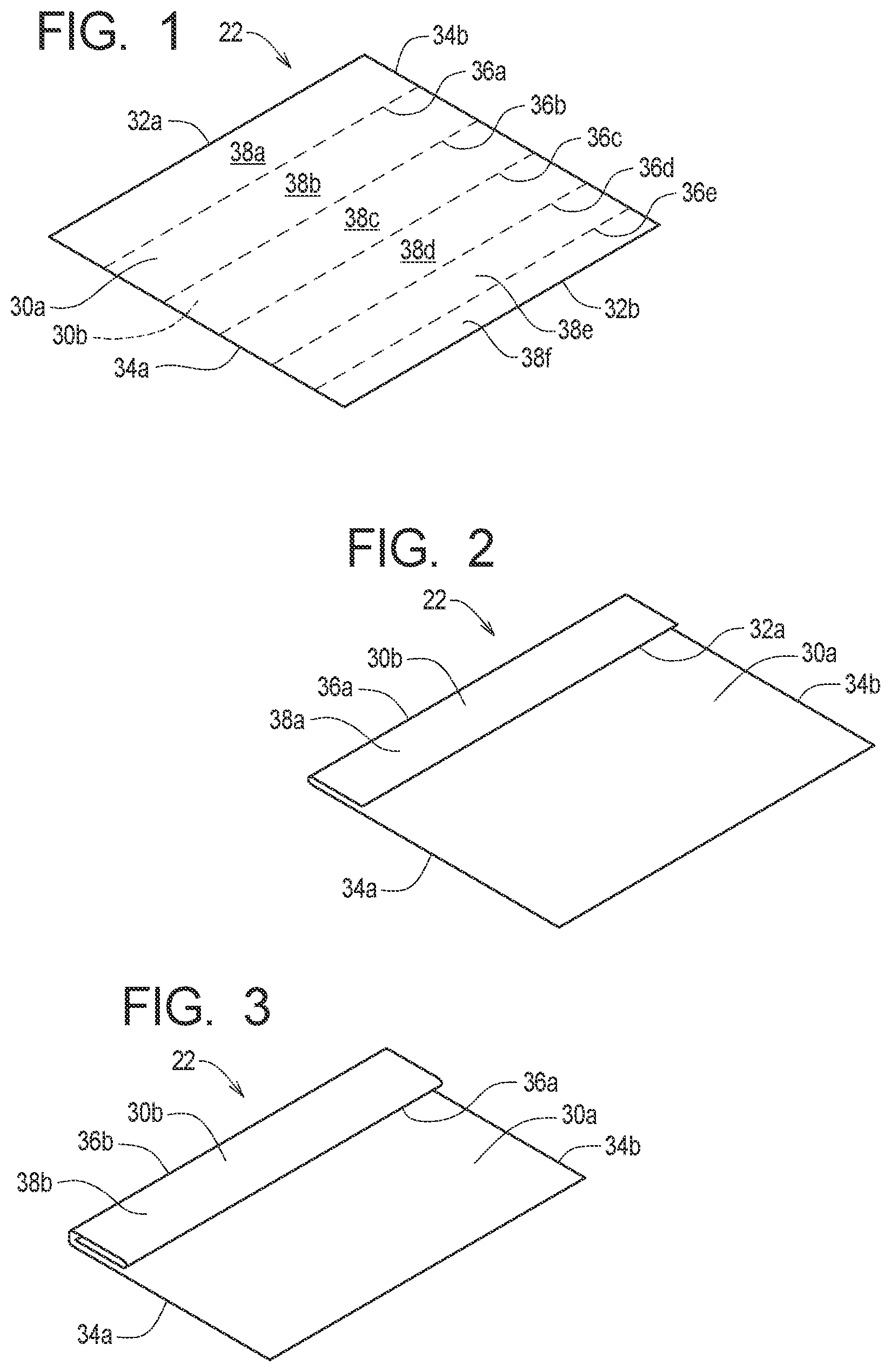
depicts a first example waste bag in a first example unfolded configuration;
illustrate a first example process of reconfiguring the first example waste bag from the first example unfolded configuration to a first example folded configuration;
illustrate a first example process of forming a first example waste bag system of the present invention;
illustrate an example process of using the first example waste bag system;
depicts a second example waste bag in a second example unfolded configuration;
illustrate a second example process of reconfiguring the second example waste bag from the second example unfolded configuration to a second example folded configuration;
illustrates an example process of forming an example waste bag system of the present invention using the second example waste bag;
illustrates a relationship of the substrate to the second example waste bag immediately prior to use.
DETAILED DESCRIPTION
The present invention may be embodied in a number of forms, and two example pet waste bags of the present invention will be described separately herein. In the following discussion, elements identified by reference numerals with letter suffixes are associated with a portion or instance of an element identified by the same reference character without a letter suffix. Any reference numeral, whether used with letter suffixes or without letter suffixes, thus refers to only one element of the invention.
I. First Example Pet Waste Bag System
illustrate a first example pet waste bag system 20 comprising a first example pet waste bag 22 , a substrate 24 on which an adhesive layer 26 is formed, and a cover sheet 28 . The first example pet waste bag 22 is detachably attached to the substrate 24 by the adhesive layer 26 such that at least a portion of the adhesive layer 26 remains exposed. The cover sheet 28 is then detachably attached to the substrate 24 by the exposed portion of the adhesive layer 26 to form a storage chamber 29 in which the first example first example pet waste bag 22 is stored during shipping and storage. During shipping and storage, the first example first example pet waste bag 22 is arranged in a folded configuration ( ) and arranged within the storage chamber 29 ( ) such that the substrate 24 and cover sheet 28 cover at least a portion of the first example pet waste bag 22 arranged within the storage chamber 29 . Prior to use, the cover sheet 28 is detached from the substrate 24 to expose the first example first example pet waste bag 22 . With the first example first example pet waste bag 22 exposed, the first example first example pet waste bag 22 may be reconfigured from the folded configuration to an unfolded configuration ( ) for use in a conventional manner.
The details of construction and use of the first example pet waste bag system 20 will now be described in further detail.
In the unfolded configuration shown in , the example first example pet waste bag 22 takes the form of a substantially flat sheet and defines a plurality of faces 30 , a plurality of end edges 32 , and a plurality of side edges 34 . Associated with the first example first example pet waste bag 22 in the unfolded configuration is a plurality of width reference lines 36 extending between the side edges 34 and a plurality of reference areas 38 defining areas of the faces 30 . As best understood with reference to , when in an intermediate configuration the first example first example pet waste bag 22 further defines a plurality of length reference lines 39 .
The first example pet waste bag 22 may be made of any conventional, lightweight, material. For example, the pet waste bag may be made of plastic. The example first example pet waste bag 22 defines a first face 30 a , a second face 30 b , first and second end edges 32 a and 32 b , and first and second side edges 34 a and 34 b . The example pet waste bag further comprises first, second, third, fourth, and fifth width reference lines 36 a , 36 b , 36 c , 36 d , and 36 e ( ), first, second, third, fourth, fifth, and sixth reference areas 38 a , 38 b , 38 c , 38 d , 38 e , and 38 f ( ), and first, second, third, and fourth length reference lines 39 a , 39 b , 39 c , and 39 d ( ). As is conventional, the example first example pet waste bag 22 may comprise at least two layers (not visible in ) sealed along the second end edge 32 b and the first and second side edges 34 a and 34 b and not along the first end edge 32 a such that the first end edge 32 a defines the bag opening (not visible in ). The sealed edges 32 b , 34 a , and 34 b of the example first example pet waste bag 22 may be sealed using any conventional methods. The construction and use of the example first example pet waste bag 22 is or may be conventional and will not be described herein beyond that extent helpful to a complete understanding of the present invention.
Three of four of the end edges 32 a and 32 b and side edges 34 a or 34 b are sealed, and one of the end edges 32 a or 32 b or side edges 34 a or 34 b is unsealed such that example the first example pet waste bag 22 conventionally defines an opening (not visible) through which pet waste can pass and a bag chamber (not visible) for storing the pet waste for transportation and eventual disposal in a conventional manner. In the example first example pet waste bag 22 , the first end edge 32 a is unsealed and the second end edge 32 b , the first side edge 34 a , and the second side edge 34 b are sealed.
illustrate the method of configuring the first example pet waste bag 22 from the unfolded configuration ( ), into an intermediate configuration ( ). illustrate an example method of configuring the first example pet waste bag 22 from the intermediate configuration into the folded configuration ( ).
Referring initially to , the first side edge 32 a of the first example pet waste bag 22 may be folded onto the first face 30 a along the first width fold line 36 a to create a first width fold. The first side edge 32 a may then be folded back toward the second face 30 b along the second width fold line 36 b to create a second width fold. As shown in , the user may continue folding the first side edge 32 a forward toward the front face 30 and back toward the second face 30 b of the first example pet waste bag 22 sequentially along the third, fourth, and fifth width lines 36 c , 36 d , and 36 e in a fanfold or accordion fashion to obtain an intermediate configuration ( ).
The method of folding the first example pet waste bag 22 as described in connection with creates a plurality of generally planar width folds in the first example pet waste bag 22 , which results in a more compact configuration of the first example pet waste bag 22 . When the first example is in the intermediate configuration as shown in , first, second, third, fourth, and fifth width folds 40 a , 40 b , 40 c , 40 d , and 40 e are formed.
The exact dimensions of each of the plurality of width folds 40 may vary in order to achieve a desired compact and stable configuration of the first example pet waste bag 22 when in the intermediate configuration and, subsequently, the folded configuration. In some embodiments, the plurality of width folds 40 may be substantially the same width and thickness. In other embodiments, the plurality of width folds 40 may be of different widths and thickness as shown in . In particular, the first width fold 40 a defines first dimension D 1 , the second width fold 40 b defines a second dimension D 2 , the third width fold 40 c defines a third dimension D 3 , the fourth width fold 40 d defines a fourth dimension D 4 , and the fifth width fold 40 e defines a fifth dimension D 5 . With the first example pet waste bag 22 in the intermediate and folded configurations, the first dimension D 1 is approximately the same as the second dimension D 2 , the second dimension D 2 is greater than the third dimension D 3 , the third dimension D 3 is greater than the fourth dimension D 4 , the fourth dimension D 4 is greater than the fifth dimension D 5 , and the fifth dimension D 6 is greater than the sixth dimension D 6 .
Referring now to , the first example pet waste bag 22 is next arranged from the intermediate configuration into the folded configuration by folding the compact first example pet waste bag 22 lengthwise along the length folds 39 a , 39 b , 39 c , and 39 d (e.g., substantially perpendicular to the plurality of width fold lines 36 ). In particular, illustrates that the second edge 32 b of the first example pet waste bag 22 is folded, lengthwise, along the first length line 34 a toward the second edge 34 b . The result is a first length fold. The first example pet waste bag 22 is further folded as shown in along the second and third length lines 39 b and 39 c to create second and third length folds. To complete arrangement of the first example first example pet waste bag 22 into the folded configuration, the first edge 34 b of the first example pet waste bag 22 is folded inward along the fourth length line 39 d such that the first example pet waste bag 22 in the folded configuration as shown in . In the folded configuration, the waste bag defines a folded bag form factor, which is smaller than both the unfolded form factor and the intermediate form factor.
illustrate that, in the folded configuration, the first example pet waste bag 22 defines a first face 50 , a second face 52 , a first and second end edges 54 a and 54 b , and first and second side edges 56 a and 56 b . are somewhat schematic to show the various folds and thus the distance between the first and second faces 50 and 52 is exaggerated. In practice, the material from which the first example pet waste bag 22 is, as is conventional, very thin, and ratio of the distance between the first and second faces 50 and 52 and the distance between the first and second end edges 52 a and 52 b is typically within a first range of approximately 1:20 to 1:100 and is, in any event, within a second rage of less than 1:10. further illustrates that, in at least one dimension, the first and last length folds are approximately the same length, the intermediate length folds between the first and last length folds are approximately the same length, and the first and last length folds are shorter than the intermediate length folds.
illustrates that the example substrate 24 defines a first face 60 , a second face 62 opposite the first face 60 , first and second end edges 64 a and 64 b , and first and second side edges 66 a and 66 b . The substrate 24 may be flexible or rigid. The substrate may be mono-layered or multilayered. The example adhesive layer 26 is formed on the example substrate 24 to facilitate detachable attachment of the pet waste bag 22 to the substrate 24 and of the cover sheet 28 to the substrate 24 to form the chamber 29 . The example adhesive layer 26 is applied to or integrally formed on the first face 60 of the example substrate 24 such that the first face 60 is adhesive. The substrate 24 has a thickness effective for the desired application. The substrate 24 and the adhesive layer 26 may be formed by any or a variety of processes known in the art. The example substrate 24 may take the size, shape, composition, and flexibility of a business, credit, debit, or gift card to facilitate storage in a wallet or the like.
illustrate that the example cover sheet 28 defines a first face 70 , a second face 72 , first and second end edges 74 a and 74 b , and first and second side edges 76 a and 76 b . The cover sheet 28 may be made of any conventional material, flexible or rigid, effective for the desired application. The cover sheet 28 may be any flexible material such as paper, plastic, or the like and may be a monolayer structure or a multilayer structure. Additionally, the example cover sheet 28 has a thickness effective for the desired application. The example cover sheet 28 is a peelable flexible plastic film or paper sheet and may be of a similar or the same size, shape, and/or composition as the example substrate 24 but is typically less rigid to facilitate peeling.
To form the first example pet waste bag system 20 , the first example pet waste bag 22 , in its folded configuration, is secured between the example substrate 24 and the example cover sheet 28 . In particular, the first example pet waste bag 22 in the folded configuration is arranged such that the second face 52 thereof is in contact with the adhesive layer 26 as shown in to define a first pet bag substructure 80 . As shown in , the first pet bag substructure 80 defines at least one adhesive margin portion 82 when the example pet waste bag 22 attached to the substrate 24 . In particular, the folded first example pet waste bag 22 is arranged such that the first end edge 54 a thereof is aligned with the first end edge 64 a of the substrate 24 to define first, second, and third margin portions 82 a , 82 b , and 82 c . The cover sheet 28 is next arranged such that at least a portion of the second face 72 of the cover sheet 28 is in contact with at least one of the first, second, and third margin portions 82 a , 82 b , and 82 c . More specifically, in the example pet waste bag system 20 , the first and second end edges 74 a and 74 b and the first and second side edges 76 a and 76 b of the cover sheet 28 are substantially aligned with the first and second end edges 64 a and 64 b , and first and second side edges 66 a and 66 b of the substrate 24 , respectively.
To use the example pet waste bag 22 , the cover sheet 28 is peeled off the substrate 24 starting from the line defined by the first end edge 64 a of the substrate 24 and the first end edge 74 a of the cover sheet 28 as shown in . Once the cover sheet 28 is substantially or completely removed from the substrate 24 , the first example pet waste bag 22 is unfolded into the unfolded configuration such that the cover sheet 28 and the substrate 24 are at the opposite end as the opening in the first end edge 32 a as shown in . The first example pet waste bag 22 may be used in the configuration shown in with or without removing the substrate 24 from the first example pet waste bag 22 .
II. Second Example Pet Waste Bag System
illustrate the assembly and use of a second example pet waste bag system 120 of the present invention. The second example pet waste bag system 120 comprising a second example pet waste bag 122 , a substrate 124 on which an adhesive layer 126 is formed, and a cover sheet 128 . The second example pet waste bag 122 is detachably attached to the substrate 124 by the adhesive layer 126 such that at least a portion of the adhesive layer 126 remains exposed. The cover sheet 128 is then detachably attached to the substrate 124 by the exposed portion of the adhesive layer 126 to form a storage chamber 129 in which the second example second example pet waste bag 122 is stored during shipping and storage. During shipping and storage, the second example second example pet waste bag 122 is arranged in a folded configuration ( ) and arranged within the storage chamber 129 such that the substrate 124 and cover sheet 128 cover at least a portion of the second example pet waste bag 122 arranged within the storage chamber 129 . Prior to use, the cover sheet 128 is detached from the substrate 124 to expose the second example second example pet waste bag 122 . With the second example second example pet waste bag 122 exposed, the second example second example pet waste bag 122 may be reconfigured from the folded configuration to an unfolded configuration ( ) for use in a conventional manner.
The details of construction and use of the second example pet waste bag system 120 will now be described in further detail.
illustrates that the unfolded configuration in which the example second example pet waste bag 122 takes the form of a substantially flat sheet and defines a plurality of faces 130 , a plurality of end edges 132 , and a plurality of side edges 134 . Associated with the second example second example pet waste bag 122 in the unfolded configuration is a plurality of width reference lines 136 extending between the side edges 134 and a plurality of reference areas 138 defining areas of the faces 130 . As best understood with reference to , when in an intermediate configuration the second example second example pet waste bag 122 further defines a plurality of length reference lines 139 .
The second example pet waste bag 122 may be made of any conventional, lightweight, material. For example, the pet waste bag may be made of plastic. The example second example pet waste bag 122 defines a first face 130 a , a second face 130 b , first and second end edges 132 a and 132 b , and first and second side edges 134 a and 134 b . The example pet waste bag further comprises first, second, third, fourth, and fifth width reference lines 136 a , 136 b , 136 c , 136 d , and 136 e ( ), first, second, third, fourth, fifth, and sixth reference areas 138 a , 138 b , 138 c , 138 d , 138 e , and 138 f ( ), and first, second, third, and fourth length reference lines 139 a , 139 b , 139 c , and 139 fd ( ). As is conventional, the example second example pet waste bag 122 may comprise at least two layers (not visible in ) sealed along the second end edge 132 b and the first and second side edges 134 a and 134 b and not along the first end edge 132 a such that the first end edge 132 a defines the bag opening (not visible in ). The sealed edges 132 b , 134 a , and 134 b of the example second example pet waste bag 122 may be sealed using any conventional methods. The construction and use of the example second example pet waste bag 122 is or may be conventional and will not be described herein beyond that extent helpful to a complete understanding of the present invention.
Three of four of the end edges 132 a and 132 b and side edges 134 a or 134 b are sealed, and one of the end edges 132 a or 132 b or side edges 134 a or 134 b is unsealed such that example the second example pet waste bag 122 conventionally defines an opening (not visible) through which pet waste can pass and a bag chamber (not visible) for storing the pet waste for transportation and eventual disposal in a conventional manner. In the example second example pet waste bag 122 , the first end edge 132 a is unsealed and the second end edge 132 b , the first side edge 134 a , and the second side edge 134 b are sealed.
illustrate the method of configuring the second example pet waste bag 122 from the unfolded configuration ( ), into an intermediate configuration ( ). illustrate an example method of configuring the second example pet waste bag 122 from the intermediate configuration into the folded configuration ( ).
Referring initially to , the first side edge 132 a of the second example pet waste bag 122 may be folded onto the second face 130 b along the first width fold line 136 a to create a first width fold. The first side edge 132 a may then be folded back toward the second face 130 b along the second width fold line 136 b to create a second width fold as shown in . As shown in , the user may continue folding the first side edge 132 a forward toward the front face 130 a and back toward the second face 130 b of the second example pet waste bag 122 sequentially along the third, fourth, and fifth width lines 136 c , 136 d , and 136 e in a fanfold or accordion fashion to obtain an intermediate configuration ( ).
The method of folding the second example pet waste bag 122 creates a plurality of generally planar width folds 140 in the second example pet waste bag 122 , which results in a more compact configuration of the second example pet waste bag 122 . When the second example is in the intermediate configuration as shown in , first, second, third, fourth, and fifth, width folds 140 a , 140 b , 140 c , 140 d , and 140 e are formed.
The exact dimensions of each of the plurality of width folds 140 may vary in order to achieve a desired compact and stable configuration of the second example pet waste bag 122 when in the intermediate configuration and, subsequently, the folded configuration. In some embodiments, the plurality of width folds 140 may be substantially the same width and thickness. In other embodiments, the plurality of width folds 140 may be of different widths and thickness as shown in . In particular, the first width fold 140 a defines first dimension D 1 , the second width fold 140 b defines a second dimension D 2 , the third width fold 140 c defines a third dimension D 3 , the fourth width fold 140 d defines a fourth dimension D 4 , and the fifth width fold 140 e defines a fifth dimension D 5 . With the second example pet waste bag 122 in the intermediate and folded configurations, the first dimension D 1 is greater than the second dimension D 2 , the second dimension D 2 is greater than the third dimension D 3 , the third dimension D 3 is greater than the fourth dimension D 4 , and the fourth dimension D 4 is greater than the fifth dimension D 5 .
Referring now to , the second example pet waste bag 122 is next arranged from the intermediate configuration into the folded configuration by folding the compact second example pet waste bag 122 lengthwise along the length folds 139 a , 139 b , 139 c , and 139 d (e.g., perpendicular to the plurality of width fold lines 136 ) in a serpentine fashion. In particular, illustrates that the second edge 132 b of the second example pet waste bag 122 is folded, lengthwise, along the first length line 134 a toward the second side 134 b . The result is a first length fold. The second example pet waste bag 122 is further folded as shown in along the second and third length lines 139 b and 139 c to create second and third length folds. To complete arrangement of the second example pet waste bag 122 into the folded configuration, the first side 134 a of the second example pet waste bag 122 is folded inward along the fourth length line 139 d such that the second example pet waste bag 122 in the folded configuration as shown in . In the folded configuration, the waste bag defines a folded bag form factor, which is smaller than both the unfolded form factor and the intermediate form factor. illustrate that each successive the length fold is slightly smaller in at least one dimension than the previous length fold.
illustrate that, in the folded configuration, the second example pet waste bag 122 defines a first face 150 , a second surface 152 , a first and second end edges 156 a and 156 b , and first and second side edges 154 a and 154 b . are somewhat schematic to show the various folds and thus the distance between the first and second faces 150 and 152 is exaggerated. In practice, the material from which the first example pet waste bag 122 is, as is conventional, very thin, and ratio of the distance between the first and second faces 150 and 152 and the distance between the first and second end edges 156 a and 156 b is typically within a first range of approximately 1:20 to 1:100 and is, in any event, within a second rage of less than 1:10.
Referring now to , the example substrate 124 , adhesive layer 126 , and cover sheet 128 may be sized, dimensioned, and/or shaped in substantially the same manner as the example substrate 24 , adhesive layer 26 , and cover sheet 28 described above. Further, the example substrate 124 , the adhesive layer 126 , and the cover sheet 128 are or may be assembled together with the second example pet waste bag 122 to form the second example pet waste bag system 120 in substantially the same manner as the example substrate 24 , the example adhesive layer 26 , and the example cover sheet 28 are assembled together with the first example pet waste bag 22 to form the first example pet waste bag 20 . Accordingly, the example substrate 124 , the example adhesive layer 126 , and the example cover sheet 128 , and the example method of forming the second example pet waste bag system 120 , will not be described herein again in detail.
To use the example pet waste bag 122 , the cover sheet 128 is peeled off the substrate 124 . Once the cover sheet 128 is substantially or completely removed from the substrate 124 , the second example pet waste bag 122 is unfolded into the unfolded configuration such that the cover sheet 128 and the substrate 124 are at the opposite end as the opening in the first end edge 132 a as shown in . The second example pet waste bag 122 may be used in the configuration shown in with or without removing the substrate 124 from the second example pet waste bag 122 .
Figures (11)
Citations
This patent cites (6)
- US4430087
- US20020065500
- US20050182379
- US20120226256
- US11056903
- USWO-2008023363