Abstract
A mechanical separator for separating a fluid sample into first and second phases within a collection container is disclosed. The mechanical separator may have a separator body having a through-hole defined therein, with the through-hole adapted for allowing fluid to pass therethrough. The separator body includes a float, having a first density, and a ballast, having a second density greater than the first density. A portion of the float is connected to a portion of the ballast. Optionally, the float may include a first extended tab adjacent a first opening of the through-hole and a second extended tab adjacent the second opening of the through-hole. In certain configurations, the separator body also includes an extended tab band disposed about an outer surface of the float. The separator body may also include an engagement band circumferentially disposed about at least a portion of the separator body.
Claims (20)
1. A mechanical separator for separating a fluid sample within a collection container, comprising: a separator body having a through-hole defined therein, the through-hole adapted for allowing fluid to pass therethrough, the separator body comprising: a float, having a first density; a ballast, having a second density greater than the first density, wherein at least a portion of the float is connected to at least a portion of the ballast at an interface; and an initial engagement band circumferentially disposed about at least a portion of the separator body, wherein upon applied rotational force in a centrifuge, the mechanical separator is adapted to transition from a first initial position in which the through-hole is oriented in an open position for allowing fluid to pass therethrough, to a second sealing position in which the float engages a sidewall of the collection container and the through-hole is oriented in a closed position for preventing fluid from being received therethrough, and the transition of the through-hole from the open position to the closed position coincides with rotation of the mechanical separator from the first initial position to the second sealing position.
Show 19 dependent claims
2. The mechanical separator according to claim 1 , wherein the initial engagement band is continuous or at least partially segmented.
3. The mechanical separator according to claim 1 , wherein the initial engagement band and the float are formed of the same material.
4. The mechanical separator according to claim 1 , wherein the initial engagement band bisects at least a portion of the ballast.
5. The mechanical separator according to claim 1 , wherein the through-hole has a circular cross-section or an elliptical cross-section.
6. The mechanical separator according to claim 1 , wherein the float is adapted for deformation upon applied rotational force to the mechanical separator.
7. The mechanical separator according to claim 1 , wherein the through-hole is defined along a through-axis and the float is adapted for deformation in a direction substantially perpendicular to the through-axis upon applied rotational force.
8. The mechanical separator according to claim 1 , wherein the separator body further comprises an extended tab band disposed about a portion of an outer surface of the float.
9. The mechanical separator of claim 8 , wherein a first portion of the extended tab band is disposed adjacent a first opening of the through-hole and a second portion of the extended tab band is disposed adjacent a second opening of the through-hole.
10. The mechanical separator of claim 9 , wherein at least one of the first portion and the second portion of the extended tab band have a concave downwardly-directed orientation.
11. The mechanical separator according to claim 9 , wherein at least one of the first portion and the second portion of the extended tab band are oriented in an outwardly-extending arcuate shape about an upper portion of at least one of the first opening and second opening of the through-hole.
12. The mechanical separator according to claim 9 , wherein at least a portion of the first portion of the extended tab band and at least a portion of the second portion of the extended tab band have the same shape and curvature.
13. A separation assembly for enabling separation of a fluid sample into first and second phases, comprising: a collection container having a first end, a second end, and a sidewall extending therebetween, the collection container defining a longitudinal axis between the first end and the second end; and a mechanical separator according to claim 1 received within the collection container.
14. The separation assembly according to claim 13 , further comprising a closure adapted for sealing engagement with the first end of the collection container.
15. The separation assembly according to claim 13 , wherein at least a portion of the through-hole is oriented substantially along the longitudinal axis of the collection container in the first initial position, and wherein at least a portion of the through-hole is oriented substantially perpendicular to the longitudinal axis of the collection container in the second sealing position.
16. The separation assembly according to claim 13 , wherein the initial engagement band engages the sidewall of the collection container when the mechanical separator is in the first initial position.
17. The separation assembly according to claim 13 , wherein the initial engagement band and the float are formed of the same material.
18. The separation assembly according to claim 13 , wherein the float is adapted for deformation upon applied rotational force to the separation assembly.
19. The separation assembly according to claim 13 , wherein the through-hole is defined along a through-axis and the float is adapted for deformation in a direction substantially perpendicular to the through-axis upon applied rotational force.
20. The separation assembly according to claim 13 , wherein the separator body further comprises an extended tab band disposed about a portion of an outer surface of the float, and a first portion of the extended tab band is disposed adjacent a first opening of the through-hole and a second portion of the extended tab band is disposed adjacent a second opening of the through-hole.
Full Description
Show full text →
CROSS REFERENCE TO RELATED APPLICATIONS
This application is a continuation of U.S. application Ser. No. 17/739,705, filed May 9, 2022, entitled “Density Phase Separation Device”, which is a continuation of U.S. application Ser. No. 17/065,618, filed Oct. 8, 2020, entitled “Density Phase Separation Device” (now U.S. Pat. No. 11,351,535), which is a continuation of U.S. application Ser. No. 16/574,515, filed Sep. 18, 2019, entitled “Density Phase Separation Device” (now U.S. Pat. No. 10,807,088), which is a continuation of U.S. application Ser. No. 15/888,238, filed Feb. 5, 2018, entitled “Density Phase Separation Device” (now U.S. Pat. No. 10,456,782), which is a divisional of U.S. application Ser. No. 14/572,102, filed Dec. 16, 2014, entitled “Density Phase Separation Device” (now U.S. Pat. No. 9,919,307), which is a continuation of U.S. application Ser. No. 12/780,432, filed May 14, 2010, entitled “Density Phase Separation Device” (now U.S. Pat. No. 8,998,000), which claims priority to U.S. Provisional Patent Application Ser. No. 61/178,599 filed May 15, 2009, the entire disclosures of each of which are hereby incorporated by reference.
BACKGROUND OF THE INVENTION
Field of the Invention
The subject invention relates to a device for separating higher and lower density fractions of a fluid sample. More particularly, this invention relates to a device for collecting and transporting fluid samples whereby the device and fluid sample are subjected to centrifugation in order to cause separation of the higher density fraction from the lower density fraction of the fluid sample.
Description of Related Art
Diagnostic tests may require separation of a patient's whole blood sample into components, such as serum or plasma (the lower density phase components), and red blood cells (the higher density phase components). Samples of whole blood are typically collected by venipuncture through a cannula or needle attached to a syringe or an evacuated blood collection tube. After collection, separation of the blood into serum or plasma and red blood cells is accomplished by rotation of the syringe or tube in a centrifuge. In order to maintain the separation, a barrier must be positioned between the higher density and lower density phase components. This allows the separated components to be subsequently examined.
A variety of separation barriers have been used in collection devices to divide the area between the higher density and lower density phases of a fluid sample. The most widely used devices include thixotropic gel materials, such as polyester gels. However, current polyester gel serum separation tubes require special manufacturing equipment to both prepare the gel and fill the tubes. Moreover, the shelf-life of the gel-based separator product is limited. Over time, globules may be released from the gel mass and enter one or both of the separated phase components. Furthermore, commercially available gel barriers may react chemically with the analytes. Accordingly, if certain drugs are present in the blood sample when it is taken, an adverse chemical reaction with the gel interface can occur. Furthermore, if an instrument probe is inserted too deeply into a collection container, then the instrument probe may become clogged if it contacts the gel.
Certain mechanical separators have also been proposed in which a mechanical barrier can be employed between the higher and lower density phases of the fluid sample. Conventional mechanical barriers are positioned between higher and lower density phase components utilizing elevated gravitational forces applied during centrifugation. For proper orientation with respect to plasma and serum specimens, conventional mechanical separators are typically positioned above the collected whole blood specimen prior to centrifugation. This typically requires that the mechanical separator be affixed to the underside of the tube closure in such a manner that blood fill occurs through or around the device when engaged with a blood collection set or phlebotomy needle. This attachment is required to prevent the premature movement of the separator during shipment, handling, and blood draw. Conventional mechanical separators are typically affixed to the tube closure by a mechanical interlock between the bellows component and the closure.
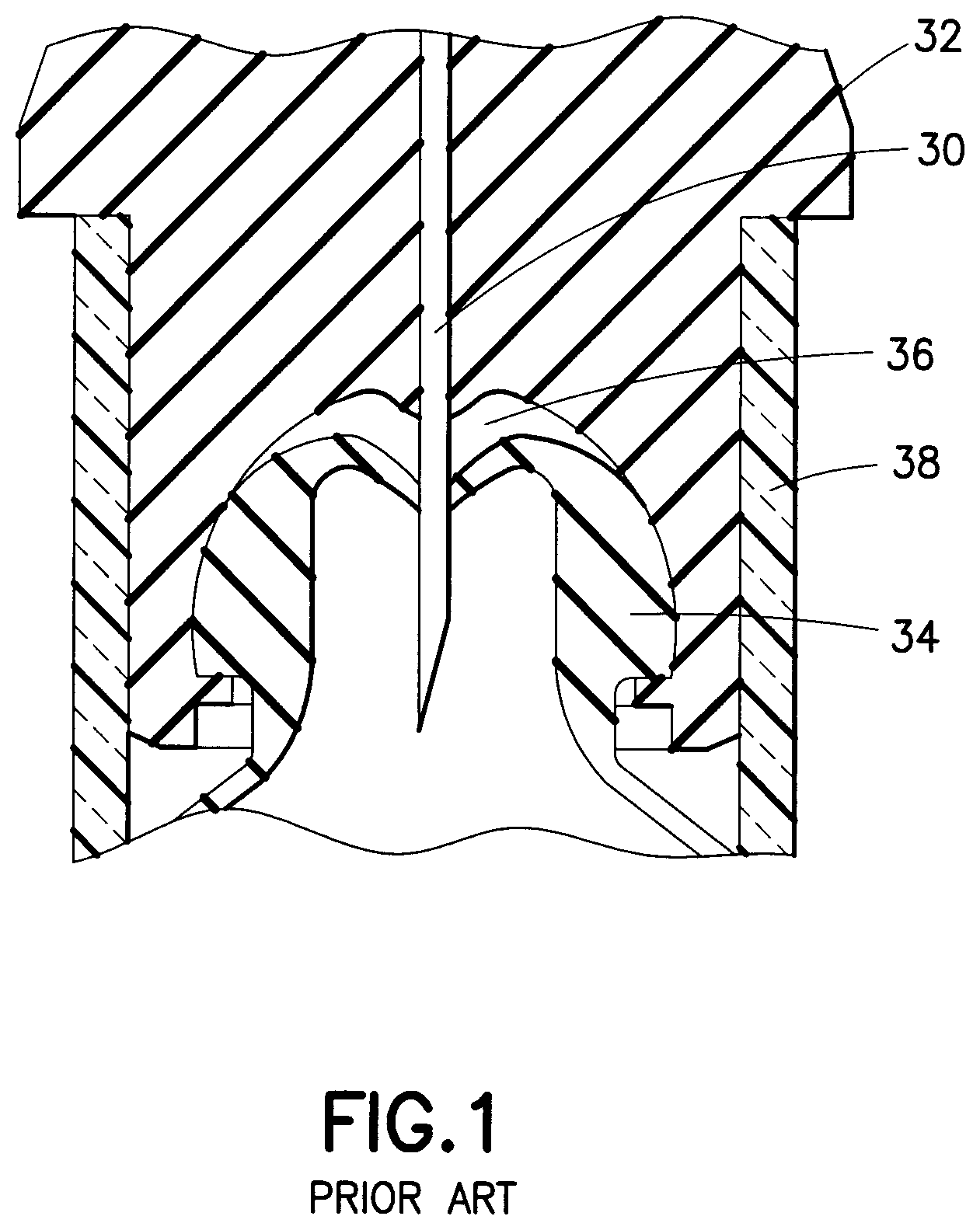
Conventional mechanical separators have some significant drawbacks. As shown in , conventional separators include a bellows 34 for providing a seal with the tube or syringe wall 38 . Typically, at least a portion of the bellows 34 is housed within, or in contact with a closure 32 . As shown in , as the needle 30 enters through the closure 32 , the bellows 34 is depressed. This creates a void 36 in which blood may pool during insertion or removal of the needle. This can result in sample pooling under the closure, device pre-launch in which the mechanical separator prematurely releases during blood collection, trapping of a significant quantity of fluid phases, such as serum and plasma, poor sample quality, and/or barrier failure under certain circumstances. Furthermore, previous mechanical separators are costly and complicated to manufacture due to the complicated multi-part fabrication techniques.
Accordingly, a need exists for a separator device that is compatible with standard sampling equipment and reduces or eliminates the aforementioned problems of conventional separators. A need also exists for a separator device that is easily used to separate a blood sample, minimizes cross-contamination of the higher and lower density phases of the sample during centrifugation, is independent of temperature during storage and shipping, and is stable to radiation sterilization. A need further exists for a unitary separation device that requires fewer relative moving parts and that allows for enhanced ease of introducing a specimen into a collection container.
SUMMARY OF THE INVENTION
The present invention is directed to an assembly for separating a fluid sample into a higher density and a lower density phase. Desirably, the mechanical separator of the present invention may be used with a collection container, such as a tube, and is structured to move within the tube under the action of applied centrifugal force in order to separate the portions of a fluid sample. In certain configurations, the tube is a specimen collection tube including an open end, a closed end, and a sidewall extending between the open end and closed end. The sidewall includes an outer surface and an inner surface and the tube further includes a closure disposed to fit in the open end of the tube with a resealable septum. Alternatively, both ends of the tube may be open, and both ends of the tube may be sealed by elastomeric closures. At least one of the closures of the tube may include a needle pierceable resealable septum.
The mechanical separator may be disposed within the tube at a location between the top closure and the bottom of the tube. The components of the separator are dimensioned and configured to achieve an overall density for the separator that lies between the densities of the phases of a fluid sample, such as the higher and lower density phases of a blood sample.
In accordance with an embodiment of the present invention, a mechanical separator for separating a fluid sample into first and second phases within a collection container includes a separator body having a through-hole defined therein. The through-hole is adapted for allowing fluid to pass therethrough. The separator body includes a float, having a first density, and a ballast, having a second density greater than the first density. A portion of the float is connected to a portion of the ballast.
The mechanical separator may have a spheroid shape. Optionally, the float may include an exterior surface and a joining surface, and the ballast may include a contact surface connected to the joining surface of the float and an exterior surface. The exterior surface of the float and the exterior surface of the ballast taken together may form the spheroid shape.
In certain configurations, the float defines the through-hole adapted for allowing fluid to pass therethrough. The through-hole may have a circular cross-section. In other configurations, the through-hole may have an elliptical cross-section. The through-hole may be defined along a through-axis, and the float may be adapted for deformation in a direction perpendicular to the through-axis upon applied rotational force.
In another configuration, the float further includes a first extended tab adjacent a first opening of the through-hole and a second extended tab adjacent the second opening of the through-hole. At least a portion of the first extended tab and at least a portion of the second extended tab may be provided above and about the through-hole and extend radially outwardly from the float in a direction parallel to the through-axis of the separator body. Optionally, the first extended tab, an upper surface of the float, and the second extended tab may form a convex upper float surface.
In another configuration, the separator body further includes an extended tab band disposed about a portion of an outer surface of the float. Optionally, a first portion of the extended tab band is disposed adjacent a first opening of the through-hole, and a second portion of the extended tab band is disposed adjacent a second opening of the through-hole. In a further configuration, at least one of the first portion and the second portion of the extended tab band have a concave downwardly-directed orientation. Optionally, at least one of the first portion and the second portion of the extended tab band are oriented in an outwardly-extending arcuate shape about an upper portion of at least one of the first opening and second opening of the through-hole. At least one of the first portion and the second portion of the extended tab band may extend outwardly from the float in a direction parallel to the through-axis. At least a portion of the first extended portion and at least a portion of the second extended portion of the extended tab band may have the same shape and curvature. In certain configurations, the extended tab band may further include a joining portion disposed between and connecting the first extended portion and the second extended portion disposed on each connecting side of the separator body. The first extended portion and the second extended portion of the extended tab band have a concave downwardly-directed orientation, and the joining portions of the extended tab band have a concave upwardly-directed orientation. In certain configurations, the float may include the extended tab band. Optionally, the float and the extended tab band may be formed of TPE and the ballast is formed of PET.
The mechanical separator may also include an initial engagement band circumferentially disposed about the separator body. The initial engagement band may be continuous or at least partially segmented. The initial engagement band and the float may be formed of the same material. The initial engagement band may bisect at least a portion of the ballast.
In another configuration, the ballast may include a base portion and a joining structure for engaging a portion of the float. The joining structure may include a plurality of arms for engaging a portion of the float, and the joining structure may provide flexure between the float and the ballast. Optionally, at least a portion of the float may have a circular outer perimeter having a curved cross-section perpendicular to the through-hole. In certain configurations, the float may include a joining structure for engaging a portion of the ballast. The joining structure may include a plurality of arms for engaging a portion of the ballast, and the joining structure may provide flexure between the float and the ballast.
In accordance with another embodiment of the present invention, a separation assembly for enabling separation of a fluid sample into first and second phases includes a collection container having a first end, a second end, and a sidewall extending therebetween. The collection container defines a longitudinal axis between the first end and the second end. The separation assembly further includes a mechanical separator having a separator body having a through-hole defined therein. The separator body is adapted to transition from a first initial position in which the through-hole is oriented in an open position for allowing fluid to pass therethrough, to a second sealing position in which the through-hole is oriented in a closed position for preventing fluid from being received therethrough, upon applied rotational force.
In one configuration, the separation assembly further includes a closure adapted for sealing engagement with the first end of the collection container, with the mechanical separator releasably engaged with a portion of the closure. The mechanical separator may be engaged with a portion of the closure in the first initial position, and the mechanical separator may be engaged with a portion of the sidewall of the collection container in the second sealing position. The closure may include an engagement boss disposed within a portion of the through-hole when the separator body is in the first initial position for forming a fluid seal between a portion of the separator body and the closure. Optionally, at least a portion of the through-hole of the mechanical separator is oriented along the longitudinal axis of the collection container in the first initial position, and the through-hole is oriented perpendicular to the longitudinal axis of the collection container in the second sealing position. Transition of the through-hole from the open position to the closed position may coincide with rotation of the mechanical separator from the first initial position to the second sealing position. The mechanical separator may sealingly engage a portion of the collection container wall in the second sealing position to prevent flow of fluid therethrough or therearound.
In certain configurations, the separator body further includes a first extended tab adjacent a first opening of the through-hole and a second extended tab adjacent the second opening of the through-hole. The first extended tab and the second extended tab may engage a portion of the sidewall of the collection container in the second sealing position. In other configurations, the separator body further includes an extended tab band disposed about a portion of an outer surface of the float. The extended tab band may engage a portion of the sidewall of the collection container in the second sealing position, and the extended tab band may form a continuous seal with the sidewall of the collection container in the second sealing position.
In other configurations, the ballast includes a joining structure for engaging a portion of the float, and at least a portion of the float includes a circular outer perimeter having a curved cross-section perpendicular to the through-hole. The outer perimeter of the float may form a continuous seal with the sidewall of the collection container in the second sealing position. Optionally, the float includes a joining structure for engaging a portion of the ballast, and at least a portion of the float includes a circular outer perimeter having a curved cross-section perpendicular to the through-hole, with the outer perimeter of the float forming a continuous seal with the sidewall of the collection container in the second sealing position.
In accordance with another embodiment of the present invention, a separation assembly for enabling separation of a fluid sample into first and second phases includes a collection container having a first end, a second end, and a sidewall extending therebetween. The separation assembly further includes a mechanical separator having a separator body having a through-hole defined therein. The separator body includes a first sealing perimeter for providing sealing engagement with a first portion of a collection container while allowing a sample to pass through the through-hole into the collection container, and a second sealing perimeter for providing sealing engagement with a second portion of the collection container while maintaining a barrier for separation between the first and second phases.
The separation assembly may include a closure adapted for sealing engagement with the open end of the collection container, in which the mechanical separator is releasably engaged with a portion of the closure.
In accordance with another embodiment of the present invention, a separation assembly for enabling separation of a fluid sample into first and second phases includes a collection container having an open end, a closed end, and a sidewall extending therebetween defining an interior. The collection container further defines a longitudinal axis between the open end and the closed end. The separation assembly further includes a closure adapted for sealing engagement with the open end of the collection container, and a post engaged with the closure and adapted for positioning within the interior of the collection container. The post includes a post through-hole aligned along the longitudinal axis of the collection container. The separation assembly also includes a mechanical separator releasably engaged with the post. The mechanical separator includes a separator body having a through-hole defined therein along a through-axis, with the through-hole adapted for allowing fluid to pass therethrough. The separator body includes a float, having a first density, and a ballast, having a second density greater than the first density. A portion of the float is connected to a portion of the ballast, and a portion of the post is received within the through-hole of the separator forming a fluid path through the post and the mechanical separator in an initial first position.
The separator body may further include an initial engagement band circumferentially disposed about a portion of the separator body. The initial engagement band and the float may be formed of the same material, and the initial engagement band may bisect at least a portion of the ballast. Optionally, the separator body is adapted to transition from a first initial position in which a portion of the post is disposed within the through-hole and the separator body is oriented in an open position for allowing fluid to pass therethrough, to a second sealing position in which the separator body is disengaged from the post and the through-hole is oriented in a closed position for preventing fluid from being received therethrough, upon applied rotational force. Transition of the separator body from the open position to the closed position may include an axial movement of the separator body to disengage from the post, and a rotational movement of the separator body from an initial first position to a second sealing position.
In accordance with yet another embodiment of the present invention, a separation assembly for enabling separation of a fluid sample into first and second phases includes a collection container having an open end, a closed end, and a sidewall extending therebetween defining an interior. The collection container further defines a longitudinal axis between the open end and the closed end. The separation assembly further includes a closure adapted for sealing engagement with the open end of the collection container. The closure includes a receiving end for positioning within the open end of the collection container, with the receiving end defining an interior cavity and including an undercut protrusion extending into the interior cavity. The separation assembly further includes a mechanical separator releasably engaged with the closure. The mechanical separator includes a separator body having a through-hole defined therein along a through-axis, with the through-hole adapted for allowing fluid to pass therethrough. The separator body includes a float, having a first density, and a ballast, having a second density greater than the first density, with a portion of the float connected to a portion of the ballast. The undercut protrusion of the closure may be disposed within the through-hole of the separator, and at least a portion of the separator body may be disposed within the interior cavity of the closure in an initial first position.
In accordance with yet another embodiment of the present invention, a collection container includes a first region having an open top end and a first sidewall defining a first interior and a first exterior. The collection container also includes a second region having a closed bottom end and a second sidewall defining a second interior and a second exterior. The first region and the second region may be aligned along a longitudinal axis such that the first interior and the second interior are provided in fluid communication. A diameter of the first interior may be greater than a diameter of the second interior, and at least one fluid flute may extend between the first region and the second region to allow passage of fluid therethrough from the first region to the second region.
In certain configurations, the first exterior has a 16 mm profile and the second exterior has a 13 mm profile. The first interior may be dimensioned to accommodate a mechanical separator therein, and the second interior may be dimensioned to at least partially restrain a portion of the mechanical separator from passing therein absent applied rotational force.
In accordance with yet another embodiment of the present invention, a separation assembly for enabling separation of a fluid sample into first and second phases includes a collection container having a first region having an open top end and a first sidewall defining a first interior and a first exterior, and a second region having a closed bottom end and a second sidewall defining a second interior and a second exterior. The first region and the second region may be aligned along a longitudinal axis such that the first interior and the second interior are provided in fluid communication, with a diameter of the first interior being greater than a diameter of the second interior. The separation assembly further includes at least one fluid flute extending between the first region and the second region to allow passage of fluid therethrough from the first region to the second region. The separation assembly may also include a mechanical separator having a float, having a first density, and a ballast, having a second density greater than the first density, with a portion of the float connected to a portion of the ballast. At least a portion of the mechanical separator is prevented from entering the second region in an initial first position, and the mechanical separator is transitioned into the second region upon application of rotational force to a second sealing position.
The mechanical separator may include a separator body having a through-hole defined therein and adapted for allowing fluid to pass therethrough.
In accordance with still a further embodiment of the present invention, a separation assembly for enabling separation of a fluid sample into first and second phases includes a collection container having a first end, a second end, and a sidewall extending therebetween defining an interior. The separation assembly further includes a closure adapted for sealing engagement with the open end of the collection container. The separation assembly also includes a mechanical separator releasably restrained by at least one of the closure and the sidewall of the collection container in an initial first position. The mechanical separator includes a separator body having a through-hole defined therein along a through-axis, with the through-hole adapted for allowing fluid to pass therethrough. The separator body includes a float, having a first density, and a ballast, having a second density greater than the first density, with a portion of the float connected to a portion of the ballast. The separation assembly further includes a carrier releasably engaged with a portion of the mechanical separator in the initial position such that, upon application of rotational force, the separator body transitions from an initial position in which fluid may pass through the through-hole, to a sealing position in which the mechanical separator prevents passage of fluid therethrough or therearound. Also upon application of rotational force, the carrier disengages from the mechanical separator.
In still a further embodiment of the present invention, a separation assembly includes a separation assembly including a collection container having a first end, a second end, and a sidewall extending therebetween defining an interior. The separation assembly also includes a mechanical separator including a float and a ballast and capable of movement from a first position to a sealing position. In the sealing position, a sealing perimeter is established between at least a portion of the interior and the separator, the sealing perimeter having a varying position about a portion of the interior, with the varying position defining an average sealing height. The mechanical separator also has a maximum height and a minimum height within the collection container, such that the average sealing height is less than the maximum height minus the minimum height.
The assembly of the present invention is advantageous over existing separation products that utilize separation gel. In particular, the assembly of the present invention will not interfere with analytes, whereas many gels interact with bodily fluids and/or analytes present within a collection container. The assembly of the present invention is also advantageous over existing mechanical separators in that the separator does not require piercing of the separator body to introduce a specimen into the collection container thereby minimizing pre-launch and sample pooling under the closure. The structure of the present mechanical separator also minimizes the loss of trapped fluid phases, such as serum and plasma within the separator body. Additionally, the assembly of the present invention does not require complicated extrusion techniques during fabrication, and may optimally employ two-shot molding techniques.
Further details and advantages of the invention will become clear from the following detailed description when read in conjunction with the accompanying drawings.
BRIEF DESCRIPTION OF THE DRAWINGS
is a partial cross-sectional side view of a conventional mechanical separator.
is a perspective view of a mechanical separator assembly having a float defining a through-hole and a ballast in accordance with an embodiment of the present invention.
is an alternative perspective view of the mechanical separator assembly of .
is a top view of the mechanical separator of .
is a side view of the mechanical separator of .
is a cross-sectional view of the mechanical separator of taken along line 6 - 6 of .
is a front view of the mechanical separator of .
is a cross-sectional view of the mechanical separator of taken along line 8 - 8 of .
is a top view of an alternative mechanical separator having a float defining a through-hole and a ballast, with first and second extended tabs forming a substantially convex upper float surface in accordance with an embodiment of the present invention.
is a side view of the mechanical separator of .
is a cross-sectional view of the mechanical separator of taken along line 11 - 11 of .
is a front view of the mechanical separator of .
is a cross-sectional view of the mechanical separator of taken along line 13 - 13 of .
is a perspective view of an alternative mechanical separator having a float defining an elliptical through-hole and a ballast in accordance with an embodiment of the present invention.
is an alternative perspective view of the mechanical separator of .
is a top view of the mechanical separator of .
is a side view of the mechanical separator of .
is a cross-sectional view of the mechanical separator of taken along line 18 - 18 of .
is a front view of the mechanical separator of .
is a cross-sectional view of the mechanical separator of taken along line 20 - 20 of .
A is a perspective view of a mechanical separator having a spheroid shaped body and a reduced separation between the first extended tab and the second extended tab in accordance with an embodiment of the present invention.
is a cross-sectional view of an alternative mechanical separator having an elliptical interior taken along a similar cross-sectional line as that shown in .
is a partial perspective view of the mechanical separator having an elliptical interior as shown in .
is a cross-sectional view of an alternative mechanical separator having an elliptical through-hole taken along a similar cross-sectional line as that shown in .
is a partial perspective view of the mechanical separator having an elliptical through-hole as shown in .
is a cross-sectional view of an alternative mechanical separator having a substantially round interior and side-cuts taken along a similar cross-sectional line as that shown in .
is a partial perspective view of the mechanical separator having a substantially round interior and side-cuts as shown in .
is a partial cross-sectional side view of a mechanical separator of the present invention affixed to a closure in accordance with an embodiment of the present invention.
is a partial cross-sectional side view of a mechanical separator disposed within a collection container in an initial position for allowing fluid to pass through the through-hole in accordance with an embodiment of the present invention.
is a partial cross-sectional side view of a mechanical separator disposed within a collection container as shown in in a sealing position for establishing a barrier between lighter and denser phases within a collection container after application of rotational force in accordance with an embodiment of the present invention.
is a perspective view of a mechanical separator in accordance with an embodiment of the present invention having a seal line for engagement with a collection container in an initial position.
is a perspective view of the mechanical separator of having a seal line for engagement with a collection container in a sealing position.
A is a perspective view of a mechanical separator having a partially scalloped surface in accordance with an embodiment of the present invention.
B is a front view of the mechanical separator of A .
C is a perspective view of a mechanical separator in accordance with an embodiment of the present invention.
D is a top view of the mechanical separator of C .
E is a front view of the mechanical separator of C .
F is a cross-sectional view of the mechanical separator of C taken along line 31 F- 31 F of E .
G is a side view of the mechanical separator of C .
H is a cross-sectional view of the mechanical separator of C taken along line 31 H- 31 H of G .
I is a bottom view of the mechanical separator of C .
is a perspective view of a mechanical separator having an initial engagement band in accordance with an embodiment of the present invention.
is an alternative perspective view of a mechanical separator having an initial engagement band as shown in .
is a side view of the mechanical separator having an initial engagement band as shown in .
is a partial cross-sectional side view of the mechanical separator having an initial engagement band of engaged with a portion of the sidewall of a collection container and closure in accordance with an embodiment of the present invention.
A is a perspective view of a mechanical separator having an extended tab band in accordance with an embodiment of the present invention.
B is a left side view of the mechanical separator of A .
C is a front view of the mechanical separator of A .
C 1 is a cross-sectional view of the mechanical separator of A taken along line 35 C 1 - 35 C 1 of B .
D is a cross-sectional view of the mechanical separator of A taken along line 35 D- 35 D of C .
E is a perspective view of a mechanical separator having an alternative extended tab band in accordance with an embodiment of the present invention.
F is a perspective view of a mechanical separator having a joining structure in accordance with an embodiment of the present invention.
G is a front view of the mechanical separator of F .
H is a cross-sectional view of the mechanical separator of G taken along line 35 H- 35 H of F .
I is a top view of the mechanical separator of F .
J is a schematic front view of the mechanical separator of F disposed within a collection container in various states of descent within the collection container in accordance with an embodiment of the present invention.
K is a schematic front view of the mechanical separator of J in a sealing position in accordance with an embodiment of the present invention.
L is a perspective view of a mechanical separator having an alternative joining structure in accordance with an embodiment of the present invention.
M is a front view of the mechanical separator of L .
N is a perspective view of a mechanical separator having an alternative joining structure in accordance with an embodiment of the present invention.
O is a front view of the mechanical separator of N .
is a partial cross-sectional side view of a mechanical separator having a circuitous though-hole in an initial position in accordance with an embodiment of the present invention.
is a partial cross-sectional side view of the mechanical separator of having a circuitous though-hole in a sealing position in accordance with an embodiment of the present invention.
is a representational cross-section of a mechanical separator having a float and a ballast separated by a thermoplastic elastomer section defining a through-hole in an initial resting position in accordance with yet another embodiment of the present invention.
is a representational cross-section of the mechanical separator of having a float and a ballast separated by a thermoplastic elastomer section defining a through-hole in an activated position during application of rotational force.
is a cross-sectional side view of a separation assembly having a mechanical separator engaged with a portion of a collection container having a closure engaged therewith in accordance with an embodiment of the present invention.
is a cross-sectional side view of an alternative separation assembly having a mechanical separator engaged with a post which is engaged with an undercut of closure in accordance with an embodiment of the present invention.
is a partial cross-sectional perspective of the closure of .
is a perspective front view of the post of .
is a perspective rear view of the post of .
is a side view of a collection container having a first region, a second region, and a plurality of fluid flutes in accordance with an embodiment of the present invention.
is a cross-sectional partial side view of a separation assembly having a mechanical separator disposed within the collection container of in accordance with an embodiment of the present invention.
A is a cross-sectional side view of an alternative collection container for use with a mechanical separator in accordance with an embodiment of the present invention.
is a cross-sectional side view of an alternative separation assembly having a mechanical separator engaged within a portion of a closure in accordance with an embodiment of the present invention.
is a partial cross-sectional perspective of the closure of .
is a cross-sectional side view of a separation assembly having a mechanical separator engaged with a closure having an engagement boss in accordance with an embodiment of the present invention.
is a cross-sectional side view of an alternative separation assembly having a mechanical separator engaged with a closure having an alternative engagement boss in accordance with an embodiment of the present invention.
is a cross-sectional side view of the separation assembly of having a sealant disposed between a portion of the mechanical separator and a portion of the closure in accordance with an embodiment of the present invention.
is a close-up sectional view of the sealant shown in .
is a cross-sectional side view of an alternative separation assembly having a mechanical separator engaged with a closure having an alternative engagement boss in accordance with an embodiment of the present invention.
is a cross-sectional side view of an alternative separation assembly having a mechanical separator engaged with a closure having an alternative engagement boss in accordance with an embodiment of the present invention.
is a perspective view of the closure of having an engagement boss including a plurality of depending feet.
is a cross-sectional side view of an alternative separation assembly having a mechanical separator engaged with a molding insert in accordance with an embodiment of the present invention.
is a perspective view of the molding insert of .
is a cross-sectional side view of an alternative separation assembly having a mechanical separator engaged with a molding insert in accordance with an embodiment of the present invention.
is a cross-sectional side view of an alternative separation assembly having a mechanical separator engaged with a molding insert in accordance with an embodiment of the present invention.
is a cross-sectional side view of an alternative separation assembly having a mechanical separator engaged with a carrier engaged with a portion of the closure in accordance with an embodiment of the present invention.
is a cross-sectional side view of an alternative separation assembly having a mechanical separator engaged with an alternative carrier engaged with a portion of the closure in accordance with an embodiment of the present invention.
is a perspective view of the carrier of .
is a cross-sectional side view of a separation assembly having a mechanical separator engaged with a carrier in an initial position in accordance with an embodiment of the present invention.
is a cross-sectional side view of the separation assembly of having a mechanical separator in a sealing position disengaged from the carrier after application of rotational force in accordance with an embodiment of the present invention.
is a cross-sectional side view of an alternative separation assembly having a mechanical separator engaged with an alternative carrier in an initial position in accordance with an embodiment of the present invention.
is a cross-sectional side view of the separation assembly of having a mechanical separator in a sealing position disengaged from the carrier after application of rotational force in accordance with an embodiment of the present invention.
is a cross-sectional side view of an alternative separation assembly having a mechanical separator engaged with a dissolvable carrier in an initial position in accordance with an embodiment of the present invention.
is a cross-sectional side view of the separation assembly of having a mechanical separator in a sealing position illustrating the carrier in the fully dissolved state after application of rotational force in accordance with an embodiment of the present invention.
DESCRIPTION OF THE PREFERRED EMBODIMENTS
For purposes of the description hereinafter, the words “upper”, “lower”, “right”, “left”, “vertical”, “horizontal”, “top”, “bottom”, “lateral”, “longitudinal”, and like spatial terms, if used, shall relate to the described embodiments as oriented in the drawing figures. However, it is to be understood that many alternative variations and embodiments may be assumed except where expressly specified to the contrary. It is also to be understood that the specific devices and embodiments illustrated in the accompanying drawings and described herein are simply exemplary embodiments of the invention.
The mechanical separator of the present invention is intended for use with a collection container for providing separation of a sample into higher and lower density phase components, as will be discussed herein. For example, the present mechanical separator can be used to provide a separation of serum or plasma from whole blood through the use of differential buoyancy to cause a sealing area to contract when submerged in a specimen exposed to elevated gravitational forces through applied rotational force or centrifugation. In one embodiment, the elevated gravitational forces can be provided at a rate of at least 2,000 revolutions/minute, such as at least 3,400 revolutions/minute.
Referring to , the mechanical separator 40 of the present invention includes a separator body 41 including a float 42 and a ballast 44 connected to the float 42 . In one embodiment, the float 42 has a first density and the ballast 44 has a second density, with the second density being greater than the first density. In another embodiment, the float 42 has a first buoyancy and the ballast 44 has a second buoyancy, with the first buoyancy being greater than the second buoyancy. In one embodiment, it is desirable that the float 42 of the mechanical separator be made from a material having a density that is lighter than the liquid or specimen intended to be separated into two phases. For example, if it is desired to separate human blood into serum and plasma, then it is desirable that the float 42 have a density of no more than about 1.020 g/cc. In one configuration, the float 42 of the mechanical separator 40 may be extruded and/or molded of a resiliently deformable and self-sealable material, such as a thermoplastic elastomer (TPE). In yet another embodiment, the float 42 may be extruded and/or molded of a resiliently deformable material that exhibits good sealing characteristics when contact is established with a collection container, as will be discussed herein. Maintenance of the float density within the specified tolerances is more easily obtained by using a standard material that does not require compounding with, for example, glass micro-spheres in order to reduce the material density.
The mechanical separator 40 also includes a through-hole 46 defined therein, such as along a through-axis T of the separator body 41 . As shown in , 5 , and 8 , the through-hole 46 may extend through the entire separator body 41 and includes a first opening 48 and a second opening 50 aligned along the through-axis T. In one configuration, the through-hole 46 bisects or substantially bisects the volumetric center of the separator body 41 . In one embodiment, the through-hole 46 is disposed entirely within the float 42 . In a further embodiment, the float 42 may further include a first extended tab 52 adjacent the first opening 48 of the through-hole 46 , and a second extended tab 54 adjacent the second opening 50 of the through-hole 46 . The first extended tab 52 and/or the second extended tab 54 may be co-formed with the float 42 , forming a portion of the float 42 itself. In another configuration, the first extended tab 52 and/or the second extended tab 54 may be separately formed and subsequently joined with the float 42 . The first extended tab 52 and the second extended tab 54 may be provided above, such as substantially above, the through-axis T of the separator body 41 . The first extended tab 52 and the second extended tab 54 may also be provided about, such as substantially about, a portion of the through-hole 46 , such as in an outwardly-extending arcuate shape about an upper portion 56 of the through-hole 46 . The first extended tab 52 and the second extended tab 54 may extend outwardly from the float 42 in a direction parallel or substantially parallel to the through axis T of the separator body 41 , such that the first extended tab 52 and the second extended tab 54 may have the same shape and curvature or substantially the same shape and curvature. In yet another embodiment, as shown in , the first extended tab 52 includes a first outermost edge 68 at the upper outermost portion of a first side of the through-hole 46 , and the second extended tab 54 includes a second outermost edge 70 at the corresponding upper outermost portion of a second side of the through-hole 46 . In one configuration, the first outermost edge 68 extends outwardly a distance that is greater than the lower outermost portion 72 of the first side of the through-hole 46 . The second outermost edge 70 also extends outwardly a distance that is greater than the corresponding lower outermost portion 74 of the second side of the through-hole 46 . Accordingly, the diameter D 1 of the separator body 41 taken about the first extended tab 52 and the second extended tab 54 about an upper portion of the through-hole 46 is slightly greater than the diameter D 2 of the separator body 41 taken about the lower portion of the through-hole 46 defined by the lower outermost portions 72 , 74 .
In one embodiment, the float 42 has an exterior surface 58 that is generally arcuate in shape, such as at least partially rounded or substantially rounded, and a joining surface 60 , shown in , adapted for engagement with a portion of the ballast 44 . The ballast 44 also includes an exterior surface 62 that is also generally arcuate in shape, such as at least partially rounded or substantially rounded, and a contact surface 64 , also shown in , that is adapted for joining with the joining surface 60 of the float 42 . In one embodiment, when taken together, the exterior surface 58 of the float 42 and the exterior surface 62 of the ballast 44 form a generally round exterior, such as a spheroid shape. It is understood herein that the term “spheroid shape” may include other configurations, in addition to a perfect sphere, that are aspects of the invention which may provide slightly non-uniform diameters taken through the mid-point. For example, different planes taken through the float 42 and ballast 44 which bisect the midpoint of the mechanical separator 40 may have varying diameter and still give rise to a generally rounded or ball-like mechanical separator 40 having a spheroid shape. In one embodiment, the float 42 and the ballast 44 may be separately formed and subsequently assembled. In another embodiment, the float 42 and the ballast 44 may be co-formed, such as co-extruded and/or co-molded, such as by a two-shot or multi-shot molding process such that both components are integrally linked together to form a complete separator body 41 . In another configuration, this integral linkage between the float 42 and the ballast 44 may be created by a material bond between the two components, by a mechanical interlock, or by a combination of a material bond and a mechanical interlock. In addition, the float 42 and the ballast 44 may be linked together by a separate post-molding operation, such as adhesive, heat-staking, and/or ultrasonic welding. As shown in , the ballast 44 may include an attachment protrusion 66 which assists in the engagement of the ballast 44 and the float 42 .
In one embodiment, it is desirable that the ballast 44 of the mechanical separator 40 be made from a material having a higher density than the liquid intended to be separated into two phases. For example, if it is desired to separate human blood into serum and plasma, then it is desirable that the ballast 44 have a density of at least 1.029 g/cc. In one embodiment, the ballast 44 can be formed from mineral filled polypropylene. It is anticipated herein that both the float 42 and the ballast 44 could be formed of various other materials with sufficient biocompatibility, density stability, additive compatibility, and neutrality to analyte interactions, adsorption, and leachability.
Due to the differential densities of the float 42 and the ballast 44 , the mechanical separator 40 includes a center of mass R that is offset from the center of volume R 1 of the separator body 41 . Specifically, the volume of the separator body 41 accounted for by the float 42 may be significantly greater than the volume of the separator body 41 accounted for by the ballast 44 . Accordingly, in certain embodiments, the center of mass R of the separator body 41 may be offset from the through-hole 46 .
In accordance with another embodiment of the present invention, as shown in , the mechanical separator 140 includes a separator body 141 having a float 142 and a ballast 144 with a through-hole 146 defined within the float 142 , as discussed above. In this configuration, shown specifically in , the first extended tab 152 and the second extended tab 154 , taken with an upper portion 155 of the float 142 , form a substantially convex upper float surface 157 . As shown in , the profile of the separator body 141 is slightly off-spherical such that a diameter D 3 of the separator body extending between diagonally off-set endpoints 158 , 159 of the through-hole 146 extending along the through-axis T, is slightly larger than a diameter D 4 of the separator body extending between outermost opposing endpoints 160 , 161 tangent to the perimeter of the separator body 141 and perpendicular to the through-hole 146 . Accordingly, the endpoints (diagonally off-set endpoints 158 , 159 , and second diagonally off-set endpoints 158 A, 159 A) may each include a thickened area of material, such as TPE.
In accordance with another embodiment, as shown in , the mechanical separator 240 includes a separator body 241 having a float 242 and a ballast 244 with a through-hole 246 defined within the float 242 , as discussed above. In this configuration, the through-hole 246 may have a substantially elliptical cross-section, as specifically shown in . In one embodiment, the major axis M 1 of the ellipse, shown in , is oriented perpendicular to the through-axis T, shown in . By extending the major axis M 1 of the ellipse perpendicular to the through-axis T, the float 242 may be adapted for increased elongation in the direction of the minor axis M 2 (shown in ) of the ellipse upon application of rotational force, as will be discussed herein.
In this configuration, the curvature of the first extended tab 252 and the curvature of the second extended tab 254 are elongated to substantially mimic at least a portion of the elliptical first opening 248 and second opening 250 of the through-axis T, respectively. In another embodiment, the first extended tab 252 is at least partially curved in shape, such as having a convex shape, and is provided adjacent the upper portion of the first opening 248 of the through-hole 246 . The second extended tab 254 may also be at least partially curved in shape, such as having a convex shape, and may be provided adjacent the upper portion of the second opening 250 of the through-hole 246 .
As shown in A , the mechanical separator 240 A includes a separator body 241 A having a float 242 A and a ballast 244 A with a through-hole 246 A defined within the float 242 A, as discussed above. In this configuration, the first extended tab 252 A and the second extended tab 254 A may have an elliptical profile that is substantially coincident to the diameter 243 A of the separator body 241 A at the edges of the through-hole 246 A, and slightly offset from the diameter 243 A at the apex 247 A of the first and second extended tabs 252 A, 254 A. In this configuration, the first extended tab 252 A and the second extended tab 254 A may include enlarged fillets 280 A positioned at the edges of the first and second extended tabs 252 A, 254 A adjacent the through-hole 246 A to assist in the formation of a barrier against a portion of the tube wall in the sealing position, as described herein. The enlarged fillets 280 A may function to facilitate the shedding of cells around the mechanical separator during application of applied rotational force, as described herein. The enlarged fillets 280 A may also include a region of the first and second extended tabs 252 A, 254 A having an increased thickness and/or diameter, such as a widened taper adjacent the ends of the first and second extended tabs 252 A, 254 A and extending along at least a portion of the through-hole 246 A.
As shown in , a mechanical separator 340 of the present invention includes a float 342 and a ballast 344 , and may include an elliptical interior 360 defining a substantially cylindrical through-hole 346 . In this configuration, the elliptical interior 360 may include a filler material 362 dimensioned to fill the elliptical interior 360 leaving a substantially cylindrical though-hole 346 . In one embodiment, the filler material 362 may be a TPE material or other sufficiently flexible material. Alternatively, as shown in , a mechanical separator 440 of the present invention, including a float 442 and a ballast 444 , may include an elliptical interior 460 defining an elliptical through-hole 446 . In yet another configuration, a mechanical separator 540 of the present invention, including a float 542 and a ballast 544 , may include a through-hole 546 having a circular cross-section and a cylindrical shape. Optionally, the float 542 may also include a slit 548 or plurality of slits 548 , such as adjacent an interface 550 with the ballast 544 . The inclusion of a slit 548 or a plurality of slits 548 defined within the float 542 may provide for increased elongation of the float 542 upon application of rotational force, as will be discussed herein.
As shown in , the mechanical separator 40 of the present invention may be provided as a portion of a separation assembly 80 for separating a fluid sample into first and second phases within a collection container 82 having a closure 84 . Specifically, the collection container 82 may be a sample collection tube, such as a proteomics, molecular diagnostics, chemistry sample tube, blood, or other bodily fluid collection tube, coagulation sample tube, hematology sample tube, and the like. Desirably, collection container 82 is an evacuated blood collection tube. In one embodiment, the collection container 82 may contain additional additives as required for particular testing procedures, such as protease inhibitors, clotting agents, and the like. Such additives may be in particle or liquid form and may be sprayed onto the cylindrical sidewall 86 of the collection container 82 or located at the bottom of the collection container 82 . The collection container 82 includes a closed bottom end 88 , an open top end 90 , and a cylindrical sidewall 92 extending therebetween. The cylindrical sidewall 92 includes an inner surface 94 with an inside diameter extending substantially uniformly from the open top end 90 to a location substantially adjacent the closed bottom end 88 along the longitudinal axis L of the collection container 82 .
The collection container 82 may be made of one or more than one of the following representative materials: polypropylene, polyethylene terephthalate (PET), glass, or combinations thereof. The collection container 82 can include a single wall or multiple wall configurations. Additionally, the collection container 82 may be constructed in any practical size for obtaining an appropriate biological sample. For example, the collection container 82 may be of a size similar to conventional large volume tubes, small volume tubes, or microtainer tubes, as is known in the art. In one particular embodiment, the collection container 82 may be a standard 13 ml evacuated blood collection tube, as is also known in the art.
The open top end 90 is structured to at least partially receive the closure 84 therein to form a liquid impermeable seal. The closure 84 includes a top end 96 and a bottom end 98 structured to be at least partially received within the collection container 82 . Portions of the closure 84 adjacent the top end 90 define a maximum outer diameter which exceeds the inside diameter of the collection container 82 . In one embodiment, the closure 84 includes a pierceable resealable septum 100 penetrable by a needle cannula (not shown). Portions of the closure 84 extending downwardly from the bottom end 98 may taper from a minor diameter which is approximately equal to, or slightly less than, the inside diameter of the collection container 82 to a major diameter that is greater than the inside diameter of the collection container 82 at the top end 96 . Thus, the bottom end 98 of the closure 84 may be urged into a portion of the collection container 82 adjacent the open top end 90 . The inherent resiliency of closure 84 can insure a sealing engagement with the inner surface 94 of the cylindrical sidewall 86 of the collection container 82 . In one embodiment, the closure 84 can be formed of a unitarily molded elastomeric material, having any suitable size and dimensions to provide sealing engagement with the collection container 82 . Optionally, the closure 84 may be at least partially surrounded by a shield, such as a Hemogard® Shield commercially available from Becton, Dickinson and Company.
As shown in , the mechanical separator 40 of the present invention may be oriented within the collection container 82 in an initial position in which the through-hole 46 of the mechanical separator 40 is aligned with the open top end 90 of the collection container 82 . In the initial position, the through-hole 46 is adapted for allowing fluid to pass therethrough, such as from a needle cannula (not shown) which has pierced the pierceable septum 100 of the closure 84 and is provided in fluid communication with the interior of the collection container 82 . The mechanical separator 40 may also be releasably engaged with a portion of the closure 84 such that the separator body 41 may transition from the initial position, as shown in , to a sealing position, as shown in . In the initial position, the through-hole 46 is oriented in an open position for allowing fluid to pass therethrough in the direction indicated in by flow arrow F. Referring to , the initial open position of the through-hole 46 is substantially aligned with the longitudinal axis L of the collection container 82 . Referring to , upon application of rotational force, such as during centrifuge, the mechanical separator 40 deforms sufficiently to disengage from engagement with the closure 84 and rotate in the direction shown by directional arrow D of to the sealing position in which the through-hole 46 is in a substantially closed position. In the substantially closed position, the float 42 including the first extended tab 52 and the second extended tab 54 form a sealing engagement with the inner surface 94 of the collection container 82 substantially preventing fluid from being received through the through-hole 46 or around the separator body 41 .
In one configuration, the through-hole 46 is substantially aligned with the open top end of the collection container 82 along at least a portion of the longitudinal axis L in the open position, and the through-hole 46 is substantially aligned perpendicular to the longitudinal axis in the closed position. It is noted that transition of the through-hole 46 from the open position to the closed position coincides with the rotation of the mechanical separator 40 from a first initial position to a second closed position. In another configuration, the mechanical separator 40 is engaged with a portion of the closure 84 in the first initial position, and the mechanical separator is engaged with a portion of the sidewall 86 of the collection container 82 in the second sealing position. Referring again to , the closure 84 may include an engagement boss 102 for engagement with the mechanical separator 40 . In one configuration, the engagement boss 102 is disposed within a portion of the through-hole 46 when the separator body 41 is in the first initial position for forming a fluid seal between a portion of the separator body 41 and the closure 84 .
In the initial position, the mechanical separator 40 may be attached to the closure 84 be means of a mechanical snap created by an undercut in the through-hole 46 which controls the release load of the mechanical separator 40 . When the mechanical separator 40 is attached to the closure 84 , it forms a seal with the sidewall 86 of the collection container 82 along a first sealing perimeter 104 as shown in . During specimen draw into the collection container 82 , the first sealing perimeter 104 prevents the accumulation of blood between the mechanical separator and the closure 84 . This reduces the formation of clots and/or fibrin strands which may disrupt function of the mechanical separator 40 . Upon application of rotational force and transition of the mechanical separator 40 as shown in , the mechanical separator 40 experiences a rotational moment while still attached to the closure 84 and, after release from the closure 84 , rotates approximately 90° to become oriented with the ballast 44 facing the bottom end 88 of the collection container 82 .
Once the mechanical separator 40 contacts the fluid contained within the collection container 82 , air that occupies the through-hole 46 is progressively displaced by the fluid as the device submerges. When the mechanical separator 40 is submerged in the fluid, the float 42 has a greater buoyancy than the ballast 44 , which generates a differential force across the mechanical separator. During centrifugation, the differential force causes the float 42 component to elongate and contract away from the sidewall 86 of the collection container 82 , thereby reducing the effective diameter and opening a communicative pathway for the flow of fluid, such as higher and lower density phase components, past the separator body 41 . It is noted that the float 42 may be adapted for deformation in a direction substantially perpendicular to the through-hole 46 . As the applied rotational force is removed, the float 42 recovers and the sealing area defined by the float 42 and the first extended tab 52 and the second extended tab 54 re-expands to seal against the inner surface 94 of the collection container along a second sealing perimeter 106 , as shown in . Accordingly, the mechanical separator 40 is adapted to prevent fluid from passing between or around the separator body 41 and the collection container 82 , and also prevents fluid from passing through the through-hole 46 , effectively establishing a barrier. The second sealing perimeter 106 establishes a barrier between higher and lower density phases within the sample.
As shown in A- 31 B , the mechanical separator 140 A includes a separator body 141 A having a float 142 A and a ballast 144 A with a through-hole 146 A defined within the float 142 A, as discussed above. In this configuration, the float 142 A may include a partially scalloped region 150 A for providing a surface to improve surface shedding of debris during use. As discussed herein, when the separator 140 A is submerged within a fluid sample, such as blood, certain blood constituents, such as fibrin or cells, may adhere to or become otherwise trapped on the upper surface of the float 142 A. In accordance with the present embodiment, the float 142 A may include a scalloped region 150 A for increasing the surface shedding. In another embodiment, the float 142 A may include opposing scalloped regions 150 A, such as shown in B . The scalloped region 150 A may include any curved shape suitable to increase the surface shedding of the float, such as elliptical, oval, curved, and the like.
In this configuration, the separator body 141 A may also include the first extended tab 152 A and the second extended tab 154 A having enlarged fillets 180 A positioned at the edges of the first and second extended tabs 152 A, 154 A adjacent the through-hole 146 A to assist in the formation of a barrier against a portion of the tube wall in the sealing position, as described herein. The enlarged fillets 180 A may include a region of the first and second extended tabs 152 A, 154 A having an increased thickness and/or diameter, such as a widened taper adjacent the ends of the first and second extended tabs 152 A, 154 A and extending along at least a portion of the through-hole 146 A. In one configuration, the enlarged fillets 180 A may facilitate shedding of cells around the mechanical separator body 141 A during application of applied rotational force, as described herein.
In accordance with a further embodiment of the present application, as shown in C- 31 I , the mechanical separator 40 D includes a separator body 41 D having a float 42 D and a ballast 44 D with a through-hole 46 D defined within the float 42 D, as discussed above. In this configuration, the separator body 41 D may have a substantially egg-shaped outer perimeter for improving the barrier seal between the mechanical separator 40 D and the sidewall of the collection container in the sealing position, such as is shown in .
In this configuration, the diameter D 5 of the separator body 41 D, specifically the float 42 D as shown in D and 31 G , taken across the float 42 D in the direction along the through-axis T axis of the through hole 46 D, as shown in F , may be less than the diameter D 6 of the separator body 41 D, specifically the float 42 D as shown in D , taken across the float 42 D in the direction perpendicular to the through-axis T axis of the through hole 46 D, as shown in F . In this configuration, the diameter D 7 of the separator body 41 D, specifically the float 42 D as shown in D , taken across the float 42 D at an angle of 45° to the through-axis T axis may be larger than the through-hole 46 D, or may be greater than the diameters D 5 and D 6 of the separator body 41 D. Also in this configuration, the diameter D 8 of the ballast 44 D taken across the ballast 44 D along the through-axis T axis of the through-hole 46 D, as shown in F , may be less than any of the diameters D 5 , D 6 , or D 7 of the separator body 41 D.
The provision of a float 42 D having an increased diameter with respect to the ballast 44 D may provide for a mechanical separator 40 D having an increased volume of lower density material, such as TPE, for displacing against a sealing surface as described herein. This embodiment may also include an extended tab band, as discussed below with respect to FIGS. and/or an initial engagement band, as discussed below with respect to .
Referring to , in a further configuration, the mechanical separator 40 may further include an initial engagement band 116 circumferentially disposed about the separator body 41 . In a further configuration, the initial engagement band 116 may be disposed about the separator body 41 in a direction substantially perpendicular to the through-hole 46 . The initial engagement band 116 may be continuously provided about the separator body 41 , or may optionally be provided in segments about the separator body 41 . In yet a further configuration, the float 42 and the initial engagement band 116 may be formed from the same material, such as TPE. The initial engagement band 116 may be provided such that a first portion 42 A of the float 42 forms the initial engagement band 116 , and a second portion 42 B substantially bisects the ballast 44 .
As shown specifically in , the initial engagement band 116 provides an interference engagement between the separator body 41 and the inner surface 94 of the collection container 82 . In this configuration, a first sealing perimeter 104 about the separator body 41 is inline with the initial engagement band 116 . This first sealing perimeter 104 assists in maintaining the separator body 41 in proper alignment with the open top end 90 of the collection container 82 , such that fluid entering the collection container 82 from a cannula (not shown) disposed through the pierceable septum 100 will pass through the first opening 48 of the separator body 41 , through the through-hole 46 , and out the second opening 50 .
In accordance with yet another embodiment of the present invention, as shown in FIGS. the mechanical separator 40 C includes a separator body 41 C having a float 42 C and a ballast 44 C. The separator body 41 C includes a through-hole 46 C defined therein, such as defined entirely within the float 42 C. In this configuration, the float 42 C may include an extended tab band 50 C disposed about an outer surface 52 C of the float 42 C. In one embodiment, the extended tab band 50 C may include a first extended portion 54 C adjacent a first opening 56 C of the through-hole 46 C, and a second extended portion 58 C adjacent the second opening 60 C of the through-hole 46 C. In this configuration, the first extended portion 54 C and the second extended portion 58 C may be provided substantially adjacent to at least a portion of the first opening 56 C and the second opening 60 C, respectively. The first extended portion 54 C and the second extended portion 58 C may each have a generally concave downwardly-directed orientation.
The first extended portion 54 C and the second extended portion 58 C may also be provided substantially about a portion of the through-hole 46 C, such as in an outwardly-extending arcuate shape about an upper portion of the through-hole 46 C. A portion of the first extended portion 54 C and a portion of the second extended portion 58 C may extend outwardly from the float 42 C in a direction substantially parallel to the through axis T A of the separator body 41 C, such that the first extended portion 54 C and the second extended portion 58 C may have substantially the same shape and curvature.
The extended tab band 50 C may also include joining portions 62 C disposed between and connecting the first extended portion 54 C and the second extended portion 58 C on both sides of the separator body 41 C. The joining portions 62 C may each have a generally concave upwardly-directed orientation. In one embodiment, the joining portions 62 C, the first extended portion 54 C, and the second extended portion 58 C are continuous therewith, forming a generally “rope-like” appearance wrapped around a portion of the float 42 C. In a further embodiment, the joining portions 62 C, the first extended portion 54 C, and the second extended portion 58 C form a continuous sine function shape about a portion of the outer surface 52 C of the float 42 C. In another embodiment, the extended tab band 50 C may be co-formed with the float 42 C, forming a portion of the float 42 C itself. In an alternative embodiment, the extended tab band 50 C may be separately formed and subsequently joined with the float 42 C. In certain configurations, both the float 42 C and the extended tab band 50 C are made of a lower density material, such as TPE, and the ballast 44 C may be formed of a higher density material, such as PET.
In one embodiment, shown specifically in C and 35 C 1 , the joining portions 62 C may each have approximately the same thickness T J . In another embodiment, the first extended portion 54 C and the second extended portion 58 C may also have approximately the same thickness T J . The cross-section of the extended tab band 50 C may have any suitable sealing shape such as rounded, squared, ribbed, or the like. It is also contemplated herein, that multiple extended tab bands 50 C may be disposed about the outer surface 52 C of the float 42 C. Referring to B and 35 D , the first extended portion 54 C and the second extended portion 58 C may include a thickened shelf region, 54 C 1 and 58 C 1 , respectively, defining a generally spline or saddle shape with the upper portion 64 C of the float 42 C. The upper portion 64 C of the float 42 C and the extended tab band 50 C may be particularly configured to maximize the surface shedding of debris during use. As discussed herein, when the separator 40 C is submerged within a fluid sample, such as blood, certain blood constituents, such as fibrin or cells, may adhere to or become otherwise trapped on the upper surface of the float 42 C. The specific shaping of the extended tab band 50 C is intended to minimize the trapping of debris during use.
In yet another embodiment, as shown in E , the extended tab band 50 C may include a first extended portion 54 C, a second extended portion 58 C, and joining portions 62 C connecting the first extended portion 54 C and the second extended portion 58 C on both sides of the float 42 C so as to form a continuous structure about the outer surface 52 C of the float 42 C. In this configuration, the thickened shelf region 54 C 1 of the first extended portion 54 C and the thickened shelf region 58 C 1 of the second extended portion 58 C have a truncated profile 54 C 2 and 58 C 2 , respectively, to improve surface shedding of debris during use and to provide additional structural support to the first extended portion 54 C and the second extended portion 58 C during sealing with a collection container (not shown) in the sealing position.
When the mechanical separator 40 C of the present embodiment is in use, the extended tab band 50 C provides a robust sealing surface against a portion of the collection container wall (not shown), similar to the seal defined by the first extended tab and the second extended tab described above with reference to . In certain embodiments, the extended tab band 50 C may provide additional sealing and minimize leakage between the mechanical separator 40 C and the collection container. In addition, in the configurations in which the float 42 C is formed of TPE, the extended tab band 50 C provides a mechanism for enhanced sealing in that TPE does not appreciably deform under conventional applied rotational forces but rather displaces to another location. The location of the arcuate extended tab band 50 C about an outer surface 52 C of the float 42 C allows for the TPE to displace uniformly against a sidewall of the collection container in a sealing position, as described herein. As the extended tab band 50 C may be provided in an alternating concave upwardly-directed and concave downwardly-directed orientation, the sealing surface of the mechanical separator 40 C may be located at various heights about the outer surface 52 C of the float 42 C corresponding to the location of the extended tab band 50 C.
In an additional configuration, it is intended herein that the mechanical separator 40 C having an extended tab band 50 C may be suitable for use in collection containers having a tilted orientation due to the enhanced sealing between the extended tab band 50 C and the collection container (as described above) in the sealing position. It is also intended herein that the mechanical separator 40 C may include an initial engagement band 116 , as similarly described with reference to above.
In accordance with yet another embodiment of the present invention, as shown in FIGS. the mechanical separator 40 A includes a separator body 41 A having a float 42 A and a ballast 44 A. The separator body 41 A includes a through-hole 46 A defined therein. In this configuration, the ballast 44 A may include a base portion 52 A and a joining structure 48 A, such as a plurality of arms 50 A for engaging a portion of the float 42 A. The ballast 44 A, specifically the joining structure 48 A, may be provided in permanent engagement with a portion of the float 42 A, such as by co-molding, two-shot molding, welding, or other adhesive joining means. In one configuration, the float 42 A may be formed of a lower density material, such as TPE, and the ballast 44 A may be formed of a higher density material, such as PET. In a further configuration, the mechanical separator 40 A may be dimensioned such that the overall density of the separator body 41 A is between the density of higher and lower density constituents of a blood sample, such as serum and red blood cells. In yet a further embodiment, the overall density of the separator body 41 A is 1.45 g/cm 3 .
As shown in H , the ballast 44 A may include a base portion 52 A having a contact surface 54 A and a joining surface 56 A. In one configuration, the contact surface 54 A may include an at least partially curved surface 58 A corresponding to an inner curvature of a collection container (not shown). The joining surface 56 A may include an attachment between the base portion 52 A and the joining structure 48 A. In one configuration, the joining surface 56 A and the joining structure 48 A are co-formed. In another configuration, the joining surface 56 A and the joining structure 48 A are separately formed and subsequently provided in permanent attachment through mechanical or adhesive locking means.
The joining structure 48 A may include a first end 60 A for engaging the base portion 52 A of the ballast 44 A and a second end 62 A for engaging a portion of the float 42 A. The top view of the float 42 A may have a substantially circular outer perimeter Po, as shown in I , and the float 42 A may have a substantially curved cross-sectional side view, such as a substantially concave down cross-section as shown in H . In a further embodiment, the float 42 A may have a substantially concave down cross-section adjacent an apex 64 A of the float 42 A, and a slight concave upward curvature adjacent the perimeter Po of the float 42 A, such as at a location at which the second end 62 A of the joining structure 48 A is attached to the float 42 A. In one configuration, the second end 62 A of the joining structure 48 A is molded first and the float 42 A is subsequently molded onto the second end 62 A of the joining structure 48 A to form a bond therewith. In another embodiment, the second end 62 A of the joining structure 48 A is inserted within, or provided adjacent to, a portion of the float 42 A and subsequently bonded or otherwise adhered thereto.
In one configuration, the joining structure 48 A may provide flexure between the float 42 A and the base portion 52 A. The flexure may be provided by at least one of the attachment between the first end 60 A of the joining structure 48 A and the base portion 52 A, the attachment between the second end 62 A of the joining structure 48 A and the float 42 A, and the pivot points 68 A of the joining structure 48 A.
Referring to J , the mechanical separator 40 A may be provided within a collection container 100 A, such as adjacent an upper end 102 A of the collection container 100 A in an initial position. The mechanical separator 40 A may be provided in engagement with a portion of a stopper 104 A, such that a portion of the stopper 104 A extends through the through-hole 46 A of the mechanical separator 40 A, as described elsewhere herein. In accordance with another embodiment of the present invention, the mechanical separator 40 A may be provided such that a portion of the float 42 A and a portion of the base portion 52 A of the ballast 44 A engage an inner surface of the collection container 100 A to restrain the mechanical separator 40 A within the upper end 102 A of the collection container 100 A such that the through-hole 46 A of the mechanical separator 40 A is aligned with the longitudinal axis L A of the collection container 100 A.
Referring again to J , a fluid specimen 108 A, such as blood, is introduced into the collection container 100 A, such as through the stopper 104 A and aligned with through-hole 46 A of the mechanical separator 40 A when the mechanical separator 40 A is oriented in the initial position as shown by reference character A. As rotational force is applied, the float 42 A flexes and initiates a flexure between the float 42 A and the ballast 44 A, as described above. The resulting flexure deforms the through-hole 46 A and the mechanical separator 40 A disengages from the stopper 104 A and begins to rotate in the direction shown by arrow R, as shown by reference character B.
As the mechanical separator 40 A becomes submerged within the fluid specimen 108 A, the float 42 A begins to orient in an upward direction and the ballast 44 A simultaneously begins to orient in a downwards direction, as shown by reference character C. During the continued application of rotational force, the ballast 44 A pulls in a downwards direction and the float 42 A flexes away from the sidewall 110 A of the collection container, as shown by reference character D. Subsequently, as shown by reference character E, the float 42 A is deformed to allow for the passage of higher and lower density phase constituents between the float 42 A and the sidewall 110 A of the collection container 100 A. This allows for separation of the higher and lower density phase constituents within the fluid sample 108 A, as well as for the separation of higher and lower density phase constituents within the fluid sample 108 A present within the through-hole 46 A of the mechanical separator 40 A.
Referring to K , once the application of rotational force has ceased, the mechanical separator 40 A becomes oriented between the separated higher density phase 112 A and the separated lower density phase 114 A in a sealing position. At the same time, the flexure between the float 42 A and the ballast 44 A ceases, causing the float 42 A to return to its initial position, as shown in I , thereby forming a seal between the outer perimeter Po and the interior circumference of the sidewall 110 A of the collection container 100 A. The float 42 A has an outer perimeter Po having an outer circumference that is at least slightly larger than the interior circumference of the sidewall 110 A of the collection container 100 A, thereby forming a robust seal therebetween.
Referring yet again to K , once the mechanical separator 40 A has been transitioned to the sealing position, a sealing perimeter is established along the outer perimeter Po between at least a portion of the interior circumference of the sidewall 110 A and the mechanical separator 40 A. As shown in K , the sealing perimeter along the outer perimeter Po has a varying position about the interior circumference of the sidewall 110 A as measured from the closed bottom end 113 A of the collection container 100 A. In one configuration, the sealing perimeter along the outer perimeter Po includes various sealing heights at each localized sealing location, S 1 , S 2 , S 3 , etc. corresponding to the overall height of the seal between the mechanical separator 40 A, specifically, the float 42 A, and the sidewall 110 A. The sealing perimeter accordingly has a height which varies slightly at each localized sealing location S 1 , S 2 , S 3 , etc. The sealing perimeter also defines an average sealing height H Avg which corresponds to the average height of each localized sealing location S 1 , S 2 , S 3 , etc., i.e., H Avg =Avg [S 1 , S 2 , S 3 , etc.]. The mechanical separator 40 A also has a maximum height H Max and a minimum height H Min within the collection container. The maximum height H Max corresponds to the distance between the highest seal point along the outer perimeter P O and the closed bottom end 113 A of the collection container 100 A. The minimum height H Min corresponds to the lowest seal point along the outer perimeter P O and the closed bottom end 113 A of the collection container 100 A. In accordance with an aspect of the present invention, the average sealing height H Avg is less than the difference between the maximum seal height H Max and the minimum seal height H Min , i.e., H Avg <H Max -H Min .
In accordance with another embodiment of the present invention, as shown in FIGS. the mechanical separator 40 B includes a separator body 41 B having a float 42 B and a ballast 44 B. The separator body 41 B includes a through-hole 46 B defined therein. In this configuration, the float 42 B may include a joining structure 48 B, such as a plurality of arms 50 B for engaging a portion of the ballast 44 B. As similarly described above, the joining structure 48 B may be provided in permanent engagement with a portion of the ballast 44 B, such as by co-molding, two-shot molding, welding, or other adhesive joining means. In this configuration, the joining structure 48 B may exhibit increased flexibility allowing for easier transition from an initial position to a sealing position, as described herein.
Referring again to L- 35 M , in one configuration, the float 42 B may include a cut-out 60 B within the float 42 B. In one embodiment, the cut-out 60 B may be positioned at the apex 62 B of the float 42 B and does not extend into the outer perimeter Po. The cut-out 60 B may provide for increased flexibility to allow passage of higher and lower density phase constituents thereby during use, such as shown in J with reference to reference character E. In yet a further configuration, the joining structure 48 B may include an opening 64 B therein adapted to allow a portion of the ballast 44 B to pass therethrough and be secured therein, such as by way of a mechanical interlock. In one embodiment, the joining structure 48 B includes a continuous arm connected to the float 42 B at a first end 68 B and a second end 70 B. The joining structure 48 B may include an opening 64 B having a locking portion 72 B of the ballast 44 B extending therethrough. In one embodiment, the opening 64 B may be disposed within the continuous arm at a location opposed from the apex 62 B of the float 42 B. In another embodiment, the ballast 44 B, such as the locking portion 72 B, and the float 42 B may be provided in permanent engagement so as to minimize separation of the float 42 B and the ballast 44 B.
Referring to N- 350 , in a further embodiment of the present invention, the mechanical separator 40 B includes a separator body 41 B having a float 42 B and a ballast 44 B. The separator body 41 B includes a through-hole 46 B defined therein. In this configuration, the float 42 B may include a joining structure 48 B, such as a plurality of arms 50 B for engaging a portion of the ballast 44 B. As similarly described above, the joining structure 48 B may include a continuous arm 50 B connected to the float 42 B at a first end 68 B and a second end 70 B. The joining structure 48 B may include an opening 64 B having a locking portion 72 B of the ballast 44 B extending therethrough in permanent engagement so as to minimize separation of the float 42 B and the ballast 44 B. The ballast 44 B may also include a support structure 74 B adjacent and connected to the joining structure 48 B of the float 42 B. In one embodiment, the support structure 74 B of the ballast 44 B may be co-formed or otherwise permanently engaged with the joining structure 48 B of the float 42 B. In a further embodiment, the joining structure 48 B may define a recess adapted to at least partially surround the support structure 74 B. In yet a further embodiment, the support structure 74 B and the joining structure 48 B allow the float 42 B and ballast 44 B to at least partially flex with respect to each other, as described herein. In certain configurations, a ballast cut-out 80 B may be provided within the base portion 52 B to lessen shrinkage of the ballast 44 B during formation.
Although the through-hole of the mechanical separator of the present invention has been shown herein as a straight bore having a spherical or elliptical cross-section, it is also contemplated herein that the through-hole 546 , as shown in , may define a serpentine or circuitous path for receiving liquid therethrough. In this configuration, the mechanical separator 540 includes a through-hole 546 having a first opening 549 and a second opening 551 that are offset with respect to each other. Specifically, the first opening 549 and the second opening 551 may be offset, such as at 60° or 90° angles with respect to each other. As shown in , in the initial position, the first opening 549 is aligned with the top open end 590 of the collection container 582 , represented herein in section. Fluid is directed through the through-hole 546 in the direction as shown by directional arrow R. In this configuration, at least one surface of the second opening 551 contacts the sidewall of the collection container 582 , while another surface of the second opening 551 remains free within the interior of the collection container 582 . Accordingly, a gap is provided between the sidewall of the collection container 582 and the second opening 551 of the through-hole 546 to allow fluid to exit the through-hole 546 and pass into the interior of the collection container 582 .
Upon application of rotational force, the mechanical separator 540 will transition from the initial position, as shown in , to a sealing position, as shown in , along directional arrow S, due to the moment of the float and ballast components as described herein. In this configuration, both the first opening 549 and the second opening 551 of the through-hole 546 are provided out of alignment with the top open end 590 of the collection container 582 and are adapted such that fluid is not directed into the through-hole 546 . A second sealing perimeter 595 is also established about the mechanical separator 540 such that fluid cannot pass between the mechanical separator 540 and the collection container 582 or through the through-hole 546 of the mechanical separator 540 , effectively establishing a barrier.
In yet another configuration, as shown in , the elongation of the mechanical separator 640 during application of rotational force is exemplified. In this configuration, the mechanical separator 640 may include a float 642 and a ballast 644 with a third section 643 joining the float 642 and the ballast 644 . It is contemplated herein, that in this configuration, both the float 642 and the ballast 644 may be made of a substantially rigid material with the float 642 having a density that is less than the density of the ballast 644 . In order to provide for an elongation between these components, the third section 643 formed of a flexible material, such as TPE, may be provided therebetween. During centrifugation, the third section 643 elongates, as shown in , in a manner similarly described with respect to the elongation of the float above. During elongation of the third section 643 , higher and lower density phases of a fluid may pass adjacent the fluid passage surfaces 645 , as shown in as in a direction extending into the page.
With reference again to and , the separator body 41 may include a center of mass R that is offset from the through-axis T, shown in , of the separator body 41 . In this configuration, the mechanical separator 40 is transitionable from a first position (such as shown in ) in which the mechanical separator 40 is engaged with a portion of the closure 84 (shown in ) or a portion of the sidewall 86 of the collection container 82 (shown in ) and the center of mass R is oriented on a first side S 1 of the longitudinal axis L of the collection container 82 , to a second position, such as shown in , in which the mechanical separator 40 is disengaged from the closure or initial engagement position with the collection container, and the center of mass R is oriented across the longitudinal axis L of the collection container 82 . At some point, during the transition of the center of mass R across the longitudinal axis L of the collection container 82 , the float 42 of the mechanical separator 40 must deform in a direction substantially perpendicular to the through-axis T of the separator body 41 in order to allow for transition of the mechanical separator 40 from the initial first position to the second sealing position. During elongation of the float 42 , the higher and lower density phases of the specimen may pass between the mechanical separator 40 , specifically the elongated float 42 , and the sidewall 86 of the collection container 82 in which the mechanical separator is in an intermediate position. From the intermediate position, the mechanical separator may subsequently transition to the sealing position, in which a portion of the float 42 forms a sealing engagement with a portion of the interior of the collection container, upon termination of applied rotational force.
Accordingly, the mechanical separator of the present invention may be considered to transition between three phases of operation: the initial phase in which a specimen is provided through the through-hole of the separator body; the intermediate phase in which the separator has disengaged from the initial position and the float 42 is elongated to allow passage of higher and lower density phases thereby; and the sealing position in which the float 42 forms a barrier with a portion of the collection container. During this sequence of phases, the mechanical separator may be considered as “open-open-closed” wherein an “open” phase is defined as a state in which the mechanical separator does not form a sealing barrier with the collection container preventing the passage of fluid therethrough and therearound. In contrast, a “closed” phase is defined as a state in which mechanical separator 40 does form a sealing barrier with the collection container preventing the passage of fluid therethrough and therearound.
The mechanical separator of the present invention is also intended for use with various closure arrangements in the initial phase. Referring to , the mechanical separator 40 may be maintained in the initial position by the interference between the float 42 and the initial engagement band 116 and the sidewall 86 of the collection container 82 . In this configuration, the mechanical separator 40 is not restrained by any portion of the closure 84 .
In another configuration, as shown in , the separation assembly includes a closure 84 and a post 180 engaged within a recess 181 of the closure 84 . The post 180 may include a separator receiving end 182 and a closure engagement end 183 . The closure engagement end 183 may be adapted for positioning within the recess 181 of the closure 84 and may optionally include at least one barb 184 for securing the post 180 within the closure 84 . The separator receiving end 182 may have any suitable profile such that it may be at least partially disposed within the through-hole 46 of the separator body 41 . In one embodiment, the separator receiving end 182 has a substantially circular cross-section. In another embodiment, the separator receiving end 182 has a substantially elliptical cross-section. The separator receiving end 182 is dimensioned to snugly fit within the through-hole 46 to provide a releaseable engagement with the mechanical separator 40 . The post 180 is also adapted for positioning within the interior of the collection container 82 and includes a post through-hole 186 aligned along the longitudinal axis of the collection container 82 . When the mechanical separator 40 is engaged with the post 180 , a fluid path is formed between the through-hole 46 of the mechanical separator 40 and the post through-hole 186 of the post 180 . This effectively forms a “sealed” fluid path for the direction of the fluid sample into the collection container 82 . Upon application of rotational force, the mechanical separator experiences a slight longitudinal movement prior to the axial rotation as the mechanical separator is pulled downward off the post 180 during applied rotation.
Referring to , an alternative separation assembly is shown including a collection container 782 having a first region 783 having an open top end 784 and a first sidewall 785 defining a first interior 786 and a first exterior 787 . The collection container 782 also includes a second region 788 having a closed bottom end 789 and a second sidewall 790 defining a second interior 791 and a second exterior 792 . In this configuration, the first region 783 and the second region 788 are aligned along a longitudinal axis L A such that the first interior 786 and the second interior 791 are provided in fluid communication. The first interior 786 includes a first diameter D F and the second interior 791 includes a second diameter D S , with the first diameter D F being greater than the second diameter D S . The collection container 782 also includes at least one fluid flute 793 extending between the first region 783 and the second region 788 to allow passage of fluid therethrough from the first region 783 to the second region 788 . In this configuration, the first exterior 787 of the first region 783 may have a profile that corresponds to a 16 mm collection tube, and the second exterior 792 of the second region 788 may have a profile that corresponds to a 13 mm collection tube.
The first interior 786 of the first region 783 may be dimensioned to accommodate a mechanical separator 40 therein in any of the configurations described herein. The second interior 791 is dimensioned to at least partially restrain a portion of the mechanical separator 40 from passing therein in the initial position and absent applied rotational force. During application of rotational force, the float portion 42 of the mechanical separator 40 may elongate thereby decreasing the effective diameter of the mechanical separator 40 and allowing passage of the mechanical separator into the second interior 791 . In this configuration, the orientation of the through-hole 46 of the mechanical separator 40 is irrelevant as the introduction of fluid sample into the collection container 782 occurs around the separator body 41 as opposed to through the through-hole 46 . Specifically, fluid is introduced into the collection container 782 into the first interior 786 and around the mechanical separator 40 . The sample then passes into the second interior 791 by way of the fluid flutes 793 . Accordingly, the initial orientation of the mechanical separator 40 is irrelevant to the function of the separator in this embodiment.
In accordance with a further embodiment of the present invention, as shown in A , a mechanical separator, as described herein, may be used with a collection container 782 A having a slight taper along a portion of the sidewall 783 A extending between an open top end 784 A and a closed bottom end 785 A. In this configuration, the collection container 782 A includes a first region indicator section A of A . First region indicator section A is disposed along a portion of the sidewall 783 A at a distance 786 A from the open top end 784 A. The collection container 782 A may also include a second region indicator section B of A . Second region indicator section B is disposed along a portion of the sidewall 783 at a distance 788 A from the open top end 784 A. In one configuration, the region defined between the first region indicator section A and the second region indicator B may have substantially no taper. In another configuration, the region defined between the first region indicator section A and the second region indicator B may have substantially may have a slight inward taper. In a further embodiment, the region defined between the first region indicator section A and the second region indicator B may be about the expected separation transition between the separated higher and lower density phases of a liquid to be separated.
In yet another embodiment, shown in , the separation assembly includes a closure 850 adapted for sealing engagement with the collection container 852 . The closure 850 includes a receiving end 842 for positioning within the open end 853 of the collection container 852 . The receiving end 842 defines an interior cavity 854 and includes an undercut protrusion 855 extending into the interior cavity 854 . The undercut protrusion 855 of the closure 850 is at least partially disposed within the through-hole 46 of the mechanical separator 40 in the initial position. Also in the initial position, at least a portion of the separator body 41 is disposed within the interior cavity 854 . The positioning of the mechanical separator 40 within the interior cavity 854 ensures that the mechanical separator 40 remains captured in the closure 850 during assembly of the closure 850 with the collection container 852 . This configuration may be utilized with the collection container having a first region and a second region, as described above. During application of rotational force, the float 42 of the mechanical separator 40 elongates allowing the mechanical separator 40 to disengage from the closure 850 .
Referring now to , various other engagements between the mechanical separator 40 and the closure 84 are also contemplated herein. As shown in , the mechanical separator 40 may include an angled engagement boss 900 disposed within the through-hole 46 in the initial position. As shown in , the mechanical separator 40 may include a substantially cylindrical engagement boss 901 disposed within the through-hole 46 in the initial position. A flanking portion 902 of the closure 903 may be provided adjacent an exterior surface 904 of the mechanical separator 40 adjacent the first opening 905 for further securing the mechanical separator 40 with the closure 903 and establishing a “sealed” fluid path into the collection container 906 therethrough.
Referring to , a sealant 907 may be provided adjacent the flanking portion 902 , as described above, for further securing the mechanical separator 40 and the closure 903 . The sealant 907 may be sufficiently tacky to retain the mechanical separator 40 in place in the initial position, yet weak enough to permit release of the mechanical separator 40 from the closure 903 upon application of rotational force.
Referring to , yet another alternative angled engagement boss 908 may be disposed within the through-hole 46 in the initial position. Referring to , the closure 910 may include at least one, such as two, depending arms 911 for engagement with the mechanical separator 40 . In one configuration, each depending arm 911 includes a contact protrusion 912 for engaging a portion of the mechanical separator 40 within the through-hole 46 in the initial position. The interference between the contact protrusion 912 and the mechanical separator 40 may be sufficient to restrain the mechanical separator 40 with the closure 910 in the initial position, yet allow for disengagement of the mechanical separator 40 from the closure 910 upon application of rotational force.
Referring to , the closure 915 may include a molding insert 916 having a wedging basket 917 for further securing the molding insert 916 with the closure 915 . As described above, the molding insert 916 may include a separator receiving end 918 for engaging the mechanical separator 40 through the through-hole 46 , and a closure engagement end 919 , as described above. Referring to , another molding insert 920 may include at least one barb 921 for further securing the molding insert 920 with the closure 922 . Referring to , yet another molding insert 930 may include at least one protrusion 931 for securing the molding insert 930 with the closure 932 .
Referring to , the separation assemblies described herein may also include a carrier 650 releasably engaged with a portion of the mechanical separator 40 in the initial position. In each of these configurations, the carrier 650 disengages from the mechanical separator upon application of rotational force and enters the fluid phase disposed below the mechanical separator 40 for the purpose of preventing clots or fibrin strands from interfering with the operation of the mechanical separator 40 .
As shown in , the carrier 650 may include a closure engagement portion 651 for releasable engagement with a portion of the closure 652 , and a depending portion 653 for releasable engagement with a portion of the mechanical separator 40 , such as through the through-hole 46 . As shown in , the carrier 650 may include a closure engagement portion 651 having a plurality of flanges 654 . The carrier 650 may also include a bowed separator engagement portion 655 for engaging a portion of the mechanical separator 40 , such as within the through-hole 46 . Upon application of rotational force, the mechanical separator 40 disengages from the initial position and rotates as described herein. Upon rotation of the mechanical separator 40 , the bowed separator engagement portion 655 contracts and allows the mechanical separator 40 to separate from the carrier 650 .
Referring to , the carrier 650 may also be releasably connected to the mechanical separator 40 in a direction opposed from the closure 660 . Referring to , the carrier 650 may optionally consist of a dissolvable material which diffuses into the sample when contact is made, as shown in .
One of the significant benefits of the mechanical separator of the present invention is that it does not require penetration by a needle cannula in order to permit entry of a fluid sample into a collection container. In each of the above-described embodiments, when the assembly is subjected to an applied rotational force, such as centrifugation, the respective phases of the specimen, such as blood, will begin to separate into a denser phase displaced toward the bottom of the collection container, and a less dense phase displaced toward the top of the collection container. The applied rotational force will urge the ballast of the mechanical separator toward the closed bottom end and the float toward the top end of the collection container. This movement of the ballast will generate a longitudinal deformation of the float. As a result, the float will become longer and narrower and will be spaced concentrically inward from the inner surface of the cylindrical sidewall of the collection container. Accordingly, lighter phase components of the blood will be able to slide past the float and travel upwards, and likewise, heavier phase components of the blood will be able to slide past the float and travel downwards.
As noted above, the mechanical separator of the present invention typically has an overall density between the densities of the separated phases of the blood. Consequently, the mechanical separator will stabilize in a position within the collection container such that the heavier phase components will be located between the mechanical separator and the closed bottom end of the collection container, while the lighter phase components will be located between the mechanical separator and the top end of the collection container.
After this stabilized state has been reached, the centrifuge will be stopped and the float will resiliently return to its unbiased state and into sealing engagement with the interior of the cylindrical sidewall of the collection container. The formed liquid phases may then be accessed separately for analysis. In one embodiment, the assembled mechanical separator of the present invention may be scaled to fit within a 13 mm collection tube.
In use, the mechanical separator of the present invention minimizes device pre-launch and eliminates the need for cannula puncture which substantially eliminates sample pooling under the closure. Additionally, the reduced clearance of the mechanical separator minimizes the loss of trapped fluid phases, such as serum and plasma.
While the present invention is described with reference to several distinct embodiments of a mechanical separator assembly and method of use, those skilled in the art may make modifications and alterations without departing from the scope and spirit. Accordingly, the above detailed description is intended to be illustrative rather than restrictive.
Figures (20)
Citations
This patent cites (439)
- US2577780
- US2693049
- US2910798
- US3300051
- US3326215
- US3508653
- US3543338
- US3647070
- US3654925
- US3661265
- US3741400
- US3747257
- US3771965
- US3773450
- US3779383
- US3780935
- US3786985
- US3800947
- US3809733
- US3814248
- US3814258
- US3832110
- US3849072
- US3850174
- US3852194
- US3862042
- US3879295
- US3882021
- US3886928
- US3887464
- US3887465
- US3887466
- US3890237
- US3890954
- US3891553
- US3894950
- US3894951
- US3894952
- US3897337
- US3897340
- US3897343
- US3901219
- US3909419
- US3919085
- US3920549
- US3920557
- US3929646
- US3931018
- US3932277
- US3935113
- US3941699
- US3945928
- US3947176
- US3951801
- US3957654
- US3960727
- US3969250
- US3970565
- US3972812
- US3981804
- US4001122
- US4004868
- US4021340
- US4021352
- US4027660
- US4055501
- US4057498
- US4057499
- US4077396
- US4082085
- US4083788
- US4088582
- US4119125
- US4131549
- US4134832
- US4142668
- US4152270
- US4154690
- US4159896
- US4169060
- US4189385
- US4201209
- US4202769
- US4243362
- US4246123
- US4257886
- US4275030
- US4279863
- US4294707
- US4315892
- US4364832
- US4369117
- US4379849
- US4381275
- US4396381
- US4409988
- US4417981
- US4425235
- US4426290
- US4443345
- US4444711
- US4448741
- US4464254
- US4470936
- US4492634
- US4508676
- US4517090
- US4522713
- US4533474
- US4535014
- US4567754
- US4569764
- US4602995
- US4701292
- US4707276
- US4717324
- US4726758
- US4770779
- US4803031
- US4818386
- US4828716
- US4832851
- US4845869
- US4853137
- US4877520
- US4917801
- US4935184
- US4957637
- US4957682
- US5007892
- US5019243
- US5028226
- US5030341
- US5086784
- US5112490
- US5171533
- US5236604
- US5251474
- US5269927
- US5271852
- US5282981
- US5308506
- US5325977
- US5354483
- US5389265
- US5393494
- US5419835
- US5422018
- US5454958
- US5455009
- US5456885
- US5462716
- US5475687
- US5511558
- US5533518
- US5552325
- US5556541
- US5560830
- US5575778
- US5577513
- US5632895
- US5632905
- US5646004
- US5648223
- US5651998
- US5707876
- US5736033
- US5755360
- US5785925
- US5789033
- US5798069
- US5840502
- US5853600
- US5860937
- US5902276
- US5955009
- US6001087
- US6074613
- US6074883
- US6106261
- US6161712
- US6174447
- US6225123
- US6227331
- US6280400
- US6296796
- US6302919
- US6379139
- US6390966
- US6406671
- US6409528
- US6464921
- US6465256
- US6471069
- US6479298
- US6497325
- US6516953
- US6537503
- US6558149
- US6582904
- US6593145
- US6607685
- US6623688
- US6740240
- US6758804
- US6783346
- US6793892
- US6803022
- US6817256
- US6866811
- US6933148
- US6976509
- US6979307
- US7074577
- US7077273
- US7153477
- US7158854
- US7166218
- US7179391
- US7188734
- US7205157
- US7211433
- US7220593
- US7223346
- US7282168
- US7294311
- US7309468
- US7329534
- US7358095
- US7374678
- US7445125
- US7470371
- US7547272
- US7578975
- US7629176
- US7645425
- US7736593
- US7745106
- US7767087
- US7771590
- US7780860
- US7806276
- US7832566
- US7837884
- US7845499
- US7901584
- US7914689
- US7915029
- US7919049
- US7922972
- US7927563
- US7947186
- US7947236
- US7954646
- US7955501
- US7972578
- US7992725
- US8012077
- US8012742
- US8048297
- US8048320
- US8048321
- US8062534
- US8092692
- US8114680
- US8119013
- US8133389
- US8206648
- USRE43547
- US8236258
- US8241592
- US8282839
- US8313954
- US8348066
- US8394342
- US8474630
- US8518272
- US8794452
- US8801586
- US8819307
- US8902189
- US8998000
- US9079123
- US9162232
- US9364828
- US9731290
- US9919308
- US9919309
- US10373157
- US10376879
- US10413898
- US10456782
- US11351535
- US11786895
- US20020023884
- US20020094304
- US20020098137
- US20020132367
- US20020156439
- US20020185778
- US20030028154
- US20030039717
- US20030205538
- US20040013575
- US20040043505
- US20040059255
- US20040129631
- US20040149287
- US20040166029
- US20040210196
- US20040241364
- US20040256331
- US20050033237
- US20050037165
- US20050059163
- US20050124965
- US20050170114
- US20050186120
- US20050261620
- US20060032825
- US20060036231
- US20060068206
- US20060089602
- US20060116270
- US20060212020
- US20060263266
- US20060278588
- US20070020629
- US20070034579
- US20070096364
- US20070102344
- US20070191775
- US20070267776
- US20080023414
- US20080290048
- US20100120596
- US20100155343
- US20100160135
- US20100288694
- US20110014705
- US20110100919
- US20110266206
- US20120015796
- US20120045424
- US20120129676
- US20130017130
- US20130095007
- US414209
- US2749130
- US19513453
- US102010000645
- US0056609
- US0017127
- US0348582
- US0137292
- US0119692
- US0392377
- US0184274
- US0385953
- US0537507
- US0399151
- US0638804
- US0520184
- US0520185
- US0638171
- US0753741
- US0494079
- US0766973
- US0493838
- US0627261
- US0640215
- US0817680
- US0678557
- US1005910
- US1016460
- US0688606
- US1106252
- US0739229
- US0744026
- US1205250
- US1221342
- US0875757
- US0928301
- US1005909
- US1107002
- US1192996
- US1106250
- US1106251
- US1106253
- US1014088
- US1006360
- US1693109
- US1189967
- US1772191
- US1509326
- US1289618
- US2293986
- US50157573
- USS56118669
- USH03270701
- USH0581712
- USH0922242
- USH09292393
- US2000199760
- US2000199762
- US2003185653
- US2062465
- US9322673
- US9520675
- US9605770
- US9607097
- US9609308
- US9712679
- US9851411
- US0114850
- US0181002
- US0209840
- US2004030826
- US2004031770
- US2005014173
- US2005080965
- US2006104636
- US2006121728
- US2006135856
- US2007000986
- US2007095450
- US2008038012
- US2008049359
- US2008097091
- US2008114998
- US2008127639
- US2009021257
- US2011069145
- US2011126866
- US2011126867
- US2012003873
- US2073190
- US3035888
- US3099412