Semiconductor Structure and Method for Forming Thereof
Abstract
A semiconductor structure and a method for forming the semiconductor structure are disclosed. The method includes the following operations. A first integrated circuit component having a fuse structure is received. A second integrated circuit component having an inductor is received. The second integrated circuit component is bonded to the first integrated circuit component. The inductor is electrically connected to the fuse structure, wherein the inductor is electrically connected to a ground through the fuse structure.
Claims (20)
1. A method for forming a semiconductor structure, comprising: receiving a first integrated circuit component having a fuse structure; receiving a second integrated circuit component having an inductor; bonding the second integrated circuit component to the first integrated circuit component; and electrically connecting the inductor to the fuse structure, wherein the inductor is electrically connected to a ground through the fuse structure.
11. A method for forming a semiconductor structure, comprising: receiving a first integrated circuit component having a fuse structure; receiving a second integrated circuit component having an inductor; bonding the second integrated circuit component to the first integrated circuit component, wherein the inductor is electrically connected to the fuse structure; and bonding a third integrated circuit component to the second integrated circuit component and electrically connecting the third integrated circuit component to the first integrated circuit component.
17. A method for forming a semiconductor structure, comprising: receiving a first integrated circuit component having a fuse structure; receiving a second integrated circuit component having an inductor; bonding the second integrated circuit component to the first integrated circuit component to electrically connect the inductor to the fuse structure; bonding a third integrated circuit component to the second integrated circuit component; and blowing the fuse structure subsequent to the bonding of the third integrated circuit component.
Show 17 dependent claims
2. The method according to claim 1 , wherein the fuse structure has a first conductive segment, a second conductive segment and a fuse line between the first conductive segment and the second conductive segment.
3. The method according to claim 1 , wherein the first integrated circuit component further includes a first substrate, and the fuse structure is disposed over the first substrate.
4. The method according to claim 1 , wherein the second integrated circuit component further includes a second substrate, and the inductor is disposed over the second substrate.
5. The method according to claim 4 , wherein the second integrated circuit component further includes a through via disposed in the second substrate, electrically connect the inductor to the fuse structure.
6. The method according to claim 1 , further comprising: blowing the fuse structure.
7. The method according to claim 6 , wherein the fuse structure is surrounded by a dielectric layer and a void is formed in the dielectric layer after the fuse structure is blown.
8. The method according to claim 7 , wherein a density of the dielectric layer is changed after the fuse structure is blown.
9. The method according to claim 6 , further comprising: laser treating the fuse structure to blow the fuse structure.
10. The method according to claim 6 , further comprising: controlling a current through a control circuit to blow the fuse structure.
12. The method according to claim 11 , further comprising: forming a dielectric layer to encapsulate the second integrated circuit component.
13. The method according to claim 12 , further comprising: forming a through dielectric via extending through the dielectric layer to electrically connect the third integrated circuit component to the first integrated circuit component.
14. The method according to claim 12 , further comprising: forming a bonding layer over the second integrated circuit component and the dielectric layer.
15. The method according to claim 11 , further comprising: blowing the fuse structure.
16. The method according to claim 15 , wherein the first integrated circuit component further includes a dielectric layer surrounding the fuse structure, and a void is formed in the dielectric layer after the fuse structure is blown.
18. The method according to claim 17 , wherein the inductor is electrically connected to a ground through the fuse structure.
19. The method according to claim 17 , wherein the fuse structure has a plurality of fuse lines parallel to each other, wherein the blowing of the fuse structure generates a plurality of voids where the plurality of the fuse lines resides.
20. The method according to claim 19 , wherein the fuse structure further comprise a pair of conductive elements connected to two ends of the plurality of fuse lines, wherein the second integrated circuit component further comprises a through silicon via adjacent to the inductor, and the inductor is electrically connected to one of the pair of conductive segments through the through silicon via.
Full Description
Show full text →
CROSS-REFERENCE TO RELATED APPLICATION
This application is a continuation of U.S. patent application Ser. No. 17/103,679 filed on Nov. 24, 2020, entitled of “SEMICONDUCTOR STRUCTURE AND METHOD FOR FORMING THEREOF”, which is incorporated by reference in its entirety.
BACKGROUND
Electronic equipment involving semiconductor devices is essential for many modern applications. Technological advances in materials and design have produced generations of semiconductor devices, in which each generation includes smaller and more complex circuits than the previous generation. The semiconductor integrated circuit (IC) industry has produced a wide variety of digital devices to address issues in a number of different areas. Semiconductor packages have been introduced in which more device dies are integrated in one package to achieve more functions.
BRIEF DESCRIPTION OF THE DRAWINGS
Aspects of the present disclosure are best understood from the following detailed description when read with the accompanying figures. It should be noted that, in accordance with the standard practice in the industry, various features are not drawn to scale. In fact, the dimensions of the various features may be arbitrarily increased or reduced for clarity of discussion.
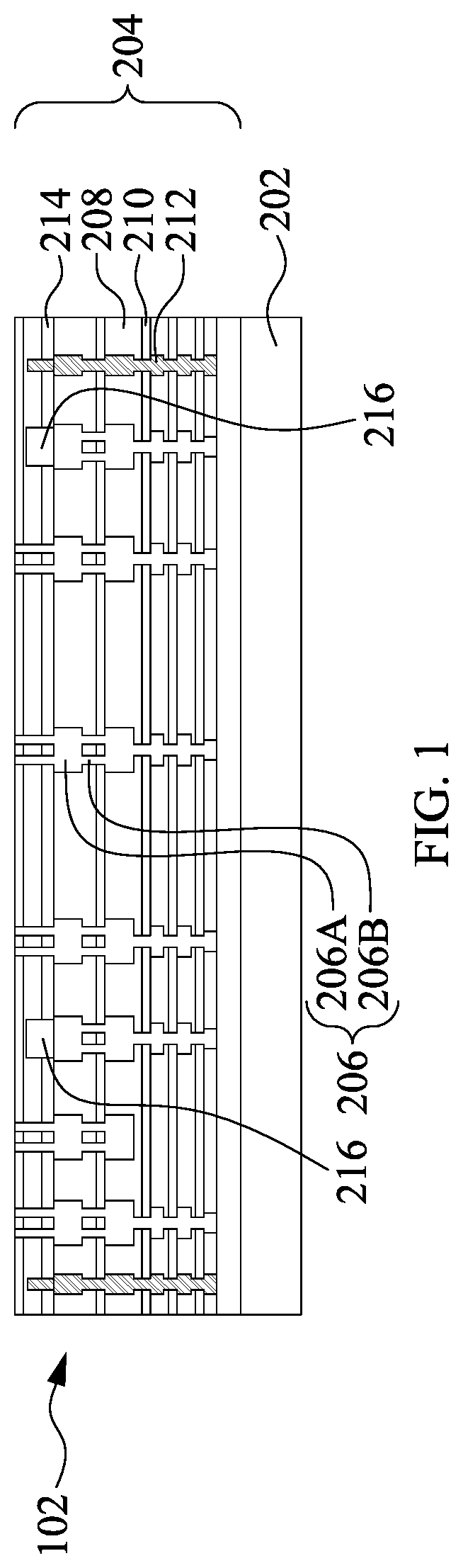
, 2 , and 6 - 15 are schematic cross-sectional views showing various stages in a method for forming a semiconductor structure, in accordance with some embodiments of the present disclosure.
A- 3 D are schematic top views of a fuse structure, in accordance with some embodiments of the present disclosure.
is a perspective view showing a second integrated circuit component, in accordance with some embodiments of the present disclosure.
A- 5 D are schematic cross-sectional views of the second integrated circuit component, in accordance with some embodiments of the present disclosure.
A- 16 B are schematic top views showing different statuses of a fuse structure before and after blowing, respectively, in accordance with some embodiments of the present disclosure.
A- 17 B are schematic top views showing different statuses of a fuse structure before and after blowing, respectively, in accordance with some embodiments of the present disclosure.
is a schematic cross-sectional view of a semiconductor structure, in accordance with some embodiments of the present disclosure.
is a schematic cross-sectional view of a semiconductor structure, in accordance with some embodiments of the present disclosure.
is a schematic cross-sectional view of a semiconductor structure, in accordance with some embodiments of the present disclosure.
is a flowchart of a method for forming a semiconductor structure, in accordance with some embodiments of the present disclosure.
is a flowchart of a method for forming a semiconductor structure, in accordance with some embodiments of the present disclosure.
DETAILED DESCRIPTION
The following disclosure provides many different embodiments, or examples, for implementing different features of the provided subject matter. Specific examples of components and arrangements are described below to simplify the present disclosure. These are, of course, merely examples and are not intended to be limiting. For example, the formation of a first feature over or on a second feature in the description that follows may include embodiments in which the first and second features are formed in direct contact, and may also include embodiments in which additional features may be formed between the first and second features, such that the first and second features may not be in direct contact. In addition, the present disclosure may repeat reference numerals and/or letters in the various examples. This repetition is for the purpose of simplicity and clarity and does not in itself dictate a relationship between the various embodiments and/or configurations discussed.
Further, spatially relative terms, such as “beneath,” “below,” “lower,” “above,” “upper” and the like, may be used herein for ease of description to describe one element or feature's relationship to another element(s) or feature(s) as illustrated in the figures. The spatially relative terms are intended to encompass different orientations of the device in use or operation in addition to the orientation depicted in the figures. The apparatus may be otherwise oriented (rotated 90 degrees or at other orientations) and the spatially relative descriptors used herein may likewise be interpreted accordingly.
Notwithstanding that the numerical ranges and parameters setting forth the broad scope of the disclosure are approximations, the numerical values set forth in the specific examples are reported as precisely as possible. Any numerical value, however, inherently contains certain errors necessarily resulting from the deviation normally found in the respective testing measurements. Also, as used herein, the terms “about,” “substantial” or “substantially” generally mean within 10%, 5%, 1% or 0.5% of a given value or range. Alternatively, the terms “about,” “substantial” or “substantially” mean within an acceptable standard error of the mean when considered by one of ordinary skill in the art. Other than in the operating/working examples, or unless otherwise expressly specified, all of the numerical ranges, amounts, values and percentages such as those for quantities of materials, durations of times, temperatures, operating conditions, ratios of amounts, and the likes thereof disclosed herein should be understood as modified in all instances by the terms “about,” “substantial” or “substantially.” Accordingly, unless indicated to the contrary, the numerical parameters set forth in the present disclosure and attached claims are approximations that can vary as desired. At the very least, each numerical parameter should at least be construed in light of the number of reported significant digits and by applying ordinary rounding techniques. Ranges can be expressed herein as being from one endpoint to another endpoint or between two endpoints. All ranges disclosed herein are inclusive of the endpoints, unless specified otherwise.
As used herein, the term “connected” may be construed as “electrically connected,” and the term “coupled” may also be construed as “electrically coupled.” “Connected” and “coupled” may also be used to indicate that two or more elements cooperate or interact with each other.
A semiconductor package structure includes a plurality of active and passive device dies. Active devices such as bipolar and field effect transistors are configured to implement specific functionalities. Passive devices such as resistors, capacitors and inductors are used to improve electrical performance of the electrical circuit. The passive and active devices may be formed as dies and are electrically connected, enabling advanced applications with reduced device size and less power consumption. In some examples, during the integration of the device dies, some processing steps may lead to, for example, charge accumulation in the electrically floating structures in the passive device dies, and thus adversely influence electrical performance of the semiconductor package.
In one or more embodiments of the present disclosure, a method for forming a semiconductor structure including a fuse structure is provided. The fuse structure may be disposed in a device die. The fuse structure in the device die is configured to electrically connect the electrically floating structure in the passive device die to ground. After the semiconductor device is completed, the fuse structure is blown to restore the function of the passive device die. Thus, the charges accumulated in the electrically floating structure may be discharged through the fuse structure during the manufacturing process, thereby protecting the semiconductor package from charge-induced damages.
, 2 and 6 through 15 are schematic cross-sectional views showing various stages in a method for forming a semiconductor structure 100 , in accordance with some embodiments of the present disclosure. In some embodiments, the semiconductor structure 100 is a semiconductor package. In some embodiments, the semiconductor structure 100 is a system-on-integrated-circuit (SoIC) package structure, an integrated fan-out (InFO) package or a three-dimensional integrated circuit (3D IC). The semiconductor structure 100 may include a plurality of active and passive device dies.
Referring to , a substrate 202 is received or provided. The substrate 202 may be referred to as a die substrate or a wafer. The substrate 202 may be a semiconductor substrate, such as a bulk semiconductor or the like, which may be doped (e.g., with a p-type or an n-type dopant) or undoped. In some embodiments, the substrate 202 is a silicon wafer. Alternatively, the substrate 202 may be a multi-layered substrate (e.g., a semiconductor-on-insulator (SOI) substrate), a gradient substrate, or the like. In some embodiments, a wide variety of electrical components (e.g., transistors, capacitors, inductors, resistors, combinations thereof, and the like) is used to meet the structural and functional requirements of the semiconductor structure 100 . In some embodiments, the substrate 202 is free of through semiconductor vias depending on the design requirements.
An interconnection structure 204 is formed over the substrate 202 . The interconnection structure 204 is configured to electrically connect its overlying components. In addition, the interconnection structure 204 is configured to electrically couple its overlying components with the electrical components of the substrate 202 . The interconnection structure 204 may include one or more conductive patterns 206 embedded in one or more dielectric layers 208 . The dielectric layers 208 may be referred to as inter-metallization dielectric (IMD) layer(s). In some embodiments, the dielectric layers 208 are formed of a low-K dielectric material, such as phosphosilicate glass (PSG), borophosphosilicate glass (BPSG), fluorosilicate glass (FSG) or the like. The conductive patterns 206 may include conductive lines 206 A and conductive vias 206 B. The conductive vias 206 B respectively electrically connect the conductive lines 206 A thereunder to the conductive lines 206 A thereon. In some embodiments, the conductive lines 206 A and the conductive vias 206 B include conductive materials, such as W, Al, Cu, AlCu, and the like.
The interconnection structure 204 may further include etch stop layers 210 disposed between the dielectric layers 208 . In some embodiments, the etch stop layers 210 are formed of a dielectric material, such as SiN, SiCN, SiCO, combinations thereof, or the like. In some embodiments, the etch stop layer 210 includes a multilayer structure, e.g., formed of a nitride layer and an oxide layer. In some embodiments, the interconnection structure 204 further includes barrier layers, such as formed of Ta or TaN, between the dielectric layers 208 and the conductive lines 206 A or conductive vias 206 B.
In some embodiments, the interconnection structure 204 further includes one or more seal rings 212 . The seal ring 212 may be formed along a periphery of the interconnection structure 204 . As illustrated in , the seal ring 212 is a continuous structure formed to laterally surround the interconnection structure 204 . The seal ring 212 may be electrically connected to an electrical ground. The seal ring 212 may be formed of a conductive material. In some embodiments, the seal ring 212 is formed of a stack of conductive lines 206 A and conductive vias 206 B. In some embodiments, the stack of the seal ring 212 is formed of a same material of the conductive patterns 206 . The seal ring 212 may be manufactured by a same process which forms the conductive patterns 206 .
In some embodiments, the interconnection structure 204 further includes one or more passivation layers 214 and one or more conductive pads 216 . The passivation layer 214 may be formed on a topmost layer of the interconnection structure 204 . In some embodiments, the conductive pads 216 are at least partially disposed in the passivation layer 214 . In some embodiments, the conductive pads 216 are formed in a metallization layer of the interconnection structure 204 . In some embodiments, the conductive pads 216 formed over the substrate 202 are configured as test pads that allows for testing of the 3D packaging or 3DIC, e.g., by use of probes and/or probe cards, and the like. The passivation layer 214 may be a silicon oxide layer, a silicon nitride layer, a silicon oxy-nitride layer, or a dielectric layer formed by other suitable dielectric materials. The conductive pads 216 may include aluminum pads, copper pads, or other suitable metal pads.
Referring to , a bonding layer 220 is formed over the interconnection structure 204 . The substrate 202 , the interconnection structure 204 and the bonding layer 220 altogether form a first integrated circuit component 102 (also referred to as a semiconductor die or a semiconductor wafer). The bonding layer 220 may be used as a bonding interface between the first integrated circuit component 102 and an overlying integrated circuit component, and may be bonded to another bonding layer on the overlying integrated circuit component discussed below. The bonding layer 220 may be formed of similar materials and by similar processes as those for the dielectric layers 208 . The bonding layer 220 may include one or more bonding pads 222 a , 222 b , and 222 c . The bonding pads 222 a , 222 b , and 222 c may be formed of similar materials of the conductive patterns 206 and manufactured by similar processes as those for the conductive patterns 206 , and thus the description are not repeated herein. The bonding layer 220 may further include one or more conductive patterns 224 . The conductive patterns 224 may be electrically connected to the seal ring 212 in the interconnection structure 204 and serve as part of the seal ring 212 .
A fuse structure 230 is formed in the bonding layer 220 . The fuse structure 230 may be electrically connected to the seal ring 212 . Alternatively, the fuse structure 230 may be electrically connected to the electrical ground through the seal ring 212 . In some embodiments, the fuse structure 230 is kept shorted or is not blown yet during the processing of the first integrated circuit component 102 . In some embodiments, the fuse structure 230 is blown after the processing of the first integrated circuit component 102 . In some embodiments, the fuse structure 230 is formed in one metallization layer of the interconnection structure 204 . In some embodiments, the fuse structure 230 is disposed in one or more dielectric layers 208 .
A- 3 C are schematic top views of the fuse structure 230 along a section line AA in , in accordance with some embodiments of the present disclosure. The bonding pad 222 a , the conductive pattern 224 and the bonding layer 220 may be formed in multi-layered structure. Referring to A , a conductive portion 222 a - 1 of the bonding pad 222 a and a conductive portion 212 - 1 of the conductive pattern 224 or the seal ring 212 are formed in a film 220 - 1 of the bonding layer 220 . In some embodiments, the film 220 - 1 is a patterned layer including recessed portions, and the conductive portion 222 a - 1 of the bonding pad 222 a and the conductive portion 212 - 1 of the seal ring 212 are formed in the recessed portions of the film 220 - 1 .
Referring to B , a film 220 - 2 is formed over the film 220 - 1 . In some embodiments, the film 220 - 2 is a patterned layer exposing portions of the film 220 - 1 . The film 220 - 2 may expose the top surface of the conductive portions 222 a - 1 and 212 - 1 . In some embodiments, the fuse structure 230 is formed in the film 220 - 2 of the bonding layer 220 . The fuse structure 230 is formed over the conductive portions 222 a - 1 and 212 - 1 and electrically coupled to the conductive portions 222 a - 1 and 212 - 1 . The fuse structure 230 may electrically connects the conductive portion 222 a - 1 of the bonding pad 222 a to the conductive portion 212 - 1 of the seal ring 212 .
Still referring to B , the fuse structure 230 includes a fuse line 230 a , a first conductive segment 230 b and a second conductive segment 230 c . The fuse line 230 a is disposed and extended between the first conductive segment 230 b and the second conductive segment 230 c . In some embodiments, the first conductive segment 230 b and the second conductive segment 230 c are respectively referred to as portions of the bonding pad 220 a and seal ring 212 . In some embodiments, the fuse line 230 a is in a shape of straight line or a meandering line. In some embodiments, a width D 1 of the fuse line 230 a is substantially less than a width D 2 of the first conductive segment 230 b , in which the width D 2 is a line width of the conductive lines 206 A or conductive vias 206 B. In some embodiments, the width D 1 of the fuse line 230 a is substantially less than a width D 3 of the second conductive segment 230 c , in which the width D 3 is a line width of the conductive lines 206 A or conductive vias 206 B. The width D 2 may be substantially same as the width D 3 . Alternatively, the width D 2 is different from the width D 3 . The fuse line 230 a , the first conductive segment 230 b and the second conductive segment 230 c may include conductive material similar as the bonding pad 222 a or the conductive pattern 224 .
Referring to C , a film 220 - 3 is formed over the film 220 - 2 . A conductive portion 222 a - 2 of the bonding pad 222 a and a conductive portion 212 - 2 of the conductive pattern 224 or the seal ring 212 are formed in the film 220 - 3 . The conductive portion 222 a - 2 is electrically coupled to the first conductive segment 230 b of the fuse structure 230 . The conductive portion 212 - 2 is electrically coupled to the second conductive segment 230 c of the fuse structure 230 . The fuse structure 230 may electrically connects the conductive portion 222 a - 2 of the bonding pad 222 a to the conductive portion 212 - 2 of the seal ring 212 . In some embodiments, the film 220 - 3 is a patterned layer, and the conductive portions 222 a - 2 of the bonding pad 222 and the conductive portion 212 - 2 of the seal ring 212 are formed in the recessed portions of the film 220 - 3 .
It is understood that the schematic drawings of the fuse structure 230 in A to 3 C are for illustration purpose only. The fuse structure 230 may include different structures and layouts according to different applications. Referring to D , a schematic top view of the fuse structure 230 is shown. D is similar to C except that the fuse structure 230 includes a plurality of fuse lines 230 d . The fuse lines 230 d are disposed and extended between the first conductive segment 230 b and the second conductive segment 230 c . In some embodiments, the fuse lines 230 d are arranged in parallel and separated from each other by a spacing distance D 4 . In some embodiments, a total width of the fuse lines 230 d is substantially less than the width D 2 of the first conductive segment 230 b or the width D 3 of the second conductive segment 230 d.
is a perspective view showing a second integrated circuit component 104 , in accordance with some embodiments of the present disclosure. It is understood that only part of the features of the second integrated circuit component 104 are illustrated in for the sake of clarity. Referring to , a substrate 402 is received or provided. The substrate 402 may be a semiconductor substrate, such as a bulk semiconductor, a dielectric substrate or the like, which may be doped (e.g., with a p-type or an n-type dopant) or undoped. In some embodiments, the substrate 402 includes a silicon carbide (SiC) substrate, a sapphire substrate or a silicon substrate. Other suitable substrates may also be used for the substrate 402 . The substrate 402 may have a first surface (also referred to as a front surface) 402 a and a second surface (also referred to as a back surface) 402 b opposite to the first surface 402 a.
An inductor 420 is formed over the substrate 402 . In some embodiments, the inductor 420 includes ports 422 and 424 . During operation, a current (not shown) is provided to flow in the inductor 420 from the port 422 to the port 424 , or vice versa. In the illustrated exemplary embodiment, the inductor 420 includes parts P 1 , P 2 , P 3 and P 4 , which are interconnected through conductive patterns 406 , in which the conductive patterns 406 include conductive lines 406 A and conductive vias 406 B. The parts P 1 , P 2 , P 3 and P 4 may be referred as different turns of the inductor 420 . In alternative embodiments, the inductor 420 may include more or fewer parts.
A- 5 D are schematic cross-sectional views of the second integrated circuit component 104 along the sectional lines 5 A- 5 A, 5 B- 5 B, 5 C- 5 C, and 5 D- 5 D, respectively, in . Referring to A , the inductor 420 is formed in an interconnection structure 404 . The interconnection structure 404 may include similar features as the interconnection structure 204 . To simplify the description, the similar features are labelled with similar numerals.
The interconnection structure 404 may include one or more dielectric layers 408 - 1 , 408 - 2 , 408 - 3 and 408 - 4 . The dielectric layers 408 - 1 , 408 - 2 , 408 - 3 and 408 - 4 collectively referenced as the dielectric layers 408 . The dielectric layers 408 may be referred to as inter-metallization dielectric (IMD) layer(s). In some embodiments, each dielectric layer 408 includes one or more conductive patterns 406 . The conductive patterns 406 may be embedded in the dielectric layers 408 . The conductive vias 406 B respectively electrically connect the conductive lines 406 A thereunder to the conductive lines 406 A thereon. In some embodiments, the conductive patterns 406 include magnetic materials, such as ferromagnetic materials. In some embodiments, the interconnection structure 404 further includes one or more etch stop layers 410 disposed between the dielectric layers 408 .
Referring to A , the parts P 1 through P 4 of the inductor 420 are electrically insulated by the dielectric layers 408 . The parts P 1 through P 4 are interconnected to form a conduction path, referred to as coils or windings herein, wherein an axis 440 of the coil extends in a direction parallel to a top surface of the substrate 402 . In some embodiments, part P 1 is connected to part P 2 through a conductive line 406 A- 1 . Part P 2 is connected to part P 3 through a conductive line 406 A- 2 . Part P 3 is connected to part P 4 through a conductive line 406 A- 3 . In some embodiments, the conductive lines 406 A- 1 , 406 A- 2 , and 406 A- 3 are arranged in a same dielectric layer 408 . In alterative embodiments, the conductive lines 406 A- 1 , 406 A- 2 , and 406 A- 3 are formed in different dielectric layers 408 . In some embodiments, the lengthwise directions of the conductive lines 406 A- 1 , 406 A- 2 , and 406 A- 3 are parallel to the top surface of the substrate 402 .
Referring to A , the port 422 of inductor 420 is electrically coupled to the conductive line 406 A- 1 in a top dielectric layer 408 - 1 . A metal column 416 - 1 , which is formed of conductive lines 406 A- 4 a , 406 A- 4 b and conductive vias 406 B- 1 a , 406 B- 1 b and 406 B- 1 c , connects the port 422 to a conductive line 406 A- 5 in a bottom dielectric layer 408 - 2 . Through another metal column 416 - 2 , which is formed of conductive lines 406 A- 6 a , 406 A- 6 b and conductive vias 406 B- 2 a , 406 B- 2 b and 406 B- 2 c , the conduction path extends back to conductive line 406 A- 1 that is in the same dielectric layer 408 - 1 as the port 422 . Through the conductive line 406 A- 1 , part P 1 of inductor 420 is connected to part P 2 , as shown in B .
Referring to B , in part P 2 , the conductive line 406 A- 1 is electrically coupled to the conductive line 406 A- 7 in the bottom dielectric layer 408 - 2 through a metal column 416 - 3 , which is formed of conductive lines 406 A- 8 a , 406 A- 8 b and conductive vias 406 B- 3 a , 406 B- 3 b and 406 B- 3 c . Through another metal column 416 - 4 , which is formed of conductive lines 406 A- 9 a , 406 A- 9 b and conductive vias 406 B- 4 a , 406 B- 4 b and 406 B- 4 c , the conduction path extends to the conductive line 406 A- 2 in the top dielectric layer 408 - 1 . Through the conductive line 406 A- 2 , part P 2 of inductor 420 is connected to part P 3 , as shown in C .
Referring to C , in part P 3 , the conductive line 406 A- 2 is electrically coupled to the conductive line 406 A- 10 in the bottom dielectric layer 408 - 2 through a metal column 416 - 5 , which is formed of conductive lines 406 A- 11 a , 406 A- 11 b and conductive vias 406 B- 5 a , 406 B- 5 b and 406 B- 5 c . Through another metal column 416 - 6 , which is formed of conductive lines 406 A- 12 a , 406 A- 12 b and conductive vias 406 B- 6 a , 406 B- 6 b and 406 B- 6 c , the conduction path extends to the conductive line 406 A- 3 in the top dielectric layer 408 - 1 . Through the conductive line 406 A- 3 , part P 3 of inductor 420 is connected to part P 4 , as shown in D .
Referring to D , the conductive line 406 A- 3 is further electrically coupled to the port 424 through the metal column 416 - 7 , the conductive line 406 A- 13 and the metal column 416 - 8 . The metal column 416 - 7 is formed of conductive lines 406 A- 14 a , 406 A- 14 b and conductive vias 406 B- 7 a , 406 B- 7 b and 406 B- 7 c . The metal column 416 - 8 is formed of conductive lines 406 A- 15 a , 406 A- 15 b and conductive vias 406 B- 8 a , 406 B- 8 b and 406 B- 8 c . If current flows into the inductor 420 through the port 422 , the current may flow in a counter-clockwise direction in each of parts P 1 through P 4 , until it reaches port 424 . Conversely, if current flows into the inductor 420 through the port 424 , the current will flow in the clockwise direction in each of parts P 1 through P 4 . A magnetic field may be generated around the inductor 420 when the current flows through the conductive coils.
The inductor 420 as shown in is an asymmetric inductor, in which ports 422 and 424 extends in different directions. In some embodiments, the ports 422 and 424 are arranged in a same level. In alternative embodiments, the ports 422 and 424 are arranged in different levels. It is understood that the inductor 420 as shown in is merely an example of the inductor. It is also understood that the inductor 420 may have different configurations, different arrangements, and different number of windings or turns depending on design requirements. In some embodiments, the inductor 420 may further include a magnetic core disposed within the inductor 420 .
Referring to and continuing with A- 5 D , a through via 412 is formed in the substrate 402 . In some embodiments, the substrate 402 is flipped over to expose the back surface of the substrate 402 , followed by the formation of the through via 412 . The through via 412 may be formed by an etching operation on the substrate 402 followed by a deposition process. The through via 412 may include conductive materials, such as W, Al, Cu, AlCu, and the like. In some embodiments, the through via 412 is referred to as a through silicon via. The through via 412 may be electrically connected to the inductor 420 .
Referring to , a bonding layer 430 is formed over the back surface of the substrate 402 . The bonding layer 430 may be formed of similar materials and by similar processes as those for the bonding layer 220 . In some embodiments, the bonding layer 430 includes one or more bonding pads 432 . The bonding pad 432 may be formed of similar materials and by similar processes as those for the bonding pads 222 a , 222 b and 222 c . The bonding pad 432 may be electrically connected to the inductor 420 through the through via 412 . In alternative embodiments, the bonding pad 432 may be electrically connected to the port 422 or 424 of the inductor 420 .
In some embodiments, the substrate 402 is singulated by separating the inductor 420 from other inductors along a scribe line. The singulated substrate 402 and the inductor 420 altogether form the second integrated circuit component 104 . The bonding layer 430 or the bonding layer 220 may be used as a bonding interface between the second integrated circuit component 104 and first integrated circuit component 102 , as discussed below.
Referring to , the second integrated circuit component 104 is bonded to the first integrated circuit component 102 . In some embodiments, the second integrated circuit component 104 is flipped over, picked and placed on the first integrated circuit component 102 . In some embodiments, the bonding between the first integrated circuit component 102 and the second integrated circuit component 104 is performed at a die-to-wafer level. Alternatively, the bonding between the first integrated circuit component 102 and the second integrated circuit component 104 may be performed at the die-to-die level or wafer-to-wafer level. In some embodiments, the bonding pad 432 of the second integrated circuit component 104 is aligned with the bonding pad 222 a , of the first integrated circuit component 102 . After the alignment process, the bonding pad 432 bonding layer 430 and the bonding pad 222 a of bonding layer 220 are bonded together by, for example, applying pressure, radiation, heat or the like. Afterwards, the dielectric materials of the bonding layer 430 and the dielectric materials of the bonding layer 220 are bonded with a dielectric-to-dielectric bond, while the bonding pad 432 of bonding layer 430 and the bonding pad 222 a of bonding layer 220 are bonded with a metal-to-metal bond. In some embodiments, the bonding between the bonding layers 430 and 220 includes hybrid bonding, pressure bonding or fusion bonding.
In some embodiments, the inductor 420 is electrically floating if the though via 412 is absent. In the present example, only one inductor is shown in the second integrated circuit component 104 ; however, the number of inductors and the arrangement of the inductors can be altered according to various applications. In some embodiments, the second integrated circuit component 104 is an inductance die. In some embodiments, the second integrated circuit component 104 is referred to as an inductance chip.
Referring to , a dielectric layer 460 is formed over the first integrated circuit component 102 . The second integrated circuit component 104 may be encapsulated by the dielectric layer 460 . The dielectric layer 460 may further cover the exposed portions of the first integrated circuit component 102 . In some embodiments, the dielectric layer 460 includes a dielectric material selected from encapsulating or molding materials. In some embodiments, the dielectric layer 460 includes, for example, compliant epoxies that are liquid at temperatures above room temperature, and have rapid cure times especially at elevated temperatures and low viscosity during dispensing.
Referring to , an etching operation may be performed to form one or more trenches 462 in the dielectric layer 460 . The etching operation may include a dry etch, a wet etch or a combination thereof. In some embodiments, one or more plasma treatments are involved in the etching operation. In some embodiments, charges or electrons will accumulate in the inductor 420 of the second integrated circuit component 104 during the etching operation. For example, the charges induced by the plasma treatment may accumulate in the inductor 420 . The accumulated charges may damage the electrically floating features or the underlying features in the first integrated circuit component 102 of the semiconductor structure 100 .
Through the proposed scheme, the charges accumulated in the inductor 420 may flow to the electrical ground through one or more discharge paths. For example, the charges in the inductor 420 may flow to the electrical ground through the conductive pattern 406 , the through via 412 , the bonding pad 432 , the bonding pad 222 a and the conductive patterns 206 in the dielectric layers 208 . Alternatively, the charges in the inductor 420 may flow to the electrical ground through the conductive pattern 406 , the through via 412 , the bonding pad 432 , the bonding pad 222 a , the fuse structure 230 and the seal ring 212 . The presence of the fuse structure 230 provides an additional discharge path between the inductor 420 and the electrical ground. Thus, the charge accumulation problem of the inductor 420 may be mitigated.
Referring to , one or more through vias 464 are formed in the trenches 462 of the dielectric layer 460 . The through via 464 may include conductive materials, such as W, Al, Cu, AlCu, and the like. In some embodiments, the through vias 464 are referred to as through dielectric vias. In some embodiments, one of the through vias 464 is electrically connected to the bonding pad 222 c of the bonding layer 220 .
Referring to , a bonding layer 470 is formed over the second integrated circuit component 104 and the dielectric layer 460 . The bonding layer 470 may be formed of similar materials and by similar processes as those for the bonding layer 430 . In some embodiments, the bonding layer 470 includes one or more bonding pads 472 a , 472 b , 472 c and 472 d . The bonding pads 472 a , 472 b , 472 c and 472 d may be formed of similar materials as the bonding pad 432 . The bonding pad 472 a may be electrically connected to the inductor 420 . In some embodiments, the bonding pad 472 a is electrically connected to the port 422 or 424 of the inductor 420 .
In some embodiments, the formation of the bonding layer 470 and the bonding pads 472 a , 472 b , 472 c and 472 d involves one or more treatments, such as a plasma treatment or a spin coating treatment. The charges induced by the plasma treatment or the spin coating treatment may accumulate in the inductor 420 of the second integrated circuit component 104 as discussed above. With the presence of the through via 412 and the fuse structure 230 , the charges accumulated in the inductor 420 may dissipate to the electrical ground. Accordingly, the charge accumulation problem of the inductor 420 of the second integrated circuit component 104 may be mitigated.
Referring to , a third integrated circuit component 106 may be received or provided. The third integrated circuit component 106 may be referred to as a semiconductor die. In some embodiments, the third integrated circuit component 106 is an individual die after singulation. In some embodiments, the third integrated circuit component 106 is a wafer before singulation. The third integrated circuit component 106 may include similar features as the first integrated circuit component 102 . To simplify the description, the similar features are labelled with similar numerals.
The third integrated circuit component 106 may include a substrate 602 and an interconnection structure 604 on the substrate 602 . The interconnection structure 604 may include one or more dielectric layers 608 , wherein each dielectric layer 608 include one or more conductive patterns 606 . In some embodiments, the interconnection structure 604 further includes one or more etch stop layers 610 and one or more seal rings 612 . In some embodiments, the interconnection structure 604 further includes a passivation layer 614 and one or more test pads 616 . In some embodiments, the third integrated circuit component 106 further includes a bonding layer 620 disposed over the interconnection structure 604 . The bonding layer 620 may include one or more bonding pads 622 .
Still referring to , the third integrated circuit component 106 may be picked and placed on the second integrated circuit component 104 . In some embodiments, a bonding between the third integrated circuit component 106 and the second integrated circuit component 104 are performed at a die-to-die level. Alternatively, the bonding between the third integrated circuit component 106 and the second integrated circuit component 104 may be performed at a die-to-wafer level or wafer-to-wafer level. In some embodiments, the bonding pads 622 of the third integrated circuit component 106 are aligned with the corresponding bonding pads 472 a , 472 b , 472 c and 472 d of the second integrated circuit component 104 . After the alignment process, the bonding pads 622 of bonding layer 620 and the bonding pads 472 a , 472 b , 472 c and 472 d of bonding layer 470 are bonded together by, for example, applying pressure, radiation, heat or the like. In some embodiments, the bonding between the bonding layers 620 and 470 includes hybrid bonding, pressure bonding or fusion bonding.
After the bonding process, the third integrated circuit component 106 may be electrically connected to the first integrated circuit component 102 . The third integrated circuit component 106 may be electrically connected to the first integrated circuit component 102 through the bonding pads 622 , 472 d , the through via 464 and the bonding pad 222 c . In some alternative embodiments, the first integrated circuit component 102 may further include an additional fuse structure (not shown) between the bonding pad 222 c and the seal ring 212 . The additional fuse structure may electrically connect the third integrated circuit component 106 to the electrical ground through the bonding pads 622 , 472 d , the through via 464 , the bonding pad 222 c , the additional fuse structure and the seal ring 212 . In some embodiments, the fuse structure 230 is kept shorted or is not blown yet during the processing of the first integrated circuit component 102 , the second integrated circuit component 104 and the third integrated circuit component 106 . In some embodiments, the fuse structure 230 is blown after the processing of the third integrated circuit component 106 . In some embodiments, the third integrated circuit component 106 is electrically floating if the though via 464 is not present.
Referring to , one or more through vias 630 are formed in the third integrated circuit component 106 . In some embodiments, the through vias 630 are extended through the substrate 602 and the interconnection structure 604 . In some embodiments, prior to the formation of the through vias 630 , a thinning process is performed to thin down the substrate 602 . After the thinning process, several treatments, such as an etching process to form trenches in the substrate 602 and the interconnection structure 604 and a deposition process to deposit conductive materials in the trenches, may be performed to form the through vias 630 . As discussed previously, the treatments may induce charge accumulation in the inductor 420 of the second integrated circuit component 104 . With the discharge path formed by the through via 412 and the fuse structure 230 , the charges accumulated in the inductor 420 may flow to the electrical ground. Thus, the charge-induced damages can be mitigated.
Referring to , a dielectric layer 640 is formed to surround the third integrated circuit component 106 . The third integrated circuit component 106 may be encapsulated by the dielectric layer 640 . In some embodiments, an interconnection structure 660 including one or more dielectric layers 662 and respective conductive patterns 664 is formed over the back surface of the third integrated circuit component 106 . The conductive patterns 664 embedded in the dielectric layers 662 may be in electrical and physical contact with the through vias 630 of the third integrated circuit component 106 . In some embodiments, one or more input/output (I/O) terminals 650 are formed over the third integrated circuit component 106 . In some embodiments, under-ball metallurgy (UBM) (not shown) are formed prior to the forming of the I/O terminals 650 . In some embodiments, the interconnection structure 660 further includes one or more etch stop layers 666 , one or more passivation layers 668 and one or more conductive pads 670 and one or more buffer layers 672 .
In some embodiments, after the interconnection structure 660 is formed, the stack of the first integrated circuit component 102 , the second integrated circuit component 104 and the third integrated circuit component 106 undergoes a singulation process to form the semiconductor structure 100 . In some embodiments, the stack of the first integrated circuit component 102 , the second integrated circuit component 104 and the third integrated circuit component 106 is singulated by sawing along a scribe line.
As discussed previously, the method for forming the semiconductor structure 100 may include performing one or more charge-induced treatments, such as a plasma treatment, a spin coating treatment or the like. In some embodiments, a charge-induced treatment is involved in forming the interconnection structure 660 . In some embodiments, charges or electrons accumulate in the electrically floating structures, such as the inductor 420 of the second integrated circuit component 104 , if the fuse structure 230 or the through via 412 is not present. The fuse structure 230 arranged in the semiconductor structure 100 establishes a discharge path between the electrically floating structure and the electrical ground. Thus, charges or electrons formed in the charge-induced treatments and accumulated in the electrically floating structure may flow to the electrical ground. Accordingly, the charge accumulation problems in the semiconductor structure 100 may be mitigated.
In some embodiments, the fuse structure 230 is kept shorted or is not blown yet during the processing of the first integrated circuit component 102 , the second integrated circuit component 104 and the third integrated circuit component 106 . In some embodiments, the fuse structure 230 is blown after a charge-induced treatment. In some embodiments, the fuse structure 230 is blown before forming the input/output (I/O) terminals 650 or before the completion of the semiconductor structure 100 . In some embodiments, a void is formed in the bonding layer 220 after the fuse structure 230 is blown. In some embodiments, the fuse structure 230 is blown by a laser treatment. The discharge path may be broke by the laser treatment. In some embodiments, the fuse structure 230 is blown by a blowing current provided through a control circuit. For example, the fuse structure 230 may be initially connected with logic circuits. Then, in a final processing step, the semiconductor structure 100 is subjected to a command through the logic circuits to cause a current to flow by and blow the fuse structure 230 . The fuse structure 230 may be designed with a less line width than a normal line width of the conductive patterns 206 / 224 , the bonding pad 222 a or configured to sustain less electrical voltage/current, such that the fuse structure 230 can be successfully blown without adversely damaging the conductive patterns 206 / 224 , and the bonding pad 222 .
It is understood that the schematic drawings of the fuse structure 230 in to 15 are for illustration purpose only. The fuse structure 230 may include different structures and layouts according to different applications. It is also understood that the schematic drawings of the fuse structure 230 in to 15 illustrates processing stages before the fuse structure 230 is blown.
A through 16 B are schematic top views showing different statuses of the fuse structure 230 before and after blowing, respectively, in accordance with some embodiments of the present disclosure. Many aspects of the fuse structure 230 are similar to those of the fuse structure 230 illustrated in C , and are hereby omitted from discussion for brevity.
Referring to A , the fuse structure 230 include the fuse line 230 a , the first conductive segment 230 b and the second conductive segment 230 c . The first conductive segment 230 b and the second conductive segment 230 c enable the fuse line 230 a to be electrically connected to one or more elements adjacent to the fuse structure 230 . The one or more elements connected to the fuse structure 230 may include the inductor 420 of the second integrated circuit component 104 .
The one or more elements are made disconnected to the fuse structure 230 by blowing the fuse structure 230 . In some embodiments, a section 231 of the fuse line 230 a is blown to create an opening 233 in the fuse line 230 a as shown in B . The opening 233 is defined by a void 226 in the bonding layer 220 where the section 231 of the fuse line 230 a is disposed. The void 226 is between opposing end portions 230 a - 1 and 230 a - 2 of the fuse line 230 a . The portions 230 a - 1 and 230 a - 2 are separated by the void 226 . In some embodiments, the portion 230 a - 1 is electrically connected to the seal ring 212 and the portion 230 a - 2 is electrically connected to the inductor 420 of the second integrated circuit component 104 after the fuse structure 230 is blown.
In some embodiments, the density of the fuse structure 230 shows a nonuniform distribution through the blowing operation. For example, the density of the fuse line 230 a is reduced after the fuse structure 230 is blown. A density of the fuse line 230 a is made less than a density of the portion 230 a - 1 or 230 a - 2 . The density of the portion 230 a - 1 or 230 a - 2 may be varied from the edge close to the void 226 to an edge of the portion 230 a - 1 or 230 a - 2 distal to the void 226 . In some embodiments, a density of the portion 230 a - 1 or 230 a - 2 closer to the void 226 is greater than a density of the portion 230 a - 1 or 230 a - 2 closer to the first conductive segment 230 b or the second conductive segment 230 c.
In some embodiments, the density of the bonding layer 220 shows an nonuniform distribution after the fuse structure 230 is blown. For example, the density of the bonding layer 220 may be consistent along the section 231 before the fuse structure 230 is blown. After the fuse structure 230 is blown, the density of the bonding layer 220 is varied from the edge close to the void 226 to an edge of the bonding layer 220 distal to the void 226 . In some embodiments, a density of the bonding layer 220 closer to the void 226 is greater than a density of the bonding layer 220 closer to the first conductive segment 230 b or the second conductive segment 230 c.
In some embodiments, the void 226 is surrounded by a metal oxide. In some embodiments, during the blowing of the fuse structure 230 , the metal in the fuse line 230 a becomes molten. In some embodiments, during the blowing of the fuse structure 230 , the oxide in the bonding layer 220 surrounding the fuse line 230 a is melted. In some embodiments, the molten metal migrates to the surrounding melted oxide and forms the metal oxide. In some embodiments, a size of the void 226 is about 0.1 micron.
In some embodiments, a length L 1 of the portion 230 a - 1 is different from a length L 2 of the portion 230 a - 2 . In some embodiments, the length L 1 of the portion 230 a - 1 and the length L 2 of the portion 230 a - 2 are substantially the same. In some embodiments, a sidewall S 1 of the portion 230 a - 1 and a sidewall S 2 of the portion 230 a - 2 are straight or curved. In some embodiments, the shape of the void 226 is rectangle, circle, polygon, or irregular.
In some embodiments, the fuse structure 230 is blown by a laser treatment. For example, the section 231 of the fuse line 230 a is vaporized with a high energy laser beam 239 to blow the fuse line 230 a , thereby forming the opening 233 . In some embodiments, the fuse line 230 a is arranged vertically spaced apart from the second integrated circuit component 104 from a top-view perspective. In some embodiments, the fuse line 230 a is arranged vertically spaced apart from the third integrated circuit component 106 from a top-view perspective. In some embodiments, the bonding layer 220 that includes the fuse line 230 a is arranged on a topmost layer of the first integrated circuit component 102 for receiving the laser beam during a blowing operation. In some embodiments, the bonding layer 220 , the dielectric layer 460 , and the dielectric layer 640 include oxide, nitride or other suitable dielectric materials. In some embodiments, the materials of the bonding layer 220 , the dielectric layer 460 , and the dielectric layer 640 are selected from materials being transparent to the laser beams. Thus, the bonding layer 220 or the other layers over the fuse structure 230 may not block or influence the laser beams.
In some embodiments, the fuse structure 230 is blown by an electrical current through control of a control circuit. For example, the section 231 of the fuse line 230 a is vaporized with a current to create the opening 233 in the fuse line 230 a . In some embodiments, the conductive patterns 206 and the seal ring 212 are arranged under the first conductive segment 230 b or the second conductive segment 230 c as illustrated in . The first conductive segment 230 b may be electrically connected to the conductive patterns 206 in lower metal levels. The first conductive segment 230 b may be electrically connected to an associated control circuit (not shown) formed in an underlying circuit area of the substrate 202 and electrically connected to the conductive patterns 206 . The control circuit in the substrate 202 may control the current flow. In some embodiments, the section 231 of the fuse line 230 a is blown after conducting a current to pass through the fuse line 230 a.
The fuse structure 230 of the present disclosure is not limited to the above-mentioned embodiments, and may have other different embodiments. A through 17 B are schematic top views showing different statuses of the fuse structure 230 before and after blowing, respectively, in accordance with some embodiments of the present disclosure. Many aspects of the fuse structure 230 are similar to those of the fuse structure 230 illustrated in D , and are hereby omitted from discussion for brevity.
Referring to A , the fuse structure 230 includes the fuse lines 230 d , the first conductive segment 230 b and the second conductive segment 230 c . Referring to B , the fuse structure 230 may be blown by vaporizing a section 235 of the fuse lines 230 d with a high energy laser beam 239 or a current to create an opening 237 in the fuse lines 230 d , as shown in B . Referring to B , the opening 237 is defined by voids 228 in the bonding layer 220 where the section 235 of the fuse lines 230 d is disposed. The voids 228 are formed between opposing end portions 230 d - 1 and 230 d - 2 of the fuse lines 230 d . The portions 230 d - 1 and 230 d - 2 are separated by the voids 228 . In some embodiments, a length L 3 of the portion 230 d - 1 is different from a length L 4 of the portion 230 d - 2 . In some embodiments, the length L 3 of the portion 230 d - 1 and the length L 4 of the portion 230 d - 2 are substantially the same. In some embodiments, the lengths of the blown fuse lines 230 d in portion 230 d - 1 or 230 d - 2 are different. In some embodiments, the shape of the void 228 is rectangle, circle, polygon, or irregular.
The structures of the present disclosure are not limited to the above-mentioned embodiments, and may have other different embodiments. To simplify the description and for the convenience of comparison between each of the embodiments of the present disclosure, components in each of the following embodiments that are discussed previously are labelled with identical numerals. For convenience of comparing the difference between the embodiments, the following description will detail the dissimilarities among different embodiments and the identical features will not be repeated.
is a schematic cross sectional view of a semiconductor structure 200 , in accordance with some embodiments of the present disclosure. The semiconductor structure 200 shown in is similar to the semiconductor structure 100 shown in except that the second integrated circuit component 104 is face-to-face bonded with the first integrated circuit component 102 . In some embodiments, the port 422 or 424 of the inductor 420 in the second integrated circuit component 104 is directly bonded to the bonding pad 432 . With the discharge path formed by the fuse structure 230 , the charges accumulated in the inductor 420 may flow to the electrical ground more efficiently. Thus, the charge-induced damages can be mitigated.
is a schematic cross sectional view of a semiconductor structure 300 , in accordance with some embodiments of the present disclosure. The semiconductor structure 300 shown in is similar to the semiconductor structure 200 shown in except that the semiconductor structure 300 further includes an additional fuse structure 230 ′. In some embodiments, the fuse structure 230 ′ is disposed in the bonding layer 220 . The fuse structure 230 ′ may be electrically connected to the seal ring 212 through the bonding pad 222 a and the fuse structure 230 . The fuse structure 230 ′ may be formed of similar materials and by similar processes as those for the fuse structure 230 . The fuse structure 230 ′ may be electrically connected to the electrical ground through the seal ring 212 . In some embodiments, the fuse structures 230 and 230 ′ are kept shorted or are not blown yet during the processing of the first integrated circuit component 102 , the second integrated circuit component 104 and the third integrated circuit component 106 . In some embodiments, the fuse structures 230 and 230 ′ are blown after the processing of the first integrated circuit component 102 , the second integrated circuit component 104 and the third integrated circuit component 106 . In some embodiments, the fuse structure 230 ′ is disposed at a level different from that of the fuse structure 230 . In some embodiments, the fuse structure 230 ′ is formed in the interconnection structure 204 .
The fuse structures 230 and 230 ′ may be electrically connected to different ports of the inductor 420 . For example, the port 422 of the inductor 420 is electrically connected to the fuse structure 230 through the bonding pad 432 a and the bonding pad 222 a . The port 424 of the inductor 420 is electrically connected to the fuse structure 230 ′ through the bonding pad 432 b and the bonding pad 222 b . With the additional discharge path formed by the fuse structure 230 ′, the charges accumulated in the inductor 420 may flow to the electrical ground more efficiently. Thus, the charge-induced damages can be mitigated.
is a schematic cross sectional view of a semiconductor structure 400 , in accordance with some embodiments of the present disclosure. The semiconductor structure 400 shown in is similar to the semiconductor structure 100 shown in except that the semiconductor structure 400 further includes several fuse structures 232 a , 232 b , 232 c and 232 d . In some embodiments, the fuse structures 232 a , 232 b and 232 c are disposed in the bonding layer 470 , and the fuse structure 232 d is disposed in the bonding layer 220 . The fuse structures 232 a , 232 b , 232 c and 232 d may be electrically connected to the seal ring 212 through the bonding pads 472 a , 472 b , 472 c and 472 d , the through via 464 and the bonding pad 222 c . The fuse structure 232 a , 232 b , 232 c and 232 d may be formed of similar materials and by similar processes as those for the fuse structure 230 . The fuse structure 232 a , 232 b , 232 c and 232 d may be electrically connected to the electrical ground through the seal ring 212 . In some embodiments, the fuse structures 230 , 232 a , 232 b , 232 c and 232 d are kept shorted or are not blown yet during the processing of the first integrated circuit component 102 , the second integrated circuit component 104 and the third integrated circuit component 106 . In some embodiments, the fuse structures 230 , 232 a , 232 b , 232 c and 232 d are blown after the processing of the first integrated circuit component 102 , the second integrated circuit component 104 and the third integrated circuit component 106 .
The fuse structures 230 , 232 a , 232 b , 232 c and 232 d may be electrically connected to the port 422 or 424 of the inductor 420 . For example, the port 422 or 424 of the inductor 420 is electrically connected to the fuse structure 232 d through the bonding pad 472 a , the fuse structure 232 a , the bonding pad 472 b , the fuse structure 232 b , the bonding pad 472 c , the fuse structure 232 c , the bonding pad 472 d , the through via 464 and the bonding pad 222 c . With the additional discharge path formed by the fuse structures 232 a , 232 b , 232 c and 232 d , the charges accumulated in the inductor 420 may flow to the electrical ground more efficiently. Thus, the charge-induced damages can be mitigated.
is a flowchart of a method 1 for forming a semiconductor structure, in accordance with some embodiments of the present disclosure. It is understood that additional steps can be provided before, during, and after the method 1 , and some of the steps described can be replaced or eliminated for other embodiments of the method. The method 1 for forming a semiconductor structure includes an operation 10 where a first integrated circuit component is received. In some embodiments, the first integrated circuit component includes a seal ring and a fuse structure. In some embodiments, the fuse structure is electrically connected to an electrical ground through the seal ring. The method 1 further includes an operation 12 where a second integrated circuit component is received. In some embodiments, the second integrated circuit component includes an inductor. The method 1 further includes an operation 14 where the second integrated circuit component is bonded to the first integrated circuit component. The method 1 further includes an operation 16 where the inductor is electrically connected to the fuse structure. In some embodiments, the inductor is electrically connected to the electrical ground through the fuse structure. In some embodiments, the method further includes an operation 18 where the fuse structure is blown after a treatment.
is a flowchart representing a method 2 for forming a semiconductor structure, in accordance with some embodiments of the present disclosure. It is understood that additional steps can be provided before, during, and after the method 2 , and some of the steps described can be replaced or eliminated for other embodiments of the method. The method 2 for forming a semiconductor structure includes an operation 20 where a first integrated circuit component is received. In some embodiments, the first integrated circuit component includes a fuse structure. The method 2 further includes an operation 22 where a second integrated circuit component is received. In some embodiments, the second integrated circuit component includes an inductor. The method 2 further includes an operation 24 where the second integrated circuit component is bonded to the first integrated circuit component. In some embodiments, the inductor is electrically connected to the fuse structure. The method 2 further includes an operation 26 where a third integrated circuit component is received. The method 2 further includes an operation 28 where the third integrated circuit component is bonded to the second integrated circuit component. In some embodiments, the third integrated circuit component is electrically connected to the first integrated circuit component. In some embodiments, the method further includes an operation 30 where the fuse structure is blown.
By using the fuse structure and method of the present disclosure, the charge accumulation problem can be mitigated. As the electrically floating structure in the device dies are electrically connected to the electrical ground though the fuse structures, the charges accumulated in the electrically floating structure may be directed to the electrical ground. The fuse structure may be blown after the processes which induces charges accumulation. Thus, the electrical circuit design of the semiconductor structure may not be influenced by the fuse structure.
According to an embodiment, a method for forming a semiconductor structure is provided. The method includes the following operations. A first integrated circuit component having a fuse structure is received. A second integrated circuit component having an inductor is received. The second integrated circuit component is bonded to the first integrated circuit component. The inductor is electrically connected to the fuse structure, wherein the inductor is electrically connected to a ground through the fuse structure.
According to an embodiment, a method for forming a semiconductor structure is provided. The method includes the following operations. A first integrated circuit component having a fuse structure is received. A second integrated circuit component having an inductor is received. The second integrated circuit component is bonded to the first integrated circuit component, wherein the inductor is electrically connected to the fuse structure. A third integrated circuit component is bonded to the second integrated circuit component, and the third integrated circuit component is electrically connected to the first integrated circuit component.
According to an embodiment, a semiconductor structure is provided. The semiconductor structure includes a first die and a second die. The first die includes a fuse structure including a pair of conductive segments, wherein the pair of conductive segments are separated by a void and one of the pair of conductive segments is electrically connected to a bonding pad. The second die is disposed over the first die. The second die is bonded to the first die. The second die includes an inductor electrically connected to the one of the pair of conductive segments.
The foregoing outlines features of several embodiments so that those skilled in the art may better understand the aspects of the present disclosure. Those skilled in the art should appreciate that they may readily use the present disclosure as a basis for designing or modifying other processes and structures for carrying out the same purposes and/or achieving the same advantages of the embodiments introduced herein. Those skilled in the art should also realize that such equivalent constructions do not depart from the spirit and scope of the present disclosure, and that they may make various changes, substitutions, and alterations herein without departing from the spirit and scope of the present disclosure.
Figures (20)
Citations
This patent cites (7)
- US9160346
- US10424521
- US11393777
- US11410927
- US20120162947
- US20170345754
- US20200075553