Method for Operating Conveying System
Abstract
A method for operating a conveying system is provided. An overhead hoist transport (OHT) vehicle is provided, wherein the OHT vehicle includes a gripping member configured to grip and hold a carrier, and a receiver configured to receive a signal. The signal is transmitted to the receiver of the OHT vehicle. The OHT vehicle is moved toward the carrier, and the carrier is gripped by the gripping member of the OHT vehicle. A lifting force is determined based on a weight of a carrier, a number of workpieces in the carrier, or a vertical distance between the OHT vehicle and the carrier, and the lifting force is applied to the carrier.
Claims (12)
1. A method for operating a conveying system, comprising: positioning an overhead hoist transport (OHT) vehicle over a first load port; transmitting a first data to the OHT vehicle, wherein the first data includes information of a weight of a first carrier, a number of workpieces in the first carrier, and a first vertical distance between the OHT vehicle and the first carrier: applying a first lifting force to the first carrier on the first load port, wherein the first lifting force is determined based on the first data; moving the OHT vehicle over a second load port; positioning the OHT vehicle over the second load port; and transmitting a second data to the OHT vehicle, wherein the second data includes information of a weight of a second carrier, a number of workpieces in the second carrier and a second vertical distance between the OHT vehicle and the second carrier; applying a second lifting force to the second carrier on the second load port, wherein the second lifting force is determined based on the second data; and receiving the first data and the second data by a control unit of the OHT vehicle for automatic calculation prior to the application of the first lifting force and the second lifting force; wherein the first lifting force is a minimum force required to lift the first carrier calculated by the control unit of the OHT vehicle, and the second lifting force is a minimum force required to lift the second carrier calculated by the control unit; and wherein the first lifting force is different from the second lifting force.
Show 11 dependent claims
2. The method of claim 1 , wherein the weight of the second carrier is different from the weight of the first carrier.
3. The method of claim 1 , further comprising: providing a first downward force subjecting to the first carrier; sending a notification if the first downward force is greater than the first lifting force; and lifting the first carrier if the first downward force is equal to or less than the first lifting force.
4. The method of claim 3 , further comprising: stopping application of the first lifting force if the first downward force is greater than the first lifting force.
5. The method of claim 1 , wherein the first lifting force is an upward force substantially equal to a first downward force of a total weight of the first carrier and the workpieces in the first carrier.
6. The method of claim 1 , further comprising: detecting whether the first carrier is lifted by the first lifting force after the application of the first lifting force.
7. The method of claim 6 , wherein the detection is performed by a sensor disposed on the first load port.
8. The method of claim 6 , wherein the detection is performed by another sensor disposed on the OHT vehicle.
9. The method of claim 1 , further comprising: calculating a first lifting torque according to the first weight of the first carrier, the first number of workpieces in the first carrier and the first vertical distance between the OHT vehicle and the first carrier; generating the first lifting torque by a hoisting motor of a hoisting member of the OHT; and converting the first lifting torque to the first lifting force by a belt of the hoisting member connecting to the hoisting motor.
10. The method of claim 1 , further comprising: lifting the first carrier with the first lifting force; or sending an alert if the first carrier cannot be lifted with the first lifting force.
11. The method of claim 1 , wherein the first data and the second data are wirelessly transmitted to the OHT vehicle.
12. The method of claim 1 , further comprising: detecting the first vertical distance between the OHT vehicle and the first carrier; and sending a notification if the first vertical distance does not decrease after the application of the first lifting force.
Full Description
Show full text →
BACKGROUND
The semiconductor industry has experienced exponential growth, and integrated circuits (ICs) are used in a wide variety of applications. ICs are typically manufactured by automated or semi-automated equipment. Workpieces, such as substrates or wafers, are loaded into the equipment, and electrical components and circuitries are then fabricated over or within the workpieces through numerous manufacturing operations.
Automated Material Handling Systems (AMHS) have been widely used in semiconductor fabrication to automatically handle and transport groups of the workpieces between various processing instruments. There are numerous types of automated vehicles (including automated guided vehicles (AGV), rail-guided vehicles (RGV), overhead hoist transport (OHT), and the like) for moving and transporting carriers (such as front-opening unified pods (FOUPs)) carrying the workpieces during fabrication. For example, an OHT system includes automatically-moving OHT vehicles carrying workpieces from a load port of one processing instrument to a load port of another processing instrument.
There is a continuous need to modify the manufacturing operations and improve efficiency of transport of the workpieces between the processing instruments, such as reducing power consumption during transport of different types and quantities of the workpieces.
BRIEF DESCRIPTION OF THE DRAWINGS
Aspects of the present disclosure are best understanding from the following detailed description when read with the accompanying figures. It should be noted that, in accordance with the standard practice in the industry, various features are not drawn to scale. In fact, the dimensions of the various features may be arbitrarily increased or reduced for clarity of discussion.
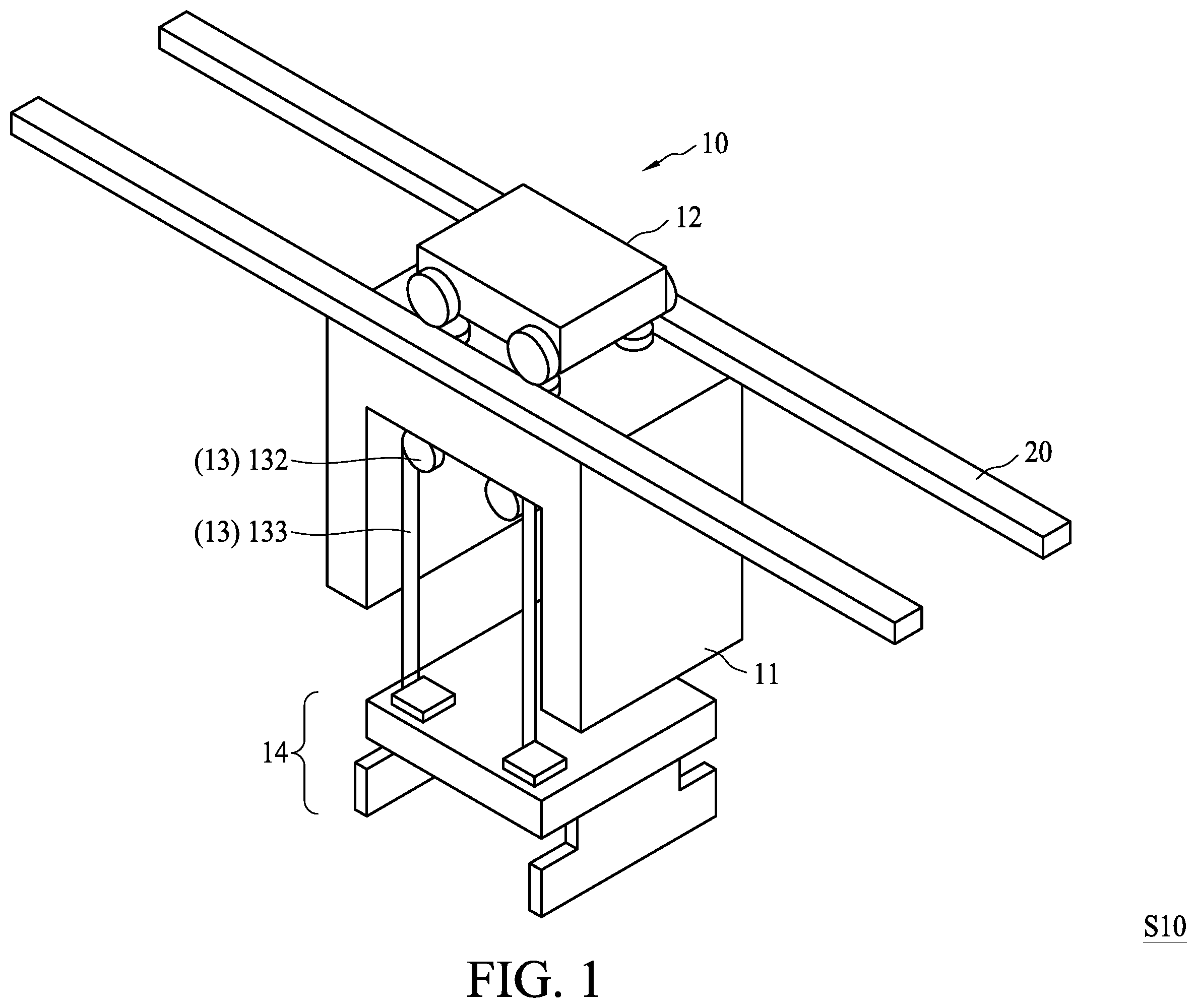
is a schematic diagram of a conveying system in accordance with some embodiments of the present disclosure.
is a cross-sectional diagram of the conveying system shown in showing a configuration when the conveying system moves a carrier in accordance with some embodiments of the present disclosure.
is flow chart of a method for operating the conveying system shown in in accordance with some embodiments of the present disclosure.
is flow chart of a method for operating the conveying system shown in in accordance with some embodiments of the present disclosure.
is a schematic diagram of electrical connections for signal transmission of the conveying system shown in in accordance with some embodiments of the present disclosure.
to 15 are schematic diagrams showing different configurations of the conveying system while performing different operations of the methods illustrated in , 4 and 16 .
is flow chart of a method for operating the conveying system in accordance with some embodiments of the methods shown in .
DETAILED DESCRIPTION
The following disclosure provides many different embodiments, or examples, for implementing different features of the provided subject matter. Specific examples of elements and arrangements are described below to simplify the present disclosure. These are, of course, merely examples and are not intended to be limiting. For example, the formation of a first feature over or on a second feature in the description that follows may include embodiments in which the first and second features are formed in direct contact, and may also include embodiments in which additional features may be formed between the first and second features, such that the first and second features may not be in direct contact. In addition, the present disclosure may repeat reference numerals and/or letters in the various examples. This repetition is for the purpose of simplicity and clarity and does not in itself dictate a relationship between the various embodiments and/or configurations discussed.
Further, spatially relative terms, such as “beneath,” “below,” “lower,” “above,” “over,” “upper,” “on” and the like, may be used herein for ease of description to describe one element or feature's relationship to another element(s) or feature(s) as illustrated in the figures. The spatially relative terms are intended to encompass different orientations of the device in use or operation in addition to the orientation depicted in the figures. The apparatus may be otherwise oriented (rotated 90 degrees or at other orientations) and the spatially relative descriptors used herein may likewise be interpreted accordingly.
As used herein, although the terms such as “first,” “second” and “third” describe various elements, components, regions, layers and/or sections, these elements, components, regions, layers and/or sections should not be limited by these terms. These terms may be only used to distinguish one element, component, region, layer or section from another. The terms such as “first,” “second” and “third” when used herein do not imply a sequence or order unless clearly indicated by the context.
Notwithstanding that the numerical ranges and parameters setting forth the broad scope of the disclosure are approximations, the numerical values set forth in the specific examples are reported as precisely as possible. Any numerical value, however, inherently contains certain errors necessarily resulting from the standard deviation found in the respective testing measurements. Also, as used herein, the terms “substantially,” “approximately” and “about” generally mean within a value or range that can be contemplated by people having ordinary skill in the art. Alternatively, the terms “substantially,” “approximately” and “about” mean within an acceptable standard error of the mean when considered by one of ordinary skill in the art. People having ordinary skill in the art can understand that the acceptable standard error may vary according to different technologies. Other than in the operating/working examples, or unless otherwise expressly specified, all of the numerical ranges, amounts, values and percentages such as those for quantities of materials, durations of times, temperatures, operating conditions, ratios of amounts, and the likes thereof disclosed herein should be understood as modified in all instances by the terms “substantially,” “approximately” or “about.” Accordingly, unless indicated to the contrary, the numerical parameters set forth in the present disclosure and attached claims are approximations that can vary as desired. At the very least, each numerical parameter should at least be construed in light of the number of reported significant digits and by applying ordinary rounding techniques. Ranges can be expressed herein as from one endpoint to another endpoint or between two endpoints. All ranges disclosed herein are inclusive of the endpoints, unless specified otherwise.
A conveying system is utilized during semiconductor fabrication. The conveying system includes a conveying unit configured to travel along a rail and carry a workpiece or a semiconductor structure from one processing machine to another. The conveying unit is able to lift a carrier for carrying semiconductor structures or workpieces from a load port of a machine station and move the carrier along the rail to another machine station. The conveying unit provides a constant force to ensure all carriers with different weights can be lifted and held safely by the conveying unit during transportation. Normally, the carrier should be unlocked from the load port prior to being lifted by the conveying unit; however, when a carrier is abnormally locked to the load port, the force may still be applied to the abnormally-locked carrier by the conveying unit, which can result in damage to the semiconductor structures or the workpieces in the carrier, damage to the load port, and/or damage to the carrier.
The present disclosure therefore provides a method for operating a conveying system including an automatic calculating operation to adjust a minimum force to lift a carrier. The minimum force can be calculated based on information of a weight of the carrier, a number of workpieces or semiconductor substrates in the carrier, a weight of each of the workpieces or semiconductor substrates, and/or a vertical distance between an overhead hoist transport (OHT) vehicle and the carrier. Minimum forces required to lift different carriers after different stages of the semiconductor fabrication can be different, and the conveying system of the present disclosure is able to adjust lifting forces applied to different carriers. Therefore, damage to the semiconductor substrates, the workpieces, the carrier and the load port during the lifting process can be prevented.
is a schematic diagram of a conveying system S 10 in accordance with various embodiments of the present disclosure. The conveying system S 10 functions to transport a carrier between locations during a semiconductor fabrication in a factory. is a cross-sectional schematic diagram illustrating the conveying system S 10 of carrying a first carrier C 10 . In some embodiments, the conveying system S 10 is an overhead hoist transport (OHT) system. The conveying system S 10 includes an OHT vehicle 10 and a rail 20 . The OHT vehicle 10 is configured to carry the first carrier C 10 and travel along the rail 20 . In some embodiments, the OHT vehicle 10 can include a housing 11 , a travelling member 12 , a hoisting member 13 and a gripping member 14 .
The travelling member 12 is configured to moveably mount the OHT vehicle 10 to the rail 20 . In some embodiments, the travelling member 12 can be a wheeled trolley, which is configured to complement and cooperate with the rail 20 for rolling movement along the rail 20 laterally or horizontally. In other words, the OHT vehicle 10 is suspended on the rail 20 through the travelling member 12 . In some embodiments, the travelling member 12 is installed on the rail 20 and connected to the housing 11 . In some embodiments, the housing 11 is mounted on the travelling member 12 . The travelling member 12 may include a travelling motor 121 and one or more wheels 122 . The OHT vehicle 10 travels laterally upon rotation of the wheel 122 of the travelling member 12 . In some embodiments, the travelling motor 121 is configured to actuate the wheel 122 such that the wheel 122 can be rotated and the OHT vehicle 10 can travel laterally along the rail 20 .
In some embodiments, the housing 11 of the OHT vehicle 10 can be a rigid frame surrounding several components, such as the hoisting member 13 and the gripping member 14 . The first carrier C 10 can be a FOUP, a standard mechanical interface (SMIF) pod, or the like. In some embodiments, the gripping member 14 is configured to grip the first carrier C 10 for carrying the workpiece SB. In some embodiments, the workpiece SB can be a wafer, a semiconductor substrate, a semiconductor structure or a package. In some embodiments, the workpiece SB includes semiconductive materials such as silicon and/or other suitable materials. In some embodiments, the workpiece SB includes circuitries or electrical components disposed on a semiconductor substrate. In some embodiments, a lot or a group of workpieces SB are disposed inside the first carrier C 10 to isolate the workpieces SB from the surrounding environment and prevent contamination.
In some embodiments, the gripping member 14 is configured to securely hold and release the first carrier C 10 in order to transport the workpiece SB along the rail 20 from one location to another. In some embodiments, the gripping member 14 is connected to the housing 11 through the hoisting member 13 . In some embodiments, the gripping member 14 can hold the first carrier C 10 inside and outside the housing 11 using the hoisting member 13 .
The hoisting member 13 is configured to lift and lower the first carrier C 10 from and to a load port of a process machine station using the gripping member 14 . In some embodiments, when the hoisting member 13 is in a retracted status, the hoisting member 13 is disposed in and surrounded by the housing 11 . In some embodiments, when the hoisting member 13 is in an extended status, the hoisting member 13 is disposed out of the housing 11 . The hoisting member 13 is extendable from and retractable toward the housing 11 . In some embodiments, the hoisting member 13 connects the housing 11 to the gripping member 14 . In some embodiments, the hoisting member 13 is extendable to move the gripping member 14 out of the housing 11 and retractable to move the gripping member 14 back to the housing 11 . In some embodiments, the hoisting member 13 is telescopically extendable and retractable.
In some embodiments, the hoisting member 13 includes a hoisting motor 131 , at least a wheel 132 and at least a belt 133 . The hoisting motor 131 is configured to actuate the wheel 132 such that the wheel 132 can be rotated and the belt 133 , which is connected to the wheel 132 , can be vertically extended from or retracted toward the wheel 132 . The hoisting member 13 can lower the gripping member 14 by extending the belt 133 from the housing 11 . A top portion of the first carrier C 10 can then be held by the gripping member 14 and lifted from a load port of a processing machine station by retracting the belt 133 toward the housing 11 . In some embodiments, when the belt 133 is in a retracted status, the hoisting member 13 , the gripping unit 14 and the carrier C 10 are disposed inside the housing 11 . In some embodiments, the hoisting member 13 is in the retracted status upon movement of the OHT vehicle 10 along the rail 20 .
In order to automatically adjust a lifting force applied to the first carrier C 10 , the OHT vehicle 10 can further include a control unit 15 installed on the housing 11 . The configuration shown in is provided for illustration purpose, and a specific location of the control unit 15 on the housing 11 is not limited herein. The control unit 15 is configured to calculate and determine a lifting force to be applied to the first carrier C 10 , wherein the lifting force is a minimum force required to lift the first carrier C 10 based on information of the first carrier C 10 received by the control unit 15 . In some embodiments, data is transmitted to the OHT vehicle 10 through wireless or wired electrical signals, and the data includes information of a weight of the first carrier C 10 , a number of workpieces SB in the first carrier C 10 , a weight of each of the workpieces SB in the first carrier C 10 , and/or a vertical distance between the OHT vehicle 10 and the first carrier C 10 . In some embodiments, the OHT vehicle 10 can further include a receiver 16 installed on the housing 11 . The configuration shown in is provided for illustration purpose, and a specific location of the receiver 16 on the housing 11 is not limited herein. The receiver 16 is electrically connected to the control unit 15 . In some embodiments, the receiver 16 can be installed in the control unit 15 or separated from the control unit 15 on the housing 11 . The signal including the information of the first carrier C 10 is received by the receiver 16 and then processed by the control unit 15 .
In some embodiments, a torque is calculated by the control unit 15 based on the data or the information of the first carrier C 10 . The control unit 15 then sends a signal including the torque to the hoisting motor 131 of the hoisting member 13 . After the gripping member 14 grips the first carrier C 10 , the hoisting motor 131 of the hoisting member 13 generates the torque, which is calculated by the control unit 15 , to actuate rotation of the wheels 132 to retract the belt 133 . The hoisting motor 131 generates the torque to drive the wheel 132 and retract the belt 133 and thus convert the torque to the lifting force. In other words, the torque is applied to an axis of the wheel 132 to turn the wheel 131 , and the belt 133 converts the torque to the lifting force applied to the first carrier C 10 through the gripping member 14 , wherein the lifting force is an upward force for raising the first carrier C 10 .
Under normal circumstances, the first carrier C 10 can be lifted by the lifting force. However, in an abnormal circumstance, such as when the first carrier C 10 is abnormally locked to a load port, the first carrier C 10 cannot be lifted by the lifting force determined by the control unit 15 due to a downward force on the first carrier C 10 from the load port. In some embodiments, under the abnormal circumstance, the conveying system S 10 will stop providing the lifting force to the first carrier C 10 . In some embodiments, the conveying system S 10 can detect the abnormal circumstance and send a signal or an alert to notify the operator that an abnormal circumstance exists. In some embodiments, the OHT vehicle 10 further includes a sensor 17 to detect whether the first carrier C 10 is lifted. The sensor can be installed on the housing 11 and electrically connected to the hoisting motor 131 , but the disclosure is not limited thereto. In some embodiments, the sensor 17 is installed on the load port and electrically connected to the control unit 15 in order to notify the operator about the lifting of the first carrier C 10 .
In accordance with the above description, one aspect of the present disclosure also provides a method M 10 for operating the conveying system S 10 . The method M 10 includes a number of operations and the description and illustration are not deemed as a limitation as the sequence of the operations. is a flow chart according to some embodiments of the method M 10 for operating the conveying system S 10 . As shown in , the method M 10 includes: (O 101 ) providing an overhead hoist transport (OHT) vehicle including a gripping member configured to grip and hold a carrier, and a receiver configured to receive a signal; (O 102 ) transmitting a signal to the receiver; (O 103 ) moving the OHT vehicle toward the carrier; (O 104 ) gripping the carrier by the gripping member; (O 105 ) determining a lifting force based on a weight of a carrier, a number of workpieces in the carrier, or a vertical distance of the OHT vehicle and the carrier; and (O 106 ) applying the lifting force to the carrier.
Another embodiment of the present disclosure provides a method M 20 for operating the conveying system S 10 . The method M 20 includes a number of operations and the description and illustration are not deemed as a limitation as the sequence of the operations. is flow chart according to some embodiments of the method M 20 for operating the conveying system S 10 . As shown in , the method M 10 includes: (O 201 ) moving an overhead hoist transport (OHT) vehicle over a first load port; (O 202 ) applying a first lifting force to a first carrier on the first load port; (O 203 ) moving the OHT vehicle over a second load port; and (O 204 ) applying a second lifting force to a second carrier on the second load port, wherein the first lifting force is different from the second lifting force.
In order to further illustrate the method M 10 and the method M 20 of the disclosure, shows a schematic diagram of electrical connections for signal transmission, and to 15 are diagrams showing different configurations of the conveying system S 10 during different operations of the method M 10 and the method M 20 .
In accordance with some embodiments and the operations O 101 and O 102 , the OHT vehicle 10 of the conveying system S 10 as shown in to 2 is provided, and a first signal or a first data including information of the first carrier C 10 is transmitted to the receiver 16 . In some embodiments, the information of the first carrier C 10 needed for calculating a first torque T 1 and/or a first lifting force F 1 can be saved in one or more servers or systems, and the receiver 16 is electrically connected to the one or more servers or systems. As shown in , the receiver 16 is electrically connected to a first server SV 1 and a second server SV 2 . Some information of the first carrier C 10 , such as a type of the first carrier C 10 , a weight of the first carrier C 10 , a number of workpieces SB in the first carrier C 10 , and an ID of the first carrier C 10 , may be stored in the first server SV 1 . Some information of the first carrier C 10 , such as a vertical distance between the OHT vehicle 10 and the first carrier C 10 , a time schedule for picking up the first carrier C 10 , a load port at which the first carrier C 10 is to be picked up, and a load port at which the first carrier C 10 is to be dropped off, may be stored in the second server SV 2 . The receiver 16 can be integrated with systems or servers already installed in a semiconductor factory.
In the operation O 102 , one or more signals (or data) including the information for determining the first lifting force F 1 is transmitted to the receiver 16 . In some embodiments, the signal (or the data) including information of the weight of the first carrier C 10 and the number of workpieces SB in the first carrier C 10 is transmitted from the first server SV 1 to the receiver 16 . In some embodiments, the signal (or the data) including information of the vertical distance between the OHT vehicle 10 and the first carrier C 10 is transmitted from the second server SV 2 to the receiver 16 . The signal (or the data) may include more or less of the above-described information according to different applications or a different design, and is not limited herein. In some embodiments, at least one of the weight of the first carrier C 10 , the number of workpieces SB in the first carrier C 10 , and the vertical distance of the OHT vehicle 10 and the first carrier C 10 is transmitted to the receiver 16 .
In some embodiments, the travelling member 12 can be electrically connected to the one or more servers. As shown in , the travelling member 12 is electrically connected to the second server SV 2 . Some information, such as the time schedule for picking up the first carrier C 10 , the load port at which the first carrier C 10 is to be picked up, and the load port at which the first carrier C 10 is to be dropped off, can be transmitted to the travelling member 12 through one or more electrical signals. The travelling member 12 can transport the first carrier C 10 from one load port to another load port according to the time schedule. However, it is not intended to limit the disclosure, and, in some embodiments, the travelling member 12 is not electrically connected to the second server SV 2 directly, but is instead connected to the second server SV 2 through the control unit 15 . In some embodiments, information of a transportation schedule is transmitted to the control unit 15 , and the travelling member 12 receives a signal from the control unit 15 to perform the movement of the OHT vehicle 10 .
is a diagram of the conveying system S 10 in accordance with some embodiments and the operation O 103 or O 201 . The OHT vehicle 10 is moved toward and displaced or positioned over the first carrier C 10 on a first load port LP 1 of a machine station. In some embodiments, the travelling member 12 moves the OHT vehicle 10 toward the first load port LP 1 according to the information from the second server SV 2 .
In some embodiments, the method M 10 and the method M 20 further include extending the hoisting member 13 toward the first carrier C 10 after the operation O 103 or O 201 and prior to the operation O 104 or O 202 . The hoisting motor 131 actuates rotation of the wheels 132 to release the belt 133 in order to lower the gripping member 14 toward the first carrier C 10 .
is a diagram of the conveying system S 10 in accordance with some embodiments and the operation O 104 , wherein the first carrier C 10 is gripped by the gripping member 14 . In some embodiments, the gripping member 14 applies forces from two opposite sides of the first carrier C 10 in order to grip the first carrier C 10 . However, the disclosure is not limited thereto. In alternative embodiments, the gripping member 14 can include a connector to connect a corresponding connector to the first carrier C 10 , e.g., on a top of the first carrier C 10 .
In the operation O 105 of the method M 10 , the first lifting force F 1 is determined based on information of the weight of the first carrier C 10 , the number of workpieces SB in the first carrier C 10 , or the vertical distance between the OHT vehicle 10 and the first carrier C 10 . As illustrated above, the first lifting force F 1 is determined by the control unit 15 based on the information transmitted from the servers SV 1 and SV 2 . In some embodiments, in order to determine the first lifting force F 1 from the information of the signal, a first torque T 1 is calculated by the control unit 15 according to the weight of the first carrier C 10 , the number of workpieces SB in the first carrier C 10 , or the vertical distance between the OHT vehicle 10 and the first carrier C 10 . The control unit 15 transmits a signal or a command to generate the first torque T 1 to the hoisting motor 131 of the hoisting member 13 , and the hoisting motor 131 generates the first torque T 1 . The first torque T 1 is converted to the first lifting force F 1 by the belt 133 in order to lift the first carrier C 10 and the gripping member 14 . In some embodiments, the first lifting force F 1 is first calculated and then the first torque T 1 is determined by the control unit 15 based on the calculated first lifting force F 1 . In some embodiments, the first lifting force F 1 is calculated based on at least one of the weight of the first carrier C 10 , the number of workpieces SB in the first carrier C 10 , and the vertical distance between the OHT vehicle 10 and the first carrier C 10 . In addition, energy consumption during conversion from the first torque T 1 to the first lifting force F 1 is also be considered and calculated by the control unit 15 in order to acquire the first torque T 1 . The first lifting force F 1 is designed and calculated to be a minimum force required for lifting the first carrier C 10 for a purpose of minimizing power consumption. The operation O 105 is performed prior to applying the first lifting force F 1 to the first carrier C 10 (i.e., the operation O 106 of the method M 10 ), and a sequence of the operation O 105 relative to operations O 101 , O 102 , O 103 and O 104 is not limited herein. Similarly, the method M 20 can further include: determining the first lifting force F 1 based on the data including at least one of the weight of the first carrier C 10 , the number of workpieces SB in the first carrier C 10 , and the vertical distance between the OHT vehicle 10 and the first carrier C 10 prior to the operation O 202 .
are diagrams of the conveying system S 10 in accordance with some embodiments and the operation O 106 or O 202 , and illustrate the first lifting force F 1 being applied to the first carrier C 10 . The first torque T 1 is generated by the hoisting motor 131 and is converted to the first lifting force F 1 in order to apply an upward force to the first carrier C 10 to lift the first carrier C 10 from the first load port LP 1 . After the first lifting force F 1 is applied, under normal circumstances, the first carrier C 10 is lifted upward from the first load port LP 1 with the first lifting force F 1 , as shown in to 9 . The hoisting member 13 is retracted back to the housing 11 , and the first carrier C 10 is held by the gripping member 14 inside the housing 11 during transportation as shown in . In order words, the OHT vehicle 10 may receive a first downward force F 2 from the first carrier C 10 due to gravity. The first downward force F 2 should be substantially equal to a total mass of the first carrier C 10 and the workpieces SB inside the first carrier C 10 , and the first lifting force F 1 should be substantially equal to or slightly greater than the first downward force F 2 . Under normal circumstances, the first carrier C 10 may be transferred to a load port of another machine station.
When an abnormal event happens, the first carrier C 10 may receive a first downward force F 2 from the first load port LP 1 as shown in , and the first carrier C 10 may not be lifted by the first lifting force F 1 from the hoisting member 13 . is a diagram of the conveying system S 10 in accordance with some embodiments of the present disclosure. The first carrier C 10 is locked to the first load port LP 1 when the first carrier C 10 is disposed on the first load port LP 1 , and the first carrier C 10 should be released prior to the applying of the first lifting force F 1 . However, if the first carrier C 10 is not released normally or if the first lifting force F 1 is applied prior to the release of the first carrier C 10 , an extra downward force F 3 is applied to the first carrier C 10 , and the OHT vehicle 10 receives both the first downward force F 2 and the extra downward force F 3 , counteracting the first lifting force F 1 . When the total downward force (the first downward force F 2 plus the extra downward force F 3 ) is greater than the first lifting force F 1 , the first carrier C 10 cannot be lifted off the first load port LP 1 with the first lifting force F 1 by the OHT vehicle 10 . Since the first lifting force F 1 is calculated to be the minimum force required for lifting the first carrier C 10 based on the calculation of the control unit 15 and the design of the OHT vehicle 10 , even a small extra downward force F 3 can result in suspension of transportation of the first carrier C 10 .
In some embodiments, the method M 10 or the method M 20 further includes detecting whether the first carrier C 10 is lifted by the first lifting force F 1 after the first lifting force F 1 is applied. In some embodiments, the OHT vehicle 10 includes a sensor 17 , and the sensor 17 can detect if the first carrier C 10 is not approaching the housing 10 , or if the vertical distance between the OHT vehicle 10 and the first carrier C 10 does not decrease, after the first lifting force F 1 is applied. In some embodiments, the sensor 17 can be installed on the first load port LP 1 to detect if the first carrier C 10 is lifted off the first load port LP 1 . In some embodiments, the sensor 17 can be installed adjacent to the first load port LP 1 or the first carrier C 10 to detect a vertical movement of the first carrier C 10 . Different types of the sensor 17 can be applied according to different requirements, and is not limited herein.
As shown in , in some embodiments, the sensor 17 is electrically connected to the hoisting member 13 and the control unit 15 , and detection of the status of the hoisting motor 131 and the belt 132 by the sensor 17 can facilitate determination of a lifting status of the first carrier C 10 by the control unit 15 . However, the disclosure is not limited thereto. As illustrated above, the sensor 17 can be installed on the first load port LP 1 or adjacent to the first carrier C 10 . In some embodiments, the sensor 17 can be electrically connected to the control unit 15 without electrically connecting to the hoisting member 13 .
In some embodiments, the method M 10 or the method M 20 can further include sending an alert if the first carrier C 10 cannot be lifted with the first lifting force F 1 . An alert or a notification is sent to notify an operator that an abnormal circumstance exists or an error has occurred. A type of the alert or the notification is not limited herein. For instance, the alert or the notification can be a message appearing on a user interface or an alarm sounded in a factory, depending on different applications. In some embodiments, the method M 10 or the method M 20 can further include stopping application of the first lifting force F 1 if the total downward force is greater than the first lifting force F 1 , for purposes of power saving and preventing damage to the workpieces SB, the first carrier C 10 , and/or the first load port LP 1 .
In some embodiments, the sensor 17 is electrically connected to the control unit 15 directly or indirectly (please refer to for the electrical connection). When abnormal circumstances exist or errors occur, the sensor 17 sends a signal to the control unit 15 . The control unit 15 can send a signal to stop the hoisting member 13 from providing the first lifting force F 1 to the first carrier C 10 until the abnormal circumstance or the error is eliminated or until an operator re-initiates the lifting operation. In some embodiments, the sensor 17 is electrically connected to a central system directly or indirectly to cause the central system to send the alert or the notification or sound the alarm.
In some embodiments, the OHT vehicle 10 stops moving or moves back to a default position after transporting the first carrier C 10 . In some embodiments, as illustrated in the flow chart of , the OHT vehicle 10 may start to transport another second carrier C 20 . is diagram showing the conveying system S 10 in accordance with the operation O 203 , in which the OHT vehicle 10 is moved toward and positioned over a second load port LP 2 of another machine station. In some embodiments, the travelling member 12 moves the OHT vehicle 10 toward the second load port LP 2 according to the information from the second server SV 2 .
In some embodiments, the method M 20 further includes extending the hoisting member 13 toward a second carrier C 20 after the operation O 203 and prior to the operation O 204 . The hoisting motor 131 actuates rotation of the wheels 132 to release the belt 133 in order to lower the gripping member 14 toward the second carrier C 20 .
is a diagram of the conveying system S 10 in accordance with some embodiments after the operation O 203 and prior to the operation O 204 . The method M 20 can further include gripping the second carrier C 20 by the gripping member 14 . In some embodiments, the gripping member 14 applies forces from two opposite sides of the second carrier C 20 in order to grip the second carrier C 20 . However, the disclosure is not limited thereto. As described above, the gripping member 14 can include a connector to connect a corresponding connector on the second carrier C 20 depending on a type of the second carrier C 20 .
are diagrams of the conveying system S 10 in accordance with some embodiments and the operation O 204 , wherein a second lifting force F 4 is applied to the second carrier C 20 . A second torque T 2 is generated by the hoisting motor 131 and is converted to the second lifting force F 4 in order to apply an upward force to the second carrier C 20 to lift the second carrier C 20 from the second load port LP 2 . The second lifting force F 4 is derived from the second torque T 2 , which is calculated by the control unit 15 . The calculation of the second torque T 2 and the second lifting force F 4 is similar to the calculation of the first torque T 1 and the first lifting force F 1 , and repeated description is omitted herein. Thus, in some embodiments, the method M 20 further includes: determining the second lifting force F 4 based on the data including at least one of the weight of the second carrier C 20 , the number of workpieces SB in the second carrier C 20 , and the vertical distance between the OHT vehicle 10 and the second carrier C 20 prior to the operation O 204 .
After the second lifting force F 4 is applied as illustrated in the operation O 204 , under normal circumstances, the second carrier C 20 is lifted upward from the second load port LP 2 with the second lifting force F 4 as shown in . The hoisting member 13 is retracted back to the housing 11 , and the second carrier C 20 is held by the gripping member 14 inside the housing 11 during transportation as shown in . Accordingly, the OHT vehicle 10 may receive a second downward force F 5 from the second carrier C 20 due to gravity. The second lifting force F 4 is designed and calculated to be a minimum force required for lifting the second carrier C 20 , and is determined for a purpose of minimizing power consumption. The second downward force F 5 should be substantially equal to a total weight of the second carrier C 20 and the workpieces SB inside the second carrier C 20 , and the second lifting force F 4 should be substantially equal to or slightly greater than the second downward force F 5 . Under normal circumstances, the second carrier C 20 may then be transferred to a load port of another machine station.
It should be noted that different types of carriers can have different weights. Carriers on different load ports of different machine stations can contain different numbers of workpieces SB and/or different weights of workpieces SB. Moreover, a vertical distance between the OHT vehicle 10 and different carriers on different load ports can also be different, and it might result in different torques required to lift the different carriers. Therefore, the second lifting force F 4 is be different from the first lifting force F 1 if one factor of the information used in the calculation is different from that of information for lifting the first carrier C 10 . In some embodiments, the weight of the first carrier C 10 is different from the weight of the second carrier C 20 , and therefore the first lifting force F 1 would be different from the second lifting force F 4 . In other embodiments, the vertical distance between the OHT vehicle 10 and the second carrier C 20 is different from the vertical distance between the OHT vehicle 10 and the first carrier C 10 , and therefore the second torque T 2 would be different from the first torque T 1 .
When an abnormal circumstance exists or an error occurs, the second carrier C 20 may receive a second downward force F 5 from the second load port LP 2 as shown in , and the second carrier C 20 may not be lifted with the second lifting force F 4 applied by the hoisting member 13 . is a diagram of the conveying system S 10 in accordance with some embodiments of the present disclosure. The second carrier C 20 is locked to the second load port LP 2 when it is disposed on the second load port LP 2 , and should be released prior to the applying of the second lifting force F 4 . However, if the second carrier C 20 is not released normally or if the second lifting force F 4 is applied prior to the release of the second carrier C 20 , an extra downward force F 6 is applied to the second carrier C 20 , and the OHT vehicle 10 receives both the second downward force F 5 and the extra downward force F 6 , counteracting the second lifting force F 4 . When the total downward force (the second downward force F 5 plus the extra downward force F 6 ) is greater than the second lifting force F 4 , the second carrier C 20 cannot be lifted with the second lifting force F 4 by the OHT vehicle 10 . Since the second lifting force F 4 is calculated to be the minimum force required for lifting the second carrier C 20 based on the calculation of the control unit 15 and the design of the OHT vehicle 10 , even a small extra downward force F 6 can result in suspension of transportation of the second carrier C 20 .
In some embodiments, the method M 20 further includes a detection operation to detect if the second carrier C 20 is lifted by the second lifting force F 4 after the second lifting force F 4 is applied, as illustrated in accordance with the operation O 204 . The OHT vehicle 10 can include the sensor 17 , or the sensor 17 can be installed on the second load port LP 2 similar to the configuration described above. In some embodiments, the method M 20 can further include lifting the second carrier C 20 or sending a notification. The above-described sensor 17 , detection operation, and types of notification can be also applied when an error occurs or an abnormal circumstance exists during the transportation of the second carrier C 20 , and repeated description is omitted herein.
In accordance with the above description, the present disclosure can prevent damage to the workpieces SB, the carriers C 10 and C 20 , and the load ports LP 1 and LP 2 due to abnormal circumstances. is a flow chart of a method M 30 illustrating some embodiments of the method M 10 or the M 20 when an abnormal circumstance exists or an error occurs. The method M 30 includes several operations: (O 301 ) providing an overhead hoist transport (OHT) vehicle; (O 302 ) transmitting a signal to the OHT vehicle, wherein the signal includes information of a weight of a carrier, a number of workpieces in the carrier, or a vertical distance between the OHT vehicle and the carrier; (O 303 ) moving the OHT vehicle toward the carrier; (O 304 ) determining a lifting force required for lifting the carrier according to the information; (O 305 ) applying the lifting force to the carrier; and (O 306 ) sending an alert if the carrier cannot be lifted with the lifting force.
The present disclosure provides a method for operating a conveying system including an automatic calculation and adjustment of a minimum force required to be applied to a carrier to lift the carrier. The minimum force can be calculated and determined from information of a weight of the carrier, a number of workpieces in the carrier, a weight of each of the workpieces, and a vertical distance between an overhead hoist transport (OHT) vehicle and the carrier. Minimum forces required to lift different carriers after different stages of the semiconductor fabrication can be different, and the conveying system of the present disclosure is able to adjust lifting forces applied to different carriers. When an abnormal circumstance exists or an error occurs, an alert or a notification is sent to notify an operator of the situation. Therefore, damage to the semiconductor substrates, the workpieces, the carrier and the load port during the lifting process can be avoided.
Some embodiments of the disclosure provide a method for operating a conveying system. The method includes several operations. An overhead hoist transport (OHT) vehicle is provided, wherein the OHT vehicle includes a gripping member configured to grip and hold a carrier, and a receiver configured to receive a signal. The signal is transmitted to the receiver of the OHT vehicle. The OHT vehicle is moved toward the carrier, and the carrier is gripped by the gripping member of the OHT vehicle. A lifting force is determined based on a weight of a carrier, a number of workpieces in the carrier, or a vertical distance between the OHT vehicle and the carrier, and the lifting force is applied to the carrier.
Some embodiments of the disclosure provide a method for operating a conveying system. The method includes several operations. An overhead hoist transport (OHT) vehicle is positioned over a first load port, and a first lifting force is applied to a first carrier on the first load port. The OHT vehicle is positioned over a second load port, and a second lifting force is applied to a second carrier on the second load port, wherein the first lifting force is different from the second lifting force.
Some embodiments of the disclosure provide a method for operating a conveying system. The method includes several operations. An overhead hoist transport (OHT) vehicle is provided, wherein the OHT vehicle includes a gripping member configured to grip and hold a carrier, and a receiver configured to receive a signal. The signal is transmitted to the receiver of the OHT vehicle, wherein the signal includes information of a weight of a carrier, a number of workpieces in the carrier, or a vertical distance between the OHT vehicle and the carrier. The OHT vehicle is moved toward the carrier, and the carrier is gripped by the gripping member of the OHT vehicle. A lifting force is determined based on the information, and the lifting force is applied to the carrier. A notification is sent if the carrier cannot be lifted with the lifting force.
The foregoing outlines features of several embodiments so that those skilled in the art may better understand the aspects of the present disclosure. Those skilled in the art should appreciate that they may readily use the present disclosure as a basis for designing or modifying other processes and structures for carrying out the same purposes and/or achieving the same advantages of the embodiments introduced herein. Those skilled in the art should also realize that such equivalent constructions do not depart from the spirit and scope of the present disclosure, and that they may make various changes, substitutions, and alterations herein without departing from the spirit and scope of the present disclosure.
Figures (16)
Citations
This patent cites (8)
- US4174921
- US20080310939
- US20100279438
- US20200243363
- US200832599
- US201641412
- USWO-2007132650
- USWO-2014115472