Abstract
Disclosed herein is an apparatus that includes a substrate having first and second surfaces opposite to each other, a first coil pattern formed on the first surface of the substrate, and a second coil pattern formed on the second surface of the substrate. The first coil pattern includes first and second lines, and the second coil pattern includes third and fourth lines. The first line is greater in a number of turn than the second line, and the third line is greater in a number of turn than the fourth line. The first line is connected to the fourth line, and the third line is connected to the second line.
Claims (9)
1. A coil component comprising: a first coil part spirally wound in a plurality of turns; and a second coil part spirally wound in a plurality of turns, wherein at least an innermost peripheral turn of the first coil part is divided into a plurality of lines including first and second lines by a spiral-shaped slit, wherein at least an innermost peripheral turn of the second coil part is divided into a plurality of lines including third and fourth lines by a spiral-shaped slit, wherein a first angular distance of the innermost peripheral turn of the first line formed by a first virtual line and an inner peripheral end of the first line is larger than a second angular distance of the innermost peripheral turn of the second line formed by the first virtual line and an inner peripheral end of the second line, wherein a third angular distance of the innermost peripheral turn of the third line formed by a second virtual line and an inner peripheral end of the third line is larger than a fourth angular distance of the innermost peripheral turn of the fourth line formed by the second virtual line and an inner peripheral end of the fourth line, wherein the inner peripheral end of the first line is connected to the inner peripheral end of the fourth line, wherein the inner peripheral end of the second line is connected to the inner peripheral end of the third line, and wherein at least the innermost peripheral turn of each of the first and second coil parts is divided into n lines, where n is an integer more than 1, wherein a total angular distance of the n lines constituting the innermost peripheral turn of the first coil part is n/2 turns, and wherein a total angular distance of the n lines constituting the innermost peripheral turn of the second coil part is n/2 turns.
9. A coil component comprising: a first coil part spirally wound in a plurality of turns; and a second coil part spirally wound in a plurality of turns, wherein at least an innermost peripheral turn of the first coil part is divided into a plurality of lines including first and second lines by a spiral-shaped slit, wherein at least an innermost peripheral turn of the second coil part is divided into a plurality of lines including third and fourth lines by a spiral-shaped slit, wherein a first angular distance of the innermost peripheral turn of the first line formed by a first virtual line and an inner peripheral end of the first line is larger than a second angular distance of the innermost peripheral turn of the second line formed by the first virtual line and an inner peripheral end of the second line, wherein a third angular distance of the innermost peripheral turn of the third line formed by a second virtual line and an inner peripheral end of the third line is larger than a fourth angular distance of the innermost peripheral turn of the fourth line formed by the second virtual line and an inner peripheral end of the fourth line, wherein the inner peripheral end of the first line is connected to the inner peripheral end of the fourth line, wherein the inner peripheral end of the second line is connected to the inner peripheral end of the third line, wherein at least the innermost peripheral turn of each of the first and second coil parts is divided into n lines, where n is integer more than 1, wherein a total angular distance of the n lines constituting the innermost peripheral turn of the first coil part is n/2 turns, wherein a total angular distance of the n lines constituting the innermost peripheral turn of the second coil part is n/2 turns, wherein at least the innermost peripheral turn of the first coil part is divided into two lines including the first and second lines, wherein at least the innermost peripheral turn of the second coil part is divided into two lines including the third and fourth lines, wherein each of the innermost peripheral turns of the first and third lines is ¾ turns, and wherein each of the innermost peripheral turns of the second and fourth lines is ¼ turns.
Show 7 dependent claims
2. The coil component as claimed in claim 1 , wherein the first line is positioned peripherally outside the second line, and wherein the third line is positioned peripherally outside the fourth line.
3. The coil component as claimed in claim 1 , wherein at least the innermost peripheral turn of the first coil part is divided into three lines including the first and second lines, and a fifth line, wherein at least the innermost peripheral turn of the second coil part is divided into three lines including the third and fourth lines, and a sixth line, wherein any one of the first, second and fifth lines is ½ turns, and remaining two thereof are one turn in total, and wherein any one of the third, fourth, and sixth lines is ½ turns, and remaining two thereof are one turn in total.
4. The coil component as claimed in claim 3 , wherein any one of the first, second and fifth lines is radially sandwiched between remaining two thereof, and wherein any one of the third, fourth and sixth lines is radially sandwiched between remaining two thereof.
5. The coil component as claimed in claim 1 , wherein at least the innermost peripheral turn of the first coil part is divided into four lines including the first and second lines, and fifth and seventh lines, wherein at least the innermost peripheral turn of the second coil part is divided into four lines including the third and fourth lines, and sixth and eighth lines, wherein any two of the first, second, fifth and seventh lines are one turn in total, and remaining two thereof are one turn in total, and wherein any two of the third, fourth, sixth and eighth lines are one turn in total, and remaining two thereof are one turn in total.
6. The coil component as claimed in claim 1 , wherein the first coil part is formed on one surface of an insulating substrate, and wherein the second coil part is formed on other surface of the insulating substrate.
7. The coil component as claimed in claim 6 , wherein the substrate is transparent or translucent.
8. The coil component as claimed in claim 7 , wherein each turn of the first and second coil parts has a circumferential region in which a radial position is not changed and a shift region in which the radial position is shifted, and wherein the circumferential region of each turn of the first coil part and the circumferential region of each turn of the second coil part coincide with each other in planar position.
Full Description
Show full text →
BACKGROUND OF THE INVENTION
Field of the Invention
The present invention relates to a coil component and, more particularly, to a coil component having a spiral-shaped planar conductor.
Description of Related Art
As a coil component used for various electronic devices, a coil component of a type in which a wire (coated wire) is wound around a magnetic core and, further, a coil component of a type in which a spiral-shaped planar conductor of a plurality of turns is formed on the surface of an insulating layer are known. For example, JP 2008-205215 A discloses a coil component having a configuration in which spiral-shaped coil parts are formed respectively on a plurality of insulating layers, and the inner peripheral ends thereof are connected to one another.
In order to reduce DC resistance or AC resistance in a coil component constituted by a spiral-shaped planar conductor, the conductor width of the spiral-shaped planar conductor may be increased. However, simply increasing the conductor width of the planar conductor increases non-uniformity in distribution of current density, making it difficult to sufficiently reduce DC resistance or AC resistance.
To make the current density uniform, there is known a method of dividing each turn of the planar conductor into a plurality of lines by a spiral-shaped slit (JP 2001-319813 A). In the example described in JP 2001-319813 A, the plurality of lines obtained are short-circuited at their inner peripheral ends, so that even when the inner peripheral ends of the plurality of planar conductors are connected as in the technique described in JP 2008-205215 A, it is sufficient to use only one connection conductor.
However, when a separate connection conductor is provided for each line so as to make the current density more uniform, the plurality of connection conductors are concentrated on one position. Therefore, in this case, the problem is how to arrange these connection conductors.
SUMMARY
It is therefore an object of the present invention to increase the degree of freedom of the layout of connection conductors in a coil component having two coil part each of which is divided into a plurality of lines and whose inner peripheral ends are connected to each other.
A coil component according to the present invention includes a first coil part spirally wound in a plurality of turns and a second coil part spirally wound in a plurality of turns. At least the innermost peripheral turn of the first coil part is divided into a plurality of lines including first and second lines by a spiral-shaped slit, and at least the innermost peripheral turn of the second coil part is divided into a plurality of lines including third and fourth lines by a spiral-shaped slit. The innermost peripheral turn of the first line is larger in angular distance than the innermost peripheral turn of the second line, and the innermost peripheral turn of the third line is larger in angular distance than the innermost peripheral turn of the fourth line. The inner peripheral end of the first line is connected to the inner peripheral end of the fourth line, and the inner peripheral end of the second line is connected to the inner peripheral end of the third line.
According to the present invention, the two lines each constituting the innermost peripheral turn differ from each other in angular distance, so that connection conductors can be arranged in a distributed manner. This can increase the degree of freedom of the layout of the connection conductors. In addition, a line with a large angular distance in one coil part and a line with a small angular distance in the other coil part are connected to each other, so that there occurs no difference in the number of turns between the lines.
In the present invention, the first line may be positioned peripherally outside the second line, and the third line may be positioned peripherally outside the fourth line. This eliminates an inner and outer peripheral difference between the lines to thereby make current density distribution uniform. As a result, it is possible to reduce DC resistance or AC resistance.
In the present invention, at least the innermost peripheral turn of each of the first and second coil parts may be divided into n lines. The total angular distance of the n lines constituting the innermost peripheral turn of the first coil part may be n/2 turns, and the total angular distance of the n lines constituting the innermost peripheral turn of the second coil part may be n/2 turns. This can make the total number of turns of the first and second coil parts odd.
In the present invention, at least the innermost peripheral turn of the first coil part may be divided into two lines including first and second lines, and at least the innermost peripheral turn of the second coil part may be divided into two lines including third and fourth lines. The innermost peripheral turns of the respective first and third lines may each be ¾ turns, and the innermost peripheral turns of the respective second and fourth lines may each be ¼ turns. Thus, overlapping the first and second coil parts allows the planar positions of the inner peripheral end of the first line and the inner peripheral end of the fourth line to coincide with each other and the planar positions of the inner peripheral end of the second line and the inner peripheral end of the third line to coincide with each other. Thus, the inner peripheral ends of the first and fourth lines can be easily connected to each other, and the inner peripheral ends of the second and third lines can be easily connected to each other.
In the present invention, at least the innermost peripheral turn of the first coil part may be divided into three lines including first, second and fifth lines, and at least the innermost peripheral turn of the second coil part may be divided into three lines including third, fourth and sixth lines. Any one of the first, second and fifth lines may be ½ turns, and the remaining two thereof may be one turn in total. Any one of the third, fourth, and sixth lines may be ½ turns, and the remaining two thereof may be one turn in total. Thus, it is possible to make the total number of turns odd while making the total length of the three lines coincide between the first and second coil parts.
In this case, any one of the first, second and fifth lines may be radially sandwiched between the remaining two thereof, and any one of the third, fourth and sixth lines may be radially sandwiched between the remaining two thereof. This eliminates an inner and outer peripheral difference to make current density distribution more uniform. As a result, it is possible to further reduce DC resistance or AC resistance.
In the present invention, at least the innermost peripheral turn of the first coil part may be divided into four lines including first, second, fifth and seventh lines, and at least the innermost peripheral turn of the second coil part may be divided into four lines including third, fourth, sixth and eighth lines. Any two of the first, second, fifth and seventh lines may be one turn in total, and the remaining two thereof may be one turn in total. Any two of the third, fourth, sixth and eighth lines may be one turn in total, and the remaining two thereof may be one turn in total. Thus, it is possible to make the total number of turns odd while making the total length of the four lines coincide between the first and second coil parts.
In the present invention, the first coil part may be formed on one surface of an insulating substrate, and the second coil part may be formed on the other surface of the insulating substrate. Thus, forming the first and second coil parts on the front and back surfaces of a single insulating substrate allows the coil component according to the present invention to be produced.
In the present invention, a plurality of turns constituting each of the first and second coil parts may each have a circumferential region in which the radial position is not changed and a shift region in which the radial position is shifted, and the circumferential region of the plurality of turns constituting the first coil part and the circumferential region of the plurality of turns constituting the second coil part may coincide with each other in planar position. This facilitates appearance inspection regardless of whether the insulating substrate is transparent or translucent.
Thus, according to the present invention, it is possible to increase the degree of freedom of the layout of connection conductors and to make the total number of turns equal between the lines in a coil component having two coil parts each of which is divided into a plurality of lines.
BRIEF DESCRIPTION OF THE DRAWINGS
The above and other objects, features and advantages of this invention will become more apparent by reference to the following detailed description of the invention taken in conjunction with the accompanying drawings, wherein:
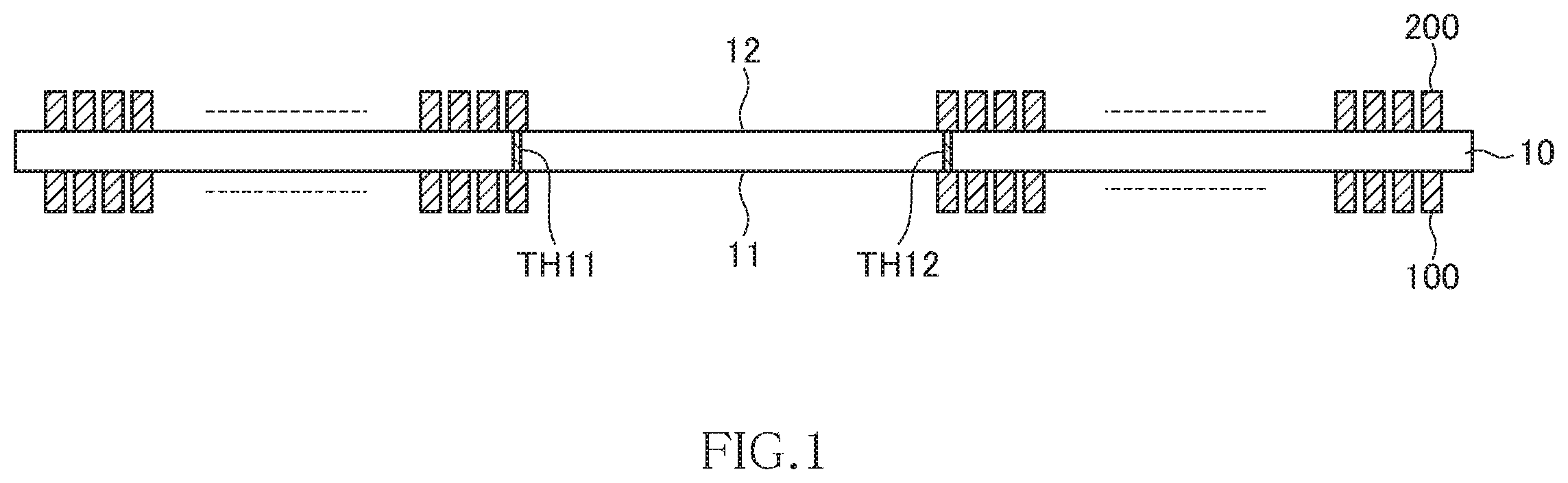
is a cross-sectional view illustrating the configuration of a coil component according to a first embodiment of the present invention;
is a plan view for explaining the pattern shape of the first coil part included in the first embodiment of the present invention as viewed from one surface side of the insulating substrate;
is a plan view for explaining the pattern shape of the second coil part included in the first embodiment of the present invention as viewed from the other surface side of the insulating substrate;
is an equivalent circuit diagram of the coil component according to the first embodiment of the present invention;
is a plan view for explaining the pattern shape of the first coil part included in a second embodiment of the present invention as viewed from one surface side of the insulating substrate;
is a plan view for explaining the pattern shape of the second coil part included in the second embodiment of the present invention as viewed from the other surface side of the insulating substrate;
is an equivalent circuit diagram of the coil component according to the second embodiment of the present invention;
is a plan view for explaining the pattern shape of the first coil part included in a third embodiment of the present invention as viewed from one surface side of the insulating substrate;
is a plan view for explaining the pattern shape of the second coil part included in the third embodiment of the present invention as viewed from the other surface side of the insulating substrate;
is an equivalent circuit diagram of the coil component according to the third embodiment of the present invention;
is a plan view for explaining the pattern shape of the first coil part included in a fourth embodiment of the present invention as viewed from one surface side of the insulating substrate;
is a plan view for explaining the pattern shape of the second coil part included in the fourth embodiment of the present invention as viewed from the other surface side of the insulating substrate; and
is an equivalent circuit diagram of the coil component according to the fourth embodiment of the present invention.
DETAILED DESCRIPTION OF THE EMBODIMENTS
Preferred embodiments of the present invention will now be explained in detail with reference to the drawings.
First Embodiment
is a cross-sectional view illustrating the configuration of a coil component according to the first embodiment of the present invention.
As illustrated in , the coil component according to the present embodiment includes an insulating substrate 10 , a first coil part 100 formed on one surface 11 of the insulating substrate 10 , and a second coil part 200 formed on the other surface 12 of the insulating substrate 10 . Although details will be described later, the inner peripheral end of the first coil part 100 and the inner peripheral end of the second coil part 200 are connected to each other through connection conductors TH 11 and TH 12 penetrating the insulating substrate 10 .
The material of the insulating substrate 10 can be, but not limited thereto, a transparent or translucent flexible material such as PET resin. Alternatively, the insulating substrate 10 may be a flexible substrate obtained by impregnating glass cloth with epoxy-based resin. When the insulating substrate 10 is made of a transparent or translucent material, the first coil part 100 and the second coil part 200 overlap each other in appearance when viewed in a plan view, which may make appearance inspection using an inspection apparatus difficult depending on how they overlap each other. Although details will be described later, in the coil component according to the present embodiment, the first and second coil parts 100 and 200 are disposed such that they almost entirely overlap each other in a plan view so as to allow appearance inspection using an inspection apparatus to be properly conducted.
is a plan view for explaining the pattern shape of the first coil part 100 as viewed from the one surface 11 side of the insulating substrate 10 .
As illustrated in , the first coil part 100 is constituted by a planar conductor spirally wound in a plurality of turns. In the example illustrated in , the first coil part 100 has six turns including turns 101 to 106 , in which the turn 101 is positioned at the outermost periphery, and turn 106 is at the innermost periphery. The turns 101 to 106 are each divided into lines L 1 and L 2 by a spiral-shaped slit. The line L 1 is positioned peripherally outside the line L 2 .
The outer peripheral end of the first coil part 100 , i.e., the outer peripheral end of the turn 101 is connected to a terminal electrode 121 through a radially extending lead-out pattern 111 . Further, a radially extending lead-out pattern 112 is disposed at a position peripherally adjacent to the lead-out pattern 111 . The leading end of the lead-out pattern 112 is connected to a terminal electrode 122 .
As illustrated in , the turns 101 to 105 constituting the first coil part 100 are each wound one round (360°). On the other hand, in the turn 106 positioned at the innermost periphery, an angular distance θ 11 of the line L 1 is ¾ turns (270°), and an angular distance θ 12 of the line L 2 is ¼ turns (90°). Accordingly, the total number of turns of the innermost peripheral turns of the lines L 1 and L 2 is one turn. The angular distance θ 11 is an angle formed by a virtual line a 0 and a virtual line a 1 , and the angular distance θ 12 is an angle formed by the virtual line a 0 and a virtual line a 2 . The virtual lines a 0 to a 2 radially extend from a center point C. The virtual line a 0 passes between the lead-out patterns 111 and 112 , the virtual line a 1 passes through the inner peripheral end of the line L 1 , and the virtual line a 2 passes through the inner peripheral end of the line L 2 . Two connection conductors TH 11 are provided at the inner peripheral end of the line L 1 of the turn 106 , and two connection conductors TH 12 are provided at the inner peripheral end of the line L 2 of the turn 106 .
The turns 101 to 106 constituting the first coil part 100 each have a circumferential region A 1 in which the radial position is not changed and a shift region B 1 in which the radial position is shifted. The six turns including the turns 101 to 106 are defined with the shift region B 1 as a boundary. As illustrated in , in the present embodiment, the outer peripheral end of the first coil part 100 is positioned within the shift region B 1 . The positional relationship between the lead-out patterns 111 and 112 may be reversed to that illustrated in .
is a plan view for explaining the pattern shape of the second coil part 200 as viewed from the other surface 12 side of the insulating substrate 10 .
As illustrated in , the second coil part 200 has the same pattern shape as the first coil part 100 . Thus, the first and second coil parts 100 and 200 can be produced using the same mask, whereby production cost can be significantly reduced. The second coil part 200 has six turns including turns 201 to 206 , in which the turn 201 is positioned at the outermost periphery, and the turn 206 is at the innermost periphery. The turns 201 to 206 are each divided into lines L 3 and L 4 by a spiral-shaped slit. The line L 3 is positioned peripherally outside the line L 4 .
The outer peripheral end of the second coil part 200 , i.e., the outer peripheral end of the turn 201 is connected to a terminal electrode 221 through a radially extending lead-out pattern 211 . Further, a radially extending lead-out pattern 212 is disposed at a position peripherally adjacent to the lead-out pattern 211 . The leading end of the lead-out pattern 212 is connected to a terminal electrode 222 .
As illustrated in , the turns 201 to 205 constituting the second coil part 200 are each wound one round (360°). On the other hand, in the turn 206 positioned at the innermost periphery, an angular distance θ 22 of the line L 3 is ¾ turns (270°), and an angular distance θ 21 of the line L 4 is ¼ turns (90°). Accordingly, the total number of turns of the innermost peripheral turns of the lines L 3 and L 4 is one turn. The angular distance θ 21 is an angle formed by the virtual line a 0 and virtual line a 1 , and the angular distance θ 22 is an angle formed by the virtual line a 0 and virtual line a 2 . The two connection conductors TH 12 are provided at the inner peripheral end of the line L 3 of the turn 206 , and the two connection conductors TH 11 are provided at the inner peripheral end of the line L 4 of the turn 206 .
The turns 201 to 206 constituting the second coil part 200 each have a circumferential region A 2 in which the radial position is not changed and a shift region B 2 in which the radial position is shifted. The six turns including the turns 201 to 206 are defined with the shift region B 2 as a boundary. As illustrated in , in the present embodiment, the outer peripheral end of the second coil part 200 is positioned within the shift region B 2 . The positional relationship between the lead-out patterns 211 and 212 may be reversed to that illustrated in .
The thus configured first and second coil parts 100 and 200 are formed on the one surface 11 and the other surface 12 of the insulating substrate 10 , respectively. The inner peripheral end of the line L 1 is connected to the inner peripheral end of the line L 4 through the connection conductor TH 11 , and the inner peripheral end of the line L 2 is connected to the inner peripheral end of the line L 3 through the connection conductor TH 12 .
is an equivalent circuit diagram of the coil component according to the present embodiment.
As illustrated in , in the present embodiment, two conductive patterns are connected in parallel between terminal electrodes E 1 and E 2 . The terminal electrode E 1 is a terminal in which the terminal electrodes 121 and 222 are short-circuited by the connection conductor TH 1 , and the terminal electrode E 2 is a terminal in which the terminal electrodes 122 and 221 are short-circuited by the connection conductor TH 2 . Of the two parallel-connected conductive patterns, the first conductive pattern includes the lines L 1 and L 4 connected through the connection conductor TH 11 , and the second conductive pattern includes the lines L 2 and L 3 connected through the connection conductor TH 12 .
The innermost turns of the respective lines L 1 and L 3 are each ¾ turns, and the innermost turns of the respective lines L 2 and L 4 are each ¼ turns, so that the conductive pattern including the lines L 1 and L 4 has 11 turns in total and, similarly, the conductive pattern including the lines L 2 and L 3 has 11 turns in total. That is, two coils each having 11 turns are connected in parallel.
As a method for realizing an odd number of turns using two coil parts having mutually the same pattern shape as in the present embodiment, it can be thought that the number of turns of each coil part is set to N+0.5 turns (N is an integer); however, in this case, the connection conductors are concentrated on one position, which may make magnetic flux difficult to pass at this position depending on the situation. On the other hand, in the present embodiment, the planar positions of the respective connection conductors TH 11 and TH 12 differ from each other by an angular distance of 180°, revealing that the connection conductors are arranged in a distributed manner.
Further, in the coil component according to the present embodiment, the turns 101 to 106 and 201 to 206 are each radially divided into two parts by a spiral-shaped slit, so that non-uniformity in distribution of current density is reduced, which in turn can reduce DC resistance or AC resistance. In addition, the line L 1 positioned at the outer peripheral side in the first coil part 100 is connected to the line L 4 positioned at the inner peripheral side in the second coil part 200 , and the line L 2 positioned at the inner peripheral side in the first coil part 100 is connected to the line L 3 positioned at the outer peripheral side in the second coil part 200 , thereby eliminating an inner and outer peripheral difference. This makes the current density distribution more uniform, thereby allowing further reduction in DC resistance or AC resistance.
Further, the coil component according to the present embodiment is constituted by the first and second coil parts 100 and 200 having mutually the same planar shape, so that it is possible to produce the first and second coil parts 100 and 200 using masks having the same pattern shape, leading to reduction in manufacturing cost. In addition, the first and second coil parts 100 and 200 almost entirely overlap each other in a plan view, excluding the shift regions B 1 and B 2 , so that it is possible to minimize visual interference between the first and second coil parts 100 and 200 , regardless of whether the insulating substrate 10 is transparent or translucent. That is, when the first coil part 100 is subjected to appearance inspection, the second coil part 200 does not become a visual obstacle and, conversely, when the second coil part 200 is subjected to appearance inspection, the first coil part 100 does not become a visual obstacle. This allows appearance inspection using an inspection apparatus to be properly conducted.
Further, in the coil component according to the present embodiment, the outer and inner peripheral ends of the respective first and second coil parts 100 and 200 are disposed within the shift regions B 1 and B 2 , respectively, so that even though the outer peripheral ends of the first coil part 100 and the outer peripheral ends of the second coil part 200 are adjacently disposed, it is possible to prevent an increase in the external dimensions of the coil part due to an increase in size of the circumferential regions A 1 and A 2 and a reduction in size of the coil inner diameter region.
Second Embodiment
Next, a coil component according to the second embodiment will be described. The coil component according to the second embodiment differs from the coil component according to the first embodiment in that the above-described first and second coil parts 100 and 200 are replaced with first and second coil parts 300 and 400 , respectively. Other basic configurations are the same as those of the coil component according to the first embodiment.
is a plan view for explaining the pattern shape of the first coil part 300 as viewed from the one surface 11 side of the insulating substrate 10 . is a plan view for explaining the pattern shape of the second coil part 400 as viewed from the other surface 12 side of the insulating substrate 10 . In the present embodiment as well, the first and second coil parts 300 and 400 have the same pattern shape.
As illustrated in , the first coil part 300 has six turns including turns 301 to 306 , in which the turn 301 is positioned at the outermost periphery, and the turn 306 is at the innermost periphery. The turns 301 to 306 are each divided into three lines L 1 , L 5 and L 2 by spiral-shaped slits. Of the three lines L 1 , L 5 and L 2 , the line L 1 is positioned at the outermost peripheral side, and the line L 2 is positioned at the innermost peripheral side. The line L 5 is radially sandwiched between the lines L 1 and L 2 .
The outer peripheral end of the first coil part 300 , i.e., the outer peripheral end of the turn 301 is connected to a terminal electrode 321 through a radially extending lead-out pattern 311 . Further, a radially extending lead-out pattern 312 is disposed at a position peripherally adjacent to the lead-out pattern 311 . The leading end of the lead-out pattern 312 is connected to a terminal electrode 322 .
As illustrated in , the turns 301 to 305 constituting the first coil part 300 are each wound one round (360°). On the other hand, in the turn 306 positioned at the innermost periphery, the angular distance of the line L 1 is one turn (360°), the angular distance of the line L 5 is ½ turns (180°), and the angular distance of the line L 2 is zero turns (0°). Accordingly, the total number of turns of the innermost peripheral turns of the lines L 1 , L 5 and L 2 is 1.5 turns. The line L 2 may be considered to terminate at the turn 305 . A connection conductor TH 21 is provided at the inner peripheral end of the line L 1 , a connection conductor TH 22 is provided at the inner peripheral end of the line L 5 , and a connection conductor TH 23 is provided at the inner peripheral end of the line L 2 .
The turns 301 to 306 constituting the first coil part 300 each have a circumferential region A 3 in which the radial position is not changed and a shift region B 3 in which the radial position is shifted. The six turns including the turns 301 to 306 are defined with the shift region B 3 as a boundary. As illustrated in , in the present embodiment, the outer peripheral end of the first coil part 300 and the inner peripheral ends of the lines L 1 and L 2 are positioned within the shift region B 3 . The connection conductors TH 21 and TH 23 provided at the inner peripheral ends of the respective lines L 1 and L 2 are positioned symmetrically with respect to the virtual line a 0 .
When a virtual line a 3 radially extending from the center point C is assumed, the connection conductor TH 22 provided at the inner peripheral end of the line L 5 is on the virtual line a 3 . An angular distance θ 3 between the virtual lines a 0 and a 3 is 180°.
The second coil part 400 has the same pattern shape as the first coil part 300 . That is, the second coil part 400 has six turns including turns 401 to 406 , in which the turn 401 is positioned at the outermost periphery, and the turn 406 is at the innermost periphery. The turns 401 to 406 are each divided into three lines L 3 , L 6 and L 4 by spiral-shaped slits. Of the three lines L 3 , L 6 and L 4 , the line L 3 is positioned at the outermost peripheral side, and the line L 4 is positioned at the innermost peripheral side. The line L 6 is radially sandwiched between the lines L 3 and L 6 .
The outer peripheral end of the second coil part 400 , i.e., the outer peripheral end of the turn 401 is connected to a terminal electrode 421 through a radially extending lead-out pattern 411 . Further, a radially extending lead-out pattern 412 is disposed at a position peripherally adjacent to the lead-out pattern 411 . The leading end of the lead-out pattern 412 is connected to a terminal electrode 422 .
As illustrated in , the turns 401 to 405 constituting the second coil part 400 are each wound one round (360°). On the other hand, in the turn 406 positioned at the innermost periphery, the angular distance of the line L 3 is one turn (360°), the angular distance of the line L 6 is ½ turns (180°), and the angular distance of the line L 4 is zero turns (0°). Accordingly, the total number of turns of the innermost peripheral turns of the lines L 3 , L 6 and L 4 is 1.5 turns. The line L 4 may be considered to terminate at the turn 405 . The connection conductor TH 23 is provided at the inner peripheral end of the line L 3 , the connection conductor TH 22 is provided at the inner peripheral end of the line L 6 , and the connection conductor TH 21 is provided at the inner peripheral end of the line L 4 .
The turns 401 to 406 constituting the second coil part 400 each have a circumferential region A 4 in which the radial position is not changed and a shift region B 4 in which the radial position is shifted. The six turns including the turns 401 to 406 are defined with the shift region B 4 as a boundary. The connection conductors TH 23 and TH 21 provided at the inner peripheral ends of the respective lines L 3 and L 4 are positioned symmetrically with respect to the virtual line a 0 . The connection conductor TH 22 provided at the inner peripheral end of the line L 6 is provided on the virtual line a 3 .
The thus configured first and second coil parts 300 and 400 are formed on the one surface 11 and the other surface 12 of the insulating substrate 10 , respectively. The inner peripheral end of the line L 1 is connected to the inner peripheral end of the line L 4 through the connection conductor TH 21 , the inner peripheral end of the line L 5 is connected to the inner peripheral end of the line L 6 through the connection conductor TH 22 , and the inner peripheral end of the line L 2 is connected to the inner peripheral end of the line L 3 through the connection conductor TH 23 .
is an equivalent circuit diagram of the coil component according to the present embodiment.
As illustrated in , in the present embodiment, three conductive patterns are connected in parallel between terminal electrodes E 1 and E 2 . The terminal electrode E 1 is a terminal in which the terminal electrodes 321 and 422 are short-circuited by the connection conductor TH 1 , and the terminal electrode E 2 is a terminal in which the terminal electrodes 322 and 421 are short-circuited by the connection conductor TH 2 . Of the three parallel-connected conductive patterns, the first conductive pattern includes the lines L 1 and L 4 connected through the connection conductor TH 21 , the second conductive pattern includes the lines L 5 and L 6 connected through the connection conductor TH 22 , and the third conductive pattern includes the lines L 2 and L 3 connected through the connection conductor TH 23 .
The innermost turns of the respective lines L 1 and L 3 are each one turn, the innermost turns of the respective lines L 5 and L 6 are each ½ turns, and the innermost turns of the respective lines L 2 and L 4 are each 0 turns, so that the first conductive pattern including the lines L 1 and L 4 , the second conductive pattern including the lines L 5 and L 6 and the third conductive pattern including the lines L 2 and L 3 each have 11 turns in total. That is, three coils each having 11 turns are connected in parallel.
When it is intended to realize an odd number of turns using two coil parts having turns each divided into three lines, it is difficult to make the number of turns of the line (L 5 , L 6 ) positioned at the radially intermediate position coincide with the number of turns of each of the other lines as far as the connection conductors are arranged concentratedly in one location. However, in the present embodiment, the innermost peripheral turns of the respective lines L 5 and L 6 positioned radially intermediate position are each ½ turns, allowing a configuration in which three coils each having 11 turns are connected in parallel to be easily realized. This method can be applied to all the cases where it is intended to realize an odd number of turns using two coil parts having turns each divided into an odd number of lines.
Further, in the coil component according to the present embodiment, the turns 301 to 306 and 401 to 406 are each radially divided into three parts by spiral-shaped slits, so that non-uniformity in distribution of current density is reduced even more than in the first embodiment, which in turn can further reduce DC resistance or AC resistance. In addition, the line L 1 positioned at the outermost peripheral side in the first coil part 300 is connected to the line L 4 positioned at the innermost peripheral side in the second coil part 400 , and line L 2 positioned at the innermost peripheral side in the first coil part 300 is connected to the line L 3 positioned at the outermost peripheral side in the second coil part 400 , thereby eliminating an inner and outer peripheral difference between the lines. This makes the current density distribution more uniform, thereby allowing a further reduction in DC resistance or AC resistance.
Comparing with the first embodiment, the positions of the terminal electrode ( 321 and 422 ) connected to the terminal electrode E 1 and the terminal electrode ( 322 and 421 ) connected to the terminal electrode E 2 are interchanged with those in the first embodiment. Thus, the positional relationship between the terminal electrodes can be arbitrarily determined.
Third Embodiment
Next, a coil component according to the third embodiment will be described. The coil component according to the third embodiment differs from the coil component according to the second embodiment in that the above-described first and second coil parts 300 and 400 are replaced with first and second coil parts 500 and 600 , respectively. Other basic configurations are the same as those of the coil component according to the second embodiment.
is a plan view for explaining the pattern shape of the first coil part 500 as viewed from the one surface 11 side of the insulating substrate 10 . is a plan view for explaining the pattern shape of the second coil part 600 as viewed from the other surface 12 side of the insulating substrate 10 . In the present embodiment as well, the first and second coil parts 500 and 600 have the same pattern shape.
As illustrated in , turns 501 to 505 constituting the first coil part 500 are each wound one round (360°). On the other hand, in a turn 506 positioned at the innermost periphery, an angular distance θ 41 of the line L 1 is ⅚ turns (300°), an angular distance θ 3 of the line L 5 is ½ turns (180°), and an angular distance θ 51 of the line L 2 is ⅙ turns (60°). The angular distance θ 41 is an angle formed by a virtual line a 0 and a virtual line a 4 , and the angular distance θ 51 is an angle formed by the virtual line a 0 and a virtual line a 5 . The virtual lines a 4 and a 5 radially extend from the center point C. The virtual line a 4 passes through the inner peripheral end of the line L 1 , and the virtual line a 5 passes through the inner peripheral end of the line L 2 . Connection conductors TH 31 , TH 32 and TH 33 are provided at the inner peripheral ends of the lines L 1 , L 5 and L 2 of the turn 506 , respectively.
The turns 501 to 506 constituting the first coil part 500 each have a circumferential region A 5 in which the radial position is not changed and a shift region B 5 in which the radial position is shifted. The six turns including the turns 501 to 506 are defined with the shift region B 5 as a boundary. The connection conductors TH 31 and TH 33 provided at the inner peripheral ends of the respective lines L 1 and L 5 are positioned symmetrically with respect to the virtual line a 0 .
The second coil part 600 has the same pattern shape as the first coil part 500 . That is, the turns 601 to 605 constituting the second coil part 600 are each wound one round (360°). On the other hand, in a turn 606 positioned at the innermost periphery, an angular distance θ 52 of the line L 3 is ⅚ turns (300°), an angular distance θ 3 of the line L 6 is ½ turns (180°), and an angular distance θ 42 of the line L 4 is ⅙ turns (60°). The angular distance θ 42 is an angle formed by the virtual line a 0 and the virtual line a 4 , and the angular distance θ 52 is an angle formed by the virtual line a 0 and the virtual line a 5 . The connection conductors TH 33 , TH 32 and TH 31 are provided at the inner peripheral ends of the lines L 3 , L 6 and L 4 of the turn 606 , respectively.
The turns 601 to 606 constituting the second coil part 600 each have a circumferential region A 6 in which the radial position is not changed and a shift region B 6 in which the radial position is shifted. The six turns including the turns 601 to 606 are defined with the shift region B 6 as a boundary. The connection conductors TH 33 and TH 31 provided at the inner peripheral ends of the respective lines L 3 and L 4 are positioned symmetrically with respect to the virtual line a 0 .
The thus configured first and second coil parts 500 and 600 are formed on the one surface 11 and the other surface 12 of the insulating substrate 10 , respectively. The inner peripheral end of the line L 1 is connected to the inner peripheral end of the line L 4 through the connection conductor TH 31 , the inner peripheral end of the line L 5 is connected to the inner peripheral end of the line L 6 through the connection conductor TH 32 , and the inner peripheral end of the line L 2 is connected to the inner peripheral end of the line L 3 through the connection conductor TH 33 .
is an equivalent circuit diagram of the coil component according to the present embodiment.
As illustrated in , in the present embodiment, three conductive patterns are connected in parallel between terminal electrodes E 1 and E 2 . The terminal electrode E 1 is a terminal in which terminal electrodes 521 and 622 are short-circuited by the connection conductor TH 1 , and the terminal electrode E 2 is a terminal in which terminal electrodes 522 and 621 are short-circuited by the connection conductor TH 2 . Of the three parallel-connected conductive patterns, the first conductive pattern includes the lines L 1 and L 4 connected through the connection conductor TH 31 , the second conductive pattern includes the lines L 5 and L 6 connected through the connection conductor TH 32 , and the third conductive pattern includes the lines L 2 and L 3 connected through the connection conductor TH 33 .
The innermost turns of the respective lines L 1 and L 3 are each ⅚ turns, the innermost turns of the respective lines L 5 and L 6 are each ½ turns, and the innermost turns of the respective lines L 2 and L 4 are each ⅙ turns, so that the first conductive pattern including the lines L 1 and L 4 , the second conductive pattern including the lines L 5 and L 6 , and the third conductive pattern including the lines L 2 and L 3 each have 11 turns in total. That is, three coils each having 11 turns are connected in parallel.
Thus, in the present embodiment, three connection conductors TH 31 to TH 33 are spaced apart from one another at 120° intervals. That is, the connection conductors are arranged in a more distributed manner.
Fourth Embodiment
Next, a coil component according to the fourth embodiment will be described. The coil component according to the fourth embodiment differs from the coil component according to the first embodiment in that the above-described first and second coil parts 100 and 200 are replaced with first and second coil parts 700 and 800 , respectively. Other basic configurations are the same as those of the coil component according to the first embodiment.
is a plan view for explaining the pattern shape of the first coil part 700 as viewed from the one surface 11 side of the insulating substrate 10 . is a plan view for explaining the pattern shape of the second coil part 800 as viewed from the other surface 12 side of the insulating substrate 10 . In the present embodiment as well, the first and second coil parts 700 and 800 have the same pattern shape.
As illustrated in , the first coil part 700 has six turns including turns 701 to 706 , in which the turn 701 is positioned at the outermost periphery, and the turn 706 is at the innermost periphery. The turns 701 to 706 are each divided into four lines L 1 , L 5 , L 7 and L 2 by spiral-shaped slits. Of the four lines L 1 , L 5 , L 7 and L 2 , the line L 1 is positioned at the outermost peripheral side, the line L 5 is positioned at the second outermost peripheral side, the line L 7 is positioned at the second innermost peripheral side, and the line L 2 is positioned at the innermost peripheral side.
As illustrated in , the turns 701 to 705 constituting the first coil part 700 are each wound one round (360°). On the other hand, in the turn 706 positioned at the innermost periphery, the angular distance of the line L 1 is one turn (360°), an angular distance θ 11 of the line L 5 is ¾ turns (270°), an angular distance θ 12 of the line L 7 is ¼ turns (90°), and the angular distance of the line L 2 is zero turns (0°). Accordingly, the total number of turns of the innermost peripheral turns of the lines L 1 , L 5 , L 7 , and L 2 is two turns. The line L 2 may be regarded to terminate at the turn 705 . Connection conductors TH 41 to TH 44 are provided at the inner peripheral ends of the respective lines L 1 , L 5 , L 7 and L 2 of the turn 706 .
The turns 701 to 706 constituting the first coil part 700 each have a circumferential region A 7 in which the radial position is not changed and a shift region B 7 in which the radial position is shifted. The six turns including the turns 701 to 706 are defined with the shift region B 7 as a boundary. The connection conductors TH 41 and TH 44 provided at the inner peripheral ends of the respective lines L 1 and L 2 are positioned symmetrically with respect to the virtual line a 0 , and the connection conductors TH 42 and TH 43 provided at the inner peripheral ends of the respective lines L 5 and L 7 are positioned symmetrically with respect to the virtual line a 0 . The connection conductors TH 42 and TH 43 are disposed on the virtual lines a 1 and a 2 , respectively.
The second coil part 800 has the same pattern shape as the first coil part 700 . That is, the second coil part 800 has six turns including turns 801 to 806 , in which the turn 801 is positioned at the outermost periphery, and the turn 806 is at the innermost periphery. The turns 801 to 806 are each divided into four lines L 3 , L 6 , L 8 , and L 4 by spiral-shaped slits. Of the four lines L 3 , L 6 , L 8 , and L 4 , the line L 3 is positioned at the outermost peripheral side, the line L 6 is positioned at the second outermost peripheral side, the line L 8 is positioned at the second innermost peripheral side, and the line L 4 is positioned at the innermost peripheral side.
As illustrated in , the turns 801 to 805 constituting the second coil part 800 are each wound one round (360°). On the other hand, in the turn 806 positioned at the innermost periphery, the angular distance of the line L 3 is one turn (360°), an angular distance θ 22 of the line L 6 is ¾ turns (270°), an angular distance θ 21 of the line L 8 is ¼ turns (90°), and the angular distance of the line L 4 is zero turns (0°). Accordingly, the total number of turns of the innermost peripheral turns of the lines L 3 , L 6 , L 8 and L 4 is two turns. The line L 4 may be regarded to terminate at the turn 805 . The connection conductors TH 44 to TH 41 are provided at the inner peripheral ends of the respective lines L 3 , L 6 , L 8 and L 4 of the turn 806 .
The turns 801 to 806 constituting the second coil part 800 each have a circumferential region A 8 in which the radial position is not changed and a shift region B 8 in which the radial position is shifted. The six turns including the turns 801 to 806 are defined with the shift region B 8 as a boundary. The connection conductors TH 41 and TH 44 provided at the inner peripheral ends of the respective lines L 4 and L 3 are positioned symmetrically with respect to the virtual line a 0 , and the connection conductors TH 42 and TH 43 provided at the inner peripheral ends of the respective lines L 8 and L 6 are positioned symmetrically with respect to the virtual line a 0 . The connection conductors TH 42 and TH 43 are disposed on the virtual lines a 1 and a 2 , respectively.
The thus configured first and second coil parts 700 and 800 are formed on the one surface 11 and the other surface 12 of the insulating substrate 10 , respectively. The inner peripheral end of the line L 1 is connected to the inner peripheral end of the line L 4 through the connection conductor TH 41 , the inner peripheral end of the line L 5 is connected to the inner peripheral end of the line L 8 through the connection conductor TH 42 , the inner peripheral end of the line L 7 is connected to the inner peripheral end of the line L 6 through the connection conductor TH 43 , and the inner peripheral end of the line L 2 is connected to the inner peripheral end of the line L 3 through the connection conductor TH 44 .
is an equivalent circuit diagram of the coil component according to the present embodiment.
As illustrated in , in the present embodiment, four conductive patterns are connected in parallel between terminal electrodes E 1 and E 2 . The terminal electrode E 1 is a terminal in which terminal electrodes 721 and 822 are short-circuited by the connection conductor TH 1 , and the terminal electrode E 2 is a terminal in which terminal electrodes 722 and 821 are short-circuited by the connection conductor TH 2 . Of the four parallel-connected conductive patterns, the first conductive pattern includes the lines L 1 and L 4 connected through the connection conductor TH 41 , the second conductive pattern includes the lines L 5 and L 8 connected through the connection conductor TH 42 , the third conductive pattern includes the lines L 7 and L 6 connected through the connection conductor TH 43 , and the fourth conductive pattern includes the lines L 2 and L 3 connected through the connection conductor TH 44 .
The innermost turns of the respective lines L 1 and L 3 are each one turn, the innermost turns of the respective lines L 5 and L 6 are each ¾ turns, the innermost turns of the respective lines L 7 and L 8 are each ¼ turns, and the innermost turns of the respective lines L 2 and L 4 are each zero turns, so that the first conductive pattern including the lines L 1 and L 4 , the second conductive pattern including the lines L 5 and L 8 , the third conductive pattern including the lines L 7 and L 6 , and the fourth conductive pattern including the lines L 2 and L 3 each have 11 turns in total. That is, four coils each having 11 turns are connected in parallel.
Thus, in the coil component according to the present embodiment, the turns 701 to 706 and 801 to 806 are each radially divided into four parts by spiral-shaped slits, so that non-uniformity in distribution of current density is reduced even more than in the first to third embodiments, which in turn can further reduce DC resistance or AC resistance. In addition, the line L 1 positioned at the outermost peripheral side in the first coil part 700 is connected to the line L 4 positioned at the innermost peripheral side in the second coil part 800 , the line L 5 positioned at the second outermost peripheral side in the first coil part 700 is connected to the line L 8 positioned at the second innermost peripheral side in the second coil part 800 , the line L 7 positioned at the second innermost peripheral side in the first coil part 700 is connected to the line L 6 positioned at the second outermost peripheral side in the second coil part 800 , the line L 2 positioned at the innermost peripheral side in the first coil part 700 is connected to the line L 3 positioned at the outermost peripheral side in the second coil part 800 , thereby eliminating an inner and outer peripheral difference between the lines. This makes the current density distribution more uniform, thereby allowing a further reduction in DC resistance or AC resistance.
It is apparent that the present invention is not limited to the above embodiments, but may be modified and changed without departing from the scope and spirit of the invention.
For example, although the two coil parts are formed on the front and back sides of the insulating substrate in the above embodiments, this is not an essential requirement in the present invention. Further, the two coil parts have the same pattern shape in the above embodiments, this is also not an essential requirement in the present invention.
Further, although all the turns of the two coil parts are divided into a plurality of lines by the spiral-shaped slit (or slits), this is not an essential requirement in the present invention, and all that needs to be done here is that at least the innermost turn is divided into a plurality of lines.
Figures (13)
Citations
This patent cites (11)
- US7417523
- US20090309579
- US20110133877
- US20130293337
- US20160094082
- US07-37728
- US2001-319813
- US2003-197438
- US2008-205215
- USWO-9843258
- US6236821