Zoom Lens and Image Pickup Apparatus
Abstract
A zoom lens includes, in order from an object side to an image side, a first lens unit having a positive refractive power, a second lens unit having a negative refractive power, a third lens unit having a positive refractive power, and a rear unit having a plurality of lens units, and distances change between adjacent lens units during zooming. A predetermined condition is satisfied.
Claims (14)
1. A zoom lens comprising, in order from an object side to an image side: a first lens unit having a positive refractive power; a second lens unit having a negative refractive power; a third lens unit having a positive refractive power; and a rear group having a plurality of lens units, wherein the rear group includes a lens unit LR closest to an image plane, wherein each distance between adjacent lens units changes during zooming, and wherein the following inequalities are satisfied: 0.20< f 1/ ft< 0.40 −4.0< mr/bfw<− 1.5 −7.0< m 3/ bfw<− 2.5 0.3 <fr/f 1<2.8
13. A zoom lens comprising, in order from an object side to an image side: a first lens unit having a positive refractive power; a second lens unit having a negative refractive power; a third lens unit having a positive refractive power; and a rear group having a plurality of lens units, wherein the rear group includes a lens unit LR closest to an image plane, wherein each distance between adjacent lens units changes during zooming, wherein the first lens unit includes one negative lens and three positive lenses, and wherein the following inequalities are satisfied: 0.20< f 1/ ft< 0.40 −4.0< mr/bfw<− 1.5 −7.0< m 3/ bfw<− 2.5
14. A zoom lens comprising, in order from an object side to an image side: a first lens unit having a positive refractive power; a second lens unit having a negative refractive power; a third lens unit having a positive refractive power; and a rear group having a plurality of lens units, wherein the rear group includes a lens unit LR closest to an image plane, wherein each distance between adjacent lens units changes during zooming, wherein during zooming from the wide-angle end toward the telephoto end, the lens unit LR moves to the object side and then to the image side, and wherein the following inequalities are satisfied: 0.20< f 1/ ft< 0.40 −4.0< mr/bfw<− 1.5 −7.0< m 3/ bfw<− 2.5
Show 11 dependent claims
2. The zoom lens according to claim 1 , wherein the rear group includes at least three lens units.
3. The zoom lens according to claim 1 , wherein the first lens unit includes one negative lens and three positive lenses.
4. The zoom lens according to claim 1 , wherein during zooming from the wide-angle end toward the telephoto end, the lens unit LR moves to the object side and then to the image side.
5. The zoom lens according to claim 1 , wherein the following inequality is satisfied: −9.0 <f 1 /f 2<−3.5 where f2 is a focal length of the second lens unit.
6. The zoom lens according to claim 1 , wherein the following inequality is satisfied: −1.2 <m 1 /f 1<−0.4 where m1 is a difference between a position of the first lens unit relative to the image plane at the telephoto end and a position of the first lens unit relative to the image plane at the wide-angle end, a sign of m1 being negative when the first lens unit is positioned closer to the object side at the telephoto end than at the wide-angle end.
7. The zoom lens according to claim 1 , wherein the following inequality is satisfied: 3.0<β2 t/β 2 w< 12.0 where β2t is a lateral magnification of the second lens unit at the telephoto end, and β2w is a lateral magnification of the second lens unit at the wide-angle end.
8. The zoom lens according to claim 1 , further comprising a diaphragm, wherein the following inequality is satisfied: 2.0 <dpw/fw< 7.0
9. The zoom lens according to claim 1 , wherein the following inequality is satisfied: 0.4 <Lt/ft< 1.2 where Lt is a distance on the optical axis from a surface of the zoom lens closest to an object to the image plane at the telephoto end.
10. The zoom lens according to claim 1 , wherein the lens unit LR includes a single lens.
11. The zoom lens according to claim 10 , wherein the following inequality is satisfied: 15.0 <VdLR< 50.0 where VdLR is an Abbe number of the single lens.
12. An image pickup apparatus comprising: the zoom lens according to claim 1 ; and an image sensor configured to receive an image formed by the zoom lens.
Full Description
Show full text →
BACKGROUND OF THE INVENTION
Field of the Invention
The present invention relates to a zoom lens suitable for a digital camera, a video camera, a surveillance camera, and the like, and an image pickup apparatus having the same.
Description of the Related Art
Japanese Patent Laid-Open Nos. (“JPs”) 2017-049445, 2018-146739, and 2019-020679 each disclose a zoom lens that includes, in order from an object side to an image side, a first lens unit having a positive refractive power, a second lens unit having a negative refractive power, a third lens unit having a positive refractive power, and a plurality of lens units.
In the zoom lenses disclosed in JPs 2017-049445, 2018-146739, and 2019-020679, in order to realize a high magnification, it is effective to increase a large moving amount of a lens unit or the power of the lens unit in the zoom lens. However, a larger moving amount of the lens unit would complicate a mechanism and make larger the zoom lens. A larger power of the lens unit would intensify the aberrational fluctuations during zooming, and high performance becomes hard to realize.
SUMMARY OF THE INVENTION
The present invention provides a compact zoom lens having a high magnification and a high optical characteristic, and an image pickup apparatus having the same.
A zoom lens according to one aspect of the present invention includes, in order from an object side to an image side, a first lens unit having a positive refractive power, a second lens unit having a negative refractive power, a third lens unit having a positive refractive power, and a rear unit having a plurality of lens units. Distances changing between adjacent lens units during zooming. The following conditional expressions are satisfied: 0.20< f 1/ ft< 0.40 −4.0< mr/bfw<− 1.5 −7.0< m 3/ bfw<− 2.5 where f1 is a focal length of the first lens unit, ft is a focal length of the zoom lens at a telephoto end, mr is a moving amount of a lens unit LR closest to an image plane in the rear unit during zooming from a wide-angle end to the telescopic end, bfw is a distance on an optical axis from a surface closest to the image plane of the lens unit LR to the image plane at the wide-angle end, m3 is a moving amount of the third lens unit during zooming from the wide-angle end to the telephoto end, and a sign of a moving amount of each lens unit is positive when the lens unit moves from the object side to the image side and negative when the lens unit moves from the image side to the object side.
An image pickup apparatus according to another aspect of the present invention includes the above zoom lens, and an image sensor configured to receive an image formed by the zoom lens.
Further features of the present invention will become apparent from the following description of exemplary embodiments with reference to the attached drawings.
BRIEF DESCRIPTION OF THE DRAWINGS
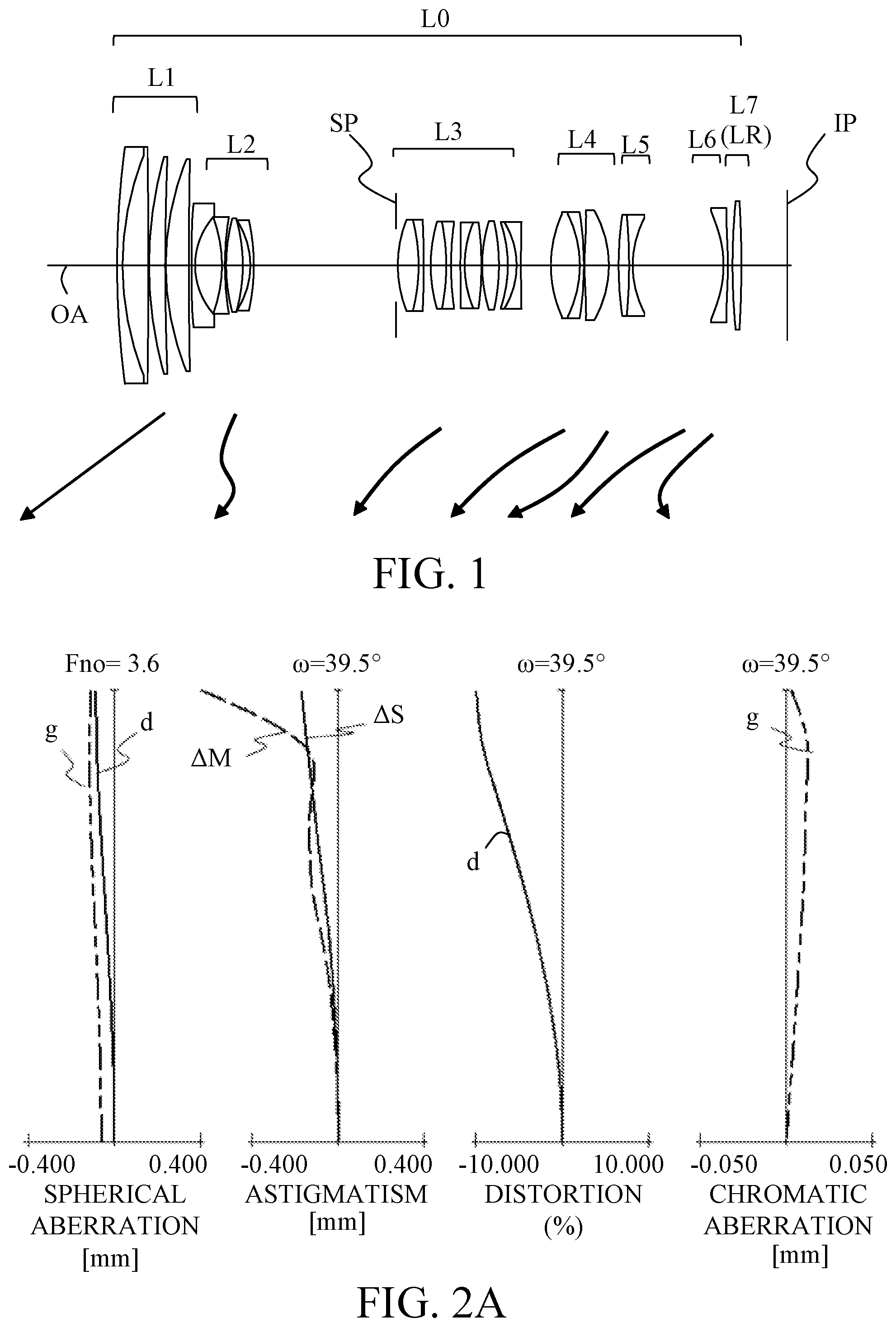
is a sectional view of a zoom lens according to Example 1.
A to 2 C are aberration diagrams of the zoom lens according to Example 1 at a wide-angle end, a middle zoom position, and a telephoto end.
is a sectional view of a zoom lens according to Example 2.
A to 4 C are aberration diagrams of the zoom lens according to Example 2 at a wide-angle end, an intermediate zoom position, and a telephoto end.
is a sectional view of a zoom lens according to Example 3.
A to 6 C are aberration diagrams of the zoom lens according to Example 3 at a wide-angle end, an intermediate zoom position, and a telephoto end.
is a sectional view of a zoom lens according to Example 4.
A to 8 C are aberration diagrams of the zoom lens according to Example 4 at a wide-angle end, an intermediate zoom position, and a telephoto end.
is a sectional view of a zoom lens according to Example 5.
A to 10 C are aberration diagrams of the zoom lens according to Example 5 at a wide-angle end, an intermediate zoom position, and a telephoto end.
is a schematic view of an image pickup apparatus having a zoom lens according to each example.
DESCRIPTION OF THE EMBODIMENTS
Referring now to the accompanying drawings, a detailed description will be given of embodiments according to the present invention.
, 3 , 5 , 7 , and 9 are sectional views of zoom lenses (optical systems) L 0 according to Examples 1 to 5, respectively, in an in-focus state at infinity. The zoom lens L 0 according to each example is an optical system used in an image pickup apparatus such as a digital video camera, a digital still camera, a broadcasting camera, a film-based camera, and a surveillance camera.
In each sectional view, the left side is the object side (front side) and the right side is the image side (rear side). The zoom lens L 0 according to each example includes a plurality of lens units. In each sectional view, i represents an order of the lens unit counted from the object side, and Li is an i-th lens unit. In each example, the lens unit is a unit of lenses that integrally moves or stops during zooming. In the zoom lens L 0 according to each example, distances between adjacent lens units change during zooming from the wide-angle end to the telephoto end. The lens unit includes one or more lenses. The lens unit may include a diaphragm (aperture stop).
SP represents the diaphragm. In each example, the diaphragm SP is included in the third lens unit L 3 , but is not limited to this example. IP represents an image plane, and when the zoom lens L 0 according to each example is used as an imaging optical system for a digital still camera or a digital video camera, the image plane of the image sensor (photoelectric conversion element) such as a CCD sensor or a CMOS sensor is placed on the image plane IP. When the zoom lens L 0 according to each example is used as an imaging optical system for a film-based camera, a photosensitive plane corresponding to a film plane is placed on the image plane IP. In each sectional view, a solid arrow schematically illustrates a moving locus of each lens unit in the in-focus state at infinity during zooming from the wide-angle end to the telephoto end. In each example, the wide-angle end and the telephoto end refer to the zoom positions when each lens unit in the zoom lens L 0 is located at both ends of a mechanically movable range on the optical axis OA.
A to 2 C, 4 A to 4 C, 6 A to 6 C, 8 A to 8 C, and 10 A to 10 C are aberration diagrams of the zoom lenses L 0 according to Examples 1 to 5, respectively. In each aberration diagram, A, 4 A, 6 A, 8 A, and 10 A are aberration diagrams of the zoom lens L 0 at the wide-angle end. B, 4 B, 6 B, 8 B, and 10 B are aberration diagrams of the zoom lens L 0 at the middle zoom position. C, 4 C, 6 C, 8 C, and 10 C are aberration diagrams of the zoom lens L 0 at the telephoto end. The spherical aberration diagram with Fno as an F-number illustrates spherical aberration amounts for the d-line (wavelength 587.6 nm) and the g-line (wavelength 435.8 nm). In the astigmatism diagram, ΔS represents an astigmatism amount on the sagittal image plane, and ΔM represents an astigmatism amount on the meridional image plane. The distortion diagram illustrates a distortion amount for the d-line. The chromatic aberration diagram shows a chromatic aberration amount for the g-line. The units for the aberrations are “mm”. ω is an imaging half angle of view (degrees).
One conventional zoom lens includes, in order from the object side to the image side, a first lens unit L 1 having a positive refractive power, a second lens unit L 2 having a negative refractive power, a third lens unit L 3 having a positive refractive power, and a plurality of lens units. In this zoom lens, if the power of the first lens unit L 1 is increased, the high magnification is easy to realize, but the aberrational fluctuation during zooming and the lateral chromatic aberration at the telephoto end become large, and the high performance is hard to realize. A larger moving amount of the first lens unit L 1 would facilitate the magnification, but complicate the mechanism and increase the overall length. It is thus important to properly set the power of the first lens unit L 1 in order to achieve both the high magnification and miniaturization of the zoom lens and to realize the high optical performance. It is effective to properly set a configuration and a moving amount of the subsequent lens unit so as to cancel various aberrations generated in the first lens unit L 1 .
The zoom lenses L 0 according to each example include, in order from the object side to the image side, a first lens unit L 1 having a positive refractive power, a second lens unit L 2 , a third lens unit L 3 having a positive refractive power, and a rear unit including a plurality of lens units. Arranging a plurality of lens units on the image side of the third lens unit L 3 and changing a distance between adjacent lens units during zooming can suppress the aberrational fluctuations during zooming and achieve high performance. In each example, the lens unit includes at least one lens having a power.
The zoom lens L 0 according to each example satisfies the following conditional expressions (1), (2), and (3). 0.20< f 1/ ft< 0.40 (1) −4.0< mr/bfw<− 1.5 (2) −7.0< m 3/ bfw<− 2.5 (3) where f1 is a focal length of the first lens L 1 , ft is a focal length of the overall system of the zoom lens L 0 at the telephoto end, mr is a moving amount of the lens unit LR closest to the image plane in the rear unit during zooming from the wide-angle end to the telephoto end, a moving amount from the object side to the image side is positive, bfw is a distance on an optical axis from a surface closest to the image plane of the lens unit LR closest to the image plane in the rear unit at the wide-angle end to the image surface IP (distance in the direction along the optical axis OA), m3 is a moving amount of the third lens unit L 3 during zooming from the wide-angle end to the telephoto end, and a moving amount from the object side to the image side is positive.
The conditional expression (1) defines a ratio of the focal length f1 of the first lens unit L 1 to the focal length ft of the overall system of the zoom lens L 0 at the telephoto end. If the value is higher than the upper limit in the conditional expression (1), the focal length f1 of the first lens unit L 1 and thereby the zoom lens L 0 become larger. If the value is lower than the lower limit in the conditional expression (1), the focal length f1 of the first lens unit L 1 becomes smaller and the aberrational fluctuation generated in the first lens unit L 1 becomes larger and the high image quality is hard to realize.
The conditional expression (2) defines a relationship between a moving amount of the lens unit LR and the backfocus. The height of the light beam can be changed by changing the distance from the lens unit LR to the image plane IP during zooming. Therefore, properly setting the relationship between the moving amount of the lens unit LR closest to the image plane during zooming and the backfocus at the wide-angle end can suppress the aberrational fluctuation generated in the first lens unit L 1 . If the value is lower than the lower limit in the conditional expression (2), the moving amount of the lens unit LR becomes smaller, that is, the absolute value of the moving amount toward the object becomes larger, the height of the light ray passing through the lens unit LR excessively changes, and the aberration is excessively corrected during zooming. If the value is higher than the upper limit in the conditional expression (2), the moving amount of the lens unit LR becomes larger, that is, the absolute value of the moving amount toward the object side becomes smaller, or the absolute value of the moving amount toward the image side becomes larger, and the distance from the lens unit LR to the image plane IP becomes shorter at the telephoto end. As a result, the lens diameter of the lens unit LR becomes larger, and the miniaturization becomes difficult.
The conditional expression (3) defines a relationship between the moving amount of the third lens unit L 3 and the backfocus. When the value is lower than the lower limit in the conditional expression (3), the moving amount of the third lens unit L 3 becomes smaller, that is, the absolute value of the moving amount of the third lens unit L 3 toward the object becomes larger, and the mechanism becomes complicated and larger. If the value is higher than the upper limit in the conditional expression (3), the moving amount of the third lens unit L 3 becomes larger, that is, the absolute value of the moving amount toward the object side becomes smaller, and the high magnification becomes difficult to realize.
In each example, the numerical ranges of the conditional expressions (1) to (3) may be set to those of the following conditional expressions (1A) to (3A), respectively. 0.24< f 1/ ft< 0.38 (1A) −3.5< mr/bfw<− 1.6 (2A) −6.0< m 3/ bfw<− 2.7 (3A)
In each example, the numerical ranges of the conditional expressions (1) to (3) may be set to those of the following conditional expressions (1B) to (3B), respectively. 0.26< f 1/ ft< 0.36 (1B) −2.9< mr/bfw<− 1.7 (2B) −5.7< m 3/ bfw<− 2.9 (3B)
A description will now be given of a configuration that the zoom lens L 0 according to each example may take. In the zoom lens L 0 according to each example, the diaphragm SP may be disposed in the third lens unit L 3 . Thereby, the front lens diameter can be easily suppressed. The first lens unit L 1 may have one negative lens and three positive lenses arranged in order from the object side to the image side. Thereby, it becomes easy to suppress the aberration generated in the first lens unit L 1 while strengthening the refractive power (power) of the first lens unit L 1 . In the zoom lens L 0 according to each example, the lens unit LR may include a single lens. Thereby, the weight of the lens unit LR can be easily reduced, and the mechanism can become simple and advantageous for miniaturization.
The zoom lens L 0 according to each example may satisfy at least one of the following conditional expressions (4) to (10): 0.3< fr/f 1<2.8 (4) −9.0< f 1/ f 2<−3.5 (5) −1.2 <m 1/ f 1<−0.4 (6) 3.0<β2 t/β 2 w< 12.0 (7) 2.0< dpw/fw< 7.0 (8) 0.4< Lt/ft< 1.2 (9) 15.0 <VdLR <50.0 (10) where fr is a focal length of the lens unit LR, f2 is a focal length of the second lens unit L 2 , and m1 is a moving amount of the first lens unit L 1 during zooming from the wide-angle end to the telephoto end. A moving amount from the object side to the image side is positive, β2t is a lateral magnification of the second lens unit L 2 at the telephoto end, β2w is a lateral magnification of the second lens unit L 2 at the wide-angle end, dpw is a distance on the optical axis from the diaphragm SP at the wide-angle end to the image plane IP, and fw is a focal length of the overall system of the zoom lens L 0 at the wide-angle end. Lt is a distance on the optical axis from the surface closest to the object of the zoom lens L 0 to the image plane IP at the telephoto end. VdLR is an Abbe number of the lenses constituting the lens unit LR.
The conditional expression (4) defines a ratio of the focal length fr of the lens unit LR to the focal length f1 of the first lens unit L 1 . When the lens unit LR has a positive refractive power, and its power arrangement symmetrical with respect to the diaphragm SP, the aberration can be easily corrected. Setting the focal length fr of the lens unit LR to have a proper relationship with the focal length f1 of the first lens unit L 1 can easily reduce various aberrations, particularly, the lateral chromatic aberration and the distortion. If the value is higher than the upper limit in the conditional expression (4), the focal length fr of the lens unit LR becomes larger, the aberration correction effect becomes insufficient, and it becomes difficult to reduce various aberrations, particularly, the lateral chromatic aberration and the distortion. If the value is lower than the lower limit in the conditional expression (4), the focal length fr of the lens unit LR becomes smaller, the exit pupil position at the telephoto end becomes distant from the image plane, and the lens diameter of the lens unit LR and thus the zoom lens L 0 become larger. In addition, the lens unit LR may move so as to have a convex locus toward the object during zooming from the wide-angle end to the telephoto end (or it may move to the object side and then to the image side). Thereby, it becomes easy to maximize the aberration correction effect of the lens unit LR. The locus convex toward the object is a locus in which during zooming from the wide-angle end to the telephoto end with reference to the paraxial image plane position, the lens unit LR moves to the object side during zooming from the wide-angle end to the middle zoom position, and moves to the image side during zooming from the middle zoom position to the telephoto end.
The conditional expression (5) defines a ratio of the focal length f1 of the first lens unit L 1 to the focal length f2 of the second lens unit L 2 . Properly setting the relationship can easily suppress the front lens diameter and reduce the overall length. If the value is higher than the upper limit in the conditional expression (5), the focal length f1 of the first lens unit L 1 becomes smaller, the absolute value of the focal length f2 of the second lens unit L 2 becomes larger, and the entrance pupil position at the wide-angle end is too far from the surface closest to the object. Therefore, the front lens diameter becomes large. If the value is lower than the lower limit in the conditional expression (5), the first focal length f1 of the lens unit L 1 becomes larger, and the absolute value of the focal length f2 of the second lens unit L 2 becomes smaller. As a result, the moving amount of the first lens unit L 1 required for zooming becomes larger and the overall length becomes longer.
The conditional expression (6) defines a relationship between the moving amount m1 and the focal length f1 of the first lens unit L 1 . Properly setting the relationship can easily provide the high magnification and miniaturization. If the value is higher than the upper limit in the conditional expression (6), the focal length f1 of the first lens unit L 1 becomes smaller, or the absolute value of the movement amount m1 becomes larger, and the overall length becomes longer. If the value is lower than the lower limit in the conditional expression (6), the focal length f2 of the second lens unit L 2 becomes larger, or the absolute value of the moving amount m1 of the first lens unit L 1 becomes smaller, and the high magnification is difficult to achieve.
The conditional expression (7) defines a relationship between the lateral magnification at the wide-angle end and the lateral magnification at the telephoto end of the second lens unit L 2 . Properly setting the relationship can easily realize the high magnification and high performance. If the value is higher than the upper limit in the conditional expression (7), the absolute value of the lateral magnification at the telephoto end becomes larger, or the absolute value of the lateral magnification at the wide-angle end becomes smaller, and the lateral magnification excessively changes. Therefore, it is difficult to correct various aberrations, and it is difficult to suppress fluctuations, particularly, in spherical aberration and astigmatism. If the value is lower than the lower limit in the conditional expression (7), the absolute value of the lateral magnification at the telephoto end becomes smaller, or the absolute value of the lateral magnification at the wide-angle end becomes smaller, and the change in the lateral magnification becomes too small. Therefore, the high magnification becomes difficult to realize.
The conditional expression (8) defines a relationship between the position of the diaphragm SP and the position of the image plane IP at the wide-angle end. Since the off-axis light beam angle is high at the wide-angle end, properly setting the position of the diaphragm SP is important in order to suppress the front lens diameter and the rear lens diameter. If the value is higher than the upper limit in the conditional expression (8), the distance from the diaphragm SP to the image plane IP becomes longer, the rear lens diameter and thereby the zoom lens L 0 become larger. If the value is lower than the lower limit in the conditional expression (8), the distance from the aperture stop SP to the image plane IP becomes shorter, the front lens diameter and thereby the zoom lens L 0 become larger.
The conditional expression (9) defines a ratio of the overall length to the focal length of the zoom lens L 0 at the telephoto end. Properly setting the ratio of the overall length to the focal length of the zoom lens L 0 can easily achieve both the shortened overall length and the high image quality. If the value is higher than the upper limit in the conditional expression (9), the zoom lens L 0 becomes longer and larger. If the value is lower than the lower limit in the conditional expression (9), the overall length of the zoom lens L 0 becomes shorter and it becomes difficult to correct various aberrations, particularly, the spherical aberration, the lateral chromatic aberration, and the coma at the telephoto end.
The conditional expression (10) defines the Abbe number of the lenses in the lens unit LR. When the Abbe number is higher than the upper limit in the conditional expression (10), the lateral chromatic aberration generated in the lens unit LR becomes smaller, it becomes difficult to cancel the lateral chromatic aberration generated in the first lens unit L 1 and thereby to improve the image quality. If the Abbe number is lower than the lower limit in the conditional expression (10), the color shift sensitivity during eccentricity becomes larger, and the required accuracy during assembly becomes excessively high.
In each example, the numerical ranges of the conditional expressions (4) to (10) may be set those of the following conditional expressions (4A) to (10A), respectively. 0.5< fr/f 1<1.9 (4A) −8.0< f 1/ f 2<−4.5 (5A) −1.0< m 1/ f 1<−0.5 (6A) 4.2<β2 t/β 2 w< 9.0 (7A) 2.5< dpw/fw< 5.5 (8A) 0.5< Lt/ft< 0.9 (9A) 20.0 <VdLR <46.0 (10A)
In each example, the numerical ranges of the conditional expressions (4) to (10) may be set to those of the following conditional expressions (4B) to (10B), respectively. 0.6< fr/f 1<1.5 (4B) −6.8< f 1/ f 2<−5.3 (5B) −0.9< m 1/ f 1<−0.6 (6B) 4.6<β2 t/β 2 w< 8.5 (7B) 3.0< dpw/fw< 4.7 (8B) 0.55< Lt/ft< 0.85 (9B) 25.0 <VdLR <41.0 (10B)
Next follows a detailed description of the zoom lens L 0 according to each example.
As illustrated in , 3 , and 7 , the zoom lenses L 0 according to Examples 1, 2, and 4 include, in order from the object side to the image side, a first lens unit L 1 having a positive refractive power, a second lens unit L 2 having a negative refractive power, and a third lens unit L 3 having a positive refractive power. The zoom lens L 0 according to Example 1 further includes a fourth lens unit L 4 having a positive refractive power, a fifth lens unit L 5 having a negative refractive power, a sixth lens unit L 6 having a negative refractive power, and a seventh lens unit L 7 having a positive optical power. The fourth lens unit L 4 , the fifth lens unit L 5 , the sixth lens unit L 6 , and the seventh lens unit L 7 correspond to a plurality of lens units disposed on the image side of the third lens unit L 3 . The seventh lens unit L 7 corresponds to the lens unit LR. During zooming from the wide-angle end to the telephoto end, distances between adjacent lens units change. Changing the distance between the third lens unit L 3 and the fourth lens unit L 4 can suppress fluctuations, particularly, in astigmatism. Changing the distance between the fourth lens unit L 4 and the fifth lens unit L 5 can suppress fluctuations, particularly, in coma. Changing the distance between the fifth lens unit L 5 and the sixth lens unit L 6 can suppress fluctuations, particularly, in distortion. Changing the distance between the sixth lens unit L 6 and the seventh lens unit L 7 can suppress fluctuations, particularly, in lateral chromatic aberration. Changing the distances among the plurality of lens units can satisfactory correct various aberrations in the overall zoom range.
As illustrated in , the zoom lens L 0 according to Example 3 includes, in order from the object side to the image side, a first lens unit L 1 having a positive refractive power, a second lens unit L 2 having a negative refractive power, a third lens unit L 3 having a positive refractive power, a fourth lens unit L 4 having a negative refractive power, a fifth lens unit L 5 having a positive refractive power, a sixth lens unit L 6 having a negative refractive power, a seventh lens unit L 7 having a negative refractive power, and an eighth lens unit L 8 having a positive refractive power. In the zoom lens L 0 according to Example 3, the eighth lens unit L 8 corresponds to the lens unit LR. During zooming from the wide-angle end to the telephoto end, distances between adjacent lens units change. Changing the distance between the third lens unit L 3 and the fourth lens unit L 4 can suppress fluctuations, particularly, in astigmatism. Changing the distance between the fourth lens unit L 4 and the fifth lens unit L 5 can suppress fluctuations, particularly, in spherical aberration. Changing the distance between the fifth lens unit L 5 and the sixth lens unit L 6 can suppress fluctuations, particularly, in coma. Changing the distance between the sixth lens unit L 6 and the seventh lens unit L 7 can suppress fluctuations, particularly, in distortion. Changing the distance between the seventh lens unit L 7 and the eighth lens unit L 8 can suppress fluctuations, particularly, in lateral chromatic aberration. Changing the distances among the plurality of lens units can satisfactorily correct various aberrations in the overall zoom range. The third lens unit L 3 and the fifth lens unit L 5 move in the same locus during zooming from the wide-angle end to the telephoto end. Thereby, a simple mechanism can be realized.
As illustrated in , the zoom lens L 0 according to Example 5 includes, in order from the object side to the image side, a first lens unit L 1 having a positive refractive power, a second lens unit L 2 having a negative refractive power, a third lens unit L 3 having a positive refractive power, a fourth lens unit L 4 having a negative refractive power, a fifth lens unit L 5 having a negative refractive power, and a sixth lens unit L 6 having a positive refractive power. In the zoom lens L 0 according to Example 5, the sixth lens unit L 6 corresponds to the lens unit LR. During zooming from the wide-angle end toward the telephoto end, distances between adjacent lens units change. Changing the distance between the third lens unit L 3 and the fourth lens unit L 4 can suppress changes of the aberrations, particularly, in coma. Changing the distance between the fourth lens unit L 4 and the fifth lens unit L 5 can suppress changes of the aberrations, particularly, in distortion. Changing the distance between the fifth lens unit L 5 and the sixth lens unit L 6 can suppress changes of the aberrations, particularly, in lateral chromatic aberration. Changing the distances among the plurality of lens units can satisfactorily correct various aberrations in the overall zoom range.
Thus, arranging a plurality of lens units on the image side of the third lens unit L 3 and changing the distances among the plurality of lens units can satisfactorily correct various aberrations in the overall zoom range. In particular, arranging at least three lens units as the plurality of lens units disposed on the image side of the third lens unit L 3 can satisfactorily correct various aberrations. The configuration of the plurality of lens units is not limited to that of each example. For example, integrally moving the fourth lens unit L 4 and the fifth lens unit L 5 according to Example 1 can simplify the mechanism. Dividing the third lens unit L 3 in Example 1 and changing the distance between the lens units can further reduce the spherical aberration fluctuation and improve the image quality.
The zoom lenses L 0 according to Examples 1 to 5 may provide an image stabilization by moving part of the zoom lens L 0 in a direction including a component in a direction orthogonal to the optical axis OA. In particular, setting the part to be moved during the image stabilization to the whole or part of the third lens unit L 3 or the fourth lens unit L 4 having a relatively small diameter can make compact the actuator for driving and thereby the lens apparatus including the zoom lens L 0 .
Numerical examples 1 to 5 corresponding to Examples 1 to 5 will be shown below. In surface data according to each numerical example, r represents a radius of curvature of each optical surface, and d (mm) represents an on-axis distance (distance on the optical axis) between an m-th surface and an (m+1)-th surface, where m is a number of a surface counted from the light incident side. Moreover, nd represents a refractive index of each optical element for the d-line, and νd represents an Abbe number of the optical element. The Abbe number νd of a certain material is expressed as νd=(Nd−1)/(NF−NC) where Nd, NF, and NC are refractive indexes for the d-line (587.6 nm), the F-line (486.1 nm), and the C-line (656.3 nm) in the Fraunhofer line.
In each numerical example, d, focal length (mm), F-number, and half angle of view (degree) have values when the optical system according to each example focuses on an object at infinity. BF (backfocus) is a distance on the optical axis from the final surface of the lens (the lens surface closest to the image plane) to the paraxial image plane in terms of the air equivalent length. The overall lens length is a length obtained by adding the backfocus to the distance on the optical axis from the frontmost surface (lens surface closest to the object) of the zoom lens to the final surface. The lens unit may include one or more lenses. When the optical surface is an aspherical surface, a * symbol is attached to the right side of the surface number. The aspherical shape is given as follows:
X = ( 1 / R ) 1 + 1 - ( 1 + K ) ( H / R ) 2 + A 2 H 2 + A 4 H 4 + A 6 H 6 + A 8 H 8 + A 1 0 H 1 0 + A 1 2 H 1 2 where X is a displacement amount from a surface apex in the optical axis direction, H is a height from the optical axis in a direction orthogonal to the optical axis, R is a paraxial radius of curvature, K is a conical constant, A2, A4, A6, A8, A10, and A12 are aspherical coefficients.
In each aspherical coefficient, “e-x” means “10 −x .” In addition to specifications such as the focal length and F-number, the angle of view is the half angle of view (degree) of the overall system, the image height is the maximum image height that determines the half angle of view, and the overall lens length is a distance from the first lens surface to the image plane. The half angle of view describes the paraxial calculation value calculated from the focal length and the image height. The backfocus BF indicates a length from the final lens surface to the image plane. Each lens unit data shows the focal length of each lens unit.
An item (variable) at a distance d according to each optical surface changes during zooming, and the surface distance (separation) according to the focal length is shown in Table 1. Table 1 shows calculation results according to each conditional expression based on the lens data of numerical examples 1 to 5.
NUMERICAL EXAMPLE 1
Surface Data
Surface
Number r d nd vd
1 255.425 1.60 1.87070 40.7
2 85.494 7.53 1.43875 94.7
3 −1859.867 0.15
4 115.473 4.70 1.49700 81.5
5 757.187 0.15
6 81.241 6.72 1.53775 74.7
7 1516.193 (Variable)
8* 2688.270 1.00 1.88300 40.8
9 21.226 7.81
10 −39.142 0.80 1.72916 54.7
11 81.078 0.39
12 51.907 4.85 1.85478 24.8
13 −48.997 2.20
14 −23.647 1.00 1.59282 68.6
15 −60.312 (Variable)
16 (Diaphragm) ∞ 0.50
17 35.307 6.08 1.65412 39.7
18 −52.038 1.50 1.59522 67.7
19 −238.158 1.98
20 44.197 4.56 1.48749 70.2
21 −61.611 1.30 1.95375 32.3
22 81.466 2.78
23 1589.792 1.20 2.05090 26.9
24 31.846 4.93 1.48749 70.2
25 −84.723 0.15
26 42.427 4.90 1.67270 32.1
27 −57.733 2.57
28 −37.849 2.57 1.85478 24.8
29 −23.648 1.20 1.80400 46.6
30 395.421 (Variable)
31 35.831 8.43 1.49700 81.5
32 −33.018 1.20 2.05090 26.9
33 −92.495 0.15
34* 95.764 7.09 1.58313 59.4
35* −30.813 (Variable)
36 94.522 3.12 1.85478 24.8
37 −145.150 1.00 1.80400 46.5
38 29.187 (Variable)
39* −35.535 1.20 1.58313 59.4
40* −390.712 (Variable)
41 182.834 2.61 1.72047 34.7
42 −309.086 (Variable)
Image Plane ∞
ASPHERIC DATA
8th Surface
K = 0.00000e+000 A 4 = 5.11258e−006 A 6 = 2.33796e−010 A 8 = −1.55382e−011
A10 = 4.35749e−014
34th Surface
K = 0.00000e+000 A 4 = −1.35080e−005 A 6 = −6.25836e−009
35th Surface
K = 0.00000e+000 A 4 = 4.06644e−006 A 6 = −9.27789e−009 A 8 = 3.24854e−012
39th Surface
K = 0.00000e+000 A 4 = −1.62256e−005 A 6 = 6.95891e−008
40th Surface
K = 0.00000e+000 A 4 = −1.69549e−005 A 6 = 8.34948e−008 A 8 = −1.23021e−010
A10 = 1.79021e−013
VARIOUS DATA
Zoom Ratio 15.68
Wide-Angle Middle Telephoto
Focal Length: 24.74 76.74 387.90
Fno.: 3.60 5.30 6.50
Half Angle of View: 39.51 15.75 3.19
Image Height: 20.40 21.64 21.64
Overall Lens Length: 194.51 241.18 287.86
BF: 13.32 48.47 46.46
d7 0.80 32.19 75.34
d15 41.25 24.57 1.49
d30 8.70 1.35 1.50
d35 2.75 1.32 3.40
d38 26.36 26.53 26.10
d40 1.39 6.82 33.63
d42 13.32 48.47 46.46
Zoom Lens Unit Data
Lens Unit Starting Surface Focal Length
1 1 117.12
2 8 −19.07
3 16 69.43
4 31 32.56
5 36 −56.83
6 39 −67.12
7 41 159.81
NUMERICAL EXAMPLE 2
Surface Data
Surface
Number r d nd vd
1 199.405 1.60 1.90043 37.4
2 75.771 7.61 1.43875 94.7
3 2140.436 0.15
4 115.473 4.66 1.49700 81.5
5 1098.547 0.15
6 69.666 7.10 1.59522 67.7
7 846.408 (Variable)
8* 551.105 1.00 1.88300 40.8
9 20.523 6.99
10 −39.928 0.80 1.77250 49.6
11 72.405 0.40
12 46.081 4.80 1.85478 24.8
13 −43.915 1.53
14 −24.602 1.00 1.59282 68.6
15 −125.843 (Variable)
16 (Diaphragm) ∞ 0.50
17 30.968 4.13 1.65412 39.7
18 −217.058 1.50 1.59522 67.7
19 −448.901 3.35
20 56.088 3.24 1.48749 70.2
21 −67.751 1.30 1.95375 32.3
22 141.265 2.14
23 226.016 1.20 2.05090 26.9
24 32.840 3.60 1.48749 70.2
25 −123.382 0.15
26 40.663 3.54 1.67270 32.1
27 −78.743 2.82
28 −32.963 1.50 1.72825 28.5
29 −25.296 1.20 1.80400 46.6
30 −351.179 (Variable)
31 29.318 7.97 1.49700 81.5
32 −35.576 1.20 2.05090 26.9
33 −80.849 0.15
34* 97.098 5.81 1.58313 59.4
35* −31.216 (Variable)
36 74.951 2.88 1.85478 24.8
37 −213.306 1.00 1.80400 46.5
38 23.473 (Variable)
39* −27.665 1.20 1.58313 59.4
40* −341.237 (Variable)
41 104.931 3.23 1.72047 34.7
42 −326.245 (Variable)
Image Plane ∞
ASPHERIC DATA
8th Surface
K = 0.00000e+000 A 4 = 3.30413e−006 A 6 = −2.34829e−010 A 8 = −7.25877e−012
A10 = 3.62542e−014
34th Surface
K = 0.00000e+000 A 4 = −2.52752e−005 A 6 = −1.72796e−008
35th Surface
K = 0.00000e+000 A 4 = 1.03432e−006 A 6 = −1.72341e−008 A 8 = −2.03279e−012
39th Surface
K = 0.00000e+000 A 4 = −8.73928e−006 A 6 = 3.74509e−008
40th Surface
K = 0.00000e+000 A 4 = −1.11329e−005 A 6 = 5.14822e−008 A 8 = −1.29169e−010
A10 = 2.27948e−013
VARIOUS DATA
Zoom Ratio 11.73
Wide-Angle Middle Telephoto
Focal Length: 24.72 69.39 289.87
Fno.: 3.60 5.30 5.88
Half Angle of View: 39.53 17.32 4.27
Image Height: 20.40 21.64 21.64
Overall Lens Length: 168.78 202.25 235.73
BF: 13.34 39.12 36.81
d7 0.80 26.27 60.83
d15 33.80 18.89 1.50
d30 7.45 2.46 1.50
d35 1.70 1.20 1.20
d38 18.58 18.88 19.79
d40 1.72 4.03 22.71
d42 13.34 39.12 36.81
Zoom Lens Unit Data
Lens Unit Starting Surface Focal Length
1 1 100.42
2 8 −17.92
3 16 57.20
4 31 28.10
5 36 −45.90
6 39 −51.70
7 41 110.55
NUMERICAL EXAMPLE 3
Surface Data
Surface
Number r d nd vd
1 225.740 1.60 1.83400 37.2
2 108.865 6.89 1.43875 94.7
3 −1600.000 0.15
4 134.358 5.00 1.43875 94.7
5 2064.513 0.15
6 80.623 6.63 1.43875 94.7
7 448.566 (Variable)
8* 397.426 1.00 1.88300 40.8
9 20.687 7.82
10 −37.394 0.80 1.72916 54.7
11 118.335 0.31
12 60.610 5.48 1.76182 26.5
13 −33.730 1.26
14 −23.918 1.00 1.53775 74.7
15 −161.887 (Variable)
16 34.423 3.74 1.85478 24.8
17 160.877 2.50
18 (Diaphragm) ∞ 0.00
19 41.440 1.20 1.92286 20.9
20 21.729 5.67 1.48749 70.2
21 341.505 0.15
22 35.787 5.42 1.49700 81.5
23 −54.438 1.00 2.00100 29.1
24 −132.964 (Variable)
25 −839.627 1.00 1.95375 32.3
26 58.544 1.77
27 −88.361 1.00 1.76200 40.1
28 24.743 4.00 1.85478 24.8
29 371.204 (Variable)
30 26.029 7.41 1.48749 70.2
31 −26.003 1.00 1.95375 32.3
32 −211.831 2.00
33* 36.433 7.20 1.58313 59.4
34* −31.674 (Variable)
35 69.957 2.71 1.80810 22.8
36 −273.805 1.00 1.80400 46.5
37 24.333 (Variable)
38* −32.780 1.20 1.58313 59.4
39* −278.467 (Variable)
40 348.028 2.86 1.72047 34.7
41 −138.495 (Variable)
Image Plane ∞
ASPHERIC DATA
8th Surface
K = 0.00000e+000 A 4 = 3.75838e−006 A 6 = 1.01163e−009 A 8 = −2.25190e−011
A10 = 6.72743e−014
33rd Surface
K = 0.00000e+000 A 4 = −2.30192e−005 A 6 = −1.02293e−008
34th Surface
K = 0.00000e+000 A 4 = 7.93294e−006 A 6 = −2.74475e−008 A 8 = 2.05118e−011
38th Surface
K = 0.00000e+000 A 4 = −3.40508e−005 A 6 = 1.11351e−007
39th Surface
K = 0.00000e+000 A 4 = −3.59306e−005 A 6 = 1.49211e−007 A 8 = −2.96761e−010
A10 = 4.90321e−013
VARIOUS DATA
Zoom Ratio 15.67
Wide-Angle Middle Telephoto
Focal Length: 24.76 83.42 387.85
Fno.: 3.60 5.10 6.50
Half Angle of View: 39.49 14.54 3.19
Image Height: 20.40 21.64 21.64
Overall Lens Length: 171.65 227.55 283.44
BF: 12.35 51.91 46.44
d7 0.80 35.74 79.26
d15 36.55 17.95 0.79
d24 1.00 2.89 5.44
d29 5.94 4.04 1.50
d34 1.19 1.58 1.73
d37 21.84 13.95 21.35
d39 1.05 8.54 36.00
d41 12.35 51.91 46.44
Zoom Lens Unit Data
Lens Unit Starting Surface Focal Length
1 1 127.84
2 8 −19.14
3 16 32.42
4 25 −40.11
5 30 28.16
6 35 −48.33
7 38 −63.83
8 40 137.85
NUMERICAL EXAMPLE 4
Surface Data
Surface
Number r d nd vd
1 220.056 1.60 1.88300 40.8
2 93.279 8.03 1.43875 94.7
3 −1293.245 0.15
4 97.100 5.97 1.49700 81.5
5 459.954 0.15
6 117.399 5.37 1.49700 81.5
7 1179.051 (Variable)
8* 287.064 1.00 1.88300 40.8
9 25.736 7.94
10 −53.742 0.80 1.72916 54.7
11 82.289 0.15
12 47.361 5.44 1.85478 24.8
13 −68.849 3.86
14 −25.876 1.00 1.59282 68.6
15 −165.250 (Variable)
16 (Diaphragm) ∞ 0.50
17 31.300 5.94 1.65412 39.7
18 −78.341 1.50 1.53775 74.7
19 184.715 0.64
20 40.252 4.37 1.48749 70.2
21 −87.206 1.30 1.95375 32.3
22 81.666 2.63
23 349.412 1.20 2.05090 26.9
24 27.148 5.60 1.48749 70.2
25 −69.169 0.15
26 35.657 5.32 1.67270 32.1
27 −53.436 2.40
28 −37.138 2.92 1.85478 24.8
29 −21.053 1.20 1.80400 46.6
30 91.373 (Variable)
31 27.579 8.08 1.49700 81.5
32 −31.348 1.20 2.05090 26.9
33 −116.343 0.15
34* 70.266 6.46 1.58313 59.4
35* −29.189 (Variable)
36 70.017 2.72 1.85478 24.8
37 −298.217 1.00 1.80400 46.5
38 22.447 (Variable)
39* −28.961 1.20 1.49700 81.5
40* 170.942 (Variable)
41 85.814 3.17 1.72047 29.0
42 −2568.107 (Variable)
Image Plane ∞
ASPHERIC DATA
8th Surface
K = 0.00000e+000 A 4 = 1.78579e−006 A 6 = 1.38483e−009 A 8 = −3.45739e−012
A10 = 1.70654e−014
34th Surface
K = 0.00000e+000 A 4 = −2.29409e−005 A 6 = −1.68589e−008
35th Surface
K = 0.00000e+000 A 4 = 2.22442e−006 A 6 = −1.75687e−008 A 8 = −2.35901e−012
39th Surface
K = 0.00000e+000 A 4 = −1.54091e−006 A 6 = 2.39947e−008
40th Surface
K = 0.00000e+000 A 4 = −6.09353e−006 A 6 = 3.17194e−008 A 8 = −1.07433e−010
A10 = 2.14422e−013
VARIOUS DATA
Zoom Ratio 16.83
Wide-Angle Middle Telephoto
Focal Length: 28.81 94.89 484.70
Fno.: 3.60 5.30 7.20
Half Angle of View: 35.30 12.84 2.56
Image Height: 20.40 21.64 21.64
Overall Lens Length: 194.00 240.17 286.34
BF: 13.85 43.81 39.37
d7 0.80 42.00 89.13
d15 46.22 22.88 1.50
d30 3.17 1.31 1.50
d35 1.19 4.12 1.20
d38 25.44 19.33 26.49
d40 2.23 5.61 26.05
d42 13.85 43.81 39.37
Zoom Lens Unit Data
Lens Unit Starting Surface Focal Length
1 1 134.78
2 8 −21.22
3 16 70.23
4 31 29.22
5 36 −44.34
6 39 −49.73
7 41 115.31
NUMERICAL EXAMPLE 5
Surface Data
Surface
Number r d nd vd
1 223.853 1.60 1.88300 40.8
2 113.461 8.76 1.43875 94.7
3 −7333.776 0.15
4 115.066 7.20 1.43875 94.7
5 647.350 0.15
6 159.127 4.98 1.49700 81.5
7 765.639 (Variable)
8 91.064 1.80 1.80311 46.7
9 26.688 9.72
10 −83.582 1.40 1.72788 54.9
11 76.171 0.15
12 45.585 5.11 1.84666 23.8
13 −571.011 8.84
14 −36.426 1.40 1.59282 68.6
15 −209.675 (Variable)
16 (Diaphragm) ∞ 0.50
17 33.903 5.16 1.65412 39.7
18 −96.183 1.50 1.53775 74.7
19 108.454 3.24
20 41.851 3.65 1.48749 70.2
21 −137.968 1.30 1.95375 32.3
22 80.578 2.63
23 282.536 1.20 2.05090 26.9
24 27.481 5.52 1.48749 70.2
25 −59.637 0.15
26 34.183 5.19 1.67270 32.1
27 −55.307 2.44
28 −36.723 5.58 1.85478 24.8
29 −23.880 1.20 1.80400 46.6
30 140.439 1.82
31 32.792 6.67 1.49700 81.5
32 −36.536 1.20 2.05090 26.9
33 −107.126 0.15
34* 1059.034 5.43 1.58313 59.4
35* −27.868 (Variable)
36 65.301 2.63 1.85478 24.8
37 −432.146 1.00 1.80400 46.5
38 21.709 (Variable)
39* −28.832 1.20 1.49700 81.5
40* 245.015 (Variable)
41 74.912 3.12 1.72047 40.0
42 586.438 (Variable)
Image Plane ∞
ASPHERIC DATA
34th Surface
K = 0.00000e+000 A 4 = −2.02740e−005 A 6 = −8.62308e−009
35th Surface
K = 0.00000e+000 A 4 = −1.55557e−006 A 6 = −4.58763e−009 A 8 = −7.70161e−012
39th Surface
K = 0.00000e+000 A 4 = 8.69486e−006 A 6 = −6.30755e−009
40th Surface
K = 0.00000e+000 A 4 = 3.44567e−006 A 6 = −1.80194e−008 A 8 = 2.95620e−011
A10 = −7.04293e−014
VARIOUS DATA
Zoom Ratio 17.61
Wide-Angle Middle Telephoto
Focal Length: 33.05 140.67 581.87
Fno.: 4.10 5.90 7.20
Half Angle of View: 31.69 8.74 2.13
Image Height: 20.40 21.64 21.64
Overall Lens Length: 218.72 276.34 333.97
BF: 14.32 39.28 46.78
d7 0.80 69.66 117.45
d15 56.37 17.64 1.52
d35 1.20 7.70 1.36
d38 30.79 19.31 24.32
d40 1.50 9.01 28.80
d42 14.32 39.28 46.78
Zoom Lens Unit Data
Lens Unit Starting Surface Focal Length
1 1 176.42
2 8 −26.51
3 16 37.19
4 36 −43.72
5 39 −51.83
6 41 118.90
TABLE 1
fl/ft mr/bfw m3/bfw fr/fl fl/f2 ml/fl β2t/β2w dpw/fw Lt/ft VdLR
EX. 1 0.302 −2.488 −4.396 1.364 −6.143 −0.797 5.707 4.589 0.742 34.7
EX. 2 0.346 −1.760 −2.941 1.101 −5.604 −0.667 5.162 3.899 0.813 34.7
EX. 3 0.330 −2.759 −5.593 1.078 −6.681 −0.874 4.872 3.634 0.731 34.7
EX. 4 0.278 −1.844 −3.519 0.856 −6.353 −0.685 7.332 3.663 0.591 29.0
EX. 5 0.303 −2.266 −3.732 0.674 −6.656 −0.653 8.095 3.338 0.574 40.0
Referring now to , a description will be given of an example of a digital still camera (image pickup apparatus 10 ) using the zoom lens L 0 according to each example for an imaging optical system. is a schematic view of the image pickup apparatus 10 provided with the zoom lens L 0 according to each example.
In , reference numeral 13 denotes a camera body, and reference numeral 11 denotes an imaging optical system including the zoom lens L 0 according to any one of Examples 1 to 5. Reference numeral 12 denotes an image sensor (photoelectric conversion element) such as a CCD sensor or a CMOS sensor, which is built in the camera body 13 , receives an optical image formed by the imaging optical system 11 , and photoelectrically converts it. The camera body 13 may be a so-called single-lens reflex camera having a quick turn mirror, or a so-called mirrorless camera having no quick turn mirror.
The zoom lens according to the present invention applied to the image pickup apparatus 10 such as a digital still camera in this way can provide the image pickup apparatus with a high optical performance. The zoom lens according to each example can be similarly applied to a video camera.
Each example can provide a compact zoom lens having a high magnification and a high optical characteristic, and an image pickup apparatus having the same.
While the present invention has been described with reference to exemplary embodiments, it is to be understood that the invention is not limited to the disclosed exemplary embodiments. The scope of the following claims is to be accorded the broadest interpretation so as to encompass all such modifications and equivalent structures and functions.
This application claims the benefit of Japanese Patent Application No. 2020-099674, filed on Jun. 8, 2020, which is hereby incorporated by reference herein in its entirety.
Figures (11)
Citations
This patent cites (26)
- US8873155
- US9128273
- US9134512
- US9217851
- US9453990
- US9851582
- US10078202
- US10416421
- US10663703
- US10754169
- US11143852
- US20090231726
- US20090323198
- US20100149654
- US20120113527
- US20130278814
- US20140055659
- US20150160442
- US20160054579
- US20190004277
- US20190212525
- US20200174234
- US20200341248
- US2017-049445
- US2018-146739
- US2019-020679