Abstract
A display device is provided, and includes a display panel, a multi-layered polarizer layer, and a cover layer. The display panel has a substrate with two opposite first edges. The multi-layered polarizer layer is disposed on the display panel and has a bottom layer with two opposite second edges corresponding to the two opposite first edges respectively. The cover layer is disposed on the multi-layered polarizer layer. A distance between one of the two opposite first edges and one of the two opposite second edges corresponding to the one of the two opposite first edges is greater than 0 and less than or equal to 5 millimeters.
Claims (19)
1. A display device comprising: a display panel having a substrate with two opposite first edges; a multi-layered polarizer layer disposed on the display panel, the multi-layered polarizer layer having a bottom layer with two opposite second edges corresponding to the two opposite first edges respectively; and a cover layer disposed on the multi-layered polarizer layer, wherein a distance between one of the two opposite first edges and one of the two opposite second edges corresponding to the one of the two opposite first edges is greater than 0 and less than or equal to 5 millimeters.
Show 18 dependent claims
2. The display device as claimed in claim 1 , wherein another distance between another one of the two opposite first edges and another one of the two opposite second edges corresponding to the another one of the two opposite first edges is greater than 0.
3. The display device as claimed in claim 1 , wherein the multi-layered polarizer layer has a first thickness, the cover layer has a second thickness, and the second thickness is less than the first thickness.
4. The display device as claimed in claim 3 , wherein a ratio of the second thickness to the first thickness is in a range from 0.05 to 0.9.
5. The display device as claimed in claim 3 , wherein the display panel has a third thickness, and a ratio of the third thickness to a sum of the first thickness and the second thickness is in a range from 0.8 to 1.2.
6. The display device as claimed in claim 1 , wherein the cover layer is a polymer.
7. The display device as claimed in claim 1 , wherein the multi-layered polarizer layer is attached onto the display panel by an adhesive layer.
8. The display device as claimed in claim 1 , wherein the display device has a main region and a foldable region.
9. The display device as claimed in claim 8 , wherein the cover layer comprises a first sub-layer and a second sub-layer, a Young's modulus of the second sub-layer is less than a Young's modulus of the first sub-layer, and the second sub-layer is disposed in the foldable region.
10. The display device as claimed in claim 9 , wherein a ratio of the Young's modulus of the first sub-layer to the Young's modulus of the second sub-layer is in a range from 2 to 20.
11. The display device as claimed in claim 9 , wherein one of the first sub-layer and the second sub-layer includes a plurality of protrusions separated by a plurality of recess portions.
12. The display device as claimed in claim 11 , wherein another one of the first sub-layer and the second sub-layer fills the recess portions.
13. The display device as claimed in claim 11 , wherein the recess portions are disposed in the foldable region.
14. The display device as claimed in claim 11 , wherein a width of one of the recess portions is equal to or less than 20 micrometers.
15. The display device as claimed in claim 8 , wherein the multi-layered polarizer layer includes a plurality of recess portions in the foldable region, and a portion of the cover layer is filled in the recess portions.
16. The display device as claimed in claim 8 , wherein the display device further comprises a cover plate disposed in the main region, the cover plate is adhered to the multi-layered polarizer layer with another adhesive layer, and a Young's modulus of the cover plate is greater than a Young's modulus of the cover layer.
17. The display device as claimed in claim 8 , wherein the cover layer includes a main part in the main region and a patterned part in the foldable region.
18. The display device as claimed in claim 17 , wherein a profile of the patterned part has a curved shape.
19. The display device as claimed in claim 8 , wherein the cover layer has a cover surface away from the multi-layered polarizer layer, the cover surface has a first part in the main region and a second part in the foldable region, and a roughness of the second part is greater than a roughness of the first part.
Full Description
Show full text →
CROSS REFERENCE TO RELATED APPLICATIONS
This application is a continuation application of U.S. application Ser. No. 16/916,074, filed on Jun. 29, 2020, which is a continuation application of U.S. application Ser. No. 16/442,574, filed on Jun. 17, 2019, which is a continuation application of U.S. application Ser. No. 15/921,677, filed on Mar. 15, 2018. The contents of these applications are incorporated herein by reference.
BACKGROUND OF THE DISCLOSURE
1. Field of the Disclosure
The present disclosure relates to a display device, and more particularly to a foldable display device.
2. Description of the Prior Art
In recent years, foldable display design has become one of next generation technologies. A foldable display device means the device can be curved, folded, stretched, flexed, or the like (generally referred to as “foldable” hereinafter), so the foldable display device offers portability when in a folded state and expands into a relatively large sized display when in an unfolded state. Accordingly, the foldable display device may have various applications in electronic displays used in televisions, monitors, mobile computing devices, such as smartphones, tablet computers, mobile personal computers (PCs), and electronic book readers, and wearable devices, such as smart watches. However, the more the number of the stacked layers or films of the display device is, the more complicated the stresses among the display device when the display device is in the folded state or a bent state, which will limit the folding or bending angle of the display device, or damage the layers or films of the display device. Thus, it's still in need of facilitating folding or bending of the display device and mitigating damage to the elements in the display device.
SUMMARY OF THE DISCLOSURE
The present disclosure provides a display device that includes a display panel, a multi-layered polarizer layer, and a cover layer. The display panel has a substrate with two opposite first edges. The multi-layered polarizer layer is disposed on the display panel and has a bottom layer with two opposite second edges corresponding to the two opposite first edges respectively. The cover layer is disposed on the multi-layered polarizer layer. A distance between one of the two opposite first edges and one of the two opposite second edges corresponding to the one of the two opposite first edges is greater than 0 and less than or equal to 5 millimeters.
These and other objectives of the present disclosure will no doubt become obvious to those of ordinary skill in the art after reading the following detailed description of the embodiment that is illustrated in the various figures and drawings.
BRIEF DESCRIPTION OF THE DRAWINGS
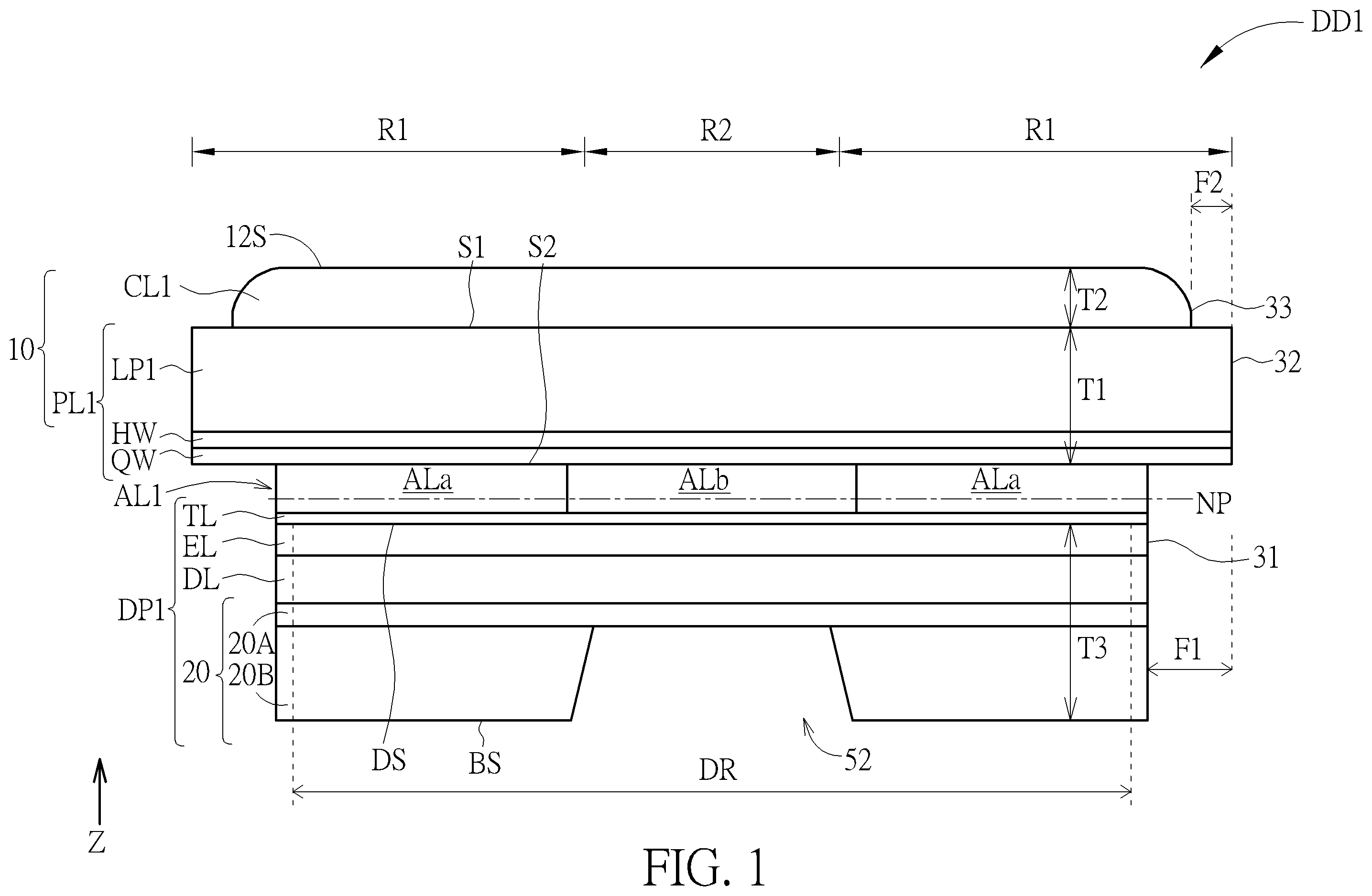
schematically illustrates a cross-sectional view of a display device according to a first embodiment of the present disclosure.
schematically illustrates the display device in a folded state.
schematically illustrates a method of forming the cover layer.
schematically illustrates a top view of a display device according to a second embodiment of the present disclosure.
schematically illustrates a cross-sectional view of the display device taken along a cross-sectional line A-A′ of .
schematically illustrates a display device according to a third embodiment of the present disclosure.
schematically illustrates a display device according to a fourth embodiment of the present disclosure.
schematically illustrates a display device according to a fifth embodiment of the present disclosure.
schematically illustrates a display device according to a sixth embodiment of the present disclosure.
schematically illustrates a display device according to a seventh embodiment of the present disclosure.
schematically illustrates a display device according to an eighth embodiment of the present disclosure.
schematically illustrates a display device according to a ninth embodiment of the present disclosure.
DETAILED DESCRIPTION
The present disclosure may be understood by reference to the following detailed description, taken in conjunction with the drawings as described below. It is noted that, for purposes of illustrative clarity and being easily understood by the readers, various drawings of this disclosure show a portion of the display device, and certain elements in various drawings may not be drawn to scale. In addition, the number and dimension of each device shown in drawings are only illustrative and are not intended to limit the scope of the present disclosure.
Certain terms are used throughout the description and following claims to refer to particular components. As one skilled in the art will understand, electronic equipment manufacturers may refer to a component by different names. This document does not intend to distinguish between components that differ in name but not function. In the following description and in the claims, the terms “include”, “comprise” and “have” are used in an open-ended fashion, and thus should be interpreted to mean “include, but not limited to . . . ”.
It will be understood that when an element or layer is referred to as being “disposed on” or “connected to” another element or layer, it can be directly on or directly connected to the other element or layer, or intervening elements or layers may be present. In contrast, when an element is referred to as being “directly on” or “directly connected to” another element or layer, there are no intervening elements or layers present.
It should be noted that the technical features in different embodiments described in the following can be replaced, recombined, or mixed with one another to constitute another embodiment without departing from the spirit of the present disclosure.
schematically illustrates a cross-sectional view of a display device according to a first embodiment of the present disclosure. The display device DD 1 is a flexible or foldable display device and includes a display panel DP 1 , a polarizer layer PL 1 , and a cover layer CL 1 , in which the polarizer layer PL 1 is disposed on the display panel DP 1 , and the cover layer CL 1 is directly formed on the polarizer layer PL 1 . Specifically, the polarizer layer PL 1 has a first surface S 1 and a second surface S 2 opposite to each other, the cover layer CL 1 is directly formed on the first surface S 1 , and the second surface S 2 of the polarizer layer PL 1 faces the display panel DP 1 . Since the cover layer CL 1 is directly formed on the polarizer layer PL 1 , extra layers, such as an adhesive layer for attaching the cover layer CL 1 to the polarizer layer PL 1 , can be not present between the polarizer layer PL 1 and the cover layer CL 1 . When a conventional display device is folded, stress will be generated. According to some embodiments, due to the absence of the extra layers between the polarizer layer PL 1 and the cover layer CL 1 , the stress between the extra layers and the stresses between the cover layer CL 1 and the extra layers and between the extra layers and the polarizer layer PL 1 can be prevented, thereby simplifying the stress between the cover layer CL 1 and the polarizer layer PL 1 and mitigating the stress between them.
In the present disclosure, the cover layer is “directly formed on” the polarizer layer means that the cover layer is disposed on the polarizer layer not by any adhesive. That is, there is no adhesive present between the cover layer and the polarizer layer, and contact between the cover layer and the polarizer layer is not by adhesion. For example, the first surface S 1 of the polarizer layer PL 1 is fully exposed before forming the cover layer CL 1 , so when the cover layer CL 1 is formed on the first surface S 1 , a surface of the cover layer CL 1 facing the polarizer layer PL 1 can be fully in contact with the first surface S 1 of the polarizer layer PL 1 . It should be understood that some undesired defects, such as voids, may exist between the cover layer CL 1 and the polarizer layer PL 1 , which may be generated during the manufacturing process of the cover layer CL 1 . This circumstance may still be interpreted as “the cover layer CL 1 is directly formed on the polarizer layer PL 1 ”.
In addition, the cover layer CL 1 directly formed on the polarizer layer PL 1 serves as an outmost layer of the display device DD 1 for protecting the elements in the display device DD 1 from damage, breakage or scratch. In some embodiments, the cover layer CL 1 can have a pencil hardness greater than or equal to 6H. To provide the display device DD 1 with flexibility or foldability, the cover layer CL 1 can have flexibility or foldability. In some embodiments, the cover layer CL 1 can be a polymer. For example, the cover layer CL 1 is formed of organic hybrid resin, inorganic hybrid resin, acryl resin, polyimide, polycarbonate, poly(methyl methacrylate), polyethersulfone, polyamide, polyamide imide, polycarbonate poly(methyl methacrylate) copolymer, acrylic or silicone resins or the like. The method for forming the cover layer CL 1 on the polarizer layer PL 1 may for example include a coating method, an injecting method, an inkjet printing method, or a deposition method, and is not limited. Also, a photolithography process and a UV curing method can be optionally performed.
The polarizer layer PL 1 is configured to enhance the contrast ratio of the display device DD 1 and is disposed on the display panel DP 1 to cover the display panel DP 1 . For example, the polarizer layer PL 1 is used as an anti-reflection film for preventing ambient light from being reflected by the display device DD 1 . In this embodiment, the polarizer layer PL 1 may include a linear polarizer LP 1 , a half wave film HW, and a quarter wave film QW, but not limited thereto. The quarter wave film QW, the half wave film HW and the linear polarizer LP 1 can be stacked sequentially, and the half wave film HW and the quarter wave film QW are disposed between the display panel DP 1 and the linear polarizer LP 1 . Specifically, the first surface S 1 is an outer surface of the linear polarizer LP 1 , the second surface S 2 is an outer surface of the quarter wave film QW, and the second surface S 2 of the polarizer layer PL 1 can be adhered to the display panel DP 1 . In this embodiment, the display device DD 1 may further include an adhesive layer AL 1 disposed between the polarizer layer PL 1 and the display panel DP 1 for attaching the second surface S 2 of the polarizer layer PL 1 to the display panel DP 1 . In another embodiment, the polarizer layer PL 1 may be composed of the linear polarizer LP 1 , and has no half wave film HW and no quarter wave film QW, so the linear polarizer LP 1 is directly attached to the display panel DP 1 through the adhesive layer AL 1 .
In this embodiment, the polarizer layer PL 1 has a first thickness T 1 in a vertical direction Z, the cover layer CL 1 has a second thickness T 2 in the vertical direction Z, and the first thickness T 1 is greater than the second thickness T 2 . The vertical direction Z can be a thickness direction, and perpendicular to the first surface S 1 of the polarizer layer PL 1 . The polarizer layer PL 1 can serve as a support substrate for supporting the cover layer CL 1 during formation of the cover layer CL 1 . Specifically, a ratio of the second thickness T 2 to the first thickness T 1 can be in a range from 0.05 to 0.9. With such thickness ratio, when a combined body 10 including the polarizer layer PL 1 and the cover layer CL 1 is attached onto the display panel DP 1 by the adhesive layer AL 1 , the cover layer CL 1 is not easily damaged. Also, other yield problems during attaching may be prevented. For example, the second thickness T 2 of the cover layer CL 1 may be in a range from 10 micrometers to 100 micrometers or in a range from 20 micrometers to 80 micrometers, and the first thickness T 1 of the polarizer layer PL 1 may be in a range from 100 micrometers to 200 micrometers or in a range from 150 micrometers to 190 micrometers.
The display panel DP 1 has a display surface DS and a back surface BS opposite to each other, and the display surface DS has a display region DR for displaying images. The cover layer CL 1 and the polarizer layer PL 1 cover the display region DR. For example, the display panel DP 1 may be a flexible display panel or a foldable display panel, so the display device DD 1 can be flexible or foldable, and the display device DD 1 can provide portability when the display device DD 1 is in a folded or bent state. The flexible display panel or the foldable display panel may be a self-luminous display panel, such as an organic light-emitting diode (OLED) display panel, an inorganic light-emitting diode (LED) display panel or a quantum dot light-emitting diode (QLED) display panel, but not limited herein. In this embodiment, the display panel DP 1 may include a supporting structure 20 , a display layer DL, and an encapsulation layer EL. The supporting structure 20 is configured to support layers or films disposed thereon. The supporting structure 20 can include a flexible substrate 20 A and a supporting film 20 B, and the flexible substrate 20 A can be disposed on the supporting film 20 B. The display layer DL is disposed on the supporting structure 20 for displaying images, for example the display layer DL may include driving circuits and display units. The driving circuits are for controlling the display of display units, and the display units are for displaying different color light. The driving circuits may for example include thin-film transistors, data lines, scan lines, power lines, and other required elements, but not limited herein. The display units may for example include inorganic light-emitting diodes, organic light-emitting diodes or quantum dot light-emitting diodes. For inorganic light-emitting diodes, each light-emitting diode (LED) may be a chip with inorganic light emitting material for emitting light, for example the chip size of a mini-LED is in a range from 100 μm to 300 μm, or the chip size of a micro-LED is in a range from 1 μm to 100 μm. Those skilled in the art will understand that the display layer DL may further include insulation layers for insulating different elements and other required elements, and will not be detailed herein.
The encapsulation layer EL is disposed on the display layer DL and configured to encapsulate the display layer DL on the supporting structure 20 , so as to prevent the display layer DL from damage by oxygen and moisture or other damage during manufacturing processes or during use. The encapsulation layer EL may include a flexible encapsulation material, which includes an inorganic material, an organic material, or a combination thereof. For example, the inorganic material may be for example aluminum oxide, silicon nitride, silicon oxynitride, or diamond-like carbon, and the organic material may be UV-curable adhesive, polymethyl methacrylate, polyimide, parylene, polyacrylate or acrylate monomer. In this embodiment, the display panel DP 1 may be atop emission display panel, but not limited thereto. In another embodiment, the display panel DP 1 may be a double-emission display panel or a bottom-emission display panel.
The display panel DP 1 has a third thickness T 3 in the vertical direction Z. The third thickness T 3 may be measured from an outer surface of the encapsulation layer EL (that is the display surface DS) to a bottom surface of the display panel DP 1 (that is the back surface BS). The bottom surface of the display panel DP 1 is the bottom surface of the supporting film 20 B of the supporting substrate 20 .
Specifically, refer to , which schematically illustrates the display device in a folded state. The display device is folded such that two portions of a cover surface 12 S of the cover layer CL 1 face each other, which can be referred to as folded inwardly. In other embodiments, although not shown, the display device can also be folded outwardly, such that two portions of the back surface BS of the display panel DP 1 face each other. The term “folded” in the present disclosure means curved, bent, folded, rolled, stretched, flexed, or the like (generally referred to as “folded” or “foldable” hereinafter).
According to some embodiments, a ratio of the third thickness T 3 to a sum of the first thickness T 1 and the second thickness T 2 can be in a range from 0.8 to 1.2. Through the thickness ratio design, the stress to the polarizer layer PL 1 and the cover layer CL 1 and the stress to the display panel DP 1 may be balanced, and damages to the display device DD 1 during folding or bending may be minimized. Thus, crack on the cover layer CL 1 , the layers (such as circuits) of the display panel DP 1 , or other layers in the display device DD 1 can be prevented or mitigated. For example, the first thickness T 1 may be 100 micrometers, the second thickness T 2 may be 60 micrometers, and the third thickness T 3 may be 150 micrometers, but not limited herein.
In some embodiments, an area of the polarizer layer PL 1 can be equal to or greater than an area of the display panel DP 1 . For example, referring to , a first distance F 1 between an edge 31 of the display panel DP 1 and an edge 32 of the polarizer layer PL 1 can be in a range from 0 to 5 millimeters. When the area of the of the polarizer layer PL 1 is greater than the area of the display panel DP 1 , the first distance F 1 can be greater than 0, for example, in a range from 0.1 to 5 millimeters.
In this embodiment, the display device DD 1 may be for example formed by the following description. First, referring to , a flexible substrate 20 A is formed on a rigid substrate (not shown), and followed by forming the display layer DL on the flexible substrate 20 A. The rigid substrate may be for example a glass substrate. The encapsulation layer EL is then formed to cover and encapsulate the display layer DL. After the encapsulation layer EL is formed, the rigid substrate is removed to expose the flexible substrate 20 A. Then, a supporting film 20 B is adhered to the flexible substrate 20 A through an adhesive (not shown). Accordingly, the display panel DP 1 is formed. Also, the flexible substrate 20 A and the supporting film 20 B may constitute the supporting structure 20 for supporting the display layer DL and the encapsulation layer EL. The flexible substrate 20 A and the supporting film 20 B may be formed of any insulating material that is flexible. For example, the insulating material may include polyethylene terephthalate (PET), polyimide (PI), or polyethylene naphthalate (PEN), but not limited thereto.
Refer to as well as . schematically illustrates a method of forming the cover layer CL 1 . First, a cover structure (not shown) is formed by coating on a polarizer mother layer PML. Then, the cover structure is patterned by photolithography to form a plurality of cover layers CL 1 . The cover layers CL 1 may be formed and separated from each other, and two adjacent cover layers CL 1 can be separated by a spacing SP. Thereafter, the polarizer mother layer PML is cut along cutting lines CU. Thus, a plurality of the combined bodies 10 are separated. Each individual combined body 10 includes one polarizer layer PL 1 and one cover layer CL 1 . Then, the combined body 10 can be attached onto the display panel DP 1 by the adhesive layer AL 1 to form the display device DD 1 as shown in and as mentioned above.
In some embodiments, due to the design of the spacing SP between the cover layers CL 1 , when the polarizer mother layer PML is cut, the cover layers CL 1 will not be cut. Thus, no crack would be generated in the cover layer CL 1 , so an optical function of the cover layer CL 1 , such as transparency, would not be affected by the cutting process, or crack on the cover layer CL 1 can be mitigated. In some embodiments, in order not to cut the cover layer CL 1 , the spacing SP may be greater than a width of the cutting line CU. For example, the spacing SP can be in a range from 0 to 40 micrometers, for example, in a range from 2 to 30 micrometers. The spacing SP can be greater than 0.
Referring to and , after the polarizer mother layer PML is cut, and a plurality of the combined bodies 10 are formed. For one individual combined body 10 , the edge of the cover layer CL 1 is disposed inwardly than the edge of the polarizer layer PL 1 . Specifically, an edge 33 of the cover layer CL 1 is spaced apart from and disposed inwardly than the edge 32 of the polarizer layer PL 1 by a second distance F 2 , which may be called a buffer region. The distance F 2 may be in a range from 0 to 20 micrometers, for example, in a range from 1 micrometer to 15 micrometers. Specifically, another edge 33 a of the cover layer CL 1 can be spaced apart from another edge 32 a of the polarizer layer PL 1 . In some embodiments, each edge of each cover layer CL 1 is spaced apart from a corresponding edge of the polarizer layer PL 1 respectively, so the buffer regions can surround the cover layer CL 1 , but not limited thereto.
Alternatively, in other embodiments, first, a cover structure (not shown) is formed by coating on a polarizer mother layer PML. The cover structure can be not subjected to patterning, and the plurality of cover layers CL 1 can be continuous and in an integral structure on the polarizer mother layer PML. That is, no spacing SP is present between two adjacent cover layers CL 1 . Then, the polarizer mother layer PML and the cover structure are cut along the cutting lines CU, and a plurality of combined bodies 10 are formed. Thus, in the individual combined body 10 , at least two adjacent edges of the cover layer CL 1 can be aligned to the corresponding two edges of the polarizer layer PL 1 . For example, referring to , in the combined body 10 , the edges 33 and 33 a of the cover layer CL 1 can be aligned to the corresponding edges 32 and 32 a of the polarizer layer PL 1 , respectively.
In some embodiments, the cover structure can be formed such that an edge 330 of the cover structure is spaced apart from the corresponding edge 320 of the polarizer mother PML, as shown in . Thus, at least one edge of the cover layer CL 1 may be spaced apart from the corresponding edge of the polarizer PL 1 (which is a part of the edge of the polarizer mother layer PML). For example, at least one edge of the cover layer CL 1 , such as the edge 33 b , may be spaced apart from the corresponding edge of the polarizer layer PL 1 , such as the edge 32 b , and at least two adjacent edges of the cover layer CL 1 , such as the edge 33 and the edge 33 a , may be respectively aligned to at least two adjacent edges of the polarizer layer PL 1 , such as the edge 32 and the edge 32 a . Or, alternatively, in other embodiments, the cover structure can be formed such that an edge 330 of the cover structure is aligned to the corresponding edge 320 of the polarizer mother PML, not shown.
According to some embodiments, the display panel can further include a touch layer to provide the touch function, thus forming a touch display panel. For example, referring to , the display panel DP 1 of this embodiment may selectively further include a touch layer TL between the encapsulation layer EL and the adhesive layer AL 1 for touch sensing. shows that the touch layer TL is directly formed on the encapsulation layer EL, and the touch display panel is so-called on-cell type display panel. Since a thickness of the touch layer TL is much less than the third thickness T 3 of the display panel DP 1 , the disposition of the touch layer TL may not affect the folding or bending of the display device DD 1 . Accordingly, the third thickness T 3 is still defined from an outer surface of the encapsulation layer EL (that is the display surface DS) to a bottom surface of the display panel DP 1 (that is the back surface BS) when the display panel DP 1 includes the touch layer TL. In another embodiment (not shown), the touch layer TL may be disposed between the encapsulation layer EL and the supporting substrate 20 , so the display panel DP 1 is so-called in-cell type display panel. In further another embodiment (not shown), the touch layer TL may be formed on a film and followed by being adhered to the encapsulation layer EL through another adhesive, so the display panel DP 1 is so-called out-cell type display device.
According to some embodiments, the display device can be foldable. shows the display device DD 1 in an un-folded state, and shows the display device DD 1 in a folded state. The display device DD 1 may have a main region R 1 and a foldable region R 2 . In other words, the flexibility of the display device DD 1 in the foldable region R 2 is greater than the flexibility of the display device DD 1 in the main region R 1 , so the display device DD 1 in the foldable region R 2 may serve as a foldable portion that is capable of being folded. Specifically, the display device DD 1 may further have another main region R 1 , and the foldable region R 2 is disposed between the two main regions R 1 . According to some embodiments, the cover layer in the foldable region R 2 may include recess portions. For example, the cover layer CL 2 has a plurality of first recess portions 51 in the foldable region R 2 as shown in following and , which can increase flexibility of the foldable region R 2 , but not limited thereto. In another embodiment, as shown in , the cover layer CL 1 in the foldable region R 2 may not have the first recess portions.
According to some embodiments, referring to , the adhesive layer AL 1 of this embodiment may selectively include two first adhesive parts ALa and a second adhesive part ALb, in which the first adhesive parts ALa are disposed in the main regions R 1 , and the second adhesive part ALb is disposed in the foldable region R 2 . In order to enhance foldability in the foldable region R 2 and differentiate the flexibility in the main regions R 1 from the flexibility in the foldable region R 2 , a Young's modulus of the second adhesive part ALb can be less than a Young's modulus of each first adhesive part ALa. Accordingly, the second adhesive part ALb is more elastic than each first adhesive part ALa. The Young's modulus described herein is defined as the Young's modulus of the adhesive layer AL 1 after being cured. In another embodiment, the adhesive layer AL 1 may be composed of one layer that has uniform Young's modulus.
In addition, in some embodiments, the supporting substrate 20 can include a second recess portion 52 in the foldable region R 2 , as shown in . The second recess portion 52 can be on a surface away from the display layer DL, for example, on the back surface BS of the display panel DP 1 . Although not shown, the second recess portion 52 can be more than one, for example, plural, according to requirements. Due to the second recess portion 52 , the stress to the display panel DP 1 in the foldable region R 2 can be mitigated. In some embodiments, the second recess portion 52 may penetrate through the supporting film 20 B and expose the surface of the flexible substrate 20 A, as shown in . Alternatively, in some embodiments, although not shown in figures, the second recess portion 52 may not penetrate through the supporting film 20 B, and a portion of the supporting film 20 B remains in the position corresponding to the second recess portion 52 . In some embodiments, the supporting substrate 20 may not have the second recess portion 52 .
The display device of the present disclosure is not limited to the above embodiment. Further embodiments of the present disclosure are described below. To compare the embodiments conveniently and simplify the description, the same component would be labeled with the same symbol in the following. The following description will detail the dissimilarities among different embodiments and the identical features will not be redundantly described.
schematically illustrates a top view of a display device according to a second embodiment of the present disclosure, and schematically illustrates a cross-sectional view of the display device taken along a cross-sectional line A-A′ of . A main difference between the display device DD 2 of this embodiment and the display device DD 1 of the first embodiment as shown in is the design of the cover layer. In and , the cover layer CL 2 includes a first sub-layer CLa, and the first sub-layer CLa includes a plurality of first recess portions 51 in the foldable region R 2 . Each first recess portion 51 may be a through hole penetrating through the first sub-layer CLa and expose the surface of the polarizer layer PL 1 , as shown in . Or, alternatively, in some embodiments, the first recess portions 51 may not penetrate through the first sub-layer CLa, and a portion of the first sub-layer CLa remains in the position corresponding to the first recess portions 51 . Specifically, the first sub-layer CLa includes two main parts MP in the main regions R 1 and a patterned part PP in the foldable region R 2 . The two main parts MP can be connected by the patterned parts PP to form an integral portion, and the patterned part PP can surround the first recess portions 51 . Through the first recess portions 51 , the flexibility of the display device DD 2 in the foldable region R 2 can be greater than the flexibility of the display device DD 2 in the main regions R 1 . In this embodiment, the first sub-layer CLa has two main parts MP disposed in the main regions R 1 respectively, but not limited thereto. In another embodiment, at least one of the main parts MP of the first sub-layer CLa may have first recess portions 51 .
For easy illustration, and shows that the edges of display panel DP 2 , the polarizer layer PL 1 , and the cover layer CL 2 are aligned. However, in some embodiments, the edges of display panel DP 2 , the polarizer layer PL 1 , and the cover layer CL 2 can be not aligned, as shown in . That is, in the display device DD 2 , the edge of the display panel DP 2 and the edge of the polarizer layer PL 1 can be spaced apart by a first distance F 1 , and the edge of the polarizer layer PL 1 and the edge of the cover layer CL 2 can be spaced apart by a second distance F 2 , as mentioned in the previous embodiments. Similarly, in the following embodiments, the edges of display panel, the polarizer layer, and the over layer can be aligned as shown in the following figures for easy illustration. Alternatively, the edges of display panel, the polarizer layer, and the cover layer can be not aligned, and the display devices in the following embodiments can have the design of the first distance F 1 and the second distance F 2 , as mentioned above. Also, in the procedure of cutting the polarizer mother layer, the buffer region design for the cover layer as mentioned above can be performed in the following embodiments.
In some embodiments, the arrangement of the first recess portions 51 may be for example a matrix arrangement, a brick arrangement or other suitable arrangement. The shape of one of the first recess portions 51 may be for example rectangular, hexagonal or other suitable shapes. Also, referring to , a width W 1 of each first recess portion 51 in a first direction D 1 may be equal to or less than 20 micrometers, and a width W 2 of each first recess portion 51 in a second direction D 2 may also be equal to or less than 20 micrometers. Since the widths W 1 and W 2 are equal to or less than 20 micrometers, the first recess portions 51 would not be easily seen during use, thereby mitigating visibility of the first recess portions 51 and maintaining image quality.
Furthermore, in some embodiments, the profile of the patterned part PP of the first sub-layer CLa in the foldable region R 2 can have a curved shape. Specifically, referring to , the patterned part PP includes a plurality of projections 5 P. Two adjacent projections 5 P are separated by one of the first recess portions 51 . Atop surface 5 T of the projection 5 P connects to a sidewall 5 S of the first recess portion 51 by a corner IE, and the profile of the corner IE has a curved shape, for example, a rounded shape. Since the first sub-layer CLa is the outmost layer of the display device DD 2 , through the curved corner design, the first sub-layer CLa can be prevented from damage resulted from scratching or hitting during use. In another embodiment, the corners IE of the patterned part PP abutting the first recess portions 51 may have right-angled corners. In some embodiments, the top surface 5 T of the projection 5 P can have a curved shape.
Referring to , the adhesive layer AL 2 of this embodiment may be composed of one layer that has single Young's modulus. In another embodiment, the adhesive layer AL 2 may be the same as the adhesive layer AL 1 of the first embodiment. That is, the adhesive layer AL 2 can have a first adhesive layer in the main region R 1 and a second adhesive layer in the foldable region R 2 , and the first adhesive layer and the second adhesive layer can have different Young's moduli. shows that the display panel DP 2 does not include the second recess portion. However, alternatively, in some embodiments, the display panel DP 2 can include the second recess portion, similar to the second recess portion 52 disposed in the supporting film 20 B as shown in , and detailed description is omitted here for brevity.
schematically illustrates a display device according to a third embodiment of the present disclosure. A difference between the display device DD 3 of this embodiment and the display device DD 2 of the second embodiment shown in is the design of the cover layer. In , the cover layer CL 3 of this embodiment further includes a second sub-layer CLb disposed in the foldable region R 2 , and the first sub-layer CLa and the second sub-layer CLb have different Young's moduli. In this embodiment, a Young's modulus of the second sub-layer CLb is less than a Young's modulus of the first sub-layer CLa, so that the second sub-layer CLb can be more elastic than the first sub-layer CLa, and the display device DD 3 in the foldable region R 2 may provide larger flexibility than the display device DD 3 in each main region R 1 . At least a portion of the second sub-layer CLb is filled in the first recess portions 51 of the first sub-layer CLa. In this embodiment, the second sub-layer CLb may cover the patterned part PP of the first sub-layer CLa. A part of the second sub-layer CLb may further extend into the main regions R 1 , but not limited thereto. Furthermore, a ratio of the Young's modulus of the first sub-layer CLa to the Young's modulus of the second sub-layer CLb is in a range from 2 to 20, so as to balance the stress between the first sub-layer CLa and the second sub-layer CLb. In this embodiment, the adhesive layer AL 3 and the display panel DP 3 may be the same as or similar to the above-mentioned adhesive layers and the display panels, and detailed descriptions are omitted.
schematically illustrates a display device according to a fourth embodiment of the present disclosure. A difference between the display device DD 4 of this embodiment and the display device DD 3 of the third embodiment shown in is the design of the cover layer. In , the first sub-layer CLa is only disposed in the main regions R 1 , and the second sub-layer CLb is disposed in the foldable region R 2 and covers the foldable region R 2 . In this embodiment, the first sub-layer CLa only has the main parts MP in the main regions R 1 respectively, but not limited thereto. In some embodiments, the first sub-layer CLa and the second sub-layer CLb can have different Young's moduli. shows that the first sub-layer CLa in the main region R 1 has no recess portion, and the second sub-layer CLb in the foldable region R 2 has no recess portion. However, in another embodiment, at least one of the main parts MP of the first sub-layer CLa in the main regions R 1 may have patterned structure. In this embodiment, the adhesive layer AL 4 and the display panel DP 4 may be the same as or similar to the above-mentioned adhesive layers and the display panels, and detailed descriptions are omitted.
schematically illustrates a display device according to a fifth embodiment of the present disclosure. A difference between the display device DD 5 of this embodiment and the display device DD 4 of the fourth embodiment shown in is the design of the cover layer. In , the second sub-layer CLb includes a plurality of third recess portions 53 . Specifically, the second sub-layer CLb includes a plurality of protrusions PR separated from each other, and the third recess portion 53 is disposed between any two of the adjacent protrusions PR. Each third recess portion 53 may be a through hole penetrating through the second sub-layer CLb and expose the surface of the polarizer layer PL 1 , as shown in . Or, alternatively, in some embodiments, the third recess portions 53 may not penetrate through the second sub-layer CLb, and portions of the second sub-layer CLb can remain in the position corresponding to the third recess portions 53 . For example, a width of each third recess portion 53 may be equal to or less than 20 micrometers. In this embodiment, the first sub-layer CLa further extends into the foldable region R 2 , and at least a portion of the first sub-layer CLa is filled in the third recess portions 53 . The first sub-layer CLa may further cover the second sub-layer CLb. The present disclosure is not limited thereto. In another embodiment, the first sub-layer CLa may not extend into the foldable region R 2 . In this embodiment, the adhesive layer AL 5 and the display panel DP 5 may be the same as or similar to the above-mentioned adhesive layers and the display panels, and detailed descriptions are omitted.
schematically illustrates a display device according to a sixth embodiment of the present disclosure. A main difference between the display device DD 6 of this embodiment and the display device DD 1 of the first embodiment shown in is the surface roughness of the cover layer. In , the cover layer CL 6 of this embodiment has a cover surface 60 S away from the polarizer layer PL 1 , the cover surface 60 S has two first parts 61 respectively in the main regions R 1 , and a second part 62 in the foldable region R 2 . A roughness of the second part 62 of the cover surface 60 S in the foldable region R 2 can be greater than a roughness of the first part 61 of the cover surface 60 S in the main region R 1 . The difference between the roughness of the first part 61 and the roughness of the second part 62 may be achieved for example by an etching process, but not limited thereto. Through the roughness difference, elasticity of the display device DD 6 in the foldable region R 2 can be greater than that in the main regions R 1 . In this embodiment, the cover layer CL 6 may be formed of the same material, but not limited thereto. In another embodiment, the cover layer CL 6 may include a first sub-layer and a second sub-layer, the first sub-layer can include the first parts 61 , and the second sub-layer can include the second part 62 . In this embodiment, the adhesive layer AL 6 and the display panel DP 6 may be the same as or similar to the above-mentioned adhesive layers and the display panels, and detailed descriptions are omitted.
schematically illustrates a display device according to a seventh embodiment of the present disclosure. A main difference between the display device DD 7 of this embodiment and the display device DD 1 of the first embodiment shown in is that the cover layer CL 7 is disposed in the foldable region R 2 , and the display device DD 7 further includes a cover plate 70 and another adhesive layer AAL between the cover plate 70 and the polarizer layer PL 1 . Specifically, the display device DD 7 includes two cover plates 70 and two adhesive layers AAL, in which each adhesive layer AAL attach each cover plate 70 to the polarizer layer PL 1 . Also, each cover plate 70 and each adhesive layer AAL are disposed in each main region R 1 respectively. A Young's modulus of the cover plate 70 can be greater than a Young's modulus of the cover layer CL 7 . For example, each cover plate 70 may be formed of a rigid substrate, such as a glass substrate. In this embodiment, the adhesive layer AL 7 and the display panel DP 7 may be the same as or similar to the above-mentioned adhesive layers and the display panels, and detailed descriptions are omitted.
schematically illustrates a display device according to an eighth embodiment of the present disclosure. A difference between the display device DD 8 of this embodiment and the display device DD 1 of the first embodiment shown in is design of the polarizer. In , the polarizer layer PL 8 includes a fourth recess portion 54 . Specifically, the polarizer layer PL 8 can include a linear polarizer LP 8 , and the linear polarizer LP 8 can include a first protection layer 81 , a second protection layer 83 , and a linear polarizer material 82 disposed between the first protection layer 81 and the second protection layer 83 . In some embodiments, the polarizer layer PL 8 may include a half-wave film HW and a quarter-wave film QW, disposed under the linear polarizer LP 8 . Referring to , the first protection layer 81 can include the plurality of fourth recess portions 54 in the foldable region R 2 . Also, the fourth recess portions 54 is disposed on the first surface 80 of the polarizer layer PL 8 , which contacts the cover layer CL 8 , and a portion of the cover layer CL 8 is filled in the fourth recess portions 54 . Through the fourth recess portions 54 , elasticity of the display device DD 8 in the foldable region R 2 can be greater than elasticity of the display device DD 8 in the main regions R 1 . In some embodiments, each fourth recess portion 54 may be a through hole penetrating through the first protection layer 81 and expose the surface of the linear polarizer material 82 , not shown in figures. Or, alternatively, in some embodiments, as shown in , the fourth recess portions 54 may not penetrate through the first protection layer 81 , and a portion of the first protection layer 81 remains in the position corresponding to the fourth recess portions 54 . In this embodiment, the adhesive layer AL 8 and the display panel DP 8 may be the same as or similar to the above-mentioned adhesive layers and the display panels, and detailed descriptions are omitted. Each of the first protection layer 81 and the second protection layer 83 can be, for example, a triacetyl cellulose (TAC) film, and the linear polarizer material 82 can be, for example, made of polyvinyl alcohol (PVA).
schematically illustrates a display device according to a ninth embodiment of the present disclosure. A difference between the display device DD 9 of this embodiment and the display device DD 8 of the eighth embodiment shown in is that the polarizer layer PL 9 includes recess portions on two surfaces in the foldable region R 2 . Referring to , the polarizer layer PL 9 includes a plurality of fourth recess portions 54 a on the first surface 80 a and a plurality of fifth recess portions 54 b on the second surface 80 b . Specifically, the fourth recess portions 54 a are disposed on the first surface 80 a of the first protection layer 81 in the foldable region R 2 , and the fifth recess portions 54 b are disposed on the second surface 80 b of the second protection layer 83 in the foldable region R 2 . In some embodiments, the fourth recess portions 54 a can be filled with the cover layer CL 9 . Specifically, the polarizer layer PL 9 of this embodiment may not include the half-wave film HW and the quarter-wave film QW, so the second protection layer 83 may contact the adhesive layer AL 9 , and the fifth recess portions 54 b can be filled with the adhesive layer AL 9 . Through the fourth recess portions 54 a and the fifth recess portions 54 b , elasticity of the display device DD 9 in the foldable region R 2 can be much greater than elasticity of the display device DD 9 in the main regions R 1 . In this embodiment, the adhesive layer AL 9 and the display panel DP 9 may be the same as or similar to the above-mentioned adhesive layers and the display panels, and detailed descriptions are omitted.
As the mentioned above, according to some embodiments, in the display device of the present disclosure, since the cover layer is directly formed on the polarizer layer, no extra layer exists between the cover layer and the polarizer layer, thereby reducing the number of the layers in the display device. Accordingly, in some embodiments, the stress between the cover layer and the polarizer layer can be simplified and mitigated. In some embodiments, by means of the design of the cover layer, recess portions, Young's modulus adjustment, and/or surface roughness of the cover layer, the display device can be suitable for use as a foldable display device, and crack occurring during folding can be prevented or mitigated.
Those skilled in the art will readily observe that numerous modifications and alterations of the device and method may be made while retaining the teachings of the disclosure. Accordingly, the above disclosure should be construed as limited only by the metes and bounds of the appended claims.
Figures (12)
Citations
This patent cites (4)
- US20180095325
- US20200326461
- US105607328
- US206400960