Method for Forming Programmable Memory
Abstract
An array of electrically erasable programmable read only memory (EEPROM) includes a first row of floating gate, a second row of floating gate, two spacers, a first row of word line and a second row of word line. The first row of floating gate and the second row of floating gate are disposed on a substrate along a first direction. The two spacers are disposed between and parallel to the first row of floating gate and the second row of floating gate. The first row of word line is sandwiched by one of the spacers and the adjacent first row of floating gate, and the second row of word line is sandwiched by the other one of the spacers and the adjacent second row of floating gate. The present invention also provides a method of forming said array of electrically erasable programmable read only memory (EEPROM).
Claims (15)
1. A method of forming an array of programmable memory, comprising: forming a first floating gate, a dummy floating gate and a second floating gate on a substrate; forming spacers on sidewalls of the dummy floating gate, and forming first spacers on sidewalls of the first floating gate and the second floating gate; filling an electrode layer in space between the first floating gate, the dummy floating gate and the second floating gate; and removing the dummy floating gate.
Show 14 dependent claims
2. The method of forming an array of programmable memory according to claim 1 , further comprising: forming source lines in the substrate beside the first floating gate opposite to the dummy floating gate and in the substrate beside the second floating gate opposite to the dummy floating gate respectively before filling the electrode layer.
3. The method of forming an array of programmable memory according to claim 1 , wherein steps of filling the electrode layer in space between the first floating gate, the dummy floating gate and the second floating gate comprise depositing and planarizing the electrode layer on the substrate and then etching back the electrode layer, to ensure the first floating gate, the dummy floating gate and the second floating gate being exposed.
4. The method of forming an array of programmable memory according to claim 1 , wherein a part of the electrode layer between one of the spacers and the adjacent first floating gate serves as a first word line, and a part of the electrode layer between the other one of the spacers and the adjacent second floating gate serves as a second word line.
5. The method of forming an array of programmable memory according to claim 4 , wherein a part of the electrode layer right next to the first floating gate opposite to the first word line serves as a first erase gate, and a part of the electrode layer right next to the second floating gate opposite to the second word line serves as a second erase gate.
6. The method of forming an array of programmable memory according to claim 4 , wherein a bottom width of the second word line is smaller than a top width of the second word line.
7. The method of forming an array of programmable memory according to claim 1 , further comprising: forming lightly doped regions, halo implantation regions and sources/drains in the substrate between the spacers after the dummy floating gate is removed.
8. The method of forming an array of programmable memory according to claim 7 , further comprising forming bit line contacts disposed on the sources/drains.
9. The method of forming an array of programmable memory according to claim 8 , further comprising forming bit lines in the substrate, wherein each of the bit line contacts directly contacts the corresponding bit line.
10. The method of forming an array of programmable memory according to claim 1 , wherein the first floating gate, the dummy floating gate and the second floating gate are arranged along a first direction.
11. The method of forming an array of programmable memory according to claim 1 , wherein a width of the first spacer is smaller than a width of the spacer.
12. The method of forming an array of programmable memory according to claim 1 , wherein the first floating gate and the second floating gate comprise stacked structures respectively.
13. The method of forming an array of programmable memory according to claim 12 , wherein each of the stacked structures comprises a dielectric layer, a floating gate layer and a hard mask stacked from bottom to top.
14. The method of forming an array of programmable memory according to claim 12 , wherein each of the stacked structures comprises a dielectric layer, a bottom floating gate layer, an oxide/nitride/oxide (ONO) layer, a control gate layer and a hard mask stacked from bottom to top.
15. The method of forming an array of programmable memory according to claim 1 , wherein a top surface of the first floating gate, a top surface of the second floating gate and a top surface of the electrode layer are on a same level.
Full Description
Show full text →
CROSS REFERENCE TO RELATED APPLICATIONS
This application is a division of U.S. application Ser. No. 17/381,219, filed on Jul. 21, 2021. The content of the application is incorporated herein by reference.
BACKGROUND OF THE INVENTION
1. Field of the Invention
The present invention relates generally to an array of memory cells and forming method thereof, and more specifically to an array of electrically erasable programmable read only memory (EEPROM) cells and forming method thereof
2. Description of the Prior Art
Memory devices include volatile memory devices and nonvolatile memory devices. Volatile memory devices can be classified into Dynamic Random Access Memory (DRAM) and Static Random Access Memory (SRAM). Nonvolatile memory devices may include Electrically Erasable Programmable Read Only Memory (EEPROM) devices, Ferroelectric Random Access Memory (FeRAM) devices, Phase-change Random Access Memory (PRAM) devices, Magnetic Random Access Memory (MRAM) devices and Flash Memory devices.
SUMMARY OF THE INVENTION
The present invention provides an array of electrically erasable programmable read only memory (EEPROM) and forming method thereof, which forms word lines between spacers by self-aligning, to avoid the non-uniformity of the widths of the word lines caused by the shifting while patterning.
The present invention provides an array of electrically erasable programmable read only memory (EEPROM) including a first row of floating gate, a second row of floating gate, two spacers, a first row of word line and a second row of word line. The first row of floating gate and the second row of floating gate are disposed on a substrate along a first direction. The spacers are disposed between and parallel to the first row of floating gate and the second row of floating gate. The first row of word line is sandwiched by one of the spacers and the adjacent first row of floating gate, and the second row of word line is sandwiched by the other one of the spacers and the adjacent second row of floating gate.
The present invention provides an array of electrically erasable programmable read only memory (EEPROM) including a first floating gate, a second floating gate, two spacers, a first word line and a second word line. The first floating gate and the second floating gate are disposed on a substrate. The spacers are disposed between the first floating gate and the second floating gate. The first word line is sandwiched by one of the spacers and the adjacent first floating gate, and the second word line is sandwiched by the other one of the spacers and the adjacent second floating gate.
The present invention provides a method of forming an array of electrically erasable programmable read only memory (EEPROM) including the following steps. A first floating gate, a dummy floating gate and a second floating gate are formed on a substrate. Spacers are formed on sidewalls of the dummy floating gate, and first spacers are formed on sidewalls of the first floating gate and the second floating gate. An electrode layer fills in space between the first floating gate, the dummy floating gate and the second floating gate. The dummy floating gate is removed.
According to the above, the present invention provides an array of electrically erasable programmable read only memory (EEPROM) and forming method thereof, which forms a first floating gate, a dummy floating gate and a second floating gate on a substrate; forms spacers on sidewalls of the dummy floating gate, and forms first spacers on sidewalls of the first floating gate and the second floating gate; fills an electrode layer in space between the first floating gate, the dummy floating gate and the second floating gate. By doing this, a part of the electrode layer between one of the spacers and the adjacent first floating gate serves as a first word line, and a part of the electrode layer between the other one of the spacers and the adjacent second floating gate serves as a second word line. By forming word lines between spacers by self-aligning, the non-uniformity of the widths of the word lines caused by the shifting while patterning can be avoided.
These and other objectives of the present invention will no doubt become obvious to those of ordinary skill in the art after reading the following detailed description of the preferred embodiment that is illustrated in the various figures and drawings.
BRIEF DESCRIPTION OF THE DRAWINGS
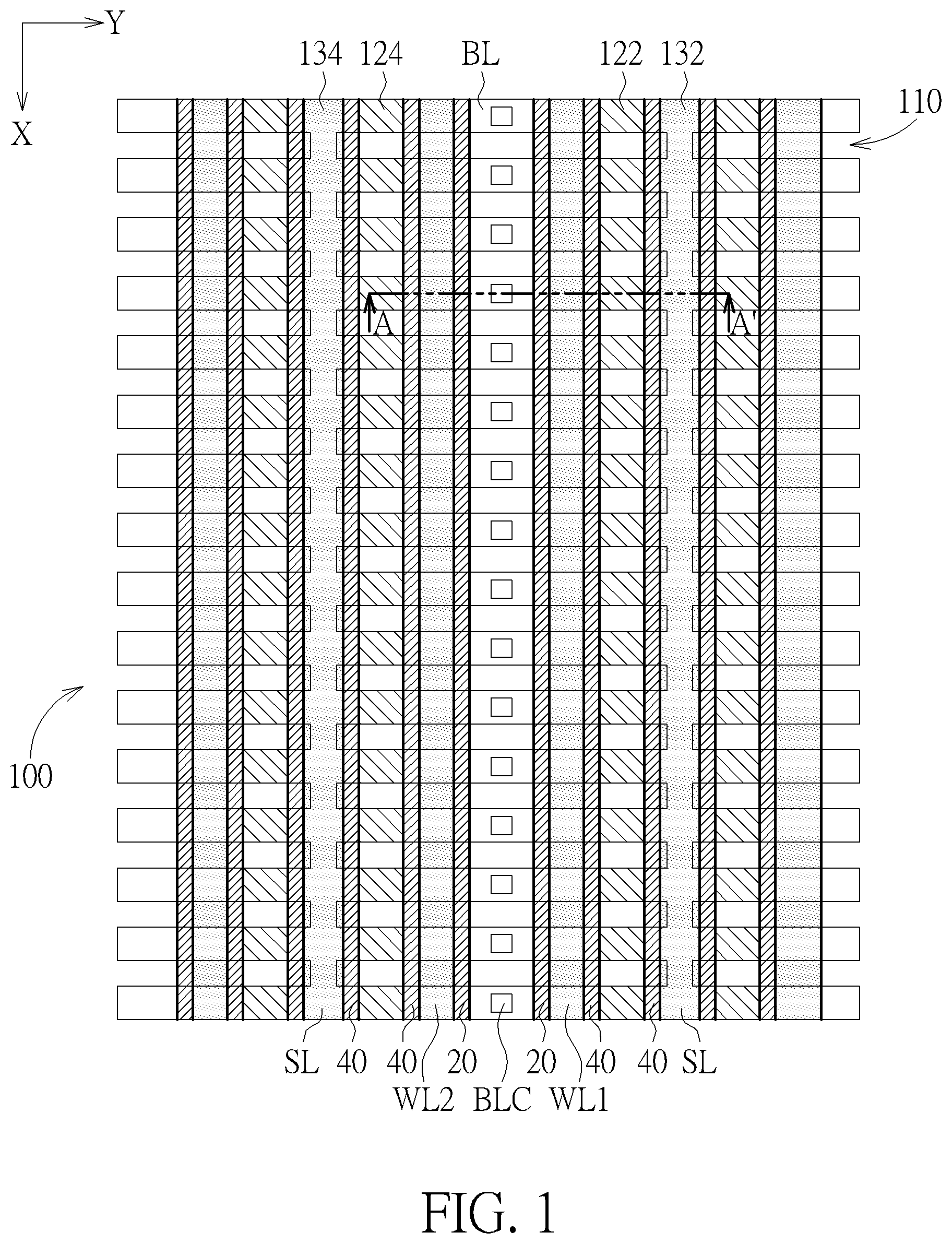
schematically depicts a top view of an array of electrically erasable programmable read only memory (EEPROM) according to an embodiment of the present invention.
schematically depicts a cross-sectional view of an array of electrically erasable programmable read only memory (EEPROM) according to an embodiment of the present invention.
schematically depicts a cross-sectional view of a method of forming an array of electrically erasable programmable read only memory (EEPROM) according to an embodiment of the present invention.
schematically depicts a cross-sectional view of a method of forming an array of electrically erasable programmable read only memory (EEPROM) according to an embodiment of the present invention.
schematically depicts a cross-sectional view of a method of forming an array of electrically erasable programmable read only memory (EEPROM) according to an embodiment of the present invention.
schematically depicts a cross-sectional view of a method of forming an array of electrically erasable programmable read only memory (EEPROM) according to an embodiment of the present invention.
schematically depicts a cross-sectional view of a method of forming an array of electrically erasable programmable read only memory (EEPROM) according to an embodiment of the present invention.
schematically depicts a cross-sectional view of a method of forming an array of electrically erasable programmable read only memory (EEPROM) according to an embodiment of the present invention.
schematically depicts a cross-sectional view of an array of electrically erasable programmable read only memory (EEPROM) according to another embodiment of the present invention.
DETAILED DESCRIPTION
The present invention provides an array of electrically erasable programmable read only memory (EEPROM) with spacers, to form self-aligned word lines and avoid the shifting of the word lines.
schematically depicts a top view of an array of electrically erasable programmable read only memory (EEPROM) according to an embodiment of the present invention. schematically depicts a cross-sectional view of an array of electrically erasable programmable read only memory (EEPROM) according to an embodiment of the present invention. is a cross-sectional view of along line AA′. Please refer to and , the array of electrically erasable programmable read only memory (EEPROM) in this embodiment is arranged regularly and repeatedly, so only one part is described.
Please refer to , a substrate 110 is provided, wherein the substrate 110 may be a semiconductor substrate such as a silicon substrate, a silicon containing substrate, a III-V group-on-silicon (such as GaN-on-silicon) substrate, a graphene-on-silicon substrate, a silicon-on-insulator (SOI) substrate or a substrate containing epitaxial layers. In this embodiment, only the substrate 110 of an electrically erasable programmable read only memory (EEPROM) area is depicted.
A first row of floating gate 122 and a second row of floating gate 124 are disposed on the substrate 110 along a first direction x. In this embodiment, the first row of floating gate 122 and the second row of floating gate 124 are constituted by several island parts. The first row of floating gate 122 and the second row of floating gate 124 include stacked structures respectively. In this case, the first row of floating gate 122 includes a dielectric layer 122 a , a floating gate layer 122 b and a hard mask 122 c stacked from bottom to top, and the second row of floating gate 124 includes a dielectric layer 124 a , a floating gate layer 124 b and a hard mask 124 c stacked from bottom to top. The dielectric layer 122 a and the dielectric layer 124 a may be oxide layers, the floating gate layer 122 b and the floating gate layer 124 b may be polysilicon layers, and the hard mask 122 c and the hard mask 124 c may be nitride layers, but it is not limited thereto. In another embodiment, the stacked structures of the first row of floating gate 122 and the second row of floating gate 124 can be replaced by gates. As shown in , a gate 220 includes a dielectric layer 222 , a bottom floating gate layer 224 , an oxide/nitride/oxide (ONO) layer 226 , a control gate layer 228 and a hard mask 229 stacked from bottom to top, wherein the dielectric layer 222 is an oxide layer, the bottom floating gate layer 224 is a polysilicon layer, the oxide/nitride/oxide (ONO) layer 226 is an oxide layer, a nitride layer and an oxide layer stacked from bottom to top, the control gate layer 228 is a polysilicon layer, and the hard mask 229 is a nitride layer, but it is not limited thereto.
Please refer to , spacers 20 are disposed between and parallel to the first row of floating gate 122 and the second row of floating gate 124 . First spacers 40 are disposed on sidewalls of the first row of floating gate 122 and the second row of floating gate 124 . A first row of word line WL 1 is sandwiched by one of the spacers 20 and the adjacent first row of floating gate 122 , and a second row of word line WL 2 is sandwiched by the other one of the spacers 20 and the adjacent second row of floating gate 124 . The spacers 20 and the first spacers 40 sandwich the first row of word line WL 1 and the second row of word line WL 2 , so the first row of word line WL 1 and the second row of word line WL 2 both have cross-sectional views broaden from bottom to top, wherein widths W 1 of top surfaces T 1 of the first row of word line WL 1 and the second row of word line WL 2 are larger than widths W 2 of bottom surfaces T 2 of the first row of word line WL 1 and the second row of word line WL 2 . Since the first row of word line WL 1 and the second row of word line WL 2 are formed self-alignedly using the spacers 20 and the first spacers 40 , the non-uniformity of the width W 1 of the first row of word line WL 1 and the width W 2 of the second row of word line WL 2 caused by the shifting while patterning can be avoided.
A first row of erase gate 132 is disposed right next to the first row of floating gate 122 opposite to the first row of word line WL 1 , and a second row of erase gate 134 is disposed right next to the second row of erase gate 134 opposite to the second row of word line WL 2 . Source lines SL are located in the substrate 110 along the first direction x and right below the first row of erase gate 132 and the second row of erase gate 134 . Bit line contacts BLC are disposed between the two spacers 20 . Bit lines BL are disposed in the substrate 110 along a second direction y, wherein the second direction y is orthogonal to the first direction x. Each of the bit line contacts BLC contacts the corresponding bit line BL directly.
A method of forming an array of electrically erasable programmable read only memory (EEPROM) 100 is presented. schematically depict cross-sectional views of a method of forming an array of electrically erasable programmable read only memory (EEPROM) according to an embodiment of the present invention. As shown in , a first floating gate 320 a , a dummy floating gate 320 b and a second floating gate 320 c are formed on a substrate 310 . In this embodiment, a stacked structure of is applied, but the stacked structure can be replaced by a stacked structure of , so that a stacked structure including a first floating gate 320 a , a dummy floating gate 320 b and a second floating gate 320 c is provided. The first floating gate 320 a includes a dielectric layer 322 a , a bottom floating gate layer 324 a , an oxide/nitride/oxide (ONO) layer 326 a , a control gate layer 328 a and a hard mask (not shown) stacked from bottom to top. The dummy floating gate 320 b includes a dielectric layer 322 b , a bottom floating gate layer 324 b , an oxide/nitride/oxide (ONO) layer 326 b , a control gate layer 328 b and a hard mask (not shown) stacked from bottom to top. The second floating gate 320 c includes a dielectric layer 322 c , a bottom floating gate layer 324 c , an oxide/nitride/oxide (ONO) layer 326 c , a control gate layer 328 c and a hard mask (not shown) stacked from bottom to top. In this embodiment, methods of forming the first floating gate 320 a , the dummy floating gate 320 b and the second floating gate 320 c may include depositing and patterning gate layers such as a dielectric layer, a bottom floating gate layer, an oxide/nitride/oxide (ONO) layer, a control gate layer and a hard mask, to form the first floating gate 320 a , the dummy floating gate 320 b and the second floating gate 320 c , but it is not limited thereto.
As shown in , spacers P are formed on sidewalls S 1 of the dummy floating gate 320 b , and first spacers P 1 are formed on sidewalls S 2 of the first floating gate 320 a and the second floating gate 320 c . The spacers P and the first spacers P 1 may include nitride spacers or oxide spacers etc. Thicknesses of the formed spacers P and the formed first spacers P 1 depend on the density of these stacked structures.
As shown in , source lines SL 1 are located in the substrate 110 beside the first floating gate 320 a opposite to the dummy floating gate 320 b , and in the substrate 110 beside the second floating gate 320 c opposite to the dummy floating gate 320 b . A photoresist Q 1 may be formed to cover parts except for areas for forming the source lines SL 1 , the source lines SL 1 are formed by implant processes, and then the photoresist Q 1 is removed.
As shown in , an electrode layer 330 fills in space between the first floating gate 320 a , the dummy floating gate 320 b and the second floating gate 320 c , wherein a part of the electrode layer 330 between one of the spacers P and the adjacent first floating gate 320 a serves as a first word line WL 3 , and a part of the electrode layer 330 between the other one of the spacers P and the adjacent second floating gate 320 c serves as a second word line WL 4 . A part of the electrode layer 330 right next to the first floating gate 320 a opposite to the first word line WL 3 serves as a first erase gate 330 a , and a part of the electrode layer 330 right next to the second floating gate 320 c opposite to the second word line WL 4 serves as a second erase gate 330 b.
Methods of filling the electrode layer 330 in space between the first floating gate 320 a , the dummy floating gate 320 b and the second floating gate 320 c may include depositing and planarizing the electrode layer 330 on the substrate 310 , and then etching back the electrode layer 330 , to ensure the first floating gate 320 a , the dummy floating gate 320 b and the second floating gate 320 c being exposed. The spacers P and the first spacers P 1 are formed in the present invention, and the first word line WL 3 and the second word line WL 4 are self-aligned between the spacers P and the first spacers P 1 , so that the non-uniformity of the widths of the first word line WL 3 and the second word line WL 4 caused by the shifting while patterning can be avoided.
Then, the dummy floating gate 320 b is removed to form a recess R, as shown in . For example, a photoresist Q 2 is formed to cover areas except for the dummy floating gate 320 b , and then the dummy floating gate 320 b is removed.
As shown in , a bit line BL 1 is formed in the substrate 310 between the spacers P, wherein the bit line BL 1 may include a lightly doped region 12 , a halo implantation region 14 and a source/drain 16 . The lightly doped region 12 , the halo implantation region 14 and the source/drain 16 may be formed by implantation processes. Then, the photoresist Q 2 is removed. The bit line contacts BLC of may be formed on the bit lines BL 1 .
To summarize, the present invention provides an array of electrically erasable programmable read only memory (EEPROM) and forming method thereof, which forms a first floating gate, a dummy floating gate and a second floating gate on a substrate; forms spacers on sidewalls of the dummy floating gate, and forms first spacers on sidewalls of the first floating gate and the second floating gate; fills an electrode layer in space between the first floating gate, the dummy floating gate and the second floating gate. By doing this, a part of the electrode layer between one of the spacers and the adjacent first floating gate serves as a first word line, and a part of the electrode layer between the other one of the spacers and the adjacent second floating gate serves as a second word line. A part of the electrode layer right next to the first floating gate opposite to the first word line serves as a first erase gate, and a part of the electrode layer right next to the second floating gate opposite to the second word line serves as a second erase gate. By forming word lines between spacers by self-aligning, the non-uniformity of the widths of the word lines caused by the shifting while patterning can be avoided. After the dummy floating gate is removed, the bit lines and the bit line contacts may be formed between the spacers.
Those skilled in the art will readily observe that numerous modifications and alterations of the device and method may be made while retaining the teachings of the invention. Accordingly, the above disclosure should be construed as limited only by the metes and bounds of the appended claims.
Figures (4)
Citations
This patent cites (3)
- US8785307
- US10163641
- US20170103991