Seal Assemblies for Surgical Access Assemblies
Abstract
Access assemblies include an instrument valve housing and a valve assembly disposed within the instrument valve housing. The valve assembly includes a guard assembly, and a seal assembly disposed adjacent the guard assembly. The seal assembly includes a plurality of seal segments defining a substantially hexagonal body. Each seal segment of the plurality of seal segments includes a base portion and a seal portion extending from the base portion. Each base portion including an outer edge formed of three segments. Each seal segment of the plurality of seal segments is disposed relative to an adjacent seal segment of the plurality of seal segments such that two of the three segments of the outer edge of the respective seal segments align with each other. The valve assembly also includes a centering mechanism for biasing the seal assembly and guard assembly towards a center of the cavity of the instrument valve.
Claims (18)
1. An access assembly comprising: an instrument valve housing including an upper housing section, a lower housing section, and an inner housing section, the instrument valve housing defining a cavity; and a valve assembly disposed within the cavity of the instrument valve housing, the valve assembly including: a guard assembly, a seal assembly disposed adjacent the guard assembly, the seal assembly including a plurality of seal segments, each seal segment of the plurality of seal segments attached to at least one other seal segment of the plurality of seal segments by a connector, the plurality of seal segments transitionable from an unfolded configuration to a folded configuration, the folded configuration defining a substantially hexagonal body, each seal segment of the plurality of seal segments includes a base portion and a seal portion extending from the base portion, each of the base portions including an outer edge formed of three segments, wherein each seal segment of the plurality of seal segments is disposed relative to an adjacent seal segment of the plurality of seal segments such that two of the three segments of the outer edge of the respective seal segments align with each other; and a centering mechanism for biasing the seal assembly and the guard assembly towards a center of the cavity of the instrument valve housing.
11. A seal assembly for an instrument valve assembly, the seal assembly comprising: a plurality of seal segments transitionable from an unfolded configuration defined by a planar orientation of the plurality of seal segments to a folded configuration defining a substantially hexagonal body, each seal segment of the plurality of seal segments attached to at least one other seal segment of the plurality of seal segments by a connector and each seal segment of the plurality of seal segments includes a base portion and a seal portion extending from the base portion, each of the base portions including an outer edge formed of three segments, wherein each seal segment of the plurality of seal segments is disposed relative to an adjacent seal segment of the plurality of seal segments such that two of the three segments of the outer edge of the respective seal segments align with each other.
Show 16 dependent claims
2. The access assembly of claim 1 , wherein each seal segment of the plurality of seal segments is rotated sixty degrees (60°) relative to an adjacent seal segment of the plurality of seal segments.
3. The access assembly of claim 1 , wherein the seal portions of the plurality of seal segments taper radially inward.
4. The access assembly of claim 1 , wherein the seal portions of the plurality of seal segments defines an opening.
5. The access assembly of claim 4 , wherein the opening includes a diameter from about 0.025″ to about 0.100″.
6. The access assembly of claim 1 , wherein the seal portions of the plurality of seal segments form an angle from about 180º to about 275º.
7. The access assembly of claim 6 , wherein the angle is 2100.
8. The access assembly of claim 1 , wherein the plurality of seal segments includes six (6) seal segments.
9. The access assembly of claim 1 , wherein the plurality of seal segments is in a planar orientation when the plurality of seal segments is in the unfolded configuration.
10. The access assembly of claim 1 , where the connector flexibly couples each segment of the plurality of segments to at least one other segment of the plurality of segments thereby facilitating transitioning the seal assembly between the unfolded configuration and the folded configuration.
12. The seal assembly of claim 11 , wherein each seal segment of the plurality of seal segments is rotated sixty degrees (60°) relative to an adjacent seal segment of the plurality of seal segments.
13. The seal assembly of claim 11 , wherein the seal portions of the plurality of seal segments taper radially inward.
14. The seal assembly of claim 11 , wherein the seal portions of the plurality of seal segments defines an opening.
15. The seal assembly of claim 14 , wherein the opening includes a diameter from about 0.025″ to about 0.100″.
16. The seal assembly of claim 11 , wherein the seal portions of the plurality of seal segments form an angle from about 180° to about 275°.
17. The seal assembly of claim 16 , wherein the angle is 2100.
18. The seal assembly of claim 11 , wherein the plurality of seal segments includes six (6) seal segments.
Full Description
Show full text →
CROSS-REFERENCE TO RELATED APPLICATION
This application claims the benefit of and priority to U.S. Provisional Patent Application Ser. No. 62/916,931, filed Oct. 18, 2019, the entire disclosure of which is incorporated by reference herein.
FIELD
The present disclosure relates to access assemblies for minimally invasive surgery, including seals. More particularly, the present disclosure relates to seals for surgical access assemblies.
BACKGROUND
In order to facilitate minimally invasive surgery, a working space must be created in the desired surgical space. An insufflation gas, typically CO 2 , is introduced into the abdomen of the patient to create an inflated state called pneumoperitoneum. Access ports are utilized to allow the introduction of surgical instrumentation and endoscopes (or other visualization tools). These ports maintain the pressure for the pneumoperitoneum, as they have one or more seals that adapt to the surgical instrumentation. Typically, a “zero-seal” in the access port seals the port in the absence of a surgical instrument in the port, and an instrument seal seals around a surgical instrument that has been inserted through the access port.
The breadth of surgical instrumentation on the market today requires a robust seal capable adjusting to multiple sizes and withstanding multiple insertions of surgical instrumentation. Some of the instrumentation can include sharp edges that can tear or otherwise damage seals. Therefore, it would be beneficial to have an access assembly with improved seal durability.
SUMMARY
An access assembly with an improved seal durability is provided. The access assembly includes an instrument valve housing, and a valve assembly disposed within the cavity of the instrument valve housing. The instrument valve housing includes upper, lower, and inner housing sections and defines a cavity. The valve assembly includes a seal assembly, a guard assembly disposed adjacent to and configured for engagement with the seal assembly, and a centering mechanism for maintaining the seal assembly and guard assembly centered within the cavity of the instrument valve. The guard assembly includes a ring portion and a plurality of petals. The plurality of petals extend radially outwardly from the ring portion when the guard assembly is in an unfolded condition, and the plurality of petals extend radially inward when the guard assembly is in a folded condition.
In embodiments, the guard assembly includes first, second, third and fourth petals, each petal including a flap portion and a connector portion for joining the flap portion to the ring portion. Each flap portion may include a first flap section and a second flap section. Each of the first and second flap sections may define a groove therebetween. The first flap section of each petal of the plurality of petals may overlap the second flap section of the adjacent petal of the plurality of petals.
In embodiments, the ring portion defines a plurality of openings and each connector portion defines a plurality of openings. The flap portion of the first guard member may overlap the flap portion of the second guard member. The flap portion of the second guard member may overlap the flap portion of the third guard member. The flap portion of the third guard member may overlap the flap portion of the fourth guard member. The flap portion of the fourth guard member may overlap the flap portion of the first guard member.
The valve assembly may further include upper, lower retainer, and middle members. At least one of the upper or lower retainer members may include a plurality of pins configured to engage the ring portion of the guard assembly. The seal assembly may include an hourglass-shaped seal supported by upper and lower flange members. The middle retainer member may be received between the upper and lower flange members. The centering mechanism may include a bellows. The centering mechanism may include an annular ring and a plurality of spokes extending outwardly from the annular ring. Each spoke of the plurality of spokes may include a rib extending at least partially along a length of the spoke.
Another access assembly with an improved seal durability is provided. The access assembly includes an instrument valve housing, and a valve assembly disposed within the cavity of the instrument valve housing. The instrument valve housing includes upper, lower, and inner housing sections and defines a cavity. The valve assembly includes a guard assembly, a seal assembly disposed adjacent the guard assembly, and a centering mechanism for maintaining the seal assembly and guard assembly centered within the cavity of the instrument valve. The seal assembly includes a plurality of seal sections. Each seal section of the plurality of seal sections includes a substantially C-shaped base portion and a semi-conical seal portion. Each seal section of the plurality of seal sections is secured to at least one adjacent seal section. The plurality of seal sections extending outwardly in a planar manner when the seal assembly is in an unfolded condition and the plurality of seal sections are stacked on top of one another when the seal assembly is in a folded condition.
The valve assembly may further include upper and lower retainer members. At least one of the upper or lower retainer members may include a plurality of pins configured to engage the base portions of the seal assembly.
In embodiments, the guard assembly includes a ring portion and a plurality of petals. The plurality of petals may extend radially outwardly from the ring portion when the guard assembly is in an unfolded condition. The plurality of petals may extend radially inward when the guard assembly is in a folded condition. The guard assembly and the seal assembly may be received between the upper and lower retainer members.
The centering mechanism may include a bellows. The centering mechanism may include an annular ring and a plurality of spokes extending outwardly from the annular ring. Each of the plurality of spokes may include a rib extending at least partially along a length of the spoke.
Another access assembly with an improved seal durability is provided. The access assembly includes an instrument valve housing, and a valve assembly disposed within the cavity of the instrument valve housing. The instrument valve housing includes upper, lower, and inner housing sections and defines a cavity. The valve assembly includes a guard assembly, and a seal assembly disposed adjacent guard assembly. The seal assembly includes a plurality of seal sections. Each seal section of the plurality of seal sections includes a substantially C-shaped base portion supporting a seal portion. A rim portion extends about an outer edge of the each base portion. Each seal section is received within the rim portion of the adjacent seal section such that the plurality of seal sections are stacked on top of one another.
In embodiments, each of the seal portions defines a wedge-shaped opening. Each base portion may include a plurality of openings. A distance between the plurality of openings and the rim portion may increase in a clockwise direction. The valve assembly may further include a centering mechanism for maintaining the seal assembly and guard assembly centered within the cavity of the instrument valve.
The valve assembly may further includes upper and lower retainer members. At least one of the upper or lower retainer members may include a plurality of pins configured to engage the base portions of the seal assembly.
In embodiments, the guard assembly includes a ring portion and a plurality of petals. The plurality of petals may extend radially outwardly from the ring portion when the guard assembly is in an unfolded condition. The plurality of petals may extend radially inward when the guard assembly is in a folded condition. The guard assembly and the seal assembly may be received between the upper and lower retainer members.
In embodiments, the centering mechanism includes a bellows. The centering mechanism includes an annular ring and a plurality of spokes extending outwardly from the annular ring, each of the plurality of spokes including a bent portion in loaded engagement with the instrument valve housing. Each of the plurality of spokes may include a rib extending at least partially along a length of the spoke.
Another access assembly includes an instrument valve housing and a valve assembly disposed within a cavity of the instrument valve housing. The instrument valve housing includes upper, lower, and inner housing sections. The valve assembly includes a guard assembly, and a seal assembly disposed adjacent the guard assembly. The seal assembly includes a plurality of seal segments defining a substantially hexagonal body. Each seal segment of the plurality of seal segments includes a base portion and a seal portion extending from the base portion. Each base portion including an outer edge formed of three segments. Each seal segment of the plurality of seal segments is disposed relative to an adjacent seal segment of the plurality of seal segments such that two of the three segments of the outer edge of the respective seal segments align with each other. The valve assembly also includes a centering mechanism for biasing the seal assembly and guard assembly towards a center of the cavity of the instrument valve.
In embodiments, each seal segment of the plurality of seal segments is clocked sixty degrees (60°) relative to an adjacent seal segment of the plurality of seal segments. The seal portions of the plurality of seal segments may taper radially inward. The seal portions of the plurality of seal segments may define an opening. The opening may include a diameter from about 0.025″ to about 0.100″. The seal portions of the plurality of seal segments may form an angle from about 180° to about 275°. In one embodiment, the angle may be 210°. The plurality of seal segments may include six (6) seal segments.
BRIEF DESCRIPTION OF THE DRAWINGS
The accompanying drawings, which are incorporated in and constitute a part of this specification, illustrate embodiments of the disclosure and, together with a general description of the disclosure given above, and the detailed description of the embodiments given below, serve to explain the principles of the disclosure, wherein:
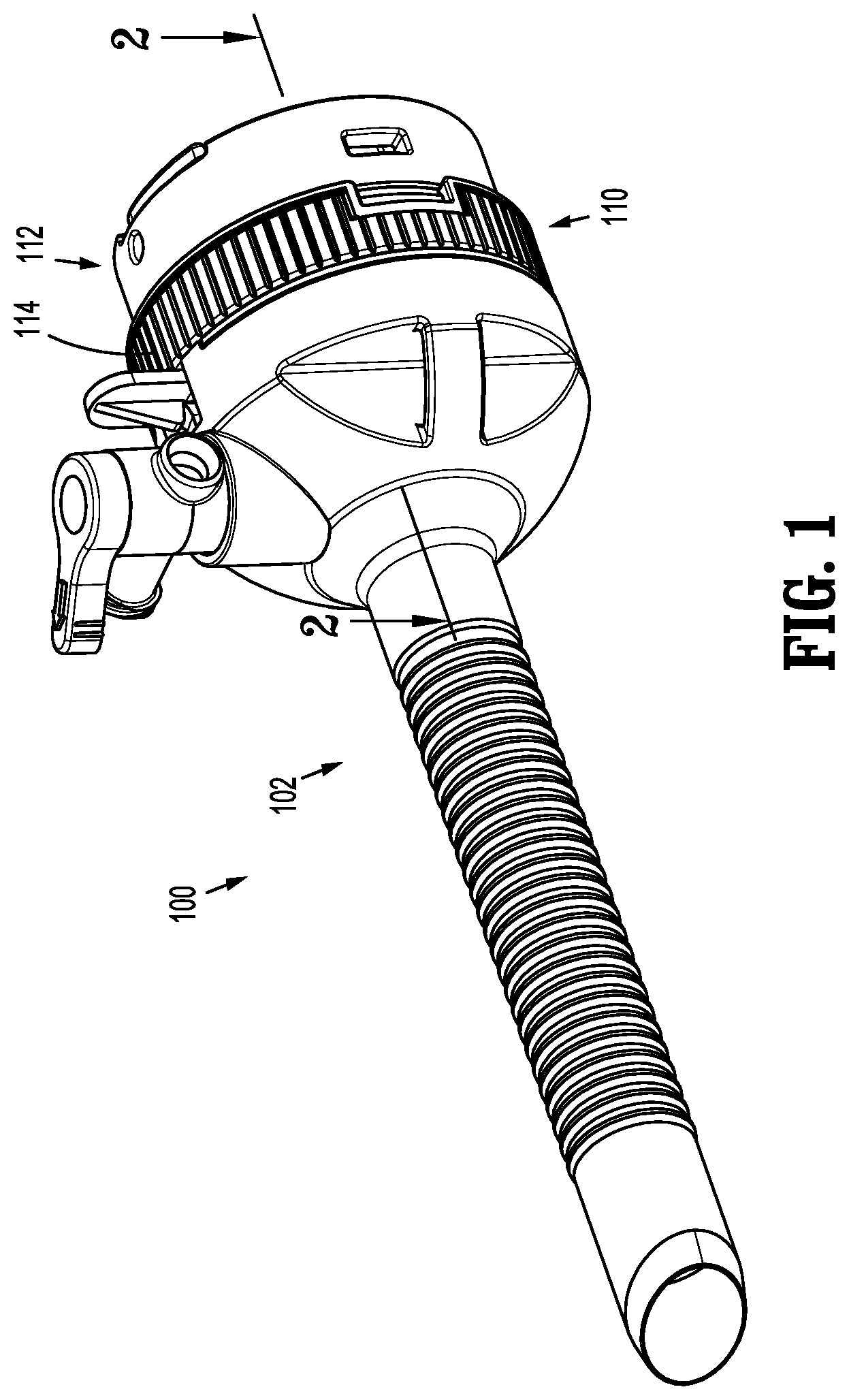
is a perspective side view of an access port assembly according to an embodiment of the present disclosure;
a cross-sectional side view of the access port assembly shown in taken along section line 2 - 2 ;
is a perspective top view of a valve assembly of the access port assembly shown in ;
is a perspective bottom view of the valve assembly shown in ;
is an exploded perspective view of the valve assembly shown in , including a centering mechanism, a guard assembly, a seal assembly, and a retainer assembly;
is a perspective view of the guard assembly shown in , in an initial or unfolded condition;
are perspective views of the guard assembly shown in , in sequential partially folded conditions;
is a perspective view of the guard assembly shown in , in a fully folded condition;
is a perspective top view of the seal assembly shown in ;
is a perspective side view of the seal assembly shown in ;
is a cross-sectional side view of the seal assembly shown in taken along section line 13 - 13 ;
is a perspective top view of a valve assembly according to another embodiment of the present disclosure;
is a perspective bottom view of the valve assembly shown in ;
is an exploded perspective view of the valve assembly shown in , including a centering mechanism, a guard assembly, a seal assembly, and a retainer assembly;
is a perspective view of the seal assembly shown in , in an initial or unfolded condition;
are perspective views of the guard assembly shown in , in sequential partially folded conditions;
is a perspective view of the guard assembly shown in , in a fully folded condition;
is a perspective top view of a valve assembly according to another embodiment of the present disclosure;
is a perspective bottom view of the valve assembly shown in ;
is an exploded perspective view of the valve assembly shown in , including a centering mechanism, a guard assembly, a seal assembly, and a retainer assembly;
is a top view of a first seal member of the seal assembly shown in ;
is a perspective view of a fourth seal member of the seal assembly shown in ;
are a perspective side and top views of the method of assembling the seal assembly shown in ;
is a top view of the seal assembly shown in ;
is a perspective view of the seal assembly shown in ;
is a perspective view of a seal assembly according to another embodiment of the present disclosure;
is a top view of the seal assembly shown in ;
is a top view of a seal section of the seal assembly shown in ;
is a perspective side view of the seal section shown in ;
are perspective top views of a method of assembling the seal assembly shown in ;
is a top perspective view of a centering mechanism according to an embodiment of the present disclosure, including a seal assembly;
is a top view of the centering mechanism and seal assembly shown in , disposed within an instrument valve housing;
is an enlarged view of a spoke of a centering mechanism according to another embodiment of the present disclosure;
is a top perspective view of a centering mechanism according to another embodiment of the present disclosure, including a seal assembly; and
is a top view of the centering mechanism and seal assembly shown in , disposed within an instrument valve housing.
DETAILED DESCRIPTION
Particular embodiments of the present disclosure are described hereinbelow with reference to the accompanying drawings; however, it is to be understood that the disclosed embodiments are merely exemplary of the disclosure and may be embodied in various forms. Well-known functions or constructions are not described in detail to avoid obscuring the present disclosure in unnecessary detail. Therefore, specific structural and functional details disclosed herein are not to be interpreted as limiting, but merely as a basis for the claims and as a representative basis for teaching one skilled in the art to variously employ the present disclosure in virtually any appropriately detailed structure. Like reference numerals refer to similar or identical elements throughout the description of the figures.
As used herein, the term “distal” refers to that portion of the instrument, or component thereof which is farther from the user while the term “proximal” refers to that portion of the instrument or component thereof which is closer to the user. As used herein, the term “about” means that the numerical value is approximate and small variations would not significantly affect the practice of the disclosed embodiments. Where a numerical limitation is used, unless indicated otherwise by the context, “about” means the numerical value can vary by ±10% and remain within the scope of the disclosed embodiments.
Access port assemblies are employed during minimally invasive surgery, e.g., laparoscopic surgery, and provide for the sealed access of surgical instruments into an insufflated body cavity, such as the abdominal cavity. The access port assemblies of the present disclosure include an instrument valve housing mounted on a cannula tube, and include an obturator (not shown) inserted through the valve housing and cannula. The obturator can have a blunt distal end, or a bladed or non-bladed penetrating distal end and can be used to incise the abdominal wall so that the access port assembly can be introduced into the abdomen. The handle of the obturator can engage or selectively lock into the instrument valve housing of the access port assembly.
Access port assemblies are employed to tunnel through an anatomical structure, e.g., the abdominal wall, either by making a new passage through the structure or by passing through an existing opening through the structure. Once the trocar assembly has tunneled through the anatomical structure, the trocar obturator is removed, leaving the cannula assembly in place. The instrument valve housing of the cannula includes valves that prevent the escape of insufflation gases from the body cavity, while also allowing surgical instruments to be inserted into the cavity.
In various embodiments, a bladeless optical trocar obturator may be provided that permits separation of tissue planes in a surgical procedure and visualization of body tissue fibers as they are being separated, thereby permitting a controlled traversal across a body wall. In other embodiments, the trocar obturator may be bladeless without being optical, e.g., without providing contemporaneous visualization thereof through the distal tip of an obturator. The bladeless obturator may be provided for the blunt dissection of the abdominal lining during a surgical procedure.
Various trocar obturators suitable for use with the cannulas of the present disclosure are known and include, for example, bladed, bladeless, blunt, optical, non-optical. For a detailed description of the structure and function of exemplary trocar assemblies, including exemplar trocar obturators and exemplar cannulas, please refer to commonly owned PCT Publication No. WO 2016/186905 (“the '905 publication”), the content of which is hereby incorporated by reference herein in its entirety.
With initial reference now to , an access port assembly according to aspects of the present disclosure is shown generally as cannula assembly 100 . The cannula assembly 100 includes a cannula 102 and an instrument valve housing 110 secured to the cannula 102 . For a detailed description of an exemplary cannula assembly, please refer to the '905 publication.
With reference to , the instrument valve housing 110 of the cannula assembly 100 includes an upper housing section 112 , a lower housing section 114 , and an inner housing section 116 . The upper, lower, and inner housing sections 112 , 114 , 116 are configured to support a valve assembly 120 on a proximal end of the cannula 102 . More particularly, the inner housing section 116 is secured between the upper and lower housing sections 112 , 114 , and the valve assembly 120 is received between the inner and lower housing sections 116 , 114 . The upper and lower housing section 112 , 114 of the instrument valve housing 110 may be selectively attachable to, and detachable from, the inner housing section 116 . The lower housing section 114 may be releasably or permanently attached to a cannula tube 104 of the cannula assembly 102 . In embodiments, either or both of the upper and lower housing sections 112 , 114 of the instrument valve housing 110 may include knurls, indentations, tabs, or be otherwise configured to facilitate engagement by a clinician.
The cannula assembly 100 may also include features for the stabilization of the access port assembly. For example, the distal end of the cannula tube 104 can carry a balloon anchor or another expandable member that engages the abdomen from the interior side. For example, see commonly owned U.S. Pat. No. 7,300,448, the entire disclosure of which is hereby incorporated by reference herein. A feature on the opposite side of the abdominal wall can be used to further stabilize the access port assembly, such as adhesive tabs or adjustable foam collars.
The upper, lower, and inner housing sections 112 , 114 , 116 of the instrument valve housing 110 define a longitudinal passage 111 for receipt of a surgical instrument (not shown). The valve assembly 120 is supported within the instrument valve housing 110 to provide sealed passage of the surgical instrument through the cannula assembly 100 .
With particular reference to , the valve assembly 120 supported in the instrument valve housing 110 includes a centering mechanism 130 , a guard assembly 140 , a seal assembly 160 , and a retainer assembly 180 . As will be described in further detail below, the centering mechanism 130 of the valve assembly 120 permits radial movement of the valve assembly 120 relative to the instrument valve housing 110 when a surgical instrument is received through the valve assembly 120 , and returns the valve assembly 120 to a generally centered position once the surgical instrument is withdrawn from within the instrument valve housing 110 . The guard assembly 140 protects the seal assembly 160 during insertion and withdrawal of a surgical instrument through the seal assembly 160 . The seal assembly 160 provides sealed passage of the surgical instrument through the instrument valve housing 110 . The retainer assembly 180 maintains the centering mechanism 130 , the guard assembly 140 , and the seal assembly 160 in an aligned relationship with one another.
With continued reference to , as noted above, the centering mechanism 130 of the instrument valve housing 110 is configured to maintain the valve assembly 110 centered within the instrument valve housing 110 ( ). More particularly, the centering mechanism 130 includes an outer annular ring 132 , an inner annular ring 134 , and a bellows 136 disposed between the outer annular ring 132 and the inner annular ring 134 . As shown in , the outer annular ring 132 is received between the inner housing section 116 and the lower housing section 114 to retain the centering mechanism 130 within the instrument valve housing 110 . As will be described in further detail below, the inner annular ring 134 supports the seal assembly 160 . For a detailed description of the structure and function of an exemplary centering mechanism, please refer to commonly owned U.S. Pat. No. 6,702,787 (“the '787 patent”), the content of which is incorporated herein by reference in its entirety.
With reference to , the guard assembly 140 of the valve assembly 120 includes a ring portion 142 and first, second, third, and fourth petals 144 , 146 , 148 , 150 extending radially outward from the ring portion 142 when the guard assembly 140 is in an initial or unfolded condition. The guard assembly 140 may be formed from a sheet of plastic/polymeric material by stamping with a tool that forms the ring portion 142 and the petals 144 , 146 , 148 , 150 . In embodiments, the plurality of openings 143 , 143 a in the ring portion 142 and first, second, third, and fourth petals 144 , 146 , 148 , 150 (described further below) may be formed in the same stamping or molding operation. Alternatively, the guard assembly 140 may be formed by molding or other techniques.
The ring portion 142 of the guard assembly 140 is configured to be received between an upper retainer member 182 of the retainer assembly 180 and the seal assembly 160 . The ring portion 142 defines a central opening 141 for receipt of a surgical instrument (not shown) therethrough. The ring portion 142 of the guard assembly 140 further defines the plurality of openings 143 . The plurality of openings 143 in the ring portion 142 facilitate engagement of the guard assembly 140 by the retainer assembly 180 .
Each of the first, second, third, and fourth petals 144 , 146 , 148 , 150 of the guard assembly 140 includes a flap portion 144 a , 146 a , 148 a , 150 a and a connector portion 144 b , 146 b , 148 b , 150 b supporting the respective flap portions 144 a , 146 a , 148 a , 150 a of the respective first, second, third, and fourth petals 144 , 146 , 148 , 150 on the ring portion 142 . In embodiments, and as shown, each of the first, second, third and fourth petals 144 , 146 , 148 , 150 are secured to the ring portion 142 by a hinge portion 144 c , 146 c , 148 c , 150 c disposed between the respective connector portions 144 b , 146 b , 148 b , 150 b of the first, second, third, and fourth petals 144 , 146 , 148 , 150 and the ring portion 142 . The hinge portion 144 c , 146 c , 148 c , 150 c of the respective first, second, third, and fourth petals 144 , 146 , 148 , 150 facilitate folding of the first, second, third, and fourth petals 144 , 146 , 148 , 150 over the ring portion 142 of the guard assembly 140 .
Each of the flap portions 144 a , 146 a , 148 a , 150 a of the respective first, second, third, and fourth petals 144 , 146 , 148 , 150 of the guard assembly 140 includes first and second flap sections 145 a , 145 b , 147 a , 147 b , 149 a , 149 b , 151 a , 151 b , respectively, separated by a radial channel or groove 145 c , 147 c , 149 c , 151 c . Each of the first and second flap sections 145 a , 145 b , 147 a , 147 b , 149 a , 149 b , 151 a , 151 b of the respective flap portions 144 a , 146 a , 148 a , 150 a tapers radially inward and downward, i.e., away from the ring portion 142 . The first and second flap sections 145 a , 145 b , 147 a , 147 b , 149 a , 149 b , 151 a , 151 b and the radial channels 145 c , 147 c , 149 c , 151 c operate as instrument guides directing a surgical instrument (not shown) through the flap portions 144 a , 146 a , 148 a , 150 a.
Each of the connector portions 144 b , 146 b , 148 b , 150 b of the first, second, third, and fourth petals 144 , 146 , 148 , 150 defines a plurality of openings 143 a . As will be described in further detail below, each of the plurality of openings 143 a in the connector portions 144 b , 146 b , 148 b , 150 b of the respective first, second, third, and fourth petals 144 , 146 , 148 , 150 align with the plurality of openings 143 in the ring portion 142 of the guard assembly 140 when the respective connector portions 144 b , 146 b , 148 b , 150 b are folded relative to the ring portion 142 .
In embodiments, and as shown, the first, second, third, and fourth petals 144 , 146 , 148 , 150 of the guard assembly 140 may each include a lip 144 d , 146 d , 148 d , 150 d , respectively, disposed between the flap portions 144 a , 146 a , 148 a , 150 a , respectively, and the respective connector portions 144 b , 146 b , 148 b , 150 b of the first, second, third, and fourth petals 144 , 146 , 148 , 150 . As shown in , the lip 144 d , 146 d , 148 d , 150 d of the respective flap portions 144 a , 146 a , 148 a , 150 a recesses the flap portions 144 a , 146 a , 148 a , 150 a , respectively, within the central opening 141 of the ring portion 142 of the guard assembly 140 . In this manner, the lips 144 d , 146 d , 148 d , 150 d are configured to reduce the cross-sectional profile, e.g., thickness, of the assembled guard assembly 140 .
With particular reference to , the guard assembly 140 of the valve assembly 120 is shown in sequential stages of folding. Referring initially to , the guard assembly 140 is shown in the initial, unfolded condition. In the initial condition, the first, second, third, and fourth petals 144 , 146 , 148 , 150 of the guard assembly 140 extend radially outward from the ring portion 142 of the guard assembly 140 . As noted above, the guard assembly 140 may be molded, stamped, or formed in any other suitable manner.
Turning to , the first petal 144 of the guard assembly 140 is folded inwardly at the hinge portion 144 c of the first petal 144 between the connection portion 144 b of the first petal 144 and the ring portion 142 of the guard assembly 140 , as indicated by arrow “A”. The first petal 144 of the guard assembly 140 is folded such that the connector portion 144 b of the first petal 144 overlaps the ring portion 142 of the guard assembly 140 and the plurality of openings 143 a in the connector portion 144 b align with the corresponding plurality of openings 143 in the ring portion 142 of the guard assembly. The lip 144 d disposed between the flap portion 144 a and the connector portion 144 b of the first petal 144 recess the flap portion 144 a within the central opening 141 of the ring portion 142 of the guard assembly 140 .
With reference to , the guard assembly 140 with the second, third, and fourth petals 146 , 148 , 150 folded in the same manner as the first petal 144 , in sequential order. More particularly, the second petal 146 is folded at the hinge portion 144 d , as indicated by arrow “B” in , such that the first flap section 147 a of the second petal 146 substantially covers the second flap section 145 b of the first petal 146 . The third petal 148 is folded at the hinge portion 148 d , as indicated by arrow “C” in , such that the first flap section 149 a of the third petal 148 substantially covers the second flap section 147 b of the second petal 148 . The fourth petal 150 is folded at the hinge portion 150 d , as indicated by arrow “D” in , such that the first flap section 151 a of the fourth petal 150 substantially covers the second flap section 149 b of the third petal 148 . The first flap section 145 a of the first petal 144 is lifted to permit the second flap section 151 b of the fourth petal 150 to be received under the first flap section 145 a of the first petal 144 such that the first flap section 145 a of the first petal 1444 substantially covers the second flap section 151 b of the fourth petal 150 . In this manner, the guard assembly 140 is folded such that each of the first flap sections 145 a , 147 a , 149 a , 151 a of the respective first, second, third, and fourth petals 144 , 146 , 148 , 150 overlaps the adjacent second flap section 146 b , 147 b , 149 b , 151 b of the respective second, third, fourth, and first petals 146 , 148 , 150 , 144 .
The flap portions 144 a , 146 a , 148 a , 150 a of the respective first, second, third, and fourth petals 144 , 146 , 148 , 150 of the guard assembly 140 are configured to flex downward upon engagement with a surgical instrument to facilitate passage of the surgical instrument through the seal assembly 160 . More particularly, engagement of one or more of the flap portions 144 a , 146 a , 148 a , 150 a of the first, second, third, and fourth petals 144 , 146 , 148 , 150 , respectively, flexes one or more of the flap portions 144 a , 146 a , 148 a , 150 a downward into engagement with an hourglass-shaped seal 162 of the seal assembly 160 to stretch the hourglass-shaped seal 162 of the seal assembly 160 to increase the size of a central opening 163 of the hour-glass seal 162 . The increased size of the central opening 163 of the hourglass-shaped seal 162 permits receipt of the surgical instrument through the valve assembly 120 . The larger the diameter of the surgical instrument, the more the first, second, third, and fourth flap portions 144 a , 146 a , 148 a , 150 a of the respective first, second, third, and fourth petals 144 , 146 , 148 , 150 are flexed downward, and the greater the size of the central opening 163 in the hour-glass seal 164 . The flap portions 144 a , 146 a , 148 a , 150 a also operate to guide and orient the surgical instrument through the seal assembly 160 .
In alternative embodiments, the third petal 148 of the guard assembly 140 may be folded prior to the second petal 146 is folded. In this manner, the first flap section 147 a of the second petal 146 substantially covers the second flap section 145 b of the first petal 144 and the second flap section 147 b of the second petal 146 covers the first flap section 149 a of the third petal 148 . Similarly, and as noted above, the first flap section 151 a of the fourth petal 150 substantially covers the second flap section 149 b of the third petal 148 and the second flap section 151 b of the fourth petal 150 substantially covers the first flap section 145 a of the first petal 144 .
It is envisioned that the guard assembly may include any number of petals, and the petals may include flap portions of any size or configuration. See U.S. Pat. Nos. 5,895,377 and 6,569,120, and PCT publication WO 91/12838, the entire disclosures of which are all hereby incorporated by reference herein, for exemplary guard assemblies, as well as other aspects of access port assemblies.
Referring to , the seal assembly 160 of the valve assembly 120 is configured to provide a seal around an outer surface of a surgical instrument (not shown) passing through the instrument valve housing 110 ( ). The seal assembly 160 includes the hourglass-shaped seal 162 supported by upper and lower annular flanges 164 , 166 . The hourglass-shaped seal 162 of the seal assembly 160 is formed of an elastic material, e.g., rubber, and defines a central opening 163 . The upper and lower flanges 164 , 166 of the seal assembly 160 may be formed of the same of different material. In embodiments, the hourglass-shaped seal 162 may include one or more fabric layers. The hourglass-shaped seal 162 provides a seal around an outer surface of a surgical instrument passing through the valve assembly 120 . The upper and lower annular flanges 164 , 166 each define a plurality of openings 165 , 167 , respectively, corresponding to respective first and second sets of pins 188 a extending from the respective upper and lower retainer members 182 , 184 of the retainer assembly 180 .
Referring back to , the retainer assembly 180 of the valve assembly 120 is configured to secure the guard assembly 140 relative to the seal assembly 160 , and secure the guard and seal assemblies 140 , 160 to the centering mechanism 130 . The retainer assembly 180 includes the upper retainer member 182 , the lower retainer member 184 , and a middle retainer member 186 .
As noted above, the upper and lower retainer members 182 , 184 include respective first and second pluralities of pins 188 a , 188 b . The first set of pins 188 a extend from a bottom surface of the upper retainer member 182 and the second set of pins 188 b extend from an upper surface of the lower retainer member 184 . Each of the first and second sets of pins 188 a , 188 b are configured to be lockingly received within a plurality of openings 187 ( ) in the middle retainer member 186 . In embodiments, the first and second sets of pins 188 a , 188 b are welded, glued, adhered, bonded or otherwise secured to each other and/or to the middle retainer member 186 within the plurality of openings 187 in the middle retainer member 186 to secure the upper, lower, and middle retainer members 182 , 184 , 186 together. Alternatively, the middle retainer member 186 may include locking features (not shown) for engaging the first and second sets of pins 188 a , 188 b.
With particular reference to , the first plurality of pins 188 a of the upper retainer member 182 extend through the ring portion 142 of the guard assembly 140 and the upper flange 164 of the seal assembly 160 . The second set of pins 188 b of the lower retainer member 182 extend through the lower flange 166 of the seal assembly 160 and the inner annular ring 134 of the centering mechanism 130 . The middle retainer member 186 is disposed between the upper and lower flanges 164 , 166 of the seal assembly 160 .
Although the retainer assembly 180 is shown with first and second pluralities of pins 188 a , 188 b , it is envisioned that the retainer assembly 180 may only include a first plurality of pins (not shown) having an increased length sufficient to engage openings (not shown) in the opposed retainer member.
During a surgical procedure utilizing cannula assembly 100 , a surgical instrument (not shown) is introduced into the instrument valve housing 110 through the longitudinal passage 113 in the upper, lower, and inner housing sections 112 , 114 , 116 . As described above, the distal end of the surgical instrument engages one or more of the first, second, third, and fourth petals 144 , 146 , 148 , 150 of the guard assembly 140 causing the respective flap portions 144 a , 146 a , 18 a , 150 a to flex downward into contact with the hourglass-shaped seal 162 of the seal assembly 160 to cause the central opening 163 of the hourglass-shaped seal 162 to open to accommodate passage of the surgical instrument through the hourglass-shaped seal 162 . The guard assembly 130 minimizes damage to the seal assembly 160 during insertion of an instrument through the valve assembly 120 . The guard assembly 130 operates to protect the hourglass-shaped seal 162 of the seal assembly 160 from tearing or other damage as a surgical instrument is received through and withdrawn from the seal assembly 160 .
With reference now to , a valve assembly according to another embodiment of the present disclosure is shown generally as valve assembly 220 . The valve assembly 220 is substantially similar to the valve assembly 120 ( ) described hereinabove, and will only be described in detail as relates to the differences therebetween.
Referring initially to , the valve assembly 220 includes a centering mechanism 230 , a guard assembly 240 , a conical origami seal assembly 260 , and a retainer assembly 280 . The centering mechanism 230 and the guard assembly 240 are substantially similar to the centering mechanism 130 and the guard assembly 140 described above.
Referring to , the seal assembly 260 of the valve assembly 220 is configured to provide a seal around an outer surface of a surgical instrument passing through the instrument valve housing 110 ( ). The seal assembly 260 includes first, second, third, fourth, fifth, and sixth petals or sections 262 , 264 , 266 , 268 , 270 , 272 each having a seal portion 262 a , 264 a , 266 a , 268 a , 270 a , 272 a , respectively, and a respective base portion 262 b , 264 b , 266 b , 268 b , 270 b , 272 b supporting the respective seal portion 262 a , 264 a , 266 a , 268 a , 270 a , 272 a . The first and second sections 262 , 264 , the second and third sections 264 , 266 , the third and fourth sections 266 , 268 , the fourth and fifth sections 268 , 270 , and the fifth and sixth section 270 , 272 are connected to one another by a connector portion 262 c , 264 c , 266 c , 268 c , 270 c , respectively.
The seal portions 262 a , 264 a , 266 a , 268 a , 270 a , 272 a of the respective first, second, third, fourth, fifth, and sixth petals or sections 262 , 264 , 266 , 268 , 270 , 272 of the seal assembly 260 are formed of an elastic material, e.g., rubber, and define a semi-conical shape. In embodiments, the seal assembly 260 is formed of polyisoprenes or silicone elastomers. The base portions 262 b , 264 b , 266 b , 268 b , 270 b , 272 b of the respective first, second, third, fourth, fifth, and sixth sections 262 , 264 , 266 , 268 , 270 , 272 of the seal assembly 260 may be formed of the same or different materials as the respective seal portions 262 a , 264 a , 266 a , 268 a , 270 a , 272 a . In embodiments, the seal portions 262 a , 264 a , 266 a , 268 a , 270 a , 272 a may include one or more fabric layers.
The seal portions 262 a , 264 a , 266 a , 268 a , 270 a , 272 a of the first, second, third, fourth, fifth, and sixth petals or sections 262 , 264 , 266 , 268 , 270 , 272 , respectively, of the seal assembly 260 are configured to provide a seal around an outer surface of a surgical instrument (not shown) passing through the valve assembly 220 . The seal portions 262 a , 264 a , 266 a , 268 a , 270 a , 272 a form a virtual inner circumferential surface for providing a seal bout the surgical instrument received through the instrument valve housing 110 . The base portions 262 b , 264 b , 266 b , 268 b , 270 b , 272 b are substantially C-shaped members and each define a plurality of openings 263 , 265 , 267 , 269 , 271 , 273 , respectively, corresponding to a plurality of pins 288 ( ) extending from an upper retainer member 282 of the retainer assembly 280 .
The method of folding the conical origami seal assembly 260 will now be described with reference to . Referring initially to , the first and second sections 262 , 264 of the seal assembly 260 are folded at the hinge portions 262 between the first and second sections 262 , 264 of the seal assembly 260 , as indicated by arrow “E”, such the length of the support portion 262 b of the first section 262 adjacent the hinge portion 262 c overlaps the length of the support portion 264 b of the second section 264 of the seal assembly 260 adjacent the hinge portion 262 c . In this manner, the plurality of openings 263 in the length of the support portion 262 b of the first section 262 adjacent the hinge portion 262 c aligns with the plurality of openings 265 in the overlapping length of the support portion 264 b of the second section 264 of the seal assembly 260 adjacent the hinge portions 262 c.
Turning to , the second and third sections 264 , 266 of the seal assembly 260 are folded at the hinge portions 264 c between the second and third sections 264 , 266 of the seal assembly 260 , as indicated by arrow “F”, such the length of the support portion 264 b of the second section 264 adjacent the hinge portion 264 b overlaps the length of the support portion 266 b of the third section 266 of the seal assembly 260 adjacent the hinge portion 264 c . In this manner, the plurality of openings 265 in the length of the support portion 264 b of the second section 264 adjacent the hinge portion 264 c aligns with the plurality of openings 267 in the overlapping length of the support portion 266 b of the third section 266 of the seal assembly 260 adjacent the hinge portions 264 c.
Referring to , the third and fourth sections 266 , 268 of the seal assembly 260 are folded at the hinge portions 266 c between the third and fourth sections 266 , 268 of the seal assembly 260 , as indicated by arrow “G”, such the length of the support portion 266 b of the third section 266 adjacent the hinge portion 266 c overlaps the length of the support portion 268 b of the fourth section 268 of the seal assembly 260 adjacent the hinge portion 266 c . In this manner, the plurality of openings 267 in the length of the support portion 266 b of the third section 266 adjacent the hinge portion 266 c aligns with the plurality of openings 269 in the overlapping length of the support portion 268 b of the fourth section 268 of the seal assembly 260 adjacent the hinge portions 266 c.
With reference to , the fourth and fifth sections 268 , 270 of the seal assembly 260 are folded at the hinge portions 268 c between the fourth and fifth sections 268 , 270 of the seal assembly 260 , as indicated by arrow “H”, such the length of the support portion 268 b of the fourth section 268 adjacent the hinge portion 268 c overlaps the length of the support portion 270 b of the fifth section 270 of the seal assembly 260 adjacent the hinge portion 268 c . In this manner, the plurality of openings 269 in the length of the support portion 268 b of the fourth section 268 adjacent the hinge portion 268 c aligns with the plurality of openings 271 in the overlapping length of the support portion 270 b of the fifth section 270 of the seal assembly 260 adjacent the hinge portions 268 c.
Turning to , the fifth and sixth sections 270 , 272 of the seal assembly 260 are folded at the hinge portions 270 c between the fifth and sixth sections 270 , 272 of the seal assembly 260 , as indicated by arrow “I”, such the length of the support portion 270 b of the fifth section 270 adjacent the hinge portion 270 c overlaps the length of the support portion 272 b of the sixth section 272 of the seal assembly 260 adjacent the hinge portion 270 c . In this manner, the plurality of openings 271 in the length of the support portion 270 b of the fifth section 270 adjacent the hinge portion 270 c aligns with the plurality of openings 273 in the overlapping length of the support portion 272 b of the sixth section 270 of the seal assembly 260 adjacent the hinge portions 270 c.
Referring back to , the retainer assembly 280 of the valve assembly 220 is configured to secure the guard assembly 240 relative to the seal assembly 260 , and secure the guard and seal assemblies 240 , 260 to the centering mechanism 230 . The retainer assembly 280 includes the upper retainer member 282 and a lower retainer member 284 . As noted above, the upper retainer member 282 includes a plurality of pins 288 ( ) extending from a bottom surface of the upper retainer 282 . The bottom retainer 284 defines a plurality of openings 287 ( ) corresponding to the plurality of pins 288 in the upper retainer member 282 . The plurality of pins 288 of the upper retainer member 282 are configured to be lockingly received within a plurality of openings 287 in the lower retainer member 282 . In embodiments, the plurality of pins 288 of the upper retainer member 282 may be friction fit, welded, glued, adhered, bonded or otherwise secured within the plurality of openings 287 in the lower retainer member 284 . Alternatively, the lower retainer member 284 may include locking features (not shown) for engaging the plurality of pins 288 of the upper retainer member 282 .
The plurality of pins 288 of the upper retainer member 282 extend through a ring portion 242 of the guard assembly 240 , through an inner annular ring 234 of the centering mechanism 230 , and through the base portions 262 b , 264 b , 266 b , 268 b , 270 b , 272 b of the respective first, second, third, fourth, fifth, and sixth sections 262 , 264 , 266 , 268 , 270 , 272 of the seal assembly 260 .
Although the retainer assembly 280 is shown with the plurality of pins 288 extending from the upper retainer member 282 , it is envisioned that the plurality of pins 288 may instead extend from the bottom retainer member 284 , and/or the retainer assembly 280 may include a second plurality of pins (not shown) extending from the bottom retainer member 284 .
In use, the valve assembly 220 operates in a substantially similar manner to the valve assembly 120 described herein above.
With reference now to , a valve assembly according to another embodiment of the present disclosure is shown generally as valve assembly 320 . The valve assembly 320 is substantially similar to the valve assembly 220 described hereinabove, and will only be described in detail as relates to the differences therebetween.
Referring initially to , the valve assembly 320 includes a centering mechanism 330 , a guard assembly 340 , a seal assembly 360 , and a retainer assembly 380 . The centering mechanism 330 , the guard assembly 340 , and the retainer assembly 380 are substantially similar to the centering mechanisms 130 , 230 , and the guard assemblies 140 , 240 , and the retainer assembly 280 described above.
Referring to , the seal assembly 360 of the valve assembly 320 is configured to provide a seal around an outer surface of a surgical instrument (not shown) passing through the instrument valve housing 110 ( ). The seal assembly 360 includes first, second, third, and fourth seal members 362 , 364 , 366 , 368 . The multiple seal members 362 , 364 , 366 , 368 form a virtual inner circumferential surface for providing a seal bout the surgical instrument received through the instrument valve housing 110 . Although shown as independent components, it is envisioned that the first, second, third, and fourth seal members 362 , 364 , 366 , 368 may be formed as a single component. The first, second and third seal members 362 , 364 , 366 are substantially similar.
Each of the first, second, third, and fourth seal members 362 , 364 , 366 , 368 of the seal assembly 360 includes a seal portion 362 a , 364 a , 366 a , 368 a , respectively, a base portion 362 b , 364 b , 366 b , 368 b , respectively, supporting the respective seal portions 362 a , 364 a , 366 a , 368 a , and a rim portion 362 c , 364 c , 366 c , 368 c , respectively, extending about an outer perimeter of the respective base portions 362 b , 364 b , 366 b , 368 b.
The seal portions 362 a , 364 a , 366 a , 368 a , of the respective first, second, third, and fourth members 362 , 364 , 366 , 368 of the seal assembly 360 are formed of an elastic material, e.g., rubber. In embodiments, the seal assembly 360 is formed of polyisoprenes or silicone elastomers. The base portions 362 b , 364 b , 366 b , 368 b of the respective first, second, third, and fourth seal members 362 , 364 , 366 , 368 of the seal assembly 360 may be formed of the same or different materials as the respective seal portions 362 a , 364 a , 366 a , 368 a . In embodiments, the seal portions 362 a , 364 a , 366 a , 368 a may include one or more fabric layers.
The seal portions 362 a , 364 a , 366 a , 368 a of the first, second, third, and fourth seal members 362 , 364 , 366 , 368 , respectively, of the seal assembly 360 are configured to provide a seal around an outer surface of a surgical instrument passing through the valve assembly 320 . The first, second, third, and fourth members 362 , 364 , 366 , 368 form a shape that defines a wedge-shaped cutout. The base portions 362 b , 364 b , 366 b , 368 b and the rim portions 362 c , 364 c , 366 c , 368 c are substantially C-shaped members. Each of the base portions 362 b , 364 b , 366 b , 368 b define a plurality of openings 363 , 365 , 367 , 369 , respectively, corresponding to a plurality of pins 388 ( ) extending from an upper retainer member 382 of the retainer assembly 380 .
A width of the base portions 362 b , 364 b , 366 b , 368 b of the first, second, third, and fourth seal members 362 , 364 , 366 , 368 of the seal assembly 360 increases in a clockwise direction, as viewed in . In this manner, using the first seal member 362 of as an example, a distance “x 1 ” between the rim portion 362 c and a first opening 363 a of the plurality of openings 363 of the base portion 362 b is less than a distance “x 2 ” between the rim portion 362 c and a final opening 363 b of the plurality of openings 363 .
Each of the first, second, and third seal members 362 , 364 , 366 of the seal assembly 360 includes a tab 362 d , 364 d , 366 d extending from the respective rim portions 362 c , 364 c , 366 c . The tabs 362 d , 364 d , 366 d facilitate assembly of the seal assembly 360 .
The method of assembling the seal assembly 360 will now be described with reference to . Referring initially to , the first seal member 360 of the seal assembly 360 is positioned in a first orientation.
Turning to , the second seal member 364 of the seal assembly 364 is received within the rim portion 362 c of the first seal member 362 . The second seal member 364 is rotationally offset from the first seal member 362 . In embodiments, the first and second seal members 362 , 364 are rotationally offset by ninety degrees (90°), although other offsets are envisioned.
With reference to , the third seal member 366 of the seal assembly 360 is then rotated relative to the second seal member 364 and received within the rim portion 364 c of the second seal member 364 of the seal assembly 360 .
Turning to , the fourth seal member 368 of the seal assembly 360 is then rotated relative to the third seal member 366 and is received within the rim portion 366 c of the third seal member 366 of the seal assembly 360 .
Once assembled, the first, second, third, and fourth seal members 362 , 364 , 366 , 368 are secured together by the plurality of pins 388 extending from the upper retainer member 382 ( ) of the retainer assembly 380 .
The valve assembly 320 is receivable within an instrument valve housing, e.g., instrument valve housing 100 ( ), and operates in a similar manner to the seal assemblies 120 , 220 described above.
With reference now to , a seal assembly according to another embodiment of the present disclosure is shown generally as seal assembly 460 . With initial reference to , the seal assembly 460 includes first, second, third, fourth, fifth, and sixth seal segments or members 462 , 464 , 466 , 468 , 470 , 472 . The first, second, third, fourth, fifth, and sixth seal segments or members 462 , 464 , 466 , 468 , 470 , 472 are stackable to form a seal having a virtual inner circumferential surface defining an opening 461 to facilitate sealed passage of a surgical instrument (not shown) through the seal assembly 460 . In embodiments, the opening 461 is between about 0.025″ and about 0.100″ in diameter.
With reference to , the seal assembly 460 defines a substantially planar, hexagonal member. The hexagonal shape facilitates assembly of the seal assembly 460 , allowing for quick placement of the seal segments in relation to each other, and/or by allowing for a quick vision check of the seal assembly 460 to ensure the seal segments 462 , 464 , 466 , 468 , 470 , 472 are properly assembled. By forming the opening 461 out of multiple segments 462 , 464 , 466 , 468 , 470 , 472 , i.e., forming a virtual inner circumferential surface, instead of as a continuous solid opening through a single seal member, the likelihood of the seal assembly 460 tearing during insertion, removal, and/or use of a surgical instrument therethrough is greatly reduced. Although shown including six (6) segments, it is envisioned that the seal assembly 460 may include as few as four (4) segments, and as many as eight (8) segments.
The first, second, third, fourth, fifth, and sixth seal segments 462 , 464 , 466 , 468 , 470 , 472 of the seal assembly 460 are formed of an elastic material, e.g., rubber, polyisoprene, or silicone elastomers. In one embodiment, the seal assembly 460 is formed of liquid silicon rubber (LSR). In embodiments, the first, second, third, fourth, fifth, and sixth segments 462 , 464 , 466 , 468 , 470 , 472 may include one or more fabric layers.
Each of the first, second, third, fourth, fifth, and sixth seal segments 462 , 464 , 466 , 468 , 470 , 472 of the seal assembly 460 are substantially similar, and therefore, will only be described in detail with respect to first seal segment 462 .
With particular to , the first seal segment 462 of the seal assembly 460 is substantially wing-shaped and is configured to partially overlap the respective second, third, fourth, fifth, and sixth seal segments 464 , 466 , 468 , 470 , 472 when the seal assembly 460 is in the assembled or stacked configuration. The first seal segment 462 includes a base portion 462 a and a seal portion 462 b extending from the base portion 462 a . The base portion 462 a and the seal portion 462 b may be formed of the same or different material.
The base portion 462 a of the first seal segment 462 of the seal assembly 460 includes an outer edge 482 . The outer edge 482 is formed of first, second, and third sections 482 a , 482 b , 482 c . As will be described in further detail below, the first, second, and third sections 482 a , 482 b , 482 c of the outer edge 482 facilitate assembly of the seal assembly 460 . The base portion 462 a of the first seal segment 462 defines a plurality of openings 463 to facilitate assembly and retention of the seal assembly 460 in the stacked configuration ( ). More particularly, the plurality of openings 463 are configured to receive pins, e.g., pins 188 a ( ) of retaining assembly 180 of instrument valve assembly 120 ( ), for securing the seal segments 462 , 464 , 466 , 468 , 470 , 472 relative to each other.
With particular reference to , the seal portion 462 b of the first seal segment 462 of the seal assembly 460 may taper radially inwardly. As shown, the seal portion 426 b of the first seal segment 462 is tapered at an angle “a” between leading and trailing portions of the seal portion 462 b . In embodiments, the angle “a” is between about zero degrees (0°) and about fifteen degrees (15°). The tapered seal segment 462 may facilitate reception of a surgical instrument (not shown) through the seal assembly 460 , and/or may enhance sealing about the surgical instrument.
With continued reference to , the seal portion 462 b of the first seal segment 462 of the seal assembly 460 includes an inner edge 482 ′. The inner edge 482 ′ may extend straight across, or may include first and second sections 482 a ′, 482 b ′ that define a V-shape (as shown). In embodiments, the seal portion 462 b defines an angle between about one-hundred eighty degrees (180°) and about two-hundred seventy-five degrees (275°). In one embodiment, and as shown, the seal portion 462 b defines an angle of two-hundred ten degrees (210°).
The method of assembly the seal assembly 460 will now be described with reference to . Referring initially to , the first seal segment 462 of the seal assembly 460 is placed flat. Turning to , the second seal segment 464 is clocked sixty degrees (60°) in a counter-clockwise direction relative to the first seal segment 462 , as shown, and is overlapped with the first seal segment 462 such that first and second outer edges 484 a , 484 b of the second seal segment 464 align with the second and third sections 482 b , 482 c ( ) of the first seal segment 462 .
With reference to , the third seal segment 466 is clocked sixty degrees (60°) in a counter-clockwise direction relative to the second seal segment 464 , as shown, and is overlapped with the second seal segment 464 such that first and second outer edges 486 a , 486 b of the third seal segment 466 align with the second and third sections 484 b , 484 c ( ) of the second seal segment 464 .
Now referring to , the fourth seal segment 468 is clocked sixty degrees (60°) in a counter-clockwise direction relative to the third seal segment 466 , as shown, and is overlapped with the third seal segment 466 such that first and second outer edges 488 a , 488 b of the fourth seal segment 468 align with the second and third sections 486 b , 486 c ( ) of the third seal segment 466 .
Turning to , the fifth seal segment 470 is clocked sixty degrees (60°) in a counter-clockwise direction relative to the fourth seal segment 468 , as shown, and is overlapped with the fourth seal segment 468 such that first and second outer edges 490 a , 490 b of the fifth seal segment 470 align with the second and third sections 488 b , 488 c ( ) of the fourth seal segment 468 .
Turning to , the sixth seal segment 472 is clocked sixty degrees (60°) in a counter-clockwise direction relative to the fifth seal segment 470 , as shown, and is overlapped with the fifth seal segment 470 such that first and second outer edges 492 a , 492 b of the sixth seal segment 472 align with the second and third sections 490 b , 490 c ( ) of the fifth seal segment 470 . In embodiments, and as shown, a portion of the sixth seal segment 472 of the seal assembly 460 may be inserted under a portion of the first seal segment 462 to increase the integrity of the seal assembly 460 .
In the assembled, or stacked configuration, the seal assembly 460 includes a substantially planar body having a substantially uniform thickness. It is envisioned that the aspects of the present disclosure may be modified for use with an access assembly having a substantially conical body.
Misalignment of any one of the seal segments of the seal assembly 460 may compromise the integrity of the seal assembly 460 . As noted above, the configuration of the seal assembly 460 permits visual inspection of the seal assembly 460 to determine if the seal assembly 460 is assembled properly.
The seal assembly 460 may be modified for use in any of the above-described instrument valve assemblies.
Centering mechanisms according to alternative embodiments of the present disclosure will now be described with reference to . The centering mechanisms will only be described to the extent necessary to fully disclose the aspects of the present disclosure, for a detailed description of the structure and function of an exemplary centering mechanism, please refer to commonly owned U.S. Pat. App. Pub. No. 2015/0025477 (“the '477 publication”), the content of which is incorporated herein by reference in its entirety. It is envisioned that the centering mechanisms may include two centering mechanisms, as disclosed in the '477 publication.
Referring initially to , a centering mechanism according to an embodiment of the present disclosure is shown generally as centering mechanism 530 . The centering mechanism 530 is a component of a valve assembly 520 and is configured to permit radial movement of the valve assembly 520 relative to the instrument valve housing 110 ( ) when a surgical instrument (not shown) is received through the valve assembly 520 , and returns the valve assembly 520 to a centered position once the surgical instrument is withdrawn from within the instrument valve housing 110 .
The centering mechanism 530 includes an annular ring 532 and a plurality of spokes or spring elements 534 extending radially outward from the annular ring 532 . Each spoke 534 of the plurality of spokes 534 of the centering mechanism 530 includes a free end 534 a . The free ends 534 a of the plurality of spokes 534 are configured to engage an inner wall 116 a ( ) of the inner housing section 116 of the instrument valve housing 110 ( ) when received within a cavity 115 defined by the inner housing section 116 . In this manner, the centering mechanism 530 is spring loaded when received within the instrument valve housing 110 , thereby providing improved spring back for the valve assembly 520 when the valve assembly 520 is moved off-center.
With particular reference to , in embodiments, the plurality of spokes 534 may include one or more longitudinal ribs 536 extending along a length of the spokes 534 . The ribs 536 reinforce the plurality of spokes 534 and provide an increased spring back.
Turning to , another centering mechanism according to an embodiment of the present disclosure is shown generally as centering mechanism 630 . The centering mechanism 630 is substantially similar to centering mechanism 530 described herein above, and therefore, will only be described as relates to the differences therebetween.
The centering mechanism 630 includes an annular ring 632 and a plurality of spokes or spring elements 634 extending radially outward from the annular ring 632 . Each spoke 634 of the plurality of spokes 634 of the centering mechanism 630 includes a free end 634 a . The free ends 634 a of the plurality of spokes 634 are bent to provide increased spring back to the valve assembly 620 .
While various embodiments of the present disclosure have been shown and described herein, it will be obvious to those skilled in the art that these embodiments are provided by way of example only. Numerous variations, changes, and substitutions will now occur to those skilled in the art without departing from the present disclosure. Accordingly, it is intended that the invention be limited only by the spirit and scope of the appended claims.
Figures (20)
Citations
This patent cites (712)
- US3402710
- US3495586
- US4016884
- US4112932
- US4183357
- US4356826
- US4402683
- US4619643
- US4653476
- US4737148
- US4863430
- US4863438
- US4984564
- US5002557
- US5073169
- US5082005
- US5122122
- US5159921
- US5176697
- US5183471
- US5192301
- US5209741
- US5209754
- US5217466
- US5242409
- US5242415
- US5257973
- US5257975
- US5269772
- US5271380
- US5290245
- US5290249
- US5308336
- US5312391
- US5312417
- US5314417
- US5318516
- US5330486
- US5334143
- US5334150
- US5336169
- US5336203
- US5337937
- US5345927
- US5346459
- US5360417
- US5366478
- US5375588
- US5378588
- US5380291
- US5385552
- US5385553
- US5391156
- US5394863
- US5395367
- US5407433
- US5431151
- US5437683
- US5445615
- US5451222
- US5460170
- US5464409
- US5480410
- US5490843
- US5507758
- US5511564
- US5514133
- US5514153
- US5520610
- US5520698
- US5522791
- US5524501
- US5524644
- US5538509
- US5540648
- US5545150
- US5545179
- US5549565
- US5551947
- US5556385
- US5569159
- US5569205
- US5569291
- US5569292
- US5577993
- US5591192
- US5601581
- US5609562
- US5624399
- US5634911
- US5634937
- US5643285
- US5649550
- US5651771
- US5653705
- US5656013
- US5672168
- US5683378
- US5685820
- US5685857
- US5685862
- US5697946
- US5709671
- US5709675
- US5713858
- US5713869
- US5720730
- US5720761
- US5722962
- US5728103
- US5730748
- US5735791
- US5741298
- US5752970
- US5776112
- US5782817
- US5792113
- US5795290
- US5800451
- US5803921
- US5810712
- US5813409
- US5830191
- US5836871
- US5836913
- US5840077
- US5842971
- US5848992
- US5853417
- US5857461
- US5865817
- US5871471
- US5871474
- US5876413
- US5893875
- US5894843
- US5895377
- US5899208
- US5899913
- US5904703
- US5906577
- US5914415
- US5916198
- US5941898
- US5951588
- US5957913
- US5964781
- US5976174
- US5997515
- US6007481
- US6017355
- US6018094
- US6024736
- US6030402
- US6033426
- US6033428
- US6042573
- US6048309
- US6059816
- US6068639
- US6077288
- US6086603
- US6093176
- US6099505
- US6099506
- US6110154
- US6142936
- US6156006
- US6162196
- US6171282
- US6197002
- US6213957
- US6217555
- US6228063
- US6234958
- US6238373
- US6241768
- US6251119
- US6254534
- US6264604
- US6276661
- US6293952
- US6315770
- US6319246
- US6328720
- US6329637
- US6355028
- US6371968
- US6382211
- US6423036
- US6440061
- US6440063
- US6443957
- US6447489
- US6450983
- US6454783
- US6464686
- US6468292
- US6478806
- US6485410
- US6485467
- US6487806
- US6488620
- US6488692
- US6524283
- US6527787
- US6544210
- US6551270
- US6551282
- US6558371
- US6562022
- US6569120
- US6572631
- US6578577
- US6582364
- US6589167
- US6589316
- US6592543
- US6613038
- US6613952
- US6623426
- US6669674
- US6676639
- US6684405
- US6702787
- US6706050
- US6716201
- US6723044
- US6723088
- US6725080
- US6736797
- US6740064
- US6800084
- US6811546
- US6814078
- US6830578
- US6835201
- US6837893
- US6840946
- US6840951
- US6846287
- US6855128
- US6863674
- US6878110
- US6884253
- US6890295
- US6913609
- US6916310
- US6916331
- US6929637
- US6939296
- US6942633
- US6942671
- US6945932
- US6958037
- US6960164
- US6972026
- US6986752
- US6991602
- US6997909
- US7001397
- US7008377
- US7011645
- US7014628
- US7033319
- US7052454
- US7056321
- US7077852
- US7081089
- US7083626
- US7100614
- US7101353
- US7104981
- US7153261
- US7160309
- US7163510
- US7192436
- US7195590
- US7201725
- US7214185
- US7217277
- US7223257
- US7223278
- US7235064
- US7235084
- US7238154
- US7258712
- US7276075
- US7294103
- US7300399
- US7300448
- US7316699
- US7320694
- US7331940
- US7344547
- US7370694
- US7377898
- US7390322
- US7393322
- US7412977
- US7440661
- US7445597
- US7452363
- US7473221
- US7481765
- US7493703
- US7494481
- US7513361
- US7513461
- US7520876
- US7537564
- US7540839
- US7559893
- US7608082
- US7625361
- US7645232
- US7650887
- US7678046
- US7686823
- US7704207
- US7708713
- US7717846
- US7717847
- US7721742
- US7727146
- US7730629
- US7736306
- US7744569
- US7753901
- US7758500
- US7758603
- US7762995
- US7766824
- US7787963
- US7794644
- US7798998
- US7811251
- US7815567
- US7837612
- US7846123
- US7850600
- US7850655
- US7850667
- US7867164
- US7896889
- US7905829
- US7909760
- US7913697
- US7918827
- US7947058
- US7951076
- US7955257
- US7955313
- US7985232
- US7998068
- US8002750
- US8002786
- US8012128
- US8021296
- US8025670
- US8029475
- US8038652
- US8052653
- US8066673
- US8079986
- US8092430
- US8092431
- US8105234
- US8109873
- US8118735
- US8128590
- US8137318
- US8147453
- US8152828
- US8157786
- US8157817
- US8187177
- US8187178
- US8206411
- US8241209
- US8262568
- US8267952
- US8323184
- US8335783
- US8343047
- US8353824
- US8398666
- US8403889
- US8480683
- US8574153
- US8585632
- US8597180
- US8961406
- US10022149
- US10568660
- US10653449
- US20010037053
- US20020055714
- US20020091410
- US20020173748
- US20030014076
- US20030093104
- US20030109853
- US20030187376
- US20030187397
- US20030233115
- US20030236549
- US20040006356
- US20040054353
- US20040059297
- US20040073090
- US20040092795
- US20040102804
- US20040111061
- US20040138529
- US20040186434
- US20040204682
- US20040204734
- US20040215209
- US20040267096
- US20040267204
- US20050010238
- US20050020884
- US20050033342
- US20050070850
- US20050070851
- US20050070935
- US20050070946
- US20050070947
- US20050096695
- US20050119525
- US20050137459
- US20050148823
- US20050192483
- US20050192594
- US20050203346
- US20050209608
- US20050212221
- US20050222582
- US20050245876
- US20050251092
- US20050251190
- US20050277946
- US20060020281
- US20060071432
- US20060129165
- US20060149137
- US20060149306
- US20060161049
- US20060161050
- US20060211992
- US20060212063
- US20060217665
- US20060224161
- US20060241651
- US20060247498
- US20060247499
- US20060247500
- US20060247516
- US20060247586
- US20060247673
- US20060247678
- US20060270911
- US20060276751
- US20070088277
- US20070093695
- US20070118175
- US20070151566
- US20070185453
- US20070203398
- US20070208312
- US20070225650
- US20070239108
- US20070255218
- US20070270654
- US20070270882
- US20080009826
- US20080021360
- US20080027476
- US20080048011
- US20080051739
- US20080058723
- US20080091143
- US20080097162
- US20080097332
- US20080119868
- US20080146884
- US20080161758
- US20080161826
- US20080177265
- US20080188868
- US20080194973
- US20080200767
- US20080208222
- US20080249475
- US20080255519
- US20080319261
- US20090012477
- US20090036738
- US20090036745
- US20090093752
- US20090093835
- US20090093850
- US20090105635
- US20090131751
- US20090137879
- US20090182279
- US20090182288
- US20090187079
- US20090204067
- US20090221968
- US20090227843
- US20090234293
- US20090275880
- US20090326330
- US20090326332
- US20100016800
- US20100030155
- US20100049138
- US20100063450
- US20100063452
- US20100100043
- US20100113886
- US20100222801
- US20100228090
- US20100228094
- US20100228096
- US20100240960
- US20100249516
- US20100249523
- US20100249524
- US20100261975
- US20100262080
- US20100280326
- US20100286484
- US20100286506
- US20100286706
- US20100298646
- US20100312063
- US20110009704
- US20110021877
- US20110028891
- US20110034778
- US20110054257
- US20110054258
- US20110054260
- US20110082341
- US20110082343
- US20110082346
- US20110087159
- US20110087168
- US20110087169
- US20110118553
- US20110118833
- US20110124968
- US20110124969
- US20110124970
- US20110125186
- US20110166423
- US20110190592
- US20110201891
- US20110251463
- US20110251464
- US20110251465
- US20110251466
- US20110251559
- US20110251560
- US20110251633
- US20110276002
- US20110313250
- US20120010569
- US20120041371
- US20120059640
- US20120065590
- US20120109064
- US20120130177
- US20120130181
- US20120130182
- US20120130183
- US20120130184
- US20120130185
- US20120130186
- US20120130187
- US20120130188
- US20120130190
- US20120130191
- US20120149987
- US20120157777
- US20120157779
- US20120157780
- US20120157781
- US20120157782
- US20120157783
- US20120157784
- US20120157785
- US20120157786
- US20120190931
- US20120190932
- US20120190933
- US20120209077
- US20120209078
- US20120245427
- US20120245429
- US20120245430
- US20120283520
- US20120316596
- US20130225930
- US20130225931
- US20130245373
- US20130274559
- US20130310651
- US20140018632
- US20150025477
- US20150065808
- US20150223833
- US20180021063
- US20190059938
- US20190059944
- US2702419
- US202313634
- US108354638
- US202008009527
- US0226026
- US0538060
- US0577400
- US0630660
- US0807416
- US0950376
- US1188415
- US1312318
- US1774918
- US1932485
- US1994896
- US2044889
- US2044897
- US2080494
- US2095781
- US2098182
- US2138117
- US2138118
- US2145593
- US2181657
- US2226025
- US2229900
- US2238924
- US2238925
- US2238926
- US2238933
- US2248478
- US2248482
- US2253283
- US2272450
- US2277464
- US2289438
- US2292165
- US2343019
- US3242615
- US2469083
- US2001525693
- US2004532660
- US2006187603
- US2008289889
- US2009534124
- US2011515128
- US8401512
- US9314801
- US9404067
- US9610963
- US9636283
- US9733520
- US9742889
- US9850093
- US9916368
- US9922804
- US9929250
- US0032116
- US0032120
- US0054675
- US0108581
- US0149363
- US0207611
- US2004043275
- US2004054456
- US2004075741
- US2004075930
- US2005058409
- US2006019723
- US2006100658
- US2006110733
- US2006118650
- US2007018458
- US2007095703
- US2007143200
- US2008015566
- US2008042005
- US2008077080
- US2008093313
- US2008103151
- US2008121294
- US2008147644
- US2009036343
- US2010000047
- US2010141409
- US2010141673
- US2012131746
- US2014052532
- US2014116889
- US2016186905
- US2018024101
- US3034908
- US3071926
- US3077726