Attachment Structure for Suspension Seating
Abstract
A seating structure includes a frame, a carrier, and a suspension material. The frame includes first and second side frame members and first and second cross frame members forming a closed loop and defining an opening therebetween. The frame also includes a plurality of first attachment features on an outer perimeter of the frame. The carrier includes first and second side carrier members and first and second cross carrier members that form a closed loop. The carrier also includes a plurality of second attachment features on an inner perimeter of the carrier. The plurality of second attachment features engages the plurality of first attachment features to attach the carrier to the frame. The suspension material is attached to the carrier and extends over the opening in the frame to define a continuous seat and backrest.
Claims (20)
1. A seating structure comprising: a frame having an opening, a user-facing surface, and a perimeter surface angled relative to the user-facing surface, the perimeter surface defining an outermost edge of the frame, the frame also including a plurality of first attachment features coupled to and evenly spaced continuously along the perimeter surface of the frame; and a carrier including a plurality of second attachment features engaging the plurality of first attachment features to attach the carrier to the frame; and a suspension material attached to the carrier and extending over the opening in the frame, wherein the suspension material at least partially covers the user-facing surface of the frame.
7. A seating structure comprising: a frame including a first side frame member and a second side frame member spaced apart in a first direction and defining an opening therebetween, each of the first side frame member and the second side frame having an outer perimeter, the first and second side frame members further defining a first width measured between the outer perimeter on the first side frame member and the outer perimeter on the second side frame member in the first direction, the frame also including a plurality of first attachment features disposed on the outer perimeter of the first and second side frame members, each of the plurality of first attachment features having a distal end, the plurality of first attachment features defining a second width measured between the distal end of one of the plurality of first attachment features on the first side frame member and the distal end of one of the plurality of first attachment features on the second side frame member in the first direction, the second width being greater than the first width; a carrier including a plurality of second attachment features engaging the plurality of first attachment features to attach the carrier to the frame; and a suspension material attached to the carrier and extending over the opening in the frame.
16. A seating structure comprising: a frame defining an opening, the frame including an inner portion facing toward the opening, an outer portion opposite from the inner portion and facing away from the opening, and a plurality of teeth on the outer portion; a carrier including a plurality of apertures that receive the plurality of teeth to attach the carrier to the frame; and a suspension material attached to the carrier and extending over the opening in the frame.
Show 17 dependent claims
2. The seating structure of claim 1 , wherein the plurality of first attachment features includes teeth, and wherein the plurality of second attachment features includes apertures.
3. The seating structure of claim 1 , wherein the suspension material is molded into the carrier.
4. The seating structure of claim 1 , wherein the plurality of second attachment features is evenly spaced continuously along the carrier.
5. The seating structure of claim 1 , wherein the frame includes a first side frame member, a second side frame member, and a cross frame member extending between and coupled to the first side frame member and the second side frame member, and wherein the perimeter surface is defined by the first side frame member, the second side frame member, and the cross frame member.
6. The seating structure of claim 5 , wherein the carrier includes a first side carrier member, a second side carrier member, and a cross carrier member corresponding to the first side frame member, the second side frame member, and the cross frame member.
8. The seating structure of claim 7 , wherein the frame includes first and second cross frame members spanning between and connected to the first and second side frame members, the first and second cross frame members spaced apart in a second direction transverse to the first direction.
9. The seating structure of claim 8 , wherein the carrier includes first and second side carrier members and first and second cross carrier members corresponding to the first and second side frame members and the first and second cross frame members, wherein the carrier is a continuous ring formed by the first and second side carrier members and first and second cross carrier members spanning between and connected to the first and second side carrier members, the first and second cross carrier members spaced apart in the second direction transverse to the first direction.
10. The seating structure of claim 9 , wherein the first side carrier member, the second side carrier member, the first cross carrier member, and the second cross carrier member are integrally formed as a single unit.
11. The seating structure of claim 7 , wherein the plurality of first attachment features includes teeth, and the plurality of second attachment features includes apertures that receive the teeth.
12. The seating structure of claim 11 , wherein the apertures define through-openings in the first and second side carrier members so that the teeth are visible through the apertures on a side of the carrier facing outwardly away from the opening.
13. The seating structure of claim 7 , further comprising: a base; a support column extending vertically from the base; and a tilt mechanism coupled to an end of the support column opposite the base, the tilt mechanism supporting the frame above the base.
14. The seating structure of claim 7 , wherein the frame defines a seat, a backrest, or both, and wherein the suspension material forms a seating surface, a backrest surface, or both.
15. The seating structure of claim 7 , wherein the suspension material is molded into the carrier.
17. The seating structure of claim 16 , wherein the frame includes a support surface extending between the inner portion and the outer portion.
18. The seating structure of claim 17 , wherein the carrier includes a first portion attached to the outer portion of the frame and a second portion extending over at least part of the support surface.
19. The seating structure of claim 18 , wherein the suspension material is attached to the second portion of the carrier.
20. The seating structure of claim 16 , wherein the plurality of teeth is evenly spaced along the outer portion.
Full Description
Show full text →
CROSS REFERENCE TO RELATED APPLICATIONS
This application is a continuation of U.S. patent application Ser. No. 16/936,375, filed Jul. 22, 2020, now U.S. Pat. No. 11,510,502 B2, which claims priority to U.S. patent application Ser. No. 15/739,577, filed Dec. 22, 2017, now U.S. Pat. No. 10,743,677 B2, which is a national stage entry of International Application No. PCT/US2016/040126 filed Jun. 29, 2016, which claims priority to U.S. Provisional Patent Application No. 62/185,932, filed Jun. 29, 2015, and to U.S. Provisional Patent Application No. 62/266,200, filed Dec. 11, 2015, the entire contents of which are incorporated by reference herein.
BACKGROUND
The present invention relates to a suspension seating structure, such as a chair or a stool, including an attachment structure for a suspension material and a method of manufacturing and using the same.
Suspension seating structures may have a suspension material secured to a frame over an opening. Often, the suspension material is put in tension over the opening. When used as a seat, the suspension material should be able to sustain relatively large tension loads applied by a user. In some seating structures, the suspension material may be trapped or captured by the frame. In other seating structures, the suspension material may be coupled to a carrier member, which is connected to the frame. Often, the frame forms a ring around the opening, or has a substantially non-linear perimeter, making it difficult to properly size and assemble the carrier onto the frame to subject the suspension material to a desired amount of tension over the opening. Similarly, it is difficult for the suspension material to have a desired load carrying capability.
SUMMARY
In one embodiment, the invention provides a seating structure including a frame having first and second side frame members spaced apart in a first direction and defining an opening therebetween. The first and second side frame members each have an inner portion facing toward the opening and an outer portion facing away from the opening. The outer portion includes a plurality of first attachment features facing outwardly away from the first and second side frame members in the first direction. The seating structure also includes a carrier having first and second side carrier members. The first and second side carrier members each include a plurality of second attachment features facing toward the first and second side frame members in the first direction. The plurality of second attachment features engages the plurality of first attachment features to attach the carrier to the frame. The seating structure further includes a suspension material attached to the carrier and extending over the opening in the frame.
In another embodiment, the invention provides a seating structure including a frame having first and second cross frame members spaced apart in a first direction and defining an opening therebetween. The first and second cross frame members each have an inner portion facing toward the opening, an outer portion facing away from the opening, and an upper surface disposed between the inner portion and the outer portion. The seating structure also includes a carrier having first and second cross carrier members spaced apart in the first direction. The first and second cross carrier members are coupled to the frame. The first cross carrier member has an upper lip overlying the upper surface of the first cross frame member and a plurality of ribs extending from the upper lip. The plurality of ribs engages the upper surface of the first cross frame member and supports the upper lip above the upper surface of the first cross frame member. The seating structure further includes a suspension material embedded in the upper lip of the carrier. The upper lip covers a first surface of the suspension material, and the plurality of ribs extends outwardly from a second surface of the suspension material.
In another embodiment, the invention provides a seating structure including a frame comprising of a plurality of frame members including a first frame member and a second frame member. The frame defines an opening between the plurality of frame members. The first frame member has a boss extending from a first end of the first frame member and a tab movably coupled to the boss. The second frame member has a bore formed in an edge of the second frame member and a recess formed in a surface of the second frame member adjacent the bore. The bore receives the boss to align the first frame member with the second frame member. The recess receives the tab to secure the boss within the bore. The seating structure further includes a carrier attached to the first frame member and to the second frame member, and a suspension material attached to the carrier and extending over the opening in the frame.
In another embodiment, the invention provides a method of assembling a seating structure. The method includes providing a frame having first and second side frame members spaced apart in a first direction and defining an opening therebetween. The first and second side frame members each have an inner portion facing toward the opening and an outer portion facing away from the opening. Each outer portion includes a plurality of first attachment features facing outwardly away from the first and second frame members in the first direction. The method also includes providing a carrier having first and second side carrier members. The side carrier members each include a plurality of second attachment features facing toward the first and second side frame members in the first direction. The method further includes attaching a suspension material to the carrier, and engaging the plurality of second attachment features with the plurality of first attachment features to attach the carrier to the frame so the suspension material extends over the opening in the frame.
Other aspects of the invention will become apparent by consideration of the detailed description and accompanying drawings.
BRIEF DESCRIPTION OF THE DRAWINGS
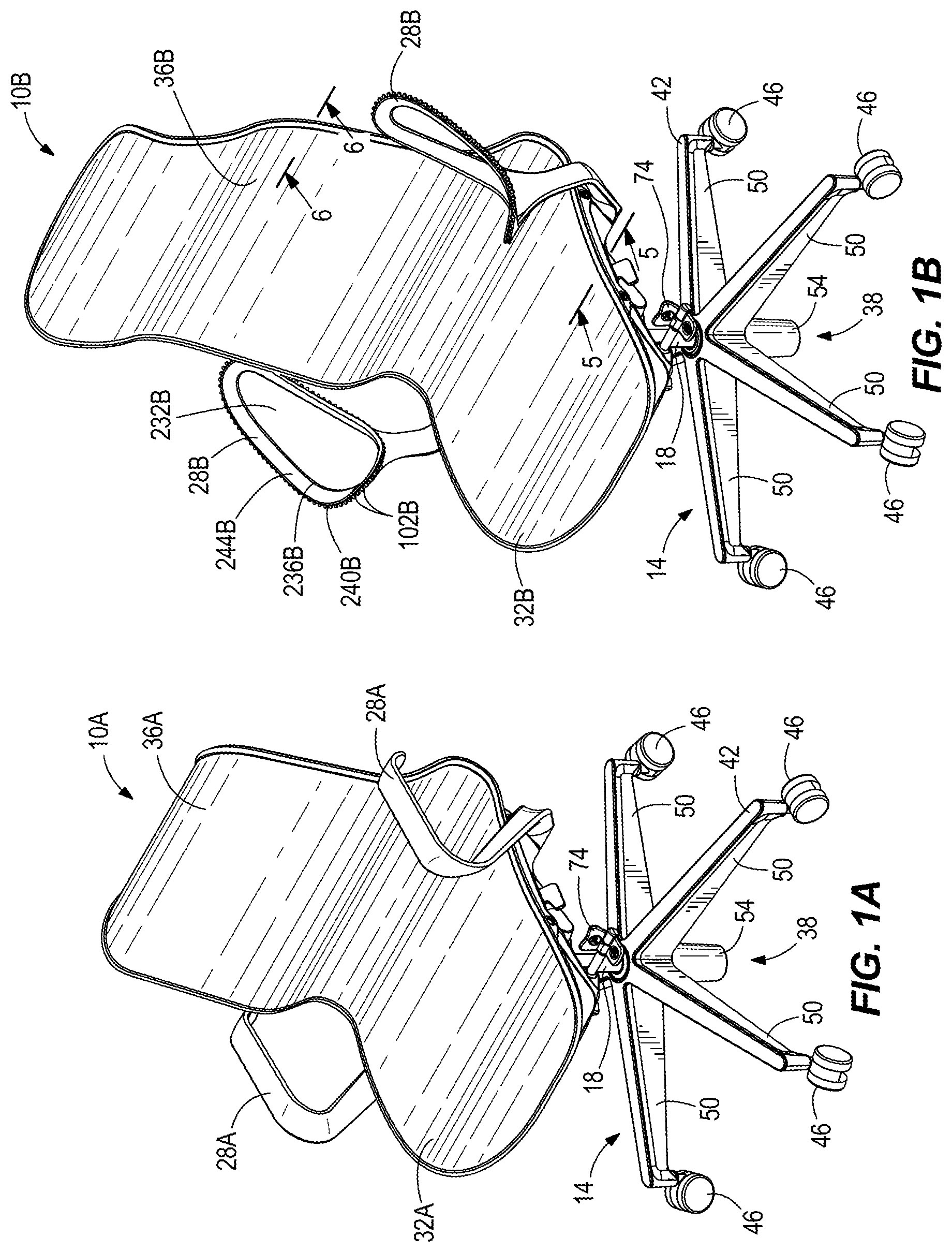
A is a perspective view of a chair according to some embodiments of the present invention.
B is a perspective view of another chair according to some embodiments of the present invention.
A is a perspective view of the chair of A with a carrier and a suspension material removed.
B is a perspective view of the chair of B with a carrier and a suspension material removed.
is an exploded perspective view of a portion of the frame of the chair shown in B .
is a cross-sectional view of the portion of the frame taken along section line 4 - 4 of .
is a cross-sectional view of a portion of the frame, the carrier, and the suspension material of the chair taken along the section line 5 - 5 of B .
is a cross-sectional view of a portion of the frame, the carrier, and the suspension material of the chair taken along the section line 6 - 6 of B .
A- 7 D show a carrier and a frame according to some embodiments of the present invention.
A- 8 B show a carrier according to some embodiments of the present invention.
A- 9 B are enlarged views of a carrier including ribs according to some embodiments of the present invention.
A- 10 C show a carrier with and without ribs subjected to a load
A- 11 B show a carrier and a frame according to some embodiments of the present invention.
A- 12 B show a carrier and a frame according to some embodiments of the present invention.
A- 13 B show a carrier and a frame according to some embodiments of the present invention.
A- 14 C show a carrier and a frame according to some embodiments of the present invention.
A- 15 C show a carrier and a frame according to some embodiments of the present invention.
A- 16 B show a curved carrier and a curved frame according to some embodiments of the present invention.
is an exploded view of a stool according to some embodiments of the present invention.
A — 18 C are views of the stool of .
A- 19 E show a method of manufacturing a carrier according to some embodiments of the present invention.
is a perspective view of a tool used to attach a carrier to a frame.
DETAILED DESCRIPTION
Before any embodiments of the invention are explained in detail, it is to be understood that the invention is not limited in its application to the details of construction and the arrangement of components set forth in the following description or illustrated in the following drawings. The invention is capable of other embodiments and of being practiced or of being carried out in various ways.
A- 1 B illustrate seating structures 10 A, 10 B embodying the present invention. The illustrated seating structures 10 A, 10 B are office chairs, which are also commonly referred to as task chairs. Each seating structure 10 A, 10 B includes a base 14 , a support column 18 , a tilt mechanism 22 ( A, 2 B ), a frame 26 A, 26 B ( A, 2 B ), armrests 28 A, 28 B, a carrier 30 A, 30 B, and a suspension material 34 A, 34 B. In the illustrated embodiments, the bases 14 , the support columns 18 , and the tilt mechanisms 22 are the same, and the frames 26 A, 26 B, the carriers 30 A, 30 B, and the suspension materials 34 A, 34 B are substantially similar. In particular, the frame 26 A, the carrier 30 A, and the suspension material 34 A of the seating structure 10 A shown in A are configured to form a chair with a relatively low backrest 36 A, while the frame 26 B, the carrier 30 B, and the suspension material 34 B of the seating structure 10 B shown in B are configured to form a chair with a relatively high backrest 36 B. Other differences between the seating structures 10 A, 10 B will also be discussed below.
As shown in A- 1 B , each base 14 includes a rigid understructure 38 , an outer cover 42 , and a plurality of casters 46 . The rigid understructure 38 supports the weight of the seating structure 10 A, 10 B. The rigid understructure 38 includes five arms 50 surrounding a central hub 54 . One of the casters 46 is attached to a distal end of each of the arms 50 . The rigid understructure 38 is made of metal (e.g., aluminum, steel, etc.), a heavy plastic, or a composite material. The outer cover 42 is positioned over the rigid understructure 38 . In some embodiments, the rigid understructure 38 and the outer cover 42 may be integrally formed from metal or a rigid plastic. In some embodiments, the outer cover 42 may be overmolded onto the rigid understructure 38 .
As shown in A- 1 B and 2 A- 2 B , the support column 18 of each seating structure 10 A, 10 B extends vertically from the base 14 . The support column 18 includes a lower end 62 , an upper end 66 , telescoping segments 70 , and an actuator 74 . The lower end 62 of the support column 18 is rotatably attached to the base 14 . The upper end 66 of the support column 18 is attached to the tilt mechanism 22 . The support column 18 includes the telescoping segments 70 that are adjustable to change a height of a seat 32 A, 32 B. The actuator 74 may be attached to the support column 18 with a cable guide and a cable.
As shown in A- 2 B , the tilt mechanism 22 of each seating structure 10 A, 10 B is coupled to the upper end 66 of the support column 18 opposite the base 14 and is coupled to a portion of the frame 26 A, 26 B. The tilt mechanism 22 is configured to allow the frame 26 A, 26 B to pivot (e.g., tilt) relative to the support column 18 .
As shown in A- 2 B , the frame 26 A, 26 B of each seating structure 10 A, 10 B is supported by the tilt mechanism 22 above the base 14 . Each frame 26 A, 26 B includes a plurality of frame members. More particularly, each frame 26 A, 26 B includes a first side frame member 78 A, 78 B, a second side frame member 82 A, 82 B, a first cross frame member 86 A, 86 B, and a second cross frame member 90 A, 90 B. The first side frame member 78 A, 78 B and the second side frame member 82 A, 82 B are spaced apart along a first axis 94 A, 94 B, and define an opening 98 A, 98 B therebetween. The first cross frame member 86 A, 86 B and the second cross frame member 90 A, 90 B are spaced apart along a second axis 106 A, 106 B that is substantially perpendicular to the first axis 94 A, 94 B. The first cross frame member 86 A, 86 B and the second cross frame member 90 A, 90 B span the opening 98 A, 98 B and are connected to the first side frame member 78 A, 78 B and the second side frame member 82 A, 82 B. The first side frame member 78 A, 78 B, the second side frame member 82 A, 82 B, the first cross frame member 86 A, 86 B, and the second cross frame member 90 A, 90 B each have an inner portion 99 A, 99 B facing toward the opening 98 A, 98 B and an outer portion 100 A, 100 B facing away from the opening 98 A, 98 B. A support surface 101 A, 101 B extends between the inner portion 99 A, 99 B and the outer portion 100 A, 100 B. A plurality of first attachment features 102 A, 102 B is disposed along the outer portion 100 A, 100 B so that the plurality of first attachment features 102 A, 102 B surrounds an outer perimeter of the frame 26 A, 26 B. The plurality of first attachment features 102 A, 102 B faces outwardly away from the first side frame member 78 A, 78 B, the second side frame member 82 A, 82 B, the first cross frame member 86 A, 86 B, and the second cross frame member 90 A, 90 B. As shown in , 6 , and 7 A- 7 D , the first attachment features 102 A, 102 B are teeth 104 A, 104 B.
In the illustrated embodiment, the first side frame member 78 A, 78 B, the second side frame member 82 A, 82 B, the first cross frame member 86 A, 86 B, and the second cross frame member 90 A, 90 B form a closed loop or ring. In some embodiments, ends of some or all of the frame members 78 A, 78 B, 82 A, 82 B, 86 A, 86 B, 90 A, 90 B are curved to provide relatively smooth transitions between the frame members and to provide rounded corners for the frames 26 A, 26 B. Although the illustrated frames 26 A, 26 B are formed of separate frame members, in other embodiments, the frames 26 A, 26 B may be formed as single homogenous units. In some embodiments, the frames 26 A, 26 B are made of glass filled and unfilled thermoplastics.
In the illustrated embodiment, each frame 26 A, 26 B is contoured to define both the seat 32 A, 32 B and the backrest 36 A, 36 B. In other words, each frame 26 A, 26 B defines a continuous seat and backrest. The first cross frame members 86 A, 86 B and lower portions of the side frame members 78 A, 78 B, 82 A, 82 B are generally planar to define the seats 32 A, 32 B, while the second cross frame members 90 A, 90 B and upper portions of the side frame members 78 A, 78 B, 82 A, 82 B are generally planar to define the backrests 36 A, 36 B. In other embodiments, each frame 26 A, 26 B may be substantially planar and define only the seat 32 A, 32 B. In further embodiments, each frame 26 A, 26 B may be substantially planar and define only the backrest 36 A, 36 B.
As shown in B, 3 , and 4 , the frame 26 B include a third cross frame member 108 B. The third cross frame member 108 B includes an elongated body 110 B, a first arm 114 B, and a second arm 118 B. The first arm 114 B and the second arm 118 B are substantially perpendicular to the elongated body 110 B. In some embodiments, curved corners extend between the elongated body 110 B and the first arm 114 B and the second arm 118 B. The first arm 114 B and the second arm 118 B of the third cross frame member 108 B are configured to engage the first side frame member 78 B and the second side frame member 82 B, respectively. When the third cross frame member 108 B is engaged with the first side frame member 78 B and the second side frame member 82 B, the elongated body 110 B of the third cross frame member 108 B is vertically spaced from and substantially above the second cross frame member 90 B to form the higher backrest 36 B.
In the illustrated embodiment, the third cross frame member 108 B is secured to the first side frame member 78 B and the second side frame member 82 B by a snap-fit-type connection. As shown in , the first arm 114 B and the second arm 118 B are substantially similar, and the first side frame member 78 B and the second side frame member 82 B are substantially similar. As such, only the first arm 114 B and the first side frame member 78 B will be described in detail below. Like reference numbers are used to refer to like parts on the second arm 118 B and the second side frame member 82 B.
As shown in , the first arm 114 B includes a boss 122 B extending from an end of the first arm 114 B and a tab 126 B movably coupled to the boss 122 B. The boss 122 B has a cross-section that is smaller than a cross-section of the remainder of the first arm 114 B. The tab 126 B is surrounded by a slot 130 B so that the tab 126 B is cantilevered on the boss 122 B and may move (e.g., flex) with respect to the boss 122 B. The tab 126 B also includes an enlarged distal end portion 138 B.
Referring to , the first side frame member 78 B has a bore 142 B formed in an edge of the first side frame member 78 B and a recess 146 B formed in a surface of the first side frame member 78 B adjacent the bore 142 B. The bore 142 B is shaped to receive the boss 122 B. The recess 146 B is formed in an interior surface of the first side frame member 78 B that partially defines the bore 142 B. In the illustrated embodiment, the recess 146 B is a through-hole that also extends through an exterior surface of the first side frame member 78 B. In other embodiments, the recess 146 B may be a depression formed in the interior surface of the side frame member 78 B. The recess 146 B is configured to receive the enlarged distal end portion 138 B of the tab 126 B. In particular, the boss 122 B is slid into the bore 142 B until the enlarged distal end portion 138 B of the tab 126 B aligns with the recess 146 B, at which point the tab 126 B snaps outward (due to the bias of the material) and into the recess 146 B, securing the frame members 78 B, 108 B together. The boss 122 B with the tab 126 B and the bore 142 B with the recess 146 B thereby connect the third cross frame member 108 B to the first and second side frame members 78 B, 82 B together without additional fasteners or tools. In alternate configurations, the first side frame member 78 B may include the boss 122 B and the tab 126 B, and the first arm 114 B may include the bore 142 B and the recess 146 B.
As shown in A and 2 B , the frame 26 A, 26 B of each seating structure 10 A, 10 B includes a support assembly 150 A, 150 B to support the frame 26 A, 26 B. The support assembly 150 A, 150 B includes a central spine 154 A, 154 B, a first lower support member 158 A, 158 B, and a second lower support member 162 A, 162 B. The central spine 154 A, 154 B is substantially Y-shaped and includes a first arm 166 A, 166 B, a second arm 170 A, 170 B, and a third arm 174 A, 174 B. The first arm 166 A, 166 B is coupled to the second cross frame member 90 A, 90 B. In some embodiments, the first arm 166 A, 166 B is integrally formed with the second cross frame member 90 A, 90 B. The second arm 170 A, 170 B and the third arm 174 A, 174 B of the central spine 154 A, 154 B extend beneath the seat 32 A, 32 B and are coupled to the tilt mechanism 22 through the second lower support member 162 A, 162 B. The first lower support member 134 A, 134 B and the second lower support member 162 A, 162 B extend laterally beneath the first side frame member 78 A, 78 B and the second side frame member 82 A, 82 B. The first lower support member 158 A, 158 B and the second lower support member 162 A, 162 B include upwardly curving ends configured engage to the first side frame member 78 A, 78 B and the second side frame member 82 A, 82 B.
With reference to A- 7 D , the teeth 104 A, 104 B are evenly spaced along the outer portion 100 A, 100 B of the frame 26 A, 26 B. Each tooth 104 A, 104 B has a proximal end 200 A, 200 B and a curved distal end 204 A, 204 B, with a length 208 A, 208 B defined therebetween. The teeth 104 A, 104 B may have the same length. The length 208 A, 208 B of the teeth 104 A, 104 B is less than a thickness 212 A, 212 B of the frame 26 A, 26 B. The teeth 104 A, 104 B are tapered so that the proximal end 200 A, 200 B of the each tooth 104 A, 104 B has a first width 216 A, 216 B and the curved distal end 204 A, 204 B of each tooth 104 A, 104 B has a second width 220 A, 220 B that is shorter than the first width 216 A, 216 B. The teeth 104 A, 104 B have a substantially constant height 224 A, 224 B. There is an even spacing 228 A, 228 B between adjacent teeth 104 A, 104 B. The spacing 228 A, 228 B between adjacent teeth 104 A, 104 B is substantially equal to the first width 216 A, 216 B of the teeth 104 A, 104 B. The first width 216 A, 216 B of the teeth 104 A, 104 B may range between about 4 mm to about 25 mm. The length 208 A, 208 B of the teeth 104 A, 104 B may range between about 4 mm to about 8 mm. The height 224 A, 224 B of the teeth 104 A, 104 B may range between about 3 mm to about 5 mm. The spacing 228 A, 228 B between the teeth 104 A, 104 B may range between about 4 mm to about 25 mm. The thickness 212 A, 212 B of the frame 26 A, 26 B may range between about 6 mm to about 12 mm. The teeth 104 A, 104 B may have a slight taper along the length 208 A, 208 B, both in the height 224 A, 224 B and width dimensions.
As shown in B , the armrests 28 B may be loop-shaped and include an opening 232 B. The armrests 28 B may include an inner portion 236 B facing toward the opening 232 B and an outer portion 240 B facing away from the opening 232 B. A support surface 244 B may extend between the inner portion 236 B and the outer portion 240 B. In some embodiments, the plurality of first attachment features 102 A, 102 B (e.g., teeth) is also disposed along the outer portion 240 B of the armrests 28 B. In other words, the construction of the armrests 28 B may be similar to the frame 26 B, but with a different shape and size. The armrests 28 B can engage a suitable carrier with a suspension material, similar to the carriers 30 A, 30 B and the suspension materials 34 A, 34 described below.
As shown in A and 8 B , each carrier 30 A, 30 B includes a first side carrier member 248 A, 248 B, a second side carrier member 252 A, 252 B, a first cross carrier member 256 A, 256 B, and a second cross carrier member 260 A, 260 B. The first side carrier member 248 A, 248 B and the second side carrier member 252 A, 252 B are spaced apart along a first axis 266 A, 266 B and define an opening 268 A, 268 B therebetween. The first cross carrier member 256 A, 256 B and the second cross carrier member 260 A, 260 B are spaced apart along a second axis 279 A, 279 B that is substantially perpendicular to the first axis 266 A, 266 B. The first cross carrier member 256 A, 256 B and the second cross carrier member 260 A, 260 B span the opening 268 A, 268 B and are connected to the first side carrier member 248 A, 248 B and the second side carrier member 252 A, 252 B. The first side carrier member 248 A, 248 B, the second side carrier member 252 A, 252 B, the first cross carrier member 256 A, 256 B, and the second cross carrier member 260 A, 260 B each include an inner portion 270 A, 270 B facing inwardly toward the opening 268 A, 268 B and an outer portion 272 A, 272 B facing away from the opening 268 A, 268 B. An upper support surface 274 A, 274 B and a lower support surface 276 A, 276 B extend between the inner portion 270 A, 270 B and the outer portion 272 A, 272 B.
As shown in A and 7 B , each carrier 30 A, 30 B also includes a plurality of second attachment features 262 A, 262 B disposed along the inner portion 270 A, 270 B. The plurality of second attachment features 262 A, 262 B face toward the first side frame member 78 A, 78 B, the second side frame member 82 A, 82 B, the first cross frame member 86 A, 86 B, and the second cross frame member 90 A, 90 B. The plurality of second attachment features 262 A, 262 B is disposed along the inner portion 270 A, 270 B of the carrier 30 A, 30 B so that the plurality of second attachment features 262 A, 262 B surrounds an inner perimeter of the carrier 30 A, 30 B. As shown in D , the second attachment features 262 A, 262 B are apertures 264 A, 264 B. In the illustrated embodiment, the apertures 264 A, 264 B are through openings. In other embodiments, the second attachment features 262 A, 262 B may be cavities. The carrier 30 A, 30 B is attached to the frame 26 A, 26 B by engaging the plurality of first attachment features 102 A, 102 B with the plurality of second attachment features 262 A, 262 B. In some embodiments, the first attachment features 102 A, 102 B on the frame 26 A, 26 B may be apertures, and the second attachment features 262 A, 262 B on the carrier 30 A, 30 B may be teeth.
In the illustrated embodiment, the first side carrier member 248 A, 248 B, the second side carrier member 252 A, 252 B, the first cross carrier member 256 A, 256 B, and the second cross carrier member 260 A, 260 B form a closed loop or ring. The illustrated carrier members 248 A, 248 B, 252 A, 252 B, 256 A, 256 B, 260 A, 260 B are integrally formed as a single homogenous unit. The carriers 30 A, 30 B may be formed of thermoplastic elastomers, thermoplastic urethanes, and/or unfilled elastomers. In other embodiments, the carriers 30 A, 30 B may be formed of discrete frame members.
As shown in A and 8 B , each carrier 30 A, 30 B includes the upper support surface 274 A, 274 B and the lower support surface 276 A, 276 B extending between the inner portion 270 A, 270 B and the outer portion 272 A, 272 B. The upper support surface 284 A, 284 B curves downwardly from an inboard portion to an outboard portion thereof, as shown in . The upper support surface 284 A, 284 B includes an upper lip 280 A, 280 B having a portion that extends inwardly and overlies the suspension material 34 A, 34 B and a top of the frame 26 A, 26 B. The lower support surface 288 A, 288 B may engage the support surface 101 A, 101 B of the frame 26 A, 26 B. The first cross carrier member 256 A, 256 B and the second cross carrier member 260 A, 260 B include an outwardly extending lower lip 286 A, 286 B. The carrier 30 A, 30 B also includes a channel 304 A, 304 B that opens outwardly and away from the opening 268 A, 268 B of the carrier 30 A, 30 B. As shown in A- 7 D , in some embodiments, the first side carrier member 248 A, 248 B, the second side carrier member 252 A, 252 B, the first cross carrier member 256 A, 256 B, and the second cross carrier member 260 A, 260 B may each include the upper lip 280 A, 280 B and the lower lip 286 A, 286 B. The upper lip 280 A, 280 B and the lower lip 286 A, 286 B are vertically spaced apart. The upper lip 280 A, 280 B and the lower lip 286 A, 208 B are joined together by a plurality of spaced apart posts 314 A, 314 B. The posts 314 A, 314 B define the apertures 264 A, 264 B. Referring to B , in some embodiments, the apertures 264 A, 264 B are defined by upper and lower landings 380 A, 380 B, 384 A, 384 B and the spaced apart posts 314 A, 314 B. The spaced apart posts 314 A, 314 B help maintain the shape and integrity of the apertures 264 A, 264 B in response to the tension in the carrier 30 A, 30 B when the carrier 30 A, 30 B is engaged with the frame 26 A, 26 B and in response to cycles of external loading of the suspension material 34 A, 34 B (e.g. by the user sitting down).
As shown in A, 7 B, and 7 D , the apertures 264 A, 264 B are evenly spaced along the channel 304 A, 304 B. A depth of the apertures 264 A, 264 B is the same as a depth 326 A, 326 B of the posts 314 A, 314 B. Each aperture 264 A, 264 B has a height 332 and a width 336 configured to receive one of the teeth 104 A, 104 B. As shown in A , the distal ends 204 A, 204 B of the teeth 104 A, 104 B lie flush with outer ends 340 A, 340 B of the posts 314 A, 314 B when the carrier 30 A, 30 B is engaged with the frame 26 A, 26 B so that the distal ends 204 A, 204 B of the teeth 104 A, 104 B are disposed within the channel 304 A, 304 B. The channel 304 A, 304 B therefore isolates or spaces the distal ends 204 A, 204 B of the teeth 104 A, 104 B inwardly from the outer portion 272 A, 272 B of the carrier 30 A, 30 B, protecting the teeth 104 A, 104 B from impact damage. As shown in , 6 , and 7 A , the distal ends 204 A, 204 B of the teeth 104 A, 104 B of the first attachment features 102 A, 102 B are visible through the apertures 264 A, 264 B on sides of the carrier 30 A, 30 B facing outward from the opening 268 A, 268 B. In other words, the teeth 104 A, 104 B are visible along an outer perimeter of the seating structure 10 A, 10 B to create a “zipperlike” appearance ( ).
As shown in , the suspension material 34 A, 34 B is attached to the carrier 30 A, 30 B and extends over the opening 98 A, 98 B defined by the frame 26 A, 26 B. The suspension material 34 A, 34 B may be made of a woven or knit material, such as elastomeric materials, fabrics, or molded polymeric materials. In some embodiments, the suspension material 34 A, 34 B forms the seat 32 A, 32 B, the backrest 36 A, 36 B, or a continuous seat and backrest of the seating structure 10 A, 10 B. In some embodiments, the frame 26 B, the carrier 30 B, and the suspension material 34 B also form the armrest 28 B.
The suspension material 34 A, 34 B is coupled to the carrier 30 A, 30 B. In the illustrated embodiment, the suspension material 34 A, 34 B is molded into the carrier 30 A, 30 B. In other embodiments, the suspension material 34 A, 34 B may be coupled to the carrier 30 A, 30 B by bonding, adhesives, mechanical fasteners (e.g., staples, screws, etc.), or the like. In embodiments where the suspension material 34 A, 34 B is molded to the carrier 30 A, 30 B, an edge 356 A, 356 B of the suspension material 34 A, 34 B is captured within the carrier 30 A, 30 B so that the upper lips 280 A, 280 B of the carrier 30 A, 30 B overlie the edge 356 A, 356 B of the suspension material 34 A, 34 B.
When the carrier 30 A, 30 B is attached to the frame 26 A, 26 B, the suspension material 34 A, 34 B is stretched over the opening 98 A, 98 B defined by the frame 26 A, 26 B so that the suspension material 34 A, 34 B is in tension. A line of tension 348 A, 348 B ( A and 9 B ) is formed between the first side carrier member 248 A, 248 B and the second side carrier member 252 A, 252 B.
As shown in A and 9 B , the carrier 30 A, 30 B includes a plurality of ribs 360 A, 360 B. The ribs 360 A, 360 B are positioned along the lower surface 288 A, 288 B of the upper lip 280 A, 280 B and engage the support surface 101 A, 101 B of the frame 26 A, 26 B. The ribs 360 A, 360 B are generally positioned along portions of the carrier 30 A, 30 B that may experience point loading, such as along the first cross carrier member 256 A, 256 B (as shown in A and 9 B ) or along the armrests 28 B. Each of the plurality of ribs 360 A, 360 B is generally shaped as a tapered truss. The ribs 360 A, 360 B are collapsible or deflectable under load. The ribs 360 A, 360 B are made of a resilient material and function like springs. The ribs 360 A, 360 B are formed as discrete elements so that only the ribs 360 A, 360 B that are in close proximity to an applied load 364 deflect ( B ). The ribs 360 A, 360 B extend above the line of tension 348 A, 348 B ( B ) and support a portion of the suspension material 34 A, 34 B above the line of tension 348 A, 348 B to form a positive cushioned curvature above the line of tension 348 A, 348 B. The ribs 360 A, 360 B inhibit the suspension material 34 A, 34 B from contacting the support surface 101 A, 101 B of the frame 26 A, 26 B when the suspension material 34 A, 34 B is subjected to the applied load 364 . The ribs 360 A, 360 B are made of resilient materials, for example rubber or silicone. As shown in A , a width 362 A, 362 B of the upper lip 280 A, 280 B and a length of the ribs 360 A, 360 B may vary along a contour of the frame 26 A, 26 B.
As shown in A , in some embodiments, the carrier 30 A, 30 B may include a shorter upper lip 368 A, 368 B. In such embodiments, when the suspension material 34 A, 34 B is subjected to an applied load 364 , the suspension material 34 A, 34 B deflects to the position identified by dashed lines. The deflected suspension material 34 A, 34 B is proximate the support surface 101 A, 101 B of the frame 26 A, 26 B which could expose a user to the hard support surface 101 A, 101 B of the frame 26 A, 26 B.
As shown in B , in some embodiments, the carrier 30 A, 30 B includes an elongated upper lip 372 A, 372 B. When the suspension material 34 A, 34 B is subjected to the applied load 364 , the suspension material 34 A, 34 B and the elongated upper lip 372 A, 372 B deflect to the positions identified by dashed lines. In such an embodiment, the elongated upper lip 372 A, 372 B provides a resilient cantilevered support and the suspension material 34 A, 34 B experiences less deflection under the load 364 . The user may still be exposed to the hard support surface 101 A, 101 B of the frame 26 A, 26 B, although to a lesser extent than in the embodiment shown in A .
C illustrates an arrangement where the carrier 30 A, 30 B includes the elongated upper lip 372 A, 372 B and the plurality of ribs 360 A, 360 B extending from the elongated upper lip 372 A, 372 B. When the suspension material 34 A, 34 B is subjected to the applied load 364 , the suspension material 34 A, 34 B, the elongated upper lip 372 A, 372 B, and the ribs 360 A, 360 B deflect to the positions identified by dashed lines. The ribs 360 A, 360 B hold a portion of the suspension material 34 A, 34 B over the line of the line of tension 348 A, 348 B when the load 364 is applied, providing a cushioning effect and inhibiting a user from contacting the support surface 101 A, 101 B of the frame 26 A, 26 B. Therefore, the elongated upper lip 372 A, 372 B and the ribs 360 A, 360 B may be positioned along portions of the frame 26 A, 26 B that contact the user (e.g., along the first cross frame member 86 A, 86 B or along the armrests 28 B) to help reduce pressure points at the edges of the seating structure 10 A, 10 B.
A- 11 B illustrate portions of a frame 378 and a carrier 379 with alternative attachment features. In the illustrated embodiment, the first attachment features on the frame 378 include teeth 104 C that have a substantially rectangular stem 376 and a barbed distal end 380 . A width 384 of the stem 376 is constant along a length 388 of the stem 376 , while a width 392 of the barbed distal end 381 is wider than the width 384 of the stem 376 . The second attachment features on the carrier 379 include apertures 264 C having a width 393 sized to receive the stem 376 . A depth 394 of each aperture 264 C may be substantially similar to the length 388 of each stem 376 . The barbed distal end 380 may extend into a channel 395 of the carrier 379 . The width 392 of each barbed distal end 381 is wider than the width 393 of each aperture 264 C. The wider widths 392 of the barbed distal ends 380 inhibit the teeth 104 C from being pulled out of the carrier 379 in response to loading of the carrier 379 .
A- 12 B illustrate portions of a frame 396 and a carrier 398 with alternative attachment features. In the illustrated embodiment, the first attachment features on the frame 396 include first teeth 400 having a first shape and second teeth 404 having a second shape. The illustrated first teeth 400 are rectangular. The illustrated second teeth 404 have a substantially rectangular stem 406 and a barbed distal end 407 , similar to the rectangular stems 376 and the distal ends 380 described above. Each first tooth 404 has a width 411 that is substantially the same as a width 409 of the stem 406 . Each first tooth 404 also has a length 412 . The second attachment features on the carrier 398 include apertures 264 D that are substantially the same as the apertures 264 C described above. A depth 413 of each aperture 264 D is substantially the same as the length 412 of each first tooth 400 . When the carrier 398 is engaged with the frame 396 , the barbed distal ends 407 of the second plurality of teeth 408 extend beyond the depth 413 of the apertures 264 D and protrude into a channel 410 of the carrier 398 . The first teeth 404 do not extend into the channel 410 . Since the width of the barbed distal end 407 is wider than the width of the apertures 264 D, the barbed distal ends 407 inhibit the teeth 404 from being pulled out of the carrier 398 in response to loading of the carrier 398 .
A- 13 B illustrate portions of a frame 420 and a carrier 422 with alternative attachment features. In the illustrated embodiment, the first attachment features on the frame 420 include teeth 104 E that are spaced relatively far apart. In other words, a spacing 424 between the teeth 104 E is greater than a width 428 of each tooth 104 E. The second attachment features on the carrier 422 are apertures 264 E. A spacing 432 between the apertures 264 E corresponds to the spacing 424 between the teeth 104 E. In the illustrated embodiment, the apertures 264 E are cavities. The apertures 264 E have a depth 436 that is less than a width 434 of the carrier 422 so that the teeth 104 E are not visible when the frame 420 is engaged with the carrier 422 .
A- 14 C illustrate portions of a frame 437 and a carrier 438 with alternative attachment features. In the illustrated embodiment, the frame 437 includes a plurality of first attachment features that are apertures 264 F. The carrier 438 includes a plurality of second attachment features that are teeth 104 F. The apertures 264 F are evenly spaced and have a rectangular cross section. A spacing 440 between the apertures 264 F is substantially the same as a width 444 of the apertures 264 F. The teeth 104 F have a rectangular cross section and have a length 448 that is substantially the same as a depth 452 of the apertures 264 F.
A- 15 C illustrate portions of a frame 458 and a carrier 459 with alternative attachment features. In the illustrated embodiment, the carrier 459 includes a first plurality of teeth 460 , a second plurality of teeth 464 , and a third plurality of teeth 468 . The teeth 460 , 464 , and 468 have unequal widths. Each first tooth 460 has a first width 472 . Each second tooth 468 has a second width 476 that is wider than the first width 472 . Each third tooth 468 has a third width 480 that is wider than the second width 476 . The first teeth 460 , the second teeth 464 , and the third teeth 468 may be equally spaced. In the illustrated embodiment, a spacing 484 between the teeth 460 , 464 , 468 is the same as the first width 472 . The frame 458 includes a first plurality of apertures 488 , a second plurality of apertures 492 , and a third plurality of apertures 496 . The apertures 488 , 492 , 496 have unequal widths. Each first aperture 488 has a first width 500 . Each second aperture 496 has a second width 504 that is wider than the first width 500 . Each third aperture 496 has a third width 508 that is wider than the second width 504 . The first apertures 488 , the second apertures 492 , and the third apertures 496 are configured to receive the first teeth 460 , the second teeth 464 , and the third teeth 468 , respectively.
A- 16 B illustrate a frame 510 that includes a curved portion 512 and a carrier 514 that includes a curved portion 516 . The frame 510 includes a straight portion 559 that has a plurality of evenly spaced apertures 264 G of equal width. The curved portion 512 of the frame 510 has a single elongated aperture 567 . The carrier 516 includes a straight portion 563 that has evenly spaced teeth 104 G of equal width. A spacing 565 between the apertures 264 G is approximately equal to the width 571 of the teeth 104 G. The curved portion 516 of the carrier 514 includes a single elongated tooth 584 . The single elongated aperture 567 at the curved portion 512 of the frame 510 and the single elongated tooth 584 at the curved portion 516 of the carrier 514 may ease manufacturing of the frame 510 and the carrier 514 and assembly of the seating structures 10 A, 10 B.
illustrates a seating structure 544 embodying the present invention. The illustrated seating structure 544 is a saddle-shaped stool. The stool includes a base 545 , a support column 546 , a frame 548 , a carrier 552 , and a suspension material 556 . The frame 548 , the carrier 552 , and the suspension material 556 of the seating structure 544 are configured to form a stool with a relatively high, narrow front and a relatively short, wide back.
As shown in B , the frame 548 includes a front portion 560 , a first side portion 564 , a second side portion 568 , and a rear portion 572 . The front portion 560 extends in a vertical direction and may be substantially arch-shaped. The front portion 560 is spaced from the rear portion 523 and defines an opening 580 therebetween. The first side portion 564 and the second side portion 568 are spaced apart and substantially perpendicular to the front portion 560 and the rear portion 572 . In the illustrated embodiment, the front portion 560 , the first side portion 564 , the second side portion 568 , and the rear portion 572 are joined together to form a closed loop or ring.
As shown in B- 18 C , the rear portion 572 has an extended width 588 that is wider than a width 592 of the front portion 560 . The first side portion 564 and the second side portion 568 are shaped so that a width 596 of the opening 580 increases from the front portion 560 to the rear portion 572 . A cross portion 600 is positioned between the first side portion 564 and the second side portion 568 . The support column 546 is attached to the cross portion 600 . In the illustrated embodiment, the first side portion 564 and the second side portion 568 have a curved shape. The front portion 560 has a height greater than a height of the first side portion 564 and the second side portion 568 .
The frame 548 includes a support surface 604 and an outer periphery 608 . The outer periphery 608 includes a plurality of outwardly extending first attachment features 610 . In the illustrated embodiment, the first attachment features 610 are teeth 611 . In other embodiments, the first attachment features 610 may be apertures. In the illustrated embodiment, some of the first attachment features 610 are integrally formed with the frame 548 . In the embodiment illustrated in , the frame 548 also includes separate insert members 612 that include first attachment features 610 .
As shown in , the carrier 552 includes a front portion 616 , a first side portion 620 , a second side portion 624 , and a rear portion 628 . The front portion 616 is spaced from the rear portion 628 . The first side portion 620 and the second side portion 624 are spaced apart along and substantially perpendicular to the front portion 616 and the rear portion 628 . The front portion 616 , the first side portion 620 , the second side portion 624 , and the rear portion 628 are joined together to form a continuous loop or a ring.
The carrier 552 includes a support surface 644 and an inner periphery 648 . A plurality of second attachment features 650 extends inwardly from the inner periphery 648 . In the illustrated embodiment, the second attachment features 650 are apertures 651 . In other embodiments, the second attachment features 650 may be teeth. The apertures 651 of the carrier 552 receive the teeth 611 of the frame 548 to connect the carrier 552 to the frame 548 .
The suspension material 556 is coupled to the carrier 552 . In the illustrated embodiment, the suspension material 556 is molded into the carrier 552 . In alternative embodiments, the suspension material 556 may be attached by the carrier 552 using other suitable coupling means. The suspension material 556 may be made of a woven or knit material, such as elastomeric materials, fabrics, or molded polymeric materials.
When the carrier 552 is connected to the frame 548 by engaging the plurality of first attachment features 102 A, 102 B with the plurality of second attachment features 262 A, 262 B, the suspension material 556 is stretched over the opening 580 of the frame 548 . As shown in , the suspension material 556 forms a saddle shape when the carrier 552 is attached to the frame 548 . The front portion 560 of the frame 548 defines a “horn” portion of the saddle, the rear portion 572 of the frame 548 forms a raised rear support portion, and the two curved side portions 564 , 568 are configured to engage the user's thighs. In some embodiments, the carrier 552 may include a plurality of ribs (similar to the ribs 360 A, 360 B shown in C ) positioned along portions of the carrier 552 that may experience point loading, such as along the first and second side portions 564 , 568 .
A- 19 E show a mold tool 656 that is used to form a carrier (such as any of the carriers described above) with an in-molded edge of suspension material. The mold tool 656 includes a first mold component 660 and a second mold component 664 . The first mold component 660 and the second mold component 664 define a cavity 668 therebetween. The suspension material is captured between the first mold component 660 and the second mold component 664 so that the edge of the suspension material is disposed within the cavity 668 . In embodiments in which the second attachment features 262 A, 262 B are apertures 264 A, 264 B, the first mold component 660 includes features 672 (e.g., teeth 672 ′ and protrusion 672 ″) defining the apertures 264 A, 264 B, channel 304 A, 304 B, upper surface portion 308 A, 308 B, and upper lip 280 A, 280 B of the carrier. In some embodiments, the features 672 are on a removable insert 676 so that the same mold tool 656 can be used to mold different configurations of the carrier 30 A, 30 B. The second mold component 664 has a wall 680 that abuts an end 684 of the features 672 of the first mold component 660 , thereby forming and defining the through openings or recesses in the carrier.
When forming the carrier 30 A, 30 B, the edge 356 A, 356 B of the suspension material 34 A, 34 B is positioned within the mold 656 , as shown in B . The first mold component 660 and the second mold component 664 are closed so that the first mold component 660 and the second mold component 664 are vertically stacked one over the other, with the edge 356 A, 356 B positioned therebetween. Liquefied carrier material is introduced into the cavity 668 through a passageway 688 defined in the first mold component 660 , for example, by injection molding. The liquefied carrier material is allowed to harden around the edge 356 A, 356 B of the suspension material 34 A, 34 B disposed within the cavity 668 ( C ). After the liquefied carrier material has hardened, the first mold component 660 is opened relative to the second mold component 664 in a direction substantially perpendicular to the teeth 672 of the first mold component 660 (e.g., in a vertical direction) to retain the carrier 30 A, 30 B on the first mold component 660 ( D ). A force or load is supplied to the suspension material 34 A, 34 B to demold or remove the carrier 30 A, 30 B from the first mold component 660 ( E ).
Referring back to A- 2 B , to attach the carrier 30 A, 30 B to the frame 26 A, 26 B, a section of the second attachment features 262 A, 262 B of the carrier 30 A, 30 B is aligned with a section of the first attachment features 102 A, 102 B of the frame 26 A, 26 B, for example, by aligning one of the plurality of outwardly extending teeth 104 A, 104 B with one of the apertures 264 A, 264 B. Next, the aperture 264 A, 264 B in the carrier 30 A, 30 B is pushed along the length 208 A, 208 B of the tooth 104 A, 104 B so that the distal end 204 A, 204 B of the tooth 104 A, 104 B is disposed between two of the posts 314 A, 314 B and lies flush along the channel 304 A, 304 B. The plurality of teeth 104 A, 104 B are then successively engaged with the plurality of apertures 264 A, 264 B until all of the teeth 104 A, 104 B are received in one of the apertures 264 A, 264 B.
In embodiments in which the apertures 264 A, 264 B are through openings, this attachment process is fully visible and may be controlled in a tooth-by-tooth manner. A tool 692 ( ) including rollers 696 , 700 , 704 is moved around the periphery of the carrier 30 A, 30 B to secure the carrier 30 A, 30 B to the frame 26 A, 26 B. The rollers 696 , 700 of the tool 692 are pressed against the carrier 30 A, 30 B and rolled along the periphery thereof to connect the carrier 30 A, 30 B to the frame 26 A, 26 B. The roller 704 rides within the channel 304 A, 304 B defined between the upper lip 280 A, 280 B and the lower lip 286 A, 286 B of the carrier 30 A, 30 B, which acts as a track for the tool 692 . Once the carrier 30 A, 30 B is attached to the frame 26 A, 26 B, the suspension material 34 A, 34 B is held in tension across the opening 98 A, 98 B defined by the frame 26 A, 26 B.
Various features and advantages of the invention are set forth in the following claims.
Figures (19)
Citations
This patent cites (86)
- US2726713
- US2865436
- US3041109
- US3061374
- US3179469
- US3214117
- US4062590
- US4598949
- US5114210
- US6293624
- US6341822
- US6345428
- US6540950
- US6688690
- US6702389
- US6715839
- US6942300
- US6957861
- US6966606
- US6976737
- US7066550
- US7201449
- US7425037
- US7441758
- US7458642
- US7484811
- US7604298
- US7631941
- US7857390
- US8025334
- US8029066
- US8157329
- US8465007
- US8534648
- US8573697
- US8905471
- US9504326
- US9913540
- US9986845
- US10477972
- US10743677
- US11510502
- US20020106479
- US20040160109
- US20050099052
- US20050194829
- US20060138849
- US20060250018
- US20080157580
- US20090261644
- US20090289490
- US20100007190
- US20110108075
- US20110133538
- US20110181092
- US20130069414
- US20140287188
- US20150008712
- US20160309900
- US20170099957
- US20200163465
- US20200383481
- US201019315
- US101208031
- US101365574
- US201299326
- US101868168
- US102395296
- US102843931
- US102920196
- US103140372
- US104228703
- US1552771
- US2551718
- US2002165672
- US2011045573
- US2011110280
- US2013132403
- US20090008035
- US100885152
- US2010032889
- US2013062036
- US2013064239
- US2014167639
- US2015049052
- US2020086314