Abstract
A furniture system includes an elongated chase having a body extending from a first end to a second end. The body has an upper surface and a lower surface. A first leg is coupled to the lower surface of the body and a second leg is coupled to the lower surface of the body and spaced apart from the first leg. Power cables are positioned within a cavity of the body, the power cables configured to connect to a building's power supply. A modular power unit is coupled to the lower surface of the body. The modular power unit includes a power outlet electrically coupled to the power cables.
Claims (19)
1. A furniture system comprising: an elongated chase including a body extending from a first end to a second end, the body having an upper surface and a lower surface, the upper surface defining a first slot, a second slot spaced apart from the first slot, and a third slot spaced apart from the first slot and the second slot, the chase defining a longitudinal axis extending through the first end and the second end; a first leg coupled to the lower surface of the body; a second leg coupled to the lower surface of the body and spaced apart from the first leg; power cables positioned within a cavity of the body, the power cables configured to connect to a building's power supply; and a first workstation accessory having a first connection member which is at least partially received in the first slot, the second slot, or the third slot, wherein each of the first slot, the second slot, and the third slot is configured to receive the first connection member.
9. A furniture system comprising: an elongated chase including a body extending from a first end to a second end, the body having an upper surface and a lower surface, the upper surface defining a first slot and a second slot spaced from the first slot, the chase defining a longitudinal axis extending through the first end and the second end; a first leg coupled to the lower surface of the body; a second leg coupled to the lower surface of the body and spaced apart from the first leg; power cables positioned within a cavity of the body, the power cables configured to connect to a building's power supply; a first workstation accessory coupled to the upper surface of the chase via a first connection member at least partially positioned in the first slot; and a second workstation accessory coupled to the upper surface of the chase via a second connection member at least partially positioned in the second slot; wherein positions of the first workstation accessory and the second workstation accessory are adjustable along the longitudinal axis of the chase.
16. A furniture system comprising: an elongated chase including a body extending from a first end to a second end, the body having an upper surface and a lower surface, the chase defining a longitudinal axis extending through the first end and the second end; a first leg coupled to the lower surface of the body; a second leg coupled to the lower surface of the body and spaced apart from the first leg; power cables positioned within a cavity of the body, the power cables configured to connect to a building's power supply; and a storage unit positioned beneath the lower surface of the body between the first leg and the second leg, the storage unit including a first storage space configured to be accessed from a first side of the elongated chase, a second storage space separate from the first storage space and configured to be accessed from a second side of the elongated chase that is opposite to the first side; and a mounting member positioned between an upper surface of the storage unit and the lower surface of the chase, wherein the mounting member supports the chase.
Show 16 dependent claims
2. The furniture system of claim 1 , further comprising a modular power unit coupled to the lower surface of the body at least partially beneath the first workstation accessory, wherein the modular power unit includes a power outlet electrically coupled to the power cables, and wherein the power outlet of the modular power unit and the first workstation accessory are positioned on a same side of the longitudinal axis.
3. The furniture system of claim 1 , wherein the first workstation accessory is adjustable along the longitudinal axis of the chase.
4. The furniture system of claim 1 , wherein each of the first slot, the second slot, and the third slot extends from the first end to the second end of the body.
5. The furniture system of claim 1 , wherein the first workstation accessory is received in the first slot, and further comprising a second workstation accessory having a second connection member which is at least partially received in the second slot and a third workstation accessory having a third connection member which is at least partially received in the third slot, wherein the second workstation accessory is positioned between the first workstation accessory and the third workstation accessory.
6. The furniture system of claim 1 , further comprising a second workstation accessory having a second connection member which is at least partially received in the second slot, wherein a longitudinal axis of the first workstation accessory is parallel to the longitudinal axis of the chase and a longitudinal axis of the second workstation accessory is perpendicular to the longitudinal axis of the chase.
7. The furniture system of claim 5 , wherein the first workstation accessory and the second workstation accessory are tables.
8. The furniture system of claim 1 , further comprising a storage unit positioned beneath the lower surface of the body between the first leg and the second leg, wherein the storage unit includes a first storage space configured to be accessed from a first side of the elongated chase, and a second storage space configured to be accessed from a second side of the elongated chase.
10. The furniture system of claim 9 , wherein the first slot and the second slot are each configured to receive the first connection member and to receive the second connection member.
11. The furniture system of claim 9 , wherein a longitudinal axis of the first workstation accessory is parallel to the longitudinal direction of the chase and a longitudinal axis of the second workstation accessory is perpendicular to the longitudinal direction of the chase.
12. The furniture system of claim 11 , wherein the first workstation accessory and the second workstation accessory are tables.
13. The furniture system of claim 9 , further comprising a modular power unit coupled to the lower surface of the body at least partially beneath the first workstation accessory, wherein the modular power unit includes a power outlet electrically coupled to the power cables, and wherein the power outlet of the modular power unit and the first workstation accessory are positioned on a same side of the longitudinal axis.
14. The furniture system of claim 13 , wherein the second workstation accessory and the power outlet of the modular power unit are positioned on opposite sides of the longitudinal axis.
15. The furniture system of claim 9 , further comprising a storage unit positioned beneath the lower surface of the body between the first leg and the second leg, wherein the storage unit includes a first storage space configured to be accessed from a first side of the elongated chase, and a second storage space configured to be accessed from a second side of the elongated chase.
17. The furniture system of claim 16 , further comprising a first workstation coupled to the elongated chase and a second workstation coupled to the elongated chase, wherein the second workstation is separated from the first workstation by the storage unit.
18. The furniture system of claim 16 , wherein the first storage space is closer to the lower surface of the body than the second storage space such that the first storage space and the second storage space are stacked.
19. The furniture system of claim 16 , wherein the first storage space and the second storage space are positioned adjacent to each other along a longitudinal axis of the storage unit.
Full Description
Show full text →
CROSS-REFERENCE TO RELATED APPLICATIONS
This application is a continuation of U.S. Non-Provisional patent application Ser. No. 17/101,725 filed on Nov. 23, 2020, which is a continuation of U.S. Non-Provisional patent application Ser. No. 15/987,489 filed on May 23, 2018, the entire contents of all of which are incorporated herein by reference.
BACKGROUND
The present invention relates to a furniture system, and more particularly to a furniture system for distributing power to workstations.
A furniture system, for example, for an office setting, may be created by furniture items forming different workstations. The furniture items may be adjustable for the entire system or for individual workstations. Furthermore, the furniture system may be configured to provide and support large amounts of power to the workstations from the building's power supply.
SUMMARY
In one embodiment, the invention provides a furniture system including an elongated chase having a body extending from a first end to a second end. The body has an upper surface and a lower surface. A first leg is coupled to the lower surface of the body, and a second leg is coupled to the lower surface of the body and spaced apart from the first leg. Power cables are positioned within a cavity of the body, the power cables configured to connect to a building's power supply. A modular power unit is coupled to the lower surface of the body. The modular power unit includes a power outlet electrically coupled to the power cables.
In another embodiment, the invention provides a furniture system including an elongated chase having a body extending from a first end to a second end. The body has an upper surface and a lower surface. A first leg is coupled to the lower surface of the body, and a second leg is coupled to the lower surface of the body and spaced apart from the first leg. Power cables are positioned within a cavity of the body, the power cables extending from the cavity and through the first leg for connection to a building's power supply. A power outlet is supported by the elongated chase and electrically coupled to the power cables.
In yet another embodiment, the invention provides a furniture system including a first elongated chase having a first body extending from a first end to a second end. The first body has a first upper surface and a first lower surface. The furniture system further includes a second elongated chase adjacent the first elongated chase, the second elongated chase including a second body extending from a third end to a fourth end. The second body having a second upper surface and a second lower surface. The first and second elongated chases together define a longitudinal axis. A first leg is coupled to the first end of the first elongated chase, and a second leg is coupled to the fourth end of the second elongated chase. A storage unit is positioned beneath the second end of the first elongated chase and the third end of the second elongated chase between the first and second legs. The first and second elongated chases are supported by the storage unit.
In yet still another embodiment, the invention provides a furniture system including an elongated chase having a body extending from a first end to a second end, the body having an upper surface and a lower surface. The upper surface defines a slot extending from the first end to the second end. A leg is coupled to the lower surface of the body adjacent the first end. A table is coupled to the slot and extends outwardly away from the elongated chase. A storage unit is positioned beneath the lower surface of the body adjacent the second end to support the second end.
In another embodiment, the invention provides a furniture system including an elongated chase having a body extending from a first end to a second end, the body having an upper surface and a lower surface. The upper surface defines a plurality of slots extending from the first end to the second end. A first leg is coupled to the lower surface of the body. A second leg is coupled to the lower surface of the body and spaced apart from the first leg. Power cables are positioned within a cavity of the body, the power cables extending from the cavity and through the first leg for connection to a building's power supply. A table is coupled to one of the plurality of slots and extends outwardly away from the elongated chase. A modular power unit is coupled to the lower surface of the body adjacent the table, the modular power unit including a power outlet electrically coupled to the power cables. A workstation accessory is coupled to another of the plurality of slots and positioned adjacent the table. A storage unit is positioned beneath the lower surface of the body between the first leg and the second leg
In yet another embodiment, the invention provides a height adjustable desk including a tabletop having a front edge configured to be adjacent a user, a rear edge opposite the front edge, a first side edge extending between the front edge and the rear edge, and a second side edge extending between the front edge and the rear edge. A first leg assembly is coupled to a bottom surface of the tabletop proximate to and inset from the first side edge, the first leg assembly operable to extend and retract. A second leg assembly is coupled to the bottom surface of the tabletop proximate to and inset from the second side edge, the second leg assembly operable to extend and retract. A first storage element is mounted to the bottom surface of the tabletop between the first side edge and the first leg assembly. A second storage element is mounted to the bottom surface of the tabletop between the second side edge and the second leg assembly.
Other aspects of the invention will become apparent by consideration of the detailed description and accompanying drawings.
BRIEF DESCRIPTION OF THE DRAWINGS
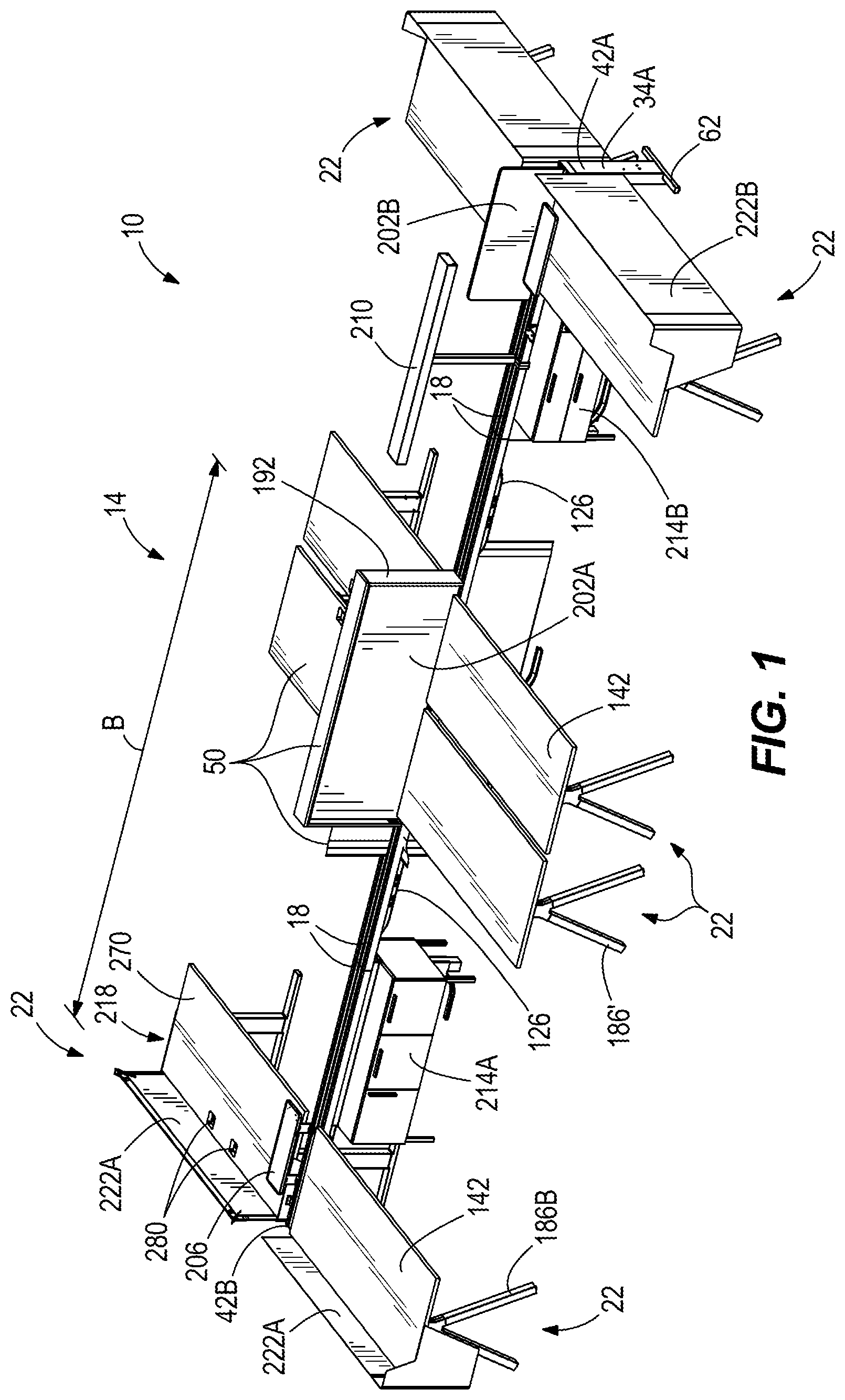
is a perspective view of a furniture system embodying the invention.
is a perspective view of the furniture system shown in another configuration.
is a perspective view of two elongated chases of the furniture system.
is a top view of the two chases of , including tables coupled to the chases.
is a cross-sectional view of one of the chases taken along line 5 - 5 in .
is a bottom view of a portion of one of the chases of .
is a bottom prospective view of a portion of a chase, including a leg coupled to the chase.
is an exploded view of a height adjustment mechanism, including the chase and the leg of .
is a perspective view of a portion of the furniture system in still another configuration including different furniture items.
is a front view of a portion of the furniture system in yet still another configuration.
is a cross-sectional view of the chase taken along line 11 - 11 in .
A is perspective view of a storage unit for use with the furniture system.
B is perspective view of another storage unit for use with the furniture system.
is a perspective view of a height-adjustable desk for use with the furniture system.
is a bottom perspective view of a portion of the furniture system including a table and the chase.
DETAILED DESCRIPTION
Before any embodiments of the invention are explained in detail, it is to be understood that the invention is not limited in its application to the details of construction and the arrangement of components set forth in the following description or illustrated in the following drawings. The invention is capable of other embodiments and of being practiced or of being carried out in various ways.
illustrate furniture systems 10 , 10 ′ embodying the invention. The furniture system 10 can be positioned within a building, such as an office, a school, a library, and the like, to provide an adjustable furniture layout 14 for groups of people to work. The furniture system 10 includes one or more elongated chases 18 and a plurality of workstations 22 adjustably coupled to the chases 18 .
With reference to , each elongated chase 18 includes a body 24 formed by a plurality of sides 30 A-D. In the illustrated embodiment, the body 24 has a generally rectangular cross-sectional shape. In other embodiments, body 24 may have other suitable cross-sectional shapes, such as square, trapezoidal, and the like. The bottom side 30 A defines a lower surface 26 of the body 24 . The top side 30 B is positioned opposite the bottom side 30 A and defines an upper surface 28 of the body 24 . The other sides 30 C, 30 D ( ) are positioned between the bottom and top sides 30 A, 30 B and extend from a first end 42 A to a second end 42 B of the body 24 . The sides 30 C, 30 D define first and second side walls 38 A, 38 B that are coupled to and extend between the lower and upper surfaces 26 , 28 .
The chase 18 defines a longitudinal axis A ( ) extending through the first end 42 A and the second end 42 B. The body 24 of the chase 18 has a length B that is longer than a height and a width of the chase 18 such that the chase 18 is elongated. Specifically, the length B is measured in a direction parallel to the longitudinal axis A. The length B of the chase 18 is several times larger than the height and the width such that the chase 18 resembles a rail or a beam. In some embodiments, a plurality of elongated chases 18 may be coupled together in a line (as shown in ) such that an overall length of the furniture layout 14 is adjustable to a desired user's needs. The number of chases 18 determines the overall length of the furniture layout 14 .
Referring back to , the workstations 22 are positioned adjacent the first and second sides 30 C, 30 D of the chase 18 such that the chase 18 is shared between the workstations 22 . In other words, the chase 18 defines a center of the furniture layout 14 . Workstation accessories 50 , such as tables, screens, and storage units, may be selectively coupled to the chase 18 for forming each workstation 22 , as further discussed below.
With reference to , the chase 18 is supported by legs 34 . A first leg 34 A is positioned at the first end 42 A of the body 24 . A second leg 34 B is positioned at the second end 42 B of the body 24 and spaced apart from the first leg 34 A. The first and second legs 34 A, 34 B are coupled to the lower surface 26 of the body 24 . In some embodiments, the chase 18 may include more than two legs 34 positioned along the chase 18 at or between the first and second ends 42 A, 42 B. The legs 34 are supported on a floor surface 56 of a room. In some scenarios, the legs 34 may be coupled to the lower surface 26 of only one of the chases 18 . In other scenarios, the legs 34 may be coupled to the lower surface 26 of two adjacent chases 18 . In the illustrated embodiment, the legs 34 are coupled to the lower surface 26 by a bracket 54 ( ). The bracket 54 may be designed to couple to one of the chases 18 or to span between two adjacent chases 18 .
With reference to , each chase 18 includes a vertical axis C ( ) extending through the lower and upper surfaces 26 , 28 . The vertical axis C is substantially perpendicular to the longitudinal axis A. The legs 34 may be coupled to the body 24 of the chase 18 parallel to or aligned with the vertical axis C or angled relative to the vertical axis C. For example, as shown in , in one configuration the legs 34 , 34 A, 34 B extend parallel to the vertical axis C. As shown in , in other configuration legs 34 A′ extend at an angle D relative to the vertical axis. In this configuration, two legs 34 A′ extend in substantially opposite directions from the same end 42 A of the body 24 , and the angle D is about 45 degrees. In other embodiments, the angle D may be any angle between 1 degree and 89 degrees. In some embodiments, the same type of leg (e.g., the leg 34 , the leg 34 A, the leg 34 B, or the two legs 34 A′) may be used along the entire length of the chase 18 for a given furniture system. In other embodiments, a mix of different types of legs may be positioned along the length of the chase 18 , based on physical space constraints and users' preferences.
With reference to , the first leg 34 A includes a foot portion 62 . The illustrated foot portion 62 is coupled to a bottom end 66 of the first leg 34 A. The foot portion 62 extends substantially perpendicular relative to the longitudinal axis A and the vertical axis C. The foot portion 62 is positioned on the floor surface 56 . Any or all of the legs 34 of the chase 18 may include the foot portion 62 . The foot portion 62 is configured to support and facilitate balancing of the chase 18 and the legs 34 .
With continued reference to , the legs 34 support the chase 18 for positioning the chase 18 above the floor surface. Specifically, the chase 18 has a height E determined by a length of the legs 34 such that the chase 18 is spaced a significant distance from the floor surface 56 . For example, the height E may be between about two and four feet so that the legs 34 position the body 24 next to a user sitting adjacent the chase 18 .
With reference to , each leg 34 includes a first height adjustment mechanism 70 . The first height adjustment mechanism 70 is a macro height adjustment mechanism. The illustrated height adjustment mechanism 70 is positioned at a top end 68 of each leg 34 . The height adjustment mechanism 70 includes an inner leg portion 74 and an outer leg portion 78 A, 78 B. The outer leg portion 78 A, 78 B extends from an inner side 82 ( ) of each leg 34 substantially perpendicular to the vertical axis C. The inner leg portion 74 is telescopably received in the outer leg portion 78 A, 78 B. In the illustrated embodiment, the inner leg portion 74 is coupled to the lower surface 26 by a bracket 60 such that the height adjustment mechanism 70 is proximate the chase 18 . The outer leg portion 78 A, 78 B includes a plurality of holes 86 A, 86 B corresponding to holes 92 formed in the inner leg portion 74 . The illustrated outer leg portion 78 A, 78 B includes two flanges extending toward each other to form the outer leg portion 78 A, 78 B. Each flange 78 A, 78 B includes a set of holes 86 A, 86 B, respectively. The illustrated inner leg portion 74 includes two projections 90 A, 90 B extending towards each other, and positioned adjacent the two flanges of the outer leg portion 78 A, 78 B. Each projection 90 A, 90 B includes two holes 92 configured to align with the holes 86 A, 86 B. Fasteners 84 (e.g., bolts, screws, etc.) are received within the holes 86 A, 86 B of the outer leg portion 78 A, 78 B and the holes 92 of each projection 90 A, 90 B for securing the inner leg portion 74 in a predetermined position to the outer leg portion 78 . As such, the height adjustment mechanism 70 is adjustable in discrete intervals. For example, the illustrated holes 86 are spaced apart by about 0.5 inches along the vertical axis C. In other embodiments, the holes 86 may be spaced apart by more or less than 0.5 inches (e.g., 0.4, 1.0, etc.).
The inner leg portion 74 is selectively secured to the outer leg portion 78 A, 78 B for adjusting the height E of the chase 18 along the vertical axis C. Specifically, the height E of the chase 18 is adjustable by sliding the inner leg portion 74 relative to the vertical axis C (i.e., upwards, downwards) within each leg 34 and inserting the fasteners 84 through the aligned holes 86 , 92 . Sliding the inner leg portion 74 upwards along the vertical axis C increases the height E of the chase 18 , and sliding the inner leg portion 74 downwards decreases the height E. The height adjustment mechanism 70 is positioned at the top end 68 such that the inner leg portion 74 may extend out or telescope from the top end 68 of each leg 34 when increasing the height E.
With reference to , each leg 34 also includes a second height adjustment mechanism 102 . The second height adjustment mechanism 102 is a micro height adjustment mechanism. The illustrated height adjustment mechanism 102 is positioned at the bottom end 66 of each leg 34 proximate the floor surface 56 . The height adjustment mechanism 102 includes glides 106 . Each of the illustrated glides has a generally cylindrical shape and is threadably coupled to each leg 34 . With respect to the first construction of the legs 34 ( ), the glides 106 are rotatably coupled to the bottom end 66 of the leg 34 or to the foot portions 62 . With respect to the second configuration of the legs 34 ′ ( ), the glides 106 are rotatably coupled to the bottom end 66 of each angled leg 34 ′.
Rotation of the glides 106 adjusts the height E of each leg 34 . Specifically, rotation in one direction increases a length of the glides 106 relative to the vertical direction C, and rotation in the opposite direction decreases the length of the glides 106 . As such, the second height adjustment mechanism 102 is infinitely adjustable compared to the discrete adjustments of the first height adjustment mechanism 70 . The legs 34 may include one or both of the height adjustment mechanisms 70 , 102 adapted for adjustment of the height E of the chase 18 relative to the vertical axis C.
The illustrated height adjustment mechanism 70 is configured as a macro height adjustment mechanism in which the height E is adjusted in in relatively large increments. Conversely, the illustrated height adjustment mechanism 102 is configured as a micro height adjustment mechanism in which the height E is adjusted in relatively small increments compared to the macro height adjustment mechanism 70 . Furthermore, the macro height adjustment mechanism 70 may be used by an installer when assembling the furniture system 10 , and the micro height adjustment mechanism 102 may be used by a user of one of the workstations 22 .
With reference to , the body 24 of the chase 18 includes a cavity 110 extending from the first end 42 A to the second end 42 B along the longitudinal axis A. The cavity 110 is continuous and extends the length B of the chase 18 . The cavity 110 is configured to receive power cables 114 (e.g., electrical cables) ( ). The cavity 110 may also or alternatively receive data cables within the cavity 110 . The power cables 114 may extend the whole length B (i.e., from the first end 42 A to the second end 42 B) or portions of the length B of the body 24 .
With reference to , each leg 34 includes a channel 116 . The power cables 114 also extend through the channel 116 of at least one of the legs 34 (e.g., the first leg 34 A in ) of the chase 18 . Specifically, the power cables 114 extend through the channel 116 into the cavity 110 of the body 24 . The illustrated leg 34 A includes the inner leg portion 74 having a first, flexible member 118 ( ) within the inner leg portion 74 , and a second member 122 positioned at an end of the first member 118 . The illustrated first member 118 is formed from a flexible conduit. The illustrated second member 122 is a junction box. The inner leg portion 74 , the first member 118 , and the second member 122 are positioned within the channel 116 of each leg 34 . The illustrated power cables 114 are configured to extend from a building (e.g., a wall 124 as shown in , floor, other furniture system, etc.) through the second member 122 , the first member 118 , and the inner leg portion 74 within the leg 34 , and into the cavity 110 of the body 24 .
With reference to , 7 , and 8 , the first member 118 is coupled to the inner leg portion 74 of the height adjustment mechanism 70 . The first member 118 is configured to guide the power cables 114 through the leg 34 to the cavity 110 of the body 24 . Furthermore, a length of the first member 118 is determined by the installer such that the first member 118 is adapted to move with the movement of the inner leg portion 74 when adjusting the height E of the chase 18 . As such, the power cables 114 may be positioned within any of the legs 34 , while the height E of the chase 18 may be adjusted using the height adjustment mechanism 70 within the legs 34 . In other embodiments, the first member 118 may not be provided such that the power cables 114 are configured to slide within each leg 34 with the movement of the height adjustment mechanism 70 .
With reference to , the illustrated leg 34 A further includes a cover member 146 removably coupled to the leg 34 A. The illustrated cover member 146 has a rectangular shape. In other embodiments, the cover member 146 may have other shapes such as square, circular, and the like. The cover member 146 is positioned a side of the first leg 34 A facing the second leg 34 B. The illustrated cover member 146 includes hook shape projections 144 received in notches 152 of the leg 34 A for removably coupling the cover member to the leg 34 A without the use of tools. In other embodiments, the cover member 146 may be removably coupled to each leg 34 by fasteners. In addition, the cover member 146 includes a window 148 positioned adjacent the bottom end 66 of the leg 34 . The window 148 is configured to receive the power cables 114 extending from a part of the building (e.g., the wall 124 ) into one of the legs 34 (e.g., the first leg 34 A). The cover member 146 is configured to provide access to the channel 116 . The cover member 146 may cover or conceal the first height adjustment mechanism 70 and/or the power cables 114 within each of the legs 34 .
The power cables 114 are configured to connect to a building's power supply. The connection is a hardwire connection (i.e., a relatively permanent connection) to the building's power supply. In addition, the power cables 114 are configured to provide electrical power directly from the building such that the power supplied may be larger than 120 volts. As such, the furniture system 10 is configured to provide and support relatively large amounts of power to the workstations 22 using the chase 18 . The chase 18 may further include the data cables within the cavity 110 such that data can be supplied to each of the workstations 22 . As such, the furniture system 10 may be configured as an architectural subsystem of the building.
As shown in , the chase 18 includes a plurality of modular power units 126 . The illustrated modular power units 126 are coupled to and extend from the lower surface 26 of the body 24 . Each modular power unit 126 includes outer faces 130 and power outlets 134 supported by the outer faces 130 . Although only one side of the illustrated modular power units 126 are shown, the other side is substantially the same in which each of the illustrated modular power units 126 include four power outlets 134 , two power outlets 134 supported on the outer face 130 of each side. In other embodiments, each modular power unit 126 may include one or more power outlets 134 in which the two sides of each modular power unit 126 may have the same or a different number of power outlets 134 supported by each of the outer faces 130 . For example, one of the sides of the modular power unit 126 may have one power outlet 134 supported by one of the outer faces 130 , and the opposite side may have no power outlets 134 .
The modular power units 126 are couplable at different locations along the length B of the body 24 such that the power and/or data may be supplied at any position along the length B. As such, power and/or data distribution is adjustable by coupling the modular power units 126 at selective positions underneath the chase 18 . The installer may couple the modular power units 126 at the selected positions when assembling the furniture system 10 .
With reference to , the power outlets 134 are supported by the chase 18 . The power outlets 134 are electrically coupled to the power cables 114 . Specifically, the power cables 114 extend from the cavity 110 ( ) through an opening 138 ( ) in the lower surface 26 of the body 24 , and into each of the modular power units 126 extending below the lower surface 26 for connecting to the power outlets 134 . As such, the modular power units 126 enclose the opening 138 where power distribution will be supplied.
With reference to , the chase 18 includes a cover plate 140 . The illustrated cover plate 140 is coupled to the lower surface 26 of the body 24 where the modular power units 126 are not provided. Specifically, the cover plate 140 is configured to position over the opening 138 in order to close a portion of the cavity 110 . The cover plate 140 is further configured to conceal the power cables 114 within the cavity 110 . In addition, each of the modular power units 126 has a length F measured in a direction parallel to the longitudinal axis A. The length F is less than the length B ( ) of the body 24 . In the illustrated embodiment, the length F of each modular power unit 126 is about one third of the length B of the body 24 . In other embodiments, the length F of each modular power unit 126 may be between about 5% and about 50% of the length B of the body 24 .
With reference to , the modular power units 126 are coupled to the bottom side 30 A of the body 24 . Specifically, the modular power units 126 are coupled such that the first and second outer faces 130 A, 130 B are spaced inwardly from the first and second side walls 38 A, 38 B of the sides 30 C, 30 D ( ). In other words, the modular power units 126 are recessed under the chase 18 . The modular power units 126 are configured to provide power at each of the first and second sides 30 C, 30 D of the chase 18 . The recessed modular power units 126 may inhibit interference of plugs and power cords plugged into the power outlets 134 adjacent the workstation accessories 50 , such as tables 142 . The recessed modular power units 126 may further reduce visualization of the power outlets 134 until the user is seated at the workstation 22 .
With reference to , the upper surface 28 of the body 24 defines a plurality of slots 150 A-C. The slots 150 A-C extend between the first end 42 A and the second end 42 B, and are continuous from the first end 42 A to the second end 42 B. The illustrated body 24 includes three slots 150 A-C. In other embodiments, the body 24 may have fewer or more slots 150 A-C. Each slot 150 A-C is defined by a generally C-shaped wall in cross-section such that each slot 150 A-C has a relatively narrow opening accessible through the upper surface 28 and a relatively large opening under the upper surface 28 . In other embodiments, the cross-section of the slots 150 A-C may have other shapes. The slots 150 A-C extend from the top side 30 B of the chase 18 into the body 24 . The slots 150 A-C are positioned above the cavity 110 ( ). The slots 150 A-C are also separate, or isolated, from the cavity 110 . The slots 150 A-C are configured to selectively couple to the workstation accessories 50 (e.g., the tables 142 ) to support the workstation accessories 50 on the chase 18 , as further described below.
With reference to , the tables 142 are coupled to the upper surface 28 . In the illustrated embodiment, the tables 142 are coupled to the upper surface 28 using connection members 154 (e.g., brackets) partially positioned within the slots 150 . Each connection member 154 includes a coupling portion 158 and an extension portion 162 extending from the coupling portion 158 ( ). The illustrated coupling portion 158 includes upper and lower portions for coupling to the upper and lower surfaces 28 , 26 , respectively of the body 24 . Specifically, the upper portion of the coupling portion 158 is received within either the first slot 150 A or the third slot 150 C, and the lower portion is received in a slot 256 defined by the lower surface. The extension portion 162 forms a platform for coupling to each table 142 . The illustrated extension portion 162 is coupled to one of the tables 142 using fasteners 156 (e.g., screws, bolts, etc.). Two or more connection members 154 may be used to couple each table 142 to the chase 18 . In other embodiments, any number of connection members 154 may be used (e.g., one, three, four, etc.). Each table 142 has at least one of the connection members 154 received in the slots 150 A, 150 C for connecting each table 142 to the chase 18 . In addition, the connection members 154 may be received at any position along the length B of the chase 18 such that the position of the tables 142 along the chase 18 is adjustable.
With reference to , 4 , and 7 , the extension portion 162 includes a flat surface 166 . The illustrated flat surface 166 is positioned adjacent a bottom surface 168 ( ) of the table 142 . The fasteners 156 extend through the extension portion 162 and the bottom surface 168 into the table 142 . As such, the extension portion 162 and the fasteners 156 are positioned underneath the table 142 . Furthermore, as shown in , each table 142 includes a first end 170 , a second end 174 , a first side 178 , and a second side 182 . The first and second sides 178 , 182 extend between the first and second ends 170 , 174 . The fasteners 156 may be positioned proximate any end 170 , 174 or side 178 , 182 . For example, as shown in , the fasteners 156 are positioned proximate the first end 170 . As shown in , the fasteners 156 are positioned proximate the first side 178 . The tables 142 are coupled to the upper surface 28 of the chase 18 using the connection members 154 and slots 150 A-C. The tables 142 extend outwardly away from the chase 18 .
With reference to , each table 142 includes a longitudinal axis G extending through the first end 170 and the second end 174 . The tables 142 include a length H measured along the longitudinal axis G and a width I measured perpendicular to the length H. The illustrated width I is less than the length H. The tables 142 may be positioned in a first configuration, as shown in , in which the longitudinal axis G of each table 142 is substantially perpendicular to the longitudinal axis A of the chase 18 . The tables 142 may alternatively be positioned in a second configuration, as shown in , in which the longitudinal axis G of each table 142 is substantially parallel to the longitudinal axis A. As such, the tables 142 are mountable to the chase 18 in different positions relative to the chase 18 such that the longitudinal axis G is either perpendicular to or parallel to the longitudinal axis A of the chase 18 . In other embodiments, a combination of the configurations may be used in the furniture layout 14 .
With continued reference to , the tables 142 are mountable to the body 24 such that each table 142 extends outwardly beyond one of the sides 30 C, 30 D of the chase 18 . Specifically, each table 142 includes an edge 180 (e.g., the first end 170 or the first side 178 ) positioned proximate the body 24 . The edge 180 may be vertically aligned with the side wall 38 A on the first side 30 C (see table 142 ′), vertically aligned with the side wall 38 B on the second side 30 D (see table 142 ′″), or located intermediate the side walls 38 A, 38 B of the chase 18 (see table 142 ″). The fasteners 156 of the connection member 154 may be positioned closer to or farther from the edge 180 for adjusting the position of the edge 180 relative to the body 24 . For example, when the fasteners 156 are positioned relatively close to the first end 170 , the first end 170 is adjacent the side wall 38 A, and the table 142 extends outwardly beyond the first side 30 C. The position of each table 142 proximate the sidewall 38 A, 38 B of the body 24 adjusts the amount of exposure of the top surface 28 of the chase 18 . The top surface 28 may be partially or completely covered between the first and second sides 30 C, 30 D by the tables 142 , and any or all of the slots 150 A-C may be at least partially covered by the tables 142 .
With reference to , two or more chases 18 may be positioned adjacent each other for forming the furniture layout 14 . The adjacent chases 18 define the longitudinal axis A. One of the tables 142 may be coupled to both of the adjacent chases 18 . For example, the table 142 may have one connection member 154 received within the first slot 150 A of one of the chases 18 , and another connection member 154 received within the first slot 150 A of the adjacent chase 18 .
In some embodiments, the furniture layout 14 may include two or more chases 18 extending parallel to, but spaced from each other. Each chase 18 may further include the tables 142 in which at least some of the tables 142 are positioned on the side 30 C of the first chase 18 , and some of the table 142 are positioned on the side 30 D of the second chase 18 . The tables 142 extend outwardly from their respective chases 18 toward each other such that a space is defined between the tables 142 . The space may form a walk way between two furniture systems. Adjusting the position of the edge 180 of the tables 142 proximate the sidewalls 38 A, 38 B of each chase 18 allows adjust a width of the walkway between the tables 142 to be changed without moving the chases 18 .
With reference to , each of the tables 142 includes a plurality of leg members 186 A, 186 B. The illustrated leg members 186 A, 186 B are coupled to the bottom surface 168 of the tables 142 at positions spaced from the chase 18 . For example, as shown in , the legs members 186 A, 186 B are spaced from the chase 18 along the longitudinal axis G ( ) such that the leg members 186 A, 186 B are positioned proximate the second end 174 of the table 142 . In some embodiments, some of the tables 142 include only one leg member 186 A, 186 B such that the leg member 186 A, 186 B and the chase 18 are configured to support each of the tables 142 . In other embodiments, the tables 142 include at least two leg members 186 A, 186 B ( ).
Similar to the legs 34 of the chase 18 , the tables 142 may include a first type of leg member 186 A ( ) that is parallel to the vertical axis C of the chase 18 , or a second type of leg member 186 B ( ) that is angled relative to the vertical axis C of the chase 18 . The second type of leg members 186 B include two legs members 186 B angled at about 45 degrees relative to the vertical axis C. In other embodiments, the angle may be any angle between 1 degree and 89 degrees. The leg members 186 A, 186 B may include one or more height adjustment mechanisms such that the leg members 186 A, 186 B are operable to extend and retract relative to the bottom surface 168 of each table 142 . The height adjustment mechanism(s) may be similar to the height adjustment mechanisms 70 , 102 of the legs 34 . For example, as shown in , the leg members 186 B include glides 188 similar to the glides 106 of the height adjustment mechanism 102 . As such, the height of the tables 142 may be adjusted to a similar height E of the chase 18 . The leg members 186 A, 186 B may further include foot portions, similar to the foot portions 62 of the legs 34 .
The tables 142 may also be configured as fixed height surfaces. In this embodiment, the leg members 186 A, 186 B do not include height adjustment mechanisms. Furthermore, in other embodiments, the leg members 186 A, 186 B support and facilitate balancing of the chase 18 and the legs 34 without the need of foot portions. Omitting the foot portions provides a cleaner aesthetic for the furniture system and minimizes obstruction of the foot portions 62 in a foot space positioned under the tables 142 of the workstations 22 .
With reference to , the workstation accessories 50 include the tables 142 and furniture items 190 . The furniture items 190 may include a frame 192 , a screen 202 , a shelf 206 , a light 210 , a storage unit 214 , a desk 218 , a privacy screen 222 A, a modesty screen 222 B, a board member 242 , a hook 244 , a cable management member 248 . Other types of furniture items, such as a USB power puck, may also be included. The tables 142 and the furniture items 190 can be positioned within any of the workstations 22 to individualize and enhance usability of the workstations 22 . The furniture items 190 may be supported by the chase 18 to increase the functionality of the chase 18 .
With reference to , the furniture items 190 are coupled to the upper surface 28 of the chase 18 . In the illustrated embodiment, the furniture items 190 are coupled to the upper surface 28 by support members 230 . An example of one of the support members 230 is shown in . The support member 230 is received within one of the slots 150 A. The illustrated support member 230 has a T-shape and includes a first support portion 234 and a second support portion 238 . The first support portion 234 is received in the slot 150 A and has a shape corresponding to the slot 150 A to inhibit movement out of the slot 150 A. The second support portion 238 extends through the first support portion 234 and above the top surface 28 of the chase 18 . The second support portion 238 provides a surface for attachment of the furniture items 190 to the support member 230 . A fastener 240 , such as a nut, is positioned on the second support portion 238 for securing the support member 230 to one of the slots 150 A-C. The fastener 240 is rotatably adjustable on the second support portion 238 for adjustably tightening the support member 230 . Some of the furniture items 190 such as the hook 244 , the cable management member 248 , and the power member may be coupled to the lower surface 26 of the chase 18 rather than the upper surface 28 . These furniture items 190 are coupled to the slot 256 defined in the lower surface 26 using similar support members or other suitable support members.
With reference to , the tables 142 and the furniture items 190 may be coupled to any one of the slots 150 A-C at any position along the length B of the chase 18 such that the tables 142 and the furniture items 190 overlap each other at the same position along the length B of the chase 18 . For example, as shown in , the frame 192 is coupled to one of the slots 150 A and the shelf 206 is coupled to another one of the slots 150 C adjacent the frame 192 and proximate the same position along the length B of the chase 18 such that portions of the frame 198 and shelf 206 overlap. In another example, as shown in , the board member 242 is positioned in one of the slots 150 A proximate the first side 30 C of the chase 18 , a portion of the screen 202 is adjacent the board member 242 and positioned over the second one of the slots 150 B, and another workstation accessory 50 is positioned in the third one of the slots 150 C.
With reference to , 2 , 9 , and 10 , the illustrated frame 192 has a generally rectangular shape. In other embodiments, the frame 192 may have a square shape. Specifically, the frame 192 includes a first member 194 extending perpendicularly from the upper surface 28 , a second member 196 spaced apart from the first member 194 and extending perpendicularly from the upper surface 28 , and a third member 198 connecting the first and second members 194 , 196 . The third member 198 extends parallel to the upper surface 28 . An opening 200 is defined between the first, second, and third members 194 , 196 , 198 such that the frame 192 is configured as an open frame (the screen 202 A overlaps the opening 200 in ). The open frame 192 creates an implied boundary between two workstations 22 on opposing sides of the chase 18 , without creating a physical barrier between the workstations 22 that blocks a user's view. The position of the frame 192 on the chase 18 is adjustable by the installer and/or any of the users of the workstations 22 .
With continued reference to , 2 , 9 , and 10 , the screen 202 A-C has a body 204 . The illustrated body 204 has a generally rectangular shape. In other embodiments, the body 204 may have and other shape such as square, circular or semi-circular, oblong, and the like. The body 204 is formed of a material such as fabric, plastic, metal, and the like. The screen 202 A-C may or may not be transparent. The screen 202 A-C may further be flexible or rigid. Furthermore, the illustrated screen 202 A-C is configured in at least two configurations. In one configuration, the screen 202 A ( ) is be positioned within the frame 192 and supported by the frame 192 . In other configurations, the screen 202 B ( ) includes substantially straight edges. The edges may alternatively be curved or wavy.
With reference to , 10 and 11 , the furniture item 190 includes the board member 242 (e.g., dry-erase white board, push pin bulletin board, a magnetic or metallic sheet, etc.). In some embodiments, the board member 242 is positioned within the frame 192 such that the board member 242 forms a barrier similar to the screen 202 ( ). The illustrated board member 242 is coupled to the upper surface 28 of the chase 18 using the support member 230 received within one of the slots 150 A-C ( ). In other embodiments, the board member 242 may be coupled to a front surface 246 of the screen 202 or to the frame 192 . The board member 242 is configured to provide a surface to be written on, to receive push pins, to support magnets, or to otherwise be customized by a user.
With reference to , the light 210 is coupled to the upper surface 28 of the chase 18 . The illustrated light 210 includes a first portion 210 A extending substantially perpendicular to the longitudinal axis A, and a second portion 210 B extending parallel along the longitudinal axis A. In some embodiments, the light 210 is electrically connected to one of the power outlets 134 of the chase 18 by a power cord. In this embodiment, the cable management member 248 is configured to cover the power cord that are extending from a bottom of the light 210 to the power outlet 134 . In other embodiments, the light 210 is powered from a rechargeable power source (e.g., battery).
With reference to , the illustrated table 142 and the desks 218 include privacy and modesty screens 222 A, 222 B. The privacy and modesty screens 222 A, 222 B extend in a direction parallel to the vertical axis C. The illustrated privacy and modesty screens 222 A, 222 B are attached to and extend from the table 142 and desk 218 . For example, as shown in , the modesty screen 222 B extends from one of the sides of the desk 218 to an area below a bottom surface 284 of the desk 218 . As shown in , the table 142 includes the modesty screen 222 B and the privacy screen 222 A extending from the second side 182 to an area above a top surface 260 ( ) of the table 142 . Furthermore, the illustrated privacy and modesty screens 222 A, 222 B extend perpendicular to the longitudinal axis A. In this embodiment, the privacy and modesty screens 222 A, 222 B are coupled to more than one side of the tables 142 or desks 218 .
The furniture items 190 , such as the frame 192 , the screen 202 , the light 210 , and the privacy and modesty screens 222 A, 222 B, are configured to provide separation between the workstations 22 . In addition, the chase 18 and the furniture items 190 , such as the frame 192 , may provide an implied boundary. The furniture items 190 may be adjustably positioned on the chase 18 for extending the separation or the implied boundary between the workstations 22 along the longitudinal axis A. The tables 142 and/or the desks 218 may include the privacy and modesty screens 222 A, 222 B for further providing separation between the workstations 22 and the surrounding environment. As such, the furniture items 190 may be adjustably positioned relative to the chase 18 to provide at least some separation and privacy for the users of the adjacent workstations 22 in the furniture layout 14 .
With reference to , the furniture system 10 includes an organizer, such as the shelf 206 , coupled to the upper surface 28 . The shelf 206 includes a surface 228 extending from the chase 18 . The surface 228 may extend past either of the side walls 38 A, 38 B of the first and second sides 30 C, 30 D, respectively. The shelf 206 is configured to provide storage for personal items (e.g., writing utensils, cellular device, etc.). The shelf 206 may be further configured to provide a location for electrical devices being charged by the chase 18 . As such, the shelf 206 may be positioned above or near the modular power units 126 . Furthermore, the chase 18 may include other furniture items 190 that are organizers, such as a cubby, a book shelf, and the like.
With reference to , 2 , 9 , and 10 , some of the workstations 22 include a storage unit 214 A-D. The storage units 214 A-D are supported by the floor surface 56 ( ). In some embodiments, the storage unit 214 A-D is at least partially positioned under the chase 18 and between the first and second ends 42 A, 42 B. Each storage unit 214 A-D has a height J that is less than the height E of the chase 18 such that the storage units 214 A-D may be positioned beneath the bottom surface 168 of the tables 142 ( ). Furthermore, the storage units 214 A-D may also be positioned beneath the modular power units 126 . In other words, the modular power units 126 are positioned between the lower surface 26 of the body 24 and an upper surface 268 of the storage units 214 A-D ( ). The storage units 214 A-D may be positioned at any location along the length B of the chase 18 . In other embodiments, the storage units 214 A-D are positioned adjacent the tables 142 . For example, as shown in , the storage unit 214 B′ is positioned substantially perpendicular to the longitudinal axis A, and near the table 142 . The storage units 214 A-D are configured to provide storage for personal items (e.g., notebooks, writing utensils, etc.) of the user of the workstation 22 .
With reference to , 10 , 12 A, and 12 B , each storage unit 214 A-D includes a plurality of storage spaces 254 . The storage units 214 A-D may be configured in at least four configurations. In some embodiments, the storage units 214 C, 214 D include two storage spaces 254 ( A- 12 B ). In other embodiments, the storage units 214 A-D may include more than two storage spaces 254 . For example, the storage units 214 A, 214 B ( , respectively) include three storage spaces 254 . The storage spaces 254 may be configured in different orientations within each storage unit 214 A-D. For example, as shown in A , the storage spaces 254 are positioned horizontally adjacent relative to the longitudinal axis A. As shown in B , the storage spaces 254 are positioned vertically adjacent relative to the vertical axis C. Furthermore, the storage units 214 A-D may include a combination of the configurations of the storage spaces 254 .
With reference to A and 12 B , some of the illustrated storage units 214 C, 214 D are configured to provide storage on two opposite sides of the storage unit 214 . Specifically, each storage unit 214 C, 214 D includes the plurality of storage spaces 254 configured to be accessed from the opposite sides of the storage unit 214 . For example, each storage unit 214 C, 214 D includes a first storage space 254 A positioned on one side and a second storage 254 B positioned on the opposite side. The storage unit 214 C, 214 D may be positioned beneath the chase 18 such that the storage spaces 254 A are configured to be accessed from the first side 30 C of the chase 18 , and the storage spaces 254 B are configured to be accessed from the second side 30 D of the chase 18 . As such, the storage unit 214 C, 214 D is configured to provide storage to the users of different workstations 22 . The storage units 214 A-D may also be used to provide separation between the workstations 22 .
With reference to , a mounting member 264 is coupled between the top surface 268 of the storage unit 214 B and the lower surface 26 of the chase 18 . The storage unit 214 B thereby provides additional support for the chase 18 through the mounting member 264 . In some embodiments, one or more of the storage units 214 A-D may be used in addition to or as an alternative to any of the legs 34 of the chase 18 . Any or all of the storage units 214 A-D may have the mounting member 264 to support the chase 18 .
With reference to , the furniture system 10 further includes a desk 218 . The illustrated desk 218 may be positioned proximate the chase 18 and electrically coupled to one of the modular power units 126 . Each desk includes a tabletop 270 including a front edge 272 , a rear edge 274 opposite the front edge 272 , a first side edge 276 , and a second side edge 278 . The first and second side edges 276 , 278 extend between the front and rear edges 272 , 274 . The front edge 272 is configured to be adjacent the user of the workstation 22 . The illustrated privacy and modesty screens 222 A, 222 B are coupled to the rear edge 274 . For example, the illustrated desk 218 includes the modesty screen 222 B coupled to the rear edge 274 and to the first and second side edges 276 , 278 . The desk 218 may be positioned in at least some of the workstations to form different configurations of the furniture system 10 .
The desks 218 have openings 280 formed through the tabletops 270 . The illustrated openings 280 have a generally rectangular shape; however, in other embodiments, the openings 280 may have any shape such as circular, hexagonal, and the like. The openings 280 extend through each tabletop 270 . The windows 280 allow power cords to extend through the tabletops 270 to supply power to the other furniture items 190 positioned on the tabletops 270 . As such, the desk 218 may be electrically coupled to the power outlets 134 of the modular power units 126 . The tabletops 270 facilitate management of the power cords using the openings 280 .
The desk 218 includes leg assemblies 282 A, 282 B. In the illustrated embodiment, the desk 218 includes two leg assemblies 282 A, 282 B. The first leg assembly 282 A is positioned proximate to and inset from the first side edge 276 , and the second leg assembly 282 B is positioned proximate to and inset from the second side edge 278 . The illustrated leg assemblies 282 A, 282 B are coupled to the bottom surface 284 of the tabletop 270 . The desk 218 is separate from the chase 18 such that the leg assemblies 282 A, 282 B provide the support to each tabletop 270 of each desk 218 . The leg assemblies 282 A, 282 B further include foot portions 290 ( ) similar to the foot portion 62 of the legs 34 .
In the illustrated embodiment, the leg assemblies 282 A, 282 B include height adjustment mechanisms (e.g., an actuator and telescoping tubes) such that the leg assemblies 282 A, 282 B are operable to extend and retract. In other words, the leg assemblies 282 A, 282 B are adjustable to change the height of tabletop 270 . As such, the desk 218 is a height-adjustable or sit-stand desk. Power for the adjustment mechanisms may be provided by one of the modular power units 126 .
With continued reference to , the illustrated desk 218 includes storage elements 286 A, 286 B. In other embodiments, any or all of the tables 142 and/or the desks 218 may the storage elements 286 A, B. The illustrated storage elements 286 A, 286 B are mounted to the bottom surface 284 of the tabletop 270 . The storage elements 286 A, 286 B may be configured as drawers slidably attached to the tables 142 and/or the tabletops 270 . The storage elements 286 A, 286 B may also be configured as shelves, ledges, and the like. The illustrated storage elements 286 A, 286 B have different sizes (e.g., the large storage unit 286 A and the small storage element 286 B in ). The storage elements 286 A, 286 B are configured to provide suspended storage for the user of each workstation 22 .
In the illustrated embodiment, the storage elements 286 A, 286 B are positioned outside of the leg members 186 A, 186 B or the leg assemblies 282 A, 286 B. More particularly, the desk 218 includes the first and second leg assemblies 282 A, B proximate to and inset from the first and second side edges 276 , 278 , respectively. One of the storage elements 286 A is positioned between the first side edge 276 and the first leg assembly 282 A, and the other storage element 286 B is positioned between the second side edge 278 and the second leg assembly 282 B. As such, the storage elements 286 A, 286 B do not interfere with a user seated at the desk 18 and provide a clean aesthetic of the workstations 22 .
The tables 142 and desks 218 may be further configured to support other relatively small furniture items 190 such as a monitor arm 288 ( ). The illustrated monitor arm 288 is supported by the table 142 and includes joints for rotating the stand to a plurality of positions. The monitor arm 288 may be configured to support electrical devices, such as computer monitors. The monitor arm 288 may also be positioned proximate the openings 280 such that power cords may extend through the monitor arm 288 to the electrical device for providing power to the electrical device.
Each workstation 22 may include any or all of the workstation accessories 50 . In the illustrated embodiment, some of the furniture accessories 50 may be shared between the workstations 22 , such as the storage units 214 , the screens 202 , etc. Each of the workstation accessories 50 may be selectively coupled to the chase 18 for providing adjustability of the workstations 22 for the users of the workstations 22 . Power is supplied to each workstation 22 by the modular power units 126 beneath the chase 18 that are electrically coupled to power cables 114 within the chase 18 . The length B of the chase 18 is adjustable, as well as the location of power distribution along the length B for further providing adjustability of the furniture system 10 . As such, the furniture system 10 may be formed in a plurality of configurations, and each workstation 22 within the furniture system 10 may be formed in a plurality of configurations.
Although the invention has been described in detail with reference to certain preferred embodiments, variations and modifications exist within the scope and spirit of one or more independent aspects of the invention as described. Various features and advantages of the invention are set forth in the following claims.
Figures (13)
Citations
This patent cites (165)
- US1520518
- US2565784
- US2798172
- US2705179
- US2821450
- US2836475
- US2979686
- US3463099
- US3342147
- US3915100
- US4105351
- US4165908
- US4296524
- US4325597
- US4382642
- US4408543
- US4409906
- US4546889
- US4567698
- US4591289
- US4600173
- US4635492
- US4665836
- US4748913
- US4838177
- US4915034
- US5086597
- US5103741
- US5117599
- US5144888
- US5152698
- US5172530
- US5182996
- US5186425
- US5277005
- US5277007
- US5309686
- US5328260
- US5339747
- US5391088
- US5428928
- US5438937
- US5537290
- US5560302
- US5568773
- US5792541
- US5794545
- US5906420
- US5943966
- US5947628
- US5957061
- US5984566
- US6017228
- US6021866
- US6032590
- US6076317
- US6085668
- US6158358
- US6167664
- US6170410
- US6182581
- US6244467
- US6253509
- US6298946
- US6324997
- US6367211
- US6382109
- US6397762
- US6415723
- US6435106
- US6464516
- US6543845
- US6598542
- US6717049
- US6725784
- US6911597
- US6935247
- US6968790
- US7347493
- US7410373
- US7557309
- US7665255
- US7703398
- US7765937
- US7766125
- US7806474
- US7950336
- US7966951
- US7975624
- US8132371
- US8196526
- US8347796
- US8439164
- US8584598
- US8616921
- US8708103
- US8915198
- US8925469
- US9161623
- US9247812
- US9284729
- US9427083
- US9488204
- USD783319
- USD786587
- USD787240
- US9681763
- US9685730
- US9730513
- USD796216
- US9765518
- USD799861
- USD800459
- US9803361
- US9808953
- US9968187
- US10045609
- US10842266
- US11291302
- US20030020381
- US20030089283
- US20050284341
- US20060042520
- US20060096506
- US20060102056
- US20070277710
- US20080276841
- US20080295745
- US20090042428
- US20090179532
- US20090273260
- US20090293773
- US20100024687
- US20100024688
- US20100171398
- US20110226165
- US20110272213
- US20110297052
- US20110298339
- US20120103234
- US20140001822
- US20140106610
- US20140238277
- US20140283715
- US20140366782
- US20160079721
- US20160255957
- US20160345724
- US20160345729
- US20160348358
- US20170290418
- US20170354247
- US20190246791
- US20190357676
- US20210106133
- US20210204690
- US20210330074
- USH07276262
- US2009095360
- USWO9719617
- USWO0013548
- USWO0191609
- USWO2004008911
- USWO2007114774
- USWO2018101875