Abstract
Provided is a surgical instrument, in more detail, a surgical instrument that may be manually operated to be used in laparoscopic surgery or various other kinds of surgery. To this end, the present invention provides a surgical instrument including an end tool configured to be rotatable in at least two directions; and a manipulator including a pitch operator controlling a pitch movement of the end tool, a yaw operator controlling a yaw movement of the end tool, and an actuation operator controlling an actuation movement of the end tool.
Claims (43)
1. A surgical instrument comprising: an end tool configured to be rotatable in at least two directions; a manipulator comprising a pitch operator configured to control a pitch movement of the end tool, a yaw operator configured to control a yaw movement of the end tool, and an actuation operator configured to control an actuation movement of the end tool; a power transfer assembly configured to transfer an operation of the manipulator to the end tool; and a connection assembly configured to extend in a first direction (X-axis), and to connect the manipulator to the end tool when the end tool is coupled to an end portion of the connection assembly and the manipulator is coupled to an other end portion of the connection assembly, wherein at least a part of the manipulator extends towards the end tool, wherein the end tool comprises a first jaw and a second jaw, each formed to be rotatable, and an end tool joint member capable of being bent in one or more directions to perform a pitch operation and/or a yaw operation of the first jaw and the second jaw, wherein the manipulator is configured to control operations of the first and second jaws of the end tool, wherein the yaw operator is integrally formed with the pitch operator to form a pitch/yaw operator, and wherein the pitch/yaw operator comprises: a pitch/yaw rotating joint that is a joint member configured to be rotatable at least about a second direction (Y-axis) and a third direction (Z-axis); and a pitch/yaw operating grip connected to the pitch/yaw rotating joint to be rotatable with the pitch/yaw rotating joint, wherein the actuation operator is configured to be separate a predetermined distance from an extension line of the connection assembly in the third direction (Z-axis), and wherein the pitch/yaw operating grip is extendedly formed from the pitch/yaw rotating joint in the third direction (Z-axis) when in a neutral state in which an outside force is not applied to the surgical instrument.
Show 42 dependent claims
2. The surgical instrument of claim 1 , wherein, when the manipulator is rotated in the two or more directions, the end tool is rotated in directions substantially identical with manipulation directions of the manipulator.
3. The surgical instrument of claim 1 , wherein a direction in which the end tool is formed at the end portion of the connection assembly and a direction in which the manipulator is formed at the other end portion of the connection assembly are identical directions based on the first direction (X-axis).
4. The surgical instrument of claim 1 , wherein the manipulator extends away from a user who grips the surgical instrument.
5. The surgical instrument of claim 1 , wherein an end portion of the manipulator is formed towards the end tool so that an end of a finger of a user gripping the manipulator faces the end tool.
6. The surgical instrument of claim 1 , wherein the power transfer assembly comprises: a pitch wire configured to transfer a pitch movement of the manipulator to the end tool by being connected to the manipulator; a yaw wire configured to transfer a yaw movement of the manipulator to the end tool by being connected to the manipulator; and an actuation wire configured to transfer an actuation movement of the manipulator to the end tool by being connected to the manipulator, wherein an operation of the pitch wire, an operation of the yaw wire, and an operation of the actuation wire are independently performed.
7. The surgical instrument of claim 6 , wherein the actuation movement of the end tool is performed by a reciprocating movement of the actuation wire.
8. The surgical instrument of claim 6 , wherein the first jaw and the second jaw connected to the actuation wire are rotated by a linear reciprocating movement of the actuation wire.
9. The surgical instrument of claim 6 , wherein two end portions of the pitch wire are respectively coupled to the end tool to extend towards the manipulator, and the actuation wire is formed between the two end portions of the pitch wire.
10. The surgical instrument of claim 6 , wherein two end portions of the yaw wire are respectively coupled to the end tool to extend towards the manipulator, and the actuation wire is formed between the two end portions of the yaw wire.
11. The surgical instrument of claim 6 , wherein two end portions of the pitch wire are respectively coupled to the end tool to extend towards the manipulator, and two end portions of the yaw wire are respectively coupled to the end tool to extend towards the manipulator, and a virtual line connecting the two end portions of the pitch wire and a virtual line connecting the two end portions of the yaw wire are formed to be perpendicular to each other.
12. The surgical instrument of claim 6 , wherein a guide hole is formed in one end portion of the first jaw and a guide hole is formed in one end portion of the second jaw, an actuation guide pin is inserted through the guide holes in the first jaw and the second jaw, the actuation wire is coupled to the actuation guide pin, and when the actuation wire translates, the actuation guide pin connected to the actuation wire translates along with the guide holes so that the actuation movement of the first jaw and the second jaw is performed.
13. The surgical instrument of claim 1 , wherein, when the actuation operator rotates about an actuation rotating axis, the first jaw and the second jaw are rotated in opposite directions to each other.
14. The surgical instrument of claim 1 , wherein the end tool joint member is a bendable type joint member that connects the end tool to the connection assembly, and comprises a plurality of recesses formed in an outer circumferential surface thereof along the first direction (X-axis), wherein one or more ribs for guiding a bending direction of the end tool joint member are formed in each of the plurality of recesses.
15. The surgical instrument of claim 1 , wherein the end tool joint member is a node type joint member that connects the end tool to the connection assembly and comprises one or more pitch nodes configured to be rotatable about the second direction (Y-axis) and one or more yaw nodes configured to be rotatable about the third direction (Z-axis).
16. The surgical instrument of claim 15 , wherein the one or more pitch nodes and the one or more yaw nodes are alternately arranged.
17. The surgical instrument of claim 15 , further comprising an elastic member accommodated in the one or more pitch nodes and/or the one or more yaw nodes and configured to provide a predetermined elastic force to the one or more pitch nodes and/or the one or more yaw nodes.
18. The surgical instrument of claim 1 , wherein the end tool joint member is a gear type joint member that connects the end tool to the connection assembly and comprises one or more pitch gears formed to be rotatable about the second direction (Y-axis) and one or more yaw gears formed to be rotatable about the third direction (Z-axis).
19. The surgical instrument of claim 1 , wherein the pitch/yaw operator is configured to be separate a predetermined distance from the extension line of the connection assembly in the third direction (Z-axis).
20. The surgical instrument of claim 1 , wherein the pitch/yaw operator is formed on the extension line of the connection assembly or a side of the extension line.
21. The surgical instrument of claim 1 , wherein the pitch/yaw operator is formed on the extension line of the connection assembly or a side of the extension line, and the connection assembly is configured to be curved once or more while connecting the end tool to the pitch/yaw operator.
22. The surgical instrument of claim 1 , wherein the actuation operator comprises: an actuation rotating axis; a first actuation rotating member and a second actuation rotating member respectively configured to be inserted into the actuation rotating axis to be rotatable about the actuation rotating axis, and having guide holes at one end portions thereof; and an actuation guide pin inserted to penetrate through the guide holes of the first actuation rotating member and the second actuation rotating member, wherein an actuation wire is coupled to the actuation guide pin so that, when the first actuation rotating member or the second actuation rotating member rotates, the actuation wire connected to the first or second actuation rotating member performs translation movement.
23. The surgical instrument of claim 1 , wherein the actuation operator comprises: an actuation rotating axis; an actuation rotating member configured to be rotatable about the actuation rotating axis; and an actuation link respectively connected to the actuation rotating axis and an actuation wire in order to make the actuation wire connected to the actuation rotating member perform a translation movement when the actuation rotating member rotates.
24. The surgical instrument of claim 1 , wherein the pitch/yaw rotating joint comprises a bendable type joint member, in which a plurality of recesses are formed in an outer circumferential surface thereof along the first direction (X-axis), wherein one or more ribs for guiding a bending direction of the pitch/yaw operator are formed in each of the plurality of recesses.
25. The surgical instrument of claim 1 , wherein the pitch/yaw rotating joint comprises a gear type joint member comprising one or more pitch gears formed to be rotatable about the second direction (Y-axis) and one or more yaw gears formed to be rotatable about the third direction (Z-axis).
26. The surgical instrument of claim 1 , wherein the pitch/yaw rotating joint comprises a node type joint member comprising one or more pitch nodes configured to be rotatable about the second direction (Y-axis) and one or more yaw nodes configured to be rotatable about the third direction (Z-axis).
27. The surgical instrument of claim 1 , wherein the pitch/yaw rotating joint comprises a ball joint and/or a universal joint.
28. The surgical instrument of claim 1 , wherein a center axis of the pitch/yaw operating grip in the third direction (Z-axis) is formed to be closer to the end tool than a center axis of the pitch/yaw rotating joint in the third direction (Z-axis).
29. The surgical instrument of claim 28 , wherein the manipulator is provided so that at least a part of the manipulator is closer to the end tool than a virtual center axis of the pitch/yaw rotating joint in the third direction (Z-axis), in at least one operating stage in which the manipulator is rotated by a predetermined angle about the second direction (Y-axis) for the pitch operation.
30. The surgical instrument of claim 1 , wherein a center axis of the pitch/yaw operating grip in the third direction (Z-axis) and the center axis of the pitch/yaw rotating joint in the third direction (Z-axis) are provided at substantially identical distances from the end tool.
31. The surgical instrument of claim 30 , wherein the manipulator is provided so that at least a part of the manipulator is closer to the end tool than a virtual center axis of the pitch/yaw rotating joint in the third direction (Z-axis), in at least one operating stage in which the manipulator is rotated by a predetermined angle about the second direction (Y-axis) for the pitch operation.
32. The surgical instrument of claim 1 , wherein a center axis of the pitch/yaw operating grip in the third direction (Z-axis) is formed to be farther from the end tool than a center axis of the pitch/yaw rotating joint in the third direction (Z-axis).
33. The surgical instrument of claim 32 , wherein the manipulator is provided so that at least a part of the manipulator is closer to the end tool than a virtual center axis of the pitch/yaw rotating joint in the third direction (Z-axis), in at least one operating stage in which the manipulator is rotated by a predetermined angle about the second direction (Y-axis) for the pitch operation.
34. The surgical instrument of claim 1 , wherein, when the pitch operator is rotated about the pitch/yaw rotating joint, the end tool is rotated in an identical direction with the pitch operator based on the pitch/yaw rotating joint.
35. The surgical instrument of claim 1 , wherein, when the yaw operator is rotated about a yaw rotating axis, the end tool is rotated in an identical direction with the yaw operator based on the yaw rotating axis.
36. The surgical instrument of claim 1 , further comprising a roll operator connected to the manipulator, wherein, when the roll operator is rotated, the end tool only rotates about a center axis thereof in a state where a relative angle between a center axis of the connection assembly and the center axis of the end tool is maintained.
37. The surgical instrument of claim 1 , wherein the power transfer assembly comprises a pitch wire connected to the manipulator to transfer a pitch movement of the manipulator to the end tool, a yaw wire connected to the manipulator to transfer a yaw movement of the manipulator to the end tool, and an actuation wire connected to the manipulator to transfer an actuation movement of the manipulator to the end tool, the manipulator comprises the pitch/yaw operator configured to control the pitch movement and the yaw movement of the end tool and the actuation operator configured to control the first and second jaws of the end tool to rotate in opposite directions to each other, wherein the pitch/yaw operator and the actuation operator are rotatable independently from each other, when the pitch/yaw operator rotates, rotation of the pitch/yaw operator is transferred to the end tool joint member and the first and second jaws connected to the end tool joint member via the pitch wire or the yaw wire so that the first and second jaws rotate in an identical direction with a rotation direction of the pitch/yaw operator, when the actuation operator rotates, rotation of the actuation operator is transferred to the first and second jaws via the actuation wire so that the first and second jaws are rotated in opposite directions to each other, and the pitch/yaw operator is configured to be separate a predetermined distance from the extension line of the connection assembly in the third direction (Z-axis).
38. The surgical instrument of claim 1 , wherein the power transfer assembly comprises a pitch wire connected to the manipulator to transfer a pitch movement of the manipulator to the end tool, a yaw wire connected to the manipulator to transfer a yaw movement of the manipulator to the end tool, and an actuation wire connected to the manipulator to transfer an actuation movement of the manipulator to the end tool, the manipulator comprises the pitch/yaw operator configured to control the pitch movement and the yaw movement of the end tool and the actuation operator configured to control the first and second jaws of the end tool to rotate in opposite directions to each other, wherein the pitch/yaw operator and the actuation operator are rotatable independently from each other, when the pitch/yaw operator rotates, rotation of the pitch/yaw operator is transferred to the end tool joint member and the first and second jaws connected to the end tool joint member via the pitch wire or the yaw wire so that the first and second jaws rotate in an identical direction with a rotation direction of the pitch/yaw operator, when the actuation operator rotates, rotation of the actuation operator is transferred to the first and second jaws via the actuation wire so that the first and second jaws are rotated in opposite directions to each other, and the pitch/yaw operator is formed on the extension line of the connection assembly, and a center axis of the pitch/yaw operating grip in the third direction (Z-axis) is formed to be closer to the end tool than a center axis of the pitch/yaw rotating joint in the third direction (Z-axis).
39. The surgical instrument of claim 1 , wherein the power transfer assembly comprises a pitch wire connected to the manipulator to transfer a pitch movement of the manipulator to the end tool, a yaw wire connected to the manipulator to transfer a yaw movement of the manipulator to the end tool, and an actuation wire connected to the manipulator to transfer an actuation movement of the manipulator to the end tool, the manipulator comprises the pitch/yaw operator configured to control the pitch movement and the yaw movement of the end tool and the actuation operator configured to control the first and second jaws of the end tool to rotate in opposite directions to each other, wherein the pitch/yaw operator and the actuation operator are rotatable independently from each other, when the pitch/yaw operator rotates, rotation of the pitch/yaw operator is transferred to the end tool joint member and the first and second jaws connected to the end tool joint member via the pitch wire or the yaw wire so that the first and second jaws rotate in an identical direction with a rotation direction of the pitch/yaw operator, when the actuation operator rotates, rotation of the actuation operator is transferred to the first and second jaws via the actuation wire so that the first and second jaws are rotated in opposite directions to each other, and the pitch/yaw operator is formed on the extension line of the connection assembly, and a center axis of the pitch/yaw operating grip in the third direction (Z-axis) and the center axis of the pitch/yaw rotating joint in the third direction (Z-axis) are provided at substantially identical distances from the end tool.
40. The surgical instrument of claim 1 , wherein the power transfer assembly comprises a pitch wire connected to the manipulator to transfer a pitch movement of the manipulator to the end tool, a yaw wire connected to the manipulator to transfer a yaw movement of the manipulator to the end tool, and an actuation wire connected to the manipulator to transfer an actuation movement of the manipulator to the end tool, the manipulator comprises the pitch/yaw operator configured to control the pitch movement and the yaw movement of the end tool and the actuation operator configured to control the first and second jaws of the end tool to rotate in opposite directions to each other, wherein the pitch/yaw operator and the actuation operator are rotatable independently from each other, when the pitch/yaw operator rotates, rotation of the pitch/yaw operator is transferred to the end tool joint member and the first and second jaws connected to the end tool joint member via the pitch wire or the yaw wire so that the first and second jaws rotate in an identical direction with a rotation direction of the pitch/yaw operator, when the actuation operator rotates, rotation of the actuation operator is transferred to the first and second jaws via the actuation wire so that the first and second jaws are rotated in opposite directions to each other, and the pitch/yaw operator is formed on the extension line of the connection assembly, and a center axis of the pitch/yaw operating grip in the third direction (Z-axis) is formed to be farther from the end tool than a center axis of the pitch/yaw rotating joint in the third direction (Z-axis).
41. The surgical instrument of claim 1 , wherein the power transfer assembly comprises a pitch wire connected to the manipulator to transfer a pitch movement of the manipulator to the end tool, a yaw wire connected to the manipulator to transfer a yaw movement of the manipulator to the end tool, and an actuation wire connected to the manipulator to transfer an actuation movement of the manipulator to the end tool, the manipulator comprises the pitch/yaw operator configured to control the pitch movement and the yaw movement of the end tool and the actuation operator configured to control the first and second jaws of the end tool to rotate in opposite directions to each other, wherein the pitch/yaw operator and the actuation operator are rotatable independently from each other, when the pitch/yaw operator rotates, rotation of the pitch/yaw operator is transferred to the end tool joint member and the first and second jaws connected to the end tool joint member via the pitch wire or the yaw wire so that the first and second jaws rotate in an identical direction with a rotation direction of the pitch/yaw operator, when the actuation operator rotates, rotation of the actuation operator is transferred to the first and second jaws via the actuation wire so that the first and second jaws are rotated in opposite directions to each other, the pitch/yaw operator is formed on the extension line of the connection assembly or at a side of the extension line, wherein the connection assembly is formed to be curved once or more while connecting the end tool to the pitch/yaw operator, and a center axis of the pitch/yaw operating grip in the third direction (Z-axis) is formed to be closer to the end tool than a center axis of the pitch/yaw rotating joint in the third direction (Z-axis).
42. The surgical instrument of claim 1 , wherein the power transfer assembly comprises a pitch wire connected to the manipulator to transfer a pitch movement of the manipulator to the end tool, a yaw wire connected to the manipulator to transfer a yaw movement of the manipulator to the end tool, and an actuation wire connected to the manipulator to transfer an actuation movement of the manipulator to the end tool, the manipulator comprises the pitch/yaw operator configured to control the pitch movement and the yaw movement of the end tool and the actuation operator configured to control the first and second jaws of the end tool to rotate in opposite directions to each other, wherein the pitch/yaw operator and the actuation operator are rotatable independently from each other, when the pitch/yaw operator rotates, rotation of the pitch/yaw operator is transferred to the end tool joint member and the first and second jaws connected to the end tool joint member via the pitch wire or the yaw wire so that the first and second jaws rotate in an identical direction with a rotation direction of the pitch/yaw operator, when the actuation operator rotates, rotation of the actuation operator is transferred to the first and second jaws via the actuation wire so that the first and second jaws are rotated in opposite directions to each other, the pitch/yaw operator is formed on the extension line of the connection assembly or at a side of the extension line, wherein the connection assembly is formed to be curved once or more while connecting the end tool to the pitch/yaw operator, and a center axis of the pitch/yaw operating grip in the third direction (Z-axis) and the center axis of the pitch/yaw rotating joint in the third direction (Z-axis) are provided at substantially identical distances from the end tool.
43. The surgical instrument of claim 1 , wherein the power transfer assembly comprises a pitch wire connected to the manipulator to transfer a pitch movement of the manipulator to the end tool, a yaw wire connected to the manipulator to transfer a yaw movement of the manipulator to the end tool, and an actuation wire connected to the manipulator to transfer an actuation movement of the manipulator to the end tool, the manipulator comprises the pitch/yaw operator configured to control the pitch movement and the yaw movement of the end tool and the actuation operator configured to control the first and second jaws of the end tool to rotate in opposite directions to each other, wherein the pitch/yaw operator and the actuation operator are rotatable independently from each other, when the pitch/yaw operator rotates, rotation of the pitch/yaw operator is transferred to the end tool joint member and the first and second jaws connected to the end tool joint member via the pitch wire or the yaw wire so that the first and second jaws rotate in an identical direction with a rotation direction of the pitch/yaw operator, when the actuation operator rotates, rotation of the actuation operator is transferred to the first and second jaws via the actuation wire so that the first and second jaws are rotated in opposite directions to each other, the pitch/yaw operator is formed on the extension line of the connection assembly or at a side of the extension line, wherein the connection assembly is formed to be curved once or more while connecting the end tool to the pitch/yaw operator, and a center axis of the pitch/yaw operating grip in the third direction (Z-axis) is formed to be farther from the end tool than a center axis of the pitch/yaw rotating joint in the third direction (Z-axis).
Full Description
Show full text →
CROSS-REFERENCE TO RELATED APPLICATIONS
This application is a divisional application of U.S. application Ser. No. 15/516,603 filed on Apr. 3, 2017, which is a national stage application under 35 USC § 371 of PCT/KR2014/009319 filed on Oct. 2, 2014, the disclosures of which are incorporated herein by reference in their entirety.
TECHNICAL FIELD
The present invention relates to a surgical instrument, and more particularly, to a surgical instrument that may be manually operated to be used in laparoscopic surgery or various other kinds of surgery.
BACKGROUND ART
Surgery denotes an operation of curing a disease by cutting, incising, or processing skin, membranes, and other tissues by using a medical instrument. In addition, laparotomy that cures, shapes, or removes an organ by cutting and opening the skin of a surgical site may cause bleeding, side effects, pain of a patient, scars, etc. Therefore, surgery performed by inserting only a medical instrument, e.g., a laparoscope, a surgical instrument, a microscope for microsurgery, etc. into the skin after forming a predetermined hole through the skin, or surgery using a robot has been recently considered as an alternative.
A surgical instrument is an instrument having an end tool provided at an end of a shaft that passes through a hole in the skin, so that a doctor directly manipulates the end tool with his/her own hands via a predetermined driver or manipulates the end tool by using a robot arm to carry out an operation on a surgical site. The end tool provided at the surgical instrument performs a pivoting operation, a gripping operation, a cutting operation, etc. via a predetermined structure.
However, the surgical instrument according to the related art has the end tool that is not bent, and thus, it is not easy for the surgical instrument to access the surgical site and to perform surgical operations. Surgical instruments having an end tool that may be curved have been developed to address the above problem; however, operations of a manipulator for curving the end tool or performing surgical operations are not intuitively identical with actual bending of the end tool or actual surgical operations of the end tool, and thus, it may not be easy for an operator to intuitively manipulate the surgical instrument and it takes the operator a long time period to be skilled to use the surgical instrument.
The information in the background art described above was obtained by the inventors for the purpose of developing the present disclosure or was obtained during the process of developing the present disclosure. As such, it is to be appreciated that this information did not necessarily belong to the public domain before the patent filing date of the present disclosure.
DETAILED DESCRIPTION OF THE INVENTIVE CONCEPT
Technical Problem
One or more embodiments of the present invention include a surgical instrument capable of making an actual operation of curving an end tool or performing of a surgical operation intuitively match with a corresponding operation of a manipulator. One or more embodiments provides an end tool having various degrees of freedom, a manipulator having a structure capable of intuitively manipulating an operation of the end tool, and a power transfer unit for transferring a driving power of the manipulator to the end tool so that the end tool may be operated according to the manipulation of the manipulator.
Technical Solution
According to an embodiment of the present invention, there is provided a surgical instrument including: an end tool configured to be rotatable in at least two directions; a manipulator including a pitch operator configured to control a pitch movement of the end tool, a yaw operator configured to control a yaw movement of the end tool, and an actuation operator configured to control an actuation movement of the end tool, wherein at least one of the pitch operator and the yaw operator includes a joint member that is curved in one or more directions; a power transfer unit configured to transfer an operation of the manipulator to the end tool; and a connection unit configured to extend in a first direction (X-axis), and to connect the manipulator to the end tool when the end tool is coupled to an end portion of the connection unit and the manipulator is coupled to the other end portion of the connection unit, wherein at least a part of the manipulator extends towards the end tool.
Advantageous Effects
According to embodiments of the present invention, since an operation direction of a manipulator by a surgical operator and an operation direction of an end tool are intuitively identical to each other, convenience of the surgical operator may be improved, and accuracy, reliability, and quickness of surgery may be improved.
DESCRIPTION OF THE DRAWINGS
A is a conceptual diagram of a pitch operation in a surgical instrument according to the related art, and B is a conceptual diagram of a yaw operation;
C is a conceptual diagram of a pitch operation in a surgical instrument according to another related art, and D is a conceptual diagram of a yaw operation;
E is a conceptual diagram of a pitch operation in a surgical instrument according to the present invention, and F is a conceptual diagram of a yaw operation;
is a side view of a surgical instrument ( 100 ) according to a first embodiment of the present invention;
is a detailed diagram showing an inner portion of the surgical instrument of ;
is an internal detailed diagram of a yaw operator ( 112 ) of the surgical instrument ( 100 ) of ;
is an internal detailed diagram of an actuation operator ( 112 ) of the surgical instrument ( 100 ) of ;
A is a conceptual diagram of a manipulator of the surgical instrument ( 100 ) of ;
B is a diagram of an example of a manipulator ( 110 ) of the surgical instrument ( 100 ) according to the first embodiment of the present invention; C is a diagram of an example of a manipulator ( 110 ) of the surgical instrument ( 100 ) according to the first embodiment of the present invention; D is a diagram of an example of a manipulator ( 110 ) of the surgical instrument ( 100 ) according to the first embodiment of the present invention;
A is a coupling perspective view of an end tool applied to the surgical instrument ( 100 ) of ;
B is an exploded perspective view of the end tool of A ;
C is a perspective view of the end tool of A , from which a jaw base ( 123 ) and a joint member ( 125 ) are omitted;
D is a front view of the joint member ( 125 ) of the end tool of A ;
is a perspective view showing the end tool of A performing a yaw operation; is a perspective view showing the end tool of A performing a yaw operation;
is a perspective view of the end tool of A performing an actuation movement and being closed;
A is a schematic diagram of a pitch operations of the surgical instrument according to the first embodiment of the present invention; B is a schematic diagram of a pitch operation of the surgical instrument according to the second embodiment of the present invention; C is a schematic diagram of a pitch operation of the surgical instrument according to the third embodiment of the present invention;
D is a schematic diagram of a yaw operation of the surgical instrument according to the first, second, and third embodiments of the present invention;
is a diagram of a surgical instrument ( 200 ) according to the second embodiment of the present invention; is a diagram of a surgical instrument ( 200 ) according to the second embodiment of the present invention;
is a of a surgical instrument ( 300 ) according to the third embodiment of the present invention; is a of a surgical instrument ( 300 ) according to the third embodiment of the present invention;
is a diagram of a surgical instrument ( 400 ) according to the fourth embodiment of the present invention; is a diagram of a surgical instrument ( 400 ) according to the fourth embodiment of the present invention;
A is a conceptual diagram of a pitch operation of a surgical instrument according to a fifth embodiment of the present invention; and B is a conceptual diagram of a yaw operation;
C is a conceptual diagram of a pitch operation of a surgical instrument according to a sixth embodiment of the present invention; and D is a conceptual diagram of a yaw operation;
E is a conceptual diagram of a pitch operation of a surgical instrument according to a seventh embodiment of the present invention; and F is a conceptual diagram of a yaw operation;
A is a diagram of a surgical instrument ( 800 ) according to the fifth embodiment of the present invention; B is a diagram of a surgical instrument ( 800 ) according to the fifth embodiment of the present invention;
is a diagram of a surgical instrument ( 600 ) according to the sixth embodiment of the present invention; is a diagram of a surgical instrument ( 600 ) according to the sixth embodiment of the present invention;
is a diagram of a surgical instrument 700 according to the seventh embodiment of the present invention; is a diagram of a surgical instrument 700 according to the seventh embodiment of the present invention; is a diagram of a surgical instrument 700 according to the seventh embodiment of the present invention;
is a of a surgical instrument ( 800 ) according to an eighth embodiment of the present invention; A is a of a surgical instrument ( 800 ) according to an eighth embodiment of the present invention; B is a of a surgical instrument ( 800 ) according to an eighth embodiment of the present invention;
A is a diagram of a surgical instrument ( 800 ) according to a modified example of the eighth embodiment of the present invention; 27 B is a diagram of a surgical instrument ( 800 ) according to a modified example of the eighth embodiment of the present invention;
is a diagram of a surgical instrument ( 900 ) according to a ninth embodiment of the present invention; is a diagram of a surgical instrument ( 900 ) according to a ninth embodiment of the present invention; is a diagram of a surgical instrument ( 900 ) according to a ninth embodiment of the present invention;
is a diagram of a surgical instrument ( 1000 ) according to a tenth embodiment of the present invention; is a diagram of a surgical instrument ( 1000 ) according to a tenth embodiment of the present invention;
is a diagram showing a first modified example of an end tool of the surgical instrument of , etc.;
is a diagram showing a second modified example of the end tool of the surgical instrument of , etc.; is a diagram showing a second modified example of the end tool of the surgical instrument of , etc.;
is a diagram showing a third modified example of the end tool of the surgical instrument of , etc.; is a diagram showing a third modified example of the end tool of the surgical instrument of , etc.; is a diagram showing a third modified example of the end tool of the surgical instrument of , etc.
is a diagram showing a first modified example of a pitch driving joint of the surgical instrument of , etc.;
is a diagram showing a second modified example of a pitch driving joint of the surgical instrument of , etc.;
is a diagram showing a first modified example of a yaw operator of the surgical instrument of , etc.;
is a diagram showing a second modified example of a yaw operator of the surgical instrument of , etc.;
is a diagram showing a third modified example of a yaw operator of the surgical instrument of , etc.;
is a diagram showing a first modified example of a pitch/yaw driving joint of the surgical instrument of A , etc. (ball joint—B);
is a diagram showing a second modified example of a pitch/yaw driving joint of the surgical instrument of A , etc. (universal joint—U);
is a diagram showing a third modified example of a pitch/yaw driving joint of the surgical instrument of A , etc. (SB);
is a diagram showing a fourth modified example of a pitch/yaw driving joint of the surgical instrument of A , etc. (SU);
is a diagram showing a fifth modified example of a pitch/yaw driving joint of the surgical instrument of A , etc. (JB);
is a diagram showing a sixth modified example of a pitch/yaw driving joint of the surgical instrument of A , etc. (JU);
is a perspective view of a surgical instrument having an additional rolling function to the surgical instrument of A ; and
A is a perspective view showing the surgical instrument of performing a rolling operation; B is a perspective view showing the surgical instrument of performing a rolling operation; C is a perspective view showing the surgical instrument of performing a rolling operation; D is a perspective view showing the surgical instrument of performing a rolling operation; E is a perspective view showing the surgical instrument of performing a rolling operation;
MODE OF THE INVENTION
As the inventive concept allows for various changes and numerous embodiments, particular embodiments will be illustrated in the drawings and described in detail in the written description. However, this is not intended to limit the present disclosure to particular modes of practice, and it is to be appreciated that all modifications, equivalents, and/or alternatives that do not depart from the spirit and technical scope are encompassed in the inventive concept. In the description, certain detailed explanations of the related art are omitted when it is deemed that they may unnecessarily obscure the essence of the present disclosure.
It will be understood that although the terms “first,” “second,” etc. may be used herein to describe various components, these components should not be limited by these terms. These components are only used to distinguish one component from another. These components are only used to distinguish one component from another.
The terms used in the present specification are merely used to describe particular embodiments, and are not intended to limit the present disclosure. An expression used in the singular encompasses the expression of the plural, unless it has a clearly different meaning in the context. In the present specification, it is to be understood that the terms such as “including,” “having,” and “comprising” are intended to indicate the existence of the features, numbers, steps, actions, components, parts, or combinations thereof disclosed in the specification, and are not intended to preclude the possibility that one or more other features, numbers, steps, actions, components, parts, or combinations thereof may exist or may be added.
Hereinafter, the exemplary embodiments will be described in detail with reference to the accompanying drawings. In the drawings, like reference numerals denote like or corresponding elements, and repeated descriptions thereof will be omitted.
Also, it will be understood that various embodiments of the present invention may be interpreted or implemented in combination, and technical features of each embodiment may be interpreted or implemented in combination with technical features of other embodiments.
<First Embodiment of a Surgical Instrument> (E1+H1a)
The surgical instrument according to the present invention is characterized in that, when a manipulator is rotated in a direction with respect to at least one operation among a pitch operation, a yaw operation, and an actuation operation, an end tool is intuitively rotated in a direction that is the same as the manipulation direction of the manipulator.
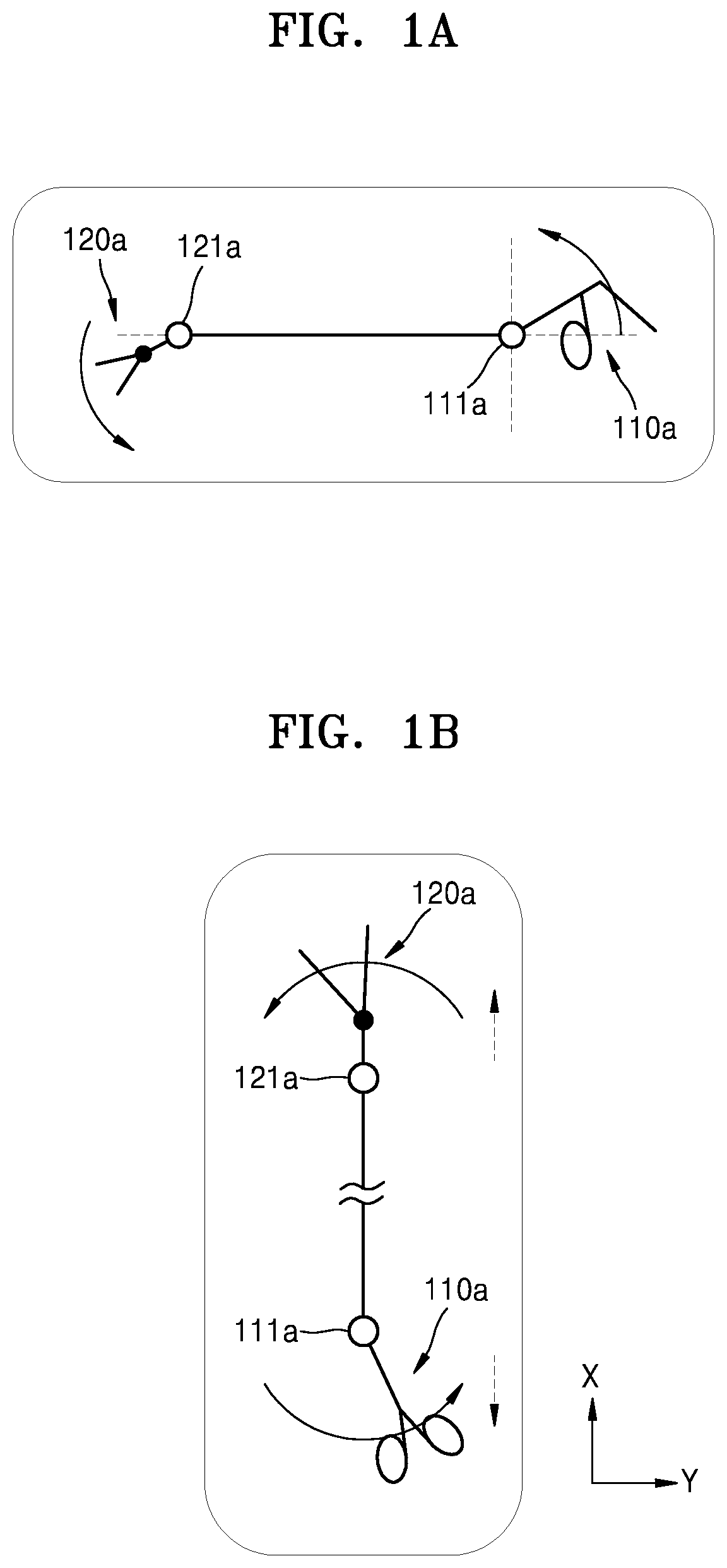
A is a conceptual diagram of a pitch operation in a surgical instrument according to the related art, and B is a conceptual diagram of a yaw operation.
Referring to A , in performing a pitch operation of a surgical instrument according to the related art, in a state where an end tool 120 a is formed in front of a rotating center 121 a of the end tool and a manipulator 110 a is formed behind a rotating center 111 a of the manipulator, when the manipulator 110 a is rotated in a clockwise direction, the end tool 120 a is also rotated in the clockwise direction, and when the manipulator 120 a is rotated in a counter-clockwise direction, the end tool 120 a is also rotated in the counter-clockwise direction. In addition, referring to B , in performing a yaw operation of the surgical instrument according to the related art, in a state where the end tool 120 a is formed in front of the rotating center 121 a of the end tool and the manipulator 110 a is formed behind the rotating center 111 a of the manipulator, when the manipulator 110 a is rotated in the clockwise direction, the end tool 120 a is also rotated in the clockwise direction and when the manipulator 120 a is rotated in the counter-clockwise direction, the end tool 120 a is also rotated in the counter-clockwise direction. In this case, when it comes to left and right sides of a user, when the user moves the manipulator 110 a to the left side, the end tool 120 a is moved to the right side, and when the user moves the manipulator 110 a to the right side, the end tool 120 a is moved to the left side. Consequently, the manipulation direction of the user and the operating direction of the end tool are opposite to each other, and thus, it may not be easy for the user to manipulate the surgical instrument.
C is a conceptual diagram of a pitch operation in a surgical instrument according to another related art, and D is a conceptual diagram of a yaw operation.
Referring to C , since a part of the surgical instrument according to the related art is formed as a mirror symmetry type, in a state where the end tool 120 b is formed in front of the rotating center 121 b of the end tool and the manipulator 110 b is formed behind the rotating center 111 b of the manipulator when performing a pitch operation, when the manipulator 110 b is rotated in the clockwise direction, the end tool 120 b is rotated in the counter-clockwise direction, and when the manipulator 110 b is rotated in the counter-clockwise direction, the end tool 120 b is rotated in the clockwise direction. In this case, when it comes to rotating directions of the manipulator and the end tool, the direction in which the user rotates the manipulator 110 b and the rotating direction of the end tool 120 b are opposite to each other. Consequently, the user may feel confusion in manipulation, operations of a joint are not intuitive, and a mistake may occur in manipulation. In addition, referring to D , during the yaw operation, in a state where the end tool 120 b is formed in front of the rotating center 121 b of the end tool and the manipulator 110 b is formed behind the rotating center 111 b of the manipulator, when the manipulator 110 b is rotated in the clockwise direction, the end tool 120 b is rotated in the counter-clockwise direction, and when the manipulator 110 b is rotated in the counter-clockwise direction, the end tool 120 b is rotated in the clockwise direction. In this case, when it comes to rotating directions of the manipulator and the end tool, the direction in which the user rotates the manipulator 110 b and the rotating direction of the end tool 120 b are opposite to each other. Consequently, the user may feel confusion in manipulation, operations of a joint are not intuitive, and a mistake may occur in manipulation.
To address the above problem, in a surgical instrument illustrated with reference to E and 1 F according to an embodiment of the present invention, an end tool 120 c is formed in front of a rotating center 121 c of the end tool and a manipulator 110 c is also formed in front of a rotating center 111 c of the manipulator, operations of the manipulator 110 c and the end tool 120 c intuitively coincide with each other.
In other words, in the surgical instrument according to the related art as shown in A, 1 B, 1 C, and 1 D , the end tool is located in front of the rotating center thereof, whereas the manipulator is located behind the rotating center thereof, and thus, the end tool, a front portion of which is moved in a state where a rear portion of which is fixed, is moved via the operation of the manipulator, a rear portion of which is moved in a state where a front portion of which is fixed, and structures do not intuitively match with each other. As such, inconsistency occurs between the manipulation of the manipulator and the operation of the end tool in view of the left-and-right direction or the rotating direction, the user may be confused, and the manipulator may not be manipulated intuitively and rapidly and mistakes of the user may occur. On the other hand, in the surgical instrument according to the embodiment of the present invention, the end tool and the manipulator are moved based on the rotating centers located at rear portions thereof, and thus, operations of the end tool and the manipulator may intuitively match with each other. Accordingly, the user may adjust intuitively and rapidly the direction of the end tool, and a possibility of generating mistakes is greatly reduced. Hereinafter, the present invention will be described below in more detail.
is a side view of a surgical instrument 100 according to a first embodiment, is an internal detailed diagram of the surgical instrument 100 of , is an internal detailed diagram of a yaw operator 112 of the surgical instrument 100 of , and is an internal detailed diagram of an actuation operator 113 of the surgical instrument 100 of .
Referring to to 5 , the surgical instrument 100 according to the first embodiment includes a manipulator 110 , an end tool 120 , a power transfer unit 130 , and a connection unit 140 . Here, the connection unit 140 is formed as a hollow shaft shape, in which one or more wires (will be described later) may be accommodated. In addition, the manipulator 110 is coupled to an end portion of the connection unit 140 and the end tool 120 is coupled to the other end portion so that the connection unit 140 connects the manipulator 110 to the end tool 120 .
In detail, the manipulator 110 is provided at one end portion of the connection unit 140 , and includes an interface that a doctor may directly manipulate, for example, an interface provided as forceps, a stick shape, a lever shape, etc. Thus, when the doctor manipulates the interface, the end tool 120 that is inserted into the body of a patient who is getting surgery operates to perform the surgery. Here, in , the manipulator 110 is formed as forceps, but the present invention is not limited thereto, that is, manipulators of various types that may be connected to the end tool 120 to manipulate the end tool 120 may be provided.
The end tool 120 is provided at the other end portion of the connection unit 140 , and is inserted to a surgical site and performs necessary operations. As an example of the end tool 120 , a pair of jaws (see 121 and 122 of A ) for performing a grip operation may be used as shown in . However, the present invention is not limited thereto, but various devices for performing the surgery may be used as the end tool 120 . For example, a one-armed cautery may be used as the end tool. The end tool 120 is connected to the manipulator 110 via the power transfer unit 130 to receive a driving power of the manipulator 110 through the power transfer unit 130 , and then, performs operations required in surgery, e.g., grip, cutting, suturing, and etc.
Here, the end tool 120 of the surgical instrument 100 according to the first embodiment of the present invention is provided to be capable of rotating in at least two directions, for example, the end tool 120 may be formed to perform a pitch operation about a Y-axis of , and at the same time, to perform a yaw operation and an actuation operation about a Z-axis of . This will be described in detail later.
The power transfer unit 130 connects the manipulator 110 and the end tool 120 to each other to transfer the driving power of the manipulator 110 to the end tool 120 , and may include a plurality of wires, pulleys, links, joints, gears, etc.
Hereinafter, the manipulator 110 , the end tool 120 , the power transfer unit 130 , etc. of the surgical instrument 100 of will be described in detail below.
(Manipulator)
Referring to to 5 , the manipulator 110 of the surgical instrument 100 according to the first embodiment of the present invention includes a pitch operator 111 controlling a pitch movement of the end tool 120 , a yaw operator 112 controlling a yaw movement of the end tool 120 , and an actuation operation 130 controlling an actuation movement of the end tool 120 .
As an exemplary utilization of the surgical instrument 100 of , a user may rotate a pitch operation grip 1112 in a state of gripping the pitch operation grip 1112 of the pitch operator 111 with his/her palm to perform the pitch movement, may rotate the yaw operator 112 in a state where the index finger is inserted to the yaw operator 112 to perform the yaw movement, and may rotate the actuation operator 113 in a state where the thumb finger is inserted to the actuation operator 113 to perform the actuation movement.
Here, the pitch operation, the yaw operation, and the actuation operation used in the present invention may be defined as follows:
First, the pitch operation denotes a vertical movement with respect to an extension direction of the connection unit 140 (X-axis direction in ), that is, an operation of rotating about the Y-axis of . In other words, the pitch operation denotes a vertical rotation of the end tool 120 extending in the extension direction of the connection unit 140 (X-axis direction of ) about the Y-axis. Next, the yaw operation denotes a movement in the left-and-right direction with respect to the extension direction of the connection unit 140 (X-axis direction of ), that is, a rotating movement about the Z-axis of . That is, the yaw operation denotes a rotating movement of the end tool 120 extending in the extension direction (X-axis direction of ) of the connection unit 140 in the left-and-right direction based on the Z-axis. In addition, the actuation operation denotes a folding or unfolding operation of two jaws (see 121 and 122 of A ), when the two jaws rotate in opposite directions about the same rotating axis as that of the yaw operation. That is, the actuation operation denotes the rotation of the two jaws (see 121 and 122 of A ) formed at the end tool 120 in opposite directions about the Z-axis.
Here, when the manipulator 110 of the surgical instrument 100 according to the first embodiment of the present invention is rotated in one direction, the end tool 120 rotates in a direction that is intuitively identical to the manipulation direction of the manipulator 110 . In other words, when the pitch operator 111 of the manipulator 110 is rotated in one direction, the end tool 120 also rotates in a direction intuitively identical to the above direction to perform a pitch movement, and when the yaw operator 112 of the manipulator 110 is rotated in one direction, the end tool 120 also rotates in a direction that is intuitively identical to the above direction to perform the yaw movement. Here, the intuitively identical direction denotes that a movement direction of an index finger of the user gripping the manipulator 110 is substantially the same as a movement direction of the end portion of the end tool 120 . The identical direction may not be an exactly identical direction on a three-dimensional (3D) coordinate system, for example, it may be appreciated that when the index finger of the user moves to the left, the end portion of the end tool 120 also moves to the left, and when the index finger of the user moves to the right, the end portion of the end tool 120 also moves to the right.
In addition, to this end, the surgical instrument 100 according to the first embodiment of the present invention is characterized in that the manipulator 110 and the end tool 120 are formed in the same direction with respect to a plane that is perpendicular to an extension axis (X-axis) of the connection unit 140 . That is, in view of a YZ plane of , the manipulator 110 extends in a +X-axis direction, and at the same time, the end tool 120 also extends in the +X-axis direction. In other words, a direction in which the end tool 120 is formed at one end portion of the connection unit 140 and a direction in which the manipulator 110 is formed at the other end portion of the connection unit 140 may be the same as each other based on the YZ plane. In other words, it may be understood that the manipulator 110 is formed away from a body of the user gripping the manipulator 110 , that is, in a direction in which the end tool 120 is formed.
In detail, in the surgical instrument according to the related art, since the manipulation direction of the manipulator by the user is different from and is not intuitively identical to an actual operation direction of the end tool, a surgical operator has difficulty in performing an intuitive operation and it takes the surgical operator a long time to skillfully move the end tool in a desired direction, and in some cases, a wrong operation occurs, and thus damaging a patient.
To address the above problem, the surgical instrument 100 according to the first embodiment of the present invention is configured so that the manipulation direction of the manipulator 110 and the operation direction of the end tool 120 are intuitively identical to each other, and to do this, the manipulator 110 and the end tool 120 are formed at the same side based on the YZ plane including a pitch operating joint 1111 . This will be described below in more detail.
Referring to to 5 , the manipulator 110 of the surgical instrument 100 according to the first embodiment of the present invention includes a pitch operator 111 controlling a pitch movement of the end tool 120 , a yaw operator 112 controlling a yaw movement of the end tool 120 , and an actuation operation 130 controlling an actuation movement of the end tool 120 .
The pitch operator 111 includes a pitch operating joint 1111 and a pitch operating grip 1112 . Here, the pitch operating joint 1111 may be formed to be rotatable about the Y-axis, and the pitch operating grip 1112 is connected to the pitch operating joint 1111 to be rotatable with the pitch operating joint 1111 . Here, since the pitch operating joint is a curved type joint, when the pitch operating grip is rotated about the Y-axis, the pitch operating joint is curved or bent accordingly. However, bending of the pitch operating joint will be expressed as rotating of the pitch operating joint for convenience of description.
For example, when the user grips and rotates the pitch operating grip 1112 , the pitch operating joint 1111 connected to the pitch operating grip 1112 rotates along with the pitch operating grip 1112 , and then, the rotating force is transmitted to the end tool 120 via the power transfer unit 130 to make the end tool 120 rotate in the same direction as the rotating direction of the pitch operating joint 1111 . That is, when the pitch operator 111 rotates in the clockwise direction around the pitch operating joint 1111 , the end tool 120 also rotates in the clockwise direction around an axis parallel to that of the pitch operating joint 1111 , and when the pitch operator 111 rotates in the counter-clockwise direction around the pitch operating joint 1111 , the end tool 120 also rotates in the counter-clockwise direction around the axis parallel to that of the pitch operating joint 1111 .
Here, the pitch operating joint 1111 may be a curved type joint member. In detail, the pitch operating joint 1111 is formed as a hollow cylinder shape, and a plurality of recesses 1111 a are formed in an outer circumferential surface thereof in a direction (X-axis direction of ) so that the pitch operating joint 1111 may be curved. Here, a rib 1111 b is formed at a center portion of each of the recesses 1111 a for determining a curvature direction of the pitch operating joint 1111 . That is, at a portion where the rib 1111 b is formed, the curvature is not performed, and the curvature of the pitch operating joint 1111 is performed at the portion where the rib 1111 b is not formed. That is, as shown in , since the ribs 1111 b are formed along opposite side surfaces of the pitch operating joint 1111 , the pitch operating joint 1111 may be curved upward or downward where the ribs 1111 b are not formed. Therefore, although an actual rotating axis does not exist in the pitch operating joint 1111 , it may be assumed that the pitch operating joint 1111 rotates in an up-and-down direction about a P-axis of . Therefore, the pitch operating joint 1111 is formed as a curved type joint member, and becomes a rotating center of the pitch movement.
In addition, the yaw operator 112 and the actuation operator 113 are formed at one end portion of the pitch operating grip 1112 of the pitch operator 111 . Therefore, when the pitch operator 111 rotates about the pitch operating joint 1111 , the yaw operator 112 and the actuation operator 113 also rotate along with the pitch operator 111 .
As such, a coordinate system of the yaw operator 112 and the actuation operator 113 is not fixed, but relatively changes according to the rotation of the pitch operator 111 . That is, in , a yaw operating axis 1121 of the yaw operator 112 is in parallel to the Z-axis, and an actuation operating axis 1131 of the actuation operator 113 is in parallel with the Y-axis. However, when the pitch operator 111 rotates, the yaw operating axis 1121 of the yaw operator 112 and the actuation operating axis 1131 of the actuation operator 113 are not parallel with the Z-axis and the Y-axis. That is, the coordinate system of the yaw operator 112 and the actuation operator 113 has changed according to the rotation of the pitch operator 111 . However, in the present specification, the coordinate system of the yaw operator 112 and the actuation operator 113 will be described on the assumption that the pitch operating grip 1112 is perpendicular to the connection unit 140 as shown in , for the convenience of the description.
The yaw operator 112 includes the yaw rotating axis 1121 and a yaw rotating member 1122 . Here, the yaw rotating axis 1121 may be formed to be at a predetermined angle with respect to an XY plane where the connection unit 140 is formed. For example, the yaw rotating axis 1121 may be formed in a direction parallel to the Z-axis as shown in , and in this state, when the pitch operator 111 rotates, the coordinate system of the yaw operator 112 may be relatively changed as described above. However, the present invention is not limited thereto, and the yaw rotating axis 1121 may be formed in various directions by ergonomic design according to the structure of a hand of the user gripping the yaw operator 112 .
The yaw rotating member 1122 is connected to the yaw rotating axis 1121 to rotate along with the yaw rotating axis 1121 . For example, when the user holds and rotates the yaw rotating member 1122 with the index finger, the yaw rotating axis 1121 connected to the yaw rotating member 1122 rotates along with the yaw rotating member 1122 , and the rotating force is transmitted to the end tool 120 via the power transfer unit 130 so that two jaws (see 121 and 122 of A ) of the end tool 120 rotate in the left-and-right direction, e.g., the same direction as the rotating direction of the yaw rotating axis 1121 . To do this, a pulley 1121 a may be formed at the yaw rotating axis 1121 . In addition, a yaw wire 132 W may be connected to the pulley 1121 a . The yaw wire 132 W is connected to a joint member 125 of the end tool 120 , wherein the joint member 125 will be described later with reference to A , to rotate the joint member 125 .
The actuation operator 113 includes an actuation rotating axis 1131 and an actuation rotating member 1132 . Here, the actuation rotating axis 1131 may be formed to be at a predetermined angle with respect to an XY plane where the connection unit 140 is formed. For example, the actuation rotating axis 1131 may be formed in a direction parallel to the Y-axis as shown in , and in this state, when the pitch operator 111 rotates, the coordinate system of the actuation yaw operator 113 may be relatively changed as described above. However, the present invention is not limited thereto, and the actuation rotating axis 1131 may be formed in various directions by ergonomic design according to the structure of a hand of the user gripping the actuation operator 113 .
In addition, the actuation rotating member 1132 is connected to the actuation rotating axis 1131 to rotate with the actuation rotating axis 1131 . For example, when the user holds and rotates the actuation rotating member 1132 with the thumb finger, the actuation rotating axis 1131 , to which the actuation rotating member 1132 is connected, rotates, and the rotating force is transmitted to the end tool 120 via the power transfer unit 130 so that two jaws (see 121 and 122 of A ) of the end tool 120 perform the actuation movement. Here, the actuation movement denotes an operation of folding or unfolding the two jaws (see 121 and 122 of A ) by rotating the two jaws (see 121 and 122 of A ) in opposite directions, as described above. That is, when the actuation operator 113 is rotated in one direction, as a first jaw (see 121 of A ) rotates in the counter-clockwise direction and a second jaw (see 122 of A ) rotates in the clockwise direction, the end tool 120 is closed. On the other hand, when the actuation operator 113 is rotated in the opposite direction, as the first jaw (see 121 of A ) rotates in the clockwise direction and the second jaw (see 122 of A ) rotates in the counter-clockwise direction, the end tool 120 is open.
In addition, a first actuation link 133 L 1 may be connected to an end portion of the actuation rotating axis 1131 , a second actuation link 133 L 2 may be connected to an end portion of the first actuation link 133 L 1 , and a third actuation link 133 L 3 may be connected to an end portion of the second actuation link 133 L 2 . Here, a pivot point 133 L 3 P is formed at the third actuation link 133 L 3 so as to perform as a central point of the movement of the third actuation link 133 L 3 . In addition, a guide protrusion 133 L 3 e is formed at an end portion of the third actuation link 133 L 3 , and a guide recess 1112 h may be formed in the pitch operating grip 1112 .
Therefore, when the actuation rotating axis 1131 rotates, the first actuation link 133 L 1 connected to the actuation rotating axis 1131 rotates, and when the first actuation link 133 L 1 rotates, the second actuation link 133 L 2 connected to the first actuation link 133 L 1 moves up and down in the Z-axis direction. In addition, when the second actuation link 133 L 2 moves up and down in the Z-axis direction, the third actuation link 133 L 3 connected to the second actuation link 133 L 2 rotates about the pivot point 133 L 3 P, and thus, the guide protrusion 133 L 3 e of the third actuation link 133 L 3 linearly moves along the guide recess 1112 h of the pitch operating grip 1112 in the X-axis direction. In addition, an actuation wire 133 W is connected to the guide protrusion 133 L 3 e of the third actuation link 133 L 3 , and thus, when the guide protrusion 133 L 3 e linearly moves in the X-axis direction, the actuation wire 133 W also linearly moves in the X-axis direction. In addition, the actuation wire 133 W is connected to an actuation guide pin 133 WG of the end tool 120 , which will be described later with reference to A to 7 C , to control the actuation movement of the jaws 121 and 122 .
Referring to to 5 , in the surgical instrument 100 according to the first embodiment of the present invention, the pitch operator 111 and the end tool 120 are formed coaxially or on axes parallel with each other (X-axis). That is, the pitch operating joint 1111 of the pitch operator 111 is formed at an end portion of the connection unit 140 , and the end tool 120 is formed at the other end portion of the connection unit 140 . Here, although the connection unit 140 is formed straight in the drawings, but the present invention is not limited thereto. That is, the connection unit 140 may be curved to have a predetermined curvature rate or bent once or more if necessary, and in this case, it may be understood that the pitch operator 111 and the end tool 120 are formed substantially on the same or parallel axis. In addition, although the pitch operator 111 and the end tool 120 are shown to be formed at the same axis (X-axis) in , but the present invention is not limited thereto, and the pitch operator 111 and the end tool 120 may be formed on different axes from each other. This will be described later.
A to 6 D are diagrams of various modified examples of the manipulator 110 of the surgical instrument 100 according to the first embodiment of the present invention.
As for H 1 of A , as described above with reference to , etc., the pitch operator 111 and the yaw operator 112 of the manipulator 110 are formed independently from each other, and thus, the pitch operator 111 and the yaw operator 112 are functionally distinguished from each other. H 1 may be seen in the first, second, and third embodiments of the present invention.
As for H 21 of B , 1) a pitch/yaw operator 411 in which a pitch operator and a yaw operator are integrally formed is provided in a manipulator 410 in order to perform functions of both the pitch operator and the yaw operator. 2) Here, the pitch/yaw operator 411 is formed above an extension line of an end tool 420 . 3) In addition, an actuation operator 413 is formed on the pitch/yaw operator 411 so as to independently rotate on the pitch/yaw operator 411 . H 21 may be seen in the fourth embodiment of the present invention.
As for H 22 of C , 1) a pitch/yaw operator 511 in which a pitch operator and a yaw operator are integrally formed is provided in a manipulator 510 in order to perform functions of both the pitch operator and the yaw operator. 2) Here, the pitch/yaw operator 511 is formed on an extension line of an end tool 520 . 3) In addition, an actuation operator 513 is formed on the pitch/yaw operator 511 to rotate with the pitch/yaw operator 511 when the pitch/yaw operator 511 rotates, and is provided to independently rotate on the pitch/yaw operator 511 . H 22 may be seen in the fifth, sixth, and seventh embodiments of the present invention.
As for H 23 of D , 1) a pitch/yaw operator 811 in which a pitch operator and a yaw operator are integrally formed is provided in a manipulator 810 in order to perform functions of both the pitch operator and the yaw operator. 2) In addition, the pitch/yaw operator 811 is formed on an extension line of an end tool 820 , and a connection unit 840 is not straight, but is bent at least once. 3) In addition, an actuation operator 813 is formed on the pitch/yaw operator 811 to rotate with the pitch/yaw operator 811 when the pitch/yaw operator 811 rotates, and is provided to independently rotate on the pitch/yaw operator 811 . H 23 may be seen in the eighth, ninth, and tenth embodiments of the present invention.
Also, various modified examples of the manipulator including the above modified examples may be applied to the surgical instrument according to the present invention.
(End Tool)—Curved Type
A is a coupling perspective view of an end tool applied to the surgical instrument 100 according to the first embodiment, B is an exploded perspective view of the end tool of A , C is a perspective view showing the end tool of A , from which a jaw base 123 and a joint member 125 are omitted, and D is a front view of the joint member 125 of the end tool of A .
Referring to A to 7 D , the end tool 120 applied to the surgical instrument 100 according to the first embodiment of the present invention adopts a curved type joint member as the joint member 125 . That is, the end tool 120 includes the first jaw 121 , the second jaw 122 , the jaw base 123 , and the joint member 125 . In addition, the power transfer unit 130 applied to the surgical instrument 100 according to the first embodiment of the present invention includes one or more pitch wires 131 W, one or more yaw wires 132 W, and an actuation wire 133 W.
In the present embodiments, the pitch operation is performed via the moving of the pitch wire connected to the joint member, and the yaw operation is performed via the moving of the yaw wire connected to the joint member. Here, the actuation wire extends towards the end tool across among the pitch wires and the yaw wires, and is connected to a recess formed in each of the two jaws. In addition, the actuation operation, that is, folding and unfolding of the two jaws, is performed by pushing and pulling of the actuation wires. Here, since the actuation wire is provided at the center across between the pitch wires and the yaw wires, moving of the pitch wires and the yaw wires in the pitch operation and the yaw operation do not affect the actuation wire.
In addition, when the pitch operation is performed as lengths of the pitch wires at opposite sides are differentiated from each other, the yaw wire crossing the center between the opposite pitch wires is not affected by the pitch operation, and likewise, when the yaw operation is performed as lengths of the yaw wires at opposite sides are differentiated from each other, the pitch wire crossing the center between the opposite yaw wires is not affected by the yaw operation. This will be described in more detail later.
A whole structure of the end tool 120 will be described in detail.
In detail, the joint member 125 is formed at an end portion of the connection unit 140 . Here, the surgical instrument according to the first embodiment of the present invention may use the curved type joint member as the joint member 125 of the end tool 120 . That is, in the present embodiment, the joint member 125 is configured by using the curved type joint member for performing the pitch operation and the yaw operation.
The joint member 125 formed as the curved type has a hollow cylinder shape, and a plurality of recesses 125 a are formed in an outer circumferential surface in a direction (X-axis direction of A ) to be curved. Here, first ribs 125 P and second ribs 125 Y for guiding a curved direction of the joint member 125 are formed at a center in each of the recesses 125 a . That is, the joint member is not curved at the portions where the ribs 125 P and 125 Y are formed, but is mainly curved at portions where the ribs 125 P and 125 Y are not formed.
Here, the first ribs 125 P for guiding the curve of the joint member 125 in a first direction (e.g., the pitch movement) and the second ribs 125 Y for guiding the curve of the joint member 125 in a second direction (e.g., the yaw movement) are formed in the joint member 125 . Here, the second ribs 125 Y may be offset a predetermined degree with respect to the first ribs 125 P. In addition, the first ribs 125 P and the second ribs 125 Y may be alternatively formed in a manner that the first ribs 125 P are formed in even-numbered recesses 125 a and the second ribs 125 Y are formed in odd-numbered recesses 125 a.
That is, in A , the first ribs 125 P are formed along opposite sides of the joint member 125 , and thus, the joint member 125 may be curved in the up-and-down direction. Therefore, although an actual rotating axis does not exist in the joint member 125 , it may be assumed that the joint member 125 rotates in an up-and-down direction about the Y-axis of A . Therefore, the joint member 125 may become the rotating center of the pitch movement.
In addition, since the second ribs 125 Y are formed along upper and lower surfaces of the joint member 125 , the joint member 125 may be curved in the left-and-right direction. Therefore, although an actual rotating axis does not exist in the joint member 125 , it may be assumed that the joint member 125 rotates in the left-and-right direction about the Z-axis of A . Therefore, the joint member 125 may become the rotating center of the yaw movement. Here, the first ribs 125 P and the second ribs 125 Y do not have to be formed on a vertical plane or a horizontal plane of the joint member 125 , but may be offset a predetermined degree from the vertical plane or the horizontal plane of the joint member 125 .
In addition, opposite ends of the pitch wires 131 W and the yaw wires 132 W are respectively coupled to the end portions of the joint member 125 at the sides of the first and second jaws 121 and 122 . Therefore, when an end portion of the pitch wire 131 W is pulled, an end portion of the joint member 125 connected to the pitch wire 131 W is also pulled, and thus, the joint member 125 rotates about the Y-axis of A to perform the pitch movement. Likewise, when an end portion of the yaw wire 132 W is pulled, an end portion of the joint member 125 connected to the yaw wire 132 W is also pulled, and thus, the joint member 125 rotates about the Z-axis of A to perform the yaw movement.
In addition, pitch wire through holes 125 PH, yaw wire through holes 125 YH, and an actuation wire through hole 125 AH are formed at an end portion (not shown) of the connection unit 140 and an end portion of the joint member 125 facing the end portion of the connection unit. In addition, the pitch wires 131 W extend from the connection unit 140 to the end tool 120 through the pitch wire through hole 125 PH and are coupled to the other end portion of the joint member 125 . In addition, the yaw wires 132 W extend from the connection unit 140 to the end tool 120 through the yaw wire through hole 125 YH and are coupled to the other end portion of the joint member 125 . Also, the actuation wire 133 W extends from the connection unit 140 to the end tool 120 through the actuation wire through hole 125 AH. In addition, the actuation wire 133 W that has passed through the actuation wire through hole 125 AH is connected to the actuation guide pin 133 WG.
Here, the pitch wire through holes 125 PH are formed at opposite end portions of the diameter of the joint member 125 in the Z-axis direction as shown in D to control the pitch movement. In addition, the yaw wire through holes 125 YH are formed at opposite end portions of the diameter of the joint member 125 in the Y-axis direction as shown in D to control the yaw movement. In addition, the actuation wire 125 AH is formed at the center of the joint member 125 as shown in D to control the actuation movement.
As described above, the yaw movement is performed by pulling one of the opposite yaw wires, and at this time, lengths of the actuation wire and the pitch wire passing through the center between the opposite yaw wires are not changed, and thus, the yaw operation is independently performed from the actuation operation and the pitch operation. Likewise, the pitch operation is performed by pulling one of the opposite pitch wires, and at this time, lengths of the actuation wire and the yaw wire passing through the center between the opposite pitch wires are not changed, and thus, the pitch operation is independently performed from the actuation operation and the yaw operation.
In addition, axis through holes 121 a and 122 a are respectively formed in the first and second jaws 121 and 122 , and an actuation axis 120 AX is inserted through the axis through holes 121 a and 122 a of the first and second jaws 121 and 122 . The first and second jaws 121 and 122 rotate about the actuation axis 120 AX.
In addition, guide holes 121 b and 122 b are formed at one sides of the axis through holes 121 a and 122 a of the first and second jaws 121 and 122 , and the actuation guide pin 133 WG is inserted through the guide holes 121 b and 122 b of the first and second jaws 121 and 122 . The actuation wire 133 W is coupled to the actuation guide pin 133 WG, and when the actuation wire 133 W reciprocates along the X-axis, the actuation guide pin 133 WG connected to the actuation wire 133 W reciprocates along the guide hole 121 b . Accordingly, the first jaw 121 and the second jaw 122 rotate about the actuation axis 120 AX to perform the actuation operation. That is, the actuation operation, in which two jaws are folded or unfolded simultaneously, may be performed by one actuation wire going forward or backward.
As described above, the end tool 120 of the surgical instrument 100 according to the first embodiment separately include the wire for the pitch operation, the wire for the yaw operation, and the wire for the actuation operation, so that one operation may not affect the other operations.
First, the yaw operation according to the present embodiment will be described below.
Referring to , 8 , and 9 , the yaw wire 132 W of the end tool 120 for performing the yaw operation connects the yaw operator 112 of the manipulator 110 to the joint member 125 of the end tool 120 . Therefore, when the yaw operator 112 rotates in the counter-clockwise direction about the yaw rotating axis 1121 , the yaw wire 132 W at the side of the manipulator 110 is entirely moved in an arrow direction in , and accordingly, between the yaw wires 132 W at the end tool 120 side, the yaw wire 132 W at the left side in is pushed towards the end tool from the manipulator and the yaw wire 132 W at the right side is pulled to move in a direction denoted by the arrow Y 1 in . Thus, the joint member 125 connected to the yaw wire 132 W and the first and second jaws 121 and 122 connected to the joint member 125 rotate in a direction denoted by the arrow Y in about the joint member 125 to perform the yaw operation. That is, when the yaw operator 112 rotates in a direction about the yaw rotating axis 1121 , the joint member 125 of the end tool 120 and the first and second jaws 121 and 122 connected to the joint member 125 also rotate in the same direction, and accordingly, the manipulating direction of the manipulator 110 and the operating direction of the end tool 120 are intuitively identical to each other.
Next, the pitch operation according to the present embodiment will be described below.
Like the above-described yaw operation, the pitch wires 131 W for performing the pitch operation of the end tool 120 connect the pitch operation (see 111 of ) of the manipulator (see 110 of ) to the joint member 125 of the end tool 120 . Therefore, when the pitch operator (see 111 of ) rotates about the pitch operating joint (see 1111 of ), the pitch wires 131 W connected to the pitch operator rotates, and accordingly, the joint member 125 connected to the pitch wires 131 W and the first and second jaws 121 and 122 connected to the joint member 125 rotate about the joint member 125 to perform the pitch operation. That is, when the pitch operator (see 111 of ) rotates in a direction about the pitch operating joint (see 1111 of ), the joint member 125 of the end tool 120 and the first and second jaws 121 and 122 connected to the joint member 125 also rotate in the same direction, the manipulating direction of the manipulator 110 and the operating direction of the end tool 120 intuitively match with each other.
Next, the actuation movement according to the present embodiment will be described below.
Referring to , the actuation wire 133 W for performing the actuation movement of the end tool 120 connects the actuation operator 113 of the manipulator 110 to the actuation guide pin 133 WG of the end tool 120 . Therefore, when the actuation operator 113 rotates in an arrow A direction of about the actuation rotating axis 1131 , the first actuation link 133 L 1 , the second actuation link 133 L 2 , and the third actuation link 133 L 3 that are sequentially connected to the actuation operator are respectively moved. Here, the pivot point 133 L 3 P is formed at the third actuation link 133 L 3 so as to perform as a central point of the rotation of the third actuation link 133 L 3 . In addition, when the third actuation link 133 L 3 rotates about the pivot point 133 L 3 P as described above, the guide protrusion 133 L 3 e of the third actuation link 133 L 3 linearly moves in an arrow C direction of , and the actuation wire 133 W connected to the guide protrusion 133 L 3 e linearly moves in the arrow A direction of in a state as shown in A . Therefore, as the actuation guide pin 133 WG connected to the actuation wire 133 W moves along the guide holes 121 b and 122 b , the first and second jaws 121 and 122 rotate about the actuation axis 120 AX, and then, the actuation operation of unfolding the first and second jaws 121 and 122 is performed.
Various modified examples of the end tool will be described later with reference to to 36 .
Total Movements According to the First Embodiment
Hereinafter, total configurations of the pitch operation, the yaw operation, and the actuation operation of the surgical instrument 100 according to the first embodiment of the present invention will be summarized as follows, with reference to the above descriptions.
The pitch operation is as follows.
As described above, when the user holds and rotates the pitch operating grip 1112 of the pitch operator 111 in an arrow P (pitch) direction of about the pitch operating joint 1111 , the joint member 125 connected to the pitch operator 111 via the pitch wires 131 W and the first and second jaws 121 and 122 connected to the joint member rotate about the Y-axis to perform the pitch operation. That is, when the pitch operator 111 rotates in a direction about the pitch operating joint 1111 , the joint member 125 of the end tool 120 and the first and second jaws 121 and 122 connected to the joint member 125 also rotate in the same direction, and accordingly, the manipulating direction of the manipulator 110 and the operating direction of the end tool 120 match with each other intuitively.
Next, the yaw operation according to the present embodiment will be described below.
When the user holds and rotates the yaw rotating member 1122 in the arrow Y direction of with the index finger, the yaw rotating member 1122 rotates about the yaw rotating axis 1121 , and then, the rotating force rotates the joint member 125 connected to the yaw operator 112 via the yaw wires 132 W and the jaws 121 and 122 connected to the joint member about the Z-axis to perform the yaw operation. That is, when the yaw operator 112 rotates in a direction about the yaw rotating axis 1121 , the joint member 125 of the end tool 120 and the first and second jaws 121 and 122 connected to the joint member 125 also rotate in the same direction, and accordingly, the manipulating direction of the manipulator 110 and the operating direction of the end tool 120 are intuitively identical to each other.
Next, the actuation operation according to the present embodiment will be described below.
When the user holds and rotates the actuation rotating member 1132 in the arrow A direction of with the thumb finger, the actuation rotating member 1132 rotates about the actuation rotating axis 1131 , and thus, the first actuation link 133 L 1 connected to the actuation rotating axis 1131 rotates with the actuation rotating axis 1131 and the second actuation link 133 L 2 connected to the first actuation link 133 L 1 descends in the arrow B direction of . In addition, when the second actuation link 133 L 2 descends in the arrow B direction of , the third actuation link 133 L 3 connected to the second actuation link 133 L 2 rotates in the counter-clockwise direction along the pivot point 133 L 3 P, and thus, the guide protrusion 133 L 3 e of the third actuation link 133 L 3 linearly moves along the guide recess 1112 h of the pitch operating grip 1112 in the X-axis direction along the arrow C of . Therefore, the actuation wire 133 W connected to the guide protrusion 133 L 3 e of the third actuation link 133 L 3 also linearly moves in the arrow C direction along the X-axis, and the actuation wire 133 W makes the actuation guide pin (see 133 WG of ) of the end tool (see 120 of ) linearly move and the first and second jaws 121 and 122 rotate in opposite directions to each other to perform the actuation operation of folding the jaws. On the contrary, when the actuation rotating member 1132 is rotated in the opposite direction to the arrow A of , the first and second jaws 121 and 122 rotate in the opposite direction to the above to perform the actuation operation of unfolding the jaws.
BEST MODE
Classification of the First, Second and Third Embodiments of the Surgical Instrument
Hereinafter, before describing the surgical instrument according to the second and third embodiments, criteria for classifying the first, second, and third embodiments of the surgical instrument according to the present invention will be described below.
A, 11 B, and 11 C are schematic diagrams illustrating pitch operation of the surgical instruments according to the first, second, and third embodiments of the present invention, and D is a schematic diagram of the yaw operation of the surgical instruments according to the first, second, and third operation of the present invention.
First, the yaw operations in the first, second, and third embodiments are described as follows.
According to the first, second, and third embodiments, the yaw movements are commonly performed by the index finger. That is, as shown in D , since the yaw movement in the first, second, and third embodiments is performed by the index finger, the pivot point is naturally located behind the moving part, and thus, the manipulating direction of the manipulator by the user and the actual operating direction of the end tool intuitively coincide with each other.
Next, the pitch operations according to the first, second, and third embodiments of the present invention will be described as follows. Here, the first, second, and third embodiments of the surgical instrument of the present invention are classified in view of locational relationship between of a virtual center line of the pitch operating grip in the Z-axis direction and a virtual center line of the pitch operating joint in the Z-axis direction.
Here, “the virtual center line X 2 of the pitch operating joint in the Z-axis direction” denotes a virtual axis in the Z-axis direction, which perpendicularly meets a rough center point of the pitch operating joint that is not in curved state in the X-axis direction, or an axis that is perpendicular to a virtual rotating center of the pitch operating joint in the Y-axis direction on a YZ plane including a virtual rotating center axis of the pitch operating joint in the Y-axis direction. Hereinafter, the above axis will be referred to as “a virtual center axis of the pitch operating joint in the Z-axis direction”.
Referring to A , according to the surgical instrument of the first embodiment, the virtual center axis of the pitch operating grip in the Z-axis direction is closer to the end tool than the virtual center axis of the pitch operating joint in the Z-axis direction. That is, the virtual center axis X 1 of the pitch operating grip 1112 in the Z-axis direction in the surgical instrument 100 is closer to the end tool than the virtual center axis X 2 of the pitch operating joint 1111 in the Z-axis direction. In this case, the pitch operating grip 1112 (or the hand holding that) moving for the pitch operation is located on the front portion than the pitch operating joint 1111 (e.g, the end tool side), and thus, the rotating center of the joint is placed on a portion corresponding to the wrist of the user as shown in A , and the hand of the user is rotated. Thus, the manipulation is intuitively performed and is easy to be performed. That is, as if the end tool 120 actually rotates, the end tool may be manipulated by the user while moving the hand that is in front of the wrist, and thus, the pitch operation of the surgical instrument is intuitively identical to the hand movement.
Referring to B , according to the surgical instrument of the second embodiment, the virtual center axis of the pitch operating grip in the Z-axis direction and the virtual center axis of the pitch operating joint in the Z-axis direction are formed on the same line. That is, the virtual center axis X 1 of a pitch operating grip 2112 of a surgical instrument 200 in the X-axis direction is formed at the same distance from the end tool as that of the virtual center axis X 2 of a pitch operating joint 2111 in the Z-axis direction. In this case, the pitch operating grip 1112 (or the hand holding that) moving for the pitch operation is located on the pitch joint point, and thus, the rotating center of the joint is placed on a portion where the user holds the pitch operating grip 2112 as shown in B .
Referring to C , according to the surgical instrument of the third embodiment, the virtual center axis of the pitch operating grip in the Z-axis direction is farther from the end tool than the virtual center axis of the pitch operating joint in the Z-axis direction. That is, the virtual center axis X 1 of a pitch operating grip 3112 in the Z-axis direction in a surgical instrument 300 is farther from the end tool than the virtual center axis X 2 of the pitch operating joint 1111 in the Z-axis direction. In this case, the pitch operating grip 3112 (or the hand holding that) moving for the pitch operation is located behind the pitch operating joint (that is, opposite to the end tool).
A common point among the first, second, and third embodiments of the surgical instrument according to the present invention is that the pitch operating grip 1112 is configured to be closer to the end tool 120 than the virtual center axis X 2 of the pitch operating joint in the Z-axis direction in at least one operating stage of the pitch operator 111 .
For example, in the surgical instrument according to the first embodiment illustrated with reference to A , since the virtual center axis X 1 of the pitch operating grip 1112 in the Z-axis direction is formed to be closer to the end tool 120 than the virtual center axis X 2 of the pitch operating joint 1111 in the Z-axis direction, the pitch operating grip 1112 is configured to be closer to the end tool 120 than the virtual center axis X 2 of the pitch operating joint 1111 in the Z-axis direction at almost every operating stage of the pitch operator 111 .
In addition, in the surgical instrument according to the second embodiment of the present invention illustrated in B , since the virtual center axis X 1 of the pitch operating grip 2112 in the Z-axis direction and the virtual center axis X 2 of the pitch operating joint 2111 in the Z-axis direction are formed at the same line, if the pitch operator 211 rotates about the pitch operating joint 2111 forward even a little in the state as shown in B , the pitch operating grip 2112 is configured to be closer the end tool 220 than the virtual center axis X 2 of the pitch operating joint 2111 in the Z-axis direction.
In addition, in the surgical instrument according to the third embodiment of the present invention illustrated with reference to C , the virtual center axis X 1 of the pitch operating grip 3112 in the Z-axis direction is formed to be farther from the end tool than the virtual center axis X 2 of the pitch operating joint 3111 in the Z-axis direction. Therefore, in a state as shown in C , the pitch operating grip 3112 is farther from the end tool 320 than the virtual center axis X 2 of the pitch operating joint in the Z-axis direction. However, if the pitch operator 311 is rotated forward by a predetermined angle or greater about the pitch operating joint 3111 in order to perform the pitch movement, it is configured that a part of the pitch operating grip 3112 is closer to the end tool 320 than the virtual center axis X 2 of the pitch operating joint 3111 in the Z-axis direction.
As described above, in at least one operating stage of the pitch operators 111 , 211 , and 311 , the pitch operating grips 1112 , 2112 , and 3112 are formed to be closer to the end tools 120 , 220 , and 320 than the virtual center axis X 2 of the pitch operating joint 1111 , 2111 , and 3111 in the Z-axis direction, and thus, fingers and the hand of the user performing the pitch operation may move more than the wrist joint of the user, wherein the fingers and the hand of the user are located in front of the wrist joint of the user. That is, according to the related art illustrated in A to 1 D , front part of the hand is fixed and rear part of the hand, e.g., the wrist and arm, have to move a lot, which is largely different from the operation of the end tool, and thus, it is difficult to intuitively manipulate the surgical instrument. However, according to the embodiments of the present invention, intuitiveness in manipulating the manipulator for operating the end tool may be greatly improved due to the above-described characteristics.
<Second Embodiment of the Surgical Instrument> (E1+H1b)
Hereinafter, the surgical instrument 200 according to the second embodiment of the present invention will be described below. Here, the surgical instrument 200 according to the second embodiment is different from the surgical instrument (see 100 of ) according to the first embodiment of the present invention, in that the virtual center axis X 1 of the pitch operating grip 2112 of the surgical instrument 200 in the Z-axis direction is formed at the same line as the virtual center axis X 2 of the pitch operating joint 2111 in the Z-axis direction. The different structure from that of the first embodiment will be described later in more detail.
are diagrams of the surgical instrument 200 according to the second embodiment of the present invention. Referring to , the surgical instrument 200 according to the second embodiment of the present invention includes a manipulator 210 , an end tool 220 , a power transfer unit 230 , and a connection unit 240 .
The manipulator 210 of the surgical instrument 200 includes a pitch operator 211 for controlling the pitch movement of the end tool 220 , a yaw operator 212 for performing the yaw movement of the end tool 220 , and an actuation operator 213 for controlling the actuation movement of the end tool 220 .
The pitch operator 211 includes the pitch operating joint 2111 and the pitch operating grip 2112 . Here, the pitch operating joint 2111 may be formed to be rotatable about the Y-axis, and the pitch operating grip 2112 is connected to the pitch operating joint 2111 to be rotatable with the pitch operating joint 2111 . Here, the pitch operating joint 2111 may be a curved type joint member.
In addition, the yaw operator 212 and the actuation operator 213 are formed on one end portion of the pitch operating grip 2112 of the pitch operator 211 .
The yaw operator 212 includes a yaw rotating axis 2121 and a yaw rotating member 2122 . Here, the yaw rotating member 2122 is connected to the yaw rotating axis 2121 to rotate along with the yaw rotating axis 2121 . For example, when the user holds and rotates the yaw rotating member 2122 with the index finger, the yaw rotating axis 2121 connected to the yaw rotating member 2122 rotates along with the yaw rotating member 2122 , and the rotating force is transmitted to the end tool 220 via the power transfer unit 230 so that two jaws 221 and 222 of the end tool 220 rotate in the same direction as the rotating direction of the yaw rotating axis 2121 . To do this, a pulley 2121 a may be formed at the yaw rotating axis 2121 . In addition, a yaw wire 232 W may be connected to the pulley 2121 a . The yaw wire 232 W is connected to the end tool 220 to rotate the end tool 220 .
The actuation operator 213 includes an actuation rotating axis 2131 and an actuation rotating member 2132 . In addition, a first actuation link (not shown) may be connected to an end portion of the actuation rotating axis 2131 , a second actuation link 233 L 2 may be connected to an end portion of the first actuation link (not shown), and a third actuation link 233 L 3 may be connected to an end portion of the second actuation link 233 L 2 . Here, a pivot point 233 L 3 P is formed at the third actuation link 233 L 3 so as to perform as a central point of the movement of the third actuation link 233 L 3 . In addition, a guide protrusion 233 L 3 e is formed at an end portion of the third actuation link 233 L 3 , and a guide recess 2112 h may be formed in the pitch operating grip 2112 .
In addition, the end tool 220 of the surgical instrument 200 uses the curved type joint member described above with reference to A to 7 D as a joint member 225 . That is, the end tool 220 includes the first jaw (not shown), the second jaw 222 , the jaw base 223 , and the joint member 225 . In addition, the power transfer unit 230 applied to the surgical instrument 200 according to the second embodiment of the present invention includes one or more pitch wires (not shown), one or more yaw wires 232 W, and an actuation wire 233 W.
Here, according to the surgical instrument of the second embodiment, the virtual center axis of the pitch operating grip in the Z-axis direction and the virtual center axis of the pitch operating joint in the Z-axis direction are formed on the same line. That is, the virtual center axis X 1 of a pitch operating grip 2112 of a surgical instrument 200 in the X-axis direction is formed at the same distance from the end tool as that of the virtual center axis X 2 of a pitch operating joint 2111 in the Z-axis direction. Here, in the surgical instrument according to the second embodiment of the present invention, the pitch operating grip 2112 is configured to be closer to the end tool 220 than the virtual center axis X 2 of the pitch operating joint in the Z-axis direction in at least one operating stage of the pitch operator 211 . That is, according to the surgical instrument of the second embodiment, since the virtual center axis X 1 of the pitch operating grip 2112 in the Z-axis direction and the virtual center axis X 2 of the pitch operating joint 2111 in the Z-axis direction are formed on the same line, if the pitch operator 211 rotates about the pitch operating joint 2111 even a little in the state as shown in , the pitch operating grip 2112 is closer to the end tool 220 than the virtual center axis X 2 of the pitch operating joint 2111 in the Z-axis direction.
<Third Embodiment of the Surgical Instrument> (E1+H1c)
Hereinafter, the surgical instrument 300 according to the third embodiment of the present invention will be described below. Here, the surgical instrument 300 according to the third embodiment is different from the surgical instrument (see 100 of ) according to the first embodiment of the present invention, in that the virtual center axis X 1 of the pitch operating grip 3112 of the surgical instrument 300 in the Z-axis direction is formed to be farther from the end tool than the virtual center axis X 2 of the pitch operating joint 3111 in the Z-axis direction. Also, a yaw operator 312 is different from that of the surgical instrument (see 100 of ) according to the first embodiment of the present invention. The different structure from that of the first embodiment will be described later in more detail.
are diagrams of a surgical instrument 300 according to the third embodiment of the present invention. Referring to , the surgical instrument 300 according to the third embodiment of the present invention includes a manipulator 310 , an end tool 320 , a power transfer unit 330 , and a connection unit 340 .
The manipulator 310 of the surgical instrument 300 includes a pitch operator 311 for controlling the pitch movement of the end tool 320 , a yaw operator 312 for performing the yaw movement of the end tool 320 , and an actuation operator 313 for controlling the actuation movement of the end tool 320 .
The pitch operator 311 includes the pitch operating joint 3111 and the pitch operating grip 3112 . Here, the pitch operating joint 3111 may be formed to be rotatable about the Y-axis, and the pitch operating grip 3112 is connected to the pitch operating joint 3111 to be rotatable with the pitch operating joint 3111 . Here, the pitch operating joint 3111 may be a curved type joint member.
In addition, the yaw operator 312 includes a yaw rotating joint 3121 and a yaw rotating member 3122 . Here, the yaw rotating member 3122 is connected to the yaw rotating joint 3121 to be rotated with the yaw rotating joint 3121 . For example, when the user holds and rotates the yaw rotating member 3122 with the index finger, the yaw rotating joint 3121 connected to the yaw rotating member 3122 rotates along with the yaw rotating member 3122 , and the rotating force is transmitted to the end tool 320 via the power transfer unit 330 so that two jaws of the end tool 320 rotate in the same direction as the rotating direction of the yaw rotating joint 3121 .
That is, in the third embodiment, the curved type joint member is used as the yaw operator 312 , which is an equivalent element having the same objective as that of the yaw operator in the above-described embodiments in that the rotation is made according to the yaw operation, and various other structures than the curved type joint member of the present embodiment may be used to achieve the objective. In the present embodiment, the yaw operator 312 is formed as a hollow cylinder shape, and a plurality of recesses 3121 a are formed in an outer circumferential surface thereof along a direction (X-axis direction) so that the yaw operator 312 may be curved. Here, a rib 3121 b is formed at a center portion of each of the recesses 3121 a for determining a curved direction of the yaw rotating joint 3121 . That is, at a portion where the rib 3121 b is formed, the curvature is not performed, and the curvature of the yaw rotating joint is performed at the portion where the rib 3121 b is not formed. That is, the ribs 3121 b are formed along upper and lower surfaces of the yaw rotating joint 3121 , and thus, the yaw rotating joint 3121 may be curved in a left-and-right direction where the ribs 3121 b are not provided. Therefore, although an actual rotating axis does not exist in the yaw rotating joint 3121 , it may be assumed that the yaw rotating joint 3121 rotates in the left-and-right direction about the Z-axis. Therefore, the yaw rotating joint 3121 is formed as a curved type joint member, and becomes a rotating center of the yaw movement.
The actuation operator 313 includes an actuation rotating axis 3131 and an actuation rotating member 3132 . In addition, a first actuation link 333 L 1 may be connected to an end portion of the actuation rotating axis 3131 , a second actuation link 333 L 2 may be connected to an end portion of the first actuation link 333 L 1 , and a third actuation link 333 L 3 may be connected to an end portion of the second actuation link 333 L 2 . Here, a pivot point 333 L 3 P is formed at the third actuation link 333 L 3 so as to perform as a central point of the movement of the third actuation link 333 L 3 . In addition, a guide protrusion 333 L 3 e is formed at an end portion of the third actuation link 333 L 3 , and a guide recess (not shown) may be formed in the pitch operating grip 3112 .
In addition, the end tool 320 of the surgical instrument 300 uses the curved type joint member described above with reference to A to 7 D as a joint member 325 . That is, the end tool 320 includes a first jaw (not shown), a second jaw 322 , a jaw base 323 , and the joint member 325 . In addition, the power transfer unit 330 applied to the surgical instrument 300 according to the third embodiment of the present invention includes one or more pitch wires 331 W, one or more yaw wires 332 W, and an actuation wire (not shown).
Here, according to the surgical instrument of the third embodiment, the virtual center axis of the pitch operating grip in the Z-axis direction is farther from the end tool than the virtual center axis of the pitch operating joint in the Z-axis direction. That is, the virtual center axis X 1 of a pitch operating grip 3112 in the Z-axis direction in a surgical instrument 300 is farther from the end tool than the virtual center axis X 2 of the pitch operating joint 1111 in the Z-axis direction.
Here, in the surgical instrument according to the third embodiment of the present invention, the pitch operating grip 3112 is configured to be closer to the end tool 320 than the virtual center axis X 2 of the pitch operating joint in the Z-axis direction in at least one operating stage of the pitch operator 311 . Therefore, according to the surgical instrument of the third embodiment, the pitch operating grip 3112 is farther from the end tool 320 than the virtual center axis X 2 of the pitch operating joint in the Z-axis direction. However, if the pitch operator 311 is rotated by a predetermined angle or greater about the pitch operating joint 3111 in order to perform the pitch movement, it is configured that a part of the pitch operating grip 3112 is closer to the end tool 320 than the virtual center axis X 2 of the pitch operating joint 3111 in the Z-axis direction.
<Fourth Embodiment of the Surgical Instrument> (E1+H21)
Hereinafter, a surgical instrument 400 according to a fourth embodiment of the present invention will be described below. Here, the surgical instrument 400 according to the fourth embodiment of the present invention is different from the surgical instrument (see 100 of ) described above according to the first embodiment, in that pitch/yaw operator 411 in which a pitch operator and a yaw operator of a manipulator 410 are integrally formed is provided to perform functions of both the pitch operator and the yaw operator, and the pitch/yaw operator 411 is formed over an extension line of an end tool 420 . Accordingly, in the surgical instrument 400 according to the fourth embodiment of the present invention, the pitch/yaw operator 411 is manipulated by using the finger of the user, not the wrist of the user. The different structure from that of the first embodiment will be described later in more detail.
are diagrams of the surgical instrument 400 according to the fourth embodiment of the present invention. Referring to , the surgical instrument 400 according to the fourth embodiment of the present invention includes a manipulator 410 , an end tool 420 , a power transfer unit 430 , and a connection unit 440 .
The manipulator 410 of the surgical instrument 400 includes the pitch/yaw operator 411 for controlling the pitch movement and the yaw movement of the end tool 420 , and an actuation operator 413 for controlling the actuation movement of the end tool 420 .
The pitch/yaw operator 411 includes a pitch/yaw rotating joint 411 and a pitch/yaw rotating member 4112 . Here, the pitch/yaw rotating joint 4111 may be configured to rotate about the Y-axis and the Z-axis, and the pitch/yaw rotating member 4112 is connected to the pitch/yaw rotating joint 4111 to rotate with the pitch/yaw rotating joint 4111 . Here, the pitch/yaw rotating joint 4111 may be a curved type joint member.
The pitch/yaw rotating joint 4111 formed as the curved type has a hollow cylinder shape, and a plurality of recesses 4111 a are formed in an outer circumferential surface in a direction (X-axis direction) so that the pitch/yaw rotating joint 4111 may be curved. Here, first ribs 4111 P and second ribs 4111 Y are formed at a center portion of each of the recesses 4111 a for guiding a curved direction of the pitch/yaw rotating joint 4111 . That is, the pitch/yaw rotating joint 4111 is not curved at the portions where the ribs 4111 P and 4111 Y are formed, but is mainly curved at portions where the ribs 4111 P and 4111 Y are not formed.
Here, first ribs 4111 P for guiding the curvature (e.g., the pitch movement) of the pitch/yaw rotating joint 4111 in a first direction and second ribs 4111 Y for guiding the curvature (e.g., the yaw movement) of the pitch/yaw rotating joint 4111 in a second direction are formed in the pitch/yaw rotating joint 4111 . Here, the second ribs 4111 Y may be offset a predetermined degree with respect to the first ribs 4111 P. In addition, the first ribs 4111 P and the second ribs 4111 Y may be alternatively formed in a manner that the first ribs 4111 P are formed in even-numbered recesses 4111 a and the second ribs 4111 Y are formed in odd-numbered recesses 4111 a.
That is, in , the first ribs 4111 P are formed along opposite side surfaces of the pitch/yaw rotating joint 4111 , and thus, the pitch/yaw rotating joint 4111 may be curved in an up-and-down direction. Therefore, although an actual rotating axis does not exist in the pitch/yaw rotating joint 4111 , it may be assumed that the pitch/yaw rotating joint 4111 rotates in the up-and-down direction about the Y-axis of . Therefore, the pitch/yaw rotating joint 4111 may be a rotating center of the pitch movement.
In addition, since the second ribs 4111 Y are formed along upper and lower surfaces of the pitch/yaw rotating joint 4111 , the pitch/yaw rotating joint 4111 may be curved in a left-and-right direction. Therefore, although an actual rotating axis does not exist in the pitch/yaw rotating joint 4111 , it may be assumed that the pitch/yaw rotating joint 4111 rotates in the left-and-right direction about the Z-axis of . Therefore, the pitch/yaw rotating joint 4111 may be a rotating center of the yaw movement.
Here, the first ribs 4111 P and the second ribs 4111 Y do not have to be formed on a vertical plane or a horizontal plane of the pitch/yaw rotating joint 4111 , but may be offset a predetermined degree from the vertical plane or the horizontal plane of the pitch/yaw rotating joint 4111 .
In addition, opposite end portions of pitch wires 431 W and yaw wires 432 W are respectively coupled to an end portion of the pitch/yaw rotating joint 4111 at the pitch/yaw rotating member 4112 side. Therefore, when the pitch/yaw rotating member 4112 is rotated, the pitch/yaw rotating joint 4111 connected to the pitch/yaw rotating member 4112 is rotated, and as the pitch/yaw rotating joint 4111 is rotated, one end portions of the pitch wires 431 W or the yaw wires 432 W are pushed and the other end portions are pulled so as to perform the pitch movement or the yaw movement of the end tool 420 .
In other words, the rotating center (e.g., the joint member) of the pitch movement and the yaw movement is also formed behind the end tool (the first and second jaws) and the rotating center (e.g., pitch/yaw rotating joint) of the pitch movement and the yaw movement is also formed behind the manipulator (pitch/yaw rotating member), and thus, the end tool and the manipulator are both moved based on the rotating centers formed behind them and the operations thereof may be intuitively identical with each other.
The actuation operator 413 includes an actuation rotating axis 4131 and an actuation rotating member 4132 . In addition, the actuation wire 433 W may be connected to an end portion of the actuation rotating axis 4131 . In addition, the other end portion of the actuation wire 433 W may be connected to the actuation guide pin (see 133 WG of ) of the end tool 420 .
In addition, the end tool 420 of the surgical instrument 400 uses the curved type joint member described above with reference to A to 7 D as a joint member 425 . That is, the end tool 420 includes a first jaw (not shown), a second jaw 422 , a jaw base 423 , and the joint member 425 . In addition, the power transfer unit 430 applied in the surgical instrument 400 according to the fourth embodiment includes one or more pitch wires 431 W, one or more yaw wires 432 W, and an actuation wire 433 W.
Here, the surgical instrument according to the fourth embodiment of the present invention 1) includes the pitch/yaw operator 411 in which the pitch operator and the yaw operator of the manipulator 410 are integrally formed so as to perform functions of both the pitch operator and the yaw operator, as described above. 2) Here, the pitch/yaw operator 411 is formed above an extension line of an end tool 420 .
Classification of Fifth, Sixth, and Seventh Embodiments of the Surgical Instrument
Hereinafter, before describing the surgical instrument according to the fifth, sixth, and seventh embodiments, criteria for classifying the fifth, sixth, and seventh embodiments of the surgical instrument according to the present invention will be described below.
A is a conceptual diagram of a pitch operation of a surgical instrument according to the fifth embodiment, B is a conceptual diagram of a yaw operation, C is a conceptual diagram of a pitch operation of a surgical instrument according to the sixth embodiment, D is a conceptual diagram of a yaw operation, E is a conceptual diagram of a pitch operation of a surgical instrument according to the seventh embodiment, F is a conceptual diagram of a yaw operation.
Here, the fifth, sixth, and seventh embodiments of the surgical instrument of the present invention are classified in view of locational relationship between of a virtual center line of the pitch/yaw operating grip in the Z-axis direction and a virtual center line of the pitch/yaw rotating joint in the Z-axis direction.
Referring to A and 18 B , the surgical instrument according to the fifth embodiment of the present invention is characterized in that the virtual center axis of the pitch/yaw operating grip in the Z-axis direction is closer to the end tool than a virtual center axis of the pitch/yaw rotating joint in the Z-axis direction. That is, a virtual center axis X 1 of a pitch/yaw operating grip 5112 in the Z-axis direction in the surgical instrument 500 is closer to the end tool than a virtual center axis X 2 of a pitch/yaw rotating joint 5111 in the Z-axis direction.
In this case, the pitch/yaw operating grip 5112 (or the hand holding that) moving for the pitch movement is located on a front portion than a pitch/yaw joint point (e.g., the end tool side), and thus, the rotating center of the joint is placed on a portion corresponding to the wrist of the user as shown in A , and the hand of the user is rotated. Thus, the manipulation is intuitively performed and is easy to be performed. That is, as if the end tool 520 actually rotates, the end tool may be manipulated by the user while moving the hand that is in front of the wrist, and thus, the pitch movement of the surgical instrument is intuitively identical to the hand movement.
In addition, the pitch/yaw operating grip 5112 (or the hand holding that) moving for the yaw movement is located on a front portion than a pitch/yaw joint point (e.g., the end tool side), and thus, the rotating center of the joint is placed on a portion corresponding to the wrist of the user as shown in B , and the hand of the user is rotated. Thus, the manipulation is intuitively performed and is easy to be performed. That is, as if the end tool 520 actually rotates, the end tool may be manipulated by the user while moving the hand that is in front of the wrist, and thus, the yaw movement of the surgical instrument is intuitively identical to the hand movement. The above configuration is applied to an eighth embodiment that will be described later.
Referring to C and 18 D , the surgical instrument according to the sixth embodiment of the present invention is characterized in that the virtual center axis of the pitch/yaw operating grip in the Z-axis direction and a virtual center axis of the pitch/yaw rotating joint in the Z-axis direction are formed on the same line. That is, a virtual center axis X 1 of a pitch/yaw operating grip 6112 in the Z-axis direction in a surgical instrument 600 and a virtual center axis X 2 of a pitch/yaw rotating joint 5111 in the Z-axis direction are formed at the same distance from the end tool.
In this case, the pitch/yaw operating grip 6112 (or the hand holding that) moving for the pitch movement is located on the pitch/yaw joint point, and thus, the rotating center of the joint is placed on a portion where the user grips the pitch/yaw operating grip 6112 as shown in B .
In addition, the pitch/yaw operating grip 6112 (or the hand holding that) moving for the yaw movement is located on the pitch/yaw joint point, and thus, the rotating center of the joint is placed on a portion where the user grips the pitch/yaw operating grip 6112 as shown in D . Therefore, in this case, front and rear parts of the hand are both moved. The above configuration is applied to a ninth embodiment that will be described later.
Referring to E and 18 F , the surgical instrument according to the seventh embodiment of the present invention is characterized in that the virtual center axis of the pitch/yaw operating grip in the Z-axis direction is farther from the end tool than a virtual center axis of the pitch/yaw rotating joint in the Z-axis direction. That is, a virtual center axis X 1 of a pitch/yaw operating grip 7112 in the Z-axis direction in a surgical instrument 700 is farther from the end tool than a virtual center axis X 2 of a pitch/yaw rotating joint 7111 in the Z-axis direction.
In this case, the pitch/yaw operating grip 7112 (or the hand holding that) moving for the pitch movement is located behind a pitch/yaw joint point (that is, opposite to the end tool).
In addition, the pitch/yaw operating grip 7112 (or the hand holding that) moving for the yaw movement is located behind a pitch/yaw joint point (e.g., opposite the end tool side), and thus, the front part of the user is fixed and the rear part of the hand (e.g., the wrist, etc.) is moved as shown in E .
A common point among the fifth, sixth, and seventh embodiments of the surgical instrument according to the present invention is that the pitch/yaw operating grip is configured to be closer to the end tool than the virtual center axis X 2 of the pitch/yaw rotating joint in the Z-axis direction in at least one operating stage of at least the pitch operator.
For example, according to the surgical instrument of the fifth embodiment illustrated in A and 18 B , the virtual center axis X 1 of the pitch/yaw operating grip 5112 in the Z-axis direction is closer to the end tool 520 than the virtual center axis X 2 of the pitch/yaw rotating joint 5111 , and thus, the pitch/yaw operating grip 5112 is formed to be closer to the end tool 520 than the virtual center axis X 2 of the pitch/yaw rotating joint 5111 in the Z-axis direction in almost every operating stage of the pitch/yaw operator 511 .
In addition, in the surgical instrument according to the sixth embodiment illustrated in C and 18 D , since the virtual center axis X 1 of the pitch/yaw operating grip 6112 in the Z-axis direction and the virtual center axis X 2 of the pitch/yaw rotating joint 6111 in the Z-axis direction are formed at the same line, if the pitch/yaw operator 611 is rotated forward even a little based on the pitch/yaw rotating joint 6111 in the state of C , the pitch/yaw operating grip 6112 is closer to the end tool 620 than the virtual center axis X 2 of the pitch/yaw rotating joint 6111 in the Z-axis direction.
In addition, in the surgical instrument according to the seventh embodiment illustrated in E and 18 F , a virtual center axis X 1 of a pitch/yaw operating grip 7112 in the Z-axis direction is farther from the end tool than a virtual center axis X 2 of a pitch/yaw rotating joint 7111 in the Z-axis direction. Therefore, in a state as shown in E , the pitch/yaw operating grip 7112 is farther from an end tool 720 than the virtual center axis X 2 of the pitch/yaw rotating joint in the Z-axis direction. However, if the pitch/yaw operator 711 is rotated forward by a predetermined angle or greater about the pitch/yaw rotating joint 7111 in order to perform the pitch operation, it is configured that a part of the pitch/yaw operating grip 7112 is closer to the end tool 720 than the virtual center axis X 2 of the pitch/yaw rotating joint 7111 in the Z-axis direction.
As described above, in at least one operating stage of the pitch/yaw operators 511 , 611 , and 711 , the pitch/yaw operating grips 5112 , 6112 , and 7112 are formed to be closer to the end tools 520 , 620 , and 720 than the virtual center axis X 2 of the pitch/yaw rotating joints 5111 , 6111 , and 7111 in the Z-axis direction, and thus, fingers and the hand of the user performing the pitch operation may move more than the wrist joint of the user, wherein the fingers and the hand of the user are located in front of the wrist joint of the user. That is, according to the related art illustrated in A to 1 D , the front part of the hand is fixed and the rear part of the hand, e.g., the wrist and arm, have to move a lot, which is largely different from the operation of the end tool, and thus, it is difficult to intuitively manipulate the surgical instrument. However, according to the embodiments of the present invention, intuitiveness in manipulating the manipulator for operating the end tool may be greatly improved due to the above-described characteristics.
<Fifth Embodiment of the Surgical Instrument> (E1+H22a)
Hereinafter, the surgical instrument 500 according to the fifth embodiment of the present invention will be described below. Here, the surgical instrument 500 according to the fifth embodiment of the present invention is different from the surgical instrument (see 100 of ) described above according to the first embodiment, in that the pitch/yaw operator 511 in which a pitch operator and a yaw operator of a manipulator 510 are integrally formed is provided to perform functions of both the pitch operator and the yaw operator, and the pitch/yaw operator 511 is formed on an extension line of an end tool 520 . In addition, the surgical instrument 500 according to the fifth embodiment of the present invention is characterized in that the virtual center axis X 1 of the pitch/yaw operating grip 5112 of the surgical instrument 500 in the Z-axis direction is closer to the end tool 520 than the virtual center axis X 2 of the pitch/yaw rotating joint 5111 in the Z-axis direction. The different structure from that of the first embodiment will be described later in more detail.
A and 19 B are diagrams of the surgical instrument 500 according to the fifth embodiment of the present invention. Referring to A and 19 B , the surgical instrument 500 according to the fifth embodiment of the present invention includes a manipulator 510 , an end tool 520 , a power transfer unit 530 , and a connection unit 540 .
The manipulator 510 of the surgical instrument 500 includes the pitch/yaw operator 511 for controlling the pitch movement and the yaw movement of the end tool 520 , and an actuation operator 513 for controlling the actuation movement of the end tool 520 .
The pitch/yaw operator 511 includes a pitch/yaw rotating joint 5111 and a pitch/yaw operating grip 5112 . Here, the pitch/yaw rotating joint 5111 may be configured to rotate about the Y-axis and the Z-axis, and the pitch/yaw operating grip 5112 is connected to the pitch/yaw rotating joint 5111 to rotate with the pitch/yaw rotating joint 5111 . Here, the pitch/yaw rotating joint 5111 may be a curved type joint member.
The pitch/yaw rotating joint 5111 formed as the curved type has a hollow cylinder shape, and a plurality of recesses 5111 a are formed in an outer circumferential surface in a direction (X-axis direction) so that the pitch/yaw rotating joint 5111 may be curved. Here, first and second ribs 5111 P and 5111 Y are formed at a center portion of each of the recesses 5111 a for guiding a curved direction of the pitch/yaw rotating joint 5111 . That is, the pitch/yaw rotating joint 5111 is not curved at the portions where the ribs 5111 P and 5111 Y are formed, but is mainly curved at portions where the ribs 5111 P and 5111 Y are not formed.
Here, the pitch/yaw rotating joint 5111 is rotated by the first ribs 5111 P in an up-and-down direction about the Y-axis, the first ribs 5111 P guiding the curvature of the pitch/yaw rotating joint 5111 in the first direction (e.g., the pitch movement), and the pitch/yaw rotating joint 5111 may become a rotating center of the pitch movement. Also, the pitch/yaw rotating joint 5111 is rotated by the second ribs 5111 Y in a left-and-right direction about the Z-axis, the second ribs 5111 Y guiding the curvature of the pitch/yaw rotating joint 5111 in the second direction (e.g., the yaw movement), and the pitch/yaw rotating joint 5111 may become a rotating center of the yaw movement.
In other words, as shown in B , the first ribs 5111 P may be formed on a diameter of the pitch/yaw rotating joint 5111 in the Y-axis direction in order to be the rotating center of the pitch movement, and the second ribs 5111 Y may be formed on a diameter of the pitch/yaw rotating joint 5111 in the Z-axis direction in order to be the rotating center of the yaw movement. Moreover, ribs may be additionally formed at various locations in the pitch/yaw rotating joint 5111 , besides the first and second ribs 5111 P and 5111 Y, and the ribs may smoothen the curvature of the pitch/yaw rotating joint 5111 .
In addition, opposite end portions of pitch wires 531 W and yaw wires 532 W are respectively coupled to an end portion of the pitch/yaw rotating joint 511 at the end tool 520 side. Therefore, when the pitch/yaw operating grip 5112 is rotated, the pitch/yaw rotating joint 5111 connected to the pitch/yaw operating grip 5112 is rotated, and as the pitch/yaw rotating joint 5111 is rotated, one end portions of the pitch wires 531 W or the yaw wires 532 W are pushed and the other end portions are pulled so as to perform the pitch movement or the yaw movement of the end tool 520 .
The actuation operator 513 includes an actuation rotating axis 5131 and an actuation rotating member 5132 . In addition, a first actuation link 533 L 1 may be connected to an end portion of the actuation rotating axis 5131 , a second actuation link 533 L 2 may be connected to an end portion of the first actuation link 533 L 1 , and a third actuation link 533 L 3 may be connected to an end portion of the second actuation link 533 L 2 . Here, a pivot point 533 L 3 P is formed at the third actuation link 533 L 3 so as to perform as a central point of the movement of the third actuation link 533 L 3 . In addition, a guide protrusion 533 L 3 e is formed at an end portion of the third actuation link 533 L 3 , and a guide recess 5112 h may be formed in the pitch/yaw operating grip 5112 . In addition, an actuation wire 533 W may be connected to the guide protrusion 533 L 3 e . In addition, the other end portion of the actuation wire 533 W may be connected to the actuation guide pin (see 133 WG of ) of the end tool 520 .
In addition, the end tool 520 of the surgical instrument 500 uses the curved type joint member described above with reference to A to 7 D as a joint member 525 . That is, the end tool 520 includes a first jaw (not shown), a second jaw 522 , a jaw base 523 , and the joint member 525 . In addition, the power transfer unit 530 applied in the surgical instrument 500 according to the fifth embodiment includes one or more pitch wires 531 W, one or more yaw wires 532 W, and the actuation wire 533 W.
Here, the surgical instrument according to the fifth embodiment of the present invention 1) includes the pitch/yaw operator 511 in which the pitch operator and the yaw operator of the manipulator 510 are integrally formed so as to perform functions of both the pitch operator and the yaw operator, as described above. 2) Here, the pitch/yaw operator 511 is formed on an extension line of an end tool 520 .
In addition, in the surgical instrument according to the fifth embodiment of the present invention, the virtual center axis X 1 of the pitch/yaw operating grip 5112 in the Z-axis direction is closer to the end tool 520 than the virtual center axis X 2 of the pitch/yaw rotating joint 5111 in the Z-axis direction.
Therefore, in the surgical instrument according to the fifth embodiment, the pitch/yaw operating grip 5112 is configured to be closer to the end tool 520 than the virtual center axis X 2 of the pitch/yaw rotating joint 5111 in the Z-axis direction. That is, in the surgical instrument according to the fifth embodiment, since the virtual center axis X 1 of the pitch/yaw operating grip 5112 in the Z-axis direction itself is closer to the end tool 520 than the virtual center axis X 2 of the pitch/yaw rotating joint 5111 in the Z-axis direction, the pitch/yaw operating grip 5112 is closer to the end tool 520 than the virtual center axis X 2 of the pitch/yaw rotating joint 5111 in the Z-axis direction in almost every operating stage of the pitch/yaw operator 511 .
As described above, since the pitch/yaw operating grip 5112 is closer to the end tool 520 than the virtual center axis X 2 of the pitch/yaw rotating joint 5111 in the Z-axis direction in at least one operating stage of the pitch/yaw operator 511 , fingers and the hand of the user in front of the wrist joint of the user who is performing the pitch operation may move more than the wrist joint. That is, according to the related art illustrated in A to 1 D , the front part of the hand is fixed and the rear part of the hand, e.g., the wrist and arm, have to move a lot, which is largely different from the operation of the end tool, and thus, it is difficult to intuitively manipulate the surgical instrument. However, according to the present embodiment, intuitiveness in manipulating the manipulator for operating the end tool may be greatly improved due to the above-described characteristics.
<Sixth Embodiment of a Surgical Instrument> (E1+H22b)
Hereinafter, a surgical instrument 600 according to the sixth embodiment of the present invention will be described below. Here, the surgical instrument 600 according to the sixth embodiment is different from the surgical instrument (see 500 of A ) according to the fifth embodiment of the present invention, in that a virtual center axis X 1 of a pitch/yaw operating grip 6112 of the surgical instrument 600 in the Z-axis direction is formed at the same line as a virtual center axis X 2 of a pitch/yaw rotating joint 6111 in the Z-axis direction.
are diagrams of the surgical instrument 600 according to the sixth embodiment of the present invention. Referring to , the surgical instrument 600 according to the sixth embodiment of the present invention includes a manipulator 610 , an end tool 620 , a power transfer unit 630 , and a connection unit 640 .
The manipulator 610 of the surgical instrument 600 includes a pitch/yaw operator 611 for controlling a pitch movement and a yaw movement of the end tool 620 , and an actuation operator 613 for controlling an actuation movement of the end tool 620 . Here, the pitch/yaw operator 611 includes a pitch/yaw rotating joint 6111 and a pitch/yaw operating grip 6112 . Here, the pitch/yaw rotating joint 6111 may be configured to rotate about the Y-axis and the Z-axis, and the pitch/yaw operating grip 6112 is connected to the pitch/yaw rotating joint 6111 to rotate with the pitch/yaw rotating joint 6111 . Here, the pitch/yaw rotating joint 6111 may be a curved type joint member.
In addition, the end tool 620 of the surgical instrument 600 uses the curved type joint member described above with reference to A to 7 D as a joint member 625 . That is, the end tool 620 includes a first jaw (not shown), a second jaw 622 , a jaw base 623 , and the joint member 625 . In addition, the power transfer unit 630 applied in the surgical instrument 600 according to the sixth embodiment includes one or more pitch wires 631 W, one or more yaw wires 632 W, and an actuation wire 633 W.
Here, according to the surgical instrument of the sixth embodiment, a virtual center axis X 1 of the pitch/yaw operating grip 6112 in the Z-axis direction and a virtual center axis X 2 of the pitch/yaw rotating joint 6111 in the Z-axis direction are formed at the same distance from the end tool. In this case, the rotating center of the joint is placed on a portion where the user grips the pitch/yaw operating grip 6112 .
Also, in the surgical instrument according to the sixth embodiment, the pitch/yaw operating grip 6112 is configured to be closer to the end tool 620 than the virtual center axis X 2 of the pitch/yaw rotating joint 6111 in the Z-axis direction in at least one operating stage of the pitch/yaw operator 611 . That is, in the surgical instrument according to the sixth embodiment of the present invention, the virtual center axis X 1 of the pitch/yaw operating grip 6112 and the virtual center axis X 2 of the pitch/yaw rotating joint 6111 in the Z-axis direction are formed on the same line, and thus, when the pitch/yaw operator 6111 rotates about the pitch/yaw rotating joint 6111 even a little from the state as shown in , the pitch/yaw operating grip 6112 is closer to the end tool 620 than the virtual center axis X 2 of the pitch/yaw rotating joint 6111 in the Z-axis direction.
As described above, since the pitch/yaw operating grip 6112 is closer to the end tool 620 than the virtual center axis X 2 of the pitch/yaw rotating joint 6111 in the Z-axis direction in at least one operating stage of the pitch/yaw operator 611 , fingers and the hand of the user in front of the wrist joint of the user who is performing the pitch operation may move more than the wrist joint. That is, according to the related art illustrated in A to 1 D , the front part of the hand is fixed and the rear part of the hand, e.g., the wrist and arm, have to move a lot, which is largely different from the operation of the end tool, and thus, it is difficult to intuitively manipulate the surgical instrument. However, according to the present embodiment, intuitiveness in manipulating the manipulator for operating the end tool may be greatly improved due to the above-described characteristics.
<Seventh Embodiment of a Surgical Instrument> (E1+H22c)
Hereinafter, the surgical instrument 700 according to the seventh embodiment of the present invention will be described below. Here, the surgical instrument 700 according to the seventh embodiment is different from the surgical instrument (see 500 of A ) according to the fifth embodiment of the present invention, in that a virtual center axis X 1 of a pitch/yaw operating grip 7112 of the surgical instrument 700 in the Z-axis direction is formed to be farther from an end tool 720 than a virtual center axis X 2 of a pitch/yaw rotating joint 7111 in the Z-axis direction. Also, an actuation operator 713 is different from that of the surgical instrument (see 500 of A ) according to the fifth embodiment of the present invention. The different structure from that of the fifth embodiment will be described later in more detail.
, 23 , and 24 are diagrams of the surgical instrument 700 according to the seventh embodiment of the present invention. Referring to , 23 , and 24 , the surgical instrument 700 according to the seventh embodiment of the present invention includes a manipulator 710 , an end tool 720 , a power transfer unit 730 , and a connection unit 740 .
The manipulator 710 of the surgical instrument 700 includes the pitch/yaw operator 711 for controlling the pitch movement and the yaw movement of the end tool 720 , and the actuation operator 713 for controlling the actuation movement of the end tool 720 .
Here, the pitch/yaw operator 711 includes a pitch/yaw rotating joint 7111 and a pitch/yaw operating grip 7112 . Here, the pitch/yaw rotating joint 7111 may be configured to rotate about the Y-axis and the Z-axis, and the pitch/yaw operating grip 7112 is connected to the pitch/yaw rotating joint 7111 to rotate with the pitch/yaw rotating joint 7111 . The pitch/yaw rotating joint 7111 may be a combination of a curved type joint member and a ball joint. The combination type joint of the curved type joint member and the ball joint as above will be described later with reference to .
In addition, the actuation operator 713 includes an actuation rotating axis 7131 , a first actuation rotating member 7132 , a second actuation rotating member 7133 , and an actuation guide pin 713 WG. In detail, an axis through hole (not shown) is formed in each of the first and second actuation rotating members 7132 and 7133 , and the actuation rotating axis 7131 is inserted through the axis through holes (not shown) of the first and second actuation rotating members 7132 and 7133 . The first and second actuation rotating members 7132 and 7133 are rotated about the actuation rotating axis 7131 .
In addition, a guide hole 7133 b is formed at a side of the axis through hole (not shown) formed in each of the first and second actuation rotating members 7132 and 7133 , and the actuation guide pin 713 WG is inserted through the guide holes 7133 b in the first and second actuation rotating members 7132 and 7133 . Then, the actuation wire 733 W is coupled to the actuation guide pin 713 WG. Therefore, when the first actuation rotating member 7132 and the second actuation rotating member 7133 are rotated, the actuation guide pin 713 WG connected to the first and second actuation rotating members 7132 and 7133 is moved along the guide hole 7133 b , and accordingly, the actuation wire 733 W linearly translates to perform the actuation operation.
For example, when one or both of the first and second actuation rotating members 7132 and 7133 are rotated in a direction A 1 and/or A 2 in from the state of , the actuation guide pin 713 WG is linearly moved in a direction of the arrow B, and thus, the actuation wire 733 W connected to the actuation guide pin 713 WG is linearly moved in a direction of the arrow C so that a first jaw 721 and a second jaw 722 of the end tool 720 connected to the actuation wire 733 W may be unfolded to opposite sides. That is, the above example is one of various modified examples for transferring the actuation movement, which shows that the movement of the actuation operator 713 may be transferred to the end tool 720 via a simple wire structure, not only by the above described link structure, and other various structures may be provided to achieve the same objective.
Although the actuation operator 713 of the surgical instrument 700 according to the seventh embodiment includes the first actuation rotating member 7132 and the second actuation rotating member 7133 so that the actuation operation is performed by two fingers in to 24 , the present embodiment is not limited thereto, and the actuation operator (see 513 of B or 613 of ) performing the actuation operation by one finger as illustrated in B or 21 may be also applied to the present embodiment.
In addition, the end tool 720 of the surgical instrument 700 uses the curved type joint member described above with reference to A to 7 D as a joint member 725 . That is, the end tool 720 includes the first jaw 721 , the second jaw 722 , a jaw base 723 , and the joint member 725 . In addition, the power transfer unit 730 applied in the surgical instrument 700 according to the seventh embodiment includes one or more pitch wires 731 W, one or more yaw wires 732 W, and the actuation wire 733 W.
Here, according to the surgical instrument of the seventh embodiment, a virtual center axis X 1 of the pitch/yaw operating grip 7112 of the surgical instrument 700 in the Z-axis direction is formed to be farther from the end tool than a virtual center axis X 2 of the pitch/yaw rotating joint 7111 in the Z-axis direction. In this case, the front part of the hand of the user is fixed, and based on the front part, the rear part of the arm (elbow, etc.) is moved.
Also, in the surgical instrument according to the seventh embodiment, the pitch/yaw operating grip 7112 is configured to be closer to the end tool 720 than the virtual center axis X 2 of the pitch/yaw rotating joint 7111 in the Z-axis direction in at least one operating stage of the pitch/yaw operator 711 . That is, according to the surgical instrument of the seventh embodiment, the pitch/yaw operating grip 7112 is farther from the end tool 720 than the virtual center axis X 2 of the pitch/yaw rotating joint 7111 in the Z-axis direction. However, if the pitch/yaw operator 711 is rotated by a predetermined angle or greater about the pitch/yaw rotating joint 7111 in order to perform the pitch or yaw movement, it is configured that a part of the pitch/yaw operating grip 7112 is closer to the end tool 720 than the virtual center axis X 2 of the pitch/yaw rotating joint 7111 in the Z-axis direction.
As described above, since the pitch/yaw operating grip 7112 is closer to the end tool 720 than the virtual center axis X 2 of the pitch/yaw rotating joint 7111 in the Z-axis direction in at least one operating stage of the pitch/yaw operator 711 , fingers and the hand of the user in front of the wrist joint of the user who is performing the pitch operation may move more than the wrist joint. That is, according to the related art illustrated in A to 1 D , the front part of the hand is fixed and the rear part of the hand, e.g., the wrist and arm, have to move a lot, which is largely different from the operation of the end tool, and thus, it is difficult to intuitively manipulate the surgical instrument. However, according to the present embodiment, intuitiveness in manipulating the manipulator for operating the end tool may be greatly improved due to the above-described characteristics.
<Eighth Embodiment of a Surgical Instrument> (E1+H23a)
Hereinafter, a surgical instrument 800 according to the eighth embodiment of the present invention will be described below. Here, the surgical instrument 800 according to the eighth embodiment of the present invention is different from the surgical instrument (see 100 of ) described above according to the first embodiment, in that pitch/yaw operator 811 in which a pitch operator and a yaw operator of a manipulator 810 are integrally formed is provided to perform functions of both the pitch operator and the yaw operator, and the pitch/yaw operator 811 is formed on an extension line of an end tool 820 , wherein the connection unit 840 is not straight, but curved at least once. In addition, the surgical instrument 800 according to the eighth embodiment of the present invention is characterized in that a virtual center axis X 1 of a pitch/yaw operating grip 8112 of the surgical instrument 800 in the Z-axis direction is closer to the end tool 820 than a virtual center axis X 2 of a pitch/yaw rotating joint 8111 in the Z-axis direction. The different structure from that of the first embodiment will be described later in more detail.
, 26 A, and 26 B are diagrams of the surgical instrument 800 according to the eighth embodiment of the present invention. Referring to , 26 A, and 26 B , the surgical instrument 800 according to the eighth embodiment of the present invention includes a manipulator 810 , the end tool 820 , a power transfer unit 830 , and the connection unit 840 .
The manipulator 810 of the surgical instrument 800 includes the pitch/yaw operator 811 for controlling the pitch movement and the yaw movement of the end tool 820 , and an actuation operator 813 for controlling the actuation movement of the end tool 820 .
Here, the pitch/yaw operator 811 includes a pitch/yaw rotating joint 8111 and a pitch/yaw operating grip 8112 . Here, the pitch/yaw rotating joint 8111 may be configured to rotate about the Y-axis and the Z-axis, and the pitch/yaw operating grip 8112 is connected to the pitch/yaw rotating joint 8111 to rotate with the pitch/yaw rotating joint 8111 . Here, the pitch/yaw rotating joint 8111 may be a curved type joint member.
In addition, the actuation operator 813 includes an actuation rotating axis 8131 , a first actuation rotating member 8132 , a second actuation rotating member 8133 , and an actuation guide pin 813 WG. The actuation operator 813 has a structure that is substantially identical with that of the actuation operator (see 713 of ) according to the seventh embodiment.
That is, when the first actuation rotating member 8132 and the second actuation rotating member 8133 are rotated, the actuation guide pin 813 WG connected to the first and second actuation rotating members 8132 and 8133 is moved along a guide hole 8133 b , and accordingly, an actuation wire 833 W linearly translates to perform the actuation operation.
Although the actuation operator 813 of the surgical instrument 800 according to the eighth embodiment includes the first actuation rotating member 8132 and the second actuation rotating member 8133 so that the actuation operation is performed by two fingers in to 27 , the present embodiment is not limited thereto, and the actuation operator (see 513 of B or 613 of ) performing the actuation operation by one finger as illustrated in B or 21 may be also applied to the present embodiment.
In addition, the end tool 820 of the surgical instrument 800 uses the curved type joint member described above with reference to A to 7 D as a joint member 825 . That is, the end tool 820 includes a first jaw 821 , a second jaw 822 , a jaw base 823 , and the joint member 825 . In addition, the power transfer unit 830 applied in the surgical instrument 800 according to the eighth embodiment includes one or more pitch wires 831 W, one or more yaw wires 832 W, and an actuation wire 833 W.
Here, the surgical instrument according to the eighth embodiment of the present invention 1) includes the pitch/yaw operator 811 in which the pitch operator and the yaw operator of the manipulator 810 are integrally formed so as to perform functions of both the pitch operator and the yaw operator, as described above. 2) In addition, the pitch/yaw operator 811 is formed on an extension line of an end tool 820 , and the connection unit 840 is not straight, but is curved at least once.
In addition, in the surgical instrument according to the eighth embodiment of the present invention, the virtual center axis X 1 of the pitch/yaw operating grip 8112 in the Z-axis direction is closer to the end tool 820 than the virtual center axis X 2 of the pitch/yaw rotating joint 8111 in the Z-axis direction.
Therefore, in the surgical instrument according to the eighth embodiment, the pitch/yaw operating grip 8112 is configured to be closer to the end tool 820 than the virtual center axis X 2 of the pitch/yaw rotating joint 8111 in the Z-axis direction in at least one operating stage of the pitch/yaw operator 811 . That is, in the surgical instrument according to the eighth embodiment, since the virtual center axis X 1 of the pitch/yaw operating grip 8112 in the Z-axis direction itself is closer to the end tool 820 than the virtual center axis X 2 of the pitch/yaw rotating joint 8111 in the Z-axis direction, the pitch/yaw operating grip 8112 is closer to the end tool 820 than the virtual center axis X 2 of the pitch/yaw rotating joint 8111 in the Z-axis direction in almost every operating stage of the pitch/yaw operator 811 .
As described above, since the pitch/yaw operating grip 8112 is closer to the end tool 820 than the virtual center axis X 2 of the pitch/yaw rotating joint 8111 in the Z-axis direction in at least one operating stage of the pitch/yaw operator 811 , fingers and the hand of the user in front of the wrist joint of the user who is performing the pitch operation may move more than the wrist joint. That is, according to the related art illustrated in A to 1 D , the front part of the hand is fixed and the rear part of the hand, e.g., the wrist and arm, have to move a lot, which is largely different from the operation of the end tool, and thus, it is difficult to intuitively manipulate the surgical instrument. However, according to the present embodiment, intuitiveness in manipulating the manipulator for operating the end tool may be greatly improved due to the above-described characteristics.
A and 27 B are diagrams of the surgical instrument 800 according to a modified example of the eighth embodiment of the present invention. Here, the surgical instrument 800 according to the modified example of the eighth embodiment is different from the surgical instrument (see 800 of ) according to the eighth embodiment in that the actuation operation is performed by using one finger, not two fingers.
In detail, the manipulator 810 of the surgical instrument 800 includes the pitch/yaw operator 811 for controlling the pitch movement and the yaw movement of the end tool 820 , and an actuation operator 813 for controlling the actuation movement of the end tool 820 . The actuation operator 813 includes an actuation rotating axis 8131 and an actuation rotating member 8132 . In addition, a first actuation link 813 L 1 may be connected to an end portion of the actuation rotating axis 8131 , and an actuation wire 813 W may be connected to an end portion of the first actuation link 813 L 1 . In addition, an actuation guide pin (not shown) of the end tool 820 may be connected to the other end portion of the actuation wire 813 W. According to the above configuration, the actuation movement may be performed only by one finger. The above example is a modified example for performing the operation of pushing and pulling the actuation wire 813 W by the actuation operator 813 , and another configuration for performing the above operation may be provided.
<Ninth Embodiment of a Surgical Instrument> (E1+H23b)
Hereinafter, a surgical instrument 900 according to the ninth embodiment of the present invention will be described below. Here, the surgical instrument 900 according to the ninth embodiment is different from the surgical instrument (see 800 of ) according to the eighth embodiment of the present invention, in that a virtual center axis X 1 of a pitch/yaw operating grip 9112 of the surgical instrument 900 in the Z-axis direction is formed on the same line as a virtual center axis X 2 of a pitch/yaw rotating joint 9111 in the Z-axis direction.
, 29 , and 30 are diagrams of the surgical instrument 900 according to the ninth embodiment of the present invention. Referring to , 29 , and 30 , the surgical instrument 900 according to the ninth embodiment of the present invention includes a manipulator 910 , an end tool 920 , a power transfer unit 930 , and a connection unit 940 .
The manipulator 910 of the surgical instrument 900 includes the pitch/yaw operator 911 for controlling the pitch movement and the yaw movement of the end tool 920 , and an actuation operator 913 for controlling the actuation movement of the end tool 920 .
Here, the pitch/yaw operator 911 includes a pitch/yaw rotating joint 9111 and a pitch/yaw operating grip 9112 . Here, the pitch/yaw rotating joint 9111 may be configured to rotate about the Y-axis and the Z-axis, and the pitch/yaw operating grip 9112 is connected to the pitch/yaw rotating joint 9111 to rotate with the pitch/yaw rotating joint 9111 . Here, the pitch/yaw rotating joint 9111 may be a curved type joint member.
In addition, the actuation operator 913 includes an actuation rotating axis 9131 , a first actuation rotating member 9132 , a second actuation rotating member 9133 , and an actuation guide pin 913 WG. The actuation operator 913 has a structure that is substantially identical with that of the actuation operator (see 713 of ) according to the seventh embodiment.
That is, when the first actuation rotating member 9132 and the second actuation rotating member 9133 are rotated, the actuation guide pin 913 WG connected to the first and second actuation rotating members 9132 and 9133 is moved along a guide hole 9133 b , and accordingly, an actuation wire 933 W linearly translates to perform the actuation operation. That is, shows the actuation operator 913 in a state where a first jaw 921 and a second jaw 922 are unfolded, and shows the actuation operator 913 in a state where the first jaw 921 and the second jaw 922 are folded.
Although the actuation operator 913 of the surgical instrument 900 according to the ninth embodiment includes the first actuation rotating member 9132 and the second actuation rotating member 9133 so that the actuation operation is performed by two fingers in to 30 , the present embodiment is not limited thereto, and the actuation operator (see 513 of B or 613 of ) performing the actuation operation by one finger as illustrated in B or 21 may be also applied to the present embodiment.
In addition, the end tool 920 of the surgical instrument 900 uses the curved type joint member described above with reference to A to 7 D as a joint member 925 . That is, the end tool 920 includes the first jaw 921 , the second jaw 922 , a jaw base 923 , and the joint member 925 . In addition, the power transfer unit 930 applied in the surgical instrument 900 according to the ninth embodiment includes one or more pitch wires 931 W, one or more yaw wires 932 W, and an actuation wire 933 W.
Here, according to the surgical instrument of the ninth embodiment, a virtual center axis X 1 of the pitch/yaw operating grip 9112 in the Z-axis direction and a virtual center axis X 2 of the pitch/yaw rotating joint 9111 in the Z-axis direction are formed at the same distance from the end tool. In this case, the rotating center of the joint is placed on a portion where the user grips the pitch/yaw operating grip 9112 .
Also, in the surgical instrument according to the ninth embodiment, the pitch/yaw operating grip 9112 is configured to be closer to the end tool 920 than the virtual center axis X 2 of the pitch/yaw rotating joint 9111 in the Z-axis direction in at least one operating stage of the pitch/yaw operator 911 . That is, in the surgical instrument according to the ninth embodiment of the present invention, the virtual center axis X 1 of the pitch/yaw operating grip 9112 and the virtual center axis X 2 of the pitch/yaw rotating joint 9111 in the Z-axis direction are formed on the same line, and thus, when the pitch/yaw operator 911 rotates about the pitch/yaw rotating joint 6111 even a little from the state as shown in , the pitch/yaw operating grip 9112 is closer to the end tool 920 than the virtual center axis X 2 of the pitch/yaw rotating joint 9111 in the Z-axis direction.
As described above, since the pitch/yaw operating 9112 is closer to the end tool 920 than the virtual center axis X 2 of the pitch/yaw rotating joint 9111 in the Z-axis direction in at least one operating stage of the pitch/yaw operator 911 , fingers and the hand of the user in front of the wrist joint of the user who is performing the pitch operation may move more than the wrist joint. That is, according to the related art illustrated in A to 1 D , the front part of the hand is fixed and the rear part of the hand, e.g., the wrist and arm, have to move a lot, which is largely different from the operation of the end tool, and thus, it is difficult to intuitively manipulate the surgical instrument. However, according to the present embodiment, intuitiveness in manipulating the manipulator for operating the end tool may be greatly improved due to the above-described characteristics.
<Tenth Embodiment of a Surgical Instrument> (E1+H23c)
Hereinafter, a surgical instrument 1000 according to the tenth embodiment of the present invention will be described below. Here, the surgical instrument 1000 according to the tenth embodiment is different from the surgical instrument (see 800 of ) according to the eighth embodiment of the present invention, in that a virtual center axis X 1 of a pitch/yaw operating grip 10112 of the surgical instrument 1000 in the Z-axis direction is formed to be farther from an end tool 1020 than a virtual center axis X 2 of a pitch/yaw rotating joint 10111 in the Z-axis direction.
are diagrams of the surgical instrument 1000 according to the tenth embodiment of the present invention. Referring to , the surgical instrument 1000 according to the tenth embodiment of the present invention includes a manipulator 1010 , an end tool 1020 , a power transfer unit 1030 , and a connection unit 1040 .
The manipulator 1010 of the surgical instrument 1000 includes the pitch/yaw operator 1011 for controlling the pitch movement and the yaw movement of the end tool 1020 , and an actuation operator 1013 for controlling the actuation movement of the end tool 1020 .
Here, the pitch/yaw operator 1011 includes a pitch/yaw rotating joint 10111 and a pitch/yaw operating grip 10112 . Here, the pitch/yaw rotating joint 10111 may be configured to rotate about the Y-axis and the Z-axis, and the pitch/yaw operating grip 10112 is connected to the pitch/yaw rotating joint 10111 to rotate with the pitch/yaw rotating joint 10111 . Here, the pitch/yaw rotating joint 10111 may be a curved type joint member.
In addition, the actuation operator 1013 includes an actuation rotating axis 10131 , a first actuation rotating member 10132 , a second actuation rotating member 10133 , and an actuation guide pin 1013 WG. The actuation operator 1013 has a structure that is substantially identical with that of the actuation operator (see 713 of ) according to the seventh embodiment.
That is, when the first actuation rotating member 10132 and the second actuation rotating member 10133 are rotated, the actuation guide pin 1013 WG connected to the first and second actuation rotating members 10132 and 10133 is moved along the guide hole 10133 b , and accordingly, the actuation wire 1033 W linearly translates to perform the actuation operation. Here, shows the actuation operator 1013 in a state where a first jaw 1021 and a second jaw 1022 are unfolded.
Although the actuation operator 1013 of the surgical instrument 1000 according to the tenth embodiment includes the first actuation rotating member 10132 and the second actuation rotating member 10133 so that the actuation operation is performed by two fingers in , the present embodiment is not limited thereto, and the actuation operator (see 513 of B or 613 of ) performing the actuation operation by one finger as illustrated in B or 21 may be also applied to the present embodiment.
In addition, the end tool 1020 of the surgical instrument 1000 uses the curved type joint member described above with reference to A to 7 D as a joint member 1025 . That is, the end tool 1020 includes the first jaw 1021 , the second jaw 1022 , a jaw base 1023 , and the joint member 1025 . In addition, the power transfer unit 1030 applied in the surgical instrument 1000 according to the tenth embodiment includes one or more pitch wires 1031 W, one or more yaw wires 1032 W, and an actuation wire 1033 W.
Here, according to the surgical instrument of the tenth embodiment, a virtual center axis X 1 of the pitch/yaw operating grip 10112 of the surgical instrument 1000 in the Z-axis direction is formed to be farther from the end tool than a virtual center axis X 2 of the pitch/yaw rotating joint 10111 in the Z-axis direction. In this case, the front part of the hand of the user is fixed, and based on the front part, the rear part of the arm (elbow, etc.) is moved.
Also, in the surgical instrument according to the tenth embodiment, the pitch/yaw operating grip 10112 is configured to be closer to the end tool 1020 than the virtual center axis X 2 of the pitch/yaw rotating joint 10111 in the Z-axis direction in at least one operating stage of the pitch/yaw operator 1011 . That is, according to the surgical instrument of the tenth embodiment, the pitch/yaw operating grip 10112 is farther from the end tool 1020 than the virtual center axis X 2 of the pitch/yaw rotating joint 10111 in the Z-axis direction. However, if the pitch/yaw operator 1011 is rotated by a predetermined angle or greater about the pitch/yaw rotating joint 10111 in order to perform the pitch or yaw movement, it is configured that a part of the pitch/yaw operating grip 10112 is closer to the end tool 1020 than the virtual center axis X 2 of the pitch/yaw rotating joint 10111 in the Z-axis direction.
As described above, since the pitch/yaw operating grip 10112 is closer to the end tool 1020 than the virtual center axis X 2 of the pitch/yaw rotating joint 10111 in the Z-axis direction in at least one operating stage of the pitch/yaw operator 1011 , fingers and the hand of the user in front of the wrist joint of the user who is performing the pitch operation may move more than the wrist joint. That is, according to the related art illustrated in A to 1 D , the front part of the hand is fixed and the rear part of the hand, e.g., the wrist and arm, have to move a lot, which is largely different from the operation of the end tool, and thus, it is difficult to intuitively manipulate the surgical instrument. However, according to the present embodiment, intuitiveness in manipulating the manipulator for operating the end tool may be greatly improved due to the above-described characteristics.
Modified Examples of the End Tool in the Surgical Instrument
Characteristics of the end tool according to the present invention are as follows. Wires are located at opposite ends of a cross-section of an end tool joint, and thus, when one of the wires is pulled, the end tool is curved towards that side. That is, since pitch wires and yaw wires are located at four directions of the cross-section and an actuation wire penetrates through a center of the cross-section, a pitch operation, a yaw operation, and an actuation operation may be performed and each of the operations is performed independently without affecting the other operations. There are a plurality of structures for implementing the above characteristics, and detailed modified examples are provided below. The modified examples that will be described below are some of various modified examples capable of implementing the above-described characteristics, and although not described herein, various examples capable of implementing the characteristics may be provided, and these examples are appreciated to be included in the scope of the present invention.
Hereinafter, various modified examples of the end tool in the surgical instrument according to the present invention will be described below. A node type joint member, a gear type joint member, etc. in addition to the curved type joint member illustrated in , etc. may be applied as the end tool of the surgical instrument according to the present invention. The above node type joint member or the gear type joint member may be used because the end tool of the surgical instrument according to the present invention is configured to perform the pitch movement or the yaw movement by pushing and pulling the wires. That is, when the pitch wire or the yaw wire is pulled or pushed, a rotation corresponding to the pitch or yaw occurs in the joint member. Hereinafter, this will be described below in more detail.
is a diagram showing a first modified example of the end tool of the surgical instrument of , etc. (node type 1 ).
Referring to , a first modified example of the end tool in the surgical instrument uses a node type joint member as the joint member 126 of the end tool 120 . That is, in the end tool (see 120 of ) of the surgical instrument illustrated in , the joint member (see 125 of ) for performing the pitch operation, the yaw operation, and the actuation operation by using the curved type joint member is provided, whereas a joint member 126 for performing the pitch operation and the yaw operation by using the node type joint member is provided.
In detail, the joint member 126 includes one or more pitch nodes 126 P performing as a pitch axis, and one or more yaw nodes 126 Y performing as a yaw axis. Here, the pitch node 126 P includes a pitch connector 126 PC that protrudes from a diameter of the pitch node 126 P in the Y-axis direction towards the end tool 120 to be connected to neighboring joints, and the yaw node 126 Y includes a yaw connector 126 YC that protrudes from a diameter of the yaw node 126 Y in the Z-axis direction towards the end tool 120 to be connected to neighboring joints.
Therefore, in , the pitch node 126 P of the node type joint member 126 is formed to be rotatable about the Y-axis, and may be a rotating center of the pitch movement. In addition, the yaw node 126 Y of the node type joint member 126 is formed to be rotatable about the Z-axis, and may be a rotating center of the yaw movement.
In addition, the present modified example may further include an elastic member 126 S. That is, the elastic member 126 S is accommodated in the pitch node 126 P and the yaw node 126 Y to provide a predetermined elastic force in a direction in which the node type joint member 126 returns to the original location.
are diagrams showing a second modified example of the end tool of the surgical instrument of , etc. (Node type 2 )
Referring to , a second modified example of the end tool in the surgical instrument uses a node type joint member as a joint member 127 of the end tool 120 . That is, in the end tool (see 120 of ) of the surgical instrument illustrated in , the joint member (see 125 of ) for performing the pitch operation, the yaw operation, and the actuation operation by using the curved type joint member is provided, whereas a joint member 127 for performing the pitch operation and the yaw operation by using the node type joint member is provided.
In detail, the joint member 127 includes one or more pitch nodes 127 P performing as a pitch axis, and one or more yaw nodes 127 Y performing as a yaw axis. Here, the pitch node 127 P includes a pitch connector 127 PC that protrudes from a diameter of the pitch node 127 P in the Y-axis direction towards the end tool 120 to be connected to neighboring joints, and the yaw node 126 Y includes a yaw connector 127 YC that protrudes from a diameter of the yaw node 127 Y in the Z-axis direction towards the end tool 120 to be connected to neighboring joints.
Therefore, in , the pitch node 127 P of the node type joint member 127 is formed to be rotatable in an up-and-down direction about the Y-axis, and may be a rotating center of the pitch movement. In addition, the yaw node 127 Y of the node type joint member 127 is formed to be rotatable in a left-and-right direction about the Z-axis, and may be a rotating center of the yaw movement.
Here, the present modified example is characterized in that the pitch nodes 127 P and the yaw nodes 127 Y are alternately formed with each other. That is, as shown in , the joints may be formed in an order of, that is, the pitch node 127 P, the yaw node 127 Y, the pitch node 127 P, and the yaw node 127 Y. In addition, the present modified example may further include an elastic member 127 S. That is, the elastic member 127 S is accommodated in the pitch node 127 P and the yaw node 127 Y to provide a predetermined elastic force in a direction in which the node type joint member 127 returns to the original location.
to 38 are diagrams showing a third modified example of the end tool of the surgical instrument of , etc. (gear type).
Referring to to 38 , a third modified example of the end tool in the surgical instrument uses a gear type joint member as a joint member 128 of the end tool 120 . That is, in the end tool (see 120 of ) of the surgical instrument illustrated in , the joint member (see 125 of ) for performing the pitch operation, the yaw operation, and the actuation operation by using the curved type joint member is provided, whereas a joint member 128 for performing the pitch operation and the yaw operation by using the gear type joint member is provided.
In detail, the joint member 128 includes first and second pitch gears 128 P 1 and 128 P 2 performing the pitch operation, and first and second yaw gears 128 Y 1 and 128 Y 2 performing the yaw operation. In addition, the joint member 128 further include an end tool connection member 128 C that connects the connection unit 140 to the jaw base 123 . Here, the second pitch gear 128 P 2 is formed to be rotatable about an axis of the first pitch gear 128 P 1 to perform the pitch operation, and the second yaw gear 128 Y 2 is formed to be rotatable about an axis of the first yaw gear 128 Y 1 to perform the yaw operation.
Here, the first yaw gear 128 Y 1 is fixed at one end portion of the connection unit 140 . In addition, the second yaw gear 128 Y 2 is fixedly formed on the end tool connection member 128 C, and the second yaw gear 128 Y 2 is rotated with respect to the first yaw gear 128 Y 1 when opposite sides of the yaw wire are pushed and pulled, so as to rotate the jaw base 123 , the first jaw 121 , and the second jaw 122 connected to the end tool connection member 128 C about the axis of the first yaw gear 128 Y 1 .
In addition, the first pitch gear 128 P 1 is fixedly formed on the end tool connection member 128 C. In addition, the second pitch gear 128 P 2 is fixedly formed on the jaw base 123 , and the second pitch gear 128 P 2 is rotated with respect to the first pitch gear 128 P 1 when opposite sides of the pitch wire are pulled and pushed so as to rotate the jaw base 123 , the first jaw 121 , and the second jaw 122 about the axis of the first pitch gear 128 P 1 .
Therefore, the second pitch gear 128 P 2 of the joint member 128 is formed to be rotatable about the axis of the first pitch gear 128 P 1 , and may be a rotating center of the pitch movement. In addition, the second yaw gear 128 Y 2 of the joint member 128 is formed to be rotatable about the axis of the first yaw gear 128 Y 1 , and may be a rotating center of the yaw movement.
Modified Examples of a Manipulator Joint in the Surgical Instrument
As shown in , the pitch operating joint according to the present invention is characterized in that the pitch operation is performed through the rotation in the Y-axis direction, the pitch and yaw wires are located at four directions in the cross-section of the joint and the actuation wire is located at the center, and the pitch operation by the pitch operating joint, the yaw operation by the yaw operator, and the actuation operation by the actuation operator may be performed independently without affecting the other operations. There may be a plurality of detailed structures capable of implementing the above characteristics, and modified examples thereof will be described in detail below. The modified examples that will be described below are some of various modified examples capable of implementing the above-described characteristics, and although not described herein, various examples capable of implementing the characteristics may be provided, and these examples are appreciated to be included in the scope of the present invention.
is a diagram showing a first modified example of a pitch operating joint (see 1111 of ) of the surgical instrument of , etc. (gGear type—G).
Referring to , the first modified example of the pitch operating joint in the surgical instrument uses a gear type joint member as a pitch operating joint 1111 G of the manipulator 110 . That is, in the manipulator (see 110 of ) of the surgical instrument illustrated in , the pitch operating joint (see 1111 of ) for performing the pitch operation of the manipulator is configured by using the curved type joint member, whereas the pitch operating joint 1111 G for performing the pitch operation is configured by using a gear type joint member according to the present modified example.
In detail, the pitch operating joint 1111 G includes first and second pitch gears 1111 G 1 and 1111 G 2 performing as pitch operating joints. Here, the first pitch gear 1111 G 1 and the second pitch gear 1111 G 2 are formed to be rotatable about the axes of each other to perform the pitch operation.
Here, the first pitch gear 1111 G 1 is fixedly formed at an end portion of the pitch operating joint 1111 G and the second pitch gear 1111 G 2 is fixedly formed at an end portion of the connection unit 140 , and thus, when the pitch operating grip 1112 is rotated, the first pitch gear 1111 G 1 and the end tool 120 connected to the first pitch gear 1111 G 1 are also rotated about the Y-axis direction.
That is, the first pitch gear 1111 G 1 of the pitch operating joint 1111 G is formed to be rotatable about the axis of the second pitch gear 1111 G 2 along with the second pitch gear 1111 G 2 , and thus, may be a rotating center of the pitch movement.
Here, since the actuation wire (not shown) passes through the centers of the two pitch wires 131 W that are in parallel with each other and the centers of the two yaw wires 132 W that are in parallel with each other, and is not affected by the pitch movement and the yaw movement.
is a diagram showing a second modified example of a pitch operating joint (see 1111 of ) of the surgical instrument of , etc. (node type—J).
Referring to , the second modified example of the pitch operating joint in the surgical instrument uses a node type joint member as a pitch operating joint 1111 J of the manipulator 110 . That is, in the manipulator (see 110 of ) of the surgical instrument illustrated in , the pitch operating joint (see 1111 of ) for performing the pitch operation of the manipulator is configured by using the curved type joint member, whereas the pitch operating joint 1111 J for performing the pitch operation is configured by using a node type joint member according to the present modified example.
In detail, the pitch operating joint 1111 J includes first and second pitch nodes 1111 J 1 and 1111 J 2 performing as pitch operating joints. Here, the first pitch node 1111 J 1 and the second pitch node 1111 J 2 are formed to be rotatable about the axes of each other to perform the pitch operation.
Here, the first pitch node 1111 J 1 includes a pitch connector 1111 J 1 C that protrudes from a diameter of the first pitch node 1111 J 1 in the Y-axis direction towards the end tool 120 to be connected to neighboring joints, and the second pitch node 1111 J 2 includes a pitch connector 1111 J 2 C that protrudes from a diameter of the second pitch node 1111 J 2 in the Y-axis direction towards the end tool 120 to be connected to the neighboring joints.
Here, the first and second pitch nodes 1111 J 1 and 1111 J 2 are formed to connect the connection unit 140 to the pitch operating joint 1111 J, and thus, when the pitch operating grip 1112 is rotated, the first pitch node 1111 J 1 and the end tool 120 connected to the first pitch node 1111 J 1 are rotated about the Y-axis direction. Here, rotation amounts of the first pitch node 1111 J 1 and the second pitch node 1111 J 2 are summed up to a total rotation amount of the pitch operating joint 1111 J.
That is, the pitch nodes 1111 J 1 and 1111 J 2 of the pitch operating joint 1111 J are formed to be rotatable about the Y-axis, and may be a rotating center of the pitch movement.
Here, since the actuation wire (not shown) passes through the centers of the two pitch wires 131 W that are in parallel with each other and the centers of the two yaw wires 132 W that are in parallel with each other, and is not affected by the pitch movement and the yaw movement.
Modified Examples of a Yaw Operator in the Surgical Instrument
As shown in , the yaw operator according to the present invention is characterized in view of rotating about the Z-axis to perform operations of pulling or pushing the yaw wires connected to opposite sides thereof. There may be a plurality of detailed structures capable of implementing the above characteristics, and modified examples thereof will be described in detail below. The modified examples that will be described below are some of various modified examples capable of implementing the above-described characteristics, and although not described herein, various examples capable of implementing the characteristics may be provided, and these examples are appreciated to be included in the scope of the present invention.
is a diagram showing a first modified example of a yaw operator (see 112 of ) of the surgical instrument of , etc. (curved type—S).
Referring to , the first modified example of the yaw operator in the surgical instrument uses a curved type joint member as a yaw operator 112 S of the manipulator 110 . That is, in the manipulator (see 110 of ) of the surgical instrument illustrated in , the yaw operator (see 112 of ) is configured to perform the yaw operation of the manipulator by using the yaw rotating axis (see 1121 of ) and the pulley (see 1121 a of ), whereas the yaw operator 112 S is configured to perform the yaw operation by using the curved type joint member in the present modified example.
In detail, the yaw operator 112 S includes a yaw joint member 1121 S of a curved type joint member for performing as a yaw rotating joint, and a yaw rotating member 1122 formed at an end portion of the yaw joint member 1121 S. Here, the yaw joint member 1121 S is formed to be rotatable about the Z-axis to perform the yaw operation, and may be a rotating center of the yaw movement.
is a diagram showing a second modified example of a yaw operator (see 112 of ) of the surgical instrument of , etc. (gear type—G).
Referring to , the second modified example of the yaw operator in the surgical instrument uses a gear type joint member as a yaw operator 112 G of the manipulator 110 . That is, in the manipulator (see 110 of ) of the surgical instrument illustrated in , the yaw operator (see 112 of ) is configured to perform the yaw operation of the manipulator by using the yaw rotating axis (see 1121 of ) and the pulley (see 1121 a of ), whereas the yaw operator 112 G is configured to perform the yaw operation by using the gear type joint member in the present modified example.
In detail, the yaw operator 112 G includes a yaw joint member 1121 G of a gear type joint member for performing as a yaw rotating joint, and a yaw rotating member 1122 formed at an end portion of the yaw joint member 1121 G.
In detail, the yaw operator 112 G includes first and second yaw gears 1121 G 1 and 1121 G 2 for performing as yaw rotating joints. Here, the second yaw gear 1121 G 2 is formed to be rotatable about the Z-axis to perform the yaw operation.
Here, the first yaw gear 1121 G 1 is fixedly formed on an end portion of the pitch operating grip 1112 and the second yaw gear 1121 G 2 is fixedly formed on an end portion of the yaw rotating member 1122 , and thus, when the yaw rotating member 1122 is rotated, the second yaw gear 1121 G 21 is rotated about an axis of the first yaw gear 1121 G 1 along with the first yaw gear 1121 G 1 . That is, the yaw operator 112 G is formed to be rotatable about the Z-axis to perform the yaw movement.
is a diagram showing a third modified example of a yaw operator (see 112 of ) of the surgical instrument of , etc. (node type—J).
Referring to , the third modified example of the yaw operator in the surgical instrument uses a node type joint member as a yaw operator 112 J of the manipulator 110 . That is, in the manipulator (see 110 of ) of the surgical instrument illustrated in , the yaw operator (see 112 of ) is configured to perform the yaw operation of the manipulator by using the yaw rotating axis (see 1121 of ) and the pulley (see 1121 a of ), whereas the yaw operator 112 J is configured to perform the yaw operation by using the curved type joint member in the present modified example.
In detail, the yaw operator 112 J includes a yaw joint member 1121 J of a node type joint member for performing as a yaw rotating joint, and a yaw rotating member 1122 formed at an end portion of the yaw joint member 1121 J.
In detail, the yaw operator 112 J includes first and second yaw nodes 1121 J 1 and 1121 J 2 for performing as yaw rotating joints. Here, the first yaw node 1121 J 1 and the second yaw node 1121 J 2 are formed to be rotatable about the Z-axis to perform the yaw operation. Here, rotation amounts of the first yaw node 1121 J 1 and the second yaw node 1121 J 2 are summed up to a total rotation amount of the yaw operating joint 1121 J.
Here, the first yaw node 1121 J 1 is formed on an end portion of the pitch operating grip 1112 and the second yaw node 1121 J 2 is formed on an end portion of the yaw rotating member 1122 , and thus, when the yaw rotating member 1122 is rotated, the first and second yaw nodes 1121 J 1 and 1121 J 2 are rotated about the Z-axis to push a side of the yaw wires (not shown) and pull the opposite side of the yaw wires. That is, the yaw operator 112 J is formed to be rotatable about the Z-axis to perform the yaw movement.
Modified Examples of Pitch/Yaw Nodes in the Surgical Instrument
As shown in A , the pitch/yaw nodes of the present invention are characterized in that the pitch and yaw wires are located at four directions and the actuation wire is centered so that the pitch and yaw operations do not affect the other operations when the pitch/yaw nodes perform the pitch and yaw operations, and the actuation operation by the actuation operator does not affect the other operations. There may be a plurality of detailed structures capable of implementing the above characteristics, and modified examples thereof will be described in detail below. The modified examples that will be described below are some of various modified examples capable of implementing the above-described characteristics, and although not described herein, various examples capable of implementing the characteristics may be provided, and these examples are appreciated to be included in the scope of the present invention.
is a diagram showing a first modified example of a pitch/yaw rotating joint (see 5111 of A ) of the surgical instrument of A , etc. (ball joint—B).
Referring to , the first modified example of the pitch/yaw rotating joint in the surgical instrument uses a ball joint as a pitch/yaw rotating joint 1111 B of the manipulator 110 . That is, in the manipulator (see 510 of A ) of the surgical instrument illustrated in A , the pitch/yaw rotating joint (see 5111 of A ) for performing the pitch/yaw operation of the manipulator is configured by using the curved type joint member, whereas the pitch/yaw rotating joint 1111 B for performing the pitch and yaw operations is configured by using a ball joint according to the present modified example. Here, the ball joint is well known in the art, and thus, detailed descriptions thereof are omitted in the present specification.
The pitch/yaw rotating joint 1111 B is rotated in an up-and-down direction about the Y-axis and may be a rotating center of the pitch movement. In addition, the pitch/yaw rotating joint 1111 B is rotated in a left-and-right direction about the Z-axis and may be a rotating center of the yaw movement.
In addition, opposite end portions of the pitch wires 131 W and the yaw wires 132 W are respectively coupled to an end portion in the pitch/yaw rotating joint 1111 B. Therefore, when the pitch/yaw operating grip 1112 is rotated, the pitch/yaw rotating joint 1111 B connected to the pitch/yaw operating grip 1112 is rotated, and as the pitch/yaw rotating joint 1111 B is rotated, one end portions of the pitch wires 131 W or the yaw wires 132 W are pushed and the other end portions are pulled so as to perform the pitch movement or the yaw movement of the end tool 120 connected to the pitch wires 131 W or the yaw wires 132 W.
is a diagram showing a second modified example of a pitch/yaw rotating joint (see 5111 of A ) of the surgical instrument of A , etc. (universal joint—U).
Referring to , the second modified example of the pitch/yaw rotating joint in the surgical instrument uses a universal joint as a pitch/yaw rotating joint 1111 U of the manipulator 110 . That is, in the manipulator (see 510 of A ) of the surgical instrument illustrated in A , the pitch/yaw rotating joint (see 5111 of A ) for performing the pitch/yaw operation of the manipulator is configured by using the curved type joint member, whereas the pitch/yaw rotating joint 1111 U for performing the pitch and yaw operations is configured by using a universal joint according to the present modified example. Here, the universal joint is well known in the art, and thus, detailed descriptions thereof are omitted in the present specification.
The pitch/yaw rotating joint 1111 U is rotated in an up-and-down direction about the Y-axis and may be a rotating center of the pitch movement. In addition, the pitch/yaw rotating joint 1111 U is rotated in a left-and-right direction about the Z-axis and may be a rotating center of the yaw movement.
In addition, opposite end portions of the pitch wires 131 W and the yaw wires 132 W are respectively coupled to an end portion in the pitch/yaw rotating joint 1111 U. Therefore, when the pitch/yaw operating grip 1112 is rotated, the pitch/yaw rotating joint 1111 U connected to the pitch/yaw operating grip 1112 is rotated, and as the pitch/yaw rotating joint 1111 U is rotated, one end portions of the pitch wires 131 W or the yaw wires 132 W are pushed and the other end portions are pulled so as to perform the pitch movement or the yaw movement of the end tool 120 connected to the pitch wires 131 W or the yaw wires 132 W.
is a diagram showing a third modified example of a pitch/yaw rotating joint (see 5111 of A ) of the surgical instrument of A , etc. (SB).
Referring to , the third modified example of the pitch/yaw rotating joint in the surgical instrument uses a combination type joint of a curved type joint member and a ball joint as a pitch/yaw rotating joint 1111 SB of the manipulator 110 . That is, in the manipulator (see 510 of A ) of the surgical instrument illustrated in A , the pitch/yaw rotating joint (see 5111 of A ) for performing the pitch/yaw operation of the manipulator is configured by using the curved type joint member, whereas the pitch/yaw rotating joint 1111 SB for performing the pitch and yaw operations is configured by using the curved type joint member 1111 S and the ball joint 1111 B together according to the present modified example.
The pitch/yaw rotating joint 1111 SB is rotated in an up-and-down direction about the Y-axis and may be a rotating center of the pitch movement. In addition, the pitch/yaw rotating joint 1111 SB is rotated in a left-and-right direction about the Z-axis and may be a rotating center of the yaw movement.
In addition, opposite end portions of the pitch wires 131 W and the yaw wires 132 W are respectively coupled to an end portion in the pitch/yaw rotating joint 1111 SB. Therefore, when the pitch/yaw operating grip 1112 is rotated, the pitch/yaw rotating joint 1111 SB connected to the pitch/yaw operating grip 1112 is rotated, and as the pitch/yaw rotating joint 1111 SB is rotated, one end portions of the pitch wires 131 W or the yaw wires 132 W are pushed and the other end portions are pulled so as to perform the pitch movement or the yaw movement of the end tool 120 connected to the pitch wires 131 W or the yaw wires 132 W.
Here, since the actuation wire (not shown) passes through the centers of the two pitch wires 131 W that are in parallel with each other and the centers of the two yaw wires 132 W that are in parallel with each other, and is not affected by the pitch movement and the yaw movement.
is a diagram showing a fourth modified example of a pitch/yaw rotating joint (see 5111 of A ) of the surgical instrument of A , etc. (SU).
Referring to , the fourth modified example of the pitch/yaw rotating joint in the surgical instrument uses a combination type joint of a curved type joint member and a universal joint as a pitch/yaw rotating joint 1111 SU of the manipulator 110 . That is, in the manipulator (see 510 of A ) of the surgical instrument illustrated in A , the pitch/yaw rotating joint (see 5111 of A ) for performing the pitch/yaw operation of the manipulator is configured by using the curved type joint member, whereas the pitch/yaw rotating joint 1111 SU for performing the pitch and yaw operations is configured by using the curved type joint member 1111 S and the universal joint 1111 U together according to the present modified example.
The pitch/yaw rotating joint 1111 SU is rotated in an up-and-down direction about the Y-axis and may be a rotating center of the pitch movement. In addition, the pitch/yaw rotating joint 1111 SU is rotated in a left-and-right direction about the Z-axis and may be a rotating center of the yaw movement.
In addition, opposite end portions of the pitch wires 131 W and the yaw wires 132 W are respectively coupled to an end portion in the pitch/yaw rotating joint 1111 SU. Therefore, when the pitch/yaw operating grip 1112 is rotated, the pitch/yaw rotating joint 1111 SU connected to the pitch/yaw operating grip 1112 is rotated, and as the pitch/yaw rotating joint 1111 SU is rotated, one end portions of the pitch wires 131 W or the yaw wires 132 W are pushed and the other end portions are pulled so as to perform the pitch movement or the yaw movement of the end tool 120 connected to the pitch wires 131 W or the yaw wires 132 W.
is a diagram showing a fifth modified example of a pitch/yaw rotating joint (see 5111 of A ) of the surgical instrument of A , etc. (JB).
Referring to , the fifth modified example of the pitch/yaw rotating joint in the surgical instrument uses a combination type joint of a node type joint member and a ball joint as a pitch/yaw rotating joint 1111 JB of the manipulator 110 . That is, in the manipulator (see 510 of A ) of the surgical instrument illustrated in A , the pitch/yaw rotating joint (see 5111 of A ) for performing the pitch/yaw operation of the manipulator is configured by using the curved type joint member, whereas the pitch/yaw rotating joint 1111 JB for performing the pitch and yaw operations is configured by using the node type joint member 1111 J and the ball joint 1111 B together according to the present modified example.
The pitch/yaw rotating joint 1111 JB is rotated in an up-and-down direction about the Y-axis and may be a rotating center of the pitch movement. In addition, the pitch/yaw rotating joint 1111 JB is rotated in a left-and-right direction about the Z-axis and may be a rotating center of the yaw movement.
In addition, opposite end portions of the pitch wires 131 W and the yaw wires 132 W are respectively coupled to an end portion in the pitch/yaw rotating joint 1111 JB. Therefore, when the pitch/yaw operating grip 1112 is rotated, the pitch/yaw rotating joint 1111 JB connected to the pitch/yaw operating grip 1112 is rotated, and as the pitch/yaw rotating joint 1111 JB is rotated, one end portions of the pitch wires 131 W or the yaw wires 132 W are pushed and the other end portions are pulled so as to perform the pitch movement or the yaw movement of the end tool 120 connected to the pitch wires 131 W or the yaw wires 132 W.
is a diagram showing a sixth modified example of a pitch/yaw rotating joint (see 5111 of A ) of the surgical instrument of A , etc. (JU).
Referring to , the sixth modified example of the pitch/yaw rotating joint in the surgical instrument uses a combination type joint of a node type joint member and a universal joint as a pitch/yaw rotating joint 1111 JU of the manipulator 110 . That is, in the manipulator (see 510 of A ) of the surgical instrument illustrated in A , the pitch/yaw rotating joint (see 5111 of A ) for performing the pitch/yaw operation of the manipulator is configured by using the curved type joint member, whereas the pitch/yaw rotating joint 1111 JU for performing the pitch and yaw operations is configured by using the node type joint member 1111 J and the universal joint 1111 U together according to the present modified example.
The pitch/yaw rotating joint 1111 JU is rotated in an up-and-down direction about the Y-axis and may be a rotating center of the pitch movement. In addition, the pitch/yaw rotating joint 1111 JU is rotated in a left-and-right direction about the Z-axis and may be a rotating center of the yaw movement.
In addition, opposite end portions of the pitch wires 131 W and the yaw wires 132 W are respectively coupled to an end portion in the pitch/yaw rotating joint 1111 JU. Therefore, when the pitch/yaw operating grip 1112 is rotated, the pitch/yaw rotating joint 1111 JU connected to the pitch/yaw operating grip 1112 is rotated, and as the pitch/yaw rotating joint 1111 JU is rotated, one end portions of the pitch wires 131 W or the yaw wires 132 W are pushed and the other end portions are pulled so as to perform the pitch movement or the yaw movement of the end tool 120 connected to the pitch wires 131 W or the yaw wires 132 W.
Modified Example of a Roll Operation of the Surgical Instrument
is a perspective view of a surgical instrument having a rolling function in addition to the surgical instrument illustrated in A , etc., and A to 51 E are perspective views of the surgical instrument of performing the rolling operation.
Referring to , a surgical instrument 500 R according to the present modified example further includes a roll operator 550 for performing a rolling operation. That is, the surgical instrument 500 R further includes the roll operator 550 formed as a ball joint surrounding the pitch/yaw rotating joint (see 5111 of A ) of the manipulator (see 510 of A ) in the surgical instrument illustrated in A , etc., so as to perform the rolling operation. Here, the rolling operation denotes an operation, in which the end tool 520 and the connection unit 540 respectively rotate about a center axis thereof in a state where a relative angle between the center axis of the connection unit and the center axis of the end tool 520 is maintained when the roll operator 550 is rotated.
That is, as shown in A to 51 E , when the roll operator 550 is rotated in a state where the other parts of the manipulator 510 are fixed, a curved angle of the joint member 525 is maintained, and in this state, the first and second jaws 521 and 522 connected to the joint member 525 (and the jaw base 523 connected to the first and second jaws 521 and 522 ) are rotated together according to the rotation of the roll operator 550 . In addition, when the first and second jaws 521 and 522 are rotated, relative locations between the first and second jaws 521 and 522 are constantly maintained. That is, the jaws 521 and 522 of the end tool 520 rotate about the center axis of the jaw base 523 while maintaining an angle therebetween. This will be described below in more detail.
The end tool 520 is rotated in pitch and yaw directions according to rotations of the pitch/yaw nodes of the manipulator. That is, the pitch/yaw rotating joint of the manipulator is rotated according to the rotation of the manipulator in the pitch direction and the yaw direction relative to the connection unit, and accordingly, the end tool 520 is also curved in the pitch direction and the yaw direction relative to the connection unit.
Here, what determines the pitch curvature angle of the end tool 520 is a relative difference between pushing and pulling of two pitch wires located at upper and lower portions on a cross-section of the pitch/yaw rotating joint in the manipulator towards the connection unit. Likewise, what determines the yaw curvature angle of the end tool 520 is a relative difference between pushing and pulling of two yaw wires located at left and right portions on a cross-section of the pitch/yaw rotating joint in the manipulator towards the connection unit.
The pitch/yaw rotating joint of the manipulator performs the curvature in the pitch direction and the yaw direction while connecting the connection unit to a grip of the manipulator, and at this time, the pitch/yaw rotating joint is configured to be rotatable by fixing the pitch/yaw rotating joint to the connection unit and not fixing an end portion of the pitch/yaw rotating joint at the manipulator side to the manipulator on the cross-section thereof, and thus, the rolling function of rotating only two jaws in a state where the end tool 520 is curved.
In more detail, when the manipulator is curved towards the yaw direction relative to the connection unit and the end tool 520 is also curved in the same direction, the pitch/yaw rotating joint of the manipulator is fixed with respect to the connection unit and a cross-sectional end at the manipulator side is not fixed with the grip of the manipulator but is rotatable, and accordingly, when a roll grip and the connection unit connected to the roll grip are rotated based on the center axis of the connection unit, the pitch/yaw rotating joint connected to the roll grip is rotated while maintaining a curved shape that is determined by the relative rotation between the connection unit and the manipulator grip. Here, four pitch and yaw wires that are located at ends of the four directions on the cross-section of the pitch/yaw rotating joint are also rotated together. As such, when the pitch/yaw rotating joint is rotated, the pitch and yaw wires located at the ends of the four directions on the pitch/yaw rotating joint are rotated together to leave original locations for other locations where there are originally the other wires.
That is, in this case, the yaw wires located at the left and right directions on the cross-section of the pitch/yaw rotating joint may be rotated to the locations of the pitch wires that are located at the upper and lower directions, and the pitch wires initially located at the upper and lower directions may be rotated to the locations of the yaw wires at the left and right directions. Therefore, when the pitch/yaw rotating joint is rotatable as described above, there is no meaning in classifying four wires as the pitch wires and the yaw wires. That is, there are four wires in four directions on the cross-section, and any wires located at the left and right directions perform as the yaw wires and any wires located at the upper and lower directions perform as the pitch wires.
Therefore, when the pitch or yaw curve is relatively determined by the connection unit and the manipulator grip even if the pitch/yaw rotating joint is rotated with the connection unit and the roll grip, the relative pitch or yaw curve between the connection unit and the end tool 520 is not affected, but is maintained. Here, two jaws of the end tool 520 are rotated about a center axis that is determined by end portions of the end tool 520 at sides of two forceps of the pitch/yaw rotating joint.
Here, the actuation wire is located to pass through a center on the cross-section of the pitch/yaw rotating joint and is not fixed with the pitch/yaw rotating joint, and thus, the actuation wire is not rotated with the rotation of the pitch/yaw rotating joint and may perform the actuation operation independently.
Here, the roll grip may be located at any position that may allow or may not interfere with the rotation of the connection unit and the pitch/yaw rotating joint of the manipulator while maintaining the relative curvature angle between the connection unit and the manipulator grip. That is, the roll grip may be fixedly located on the connection unit, may be fixedly located on the pitch/yaw rotating joint of the manipulator, or may extend from the pitch/yaw rotating joint towards the manipulator and is fixedly located on the manipulator.
In addition, various snake, joints, ball joints, etc. satisfying the above description may be used as the pitch/yaw rotating joint of the manipulator, and detailed descriptions thereof are omitted.
While the present invention has been described with reference to exemplary embodiments thereof, it will be understood by those of ordinary skill in the art that various changes in form and details may be made therein without departing from the spirit and scope of the invention. Although not described, it would be appreciated that equivalent units may be coupled to the present invention. Therefore, the scope sought to be protected of the present invention shall be defined by the appended claims.
INDUSTRIAL APPLICABILITY
The present invention may be applied to surgical instruments that may be manually operated to perform laparoscopic surgery or various surgical operations.
Figures (20)
Citations
This patent cites (120)
- US3273408
- US3529481
- US5478347
- US5539987
- US5792165
- US5797900
- US5908436
- US5954731
- US6191017
- US6394998
- US6432112
- US6554844
- US6676684
- US6692485
- US6889116
- US6936042
- US6969385
- US6994716
- US7101363
- US7338513
- US7364582
- US7540867
- US7648519
- US7686826
- US7914522
- US7942895
- US8100824
- US8465475
- US8801731
- US8821480
- US9033998
- US9179927
- US9695916
- US9737302
- US10105128
- US10166082
- US10405936
- US20030036748
- US20040199147
- US20050096694
- US20060020287
- US20060025811
- US20060190034
- US20060219065
- US20070208375
- US20070265502
- US20070282371
- US20080000317
- US20080039255
- US20080065116
- US20080245175
- US20090112230
- US20100198253
- US20100249818
- US20100286480
- US20110106145
- US20110112517
- US20110152922
- US20120004648
- US20120330287
- US20130012958
- US20130012959
- US20130144274
- US20130144306
- US20140114293
- US20140194893
- US20140318288
- US20140350570
- US20150032125
- US20150150635
- US20160008068
- US20160256232
- US20170042560
- US20180110577
- US20180228506
- US20190336230
- US102131469
- USS59102587
- US6449739
- USH06-311984
- USH08173442
- US2004-122286
- US2006-34978
- US2006-061364
- US2006-062019
- US2006-116194
- US2008-521485
- US2010-220786
- US4701433
- US2011-521703
- US2011-200666
- US10-2006-0093060
- US10-0695471
- US10-2009-0119366
- US10-2009-0124828
- US10-0956760
- US10-2010-0099818
- US10-2010-0118573
- US10-2011-0005671
- US10-2011-0014534
- US10-2011-0028613
- US101064825
- US10-1075294
- US10-2012-0003091
- US10-2013-0023311
- US10-2013-0023755
- US10-2013-0057250
- US10-1301783
- US10-1364970
- US10-2014-0113893
- US2009/100366
- US2009158115
- US2010/030114
- US2011/115311
- US2012074564
- US2013/077571
- US2013082220
- US2014/053652
- US2014/123390
- US2014/156219