Methods and Apparatus for Delivering Staples to a Target Tissue
Abstract
A device for attaching a sheet-like implant to a target tissue includes a pilot member and a staple push rod. In some embodiments, the pilot member has a distal end and at least a pair of prongs extending from the distal end. The prongs are configured to form pilot holes when the distal end of the pilot member is pressed against the target tissue. The staple push rod is disposed within at least a portion of the pilot member and slidable relative thereto. The staple push rod includes at least a pair of stakes. Each stake is dimensioned to engage a surface of a staple to apply pushing forces thereto. Each stake is positioned relative to a prong along an inner surface of the pilot member so that the stakes advance into the pilot holes when the stakes are moved in a distal direction. Methods for attaching a sheet-like implant to a target tissue are also disclosed.
Claims (9)
1. A method for attaching a sheet-like implant to a target tissue, comprising the steps of: piercing the target tissue with a first prong and a second prong of a pilot member of a staple device to create a first pilot hole and a second pilot hole in the target tissue, the pilot member having a tubular shaft, the first prong and the second prong fixed to the tubular shaft and extending from a distal end of the tubular shaft, the staple device further including a staple push member longitudinally moveable within a lumen of the tubular shaft; advancing the staple push member in a distal direction so that the staple push member applies distally directed forces to a staple disposed in the lumen of the tubular shaft to advance first and second arms of the staple in a distal direction and into the first and second pilot holes while the first and second prongs of the staple device remain positioned in the first and second pilot holes, respectively.
Show 8 dependent claims
2. The method of claim 1 , wherein the staple push member includes first and second stakes engaged with the first and second arms of the staple.
3. The method of claim 2 , wherein the staple push member is longitudinally moveable between a retracted position in which distal ends of the first and second stakes are positioned within the lumen of the tubular shaft and an extended position in which the distal ends of the first and second stakes are positioned distal of the first and second prongs.
4. The method of claim 3 , wherein a portion of the staple is positioned between laterally outward surfaces of the first and second stakes and an interior surface of the tubular shaft.
5. The method of claim 3 , wherein the first and second stakes splay outward in opposite directions when moved to the extended position.
6. The method of claim 5 , wherein the first and second arms of the staple splay outward in opposite directions in the extended position.
7. The method of claim 2 , wherein the first stake is disposed within a passage of the first arm of the staple and the second stake is disposed within a passage of the second arm of the staple.
8. The method of claim 7 , wherein each of the first and second arms of the staple comprises a trunk portion and a fluke portion, wherein the fluke portion is offset from the trunk portion, and wherein the passage extends at least partially through the fluke portion of each arm.
9. The method of claim 1 , wherein the first and second arms of the staple splay outward in opposite directions when expelled from the lumen of the tubular shaft.
Full Description
Show full text →
CROSS REFERENCE TO RELATED APPLICATIONS
This application is a continuation of U.S. application Ser. No. 14/733,458, filed Jun. 8, 2015, which is a continuation of U.S. application Ser. No. 13/889,687, filed May 8, 2013, which is a continuation of U.S. application Ser. No. 12/794,551, filed Jun. 4, 2010, which claims the benefit of U.S. provisional application Ser. No. 61/313,051 filed Mar. 11, 2010; U.S. provisional application Ser. No. 61/253,800, filed Oct. 21, 2009; and U.S. provisional application Ser. No. 61/184,198, filed Jun. 4, 2009, the disclosures of each incorporated herein by reference.
INCORPORATION BY REFERENCE
All publications and patent applications mentioned in this specification are herein incorporated by reference to the same extent as if each individual publication or patent application was specifically and individually indicated to be incorporated by reference.
FIELD OF THE INVENTION
The present invention relates generally to orthopedic medicine and surgery. More particularly, the present invention relates to methods and apparatus for delivery and fixation of sheet-like materials, such as for treating articulating joints.
BACKGROUND OF THE INVENTION
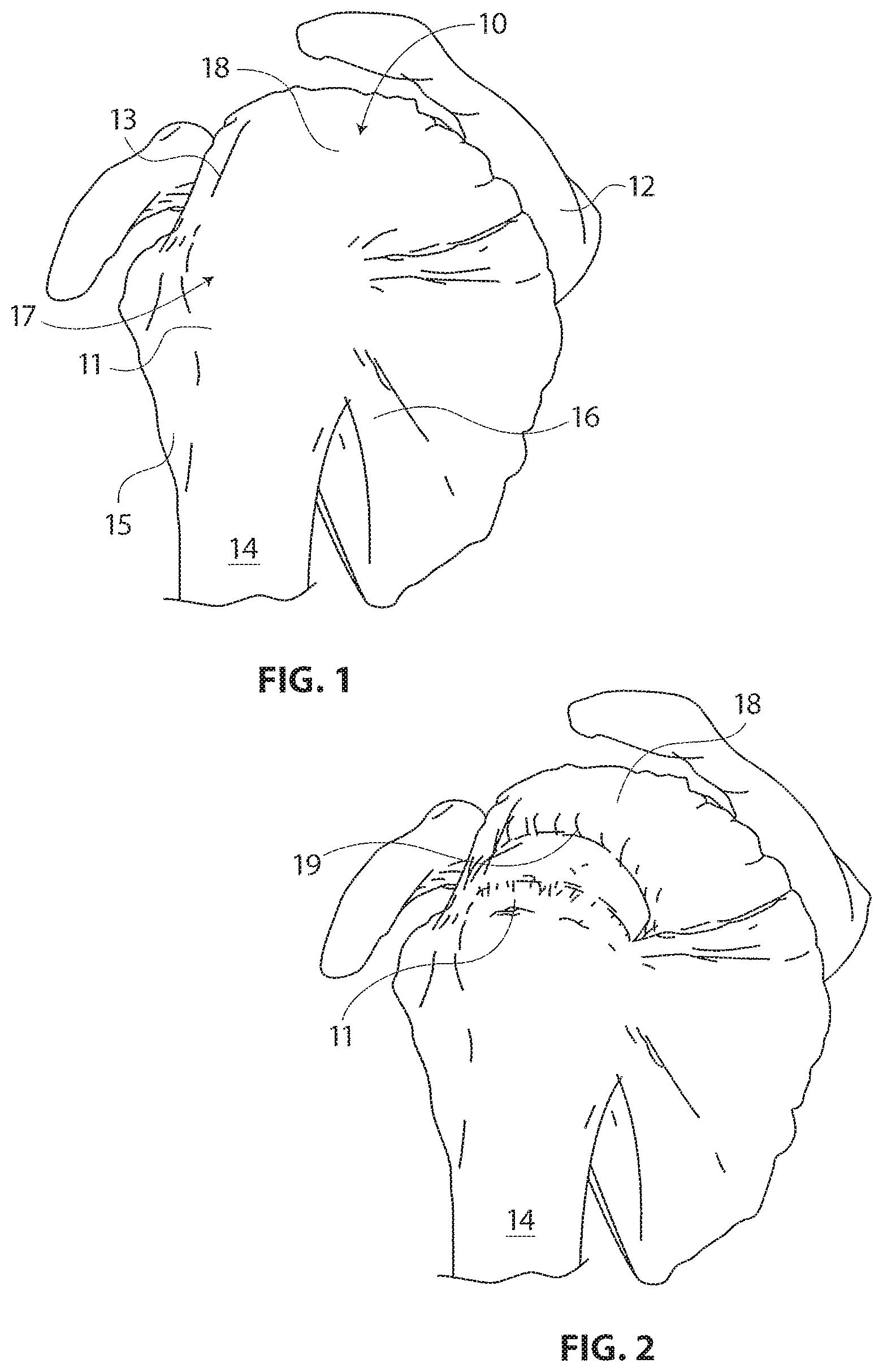
The glenohumeral joint of the shoulder is found where the head of the humerus mates with a shallow depression in the scapula. This shallow depression is known as the glenoid fossa. Six muscles extend between the humerus and scapula and actuate the glenohumeral joint. These six muscles include the deltoid, the teres major, and the four rotator cuff muscles. As disclosed by Ball et al. in U.S. Patent Publication No. US 2008/0188936 A1 and as illustrated in the rotator cuff muscles are a complex of four muscles. These four muscles are the supraspinatus, the infraspinatus, the subscapularis, and the teres minor. The centering and stabilizing roles played by the rotator cuff muscles are critical to the proper function of the shoulder. The rotator cuff muscles provide a wide variety of moments to rotate the humerus and to oppose unwanted components of the deltoid and pectoralis muscle forces.
The four muscles of the rotator cuff arise from the scapula 12 . The distal tendons of the rotator cuff muscles splay out and interdigitate to form a common continuous insertion on the humerus 14 . The subscapularis 16 arises from the anterior aspect of the scapula 12 and attaches over much of the lesser tuberosity of the humerous. The supraspinatus muscle 18 arises from the supraspinatus fossa of the posterior scapula, passes beneath the acromion and the acromioclavicular joint, and attaches to the superior aspect of the greater tuberosity 11 . The infraspinatus muscle 13 arises from the infraspinous fossa of the posterior scapula and attaches to the posterolateral aspect of the greater tuberosity 11 . The teres minor 15 arises from the lower lateral aspect of the scapula 12 and attaches to the lower aspect of the greater tuberosity 11 .
The mechanics of the rotator cuff muscles 10 are complex. The rotator cuff muscles 10 rotate the humerus 14 with respect to the scapula 12 , compress the humeral head 17 into the glenoid fossa providing a critical stabilizing mechanism to the shoulder (known as concavity compression), and provide muscular balance. The supraspinatus and infraspinatus provide 45 percent of abduction and 90 percent of external rotation strength. The supraspinatus and deltoid muscles are equally responsible for producing torque about the shoulder joint in the functional planes of motion.
The rotator cuff muscles 10 are critical elements of this shoulder muscle balance equation. The human shoulder has no fixed axis. In a specified position, activation of a muscle creates a unique set of rotational moments. For example, the anterior deltoid can exert moments in forward elevation, internal rotation, and cross-body movement. If forward elevation is to occur without rotation, the cross-body and internal rotation moments of this muscle must be neutralized by other muscles, such as the posterior deltoid and infraspinatus. The timing and magnitude of these balancing muscle effects must be precisely coordinated to avoid unwanted directions of humeral motion. Thus the simplified view of muscles as isolated motors, or as members of force couples must give way to an understanding that all shoulder muscles function together in a precisely coordinated way—opposing muscles canceling out undesired elements leaving only the net torque necessary to produce the desired action. Injury to any of these soft tissues can greatly inhibit ranges and types of motion of the arm.
With its complexity, range of motion and extensive use, a fairly common soft tissue injury is damage to the rotator cuff or rotator cuff tendons. Damage to the rotator cuff is a potentially serious medical condition that may occur during hyperextension, from an acute traumatic tear or from overuse of the joint. With its critical role in abduction, rotational strength and torque production, the most common injury associated with the rotator cuff region is a strain or tear involving the supraspinatus tendon. A tear in the supraspinitus tendon 19 is schematically depicted in . A tear at the insertion site of the tendon with the humerus, may result in the detachment of the tendon from the bone. This detachment may be partial or full, depending upon the severity of the injury. Additionally, the strain or tear can occur within the tendon itself. Injuries to the supraspinatus tendon 19 and recognized modalities for treatment are defined by the type and degree of tear. The first type of tear is a full thickness tear as also depicted in , which as the term indicates is a tear that extends through the thickness of the supraspinatus tendon regardless of whether it is completely torn laterally. The second type of tear is a partial thickness tear which is further classified based on how much of the thickness is torn, whether it is greater or less than 50% of the thickness.
The accepted treatment for a full thickness tear or a partial thickness tear greater than 50% includes reconnecting the torn tendon via sutures. For the partial thickness tears greater than 50%, the tear is completed to a full thickness tear by cutting the tendon prior to reconnection. In contrast to the treatment of a full thickness tear or a partial thickness tear of greater than 50%, the treatment for a partial thickness tear less than 50% usually involves physical cessation from use of the tendon, i.e., rest. Specific exercises can also be prescribed to strengthen and loosen the shoulder area. In many instances, the shoulder does not heal and the partial thickness tear can be the source of chronic pain and stiffness. Further, the pain and stiffness may cause restricted use of the limb which tends to result in further degeneration or atrophy in the shoulder. Surgical intervention may be required for a partial thickness tear of less than 50%, however, current treatment interventions do not include repair of the tendon, rather the surgical procedure is directed to arthroscopic removal of bone to relieve points of impingement or create a larger tunnel between the tendon and bone that is believed to be causing tendon damage. As part of the treatment, degenerated tendon may also be removed using a debridement procedure in which tendon material is ablated. Again, the tendon partial tear is not repaired. Several authors have reported satisfactory early post operative results from these procedures, but over time recurrent symptoms have been noted. In the event of recurrent symptoms, many times a patient will “live with the pain”. This may result in less use of the aim and shoulder which further causes degeneration of the tendon and may lead to more extensive damage. A tendon repair would then need to be done in a later procedure if the prescribed treatment for partial tear was unsuccessful in relieving pain and stiffness or over time the tear propagated through injury or degeneration to a full thickness tear or a partial thickness tear greater than 50% with attendant pain and debilitation. A subsequent later procedure would include the more drastic procedure of completing the tear to full thickness and suturing the ends of the tendon back together. This procedure requires extensive rehabilitation, has relatively high failure rates and subjects the patient who first presented and was treated with a partial thickness tear less than 50% to a second surgical procedure.
As described above, adequate treatments do not currently exist for repairing a partial thickness tear of less than 50% in the supraspinatus tendon. Current procedures attempt to alleviate impingement or make room for movement of the tendon to prevent further damage and relieve discomfort but do not repair or strengthen the tendon. Use of the still damaged tendon can lead to further damage or injury. Prior damage may result in degeneration that requires a second more drastic procedure to repair the tendon. Further, if the prior procedure was only partially successful in relieving pain and discomfort, a response may be to use the shoulder less which leads to degeneration and increased likelihood of further injury along with the need for more drastic surgery. There is a large need for surgical techniques and systems to treat partial thickness tears of less than 50% and prevent future tendon damage by strengthening or repairing the native tendon having the partial thickness tear.
SUMMARY OF THE INVENTION
According to aspects of the invention, a device for attaching a sheet-like implant to a target tissue is disclosed. In some embodiments, the device includes a pilot member and a staple push rod. In these embodiments, the pilot member has a distal end and at least a pair of prongs extending from the distal end. The prongs are configured to form pilot holes when the distal end of the pilot member is pressed against the target tissue. The staple push rod is disposed within at least a portion of the pilot member and slidable relative thereto. The staple push rod includes at least a pair of stakes. Each stake is dimensioned to engage a surface of a staple to apply pushing forces thereto. Each stake is positioned relative to a prong along an inner surface of the pilot member so that the stakes advance into the pilot holes when the stakes are moved in a distal direction.
In some embodiments of the invention, the stakes are biased to expand against an inner surface of the pilot member. Each stake has a distal portion and a proximal portion. Each distal portion may be dimensioned to extend into a passage defined by a staple. Each proximal portion may have a width larger than a width of each distal portion so that a shoulder of each proximal portion contacts a proximal surface of the staple to apply pushing forces thereto.
In some embodiments, the device also includes a staple which is carried by the staple push rod. The staple includes first and second arms, each having proximal and distal ends. A bridge extends from the proximal end of the first aim to the proximal end of the second arm. A first fluke of the staple has a proximal end abutting the distal end of the first arm. A second fluke of the staple has a proximal end abutting the distal end of the second arm. In some of these embodiments, each stake of the staple push rod has a distal portion and a proximal portion. Each distal portion extends into a passage defined by a fluke. Each proximal portion has a width larger than a width of each distal portion. This allows a shoulder of each proximal portion to contact a distal surface of a fluke to apply pushing forces thereto. The pushing forces place the first arm, the second arm, and the bridge in tension when the flukes are pushed into the target tissue. Each stake may be configured to bend at a location slightly distal of the shoulder when each fluke rotates.
In some embodiments, the proximal portion of each stake has a proximal thickness, and the distal portion of each stake has a distal thickness. The distal thickness may be configured to be less than the proximal thickness to facilitate bending of each stake at a location slightly distal of each shoulder. In some embodiments, each stake bends proximate the proximal end of a fluke when the flukes rotate. The proximal portions of the stakes may be configured with sufficient length so that there is a gap between the staple push rod and the bridge portion of staple. This allows the staple to be placed in tension without the bridge portion of the staple contacting the staple push rod.
In some embodiments, each prong of the pilot member has a length that is greater than a length of each fluke of the staple. The device may be configured such that the pushing forces include a first force applied to a proximal surface of the first fluke at a location that is offset from the first arm. The proximal portions of the stakes may be biased to diverge from one another so that the pushing force applied to each fluke has a laterally outward component. In some embodiments, a distal-most portion of each stake extends across a leading edge of each fluke.
According to aspects of the invention, methods for attaching a sheet-like implant to target tissue are also disclosed. In some embodiments, the methods include the step of providing a device that includes a pilot member. The pilot member has a distal end and at least a pair of prongs extending from the distal end. The device further includes a staple push rod carrying a staple. The staple comprises first and second arms each having proximal and distal ends. A bridge extends from the proximal end of the first arm to the proximal end of the second arm. The staple further comprises a first fluke having a proximal end abutting the distal end of the first arm, and a second fluke having a proximal end abutting the distal end of the second arm. The staple push rod of the device includes a pair of stakes, each having distal and proximal portions. Each distal portion extends into a passage defined by a fluke. Each proximal portion has a width larger than a width of each distal portion so that a shoulder of each proximal portion contacts a distal surface of a fluke.
The above methods further include the step of piercing the target tissue with the first prong of the pilot member to create a first pilot hole, and piercing the target tissue with the second prong to create a second pilot hole. The first fluke is positioned near the first pilot hole and the second fluke is positioned near the second pilot hole. The staple push rod is advanced in a distal direction so that the stakes apply pushing forces to the flukes. This causes the flukes to advance into the pilot holes and causes the first arm, the second arm, and the bridge to be placed in tension. The first arm provides a first reaction force when placed in tension and the second arm provides a second reaction force when placed in tension. The pushing forces and reaction forces cooperate to produce a moment applied to each fluke. The moment applied to each fluke causes each fluke to rotate so that each fluke assumes a locked position. When in the locked position, the longitudinal axis of each fluke is skewed relative to a longitudinal axis of the pilot member.
In some embodiments, a first moment having a first direction is applied to the first fluke, and a second moment having a second direction is applied to the second fluke. In these embodiments, the first direction is different from the second direction. In some embodiments, the first direction is generally opposite the second direction. The first direction may be a clockwise direction while the second direction is a counter-clockwise direction. In some embodiments, a first pushing force is applied to the proximal surface of the first fluke at a location that is offset from the first arm. The first pushing force may be in a direction that is generally parallel to a central axis of the first pilot hole.
In some embodiments, the flukes are advanced into the pilot holes while the prongs are disposed in the pilot holes. The methods may further include the step of moving the pilot member in a proximal direction relative to the target tissue until a distal end of the first prong is located proximal of the first fluke and a distal end of the second prong is located proximally of the second fluke. The step of advancing the staple push rod in a distal direction may include actuating a mechanism that produces relative motion between the staple push rod and the pilot member while applying a distally directed force to the pilot member.
In some of the above embodiments, moving the pilot member in a proximal direction relative to the target tissue includes producing relative motion between the staple push rod and the pilot member while applying a distally directed force to the pilot member. The first fluke may assume a first locking position and the second fluke may assume a second locking position while a distal end of the first prong is located proximal of the first fluke and a distal end of the second prong is located proximally of the second fluke.
According to aspects of the invention, a device for attaching a sheet-like implant to a target tissue is disclosed. In some embodiments the device includes a pilot member, a staple push rod slidably disposed within at least a portion of the pilot member, and a staple carried by the push rod. In these embodiments, the pilot member has a distal end and at least a pair of prongs extending from the distal end. The staple comprises first and second arms, each having proximal and distal ends. A bridge extends from the proximal end of the first aim to the proximal end of the second arm. A first fluke of the staple has a proximal end abutting the distal end of the first arm, and a second fluke of the staple has a proximal end abutting the distal end of the second arm. The staple push rod includes a pair of stakes, each having distal and proximal portions. The distal portion of each stake extends into a passage defined by a fluke. Each proximal portion has a width larger than a width of each distal portion.
With the above arrangement, a shoulder of each proximal portion contacts a distal surface of a fluke to apply pushing forces thereto. The pushing forces place the first arm, the second arm, and the bridge in tension when the flukes are pushed into the target tissue. The first arm provides a first reaction force when placed in tension, and the second arm provides a second reaction force when placed in tension. The pushing forces and the reaction forces cooperate to produce a moment applied to each fluke. The moment applied to each fluke causes each fluke to rotate so that each fluke assumes a locked position. When in the locked position, the longitudinal axis of each fluke is skewed relative to an arm of the staple.
Further aspects of the present invention will become apparent after review of the Detailed Description with reference to the following drawings.
BRIEF DESCRIPTION OF THE DRAWINGS
is a simplified perspective view of the human rotator cuff and associated anatomical structure. A and 2 B are alternative perspective views of the tissue fastener or staple of illustrating other features in accordance with the present disclosure;
is a schematic depiction of a full thickness tear in the supraspinatus tendon of the rotator cuff of . A- 4 B are partial cross sectional views of the fastener of depicting a projection in a first retracted state and a second deployed or extended state, respectively;
is a stylized anterior view of a patient with a shoulder of patient being shown in cross-section for purposes of illustration.
is a stylized anterior view of a shoulder including a humerus and a scapula. The head of the humerus is shown mating with the glenoid fossa of the scapula at a glenohumeral joint and a sheet-like material is fixed to the tendon.
is a stylized perspective view illustrating an exemplary procedure for treating a shoulder of a patient.
is a stylized perspective view of a shoulder including a supraspinatus having a distal tendon with a sheet-like material fixed thereto. A proximal end of the supraspinatus is fixed to the scapula and the distal tendon of the supraspinatus is fixed to the humerus.
A , B , and C are multiple plan views illustrating an exemplary staple in accordance with the present detailed description.
is a perspective view further illustrating the staple shown in the previous Figure.
is a perspective view showing a staple push rod that may be used in conjunction with the staple shown in the previous Figure.
A and B illustrate multiple plan views of an exemplary fixation tool in accordance with the present detailed description.
A is a further enlarged partial cross-sectional view of a distal portion of the fixation tool shaft shown in the previous Figure.
B is an additional partial cross-sectional view showing a staple carried by a staple push rod and a fixation tool shaft disposed about the staple push rod.
A through C are a sequence of plan views illustrating an exemplary method and apparatus in accordance with the present detailed description.
A , B , C and D are multiview projections illustrating a fixation tool shaft shown in the previous Figures.
is an enlarged axial view of the fixation tool shaft shown in the previous Figure.
is an additional enlarged axial view of the fixation tool shaft shown in the previous Figure.
is an exploded isometric view of an exemplary fixation tool in accordance with this detailed description.
DETAILED DESCRIPTION OF THE INVENTION
The following detailed description should be read with reference to the drawings in which similar elements in different drawings are numbered the same. The drawings, which are not necessarily to scale, depict illustrative embodiments and are not intended to limit the scope of the invention.
As used herein, the term “tissue” refers to soft tissue, such as a tendon, and/or bone tissue, depending on the context in which it is used.
is a stylized anterior view of a patient 20 . For purposes of illustration, a shoulder 22 of patient 20 is shown in cross-section in . Shoulder 22 includes a humerus 14 and a scapula 12 . In , a head 24 of humerus 14 can be seen mating with a glenoid fossa of scapula 12 at a glenohumeral joint. With reference to , it will be appreciated that the glenoid fossa comprises a shallow depression in scapula 12 . The movement of humerus 14 relative to scapula 12 is controlled by a number of muscles including: the deltoid, the supraspinatus, the infraspinatus, the subscapularis, and the teres minor. For purposes of illustration, only the supraspinatus 26 is shown in .
With reference to , it will be appreciated that a distal tendon 28 of the supraspinatus 26 meets humerus 14 at an insertion point. Scapula 12 of shoulder 22 includes an acromium 32 . In , a subacromial bursa 34 is shown extending between acromium 32 of scapula 12 and head 24 of humerus 14 . In , subacromial bursa 34 is shown overlaying supraspinatus 26 . Subacromial bursa 34 is one of the hundreds of bursae found the human body. Each bursa comprises a fluid filled sac. The presence of these bursae in the body reduces friction between bodily tissues. Injury and/or infection of the bursa can cause it to become inflamed. This condition is sometimes referred to as bursitis.
The exemplary methods and apparatus described herein may be used to fix tendon repair implants to various target tissues. For example, a tendon repair implant may be fixed to one or more tendons associated with an articulating joint, such as the glenohumeral joint. The tendons to be treated may be torn, partially torn, have internal micro-tears, be untorn, and/or be thinned due to age, injury or overuse. Applicants believe that the methods and apparatus of the present application and related devices may provide very beneficial therapeutic effect on a patient experiencing joint pain believed to be caused by partial thickness tears and/or internal microtears. By applying a tendon repair implant early before a full tear or other injury develops, the implant may cause the tendon to thicken and/or at least partially repair itself, thereby avoiding more extensive joint damage, pain, and the need for more extensive joint repair surgery.
is a stylized anterior view of a shoulder 22 including a humerus 14 and a scapula 12 . In , a head 24 of humerus 14 is shown mating with a glenoid fossa of scapula 12 at a glenohumeral joint. A supraspinatus 26 is also shown in . This muscle (along with others) control the movement of humerus 14 relative to scapula 12 . A distal tendon 28 of supraspinatus 26 meets humerus 14 at an insertion point 30 .
In the embodiment of , distal tendon 28 includes a first damaged portion 36 . A number of loose tendon fibers 40 in first damaged portion 36 are visible in . First damaged portion 36 includes a first tear 42 extending partially through distal tendon 28 . First tear 42 may therefore be referred to as a partial thickness tear. With reference to , it will be appreciated that first tear 42 begins on the side of distal tendon 28 facing the subacromial bursa (shown in the previous Figure) and ends midway through distal tendon 28 . Accordingly, first tear 42 may be referred to as a bursal side tear.
With reference to , it will be appreciated that distal tendon 28 includes a second damaged portion 38 located near insertion point 30 . In the embodiment of , second damaged portion 38 of distal tendon 28 has become frayed and a number of loose tendon fibers 40 are visible in . Second damaged portion 38 of distal tendon 28 includes second tear 44 . With reference to , it will be appreciated that second tear 44 begins on the side of distal tendon 28 facing the humerus 14 . Accordingly, second damaged portion 38 may be referred to as an articular side tear.
In the embodiment of , a sheet-like implant 50 has been placed over the bursal side of distal tendon 28 . With reference to , it will be appreciated that sheet-like implant 50 extends over insertion point 30 , first tear 42 and second tear 44 . Some useful methods in accordance with this detailed description may include placing a tendon repair implant on the bursal side of a tendon regardless of whether the tears being treated are on the bursal side, articular side or within the tendon. In some cases the exact location and nature of the tears being treated may be unknown. A tendon repair implant may be applied to the bursal side of a tendon to treat shoulder pain that is most likely caused by one or more partial thickness tears in the tendon. In the embodiment of , sheet-like implant 50 is fixed to distal tendon 28 and to humerus 14 by a plurality of staples 100 as described herein in detail.
is a stylized perspective view illustrating an exemplary procedure for treating a shoulder 22 of a patient 20 . The procedure illustrated in may include, for example, fixing tendon repair implants to one or more tendons of shoulder 22 . The tendons treated may be torn, partially torn, have internal micro-tears, be untorn, and/or be thinned due to age, injury or overuse.
Shoulder 22 of has been inflated to create a cavity therein. In the exemplary embodiment of A , a fluid supply 52 is pumping a continuous flow of saline into the cavity. This flow of saline exits the cavity via a fluid drain 54 . A camera 56 provides images from inside the cavity. The images provided by camera 56 may be viewed on a display 58 .
Camera 56 may be used to visually inspect the tendons of shoulder 22 for damage. A tendon repair implant in accordance with this disclosure may be fixed to a bursal surface of the tendon regardless of whether there are visible signs of tendon damage. Applicants believe that the methods and apparatus of the present application and related devices may provide very beneficial therapeutic effect on a patient experiencing joint pain believed to be caused by internal microtears, but having no clear signs of tendon tears. By applying a tendon repair implant early before a full tear or other injury develops, the implant may cause the tendon to thicken and/or at least partially repair itself, thereby avoiding more extensive joint damage, pain, and the need for more extensive joint repair surgery.
A delivery system 60 can be seen extending from shoulder 22 in . Delivery system 60 comprises a sheath that is fixed to a handle. The sheath defines a lumen and a distal opening fluidly communicating the lumen. In the embodiment of , the distal opening of the sheath has been placed in fluid communication with the cavity created in shoulder 22 .
A tendon repair implant is at least partially disposed in the lumen defined by the sheath of delivery system 60 . Delivery system 60 can be used to place the tendon repair implant inside shoulder 22 . Delivery system 60 can also be used to hold the tendon repair implant against the tendon. In some embodiments, the tendon repair implant is folded into a compact configuration when inside the lumen of the sheath. When this is the case, delivery system 60 may be used to unfold the tendon repair implant into an expanded shape.
The tendon repair implant may be fixed to the tendon while it is held against the tendon by delivery system 60 . Various attachment elements may be used to fix the tendon repair implant to the tendon. Examples of attachment elements that may be suitable in some applications include sutures, tissue anchors, bone anchors, and staples. In the exemplary embodiment of , the shaft of a fixation tool 70 is shown extending into shoulder 22 . In one exemplary embodiment, fixation tool 70 is capable of fixing the tendon repair implant to the tendon with one or more staples while the tendon repair implant is held against the tendon by delivery system 60 .
is a stylized perspective view of a shoulder 22 including a supraspinatus 26 having a distal tendon 28 . With reference to , it will be appreciated that a tendon repair implant 50 has been fixed to a surface of distal tendon 28 . Tendon repair implant 50 may comprise, for example, various sheet-like structures without deviating from the spirit and scope of the present detailed description. In some useful embodiments, the sheet-like structure may comprise a plurality of fibers. The fibers may be interlinked with one another. When this is the case, the sheet-like structure may comprise a plurality of apertures comprising the interstitial spaces between fibers. Various processes may be used to interlink the fibers with one another. Examples of processes that may be suitable in some applications including weaving, knitting, and braiding. In some embodiment, the sheet-like structure may comprise a laminate including multiple layers of film with each layer of film defining a plurality of micro-machined or formed holes. The sheet-like structure of the tendon repair implant may also comprise a plurality of electro-spun nanofiber filaments forming a composite sheet. Additionally, the sheet-like structure may comprise a synthetic sponge material that defines a plurality of pores. The sheet-like structure may also comprise a reticulated foam material. Reticulated foam materials that may be suitable in some applications are available from Biomerix Corporation of Freemont, Calif. which identifies these materials using the trademark BIOMATERIAL™.
Various attachment elements may be used to fix tendon repair implant 50 to distal tendon 28 without deviating from the spirit and scope of this detailed description. Examples of attachment elements that may be suitable in some applications include sutures, tissue anchors, bone anchors, and staples. In the exemplary embodiment of , a plurality of staples 100 are fixing tendon repair implant 50 to distal tendon 28 . In some exemplary methods, a plurality of staples 100 may be applied using a fixation tool. The fixation tool may then be withdrawn from the body of the patient. Distal tendon 28 meets humerus 14 at an insertion point 30 . With reference to , it will be appreciated that sheet-like implant 50 extends over insertion point 30 . Tendon repair implant may be applied to distal tendon 28 , for example, using the procedure illustrated in the previous Figure.
A , B , and C are multiple plan views illustrating an exemplary staple 100 in accordance with the present detailed description. A , B , and C may be collectively referred to as . A proximal direction is illustrated with an arrow P in . A distal direction is illustrated with a second arrow D in .
Staple 100 comprises a first arm 102 A, a second arm 102 B, and a bridge 104 extending from the proximal end of first arm 102 A to the proximal end of second arm 102 B. The distal end of first arm 102 A abuts the proximal end of a first fluke 106 A. Similarly, the distal end of second arm 102 B abuts the proximal end of a second fluke 106 B. In , first fluke 106 A and second fluke 106 B are shown extending distally from first arm 102 A and second arm 102 B, respectively. With reference to , it will be appreciated that first fluke 106 A has a lateral extent that is larger than a lateral extent of first arm 102 A. First fluke 106 A is mounted eccentrically to first arm 102 A in the embodiment of . Second fluke 106 B is mounted eccentrically to second arm 102 B and second fluke 106 B has a lateral extent that is larger than a lateral extent of second arm 102 B. First fluke 106 A includes a first proximal surface 108 A projecting at an outward angle in a proximal direction away from the distal end of first arm 102 A. Second fluke 106 B includes a second proximal surface 108 B projecting at an outward angle in a proximal direction away from the distal end of second arm 102 B.
With reference to A , it will be appreciated that first fluke 106 A includes a first point 120 A and a first barb 122 A. Second fluke 106 B includes a second point 120 B and a second barb 122 B. In , first point 120 A and second point 120 B are shown generally pointing in the distal direction indicated by arrow D. Also in , first barb 122 A and second barb 122 B are shown generally pointing in the proximal direction indicated by arrow P.
With reference to A it will be appreciated that first fluke 106 A defines a first passageway 124 A and second fluke 106 B defines a second passageway 124 B. In the exemplary embodiment of , first passageway 124 A extends through first fluke 106 A and second passageway 124 B extends through second fluke 106 B. It will be appreciated, however, that first passageway 124 A may extend through other portions of staple 100 in some embodiments. Similarly, second passageway 124 B may extend through other portions of staple 100 in some embodiments. With reference to B it will be appreciated that, first passageway 124 A and second passageway 124 B each have a generally square cross-sectional shape. It will be appreciated, however, that first passageway 124 A and second passageway 124 B may have various cross-sectional shapes without deviating from the spirit and scope of the present detailed description. Further, each passageway can extend partially through the length of each fluke rather than all the way through to provide a cavity rather than a passageway.
With reference to C , it will be appreciated that first barb 122 A of first fluke 106 A defines a first notch 126 A. In the exemplary embodiment of , first notch 126 A divides first barb 122 A into a first sub-barb and a second sub-barb. Second barb 122 B of second fluke 106 B defines a second notch 126 B. In the exemplary embodiment of , second notch 126 B divides second barb 122 B into a first sub-barb and a second sub-barb.
is a perspective view showing staple 100 shown in the previous Figure. Staple 100 comprises a first arm 102 A, a second arm 102 B, and a bridge 104 extending from the proximal end of first arm 102 A to the proximal end of second arm 102 B. The distal end of first arm 102 A abuts the proximal end of a first fluke 106 A. With reference to it will be appreciated that first fluke 106 A defines a first passageway 124 A. In the exemplary embodiment of , first passageway 124 A has a generally square cross-sectional shape. It will be appreciated, however, that first passageway 124 A may have various cross-sectional shapes without deviating from the spirit and scope of the present detailed description.
A second fluke 106 B extends distally from second arm 102 B with the proximal end of second fluke 106 B abutting the distal end of second arm 102 B. With reference to , it will be appreciated that second fluke 106 B has a lateral extent that is larger than a lateral extent of second arm 102 B. Second fluke 106 B is mounted eccentrically to second arm 102 B in the embodiment of . Similarly, first fluke 106 A is mounted eccentrically to first arm 102 A and first fluke 106 A has a lateral extent that is larger than a lateral extent of first arm 102 A.
A proximal direction is illustrated with an arrow P in . A distal direction is illustrated with a second arrow D in . With reference to A , it will be appreciated that first fluke 106 A of first arm 102 A includes a first point 120 A and a first barb 122 A. Second fluke 106 B includes a second point 120 B and a second barb 122 B. In , first point 120 A and second point 120 B are shown generally pointing in the distal direction indicated by arrow D. Also in , first barb 122 A and second barb 122 B are shown generally pointing in the proximal direction indicated by arrow P. With reference to , it will be appreciated that first fluke 106 A includes a first proximal surface 108 A projecting at an outward angle in a proximal direction away from the distal end of first arm 102 A. Second fluke 106 B includes a second proximal surface 108 B projecting at an outward angle in a proximal direction away from the distal end of second arm 102 B.
is a perspective view showing a staple push rod 130 that may be used in conjunction with staple 100 shown in the previous Figure. Staple push rod 130 includes a shaft 132 and a pair of stakes 134 extending distally beyond a distal end of shaft 132 . The distal direction is indicated with an arrow D in . Stakes 134 include a first stake 134 A and a second stake 134 B. First stake 134 A and second stake 134 B form a fork 136 .
In the embodiment of , each stake 134 has a distal portion 138 and a proximal portion 140 . In some useful embodiments, each distal portion 138 is dimensioned to extend into a passage defined by a staple. In the embodiment of , each proximal portion 140 has a width larger than a width of each distal portion 138 so that a shoulder of each proximal portion 140 contacts a proximal surface of the staple to apply pushing forces thereto. First stake 134 A comprises a first shoulder 142 A and second stake 134 B comprises a second shoulder 142 B. Although depicted as a shoulder to provide pushing force to the staple, other designs can be utilized. For example, any larger cross section proximal portion can provide a pushing force, such as a conical increase in profile. In the embodiment of , proximal portion 140 of first stake 134 A and the proximal portion 140 of second stake 134 B diverge from one another as they extend in distal direction D away from shaft 132 . In some applications, this arrangement may cause pushing forces applied to two flukes of a staple to have a laterally outward component.
In , first stake 134 A and second stake 134 B are shown assuming a substantially unstressed state. It will be appreciated that first stake 134 A and second stake 134 B can be resiliently urged to assume shapes other than the shape shown in . For example, first stake 134 A and second stake 134 B may be urged together so that fork 136 can be inserted into a lumen having a diameter smaller than the distance between the distal points of first stake 134 A and second stake 134 B shown in .
A and B illustrate multiple plan views of an exemplary fixation tool 144 in accordance with the present detailed description. Fixation tool 144 incorporates staple push rod 130 and is useful in delivering staple 100 . A and B may be referred to collectively as . It is customary to refer to multiview projections using terms such as front view, top view, and side view. In accordance with this convention, A may be referred to as a top view of fixation tool 144 and B may be referred to as a side view of fixation tool 144 . The terms top view and side view are used herein as a convenient method for differentiating between the views shown in . It will be appreciated that the elements shown in may assume various orientations without deviating from the spirit and scope of this detailed description. Accordingly, the terms top view and side view should not be interpreted to limit the scope of the invention recited in the attached claims.
In the embodiment of , fixation tool 144 comprises a pilot member or fixation tool shaft 146 that is attached to a handle 148 . Fixation tool shaft 146 comprises a wall 150 defining a lumen 152 . With reference to , it will be appreciated that fixation tool shaft 146 includes a first prong 154 A and a second prong 156 B that extend distally beyond a distal end 158 of lumen 152 .
In , a staple 100 can be seen residing in lumen 152 of fixation tool shaft 146 . For purposes of illustration, a distal portion of fixation tool shaft 146 is enlarged in to better show staple 100 . Staple 100 comprises a first aim 102 A, a second arm 102 B, and a bridge 104 extending from the proximal end of first arm 102 A to the proximal end of second arm 102 B. The distal end of first arm 102 A abuts the proximal end of a first fluke 106 A. Similarly, the distal end of second arm 102 B abuts the proximal end of a second fluke 106 B. In , first fluke 106 A and second fluke 106 B are shown extending distally from first arm 102 A and second arm 102 B, respectively.
Staple push rod 130 includes a shaft 132 and a pair of stakes 134 extending distally beyond a distal end of shaft 132 . The distal direction is indicated with an arrow D in . Stakes 134 include a first stake 134 A and a second stake 134 B. In , a distal portion of each stake 134 can be seen extending through a passageway defined by staple 100 . In the embodiment of , a trigger 160 is pivotably coupled to handle 148 of fixation tool 144 . Trigger 160 is operatively coupled to staple push rod 130 . In operation, staple push rod 130 will be advanced and/or retracted in an axial direction when trigger 160 is pivoted relative to handle 148 .
A is a further enlarged top view of a distal portion of fixation tool shaft 146 shown in the previous Figure. For purposes of illustration, fixation tool shaft 146 is shown in partial cross-section in A so that staple 100 is visible residing in lumen 152 . With reference to A , it will be appreciated that staple 100 is disposed on a distal portion of staple push rod 130 . Staple 100 comprises a first arm 102 A, a second arm 102 B, and a bridge 104 extending from the proximal end of first arm 102 A to the proximal end of second arm 102 B. The distal end of first arm 102 A abuts the proximal end of a first fluke 106 A. Similarly, the distal end of second arm 102 B abuts the proximal end of a second fluke 106 B. In , first fluke 106 A and second fluke 106 B are shown extending distally from first arm 102 A and second aim 102 B, respectively.
First fluke 106 A of staple 100 defines a first passageway 124 A. In A , a distal portion 138 of first stake 134 A of staple push rod 130 can be seen extending through first passageway 124 A defined by first fluke 106 A. A distal portion 138 of second stake 134 B of staple push rod 130 can be seen extending through a second passageway 124 B defined by second fluke 106 B of staple 100 .
In A , a first shoulder 142 A of first stake 134 A is shown contacting proximal surface 108 of first fluke. Distal portion 138 of first stake 134 A extends distally of first shoulder 142 A and proximal portion 140 of first stake 134 A extends proximally of first shoulder 142 A. In some useful embodiments, the proximal portion of first stake 134 A has a first thickness and the distal portion of first stake 134 A has a second thickness different from the first thickness. In some particularly useful embodiments, the second thickness is less than the first thickness. In some applications, this may increase the flexibility of the distal portion of first stake 134 A so that it bends more easily, and so that it withdraws from the staple with minimal force.
A second shoulder 142 B of second stake 134 B is shown contacting proximal surface 108 of second fluke 106 in A . A distal portion 138 of second stake 134 B extends distally of second shoulder 142 B and a proximal portion 140 of second stake 134 B extends proximally of second shoulder 142 B. In some useful embodiments, the proximal portion of second stake 134 B has a first thickness and the distal portion of second stake 134 B has a second thickness different from the first thickness. In some particularly useful embodiments, the second thickness is less than the first thickness. In some applications, this may increase the flexibility of the distal portion of first stake 134 A so that it bends more easily, and so that it withdraws from the staple with minimal force.
With reference to A , it will be appreciated that there is a gap G between staple push rod 130 and bridge 104 of staple 100 . In some applications, gap G allows staple 100 to be placed in tension without bridge 104 contacting staple push rod 130 . Staple 100 may be placed in tension, for example, as staple 100 is advanced into a target tissue.
B is an additional top view showing a distal portion of fixation tool shaft 146 , staple push rod 130 , and staple 100 . By comparing A and B , it will be appreciated that staple push rod 130 and staple 100 have been advanced in a distal direction D relative to fixation tool shaft 146 . In B , staple 100 is shown extending out of lumen 152 defined by fixation tool shaft 146 .
In B , a distal portion 138 of first stake 134 A of staple push rod 130 can be seen extending through a first passageway 124 A defined by first fluke 106 A of staple 100 . In B , a first shoulder 142 A of first stake 134 A is shown contacting proximal surface 108 of first fluke 106 A. Distal portion 138 of first stake 134 A extends distally of first shoulder 142 A and proximal portion 140 of first stake 134 A extends proximally of first shoulder 142 A. In some useful embodiments, the proximal portion of first stake 134 A has a first width and the distal portion of first stake 134 A has a second width different from the first width. In some particularly useful embodiments, the first width is greater than the first width. The arrangement allows the proximal portion of stake to engage a proximal surface of the staple to apply pushing forces to the staple.
In B , a distal portion 138 of second stake 134 B of staple push rod 130 can be seen extending through a second passageway 124 B defined by second fluke 106 B of staple 100 . In B , a second shoulder 142 B of second stake 134 B is shown contacting proximal surface 108 of second fluke 106 B. In the embodiment of B , proximal portion 140 of second stake 134 B may apply pushing force to proximal surface 108 of second stake 134 B. Proximal portion 140 of second stake 134 B extends proximally of second shoulder 142 B and distal portion 138 of second stake 134 B extends distally of second shoulder 142 B. In the embodiment of B , proximal portion 140 of second stake 134 B has a width larger than the width of distal portion 138 of second stake 134 B so that the shoulder 142 of second stake 134 B contacts proximal surface 108 of second fluke 106 B to apply pushing forces thereto.
In the embodiment of B , first stake 134 A and second stake 134 B are in a substantially unstressed state. It will be appreciated that first stake 134 A and second stake 134 B can be resiliently urged to assume shapes other than the shape shown in . For example, first stake 134 A and second stake 134 B may be urged together so that fork 136 of staple push rod 130 and staple 100 can be inserted into lumen 152 defined by fixation tool shaft 146 .
With reference to B , it will be appreciated that there is a gap G between staple push rod 130 and bridge 104 of staple 100 . In some applications, gap G allows staple 100 to be placed in tension without bridge 104 contacting staple push rod 130 . In some applications, placing staple 100 under tension may urge first fluke 106 and second fluke 106 into orientations which lock staple 100 into a target tissue. For example, first fluke 106 A and second fluke 106 B may be rotated so that a barb of each fluke engages the target tissue. When this is the case, the tension on the staple may keep first fluke 106 A and second fluke 106 B in the rotated position. Also when this is the case, the barbs of the rotated flukes may inhibit staple pullout.
A through C are a sequence of plan views illustrating an exemplary method in accordance with the present detailed description. A , B , and C may be collectively referred to as . The exemplary method illustrated in may be used, for example, to fix a tendon repair implant 50 to a target tissue T using a staple 100 .
At A , a fixation tool 144 has been used to form a first pilot hole 162 A and a second pilot hole 162 B in target tissue T. In the embodiment of , fixation tool 144 includes a fixation tool shaft 146 comprising a wall 150 defining a lumen 152 . With reference to , it will be appreciated that fixation tool shaft 146 includes a first prong 154 A and a second prong 156 B that extend distally beyond a distal end 158 of lumen 152 . In the embodiment of A , first prong 154 A and second prong 156 B have been urged into tissue T to form first pilot hole 162 A and second pilot hole 162 B. In A a distally directed force F applied to fixation tool shaft 146 is illustrated using an arrow. Force F may be produced, for example, by pushing on a handle that is fixed to a proximal portion of fixation tool shaft 146 . It will be appreciated that in some embodiments, such as the embodiment depicted in , one of the first and second pilot holes may be formed through the sheet-like implant and the target tissue, and the other pilot hole may be formed directly in the target tissue without passing through the sheet-like implant. In other words, in various embodiments staples may straddle the perimeter edge of the sheet-like implant (as shown in ), may be applied adjacent to the perimeter, and/or be applied to a central region of the implant. In some embodiments, the staples may be used to attach the implant to soft tissue and/or to bone. In A , a staple 100 can be seen residing in lumen 152 of fixation tool shaft 146 . For purposes of illustration, fixation tool shaft 146 is shown in partial cross-section in A so that staple 100 is visible residing in lumen 152 . With reference to , it will be appreciated that staple 100 is carried by a fork 136 comprising a first stake 134 A and a second stake 134 B. In A , a distal portion of first stake 134 A of staple push rod 130 can be seen extending through a first passageway defined by first fluke 106 A. A distal portion of second stake 134 B of staple push rod 130 can be seen extending through a second passageway defined by second fluke 106 B of staple 100 .
In some useful embodiments, each stake is positioned relative to a prong along an inner surface of fixation tool shaft 146 so that the stakes advance into the pilot holes when the stakes are moved in a distal direction. Staple push rod 130 is slidably disposed within lumen 152 defined by along fixation tool shaft 146 . Fixation tool 144 includes a mechanism that is capable of creating relative axial motion between staple push rod 130 and fixation tool shaft 146 so that staple push rod 130 slides along fixation tool shaft 146 .
At B , relative motion has been created between staple push rod 130 and fixation tool shaft 146 while distally directed force F has been continuously applied to fixation tool shaft 146 . By comparing B and A , it will be appreciated that first stake 134 A and second stake 134 B have been advanced in a distal direction D. With reference to , it will also be appreciated that first stake 134 A and second stake 134 B have advanced into first pilot hole 162 A and second pilot hole 162 B, respectively. In B , first fluke 106 A is shown residing in first pilot hole 162 . Second fluke 106 B is residing in second pilot hole 162 in the embodiment of B .
At C , additional relative motion has been created between staple push rod 130 and fixation tool shaft 146 while distally directed force F has been continuously applied to fixation tool shaft 146 . By comparing C and B , it will be appreciated that the relative motion between staple push rod 130 and fixation tool shaft 146 has moved fixation tool shaft 146 in a proximal direction P.
By comparing C and B , it will also be appreciated that first arm 102 A of staple 100 has been bent and first fluke 106 A has been rotated to a toggled position. In the exemplary embodiment of C , force applied to first fluke 106 A by first shoulder 142 A has caused first fluke 106 A to rotate. Also in the embodiment of C , the rotation of first fluke 106 A has caused some bending in the distal portion 138 of first stake 134 A. With continuing reference to C and B , it will be appreciated that second arm 102 B of staple 100 has been bent and second fluke 106 A has been rotated to a toggled position. In the exemplary embodiment of C , force applied to second fluke 106 b by second shoulder 142 B has caused second fluke 106 B to rotate. Also in the embodiment of C , the rotation of second fluke 106 B has caused some bending in the distal portion 138 of second stake 134 B.
With reference to C , it will be appreciated that a first through hole 164 A and a second through hole 164 B have been formed in tendon repair implant 50 . In the embodiment of , first through hole 164 A and a second through hole 164 B were created by urging first prong 154 A and second prong 156 B of fixation tool shaft 146 through tendon repair implant 50 .
A , B , and C are multiview projections illustrating a fixation tool shaft 146 shown in the previous Figures. D is a cross-sectional view of fixation tool shaft 146 sectioned along cutting plane D-D illustrated in C . These Figures may be collectively referred to as . Fixation tool shaft 146 of comprises a wall 150 defining a lumen 152 . A first prong 154 A and a second prong 156 B of fixation tool shaft 146 extend distally beyond a distal end 158 of lumen 152 .
With reference to , it will be appreciated that fixation tool shaft 146 comprises a proximal portion 170 , a distal portion 168 and an intermediate portion 166 disposed between proximal portion 170 and distal portion 168 . In the embodiment of , distal portion 168 has an axial extent DA, a major lateral extent LA and a minor lateral extent LB. With reference to , it will be appreciated that axial extent DA is greater than both minor lateral extent LB and major lateral extent LA.
is an enlarged axial view of fixation tool shaft 146 shown in the previous Figure. With reference to , it will be appreciated that proximal portion 170 of fixation tool shaft 146 comprises a wall 150 having an outer surface 172 . In , outer surface 172 is illustrated using a circle. Thus, it will be appreciated that proximal portion 170 of fixation tool shaft 146 has a generally cylindrical outer shape in the exemplary embodiment of . In the exemplary embodiment of , fixation tool shaft 146 has a generally uniform wall thickness. Accordingly, the shape of proximal portion 170 may be generally described as a cylindrical tube. The shape of distal portion 168 may be described as a cylindrical-tube that has been partially flattened. In the exemplary embodiment of , distal portion 168 of fixation tool shaft 146 has a major lateral extent LA and a minor lateral extent LB. With reference to , it will be appreciated that major lateral extent LA is greater than minor lateral extent LB.
is an additional enlarged axial view of fixation tool shaft 146 . With reference to , it will be appreciated that distal portion 168 of fixation tool shaft 146 comprises a first major side SA, a second major side SB, a first minor side SC, and a second minor side SD. In the exemplary embodiment of , each minor side has a first central radius RA and each major side has a second central radius RB. With reference to , it will be appreciated that second central radius RB is greater than first central radius RA. In the exemplary embodiment of , first major side SA, second major side SB, first minor side SC, and second minor side SD each have a generally convex shape. In the exemplary embodiment of , each minor side is generally more convex than each major side.
is an exploded isometric view of an exemplary fixation tool 144 in accordance with this detailed description. In the embodiment of , fixation tool 144 comprises a fixation tool shaft 146 and a handle 148 . In , handle 148 is exploded into two pieces. A proximal portion of fixation tool shaft 146 is fixed to handle 148 when fixation tool 144 is in an assembled state. Fixation tool shaft 146 comprises a wall 150 defining a lumen 152 .
When fixation tool 144 is in an assembled state a staple push rod 130 extends into lumen 152 of fixation tool shaft 146 . Staple push rod 130 comprises a fork 136 and a shaft 132 . Fork 136 comprises a first stake 134 A and a second stake 134 B. Shaft 132 is coupled between fork 136 and a lever 174 . Lever 174 is coupled to a trigger 160 . Trigger 160 is pivotably coupled to handle 148 of fixation tool 144 when fixation tool 144 is in an assembled state. In operation, staple push rod 130 will be advanced and/or retracted in an axial direction when trigger 160 is pivoted relative to handle 148 .
While exemplary embodiments of the present invention have been shown and described, modifications may be made, and it is therefore intended in the appended claims and subsequently filed claims to cover all such changes and modifications which fall within the true spirit and scope of the invention.
Figures (16)
Citations
This patent cites (496)
- US511238
- US765793
- US1728316
- US1855546
- US1868100
- US1910688
- US1940351
- US2034785
- US2075508
- US2131321
- US2158242
- US2199025
- US2201610
- US2254620
- US2277931
- US2283814
- US2316297
- US2421193
- US2571813
- US2630316
- US2684070
- US2744251
- US2790341
- US2817339
- US2825162
- US2881762
- US2910067
- US3068870
- US3077812
- US3103666
- US3123077
- US3209754
- US3221746
- US3470834
- US3527223
- US3570497
- US3577837
- US3579831
- US3643851
- US3687138
- US3716058
- US3717294
- US3757629
- US3777538
- US3837555
- US3845772
- US3875648
- US3960147
- US3976079
- US4014492
- US4127227
- US4259959
- US4263903
- US4265226
- US4317451
- US4400833
- US4422567
- US4454875
- US4480641
- US4485816
- US4526174
- US4549545
- US4570623
- US4595007
- US4624254
- US4627437
- US4632100
- US4635637
- US4669473
- US4696300
- US4719917
- US4738255
- US4741330
- US4762260
- US4799495
- US4809695
- US4821721
- US4851005
- US4858608
- US4884572
- US4887601
- US4924866
- US4930674
- US4968315
- US4976715
- US4994073
- US4997436
- US5002563
- US5013316
- US5015249
- US5037422
- US5041129
- US5046513
- US5053047
- US5059206
- US5062563
- US5100417
- US5102421
- US5116357
- US5122155
- US5123913
- USRE34021
- US5141515
- US5141520
- US5156609
- US5156616
- US5167665
- US5171259
- US5174295
- US5174487
- US5176682
- US5176692
- US5203787
- US5217472
- US5222961
- US5224946
- US5242457
- US5246441
- US5251642
- US5261914
- US5269753
- US5269783
- US5282829
- US5289963
- US5290217
- US5304187
- US5333624
- US5342396
- US5350400
- US5352229
- US5354292
- US5364408
- US5366460
- US5370650
- US5372604
- US5380334
- US5383477
- US5397332
- US5403326
- US5405360
- US5411522
- US5411523
- US5417691
- US5417712
- US5425490
- US5441502
- US5441508
- US5456720
- US5464403
- US5478354
- US5486197
- US5497933
- US5500000
- US5501695
- US5503623
- US5505735
- US5507754
- US5520700
- US5522817
- US5545180
- US5560532
- US5562689
- US5569306
- US5582616
- US5584835
- US5618314
- US5622257
- US5628751
- US5643319
- US5643321
- US5647874
- US5649963
- US5662683
- US5667513
- US5674245
- US5681342
- US5702215
- US5713903
- US5720753
- US5725541
- US5741282
- US5766246
- US5782864
- US5797909
- US5797931
- US5797963
- US5807403
- US5830221
- US5836961
- US5868762
- US5873891
- US5885258
- US5885294
- US5893856
- US5904696
- US5919184
- US5922026
- US5928244
- US5948000
- US5957939
- US5957953
- US5968044
- US5980557
- US5988171
- US5989265
- US5997552
- US6063088
- US6156045
- US6179840
- US6193731
- US6193733
- US6245072
- US6302885
- US6312442
- US6315789
- US6318616
- US6322563
- US6325805
- US6387113
- US6391333
- US6413274
- US6425900
- US6436110
- US6447522
- US6447524
- US6478803
- US6482178
- US6482210
- US6506190
- US6511499
- US6517564
- US6524316
- US6527795
- US6530933
- US6540769
- US6551333
- US6554852
- US6569186
- US6575976
- US6599289
- US6620185
- US6629988
- US6638297
- US6648893
- US6666872
- US6673094
- US6685728
- US6692506
- US6723099
- US6726704
- US6726705
- US6740100
- US6746472
- US6764500
- US6770073
- US6779701
- US6800081
- US6835206
- US6849078
- US6887259
- US6926723
- US6932834
- US6939365
- US6946003
- US6949117
- US6964685
- US6966916
- US6972027
- US6984241
- US6991597
- US7008435
- US7021316
- US7025772
- US7033379
- US7037324
- US7048171
- US7063711
- US7083638
- US7087064
- US7112214
- US7118581
- US7144413
- US7144414
- US7150750
- US7153314
- US7160314
- US7160326
- US7163551
- US7163563
- US7169157
- US7189251
- US7201754
- US7214232
- US7226469
- US7229452
- US7247164
- US7303577
- US7309337
- US7320692
- US7320701
- US7322935
- US7326231
- US7343920
- US7368124
- US7377934
- US7381213
- US7390329
- US7399304
- US7404824
- US7416554
- US7452368
- US7460913
- US7463933
- US7465308
- US7481832
- US7485124
- US7497854
- US7500972
- US7500980
- US7500983
- US7503474
- US7506791
- US7559941
- US7572276
- US7585311
- US7766208
- US7771440
- US7776057
- US7780685
- US7785255
- US7807192
- US7819880
- US7918879
- US3114101
- US8197837
- US8668718
- US8763878
- US8821536
- US8821537
- US8864780
- US9033201
- US9101460
- US9107661
- US9113977
- US9125650
- US9179961
- US9198751
- US9204940
- US9247978
- US9271726
- US9314314
- US9314331
- US9370356
- US9393103
- US9566063
- US20020077687
- US20020090725
- US20020123767
- US20020165559
- US20030073979
- US20030125748
- US20030212456
- US20040059416
- US20040138705
- US20040167519
- US20050015021
- US20050049618
- US20050051597
- US20050059996
- US20050060033
- US20050107807
- US20050113736
- US20050171569
- US20050187576
- US20050240222
- US20050274768
- US20060074423
- US20060178743
- US20060235442
- US20060293760
- US20070078477
- US20070083236
- US20070112361
- US20070179531
- US20070185506
- US20070190108
- US20070219558
- US20070270804
- US20070288023
- US20080027470
- US20080051888
- US20080065153
- US20080090936
- US20080125869
- US20080135600
- US20080173691
- US20080188874
- US20080188936
- US20080195119
- US20080200949
- US20080241213
- US20080272173
- US20080306408
- US20090001122
- US20090012521
- US20090030434
- US20090069806
- US20090076541
- US20090105535
- US20090112085
- US20090134198
- US20090156986
- US20090156997
- US20090182245
- US20090242609
- US20100145367
- US20100147922
- US20100163598
- US20100191332
- US20100241227
- US20100249801
- US20100256675
- US20100274278
- US20100292715
- US20100292791
- US20100312250
- US20100312275
- US20100327042
- US20110000950
- US20110004221
- US20110011917
- US20110034942
- US20110040310
- US20110040311
- US20110066166
- US20110106154
- US20110114700
- US20110224702
- US20110264149
- US20120160893
- US20120193391
- US20120209401
- US20120211543
- US20120248171
- US20120316608
- US20130153627
- US20130153628
- US20130158554
- US20130158587
- US20130158661
- US20130172920
- US20130172997
- US20130184716
- US20130240598
- US20130245627
- US20130245682
- US20130245706
- US20130245707
- US20130245762
- US20130245774
- US2390508
- US0142225
- US0298400
- US0390613
- US0543499
- US0548998
- US0557963
- US0589306
- US0908152
- US1491157
- US1559379
- US2030576
- US2154688
- US2397240
- US58188442
- US22005506122
- US2006515//4
- US8505025
- US0176456
- US0234140
- US2004000138
- US2004093690
- US2005016389
- US2006086679
- US2007014910
- US2007030676
- US2007078978
- US2007082088
- US2008111073
- US2008111078
- US2008139473
- US2009079211
- US2009143331
- US2011095890
- US2011128903
- US3105670