Multi-purpose Tools and Methods of Use
Abstract
Herein are novel tools for splitting wood and material handling. Disclosed is a vehicle supported wood splitter comprising a blade portion and a fixation portion extending from the blade portion. The blade portion comprises a generally upward facing cut edge situated between a primary deflector face and a secondary deflector face and in one embodiment at least a portion of the fixation portion is sized and shaped to be received in a hitch receiver of a vehicle. In other forms, the blade portion comprises a ball space for seating over a hitch ball. In some forms, the splitter is in the form of a jack stand. Also disclosed is a complementary kindling collection system, a guide system, and splitter device adapted to one or more of casting, machining, and welding. Several methods of use are also disclosed.
Claims (25)
1. A splitting tool in an operational configuration comprising: a fixation portion at a distal end of said splitting tool configured to immobilize said splitting tool against downward and torsional forces when inserted within a square receiver cavity of a hitch receiver secured to a vehicle; a blade portion at a proximal end of said splitting tool; said blade portion extending from said fixation portion; said blade portion comprising an upward facing cut edge; said blade portion comprising a primary deflector face with an opposed secondary deflector face forming a wedge descending from said cut edge; said splitting tool absent of ground engaging supports extending from said splitting tool used to provide elevated support of said blade portion; whereas said splitting tool is supported entirely by said fixation portion when seated in a hitch receiver of a vehicle during splitting operations whereas the blade portion remains in a fixed position relative to the fixation portion during splitting operations.
17. A splitting tool in an operational configuration comprising: a fixation portion at a distal end of said splitting tool configured to immobilize said splitting tool against downward and torsional forces when inserted within a square receiver cavity of a hitch receiver secured to a vehicle; a blade portion at a proximal end of said splitting tool; said blade portion extending from said fixation portion; said blade portion comprising an upward facing cut edge; said blade portion comprising a primary deflector face with an opposed secondary deflector face forming a wedge descending from said cut edge, said cut edge having a length; said cut edge being within one cut edge length of said fixation portion configured for seating within said square receiver cavity; whereas said splitting tool is supported entirely by said fixation portion supported within said square receiver cavity when seated in a hitch receiver of a vehicle during splitting operations whereas the blade portion remains in a fixed position relative to the fixation portion during splitting operations.
24. A splitting tool secured in a hitch receiver in an operational configuration comprising: said hitch receiver secured to a vehicle; said hitch receiver comprising a square receiver cavity; a fixation portion at a distal end of said splitting tool configured to immobilize said splitting tool against downward and torsional forces when inserted within said square receiver cavity of said hitch receiver; a blade portion at a proximal end of said splitting tool; said blade portion extending from said fixation portion; said blade portion comprising an upward facing cut edge; said blade portion comprising a primary deflector face with an opposed secondary deflector face forming a wedge descending from said cut edge; whereas said splitting tool is supported entirely by said fixation portion when seated in said hitch receiver of the vehicle during splitting operations whereas the blade portion remains in a fixed position relative to the fixation portion during splitting operations.
Show 22 dependent claims
2. The splitting tool of claim 1 further comprising a fixation bore extending horizontally through said fixation portion whereas said fixation bore is configured for seating a hitch pin therein.
3. The splitting tool of claim 1 further comprising: a fixation bore; whereas said fixation bore is threaded for receiving a threaded clamp bolt operable for securing said fixation portion within a hitch receiver of a vehicle.
4. The splitting tool of claim 1 further comprising: a clamp post; said clamp post extending from said fixation portion; and whereas said clamp post is configured to extend through a hitch pin hole of a hitch receiver.
5. The splitting tool of claim 1 whereas said splitting tool is absent of any one or more of multi-part blade guards, shrouds, and shields that separate said upward facing cut edge of said splitting tool from a user.
6. The splitting tool of claim 1 whereas said splitting tool is absent of at least one of: (a) wheels coupled to said splitting tool for rolling transport of the device on a ground surface and, (b) release pins joining said fixation portion and said blade portion.
7. The splitting tool of claim 1 further comprising: a bottle opener recess operable for positioning a bottle cap therein; a bottle flange extending into said bottle opener recess for engaging a bottle cap; and whereas said bottle opener recess and said bottle flange are located at a proximal end of said splitting tool.
8. The splitting tool of claim 1 whereas said splitting tool is sized to fit in an envelope volume having dimensions 14 inches×5 inches×7 inches.
9. The splitting tool of claim 1 whereas a cross-sectional profile taken perpendicular to an elongate axis of said fixation portion is one or the other of: a square profile, an ‘I’ profile, an ‘L’ profile, and a ‘I’ profile operable for seating in a hitch receiver.
10. The splitting tool of claim 1 further comprising a log boss in the form of rounded enlarged mass at a proximal end of said splitting tool extending above said cut edge.
11. The splitting tool of claim 1 further comprising; said fixation portion in the form of a ball mount; said ball mount having a ball mount tongue; said blade portion positioned directly above a portion of said ball mount; and whereas said blade portion is secured to said ball mount using one or more of: a weld, a fastener, and a pin.
12. The splitting tool of claim 1 whereas one of said secondary deflector face and primary deflector face is sloped steeper than the other.
13. The splitting tool of claim 1 whereby said blade portion is seated superiorly on a body portion that is in the form of a horizontally positioned rectangular tube.
14. The splitting tool of claim 1 whereas said fixation portion and said blade portion are inseparable.
15. The splitting tool of claim 1 whereas said blade portion further comprises a removable edge portion.
16. The splitting tool of claim 1 whereas said blade portion is adjustable in height with respect to said fixation portion.
18. The splitting tool of claim 17 whereas said splitting tool is sized to fit in an envelope volume having dimensions 14 inches×5 inches×7 inches.
19. The splitting tool of claim 17 whereas cross-sectional profile taken perpendicular to an elongate axis of said fixation portion is one or the other of: a square profile, an ‘I’ profile, an ‘L’ profile, and a ‘I’ profile operable for seating in a square receiver cavity of a hitch receiver.
20. The splitting tool of claim 17 further comprising; said fixation portion in the form of a ball mount; said ball mount having a ball mount tongue; said blade portion positioned directly above a portion of said ball mount; and whereas said blade portion is secured to said ball mount using one or more of: a weld, a fastener, and a pin.
21. The splitting tool of claim 17 whereas said fixation portion and said blade portion are inseparable.
22. The splitting tool of claim 17 whereas a cross-section of said fixation portion has an outer profile that measures one of: 1.25 inch×1.25 inch, 2.0 inch×2.0 inch, 2.5 inch×2.5 inch, and 3 inch×3 inch.
23. The splitting tool of claim 17 further comprising: a guide portion; a guide surface; and whereas said guide surface is positioned parallel, superior, and laterally offset from said cut edge.
25. The splitting tool of claim 24 further comprising: a hitch coupler; a coupler outer surface formed on the outer surface of said hitch coupler; said coupler outer surface having a generally square outer profile operable for sliding fit into a generally square receiver cavity of a hitch receiver; said hitch coupler comprising a coupler inner face; said coupler inner face defining a handle cavity; said fixation portion in the form of an elongate axe handle of a hand axe; said elongate axe handle having an axe handle surface thereon; at least a portion of said elongate axe handle seated in said handle cavity; said coupler inner face at least partially enveloping said axe handle surfaces consequently limiting rotational movement therebetween; said blade portion fixed to said elongate axe handle; and, wherein said hitch coupler with elongate axe handle extending therefrom is seated in a hitch receiver.
Full Description
Show full text →
This application is a U.S. Continuation-In-Part patent application claiming benefit of Provisional Patent Application No. 63/139,228 filed Jan. 19, 2021, and benefit of Provisional Patent Application No. 63/080,302 filed Sep. 18, 2020, and benefit of Provisional Patent Application No. 63/067,272 filed Aug. 18, 2020. This application also claims priority to U.S. Continuation-In-Part patent application Ser. No. 16/746,873 filed Jan. 19, 2020 which claims benefit of Provisional Patent Application No. 62/794,622 filed Jan. 20, 2019. This application also claims priority to U.S. Non-Provisional patent application Ser. No. 16/049,710 filed Jul. 30, 2018 which claims benefit to U.S. Provisional Patent Application U.S. 62/538,694 filed Jul. 29, 2017. The entire disclosures of these applications are hereby incorporated by reference and relied upon.
TECHNICAL FIELD
The invention relates generally to multi-purpose tools and their methods of use. More particularly, this application relates to apparatus and methods for splitting wood, especially to vehicle mounted and ground supported apparatuses and methods for splitting wood, and apparatus and methods for material handling and utility accessory handling.
BACKGROUND
Splitting wood is a common task performed by people around the world. The split wood is used typically in fires for heating of building structures, saunas, campfires, and for the enjoyment of fireplaces. Splitting wood, however, can be a difficult task and therefore there has been an abundance of prior art directed to machines of various sizes for this purpose. However, even the simplest of these devices are too large and complex and lead to poor body mechanics. The standard for splitting wood into kindling is the axe, however the axe has proved to be dangerous since the method typically involves swinging an axe blade toward a user's opposing hand stabilizing the log.
The abundance of tools a person may collect to perform various tasks can become overwhelming eventually cluttering the garage and other work areas.
What is needed are log splitting devices and methods that are significantly safer than a hand axe, yet simple, effective, inexpensive, and highly portable. What is also needed are tools that take up less space and if possible, tools that can be utilized for more than one purpose thereby occupying less space.
SUMMARY
Disclosed herein are tools and methods of use for the splitting of wood such as logs into smaller pieces such as kindling and for material handling. In a some preferred forms, a splitting tool is mounted within a trailer hitch receiver of a vehicle. The trailer hitch receiver provides substantial support used by the apparatus to maintain its position during a wood splitting process. In other forms, the article of invention is mounted to the frame or bumper of a trailer such as a travel trailer. Like the trailer hitch receiver, the trailer frame or bumper provides substantial support used by the apparatus to maintain its position during a wood splitting process. In some forms, a splitting tool is coupled to a trailer hitch ball. Most of the devices described herein may be used to split wood in any form but may be used to split other materials as well and may alternately be termed a splitting tool. In some forms, a splitting tool and other accessories such as for lighting and material handling utilize a jack stand base or a jack stand arm for support. The terms ‘log’ and ‘wood’ are used generically to represent all wood forms including wood that has been exposed to some form of processing.
In one form, a wood splitter comprises a fixation portion and a blade portion and an optional guide portion.
In one form, a fixation portion of a wood splitter is housed within a hitch receiver that is fixed to a vehicle.
In one form, a wood splitter is supported entirely by a hitch receiver of a vehicle.
In one form, a wood splitter in an operable configuration is supported entirely by the hitch receiver of a vehicle and is contained entirely within a defined space from an origin centered at the receiver entry of the hitch receiver whereas the defined space is between +5 inches and −2 inches along an axis OY, +/−3 inches along an axis OX, and +8 inches and −7 inches along axis OZ (−OZ extends into the hitch receiver). Alternatively, a wood splitter in an operable configuration is supported entirely by the hitch receiver of a vehicle and is contained entirely within a defined space from an origin centered at the receiver entry of the hitch receiver whereas the defined space is between +7 inches and −4 inches along an axis OY, +/−5 inches along an axis OX, and +10 inches and −9 inches along axis OZ (−OZ extends into hitch receiver).
In one form, a wood splitter comprises a fixation bore on the fixation portion for receiving a hitch pin.
In one form, a wood splitter comprises a primary blade and an optional secondary blade.
In one form, the primary blade has a cut edge that is aligned substantially parallel to the elongate axis of the hitch receiver.
In one form, a primary blade is at an oblique angle to the secondary blade such as 90 degrees.
In one form, a wood splitter is manufactured by one or more of machining and casting and forging.
In one form, one end of a log is placed on top of a blade portion of a wood splitter extending from a hitch receiver of a vehicle wherein the log is impacted on an opposing end thereby splitting the log when driven over a primary blade.
In one form, in one form a blade portion comprises a deflector portion below at least one of a primary blade and a secondary blade to create wedging forces during splitting.
In one form, a collector is positioned below a wood splitter to capture split wood pieces.
In one form, a fixation portion is sized and shaped to be received in one or more of a standard 1.25 inch, 2 inch, 2.5 inch, and 3 inch hitch receiver of a vehicle but may be custom sized. Typically, the hitch receiver opening has a square extended profile.
In one form, a fixation portion is received in a splitter sleeve fixed to one or more of a trailer frame or bumper.
In one form, a fixation portion and a blade portion are formed from a body portion.
In one form, a fixation portion is formed from one or more of a solid bar and a tube and a plate.
In one form, one or more of a primary blade and optional secondary blade has a cut edge which may be sharpened.
In one form, a primary blade has a primary edge face and a secondary edge face that is vertical or sloped.
In one form, the primary edge and secondary edge face transition to respective primary and secondary deflector faces.
In one form, a primary edge and secondary edge face generally upward.
In one form, a cut edge is centered between sloping deflector faces of a blade portion.
In one form, a cut edge is offset between sloping deflector faces.
In one form, a fixation portion and other aspects of a body portion are defined by one or more of; a top face, a bottom face, a first side face, a second side face, proximal end face and a distal end face.
In one form a fixation face defines a fixation bore having a diameter for housing a hitch pin.
In one form, a blade portion comprises a blade extension for seating within a fixation recess.
In one form, a blade extension has one or more of a first side extension wall, a second side extension wall, an upper extension wall, and a lower extension wall.
In one form, fixation recess comprises one or more of: an upper recess wall, a lower recess wall, a first side recess wall, and a second side recess wall.
In one form, a fixation portion comprises a proximal tube wall and a distal tube wall terminating the ends.
In one form, a wood splitter is part of a dual-function hitch ball-wood splitter.
In one form, a ball mount is inserted in a hitch receiver with a hitch ball facing superiorly for towing functions, and alternately the ball mount is flipped with a wood splitter facing superiorly for wood splitting functions.
In one form, the blade portion is removable in a dual-function hitch ball-wood splitter.
In one form, a wood splitter comprises a grip band seated in a circumferential inset in a fixation portion of the wood splitter.
In one form, a wood splitter comprises a guide portion.
In one form, a guide portion comprises a guide wall with guide surface thereon.
In one form, a guide portion comprises one or more of a first guide leg and a second guide leg.
In one form, a first guide leg transitions into a first guide foot.
In one form, a second guide leg transitions into a second guide foot.
In one form, a guide wall has a portion that is generally horizontal.
In one form, a guide surface is generally superior, parallel, and spaced from a cut edge.
In one form, a guide portion has a deflectable insertion.
In one form, a first guide foot is seated in a first guide receiver.
In one form, a second guide foot is seated in a second guide receiver.
In one form, a guide portion is pivotable.
In one form, the motion of a guide portion is limited by one or more of a first lock pin, a second lock pin, and a third lock pin.
In one form, a guide portion is one of L shaped and T shaped.
In one form, a guide portion comprises a pivot joint.
In one form, a body portion is formed generally square and elongate.
In one form, various components of a wood splitter are one or more of fastened and welded.
In one form, a wood splitter comprises a bottle opener.
In one form, a cut edge is one or more of linear, concave, and convex.
In one form, a blade portion comprises a removable edge portion.
In one form, a blade portion comprises a blade interlock for removing a removable edge portion.
In one form, a wood splitter comprises an operational configuration and a storage configuration.
In one form, a removable edge portion is removed from a blade portion in a storage configuration.
In one form, a guide wall is in the form of a ring wherein the ring is partially or fully enclosed and defines a guide aperture.
In one form, a wood splitter comprises a blade cover to minimize exposure to a blade portion when not in use.
In one form, a blade cover comprises one or more magnets.
In one form, a collector is positioned between a wood splitter and a ground surface.
In one form, wood pieces fall and are collected in a collector.
In one form a collector is inclined.
In one form, a blade portion is covered by a removable sleeve.
In one form, a wood splitter comprises a deflector saddle.
In one form, a wood splitter comprises a fixed or removable blade plate.
In one form, a blade plate comprises one or more blade slots.
In one form, a blade plate comprises one or more blade holes.
In one form, a cut edge is integrated into an upright wall of a tubular body portion.
In one form, a support wedge is used to provide support to a deflector plate.
In one form, a wood splitter is configured with a foldable guide that functions as a blade cover in a storage configuration.
In one form, a wood splitter comprises a deflector plate supported at an upper deflector support face.
In one form, a wood splitter comprises a blade plate secured to a second side face.
In one form, a wood splitter comprises a guide portion that is generally U-shaped.
In one form, a wood splitter comprises a joined tubular fixation portion and a blade plate.
In one form, a blade plate comprises a blade extension.
In one form, a wood splitter comprises a bottom face mounted deflector plate.
In one form, a fixation portion is secured to a vertical wall in a hitch receiver by a clamp post in combination with a tightened clamp nut.
In one form, a fixation portion is secured to a vertical wall in a hitch receiver by a clamp bolt threaded into a body portion of a wood splitter.
In one form, a wood splitter is absent a deflector face.
In one form, a deflector plate is formed as an extension of a body portion by formation of a deflector bend.
In one form, a fixation portion comprises a profile extension for adding stability.
In one form, a blade portion including deflector plate are formed from a monolithic body portion.
In one form, a blade portion comprises one or more of a first bumper and a second bumper situated on an end of the blade portion.
In one form, a wood splitter comprises an adjustable height blade portion.
In one form, a blade portion is secured to a superior end of a height strut which is removably coupled to a fixation portion.
In one form, height strut comprises a plurality of spaced height apertures.
In one form, an inferior end of a height strut comprises a ground pad.
In one form, a wood splitter comprises a fixation portion configured for capture over a hitch ball.
In one form, a wood splitter comprises a fixation portion configured for capture over a hitch ball secured to a ball mount.
In one form, a wood splitter comprises a blade housing in the form of a cylindrical tube.
In one form, a blade housing comprises a base surface at an inferior end.
In one form, the base surface is aligned with a plane.
In one form, a blade housing comprises a pair of opposed perch surfaces at a superior end.
In one form, a blade housing comprises opposed slope surfaces.
In one form, a blade portion comprises a blade plate.
In one form, a blade portion comprises a pair of opposed deflector plates.
In one form, a blade portion comprises opposed deflector plates and one or more cut edge formed monolithically.
In one form, a primary deflector face and a secondary deflector face intersect at a cut edge.
In one form, a blade plate is removable.
In one form, a wood splitter is placed over a hitch ball such that the hitch ball is confined within a ball space within a fixation portion.
In one form, the ball space extends superiorly more than 2.2 inches from an inferior end of a wood splitter.
In one form, the ball space has a lateral diameter between about 1.875 inches and 3.5 inches measured at its narrowest point.
In one form, a base surface of a wood splitter fixation portion is supported by one or more of a base pod of a ball mount and a hitch ball base.
In one form, a fixation portion of a wood splitter is captured over a reverse side of a hitch ball secured to a ball mount.
In one form, a ball mount and hitch ball serve to support a wood splitter.
In one form, a wood splitter comprises a modified hitch ball comprising a rod capture.
In one form, a wood splitter comprises a blade rod joining a fixation portion to a hitch ball.
In one form, a wood splitter is configured for use as both a hand axe and as a hitch receiver mounted wood splitter.
In one form, a hitch coupler couples an axe handle to a hitch receiver.
In one form, a hitch coupler comprises a generally square coupler outer surface sized to fit in a corresponding hitch receiver.
In one form, a hitch coupler comprises a handle cavity for occupation by an axe handle.
In one form, a wood splitter is configured for use when mounted to one or more of; a trailer frame, a trailer tongue, or the bumper of a trailer or other vehicle.
In one form, a wood splitter is rotated between an operational configuration (mode) and a storage configuration.
In one form, a wood splitter is housed within a splitter sleeve in a storage configuration.
In one form, a wood splitter is removed from a splitter sleeve in a storage configuration (mode).
In one form, a splitter sleeve is part of a bracket for mounting to a trailer frame or trailer tongue.
In one form, a fixation portion of a wood splitter comprises a stem with optional threads.
In one form, a stem of a wood splitter fixation portion is housed in a frame hole or the hole of a holed plate extending from a trailer frame or trailer tongue.
In one form, an interchangeable wood splitter is part of a kit that includes interchangeable trailer balls (hitch balls).
In one form, an interchangeable wood splitter is an accessory to an interchangeable hitch ball system.
In one form, a fixation portion of a wood splitter is configured for mounting to a structure such as a ball mount, trailer frame, bumper, or intermediate bracket attached to these structures.
In one form, a fixation portion comprises a female cavity that is threaded to accept a blade lock bolt.
In one form, a fixation portion comprises a threaded stem for capture by a hitch ball nut.
In one form, a fixation portion comprises an unthreaded stem whereby the wood splitter utilizes gravity to remain fixed to an anchor.
In one form, a guide portion is generally U-shaped.
In one form, a guide portion folds down.
In one form, a wood splitter comprises one or more of: an upper window, a lower window, an upper chamber, and a lower chamber.
In one form, a wood splitter comprises a ball space sized and shaped for occupation by a hitch ball in a captured ball configuration.
In one form, a fixation portion of a wood splitter is configured to secure by fastener or post in a posted configuration and by positioning over a hitch ball in a captured ball configuration.
In one form, one or more flutes may extend into a fixation portion.
In one form, a log boss may be located at one end of a cut edge for quick positioning of a log.
In one form, a blade cover is provided for covering and uncovering a cut edge of a blade portion.
In one form, a blade cover hangs from a guide portion in an operational mode.
In one form, a blade cover is flipped up in an operational mode.
In one form, a wood splitter comprises a fixation portion in the form of one of a square tube and square bar with a blade portion having a blade extension fixed to an inside or outside vertical surface of the tube or bar.
In one form, a wood splitter comprises a guide surface of a guide portion that is adjustable in distance from a cut edge of a blade portion.
In one form, a receiver block extends from a body portion of a hitch splitter for housing a first guide receiver.
In one form, a wood splitter has a guide portion that is switchable between at least two of the following configurations (modes): an open mode, a storage mode, an operational mode, an and an absent mode.
In one form, a guide portion comprises a faceted collar.
In one form, a faceted collar interfaces with a block face to determine position of a guide portion.
In one form, a guide portion is in the form of a turret.
In one form, a guide portion has a generally circular guide wall with a generally vertical first guide leg extending from it. An L-shaped prong extends between the first guide leg and another portion of the guide wall.
In one form, a guide portion is vertically adjustable above the cut edge.
In one form, a body portion comprises one or more of: a fixation cavity, a primary blade cavity, and a secondary blade cavity.
In one form, a wood splitter comprises a tubular fixation portion fixed to a casted or machined blade portion.
In one form, a wood splitter comprises a solid bar fixation portion fixed to a casted or machined blade portion.
In one form, a method for splitting wood comprises the step of obtaining a wood splitter having a blade portion and a fixation portion extending from the blade portion and securing the fixation portion in a hitch receiver of a vehicle.
In one form, a method for splitting wood comprises the step of obtaining a wood splitter having an internal ball space and placing it over a hitch ball such that the hitch ball occupies the ball space.
In one form, a jack stand is converted into a wood splitter utilizing a cover blade supported by a portion of a jack stand lift arm captured therein.
In one form, a jack stand is converted into a wood splitter whereby the jack stand lift arm is substituted with a jack stand blade arm.
In one form, a wood splitter comprises a ball window for laterally passing a hitch ball in and out of a ball space.
In one form, a wood splitter comprises a ball window at an inferior end of a splitter for passing a hitch ball in and out of a ball space from an inferior end.
In one form, a wood splitter comprises a neck collar for laterally passing a hitch ball in and out of a ball space.
In one form, the neck collar secures the wood splitter upright on a European style hitch ball and is held with a neck pin.
In one form, a wood splitter comprises a blade portion with upright cut edge extending from a neck and torso.
In one form, a wood splitter comprises a blade cap.
In one form, a jack stand is modified for use as a multi-function jack stand.
In one form, a multi-function jack stand comprises secondary support.
In one form, the secondary support supports an elongate support member.
In one form, the secondary support supports an accessory.
In one form, the secondary support is integrated in the lift arm of a jack stand.
In one form, the secondary support is integrated in the jack stand base.
In one form, a multi-function jack stand supports a blade.
In one form, a multi-function jack stand supports a light.
In one form, a multi-function jack stand supports a screen.
In one form, a multi-function jack stand supports a camera mount.
In one form, a multi-function jack stand supports material support pod.
In one form, a multi-function jack stand supports a paint can.
In one form, a multi-function jack stand supports a hanger.
In one form, a multi-function jack stand supports a material support assembly.
In one form, a multi-function jack stand is operable for staking to the ground.
In one form, a multi-function jack stand supports a ski wax strut.
In one form, a multi-function jack stand supports a flag or sign.
In one form, a multi-function jack stand supports a target.
BRIEF DESCRIPTION OF THE SEVERAL VIEWS OF THE DRAWINGS
These and other features and advantages of the present invention will become more readily appreciated when considered in connection with the following detailed description and appended drawings, wherein each Figure is according to one or more embodiments shown and described herein, and wherein:
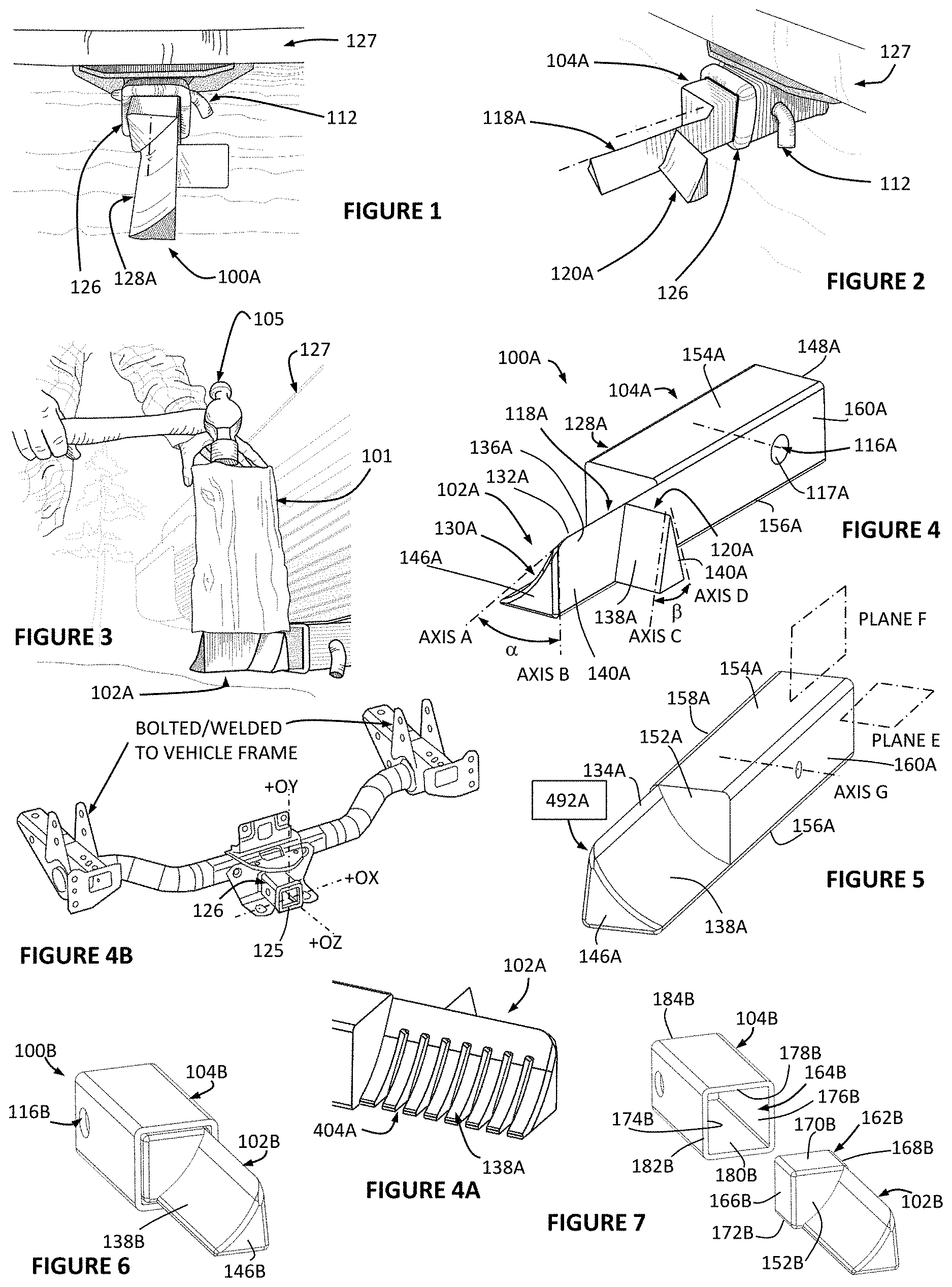
depicts a top perspective view of a wood splitter mounted within a hitch receiver of a truck;
depicts a side perspective view of a wood splitter mounted within a hitch receiver of a truck;
depicts a side perspective view of a user using a hammer to impact a log against a wood splitter mounted within a hitch receiver of a truck;
depicts a top perspective view of a wood splitter with secondary blade for mounting within a hitch receiver of a vehicle;
A depicts a partial top perspective view of a blade portion of a wood splitter having a plurality of vertical relief grooves extending along a deflector face;
B depicts a top perspective view of one embodiment of a common hitch receiver and a receiver entry;
depicts a top perspective view of a wood splitter for mounting within a hitch receiver of a vehicle;
depicts a top perspective view of a wood splitter having a substantially solid blade portion secured in a substantially tubular fixation portion for mounting within a hitch receiver of a vehicle;
depicts a top perspective exploded view of the wood splitter of having a substantially solid blade portion secured in a substantially tubular fixation portion for mounting within a hitch receiver of a vehicle;
depicts a top perspective view of a wood splitter having a substantially solid blade portion secured in a substantially tubular fixation portion for mounting within a hitch receiver of a vehicle;
depicts a top view of a wood splitter having a guard portion seated within guard receivers and wherein the wood splitter is configured for mounting within a hitch receiver of a vehicle;
A depicts a top perspective view of the wood splitter illustrated in ;
B depicts a top view of a wood splitter having a guide portion seated within guide receivers similar to . The guide portion includes a generally linear wall portion that is substantially parallel a cut edge of a blade portion. The wood splitter is configured for mounting within a hitch receiver of a vehicle;
C depicts a top perspective view of the guide portion of A ;
depicts a top perspective view of a wood splitter having a guard portion seated within a guard receiver and wherein the wood splitter is configured for mounting within a hitch receiver of a vehicle;
depicts an exploded top perspective view of the wood splitter of ;
depicts a partial exploded top perspective view of the wood splitter of ;
depicts a top perspective view of a wood splitter having a guard portion seated within a guard receiver and wherein the wood splitter is configured for mounting within a hitch receiver of a vehicle;
depicts a partial top view of a wood splitter having a guard portion seated within a guard receiver and wherein the wood splitter is configured for mounting within a hitch receiver of a vehicle;
depicts a partial top perspective view of a wood splitter having a guard portion with softened end seated within a guard receiver and wherein the wood splitter is configured for mounting within a hitch receiver of a vehicle;
depicts a partial top perspective view of a wood splitter having a collapsible guard portion seated within a guard receiver and wherein the wood splitter is configured for mounting within a hitch receiver of a vehicle;
depicts a top perspective view of a wood splitter having a guard portion seated within a guard receiver in an operational mode and wherein the wood splitter is configured for mounting within a hitch receiver of a vehicle;
depicts a top perspective view of a wood splitter with secondary blade for mounting within a hitch receiver of a vehicle;
depicts a perspective view of a blade portion of the wood splitter of for mounting within a hitch receiver of a vehicle;
depicts a top perspective view of a wood splitter for mounting within a hitch receiver of a vehicle;
depicts a top perspective view of a wood splitter having a removable portion of a blade portion for mounting within a hitch receiver of a vehicle;
depicts a top perspective exploded view of the wood splitter of having a removable portion of a blade portion and whereby the wood splitter is for mounting within a hitch receiver of a vehicle;
depicts a top perspective view of the wood splitter of including a guard portion for mounting within a hitch receiver of a vehicle;
depicts a top perspective exploded view of the wood splitter of including a guard portion for mounting within a hitch receiver of a vehicle;
depicts a top perspective view of the wood splitter of including an alternative guard portion for mounting within a hitch receiver of a vehicle;
depicts a top perspective view of a wood splitter including a blade cover for mounting within a hitch receiver of a vehicle;
depicts two side views of the blade cover illustrated in ;
depicts a top perspective view of a wood splitter including a blade cover positioned over a kindling collector;
depicts a top perspective view of a wood splitter with a blade cover removed and positioned over a kindling collector;
depicts a top perspective view of a wood splitter having a removeable blade portion and an extruded deflector body portion;
depicts a top perspective exploded view of the wood splitter of ;
depicts a bottom perspective exploded view of the wood splitter of ;
depicts a top perspective view of a wood splitter having a removeable blade portion;
depicts a top perspective exploded view of the wood splitter of ;
depicts a bottom perspective exploded view of the wood splitter of ;
depicts a top perspective view of a wood splitter having a removeable blade portion;
depicts a top perspective exploded view of the wood splitter of ;
depicts a top perspective exploded view of the wood splitter of ;
A depicts a top perspective view of a wood splitter having an integrated blade portion;
B depicts a top perspective exploded view of the wood splitter of A having an integrated blade portion;
A depicts a top perspective view of a wood splitter having a pivotable blade guide and cover;
B depicts a top perspective exploded view of the wood splitter of A ;
depicts a top perspective view of a wood splitter having a side mounted blade portion configured for mounting within a hitch receiver of a vehicle;
depicts a top perspective view of the wood splitter of for mounting within a hitch receiver of a vehicle;
depicts an exploded top perspective view of the wood splitter of configured for mounting within a hitch receiver of a vehicle;
depicts a top perspective view of a wood splitter configured for mounting within a hitch receiver of a vehicle;
depicts an end view of the wood splitter of with integrated blade portion and configured for mounting within a hitch receiver of a vehicle;
depicts a top perspective view of a wood splitter with integrated blade portion for mounting within a hitch receiver of a vehicle;
A depicts an end view of the wood splitter of configured for mounting within a hitch receiver of a vehicle;
B depicts an end view of the wood splitter of with guide configured for mounting within a hitch receiver of a vehicle;
C depicts a top view of the wood splitter of with guide configured for mounting within a hitch receiver of a vehicle;
D depicts an exploded view of the wood splitter of with guide configured for mounting within a hitch receiver of a vehicle;
depicts a top perspective view of a wood splitter having a flat blade portion for mounting within a hitch receiver of a vehicle;
depicts an exploded view of the wood splitter illustrated in ;
depicts a top perspective view of a wood splitter configured for mounting within a hitch receiver of a vehicle;
depicts an exploded top perspective view of the wood splitter of configured for mounting within a hitch receiver of a vehicle;
depicts a top perspective view of a wood splitter configured for mounting within a hitch receiver of a vehicle;
depicts a top perspective view of the wood splitter of configured for mounting within a hitch receiver of a vehicle;
depicts a top perspective view of a wood splitter with deflector portion for mounting within a hitch receiver of a vehicle;
depicts a top perspective view of the wood splitter with deflector portion of configured for mounting within a hitch receiver of a vehicle;
depicts a top perspective view of a wood splitter illustrating an alternative fixation portion and configured for mounting within a hitch receiver of a vehicle;
depicts a top perspective view of a wood splitter illustrating an alternative fixation portion and configured for mounting within a hitch receiver of a vehicle;
depicts a top perspective view of the wood splitter of illustrating an alternative fixation portion and configured for mounting within a hitch receiver of a vehicle;
depicts a top perspective view of a wood splitter with integrated blade and deflector portions and configured for mounting within a hitch receiver of a vehicle;
depicts an alternative top perspective view of the wood splitter of with integrated blade and deflector portions and configured for mounting within a hitch receiver of a vehicle;
depicts a top perspective view of a wood splitter with lowered integrated blade and deflector portions and configured for mounting within a hitch receiver of a vehicle;
depicts a top perspective view of a wood splitter blade portion equipped with side bosses (log bosses);
depicts an exploded top perspective view of the wood splitter blade of with side bosses;
depicts a top perspective view of an adjustable height wood splitter and configured for mounting within a hitch receiver of a vehicle;
depicts an exploded top perspective view of the wood splitter of configured for mounting within a hitch receiver of a vehicle;
depicts a top perspective view of a ground engaging wood splitter configured for mounting within a hitch receiver of a vehicle;
depicts an alternative top perspective view of the ground engaging wood splitter of configured for mounting within a hitch receiver of a vehicle;
depicts an exploded top perspective view of the ground engaging wood splitter of configured for mounting within a hitch receiver of a vehicle;
depicts an end view of the ground engaging wood splitter of configured for mounting within a hitch receiver of a vehicle;
depicts a top perspective view of a hitch ball mounted wood splitter configured for use over a hitch ball;
depicts a top perspective view of a hitch ball wood splitter configured for use over a hitch ball;
B depicts an exploded view of the hitch ball wood splitter of ;
depicts an exploded top perspective view of a hitch ball mounted wood splitter configured for use over a hitch ball;
depicts a top perspective view of a hitch ball nut mounted wood splitter configured for use over an opposing end of a hitch ball;
depicts a modified hitch ball nut as used in the hitch mounted wood splitter of ;
depicts a cross sectional view through the hitch ball of the hitch ball nut mounted wood splitter of ;
depicts a side view of the hitch ball nut mounted wood splitter of ;
depicts a top perspective view of a hitch ball mounted wood splitter for use on a hitch ball;
depicts an exploded top perspective view of the hitch ball mounted wood splitter of ;
depicts a blade and deflector portions of the hitch ball mounted wood splitter of ;
depicts a top perspective view of an axe convertible to hitch wood splitter configured for mounting within a hitch receiver of a vehicle;
depicts a top perspective view of an axe removed from a hitch coupler that is operable for mounting within a hitch receiver of a vehicle;
A depicts a top perspective view from a trailing end of the hitch coupler of operable to couple a hand axe to a hitch receiver;
B depicts a perspective view of a hitch coupler being applied to an axe handle of an axe;
C depicts a perspective view of the hitch coupler of B enclosed about an axe handle;
D depicts a perspective view of a hitch coupler and optional coupler hinge;
E depicts an opposing perspective view of the hitch coupler of D ;
F depicts an exploded perspective view of a hand axe and hitch coupler;
G depicts a perspective view of a hand axe preparing to be coupled with a hitch coupler;
H depicts a cross-sectional perspective view through a central vertical plane of the hitch coupler illustrated in F ;
J depicts a close-up perspective view of the hitch coupler illustrated in F ;
K depicts a perspective view of the hand axe and coupler assembled in an operative mode or configuration in a hitch receiver;
depicts a top perspective view of a wood splitter secured to a frame of a trailer in an operational mode;
depicts a top perspective view of the wood splitter of in a storage mode;
depicts a top perspective view of a wood splitter secured to a frame of a trailer in an alternative embodiment;
depicts a top perspective view of a wood splitter with mounting bracket in an operational configuration;
depicts a top perspective view of the wood splitter of in a storage configuration;
depicts a top perspective exploded view of the wood splitter of ;
depicts a bottom perspective exploded view of a wood splitter having a threaded stem;
depicts a top perspective exploded view of a wood splitter configured to mount to an interactive lock head of a base fastener;
depicts a top perspective exploded view of interchangeable system capable of mounting various size trailer balls and a wood splitter to a base fastener;
depicts a perspective cross sectional view through a wood splitter and base fastener of the interchangeable system of ;
A depicts a perspective view of the wood splitter of ;
B depicts a partial perspective view of a wood splitter having a saddle seated over a portion of a trailer frame;
C depicts a partial perspective view of a wood splitter welded to a portion of a trailer frame with a protective sleeve;
D depicts a perspective view of a wood splitter welded to a ball mount tongue of a ball mount;
E depicts an opposing perspective view of the wood splitter of D ;
F depicts a perspective view of a wood splitter with secondary blade and with extended length ball mount tongue;
G depicts a perspective view of a wood splitter fastened to an extended length ball mount tongue;
H depicts a perspective view of a wood splitter with ball space and secondary blade;
J depicts a perspective view of a wood splitter with ball space with alternative secondary blade;
K depicts a perspective view of an alternative wood splitter with internal ball space;
L depicts a perspective view of a wood splitter with ball space and several optional features;
M depicts a perspective view illustrating assembly of the wood splitter of L over a hitch ball base;
N depicts a perspective view illustrating an operable configuration with the wood splitter of L seated on a hitch ball.
P depicts a perspective view illustrating a wood splitter having one or more base tabs extending from a base surface of a fixation portion;
Q depicts a perspective view illustrating various features that may be included in a wood splitter;
R depicts a perspective view of a wood splitter with ball space having a pivoting guide portion folded down in a storage configuration;
S depicts a perspective view of the wood splitter of R having a fixation portion with ball space with pivoting guide portion locked upright in an operational configuration;
T depicts a perspective view of the wood splitter of R with guide portion removed illustrating a first guide receiver and guide boss;
A is a perspective view of a wood splitter having a female cavity and blade lock bolt and alternatively, the blade lock bolt is substituted by a threaded hitch ball;
B depicts a perspective view of a wood splitter having a fixation portion in the form of a blade coupler, and a removable blade portion;
C depicts a cross-sectional view of a blade coupler similar to that illustrated in B ;
D depicts a perspective view of a wood splitter with a blade portion having a cut edge offset to one side;
is a perspective view of a wood splitter having an extended stem and mounted to a ball mount;
is an exploded view of the wood splitter and ball mount illustrated in ;
is an exploded view of the wood splitter and ball mount illustrated in with a ring shaped guide portion;
is a side view of a wood splitter with a novel guide portion;
is an exploded perspective view of the wood splitter of ;
is a perspective view of a dual mode wood splitter in a posted configuration;
is an exploded view of the dual mode wood splitter of ;
is an exploded perspective view of another dual mode wood splitter;
is a cross sectional view of the dual mode wood splitter of ;
is a perspective view of a wood splitter having an offset cut edge;
is a perspective view of a wood splitter configured for a captured ball configuration;
is a cross sectional view of the wood splitter of configured for a captured ball configuration with optional flutes;
is a perspective view of a wood splitter configured for a captured ball configuration;
is a cross sectional view of the wood splitter of illustrating the internal ball space;
is a perspective view of a wood splitter configured for a captured ball configuration;
is a perspective view of a wood splitter configured for a captured ball configuration;
is a cross-sectional view of the wood splitter illustrated in ;
is a perspective view of a guide portion in the form of a plate with extended superior lobe;
is a perspective view of a wood splitter with a novel guide portion;
is an exploded view of the wood splitter of ;
is an end view of the wood splitter of ;
is a perspective view of a wood splitter with an adjustable form of the guide portion illustrated in ;
is a perspective view of a wood splitter having a novel guide portion;
is an exploded perspective view of the wood splitter of ;
is a perspective view of a wood splitter having a novel adjustable guide portion and cut blade cover;
is a perspective view of a wood splitter with blade cover in an uncovered position;
is a perspective view of a wood splitter with blade cover in a covered position;
is a perspective view of a wood splitter with blade cover in an uncovered position;
is a perspective view of a wood splitter with novel guide portion and construction;
is an opposing perspective view of the wood splitter of ;
is a perspective view of a wood splitter with a novel guide portion;
is a perspective view of a wood splitter with a novel guide portion;
is a perspective view of a wood splitter with a novel guide portion;
is a perspective view of a wood splitter with a novel guide portion;
is a perspective view of the wood splitter of with guide portion in a different mode;
is an exploded perspective view of a wood splitter with a novel guide portion;
is a perspective view of the wood splitter of in an operational mode;
is a perspective view of the wood splitter of about to set into an open mode;
is a perspective view of a wood splitter having a novel guide portion;
is a perspective view of the wood splitter of in an operational configuration;
is a perspective view of the wood splitter of in an open configuration;
is a top view of a guide portion of the wood splitter of ;
is a perspective view of a novel wood splitter with integrated bottle opener in an operational mode;
is a perspective view of the wood splitter of in an open mode;
is a partial close-up view of the first guide receiver of the wood splitter of ;
is a perspective view of the wood splitter of showing various cavities;
is a perspective view of the wood splitter of using a novel guide portion;
is a perspective view of the guide portion of the wood splitter of ;
is a perspective view of a novel wood splitter;
is an exploded view of the wood splitter of ;
is a different perspective view of the wood splitter of ;
is a different perspective view of the wood splitter of ;
is a perspective view of a wood splitter having a solid fixation portion;
is a perspective view of a wood splitter having a curved blade portion;
is a diagram of an embodiment of one method of splitting wood utilizing a hitch receiver supported wood splitter as described herein;
is a diagram of an embodiment of one method of splitting wood utilizing a wood splitter having an internal ball space in conjunction with a ball mount and hitch ball;
is a perspective view of a wood splitter in the form of a jack stand with a novel cover blade accessory;
is an exploded view of the jack stand with cover blade accessory of ;
A is a perspective view of a cover blade;
B depicts a perspective view of a cover blade;
C depicts a perspective view of a cover blade seated over the lift pod of a jack stand lift arm;
D is an exploded perspective view of a cover blade having a cover blade cavity that is open on two ends and fits over a lift pod like a saddle;
E depicts a perspective view of a cover blade;
F depicts a perspective view of a cover blade;
G depicts a perspective view of a cover blade;
is an exploded view of a wood splitter in the form of a jack stand with a jack stand lift arm substituted with a jack stand blade arm;
is a perspective view of the wood splitter illustrated in ;
depicts a partially exploded perspective view of a jack stand having a blade portion and guide portion;
depicts a perspective view of an assembled wood splitter of ;
depicts a front view of the wood splitter of ;
A depicts a perspective view of the wood splitter of with a guide portion;
B depicts a top perspective view of an adaptable lift pod with complementary fit over the blade of a jack stand blade arm;
depicts a perspective view of a wood splitter having a jack stand blade arm pinned in a jack stand base with elevated guide portion;
depicts an alternative perspective view of the wood splitter of with elevated guide portion;
depicts a perspective view of a wood splitter having a jack stand blade arm;
depicts an opposing perspective view of the wood splitter of ;
depicts an exploded perspective view of the wood splitter of ;
depicts a cross-sectional view of the wood splitter of with engaged stop;
depicts a cross-sectional view of the wood splitter of with disengaged stop;
depicts a perspective view of a jack stand blade arm;
depicts an alternate perspective view of the of the jack stand blade arm of ;
A depicts a perspective view of a modified jack stand lift arm with multi-purpose hole;
B depicts an exploded perspective view of a modified jack stand lift arm with complementing wood splitter having protruding blade anchor;
C depicts a bottom perspective view of the wood splitter with protruding blade anchor of B ;
D depicts a cross-sectional perspective view of the modified jack stand lift arm of B ;
E depicts a top perspective view of a modified jack stand with a complementing material support assembly;
F depicts a cross-sectional view of the modified jack stand with a complementing material support assembly of E ;
G depicts perspective view of example signs and flags coupled to sign poles suited for mounting in the multi-purpose hole of the modified jack stand lift arm of A ;
H depicts perspective views of examples of various material support assemblies that are suited for mounting in the multi-purpose hole of the modified jack stand lift arm of A ;
I depicts a top perspective view of an example of an alternative means of fixing an elongate support member to a jack stand lift arm using a U-shaped support bracket;
J depicts a partial exploded view of the U-shaped support bracket of I ;
K depicts a partial top perspective view of a support bracket for mounting to an upper support surface of a jack stand lift arm;
L depicts a partial top perspective view of a support bracket for mounting to a first arm face of a jack stand lift arm;
M depicts a partial top perspective view of a clamping style support bracket for mounting to a first arm face of a jack stand lift arm;
N depicts a partial top perspective view of direct fixation of an elongate support member to a first arm face of a jack stand lift arm;
P depicts a top perspective view of a pair of modified jack stand lift arms used in conjunction with complementing elongate support members to support a ski wax strut;
Q depicts a bottom perspective view of the ski wax station of P with ski wax strut lifted off elongate support members;
R depicts perspective view of a size coupler which may be used to couple various sized elongate support members to a modified jack stand lift arm;
depicts a top perspective view of a modified jack stand lift arm with recess for seating a tongue of a blade insert;
depicts a bottom perspective view of a modified jack stand lift arm of with wood splitter removed;
depicts a bottom perspective view of a modified jack stand lift arm with recess for seating a tongue of a blade insert;
depicts a top perspective view of the modified jack stand lift arm of with wood splitter removed;
depicts a top perspective view of an alternative form of jack stand base with cover blade seated over a superior end;
depicts a top perspective exploded view of an alternative form of jack stand base and cover blade;
depicts a bottom view of the cover blade depicted in ;
depicts a bottom perspective view of the cover blade depicted in ;
depicts a perspective view of a wood splitter configured for a captured ball configuration;
depicts an opposing perspective view of the wood splitter of configured for a captured ball configuration;
depicts a perspective view of the wood splitter of seated over a hitch ball on a ball mount assembly;
depicts a cross-sectional perspective view of the wood splitter of with view of the internal ball space;
depicts a cross-sectional perspective view of the wood splitter of (but turned 90 degrees to the view) with view of the internal ball space;
depicts a bottom perspective view of the wood splitter of with view of the internal ball space;
depicts a top perspective view of a novel wood splitter with optional integrated bottle opener;
depicts an alternative top perspective view of the wood splitter of ;
depicts a bottom view of the wood splitter of ;
depicts a bottom perspective view of the wood splitter of ;
depicts a top perspective view of a wood splitter with log boss at the end of the blade portion;
B depicts an opposing perspective view of the wood splitter of ;
depicts a top perspective view of a wood splitter having a fixation portion with X-shaped profile;
depicts a top perspective exploded view of a wood splitter having a tubular fixation portion for welded fixation to a blade portion;
depicts a bottom perspective view of an adjunct blade;
depicts a top perspective view of the adjunct blade of ;
depicts a top perspective view of an alternative adjunct blade;
depicts a top perspective view of an adjunct blade;
depicts a perspective view of a volume envelope in which wood splitters having a ball space or that are secured to a ball mount can fit;
depicts a perspective view of a volume envelope in which wood splitters having a fixation portion operable to be received in a hitch receiver can fit;
depicts a perspective view of a wood splitter mounted to a European style ball mount;
depicts an exploded perspective view of the wood splitter of ;
depicts a bottom perspective view of the wood splitter illustrated in ;
depicts a cross-sectional perspective view vertically through the cut edge of the wood splitter of ;
depicts a side view of the wood splitter of ;
depicts a perspective view of a wood splitter with centered cut edge;
depicts a perspective view of a wood splitter with offset cut edge;
depicts an exploded view of a wood splitter comprising an alternative form of ball space reducer fit over a hitch ball;
depicts a perspective view of the wood splitter of ;
depicts a bottom perspective view of a wood splitter with a blade cap;
depicts a front perspective view of a wood splitter with a blade cap;
depicts a front perspective view of a multi-function jack stand with integrated secondary support;
depicts a front perspective view of a multi-function jack stand with integrated secondary support;
depicts an exploded view of the multi-function jack stand of ;
depicts a front perspective view of a support strut of the multi-function jack stand of ;
depicts a front perspective view of a multi-function jack stand with integrated secondary support and optional removed secondary key;
depicts a front perspective view of a multi-function jack stand with integrated secondary support and optional secondary key inserted;
depicts a front perspective view of a multi-function jack stand with integrated secondary support;
depicts a front perspective view of a multi-function jack stand with integrated secondary support;
depicts a front perspective view of a multi-function jack stand base with integrated secondary support;
depicts a front perspective view of a multi-function jack stand with integrated secondary support and an inserted material support assembly;
depicts a partially exploded front perspective view of a multi-function jack stand with integrated secondary support and material support assembly of ;
depicts a front perspective view of a multi-function jack stand with integrated secondary support and an inserted elongate support member;
depicts a front perspective view of a multi-function jack stand with integrated secondary support and an inserted material support assembly;
depicts a front perspective view of a multi-function jack stand with integrated secondary support;
depicts a side perspective view of a multi-function jack stand with integrated secondary support and an inserted material support assembly;
depicts a side perspective view of a multi-function jack stand with integrated secondary support and a material support assembly;
depicts a partially exploded top perspective view of a multi-function jack stand with elongate support member and utility light;
depicts a partially exploded top perspective view of a multi-function jack stand with utility light;
depicts a bottom perspective view of a utility light for use with a multi-function jack stand;
depicts a top perspective view of a multi-function jack stand with integrated secondary support and elongate support member utilized to support a screen, drape, curtain, or backdrop;
depicts a partial perspective view of a support member receiver of an elongate support member and a utility aperture and utility fastener;
depicts a partial exploded perspective view of a support member receiver of an elongate support member with a hanger for coupling with the elongate support member;
depicts a partial exploded perspective view of a support member receiver of an elongate support member with a hanger for coupling with the elongate support member;
depicts a partial exploded perspective view of a support member receiver of an elongate support member with camera mount for coupling with the elongate support member;
depicts a partial exploded perspective view of a support member receiver of an elongate support member with a material support pod for coupling with the elongate support member;
depicts a partial exploded perspective view of a support member receiver of an elongate support member with a material support pod for coupling with the elongate support member;
depicts a partial exploded perspective view of a support member receiver of an elongate support member with a material support pod for coupling with the elongate support member;
depicts a perspective view of a jack stand blade arm disposed in a base cavity of a jack stand base;
depicts a partial exploded perspective view of the jack stand blade arm and jack stand base of ;
depicts a partial exploded inferior perspective view of the jack stand blade arm and a jack stand base of ;
depicts a perspective view of a jack stand blade arm;
depicts a partial exploded inferior perspective view of a jack stand blade arm and a jack stand base;
depicts a partial exploded view of a modular jack stand blade arm and jack stand base with a collector;
depicts a cross-sectional view through a central plane of the modular jack stand blade arm and jack stand base with a collector of ;
depicts a side closeup view of the collector retainer illustrated in ;
depicts a side view of a jack stand blade arm and jack stand base with collector;
depicts a top view of the jack stand blade arm and jack stand base with collector of ;
depicts a perspective view of a lift trunk;
depicts a perspective view of a lift trunk;
depicts a perspective view of a lift trunk;
depicts a perspective view of a wood splitter;
depicts a perspective view of a wood splitter;
depicts a perspective view of a wood splitter;
depicts a partially exploded perspective view of a lift trunk aligned for insertion in a jack stand base;
depicts a partially exploded inferior perspective view of a modular wood splitter, lift trunk, and jack stand;
depicts a partially exploded perspective view of an elongate support member, a lift trunk, and jack stand;
is a diagram illustrating a method of converting a jack stand into a jack stand wood splitter using a jack stand blade arm;
is a diagram illustrating a method of converting a jack stand into a jack stand wood splitter using a cover blade;
is a diagram illustrating a method of converting a jack stand into a jack stand wood splitter using a cover blade;
is a diagram illustrating a method of converting a lift trunk to utilize a jack stand as a multi-purpose jack stand.
depicts a perspective view of a wood splitter configured for a captured hitch ball fixation with grip band;
depicts an exploded perspective view of ;
depicts an exploded perspective view of a wood splitter configured for a captured ball configuration with grip band;
depicts a perspective view of the wood splitter of ;
depicts a cross-sectional view of a wood splitter with ball space having an internal annular bumper;
depicts a bottom perspective view of a wood splitter configured for a captured ball configuration with bumper slots in the ball space;
depicts the wood splitter of with bumpers seated in the bumper slots;
A depicts a cross-sectional view of a wood splitter configured for a captured hitch ball with bayonet engagement slot at the lower end of the ball space;
B depicts a close-up view of the bayonet engagement slot of A ;
depicts a perspective view of a bayonet washer for fixation between a ball mount and a hitch ball (see );
depicts a hitch ball with one or more bayonets integrated into its base;
depicts a perspective view of a slotted bayonet washer for fixation between a ball mount and hitch ball (see );
depicts a perspective view of the slotted bayonet washer of used with a restraining band to secure a wood splitter;
depicts a perspective view of a hitch ball base with integrated bayonet engagement slot;
A depicts a partial exploded view of a friction sleeve for placement over a hitch ball before placement of a wood splitter;
B is an enlarged perspective view of the friction sleeve illustrated in A ;
depicts a perspective view of a wood splitter seated over a ball mount and hitch ball with a banded blade guard;
depicts an exploded perspective view of a donut bumper secured around the neck of a hitch ball before placement of a wood splitter;
depicts an exploded perspective view of an elevated washer situated between a ball mount and a hitch ball base;
depicts a partial exploded perspective view of a hitch ball with integrated base stabilizer;
depicts an exploded perspective view of a stabilizer washer situated between a ball mount and hitch ball base;
depicts an enlarged perspective view of the stabilizer washer in ;
depicts a partially exploded perspective view of a wood splitter configured with locking pin for locking onto a hitch ball;
depicts a perspective view of the wood splitter locked with locking pin of ;
depicts a perspective view of a wood splitter operable to be fully supported on a hitch ball;
depicts a bottom perspective view of the wood splitter of ;
depicts a perspective view of a wood splitter fixed to a ball mount by a lower restraint band;
depicts a top perspective view of a wood splitter with restraint recesses as used in ;
depicts a top perspective view of the lower restraint band as illustrated in ;
depicts a rear partially exploded perspective view of a coupler clip for securing a wood splitter to a ball mount;
depicts a front perspective view of a coupler clip engaged to secure the wood splitter of to the ball mount;
depicts a partially exploded perspective view of a wood splitter with set screw operable to hold a wood splitter to a hitch ball.
DETAILED DESCRIPTION OF SELECTED EMBODIMENTS
Select embodiments of the article of invention will now be described with reference to the Figures. Like numerals indicate like or corresponding elements throughout the several views. Various embodiments having like or corresponding elements are distinguished by letters (i.e. 100 A, 100 B, 100 C, 100 AA). Element numbers without an attached letter in most cases refers to objects used in conjunction with an embodiment of this disclosure (i.e., impact tool 105 ). Embodiments described in the Specification and Drawings are fully supported as will be recognized by those skilled in the art. To avoid redundant explanation in the Specification and redundant labeling of elements in the Drawings, like elements are not re-described and/or relabeled in every instance. Some features described and illustrated for one embodiment, may optionally be utilized within other similar embodiments although not described or illustrated in the feature to again avoid redundant work. The terminology used in the description presented herein is not intended to be interpreted in any limited or restrictive way, simply because it is being utilized in conjunction with detailed description of certain specific embodiments of the invention. Furthermore, embodiments of the invention may include several novel features, no single one of which is solely responsible for its desirable attributes or which is essential to practicing the invention described herein.
through 4 illustrate an embodiment of the article of invention. In this embodiment, a wood splitter 100 A is illustrated housed within a hitch receiver 126 that is fixed to a vehicle 127 such as for example, a car, a truck, a UTV, and trailer. Although not required, a hitch pin 112 (which may take other forms such as a bolt) is extended through a hole bored through a hitch receiver 126 and passes through a fixation bore 116 A on a fixation portion of wood splitter 100 A. A hitch pin retainer 114 may be used to secure hitch pin 112 in position. In this embodiment, wood splitter 100 A comprises a primary blade 118 A and an optional secondary blade 120 A extending at an oblique angle from the primary blade. In preferred forms, the oblique angle is generally 90 degrees. As noted in , the blade portion 102 A of the wood splitter is spaced sufficiently from the vehicle thereby avoiding damage to the vehicle during splitting actions. In this embodiment and others, the wood splitter 100 A is manufactured from metal, preferably steels and their alloys. In some embodiments the steels are stainless steels. However, any material having sufficient strength, ductility, and hardness may be used such as aluminum, and aluminum alloys. In some places, polymers may be used. Individual parts and assemblies of the article of invention may be formed by one or more of a range of manufacturing processes including machining, casting, and forging. In some embodiments, the tools are in the form of a single casted or forged part. All or a portion of the blade portions may be hardened or remain unhardened. Some parts can be manufactured from plastic injection.
illustrates a user positioning a log on a blade portion 102 A of a wood splitter 100 A secured within a hitch receiver 126 of a vehicle such as a truck. The user holds the side of a log 101 or other wood with one hand and impacts the top of the log with an impact tool 105 such as a hammer or mallet. The impact causes the log 101 to be driven down over a primary blade 118 A (and secondary blade 120 A if so equipped) and also over a deflector portion 130 A of the splitter. As a consequence of this, the log 101 is split into smaller pieces. In some embodiments, a collector (such as 258 I in ) is positioned below a wood splitter to capture the smaller wood pieces (also referred to as kindling 103 ) as they fall from the wood splitter. A wood splitter according to some embodiments of this invention are configured for being slidingly received in standard size hitch receiver openings such as a 2 inch×2 inch hitch receiver, and in other embodiments for a standard 1.25 inch×1.25 inch hitch receiver, standard 2.5 inch×2.5 inch hitch receiver, and 3 inch×3 inch hitch receivers. However, it is conceived the device could be used in any other custom sized receiver. In addition, the disclosed wood splitter embodiments may be received in parts functionally equivalent to hitch receivers for splitting purposes such as splitter sleeve 388 DD ( ).
Referring back to , it illustrates one embodiment of the article of invention. In this embodiment a wood splitter comprises a fixation portion 104 A and a blade portion 102 A formed from a body portion 128 A. The fixation portion 104 A is generally configured to be received in a hitch receiver 126 secured to a vehicle 127 . In this embodiment, fixation portion 104 A is in the form of a solid bar made of a metal such as steel. The blade portion 102 A comprises a primary blade 118 A and in this embodiment also comprises an optional secondary blade 120 A extending generally perpendicular to primary blade 118 A. The primary blade 118 A and secondary blade both have a cut edge 132 A with a primary edge face 134 A and a secondary edge face 136 A. One or more of a primary edge face and a secondary edge face may be vertical or sloped. In some embodiments, a primary edge face 134 A and secondary edge face 136 A seamlessly transition into a primary deflector face 138 A and secondary deflector face 140 A of a deflector portion 130 A whereas in other embodiments there is a distinct transition such as a change in angle between them. In some embodiments, the primary edge faces and secondary edge faces are separated from the primary and secondary deflector faces by respective primary and secondary transition faces.
Edge faces, transition faces, and deflector faces may assume a variety of profiles not limited to generally flat, concave, and convex. In preferred embodiments, the aforementioned primary and secondary blade components face generally upward however in other embodiments the blade portions are vertical or downward. Distances between opposed edge, transition, and deflector faces increase moving inferiorly from the cut edges as illustrated in . Axis A and axis B extend from a cut edge 132 A and generally follow the included surfaces below thereby defining a slope angle α. When the optional secondary blade is present, axis C and D extend from a cut edge of the secondary blade along the wedged surfaces defining a slope angle β. In preferred embodiments, these angles (α and β) range between 20 degrees and 80 degrees although they may assume values outside this range.
In some embodiments, a cut edge of a blade portion is generally centered between sloping faces of a blade portion (i.e. ). In other embodiments such as illustrated in , a cut edge 132 A is offset to one side of body portion 128 A. This offset tends to create steeper incline faces on one side versus the other. A cut edge offset to the right ( ) is preferable for right-handed users, whereas a cut edge offset to the left ( ) is preferable for left hand users. Some embodiments include two cut edges so configured such that by rotating a wood splitter 90 degrees within a hitch receiver, a user may use a single wood splitter to perform left-handed and right handed splitting.
Embodiments having a secondary blade 120 A, it is preferable the second blade also includes one or more opposed primary and secondary edge faces, transition faces, and deflector faces. Distances between opposed edge, transition, and deflector faces increase moving inferiorly from the cut edge of a secondary blade as represented by the angle β ( ) between axis C and axis D each extending down opposing slopes.
In this and other embodiments, a fixation portion 104 A and other aspects of a body portion 128 A may be defined by a top face 154 A, a bottom face 156 A, a first side face 158 A, and a second side face 160 A. A proximal end face 146 A and a distal end face 148 A are positioned at the opposing ends. A fixation face 117 A defines a fixation bore 116 A extending between first side face 158 A and second side face 160 A. Fixation bore 116 A has an elongate axis G and is characterized by a diameter sufficient to house a hitch pin 112 . It is preferred that fixation bore 116 A is generally aligned with a horizontal mid plane (plane E) and is generally perpendicular to first and second side faces 158 A and 160 A. Embodiments configured to accommodate both left-handed and right-handed users may include a secondary fixation bore (not shown) extending between bottom face 156 A and top face 154 A. A distal blade face 152 A may extend between blade portion 102 A and fixation portion 104 A. Plane F ( ) is orthogonal to plane E. Plane F stands vertical in operation and is centrally located between first and second side faces 158 A, 160 A within the fixation portion of wood splitter embodiments that are secured within a hitch receiver of a vehicle.
A illustrates a blade portion of the wood splitter of having a plurality of relief grooves 404 A extending into a primary deflector face 138 A of a blade portion 102 A. The relief grooves 404 A may be utilized in a variety of wood splitter embodiments having either primary or secondary deflector faces.
B illustrates one embodiment of a typical hitch receiver that is bolted or welded to the frame of a vehicle such as one of a car, truck, and UTV. Various vehicle mounted wood splitters as disclosed herein and in operable configurations are supported entirely by the hitch receiver of a vehicle (or ball mounts inserted therein) and in preferred embodiments are contained entirely within a defined space from an origin centered at the receiver entry 125 of the hitch receiver 126 whereas the defined space is between +5 inches and −3 inches along an axis OY, +/−3 inches along an axis OX, and +8 inches and −7 inches along axis OZ (−OZ extends into the hitch receiver). The ‘+’ symbol designates a positive direction in B . Alternatively, a wood splitter in an operable configuration is supported entirely by the hitch receiver of a vehicle and is contained entirely within a defined space from an origin centered at the receiver entry of the hitch receiver whereas the defined space is between +7 inches and −5 inches along an axis OY, +/−5 inches along an axis OX, and +10 inches and −9 inches along axis OZ (−OZ extends into hitch receiver). In alternative embodiments, a wood splitter can extend outside the defined space.
illustrates yet another embodiment of the article of invention. In this embodiment of a wood splitter 100 B, a blade portion 102 B comprises a blade extension 162 B configured for seating within fixation recess 164 B and held by one or more of; fasteners such as screws and pins, and welds. Blade extension 162 B is defined by one or more of; a first side extension wall 166 B, a second side extension wall 168 B, an upper extension wall 170 B, and a lower extension wall 172 B. Fixation recess 164 B comprises one or more of; an upper recess wall 178 B, a lower recess wall 180 B, a first side recess wall 174 B, and a second side recess wall 176 B. Fixation portion 104 B comprises a proximal tube wall 182 B and a distal tube wall 184 B terminating the ends. As illustrated in , in some embodiments blade portion 102 B does not comprises a four sided blade extension whereas the blade extension is two sided and is instead seated on second side extension wall 168 B and lower extension wall 172 B against respective second side recess wall 176 B and lower recess wall 180 B.
A illustrate another embodiment of the article of invention equipped with a guide portion. In this embodiment, guide portion 106 C comprises a guide wall 186 C having a guide surface 188 C formed thereon. Extending from guide wall 186 C is a first guide leg 190 C which is spaced from a second guide leg 192 C. Body portion 128 C is equipped with one or more guide receivers. The guide receivers may be in the form of a bored hole or may assume other forms capable of securing one or more guide legs and guide feet if present. In this embodiment, wood splitter 100 C comprises a first guide receiver 108 C disposed in top face 154 C and a second guide receiver 110 C disposed in proximal end face 146 C however the guide receivers may be positioned at other faces such as a second side face. As illustrated here, a guide leg may include a guide foot portion such as the second guide foot 196 C which is housed within second guide receiver 110 C. Each guide receiver may comprise a radial guide face defining the walls of the bore and an end guide face at the bottom of the bore.
B illustrates a variation of the guide portion 106 C illustrated in . The embodiment in has a generally horizontal guide wall 186 C with guide surface 188 C formed thereon having a curved or semi-circular shape. In contrast, guide portion 106 C in C comprises a generally horizontal guide wall 186 C with guide surface 188 C that is generally linear along a portion adjacent cut edge 132 C.
Guide portion 106 C in , 10 A, 10 B, and 10 C are configured to have a deflectable insertion. Therefore, to attach guide portion 106 C to body portion 128 C, first guide leg 190 C is inserted in first guide receiver 108 C, then guide portion 106 C is pivoted such that second guide foot 196 C is near second guide receiver 110 C. The user applies a force to second guide leg 192 C to deflect it far enough to clear proximal end face 146 C until it can be aligned with second guide receiver 110 C. The user then releases second guide leg 192 C thereby allowing it to spring into second guide receiver 110 C thus securing it in position. A reverse of these steps are used to remove guide portion 106 C from body portion 128 C.
illustrates another embodiment of the article of invention also equipped with a guide portion 106 D. In this embodiment, a proximal end of blade portion 102 D comprises a guide boss 198 D configured with a first guide receiver 108 D positioned generally vertical along axis K in this embodiment and disposed in a generally horizontal positioned guide boss face 199 D. A second proximal end face 147 D transitions between guide boss 198 D and cut edge 132 D. First pin recess 200 D houses first lock pin 206 D, and second pin recess 202 D houses second lock pin 208 D and third pin recess 204 D in first guide leg 190 D houses third lock pin 210 D. When first guide leg 190 D is inserted into first guide receiver 108 D, motion of guide portion 106 D is limited by third lock pin 210 D being captured between first lock pin 206 D and second lock pin 208 D. In addition, third lock pin 210 D may be used to set first guide leg 190 vertical position within first guide receiver 108 D. In this embodiment, guide portion 106 D is an “L” shape. Guide portion 106 D may be configured to lift out and be removed by the user, or may be fixed within by a pin, screw, weld or other means. For example, a fourth lock pin 214 D can be seated within fourth pin recess 212 D at the inferior end of first guide leg 190 D to limit removal.
illustrates a similar wood splitter 100 D embodiment however, guide portion 106 D is in the shape of a “T”. The shape of guide portion 106 D may be fashioned into a wide range of shapes. illustrates a top view of a “T” shaped guide portion 106 D. illustrates a partial view of a “T” shaped guide portion having a buffer leg 216 D to soften contact by a user. illustrate an embodiment wherein a first guide leg 190 D comprises a pivot joint 218 D thus providing an option to fold a superior portion of a guide portion 106 D down over primary blade 118 D in a storage mode thereby reducing the profile and shielding a user from accidental harm. During operation, guide portion 106 D is lifted upright and lowered into first guide receiver 108 D consequently aligning pivot joint 218 D along axis K and locking it as illustrated in . Third lock pin 210 D holds the vertical position.
illustrates another embodiment of the article of invention equipped with both a primary blade 118 E and a secondary blade 120 E aligned generally perpendicular to each other. The secondary blade option provides for the creation of an additional wood piece during each wood splitting cycle. In this embodiment, body portion 128 E is in the form of a generally square elongate tube although the illustrated embodiment and other embodiments may alternatively use a solid elongate bar, U-channel, L-shape, or other shape configuration. When using non-bar materials, wall thicknesses should be sufficient to prevent plastic deformation upon splitting impact. In this embodiment, body portion 128 E serves as both a fixation portion 104 E and as a support of blade portion 102 E. In this embodiment, primary blade 118 E comprises opposed primary deflector face 138 E and secondary deflector face 140 E to wedge the wood apart during splitting. Superiorly, the deflector faces narrow and transition into primary edge face 134 E and secondary edge face 136 E until reaching cut edge 132 E. Inferiorly, blade bottom blade surface 236 E rests over top face 154 E of body portion 128 E and is secured in place with welds therebetween. An optional secondary blade 120 E is joined, preferably by welding, to a proximal end face of body portion 128 E and primary blade 118 E. In some embodiments as illustrated here, a bottle opener recess 220 E defined by an opener face 219 E is provided for the user to open and consume bottled drinks when splitting wood. In this embodiment, bottle open recess 220 E is positioned for opening to the internal tube cavity 129 E of body portion 128 E. Although most embodiments illustrate the cut edge of a primary blade or secondary blade to be generally linear, in alternative embodiments, the cut edge may be concave or convex superiorly.
illustrates another embodiment of the article of invention. In this embodiment, wood splitter 100 F comprises a solid body portion 128 F. Here primary blade 118 F and optional secondary blade 120 F are machined or casted. As illustrated in this embodiment, a blunt sided first bumper 222 F and a second bumper 224 F may be secured to the side edges of blades to reduce blade exposure. The bumper is sometimes referred to as a log boss or side boss.
illustrates another embodiment of a wood splitter 100 G comprising a body portion 128 G that is solid and having a blade portion 102 G that is at least partially removable. Sloped primary deflector face 138 G and secondary deflector face 140 G are cut in body portion 128 G. A blade interlock 238 G mechanism is used to secure a removable edge portion 135 G of the blade from blade portion 102 G. In this embodiment blade interlock 238 G is in the form of a pair of spaced tongues namely first tongue 228 G and second tongue 230 G extending from blade bottom surface 236 G. The first tongue 228 G and second tongue 230 G are received a complementary first recess 232 G and second recess 234 G in an operational configuration and the removable aspect may be separated from the blade portion in a storage configuration as illustrated in . Alternatively, the recesses and tongues may be reversed such that the tongues extend from body portion 128 G.
illustrates an embodiment of the wood splitter of with a guide portion 106 G. In this embodiment, guide portion 106 G comprises guide wall 186 G with guide surface 188 G thereon wherein the guide wall is in the form of a generally horizontally ring, however, may form other shapes such as an oval or square in other embodiments. Guide wall 186 G is supported by at least one first guide leg 190 G and generally centered superiorly (but may be offset) over blade portion 102 G. First guide leg 190 G is received in first guide receiver 108 G to support it in position. A leg stop 191 G may be used to properly position the guide legs. Examples of leg stops may include lock pins as described earlier, bosses, spring clips, leg diameter changes (as illustrated here). illustrates an alternative shaped guide wall 186 G that is opened at one end for user convenience. In alternative embodiments, portions of the guide wall 186 G may be linear as discussed earlier and cut edges 132 G of blade portion 102 G may be offset from center as illustrated elsewhere in this disclosure. In embodiments wherein the guide wall is ring shaped, it consequently defines a guide aperture 107 G through which the user feeds wood to be split.
illustrate an embodiment of a blade cover 240 H for use during a storage configuration (mode) to minimize exposure to a blade portion 102 H when not in use. In this embodiment, blade cover 240 H comprises a primary cover wall 244 H and a secondary cover wall 246 H intersecting to form an edge pocket 242 H of size and shape to enclose a cut edge 132 H. Primary cover wall 244 H and secondary cover wall 246 H are preferably shaped to generally parallel any one or more corresponding edge faces, deflector faces, and transition faces of blade portion 102 H. In one embodiment, blade cover 240 H comprises one or more magnets 248 H secured to secondary cover wall 246 H on inner cover surface 250 H and on external cover surface 252 H. Magnets 248 H on inner cover surface 250 H, releasably secure the cover over cut edge 132 H by magnetic attraction with blade portion 102 H. Magnets 248 H on external cover surface 252 H, secure blade cover 240 H to a part of body portion 128 H such as bottom face 156 H to prevent loss when wood splitter 100 H is used in operational mode. However, inner cover magnets may be used in both a storage and operational mode.
illustrate an embodiment of a wood splitter 1001 as it would be if secured in a hitch receiver of a vehicle 127 with a collector 258 I positioned between wood splitter 100 I and a ground surface. As wood is driven downward over a cut edge 1321 , wood pieces such as kindling 103 are split off and fall into collector 258 I. Collector 258 I is in the form of a bucket or tub in some embodiments and may comprise a collector handle 124 I such as a bucket handle for carrying convenience. As noted in , sleeve 254 I is preferably sized and shaped with sleeve cavity 256 I to complement the size and shape of blade portion 102 I and be slid off in an operational configuration and slid over blade portion 102 I in a storage configuration thereby limiting exposure injury to the blade portion. Collector 258 I may be inclined such that split wood pieces fall away from blade portion 102 I and collect on collector floor 2601 . An elevator 262 I such as a wood block or brick may be used to provide inclination to encourage kindling to fall in a somewhat orderly pile.
illustrates another embodiment of a wood splitter 100 J comprising a deflector saddle 270 J portion. The deflector saddle 270 J in this embodiment is extruded (although other techniques such as casting can used) preferably of an aluminum alloy with primary deflector face 138 J and secondary deflector face 140 J integrated into the body of the extrusion. The deflector saddle 270 J portion is configured for fixed or removable mounting on top face 154 J of body portion 128 J. In a fixed configuration, fasteners or equivalents may be used. In a removable configuration, deflector saddle 270 J may include a pair of opposing saddle legs 272 J defining a U-channel 268 J sized to slide over and seat on body portion 128 J. A first positioner 264 J and a second positioner 266 J are positioned on and protrude from top face 154 J to position deflector saddle 270 J portion therebetween. Also illustrated is a blade interlock 238 J operating as described with previous embodiments.
illustrates yet another embodiment of a wood splitter 100 K comprising a blade portion 102 K fixed or removably fixed to top face 154 K of body portion 128 K. Body portion 128 K may be solid or tubular. First tongue 228 K and second tongue 230 K are pressed, threaded or otherwise fixed in respective first blade port 274 K and second blade port 276 K which are disposed in blade bottom surface 236 K. First and second tongue 228 K, 230 K are housed in respective first recess 232 K and second recess 234 K which extend into top face 154 K of body portion 128 K. In other forms first tongue 228 K and second tongue 230 K are in the form of bolts for fastening blade portion 102 K to top face 154 K. In some forms blade portion 102 K is welded to body portion 128 K.
illustrates another embodiment of a wood splitter 100 L comprising a removable blade plate 302 L. Here, a part of blade portion 102 L is in the form of a blade plate 302 L having a cut edge 132 L at a superior end and at least one of a primary and a secondary edge face 134 L, 136 L. Extending from an inferior end of the plate is a generally vertical first blade slot 282 L and a distally spaced second blade slot 284 L. A complementing first blade post 278 L and a second blade post 280 L having heads are positioned for securing the removable blade plate 302 L adjacent second side face 160 L. Primary deflector face 138 L is sloped to meet removable blade plate 302 L. As yet another variation, removable blade plate 302 L comprises a first blade hole 286 L and a second blade hole 288 L extending through removable blade plate 302 L. In this embodiment, first blade post 278 L and second blade post 280 L are in the form of screw fasteners for threadably locking the plate to body portion 128 L.
A, 40 B illustrate an embodiment of a wood splitter 100 M comprising a cut edge 132 M integrated into an upright wall 294 M of tubular body portion 128 M. A base wall 296 M extends horizontally from the bottom of upright wall 294 M. Sloped at the end of base wall 296 M is deflector support face 290 M for support of sub-primary deflector face 139 M of deflector plate 298 M. Deflector mate face 292 M abuts an inside surface of upright wall 294 M. A weld may be used at contact junctions between deflector plate 298 L and one or more of upright wall 294 M and deflector support face 290 M. Note that primary edge face 134 M is sloped steeper than primary deflector face 138 M in preferred embodiments. Similarly, A illustrate various embodiments with deflector plate mounting variations. In these embodiments, primary edge face 134 N, 134 P are aligned with respective deflector support face 290 N, 290 P for simplified manufacturing purposes. , 46 illustrate use of a support wedge 300 N to provide support to deflector plate 298 N, whereas in the embodiment in , 48 A a sub-primary deflector face 139 P is supported at an upper edge of deflector support face 290 P. Contact junctions between the deflector plate and a base wall and an upper wall are preferably welded 304 P. Welds 304 NP also hold support wedge 300 N in place.
A- 41 B illustrate an embodiment of a wood splitter 100 AI configured with a foldable guide 396 AI that functions as a blade cover in a storage configuration. In this embodiment, first guide receiver 108 AI extends into body portion 128 AI through top face 154 AI. First guide foot 194 AI at the terminal end of first guide leg 190 AI is housed in first guide receiver 108 AI. Guide wall 186 AI with guide surface 188 AI thereon runs generally parallel, superior, and along the length of cut edge 132 AI. Pivot plate 392 AI comprises a pivot cylinder 390 AI extending along an inferior edge of pivot plate 392 AI allowing consequent movement between it and guide wall 186 AL Pivot motion of pivot cylinder is limited to approximately 90 degrees between an operational and storage configuration. In an operational configuration, shield face 394 AI is generally upright to serve as a guide to log 101 pieces to be split. In a storage configuration, pivot plate 392 AI is folded down covering cut edge 132 AI.
illustrate an embodiment of a wood splitter 100 Q having a deflector plate 298 Q supported at upper deflector support face 291 Q and deflector support face 290 Q. Blade plate 302 Q is secured to second side face 160 Q and deflector mate face 292 Q abuts primary transition face 142 Q. Blade plate 302 Q includes in this embodiment a bottle opener recess 220 Q. Again, welds 304 Q are preferably utilized to secure deflector plate 298 Q to body portion 128 Q and to blade plate 302 Q. Likewise, welds are preferably utilized to secure blade plate 302 Q to second side face 160 Q.
B, 48 C, and 48 D illustrate the wood splitter of with one embodiment of a guide portion 106 EE. In this embodiment, guide portion 106 EE is generally U-shaped comprising a generally flat guide wall 186 EE with guide surface 188 EE formed thereon positioned substantially parallel and superior yet offset (by distance ‘U’) from cut edge 132 EE. This arrangement defines a fall aperture 109 EE through which split wood pieces will fall during splitting operations. Extending inferiorly at a distal end of guide wall 186 EE is first guide leg 190 EE with first fixation face 398 EE thereon. Extending inferiorly at a proximal end of guide wall 186 EE is second guide leg 192 EE with second fixation face 400 EE formed thereon. First fixation face 398 EE is secured to second side face 160 EE and second fixation face 400 EE is secured to proximal end face 146 EE. In preferred embodiments this fixation is by use of fasteners for the purpose of guide portion 106 EE removal for blade sharpening otherwise welds and other similar mechanical operations may be used.
illustrates another embodiment of a wood splitter 100 R comprising a joined tubular fixation portion 104 R and a blade plate 302 R. In this embodiment, blade plate 302 R comprises a blade extension 162 R for fixation against at least one of the internal tube faces within fixation recess 164 R (alternatively, blade extension 162 R may be fixed against an external tube face such as first side face 158 R or second side face 160 R). In this embodiment, blade extension 162 R is fixed against second side recess wall 176 R within fixation recess 164 R. Fixation aperture wall 306 R defines one or more fixation apertures 308 R which may be used to weld blade plate 302 R second side recess wall 176 R. Alternatively, fasteners may be used to secure blade plate 302 R to second side recess wall 176 R. As a further alternative, blade plate 302 R may be welded from inside fixation recess 164 R to one of the adjacent internal walls. Deflector plate 298 R is secured at a sloped angle to blade plate 302 R by abutting deflector mate face 292 R to primary transition face 142 R and welding, fastening, or utilization of other fixation technique. Support wedge 300 R may be used to provide additional support to deflector plate 298 R.
illustrates yet another embodiment of a wood splitter 100 S comprising a bottom face 156 S mounted deflector plate 298 S. Deflector plate 298 S comprises a first flange 314 S having upward facing landing face 310 S which is configured for fixation to a downward facing face such as bottom face 156 S of body portion 128 S. Landing face 310 S is fixed to bottom face 156 S using common fixation methods such as fasteners or welds. Deflector plate 298 S may comprise a deflector bend 312 S for angulation purposes, however in alternative embodiments, deflector plate 298 S is flat and bottom face 156 S is angled in blade portion 102 S to achieve the desired angulation.
The fixation portion of the splitter has been primarily illustrated as a square tube or bar. The applicant recognizes the fixation portion may assume a variety of other shape profiles insertable into common square profiled hitch receivers having measures in inches of at least one of 1.25×1.25, 2×2, 2.5×2.5, and 3×3. It is recognized the invention will also perform in custom sized applications and serve to support and fix blade portion position. For example, the fixation portion could assume a ‘H’, ‘I’, ‘Z’, ‘+’, ‘X’, ‘T’, and ‘U’ shape profile preferably along axis-M to name just a few alternative profiles. illustrate just some example embodiments comprising alternative fixation portions. illustrate for example, a fixation portion 104 T that is in the form of a flat bar. In this embodiment, body portion 128 T which comprises both a fixation portion 104 T and a blade portion 102 T, comprises a cut edge 132 T and a primary edge face 134 T extending downward from the cut edge. In this embodiment, a clamp post 316 T in combination with a tightened clamp nut 318 T are utilized to releasably fix and support wood splitter 100 T to a vertical wall within a hitch receiver. Further illustrated here in is an embodiment of an optional log boss 492 T at a proximal end, preferably rounded in profile raised above the cut edge 132 T. As a further option to a variety of embodiments disclosed herein, the splitter includes a bottle flange 221 T stepped in from a proximal end of the splitter and forming a bottle opener recess 220 T. In some embodiments, the bottle opener feature is present without the log boss and vise-versa. Alternatively, the clamp post and nut are in the form of a clamp bolt 319 T threaded into threaded hole 322 T of body portion 128 T as illustrated in . This embodiment ( ) does not include a sloped deflector face although it is recognized a deflector face could be readily integrated to the device using disclosure from embodiments disclosed earlier. In the embodiment of , a deflector plate 298 T is formed as an extension of body portion 128 T by formation of a deflector bend 312 T thereby causing a formation of a sloped primary deflector face 138 T. illustrate the embodiment of adapted with one or more generally horizontal profile extensions 320 T from body portion 128 T to form an L-shaped or U-shaped fixation portion 104 T along axis-M thereby adding additional torsional stability to the construct. The embodiment illustrated in utilizes an upstanding profile extension 320 T from body portion 128 T to gain additional stability from the walls of a hitch receiver. The various embodiments may be equipped with a log boss if so desired.
illustrate another embodiment of a wood splitter 100 U comprising a blade portion 102 U including deflector plate 298 U that are formed from body portion 128 U. In this embodiment, a portion of tubular body portion 128 U is cut away, a deflection cut 321 U is made, and a bottom wall of the tubular body is bent downwards at deflector bend 312 U thereby forming angled deflector plate 298 U.
illustrates an embodiment of a blade portion 102 V comprising a first bumper 222 V and a second bumper 224 V situated on each end of the blade portion 102 V to buffer interaction between users and cut edge 132 V. First and second bumper 222 V, 224 V preferably comprise an enlarged portion 324 V nearest a cut edge 132 V. In this embodiment, the enlarged portion 324 V is in the form of a bulb. Fixation apertures 3068 V may be included for use of fasteners that extend through to threaded holes 322 V to secure a bumper to blade portion 102 V.
illustrate another embodiment of a wood splitter 100 W comprising an adjustable height blade portion 102 W for improved user ergonomics. In this embodiment, blade portion 102 W is secured to the superior end of a height strut 326 W by use of threaded, pinned, welded or other suitable technique. In this embodiment, height strut 326 W stands generally vertical and is removably housed within first recess 232 W along axis P. Height strut 326 W comprises a plurality of spaced height apertures 328 W along the length of height strut 326 W. Height apertures 328 W are configured to house a removable first lock pin 206 W for height adjustment of blade portion 102 W by the user. First lock pin 206 W secures blade portion 102 W at a chosen height by abutting against top face 154 W of body portion 128 W. When the user is done using the wood splitter 100 W, first lock pin 206 W may be removed as well as blade portion 102 W with height strut 326 W and guide portion 106 W. illustrate an embodiment similar to that illustrated in but configured to engage a ground surface. In an adjustable form, height strut 326 X can be adjustable by telescoping or can be fixed in length. In this embodiment as illustrated, an inferior end of height strut 326 X comprises a ground stake 330 X. Ground stake 330 X preferably has a narrowed entry point 332 X for eased insertion into dirt. Ground pad 331 X is a broadened surface for abutting a ground surface thereby limiting entry into the ground even during impact to maintain a definitive blade portion 102 X height and also add stability to the construct. In an operable mode, height strut 326 X extends through first recess 232 X of fixation portion 104 X thereby eliminating side to side movement. Alternatively, a coupler bracket 233 X between the height strut and ball mount or a hitch ball can be utilized to secure the height strut to the ball mount (i.e. 340 Y). In an alternative embodiment, ground stake 330 X is absent wherein ground pad 331 X provides the sole stability. In this case, ground pad 331 X may include a bevel, point or other ground engaging surface.
illustrates another embodiment of a wood splitter 100 Y configured for capture over a standard hitch ball 334 Y. In this embodiment a user uses a ball mount 340 Y with hitch ball 334 Y secured to it using a hitch ball washer 336 Y and a hitch ball nut 338 Y to secure the construct. Standard ball mounts are available in a variety of forms with various levels of drop or elevation. The ball mount illustrated in for example, provides a 2-inch drop or if turned 180 degrees a zero-inch drop. Users may choose elevation or drop levels best suited for the application. Some may prefer for example, elevated ball mounts for improved biomechanics (i.e., reduced back bending). A wood splitter 100 Y in this embodiment comprises a blade portion 102 Y and fixation portion 104 Y with ball space 354 Y for mounting on ball mount 340 Y and hitch ball 334 Y. Central axis Q extends through both the hitch ball and wood splitter as illustrated in . Capturing the hitch ball within the ball space serves to secure and prevent lateral movement of the wood splitter from Axis Q during splitting operations. Fixation portion 104 Y comprises a blade housing 342 Y preferably in the form of a cylindrical tube although other profiles such as a square tube may be used. Blade housing 342 Y comprises a base surface 344 Y at an inferior end and a pair of opposed perch surfaces 348 Y at a superior end. Sloping downward and away from perch surfaces 348 Y are opposed slope surfaces 346 Y on each side of vertical plane R beginning near a superior end of said blade housing 342 Y. A blade plate 302 Y comprises a rest surface 350 Y at an inferior end and a cut edge 132 Y at a superior end, and opposed primary transition face 142 Y and secondary transition face 144 Y defining the sides. A pair of opposed deflector plates 298 Y comprise an upward facing primary deflector face 138 Y on one plate and an upward facing secondary deflector face 140 Y on the other. Each deflector plate 298 Y comprises a sub-primary deflector face 139 Y on an inferior surface. Each deflector plate 298 Y is secured to blade housing 342 Y preferably by welds between slope surface 346 Y and the corresponding sub-primary deflector face 139 Y. Blade plate 302 Y may be removable or preferably secured by weld 304 Y between rest surface 350 Y and perch surfaces 348 Y. Wood splitter 100 Y is removed from hitch ball 334 Y in a storage mode. To change to an operational mode, a ball mount 340 Y with hitch ball 334 Y is secured in a hitch receiver 126 of a vehicle and serves to support fixation portion 104 Y. Wood splitter 100 Y is then placed over hitch ball 334 Y such that hitch ball 334 Y is confined within ball space 354 Y of fixation portion 104 Y which is defined by internal capture face 352 Y. Base surface 344 Y is seated on and supported by an upward facing base pod 345 Y of ball mount 340 Y. In preferred embodiment the diameter of ball space 354 Y is only slightly larger than hitch ball 334 Y for added stability (i.e. <. 1 ″, although it may be larger). In this embodiment, alignment of parts along axis Q is preferred as illustrated. B illustrate a similar embodiment as but with squared deflector plates 298 Y at a steeper slope and notches at the perch surfaces are removed. Note that in some embodiments blade plate 302 Y is removable and may be separated by the user for temporary safety purposes if so desired. One or more positioning boss 351 Y may be used to capture and/or align the blade plate 302 Y to blade housing 342 Y.
illustrate another embodiment of a wood splitter 100 Z configured for capture over the reverse side of a hitch ball 334 Z secured in a ball mount 340 Z. In this embodiment, blade portion 102 Z is in the form of a wedge comprising a superiorly facing cut edge 132 Z. The disclosed cut edges, they may range from sharpened to relatively dull depending on the performance desired by the user. Extending into a generally horizontal base surface 344 Z is a ball space 354 Z defined by capture face 352 Z. Ball space 354 Z is sufficient in size to slide only over hitch ball nut 338 Z and hitch ball washer 336 Z such that base surface 344 Z abuts base pod 345 Z on ball mount 340 Z. In an alternative embodiment, ball space 354 Z is threaded. In turn, a portion of the external surface of hitch ball nut 338 Z comprises external threads 356 Z for threaded engagement therebetween as illustrated in . The capture faces 352 Z define a ball space having a diameter and fit configured to keep the hitch ball nut aligned within the ball space along Axis S thereby securing wood splitter 100 Z from lateral movement.
The central axis of ball space 354 Z and the central axis of hitch ball 334 Z are aligned along axis S in an operational configuration ( ). Wood splitter 100 Z is removed from hitch ball mount 340 Z in a storage configuration by lifting off or unthreading if threaded engagement. In an operational configuration, the user inserts hitch ball mount 340 Z into a hitch receiver 126 of a vehicle 127 in an upside-down orientation. The user then places wood splitter 100 Z with ball space 354 Z over hitch ball nut 338 Z and hitch ball washer 336 Z. Wood splitter 100 Z is then ready for use.
illustrate another embodiment of a wood splitter 100 AA again utilizing a modified hitch ball 334 AA and standard ball mount 340 AA to mount a fixation portion 104 AA on. In this embodiment, hitch ball 334 AA comprises a rod capture 360 AA typically in the form of a bore along axis T. Rod capture 360 AA may extend entirely through to an opposing end of hitch ball 334 AA for the passage of water if so desired or diverted to exit at a side of the ball. Blade rod 358 AA may be in the form of one or more of a smooth pin, a threaded rod, or a combination of threads on one end and smooth on the other. Blade rod 358 AA in this embodiment is mechanically pressed in rod recess 364 AA yet left partially protruding from hemi-spherical ball palm 362 AA surface. Rod capture 360 AA in this embodiment is sized to allow sliding insertion of the protruding end of blade rod 358 AA therein. In alternative embodiments, the exposed end of blade rod 358 AA is threaded and is housed in complementary threads in rod capture 360 AA. Wood splitter 100 AA and blade rod 358 AA is removed from hitch ball 334 AA in a storage configuration. In an operational configuration, the user places wood splitter 100 AA over hitch ball 334 AA such that blade rod 358 AA is housed within rod capture 360 AA and ball palm 362 AA abuts hitch ball 334 AA. Blade rod 358 AA holds wood splitter 100 AA in position at the top of hitch ball 334 AA.
, 82 , 82 A illustrate yet another embodiment of a wood splitter 100 BB configured for use both as a hand axe and as a hitch receiver mounted wood splitter. In this embodiment, a blade portion 102 BB is fixed to an elongate axe handle 366 BB. An axe handle surface 368 BB envelopes elongate axe handle 366 BB. A retaining hole 380 BB extends through axe handle 366 BB at a distal end for locking in position with a hitch pin 112 if so desired. Hitch coupler 370 BB comprises a generally square coupler outer surface 372 BB (although other profiles will be recognized by those skilled in the art) sized to sliding fit into receiver cavity 131 defined by receiver surfaces 133 of a corresponding hitch receiver 126 . In preferred embodiments, receiver cavity 131 is generally square (corners can be rounded) and sized for receiving a 2″×2″ or 1.25″×1.25″ ball mounts but may also include 2.5″×2.5″ and 3.0″×3.0″ ball mounts (inches). In alternative embodiments, the receiver cavity 131 can be of non-standard dimensions with the hitch coupler sized for sliding fit accordingly. A coupler hole 378 BB extends through hitch coupler 370 BB for occupation by a hitch pin 112 for securing both axe handle 366 BB and hitch coupler 370 BB within hitch receiver 126 . Coupler inner face 374 BB defines handle cavity 376 BB. Handle cavity 376 BB is sized and shaped to complement axe handle surface 368 BB profile to minimize movement therebetween during operation. The complementing surfaces are therefore preferably non-circular. Lead face 382 BB and trailing face 389 BB cap off ends of hitch coupler 370 BB. To use as an axe or for storage mode (configuration) ( ), hitch pin 112 is removed if present and blade portion 102 BB with axe handle 366 BB are distracted from hitch coupler 370 BB. In an operational configuration ( ), axe handle 366 BB is slid into hitch coupler 370 BB and the assembly is placed in a suitable sized hitch receiver of a vehicle. A hitch pin 112 may be used to lock the assembly in position. Hitch coupler 370 BB preferably comprises one or more finger features for easy insertion and removal of the hitch coupler 370 BB in receiver cavity 131 of hitch receiver 126 . In this embodiment, the finger features are illustrated in the form of coupler ears 379 BB extending from the sides of hitch coupler 370 BB. In other embodiments the finger feature may be in the form of a depression or ridge. In alternative embodiments, hitch coupler 370 BB may be partially or fully split for eased coupling around axe handle 366 BB. In addition, coupler inner face 374 BB and axe handle 366 BB may include complementary intermeshing features such as teeth. In this embodiment, the axe serves as blade portion 102 BB and hitch coupler 370 BB serves as a fixation portion.
B- 82 E illustrates yet another embodiment of a wood splitter 100 AC again configured for use both as a hand axe and as a hitch receiver mounted wood splitter. In this embodiment, hitch coupler 370 AC comprises a first body 377 AC and second body 381 AC that enclose around axe handle 366 AC. In some embodiments, first body 377 AC and second body 381 AC are independent parts that are positioned together to enclose axe handle 366 AC. In other embodiments and as illustrated here, hinge seat 373 AC extends in and across coupler outer surface 372 AC for seating a coupler hinge 371 AC therein. Coupler hinge 371 AC may assume a variety of forms including but not limited to for example any one of: a metal form, a fabric, and a thin extension of first body 377 AC and second body 381 AC. Handle cavity 376 AC is operable to receive axe handle 366 AC therein and is defined by coupler inner surface 374 AC and secondary coupler inner surface 375 AC for seating handle bulb 367 AC therein. Generally, secondary coupler inner surface 375 AC defines an enlarged space for occupation by an enlarged handle bulb 367 AD. In a method of use, first body 377 AC and second body 381 AC are moved/pivoted away from each other before closing about axe handle 366 AC. Hitch coupler 370 AD is then slid into receiver cavity 131 of a hitch receiver. An optional hitch pin 112 may be used to secure the assembly in place.
F- 82 K illustrates yet another embodiment of a wood splitter 100 AD configured for use both as a hand axe and as a hitch receiver mounted wood splitter. As illustrated in J , hitch coupler 370 AD is formed of a first body 377 AD comprising an insertion aperture 361 AD extending along an insert axis 363 AD. Fourth coupler inner surface 365 AD is enlarged to define an insertion aperture 361 AD sufficiently large to pass distal end of axe handle 366 AD (including handle bulb 367 AD) therethrough. Axe handle 366 AD is typically non-circular and of a generally oval profile thereby limiting rotation once seated in hitch coupler 370 AD. Coupler inner surface 374 AD is situated proximal and operable to cup a portion of axe handle 366 AD against downward impact forces transmitted from blade portion 102 AD. As illustrated in H , third couple inner surface 369 AD and secondary coupler inner surface 375 AD are operable to respectfully cup a portion of axe handle 366 AD and handle bulb 367 AD to counteract upward forces from the distal end (when positioned in hitch receiver) of the axe handle. In a method of use, axe handle 366 AD is extended through insertion aperture 361 AD then hitch coupler 370 AD is pivoted such that the coupler inner surfaces are at least partially engaged with axe handle 366 AD. Hitch coupler 370 AD with axe handle 366 AD is then slid into receiver cavity 131 of hitch receiver 126 and optionally pinned with hitch pin 112 and optionally secured with hitch pin retainer 114 .
illustrate another embodiment of a wood splitter 100 CC configured for use on a trailer frame 384 CC or trailer tongue 383 CC instead of a hitch receiver 126 . A tongue coupler 387 CC is fixed to a trailer tongue 383 CC and operable to releasably couple to a hitch ball for towing by a vehicle. In this embodiment ( ), wood splitter 100 CC is secured to trailer frame 384 CC using a blade restraint 386 CC illustrated here in the form of a pin extending through a body portion 128 CC of fixation portion 104 CC. The pin is restrained on both a top and bottom end (i.e. bolt head, nut) to retain position. In an operational configuration, wood splitter 100 CC is extended outward from trailer frame 384 CC to provide access to it as illustrated in . In a storage configuration, wood splitter 100 CC is rotated for storage underneath trailer frame 384 CC as illustrated in thereby minimizing contact by those passing by. In an alternative configuration as illustrated in , fixation portion 104 CC of wood splitter 100 CC is housed within splitter sleeve 388 CC having a form reflective of a hitch receiver. In this embodiment, splitter sleeve 388 CC is in the form of a section of square tube secured to a top section of trailer frame 384 CC. In preferred embodiments, the square tube is welded or bolted to trailer frame 384 CC. The internal dimensions of splitter sleeve 388 CC are configured for sliding engagement of a fixation portion 104 CC of wood splitter 100 CC. Splitter sleeve 388 CC may include a pin hole 385 CC for securing wood splitter 100 CC in place in an operational configuration using a hitch pin 112 . In a storage configuration, hitch pin is removed and wood splitter 100 CC is slid out from splitter sleeve 388 CC and preferably stored.
represents yet another embodiment of a trailer mounted wood splitter 100 DD wherein splitter sleeve 388 DD is configured as a bracket for mounting to a trailer frame 384 DD having a tongue coupler 387 DD. In some embodiments the bracket is permanently fixed such as by welding, and in other embodiments is removable in conjunction with fasteners for example. Squarely configured sleeve walls 416 DD define sleeve cavity 414 DD which again is sized and shaped for housing wood splitter 100 DD therein. In an operational configuration (also known as operational mode), blade portion 102 DD is exposed as illustrated in . In a storage configuration (also known as storage mode), wood splitter 100 DD is reversed wherein blade portion 102 DD is shielded within sleeve cavity 414 DD as illustrated in . Hitch pin 112 DD may be utilized to secure wood splitter 100 DD within splitter sleeve 388 DD. One or more bracket fasteners 410 DD (i.e. bolt, nut, washers) may be used to secure splitter sleeve 388 DD to the trailer, in this case spanning between aligned leg apertures 412 DD on first bracket leg 406 DD and second bracket leg 408 DD. A protectant such as a rubber liner may be used at the internal bracket walls 417 DD to minimize abrasion between the bracket and trailer. This removable bracket configuration provides retrofitting to existing trailers and mounting to new trailers without disrupting frame metal or paint.
illustrates another embodiment of a wood splitter 100 DR whereby the wood splitter 100 DR has a stem 430 DR that is threaded extending from a base surface 344 DR. In this embodiment, frame hole 418 DR serving to secure stem 430 DR therein, extends through a portion of one or more of a trailer frame and a trailer tongue and a trailer bumper. Stem 430 DR is seated in frame hole 418 DR for operational use. A hitch ball nut 338 DR with hitch ball washer 336 DR may be utilized to secure wood splitter 100 DR to the trailer frame or trailer tongue. However, in an alternative embodiment, it is unnecessary for stem 430 DR to be threaded in which case the user simply drops the post through frame hole 418 DR for use, and removes wood splitter 100 DR as desired by simply lifting wood splitter 100 DR off the trailer frame. In an alternate embodiment, stem 430 DR may be secured within the hole of a holed plate 419 DR extending fixed or removably fixed from a trailer frame or trailer tongue or from a bracket on either.
A represents various forms of a wood splitting system that includes a base fastener 420 FF having an interactive lock head for quick attachment and detachment of parts to it. As illustrated in , (wherein base fastener 420 FF is seated in ball mount hole 458 FF) base fastener 420 FF comprises a central axis T with a broad beveled boss 426 FF sloping towards a superiorly protruding center boss 422 FF. Head aperture 424 FF extends generally perpendicular through center boss 422 FF for housing of release pin 444 FF. On center boss 422 FF and beveled boss 426 FF is male surface 428 FF. The underside of center boss 422 FF is generally flat with base face 432 FF thereon. Stem 430 FF extends generally centrally and inferiorly from base face 432 FF and may be threaded for fixing to a support structure such as a ball mount ( ), trailer frame ( ) or trailer tongue, or indirectly through a complementary bracket attached to these structures or holed plate 419 EE. Various sized interchangeable trailer balls such as the 1.875″ ball 454 FF and 2″ ball 456 FF and 2.3125″ ball (not shown) are currently available as interchangeable kits for use with a variety of trailers. Inclusion of an interchangeable wood splitter 100 FF offers an expansion creating a novel interchangeable kit that includes wood splitting capabilities when using base fastener 420 FF and a complementary support structure such as those mentioned above (i.e. ball mount, trailer frame, holed plate). Alternatively, wood splitter 100 FF may be offered as an accessory to swappable hitch kits. In these embodiments, wood splitter fixation portion 104 FF comprises a female cavity 445 FF generally complementing the size and shape of base fastener 420 FF. In this embodiment, female cavity 445 FF comprises a female bevel 448 FF leading to a superiorly placed female recess 446 FF with female surface 452 FF thereon both 448 FF and 446 FF. Pin aperture 450 FF extends generally perpendicular to axis ‘T’ through the body of wood splitter fixation portion 104 FF. Distracting release pin 444 FF provides the user quick removal of an interchangeable head or blade. To attach wood splitter 100 FF, female cavity 445 F is aligned along axis ‘T’ above center boss 422 FF and lowered such that center boss 422 FF is fully seated within female recess 446 FF. Head aperture 424 FF is aligned with pin aperture 450 FF. Release pin 444 FF can then be inserted in the pin aperture spanning across both apertures thereby locking wood splitter 100 FF thereon. Finger recess 442 FF may be present as a depression at the pin aperture. It is recognized that wood splitter 100 FF may be used for splitting without release pin 444 FF. Other quick release mechanisms known in the art such as bayonet may be substituted for the previously described pin method.
B illustrates yet another embodiment of a wood splitter 100 AE configured for use on a trailer frame 384 AE or trailer tongue 383 AE instead of a hitch receiver 126 . In this embodiment, wood splitter 100 AE comprising deflector saddle 270 AE is a form of wood splitter 100 J illustrated previously in . Deflector saddle 270 AE, having opposed spaced saddle legs 272 AE, is sized for seating a portion of trailer frame 384 AE or trailer tongue 383 AE therein thereby releasably securing wood splitter 100 AE for log splitting impact.
C illustrates yet another embodiment of a wood splitter 100 AF configured for use on a trailer frame 384 AF or trailer tongue 383 AE instead of a hitch receiver 126 . In this embodiment, wood splitter 100 AF which is a form of wood splitter 100 I is secured to trailer frame 384 AF by one or more welds 304 AF extending between trailer frame 384 AF and fixation portion 104 AF of wood splitter 100 AF. A removable protector such as protective sleeve 254 AF with sleeve cavity 256 AF formed therein is operable to slide over or otherwise be affixed on the blade portion 102 AF when the splitter is not in use and removed in an operative mode. Collector 258 AF may be placed below wood splitter 100 AF to catch kindling as it is split from a log and lumber. Elevator 262 AF may be used to tilt collector whereby kindling pieces fall to the side thereby not interrupting the splitting process.
D- 93 E illustrates another embodiment of a wood splitter operable to use when seated within a receiver cavity 131 of a hitch receiver. In this embodiment, a ball mount 340 AG comprises a fixation portion 104 AG and a ball mount tongue 341 AG extending from fixation portion 104 AG. Ball mount tongue 341 AG comprises opposing tongue faces 343 AG suitable for mounting a base surface 344 AG of blade portion 102 AG thereon. One or more welds 304 AG extend between ball mount tongue 341 AG and blade portion 102 AG to fix it in place. Weld 304 AG may also be used to secure guide portion 106 AG to blade portion 102 AG in a predetermined position. As recognized here and with a wide variety of other embodiments described herein, a fixed or removable log boss may be positioned to elevate over one end, or both ends of the cut edge. A log boss may be used in conjunction with a guide portion or in the absence of a guide portion.
F illustrates an embodiment of a wood splitter 100 AH removably seated over a hitch ball 334 AH which in turn is mounted to a ball mount 340 AH. Note that the ball mount tongue 341 AH may be extended various lengths when used in this disclosure. In some forms, a base pod 345 Y of a ball mount tongue is generally aligned with a fixation portion ( ) of the ball mount whereas in other embodiments the base pod is offset by up to 8 inches or more. F illustrates, for example, an extended length ball mount tongue 341 AH that thereby raises the height of wood splitter 100 AH providing more room for a collector (i.e. 258 AF) to be placed below as well as reduced back bending by a user during splitting operations. This is particularly useful on vehicles having lower hitch receivers. In addition, as just one example, F illustrates this style of wood splitter (fitting over a hitch ball 334 AH/having a ball space) may also comprise a secondary blade 120 AH extending generally perpendicular to primary blade 118 AH. This is further illustrated in H . Note in this embodiment that secondary blade 120 AH comprises a primary deflector face 138 AH that is angled away from secondary deflector face 140 AH to produce a wedge effect during splitting. Inset from an outside surface of secondary blade 120 AH is secondary blade cavity 548 AH (shown here at placement site). J illustrates the same embodiment with one or more secondary blade 120 AK which has a primary deflector face 138 AK and a secondary deflector face 140 AK that are substantially parallel in nature. Note that in preferred wood splitters having a ball space only one secondary blade 120 AK is present or absent all together, however as illustrated here ( J ), there may be two secondary blades 120 AK opposed to each other.
G illustrates an embodiment of a wood splitter 100 AJ whereby a blade lock bolt 460 AJ extends through a ball mount hole 458 AJ and threading into a threaded female cavity 445 AJ of fixation portion 104 AJ fixing it in place. Blade lock washer 461 AJ may be utilized. Ball mount 340 AJ in this embodiment also comprises an extended length ball mount tongue 341 AJ.
K illustrates another embodiment of a wood splitter 100 AL again with a convex cut edge 132 AL. Note in this embodiment cut edge 132 AL is wider than the inferior base of wood splitter fixation portion 104 AL.
L illustrates one embodiment of a wood splitter 100 AM comprising one or more optional features that may be useful on a variety of embodiments of the invention. Wood splitter 100 AM is a form of wood splitter 100 Y illustrated earlier. In some embodiments, base surface 344 AM is supported directly against a base pod of a ball mount tongue whereas in other embodiments is supported by superior base face 571 AM of hitch ball base 570 AM as illustrated in M- 93 N . In some embodiments, base face insets 574 AM are inset in base surface 344 AM for seating a hitch ball base 570 AM having a base profile 572 AM that is faceted therein similar to a socket over the head of a bolt. This configuration fixes wood splitter 100 AM from rotating during use if so desired. In some embodiments, one or more base tabs 573 AN ( P ) extend from base surface 344 AN for capture on one or more sides of a ball mount tongue (i.e. 341 AG). In some embodiments for example, ball space 354 AM ( L ) is sized for housing two or more trailer ball sizes (i.e. 1⅞″, 2″, 2 5/16″, 3 ″). In these cases, a user may use an optional ball space reducer 576 AM that provides a ball space 354 AM of one diameter when ball space reducer 576 AM is absent, and a small ball spacer diameter when ball space reducer 576 AM is fitted inside ball space 354 AM. In most cases, the ball space reducer removes excess play during use when utilizing a smaller hitch ball. In this embodiment, a ball space reducer 576 AM comprises a reducer outer face 579 AM defining an outer diameter for fit into ball space 354 AM, and a reducer inner face 578 AM of a smaller diameter defining a reducer cavity 577 AM of a smaller diameter operable to house a smaller hitch ball. In some embodiments, the ball space reducer is biased such that it can be stretched over the surface of a hitch ball. Another form of ball space reducer 576 AX is illustrated in . In this embodiment, the ball space reducer is in the general form of a sphere (i.e. like a tennis ball) comprising a reducer outer face 579 AX, a reducer inner face 578 AX, and a reducer interface 575 AX dividing the sphere and extending between the reducer inner face and the reducer outer face. The reducer inner face defines a substantially spherical reducer cavity 577 AX sized for fit over hitch ball 334 AX. In some embodiments, the ball space reducer is compressible whereas a friction fit is created between wood splitter capture face 352 AX and hitch ball 334 AX during operation thereby providing additional stability of the wood splitter during use. In some embodiments, the ball space reducer is manufactured from an elastomer and may have a felt covering. In other embodiments although not limited to these, the ball space reducer is at least partially manufactured from felt or other textiles and may be in the form of a sleeve or sock. In some embodiments, the ball space reducer comprises a logo or insignia on an outer surface for branding purposes (visible to other motorists) when the vehicle is in transport without the wood splitter mounted over it.
Q illustrates one embodiment of a wood splitter 100 AP comprising other features that may be integrated into various embodiments. Note that in this embodiment, primary deflector face 138 AP and secondary deflector face 140 AP comprise one or more spaced and sloped relief grooves 404 AP. In other embodiments, primary deflector face 138 AP and secondary deflector face 140 AP are substantially smooth. Various apertures or cuts through blade housing 342 AP, either closed from (i.e. designated here as an upper window 462 AP) or open to an edge (i.e. designated here as a lower window 464 AP) may be present as further illustrated this Figure.
R- 93 T illustrate an embodiment of a wood splitter 100 AQ with an internal ball space 354 AQ extending from base surface 344 AQ whereby the ball space is sized and shaped to house a hitch ball therein. At least one side of wood splitter 100 AQ comprises a lateral inset 490 AQ defining a guide boss 470 AG spaced from first guide receiver 108 AQ. First guide receiver extends generally horizontally through wood splitter 100 AQ at a height above where a hitch ball would internally occupy. A cammed tooth 682 AQ having a cam aperture receives first guide foot 194 AQ therein. A weld 304 AQ or other fixation means is used to secure cammed tooth 682 AQ at a predetermined position on first guide foot 194 AQ. Cammed tooth 682 AQ is fixed such that guide portion 106 AQ can be folded down in a storage configuration and held upright in an operational configuration. In an operational configuration, cammed tooth 682 AQ is rotated until tooth face 684 AQ abuts guide boss 470 AQ thereby holding guide surface 188 AQ in a predetermined position superior, parallel, and spaced from cut edge 132 AQ. Clearance window 680 AQ is present if required to provide clearance for tooth face 684 AQ when rotating guide portion 106 AQ between storage and operational configurations. In some embodiments, clearance is provided by sliding the guide portion laterally first then rotating in which there is no need for a clearance window. In some embodiments, a clipped or pinned internal spring encircles first guide foot 194 AQ causing cammed tooth 682 AQ to be biased to remain medial in position against guide boss 470 AQ.
illustrate a variety of embodiments of wood splitters configured for mounting to a structure such as a ball mount, trailer frame, bumper, or intermediate bracket attached to these structures. A for example, illustrates a wood splitter 100 GG having a female cavity 445 GG that is threaded through base surface 344 GG along an Axis P. Female cavity 445 GG is sized to complement blade lock bolt 460 GG to securely hold the fixation portion 104 GG of the wood splitter to a ball mount 340 GG by extending through a ball mount hole 458 GG and thereby fixing the wood splitter to the ball mount much like depicted in . Alternatively, blade lock bolt 460 GG can be substituted with a threaded hitch ball 334 GG whereby the threads on the hitch ball are used to fix the wood splitter in place while simultaneously holding the hitch ball in place. In this case, on one side of ball mount 340 GG is wood splitter 100 GG, whereas on the other side, is the hitch ball 334 GG thereby operating as a dual-function hitch ball-wood splitter. The user would then insert this assembly in a hitch receiver with hitch ball positioned superiorly when towing thereby using the normal function of the hitch ball, and would flip this orientation so that the wood splitter 100 GG is positioned superiorly for use as a wood splitter. (Note-Hitch ball 334 GG in is illustrated at a reduced scale). As illustrated later in for example, the blade lock bolt can be threaded directly into the fixation portion of the wood splitter, or alternatively, into a separate nut such as a blade nut 474 JJ abutting and/or inset in the fixation portion.
B- 94 D provide an example embodiment of a dual-function hitch ball-wood splitter 111 EJ arrangement. Again, by flipping the orientation of the ball mount 340 EJ within a hitch receiver of a vehicle, the device can be used for towing or wood splitting as described earlier. B- 94 D relate to an embodiment of this dual-function hitch ball-wood splitter 111 EJ. In this embodiment, the wood splitter 100 EJ comprises a fixation portion 104 EJ in the form of a threaded block. The fixation portion comprises a base face 231 EJ that is of substantially flat profile for mounting against a ball mount tongue 341 EJ of a ball mount 340 EJ. Extending substantially perpendicular from base face 231 EJ is a female cavity 445 EJ which in this case is threaded to receive and interlock with threads extending from a hitch ball. In this case, the fixation portion 104 EJ operates as a locking nut on the hitch ball. Depending on configuration, the fixation portion 104 EJ can comprise a primary deflector face 138 EJ and an opposing secondary deflector face 140 EJ separated by a ceiling face 229 EJ positioned to support the mate face 225 EJ of blade portion 102 EJ. Inset into the fixation portion 104 EJ are one or more pockets here in the form of a first recess 232 EJ, and an opposing second recess 234 EJ. In some cases, a pocket in the form of a non-circular port 227 EJ that is substantially aligned with the elongate axis of the female cavity 445 EJ is present. The first recess, second recess, and female cavity are substantially sized to receive extensions from the blade portion 102 EJ such as one or more of a first tongue 228 EJ, and a second tongue 230 EJ. In some cases, only a non-circular first tongue is present and housed in non-circular port 227 EJ which in this case is in the form of a hex to limit rotation of the blade portion during use. Located between wedging primary deflector face 138 EJ and secondary deflector face 140 EJ and spaced from base face 231 EJ is ceiling face 229 EJ. In some embodiments, the blade portion can include a primary edge face 134 EJ, and an opposed secondary edge face 136 EJ extending from cut edge 132 EJ. In some embodiments, a log boss 492 EJ extends upwards from the blade portion at one or more ends of the cut edge as seen previously. As would be recognized by one skilled in the art, the deflector faces and edge faces can comprise a wide variety of configurations. For example, in one embodiment, the deflector faces are configured entirely on the blade portion, whereas in other embodiments the deflector faces extend from the blade portion to the fixation portion as illustrated. In some embodiments, the edge faces are absent and only the deflector faces remain. As depicted in B , the fixation portion 104 EJ is in the form of a blade coupler operable to receive removable blade portion 102 EJ. The fixation portion comprises a superiorly facing ceiling face 229 EJ operable to support opposing mate face 225 EJ of removeable blade portion 102 EJ thereon. This coupling relationship provides the user the option of removing the blade portion 102 EJ of wood splitter 100 EJ when not in use and perhaps storage in the vehicle, and quickly re-coupling the blade portion 102 EJ in preparation for splitting of wood. Coupling between the recesses and tongue in this embodiment secures the blade portion in place with the assistance of gravity. Those skilled in the art will recognize other coupling relationships known in the art can be utilized. C depicts a cross-sectional view of a fixation portion in the form of a lock coupler similar to that illustrated in B . Note the threads extending at least partially through female cavity 445 EJ that extends upwards from base face 231 EJ Washer recess 237 EJ also extends upwards from the base face for housing a common hitch ball washer (i.e. 336 Y, usually in the form of a lock washer) used to lock hitch balls. This embodiment also depicts a non-circular port 227 EJ extending at least partially into the fixation portion from ceiling face 229 EJ for receiving a non-circular first tongue as previously discussed. In this embodiment, the non-circular port is generally aligned with the female cavity along an axis. D depicts a variation wherein the wood splitter comprises a blade portion having a cut edge 132 EJ offset to one side of the wood splitter. During splitting operations, the substantially vertical deflector face tends to aim kindling directly into a collector such as a bucket sitting on a ground surface below.
Illustrated in is a similar wood splitter 100 GG yet with a stem 430 GG extending from the base surface 344 GG which in this case is threaded for capture by hitch ball nut 338 GG with hitch ball washer 336 GG for securing to a ball mount 340 GG through a ball mount hole 458 GG. In alternative embodiments, stem 430 GG may be utilized without hitch ball nut 338 GG and therefore may not require threads in which case wood splitter 100 GG utilizes gravity to remain seated during splitting. illustrates the system shown in with a guide portion 106 GG. Guide portion 106 GG comprises a guide wall 186 GG with guide surface 188 GG formed thereon with the guide wall here in the general shape of a ring which may be fully or only partially enclosed. Guide wall 186 GG defines a guide aperture 107 GG through which logs may be placed for splitting. Guide wall 186 GG is supported by first guide leg 190 GG and in some case a second guide leg 192 GG as illustrated in earlier embodiments. In this embodiment, first guide leg 190 GG comprises a first guide foot 194 GG portion. A leg stop 191 GG is provided to control the vertical position of the guide portion by abutting against an anchor surface such as a surface of a ball mount 340 GG as the leg stop is housed in first guide receiver 108 GG. In some embodiments, first guide foot 194 GG and first guide receiver 108 GG have non-circular profiles to keep guide portion 106 GG in a predetermined position over blade portion 102 GG.
illustrates an embodiment of a wood splitter 100 HH having a guide portion 106 HH extending from a first guide receiver 108 HH in the wood splitter. The guide portion 106 HH is generally U-shaped. First guide receiver 108 HH may assume a variety of forms such as a hole, groove, or a recess. In this embodiment, wood splitter 100 HH comprises an upper window 462 HH extending laterally or otherwise diametrically through sides of the wood splitter. Here first guide receiver 108 HH is located at a superior junction between two sub-primary deflector faces 139 HH that at least partially define upper window 462 HH. Welds may be utilized to secure a first guide foot 194 HH to at least one of sub-primary deflector faces 139 HH. In this embodiment, guide portion 106 HH comprises first guide leg 190 HH extending between first guide foot 194 HH and first guide wall 186 HH wherein first guide leg 190 HH elevates first guide wall 186 HH above cut edge 132 HH. As illustrated previously in C , first guide wall is positioned generally parallel and laterally spaced from cut edge 132 HH for producing a predetermined thickness of kindling from a log. In addition, first guide wall 186 HH may also serve as a user guard to protect from direct exposure to blade portion 102 HH. It is recognized that first guide foot 194 HH may be secured at a variety of positions within upper window 462 HH and at a variety of angles. In an alternative embodiment, guide portion 106 HH may be generally L shaped with first guide foot 194 HH secured (welds, fasteners, captured) to an external wood splitter 100 HH surface, a surface of a receiver block (i.e. 568 ZZ ), or within a first guide receiver within the receiver block.
In alternative embodiments such as illustrated in , the first guide foot is configured for seating within a first guide receiver 108 KK, 108 LL in the form of a bore extending through at least a portion of a wood splitter. Again, the first guide wall position may be fixed by welding. Alternatively, as illustrated in , guide portion 106 K may be pivotable within first guide receiver 108 KK wherein a portion of first guide leg 190 KK abuts against guide boss 470 KK extending from blade portion 102 KK in an operational mode and wherein the guide portion 106 KK is folded down against primary deflector face 138 KK in a storage mode. Alternatively, a set screw or locking pin may be extended through lock port 472 KK to interfere with or otherwise clamp guide portion 106 KK in a predetermined position. represents another example of a wood splitter 100 LL having a cut edge 132 LL that is offset from a central plane of the wood splitter. In addition, primary deflector face 138 LL comprises a steeper angulation than secondary deflector face 140 LL. The steeper angulation arrangement is preferred for steering kindling pieces into a collector. An offset cut edge may be utilized in any of the embodiments displayed herein especially those where the wood splitter is rigidly fixed or balanced to less likely cause wobble of the wood splitter during impact. For example, the embodiments illustrated in D, 94 , and 95 have a secured fixation portion that will not wobble with impact even in an offset blade configuration.
illustrates a novel wood splitter 100 KK capable of securing to an anchor such as a ball mount tongue by fastener or post in a posted configuration, and alternatively by positioning over a hitch ball in a captured ball configuration. For example, in a posted configuration, illustrates a wood splitter 100 JJ having a lower window 464 JJ extending through at least one side of blade housing 342 JJ forming an inset blade floor 476 JJ bounded by a floor stop 478 JJ illustrated here in the form of a ridge. In this embodiment, a blade nut 474 JJ having a centralized threaded hole is slid into lower window 464 JJ and seated against blade floor 476 JJ and guided by one or more floor stops 478 JJ illustrated here in the form of a ridge. Inset blade floor 476 JJ is sized to receive blade nut 474 JJ. A threaded blade lock bolt 460 JJ engages the threaded hole in blade nut 474 JJ securing the assembly to an anchor such as within a ball mount hole of a ball mount. In a captured ball configuration, blade nut 474 JJ is removed/absent along with blade lock bolt 460 JJ to expose ball space 354 JJ. Ball space 354 JJ has a diameter sufficient for sliding over a hitch ball thereby utilizing the hitch ball to stabilize wood splitter 100 JJ during splitting operations. Removal of captured ball style wood splitters involves the user simply lifting the wood splitter up and off the trailer ball and ball mount (note ). illustrates a second example of a wood splitter 100 KK offering both a posted configuration and a captured ball configuration. In a posted configuration, extending into the superior end of ball space 354 KK is superior lock recess 482 KK having threads complementing extended blade lock bolt 484 KK. Extended blade lock bolt 484 KK extends through ball space 354 KK to engage superior lock recess 482 KK to lock wood splitter 100 KK to an anchor such as a ball mount or trailer frame. Optional floor plate 480 KK comprises a periphery of sufficient size for fit within ball space 354 KK and may be positioned in the inferior portion of ball space 354 KK to assist positional support of wood splitter 100 KK. In a captured ball configuration, extended blade lock bolt 484 KK is removed/absent along with floor plate 480 KK. Wood splitter 100 KK is then set over a ball mount secured hitch ball wherein the hitch ball is captured within ball space 354 KK and base surface 344 KK rests upon a ball mount surface similar to the embodiment illustrated in . The captured ball configuration is well suited for quick and portable wood splitting due to the simplicity of simply placing the device over a hitch ball of a vehicle.
illustrate additional forms of wood splitters well suited for a captured ball configuration many of which may be formed by machining or metal casting. These embodiments like all others may include a secondary blade (i.e., ). illustrates a wood splitter having a capture face 352 MM defining an internal ball space 354 MM that is sized and shaped for sliding over and capturing a hitch ball therein. Although the ball space may assume many forms, the ball space 354 MM is preferably cylindrical and preferably hemi-spherical at a superior end. At an inferior end, the ball space may broaden in diameter at 486 MM to accommodate the flared base often seen with a hitch ball. In some embodiments the ball space may not broaden inferiorly. In this event and depending on the hitch ball style, base surface 344 MM will be supported by the ball mount base pod (see 345 Y, ) or the top surface of the flared base of the hitch ball. One or more flutes 488 MM may extend through base surface 344 MM and capture face 352 MM as a means to reduce weight and material. illustrates yet another embodiment of a wood splitter 100 NN again comprising an upper window 462 NN that intersects with the superior end of ball space 354 NN. At one or more ends of cut edge 132 NN, a log boss 492 NN may be positioned for quick positioning of a log. The log boss is an enlarged mass extending above the cut edge that a user may use to quickly position a log for splitting while also reducing exposure to the blade. In some embodiments, a log boss is positioned on each end of cut edge 132 NN. One or more lateral insets 490 NN may be used in the blade housing 342 NN to reduce weight and material.
illustrates yet another example of a wood splitter for a captured ball configuration configured to minimize material. In this embodiment, wood splitter 100 PP comprises an upper window 462 PP, and a lower window 464 PP extending through blade housing 342 PP. Defined internally in ball space 354 PP between upper window 462 PP and lower window 464 PP is upper chamber 466 PP which is preferably positioned such that capture face 352 PP is generally aligned with the widest spherical diameter of a hitch ball that would reside therein thereby offering undiminished support. Defined between lower window 464 PP and base surface 344 PP is lower chamber 468 PP preferably sized to capturing a hitch ball base 570 AA therein. In some embodiments the lower chamber diameter is sized the same as the upper chamber diameter. In other embodiments, the lower chamber 468 PP diameter is larger than the upper chamber 466 PP diameter to accommodate hitch balls that have a hitch ball base 570 AA of a larger diameter than the hitch ball.
illustrate yet another example embodiment of a wood splitter having a captured ball configuration. Wood splitter 100 AX comprises a blade housing 342 AX extending along Axis Q from a substantially flat base surface 344 AX that is aligned in a first plane, Plane V. Primary blade 118 AX comprises cut edge 132 AX superiorly with opposed primary deflector face 138 AX and secondary deflector face 140 AX diverging as they extend below thereby creating a wedge. The deflector faces can be substantially flat as illustrated here, or non-planar. The cut edge may be centered thus intersecting Axis Q or offset from Axis Q (typically resulting in one of the opposing primary or secondary deflector faces being steeper than the other). Here the primary blade is substantially flat and horizontal, but can be concave, convex, or assume other profiles (note non-linear cut edge 471 AX). Primary edge face 134 AX and secondary edge face 136 AX may also be present adjacent the cut edge as well as a secondary blade 120 AX if so desired as illustrated previously in H, 93 J , and others. At one or more ends (first end 728 AX, second end 730 AX) of cut edge 132 AX, a log boss 492 AX can be positioned for quick positioning of a log and for use as a blade buffer. The log boss is an enlarged mass extending above the cut edge 132 AX that a user may use to quickly position a log for splitting while also reducing exposure to the cut edge. As illustrated in , blade portion 102 AX is preferably orientated over the hitch ball such that the log boss 492 AX is adjacent the user thereby also providing a level of protection between the user and the cut edge 132 AX. Log boss face 495 AX is formed thereon the log boss and faces the cut edge. In other embodiments, such as illustrated in , blade portion 102 FF has a log boss 492 FF orientated opposite the user. In some embodiments, a log boss is positioned on each end of cut edge 132 AX. One or more lateral insets 490 AX extending towards Axis Q from outer faces 842 AX may be positioned in the blade housing 342 AX thus reducing weight and material. This embodiment also comprises a circumferential inset 491 AX encircling fixation portion 104 AX. Blade housing 342 AX comprises an upper window 462 AX defined by sub-primary deflector face 139 AX on wedge wall 463 AX. The upper window intersects with the superior end of ball space 354 AX. Upper window 462 AX extends above ball space 354 AX and traverses diametrically between outer faces 842 AX under primary deflector face 138 AX and secondary deflector face 140 AX of wedge wall 463 AX to lateral sides of the blade housing. The ball space 354 AX, substantially defined by capture face 352 AX, is generally cylindrical in this embodiment with a substantially vertical elongate axis, but may comprise other non-circular profiles such as hexagonal while still functioning to utilize the hitch ball 334 AX as a structure for immobilizing the wood splitter during use. Ends of cut edge 132 AX absent of a log boss may include a sloped relief 836 AX. As with all captured ball configurations, preferred embodiments are sized to house within the ball space hitch ball diameters of about 1.875 inch, 2 inch, 2.3125 inch, and 3.0 inch. Most splitting tools disclosed herein including that shown in comprise ball spaces having a lateral diameter between about 1.875 inches and 3.5 inches and wherein the ball space extends superiorly more than 2.2 inches (although not limited to this) from base surface 344 AX along axis Q through ball window 884 AX. Note in some embodiments, the ball space curves inward at a superior end whereby the capture face is spherical but also can be of other profiles. For example, a curved inward capture face 352 AX is illustrated in at least . In some embodiments, the curved inward capture face is positioned operable to engage a hitch ball to at least partially or wholly support a splitter. However, in most embodiments the splitter is supported vertically in its entirety at base surface 344 AX. In preferred embodiments, the ball space has a height sufficient to accommodate hitch balls that vary in height. also depicts a ceiling face 469 AX directed downward at the joining of the wedge walls. As an option, some embodiments disclosed herein include a direction ridge 465 AX that extends upward from one or more lateral ends of one or more of the primary deflector face and secondary deflector face. These direction ridges create a funneling effect by guiding kindling toward the inside of a collector and therefore limit kindling from misdirection away from the collector. Similarly, these direction ridges can be used on the wood splitters of a variety of embodiments disclosed herein as would be recognized by those skilled in the art. As mentioned previously, those skilled in the art will recognize that the cut edge of any of the splitter blades disclosed herein can be but are not limited to straight, convex, and concave. Most Figures illustrate straight cut edges, although non-linear cut edges (i.e. 471 AX, 471 AY, 471 AQ, 471 AT, 471 DB, 471 DK) are illustrated by dotted line in some of the Figures.
Some embodiments are sized to work for more than one hitch size. For example, a ball space configured for receiving a 2.3125 inch ball may still work adequately on a 2 inch or 1.875 inch hitch ball without excessive play however a ball space reducer can be helpful. Note also that the blade housing 342 Y in some embodiments is assembled by welds 304 Y as illustrated in from tubing and metal plate, whereas in other embodiments such as blade housing 342 AX of is free of welds and is of a single piece construction (a casting for example) except possibly where an optional guide portion is attached to the blade housing. For a single piece blade housing construction, metal casting or forging process may be utilized.
are associated with wood splitters having a ball space (whereas the ball space serves as a fixation portion) for mounting over a hitch ball in an operable configuration (mode). The hitch ball thereby serves to substantially maintain the position of the wood splitter in an operable configuration when supported on a ball mount. The ball space can be entirely enclosed aside from the inferior opening for passing a hitch ball such as illustrated in L for example, or can have any variety of openings (i.e. windows) as illustrated in other embodiments. Several of the embodiments of have features previously illustrated in other embodiments disclosed herein such as, for example, the features illustrated in the embodiment. The embodiment depicted in , includes a recessed annular face 997 CX defining a circumferential recess 491 CX encircling the inferior portion of the splitter. A grip band 998 CX having an internal face 1096 CX facing inside and an external face 1098 CX facing outside is sized and shaped for seating in the circumferential recess. The grip band is stretched over the inferior end of the splitter and housed in the circumferential recess as illustrated in . Preferably the grip band 998 CX is made from a polymer or elastomeric material such as silicone. Band insignia 1000 CX such as a company logo can be positioned on the external face 1098 CX of the grip band for product branding purposes. A distinct color palate can also be used as a source identifier.
In some embodiments, the grip band 998 CY comprises one or more bumper boss 1004 CY spaced about and extending from the internal face 1096 CY. The bumper boss are sized, shaped, and positioned to extend through corresponding bumper apertures 1002 CY ( ) that extend through the annular face 997 CY and a short distance into ball space 354 CY where they resiliently engage a portion of a hitch ball when the splitter is in an operable mode and thereby further stabilizes the splitter while also allowing installation and removal of the splitter with a friction fit. illustrates yet another embodiment of a wood splitter 100 CZ comprising an internal annular bumper 1005 CZ seated on the capture face 352 CZ of ball space 354 CZ or within a bumper slot within the capture face 352 CZ to again provide a friction fit between the hitch ball and splitter. The splitter illustrated in comprise one or more bumper slots 1006 DT inset in the capture face 352 DT. Resilient bumpers 1008 DT are fixed within the bumper slots and have a thickness to again provide a friction fit between the wood splitter 100 DT and a hitch ball while still enabling a user to don and doff the splitter with a small axial/rotatory force (i.e. 0.5 lb.-20 lb.).
A- 267 illustrate embodiments comprising a bayonet style engagement between the splitter and bayoneted base. As illustrated in A , inset at an inferior end in capture face 352 DU is one or more bayonet engagement slot 1010 DU. The engagement slot has a width sufficient for occupation by a corresponding bayonet and typically has a vertical leg and a horizontal leg as further illustrated in B . illustrates bayonet washer 1050 DU having a radial washer face 1054 DU of size and shape to be inset into the inferior end of the ball space 354 DU with a sliding fit. Bayonet 1052 DU extends radially from radial washer face 1054 DU and in an operational mode, engages in bayonet engagement slot 1010 DU by entering in the vertical leg and then the horizontal leg with a rotation of the splitter thereby securing the wood splitter with the bayonet washer thereby fixing it to the ball mount. In this embodiment, bayonet washer 1050 DU is fit between the hitch ball base and ball mount similar to that of whereby the threaded portion of a hitch ball extends through washer hole 1062 DU of the bayonet washer 1050 DU. Alternatively, the function of the bayonet washer can be integrated into a hitch ball as illustrated in . In this embodiment, hitch ball base 570 DV has a radial washer face 1054 DV with diameter sized for sliding fit into the splitter ball space 354 DU. Bayonets 1052 DV are sized/positioned to engage the bayonet engagement slots and serve for quick engagement/release of the splitter from the hitch ball. An increased height of the radial washer face can provide further stability to the splitter by limiting motion at the inferior end of the splitter. illustrates a similar embodiment to that of . In this embodiment, the hitch ball base 570 DY comprises a bayonet engagement slot 1010 DY inset in hitch ball base 570 DY. A bayonet extending from the capture face of a splitter engages the slot when lowered and rotated.
A- 271 B illustrate the use of a friction spacer 189 DZ which can also be described as a thin form of a ball space reducer 576 DZ. This friction spacer 189 DZ is useful to create a friction fit between the hitch ball 334 DZ and capture face 352 DZ of a mating splitter when the gap therebetween is very small yet can be filled with a thin spacer. B illustrates this friction spacer 189 DZ in the form of a thin weaved cloth such as of polypropylene. In this case, the friction spacer is simply draped or stretched over the hitch ball before pressuring the splitter into the operable position. The friction spacer 189 DZ comprises a reducer inner face 578 DZ facing inside and a reducer outer face 579 DZ facing outside.
illustrate yet another embodiment for securing a splitter to a ball mount. illustrates bayonet slots 1056 DW inset in the inferior side of bayonets 1052 DW. In this embodiment, the bayonets extend from either a separate bayonet washer 1050 DW, but can alternatively extend from a hitch ball base such as illustrated earlier as 570 DV. Here, a restraining band 1058 DW having restraint receivers 1060 DW at the ends of the restraining band, is stretched through the upper window of the splitter with the restraint receivers removably coupled to the opposing bayonets thereby securing the splitter to the ball mount 340 DW. In this embodiment, radial washer face 1054 DW has an oversize diameter exceeding the diameter of the capture space whereas the base surface of the respective splitter is supported by the superior facing surface of the bayonet washer 1050 DW. Alternatively, the radial washer face 1054 DW has a diameter for sliding fit into the ball space of a respective splitter and slots for passage of the bayonets extending through the inferior end of the ball space. illustrates an embodiment of a wood splitter 100 DX in an operable mode over a hitch ball and is secured by a blade cap 900 DX. Extending from the blade cap is a restraining band 1058 DX that extends under the ball mount 340 DX or under the threaded hitch ball stem. A restraining cup 1059 DX can be utilized to engage a portion of the threaded hitch ball stem or nut thereby preventing the restraining band from slipping off. illustrates an embodiment of a wood splitter 100 EA utilizing a donut bumper 1066 EA placed, wrapped, or stretched around the neck of a hitch ball 334 EA. The donut bumper is compressible and creates a friction fit between the capture face 352 EA of ball space 354 EA and the outer surface of the donut bumper 1066 EA. In this way, the donut bumper is utilized to provide additional stabilization to the wood splitter while still allowing the wood splitter to be easily removable.
illustrate various form of utilizing an elevated washer 1064 DI or a fitted hitch ball base 570 EB to add stabilization in the ball space of a splitter. In , elevated washer 1064 DI (positioned between standard hitch ball base 570 DI and the ball mount tongue 341 DI) comprises a radial washer face 1054 DI sized for sliding fit within the ball space of a respective splitter. It is preferred that the radial washer face has an enhanced thickness ‘T’ for stabilizing the inferior end of the ball space by limiting any side-to-side movement when splitting off axis. In preferred embodiments, ‘T’ is between 0.2 inches and 0.5 inches but can assume other thicknesses. The enhanced thickness hitch ball base illustrated in accomplishes a similar function of limiting side-to-side movement. Here again, the hitch ball base 570 EB has a circular diameter sized for sliding fit within the ball space 354 EB of a respective splitter. In alternative embodiments, the elevated washer or enhanced thickness hitch ball base 570 EB can have a non-circular base profile 572 EB for fit into a non-circular ball space (i.e. L ) thereby limiting rotation between the splitter and ball mount.
illustrates yet another option for supporting a wood splitter having a capture space. In this embodiment, a stabilizer washer 1068 EC comprises an upward facing landing surface 1072 EC for supporting the base surface 344 EC of wood splitter 100 EC. Radial washer face 1054 EC is therefore of sufficient radial diameter (larger than the respective ball space diameter) for this to occur. Optionally, a circular or non-circular elevated boss 1070 EC can rise up for sliding fit into a ball space of respective wood splitter 100 EC. A central washer hole 1062 EC extends through the stabilizer washer for housing the threaded stem of the hitch ball. As described previously, the elevated boss 1070 EC can have an enhanced thickness ‘T’ to offer additional inferior stabilization of the wood splitter 100 EC.
depict another embodiment of a wood splitter mounted over a hitch ball. In this embodiment, the splitter is secured in position by application of one or more lock pins or as shown here a U-shaped locking pin 1074 ED. Here the legs of the locking pin are spaced to seat within spaced pin receiving holes 1076 ED. The legs of the locking pin travel under the inferior side of the hitch ball in an operational mode ( ) thereby limiting motion that can occur between the hitch ball and splitter. Once the locking pin 1074 ED is removed, the wood splitter can also be elevated for removal.
depicts yet another embodiment of a wood splitter 100 EE whereby the wood splitter is supported entirely by the hitch ball much like the wood splitter illustrated in which captures the neck 872 BZ between collar face 882 BZ and neck pin 876 BZ. However, in the embodiment, neck 872 EE is captured between a pair of opposed neck pins 876 EE that extend through a pair of spaced pin receiving holes 1076 EE. Here, base surface 344 EE does not require vertical support from a surface of a ball mount or hitch ball base.
depict yet another embodiment of an apparatus for helping to stabilize a wood splitter 100 EF to a ball mount 340 EF. In this embodiment, the wood splitter is equipped with one or more restraint recesses 1082 EF at an inferior end of the wood splitter. A lower restraint band 1078 EF is equipped at ends of the restraint band with restraint claws 1080 EF. The restraint claws are seated in the restraint recesses 1082 EF with the lower restraint band again stretched under the ball mount and/or over the inferior end of the hitch ball stem 430 EF. A restraining cup 1059 EF centered over the hitch ball stem can be used to help assist holding the band in a secure position.
depict yet another embodiment of an apparatus operable for improved stabilization of a wood splitter 100 EG. In this embodiment, a coupler clip 1084 EG comprising a C-frame 1092 EG shaped body utilizes a pair of spaced upper ridge 1086 EG and lower ridge 1088 EG on each side of the C-frame. Once the wood splitter 100 EG is in an operable mode over the hitch ball, the coupler clip 1084 EG is slid in position capturing the wood splitter and ball mount between the upper and lower ridges on each side of the C-frame. To facilitate this, the inferior end of the wood splitter 100 EG can comprise respective restraint recesses 1082 EG for improved face to face engagement.
depicts a wood splitter 100 EH equipped with one or more set screws 1094 EH seated in set screw holes 1090 EH. The set screws can be radially spaced about the fixation portion 104 EH of the wood splitter. Advancing the set screw impinges the leading end of the set screw under the inferior side of the hitch ball thereby securing the wood splitter in position. Alternatively, the set screws can be in the form of spring pins to provide an alternative friction fit.
through 123 illustrate a select number of embodiments of guide portions. illustrate a guide portion 106 QQ in the form of a plate. In preferred embodiment, guide portion 106 QQ is manufactured from sheet metal although other materials such as polymers may be substituted. Extending out from the plate from plate leg 498 QQ towards cut edge 132 QQ is guide wall 186 QQ with guide surface 188 QQ thereon. Guide surface 188 QQ is generally parallel, superior, and horizontally distanced from cut edge 132 QQ a distance for a preferred kindling thickness (i.e. 0.75-1″ for example). In this embodiment, a lower portion of plate leg 498 QQ is fastened to secondary blade 120 QQ by use of one or more guide fasteners 494 QQ threading into complementing fastener receivers 496 QQ in secondary blade 120 QQ. In an alternative embodiment, a sliding glide wall plate is adapted to provide a user the ability to adjust the horizontal distance between the guide surface 188 QQ and cut edge 132 QQ. Adjustment fasteners at 500 QQ may be tightened to secure the sliding guide wall at a predetermined distance based on user preference. In the embodiment of , guide portion 106 SS is in the form of a plate with extended superior lobe serving as a guide wall 186 SS with guide surface 188 SS thereon. Guide portion 106 QQ ( ) may be substituted with guide portion 106 SS thereby fastened to secondary blade 120 QQ using the same guide fasteners. Log boss 492 SS extends above the cut edge on secondary blade 120 QQ thereby serving as both a kindling width guide and as a small protectant against blade exposure.
illustrate various configurations of guide portions 106 RR of a wood splitter 100 RR each having a first guide leg 190 RR with a first guide foot 194 RR received in a first guide receiver 108 RR in the form of a bore and a second guide leg 192 RR with a second guide foot 196 RR received in a second guide receiver 110 RR also in the form of a bore. Guide wall 186 RR with guide surface 188 RR formed thereon spans between first guide leg 190 RR and second guide leg 192 RR. In the embodiment of , the first and second guide feet are seated into the respective first guide receiver 108 RR and second guide receiver 110 RR by elastically stretching the two legs apart and aligning them with each hole. Releasing the second guide leg 192 RR causes consequent springing of second guide leg 192 RR toward second guide receiver 110 RR thereby holding the guide portion to the remaining portions of wood splitter 100 RR. In this embodiment, first guide receiver 108 RR is placed vertical through a fixation portion 104 RR whereas second guide receiver 110 RR is placed horizontal through a blade portion 102 RR. Guide portion 106 RR illustrated in and also provides adjustability whereby guide surface 188 RR may be adjustably locked at various distances from cut edge 132 RR. Here first guide foot 194 RR and second guide foot 196 RR are generally parallel and aligned with a pair of complementary first guide receiver 108 RR and second guide receiver 110 RR positioned generally perpendicular to cut edge 132 RR. A set screw or locking pin may be extended through lock port 472 RR to interfere with and lock guide portion 106 RR in a predetermined position.
illustrate various embodiments of optional blade covers 502 RR for quickly covering and uncovering a cut edge 132 RR of a blade portion 102 RR. Blade cover 502 RR comprises a cover body 504 RR from which one or more cover legs 506 RR extends. A spin aperture 508 RR extends through at least one cover leg 506 RR for occupation by a spin fastener 512 RR such as a screw. A blade cap 510 RR may be formed as a U-shaped tunnel ( ) for seating cut edge 132 RR therein or may be in the form of a broad surface ( ). In the embodiment of , blade cover 502 RR is lifted off cut edge 132 RR and allowed to spin and hang from the corresponding first or second guide foot 194 RR, 196 RR. To reapply, the blade cover 502 RR is lifted and moved wherein the cut edge rests in the U-shaped tunnel. In the embodiment of , blade cover 502 RR spins about spin fastener 512 RR. In a covered position, the blade cover is flipped down as illustrated in . In an uncovered position, the blade cover is flipped up to expose the cut edge 132 RR during log splitting operations.
represent yet another embodiment of a wood splitter 100 TT in accordance with the disclosed invention. In this embodiment, a fixation portion 104 TT is in the form of a generally square tube much like the embodiment. A fixation bore 116 TT is located near a distal end of fixation portion 104 TT for housing a hitch pin 112 when inserted in a hitch receiver. A first guide receiver 108 TT in the form of a bore is located near a proximal end of the fixation portion and extends generally horizontally through it. In this embodiment, a third guide receiver 520 TT extends through blade extension 162 TT of blade portion 102 TT and is located within fixation recess 164 TT. Blade portion 102 TT may include blade notch 123 TT to reduce the diameter of a portion of blade portion 102 TT sufficiently to fit within fixation recess 164 TT. Blade portion 102 TT may be manufactured from sheet metal having an upward facing superior cut edge 132 TT and inferiorly placed primary deflector face 138 TT for creation of wedging during splitting operations. First guide receiver 108 TT may be enlarged (as illustrated ) for welding second side extension wall 168 TT of blade portion 102 TT to the second side recess wall 176 TT in fixation recess 164 TT. Alternatively, those skilled in the art will recognize that the blade portion 102 TT may be fastened using bolts or screws to fixation portion 104 TT. Lock collar 514 TT is welded to fixation portion 104 TT in alignment with first guide receiver 108 TT such that first guide foot 194 RR passes through a central aperture of lock collar 514 TT. User adjustment of lock collar set screw 516 TT binds and releases first guide foot 194 RR allowing consequent adjustment width between cut edge 132 TT and guide surface 188 TT for variance of kindling thickness. Guide portion 106 TT in this embodiment is a replica of guide portion 106 RR and thus comprises similar features and orientations. A secondary blade 120 TT extending from a primary blade 118 TT as described previously may be provided to produce twice the strands of kindling with each log split.
illustrates yet another embodiment of a wood splitter having a guide portion 106 UU with fixed or adjustable guide wall 186 UU and guide surface 188 UU thereon. A receiver block 568 UU extends superiorly from each of opposite ends of cut edge 132 UU. One receiver block having a first guide receiver 108 UU therein and the other having a second guide receiver 110 UU therein. Guide portion 106 UU may be generally U-shaped with opposed fixation apertures 522 UU at each end of the U of guide legs 190 UU and 192 UU. In this embodiment, the fixation apertures 522 UU are in the form of slots for kindling thickness adjustment or may be in the form of holes for fixed kindling thickness. Guide fasteners 494 UU extend through fixation apertures 522 UU and thread into the respective guide receivers to maintain or adjust position.
illustrates another embodiment of a wood splitter having a guide portion 106 VV in the form of a generally straight bar secured at one end in first guide receiver 108 VV. First guide receiver 108 VV resides in receiver block 568 VV which extends superiorly above cut edge 132 VV at a distal end of the cut edge. In this embodiment, guide wall 186 VV with guide surface 188 VV thereon is in the form of a bar welded, screwed into, clamped or otherwise fixed to first guide receiver 108 VV. First guide receiver 108 VV may include a bore for receiving the guide portion therein.
illustrates a variation of a wood splitter having a guide portion 106 VV in the form of a generally straight bar secured at one portion in first guide receiver 108 VV. First guide receiver 108 VV resides superiorly on receiver block 568 VV which extends superiorly above cut edge 132 VV from a lateral portion of secondary blade 120 VV. In this embodiment, guide wall 186 VV with guide surface 188 VV thereon is in the form of a bar welded, screwed into, clamped or otherwise fixed to first guide receiver 108 VV. First guide receiver 108 VV may include a hole or channel for receiving the guide portion therein. In some embodiments, receiver block 568 VV may further comprise a sharpened vertical edge whereby wood impacted against the receiver block will be split as it moves down across blade portion 102 VV. Likewise, first guide leg 190 WW may also be sharpened to also assist wood splitting.
illustrate various forms of wood splitters having a guide portion 106 WW switchable between an operational mode (providing guidance through a guide surface to blade cut edge), storage mode (limiting blade exposure by partially shielding cut edge) and an open mode (no guidance with open exposure to blade) in accordance with the disclosed invention. In an open mode as illustrated in , guide wall 186 WW is positioned generally perpendicular to cut edge 132 WW at a distal end of blade portion 102 WW thereby exposing cut edge 132 WW. By moving the guide portion 106 WW out of the way, the user may use blade portion 102 WW for splitting not only smaller kindling pieces, but also to split larger logs into chunks. In a storage mode, guide portion 106 WW is rotated such that guide wall 186 WW is above and generally parallel with cut edge 132 WW thereby minimizing exposure to the cut edge. Second guide foot 196 WW may be seated in second guide receiver 110 WW which here is in the form of a depression that the foot can elastically snap into and out of Guide portion 106 WW rotates about first guide leg 190 WW which terminates in first guide foot 194 WW which is housed within first guide receiver 108 WW bore. First guide receiver 108 WW bore is housed in receiver block 568 WW which extends behind secondary blade 120 WW. A third guide receiver may be located at a position intermediate blade portion 102 WW and fixation portion 104 WW for receiving second guide foot 196 WW when in open mode. Also illustrated in is logo face 524 WW also located intermediate the blade portion 102 WW and fixation portion 104 WW. Logo face 524 WW faces at least partially proximally and is a face comprising no other features aside from trademark information related the product.
, 134 , 137 , and 145 - 147 illustrate further embodiments of wood splitters in accordance with the disclosed invention with guide portions set in an operational mode or configuration. , 135 and 138 , illustrate further embodiments of wood splitters in accordance with the disclosed invention with guide portions set in an open mode or configuration.
Illustrated in is another embodiment of a wood splitter comprising an L-shaped guide portion 106 XX having guide wall 186 XX illustrated here in the form of a round rod. Here at least a portion of first guide foot 194 XX and in some cases first guide leg 190 XX is threaded, however in alternative embodiments the threads are absent. First guide foot 194 XX is housed in first guide receiver 108 XX of receiver block 568 XX extending between an upper prop floor 538 XX and a lower prop floor 540 XX. First guide receiver 108 XX is in the form of a bore along generally vertical axis H. A faceted collar 530 XX extends at least partially around first guide foot 194 XX and is illustrated here in the form of a square nut. Faceted collar 530 XX is supported vertically by upper prop floor 538 XX. Faceted collar 530 XX comprises at least a first facet 532 XX and a second facet 534 XX which interface with block face 528 XX on block wall 526 XX. In this embodiment, first facet 532 XX and second facet 534 XX are distanced at approximately 90 degrees. Thus, open and operational modes are dependent on whether first facet 532 XX or second facet 534 XX abuts block face 528 XX. Faceted collar 530 XX which may be threaded, is fixed on first guide foot 194 XX at a predetermined position to provide a desired vertical GAP between guide surface 188 XX and blade edge 132 XX. Welds, adhesives, pins, or other fixation methods may be used to secure the facet collar in place. In this embodiment, faceted collar 530 XX is fixed such that the first facet 532 XX is parallel to an axis defining guide surface 188 XX and second facet 534 XX is perpendicular to an axis defining guide surface 188 XX. To switch between open and operational modes, the user simply lifts the guide portion enough to unblock faceted collar 530 XX and rotate 90 degrees then re-lower into a blocked position. An inferior restraint such as a nut, pin, or clip may be used to releasably retain guide portion 106 XX which may be by abutment against lower prop floor 540 XX.
Guide portion 106 XX illustrated in operate using a similar function. In this embodiment, guide portion 106 XX is in a turret form as noted in . Faceted collar 530 XX is a generally circular block with a central turret aperture 542 XX extending therethrough. A facet recess 544 XX on a radial surface is bounded by a first facet 532 XX and a second facet 534 XX. Guide wall 186 XX with guide surface 188 XX thereon is tangent and radially extends from the faceted collar 530 XX. A bottom surface of the faceted collar is supported by upper prop floor 538 XX. Guide fastener 494 XX extends through turret aperture 542 XX and is received in a threaded portion of first guide receiver 108 XX. Block wall 526 XX with block face 528 XX thereon extends upward from upper prop floor 538 XX and is positioned to travel within facet recess 544 XX when guide portion 106 XX is moved between modes. Contact between each facet and the block face limits movement of guide portion 106 XX.
illustrate additional examples of embodiments of guide portions within wood splitters in accordance with the disclosed invention. illustrates an example of a wood splitter 100 YY that is monolithic between a fixation portion 104 YY and a blade portion 102 YY as might be achieved by machining from a single block of metal or casting processes. In this embodiment, a bottle opener is integrated into a proximal end of blade portion 102 YY comprising a downwardly extended bottle flange 221 YY defining a bottle opener recess 220 YY extending upward. The bottle open recess is sufficiently wide to engage a bottle cap therein to wedge it off a bottle for the convenience of the user.
illustrates an embodiment including optional cavities. A fixation cavity 550 YY extends upward from an inferior portion of a wood splitter 100 YY into the fixation portion 104 YY. Embodiments may also include a primary blade cavity 546 YY also extending upward from an inferior portion of wood splitter 100 Y but into the primary blade. Some embodiments include a secondary blade cavity 548 ZZ extending upward from lower prop floor 540 ZZ at an inferior portion of a wood splitter 100 ZZ into a secondary blade 120 ZZ as illustrated in . One or more cavity dividers 562 ZZ may be present to reinforce the cavities.
First guide receiver 108 YY, 108 ZZ (within receiver block 568 YY, 568 ZZ) in these embodiments is in the form of a generally vertical bore. Receiver block 568 YY, 568 ZZ are located intermediately between a fixation portion 104 YY, 104 ZZ and a blade portion 102 YY, 102 ZZ. First guide receiver 108 YY, 108 ZZ is configured to house a first guide foot 194 YY, 194 ZZ therein. Formed in an upper prop floor 538 YY, 538 ZZ is block wall 526 YY, 526 ZZ which is in the form of a channel for cradling various parts of guide portion 106 YY, 106 ZZ. Offset approximately 90 degrees from the block wall is secondary block wall 527 YY, 527 ZZ with secondary block face 529 YY, 529 ZZ thereon which is also in the form of a channel for cradling various parts of guide portion 106 YY, 106 ZZ as illustrated in the Figures. As illustrated in , the channels formed by the block wall and the secondary block wall intersect at generally 90 degrees in this embodiment but may vary in other embodiments.
Illustrated in is an alternative embodiment of a guide portion 106 YY having a generally circular guide wall 186 YY with guide surface 188 YY formed thereon. A generally vertical first guide leg 190 YY extends substantially perpendicular from generally horizontal guide wall 186 YY terminating in a first guide foot 194 YY. A prong 558 YY, here L-shaped, extends between the first guide leg 190 YY and another portion of guide wall 186 YY at a distance. First guide foot 194 YY is sized to be received and secured in first guide receiver 108 YY. Prong 558 YY is positioned to reside in the channel formed by secondary block wall 527 YY thereby maintaining the height of the guide wall 186 YY and its position generally centered over cut edge 132 YY. Guide portion 106 YY may be formed from a variety of manufacturing techniques including casting and welding of formed rods. As illustrated in previous figures such as A , guide wall 186 YY may not be fully enclosed. In alternative embodiments, a second guide leg 192 YY may be extended for extra support as illustrated and received in a second guide receiver 110 WW such as shown in . The guide illustrated may be inserted or removed by aligning the guide feet to the respective guide receivers and applying an upward or downward force.
illustrate yet another guide portion 106 ZZ also formed in an L shape. In this embodiment, a prong 558 ZZ extends from a side of first guide leg 190 ZZ. Prong 558 ZZ in this embodiment is generally cylindrical and positioned generally perpendicular first guide leg 190 YY while also being generally parallel with guide wall 186 ZZ although distanced inferiorly from it. Welds or fasteners may be used to fix prong 558 ZZ to first guide leg 190 ZZ. An optional inferior restraint 536 ZZ may be utilized at first guide foot 194 ZZ to prevent unintended release of the guide portion from first guide receiver 108 ZZ.
also illustrates an alternative form of construction of a wood splitter 100 ZZ. In this embodiment, a tubular fixation portion 104 ZZ is fixed to a casted or machined blade portion 102 ZZ. Tubular fixation portion 104 ZZ may be cut from a length of tubular metal stock. Alternatively, bar stock may be used. In preferred forms, the fixation portion has a square profile with a nominal dimension of 1.25 inch×1.25 inch, 2 inch×2 inch, 2.5 inch×2.5 inch, or 3 inch×3 inch for sliding fit into standard hitch receivers. Intermediate cavity 552 ZZ is optional, however when present may be sized for the tube or bar stock of fixation portion 104 ZZ to slide in and reside partially inside the intermediate cavity 552 ZZ. Alternatively, intermediate cavity 552 ZZ can be sized small enough such that an end of fixation portion 104 ZZ will not fit within intermediate cavity 552 ZZ and sits flush with terminal face 554 ZZ. One or more positioning pods 556 ZZ extending from terminal face 554 ZZ may be used to rapidly align blade portion 102 ZZ and fixation portion 104 ZZ during manufacturing.
Due to variability of wood grains encountered during splitting, kindling pieces may become wedged between secondary blade 120 ZZ and receiver block 568 ZZ which define wood chute 566 ZZ. To minimize wedging, combinations of the following features may be implemented. First, step back 560 ZZ is utilized to further distance receiver block 568 ZZ from log boss 492 ZZ. Secondly, wood chute 566 ZZ is wider inferiorly by beveling back the face of receiver block 568 ZZ. Third, secondary blade 120 ZZ is generally vertical or negatively sloped on the side facing wood chute 566 ZZ. In preferred embodiments, wood chute 566 ZZ also widens with increasing lateral distance from cut edge 132 ZZ. In alternative embodiments, secondary blade 120 ZZ is absent.
illustrates a wood splitter variation having a solid fixation portion which may be in the form of a bar welded to the blade portion or casted as a monolithic part. In this Figure, the bar has a nominal diameter of 1.25″×1.25″. Other embodiments are nominally 2″×2″. Custom diameters and cross-sectional profiles may be utilized.
illustrates an alternative embodiment of a wood splitter with optional guide portion removed. Note that the body of blade portion 102 II as illustrated is curved as is cut edge 13211 . In some embodiments this curvature is concave whereas in others the curvature is convex.
illustrates a form of a jack stand having a jack stand base 700 AB and a jack stand lift arm 702 AB captured within base cavity 701 AB of jack stand base 700 AB along axis W. A variety of locking mechanisms are utilized in the prior art for locking the overall height of jack stands including but not limited to pinned aligned bores, and toothed jack stand lift arms. The locking mechanisms are immaterial to the wood splitting functions described albeit some are more convenient than others. The embodiment illustrated in the Figures such as utilizes pinned aligned bores as noted by first jack pin receiver 707 AB which extends through base cavity 701 AB of jack stand base 700 AB. The pinned aligned bores facilitate adjustment and fixation of a jack stand lift arm 702 AB or blade arm 704 AB within a base cavity 701 AB of a jack stand base 700 AB. In some embodiments, jack stand base 700 AB comprises a broad pod 732 AB that is sloped inward superiorly toward a central jack stand base axis (i.e. axis W) at jack neck 734 AB. The broad pod 732 AB has an inferior base surface 726 AB for seating on a ground surface. Base cavity 701 AB extends generally vertically through jack neck 734 AB and is sized and shaped to slidingly house jack stand lift arm 702 AB or jack stand blade arm 704 AB therein. First jack pin receiver 707 AB is aligned with one of the second jack pin receivers 709 AB on the elongate lift trunk 713 AB of jack stand lift arm 702 AB for a predetermined height then pinned for locking with jack pin 706 AB.
Similarly, illustrate a toothed style jack stand base 700 AT configured to adjustably support a toothed jack stand blade arm 704 AT or toothed jack stand lift arm 702 BI ( C ). In alternative embodiments, a toothed style jack stand base 700 AT is configured to adjustably support a jack stand lift arm 702 AT (i.e. 702 AT for use with cover blade 708 ), and in other embodiments it supports a modified jack stand lift arm having a blade insert such as 702 AU or 702 AV as depicted in .
Illustrated in are yet additional examples of jack stand blade arms. In the embodiment of , the jack stand blade arm 704 DA comprises an assembly of welded plates and tubes which can be fastened or secured using welds 304 DA. In this embodiment, lift trunk 713 DA comprises a lift trunk inferior face 755 DA at an inferior end and a lift trunk superior face 753 DA at a superior end. The lift trunk superior face 753 DA is angled to provide support and fixation to deflector plate 298 DA. Blade plate 302 DA is secured to an outer trunk surface 756 DA and can also be fixed to deflector plate 298 DA whereby together the blade plate (with secondary deflector face 140 DA thereon) and deflector plate 298 DA (with primary deflector face 138 DA thereon) form a wedge to assist in the splitting process as log 101 DA is driven inferiorly when impacted by impact tool 105 DA (i.e. mallet). The split pieces of kindling 103 as a result of the impact can fall to the ground or into a collector placed adjacent to the jack stand blade arm and jack stand base. This blade portion wedge between deflector faces is typically, although not limited to, 20-60 degrees and can be fixed or a variably changing angle. Blade plate 302 DA comprises an upward facing cut edge 132 DA on which a log to be split is placed. The cut edge is illustrated here as linear but can be of other configurations such as for example, downwardly concave or upwardly convex. If desired, a log boss 492 DA can be included on one or both ends of the cut edge elevating above the cut edge to serve as a buffer between the cut edge and the user. In this embodiment, the rounded log bosses are cut in the metal blade plate. In alternative forms, the log bosses are manufactured of softer bumper materials. In this embodiment, blade plate 302 DA narrows at an inferior end. Some embodiments include an optional bottle opener such as illustrated in as bottle opener recess 220 DA with bottle flange 221 DA to grip the edge of a bottle cap. The cut edge 132 DA is formed by an angled primary edge face 134 DA and opposing secondary edge face 136 DA if needed. A trunk stop 739 DA can be disposed on the lift trunk to serve as a fixation support of the lift trunk in base cavity 701 DA of jack stand base 700 DA. In this embodiment, jack stand base 700 DA is manufactured of sheet metal forming a plurality of leg bends 763 DA as depicted here and also as leg bends 763 DC in and elsewhere. In this embodiment, the trunk stop 739 DA is in the form of a collar welded to the outside of the lift trunk. The trunk stop comprises an upper trunk stop face 743 DA facing upwards and a lower trunk stop face 741 DA facing downwards to serve as a stop when abutting superior base surface 723 DA. In some embodiments a trunk stop finger 749 DA extends further distally from the lower trunk stop face to improve fit against jack neck inner faces 696 DA which forms base cavity 701 DA of which the lift trunk is seated. Along the length of the lift trunk can be one or more second jack pin receivers 709 DA which can be used for a purposes such as one or more of: hanging the jack stand blade arm on a hook during storage, to receive a lift pin/plunger to secure the lift trunk in a predetermined position with respect to the jack stand base, and secure a trunk stop plunger 751 DB when the trunk stop plunger is configured to be vertically adjustable ( ) along the lift trunk as opposed to be fixed by welds or fasteners (i.e. ). This adjustment maintains ergonomic use of the device by accommodating users varying in height. The length of the lift trunk below the trunk stop 739 DB is the working portion 757 DB. In preferred embodiments, although not limited to, the working portion is about the length of the jack neck 734 DA. However, the working length is preferred to be longer than this when the trunk stop is adjustable and can be other lengths as desired. The jack neck 734 DA can include a first jack pin receiver 707 DA extending transversely through it and can also include a secondary key recess 944 DA to receive a locking key as a safety lock.
depicts a jack stand blade arm 704 DB much like 704 DA. In this embodiment, blade plate 302 DB is bent at a bend line and mounted to the lift trunk superior face 753 DB of lift trunk 713 DB and held using weld 304 DB and/or fasteners. Again, one side of blade plate 302 DB comprises a secondary deflector face 140 DB that works cooperatively as a wedge during splitting with primary deflector face 138 DB on the opposing side of blade plate 302 DB.
depicts a jack stand blade arm 704 DC much like that previously illustrated in , however, without the trunk teeth whereas the jack stand blade arm is fixed in position relative to the jack neck 734 DC by trunk stop 739 DC. Again, trunk stop 739 DC can be fixed by welds and/or fasteners, or adjustable to slide along the lift trunk. In preferred embodiments although not limited to, the cut edge is positioned between 8 inches to 24 inches from the ground support surface. In other embodiments, the cut edge is between 12 to 22 inches from the ground support surface.
illustrates yet another embodiment of a jack stand base 700 DD with a centralized base cavity 701 DD that in this embodiment is in the form of a round cylinder. Jack stand blade arm 704 DD is depicted here in a modular form whereby blade portion 102 DD is releasable from lift trunk 713 DD and can be exchanged with other accessories such as lift pod 711 DD for supporting a motor vehicle or any one or more of the accessories for example in . Lift trunk 713 DD seats within base cavity 701 DD of jack neck 734 DD of jack stand base 700 DD. As illustrated, lift trunk 713 DD has a generally round profile but as recognized other sectional profiles can be used to provide support. Jack stand base 700 DD comprises a generally cylindrical jack neck 734 DD elevated to extend above 3-4 substantially equally spaced first base leg 1040 DD, second base leg 1042 DD, and third base leg 1044 DD (and fourth base leg if present). An inner leg strut 1036 DD extends horizontally between adjacent base legs for additional support. Each base leg extends out radially from the jack neck in an inferior direction. The inferior portions of each base leg can include a substantially horizontally flat base pod 1038 DD. A base wall 703 DD defines each elongate base leg whereas each base leg cross-sectional profile in this embodiment is substantially rectangular. One or more first jack pin receivers 707 DD extend through jack neck 734 DD, and one or more second jack pin receivers 709 DD extend through lift trunk 713 DD, for alignment and insertion of jack pin 706 DD therethrough thereby securing the positional relationship therebetween. In the absence of using a jack pin, a trunk stop 739 DD can be utilized to secure this positional relationship as described in previous embodiments. In this case, the trunk stop would abut upward facing superior base surface 723 DD of the jack neck. In this embodiment, collector 258 DD (here in the form of a bucket) can be angled such that kindling split into collector cavity 1024 DD will fall to one side of the collector (against collector inner face 1018 DD and collector floor face 1020 DD). Opposite the collector floor face 1020 DD is collector bottom face 1022 DD. A collector retainer 1030 DD can be used to facilitate this by securing the collector to the lift trunk 713 DD. In this embodiment, the collector retainer comprises a primary finger 1032 DD that extends into the collector cavity and against collector inner face 1018 DD. A secondary finger 1034 DD is positioned inferiorly and extends radially to provide for the capture of collector rim 1014 DD between the fingers. Other forms of a collector retainers can be used that are available in the prior art such a spring clips, straps, or brackets. As disclosed for other embodiments, the blade portion 102 DD comprises a primary deflector face 138 DD angled from a secondary deflector face 140 DD. In some embodiments, the secondary deflector face is positioned with a steep downward slope. In other embodiments, the secondary deflector face has a less steep slope. As an example, this relationship is illustrated in whereby the angular position of the secondary deflector face 140 DD can be adjusted. For example, at an angular position of angle δ, pieces of split kindling will be directed into a high space 1026 DD, whereas a secondary deflector face 140 DD at angle x will be directed into a low space 1028 DD of the collector 258 DD. This relationship in this case is dependent on the vertical height of the blade portion and the height of the collector. In a preferred embodiment, the secondary deflector face 140 DD is sloped at angle δ such that split kindling pieces will be directed into the high space 1026 DD then fall and stack by influence of gravity into the low space 1028 DD. This action provides the user the ability to continue to split wood without bending or other physical effort to pick up and stack the kindling in the collector. In preferred embodiments, the collector as illustrated here has a height between 12.5 and 16.5 inches and a rim diameter between 10.5 and 13.5 inches. Further to , note blade portion 102 DD is removeable from lift trunk 713 DD. When assembled, a blade anchor 771 DD is held within the internal cannula of lift trunk 713 DD to secure the blade portion 102 DD thereon ( ).
illustrate yet another embodiment of a jack stand blade arm 704 DE seated within jack neck 734 DE with collector 258 DE standing substantially vertical adjacent the lift trunk 713 DE. Like a typical bucket, the collector 258 DE has a collector bottom face 1020 DE enclosing the bottom end of the collector. Note in this embodiment, the outside surface of 1016 DE of collector 258 DE is adjacent the lift trunk 713 DE and cradled between two base legs which in this example are first base leg 1040 DE and second base leg 1042 DE. Again, the secondary deflector face 140 DE can be adjusted to direct the split kindling into the bucket (i.e., adjustment of angle x). Note also, the blade portion can be fixed to the lift trunk such as by welding 304 DE ( ) using a blade portion 102 DM such as that illustrated in . In this embodiment, a lift trunk superior face is welded to flat 769 DM. Note that a log boss illustrated in the various embodiments herein can assume many forms some of which have been described in this document but not limited to these. Further, a log boss such as 492 DM can also be in the form of a fastener such as a threaded post, shoulder bolt, cap screw, or as a pin such the domed pin illustrated in . The pins can be pressed in boss sockets 497 DM in the blade, welded, threaded, or retained by magnets located at the bottom of the boss socket or the end of the pin. When held by magnets or gravity, the log boss can be quickly removed by hand using a superior distraction force for the purpose of blade sharpening. In some forms, the boss socket can be in the form of an open elongate channel at the end of the blade portion and secured by weld.
illustrates additional forms of lift trunks sized and shaped for seating in a jack stand having a square or rectangular base cavity. In preferred embodiments although not limited to, the cross-sectional profile of the working portion (i.e., 757 DH) has a length between 0.75 and 2.0 inches, and a width between 0.7 and 1.5 inches. illustrates a lift trunk 713 DF which can be supported by one or more of a fixed or adjustable trunk stop 739 DF and pinned through second jack pin receiver 709 DF. Various accessories can be mounted to the lift trunk such as the blade portion 102 DK illustrated in whereby the blade anchor 771 DK is in the form of a tube extending from the bottom of the blade portion and whereby the superior end of the lift trunk is sized and shaped for fit inside the blade anchor adjacent the capture faces 352 DK. In some embodiments, the superior end of lift trunk 713 DK is of reduced size compared to the working portion 757 DK of the lift trunk, whereas outer cavity face 353 DK defines a blade anchor 771 DK that is sized to also have sliding fit into base cavity 701 DK. Therefore, blade portion 102 DK can be mounted directly within the base cavity or in an elevated position at the superior end of the lift trunk 713 DK.
illustrates yet another embodiment of a lift trunk 713 DG which includes a multi-purpose hole 776 DG (which may be partially or wholly threaded) extending inferiorly from a lift trunk superior face 753 DG and terminating at multi-purpose hole stop 777 DG. Using this embodiment, the boss style blade anchor 771 DD is seated in multi-purpose hole stop 777 DG to secure the blade portion 102 DD in position. illustrates an embodiment whereas the multi-purpose hole 776 DH extends further into the lift trunk and again terminating at upward facing multi-purpose hole stop 777 DH. An inferior multi-purpose restraint 761 DH may be utilized to provide additional support to fixtures inserted therein the multi-purpose hole. One or more recesses can be included in the lift trunk to reduce unnecessary weight such as illustrated (i.e., first trunk recess 752 DF, second trunk recess 754 DF). illustrates at least 3 methods for supporting a lift trunk in a base cavity at a preferred height. These include the use of one or more trunk teeth 748 DJ, a trunk stop 739 DJ, and a second jack pin receiver 709 DJ. illustrates a lift trunk 713 DK in preparation for seating in a base cavity of a jack stand base. illustrates the use of a lift trunk 713 DL used in combination with an elongate support member 802 DL. As one can see, the lift trunks and lift trunk/elongate support member combination facilitates use of the accessories introduced in previous embodiments such as those in , 217 - 234 . Although it is preferred that the working portion of the lift trunk complements the shape of the base cavity (i.e., rectangular working portion seating in rectangular base cavity) other combinations are contemplated. For example, a cylindrical working portion can be seated in a rectangular base cavity. In alternative embodiments, the profile of the working portion can be the same or different from the portion of the lift trunk above the working portion. For example, the working portion can be rectangular whereas the portion above can be cylindrical. In yet another alternative embodiment, the working portion ends at the trunk stop. This results in a very reduced overall profile. In preferred embodiments, the length of the lift trunk ranges between 3 and 26 inches and in some cases between 4 and 13 inches.
As illustrated in A , a novel cover blade 708 AB comprises a blade housing 342 AB having a cover blade cavity 710 AB extending in from an inferior surface. Cover blade cavity 710 AB is sized and shaped to house lift pod 711 AB therein. The cover blade cavity can be a fully enclosed space (aside from the opening for entry of a lift pod), or can be open to varying degrees sufficient to remain secured at the top of a lift pod. This mating of the cover blade and lift pod creates a novel form of jack stand wood splitter 715 AB. Cover blade cavity 710 AB is defined by cavity walls 712 AB with capture faces 352 AB thereon positioned radially and terminates in ceiling face 469 AB superiorly. Ceiling face 469 AB faces downward to abut a portion or all of the superior surfaces of a jack stand lift arm. Ceiling face 469 AB can be substantially flat, as illustrated here, or can be contoured to engage with any one or more of the superior facing jackstand lift arm surfaces such as those illustrated in J . Cut edge 132 AB is positioned at a superior end with an opposed primary deflector face 138 AB and secondary deflector face 140 AB angled with respect to each other to create a wedge extending below the leading cut edge. Further as illustrated in A , cover blade 708 AR can comprise a guide portion 106 AR providing a guide wall 186 AR with guide surface 188 AR thereon spaced superiorly and offset laterally yet generally parallel to cut edge 132 AR. In this embodiment, guide portion 106 AR is in the form of a U-shaped rod having a first guide foot 194 AR housed within a first guide receiver 108 AR that extends at least partially through cover blade 708 AR and welded, screwed, or otherwise fixed into position. In some embodiments, guide portion 106 AR is L-shaped whereas one leg of the L is welded 304 AR or otherwise fixed directly to one of first end 728 AR and second end 730 AR of blade portion 102 AR. In some embodiments, one or more ends of cut edge 132 AR may terminate in a log boss 492 AR (or otherwise known as an enlarged portion 324 in other embodiments) that is elevated above the cut edge. Some embodiments of log splitter 100 AR include any one or more of guide portions and log bosses whereas some embodiments include neither. In some embodiments, first guide leg 190 AR is resilient such that guide wall 186 AR can deflect if necessary when driving a log, in other embodiments first guide leg 190 AR is rigid.
In some embodiments of cover blades, an optional friction spacer 189 AB ( A for example) can be used to tighten the fit between a cover blade and a lift pod 711 AB. For example, a weaved cloth (i.e., polypropylene), a polymer insert, or an elastomeric layer (i.e. rubber, silicone) can be placed on or draped over the lift pod before fitting the cover blade over it. This provides a cushioned feel to the user and tightens the fit between the lift pod and the cover blade. In some forms, the friction spacer is in the form of a thin polymer adhered to the capture faces 352 AB of the cover blade 708 AB.
B depicts a similar cover blade 708 BI with cover blade cavity 710 BI defined by cavity walls 712 with capture faces 352 BI thereon radially and terminating in ceiling face 469 AB superiorly. As previous for the embodiment of , cover blade cavity 710 B 1 is sized and shaped for housing a lift pod 711 of a jack stand lift arm 702 therein. For example ( A ), cover blade cavity dimensions can range from but are not limited to 3.0 inches to 4.75 inches in length (L), and 0.75 inches to 1.8 inches in width (W) with a depth (D) that can have a wide variance although typically between 0.5 to 3.0 inches. In typical cases, for 6 ton rated jack stand arms, the cover blade cavity will have a length substantially between 3.75 to 4.25 inches, and a width substantially between 1.0-1.8 inches. In typical cases, for 3 ton rated jack stand arms, the cover blade cavity will have a length between 3.3 to 3.75 inches and a width between 0.85 to 1.5 inches. In some cases, these cavities will be even narrower when fit for 2 ton rated jack stands. Opposed primary deflector face 138 BI and secondary deflector face 140 BI are angled with respect to each other as before for splitting. As before, the cut edge can be offset and one deflector face can have a steeper slope than the other. The deflector faces can be planar as shown or curved as can the cut edge. As with other embodiments herein, a primary and/or secondary edge face can extend down from the cut edge as noted in D . Some embodiments include an extended collar 729 BI which is a portion of cover blade 708 BI that extends inferiorly to provide more support as it rests lower on the lift trunk 713 BI of a jack stand lift arm 702 BI. Extending into the cover blade cavity 710 BI can be one or more cover restraints 731 BI in the form of one or more of: pins, fasteners such as set screws or thumb screws that are centrally or laterally placed, and bosses. In some forms the cover restraints are in the form of bands or ties. In the case of set screws for example, they are advanced sufficiently into lift trunk 713 BI to prevent removal, limit wobble, or both. For example, when in the form of a fastener, the restrain can be advanced into the first trunk recess 752 of a lift arm. In the case of pins, the pins block removal of cover blade 708 B 1 . One or more log boss 492 BI can be integrated into the cover blade (one or both lateral ends of the blade), or as illustrated in C , the log boss 492 BI is removable by removal of log boss fasteners 493 BI. Also depicted in C , is a toothed jack stand lift arm 702 B 1 having lift pod 711 B 1 housed within cover blade cavity 710 B 1 of cover blade 708 BI. In some embodiments such as illustrated in C , a restraining band 1058 BI can be utilized to provide additional fixation of a cover blade over a lift arm. The restraining band can be elastic or having spring like properties or inelastic. In the case of a spring, the spring can be stretched over a tooth of the lift arm if present. In this case, the restraining band forms a loop and is fastened, welded, or otherwise fixed to one or more cavity wall. The embodiment in D depicts a cover blade 708 BW much like cover blade 708 AB but having a cover blade cavity 710 BW defined by a pair of opposing substantially vertical capture faces whereas the cover blade cavity 710 BW is open at one or more opposing ends. These open ends for example, can be at ends parallel to the cut edge or perpendicular to the cut edge. The cavity is bounded superiorly by ceiling face 469 BW. This configuration provides for a cover blade that fits over support surface 765 AT of jack stand lift arm 702 AT like a saddle and is captured between pod posts 770 AT. One or more log boss can be positioned at the ends of the cut edge 132 BW. In one embodiment, the cover blade 708 BW is formed by extrusion such as using an aluminum alloy and comprises a removable edge portion of a harder material (i.e. carbon steel) as previously illustrated in . E illustrates yet another embodiment of a cover blade 708 DN. In this embodiment, cavity walls 712 DN with capture faces 352 DN thereon extend downward to form a cover blade cavity 710 DN for capture of a lift pod 711 therebetween the opposing capture faces. Ceiling face 469 DN is supported on top of the lift pod in an operational configuration. Note in this embodiment, a central section of the capture cavity is open. F illustrates yet another embodiment of a cover blade 708 DP. In this embodiment, a cover blade cavity 710 DP is defined by opposing cavity walls 712 DP with capture faces 352 DP in the form of opposing legs. In some embodiments, these legs are formed from a U-shaped sheet metal flat that is welded 304 DP to ceiling face 469 DP of the wood splitter. One or more restraints can be present and directed inside the cover blade cavity 710 DP. For example, as further illustrated in F , the restraint is in the form of a boss or pair of opposed bosses extending into the cavity, whereas in G , the restraint is in the form of a set screw that can be advanced into a first trunk recess 752 of a lift arm. The base of the U-shaped flat settles within the concave mid-section of the lift pod (i.e., J ) in an operational configuration. In some embodiments, a log boss 492 DP can be configured to extend above a blade portion/cover blade and below the blade portion/coverblade to limit side to side blade motion on the lift pod as illustrated in F . Here, the log boss 492 DP is in the form of an elongate shaft secured in a log boss socket 497 DP and is in the form of a channel in the side of the blade. Alternatively, the log boss socket can be in the form of a cannula for holding the log boss therein. The elongate shaft of the log boss in some embodiments includes a collar to determine position of the log boss in the log boss socket. In some embodiments, the relationship between the log boss and log boss socket is tongue and groove which can be wedged to maintain a predetermined positional relationship while providing a means for removal if so desired.
In an alternative embodiment, a jack stand lift arm of a jack stand is substituted with a jack stand blade arm as illustrated in to form a novel jack stand wood splitter. In one embodiment, jack stand blade arm 704 AZ replicates jack stand lift arm 702 AZ except lift pod 711 AZ is replaced with blade portion 102 AZ. Jack stand blade arm 704 AZ comprises a lift trunk 713 AZ extending from blade portion 102 AZ whereas the lift trunk is sized and shaped for being received in base cavity 701 AZ and fixed using jack pin 706 AZ. Blade portion 102 AZ comprises an upward facing cut edge 132 AZ with opposed primary deflector face 138 AZ and secondary deflector face 140 AZ forming a splitting wedge. As illustrated elsewhere, one or more of a; log boss (i.e., 492 Q), first bumper (i.e., 222 V), and guide portion may be used to guide the log splitting and also minimize cut edge exposure. For example, and as illustrated in , a guide portion may be in the form of a U-shaped rod having a first guide foot 194 AQ operable for housing within first guide receiver 108 AQ extending through blade portion 102 AQ just below cut edge 132 AQ. Weld 304 Q holds guide portion 106 AQ in a designated position. Alternatively, first guide leg 190 AQ may be fixed or welded directly to a side of blade portion 102 AQ in the absence of first guide foot 194 AQ. In some embodiments, a guide boss such as illustrated in may be present to provide a rotating guide portion as previously described.
In an alternative embodiment, a jack stand blade arm 704 AT of a jack stand wood splitter 715 AT may be converted for use as a jack stand lift arm by addition of an adaptable lift pod 838 BP. As depicted in B , an inferior surface of the adaptable lift pod 838 BP has an inferior profile complementary to reside on the blade of jack stand blade arm 704 AT. In this embodiment, a substantially V-shaped capture cavity 840 BP is defined by inclined V-faces 841 BP. The superior facing support surface 765 BP of adaptable lift pod 838 BP may comprise a variety of profiles but is illustrated here with pod posts 770 BP, concave mid-section 766 BP, and opposing lift pod flats 768 BP. Outer faces 842 BP encircle the block body of the adaptable lift pod.
illustrate one embodiment of a guide portion 106 AS extending upwards from a jack stand base 700 AS. The guide portion 106 AS comprises a guide wall 186 AS with guide surface 188 AS thereon encircling above cut edge 132 AS. The guide wall 186 AS is supported by a first guide leg 190 AS and an opposed second guide leg 192 AS that are fixed or releasably fixed to the base wall 703 AS of jack stand base 700 AS. As noted here, base wall 703 AS of jack stand base 700 AS is inwardly sloped on 4 sides from inferior base surface 726 AS. First guide leg 190 AS and second guide leg 192 AS extend upward from respective first guide foot 194 AS and second guide foot 196 AS to intersect guide wall 186 AS thereby supporting it in position. In this embodiment, first guide leg 190 AS and second guide leg 192 AS diverge as they move superiorly from jack stand base 700 AS. Each guide foot may be fixed to base wall 703 AS using a common fixation such as welding or fasteners. In alternative embodiments, first guide receiver 108 AS and second guide receiver 110 AS are provided on the base wall 703 AS to removably house the first guide foot 194 AS in the first guide receiver 108 AS, and removably fix first the second guide foot 196 AS in the second guide receiver 110 AS.
illustrate various forms of jack stand splitters having a toothed jack stand lift arm or toothed jack stand blade arm. For example, the embodiments illustrated in depict a jack stand base 700 AT having a jack neck 734 AT extending upward at the jack stand base. A centralized generally vertical elongate base cavity 701 AT extends through the jack neck. The base cavity is typically square, rectangular or round to complement the profile of a corresponding lift trunk such as 713 AT of a jack stand lift arm 702 AT (with lift pod 711 AT as illustrated in A ), or to complement the profile of a corresponding lift trunk 713 AT of a jack stand blade arm 704 AT (with blade portion 102 AT at a superior end) for seating of the lift trunk therein. The toothed arms comprise a plurality of trunk teeth 748 AT that may be described as pointing downward and separated by tooth gaps 750 AT. The tooth gaps are sufficiently wide for cam 738 AT interference. The lift trunk may include one or more elongate trunk recesses such as first trunk recess 752 AT, and second trunk recess 754 AT extending into the trunk from one or more outer trunk surfaces 756 AT. The base wall 703 AT may be interrupted by one or more base windows 758 AT extending through the sides (generally rectangular) or bottom (generally square) of the jack stand base 700 AT. A U-shaped cam arm 736 AT with circular cross sectional profile comprises a cam leg 742 AT, a handle leg 744 AT, and a stop leg 746 AT. A cam 738 AT with cam surface 740 AT thereon, extends generally perpendicular from the cam leg 742 AT. The cam leg pivots through the jack neck 734 AT whereby the cam 738 AT is positionable for interference mode ( ) where the cam interferes with a trunk tooth 748 AT consequently securing the blade arm or lift pod at a desired height, or positionable for a clearance mode ( ), where the cam does not interfere with a trunk tooth 748 AT allowing consequent adjustment of the lift trunk position. Adjustment of the lift trunk is completed by the user grasping the cam arm 736 AT such that the stop leg 746 AT is elevated ( ) thereby moving the cam to the clearance mode, adjusting the height to a desired level, and releasing the cam arm 736 AT ( ) such that cam 738 AT moves to an interference mode wherein cam surface 740 AT aligns in a tooth gap 750 AT and interferes with one trunk tooth 748 AT locking the lift trunk in a desired position. In preferred embodiments, the weight of the cam arm 736 AT biases the cam 738 AT towards the interference mode. In this case, stop leg 746 AT abuts base wall 703 AT or base tab 760 AT to hold in interference mode position whereby cam 738 AT remains engaged with a desired trunk tooth 748 AT. The jack stand blade arm 704 AT may absent of a log boss 492 AT at either end of the blade, or may include one log boss at first end 728 AT, and may also include a second log boss 492 AT at a second end 730 AT. The first and second log bosses may be manufactured integral to the blade portion or removable such as by the use of fasteners as previously discussed.
illustrate various views of a jack stand blade arm 704 AT separated from a jack stand base 700 AT. Note lift trunk 713 AT may comprise one or more of a first trunk recess 752 AT and a second trunk recess 754 AT inset from an outer trunk surface 756 AT. In some embodiments a hole may extend through the lift trunk of sufficient size to hang the jack stand blade arm 704 AT from a hook on a wall.
A illustrates one embodiment of a modified jack stand lift arm 702 AT depicted here in the form of having a toothed lift trunk 713 AT but may alternatively be in the form of a pinned hole lift trunk ( ). Integrated into a superior end of jack stand lift arm 702 AT is lift pod 711 AT having an upward facing support surface 765 AT extending between opposed first arm face 772 AT and second arm face 774 AT. Typically, there is a concave shaped mid-section 766 AT separating two spaced generally horizontal flats 768 AT. In some embodiments, a pair of laterally spaced pod posts 770 AT reside adjacent or nearly adjacent first end 728 AT and second end 730 AT of lift pod 711 AT. Extending inferiorly through support surface 765 AT is multi-purpose hole 776 AT which may take the form of a blind hole extending into lift pod 711 AT and in some embodiments into the lift trunk 713 AT, or may take the form of a through hole extending all the way through the lift trunk as illustrated in D . Multi-purpose hole 776 AT may be unthreaded, partially threaded ( D ), or fully threaded. If threaded, it is preferable that the threads are at a superior end of the hole. Some embodiments include an interference hole 780 AT extending through at least a portion of multi-purpose hole 776 AT. Interference hole 780 AT is configured to receive a removeable interference key 784 AT that may be threaded into or pushed into interference hole 780 AT thereby causing consequent blocking of multi-purpose hole 776 AT. Therefore, the interference hole may also include interference threads 782 AT. With this configuration, a rod (i.e., sign post, material support stand) may be extended entirely through multi-purpose hole 776 AT for resting on a ground surface, or extend partially through multi-purpose hole 776 AT until blocked by interference key 784 AT, or extend through multi-purpose hole 776 AT and locked in place by an interference key 784 AT threaded against it. Interference key 784 AT may be in the form of, but not limited to, a locking pin or a screw which may include a knobbed end. In some embodiments, the interference key 784 AT is removable, thus allowing complete removal of jack stand lift arm 702 AT from jack stand base 700 AT if so desired.
B- 169 C depicts a wood splitter 100 AT configured as a removable blade insert for mating with a modified jack stand lift arm 702 AT. In this embodiment, the upward facing side of blade portion 102 AT has features described previously in other disclosed blades. The downward facing fixation portion 104 AT is configured for mating with support surface 765 AT. As one skilled in the art would recognize, this downward facing blade portion may assume a variety of profiles yet still be supported by support surface 765 AT. In a preferred embodiment, the downward facing fixation portion comprises a convex mid-section 767 AT, separating a pair of generally horizontal fixation portion flats 769 AT. At each end of the downward facing fixation portion are pod post seats 786 AT shaped to house pod posts 770 AT in a mounted configuration. Extending inferiorly from downward facing fixation portion is blade anchor 771 AT which in this embodiment is in the form of cylindrical boss sized for sliding fit along axis-WW into multi-purpose hole 776 AT for transition from an unmounted to a mounted configuration whereby wood splitter 100 AT is securely mated with support surface 765 AT of lift pod 711 AT. In the mounted configuration, wood such as a log placed upright on top of cut edge 132 AT and impacted from the top will split as previously illustrated in .
The mating relationship between the wood splitter and the lift pod may assume a variety of forms including those illustrated here. For example, depict various embodiments of modified jack stand lift arms 702 AU and 702 AV that comprise a wood splitter 100 AU, 100 AV in the form of a removable blade insert. Although illustrated here as toothed jack stand arms, the jack stand arms may alternatively be of an aligned pin hole type. At least a portion of inferior face 764 AU and 764 AV are configured to complement at least a portion of respective support surfaces 765 AU and 765 AV on the jack stand arms. In the embodiment of , wood splitter 100 AU comprises a blade anchor 771 AU configured in the shape of a tongue for sliding receipt in boss receiver 788 AU which in this embodiment is in the form of a planar recess. The embodiment illustrated in utilizes a blade anchor 771 AV in the form of bulbous shaped tongue for receipt into a bulbous shaped boss receiver 788 AV. Note in the embodiment, the mounted and unmounted configurations are obtained by translation along a generally vertical axis, whereas in the embodiment, movement between mounted and unmounted configurations are obtained by translation along a generally horizontal axis.
The modified jack stand lift arm with multi-purpose hole is adaptable to perform a wide variety of functions in addition to the log splitting capabilities as will be recognized by those skilled in the art. For example, jack stand base 700 AT with jack stand lift arm 702 AT equipped with multi-purpose hole 776 AT may be used as a pole support such as may be used for portable upright support of signs ( G ). Here, an inferior end of the sign pole is slid into, or threaded into, multi-purpose hole 776 AT. In some embodiments, interference key 784 AT is used to stop translation of sign pole 790 AT or to clamp against the sign pole to secure it in a predetermined position.
In yet another example, the modified jack stand lift arm with multi-purpose hole is adaptable for use as a material support stand. Cutting boards, pipes, or other material with extended length can be very difficult to balance by one person especially while they simultaneously attempt to perform a mechanical operation such as cutting the material. A material support stand can be very useful to support one end of the elongate material while sawing at an opposing end of the material. A modified jack stand with multi-purpose hole, is utilized to support a material support pole and material support pod thereby eliminating the duplication of material support stand base supports. E, 169 F , and 169 H depict examples of various forms of material support stands supportable in the multi-purpose hole of the modified jack stand. For example, E depicts an exploded view of a jack stand base 700 AT, jack stand lift arm 702 AT, and material support assembly 800 BJ. The material support assembly 800 BJ comprises an elongate support member 802 BJ which may be of a fixed length or of an adjustable length as illustrated in E . Here (although useable in a variety of embodiments), the elongate support member 802 BJ comprises an inner rod 804 BJ in telescoping relationship with an outer rod 806 BJ and a member lock 808 BJ for releasably fixing the length relationship between the inner and outer rod. Although an inner rod and outer rod are used here as examples, those skilled in the art will recognize that other profiles of inter-translating elongate support members may be substituted for the rods such as elongate rails. The inferior end of elongate support member 802 BJ is threaded 810 BJ in some embodiments for threaded coupling with multi-purpose hole threads 778 AT of jack stand lift arm 702 AT. In other embodiments, a portion of the material support assembly may be configured for sliding engagement within the multi-purpose hole. At the superior end of elongate support member 802 BJ is material support pod 812 BJ. The material support pod may be fixedly attached ( F ), pivotably attached (i.e., hinge), or releasably attached ( H , lower left) to a material support assembly 800 BJ/BK/BL/BM/BN. The material support pod may be configured for a variety of different uses. For example, in E and 169 F , material support pod 812 BJ is configured for rolling support of elongate flat materials such as lumber. It utilizes an elongate roller 814 BJ pivoting about a pivot pin 816 BJ that is supported by a cradle 818 BJ. While supported in the air, a piece of lumber will easily translate as it is moved towards a saw for example. Member lock 808 BJ may be used in some configuration to adjust the height of the material support pod, however, in other embodiments the interference key 784 AT may be utilized for this. Where height of the support pod is less imperative, the inferior end of the elongate support member 802 BJ may be unlocked for resting against a ground surface. H depicts four additional examples of material support assemblies 800 BJ/BL/BM/BN. In the BK embodiment, cradle 818 BK is configured to hold a pair of roller wheels 815 BK in a spaced relationship for cupping the outer surface of an elongate round member such as a pipe therebetween. Due to the rollers, the pipe may be easily rotated during machining operations. Similarly, in the BM embodiment, cradle 818 MB is elevated at the end to again cup a round object such as a pipe on a V-shaped platform 823 BM. In the BL embodiment, the material support pod 812 BL is in the form of a work platform 820 BL which in preferred embodiments is generally flat and horizontal although in other embodiments may be angled from horizontal. The platform may serve as an elevated work surface. In some embodiments the work platform is generally round with a raised circumferential fence for securing a paint can to provide an elevated painting experience. In alterative embodiments, a group of 2-4 material support assemblies 800 BL, with supporting modified jack stand lift arm 702 AT and jack stand base 700 AT, are utilized to support a board, a sheet (i.e., plywood), or other support surface (flat or contoured) to create a quickly assembled table surface. Such an arrangement may be useful for a garage sale without the need to purchase a folding table. The BN embodiment illustrates that the material support assembly may be configured for releasable fixation to a material support pod 812 BN. In this example, the releasable fixation is by threaded engagement.
P and 169 Q depict yet another embodiment of the use of a modified jack stand, in this case as a portable ski wax station. In this embodiment, a pair of jack stand bases 700 AT are spaced on a support surface such as a basement floor. An elongate support member 802 BX is supported substantially vertically when housed in the multi-purpose hole 776 AT ( D ) of jack stand lift arm 702 AT. Alternatively, elongate support member may use a variety of other support methods to fix to the jack stand lift arm, some of which are illustrated in I- 169 N . A ski wax strut 850 BX is mounted to the elongate support members. The ski wax strut has a superior facing contoured ski surface 858 BX for supporting a ski 852 BX to be waxed with bottom side of the ski up, and an inferiorly facing strut bottom 867 BX. A binding recess 864 BX dips into the ski wax strut 850 BX to provide clearance for the ski's binding. A pair of spaced and opposed ski guides 854 BX are fixed to each strut side 866 BX to maintain ski position therebetween. Extending into the strut bottom 867 BX of ski wax strut 850 BX are a pair of spaced strut receivers 856 BX (one at a tip end 860 BX and one at a tail end 862 BX) which here are in the form of blind holes of complementary size and shape to receive the superior end of an elongate support member 802 BX. This arrangement provides for a quickly assembled/disassembled ski wax station using multi-purpose jack stands.
The elongate support member may use a variety of other support configurations to fix to a jack stand lift arm. Some examples, not all, are illustrated in I- 169 N . The embodiments in I- 169 N illustrates a jack stand base 700 AT as described previously in , however the modifications to the jack stand lift arm described here apply also to pinned jack stands like those illustrated in . As illustrated in I , the base of U-shaped support bracket 796 BR is fixed to the inferior end of elongate support member 802 BR preferably by threaded engagement, welding, or other method known in the art such that when assembled the elongate support member stands substantially vertical. Support bracket 796 BR comprises a plurality of fastener holes 792 BR extending through the legs of the U-shaped support bracket 796 BR and/or horizontal base of the U-shaped support bracket. The legs of the U-shaped support bracket are spaced for sliding fit over the first arm face 772 BR and second arm face 774 BR of lift pod 711 BR. Support fasteners 794 BR extend through fastener holes 792 BR to clamp the legs of the U-shaped support bracket together or for threading into fastener holes 792 BR of lift pod 711 BR. As illustrated, the fastener hole 792 BR may extend through the base of the U and/or legs of the U. Alternatively, the fastener holes 792 BR in the support bracket may be positioned so as to extend across and below the inferior surface of the lift pod thereby clamping the U-shaped support bracket about the lift pod. Alternatively, as illustrated in K , support bracket 796 BS is in the form of a substantially horizontal rectangular plate comprising vertical fastener holes 792 BS. One or more support fastener 794 BS is advanced through fastener holes 792 BS of the bracket and threaded into vertical fastener holes 792 BS of lift pod 711 B S. Again, this may be a threaded engagement with the lift pod or nuts may be utilized on an opposing end of the support fasteners.
L illustrates yet another form of fixation between an elongate support member 802 BT and lift pod 711 BT. Here the elongate support member 802 BT is fixed to a generally flat and vertically positioned support bracket 796 BT preferably by welding 304 BT. The support bracket 796 BT comprises a plurality of fastener holes extending horizontally through the support bracket and are aligned with complementing fastener holes 792 BT in the lift pod for fixation using support fasteners 794 BT. Fixation may be by threaded fixation or by use of nuts on opposing ends of the support fasteners. M illustrates use of a support bracket 796 BT in the form of a compressive clamping plate. The clamping plate is substantially flat with a vertically arched portion 797 BU for housing elongate support member 802 BU therein for compressive clamping by advancing support fasteners 794 BU within fastener holes 792 BU. In yet another example in N , fastener holes 792 BV extend through elongate support member 802 BV and into lift pod 711 BV with clamping by support fasteners 794 BV which extend therein using threaded engagement or by use of a nut.
R illustrates perspective views of a size coupler 828 BO that may be utilized to couple various sized elongate members such as sign pole 790 AT or a material support assembly 800 BJ/BL/BM/BN with multi-purpose hole 776 AT in the event they are not of compatible sizes. Size coupler 828 BO comprises a first coupler end 830 BO of a predetermined size and a second coupler end 832 BO of different predetermined size. At least one of the first coupler end 830 BO and the second coupler end 832 BO are sized for sliding fit into the multi-purpose hole of a jack stand lift arm. One or more of the outer and/or inner surfaces of size coupler 828 BO may be threaded for threaded engagement with the multi-purpose hole or with the elongate support member of the material support assembly. In some embodiments, this engagement may occur on an outside surface of the size coupler or on an inside surface of the size coupler.
depicts an alternative form of jack stand splitter with removable cover blade 708 AW (also referred to as wood splitter 100 AW). In one form, the jack stand base supports wood splitter 100 AW when used as a wood splitter, and in another form, the cover blade (wood splitter) is removed to be used as a jack stand such as to support an RV once parked. In this embodiment, a jack stand base 700 AW is substantially pyramid shaped extending upward from inferior base surface 726 AW of broad pod 732 AW. At each side of the pyramid is a base wall 703 AW terminating superiorly at a post seat 834 AW with a central base cavity 701 AW that extends vertically therethrough. Threaded post and nut 725 AW (with lever arm 727 AW) are removably seated within post seat 834 AW when used as a jack stand, however the threaded post and nut 725 AW are removed for seating of cover blade 708 AW over the superior end of jack stand base 700 AW when used as a jack stand splitter. Cover blade 708 AW comprises an upward facing cut edge 132 AW situated superiorly between a primary deflector face 138 AW that diverges inferiorly from a secondary deflector face 140 AW to form a wedge for splitting. Blade portions of this disclosure optionally include an opposing primary edge face and secondary edge face extending from the cut edge and between the respective deflector faces such as illustrated in . The edge faces are typically a narrow band of material adjacent the cut edge optimized for cutting into a material and can be the result of blade sharpening. Extending superiorly from one or more ends of cut edge 132 AW is an optional log boss 492 AW which provides the user a safety buffer from the cut edge. Extending superiorly from an inferior end of cover blade 708 AW is a cover blade cavity 710 AW which in preferred embodiments comprises a profile complementing the superior end of jack stand base 700 AW for fit therein. The cover blade cavity 710 AW comprises an inferiorly facing ceiling face 469 AW with two pairs of opposed sloped and opposing capture faces 352 AW ( ). In preferred embodiments, when cover blade 708 AW is seated over the superior end of jack stand base 700 AW, the opposing capture faces 352 AW are seated against base wall 703 AW. Similarly, ceiling face 469 AW can be seated against a superior surface of jack stand base 700 AW to form a stable and strong wood splitting apparatus.
illustrate various views of a wood splitter 100 AY comprising an ‘I’ shaped fixation portion 104 AY for fixation within a hitch receiver 126 of a vehicle (i.e. car, truck, trailer, RV). Extending proximally from the fixation portion 104 AY is a blade portion 102 AY. The fixation portion comprises; a distal tube wall 184 AY at a distal end, a substantially flat top face 154 AY opposed to a substantially flat bottom face 156 AY, a substantially flat first side face 158 AY opposed to a substantially flat second side face 160 AY. Together, the opposed side faces and opposed top/bottom faces have a width that substantially occupies a trailer hitch receiver when slid into it. As illustrated in various embodiments, a receiver block may be present intermediate the fixation portion and blade portion (i.e. overlapping or extending between). Here, note receiver block 568 AY. When present, the receiver block is a mass of material (typically an enlarged mass) that may be used as one or more of: an attachment point for the blade portion, an attachment point for the fixation portion, attachment/housing of a guide portion, as a log boss, and to direct movement of split material. In this embodiment, situated in the receiver block is a first guide receiver 108 AY that is positioned upwards (but assumes other positions in other embodiments) for housing a portion of guide portion 106 AY. Here, guide portion 106 AY is substantially L shaped and in a rod form. One leg of the guide portion is positioned parallel above and spaced laterally from cut edge 132 AY. A primary blade 118 AY of blade portion 102 AY extends proximally parallel to axis M, and an optional secondary blade 120 AY extends substantially perpendicular from the primary blade. Extending inferiorly from cut edge 132 AY of each blade is a primary deflector face 138 AY and a secondary deflector face 140 AY as described previously. In this embodiment, the secondary deflector faces are substantially vertical but may assume other inclines, and the primary deflector faces are sloped. If the secondary blade is present, a wood chute 566 AY is formed between the secondary blade and the receiver block 568 AY. In preferred embodiments, wood chute 566 AY widens inferiorly and/or laterally thereby providing low friction escape of wood pieces as they are split and move through the wood chute. Distally adjacent the primary deflector face of primary blade 118 AY is an enlarged portion of receiver block 568 AY which serves to quickly position wood pieces to be split. In some forms this may be considered a log boss as described earlier. Note in this embodiment that the receiver block 568 AY is stepped back distally on the side of the secondary deflector face compared to primary deflector face side thereby providing additional depth to the chute to again provide for easy escape of split wood pieces. A fixation bore 116 AY extends across the midsection of the ‘I’ beam and is sized to pass a locking pin to lock the splitter in a hitch receiver.
In this embodiment, one or more primary blade cavities 546 AY may extend upwards from a bottom face 156 AY of the primary blade 118 AY of the blade portion 102 AY, and may also extend a second blade cavity 548 AY from a bottom face of the secondary blade 120 AY. Here a bottle opener recess 220 AY with bottle flange 221 AY for opening a bottle is formed at a proximal end of the blade portion extending between the adjacent primary blade cavity 546 AY and secondary deflector face 140 AY of the primary blade 118 AY.
B illustrate a wood splitter 100 DS similar to that described previously but having a log boss 492 DS elevated above the cut edge at a proximal end of the blade portion 102 DS. The log boss can be optional and in some embodiments removable. In some embodiments, a log boss may be used in the absence of a guide rod as illustrated in / 188 B or vice versa. In some embodiments, both a log boss and a guide rod are used whereas in other embodiments neither is used. In some embodiments, such as illustrated in / 188 B, a secondary blade is absent. The splitter in this embodiment occupies a very small volume which is an attractive feature for those limited in space when storing or transporting this device.
It is worth noting that in most embodiments, the splitting devices described herein have a size and weight conducive for most users to lift using one hand with a size profile conducive to easily storing and transporting in spaces like a shoe box or smaller. These weight, portability, and size advantages make the devices preferable and less cumbersome to users than splitters offered in the prior art. Therefore, although features such as wheels can be incorporated for transport of the devices, the devices disclosed herein are typically absent of wheels coupled to the device. Furthermore, some prior art splitters include an expansive and typically multi-part blade guard, guide, shroud, or shield separating an upward facing blade of a splitter from the user. These features of the prior art add weight, size, and complexity to the splitting devices. The applicant, however, has discovered novel ways to incorporate safety, guidance, and handling features to the disclosed splitters without sacrificing size, weight, and portability that is attractive to campers. In some cases, the splitters herein are absent of safety guards or guides placed above a splitting blade. In other embodiments, a guide portion is utilized typically in the form of a straight or curved bar elevated above the cut edge. Typically, this straight or curved bar is a single part. In most embodiments, this bar/tube is monolithic with the wood splitter (i.e., extending from the fixation portion or blade portion) by way of casting or welding although in some embodiments this guide portion is pivotable and operates as a separate part. In some embodiments, the only portion of the splitter extending above the cut edge of the wood splitter is a log boss (i.e., 492 AX) having an upright log boss face (i.e., 495 AX) at one end of the cut edge for positioning a log there against. The log boss also works as an elevated safety buffer between the user and the cut edge of the splitter. In preferred embodiments, the log boss is monolithic with the wood splitter by casting or welding but can alternatively be attached and detachable by fasteners, magnets, or wedged joints and other mating systems known in the art. In most embodiments, the splitter is either absent of a guide portion or log boss, or includes a guide portion in the form of a bar and/or a log boss.
In several embodiments, wood splitters disclosed herein have a fixation portion operable to be received in a hitch receiver of a vehicle (i.e., , 185 , 188 and others) and are absent of any support frame for the splitter that engages with a ground surface to support an elevated splitting blade. Similarly, splitters disclosed herein having a ball space for capture over a hitch ball (i.e., , 91 , 178 and others) are also absent of any support frame for the wood splitter or base that engages with a ground surface. Embodiments such as these and others disclosed herein, rely fully on the support of the vehicle during operation of the splitter and are not supported by the vehicle for the sole purpose of transporting the device. Other splitter embodiments herein rely on the elevated support provided by a jack stand type of device (i.e., 152 , 153 D, 174 , and others).
As noted in the Figures for most embodiments, the fixation portion and blade portion are monolithic and generally inseparable (without destruction of the device) due to unified casting or welding of these portions. In some cases, fasteners can be used to join the fixation portion and blade portion of the wood splitter. Preferred embodiments of splitters herein are operable for mounting in a hitch receiver of a vehicle (i.e., , 185 , 188 and others) and whereby the fixation portion is un-separable from the wood splitter. In preferred embodiments, there is an absence of release pins joining the fixation portion housed in the vehicle's receiver and the wood splitter. However, in some embodiments threaded fasteners can be utilized for joining the fixation portion and blade portion.
illustrates a wood splitter similar to the embodiment in whereas the fixation portion 104 BA has a ‘X’ profile instead of an ‘I’ profile.
illustrates a wood splitter 100 EK similar to the embodiment illustrated in whereas the fixation portion 104 EK is in the form of a tube and welded to a blade portion 102 EK.
depict a variety of styles of blade plates that can used to form the cut edge of a blade portion. These options may provide more flexibility to utilize sharper or more durable materials than can formed through the casting process without incurring unnecessary expense. for example, comprises a blade plate 302 BC having a superior positioned cut edge 132 BC with an opposing primary edge face 134 BC and secondary edge face 136 BC extending in a wedged configuration from it. A blade plate undercut 303 BC extends across the back of the blade plate 302 BC with blade clamp holes 145 BC extending therethrough for fastening the blade plate 302 BC to the body of the blade portion. Integrated with the blade plate and extending perpendicular is secondary blade 120 BC. is a blade plate 302 BD sized for capping a secondary blade. It too comprises a blade plate undercut 303 BD. illustrates yet another embodiment of a secondary blade 120 BE configured for fastening to a primary blade. It comprises a primary deflector face 138 BE and a second deflector face 140 BE. One or more fixation pods 305 BE are utilized for fixation to a primary blade using welds or fasteners through blade clamp holes 145 BE.
illustrate various sized envelope volumes in which selected embodiments of the article of invention may fit. Preferred embodiments of the invention are attractive due at least to their small size, portability and reduced material/weight when compared to wood splitters of the prior art. for example, illustrates an envelope size in which selected wood splitter embodiments comprising a ball space for fitting over a hitch ball would fit ( 100 BF for example). In this case, an (X, Y, Z) envelope may be (4″×4″×7″), and alternatively (6″×6″×8″), and alternatively (8″×8″×10″). for example, illustrates an envelope in which selected wood splitter embodiments disclosed herein comprising a fixation portion operable to fit in a receiver cavity of a hitch receiver would fit ( 100 BG for example). In this case, an (X, Y, Z) envelope may be (13″×3.5″×6″), and alternatively (14″×5″×7″), and alternatively (16″×7″×12″). In some cases, removal of the guide portion significantly reduces the size of the envelope needed to house the remaining portions of the wood splitter. For example, a splitter of the form illustrated in B can fit in an (X, Y, Z) envelope (13″×3.5″×3.5″) or slightly more generous envelope of (14″×4″×4″).
illustrate yet another embodiment of a wood splitter 100 BZ. In this embodiment, wood splitter 100 BZ is equipped for mounting on European style ball mount 340 BZ. This European style of ball mount is illustrated as equipped for sliding into a hitch receiver of a vehicle and pinned if so desired with hitch pin 112 BZ. Here the ball mount is in the form of a substantially square bar but could also be a tube and can assume other profiles besides square as previously discussed. The ball mount may alternatively use other known fixation mechanisms for attachment to a vehicle known to those skilled in the art.
In this embodiment, European style ball mount 340 BZ comprises a torso 874 BZ extending outward and upward from a proximal end of the ball mount. A neck 872 BZ extends substantially vertical from a proximal end of torso 874 BZ effectively elevating the wood splitter 100 BZ above the hitch receiver (i.e. 2-6 inches for example). The neck and bar may be a bar or tube and assume a variety of cross-sectional profiles beside the round profile shown here. At the superior end of neck 872 BZ is hitch ball 334 BZ of substantially spherical shape and replicating one of the hitch ball sizes discussed earlier. At a superior end of hitch ball 334 BZ is first ball flat 870 BZ, a substantially flattened area.
As illustrated, blade portion 102 BZ of wood splitter 100 BZ comprises a blade housing 342 BZ having an upward facing cut edge 132 BZ. Extending below the cut edge are opposed primary deflector face 138 BZ and secondary deflector face 140 BZ that inferiorly diverge. A respective primary edge face 134 BZ and secondary edge face 136 BZ may also be present between the cut edge and deflector faces. Cut edge 132 BZ is illustrated here as centered over blade housing 342 BZ but may be offset to one side as previously illustrated in (also see ).
Providing access into ball space 354 BZ for housing the hitch ball is ball window 884 BZ. The ball window is defined by ball window face 886 BZ and is sized and shaped, typically round, for passing through outer face 842 BZ a hitch ball along the mount-unmount path illustrated in . In addition, generally U-shaped neck collar 880 BZ defined by collar face 882 BZ extends into blade housing 342 BZ. Neck collar 880 BZ is sized and shaped (vertical channel) to receive neck 872 BZ therein. Therefore, during mounting of the wood splitter 100 BZ on the hitch ball 334 BZ, hitch ball 334 BZ and neck 872 BZ pass through the ball window and collar until substantially centered in blade housing 342 BZ. The blade housing is then lowered until the hitch ball 334 BZ is seated in ball space 354 BZ against capture face 352 BZ which defines the substantially spherical ball space. In addition, first ball flat 870 BZ and a complementing second ball flat 871 BZ at the superior end of the ball space are seated against each other to provide further stability during splitting operations. Wood splitter 100 BZ in this embodiment comprises a blade portion locking mechanism illustrated here in the form of a neck pin 876 BZ for removable placement in neck pin hole 878 BZ. The neck pin hole extends across neck collar 880 BZ from an outer face 842 BZ. The neck pin and neck pin hole include cooperating threads in some embodiments. The neck pin hole is positioned such that an inserted neck pin will capture neck 872 BZ within neck collar 880 BZ thereby fixing blade portion 102 BZ upright for splitting purposes. Removing neck pin 876 BZ provides for removal by lifting the blade portion 102 BZ such that the hitch ball and neck can escape through the ball window and neck collar. Like other embodiments, a log boss 492 BZ may be positioned on one end of the cut edge 132 BZ.
illustrate yet another embodiment of a wood splitter 100 BY. The fixation portion 104 BY, torso 874 BY, and neck 872 BY replicate the embodiment of . Fixed (i.e., welded, threaded, pinned, pressed) or removably fixed (i.e., ) to the superior end of neck 872 BY is blade portion 102 BY. At the superior end of blade portion 102 BY is upwardly facing cut edge 132 BY with one or more pairs of diverging deflector faces and edge faces.
illustrate examples of various forms of blade caps for covering the blade of a wood splitter during non-use. As noted in , blade cap 900 AY comprises an outer cap face 904 AY and an inner cap face 902 AY. The inner cap face defines a blade cavity 906 AY having a form complementing the shape of the blade portion which in this embodiment is an ‘T’ shaped blade. In preferred forms, a control fixator 910 AY is secured to the outer cap face. The control fixator can assume a variety of forms such as one or more of an elastic band, a tie, a magnet, and a Velcro strip. The elongate forms of the control fixator can be wrapped around the blade portion for fixation and released for removal. Similarly, blade cap 900 AX also comprises an outer cap face 904 AX and an inner cap face 902 AX. The inner cap face defines a blade cavity 906 AX again having a form complementing the shape of the blade portion which in this embodiment is substantially a straight edge. Again, one or more control fixators 910 AX may be used assuming a variety of forms as introduced previously. In one embodiment, the control fixator is in the form of a magnet or magnetic strip secured to a control surface 908 AX on the outer cap face and/or inner cap face. During storage, the magnets secure the blade cap over the blade. During operation, the blade cap can be completely removed or stored using magnetic force at the superior end of the ball space as also illustrated in . In this configuration, the outer cap face 904 AX is preferred to complement the superior end of the ball space of blade portion 102 AX. In other embodiments, the blade cap comprises one or more band posts 912 AX, 912 AY for retaining bands utilized to hold the blade cap in place. The band post can be configured to hold the retaining bands from separating from the blade cap and/or hold it in a designated position on the blade cap. The retaining bands can be formed to stretch around a feature of the splitter such as around a portion of the blade portion yet still be quickly removed. In one embodiment, the control fixator is in the form of a retaining band that can be stretched about the entire ball mount thereby holding both the blade cap and blade portion 102 AX from undesired removal from the ball mount such as when the vehicle is in motion.
illustrate various forms of multi-function jack stands (i.e., 699 CA) with secondary support 698 for supporting material handling and other utility accessories. Note that the secondary support can be used with a variety of jack stands such as but not limited to those with pinned aligned bores lift arms (i.e., ) and those having toothed jack stand lift arms (i.e., B ). In for example, jack stand base 700 CA comprises a base tongue 936 CA extending inward from a base wall 703 CA. In this embodiment, the base tongue is substantially horizontal and intersects axis XX that extends upward through base aperture 705 CA of base wall 703 CA. In this embodiment, a support collar 918 CA in the form of a tube extends between base aperture 705 CA and upper tongue surface 938 CA, however, in other embodiments, the support collar only extends part of the distance. One or more welds 304 CA may be used to secure the support collar in place. Support collar 918 CA is sized and shaped to house a portion of an elongate support member therein to provide support and stability to the elongate support member. Support collar 918 CA in this embodiment extends towards the top of jack stand base 700 CA or may be trimmed just superior to base wall 703 CB as illustrated in . A positional lock such as a set screw 516 CA, locking pin, locking nut, other apparatus known in the art can be utilized to hold a desired rotational position of an elongate support member housed in a secondary support of a multi-function jack stand.
illustrate components of the secondary support 698 CB of the embodiment. Here, support collar 918 CB is in the form of a tube having an exterior collar face 927 CB and an inner collar face 924 CB defining a support collar channel 926 CB extending therethrough. A superior collar face 920 CB extends between the inner collar face and exterior collar face at the superior end. An inferior collar face 922 CB extends between the inner collar face and exterior collar face at the inferior end. In this embodiment, a support strut 928 CB comprises a first strut end 930 CB and a second strut end 932 CB whereby the support strut extends between opposing base walls 703 CB and is secured by means such as welding 304 CB or fastening to the base wall 703 CB. In some embodiments, the support strut 928 CB comprises a support hole 934 CB extending through a superior strut face 933 CB of the support strut. The support hole 934 CB is sized to house just the terminal point (i.e. 958 CH) of an elongate support member such as elongate support member 802 CH, or sized to pass the entire diameter of the elongate support member while still providing radial support.
illustrate a jack stand base 700 CD having a removable secondary key 940 CD sized and shaped for housing within a secondary key recess 944 CD of jack neck 734 CD. The secondary key serves as a back up lock to hold the jack stand lift arm 702 CD in the desired position even if the cam lock fails (the primary locking mechanism). This secondary key can be integrated in any of the toothed jack stands disclosed herein. Note in addition to base windows 758 CD, the jack stand base 700 CD can comprise one or more base reliefs 759 CD extending upwards from the inferior base surface 726 CD.
illustrate further embodiments of jack stand bases with multi-function jack stand secondary support 698 CE. for example, introduces a tongue coupler 948 CE fixed to the superior strut face 933 CE of support strut 928 CE. Here the tongue coupler is in the form of a tube with the inside of the tube sized and shaped for housing the inferior end of an elongate support member. Alternatively, jack stand base 700 CF ( ) illustrates a base tongue 936 CF with a support hole 934 CF extending therethrough as described earlier. In this embodiment, a support collar is absent, and therefore base aperture 705 CF and the support hole provide the radial support to an elongate support member. This configuration is further illustrated in whereby an elongate support member 802 CH (here as a part of a material support assembly 800 CH) extends through base aperture 705 CH and supported by upper tongue surface 938 CH of base tongue 936 CH. Point 958 CH is housed in support hole 934 CH. In yet another alternative, illustrates where extending upward from the base tongue is a tongue pin 946 CG. The tongue pin is received in an inferior recess of an elongate support member to provide an alternative method of fixation to a removable elongate support member. Also illustrated is cam arm hole 737 CG that extends through jack neck outer face 697 CG of jack neck 734 CG for seating a portion of a cam arm. Similarly, cam arm hole 737 DC is depicted in for seating cam arm 736 DC and as a further example, a cam arm hole is depicted in extending through jack neck outer face 697 DA.
illustrate yet additional alternative embodiments of support for the inferior end of an elongate support member. In , the elongate support member extends through support hole 934 CH and is supported by a ground surface (i.e., garage floor). In , the elongate support member also extends through support hole 934 CM and is supported by both the ground and point 958 CM being driven into the ground (i.e., dirt/grass).
illustrate an embodiment of a multi-function jack stand whereby support is provided to an elongate support member 802 CK by one or more coupler arms extending from a side of a jack stand lift arm 702 CK. In this embodiment, opposed coupler arms 952 CK extend from first arm face 772 CK. An inner coupler face 954 CK extends down the coupler arms along axis WW and form coupler channel 956 CK for removable housing of elongate support member 802 CK therein. As illustrated, base aperture 705 CK is aligned with coupler channel 956 CK. Also as disclosed in , any of the jack stand bases disclosed herein can include one or more stake apertures 982 CK extending through base wall 703 CK between inner base face 733 CK and outer base face 735 CK. This feature provides the option to stake the jack stand base to the ground in the event additional stability is required. In preferred embodiments, the stake apertures are spaced just above (i.e., 25-2.0 inch) the inferior end of the jack stand base 700 CK and are located at the four corners of the jack stand base, however, they can vary in number and be located at other positions in the base wall such as along the substantially straight sides. The stake apertures are sufficient in size to extend a stake 984 CK through, however also small enough so as to not compromise the structural integrity of the base wall 703 CK.
illustrates a multi-function jack stand 699 CJ with removable elongate support member 802 CJ. The superior end of the elongate support member, the support member receiver 803 CJ, can be solid or comprise a support member cannula 811 CJ and is available for attachment of accessories.
As illustrated earlier in at least A- 169 Q , jack stands can include secondary support features such as multi-purpose hole 776 AT extending inferiorly from support surface 765 AT of jack stand lift arm 702 AT. Also illustrated, the secondary support features can be integrated into the jack stand base. illustrate some additional examples of accessories that can be used with a multi-function jack stand. for example, depicts a utility light 960 CP configured for mating with a multi-function jack stand as disclosed herein. The utility light 960 CP comprises a light body 962 CP for securing various components of the light together such as an emitter 963 CP (i.e. LED bulb or other light bulb), one or more of a battery 966 CP for wireless power and a power cord 968 CP for wired power, an accessory stem 972 CP operable for mating with an elongate support member or other jack stand secondary support. The accessory stem preferably comprises a single or poly-axial joint 970 CP for adjusting the direction of the light. The accessory stem comprises a first stem surface 976 CP defining the accessory stem. A stem stop 974 CP can be present for positioning height. The accessory stem 972 CP is operable to seat within or over a support member receiver 803 CQ. For example, support member receiver 803 CN of comprises a cannula 811 CQ ( ) defined by support member inner surface 807 CG for seating the accessory stem therein. Alternatively, the stem can be configured to fit over the support member receiver as illustrated with the accessories of . As yet another alternative, the accessory stem 972 CP can be seated in multi-purpose hole 776 of a jack stand lift arm as illustrated in .
also illustrates an elongate support member 802 CN operable for seating within the multi-purpose hole of a jack stand lift arm. Alternatively, a reduced diameter point 958 CN extending from the elongate support member at support member base end 805 CN can be housed in the multi-purpose hole. In the embodiment of , the elongate support member is illustrated as telescoping and therefore adjustable in length, however, the elongate support member can alternatively be fixed in length or adjustable for all embodiments disclosed herein.
illustrates the use of a multi-function jack stand with integrated secondary support and elongate support member utilized to support a screen 990 CR which can also be in the form of one of a drape, drop cloth, curtain, and backdrop. A screen arrangement can be used to provide a backdrop for pictures, to contain overspray when painting, to serve as a screen for slideshows or projected movies, or to serve as a room divider etc. The screen 990 CR preferably comprises one or more screen retainers 992 CR of various forms such as but not limited to one of a hole, a grommet, and a material loop or flap fastened to the screen. The screen retainers can integrate Velcro or similar materials for quick fastening and unfastening. In this embodiment, the screen retainer is in the form of a hole extending through the screen 990 CR near two opposing corners. Alternatively, screen 990 CR can be in the form of a target. Although not limited to, the target can be any one or more of rigid or semi-rigid such as paper, cardboard, plastics, wood or steel. The target can also be flexible such as a cloth, paper, or plastic sheet. In some embodiments, the target can include a Velcro or similar material portion on the broad face of the screen and used for example for target games where a Velcro faced toy is thrown at the target symbol 994 CR affixed or imprinted on one of the broad faces 991 CR of screen 990 CR. In some embodiments, the screen 990 CR with target symbol 994 CR with or without center bullseye is utilized for target practice with bb-guns or firearms whereby the multi-function jack stands 699 CR serve as a convenient means to hold the screen 990 CR upright. Similarly, the target can be utilized for other games that require aim such as bow and arrow, pitching and kicking.
Illustrated in are various accessories for securing devices such as a screen to an elongate support member. For example, depicts an elongate support member having a utility aperture 978 CQ extending into inner rod 804 CQ (note the inner rod and outer rod positions may be swapped in various embodiments). The utility aperture can be threaded for engagement with utility fastener 980 CQ which is used to support the screen through a screen retainer 992 CR. The utility fastener can assume a variety of forms including but not limited to a threaded screw, hook, and spring clip. In this embodiment, two multi-function jack stands are spaced and utilized to support the screen, however any number can be utilized as needed by the specific task. illustrate embodiments of hanger accessories for use with an elongate support member. In , the hanger accessory comprises a first stem surface 976 CS defining accessory stem 972 CS that is operable for fit within a support member cannula 811 CS of an elongate support member 802 . Extending from a superior end of the hanger accessory is a hanger 979 CS that is generally elongate and, in this embodiment, has a free end extending radially and sloping upwards. Alternatively, as with other accessories disclosed herein, the accessory stem 972 CS is operable for fit over the support member receiver 803 CQ at the superior end of the elongate support member. Here, the accessory stem comprises a second stem surface 975 CS defining a stem cavity 977 CS operable for fit of the support member receiver therein. The hanger 979 CS can vary in length depending on the intended purpose. For example, the hanger may be short (i.e. 1″) if needed only to extend through a screen, or longer (i.e. 4″) if needed to support a coiled extension cord for example. In alternative embodiments, the hanger is in the form of an upward U-shape centered over the central axis of the accessory stem. An object such as a coiled extension cord is then hung between the two legs of the U.
depicts a camera mount 890 CT as yet another accessory for use with an elongate support member and multi-function jack stand. As illustrated, the camera mount 890 CT comprises a retainer arm body 896 CT having a first retainer arm 892 CT and opposed second retainer arm 894 CT extending therefrom for fitting a smart phone therebetween. An accessory stem 972 CT extends from one end of the retainer arm body 896 CT and is defined by a first stem surface 976 CT for fit into a support member cannula 811 of an elongate support member. A uni-axial or poly-axial joint 970 CT can be utilized to provide camera direction adjustment. This simple accessory is helpful in a pinch when a traditional tripod is unavailable for use.
illustrate various forms of material support pods. In these embodiments, an accessory stem 972 extends from an inferior surface of a material support pod 812 CU/ 812 CV/ 812 CW. The material support pod 812 CU in is illustrated as substantially circular but can assume other non-circular shapes. Each can include a retainer wall 817 CU/ 817 CV/ 817 /CW to contain objects placed on work platform 820 CU/ 820 CV/ 820 CW of the respective material support pod. The material support pod 812 CV/ 812 CW of comprise a plurality of spaced arms 813 CV/ 813 CW. Each spaced arm can be utilized for example as a convenient place to hang extension cords or ropes. In the configurations illustrated, the material support pod is also operable to support a can of paint such a quart size or gallon size as an ergonomic benefit during painting by elevating the paint can off the floor. The retainer wall is sized to hold position of the paint can therein. As illustrated previously, the accessory stem can be configured for fit over the support member receiver or inside the support member receiver of an elongate support member. In an alternative embodiment, the support member receiver of the elongate support member is threaded and threads directly into complementary threads extending into the bottom side of a material support pod. In this configuration, an accessory stem may be absent.
One example of a method of use of a jack stand wood splitter 715 AB using a cover blade comprises the following steps. The user obtains a jack stand assembly 716 AB and places it on a ground surface. The user then obtains a cover blade 708 AB and aligns cover blade cavity 710 AB with the top of lift pod 711 AB of jack stand lift arm 702 AB and lowers the cover blade 708 AB until base surface 344 AB rests on the superior end of lift pod 711 AB. The user then places one end of a log on top of cut edge 132 AB and impacts the other end of the log causing it to split with pieces falling to the ground. In a second method in accordance with the embodiment, the user again obtains a jack stand assembly 716 AB and places it on a ground surface. The user removes jack stand lift arm 702 AB and substitutes it with jack stand blade arm 704 AB and locks into position with jack pin 706 AB. The user then places one end of a log on top of cut edge 132 AB of jack stand blade arm 704 AB and impacts the other end of the log causing it to split with pieces falling to the ground.
In one embodiment, a method for splitting wood in accordance with the disclosed invention comprises one or more of the following steps as illustrated in . Obtaining a wood splitter ( 580 ) having a blade portion and a fixation portion extending from the blade portion and wherein the blade portion comprises an upward facing cut edge situated between a primary deflector face and a secondary deflector face and wherein at least a portion the fixation portion is sized and shaped to be received in a hitch receiver of a vehicle. Then obtaining a vehicle having a hitch receiver ( 582 ). Aligning the fixation portion of the wood splitter with the receiver cavity of the vehicle's hitch receiver ( 584 ). Sliding at least a portion of the fixation portion of the wood splitter into the receiver cavity whereby the wood splitter is supported entirely by the hitch receiver ( 586 ). Optionally aligning a fixation bore on the fixation portion with a pin hole of the hitch receiver ( 588 ). Optionally securing the wood splitter with a hitch pin ( 590 ). Optionally placing a collector under the wood splitter (and angling if so desired) to collect wood pieces ( 592 ). Removing and/or repositioning blade covers if present and couple guide portion and/or reset guide mode as desired ( 594 ). Reattaching removable edge portion and other blade portions if so equipped ( 596 ). Grasping a log to be split preferably from its side by hand or grasping tool ( 598 ). Positioning a log in any one of the following positions with respect to the wood splitter: against a guide surface of a guide portion ( 600 ), within a guide aperture ( 602 ), over blade with guide absent ( 604 ), over blade with guide in open mode ( 606 ). Positioning the end of the log to be split on the upward facing cut edge of a primary blade of the blade portion ( 610 ) and simultaneously optionally positioning the log against a log boss if present ( 608 ) and optionally positioning log over both primary and secondary blade if present ( 612 ). Grasping an impactor such as a hammer or mallet ( 614 ). Impacting the opposing end of the log with sufficient force to cause it to split and wood pieces to fall to ground or into a collector if present ( 616 ). Repeating the process to split the next log ( 618 ).
In one embodiment ( ), a method for splitting wood in accordance with the disclosed invention comprises one or more of the following steps. Obtaining a vehicle having a hitch receiver ( 630 ). Obtaining a ball mount with a hitch ball secured thereon ( 632 ). Aligning the ball mount with the receiver cavity of the vehicle's hitch receiver ( 634 ). Sliding at least a portion of the ball mount into the receiver cavity ( 636 ). Optionally aligning a fixation bore on the ball mount with a pin hole of the hitch receiver ( 638 ). Optionally securing the ball mount with a hitch pin ( 640 ). Optionally placing a collector under the wood splitter (and angling if so desired) to collect wood pieces ( 642 ). Obtaining a wood splitter with blade portion having an internal ball space in a fixation portion and placing it over the hitch ball such that the hitch ball occupies the ball space ( 644 ). Removing and/or repositioning blade covers if present and couple guide portion and/or reset guide mode as desired ( 646 ). Reattaching removable edge portion and other blade portions if so equipped ( 648 ). Grasping a log to be split preferably from its side by hand or grasping tool ( 650 ). Positioning a log in any one of the following positions with respect to the wood splitter: against a guide surface of a guide portion ( 652 ), within a guide aperture ( 654 ), over blade with guide absent ( 656 ), over blade with guide in open mode ( 658 ). Positioning the end of the log to be split on the upward facing cut edge of a primary blade of the blade portion ( 662 ) and simultaneously optionally positioning the log against a log boss if present ( 660 ) and optionally positioning log over both primary and secondary blade if present ( 664 ). Grasping an impactor such as a hammer or mallet ( 668 ). Impacting the opposing end of the log with sufficient force to cause it to split and wood pieces to fall to ground or into a collector if present ( 670 ). Repeating the process to split the next log ( 672 ). When finished, the user lifts the blade portion and wood splitter off the hitch ball making the hitch ball available for use in towing.
In one embodiment ( ), a method of converting a jack stand into a jack stand wood splitter and splitting wood in accordance with the disclosed invention comprises one or more of the following steps. Obtaining a jack stand having a jack stand base with a jack neck substantially centered in the jack stand base and an adjustable lift arm ( 1050 ). Removing the jack stand lift arm, typically using an axial force, from the base cavity of the jack stand base ( 1052 ). Obtaining a jack stand blade arm having a lift trunk sized and shaped for sliding engagement within the base cavity of the jack stand base ( 1054 ). Leading with the lift trunk inferior face, aligning then sliding the lift trunk of the jack stand blade arm into the superior end of the base cavity ( 1056 ). Securing the lift arm in a desired position in relation to the base cavity by the use of at least one of: a jack pin, a trunk stop, a clamp, and a trunk tooth ( 1058 ). Installing the wood splitter with blade portion on the superior end of the lift trunk if needed ( 1060 ). Optionally positioning a collector under the blade portion of the wood splitter to collect kindling ( 1062 ). Obtaining a log/wood and placing one end on top of the cut edge ( 1064 ). Impacting the superior facing end of the log/wood with an impactor and directing kindling pieces into the collector if so equipped ( 1066 ).
In one embodiment ( ), a method of converting a jack stand into a jack stand wood splitter and splitting wood in accordance with the disclosed invention comprises one or more of the following steps. Obtaining a jack stand comprising a jack stand base and a jack stand lift arm ( 1070 ). Obtaining a jack stand cover blade (wood splitter) configured for fit over the lift pod of the jack stand lift arm ( 1072 ). Lowering the cover blade so the lift pod is seated in the cover blade cavity and securing if desired (i.e., fasteners, pins etc.) ( 1074 ). Optionally, positioning a collector under the blade portion of the wood splitter ( 1076 ). Placing a log on top of the cut edge of the cover blade ( 1078 ), and impacting the superior end of the log with an impactor ( 1080 ).
In one embodiment ( ), a method of converting a jack stand of the type illustrated in into a jack stand wood splitter and splitting wood in accordance with the disclosed invention comprises one or more of the following steps. Obtaining the jack stand comprising a jack stand base with inward sloping base walls and if necessary, removing the associate threaded post and nut lift pad ( 1084 ). Obtaining a jack stand cover blade (wood splitter) with cover blade cavity configured for fit over and supported by the base wall of the jack stand ( 1086 ). Lowering the cover blade so the base walls of the jack stand base are seated in the cover blade cavity ( 1088 ). Optionally, positioning a collector under the cover blade ( 1090 ). Placing a log on top of the cut edge of the cover blade ( 1092 ), and impacting the superior end of the log with an impactor ( 1094 ) to cause consequent splitting of the log.
In one embodiment ( ), a method of converting a jack stand into a multi-function jack stand in accordance with the disclosed invention comprises one or more of the following steps. Obtaining a jack stand having a jack stand base and adjustable height jack stand lift arm ( 1096 ). Removing the lift arm from the base cavity of the jack stand base ( 1098 ). Obtaining an elongate lift trunk having a multi-purpose hole extending down at least a portion of the lift trunk from a superior end and having a working portion sized and shaped for seating within the base cavity of the jack stand base ( 1100 ). Aligning then sliding the lift trunk into the base cavity of the jack stand base ( 1102 ). Securing the lift arm in a desired position using one of a pin, a stop, a clamp, and a tooth ( 1104 ). Performing at least one of the following: inserting the inferior end of an elongate support member into the multi-purpose hole and attaching accessories to the elongate support member ( 1106 ), attaching accessories directly to the superior end or outside of the lift trunk ( 1108 ) (i.e., wood splitter 100 DK ), attaching accessories within the multi-purpose hole ( 1110 ).
It is noted that the terms “substantially” and “about” and “generally” may be utilized herein to represent the inherent degree of uncertainty that may be attributed to any quantitative comparison, value, measurement, or other representation. These terms are also utilized herein to represent the degree by which a quantitative representation may vary from a stated reference without resulting in a change in the basic function of the subject matter at issue. Terms such as inferior, superior, and lateral reflect locations relative to the position of the tool during operation.
The foregoing invention has been described in accordance with the relevant legal standards, thus the description is exemplary rather than limiting in nature. Variations and modifications to the disclosed embodiment may become apparent to those skilled in the art and fall within the scope of the invention.
Figures (20)
Citations
This patent cites (53)
- US1830769
- US2203632
- US2646955
- US2851072
- US3026865
- US3100481
- US3242955
- US3802473
- US3886927
- US3924501
- US4239198
- US4244407
- US4315534
- US4341246
- US4362194
- US4378037
- US4411298
- US4431040
- US4446898
- US4453580
- US4679607
- US4782867
- US4782868
- US4782870
- US4800937
- US4945960
- US5245902
- US5284193
- US5520105
- US5575319
- US6112784
- US6390162
- US6453958
- US6568577
- US6601746
- US6763864
- US6886551
- US7096901
- US7107982
- US7243826
- US7556072
- US7587968
- US7756072
- US7913726
- US8668000
- US8689778
- US10124507
- US20050279423
- US20080073361
- US20090229709
- US20160107330
- US20160288362
- US452572