Semiconductor Device and Method of Manufacturing the Same
Abstract
In one embodiment, a semiconductor device includes a substrate, insulating films and first films alternately stacked on the substrate, at least one of the first films including an electrode layer and a charge storage layer provided on a face of the electrode layer via a first insulator, and a semiconductor layer provided on a face of the charge storage layer via a second insulator. The device further includes at least one of a first portion including nitrogen and provided between the first insulator and the charge storage layer with an air gap provided in the first insulator, a second portion including nitrogen, provided between the charge storage layer and the second insulator, and including a portion protruding toward the charge storage layer, and a third portion including nitrogen and provided between the second insulator and the semiconductor layer with an air gap provided in the first insulator.
Claims (12)
1. A semiconductor device comprising: a substrate; a plurality of insulating films and a plurality of first films alternately stacked on the substrate, at least one of the first films including an electrode layer and a charge storage layer provided on a face of the electrode layer via a first insulator, the face of the electrode layer being parallel to a direction of the stacking, the first insulator including a first insulating layer including a first metal element and a second insulating layer including the first metal element and a second metal element; and a semiconductor layer provided on a face of the charge storage layer via a second insulator, the face of the charge storage layer being parallel to the direction of the stacking, the device further comprising at least one of: a first portion including nitrogen and provided at least between the first insulator and the charge storage layer, and a second portion including nitrogen and provided at least between the charge storage layer and the second insulator.
Show 11 dependent claims
2. The device of claim 1 , wherein the first portion is provided on the face of the charge storage layer, the face being parallel to the direction of the stacking.
3. The device of claim 1 , wherein the first portion is further provided on a upper face and a lower face of the charge storage layer.
4. The device of claim 3 , wherein the second portion is in contact with the first portion.
5. The device of claim 1 , wherein the first metal element is hafnium, aluminum or zirconium.
6. The device of claim 1 , wherein the second metal element is titanium.
7. The device of claim 1 , wherein at least one of the first and second portions is an insulator including nitrogen.
8. The device of claim 1 , wherein the first insulator includes a first layer provided on a face of the electrode layer and a second layer provided on a face of the first layer, the face of the electrode layer opposing the charge storage layer, the face of the first layer opposing the charge storage layer, the first layer is further provided on an upper face and a lower face of the electrode layer, and the second layer is further provided on an upper face and a lower face of the charge storage layer.
9. The device of claim 8 , wherein the second layer includes the first and second insulating layers as a high-dielectric constant insulator.
10. The device of claim 9 , wherein the second layer further includes an insulator including silicon, and the high-dielectric constant insulator is sandwiched between the insulator including silicon and the first portion.
11. The device of claim 1 , wherein the first insulating layer is provided on the face of the electrode layer, and the second insulating layer is provided on the face of the electrode layer via the first insulating layer.
12. The device of claim 1 , wherein a composition ratio of the second metal element in the second insulating layer is higher than a composition ratio of the second metal element in the first insulating layer.
Full Description
Show full text →
CROSS REFERENCE TO RELATED APPLICATION
This application is a divisional of U.S. application Ser. No. 17/136,621, filed Dec. 29, 2020, which is a divisional of U.S. application Ser. No. 16/559,165 filed Sep. 3, 2019 and claims the benefit of priority from the prior Japanese Patent Application No. 2019-048973, filed on Mar. 15, 2019, the entire contents of which are incorporated herein by reference.
FIELD
Embodiments described herein relate to a semiconductor device and a method of manufacturing the same.
BACKGROUND
Integration of a semiconductor memory such as a three-dimensional memory has been improved year by year. Accordingly, unless a flow of carriers in or near memory cells is controlled with high accuracy, it may be difficult to cause a highly integrated semiconductor memory to perform a desired operation. For example, the carriers may flow among the memory cells, resulting in erroneous writing into a non-selected cell.
BRIEF DESCRIPTION OF THE DRAWINGS
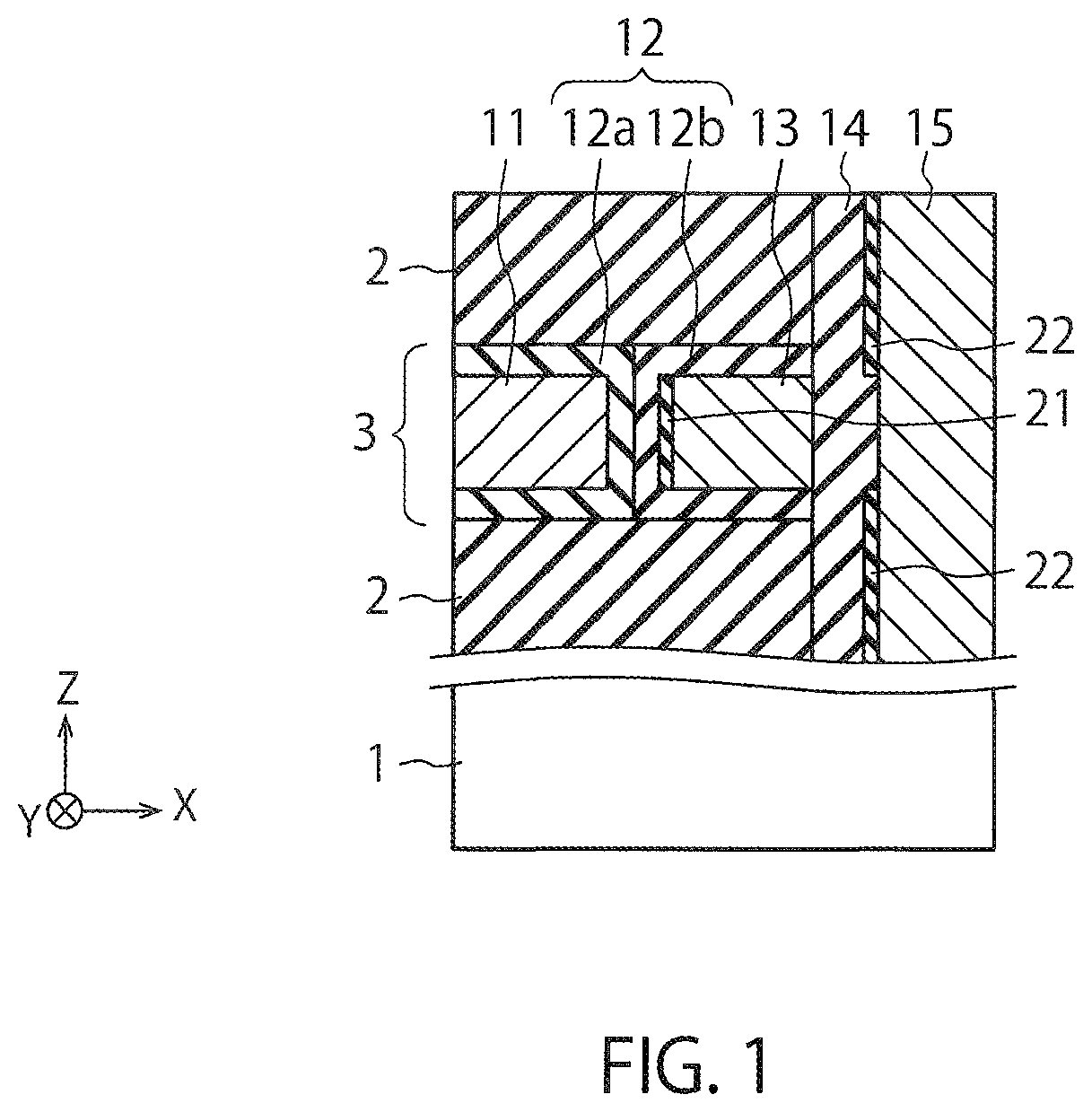
is a cross-sectional view illustrating a structure of a semiconductor device of a first embodiment;
A to 5 C are cross-sectional views illustrating a method of manufacturing the semiconductor device of the first embodiment;
is a cross-sectional view illustrating a structure of a semiconductor device of a first modification to the first embodiment;
A and 7 B are cross-sectional views illustrating a method of manufacturing the semiconductor device of the first modification to the first embodiment;
is a cross-sectional view illustrating a structure of a semiconductor device of a second modification to the first embodiment;
A to 9 C are cross-sectional views illustrating a method of manufacturing the semiconductor device of the second modification to the first embodiment;
is a cross-sectional view illustrating a structure of a semiconductor device of a third modification to the first embodiment;
A to 11 C are cross-sectional views illustrating a method of manufacturing the semiconductor device of the third modification to the first embodiment;
is a cross-sectional view illustrating a structure of a semiconductor device of a second embodiment;
A to 13 C are cross-sectional views illustrating a method of manufacturing the semiconductor device of the second embodiment;
A to 14 C are cross-sectional views illustrating structures of semiconductor devices of modifications to the second embodiment;
A and 15 B are cross-sectional views illustrating structures of semiconductor devices of other modifications to the second embodiment;
is a cross-sectional view illustrating a structure of a semiconductor device of a third embodiment;
A to 17 C are cross-sectional views illustrating structures of semiconductor devices of modifications to the third embodiment;
is a cross-sectional view illustrating a structure of a semiconductor device of a fourth embodiment;
A to 19 C are cross-sectional views illustrating a method of manufacturing the semiconductor device of the fourth embodiment;
A to 20 C is cross-sectional views illustrating structures of semiconductor devices of modifications to the fourth embodiment;
is a cross-sectional view illustrating a structure of a semiconductor device of another modification to the fourth embodiment;
A to 23 C are cross-sectional views illustrating a method of manufacturing a semiconductor device of a fifth embodiment;
is a cross-sectional view illustrating a structure of a semiconductor device of a sixth embodiment;
A to 25 C are cross-sectional views illustrating a method of manufacturing the semiconductor device of the sixth embodiment;
is a cross-sectional view illustrating a structure of a semiconductor device of a seventh embodiment;
A to 28 C are cross-sectional views illustrating a method of manufacturing the semiconductor device of the seventh embodiment;
A and 29 B are cross-sectional views illustrating a method of manufacturing a semiconductor device of a first modification to the seventh embodiment; and
A and 30 B are cross-sectional views illustrating a method of manufacturing a semiconductor device of a second modification to the seventh embodiment.
DETAILED DESCRIPTION
In one embodiment, a semiconductor device includes a substrate, a plurality of insulating films and a plurality of first films alternately stacked on the substrate, at least one of the first films including an electrode layer and a charge storage layer provided on a face of the electrode layer via a first insulator, the face of the electrode layer being parallel to a direction of the stacking, and a semiconductor layer provided on a face of the charge storage layer via a second insulator, the face of the charge storage layer being parallel to the direction of the stacking. The device further includes at least one of a first portion including nitrogen and provided at least between the first insulator and the charge storage layer with an air gap provided in the first insulator, a second portion including nitrogen, provided at least between the charge storage layer and the second insulator, and including a portion protruding toward the charge storage layer, and a third portion including nitrogen and provided at least between the second insulator and the semiconductor layer with an air gap provided in the first insulator.
Embodiments will now be explained with reference to the accompanying drawings. In to 30 B , identical or similar components are respectively assigned identical reference numerals, and overlapping description thereof is omitted.
First Embodiment
is a cross-sectional view illustrating a structure of a semiconductor device of a first embodiment. The semiconductor device illustrated in is a three-dimensional memory, for example.
The semiconductor device illustrated in includes a substrate 1 and a plurality of insulating layers 2 and a plurality of intermediate portions 3 that are alternately stacked on the substrate 1 . The insulating layers 2 are an example of a plurality of insulating films, and the intermediate portions 3 are an example of a plurality of first films. illustrates two of the insulating layers 2 and one of the intermediate portions 3 .
The intermediate portion 3 includes an electrode layer 11 , a block insulator 12 , and a charge storage layer 13 as components of a memory cell in a three-dimensional memory. The semiconductor device illustrated in further includes a tunnel insulator 14 and a channel semiconductor layer 15 that are continuously provided on respective side faces of the insulating layers 2 and the intermediate portion 3 . The block insulator 12 is an example of a first insulator, and the tunnel insulator 14 is an example of a second insulator. The block insulator 12 includes two insulators 12 a and 12 b . The insulator 12 a is an example of a first layer, and the insulator 12 b is an example of a second layer.
The semiconductor device illustrated in further includes silicon nitride films (SiN) 21 and 22 . The silicon nitride film 21 is an example of a first portion, and the silicon nitride film 22 is an example of a third portion. The silicon nitride films 21 and 22 are each further an example of an insulator including nitrogen.
The substrate 1 is a semiconductor substrate such as a silicon (Si) substrate. illustrates an X-direction and a Y-direction parallel to a surface of the substrate 1 and perpendicular to each other and a Z-direction perpendicular to the surface of the substrate 1 . In the present specification, a +Z-direction is treated as an upward direction, and a −Z-direction is treated as a downward direction. The −Z-direction may or may not match a gravity direction. The Z-direction is parallel to a direction of the stacking of the plurality of insulating layers 2 and the plurality of intermediate portions 3 .
The insulating layer 2 is a silicon oxide film (SiO 2 ), for example. The thickness of the insulating layer 2 is 30 nm, for example. Similarly, the thickness of the intermediate portion 3 is 30 nm, for example.
The electrode layer 11 is a metal layer such as a tungsten (W) layer, and functions as a word line. The block insulator 12 includes an insulator 12 a provided on a side face, an upper face, and a lower face of the electrode layer 11 and an insulator 12 b provided on a side face, an upper face, and a lower face of the charge storage layer 13 . The insulator 12 a is an aluminum oxide film (AlO X ), for example, and the insulator 12 b is a silicon oxide film, for example. The insulator 12 a is provided on a face that is a side face of the electrode layer 11 and opposes the charge storage layer 13 , and the insulator 12 b is provided on a face that is a side face of the charge storage layer 13 and opposes the electrode layer 11 . The upper layer of the electrode layer 11 is a face opposing the insulating layer 2 positioned above the electrode layer 11 among the faces of the electrode layer 11 . The lower face of the electrode layer 11 is a face opposing the insulating layer 2 positioned below the electrode layer 11 among the surfaces of the electrode layer 11 . The side face of the electrode layer 11 is a face positioned between the upper face and the lower face of the electrode layer 11 among the faces of the electrode layer 11 . The same applies to the side face, the upper face and the lower face of the charge storage layer 13 .
The charge storage layer 13 is formed on the side face of the electrode layer 11 via the block insulator 12 (the insulators 12 a and 12 b ). The charge storage layer 13 functions as a layer storing a charge for data storage. The charge storage layer 13 is a silicon layer, for example, and the silicon layer stores the charge. The charge storage layer 13 is also referred to as a floating electrode. The charge storage layer 13 may be formed of a metal layer or an insulator functioning as a layer storing the charge.
The tunnel insulator 14 is continuously formed on the side face of the charge storage layer 13 and the side faces of the insulating layers 2 . The tunnel insulator 14 is a silicon oxide film, for example. The channel semiconductor layer 15 is formed on the side face of the charge storage layer 13 and the side faces of the insulating layers 2 via the tunnel insulator 14 . The channel semiconductor layer 15 is a silicon layer.
The silicon nitride film 21 is formed between the block insulator 12 and the charge storage layer 13 , and specifically is formed on the side face of the charge storage layer 13 . The silicon nitride film 22 is formed between the tunnel insulator 14 and the channel semiconductor layer 15 , and specifically is divided into an upper portion and a lower portion along the side face of the charge storage layer 13 . In , the upper portion and the lower portion of the silicon nitride film 22 are arranged along the side faces of the insulating layers 2 .
The silicon nitride films 21 and 22 in the present embodiment may be replaced with portions each containing nitrogen but remaining less than a film, although each formed as a film containing nitrogen. That is, the portions each containing nitrogen but remaining less than a film may be respectively formed between the block insulator 12 and the charge storage layer 13 or between the tunnel insulator 14 and the channel semiconductor layer 15 instead of the silicon nitride films 21 and 22 . The portions are also respectively examples of the first portion and the third portion.
Details of the silicon nitride films 21 and 22 will be described below.
The semiconductor device of the present embodiment reverses a channel between cells by a fringe electric field that has leaked out of a word line (the electrode layer 11 ) to cause carriers to flow because it does not include a diffusion layer. To promote this, impurities can conceivably be added into the charge storage layer 13 (the silicon layer). However, the impurities are not easily added if the thickness of the charge storage layer 13 is small. On the other hand, when a high voltage is applied to the word line in the non-selected cell to reverse the channel between the cells, erroneous writing into the non-selected cell may occur.
The semiconductor device of the present embodiment includes the silicon nitride film 21 between the block insulator 12 and the charge storage layer 13 , and includes the silicon nitride film 22 between the tunnel insulator 14 and the channel semiconductor layer 15 . Accordingly, problems such as erroneous writing into the non-selected cell can be suppressed.
For example, the silicon nitride film 22 in the present embodiment is formed along the side faces of the insulating layers 2 , and is divided into the upper portion and the lower portion along the side face of the charge storage layer 13 . Therefore, according to the present embodiment, a nitrogen concentration in a region between the tunnel insulator 14 and the channel semiconductor layer 15 can be made higher in a region between the cells than that in a region of a cell portion. Accordingly, a threshold voltage between the cells can be reduced, and the channel between the cells can be reversed even when a high voltage is not applied to the word line in the non-selected cell. As a result, erroneous writing into the non-selected cell can be reduced. In the present embodiment, when the threshold voltage between the cells is reduced, an ON current increases.
The silicon nitride film 22 in the present embodiment can suppress charge trapping, and accordingly can suppress a variation of the ON current. Therefore, according to the present embodiment, a reading time period from the cell can be shortened, whereby erroneous writing into the non-selected cell can be further reduced.
The silicon nitride film 21 in the present embodiment can provide a layer having a high dielectric constant between the block insulator 12 and the charge storage layer 13 . Accordingly, a leak current from the cell can be reduced, and a writing characteristic into the cell can be improved.
As described above, according to the present embodiment, a flow of the carriers can be controlled with high accuracy, whereby problems such as erroneous writing into the non-selected cell can be suppressed.
A to 5 C are cross-sectional views illustrating a method of manufacturing the semiconductor device of the first embodiment.
First, a plurality of insulating layers 2 and a plurality of sacrifice layers 4 are alternately formed on a substrate 1 ( A ). The insulating layer 2 is a silicon oxide film having a thickness of 30 nm, for example, and is formed using TEOS (tetraethyl orthosilicate) at a temperature of 300 to 700° C. in a reduced pressure environment (e.g., 2000 Pa or less) by CVD (chemical vapor deposition). The sacrifice layer 4 is a silicon nitride film having a thickness of 30 nm, for example, and is formed using SiH 4 and NH 3 (H represents hydrogen) in a reduced pressure environment (e.g., 2000 Pa or less) by CVD. The sacrifice layer 4 is an example of a second film.
Then, a trench H 1 is formed in the insulating layers 2 and the sacrifice layers 4 by RIE (reactive ion etching). The trench H 1 is formed to extend in a Y-direction. In a process illustrated in B , a plurality of trenches extending in the Y-direction are formed, and B illustrates one of the trenches. Description related to the trench H 1 is also similarly applied to the trenches other than the trench H 1 .
Then, an insulator 5 is embedded in the trench H 1 ( C ). The insulator 5 is a silicon oxide film, for example.
Then, a plurality of holes H 2 are formed in the insulator 5 by RIE ( A, 3 B and 3 C ). A illustrates the same XZ cross section as those illustrated in A to 2 C , and B illustrates a different XZ cross section from that illustrated in A . C illustrates an XY cross section at a certain height of the insulating layers 2 . A and 3 B respectively illustrate XZ cross sections on an A-A′ line and a B-B′ line illustrated in C .
Then, a portion of each of the sacrifice layers 4 exposed to the inside of the hole H 2 is selectively removed by wet etching using a hot phosphoric acid ( A ). As a result, the sacrifice layers 4 are recessed compared to the insulating layers 2 , and a cavity H 3 is formed on a side face of each of the sacrifice layers 4 . The cavity H 3 is an example of a first concave portion.
Then, an insulator 12 b constituting a block insulator 12 and a charge storage layer 13 are formed in this order in the cavity H 3 ( B ). The insulator 12 b is a silicon oxide film having a thickness of 10 nm, for example, and is formed using TDMAS (tris(dimethylamino)silane) and O 3 at a temperature of 400 to 800° C. in a reduced pressure environment (e.g., 2000 Pa or less) by ALD (atomic layer deposition). The charge storage layer 13 is a silicon layer having a thickness of 10 nm, for example, and is formed using SiH 4 at a temperature of 400 to 800° C. in a reduced pressure environment (e.g., 2000 Pa or less) by CVD. The charge storage layer 13 outside the cavity H 3 is removed using an alkaline chemical solution, and the respective charge storage layers 13 inside the different cavities H 3 are separated from one another.
Then, a tunnel insulator 14 and a channel semiconductor layer 15 are formed in this order in each of the holes H 2 ( C ). As a result, the tunnel insulator 14 and the channel semiconductor layer 15 are formed in this order on a side face of the charge storage layer 13 and respective side faces of the insulating layers 2 . The tunnel insulator 14 is a silicon oxide film having a thickness of 7 nm, for example, and is formed using TDMAS and O 3 at a temperature of 400 to 800° C. in a reduced pressure environment (e.g., 2000 Pa or less) by ALD. The channel semiconductor layer 15 is a silicon layer having a thickness of 10 nm, for example, and is formed using SiH 4 at a temperature of 400 to 800° C. in a reduced pressure environment (e.g., 2000 Pa or less) by CVD.
Then, a remainder of each of the sacrifice layers 4 exposed to the inside of a hole (not illustrated) is selectively removed by wet etching using a hot phosphoric acid ( A ). As a result, the sacrifice layers 4 are recessed compared to the insulating layers 2 , and a cavity H 4 is formed on a side face of each of the insulators 12 b . The cavity H 4 is an example of a second concave portion.
Then, nitriding treatment using the cavity H 4 is performed ( B ). As a result, a silicon nitride film 21 is formed between the block insulator 12 and the charge storage layer 13 , and specifically is formed on the side face of the charge storage layer 13 . Further, a silicon nitride film 22 is formed between the tunnel insulator 14 and the channel semiconductor layer 15 , and specifically is formed on a side of the channel semiconductor layer 15 . The nitriding treatment is performed at a temperature 500° C. or more using a nitriding gas (e.g., NH 3 ), for example. Arrows illustrated in B schematically indicate how a nitriding gas or a substance produced by a nitriding gas progresses.
The charge storage layer 13 in the present embodiment has a function of blocking a nitriding gas or a substance produced from a nitriding gas. Therefore, the silicon nitride film 22 in the present embodiment is not formed along the side face of the charge storage layer 13 , and is divided into an upper portion and a lower portion along the side face of the charge storage layer 13 .
Then, an insulator 12 a constituting the block insulator 12 and an electrode layer 11 are formed in this order in the cavity H 4 ( C ). The insulator 12 a is an aluminum oxide film, for example, and is formed at a temperature of 500° C. or less by ALD. The electrode layer 11 includes a titanium nitride film (TiN) as a barrier metal layer and a tungsten layer as an electrode material layer. The titanium nitride film is formed using TiCl 4 and NH 3 (Cl represents chlorine), for example. The tungsten layer is formed using WF 6 (F represents fluorine).
Then, various interconnect layers and inter layer dielectrics are formed on the substrate 1 . In this manner, the semiconductor device of the present embodiment is manufactured.
More details of the present embodiment will be described below.
Although the insulating layer 2 and the sacrifice layer 4 are formed by CVD in the present embodiment, they may be formed using another method. The insulating layer 2 (the silicon oxide film) may be formed using SiH 4 and N 2 O by plasma CVD, for example. The sacrifice layer 4 (the silicon nitride film) may be formed using SiH 2 Cl 2 and NH 3 by plasma CVD, for example.
Although the charge storage layer 13 is formed using SiH 4 in the present embodiment, it may be formed using another gas. For example, the charge storage layer 13 may be formed using Si 2 H 6 . A seed layer of the charge storage layer 13 may be formed using an organic Si source gas or Si 2 H 6 , and a main layer of the charge storage layer 13 may be formed using SiH 4 . A P atom or a B atom may be added to the charge storage layer 13 (the silicon layer) (P represents phosphorous, and B represents boron) by supplying a PH 3 gas or a BCl 3 gas, together with a source gas in the charge storage layer 13 . Accordingly, a threshold voltage of the memory cell can be adjusted to an appropriate value so that a characteristic of a memory cell can be improved.
In a process illustrated in B , after the charge storage layer 13 outside the cavity H 3 is removed, metal elements such as Ti (titanium), Co (cobalt), Ru (ruthenium), and Ni (nickel) may be added to the charge storage layer 13 . For example, a silicon layer may be formed as the charge storage layer 13 , a titanium layer may be formed on the silicon layer using TiCl 4 , and the silicon layer may be silicided by the titanium layer. In this case, the charge storage layer 13 becomes a metal layer (titanium silicide layer), whereby a writing characteristic and an erasing characteristic of the memory cell can be improved. A similar effect can also be obtained when the charge storage layer 13 is constituted by a silicon layer and a metal layer (e.g., a TiN layer) inserted into the silicon layer.
A silicon layer may be formed as the charge storage layer 13 , and a portion of the silicon layer may be changed to a SiN film by adding nitrogen to the silicon layer. The charge storage layer 13 may be constituted by a silicon layer and a SiN film inserted into the silicon layer. The charge storage layer 13 can be formed during formation of the silicon layer by switching a Si source gas (e.g., a SiH 2 Cl 2 gas) in the silicon layer to an NH 3 gas in situ. When nitrogen is contained in the charge storage layer 13 , a charge holding property of the charge storage layer 13 can be improved, for example.
Although the tunnel insulator 14 and the insulator 12 b (the silicon oxide film) are formed by ALD using TDMAS and O 3 in the present embodiment, they may be formed by another method using another gas. For example, the tunnel insulator 14 and the insulator 12 b may be formed by CVD using SiH 4 and N 2 O.
In the nitriding treatment illustrated in B , a gas other than NH 3 may be used. Examples of the gas include a NO gas and a ND 3 gas (D represents deuterium). When a ND 3 gas is used, a deuterium atom may be added to the tunnel insulator 14 and the insulator 12 b . Accordingly, insulation and reliability of the tunnel insulator 14 and the insulator 12 b can be improved.
In the present embodiment, when the charge storage layer 13 outside the cavity H 3 is removed by a chemical solution in the process illustrated in B , a corner, on the side of the tunnel insulator 14 , of the charge storage layer 13 is rounded by the chemical solution. Accordingly, a nitriding agent in a nitriding process enters the charge storage layer 13 from its end. As a result, an interface between the tunnel insulator 14 and the channel semiconductor layer 15 in the vicinity of the end is nitrided. In this case, a nitrogen concentration in the interface decreases toward a central portion of the cell.
If a silicon nitride film is formed on an upper face and a lower face of the charge storage layer 13 by the nitriding treatment illustrated in B , respective nitrogen concentrations in the vicinities of the upper face and the lower face of the charge storage layer 13 decrease downward from the upper face of the charge storage layer 13 and decrease upward from the lower face of the charge storage layer 13 . The reason is that a nitrogen concentration gradient occurs in the charge storage layer 13 as the nitriding agent is diffused into the charge storage layer 13 .
Although the silicon nitride film 21 is formed between the block insulator 12 and the charge storage layer 13 and the silicon nitride film 22 is formed between the tunnel insulator 14 and the channel semiconductor layer 15 in the present embodiment, silicon nitride films may be respectively formed between the charge storage layer 13 and the tunnel insulator 14 and between the insulating layers 2 and the tunnel insulator 14 . For example, a silicon nitride film can be formed between the charge storage layer 13 and the tunnel insulator 14 by performing nitriding treatment at a temperature of 500° C. or more using NO, NH 3 , or ND 3 after the tunnel insulator 14 is formed. In this case, a silicon nitride film may also be formed between the tunnel insulator 14 and the channel semiconductor layer 15 by performing nitriding treatment at a temperature of 500° C. or more using NO after the channel semiconductor layer 15 is formed. The silicon nitride film is formed not only along the side faces of the insulating layers 2 but also along the side face of the charge storage layer 13 .
If the silicon nitride film is formed between the tunnel insulator 14 and the channel semiconductor layer 15 , the silicon nitride film 22 is formed again between the tunnel insulator 14 and the channel semiconductor layer 15 by the nitriding treatment illustrated in B . Accordingly, a nitrogen concentration of a portion where the silicon nitride film 22 is formed in the interface between the tunnel insulator 14 and the channel semiconductor layer 15 becomes higher than a nitrogen concentration of the other portion. Accordingly, a threshold voltage of a transistor between the cells can be further reduced.
If a semiconductor device including a silicon nitride film between the charge storage layer 13 and the tunnel insulator 14 is manufactured, the side face of the charge storage layer 13 may be nitrided after the charge storage layer 13 is formed and before the tunnel insulator 14 is formed. In this case, nitriding may be performed by plasma nitriding or radial nitriding using N 2 , NH 3 , ND 3 , or NO.
Details of a silicon nitride film other than the silicon nitride films 21 and 22 will be described below.
Although the insulator 12 a constituting the block insulator 12 is an aluminum oxide film in the present embodiment, it may be another insulator. For example, the insulator 12 a may be a stacked film alternately including two or more silicon nitride films and one or more silicon oxide films, or may be a high-k insulator (high-dielectric constant insulator) other than an aluminum oxide film. Examples of the high-k insulator include a HfO X film and an LaAlO X film (Hf represents hafnium, and La represents lanthanum). The insulator 12 a may be a stacked film including a silicon oxide film and a high-k insulator. The foregoing materials are also applicable to the tunnel insulator 14 .
Various modifications to the first embodiment will be described below.
is a cross-sectional view illustrating a structure of a semiconductor device of a first modification to the first embodiment.
The semiconductor device illustrated in includes a silicon nitride film 23 instead of the silicon nitride films 21 and 22 . The silicon nitride film 23 is formed between a charge storage layer 13 and a tunnel insulator 14 and between insulating layers 2 and the tunnel insulator 14 , and specifically is formed between a side face of the charge storage layer 13 and respective side faces of the insulating layers 2 . The silicon nitride film 23 is an example of a second portion.
A and 7 B are cross-sectional views illustrating a method of manufacturing the semiconductor device of the first modification to the first embodiment.
First, processes from A to B are performed. A illustrates the same cross section as that illustrated in B . Then, a silicon nitride film 23 is formed on respective side faces, exposed to the inside of a hole H 2 , of a charge storage layer 13 and insulating layers 2 ( B ). The silicon nitride film 23 may be formed by CVD or may be formed by plasma nitriding or radial nitriding, for example. If the silicon nitride film 23 is formed by nitriding, at least a portion of the silicon nitride film 23 may be another insulator (e.g., a silicon oxynitride film) containing silicon and nitrogen.
In the present modification, processes from C to C are then performed. In such a manner, the semiconductor device of the present modification is manufactured.
is a cross-sectional view illustrating a structure of a semiconductor device of a second modification to the first embodiment.
The semiconductor device illustrated in includes a silicon nitride film 24 instead of the silicon nitride films 21 and 22 . The silicon nitride film 24 is formed between a block insulator 12 and a charge storage layer 13 and between the charge storage layer 13 and a tunnel insulator 14 , and specifically is formed on a side face, an upper face, and a lower face of the charge storage layer 13 . The silicon nitride film 24 of the present modification covers the entire surface of the charge storage layer 13 . The silicon nitride film 24 is an example of a first portion and a second portion.
A to 9 C are cross-sectional views illustrating a method of manufacturing the semiconductor device of the second modification to the first embodiment.
First, the processes from A to A are performed. A illustrates the same cross section as that illustrated in A . Then, an insulator 12 b constituting a block insulator 12 , an insulator (silicon nitride film) 24 a constituting a silicon nitride film 24 , and a charge storage layer 13 are formed in this order in a cavity H 3 ( B ). The insulator 24 a is formed by CVD, for example.
Then, an insulator (silicon nitride film) 24 b constituting the silicon nitride film 24 is formed on a side face, exposed to the inside of a hole H 2 , of the charge storage layer 13 ( C ). The insulator 24 a is formed by nitriding the side face of the charge storage layer 13 , for example. Then, a tunnel insulator 14 and a channel semiconductor layer 15 are formed in this order in each of holes H 2 ( C ).
In the present modification, the processes from A to C are then performed. In such a manner, the semiconductor device of the present modification is manufactured.
is a cross-sectional view illustrating a structure of a semiconductor device of a third modification to the first embodiment.
The semiconductor device illustrated in includes a silicon nitride film 25 instead of the silicon nitride films 21 and 22 . The silicon nitride film 25 is formed between a block insulator 12 and a charge storage layer 13 and between the charge storage layer 13 and a tunnel insulator 14 , and specifically is formed on a side face, an upper face, and a lower face of the charge storage layer 13 . The silicon nitride film 25 is further formed on respective side faces of the insulating layers 2 . The silicon nitride film 25 in the present modification covers the entire surface of the charge storage layer 13 , like the silicon nitride film 24 in the second modification. The silicon nitride film 25 is an example of a first portion and a second portion.
A to 11 C are cross-sectional views illustrating a method of manufacturing the semiconductor device of the third modification to the first embodiment.
First, the processes from A to A are performed. A illustrates the same cross section as that illustrated in A . Then, an insulator 12 b constituting a block insulator 12 , an insulator (silicon nitride film) 25 a constituting a silicon nitride film 25 , and a charge storage layer 13 are formed in this order in a cavity H 3 ( B ). The insulator 25 a is formed by CVD, for example.
Then, an insulator (silicon nitride film) 25 b constituting the silicon nitride film 25 is formed on respective side faces, exposed to the inside of the hole H 2 , of the charge storage layer 13 and insulating layers 2 ( C ). The insulator 25 b may be formed by CVD or may be formed by plasma nitriding or radial nitriding, for example. If the insulator 25 b is formed by nitriding, at least a portion of the insulator 25 b may be another insulator (e.g., a silicon oxynitride film) containing silicon and nitrogen.
In the present modification, the processes from A to C are then performed. In such a manner, the semiconductor device of the present modification is manufactured.
According to the modifications, when the silicon nitride films 23 , 24 , and 25 are formed, a similar effect to that when the silicon nitride films 21 and 22 are formed can be obtained. For example, charge trapping to the tunnel insulator 14 or the like can be suppressed, and a leak current from a cell can be reduced. Accordingly, problems such as erroneous writing into a non-selected cell can be suppressed.
As described above, in the present embodiment and the modifications, the silicon nitride films 21 to 25 are each formed between the block insulator 12 and the charge storage layer 13 , between the charge storage layer 13 and the tunnel insulator 14 , or between the tunnel insulator 14 and the channel semiconductor layer 15 . Therefore, according to the present embodiment and the modifications, the flow of carriers can be controlled with high accuracy, whereby problems such as erroneous writing into the non-selected cell can be suppressed.
Second Embodiment
is a cross-sectional view illustrating a structure of a semiconductor device of a second embodiment.
The semiconductor device illustrated in includes silicon nitride films 21 and 22 , like the semiconductor device illustrated in . further illustrates a barrier metal layer 11 a and an electrode material layer 11 b that constitutes an electrode layer 11 , and insulators 12 c and 12 d that, together with insulators 12 a and 12 b , constitute a block insulator 12 . The insulator 12 a is an example of a first layer, and the insulators 12 b , 12 c , and 12 d are each an example of a second layer.
The electrode layer 11 includes the barrier metal layer 11 a provided on a side face, an upper face, and a lower face of the insulator 12 a , and the electrode material layer 11 b provided on a side face, an upper face, and a lower face of the barrier metal layer 11 a . The barrier metal layer 11 a is a TiN layer, for example. The electrode material layer 11 b is a W layer, for example.
The block insulator 12 includes the insulator 12 a provided on a side face, an upper face, and a lower face of the electrode layer 11 , and the insulators 12 d , 12 c , and 12 b that are provided in this order on a side face, an upper face, and a lower face of the charge storage layer 13 . The insulator 12 a is an aluminum oxide film, for example. The insulator 12 b is a silicon oxide film, for example. The insulator 12 c is a silicon nitride film or a high-k insulator (high-dielectric constant insulator) containing a metal. The insulator 12 d is a silicon oxide film, for example. According to the present embodiment, when the insulator 12 c is provided between the insulators 12 b and 12 d , the performance of the block insulator 12 on the side of the charge storage layer 13 can be improved.
The block insulator 12 includes an air gap G in the insulators 12 b , 12 c , and 12 d positioned on the side of the charge storage layer 13 . The air gap G in the present embodiment is sandwiched between the insulator 12 b and the insulator 12 d , like the insulator 12 c . As described below, the air gap G is formed by removing a portion of the insulator 12 c.
According to the present embodiment, when the air gap G is included in the block insulator 12 , it is possible to reduce an interference between cells, to reduce a leak current from the cell, and to reduce erroneous writing caused by the insulator 12 c.
A to 13 C are cross-sectional views illustrating a method of manufacturing the semiconductor device of the second embodiment.
First, after the processes from A to A are performed, insulators 12 b , 12 c , and 12 d and a charge storage layer 13 are formed in this order in a cavity H 3 , for example ( A ). The insulators 12 b , 12 c , and 12 d are formed by CVD and ALD, for example.
Then, the charge storage layer 13 and the insulators 12 d and 12 c outside the cavity H 3 are removed by wet etching using an alkaline chemical solution ( B ). As a result, charge storage layers 13 in different cavities H 3 are separated from one another.
Then, a portion of the insulator 12 c is selectively removed by wet etching from a hole H 2 ( C ). As a result, a side face of the insulator 12 c is recessed, and an air gap G is formed between the insulators 12 d and 12 b.
In the present embodiment, the processes illustrated in C to 5 C are then performed. In such a manner, the semiconductor device of the present embodiment is manufactured.
A to 14 C are cross-sectional views illustrating structures of semiconductor devices of modifications to the second embodiment.
In the modification illustrated in A , a portion (convex portion) 14 a of a tunnel insulator 14 enters an air gap G. Such a structure can be implemented when the portion 14 a of the tunnel insulator 14 enters the air gap G when the tunnel insulator 14 is formed.
In the modification illustrated in B , an air gap G is formed only on an upper face and a lower face of an insulator 12 d , and does not extend to a side face of the insulator 12 d . Such a structure can be implemented when a recess amount of an insulator 12 c is reduced in a process illustrated in C .
In the modification illustrated in C , an air gap G is formed to be further smaller than that in the modification illustrated in B , and the air gap G is completely surrounded by insulators 12 d and 12 b . Such a structure can be implemented when a recess amount of an insulator 12 c is further reduced in the process illustrated in C . In C , an insulator contacting a right end of the air gap G may be a portion 14 a of a tunnel insulator 14 instead of the insulator 12 d.
A shape of the air gap G may be a shape illustrated in A, 14 B or 14 C instead of the shape illustrated in .
A and 15 B are cross-sectional views illustrating structures of semiconductor devices of other modifications to the second embodiment.
In the modification illustrated in A , a block insulator 12 includes insulators 12 a , 12 b , 12 c and 12 d , but does not include an air gap G. The insulator 12 c in the present modification has a shape an end of which is pointed. Such a structure can be implemented by oxidizing a portion of the insulator 12 c after a process illustrated in B . According to the present modification, when a distance between an upper face and a lower face of a charge storage layer 13 and the insulator 12 c is made large, erroneous writing caused by an insulator 12 c can be reduced.
In the modification illustrated in B , a portion of an insulator 12 c illustrated in A is replaced with an air gap G. Such a structure can be implemented by oxidizing a portion of the insulator 12 c after the process illustrated in B and then performing the process illustrated in C . According to the present modification, an advantage of a distance between an upper face and a lower face of a charge storage layer 13 and the air gap G being large can also be enjoyed while the above-described advantage of the air gap G is enjoyed. In B , at least a portion of the insulator contacting a right end of the air gap G and its vicinity may be a portion 14 a of a tunnel insulator 14 instead of the insulators 12 b and 12 b.
As described above, the block insulator 12 in each of the present embodiment and the modifications includes the air gap G in the insulators 12 b , 12 c , and 12 d positioned on the side of the charge storage layer 13 . Therefore, according to the present embodiment and the modifications, it is possible to reduce an interference between cells, to reduce a leak current from the cell, and to reduce erroneous writing caused by the insulator 12 c.
Third Embodiment
is a cross-sectional view illustrating a structure of a semiconductor device of a third embodiment.
The semiconductor device illustrated in includes silicon nitride films 21 and 22 , like the semiconductor device illustrated in . further illustrates a barrier metal layer 11 a , an electrode material layer 11 b , and insulators 12 c and 12 d , described above, and a semiconductor film 13 a , a metal film 13 b , and a semiconductor film 13 c that constitutes a charge storage layer 13 .
The semiconductor film 13 a is formed on an upper face and a lower face of the insulator 12 d and a side face of the silicon nitride film 21 . The semiconductor film 13 a is a silicon film, for example. The metal film 13 b is formed on an upper face, a lower face, and a side face of the semiconductor film 13 a . The metal film 13 b is a titanium nitride film, for example. The metal film 13 b is formed in not the whole but a portion of the upper face and the lower face of the semiconductor film 13 a . The semiconductor film 13 c is formed on an upper face, a lower face, and a side face of the metal film 13 b and the upper face and the lower face of the semiconductor film 13 a . The semiconductor film 13 c is a silicon film, for example.
The metal film 13 b is sandwiched between the semiconductor films 13 a and 13 c , and is further completely covered with the semiconductor films 13 a and 13 c . Therefore, the metal film 13 b does not contact a tunnel insulator 14 .
The charge storage layer 13 in the present embodiment can be formed by forming the semiconductor film 13 a , the metal film 13 b , and the semiconductor film 13 c in this order in a cavity H 3 in the process illustrated in B . Before the semiconductor film 13 c is formed on the surface of the metal film 13 b , a portion of the metal film 13 b is removed.
As described above, the charge storage layer 13 in the present embodiment includes not only the semiconductor films 13 a and 13 c but also the metal film 13 b . If the charge storage layer 13 is formed of only a semiconductor, electrons from a channel semiconductor layer 15 may pass through the charge storage layer 13 into the electrode layer 11 . However, according to the present embodiment, the metal film 13 b can inhibit electrons from passing into the electrode layer 11 by scattering the electrons.
The electrons in the charge storage layer 13 may be accumulated in the semiconductor films 13 a and 13 c or may be accumulated in the metal film 13 b . In the present embodiment, the electrons in the charge storage layer 13 are accumulated in the semiconductor films 13 a and 13 c.
The metal film 13 b in the present embodiment is formed not to contact the tunnel insulator 14 . Accordingly, it is possible to improve a window of a memory cell and to suppress a damage to the tunnel insulator 14 from the metal film 13 b.
A to 17 C are cross-sectional views illustrating structures of semiconductor devices of modifications to the third embodiment.
In the modification illustrated in A , a metal film 13 b is not completely covered with semiconductor films 13 a and 13 c . However, the semiconductor device of the present modification includes a silicon nitride film 26 between a charge storage layer 13 and a tunnel insulator 14 . Therefore, the silicon nitride film 26 prevents contact between the metal film 13 b and the tunnel insulator 14 . The silicon nitride film 26 can be formed using a similar method to that used to form the silicon nitride film 24 b illustrated in C . The metal film 13 b in the present modification is formed between the semiconductor film 13 a and the semiconductor film 13 c and between the semiconductor film 13 a and the silicon nitride film 26 . The silicon nitride film 26 is an example of a second portion.
In the modification illustrated in B , a semiconductor film 13 a is removed from the charge storage layer 13 illustrated in . In the modification illustrated in C , a semiconductor film 13 a is removed from the charge storage layer 13 illustrated in A . The charge storage layer 13 may be formed, as in the modifications. In the modifications, a metal film 13 b is sandwiched between a semiconductor film 13 c and a silicon nitride film 21 , for example.
As described above, in the present embodiment and the modifications, the charge storage layer 13 includes the metal film 13 b . Therefore, according to the present embodiment and the modifications, electrons can be inhibited from passing through the charge storage layer 13 into the electrode layer 11 .
Fourth Embodiment
is a cross-sectional view illustrating a structure of a semiconductor device of a fourth embodiment.
The semiconductor device illustrated in includes a silicon nitride film 24 (including an insulator 24 a but not including an insulator 24 b ), like the semiconductor device illustrated in . further illustrates a barrier metal layer 11 a and an electrode material layer 11 b , described above, and insulators 12 e and 12 f that, together with insulators 12 a and 12 b , constitute a block insulator 12 .
The block insulator 12 includes the insulator 12 a provided on a side face, an upper face, and a lower face of an electrode layer 11 , and the insulators 12 f , 12 e , and 12 b that are provided in this order on a side face, an upper face, and a lower face of a charge storage layer 13 . The insulator 12 a is an aluminum oxide film, for example. The insulator 12 b is a silicon oxide film, for example. The insulator 12 e is a high-k insulator (high dielectric constant insulator), for example, and specifically is a HfO X film (or a HfTiO X film containing a titanium atom at a low composition ratio). The insulator 12 f is a high-k insulating layer, for example, and specifically is a HfTiO X film containing a titanium atom at a high composition ratio. In the present embodiment, the composition ratio of the titanium atom in the insulator 12 e is lower than the composition ratio of the titanium atom in the insulator 12 f . If the insulator 12 e is a HfO X film, the composition ratio of the titanium atom in the insulator 12 e is zero or substantially zero. According to the present embodiment, the block insulator 12 on the side of the charge storage layer 13 includes not only the insulator 12 b but also the insulators 12 e and 12 f so that the performance of the block insulator 12 on the side of the charge storage layer 13 can be improved.
An end of the insulator 12 f in the present embodiment is covered with the insulator 12 e and the silicon nitride film 24 . Therefore, the insulator 12 f in the present embodiment does not contact a tunnel insulator 14 , like the insulator 12 c in the second embodiment. In the present embodiment, the insulator 12 e in the vicinity of the end of the insulator 12 f is a HfO X film containing a nitrogen atom.
A result of an experiment has indicated that when the insulators 12 e and 12 f are each a HfTiO X film, a trap density in the insulators 12 e and 12 f more increases than when the insulators 12 e and 12 f are each a HfO X film. Accordingly, a writing characteristic and an erasing characteristic of a memory cell can be improved.
The result of the experiment has further indicated that a trap density in the HfTiO X film increases as the composition ratio of the titanium atom in the HfTiO X film. The increase in the trap density may increase erroneous writing into the memory cell, although it results in an improvement in the writing characteristic and the erasing characteristic of the memory cell. The block insulator 12 in the present embodiment includes the insulator 12 e containing a titanium atom at a low composition ratio and the insulator 12 f containing a titanium atom at a high composition ratio, and the insulator 12 e prevents contact between the insulator 12 f and the tunnel insulator 14 . Accordingly, a profit produced by the increase in the trap density can be enjoyed while erroneous writing into the memory cell is suppressed.
The result of the experiment has further indicated that when a nitrogen concentration in each of the HfO X film and the HfTiO X film is high, the titanium atom is not easily diffused from the outside to the inside of the films and the titanium atom is easily diffused from the inside to the outside of the films. In the present embodiment, a nitrogen atom is doped into the insulators 12 e and 12 f in the vicinity of the tunnel insulator 14 . Accordingly, a structure in which the end of the insulator 12 f is covered with the insulator 12 e can be implemented (see C , described below) so that erroneous writing into the memory cell can be effectively suppressed.
A titanium concentration in the insulator 12 e is 1.0×10 20 atoms/cm 3 or less, for example, at least in the vicinity of the end of the insulator 12 f , and a titanium concentration in the insulator 12 f is 1.0×10 20 atoms/cm 3 or more, for example. Further, a nitrogen concentration in the insulator 12 e is 1.0×10 20 atoms/cm 3 or more, for example, at least in the vicinity of the end of the insulator 12 f , and a nitrogen concentration in the insulator 12 f is 1.0×10 20 atoms/cm 3 or less, for example. The insulators 12 e and 12 f in the present embodiment may include an Al atom, a Si atom, or a Zr (zirconium) atom instead of a Hf atom.
A to 19 C are cross-sectional views illustrating a method of manufacturing the semiconductor device of the fourth embodiment.
First, after the processes illustrated in A to 4 A are performed, insulators 12 b , 12 e , and 12 f , a silicon nitride film 24 , and a charge storage layer 13 are formed in this order in a cavity H 3 , for example ( A ). The insulator 12 e is a HfO X film, for example, and is formed by ALD using a Hf source gas and O 3 . After the HfO X film is formed, a surface of the HfO X film may be nitride to form a nitride film having a thickness of approximately 1 nm. Such nitriding treatment is performed at a temperature of 300 to 800° C. in a N 2 atmosphere by plasma annealing, for example. A N 2 gas may be replaced with an NH 3 gas. The insulator 12 f is a HfTiO X film, for example, and is formed by ALD using a Hf source gas, a Ti source gas, and O 3 .
Then, the charge storage layer 13 and the insulators 12 f and 12 e outside the cavity H 3 are removed by wet etching using an alkaline chemical solution ( B ). As a result, charge storage layers 13 in different cavities H 3 are separated from one another.
Then, the insulators 12 e and 12 f are nitrided from a hole H 2 , to nitride an end having a thickness of approximately 1 nm of each of the insulators 12 e and 12 f . Such nitriding treatment is performed at a temperature of 300 to 800° C. in a N 2 atmosphere by plasma annealing, for example. A N 2 gas may be replaced with an NH 3 gas. According to the nitriding treatment, a titanium atom can be diffused outward from the end of each of the insulators 12 e and 12 f . As a result, both the ends of the insulators 12 e and 12 f each become a HfO X film (or a HfTiO X film containing a titanium atom at a low composition ratio). This corresponds to a change of the end of the insulator 12 f to the insulator 12 e . Accordingly, the end of the insulator 12 f can be moved toward an electrode layer 11 so that a structure in which the end of the insulator 12 f is covered with the insulator 12 e can be implemented ( C ).
In the present embodiment, the processes illustrated in C to 5 C are then performed. In such a manner, the semiconductor device of the present embodiment is manufactured.
A to 20 C are cross-sectional views illustrating structures of semiconductor devices of modifications to the fourth embodiment.
In the modification illustrated in A , a silicon nitride film 24 is formed on an entire surface of a charge storage layer 13 . Such a structure can be implemented by a process for forming an insulator 24 a and an insulator 24 b , described above.
In the modification illustrated in B , respective ends of insulators 12 e and 12 f and an end of a silicon nitride film 24 are recessed with respect to a side face of a charge storage layer 13 . A tunnel insulator 14 enters a concave portion facing the ends. Such a structure can be implemented by performing a process for recessing the ends by wet etching instead of a process illustrated in C . Such a structure enables erroneous writing into a memory cell to be suppressed, like the structure illustrated in .
In the modification illustrated in C , a silicon nitride film 24 is formed on an entire surface of a charge storage layer 13 while respective ends of insulators 12 e and 12 f are recessed with respect to a side face of the charge storage layer 13 . A tunnel insulator 14 enters a concave portion facing the ends. Such a structure can be implemented by performing a process for recessing the ends by wet etching and a process for forming an insulator 24 b instead of the process illustrated in C . Such a structure enables erroneous writing into a memory cell to be suppressed, like the structure illustrated in . In such a recessing process, an end of the silicon nitride film 24 may also be recessed. The insulator 24 b is formed in a portion obtained by the recessing.
is a cross-sectional view illustrating a structure of a semiconductor device of another modification to the fourth embodiment.
In the modification illustrated in , an end of an insulator 12 e is covered with an insulator 12 f , contrary to the structure illustrated in . Such a structure can be implemented by forming a HfTiO X film containing a titanium atom at a high composition ratio as the insulator 12 e and forming a HfO X film (or a HfTiO X film containing a titanium atom at a low composition ratio) as the insulator 12 f . According to the present modification, a similar effect to that illustrated in can be obtained.
According to the present embodiment and the modifications, when the block insulator 12 on the side of the charge storage layer 13 is configured using the HfO X film and/or the HfTiO X film, a profit produced by the increase in the trap density can be obtained.
Fifth Embodiment
A to 23 C are cross-sectional views illustrating a method of manufacturing a semiconductor device of a fifth embodiment. In the present embodiment, nitriding treatment using a seam or a bird's beak is handled.
First, after the processes illustrated in A to 4 A are performed, an insulator 12 b is formed in a cavity H 3 , for example ( A ). The insulator 12 b is a silicon oxide film having a thickness of 10 nm, for example, and is formed using TDMAS and O 3 at a temperature of 400 to 800° C. in a reduced pressure environment (e.g., 2000 Pa or less) by ALD.
Then, a charge storage layer 13 is formed in the cavity H 3 , for example ( B ). The charge storage layer 13 is a silicon layer having a thickness of 10 nm, for example, and is formed using SiH 4 at a temperature of 400 to 800° C. in a reduced pressure environment (e.g., 2000 Pa or less) by CVD. B illustrates a seam B 1 formed in the charge storage layer 13 in this process and a natural oxide film 31 formed on a surface of the charge storage layer 13 .
Then, the charge storage layer 13 outside the cavity H 3 is removed by wet etching using an alkaline medicinal solution ( C ). As a result, charge storage layers 13 in different cavities H 3 are separated from one another. C illustrates a seam B 1 partially cut in this process, a bird's beak B 2 formed at a corner of the charge storage layer 13 in this process, and a natural oxide film 32 formed on a surface of the charge storage layer 13 , for example.
A process illustrated in C may be performed by dry etching using a C X F Y gas (C is carbon and F is fluorine) instead of being performed by wet etching using an alkaline medicinal solution. In this case, fluorine remains on a side face of the charge storage layer 13 after completion of the semiconductor device, and is also diffused to a block insulator 12 , a tunnel insulator 14 , and a channel semiconductor layer 15 by a post heat process. If a gas for dry etching contains a halogen element other than fluorine, the halogen element can remain on the side face.
Then, nitriding treatment using a hole H 2 is performed ( A ). As a result, a silicon nitride film 27 is formed on the side face of the charge storage layer 13 . The nitriding treatment is performed at a temperature of 500° C. or more by radical nitriding using a nitriding gas (e.g., a N 2 gas), for example. Note that the silicon nitride film 27 also enters the seam B 1 and the bird's beak B 2 . With this process, the silicon nitride film 27 including a portion protruding toward the charge storage layer 13 is formed. The silicon nitride film 27 is an example of a second portion and a fourth portion. Note that the silicon nitride film 27 that has entered the bird's beak B 2 contacts an upper face or a lower face of the charge storage layer 13 , and the silicon nitride film 27 that has entered the seam B 1 does not contact the upper face and the lower face of the charge storage layer 13 .
In a process illustrated in A , the charge storage layer 13 and the natural oxide film 32 are nitrided. Further, the insulator 12 b and insulating layers 2 may be nitrided. Accordingly, a portion formed by nitriding the natural oxide film 32 , the insulator 12 b , and the insulating layers 2 in the silicon nitride film 27 accurately becomes a silicon oxynitride film. Accordingly, the silicon nitride film 27 may at least partially contain oxygen.
Then, a tunnel insulator 14 and a channel semiconductor layer 15 are formed in this order in each of holes H 2 , like in the process illustrated in C ( B ). Then, a remainder of each of sacrifice layers 4 is replaced with an insulator 12 a and an electrode layer 11 , like in the process illustrated in A and the process illustrated in C ( C ).
Then, various interconnect layers and inter layer dielectrics are formed on a substrate 1 . In such a manner, the semiconductor device of the present embodiment is manufactured.
The silicon nitride film 27 in the present embodiment is formed to a shape similar to that of the above-described silicon nitride film 25 . Therefore, according to the present embodiment, when the silicon nitride film 27 is formed, a similar effect to that when the silicon nitride film 25 is formed can be obtained.
In the present embodiment, the silicon nitride film 27 is formed to enter the seam B 1 and the bird's beak B 2 . If the seam B 1 and the bird's beak B 2 are left covered with the natural oxide film 32 , a writing characteristic into a memory cell decreases due to an influence of a damage at respective positions of the seam B 1 and the bird's beak B 2 and an influence of the natural oxide film 32 . However, according to the present embodiment, when the silicon nitride film 27 is formed to enter the seam B 1 and the bird's beak B 2 , the writing characteristic into the memory cell can be made favorable. If fluorine is supplied by thermal diffusion, an interface defect is fluorine terminated so that a writing/erasing cycle stress tolerance is improved. In this case, in the channel semiconductor layer 15 , a channel current increases, a threshold value distribution decreases, and a memory cell is easily multivalued, for example, due to the fluorine termination of a grain boundary defect of crystallized silicon and the interface defect between the tunnel insulator 14 and the channel semiconductor layer 15 .
Sixth Embodiment
is a cross-sectional view illustrating a structure of a semiconductor device of a sixth embodiment.
The semiconductor device illustrated in includes silicon nitride films 21 and 22 , like the semiconductor device illustrated in . further illustrates insulators 12 g and 12 h that, together with an insulator 12 a , constitute a block insulator 12 . The insulator 12 a is an example of a first layer, and the insulators 12 g and 12 h are each an example of a second layer.
The block insulator 12 includes the insulator 12 a provided on a side face, an upper face, and a lower face of an electrode layer 11 , the insulator 12 g provided on an upper face and a lower face of a charge storage layer 13 , and the insulator 12 h provided on a side face of the charge storage layer 13 . The insulator 12 a is an aluminum oxide film, for example. The insulator 12 g is a SiOC film containing a carbon atom at a relatively high composition ratio. The insulator 12 h is a SiO 2 film (or a SiOC film containing a carbon atom at a relatively low composition ratio), for example. In the present embodiment, a carbon concentration in the insulator 12 g is higher than a carbon concentration in the insulator 12 h . If the insulator 12 h is a SiO 2 film, the carbon concentration in the insulator 12 h is zero or substantially zero. The carbon concentration in the insulator 12 h is 1.0×10 16 atoms/cm 3 or less, for example, and the carbon concentration in the insulator 12 g is 1.0×10 16 atoms/cm 3 or more, for example. The insulator 12 h is an example of a first region, and the insulator 12 g is an example of a second region.
A to 25 C are cross-sectional views illustrating a method of manufacturing the semiconductor device of the sixth embodiment.
First, the processes illustrated in A to 5 A are performed, and an insulator 12 a is then formed in a cavity H 4 ( A ), like in the process illustrated in C . In a process illustrated in B in the present embodiment, an insulator 12 g is formed instead of the insulator 12 b . The insulator 12 g is a SiOC film having a thickness of 10 nm. For example, an amorphous SiC film is formed using SiH 4 , Si 2 H 6 , and C 2 H 6 at a temperature of 300 to 700° C. in a reduced pressure environment (e.g., 2000 Pa or less) by CVD, and is oxidized using H 2 and O 2 at a temperature of 500 to 700° C. in a reduced pressure environment (e.g., 2000 Pa or less) by plasma oxidation or thermal oxidation, to form a SiOC film (the insulator 12 g ) from the SiC film. At least any one of SiH 2 Cl 2 , Si 2 Cl 6 , and SiCl 4 may be used instead of SiH 4 and/or Si 2 H 6 .
Then, to modify the insulator 12 a (the aluminum oxide film), the insulator 12 a is annealed in a nitrogen atmosphere at a temperature of 600 to 1200° C. ( B ). In this case, a carbon atom passes outward through the insulator 12 g in the vicinity of the insulator 12 a . As a result, the insulator 12 g on a side face of a charge storage layer 13 changes to a SiO 2 film (or a SiOC film containing a carbon atom at a relatively low composition ratio), i.e., changes to an insulator 12 h . On the other hand, the insulator 12 g on an upper face and a lower face of the charge storage layer 13 are maintained in a SiOC film containing a carbon atom at a relatively high composition ratio, i.e., maintained in the insulator 12 g.
Then, an electrode layer 11 is formed in a cavity H 4 ( C ). The electrode layer 11 includes a titanium nitride film as a barrier metal layer and a tungsten layer as an electrode material layer. The titanium nitride film is formed using TiCl 4 and NH 3 , for example. The tungsten layer is formed using WF 6 , for example.
Then, various interconnect layers and inter layer dielectrics are formed on a substrate 1 . In such a manner, the semiconductor device of the present embodiment is manufactured.
As described above, the block insulator 12 in the present embodiment includes the insulator 12 g containing carbon on the upper face and the lower face of the charge storage layer 13 . Accordingly, it is possible to suppress a load electric field to a non-selected cell and to reduce erroneous writing to the non-selected cell.
While a specific dielectric constant of the SiO 2 film is 3.9, a specific dielectric constant of the SiOC film becomes lower than 3.9. In the present embodiment, when the insulator 12 g contains carbon, a specific dielectric constant of the insulator 12 g can be decreased to approximately 3.0. Accordingly, erroneous writing into the non-selected cell can be effectively reduced.
Seventh Embodiment
is a cross-sectional view illustrating a structure of a semiconductor device of a seventh embodiment.
The semiconductor device illustrated in has a similar structure to that of the semiconductor device illustrated in . In the present embodiment, a charge storage layer 13 is a Si-rich silicon nitride film, and a silicon nitride film 25 is a N-rich silicon nitride film.
Therefore, the silicon nitride film 25 in the present embodiment has a higher composition ratio of nitrogen to silicon and nitrogen than that of the charge storage layer 13 . When the silicon nitride film 25 is represented by a composition formula Si 1-X N X , and the charge storage layer 13 is represented by a composition formula Si 1-Y N Y , a relationship of X>Y holds. Accordingly, the composition ratio of nitrogen in the silicon nitride film 25 is relatively large, for example, a value of “X/(1−X)” is 1.22 or more (e.g., 1.30). On the other hand, the composition ratio of nitrogen in the charge storage layer 13 is relatively low, for example, a value of “Y/(1−Y)” is 1.22 or less.
The charge storage layer 13 and the silicon nitride film 25 may contain silicon, nitrogen, and further another element. For example, the charge storage layer 13 may contain at least either one of oxygen and carbon.
A to 28 C are cross-sectional views illustrating a method of manufacturing the semiconductor device of the seventh embodiment.
First, the processes from A to A are performed. A illustrates the same cross section as that illustrated in A .
Then, an insulator 12 b constituting a block insulator 12 is formed in a cavity H 3 , for example ( B ). The insulator 12 b is a silicon oxide film having a thickness of 5 to 10 nm, for example, and is formed using TDMAS and O 3 at a temperature of 400 to 800° C. in a reduced pressure environment (e.g., 2000 Pa or less) by ALD.
Then, an insulator 25 a constituting a silicon nitride film 25 is formed in the cavity H 3 , for example ( C ). The insulator 25 a is a N-rich silicon nitride film having a thickness of 5 nm, for example, and is formed using SiH 2 Cl 2 and NH 3 at a temperature of 300 to 800° C. in a reduced pressure environment (e.g., 2000 Pa or less) by ALD.
Then, a charge storage layer 13 is formed in the cavity H 3 , for example ( A ). The charge storage layer 13 is a Si-rich silicon nitride film having a thickness of 5 to 10 nm, for example, and is formed using SiH 2 Cl 2 and NH 3 at a temperature of 300 to 800° C. in a reduced pressure environment (e.g., 2000 Pa or less) by ALD. An amount of supply of SiH 2 Cl 2 when the charge storage layer 13 is formed is controlled such that a composition ratio of nitrogen in the charge storage layer 13 is lower than a composition ratio of nitrogen in the insulator 25 a.
Then, the charge storage layer 13 and the insulator 25 a outside the cavity H 3 are removed by wet etching using an alkaline medicinal solution ( B ). As a result, charge storage layers 13 in different cavities H 3 are separated from one another. B illustrate a natural oxide film 33 then formed on a surface of the charge storage layer 13 , for example.
Then, nitriding treatment using a hole H 2 is performed ( C ). As a result, an insulator 25 b constituting the silicon nitride film 25 is formed on a surface of the charge storage layer 13 , for example. The nitriding treatment is performed by annealing using an NH 3 gas, for example. The insulator 25 b is a N-rich silicon nitride film, for example.
In a process illustrated in C , the charge storage layer 13 and the natural oxide film 33 are nitrided. Further, the insulator 12 b and insulating layers 2 may be nitrided. Accordingly, a portion, formed by nitriding the natural oxide film 33 , the insulator 12 b , and the insulating layers 2 , in the insulator 25 b accurately becomes a silicon oxynitride film. Accordingly, the insulator 25 b may at least partially contain oxygen.
In the present embodiment, the processes illustrated in C, 5 A and 5 C are then performed. In such a manner, the semiconductor device of the present embodiment is manufactured.
As described above, the charge storage layer 13 in the present embodiment is a Si-rich silicon nitride film, and is covered with the Ni-rich silicon nitride film (the silicon nitride film 25 ). Therefore, according to the present embodiment, it is possible to store charges in the Si-rich silicon nitride film and for the N-rich silicon nitride film to prevent the charges from passing through the Si-rich silicon nitride film. Therefore, according to the present embodiment, it is possible to control a flow of carriers with high accuracy and thereby to suppress problems such as erroneous writing into a non-selected cell.
A and 29 B are cross-sectional views illustrating a method of manufacturing a semiconductor device of a first modification to the seventh embodiment.
In the present modification, processes illustrated in A and 29 B are performed instead of the process illustrated in C . In the process illustrated in A , a tunnel insulator 14 is formed on a side face of a natural oxide film 33 . The tunnel insulator 14 is a silicon oxide film, for example.
Then, annealing treatment using a NO gas is performed ( B ). As a result, a side face, on the side of a charge storage layer 13 , of the natural oxide film 33 is nitrided, to form an insulator 25 b . The insulator 25 b is a N-rich silicon nitride film, for example. Then, after a channel semiconductor layer 15 is formed, the processes illustrated in A and 5 C are performed, to complete the semiconductor device.
A and 30 B are cross-sectional views illustrating a method of manufacturing a semiconductor device of a second modification to the seventh embodiment.
A illustrates the same cross section as that illustrated in B . In the present modification, a process illustrated in B is performed instead of the process illustrated in C . In the process illustrated in B , a N-rich SiN film (or a SiON film) is formed on a surface of a natural oxide film 33 by ALD. Accordingly, an insulator 25 b including the natural oxide film 33 and the SiN film is formed. During and after ALD, a nitrogen atom may be incorporated into the natural oxide film 33 . Then, after a channel semiconductor layer 15 is formed, the processes illustrated in A and 5 C are performed, to complete the semiconductor device.
As described above, in the present embodiment and the modifications, the charge storage layer 13 is the Si-rich silicon nitride film, and is covered with the N-rich silicon nitride film (the silicon nitride film 25 ). Therefore, according to the present embodiment and the modifications, it is possible to control a flow of carriers with high accuracy and thereby to suppress problems such as erroneous writing into a non-selected cell, like in the first embodiment, for example.
While certain embodiments have been described, these embodiments have been presented by way of example only, and are not intended to limit the scope of the inventions. Indeed, the novel devices and methods described herein may be embodied in a variety of other forms; furthermore, various omissions, substitutions and changes in the form of the devices and methods described herein may be made without departing from the spirit of the inventions. The accompanying claims and their equivalents are intended to cover such forms or modifications as would fall within the scope and spirit of the inventions.
Figures (20)
Citations
This patent cites (55)
- US7842992
- US8013380
- US8072024
- US8134200
- US8338876
- US8354706
- US8455940
- US8779499
- US8809931
- US8829593
- US8866139
- US9012971
- US9129861
- US9257572
- US9287388
- US10153262
- US10242992
- US10276586
- US10283646
- US20060264066
- US20110287612
- US20120001249
- US20130234130
- US20150060992
- US20150200199
- US20160043099
- US20170263640
- US20170263780
- US20180269196
- US20200091165
- US2007-250582
- US2007-294910
- US2008-47283
- US2008-536318
- US2009-81203
- US2009-152498
- US2009-277770
- US2010-147125
- US2010-225684
- US2010-258388
- US2011-114057
- US2012-227326
- US2013-197546
- US2013-219239
- US2015-50466
- US2015-99923
- US2015-128192
- US5858643
- US2017-10951
- US6095951
- US2017-163044
- US2017-163108
- US2017-163110
- US2018-157035
- US2020-47744